Machine
Translation Quality
Estimation
V Harsha Vardhan
Neeraj Battan
Kartavya Gupta
Professor: Vasudeva Verma
Mentor: Nisarg Jhaveri
Introduction
Shared Task: Quality Estimation
The aim of our project is to determine the quality of a machine
translated text by predicting the HTER (Human-targeted
Translation Error Rate) scores.
Data provided by the shared task of Quality Estimation
contains english to spanish and spanish to english machine
translated sentences with respective HTER scores
17 Baseline features are provided
Applications
- Decide whether a given translation is good enough of
publishing as it is
- Inform readers of the target language only whether or not
they can rely on a translation
- Filter out the sentences which are not good enough for
posting and need post-editing by human
- Select the best translation among options from multiple
Machine Translation and/or translation memory systems
- Highlight the words that need post-editing task
Approaches
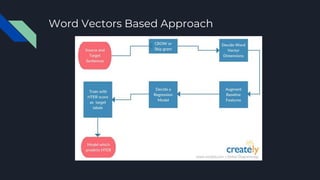
Word Vectors Based Approach
RNN Based Approach
Results (Pearson’s score)
Word Vectors based approach
- For German-English: 0.45
- For English-German: 0.43
RNN based approach
- For German-English: 0.63
- For English-German: 0.55
Possible Improvements
Word Vectors based approach
- Using neural networks based
regression to improve the results
RNN based approach
- Train the RNN model with a large
parallel corpus giving more
accurate quality estimation vectors
which will give us a huge boost
- Incorporating more features along
with the generated QEV
Thanks
Link for website
https://talent404.github.io/IRE-MTQE/
Link for code
https://github.com/talent404/IRE-MTQE

Machine Translation Quality Estimation

  • 1.
    Machine Translation Quality Estimation V HarshaVardhan Neeraj Battan Kartavya Gupta Professor: Vasudeva Verma Mentor: Nisarg Jhaveri
  • 2.
  • 3.
    Shared Task: QualityEstimation The aim of our project is to determine the quality of a machine translated text by predicting the HTER (Human-targeted Translation Error Rate) scores. Data provided by the shared task of Quality Estimation contains english to spanish and spanish to english machine translated sentences with respective HTER scores 17 Baseline features are provided
  • 4.
    Applications - Decide whethera given translation is good enough of publishing as it is - Inform readers of the target language only whether or not they can rely on a translation - Filter out the sentences which are not good enough for posting and need post-editing by human - Select the best translation among options from multiple Machine Translation and/or translation memory systems - Highlight the words that need post-editing task
  • 5.
  • 6.
  • 7.
  • 8.
    Results (Pearson’s score) WordVectors based approach - For German-English: 0.45 - For English-German: 0.43 RNN based approach - For German-English: 0.63 - For English-German: 0.55
  • 9.
    Possible Improvements Word Vectorsbased approach - Using neural networks based regression to improve the results RNN based approach - Train the RNN model with a large parallel corpus giving more accurate quality estimation vectors which will give us a huge boost - Incorporating more features along with the generated QEV
  • 10.
    Thanks Link for website https://talent404.github.io/IRE-MTQE/ Linkfor code https://github.com/talent404/IRE-MTQE