GENE
THERAPHY
WHAT IS GENE THERAPHY?
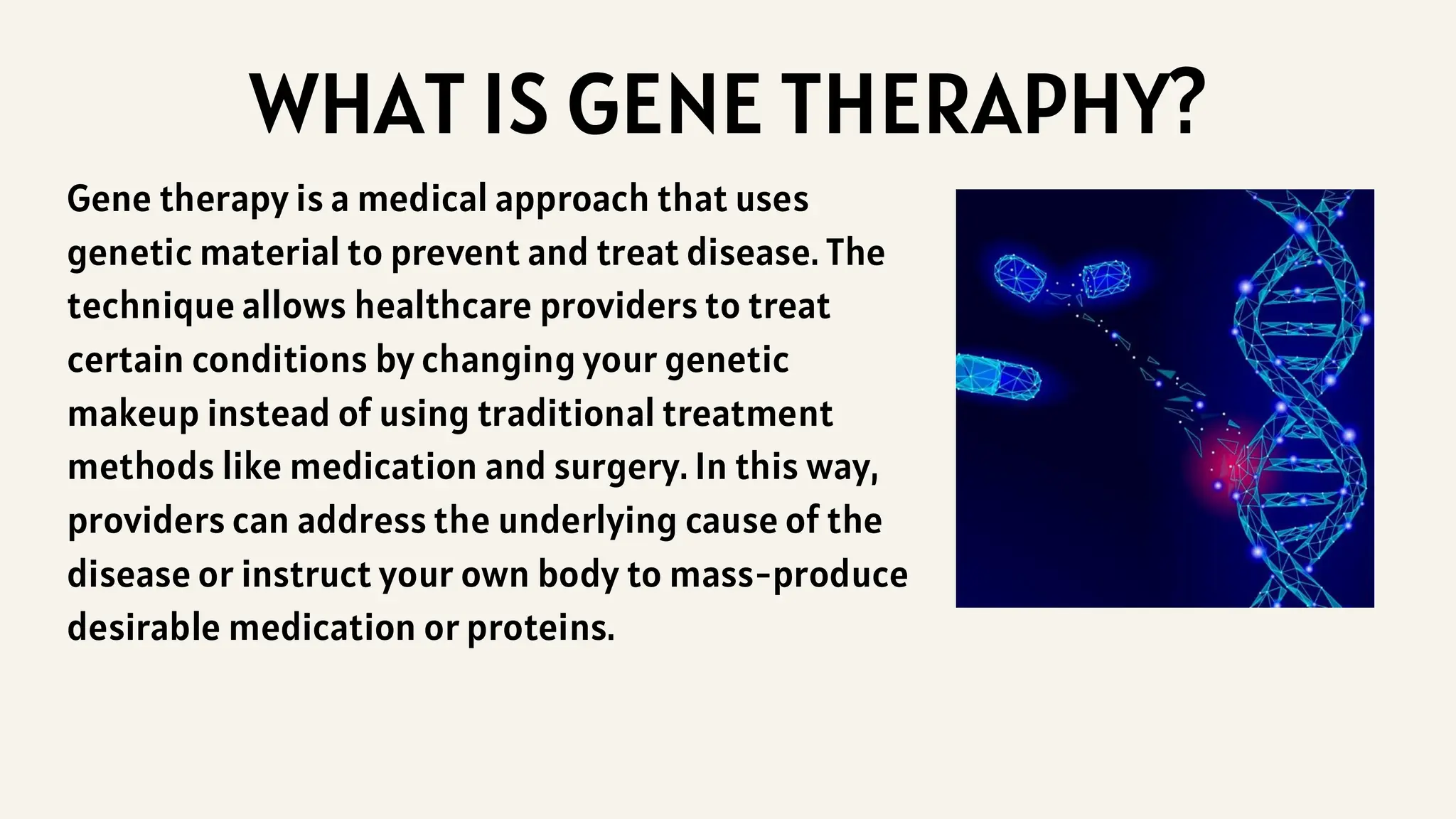
Gene therapy is a medical approach that uses
genetic material to prevent and treat disease. The
technique allows healthcare providers to treat
certain conditions by changing your genetic
makeup instead of using traditional treatment
methods like medication and surgery. In this way,
providers can address the underlying cause of the
disease or instruct your own body to mass-produce
desirable medication or proteins.
1
2
3
Reduce levels of certain disease causing proteins.
Increase production of working proteins.
Produce new or modified proteins with cell.
In gene therapy, genetic material is transferred to your cells. This genetic
material then changes how your cells produce proteins. It can:
HISTORY OF GENE THERAPHY
Gene therapy began in the 1960s with the first successful
direct incorporation of functional DNA into a mammalian
cell by biochemist Dr. Lorraine Marquardt Kraus. The first
attempt at gene therapy in humans was in 1980 by Martin
Cline, but it was unsuccessful. The first widely accepted
success was in 1990 when Ashanthi DeSilva was treated
for ADA-SCID.
HOW GENE THERAPHY HELPS?
Gene therapy targets the root cause of genetic diseases.
Our genes, sections of DNA, instruct protein production,
crucial for bodily functions. Genetic changes (gene
variants) can disrupt this process, causing disease. These
variants can arise naturally, through environmental
factors, or be inherited. Gene therapy aims to correct
these errors, acting like a blueprint repair to fix missing
parts or correct mistakes in the body's genetic code.
WHAT IS GENE THERAPHY USED FOR?
Most gene therapies are still in the clinical trial
phase. Clinical trials play an important role in finding
treatments that are safe and effective. Clinical trials
are investigating gene therapy for the treatment of
cancer, macular degeneration and other eye
diseases, certain genetic conditions and HIV/AIDS.
1
2
Luxturna - Approved in December 2017, and is a one-time treatment used
to improve vision in people with genetic vision loss due to certain
inherited retinal (eye) diseases. Zolgensma®- It's the FDA approved in May
2019 to treat spinal muscular atrophy in children younger than 2 years old.
Zolgensma - It's the FDA approved in May 2019 to treat spinal muscular
atrophy in children younger than 2 years old.
The U.S. Food and Drug Administration (FDA) has approved two gene therapies
for use in the U.S. :
APPROACH TO
GENE THERAPHY
HOW DOES GENE THERAPHY WORK?
Gene therapy replaces or disables faulty genes,
sometimes introducing new ones to treat diseases.
Healthcare providers deliver a healthy gene copy to
cells, replacing a damaged gene, inactivating a
mutated one, or introducing a new gene. This alters
cellular protein production. This can be achieved
through:
GENE ADDITION
Gene addition inserts a new copy of a gene into
your cells. The working gene has instructions for
the cell to produce more of the specific protein it
needs. This method most often uses an adeno-
associated virus (AAV) to carry the gene to the
cells.
GENE SILENCING
Gene silencing transfers genetic material that
prevents the activity of a gene that’s already
in a cell. This method decreases the amount of
a specific protein the cell is making by
targeting messenger RNA (mRNA).
GENE EDITING
Gene editing modifies parts of your DNA by altering
or deleting elements within your gene. Genetic
material is delivered to edit or change pieces of
DNA located within a cell, which corrects the
protein that the DNA is producing. Gene editing
uses technology like CRISPR/cas9.
HOW IS THE GENETIC MATERIAL DELIVERED?
The genetic material needs help getting where it needs to
go, like being wrapped in a package with an address label.
This package is known as a vector. Viruses are usually used
as vectors because they’ve evolved to be very good at
getting into cells. Scientists use the same ability to deliver
the genetic material into your cells. Any disease-causing
part of a virus is removed, allowing it to enter your cells
without making you sick.
Gene therapy requires effective delivery systems, often using vectors (commonly
modified viruses) to transport genetic material into cells. There are two primary
methods of delivery:
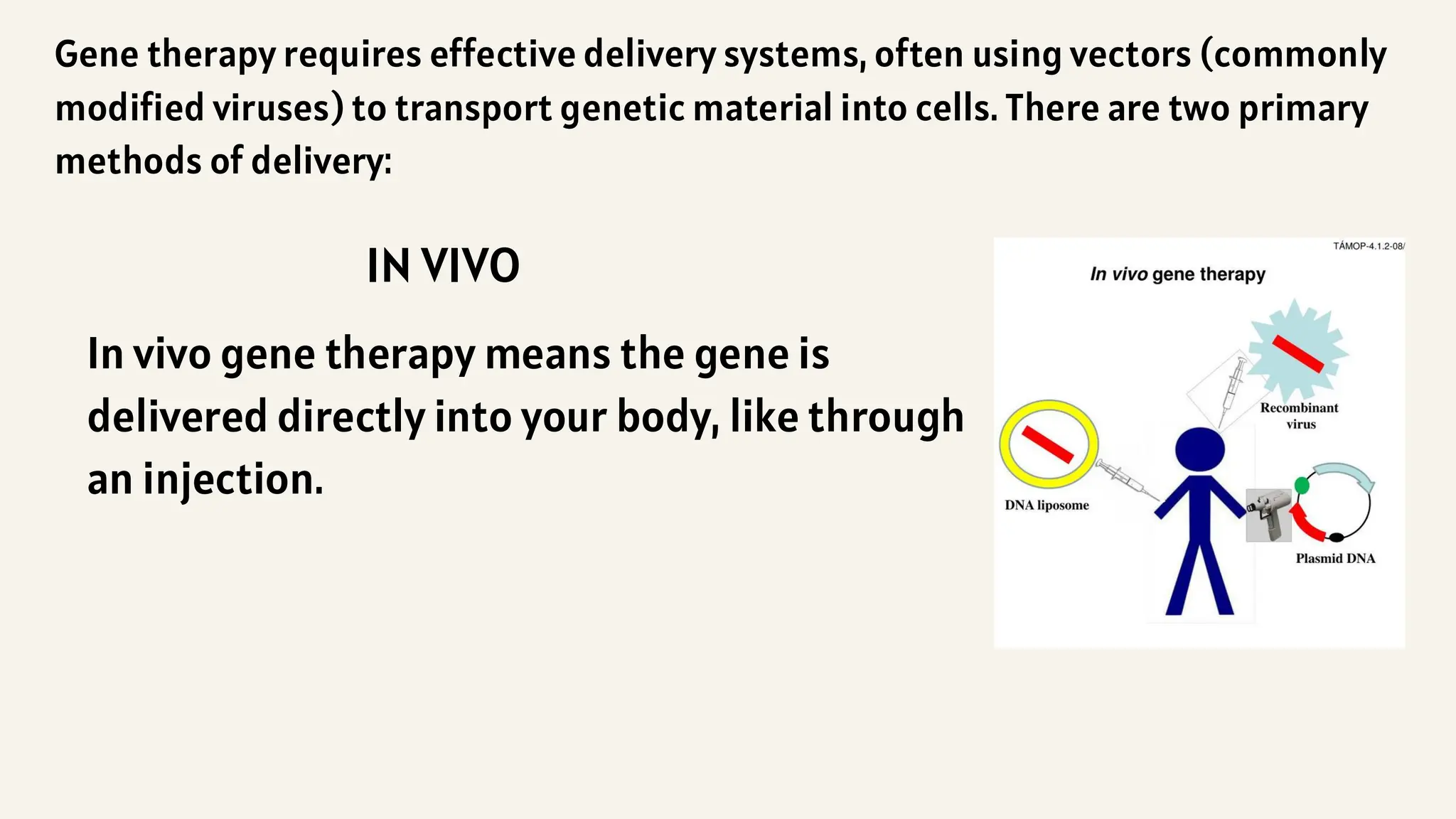
IN VIVO
In vivo gene therapy means the gene is
delivered directly into your body, like through
an injection.
Gene therapy requires effective delivery systems, often using vectors (commonly
modified viruses) to transport genetic material into cells. There are two primary
methods of delivery:
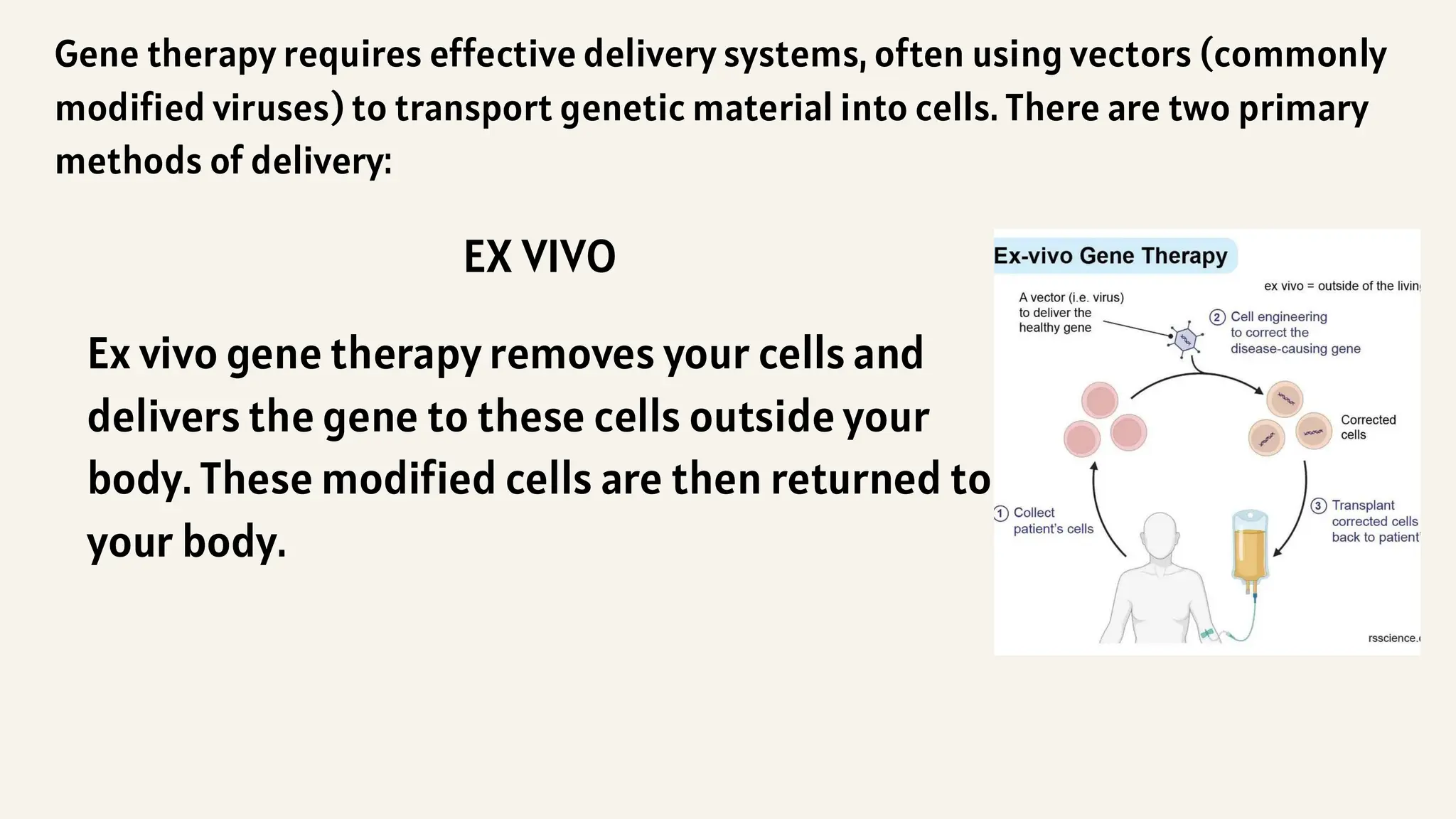
EX VIVO
Ex vivo gene therapy removes your cells and
delivers the gene to these cells outside your
body. These modified cells are then returned to
your body.
STEM CELL
THERAPHY
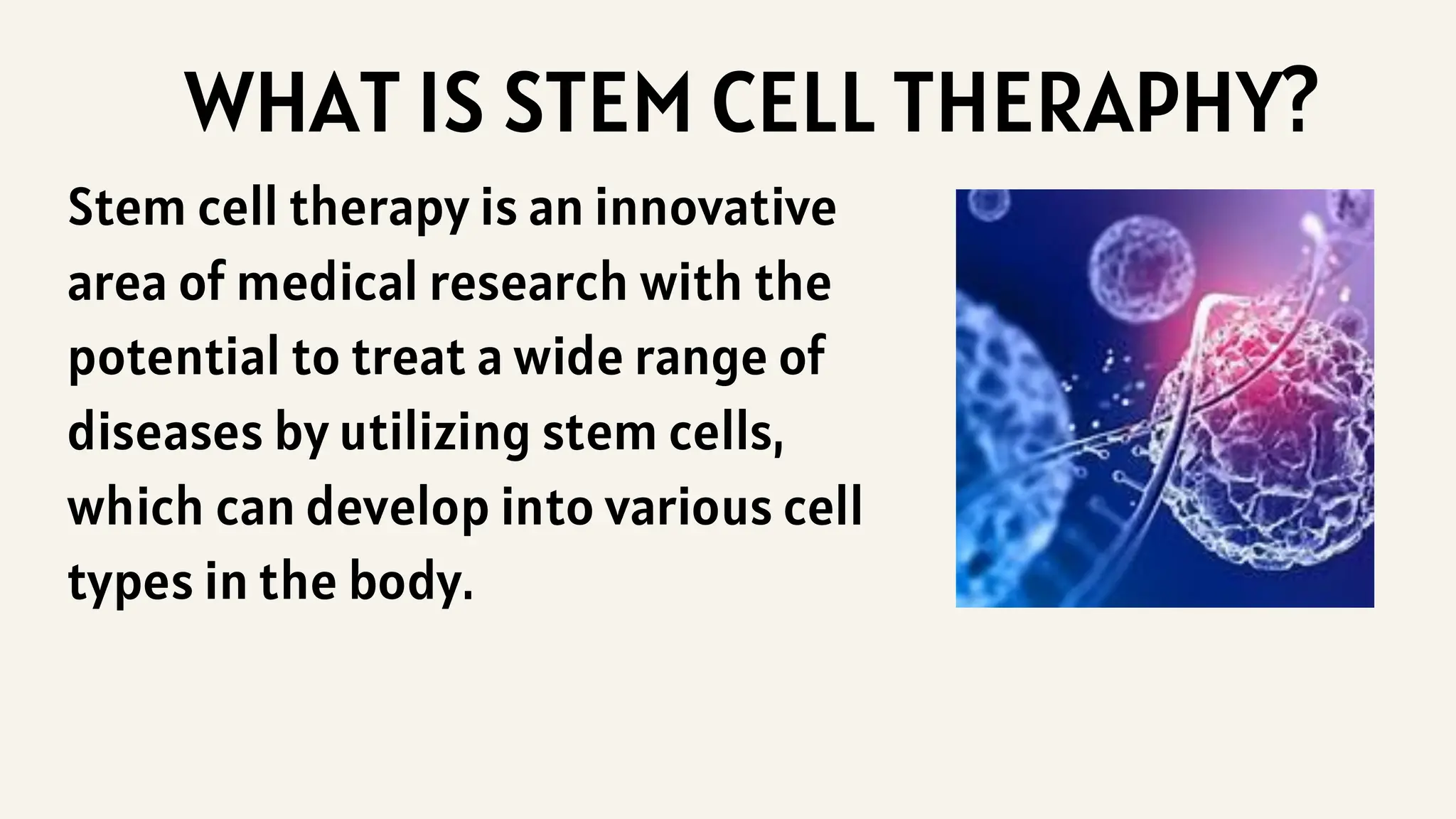
Stem cell therapy is an innovative
area of medical research with the
potential to treat a wide range of
diseases by utilizing stem cells,
which can develop into various cell
types in the body.
WHAT IS STEM CELL THERAPHY?
ESTABLISHED THERAPHY
The only established stem cell therapy is
hematopoietic stem cell transplantation
(HSCT), commonly known as bone marrow
transplantation, which is used to treat
conditions like leukemia and lymphoma.
Stem Cell Delivery Methods
Direct Injection - Stem cells are directly injected into the affected
tissue or organ.
Scaffolding - Stem cells are incorporated into a supportive scaffold to
facilitate tissue regeneration and structural integrity.
Systemic Administration - Stem cells are administered intravenously
or intra-arterially, allowing for wider distribution throughout the
body.
Stem cells can be administered through:
APPLICATIONS OF STEM CELL THERAPHY
Neurological Disorders - Treatment of stroke, traumatic brain injury,
spinal cord injuries, and neurodegenerative diseases.
Cardiovascular Diseases - Repair of damaged heart tissue and
improvement of heart function.
Hematological Disorders - Generation of mature red blood cells for
gene therapy, blood transfusions, and topical medicinal applications.
The potential applications of stem cell therapy are vast and span multiple medical fields
Dental Regeneration - Successful cultivation of complete teeth in animal models.
Otology - Potential for regenerating cochlear hair cells to improve hearing.
Ophthalmology - Restoration of vision through corneal stem cell transplantation.
Endocrinology - Generation of insulin-producing beta cells for type 1 diabetes treatment.
Orthopedics - Treatment of bone and muscle trauma, cartilage repair, and osteoarthritis.
Wound Healing - Stimulation of tissue growth for improved wound healing and
regeneration.
Infectious Diseases - Development of disease-resistant immune systems for HIV/AIDS
patients.
Drug Discovery and Biomedical Research - Creation of functional adult tissues for drug
development and research.
Conservation Biology - Potential applications in regenerating cells from endangered species.
Ethical and Practical Challenges - While showing significant promise, the field also faces ethical
and practical challenges:
Embryonic Stem Cells - The derivation process often involves the destruction of embryos,
sparking intense ethical debates and political controversies.
Somatic Cell Nuclear Transfer (SCNT) - Concerns exist regarding the potential misuse of this
technology for human cloning.
Umbilical Cord Blood - The marketing and efficacy of treatments utilizing stored umbilical cord
blood remain controversial.
Many unproven therapies are still in early stages of development,
and their long term efficacy and safety require further investigation.
There ethical concern on the implications of embryonic stem cell
use continue to generate debate.
The cost of stem cell therapies can be prohibitive for many patients.
Despite its promise, stem cell therapy faces several
challenges:

THANK YOU

GENE THERAPHY SCIENCE TECHNOLOGY AND SOC

  • 1.
  • 2.
    WHAT IS GENETHERAPHY? Gene therapy is a medical approach that uses genetic material to prevent and treat disease. The technique allows healthcare providers to treat certain conditions by changing your genetic makeup instead of using traditional treatment methods like medication and surgery. In this way, providers can address the underlying cause of the disease or instruct your own body to mass-produce desirable medication or proteins.
  • 3.
    1 2 3 Reduce levels ofcertain disease causing proteins. Increase production of working proteins. Produce new or modified proteins with cell. In gene therapy, genetic material is transferred to your cells. This genetic material then changes how your cells produce proteins. It can:
  • 4.
    HISTORY OF GENETHERAPHY Gene therapy began in the 1960s with the first successful direct incorporation of functional DNA into a mammalian cell by biochemist Dr. Lorraine Marquardt Kraus. The first attempt at gene therapy in humans was in 1980 by Martin Cline, but it was unsuccessful. The first widely accepted success was in 1990 when Ashanthi DeSilva was treated for ADA-SCID.
  • 5.
    HOW GENE THERAPHYHELPS? Gene therapy targets the root cause of genetic diseases. Our genes, sections of DNA, instruct protein production, crucial for bodily functions. Genetic changes (gene variants) can disrupt this process, causing disease. These variants can arise naturally, through environmental factors, or be inherited. Gene therapy aims to correct these errors, acting like a blueprint repair to fix missing parts or correct mistakes in the body's genetic code.
  • 6.
    WHAT IS GENETHERAPHY USED FOR? Most gene therapies are still in the clinical trial phase. Clinical trials play an important role in finding treatments that are safe and effective. Clinical trials are investigating gene therapy for the treatment of cancer, macular degeneration and other eye diseases, certain genetic conditions and HIV/AIDS.
  • 7.
    1 2 Luxturna - Approvedin December 2017, and is a one-time treatment used to improve vision in people with genetic vision loss due to certain inherited retinal (eye) diseases. Zolgensma®- It's the FDA approved in May 2019 to treat spinal muscular atrophy in children younger than 2 years old. Zolgensma - It's the FDA approved in May 2019 to treat spinal muscular atrophy in children younger than 2 years old. The U.S. Food and Drug Administration (FDA) has approved two gene therapies for use in the U.S. :
  • 8.
  • 9.
    HOW DOES GENETHERAPHY WORK? Gene therapy replaces or disables faulty genes, sometimes introducing new ones to treat diseases. Healthcare providers deliver a healthy gene copy to cells, replacing a damaged gene, inactivating a mutated one, or introducing a new gene. This alters cellular protein production. This can be achieved through:
  • 10.
    GENE ADDITION Gene additioninserts a new copy of a gene into your cells. The working gene has instructions for the cell to produce more of the specific protein it needs. This method most often uses an adeno- associated virus (AAV) to carry the gene to the cells.
  • 11.
    GENE SILENCING Gene silencingtransfers genetic material that prevents the activity of a gene that’s already in a cell. This method decreases the amount of a specific protein the cell is making by targeting messenger RNA (mRNA).
  • 12.
    GENE EDITING Gene editingmodifies parts of your DNA by altering or deleting elements within your gene. Genetic material is delivered to edit or change pieces of DNA located within a cell, which corrects the protein that the DNA is producing. Gene editing uses technology like CRISPR/cas9.
  • 13.
    HOW IS THEGENETIC MATERIAL DELIVERED? The genetic material needs help getting where it needs to go, like being wrapped in a package with an address label. This package is known as a vector. Viruses are usually used as vectors because they’ve evolved to be very good at getting into cells. Scientists use the same ability to deliver the genetic material into your cells. Any disease-causing part of a virus is removed, allowing it to enter your cells without making you sick.
  • 14.
    Gene therapy requireseffective delivery systems, often using vectors (commonly modified viruses) to transport genetic material into cells. There are two primary methods of delivery: IN VIVO In vivo gene therapy means the gene is delivered directly into your body, like through an injection.
  • 15.
    Gene therapy requireseffective delivery systems, often using vectors (commonly modified viruses) to transport genetic material into cells. There are two primary methods of delivery: EX VIVO Ex vivo gene therapy removes your cells and delivers the gene to these cells outside your body. These modified cells are then returned to your body.
  • 17.
  • 18.
    Stem cell therapyis an innovative area of medical research with the potential to treat a wide range of diseases by utilizing stem cells, which can develop into various cell types in the body. WHAT IS STEM CELL THERAPHY?
  • 19.
    ESTABLISHED THERAPHY The onlyestablished stem cell therapy is hematopoietic stem cell transplantation (HSCT), commonly known as bone marrow transplantation, which is used to treat conditions like leukemia and lymphoma.
  • 20.
    Stem Cell DeliveryMethods Direct Injection - Stem cells are directly injected into the affected tissue or organ. Scaffolding - Stem cells are incorporated into a supportive scaffold to facilitate tissue regeneration and structural integrity. Systemic Administration - Stem cells are administered intravenously or intra-arterially, allowing for wider distribution throughout the body. Stem cells can be administered through:
  • 21.
    APPLICATIONS OF STEMCELL THERAPHY Neurological Disorders - Treatment of stroke, traumatic brain injury, spinal cord injuries, and neurodegenerative diseases. Cardiovascular Diseases - Repair of damaged heart tissue and improvement of heart function. Hematological Disorders - Generation of mature red blood cells for gene therapy, blood transfusions, and topical medicinal applications. The potential applications of stem cell therapy are vast and span multiple medical fields
  • 22.
    Dental Regeneration -Successful cultivation of complete teeth in animal models. Otology - Potential for regenerating cochlear hair cells to improve hearing. Ophthalmology - Restoration of vision through corneal stem cell transplantation. Endocrinology - Generation of insulin-producing beta cells for type 1 diabetes treatment. Orthopedics - Treatment of bone and muscle trauma, cartilage repair, and osteoarthritis. Wound Healing - Stimulation of tissue growth for improved wound healing and regeneration. Infectious Diseases - Development of disease-resistant immune systems for HIV/AIDS patients.
  • 23.
    Drug Discovery andBiomedical Research - Creation of functional adult tissues for drug development and research. Conservation Biology - Potential applications in regenerating cells from endangered species. Ethical and Practical Challenges - While showing significant promise, the field also faces ethical and practical challenges: Embryonic Stem Cells - The derivation process often involves the destruction of embryos, sparking intense ethical debates and political controversies. Somatic Cell Nuclear Transfer (SCNT) - Concerns exist regarding the potential misuse of this technology for human cloning. Umbilical Cord Blood - The marketing and efficacy of treatments utilizing stored umbilical cord blood remain controversial.
  • 24.
    Many unproven therapiesare still in early stages of development, and their long term efficacy and safety require further investigation. There ethical concern on the implications of embryonic stem cell use continue to generate debate. The cost of stem cell therapies can be prohibitive for many patients. Despite its promise, stem cell therapy faces several challenges:
  • 26.