Writing Chemical
Formula
-is a way of expressing information about the
proportions of atoms that constitute a
particular chemical compound, using a single
line ofchemical element symbols, numbers,
and sometimes also other symbols, such as
parentheses, dashes, brackets, commas
and plus (+) and minus ( ) signs.
−
•The chemical formula of a covalent
molecular compound tells us the number of
atoms of each element present in the
compound.
•E.g. Water H2O -The formula tells us that
there are 2 Hydrogen atoms and 1 oxygen
atom present in each water molecule.
•The chemical formula of a covalent network
tells us the ratio of the elements present.
E.g. Silicon dioxide, SiO2 structure-The
formula tells us there are 2 silicon atoms
present for every 1 oxygen atom.
•The chemical formula of an ionic compound
tells us the ratio of the elements present.
E.g. Sodium chloride, NaCl – The formula
tells us there is one ion of sodium for every
one ion of chlorine
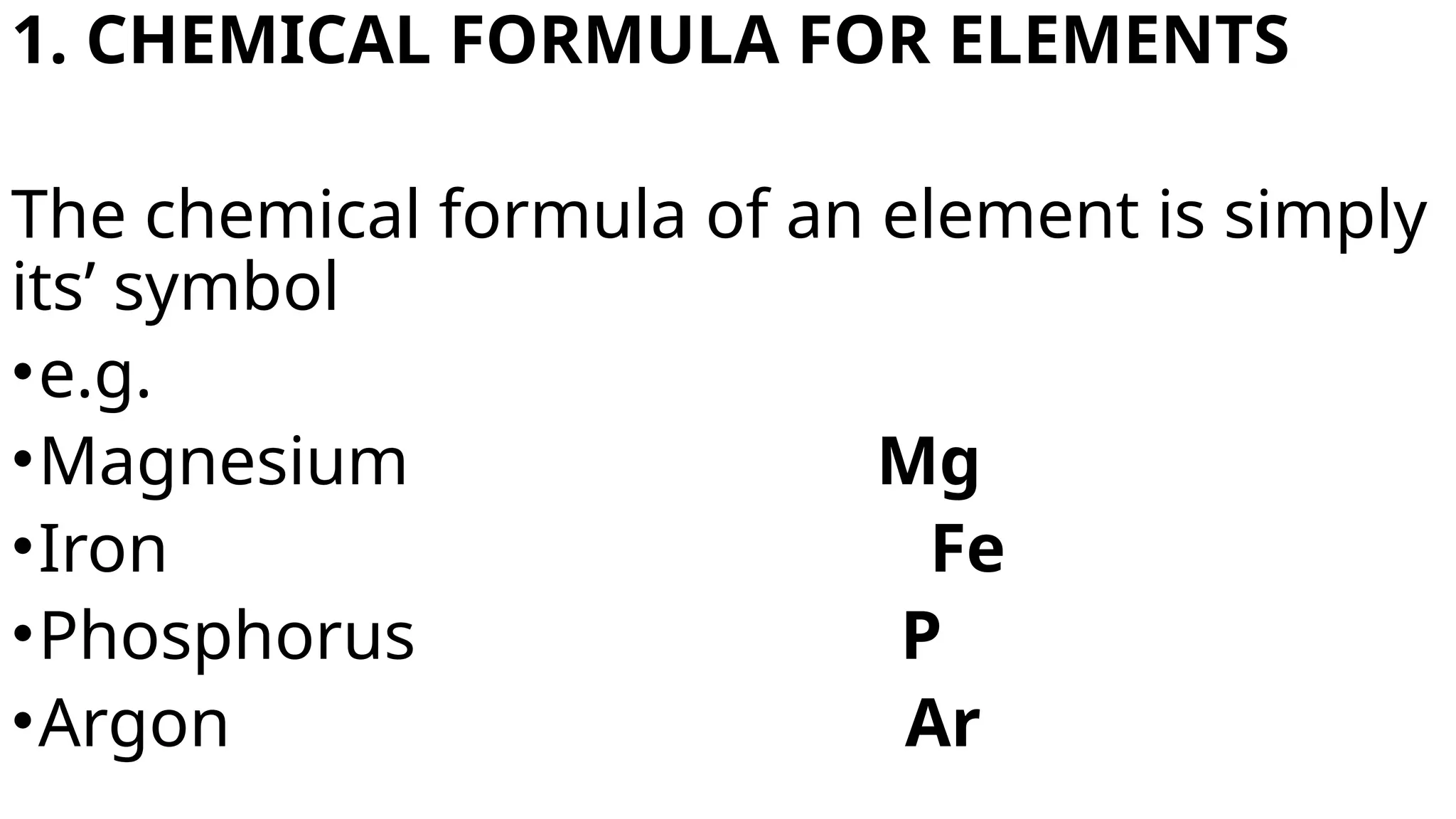
1. CHEMICAL FORMULA FOR ELEMENTS
The chemical formula of an element is simply
its’ symbol
•e.g.
•Magnesium Mg
•Iron Fe
•Phosphorus P
•Argon Ar
2. USING VALENCY
The valency of an atom or ion is the number
of electrons it shares, loses or gains in a
chemical reaction to become stable i.e. the
number of bonds it forms with other atoms
Table:
•Group number 1 2 3 4 5 6 7 0
We can follow a set of simple rules to write
chemical formula:
1. Write symbols of elements present in
compound
2. Put valency above each symbol
3. Cross valency over (swap and drop)
4. Cancel down ratio if necessary
5. Write correct chemical formula
Example
1.Sodium chloride
Na Cl
Na1 Cl1
Na1 Cl1
(Not needed)
NaCl
3. ROMAN NUMERALS
•Some elements, particularly the transition metals in
the centre block of the periodic table can have more
than one valency.
Roman Numeral Valency
•I 1
•II 2
•III 3
•IV 4
•V 5
•VI 6
Example 1. Copper(II) chloride
Cu Cl
Cu2
Cl1
Cu1 Cl2
CuCl2
Example 2. Iron(III)fluoride
Fe F
Fe3
F1
Fe1 F3
FeF3
4. PREFIXES
•In the names of some compounds the ratio of
atoms present can be indicated by prefixes.
•Prefix Meaning
•Mono 1
•Di 2
•Tri 3
•Tetra 4
•Penta 5
•Hexa 6
Examples:
Carbon monoxide CO
Nitrogen dioxide NO2
Phosphorus trichloride PCl3
Phosphorus pentachloride PCl5
Dinitrogen tetroxide N2O4
5.Polyatomic Ions
•Ions formed by more than one type of
element
•Atoms of different elements held together
by covalent bonds
•Atoms always stay together and collectively
have a single charge
•Do not always have “-ide” ending
ex: NH4
1-
= ammonium ion
CO3
2-
= carbonate
6. IONIC FORMULA
•The ionic formula shows the charges of the
ions present in an ionic substance.
GROUP NUMBER
1
2
3
4
5
6
7
0
VALENCY
1
2
3
4
3
2
1
0
CHARGE ON ION
1+
2+
3+
4
3-
2-
1-
0
• The order of common nonmetals in binary compound formulas is C, P,
N, H, S, I, Br, Cl, O, F.
Empirical and Molecular Formula
Empirical Formula
• Empirical formulas are the simplest, whole number ratio
of elements in a compound.
• It’s the reduced chemical formula
• Example: Benzene – C6H6 (molecular formula) CH (empirical
formula)
• Water – H2O (molecular formula) H2O (empirical formula)
• The empirical formula CAN be the same as a molecular
formula
Solve for Empirical Formula:
A compound is found to be 34.53% zinc, 14.79% nitrogen, and
50.68% oxygen. Calculate the empirical formula for this
compound.
1. 34.53% = 0.3453 x 100 = 34.53
2. Divide 34.53 to the atomic weight of zinc (in the periodic
table).
= 34.53/65.38
= 0.53mol
3. Divide by the smallest answer.
Solve:
A compound is composed of 52.14% Carbon, 13.13%
Hydrogen, and 34.73% Oxygen by mass. A)What is the
empirical formula? B) If the molar mass of the compound is
138.204 g/mol, what is the molecular formula?
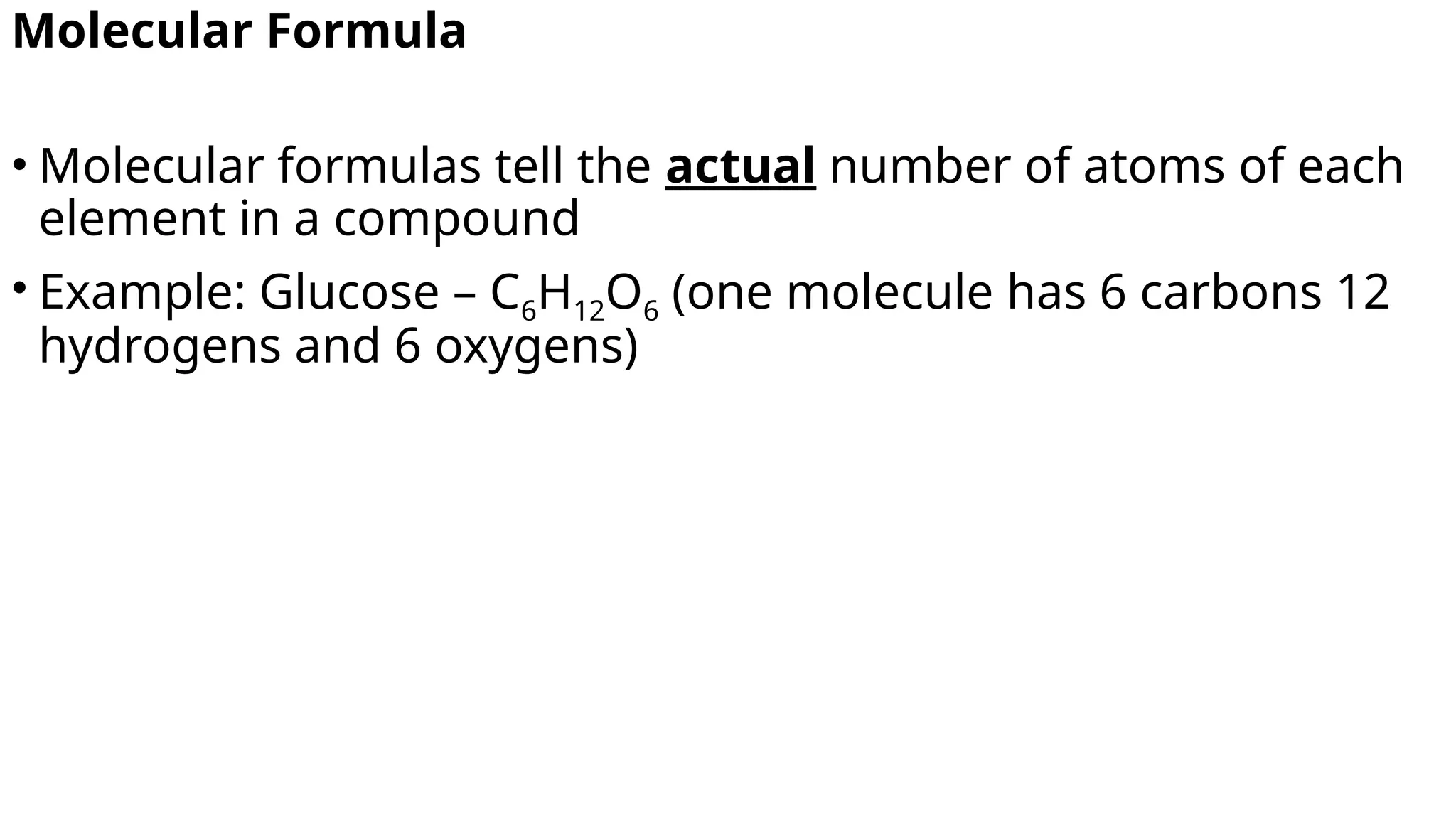
Molecular Formula
• Molecular formulas tell the actual number of atoms of each
element in a compound
• Example: Glucose – C6H12O6 (one molecule has 6 carbons 12
hydrogens and 6 oxygens)
Solve for Molecular Formula:
C6H12O6
1. Calculate molar mass for the empirical formula
2. Find the molar mass given in the problem.
3. Find the “number” n
4. Multiply each subscript in the empirical formula by n
(“number”)
5. Write the formula with the metal first or in the order in which
it was given if there is no metal.
Solve:
A compound is composed of 52.14% Carbon, 13.13%
Hydrogen, and 34.73% Oxygen by mass. A)What is the
empirical formula? B) If the molar mass of the compound is
138.204 g/mol, what is the molecular formula?
Quiz:
Determine the empirical and molecular formula
for chrysotile asbestos. Chrysotile has the following
percent composition: 28.03% Mg, 21.60% Si, 1.16% H,
and 49.21% O. The molar mass for chrysotile is 520.8
g/mol.
GenChem1-Writing Chemical Formula and Empirical/Molecular.pptx

GenChem1-Writing Chemical Formula and Empirical/Molecular.pptx

  • 1.
  • 2.
    -is a wayof expressing information about the proportions of atoms that constitute a particular chemical compound, using a single line ofchemical element symbols, numbers, and sometimes also other symbols, such as parentheses, dashes, brackets, commas and plus (+) and minus ( ) signs. −
  • 3.
    •The chemical formulaof a covalent molecular compound tells us the number of atoms of each element present in the compound. •E.g. Water H2O -The formula tells us that there are 2 Hydrogen atoms and 1 oxygen atom present in each water molecule.
  • 4.
    •The chemical formulaof a covalent network tells us the ratio of the elements present. E.g. Silicon dioxide, SiO2 structure-The formula tells us there are 2 silicon atoms present for every 1 oxygen atom.
  • 5.
    •The chemical formulaof an ionic compound tells us the ratio of the elements present. E.g. Sodium chloride, NaCl – The formula tells us there is one ion of sodium for every one ion of chlorine
  • 6.
    1. CHEMICAL FORMULAFOR ELEMENTS The chemical formula of an element is simply its’ symbol •e.g. •Magnesium Mg •Iron Fe •Phosphorus P •Argon Ar
  • 7.
    2. USING VALENCY Thevalency of an atom or ion is the number of electrons it shares, loses or gains in a chemical reaction to become stable i.e. the number of bonds it forms with other atoms Table: •Group number 1 2 3 4 5 6 7 0
  • 9.
    We can followa set of simple rules to write chemical formula: 1. Write symbols of elements present in compound 2. Put valency above each symbol 3. Cross valency over (swap and drop) 4. Cancel down ratio if necessary 5. Write correct chemical formula
  • 10.
    Example 1.Sodium chloride Na Cl Na1Cl1 Na1 Cl1 (Not needed) NaCl
  • 11.
    3. ROMAN NUMERALS •Someelements, particularly the transition metals in the centre block of the periodic table can have more than one valency. Roman Numeral Valency •I 1 •II 2 •III 3 •IV 4 •V 5 •VI 6
  • 12.
    Example 1. Copper(II)chloride Cu Cl Cu2 Cl1 Cu1 Cl2 CuCl2
  • 13.
    Example 2. Iron(III)fluoride FeF Fe3 F1 Fe1 F3 FeF3
  • 14.
    4. PREFIXES •In thenames of some compounds the ratio of atoms present can be indicated by prefixes. •Prefix Meaning •Mono 1 •Di 2 •Tri 3 •Tetra 4 •Penta 5 •Hexa 6
  • 15.
    Examples: Carbon monoxide CO Nitrogendioxide NO2 Phosphorus trichloride PCl3 Phosphorus pentachloride PCl5 Dinitrogen tetroxide N2O4
  • 16.
    5.Polyatomic Ions •Ions formedby more than one type of element •Atoms of different elements held together by covalent bonds •Atoms always stay together and collectively have a single charge •Do not always have “-ide” ending ex: NH4 1- = ammonium ion CO3 2- = carbonate
  • 17.
    6. IONIC FORMULA •Theionic formula shows the charges of the ions present in an ionic substance.
  • 18.
  • 19.
    • The orderof common nonmetals in binary compound formulas is C, P, N, H, S, I, Br, Cl, O, F.
  • 20.
  • 21.
    Empirical Formula • Empiricalformulas are the simplest, whole number ratio of elements in a compound. • It’s the reduced chemical formula • Example: Benzene – C6H6 (molecular formula) CH (empirical formula) • Water – H2O (molecular formula) H2O (empirical formula) • The empirical formula CAN be the same as a molecular formula
  • 22.
    Solve for EmpiricalFormula: A compound is found to be 34.53% zinc, 14.79% nitrogen, and 50.68% oxygen. Calculate the empirical formula for this compound. 1. 34.53% = 0.3453 x 100 = 34.53 2. Divide 34.53 to the atomic weight of zinc (in the periodic table). = 34.53/65.38 = 0.53mol 3. Divide by the smallest answer.
  • 23.
    Solve: A compound iscomposed of 52.14% Carbon, 13.13% Hydrogen, and 34.73% Oxygen by mass. A)What is the empirical formula? B) If the molar mass of the compound is 138.204 g/mol, what is the molecular formula?
  • 24.
    Molecular Formula • Molecularformulas tell the actual number of atoms of each element in a compound • Example: Glucose – C6H12O6 (one molecule has 6 carbons 12 hydrogens and 6 oxygens)
  • 25.
    Solve for MolecularFormula: C6H12O6 1. Calculate molar mass for the empirical formula 2. Find the molar mass given in the problem. 3. Find the “number” n 4. Multiply each subscript in the empirical formula by n (“number”) 5. Write the formula with the metal first or in the order in which it was given if there is no metal.
  • 26.
    Solve: A compound iscomposed of 52.14% Carbon, 13.13% Hydrogen, and 34.73% Oxygen by mass. A)What is the empirical formula? B) If the molar mass of the compound is 138.204 g/mol, what is the molecular formula?
  • 27.
    Quiz: Determine the empiricaland molecular formula for chrysotile asbestos. Chrysotile has the following percent composition: 28.03% Mg, 21.60% Si, 1.16% H, and 49.21% O. The molar mass for chrysotile is 520.8 g/mol.