
GENERAL
ELECTRICS

        By :
        Ishit Bhatt
        Kapil Rajput
        Prayag Chauhan
        Ronak Thacker
History of
• Established in 1879 by Thomas Alva Edison, backing of
 banker J.P.Morgan as Electric Light Company.

• Started manufacturing light bulbs & ele. equipment.


• Edison was great inventor but not far-sighted manager.


• Later Morgan took over charge and named it as General
 Electric Co.
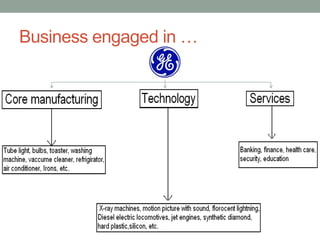
Business engaged in …
Life cycle of Jack Welch
• Born - 19th November 1935 at Massachusetts
• Father was of passive conductor in train
• Mother was dominating women and a housewife
• He was a brilliant student at the University of
    Massachusetts
•   He did doctorate in Chemical Engineering from University
    of Illinois
•   He joined GE plastic factory in 1960
•   In 1981 he became CEO of GE
•   He retired from GE in September 2001
•   Became national hero
Traits of Jack Welch
• Blunt – Speaks their own mind

• Self motivated

• Impatient with subordinates

• Emotionally volatile – Unpredictable behavior

• Fiery tempered

• Neutron Jack

• Charismatic leader

• Not meliable
Traits of Welch
• Vision: Ability to see around corners, probe consensus
 thinking and swiftly make a change when the market
 demands it.

• Leadership: Track-record with people: How one supports
 and guides people who are working with him.

• Crisis-management ability: Experience and courage to
 overcome a crisis.
Achievements of
• Rapid growth
  • If Invested $100 in 1981 value becomes $6749 in 2001 (664% )


• Monopoly in bulb market
• Acquisition of RCA
• New technology
• Boundary-less organization
• Expansion in new areas
• Improved productivity in locomotives
Malpractices of
• High employee turnover
  • As, Bs & Cs
  • 1 of every 4 employees was gone


• Not fulfilling corporate social responsibility
  • Polluting Hudson river by releasing polychlorinated biphenyls


• Pension fund


• Criminal activities
  • Deceptive advertising of light bulbs & unfair debt collection
  • 39 law violation
  • Contracting fraud
Activities of Jack
• Took company from $14 billion to $410 billion during his
 20 years of journey in GE

• Removal of bureaucracy


• Adopted boundary less organization


• Adopted Six sigma to eliminating defects


• Selling of low profit companies


• High rate profitability
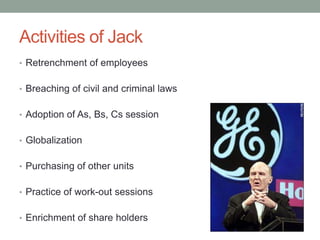
Activities of Jack
• Retrenchment of employees


• Breaching of civil and criminal laws


• Adoption of As, Bs, Cs session


• Globalization


• Purchasing of other units


• Practice of work-out sessions


• Enrichment of share holders
For society …
• Paid taxes of $5.7 billion in 2000.


• Managers became multimillionaire in GE stock.


• Made $40 million in grants to colleges, universities, &
 non-profit group.

• Community projects
  • Tutoring
  • Playground construction
  • Repairing school equipment & rec. machines for blind
  • Special Olympics
Other side of coin
• Pressured cities, countries & states to lower taxes by
 threatening to move operation elsewhere.

• This lowered budget for schools and infrastructure.


• Manipulating laws which are in favor of company.
Summary

Gen ele

  • 1.
    GENERAL ELECTRICS By : Ishit Bhatt Kapil Rajput Prayag Chauhan Ronak Thacker
  • 2.
    History of • Establishedin 1879 by Thomas Alva Edison, backing of banker J.P.Morgan as Electric Light Company. • Started manufacturing light bulbs & ele. equipment. • Edison was great inventor but not far-sighted manager. • Later Morgan took over charge and named it as General Electric Co.
  • 3.
  • 4.
    Life cycle ofJack Welch • Born - 19th November 1935 at Massachusetts • Father was of passive conductor in train • Mother was dominating women and a housewife • He was a brilliant student at the University of Massachusetts • He did doctorate in Chemical Engineering from University of Illinois • He joined GE plastic factory in 1960 • In 1981 he became CEO of GE • He retired from GE in September 2001 • Became national hero
  • 5.
    Traits of JackWelch • Blunt – Speaks their own mind • Self motivated • Impatient with subordinates • Emotionally volatile – Unpredictable behavior • Fiery tempered • Neutron Jack • Charismatic leader • Not meliable
  • 6.
    Traits of Welch •Vision: Ability to see around corners, probe consensus thinking and swiftly make a change when the market demands it. • Leadership: Track-record with people: How one supports and guides people who are working with him. • Crisis-management ability: Experience and courage to overcome a crisis.
  • 7.
    Achievements of • Rapidgrowth • If Invested $100 in 1981 value becomes $6749 in 2001 (664% ) • Monopoly in bulb market • Acquisition of RCA • New technology • Boundary-less organization • Expansion in new areas • Improved productivity in locomotives
  • 8.
    Malpractices of • Highemployee turnover • As, Bs & Cs • 1 of every 4 employees was gone • Not fulfilling corporate social responsibility • Polluting Hudson river by releasing polychlorinated biphenyls • Pension fund • Criminal activities • Deceptive advertising of light bulbs & unfair debt collection • 39 law violation • Contracting fraud
  • 9.
    Activities of Jack •Took company from $14 billion to $410 billion during his 20 years of journey in GE • Removal of bureaucracy • Adopted boundary less organization • Adopted Six sigma to eliminating defects • Selling of low profit companies • High rate profitability
  • 10.
    Activities of Jack •Retrenchment of employees • Breaching of civil and criminal laws • Adoption of As, Bs, Cs session • Globalization • Purchasing of other units • Practice of work-out sessions • Enrichment of share holders
  • 11.
    For society … •Paid taxes of $5.7 billion in 2000. • Managers became multimillionaire in GE stock. • Made $40 million in grants to colleges, universities, & non-profit group. • Community projects • Tutoring • Playground construction • Repairing school equipment & rec. machines for blind • Special Olympics
  • 12.
    Other side ofcoin • Pressured cities, countries & states to lower taxes by threatening to move operation elsewhere. • This lowered budget for schools and infrastructure. • Manipulating laws which are in favor of company.
  • 13.