Individual Interview
Materials:
Notebook paper
Skills profile from standardized assessment (if completed)
Student folder
Preparation:
If completed after standardized assessment, then look at the learner’s skill profile with
permission.
If this is a follow up interview, check the student folder for activities and previous goals.
Select skills mastered, skills partially mastered, and skills that need improvement to highlight in
conversation.
Note: Initial conversation can take from 20 to 60 minutes. Follow up goal setting is brief: 5-15
minutes.
Directions:
1. For initial interview:
a. Introduce yourself. Sample script: “Hi, my name is [Name]. I help out with the
[organization] program. [explain your role if necessary] I wanted to find out more about
your goals and how I can help you meet those goals.”
b. Explain the estimated length of time and the process:
i. 20-30 minutes at the beginning-Most of the first session together
ii. Create a Personal Profile
iii. Review skills mastered and to develop
iv. Discuss long term and short term goals
2. For follow-up interview-Review goals regularly to determine progress
a. Usually takes 5-15 minutes at the beginning of the session.
b. Review what was discussed in previous interview.
c. Ask long term goal: Is this still your overall goal in attending class?
d. Ask about short term goals:
i. How did you do with your short term goals this past week?
ii. Did you complete or master something? (Optional: celebrate with certificate,
stickers, or other recognition)
iii. What are you working on that you want to review?
iv. Do you want to set new short term goals? Do we need to break the goal into
smaller steps? Are there any additional materials or support you need to reach
these goals?
3. Get to know you: Use notebook paper and write “[Name’s] Personal Profile” on the top.
a. Sample script: First of all, I would like to get to know you a little better. I was wondering
if we could write a summary of information you would like your tutors to know about
you to put in your folder? [Some residents may prefer that the interviewer writes.]
4. PERSONAL PROFILE: Open questions, reflect back what you heard before writing. Some residents
will just tell you exactly what to write about themselves. Others might not have much to say, so
you can help them open up by asking questions. Some examples:
a. What are some things your tutors should know about you?
b. Do you have a nickname you like?
c. What is most important to you?
d. What are some of your interests or hobbies?
e. What do you want to get out of tutoring?
f. Is there anything tutors should know to teach you, like you need them to speak loudly?
g. What is your favorite subject in school? What is your least favorite?
h. Is there anything else we should know about you?
5. LONG TERM GOAL: Under the written profile, write “Long Term Goal.” What do you want to do
after passing the GED® test? Tell me more about this goal? What would you like to see happen
if you meet this goal? [Resident or tutor writes the goal]
6. SKILLS PROFILE: If resident has recently taken a standardized assessment (like the Official GED
Practice Test), show the skills profile to the learner to discuss.
a. These are the skills that the [standardized] test said you had mastered before starting to
study. If you have mastered the skill that means you can answer correctly every time
you see this type of question. [Select an example and explain what the skill means]
b. These are the skills that the [standardized] test said you had partial mastered when you
first started in class. If you have partially mastered the skill that means you can answer
correctly sometimes when you see this type of question, but you might need to practice
to get it right every time. [Select an example and explain what the skill means]
c. These are the skills that the [standardized] test said you had not mastered when you
first started in class. If you have not mastered the skill that means you did not answer
correctly. [Select an example and explain what the skill means]
d. I am going to leave this skills profile in your folder for you and your tutors.
7. SET SHORT TERM GOALS: Under long term goal, write “Short Term Goals.” Select up to three
goals to focus on for the next week or month.
a. Sample script: “I would like to help you set some goals for the next [week/month] you
are studying. I will be back again in [usually one week] to review how you are working
towards your goals. To help you set your goal, tell me what skills you would like to study
and practice over the next week? They could be this list of skills to master for the GED
Test, or could be anything that you would like to learn.”
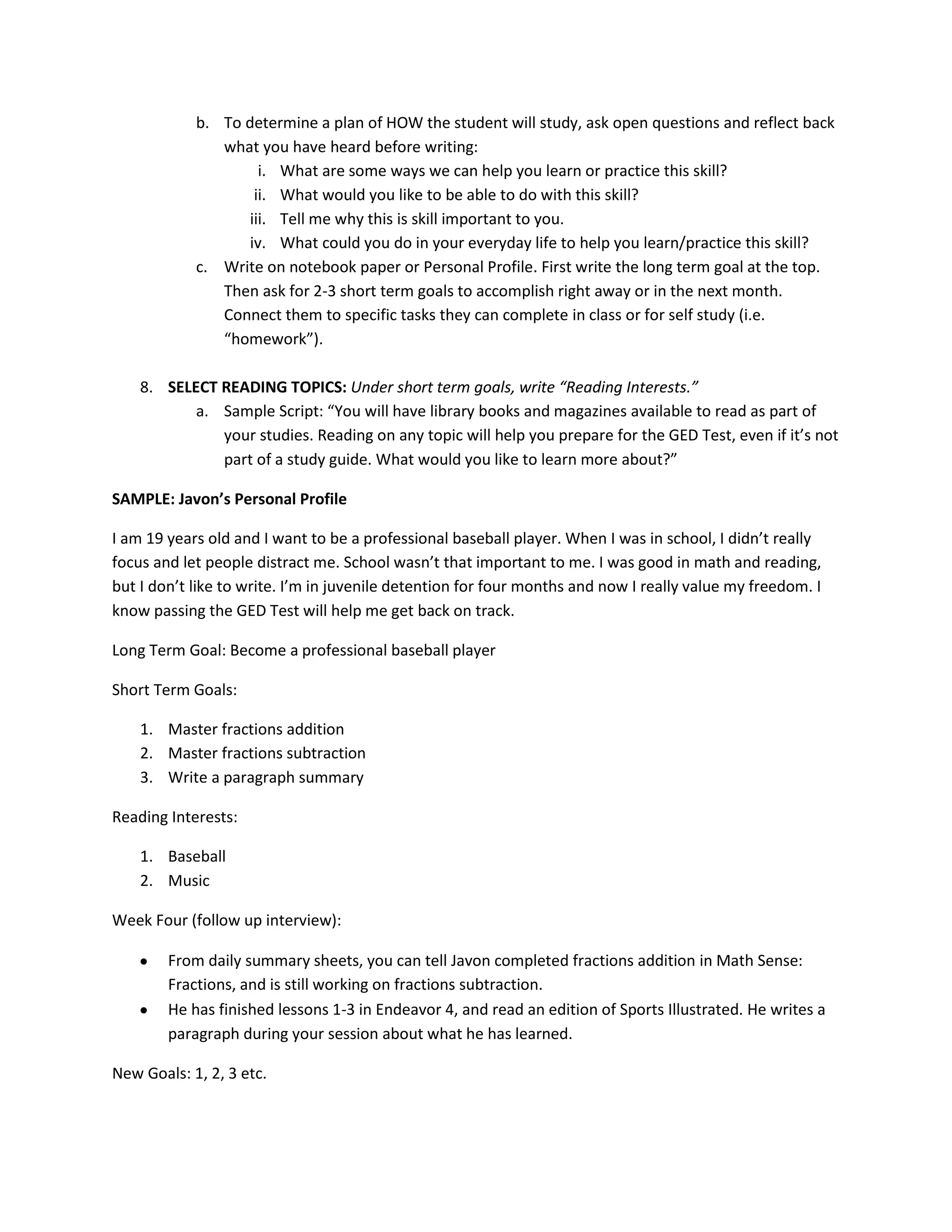
b. To determine a plan of HOW the student will study, ask open questions and reflect back
what you have heard before writing:
i. What are some ways we can help you learn or practice this skill?
ii. What would you like to be able to do with this skill?
iii. Tell me why this is skill important to you.
iv. What could you do in your everyday life to help you learn/practice this skill?
c. Write on notebook paper or Personal Profile. First write the long term goal at the top.
Then ask for 2-3 short term goals to accomplish right away or in the next month.
Connect them to specific tasks they can complete in class or for self study (i.e.
“homework”).
8. SELECT READING TOPICS: Under short term goals, write “Reading Interests.”
a. Sample Script: “You will have library books and magazines available to read as part of
your studies. Reading on any topic will help you prepare for the GED Test, even if it’s not
part of a study guide. What would you like to learn more about?”
SAMPLE: Javon’s Personal Profile
I am 19 years old and I want to be a professional baseball player. When I was in school, I didn’t really
focus and let people distract me. School wasn’t that important to me. I was good in math and reading,
but I don’t like to write. I’m in juvenile detention for four months and now I really value my freedom. I
know passing the GED Test will help me get back on track.
Long Term Goal: Become a professional baseball player
Short Term Goals:
1. Master fractions addition
2. Master fractions subtraction
3. Write a paragraph summary
Reading Interests:
1. Baseball
2. Music
Week Four (follow up interview):
From daily summary sheets, you can tell Javon completed fractions addition in Math Sense:
Fractions, and is still working on fractions subtraction.
He has finished lessons 1-3 in Endeavor 4, and read an edition of Sports Illustrated. He writes a
paragraph during your session about what he has learned.
New Goals: 1, 2, 3 etc.

GED Tutoring Individual Interview

  • 1.
    Individual Interview Materials: Notebook paper Skillsprofile from standardized assessment (if completed) Student folder Preparation: If completed after standardized assessment, then look at the learner’s skill profile with permission. If this is a follow up interview, check the student folder for activities and previous goals. Select skills mastered, skills partially mastered, and skills that need improvement to highlight in conversation. Note: Initial conversation can take from 20 to 60 minutes. Follow up goal setting is brief: 5-15 minutes. Directions: 1. For initial interview: a. Introduce yourself. Sample script: “Hi, my name is [Name]. I help out with the [organization] program. [explain your role if necessary] I wanted to find out more about your goals and how I can help you meet those goals.” b. Explain the estimated length of time and the process: i. 20-30 minutes at the beginning-Most of the first session together ii. Create a Personal Profile iii. Review skills mastered and to develop iv. Discuss long term and short term goals 2. For follow-up interview-Review goals regularly to determine progress a. Usually takes 5-15 minutes at the beginning of the session. b. Review what was discussed in previous interview. c. Ask long term goal: Is this still your overall goal in attending class? d. Ask about short term goals: i. How did you do with your short term goals this past week? ii. Did you complete or master something? (Optional: celebrate with certificate, stickers, or other recognition) iii. What are you working on that you want to review? iv. Do you want to set new short term goals? Do we need to break the goal into smaller steps? Are there any additional materials or support you need to reach these goals?
  • 2.
    3. Get toknow you: Use notebook paper and write “[Name’s] Personal Profile” on the top. a. Sample script: First of all, I would like to get to know you a little better. I was wondering if we could write a summary of information you would like your tutors to know about you to put in your folder? [Some residents may prefer that the interviewer writes.] 4. PERSONAL PROFILE: Open questions, reflect back what you heard before writing. Some residents will just tell you exactly what to write about themselves. Others might not have much to say, so you can help them open up by asking questions. Some examples: a. What are some things your tutors should know about you? b. Do you have a nickname you like? c. What is most important to you? d. What are some of your interests or hobbies? e. What do you want to get out of tutoring? f. Is there anything tutors should know to teach you, like you need them to speak loudly? g. What is your favorite subject in school? What is your least favorite? h. Is there anything else we should know about you? 5. LONG TERM GOAL: Under the written profile, write “Long Term Goal.” What do you want to do after passing the GED® test? Tell me more about this goal? What would you like to see happen if you meet this goal? [Resident or tutor writes the goal] 6. SKILLS PROFILE: If resident has recently taken a standardized assessment (like the Official GED Practice Test), show the skills profile to the learner to discuss. a. These are the skills that the [standardized] test said you had mastered before starting to study. If you have mastered the skill that means you can answer correctly every time you see this type of question. [Select an example and explain what the skill means] b. These are the skills that the [standardized] test said you had partial mastered when you first started in class. If you have partially mastered the skill that means you can answer correctly sometimes when you see this type of question, but you might need to practice to get it right every time. [Select an example and explain what the skill means] c. These are the skills that the [standardized] test said you had not mastered when you first started in class. If you have not mastered the skill that means you did not answer correctly. [Select an example and explain what the skill means] d. I am going to leave this skills profile in your folder for you and your tutors. 7. SET SHORT TERM GOALS: Under long term goal, write “Short Term Goals.” Select up to three goals to focus on for the next week or month. a. Sample script: “I would like to help you set some goals for the next [week/month] you are studying. I will be back again in [usually one week] to review how you are working towards your goals. To help you set your goal, tell me what skills you would like to study and practice over the next week? They could be this list of skills to master for the GED Test, or could be anything that you would like to learn.”
  • 3.
    b. To determinea plan of HOW the student will study, ask open questions and reflect back what you have heard before writing: i. What are some ways we can help you learn or practice this skill? ii. What would you like to be able to do with this skill? iii. Tell me why this is skill important to you. iv. What could you do in your everyday life to help you learn/practice this skill? c. Write on notebook paper or Personal Profile. First write the long term goal at the top. Then ask for 2-3 short term goals to accomplish right away or in the next month. Connect them to specific tasks they can complete in class or for self study (i.e. “homework”). 8. SELECT READING TOPICS: Under short term goals, write “Reading Interests.” a. Sample Script: “You will have library books and magazines available to read as part of your studies. Reading on any topic will help you prepare for the GED Test, even if it’s not part of a study guide. What would you like to learn more about?” SAMPLE: Javon’s Personal Profile I am 19 years old and I want to be a professional baseball player. When I was in school, I didn’t really focus and let people distract me. School wasn’t that important to me. I was good in math and reading, but I don’t like to write. I’m in juvenile detention for four months and now I really value my freedom. I know passing the GED Test will help me get back on track. Long Term Goal: Become a professional baseball player Short Term Goals: 1. Master fractions addition 2. Master fractions subtraction 3. Write a paragraph summary Reading Interests: 1. Baseball 2. Music Week Four (follow up interview): From daily summary sheets, you can tell Javon completed fractions addition in Math Sense: Fractions, and is still working on fractions subtraction. He has finished lessons 1-3 in Endeavor 4, and read an edition of Sports Illustrated. He writes a paragraph during your session about what he has learned. New Goals: 1, 2, 3 etc.