Exploring Artifact Registry
How We Deployed Artifact Registry at Scale at Qodea
In a world where managing thousands of artifacts is a daily
challenge, how can we make it scalable, secure, and cost-efficient?
Today, I’ll walk you through Google Artifact Registry and how we tackled this challenge
head-on at Qodea by deploying it at scale.
Why Artifact Management
Matters Today
Challenges of managing large numbers of artifacts across
cloud-native applications.
The need for secure, scalable, and cost-effective storage
and access to artifacts.
Efficient CI/CD:
Continuous integration and deployment pipelines
need seamless access to artifacts, with low
latency and high reliability.
Scalable Storage:
As teams and projects grow, so does the volume
of artifacts, leading to storage and organization
challenges.
Security and Compliance:
Managing vulnerabilities and ensuring compliance
across all artifacts is critical, especially in
regulated industries.
What is Google
Artifact Registry?
Google Artifact Registry is a fully managed service designed to
store, manage, and secure container images and
language-specific artifacts. It integrates deeply with Google
Cloud, making it an ideal choice for teams operating in
cloud-native environments.
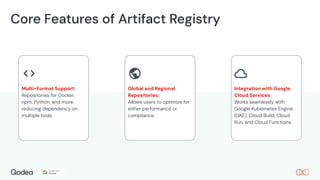
Core Features of Artifact Registry
Multi-Format Support:
Repositories for Docker,
npm, Python, and more,
reducing dependency on
multiple tools.
Global and Regional
Repositories:
Allows users to optimize for
either performance or
compliance.
Integration with Google
Cloud Services
Works seamlessly with
Google Kubernetes Engine
(GKE), Cloud Build, Cloud
Run, and Cloud Functions.
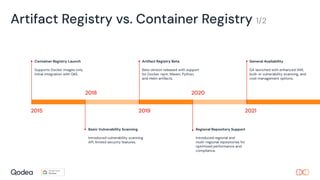
Artifact Registry vs. Container Registry 1/2
2015
Container Registry Launch
Supports Docker images only.
Initial integration with GKE.
Basic Vulnerability Scanning
Introduced vulnerability scanning
API, limited security features.
2018
2019
Artifact Registry Beta
Beta version released with support
for Docker, npm, Maven, Python,
and Helm artifacts.
2020
2021
Regional Repository Support
Introduced regional and
multi-regional repositories for
optimized performance and
compliance.
General Availability
GA launched with enhanced IAM,
built-in vulnerability scanning, and
cost management options.
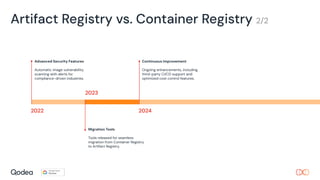
Artifact Registry vs. Container Registry 2/2
2022
Advanced Security Features
Automatic image vulnerability
scanning with alerts for
compliance-driven industries.
Migration Tools
Tools released for seamless
migration from Container Registry
to Artifact Registry.
2023
2024
Continuous Improvement
Ongoing enhancements, including
third-party CI/CD support and
optimized cost control features.
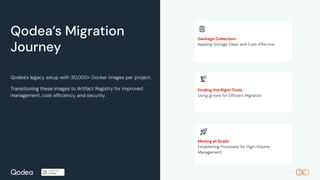
Qodea’s Migration
Journey
Qodea’s legacy setup with 30,000+ Docker images per project.
Transitioning these images to Artifact Registry for improved
management, cost efficiency, and security.
Moving at Scale:
Establishing Processes for High-Volume
Management
Garbage Collection:
Keeping Storage Clean and Cost-Effective
Finding the Right Tools:
Using gcrane for Efficient Migration
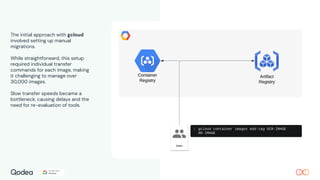
The initial approach with gcloud
involved setting up manual
migrations.
While straightforward, this setup
required individual transfer
commands for each image, making
it challenging to manage over
30,000 images.
Slow transfer speeds became a
bottleneck, causing delays and the
need for re-evaluation of tools.
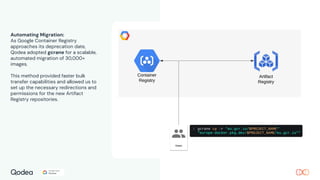
Automating Migration:
As Google Container Registry
approaches its deprecation date,
Qodea adopted gcrane for a scalable,
automated migration of 30,000+
images.
This method provided faster bulk
transfer capabilities and allowed us to
set up the necessary redirections and
permissions for the new Artifact
Registry repositories.
Demo

GDG Cloud Iasi - Exploring Artifact Registry.pdf

  • 1.
    Exploring Artifact Registry HowWe Deployed Artifact Registry at Scale at Qodea
  • 2.
    In a worldwhere managing thousands of artifacts is a daily challenge, how can we make it scalable, secure, and cost-efficient? Today, I’ll walk you through Google Artifact Registry and how we tackled this challenge head-on at Qodea by deploying it at scale.
  • 3.
    Why Artifact Management MattersToday Challenges of managing large numbers of artifacts across cloud-native applications. The need for secure, scalable, and cost-effective storage and access to artifacts. Efficient CI/CD: Continuous integration and deployment pipelines need seamless access to artifacts, with low latency and high reliability. Scalable Storage: As teams and projects grow, so does the volume of artifacts, leading to storage and organization challenges. Security and Compliance: Managing vulnerabilities and ensuring compliance across all artifacts is critical, especially in regulated industries.
  • 4.
    What is Google ArtifactRegistry? Google Artifact Registry is a fully managed service designed to store, manage, and secure container images and language-specific artifacts. It integrates deeply with Google Cloud, making it an ideal choice for teams operating in cloud-native environments.
  • 5.
    Core Features ofArtifact Registry Multi-Format Support: Repositories for Docker, npm, Python, and more, reducing dependency on multiple tools. Global and Regional Repositories: Allows users to optimize for either performance or compliance. Integration with Google Cloud Services Works seamlessly with Google Kubernetes Engine (GKE), Cloud Build, Cloud Run, and Cloud Functions.
  • 6.
    Artifact Registry vs.Container Registry 1/2 2015 Container Registry Launch Supports Docker images only. Initial integration with GKE. Basic Vulnerability Scanning Introduced vulnerability scanning API, limited security features. 2018 2019 Artifact Registry Beta Beta version released with support for Docker, npm, Maven, Python, and Helm artifacts. 2020 2021 Regional Repository Support Introduced regional and multi-regional repositories for optimized performance and compliance. General Availability GA launched with enhanced IAM, built-in vulnerability scanning, and cost management options.
  • 7.
    Artifact Registry vs.Container Registry 2/2 2022 Advanced Security Features Automatic image vulnerability scanning with alerts for compliance-driven industries. Migration Tools Tools released for seamless migration from Container Registry to Artifact Registry. 2023 2024 Continuous Improvement Ongoing enhancements, including third-party CI/CD support and optimized cost control features.
  • 8.
    Qodea’s Migration Journey Qodea’s legacysetup with 30,000+ Docker images per project. Transitioning these images to Artifact Registry for improved management, cost efficiency, and security. Moving at Scale: Establishing Processes for High-Volume Management Garbage Collection: Keeping Storage Clean and Cost-Effective Finding the Right Tools: Using gcrane for Efficient Migration
  • 9.
    The initial approachwith gcloud involved setting up manual migrations. While straightforward, this setup required individual transfer commands for each image, making it challenging to manage over 30,000 images. Slow transfer speeds became a bottleneck, causing delays and the need for re-evaluation of tools.
  • 10.
    Automating Migration: As GoogleContainer Registry approaches its deprecation date, Qodea adopted gcrane for a scalable, automated migration of 30,000+ images. This method provided faster bulk transfer capabilities and allowed us to set up the necessary redirections and permissions for the new Artifact Registry repositories.
  • 11.