1
1
MEDIEVAL LITERATURE
Sir Gawain and the
Green Knight
2
Sir Gawain and the Green Knight
(Oxford University Press, 1998)
NB: YOU WILL BE
EXPECTED TO BRING THE
TEXT TO EVERY CLASS
Assignment due: FRIDAY
10 MAY
3
Where are we?
•  William Shakespeare (1564–1616)
Elizabethan period
•  Sir Gawain and the Green Knight (c.1380–90)
Anonymous (NB!)
•  Late Middle Ages (Medieval period)
(over 600 years ago)
4
What were the “Middle Ages”?
•  Period between
Dark Ages (c. 500 – 1000)
and
•  The Renaissance (c. 1500–1600)
c. 1000–1500 AD
2
5
The medieval period was the beginning of recognisable
English language and literature.
Beginnings of the ‘modern’ age.
Medieval literature has been influential for over 600 years.
WHY ARE WE STUDYING THIS
PERIOD AND THIS WORK?
6
King Arthur and the Knights
of the Round Table
•  King Arthur – a legendary king of Britain
•  He becomes king when he draws a
mysterious sword out of a stone
7
•  Arthur fights to end a period of civil war, and
becomes leader of a group of heroic knights,
including
Sir Lancelot
Sir Gawain
Sir Galahad
•  They meet around a Round Table –
•  At which everyone is equal
8
•  Arthur’s kingship is further confirmed when he
receives a magical sword — Excalibur —
from ‘the Lady of the Lake’
•  For many years Arthur’s knights go on
adventures, defeating enemies, upholding
good over evil, and upholding the values of
chivalry.
•  But tragedy develops when Arthur’s queen —
Guenevere — falls in love with his best
knight, Lancelot.
3
9
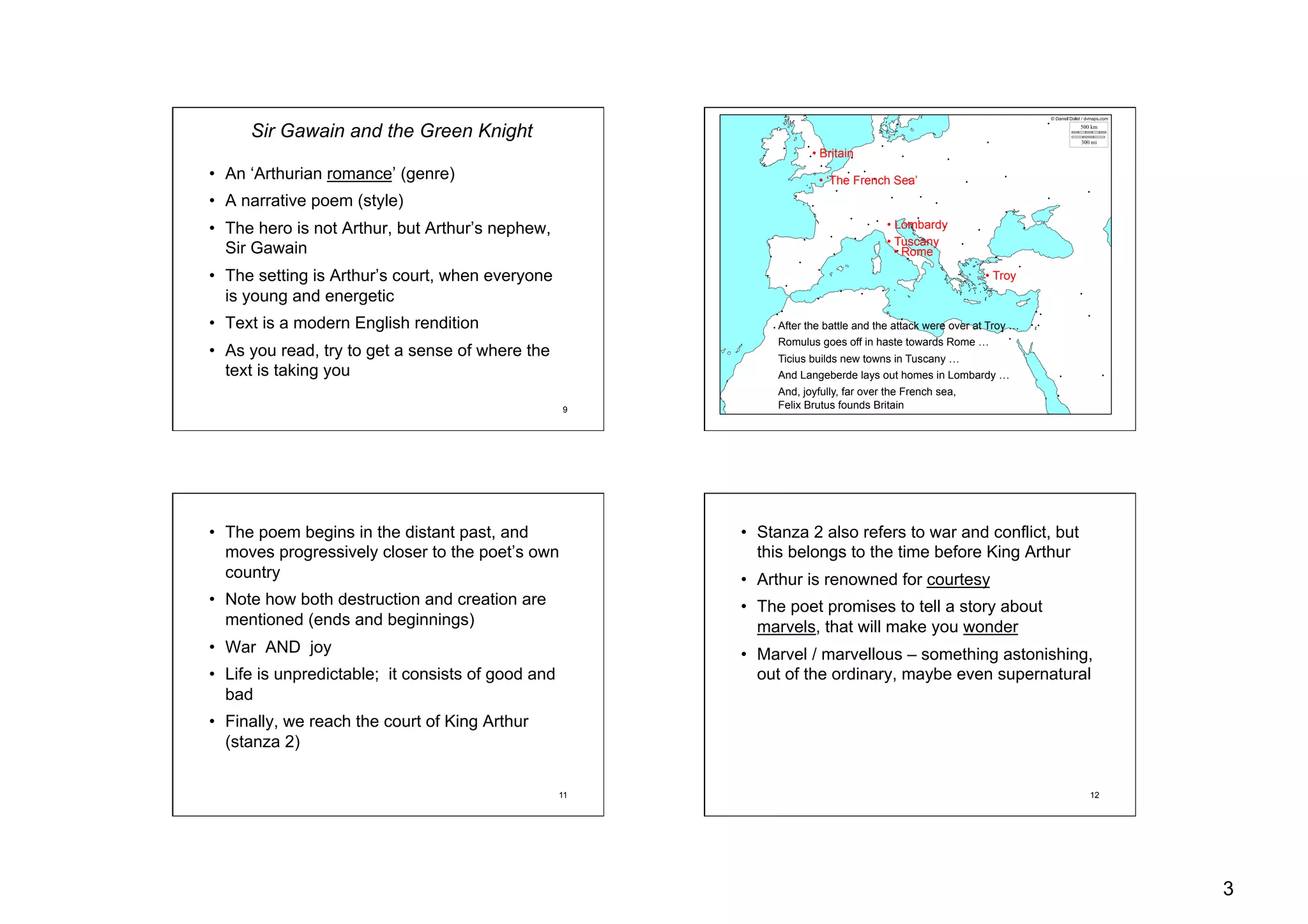
Sir Gawain and the Green Knight
•  An ‘Arthurian romance’ (genre)
•  A narrative poem (style)
•  The hero is not Arthur, but Arthur’s nephew,
Sir Gawain
•  The setting is Arthur’s court, when everyone
is young and energetic
•  Text is a modern English rendition
•  As you read, try to get a sense of where the
text is taking you
10
• Troy
• Tuscany
• Lombardy
• Rome
• Britain
• ‘The French Sea’
After the battle and the attack were over at Troy …
Romulus goes off in haste towards Rome …
Ticius builds new towns in Tuscany …
And Langeberde lays out homes in Lombardy …
And, joyfully, far over the French sea,
Felix Brutus founds Britain
11
•  The poem begins in the distant past, and
moves progressively closer to the poet’s own
country
•  Note how both destruction and creation are
mentioned (ends and beginnings)
•  War AND joy
•  Life is unpredictable; it consists of good and
bad
•  Finally, we reach the court of King Arthur
(stanza 2)
12
•  Stanza 2 also refers to war and conflict, but
this belongs to the time before King Arthur
•  Arthur is renowned for courtesy
•  The poet promises to tell a story about
marvels, that will make you wonder
•  Marvel / marvellous – something astonishing,
out of the ordinary, maybe even supernatural
4
13
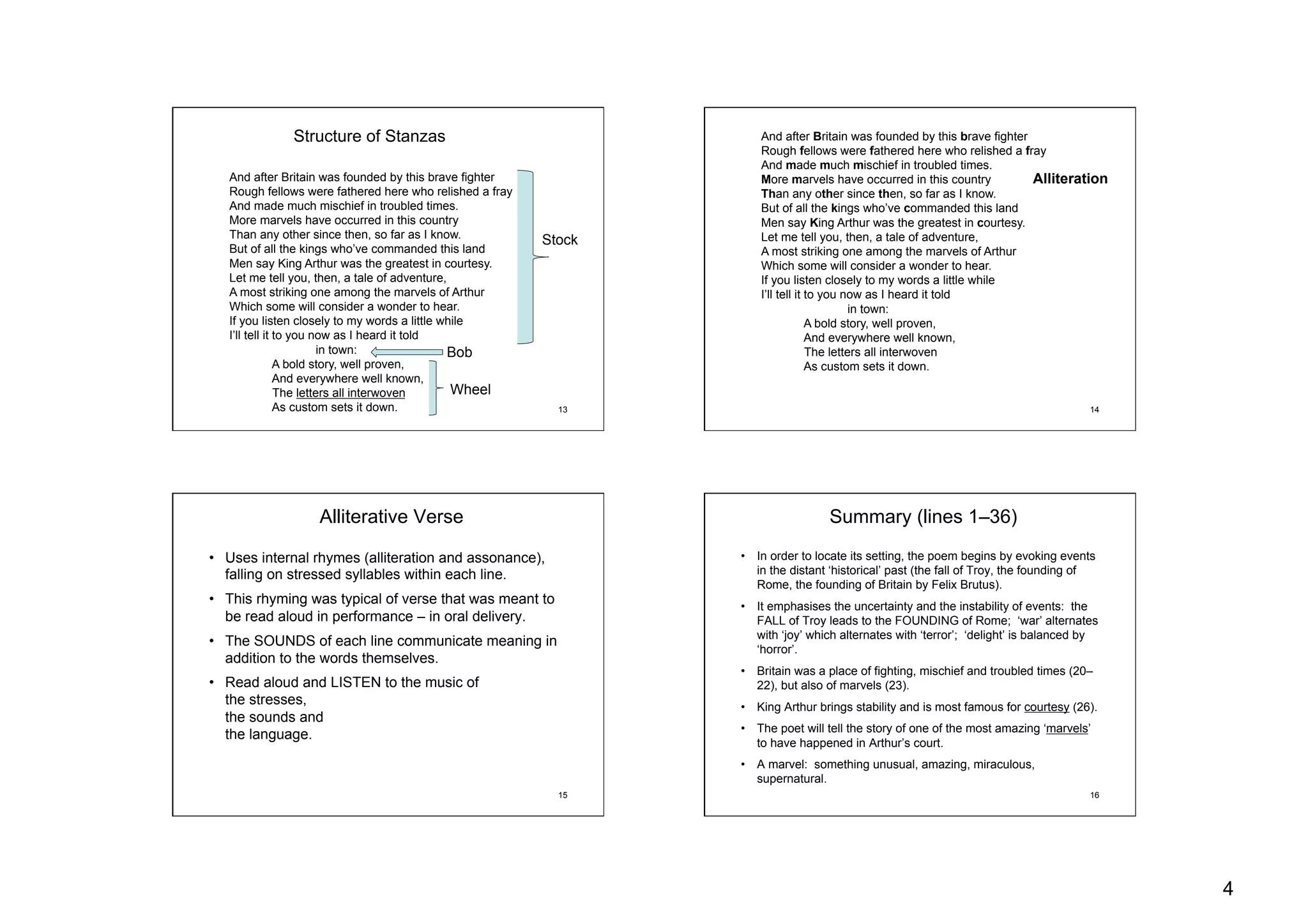
And after Britain was founded by this brave fighter
Rough fellows were fathered here who relished a fray
And made much mischief in troubled times.
More marvels have occurred in this country
Than any other since then, so far as I know.
But of all the kings who’ve commanded this land
Men say King Arthur was the greatest in courtesy.
Let me tell you, then, a tale of adventure,
A most striking one among the marvels of Arthur
Which some will consider a wonder to hear.
If you listen closely to my words a little while
I’ll tell it to you now as I heard it told
in town:
A bold story, well proven,
And everywhere well known,
The letters all interwoven
As custom sets it down.
Stock
Bob
Wheel
Structure of Stanzas
14
And after Britain was founded by this brave fighter
Rough fellows were fathered here who relished a fray
And made much mischief in troubled times.
More marvels have occurred in this country
Than any other since then, so far as I know.
But of all the kings who’ve commanded this land
Men say King Arthur was the greatest in courtesy.
Let me tell you, then, a tale of adventure,
A most striking one among the marvels of Arthur
Which some will consider a wonder to hear.
If you listen closely to my words a little while
I’ll tell it to you now as I heard it told
in town:
A bold story, well proven,
And everywhere well known,
The letters all interwoven
As custom sets it down.
Alliteration
15
Alliterative Verse
•  Uses internal rhymes (alliteration and assonance),
falling on stressed syllables within each line.
•  This rhyming was typical of verse that was meant to
be read aloud in performance – in oral delivery.
•  The SOUNDS of each line communicate meaning in
addition to the words themselves.
•  Read aloud and LISTEN to the music of
the stresses,
the sounds and
the language.
16
Summary (lines 1–36)
•  In order to locate its setting, the poem begins by evoking events
in the distant ‘historical’ past (the fall of Troy, the founding of
Rome, the founding of Britain by Felix Brutus).
•  It emphasises the uncertainty and the instability of events: the
FALL of Troy leads to the FOUNDING of Rome; ‘war’ alternates
with ‘joy’ which alternates with ‘terror’; ‘delight’ is balanced by
‘horror’.
•  Britain was a place of fighting, mischief and troubled times (20–
22), but also of marvels (23).
•  King Arthur brings stability and is most famous for courtesy (26).
•  The poet will tell the story of one of the most amazing ‘marvels’
to have happened in Arthur’s court.
•  A marvel: something unusual, amazing, miraculous,
supernatural.
5
17
Lines 37–84
•  It is Christmas time (37); more specifically, New Year’s Day
(60). (Twelve days of Christmas = 25 December – 5 January.)
•  The setting is Arthur’s court at Camelot. Everyone is taking part
in festive events, jousting, dancing, singing.
•  Everyone is beautiful, youthful and happy:
All in that hall were beautiful, young and, of
their kind
The happiest under heaven, (54–56)
‘For al was this fayre folk in [their] first age’
•  They exchange gifts (and kisses), then prepare for a feast, for
which Queen Guenevere has place of honour under a canopy of
expensive draperies.
18
Lines 85–129
•  The king is restless, and refuses to sit down until everyone has
been served
He was in a merry mood, like a mischievous boy
His blood burned, his restless mind roused him (86, 89)
•  He will also wait until either
Someone has told a story of adventure
or
Someone comes into the hall to challenge them to battle or
some other adventure
•  Arthur wants something unusual to happen – either in a story,
or in real life.
•  The feast continues; everything is of the best quality; everyone
is happy; everything is perfect …
•  Or is it? Why does Arthur wait for something unusual? Is
something missing? Is peace not good enough?
19
Poetic Technique
•  Note how the poet lavishes attention on the smallest details …
•  ‘Zooming’ technique
•  But he also gives subtle hints that there are important issues
lying below the surface of what he is describing
•  (1) Arthur’s court is youthful, joyful and energetic
•  But this could also mean that it is inexperienced / untested /
maybe even impulsive / reckless
•  Is Arthur being reckless in calling for a ‘marvel’?
•  (2) The feast is magnificent, lacking in nothing …
•  Is there an element of smugness / self-satisfaction here?
20
The arrival of the Green Knight
•  The poet hints that everything is about to change because
‘another sound was stirring’ (132): something is approaching …
•  Just as people were turning their attention to their food …
•  When there hove into the court a hideous figure
[‘aghlich mayster’]
Square-built and bulky, full-fleshed from neck to thigh. (136–37)
•  It’s a huge figure of a man, who may even have been ‘half-giant’
[‘half-etayn’].
•  NB The word ‘giant’ [‘etayn’] has associations with savagery,
monstrous wild creatures that eat men, women & children
•  BUT this figure is also ‘the mightiest of men’ and ‘a handsome
knight’ with an elegantly shaped body (141–44).
•  What is he? Giant or huge man? Hideous or handsome? The
poet indicates that he’s both, and Arthur’s court can’t decide.
6
21
‘Giant’ (‘etayn’)
– associations with
savagery, monstrous wild
creatures that eat men,
women & children
22
•  The poet draws the reader into the sense of astonishment and
uncertainty experienced by Arthur’s court.
•  They don’t know what they are looking at.
•  The newcomer is a huge, well-dressed man – but everything
about him is green:
Not only was this creature
Colossal, he was bright green —
•  The poet’s gaze takes in the knight’s magnificent clothes and
jewels
•  These indicate that he’s someone from a very wealthy,
cultivated background;
•  We begin to think that it’s only his clothes and decorations that
are green.
•  But slowly we become aware that the whole man is green, and
so is his horse.
•  WHAT IS HE? Is he giant or man? Human or supernatural?
•  We share the uncertainty of Arthur’s court as they stare at the
Green Knight (GK).
23
Lines 179–249
•  The knight’s appearance is also extraordinary in the way his hair
and his beard reach down to his elbows
•  His horse’s mane is also elaborately decorated
•  Is he a threat? The poet emphasises that he wears no
protective armour, but he carries:
•  (1) A branch of green holly
(a sign of peace); and
(2) An enormous axe,
richly decorated
•  A new ambiguity: does he stand for peace (holly), or for war
(the axe)? 24
Lines 179–249
•  The knight’s appearance is ambiguous and confusing, but his
behaviour is downright rude:
‘Where is’, he said, ‘The leader of this lot?’
[‘Wher is’, he sayd, ‘The governour of this gyng?’]
•  It should be obvious who is the king, but the GK pretends that
it’s not. (An obvious insult.)
•  The court is stunned by the sight of the GK (Arthur wanted a
marvel!), but the poet emphasises that no one spoke for another
reason:
•  They are waiting for Arthur to reply. Courtesy demands that he
identify himself (247).
•  Courtesy is being identified as an important value.
7
25
Lines 250–365
•  Arthur courteously invites the GK to join them
•  But he refuses: he’s there because of the high reputation of
Arthur’s knights for valour and courtesy.
•  The GK says he wants no battle – then insults the knights as
‘beardless boys’
•  What he wants is an exchange of blows – with his huge axe
•  The court goes silent with astonishment, prompting the GK to
laugh at them all
•  Arthur is furious, takes the axe and starts practising with it
•  Then Gawain intervenes …
•  With elaborate courtesy he asks Arthur to allow him to take up
the challenge (340–361)
26
Courtesy and Chivalry
•  Courtesy – politeness, good manners, being respectful or
considerate, gentle, doing something out of generosity rather
than because you have to
•  Courteous – ‘having manners fit for a royal court’;
knowing how to behave; cultivated, refined, polished, civilized
•  The opposite of being brutal, ferocious, harsh – everything that
was expected of a fighter in a military society.
27
Courtesy and Chivalry
•  Chivalry / Chivalrous: being polite, behaving well
•  Chivalry – The qualities of an ideal knight: courage, honour,
courtesy, justice, readiness to help the weak
•  Developed into a religious, social and moral code governing
behaviour ON and OFF the battlefield
•  Courtesy and Chivalry express
the essential social and ethical
principles of medieval knighthood.
•  Arthur’s court is famous for its
courtesy and chivlary
•  The Green Knight challenges the
court to live up to its reputation
•  The poet is questioning his society’s
ability to live up to its own values
28
The ‘Beheading Game’
•  Arthur wanted a marvel – he seems to have got more than he
bargained for!
•  The GK makes Gawain identify himself, and repeat the terms of
the ‘game’.
•  He also makes Gawain swear by his troth [‘trawthe’] that he will
honour his side of the bargain.
•  They make an agreement, a pact – a form of contract; a verbal
undertaking; a covenant (393).
•  What does that mean? What should it mean?
•  Should all promises be kept? – even if circumstances change?
•  Note how the poet focuses again on the smallest details of the
beheading and what follows …
8
29
The ‘Beheading Game’
•  The Green Knight has identified himself and his abode – but
remains just as mysterious as ever.
•  Note the poet’s question: ‘And so?’ (462)
•  Life returns to normal; Arthur reassures the queen; they are
served double helpings of dainties …
•  ‘Until at last / night fell’ (485–6)
•  Lines 487–90: The poet seems to be speaking directly to
Gawain, but is also perhaps giving a sense of Gawain’s own
thoughts.
•  The experience has set him apart from the others, and it has
become his burden.
•  Gawain has already been initiated into something that lies
beyond the experience of his fellows
30
Romance and Realism
•  Romance – a fictional narrative, usually about adventure or love,
or both, that also involves an element of fantasy
•  Realism – accurate representation of the ‘real’ world
•  The Gawain-poet mixes these two elements / genres
31
Structure of the Poem
•  Divided into four main sections called ‘Fitts’
•  Fitt 1 – Arthur’s court; New Year festivities;
the arrival of the Green Knight
•  Fitt 2 – The passage of the seasons; Gawain’s departure; the
Winter Journey.
•  Begins with a veiled warning:
… if the game grew serious, think it no surprise,
For if men are feather-wits when the wine’s flowing
Time races on, nothing remains unchanged;
Our endings rarely square with our beginnings.
•  How is this ‘Game’ going to end?
32
491–566
•  The passing year is described in terms of the cycle of the
seasons – the changing natural world
•  The year dwindles, all days seem yesterdays (529)
‘And thus yirnes the yere in yisterdayes mony’
•  Michaelmas (religious calendar): 29 September
the day when debts have to be repaid
•  All Hallows Day (1 November)
•  Gawain prepares to fulfil his side of the bargain
‘Kind or severe, We must engage our fate.’ (564–5)
•  He never questions whether he should keep his promise
•  A promise is sacred
9
33
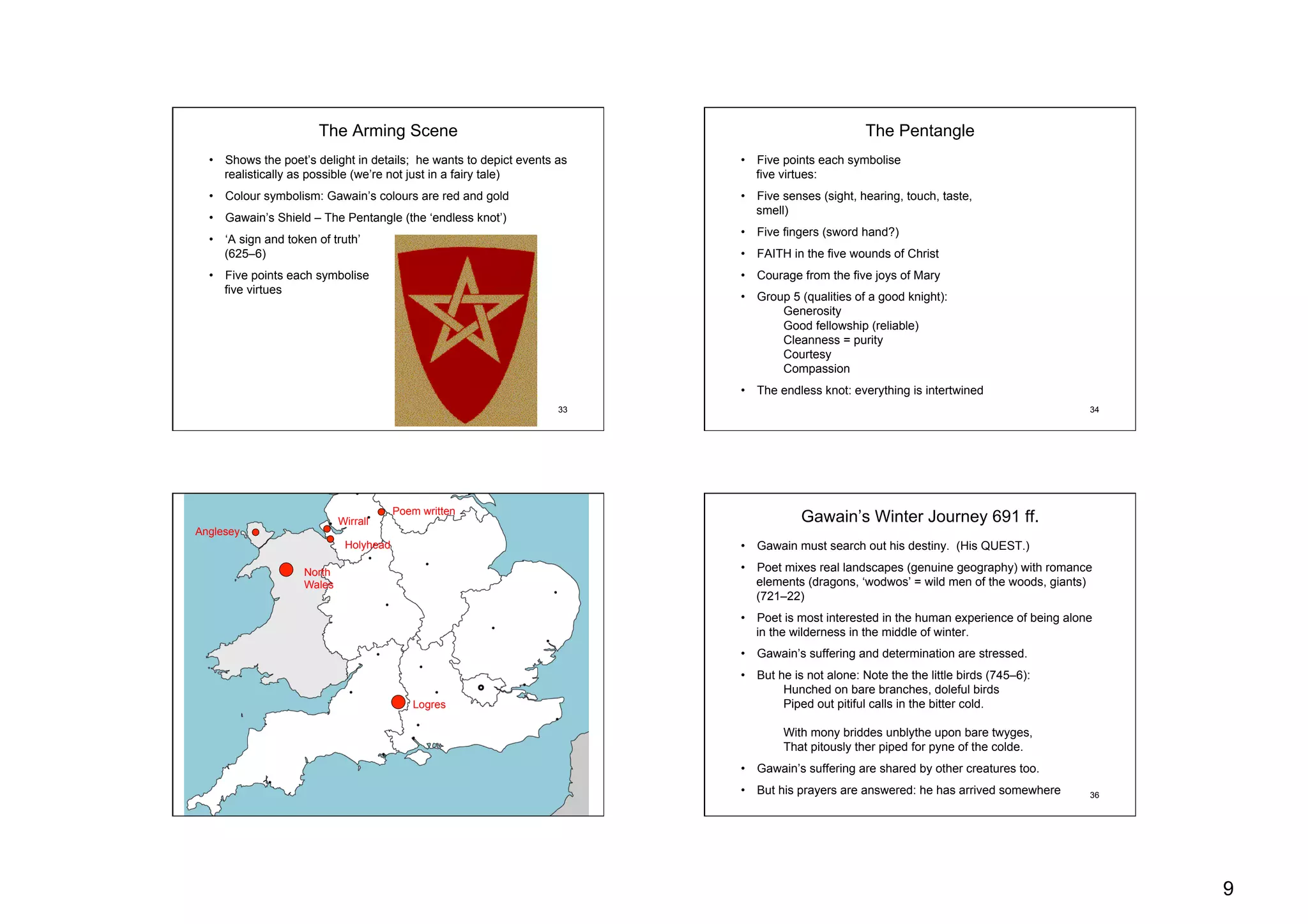
The Arming Scene
•  Shows the poet’s delight in details; he wants to depict events as
realistically as possible (we’re not just in a fairy tale)
•  Colour symbolism: Gawain’s colours are red and gold
•  Gawain’s Shield – The Pentangle (the ‘endless knot’)
•  ‘A sign and token of truth’
(625–6)
•  Five points each symbolise
five virtues
34
The Pentangle
•  Five points each symbolise
five virtues:
•  Five senses (sight, hearing, touch, taste,
smell)
•  Five fingers (sword hand?)
•  FAITH in the five wounds of Christ
•  Courage from the five joys of Mary
•  Group 5 (qualities of a good knight):
Generosity
Good fellowship (reliable)
Cleanness = purity
Courtesy
Compassion
•  The endless knot: everything is intertwined
35
Logres
North
Wales
Anglesey
Holyhead
Wirrall
Poem written
36
Gawain’s Winter Journey 691 ff.
•  Gawain must search out his destiny. (His QUEST.)
•  Poet mixes real landscapes (genuine geography) with romance
elements (dragons, ‘wodwos’ = wild men of the woods, giants)
(721–22)
•  Poet is most interested in the human experience of being alone
in the wilderness in the middle of winter.
•  Gawain’s suffering and determination are stressed.
•  But he is not alone: Note the the little birds (745–6):
Hunched on bare branches, doleful birds
Piped out pitiful calls in the bitter cold.
With mony briddes unblythe upon bare twyges,
That pitously ther piped for pyne of the colde.
•  Gawain’s suffering are shared by other creatures too.
•  But his prayers are answered: he has arrived somewhere
10
37
Hautdesert – Safety
•  Note how the castle appears mysteriously through the trees –
Gawain is astonished. Is it real?
•  He is welcomed, first by the servants, then by the lord of the
castle.
•  The interior supplies the opposite of everything Gawain
experienced in the wilderness: an island of civilisation.
•  When they find out who Gawain is, the retainers are overjoyed
(916 –), calling him the ‘prince of courtesy’.
•  In chapel, Gawain sees the lady of the castle, who seems to him
immensely beautiful.
•  Everything is perfect – Gawain can relax.
38
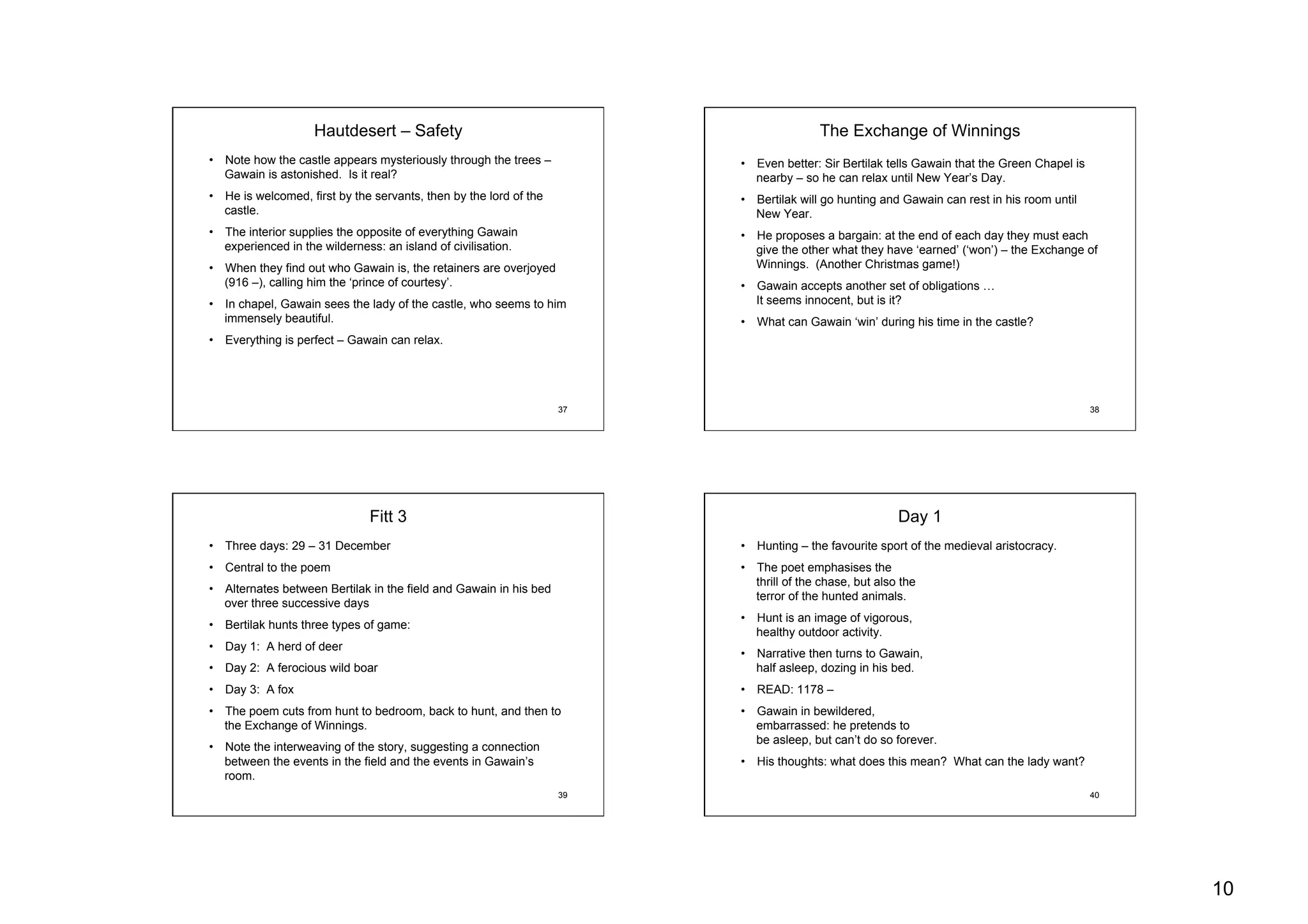
The Exchange of Winnings
•  Even better: Sir Bertilak tells Gawain that the Green Chapel is
nearby – so he can relax until New Year’s Day.
•  Bertilak will go hunting and Gawain can rest in his room until
New Year.
•  He proposes a bargain: at the end of each day they must each
give the other what they have ‘earned’ (‘won’) – the Exchange of
Winnings. (Another Christmas game!)
•  Gawain accepts another set of obligations …
It seems innocent, but is it?
•  What can Gawain ‘win’ during his time in the castle?
39
Fitt 3
•  Three days: 29 – 31 December
•  Central to the poem
•  Alternates between Bertilak in the field and Gawain in his bed
over three successive days
•  Bertilak hunts three types of game:
•  Day 1: A herd of deer
•  Day 2: A ferocious wild boar
•  Day 3: A fox
•  The poem cuts from hunt to bedroom, back to hunt, and then to
the Exchange of Winnings.
•  Note the interweaving of the story, suggesting a connection
between the events in the field and the events in Gawain’s
room.
40
Day 1
•  Hunting – the favourite sport of the medieval aristocracy.
•  The poet emphasises the
thrill of the chase, but also the
terror of the hunted animals.
•  Hunt is an image of vigorous,
healthy outdoor activity.
•  Narrative then turns to Gawain,
half asleep, dozing in his bed.
•  READ: 1178 –
•  Gawain in bewildered,
embarrassed: he pretends to
be asleep, but can’t do so forever.
•  His thoughts: what does this mean? What can the lady want?
11
41
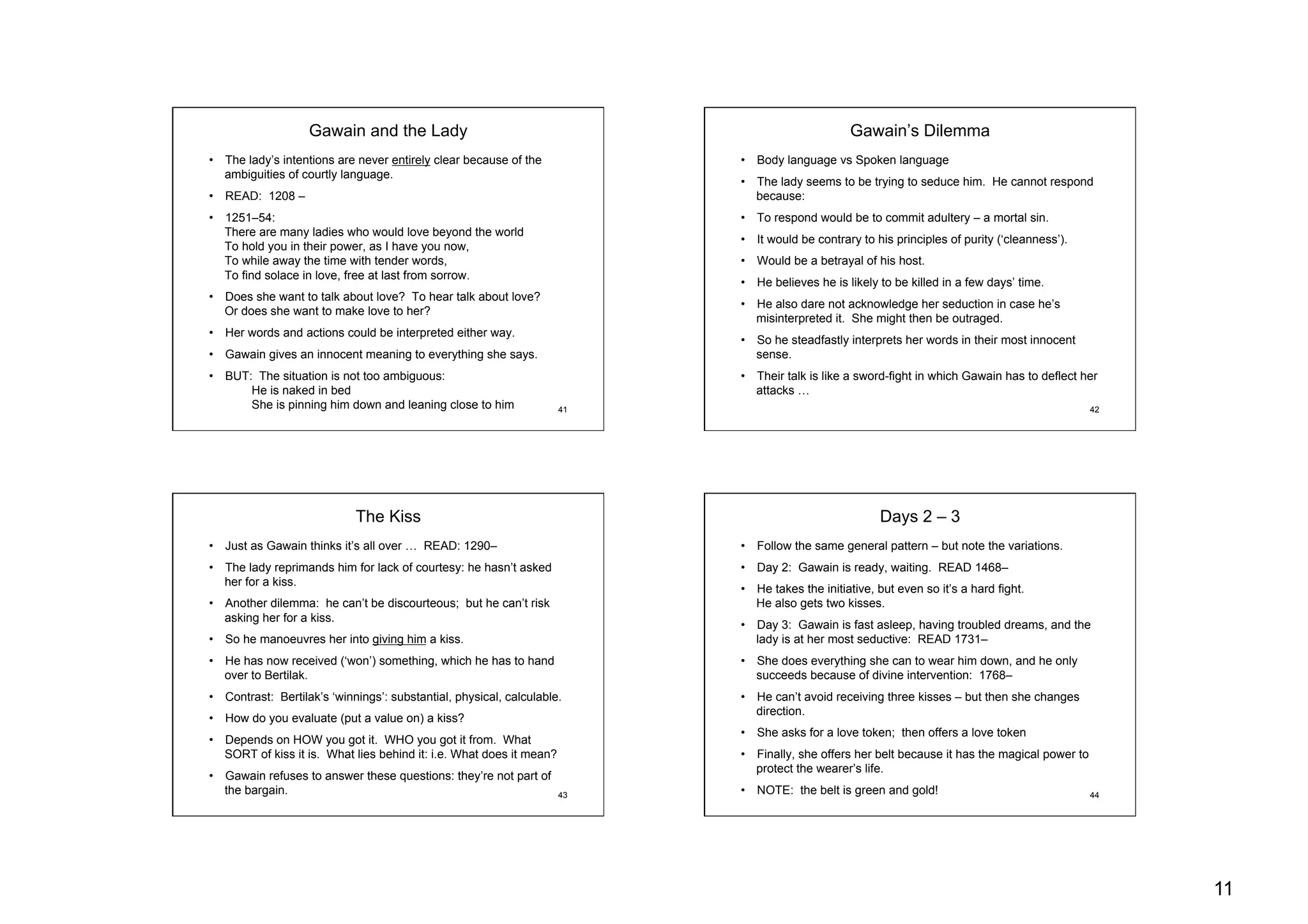
Gawain and the Lady
•  The lady’s intentions are never entirely clear because of the
ambiguities of courtly language.
•  READ: 1208 –
•  1251–54:
There are many ladies who would love beyond the world
To hold you in their power, as I have you now,
To while away the time with tender words,
To find solace in love, free at last from sorrow.
•  Does she want to talk about love? To hear talk about love?
Or does she want to make love to her?
•  Her words and actions could be interpreted either way.
•  Gawain gives an innocent meaning to everything she says.
•  BUT: The situation is not too ambiguous:
He is naked in bed
She is pinning him down and leaning close to him 42
Gawain’s Dilemma
•  Body language vs Spoken language
•  The lady seems to be trying to seduce him. He cannot respond
because:
•  To respond would be to commit adultery – a mortal sin.
•  It would be contrary to his principles of purity (‘cleanness’).
•  Would be a betrayal of his host.
•  He believes he is likely to be killed in a few days’ time.
•  He also dare not acknowledge her seduction in case he’s
misinterpreted it. She might then be outraged.
•  So he steadfastly interprets her words in their most innocent
sense.
•  Their talk is like a sword-fight in which Gawain has to deflect her
attacks …
43
The Kiss
•  Just as Gawain thinks it’s all over … READ: 1290–
•  The lady reprimands him for lack of courtesy: he hasn’t asked
her for a kiss.
•  Another dilemma: he can’t be discourteous; but he can’t risk
asking her for a kiss.
•  So he manoeuvres her into giving him a kiss.
•  He has now received (‘won’) something, which he has to hand
over to Bertilak.
•  Contrast: Bertilak’s ‘winnings’: substantial, physical, calculable.
•  How do you evaluate (put a value on) a kiss?
•  Depends on HOW you got it. WHO you got it from. What
SORT of kiss it is. What lies behind it: i.e. What does it mean?
•  Gawain refuses to answer these questions: they’re not part of
the bargain. 44
Days 2 – 3
•  Follow the same general pattern – but note the variations.
•  Day 2: Gawain is ready, waiting. READ 1468–
•  He takes the initiative, but even so it’s a hard fight.
He also gets two kisses.
•  Day 3: Gawain is fast asleep, having troubled dreams, and the
lady is at her most seductive: READ 1731–
•  She does everything she can to wear him down, and he only
succeeds because of divine intervention: 1768–
•  He can’t avoid receiving three kisses – but then she changes
direction.
•  She asks for a love token; then offers a love token
•  Finally, she offers her belt because it has the magical power to
protect the wearer’s life.
•  NOTE: the belt is green and gold!
12
45
Gawain’s Conflict
•  He promises the lady that he will conceal the belt – a new
promise that CONFLICTS with his pact with Bertilak.
•  He breaks troth / fidelity with Bertilak.
•  Not for a secret love affair, but because he is afraid for his life.
•  Does it matter?
•  Hunts and Bedroom Scenes – any connections?
•  No exact equivalences, but there is a suggestiveness:
•  Like the deer on day 1, Gawain is caught unawares
•  Like the boar on day 2, Gawain is fiercely defensive
•  Like the fox on day 3, Gawain has to twist and turn; finally, he
wants to escape a deadly blow, and falls victim to something
else: READ: 1893–
46
Fitt 4 – New Year’s Day
•  New Year’s Day approaches: READ 1998–
•  The raging storm outside appears to mirror the emotional storm that
Gawain is experiencing
•  When Gawain arms himself –
the poet doesn’t mention his
shield. Rather, he describes
him putting on the green
girdle. READ 2025–
•  Gawain’s guide provides
further temptation – he’ll
help Gawain to escape a
terrible monster.
(Temptation can come in many forms.)
READ: 2097–
•  Gawain’s answer: 2126–2139.
•  Gawain finds the Green Chapel. READ 2160–2188
47
The Beheading
•  He hears a blade being sharpened – again testing his resolve and
courage
•  READ: 2220–2330
•  The Green Knight raises the axe three times, but only the third blow
touches Gawain
•  The Revelation: he is Bertilak, transformed by magic into the Green
Knight, and he has been testing Gawain for days
•  The cut on the neck is to repay Gawain for his fault in keeping the
green girdle.
Beheading (agreement)
Beheading (fulfilment)
Exchange1
Exchange1
Exchange2
Exchange2
Exchange3
Exchange3
Temptation1
Temptation2
Temptation3
13
49
Gawain’s Test(s)
•  Gawain believes there is only one big test – the beheading
•  He discovers that the big picture depends on his behaviour when
he was most off guard (day-to-day little pictures)
•  The MAIN test in life does not have to be dramatic, heroic, epic
•  If you pass the little tests in life, the outcomes of the major tests will
have been decided
•  The Green Knight’s judgement:
‘You’re the most faultless warrior who walks on foot!
As a pearl is more precious than a snow-pea
So is Gawain, upon my oath, among other knights.’ (2363–5)
Gawain’s response and judgement: READ (2369–2388)
He accuses himself of: cowardice, covetousness, fear, falseness,
faithlessness, being fooled by a woman. (A little hysterical?)
50
•  The Green Knight disagrees: READ 2389–2399
•  The Green Knight is like a priest absolving Gawain of his ‘sin’
because of his
•  Contrition
Confession
Penance
•  But Gawain is mortified: READ: 2429–
•  Gawain will keep the girdle and wear it ‘as a sign of my fault’ (2433)
•  Whose judgement should we accept?
Judging Gawain
51
•  READ 2498–2520
•  Arthur and his court comfort Gawain and adopt the green girdle for
‘fellowship’
•  Because they haven’t learned anything?
•  Or because Gawain’s principles are so lofty that no one could live
up to them all the time.
•  They agree with the GK that Gawain has done as much as anyone
could hope to do, and more.
•  No one is perfect; we are all bound to fail some time.
•  Poet suggests that that’s why we need tolerance and
understanding, as well as a forgiving God (2527–9).
•  But he lets the poem fade away, back to Troy (2521–26), leaving
YOU to decide.
Camelot
52
•  Courtesy, humility, chastity, covetousness, cowardice, bravery,
truth, untruth, faith etc — These are all abstract concepts.
•  But the poet also makes you aware of the daily experience of a
living individual; even of a little bird ‘peeping piteously for pain of
the cold’.
•  Abstract concepts can guide us, but we have to LIVE through
challenges every day, and sometimes it’s difficult to remember
those grand principles.
•  Every day is a test, a challenge, so you should ALWAYS be doing
the best you possibly can.
Principles and Individual Experience

Gawain

  • 1.
    1 1 MEDIEVAL LITERATURE Sir Gawainand the Green Knight 2 Sir Gawain and the Green Knight (Oxford University Press, 1998) NB: YOU WILL BE EXPECTED TO BRING THE TEXT TO EVERY CLASS Assignment due: FRIDAY 10 MAY 3 Where are we? •  William Shakespeare (1564–1616) Elizabethan period •  Sir Gawain and the Green Knight (c.1380–90) Anonymous (NB!) •  Late Middle Ages (Medieval period) (over 600 years ago) 4 What were the “Middle Ages”? •  Period between Dark Ages (c. 500 – 1000) and •  The Renaissance (c. 1500–1600) c. 1000–1500 AD
  • 2.
    2 5 The medieval periodwas the beginning of recognisable English language and literature. Beginnings of the ‘modern’ age. Medieval literature has been influential for over 600 years. WHY ARE WE STUDYING THIS PERIOD AND THIS WORK? 6 King Arthur and the Knights of the Round Table •  King Arthur – a legendary king of Britain •  He becomes king when he draws a mysterious sword out of a stone 7 •  Arthur fights to end a period of civil war, and becomes leader of a group of heroic knights, including Sir Lancelot Sir Gawain Sir Galahad •  They meet around a Round Table – •  At which everyone is equal 8 •  Arthur’s kingship is further confirmed when he receives a magical sword — Excalibur — from ‘the Lady of the Lake’ •  For many years Arthur’s knights go on adventures, defeating enemies, upholding good over evil, and upholding the values of chivalry. •  But tragedy develops when Arthur’s queen — Guenevere — falls in love with his best knight, Lancelot.
  • 3.
    3 9 Sir Gawain andthe Green Knight •  An ‘Arthurian romance’ (genre) •  A narrative poem (style) •  The hero is not Arthur, but Arthur’s nephew, Sir Gawain •  The setting is Arthur’s court, when everyone is young and energetic •  Text is a modern English rendition •  As you read, try to get a sense of where the text is taking you 10 • Troy • Tuscany • Lombardy • Rome • Britain • ‘The French Sea’ After the battle and the attack were over at Troy … Romulus goes off in haste towards Rome … Ticius builds new towns in Tuscany … And Langeberde lays out homes in Lombardy … And, joyfully, far over the French sea, Felix Brutus founds Britain 11 •  The poem begins in the distant past, and moves progressively closer to the poet’s own country •  Note how both destruction and creation are mentioned (ends and beginnings) •  War AND joy •  Life is unpredictable; it consists of good and bad •  Finally, we reach the court of King Arthur (stanza 2) 12 •  Stanza 2 also refers to war and conflict, but this belongs to the time before King Arthur •  Arthur is renowned for courtesy •  The poet promises to tell a story about marvels, that will make you wonder •  Marvel / marvellous – something astonishing, out of the ordinary, maybe even supernatural
  • 4.
    4 13 And after Britainwas founded by this brave fighter Rough fellows were fathered here who relished a fray And made much mischief in troubled times. More marvels have occurred in this country Than any other since then, so far as I know. But of all the kings who’ve commanded this land Men say King Arthur was the greatest in courtesy. Let me tell you, then, a tale of adventure, A most striking one among the marvels of Arthur Which some will consider a wonder to hear. If you listen closely to my words a little while I’ll tell it to you now as I heard it told in town: A bold story, well proven, And everywhere well known, The letters all interwoven As custom sets it down. Stock Bob Wheel Structure of Stanzas 14 And after Britain was founded by this brave fighter Rough fellows were fathered here who relished a fray And made much mischief in troubled times. More marvels have occurred in this country Than any other since then, so far as I know. But of all the kings who’ve commanded this land Men say King Arthur was the greatest in courtesy. Let me tell you, then, a tale of adventure, A most striking one among the marvels of Arthur Which some will consider a wonder to hear. If you listen closely to my words a little while I’ll tell it to you now as I heard it told in town: A bold story, well proven, And everywhere well known, The letters all interwoven As custom sets it down. Alliteration 15 Alliterative Verse •  Uses internal rhymes (alliteration and assonance), falling on stressed syllables within each line. •  This rhyming was typical of verse that was meant to be read aloud in performance – in oral delivery. •  The SOUNDS of each line communicate meaning in addition to the words themselves. •  Read aloud and LISTEN to the music of the stresses, the sounds and the language. 16 Summary (lines 1–36) •  In order to locate its setting, the poem begins by evoking events in the distant ‘historical’ past (the fall of Troy, the founding of Rome, the founding of Britain by Felix Brutus). •  It emphasises the uncertainty and the instability of events: the FALL of Troy leads to the FOUNDING of Rome; ‘war’ alternates with ‘joy’ which alternates with ‘terror’; ‘delight’ is balanced by ‘horror’. •  Britain was a place of fighting, mischief and troubled times (20– 22), but also of marvels (23). •  King Arthur brings stability and is most famous for courtesy (26). •  The poet will tell the story of one of the most amazing ‘marvels’ to have happened in Arthur’s court. •  A marvel: something unusual, amazing, miraculous, supernatural.
  • 5.
    5 17 Lines 37–84 •  Itis Christmas time (37); more specifically, New Year’s Day (60). (Twelve days of Christmas = 25 December – 5 January.) •  The setting is Arthur’s court at Camelot. Everyone is taking part in festive events, jousting, dancing, singing. •  Everyone is beautiful, youthful and happy: All in that hall were beautiful, young and, of their kind The happiest under heaven, (54–56) ‘For al was this fayre folk in [their] first age’ •  They exchange gifts (and kisses), then prepare for a feast, for which Queen Guenevere has place of honour under a canopy of expensive draperies. 18 Lines 85–129 •  The king is restless, and refuses to sit down until everyone has been served He was in a merry mood, like a mischievous boy His blood burned, his restless mind roused him (86, 89) •  He will also wait until either Someone has told a story of adventure or Someone comes into the hall to challenge them to battle or some other adventure •  Arthur wants something unusual to happen – either in a story, or in real life. •  The feast continues; everything is of the best quality; everyone is happy; everything is perfect … •  Or is it? Why does Arthur wait for something unusual? Is something missing? Is peace not good enough? 19 Poetic Technique •  Note how the poet lavishes attention on the smallest details … •  ‘Zooming’ technique •  But he also gives subtle hints that there are important issues lying below the surface of what he is describing •  (1) Arthur’s court is youthful, joyful and energetic •  But this could also mean that it is inexperienced / untested / maybe even impulsive / reckless •  Is Arthur being reckless in calling for a ‘marvel’? •  (2) The feast is magnificent, lacking in nothing … •  Is there an element of smugness / self-satisfaction here? 20 The arrival of the Green Knight •  The poet hints that everything is about to change because ‘another sound was stirring’ (132): something is approaching … •  Just as people were turning their attention to their food … •  When there hove into the court a hideous figure [‘aghlich mayster’] Square-built and bulky, full-fleshed from neck to thigh. (136–37) •  It’s a huge figure of a man, who may even have been ‘half-giant’ [‘half-etayn’]. •  NB The word ‘giant’ [‘etayn’] has associations with savagery, monstrous wild creatures that eat men, women & children •  BUT this figure is also ‘the mightiest of men’ and ‘a handsome knight’ with an elegantly shaped body (141–44). •  What is he? Giant or huge man? Hideous or handsome? The poet indicates that he’s both, and Arthur’s court can’t decide.
  • 6.
    6 21 ‘Giant’ (‘etayn’) – associationswith savagery, monstrous wild creatures that eat men, women & children 22 •  The poet draws the reader into the sense of astonishment and uncertainty experienced by Arthur’s court. •  They don’t know what they are looking at. •  The newcomer is a huge, well-dressed man – but everything about him is green: Not only was this creature Colossal, he was bright green — •  The poet’s gaze takes in the knight’s magnificent clothes and jewels •  These indicate that he’s someone from a very wealthy, cultivated background; •  We begin to think that it’s only his clothes and decorations that are green. •  But slowly we become aware that the whole man is green, and so is his horse. •  WHAT IS HE? Is he giant or man? Human or supernatural? •  We share the uncertainty of Arthur’s court as they stare at the Green Knight (GK). 23 Lines 179–249 •  The knight’s appearance is also extraordinary in the way his hair and his beard reach down to his elbows •  His horse’s mane is also elaborately decorated •  Is he a threat? The poet emphasises that he wears no protective armour, but he carries: •  (1) A branch of green holly (a sign of peace); and (2) An enormous axe, richly decorated •  A new ambiguity: does he stand for peace (holly), or for war (the axe)? 24 Lines 179–249 •  The knight’s appearance is ambiguous and confusing, but his behaviour is downright rude: ‘Where is’, he said, ‘The leader of this lot?’ [‘Wher is’, he sayd, ‘The governour of this gyng?’] •  It should be obvious who is the king, but the GK pretends that it’s not. (An obvious insult.) •  The court is stunned by the sight of the GK (Arthur wanted a marvel!), but the poet emphasises that no one spoke for another reason: •  They are waiting for Arthur to reply. Courtesy demands that he identify himself (247). •  Courtesy is being identified as an important value.
  • 7.
    7 25 Lines 250–365 •  Arthurcourteously invites the GK to join them •  But he refuses: he’s there because of the high reputation of Arthur’s knights for valour and courtesy. •  The GK says he wants no battle – then insults the knights as ‘beardless boys’ •  What he wants is an exchange of blows – with his huge axe •  The court goes silent with astonishment, prompting the GK to laugh at them all •  Arthur is furious, takes the axe and starts practising with it •  Then Gawain intervenes … •  With elaborate courtesy he asks Arthur to allow him to take up the challenge (340–361) 26 Courtesy and Chivalry •  Courtesy – politeness, good manners, being respectful or considerate, gentle, doing something out of generosity rather than because you have to •  Courteous – ‘having manners fit for a royal court’; knowing how to behave; cultivated, refined, polished, civilized •  The opposite of being brutal, ferocious, harsh – everything that was expected of a fighter in a military society. 27 Courtesy and Chivalry •  Chivalry / Chivalrous: being polite, behaving well •  Chivalry – The qualities of an ideal knight: courage, honour, courtesy, justice, readiness to help the weak •  Developed into a religious, social and moral code governing behaviour ON and OFF the battlefield •  Courtesy and Chivalry express the essential social and ethical principles of medieval knighthood. •  Arthur’s court is famous for its courtesy and chivlary •  The Green Knight challenges the court to live up to its reputation •  The poet is questioning his society’s ability to live up to its own values 28 The ‘Beheading Game’ •  Arthur wanted a marvel – he seems to have got more than he bargained for! •  The GK makes Gawain identify himself, and repeat the terms of the ‘game’. •  He also makes Gawain swear by his troth [‘trawthe’] that he will honour his side of the bargain. •  They make an agreement, a pact – a form of contract; a verbal undertaking; a covenant (393). •  What does that mean? What should it mean? •  Should all promises be kept? – even if circumstances change? •  Note how the poet focuses again on the smallest details of the beheading and what follows …
  • 8.
    8 29 The ‘Beheading Game’ • The Green Knight has identified himself and his abode – but remains just as mysterious as ever. •  Note the poet’s question: ‘And so?’ (462) •  Life returns to normal; Arthur reassures the queen; they are served double helpings of dainties … •  ‘Until at last / night fell’ (485–6) •  Lines 487–90: The poet seems to be speaking directly to Gawain, but is also perhaps giving a sense of Gawain’s own thoughts. •  The experience has set him apart from the others, and it has become his burden. •  Gawain has already been initiated into something that lies beyond the experience of his fellows 30 Romance and Realism •  Romance – a fictional narrative, usually about adventure or love, or both, that also involves an element of fantasy •  Realism – accurate representation of the ‘real’ world •  The Gawain-poet mixes these two elements / genres 31 Structure of the Poem •  Divided into four main sections called ‘Fitts’ •  Fitt 1 – Arthur’s court; New Year festivities; the arrival of the Green Knight •  Fitt 2 – The passage of the seasons; Gawain’s departure; the Winter Journey. •  Begins with a veiled warning: … if the game grew serious, think it no surprise, For if men are feather-wits when the wine’s flowing Time races on, nothing remains unchanged; Our endings rarely square with our beginnings. •  How is this ‘Game’ going to end? 32 491–566 •  The passing year is described in terms of the cycle of the seasons – the changing natural world •  The year dwindles, all days seem yesterdays (529) ‘And thus yirnes the yere in yisterdayes mony’ •  Michaelmas (religious calendar): 29 September the day when debts have to be repaid •  All Hallows Day (1 November) •  Gawain prepares to fulfil his side of the bargain ‘Kind or severe, We must engage our fate.’ (564–5) •  He never questions whether he should keep his promise •  A promise is sacred
  • 9.
    9 33 The Arming Scene • Shows the poet’s delight in details; he wants to depict events as realistically as possible (we’re not just in a fairy tale) •  Colour symbolism: Gawain’s colours are red and gold •  Gawain’s Shield – The Pentangle (the ‘endless knot’) •  ‘A sign and token of truth’ (625–6) •  Five points each symbolise five virtues 34 The Pentangle •  Five points each symbolise five virtues: •  Five senses (sight, hearing, touch, taste, smell) •  Five fingers (sword hand?) •  FAITH in the five wounds of Christ •  Courage from the five joys of Mary •  Group 5 (qualities of a good knight): Generosity Good fellowship (reliable) Cleanness = purity Courtesy Compassion •  The endless knot: everything is intertwined 35 Logres North Wales Anglesey Holyhead Wirrall Poem written 36 Gawain’s Winter Journey 691 ff. •  Gawain must search out his destiny. (His QUEST.) •  Poet mixes real landscapes (genuine geography) with romance elements (dragons, ‘wodwos’ = wild men of the woods, giants) (721–22) •  Poet is most interested in the human experience of being alone in the wilderness in the middle of winter. •  Gawain’s suffering and determination are stressed. •  But he is not alone: Note the the little birds (745–6): Hunched on bare branches, doleful birds Piped out pitiful calls in the bitter cold. With mony briddes unblythe upon bare twyges, That pitously ther piped for pyne of the colde. •  Gawain’s suffering are shared by other creatures too. •  But his prayers are answered: he has arrived somewhere
  • 10.
    10 37 Hautdesert – Safety • Note how the castle appears mysteriously through the trees – Gawain is astonished. Is it real? •  He is welcomed, first by the servants, then by the lord of the castle. •  The interior supplies the opposite of everything Gawain experienced in the wilderness: an island of civilisation. •  When they find out who Gawain is, the retainers are overjoyed (916 –), calling him the ‘prince of courtesy’. •  In chapel, Gawain sees the lady of the castle, who seems to him immensely beautiful. •  Everything is perfect – Gawain can relax. 38 The Exchange of Winnings •  Even better: Sir Bertilak tells Gawain that the Green Chapel is nearby – so he can relax until New Year’s Day. •  Bertilak will go hunting and Gawain can rest in his room until New Year. •  He proposes a bargain: at the end of each day they must each give the other what they have ‘earned’ (‘won’) – the Exchange of Winnings. (Another Christmas game!) •  Gawain accepts another set of obligations … It seems innocent, but is it? •  What can Gawain ‘win’ during his time in the castle? 39 Fitt 3 •  Three days: 29 – 31 December •  Central to the poem •  Alternates between Bertilak in the field and Gawain in his bed over three successive days •  Bertilak hunts three types of game: •  Day 1: A herd of deer •  Day 2: A ferocious wild boar •  Day 3: A fox •  The poem cuts from hunt to bedroom, back to hunt, and then to the Exchange of Winnings. •  Note the interweaving of the story, suggesting a connection between the events in the field and the events in Gawain’s room. 40 Day 1 •  Hunting – the favourite sport of the medieval aristocracy. •  The poet emphasises the thrill of the chase, but also the terror of the hunted animals. •  Hunt is an image of vigorous, healthy outdoor activity. •  Narrative then turns to Gawain, half asleep, dozing in his bed. •  READ: 1178 – •  Gawain in bewildered, embarrassed: he pretends to be asleep, but can’t do so forever. •  His thoughts: what does this mean? What can the lady want?
  • 11.
    11 41 Gawain and theLady •  The lady’s intentions are never entirely clear because of the ambiguities of courtly language. •  READ: 1208 – •  1251–54: There are many ladies who would love beyond the world To hold you in their power, as I have you now, To while away the time with tender words, To find solace in love, free at last from sorrow. •  Does she want to talk about love? To hear talk about love? Or does she want to make love to her? •  Her words and actions could be interpreted either way. •  Gawain gives an innocent meaning to everything she says. •  BUT: The situation is not too ambiguous: He is naked in bed She is pinning him down and leaning close to him 42 Gawain’s Dilemma •  Body language vs Spoken language •  The lady seems to be trying to seduce him. He cannot respond because: •  To respond would be to commit adultery – a mortal sin. •  It would be contrary to his principles of purity (‘cleanness’). •  Would be a betrayal of his host. •  He believes he is likely to be killed in a few days’ time. •  He also dare not acknowledge her seduction in case he’s misinterpreted it. She might then be outraged. •  So he steadfastly interprets her words in their most innocent sense. •  Their talk is like a sword-fight in which Gawain has to deflect her attacks … 43 The Kiss •  Just as Gawain thinks it’s all over … READ: 1290– •  The lady reprimands him for lack of courtesy: he hasn’t asked her for a kiss. •  Another dilemma: he can’t be discourteous; but he can’t risk asking her for a kiss. •  So he manoeuvres her into giving him a kiss. •  He has now received (‘won’) something, which he has to hand over to Bertilak. •  Contrast: Bertilak’s ‘winnings’: substantial, physical, calculable. •  How do you evaluate (put a value on) a kiss? •  Depends on HOW you got it. WHO you got it from. What SORT of kiss it is. What lies behind it: i.e. What does it mean? •  Gawain refuses to answer these questions: they’re not part of the bargain. 44 Days 2 – 3 •  Follow the same general pattern – but note the variations. •  Day 2: Gawain is ready, waiting. READ 1468– •  He takes the initiative, but even so it’s a hard fight. He also gets two kisses. •  Day 3: Gawain is fast asleep, having troubled dreams, and the lady is at her most seductive: READ 1731– •  She does everything she can to wear him down, and he only succeeds because of divine intervention: 1768– •  He can’t avoid receiving three kisses – but then she changes direction. •  She asks for a love token; then offers a love token •  Finally, she offers her belt because it has the magical power to protect the wearer’s life. •  NOTE: the belt is green and gold!
  • 12.
    12 45 Gawain’s Conflict •  Hepromises the lady that he will conceal the belt – a new promise that CONFLICTS with his pact with Bertilak. •  He breaks troth / fidelity with Bertilak. •  Not for a secret love affair, but because he is afraid for his life. •  Does it matter? •  Hunts and Bedroom Scenes – any connections? •  No exact equivalences, but there is a suggestiveness: •  Like the deer on day 1, Gawain is caught unawares •  Like the boar on day 2, Gawain is fiercely defensive •  Like the fox on day 3, Gawain has to twist and turn; finally, he wants to escape a deadly blow, and falls victim to something else: READ: 1893– 46 Fitt 4 – New Year’s Day •  New Year’s Day approaches: READ 1998– •  The raging storm outside appears to mirror the emotional storm that Gawain is experiencing •  When Gawain arms himself – the poet doesn’t mention his shield. Rather, he describes him putting on the green girdle. READ 2025– •  Gawain’s guide provides further temptation – he’ll help Gawain to escape a terrible monster. (Temptation can come in many forms.) READ: 2097– •  Gawain’s answer: 2126–2139. •  Gawain finds the Green Chapel. READ 2160–2188 47 The Beheading •  He hears a blade being sharpened – again testing his resolve and courage •  READ: 2220–2330 •  The Green Knight raises the axe three times, but only the third blow touches Gawain •  The Revelation: he is Bertilak, transformed by magic into the Green Knight, and he has been testing Gawain for days •  The cut on the neck is to repay Gawain for his fault in keeping the green girdle. Beheading (agreement) Beheading (fulfilment) Exchange1 Exchange1 Exchange2 Exchange2 Exchange3 Exchange3 Temptation1 Temptation2 Temptation3
  • 13.
    13 49 Gawain’s Test(s) •  Gawainbelieves there is only one big test – the beheading •  He discovers that the big picture depends on his behaviour when he was most off guard (day-to-day little pictures) •  The MAIN test in life does not have to be dramatic, heroic, epic •  If you pass the little tests in life, the outcomes of the major tests will have been decided •  The Green Knight’s judgement: ‘You’re the most faultless warrior who walks on foot! As a pearl is more precious than a snow-pea So is Gawain, upon my oath, among other knights.’ (2363–5) Gawain’s response and judgement: READ (2369–2388) He accuses himself of: cowardice, covetousness, fear, falseness, faithlessness, being fooled by a woman. (A little hysterical?) 50 •  The Green Knight disagrees: READ 2389–2399 •  The Green Knight is like a priest absolving Gawain of his ‘sin’ because of his •  Contrition Confession Penance •  But Gawain is mortified: READ: 2429– •  Gawain will keep the girdle and wear it ‘as a sign of my fault’ (2433) •  Whose judgement should we accept? Judging Gawain 51 •  READ 2498–2520 •  Arthur and his court comfort Gawain and adopt the green girdle for ‘fellowship’ •  Because they haven’t learned anything? •  Or because Gawain’s principles are so lofty that no one could live up to them all the time. •  They agree with the GK that Gawain has done as much as anyone could hope to do, and more. •  No one is perfect; we are all bound to fail some time. •  Poet suggests that that’s why we need tolerance and understanding, as well as a forgiving God (2527–9). •  But he lets the poem fade away, back to Troy (2521–26), leaving YOU to decide. Camelot 52 •  Courtesy, humility, chastity, covetousness, cowardice, bravery, truth, untruth, faith etc — These are all abstract concepts. •  But the poet also makes you aware of the daily experience of a living individual; even of a little bird ‘peeping piteously for pain of the cold’. •  Abstract concepts can guide us, but we have to LIVE through challenges every day, and sometimes it’s difficult to remember those grand principles. •  Every day is a test, a challenge, so you should ALWAYS be doing the best you possibly can. Principles and Individual Experience