What is GATE?
The Graduate Aptitude Test in Engineering (GATE) is an
all-India examination that primarily tests the comprehensive
understanding of various undergraduate subjects in
engineering and science.
The GATE exam is conducted on behalf of the National Coordination
Board – GATE, Department of Higher Education, Ministry of
Human Resources Development (MHRD), Government of
India.
3.
Why GATE ?
GATE preparation helps you appreciate ,enjoy and improve
knowledge of your B.E. course.
Increase chances of foreign placement.
Better quality job assured ,especially if you prefer technical work.
Be called an IITian for life.
M-Tech degree is must to teach in an engineering college.
In short better career and higher salary.
4.
Reasons for choosingGATE
Getting placed in PSUs(Public Sector
Undertakings i.e., government-owned
companies).
Getting M-tech. Degree from IITs & NITs.
GATE qualified students are also
eligible for the award of Junior
Research Fellowship in CSIR
Laboratories and CSIR sponsored
projects.
Just for Experience.
5.
GATE syllabus forCS/IT
ENGINEERING MATHEMATICS
Mathematical Logic: Propositional Logic; First Order Logic
Probability: Conditional Probability; Mean, Median, Mode and Standard Deviation;
Random Variables; Distributions; uniform, normal, exponential, Poisson, Binomial
Set Theory & Algebra: Sets; Relations; Functions; Groups; Partial Orders; Lattice; Boolean
Algebra
Combinatory: Permutations; Combinations; Counting; Summation; generating
functions;recurrencerelations;asymptotics
Graph Theory: Connectivity; spanning trees; Cut vertices & edges; covering; matching;
independent sets; Colouring;Planarity; Isomorphism.
Linear Algebra: Algebra of matrices, determinants, systems of linear equations, Eigen
values and Eigen vectors.
Numerical Methods: LU decomposition for systems of linear equations; numerical
solutions of non-linear algebraic equations by Secant, Bisection and Newton- Raphson
Methods; Numerical integration by trapezoidal and Simpson’s rules.
Calculus: Limit, Continuity & differentiability, Mean value Theorems, Theorems of
integral calculus, evaluation of definite & improper integrals, Partial derivatives, Total
derivatives, maxima & minima cont…
6.
COMPUTER SCIENCE ANDINFORMATION TECHNOLOGY
Digital Logic: Logic functions, Minimization, Design and synthesis of combinational and sequential
circuits; Number representation and computer arithmetic (fixed and floating point).
Computer Organization and Architecture: Machine instructions and addressing modes, ALU
and data-path, CPU control design, Memory interface, I/O interface (Interrupt and DMA
mode),Instruction pipelining, Cache and main memory, Secondary storage.
Programming and Data Structures: Programming in C; Functions, Recursion, Parameter passing,
Scope, Binding; Abstract data types, Arrays, Stacks, Queues, Linked Lists, Trees, Binary search trees,
Binary heaps.
Algorithms: Analysis, Asymptotic notation, Notions of space and time complexity, Worst and
average case analysis; Design: Greedy approach, Dynamic programming, Divide-and-conquer; Tree and
graph traversals, Connected components, Spanning trees, Shortest paths; Hashing, Sorting, Searching.
Asymptotic analysis (best, worst, average cases) of time and space, upper and lower bounds, Basic
concepts of complexity classes – P, NP, NP-hard, NP-complete. Cont..
7.
COMPUTER SCIENCE ANDINFORMATION TECHNOLOGY
Theory of Computation: Compiler Design: Lexical analysis, Parsing, Syntax directed
translation, Runtime environments , Intermediate and target code generation, Basics of
code optimization.
OperatingSystem:Processes,Threads,Interprocesscommunication,Concurrency,Synchroni
zation, Deadlock, CPU scheduling, Memory management and virtual memory, File systems,
I/O systems, Protection and security.
Databases: ER-model, Relational model (relational algebra, tuple calculus), Database
design (integrity constraints, normal forms), Query languages (SQL), File structures
(sequential files, indexing, B and B+ trees), Transactions and concurrency control.
Information Systems and Software Engineering: information gathering, requirement
and feasibility analysis, data flow diagrams, process specifications, input/output design,
process life cycle, planning and managing the project, design, coding, testing,
implementation, maintenance.
Computer Networks: ISO/OSI stack, LAN technologies (Ethernet, Token ring), Flow and
error control techniques, Routing algorithms, Congestion control, TCP/UDP and sockets,
IP(v4),Application layer protocols (icmp, dns,smtp, pop, ftp, http); Basic concepts of hubs,
switches, gateways, and routers. Network security – basic concepts of public key and
private key cryptography, digital signature, firewalls.
Web technologies: HTML, XML, basic concepts of client-server computing.
8.
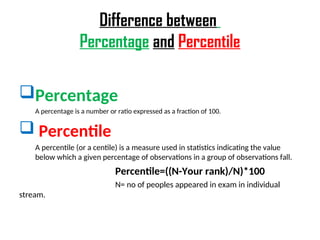
Difference between
Percentage andPercentile
Percentage
A percentage is a number or ratio expressed as a fraction of 100.
Percentile
A percentile (or a centile) is a measure used in statistics indicating the value
below which a given percentage of observations in a group of observations fall.
Percentile=((N-Your rank)/N)*100
N= no of peoples appeared in exam in individual
stream.
GATE 2016 VsGATE 2015 Statistics:
Year Total
applicants
Total
Appeared
Male
Candidates
Female
Candidates
GATE 2016 971831 818850 576611 242207
GATE 2015 927580 804463 567111 237235
13.
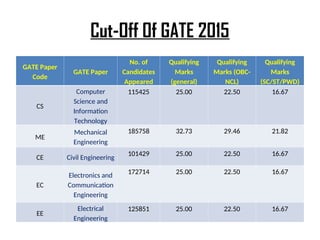
Cut-Off Of GATE2015
GATE Paper
Code
GATE Paper
No. of
Candidates
Appeared
Qualifying
Marks
(general)
Qualifying
Marks (OBC-
NCL)
Qualifying
Marks
(SC/ST/PWD)
CS
Computer
Science and
Information
Technology
115425 25.00 22.50 16.67
ME
Mechanical
Engineering
185758 32.73 29.46 21.82
CE Civil Engineering
101429 25.00 22.50 16.67
EC
Electronics and
Communication
Engineering
172714 25.00 22.50 16.67
EE
Electrical
Engineering
125851 25.00 22.50 16.67
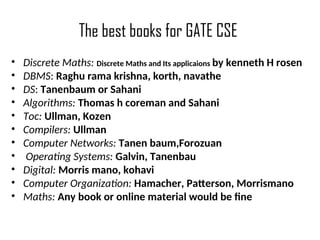
The best booksfor GATE CSE
• Discrete Maths: Discrete Maths and Its applicaions by kenneth H rosen
• DBMS: Raghu rama krishna, korth, navathe
• DS: Tanenbaum or Sahani
• Algorithms: Thomas h coreman and Sahani
• Toc: Ullman, Kozen
• Compilers: Ullman
• Computer Networks: Tanen baum,Forozuan
• Operating Systems: Galvin, Tanenbau
• Digital: Morris mano, kohavi
• Computer Organization: Hamacher, Patterson, Morrismano
• Maths: Any book or online material would be fine
Study Material Available
•MADEEASY publications.
• ACE Academy notes.
• Elite Gate Academy Hydrabad
• PT Education
• Gate Tutor
• Gate Forum materials and Practice papers.
• G K Publishers.
• G K Publishers previous year solved.
• Schaum series(for clearing concepts and quick
revision).
• Wani Classes Pune