1
Noida Institute ofEngineering and Technology, Greater
Noida
Stacks and Queues
08/26/2025
Ms. Pooja Sharma BCSE0301: Unit-4
Pooja Sharma
Assistant Professor
Computer Science
Unit: 4
Data Structure
Course Details
(Ex: B Tech 3rd
Sem)
2.
08/26/2025 Ms. PoojaSharma DATA STRUCTURES AND ALGORITHMS-I
BCSE0301 Unit-4
2
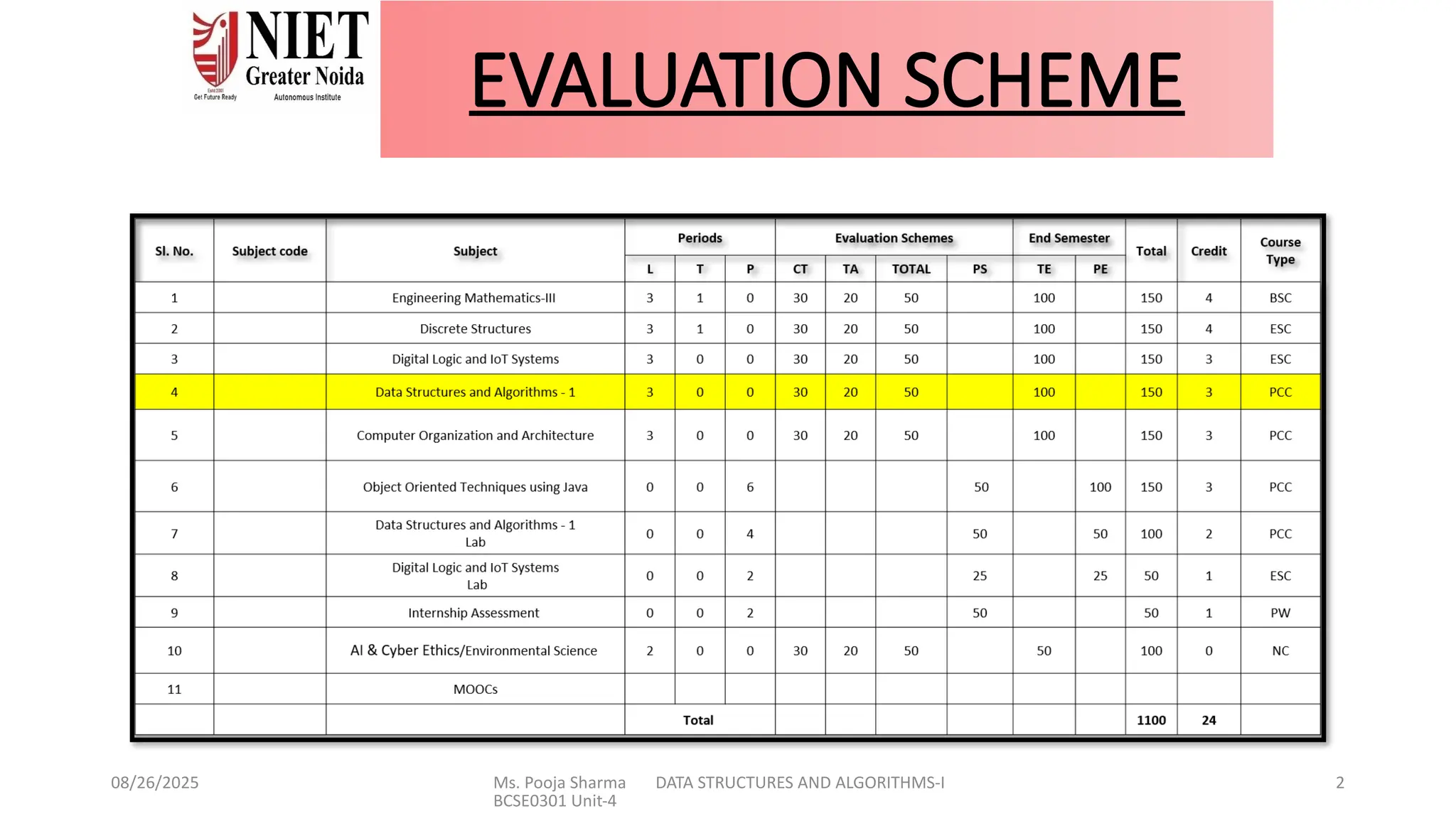
EVALUATION SCHEME
3.
08/26/2025 Ms. PoojaSharma DATA STRUCTURES AND ALGORITHMS-I
BCSE0301 Unit-4
3
SYLLABUS
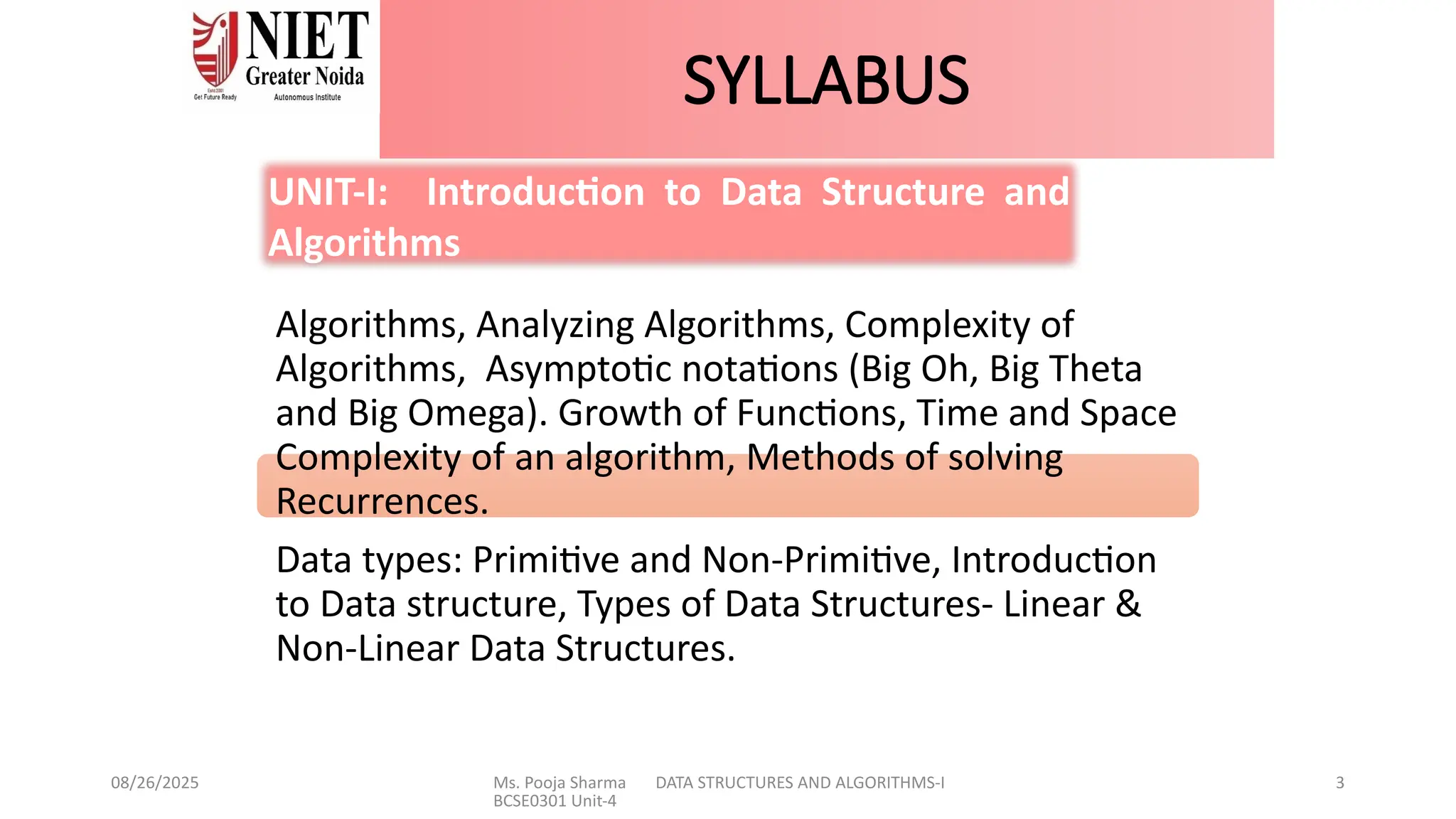
Algorithms, Analyzing Algorithms, Complexity of
Algorithms, Asymptotic notations (Big Oh, Big Theta
and Big Omega). Growth of Functions, Time and Space
Complexity of an algorithm, Methods of solving
Recurrences.
Data types: Primitive and Non-Primitive, Introduction
to Data structure, Types of Data Structures- Linear &
Non-Linear Data Structures.
UNIT-I: Introduction to Data Structure and
Algorithms
4.
08/26/2025 Ms. PoojaSharma DATA STRUCTURES AND ALGORITHMS-I
BCSE0301 Unit-4
4
SYLLABUS
Arrays: Definition, Single and Multi-Dimensional, Representation of
an Arrays: Row and Column Major, Derivation of Index Formulae for
1-D,2-D and 3-D and n-D Arrays, Application of Arrays: Sparse Matrix
and their Representation.
Searching and Sorting: Searching Algorithms with analysis: Linear
and Binary Search.
Sorting Algorithms with analysis: Bubble Sort, Insertion Sort,
Selection Sort, Shell Sort, Sorting in Linear Time- Counting Sort.
Hashing: Hashing the Symbol Table, Hashing Functions, Collision
Resolution, Techniques hashing for direct files.
UNIT-II: Design and Analysis of Algorithms: Array
Data Structure
5.
08/26/2025 Ms. PoojaSharma DATA STRUCTURES AND ALGORITHMS-I
BCSE0301 Unit-4
5
SYLLABUS
Linked Lists: Comparison of Array, List and Linked
list.
Types of linked list: Singly Linked List, Doubly
Linked List, Circular Linked List.
Polynomial Representation and Addition of
Polynomials.
UNIT-III: Design and Analysis of Algorithms: Linked
Data Structure
6.
08/26/2025 Ms. PoojaSharma DATA STRUCTURES AND ALGORITHMS-I
BCSE0301 Unit-4
6
SYLLABUS
Stack Primitive Stack operations: Push & Pop, Array and Linked List
Implementation of Stack, Application of stack: Infix, Prefix, Postfix
Expressions and their mutual conversion, Evaluation of postfix expression.
Recursion: Principles of recursion, Tail recursion, Removal of recursion, with
example such as Fibonacci series, binary search, Merge sort and Quick sort
algorithms with analysis. Tower of Hanoi, Trade-offs between iteration and
recursion.
Queue: Array and linked List implementation of queues, Operations on
Queue: Create, Insert, Delete, Full and Empty, Circular queues, Dequeue and
Priority Queue algorithms with analysis .
UNIT-IV: Design and Analysis of Algorithms: Stack Data
Structure, Recursion and Queue Data Structure.
7.
08/26/2025 Ms. PoojaSharma DATA STRUCTURES AND ALGORITHMS-I
BCSE0301 Unit-4
7
SYLLABUS
Divide and Conquer concepts with Examples Such as Quick sort, Merge
sort, Convex Hull.
Greedy Methods with Examples Such as Activity Selection, Task
Scheduling, Fractional Knapsack Problem.
UNIT-V: Design and Analysis of Algorithms: Divide
and Conquer and Greedy Algorithms.
8.
08/26/2025 Ms. PoojaSharma DATA STRUCTURES AND ALGORITHMS-I
BCSE0301 Unit-4
8
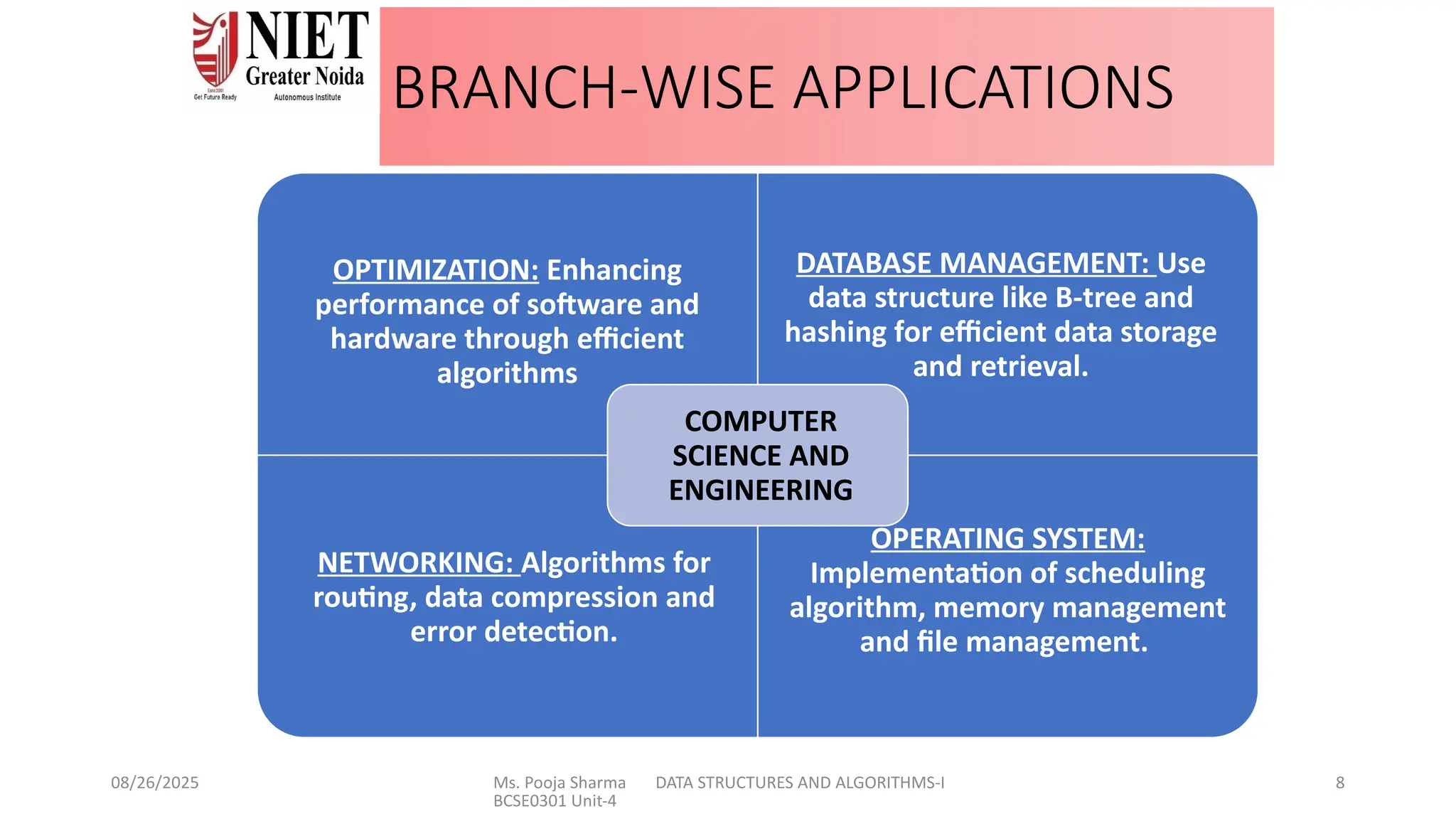
BRANCH-WISE APPLICATIONS
OPTIMIZATION: Enhancing
performance of software and
hardware through efficient
algorithms
DATABASE MANAGEMENT: Use
data structure like B-tree and
hashing for efficient data storage
and retrieval.
NETWORKING: Algorithms for
routing, data compression and
error detection.
OPERATING SYSTEM:
Implementation of scheduling
algorithm, memory management
and file management.
COMPUTER
SCIENCE AND
ENGINEERING
9.
08/26/2025 Ms. PoojaSharma DATA STRUCTURES AND ALGORITHMS-I
BCSE0301 Unit-4
9
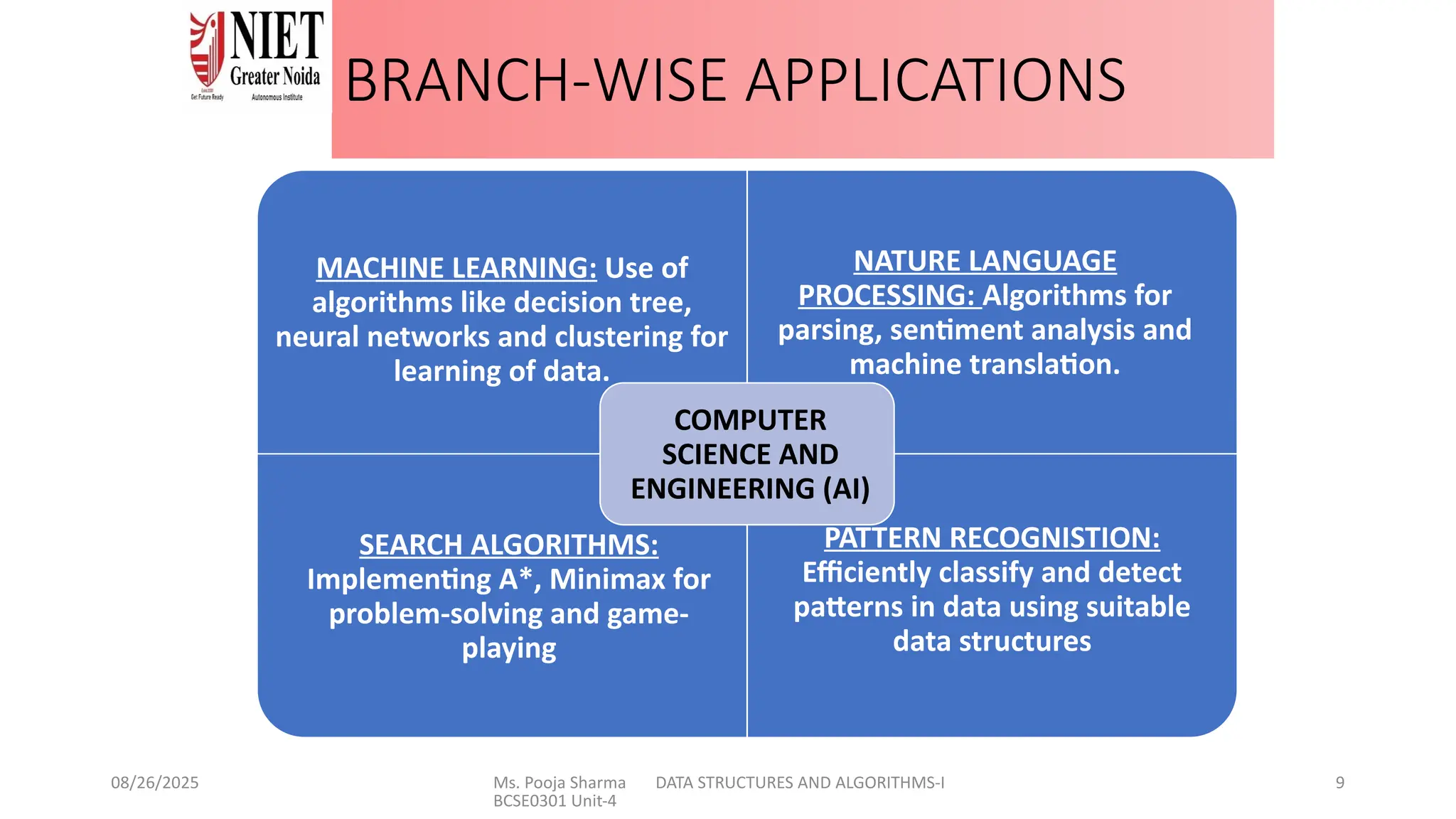
BRANCH-WISE APPLICATIONS
MACHINE LEARNING: Use of
algorithms like decision tree,
neural networks and clustering for
learning of data.
NATURE LANGUAGE
PROCESSING: Algorithms for
parsing, sentiment analysis and
machine translation.
SEARCH ALGORITHMS:
Implementing A*, Minimax for
problem-solving and game-
playing
PATTERN RECOGNISTION:
Efficiently classify and detect
patterns in data using suitable
data structures
COMPUTER
SCIENCE AND
ENGINEERING (AI)
10.
08/26/2025 Ms. PoojaSharma DATA STRUCTURES AND ALGORITHMS-I
BCSE0301 Unit-4
10
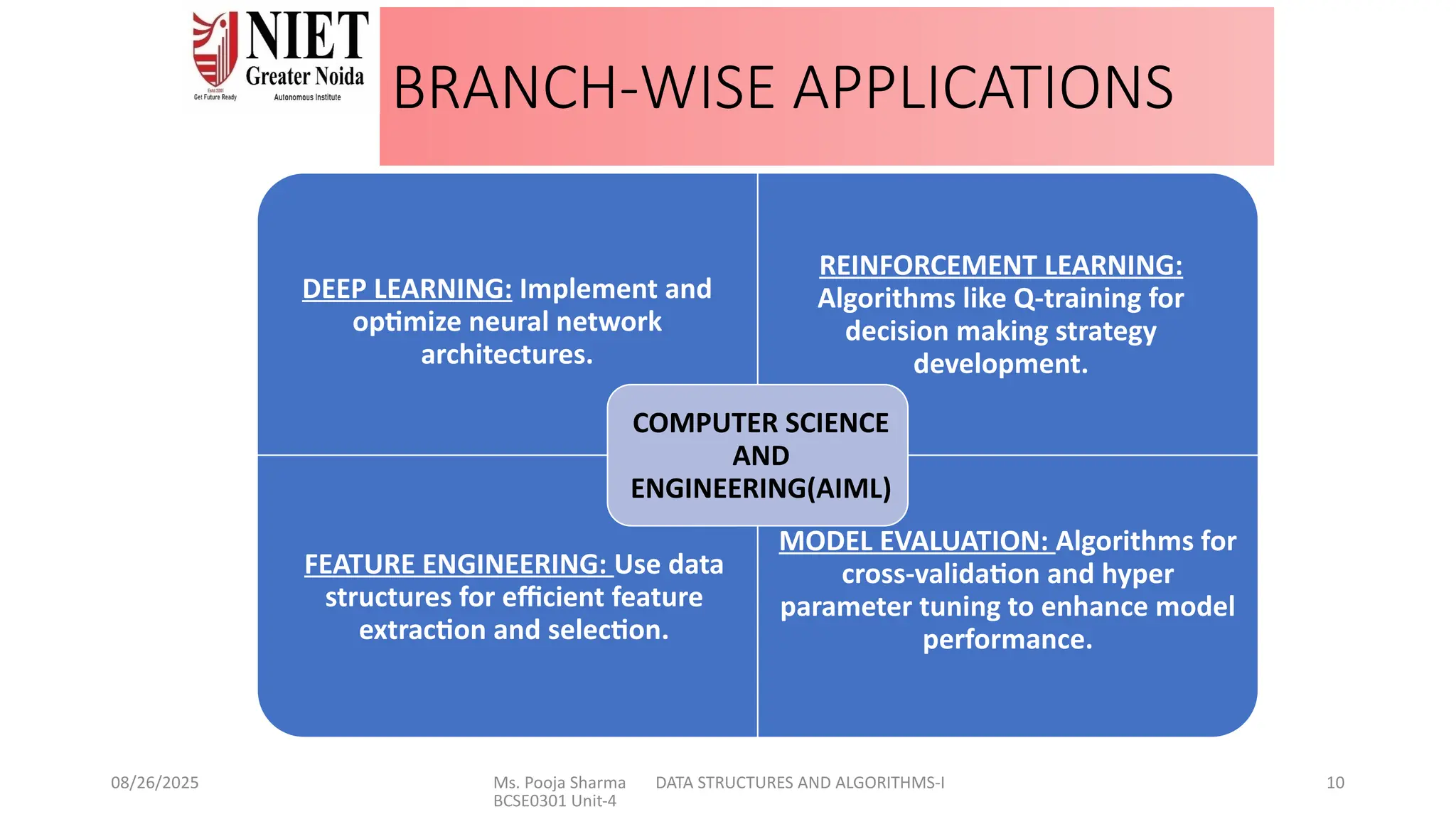
BRANCH-WISE APPLICATIONS
DEEP LEARNING: Implement and
optimize neural network
architectures.
REINFORCEMENT LEARNING:
Algorithms like Q-training for
decision making strategy
development.
FEATURE ENGINEERING: Use data
structures for efficient feature
extraction and selection.
MODEL EVALUATION: Algorithms for
cross-validation and hyper
parameter tuning to enhance model
performance.
COMPUTER SCIENCE
AND
ENGINEERING(AIML)
11.
08/26/2025 Ms. PoojaSharma DATA STRUCTURES AND ALGORITHMS-I
BCSE0301 Unit-4
11
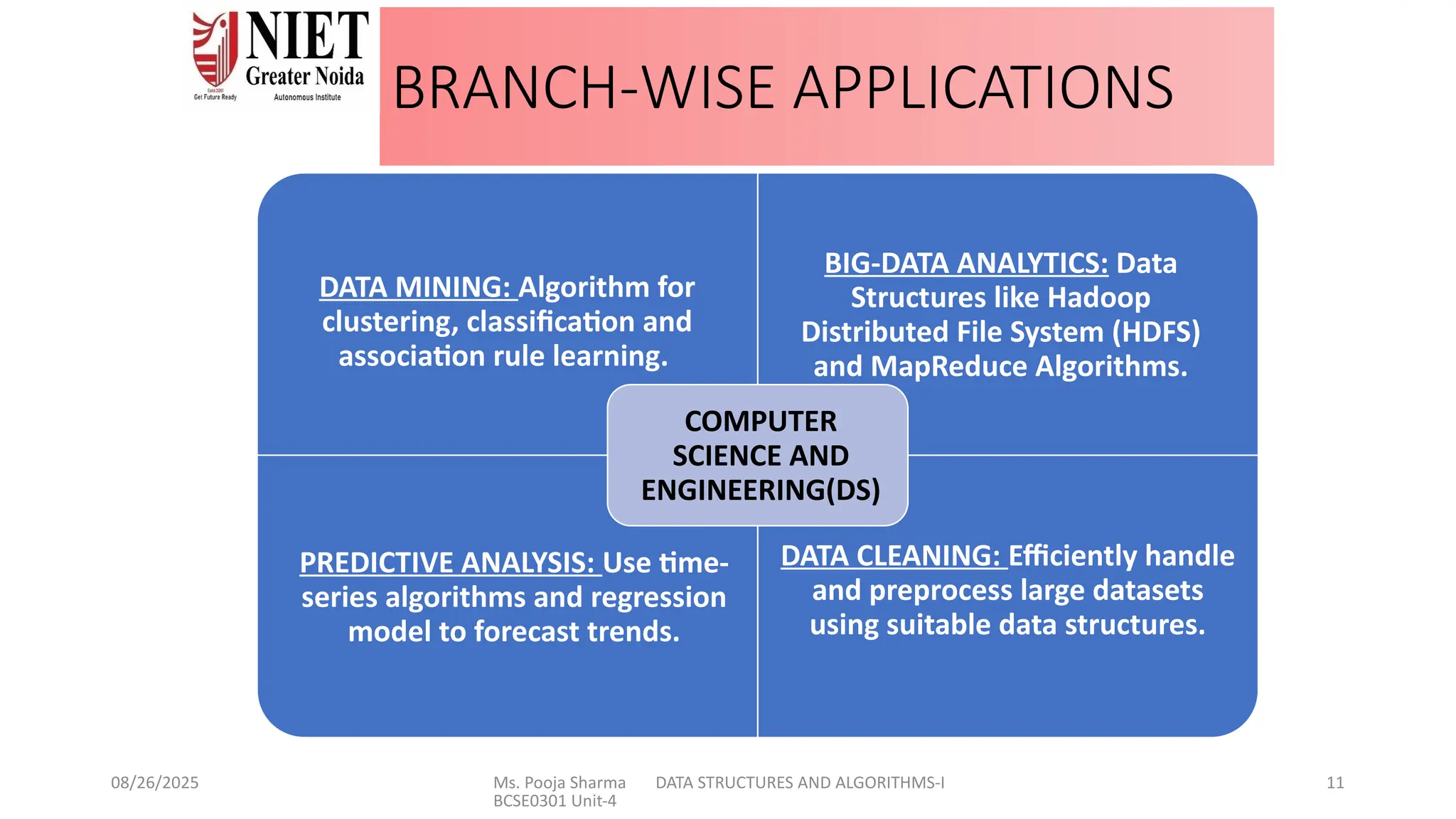
BRANCH-WISE APPLICATIONS
DATA MINING: Algorithm for
clustering, classification and
association rule learning.
BIG-DATA ANALYTICS: Data
Structures like Hadoop
Distributed File System (HDFS)
and MapReduce Algorithms.
PREDICTIVE ANALYSIS: Use time-
series algorithms and regression
model to forecast trends.
DATA CLEANING: Efficiently handle
and preprocess large datasets
using suitable data structures.
COMPUTER
SCIENCE AND
ENGINEERING(DS)
12.
08/26/2025 Ms. PoojaSharma DATA STRUCTURES AND ALGORITHMS-I
BCSE0301 Unit-4
12
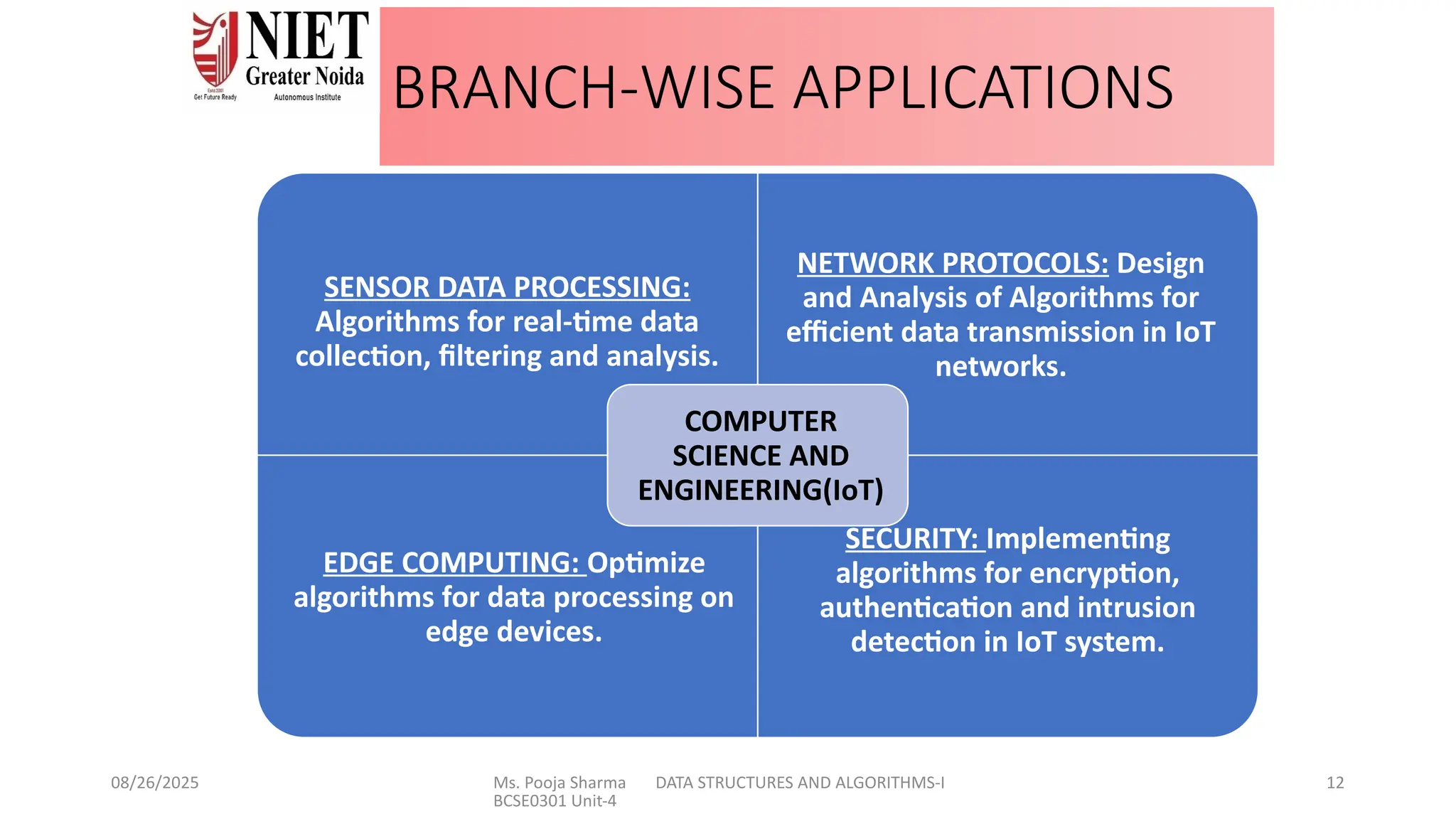
BRANCH-WISE APPLICATIONS
SENSOR DATA PROCESSING:
Algorithms for real-time data
collection, filtering and analysis.
NETWORK PROTOCOLS: Design
and Analysis of Algorithms for
efficient data transmission in IoT
networks.
EDGE COMPUTING: Optimize
algorithms for data processing on
edge devices.
SECURITY: Implementing
algorithms for encryption,
authentication and intrusion
detection in IoT system.
COMPUTER
SCIENCE AND
ENGINEERING(IoT)
13.
08/26/2025 Ms. PoojaSharma DATA STRUCTURES AND ALGORITHMS-I
BCSE0301 Unit-4
13
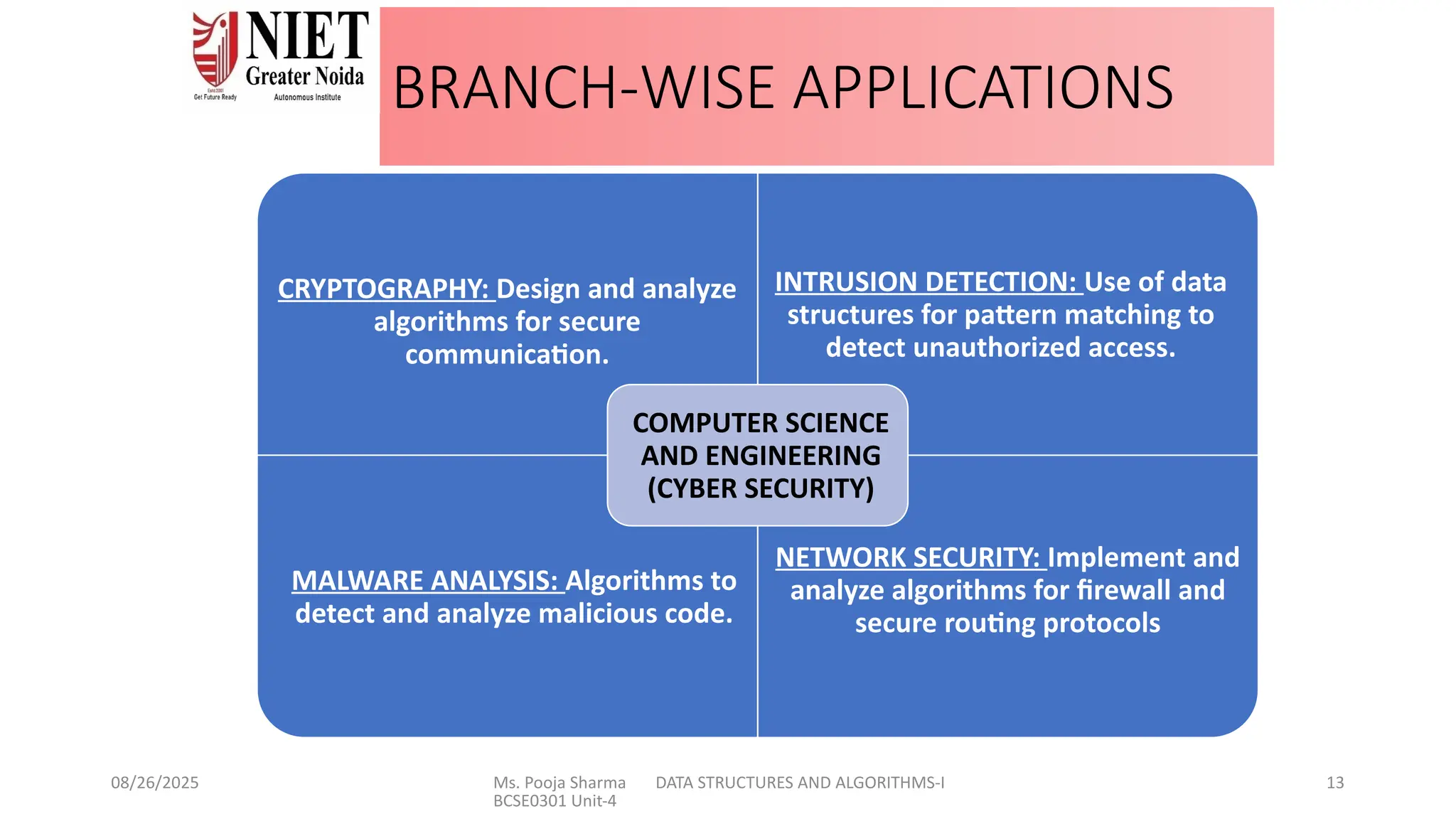
BRANCH-WISE APPLICATIONS
CRYPTOGRAPHY: Design and analyze
algorithms for secure
communication.
INTRUSION DETECTION: Use of data
structures for pattern matching to
detect unauthorized access.
MALWARE ANALYSIS: Algorithms to
detect and analyze malicious code.
NETWORK SECURITY: Implement and
analyze algorithms for firewall and
secure routing protocols
COMPUTER SCIENCE
AND ENGINEERING
(CYBER SECURITY)
14.
COURSE OBJECTIVE
STUDENTS WILLTRY TO LEARN:
1. To impart the basic concepts of data structures and algorithms.
2. To understand concepts about searching and sorting techniques.
3. To Understand basic concepts about stacks, queues, lists, trees and
graphs.
4. To understanding about writing algorithms and step by step
approach in solving problems with the help of fundamental data
15.
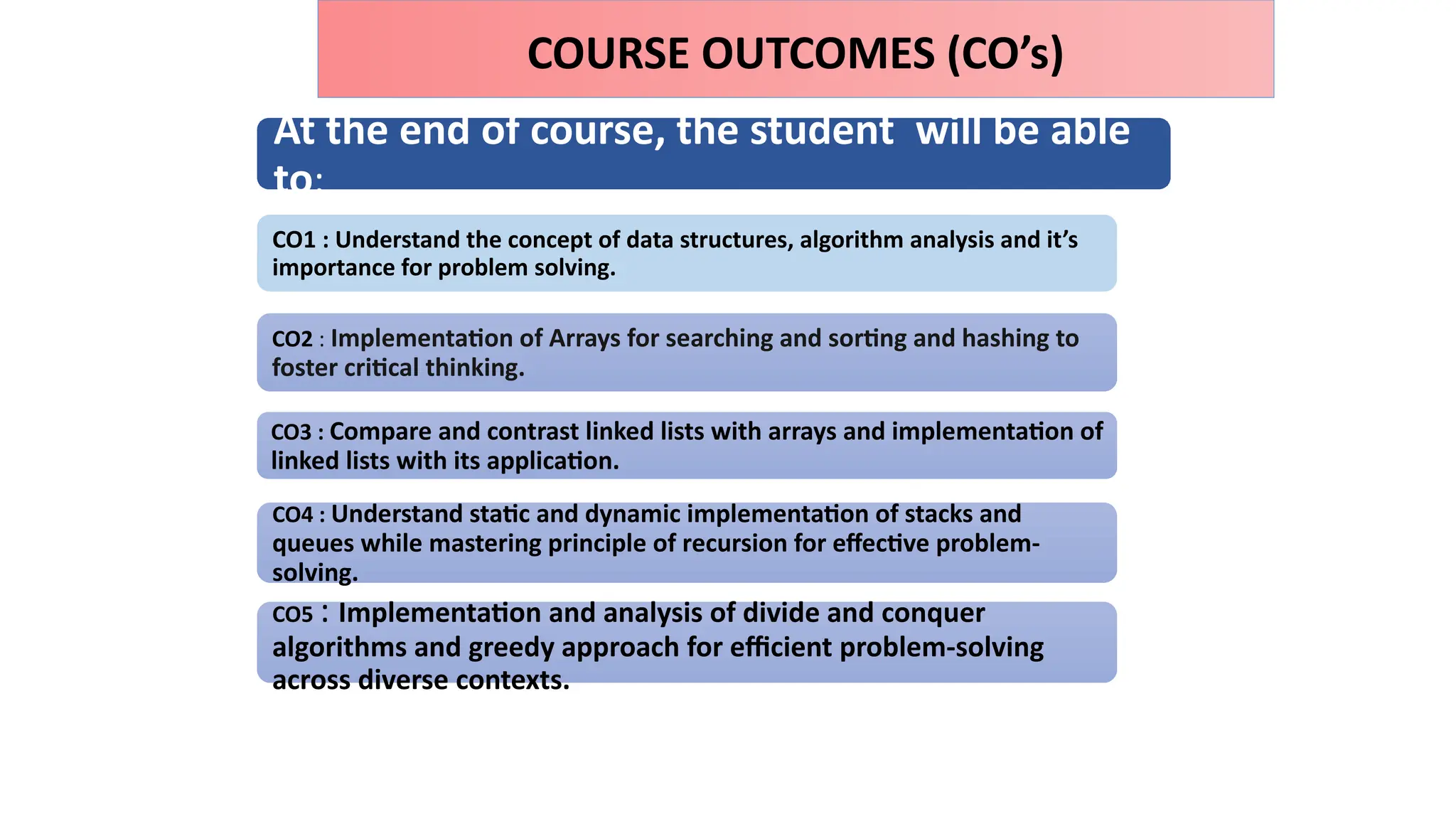
COURSE OUTCOMES (CO’s)
Atthe end of course, the student will be able
to:
CO1 : Understand the concept of data structures, algorithm analysis and it’s
importance for problem solving.
CO2 : Implementation of Arrays for searching and sorting and hashing to
foster critical thinking.
CO3 : Compare and contrast linked lists with arrays and implementation of
linked lists with its application.
CO4 : Understand static and dynamic implementation of stacks and
queues while mastering principle of recursion for effective problem-
solving.
CO5 : Implementation and analysis of divide and conquer
algorithms and greedy approach for efficient problem-solving
across diverse contexts.
16.
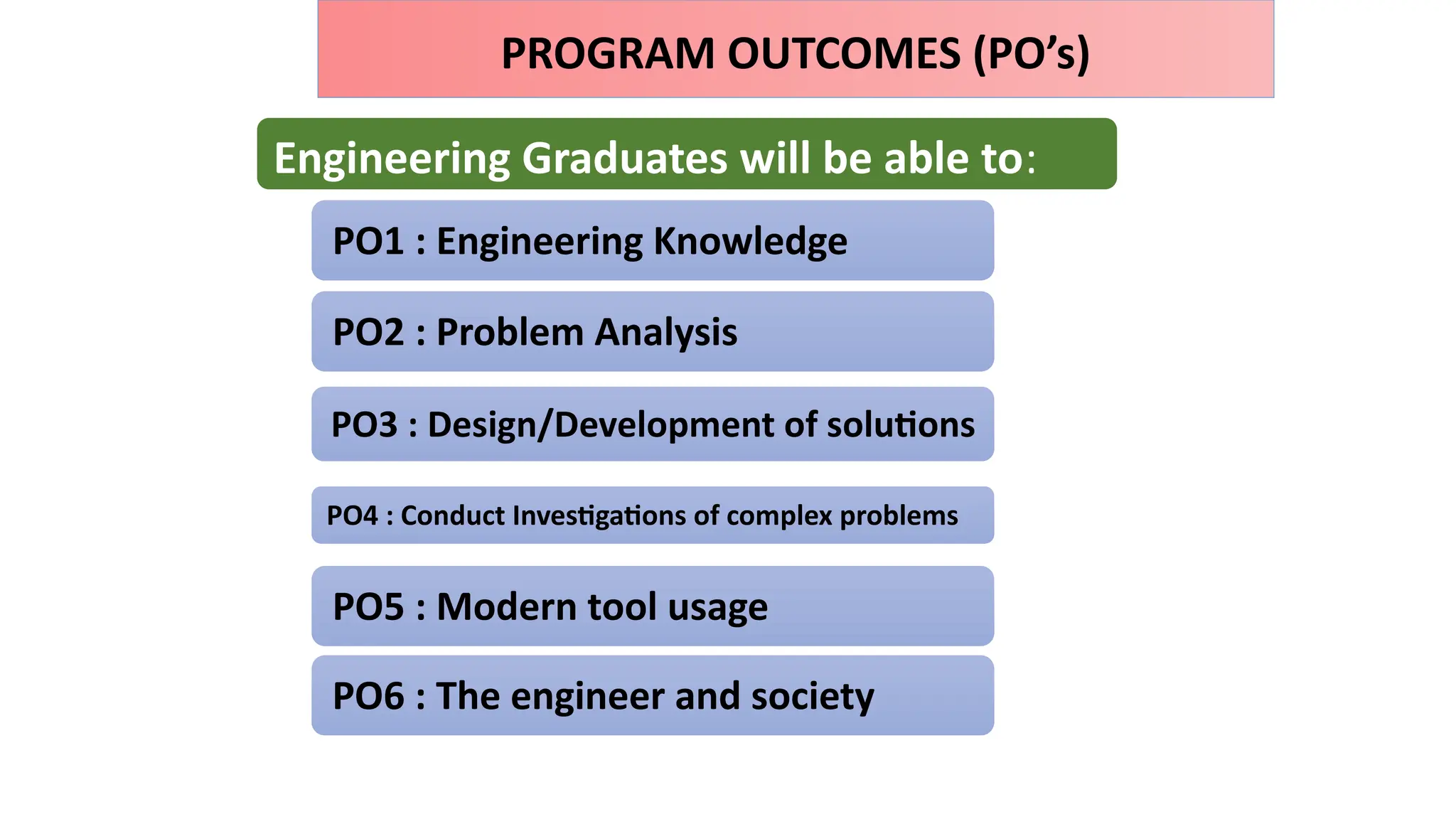
PROGRAM OUTCOMES (PO’s)
EngineeringGraduates will be able to:
PO1 : Engineering Knowledge
PO2 : Problem Analysis
PO3 : Design/Development of solutions
PO4 : Conduct Investigations of complex problems
PO5 : Modern tool usage
PO6 : The engineer and society
17.
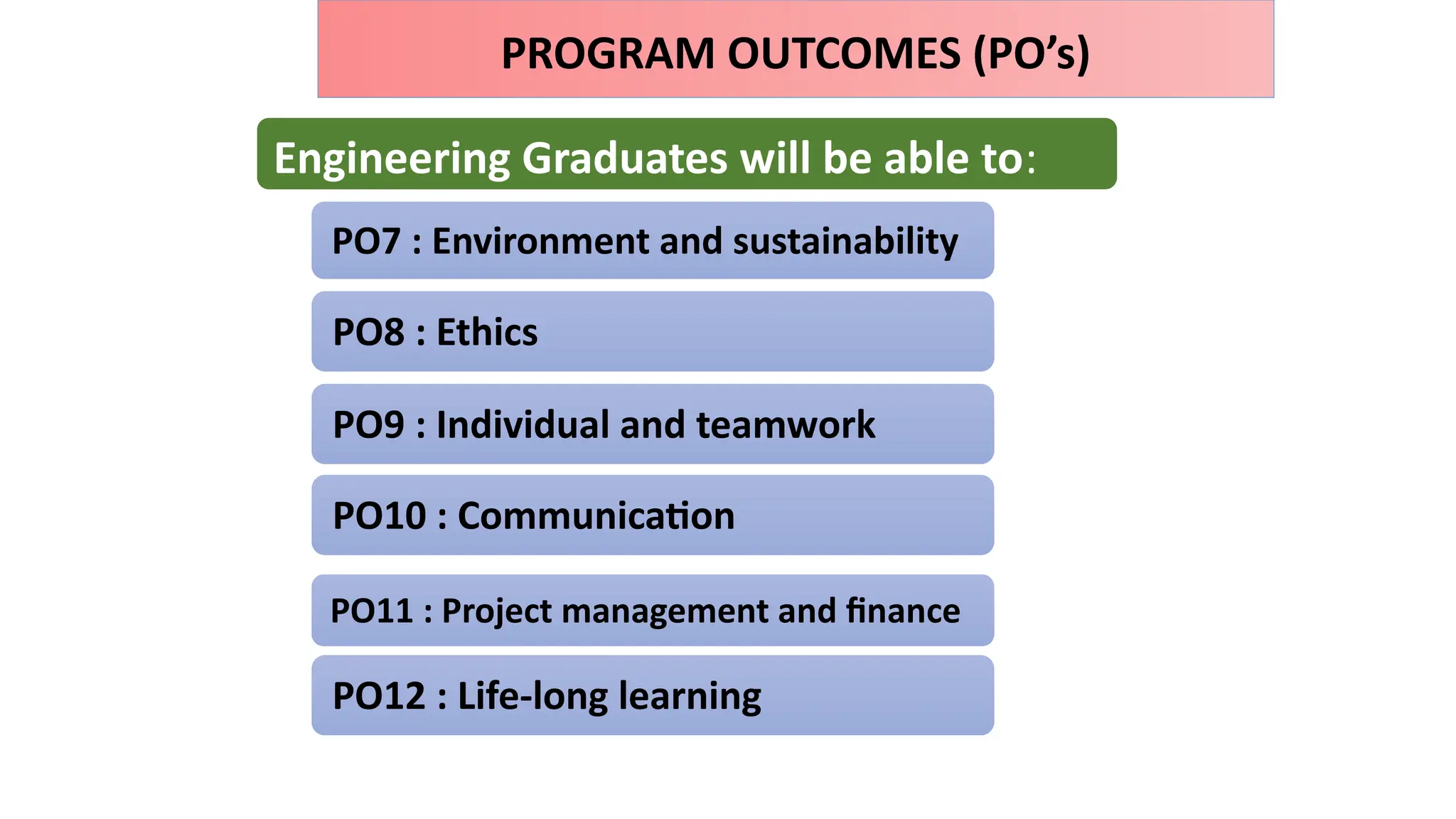
PROGRAM OUTCOMES (PO’s)
EngineeringGraduates will be able to:
PO7 : Environment and sustainability
PO8 : Ethics
PO9 : Individual and teamwork
PO10 : Communication
PO11 : Project management and finance
PO12 : Life-long learning
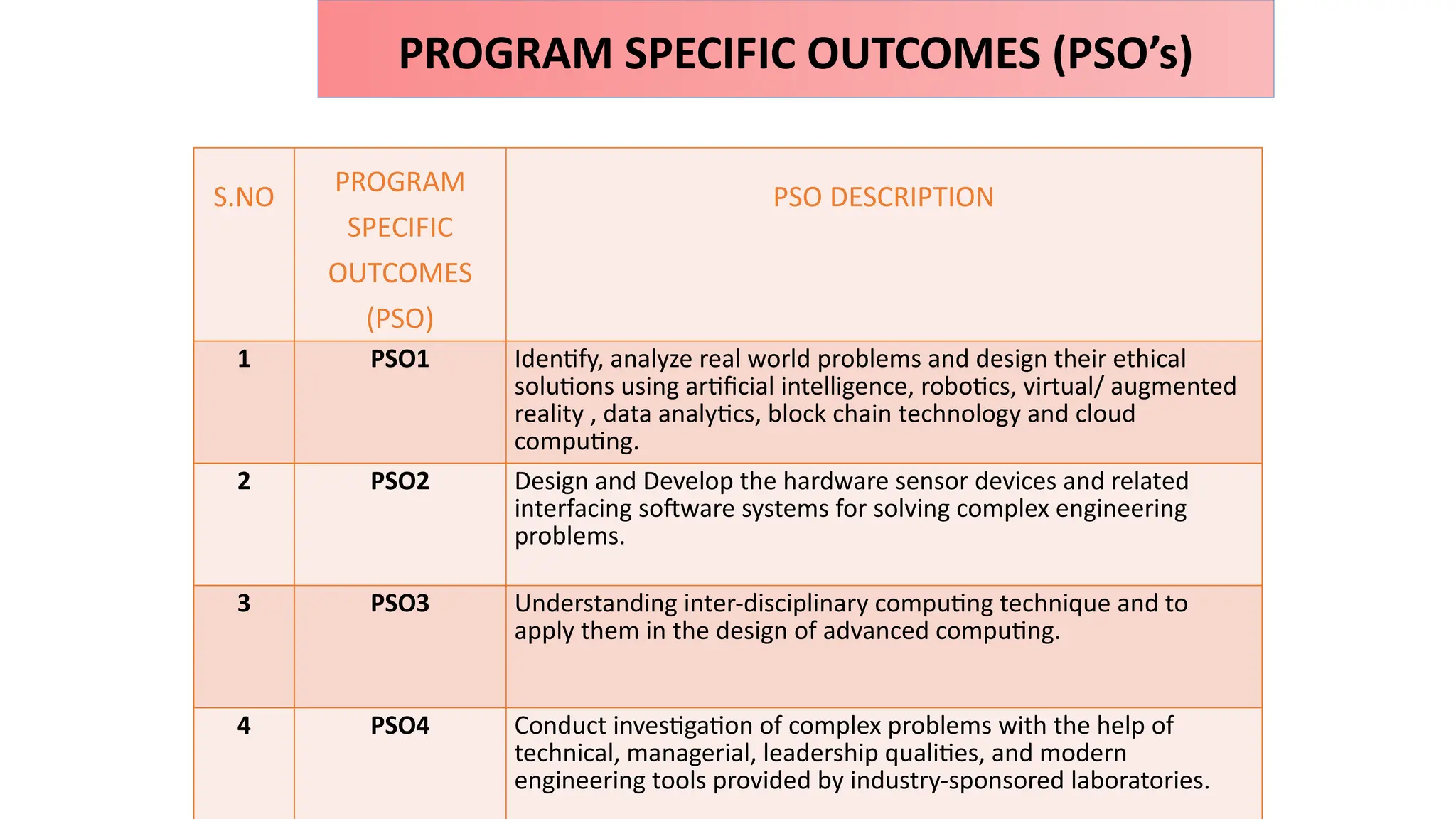
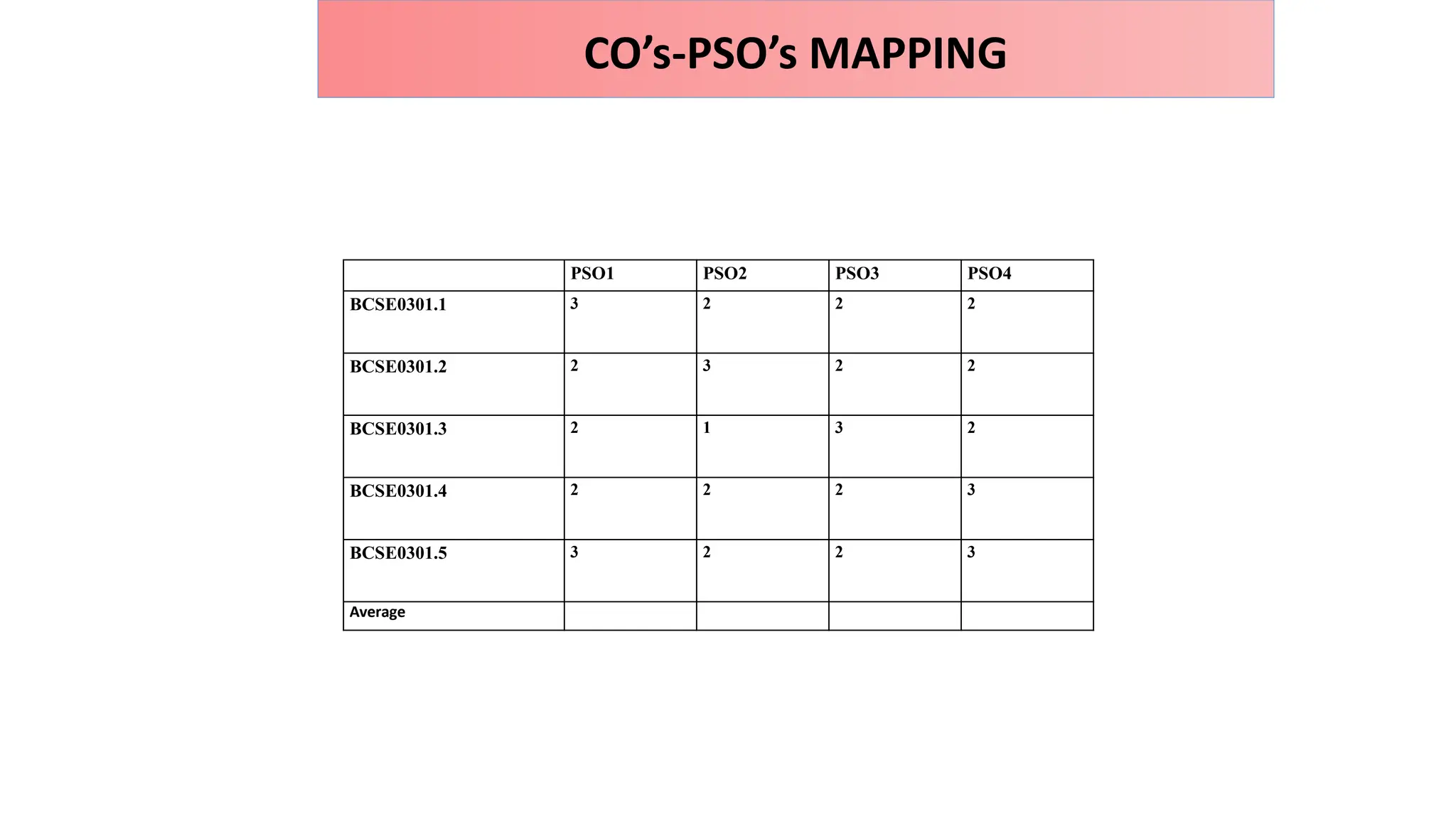
PROGRAM SPECIFIC OUTCOMES(PSO’s)
S.NO PROGRAM
SPECIFIC
OUTCOMES
(PSO)
PSO DESCRIPTION
1 PSO1 Identify, analyze real world problems and design their ethical
solutions using artificial intelligence, robotics, virtual/ augmented
reality , data analytics, block chain technology and cloud
computing.
2 PSO2 Design and Develop the hardware sensor devices and related
interfacing software systems for solving complex engineering
problems.
3 PSO3 Understanding inter-disciplinary computing technique and to
apply them in the design of advanced computing.
4 PSO4 Conduct investigation of complex problems with the help of
technical, managerial, leadership qualities, and modern
engineering tools provided by industry-sponsored laboratories.
PROGRAM EDUCATIONAL OBJECTIVES(PEO’s)
PROGRAM
EDUCATIONAL
OBJECTIVES
(PEO’s)
PEO’s DESCRIPTION
PEO1
To have an excellent scientific and engineering breadth so as to
comprehend, analyze, design and provide sustainable solutions for
real-life problems using state-of-the-art technologies.
PEO2
To have a successful career in industries, to pursue higher studies or
to support entrepreneurial endeavors and to face the global
challenges.
PEO3
To have an effective communication skills, professional attitude,
ethical values and a desire to learn specific knowledge in emerging
trends, technologies for research, innovation and product
development and contribution to society.
PEO4
To have life-long learning for up-skilling and re-skilling for a successful
professional career as an engineer, scientist, entrepreneur or
bureaucrat for the betterment of the society.
PRE-REQUISITE FOR THESUBJECT
S.NO TOPIC UNDERSTANDING
1
PROGRAMMING
BASIC UNDERSTANDING OF C
AND PYTHON.
2
ARRAYS
CREATION OF ARRAYS
3
POINTERS
BASIC UNDERSTANDING OF
WORKING WITH POINTERS (C
LANGUAGE)
4
CLASS
CREATION OF CLASS AND IT’S
OBJECTS.
5
FLOW CHART AND ALGORITHMS
BASIC SYMBOLS AND PSEUDO
CODE.
28.
BRIEF INTRODUCTION ABOUTTHE SUBJECT
WITH VIDEOS
Video Links:
1. https://infyspringboard.onwingspan.com/web/en/app/toc/lex_auth_0125409699132620
801065_shared/overview
2. https://infyspringboard.onwingspan.com/web/en/app/toc/lex_auth_0135015662906327
049522/overview
3. https://infyspringboard.onwingspan.com/web/en/app/toc/lex_auth_0131771733610414
0852_shared/overview
Above Links will give you a brief reference of Subject.
29.
08/26/2025 Ms. PoojaSharma BCSE0301: Unit-4 29
Stacks: Abstract Data Type, Primitive Stack operations: Push & Pop, Array and Linked
Implementation of Stack in C, Application of stack: Prefix and Postfix Expressions,
Evaluation of
postfix expression, Iteration and Recursion- Principles of recursion, Tail recursion, Removal
of
recursion Problem solving using iteration and recursion with examples such as binary
search,
Fibonacci numbers, and Hanoi towers. Tradeoffs between iteration and recursion.
Queues: Operations on Queue: Create, Add, Delete, Full and Empty, Circular queues, Array
and
linked implementation of queues in C, Dequeue and Priority Queue.
UNIT-4
Syllabus
30.
08/26/2025 Ms. PoojaSharma BCSE0301: Unit-4 30
Topics Duration (in
Hours)
Stacks: Abstract Data Type 1
Array and Linked Implementation of Stack in C 1
Application of stack: Prefix and Postfix
Expressions
1
Evaluation of postfix expression 1
Iteration and Recursion- Principles of recursion 1
Binary search using recursion 1
Hanoi towers 1
Tradeoffs between iteration and recursion. 2
Contents
31.
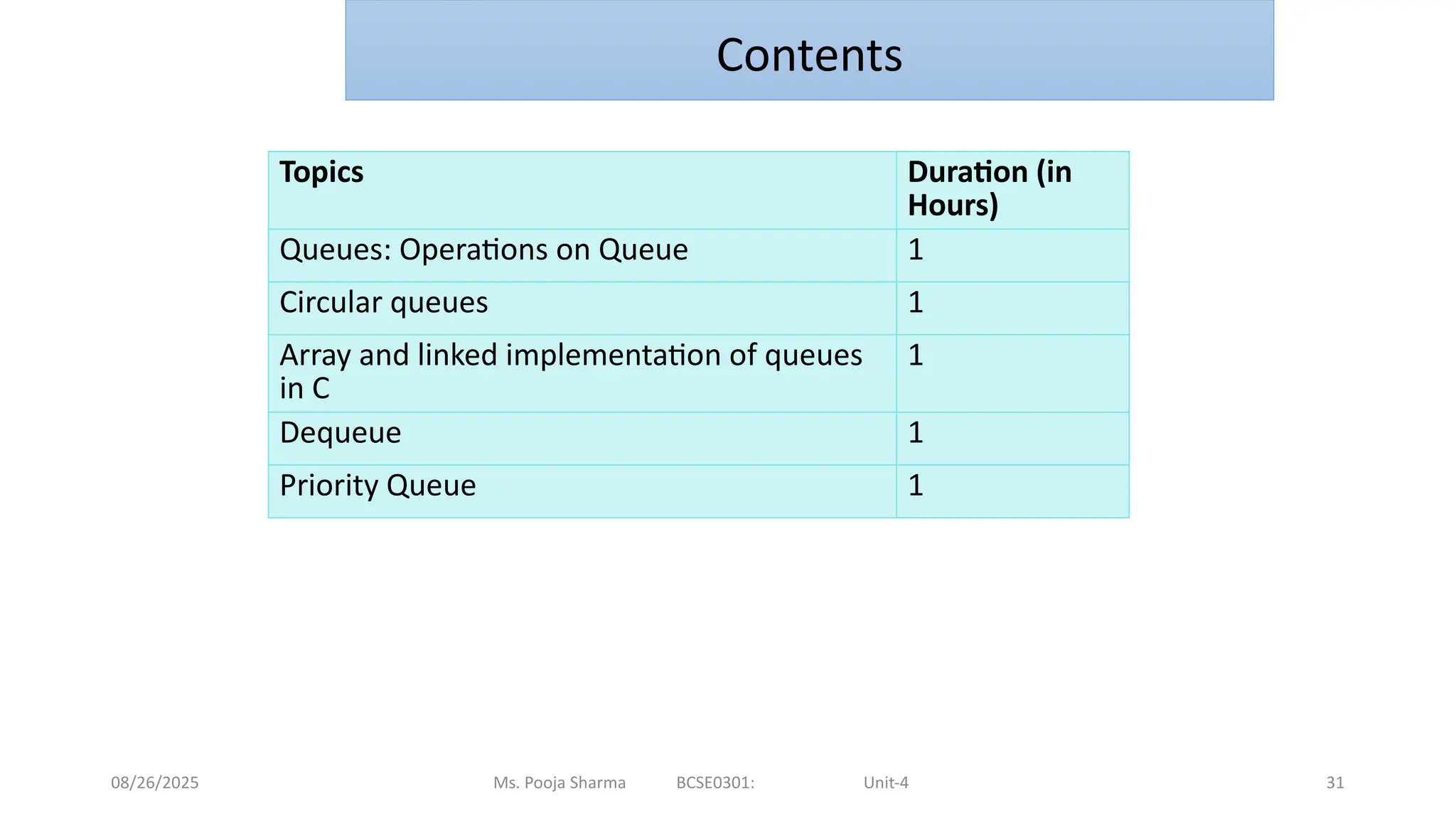
08/26/2025 Ms. PoojaSharma BCSE0301: Unit-4 31
Topics Duration (in
Hours)
Queues: Operations on Queue 1
Circular queues 1
Array and linked implementation of queues
in C
1
Dequeue 1
Priority Queue 1
Contents
32.
08/26/2025 32
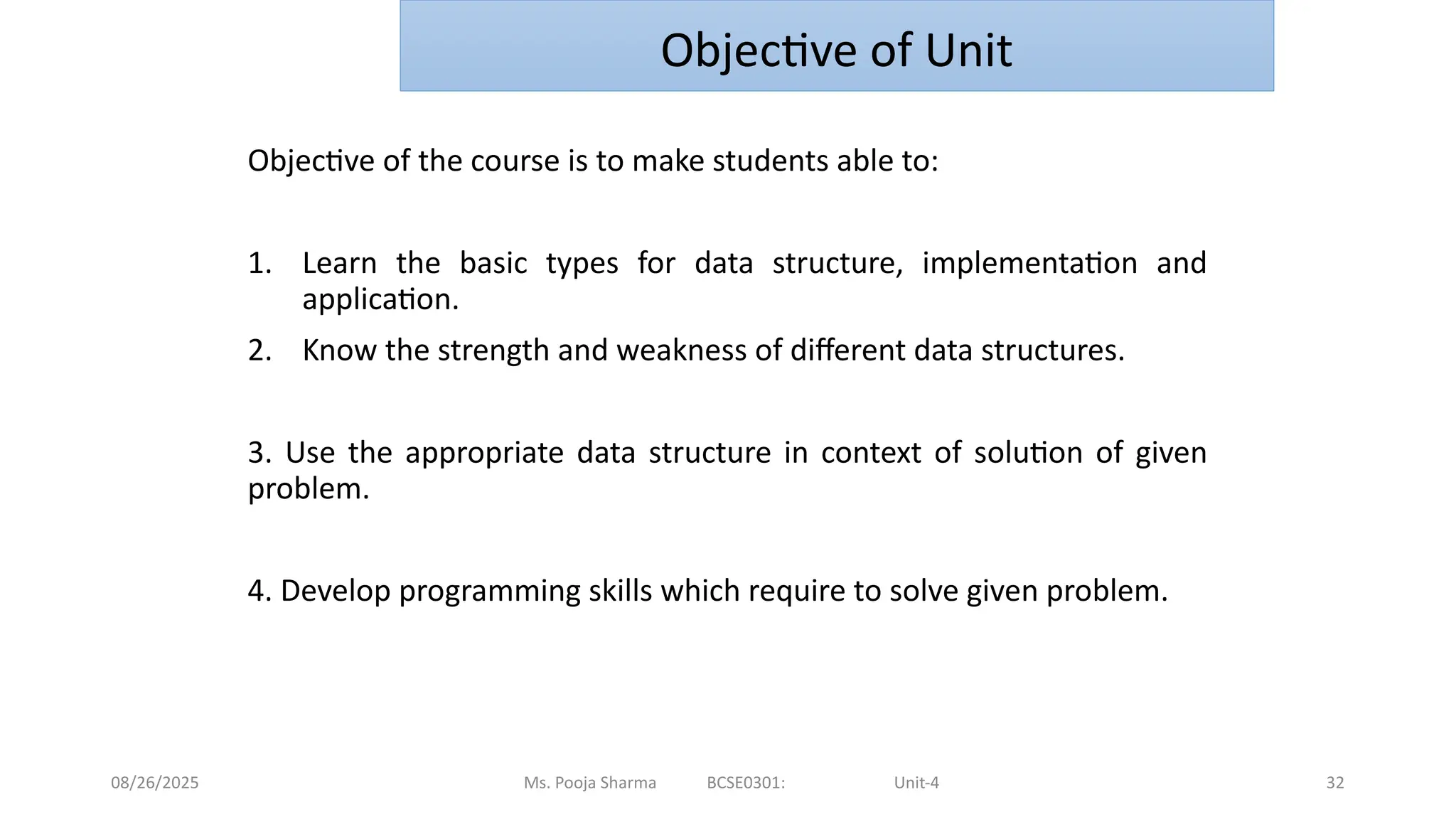
Objective ofthe course is to make students able to:
1. Learn the basic types for data structure, implementation and
application.
2. Know the strength and weakness of different data structures.
3. Use the appropriate data structure in context of solution of given
problem.
4. Develop programming skills which require to solve given problem.
Ms. Pooja Sharma BCSE0301: Unit-4
Objective of Unit
33.
08/26/2025 Ms. PoojaSharma BCSE0301: Unit-4 33
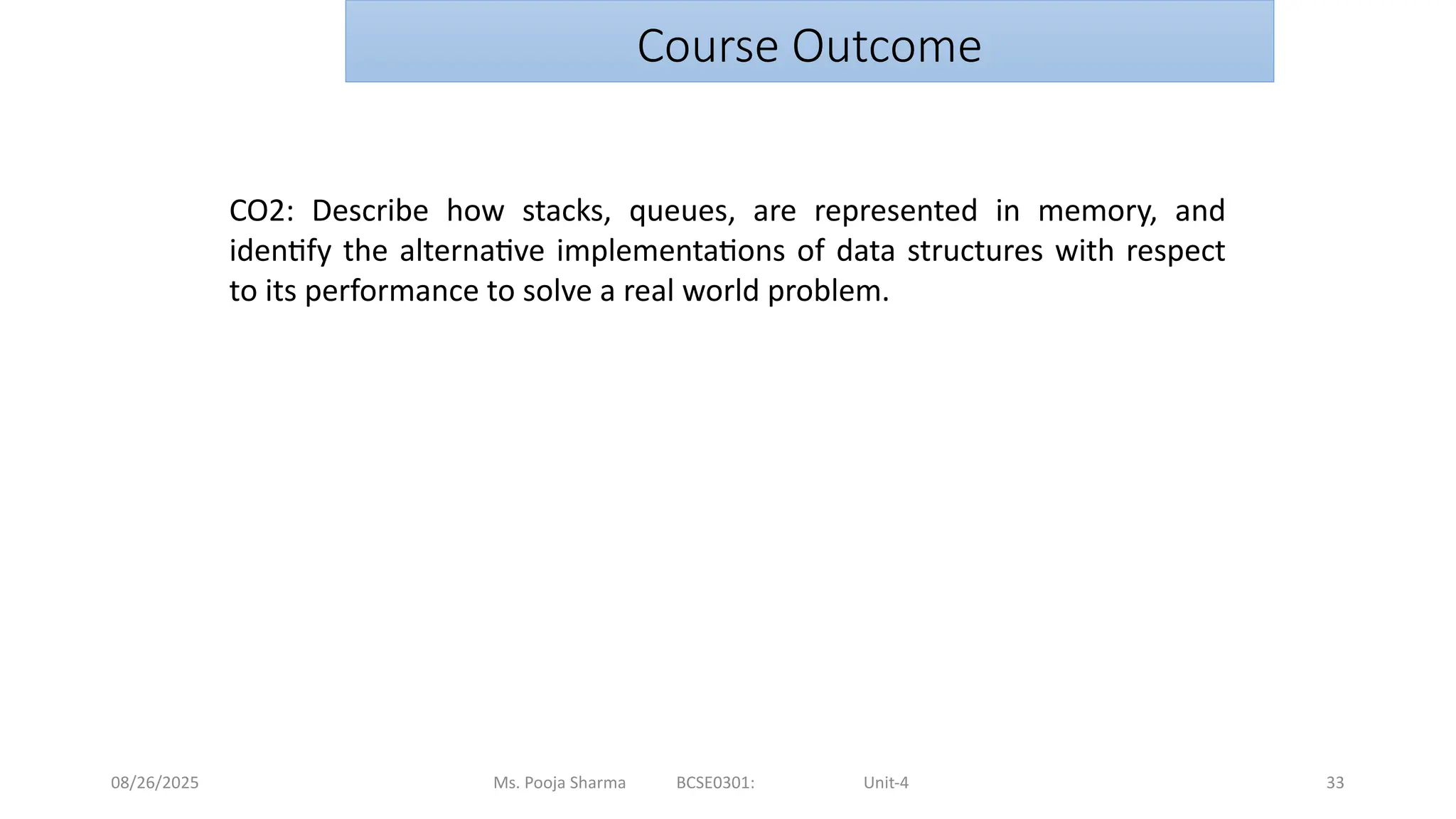
Course Outcome
CO2: Describe how stacks, queues, are represented in memory, and
identify the alternative implementations of data structures with respect
to its performance to solve a real world problem.
34.
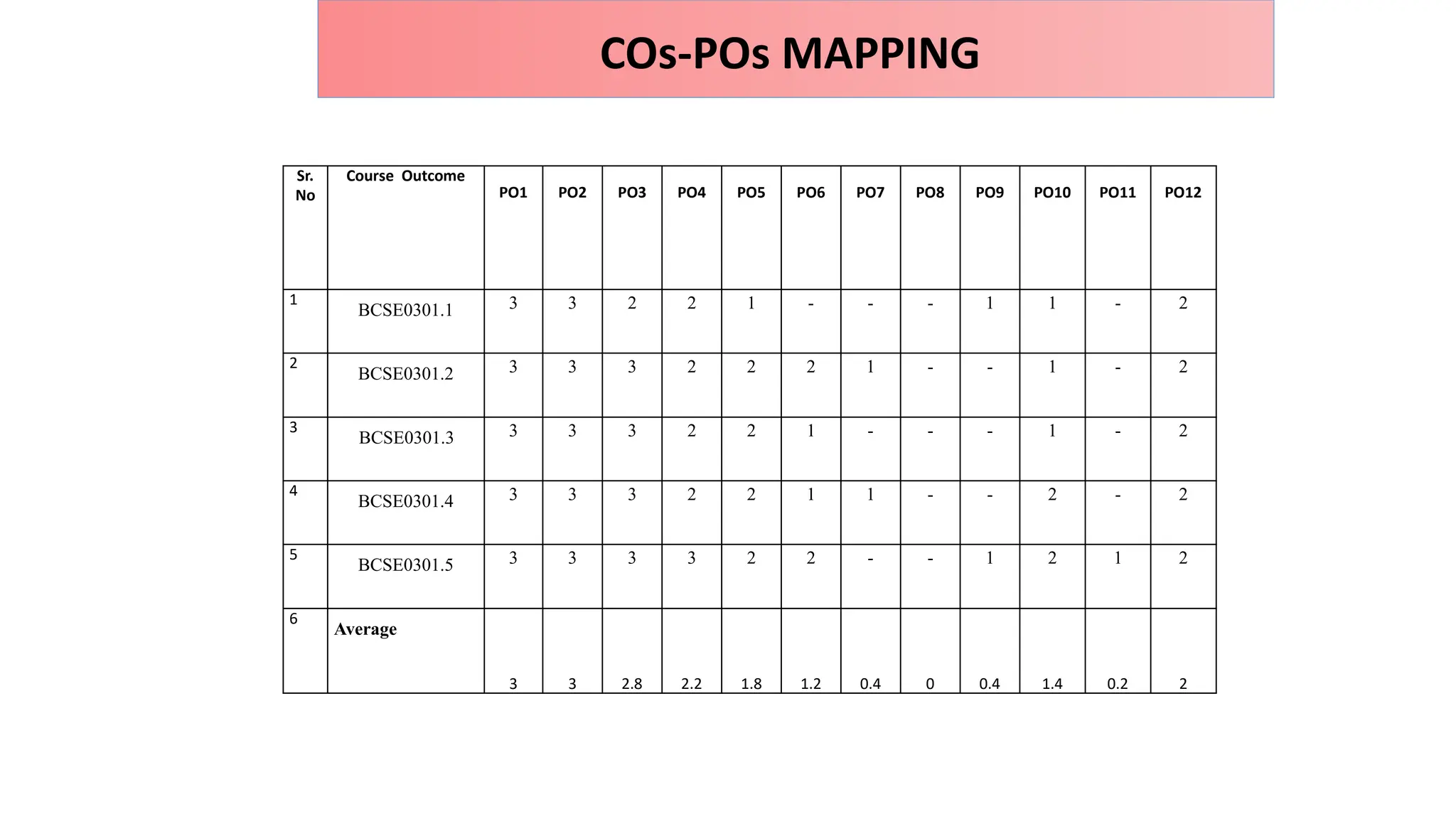
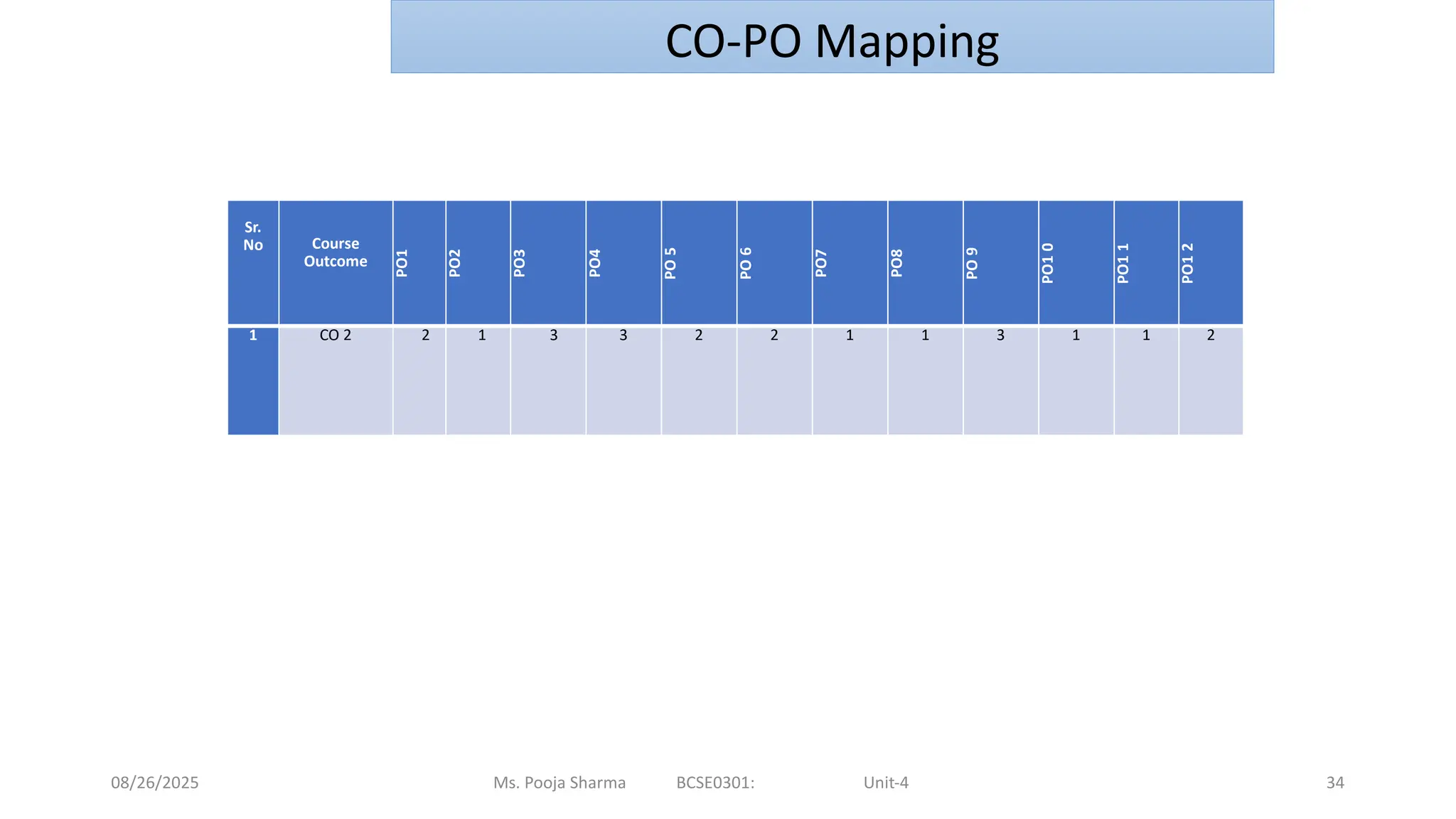
08/26/2025 Ms. PoojaSharma BCSE0301: Unit-4 34
Sr.
No Course
Outcome
PO1
PO2
PO3
PO4
PO
5
PO
6
PO7
PO8
PO
9
PO1
0
PO1
1
PO1
2
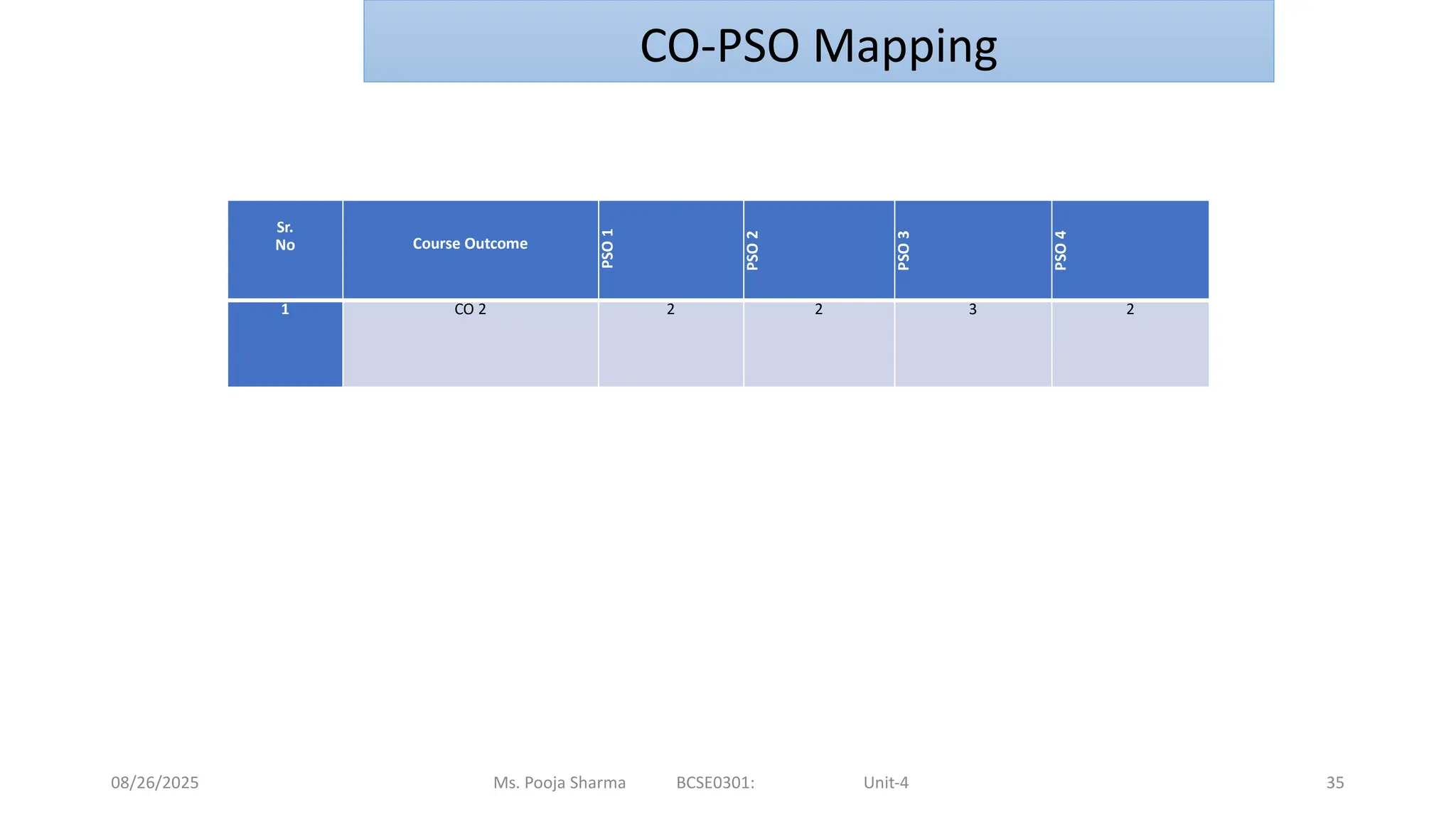
1 CO 2 2 1 3 3 2 2 1 1 3 1 1 2
CO-PO Mapping
08/26/2025 Ms. PoojaSharma BCSE0301: Unit-4 36
Prerequisite and Recap
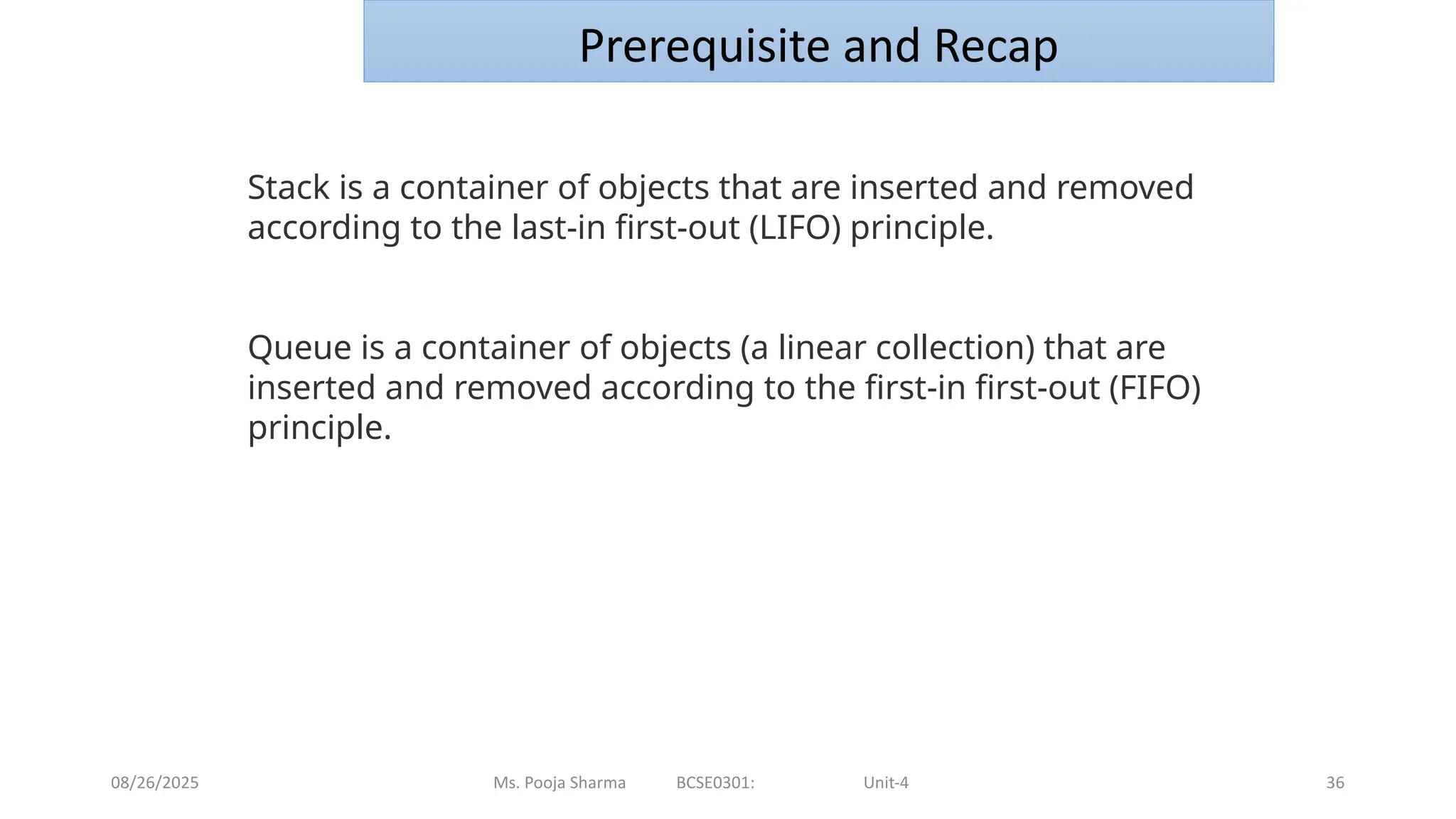
Stack is a container of objects that are inserted and removed
according to the last-in first-out (LIFO) principle.
Queue is a container of objects (a linear collection) that are
inserted and removed according to the first-in first-out (FIFO)
principle.
37.
08/26/2025 Ms. PoojaSharma BCSE0301: Unit-4 37
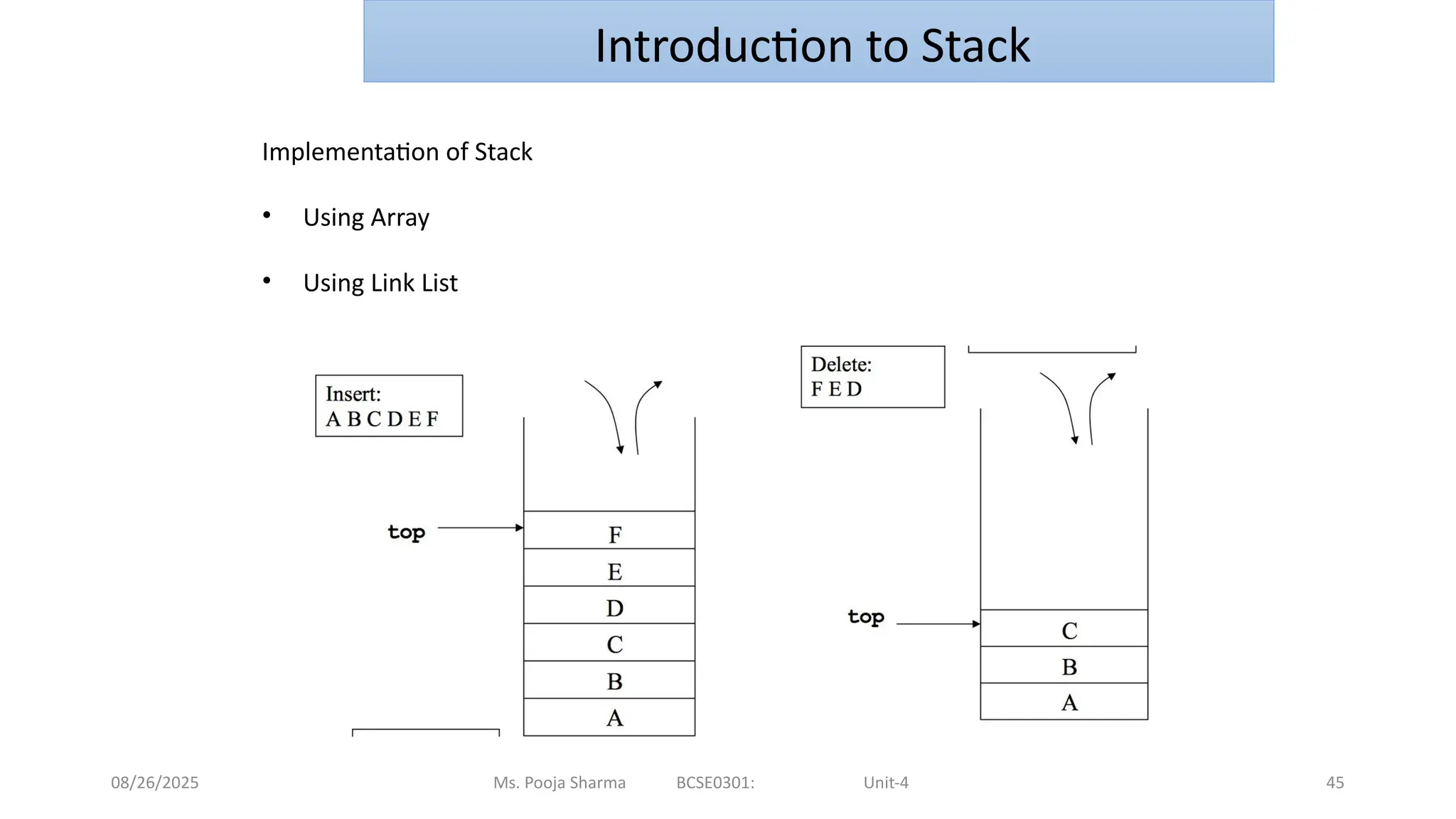
Stack
A stack is a data structure in which
items can be inserted only from one
end and get items back from the
same end.
There , the last item inserted into
stack, is the the first item to be taken
out from the stack. In short its also
called Last in First out [LIFO].
Introduction to Stack
38.
08/26/2025 Ms. PoojaSharma BCSE0301: Unit-4 38
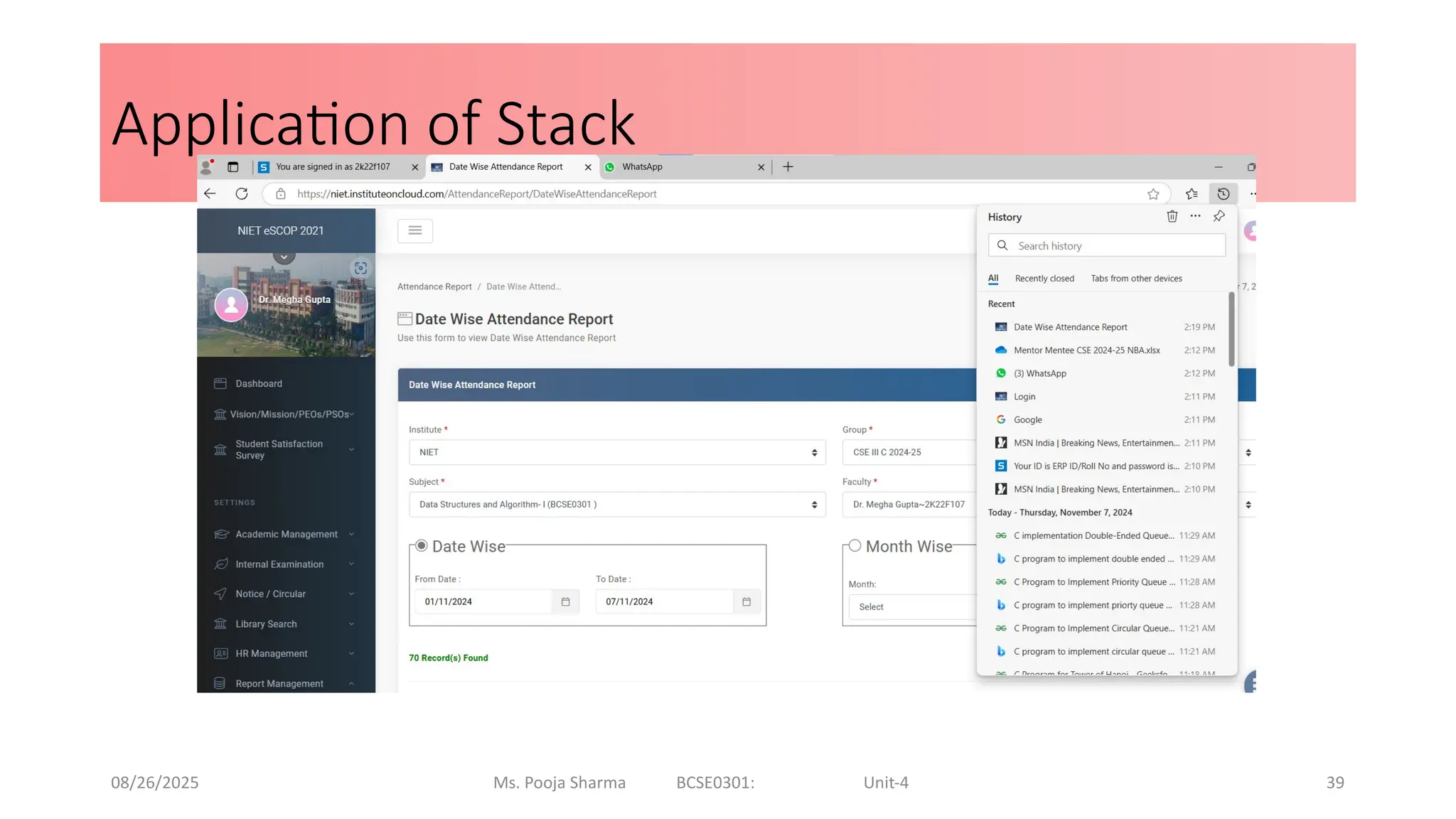
• Applications of Stacks:
• Function calls: Stacks are used to keep track of the
return addresses of function calls, allowing the
program to return to the correct location after a
function has finished executing.
• Recursion: Stacks are used to store the local variables
and return addresses of recursive function calls,
allowing the program to keep track of the current
state of the recursion.
• Expression evaluation: Stacks are used to evaluate
expressions in postfix notation (Reverse Polish
Notation).
Introduction to Stack
08/26/2025 Ms. PoojaSharma BCSE0301: Unit-4 40
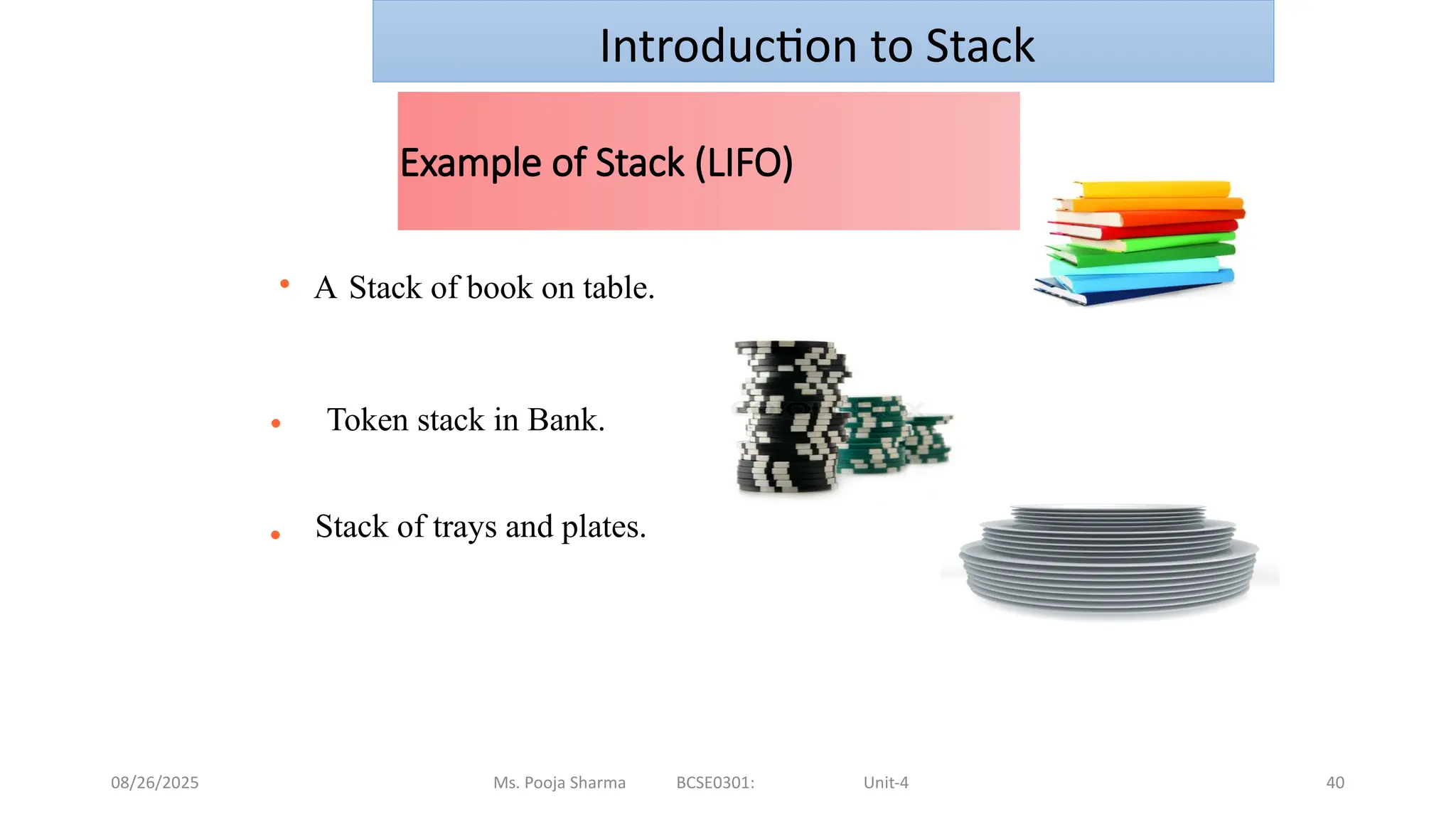
Example of Stack (LIFO)
● A Stack of book on table.
● Token stack in Bank.
● Stack of trays and plates.
Introduction to Stack
41.
08/26/2025 Ms. PoojaSharma BCSE0301: Unit-4 41
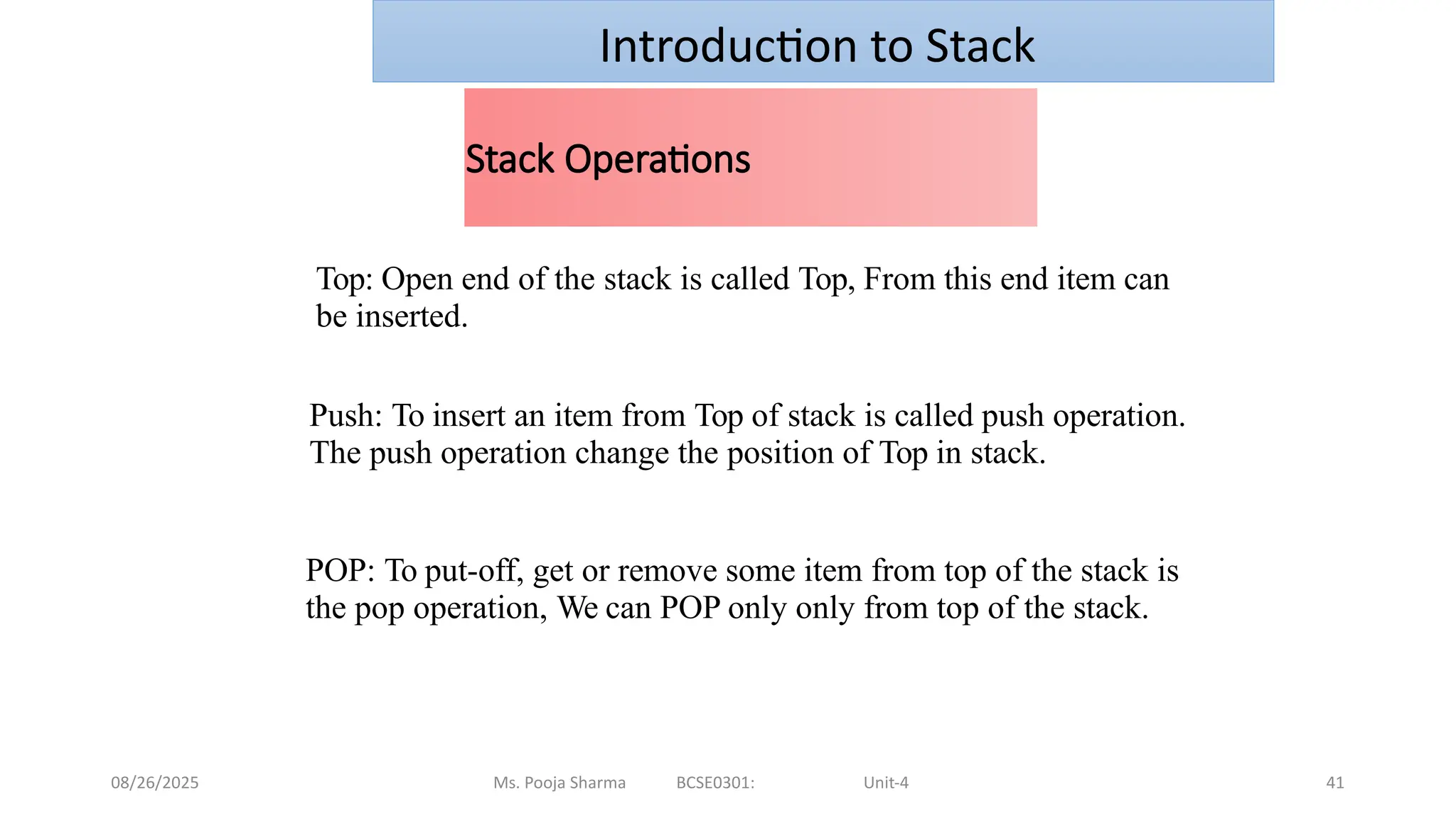
Stack Operations
Top: Open end of the stack is called Top, From this end item can
be inserted.
Push: To insert an item from Top of stack is called push operation.
The push operation change the position of Top in stack.
POP: To put-off, get or remove some item from top of the stack is
the pop operation, We can POP only only from top of the stack.
Introduction to Stack
42.
08/26/2025 Ms. PoojaSharma BCSE0301: Unit-4 42
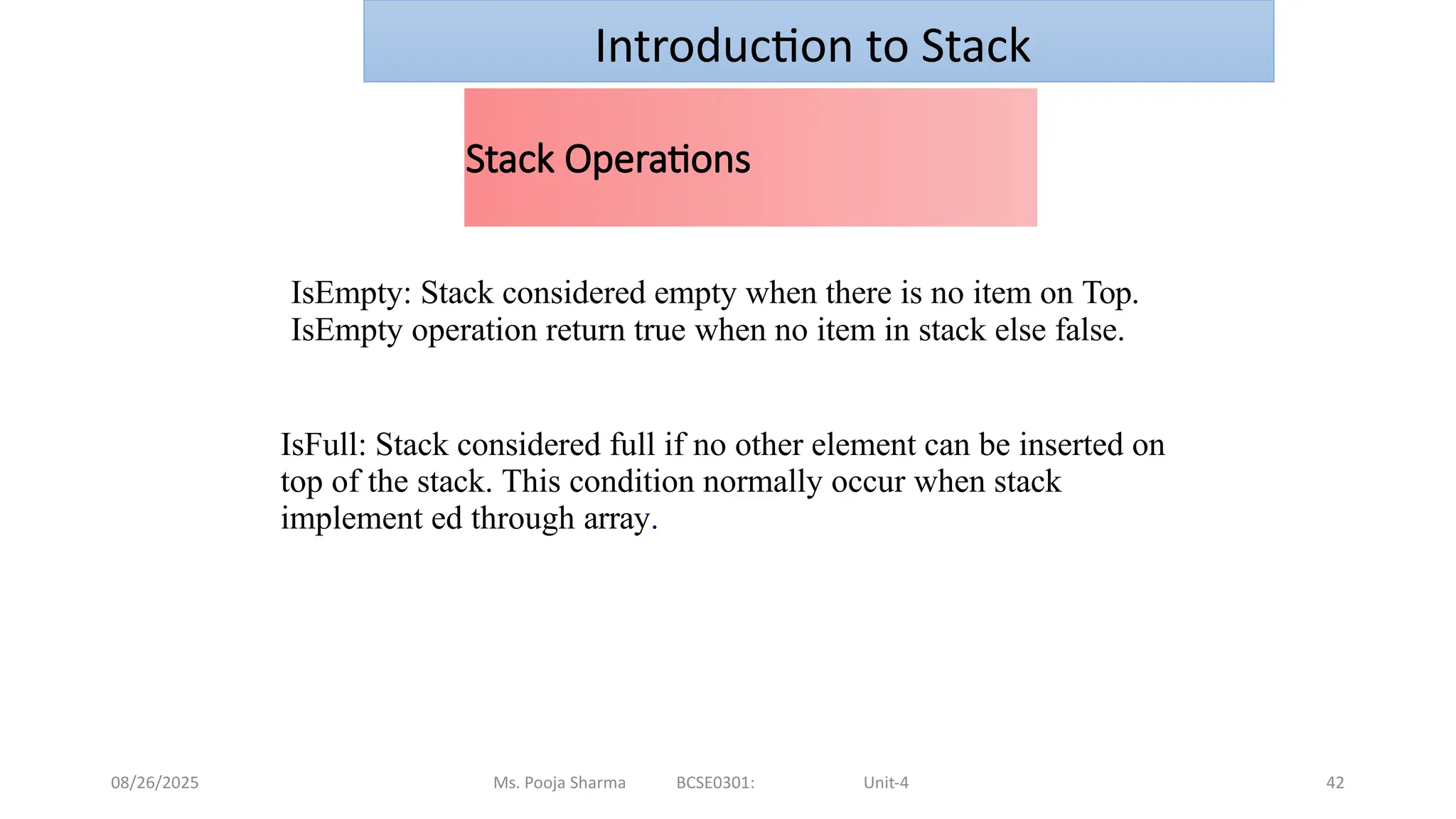
Stack Operations
IsEmpty: Stack considered empty when there is no item on Top.
IsEmpty operation return true when no item in stack else false.
IsFull: Stack considered full if no other element can be inserted on
top of the stack. This condition normally occur when stack
implement ed through array.
Introduction to Stack
43.
08/26/2025 Ms. PoojaSharma BCSE0301: Unit-4 43
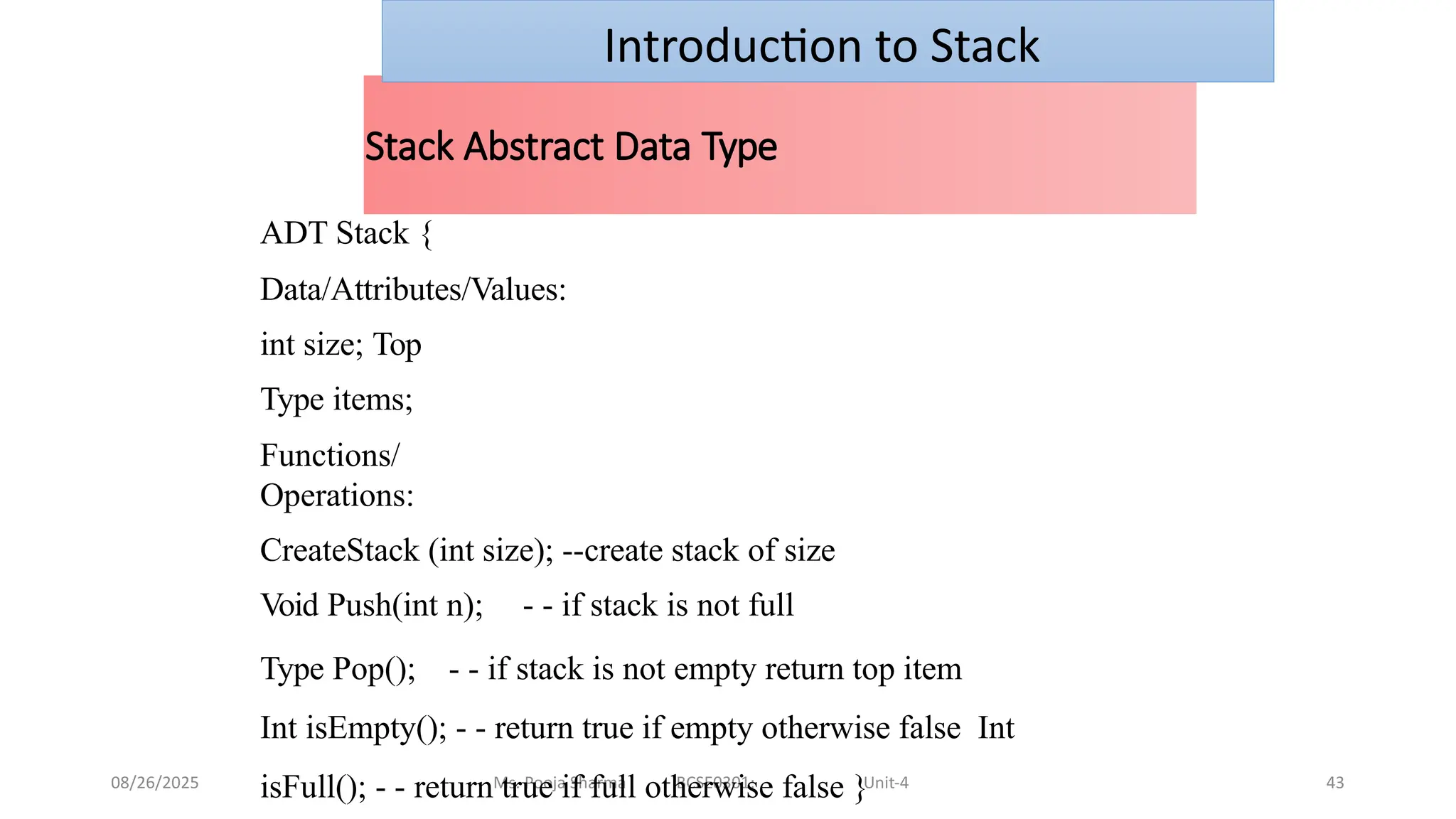
Stack Abstract Data Type
ADT Stack {
Data/Attributes/Values:
int size; Top
Type items;
Functions/
Operations:
CreateStack (int size); --create stack of size
Void Push(int n); - - if stack is not full
Type Pop(); - - if stack is not empty return top item
Int isEmpty(); - - return true if empty otherwise false Int
isFull(); - - return true if full otherwise false }
Introduction to Stack
44.
08/26/2025 Ms. PoojaSharma BCSE0301: Unit-4 44
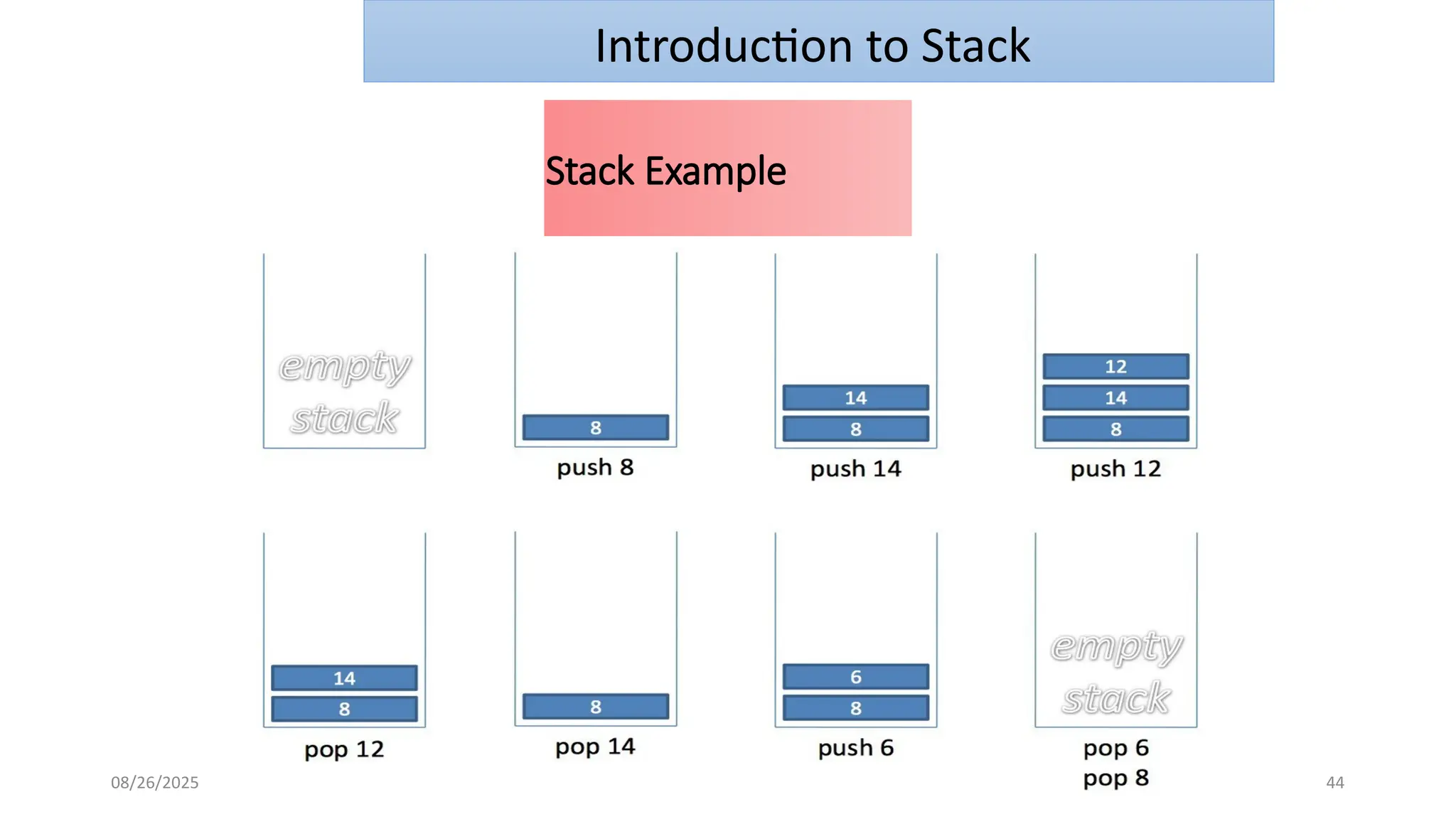
Stack Example
Introduction to Stack
45.
08/26/2025 Ms. PoojaSharma BCSE0301: Unit-4 45
Introduction to Stack
Implementation of Stack
• Using Array
• Using Link List
46.
08/26/2025 Ms. PoojaSharma BCSE0301: Unit-4 46
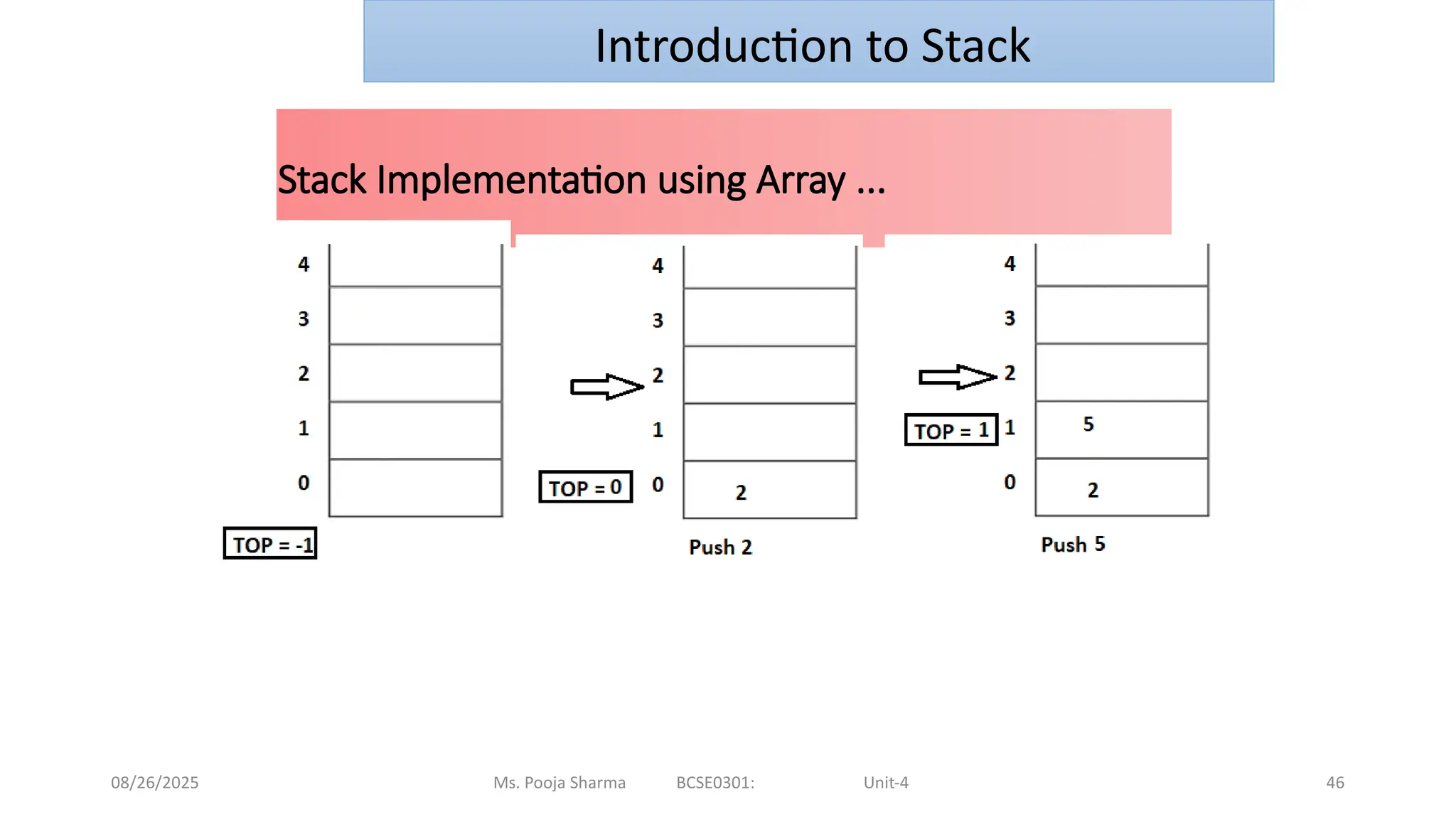
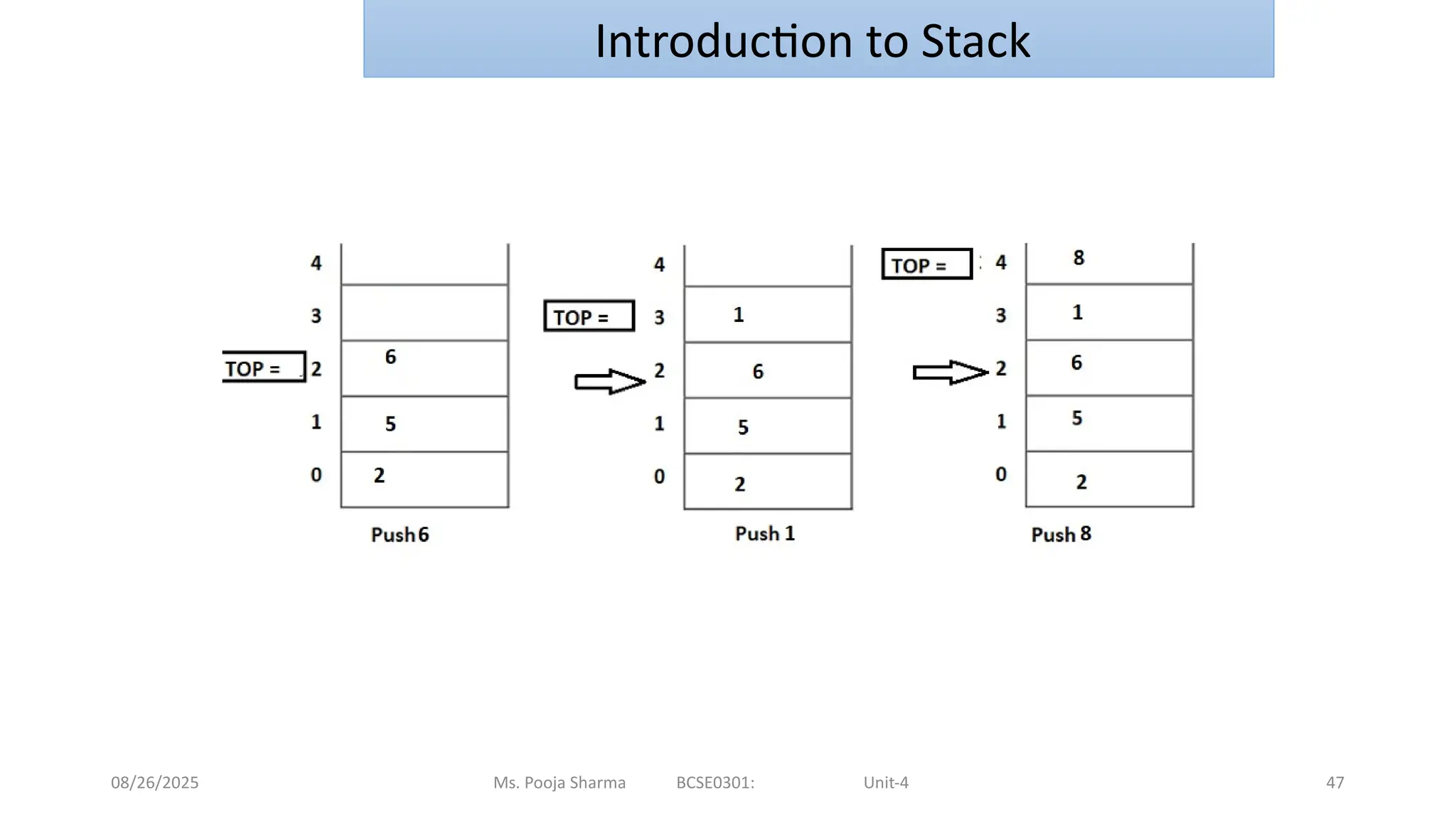
Stack Implementation using Array ...
Introduction to Stack
08/26/2025 Ms. PoojaSharma BCSE0301: Unit-4 48
Stack Implementation using Array
Introduction to Stack
A stack can be implemented using array as follows...
Before implementing actual operations, first follow the below steps to
create an empty stack.
Step 1 - Include all the header files which are used in the program and
define a constant 'SIZE' with specific value.
Step 2 - Declare all the functions used in stack implementation.
Step 3 - Create a one dimensional array with fixed size (int stack[SIZE])
Step 4 - Define a integer variable 'top' and initialize with '-1'. (int top = -1)
Step 5 - In main method, display menu with list of operations and make
suitable function calls to perform operation selected by the user on the
stack.
49.
08/26/2025 Ms. PoojaSharma BCSE0301: Unit-4 49
push(value)- Inserting value into the stack using array
Introduction to Stack
In a stack, push() is a function used to insert an element into the stack. In
a stack, the new element is always inserted at top position. Push
function takes one integer value as parameter and inserts that value into
the stack. We can use the following steps to push an element on to the
stack...
Step 1 - Check whether stack is FULL. (top == SIZE-1)
Step 2 - If it is FULL, then display "Stack is FULL!!! Insertion is not
possible!!!" and terminate the function.
Step 3 - If it is NOT FULL, then increment top value by one (top++)
and set stack[top] to value (stack[top] = value).
50.
08/26/2025 Ms. PoojaSharma BCSE0301: Unit-4 50
Introduction to Stack
pop() - Delete a value from the Stack using array
In a stack, pop() is a function used to delete an element from the stack. In
a stack, the element is always deleted from top position. Pop function
does not take any value as parameter. We can use the following steps to
pop an element from the stack...
Step 1 - Check whether stack is EMPTY. (top == -1)
Step 2 - If it is EMPTY, then display "Stack is EMPTY!!! Deletion is not
possible!!!" and terminate the function.
Step 3 - If it is NOT EMPTY, then delete stack[top] and
decrement top value by one (top--).
51.
Ms. Pooja SharmaBCSE0301: Unit-4
08/26/2025 51
Introduction to Stack
display() - Displays the elements of a Stack using array
We can use the following steps to display the elements of a stack...
Step 1 - Check whether stack is EMPTY. (top == -1)
Step 2 - If it is EMPTY, then display "Stack is EMPTY!!!" and terminate
the function.
Step 3 - If it is NOT EMPTY, then define a variable 'i' and initialize with
top. Display stack[i] value and decrement i value by one (i--).
Step 3 - Repeat above step until i value becomes '0'.
52.
Ms. Pooja SharmaBCSE0301: Unit-4
08/26/2025 52
int main()
{
int choice;
while (1)
{
printf("nPerform operations on the stack:");
printf("n1.Push the elementn2.Pop the elementn3.Shown4.End");
printf("nnEnter the choice: ");
scanf("%d", &choice);
switch (choice)
{
case 1:
push(); break;
case 2:
pop(); break;
case 3:
show(); break;
case 4:
exit(0);
default:
printf("nInvalid choice!!");
} } }
#include <stdio.h>
#include <stdlib.h>
#define SIZE 4
int top = -1,
int inp_array[SIZE];
void push();
void pop();
void show();
53.
Ms. Pooja SharmaBCSE0301: Unit-4
08/26/2025 53
void push()
{
int x;
if (top == SIZE - 1)
{
printf("nOverflow!!");
}
else
{
printf("nEnter the element to be added onto the
stack: ");
scanf("%d", &x);
top = top + 1;
inp_array[top] = x;
}
}
54.
Ms. Pooja SharmaBCSE0301: Unit-4
08/26/2025 54
void pop()
{
if (top == -1)
{
printf("nUnderflow!!");
}
else
{
printf("nPopped element: %d", inp_array[top]);
top = top - 1;
}
}
void show()
{
if (top == -1)
{
printf("nUnderflow!!");
}
else
{
printf("nElements present in the
stack: n");
for (int i = top; i >= 0; --i)
printf("%dn", inp_array[i]);
}
}
55.
Ms. Pooja SharmaBCSE0301: Unit-4
08/26/2025 55
Stack Implementation using Link List
Introduction to Stack
The major problem with the stack implemented using an array is, it works
only for a fixed number of data values.
Stack implemented using an array is not suitable, when we don't know the
size of data which we are going to use.
Stack implemented using linked list works for the variable size of data.
So, there is no need to fix the size at the beginning of the implementation.
56.
Ms. Pooja SharmaBCSE0301: Unit-4
08/26/2025 56
Stack Implementation using Link List
Introduction to Stack
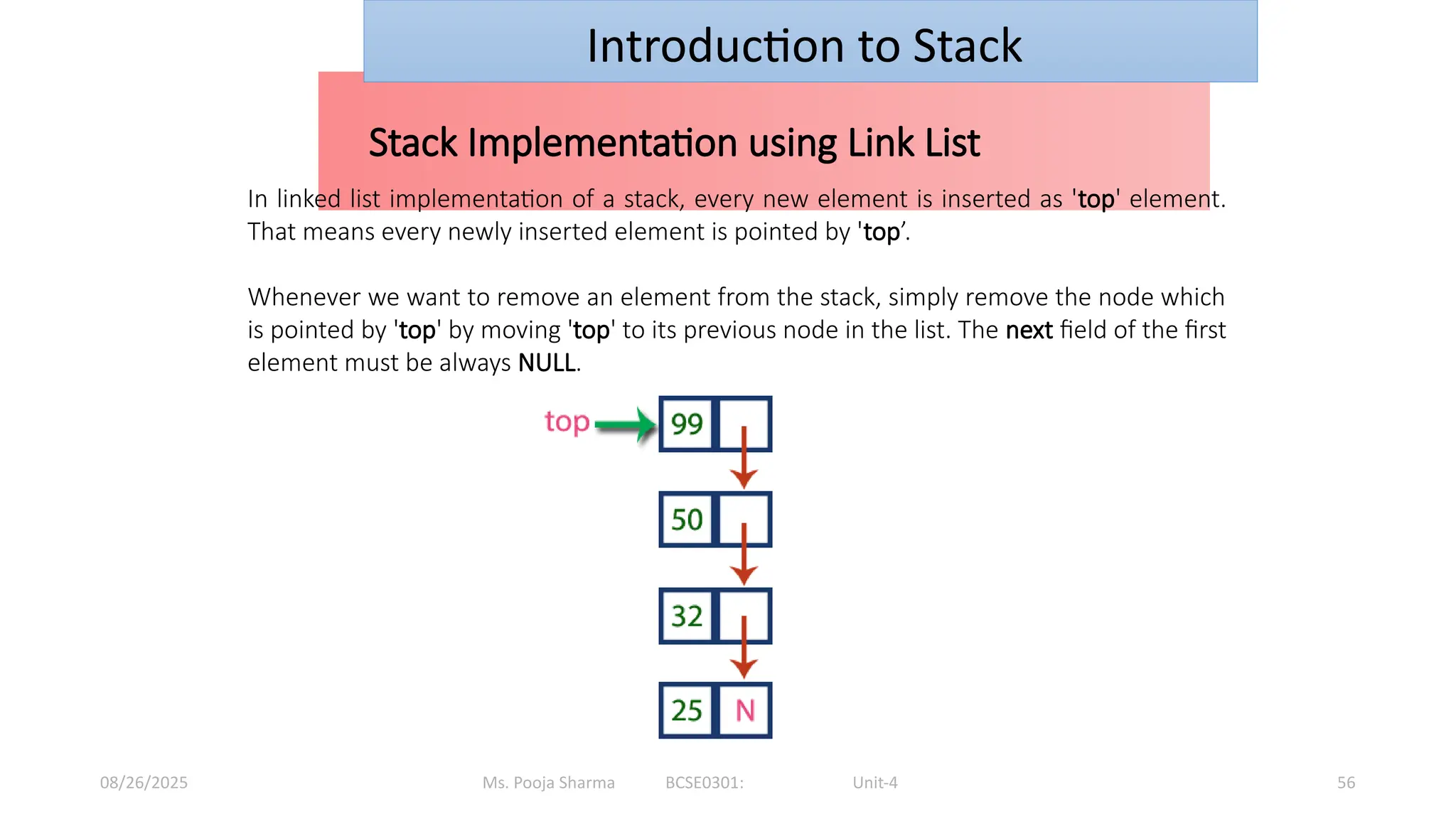
In linked list implementation of a stack, every new element is inserted as 'top' element.
That means every newly inserted element is pointed by 'top’.
Whenever we want to remove an element from the stack, simply remove the node which
is pointed by 'top' by moving 'top' to its previous node in the list. The next field of the first
element must be always NULL.
57.
Ms. Pooja SharmaBCSE0301: Unit-4
08/26/2025 57
Stack Implementation using Link List
Introduction to Stack
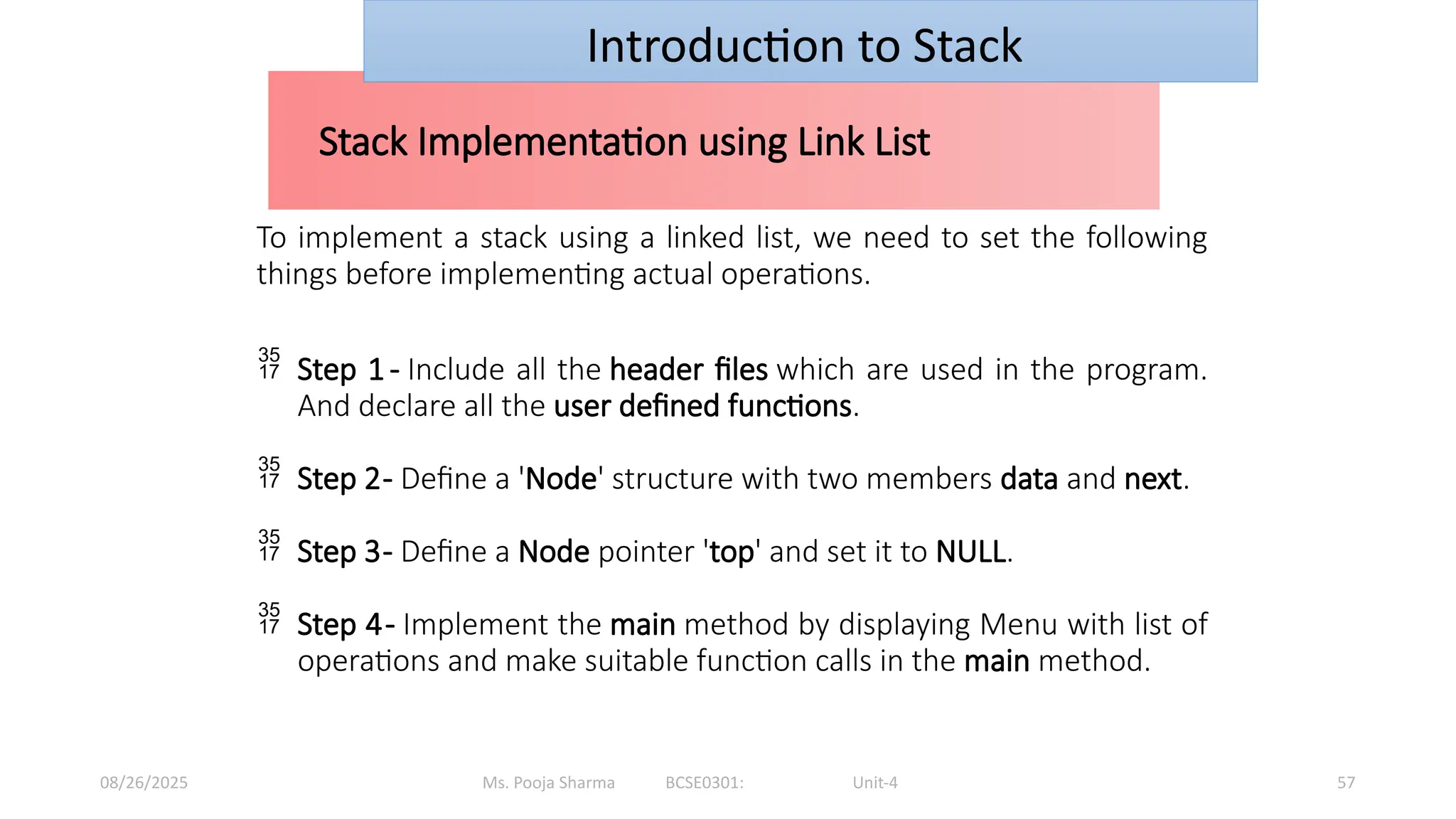
To implement a stack using a linked list, we need to set the following
things before implementing actual operations.
Step 1- Include all the header files which are used in the program.
And declare all the user defined functions.
Step 2- Define a 'Node' structure with two members data and next.
Step 3- Define a Node pointer 'top' and set it to NULL.
Step 4- Implement the main method by displaying Menu with list of
operations and make suitable function calls in the main method.
58.
Ms. Pooja SharmaBCSE0301: Unit-4
08/26/2025 58
Introduction to Stack
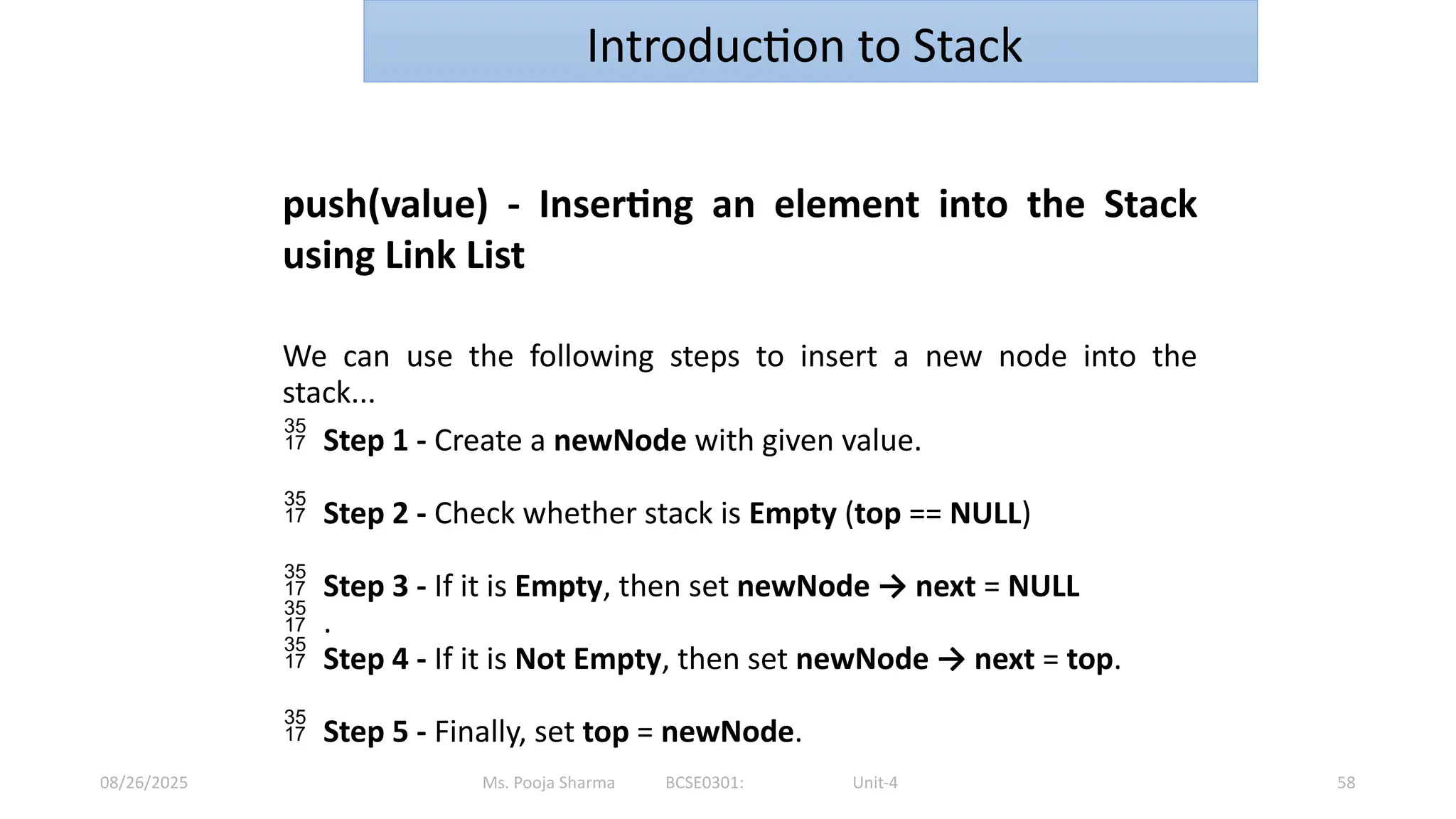
push(value) - Inserting an element into the Stack
using Link List
We can use the following steps to insert a new node into the
stack...
Step 1 - Create a newNode with given value.
Step 2 - Check whether stack is Empty (top == NULL)
Step 3 - If it is Empty, then set newNode → next = NULL
.
Step 4 - If it is Not Empty, then set newNode → next = top.
Step 5 - Finally, set top = newNode.
59.
08/26/2025 Ms. PoojaSharma BCSE0301: Unit-4 59
Introduction to Stack
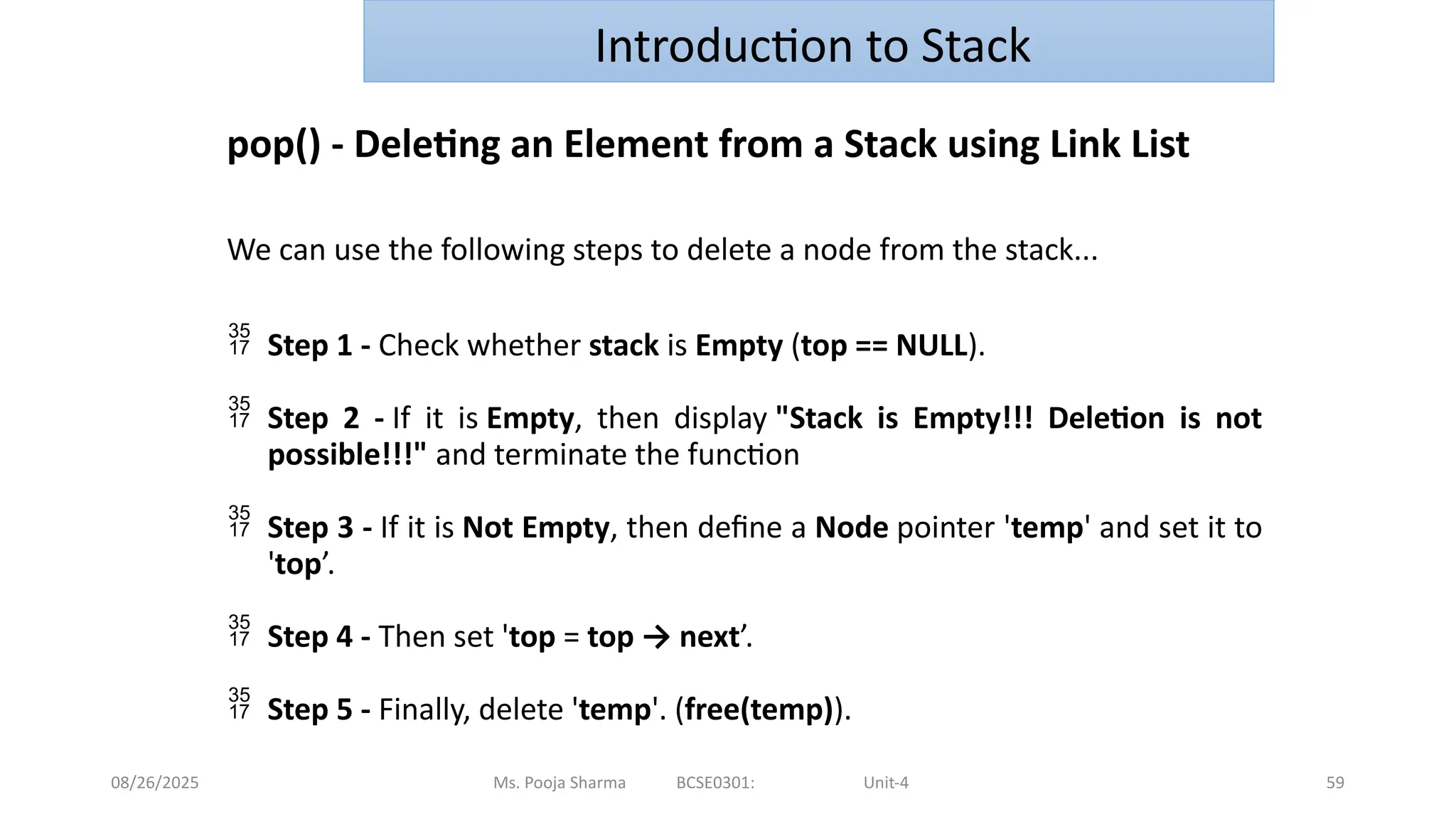
pop() - Deleting an Element from a Stack using Link List
We can use the following steps to delete a node from the stack...
Step 1 - Check whether stack is Empty (top == NULL).
Step 2 - If it is Empty, then display "Stack is Empty!!! Deletion is not
possible!!!" and terminate the function
Step 3 - If it is Not Empty, then define a Node pointer 'temp' and set it to
'top’.
Step 4 - Then set 'top = top → next’.
Step 5 - Finally, delete 'temp'. (free(temp)).
60.
08/26/2025
Ms. Pooja SharmaBCSE0301: Unit-4
60
Introduction to Stack
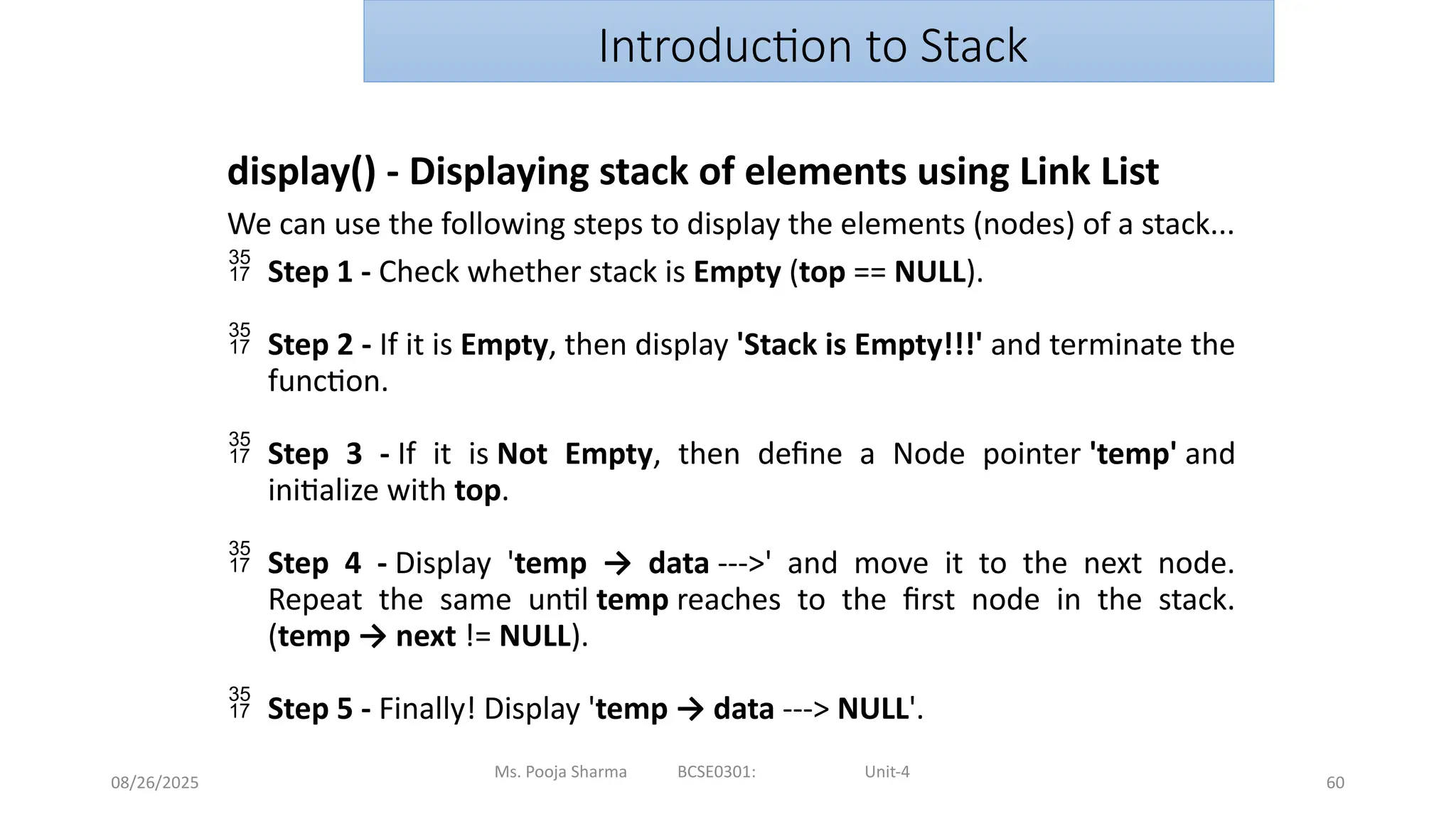
display() - Displaying stack of elements using Link List
We can use the following steps to display the elements (nodes) of a stack...
Step 1 - Check whether stack is Empty (top == NULL).
Step 2 - If it is Empty, then display 'Stack is Empty!!!' and terminate the
function.
Step 3 - If it is Not Empty, then define a Node pointer 'temp' and
initialize with top.
Step 4 - Display 'temp → data --->' and move it to the next node.
Repeat the same until temp reaches to the first node in the stack.
(temp → next != NULL).
Step 5 - Finally! Display 'temp → data ---> NULL'.
61.
08/26/2025 Ms. PoojaSharma BCSE0301: Unit-4 61
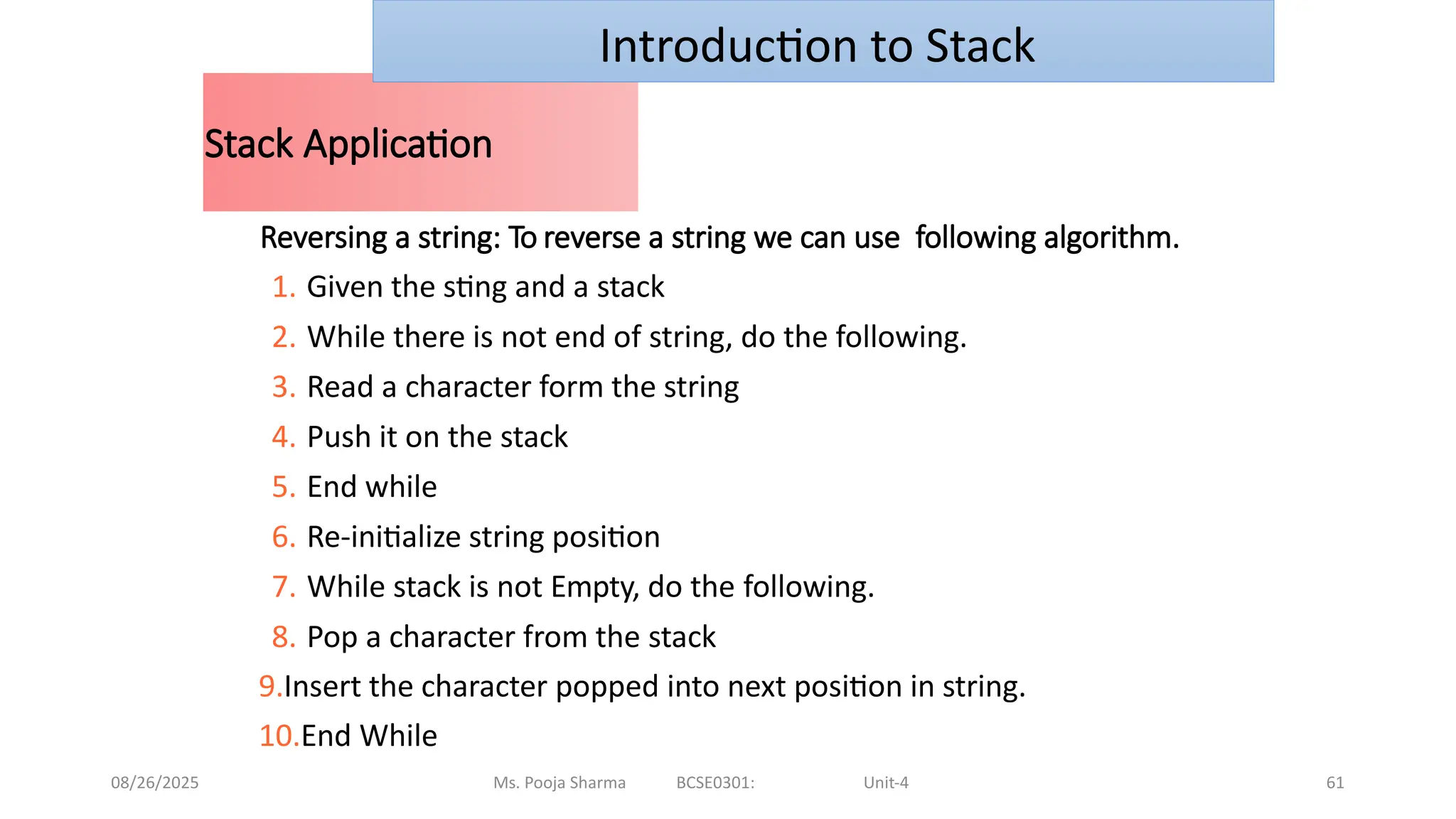
Stack Application
Reversing a string: To reverse a string we can use following algorithm.
1. Given the sting and a stack
2. While there is not end of string, do the following.
3. Read a character form the string
4. Push it on the stack
5. End while
6. Re-initialize string position
7. While stack is not Empty, do the following.
8. Pop a character from the stack
9.Insert the character popped into next position in string.
10.End While
Introduction to Stack
62.
08/26/2025 Ms. PoojaSharma BCSE0301: Unit-4 62
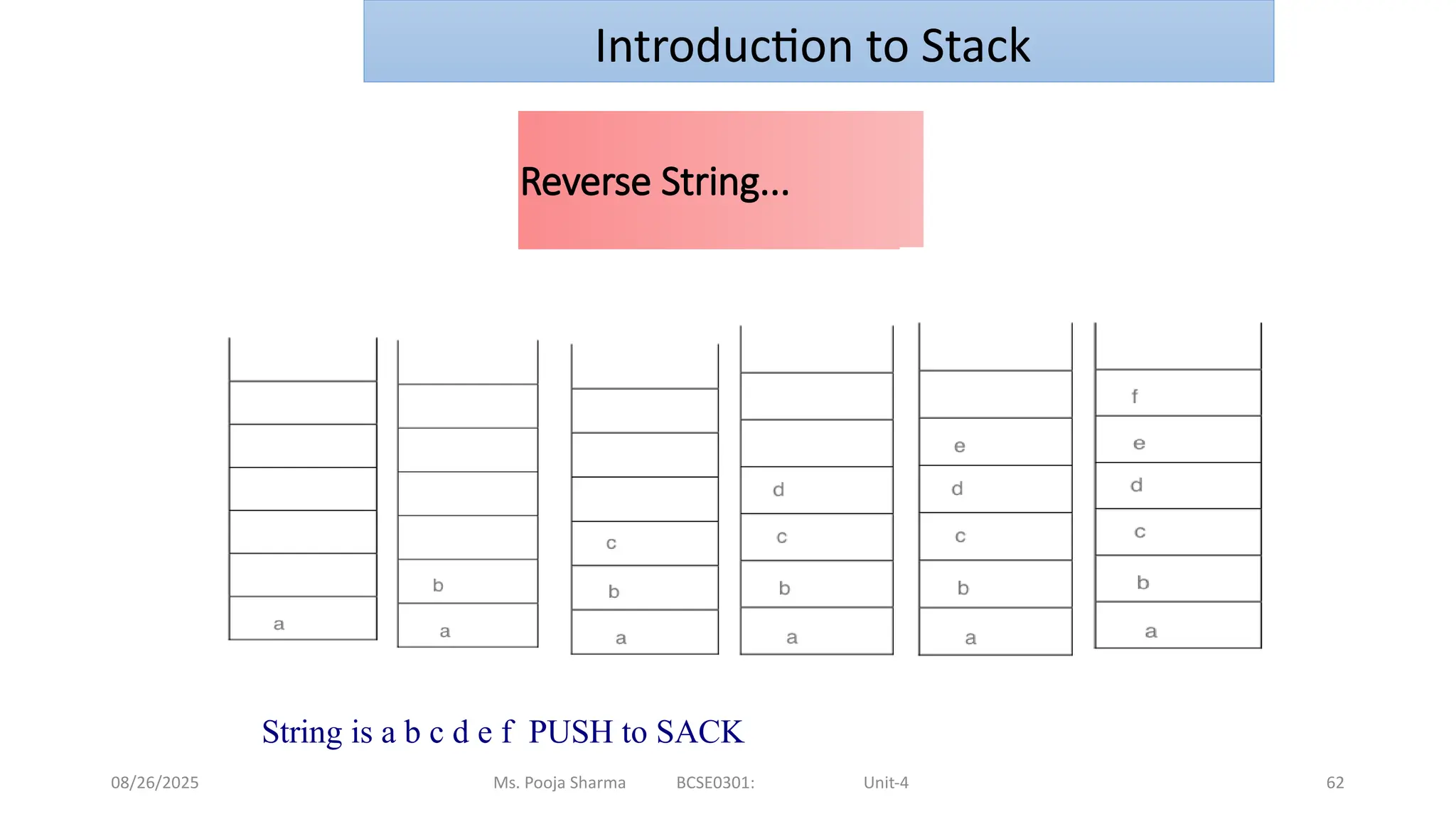
Reverse String...
String is a b c d e f PUSH to SACK
Introduction to Stack
63.
08/26/2025 Ms. PoojaSharma BCSE0301: Unit-4 63
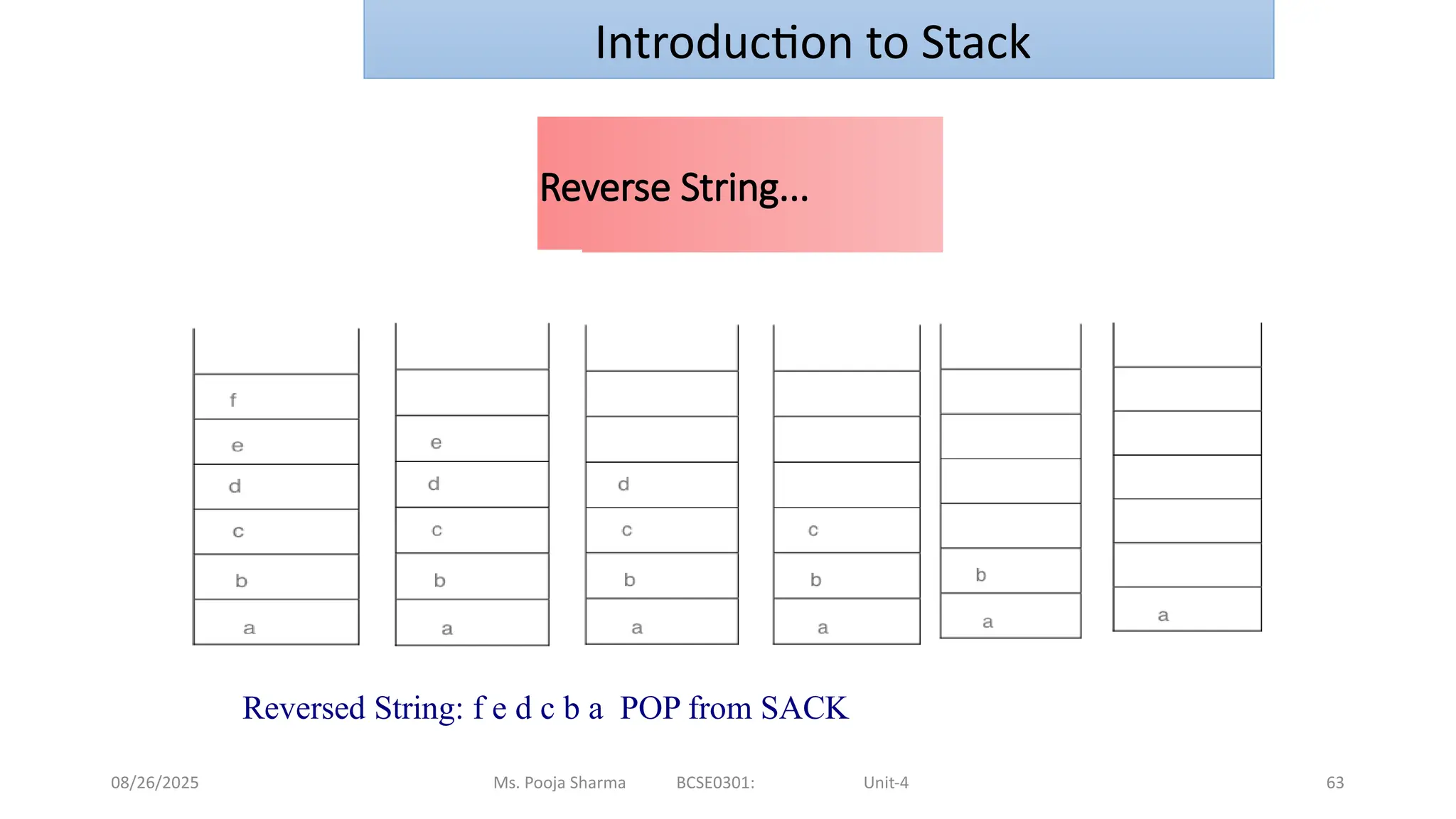
Reverse String...
Reversed String: f e d c b a POP from SACK
Introduction to Stack
64.
08/26/2025 Ms. PoojaSharma BCSE0301: Unit-4 64
Introduction to Stack
What is an Expression?
In any programming language, if we want to perform any calculation or to
frame a condition etc., we use a set of symbols to perform the task. These
set of symbols makes an expression.
An expression can be defined as follows...
An expression is a collection of operators and operands that represents a
specific value.
In above definition, operator is a symbol which performs a particular task
like arithmetic operation or logical operation or conditional operation etc.,
Operands are the values on which the operators can perform the task.
Here operand can be a direct value or variable or address of memory
location
65.
08/26/2025 Ms. PoojaSharma BCSE0301: Unit-4 65
Introduction to Stack
Expression Types
Based on the operator position, expressions are divided into
THREE types. They are as follows...
1.Infix Expression
2.Postfix Expression
3.Prefix Expression
66.
08/26/2025 Ms. PoojaSharma BCSE0301: Unit-4 66
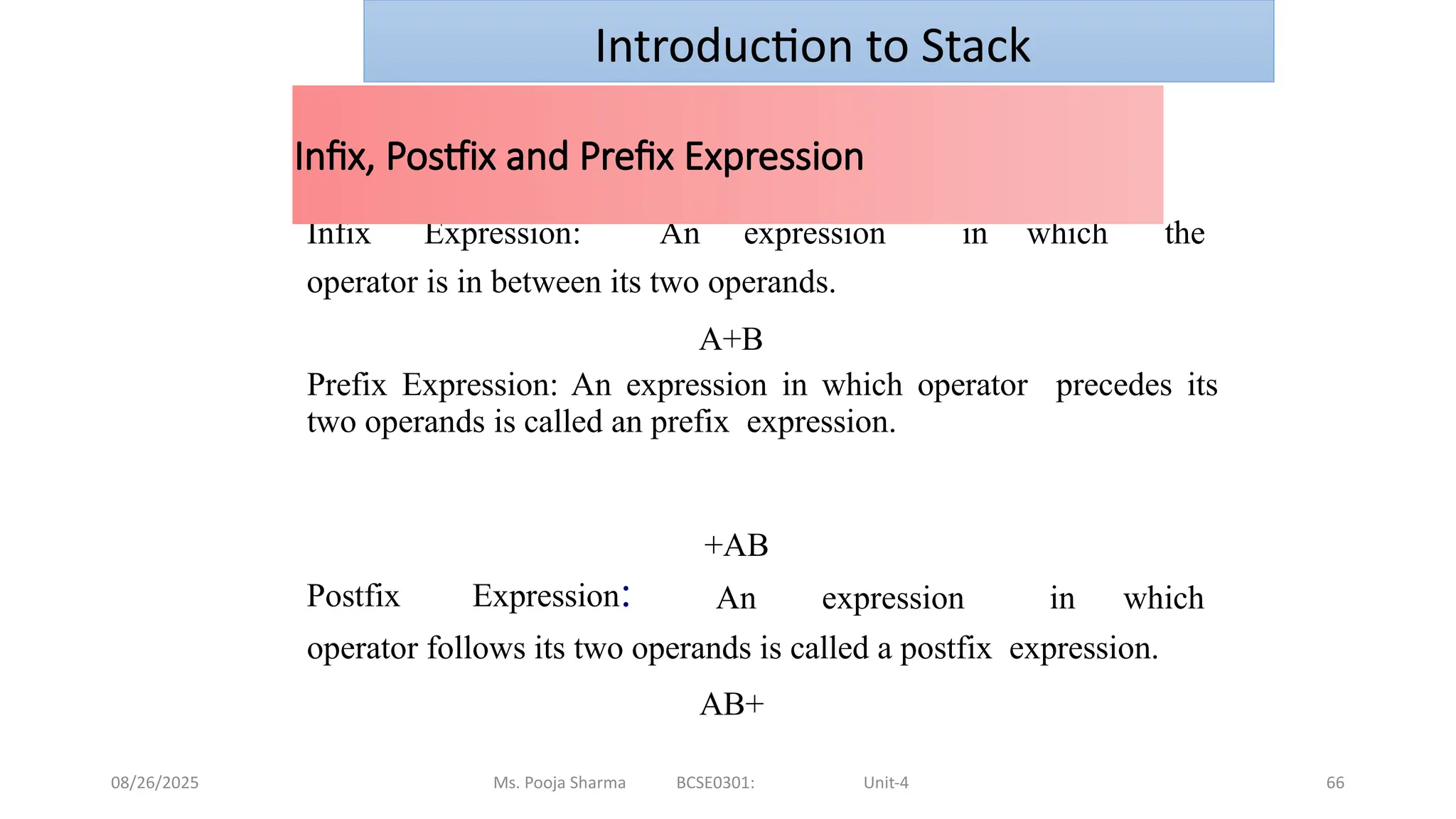
Infix Expression: An expression in which the
operator is in between its two operands.
A+B
Prefix Expression: An expression in which operator precedes its
two operands is called an prefix expression.
Postfix Expression:
+AB
An expression in which
operator follows its two operands is called a postfix expression.
AB+
Infix, Postfix and Prefix Expression
Introduction to Stack
67.
08/26/2025 Ms. PoojaSharma BCSE0301: Unit-4 67
Infix to Postfix Conversion
Infix expression can be directly evaluated but the standard practice
in CS is that the infix expression converted to postfix form and then
the expression is evaluated.
During both processes stack is proved to be a useful data
structure.
Introduction to Stack
68.
08/26/2025 Ms. PoojaSharma BCSE0301: Unit-4 68
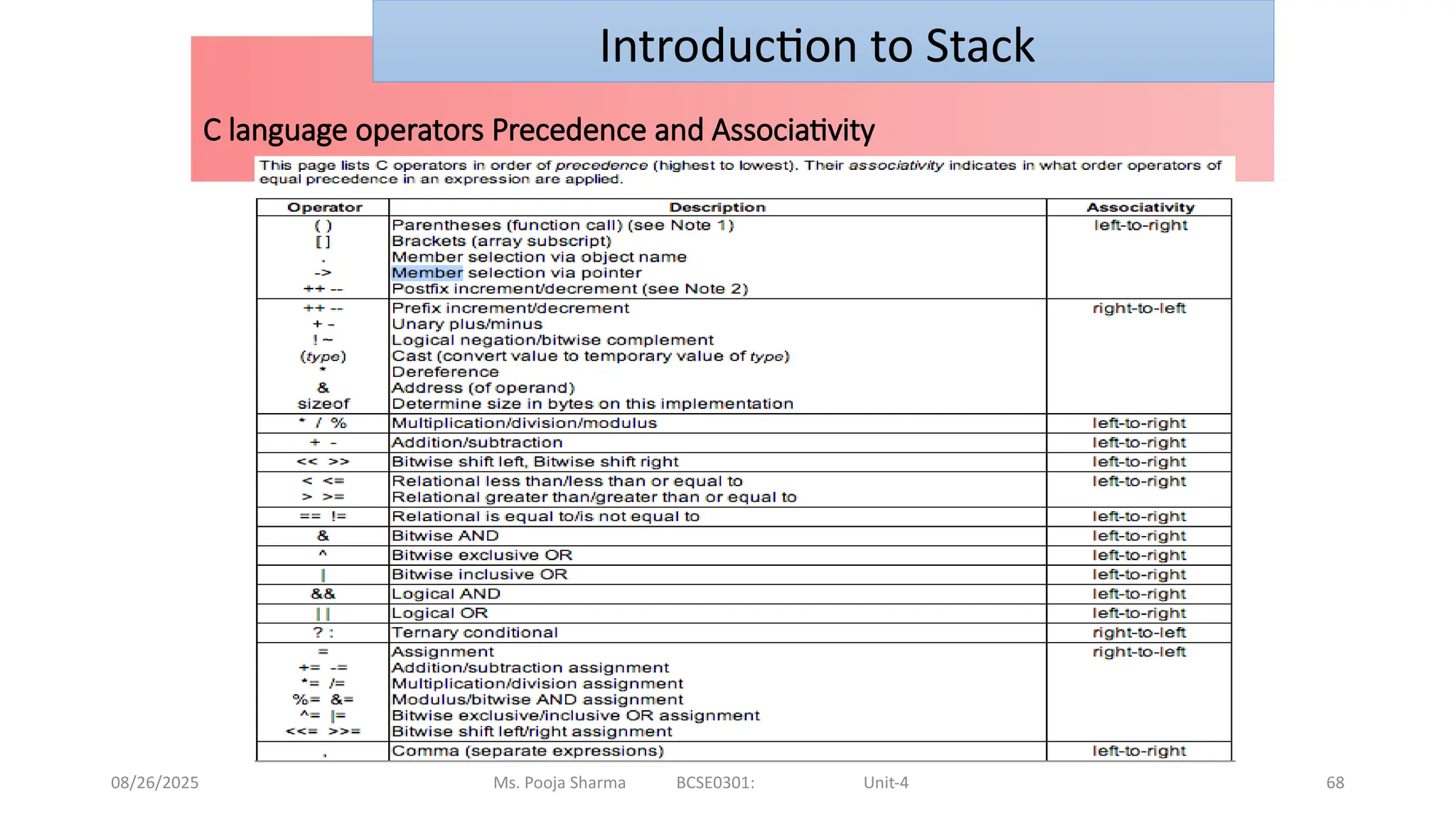
C language operators Precedence and Associativity
Introduction to Stack
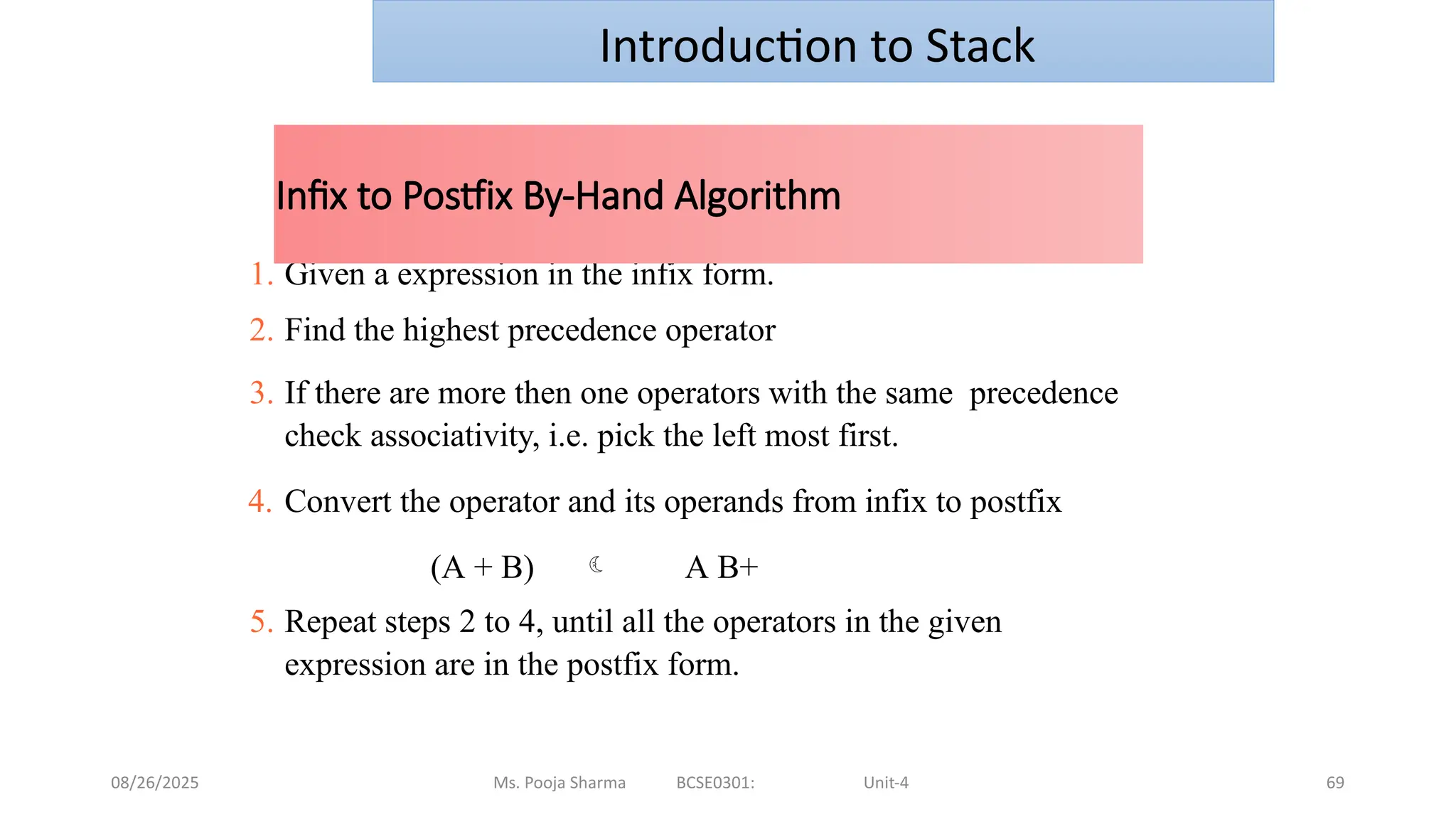
69.
08/26/2025 Ms. PoojaSharma BCSE0301: Unit-4 69
1. Given a expression in the infix form.
2. Find the highest precedence operator
3. If there are more then one operators with the same precedence
check associativity, i.e. pick the left most first.
4. Convert the operator and its operands from infix to postfix
(A + B) A B+
5. Repeat steps 2 to 4, until all the operators in the given
expression are in the postfix form.
Infix to Postfix By-Hand Algorithm
Introduction to Stack
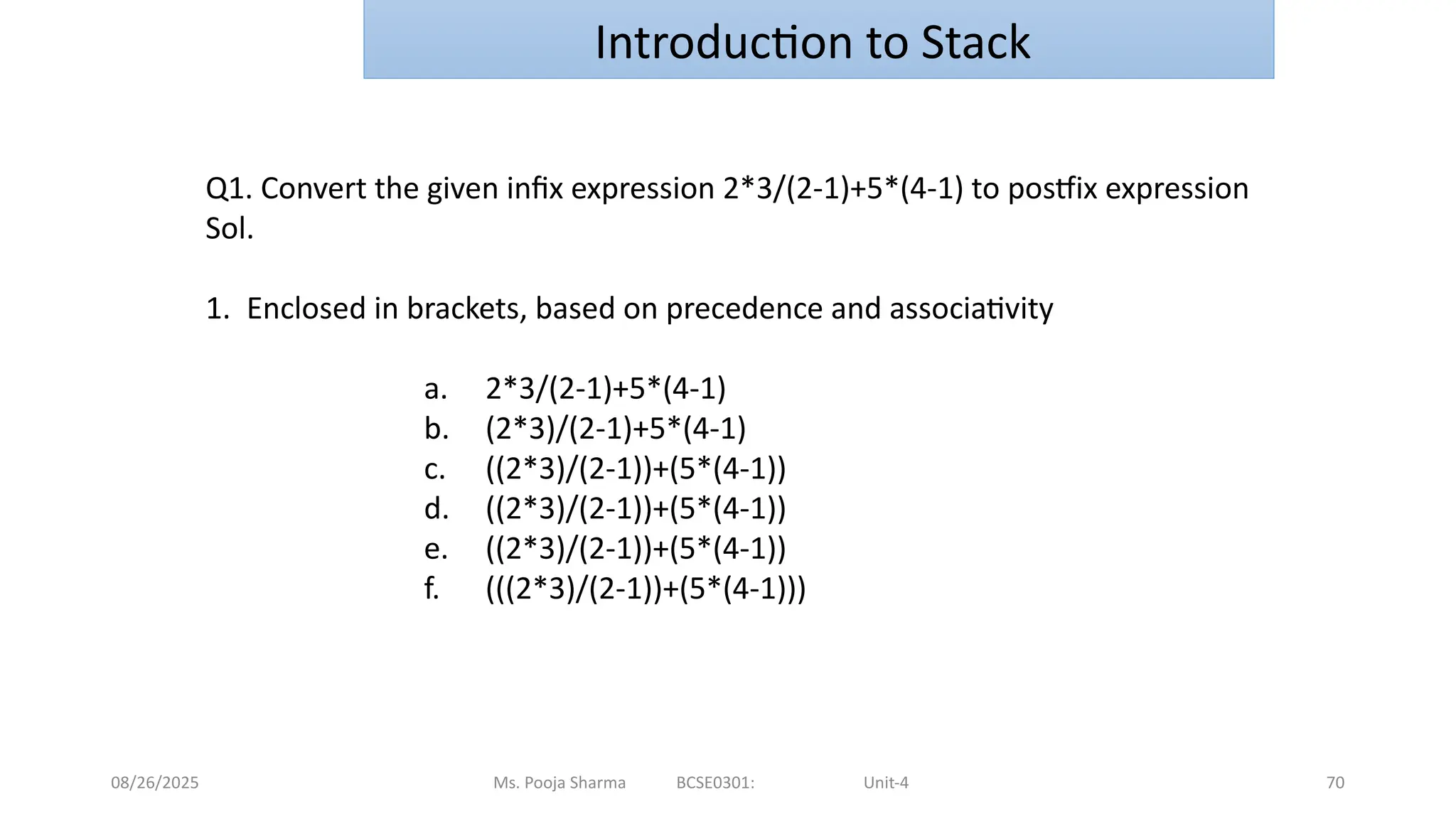
70.
08/26/2025 Ms. PoojaSharma BCSE0301: Unit-4 70
Introduction to Stack
Q1. Convert the given infix expression 2*3/(2-1)+5*(4-1) to postfix expression
Sol.
1. Enclosed in brackets, based on precedence and associativity
a. 2*3/(2-1)+5*(4-1)
b. (2*3)/(2-1)+5*(4-1)
c. ((2*3)/(2-1))+(5*(4-1))
d. ((2*3)/(2-1))+(5*(4-1))
e. ((2*3)/(2-1))+(5*(4-1))
f. (((2*3)/(2-1))+(5*(4-1)))
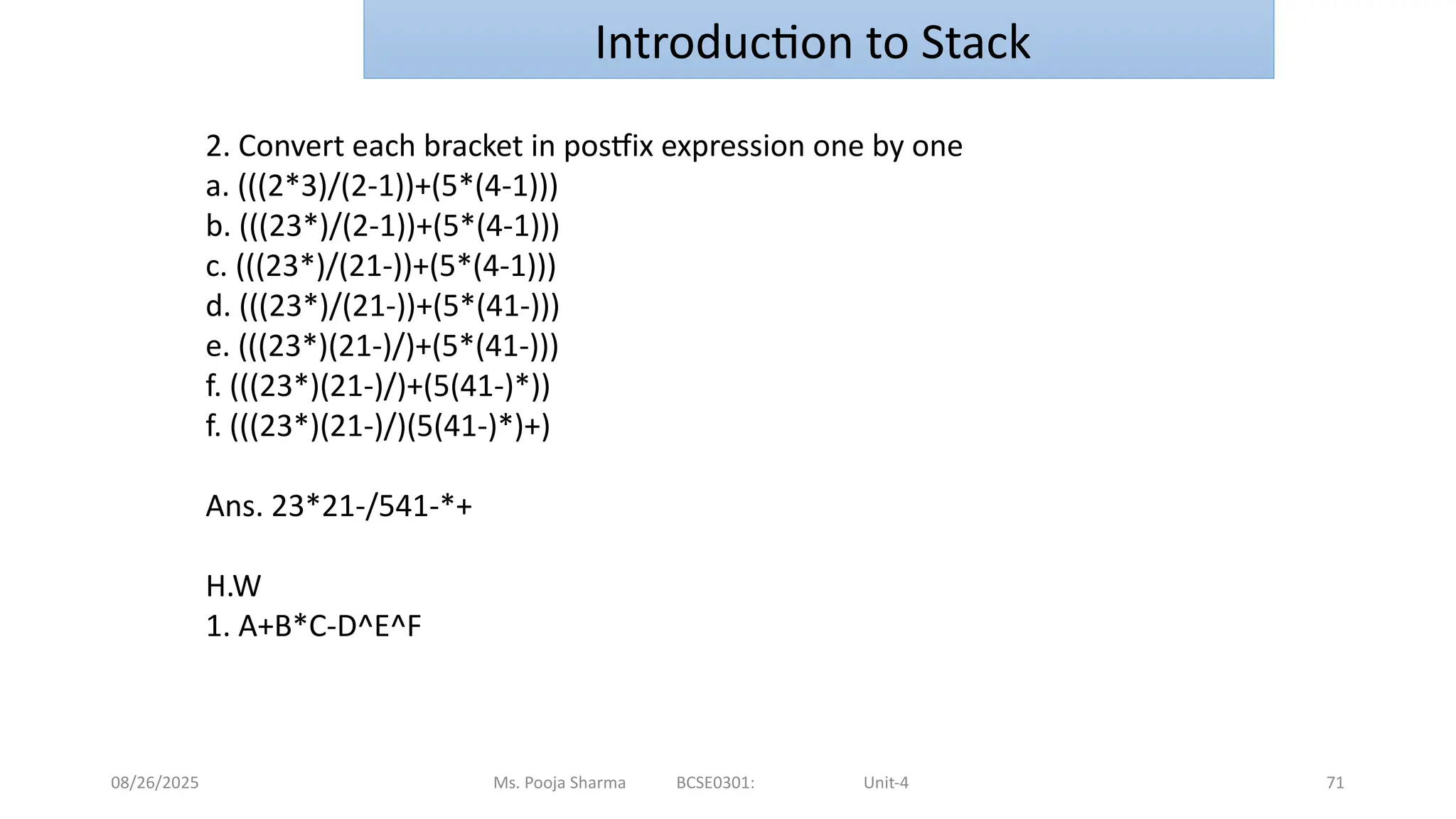
71.
08/26/2025 Ms. PoojaSharma BCSE0301: Unit-4 71
Introduction to Stack
2. Convert each bracket in postfix expression one by one
a. (((2*3)/(2-1))+(5*(4-1)))
b. (((23*)/(2-1))+(5*(4-1)))
c. (((23*)/(21-))+(5*(4-1)))
d. (((23*)/(21-))+(5*(41-)))
e. (((23*)(21-)/)+(5*(41-)))
f. (((23*)(21-)/)+(5(41-)*))
f. (((23*)(21-)/)(5(41-)*)+)
Ans. 23*21-/541-*+
H.W
1. A+B*C-D^E^F
72.
08/26/2025 Ms. PoojaSharma BCSE0301: Unit-4 72
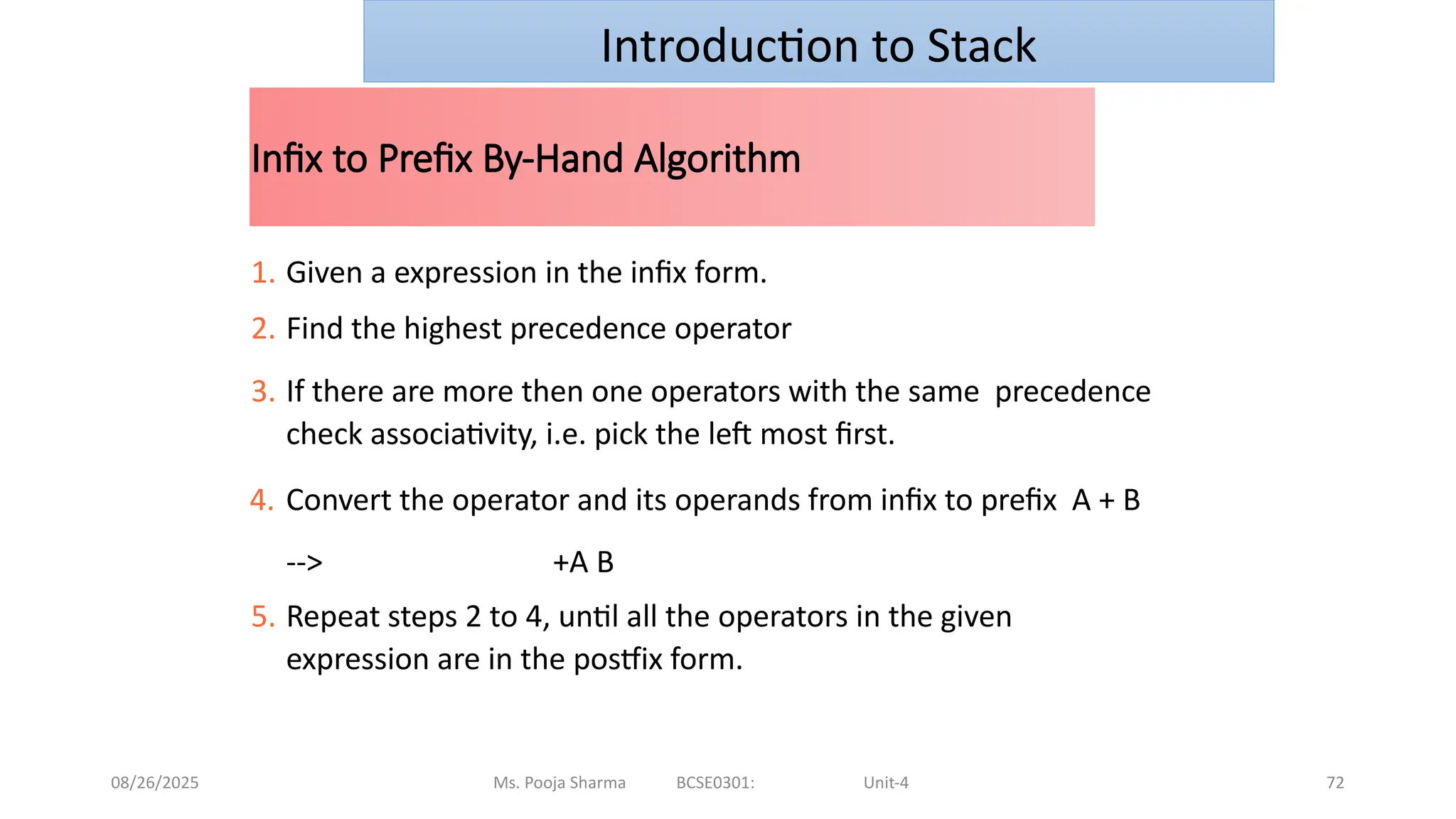
Infix to Prefix By-Hand Algorithm
1. Given a expression in the infix form.
2. Find the highest precedence operator
3. If there are more then one operators with the same precedence
check associativity, i.e. pick the left most first.
4. Convert the operator and its operands from infix to prefix A + B
--> +A B
5. Repeat steps 2 to 4, until all the operators in the given
expression are in the postfix form.
Introduction to Stack
73.
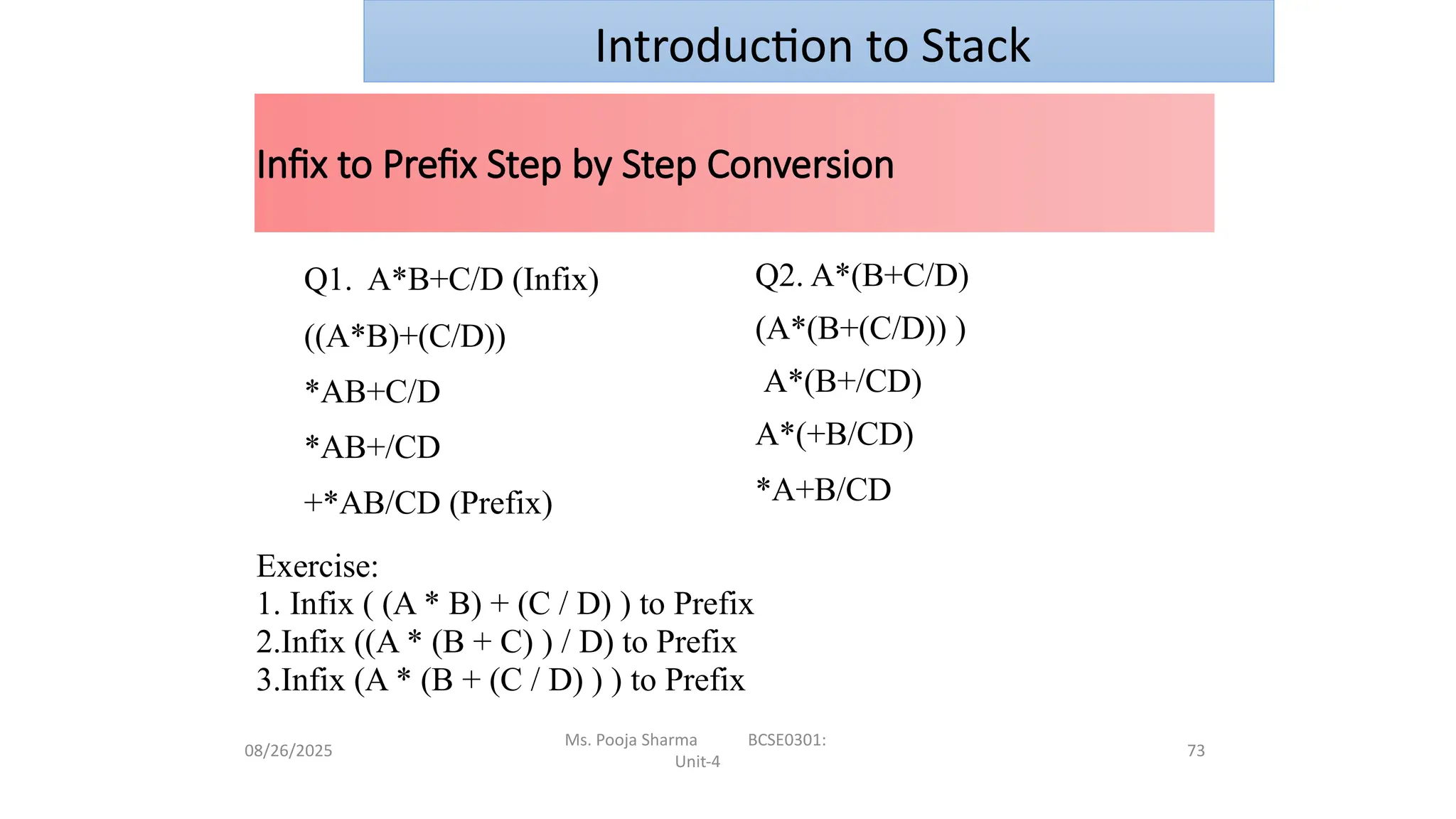
Q1. A*B+C/D (Infix)
((A*B)+(C/D))
*AB+C/D
*AB+/CD
+*AB/CD(Prefix)
Q2. A*(B+C/D)
(A*(B+(C/D)) )
A*(B+/CD)
A*(+B/CD)
*A+B/CD
Exercise:
1. Infix ( (A * B) + (C / D) ) to Prefix
2.Infix ((A * (B + C) ) / D) to Prefix
3.Infix (A * (B + (C / D) ) ) to Prefix
Infix to Prefix Step by Step Conversion
08/26/2025
Ms. Pooja Sharma BCSE0301:
Unit-4
73
Introduction to Stack
74.
08/26/2025 Ms. PoojaSharma BCSE0301: Unit-4 74
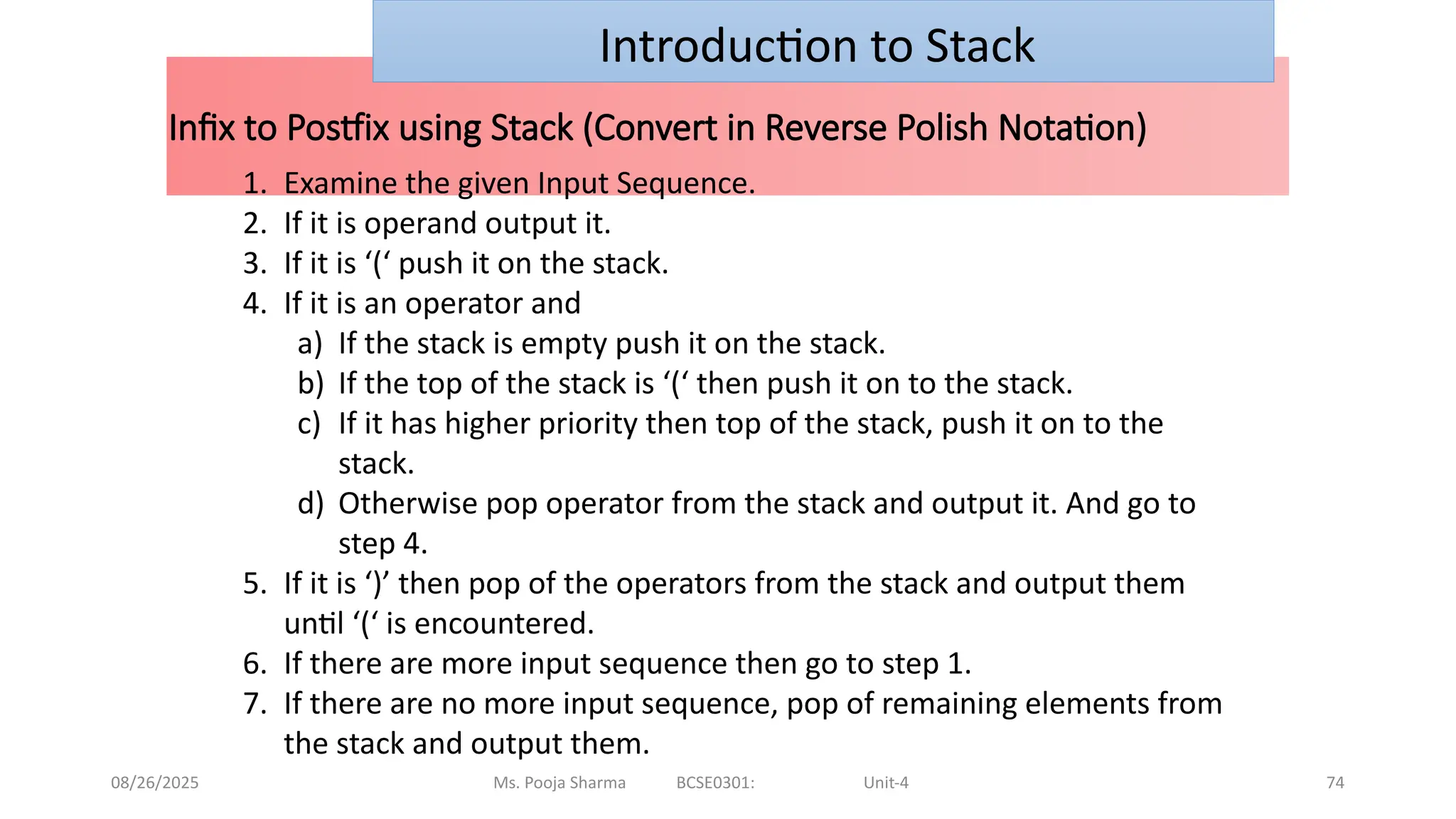
Infix to Postfix using Stack (Convert in Reverse Polish Notation)
Introduction to Stack
1. Examine the given Input Sequence.
2. If it is operand output it.
3. If it is ‘(‘ push it on the stack.
4. If it is an operator and
a) If the stack is empty push it on the stack.
b) If the top of the stack is ‘(‘ then push it on to the stack.
c) If it has higher priority then top of the stack, push it on to the
stack.
d) Otherwise pop operator from the stack and output it. And go to
step 4.
5. If it is ‘)’ then pop of the operators from the stack and output them
until ‘(‘ is encountered.
6. If there are more input sequence then go to step 1.
7. If there are no more input sequence, pop of remaining elements from
the stack and output them.
75.
08/26/2025 Ms. PoojaSharma BCSE0301: Unit-4 75
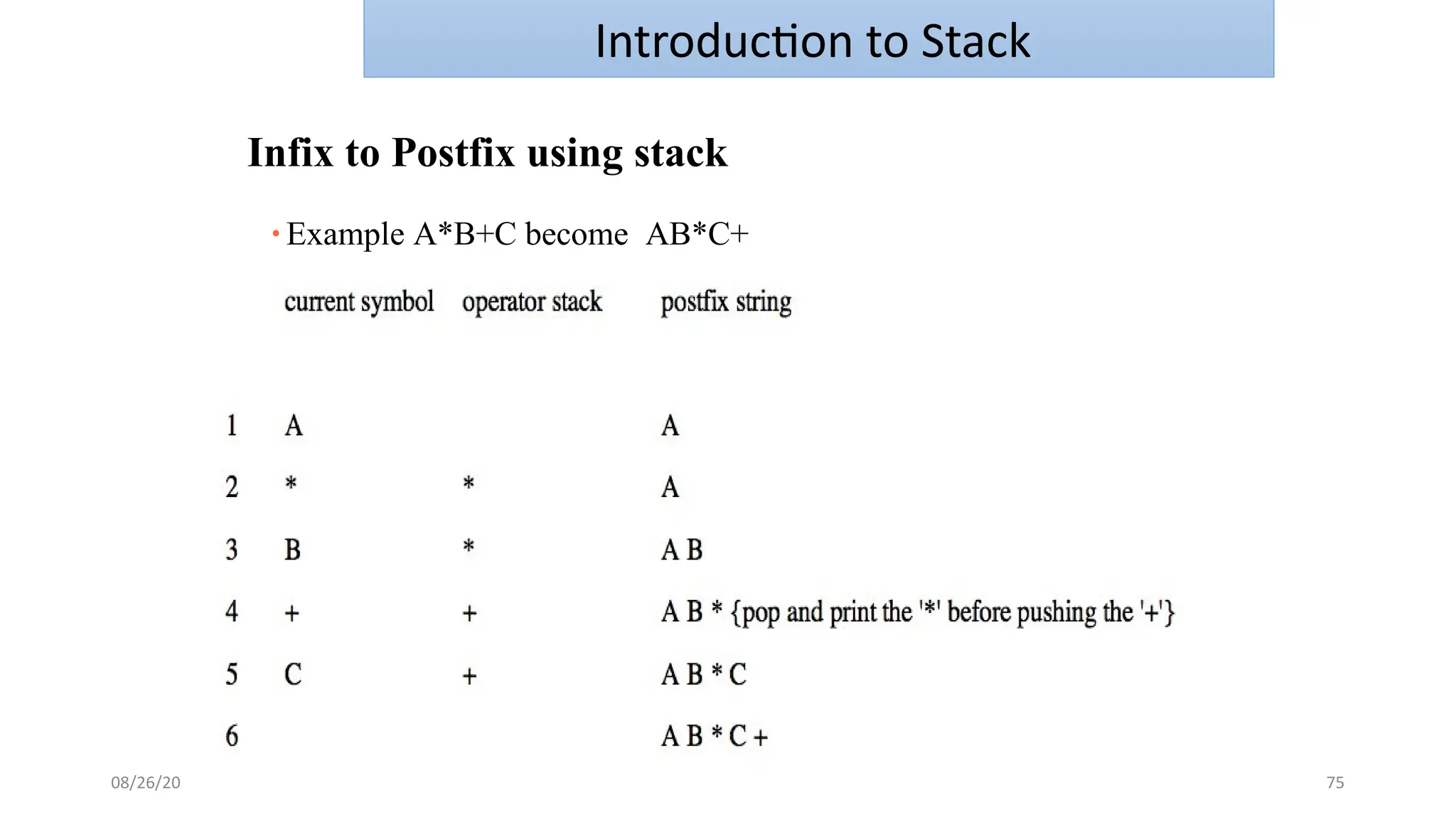
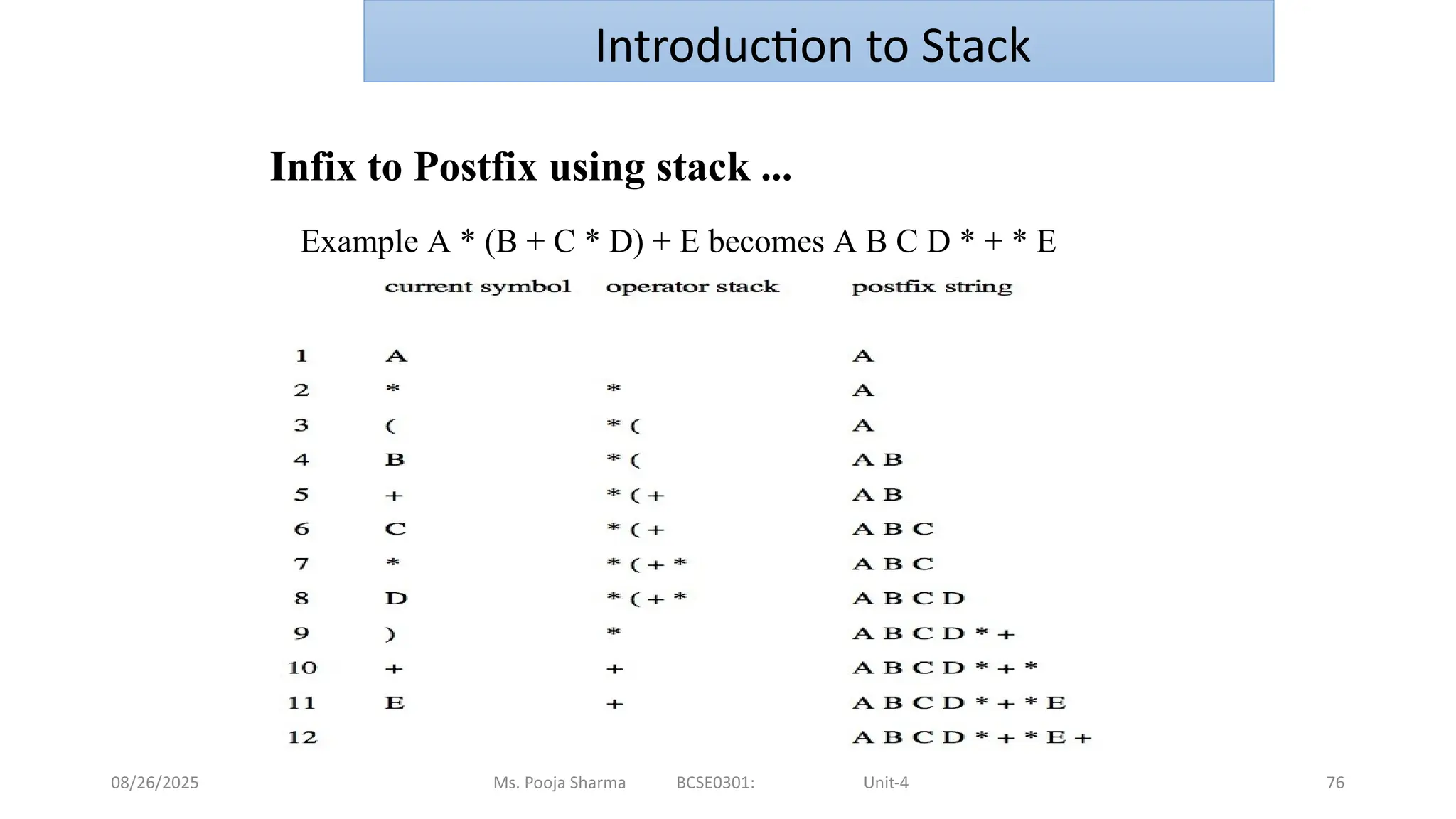
Infix to Postfix using stack
● Example A*B+C become AB*C+
Introduction to Stack
76.
08/26/2025 Ms. PoojaSharma BCSE0301: Unit-4 76
Infix to Postfix using stack ...
Example A * (B + C * D) + E becomes A B C D * + * E
+
Introduction to Stack
77.
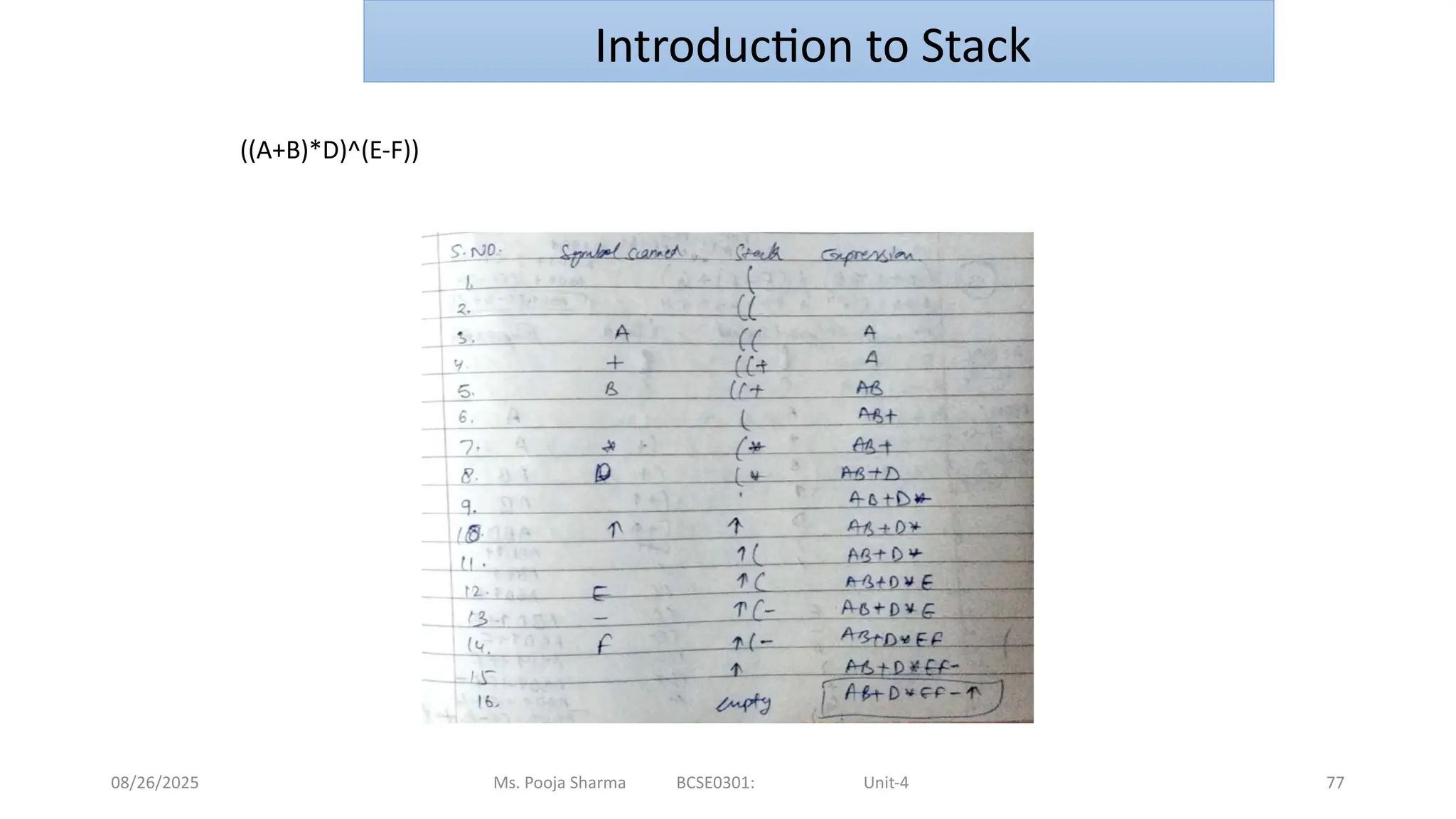
08/26/2025 Ms. PoojaSharma BCSE0301: Unit-4 77
Introduction to Stack
((A+B)*D)^(E-F))
78.
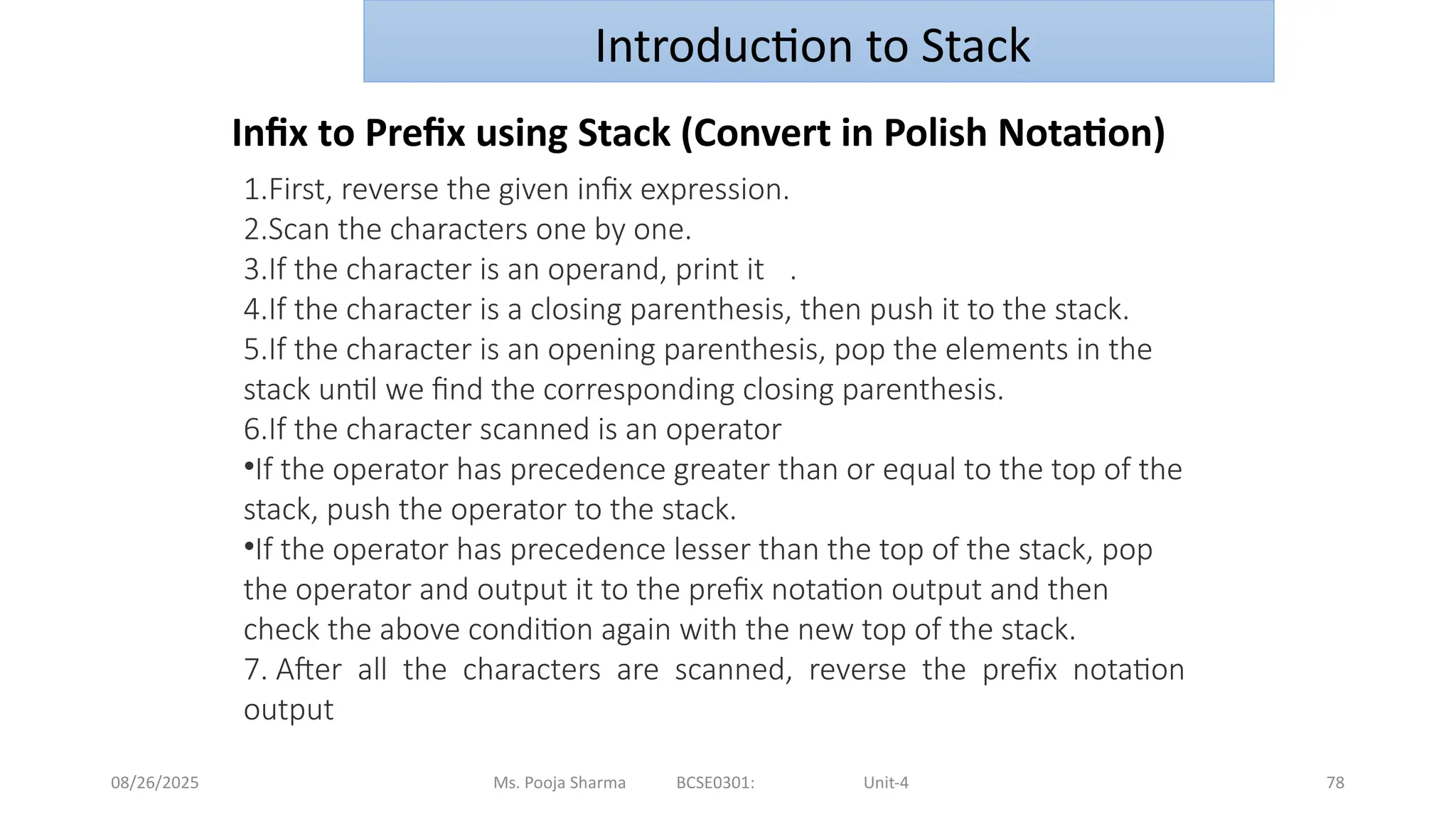
08/26/2025 Ms. PoojaSharma BCSE0301: Unit-4 78
Introduction to Stack
Infix to Prefix using Stack (Convert in Polish Notation)
1.First, reverse the given infix expression.
2.Scan the characters one by one.
3.If the character is an operand, print it .
4.If the character is a closing parenthesis, then push it to the stack.
5.If the character is an opening parenthesis, pop the elements in the
stack until we find the corresponding closing parenthesis.
6.If the character scanned is an operator
•If the operator has precedence greater than or equal to the top of the
stack, push the operator to the stack.
•If the operator has precedence lesser than the top of the stack, pop
the operator and output it to the prefix notation output and then
check the above condition again with the new top of the stack.
7. After all the characters are scanned, reverse the prefix notation
output
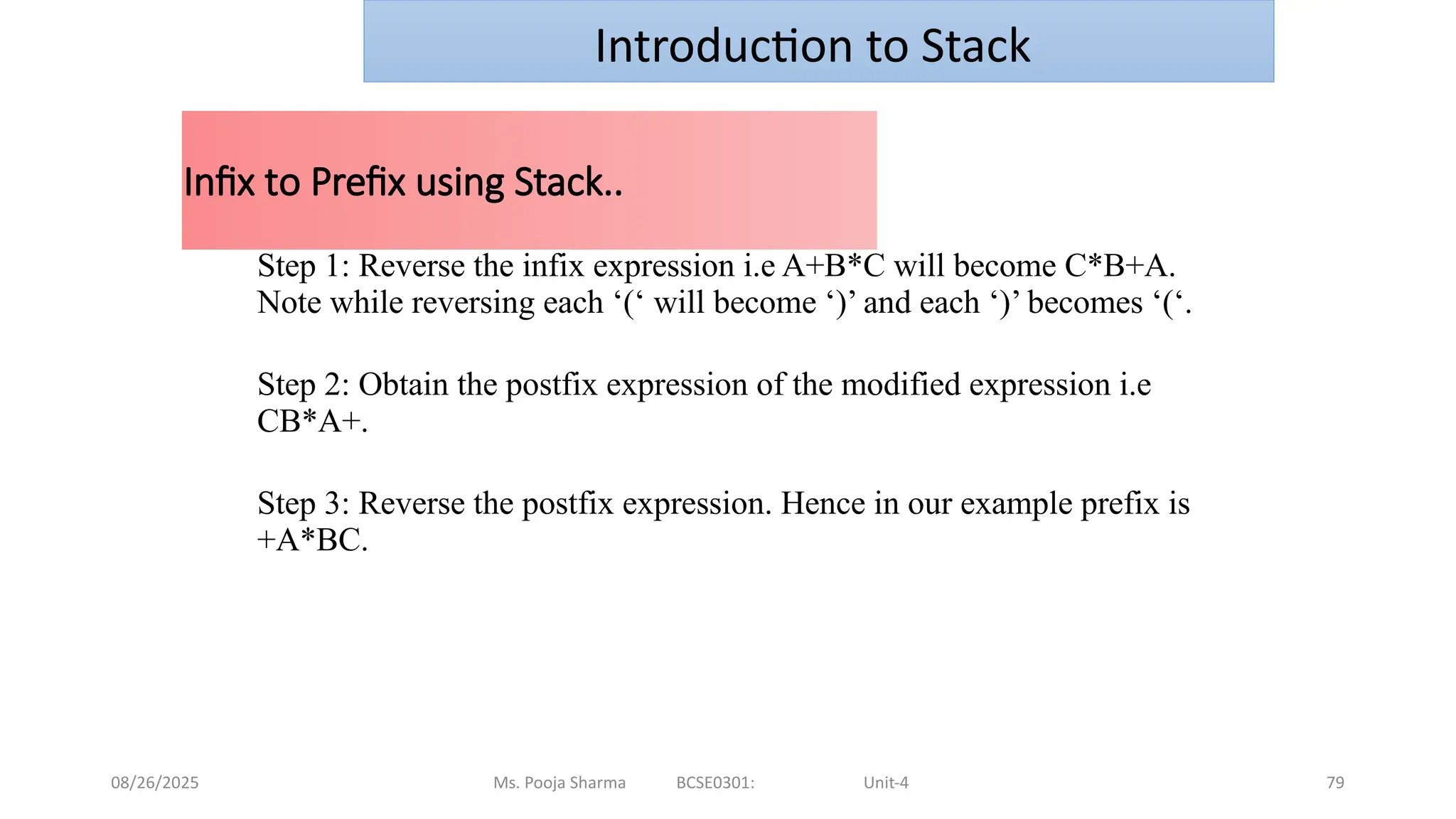
79.
08/26/2025 Ms. PoojaSharma BCSE0301: Unit-4 79
Infix to Prefix using Stack..
Step 1: Reverse the infix expression i.e A+B*C will become C*B+A.
Note while reversing each ‘(‘ will become ‘)’ and each ‘)’ becomes ‘(‘.
Step 2: Obtain the postfix expression of the modified expression i.e
CB*A+.
Step 3: Reverse the postfix expression. Hence in our example prefix is
+A*BC.
Introduction to Stack
80.
08/26/2025 Ms. PoojaSharma BCSE0301: Unit-4 80
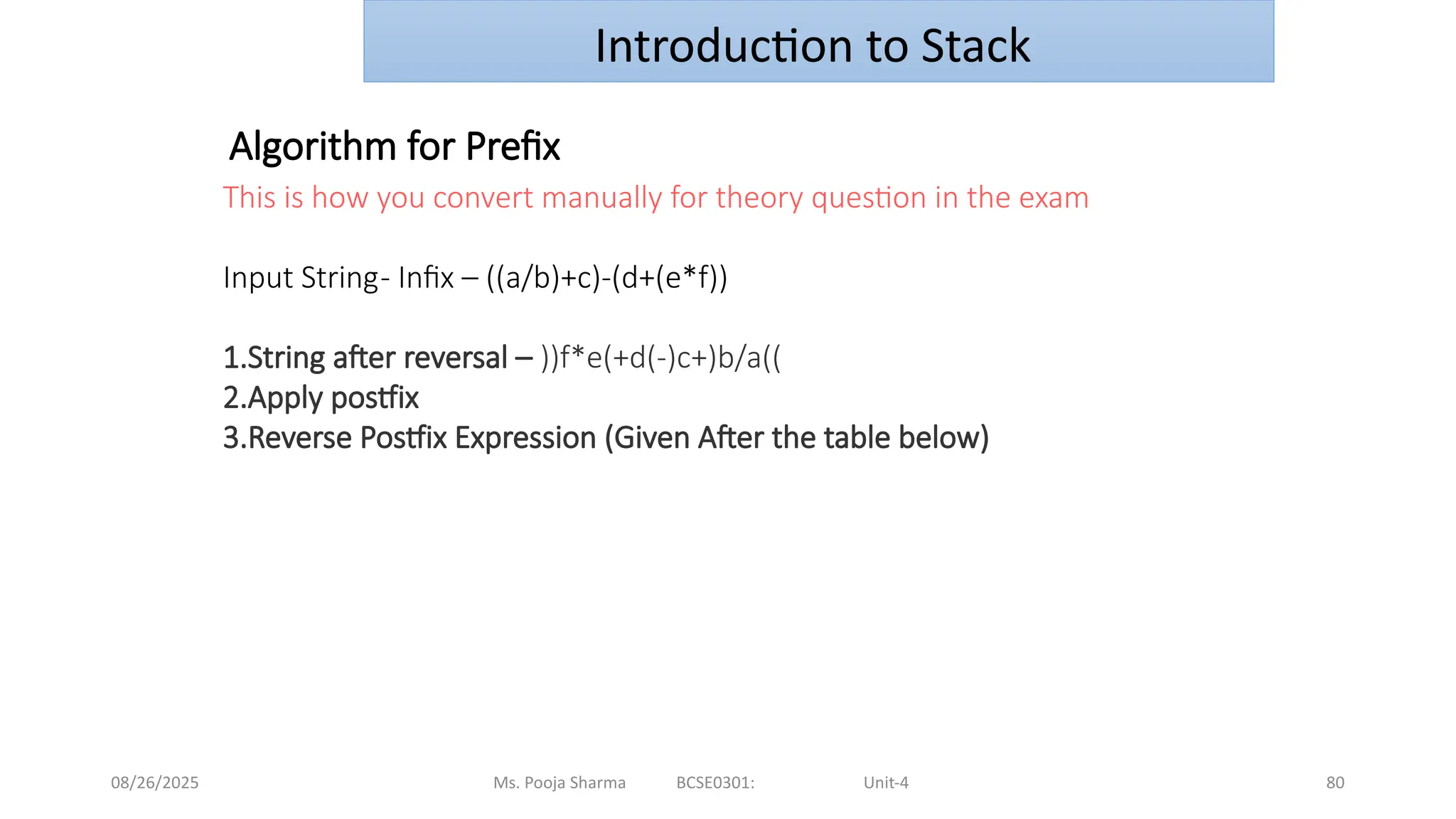
This is how you convert manually for theory question in the exam
Input String- Infix – ((a/b)+c)-(d+(e*f))
1.String after reversal – ))f*e(+d(-)c+)b/a((
2.Apply postfix
3.Reverse Postfix Expression (Given After the table below)
Algorithm for Prefix
Introduction to Stack
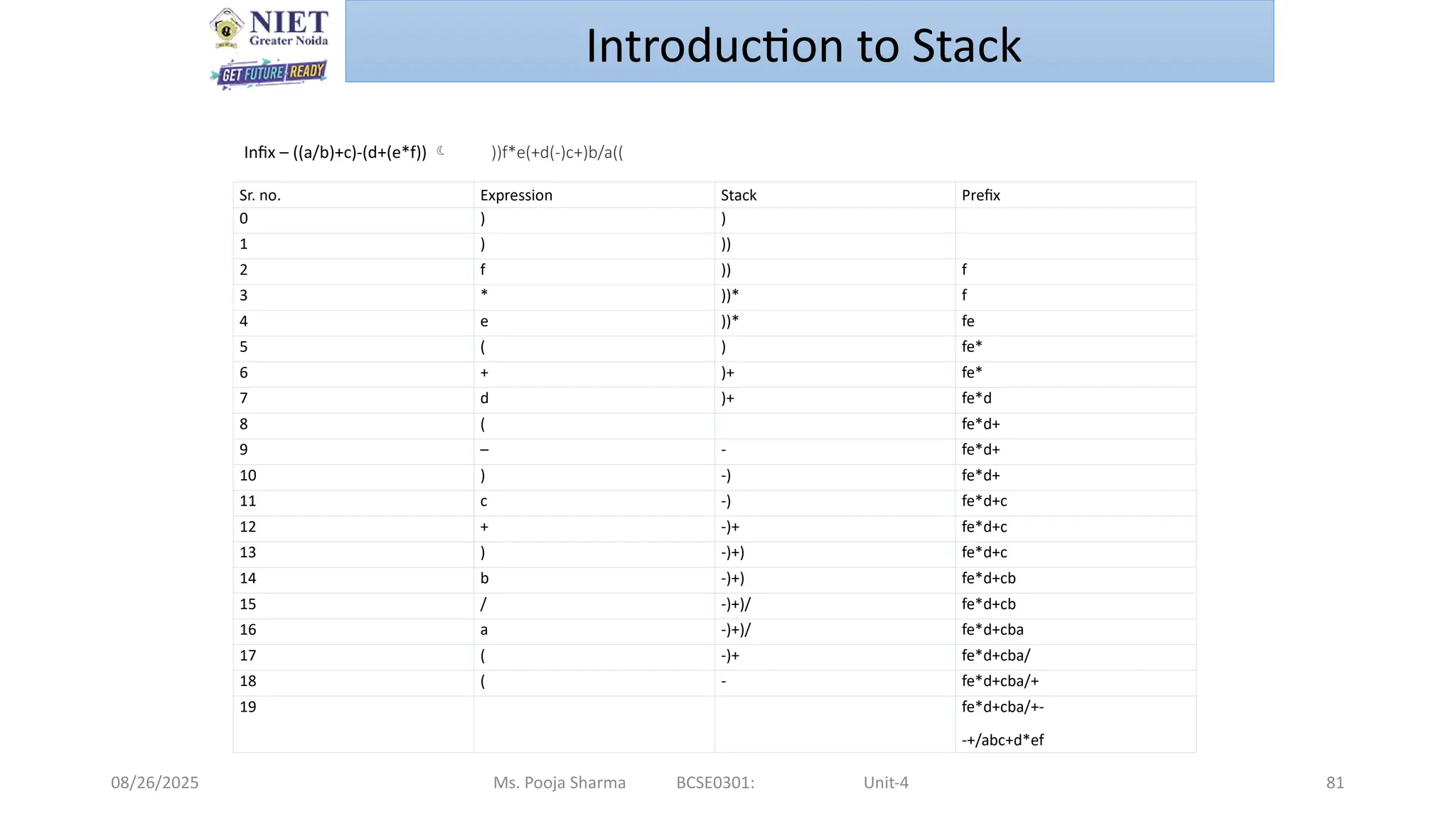
81.
08/26/2025 Ms. PoojaSharma BCSE0301: Unit-4 81
Sr. no. Expression Stack Prefix
0 ) )
1 ) ))
2 f )) f
3 * ))* f
4 e ))* fe
5 ( ) fe*
6 + )+ fe*
7 d )+ fe*d
8 ( fe*d+
9 – - fe*d+
10 ) -) fe*d+
11 c -) fe*d+c
12 + -)+ fe*d+c
13 ) -)+) fe*d+c
14 b -)+) fe*d+cb
15 / -)+)/ fe*d+cb
16 a -)+)/ fe*d+cba
17 ( -)+ fe*d+cba/
18 ( - fe*d+cba/+
19 fe*d+cba/+-
-+/abc+d*ef
Infix – ((a/b)+c)-(d+(e*f)) ))f*e(+d(-)c+)b/a((
Introduction to Stack
82.
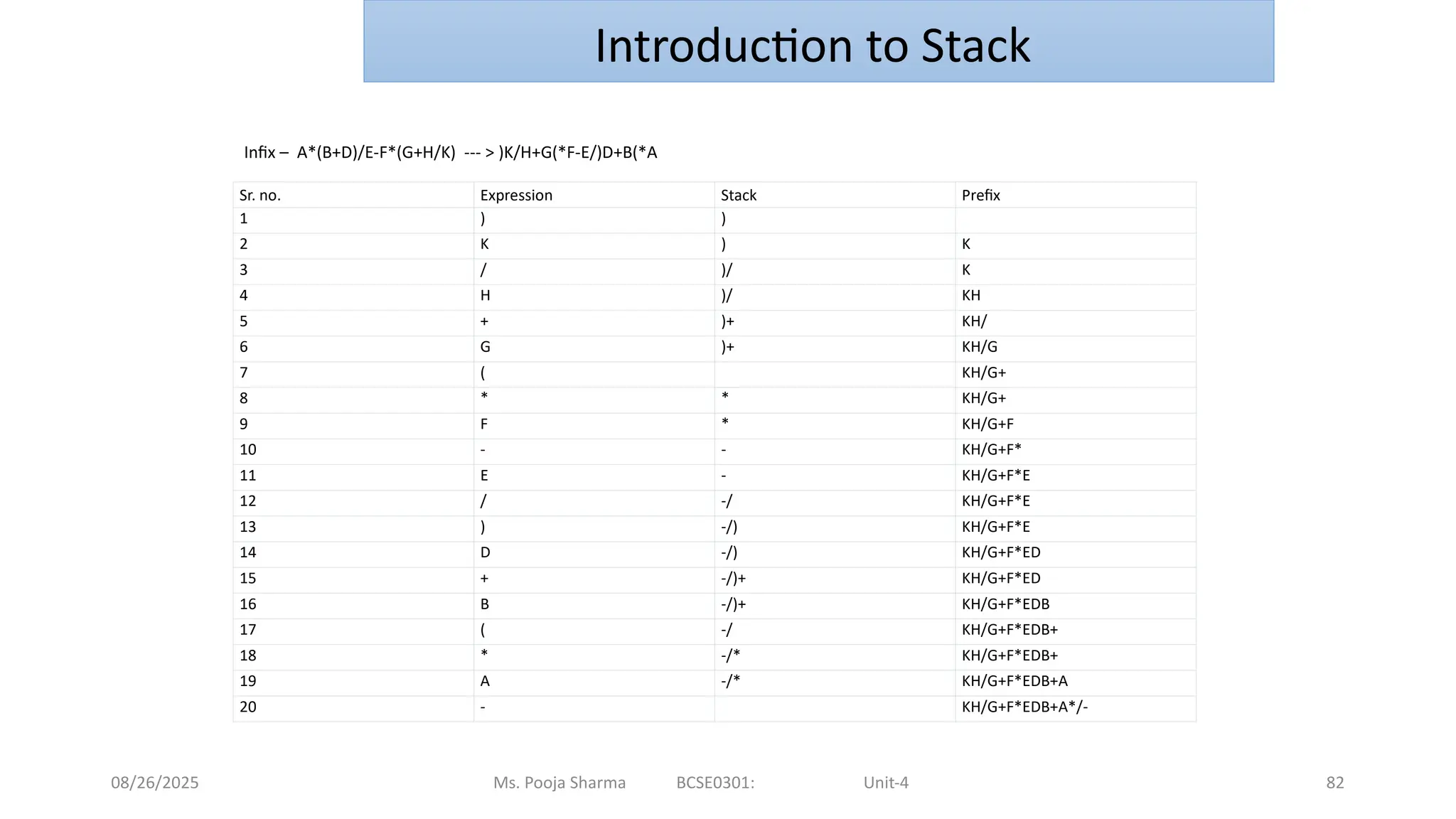
08/26/2025 Ms. PoojaSharma BCSE0301: Unit-4 82
Sr. no. Expression Stack Prefix
1 ) )
2 K ) K
3 / )/ K
4 H )/ KH
5 + )+ KH/
6 G )+ KH/G
7 ( KH/G+
8 * * KH/G+
9 F * KH/G+F
10 - - KH/G+F*
11 E - KH/G+F*E
12 / -/ KH/G+F*E
13 ) -/) KH/G+F*E
14 D -/) KH/G+F*ED
15 + -/)+ KH/G+F*ED
16 B -/)+ KH/G+F*EDB
17 ( -/ KH/G+F*EDB+
18 * -/* KH/G+F*EDB+
19 A -/* KH/G+F*EDB+A
20 - KH/G+F*EDB+A*/-
Infix – A*(B+D)/E-F*(G+H/K) --- > )K/H+G(*F-E/)D+B(*A
Introduction to Stack
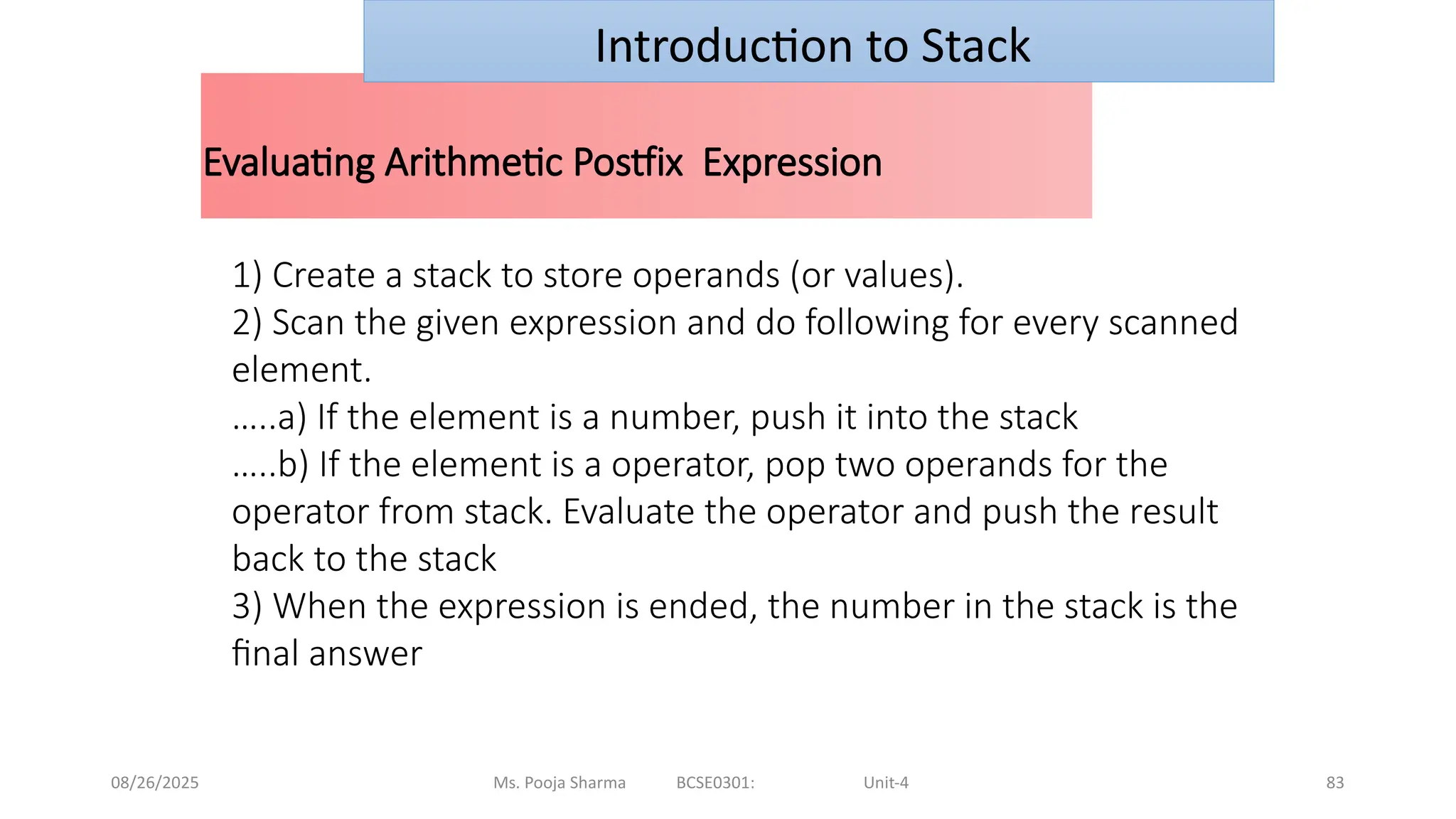
83.
08/26/2025 Ms. PoojaSharma BCSE0301: Unit-4 83
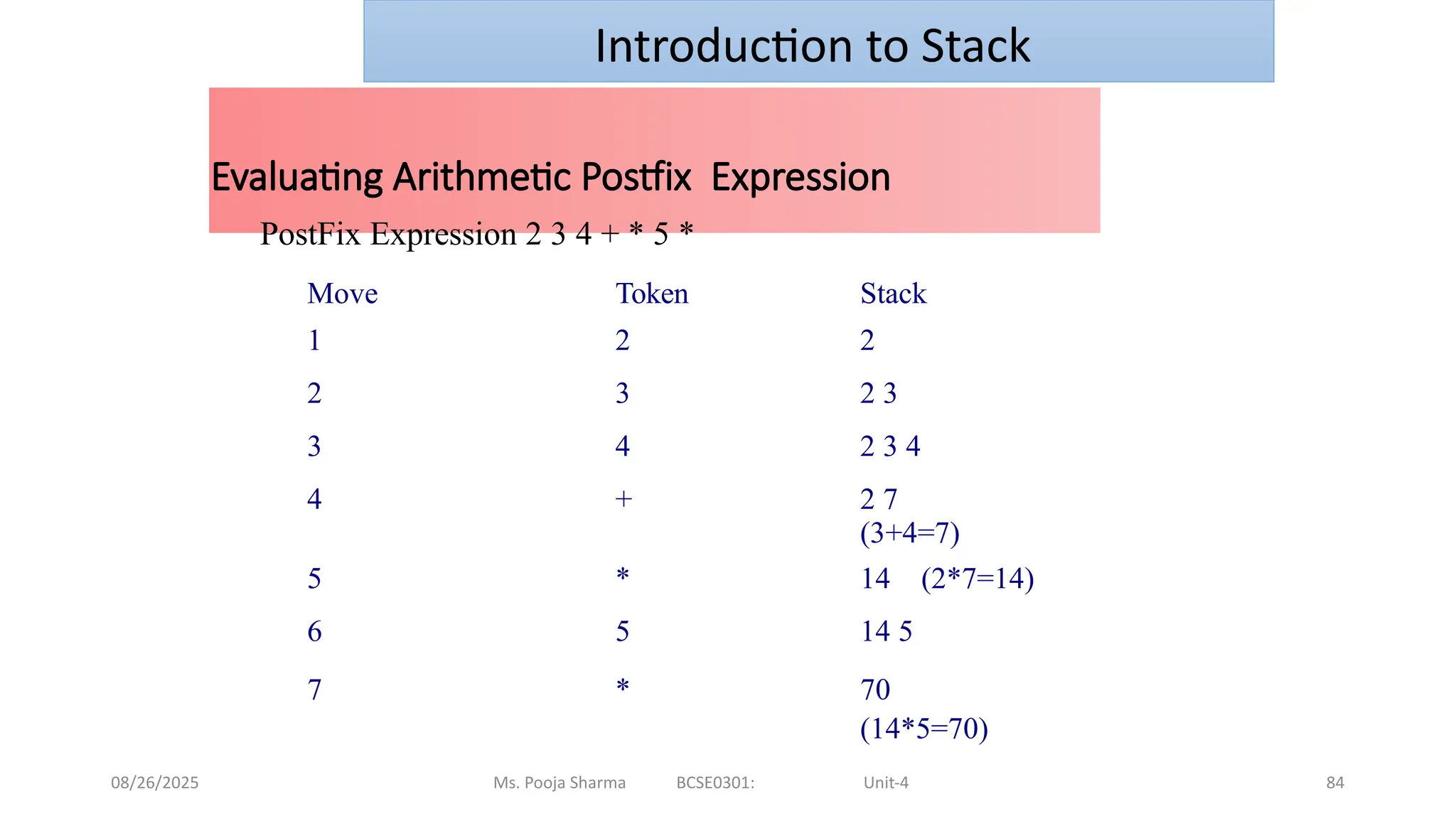
Evaluating Arithmetic Postfix Expression
Introduction to Stack
1) Create a stack to store operands (or values).
2) Scan the given expression and do following for every scanned
element.
…..a) If the element is a number, push it into the stack
…..b) If the element is a operator, pop two operands for the
operator from stack. Evaluate the operator and push the result
back to the stack
3) When the expression is ended, the number in the stack is the
final answer
08/26/2025 Ms. PoojaSharma BCSE0301: Unit-4
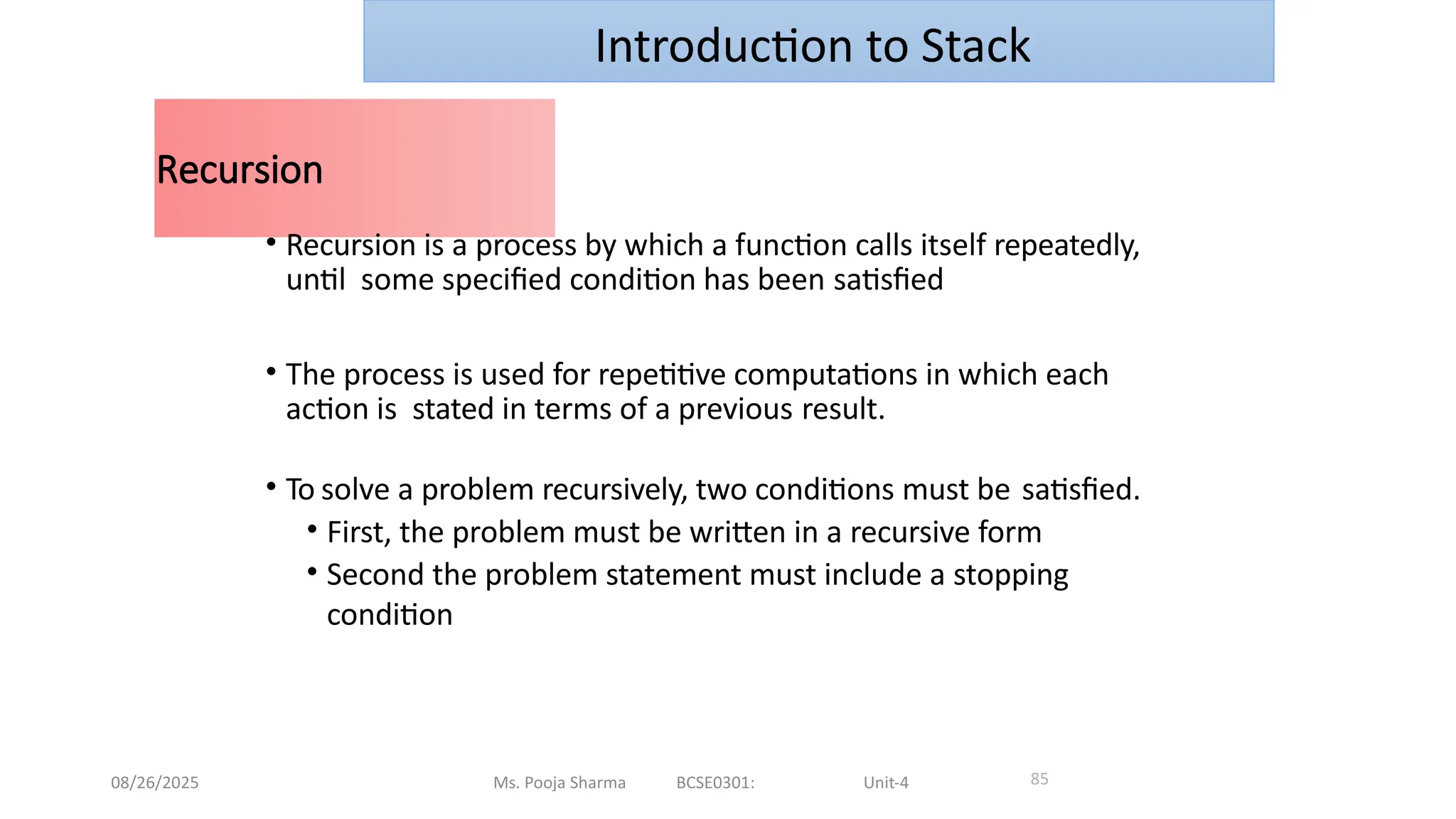
Recursion
85
• Recursion is a process by which a function calls itself repeatedly,
until some specified condition has been satisfied
• The process is used for repetitive computations in which each
action is stated in terms of a previous result.
• To solve a problem recursively, two conditions must be satisfied.
• First, the problem must be written in a recursive form
• Second the problem statement must include a stopping
condition
Introduction to Stack
86.
08/26/2025 Ms. PoojaSharma BCSE0301: Unit-4
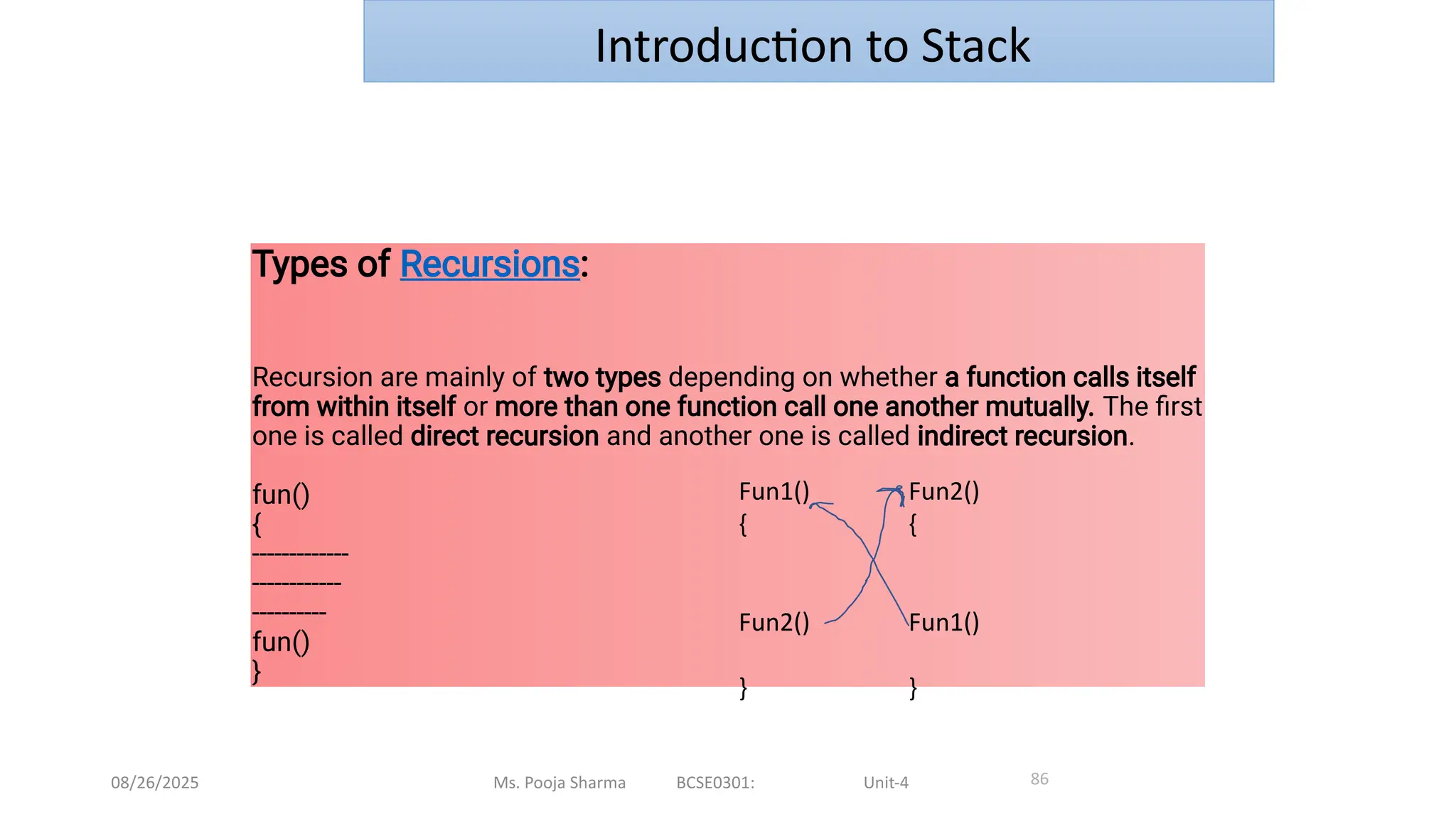
Types of Recursions:
Recursion are mainly of two types depending on whether a function calls itself
from within itself or more than one function call one another mutually. The first
one is called direct recursion and another one is called indirect recursion.
fun()
{
-------------
------------
----------
fun()
}
86
Introduction to Stack
Fun1()
{
Fun2()
}
Fun2()
{
Fun1()
}
08/26/2025 Ms. PoojaSharma BCSE0301: Unit-4
Recursion
88
• There is base condition, that stops further calling of the function
• Function call itself directly or indirectly, it should reach towards
base condition.
Introduction to Stack
89.
08/26/2025 Ms. PoojaSharma BCSE0301: Unit-4
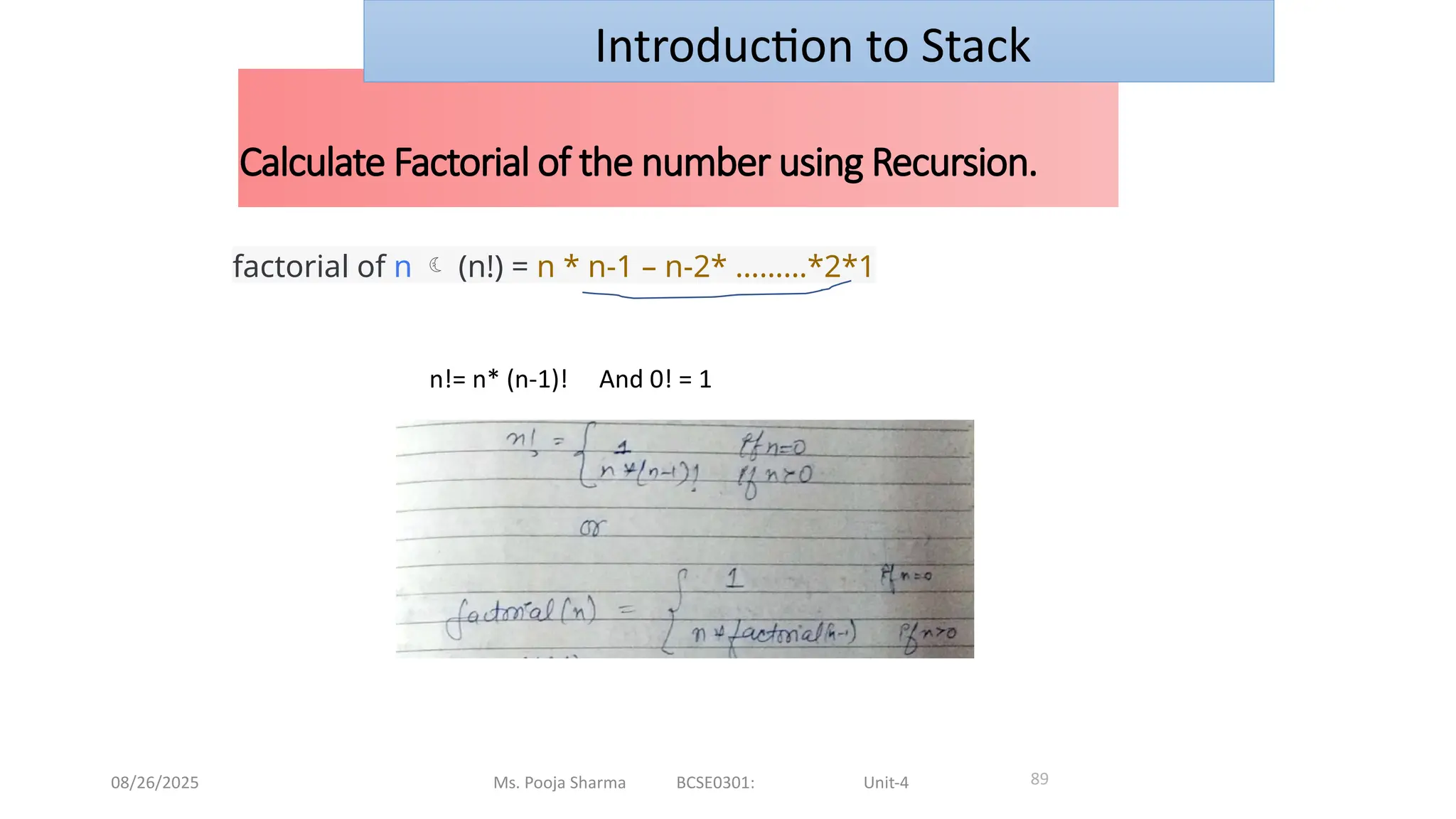
Calculate Factorial of the number using Recursion.
89
Introduction to Stack
factorial of n (n!) = n * n-1 – n-2* ………*2*1
n!= n* (n-1)! And 0! = 1
90.
08/26/2025 Ms. PoojaSharma BCSE0301: Unit-4
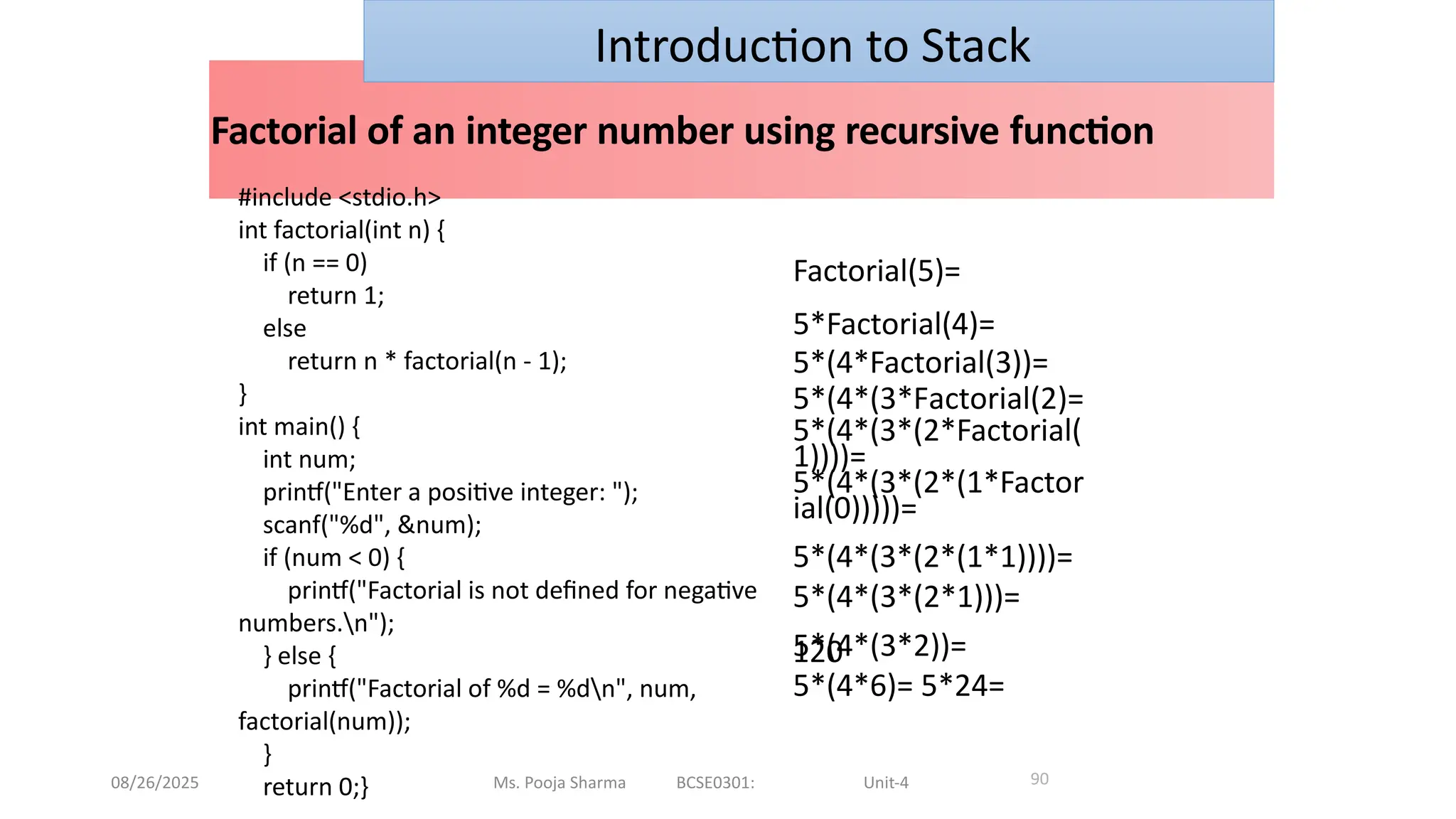
Factorial of an integer number using recursive function
90
Factorial(5)=
5*Factorial(4)=
5*(4*Factorial(3))=
5*(4*(3*Factorial(2)=
5*(4*(3*(2*Factorial(
1))))=
5*(4*(3*(2*(1*Factor
ial(0)))))=
5*(4*(3*(2*(1*1))))=
5*(4*(3*(2*1)))=
5*(4*(3*2))=
5*(4*6)= 5*24=
120
Introduction to Stack
#include <stdio.h>
int factorial(int n) {
if (n == 0)
return 1;
else
return n * factorial(n - 1);
}
int main() {
int num;
printf("Enter a positive integer: ");
scanf("%d", &num);
if (num < 0) {
printf("Factorial is not defined for negative
numbers.n");
} else {
printf("Factorial of %d = %dn", num,
factorial(num));
}
return 0;}
91.
08/26/2025 Ms. PoojaSharma BCSE0301: Unit-4
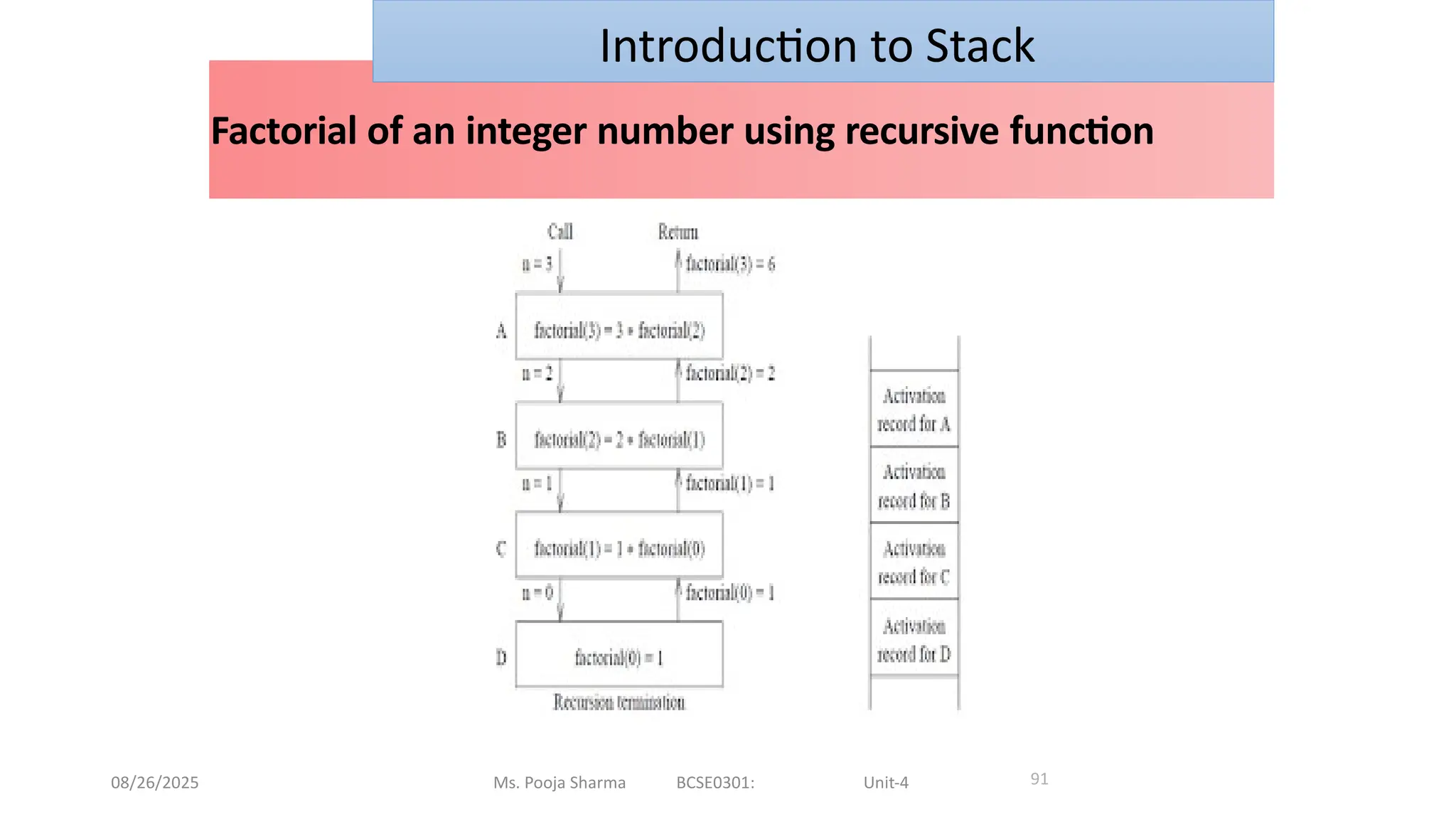
Factorial of an integer number using recursive function
91
Introduction to Stack
92.
08/26/2025 92
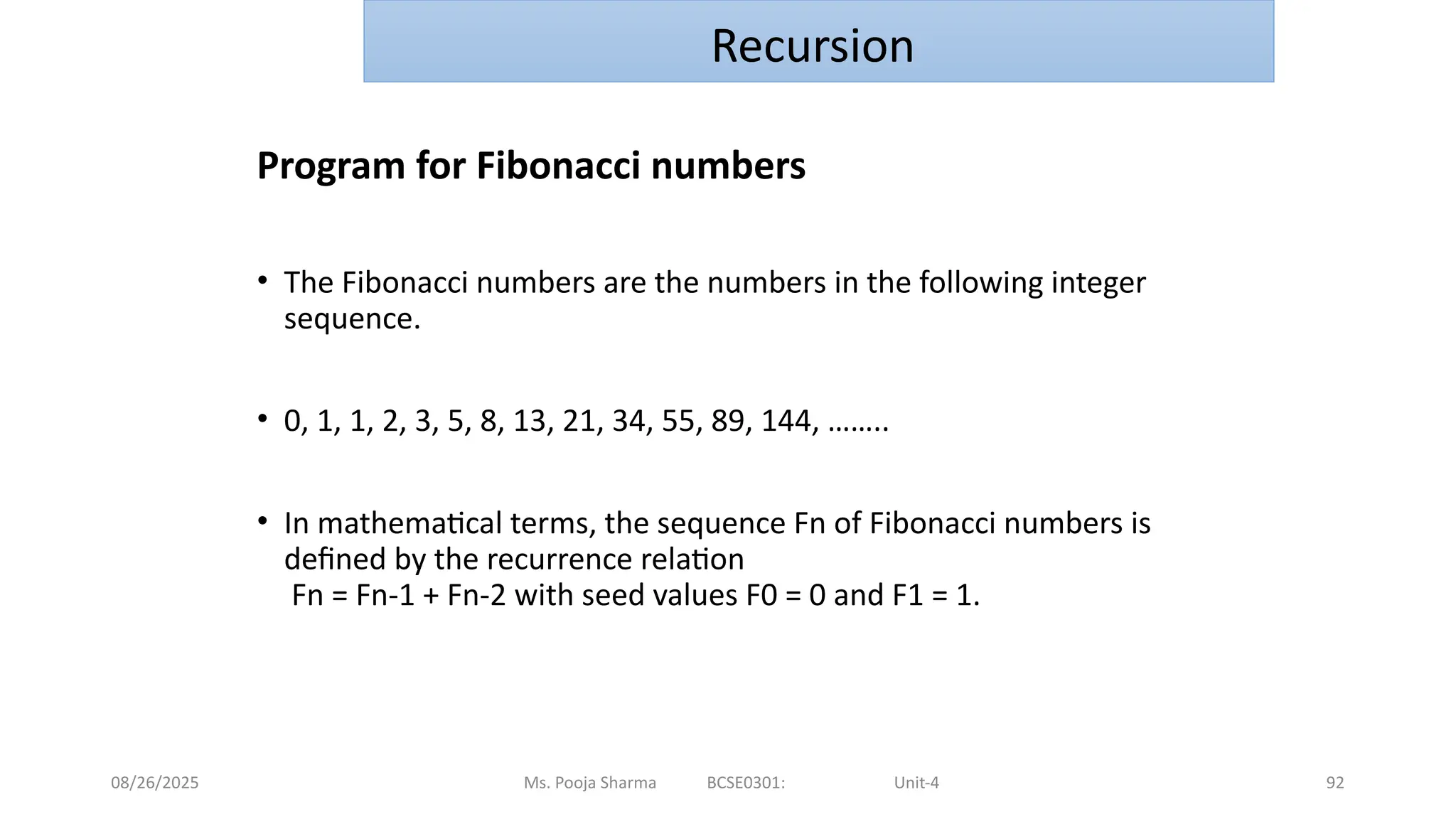
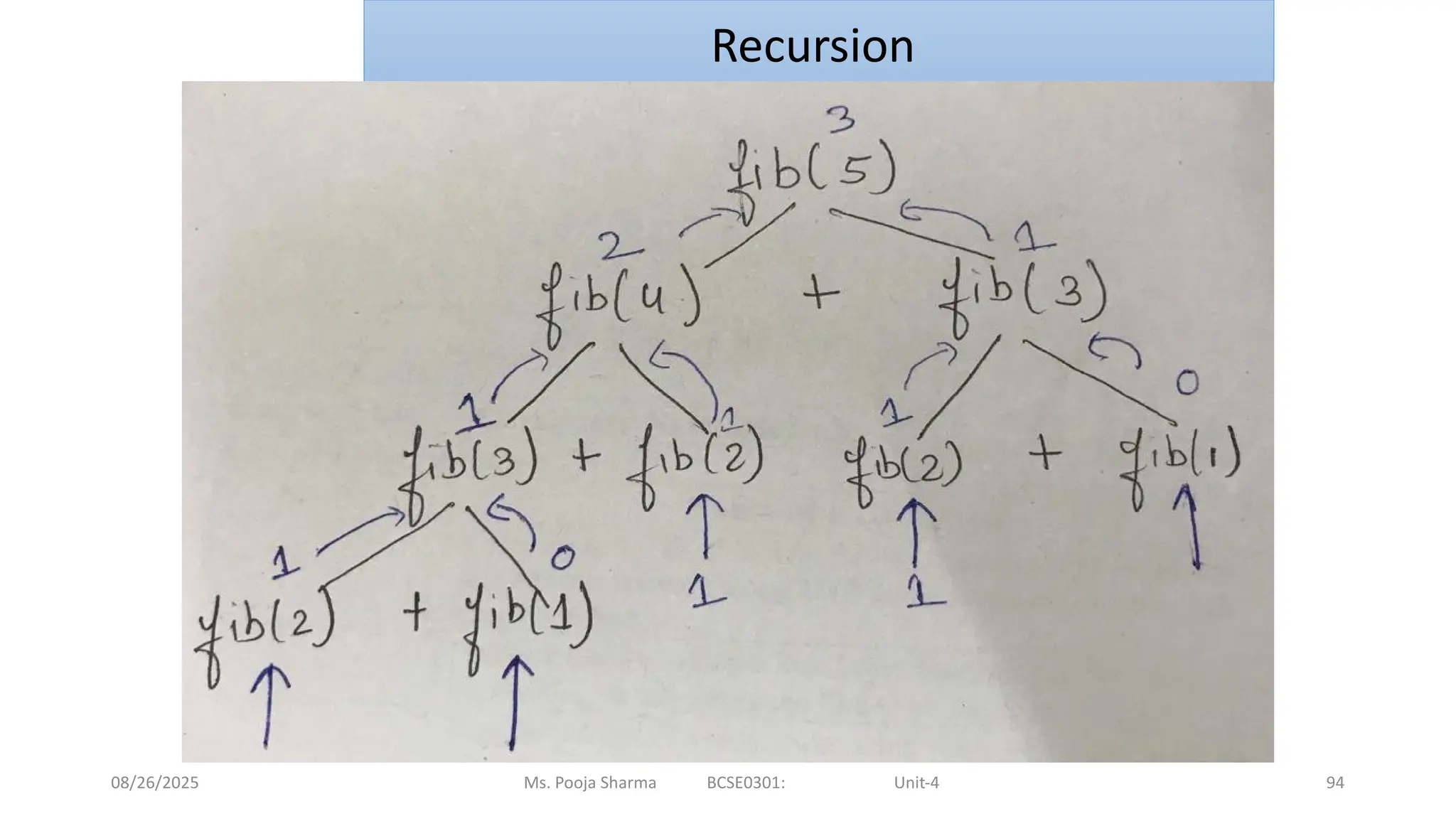
Program forFibonacci numbers
• The Fibonacci numbers are the numbers in the following integer
sequence.
• 0, 1, 1, 2, 3, 5, 8, 13, 21, 34, 55, 89, 144, ……..
• In mathematical terms, the sequence Fn of Fibonacci numbers is
defined by the recurrence relation
Fn = Fn-1 + Fn-2 with seed values F0 = 0 and F1 = 1.
Ms. Pooja Sharma BCSE0301: Unit-4
Recursion
08/26/2025 Ms. PoojaSharma BCSE0301: Unit-4
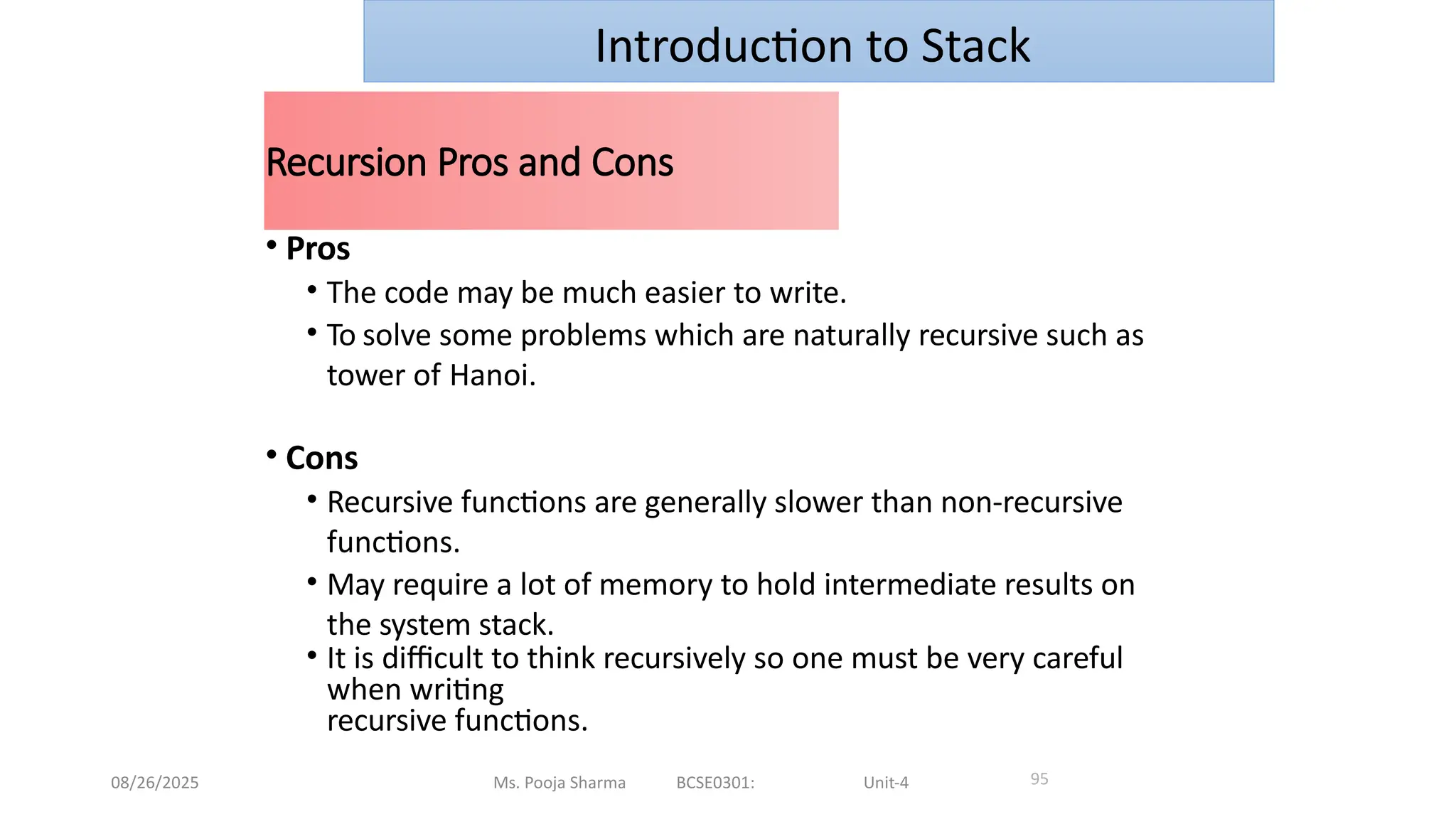
Recursion Pros and Cons
95
• Pros
• The code may be much easier to write.
• To solve some problems which are naturally recursive such as
tower of Hanoi.
• Cons
• Recursive functions are generally slower than non-recursive
functions.
• May require a lot of memory to hold intermediate results on
the system stack.
• It is difficult to think recursively so one must be very careful
when writing
recursive functions.
Introduction to Stack
08/26/2025 97
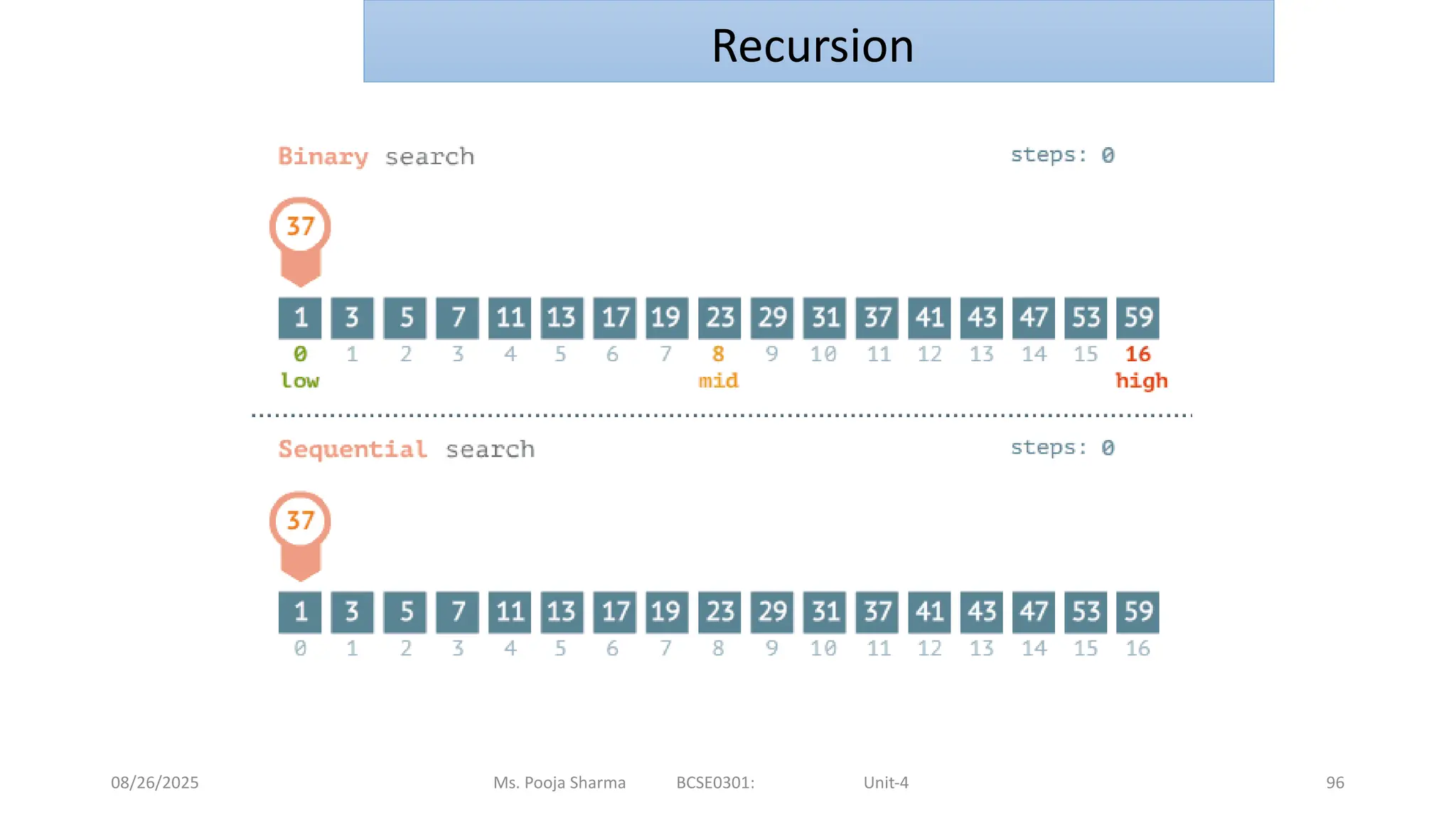
// CProgram to implement binary
search using iteration
#include <stdio.h>
int binarySearch(int arr[], int left, int
right, int key) {
// Loop will run till left > right. It
means that there
// are no elements to consider in
the given subarray
while (left <= right) {
// calculating mid point
int mid = left + (right - left) / 2;
Ms. Pooja Sharma BCSE0301: Unit-4
Recursion
// Check if key is present at mid
if (arr[mid] == key) {
return mid;
}
// If key greater than arr[mid], ignore left
half
if (arr[mid] < key) {
left = mid + 1;
}
// If key is smaller than or equal to
arr[mid],
// ignore right half
else {
right = mid - 1;
}
}
// If we reach here, then element was not
present
return -1;
}
98.
08/26/2025 98
my_list =[ 1, 9, 11, 21, 34, 54, 67, 90 ]
elem_to_search = 1
print("The list is")
print(my_list)
my_result = binary_search(my_list,0,len(my_list)-1,elem_to_search)
if my_result != -1:
print("Element found at index ", str(my_result))
else:
print("Element not found!")
Ms. Pooja Sharma BCSE0301: Unit-4
Recursion
99.
08/26/2025 Ms. PoojaSharma BCSE0301: Unit-4
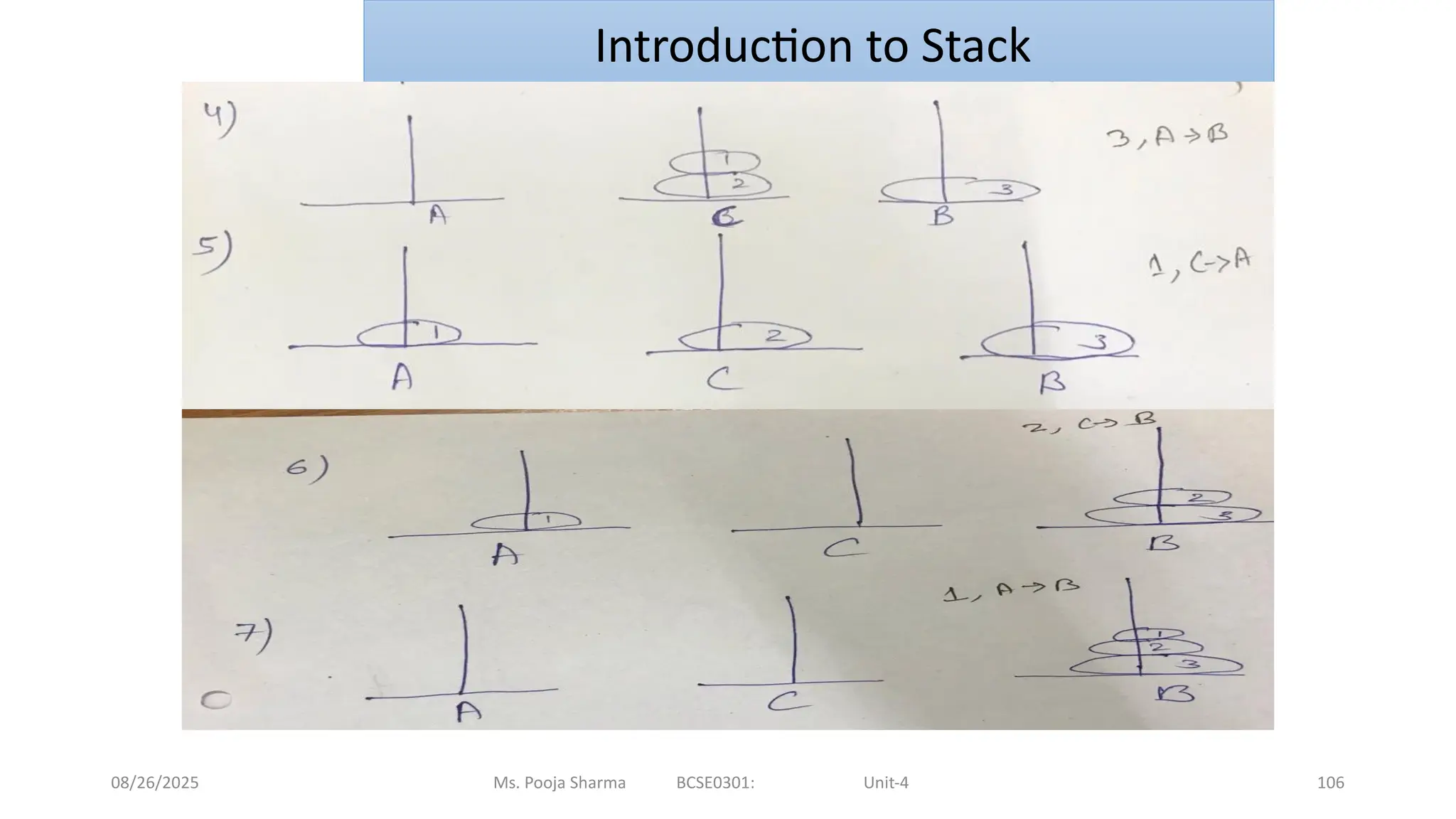
Tower of Hanoi Problem
99
Introduction to Stack
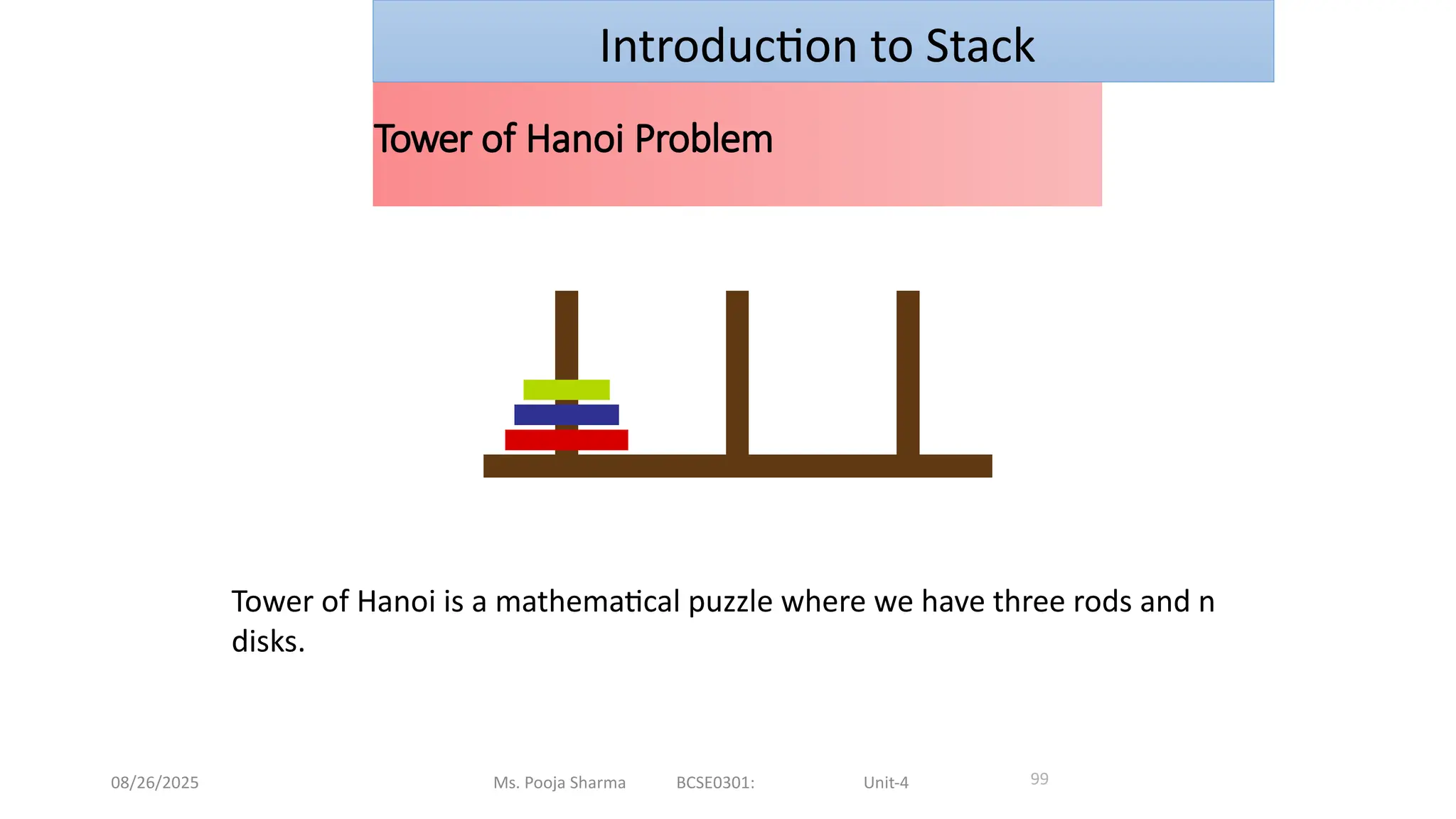
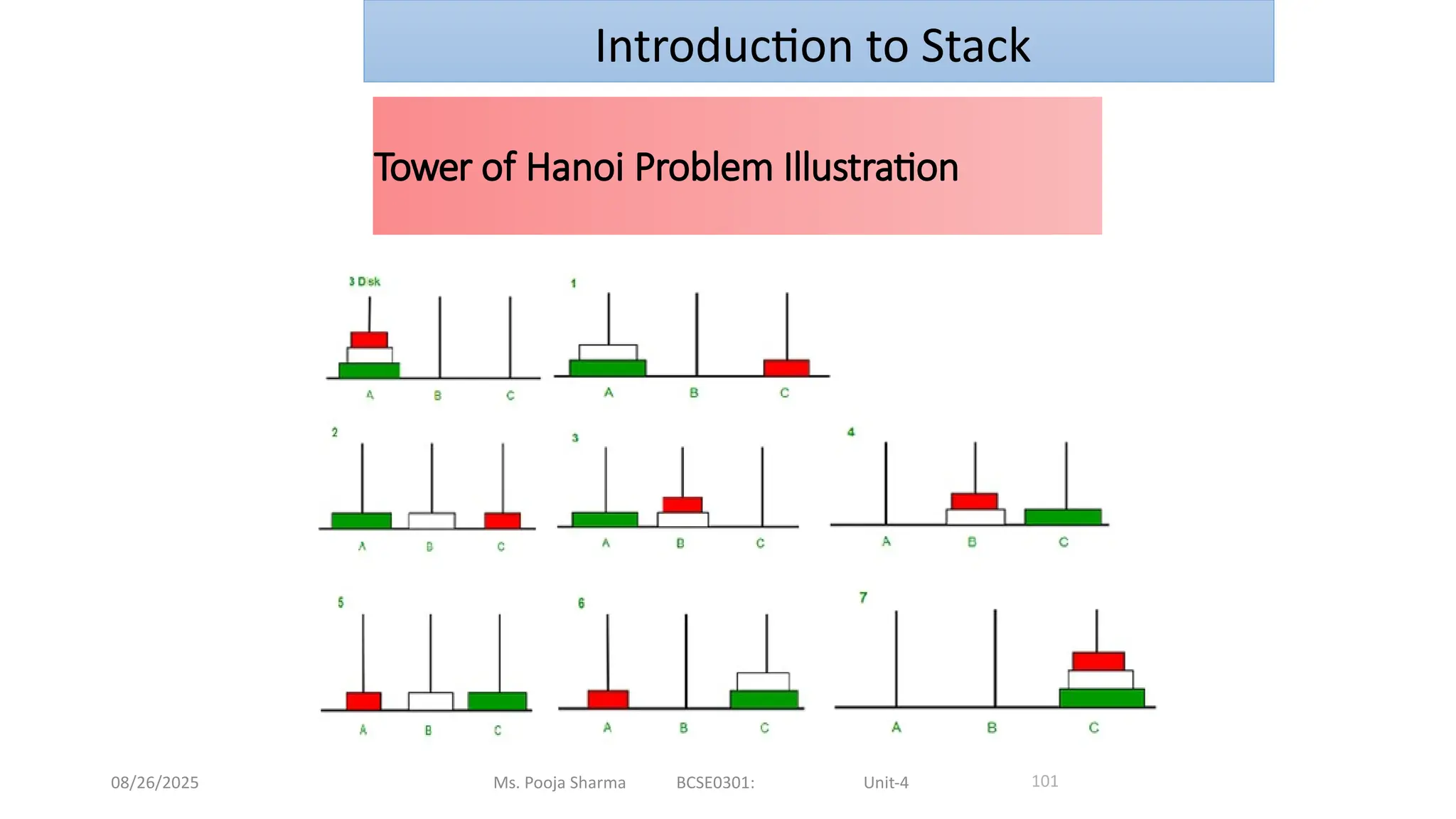
Tower of Hanoi is a mathematical puzzle where we have three rods and n
disks.
100.
08/26/2025 Ms. PoojaSharma BCSE0301: Unit-4
Tower of Hanoi Problem
100
Introduction to Stack
The objective of the puzzle is to move the entire stack to another rod, obeying
the following simple rules:
1) Only one disk can be moved at a time.
2) Each move consists of taking the upper disk from one of the stacks and
placing it on top of another stack i.e. a disk can only be moved if it is the
uppermost disk on a stack.
3) No disk may be placed on top of a smaller disk.
101.
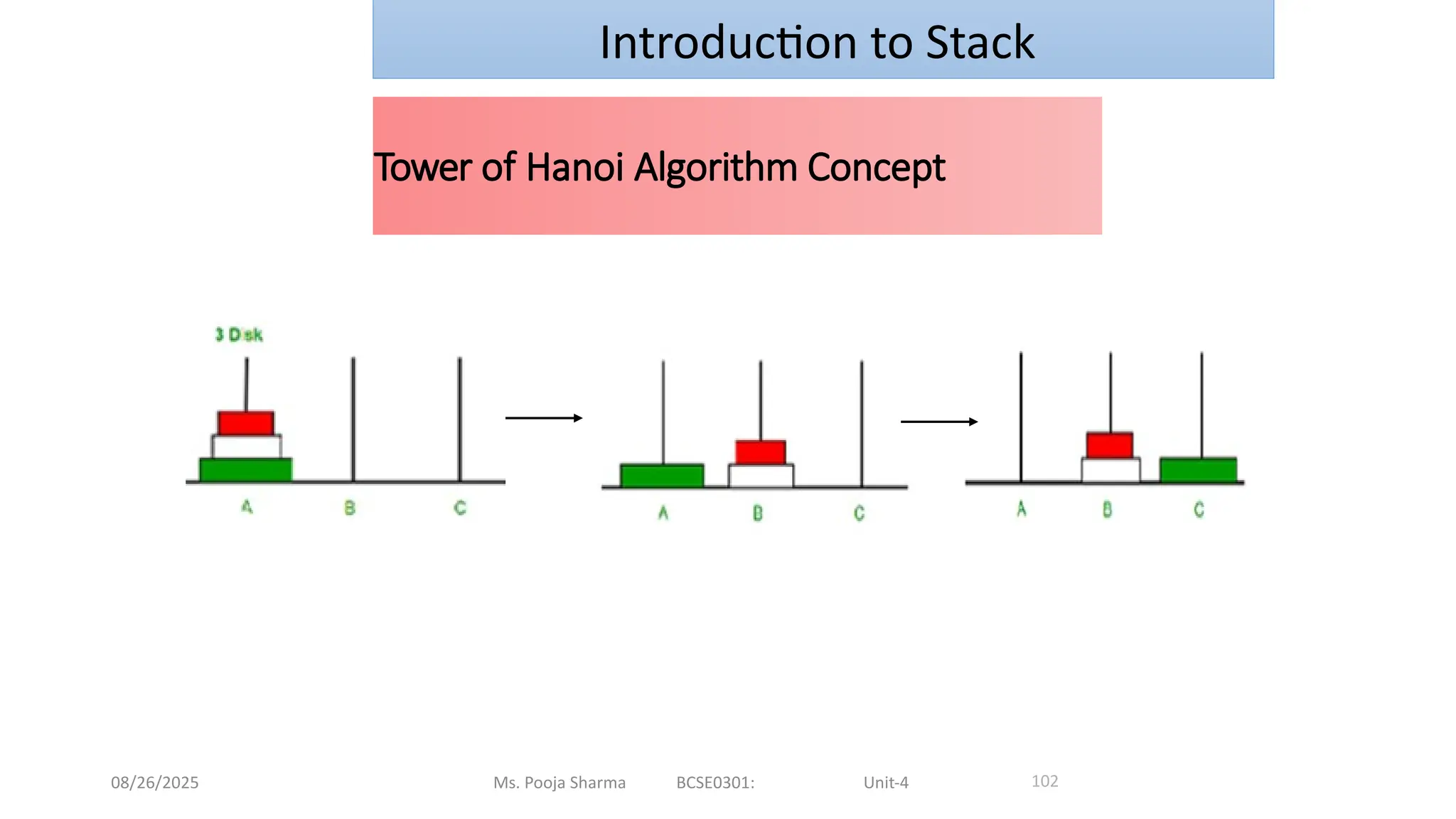
08/26/2025 Ms. PoojaSharma BCSE0301: Unit-4
Tower of Hanoi Problem Illustration
101
Introduction to Stack
102.
08/26/2025 Ms. PoojaSharma BCSE0301: Unit-4
Tower of Hanoi Algorithm Concept
102
Introduction to Stack
103.
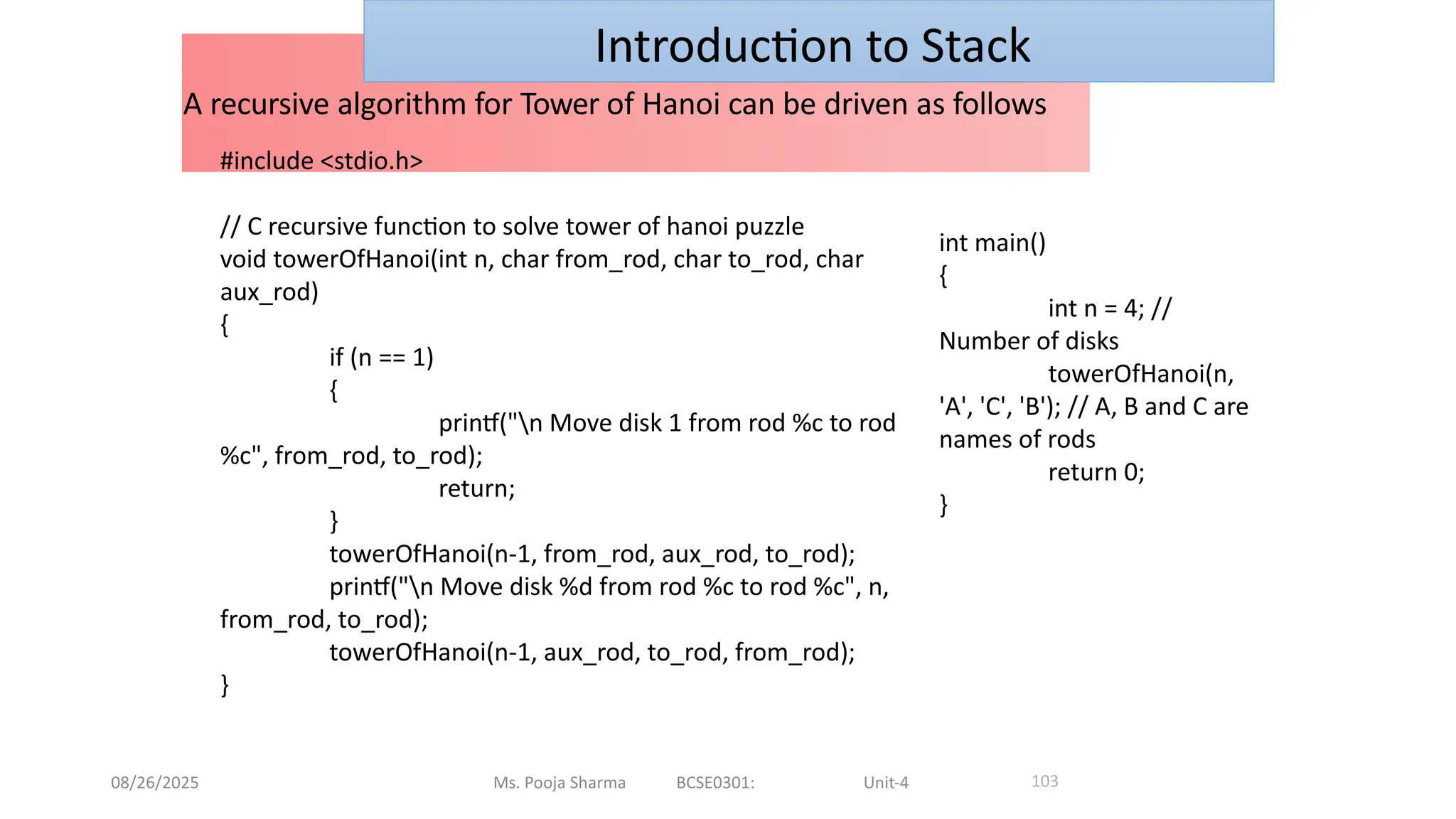
08/26/2025 Ms. PoojaSharma BCSE0301: Unit-4
A recursive algorithm for Tower of Hanoi can be driven as follows
103
Introduction to Stack
#include <stdio.h>
// C recursive function to solve tower of hanoi puzzle
void towerOfHanoi(int n, char from_rod, char to_rod, char
aux_rod)
{
if (n == 1)
{
printf("n Move disk 1 from rod %c to rod
%c", from_rod, to_rod);
return;
}
towerOfHanoi(n-1, from_rod, aux_rod, to_rod);
printf("n Move disk %d from rod %c to rod %c", n,
from_rod, to_rod);
towerOfHanoi(n-1, aux_rod, to_rod, from_rod);
}
int main()
{
int n = 4; //
Number of disks
towerOfHanoi(n,
'A', 'C', 'B'); // A, B and C are
names of rods
return 0;
}
104.
08/26/2025 Ms. PoojaSharma BCSE0301: Unit-4 104
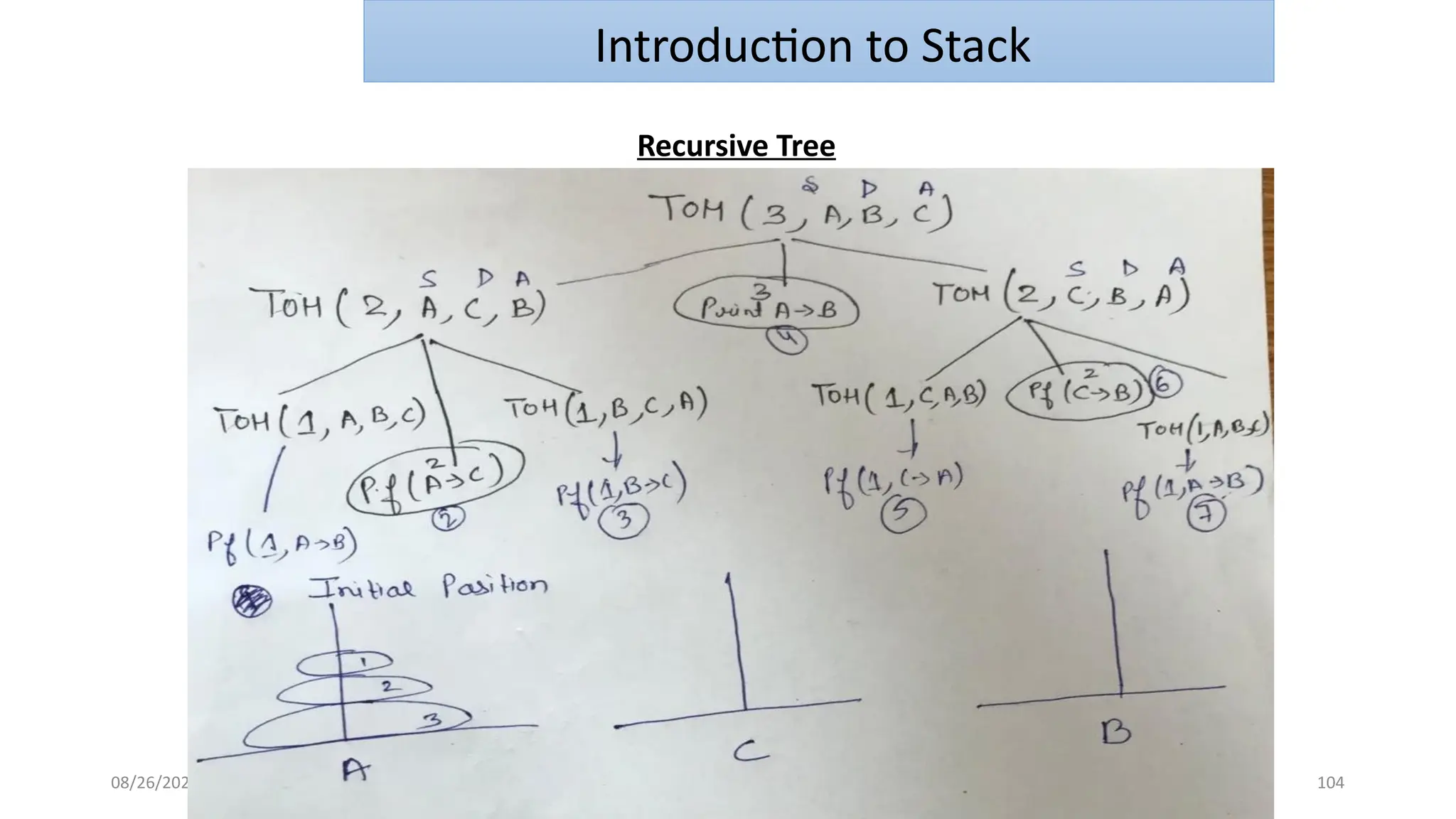
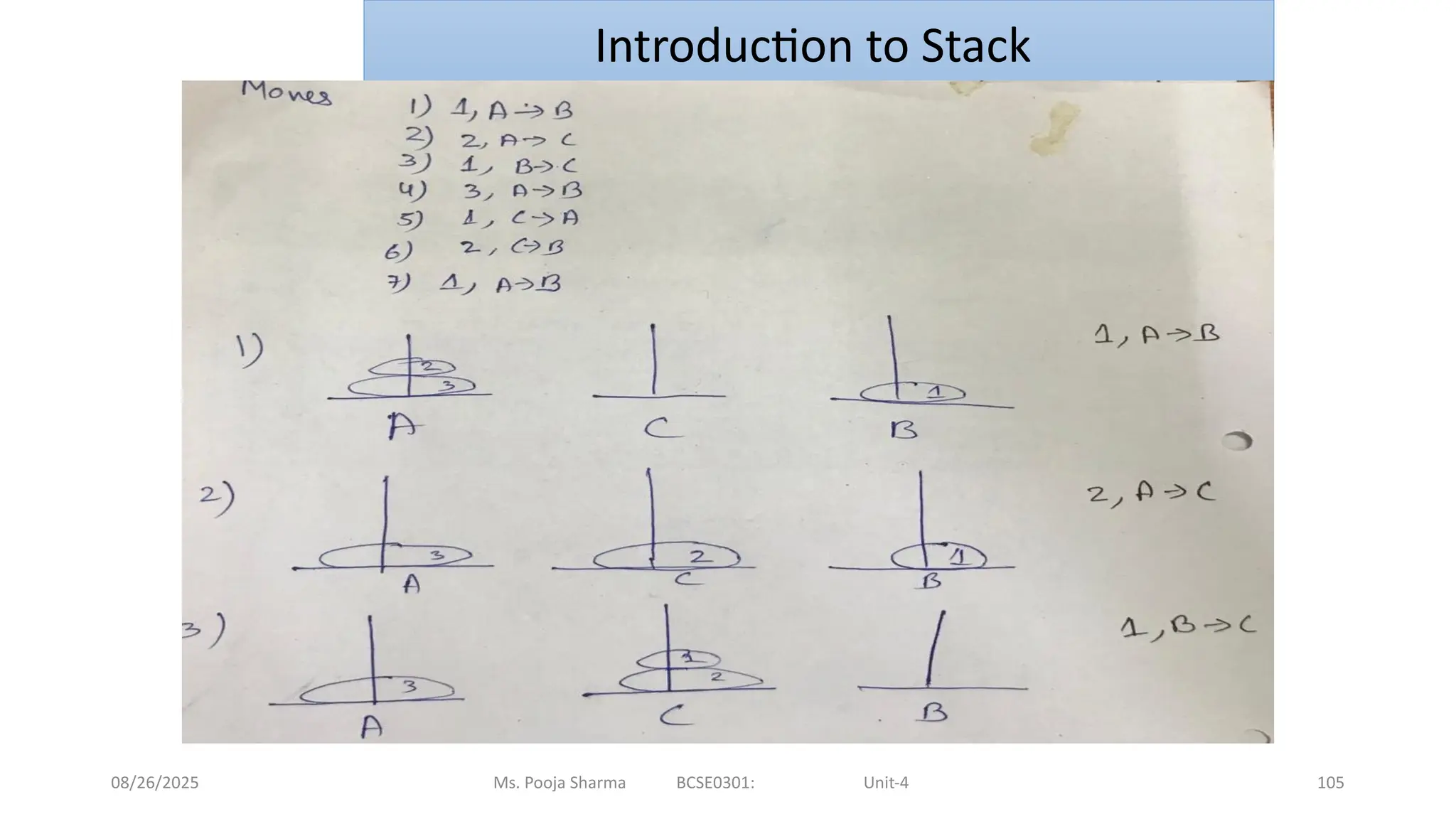
Introduction to Stack
Recursive Tree
08/26/2025 107
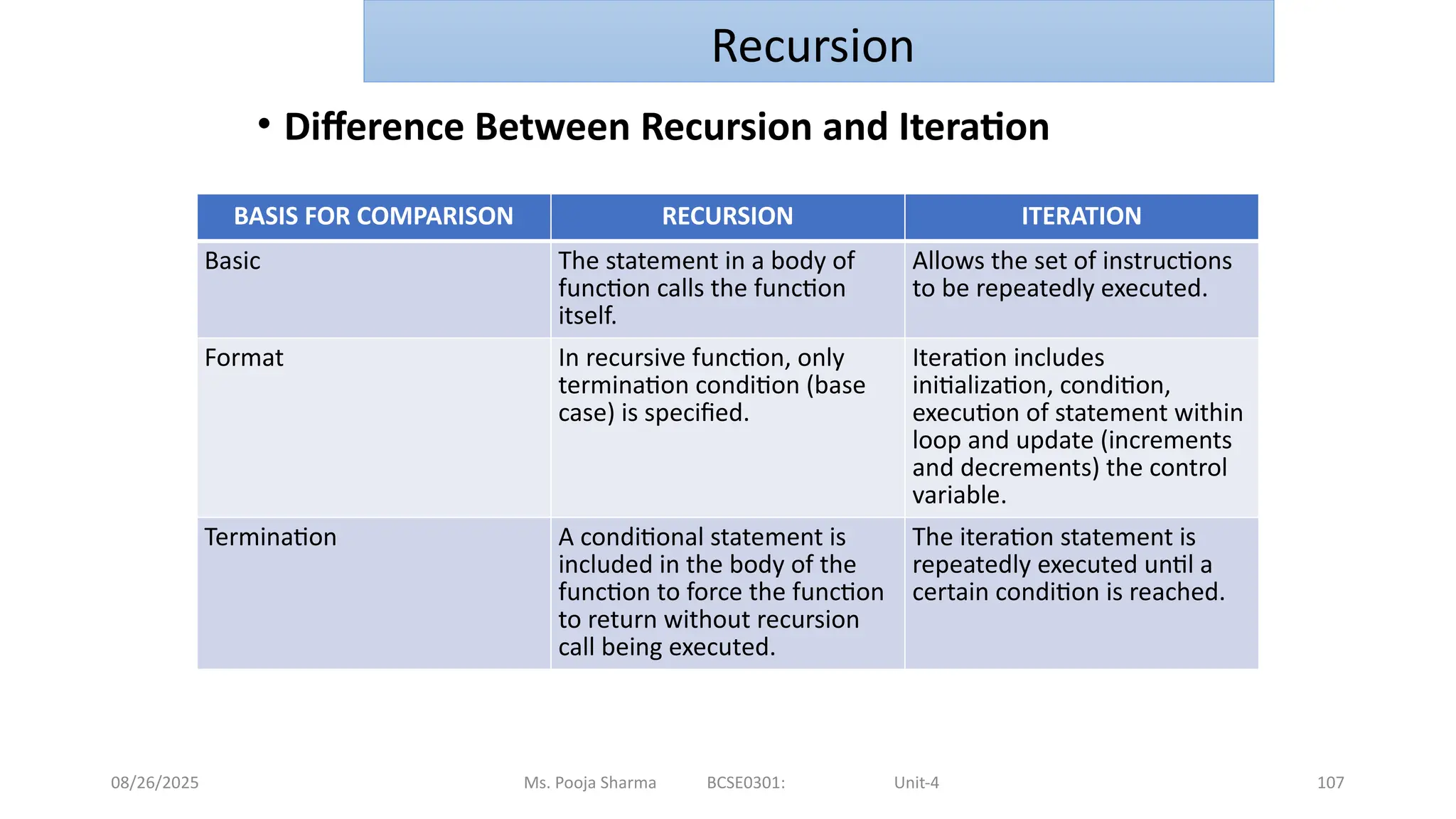
• DifferenceBetween Recursion and Iteration
Ms. Pooja Sharma BCSE0301: Unit-4
BASIS FOR COMPARISON RECURSION ITERATION
Basic The statement in a body of
function calls the function
itself.
Allows the set of instructions
to be repeatedly executed.
Format In recursive function, only
termination condition (base
case) is specified.
Iteration includes
initialization, condition,
execution of statement within
loop and update (increments
and decrements) the control
variable.
Termination A conditional statement is
included in the body of the
function to force the function
to return without recursion
call being executed.
The iteration statement is
repeatedly executed until a
certain condition is reached.
Recursion
108.
08/26/2025 108
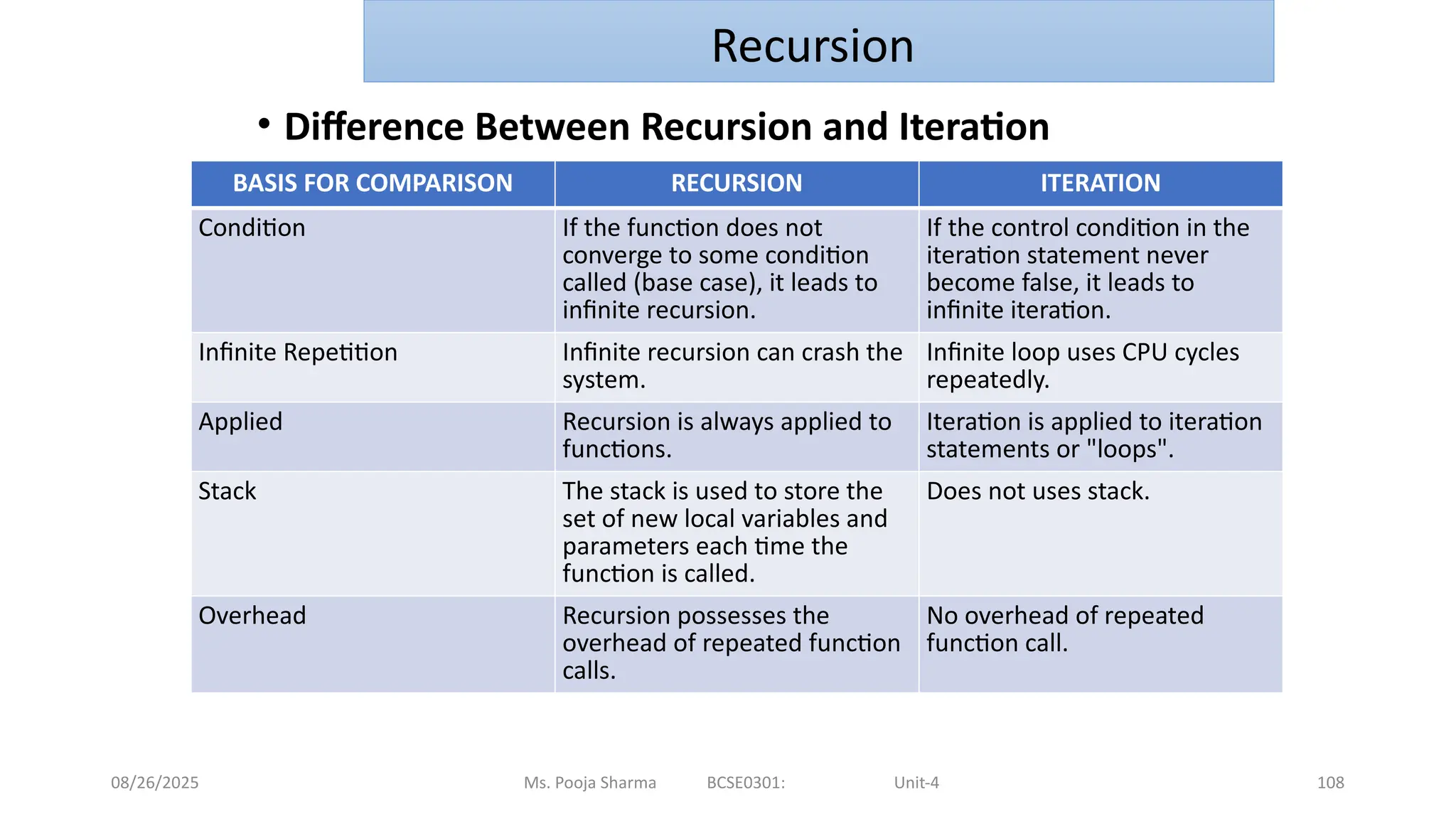
• DifferenceBetween Recursion and Iteration
Ms. Pooja Sharma BCSE0301: Unit-4
BASIS FOR COMPARISON RECURSION ITERATION
Condition If the function does not
converge to some condition
called (base case), it leads to
infinite recursion.
If the control condition in the
iteration statement never
become false, it leads to
infinite iteration.
Infinite Repetition Infinite recursion can crash the
system.
Infinite loop uses CPU cycles
repeatedly.
Applied Recursion is always applied to
functions.
Iteration is applied to iteration
statements or "loops".
Stack The stack is used to store the
set of new local variables and
parameters each time the
function is called.
Does not uses stack.
Overhead Recursion possesses the
overhead of repeated function
calls.
No overhead of repeated
function call.
Recursion
109.
08/26/2025 109
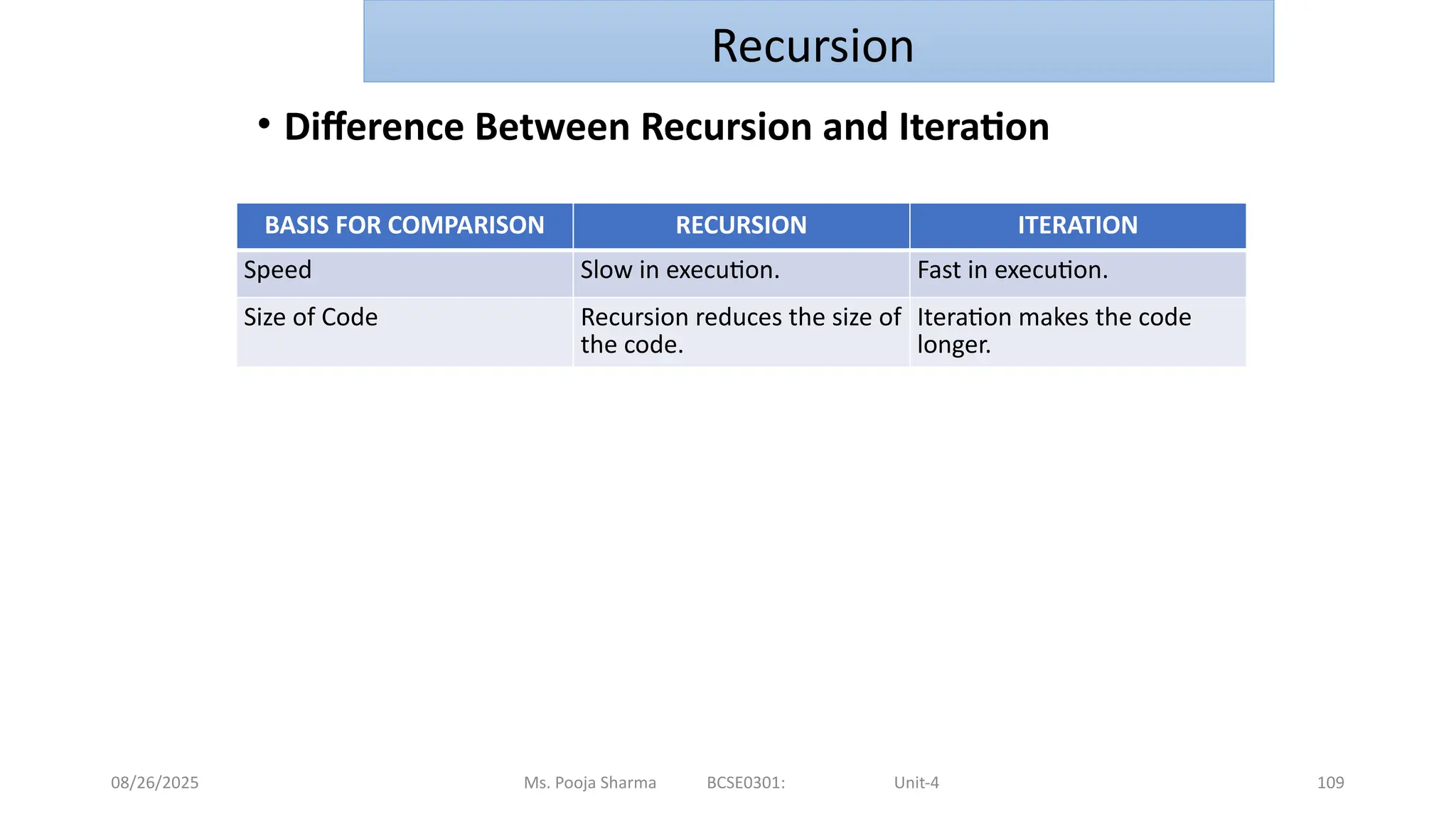
• DifferenceBetween Recursion and Iteration
Ms. Pooja Sharma BCSE0301: Unit-4
BASIS FOR COMPARISON RECURSION ITERATION
Speed Slow in execution. Fast in execution.
Size of Code Recursion reduces the size of
the code.
Iteration makes the code
longer.
Recursion
110.
08/26/2025 Ms. PoojaSharma BCSE0301: Unit-4 110
Queue
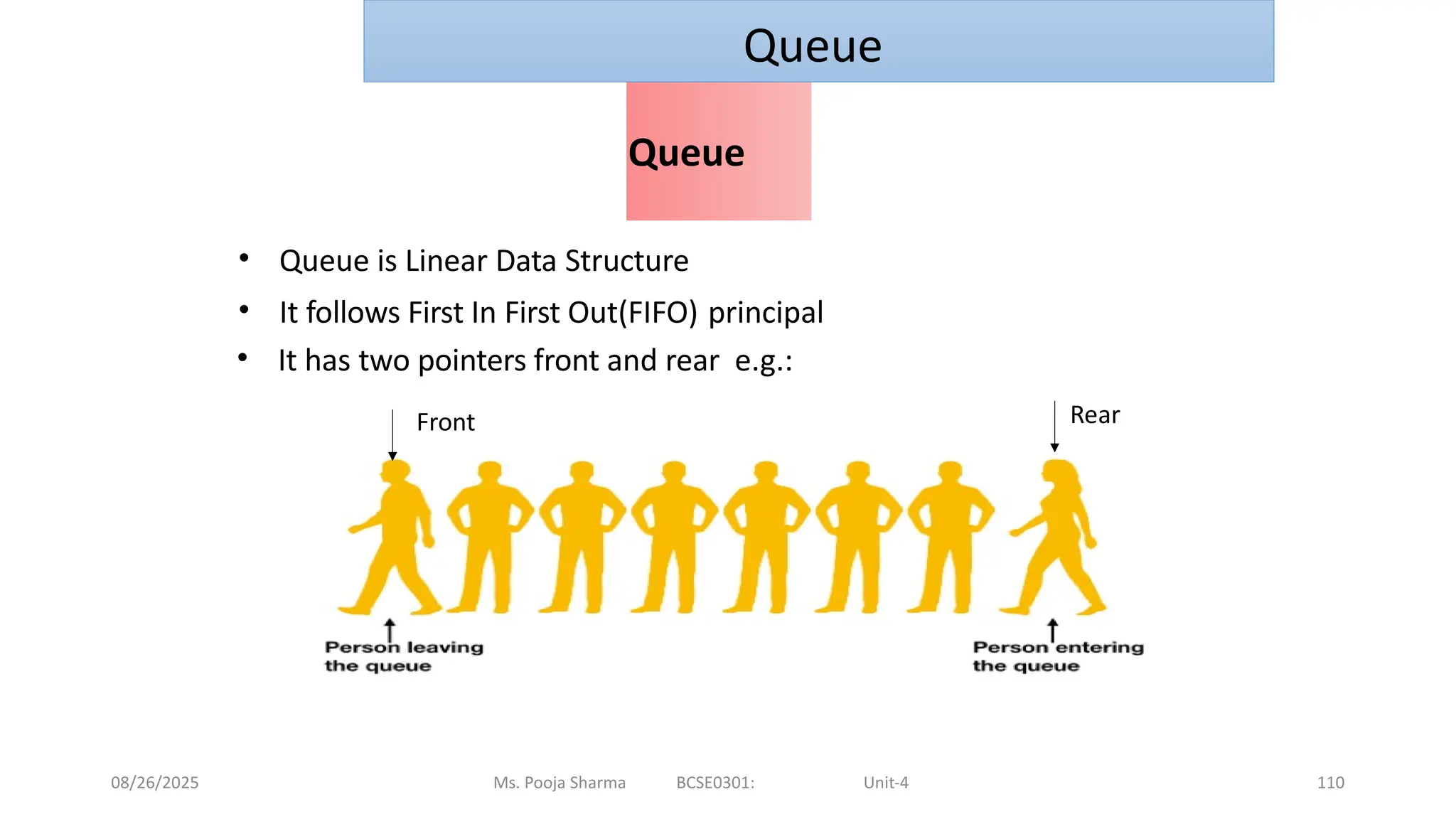
• Queue is Linear Data Structure
• It follows First In First Out(FIFO) principal
• It has two pointers front and rear e.g.:
Queue
Front Rear
111.
08/26/2025 Ms. PoojaSharma BCSE0301: Unit-4 111
Implementation of Queue
1. Using Array
2. Using Link List
Queue
Application of Queue
Queues are used in a lot of applications, few of them are:
•Queue is used to implement many algorithms like Breadth First Search (BFS), etc.
•It can be also used by an operating system when it has to schedule jobs with equal priority
•Customers calling a call center are kept in queues when they wait for someone to pick up the
calls
08/26/2025 Ms. PoojaSharma BCSE0301: Unit-4 114
Operations on Queue
Insertion:
Algorithm:
Step 1: If REAR = MAX – 1 then
Write “Queue is Overflow”
Goto step 4
[End of IF]
Step 2: IF FRONT=-1 and REAR=-1
SET FRONT=REAR=0
ELSE
SET REAR=REAR+1
[END OF IF]
Step 3: SET QUEUE [REAR] =
NUM
Step 4: EXIT
Queue
115.
08/26/2025 Ms. PoojaSharma BCSE0301: Unit-4 115
Example of Deletion in Queue
10 20
A[0] A[1] A[2] A[3] A[4]
20
A[0] A[1] A[2] A[3] A[4]
F=R=1
F=0 R=1
Queue
116.
08/26/2025 Ms. PoojaSharma BCSE0301: Unit-4 116
Example of Deletion in Queue
10 20
A[0] A[1] A[2] A[3] A[4]
20
A[0] A[1] A[2] A[3] A[4]
F=R=1
F=0 R=1
Queue
117.
08/26/2025 Ms. PoojaSharma BCSE0301: Unit-4 117
Operations on Queue
Deletion:
Algorithm:
Step 1: IF FRONT = -1 OR FRONT>REAR
Write “Queue is Underflow”
ELSE
SET VAL=QUEUE [FRONT]
FRONT = FRONT + 1
[END OF IF]
Step 2: EXIT
Queue
118.
08/26/2025 Ms. PoojaSharma BCSE0301: Unit-4 118
n=int(input("Enter the size of Queue:"))
A=[]
while(True):
print("Select the Operation:")
print("1.Enqueue 2.Dequeue 3. Display 4. Quit")
num = int(input())
if(num == 1):
val = int(input("Enter the element:"))
A.append(val)
elif(num == 2):
A.pop(0)
elif(num == 3):
for i in range(len(A)):
print(A[i],"")
elif(num == 4):
break
Queue
Python Program
119.
08/26/2025 Ms. PoojaSharma BCSE0301: Unit-4 119
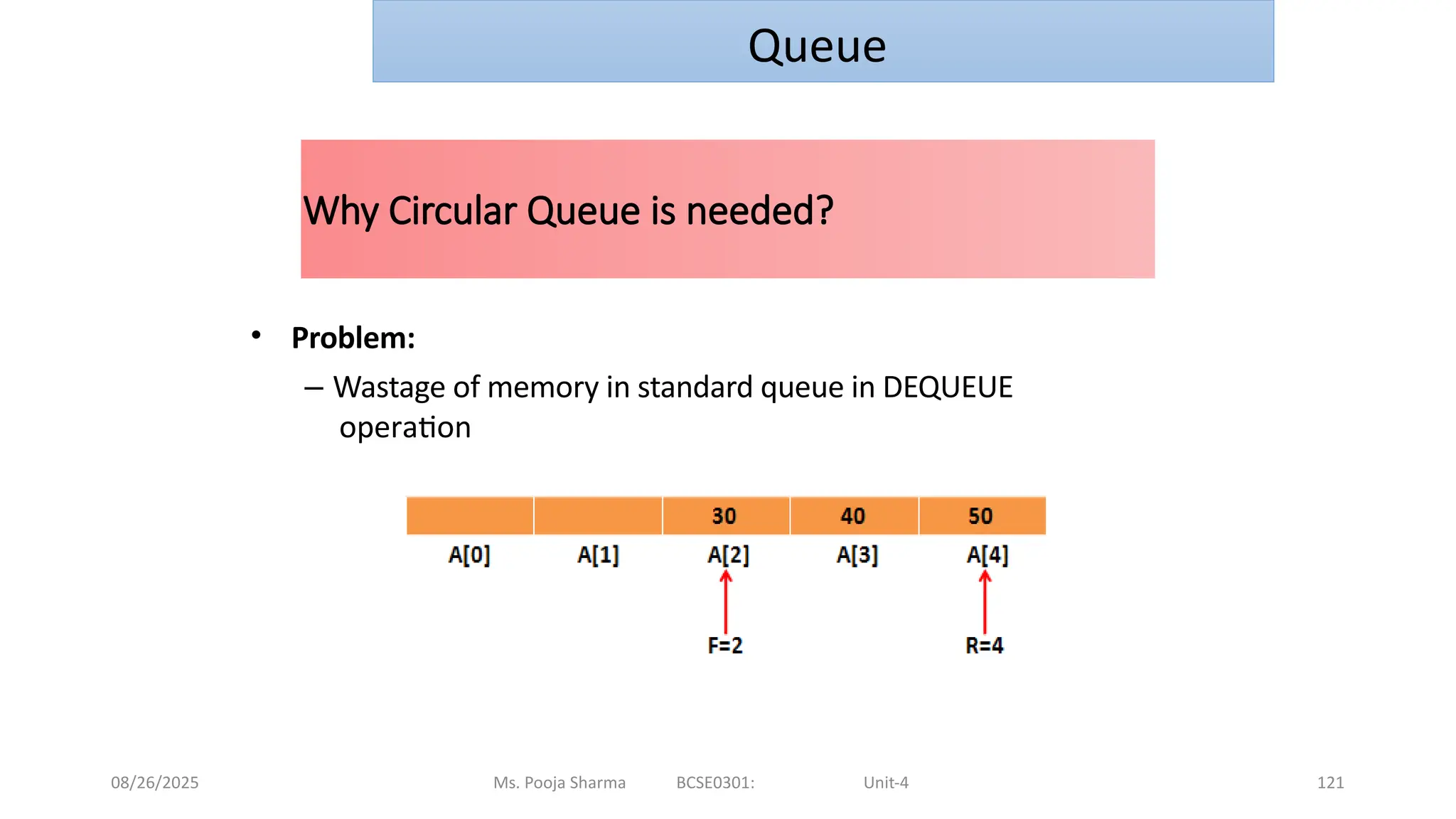
Queue
Drawback of array implementation
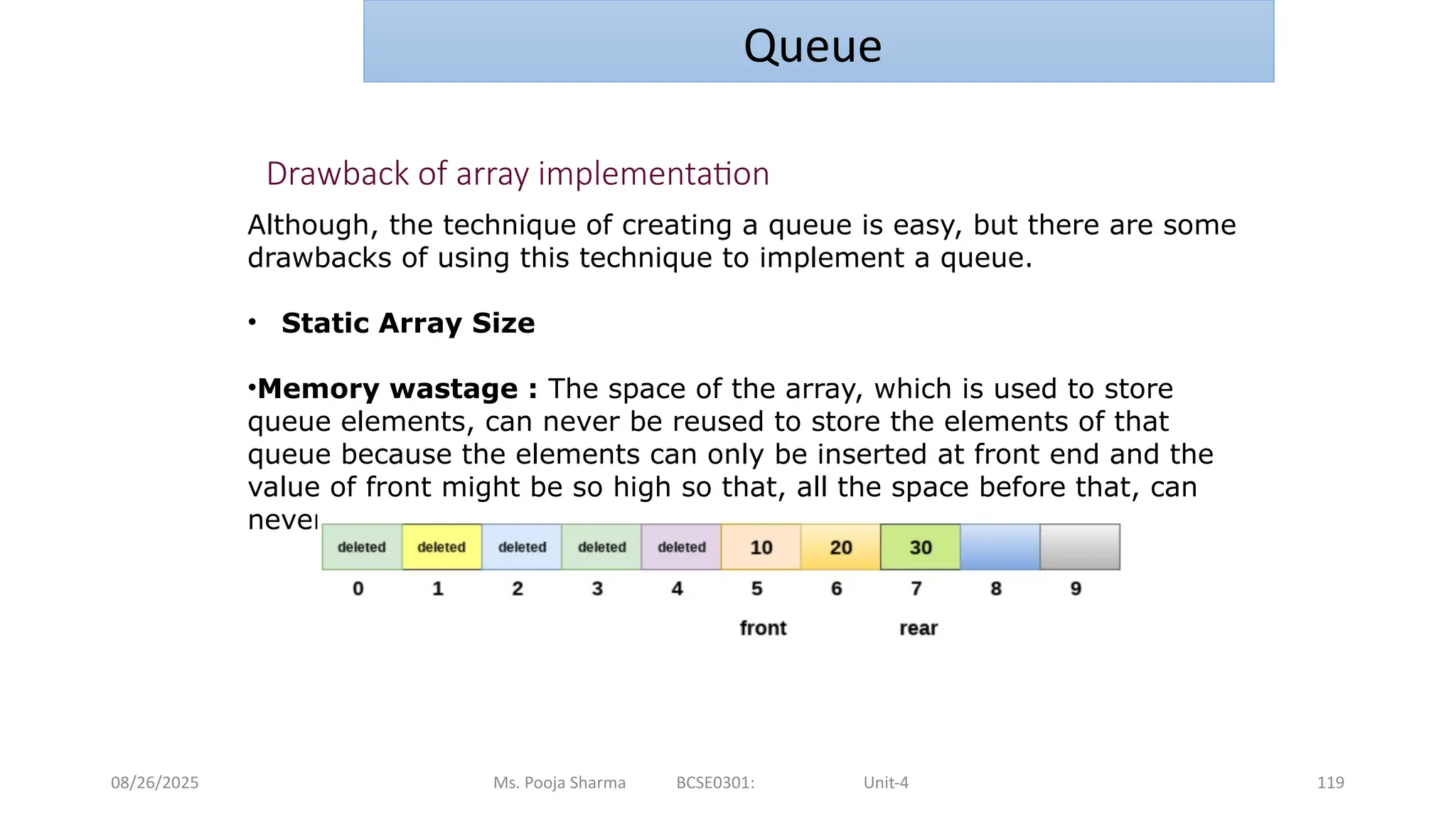
Although, the technique of creating a queue is easy, but there are some
drawbacks of using this technique to implement a queue.
• Static Array Size
•Memory wastage : The space of the array, which is used to store
queue elements, can never be reused to store the elements of that
queue because the elements can only be inserted at front end and the
value of front might be so high so that, all the space before that, can
never be filled.
08/26/2025 Ms. PoojaSharma BCSE0301: Unit-4 121
Why Circular Queue is needed?
• Problem:
– Wastage of memory in standard queue in DEQUEUE
operation
Queue
122.
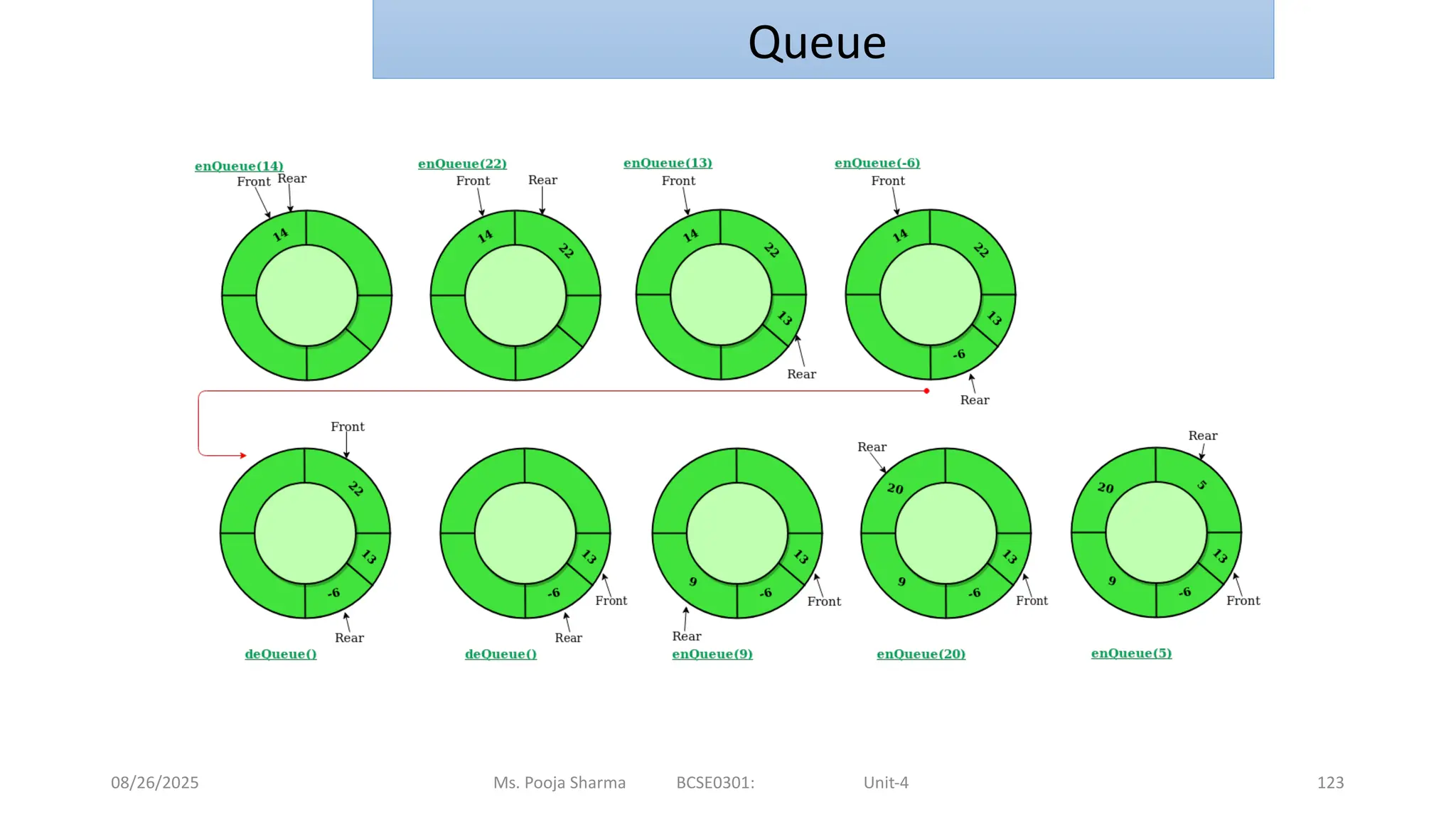
08/26/2025 Ms. PoojaSharma BCSE0301: Unit-4 122
What is Circular Queue?
• The Arrangement of the elements Q[0], Q[1], ..,Q[n] in a circular
fashion with Q[1] following Q[n] is called Circular Queue.
• The last node is connected to first node
to make a circle.
• Initially, Both Front and Rear pointers points
to the beginning of the array.
• It is also known as “Ring Buffer”.
Queue
08/26/2025 Ms. PoojaSharma BCSE0301: Unit-4 124
Insertion in circular queue
Step 1 - Check whether Circular queue is FULL. Front == (Rear+1)%Max
Step 2 - If it is FULL, then display "Queue is FULL!!! Insertion is not
possible!!!" and terminate the function.
Step 3 - If it is NOT FULL, then check Front == -1,
then Front =0.
Step 4 - Rear = (Rear+1)%max, set Cqueue[Rear] = value.
Queue
125.
08/26/2025 Ms. PoojaSharma BCSE0301: Unit-4 125
Deletion in circular queue
Step 1 - Check whether queue is EMPTY. (front == -1)
Step 2 - If it is EMPTY, then display “Circular Queue is EMPTY!!! Deletion is not
possible!!!" and terminate the function.
Step 3 - Val = Cqueue[front];
Step 4 – if(front==rear)
front = rear = -1;
Step 5 – front = (front+1)%Max;
Step 6 – return Val
Queue
126.
08/26/2025 Ms. PoojaSharma BCSE0301: Unit-4 126
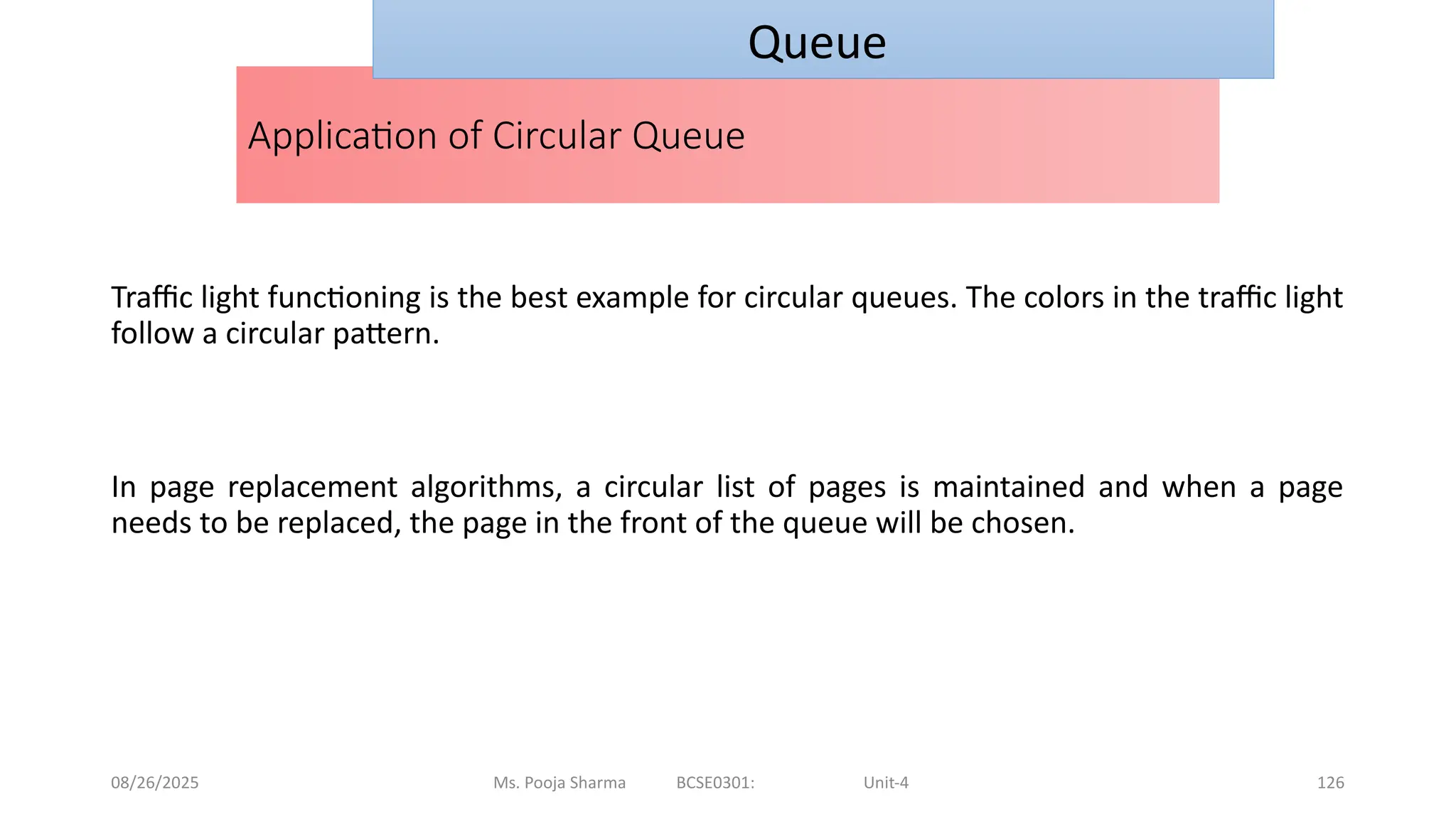
Application of Circular Queue
Traffic light functioning is the best example for circular queues. The colors in the traffic light
follow a circular pattern.
In page replacement algorithms, a circular list of pages is maintained and when a page
needs to be replaced, the page in the front of the queue will be chosen.
Queue
127.
08/26/2025 Ms. PoojaSharma BCSE0301: Unit-4 127
Queue
display() - Displays the elements of a Circular Queue
We can use the following steps to display the elements of a circular queue...
Step 1 - Check whether queue is EMPTY. (front == -1)
Step 2 - If it is EMPTY, then display "Queue is EMPTY!!!" and terminate the function.
Step 3 - If it is NOT EMPTY, then define an integer variable 'i' and set 'i = front'.
Step 4 – for(i = front; i!=rear; i = (i+1)%Max)
Print Cqueue[i];
end
print(queue[rear]);
Step 5 - Exit
128.
08/26/2025 Ms. PoojaSharma BCSE0301: Unit-4 128
Queue
Program to implement circular queue
#include <stdio.h>
// Define the maximum size of the queue
#define MAX_SIZE 5
// Declare the queue array and front, rear variables
int queue[MAX_SIZE];
int front = -1, rear = -1;
// Function to check if the queue is full
int isFull()
{
// If the next position is the front, the queue is full
return (rear + 1) % MAX_SIZE == front;
}
129.
08/26/2025 Ms. PoojaSharma BCSE0301: Unit-4 129
Queue
// Function to enqueue (insert) an element
void enqueue(int data)
{
// If the queue is full, print an error message and
// return
if (isFull()) {
printf("Queue overflown");
return;
}
// If the queue is empty, set the front to the first
// position
if (front == -1) {
front = 0;
}
// Add the data to the queue and move the rear pointer
rear = (rear + 1) % MAX_SIZE;
queue[rear] = data;
printf("Element %d insertedn", data);
}
// Function to check if the
queue is empty
int isEmpty()
{
// If the front hasn't
been set, the queue is
empty
return front == -1;
}
130.
08/26/2025 Ms. PoojaSharma BCSE0301: Unit-4 130
Queue
int dequeue()
{
if (isEmpty()) {
printf("Queue underflown");
return -1;
}
// Get the data from the front of the queue
int data = queue[front];
// If the front and rear pointers are at the same
// position, reset them
if (front == rear) {
front = rear = -1;
}
else {
front = (front + 1) % MAX_SIZE;
}
return data;
}
131.
08/26/2025 Ms. PoojaSharma BCSE0301: Unit-4 131
Queue
void display()
{
// If the queue is empty, print a message and return
if (isEmpty()) {
printf("Queue is emptyn");
return;
}
// Print the elements in the queue
printf("Queue elements: ");
int i = front;
while (i != rear) {
printf("%d ", queue[i]);
i = (i + 1) % MAX_SIZE;
}
// Print the last element
printf("%dn", queue[rear]);
}
132.
08/26/2025 Ms. PoojaSharma BCSE0301: Unit-4 132
Queue
// Main function
int main()
{
// Enqueue some elements
enqueue(10);
enqueue(20);
enqueue(30);
// Display the queue
display();
// Dequeue an element and print it
printf("Dequeued element: %dn", dequeue());
// Display the queue again
display();
// End of main function
return 0;
}
133.
08/26/2025 Ms. PoojaSharma BCSE0301: Unit-4 133
Priority Queue
• In priority queue, each element is assigned a priority.
• Priority of an element determines the order in which the elements
will be processed.
• Rules:
1. An element with higher priority will processed before an
element with a lower priority.
2. Two elements with the same priority are processed on
a First Come First Serve basis.
Queue
134.
08/26/2025 Ms. PoojaSharma BCSE0301: Unit-4 134
Queue
Priority Queue
DATA PRIORTY
NUMBER
A 5
B 1
D 3
E 2
F 8
G 6
135.
08/26/2025 Ms. PoojaSharma BCSE0301: Unit-4 135
Types of Priority Queue
1. Ascending Priority Queue
In this type of priority queue, elements can be inserted into any
order but only the smallest priority element can be removed.
2. Descending Priority Queue
In this type of priority queue, elements can be inserted into any
order but only the largest priority element can be removed.
Queue
136.
08/26/2025 Ms. PoojaSharma BCSE0301: Unit-4 136
Array Representation of Priority Queue
Insertion Operation:
• While inserting elements in priority queue we will add it at the
appropriate position depending on its priority
• It is inserted in such a way that the elements are always ordered
either in Ascending or descending sequence
Queue
137.
08/26/2025 Ms. PoojaSharma BCSE0301: Unit-4 137
Queue
Array Insertion of Priority Queue
DATA PRIORTY
NUMBER
A 5
B 1
D 3
E 2
F 8
G 6
DATA PRIORTY
NUMBER
B 1
E 2
D 3
A 5
G 6
F 8
138.
08/26/2025 Ms. PoojaSharma BCSE0301: Unit-4 138
Array Representation of Priority Queue
Deletion Operation:
• While deletion, the element at the front
is always deleted.
Queue
DATA PRIORTY
NUMBER
B 1
E 2
D 3
A 5
G 6
F 8
139.
08/26/2025 Ms. PoojaSharma BCSE0301: Unit-4 139
• C Program to Implement Priority Queue - GeeksforGeeks
140.
08/26/2025 Ms. PoojaSharma BCSE0301: Unit-4 140
Application of Priority Queue
Queue
1. Prim's algorithm implementation can be done using priority queues.
2. Dijkstra's shortest path algorithm implementation can be done using priority queues.
3. A* Search algorithm implementation can be done using priority queues.
4. Priority queues are used to sort heaps.
5. Priority queues are used in operating system for load balancing and interrupt
handling.
6. Priority queues are used in huffman codes for data compression.
7. In traffic light, depending upon the traffic, the colors will be given priority.
141.
08/26/2025 Ms. PoojaSharma BCSE0301: Unit-4 141
Deque / Double Ended Queue
• A list in which elements can be inserted or deleted either end
• It is also known as “Head-Tail Linked List”
• It has two pointers LEFT and RIGHT, which point to either end of the
deque.
• Deque (Doubly Ended Queue) in Python is implemented using the
module “collections“. Deque is preferred over a list in the cases where
we need quicker append and pop operations from both the ends of
the container, as deque provides an O(1) time complexity for append
and pop operations as compared to a list that provides O(n) time
complexity.
Queue
142.
08/26/2025 Ms. PoojaSharma BCSE0301: Unit-4 142
Types of Deque
• Input Restricted Deque:-
In this dequeue, insertion can be done only at one of the end, while
deletion can be done from both ends.
• Output Restricted Deque:-
In this dequeue, deletion can be done only at one of the ends,
while insertions can be done on both ends
Queue
08/26/2025 Ms. PoojaSharma BCSE0301: Unit-4 146
Queue
Application of Deque –
Deque is a Double Ended Queue where operations(Add/Remove) can be
made on both ends of the queue.
1.A web browser's history. Recently visited URLs are added to the front of
the deque, and the URL at the back of the deque is removed after some
specified number of insertions at the front.
2.Another common application of the deque is storing a software
application's list of undo operations.
3.Have you see moneyControl App, it will show the stocks you last visited,
it will remove the stocks after some time and will add the latest ones.
147.
08/26/2025 147
• SelfMade Video Link:
• Youtube/other Video Links
https://www.youtube.com/watch?v=8e_PwxYGZrA&list=PLzgPDYo_3xukPJdH
6hVQ6Iic7KiJuoA-l
https://www.youtube.com/watch?v=_t2GVaQasRY&list=PLeo1K3hjS3uu_n_a
__MI_KktGTLYopZ12
https://www.youtube.com/watch?v=pkYVOmU3MgA&t=22062s
Ms. Pooja Sharma BCSE0301: Unit-4
Faculty Video Links, YouTube & NPTEL
Video Links and Online Courses Details
148.
08/26/2025 148
1. Whatis Stack and where it can be used?
2. What is a Queue, how it is different from stack and how is it
implemented?
3. What are Infix, prefix, Postfix notations?
4. How to implement a stack using queue?
5. How to implement a queue using stack?
6. What is recursion and when should you use it?
7. Write a function to copy string (Iterative and Recursive).
8. Check if a number is Palindrome using recursion
9. Reverse a stack using recursion.
10. Sort a stack using recursion.
Ms. Pooja Sharma BCSE0301: Unit-4
Daily Quiz
149.
08/26/2025 149
Q 1What do you understand by stable and in place sorting?
Q 2 Consider the following infix expression and convert into reverse
polish notation using stack. A + (B * C – (D / E ^ F) * H)
Q3 Recursive function to delete k-th node from linked list.
Q4. Write the python Program to implement queue using stack.
Q5. The initial configuration of a queue is p,q,r,s (‘p’ is in the front
end ). To get the configuration s,r,q,p, how many minimum dequeue
and enqueue are required?
Ms. Pooja Sharma BCSE0301: Unit-4
Weekly Assignment
150.
08/26/2025 150
1. Processof inserting an element in stack is called ____________
a) Create
b) Push
c) Evaluation
d) Pop
2. Process of removing an element from stack is called __________
a) Create
b) Push
c) Evaluation
d) Pop
Ms. Pooja Sharma BCSE0301: Unit-4
MCQ s
151.
08/26/2025 151
3. Ina stack, if a user tries to remove an element from empty stack it is
called _________
a) Underflow
b) Empty collection
c) Overflow
d) Garbage Collection
4. Pushing an element into stack already having five elements and
stack size of 5, then stack becomes
a) Overflow
b) Crash
c) Underflow
d) User flow
Ms. Pooja Sharma BCSE0301: Unit-4
MCQ s
152.
08/26/2025 Ms. PoojaSharma BCSE0301: Unit-4 152
5. Which of the following applications may use a stack?
a) A parentheses balancing program
b) Tracking of local variables at run time
c) Compiler Syntax Analyzer
d) Data Transfer between two asynchronous process
6. 1. Recursion is a method in which the solution of a problem depends
on ____________
a) Larger instances of different problems
b) Larger instances of the same problem
c) Smaller instances of the same problem
d) Smaller instances of different problems
MCQ s
153.
08/26/2025 Ms. PoojaSharma BCSE0301: Unit-4 153
7. Recursion is similar to which of the following?
a) Switch Case
b) Loop
c) If-else
d) if elif else
8. A queue follows __________
a) FIFO (First In First Out) principle
b) LIFO (Last In First Out) principle
c) Ordered array
d) Linear tree
MCQ s
154.
08/26/2025 Ms. PoojaSharma BCSE0301: Unit-4 154
9. If the elements “A”, “B”, “C” and “D” are placed in a queue and are
deleted one at a time, in what order will they be removed?
a) ABCD
b) DCBA
c) DCAB
d) ABDC
10. A data structure in which elements can be inserted or deleted
at/from both the ends but not in the middle is?
a) Queue
b) Circular queue
c) Dequeue
d) Priority queue
MCQ s
155.
08/26/2025 155
Q1. Definepriority queue.
Q2. Write a program in C for implementation of a queue. Your program
should at least contain ADD, CREATE. DELETE, FULL and EMPTY
functions.
Q3. If an array is defined as int a[10] [20] in C, devise a formula to
calculate the address of an any variable say a[i] [j], for any valid value
of i and j.
Q4. Write a program to implement STACK using linked list.
Q5. If the Tower of Hanoi is operated on n=10 disks, calculate the total
number of moves.
Q6. Differentiate between overflow and underflow condition in a
linked list.
Ms. Pooja Sharma BCSE0301: Unit-4
Expected Questions for University Exam
156.
08/26/2025 156
Q7. Convertthe following infix expression into postfix expression:
B-C/D+A*(F-G/H).
Q8.Write a program in python to compute the factorial of given
number recursively.
Q9.Write a Program in python to implement all operations of a Stack
using array.
Q10.Define Dequeue.
Q11. Write the syntax to check whether a given circular queue is full or
empty?
Q12. What is Recursion? Give disadvantages of recursion.
Q13.Explain Tower of Hanoi problem and write a recursive algorithm to
solve it.
Q14. Explain how a circular queue can be implemented using arrays.
Write all functions for circular queue operations.
Ms. Pooja Sharma BCSE0301: Unit-4
Expected Questions for University Exam
08/26/2025 Ms. PoojaSharma BCSE0301: Unit-4 158
Summary
We consider two fundamental data types for storing collections of
objects: the stack and the queue.
We implement each using either a singly-linked list or a resizing array.
We introduce two advanced Java features—generics and iterators—that
simplify client code.
Finally, we consider various applications of stacks and queues ranging
from parsing arithmetic expressions to simulating queueing systems.
159.
08/26/2025 Ms. PoojaSharma BCSE0301: Unit-4 159
References
[1] Aaron M. Tenenbaum, Yedidyah Langsam and Moshe J. Augenstein,
“Data Structures Using C and C++”, PHI Learning Private Limited, Delhi
India
[2] Horowitz and Sahani, “Fundamentals of Data Structures”, Galgotia
Publications Pvt Ltd Delhi India.
[3] Lipschutz, “Data Structures” Schaum’s Outline Series, Tata McGraw-
hill Education (India) Pvt. Ltd.
[4] Thareja, “Data Structure Using C” Oxford Higher Education.
[5] AK Sharma, “Data Structure Using C”, Pearson Education India.



![08/26/2025 Ms. Pooja Sharma BCSE0301: Unit-4 37
Stack
A stack is a data structure in which
items can be inserted only from one
end and get items back from the
same end.
There , the last item inserted into
stack, is the the first item to be taken
out from the stack. In short its also
called Last in First out [LIFO].
Introduction to Stack](https://image.slidesharecdn.com/unit4poojasharma-250826153415-4ccc7c32/75/operating_systems_presentations_delhi_nc-37-2048.jpg)

![08/26/2025 Ms. Pooja Sharma BCSE0301: Unit-4 48
Stack Implementation using Array
Introduction to Stack
A stack can be implemented using array as follows...
Before implementing actual operations, first follow the below steps to
create an empty stack.
Step 1 - Include all the header files which are used in the program and
define a constant 'SIZE' with specific value.
Step 2 - Declare all the functions used in stack implementation.
Step 3 - Create a one dimensional array with fixed size (int stack[SIZE])
Step 4 - Define a integer variable 'top' and initialize with '-1'. (int top = -1)
Step 5 - In main method, display menu with list of operations and make
suitable function calls to perform operation selected by the user on the
stack.](https://image.slidesharecdn.com/unit4poojasharma-250826153415-4ccc7c32/75/operating_systems_presentations_delhi_nc-48-2048.jpg)
![08/26/2025 Ms. Pooja Sharma BCSE0301: Unit-4 49
push(value)- Inserting value into the stack using array
Introduction to Stack
In a stack, push() is a function used to insert an element into the stack. In
a stack, the new element is always inserted at top position. Push
function takes one integer value as parameter and inserts that value into
the stack. We can use the following steps to push an element on to the
stack...
Step 1 - Check whether stack is FULL. (top == SIZE-1)
Step 2 - If it is FULL, then display "Stack is FULL!!! Insertion is not
possible!!!" and terminate the function.
Step 3 - If it is NOT FULL, then increment top value by one (top++)
and set stack[top] to value (stack[top] = value).](https://image.slidesharecdn.com/unit4poojasharma-250826153415-4ccc7c32/75/operating_systems_presentations_delhi_nc-49-2048.jpg)
![08/26/2025 Ms. Pooja Sharma BCSE0301: Unit-4 50
Introduction to Stack
pop() - Delete a value from the Stack using array
In a stack, pop() is a function used to delete an element from the stack. In
a stack, the element is always deleted from top position. Pop function
does not take any value as parameter. We can use the following steps to
pop an element from the stack...
Step 1 - Check whether stack is EMPTY. (top == -1)
Step 2 - If it is EMPTY, then display "Stack is EMPTY!!! Deletion is not
possible!!!" and terminate the function.
Step 3 - If it is NOT EMPTY, then delete stack[top] and
decrement top value by one (top--).](https://image.slidesharecdn.com/unit4poojasharma-250826153415-4ccc7c32/75/operating_systems_presentations_delhi_nc-50-2048.jpg)
![Ms. Pooja Sharma BCSE0301: Unit-4
08/26/2025 51
Introduction to Stack
display() - Displays the elements of a Stack using array
We can use the following steps to display the elements of a stack...
Step 1 - Check whether stack is EMPTY. (top == -1)
Step 2 - If it is EMPTY, then display "Stack is EMPTY!!!" and terminate
the function.
Step 3 - If it is NOT EMPTY, then define a variable 'i' and initialize with
top. Display stack[i] value and decrement i value by one (i--).
Step 3 - Repeat above step until i value becomes '0'.](https://image.slidesharecdn.com/unit4poojasharma-250826153415-4ccc7c32/75/operating_systems_presentations_delhi_nc-51-2048.jpg)
![Ms. Pooja Sharma BCSE0301: Unit-4
08/26/2025 52
int main()
{
int choice;
while (1)
{
printf("nPerform operations on the stack:");
printf("n1.Push the elementn2.Pop the elementn3.Shown4.End");
printf("nnEnter the choice: ");
scanf("%d", &choice);
switch (choice)
{
case 1:
push(); break;
case 2:
pop(); break;
case 3:
show(); break;
case 4:
exit(0);
default:
printf("nInvalid choice!!");
} } }
#include <stdio.h>
#include <stdlib.h>
#define SIZE 4
int top = -1,
int inp_array[SIZE];
void push();
void pop();
void show();](https://image.slidesharecdn.com/unit4poojasharma-250826153415-4ccc7c32/75/operating_systems_presentations_delhi_nc-52-2048.jpg)
![Ms. Pooja Sharma BCSE0301: Unit-4
08/26/2025 53
void push()
{
int x;
if (top == SIZE - 1)
{
printf("nOverflow!!");
}
else
{
printf("nEnter the element to be added onto the
stack: ");
scanf("%d", &x);
top = top + 1;
inp_array[top] = x;
}
}](https://image.slidesharecdn.com/unit4poojasharma-250826153415-4ccc7c32/75/operating_systems_presentations_delhi_nc-53-2048.jpg)
![Ms. Pooja Sharma BCSE0301: Unit-4
08/26/2025 54
void pop()
{
if (top == -1)
{
printf("nUnderflow!!");
}
else
{
printf("nPopped element: %d", inp_array[top]);
top = top - 1;
}
}
void show()
{
if (top == -1)
{
printf("nUnderflow!!");
}
else
{
printf("nElements present in the
stack: n");
for (int i = top; i >= 0; --i)
printf("%dn", inp_array[i]);
}
}](https://image.slidesharecdn.com/unit4poojasharma-250826153415-4ccc7c32/75/operating_systems_presentations_delhi_nc-54-2048.jpg)
![08/26/2025 97
// C Program to implement binary
search using iteration
#include <stdio.h>
int binarySearch(int arr[], int left, int
right, int key) {
// Loop will run till left > right. It
means that there
// are no elements to consider in
the given subarray
while (left <= right) {
// calculating mid point
int mid = left + (right - left) / 2;
Ms. Pooja Sharma BCSE0301: Unit-4
Recursion
// Check if key is present at mid
if (arr[mid] == key) {
return mid;
}
// If key greater than arr[mid], ignore left
half
if (arr[mid] < key) {
left = mid + 1;
}
// If key is smaller than or equal to
arr[mid],
// ignore right half
else {
right = mid - 1;
}
}
// If we reach here, then element was not
present
return -1;
}](https://image.slidesharecdn.com/unit4poojasharma-250826153415-4ccc7c32/75/operating_systems_presentations_delhi_nc-97-2048.jpg)
![08/26/2025 98
my_list = [ 1, 9, 11, 21, 34, 54, 67, 90 ]
elem_to_search = 1
print("The list is")
print(my_list)
my_result = binary_search(my_list,0,len(my_list)-1,elem_to_search)
if my_result != -1:
print("Element found at index ", str(my_result))
else:
print("Element not found!")
Ms. Pooja Sharma BCSE0301: Unit-4
Recursion](https://image.slidesharecdn.com/unit4poojasharma-250826153415-4ccc7c32/75/operating_systems_presentations_delhi_nc-98-2048.jpg)
![08/26/2025 Ms. Pooja Sharma BCSE0301: Unit-4 112
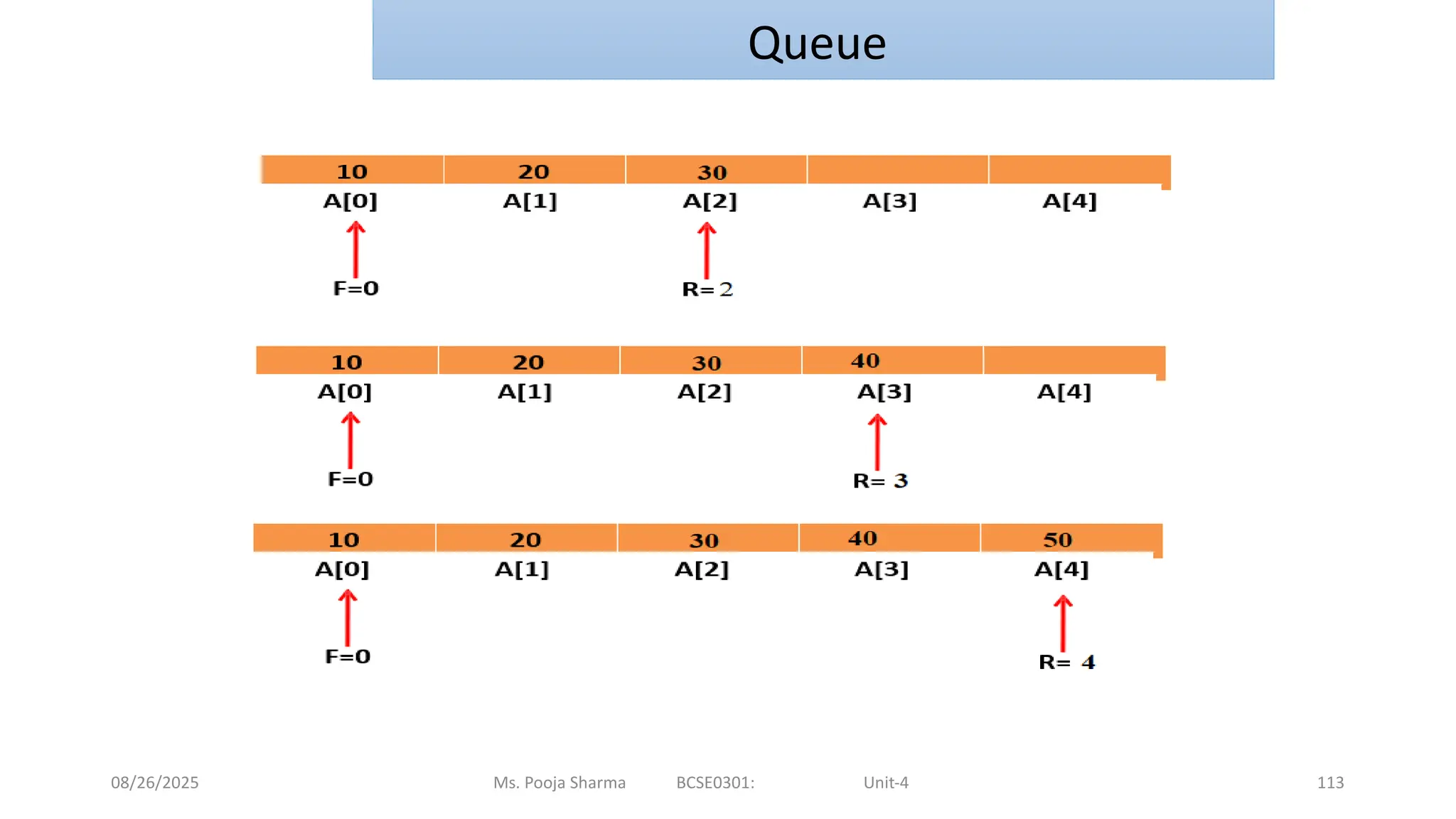
Insertion in Queue using Array
A[0] A[1] A[2] A[3] A[4]
F=R=(-1)
10
A[0] A[1] A[2] A[3] A[4]
F=R=0
10 20
F=0 R=1
A[0] A[1] A[2] A[3] A[4]
Queue](https://image.slidesharecdn.com/unit4poojasharma-250826153415-4ccc7c32/75/operating_systems_presentations_delhi_nc-112-2048.jpg)
![08/26/2025 Ms. Pooja Sharma BCSE0301: Unit-4 114
Operations on Queue
Insertion:
Algorithm:
Step 1: If REAR = MAX – 1 then
Write “Queue is Overflow”
Goto step 4
[End of IF]
Step 2: IF FRONT=-1 and REAR=-1
SET FRONT=REAR=0
ELSE
SET REAR=REAR+1
[END OF IF]
Step 3: SET QUEUE [REAR] =
NUM
Step 4: EXIT
Queue](https://image.slidesharecdn.com/unit4poojasharma-250826153415-4ccc7c32/75/operating_systems_presentations_delhi_nc-114-2048.jpg)
![08/26/2025 Ms. Pooja Sharma BCSE0301: Unit-4 115
Example of Deletion in Queue
10 20
A[0] A[1] A[2] A[3] A[4]
20
A[0] A[1] A[2] A[3] A[4]
F=R=1
F=0 R=1
Queue](https://image.slidesharecdn.com/unit4poojasharma-250826153415-4ccc7c32/75/operating_systems_presentations_delhi_nc-115-2048.jpg)
![08/26/2025 Ms. Pooja Sharma BCSE0301: Unit-4 116
Example of Deletion in Queue
10 20
A[0] A[1] A[2] A[3] A[4]
20
A[0] A[1] A[2] A[3] A[4]
F=R=1
F=0 R=1
Queue](https://image.slidesharecdn.com/unit4poojasharma-250826153415-4ccc7c32/75/operating_systems_presentations_delhi_nc-116-2048.jpg)
![08/26/2025 Ms. Pooja Sharma BCSE0301: Unit-4 117
Operations on Queue
Deletion:
Algorithm:
Step 1: IF FRONT = -1 OR FRONT>REAR
Write “Queue is Underflow”
ELSE
SET VAL=QUEUE [FRONT]
FRONT = FRONT + 1
[END OF IF]
Step 2: EXIT
Queue](https://image.slidesharecdn.com/unit4poojasharma-250826153415-4ccc7c32/75/operating_systems_presentations_delhi_nc-117-2048.jpg)
![08/26/2025 Ms. Pooja Sharma BCSE0301: Unit-4 118
n=int(input("Enter the size of Queue:"))
A=[]
while(True):
print("Select the Operation:")
print("1.Enqueue 2.Dequeue 3. Display 4. Quit")
num = int(input())
if(num == 1):
val = int(input("Enter the element:"))
A.append(val)
elif(num == 2):
A.pop(0)
elif(num == 3):
for i in range(len(A)):
print(A[i],"")
elif(num == 4):
break
Queue
Python Program](https://image.slidesharecdn.com/unit4poojasharma-250826153415-4ccc7c32/75/operating_systems_presentations_delhi_nc-118-2048.jpg)
![08/26/2025 Ms. Pooja Sharma BCSE0301: Unit-4 122
What is Circular Queue?
• The Arrangement of the elements Q[0], Q[1], ..,Q[n] in a circular
fashion with Q[1] following Q[n] is called Circular Queue.
• The last node is connected to first node
to make a circle.
• Initially, Both Front and Rear pointers points
to the beginning of the array.
• It is also known as “Ring Buffer”.
Queue](https://image.slidesharecdn.com/unit4poojasharma-250826153415-4ccc7c32/75/operating_systems_presentations_delhi_nc-122-2048.jpg)
![08/26/2025 Ms. Pooja Sharma BCSE0301: Unit-4 124
Insertion in circular queue
Step 1 - Check whether Circular queue is FULL. Front == (Rear+1)%Max
Step 2 - If it is FULL, then display "Queue is FULL!!! Insertion is not
possible!!!" and terminate the function.
Step 3 - If it is NOT FULL, then check Front == -1,
then Front =0.
Step 4 - Rear = (Rear+1)%max, set Cqueue[Rear] = value.
Queue](https://image.slidesharecdn.com/unit4poojasharma-250826153415-4ccc7c32/75/operating_systems_presentations_delhi_nc-124-2048.jpg)
![08/26/2025 Ms. Pooja Sharma BCSE0301: Unit-4 125
Deletion in circular queue
Step 1 - Check whether queue is EMPTY. (front == -1)
Step 2 - If it is EMPTY, then display “Circular Queue is EMPTY!!! Deletion is not
possible!!!" and terminate the function.
Step 3 - Val = Cqueue[front];
Step 4 – if(front==rear)
front = rear = -1;
Step 5 – front = (front+1)%Max;
Step 6 – return Val
Queue](https://image.slidesharecdn.com/unit4poojasharma-250826153415-4ccc7c32/75/operating_systems_presentations_delhi_nc-125-2048.jpg)
![08/26/2025 Ms. Pooja Sharma BCSE0301: Unit-4 127
Queue
display() - Displays the elements of a Circular Queue
We can use the following steps to display the elements of a circular queue...
Step 1 - Check whether queue is EMPTY. (front == -1)
Step 2 - If it is EMPTY, then display "Queue is EMPTY!!!" and terminate the function.
Step 3 - If it is NOT EMPTY, then define an integer variable 'i' and set 'i = front'.
Step 4 – for(i = front; i!=rear; i = (i+1)%Max)
Print Cqueue[i];
end
print(queue[rear]);
Step 5 - Exit](https://image.slidesharecdn.com/unit4poojasharma-250826153415-4ccc7c32/75/operating_systems_presentations_delhi_nc-127-2048.jpg)
![08/26/2025 Ms. Pooja Sharma BCSE0301: Unit-4 128
Queue
Program to implement circular queue
#include <stdio.h>
// Define the maximum size of the queue
#define MAX_SIZE 5
// Declare the queue array and front, rear variables
int queue[MAX_SIZE];
int front = -1, rear = -1;
// Function to check if the queue is full
int isFull()
{
// If the next position is the front, the queue is full
return (rear + 1) % MAX_SIZE == front;
}](https://image.slidesharecdn.com/unit4poojasharma-250826153415-4ccc7c32/75/operating_systems_presentations_delhi_nc-128-2048.jpg)
![08/26/2025 Ms. Pooja Sharma BCSE0301: Unit-4 129
Queue
// Function to enqueue (insert) an element
void enqueue(int data)
{
// If the queue is full, print an error message and
// return
if (isFull()) {
printf("Queue overflown");
return;
}
// If the queue is empty, set the front to the first
// position
if (front == -1) {
front = 0;
}
// Add the data to the queue and move the rear pointer
rear = (rear + 1) % MAX_SIZE;
queue[rear] = data;
printf("Element %d insertedn", data);
}
// Function to check if the
queue is empty
int isEmpty()
{
// If the front hasn't
been set, the queue is
empty
return front == -1;
}](https://image.slidesharecdn.com/unit4poojasharma-250826153415-4ccc7c32/75/operating_systems_presentations_delhi_nc-129-2048.jpg)
![08/26/2025 Ms. Pooja Sharma BCSE0301: Unit-4 130
Queue
int dequeue()
{
if (isEmpty()) {
printf("Queue underflown");
return -1;
}
// Get the data from the front of the queue
int data = queue[front];
// If the front and rear pointers are at the same
// position, reset them
if (front == rear) {
front = rear = -1;
}
else {
front = (front + 1) % MAX_SIZE;
}
return data;
}](https://image.slidesharecdn.com/unit4poojasharma-250826153415-4ccc7c32/75/operating_systems_presentations_delhi_nc-130-2048.jpg)
![08/26/2025 Ms. Pooja Sharma BCSE0301: Unit-4 131
Queue
void display()
{
// If the queue is empty, print a message and return
if (isEmpty()) {
printf("Queue is emptyn");
return;
}
// Print the elements in the queue
printf("Queue elements: ");
int i = front;
while (i != rear) {
printf("%d ", queue[i]);
i = (i + 1) % MAX_SIZE;
}
// Print the last element
printf("%dn", queue[rear]);
}](https://image.slidesharecdn.com/unit4poojasharma-250826153415-4ccc7c32/75/operating_systems_presentations_delhi_nc-131-2048.jpg)
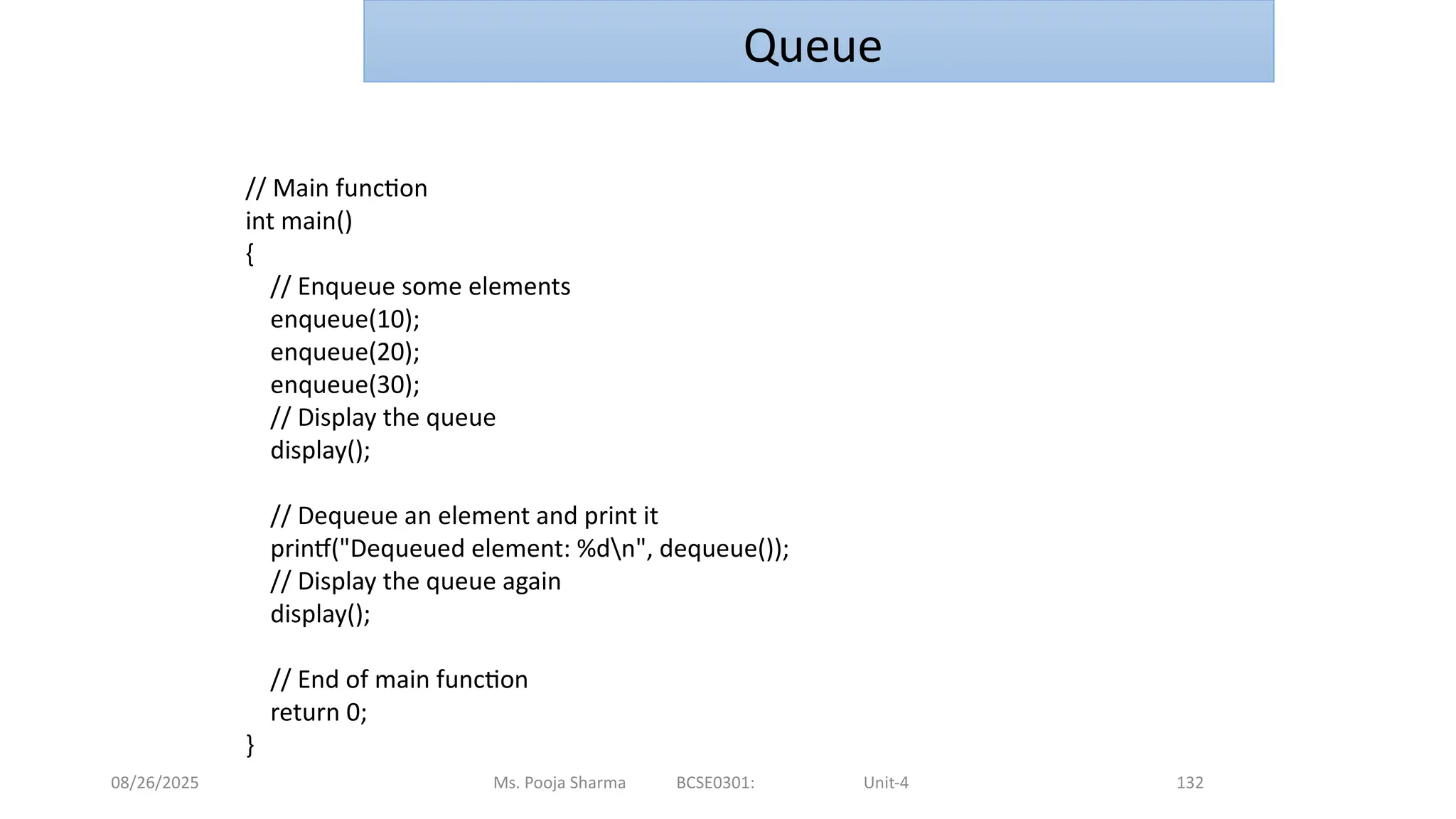
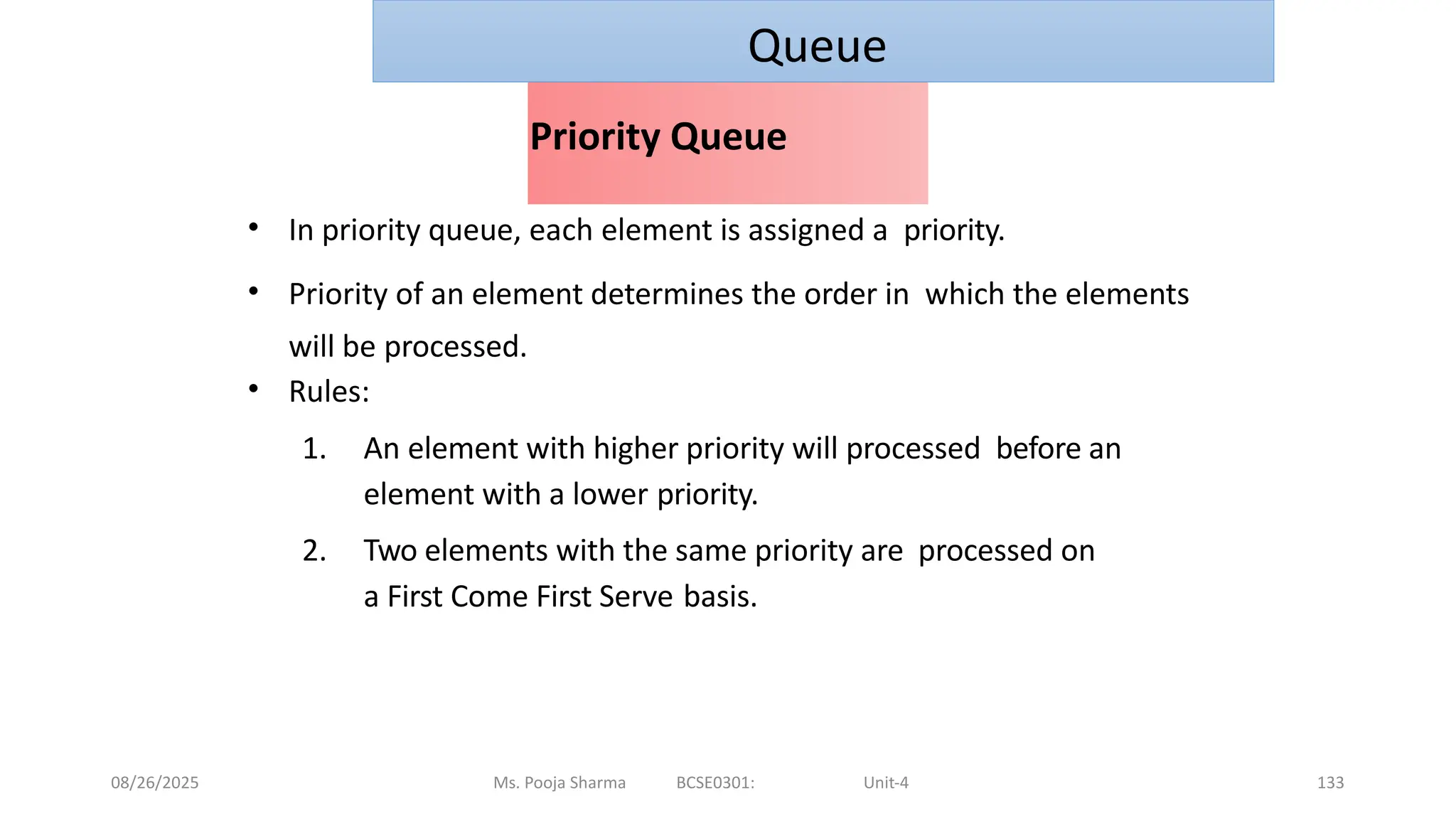
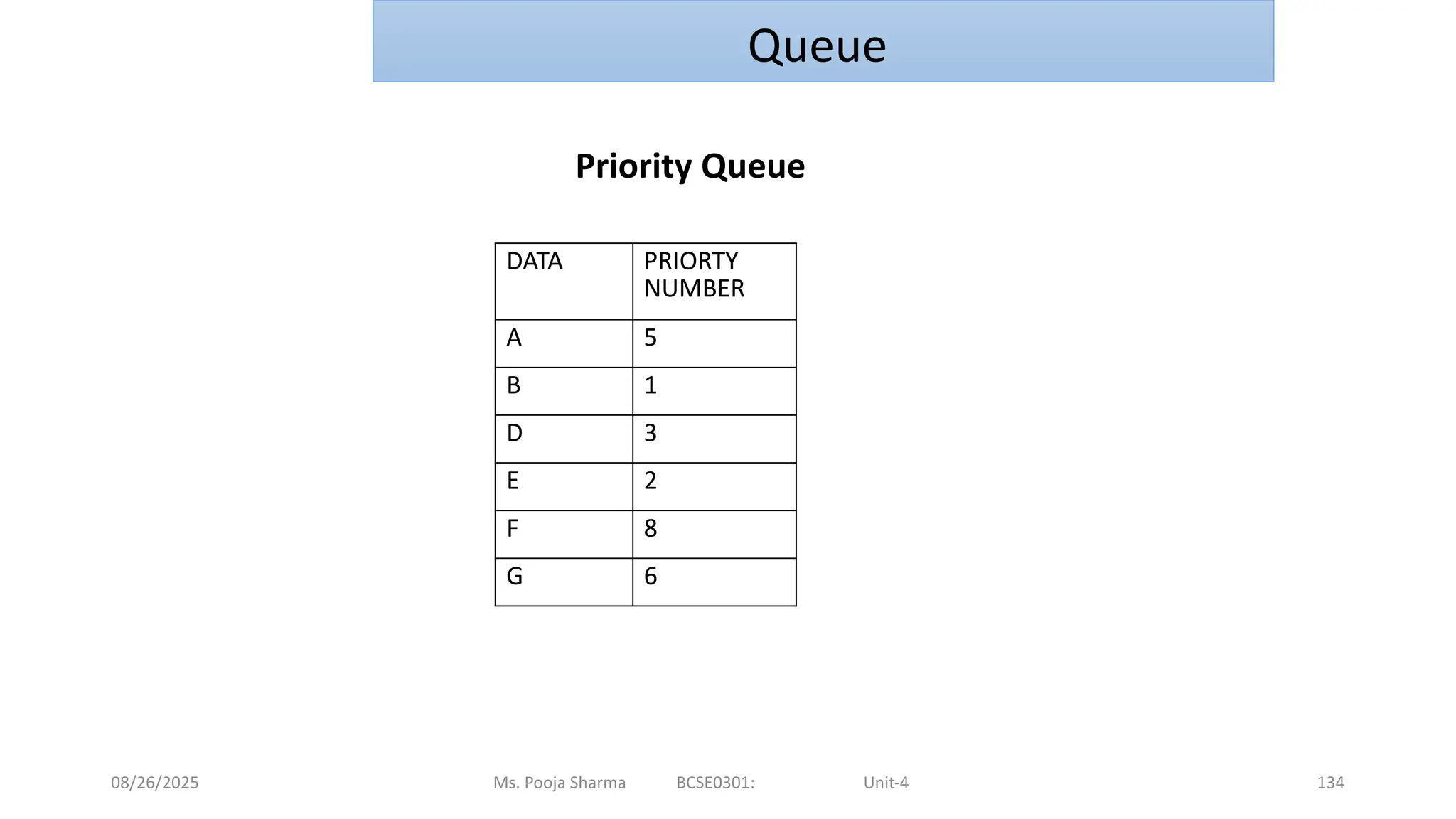
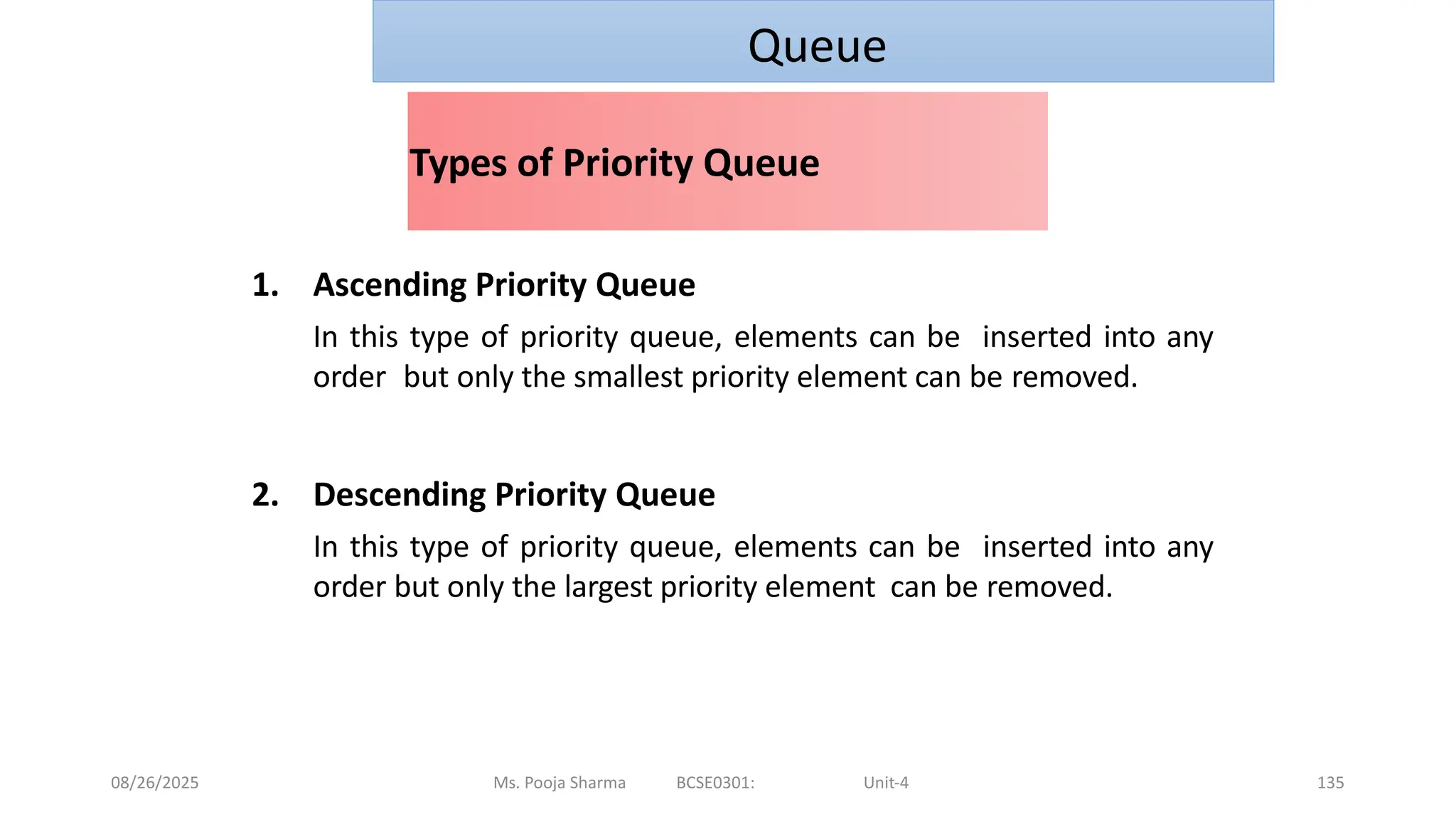
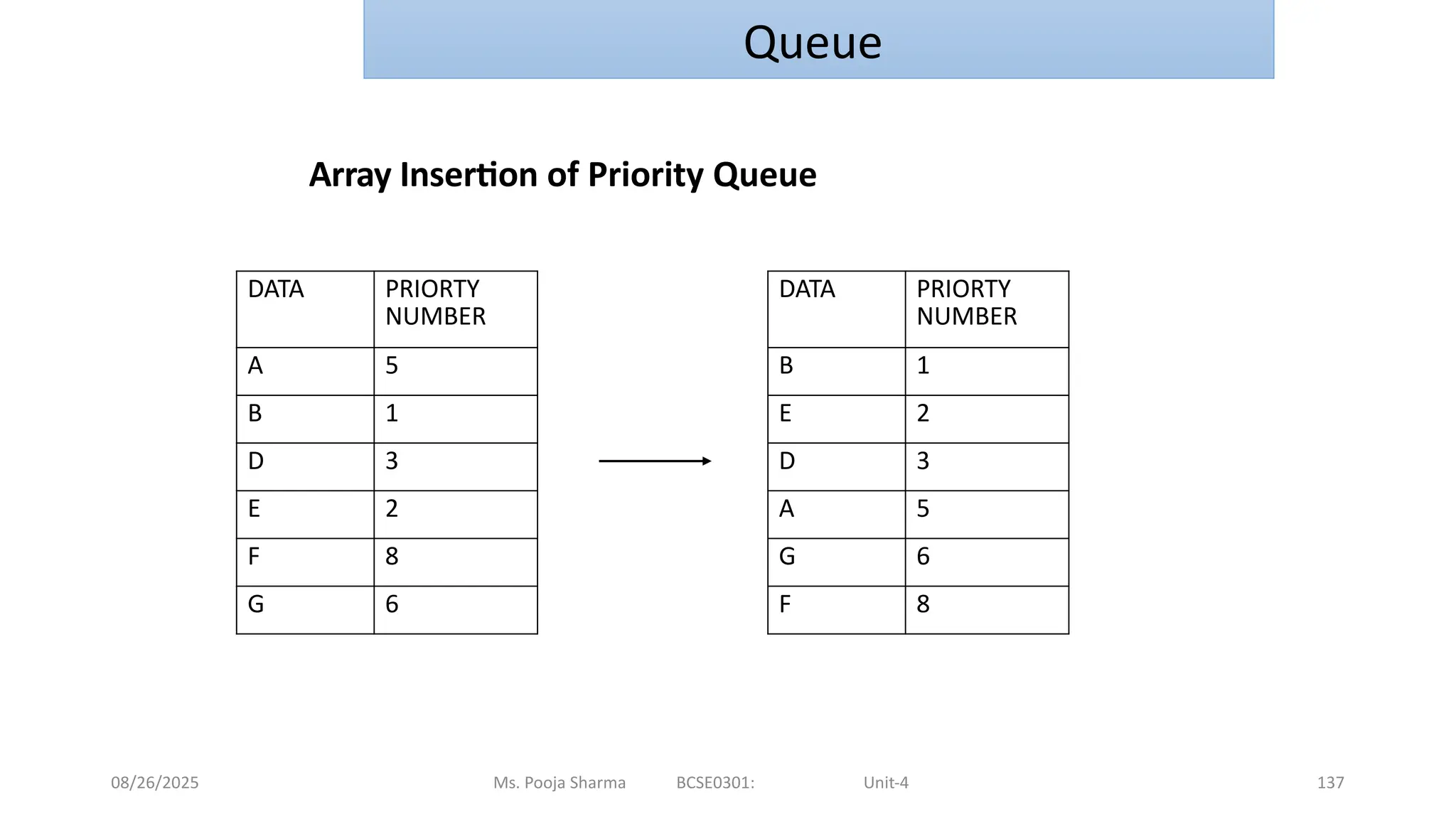
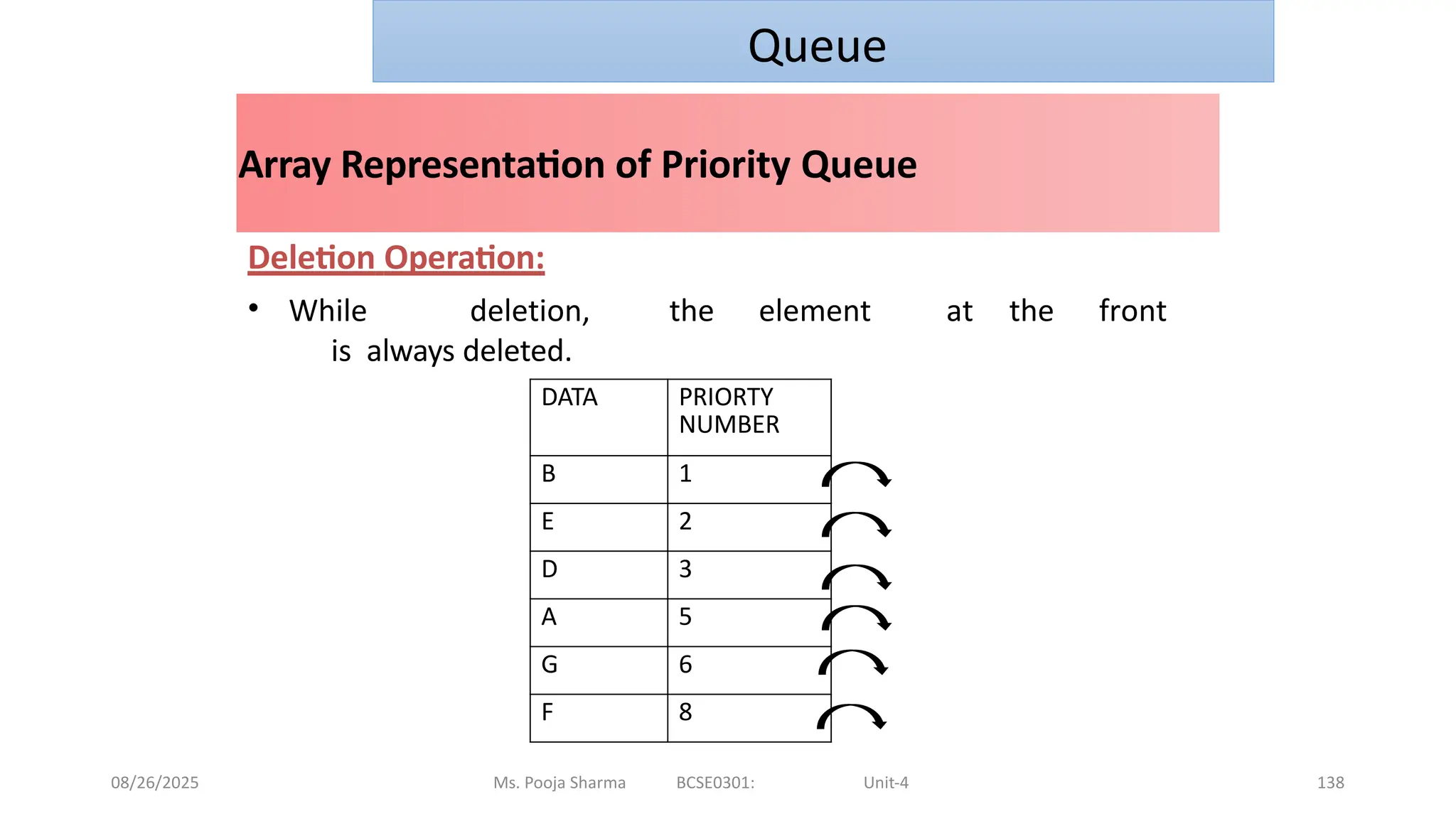
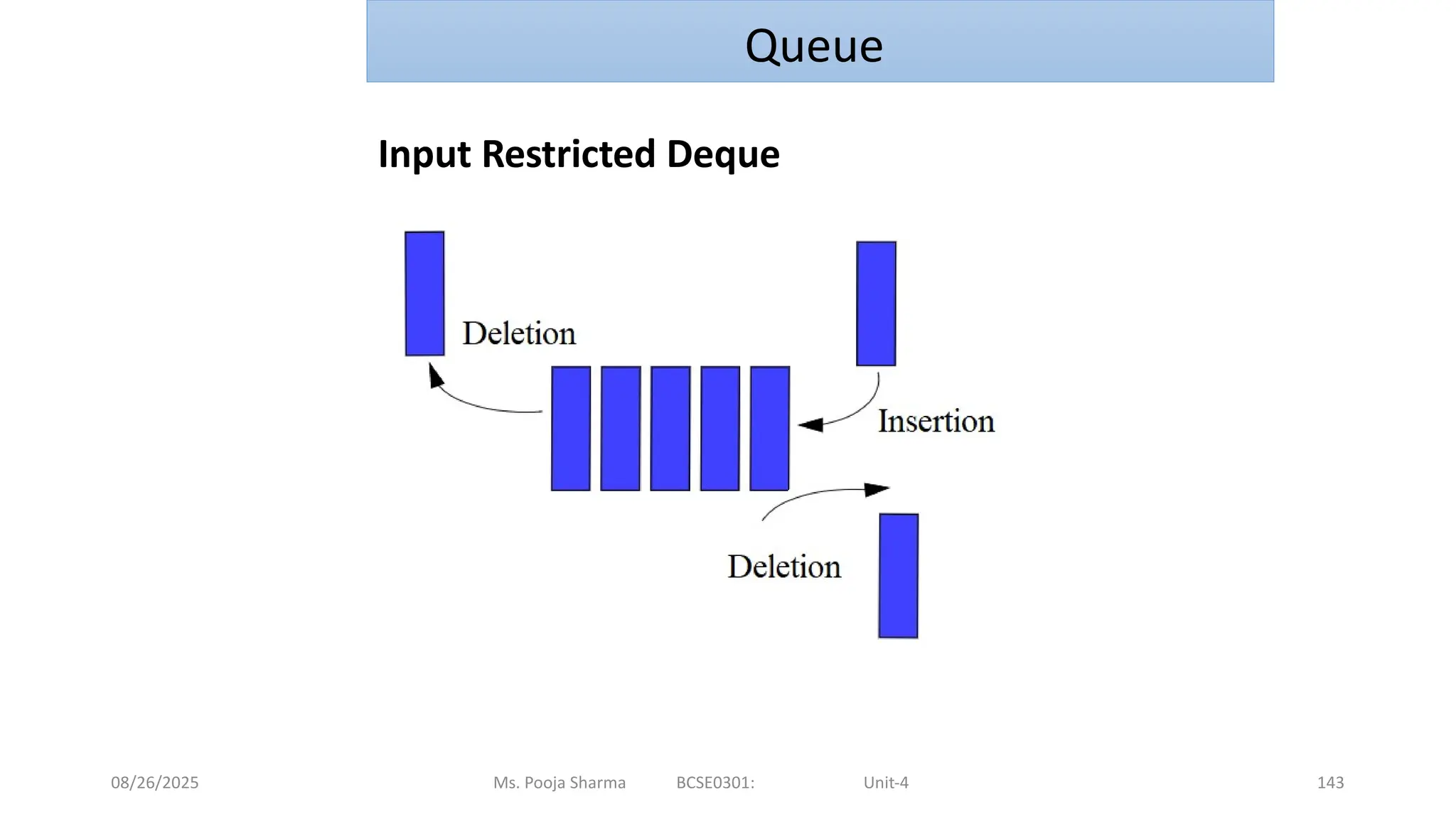
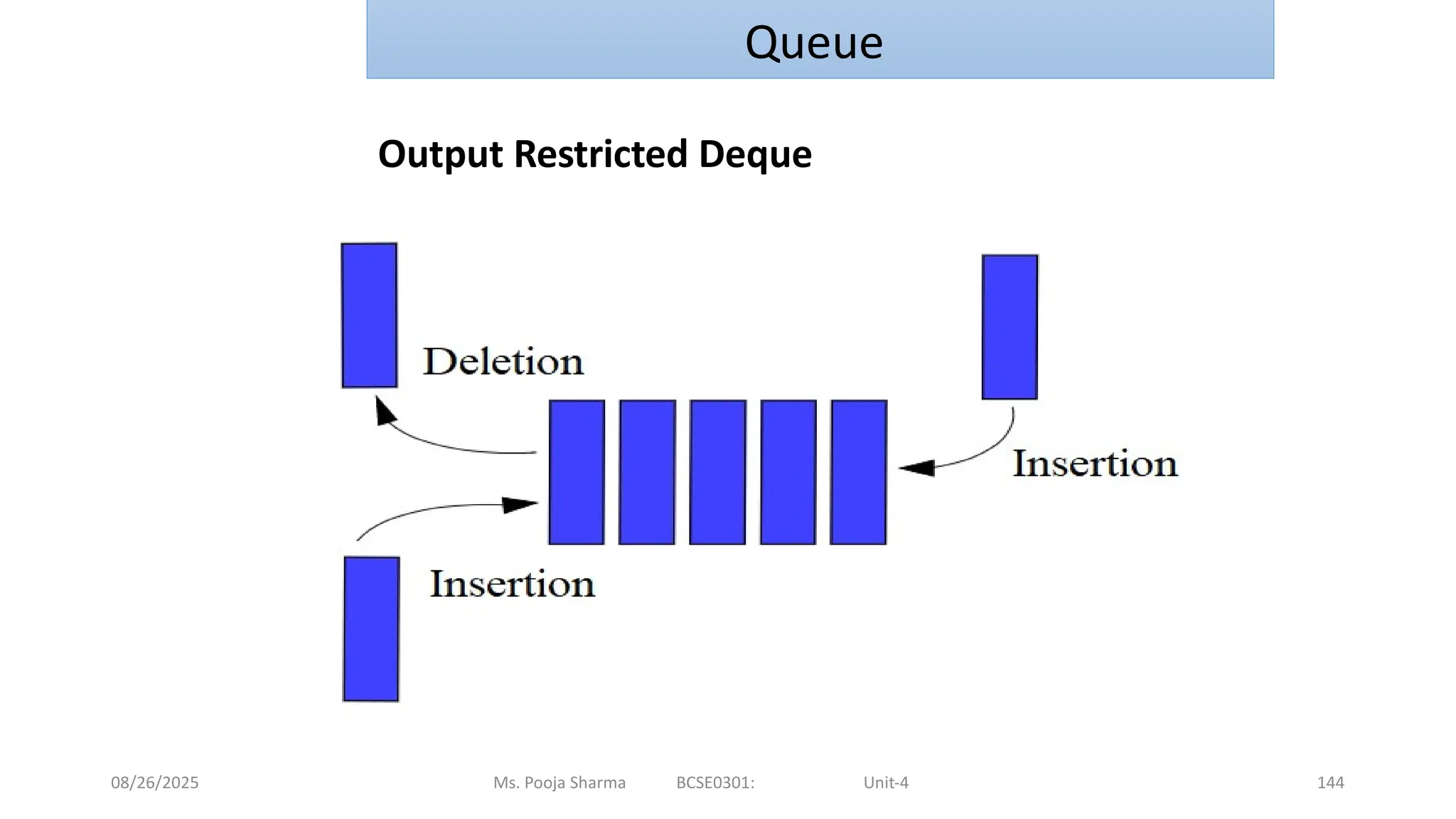
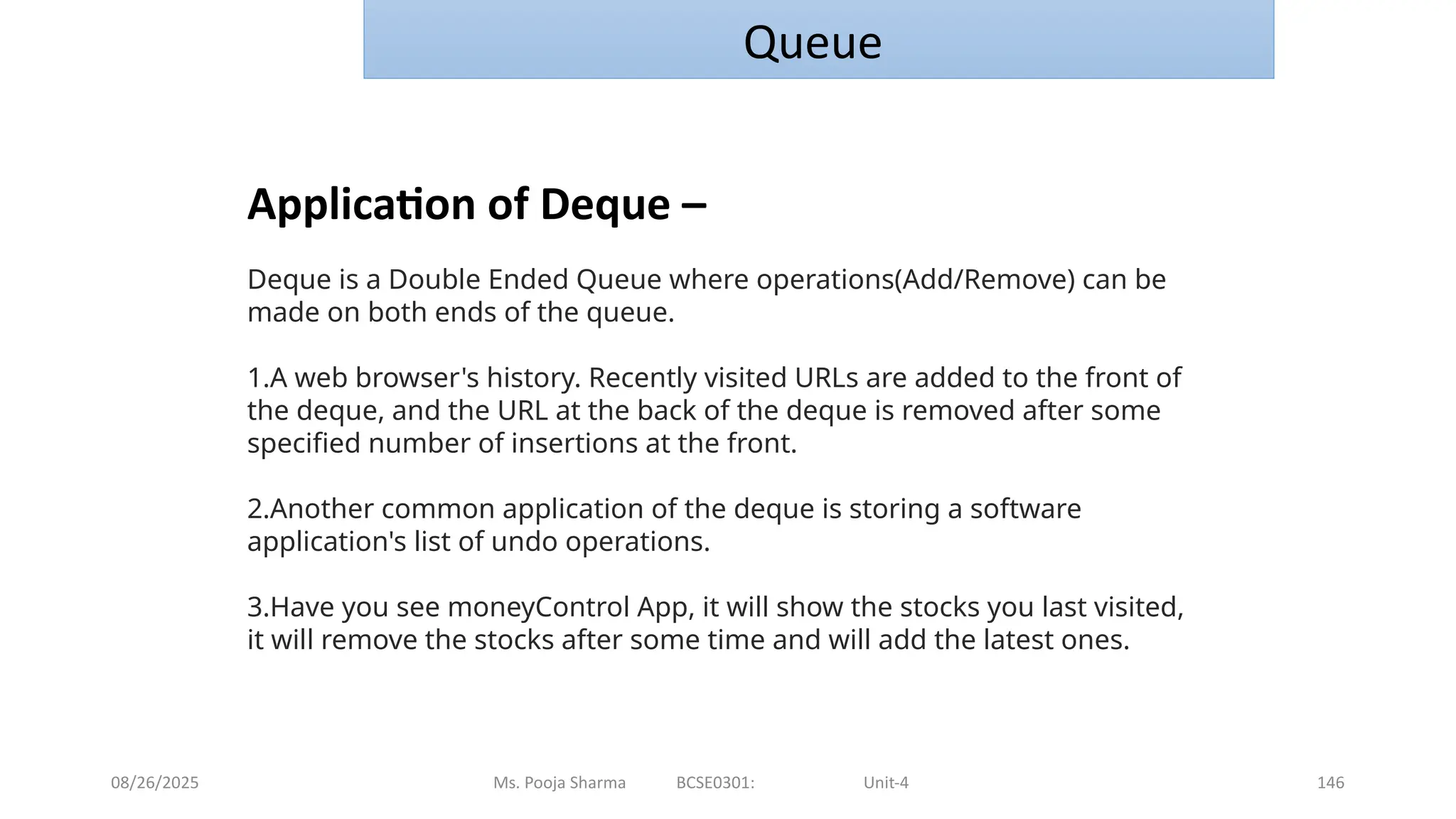

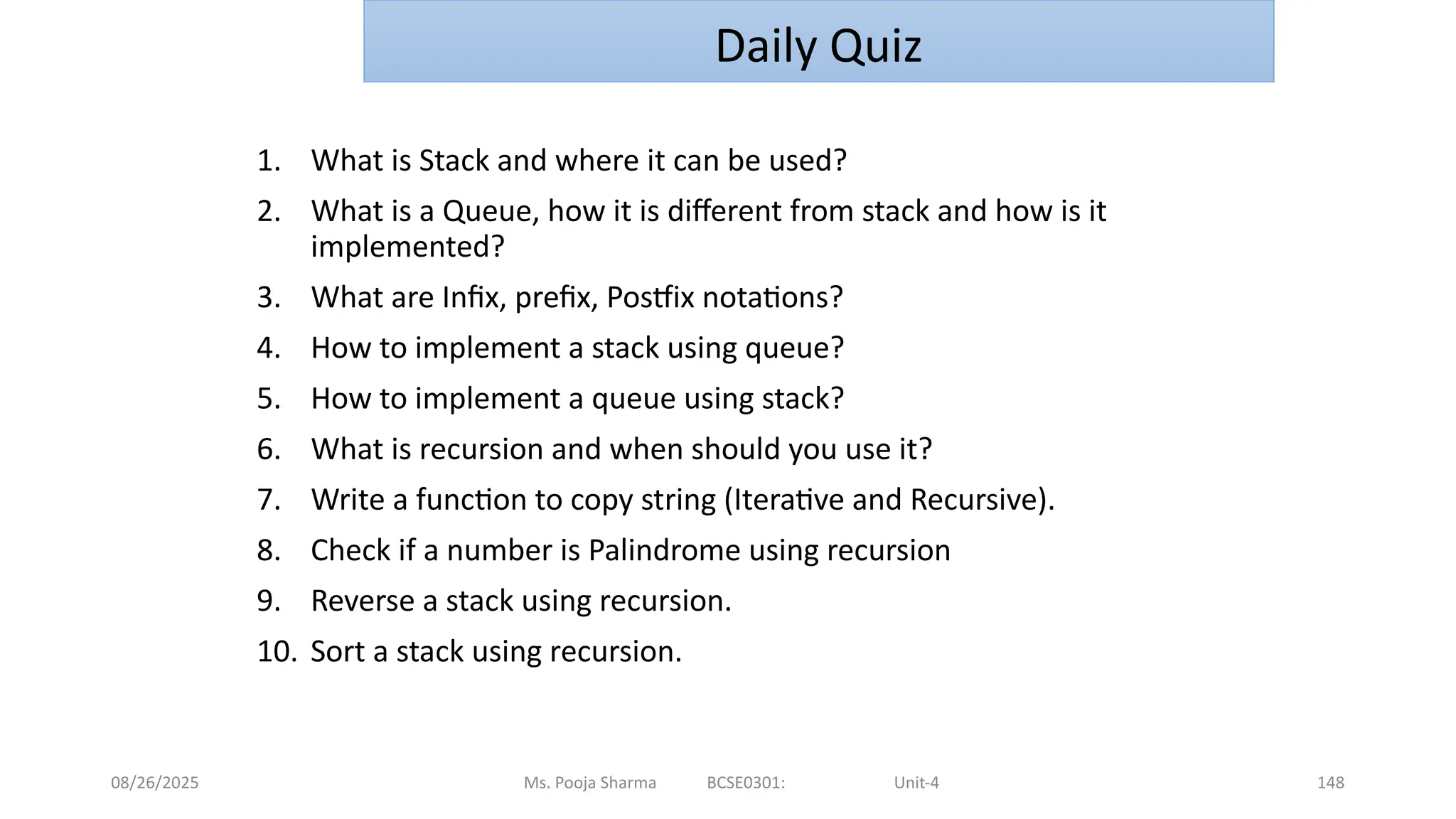
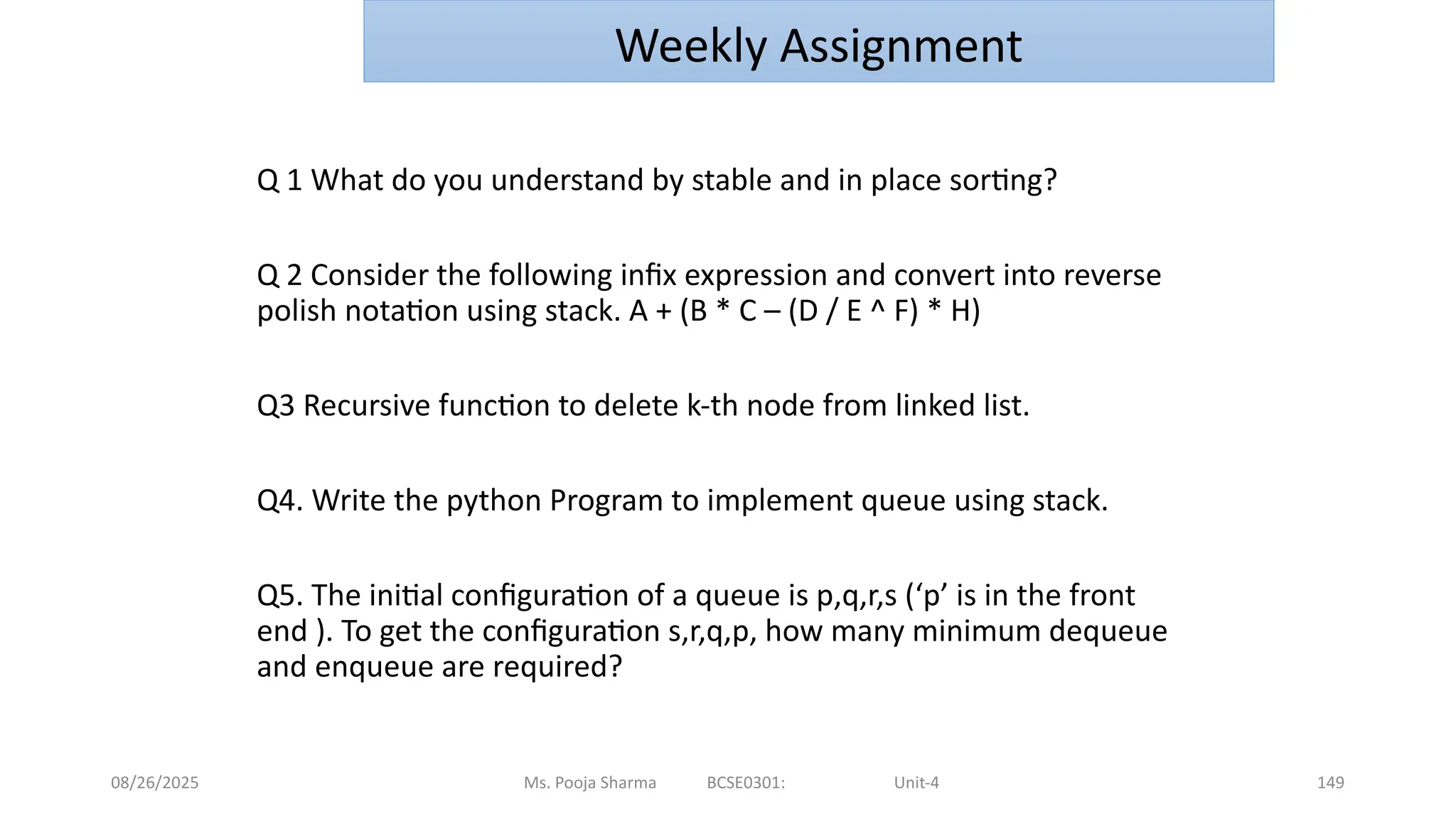
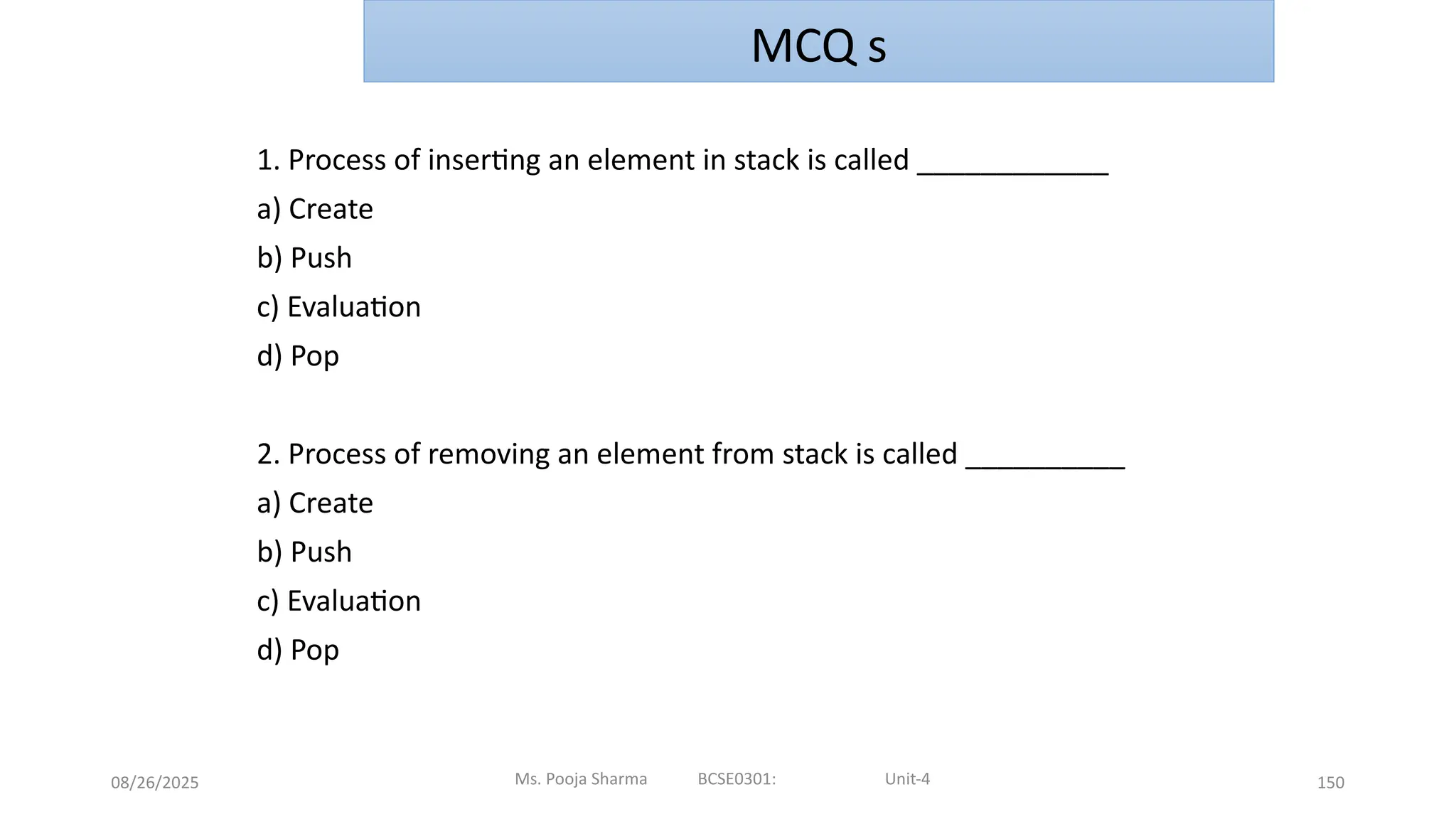
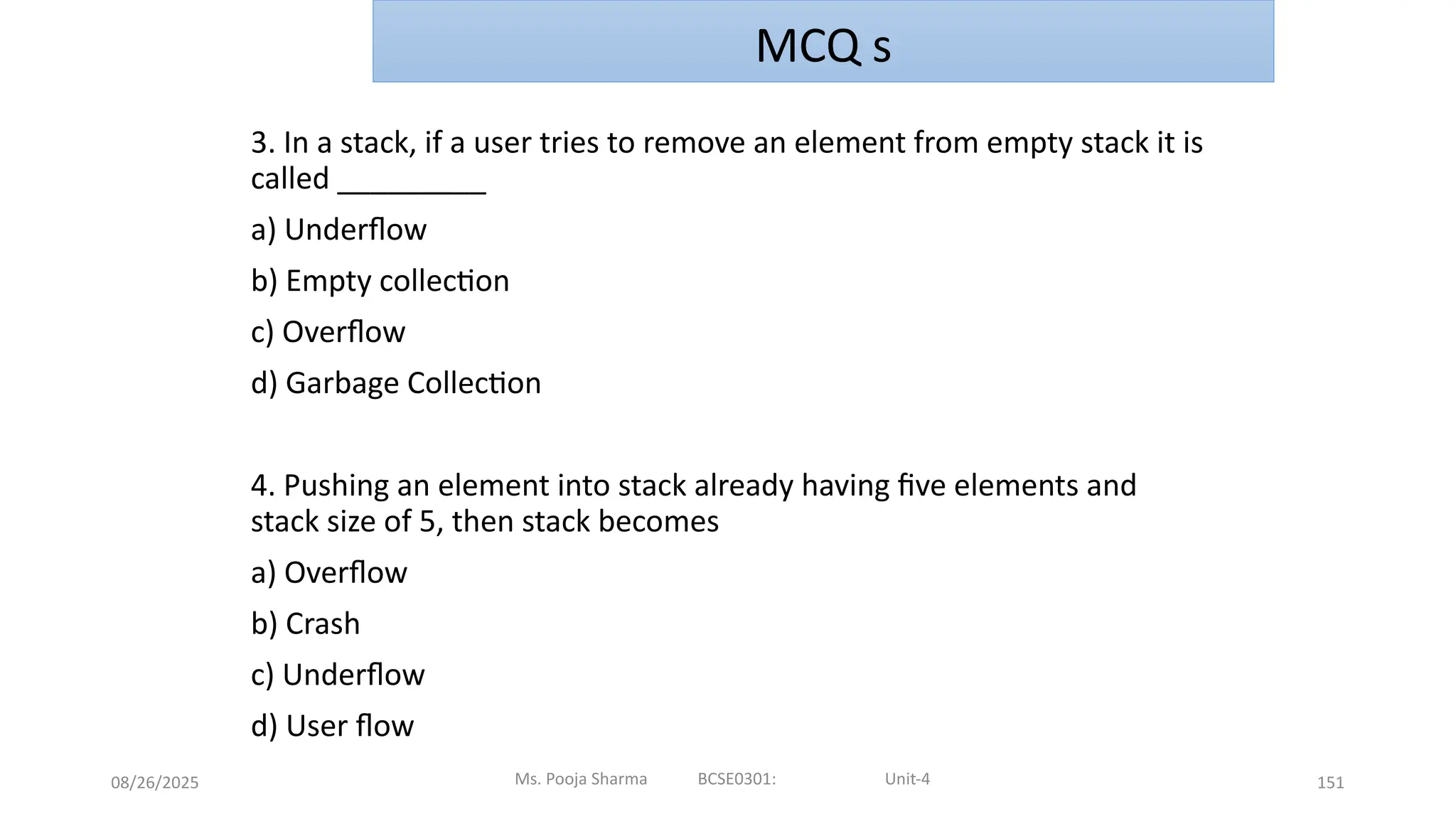
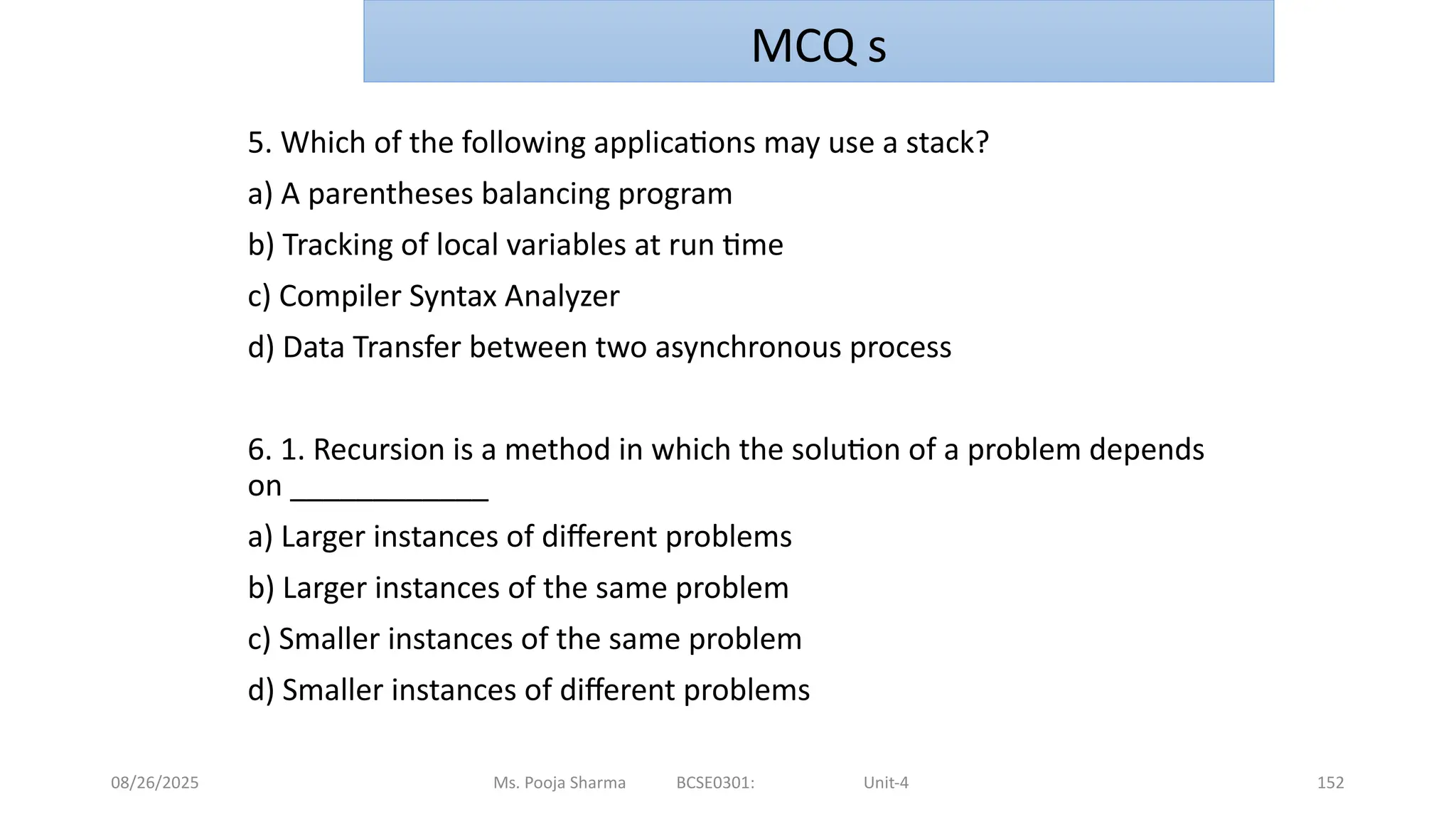
![08/26/2025 155
Q1. Define priority queue.
Q2. Write a program in C for implementation of a queue. Your program
should at least contain ADD, CREATE. DELETE, FULL and EMPTY
functions.
Q3. If an array is defined as int a[10] [20] in C, devise a formula to
calculate the address of an any variable say a[i] [j], for any valid value
of i and j.
Q4. Write a program to implement STACK using linked list.
Q5. If the Tower of Hanoi is operated on n=10 disks, calculate the total
number of moves.
Q6. Differentiate between overflow and underflow condition in a
linked list.
Ms. Pooja Sharma BCSE0301: Unit-4
Expected Questions for University Exam](https://image.slidesharecdn.com/unit4poojasharma-250826153415-4ccc7c32/75/operating_systems_presentations_delhi_nc-155-2048.jpg)
![08/26/2025 Ms. Pooja Sharma BCSE0301: Unit-4 159
References
[1] Aaron M. Tenenbaum, Yedidyah Langsam and Moshe J. Augenstein,
“Data Structures Using C and C++”, PHI Learning Private Limited, Delhi
India
[2] Horowitz and Sahani, “Fundamentals of Data Structures”, Galgotia
Publications Pvt Ltd Delhi India.
[3] Lipschutz, “Data Structures” Schaum’s Outline Series, Tata McGraw-
hill Education (India) Pvt. Ltd.
[4] Thareja, “Data Structure Using C” Oxford Higher Education.
[5] AK Sharma, “Data Structure Using C”, Pearson Education India.](https://image.slidesharecdn.com/unit4poojasharma-250826153415-4ccc7c32/75/operating_systems_presentations_delhi_nc-159-2048.jpg)