SmarterKnowledge
Knowledge Management for the Australian
Government
Taking Knowledge Management in your
organisation to the next level
Dr Michael Nelson, Director, SmarterKnowledge
10-11 October 2013, Rydges Capital Hill, Canberra
© 2013 SmarterKnowledge
SmarterKnowledge
Agenda
2
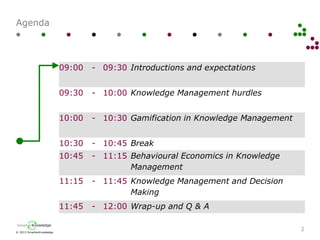
09:00 - 09:30 Introductions and expectations
09:30 - 10:00 Knowledge Management hurdles
10:00 - 10:30 Gamification in Knowledge Management
10:30 - 10:45 Break
10:45 - 11:15 Behavioural Economics in Knowledge
Management
11:15 - 11:45 Knowledge Management and Decision
Making
11:45 - 12:00 Wrap-up and Q & A
© 2013 SmarterKnowledge
SmarterKnowledge
Agenda
3
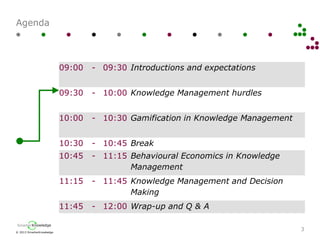
09:00 - 09:30 Introductions and expectations
09:30 - 10:00 Knowledge Management hurdles
10:00 - 10:30 Gamification in Knowledge Management
10:30 - 10:45 Break
10:45 - 11:15 Behavioural Economics in Knowledge
Management
11:15 - 11:45 Knowledge Management and Decision
Making
11:45 - 12:00 Wrap-up and Q & A
© 2013 SmarterKnowledge
SmarterKnowledge
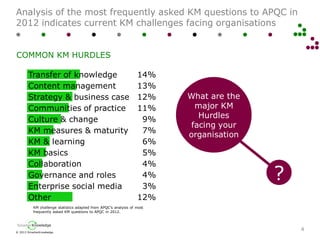
Analysis of the most frequently asked KM questions to APQC in
2012 indicates current KM challenges facing organisations
4
COMMON KM HURDLES
Transfer of knowledge 14%
Content management 13%
Strategy & business case 12%
Communities of practice 11%
Culture & change 9%
KM measures & maturity 7%
KM & learning 6%
KM basics 5%
Collaboration 4%
KM challenge statistics adapted from APQC’s analysis of most
frequently asked KM questions to APQC in 2012.
Governance and roles 4%
Enterprise social media 3%
Other 12%
What are the
major KM
Hurdles
facing your
organisation
?
© 2013 SmarterKnowledge
SmarterKnowledge
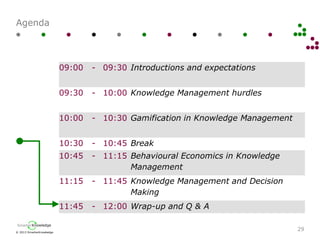
Agenda
5
09:00 - 09:30 Introductions and expectations
09:30 - 10:00 Knowledge Management hurdles
10:00 - 10:30 Gamification in Knowledge Management
10:30 - 10:45 Break
10:45 - 11:15 Behavioural Economics in Knowledge
Management
11:15 - 11:45 Knowledge Management and Decision
Making
11:45 - 12:00 Wrap-up and Q & A
© 2013 SmarterKnowledge
SmarterKnowledge
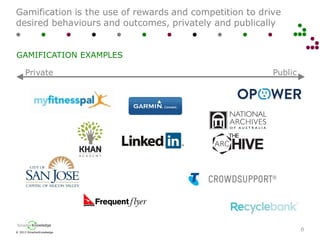
Gamification is the use of rewards and competition to drive
desired behaviours and outcomes, privately and publically
6
GAMIFICATION EXAMPLES
Private Public
© 2013 SmarterKnowledge
SmarterKnowledge
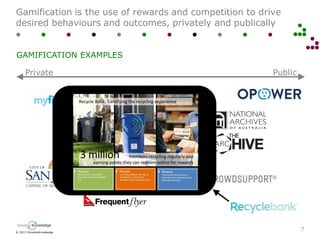
Gamification is the use of rewards and competition to drive
desired behaviours and outcomes, privately and publically
7
GAMIFICATION EXAMPLES
Private Public
© 2013 SmarterKnowledge
SmarterKnowledge
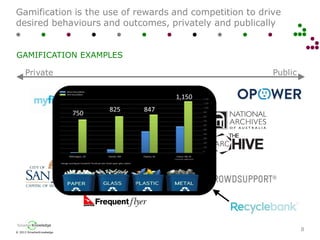
Gamification is the use of rewards and competition to drive
desired behaviours and outcomes, privately and publically
8
GAMIFICATION EXAMPLES
Private Public
© 2013 SmarterKnowledge
SmarterKnowledge
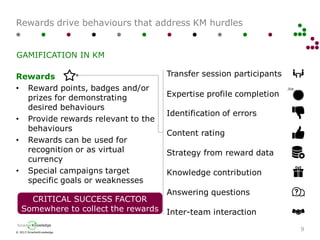
Rewards drive behaviours that address KM hurdles
9
GAMIFICATION IN KM
Identification of errors
Content rating
Expertise profile completion
Star
Answering questions
Inter-team interaction
Strategy from reward data
Transfer session participants
Knowledge contribution
Rewards
• Reward points, badges and/or
prizes for demonstrating
desired behaviours
• Provide rewards relevant to the
behaviours
• Rewards can be used for
recognition or as virtual
currency
• Special campaigns target
specific goals or weaknesses
CRITICAL SUCCESS FACTOR
Somewhere to collect the rewards
© 2013 SmarterKnowledge
SmarterKnowledge
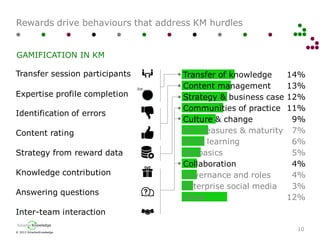
Rewards drive behaviours that address KM hurdles
10
GAMIFICATION IN KM
Identification of errors
Content rating
Expertise profile completion
Star
Answering questions
Inter-team interaction
Strategy from reward data
Transfer session participants
Knowledge contribution
Transfer of knowledge 14%
Content management 13%
Strategy & business case 12%
Communities of practice 11%
Culture & change 9%
KM measures & maturity 7%
KM & learning 6%
KM basics 5%
Collaboration 4%
Governance and roles 4%
Enterprise social media 3%
Other 12%
© 2013 SmarterKnowledge
SmarterKnowledge
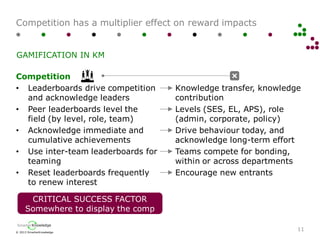
Competition has a multiplier effect on reward impacts
Competition
• Leaderboards drive competition
and acknowledge leaders
• Peer leaderboards level the
field (by level, role, team)
• Acknowledge immediate and
cumulative achievements
• Use inter-team leaderboards for
teaming
• Reset leaderboards frequently
to renew interest
Knowledge transfer, knowledge
contribution
Levels (SES, EL, APS), role
(admin, corporate, policy)
Drive behaviour today, and
acknowledge long-term effort
Teams compete for bonding,
within or across departments
Encourage new entrants
11
GAMIFICATION IN KM
CRITICAL SUCCESS FACTOR
Somewhere to display the comp
© 2013 SmarterKnowledge
SmarterKnowledge
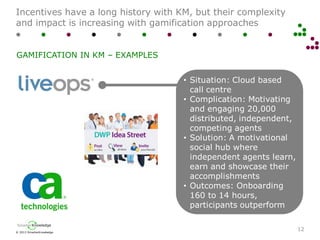
Incentives have a long history with KM, but their complexity
and impact is increasing with gamification approaches
12
GAMIFICATION IN KM – EXAMPLES
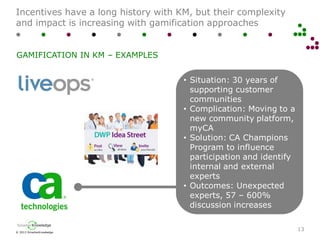
• Situation: Cloud based
call centre
• Complication: Motivating
and engaging 20,000
distributed, independent,
competing agents
• Solution: A motivational
social hub where
independent agents learn,
earn and showcase their
accomplishments
• Outcomes: Onboarding
160 to 14 hours,
participants outperform
© 2013 SmarterKnowledge
SmarterKnowledge
Incentives have a long history with KM, but their complexity
and impact is increasing with gamification approaches
13
GAMIFICATION IN KM – EXAMPLES
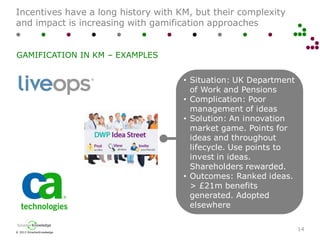
• Situation: 30 years of
supporting customer
communities
• Complication: Moving to a
new community platform,
myCA
• Solution: CA Champions
Program to influence
participation and identify
internal and external
experts
• Outcomes: Unexpected
experts, 57 – 600%
discussion increases
© 2013 SmarterKnowledge
SmarterKnowledge
Incentives have a long history with KM, but their complexity
and impact is increasing with gamification approaches
14
GAMIFICATION IN KM – EXAMPLES
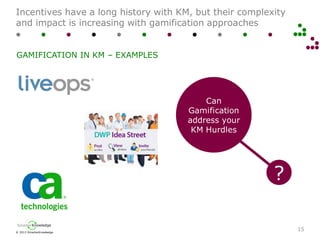
• Situation: UK Department
of Work and Pensions
• Complication: Poor
management of ideas
• Solution: An innovation
market game. Points for
ideas and throughout
lifecycle. Use points to
invest in ideas.
Shareholders rewarded.
• Outcomes: Ranked ideas.
> £21m benefits
generated. Adopted
elsewhere
© 2013 SmarterKnowledge
SmarterKnowledge
Incentives have a long history with KM, but their complexity
and impact is increasing with gamification approaches
15
GAMIFICATION IN KM – EXAMPLES
Can
Gamification
address your
KM Hurdles
?
© 2013 SmarterKnowledge
SmarterKnowledge
Agenda
16
09:00 - 09:30 Introductions and expectations
09:30 - 10:00 Knowledge Management hurdles
10:00 - 10:30 Gamification in Knowledge Management
10:30 - 10:45 Break
10:45 - 11:15 Behavioural Economics in Knowledge
Management
11:15 - 11:45 Knowledge Management and Decision
Making
11:45 - 12:00 Wrap-up and Q & A
© 2013 SmarterKnowledge
SmarterKnowledge
Agenda
17
09:00 - 09:30 Introductions and expectations
09:30 - 10:00 Knowledge Management hurdles
10:00 - 10:30 Gamification in Knowledge Management
10:30 - 10:45 Break
10:45 - 11:15 Behavioural Economics in Knowledge
Management
11:15 - 11:45 Knowledge Management and Decision
Making
11:45 - 12:00 Wrap-up and Q & A
© 2013 SmarterKnowledge
SmarterKnowledge
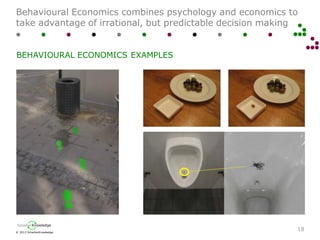
Behavioural Economics combines psychology and economics to
take advantage of irrational, but predictable decision making
18
BEHAVIOURAL ECONOMICS EXAMPLES
19
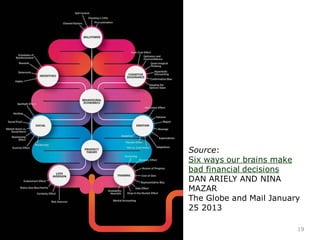
Source:
Six ways our brains make
bad financial decisions
DAN ARIELY AND NINA
MAZAR
The Globe and Mail January
25 2013
© 2013 SmarterKnowledge
SmarterKnowledge
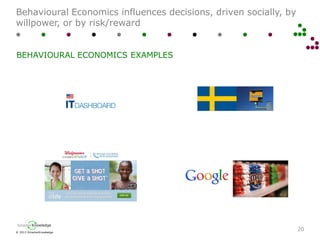
Behavioural Economics influences decisions, driven socially, by
willpower, or by risk/reward
20
BEHAVIOURAL ECONOMICS EXAMPLES
© 2013 SmarterKnowledge
SmarterKnowledge
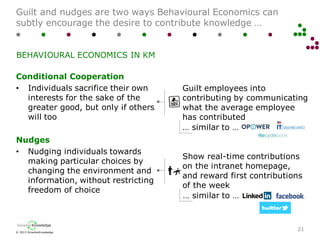
Guilt and nudges are two ways Behavioural Economics can
subtly encourage the desire to contribute knowledge …
21
BEHAVIOURAL ECONOMICS IN KM
Conditional Cooperation
• Individuals sacrifice their own
interests for the sake of the
greater good, but only if others
will too
Nudges
• Nudging individuals towards
making particular choices by
changing the environment and
information, without restricting
freedom of choice
Guilt employees into
contributing by communicating
what the average employee
has contributed
Show real-time contributions
on the intranet homepage,
and reward first contributions
of the week
… similar to …
… similar to …
© 2013 SmarterKnowledge
SmarterKnowledge
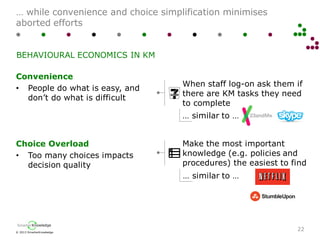
… while convenience and choice simplification minimises
aborted efforts
22
BEHAVIOURAL ECONOMICS IN KM
Convenience
• People do what is easy, and
don’t do what is difficult
Choice Overload
• Too many choices impacts
decision quality
When staff log-on ask them if
there are KM tasks they need
to complete
Make the most important
knowledge (e.g. policies and
procedures) the easiest to find
… similar to …
… similar to …
© 2013 SmarterKnowledge
SmarterKnowledge
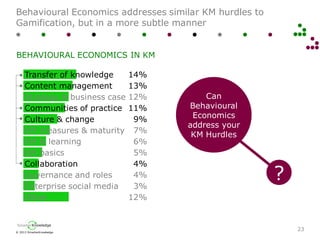
Behavioural Economics addresses similar KM hurdles to
Gamification, but in a more subtle manner
23
BEHAVIOURAL ECONOMICS IN KM
Transfer of knowledge 14%
Content management 13%
Strategy & business case 12%
Communities of practice 11%
Culture & change 9%
KM measures & maturity 7%
KM & learning 6%
KM basics 5%
Collaboration 4%
Governance and roles 4%
Enterprise social media 3%
Other 12%
Can
Behavioural
Economics
address your
KM Hurdles
?
© 2013 SmarterKnowledge
SmarterKnowledge
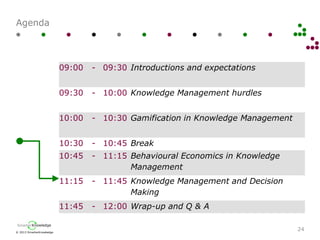
Agenda
24
09:00 - 09:30 Introductions and expectations
09:30 - 10:00 Knowledge Management hurdles
10:00 - 10:30 Gamification in Knowledge Management
10:30 - 10:45 Break
10:45 - 11:15 Behavioural Economics in Knowledge
Management
11:15 - 11:45 Knowledge Management and Decision
Making
11:45 - 12:00 Wrap-up and Q & A
© 2013 SmarterKnowledge
SmarterKnowledge
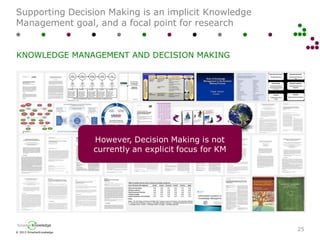
Supporting Decision Making is an implicit Knowledge
Management goal, and a focal point for research
25
KNOWLEDGE MANAGEMENT AND DECISION MAKING
However, Decision Making is not
currently an explicit focus for KM
© 2013 SmarterKnowledge
SmarterKnowledge
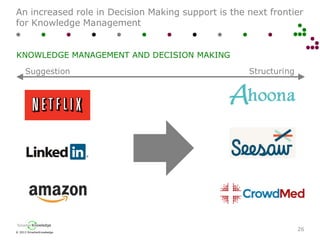
An increased role in Decision Making support is the next frontier
for Knowledge Management
26
KNOWLEDGE MANAGEMENT AND DECISION MAKING
Suggestion Structuring
© 2013 SmarterKnowledge
SmarterKnowledge
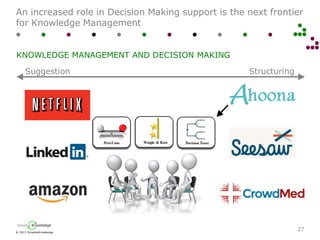
An increased role in Decision Making support is the next frontier
for Knowledge Management
27
KNOWLEDGE MANAGEMENT AND DECISION MAKING
Suggestion Structuring
© 2013 SmarterKnowledge
SmarterKnowledge
An increased role in Decision Making support is the next frontier
for Knowledge Management
28
KNOWLEDGE MANAGEMENT AND DECISION MAKING
Is KM
improving
decisions in
your
organisation
?
© 2013 SmarterKnowledge
SmarterKnowledge
Agenda
29
09:00 - 09:30 Introductions and expectations
09:30 - 10:00 Knowledge Management hurdles
10:00 - 10:30 Gamification in Knowledge Management
10:30 - 10:45 Break
10:45 - 11:15 Behavioural Economics in Knowledge
Management
11:15 - 11:45 Knowledge Management and Decision
Making
11:45 - 12:00 Wrap-up and Q & A

Gamification, behavioural economics and knowledge management - presentation

  • 1.
    SmarterKnowledge Knowledge Management forthe Australian Government Taking Knowledge Management in your organisation to the next level Dr Michael Nelson, Director, SmarterKnowledge 10-11 October 2013, Rydges Capital Hill, Canberra
  • 2.
    © 2013 SmarterKnowledge SmarterKnowledge Agenda 2 09:00- 09:30 Introductions and expectations 09:30 - 10:00 Knowledge Management hurdles 10:00 - 10:30 Gamification in Knowledge Management 10:30 - 10:45 Break 10:45 - 11:15 Behavioural Economics in Knowledge Management 11:15 - 11:45 Knowledge Management and Decision Making 11:45 - 12:00 Wrap-up and Q & A
  • 3.
    © 2013 SmarterKnowledge SmarterKnowledge Agenda 3 09:00- 09:30 Introductions and expectations 09:30 - 10:00 Knowledge Management hurdles 10:00 - 10:30 Gamification in Knowledge Management 10:30 - 10:45 Break 10:45 - 11:15 Behavioural Economics in Knowledge Management 11:15 - 11:45 Knowledge Management and Decision Making 11:45 - 12:00 Wrap-up and Q & A
  • 4.
    © 2013 SmarterKnowledge SmarterKnowledge Analysisof the most frequently asked KM questions to APQC in 2012 indicates current KM challenges facing organisations 4 COMMON KM HURDLES Transfer of knowledge 14% Content management 13% Strategy & business case 12% Communities of practice 11% Culture & change 9% KM measures & maturity 7% KM & learning 6% KM basics 5% Collaboration 4% KM challenge statistics adapted from APQC’s analysis of most frequently asked KM questions to APQC in 2012. Governance and roles 4% Enterprise social media 3% Other 12% What are the major KM Hurdles facing your organisation ?
  • 5.
    © 2013 SmarterKnowledge SmarterKnowledge Agenda 5 09:00- 09:30 Introductions and expectations 09:30 - 10:00 Knowledge Management hurdles 10:00 - 10:30 Gamification in Knowledge Management 10:30 - 10:45 Break 10:45 - 11:15 Behavioural Economics in Knowledge Management 11:15 - 11:45 Knowledge Management and Decision Making 11:45 - 12:00 Wrap-up and Q & A
  • 6.
    © 2013 SmarterKnowledge SmarterKnowledge Gamificationis the use of rewards and competition to drive desired behaviours and outcomes, privately and publically 6 GAMIFICATION EXAMPLES Private Public
  • 7.
    © 2013 SmarterKnowledge SmarterKnowledge Gamificationis the use of rewards and competition to drive desired behaviours and outcomes, privately and publically 7 GAMIFICATION EXAMPLES Private Public
  • 8.
    © 2013 SmarterKnowledge SmarterKnowledge Gamificationis the use of rewards and competition to drive desired behaviours and outcomes, privately and publically 8 GAMIFICATION EXAMPLES Private Public
  • 9.
    © 2013 SmarterKnowledge SmarterKnowledge Rewardsdrive behaviours that address KM hurdles 9 GAMIFICATION IN KM Identification of errors Content rating Expertise profile completion Star Answering questions Inter-team interaction Strategy from reward data Transfer session participants Knowledge contribution Rewards • Reward points, badges and/or prizes for demonstrating desired behaviours • Provide rewards relevant to the behaviours • Rewards can be used for recognition or as virtual currency • Special campaigns target specific goals or weaknesses CRITICAL SUCCESS FACTOR Somewhere to collect the rewards
  • 10.
    © 2013 SmarterKnowledge SmarterKnowledge Rewardsdrive behaviours that address KM hurdles 10 GAMIFICATION IN KM Identification of errors Content rating Expertise profile completion Star Answering questions Inter-team interaction Strategy from reward data Transfer session participants Knowledge contribution Transfer of knowledge 14% Content management 13% Strategy & business case 12% Communities of practice 11% Culture & change 9% KM measures & maturity 7% KM & learning 6% KM basics 5% Collaboration 4% Governance and roles 4% Enterprise social media 3% Other 12%
  • 11.
    © 2013 SmarterKnowledge SmarterKnowledge Competitionhas a multiplier effect on reward impacts Competition • Leaderboards drive competition and acknowledge leaders • Peer leaderboards level the field (by level, role, team) • Acknowledge immediate and cumulative achievements • Use inter-team leaderboards for teaming • Reset leaderboards frequently to renew interest Knowledge transfer, knowledge contribution Levels (SES, EL, APS), role (admin, corporate, policy) Drive behaviour today, and acknowledge long-term effort Teams compete for bonding, within or across departments Encourage new entrants 11 GAMIFICATION IN KM CRITICAL SUCCESS FACTOR Somewhere to display the comp
  • 12.
    © 2013 SmarterKnowledge SmarterKnowledge Incentiveshave a long history with KM, but their complexity and impact is increasing with gamification approaches 12 GAMIFICATION IN KM – EXAMPLES • Situation: Cloud based call centre • Complication: Motivating and engaging 20,000 distributed, independent, competing agents • Solution: A motivational social hub where independent agents learn, earn and showcase their accomplishments • Outcomes: Onboarding 160 to 14 hours, participants outperform
  • 13.
    © 2013 SmarterKnowledge SmarterKnowledge Incentiveshave a long history with KM, but their complexity and impact is increasing with gamification approaches 13 GAMIFICATION IN KM – EXAMPLES • Situation: 30 years of supporting customer communities • Complication: Moving to a new community platform, myCA • Solution: CA Champions Program to influence participation and identify internal and external experts • Outcomes: Unexpected experts, 57 – 600% discussion increases
  • 14.
    © 2013 SmarterKnowledge SmarterKnowledge Incentiveshave a long history with KM, but their complexity and impact is increasing with gamification approaches 14 GAMIFICATION IN KM – EXAMPLES • Situation: UK Department of Work and Pensions • Complication: Poor management of ideas • Solution: An innovation market game. Points for ideas and throughout lifecycle. Use points to invest in ideas. Shareholders rewarded. • Outcomes: Ranked ideas. > £21m benefits generated. Adopted elsewhere
  • 15.
    © 2013 SmarterKnowledge SmarterKnowledge Incentiveshave a long history with KM, but their complexity and impact is increasing with gamification approaches 15 GAMIFICATION IN KM – EXAMPLES Can Gamification address your KM Hurdles ?
  • 16.
    © 2013 SmarterKnowledge SmarterKnowledge Agenda 16 09:00- 09:30 Introductions and expectations 09:30 - 10:00 Knowledge Management hurdles 10:00 - 10:30 Gamification in Knowledge Management 10:30 - 10:45 Break 10:45 - 11:15 Behavioural Economics in Knowledge Management 11:15 - 11:45 Knowledge Management and Decision Making 11:45 - 12:00 Wrap-up and Q & A
  • 17.
    © 2013 SmarterKnowledge SmarterKnowledge Agenda 17 09:00- 09:30 Introductions and expectations 09:30 - 10:00 Knowledge Management hurdles 10:00 - 10:30 Gamification in Knowledge Management 10:30 - 10:45 Break 10:45 - 11:15 Behavioural Economics in Knowledge Management 11:15 - 11:45 Knowledge Management and Decision Making 11:45 - 12:00 Wrap-up and Q & A
  • 18.
    © 2013 SmarterKnowledge SmarterKnowledge BehaviouralEconomics combines psychology and economics to take advantage of irrational, but predictable decision making 18 BEHAVIOURAL ECONOMICS EXAMPLES
  • 19.
    19 Source: Six ways ourbrains make bad financial decisions DAN ARIELY AND NINA MAZAR The Globe and Mail January 25 2013
  • 20.
    © 2013 SmarterKnowledge SmarterKnowledge BehaviouralEconomics influences decisions, driven socially, by willpower, or by risk/reward 20 BEHAVIOURAL ECONOMICS EXAMPLES
  • 21.
    © 2013 SmarterKnowledge SmarterKnowledge Guiltand nudges are two ways Behavioural Economics can subtly encourage the desire to contribute knowledge … 21 BEHAVIOURAL ECONOMICS IN KM Conditional Cooperation • Individuals sacrifice their own interests for the sake of the greater good, but only if others will too Nudges • Nudging individuals towards making particular choices by changing the environment and information, without restricting freedom of choice Guilt employees into contributing by communicating what the average employee has contributed Show real-time contributions on the intranet homepage, and reward first contributions of the week … similar to … … similar to …
  • 22.
    © 2013 SmarterKnowledge SmarterKnowledge …while convenience and choice simplification minimises aborted efforts 22 BEHAVIOURAL ECONOMICS IN KM Convenience • People do what is easy, and don’t do what is difficult Choice Overload • Too many choices impacts decision quality When staff log-on ask them if there are KM tasks they need to complete Make the most important knowledge (e.g. policies and procedures) the easiest to find … similar to … … similar to …
  • 23.
    © 2013 SmarterKnowledge SmarterKnowledge BehaviouralEconomics addresses similar KM hurdles to Gamification, but in a more subtle manner 23 BEHAVIOURAL ECONOMICS IN KM Transfer of knowledge 14% Content management 13% Strategy & business case 12% Communities of practice 11% Culture & change 9% KM measures & maturity 7% KM & learning 6% KM basics 5% Collaboration 4% Governance and roles 4% Enterprise social media 3% Other 12% Can Behavioural Economics address your KM Hurdles ?
  • 24.
    © 2013 SmarterKnowledge SmarterKnowledge Agenda 24 09:00- 09:30 Introductions and expectations 09:30 - 10:00 Knowledge Management hurdles 10:00 - 10:30 Gamification in Knowledge Management 10:30 - 10:45 Break 10:45 - 11:15 Behavioural Economics in Knowledge Management 11:15 - 11:45 Knowledge Management and Decision Making 11:45 - 12:00 Wrap-up and Q & A
  • 25.
    © 2013 SmarterKnowledge SmarterKnowledge SupportingDecision Making is an implicit Knowledge Management goal, and a focal point for research 25 KNOWLEDGE MANAGEMENT AND DECISION MAKING However, Decision Making is not currently an explicit focus for KM
  • 26.
    © 2013 SmarterKnowledge SmarterKnowledge Anincreased role in Decision Making support is the next frontier for Knowledge Management 26 KNOWLEDGE MANAGEMENT AND DECISION MAKING Suggestion Structuring
  • 27.
    © 2013 SmarterKnowledge SmarterKnowledge Anincreased role in Decision Making support is the next frontier for Knowledge Management 27 KNOWLEDGE MANAGEMENT AND DECISION MAKING Suggestion Structuring
  • 28.
    © 2013 SmarterKnowledge SmarterKnowledge Anincreased role in Decision Making support is the next frontier for Knowledge Management 28 KNOWLEDGE MANAGEMENT AND DECISION MAKING Is KM improving decisions in your organisation ?
  • 29.
    © 2013 SmarterKnowledge SmarterKnowledge Agenda 29 09:00- 09:30 Introductions and expectations 09:30 - 10:00 Knowledge Management hurdles 10:00 - 10:30 Gamification in Knowledge Management 10:30 - 10:45 Break 10:45 - 11:15 Behavioural Economics in Knowledge Management 11:15 - 11:45 Knowledge Management and Decision Making 11:45 - 12:00 Wrap-up and Q & A