
Kent Hoover, Isabel Lippincott, Angel Pichardo, Katherine Anne
Rebholz, Beau Smith, Katrina Wiesner
Galecto Biotech
● Founded Nov 2011 by world leading Galectin and Fibrosis experts
● Focus on Galectin Modulation
◦ Galectins have been shown to be involved in several pathological
conditions
◦ Founders have world class insight into Galectin biology and
pharmacology with dozens of publications
● Target Indications: Fibrotic Diseases
◦ IPF – a >$500 M IPF market opportunity with clear regulatory &
clinical path
● Clinical development
◦ IPF: First Human Dose completed Sept. 2014
◦ Phase IIb in 24 IPF patients ongoing
◦ Three issued US composition of matter patents
Summary – Galecto Biotech
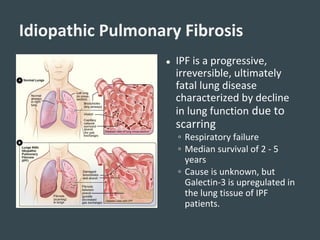
● IPF is a progressive,
irreversible, ultimately
fatal lung disease
characterized by decline
in lung function due to
scarring
◦ Respiratory failure
◦ Median survival of 2 - 5
years
◦ Cause is unknown, but
Galectin-3 is upregulated in
the lung tissue of IPF
patients.
Idiopathic Pulmonary Fibrosis
● US incidence of IPF: ~30,000/yr
● US prevalence: ~100,000, EU: ~120,000
◦ Increasing incidence and IPF-related deaths worldwide
● Most patients are ≥ 50 years-old at diagnosis
◦ Males more frequently affected than females
◦ In approx 10 % of cases there is a family history of IPF
IPF, an Orphan Indication
● Pirfinedone (Esbriet; Roche)
◦ Approved in EU and US
◦ Dose limiting side effects – upper GI symptoms and
skin sensitivity to light
● Nintedanib (BI)
◦ Tyrosine kinase inhibitor
◦ Just approved in EU and US
◦ Dose limiting side effects – diarrhea (> 60 %)
● Both only demonstrated to slow disease progression
IPF Drugs on Market
Lectins: Sugar binding proteins:
● Intra and Extracellular, often membrane bound.
● Mediate cellular, carbohydrate, and protein recognition
● Involved in bacterial and viral binding
● Can be toxic
Galectins: Non-Membrane bound
● Bind beta-galactoside sugars
○ Found in Cytosol, nucleus, ECM, and Circulation
○ Upregulation of Galectin-3 has been linked to fibrosis in the
lungs, kidneys and liver.
Galectins and IPF
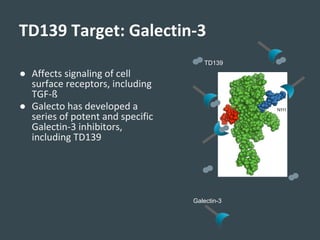
● Affects signaling of cell
surface receptors, including
TGF-ß
● Galecto has developed a
series of potent and specific
Galectin-3 inhibitors,
including TD139
TD139 Target: Galectin-3
Galectin-3
TD139
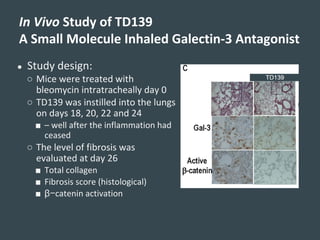
● Study design:
○ Mice were treated with
bleomycin intratracheally day 0
○ TD139 was instilled into the lungs
on days 18, 20, 22 and 24
■ – well after the inflammation had
ceased
○ The level of fibrosis was
evaluated at day 26
■ Total collagen
■ Fibrosis score (histological)
■ β−catenin activation
In Vivo Study of TD139
A Small Molecule Inhaled Galectin-3 Antagonist
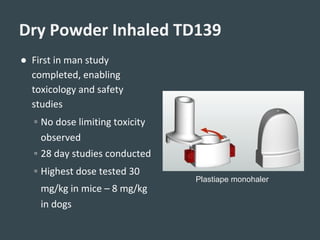
● First in man study
completed, enabling
toxicology and safety
studies
◦ No dose limiting toxicity
observed
◦ 28 day studies conducted
◦ Highest dose tested 30
mg/kg in mice – 8 mg/kg
in dogs
Dry Powder Inhaled TD139
Plastiape monohaler
● Study design
◦ Combined healthy volunteer and patient study
● Healthy volunteer study completed:
◦ 6 dose groups (0.15, 1.5, 3, 10, 20 and 50 mg)
◦ 4 active, 2 placebo in each group
● Results
◦ Mild adverse effects only (cough & headache)
◦ All lab and other clinical parameters satisfactory
◦ Plastiape inhaler performing well
Clinical Data in Healthy Volunteers
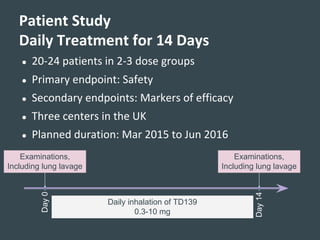
● 20-24 patients in 2-3 dose groups
● Primary endpoint: Safety
● Secondary endpoints: Markers of efficacy
● Three centers in the UK
● Planned duration: Mar 2015 to Jun 2016
Patient Study
Daily Treatment for 14 DaysDay0
Day14
Examinations,
Including lung lavage
Examinations,
Including lung lavage
Daily inhalation of TD139
0.3-10 mg
● Galectin-3 has been shown to play a central role in
fibrosis in many organs
● Development of an orally active Gal-3 inhibitor would
open up a plethora of new opportunities
● We have also identified new gal-3 inhibitors with
increased bioavailability
● Phase IIa trials for TD139 ending in June 2016
● Ca$h Money
Moving Forward...

Galecto Biotech Galectin Drug Review

  • 1.
    Kent Hoover, IsabelLippincott, Angel Pichardo, Katherine Anne Rebholz, Beau Smith, Katrina Wiesner Galecto Biotech
  • 2.
    ● Founded Nov2011 by world leading Galectin and Fibrosis experts ● Focus on Galectin Modulation ◦ Galectins have been shown to be involved in several pathological conditions ◦ Founders have world class insight into Galectin biology and pharmacology with dozens of publications ● Target Indications: Fibrotic Diseases ◦ IPF – a >$500 M IPF market opportunity with clear regulatory & clinical path ● Clinical development ◦ IPF: First Human Dose completed Sept. 2014 ◦ Phase IIb in 24 IPF patients ongoing ◦ Three issued US composition of matter patents Summary – Galecto Biotech
  • 3.
    ● IPF isa progressive, irreversible, ultimately fatal lung disease characterized by decline in lung function due to scarring ◦ Respiratory failure ◦ Median survival of 2 - 5 years ◦ Cause is unknown, but Galectin-3 is upregulated in the lung tissue of IPF patients. Idiopathic Pulmonary Fibrosis
  • 4.
    ● US incidenceof IPF: ~30,000/yr ● US prevalence: ~100,000, EU: ~120,000 ◦ Increasing incidence and IPF-related deaths worldwide ● Most patients are ≥ 50 years-old at diagnosis ◦ Males more frequently affected than females ◦ In approx 10 % of cases there is a family history of IPF IPF, an Orphan Indication
  • 5.
    ● Pirfinedone (Esbriet;Roche) ◦ Approved in EU and US ◦ Dose limiting side effects – upper GI symptoms and skin sensitivity to light ● Nintedanib (BI) ◦ Tyrosine kinase inhibitor ◦ Just approved in EU and US ◦ Dose limiting side effects – diarrhea (> 60 %) ● Both only demonstrated to slow disease progression IPF Drugs on Market
  • 6.
    Lectins: Sugar bindingproteins: ● Intra and Extracellular, often membrane bound. ● Mediate cellular, carbohydrate, and protein recognition ● Involved in bacterial and viral binding ● Can be toxic Galectins: Non-Membrane bound ● Bind beta-galactoside sugars ○ Found in Cytosol, nucleus, ECM, and Circulation ○ Upregulation of Galectin-3 has been linked to fibrosis in the lungs, kidneys and liver. Galectins and IPF
  • 7.
    ● Affects signalingof cell surface receptors, including TGF-ß ● Galecto has developed a series of potent and specific Galectin-3 inhibitors, including TD139 TD139 Target: Galectin-3 Galectin-3 TD139
  • 8.
    ● Study design: ○Mice were treated with bleomycin intratracheally day 0 ○ TD139 was instilled into the lungs on days 18, 20, 22 and 24 ■ – well after the inflammation had ceased ○ The level of fibrosis was evaluated at day 26 ■ Total collagen ■ Fibrosis score (histological) ■ β−catenin activation In Vivo Study of TD139 A Small Molecule Inhaled Galectin-3 Antagonist
  • 9.
    ● First inman study completed, enabling toxicology and safety studies ◦ No dose limiting toxicity observed ◦ 28 day studies conducted ◦ Highest dose tested 30 mg/kg in mice – 8 mg/kg in dogs Dry Powder Inhaled TD139 Plastiape monohaler
  • 10.
    ● Study design ◦Combined healthy volunteer and patient study ● Healthy volunteer study completed: ◦ 6 dose groups (0.15, 1.5, 3, 10, 20 and 50 mg) ◦ 4 active, 2 placebo in each group ● Results ◦ Mild adverse effects only (cough & headache) ◦ All lab and other clinical parameters satisfactory ◦ Plastiape inhaler performing well Clinical Data in Healthy Volunteers
  • 11.
    ● 20-24 patientsin 2-3 dose groups ● Primary endpoint: Safety ● Secondary endpoints: Markers of efficacy ● Three centers in the UK ● Planned duration: Mar 2015 to Jun 2016 Patient Study Daily Treatment for 14 DaysDay0 Day14 Examinations, Including lung lavage Examinations, Including lung lavage Daily inhalation of TD139 0.3-10 mg
  • 12.
    ● Galectin-3 hasbeen shown to play a central role in fibrosis in many organs ● Development of an orally active Gal-3 inhibitor would open up a plethora of new opportunities ● We have also identified new gal-3 inhibitors with increased bioavailability ● Phase IIa trials for TD139 ending in June 2016 ● Ca$h Money Moving Forward...