-CONFIDENTIAL-

Virtually Impossible

The Reality of Virtualization Security
Gal Diskin / Chief Research Officer / Cyvera LTD.
-CONFIDENTIAL-

/WhoAmI ?
• Chief Research Officer @ Cvyera LTD
• Formerly Security Evaluation Architect of the
Software & Services Group @ Intel®
• Before that – Entrepreneur, Consultant, IDF
• Always a security “enthusiast” 
– Personal focus areas:
•
•
•
•

DBI, Fuzzing & Automated exploitation
Exploitation techniques & Mitigations
Vehicles & Traffic systems
Embedded systems
-CONFIDENTIAL-

ThankZ & GreetZ
• My wife
– For tolerating me doing security research

• Everyone at Cyvera, special thanks to:
– Harel Baris for help with the presentation design
– Gal Badishi and Ariel Cohen for reviewing

• All Intel security people
– Especially my old team
-CONFIDENTIAL-

What I will talk about today

Beyond why virtualization is virtually impossible to secure…

• Hardware assisted virtualization
• SW stacks and different virtualization
approaches and related weaknesses
• The complexity in memory management and
related weaknesses
• Computer platforms internals and related
weaknesses
• Finally, I will present a small taxonomy of
attacks against virtualization
• Special bonus – potential VM escape ;-)
-CONFIDENTIAL-

What is Virtualization?
• In the context of this talk replacing the CPU
and computer platform with a virtual
environment
• A bit of history:
– Turing’s universal computing machine
– Popek and Goldberg virtualization requirements
-CONFIDENTIAL-

Terminology
• A Virtual Machine Manager (VMM) is the software
virtualizing privileged instructions and hardware
• A Virtual Machine (VM) is a software stack running
under a VMM
• A Guest OS is the operating system of a VM
• A Host OS is the operating system controlling the
VMM
• Root operation is when you execute inside a VMM
-CONFIDENTIAL-

What is “secure” virtualization?
Security Goals:

– Prevent modification of VMM and host OS
by guests
– Prevent guest OS from modifying another
guest
– Prevent guest from subverting hardware or
firmware*
– Prevent guest from stealing data from
other guest OS / host OS / VMM*
– Prevent DOS by guest OS* or getting unfair
share of resources relative to other guests*
– Keep guest OS secure – don’t harm normal
OS defenses*
* Depending on the hypervisor design, might be a non-goal
-CONFIDENTIAL-

SOFTWARE STACKS
Piling different pieces of software
-CONFIDENTIAL-

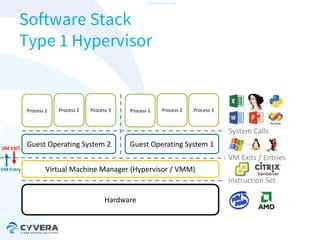
Software Stack
Type 1 Hypervisor

Process 1

Process 2

Process 3

Process 1

Process 2

Process 3

System Calls
VM EXIT

Guest Operating System 2

Guest Operating System 1
VM Exits / Entries

VM Entry

Virtual Machine Manager (Hypervisor / VMM)
Instruction Set
Hardware
-CONFIDENTIAL-

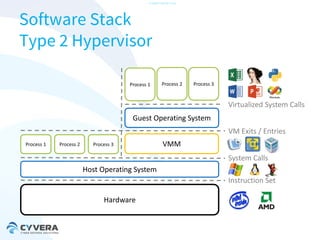
Software Stack
Type 2 Hypervisor
Process 1

Process 2

Process 3

Virtualized System Calls
Guest Operating System
VM Exits / Entries
Process 1

Process 2

Process 3

VMM
System Calls

Host Operating System
Instruction Set
Hardware
-CONFIDENTIAL-

ISA emulation challenges
• A VMM needs to emulate every
instruction or event it registers on
• A VMM must register to a certain set of
instructions and x86 events known as the “fixed-1
exits”
– e.g: CPUID, GETSEC, INVD, XSETBV and various VT ISA

• ISA emulation challenges

– Specification
– Corner cases
– Deciding if the guest has the right privilege from root
operation is hard
• Confused deputy situation…
-CONFIDENTIAL-

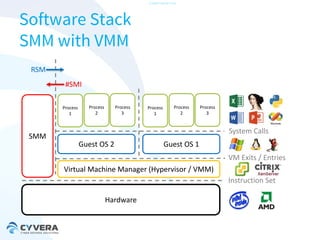
Software Stack
SMM with VMM
RSM
#SMI
Process
1

SMM

Process
2

Process
3

Process
1

Process
2

Process
3

System Calls
Guest OS 2

Guest OS 1
VM Exits / Entries

Virtual Machine Manager (Hypervisor / VMM)
Instruction Set
Hardware
-CONFIDENTIAL-

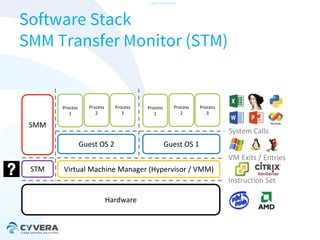
Software Stack
SMM Transfer Monitor (STM)

Process
1

Process
2

Process
3

Process
1

Process
2

Process
3

SMM

System Calls
Guest OS 2

Guest OS 1
VM Exits / Entries

STM

Virtual Machine Manager (Hypervisor / VMM)
Instruction Set
Hardware
-CONFIDENTIAL-

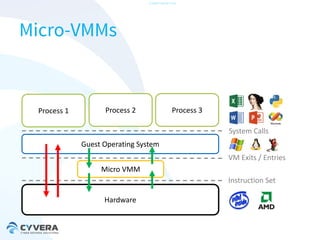
Micro-VMMs

Process 1

Process 2

Process 3

System Calls
Guest Operating System
VM Exits / Entries

Micro VMM
Instruction Set
Hardware
-CONFIDENTIAL-

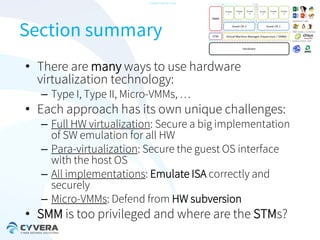
Section summary
• There are many ways to use hardware
virtualization technology:
– Type I, Type II, Micro-VMMs, …

• Each approach has its own unique challenges:

– Full HW virtualization: Secure a big implementation
of SW emulation for all HW
– Para-virtualization: Secure the guest OS interface
with the host OS
– All implementations: Emulate ISA correctly and
securely
– Micro-VMMs: Defend from HW subversion

• SMM is too privileged and where are the STMs?
-CONFIDENTIAL-

MEMORY

Where did I put that instruction?
-CONFIDENTIAL-

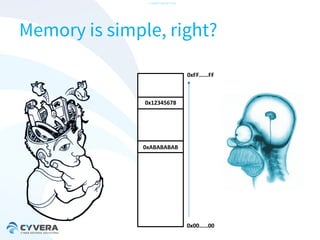
Memory is simple, right?
0xFF…...FF

0x12345678

0xABABABAB

0x00……00
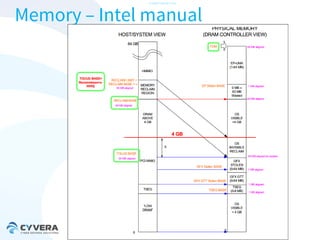
Memory – Intel manual
-CONFIDENTIAL-
-CONFIDENTIAL-

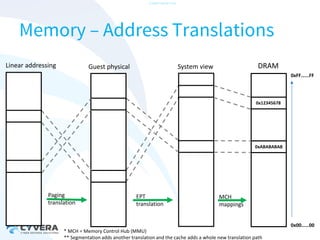
Memory – Address Translations
Linear addressing

DRAM

System view

Guest physical

0xFF…...FF

0x12345678

0xABABABAB

Paging
translation

EPT
translation

MCH
mappings
0x00……00

* MCH = Memory Control Hub (MMU)
** Segmentation adds another translation and the cache adds a whole new translation path
-CONFIDENTIAL-

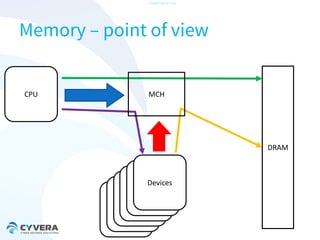
Memory – point of view

CPU

MCH

DRAM

Devices
CPU
CPU
CPU
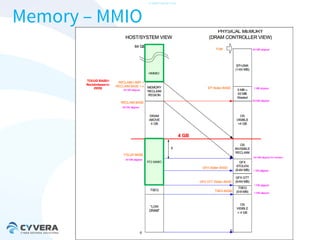
Memory – MMIO

-CONFIDENTIAL-
-CONFIDENTIAL-

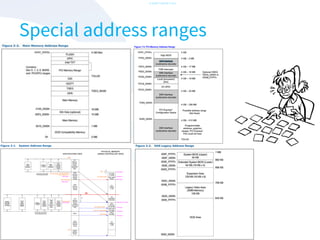
Special address ranges
-CONFIDENTIAL-

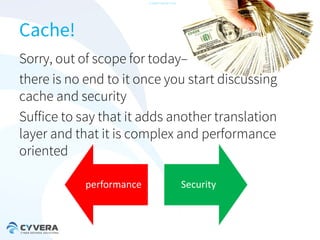
Cache!
Sorry, out of scope for today–
there is no end to it once you start discussing
cache and security
Suffice to say that it adds another translation
layer and that it is complex and performance
oriented
performance

Security
-CONFIDENTIAL-

Section summary
• Memory is complex!
• Attackers with access to MMIO or physical
memory addresses can compromise anything
on the system
• Access to special address ranges is also
dangerous
• EPT can help mitigate some of the problems
– If you can configure it correctly, if it is available
-CONFIDENTIAL-

COMPUTER PLATFORMS

The insides
-CONFIDENTIAL-

What is a computer?
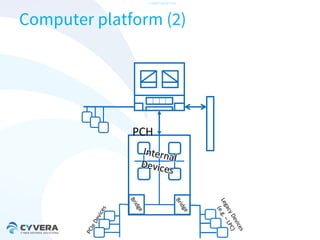
• A very complex device internally
• The logical software architecture can be complex
• Every modern computer system is also a complex
high speed network of interconnecting hardware
components using many communication protocols
-CONFIDENTIAL-

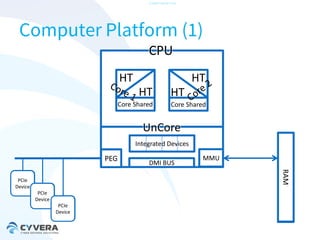
Computer Platform (1)
CPU
HT

HT
HT

Core Shared

HT
Core Shared

UnCore
Integrated Devices

PEG

DMI BUS

MMU

RAM

PCIe
Device

PCIe
Device
PCIe
Device
-CONFIDENTIAL-

Computer platform (2)

PCH
-CONFIDENTIAL-

Device virtualization
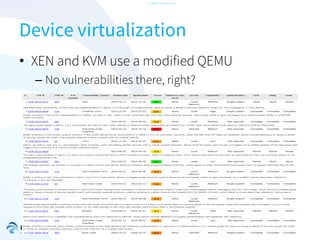
• XEN and KVM use a modified QEMU
– No vulnerabilities there, right?
-CONFIDENTIAL-

VT-d (IOMMU)
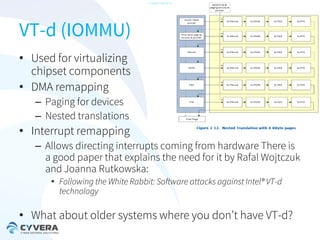
• Used for virtualizing
chipset components
• DMA remapping
– Paging for devices
– Nested translations

• Interrupt remapping
– Allows directing interrupts coming from hardware There is
a good paper that explains the need for it by Rafal Wojtczuk
and Joanna Rutkowska:
• Following the White Rabbit: Software attacks against Intel® VT-d
technology

• What about older systems where you don’t have VT-d?
-CONFIDENTIAL-

Section summary
• Computer hardware is complex!
• Emulating necessary components is
hard:
– Multiple CVEs already found in ACPI and
APIC virtualization as well as QEMU

• VT-d helps virtualizing DMA and
hardware interrupts
– If used correctly
-CONFIDENTIAL-

ATTACK VECTORS TAXONOMY
Potential and practical ones
-CONFIDENTIAL-

Basic Vectors
• ISA Implementation

– Emulating x86 isn’t easy…

• Performance monitoring

– Classic side channels
– Real Time Instruction Tracing – new feature coming up

• Old systems

– New defenses were introduced with the latest HW

• New features

– Approach to new features (CPU/PCH)
• Whitelist or Blacklist?
-CONFIDENTIAL-

Address Space Attacks
• IO Address Space

– How many IO ports are there in x86?
– What happens if we configure port overlaps?

• MMIO Overlaps

– As discussed during the presentation

• Special memory ranges access and overlaps

– What happens when a guest can access special ranges?

• MSR address space

– MSRs define system configuration and behavior
-CONFIDENTIAL-

Privileged Software
• Corrupted ACMs
– ACMs run in a very high privilege, if you can
compromise one…

• CPU/PCH Firmware(s)
– Compromise of the CPU or PCH firmware naturally
allows an attacker to control any VM

• BIOS & SMM
– The BIOS is a common component of the platform and
controls both configuration and SMM code
-CONFIDENTIAL-

Other Interesting Vectors
• Intentional misconfiguration
– It is possible to misconfigure PCIe config space, MSRs or
MMIO constants in order to create unexpected situations
for the VMM

• Server platforms (are fun!)
– Platforms and CPUs for the server market have special
features, all of those usually run in very high privilege

• Errata
– What if there is an Errata in the CPU/PCH behavior we
rely on to emulate something - sucks, right? 
-CONFIDENTIAL-

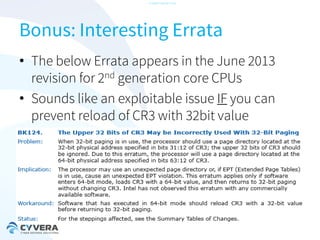
Bonus: Interesting Errata
• The below Errata appears in the June 2013
revision for 2nd generation core CPUs
• Sounds like an exploitable issue IF you can
prevent reload of CR3 with 32bit value
-CONFIDENTIAL-

Summary
• Computer platforms are complex
• There are several approaches to virtualizing
HW, each with its own inherent weaknesses
– Full hardware virtualization: slower and uses SW
emulation, therefore prone to SW vulnerabilities
– Direct hardware access: prone to malicious HW
manipulations (micro-VMMs)

• Better defenses are available only with new
and sometimes also high end HW
-CONFIDENTIAL-

THE END
Contact me at: http://www.cyvera.com/contact
-CONFIDENTIAL-

BACKUP
-CONFIDENTIAL-

Useful tools and info for people
interested in virtualization research
• LOLA by Jeff Forristal (free)

– Because a Python interface to the HW rocks!

• 8 series PCH manuals
• 2nd generation core Errata
• Intel software developer manuals
– Volume 3 contains most information about VT
– Other volumes are also useful to understand what is
emulated

• Patience!
– Hardware debugging, reading long technical manuals
-CONFIDENTIAL-

How different virtualization SW works
• VMware Player
– Emulates 440BX motherboard (15 years old)
– Monitors PCIe configuration, at least IO ports, to
some degree but because of Win95 and Win3.1
compatibility, not security!
-CONFIDENTIAL-

Disclaimer
• All product logos and names used in this
presentation are the property of their
respective owners. I make no claim for
ownership on those. I am merely using them as
examples of such products

Gal Diskin - Virtually Impossible

  • 1.
    -CONFIDENTIAL- Virtually Impossible The Realityof Virtualization Security Gal Diskin / Chief Research Officer / Cyvera LTD.
  • 2.
    -CONFIDENTIAL- /WhoAmI ? • ChiefResearch Officer @ Cvyera LTD • Formerly Security Evaluation Architect of the Software & Services Group @ Intel® • Before that – Entrepreneur, Consultant, IDF • Always a security “enthusiast”  – Personal focus areas: • • • • DBI, Fuzzing & Automated exploitation Exploitation techniques & Mitigations Vehicles & Traffic systems Embedded systems
  • 3.
    -CONFIDENTIAL- ThankZ & GreetZ •My wife – For tolerating me doing security research • Everyone at Cyvera, special thanks to: – Harel Baris for help with the presentation design – Gal Badishi and Ariel Cohen for reviewing • All Intel security people – Especially my old team
  • 4.
    -CONFIDENTIAL- What I willtalk about today Beyond why virtualization is virtually impossible to secure… • Hardware assisted virtualization • SW stacks and different virtualization approaches and related weaknesses • The complexity in memory management and related weaknesses • Computer platforms internals and related weaknesses • Finally, I will present a small taxonomy of attacks against virtualization • Special bonus – potential VM escape ;-)
  • 5.
    -CONFIDENTIAL- What is Virtualization? •In the context of this talk replacing the CPU and computer platform with a virtual environment • A bit of history: – Turing’s universal computing machine – Popek and Goldberg virtualization requirements
  • 6.
    -CONFIDENTIAL- Terminology • A VirtualMachine Manager (VMM) is the software virtualizing privileged instructions and hardware • A Virtual Machine (VM) is a software stack running under a VMM • A Guest OS is the operating system of a VM • A Host OS is the operating system controlling the VMM • Root operation is when you execute inside a VMM
  • 7.
    -CONFIDENTIAL- What is “secure”virtualization? Security Goals: – Prevent modification of VMM and host OS by guests – Prevent guest OS from modifying another guest – Prevent guest from subverting hardware or firmware* – Prevent guest from stealing data from other guest OS / host OS / VMM* – Prevent DOS by guest OS* or getting unfair share of resources relative to other guests* – Keep guest OS secure – don’t harm normal OS defenses* * Depending on the hypervisor design, might be a non-goal
  • 8.
  • 9.
    -CONFIDENTIAL- Software Stack Type 1Hypervisor Process 1 Process 2 Process 3 Process 1 Process 2 Process 3 System Calls VM EXIT Guest Operating System 2 Guest Operating System 1 VM Exits / Entries VM Entry Virtual Machine Manager (Hypervisor / VMM) Instruction Set Hardware
  • 10.
    -CONFIDENTIAL- Software Stack Type 2Hypervisor Process 1 Process 2 Process 3 Virtualized System Calls Guest Operating System VM Exits / Entries Process 1 Process 2 Process 3 VMM System Calls Host Operating System Instruction Set Hardware
  • 11.
    -CONFIDENTIAL- ISA emulation challenges •A VMM needs to emulate every instruction or event it registers on • A VMM must register to a certain set of instructions and x86 events known as the “fixed-1 exits” – e.g: CPUID, GETSEC, INVD, XSETBV and various VT ISA • ISA emulation challenges – Specification – Corner cases – Deciding if the guest has the right privilege from root operation is hard • Confused deputy situation…
  • 12.
    -CONFIDENTIAL- Software Stack SMM withVMM RSM #SMI Process 1 SMM Process 2 Process 3 Process 1 Process 2 Process 3 System Calls Guest OS 2 Guest OS 1 VM Exits / Entries Virtual Machine Manager (Hypervisor / VMM) Instruction Set Hardware
  • 13.
    -CONFIDENTIAL- Software Stack SMM TransferMonitor (STM) Process 1 Process 2 Process 3 Process 1 Process 2 Process 3 SMM System Calls Guest OS 2 Guest OS 1 VM Exits / Entries STM Virtual Machine Manager (Hypervisor / VMM) Instruction Set Hardware
  • 14.
    -CONFIDENTIAL- Micro-VMMs Process 1 Process 2 Process3 System Calls Guest Operating System VM Exits / Entries Micro VMM Instruction Set Hardware
  • 15.
    -CONFIDENTIAL- Section summary • Thereare many ways to use hardware virtualization technology: – Type I, Type II, Micro-VMMs, … • Each approach has its own unique challenges: – Full HW virtualization: Secure a big implementation of SW emulation for all HW – Para-virtualization: Secure the guest OS interface with the host OS – All implementations: Emulate ISA correctly and securely – Micro-VMMs: Defend from HW subversion • SMM is too privileged and where are the STMs?
  • 16.
    -CONFIDENTIAL- MEMORY Where did Iput that instruction?
  • 17.
    -CONFIDENTIAL- Memory is simple,right? 0xFF…...FF 0x12345678 0xABABABAB 0x00……00
  • 18.
    Memory – Intelmanual -CONFIDENTIAL-
  • 19.
    -CONFIDENTIAL- Memory – AddressTranslations Linear addressing DRAM System view Guest physical 0xFF…...FF 0x12345678 0xABABABAB Paging translation EPT translation MCH mappings 0x00……00 * MCH = Memory Control Hub (MMU) ** Segmentation adds another translation and the cache adds a whole new translation path
  • 20.
    -CONFIDENTIAL- Memory – pointof view CPU MCH DRAM Devices CPU CPU CPU
  • 21.
  • 22.
  • 23.
    -CONFIDENTIAL- Cache! Sorry, out ofscope for today– there is no end to it once you start discussing cache and security Suffice to say that it adds another translation layer and that it is complex and performance oriented performance Security
  • 24.
    -CONFIDENTIAL- Section summary • Memoryis complex! • Attackers with access to MMIO or physical memory addresses can compromise anything on the system • Access to special address ranges is also dangerous • EPT can help mitigate some of the problems – If you can configure it correctly, if it is available
  • 25.
  • 26.
    -CONFIDENTIAL- What is acomputer? • A very complex device internally • The logical software architecture can be complex • Every modern computer system is also a complex high speed network of interconnecting hardware components using many communication protocols
  • 27.
    -CONFIDENTIAL- Computer Platform (1) CPU HT HT HT CoreShared HT Core Shared UnCore Integrated Devices PEG DMI BUS MMU RAM PCIe Device PCIe Device PCIe Device
  • 28.
  • 29.
    -CONFIDENTIAL- Device virtualization • XENand KVM use a modified QEMU – No vulnerabilities there, right?
  • 30.
    -CONFIDENTIAL- VT-d (IOMMU) • Usedfor virtualizing chipset components • DMA remapping – Paging for devices – Nested translations • Interrupt remapping – Allows directing interrupts coming from hardware There is a good paper that explains the need for it by Rafal Wojtczuk and Joanna Rutkowska: • Following the White Rabbit: Software attacks against Intel® VT-d technology • What about older systems where you don’t have VT-d?
  • 31.
    -CONFIDENTIAL- Section summary • Computerhardware is complex! • Emulating necessary components is hard: – Multiple CVEs already found in ACPI and APIC virtualization as well as QEMU • VT-d helps virtualizing DMA and hardware interrupts – If used correctly
  • 32.
  • 33.
    -CONFIDENTIAL- Basic Vectors • ISAImplementation – Emulating x86 isn’t easy… • Performance monitoring – Classic side channels – Real Time Instruction Tracing – new feature coming up • Old systems – New defenses were introduced with the latest HW • New features – Approach to new features (CPU/PCH) • Whitelist or Blacklist?
  • 34.
    -CONFIDENTIAL- Address Space Attacks •IO Address Space – How many IO ports are there in x86? – What happens if we configure port overlaps? • MMIO Overlaps – As discussed during the presentation • Special memory ranges access and overlaps – What happens when a guest can access special ranges? • MSR address space – MSRs define system configuration and behavior
  • 35.
    -CONFIDENTIAL- Privileged Software • CorruptedACMs – ACMs run in a very high privilege, if you can compromise one… • CPU/PCH Firmware(s) – Compromise of the CPU or PCH firmware naturally allows an attacker to control any VM • BIOS & SMM – The BIOS is a common component of the platform and controls both configuration and SMM code
  • 36.
    -CONFIDENTIAL- Other Interesting Vectors •Intentional misconfiguration – It is possible to misconfigure PCIe config space, MSRs or MMIO constants in order to create unexpected situations for the VMM • Server platforms (are fun!) – Platforms and CPUs for the server market have special features, all of those usually run in very high privilege • Errata – What if there is an Errata in the CPU/PCH behavior we rely on to emulate something - sucks, right? 
  • 37.
    -CONFIDENTIAL- Bonus: Interesting Errata •The below Errata appears in the June 2013 revision for 2nd generation core CPUs • Sounds like an exploitable issue IF you can prevent reload of CR3 with 32bit value
  • 38.
    -CONFIDENTIAL- Summary • Computer platformsare complex • There are several approaches to virtualizing HW, each with its own inherent weaknesses – Full hardware virtualization: slower and uses SW emulation, therefore prone to SW vulnerabilities – Direct hardware access: prone to malicious HW manipulations (micro-VMMs) • Better defenses are available only with new and sometimes also high end HW
  • 39.
    -CONFIDENTIAL- THE END Contact meat: http://www.cyvera.com/contact
  • 40.
  • 41.
    -CONFIDENTIAL- Useful tools andinfo for people interested in virtualization research • LOLA by Jeff Forristal (free) – Because a Python interface to the HW rocks! • 8 series PCH manuals • 2nd generation core Errata • Intel software developer manuals – Volume 3 contains most information about VT – Other volumes are also useful to understand what is emulated • Patience! – Hardware debugging, reading long technical manuals
  • 42.
    -CONFIDENTIAL- How different virtualizationSW works • VMware Player – Emulates 440BX motherboard (15 years old) – Monitors PCIe configuration, at least IO ports, to some degree but because of Win95 and Win3.1 compatibility, not security!
  • 43.
    -CONFIDENTIAL- Disclaimer • All productlogos and names used in this presentation are the property of their respective owners. I make no claim for ownership on those. I am merely using them as examples of such products