GAIN MEDIA
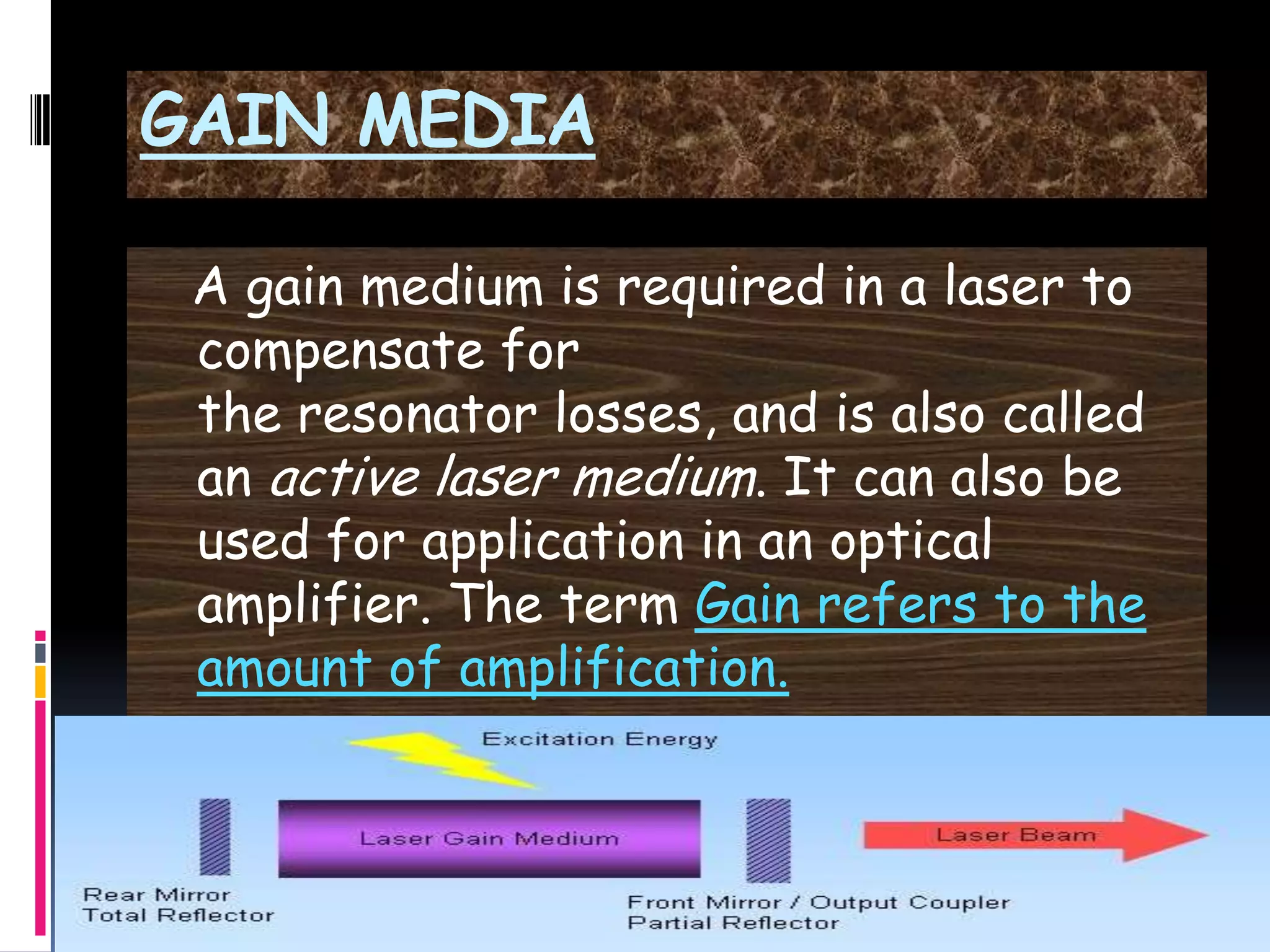
A gain medium is required in a laser to
compensate for
the resonator losses, and is also called
an active laser medium. It can also be
used for application in an optical
amplifier. The term Gain refers to the
amount of amplification.
TYPES OF LASER GAIN
MEDIA
There are 3 medium – Gas, Liquid, Solid.
a laser transition in the desired wavelength
region, results in maximum gain.
 GAS LASERS- e.g. in CO2 and Excimer
Lasers
They have narrow wavelength region where
there is appreciable optical gain because
the spectroscopic transitions are sharp.
 LIQUID LASERS- e.g in Dye Lasers
Have broad region for optical gain
corresponding to their flurescence.
 SOLID STATE LASERS- e.g Nd: YAG
Have either narrow or broad range region
depending upon the nature of
fluorescence.
PUMPING
As the gain medium adds energy to the
amplified light, it must itself receive
some energy through a process called
pumping.
There are 2 basic pumping mechanism
1) OPTICAL PUMPING
2) ELECTRICAL PUMPING
OPTICAL PUMPING
Optically pumping some medium essentially
means to inject light in order to
electronically excite the medium or some
of its constituents into other (usually
higher-lying) energy levels. In the context
of lasers or laser amplifiers, the goal is to
achieve a population inversion in the gain
medium and thus to obtain optical
amplification via stimulated emission for
some range of optical frequencies.
One can use strong and incoherent Black body
source or Coherent Laser for exciting laser
medium to excited states.
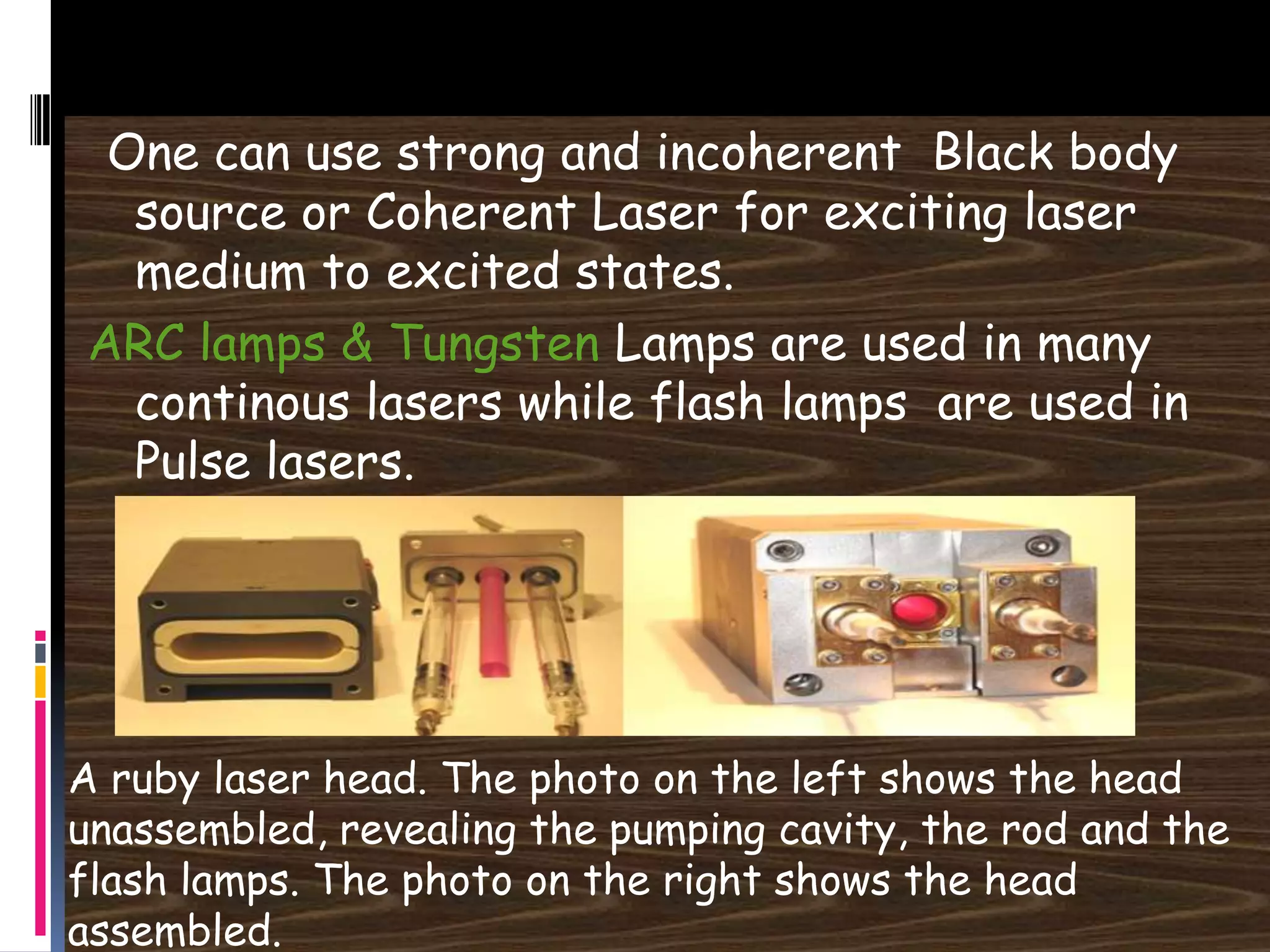
ARC lamps & Tungsten Lamps are used in many
continous lasers while flash lamps are used in
Pulse lasers.
A ruby laser head. The photo on the left shows the head
unassembled, revealing the pumping cavity, the rod and the
flash lamps. The photo on the right shows the head
assembled.
ELECTRICAL PUMPING
Discharge is created in Gain media which excites
the population inversion.
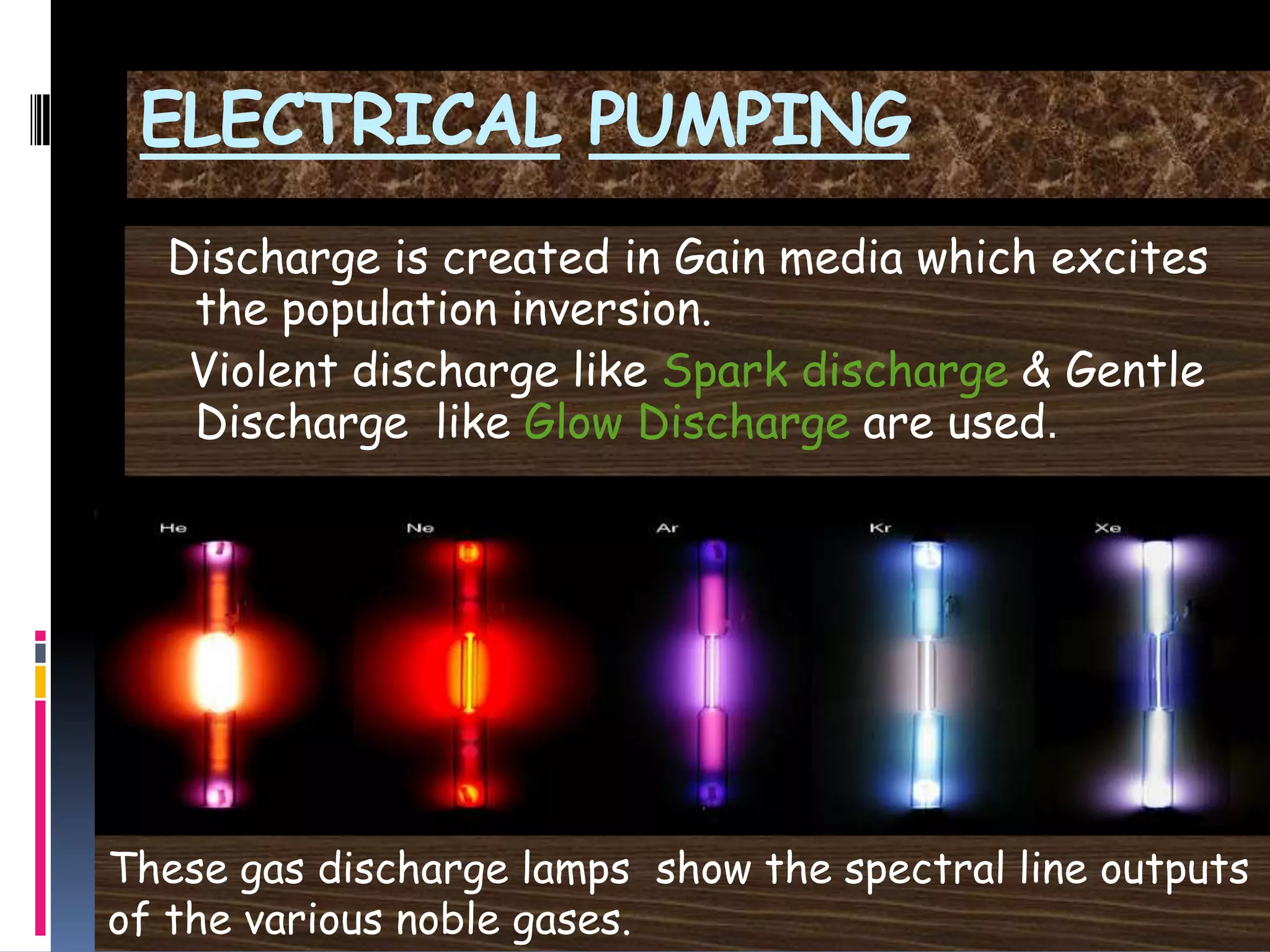
Violent discharge like Spark discharge & Gentle
Discharge like Glow Discharge are used.
These gas discharge lamps show the spectral line outputs
of the various noble gases.
LASER RESONATOR
A laser requires a laser resonator (or laser
cavity), in which the laser radiation can
circulate and pass a gain medium which
compensates the optical losses.
It provides a means by which an operator
can control a Laser. Control is achieved by
adjusting the losses experienced by Cavity .
High losses are chosen for most which are
not desired and low losses for selected band
of frequencies.
Q- SWITCHING
 Q-switching, sometimes known as giant
pulse formation, is a technique by which
a laser can be made to produce a pulsed
output beam. The technique allows the
production of light pulses with extremely
high (giga watt) peak power, much higher
than would be produced by the same laser
if it were operating in a continuous
wave (constant output) mode. Compared
to mode locking, another technique for
pulse generation with lasers, Q-switching
leads to much lower pulse repetition
rates, much higher pulse energies, and
much longer pulse durations.
It’s a technique that provide very high
output power from pulsed laser. Crossed
polariser are placed within cavity to
prevent any lasing as every time the light
travel to & fro in cavity so its phase is
changed. Such photon are mutually out of
phase & interact destructively never
allowing laser to amplify.
POCKEL CELL
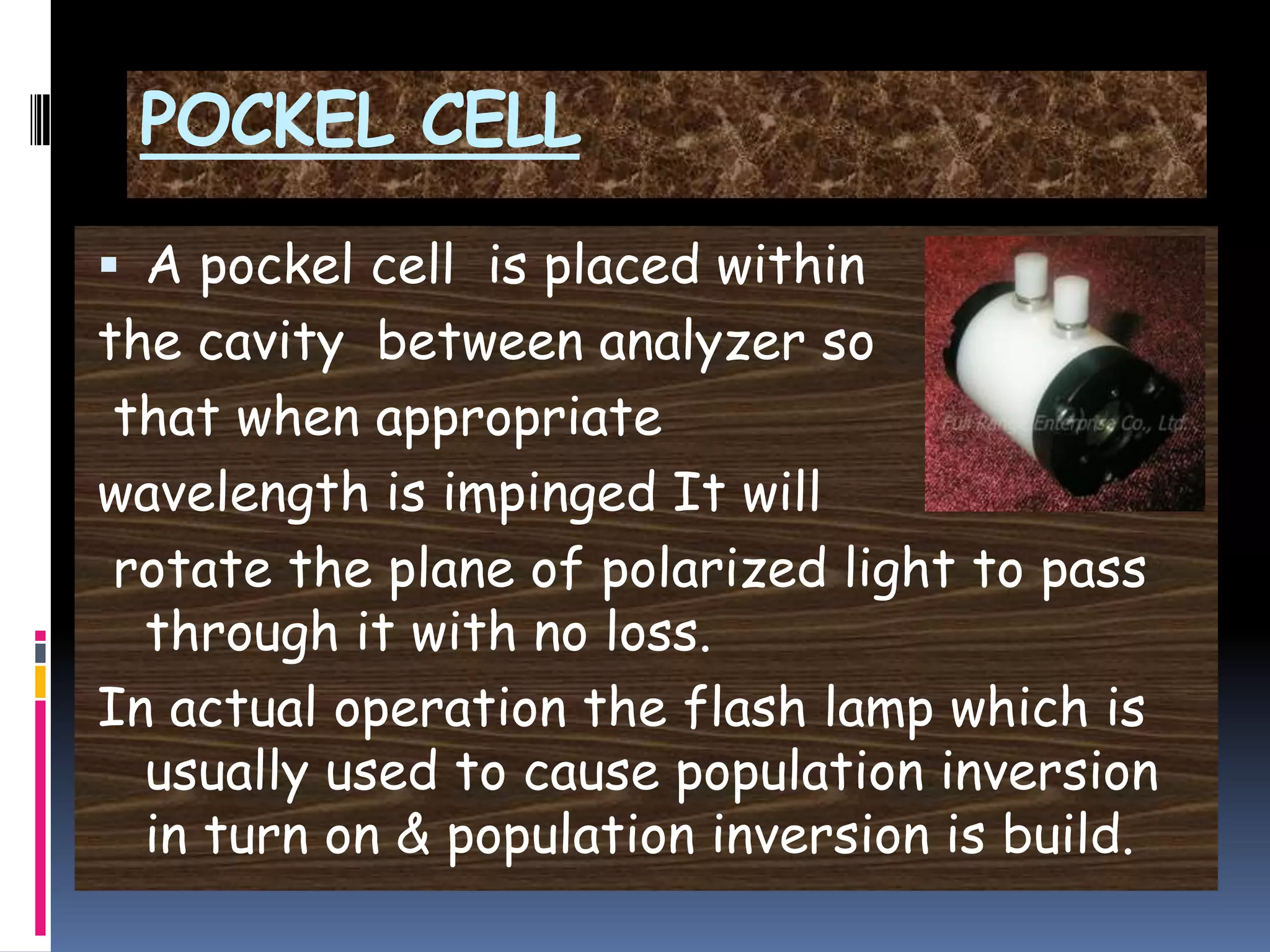
 A pockel cell is placed within
the cavity between analyzer so
that when appropriate
wavelength is impinged It will
rotate the plane of polarized light to pass
through it with no loss.
In actual operation the flash lamp which is
usually used to cause population inversion
in turn on & population inversion is build.
When population inversion is at
maximum the pockel cell is burst so
that lasing occurs. By this time the
excited population has become so
great that a strong burst of laser
emission is emitted causing rapid
depletion of population inversion.
This process is called Q- Switching.
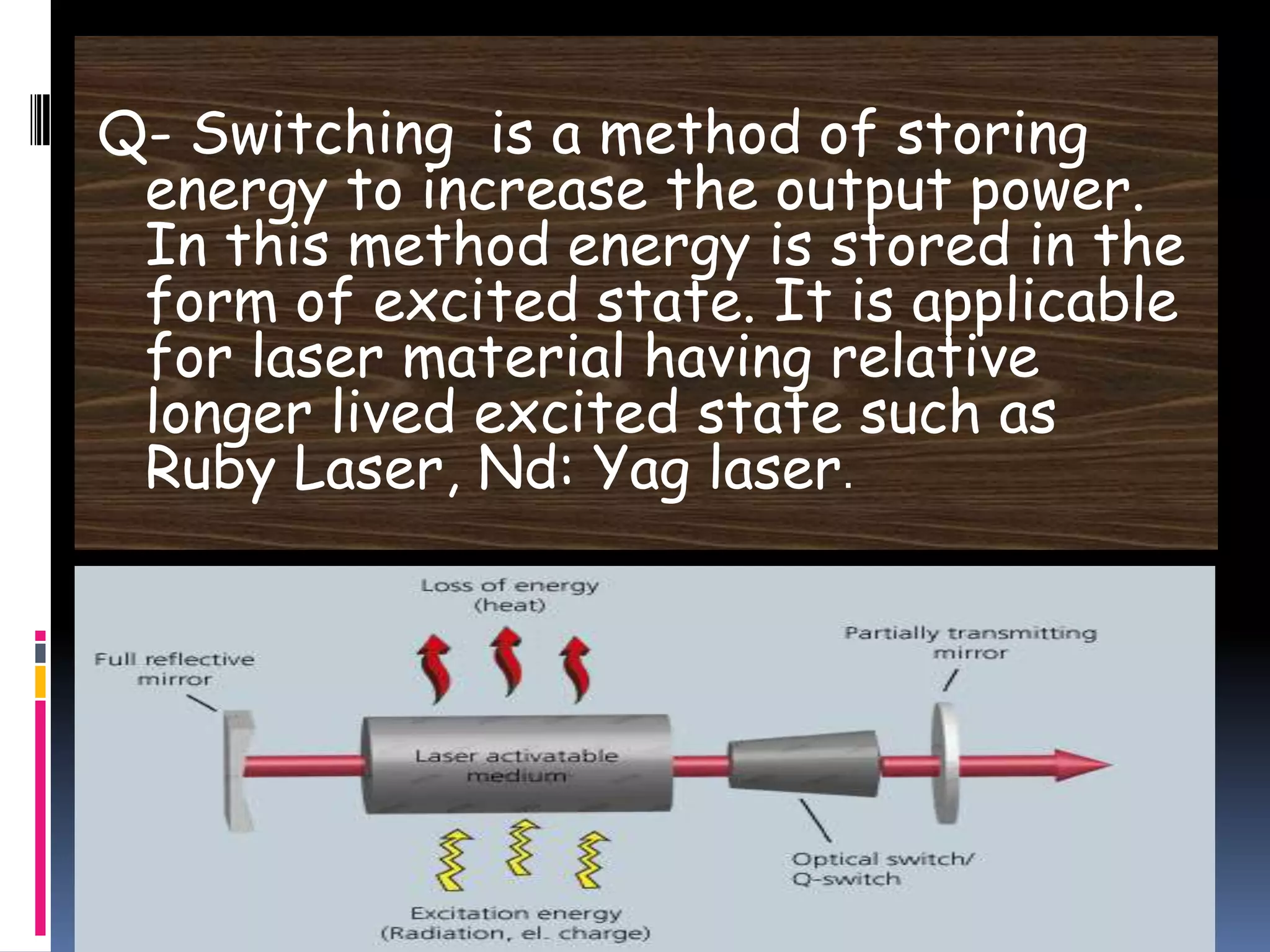
Q- Switching is a method of storing
energy to increase the output power.
In this method energy is stored in the
form of excited state. It is applicable
for laser material having relative
longer lived excited state such as
Ruby Laser, Nd: Yag laser.
THANK
YOU

Gain media & q switching

  • 2.
    GAIN MEDIA A gainmedium is required in a laser to compensate for the resonator losses, and is also called an active laser medium. It can also be used for application in an optical amplifier. The term Gain refers to the amount of amplification.
  • 3.
    TYPES OF LASERGAIN MEDIA There are 3 medium – Gas, Liquid, Solid. a laser transition in the desired wavelength region, results in maximum gain.  GAS LASERS- e.g. in CO2 and Excimer Lasers They have narrow wavelength region where there is appreciable optical gain because the spectroscopic transitions are sharp.  LIQUID LASERS- e.g in Dye Lasers Have broad region for optical gain corresponding to their flurescence.
  • 4.
     SOLID STATELASERS- e.g Nd: YAG Have either narrow or broad range region depending upon the nature of fluorescence.
  • 5.
    PUMPING As the gainmedium adds energy to the amplified light, it must itself receive some energy through a process called pumping. There are 2 basic pumping mechanism 1) OPTICAL PUMPING 2) ELECTRICAL PUMPING
  • 6.
    OPTICAL PUMPING Optically pumpingsome medium essentially means to inject light in order to electronically excite the medium or some of its constituents into other (usually higher-lying) energy levels. In the context of lasers or laser amplifiers, the goal is to achieve a population inversion in the gain medium and thus to obtain optical amplification via stimulated emission for some range of optical frequencies.
  • 7.
    One can usestrong and incoherent Black body source or Coherent Laser for exciting laser medium to excited states. ARC lamps & Tungsten Lamps are used in many continous lasers while flash lamps are used in Pulse lasers. A ruby laser head. The photo on the left shows the head unassembled, revealing the pumping cavity, the rod and the flash lamps. The photo on the right shows the head assembled.
  • 8.
    ELECTRICAL PUMPING Discharge iscreated in Gain media which excites the population inversion. Violent discharge like Spark discharge & Gentle Discharge like Glow Discharge are used. These gas discharge lamps show the spectral line outputs of the various noble gases.
  • 9.
    LASER RESONATOR A laserrequires a laser resonator (or laser cavity), in which the laser radiation can circulate and pass a gain medium which compensates the optical losses. It provides a means by which an operator can control a Laser. Control is achieved by adjusting the losses experienced by Cavity . High losses are chosen for most which are not desired and low losses for selected band of frequencies.
  • 10.
    Q- SWITCHING  Q-switching,sometimes known as giant pulse formation, is a technique by which a laser can be made to produce a pulsed output beam. The technique allows the production of light pulses with extremely high (giga watt) peak power, much higher than would be produced by the same laser if it were operating in a continuous wave (constant output) mode. Compared to mode locking, another technique for pulse generation with lasers, Q-switching leads to much lower pulse repetition rates, much higher pulse energies, and much longer pulse durations.
  • 11.
    It’s a techniquethat provide very high output power from pulsed laser. Crossed polariser are placed within cavity to prevent any lasing as every time the light travel to & fro in cavity so its phase is changed. Such photon are mutually out of phase & interact destructively never allowing laser to amplify.
  • 12.
    POCKEL CELL  Apockel cell is placed within the cavity between analyzer so that when appropriate wavelength is impinged It will rotate the plane of polarized light to pass through it with no loss. In actual operation the flash lamp which is usually used to cause population inversion in turn on & population inversion is build.
  • 13.
    When population inversionis at maximum the pockel cell is burst so that lasing occurs. By this time the excited population has become so great that a strong burst of laser emission is emitted causing rapid depletion of population inversion. This process is called Q- Switching.
  • 14.
    Q- Switching isa method of storing energy to increase the output power. In this method energy is stored in the form of excited state. It is applicable for laser material having relative longer lived excited state such as Ruby Laser, Nd: Yag laser.
  • 15.