Two Kinds
from The Joy Luck
Club
G7 W1
BY: Nelly Elzeny
Table of contents
01
04
02
05
03
Text Background Genre New Vocabulary
Text Analysis SB Questions &
Answers
Author &
Text
Background
01
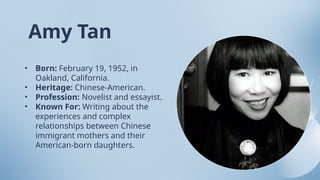
• Born: February 19, 1952, in
Oakland, California.
• Heritage: Chinese-American.
• Profession: Novelist and essayist.
• Known For: Writing about the
experiences and complex
relationships between Chinese
immigrant mothers and their
American-born daughters.
Amy Tan
Text Background
●In 1949, following years of civil war, the
Communist party seized control of China. A
number of Chinese who feared Communists—
like the mother in “Two Kinds”—fled to the
United States. Many lost everything except
their hopes for a better future. They placed
these hopes on the shoulders of their children
born in the new land.
Genre
02
Scan page 13 for the
genre 👁‍
🗨
NOVEL
EXCERPT
● Imagine your favorite short story.
Now imagine that story was
much, much longer, with more
characters, bigger problems, and
several plot twists. That’s a novel!
i. A novel is a long work of
fiction. "Fiction" means the story is
made up from the author's
imagination (even if it's based on
real events).
ii. It's written in prose (regular writing,
not poetry).
iii. It's usually long enough to be
published as its own book.
Think of it like this: If a short story is
a single song, a novel is the entire
album.
💬The word "novel" comes from the Italian
word "novella," which means "new."
Hundreds of years ago, a "novella" was the
name for a short, new story. Eventually,
these stories got longer and longer, and
the name stuck!
💬What Makes a Novel
Special? The Key
Ingredients
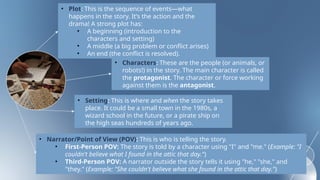
• Plot: This is the sequence of events—what
happens in the story. It’s the action and the
drama! A strong plot has:
• A beginning (introduction to the
characters and setting)
• A middle (a big problem or conflict arises)
• An end (the conflict is resolved).
• Characters: These are the people (or animals, or
robots!) in the story. The main character is called
the protagonist. The character or force working
against them is the antagonist.
• Setting: This is where and when the story takes
place. It could be a small town in the 1980s, a
wizard school in the future, or a pirate ship on
the high seas hundreds of years ago.
• Narrator/Point of View (POV): This is who is telling the story.
• First-Person POV: The story is told by a character using "I" and "me." (Example: "I
couldn't believe what I found in the attic that day.")
• Third-Person POV: A narrator outside the story tells it using "he," "she," and
"they." (Example: "She couldn't believe what she found in the attic that day.")
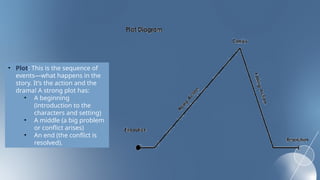
• Plot: This is the sequence of
events—what happens in the
story. It’s the action and the
drama! A strong plot has:
• A beginning
(introduction to the
characters and setting)
• A middle (a big problem
or conflict arises)
• An end (the conflict is
resolved).
1. What is the main definition of a novel?
a) A short, true story
b) A long work of fiction
c) A collection of poems
d) A factual news article
2. Who is the main character in a novel, often called the hero?
a) The Antagonist
b) The Illustrator
c) The Protagonist
d) The Narrator
3. Which of the following describes the "setting" of a novel?
a) The main problem in the story
b) The lesson the author wants to teach
c) The time and place where the story happens
d) The person telling the story
4. If a story is set in the future with advanced technology and space travel, what genre is it most likely to be?
a) Historical Fiction
b) Realistic Fiction
c) Fantasy
d) Science Fiction
5. What do we call the central message or big idea that the author wants to share?
a) The Plot
b) The Theme
c) The Conflict
d) The Climax
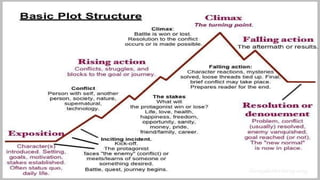
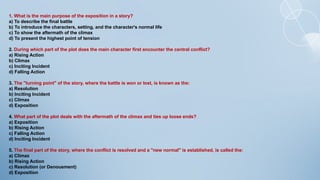
1. What is the main purpose of the exposition in a story?
a) To describe the final battle
b) To introduce the characters, setting, and the character's normal life
c) To show the aftermath of the climax
d) To present the highest point of tension
2. During which part of the plot does the main character first encounter the central conflict?
a) Rising Action
b) Climax
c) Inciting Incident
d) Falling Action
3. The "turning point" of the story, where the battle is won or lost, is known as the:
a) Resolution
b) Inciting Incident
c) Climax
d) Exposition
4. What part of the plot deals with the aftermath of the climax and ties up loose ends?
a) Exposition
b) Rising Action
c) Falling Action
d) Inciting Incident
5. The final part of the story, where the conflict is resolved and a "new normal" is established, is called the:
a) Climax
b) Rising Action
c) Resolution (or Denouement)
d) Exposition
New
Vocabulary
03
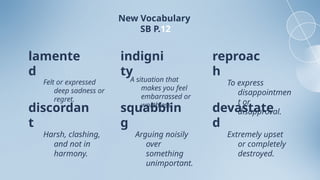
New Vocabulary
SB P.12
lamente
d
discordan
t
indigni
ty
squabblin
g
reproac
h
devastate
d
Felt or expressed
deep sadness or
regret.
A situation that
makes you feel
embarrassed or
worthless.
To express
disappointmen
t or
disapproval.
Harsh, clashing,
and not in
harmony.
Arguing noisily
over
something
unimportant.
Extremely upset
or completely
destroyed.
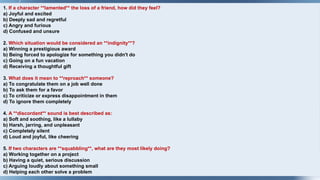
1. If a character **lamented** the loss of a friend, how did they feel?
a) Joyful and excited
b) Deeply sad and regretful
c) Angry and furious
d) Confused and unsure
2. Which situation would be considered an **indignity**?
a) Winning a prestigious award
b) Being forced to apologize for something you didn't do
c) Going on a fun vacation
d) Receiving a thoughtful gift
3. What does it mean to **reproach** someone?
a) To congratulate them on a job well done
b) To ask them for a favor
c) To criticize or express disappointment in them
d) To ignore them completely
4. A **discordant** sound is best described as:
a) Soft and soothing, like a lullaby
b) Harsh, jarring, and unpleasant
c) Completely silent
d) Loud and joyful, like cheering
5. If two characters are **squabbling**, what are they most likely doing?
a) Working together on a project
b) Having a quiet, serious discussion
c) Arguing loudly about something small
d) Helping each other solve a problem
Text Analysis
04
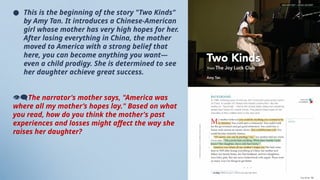
● This is the beginning of the story "Two Kinds"
by Amy Tan. It introduces a Chinese-American
girl whose mother has very high hopes for her.
After losing everything in China, the mother
moved to America with a strong belief that
here, you can become anything you want—
even a child prodigy. She is determined to see
her daughter achieve great success.
👁‍
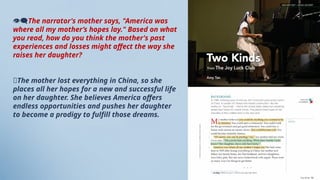
🗨The narrator's mother says, "America was
where all my mother’s hopes lay." Based on what
you read, how do you think the mother's past
experiences and losses might affect the way she
raises her daughter?
👁‍
🗨The narrator's mother says, "America was
where all my mother’s hopes lay." Based on what
you read, how do you think the mother's past
experiences and losses might affect the way she
raises her daughter?
👤The mother lost everything in China, so she
places all her hopes for a new and successful life
on her daughter. She believes America offers
endless opportunities and pushes her daughter
to become a prodigy to fulfill those dreams.
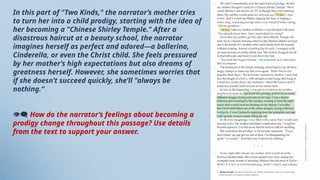
In this part of "Two Kinds," the narrator’s mother tries
to turn her into a child prodigy, starting with the idea of
her becoming a "Chinese Shirley Temple." After a
disastrous haircut at a beauty school, the narrator
imagines herself as perfect and adored—a ballerina,
Cinderella, or even the Christ child. She feels pressured
by her mother’s high expectations but also dreams of
greatness herself. However, she sometimes worries that
if she doesn’t succeed quickly, she’ll "always be
nothing.“
👁‍
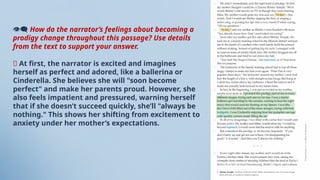
🗨 How do the narrator’s feelings about becoming a
prodigy change throughout this passage? Use details
from the text to support your answer.
👁‍
🗨 How do the narrator’s feelings about becoming a
prodigy change throughout this passage? Use details
from the text to support your answer.
👤 At first, the narrator is excited and imagines
herself as perfect and adored, like a ballerina or
Cinderella. She believes she will "soon become
perfect" and make her parents proud. However, she
also feels impatient and pressured, warning herself
that if she doesn’t succeed quickly, she’ll "always be
nothing." This shows her shifting from excitement to
anxiety under her mother’s expectations.
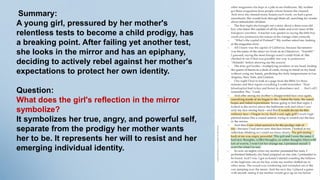
Summary:
A young girl, pressured by her mother's
relentless tests to become a child prodigy, has
a breaking point. After failing yet another test,
she looks in the mirror and has an epiphany,
deciding to actively rebel against her mother's
expectations to protect her own identity.
Question:
What does the girl's reflection in the mirror
symbolize?
It symbolizes her true, angry, and powerful self,
separate from the prodigy her mother wants
her to be. It represents her will to resist and her
emerging individual identity.
Summary:
The narrator's mother temporarily gave up on
her prodigy tests, but her hope is reignited
after seeing a young, talented Chinese girl
playing the piano on *The Ed Sullivan Show*,
captivating her completely.
Question:
Why does the performance on TV so instantly
captivate the narrator's mother?
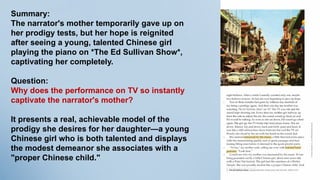
It presents a real, achievable model of the
prodigy she desires for her daughter—a young
Chinese girl who is both talented and displays
the modest demeanor she associates with a
"proper Chinese child."
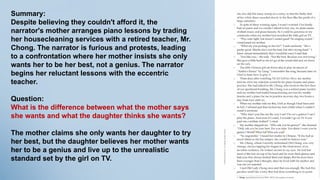
Summary:
Despite believing they couldn't afford it, the
narrator's mother arranges piano lessons by trading
her housecleaning services with a retired teacher, Mr.
Chong. The narrator is furious and protests, leading
to a confrontation where her mother insists she only
wants her to be her best, not a genius. The narrator
begins her reluctant lessons with the eccentric
teacher.
Question:
What is the difference between what the mother says
she wants and what the daughter thinks she wants?
The mother claims she only wants her daughter to try
her best, but the daughter believes her mother wants
her to be a genius and live up to the unrealistic
standard set by the girl on TV.
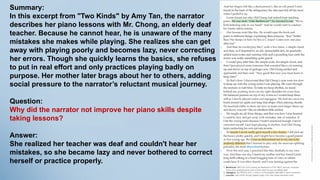
Summary:
In this excerpt from "Two Kinds" by Amy Tan, the narrator
describes her piano lessons with Mr. Chong, an elderly deaf
teacher. Because he cannot hear, he is unaware of the many
mistakes she makes while playing. She realizes she can get
away with playing poorly and becomes lazy, never correcting
her errors. Though she quickly learns the basics, she refuses
to put in real effort and only practices playing badly on
purpose. Her mother later brags about her to others, adding
social pressure to the narrator’s reluctant musical journey.
Question:
Why did the narrator not improve her piano skills despite
taking lessons?
Answer:
She realized her teacher was deaf and couldn't hear her
mistakes, so she became lazy and never bothered to correct
herself or practice properly.
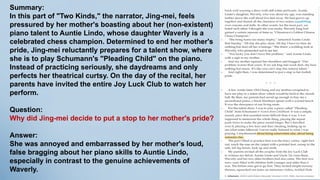
Summary:
In this part of "Two Kinds," the narrator, Jing-mei, feels
pressured by her mother's boasting about her (non-existent)
piano talent to Auntie Lindo, whose daughter Waverly is a
celebrated chess champion. Determined to end her mother's
pride, Jing-mei reluctantly prepares for a talent show, where
she is to play Schumann's "Pleading Child" on the piano.
Instead of practicing seriously, she daydreams and only
perfects her theatrical curtsy. On the day of the recital, her
parents have invited the entire Joy Luck Club to watch her
perform.
Question:
Why did Jing-mei decide to put a stop to her mother's pride?
Answer:
She was annoyed and embarrassed by her mother's loud,
false bragging about her piano skills to Auntie Lindo,
especially in contrast to the genuine achievements of
Waverly.
Summary:
In this passage, Jing-mei's confidence at the talent show quickly
shatters when she begins to play the piano and realizes she is
making numerous mistakes. Despite her hopes, the audience hears
her poor performance. While her teacher, Mr. Chong, cheers
enthusiastically, she sees the pained expression on her mother's face
and hears the weak applause and critical whispers from the crowd.
Overwhelmed by shame, she is acutely aware of her failure and the
disappointment she has caused her parents, who remain in their
seats out of pride for the rest of the show.
Question:
What was the audience's reaction to Jing-mei's performance?
Answer:
The audience reacted with weak applause and critical whispers. A
little boy loudly called it "awful," and his mother replied that Jing-mei
"certainly tried." Mr. Chong was the only one who cheered
enthusiastically, while her mother looked stricken and pained.
Summary:
After the disastrous talent show, Jing-mei faces the reactions of her
family and friends. While Auntie Lindo offers a vague compliment and
her father makes a cryptic comment, Waverly openly declares that
Jing-mei is not a genius. The most crushing response is her mother's
silent, devastated expression, which makes Jing-mei feel a profound
sense of loss and shame. To her surprise, her mother does not scold
her. However, two days later, her mother insists that she resume her
piano practice as if nothing happened. This leads Jing-mei to
defiantly refuse, declaring she is not a genius and will not play
anymore, which angers her mother.
Question:
How did Jing-mei's mother react after the talent show, and how did it
affect Jing-mei?
Answer:
Jing-mei's mother had a quiet, blank, and devastated expression,
which made Jing-mei feel that she had lost everything and that her
mother had lost all hope in her. The lack of shouting or blame left
Jing-mei feeling unexpectedly disappointed and even more
miserable, as she had prepared to retaliate and release her own
frustration.
Summary:
After the disastrous talent show, Jing-mei faces the reactions of her family
and friends. While Auntie Lindo offers a vague compliment and her father
makes a cryptic comment, Waverly openly declares that Jing-mei is not a
genius. The most crushing response is her mother's silent, devastated
expression, which makes Jing-mei feel a profound sense of loss and shame.
To her surprise, her mother does not scold her. However, two days later, her
mother insists that she resume her piano practice as if nothing happened.
This leads Jing-mei to defiantly refuse, declaring she is not a genius and
will not play anymore, which angers her mother.
Question:
How did Jing-mei's mother react after the talent show, and how did it affect
Jing-mei?
Answer:
Jing-mei's mother had a quiet, blank, and devastated expression, which
made Jing-mei feel that she had lost everything and that her mother had lost
all hope in her. The lack of shouting or blame left Jing-mei feeling
unexpectedly disappointed and even more miserable, as she had prepared
to retaliate and release her own frustration.
Summary:
After years of not playing, the narrator’s mother
offers to give her the piano for her thirtieth
birthday. The mother insists the piano always
belonged to the daughter and encourages her to
play again, believing she still has natural talent.
Although the daughter initially refuses, the offer
feels like forgiveness and makes her proud.
Question:
Why did the mother offer the piano to her
daughter?
Answer:
As a sign of forgiveness and because she believed
her daughter was the only one who could truly
play it.
Summary:
After her mother's death, the narrator has her
childhood piano tuned. While going through old
music books, she rediscovers two pieces she once
played: "Pleading Child" and "Perfectly
Contented." She realizes they are two halves of the
same song.
Question:
What did the narrator realize about the two piano
pieces?
Answer:
She realized that "Pleading Child" and "Perfectly
Contented" were two halves of the same song.
SB Questions
Page: 25
Answers:
1. She pressures her daughter to become a child prodigy. First she pressures the
daughter to become an actress. Next, she pressures her to learn facts in order to
appear on television. Then, she pressures her to become an accomplished pianist.
2. The mother exchanges housecleaning services for piano lessons from Mr. Chong, a
retired piano teacher who lives in their apartment building.
3. The narrator practices as little as she can for the talent show. She purposely makes
no effort, and because Mr. Chong is deaf and cannot hear how well she is playing, he
does not notice.
4. The narrator’s piano performance at the recital is terrible, and no one applauds except
for T be angry because she was so poorly prepared. Instead, the mother shows only a
quiet, blank look that said she had lost everything.
5. The mother gives the daughter the old piano. The daughter has it tuned and plays the
same song that she played at the talent show.

G7 Two Kinds.pptx..........................

G7 Two Kinds.pptx..........................

  • 1.
    Two Kinds from TheJoy Luck Club G7 W1 BY: Nelly Elzeny
  • 2.
    Table of contents 01 04 02 05 03 TextBackground Genre New Vocabulary Text Analysis SB Questions & Answers
  • 3.
  • 4.
    • Born: February19, 1952, in Oakland, California. • Heritage: Chinese-American. • Profession: Novelist and essayist. • Known For: Writing about the experiences and complex relationships between Chinese immigrant mothers and their American-born daughters. Amy Tan
  • 5.
    Text Background ●In 1949,following years of civil war, the Communist party seized control of China. A number of Chinese who feared Communists— like the mother in “Two Kinds”—fled to the United States. Many lost everything except their hopes for a better future. They placed these hopes on the shoulders of their children born in the new land.
  • 6.
  • 7.
    Scan page 13for the genre 👁‍ 🗨
  • 8.
    NOVEL EXCERPT ● Imagine yourfavorite short story. Now imagine that story was much, much longer, with more characters, bigger problems, and several plot twists. That’s a novel!
  • 9.
    i. A novelis a long work of fiction. "Fiction" means the story is made up from the author's imagination (even if it's based on real events). ii. It's written in prose (regular writing, not poetry). iii. It's usually long enough to be published as its own book.
  • 10.
    Think of itlike this: If a short story is a single song, a novel is the entire album. 💬The word "novel" comes from the Italian word "novella," which means "new." Hundreds of years ago, a "novella" was the name for a short, new story. Eventually, these stories got longer and longer, and the name stuck!
  • 11.
    💬What Makes aNovel Special? The Key Ingredients
  • 12.
    • Plot: Thisis the sequence of events—what happens in the story. It’s the action and the drama! A strong plot has: • A beginning (introduction to the characters and setting) • A middle (a big problem or conflict arises) • An end (the conflict is resolved). • Characters: These are the people (or animals, or robots!) in the story. The main character is called the protagonist. The character or force working against them is the antagonist. • Setting: This is where and when the story takes place. It could be a small town in the 1980s, a wizard school in the future, or a pirate ship on the high seas hundreds of years ago. • Narrator/Point of View (POV): This is who is telling the story. • First-Person POV: The story is told by a character using "I" and "me." (Example: "I couldn't believe what I found in the attic that day.") • Third-Person POV: A narrator outside the story tells it using "he," "she," and "they." (Example: "She couldn't believe what she found in the attic that day.")
  • 13.
    • Plot: Thisis the sequence of events—what happens in the story. It’s the action and the drama! A strong plot has: • A beginning (introduction to the characters and setting) • A middle (a big problem or conflict arises) • An end (the conflict is resolved).
  • 15.
    1. What isthe main definition of a novel? a) A short, true story b) A long work of fiction c) A collection of poems d) A factual news article 2. Who is the main character in a novel, often called the hero? a) The Antagonist b) The Illustrator c) The Protagonist d) The Narrator 3. Which of the following describes the "setting" of a novel? a) The main problem in the story b) The lesson the author wants to teach c) The time and place where the story happens d) The person telling the story 4. If a story is set in the future with advanced technology and space travel, what genre is it most likely to be? a) Historical Fiction b) Realistic Fiction c) Fantasy d) Science Fiction 5. What do we call the central message or big idea that the author wants to share? a) The Plot b) The Theme c) The Conflict d) The Climax
  • 16.
    1. What isthe main purpose of the exposition in a story? a) To describe the final battle b) To introduce the characters, setting, and the character's normal life c) To show the aftermath of the climax d) To present the highest point of tension 2. During which part of the plot does the main character first encounter the central conflict? a) Rising Action b) Climax c) Inciting Incident d) Falling Action 3. The "turning point" of the story, where the battle is won or lost, is known as the: a) Resolution b) Inciting Incident c) Climax d) Exposition 4. What part of the plot deals with the aftermath of the climax and ties up loose ends? a) Exposition b) Rising Action c) Falling Action d) Inciting Incident 5. The final part of the story, where the conflict is resolved and a "new normal" is established, is called the: a) Climax b) Rising Action c) Resolution (or Denouement) d) Exposition
  • 17.
  • 18.
    New Vocabulary SB P.12 lamente d discordan t indigni ty squabblin g reproac h devastate d Feltor expressed deep sadness or regret. A situation that makes you feel embarrassed or worthless. To express disappointmen t or disapproval. Harsh, clashing, and not in harmony. Arguing noisily over something unimportant. Extremely upset or completely destroyed.
  • 19.
    1. If acharacter **lamented** the loss of a friend, how did they feel? a) Joyful and excited b) Deeply sad and regretful c) Angry and furious d) Confused and unsure 2. Which situation would be considered an **indignity**? a) Winning a prestigious award b) Being forced to apologize for something you didn't do c) Going on a fun vacation d) Receiving a thoughtful gift 3. What does it mean to **reproach** someone? a) To congratulate them on a job well done b) To ask them for a favor c) To criticize or express disappointment in them d) To ignore them completely 4. A **discordant** sound is best described as: a) Soft and soothing, like a lullaby b) Harsh, jarring, and unpleasant c) Completely silent d) Loud and joyful, like cheering 5. If two characters are **squabbling**, what are they most likely doing? a) Working together on a project b) Having a quiet, serious discussion c) Arguing loudly about something small d) Helping each other solve a problem
  • 20.
  • 21.
    ● This isthe beginning of the story "Two Kinds" by Amy Tan. It introduces a Chinese-American girl whose mother has very high hopes for her. After losing everything in China, the mother moved to America with a strong belief that here, you can become anything you want— even a child prodigy. She is determined to see her daughter achieve great success. 👁‍ 🗨The narrator's mother says, "America was where all my mother’s hopes lay." Based on what you read, how do you think the mother's past experiences and losses might affect the way she raises her daughter?
  • 22.
    👁‍ 🗨The narrator's mothersays, "America was where all my mother’s hopes lay." Based on what you read, how do you think the mother's past experiences and losses might affect the way she raises her daughter? 👤The mother lost everything in China, so she places all her hopes for a new and successful life on her daughter. She believes America offers endless opportunities and pushes her daughter to become a prodigy to fulfill those dreams.
  • 23.
    In this partof "Two Kinds," the narrator’s mother tries to turn her into a child prodigy, starting with the idea of her becoming a "Chinese Shirley Temple." After a disastrous haircut at a beauty school, the narrator imagines herself as perfect and adored—a ballerina, Cinderella, or even the Christ child. She feels pressured by her mother’s high expectations but also dreams of greatness herself. However, she sometimes worries that if she doesn’t succeed quickly, she’ll "always be nothing.“ 👁‍ 🗨 How do the narrator’s feelings about becoming a prodigy change throughout this passage? Use details from the text to support your answer.
  • 24.
    👁‍ 🗨 How dothe narrator’s feelings about becoming a prodigy change throughout this passage? Use details from the text to support your answer. 👤 At first, the narrator is excited and imagines herself as perfect and adored, like a ballerina or Cinderella. She believes she will "soon become perfect" and make her parents proud. However, she also feels impatient and pressured, warning herself that if she doesn’t succeed quickly, she’ll "always be nothing." This shows her shifting from excitement to anxiety under her mother’s expectations.
  • 25.
    Summary: A young girl,pressured by her mother's relentless tests to become a child prodigy, has a breaking point. After failing yet another test, she looks in the mirror and has an epiphany, deciding to actively rebel against her mother's expectations to protect her own identity. Question: What does the girl's reflection in the mirror symbolize? It symbolizes her true, angry, and powerful self, separate from the prodigy her mother wants her to be. It represents her will to resist and her emerging individual identity.
  • 26.
    Summary: The narrator's mothertemporarily gave up on her prodigy tests, but her hope is reignited after seeing a young, talented Chinese girl playing the piano on *The Ed Sullivan Show*, captivating her completely. Question: Why does the performance on TV so instantly captivate the narrator's mother? It presents a real, achievable model of the prodigy she desires for her daughter—a young Chinese girl who is both talented and displays the modest demeanor she associates with a "proper Chinese child."
  • 27.
    Summary: Despite believing theycouldn't afford it, the narrator's mother arranges piano lessons by trading her housecleaning services with a retired teacher, Mr. Chong. The narrator is furious and protests, leading to a confrontation where her mother insists she only wants her to be her best, not a genius. The narrator begins her reluctant lessons with the eccentric teacher. Question: What is the difference between what the mother says she wants and what the daughter thinks she wants? The mother claims she only wants her daughter to try her best, but the daughter believes her mother wants her to be a genius and live up to the unrealistic standard set by the girl on TV.
  • 28.
    Summary: In this excerptfrom "Two Kinds" by Amy Tan, the narrator describes her piano lessons with Mr. Chong, an elderly deaf teacher. Because he cannot hear, he is unaware of the many mistakes she makes while playing. She realizes she can get away with playing poorly and becomes lazy, never correcting her errors. Though she quickly learns the basics, she refuses to put in real effort and only practices playing badly on purpose. Her mother later brags about her to others, adding social pressure to the narrator’s reluctant musical journey. Question: Why did the narrator not improve her piano skills despite taking lessons? Answer: She realized her teacher was deaf and couldn't hear her mistakes, so she became lazy and never bothered to correct herself or practice properly.
  • 29.
    Summary: In this partof "Two Kinds," the narrator, Jing-mei, feels pressured by her mother's boasting about her (non-existent) piano talent to Auntie Lindo, whose daughter Waverly is a celebrated chess champion. Determined to end her mother's pride, Jing-mei reluctantly prepares for a talent show, where she is to play Schumann's "Pleading Child" on the piano. Instead of practicing seriously, she daydreams and only perfects her theatrical curtsy. On the day of the recital, her parents have invited the entire Joy Luck Club to watch her perform. Question: Why did Jing-mei decide to put a stop to her mother's pride? Answer: She was annoyed and embarrassed by her mother's loud, false bragging about her piano skills to Auntie Lindo, especially in contrast to the genuine achievements of Waverly.
  • 30.
    Summary: In this passage,Jing-mei's confidence at the talent show quickly shatters when she begins to play the piano and realizes she is making numerous mistakes. Despite her hopes, the audience hears her poor performance. While her teacher, Mr. Chong, cheers enthusiastically, she sees the pained expression on her mother's face and hears the weak applause and critical whispers from the crowd. Overwhelmed by shame, she is acutely aware of her failure and the disappointment she has caused her parents, who remain in their seats out of pride for the rest of the show. Question: What was the audience's reaction to Jing-mei's performance? Answer: The audience reacted with weak applause and critical whispers. A little boy loudly called it "awful," and his mother replied that Jing-mei "certainly tried." Mr. Chong was the only one who cheered enthusiastically, while her mother looked stricken and pained.
  • 31.
    Summary: After the disastroustalent show, Jing-mei faces the reactions of her family and friends. While Auntie Lindo offers a vague compliment and her father makes a cryptic comment, Waverly openly declares that Jing-mei is not a genius. The most crushing response is her mother's silent, devastated expression, which makes Jing-mei feel a profound sense of loss and shame. To her surprise, her mother does not scold her. However, two days later, her mother insists that she resume her piano practice as if nothing happened. This leads Jing-mei to defiantly refuse, declaring she is not a genius and will not play anymore, which angers her mother. Question: How did Jing-mei's mother react after the talent show, and how did it affect Jing-mei? Answer: Jing-mei's mother had a quiet, blank, and devastated expression, which made Jing-mei feel that she had lost everything and that her mother had lost all hope in her. The lack of shouting or blame left Jing-mei feeling unexpectedly disappointed and even more miserable, as she had prepared to retaliate and release her own frustration.
  • 32.
    Summary: After the disastroustalent show, Jing-mei faces the reactions of her family and friends. While Auntie Lindo offers a vague compliment and her father makes a cryptic comment, Waverly openly declares that Jing-mei is not a genius. The most crushing response is her mother's silent, devastated expression, which makes Jing-mei feel a profound sense of loss and shame. To her surprise, her mother does not scold her. However, two days later, her mother insists that she resume her piano practice as if nothing happened. This leads Jing-mei to defiantly refuse, declaring she is not a genius and will not play anymore, which angers her mother. Question: How did Jing-mei's mother react after the talent show, and how did it affect Jing-mei? Answer: Jing-mei's mother had a quiet, blank, and devastated expression, which made Jing-mei feel that she had lost everything and that her mother had lost all hope in her. The lack of shouting or blame left Jing-mei feeling unexpectedly disappointed and even more miserable, as she had prepared to retaliate and release her own frustration.
  • 33.
    Summary: After years ofnot playing, the narrator’s mother offers to give her the piano for her thirtieth birthday. The mother insists the piano always belonged to the daughter and encourages her to play again, believing she still has natural talent. Although the daughter initially refuses, the offer feels like forgiveness and makes her proud. Question: Why did the mother offer the piano to her daughter? Answer: As a sign of forgiveness and because she believed her daughter was the only one who could truly play it.
  • 34.
    Summary: After her mother'sdeath, the narrator has her childhood piano tuned. While going through old music books, she rediscovers two pieces she once played: "Pleading Child" and "Perfectly Contented." She realizes they are two halves of the same song. Question: What did the narrator realize about the two piano pieces? Answer: She realized that "Pleading Child" and "Perfectly Contented" were two halves of the same song.
  • 35.
  • 37.
    Answers: 1. She pressuresher daughter to become a child prodigy. First she pressures the daughter to become an actress. Next, she pressures her to learn facts in order to appear on television. Then, she pressures her to become an accomplished pianist. 2. The mother exchanges housecleaning services for piano lessons from Mr. Chong, a retired piano teacher who lives in their apartment building. 3. The narrator practices as little as she can for the talent show. She purposely makes no effort, and because Mr. Chong is deaf and cannot hear how well she is playing, he does not notice. 4. The narrator’s piano performance at the recital is terrible, and no one applauds except for T be angry because she was so poorly prepared. Instead, the mother shows only a quiet, blank look that said she had lost everything. 5. The mother gives the daughter the old piano. The daughter has it tuned and plays the same song that she played at the talent show.