Fundraising Solutions by SMSnet
                                        www.sm snet.ca


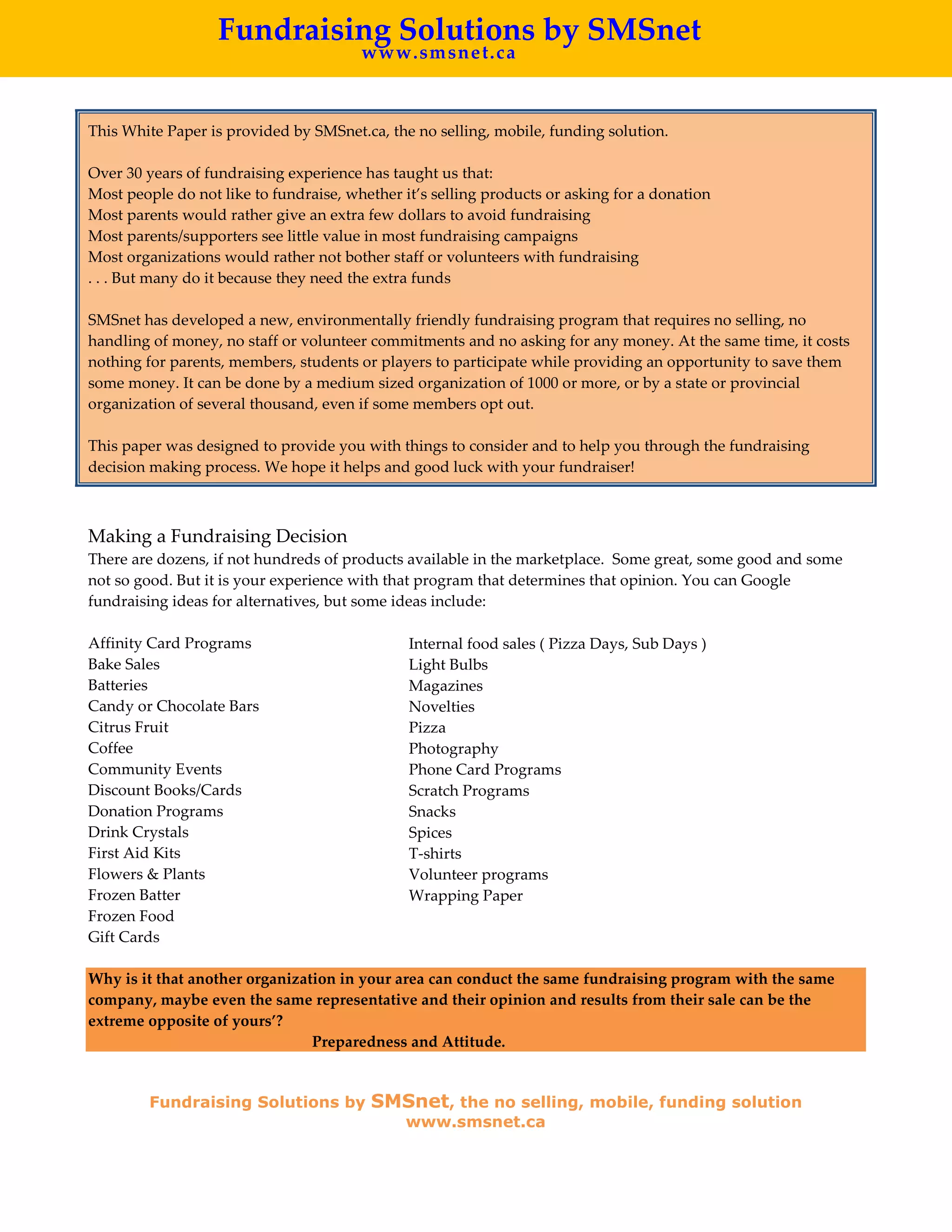
This White Paper is provided by SMSnet.ca, the no selling, mobile, funding solution.

Over 30 years of fundraising experience has taught us that:
Most people do not like to fundraise, whether it’s selling products or asking for a donation
Most parents would rather give an extra few dollars to avoid fundraising
Most parents/supporters see little value in most fundraising campaigns
Most organizations would rather not bother staff or volunteers with fundraising
. . . But many do it because they need the extra funds

SMSnet has developed a new, environmentally friendly fundraising program that requires no selling, no
handling of money, no staff or volunteer commitments and no asking for any money. At the same time, it costs
nothing for parents, members, students or players to participate while providing an opportunity to save them
some money. It can be done by a medium sized organization of 1000 or more, or by a state or provincial
organization of several thousand, even if some members opt out.

This paper was designed to provide you with things to consider and to help you through the fundraising
decision making process. We hope it helps and good luck with your fundraiser!


Making a Fundraising Decision
There are dozens, if not hundreds of products available in the marketplace. Some great, some good and some
not so good. But it is your experience with that program that determines that opinion. You can Google
fundraising ideas for alternatives, but some ideas include:

Affinity Card Programs                         Internal food sales ( Pizza Days, Sub Days )
Bake Sales                                     Light Bulbs
Batteries                                      Magazines
Candy or Chocolate Bars                        Novelties
Citrus Fruit                                   Pizza
Coffee                                         Photography
Community Events                               Phone Card Programs
Discount Books/Cards                           Scratch Programs
Donation Programs                              Snacks
Drink Crystals                                 Spices
First Aid Kits                                 T-shirts
Flowers & Plants                               Volunteer programs
Frozen Batter                                  Wrapping Paper
Frozen Food
Gift Cards

Why is it that another organization in your area can conduct the same fundraising program with the same
company, maybe even the same representative and their opinion and results from their sale can be the
extreme opposite of yours’?
                                Preparedness and Attitude.


         Fundraising Solutions by        SMSnet, the no selling, mobile, funding solution
                                              www.smsnet.ca
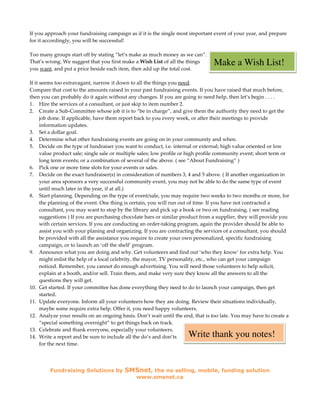
If you approach your fundraising campaign as if it is the single most important event of your year, and prepare
for it accordingly, you will be successful!

Too many groups start off by stating “let’s make as much money as we can”.
That’s wrong. We suggest that you first make a Wish List of all the things       Make a Wish List!
you want, and put a price beside each item, then add up the total cost.

If it seems too extravagant, narrow it down to all the things you need.
Compare that cost to the amounts raised in your past fundraising events. If you have raised that much before,
then you can probably do it again without any changes. If you are going to need help, then let’s begin . . . .
1. Hire the services of a consultant, or just skip to item number 2.
2. Create a Sub-Committee whose job it is to “be in charge”, and give them the authority they need to get the
      job done. If applicable, have them report back to you every week, or after their meetings to provide
      information updates.
3. Set a dollar goal.
4. Determine what other fundraising events are going on in your community and when.
5. Decide on the type of fundraiser you want to conduct, i.e. internal or external; high value oriented or low
      value product sale; single sale or multiple sales; low profile or high profile community event; short term or
      long term events; or a combination of several of the above. ( see “About Fundraising” )
6. Pick one or more time slots for your events or sales.
7. Decide on the exact fundraiser(s) in consideration of numbers 3, 4 and 5 above. ( If another organization in
      your area sponsors a very successful community event, you may not be able to do the same type of event
      until much later in the year, if at all.)
8. Start planning. Depending on the type of event/sale, you may require two weeks to two months or more, for
      the planning of the event. One thing is certain, you will run out of time. If you have not contracted a
      consultant, you may want to stop by the library and pick up a book or two on fundraising. ( see reading
      suggestions ) If you are purchasing chocolate bars or similar product from a supplier, they will provide you
      with certain services. If you are conducting an order-taking program, again the provider should be able to
      assist you with your planing and organizing. If you are contracting the services of a consultant, you should
      be provided with all the assistance you require to create your own personalized, specific fundraising
      campaign, or to launch an ‘off the shelf’ program.
9. Announce what you are doing and why. Get volunteers and find out ‘who they know’ for extra help. You
      might enlist the help of a local celebrity, the mayor, TV personality, etc., who can get your campaign
      noticed. Remember, you cannot do enough advertising. You will need those volunteers to help solicit,
      explain at a booth, and/or sell. Train them, and make very sure they know all the answers to all the
      questions they will get.
10. Get started. If your committee has done everything they need to do to launch your campaign, then get
      started.
11. Update everyone. Inform all your volunteers how they are doing. Review their situations individually,
      maybe some require extra help. Offer it, you need happy volunteers.
12. Analyze your results on an ongoing basis. Don’t wait until the end, that is too late. You may have to create a
      “special something overnight” to get things back on track.
13. Celebrate and thank everyone, especially your volunteers.
14. Write a report and be sure to include all the do’s and don’ts     Write thank you notes!
      for the next time.


         Fundraising Solutions by         SMSnet, the no selling, mobile, funding solution
                                               www.smsnet.ca
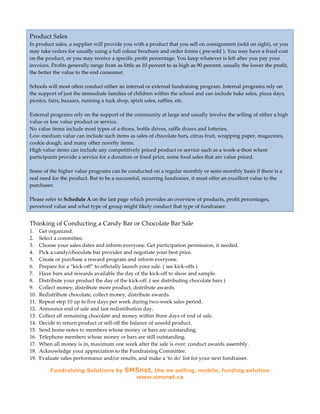
Product Sales
In product sales, a supplier will provide you with a product that you sell on consignment (sold on sight), or you
may take orders for usually using a full colour brochure and order forms ( pre-sold ). You may have a fixed cost
on the product, or you may receive a specific profit percentage. You keep whatever is left after you pay your
invoices. Profits generally range from as little as 10 percent to as high as 90 percent, usually the lower the profit,
the better the value to the end consumer.

Schools will most often conduct either an internal or external fundraising program. Internal programs rely on
the support of just the immediate families of children within the school and can include bake sales, pizza days,
picnics, fairs, bazaars, running a tuck shop, spirit sales, raffles, etc.

External programs rely on the support of the community at large and usually involve the selling of either a high
value or low value product or service.
No value items include most types of a-thons, bottle drives, raffle draws and lotteries.
Low-medium value can include such items as sales of chocolate bars, citrus fruit, wrapping paper, magazines,
cookie dough, and many other novelty items.
High value items can include any competitively priced product or service such as a work-a-thon where
participants provide a service for a donation or fixed price, some food sales that are value priced.

Some of the higher value programs can be conducted on a regular monthly or semi-monthly basis if there is a
real need for the product. But to be a successful, recurring fundraiser, it must offer an excellent value to the
purchaser.

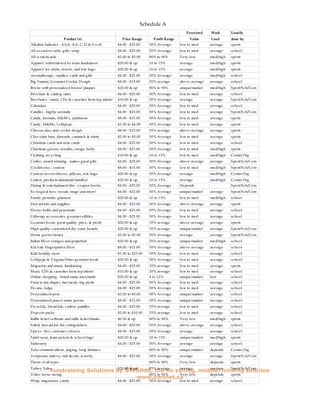
Please refer to Schedule A on the last page which provides an overview of products, profit percentages,
perceived value and what type of group might likely conduct that type of fundraiser.


Thinking of Conducting a Candy Bar or Chocolate Bar Sale
1.    Get organized.
2.    Select a committee.
3.    Choose your sales dates and inform everyone. Get participation permission, if needed.
4.    Pick a candy/chocolate bar provider and negotiate your best price.
5.    Create or purchase a reward program and inform everyone.
6.    Prepare for a “kick-off” to officially launch your sale. ( see kick-offs )
7.    Have bars and rewards available the day of the kick-off to show and sample.
8.    Distribute your product the day of the kick-off. ( see distributing chocolate bars )
9.    Collect money, distribute more product, distribute awards.
10.   Redistribute chocolate, collect money, distribute awards.
11.   Repeat step 10 up to five days per week during two-week sales period.
12.   Announce end of sale and last redistribution day.
13.   Collect all remaining chocolate and money within three days of end of sale.
14.   Decide to return product or sell-off the balance of unsold product.
15.   Send home notes to members whose money or bars are outstanding.
16.   Telephone members whose money or bars are still outstanding.
17.   When all money is in, maximum one week after the sale is over, conduct awards assembly.
18.   Acknowledge your appreciation to the Fundraising Committee.
19.   Evaluate sales performance and/or results, and make a ‘to do’ list for your next fundraiser.

          Fundraising Solutions by         SMSnet, the no selling, mobile, funding solution
                                                www.smsnet.ca
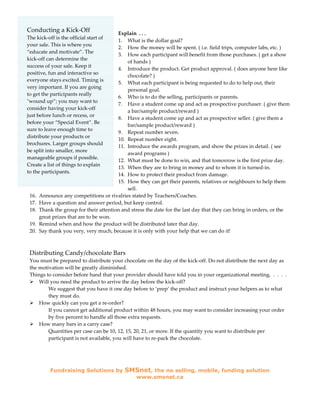
Conducting a Kick-Off                    Explain . . .
The kick-off is the official start of
                                         1. What is the dollar goal?
your sale. This is where you
                                         2. How the money will be spent. ( i.e. field trips, computer labs, etc. )
“educate and motivate”. The
                                         3. How each participant will benefit from those purchases. ( get a show
kick-off can determine the
                                             of hands )
success of your sale. Keep it
                                         4. Introduce the product. Get product approval. ( does anyone here like
positive, fun and interactive so
                                             chocolate? )
everyone stays excited. Timing is
                                         5. What each participant is being requested to do to help out, their
very important. If you are going
                                             personal goal.
to get the participants really
                                         6. Who is to do the selling, participants or parents.
"wound up”; you may want to
                                         7. Have a student come up and act as prospective purchaser. ( give them
consider having your kick-off
                                             a bar/sample product/reward )
just before lunch or recess, or
                                         8. Have a student come up and act as prospective seller. ( give them a
before your “Special Event”. Be
                                             bar/sample product/reward )
sure to leave enough time to
                                         9. Repeat number seven.
distribute your products or
                                         10. Repeat number eight.
brochures. Larger groups should
                                         11. Introduce the awards program, and show the prizes in detail. ( see
be split into smaller, more
                                             award programs )
manageable groups if possible.
                                         12. What must be done to win, and that tomorrow is the first prize day.
Create a list of things to explain
                                         13. When they are to bring in money and to whom it is turned-in.
to the participants.
                                         14. How to protect their product from damage.
                                         15. How they can get their parents, relatives or neighbours to help them
                                             sell.
 16.   Announce any competitions or rivalries stated by Teachers/Coaches.
 17.   Have a question and answer period, but keep control.
 18.   Thank the group for their attention and stress the date for the last day that they can bring in orders, or the
       great prizes that are to be won.
 19.   Remind when and how the product will be distributed later that day.
 20.   Say thank you very, very much, because it is only with your help that we can do it!


 Distributing Candy/chocolate Bars
 You must be prepared to distribute your chocolate on the day of the kick-off. Do not distribute the next day as
 the motivation will be greatly diminished.
 Things to consider before hand that your provider should have told you in your organizational meeting. . . . .
     Will you need the product to arrive the day before the kick-off?
         We suggest that you have it one day before to ‘prep’ the product and instruct your helpers as to what
         they must do.
     How quickly can you get a re-order?
         If you cannot get additional product within 48 hours, you may want to consider increasing your order
         by five percent to handle all those extra requests.
     How many bars in a carry case?
         Quantities per case can be 10, 12, 15, 20, 21, or more. If the quantity you want to distribute per
         participant is not available, you will have to re-pack the chocolate.


           Fundraising Solutions by         SMSnet, the no selling, mobile, funding solution
                                                 www.smsnet.ca
Will carry cases be split into other sizes allowing younger siblings to participate?
     Decide if you have families with more than one child in the organization, and if each is required to sell,
     and/or to sell the same or lesser amount.
If so, who will do the splitting the carry boxes and when?
     You can ask the adult volunteers to do it, or we suggest, ask for student help, then give them a bar or
     two for helping out.
How many bars will a participant be allowed to take home the first day?
     To be fair to everyone, it should be one carry case per participant.
How will the bars be given to the classes and participants?
     Individual classes can send their own “runners” to the distribution area with a formal ‘number of carry
     cases request form’, or we suggest, you can have “runners” visit each class, get the formal request,
     return to the distribution area, and take the appropriate amount of chocolate back to the class for
     distribution.
Where will the bars be located for distribution?
     “Runners” can bring chocolate from the distribution point to the classroom. This may take three to five
     runners per class, at a rate of eight minutes per calls. Build this timing into your schedule.
What type of accounting tally sheets are being used?
     Chocolate bar companies will supply you with tally or accounting sheets. This will help you keep track
     of bars going out as well as money coming in. Many organizations now use class lists. If you do, use the
     column headings shown on the chocolate provider’s accounting sheets, and/or include your own
     headings, but only if they are better.
Have the accounting sheets been prepared in advance?                                  Not keeping up?
     Regardless of the accounting sheet being used, have all potential names,
     by class prepared in advance so all you need to do is record the amount          Get help from
     of chocolate taken beside the seller’s name.                                     other volunteers.
Who will be collecting money and when?
     Money should be collected, and prize vouchers and additional chocolate should be distributed every
     day for best results. Plan for it, and have back up people to help.
Who will be counting and depositing the money?
     This is important. Two people should do this together and sign off on all paperwork.
Are there collection envelopes inside the carry case of bars?
     If there isn’t, you will need envelopes for the participants, especially if you are repackaging the carry
     cases for some of the participants.
How are prize draw vouchers physically distributed?
     Every time money is returned, prize vouchers should be distributed.
When are those prizes given to the winner?
     A variety of prizes should be awarded daily if possible, or every two days. You have to keep the
     momentum going.
Have you created any publicity posters, prize posters and goal charts?
     You can have a publicity poster context in advance and award some prizes, one grand prize for the
     overall best as chosen by all participants, plus some draw prizes just for entering.
How often, and who is updating these posters/charts?
     If you have twenty, thirty or more posters you can relocate them around the building every few days so
     they look new. You can also use the more creative ones and make many copies of them. Put up a new
     poster every day. Your accounting team should update goal charts everyday as they are counting the
     money everyday.


    Fundraising Solutions by          SMSnet, the no selling, mobile, funding solution
                                           www.smsnet.ca
Have you prepared unique morning announcements and who will be reading them?
        Students would really enjoy doing this. This could be a consolation prize for the top ten poster winners.
        ( allow the students to be creative )
    What do we do with unsold bars?
        Unsold bars need to be redistributed. In keeping the enthusiasm going, you want all the better sellers to
        have as much chocolate as they need in order to keep selling. Get the chocolate back from the
        participants who are not selling, and redistribute it to the participants who need it and will sell it.
        Announce the redistribution day one day in advance and explain: bring in your bars if you cannot sell
        anymore along with your money, and your name will be entered into a special draw. This should be
        done three to five times before the end of the sale.
    Who will help with redistribution of product?
        Redistribution days may require runners, and accounting help for each class.
    Will you return any leftover product?
        Sometimes there is a penalty if you return product, check your contract. You may also have to pay for
        the return freight. Compare the cost of your penalties against the value of the returned product. Some
        organizations will keep a little extra product and use it for prizes; or for a class with a special project that
        may require some extra funding; or the best sellers may want to keep on selling and can be given one
        bar for every ten they sell; or the organization can sell them two weeks later at half price.
    How quickly after delivery must this be done?
        Again, check your contract. Usually product returns need to be completed within thirty days, but there
        is usually a grace period.

Prize Programs
Are you motivated? Is what motivates you the same thing that is going to motivate your participants?

There has been much controversy over the years regarding the use of prize programs. Some dislike them
because they instill competition, others like them because it is important to say thank you. Whichever way you
feel, everyone agrees that a poor or unfair prize program detracts from the positive aspects of your sale and
should be avoided. There can only be one top seller, but there can be three top sellers per class. More is always
better, and it doesn’t have to cost too much.

Generally speaking, you should give back five to ten percent of your profit into your awards program, incentive
system, recognition program, or whatever else you want to call your prize program. Because your workers are
not getting paid, you should do something special for them.

There are many types of prize programs and ways to distribute the prizes. There are top seller prizes, but that
usually means 98% of the participants do not win. Even if you make it the top three sellers, it is still not very
motivating. The most motivating is one where everyone wins, and yes it can be done!

Many feel the fairest method to distribute prizes is through draws. Every participant earns a chance to win a
prize for every (choose a number ) bars sold, or other dollar value of sales attained. Participants have to know
what those numbers are so they can make their own goals.

Draw prizes are especially beneficial when conducting a chocolate bar sale. Awarding these prizes every day of
the sale keeps the momentum going and the sales hot. If you are running a pre-sold, order taking campaign, you
can still conduct draws by asking for a show of hands to help determine sales to date.


         Fundraising Solutions by          SMSnet, the no selling, mobile, funding solution
                                                www.smsnet.ca
When you give someone a single draw ballot for a specific dollar sale achieved, you are giving a participant one
chance at winning. If that ballot is good for one chance at 25 different prizes, then you have just given them 25
chances to win. But if you give them four ballots for that same specific dollar goal, then they now have 100
chances to win! Which would you rather have: 25 or 100?

What can you give away? Anything at all that gets donated by staff, parents or members of the community at
large. The staff might enjoy getting involved by donating a prize. It can be lunch bought by, prepared by or
served by a staff member,                                                        help with a French class, extra recess
time, one hour of time on the       ( Some organizations conduct pre-            computer, help with an assignment,
having recess inside on a cold      sold programs and request payment            day, a guitar lesson, a batch of
homemade cookies, a hand-           at the time of ordering. Those that          made craft, principal for the day, the
list is endless. This gets the      do, notice about a 15 to 20 percent          staff involved, and every sale is
better if the staff is involved.    drop in sales over C.O.D. sales. ) If
                                    you are getting your money at the
Parents are another source for      time your customer places an order,          donated prizes. Many parents or the
companies they own or work          then you can give out draw ballots           at may be willing to donate
something. Even the typing of       based on cash turned in.                     an assignment is a prize some
student might want to win.                                                       Send home a flyer informing the
parents about the sale, and                                                      what staff is donating to help create
prizes just for their students. Make it as long a list as possible. Then ask the parents if they can send in a prize.
All prizes are cheerfully accepted should be your policy. Inappropriate prizes can be returned or used
elsewhere. Include some suggestions as well: Lunch at a favorite quick serve restaurant, a golf lesson, help with
a woodworking project, tickets to a game, some desktop publishing work done, a computer lesson, etc.

And specifically ask for assistance from local stores and area merchants. You might be surprised what you can
get: Five free skate sharpening, free ice time, a tank of gas, one free lawn mowing, gift certificates for all kinds of
stores, free movie or game rentals, free meals, etc.

Now that you have fifty to one hundred free prizes, go spend your five to ten percent of the profits. After
consulting some of the students from a variety of grade levels, decide on some prizes. You can buy the prizes or
sometimes you can borrow the prize with the understanding that a gift certificate for that particular store will be
purchased. Many times, a local merchant will give your school a good discount when you explain the reason for
the purchase. Remember to send home a newsletter informing the parents of all the local merchants who helped
out by giving discounts or free gifts.

Save some of your prize budget money for class prizes, one prize for every class. A movie, popcorn and a drink,
or an ice cream sundae and a movie are very inexpensive ways to say thank you. Pizza and a drink may seem
like more, but that movie is important too. This way, the staff member gets a prize too.

Some schools get the staff involved in other ways as well. There are prizes like shaving the head of Mr. or Mrs.
____, a pie in the face of Mr. ____, Mrs. ___ will spend an hour of the day riding around the school from class to
class on a tricycle. Ask the staff to use their imagination. There have been many stories about principals kissing a
pig, spending lunch hour on the roof barbecuing, doing the students’ homework, etc. It’s all for fun, so keep it
light hearted and amusing.


         Fundraising Solutions by          SMSnet, the no selling, mobile, funding solution
                                                 www.smsnet.ca
Now that you have one hundred or more prizes to distribute,              The trick again, is to be organized.
including a prize for every class, how do you distribute the             Have your ballots pre-printed on an 8
prizes? Especially if every time a specific dollar goal is attained,     ½ by 11-inch sheet, three, four or five
four, five or more ballots are given out.                                across on a page, and six, eight, nine,
                                                                         ten etc. down the page. Make sure
Every morning, either after turning in money, or after a show of         your number up, or your number
hands to signify dollar sales, issue the ballots. Allow the              across matches the number of ballots
students to place their ballots in the ballot boxes during recess.       you are giving out per chance per
Just before lunch, or just when lunch begins so there is an              student. Have ballot boxes gift-
audience present, draw and announce the daily prize winners              wrapped and ready in advance. You
and have them collect their prizes.                                      will want one ballot box per Staff
                                                                         prize, a separate ballot box for daily
Congratulate the winners by name during afternoon                        prizes, and another ballot box for
announcements and let everyone know what tomorrow’s prizes               special prizes and for bigger prizes.
will be. Once or twice during the sale, have a special draw and
not tell anyone in advance, this helps keep it exciting.

You will want to distribute some prizes daily, but you may want to wait to the end of the sale to distribute the
big prizes. If you do, make it as special as the fundraiser was: hold an assembly. After all the money has been
collected, have all the students present for the big draws. Have each teacher pick a name from their own ballot
boxes, have some students help with the name pulling for some other prizes. Treat it like the important event it
is. Thank everyone who sold, helped with publicity, as runners, with accounting, counting bars, etc.

Send home another newsletter thanking the parents for their help, and mention by name the parents, staff and
merchants who donated prizes or discounted merchandize. Only with everyone’s help was your fundraiser
successful, so be sure to thank everyone involved.

A special hand written note to parents, staff or merchants who went above and beyond the call of duty is a nice
added touch and will be remembered for a long time.

A Brief History of Fundraising
In ancient Egypt, Social Organizations collected membership dues in order to belong to their club, the first
fundraisers.

The first modern fundraising campaign is generally credited to the work of two YMCA professional staff
members Lyman L. Pierce and Charles S. Ward. Back in the late 1890’s, they took a militaristic approach to
fundraising, hence the term ‘campaign’. They determined that there are six fundamental elements to a successful
fundraising campaign: A given time frame, a specific goal, volunteer solicitors, a kick-off, regular report
meetings and a victory celebration.

In the fifties, chocolate bars were introduced for fundraising at the outlandish price of $0.25 each, featuring the
name of the organization on the wrapper. ( Prices increased to $0.50, then $0.75, $1.00, $2.00, and now you will
find these chocolate products being offered at $3.00, $4.00 and $5.00. )
In a July 1960 issue of Public Relations Journal, Dr. Sidney J. Levy, in an article entitled “Humanized Appeals of
Fundraising” suggested that there are two primary motivating factors in personal giving or supporting: a sense
of duty, and personal self interest.
Dr. Levy’s research suggests that a hierarchy of loyalty exists:

         Fundraising Solutions by          SMSnet, the no selling, mobile, funding solution
                                                 www.smsnet.ca
Religious ( a sense of belonging )
Fraternal, school, social ( a sense of ownership )
Health care, disease ( Specific help targeted at less fortunate due to health )
Social, welfare ( General help for less fortunate or those in need )


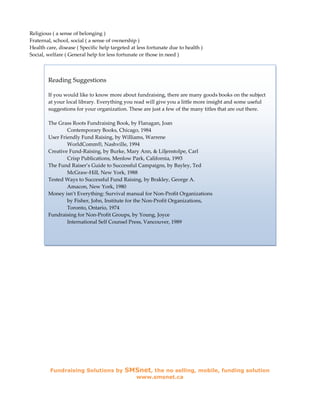
        Reading Suggestions

        If you would like to know more about fundraising, there are many goods books on the subject
        at your local library. Everything you read will give you a little more insight and some useful
        suggestions for your organization. These are just a few of the many titles that are out there.

        The Grass Roots Fundraising Book, by Flanagan, Joan
                Contemporary Books, Chicago, 1984
        User Friendly Fund Raising, by Williams, Warrene
                WorldComm®, Nashville, 1994
        Creative Fund-Raising, by Burke, Mary Ann, & Liljenstolpe, Carl
                Crisp Publications, Menlow Park, California, 1993
        The Fund Raiser’s Guide to Successful Campaigns, by Bayley, Ted
                McGraw-Hill, New York, 1988
        Tested Ways to Successful Fund Raising, by Brakley, George A.
                Amacon, New York, 1980
        Money isn’t Everything: Survival manual for Non-Profit Organizations
                by Fisher, John, Institute for the Non-Profit Organizations,
                Toronto, Ontario, 1974
        Fundraising for Non-Profit Groups, by Young, Joyce
                International Self Counsel Press, Vancouver, 1989


         Fundraising Solutions by          SMSnet, the no selling, mobile, funding solution
                                                www.smsnet.ca
Schedule A
                                                                                               P erceived   Work       Usually
                        P roduct (s)                      P rice Range      P rofit Range        Value      Load       done by
Alkaline batteries - AAA, AA, C, D & 9 volt             $4.00 - $25.00    50% Average       lo w to med     average    sports
All oc c asion c ards, gifts, wrap                      $4.00 - $25.00    50% Average       lo w to med     average    sc hoo l
All sc ratc hc ards -                                   $2.00 to $5.00    80% to 90%        Very low        med/high   sports
Apparel: embroidered for team fundraisers               $20.00 & up       10 to 15%         average         med/high   sports
Apparel: tee shirts, towels, and tote bags              $20.00 & up       10 to 15%         average         med/high   sports
Aromatherapy, c andles, c ards and gifts                $4.00 - $25.00    50% Average       average         med/high   sc hoo l
Big Yummy Gourmet Coo kie Dough                         $8.00 - $15.00    35% average       above average   average    sc hoo l
Bric ks with perso nalized bro nze plaques              $20.00 & up       80% to 90%        unique/market   med/high   S po rt/S c h/Co m
Broc hure & c atalog sales                              $4.00 - $25.00    50% Average       lo w to med     average    sc hoo l
Broc hures - music CDs & c assettes from top artists!   $10.00 & up       50% Average       average         average    S po rt/S c h/Co m
Calendars                                               $4.00 - $25.00    50% Average       lo w to med     average    sc hoo l
Candles - highly aromatic                               $4.00 - $25.00    50% Average       lo w to med     average    S po rt/S c h/Co m
Candy, bio mats, M&M's, spiritwear                      $8.00 - $15.00    50% Average       lo w to med     average    sports
Candy, M&Ms, Lollipops -                                $1.00 to $4.00    50% Average       lo w to med     average    sports
Cheesec akes and c oo kie dough                         $8.00 - $15.00    35% average       above average   average    sports
Choc olate bars, almonds, c aramels & mints             $2.00 to $5.00    50% Average       lo w to med     average    sports
Christmas c ards and no te c ards                       $4.00 - $25.00    50% Average       lo w to med     average    sc hoo l
Christmas greens, wreaths, swags, holly                 $4.00 - $25.00    50% Average       lo w to med     med/high   sports
Clothing rec yc ling                                    $10.00 & up       10 to 15%         lo w to med     med/high   Co mm Org
Coffee, award winning - makes great gifts               $4.00 - $25.00    50% Average       above average   average    S po rt/S c h/Co m
Coo kbooks - c ustom                                    $8.00 - $15.00    50% Average       lo w to med     med/high   S po rt/S c h/Co m
Custom woven throws, pillo ws, tote bags                $20.00 & up       50% Average       average         med/high   Co mm Org
Cutlery produc ts-aluminum handled                      $20.00 & up       10 to 15%         average         med/high   Co mm Org
Dining & entertainment disc . c o upon boo ks           $4.00 - $25.00    50% Average       Depends                    S po rt/S c h/Co m
Ec ologic al tees, sweats, mugs and more!               $4.00 - $25.00    50% Average       unique/market   average    S po rt/S c h/Co m
Family po rtraits, glamo ur                             $20.00 & up       10 to 15%         lo w to med     med/high   sc hoo l
First aid kits and supplies                             $4.00 - $25.00    50% Average       above average   average    sports
Flo wer bulbs and perennials                            $4.00 - $25.00    50% Average       lo w to med     average    sc hoo l
Giftwrap, ac c essories, gourmet edibles                $4.00 - $25.00    50% Average       lo w to med     average    sc hoo l
Go urmet foods: great quality, pric e, & profit         $20.00 & up       35% average       above average   average    sports
High quality c ustomized dry erase boards               $20.00 & up       35% average       unique/market   average    S po rt/S c h/Co m
Ho me grown honey -                                     $2.00 to $5.00    50% Average       average         average    S po rt/S c h/Co m
Indian River oranges and grapefruit                     $20.00 & up       25% average       unique/market   med/high   sc hoo l
Kid S afe Fingerprint-a-Tho n                           $8.00 - $15.00    50% Average       above average   average    sc hoo l
Kids ho liday store                                     $1.00 to $25.00   50% Average       lo w to med     average    sc hoo l
Lollipops & V irginia Diner gourmet foods               $20.00 & up       50% Average       lo w to med     average    sc hoo l
Magazine and music fundraising                          $4.00 - $25.00    35% average       lo w to med     average    sports
Music CDs & c assettes from top artists!                $10.00 & up       35% average       lo w to med     average    sc hoo l
Online sho pping - brand name merc hants                $20.00 & up       4 to 12%          unique/market   low        sc hoo l
Pasta in fun shapes, fast meals, big profit             $4.00 - $25.00    50% Average       lo w to med     average    sc hoo l
Pec ans, fudge                                          $4.00 - $25.00    50% Average       lo w to med     average    sc hoo l
Personalized pens                                       $2.00 to $5.00    50% Average       unique/market   average    sc hoo l
Personalized prayer name poems                          $8.00 - $15.00    50% Average       unique/market   average    sc hoo l
Pizza kits, bread kits, c utters, paddles               $4.00 - $25.00    35% average       lo w to med     average    sc hoo l
Popc o rn pac ks                                        $2.00 to $10.00   35% average       lo w to med     average    sc hoo l
Raffle tic ket software and raffle tic ket blanks       $0.50 & up        80% to 90%        Very low        med/high   sports
S afety first aid kit, fire extinguishers               $4.00 - $25.00    50% Average       above average   average    sc hoo l
S pic es - five c ustomer c hoic es                     $4.00 - $25.00    50% Average       average         average    sc hoo l
S pirit wear, team jac kets & sc hool bags              $20.00 & up       10 to 15%         unique/market   med/high   sports
S tatio nery                                            $4.00 - $25.00    50% Average       average         average    sc hoo l
Telec ommunic atio ns, paging, long distanc e                             80% to 90%        unique/market   depends    Co mm Org
Temporary tattoo s, nail dec als, jewelry               $4.00 - $25.00    50% Average       average         average    S po rt/S c h/Co m
Thons of all types                                                        80% to 90%        Very low        depends    sports
Turkey S ales                                           $20.00 & up       25% average       average         average    S po rt/S c h/Co m
               Fundraising Solutions by                     SMSnet, the no selling, mobile, funding solution
Video horse rac ing                                                       80% to 90%        Very low        depends    sports
                                                                     www.smsnet.ca
Wrap, magazines, c andy                                 $4.00 - $25.00    50% Average       lo w to med     average    sc hoo l
About SMSnet
SMSnet is a revolutionary new fundraising program which provides community sports groups, membership organizations
and high schools with a no selling, high profit, green fundraiser that is great for the community
as well as great for business.

SMSnet is completely different from all other traditional, community type fundraising. By having a ‘no selling’
mandate, SMSnet eliminates the need for students or members to sell anything door to door, or to leverage
friends or family relationships into buying something to help out their cause. Furthermore, as there is no selling,
there is also no collection of monies or distribution of products, no returns, no financial risk, no class or sports
practice disruptions and no time commitments required by staff or volunteers.

While generating local fundraising profits, SMSnet provides community and regional Brands with the ability to
empower their marketing efforts using a unique text messaging offering to a community based subscriber group
at several times less than the cost of traditional media advertising or other mobile marketing alternatives.

In January 2010, Indigo Mobile Media launched SMSnet, their no selling, mobile, fundraising solution. Initiated
as a localized fundraiser, it is quickly spreading as a regional and national program offering local and national
Brands the opportunity to place their mobile advertising and messaging into the right hands, at the right time,
and in a cost effective manner.

Indigo Mobile Media is now embarking on raising its presence within the North American fundraising
community as it looks to further accelerate the growth of its program. Indigo asks Brands in its corporate
tag line; “your customers are mobile, shouldn’t your advertising be?”

By January 2010, the number of US mobile subscribers had grown to over 280 million, reaching 90% of U.S.
households. Last year, U.S. consumers sent over 110.4 billion SMS messages per month. In Canada, there are
over 25 million mobile phone subscribers reaching 74% of Canadian households. On average, 87 million text
messages are sent by Canadians every day... that's 2.7 billion messages per month!

Texting is the pre-eminent method used by teens and young adults to communicate with one another. It is more
widely used that voice calling, email or all social media offerings combined. And because of the teenage use of
SMS, most parents have been influenced into text messaging usage. If you want to get your message to a 16 to 55
year old, be prepared to embrace SMS.

According to Indigo Mobile Media, SMSnet provides Brands the opportunity to initiate and strengthen
relationships with consumers while providing additional value that can influence buying behaviour. SMSnet
delivers tangible and measurable ROI at a cost several times less than traditional media advertising or other
mobile marketing alternatives.

Contact Indigo Mobile Media at www.indigomobilemedia.com or www.smsnet.ca


         Fundraising Solutions by         SMSnet, the no selling, mobile, funding solution
                                               www.smsnet.ca

Fundraising Solutions by SMSnet.ca

  • 1.
    Fundraising Solutions bySMSnet www.sm snet.ca This White Paper is provided by SMSnet.ca, the no selling, mobile, funding solution. Over 30 years of fundraising experience has taught us that: Most people do not like to fundraise, whether it’s selling products or asking for a donation Most parents would rather give an extra few dollars to avoid fundraising Most parents/supporters see little value in most fundraising campaigns Most organizations would rather not bother staff or volunteers with fundraising . . . But many do it because they need the extra funds SMSnet has developed a new, environmentally friendly fundraising program that requires no selling, no handling of money, no staff or volunteer commitments and no asking for any money. At the same time, it costs nothing for parents, members, students or players to participate while providing an opportunity to save them some money. It can be done by a medium sized organization of 1000 or more, or by a state or provincial organization of several thousand, even if some members opt out. This paper was designed to provide you with things to consider and to help you through the fundraising decision making process. We hope it helps and good luck with your fundraiser! Making a Fundraising Decision There are dozens, if not hundreds of products available in the marketplace. Some great, some good and some not so good. But it is your experience with that program that determines that opinion. You can Google fundraising ideas for alternatives, but some ideas include: Affinity Card Programs Internal food sales ( Pizza Days, Sub Days ) Bake Sales Light Bulbs Batteries Magazines Candy or Chocolate Bars Novelties Citrus Fruit Pizza Coffee Photography Community Events Phone Card Programs Discount Books/Cards Scratch Programs Donation Programs Snacks Drink Crystals Spices First Aid Kits T-shirts Flowers & Plants Volunteer programs Frozen Batter Wrapping Paper Frozen Food Gift Cards Why is it that another organization in your area can conduct the same fundraising program with the same company, maybe even the same representative and their opinion and results from their sale can be the extreme opposite of yours’? Preparedness and Attitude. Fundraising Solutions by SMSnet, the no selling, mobile, funding solution www.smsnet.ca
  • 2.
    If you approachyour fundraising campaign as if it is the single most important event of your year, and prepare for it accordingly, you will be successful! Too many groups start off by stating “let’s make as much money as we can”. That’s wrong. We suggest that you first make a Wish List of all the things Make a Wish List! you want, and put a price beside each item, then add up the total cost. If it seems too extravagant, narrow it down to all the things you need. Compare that cost to the amounts raised in your past fundraising events. If you have raised that much before, then you can probably do it again without any changes. If you are going to need help, then let’s begin . . . . 1. Hire the services of a consultant, or just skip to item number 2. 2. Create a Sub-Committee whose job it is to “be in charge”, and give them the authority they need to get the job done. If applicable, have them report back to you every week, or after their meetings to provide information updates. 3. Set a dollar goal. 4. Determine what other fundraising events are going on in your community and when. 5. Decide on the type of fundraiser you want to conduct, i.e. internal or external; high value oriented or low value product sale; single sale or multiple sales; low profile or high profile community event; short term or long term events; or a combination of several of the above. ( see “About Fundraising” ) 6. Pick one or more time slots for your events or sales. 7. Decide on the exact fundraiser(s) in consideration of numbers 3, 4 and 5 above. ( If another organization in your area sponsors a very successful community event, you may not be able to do the same type of event until much later in the year, if at all.) 8. Start planning. Depending on the type of event/sale, you may require two weeks to two months or more, for the planning of the event. One thing is certain, you will run out of time. If you have not contracted a consultant, you may want to stop by the library and pick up a book or two on fundraising. ( see reading suggestions ) If you are purchasing chocolate bars or similar product from a supplier, they will provide you with certain services. If you are conducting an order-taking program, again the provider should be able to assist you with your planing and organizing. If you are contracting the services of a consultant, you should be provided with all the assistance you require to create your own personalized, specific fundraising campaign, or to launch an ‘off the shelf’ program. 9. Announce what you are doing and why. Get volunteers and find out ‘who they know’ for extra help. You might enlist the help of a local celebrity, the mayor, TV personality, etc., who can get your campaign noticed. Remember, you cannot do enough advertising. You will need those volunteers to help solicit, explain at a booth, and/or sell. Train them, and make very sure they know all the answers to all the questions they will get. 10. Get started. If your committee has done everything they need to do to launch your campaign, then get started. 11. Update everyone. Inform all your volunteers how they are doing. Review their situations individually, maybe some require extra help. Offer it, you need happy volunteers. 12. Analyze your results on an ongoing basis. Don’t wait until the end, that is too late. You may have to create a “special something overnight” to get things back on track. 13. Celebrate and thank everyone, especially your volunteers. 14. Write a report and be sure to include all the do’s and don’ts Write thank you notes! for the next time. Fundraising Solutions by SMSnet, the no selling, mobile, funding solution www.smsnet.ca
  • 3.
    Product Sales In productsales, a supplier will provide you with a product that you sell on consignment (sold on sight), or you may take orders for usually using a full colour brochure and order forms ( pre-sold ). You may have a fixed cost on the product, or you may receive a specific profit percentage. You keep whatever is left after you pay your invoices. Profits generally range from as little as 10 percent to as high as 90 percent, usually the lower the profit, the better the value to the end consumer. Schools will most often conduct either an internal or external fundraising program. Internal programs rely on the support of just the immediate families of children within the school and can include bake sales, pizza days, picnics, fairs, bazaars, running a tuck shop, spirit sales, raffles, etc. External programs rely on the support of the community at large and usually involve the selling of either a high value or low value product or service. No value items include most types of a-thons, bottle drives, raffle draws and lotteries. Low-medium value can include such items as sales of chocolate bars, citrus fruit, wrapping paper, magazines, cookie dough, and many other novelty items. High value items can include any competitively priced product or service such as a work-a-thon where participants provide a service for a donation or fixed price, some food sales that are value priced. Some of the higher value programs can be conducted on a regular monthly or semi-monthly basis if there is a real need for the product. But to be a successful, recurring fundraiser, it must offer an excellent value to the purchaser. Please refer to Schedule A on the last page which provides an overview of products, profit percentages, perceived value and what type of group might likely conduct that type of fundraiser. Thinking of Conducting a Candy Bar or Chocolate Bar Sale 1. Get organized. 2. Select a committee. 3. Choose your sales dates and inform everyone. Get participation permission, if needed. 4. Pick a candy/chocolate bar provider and negotiate your best price. 5. Create or purchase a reward program and inform everyone. 6. Prepare for a “kick-off” to officially launch your sale. ( see kick-offs ) 7. Have bars and rewards available the day of the kick-off to show and sample. 8. Distribute your product the day of the kick-off. ( see distributing chocolate bars ) 9. Collect money, distribute more product, distribute awards. 10. Redistribute chocolate, collect money, distribute awards. 11. Repeat step 10 up to five days per week during two-week sales period. 12. Announce end of sale and last redistribution day. 13. Collect all remaining chocolate and money within three days of end of sale. 14. Decide to return product or sell-off the balance of unsold product. 15. Send home notes to members whose money or bars are outstanding. 16. Telephone members whose money or bars are still outstanding. 17. When all money is in, maximum one week after the sale is over, conduct awards assembly. 18. Acknowledge your appreciation to the Fundraising Committee. 19. Evaluate sales performance and/or results, and make a ‘to do’ list for your next fundraiser. Fundraising Solutions by SMSnet, the no selling, mobile, funding solution www.smsnet.ca
  • 4.
    Conducting a Kick-Off Explain . . . The kick-off is the official start of 1. What is the dollar goal? your sale. This is where you 2. How the money will be spent. ( i.e. field trips, computer labs, etc. ) “educate and motivate”. The 3. How each participant will benefit from those purchases. ( get a show kick-off can determine the of hands ) success of your sale. Keep it 4. Introduce the product. Get product approval. ( does anyone here like positive, fun and interactive so chocolate? ) everyone stays excited. Timing is 5. What each participant is being requested to do to help out, their very important. If you are going personal goal. to get the participants really 6. Who is to do the selling, participants or parents. "wound up”; you may want to 7. Have a student come up and act as prospective purchaser. ( give them consider having your kick-off a bar/sample product/reward ) just before lunch or recess, or 8. Have a student come up and act as prospective seller. ( give them a before your “Special Event”. Be bar/sample product/reward ) sure to leave enough time to 9. Repeat number seven. distribute your products or 10. Repeat number eight. brochures. Larger groups should 11. Introduce the awards program, and show the prizes in detail. ( see be split into smaller, more award programs ) manageable groups if possible. 12. What must be done to win, and that tomorrow is the first prize day. Create a list of things to explain 13. When they are to bring in money and to whom it is turned-in. to the participants. 14. How to protect their product from damage. 15. How they can get their parents, relatives or neighbours to help them sell. 16. Announce any competitions or rivalries stated by Teachers/Coaches. 17. Have a question and answer period, but keep control. 18. Thank the group for their attention and stress the date for the last day that they can bring in orders, or the great prizes that are to be won. 19. Remind when and how the product will be distributed later that day. 20. Say thank you very, very much, because it is only with your help that we can do it! Distributing Candy/chocolate Bars You must be prepared to distribute your chocolate on the day of the kick-off. Do not distribute the next day as the motivation will be greatly diminished. Things to consider before hand that your provider should have told you in your organizational meeting. . . . . Will you need the product to arrive the day before the kick-off? We suggest that you have it one day before to ‘prep’ the product and instruct your helpers as to what they must do. How quickly can you get a re-order? If you cannot get additional product within 48 hours, you may want to consider increasing your order by five percent to handle all those extra requests. How many bars in a carry case? Quantities per case can be 10, 12, 15, 20, 21, or more. If the quantity you want to distribute per participant is not available, you will have to re-pack the chocolate. Fundraising Solutions by SMSnet, the no selling, mobile, funding solution www.smsnet.ca
  • 5.
    Will carry casesbe split into other sizes allowing younger siblings to participate? Decide if you have families with more than one child in the organization, and if each is required to sell, and/or to sell the same or lesser amount. If so, who will do the splitting the carry boxes and when? You can ask the adult volunteers to do it, or we suggest, ask for student help, then give them a bar or two for helping out. How many bars will a participant be allowed to take home the first day? To be fair to everyone, it should be one carry case per participant. How will the bars be given to the classes and participants? Individual classes can send their own “runners” to the distribution area with a formal ‘number of carry cases request form’, or we suggest, you can have “runners” visit each class, get the formal request, return to the distribution area, and take the appropriate amount of chocolate back to the class for distribution. Where will the bars be located for distribution? “Runners” can bring chocolate from the distribution point to the classroom. This may take three to five runners per class, at a rate of eight minutes per calls. Build this timing into your schedule. What type of accounting tally sheets are being used? Chocolate bar companies will supply you with tally or accounting sheets. This will help you keep track of bars going out as well as money coming in. Many organizations now use class lists. If you do, use the column headings shown on the chocolate provider’s accounting sheets, and/or include your own headings, but only if they are better. Have the accounting sheets been prepared in advance? Not keeping up? Regardless of the accounting sheet being used, have all potential names, by class prepared in advance so all you need to do is record the amount Get help from of chocolate taken beside the seller’s name. other volunteers. Who will be collecting money and when? Money should be collected, and prize vouchers and additional chocolate should be distributed every day for best results. Plan for it, and have back up people to help. Who will be counting and depositing the money? This is important. Two people should do this together and sign off on all paperwork. Are there collection envelopes inside the carry case of bars? If there isn’t, you will need envelopes for the participants, especially if you are repackaging the carry cases for some of the participants. How are prize draw vouchers physically distributed? Every time money is returned, prize vouchers should be distributed. When are those prizes given to the winner? A variety of prizes should be awarded daily if possible, or every two days. You have to keep the momentum going. Have you created any publicity posters, prize posters and goal charts? You can have a publicity poster context in advance and award some prizes, one grand prize for the overall best as chosen by all participants, plus some draw prizes just for entering. How often, and who is updating these posters/charts? If you have twenty, thirty or more posters you can relocate them around the building every few days so they look new. You can also use the more creative ones and make many copies of them. Put up a new poster every day. Your accounting team should update goal charts everyday as they are counting the money everyday. Fundraising Solutions by SMSnet, the no selling, mobile, funding solution www.smsnet.ca
  • 6.
    Have you preparedunique morning announcements and who will be reading them? Students would really enjoy doing this. This could be a consolation prize for the top ten poster winners. ( allow the students to be creative ) What do we do with unsold bars? Unsold bars need to be redistributed. In keeping the enthusiasm going, you want all the better sellers to have as much chocolate as they need in order to keep selling. Get the chocolate back from the participants who are not selling, and redistribute it to the participants who need it and will sell it. Announce the redistribution day one day in advance and explain: bring in your bars if you cannot sell anymore along with your money, and your name will be entered into a special draw. This should be done three to five times before the end of the sale. Who will help with redistribution of product? Redistribution days may require runners, and accounting help for each class. Will you return any leftover product? Sometimes there is a penalty if you return product, check your contract. You may also have to pay for the return freight. Compare the cost of your penalties against the value of the returned product. Some organizations will keep a little extra product and use it for prizes; or for a class with a special project that may require some extra funding; or the best sellers may want to keep on selling and can be given one bar for every ten they sell; or the organization can sell them two weeks later at half price. How quickly after delivery must this be done? Again, check your contract. Usually product returns need to be completed within thirty days, but there is usually a grace period. Prize Programs Are you motivated? Is what motivates you the same thing that is going to motivate your participants? There has been much controversy over the years regarding the use of prize programs. Some dislike them because they instill competition, others like them because it is important to say thank you. Whichever way you feel, everyone agrees that a poor or unfair prize program detracts from the positive aspects of your sale and should be avoided. There can only be one top seller, but there can be three top sellers per class. More is always better, and it doesn’t have to cost too much. Generally speaking, you should give back five to ten percent of your profit into your awards program, incentive system, recognition program, or whatever else you want to call your prize program. Because your workers are not getting paid, you should do something special for them. There are many types of prize programs and ways to distribute the prizes. There are top seller prizes, but that usually means 98% of the participants do not win. Even if you make it the top three sellers, it is still not very motivating. The most motivating is one where everyone wins, and yes it can be done! Many feel the fairest method to distribute prizes is through draws. Every participant earns a chance to win a prize for every (choose a number ) bars sold, or other dollar value of sales attained. Participants have to know what those numbers are so they can make their own goals. Draw prizes are especially beneficial when conducting a chocolate bar sale. Awarding these prizes every day of the sale keeps the momentum going and the sales hot. If you are running a pre-sold, order taking campaign, you can still conduct draws by asking for a show of hands to help determine sales to date. Fundraising Solutions by SMSnet, the no selling, mobile, funding solution www.smsnet.ca
  • 7.
    When you givesomeone a single draw ballot for a specific dollar sale achieved, you are giving a participant one chance at winning. If that ballot is good for one chance at 25 different prizes, then you have just given them 25 chances to win. But if you give them four ballots for that same specific dollar goal, then they now have 100 chances to win! Which would you rather have: 25 or 100? What can you give away? Anything at all that gets donated by staff, parents or members of the community at large. The staff might enjoy getting involved by donating a prize. It can be lunch bought by, prepared by or served by a staff member, help with a French class, extra recess time, one hour of time on the ( Some organizations conduct pre- computer, help with an assignment, having recess inside on a cold sold programs and request payment day, a guitar lesson, a batch of homemade cookies, a hand- at the time of ordering. Those that made craft, principal for the day, the list is endless. This gets the do, notice about a 15 to 20 percent staff involved, and every sale is better if the staff is involved. drop in sales over C.O.D. sales. ) If you are getting your money at the Parents are another source for time your customer places an order, donated prizes. Many parents or the companies they own or work then you can give out draw ballots at may be willing to donate something. Even the typing of based on cash turned in. an assignment is a prize some student might want to win. Send home a flyer informing the parents about the sale, and what staff is donating to help create prizes just for their students. Make it as long a list as possible. Then ask the parents if they can send in a prize. All prizes are cheerfully accepted should be your policy. Inappropriate prizes can be returned or used elsewhere. Include some suggestions as well: Lunch at a favorite quick serve restaurant, a golf lesson, help with a woodworking project, tickets to a game, some desktop publishing work done, a computer lesson, etc. And specifically ask for assistance from local stores and area merchants. You might be surprised what you can get: Five free skate sharpening, free ice time, a tank of gas, one free lawn mowing, gift certificates for all kinds of stores, free movie or game rentals, free meals, etc. Now that you have fifty to one hundred free prizes, go spend your five to ten percent of the profits. After consulting some of the students from a variety of grade levels, decide on some prizes. You can buy the prizes or sometimes you can borrow the prize with the understanding that a gift certificate for that particular store will be purchased. Many times, a local merchant will give your school a good discount when you explain the reason for the purchase. Remember to send home a newsletter informing the parents of all the local merchants who helped out by giving discounts or free gifts. Save some of your prize budget money for class prizes, one prize for every class. A movie, popcorn and a drink, or an ice cream sundae and a movie are very inexpensive ways to say thank you. Pizza and a drink may seem like more, but that movie is important too. This way, the staff member gets a prize too. Some schools get the staff involved in other ways as well. There are prizes like shaving the head of Mr. or Mrs. ____, a pie in the face of Mr. ____, Mrs. ___ will spend an hour of the day riding around the school from class to class on a tricycle. Ask the staff to use their imagination. There have been many stories about principals kissing a pig, spending lunch hour on the roof barbecuing, doing the students’ homework, etc. It’s all for fun, so keep it light hearted and amusing. Fundraising Solutions by SMSnet, the no selling, mobile, funding solution www.smsnet.ca
  • 8.
    Now that youhave one hundred or more prizes to distribute, The trick again, is to be organized. including a prize for every class, how do you distribute the Have your ballots pre-printed on an 8 prizes? Especially if every time a specific dollar goal is attained, ½ by 11-inch sheet, three, four or five four, five or more ballots are given out. across on a page, and six, eight, nine, ten etc. down the page. Make sure Every morning, either after turning in money, or after a show of your number up, or your number hands to signify dollar sales, issue the ballots. Allow the across matches the number of ballots students to place their ballots in the ballot boxes during recess. you are giving out per chance per Just before lunch, or just when lunch begins so there is an student. Have ballot boxes gift- audience present, draw and announce the daily prize winners wrapped and ready in advance. You and have them collect their prizes. will want one ballot box per Staff prize, a separate ballot box for daily Congratulate the winners by name during afternoon prizes, and another ballot box for announcements and let everyone know what tomorrow’s prizes special prizes and for bigger prizes. will be. Once or twice during the sale, have a special draw and not tell anyone in advance, this helps keep it exciting. You will want to distribute some prizes daily, but you may want to wait to the end of the sale to distribute the big prizes. If you do, make it as special as the fundraiser was: hold an assembly. After all the money has been collected, have all the students present for the big draws. Have each teacher pick a name from their own ballot boxes, have some students help with the name pulling for some other prizes. Treat it like the important event it is. Thank everyone who sold, helped with publicity, as runners, with accounting, counting bars, etc. Send home another newsletter thanking the parents for their help, and mention by name the parents, staff and merchants who donated prizes or discounted merchandize. Only with everyone’s help was your fundraiser successful, so be sure to thank everyone involved. A special hand written note to parents, staff or merchants who went above and beyond the call of duty is a nice added touch and will be remembered for a long time. A Brief History of Fundraising In ancient Egypt, Social Organizations collected membership dues in order to belong to their club, the first fundraisers. The first modern fundraising campaign is generally credited to the work of two YMCA professional staff members Lyman L. Pierce and Charles S. Ward. Back in the late 1890’s, they took a militaristic approach to fundraising, hence the term ‘campaign’. They determined that there are six fundamental elements to a successful fundraising campaign: A given time frame, a specific goal, volunteer solicitors, a kick-off, regular report meetings and a victory celebration. In the fifties, chocolate bars were introduced for fundraising at the outlandish price of $0.25 each, featuring the name of the organization on the wrapper. ( Prices increased to $0.50, then $0.75, $1.00, $2.00, and now you will find these chocolate products being offered at $3.00, $4.00 and $5.00. ) In a July 1960 issue of Public Relations Journal, Dr. Sidney J. Levy, in an article entitled “Humanized Appeals of Fundraising” suggested that there are two primary motivating factors in personal giving or supporting: a sense of duty, and personal self interest. Dr. Levy’s research suggests that a hierarchy of loyalty exists: Fundraising Solutions by SMSnet, the no selling, mobile, funding solution www.smsnet.ca
  • 9.
    Religious ( asense of belonging ) Fraternal, school, social ( a sense of ownership ) Health care, disease ( Specific help targeted at less fortunate due to health ) Social, welfare ( General help for less fortunate or those in need ) Reading Suggestions If you would like to know more about fundraising, there are many goods books on the subject at your local library. Everything you read will give you a little more insight and some useful suggestions for your organization. These are just a few of the many titles that are out there. The Grass Roots Fundraising Book, by Flanagan, Joan Contemporary Books, Chicago, 1984 User Friendly Fund Raising, by Williams, Warrene WorldComm®, Nashville, 1994 Creative Fund-Raising, by Burke, Mary Ann, & Liljenstolpe, Carl Crisp Publications, Menlow Park, California, 1993 The Fund Raiser’s Guide to Successful Campaigns, by Bayley, Ted McGraw-Hill, New York, 1988 Tested Ways to Successful Fund Raising, by Brakley, George A. Amacon, New York, 1980 Money isn’t Everything: Survival manual for Non-Profit Organizations by Fisher, John, Institute for the Non-Profit Organizations, Toronto, Ontario, 1974 Fundraising for Non-Profit Groups, by Young, Joyce International Self Counsel Press, Vancouver, 1989 Fundraising Solutions by SMSnet, the no selling, mobile, funding solution www.smsnet.ca
  • 10.
    Schedule A P erceived Work Usually P roduct (s) P rice Range P rofit Range Value Load done by Alkaline batteries - AAA, AA, C, D & 9 volt $4.00 - $25.00 50% Average lo w to med average sports All oc c asion c ards, gifts, wrap $4.00 - $25.00 50% Average lo w to med average sc hoo l All sc ratc hc ards - $2.00 to $5.00 80% to 90% Very low med/high sports Apparel: embroidered for team fundraisers $20.00 & up 10 to 15% average med/high sports Apparel: tee shirts, towels, and tote bags $20.00 & up 10 to 15% average med/high sports Aromatherapy, c andles, c ards and gifts $4.00 - $25.00 50% Average average med/high sc hoo l Big Yummy Gourmet Coo kie Dough $8.00 - $15.00 35% average above average average sc hoo l Bric ks with perso nalized bro nze plaques $20.00 & up 80% to 90% unique/market med/high S po rt/S c h/Co m Broc hure & c atalog sales $4.00 - $25.00 50% Average lo w to med average sc hoo l Broc hures - music CDs & c assettes from top artists! $10.00 & up 50% Average average average S po rt/S c h/Co m Calendars $4.00 - $25.00 50% Average lo w to med average sc hoo l Candles - highly aromatic $4.00 - $25.00 50% Average lo w to med average S po rt/S c h/Co m Candy, bio mats, M&M's, spiritwear $8.00 - $15.00 50% Average lo w to med average sports Candy, M&Ms, Lollipops - $1.00 to $4.00 50% Average lo w to med average sports Cheesec akes and c oo kie dough $8.00 - $15.00 35% average above average average sports Choc olate bars, almonds, c aramels & mints $2.00 to $5.00 50% Average lo w to med average sports Christmas c ards and no te c ards $4.00 - $25.00 50% Average lo w to med average sc hoo l Christmas greens, wreaths, swags, holly $4.00 - $25.00 50% Average lo w to med med/high sports Clothing rec yc ling $10.00 & up 10 to 15% lo w to med med/high Co mm Org Coffee, award winning - makes great gifts $4.00 - $25.00 50% Average above average average S po rt/S c h/Co m Coo kbooks - c ustom $8.00 - $15.00 50% Average lo w to med med/high S po rt/S c h/Co m Custom woven throws, pillo ws, tote bags $20.00 & up 50% Average average med/high Co mm Org Cutlery produc ts-aluminum handled $20.00 & up 10 to 15% average med/high Co mm Org Dining & entertainment disc . c o upon boo ks $4.00 - $25.00 50% Average Depends S po rt/S c h/Co m Ec ologic al tees, sweats, mugs and more! $4.00 - $25.00 50% Average unique/market average S po rt/S c h/Co m Family po rtraits, glamo ur $20.00 & up 10 to 15% lo w to med med/high sc hoo l First aid kits and supplies $4.00 - $25.00 50% Average above average average sports Flo wer bulbs and perennials $4.00 - $25.00 50% Average lo w to med average sc hoo l Giftwrap, ac c essories, gourmet edibles $4.00 - $25.00 50% Average lo w to med average sc hoo l Go urmet foods: great quality, pric e, & profit $20.00 & up 35% average above average average sports High quality c ustomized dry erase boards $20.00 & up 35% average unique/market average S po rt/S c h/Co m Ho me grown honey - $2.00 to $5.00 50% Average average average S po rt/S c h/Co m Indian River oranges and grapefruit $20.00 & up 25% average unique/market med/high sc hoo l Kid S afe Fingerprint-a-Tho n $8.00 - $15.00 50% Average above average average sc hoo l Kids ho liday store $1.00 to $25.00 50% Average lo w to med average sc hoo l Lollipops & V irginia Diner gourmet foods $20.00 & up 50% Average lo w to med average sc hoo l Magazine and music fundraising $4.00 - $25.00 35% average lo w to med average sports Music CDs & c assettes from top artists! $10.00 & up 35% average lo w to med average sc hoo l Online sho pping - brand name merc hants $20.00 & up 4 to 12% unique/market low sc hoo l Pasta in fun shapes, fast meals, big profit $4.00 - $25.00 50% Average lo w to med average sc hoo l Pec ans, fudge $4.00 - $25.00 50% Average lo w to med average sc hoo l Personalized pens $2.00 to $5.00 50% Average unique/market average sc hoo l Personalized prayer name poems $8.00 - $15.00 50% Average unique/market average sc hoo l Pizza kits, bread kits, c utters, paddles $4.00 - $25.00 35% average lo w to med average sc hoo l Popc o rn pac ks $2.00 to $10.00 35% average lo w to med average sc hoo l Raffle tic ket software and raffle tic ket blanks $0.50 & up 80% to 90% Very low med/high sports S afety first aid kit, fire extinguishers $4.00 - $25.00 50% Average above average average sc hoo l S pic es - five c ustomer c hoic es $4.00 - $25.00 50% Average average average sc hoo l S pirit wear, team jac kets & sc hool bags $20.00 & up 10 to 15% unique/market med/high sports S tatio nery $4.00 - $25.00 50% Average average average sc hoo l Telec ommunic atio ns, paging, long distanc e 80% to 90% unique/market depends Co mm Org Temporary tattoo s, nail dec als, jewelry $4.00 - $25.00 50% Average average average S po rt/S c h/Co m Thons of all types 80% to 90% Very low depends sports Turkey S ales $20.00 & up 25% average average average S po rt/S c h/Co m Fundraising Solutions by SMSnet, the no selling, mobile, funding solution Video horse rac ing 80% to 90% Very low depends sports www.smsnet.ca Wrap, magazines, c andy $4.00 - $25.00 50% Average lo w to med average sc hoo l
  • 11.
    About SMSnet SMSnet isa revolutionary new fundraising program which provides community sports groups, membership organizations and high schools with a no selling, high profit, green fundraiser that is great for the community as well as great for business. SMSnet is completely different from all other traditional, community type fundraising. By having a ‘no selling’ mandate, SMSnet eliminates the need for students or members to sell anything door to door, or to leverage friends or family relationships into buying something to help out their cause. Furthermore, as there is no selling, there is also no collection of monies or distribution of products, no returns, no financial risk, no class or sports practice disruptions and no time commitments required by staff or volunteers. While generating local fundraising profits, SMSnet provides community and regional Brands with the ability to empower their marketing efforts using a unique text messaging offering to a community based subscriber group at several times less than the cost of traditional media advertising or other mobile marketing alternatives. In January 2010, Indigo Mobile Media launched SMSnet, their no selling, mobile, fundraising solution. Initiated as a localized fundraiser, it is quickly spreading as a regional and national program offering local and national Brands the opportunity to place their mobile advertising and messaging into the right hands, at the right time, and in a cost effective manner. Indigo Mobile Media is now embarking on raising its presence within the North American fundraising community as it looks to further accelerate the growth of its program. Indigo asks Brands in its corporate tag line; “your customers are mobile, shouldn’t your advertising be?” By January 2010, the number of US mobile subscribers had grown to over 280 million, reaching 90% of U.S. households. Last year, U.S. consumers sent over 110.4 billion SMS messages per month. In Canada, there are over 25 million mobile phone subscribers reaching 74% of Canadian households. On average, 87 million text messages are sent by Canadians every day... that's 2.7 billion messages per month! Texting is the pre-eminent method used by teens and young adults to communicate with one another. It is more widely used that voice calling, email or all social media offerings combined. And because of the teenage use of SMS, most parents have been influenced into text messaging usage. If you want to get your message to a 16 to 55 year old, be prepared to embrace SMS. According to Indigo Mobile Media, SMSnet provides Brands the opportunity to initiate and strengthen relationships with consumers while providing additional value that can influence buying behaviour. SMSnet delivers tangible and measurable ROI at a cost several times less than traditional media advertising or other mobile marketing alternatives. Contact Indigo Mobile Media at www.indigomobilemedia.com or www.smsnet.ca Fundraising Solutions by SMSnet, the no selling, mobile, funding solution www.smsnet.ca