Principles of Management
Session. 1
Introduction to Management
&
Organizations
USMAN SADIQ (Ph.D. Scholar)
Our expectations?
 Hard work
 Honesty
 Responsible attitude
AFTER STUDYING THIS CHAPTER YOU SHOULD BE
ABLE TO:
• Define Business and describe the characteristics of
Organization.
• Differentiate between managerial and non-managerial
employees.
• Describe Management.
• Explain the functions, roles, and skills of managers and
how the manager's job is changing.
• Recognize the value of studying Management
4
Business :
The term “Business” signifies
individual & group activities
directed towards wealth
generation through goods &
services (recognized by the law).
Organization:
A group of people working
together in a structured and
coordinated fashion to achieve a
set of goals is called
organization.
Goals & Objectives:
Goals are the end results towards which all the activities are directed.
Different organizations may have different goals. e.g. Profitability,
Growth, Market Penetration, Productivity, Leadership, Client
Satisfaction etc.
Objectives are sub goals.
SOME IMPORTANT TERMS TO KNOW
5
What is Management...
Coordination and oversight of the work
activities of others so that their activities are
completed efficiently and effectively.
6
EffectivenessVS Efficiency
Doing the right things , or completing activities
so that organization goals are attained, called
Effectiveness.
Doing the things right, or getting the most
output from the least amount of inputs,
called Efficiency.
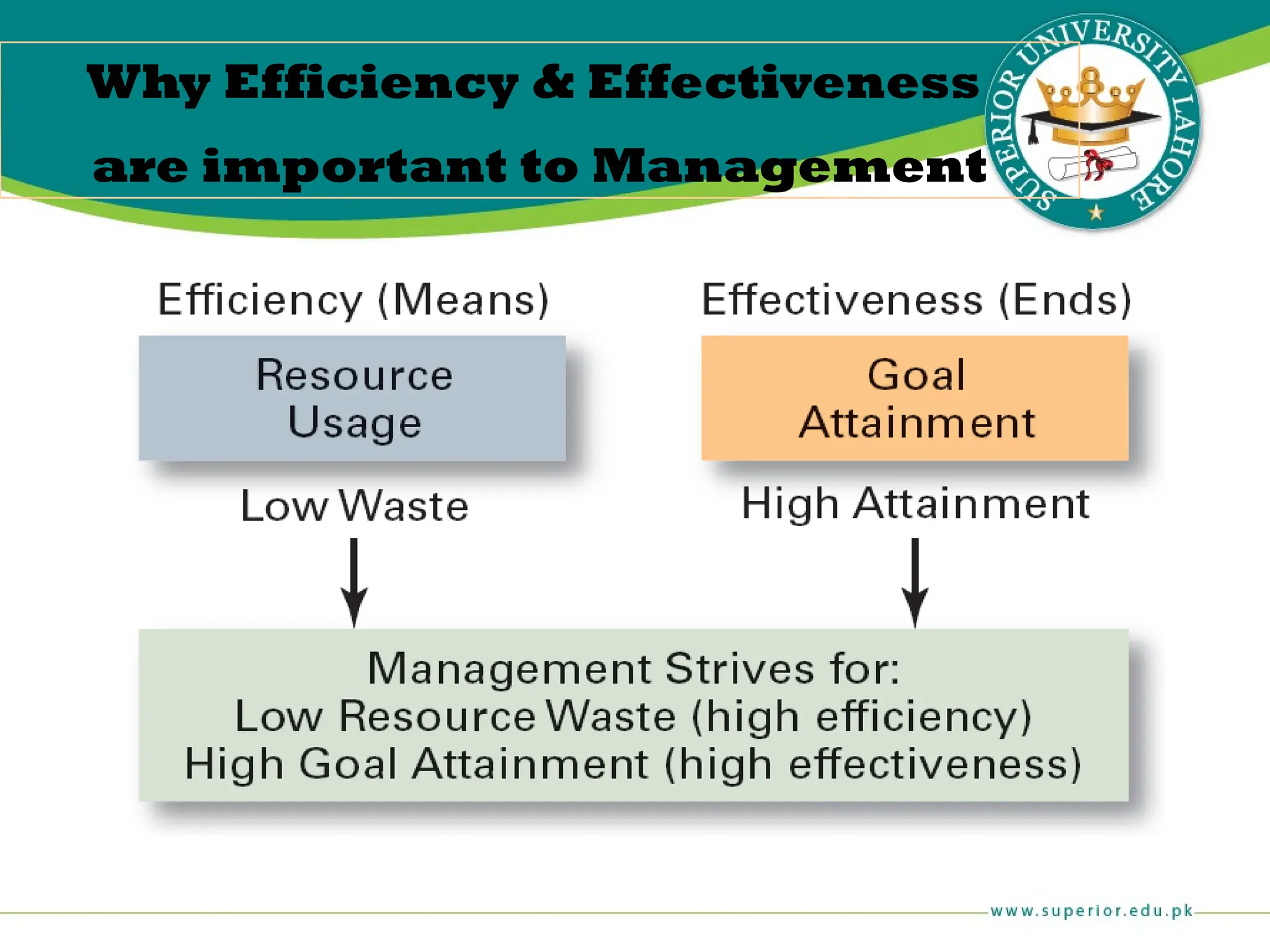
Why Efficiency & Effectiveness
are important to Management
8
What are the functions
of Management?
OR
What is Management
Process?
9
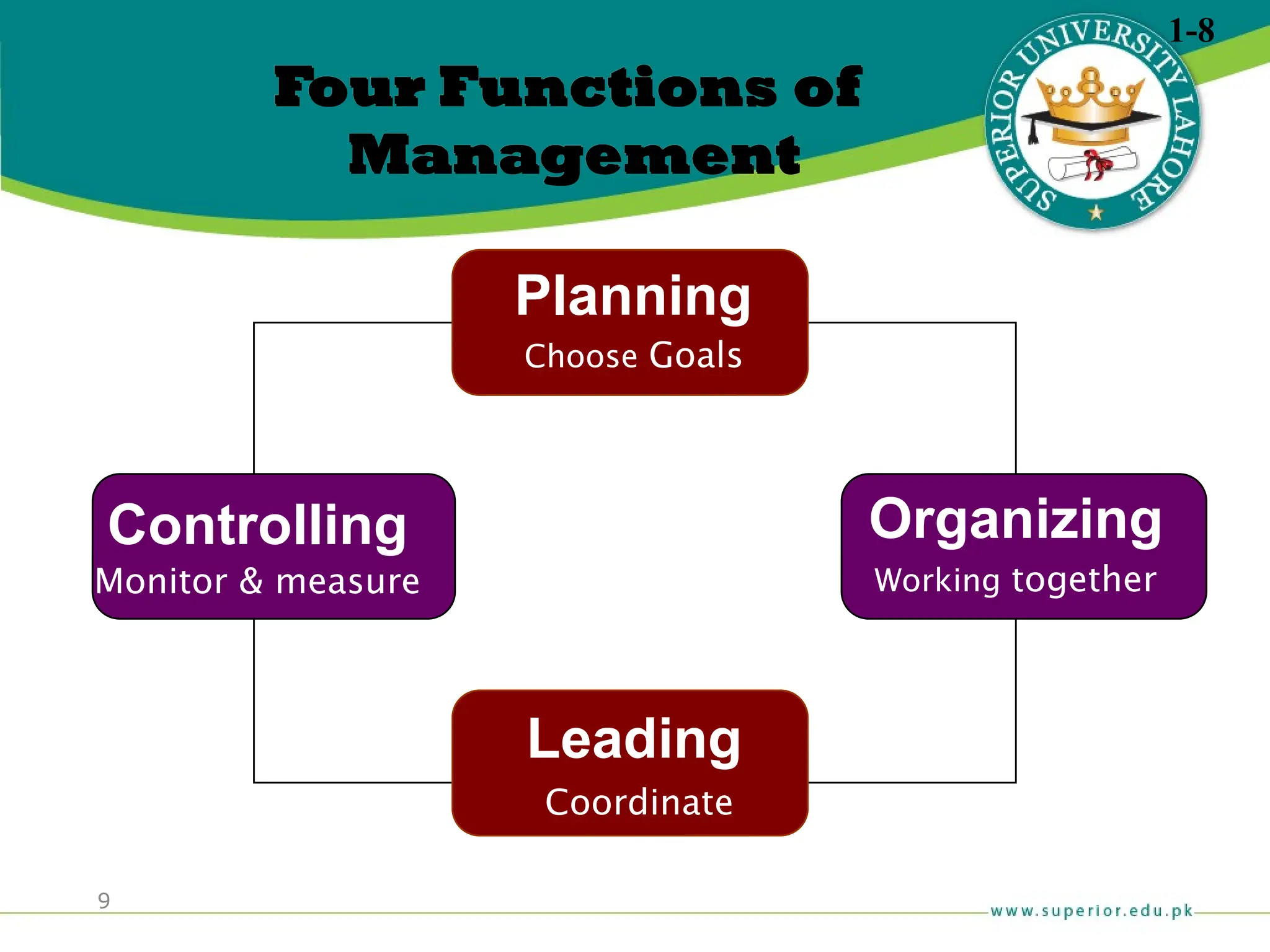
Four Functions of
Management
Planning
Choose Goals
Organizing
Working together
Leading
Coordinate
Controlling
Monitor & measure
1-8
10
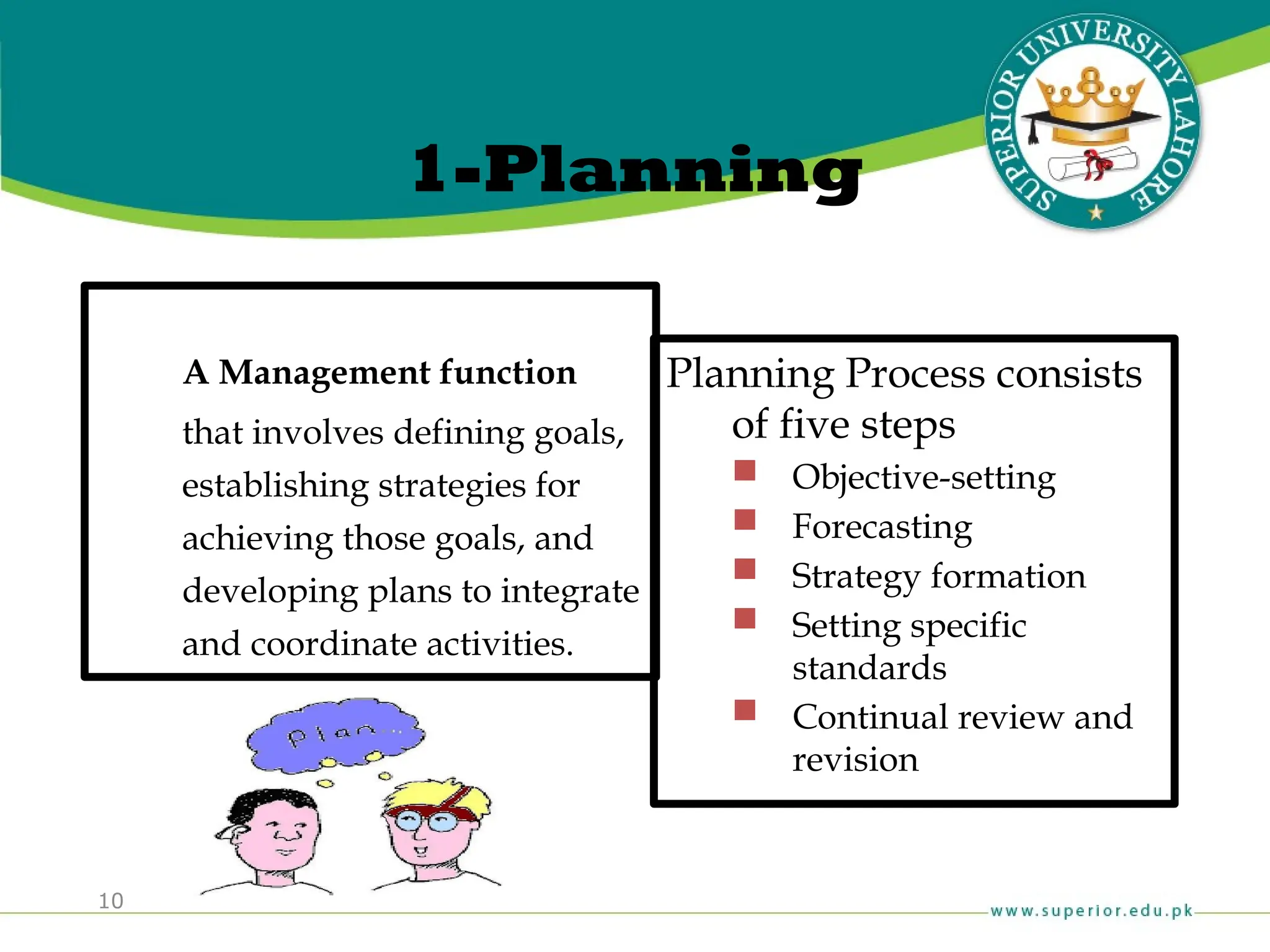
1-Planning
A Management function
that involves defining goals,
establishing strategies for
achieving those goals, and
developing plans to integrate
and coordinate activities.
Planning Process consists
of five steps
 Objective-setting
 Forecasting
 Strategy formation
 Setting specific
standards
 Continual review and
revision
11
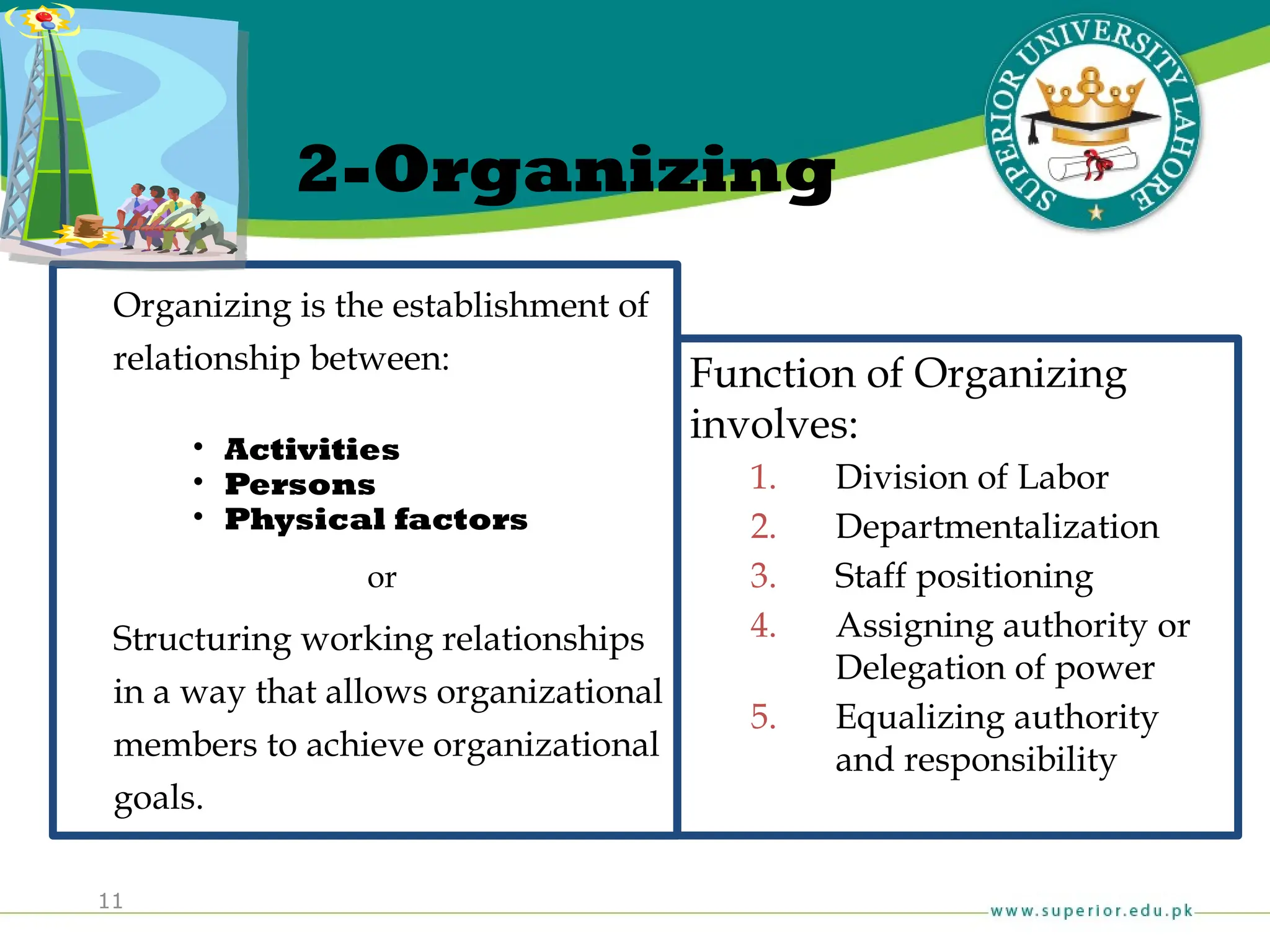
2-Organizing
Organizing is the establishment of
relationship between:
• Activities
• Persons
• Physical factors
or
Structuring working relationships
in a way that allows organizational
members to achieve organizational
goals.
Function of Organizing
involves:
1. Division of Labor
2. Departmentalization
3. Staff positioning
4. Assigning authority or
Delegation of power
5. Equalizing authority
and responsibility
12
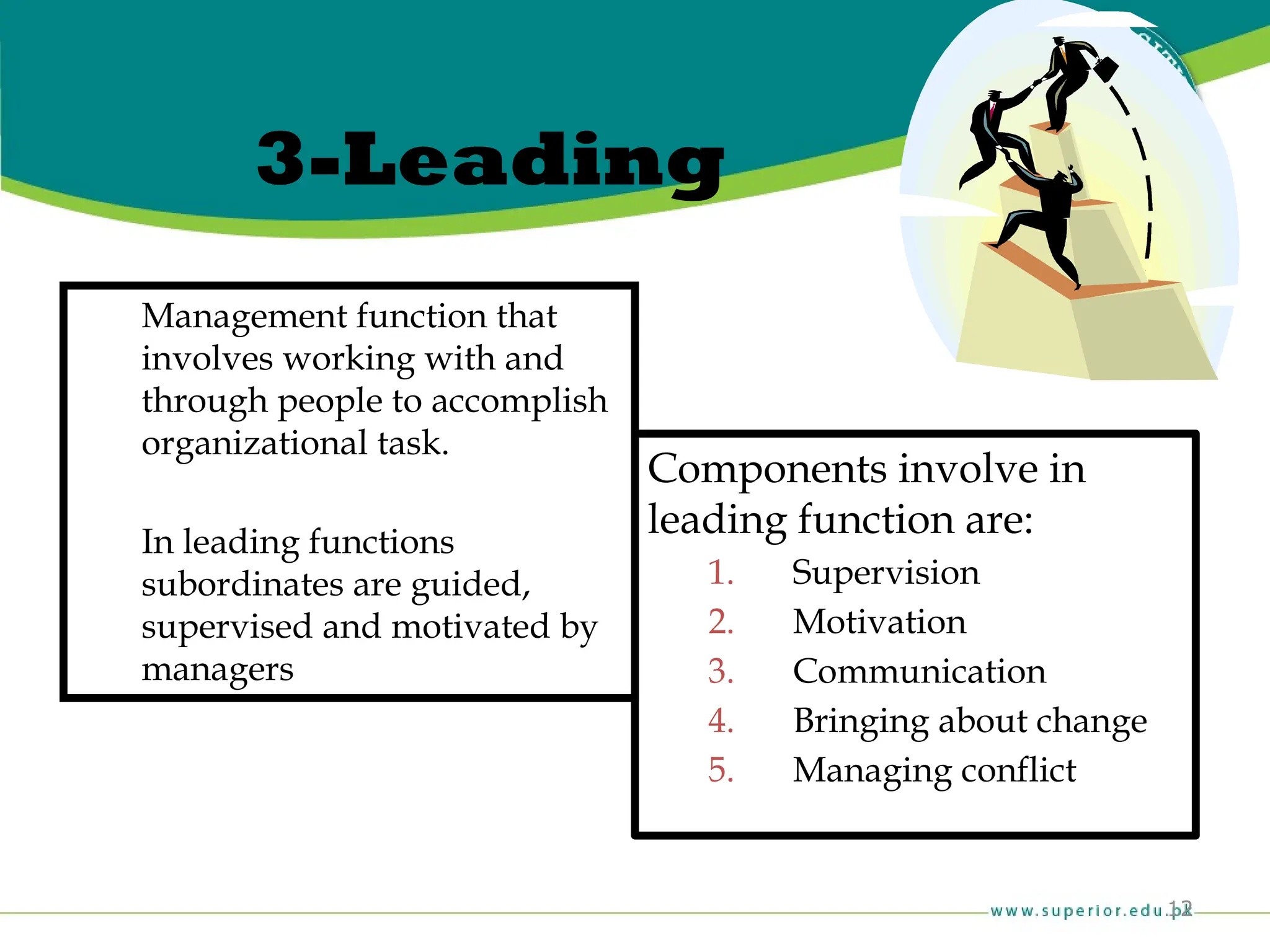
3-Leading
Management function that
involves working with and
through people to accomplish
organizational task.
In leading functions
subordinates are guided,
supervised and motivated by
managers
Components involve in
leading function are:
1. Supervision
2. Motivation
3. Communication
4. Bringing about change
5. Managing conflict
13
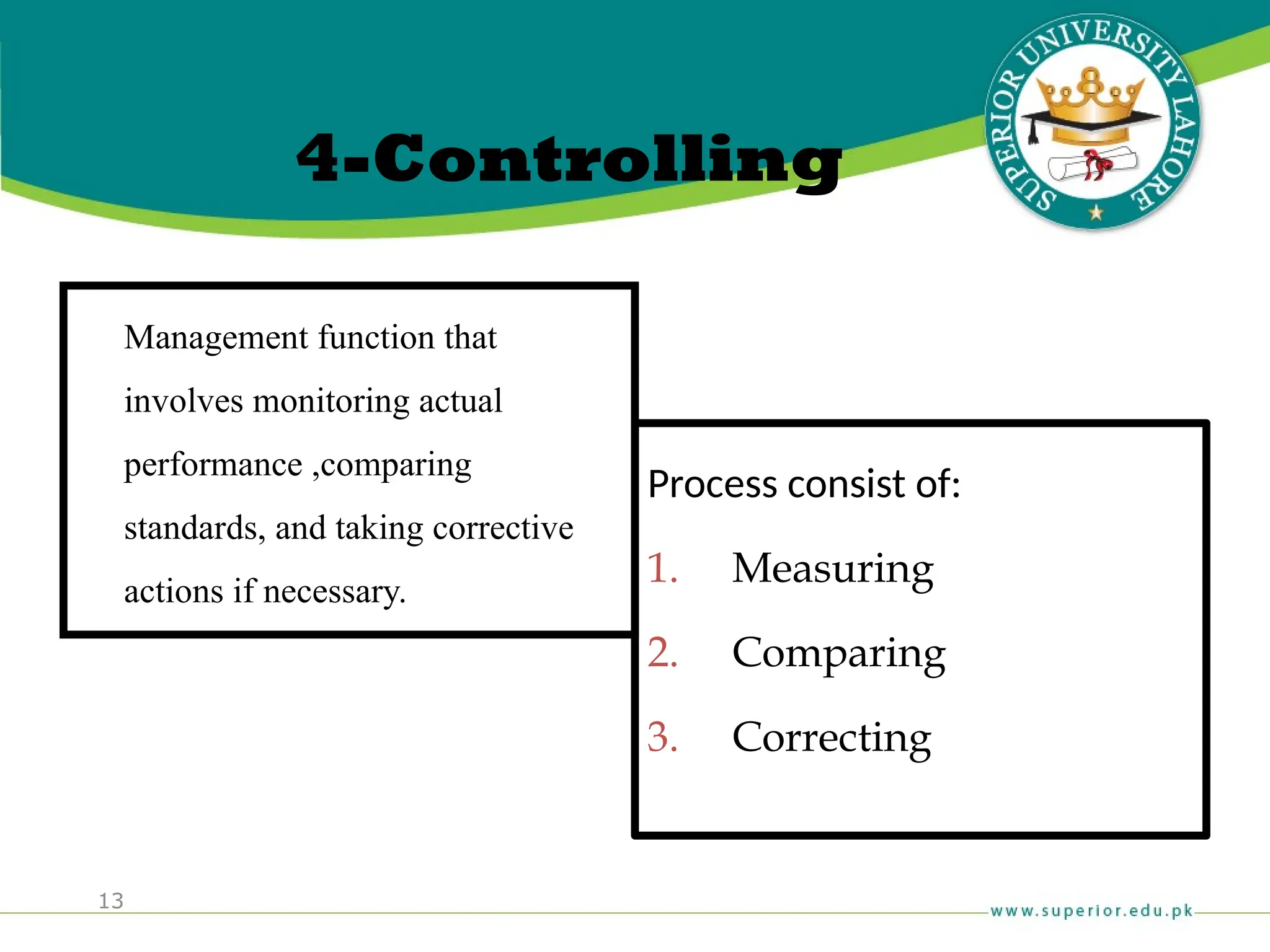
4-Controlling
Management function that
involves monitoring actual
performance ,comparing
standards, and taking corrective
actions if necessary.
Process consist of:
1. Measuring
2. Comparing
3. Correcting
14
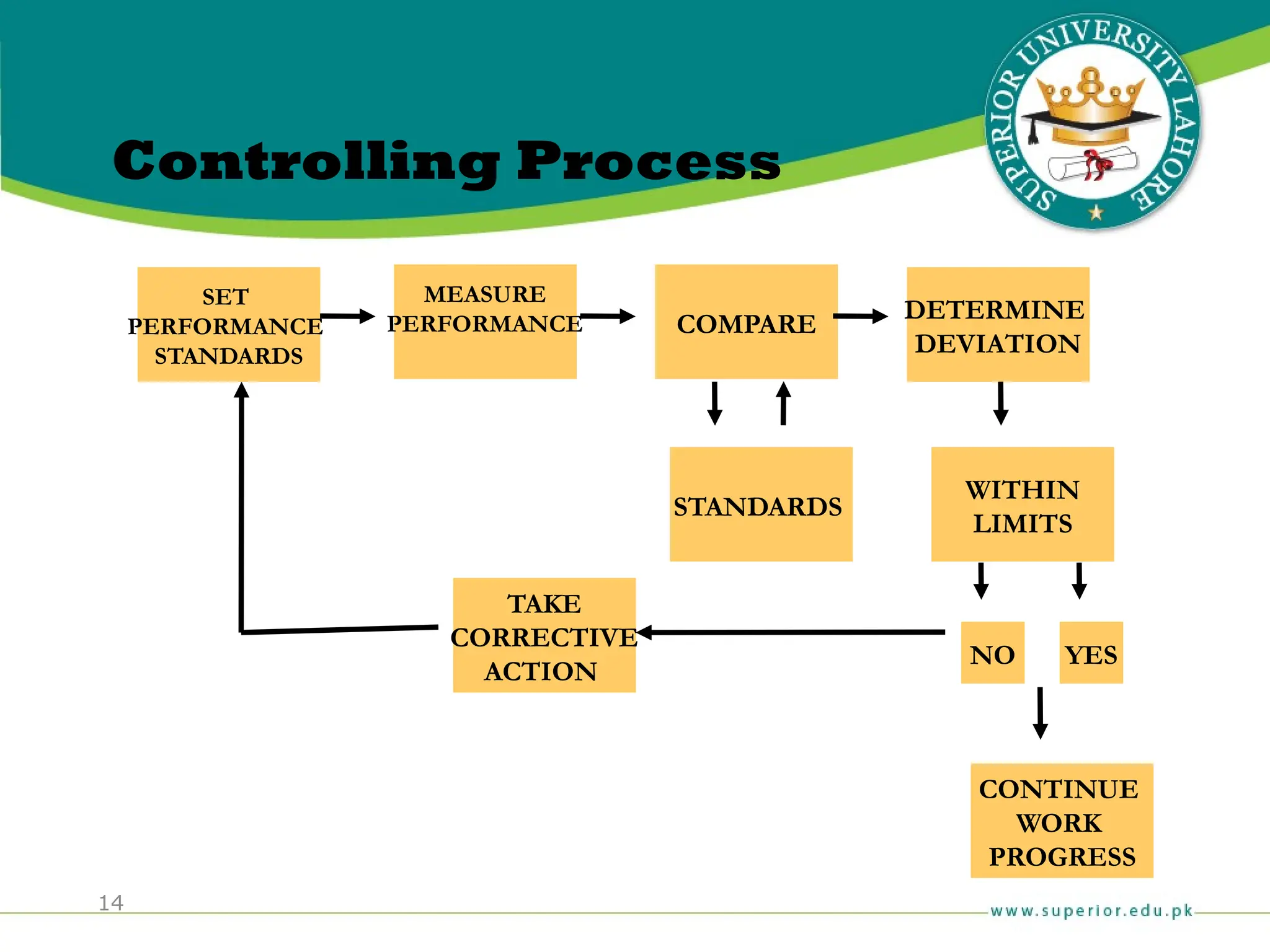
SET
PERFORMANCE
STANDARDS
STANDARDS
WITHIN
LIMITS
CONTINUE
WORK
PROGRESS
TAKE
CORRECTIVE
ACTION
COMPARE
MEASURE
PERFORMANCE
DETERMINE
DEVIATION
NO YES
Controlling Process
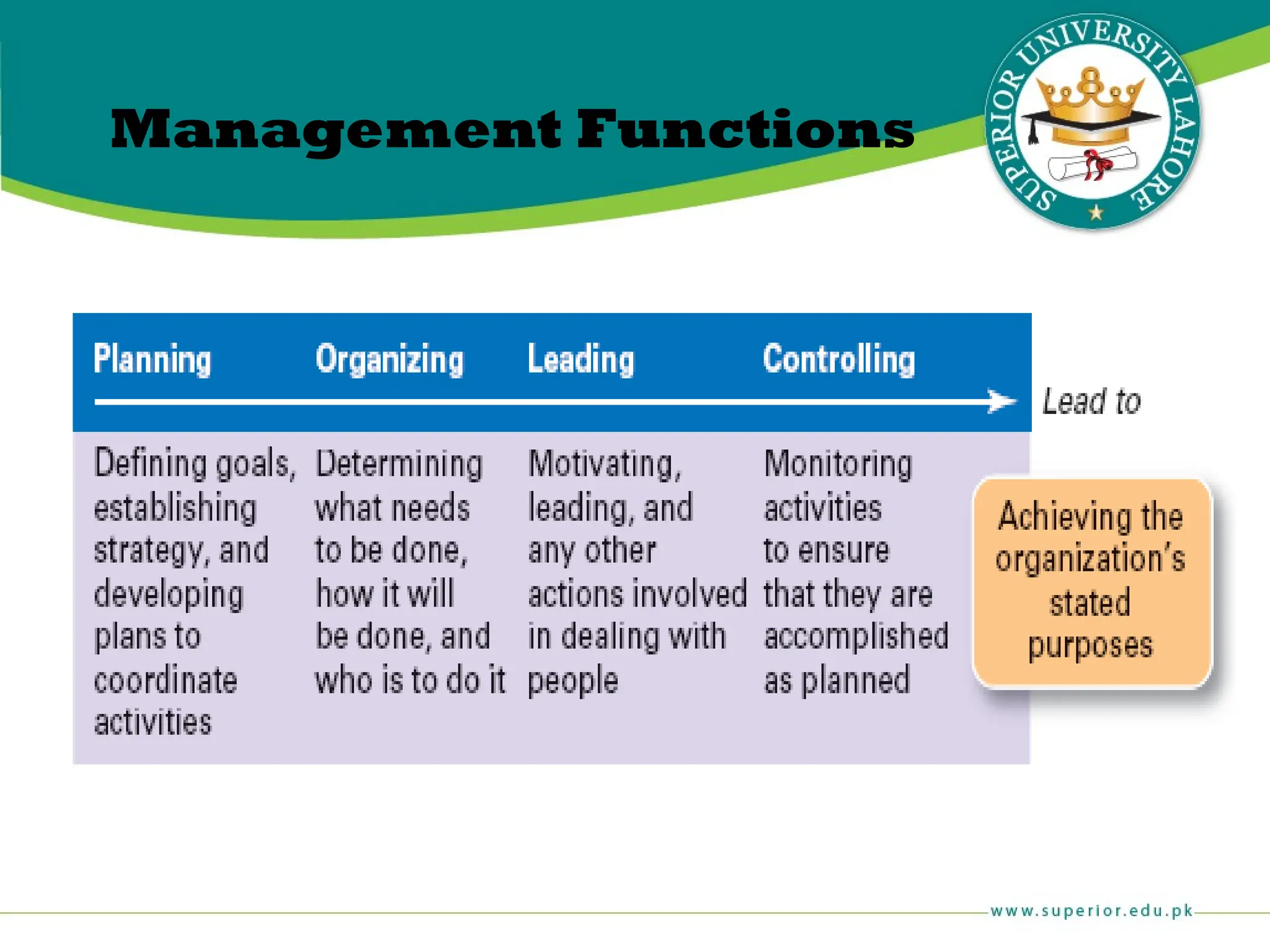
Management Functions
16
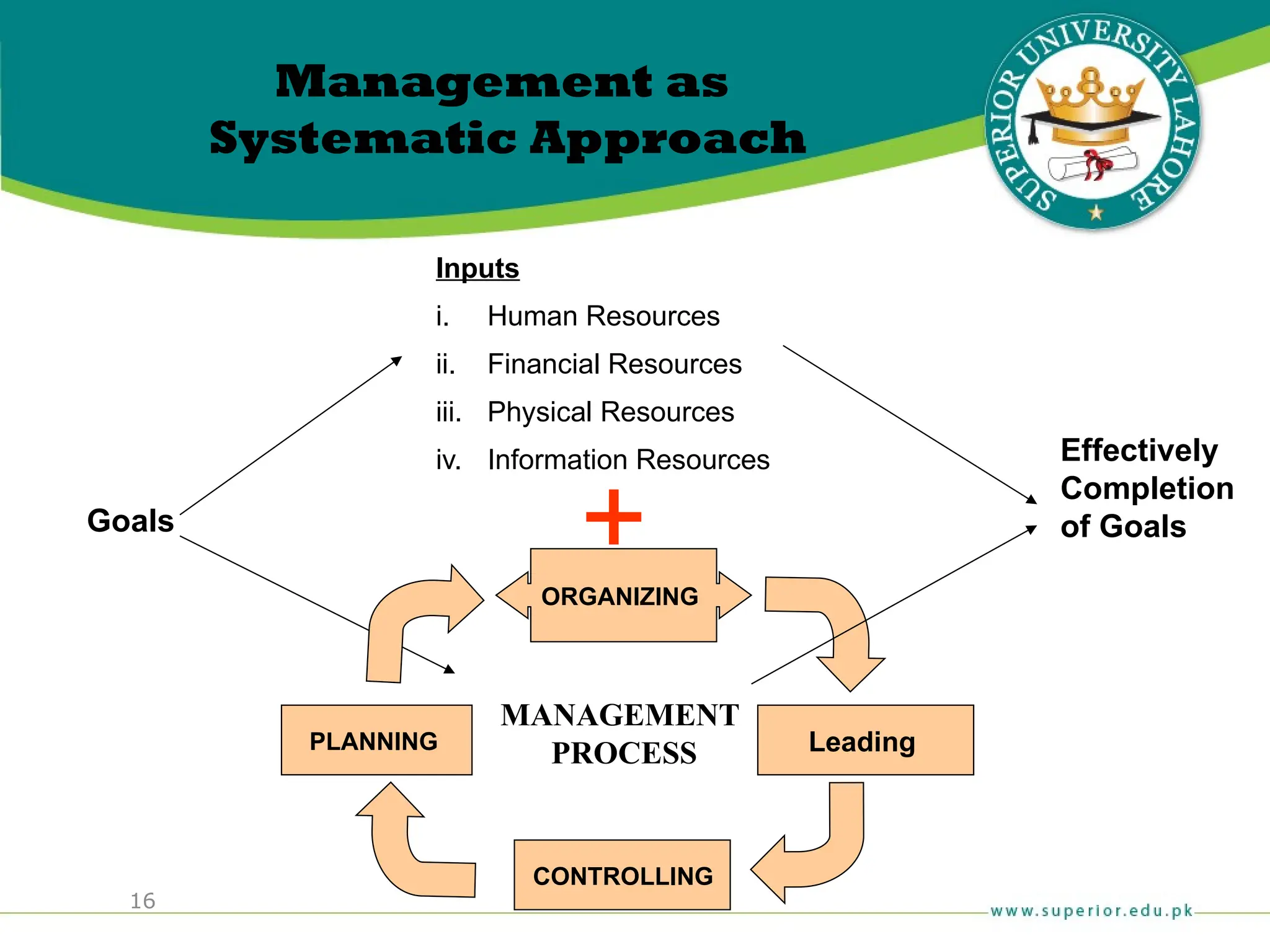
Management as
Systematic Approach
Goals
Inputs
i. Human Resources
ii. Financial Resources
iii. Physical Resources
iv. Information Resources
MANAGEMENT
PROCESS
ORGANIZING
PLANNING
Effectively
Completion
of Goals
+
CONTROLLING
Leading
17
The Universality of
Management
The reality that management is needed in all
types and sizes of organization, at all
organizational levels, in all organizational
areas, and in organization no matter where
located.
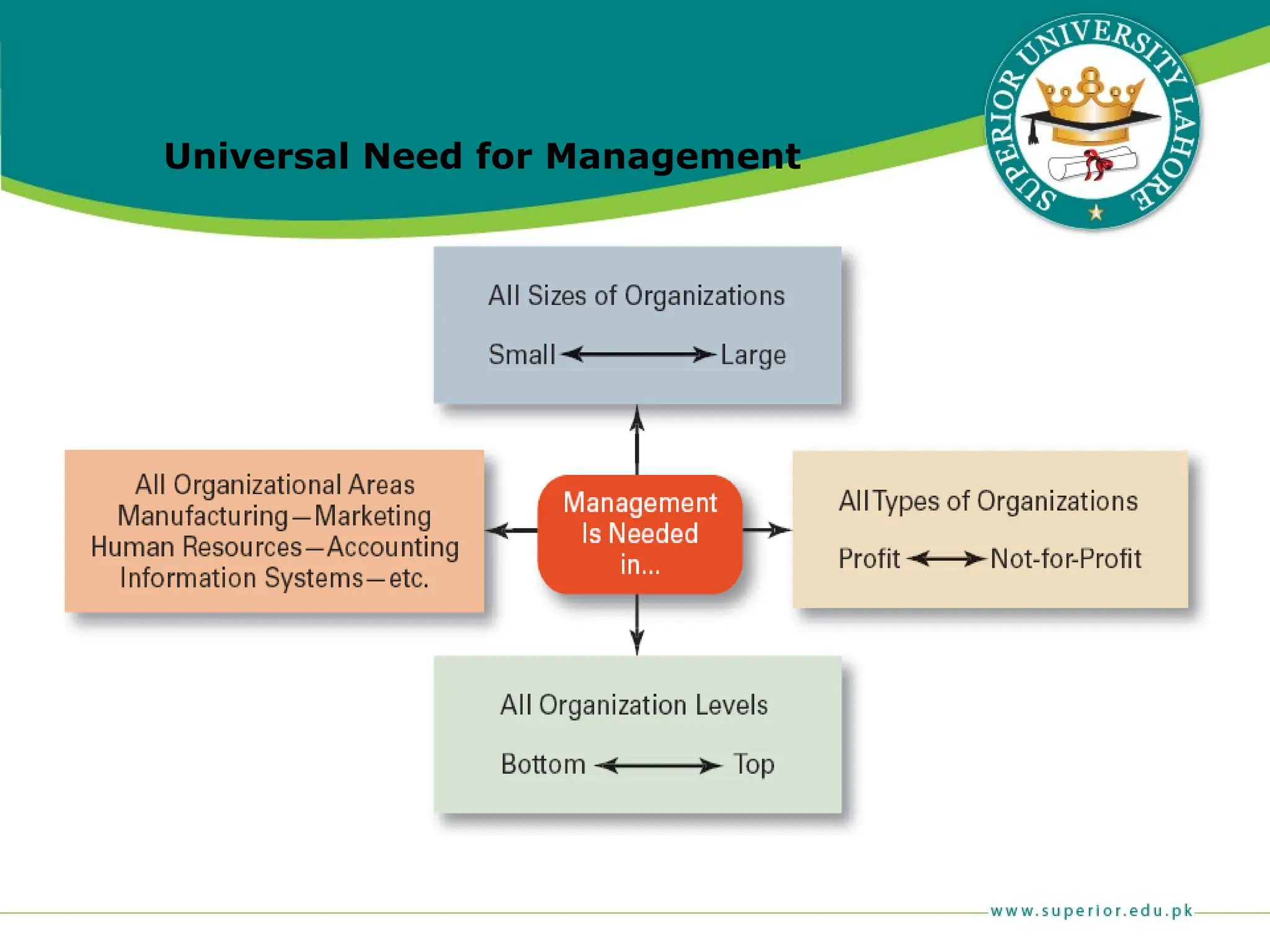
Universal Need for Management
19
Managers are those people who work with
and through other people for getting
activities completed in order to accomplish
organizational goals.
Manager
20
Difference between
Managers and Operatives
• Operatives are people who work
directly on a job or task & have no
responsibility for overseeing the work of
others.
In contrast
• Managers direct the activities of
other people in the organization.
21
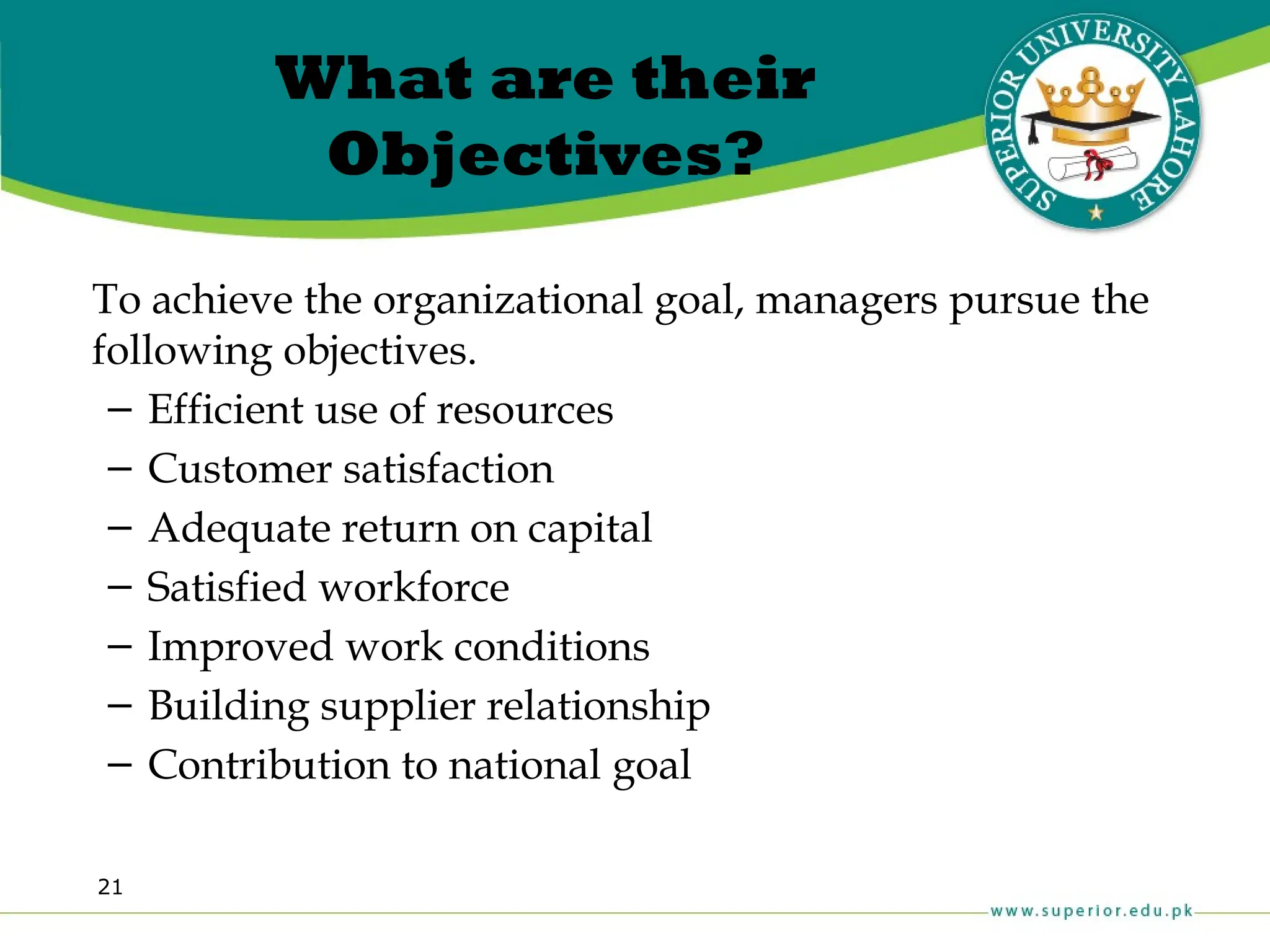
What are their
Objectives?
To achieve the organizational goal, managers pursue the
following objectives.
– Efficient use of resources
– Customer satisfaction
– Adequate return on capital
– Satisfied workforce
– Improved work conditions
– Building supplier relationship
– Contribution to national goal
22
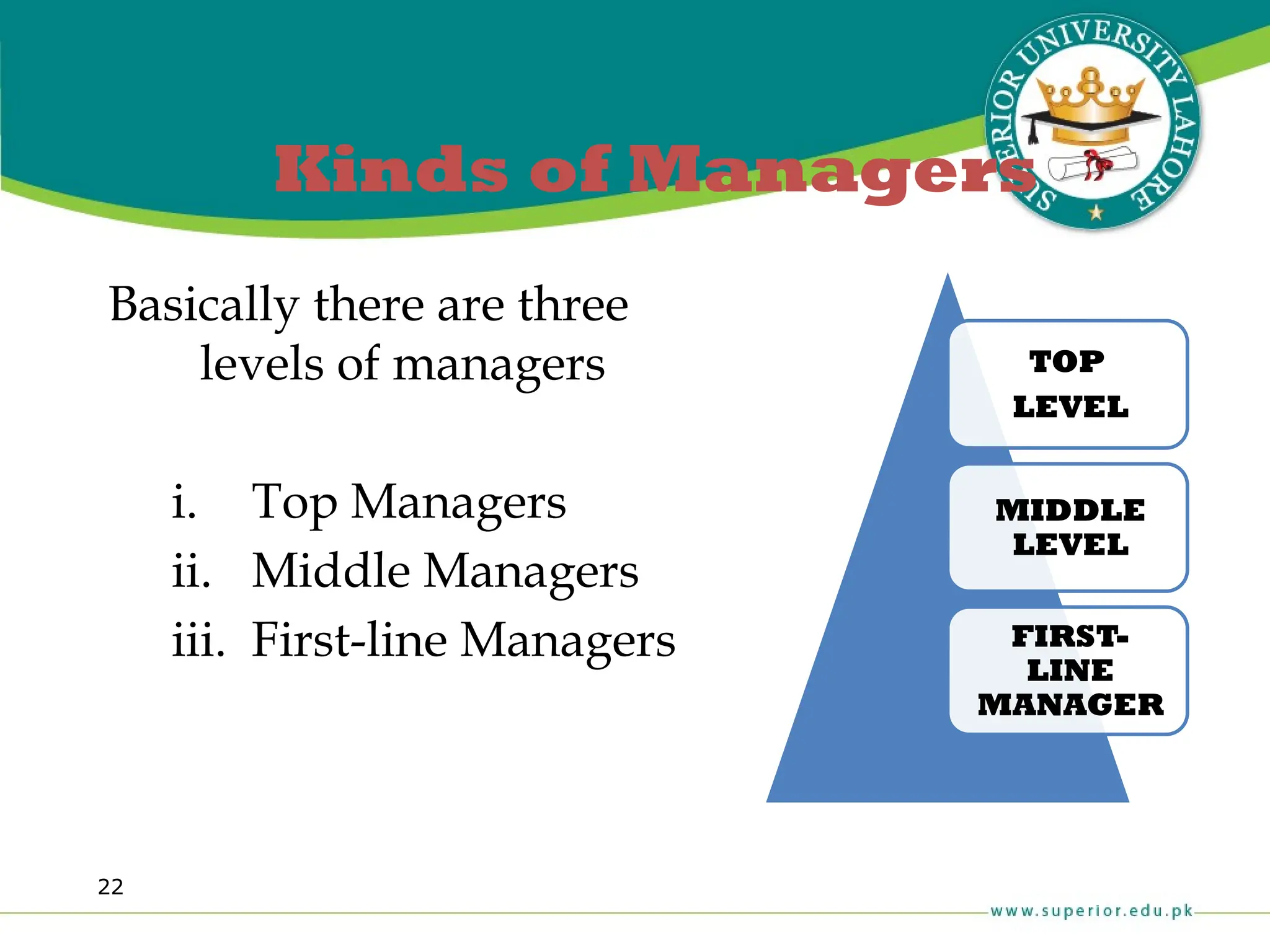
Kinds of Managers
Basically there are three
levels of managers
i. Top Managers
ii. Middle Managers
iii. First-line Managers
TOP
LEVEL
MIDDLE
LEVEL
FIRST-
LINE
MANAGER
23
Basic
Managerial
Roles & Skills
24
Managerial Role.
The managerial roles are divided into three
basic categories identified by Henry
Mintzberg.
1. Interpersonal Role
2. Informational Role
3. Decisional Role
25
26
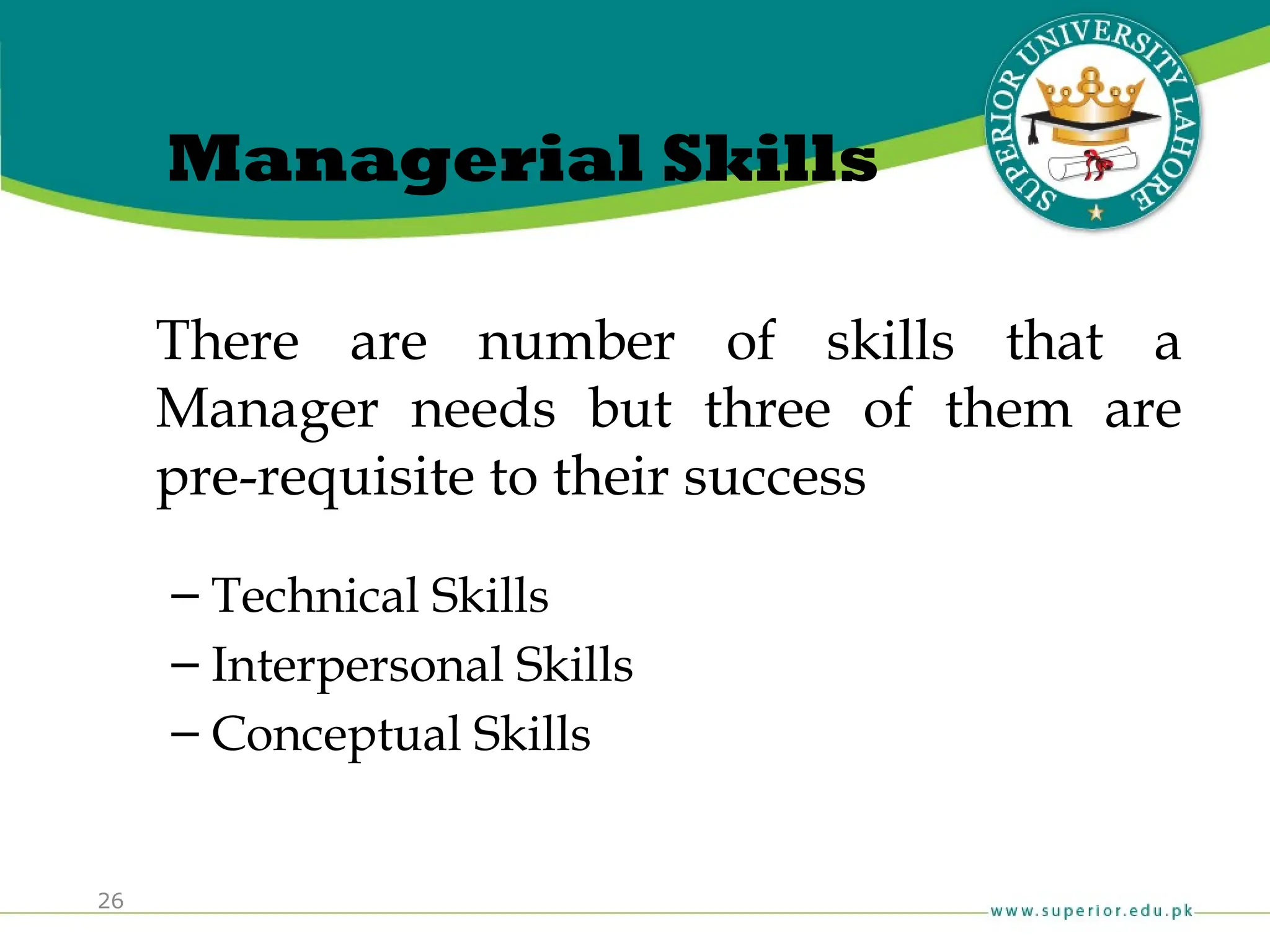
Managerial Skills
There are number of skills that a
Manager needs but three of them are
pre-requisite to their success
– Technical Skills
– Interpersonal Skills
– Conceptual Skills
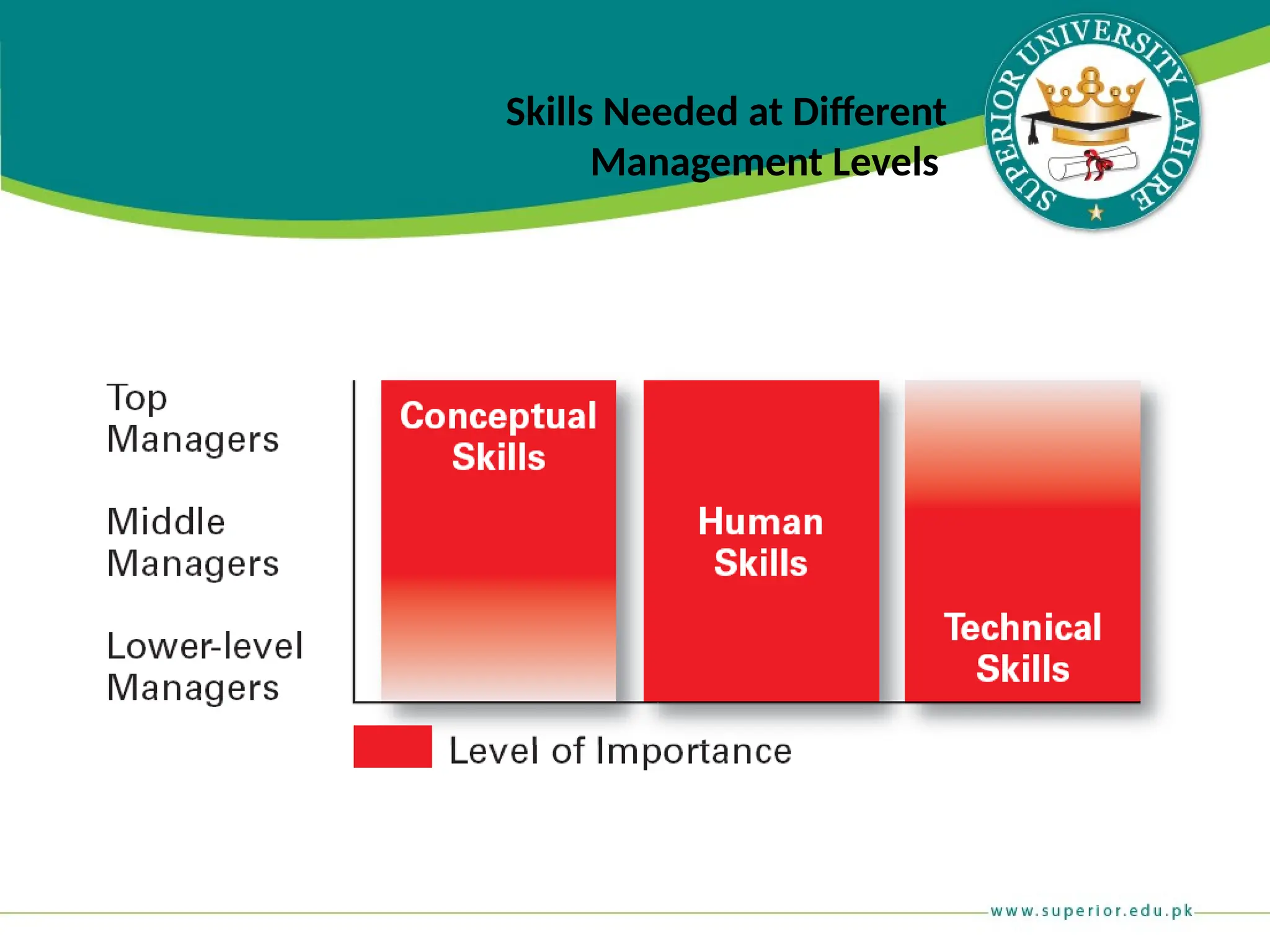
Skills Needed at Different
Management Levels
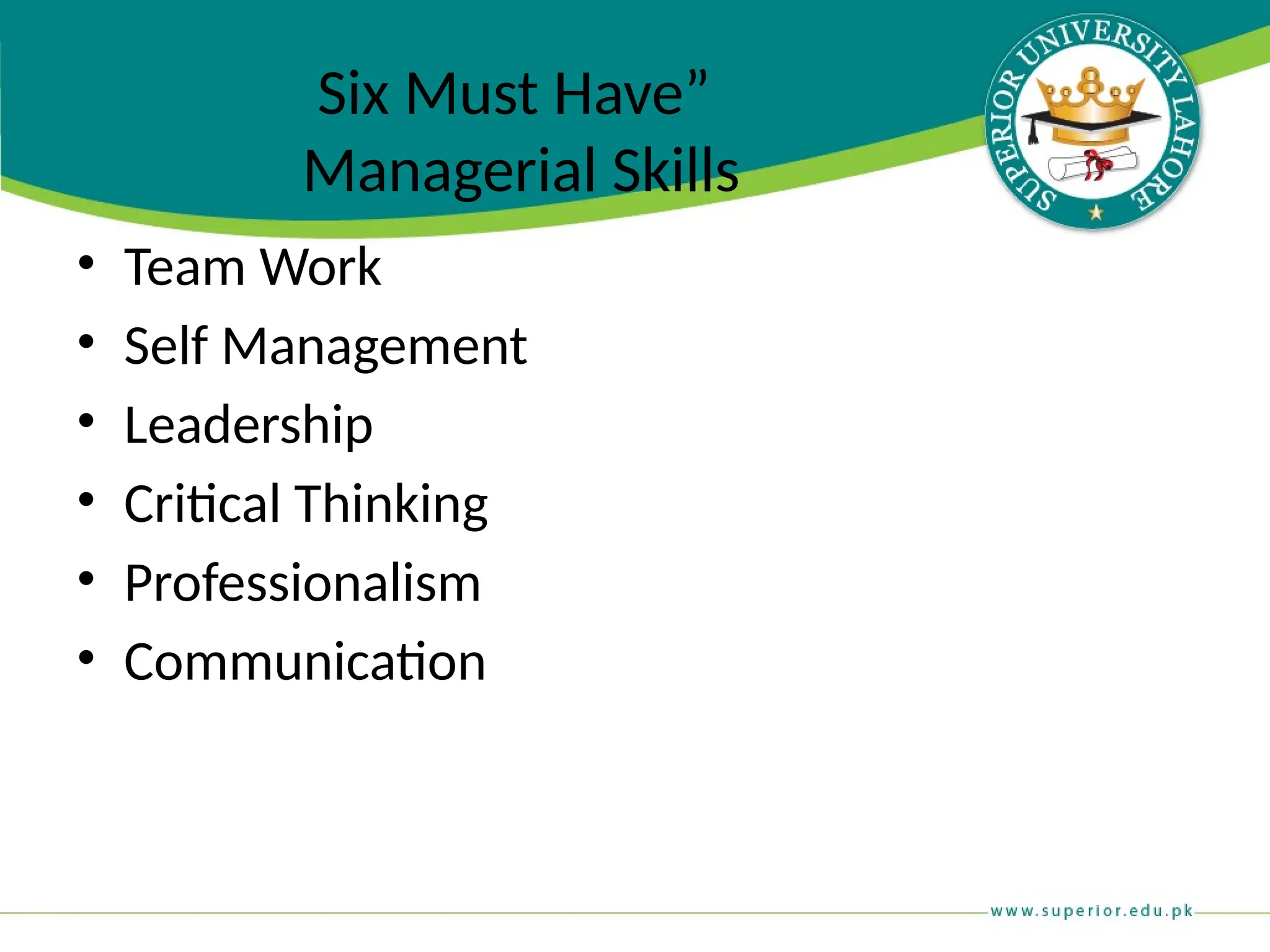
Six Must Have”
Managerial Skills
• Team Work
• Self Management
• Leadership
• Critical Thinking
• Professionalism
• Communication
29
HOW THE
MANAGER’S JOB IS
CHANGING
Roles
Skills
Manager
Interpersonal
Informational
Decisional
Liaison
Leader
Figure Head
Spokes person
Disseminator
Monitor
Entrepreneur
Resource Allocator
Negotiator
Disturbance Handler
Technical Skills
Interpersonal skills
Conceptual Skills
Diagnostic Skills
Levels
Top Level
Middle Level
First level
Components of
Management
MANAGEMENT
Changes and
Management
Universality of
Management
All sizes of Organizations
All Types of Organizations
All Organizational Levels
Effectiveness
Efficiency
Motivation
Communication
Bringing Change
Managing Conflicts
Supervision
Measuring
Comparing
Correcting
Functions
PLANNING ORGANIZING
LEADING CONTROLLING
Goal setting
Forecasting
Strategy Formation
Review & Revision
Standard Setting
Division of labor
Departmentalization
Staff Positioning
Delegation of Power
Equalizing authority &
Responsibility
Digitization
Changing security threats
Organizational & Managerial Ethics
Increased Competitiveness
THANK YOU

Fundemntals of Managmnet basic expanations

  • 1.
    Principles of Management Session.1 Introduction to Management & Organizations USMAN SADIQ (Ph.D. Scholar)
  • 2.
    Our expectations?  Hardwork  Honesty  Responsible attitude
  • 3.
    AFTER STUDYING THISCHAPTER YOU SHOULD BE ABLE TO: • Define Business and describe the characteristics of Organization. • Differentiate between managerial and non-managerial employees. • Describe Management. • Explain the functions, roles, and skills of managers and how the manager's job is changing. • Recognize the value of studying Management
  • 4.
    4 Business : The term“Business” signifies individual & group activities directed towards wealth generation through goods & services (recognized by the law). Organization: A group of people working together in a structured and coordinated fashion to achieve a set of goals is called organization. Goals & Objectives: Goals are the end results towards which all the activities are directed. Different organizations may have different goals. e.g. Profitability, Growth, Market Penetration, Productivity, Leadership, Client Satisfaction etc. Objectives are sub goals. SOME IMPORTANT TERMS TO KNOW
  • 5.
    5 What is Management... Coordinationand oversight of the work activities of others so that their activities are completed efficiently and effectively.
  • 6.
    6 EffectivenessVS Efficiency Doing theright things , or completing activities so that organization goals are attained, called Effectiveness. Doing the things right, or getting the most output from the least amount of inputs, called Efficiency.
  • 7.
    Why Efficiency &Effectiveness are important to Management
  • 8.
    8 What are thefunctions of Management? OR What is Management Process?
  • 9.
    9 Four Functions of Management Planning ChooseGoals Organizing Working together Leading Coordinate Controlling Monitor & measure 1-8
  • 10.
    10 1-Planning A Management function thatinvolves defining goals, establishing strategies for achieving those goals, and developing plans to integrate and coordinate activities. Planning Process consists of five steps  Objective-setting  Forecasting  Strategy formation  Setting specific standards  Continual review and revision
  • 11.
    11 2-Organizing Organizing is theestablishment of relationship between: • Activities • Persons • Physical factors or Structuring working relationships in a way that allows organizational members to achieve organizational goals. Function of Organizing involves: 1. Division of Labor 2. Departmentalization 3. Staff positioning 4. Assigning authority or Delegation of power 5. Equalizing authority and responsibility
  • 12.
    12 3-Leading Management function that involvesworking with and through people to accomplish organizational task. In leading functions subordinates are guided, supervised and motivated by managers Components involve in leading function are: 1. Supervision 2. Motivation 3. Communication 4. Bringing about change 5. Managing conflict
  • 13.
    13 4-Controlling Management function that involvesmonitoring actual performance ,comparing standards, and taking corrective actions if necessary. Process consist of: 1. Measuring 2. Comparing 3. Correcting
  • 14.
  • 15.
  • 16.
    16 Management as Systematic Approach Goals Inputs i.Human Resources ii. Financial Resources iii. Physical Resources iv. Information Resources MANAGEMENT PROCESS ORGANIZING PLANNING Effectively Completion of Goals + CONTROLLING Leading
  • 17.
    17 The Universality of Management Thereality that management is needed in all types and sizes of organization, at all organizational levels, in all organizational areas, and in organization no matter where located.
  • 18.
  • 19.
    19 Managers are thosepeople who work with and through other people for getting activities completed in order to accomplish organizational goals. Manager
  • 20.
    20 Difference between Managers andOperatives • Operatives are people who work directly on a job or task & have no responsibility for overseeing the work of others. In contrast • Managers direct the activities of other people in the organization.
  • 21.
    21 What are their Objectives? Toachieve the organizational goal, managers pursue the following objectives. – Efficient use of resources – Customer satisfaction – Adequate return on capital – Satisfied workforce – Improved work conditions – Building supplier relationship – Contribution to national goal
  • 22.
    22 Kinds of Managers Basicallythere are three levels of managers i. Top Managers ii. Middle Managers iii. First-line Managers TOP LEVEL MIDDLE LEVEL FIRST- LINE MANAGER
  • 23.
  • 24.
    24 Managerial Role. The managerialroles are divided into three basic categories identified by Henry Mintzberg. 1. Interpersonal Role 2. Informational Role 3. Decisional Role
  • 25.
  • 26.
    26 Managerial Skills There arenumber of skills that a Manager needs but three of them are pre-requisite to their success – Technical Skills – Interpersonal Skills – Conceptual Skills
  • 27.
    Skills Needed atDifferent Management Levels
  • 28.
    Six Must Have” ManagerialSkills • Team Work • Self Management • Leadership • Critical Thinking • Professionalism • Communication
  • 29.
  • 31.
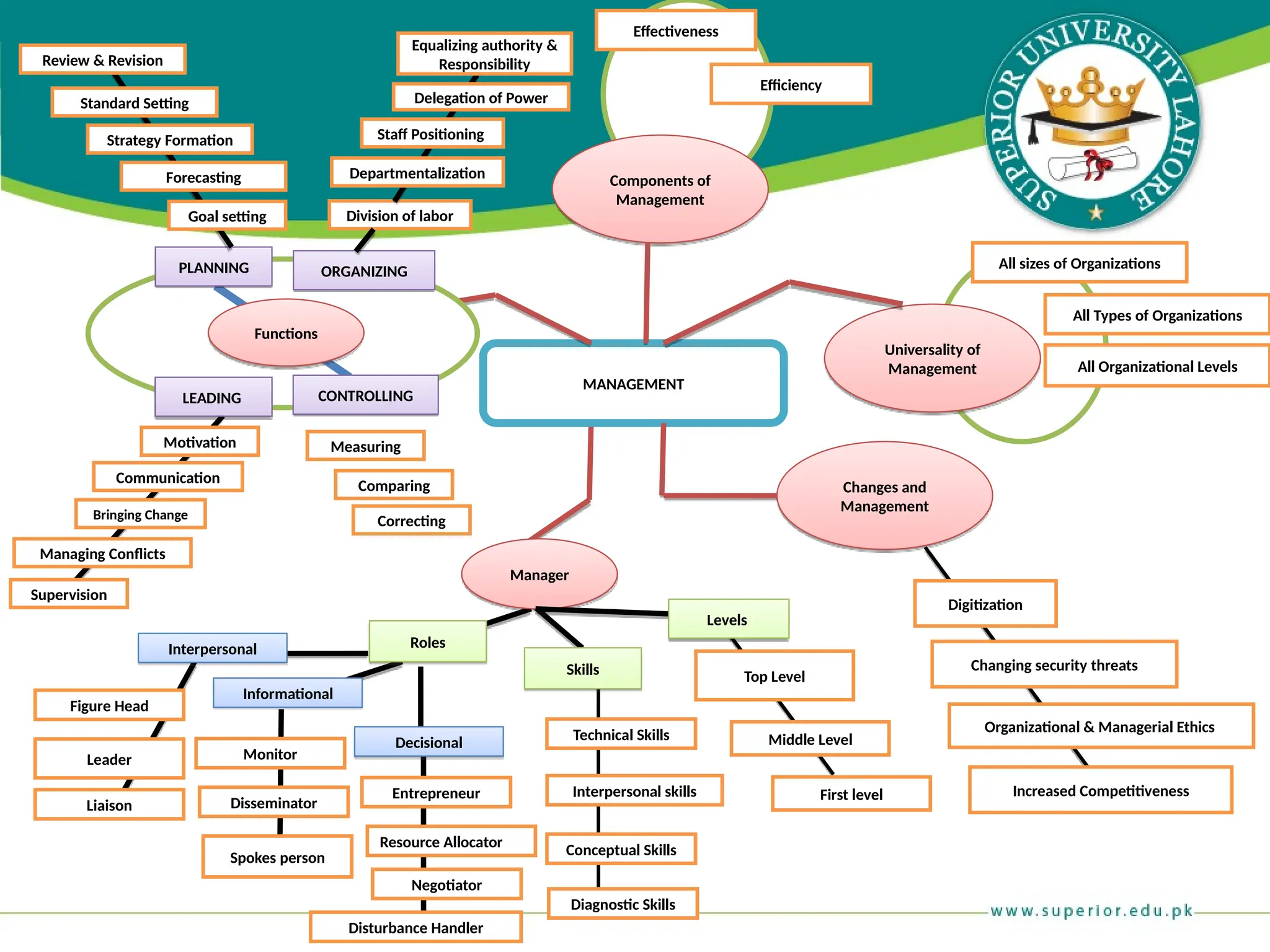
    Roles Skills Manager Interpersonal Informational Decisional Liaison Leader Figure Head Spokes person Disseminator Monitor Entrepreneur ResourceAllocator Negotiator Disturbance Handler Technical Skills Interpersonal skills Conceptual Skills Diagnostic Skills Levels Top Level Middle Level First level Components of Management MANAGEMENT Changes and Management Universality of Management All sizes of Organizations All Types of Organizations All Organizational Levels Effectiveness Efficiency Motivation Communication Bringing Change Managing Conflicts Supervision Measuring Comparing Correcting Functions PLANNING ORGANIZING LEADING CONTROLLING Goal setting Forecasting Strategy Formation Review & Revision Standard Setting Division of labor Departmentalization Staff Positioning Delegation of Power Equalizing authority & Responsibility Digitization Changing security threats Organizational & Managerial Ethics Increased Competitiveness
  • 32.