Introduction to
Accounting
Department of
Business Management
Dr. Laxmidhar Panda
Assistant Professor
01 Characteristic of Accounting
02 Nature and scope of Accounting
Contents
C. V. Raman Global University, Odisha
* 1
03 Need and Objective of Accounting
04 Branches of Accounting
C. V. Raman Global University, Odisha
* 2
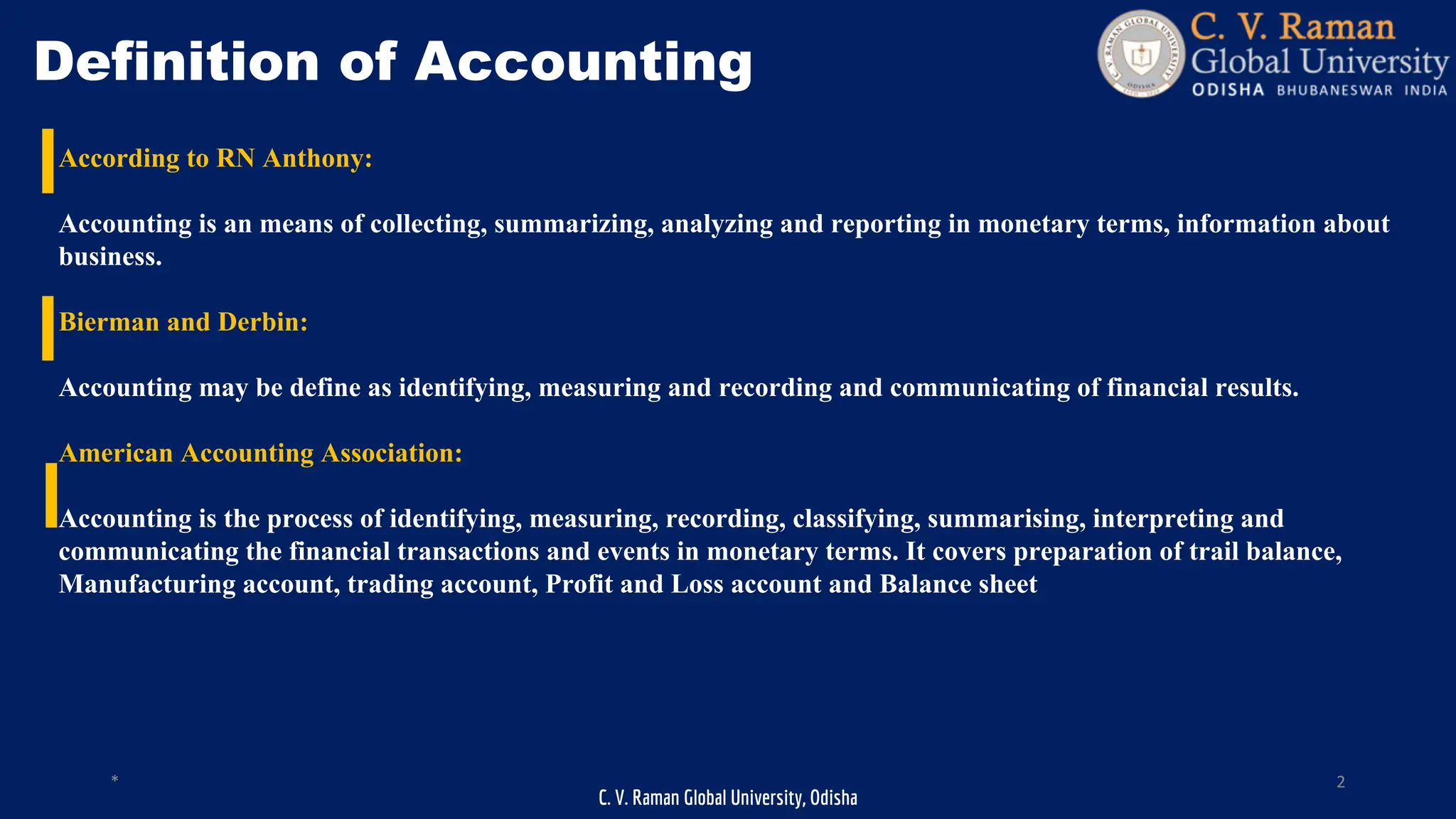
Definition of Accounting
According to RN Anthony:
Accounting is an means of collecting, summarizing, analyzing and reporting in monetary terms, information about
business.
Bierman and Derbin:
Accounting may be define as identifying, measuring and recording and communicating of financial results.
American Accounting Association:
Accounting is the process of identifying, measuring, recording, classifying, summarising, interpreting and
communicating the financial transactions and events in monetary terms. It covers preparation of trail balance,
Manufacturing account, trading account, Profit and Loss account and Balance sheet
C. V. Raman Global University, Odisha
* 2
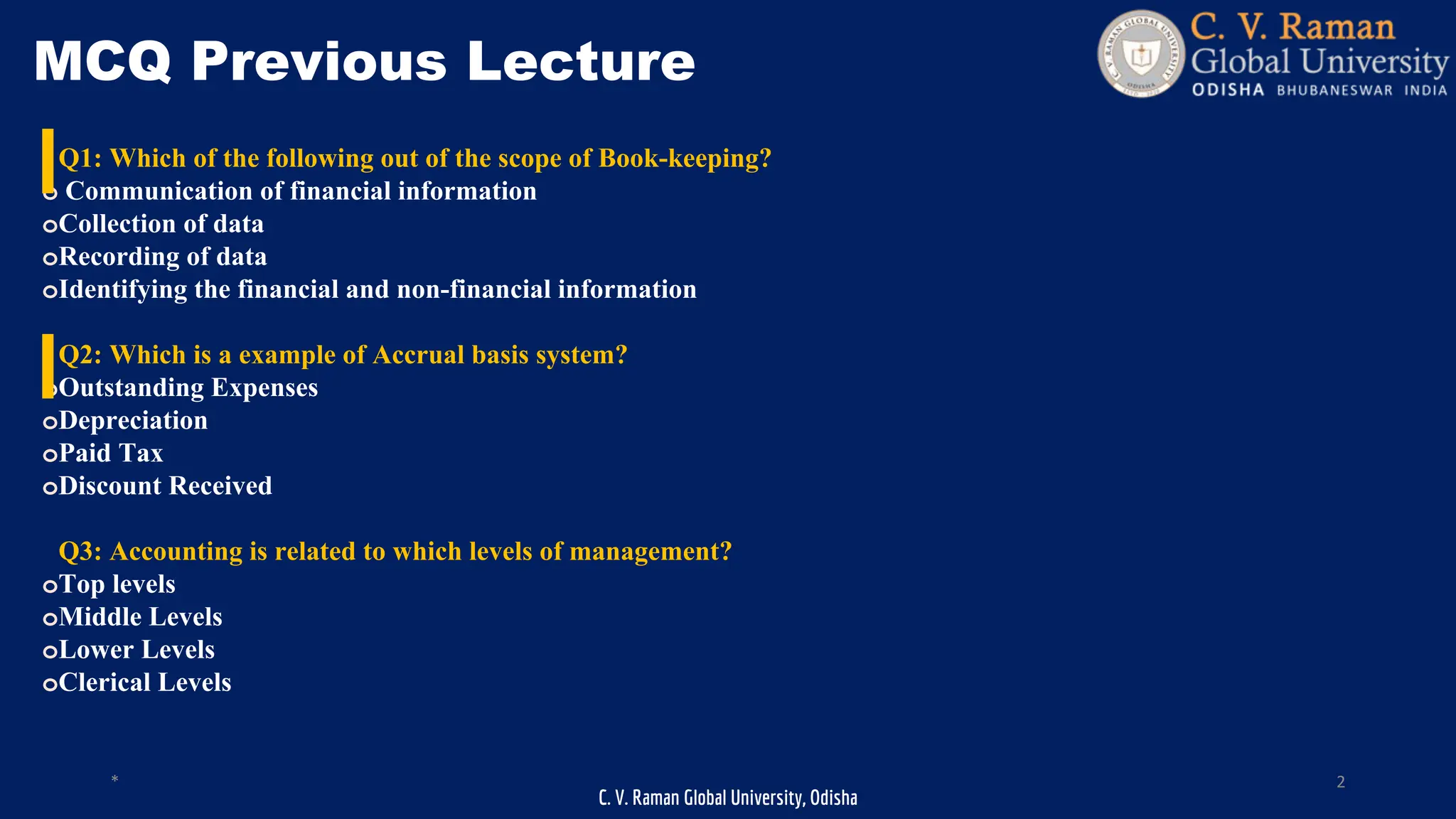
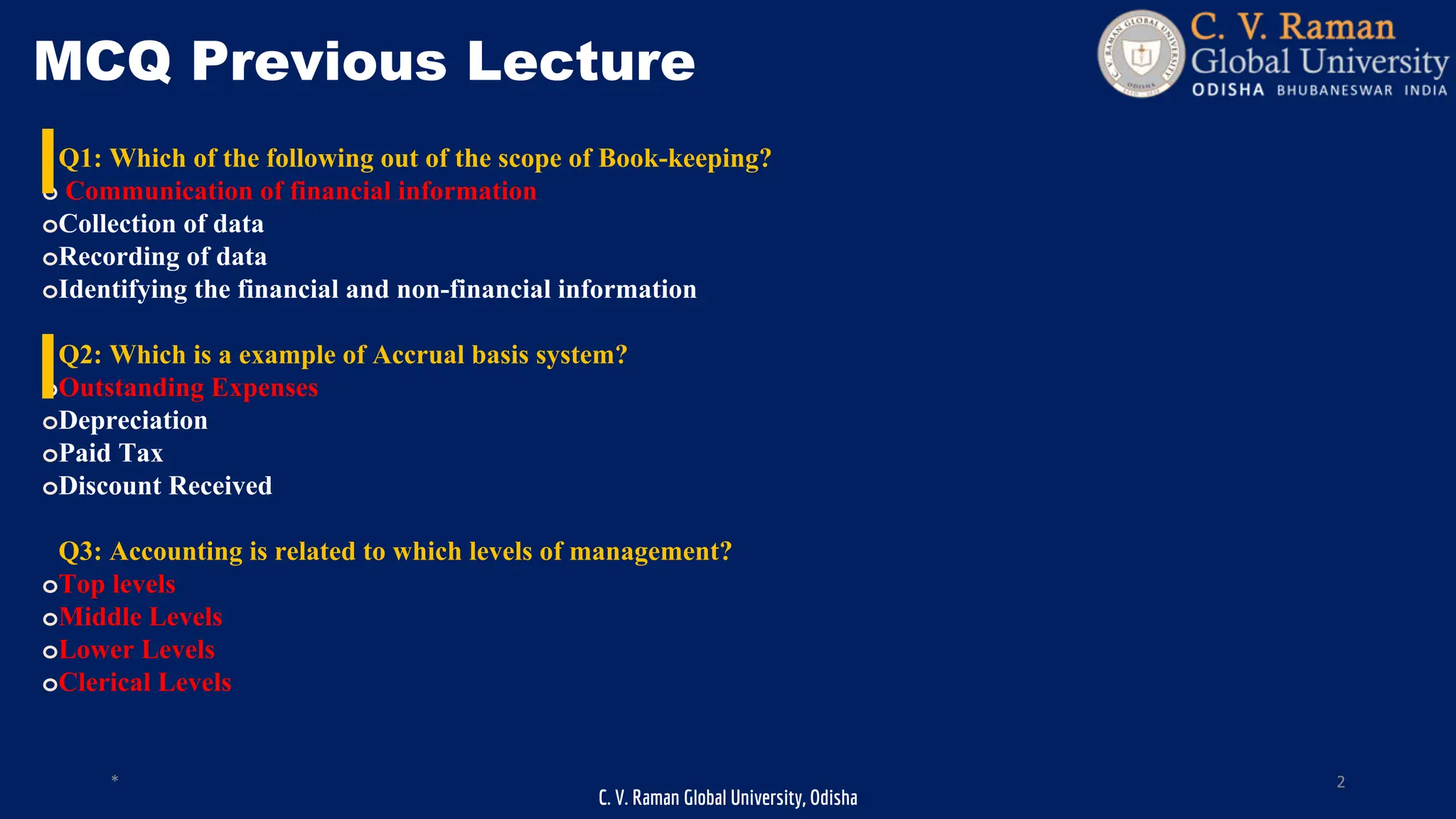
MCQ Previous Lecture
Q1: Which of the following out of the scope of Book-keeping?
o Communication of financial information
oCollection of data
oRecording of data
oIdentifying the financial and non-financial information
Q2: Which is a example of Accrual basis system?
oOutstanding Expenses
oDepreciation
oPaid Tax
oDiscount Received
Q3: Accounting is related to which levels of management?
oTop levels
oMiddle Levels
oLower Levels
oClerical Levels
C. V. Raman Global University, Odisha
* 2
MCQ Previous Lecture
Q1: Which of the following out of the scope of Book-keeping?
o Communication of financial information
oCollection of data
oRecording of data
oIdentifying the financial and non-financial information
Q2: Which is a example of Accrual basis system?
oOutstanding Expenses
oDepreciation
oPaid Tax
oDiscount Received
Q3: Accounting is related to which levels of management?
oTop levels
oMiddle Levels
oLower Levels
oClerical Levels
C. V. Raman Global University, Odisha
* 2
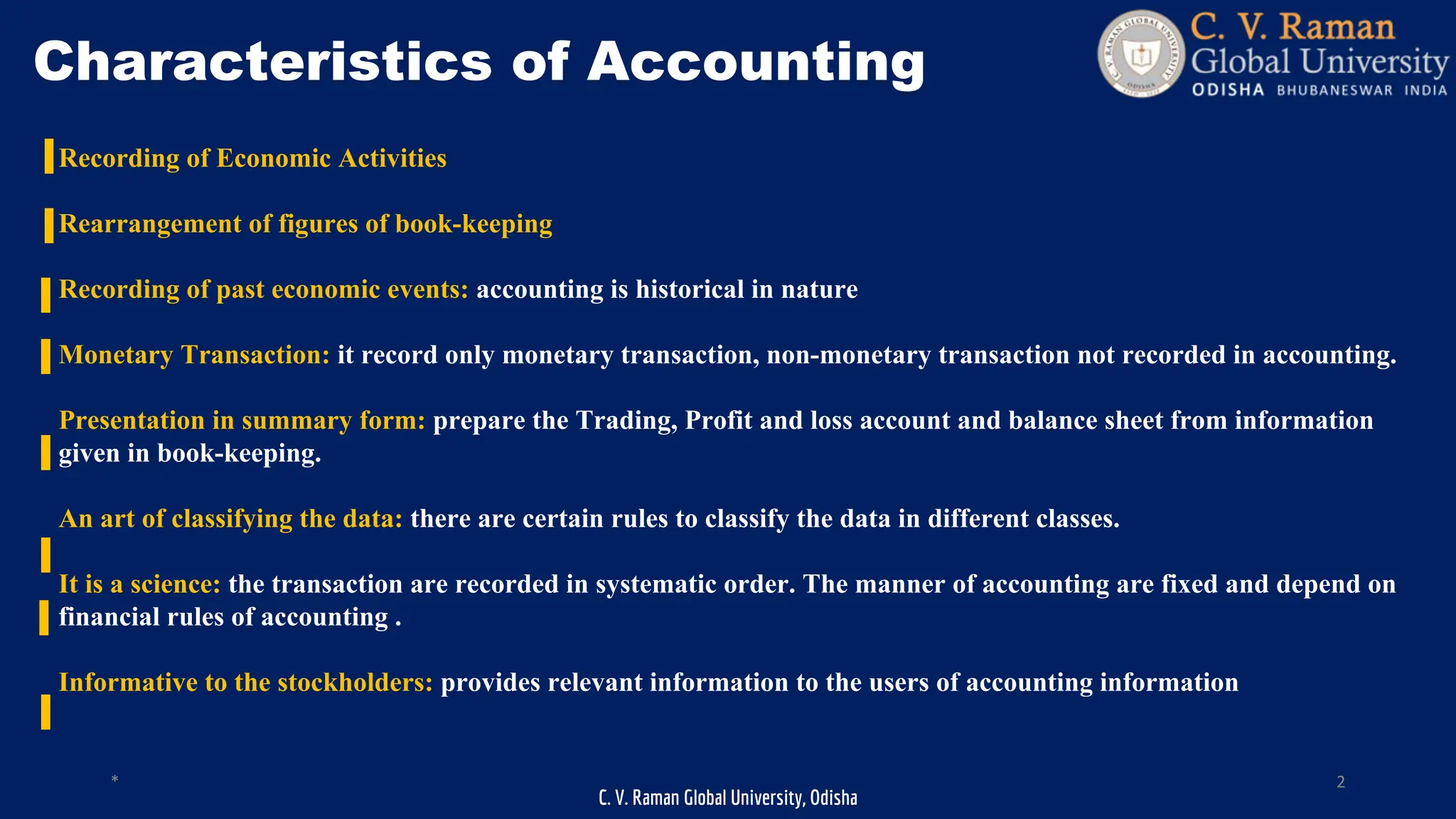
Characteristics of Accounting
Recording of Economic Activities
Rearrangement of figures of book-keeping
Recording of past economic events: accounting is historical in nature
Monetary Transaction: it record only monetary transaction, non-monetary transaction not recorded in accounting.
Presentation in summary form: prepare the Trading, Profit and loss account and balance sheet from information
given in book-keeping.
An art of classifying the data: there are certain rules to classify the data in different classes.
It is a science: the transaction are recorded in systematic order. The manner of accounting are fixed and depend on
financial rules of accounting .
Informative to the stockholders: provides relevant information to the users of accounting information
C. V. Raman Global University, Odisha
* 2
Scope of Accounting
To test and verify the entries in Book-keeping
To test the total and balance of ledger
To prepare Trail Balance from Ledger
To disclose adjustments
To Prepare the Final Account [Trading, P&L, BS]
To rectify error
To find out conclusion on the basis of analysis of financial statements
C. V. Raman Global University, Odisha
* 2
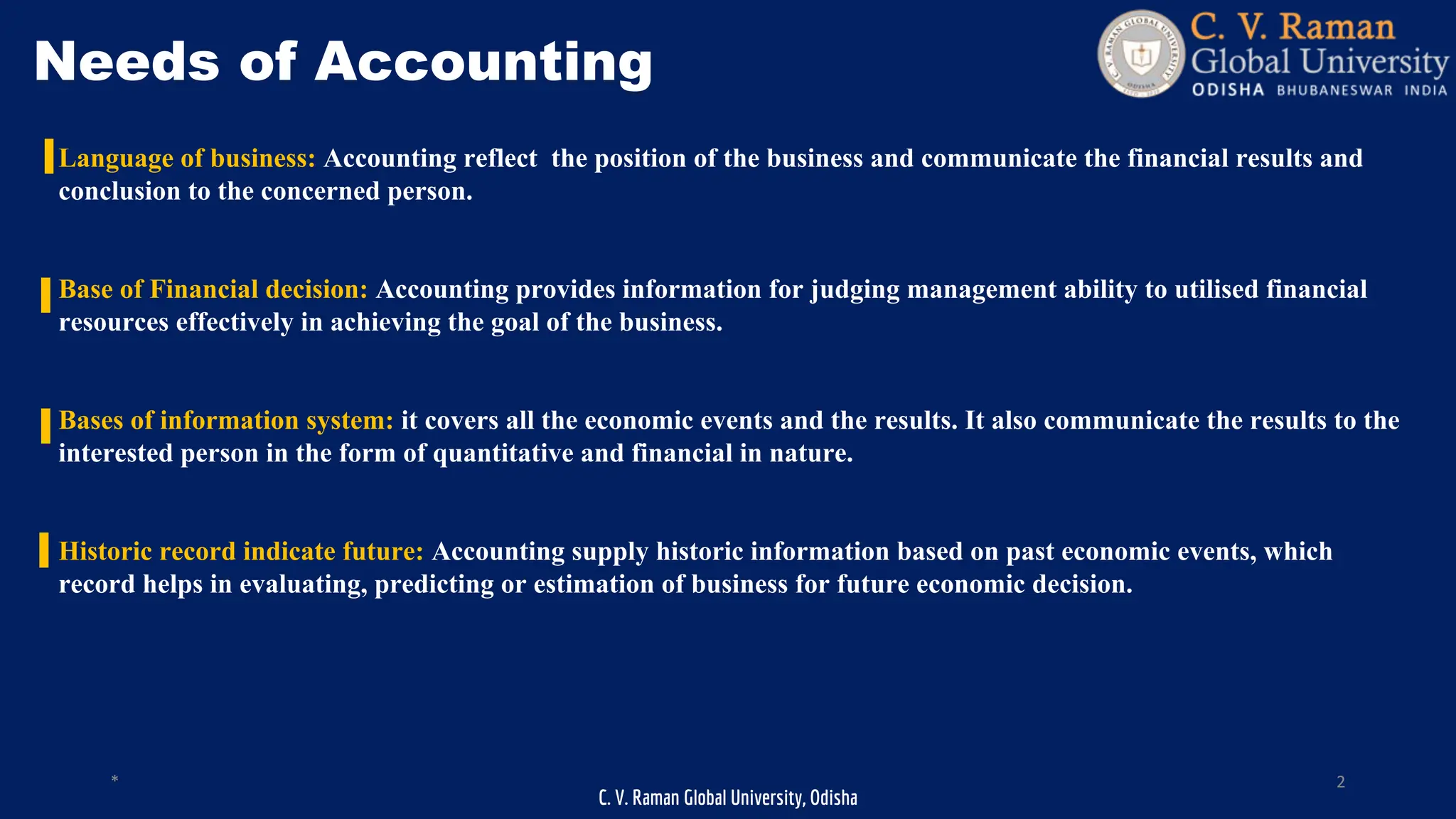
Needs of Accounting
Language of business: Accounting reflect the position of the business and communicate the financial results and
conclusion to the concerned person.
Base of Financial decision: Accounting provides information for judging management ability to utilised financial
resources effectively in achieving the goal of the business.
Bases of information system: it covers all the economic events and the results. It also communicate the results to the
interested person in the form of quantitative and financial in nature.
Historic record indicate future: Accounting supply historic information based on past economic events, which
record helps in evaluating, predicting or estimation of business for future economic decision.
C. V. Raman Global University, Odisha
* 2
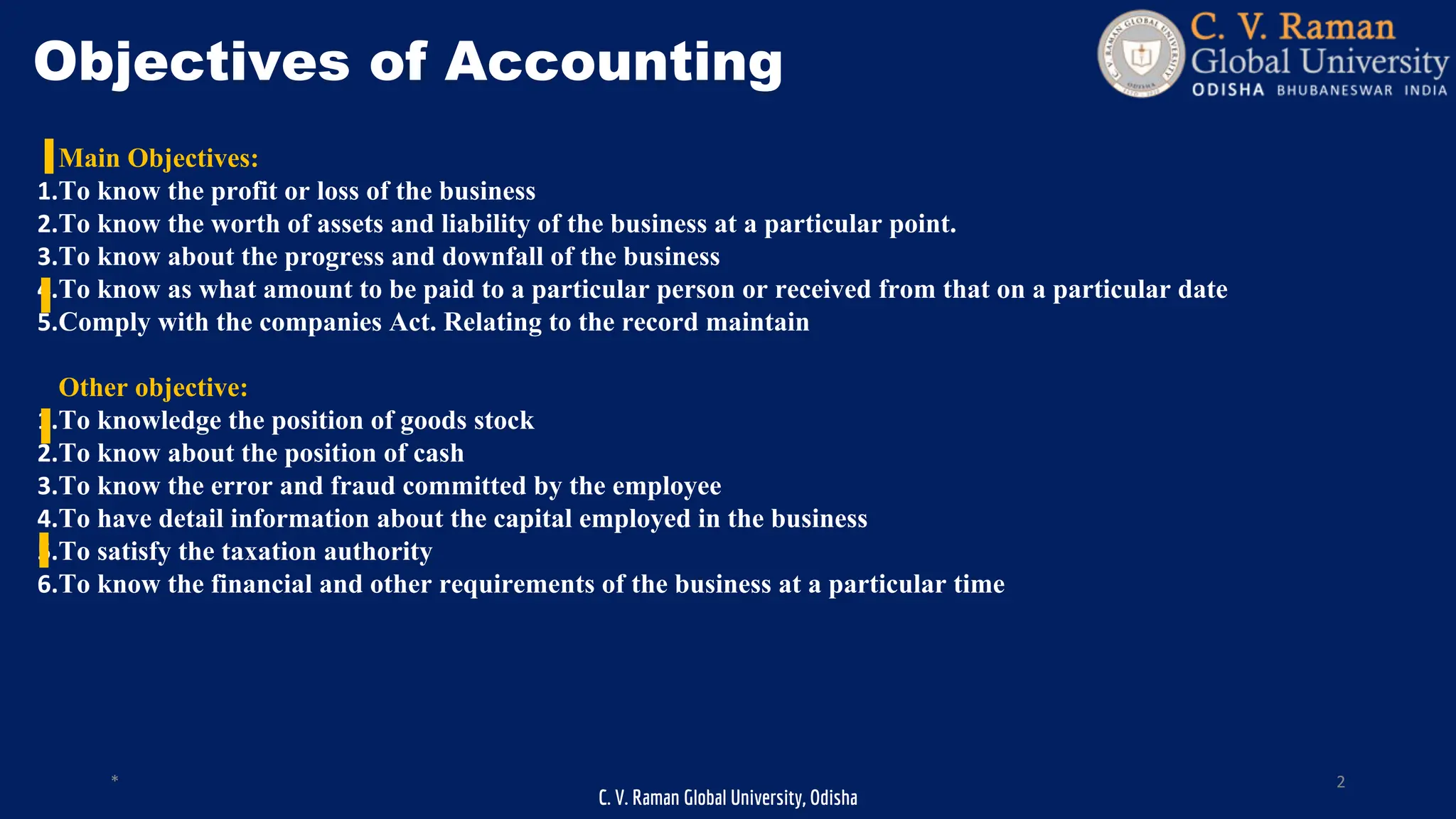
Objectives of Accounting
Main Objectives:
1.To know the profit or loss of the business
2.To know the worth of assets and liability of the business at a particular point.
3.To know about the progress and downfall of the business
4.To know as what amount to be paid to a particular person or received from that on a particular date
5.Comply with the companies Act. Relating to the record maintain
Other objective:
1.To knowledge the position of goods stock
2.To know about the position of cash
3.To know the error and fraud committed by the employee
4.To have detail information about the capital employed in the business
5.To satisfy the taxation authority
6.To know the financial and other requirements of the business at a particular time
C. V. Raman Global University, Odisha
* 2
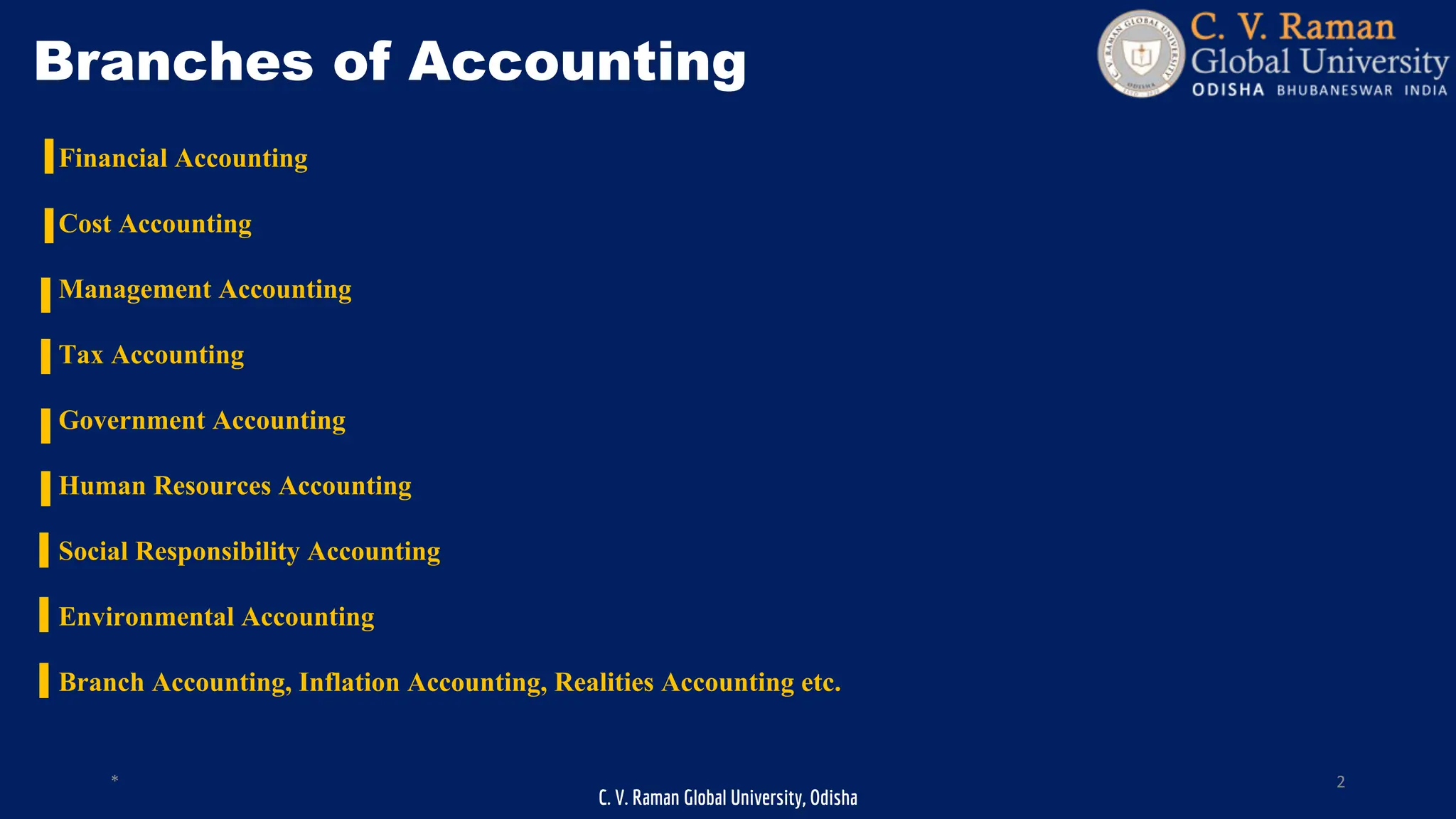
Branches of Accounting
Financial Accounting
Cost Accounting
Management Accounting
Tax Accounting
Government Accounting
Human Resources Accounting
Social Responsibility Accounting
Environmental Accounting
Branch Accounting, Inflation Accounting, Realities Accounting etc.
Thank You
Department of Business Management
Mail Id: laxmidhar.panda@cgu-odisha.ac.in
Cell No:6350028826
www.cgu-odisha.edu.in
Dr. Laxmidhar Panda

Fundamentals of Financial Accounting PPT

  • 1.
    Introduction to Accounting Department of BusinessManagement Dr. Laxmidhar Panda Assistant Professor
  • 2.
    01 Characteristic ofAccounting 02 Nature and scope of Accounting Contents C. V. Raman Global University, Odisha * 1 03 Need and Objective of Accounting 04 Branches of Accounting
  • 3.
    C. V. RamanGlobal University, Odisha * 2 Definition of Accounting According to RN Anthony: Accounting is an means of collecting, summarizing, analyzing and reporting in monetary terms, information about business. Bierman and Derbin: Accounting may be define as identifying, measuring and recording and communicating of financial results. American Accounting Association: Accounting is the process of identifying, measuring, recording, classifying, summarising, interpreting and communicating the financial transactions and events in monetary terms. It covers preparation of trail balance, Manufacturing account, trading account, Profit and Loss account and Balance sheet
  • 4.
    C. V. RamanGlobal University, Odisha * 2 MCQ Previous Lecture Q1: Which of the following out of the scope of Book-keeping? o Communication of financial information oCollection of data oRecording of data oIdentifying the financial and non-financial information Q2: Which is a example of Accrual basis system? oOutstanding Expenses oDepreciation oPaid Tax oDiscount Received Q3: Accounting is related to which levels of management? oTop levels oMiddle Levels oLower Levels oClerical Levels
  • 5.
    C. V. RamanGlobal University, Odisha * 2 MCQ Previous Lecture Q1: Which of the following out of the scope of Book-keeping? o Communication of financial information oCollection of data oRecording of data oIdentifying the financial and non-financial information Q2: Which is a example of Accrual basis system? oOutstanding Expenses oDepreciation oPaid Tax oDiscount Received Q3: Accounting is related to which levels of management? oTop levels oMiddle Levels oLower Levels oClerical Levels
  • 6.
    C. V. RamanGlobal University, Odisha * 2 Characteristics of Accounting Recording of Economic Activities Rearrangement of figures of book-keeping Recording of past economic events: accounting is historical in nature Monetary Transaction: it record only monetary transaction, non-monetary transaction not recorded in accounting. Presentation in summary form: prepare the Trading, Profit and loss account and balance sheet from information given in book-keeping. An art of classifying the data: there are certain rules to classify the data in different classes. It is a science: the transaction are recorded in systematic order. The manner of accounting are fixed and depend on financial rules of accounting . Informative to the stockholders: provides relevant information to the users of accounting information
  • 7.
    C. V. RamanGlobal University, Odisha * 2 Scope of Accounting To test and verify the entries in Book-keeping To test the total and balance of ledger To prepare Trail Balance from Ledger To disclose adjustments To Prepare the Final Account [Trading, P&L, BS] To rectify error To find out conclusion on the basis of analysis of financial statements
  • 8.
    C. V. RamanGlobal University, Odisha * 2 Needs of Accounting Language of business: Accounting reflect the position of the business and communicate the financial results and conclusion to the concerned person. Base of Financial decision: Accounting provides information for judging management ability to utilised financial resources effectively in achieving the goal of the business. Bases of information system: it covers all the economic events and the results. It also communicate the results to the interested person in the form of quantitative and financial in nature. Historic record indicate future: Accounting supply historic information based on past economic events, which record helps in evaluating, predicting or estimation of business for future economic decision.
  • 9.
    C. V. RamanGlobal University, Odisha * 2 Objectives of Accounting Main Objectives: 1.To know the profit or loss of the business 2.To know the worth of assets and liability of the business at a particular point. 3.To know about the progress and downfall of the business 4.To know as what amount to be paid to a particular person or received from that on a particular date 5.Comply with the companies Act. Relating to the record maintain Other objective: 1.To knowledge the position of goods stock 2.To know about the position of cash 3.To know the error and fraud committed by the employee 4.To have detail information about the capital employed in the business 5.To satisfy the taxation authority 6.To know the financial and other requirements of the business at a particular time
  • 10.
    C. V. RamanGlobal University, Odisha * 2 Branches of Accounting Financial Accounting Cost Accounting Management Accounting Tax Accounting Government Accounting Human Resources Accounting Social Responsibility Accounting Environmental Accounting Branch Accounting, Inflation Accounting, Realities Accounting etc.
  • 11.
    Thank You Department ofBusiness Management Mail Id: laxmidhar.panda@cgu-odisha.ac.in Cell No:6350028826 www.cgu-odisha.edu.in Dr. Laxmidhar Panda