1
Cloud native
The false assumption
By migrating to newer cloud technologies -e.g. Serverless, BaaS, Microservices-
companies will automatically achieve scale -i.e. support more users with less
money - and launch new faster.
2
Cloud native
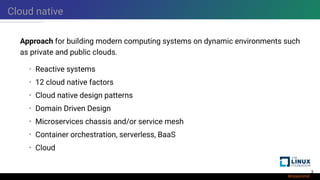
Approach for building modern computing systems on dynamic environments such
as private and public clouds.
• Reactive systems
• 12 cloud native factors
• Cloud native design patterns
• Domain Driven Design
• Microservices chassis and/or service mesh
• Container orchestration, serverless, BaaS
• Cloud
3
Cloud native
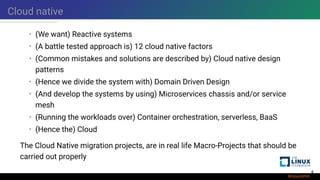
• (We want) Reactive systems
• (A battle tested approach is) 12 cloud native factors
• (Common mistakes and solutions are described by) Cloud native design
patterns
• (Hence we divide the system with) Domain Driven Design
• (And develop the systems by using) Microservices chassis and/or service
mesh
• (Running the workloads over) Container orchestration, serverless, BaaS
• (Hence the) Cloud
The Cloud Native migration projects, are in real life Macro-Projects that should be
carried out properly
4
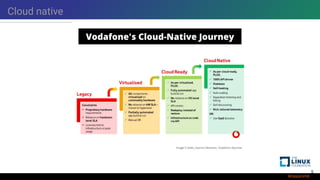
Cloud native
5
The migration project(s)
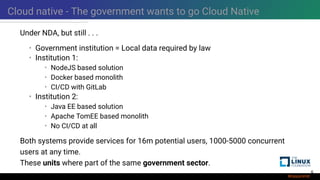
Cloud native - The government wants to go Cloud Native
Under NDA, but still . . .
• Government institution = Local data required by law
• Institution 1:
• NodeJS based solution
• Docker based monolith
• CI/CD with GitLab
• Institution 2:
• Java EE based solution
• Apache TomEE based monolith
• No CI/CD at all
Both systems provide services for 16m potential users, 1000-5000 concurrent
users at any time.
These units where part of the same government sector.
6
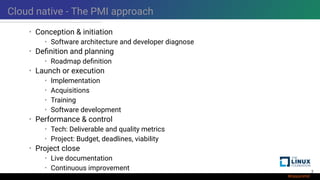
Cloud native - The PMI approach
• Conception & initiation
• Software architecture and developer diagnose
• Definition and planning
• Roadmap definition
• Launch or execution
• Implementation
• Acquisitions
• Training
• Software development
• Performance & control
• Tech: Deliverable and quality metrics
• Project: Budget, deadlines, viability
• Project close
• Live documentation
• Continuous improvement 7
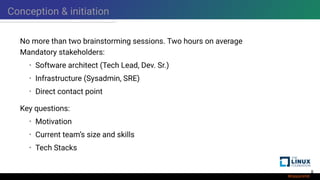
Conception & initiation
No more than two brainstorming sessions. Two hours on average
Mandatory stakeholders:
• Software architect (Tech Lead, Dev. Sr.)
• Infrastructure (Sysadmin, SRE)
• Direct contact point
Key questions:
• Motivation
• Current team’s size and skills
• Tech Stacks
8
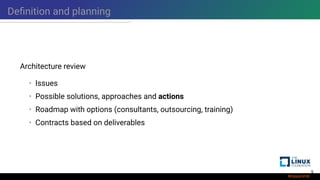
Definition and planning
Architecture review
• Issues
• Possible solutions, approaches and actions
• Roadmap with options (consultants, outsourcing, training)
• Contracts based on deliverables
9
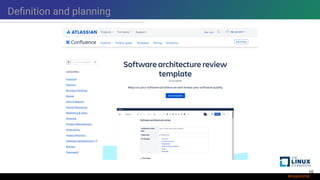
Definition and planning
10
Definition and planning
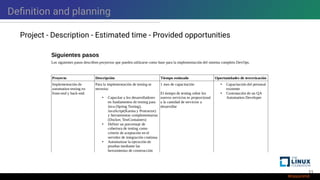
Project - Description - Estimated time - Provided opportunities
11
Launch or execution
1-Contact point, 2-Direct means of communication , 3- Non-repudiable means of
communication
• Culture
• DevOps
• Test Driven Development
• Infrastructure
• Remote access
• VCS, CI/CD
• Cloud Native Platform -e.g. Openshift, Kubernetes, Amazon EKS, Oracle
Kubernetes Engine-
• Observability -e.g. Linkerd, Prometheus, Grafana, ELK, alarms-
Ideally make one presentation/technology transfer per deliverable.
12
Launch or execution
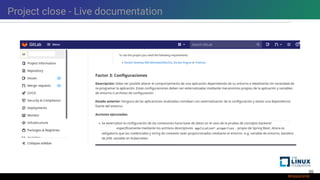
All phases produce ”live documentation”.
• Training and development
• Bootstrap archetypes (also pet projects)
• SCM -e.g. Maven, NPM -
• TDD, DDD, Microservice Chassis, infrastructure as code
• CI/CD Pipelines
• Don’t kill the monolith, create an ecosystems around
• New project with mandatory cloud native factors
13
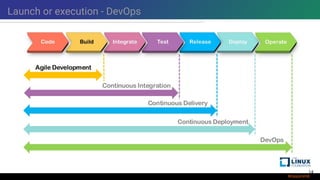
Launch or execution - DevOps
14
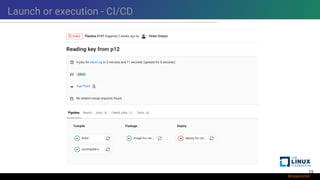
Launch or execution - CI/CD
15
Performance & control
• Tech
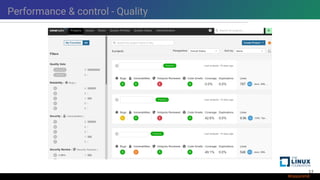
• Code quality-e.g. coverage, code smells, bugs, vulnerabilities-
• Performance -e.g. network latency and failures-
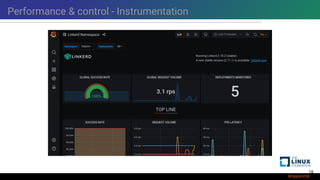
• Instrumentation
• How many services have been migrated
• Project
• Budget
• Deliverables vs. deadlines
• Users and developers perceptions
16
Performance & control - Quality
17
Performance & control - Instrumentation
18
Project close
• Implementation should transition to support
• Live documentation
• What could be done better?
19
Project close - Live documentation
20
Víctor Orozco
• vorozco@nabenik.com
• @tuxtor
• https://vorozco.com
• https://tuxtor.shekalug.org
This work is licensed under
Creative Commons Attribution-
NonCommercial-ShareAlike 3.0
Guatemala (CC BY-NC-SA 3.0 GT).
21
22

From traditional to GitOps

  • 1.
  • 2.
    Cloud native The falseassumption By migrating to newer cloud technologies -e.g. Serverless, BaaS, Microservices- companies will automatically achieve scale -i.e. support more users with less money - and launch new faster. 2
  • 3.
    Cloud native Approach forbuilding modern computing systems on dynamic environments such as private and public clouds. • Reactive systems • 12 cloud native factors • Cloud native design patterns • Domain Driven Design • Microservices chassis and/or service mesh • Container orchestration, serverless, BaaS • Cloud 3
  • 4.
    Cloud native • (Wewant) Reactive systems • (A battle tested approach is) 12 cloud native factors • (Common mistakes and solutions are described by) Cloud native design patterns • (Hence we divide the system with) Domain Driven Design • (And develop the systems by using) Microservices chassis and/or service mesh • (Running the workloads over) Container orchestration, serverless, BaaS • (Hence the) Cloud The Cloud Native migration projects, are in real life Macro-Projects that should be carried out properly 4
  • 5.
  • 6.
  • 7.
    Cloud native -The government wants to go Cloud Native Under NDA, but still . . . • Government institution = Local data required by law • Institution 1: • NodeJS based solution • Docker based monolith • CI/CD with GitLab • Institution 2: • Java EE based solution • Apache TomEE based monolith • No CI/CD at all Both systems provide services for 16m potential users, 1000-5000 concurrent users at any time. These units where part of the same government sector. 6
  • 8.
    Cloud native -The PMI approach • Conception & initiation • Software architecture and developer diagnose • Definition and planning • Roadmap definition • Launch or execution • Implementation • Acquisitions • Training • Software development • Performance & control • Tech: Deliverable and quality metrics • Project: Budget, deadlines, viability • Project close • Live documentation • Continuous improvement 7
  • 9.
    Conception & initiation Nomore than two brainstorming sessions. Two hours on average Mandatory stakeholders: • Software architect (Tech Lead, Dev. Sr.) • Infrastructure (Sysadmin, SRE) • Direct contact point Key questions: • Motivation • Current team’s size and skills • Tech Stacks 8
  • 10.
    Definition and planning Architecturereview • Issues • Possible solutions, approaches and actions • Roadmap with options (consultants, outsourcing, training) • Contracts based on deliverables 9
  • 11.
  • 12.
    Definition and planning Project- Description - Estimated time - Provided opportunities 11
  • 13.
    Launch or execution 1-Contactpoint, 2-Direct means of communication , 3- Non-repudiable means of communication • Culture • DevOps • Test Driven Development • Infrastructure • Remote access • VCS, CI/CD • Cloud Native Platform -e.g. Openshift, Kubernetes, Amazon EKS, Oracle Kubernetes Engine- • Observability -e.g. Linkerd, Prometheus, Grafana, ELK, alarms- Ideally make one presentation/technology transfer per deliverable. 12
  • 14.
    Launch or execution Allphases produce ”live documentation”. • Training and development • Bootstrap archetypes (also pet projects) • SCM -e.g. Maven, NPM - • TDD, DDD, Microservice Chassis, infrastructure as code • CI/CD Pipelines • Don’t kill the monolith, create an ecosystems around • New project with mandatory cloud native factors 13
  • 15.
  • 16.
  • 17.
    Performance & control •Tech • Code quality-e.g. coverage, code smells, bugs, vulnerabilities- • Performance -e.g. network latency and failures- • Instrumentation • How many services have been migrated • Project • Budget • Deliverables vs. deadlines • Users and developers perceptions 16
  • 18.
  • 19.
    Performance & control- Instrumentation 18
  • 20.
    Project close • Implementationshould transition to support • Live documentation • What could be done better? 19
  • 21.
    Project close -Live documentation 20
  • 22.
    Víctor Orozco • vorozco@nabenik.com •@tuxtor • https://vorozco.com • https://tuxtor.shekalug.org This work is licensed under Creative Commons Attribution- NonCommercial-ShareAlike 3.0 Guatemala (CC BY-NC-SA 3.0 GT). 21
  • 23.