From front-end to the hardware
Henri Cavalcante
+
From front-end to the hardware
Henri Cavalcante
@henricavalcante
(ESP8266 Firebase ready givaway #fif2016)
How many of you?
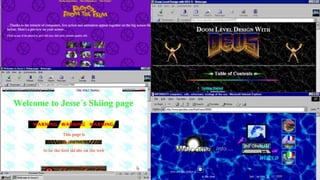
May, 1995
May, 1995
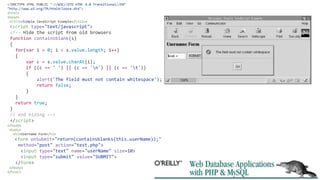
<!DOCTYPE HTML PUBLIC "-//W3C//DTD HTML 4.0 Transitional//EN"
"http://www.w3.org/TR/html4/loose.dtd">
<html>
<head>
<title>Simple JavaScript Example</title>
<script type="text/javascript">
<!-- Hide the script from old browsers
function containsblank(s)
{
for(var i = 0; i < s.value.length; i++)
{
var c = s.value.charAt(i);
if ((c == ' ') || (c == 'n') || (c == 't'))
{
alert('The field must not contain whitespace');
return false;
}
}
return true;
}
// end hiding -->
</script>
</head>
<body>
<h2>Username Form</h2>
<form onSubmit="return(containsblanks(this.userName));"
method="post" action="test.php">
<input type="text" name="userName" size=10>
<input type="submit" value="SUBMIT">
</form>
</body>
</html>
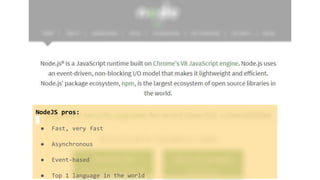
NodeJS pros:
● Fast, very fast
● Asynchronous
● Event-based
● Top 1 language in the world
Johnny-Five
Johnny-Five is the original JavaScript
Robotics programming framework. Released
by Bocoup in 2012, Johnny-Five is
maintained by a community of passionate
software developers and hardware
engineers. Over 75 developers have made
contributions towards building a
robust, extensible and composable
ecosystem.
+
Firmata
Firmata is a protocol for communicating with microcontrollers from
software on a computer (or smartphone/tablet, etc). The protocol can be
implemented in firmware on any microcontroller architecture as well as
software on any computer software package (see list of client libraries
below).
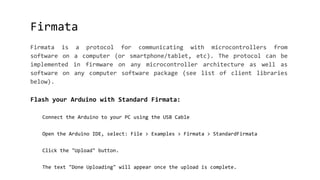
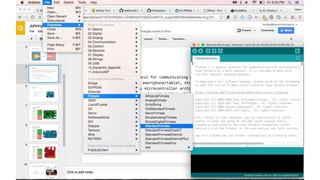
Flash your Arduino with Standard Firmata:
Connect the Arduino to your PC using the USB Cable
Open the Arduino IDE, select: File > Examples > Firmata > StandardFirmata
Click the "Upload" button.
The text "Done Uploading" will appear once the upload is complete.
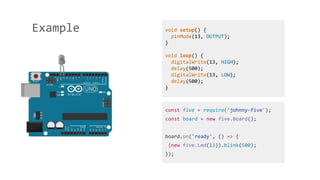
Example
const five = require('johnny-five');
const board = new five.Board();
board.on('ready', () => {
(new five.Led(13)).blink(500);
});
void setup() {
pinMode(13, OUTPUT);
}
void loop() {
digitalWrite(13, HIGH);
delay(500);
digitalWrite(13, LOW);
delay(500);
}
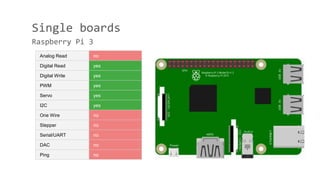
Single boards
Raspberry Pi 3
Analog Read no
Digital Read yes
Digital Write yes
PWM yes
Servo yes
I2C yes
One Wire no
Stepper no
Serial/UART no
DAC no
Ping no
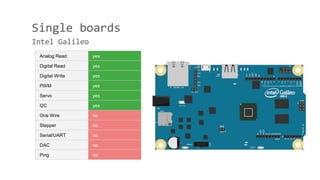
Single boards
Intel Galileo
Analog Read yes
Digital Read yes
Digital Write yes
PWM yes
Servo yes
I2C yes
One Wire no
Stepper no
Serial/UART no
DAC no
Ping no
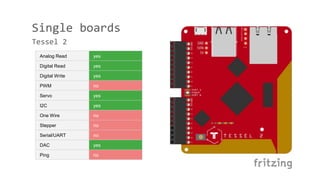
Single boards
Tessel 2
Analog Read yes
Digital Read yes
Digital Write yes
PWM no
Servo yes
I2C yes
One Wire no
Stepper no
Serial/UART no
DAC yes
Ping no
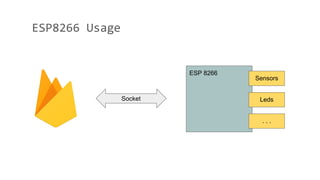
ESP8266 Usage
ESP 8266
Sensors
Leds
. . .
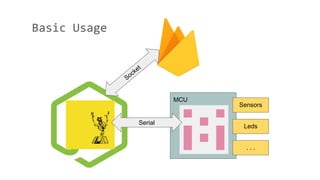
Basic Usage
MCU
Serial
Sensors
Leds
. . .
const five = require('johnny-five');
const board = new five.Board();
const Firebase = require('firebase');
const relays = new Firebase('https://io16natal.firebaseio.com').child('relay');
board.on('ready', () => {
const lamps = {
'01': new five.Relay(8),
'02': new five.Relay(9),
'03': new five.Relay(10),
'04': new five.Relay(11)
}
relays.on('value', (snap) => {
snap.forEach((lamp) => { lamps[lamp.key()][lamp.val()]() });
});
});
Example
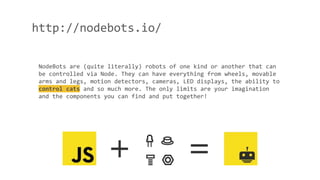
http://nodebots.io/
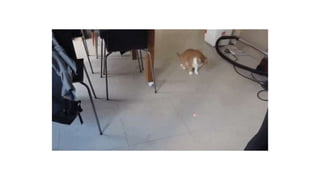
NodeBots are (quite literally) robots of one kind or another that can
be controlled via Node. They can have everything from wheels, movable
arms and legs, motion detectors, cameras, LED displays, the ability to
control cats and so much more. The only limits are your imagination
and the components you can find and put together!
github.com/henricavalcante
twitter.com/henricavalcante
fb.me/henricavalcante

From front-end to the hardware

  • 1.
    From front-end tothe hardware Henri Cavalcante
  • 2.
    + From front-end tothe hardware
  • 5.
  • 6.
  • 7.
  • 10.
  • 12.
    <!DOCTYPE HTML PUBLIC"-//W3C//DTD HTML 4.0 Transitional//EN" "http://www.w3.org/TR/html4/loose.dtd"> <html> <head> <title>Simple JavaScript Example</title> <script type="text/javascript"> <!-- Hide the script from old browsers function containsblank(s) { for(var i = 0; i < s.value.length; i++) { var c = s.value.charAt(i); if ((c == ' ') || (c == 'n') || (c == 't')) { alert('The field must not contain whitespace'); return false; } } return true; } // end hiding --> </script> </head> <body> <h2>Username Form</h2> <form onSubmit="return(containsblanks(this.userName));" method="post" action="test.php"> <input type="text" name="userName" size=10> <input type="submit" value="SUBMIT"> </form> </body> </html>
  • 17.
    NodeJS pros: ● Fast,very fast ● Asynchronous ● Event-based ● Top 1 language in the world
  • 22.
    Johnny-Five Johnny-Five is theoriginal JavaScript Robotics programming framework. Released by Bocoup in 2012, Johnny-Five is maintained by a community of passionate software developers and hardware engineers. Over 75 developers have made contributions towards building a robust, extensible and composable ecosystem. +
  • 25.
    Firmata Firmata is aprotocol for communicating with microcontrollers from software on a computer (or smartphone/tablet, etc). The protocol can be implemented in firmware on any microcontroller architecture as well as software on any computer software package (see list of client libraries below). Flash your Arduino with Standard Firmata: Connect the Arduino to your PC using the USB Cable Open the Arduino IDE, select: File > Examples > Firmata > StandardFirmata Click the "Upload" button. The text "Done Uploading" will appear once the upload is complete.
  • 29.
    Example const five =require('johnny-five'); const board = new five.Board(); board.on('ready', () => { (new five.Led(13)).blink(500); }); void setup() { pinMode(13, OUTPUT); } void loop() { digitalWrite(13, HIGH); delay(500); digitalWrite(13, LOW); delay(500); }
  • 30.
    Single boards Raspberry Pi3 Analog Read no Digital Read yes Digital Write yes PWM yes Servo yes I2C yes One Wire no Stepper no Serial/UART no DAC no Ping no
  • 31.
    Single boards Intel Galileo AnalogRead yes Digital Read yes Digital Write yes PWM yes Servo yes I2C yes One Wire no Stepper no Serial/UART no DAC no Ping no
  • 32.
    Single boards Tessel 2 AnalogRead yes Digital Read yes Digital Write yes PWM no Servo yes I2C yes One Wire no Stepper no Serial/UART no DAC yes Ping no
  • 34.
  • 35.
  • 36.
    const five =require('johnny-five'); const board = new five.Board(); const Firebase = require('firebase'); const relays = new Firebase('https://io16natal.firebaseio.com').child('relay'); board.on('ready', () => { const lamps = { '01': new five.Relay(8), '02': new five.Relay(9), '03': new five.Relay(10), '04': new five.Relay(11) } relays.on('value', (snap) => { snap.forEach((lamp) => { lamps[lamp.key()][lamp.val()]() }); }); }); Example
  • 37.
    http://nodebots.io/ NodeBots are (quiteliterally) robots of one kind or another that can be controlled via Node. They can have everything from wheels, movable arms and legs, motion detectors, cameras, LED displays, the ability to control cats and so much more. The only limits are your imagination and the components you can find and put together!
  • 40.