FreeBSD
Sindh Madressatul Islam University
Spring 2017
4th Semester
HISTORY
2
INTRODUCTION
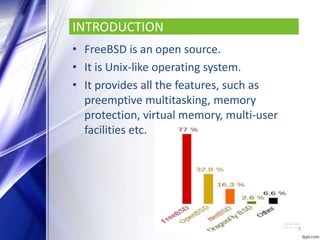
• FreeBSD is an open source.
• It is Unix-like operating system.
• It provides all the features, such as
preemptive multitasking, memory
protection, virtual memory, multi-user
facilities etc.
3
USES
• It Uses many IT companies: IBM, Nokia
to build their product.
• Certain parts of Apple’s Mac OS operating
system are based on FreeBSD .
• PSP3 operating system also borrows
certain components from FreeBSD.
• Netflix, what’sapp are also examples of
big, successful companies which are
running FreeBSD 10.
4
TARGET
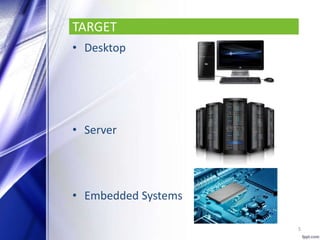
• Desktop
• Server
• Embedded Systems
5
DESIGN PRINCIPLE
There are several design principles of
FreeBSD:
• The design of the system should be as
simple as possible.
• Security mechanism should be open for
the public.
• All access to the system should be
carefully checked.
• The separation of logical and physical
environment is needed to reduce the
possible risks.
• It Should be user friendly.
6
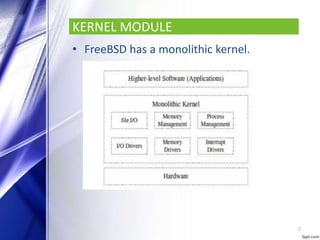
KERNEL MODULE
• FreeBSD has a monolithic kernel.
7
KERNEL THREADING
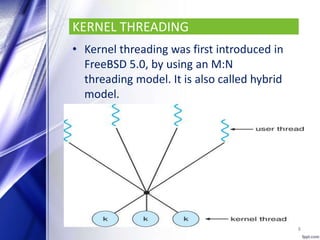
• Kernel threading was first introduced in
FreeBSD 5.0, by using an M:N
threading model. It is also called hybrid
model.
8
KERNEL THREADING
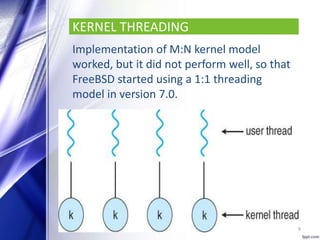
Implementation of M:N kernel model
worked, but it did not perform well, so that
FreeBSD started using a 1:1 threading
model in version 7.0.
9
PROCESS MANAGEMENT
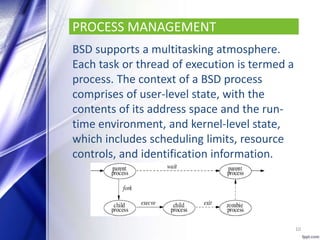
BSD supports a multitasking atmosphere.
Each task or thread of execution is termed a
process. The context of a BSD process
comprises of user-level state, with the
contents of its address space and the run-
time environment, and kernel-level state,
which includes scheduling limits, resource
controls, and identification information.
10
FILE SYSTEM
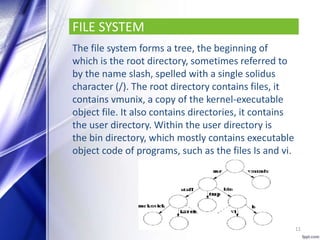
The file system forms a tree, the beginning of
which is the root directory, sometimes referred to
by the name slash, spelled with a single solidus
character (/). The root directory contains files, it
contains vmunix, a copy of the kernel-executable
object file. It also contains directories, it contains
the user directory. Within the user directory is
the bin directory, which mostly contains executable
object code of programs, such as the files Is and vi.
11
MEMORY MANAGEMENT
BSD uses a two-level approach to maintain available
resources.
1. If a modest amount of memory is available, the
system will take memory resources away from
processes if these resources have not been used
recently. Should there be a severe resource
shortage, the system will resort to swapping the
entire context of a process to secondary storage.
2. The demand paging and swapping done by the
system are effectively transparent to processes. The
support of large sparse address spaces, mapped
files, and shared memory was a requirement for
BSD. An interface was specified, called mmap, that
allowed unrelated processes to request a shared
mapping of a file into their address spaces
12
LANGUAGE CODE
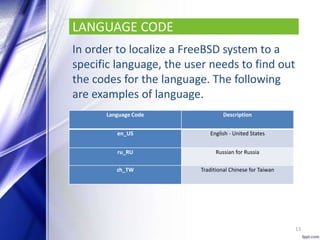
In order to localize a FreeBSD system to a
specific language, the user needs to find out
the codes for the language. The following
are examples of language.
Language Code Description
en_US English - United States
ru_RU Russian for Russia
zh_TW Traditional Chinese for Taiwan
13
NETWORK COMMUNICATION
BSD could provide interoperability and resource
sharing among the diverse set of machines that
was available in the Berkeley environment.
Consequently, the network-communication layer
is designed to support multiple protocols. New
protocols are added to the kernel without the
support for older protocols being affected. Older
applications can continue to operate using the
old protocol over the same physical network as
is used by newer applications running with a
newer network protocol.
14
FILE SHARING PROCESS
• FreeBSD supports the Network File System
(NFS), which allows a server to share directories
and files with clients over a network.
• With NFS, users and programs can access files
on remote systems as if they were stored locally.
15
FILE SHARING PROCESS
NFS has many practical uses. Some of the common
uses are:
• Data that would otherwise be duplicated on
each client can be kept in a single location and
accessed by clients on the network.
• Several clients may need access to
the userdirectory. Sharing that directory allows
for quick access to the source files without
having to download them to each client.
16
SECURITY PROTOCOL
Free BSD uses Security Protocols are
• SSL (Secure Sockets Layer).
• TLS (Transport Layer Security).
These protocols provide a secure communications
layer over which other protocols can be utilized.
17
SECURITY PROTOCOL
• FreeBSD provides several security-related
features including access control lists (ACLs),
security event auditing and mandatory access
controls (MAC).
• These security enhancements were developed
by the Trusted BSD project. The project was
founded by Robert Watson with the goal of
implementing concepts from the Common
Criteria for Information Technology Security
Evaluation.
18
SECURITY PROTOCOL
The project is supported by a variety of
organizations, including the
• NSA, Network Associates Laboratories.
• Yahoo!.
• McAfee Research.
• Apple Computer.
• Google.
19
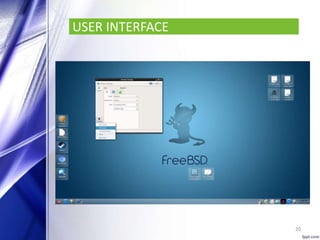
USER INTERFACE
20
THANK YOU
21

Bsd ppt

  • 1.
    FreeBSD Sindh Madressatul IslamUniversity Spring 2017 4th Semester
  • 2.
  • 3.
    INTRODUCTION • FreeBSD isan open source. • It is Unix-like operating system. • It provides all the features, such as preemptive multitasking, memory protection, virtual memory, multi-user facilities etc. 3
  • 4.
    USES • It Usesmany IT companies: IBM, Nokia to build their product. • Certain parts of Apple’s Mac OS operating system are based on FreeBSD . • PSP3 operating system also borrows certain components from FreeBSD. • Netflix, what’sapp are also examples of big, successful companies which are running FreeBSD 10. 4
  • 5.
  • 6.
    DESIGN PRINCIPLE There areseveral design principles of FreeBSD: • The design of the system should be as simple as possible. • Security mechanism should be open for the public. • All access to the system should be carefully checked. • The separation of logical and physical environment is needed to reduce the possible risks. • It Should be user friendly. 6
  • 7.
    KERNEL MODULE • FreeBSDhas a monolithic kernel. 7
  • 8.
    KERNEL THREADING • Kernelthreading was first introduced in FreeBSD 5.0, by using an M:N threading model. It is also called hybrid model. 8
  • 9.
    KERNEL THREADING Implementation ofM:N kernel model worked, but it did not perform well, so that FreeBSD started using a 1:1 threading model in version 7.0. 9
  • 10.
    PROCESS MANAGEMENT BSD supportsa multitasking atmosphere. Each task or thread of execution is termed a process. The context of a BSD process comprises of user-level state, with the contents of its address space and the run- time environment, and kernel-level state, which includes scheduling limits, resource controls, and identification information. 10
  • 11.
    FILE SYSTEM The filesystem forms a tree, the beginning of which is the root directory, sometimes referred to by the name slash, spelled with a single solidus character (/). The root directory contains files, it contains vmunix, a copy of the kernel-executable object file. It also contains directories, it contains the user directory. Within the user directory is the bin directory, which mostly contains executable object code of programs, such as the files Is and vi. 11
  • 12.
    MEMORY MANAGEMENT BSD usesa two-level approach to maintain available resources. 1. If a modest amount of memory is available, the system will take memory resources away from processes if these resources have not been used recently. Should there be a severe resource shortage, the system will resort to swapping the entire context of a process to secondary storage. 2. The demand paging and swapping done by the system are effectively transparent to processes. The support of large sparse address spaces, mapped files, and shared memory was a requirement for BSD. An interface was specified, called mmap, that allowed unrelated processes to request a shared mapping of a file into their address spaces 12
  • 13.
    LANGUAGE CODE In orderto localize a FreeBSD system to a specific language, the user needs to find out the codes for the language. The following are examples of language. Language Code Description en_US English - United States ru_RU Russian for Russia zh_TW Traditional Chinese for Taiwan 13
  • 14.
    NETWORK COMMUNICATION BSD couldprovide interoperability and resource sharing among the diverse set of machines that was available in the Berkeley environment. Consequently, the network-communication layer is designed to support multiple protocols. New protocols are added to the kernel without the support for older protocols being affected. Older applications can continue to operate using the old protocol over the same physical network as is used by newer applications running with a newer network protocol. 14
  • 15.
    FILE SHARING PROCESS •FreeBSD supports the Network File System (NFS), which allows a server to share directories and files with clients over a network. • With NFS, users and programs can access files on remote systems as if they were stored locally. 15
  • 16.
    FILE SHARING PROCESS NFShas many practical uses. Some of the common uses are: • Data that would otherwise be duplicated on each client can be kept in a single location and accessed by clients on the network. • Several clients may need access to the userdirectory. Sharing that directory allows for quick access to the source files without having to download them to each client. 16
  • 17.
    SECURITY PROTOCOL Free BSDuses Security Protocols are • SSL (Secure Sockets Layer). • TLS (Transport Layer Security). These protocols provide a secure communications layer over which other protocols can be utilized. 17
  • 18.
    SECURITY PROTOCOL • FreeBSDprovides several security-related features including access control lists (ACLs), security event auditing and mandatory access controls (MAC). • These security enhancements were developed by the Trusted BSD project. The project was founded by Robert Watson with the goal of implementing concepts from the Common Criteria for Information Technology Security Evaluation. 18
  • 19.
    SECURITY PROTOCOL The projectis supported by a variety of organizations, including the • NSA, Network Associates Laboratories. • Yahoo!. • McAfee Research. • Apple Computer. • Google. 19
  • 20.
  • 21.