DNS Security
Dhaval Kapil
Computer Science and Engineering Department
IIT Roorkee
Flow of the presentation
● About DNS
● Working of DNS
● Flaws in design of DNS
● Threats involving DNS
● Mitigation of these threats
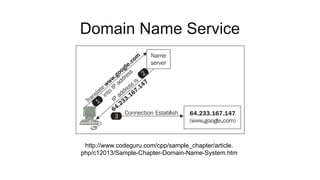
Domain Name Service
http://www.codeguru.com/cpp/sample_chapter/article.
php/c12013/Sample-Chapter-Domain-Name-System.htm
About DNS
● Hierarchical distributed naming system for computers
● Mapping of 'domain name' and 'IP address'
● Internet’s primary directory service
Working of DNS
DNS Server:
■ Information about domain names stored in text files called zones
■ Listens on UDP port 53 for name resolution queries
■ Listens on TCP port 53 for zone transfer queries
DNS Client:
■ Runs a service - resolver
■ Handles interaction with DNS Server for resolving domain names and IP
addresses through records
Flaws in the design of DNS
● Designed without any security considerations
● Was initially designed for small networks with trusted hosts
● No check for authenticity and integrity added
● Unfortunately with growth of network DNS remained
unchanged
● Resulted in lots of threats because of the above issues
Threats involving DNS
1. Zone File Compromise
2. Zone Information Leakage/DNS Footprinting
3. DNS Amplification Attack
4. DNS Client flooding
5. DNS Cache poisoning
6. DNS Vulnerabilities in Shared Host Environments
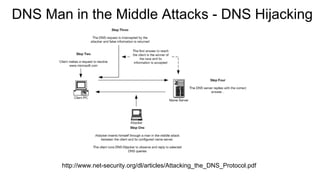
7. DNS Man in the Middle Attacks - DNS Hijacking
8. Typosquatting
Zone File Compromise
● Administrator can directly interact with DNS Server
● Command line or GUI interface provided for configuration of
DNS records
● In this attack, the attacker first gains direct access to the
server
Security measure: Restrict access to DNS server
Zone Information Leakage/DNS Footprinting
● Zone Transfer: DNS Server passing a copy of its database
(called “zone”) to another DNS Server.
● Slave DNS Servers ask for zone transfer from Master DNS
Server
● Attacker pretends to be a Slave DNS Server
● DNS records reveal about the topology of the network
Security measure: Restrict zone transfers to particular IP
addresses or use any other kind of authentication
DNS Amplification Attack
● Genuine DNS servers used to perform DOS attack on victim
host
● Attacker sends DNS request packets to a genuine DNS
Server with source IP spoofed as victim’s IP.
● Amplified responses go to victim.
DNS Client Flooding
● Attacker sends a flood of DNS packets to the DNS server
● Preferably request for invalid domains
● The DNS server tries to spend all of its resources on finding
the IP
● Resources exhausted for legitimate requests
DNS Cache Poisoning
https://jfdm.host.cs.st-andrews.ac.uk/notes/netsec/
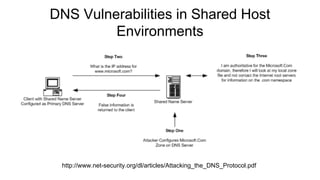
DNS Vulnerabilities in Shared Host
Environments
http://www.net-security.org/dl/articles/Attacking_the_DNS_Protocol.pdf
DNS Man in the Middle Attacks - DNS Hijacking
http://www.net-security.org/dl/articles/Attacking_the_DNS_Protocol.pdf
Typosquatting
● The practice of registering a domain name that is confusingly
similar to an existing popular brand
● The attacker registers similar sounding domain names.
● This threat does not target a particular victim.
DNSSEC (Domain Name System Security
Extensions)
● Around 1994, the IETF started a discussion to make DNS
secure by adding a set of extensions to it.
● Backward compatibility ensured
● Performance issues kept in mind
● Provides authentication and integrity to DNS
● Unfortunately still not widely adopted
● Widespread need of DNS in internet
● Original implementation didn’t consider security issues
● No check for authenticity and integrity
● To add security, IETF added security extensions DNSSEC
Conclusion

Dns security

  • 1.
    DNS Security Dhaval Kapil ComputerScience and Engineering Department IIT Roorkee
  • 2.
    Flow of thepresentation ● About DNS ● Working of DNS ● Flaws in design of DNS ● Threats involving DNS ● Mitigation of these threats
  • 3.
  • 4.
    About DNS ● Hierarchicaldistributed naming system for computers ● Mapping of 'domain name' and 'IP address' ● Internet’s primary directory service
  • 5.
    Working of DNS DNSServer: ■ Information about domain names stored in text files called zones ■ Listens on UDP port 53 for name resolution queries ■ Listens on TCP port 53 for zone transfer queries DNS Client: ■ Runs a service - resolver ■ Handles interaction with DNS Server for resolving domain names and IP addresses through records
  • 6.
    Flaws in thedesign of DNS ● Designed without any security considerations ● Was initially designed for small networks with trusted hosts ● No check for authenticity and integrity added ● Unfortunately with growth of network DNS remained unchanged ● Resulted in lots of threats because of the above issues
  • 7.
    Threats involving DNS 1.Zone File Compromise 2. Zone Information Leakage/DNS Footprinting 3. DNS Amplification Attack 4. DNS Client flooding 5. DNS Cache poisoning 6. DNS Vulnerabilities in Shared Host Environments 7. DNS Man in the Middle Attacks - DNS Hijacking 8. Typosquatting
  • 8.
    Zone File Compromise ●Administrator can directly interact with DNS Server ● Command line or GUI interface provided for configuration of DNS records ● In this attack, the attacker first gains direct access to the server Security measure: Restrict access to DNS server
  • 9.
    Zone Information Leakage/DNSFootprinting ● Zone Transfer: DNS Server passing a copy of its database (called “zone”) to another DNS Server. ● Slave DNS Servers ask for zone transfer from Master DNS Server ● Attacker pretends to be a Slave DNS Server ● DNS records reveal about the topology of the network Security measure: Restrict zone transfers to particular IP addresses or use any other kind of authentication
  • 10.
    DNS Amplification Attack ●Genuine DNS servers used to perform DOS attack on victim host ● Attacker sends DNS request packets to a genuine DNS Server with source IP spoofed as victim’s IP. ● Amplified responses go to victim.
  • 11.
    DNS Client Flooding ●Attacker sends a flood of DNS packets to the DNS server ● Preferably request for invalid domains ● The DNS server tries to spend all of its resources on finding the IP ● Resources exhausted for legitimate requests
  • 12.
  • 13.
    DNS Vulnerabilities inShared Host Environments http://www.net-security.org/dl/articles/Attacking_the_DNS_Protocol.pdf
  • 14.
    DNS Man inthe Middle Attacks - DNS Hijacking http://www.net-security.org/dl/articles/Attacking_the_DNS_Protocol.pdf
  • 15.
    Typosquatting ● The practiceof registering a domain name that is confusingly similar to an existing popular brand ● The attacker registers similar sounding domain names. ● This threat does not target a particular victim.
  • 16.
    DNSSEC (Domain NameSystem Security Extensions) ● Around 1994, the IETF started a discussion to make DNS secure by adding a set of extensions to it. ● Backward compatibility ensured ● Performance issues kept in mind ● Provides authentication and integrity to DNS ● Unfortunately still not widely adopted
  • 17.
    ● Widespread needof DNS in internet ● Original implementation didn’t consider security issues ● No check for authenticity and integrity ● To add security, IETF added security extensions DNSSEC Conclusion