FRANCHISING
MEANING OF
FRANCHISING
Arrangements where one party (the franchiser) grants another party
(the franchisee) the right to use its trademark or trade-name as well as
certain business systems and processes, to produce and market a good
or service according to certain specifications. The franchisee usually
pays a one-time franchise fee plus a percentage of sales revenue as
royalty, and gains
(1) immediate name recognition.
(2) tried and tested products.
(3) standard building design and décor.
(4) detailed techniques in running and promoting the business.
(5) training of employees.
(6) ongoing help in promoting and upgrading of the products.
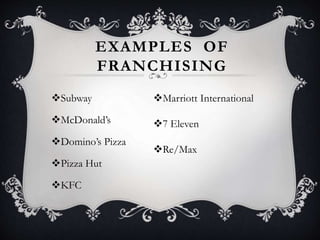
EXAMPLES OF
FRANCHISING
Subway
McDonald’s
Domino’s Pizza
Pizza Hut
KFC
Marriott International
7 Eleven
Re/Max
EXAMPLE OF KFC
KFC, also known as Kentucky Fried Chicken, is an American
fast food restaurant chain that specializes in fried chicken.
Headquartered in Louisville, Kentucky, it is the world's second-
largest restaurant chain (as measured by sales) after
McDonald's, with almost 20,000 locations globally in 123
countries.
The founder of KFC is Harland Sanders. The annual Revenue
is
US$23 billion.
EXAMPLE OF Mc Donalds
McDonalds Corporation
At the time of publication, this international quick-service restaurant
company has over 75 percent of its worldwide restaurants
independently owned.
Business owners can purchase a new or existing restaurant. An
initial down payment is required, and the rest of the cost can be
financed for up to seven years.
During the terms of the franchise agreement, ongoing fees include
rent and service fees.
Some of the qualities the company is looking for in a franchisee are
business experience, an acceptable credit history, willingness to
complete the company's comprehensive training program and
sufficient liquid assets to invest in the business.
TYPES OF FRANCHISING:
MANUFACTURING FRANCHISEE
PRODUCT FRANCHISES ,OR SINGLE OPERATOR
FRANCHISES
BUSINESS FORMAT FRANCHISES
ADVANTAGE OF
FRANCHISING
DISADVANTAGE OF
FRANCHISING
 RAPID EXPANSION
 MARKETING SUPPORT
 ADDITIONAL SOURCES
OF REVENUE
 Minimal risk for
franchisee
 CAPITAL INVESTEMNT
 LESS CONTROL
 COSTLY LEGAL ACTION
 REGULATION
 Sharing of Profits
Aayushi Gupta
Aditi Mantri
Shubhi Chauhan
Soumya Vyas
Surendra Pal Singh

Franchising

  • 1.
  • 2.
    MEANING OF FRANCHISING Arrangements whereone party (the franchiser) grants another party (the franchisee) the right to use its trademark or trade-name as well as certain business systems and processes, to produce and market a good or service according to certain specifications. The franchisee usually pays a one-time franchise fee plus a percentage of sales revenue as royalty, and gains (1) immediate name recognition. (2) tried and tested products. (3) standard building design and décor. (4) detailed techniques in running and promoting the business. (5) training of employees. (6) ongoing help in promoting and upgrading of the products.
  • 3.
    EXAMPLES OF FRANCHISING Subway McDonald’s Domino’s Pizza PizzaHut KFC Marriott International 7 Eleven Re/Max
  • 4.
    EXAMPLE OF KFC KFC,also known as Kentucky Fried Chicken, is an American fast food restaurant chain that specializes in fried chicken. Headquartered in Louisville, Kentucky, it is the world's second- largest restaurant chain (as measured by sales) after McDonald's, with almost 20,000 locations globally in 123 countries. The founder of KFC is Harland Sanders. The annual Revenue is US$23 billion.
  • 5.
    EXAMPLE OF McDonalds McDonalds Corporation At the time of publication, this international quick-service restaurant company has over 75 percent of its worldwide restaurants independently owned. Business owners can purchase a new or existing restaurant. An initial down payment is required, and the rest of the cost can be financed for up to seven years. During the terms of the franchise agreement, ongoing fees include rent and service fees. Some of the qualities the company is looking for in a franchisee are business experience, an acceptable credit history, willingness to complete the company's comprehensive training program and sufficient liquid assets to invest in the business.
  • 6.
    TYPES OF FRANCHISING: MANUFACTURINGFRANCHISEE PRODUCT FRANCHISES ,OR SINGLE OPERATOR FRANCHISES BUSINESS FORMAT FRANCHISES
  • 7.
    ADVANTAGE OF FRANCHISING DISADVANTAGE OF FRANCHISING RAPID EXPANSION  MARKETING SUPPORT  ADDITIONAL SOURCES OF REVENUE  Minimal risk for franchisee  CAPITAL INVESTEMNT  LESS CONTROL  COSTLY LEGAL ACTION  REGULATION  Sharing of Profits
  • 8.
    Aayushi Gupta Aditi Mantri ShubhiChauhan Soumya Vyas Surendra Pal Singh