Abbott
Robert D Hubbard, Ph.D.
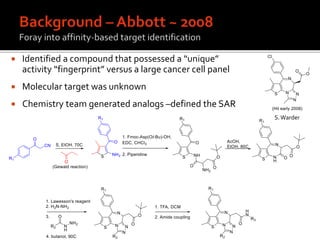
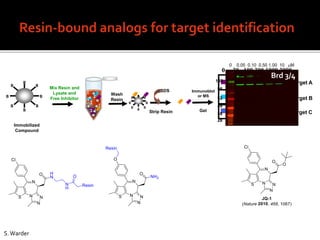
 Identified a compound that possessed a “unique”
activity “fingerprint” versus a large cancer cell panel
 Molecular target was unknown
 Chemistry team generated analogs –defined the SAR
S.Warder
Immobilized
Compound
B
B
B
BB
B B
B
Rock2 160KD
Mix Resin and
Lysate and
Free Inhibitor
SDS
Strip Resin
Wash
Resin
I
I
I
I
I
I
B
B
B BB
B B
B
Gel
Immunoblot
or MS
0 30 100 300 1000 3000
Target A
Target B
Target C
but not
strong
but not
strong
98
62
49
188
38
28
0 0.05 0.10 0.50 1.00 10 mM
Brd 3/4
S.Warder
R2
= 0.85
(pEC50)
3.0 3.5 4.0 4.5 5.0 5.5 6.0 6.5 7.0 7.5
5.0
5.5
6.0
6.5
7.0
7.5
8.0
R2
= 0.85
BINDING (pKD)
Proliferation50
3.0 3.5 4.03.0 3.5 4.0 4.5 5.0 5.5 6.0 6.5 7.06.0 6.5 7.0 7.5
5.0
5.5
6.0
6.5
7.0
7.5
8.0
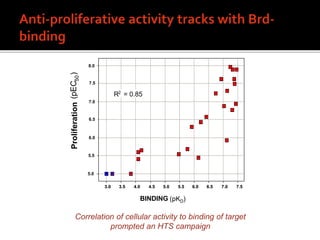
Correlation of cellular activity to binding of target
prompted an HTS campaign
TR FRET TSA
In silico
analysis
Structural
Biology
(NMR/X-ray)
ADME
physchem
properties
Primary HTS
& confirmation
Orthogonal
confirmation
3500
actives
1000
actives
~20
clusters
Clustering &
data-mining
Structural
confirmation
Lead-like
properties
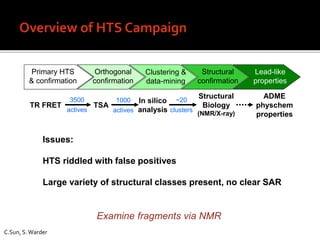
Issues:
HTS riddled with false positives
Large variety of structural classes present, no clear SAR
Examine fragments via NMR
C.Sun, S.Warder
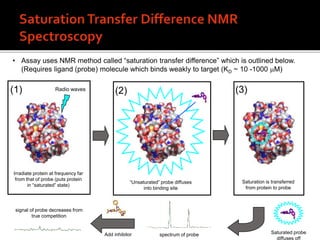
• Assay uses NMR method called “saturation transfer difference” which is outlined below.
(Requires ligand (probe) molecule which binds weakly to target (KD ~ 10 -1000 mM)
Irradiate protein at frequency far
from that of probe (puts protein
in “saturated” state)
Radio waves
Saturation is transferred
from protein to probe
“Unsaturated” probe diffuses
into binding site
Saturated probe
diffuses off
spectrum of probeAdd inhibitor
(1) (2) (3)
signal of probe decreases from
true competition
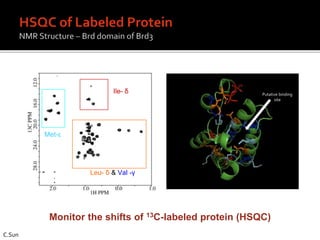
Ile- δ
Met-ε
Leu- δ & Val -γ
Ile- δ
Met-ε
Leu- δ & Val -γ
Monitor the shifts of 13C-labeled protein (HSQC)
Putative binding
site
C.Sun
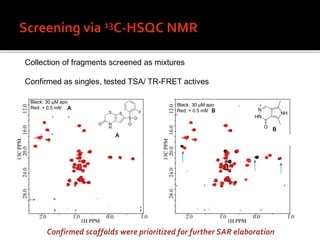
Confirmed scaffolds were prioritized for further SAR elaboration
Collection of fragments screened as mixtures
Confirmed as singles, tested TSA/ TR-FRET actives
Black: 30 µM apo
Red: + 0.5 mM A-266285.0 N
HN
NH
O
A-266285.0
Black: 30 µM apo
Red: + 0.5 mM A-266285.0 N
HN
NH
O
A-266285.0
AzB
B
Black: 30 µM apo
Red: + 0.5 mM A-1083709.0
N
H
S
O
S
S O
O
F
A-1083709.0
Black: 30 µM apo
Red: + 0.5 mM A-1083709.0
N
H
S
O
S
S O
O
F
A-1083709.0
A
A
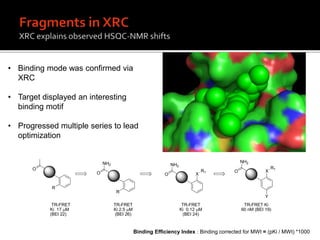
• Binding mode was confirmed via
XRC
• Target displayed an interesting
binding motif
• Progressed multiple series to lead
optimization
O
TR-FRET
Ki 17 mM
(BEI 22)
TR-FRET
Ki 2.5 mM
(BEI 26)
TR-FRET
Ki 0.12 mM
(BEI 24)
TR-FRET Ki
60 nM (BEI 19)
R
O
NH2
R
O
NH2
X
R1 O
NH2
X
R1
Y
Binding Efficiency Index : Binding corrected for MWt = (pKi / MWt) *1000
• Preliminary SAR provided two sites of resin attachment – ID protein hits from
each
• High potency of initial analogs (Brd) minimized the number of non-specific
interactions
• Early involvement of structural biology was crucial to confirm actives from HTS
and fragment screen
• The Brd-project was successfully transitioned to clinical candidate

Fragment_Based_Drug_Design_Abbott

  • 1.
  • 2.
     Identified acompound that possessed a “unique” activity “fingerprint” versus a large cancer cell panel  Molecular target was unknown  Chemistry team generated analogs –defined the SAR S.Warder
  • 4.
    Immobilized Compound B B B BB B B B Rock2 160KD MixResin and Lysate and Free Inhibitor SDS Strip Resin Wash Resin I I I I I I B B B BB B B B Gel Immunoblot or MS 0 30 100 300 1000 3000 Target A Target B Target C but not strong but not strong 98 62 49 188 38 28 0 0.05 0.10 0.50 1.00 10 mM Brd 3/4 S.Warder
  • 5.
    R2 = 0.85 (pEC50) 3.0 3.54.0 4.5 5.0 5.5 6.0 6.5 7.0 7.5 5.0 5.5 6.0 6.5 7.0 7.5 8.0 R2 = 0.85 BINDING (pKD) Proliferation50 3.0 3.5 4.03.0 3.5 4.0 4.5 5.0 5.5 6.0 6.5 7.06.0 6.5 7.0 7.5 5.0 5.5 6.0 6.5 7.0 7.5 8.0 Correlation of cellular activity to binding of target prompted an HTS campaign
  • 6.
    TR FRET TSA Insilico analysis Structural Biology (NMR/X-ray) ADME physchem properties Primary HTS & confirmation Orthogonal confirmation 3500 actives 1000 actives ~20 clusters Clustering & data-mining Structural confirmation Lead-like properties Issues: HTS riddled with false positives Large variety of structural classes present, no clear SAR Examine fragments via NMR C.Sun, S.Warder
  • 7.
    • Assay usesNMR method called “saturation transfer difference” which is outlined below. (Requires ligand (probe) molecule which binds weakly to target (KD ~ 10 -1000 mM) Irradiate protein at frequency far from that of probe (puts protein in “saturated” state) Radio waves Saturation is transferred from protein to probe “Unsaturated” probe diffuses into binding site Saturated probe diffuses off spectrum of probeAdd inhibitor (1) (2) (3) signal of probe decreases from true competition
  • 8.
    Ile- δ Met-ε Leu- δ& Val -γ Ile- δ Met-ε Leu- δ & Val -γ Monitor the shifts of 13C-labeled protein (HSQC) Putative binding site C.Sun
  • 9.
    Confirmed scaffolds wereprioritized for further SAR elaboration Collection of fragments screened as mixtures Confirmed as singles, tested TSA/ TR-FRET actives Black: 30 µM apo Red: + 0.5 mM A-266285.0 N HN NH O A-266285.0 Black: 30 µM apo Red: + 0.5 mM A-266285.0 N HN NH O A-266285.0 AzB B Black: 30 µM apo Red: + 0.5 mM A-1083709.0 N H S O S S O O F A-1083709.0 Black: 30 µM apo Red: + 0.5 mM A-1083709.0 N H S O S S O O F A-1083709.0 A A
  • 10.
    • Binding modewas confirmed via XRC • Target displayed an interesting binding motif • Progressed multiple series to lead optimization O TR-FRET Ki 17 mM (BEI 22) TR-FRET Ki 2.5 mM (BEI 26) TR-FRET Ki 0.12 mM (BEI 24) TR-FRET Ki 60 nM (BEI 19) R O NH2 R O NH2 X R1 O NH2 X R1 Y Binding Efficiency Index : Binding corrected for MWt = (pKi / MWt) *1000
  • 11.
    • Preliminary SARprovided two sites of resin attachment – ID protein hits from each • High potency of initial analogs (Brd) minimized the number of non-specific interactions • Early involvement of structural biology was crucial to confirm actives from HTS and fragment screen • The Brd-project was successfully transitioned to clinical candidate