KNOW YOUR NUMBERS!

 Factors, Multiples, Fractions,
 Percents, Estimates, Change
     From a Dollar, Tips
FRACTIONS, DECIMALS,
 PERCENTS, & ANGLES
 Convert from one to any of
  the other three… with or
    without a calculator!
Purpose
• Know your numbers! In this case,
  understand how to convert fractions to
  decimals, percents, or pieces of a circle.
• Get a “feel” for each. Estimate a fraction
  based on the decimal. Create a circle
  graph given a percent or a fraction.
• Circle has 360 degrees. Multiply fraction,
  decimal, or percent times 360.
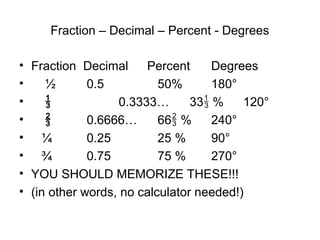
Fraction – Decimal – Percent - Degrees

• Fraction Decimal      Percent     Degrees
•    ½       0.5          50%       180°
•                 0.3333…      33 %    120°
•           0.6666…      66 %     240°
• ¼          0.25         25 %      90°
• ¾          0.75         75 %      270°
• YOU SHOULD MEMORIZE THESE!!!
• (in other words, no calculator needed!)
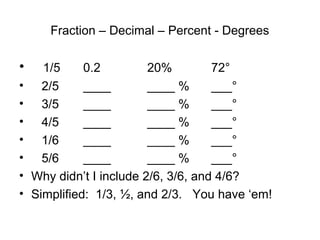
Fraction – Decimal – Percent - Degrees

•     1/5     0.2         20%         72°
•     2/5     ____        ____ %      ___°
•     3/5     ____        ____ %      ___°
•     4/5     ____        ____ %      ___°
•     1/6     ____        ____ %      ___°
•     5/6     ____        ____ %      ___°
•   Why didn’t I include 2/6, 3/6, and 4/6?
•   Simplified: 1/3, ½, and 2/3. You have ‘em!
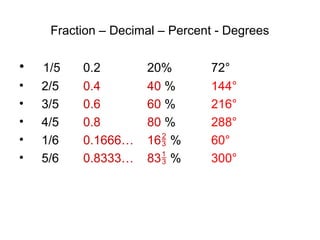
Fraction – Decimal – Percent - Degrees

•   1/5   0.2        20%        72°
•   2/5   0.4        40 %       144°
•   3/5   0.6        60 %       216°
•   4/5   0.8        80 %       288°
•   1/6   0.1666…    16 %      60°
•   5/6   0.8333…    83 %      300°
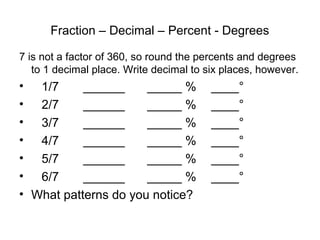
Fraction – Decimal – Percent - Degrees

7 is not a factor of 360, so round the percents and degrees
   to 1 decimal place. Write decimal to six places, however.
• 1/7      ______     _____ %            ____°
• 2/7      ______     _____ %            ____°
• 3/7      ______     _____ %            ____°
• 4/7      ______     _____ %            ____°
• 5/7      ______     _____ %            ____°
• 6/7      ______     _____ %            ____°
• What patterns do you notice?
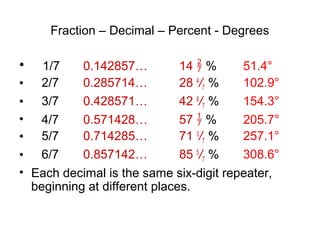
Fraction – Decimal – Percent - Degrees

•     1/7    0.142857…          14  %    51.4°
•     2/7    0.285714…          28 4/7 %  102.9°
•     3/7    0.428571…          42 6/7 %  154.3°
•     4/7    0.571428…          57  %    205.7°
•     5/7    0.714285…          71 3/7 %  257.1°
•     6/7    0.857142…          85 5/7 %  308.6°
•   Each decimal is the same six-digit repeater,
    beginning at different places.
Fraction – Decimal – Percent - Degrees

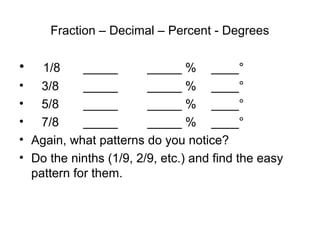
•     1/8     _____       _____ % ____°
•     3/8     _____       _____ % ____°
•     5/8     _____       _____ % ____°
•     7/8     _____       _____ % ____°
•   Again, what patterns do you notice?
•   Do the ninths (1/9, 2/9, etc.) and find the easy
    pattern for them.
Fraction – Decimal – Percent - Degrees

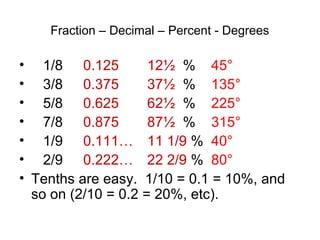
• 1/8 0.125          12½ % 45°
• 3/8 0.375          37½ % 135°
• 5/8 0.625          62½ % 225°
• 7/8 0.875          87½ % 315°
• 1/9 0.111… 11 1/9 % 40°
• 2/9 0.222… 22 2/9 % 80°
• Tenths are easy. 1/10 = 0.1 = 10%, and
  so on (2/10 = 0.2 = 20%, etc).
F–D–P–D
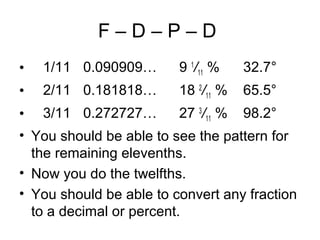
•   1/11 0.090909…       9 1/11 %    32.7°
•   2/11 0.181818…       18 2/11 %   65.5°
•   3/11 0.272727…       27 3/11 %   98.2°
• You should be able to see the pattern for
  the remaining elevenths.
• Now you do the twelfths.
• You should be able to convert any fraction
  to a decimal or percent.
Converting Back & Forth
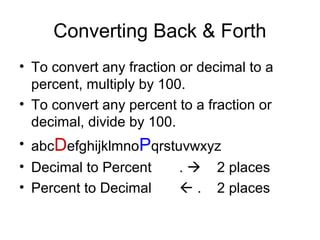
• To convert any fraction or decimal to a
  percent, multiply by 100.
• To convert any percent to a fraction or
  decimal, divide by 100.
• abcDefghijklmnoPqrstuvwxyz
• Decimal to Percent   .  2 places
• Percent to Decimal    . 2 places
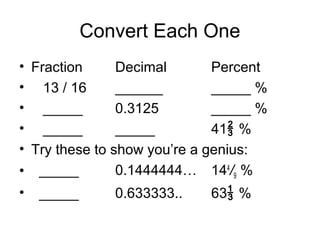
Convert Each One
• Fraction      Decimal       Percent
• 13 / 16       ______        _____ %
• _____         0.3125        _____ %
• _____         _____         41 %
• Try these to show you’re a genius:
• _____         0.1444444… 144/9 %
•   _____      0.633333..   63 %
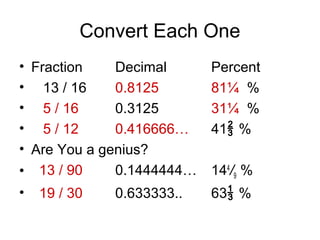
Convert Each One
• Fraction    Decimal      Percent
• 13 / 16     0.8125       81¼ %
• 5 / 16      0.3125       31¼ %
• 5 / 12      0.416666…    41 %
• Are You a genius?
• 13 / 90     0.1444444…   144/9 %
•   19 / 30   0.633333..   63 %
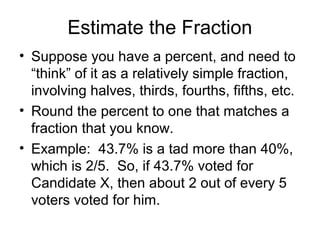
Estimate the Fraction
• Suppose you have a percent, and need to
  “think” of it as a relatively simple fraction,
  involving halves, thirds, fourths, fifths, etc.
• Round the percent to one that matches a
  fraction that you know.
• Example: 43.7% is a tad more than 40%,
  which is 2/5. So, if 43.7% voted for
  Candidate X, then about 2 out of every 5
  voters voted for him.
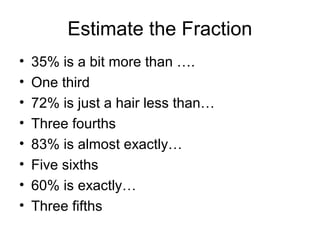
Estimate the Fraction
•   35% is a bit more than ….
•   One third
•   72% is just a hair less than…
•   Three fourths
•   83% is almost exactly…
•   Five sixths
•   60% is exactly…
•   Three fifths
Estimate the Fraction
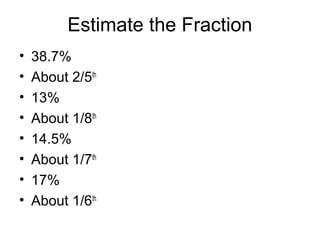
•   38.7%
•   About 2/5th
•   13%
•   About 1/8th
•   14.5%
•   About 1/7th
•   17%
•   About 1/6th
Tip?
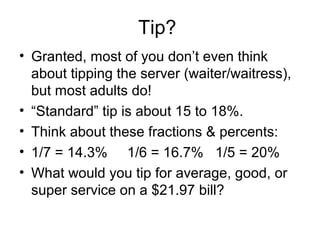
• Granted, most of you don’t even think
  about tipping the server (waiter/waitress),
  but most adults do!
• “Standard” tip is about 15 to 18%.
• Think about these fractions & percents:
• 1/7 = 14.3% 1/6 = 16.7% 1/5 = 20%
• What would you tip for average, good, or
  super service on a $21.97 bill?
Tip on $21.97?
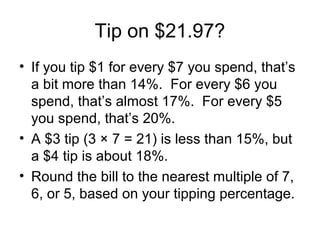
• If you tip $1 for every $7 you spend, that’s
  a bit more than 14%. For every $6 you
  spend, that’s almost 17%. For every $5
  you spend, that’s 20%.
• A $3 tip (3 × 7 = 21) is less than 15%, but
  a $4 tip is about 18%.
• Round the bill to the nearest multiple of 7,
  6, or 5, based on your tipping percentage.
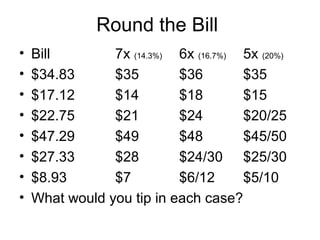
Round the Bill
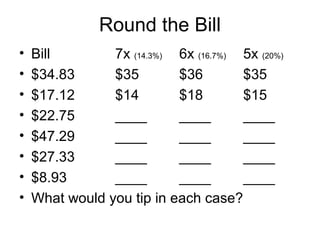
•   Bill        7x (14.3%) 6x (16.7%) 5x (20%)
•   $34.83      $35        $36        $35
•   $17.12      $14        $18        $15
•   $22.75      ____       ____       ____
•   $47.29      ____       ____       ____
•   $27.33      ____       ____       ____
•   $8.93       ____       ____       ____
•   What would you tip in each case?
Round the Bill
•   Bill        7x (14.3%) 6x (16.7%) 5x (20%)
•   $34.83      $35        $36        $35
•   $17.12      $14        $18        $15
•   $22.75      $21        $24        $20/25
•   $47.29      $49        $48        $45/50
•   $27.33      $28        $24/30 $25/30
•   $8.93       $7         $6/12      $5/10
•   What would you tip in each case?
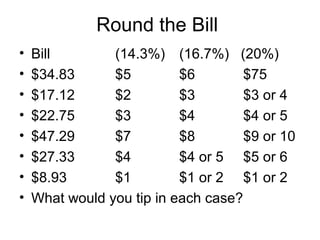
Round the Bill
•   Bill        (14.3%) (16.7%) (20%)
•   $34.83      $5         $6        $75
•   $17.12      $2         $3        $3 or 4
•   $22.75      $3         $4        $4 or 5
•   $47.29      $7         $8        $9 or 10
•   $27.33      $4         $4 or 5 $5 or 6
•   $8.93       $1         $1 or 2 $1 or 2
•   What would you tip in each case?
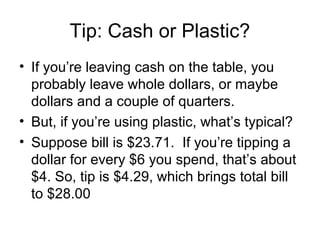
Tip: Cash or Plastic?
• If you’re leaving cash on the table, you
  probably leave whole dollars, or maybe
  dollars and a couple of quarters.
• But, if you’re using plastic, what’s typical?
• Suppose bill is $23.71. If you’re tipping a
  dollar for every $6 you spend, that’s about
  $4. So, tip is $4.29, which brings total bill
  to $28.00
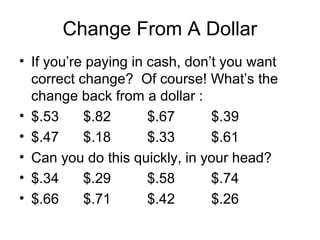
Change From A Dollar
• If you’re paying in cash, don’t you want
  correct change? Of course! What’s the
  change back from a dollar :
• $.53     $.82       $.67      $.39
• $.47     $.18       $.33      $.61
• Can you do this quickly, in your head?
• $.34     $.29       $.58      $.74
• $.66     $.71       $.42      $.26
PERCENTS

Solve Percent Problems
Percent Proportion
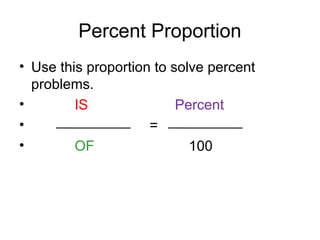
• Use this proportion to solve percent
  problems.
•        IS               Percent
•                    =
•        OF                 100
Solving Percent Problems
• Use the “IS over OF equals Percent Over
  One Hundred” proportion.
• When the problem calls for a percent of
  increase (growth) or decrease (decline),
  use “Difference” as the “IS” and “OLD” as
  the “OF.”
• Difference = New – Old.
Solve
• What is 33 1/3 % of 123?
• Hint: 33 1/3% is one-third! Just divide by
  3, or, set up proportion: is/of = 1/3
• 41
• 18 correct on a 22 question quiz is what
  percent correct?
• 819/11 % (81.8, rounded to nearest tenth)
Solve
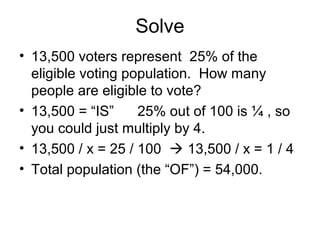
• 13,500 voters represent 25% of the
  eligible voting population. How many
  people are eligible to vote?
• 13,500 = “IS”     25% out of 100 is ¼ , so
  you could just multiply by 4.
• 13,500 / x = 25 / 100  13,500 / x = 1 / 4
• Total population (the “OF”) = 54,000.
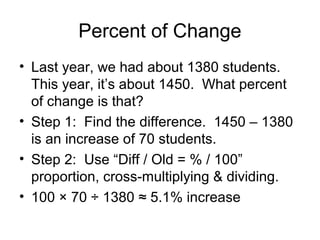
Percent of Change
• Last year, we had about 1380 students.
  This year, it’s about 1450. What percent
  of change is that?
• Step 1: Find the difference. 1450 – 1380
  is an increase of 70 students.
• Step 2: Use “Diff / Old = % / 100”
  proportion, cross-multiplying & dividing.
• 100 × 70 ÷ 1380 ≈ 5.1% increase
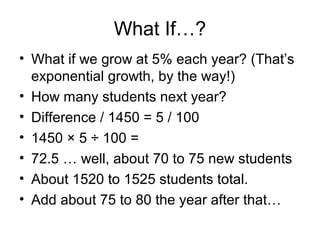
What If…?
• What if we grow at 5% each year? (That’s
  exponential growth, by the way!)
• How many students next year?
• Difference / 1450 = 5 / 100
• 1450 × 5 ÷ 100 =
• 72.5 … well, about 70 to 75 new students
• About 1520 to 1525 students total.
• Add about 75 to 80 the year after that…
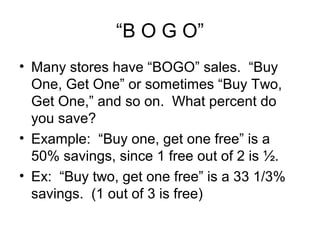
“B O G O”
• Many stores have “BOGO” sales. “Buy
  One, Get One” or sometimes “Buy Two,
  Get One,” and so on. What percent do
  you save?
• Example: “Buy one, get one free” is a
  50% savings, since 1 free out of 2 is ½.
• Ex: “Buy two, get one free” is a 33 1/3%
  savings. (1 out of 3 is free)
BOGO
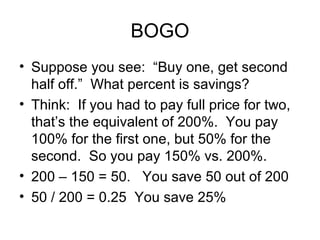
• Suppose you see: “Buy one, get second
  half off.” What percent is savings?
• Think: If you had to pay full price for two,
  that’s the equivalent of 200%. You pay
  100% for the first one, but 50% for the
  second. So you pay 150% vs. 200%.
• 200 – 150 = 50. You save 50 out of 200
• 50 / 200 = 0.25 You save 25%
Which is Cheaper?
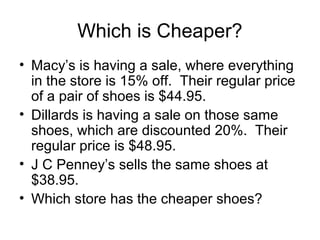
• Macy’s is having a sale, where everything
  in the store is 15% off. Their regular price
  of a pair of shoes is $44.95.
• Dillards is having a sale on those same
  shoes, which are discounted 20%. Their
  regular price is $48.95.
• J C Penney’s sells the same shoes at
  $38.95.
• Which store has the cheaper shoes?
Cheaper Shoes?
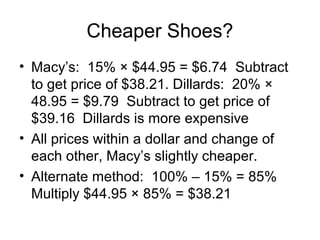
• Macy’s: 15% × $44.95 = $6.74 Subtract
  to get price of $38.21. Dillards: 20% ×
  48.95 = $9.79 Subtract to get price of
  $39.16 Dillards is more expensive
• All prices within a dollar and change of
  each other, Macy’s slightly cheaper.
• Alternate method: 100% – 15% = 85%
  Multiply $44.95 × 85% = $38.21

Fractions decimals percents

  • 1.
    KNOW YOUR NUMBERS! Factors, Multiples, Fractions, Percents, Estimates, Change From a Dollar, Tips
  • 2.
    FRACTIONS, DECIMALS, PERCENTS,& ANGLES Convert from one to any of the other three… with or without a calculator!
  • 3.
    Purpose • Know yournumbers! In this case, understand how to convert fractions to decimals, percents, or pieces of a circle. • Get a “feel” for each. Estimate a fraction based on the decimal. Create a circle graph given a percent or a fraction. • Circle has 360 degrees. Multiply fraction, decimal, or percent times 360.
  • 4.
    Fraction – Decimal– Percent - Degrees • Fraction Decimal Percent Degrees • ½ 0.5 50% 180° •  0.3333… 33 % 120° •  0.6666… 66 % 240° • ¼ 0.25 25 % 90° • ¾ 0.75 75 % 270° • YOU SHOULD MEMORIZE THESE!!! • (in other words, no calculator needed!)
  • 5.
    Fraction – Decimal– Percent - Degrees • 1/5 0.2 20% 72° • 2/5 ____ ____ % ___° • 3/5 ____ ____ % ___° • 4/5 ____ ____ % ___° • 1/6 ____ ____ % ___° • 5/6 ____ ____ % ___° • Why didn’t I include 2/6, 3/6, and 4/6? • Simplified: 1/3, ½, and 2/3. You have ‘em!
  • 6.
    Fraction – Decimal– Percent - Degrees • 1/5 0.2 20% 72° • 2/5 0.4 40 % 144° • 3/5 0.6 60 % 216° • 4/5 0.8 80 % 288° • 1/6 0.1666… 16 % 60° • 5/6 0.8333… 83 % 300°
  • 7.
    Fraction – Decimal– Percent - Degrees 7 is not a factor of 360, so round the percents and degrees to 1 decimal place. Write decimal to six places, however. • 1/7 ______ _____ % ____° • 2/7 ______ _____ % ____° • 3/7 ______ _____ % ____° • 4/7 ______ _____ % ____° • 5/7 ______ _____ % ____° • 6/7 ______ _____ % ____° • What patterns do you notice?
  • 8.
    Fraction – Decimal– Percent - Degrees • 1/7 0.142857… 14  % 51.4° • 2/7 0.285714… 28 4/7 % 102.9° • 3/7 0.428571… 42 6/7 % 154.3° • 4/7 0.571428… 57  % 205.7° • 5/7 0.714285… 71 3/7 % 257.1° • 6/7 0.857142… 85 5/7 % 308.6° • Each decimal is the same six-digit repeater, beginning at different places.
  • 9.
    Fraction – Decimal– Percent - Degrees • 1/8 _____ _____ % ____° • 3/8 _____ _____ % ____° • 5/8 _____ _____ % ____° • 7/8 _____ _____ % ____° • Again, what patterns do you notice? • Do the ninths (1/9, 2/9, etc.) and find the easy pattern for them.
  • 10.
    Fraction – Decimal– Percent - Degrees • 1/8 0.125 12½ % 45° • 3/8 0.375 37½ % 135° • 5/8 0.625 62½ % 225° • 7/8 0.875 87½ % 315° • 1/9 0.111… 11 1/9 % 40° • 2/9 0.222… 22 2/9 % 80° • Tenths are easy. 1/10 = 0.1 = 10%, and so on (2/10 = 0.2 = 20%, etc).
  • 11.
    F–D–P–D • 1/11 0.090909… 9 1/11 % 32.7° • 2/11 0.181818… 18 2/11 % 65.5° • 3/11 0.272727… 27 3/11 % 98.2° • You should be able to see the pattern for the remaining elevenths. • Now you do the twelfths. • You should be able to convert any fraction to a decimal or percent.
  • 12.
    Converting Back &Forth • To convert any fraction or decimal to a percent, multiply by 100. • To convert any percent to a fraction or decimal, divide by 100. • abcDefghijklmnoPqrstuvwxyz • Decimal to Percent .  2 places • Percent to Decimal  . 2 places
  • 13.
    Convert Each One •Fraction Decimal Percent • 13 / 16 ______ _____ % • _____ 0.3125 _____ % • _____ _____ 41 % • Try these to show you’re a genius: • _____ 0.1444444… 144/9 % • _____ 0.633333.. 63 %
  • 14.
    Convert Each One •Fraction Decimal Percent • 13 / 16 0.8125 81¼ % • 5 / 16 0.3125 31¼ % • 5 / 12 0.416666… 41 % • Are You a genius? • 13 / 90 0.1444444… 144/9 % • 19 / 30 0.633333.. 63 %
  • 15.
    Estimate the Fraction •Suppose you have a percent, and need to “think” of it as a relatively simple fraction, involving halves, thirds, fourths, fifths, etc. • Round the percent to one that matches a fraction that you know. • Example: 43.7% is a tad more than 40%, which is 2/5. So, if 43.7% voted for Candidate X, then about 2 out of every 5 voters voted for him.
  • 16.
    Estimate the Fraction • 35% is a bit more than …. • One third • 72% is just a hair less than… • Three fourths • 83% is almost exactly… • Five sixths • 60% is exactly… • Three fifths
  • 17.
    Estimate the Fraction • 38.7% • About 2/5th • 13% • About 1/8th • 14.5% • About 1/7th • 17% • About 1/6th
  • 18.
    Tip? • Granted, mostof you don’t even think about tipping the server (waiter/waitress), but most adults do! • “Standard” tip is about 15 to 18%. • Think about these fractions & percents: • 1/7 = 14.3% 1/6 = 16.7% 1/5 = 20% • What would you tip for average, good, or super service on a $21.97 bill?
  • 19.
    Tip on $21.97? •If you tip $1 for every $7 you spend, that’s a bit more than 14%. For every $6 you spend, that’s almost 17%. For every $5 you spend, that’s 20%. • A $3 tip (3 × 7 = 21) is less than 15%, but a $4 tip is about 18%. • Round the bill to the nearest multiple of 7, 6, or 5, based on your tipping percentage.
  • 20.
    Round the Bill • Bill 7x (14.3%) 6x (16.7%) 5x (20%) • $34.83 $35 $36 $35 • $17.12 $14 $18 $15 • $22.75 ____ ____ ____ • $47.29 ____ ____ ____ • $27.33 ____ ____ ____ • $8.93 ____ ____ ____ • What would you tip in each case?
  • 21.
    Round the Bill • Bill 7x (14.3%) 6x (16.7%) 5x (20%) • $34.83 $35 $36 $35 • $17.12 $14 $18 $15 • $22.75 $21 $24 $20/25 • $47.29 $49 $48 $45/50 • $27.33 $28 $24/30 $25/30 • $8.93 $7 $6/12 $5/10 • What would you tip in each case?
  • 22.
    Round the Bill • Bill (14.3%) (16.7%) (20%) • $34.83 $5 $6 $75 • $17.12 $2 $3 $3 or 4 • $22.75 $3 $4 $4 or 5 • $47.29 $7 $8 $9 or 10 • $27.33 $4 $4 or 5 $5 or 6 • $8.93 $1 $1 or 2 $1 or 2 • What would you tip in each case?
  • 23.
    Tip: Cash orPlastic? • If you’re leaving cash on the table, you probably leave whole dollars, or maybe dollars and a couple of quarters. • But, if you’re using plastic, what’s typical? • Suppose bill is $23.71. If you’re tipping a dollar for every $6 you spend, that’s about $4. So, tip is $4.29, which brings total bill to $28.00
  • 24.
    Change From ADollar • If you’re paying in cash, don’t you want correct change? Of course! What’s the change back from a dollar : • $.53 $.82 $.67 $.39 • $.47 $.18 $.33 $.61 • Can you do this quickly, in your head? • $.34 $.29 $.58 $.74 • $.66 $.71 $.42 $.26
  • 25.
  • 26.
    Percent Proportion • Usethis proportion to solve percent problems. • IS Percent • = • OF 100
  • 27.
    Solving Percent Problems •Use the “IS over OF equals Percent Over One Hundred” proportion. • When the problem calls for a percent of increase (growth) or decrease (decline), use “Difference” as the “IS” and “OLD” as the “OF.” • Difference = New – Old.
  • 28.
    Solve • What is33 1/3 % of 123? • Hint: 33 1/3% is one-third! Just divide by 3, or, set up proportion: is/of = 1/3 • 41 • 18 correct on a 22 question quiz is what percent correct? • 819/11 % (81.8, rounded to nearest tenth)
  • 29.
    Solve • 13,500 votersrepresent 25% of the eligible voting population. How many people are eligible to vote? • 13,500 = “IS” 25% out of 100 is ¼ , so you could just multiply by 4. • 13,500 / x = 25 / 100  13,500 / x = 1 / 4 • Total population (the “OF”) = 54,000.
  • 30.
    Percent of Change •Last year, we had about 1380 students. This year, it’s about 1450. What percent of change is that? • Step 1: Find the difference. 1450 – 1380 is an increase of 70 students. • Step 2: Use “Diff / Old = % / 100” proportion, cross-multiplying & dividing. • 100 × 70 ÷ 1380 ≈ 5.1% increase
  • 31.
    What If…? • Whatif we grow at 5% each year? (That’s exponential growth, by the way!) • How many students next year? • Difference / 1450 = 5 / 100 • 1450 × 5 ÷ 100 = • 72.5 … well, about 70 to 75 new students • About 1520 to 1525 students total. • Add about 75 to 80 the year after that…
  • 32.
    “B O GO” • Many stores have “BOGO” sales. “Buy One, Get One” or sometimes “Buy Two, Get One,” and so on. What percent do you save? • Example: “Buy one, get one free” is a 50% savings, since 1 free out of 2 is ½. • Ex: “Buy two, get one free” is a 33 1/3% savings. (1 out of 3 is free)
  • 33.
    BOGO • Suppose yousee: “Buy one, get second half off.” What percent is savings? • Think: If you had to pay full price for two, that’s the equivalent of 200%. You pay 100% for the first one, but 50% for the second. So you pay 150% vs. 200%. • 200 – 150 = 50. You save 50 out of 200 • 50 / 200 = 0.25 You save 25%
  • 34.
    Which is Cheaper? •Macy’s is having a sale, where everything in the store is 15% off. Their regular price of a pair of shoes is $44.95. • Dillards is having a sale on those same shoes, which are discounted 20%. Their regular price is $48.95. • J C Penney’s sells the same shoes at $38.95. • Which store has the cheaper shoes?
  • 35.
    Cheaper Shoes? • Macy’s:15% × $44.95 = $6.74 Subtract to get price of $38.21. Dillards: 20% × 48.95 = $9.79 Subtract to get price of $39.16 Dillards is more expensive • All prices within a dollar and change of each other, Macy’s slightly cheaper. • Alternate method: 100% – 15% = 85% Multiply $44.95 × 85% = $38.21