Fractal Narrative About The Relationship Between
Geometries And Technology And Its Impact On
Narrative Spaces 1 Aufl German A Duarte download
https://ebookbell.com/product/fractal-narrative-about-the-
relationship-between-geometries-and-technology-and-its-impact-on-
narrative-spaces-1-aufl-german-a-duarte-51800160
Explore and download more ebooks at ebookbell.com
Here are some recommended products that we believe you will be
interested in. You can click the link to download.
Fractal Algorithm And Its Application In Rock Mechanics Dongjie Xue
https://ebookbell.com/product/fractal-algorithm-and-its-application-
in-rock-mechanics-dongjie-xue-46715668
Fractal Teletraffic Modeling And Delay Bounds In Computer
Communications Ming Li
https://ebookbell.com/product/fractal-teletraffic-modeling-and-delay-
bounds-in-computer-communications-ming-li-46873338
Fractal Calculus And Its Applications Fcalculus Alireza Khalili
Golmankhaneh
https://ebookbell.com/product/fractal-calculus-and-its-applications-
fcalculus-alireza-khalili-golmankhaneh-47411722
Fractal Energy Trading Four Simple Rules To Profit In Any Market Any
Timeframe Print Replica Kindle Edition Doc Severson
https://ebookbell.com/product/fractal-energy-trading-four-simple-
rules-to-profit-in-any-market-any-timeframe-print-replica-kindle-
edition-doc-severson-49176954
Fractal Behaviour Of The Earth System Vijay Prasad Dimri
https://ebookbell.com/product/fractal-behaviour-of-the-earth-system-
vijay-prasad-dimri-49924390
Fractal Tomography For Power Grids S D Varwandkar M V Hariharan
https://ebookbell.com/product/fractal-tomography-for-power-grids-s-d-
varwandkar-m-v-hariharan-50688900
Fractal Worlds Grown Built And Imagined Michael Frame Amelia Urry
https://ebookbell.com/product/fractal-worlds-grown-built-and-imagined-
michael-frame-amelia-urry-51893212
Fractal Geometry And Stochastics Vi Progress In Probability 76 Uta
Freiberg Editor
https://ebookbell.com/product/fractal-geometry-and-stochastics-vi-
progress-in-probability-76-uta-freiberg-editor-51985318
Fractal Signatures In The Dynamics Of An Epidemiology 1st Edition
Santo Banerjee
https://ebookbell.com/product/fractal-signatures-in-the-dynamics-of-
an-epidemiology-1st-edition-santo-banerjee-53649982
German A. Duarte
Fractal Narrative
Media Studies
2014-06-18 12-06-45 --- Projekt: transcript.titeleien / Dokument: FAX ID 03c6369503115576|(S. 1- 4) TIT2829.p 369503115592
German A. Duarte holds a Ph.D. (2013) in Media Studies, Ruhr-Universität Bo-
chum. His research interests include history of media, film history, new techno-
logies in audiovisual narratives, cognitive-cultural economy and philosophy.
2014-06-18 12-06-45 --- Projekt: transcript.titeleien / Dokument: FAX ID 03c6369503115576|(S. 1- 4) TIT2829.p 369503115592
German A. Duarte
Fractal Narrative
About the Relationship Between Geometries and Technology
and Its Impact on Narrative Spaces
2014-06-18 12-06-45 --- Projekt: transcript.titeleien / Dokument: FAX ID 03c6369503115576|(S. 1- 4) TIT2829.p 369503115592
Bibliographic information published by the Deutsche Nationalbibliothek
The Deutsche Nationalbibliothek lists this publication in the Deutsche Natio-
nalbibliografie; detailed bibliographic data are available in the Internet at
http://dnb.d-nb.de
© 2014 transcript Verlag, Bielefeld
All rights reserved. No part of this book may be reprinted or reproduced or uti-
lized in any form or by any electronic, mechanical, or other means, now known
or hereafter invented, including photocopying and recording, or in any infor-
mation storage or retrieval system, without permission in writing from the
publisher.
Cover layout: Kordula Röckenhaus, Bielefeld
Cover illustration: himberry / photocase.de
Typeset by German A. Duarte
Printed by Majuskel Medienproduktion GmbH, Wetzlar
Print-ISBN 978-3-8376-2829-6
PDF-ISBN 978-3-8394-2829-0
2014-06-18 12-06-45 --- Projekt: transcript.titeleien / Dokument: FAX ID 03c6369503115576|(S. 1- 4) TIT2829.p 369503115592
In memory of Adela Vélez Rezk and Antonio Caronia
Quis desiderio sit pudor aut modus
tam cari capitis? praecipe lugubris
cantus, Melpomene, cui liquidam pater vocem cum cithara dedit.
(Horace, Odes, I 24)
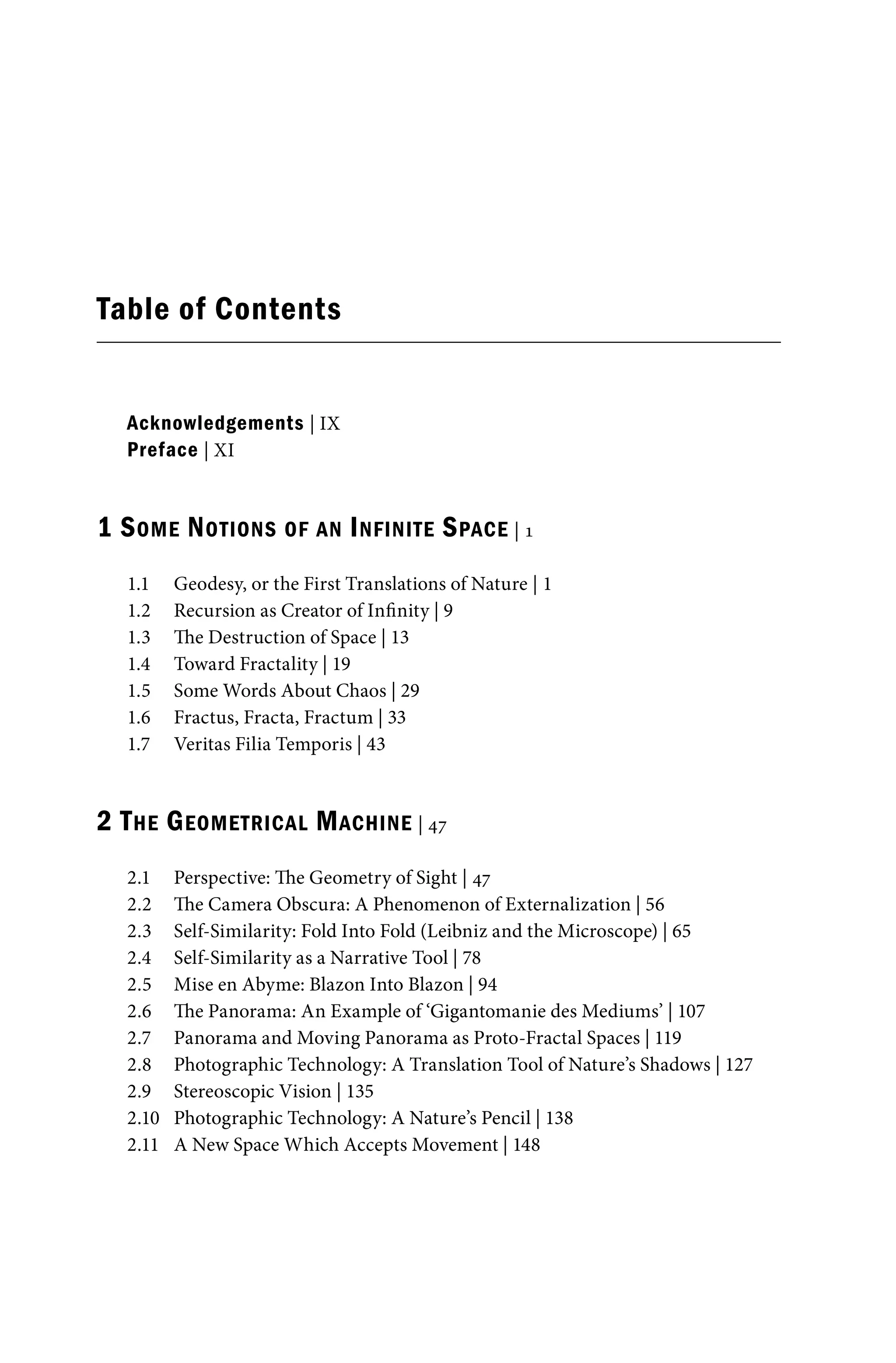
Table of Contents
Acknowledgements | IX
Preface | XI
1 SOME NOTIONS OF AN INFINITE SPACE | 1
1.1 Geodesy, or the First Translations of Nature | 1
1.2 Recursion as Creator of Infinity | 9
1.3 The Destruction of Space | 13
1.4 Toward Fractality | 19
1.5 Some Words About Chaos | 29
1.6 Fractus, Fracta, Fractum | 33
1.7 Veritas Filia Temporis | 43
2 THE GEOMETRICAL MACHINE | 47
2.1 Perspective: The Geometry of Sight | 47
2.2 The Camera Obscura: A Phenomenon of Externalization | 56
2.3 Self-Similarity: Fold Into Fold (Leibniz and the Microscope) | 65
2.4 Self-Similarity as a Narrative Tool | 78
2.5 Mise en Abyme: Blazon Into Blazon | 94
2.6 The Panorama: An Example of ‘Gigantomanie des Mediums’ | 107
2.7 Panorama and Moving Panorama as Proto-Fractal Spaces | 119
2.8 Photographic Technology: A Translation Tool of Nature’s Shadows | 127
2.9 Stereoscopic Vision | 135
2.10 Photographic Technology: A Nature’s Pencil | 138
2.11 A New Space Which Accepts Movement | 148
3 FILM AS SPATIAL ORGANIZATION | 167
3.1 Visualizing Multidimensional Spaces | 167
3.2 A Geodesy of Film Narrative | 187
3.3 Ideal Elements in Narrative Space | 219
3.4 A New Relationship Between Paradigma and Syntagma | 257
3.5 Hypertext: A Digital Episteme | 273
3.6 Toward a Strict Fractal Narrative | 288
4 FRACTAL NARRATIVE | 307
4.1 Media-Activism: The Creation of Fractal Spaces | 307
4.2 Fractalis Narratio Ordine Geometrico Demonstrata | 339
List of Illustrations | 353
Bibliography | 363
Acknowledgements
This volume continues and elaborates my Ph.D. dissertation ‘Fractal Narrative’ sub-
mitted to RUHR-Universität Bochum, July 2013.
I would like to take this opportunity to gratefully acknowledge the guidance of
some professors, scholars and friends who believed in this work and supported me
from the very beginning of my research.
My deepest appreciation and gratitude go to my mentor and friend Antonio Caro-
nia, who kindly followed the development of this book until he passed away in Janu-
ary 2013. Without his friendship, his advice and his encouragement I would never
have started this research. I will always be grateful for his friendship and for all the
conversations we had, which were always a source of inspiration for me.
Special thanks are offered to my doctoral adviser Oliver Fahle for following this
work in all its stages and for his comments and suggestions. It is also my duty and
pleasure to thank Erich Hörl for his guidance during the drafting of this text.
My gratitude also goes to many friends and colleagues who, during the years de-
voted to the research, offered me their assistance and advice. I mention them in alpha-
betic order: Justin Battin, Unai Begiristain, Wil Chang, Lázaro Echegaray, Alessandra
Luciano, Eva Oer, Rebekka Reichold, Alfredo Rizza, Sven Speek and Mike Yung.
To Maria Elena and to my parents go my thanks for their unlimited support, and
their inexhaustible patience all through my research work.
Berlin
May 2014
Preface
Fractals suggest recursivity, infinity and the repetition of a principle of order. But they
are not just infinite images, wonderful infinite images in a space. They are processes.
Fractals are digital pictures of the universe’s continuous movement. Attempting to
explain the state of fractals, one can only posit that their state is pure becoming. For
this reason fractal geometry was understood as a geometry that can recognize nature,
its irregular shapes, its perpetual mutation and its chaotic characteristics.
The present work attempts to demonstrate that fractals are more than an instru-
ment of scientists, more than just one of the features of our scientific context. Indeed,
these forms have accompanied mankind over millennia. Consider, for instance, not
only the fractal shape of mountains, trees and human lungs, but also Islamic art, Afri-
can architecture, Hokusai’s works and many other artistic expressions that are able to
display these infinite forms and show us that they are also part of mankind’s deepest
unconscious.
Notwithstanding the irregularity and infiniteness of nature, starting from the 4th
century B.C. onwards, philosophy developed a linear thought called logic and op-
posed the alogon to it. According to this framework, what is not linear is inexplicable
and therefore a paradox. At the same time, geometry and mathematics developed a
science able to explain nature and natural phenomena through abstract and simple
forms that do not exist in nature, that is, through lines that only exist in the human
mind. As a result, the logos became the only rule and was considered the only truth.
Geometry, which was an indispensable instrument for analyzing nature, was also
governed by logic, mostly embodied in the axioms of Euclid.
Through geometry, ‘real things,’ fruits of the observation of nature, were identi-
fied with the fruits of the intellect, that is, with geometrical figures that, in turn, were
perceived as ‘real.’ As a consequence, geometry could create ‘reality’ through abstrac-
tions, through figures created by the intellect. At that point, the rational translation
of natural objects through the science of geometry started to be seen as an objective
translation of nature. This impression of objectivity, derived from a kind of Pythago-
rean thought in which nature can be translated into numbers, started to impose a new
relationship between man and nature. On the one hand, one started to see nature as a
regular entity that could be embraced by logos. On the other hand, one assumed that
the human senses where insufficient to understand some phenomena. Therefore, ge-
Fractal Narrative
XII
ometry was employed to translate objects and phenomena onto another plane where
human perception could analyze them.
The idea that nature could be translated into the language of numbers generated
the erroneous conception that natural processes are regular, that is to say, that they
can be predicted and imitated by finding their correspondence with numbers or Eu-
clidean geometrical figures. This idea is exemplified by the Greek concept of truth
(aletheia), the literal meaning of which is ‘the state of not being hidden, of being evi-
dent,’ or in Heidegger’s translation, the state of ‘Unverborgenheit.’
This concept of truth governed mankind’s relationship with nature from the clas-
sical period up to the Modern Age. During this period, truth and nature were seen as
eternal and immutable entities that could only be understood by decoding them using
numbers. Thus, nature could only be contemplated, because only through contempla-
tion could mankind decipher it and disclose its secrets. Consequently, the scientific
knowledge, namely the theoria of the Greeks and the contemplatio of the Romans,
subdued the praxis.
However, through the mediation of Christian thought, in the Modern Age, scien-
tific knowledge was no longer understood as the fine ultimo to which praxis should
be subordinated. Theoria and contemplatio became operative instruments. From that
moment on, man began seeing his presence in the world as a chance – almost as a
mission – to become the ‘dominator’ of nature. And man’s supremacy over nature is
expressed in his act of making truth. This truth is no longer the Greek aletheia, but the
Hebrew ‘emet’ whose root is strongly related to the verb ‘to do.’ More specifically, the
difference between the Greek and Hebraic truths lies in that the first one is something
that man ‘knows,’ whereas the second is something in the sphere of what man ‘prac-
tices.’ In the Hebrew conception of truth, there is something formed in time, some-
thing created in time and by time, which implies that every historical period generates
its own truth. The old idea of an untouchable and everlasting truth was replaced by a
completely different concept. The human being acquired the capacity to ‘act’ upon na-
ture thus establishing a continuous creation of truth. Therefore, scientific knowledge
also started to be understood as a means to improve technology with the aim of cre-
ating truth by transforming nature. But if technology represented the only means to
transform nature and supply human sensorial weakness, then geometry represented
the instrument to translate nature ‘objectively.’ In addition, geometry was a means to
improve – and also to prove – the efficacy of technology, which, in turn, offered the
possibility to study, represent and simulate the human body and its functions. Con-
sider, for instance, the technique of perspective developed during the Renaissance,
which, by applying the geometrical rules developed by Euclid, allowed not only the
analysis of the human sense of sight, but also its representation and simulation.
During the Renaissance, the desire to represent natural objects with a high degree
of objectivity created a different relationship with nature. The Renaissance took on as
a goal the construction of an image on a two-dimensional surface able to produce for
the beholder an illusion of a three-dimensional object, a simulation of our perception
of natural objects. The principal aim of perspective was to achieve a perfect transla-
Preface XIII
tion of nature in order to produce in the beholder, in Gombrich’s words, an effect
‘akin to visual hallucination.’ Perspective aims to attain the correct equation such
that the image appears like the object and the object like the image. In addition, this
technique generates a kind of mechanization of the representation of natural objects.
It was a mechanization of the natural function of sight that was simulated through
the device of the camera obscura. As a prosthesis able to realize translations of nature,
which are seen as objective due to its scientific component, the camera obscura started
a phenomenon of alienation of mankind from the representation of the world. The
camera obscura represents the first of a series of visual media that translated nature
under a Euclidean ordino.
In the field of cinematographic studies, when the formalist influence on the study
of cinematography came to an end, some narrative constructions started to be seen as
narrative constructions that do not represent Euclidean spaces. In other words, it be-
came quite clear that even though the cinematographic camera was a direct heir of the
camera obscura and, for this reason, a geometrical machine governed by Euclidean
rules, it was able to develop non-Euclidean narrative spaces that share some features
with fractal forms.
The primary aim of the present work is to analyze the influence of fractal geom-
etry on the organization of contemporary narrative spaces. As noted by Simmel (see
Simmel G. 1908, esp. pp. 614-708), society is not only developed into the space – that
is, the social space is not only a spatial manifestation or development – but it also con-
structs a spatial organization that is perceptible. Certainly, technology and geometry
play a fundamental role in the construction of the social space. Our society, strongly
influenced by contemporary mass media, has started to see a new way to articulate
narrative spaces, displaying a type of organization that I call in this text fractal. In my
view, society is moving towards the construction of fractal social spaces that will, in
the near future, completely modify social dynamics and structures, class struggles,
and so on. At the moment, we see only one aspect of the impact that fractal geometry
has on the organization of narrative spaces: on the aesthetics of some narrative con-
structions and on the creation of open spaces for discussion and sharing information.
My research, by analyzing the symbiosis between man and technology and between
man and geometry, aims at developing an instrument of analysis that could represent
a new way to understand the contemporary narrative act, which is no longer the cre-
ation of a linear succession of information governed by fixed Euclidean rules, but the
construction of infinite fractal spaces in which man and technology establish a new
relationship.
In the first part, I first outline the development of geometry, Euclid’s contribution, as
well as the scientific research that allowed the theorization of non-Euclidean geom-
etries. After that, I deal with the fundamental concepts of topology and proto-fractal
objects that in the 1970s allowed Benoit Mandelbrot to create fractal geometry.
The second part is focused on the development of the technological devices that
influenced the analysis of space and allowed the theorization of new kinds of struc-
Fractal Narrative
XIV
tures, new ways of organizing the universe. Each visual medium considered in this
second part is analyzed from a historical point of view that enables us to highlight a
common process shared by all the devices discussed. Indeed, every visual medium
was developed within the scientific field with the purpose of improving mankind’s
analysis of nature. As prostheses that supplies human sensorial weakness, these appa-
ratuses represented extensions of the human senses and allowed a better understand-
ing of nature and natural phenomena. However, when these apparatuses are intro-
duced to the large public, they become narrative instruments that not only modify the
social understanding of ‘objective representation’ but also influence the way mankind
constructs narrative spaces, the way mankind communicates. Particular attention is
drawn to the microscope, which influenced Leibniz’s theories of Analysis Situs and
Monadology, through which I analyze important characteristics of fractal objects
that are present in the organization of some narrative spaces. But I also deal with
the invention of the cinematographic camera, which allowed Bergson to theorize a
new universal structure, and the Panorama, the aim of which was to concentrate in
a single place huge quantities of information, always attempting to create an infinite
space where information could be preserved.
The third part of this work focuses on the introduction of non-Euclidean geom-
etries into art, on the way fractal spaces can be illustrated through pictorial repre-
sentations, and on how these spaces, particularly as displayed in African art, were
introduced into and interpreted by Western artistic expression. I also examine some
scientific theories, like Poincaré’s Analysis Situs, and how these theories were in-
corporated into artistic expression. From there I am able to start an analysis on the
influences of both Euclidean geometry and linguistics on the organization of nar-
rative spaces, and on how Deleuze, by analyzing the cinematographic camera as an
instrument able to construct non-Euclidean spaces, made possible the understand-
ing of audiovisual narrative as a pure spatial organization, which, after the Second
World War, started to be organized following some non-Euclidean laws. Following
in the footsteps of Deleuze, I attempt to create a parallel between the development
of non-Euclidean geometries and the audiovisual narrative spaces constructed after
the Second World War. The comparison between the development of non-Euclidean
geometries and the construction of non-Euclidean narrative spaces takes into account
the role played by technology. I theorize that every technological improvement gener-
ated a new way of organizing narrative spaces. Thus, I argue that video technology
enabled the development of a kind of image that shares some characteristics with
Proto-Fractal objects. I analyze the digital image and the organization of audiovisual
narrative spaces through a comparison with the characteristics of fractal forms. In
this part, I used as a framework the theory developed in the text to analyze some
mainstream films. While analyzing these films, I also attempt to highlight the exis-
tence of fractal narratives and how they function. Indeed, even though the narrative
spaces developed in the films under analysis have already been studied, I decode them
in a completely new way, that is, through the innovative instrument of analysis offered
by fractal geometry.
Preface XV
The fourth and last part is focused on the current status of audiovisual narrative.
I deal in particular with the narratives developed in recent times on the World Wide
Web, and I inquiry into the social role that these narratives play and can play in the
future. I also propose a geometrical demonstration of the fractal narrative in order to
better define its essence and potentialities.
1 Some Notions of an Infinite Space
Est-ce simplement que les choses qui nous semblent
belles sont celles qui s’adaptent le mieux à notre intelli-
gence, et que par suite elles sont en même temps l’outil
que cette intelligence sait le mieux manier ?1
1.1 GEODESY, OR THE FIRST TRANSLATIONS OF NATURE
The Greeks developed Geometry as an abstraction of familiar things, the abstrac-
tion of the reality around them.2
Thales of Miletus (ca. 625-547 B.C.) is commonly
considered the first philosopher to realize a system in which all things derive from a
1 | Poincaré H. 1908, p. 17.
2 | With this I do not want to state that geometry is a Greek invention. Geometry has an
universal character that all cultures have faced. The interest here is in the process that
Greeks developed over centuries and which developed a strong influence on the human
perception of space and therefore its representation. When one talks about geometry it
is necessary to talk about geometries. This is due to the fact that every culture and every
era has constructed its own view of space. As Serres posited questioning the history of
this noble science: “Commençons par l’histoire de la géométrie: peut-on décider ce que
désigne cette science? La mesure, ancienne et moderne, de la terre, arable ou construc-
tible, celle des cultivateurs ou des maçons? Les figures archaïques de l’arithmétique
pythagoricienne? Celles de l’école de Chio? Les formes ou les idées platoniciennes? Les
livres des Éléments d’Euclide? Ce qui nous reste d’Archimède ou d’Apollonius? La repré-
sentation Cartésienne? Les épures descriptives du siècle passé? Les reconstructions
non euclidiennes? L’analysis situs de Leibniz, la topologie d’Euler, Riemann et Poincaré?
Les démonstrations formelles de Hilbert? La géométrie algébrique contemporaine?
Les plans des programmateurs de mouvements robotiques...? L’universel, vu de loin,
se transforme, de près, en une jungle de sciences si différentes que surabonderait le
nombre des histoires à relater, toutes divergentes et enracinées dans des passés ou-
bliés.” (Serres M. 1993, p. 16.)
Fractal Narrative
2
principle formulated through geometric analysis and through geometric theorems. In
fact, he developed both the concept of model and of scale.
The first geometrical theorems were diagrams that showed a strong relationship
with the visible and were also used to prove natural phenomena. By using the spatial
character offered by geometry, the proven phenomena acquired additional veracity
because they displayed a direct relationship with the ‘things’ themselves. Aiming at
measuring proportions that surpassed the human scale, Thales created a spatial re-
organization through observations and worked on optical representations of objects
at a lower scale. Indeed, he translated the visible into a tangible form through abs-
tractions. He measured and measuring means to compare, and to compare is an act
of transport, of translation, of the rule, the point of view or the things covered by an
alignment.3
At that time geometry benefited from a field of study that, while still belonging
to geometry, was also seen as an isolated subject. This was geodesy (gewdaisia), a
science that dealt with sensitive and corruptible objects. Conversely, geometry was
applied to the treatment of non-sensitive entities.
How do we approach astronomy that would have as a matter of study the sensitive
sizes? How do we see the sky that is above our heads?
“Nor would astronomy be concerned with sensible magnitudes or with this heaven. For
neither are sensible lines such as the geometrician speaks of (for no sensible thing is
straight or round in the sense in which he uses the terms ‘straight’ and ‘round’; for the
circle touches the ruler not at that point, but in the way in which Protagoras used to say
in refuting the geometricians), nor are the motions and the orbits of the heavenly bod-
ies similar to those discussed by astronomy, nor do points have the same nature as the
stars.”4
Traditionally, Egypt is considered the birthplace of geometry. As narrated by Herodo-
tus, Ramses II (ca. mid 13th century B.C.) developed a system of equal distribution of
lands. Agricultural lands were divided into equal rectangles and when the Nile rose
and the water carried off a portion of land, the system used by Ramses II acted to affix
the corresponding reduction of taxes related to the portion of land lost as caused by
the effluent.5
Also in Plato’s Phaedrus, the origins of geometry are placed in Egypt.
Socrates: “Very well. The story is that in the region of Naucratis in Egypt there dwelt one
of the old gods of the country, the god to whom the bird called Ibis is sacred, his own
3 | Serres M. 1993, p. 198.
4 | Aristotle, Metaphysics, B.2, 998 a 2, 5. (Translation: Apostle H.G. 1966.)
5 | Consider, for instance, what had been observed by the Greek historian Herodotus
(5th century BC) in his Histories (Histories ii. 109).
1.1 Geodesy, or the First Translations of Nature 3
name being Theuth. He it was that invented number and calculation, geometry and as-
tronomy, not to speak of draughts and dice, and above all writing.”6
In Aristotle’s Metaphysics, geometry developed in Egypt as a wise need for priests,
rather than an instrument to measure and divide land.
“As more arts were arrived at, some for the necessities of life and others as the only
ends of activity, those who arrived at the arts for the latter purpose were always believed
to be the wiser than those who did so for the former because their sciences were not
instrumental to something else. Now when all such arts were already developed, the
sciences concerned neither with giving pleasures to others nor with the necessities of
life were discovered, and first in such places where men had leisure. Accordingly, it was
in Egypt that the mathematical arts were first formed, for there the priestly class was
allowed leisure.”7
Let us go back to Thales. Thales went first to Egypt, and then, upon his return to
Greece, he introduced the study of geometry.8
Geometry with Thales became a de-
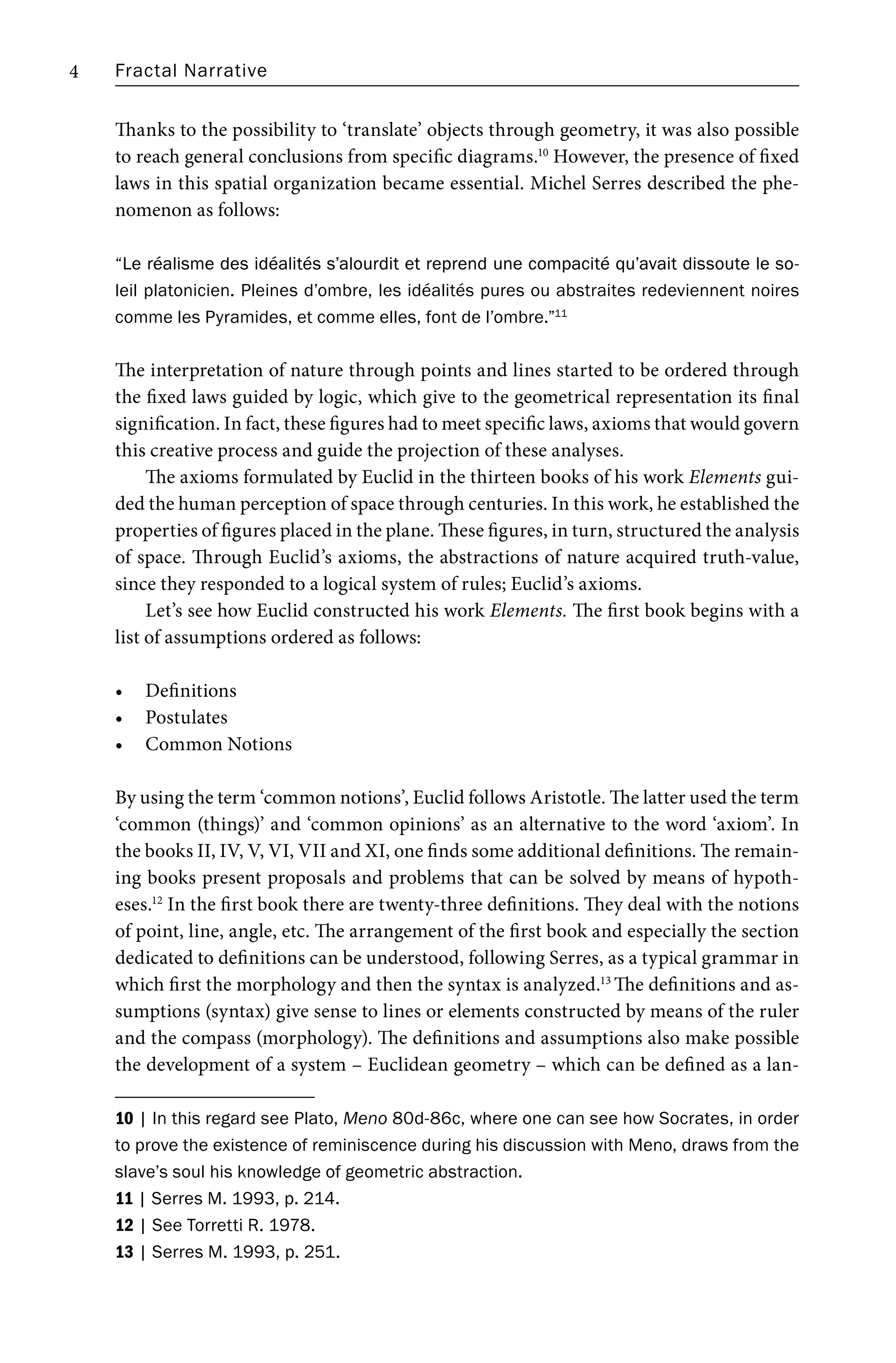
ductive science ruled by general propositions. In Laertius’s writings, Hieronymus, a
pupil of Aristotle, tells how Thales, using the shadow projected by the pyramids, could
carry such colossal structures on paper.
“Hieronymus says that he even succeeded in measuring the pyramids by observation
of the length of their shadow at the moment when our shadows are equal to our own
height.”9
6 | Plato, Phaedrus, 274 c-d (Translation: Hackforth R. 1952.)
7 | Aristotle, Metaphysics, A.1, 981 b 17-24 (Translation: Apostle H.G. 1966.)
8 | See Heath T. 1981.
9 | Diógenes Laertius i. 27.
|Fig. 1.1|
Fractal Narrative
4
Thanks to the possibility to ‘translate’ objects through geometry, it was also possible
to reach general conclusions from specific diagrams.10
However, the presence of fixed
laws in this spatial organization became essential. Michel Serres described the phe-
nomenon as follows:
“Le réalisme des idéalités s’alourdit et reprend une compacité qu’avait dissoute le so-
Le réalisme des idéalités s’alourdit et reprend une compacité qu’avait dissoute le so-
leil platonicien. Pleines d’ombre, les idéalités pures ou abstraites redeviennent noires
comme les Pyramides, et comme elles, font de l’ombre.”11
The interpretation of nature through points and lines started to be ordered through
the fixed laws guided by logic, which give to the geometrical representation its final
signification. In fact, these figures had to meet specific laws, axioms that would govern
this creative process and guide the projection of these analyses.
The axioms formulated by Euclid in the thirteen books of his work Elements gui-
ded the human perception of space through centuries. In this work, he established the
properties of figures placed in the plane. These figures, in turn, structured the analysis
of space. Through Euclid’s axioms, the abstractions of nature acquired truth-value,
since they responded to a logical system of rules; Euclid’s axioms.
Let’s see how Euclid constructed his work Elements. The first book begins with a
list of assumptions ordered as follows:
• Definitions
• Postulates
• Common Notions
By using the term ‘common notions’, Euclid follows Aristotle. The latter used the term
‘common (things)’ and ‘common opinions’ as an alternative to the word ‘axiom’. In
the books II, IV, V, VI, VII and XI, one finds some additional definitions. The remain-
ing books present proposals and problems that can be solved by means of hypoth-
eses.12
In the first book there are twenty-three definitions. They deal with the notions
of point, line, angle, etc. The arrangement of the first book and especially the section
dedicated to definitions can be understood, following Serres, as a typical grammar in
which first the morphology and then the syntax is analyzed.13
The definitions and as-
sumptions (syntax) give sense to lines or elements constructed by means of the ruler
and the compass (morphology). The definitions and assumptions also make possible
the development of a system – Euclidean geometry – which can be defined as a lan-
10 | In this regard see Plato, Meno 80d-86c, where one can see how Socrates, in order
to prove the existence of reminiscence during his discussion with Meno, draws from the
slave’s soul his knowledge of geometric abstraction.
11 | Serres M. 1993, p. 214.
12 | See Torretti R. 1978.
13 | Serres M. 1993, p. 251.
1.1 Geodesy, or the First Translations of Nature 5
guage of infinite possibilities and performances.14
These definitions and assumptions
represent proper principles; they are “truths whose existence is impossible to prove.”15
However, what is the difference between postulate and hypothesis? Indeed, bet-
ween these two words, there is a huge semantic difference.
“Thus any probable proposition that the teacher assumes without proving it, if the stu-
dent accepts it, is a hypothesis – a hypothesis not absolutely but relatively to the stu-
dent; but the same assumption, if it is made when the student has no opinion or a
contrary opinion about it, is a postulate.”16
That is to say, a postulate is an improbable proposition that the master asks the dis-
ciple to grant him.
“This is the difference between a hypothesis and a postulate; the latter is the contrary
of the student’s opinion, or any provable proposition that is assumed and used without
being proved.”17
Following this short passage from Aristotle, Euclid’s postulates became the instru-
ments through which mankind constructs its ‘reality’.18
As mentioned above, the use
of lines, circles and areas simplify the analysis, since all these elements deal with ‘ex-
isting’ things. Geometry made the world of mathematics fully intelligible. Thanks to
the abstractions offered by the geometric knowledge, nature became more deduct-
ible. Geometric knowledge, which allowed man to explain phenomena by describing
the reality, became a ‘mediator’ between human cognition and the nature of existing
things.19
Thus, geometry became essential to make direct confrontations with the re-
sult of mathematical analysis, i.e. with numbers. Thanks to geometry, the ‘real things’,
fruits of the observation of nature, could be identified with the fruits of intellect, that
14 | Heath T. 1981, p. 373.
15 | Aristotle, Posterior Analytics, 76a, 31. (Translation: Tredennick H. 1960.)
16 | Aristotle, Posterior Analytics, 76b, 30. (Translation: Tredennick H. 1960.)
17 | Aristotle, Posterior Analytics, 76b 32-34. (Translation: Tredenneck H. 1960.)
18 | In this regard, it is important to remember the strong bond between the meaning of
Truth and ideîn (to see) in the ancient Greek world. For the Greeks, mathematics repre-
sented the order of nature, which was manifested to man: αληθεια (alétheia) “truth” in
the meaning of revelation, but also in the meaning of reality. Aletheia is the truth-reality
that is manifested to humans through mathematics, and it can be seen (ideîn) through
numbers. Conversely, for the scientist of the modern era, truth does not imply the Greek
‘passivity’ imposed by the action of “to see”. It is strongly associated with the Hebrew
meaning of ‘emet (‫)אמת‬ or “doing truth”. The latter implies an action upon nature. Thus,
truth in the modern era is the order that mankind assigns to nature. See, Galimberti U.
20054
, p. 312. This point will be discussed in more detail in the following chapters.
19 | See Gray J. 19892
.
Fractal Narrative
6
is, geometrical figures that were also ‘real’. In fact, geometry creates ‘reality’ through
abstractions, that is, through figures created by the intellect.
Contemporary to the process of abstraction initiated by geometry, Pythagorean
mathematics developed. Pythagoras advocated that mathematical principles could be
applied to any existing thing. The idea of the ‘superiority’ of the science of numbers
was born when Pythagoras (or perhaps one of his students) found a mathematical
relationship in the consonance of sounds of musical instruments. This fact encoura-
ged the Pythagoreans to establish further connections between numbers and natural
phenomena. According to Pythagoreans, the analysis of nature should pass through
the science of numbers, i.e. nature could be translated into the language of numbers.
“Contemporaneously with these thinkers, and even before them, the so-called Pythago-
reans, who were engaged in the study of mathematical objects, were the first to advance
this study, and having been brought up in it, they regarded the principles of mathemati-
cal objects as the principles of all things. Since of mathematical objects numbers are
by nature first, and (a) they seemed to observe in numbers, rather than fire or earth or
water, many likenesses to things, both existing and in generation (and so they regarded
such an attribute of numbers as justice, such other as soul or intellect, another as oppor-
tunity, and similarly with almost all of the others), and (b) they also observed numerical
attributes and ratios in the objects of harmonics; since, then, all other things appeared
in their nature to be likenesses of numbers, and numbers to be first in the whole of na-
ture, they came to the belief that the elements of numbers are the elements of all things
and that the whole heaven is a harmony and a number.”20
The analysis of the real by means of numbers encountered a crisis due to the discovery
of the diagonal of the square, in other words, the discovery of the irrational num-
bers: √2. History attributed their discovery to Pythagoras despite the fact that some
authors attested that he did not discover the irrationals.21
One supposes that their
discovery remained a secret for years – almost a century – and this long silence cre-
20 | Aristotle, Metaphysics, 985b 23 - 986a 4. (Translation: Apostle H.G. 1966.)
21 | One of these texts, which questions the discovery of irrationals by Pytagoras, is
Plato’s Theaetetus. In this discussion between Socrates and Theaetetus one can see
how the irrationals were found.
“Theaet. We divided all numbers into two classes. The one, the numbers which
can be formed by multiplying equal factors, we represented by the shape of the square
and called square or equilateral numbers.
Soc. Well done!
Theaet. The numbers between these, such as three and five and all numbers
which cannot be formed by multiplying equal factors, but only by multiplying a greater
by a less or a less by a greater, and are therefore always contained in unequal sides, we
represented by the shape of the oblong rectangle and called oblong numbers.
Soc. Very good; and what next?
1.1 Geodesy, or the First Translations of Nature 7
ated the doubt over the attribution of this discovery to Pythagoras. In addition, it is
also impossible to date with precision the discovery of irrationals.22
However, thanks
to the testimony given by several texts about the crisis generated by the discovery of
irrationals, it is possible to understand how geometry was developed on the basis of
the theory of numbers.23
The primitive Pythagorean arithmetic only admitted integers. Therefore, the dia-
gonal of the square shows, in the geometric space, existing and reproducible lengths
that are unrecognizable by calculation. Thus, the measurement of the diagonal re-
quires a non-Pythagorean notion, which demonstrates the existence of an irrational,
a non-being, an afterlife. Going beyond the concepts of known ratios, the diagonal
became a measure, “irrational and inexpressible in its essence.”24
What happens if something can be represented by geometry but not by the science
of numbers? How do we represent the complexity of this non-being and most impor-
tantly, how to accept the existence of a non-being, of an afterlife?25
The ratio of the diagonal of the square, inexplicable through natural numbers, was
historically seen as the drama of irrationality and (in some ways) as the death of pure
thought.26
If the logos means proportion, ratio or the action, alogon means irrational,
it prohibits measuring. If logos means speech, alogon is opposed to any word. Thus,
accuracy is condemned to collapse and reason to keep silent.27
In order to accept the existence of the diagonal and to assign a measurement to it,
one must take into account another dimension, a space that accepts the existence of
such a segment. First, we must overcome the one-dimensional world of the straight
line, and then it is necessary to go out into an ‘ultra-dimensional’ world where the
line is submerged.28
The measurement of such a segment (the diagonal) means the
Theaet. All the lines which form the four sides of the equilateral or square num-
bers we called lengths, and those which form oblong numbers we called surds, because
they are not commensurable with the others in length, but only in the areas of the planes
which they have the power to form. And similarly in the case of solids.” (Plato, Theaete-
tus, 147e – 148 b. - Translation: Fowler H.N. 1921.)
22 | It is interesting to see how irrationals started to be accepted. Thomas Heath ana-
lyzes this assimilation through Plato, (Republic vii. 546 D.) where irrationals seem to be
totally assimilated. See Heath T. 1981, p. 157.
23 | See Heath T. A history of Greek Mathematics. Volume I. The Irracional, p. 154.
24 | Toth I. 1991, p. 65.
25 | That is why one needed to accept the realistic theory that states that things in our
intellect are more real than reality. From this premise, mathematics could be assimilated
as an abstract form of real objects. See Dicks D.R. 1970 and Körner S. 1960.
26 | Serres M. 1993, p. 20.
27 | Serres M. 1993, p. 146.
28 | Toth I. 1991, p. 95.
Fractal Narrative
8
recognition of the incommensurability, of the non-Pythagorean.29
What allowed the
recognition of the diagonal on a flat universe was that it had been recognized inde-
pendently, it was recognized as ‘the measurement of the diagonal’. Even if it was not re-
presentable with Pythagorean numbers, it became an existing measurement because
it acquired its own existence as the diagonal of the square; it belonged to the field of
irrational numbers.30
29 | The diagonal needs to be broken down in this way and its analysis requires a recur-
sive operation. See Toth I. 1991, p. 65.
30 | One can observe the same phenomenon in the Greek π. This ratio, which is docu-
mented in 1650 B.C. in the Rhind papyrus, is the constant ratio between the length
of a circumference to the diameter of the same. In the Rhind papyrus, this ratio was
calculated as 3.16049… Thanks to Archimedes π was calculated with more precision.
Archimedes found that the length of the circumference could be approximated with the
perimeter of regular polygons inscribed and circumscribed to the circumference. This
measurement became even more precise by increasing the number of sides of the poly-
gons, which tend to multiply endlessly. By multiplying its sides to 96, Archimedes found
that the result was 3.14271… The definition of this irrational was corrected by Lambert
in the seventeenth century.
1.2 RECURSION AS CREATOR OF INFINITY
The number theory, our sense of measurement, and even deeper thoughts on the ir-
rational and rational are fruits of the diagonal of the square and of the abstract figures
developed by Greek thought and its relationship with space. From these concepts,
other languages started to be developed, which use even more complex abstractions
in order to reproduce and explain natural phenomena. These languages became even
better instruments for mediating the relationship between man and nature. By means
of some of these languages and their relationship with other sciences and concepts,
mankind was able to approach natural phenomena and concepts from another point
of view. This was the case of the relationship between the algorithms and paradoxes of
Zeno. Zeno’s paradoxes enable us to understand how using the abstractions offered by
numbers, the divisibility of space was postulated by applying a recursive operation. In
turn, this allowed us to question the existence of movement.
|Prop. XVI| Zeno showed how the idealization of infinity is based on the concept of
recursion. It is important to remember that Zeno’s paradoxes were created to support
Parmenides of Elea’s thoughts on motionlessness (ἀτρεμής), a concept developed in
his unique surviving (in a fragmentary form) work, On Nature. In this important
work, which influenced many aspects of western philosophy, Parmenides deals with
the concept of reality (in his words, “what-is”). Reality was described as one, change
was considered impossible and entities were thought to be unchanging. He also de-
veloped an interesting way of inquiry grounded in the opposition, that it is (ὅπως
ἐστίν) – that is not (ὡς οὐκ ἐστίν). In his work, Parmenides asserts that an entity
always stays in its place. His aim was to place reality exclusively in the logos and not
in perception because, according to him, perception (doxa – δόξα: a Greek word that
describes common beliefs or popular opinions) is misled. Thus, he theorized an eter-
nal reality (aletheia), which is static and immutable.
Zeno was a member of the Eleatic School founded by Parmenides. His most fa-
mous paradoxes are known as “Arguments Against Motion.”1
Zeno created the para-
doxes in order to support Parmenides’ doctrine that “all is one.” Zeno, following the
logic that states that the analysis of reality must be effectuated through the logos, and
arguing that no change is possible, concluded that motion is just an illusion.
Let us focus more closely on these Arguments. In the case of the dichotomy para-
dox, Zeno states that a moving body that must arrive at point B from point A will nev-
er get there. The body must first cover the first half of the course, but before doing that,
it must reach half of the half, and half of that half, and so on to infinity. This recursive
operation divides the space to cover an infinite number of times; consequently, the
body will never arrive at point B.
1 | According to Plato, the creation of these paradoxes was a response to some philoso-
phers who had created some paradoxes to contradict Parmenides’ philosophy.
Fractal Narrative
10
Zeno’s arguments accomplished his goal of defending Parmenides’ thesis. However,
as we will see in the following chapters, Zeno’s approach to the analysis of movement
– which is an action and consequently, is indivisible, like time – leads us to apply the
same approach to the analysis of time, thus giving rise to the erroneous analysis of
time by means of spatial notions. Let us delve into this last point.
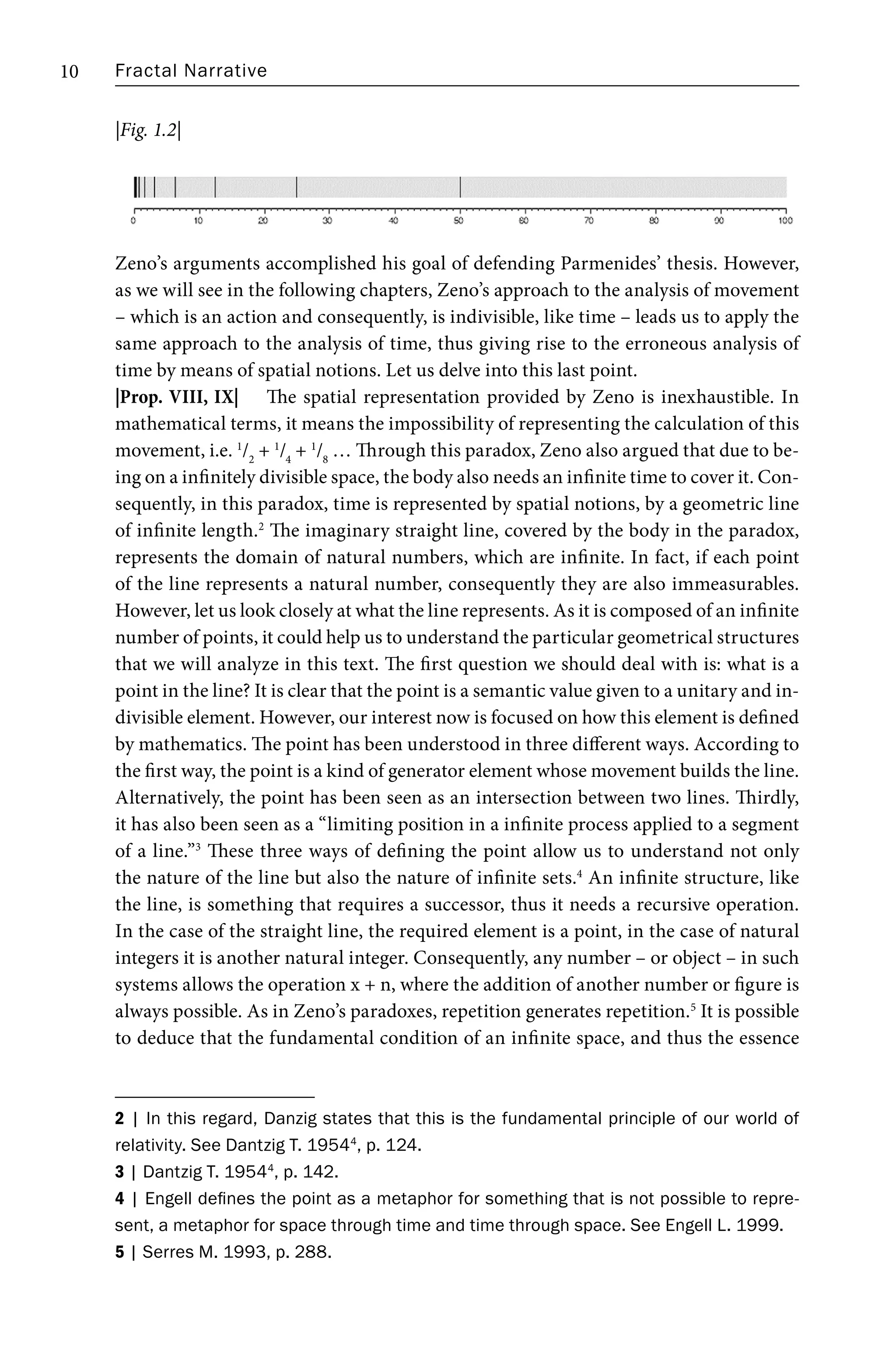
|Prop. VIII, IX| The spatial representation provided by Zeno is inexhaustible. In
mathematical terms, it means the impossibility of representing the calculation of this
movement, i.e. 1
/2
+ 1
/4
+ 1
/8
… Through this paradox, Zeno also argued that due to be-
ing on a infinitely divisible space, the body also needs an infinite time to cover it. Con-
sequently, in this paradox, time is represented by spatial notions, by a geometric line
of infinite length.2
The imaginary straight line, covered by the body in the paradox,
represents the domain of natural numbers, which are infinite. In fact, if each point
of the line represents a natural number, consequently they are also immeasurables.
However, let us look closely at what the line represents. As it is composed of an infinite
number of points, it could help us to understand the particular geometrical structures
that we will analyze in this text. The first question we should deal with is: what is a
point in the line? It is clear that the point is a semantic value given to a unitary and in-
divisible element. However, our interest now is focused on how this element is defined
by mathematics. The point has been understood in three different ways. According to
the first way, the point is a kind of generator element whose movement builds the line.
Alternatively, the point has been seen as an intersection between two lines. Thirdly,
it has also been seen as a “limiting position in a infinite process applied to a segment
of a line.”3
These three ways of defining the point allow us to understand not only
the nature of the line but also the nature of infinite sets.4
An infinite structure, like
the line, is something that requires a successor, thus it needs a recursive operation.
In the case of the straight line, the required element is a point, in the case of natural
integers it is another natural integer. Consequently, any number – or object – in such
systems allows the operation x + n, where the addition of another number or figure is
always possible. As in Zeno’s paradoxes, repetition generates repetition.5
It is possible
to deduce that the fundamental condition of an infinite space, and thus the essence
2 | In this regard, Danzig states that this is the fundamental principle of our world of
relativity. See Dantzig T. 19544
, p. 124.
3 | Dantzig T. 19544
, p. 142.
4 | Engell defines the point as a metaphor for something that is not possible to repre-
sent, a metaphor for space through time and time through space. See Engell L. 1999.
5 | Serres M. 1993, p. 288.
|Fig. 1.2|
1.2 Recursion as Creator of Infinity 11
of infinite sets, is the generating element, which, due to its nature, requires or allows
a successor.
Through the definition of the inner nature of the straight line, one can define re-
cursion as a means of creation of immeasurable spaces. The capacity to accept a recur-
sive operation is what gives infiniteness to the straight line and represents the essence
of this structure. The straight line, being an infinite succession of points, was evidence
of the existence of infinite spaces. Not accepting the existence of infinity means the
non-existence of natural numbers. The absence of infinity also means the beginning
and end of time, the impossibility of dividing magnitudes into magnitudes.6
“If there were no infinity, all magnitudes would be commensurable and there would be
nothing inexpressible or irrational, features that are thought to distinguish geometry from
arithmetic; nor could numbers exhibit the generative power of the monad, nor would they
have in them all the ratios -such as multiple and super particular- that are in things.”7
|Prop. XV| If we return to Zeno’s paradox, the existence of two kinds of infinities
seems to emerge from it. Aristotle argued that, when one talks about infinity, it is
essential to distinguish between potential infinity and actual infinity. The first one is
accessible through human cognition, the second one represents a vague idea and is
inaccessible to the human being.
We have outlined above the essence of infinity. In particular, it is the result of an
endless succession (as in the case of natural numbers and straight line) and it derives
from a recursive operation. This infinity can be denoted as potential infinity. The limit
of human perception appears when one tries to identify a single entity of infinite size
as a uniqueness. This represents the actual infinity and exceeds the limits of our intel-
lect.
The duality depicted above has been described by Leibniz as “infinitum actu non
datur”:
“Prennons une ligne droite et prolongeons la, ensorte qu’elle soit double de la première.
Or il est claire, que la seconde, estant parfaitement semblable à la première, peutestre
doublée de même, pour avoir la troisième qui est encor semblable aux precedentes; et
la même raison ayant tousjours lieu, il n’est jamais possible qu’on soit arresté; ainsi la
ligne peut estre prolongée à l’infini, de sorte que la consideration de l’infini vient de celle
de la similitude ou de la même raison, et son origine est la même avec celle des verités
universelles et necessaires. Cela fait voir comment ce qui donne de l’accomplissement
à la conception de cette idée, se trouve en nous mêmes, et ne sauriot venir des expe-
6 | Fauvel J. – Gray J. 1987, p. 96.
7 | Proclus, A Commentary on the first Book of Euclid’s Elements (ed. and tranlated by
Morrow G.R. 1970, p. 5.)
Fractal Narrative
12
riences des sens, tout comme les verités necessaires ne sauroient estre prouvées par
l’induction ny par les sens.”8
Leibniz also states that :
“Mais on se trompe en voulant s’imaginer un espace absolu qui soit tout infini composé
de parties, il n’y a rien de tel, c’est une notion qui implique contradiction, et ces touts infi-
nis et leur opposés infiniment petits, ne sont de mise que dans le calcul des Geometres,
tout comme les racines imaginaires de l’Algèbre.”9
In Zeno’s paradoxes the succession 1
/2
+ 1
/4
+ 1
/8
… shows that the recursive operation
is the source of the existence of the potential infinity. However, the vision of an im-
measurable entity was unacceptable by the human intellect, as attested by Leibniz.
8 | Leibniz G.W. 1996a (1765), p. 212.
9 | Leibniz G.W. 1996a (1765), p. 214.
1.3 THE DESTRUCTION OF SPACE
In the previous chapters I have tried to highlight, through the example of the diago-
nal, the notions of ratio and scale. Thanks to these notions, an immeasurable object,
being recognized as an entity itself, becomes recognizable and therefore measurable.
In particular, the notion of relation, of ratio, is essential in a hierarchical system. In
Serres words:
“Qu’il s’agisse de monde ou de religion, de politique, de la maison... de langue, savoir,
vue, théorie... l’essentiel gît dans le rapport. Prenez un ensemble quelconque d’astre,
de dieux, d’individus, de rues, de pierres, de mots, de sites, d’abstractions, il ne peut
devenir système rationnel que s’il est lié par une référence. Le rationnel est prisonnier
du référé. La raison est gelée dans la hiérarchie.”1
The impossibility of comparing means the impossibility of measuring. In the case of
the diagonal, to overcome this obstacle, the ‘diagonal’ itself became a concept. This
phenomenon of recognition, as we will see in this text, repeats itself throughout the
history of geometry. However, our interest now is focused on the crisis produced by
the need to represent phenomena in spaces that do not correspond to those construct-
ed by Euclid.
At the beginning of the 19th century, the ‘destruction’ of the Euclidean space was
possible because of the nature of the fifth postulate, the so-called Parallel Postulate,
which was considered Euclid’s major innovation, but which was also the most criti-
cized.
“if a straight line falling on two straight
lines make the interior angles on the
same side less than two right angles, the
straight lines, if produced indefinitely,
meet on that side on which are the angles
less than two right angles.”2
Some commentators of Euclid, like Ptolemy, Proclus or Posidonius, doubted the de-
monstrability of this postulate. It is also possible to find severe criticisms of the fifth
postulate of Euclid’s Elements, dated to the twelfth and thirteenth century in some
Arabic, as well as in some Greek texts of the fifteenth and the early sixteenth century.
1 | Serres M. 1993, p. 137.
2 | Euclid’s Elements (Translation: Heath T.L. 1926 I, p. 155.)
|Fig. 1.3|
Fractal Narrative
14
Before we deal with the process that initiated the recognition of a geometry that
does not meet the Euclidean notions, it would be interesting to make a short digres-
sion on the revolution started by Descartes in 1637.
With his work La géométrie, Descartes provided a revolutionary concept: the Car-
tesian coordinated system. Thanks to René Descartes, geometry could be ‘conjugate’
with algebra. Inventing algebraic geometry, he created a language able to express vis-
ible variation with formulas.3
In La géométrie, known as the first book of modern
mathematics, Descartes claims that:
“Tous les problemes de Geometrie se peuuent facilement reduire a tels termes, qu’il
n’est besoin pas aprés que de connoistre la longeur de quelques lignes droites, pour les
construire.”4
Descartes encouraged the study of geometry through the methods of algebra, and
from this combination derived the idea of coordinates. The Cartesian Coordinate Sys-
tem allows specifying points with coordinates, which correspond to equations that
in turn can be identified with geometric groups. In other words, it is a translation of
geometry into algebra. The method used by Descartes shows that numbers are able
to represent geometrical objects. It also demonstrates that it is possible to solve some
problems belonging to the field of geometry through arithmetic operations. Descartes
developed a system that grants a letter to each line in order to perform the geometric
operation in the field of algebra.5
This method allowed the scientist to have parametric
representations of geometric objects.6
Thanks to the notion of coordinates and the
approach to equations, science was able to create forms through equations. Descartes’
idea was the possibility to draw with equations as with the ruler and the compass.
His aim was to translate a geometrical problem into algebraic language, solve the
problem, and then translate it back into geometric figures. This process was useful for
solving some mechanical problems, calculations that could be represented by curves.
However, Descartes’ La Géométrie offered more than one method of analysis. Thanks
to Descartes, geometry acquires a still greater range in that it started to concern the
field of specificity, demonstrability and constructiveness.7
The possibility of translat-
ing images – geometric objects – into the field of numbers granted a higher dimension
of ‘truth’ and accuracy to calculations. This phenomenon was emphasized because,
in a successive stage, it was applied to machinery and mechanisms in order to prove
their functionality.
3 | Serres M. 1993, p. 168.
4 | “Any problem in geometry can easily be reduced to such terms that a knowledge of
the lengths of certain straight lines is sufficient for its construction” (Descartes R. La
Géométrie. – Tranlation: Smith D.E. - Latham M.L. 1925, p. 2.)
5 | See Reed D. 1995.
6 | See Smith D.E. - Latham M.L. 1925.
7 | Reed D. 1995, p. 30.
1.3 The Destruction of Space 15
The foundations for the creation of a new geometry, and an alternative to the Eu-
clidean one, were laid in the eighteenth century. After the contribution of John Wallis
(1616-1703), the mathematician and Jesuit Gerolamo Saccheri (1667-1733) devoted a
work to the demonstration of Euclid’s fifth postulate.8
In his work Euclides ab omni
naevo vindicatus : sive conatus geometricus quo stabiliuntur prima ipsa universae Geo-
metriae principia, of 1733, he developed a very special reasoning. Saccheri adopted
as premises the first twenty-six of Euclid’s propositions and assumed as hypothesis
that the fifth postulate was false in order to prove, through this hypothesis, that it
was true.9
Saccheri’s conclusion was that the fifth postulate cannot be demonstrated.
In turn, Johann Heinrich Lambert (1728-1777) attempted to develop contradictions
that could create alternative postulates. Consequently, Lambert left several geometric
theorems developed in non-Euclidean parallels systems.10
At that time, the proposal of a new geometry was considered a heresy. However,
after Saccheri’s and Lambert’s works, many criticisms of Euclidean geometry and
several new geometries emerged. It was during the early nineteenth century that a
real breaking away from Euclidean space occurred. This revolution started becoming
more concrete thanks to Johann Carl Friedrich Gauss (1777-1855) and Georg Fried-
rich Bernhard Riemann (1826-1866). Gauss did not seek to contradict the existing
geometry, he sought to create a new geometry, a non-Euclidean geometry. This revolu-
tionary topic was certainly a problem at the time. To theorize a new geometry meant
not only to go against the scientific world, but also to attack both science and Western
Culture. As a consequence, Gauss’s work remained unpublished.11
The first publications theorizing a non-Euclidean geometry are the result of the
research of two Russian authors: Nikolai I. Lobachevsky (1792-1856) and Janos Bolyai
(1802-1860) published in 1830.12
They both concluded that there is not a ‘universal
geometry’, rather each field requires a special geometry. They assumed that Euclidean
geometry is more adapted to human senses, to our perception of the world, whereas
other perspectives, for example atomic or planetary ones, require a different kind of
geometry.13
For example, a planetary perspective, being planets spheres and their or-
8 | See Gray J. 19892
.
9 | See Bonola R. 1955. Chapter II. The Foreruners of Non-Euclidean Geometry. Gerola-
mo Saccheri.
10 | It is very interesting to note the spherical geometry invented by Thomas Reid in the
eighteenth century. This geometry was based on the idea of the perceptual space, i.e.
the world is presented as a hemisphere centered in the human eye.
11 | See Henderson D.L. 1983.
12 | For a more detailed analysis of this process see Leonesi S. – Toffalori C. 2007.
13 | Note that Lobachevsky and Gauss tried to demonstrate that their new geometry
could exist in natural space. In fact, they investigated if there were elements of non-
Euclidean geometry in natural space. For instance, Gauss attempted to measure the
angle sum of an immense triangle formed by three mountain peaks. See Henderson
D.L. 1983.
Fractal Narrative
16
bits circumferences or ellipses, justifies the elliptic geometry theorized by Riemann,
in which the plane manifests some spherical surfaces. From this new perspective, a
straight line must be understood as a circle of maximum radius.14
In addition, through
his elliptic geometry, Riemann realized for the first time the important distinction
between unbounded space and infinite space.15
The sphere represented both a finite
surface and an unbounded space in which the line cannot be extended infinitely, con-
trary to Euclid’s postulates. Thus, in this space a parallel line cannot be drawn to a
given line.16
Thanks to Riemann, there arose the will to develop new geometrical spac-
es, such as the topological space. In fact, Riemann also proposed some surfaces that
curvature might vary. In such spaces, composed by irregular shapes, the movement
of objects implies changes in their shape as well as in their properties.17
Through this
theory, the principle of indeformability established by Euclid was completely negated.
Additionally, some important research developed during the nineteenth century also
14 | See Leonesi S. – Toffalori C. 2007.
15 | It is interesting to quote Riemann’s words about the development of a multidi-
mensional space. “Diese Dunkelheit wurde auch von Euklid bis auf Legendre, um den
berühmtesten neueren Bearbeiter der Geometrie zu nennen, weder von dem Mathema-
tikern noch von den Philosophen, welche sich damit beschäftigten, gehoben. Es hat-
te dies seinen Grund wohl darin, daß der allgemeine Begriff mehrfach ausgedehnter
Größen, unter welchem die Raumgrößen enthalten sind, ganz unbearbeitet blieb. Ich
habe mir daher zunächst die Aufgabe gestellt, den Begriff einer mehrfach ausgedehnten
Größe aus allgemeinen Größenbegriffen zu konstruieren. Es wird daraus hervorgehen,
daß eine mehrfach ausgedehnte Größe verschiedener Maßverhältnisse fähig ist und
der Raum also nur einen besonderen Fall einer dreifach ausgedehnten Größe bildet.
Hiervon aber ist eine notwendige Folge, daß die Sätze der Geometrie sich nicht aus
allgemeinen Größenbegriffen ableiten lassen, sondern daß diejenigen Eingenschaften,
durch welche sich der Raum von anderen denkbaren dreifach ausgedehnten Größen
unterscheidet, nur aus der Erfahrung entnommen werden können. Hieraus entsteht die
Aufgabe, die einfachsten Tatsachen aufzusuchen, aus denen sich die Maßverhältnisse
des Raumes bestimmen lassen – einige Aufgabe, die der Natur der Sache nach nicht
völlig bestimmt ist; denn es lassen sich mehrere Systeme einfacher Tatsachen angeben,
welcher zur Bestimmung der Maßverhältnisse des Raumes hinreichen; am wichtigsten
ist für den gegenwärtigen Zweck das von Euklid zugrunde gelegte. Diese Tatsachen sind
wie alle Tatsachen nicht notwendig, sondern nur von empirischer Gewißheit, sie sind
Hypothesen; man kann also ihre Wahrscheinlichkeit, welche innerhalb der Grenzen der
Beobachtung allerdings sehr groß ist, untersuchen und hiernach über die Zulässigkeit
ihrer Ausdehnung jenseits der Grenzen der Beobachtung sowohl nach der Seite des Un-
meßbargroßen, als nach der Seite des Unmeßbarkleinen urteilen.” (Riemann B. 1919,
pp. 1-2.)
16 | See Wolfe H.E. 1945.
17 | See Bonola R. 1955.
1.3 The Destruction of Space 17
created the need to develop new mathematical spaces, as Jean-Victor Poncelet did
through pure imaginary numbers.
During the early nineteenth century, pure imaginary numbers were a scandalous
topic but at the same time, very useful. In this regard, Poncelet, trying to explain the
usefulness of imaginary numbers, used the method of postulation. He claimed that
mathematical reasoning can be thought of as a mechanical operation using abstract
signs. From the moment that the new sort of numbers was accepted in mathematical
analysis, Poncelet argued that geometry is equally able to use abstract signs.18
There-
fore, Poncelet made a great contribution to science by working on the combination
of mathematics and geometry. He opened a path of analysis based on the method of
postulation, a kind of analysis that helped to theorize non-Euclidean geometries.19
In 1899 David Hilbert (1862-1943) published Grundlage der Geometrie, where he
wrote an important analysis of the method of postulation. Hilbert’s work represents
a break with the semantic space constructed by Euclid nearly two millennia earlier.
To understand Hilbert’s contribution one must remember Descartes’ La géométrie.
As noted above, Descartes provided a method of operation. For Descartes, axioms do
not really matter: the problems’ resolution passes through the construction and its
demonstration. Instead, Hilbert deals with a different kind of problem. In his work,
there is no longer a Cartesian construction and the method of postulation becomes
fundamental.
“Die Geometrie bedarf – ebenso wie die Arithmetik – zu ihrem folgerichtigen Aufbau nur
weniger und einfacher Grundsätze. Diese Grundsätze heißen Axiome der Geometrie.
Die Aufstellung der Axiome der Geometrie und die Erforschung ihres Zusammenhanges
ist eine Aufgabe, die seit Euklid in zahlreichen vortrefflichen Abhandlungen der mathe-
matischen Literatur sich erörtert findet. Die bezeichnete Aufgabe läuft auf die logische
Analyse unserer räumlichen Anschauung hinaus.”20
This excerpt shows that from the interest in axioms derived a logical analysis instead
of the former constructive examination proposed by Descartes. This meant a radical
change in the method used to study spaces and also to represent them.
Hilbert proposed three kinds of objects: points, lines and planes, whose proper-
ties are described by words like “between” and “congruent.” These families of objects
are defined by five axioms: incidence, order, parallelism, continuity and congruence.
In this way, Hilbert conceptualized the point, the line and the plane. He considered
these concepts in a purely formal way. That is to say, these concepts – line, point and
plane – do not represent a physical or intuitive idea; rather, their existence is only
justified because they obey the 21 laws set by Hilbert himself.21
Any object that meets
18 | Shapiro S. 1997, p. 146.
19 | See Poncelet J.V. 1822.
20 | Hilbert D. 1962, p. 2.
21 | In this regard see Toepell M. 1986.
Fractal Narrative
18
these conditions will be or will have the right to be interpreted, and therefore, called
point, line or plane.22
Thanks to Hilbert, the science of geometry underwent a big change. On the one
hand, Descartes developed methods to solve problems; on the other hand, Hilbert
developed an analysis of logical relations between propositions. Hilbert determined
kinds of geometries; conversely, Descartes constructed types of curves.23
Following
Hilbert’s contribution, the scientific world started a discussion about the nature of
space as well as a debate about the objects that humanity had placed in this space
since antiquity.
22 | Leonesi S. - Toffalori C. 2007, Chapter 3, Dondamenti e turbamenti.
23 | Reed D. 1995, p. 38.
1.4 TOWARD FRACTALITY
The apparent weakness of the fifth postulate allowed the development of a new theory
of space. Scientists started to create new postulates for new geometries that responded
to new mathematical objects. Hilbert made this possible through new axioms that
rendered geometry a logical analysis of spaces and structures. In fact, a new logic,
governed by axioms different from those of Euclid, allowed the representation of new
spaces.
Towards the end of the nineteenth century, Giuseppe Peano, achieving Hilbert’s theo-
ries, showed that the traditional notion of the curve was naïve and tried to develop
a very particular space.1
He built a curve, which was supposed to cover all the points
in a square.2
Peano’s curves obliged the scientific world to think on the nature of this
geometric figure and, therefore, to propose alternative definitions of curve.
Traditionally, the curve was considered as a one-dimensional object placed in a
two-dimensional plane. Peano’s curve, as one can observe in the figure above (fig. 1.4),
represents a one-dimensional object that fills the two-dimensional plane. Hence the
curve is considered a two-dimensional object.3
1 | See Hilbert D. 1891.
2 | See Peano G. 1890.
3 | In this regard it is important to quote Peitgen, Jürgens and Saupe. This phenomenon,
which occurs in nature, was highlighted by fractal geometry. Thanks to fractal geometry,
mankind could understand and, therefore, apply this “space-filling structure” to complex
systems. “In Nature the organization of space filling structures is one of the fundamental
building blocks of living beings. An organ must be supplied with the necessary support-
ing substances such as water and oxygen. In many cases these substances will be trans-
ported through vessel systems that must reach every point in the volume of the organ.
|Fig. 1.4|
Fractal Narrative
20
Through the nineteenth century, there were several attempts to ‘conjugate’ math-
ematical analysis with forms. Geometry was proposed as a field of analysis of struc-
tures and phenomena. It led to the introduction of particular figures into space, of
ideal elements.
Justus Grassmann, with his work on crystallography, demonstrated that the de-
velopment of a new geometry was of primary importance for the industry. According
to Grassmann, in this particular domain, geometrical analysis was more appropriate
than the application of concepts of pure mathematics. But why was it necessary to
theorize a new geometry? In other words, what is the point of the change from geom-
etry as a physical or spatial study to a geometry that deals with independent struc-
tures and complex sets? Most likely, the idea lying at the bottom of new geometries
was that by means of another kind of perspective, the spatial relations, which do not
provide fixed distances or specific magnitudes, could be better analyzed. This kind of
perspective was highly useful for the study of surfaces such as those of crystals carried
out by Grassmann.4
Grassmann developed a stronger connection between arithmetic, which has as its
subject of study quantity, and geometry, which deals with physical bodies and spaces.
J. Grassmann worked under the influence of his father, Hermann Grassmann (1809-
1877), who, with his work Die Ausdehnungslehre von 1844, developed geometry as a
science of forms.5
Under H. Grassmann geometry acquired the ability to accept either
abstractions or interpretations from any language. According to H. Grassmann, ge-
ometry assigns meaning to objects. Therefore, the object itself is totally irrelevant;
For example, the kidney houses three interwoven tree-like vessel systems, the arterial,
the venous, and the urinary system. Each one of them has access to every part of the
kidney. Fractals solve the problem of how to organize such a complicated structure in an
efficient way. Of course, this was not what Peano and Hilbert were interested in almost
100 years ago. It is only now, after Mandelbrot’s work, that the omnipresence of fractal
becomes apparent.” (Petingen H.O. - Jürgens H. - Saupe D. 1992, p. 94.) Note that these
curves are now used in printing and in the creation of digital images.
4 | See Lewis C.A. 1975.
5 | As we might suppose, after Leibniz’s Analysis Situs the idea of the conjugation of
algebra with geometry became a necessity in the scientific field. Grassmann developed
an important example of a topologic space. Further, he developed an interesting con-
tinuous form. However, I would like to quote Listing’s words about topology. In fact, he
coined the term. “Unter der Topologie soll also die Lehre von den modalen Verhältnissen
räumlicher Gebilde verstanden werden, oder von Gesetzen des Zusammenhangs, der
gegenseitigen Lage und der Aufeinanderfolge von Punkten, Linien, Flächen, Körpern und
ihren Teilen oder ihren Aggregaten im Raume, abgesehen von den Maß- und Großenver-
hältnissen.” (Listing J.B. 1848, p. 6.) It is interesting to note that contrary to Leibniz, who
was primarily interested in the possibilities of the movement of variable points in space,
Listing focused on the complexity of the set. Indeed, he was interested in the develop-
ment of a complexus. See Heuser M.-L. 2007.
1.4 Toward Fractality 21
what is important is the meaning granted to the object.6
Thus, geometry became a
language able to express any concept through forms. This desire was driven by an
interesting remark on mathematical science:
“Die reine Mathematik ist daher die Wissenschaft der besonderen Seins als eines durch
das Denken gewordenen.”7
|Prop. X| The main problem was that mathematics had no spatial concepts. In order
to solve this problem, H. Grassmann proposed a new relationship between mathemat-
ics and many other scientific fields. With this aim, he attempted to develop a basic
concept of ‘continuous’, in which the notion of ‘becoming’ derives from a spatial con-
tinuous form.8
This continuous form is characterized by three major phenomena: Er-
zeugen (generation), Setzen (positioning) and Verknüpfen (bonding). The becoming,
being the essence of infinity, is represented by H. Grassmann as a continuous form
that presents a generating phenomenon. But his analysis is not limited to the generat-
ing element. Through the concepts of Setzen and Verknüpfen, H. Grassmann assigns a
spatial nature to the becoming. As pointed out above, the first condition to create an
infinite space is the generation (Erzeugen). The generating element represents the pos-
sibility to apply a recursive operation. As long as we accept an infinite space created
by means of Grassmann’s continuous form, we are obliged to recognize the position
(Setzen) of its elements and its direct relationship (Verknüpfen) with the whole set.
Such recognition not only allows the creation of a topology or map of an infinite space
(because it is in constant self-reproduction) but it also allows the analysis of the char-
acter of a given object in its relationship with the others in the set. In this new kind of
space, the objects are analyzed as sets without losing their unitary nature. Each object
has a relationship with each other and with the whole. According to Grassmann, the
process of continuous form characterizes the essence of all things that are created by
the human thought.9
It is important to remember that Grassmann’s work represents
the first fundamental investigation into a multidimensional geometry.10
It was only with the work of Karl Georg Christian von Staudt (1798-1867) that it
became possible to realize Grassmann’s theories on space. In fact, before reaching
that stage it was necessary to build new elements and to develop a new interpretation
of accepted geometrical elements. For example, points, contrary to Euclid’s definition
6 | See Grassmann H. 1878.
7 | Grassmann H. 1878, Einleitung XXII.
8 | Lewis C.A. 1975, p. 98.
9 | As we will see in the last part of this text, Vannevar Bush, in his attempt to develop
the first hypertext, highlighted the same phenomenon.
10 | For a further analysis of these works, see Grassmann H. 1878, Lewis C.A. 1975,
Kolmogorov A.N and Yushkevich A.P. 1996, which treats the subject from a scientific
perspective.
Fractal Narrative
22
stating that a point has no parts (= is indivisible), were defined as elements having an
internal structure.
“We are accustomed, even today, to think of a line as a locus of points. However, one can
just as well think of a point as a locus of lines.”11
Thanks to these innovative theories, the objects of classic geometry acquired another
identity. Thus, the search for a new axiomatic changed the focus of geometry. Geom-
etry was no longer interested in the classic geometrical objects, like triangles, squares
and circles, but started to develop the study of geometric forms as a unity, a flexible
unity that allows transformations.12
The acknowledgement of new axioms offered the
possibility to build a space where the existence of points presenting an internal struc-
ture was accepted. In adition, this new vision of geometry allowed the representation,
through forms, of complex operations belonging to mathematics.
After the research of Grassmann and Staudt, several objects of great rarity
emerged in the scientific world. For example, scientists had always believed that ev-
ery curve has a tangent at every point, except in obvious cases of curves that showed
a sharp reversal of direction. Thanks to the research improvements in the field of
mathematics in the nineteenth century, scientists discovered some special proper-
ties of curves. They realized that it is possible to construct a curve that manifests no
tangent at any point. It was Bernhard Riemann (1826-1866) who revealed for the first
time this geometrical object, which was demonstrated through the examples of Wei-
erstraß (1815-1897) in 1860. Thanks to Weierstraß’s contributions on this subject, the
basic concepts of topology were established: proximity, open sets, and accumulations
of points of the infinite set. The multiplication of dimensions created a new space
where the traditional objects could manifest drastic changes. Riemann also carried
out an expansion of classic metric notions: length, area and volume. He also worked
on the notion of surfaces and created several new ones. Some of them are designed as
completely break up entities, as a reunion of pieces connected by ‘laces’ coming from
the same point. Among the surfaces theorized by Riemann there is a surface made
up several ‘layers’ that can also be interconnected along the lines of passage.13
He also
created families of curves or surfaces that are considered “multiplicities” of infinite
dimension. The scientific community rejected these curves, and some of them could
even properly be described as ‘monsters’.14
|Prop. III| One of the most important contributions to this revolution in geometry
was given by Georg Cantor. However, before analyzing Cantor’s work, it is necessary
to know what his aims were. Cantor began his research with the analysis of the para-
doxes of both Albert of Saxony (Albertus de Saxonia 1316-1390) and Galileo Gali-
11 | Shapiro S. 1997, p. 148.
12 | See Heuser M.-L. 2007, pp. 197-198.
13 | Dieudonné J. 1994, p. 37.
14 | See Gray J. 1994.
1.4 Toward Fractality 23
lei (1564-1642). In his paradox, Albert of Saxony states that by cutting up a beam of
infinite length into cubes of the same size and then placing the cubes in such a way
as to make another cube, it is possible to fill an infinite three-dimensional space.15
By means of this paradox, he compared two infinite spaces and attempted to estab-
lish relationships of magnitude between them. Galileo undertook the same operation
but with numbers. He took the positive numbers, 1,2,3,4,5,6,7… to infinity. Then he
squared all the numbers as follows: 1x1=1, 2x2=4, 3x3=9, 4x4=16 5x5=25, etc. The
series of numbers obtained by means of this operation (1, 4, 9, 16, 25…) is also infinite
because it is in one-to-one correspondence with positives numbers. At that point,
Galileo wondered which group has the largest number of elements, being both infi-
nite sets. Each item in the list of squares corresponds to an item of the list of positive
numbers. The paradox lies in the fact that the set of numbers obtained by squaring the
integers is also in the set of integers. Thus, it suggests that the list of positive numbers
is bigger than the list of numbers obtained from this group, i.e. the powers. Galileo’s
conclusion is that one should not try to measure or compare infinite sets because it is
impossible to know which ‘infinite’ is bigger.
Cantor’s revolution consists in considering the infinite not as a succession (= the
Aristotelian potential infinite), but as a totality, as an object which must be perceived
by the intellect as an entire entity, even if it is infinite.16
Thanks to Cantor, the exis-
tence of the actual infinity started to be accepted.
“By arranging the integers not in their natural order but according to the sequence 0, 1,
-1, 2 -2, 3, -3, ….., we see at once that the distinction becomes meaningless. (According
to the definition of set, the order in which we place the individual elements in a set is
immaterial. Thus the set consisting of the letters a, b, c is the same as that consisting
of b, a, c.) Moreover, Cantor argued that to deny the actual infinite means to deny the
existence of irrational numbers, for such numbers have an infinite decimal expansion,
whereas any finite decimal would only be a rational approximation.”17
Cantor’s theories lead to the acceptance of a hierarchy of infinities. He demonstrated
to the scientific world that from an infinite set it can derive a new set that has more
elements than the original set:
“If from any given set – finite or infinite – one can create (‘more’ in the ordinary sense
of the word for finite sets, and in the sense of power for infinite ones), then this process
can be repeated; that is, from the new set we can create a set with still more elements,
and so on ad infinitum!”18
15 | See Barrow J.D. 2005.
16 | Maor E. 1987, p. 54.
17 | Maor E. 1987, p. 54.
18 | Maor E. 1987, p. 62.
Fractal Narrative
24
Thanks to Cantor, who compared infinite sets, it was possible to recognize infinites
bigger than others and therefore also measurable infinities and non-measurable ones.
Cantor reached this conclusion by making one-to-one correspondences between sets.
For example, if one has a set composed of the letters a, b, c and another composed by
the numbers 1, 2, 3, it is possible to create a 1:1 correspondence, as follows: 1 with a, 2
with b and 3 with c. There can also be a correspondence 1 with b, 2 with a and 3 with
c. These correspondences are possible because the number of objects of each set is the
same. If the 1:1 correspondence is possible between finite sets it is because they have
the same quantity of elements. Cantor followed the same process but with infinite
sets. He stated that when a 1:1 correspondence can be made between two infinite sets
it means that they have the same amount of items. Thus, he demonstrated that there
is the same quantity of points in the straight line as in a part of it. It is important to
note that this conclusion contradicts the postulate of Euclid asserting that the whole
is greater than the part.
“Un ensemble infini se reconnaît à ceci, qu’il peut être mis en correspondance terme
à terme avec une vraie partie de lui-même, c’est-à-dire appliqué et comme remplié sur
cette partie. Ainsi l’ensemble des nombres entiers peut être appliqué sur l’ensemble des
nombres pairs, ou sur celui des carrés parfaits qui sont pourtant contenus en lui: il suffit
d’écrire en face de tout nombre son double, ou son carré; on se trouve alors avoir passé
en revue tous les termes possibles, dans chacune des deux séries.”19
By demonstrating that there is a one-to-one correspondence between the points of
the curve and the points of the plane, Cantor opened many useful possibilities to
understanding the relationship between curves and planes. These relationships were
very useful in the topological dimension that, at that period, was in its first phase of
development.
In 1892, Henri Poincaré (1854 -1912) laid the foundations for a critical theory
known as topology.
To understand complexity, which became a topic of study to the scientific world,
it was extremely important to develop a space where it would be possible to make ab-
stractions of complex phenomena. The Analysis Situs20
of Poincaré was the creation of
a space that allowed scientists to explain phenomena through abstractions that enable
a new character of spatial structures that are highly transformative.21
Let us see how
Poincaré expressed the need for such a space:
19 | Bolzano-Weierstraß, in Dällenbach L. 1977, p. 33.
20 | Through the analysis situs, Leibniz attempted to describe a new way of represent-
ing space based on the relationships between objects. It is important to remember that
Leibniz’s ideas about the analysis situs are formed within the algebra, and its primary
aim was to prove mechanical systems.
21 | On the development of the Analysis Situs, see Dieudonné J. 1989, especially The
Work of Poincaré.
1.4 Toward Fractality 25
“Il faut qu’on arrive à le construire [l’Analysis Situs] complètement dans des espaces
supérieurs ; on aura alors un instrument qui permettra réellement de voir dans l’hype-
respace et de suppléer à nos sens.”22
Topology represents a violent departure from the space built by the Greeks:
“La topologie impose l’oubli de la tradition et le souvenir d’une constitution spatiale
recouverte par l’équivoque du miracle grec, suspend le langage traditionnel comme am-
bigu et pratique la dissociation liminaire de la pureté non métrique et de la mesure.”23
But how does one imagine this space?
A factor that helped in designing the topological dimension was the relativity of
space theorized by Poincaré. He stated in the early twentieth century that space was
amorphous and that the objects placed into space gave it shape.24
In Günzel’s words:
“Für die topologische Raumbescreibung hilfreich sind dabei Relativierungen, welche von
Seiten der Mathematik und Physik nach Newton hinsichtlich der Raumauffassung vorge-
nommen wurden: Raum wird im Zuge dessen nicht mehr als eine dreifach dimensionier-
te Entität oder formale Einheit gefasst, sondern anhand von Elementen beschreiben, die
relational zueinander bestimmt werden. –Mit anderen Worten: An die Stelle des Ausdeh-
nungsaprioris tritt eine Strukturdarstellung von Raum.”25
|Prop. XI| This new character of the space, clearly influenced by Leibniz’s ideas, rep-
resents the peak of the revolutionary ideas of topology in the new way of conceiving
space.26
These shapes are placed into a space composed of a number of dimensions
that are assigned by our intellect.27
The space, at that point, could be understood as
a composition of dimensions necessary to respond to movements and forms derived
from a complex thought.28
Further, directly influenced by Leibniz’s theory of Analysis
22 | Poincaré H. 1908, p. 40.
23 | Serres M. 1993, p. 21.
24 | Poincaré H. 1908, p. 103.
25 | Günzel S. 2007, p. 17.
26 | See Günzel S. 2007.
27 | See Lefèbvre H. 20004
, especially Dessin de l’ouvrage.
28 | Note that thanks to Poincaré and Helmholtz the scientific world and the larger public
recognized that sense perceptions were relative. One can find, after Poincaré’s studies,
many articles and scientific researches focused on the relativity of the space theorized
by Poincaré, theories that imply a non-Euclidean geometry as well as the existence of
more than three dimensions in space. Examples include Sir William Crookes De la rela-
tivité des connaissances humaines, published in 1897 and Gaston Moch’s analysis of
it published in the Revue Scientifique the same year. Another interesting example is La
relativité de l’espace euclidien (1903) by Maurice Boucher.
Fractal Narrative
26
situs, the space proposed by Poincaré is also freed from a coordinate system. As ex-
plained by Heuser:
“Der Raum wird zunächst aufgelöst in eine Menge von Örten, deren Kongruenzbeziehun-
gen zu einem fixen Punkt den unendlichen Raum ergeben. Die einzelnen geometrischen
Figuren entstehen dadurch, dass bestimmte Punkte festgehelten werden, die zueinan-
der eine konstante Abstandsbeziehung innehaben, während andere (variable) Punkte
innerhalb dieser Konstellation als beweglich gedacht werden.”29
Poincaré’s theories are placed in a special scientific and social context of interest on
the concept of space. In fact, as noted by Henderson, one of the most important philo-
sophical bases developed by Kant in Kritik der reinen Vernunft is the distinction be-
tween synthetic and analytic judgments. Kant argued that there exist judgments that
are synthetic a priori and demonstrated their existence by means of axioms of pure
mathematics and geometry. Consequently, the a priori nature of the axioms governed
Kant’s definition of space as a pure form of sensibility. Thus, according to Kant there
is no space with more than three dimensions. Kant’s space corresponded to Euclidean
space in that it accepted only three dimensions.30
The philosophical questions derived
from the development of non-Euclidean geometries, especially due to Kant’s reflec-
tions about space, brought the subject of new geometries and the possible existence
of more than three dimensions to the popular sphere. This was the case of Hermann
Ludwig Ferdinand von Helmholtz (1821-1894) who tried to popularize the subject to
an audience not familiar with mathematics. Helmholtz argued that geometrical axi-
oms vary according to the kind of space inhabited.31
He theorized the space curvature,
from which derives a fourth dimension in space, as a property of the space that can be
recognized only through analytical calculation.32
|Prop. XVII| The geometry that accompanied mankind through millennia was based
on direct experience with nature; it reflected the space in which mankind lives. This
29 | Heuser M.-L. 2007, p. 188.
30 | See Henderson L.D. 1983.
31 | See Helmholtz H. 1876.
32 | See Helmholtz H. 1876. It is interesting to note that the popularization of non-
Euclidean geometries was specially focused on the existence of a fourth dimension in
space. Certainly, this subject was the most interesting for the public. In fact, it was per-
ceived as a weakness of human senses from which derive a kind of illusion of the space
in which humans live. In other words, it was understood as the human inability to see re-
ality as well as the existence of an illusion generated by human cognition. Consequently,
some literary works like Flatland (1884) by Edwin Abbott Abbott (1838-1926) acquired
huge public interest as well as the interest of artists like Duchamp and some Cubists.
Theories about a fourth dimension were also the source of many science fiction works,
for example some H.G. Wells’ tales. For further information about this subject, see Hen-
derson L.D. 1983.
1.4 Toward Fractality 27
notwithstanding, geometry, in turn, is also a means of analysis of spaces invented by
mankind and derived from abstractions of nature. In Poincaré’s words: “(…) Nous
avons créé l’espace qu’elle [geometry] étudie, mais en l’adaptant au monde où nous
vivons.”33
Thus, thanks to Poincaré, the notion of dimension started to be understood
as an instinctive concept built by our ancestors or somehow implanted in our child-
hood. In consequence, Poincaré could create a space that allowed him to question the
universal determinacy: the universe seen as a clock. By using geometric imagination,
Poincaré analyzed movement. Leibniz’s influence is clear. Leibniz’s Analysis Situs gen-
erates an interesting concept of movement. In fact, this geometric structure allows us
to determine movement by the relationships of spaces, by the relationship between
points, whose links determine movement.34
Thanks to this particular approach, Poin-
caré noted the chaotic character of nature, even though he did not define it clearly.35
Poincaré attempted to create a space able to accept some phenomena that could
not be accepted by the space governed by Euclidean geometry. One should remember
that in that period, geometry was neglected and considered obsolete, but Poincaré
created a new need for geometry and its language. Regarding geometry, he stated:
“Il nous permet donc encore de nous diriger dans cet espace qui est trop grand pour
nous et que nous ne pouvons voir, en nous rappelant sans cesse l’espace visible qui
n’en est qu’une image imparfaite sans doute, mais qui est encore une image. Ici encore,
comme dans tous les exemples précédents, c’est l’analogie avec ce qui est simple qui
nous permet de comprendre ce qui est complexe.”36
|Prop. XXII| Poincaré encouraged the use of geometry in order to create an alter-
native space useful for analyzing complex phenomena. As noted above, this space
emerged through the Analysis Situs, in which one finds the fundamental concepts of
topology:37
e.g. the principle of transformation, the disappearnce of the coordinates in
the space and the principle of invariableness.38
In Euclidean geometry, two objects are equivalent when it is possible to transform
one into the other by means of rotations or translations, that is to say transformations
that keep the angle, the size, the area and the volume.
33 | Poincaré H. 1908, p. 121
34 | See Heuser M.-L. 2007.
35 | See Ekeland I. 1995.
36 | Poincaré H. 1908, p. 39.
37 | Note that Poincaré’s work Analysis Situs derive from the study of the concepts of
Algebraic Topology. This research in multiple volumes, the first of which was edited in
1892 in Comptes-Rendus, was completed by a paper of 1895 entitled Analysis Situs.
Then, the notion of Analysis Situs was definitively completed in a series of papers edited
between 1899 and 1905, these entitled Compléments à l’Analysis Situs.
38 | See Dieudonné J. 1989, p. 18.
Fractal Narrative
28
In the topological dimension (dT), the concept of transformation acquires a much
wider definition. In the topological dimension, geometric properties of bodies remain
unchanged after the transformations exerted on the body. This proprety of the objects
in topology is know as homeomorphism (fig. 1.5).
The objects in the topological dimension are equivalent in a larger sense. The to-
pology allows the object to bend, stretch, twist, etc… while remaining the same size;
the object still denotes the same object.39
An example that may help us to understand
the usefulness of deformations is given by the plans of the public transport of cities.
We are aware that these representations are not geometrically accurate. Neither the
scale, the curves, nor the positions coincide with the objects represented. Certainly,
these deformations are useful in maps, and it would be possible to argue that they
transmit with high fidelity the needed information: the topological information.40
In addition, the difference between dT and dE is useful in measuring the disorder
in a system. If dT = dE, there is order in the system. Conversely, if dT < dE, the system
is highly disordered. This means that in the absence of irregularity the objects coin-
cide in the two dimensions.
In 1914, Felix Hausdorff (1868-1942) provided the scientific world with his work
Grundzüge der Mengenlehre in which he introduced some theoretical and topologi-
cal notions of a dimension nowadays known by his name. Although there had been
proposals of this kind, e.g. from Maurice Fréchet, it was Hausdorff who provided a
comprehensive theory of topological spaces.41
He offered the possibility of thinking
and recognizing the existence of fractional dimensions. In other words, he not only
recognized the irregularity in a space, but also the possibility to measure it. The theo-
rization of this dimension placed scholars closer to the recognition of an irregular
nature and, as a consequence, also influenced the way to represent nature.
39 | See Stewart I. 1975.
40 | It is interesting to note how the space represented by the topology found an in-
teresting analogous in the space described by Merlau-Ponty from a phenomenological
analysis. Borrowing from Merlau-Ponty, “L’espace est en soi, ou plutôt il est l’en soi par
excellence, sa définition est d’être en soi. Chaque point de l’espace est et est pensé là
où il est, l’un ici, l’autre là, l’espace est l’évidence du où. Orientation, polarité, envelop-
pement sont en lui des phénomènes dérivés, liés à ma présence. Lui repose absolument
en soi, est partout égal à soi, homogène, et ses dimensions par exemple sont par défini-
tion substituables.” (Merleau-Ponty M. 1964, p. 47.)
41 | In this regard see Dierkesmann M. – Lorentz G.G. – Bergmann G. – Bonnet H. 1967.
|Fig. 1.5|
1.5 SOME WORDS ABOUT CHAOS
The universal non-determinacy was a recurrent idea, but neither science nor philoso-
phy could clearly demonstrate it because of the lack of a solid theory that could dis-
place the theory of the universe-clock.1
There was a theory of a universal harmony,
which allowed us to ‘predict’ and calculate an apparent universal order, mankind and
society included.2
In this regard, Poincaré pointed out in 1908 in his Science et mé-
thode, and in particular in the first book entitled Savant et la science, that:
“N’est-ce pas là, pour nous autres mathématiciens, un procédé en quelque sorte profes-
sionnel ? Nous sommes accoutumés à extrapoler, ce qui est un moyen de déduire l’ave-
nir du passé et du présent, et comme nous savons bien ce qu’il vaut, nous ne risquons
pas de nous faire illusion sur la portée des résultats qu’il nous donne. Il y a eu autre fois
des prophètes de malheur. Ils répétaient volontiers que tous les problèmes susceptibles
d’être résolus l’avaient été déjà, et qu’après eux il n’y aurait plus qu’à glaner. Heureuse-
ment, l’exemple du passé nous rassure. Bien des fois déjà on a cru avoir fait l’inventaire
de ceux qui comportent une solution. Et puis le sens du mot solution s’est élargi, les
problèmes insolubles sont devenus les plus intéressants de tous et d’autres problèmes
se sont posés auxquels on n’avait pas songé.”3
Seventy years later, these same ideas were identified with chaos theory.
Chaos theory was born in a context of broad scientific research focused on incom-
prehensible phenomena, the so-called monsters of chaos.4
One must wait until 1975
to see the materialization of this theory through the word ‘chaos’, put forward by the
mathematician J. York. Science, at that time, underwent a serious crisis. Several scien-
tists in the United States and Europe started looking for a way to recognize the chaotic
world, and mankind started to recognize and identify the indeterminacy of nature.
Deterministic thought, which was born with Newton in the seventeenth century and
exalted by Laplace in the nineteenth century, was decisively abandoned during the
1970s thanks to the technical possibilities offered by the personal computer.
1 | In the Bible, chaos is synonymous with mix, disorder, elements not yet divided. The
essence of the universe derives from a voluntary action of separating, dividing, ordering
and then defining, in order to finish the original chaos. It is in this sense that the biblical
passage where God separates light from darkness and named light “day” and darkness
“night” has been read. It is important to note the lack of time in chaos. In the biblical
passage, God, day by day, defined and separated elements. However, this chronology is
imposed by the will of God and not by the chaotic state of universe. According to Leibniz,
chaos is a set of possibilities, the non-coordination of individual essences. See Deleuze
G. 1988.
2 | In this regard see Smith A. 1966 (1759).
3 | Poincaré H. 1908, pp. 19-20.
4 | See Aubin D. - Dalmedico A.D. 2002.
Fractal Narrative
30
Chaos theory focuses on the analysis of movement: bifurcations,5
attractors6
and
fractals unveiled a new way to analyze processes and movements. Some physicists
argued that chaos was a science of process and not a science of state,7
and it is under-
stood as a dynamic phenomenon. “It occurs when the state of a system changes with
time. There are regular changes, the stuff of classical dynamics, and chaotic ones, and
no doubt worse, which we do not yet understand.”8
Mankind believed for centuries that the solar system, and therefore everything,
could be included in a cyclical action. Thanks to Poincaré, one began to observe that
some systems could express a non-cyclical development and also that the position of
a system is highly dependent on its initial data.
“The hallmark of chaos is that the motions diverge exponentially fast. Translated into a
prediction problem, this means that any input error multiplies itself at an escalating rate
as a function of prediction time, so that before long it engulfs the calculation, and all
predictive power is lost.”9
In the analysis of a system, a small error in the original data results in a completely
different position after a while. It is this phenomenon of sensitivity to initial con-
ditions that allowed the realization of chaos.10
Recognizing the existence of chaotic
systems allowed a new vision of the universe. From the moment that the chaotic na-
ture of some movements was identified, chaos was recognized in many fields: fluids,
weather, aircraft traffic, in our cities as well our cities themselves, politics and more.11
The acknowledgment of irregular phenomena allows us to represent society under a
new structure as well; a new structure that can be illustrated by a fractal object. In
addition, the social space started to be described through topologic characteristics,
it is to say, as a space built by the relationships between objects. In Foucault’s words:
“L’espace dans lequel nous vivons, par lequel nous sommes attirés hors de nous-
mêmes, dans lequel se déroule précisément l’érosion de notre vie, de notre temps et
de notre histoire, cet espace qui nous ronge et nous ravine est en lui-même aussi un es-
pace! hétérogène. Autrement dit, nous ne vivons pas dans une sorte de vide, à l’intérieur
5 | Bifurcations theory focuses on the mathematical study of qualitative changes in the
topological structure. There is a bifurcation when a small variation of parameter values
causes a qualitative or topologic change in the system, a change of its nature. These
changes may generate a disaster.
6 | In the study of dynamical systems, an attractor is a set, a curve or a space to which
a system evolves in an irreversible way in the absence of disturbances.
7 | See Browand F.K. 1986.
8 | Stewart I. 1992, p. 46.
9 | Davis P. 1992, p. 216.
10 | Martens M. – Nowicki T.J. 2003, p. 6.
11 | For a deeper discussion of this subject, see Musha T. – Higuci H. 1976.
1.5 Some Words About Chaos 31
duquel on pourrait situer des individus et des choses. Nous ne vivons pas à l’interieur
d’un vide qui se colorerait de différents chatoiement, nous vivons à l’intérieur d’un en-
semble de relations qui définissent des emplacements irréductibles les uns aux autres
et absolument non superposables.”12
Before the formulation of chaos theory, the movements that were subsequently ap-
proached through this new theory were analyzed through the deterministic laws of
Newton.13
This kind of approach was however imperfect, as clearly explained by M.
Martens and T.J. Nowicki:
“When one deals with a system that is highly sensitive to initial conditions (think of tur-
bulent flows or weather), it becomes very hard to calculate and predict the longer-term
future. The surprising fact is that very long-term behavior can be understood much bet-
ter. Moreover, in many practical systems the evolution that starts at any typical initial
state will show this asymptotic behavior after a rather short period of time. This leads to
the notion of an attractor.”14
|Prop. IV| Since these movements were recognized, it became necessary to represent
them in a space, that is, to place them into a space in order to study them.
As we will see, fractal geometry became an
important instrument for representing these
phenomena. However, I would like to draw at-
tention to the Strange Attractors,15
– mainly to
the Lorenz Attractor (fig. 1.6). To understand
the Lorenz Attractor it is important to know
the difference between dissipative dynamical
systems and conservative dynamical systems.
The dissipative dynamical systems are systems with ‘some sort of friction’; they are
systems that manifest a loss of energy in its dynamics, a loss of energy that is con-
tinuous.16
The second kind of system, the conservative dynamical systems, maintain its en-
ergy; the motion of their objects is conserved and no energy is lost. Thus, in the first
12 | Foucault M. 1984, p. 47.
13 | See Mullin T. 1992.
14 | Martens M. – Nowicki T. J. 2003, p. 69.
15 | An attractor is a set that can dictate a dynamical system through a variable, a
dynamical system that evolves over time. The attractors enable the representation of
systems geometrically in n-dimensions.
16 | Peitgen H.O. – Jürgens H. – Saupe D. 1992, p. 655.
|Fig. 1.6|
Fractal Narrative
32
case, the system tends to be simple patterns of motion; in the second case, in the case
of conservative dynamical systems, the system tends to the complex, to chaos. Conse-
quently, strange attractors are fractals as geometrical patterns.17
The development of strange attractors, in particular the Lorenz Attractor, gener-
ated great hope in the social sciences as well as in the natural sciences. It could rep-
resent the instrument that helps us to understand such chaotic phenomena as turbu-
lence, our planet’s climate and human brain activity.18
Theses chaotic systems, which
were illustrated by the strange attractors, reached the larger public as the butterfly
effect, after the title of a paper by Edward Lorenz, Does the Flap of a Butterfly’s Wings
in Brazil Set Off a Tornado in Texas?19
As we will see in what follows, nascent fractal geometry was able to take form
within the research on chaotic phenomena undertaken during the Seventies. Chaos
theory, like fractal geometry, consists of repetitive operations. Applying fractals to
chaos theory is a special use of fractal geometry, as it not applied to real objects, but
to mental ones.
Over time, fractal geometry started to extent beyond the scientific field. In a rela-
tively short time, fractal objects came into our quotidian lives.
17 | See Peitgen H.O. – Jürgens H. – Saupe D. 1992.
18 | Peitgen H.O. – Jürgens H. – Saupe D. 1992, p. 656.
19 | See Wolfram S. 2002.
1.6 FRACTUS, FRACTA, FRACTUM
In Les objets fractals ; forme, hasard et dimension, Benoit Mandelbrot carried out a
study of nature and chaotic phenomena with the help of some geometric structures,
which were considered an idea of an esoteric and unusable space, a pathology of math-
ematics. These geometric structures were fractal objects.1
Fractal geometry used these
‘pathological’ structures and turned them into tools of science. Today, these struc-
tures, used in the development of fractal geometry, are called proto-fractals.2
This new
geometry of nature was born from a special interest in the shape of natural objects,
called rough objects.
In nature, says Mandelbrot, rough forms prevail over soft shapes. To describe the
process, which excluded the nature from mathematics, Mandelbrot observes that a
prehistoric man saw some mild forms, the full moon, the pupil of the eye and some
fruits. This notwithstanding, mathematics began to deal with simple shapes and then
developed geometry, which became an exact science. Rough forms were in such a
way moved into the field of arts.3
Euclidean geometry is often described as a ‘cold’
and ‘dry’ geometry because it cannot describe the shape of a financial statement, of
a cloud, a mountain or a tree. Only painters have ever taken into consideration these
forms and realized that these rough forms were completely beyond geometrical analy-
ses. Mandelbrot uses the words of Eugène Delacroix to show the consciousness of
these kinds of forms by artists: “Everything is idealized by man. The straight line itself
is his invention because it is nowhere in nature.”4
|Prop. XX| Science showed its weakness: it was not able to recognize certain shapes.
Although, geometry made big progresses toward the recognition of many forms and
phenomena, there was still a ‘weakness’: geometry could not recognize roughness,
fragmentation, irregularity, which were phenomena strongly present in nature.
Mandelbrot’s challenge was to study and describe what geometry defined as form-
less or amorphous. His method was to apply and to study fractal objects, which can be
mathematical or natural objects. These fractal objects are characterized by irregular,
rough, porous and fragmented shapes, and above all, they have the same properties
at all scales. Thanks to this last characteristic, the use of these particular objects ac-
1 | See Mandelbrot B. 1995.
2 | See Mandelbrot B. 1997.
3 | This phenomenon of alienation of science from nature was manifested by Merleau-
Ponty as follows: “La science manipule les choses et renonce à les habiter. Elle s’en
donne des modèles internes et, opérant sur ces indices ou variables les transformations
permises par leur définition, ne se confronte que de loin en loin avec le monde actuel.
Elle est, elle a toujours été, cette pensée admirablement active, ingénieuse, désinvolte,
ce parti pris de traiter tout être comme “object en général”, c’est-à-dire à la fois comme
s’il ne nous était rien et se trouvait cependant prédestiné à nos artifices.” (Merleau-
Ponty M. 1964, p. 9.)
4 | Mandelbrot B. 1997, p. 31.
Fractal Narrative
34
quired an important utility in Mandelbrot’s research. They became the central thread
of all his work. The idea was that some aspects of the world have the same structure
at all scales, just the details change when one changes point of view. Thus, every little
piece of an object contains the ‘key’ of the entire construction, just like in a fractal
object.5
The fractal character of nature, according to Mandelbrot, is directly reflected
in the economy that nature applies in its structure. As Mandelbrot explains, nature
never uses different DNA codes, or different structures to create a branch of broccoli.
From the moment that a three-view system is created, nature generates branches pe-
riodically until it stops, as in the case of broccoli and the human lung. Ramification
of ramifications of ramifications, such as with broccoli in nature and the lung within
our body, the growth of a body is arranged with a simple code that can be defined as
the repetition of the smallest structure. The continuous, related repetition is the basis
of a fractal structure, simplicity within the complexity of nature.
This idea was first introduced to the scientific world by Poincaré in a work that
became vital for Mandelbrot’s research. In 1908, Poincaré highlighted this ‘simplicity’
of nature. He noted that thanks to this simplicity it is possible to conduct a study of
nature. According to Poncaré, the most interesting phenomena are those that can be
used multiple times because they can be renewed and applied to other circumstances.
The simplicity of nature, a simplicity of absolute complexity because of its infinite pos-
sibilities of combination, is what allows the existence of science. He used as example
the chemical elements. Assuming that the number of chemical elements was 60 bil-
lion, Poincaré states that science, in that case, would be almost useless because of the
inability to gain experience. It would be impossible to compare the elements because
each case would be almost unique:
“il y aurait une grande probabilité pour qu’il soit formé [un caillou] de quelque substance
inconnue ; tout ce que nous saurions des autres cailloux ne vaudrait rien pour lui ; de-
vant chaque objet nouveau nous serions comme l’enfant qui vient de naître ; comme lui
nous ne pourrions qu’obéir à nos caprices ou à nos besoins ; dans un pareil monde, il n’y
aurait pas de science ; peut-être la pensée et même la vie y seraient-elles impossibles,
puisque l’évolution n’aurait pu y développer les instincts conservateurs.”6
Poincaré was interested in the study of facts that can be repeated, namely simple facts
that can create complex structures, even infinite structures. He noted that in a com-
plex fact there are thousands of circumstances that meet by chance. As such, it was
necessary to develop a method to analyze and understand complex facts. As in the
case of a biologist who studies with more interest the single cell than the entire ani-
mal – because of the similarities that they have to the entire organism – the scientific
world started to develop the concept of symmetry between scales. Symmetry was un-
derstood as the beauty of nature, as the universal harmony in chaos.
5 | Mandelbrot B. 1997, p. 36.
6 | Poincaré H. 1908, p. 10.
Random documents with unrelated
content Scribd suggests to you:
“raised biscuits,” the other donations being far below the proper
standard.
It became necessary for the pastor and his wife to visit an adjoining
town the next day, their children being left behind. During the
absence of the parents there were developments which scandalized
the entire neighborhood and filled the pastor and his wife with
horror.
Shortly after their parents went away the children got busy. The
residents of the neighborhood passing the parsonage during the day
noted with mingled amusement and indignation the fact that each
one of the wooden pickets surrounding the ample enclosure of the
parsonage was surmounted by a raised biscuit.
It was a very hot Sabbath, but the faithful residents of the parish
were practically all in attendance. The parson accepted even the
most extreme views of the tense theology of that period. Therefore
the faithful mothers of the congregation arose early in order that
they might prepare all the children of walking age and upwards to
appear in clean clothes and clean faces by the time the last bell
stroke was heard.
The Small Boy Who Scandalized the Congregation
In accordance with the custom of that period, there were no free
pews, except for the extremely poor. The owner of each of these
sittings after carefully packing his family away in the limited space
available for that purpose, closed the door of his pew.
As before stated, it was a very warm day and little “Jabe,” who for
some family reason or other was at present living with his three
maiden aunts, came to church attired only in his gingham shirt and
cotton trousers. Jabe was not old enough to appreciate the
solemnity of the occasion and it was beyond his understanding how
people could be so foolish as to be willing to sit perfectly still for two
mortal hours in church. Therefore, when he found that his
attendance at church was inevitable that morning, he looked about
to provide himself with diversion for the long period of hateful
inactivity. The maiden aunts were very devout. They gave their
entire attention to the parson. Except to occasionally lay a
restraining hand on the “wiggling” urchin who was stationed
between them, they seemed to have forgotten him.
In the pew immediately behind little Jabe and his aunts, there were
several young girls. Even at this time it was often necessary to frown
upon the effervescent spirits of girls in their teens. It can therefore
be readily understood how horrified and scandalized were the
“pillars” of the church, when in the midst of the service, one of these
young ladies squealed hysterically. The minister ceased his discourse
and one of the deacons hastily demanded an explanation, which
even in that austere congregation seemed to be not only satisfying
but amusing. Little Jabe on his way to church, loitering behind his
faithful aunts, had spied a small snake on the roadside, pounced
upon it and tucked it inside his little gingham shirt. When the pastor
had got well along in “fifthly,” Jabe had taken the snake by the tail
and allowed his head to emerge from his shirt front with the above
named disastrous consequences to the dignity of the morning
service.
Without doubt the first essential for the success of the country
pastor is the diplomatic instinct. He may be lacking in many other
ways, and yet continue to retain the good will and support of his
parish, provided that he can get in intimate contact with his people
without wounding their peculiar sensibilities.
The “Driveling Idiot”
A well-known clergyman, who was extremely popular in several
parishes, tells with much delight, his experience with a certain
amiable old lady who received him very cordially one day when
making pastoral visits.
This minister was a comparative newcomer in the community and
had never had an opportunity to really make the acquaintance of the
lady in question. The conversation covered the normal range of
small town subjects, the lady showing very considerable interest in
the minister and his prospects and becoming more and more affable
as the conversation continued.
Finally it became the proper thing for the minister to gracefully
withdraw, which he did despite the urgent protest of his hostess to
linger a little longer. As he was about to take his departure, she gave
him a most approving look and dismissed him with the following
words:
“I am so glad we have had this little visit. I am sure we shall all like
you ever so much. Do you know you greatly remind me of the
minister who was here when my husband and I first went to
housekeeping. He died a driveling idiot.”
In a remote village there was located a clergyman who divided his
energies between two small parishes. Diplomacy was not his strong
point. Probably not one-third of his hearers were communicant
members. And under his austere ministrations, many who were fairly
regular in their attendance showed a marked reluctance to allow
themselves to be enrolled officially.
In consequence of this unwillingness to assume church
responsibilities, the pastor held very pessimistic views as to their
probable future and did not hesitate to make it fairly clear and
definite when occasion permitted.
A great opportunity came to him and it may be truthfully said that
he made the most of it.
The Love-Cracked Suicide
Away back in the hills there was a young man of nineteen or twenty
who had become greatly interested in a somewhat frivolous maiden
of sixteen years. Psychologists of the present would have probably
pronounced Jim’s development as about equal to that of ten or
twelve years. He was distinctly defective mentally, but a good worker
on the farm and of generally amiable tendencies. Theology to him
was as remote a topic as Babylonian literature.
But Jim had very definite views as to this girl. He was infatuated to
the point of desperation.
The young lady in question considered it a great joke. One evening
she would be very bland and agreeable and the next time Jim
appeared, she would be very much the reverse. It is unnecessary to
dwell upon the details which are too familiar to most people to
require explanation. She was having a beautiful time tormenting
poor Jim. One evening she carried it a little too far and Jim left her
convinced that life was not worth living. Retiring to a lonely hilltop
with a heavily loaded shotgun, he departed this life with almost
incredible rapidity.
This unfortunate event created a wide sensation. Overwhelmed with
remorse, the young lady could not sufficiently abase herself.
Therefore, when the funeral was held in the little country church,
she appeared first among the mourners, although there is not the
slightest probability that she would ever have married poor Jim had
he lived to continue his courtship.
Knowing Jim’s amiable qualities, all of the community were
sympathetic except the pastor. To him this situation presented the
opportunity of a lifetime.
The keynote of the funeral discourse was soon made apparent by
the text:
“And Paul cried with a loud voice: Do thyself no harm.”
Whereupon the astonished congregation found that instead of
having gathered to hear words of sympathy for the family bereaved
by the insane act of a love-crazed youth, they were to hear words of
condemnation and vituperation with direful warnings of eternal
misery.
The more intelligent people listened with disgust, while those who
seldom, if ever, entered the church, looked on with amusement.
With the completion of the services, the people gladly withdrew from
the ministerial presence and when safely outside, their general views
were summarized by the comments of the local cobbler.
“Well, the parson certainly had it in for poor Jim; he held him out
over Tophet for about an hour and then kicked him over in!”
“There is a Lion in the Way”
On a certain July Sabbath the afternoon service in the little church
seemed to drag. There had been a long morning service, and a
session of the Sunday school earlier in the day, so it perhaps may
not seem surprising that some of the congregation were seen to nod
at times and then with renewed effort, concentrate their attention
upon the minister.
The pastor of the parish was greatly beloved for his personal
characteristics, but not greatly admired as a preacher. His oratorical
process consisted of slow, rambling talks in a low monotone
intermingled with occasional emphatic remarks in a very loud voice.
The breeze which had been coming through the open windows died
away and the congregation became more and more drowsy. The
pastor, amiable and considerate, was the last preacher in the world
to resent somnolence on the part of his audience.
The sermon progressed and the pastor’s thought was being slowly
and laboriously laid before the few who were still awake. When he
found it consistent with his system of discourse, he often projected
an allegorical picture upon the mental processes of his hearers.
Suddenly raising his voice until it echoed and re-echoed throughout
the edifice, he shouted:
“But there is a lion in the way!”
A rustle passed over the congregation and all the drowsy ones sat
up, some few looking around hurriedly in various directions but
becoming speedily reassured.
The fact that a combined circus and menagerie was advertised to
exhibit in a nearby town within a few days might possibly have had
something to do with the unexpected success of the pastor’s
allegory.
The enrollment in a certain community church was relatively small
because of a diversity of the religious beliefs among the various
families. Those who did not belong to the faith represented by the
minister were indisposed at that period to accept membership in the
church, even if they might be fairly regular in their attendance and
assist in the church financially. Others, of course, were indifferent
altogether.
The Man Who Borrowed “Arabian Nights” from a
Christian Woman
A man, naturally bright, but of limited education, had an unusually
good excuse for not attending church. He had a very large family
which taxed all his energies to support, and was sadly lacking in
church-going apparel. One day, while at the house of a neighbor, he
asked the woman of the household, who was a conscientious church
worker, to loan him a book to read.
Thinking that this man might enjoy tales of the marvelous, the
woman loaned him a copy of an expurgated edition of “Arabian
Nights.” He took the book away with him and kept it for some time.
Finally one evening he brought it back. When asked if he had read
the book through, he said he had read part of it, but it had troubled
him. Asked for a more definite explanation, he expressed himself as
follows:
“Well,” said he, “to tell the plain truth, I was shocked when I started
reading. I could not understand how any Christian woman could loan
me such, a pack of lies as there is in that book!”
All of which well illustrates the different standards of the Victorian
period as compared with those of the present day.
The congregation of a certain New England church, especially the
feminine portion, were full of appreciation, admiration and sympathy
for one of the deacons.
The Woman Who Was Not Going to be a Pack Horse
This man wore a constant expression of submission and meekness.
He was an exemplary citizen in every respect and was faithful in his
attendance to the duties of his office.
There was a special reason why the women of the church so highly
approved of the deacon. It was reported that his wife was very
impatient with him.
Gradually there developed an atmosphere of coldness toward the
wife, more than counter-balanced by the sympathetic friendliness
toward her husband. This was somewhat irritating to the lady in
question, who so far as she knew had never transgressed any of the
general laws of society nor of the church. After a while the deacon’s
wife became very unreconciled at the situation and from dwelling
upon the matter she became probably more irritable than a deacon’s
wife should be.
One day some unfortunate event led this woman to express herself
more freely to her husband than she had done for a long time. As
usual he accepted her remarks with docility and calmness.
The deacon went to his room and the wife went about her tasks in a
tumult of dissatisfaction with herself and the entire situation. She
recalled legends of the deacon’s early life which indicated he was of
a very high temper. If he had only said something in self-defense,
the situation would be more bearable. Shortly afterward she had
occasion to go up stairs and as her felt slippers made little noise, she
approached the conjugal chamber unnoted. Hearing the sound of
her husband’s voice, she stopped at the nearly closed door to listen.
The deacon was engaged in prayer and she listened to hear him
express his thanks that although a wilful, perverse person, he had
been permitted to have a cross to bear, or rather a thorn in the flesh
in the form of his wife, in consequence of which he could develop
patience, endurance and the various divine virtues.
The deacon’s wife listened to the foregoing in amazement and then
it all dawned upon her. Pushing open the door and quickly
confronting her astonished husband, she said:
“I understand it all now. Perhaps you think I am going to be a pack
horse to carry you to Heaven, but you will find out differently.”
The legend says that the subsequent amiability and angelic
sweetness of the wife eventually caused the deacon to appear
almost irascible at times.
Among the regular attendants at a little country church, were a
rather attractive, enterprising young lady and a very bashful young
man.
The Enterprising Deacon Who Proposed at the Grave
As may often be observed, under such circumstances, the vivacious
young lady possessed great attractiveness in the eyes of the young
man, but held back by his natural diffidence, he failed to make his
admiration definitely known to the girl. She was not lacking in other
admirers and so it happened that when the young man in question
finally developed sufficient courage to ask the young lady to marry
him, he was informed in the most gracious manner that while she
had always esteemed him highly as a friend and might have even
had a greater interest in him, a more self-confident rival had secured
her promise to marry him.
The young man was naturally very much cast down. The apparent
admission on the young lady’s part that his answer might have been
different had he been a little more prompt in making his wishes
known, was especially depressing to him.
A few years passed and the young woman, who had apparently lived
happily with her husband, was unfortunately left a widow. Her
former admirer decided that he would not be backward this time,
but just as soon as any decent period had passed, he would resume
paying his addresses and thereby forestall any of the other eligibles
of the community. He called upon the young woman and was
graciously received and thus encouraged proceeded to carry on his
courtship with a vigor and enthusiasm that to his own highly
developed sense of the fitness of things, seemed to border upon
impropriety. Finally he brought matters to a climax by again offering
his hand and fortune to the blooming widow. Greatly to his chagrin
he was informed, as before, that she was promised to another man.
This was hard luck indeed and the disappointed wooer was almost
inclined to resort to that quite common rural expedient and marry
some other girl “out of spite.” But somehow this did not seem to
square with his conscientious scruples and in fact there was no other
girl about who seemed to attract him. It was a depressing situation
indeed.
But, as sometimes happens, she who had been maid, wife, widow
and again wife, once more became a widow. The twice disappointed
devotee decided this time there would be no delays due to a
fantastic sense of what was suitable and proper.
Accordingly the very next evening he called to see the doubly
bereaved woman. She met him very cordially and his hopes arose
high. Feeling that he had already made his regard for her sufficiently
clear so that there need be no time lost in preliminaries, he gave but
a few minutes’ consideration to discussing the weather and other
common topics before proceeding to the matter at hand. He asked
her to marry him.
The young woman gazed at him sympathetically a moment and then
murmured:
“I am so sorry but I am already engaged; Deacon Harris proposed at
the grave!”
CHAPTER XI
Tales of Rural Thrift
There are probably few better schools for the development of thrift
than the small New England farm, which although necessarily limited
in its capacity to produce an income, still requires a considerable
investment in necessary equipment. Those courageous, hard
working couples who bring up a family upon one of these small
homesteads, find it exceedingly hard to make ends meet and may
quite likely often find themselves at the end of the year in the state
of mind shown by the humble tiller of a Vermont farm who when
asked what kind of a season he had had, replied:
“I cannot say that we have made any money this year, but we have
got considerable growth on the young ones.”
The Old Friend and the Load of Hay
For many years a family had subsisted upon a small farm which was
a source of profit chiefly to a money lender some fifteen miles
distant and made secure by means of a very energetic mortgage. It
mattered not what the family necessities might be, provision must
always be made on the first day of April for the payment of the
interest.
One April first, when “Uncle Aaron” had traveled the fifteen miles
laboriously through the mud to make his annual payment, he
seemed to the holder of the mortgage to be somewhat depressed.
As he was normally a very cheerful man, the money lender asked
him how things were going. He was informed that “Uncle Aaron”
was exceedingly short of hay with which to feed his stock until the
grass in his pasture had made sufficient start to justify his turning
his cattle out to seek their own living.
“Well! well! Uncle Aaron,” was the reply. “I have a whole barn full of
hay at my farm up the Branch and you can take your horse and
wagon, go up there and get a load for your cattle and it won’t cost
you a cent.”
Uncle Aaron made his way homeward with a light heart. To be sure
the roads were in a fearful state, but his old mare was faithful and
reliable and he felt sure she could make the journey and take home
a pretty fair load of hay for his lean and always expectant cows.
A couple of days later with his horse and hay wagon he made the
journey, securing as much hay as he thought his horse could get
home with over the muddy roads. Apparently Uncle Aaron
overestimated the old mare’s capacity, as when he was yet six or
eight miles from home she seemed to have lost all courage. He
could hardly get her along the road. Finally he remembered that at a
farm a short distance ahead, there lived an acquaintance of his who
would probably be glad to put him up for the night. He succeeded in
persuading his reluctant horse to cover the remaining distance and
turning into the farm road observed his old friend looking at him
curiously, but who quickly approached and welcomed him gladly.
“Just drive into the barnyard,” said he, “and put your horse in a stall,
give her some supper and then we will go in the house. My wife will
be glad to make your acquaintance.”
This was indeed a haven of rest for Uncle Aaron. With the old mare
well fed and furnished with a comfortable bed of straw to sleep on,
as his friend had plenty of straw, although he admitted being very
short of hay, Uncle Aaron accepted gladly the hospitality of his
friend’s wife who served an excellent supper. Such cordiality was
really delightful after so weary a day.
The evening passed in reminiscences of boyhood days, and the
occasion was enlivened by several pitchers of cider which in turn
recalled jolly old songs in which “Uncle Aaron” and his host joined
with zest. It was a late hour before the old friends retired to rest.
Uncle Aaron slept soundly and late. He was awakened to hear with
horror the clock striking nine. Breakfast must have been over at least
two hours, if not more. Leaping from the bed, Uncle Aaron hastily
proceeded to dress, but his attention was called to a chamber
window by the bellowing of cattle. Looking out he saw his host
halfway across the field engaged in some farming task, while a large
herd of cattle were in the barnyard eagerly consuming what seemed
to be about the last of his load of hay. Hastening from the house and
chasing the cattle back into the meadow, where they had evidently
been eagerly searching for an occasional bite of dead grass, Uncle
Aaron accepted a late breakfast with numerous apologies to his
hostess, harnessed his horse and dejectedly turned his way
homeward. The load which the old mare had occasion to haul over
the still sticky roads, did not seem to be much of an embarrassment
the rest of the way home.
The sad feature of this melancholy tale, to Uncle Aaron, was the
ever present doubt as to the real good intentions of his old friend in
turning his hungry cows into the meadow that morning and leaving
the gateway insecurely fastened.
The ambitious proprietor of a small farm is naturally somewhat
perturbed when winter finds him with insufficient forage for his
stock. It means that he must go to the expense of buying supplies
from his more fortunate neighbors, or that he must sell some of his
cattle at a sacrifice.
The Man Who Worked a Confidence Game on His
Cows
The owner of a little mountain farm found himself as winter
approached with a shortage of hay, but more dry straw than usual.
The question therefore was how to enthuse his cattle with the idea
of making one good, substantial meal per day of the straw. It should
be understood incidentally that the grain had been threshed out of
this straw, leaving just the residue, which from the standpoint of the
average experienced bovine citizen was exceedingly unpalatable.
The experiment was tried of feeding straw to the cattle in the
manger in the way hay was fed, but with very unsatisfactory results.
The cows nosed over the straw with badly concealed disgust. When
it became necessary to feed hay, practically all the straw had to be
removed. It was a discouraging situation but Yankee ingenuity,
which has so often stood the test, did not fail in this instance.
Taking into careful consideration the exceedingly complex
psychology (?) of the average cow, the owner had a very bright
idea. He hastily pitched a large quantity of straw out into the
barnyard where the cattle went out to drink, making as high a pile of
it as possible; this he surrounded with a rickety fence.
The next day, at the normal time for the straw ration, the cattle were
turned into the yard, and gazed curiously at the straw pile. Watching
at some distance, the farmer saw one or two cows approach the
stack and thrusting their heads through the ramshackle fence, nibble
cautiously at the straw. The owner promptly rushed into the yard
and chased the cattle away.
Again the farmer watchfully waited, noting with gleeful enthusiasm
the marked change in the attitude of his cattle toward the straw.
That which had been scorned by them when fed as a legitimate
ration, now seemed to assume new and seductive attractions.
He again drove them away and went to his house for the noonday
meal. When he returned an hour or two later the temporary fence
was completely demolished, while the unusual abdominal distention
of his flock of cows gave abundant evidence of the success of his
experiment.
There are few legends of unusual thrift which come down out of the
past involving the medical profession. The country doctor has usually
worked hard, gone without sleep, trusted patients to whom no one
else would think of giving credit, and died poor.
“Stew ’Er Down”
There were exceptions, however. A doctor who had for many years
enjoyed a fairly lucrative practice and who had shown unusual
efficiency in holding his expenses at a low figure, gradually found
himself handicapped by the infirmities of age with a naturally
diminishing professional income.
Although the old doctor was in affluent circumstances for that
period, it was very depressing to him not to be able to lay aside the
usual amount each year. He accordingly resorted to the extremes of
economy. The doctor lived alone except for a housekeeper, and
having had a misunderstanding with her, found himself left entirely
to his own devices. He accordingly engaged a half-grown boy to
come and stay with him and “do chores for his board.”
The boy did not find the environment especially exhilarating. The old
man was very irascible and hard to please. Furthermore his menu
was rather too simple to meet the requirements of a growing boy.
One evening returning from school, the young man hustled to do his
outdoor tasks in order to prepare for an early supper. He had even
more than his normally excellent appetite. In fact he was practically
famished. He hoped therefore that the old doctor would give
instructions for a tolerably elaborate meal.
But he was greatly disappointed. Seating himself near the kitchen
range, the old doctor who commonly held his cane in his hand, even
when sitting in his easy chair, testily gave instructions to the boy to
make a hasty pudding, prepared of course by sifting fine cornmeal
into a kettle of boiling hot water until the right admixture is made,
and then allowing it to cook for a short time.
According to the instructions, the youngster soon had the kettle
boiling and brought forward an ample supply of the cornmeal, the
old man watching every movement. Taking spoonfuls of the meal in
one hand, he stirred vigorously with the other, meantime sifting in
the meal. In his eagerness to prepare a sufficient quantity of the
food to satisfy his youthful craving, the boy had put an unusual
amount of water in the kettle. But when he had sifted in about half
enough meal to produce the requisite combination with the water, he
was abruptly brought to a halt by the old doctor.
“Hold on there, boy!” said he. “You have enough meal in there. Stew
’er down.”
The old man’s word was law and there was nothing for the
youngster to do but to speed up the fire and stir the contents of the
kettle until the evaporation of the superfluous water had brought the
food mixture to the right consistency.
The boy decided that in the interest of self-preservation he had
better hunt for a new job.
“Never Mind, I Can Cut It”
Probably no more elaborate form of thrift has ever been carried out
than that of the old-time widow of small fortune and the
determination to live on her income. One of this type of widows
succeeded in making herself a social leader among a considerable
circle of women who were in much more comfortable circumstances
financially. The airs and graces of this old lady were not looked upon
with special admiration by the men of the community, but when an
exceedingly amiable married woman of the neighborhood was
invited with her husband to have supper with the widow, she
prevailed upon her reluctant husband to go with her.
They were received cordially by the hostess who gave most gracious
attention to the husband. He was not especially responsive and his
wife looked on with considerable anxiety lest he should somehow
allow his disapproval of the widow to show out in the conversation.
Everything went smoothly, however, and the amiable wife began to
feel quite at ease. Called to the dining room, the table was found to
be set out in very attractive style and lavishly supplied with
everything except things to eat. The food exhibit was exceedingly
meager.
They took their seats and the old gentleman gruffly replied to the
prattle of the widow and seemed to be making a pretense of
enjoying his meal.
Finally, however, that occurred which the wife had feared, and she
felt disgraced for life.
As the final artistic touch of the meal, the widow turned to the pie
which was apparently destined for dessert, cut it with great precision
exactly through the center, next dividing one of the halves into three
exactly equal parts. She then passed the pie to the amiable wife
aforesaid, who removed one of the geometrical portions with the
grace and ease customary on such occasions. The widow then
passed the pie to the husband.
Perhaps the old man was actually in that state of undernourishment
which produces such dissatisfaction in the masculine mind; perhaps
he was inspired by a sardonic sense of humor. What he did was to
reach out and take the half pie yet uncut and remove it to his plate.
His wife looked on with horror.
“Why, papa,” said she, “that part of the pie is not cut.”
The old man smiled at her grimly.
“Never mind,” said he. “I can cut it.”
The impression should not be acquired that New England thrift and
stinginess are synonymous. A person can be very economical and
still be generous and considerate.
The Empty Flour Barrel
A young married woman, whose husband was not regarded as a
very good “provider” and who had been housekeeping a year or two,
was quite flattered one afternoon at receiving calls by two estimable
old ladies of the neighborhood. It may be taken for granted that
they knew pretty nearly all the facts regarding the young couple in
question. And their disapproval of the husband was about equally
balanced by their sympathy for the wife.
After devoting an hour or two to conversation with her guests, the
young housekeeper excused herself in order that she might prepare
the five o’clock supper. Styles of entertainment naturally change
according to the times, but at that period no farm supper table with
guests present would be considered as properly spread without an
abundant supply of hot soda biscuits which would be made more
palatable by serving some kind of fruit sauce.
Shortly after the young hostess had set about her task of preparing
supper, a pounding was heard in the kitchen. The two old ladies
looked at each other significantly. The pounding continued. The
hollow sound could suggest but one thing. The housewife was
making a desperate effort to gather up enough flour from a nearly
empty barrel to make the biscuits de rigeur for supper.
The old ladies became more and more uneasy and the conversation
died away. Finally one of them arose.
“Do you know, I’m going home! It doesn’t seem to me as though I
could swallow a mouthful of one of those biscuits. That poor thing
doesn’t have half enough to eat!”
While the other lady was hesitating, the hostess re-entered the
room. She of the uneasy conscience had already put on her wrap.
The hostess protested but with no results. Her decision being
unalterable, the other guest decided that it would be more
diplomatic for her to make an excuse also. And the ladies departed
to their homes, each of them more disgusted with Jake’s
improvidence than before they had apparently encountered the
direct evidence that his poor wife must be going hungry.
This was many years ago and probably not even millionaires now
buy their flour in barrels. But just because poor “Jake” had been a
little slow about finding the wherewithal to lay in perhaps a year’s
stock of flour for himself and wife, in one package, his wife’s social
status received a serious jolt.
Under the strictly home rule township system of the New England
states, only the large towns have their own resorts for the “down-
and-outs” known as “poor farms.”
The Town Pauper Who Made an Epigram
The small towns have from the most remote days generally arranged
to have the chronic town pauper boarded out in some family.
Naturally people in comfortable circumstances are not likely to
furnish entertainment for these unfortunates, who are generally
farmed out by the year in homes where the very moderate
compensation for board would be of financial assistance in meeting
the year’s expenses.
“Uncle Hiram” had recently been transferred to the care of a family
which was not noted as given to a luxurious menu. There was no
doubt sufficient food, but it was very plain and “Uncle Hiram” was
naturally somewhat of an epicure.
One day he appeared at the residence of the poor master and
seemed to be more dejected than usual. Suspecting that something
was wrong, the official began to ask questions.
“Well, Uncle Hiram, how are you getting along at your new home?”
Uncle Hiram was rather non-committal in his reply, seemingly
reluctant to make complaints, but after some urging he proceeded to
make his ideas clear in the following long remembered statement.
“Mr. Thomas’s folks are very good folks; but they have everything ter
buyee; and nothin’ ter buy it with.”
As there was no evidence that Uncle Hiram did not fare as well in
the menu as the rest of the family, it was not considered necessary
to try and hunt him up a new boarding place.
The Conscientious Neighbor Who Ran An Account
It is a common belief that excessive thrift is a continual temptation
to dishonesty, but such is not necessarily the case. Perhaps there is
no more marked example of that exactitude in business transactions
which so frequently leads to the charge of stinginess than the
instance recorded of the obliging man who was asked by his
neighbor to kindly extend a little helpful supervision over the efforts
of his young boys to carry on the farm during his own necessary
absence for a few weeks. He offered to pay liberally for all the time
required in carrying out this plan.
The man cheerfully consented to do all he could for the youngsters
while their father was away.
The boys being carefully instructed as to their duties in his absence,
the father started on his journey well content that everything would
be all right. On his return he found that all had worked out as he
had expected.
The farm business had gone smoothly and when the obliging
neighbor presented his bill, carefully itemized, it was promptly paid
and with much pleasure.
The bill was carefully preserved as a souvenir for many years. It
comprised a considerable number of items, each representing some
small service for which the charge was accordingly trivial. Of course
it is impossible, and neither is it desirable, to go into details
regarding this bill, but one item may give a clue as to the
conscientious, methodical and business-like habits of the man who
presented it.
October 21st:—To helping roll log over ... 1c.
That which has appeared heretofore in this chapter illustrates the
various phases of the habitual economy which has made the Scotch,
the New Englanders and other nationalities take so leading a place in
modern civilization. But there is another instance of the economical
instinct which stands out in very unpleasant contrast with the
foregoing.
The Thrifty Man Who “Swore Off” Using Tobacco
A well-to-do farmer had reached quite an advanced age and had
been recently left alone by the death of his wife. He had no children
and no obvious reason for denying himself anything within reason
that would help to allay his natural loneliness. But such a hold had
frugal habits taken upon him that one December he resolved that on
January first he would discontinue for all time his one indulgence,
viz., “fine cut” tobacco, utilized in the manner made famous and
conspicuous by many eminent Americans during the preceding
century.
Accordingly, having reached this decision, this model citizen began to
plan ahead. He found that his supply of “fine cut” was in
considerable excess of his normal requirements. He therefore
speeded up the matter somewhat by increasing his daily allowance.
But when the thirty-first day of December arrived, he found himself
with several days’ supply on hand.
There were acquaintances who would on request have cheerfully
obliged him by taking over his reserve stock. But this plan made no
appeal. He resolved to sit up until midnight, if necessary, and
consume the last of that “fine cut” himself.
He carried out his plans according to program. But even his
thoroughly seasoned physique rebelled. The next day he was
seriously ill. And his funeral took place a week or two later.
CHAPTER XII
Cheerful Tales of Neighborly Intercourse
The impression may be easily acquired by the reader that the
collector of these authentic reminiscences is inclined to look with
favor upon those whose personalities are exhibited in these pages.
Such an impression is probably correct as it is not human nature to
comment too sarcastically upon that which adds to the joy of life.
In the average conservative rural neighborhood of New England, it is
regarded as excellent policy to cultivate the semblance of cordiality
in neighborly associations with special regard for humorous
intercourse whenever possible because people of even more than
average human frailty may have occasion to do kindly acts.
Therefore, it is seldom that neighborhood friction becomes openly
demonstrative.
The boy or girl who has been raised in an atmosphere of
forbearance and who has been taught to avoid any outward display
of personal dislike, has acquired a very useful lesson. This may
explain to a certain extent the ability of the transplanted Yankee to
avoid antagonisms in neighborhoods in which there may be,
generally speaking, less personal restraint.
“Am I Ben Jackson, or Am I Not?”
It would have been perhaps natural for a certain Ben Jackson to
have resented what happened to him one sultry afternoon, but so
far as the record shows, if he had any such feeling he kept it
carefully to himself.
Ben Jackson had been to town a few miles away with a load which
he delivered with a yoke of oxen attached to a primitive cart of
earlier days. At that time it was but the most natural thing in the
world that there should have been included in Ben’s purchases at the
country store, a bottle of rum. It must not be understood by this
that Ben was an intemperate man, for such was not the case. Like
nearly everybody else of that era, including deacons, clergymen, as
well as Indians, he considered that his health and that of his family
required that they have “something in the house” at all times.
On his way home with an empty cart and a docile pair of oxen,
progress was necessarily slow. A man who rises at three or four
o’clock in the morning in order to put in a fair day’s work before nine
o’clock in the evening, has an excuse for becoming drowsy at times
of inaction. Ben had sampled the rum, found it good and tried it
again, after which, knowing that his oxen would probably find their
way through the coming strip of woodland without any guidance
from himself, he stretched out upon the cart and was soon fast
asleep.
In the meantime the oxen had leisurely picked their way through the
woods until they came to a little opening at one side of the road
where there was some green grass. Having no one to restrain their
movements, they turned away from the road and began to refresh
themselves. Just about that time two young men came along who
knew Ben very well and who promptly grasped the situation. The
little opening at the roadside was rather rough ground and they
could easily picture the oxen tipping the cart to such an angle that
Ben would roll off and possibly be injured. It was therefore but a
naturally kind act for them to guide the oxen safely into a little arbor,
release them from the cart and leave their friend to enjoy his nap in
safety. Incidentally they decided to sit down in nearby obscurity and
watch developments.
Ben’s nap lasted for considerable time. But finally a swarm of
mosquitoes aroused him to semi-consciousness. He was surrounded
by trees and the entire scene was vague and unfamiliar. It seemed
to him that it must all be a dream. He began to talk and his kind
friends, before mentioned, listened eagerly.
“Am I Ben Jackson, or am I not? If I am Ben Jackson, I have lost a
yoke of oxen. If I am not Ben Jackson, I have found a cart.”
It can be easily understood that the friends in ambush soon
reassured Ben as to his identity. Just how much of the rum was left
when he finally arrived home does not appear in the record.
WHITE BIRCHES OF NEW ENGLAND
It will be noted that in this instance a practical joke was played upon
an unsuspecting citizen which placed him in a ridiculous light.
However, if the same practical joke had resulted in anything like
personal injury or damage to property, it would have been met with
local disgust or indignation, all of which indicates merely inherent
common sense.
Welcome to our website – the perfect destination for book lovers and
knowledge seekers. We believe that every book holds a new world,
offering opportunities for learning, discovery, and personal growth.
That’s why we are dedicated to bringing you a diverse collection of
books, ranging from classic literature and specialized publications to
self-development guides and children's books.
More than just a book-buying platform, we strive to be a bridge
connecting you with timeless cultural and intellectual values. With an
elegant, user-friendly interface and a smart search system, you can
quickly find the books that best suit your interests. Additionally,
our special promotions and home delivery services help you save time
and fully enjoy the joy of reading.
Join us on a journey of knowledge exploration, passion nurturing, and
personal growth every day!
ebookbell.com

Fractal Narrative About The Relationship Between Geometries And Technology And Its Impact On Narrative Spaces 1 Aufl German A Duarte

  • 1.
    Fractal Narrative AboutThe Relationship Between Geometries And Technology And Its Impact On Narrative Spaces 1 Aufl German A Duarte download https://ebookbell.com/product/fractal-narrative-about-the- relationship-between-geometries-and-technology-and-its-impact-on- narrative-spaces-1-aufl-german-a-duarte-51800160 Explore and download more ebooks at ebookbell.com
  • 2.
    Here are somerecommended products that we believe you will be interested in. You can click the link to download. Fractal Algorithm And Its Application In Rock Mechanics Dongjie Xue https://ebookbell.com/product/fractal-algorithm-and-its-application- in-rock-mechanics-dongjie-xue-46715668 Fractal Teletraffic Modeling And Delay Bounds In Computer Communications Ming Li https://ebookbell.com/product/fractal-teletraffic-modeling-and-delay- bounds-in-computer-communications-ming-li-46873338 Fractal Calculus And Its Applications Fcalculus Alireza Khalili Golmankhaneh https://ebookbell.com/product/fractal-calculus-and-its-applications- fcalculus-alireza-khalili-golmankhaneh-47411722 Fractal Energy Trading Four Simple Rules To Profit In Any Market Any Timeframe Print Replica Kindle Edition Doc Severson https://ebookbell.com/product/fractal-energy-trading-four-simple- rules-to-profit-in-any-market-any-timeframe-print-replica-kindle- edition-doc-severson-49176954
  • 3.
    Fractal Behaviour OfThe Earth System Vijay Prasad Dimri https://ebookbell.com/product/fractal-behaviour-of-the-earth-system- vijay-prasad-dimri-49924390 Fractal Tomography For Power Grids S D Varwandkar M V Hariharan https://ebookbell.com/product/fractal-tomography-for-power-grids-s-d- varwandkar-m-v-hariharan-50688900 Fractal Worlds Grown Built And Imagined Michael Frame Amelia Urry https://ebookbell.com/product/fractal-worlds-grown-built-and-imagined- michael-frame-amelia-urry-51893212 Fractal Geometry And Stochastics Vi Progress In Probability 76 Uta Freiberg Editor https://ebookbell.com/product/fractal-geometry-and-stochastics-vi- progress-in-probability-76-uta-freiberg-editor-51985318 Fractal Signatures In The Dynamics Of An Epidemiology 1st Edition Santo Banerjee https://ebookbell.com/product/fractal-signatures-in-the-dynamics-of- an-epidemiology-1st-edition-santo-banerjee-53649982
  • 5.
    German A. Duarte FractalNarrative Media Studies 2014-06-18 12-06-45 --- Projekt: transcript.titeleien / Dokument: FAX ID 03c6369503115576|(S. 1- 4) TIT2829.p 369503115592
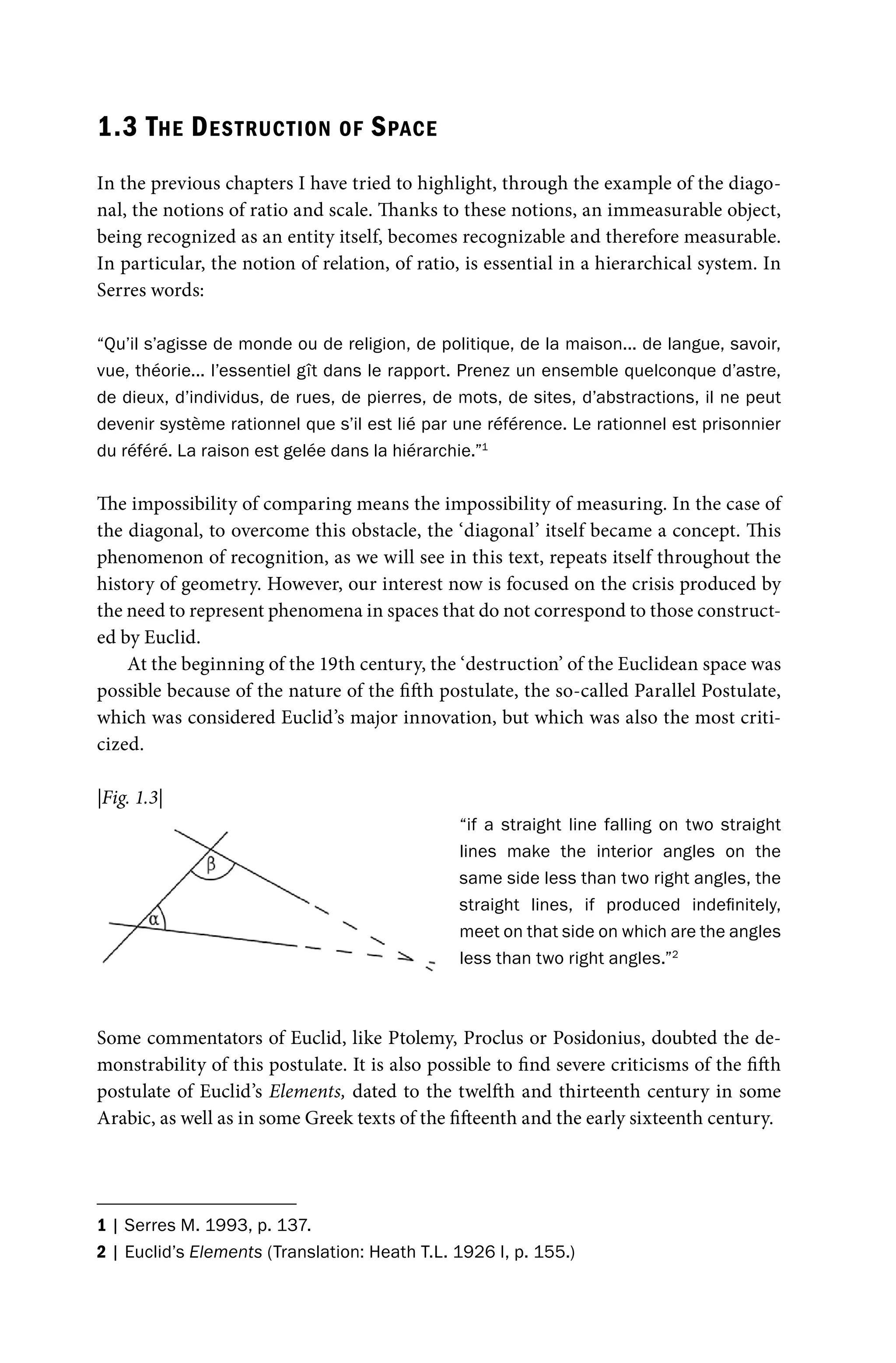
  • 6.
    German A. Duarteholds a Ph.D. (2013) in Media Studies, Ruhr-Universität Bo- chum. His research interests include history of media, film history, new techno- logies in audiovisual narratives, cognitive-cultural economy and philosophy. 2014-06-18 12-06-45 --- Projekt: transcript.titeleien / Dokument: FAX ID 03c6369503115576|(S. 1- 4) TIT2829.p 369503115592
  • 7.
    German A. Duarte FractalNarrative About the Relationship Between Geometries and Technology and Its Impact on Narrative Spaces 2014-06-18 12-06-45 --- Projekt: transcript.titeleien / Dokument: FAX ID 03c6369503115576|(S. 1- 4) TIT2829.p 369503115592
  • 8.
    Bibliographic information publishedby the Deutsche Nationalbibliothek Bibliographic information published by the Deutsche Nationalbibliothek The Deutsche Nationalbibliothek lists this publication in the Deutsche Natio- nalbibliografie; detailed bibliographic data are available in the Internet at http://dnb.d-nb.de © 2014 transcript Verlag, Bielefeld © 2014 transcript Verlag, Bielefeld All rights reserved. No part of this book may be reprinted or reproduced or uti- lized in any form or by any electronic, mechanical, or other means, now known or hereafter invented, including photocopying and recording, or in any infor- mation storage or retrieval system, without permission in writing from the publisher. Cover layout: Kordula Röckenhaus, Bielefeld Cover illustration: himberry / photocase.de Typeset by German A. Duarte Printed by Majuskel Medienproduktion GmbH, Wetzlar Print-ISBN 978-3-8376-2829-6 PDF-ISBN 978-3-8394-2829-0 2014-06-18 12-06-45 --- Projekt: transcript.titeleien / Dokument: FAX ID 03c6369503115576|(S. 1- 4) TIT2829.p 369503115592
  • 9.
    In memory ofAdela Vélez Rezk and Antonio Caronia Quis desiderio sit pudor aut modus tam cari capitis? praecipe lugubris cantus, Melpomene, cui liquidam pater vocem cum cithara dedit. (Horace, Odes, I 24)
  • 11.
    Table of Contents Acknowledgements| IX Preface | XI 1 SOME NOTIONS OF AN INFINITE SPACE | 1 1.1 Geodesy, or the First Translations of Nature | 1 1.2 Recursion as Creator of Infinity | 9 1.3 The Destruction of Space | 13 1.4 Toward Fractality | 19 1.5 Some Words About Chaos | 29 1.6 Fractus, Fracta, Fractum | 33 1.7 Veritas Filia Temporis | 43 2 THE GEOMETRICAL MACHINE | 47 2.1 Perspective: The Geometry of Sight | 47 2.2 The Camera Obscura: A Phenomenon of Externalization | 56 2.3 Self-Similarity: Fold Into Fold (Leibniz and the Microscope) | 65 2.4 Self-Similarity as a Narrative Tool | 78 2.5 Mise en Abyme: Blazon Into Blazon | 94 2.6 The Panorama: An Example of ‘Gigantomanie des Mediums’ | 107 2.7 Panorama and Moving Panorama as Proto-Fractal Spaces | 119 2.8 Photographic Technology: A Translation Tool of Nature’s Shadows | 127 2.9 Stereoscopic Vision | 135 2.10 Photographic Technology: A Nature’s Pencil | 138 2.11 A New Space Which Accepts Movement | 148
  • 12.
    3 FILM ASSPATIAL ORGANIZATION | 167 3.1 Visualizing Multidimensional Spaces | 167 3.2 A Geodesy of Film Narrative | 187 3.3 Ideal Elements in Narrative Space | 219 3.4 A New Relationship Between Paradigma and Syntagma | 257 3.5 Hypertext: A Digital Episteme | 273 3.6 Toward a Strict Fractal Narrative | 288 4 FRACTAL NARRATIVE | 307 4.1 Media-Activism: The Creation of Fractal Spaces | 307 4.2 Fractalis Narratio Ordine Geometrico Demonstrata | 339 List of Illustrations | 353 Bibliography | 363
  • 13.
    Acknowledgements This volume continuesand elaborates my Ph.D. dissertation ‘Fractal Narrative’ sub- mitted to RUHR-Universität Bochum, July 2013. I would like to take this opportunity to gratefully acknowledge the guidance of some professors, scholars and friends who believed in this work and supported me from the very beginning of my research. My deepest appreciation and gratitude go to my mentor and friend Antonio Caro- nia, who kindly followed the development of this book until he passed away in Janu- ary 2013. Without his friendship, his advice and his encouragement I would never have started this research. I will always be grateful for his friendship and for all the conversations we had, which were always a source of inspiration for me. Special thanks are offered to my doctoral adviser Oliver Fahle for following this work in all its stages and for his comments and suggestions. It is also my duty and pleasure to thank Erich Hörl for his guidance during the drafting of this text. My gratitude also goes to many friends and colleagues who, during the years de- voted to the research, offered me their assistance and advice. I mention them in alpha- betic order: Justin Battin, Unai Begiristain, Wil Chang, Lázaro Echegaray, Alessandra Luciano, Eva Oer, Rebekka Reichold, Alfredo Rizza, Sven Speek and Mike Yung. To Maria Elena and to my parents go my thanks for their unlimited support, and their inexhaustible patience all through my research work. Berlin May 2014
  • 15.
    Preface Fractals suggest recursivity,infinity and the repetition of a principle of order. But they are not just infinite images, wonderful infinite images in a space. They are processes. Fractals are digital pictures of the universe’s continuous movement. Attempting to explain the state of fractals, one can only posit that their state is pure becoming. For this reason fractal geometry was understood as a geometry that can recognize nature, its irregular shapes, its perpetual mutation and its chaotic characteristics. The present work attempts to demonstrate that fractals are more than an instru- ment of scientists, more than just one of the features of our scientific context. Indeed, these forms have accompanied mankind over millennia. Consider, for instance, not only the fractal shape of mountains, trees and human lungs, but also Islamic art, Afri- can architecture, Hokusai’s works and many other artistic expressions that are able to display these infinite forms and show us that they are also part of mankind’s deepest unconscious. Notwithstanding the irregularity and infiniteness of nature, starting from the 4th century B.C. onwards, philosophy developed a linear thought called logic and op- posed the alogon to it. According to this framework, what is not linear is inexplicable and therefore a paradox. At the same time, geometry and mathematics developed a science able to explain nature and natural phenomena through abstract and simple forms that do not exist in nature, that is, through lines that only exist in the human mind. As a result, the logos became the only rule and was considered the only truth. Geometry, which was an indispensable instrument for analyzing nature, was also governed by logic, mostly embodied in the axioms of Euclid. Through geometry, ‘real things,’ fruits of the observation of nature, were identi- fied with the fruits of the intellect, that is, with geometrical figures that, in turn, were perceived as ‘real.’ As a consequence, geometry could create ‘reality’ through abstrac- tions, through figures created by the intellect. At that point, the rational translation of natural objects through the science of geometry started to be seen as an objective translation of nature. This impression of objectivity, derived from a kind of Pythago- rean thought in which nature can be translated into numbers, started to impose a new relationship between man and nature. On the one hand, one started to see nature as a regular entity that could be embraced by logos. On the other hand, one assumed that the human senses where insufficient to understand some phenomena. Therefore, ge-
  • 16.
    Fractal Narrative XII ometry wasemployed to translate objects and phenomena onto another plane where human perception could analyze them. The idea that nature could be translated into the language of numbers generated the erroneous conception that natural processes are regular, that is to say, that they can be predicted and imitated by finding their correspondence with numbers or Eu- clidean geometrical figures. This idea is exemplified by the Greek concept of truth (aletheia), the literal meaning of which is ‘the state of not being hidden, of being evi- dent,’ or in Heidegger’s translation, the state of ‘Unverborgenheit.’ This concept of truth governed mankind’s relationship with nature from the clas- sical period up to the Modern Age. During this period, truth and nature were seen as eternal and immutable entities that could only be understood by decoding them using numbers. Thus, nature could only be contemplated, because only through contempla- tion could mankind decipher it and disclose its secrets. Consequently, the scientific knowledge, namely the theoria of the Greeks and the contemplatio of the Romans, subdued the praxis. However, through the mediation of Christian thought, in the Modern Age, scien- tific knowledge was no longer understood as the fine ultimo to which praxis should be subordinated. Theoria and contemplatio became operative instruments. From that moment on, man began seeing his presence in the world as a chance – almost as a mission – to become the ‘dominator’ of nature. And man’s supremacy over nature is expressed in his act of making truth. This truth is no longer the Greek aletheia, but the Hebrew ‘emet’ whose root is strongly related to the verb ‘to do.’ More specifically, the difference between the Greek and Hebraic truths lies in that the first one is something that man ‘knows,’ whereas the second is something in the sphere of what man ‘prac- tices.’ In the Hebrew conception of truth, there is something formed in time, some- thing created in time and by time, which implies that every historical period generates its own truth. The old idea of an untouchable and everlasting truth was replaced by a completely different concept. The human being acquired the capacity to ‘act’ upon na- ture thus establishing a continuous creation of truth. Therefore, scientific knowledge also started to be understood as a means to improve technology with the aim of cre- ating truth by transforming nature. But if technology represented the only means to transform nature and supply human sensorial weakness, then geometry represented the instrument to translate nature ‘objectively.’ In addition, geometry was a means to improve – and also to prove – the efficacy of technology, which, in turn, offered the possibility to study, represent and simulate the human body and its functions. Con- sider, for instance, the technique of perspective developed during the Renaissance, which, by applying the geometrical rules developed by Euclid, allowed not only the analysis of the human sense of sight, but also its representation and simulation. During the Renaissance, the desire to represent natural objects with a high degree of objectivity created a different relationship with nature. The Renaissance took on as a goal the construction of an image on a two-dimensional surface able to produce for the beholder an illusion of a three-dimensional object, a simulation of our perception of natural objects. The principal aim of perspective was to achieve a perfect transla-
  • 17.
    Preface XIII tion ofnature in order to produce in the beholder, in Gombrich’s words, an effect ‘akin to visual hallucination.’ Perspective aims to attain the correct equation such that the image appears like the object and the object like the image. In addition, this technique generates a kind of mechanization of the representation of natural objects. It was a mechanization of the natural function of sight that was simulated through the device of the camera obscura. As a prosthesis able to realize translations of nature, which are seen as objective due to its scientific component, the camera obscura started a phenomenon of alienation of mankind from the representation of the world. The camera obscura represents the first of a series of visual media that translated nature under a Euclidean ordino. In the field of cinematographic studies, when the formalist influence on the study of cinematography came to an end, some narrative constructions started to be seen as narrative constructions that do not represent Euclidean spaces. In other words, it be- came quite clear that even though the cinematographic camera was a direct heir of the camera obscura and, for this reason, a geometrical machine governed by Euclidean rules, it was able to develop non-Euclidean narrative spaces that share some features with fractal forms. The primary aim of the present work is to analyze the influence of fractal geom- etry on the organization of contemporary narrative spaces. As noted by Simmel (see Simmel G. 1908, esp. pp. 614-708), society is not only developed into the space – that is, the social space is not only a spatial manifestation or development – but it also con- structs a spatial organization that is perceptible. Certainly, technology and geometry play a fundamental role in the construction of the social space. Our society, strongly influenced by contemporary mass media, has started to see a new way to articulate narrative spaces, displaying a type of organization that I call in this text fractal. In my view, society is moving towards the construction of fractal social spaces that will, in the near future, completely modify social dynamics and structures, class struggles, and so on. At the moment, we see only one aspect of the impact that fractal geometry has on the organization of narrative spaces: on the aesthetics of some narrative con- structions and on the creation of open spaces for discussion and sharing information. My research, by analyzing the symbiosis between man and technology and between man and geometry, aims at developing an instrument of analysis that could represent a new way to understand the contemporary narrative act, which is no longer the cre- ation of a linear succession of information governed by fixed Euclidean rules, but the construction of infinite fractal spaces in which man and technology establish a new relationship. In the first part, I first outline the development of geometry, Euclid’s contribution, as well as the scientific research that allowed the theorization of non-Euclidean geom- etries. After that, I deal with the fundamental concepts of topology and proto-fractal objects that in the 1970s allowed Benoit Mandelbrot to create fractal geometry. The second part is focused on the development of the technological devices that influenced the analysis of space and allowed the theorization of new kinds of struc-
  • 18.
    Fractal Narrative XIV tures, newways of organizing the universe. Each visual medium considered in this second part is analyzed from a historical point of view that enables us to highlight a common process shared by all the devices discussed. Indeed, every visual medium was developed within the scientific field with the purpose of improving mankind’s analysis of nature. As prostheses that supplies human sensorial weakness, these appa- ratuses represented extensions of the human senses and allowed a better understand- ing of nature and natural phenomena. However, when these apparatuses are intro- duced to the large public, they become narrative instruments that not only modify the social understanding of ‘objective representation’ but also influence the way mankind constructs narrative spaces, the way mankind communicates. Particular attention is drawn to the microscope, which influenced Leibniz’s theories of Analysis Situs and Monadology, through which I analyze important characteristics of fractal objects that are present in the organization of some narrative spaces. But I also deal with the invention of the cinematographic camera, which allowed Bergson to theorize a new universal structure, and the Panorama, the aim of which was to concentrate in a single place huge quantities of information, always attempting to create an infinite space where information could be preserved. The third part of this work focuses on the introduction of non-Euclidean geom- etries into art, on the way fractal spaces can be illustrated through pictorial repre- sentations, and on how these spaces, particularly as displayed in African art, were introduced into and interpreted by Western artistic expression. I also examine some scientific theories, like Poincaré’s Analysis Situs, and how these theories were in- corporated into artistic expression. From there I am able to start an analysis on the influences of both Euclidean geometry and linguistics on the organization of nar- rative spaces, and on how Deleuze, by analyzing the cinematographic camera as an instrument able to construct non-Euclidean spaces, made possible the understand- ing of audiovisual narrative as a pure spatial organization, which, after the Second World War, started to be organized following some non-Euclidean laws. Following in the footsteps of Deleuze, I attempt to create a parallel between the development of non-Euclidean geometries and the audiovisual narrative spaces constructed after the Second World War. The comparison between the development of non-Euclidean geometries and the construction of non-Euclidean narrative spaces takes into account the role played by technology. I theorize that every technological improvement gener- ated a new way of organizing narrative spaces. Thus, I argue that video technology enabled the development of a kind of image that shares some characteristics with Proto-Fractal objects. I analyze the digital image and the organization of audiovisual narrative spaces through a comparison with the characteristics of fractal forms. In this part, I used as a framework the theory developed in the text to analyze some mainstream films. While analyzing these films, I also attempt to highlight the exis- tence of fractal narratives and how they function. Indeed, even though the narrative spaces developed in the films under analysis have already been studied, I decode them in a completely new way, that is, through the innovative instrument of analysis offered by fractal geometry.
  • 19.
    Preface XV The fourthand last part is focused on the current status of audiovisual narrative. I deal in particular with the narratives developed in recent times on the World Wide Web, and I inquiry into the social role that these narratives play and can play in the future. I also propose a geometrical demonstration of the fractal narrative in order to better define its essence and potentialities.
  • 21.
    1 Some Notionsof an Infinite Space Est-ce simplement que les choses qui nous semblent belles sont celles qui s’adaptent le mieux à notre intelli- gence, et que par suite elles sont en même temps l’outil que cette intelligence sait le mieux manier ?1 1.1 GEODESY, OR THE FIRST TRANSLATIONS OF NATURE The Greeks developed Geometry as an abstraction of familiar things, the abstrac- tion of the reality around them.2 Thales of Miletus (ca. 625-547 B.C.) is commonly considered the first philosopher to realize a system in which all things derive from a 1 | Poincaré H. 1908, p. 17. 2 | With this I do not want to state that geometry is a Greek invention. Geometry has an universal character that all cultures have faced. The interest here is in the process that Greeks developed over centuries and which developed a strong influence on the human perception of space and therefore its representation. When one talks about geometry it is necessary to talk about geometries. This is due to the fact that every culture and every era has constructed its own view of space. As Serres posited questioning the history of this noble science: “Commençons par l’histoire de la géométrie: peut-on décider ce que désigne cette science? La mesure, ancienne et moderne, de la terre, arable ou construc- tible, celle des cultivateurs ou des maçons? Les figures archaïques de l’arithmétique pythagoricienne? Celles de l’école de Chio? Les formes ou les idées platoniciennes? Les livres des Éléments d’Euclide? Ce qui nous reste d’Archimède ou d’Apollonius? La repré- sentation Cartésienne? Les épures descriptives du siècle passé? Les reconstructions non euclidiennes? L’analysis situs de Leibniz, la topologie d’Euler, Riemann et Poincaré? Les démonstrations formelles de Hilbert? La géométrie algébrique contemporaine? Les plans des programmateurs de mouvements robotiques...? L’universel, vu de loin, se transforme, de près, en une jungle de sciences si différentes que surabonderait le nombre des histoires à relater, toutes divergentes et enracinées dans des passés ou- bliés.” (Serres M. 1993, p. 16.)
  • 22.
    Fractal Narrative 2 principle formulatedthrough geometric analysis and through geometric theorems. In fact, he developed both the concept of model and of scale. The first geometrical theorems were diagrams that showed a strong relationship with the visible and were also used to prove natural phenomena. By using the spatial character offered by geometry, the proven phenomena acquired additional veracity because they displayed a direct relationship with the ‘things’ themselves. Aiming at measuring proportions that surpassed the human scale, Thales created a spatial re- organization through observations and worked on optical representations of objects at a lower scale. Indeed, he translated the visible into a tangible form through abs- tractions. He measured and measuring means to compare, and to compare is an act of transport, of translation, of the rule, the point of view or the things covered by an alignment.3 At that time geometry benefited from a field of study that, while still belonging to geometry, was also seen as an isolated subject. This was geodesy (gewdaisia), a science that dealt with sensitive and corruptible objects. Conversely, geometry was applied to the treatment of non-sensitive entities. How do we approach astronomy that would have as a matter of study the sensitive sizes? How do we see the sky that is above our heads? “Nor would astronomy be concerned with sensible magnitudes or with this heaven. For neither are sensible lines such as the geometrician speaks of (for no sensible thing is straight or round in the sense in which he uses the terms ‘straight’ and ‘round’; for the circle touches the ruler not at that point, but in the way in which Protagoras used to say in refuting the geometricians), nor are the motions and the orbits of the heavenly bod- ies similar to those discussed by astronomy, nor do points have the same nature as the stars.”4 Traditionally, Egypt is considered the birthplace of geometry. As narrated by Herodo- tus, Ramses II (ca. mid 13th century B.C.) developed a system of equal distribution of lands. Agricultural lands were divided into equal rectangles and when the Nile rose and the water carried off a portion of land, the system used by Ramses II acted to affix the corresponding reduction of taxes related to the portion of land lost as caused by the effluent.5 Also in Plato’s Phaedrus, the origins of geometry are placed in Egypt. Socrates: “Very well. The story is that in the region of Naucratis in Egypt there dwelt one of the old gods of the country, the god to whom the bird called Ibis is sacred, his own 3 | Serres M. 1993, p. 198. 4 | Aristotle, Metaphysics, B.2, 998 a 2, 5. (Translation: Apostle H.G. 1966.) 5 | Consider, for instance, what had been observed by the Greek historian Herodotus (5th century BC) in his Histories (Histories ii. 109).
  • 23.
    1.1 Geodesy, orthe First Translations of Nature 3 name being Theuth. He it was that invented number and calculation, geometry and as- tronomy, not to speak of draughts and dice, and above all writing.”6 In Aristotle’s Metaphysics, geometry developed in Egypt as a wise need for priests, rather than an instrument to measure and divide land. “As more arts were arrived at, some for the necessities of life and others as the only ends of activity, those who arrived at the arts for the latter purpose were always believed to be the wiser than those who did so for the former because their sciences were not instrumental to something else. Now when all such arts were already developed, the sciences concerned neither with giving pleasures to others nor with the necessities of life were discovered, and first in such places where men had leisure. Accordingly, it was in Egypt that the mathematical arts were first formed, for there the priestly class was allowed leisure.”7 Let us go back to Thales. Thales went first to Egypt, and then, upon his return to Greece, he introduced the study of geometry.8 Geometry with Thales became a de- ductive science ruled by general propositions. In Laertius’s writings, Hieronymus, a pupil of Aristotle, tells how Thales, using the shadow projected by the pyramids, could carry such colossal structures on paper. “Hieronymus says that he even succeeded in measuring the pyramids by observation of the length of their shadow at the moment when our shadows are equal to our own height.”9 6 | Plato, Phaedrus, 274 c-d (Translation: Hackforth R. 1952.) 7 | Aristotle, Metaphysics, A.1, 981 b 17-24 (Translation: Apostle H.G. 1966.) 8 | See Heath T. 1981. 9 | Diógenes Laertius i. 27. |Fig. 1.1|
  • 24.
    Fractal Narrative 4 Thanks tothe possibility to ‘translate’ objects through geometry, it was also possible to reach general conclusions from specific diagrams.10 However, the presence of fixed laws in this spatial organization became essential. Michel Serres described the phe- nomenon as follows: “Le réalisme des idéalités s’alourdit et reprend une compacité qu’avait dissoute le so- Le réalisme des idéalités s’alourdit et reprend une compacité qu’avait dissoute le so- leil platonicien. Pleines d’ombre, les idéalités pures ou abstraites redeviennent noires comme les Pyramides, et comme elles, font de l’ombre.”11 The interpretation of nature through points and lines started to be ordered through the fixed laws guided by logic, which give to the geometrical representation its final signification. In fact, these figures had to meet specific laws, axioms that would govern this creative process and guide the projection of these analyses. The axioms formulated by Euclid in the thirteen books of his work Elements gui- ded the human perception of space through centuries. In this work, he established the properties of figures placed in the plane. These figures, in turn, structured the analysis of space. Through Euclid’s axioms, the abstractions of nature acquired truth-value, since they responded to a logical system of rules; Euclid’s axioms. Let’s see how Euclid constructed his work Elements. The first book begins with a list of assumptions ordered as follows: • Definitions • Postulates • Common Notions By using the term ‘common notions’, Euclid follows Aristotle. The latter used the term ‘common (things)’ and ‘common opinions’ as an alternative to the word ‘axiom’. In the books II, IV, V, VI, VII and XI, one finds some additional definitions. The remain- ing books present proposals and problems that can be solved by means of hypoth- eses.12 In the first book there are twenty-three definitions. They deal with the notions of point, line, angle, etc. The arrangement of the first book and especially the section dedicated to definitions can be understood, following Serres, as a typical grammar in which first the morphology and then the syntax is analyzed.13 The definitions and as- sumptions (syntax) give sense to lines or elements constructed by means of the ruler and the compass (morphology). The definitions and assumptions also make possible the development of a system – Euclidean geometry – which can be defined as a lan- 10 | In this regard see Plato, Meno 80d-86c, where one can see how Socrates, in order to prove the existence of reminiscence during his discussion with Meno, draws from the slave’s soul his knowledge of geometric abstraction. 11 | Serres M. 1993, p. 214. 12 | See Torretti R. 1978. 13 | Serres M. 1993, p. 251.
  • 25.
    1.1 Geodesy, orthe First Translations of Nature 5 guage of infinite possibilities and performances.14 These definitions and assumptions represent proper principles; they are “truths whose existence is impossible to prove.”15 However, what is the difference between postulate and hypothesis? Indeed, bet- ween these two words, there is a huge semantic difference. “Thus any probable proposition that the teacher assumes without proving it, if the stu- dent accepts it, is a hypothesis – a hypothesis not absolutely but relatively to the stu- dent; but the same assumption, if it is made when the student has no opinion or a contrary opinion about it, is a postulate.”16 That is to say, a postulate is an improbable proposition that the master asks the dis- ciple to grant him. “This is the difference between a hypothesis and a postulate; the latter is the contrary of the student’s opinion, or any provable proposition that is assumed and used without being proved.”17 Following this short passage from Aristotle, Euclid’s postulates became the instru- ments through which mankind constructs its ‘reality’.18 As mentioned above, the use of lines, circles and areas simplify the analysis, since all these elements deal with ‘ex- isting’ things. Geometry made the world of mathematics fully intelligible. Thanks to the abstractions offered by the geometric knowledge, nature became more deduct- ible. Geometric knowledge, which allowed man to explain phenomena by describing the reality, became a ‘mediator’ between human cognition and the nature of existing things.19 Thus, geometry became essential to make direct confrontations with the re- sult of mathematical analysis, i.e. with numbers. Thanks to geometry, the ‘real things’, fruits of the observation of nature, could be identified with the fruits of intellect, that 14 | Heath T. 1981, p. 373. 15 | Aristotle, Posterior Analytics, 76a, 31. (Translation: Tredennick H. 1960.) 16 | Aristotle, Posterior Analytics, 76b, 30. (Translation: Tredennick H. 1960.) 17 | Aristotle, Posterior Analytics, 76b 32-34. (Translation: Tredenneck H. 1960.) 18 | In this regard, it is important to remember the strong bond between the meaning of Truth and ideîn (to see) in the ancient Greek world. For the Greeks, mathematics repre- sented the order of nature, which was manifested to man: αληθεια (alétheia) “truth” in the meaning of revelation, but also in the meaning of reality. Aletheia is the truth-reality that is manifested to humans through mathematics, and it can be seen (ideîn) through numbers. Conversely, for the scientist of the modern era, truth does not imply the Greek ‘passivity’ imposed by the action of “to see”. It is strongly associated with the Hebrew meaning of ‘emet (‫)אמת‬ or “doing truth”. The latter implies an action upon nature. Thus, truth in the modern era is the order that mankind assigns to nature. See, Galimberti U. 20054 , p. 312. This point will be discussed in more detail in the following chapters. 19 | See Gray J. 19892 .
  • 26.
    Fractal Narrative 6 is, geometricalfigures that were also ‘real’. In fact, geometry creates ‘reality’ through abstractions, that is, through figures created by the intellect. Contemporary to the process of abstraction initiated by geometry, Pythagorean mathematics developed. Pythagoras advocated that mathematical principles could be applied to any existing thing. The idea of the ‘superiority’ of the science of numbers was born when Pythagoras (or perhaps one of his students) found a mathematical relationship in the consonance of sounds of musical instruments. This fact encoura- ged the Pythagoreans to establish further connections between numbers and natural phenomena. According to Pythagoreans, the analysis of nature should pass through the science of numbers, i.e. nature could be translated into the language of numbers. “Contemporaneously with these thinkers, and even before them, the so-called Pythago- reans, who were engaged in the study of mathematical objects, were the first to advance this study, and having been brought up in it, they regarded the principles of mathemati- cal objects as the principles of all things. Since of mathematical objects numbers are by nature first, and (a) they seemed to observe in numbers, rather than fire or earth or water, many likenesses to things, both existing and in generation (and so they regarded such an attribute of numbers as justice, such other as soul or intellect, another as oppor- tunity, and similarly with almost all of the others), and (b) they also observed numerical attributes and ratios in the objects of harmonics; since, then, all other things appeared in their nature to be likenesses of numbers, and numbers to be first in the whole of na- ture, they came to the belief that the elements of numbers are the elements of all things and that the whole heaven is a harmony and a number.”20 The analysis of the real by means of numbers encountered a crisis due to the discovery of the diagonal of the square, in other words, the discovery of the irrational num- bers: √2. History attributed their discovery to Pythagoras despite the fact that some authors attested that he did not discover the irrationals.21 One supposes that their discovery remained a secret for years – almost a century – and this long silence cre- 20 | Aristotle, Metaphysics, 985b 23 - 986a 4. (Translation: Apostle H.G. 1966.) 21 | One of these texts, which questions the discovery of irrationals by Pytagoras, is Plato’s Theaetetus. In this discussion between Socrates and Theaetetus one can see how the irrationals were found. “Theaet. We divided all numbers into two classes. The one, the numbers which can be formed by multiplying equal factors, we represented by the shape of the square and called square or equilateral numbers. Soc. Well done! Theaet. The numbers between these, such as three and five and all numbers which cannot be formed by multiplying equal factors, but only by multiplying a greater by a less or a less by a greater, and are therefore always contained in unequal sides, we represented by the shape of the oblong rectangle and called oblong numbers. Soc. Very good; and what next?
  • 27.
    1.1 Geodesy, orthe First Translations of Nature 7 ated the doubt over the attribution of this discovery to Pythagoras. In addition, it is also impossible to date with precision the discovery of irrationals.22 However, thanks to the testimony given by several texts about the crisis generated by the discovery of irrationals, it is possible to understand how geometry was developed on the basis of the theory of numbers.23 The primitive Pythagorean arithmetic only admitted integers. Therefore, the dia- gonal of the square shows, in the geometric space, existing and reproducible lengths that are unrecognizable by calculation. Thus, the measurement of the diagonal re- quires a non-Pythagorean notion, which demonstrates the existence of an irrational, a non-being, an afterlife. Going beyond the concepts of known ratios, the diagonal became a measure, “irrational and inexpressible in its essence.”24 What happens if something can be represented by geometry but not by the science of numbers? How do we represent the complexity of this non-being and most impor- tantly, how to accept the existence of a non-being, of an afterlife?25 The ratio of the diagonal of the square, inexplicable through natural numbers, was historically seen as the drama of irrationality and (in some ways) as the death of pure thought.26 If the logos means proportion, ratio or the action, alogon means irrational, it prohibits measuring. If logos means speech, alogon is opposed to any word. Thus, accuracy is condemned to collapse and reason to keep silent.27 In order to accept the existence of the diagonal and to assign a measurement to it, one must take into account another dimension, a space that accepts the existence of such a segment. First, we must overcome the one-dimensional world of the straight line, and then it is necessary to go out into an ‘ultra-dimensional’ world where the line is submerged.28 The measurement of such a segment (the diagonal) means the Theaet. All the lines which form the four sides of the equilateral or square num- bers we called lengths, and those which form oblong numbers we called surds, because they are not commensurable with the others in length, but only in the areas of the planes which they have the power to form. And similarly in the case of solids.” (Plato, Theaete- tus, 147e – 148 b. - Translation: Fowler H.N. 1921.) 22 | It is interesting to see how irrationals started to be accepted. Thomas Heath ana- lyzes this assimilation through Plato, (Republic vii. 546 D.) where irrationals seem to be totally assimilated. See Heath T. 1981, p. 157. 23 | See Heath T. A history of Greek Mathematics. Volume I. The Irracional, p. 154. 24 | Toth I. 1991, p. 65. 25 | That is why one needed to accept the realistic theory that states that things in our intellect are more real than reality. From this premise, mathematics could be assimilated as an abstract form of real objects. See Dicks D.R. 1970 and Körner S. 1960. 26 | Serres M. 1993, p. 20. 27 | Serres M. 1993, p. 146. 28 | Toth I. 1991, p. 95.
  • 28.
    Fractal Narrative 8 recognition ofthe incommensurability, of the non-Pythagorean.29 What allowed the recognition of the diagonal on a flat universe was that it had been recognized inde- pendently, it was recognized as ‘the measurement of the diagonal’. Even if it was not re- presentable with Pythagorean numbers, it became an existing measurement because it acquired its own existence as the diagonal of the square; it belonged to the field of irrational numbers.30 29 | The diagonal needs to be broken down in this way and its analysis requires a recur- sive operation. See Toth I. 1991, p. 65. 30 | One can observe the same phenomenon in the Greek π. This ratio, which is docu- mented in 1650 B.C. in the Rhind papyrus, is the constant ratio between the length of a circumference to the diameter of the same. In the Rhind papyrus, this ratio was calculated as 3.16049… Thanks to Archimedes π was calculated with more precision. Archimedes found that the length of the circumference could be approximated with the perimeter of regular polygons inscribed and circumscribed to the circumference. This measurement became even more precise by increasing the number of sides of the poly- gons, which tend to multiply endlessly. By multiplying its sides to 96, Archimedes found that the result was 3.14271… The definition of this irrational was corrected by Lambert in the seventeenth century.
  • 29.
    1.2 RECURSION ASCREATOR OF INFINITY The number theory, our sense of measurement, and even deeper thoughts on the ir- rational and rational are fruits of the diagonal of the square and of the abstract figures developed by Greek thought and its relationship with space. From these concepts, other languages started to be developed, which use even more complex abstractions in order to reproduce and explain natural phenomena. These languages became even better instruments for mediating the relationship between man and nature. By means of some of these languages and their relationship with other sciences and concepts, mankind was able to approach natural phenomena and concepts from another point of view. This was the case of the relationship between the algorithms and paradoxes of Zeno. Zeno’s paradoxes enable us to understand how using the abstractions offered by numbers, the divisibility of space was postulated by applying a recursive operation. In turn, this allowed us to question the existence of movement. |Prop. XVI| Zeno showed how the idealization of infinity is based on the concept of recursion. It is important to remember that Zeno’s paradoxes were created to support Parmenides of Elea’s thoughts on motionlessness (ἀτρεμής), a concept developed in his unique surviving (in a fragmentary form) work, On Nature. In this important work, which influenced many aspects of western philosophy, Parmenides deals with the concept of reality (in his words, “what-is”). Reality was described as one, change was considered impossible and entities were thought to be unchanging. He also de- veloped an interesting way of inquiry grounded in the opposition, that it is (ὅπως ἐστίν) – that is not (ὡς οὐκ ἐστίν). In his work, Parmenides asserts that an entity always stays in its place. His aim was to place reality exclusively in the logos and not in perception because, according to him, perception (doxa – δόξα: a Greek word that describes common beliefs or popular opinions) is misled. Thus, he theorized an eter- nal reality (aletheia), which is static and immutable. Zeno was a member of the Eleatic School founded by Parmenides. His most fa- mous paradoxes are known as “Arguments Against Motion.”1 Zeno created the para- doxes in order to support Parmenides’ doctrine that “all is one.” Zeno, following the logic that states that the analysis of reality must be effectuated through the logos, and arguing that no change is possible, concluded that motion is just an illusion. Let us focus more closely on these Arguments. In the case of the dichotomy para- dox, Zeno states that a moving body that must arrive at point B from point A will nev- er get there. The body must first cover the first half of the course, but before doing that, it must reach half of the half, and half of that half, and so on to infinity. This recursive operation divides the space to cover an infinite number of times; consequently, the body will never arrive at point B. 1 | According to Plato, the creation of these paradoxes was a response to some philoso- phers who had created some paradoxes to contradict Parmenides’ philosophy.
  • 30.
    Fractal Narrative 10 Zeno’s argumentsaccomplished his goal of defending Parmenides’ thesis. However, as we will see in the following chapters, Zeno’s approach to the analysis of movement – which is an action and consequently, is indivisible, like time – leads us to apply the same approach to the analysis of time, thus giving rise to the erroneous analysis of time by means of spatial notions. Let us delve into this last point. |Prop. VIII, IX| The spatial representation provided by Zeno is inexhaustible. In mathematical terms, it means the impossibility of representing the calculation of this movement, i.e. 1 /2 + 1 /4 + 1 /8 … Through this paradox, Zeno also argued that due to be- ing on a infinitely divisible space, the body also needs an infinite time to cover it. Con- sequently, in this paradox, time is represented by spatial notions, by a geometric line of infinite length.2 The imaginary straight line, covered by the body in the paradox, represents the domain of natural numbers, which are infinite. In fact, if each point of the line represents a natural number, consequently they are also immeasurables. However, let us look closely at what the line represents. As it is composed of an infinite number of points, it could help us to understand the particular geometrical structures that we will analyze in this text. The first question we should deal with is: what is a point in the line? It is clear that the point is a semantic value given to a unitary and in- divisible element. However, our interest now is focused on how this element is defined by mathematics. The point has been understood in three different ways. According to the first way, the point is a kind of generator element whose movement builds the line. Alternatively, the point has been seen as an intersection between two lines. Thirdly, it has also been seen as a “limiting position in a infinite process applied to a segment of a line.”3 These three ways of defining the point allow us to understand not only the nature of the line but also the nature of infinite sets.4 An infinite structure, like the line, is something that requires a successor, thus it needs a recursive operation. In the case of the straight line, the required element is a point, in the case of natural integers it is another natural integer. Consequently, any number – or object – in such systems allows the operation x + n, where the addition of another number or figure is always possible. As in Zeno’s paradoxes, repetition generates repetition.5 It is possible to deduce that the fundamental condition of an infinite space, and thus the essence 2 | In this regard, Danzig states that this is the fundamental principle of our world of relativity. See Dantzig T. 19544 , p. 124. 3 | Dantzig T. 19544 , p. 142. 4 | Engell defines the point as a metaphor for something that is not possible to repre- sent, a metaphor for space through time and time through space. See Engell L. 1999. 5 | Serres M. 1993, p. 288. |Fig. 1.2|
  • 31.
    1.2 Recursion asCreator of Infinity 11 of infinite sets, is the generating element, which, due to its nature, requires or allows a successor. Through the definition of the inner nature of the straight line, one can define re- cursion as a means of creation of immeasurable spaces. The capacity to accept a recur- sive operation is what gives infiniteness to the straight line and represents the essence of this structure. The straight line, being an infinite succession of points, was evidence of the existence of infinite spaces. Not accepting the existence of infinity means the non-existence of natural numbers. The absence of infinity also means the beginning and end of time, the impossibility of dividing magnitudes into magnitudes.6 “If there were no infinity, all magnitudes would be commensurable and there would be nothing inexpressible or irrational, features that are thought to distinguish geometry from arithmetic; nor could numbers exhibit the generative power of the monad, nor would they have in them all the ratios -such as multiple and super particular- that are in things.”7 |Prop. XV| If we return to Zeno’s paradox, the existence of two kinds of infinities seems to emerge from it. Aristotle argued that, when one talks about infinity, it is essential to distinguish between potential infinity and actual infinity. The first one is accessible through human cognition, the second one represents a vague idea and is inaccessible to the human being. We have outlined above the essence of infinity. In particular, it is the result of an endless succession (as in the case of natural numbers and straight line) and it derives from a recursive operation. This infinity can be denoted as potential infinity. The limit of human perception appears when one tries to identify a single entity of infinite size as a uniqueness. This represents the actual infinity and exceeds the limits of our intel- lect. The duality depicted above has been described by Leibniz as “infinitum actu non datur”: “Prennons une ligne droite et prolongeons la, ensorte qu’elle soit double de la première. Or il est claire, que la seconde, estant parfaitement semblable à la première, peutestre doublée de même, pour avoir la troisième qui est encor semblable aux precedentes; et la même raison ayant tousjours lieu, il n’est jamais possible qu’on soit arresté; ainsi la ligne peut estre prolongée à l’infini, de sorte que la consideration de l’infini vient de celle de la similitude ou de la même raison, et son origine est la même avec celle des verités universelles et necessaires. Cela fait voir comment ce qui donne de l’accomplissement à la conception de cette idée, se trouve en nous mêmes, et ne sauriot venir des expe- 6 | Fauvel J. – Gray J. 1987, p. 96. 7 | Proclus, A Commentary on the first Book of Euclid’s Elements (ed. and tranlated by Morrow G.R. 1970, p. 5.)
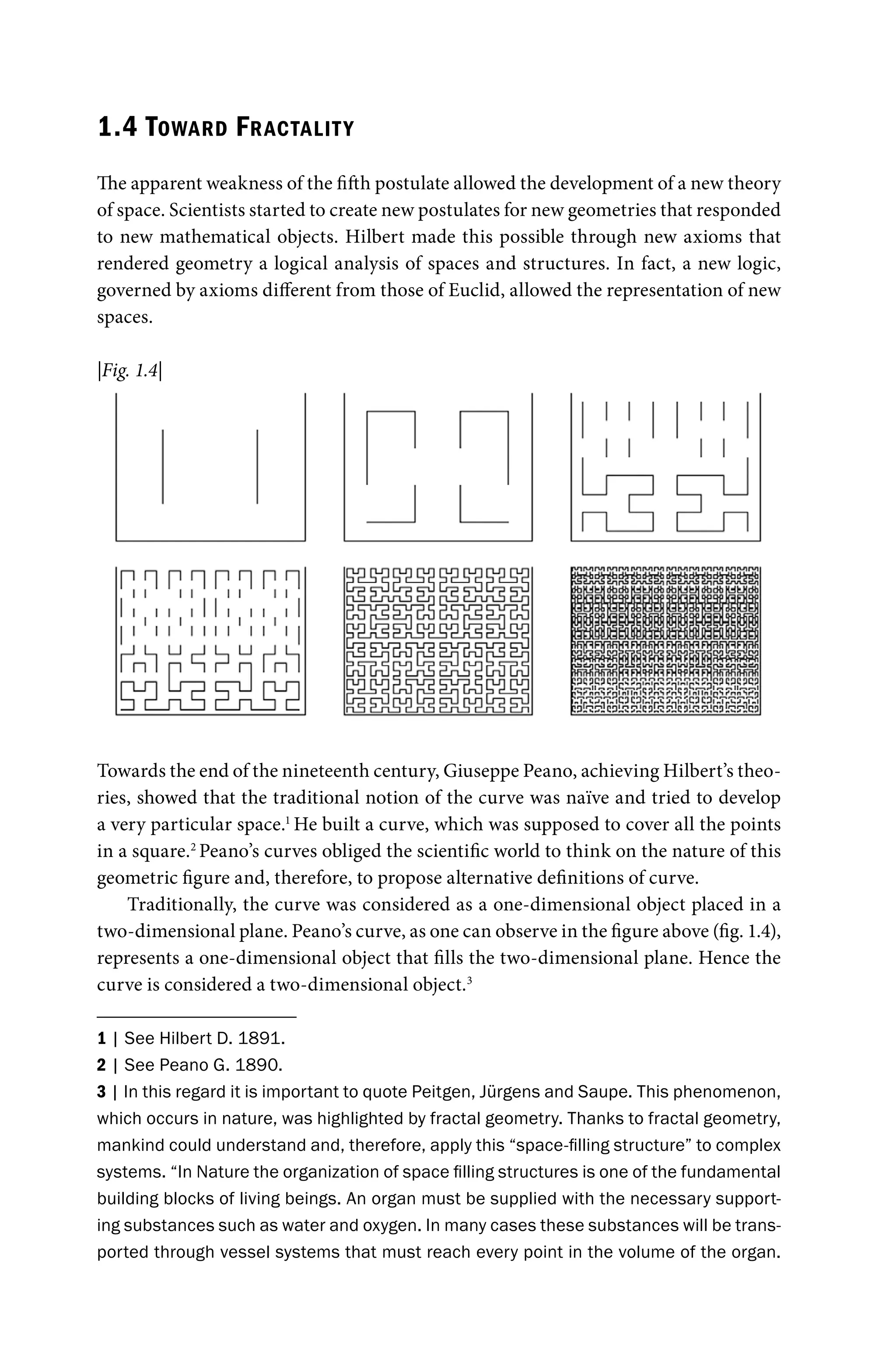
  • 32.
    Fractal Narrative 12 riences dessens, tout comme les verités necessaires ne sauroient estre prouvées par l’induction ny par les sens.”8 Leibniz also states that : “Mais on se trompe en voulant s’imaginer un espace absolu qui soit tout infini composé de parties, il n’y a rien de tel, c’est une notion qui implique contradiction, et ces touts infi- nis et leur opposés infiniment petits, ne sont de mise que dans le calcul des Geometres, tout comme les racines imaginaires de l’Algèbre.”9 In Zeno’s paradoxes the succession 1 /2 + 1 /4 + 1 /8 … shows that the recursive operation is the source of the existence of the potential infinity. However, the vision of an im- measurable entity was unacceptable by the human intellect, as attested by Leibniz. 8 | Leibniz G.W. 1996a (1765), p. 212. 9 | Leibniz G.W. 1996a (1765), p. 214.
  • 33.
    1.3 THE DESTRUCTIONOF SPACE In the previous chapters I have tried to highlight, through the example of the diago- nal, the notions of ratio and scale. Thanks to these notions, an immeasurable object, being recognized as an entity itself, becomes recognizable and therefore measurable. In particular, the notion of relation, of ratio, is essential in a hierarchical system. In Serres words: “Qu’il s’agisse de monde ou de religion, de politique, de la maison... de langue, savoir, vue, théorie... l’essentiel gît dans le rapport. Prenez un ensemble quelconque d’astre, de dieux, d’individus, de rues, de pierres, de mots, de sites, d’abstractions, il ne peut devenir système rationnel que s’il est lié par une référence. Le rationnel est prisonnier du référé. La raison est gelée dans la hiérarchie.”1 The impossibility of comparing means the impossibility of measuring. In the case of the diagonal, to overcome this obstacle, the ‘diagonal’ itself became a concept. This phenomenon of recognition, as we will see in this text, repeats itself throughout the history of geometry. However, our interest now is focused on the crisis produced by the need to represent phenomena in spaces that do not correspond to those construct- ed by Euclid. At the beginning of the 19th century, the ‘destruction’ of the Euclidean space was possible because of the nature of the fifth postulate, the so-called Parallel Postulate, which was considered Euclid’s major innovation, but which was also the most criti- cized. “if a straight line falling on two straight lines make the interior angles on the same side less than two right angles, the straight lines, if produced indefinitely, meet on that side on which are the angles less than two right angles.”2 Some commentators of Euclid, like Ptolemy, Proclus or Posidonius, doubted the de- monstrability of this postulate. It is also possible to find severe criticisms of the fifth postulate of Euclid’s Elements, dated to the twelfth and thirteenth century in some Arabic, as well as in some Greek texts of the fifteenth and the early sixteenth century. 1 | Serres M. 1993, p. 137. 2 | Euclid’s Elements (Translation: Heath T.L. 1926 I, p. 155.) |Fig. 1.3|
  • 34.
    Fractal Narrative 14 Before wedeal with the process that initiated the recognition of a geometry that does not meet the Euclidean notions, it would be interesting to make a short digres- sion on the revolution started by Descartes in 1637. With his work La géométrie, Descartes provided a revolutionary concept: the Car- tesian coordinated system. Thanks to René Descartes, geometry could be ‘conjugate’ with algebra. Inventing algebraic geometry, he created a language able to express vis- ible variation with formulas.3 In La géométrie, known as the first book of modern mathematics, Descartes claims that: “Tous les problemes de Geometrie se peuuent facilement reduire a tels termes, qu’il n’est besoin pas aprés que de connoistre la longeur de quelques lignes droites, pour les construire.”4 Descartes encouraged the study of geometry through the methods of algebra, and from this combination derived the idea of coordinates. The Cartesian Coordinate Sys- tem allows specifying points with coordinates, which correspond to equations that in turn can be identified with geometric groups. In other words, it is a translation of geometry into algebra. The method used by Descartes shows that numbers are able to represent geometrical objects. It also demonstrates that it is possible to solve some problems belonging to the field of geometry through arithmetic operations. Descartes developed a system that grants a letter to each line in order to perform the geometric operation in the field of algebra.5 This method allowed the scientist to have parametric representations of geometric objects.6 Thanks to the notion of coordinates and the approach to equations, science was able to create forms through equations. Descartes’ idea was the possibility to draw with equations as with the ruler and the compass. His aim was to translate a geometrical problem into algebraic language, solve the problem, and then translate it back into geometric figures. This process was useful for solving some mechanical problems, calculations that could be represented by curves. However, Descartes’ La Géométrie offered more than one method of analysis. Thanks to Descartes, geometry acquires a still greater range in that it started to concern the field of specificity, demonstrability and constructiveness.7 The possibility of translat- ing images – geometric objects – into the field of numbers granted a higher dimension of ‘truth’ and accuracy to calculations. This phenomenon was emphasized because, in a successive stage, it was applied to machinery and mechanisms in order to prove their functionality. 3 | Serres M. 1993, p. 168. 4 | “Any problem in geometry can easily be reduced to such terms that a knowledge of the lengths of certain straight lines is sufficient for its construction” (Descartes R. La Géométrie. – Tranlation: Smith D.E. - Latham M.L. 1925, p. 2.) 5 | See Reed D. 1995. 6 | See Smith D.E. - Latham M.L. 1925. 7 | Reed D. 1995, p. 30.
  • 35.
    1.3 The Destructionof Space 15 The foundations for the creation of a new geometry, and an alternative to the Eu- clidean one, were laid in the eighteenth century. After the contribution of John Wallis (1616-1703), the mathematician and Jesuit Gerolamo Saccheri (1667-1733) devoted a work to the demonstration of Euclid’s fifth postulate.8 In his work Euclides ab omni naevo vindicatus : sive conatus geometricus quo stabiliuntur prima ipsa universae Geo- metriae principia, of 1733, he developed a very special reasoning. Saccheri adopted as premises the first twenty-six of Euclid’s propositions and assumed as hypothesis that the fifth postulate was false in order to prove, through this hypothesis, that it was true.9 Saccheri’s conclusion was that the fifth postulate cannot be demonstrated. In turn, Johann Heinrich Lambert (1728-1777) attempted to develop contradictions that could create alternative postulates. Consequently, Lambert left several geometric theorems developed in non-Euclidean parallels systems.10 At that time, the proposal of a new geometry was considered a heresy. However, after Saccheri’s and Lambert’s works, many criticisms of Euclidean geometry and several new geometries emerged. It was during the early nineteenth century that a real breaking away from Euclidean space occurred. This revolution started becoming more concrete thanks to Johann Carl Friedrich Gauss (1777-1855) and Georg Fried- rich Bernhard Riemann (1826-1866). Gauss did not seek to contradict the existing geometry, he sought to create a new geometry, a non-Euclidean geometry. This revolu- tionary topic was certainly a problem at the time. To theorize a new geometry meant not only to go against the scientific world, but also to attack both science and Western Culture. As a consequence, Gauss’s work remained unpublished.11 The first publications theorizing a non-Euclidean geometry are the result of the research of two Russian authors: Nikolai I. Lobachevsky (1792-1856) and Janos Bolyai (1802-1860) published in 1830.12 They both concluded that there is not a ‘universal geometry’, rather each field requires a special geometry. They assumed that Euclidean geometry is more adapted to human senses, to our perception of the world, whereas other perspectives, for example atomic or planetary ones, require a different kind of geometry.13 For example, a planetary perspective, being planets spheres and their or- 8 | See Gray J. 19892 . 9 | See Bonola R. 1955. Chapter II. The Foreruners of Non-Euclidean Geometry. Gerola- mo Saccheri. 10 | It is very interesting to note the spherical geometry invented by Thomas Reid in the eighteenth century. This geometry was based on the idea of the perceptual space, i.e. the world is presented as a hemisphere centered in the human eye. 11 | See Henderson D.L. 1983. 12 | For a more detailed analysis of this process see Leonesi S. – Toffalori C. 2007. 13 | Note that Lobachevsky and Gauss tried to demonstrate that their new geometry could exist in natural space. In fact, they investigated if there were elements of non- Euclidean geometry in natural space. For instance, Gauss attempted to measure the angle sum of an immense triangle formed by three mountain peaks. See Henderson D.L. 1983.
  • 36.
    Fractal Narrative 16 bits circumferencesor ellipses, justifies the elliptic geometry theorized by Riemann, in which the plane manifests some spherical surfaces. From this new perspective, a straight line must be understood as a circle of maximum radius.14 In addition, through his elliptic geometry, Riemann realized for the first time the important distinction between unbounded space and infinite space.15 The sphere represented both a finite surface and an unbounded space in which the line cannot be extended infinitely, con- trary to Euclid’s postulates. Thus, in this space a parallel line cannot be drawn to a given line.16 Thanks to Riemann, there arose the will to develop new geometrical spac- es, such as the topological space. In fact, Riemann also proposed some surfaces that curvature might vary. In such spaces, composed by irregular shapes, the movement of objects implies changes in their shape as well as in their properties.17 Through this theory, the principle of indeformability established by Euclid was completely negated. Additionally, some important research developed during the nineteenth century also 14 | See Leonesi S. – Toffalori C. 2007. 15 | It is interesting to quote Riemann’s words about the development of a multidi- mensional space. “Diese Dunkelheit wurde auch von Euklid bis auf Legendre, um den berühmtesten neueren Bearbeiter der Geometrie zu nennen, weder von dem Mathema- tikern noch von den Philosophen, welche sich damit beschäftigten, gehoben. Es hat- te dies seinen Grund wohl darin, daß der allgemeine Begriff mehrfach ausgedehnter Größen, unter welchem die Raumgrößen enthalten sind, ganz unbearbeitet blieb. Ich habe mir daher zunächst die Aufgabe gestellt, den Begriff einer mehrfach ausgedehnten Größe aus allgemeinen Größenbegriffen zu konstruieren. Es wird daraus hervorgehen, daß eine mehrfach ausgedehnte Größe verschiedener Maßverhältnisse fähig ist und der Raum also nur einen besonderen Fall einer dreifach ausgedehnten Größe bildet. Hiervon aber ist eine notwendige Folge, daß die Sätze der Geometrie sich nicht aus allgemeinen Größenbegriffen ableiten lassen, sondern daß diejenigen Eingenschaften, durch welche sich der Raum von anderen denkbaren dreifach ausgedehnten Größen unterscheidet, nur aus der Erfahrung entnommen werden können. Hieraus entsteht die Aufgabe, die einfachsten Tatsachen aufzusuchen, aus denen sich die Maßverhältnisse des Raumes bestimmen lassen – einige Aufgabe, die der Natur der Sache nach nicht völlig bestimmt ist; denn es lassen sich mehrere Systeme einfacher Tatsachen angeben, welcher zur Bestimmung der Maßverhältnisse des Raumes hinreichen; am wichtigsten ist für den gegenwärtigen Zweck das von Euklid zugrunde gelegte. Diese Tatsachen sind wie alle Tatsachen nicht notwendig, sondern nur von empirischer Gewißheit, sie sind Hypothesen; man kann also ihre Wahrscheinlichkeit, welche innerhalb der Grenzen der Beobachtung allerdings sehr groß ist, untersuchen und hiernach über die Zulässigkeit ihrer Ausdehnung jenseits der Grenzen der Beobachtung sowohl nach der Seite des Un- meßbargroßen, als nach der Seite des Unmeßbarkleinen urteilen.” (Riemann B. 1919, pp. 1-2.) 16 | See Wolfe H.E. 1945. 17 | See Bonola R. 1955.
  • 37.
    1.3 The Destructionof Space 17 created the need to develop new mathematical spaces, as Jean-Victor Poncelet did through pure imaginary numbers. During the early nineteenth century, pure imaginary numbers were a scandalous topic but at the same time, very useful. In this regard, Poncelet, trying to explain the usefulness of imaginary numbers, used the method of postulation. He claimed that mathematical reasoning can be thought of as a mechanical operation using abstract signs. From the moment that the new sort of numbers was accepted in mathematical analysis, Poncelet argued that geometry is equally able to use abstract signs.18 There- fore, Poncelet made a great contribution to science by working on the combination of mathematics and geometry. He opened a path of analysis based on the method of postulation, a kind of analysis that helped to theorize non-Euclidean geometries.19 In 1899 David Hilbert (1862-1943) published Grundlage der Geometrie, where he wrote an important analysis of the method of postulation. Hilbert’s work represents a break with the semantic space constructed by Euclid nearly two millennia earlier. To understand Hilbert’s contribution one must remember Descartes’ La géométrie. As noted above, Descartes provided a method of operation. For Descartes, axioms do not really matter: the problems’ resolution passes through the construction and its demonstration. Instead, Hilbert deals with a different kind of problem. In his work, there is no longer a Cartesian construction and the method of postulation becomes fundamental. “Die Geometrie bedarf – ebenso wie die Arithmetik – zu ihrem folgerichtigen Aufbau nur weniger und einfacher Grundsätze. Diese Grundsätze heißen Axiome der Geometrie. Die Aufstellung der Axiome der Geometrie und die Erforschung ihres Zusammenhanges ist eine Aufgabe, die seit Euklid in zahlreichen vortrefflichen Abhandlungen der mathe- matischen Literatur sich erörtert findet. Die bezeichnete Aufgabe läuft auf die logische Analyse unserer räumlichen Anschauung hinaus.”20 This excerpt shows that from the interest in axioms derived a logical analysis instead of the former constructive examination proposed by Descartes. This meant a radical change in the method used to study spaces and also to represent them. Hilbert proposed three kinds of objects: points, lines and planes, whose proper- ties are described by words like “between” and “congruent.” These families of objects are defined by five axioms: incidence, order, parallelism, continuity and congruence. In this way, Hilbert conceptualized the point, the line and the plane. He considered these concepts in a purely formal way. That is to say, these concepts – line, point and plane – do not represent a physical or intuitive idea; rather, their existence is only justified because they obey the 21 laws set by Hilbert himself.21 Any object that meets 18 | Shapiro S. 1997, p. 146. 19 | See Poncelet J.V. 1822. 20 | Hilbert D. 1962, p. 2. 21 | In this regard see Toepell M. 1986.
  • 38.
    Fractal Narrative 18 these conditionswill be or will have the right to be interpreted, and therefore, called point, line or plane.22 Thanks to Hilbert, the science of geometry underwent a big change. On the one hand, Descartes developed methods to solve problems; on the other hand, Hilbert developed an analysis of logical relations between propositions. Hilbert determined kinds of geometries; conversely, Descartes constructed types of curves.23 Following Hilbert’s contribution, the scientific world started a discussion about the nature of space as well as a debate about the objects that humanity had placed in this space since antiquity. 22 | Leonesi S. - Toffalori C. 2007, Chapter 3, Dondamenti e turbamenti. 23 | Reed D. 1995, p. 38.
  • 39.
    1.4 TOWARD FRACTALITY Theapparent weakness of the fifth postulate allowed the development of a new theory of space. Scientists started to create new postulates for new geometries that responded to new mathematical objects. Hilbert made this possible through new axioms that rendered geometry a logical analysis of spaces and structures. In fact, a new logic, governed by axioms different from those of Euclid, allowed the representation of new spaces. Towards the end of the nineteenth century, Giuseppe Peano, achieving Hilbert’s theo- ries, showed that the traditional notion of the curve was naïve and tried to develop a very particular space.1 He built a curve, which was supposed to cover all the points in a square.2 Peano’s curves obliged the scientific world to think on the nature of this geometric figure and, therefore, to propose alternative definitions of curve. Traditionally, the curve was considered as a one-dimensional object placed in a two-dimensional plane. Peano’s curve, as one can observe in the figure above (fig. 1.4), represents a one-dimensional object that fills the two-dimensional plane. Hence the curve is considered a two-dimensional object.3 1 | See Hilbert D. 1891. 2 | See Peano G. 1890. 3 | In this regard it is important to quote Peitgen, Jürgens and Saupe. This phenomenon, which occurs in nature, was highlighted by fractal geometry. Thanks to fractal geometry, mankind could understand and, therefore, apply this “space-filling structure” to complex systems. “In Nature the organization of space filling structures is one of the fundamental building blocks of living beings. An organ must be supplied with the necessary support- ing substances such as water and oxygen. In many cases these substances will be trans- ported through vessel systems that must reach every point in the volume of the organ. |Fig. 1.4|
  • 40.
    Fractal Narrative 20 Through thenineteenth century, there were several attempts to ‘conjugate’ math- ematical analysis with forms. Geometry was proposed as a field of analysis of struc- tures and phenomena. It led to the introduction of particular figures into space, of ideal elements. Justus Grassmann, with his work on crystallography, demonstrated that the de- velopment of a new geometry was of primary importance for the industry. According to Grassmann, in this particular domain, geometrical analysis was more appropriate than the application of concepts of pure mathematics. But why was it necessary to theorize a new geometry? In other words, what is the point of the change from geom- etry as a physical or spatial study to a geometry that deals with independent struc- tures and complex sets? Most likely, the idea lying at the bottom of new geometries was that by means of another kind of perspective, the spatial relations, which do not provide fixed distances or specific magnitudes, could be better analyzed. This kind of perspective was highly useful for the study of surfaces such as those of crystals carried out by Grassmann.4 Grassmann developed a stronger connection between arithmetic, which has as its subject of study quantity, and geometry, which deals with physical bodies and spaces. J. Grassmann worked under the influence of his father, Hermann Grassmann (1809- 1877), who, with his work Die Ausdehnungslehre von 1844, developed geometry as a science of forms.5 Under H. Grassmann geometry acquired the ability to accept either abstractions or interpretations from any language. According to H. Grassmann, ge- ometry assigns meaning to objects. Therefore, the object itself is totally irrelevant; For example, the kidney houses three interwoven tree-like vessel systems, the arterial, the venous, and the urinary system. Each one of them has access to every part of the kidney. Fractals solve the problem of how to organize such a complicated structure in an efficient way. Of course, this was not what Peano and Hilbert were interested in almost 100 years ago. It is only now, after Mandelbrot’s work, that the omnipresence of fractal becomes apparent.” (Petingen H.O. - Jürgens H. - Saupe D. 1992, p. 94.) Note that these curves are now used in printing and in the creation of digital images. 4 | See Lewis C.A. 1975. 5 | As we might suppose, after Leibniz’s Analysis Situs the idea of the conjugation of algebra with geometry became a necessity in the scientific field. Grassmann developed an important example of a topologic space. Further, he developed an interesting con- tinuous form. However, I would like to quote Listing’s words about topology. In fact, he coined the term. “Unter der Topologie soll also die Lehre von den modalen Verhältnissen räumlicher Gebilde verstanden werden, oder von Gesetzen des Zusammenhangs, der gegenseitigen Lage und der Aufeinanderfolge von Punkten, Linien, Flächen, Körpern und ihren Teilen oder ihren Aggregaten im Raume, abgesehen von den Maß- und Großenver- hältnissen.” (Listing J.B. 1848, p. 6.) It is interesting to note that contrary to Leibniz, who was primarily interested in the possibilities of the movement of variable points in space, Listing focused on the complexity of the set. Indeed, he was interested in the develop- ment of a complexus. See Heuser M.-L. 2007.
  • 41.
    1.4 Toward Fractality21 what is important is the meaning granted to the object.6 Thus, geometry became a language able to express any concept through forms. This desire was driven by an interesting remark on mathematical science: “Die reine Mathematik ist daher die Wissenschaft der besonderen Seins als eines durch das Denken gewordenen.”7 |Prop. X| The main problem was that mathematics had no spatial concepts. In order to solve this problem, H. Grassmann proposed a new relationship between mathemat- ics and many other scientific fields. With this aim, he attempted to develop a basic concept of ‘continuous’, in which the notion of ‘becoming’ derives from a spatial con- tinuous form.8 This continuous form is characterized by three major phenomena: Er- zeugen (generation), Setzen (positioning) and Verknüpfen (bonding). The becoming, being the essence of infinity, is represented by H. Grassmann as a continuous form that presents a generating phenomenon. But his analysis is not limited to the generat- ing element. Through the concepts of Setzen and Verknüpfen, H. Grassmann assigns a spatial nature to the becoming. As pointed out above, the first condition to create an infinite space is the generation (Erzeugen). The generating element represents the pos- sibility to apply a recursive operation. As long as we accept an infinite space created by means of Grassmann’s continuous form, we are obliged to recognize the position (Setzen) of its elements and its direct relationship (Verknüpfen) with the whole set. Such recognition not only allows the creation of a topology or map of an infinite space (because it is in constant self-reproduction) but it also allows the analysis of the char- acter of a given object in its relationship with the others in the set. In this new kind of space, the objects are analyzed as sets without losing their unitary nature. Each object has a relationship with each other and with the whole. According to Grassmann, the process of continuous form characterizes the essence of all things that are created by the human thought.9 It is important to remember that Grassmann’s work represents the first fundamental investigation into a multidimensional geometry.10 It was only with the work of Karl Georg Christian von Staudt (1798-1867) that it became possible to realize Grassmann’s theories on space. In fact, before reaching that stage it was necessary to build new elements and to develop a new interpretation of accepted geometrical elements. For example, points, contrary to Euclid’s definition 6 | See Grassmann H. 1878. 7 | Grassmann H. 1878, Einleitung XXII. 8 | Lewis C.A. 1975, p. 98. 9 | As we will see in the last part of this text, Vannevar Bush, in his attempt to develop the first hypertext, highlighted the same phenomenon. 10 | For a further analysis of these works, see Grassmann H. 1878, Lewis C.A. 1975, Kolmogorov A.N and Yushkevich A.P. 1996, which treats the subject from a scientific perspective.
  • 42.
    Fractal Narrative 22 stating thata point has no parts (= is indivisible), were defined as elements having an internal structure. “We are accustomed, even today, to think of a line as a locus of points. However, one can just as well think of a point as a locus of lines.”11 Thanks to these innovative theories, the objects of classic geometry acquired another identity. Thus, the search for a new axiomatic changed the focus of geometry. Geom- etry was no longer interested in the classic geometrical objects, like triangles, squares and circles, but started to develop the study of geometric forms as a unity, a flexible unity that allows transformations.12 The acknowledgement of new axioms offered the possibility to build a space where the existence of points presenting an internal struc- ture was accepted. In adition, this new vision of geometry allowed the representation, through forms, of complex operations belonging to mathematics. After the research of Grassmann and Staudt, several objects of great rarity emerged in the scientific world. For example, scientists had always believed that ev- ery curve has a tangent at every point, except in obvious cases of curves that showed a sharp reversal of direction. Thanks to the research improvements in the field of mathematics in the nineteenth century, scientists discovered some special proper- ties of curves. They realized that it is possible to construct a curve that manifests no tangent at any point. It was Bernhard Riemann (1826-1866) who revealed for the first time this geometrical object, which was demonstrated through the examples of Wei- erstraß (1815-1897) in 1860. Thanks to Weierstraß’s contributions on this subject, the basic concepts of topology were established: proximity, open sets, and accumulations of points of the infinite set. The multiplication of dimensions created a new space where the traditional objects could manifest drastic changes. Riemann also carried out an expansion of classic metric notions: length, area and volume. He also worked on the notion of surfaces and created several new ones. Some of them are designed as completely break up entities, as a reunion of pieces connected by ‘laces’ coming from the same point. Among the surfaces theorized by Riemann there is a surface made up several ‘layers’ that can also be interconnected along the lines of passage.13 He also created families of curves or surfaces that are considered “multiplicities” of infinite dimension. The scientific community rejected these curves, and some of them could even properly be described as ‘monsters’.14 |Prop. III| One of the most important contributions to this revolution in geometry was given by Georg Cantor. However, before analyzing Cantor’s work, it is necessary to know what his aims were. Cantor began his research with the analysis of the para- doxes of both Albert of Saxony (Albertus de Saxonia 1316-1390) and Galileo Gali- 11 | Shapiro S. 1997, p. 148. 12 | See Heuser M.-L. 2007, pp. 197-198. 13 | Dieudonné J. 1994, p. 37. 14 | See Gray J. 1994.
  • 43.
    1.4 Toward Fractality23 lei (1564-1642). In his paradox, Albert of Saxony states that by cutting up a beam of infinite length into cubes of the same size and then placing the cubes in such a way as to make another cube, it is possible to fill an infinite three-dimensional space.15 By means of this paradox, he compared two infinite spaces and attempted to estab- lish relationships of magnitude between them. Galileo undertook the same operation but with numbers. He took the positive numbers, 1,2,3,4,5,6,7… to infinity. Then he squared all the numbers as follows: 1x1=1, 2x2=4, 3x3=9, 4x4=16 5x5=25, etc. The series of numbers obtained by means of this operation (1, 4, 9, 16, 25…) is also infinite because it is in one-to-one correspondence with positives numbers. At that point, Galileo wondered which group has the largest number of elements, being both infi- nite sets. Each item in the list of squares corresponds to an item of the list of positive numbers. The paradox lies in the fact that the set of numbers obtained by squaring the integers is also in the set of integers. Thus, it suggests that the list of positive numbers is bigger than the list of numbers obtained from this group, i.e. the powers. Galileo’s conclusion is that one should not try to measure or compare infinite sets because it is impossible to know which ‘infinite’ is bigger. Cantor’s revolution consists in considering the infinite not as a succession (= the Aristotelian potential infinite), but as a totality, as an object which must be perceived by the intellect as an entire entity, even if it is infinite.16 Thanks to Cantor, the exis- tence of the actual infinity started to be accepted. “By arranging the integers not in their natural order but according to the sequence 0, 1, -1, 2 -2, 3, -3, ….., we see at once that the distinction becomes meaningless. (According to the definition of set, the order in which we place the individual elements in a set is immaterial. Thus the set consisting of the letters a, b, c is the same as that consisting of b, a, c.) Moreover, Cantor argued that to deny the actual infinite means to deny the existence of irrational numbers, for such numbers have an infinite decimal expansion, whereas any finite decimal would only be a rational approximation.”17 Cantor’s theories lead to the acceptance of a hierarchy of infinities. He demonstrated to the scientific world that from an infinite set it can derive a new set that has more elements than the original set: “If from any given set – finite or infinite – one can create (‘more’ in the ordinary sense of the word for finite sets, and in the sense of power for infinite ones), then this process can be repeated; that is, from the new set we can create a set with still more elements, and so on ad infinitum!”18 15 | See Barrow J.D. 2005. 16 | Maor E. 1987, p. 54. 17 | Maor E. 1987, p. 54. 18 | Maor E. 1987, p. 62.
  • 44.
    Fractal Narrative 24 Thanks toCantor, who compared infinite sets, it was possible to recognize infinites bigger than others and therefore also measurable infinities and non-measurable ones. Cantor reached this conclusion by making one-to-one correspondences between sets. For example, if one has a set composed of the letters a, b, c and another composed by the numbers 1, 2, 3, it is possible to create a 1:1 correspondence, as follows: 1 with a, 2 with b and 3 with c. There can also be a correspondence 1 with b, 2 with a and 3 with c. These correspondences are possible because the number of objects of each set is the same. If the 1:1 correspondence is possible between finite sets it is because they have the same quantity of elements. Cantor followed the same process but with infinite sets. He stated that when a 1:1 correspondence can be made between two infinite sets it means that they have the same amount of items. Thus, he demonstrated that there is the same quantity of points in the straight line as in a part of it. It is important to note that this conclusion contradicts the postulate of Euclid asserting that the whole is greater than the part. “Un ensemble infini se reconnaît à ceci, qu’il peut être mis en correspondance terme à terme avec une vraie partie de lui-même, c’est-à-dire appliqué et comme remplié sur cette partie. Ainsi l’ensemble des nombres entiers peut être appliqué sur l’ensemble des nombres pairs, ou sur celui des carrés parfaits qui sont pourtant contenus en lui: il suffit d’écrire en face de tout nombre son double, ou son carré; on se trouve alors avoir passé en revue tous les termes possibles, dans chacune des deux séries.”19 By demonstrating that there is a one-to-one correspondence between the points of the curve and the points of the plane, Cantor opened many useful possibilities to understanding the relationship between curves and planes. These relationships were very useful in the topological dimension that, at that period, was in its first phase of development. In 1892, Henri Poincaré (1854 -1912) laid the foundations for a critical theory known as topology. To understand complexity, which became a topic of study to the scientific world, it was extremely important to develop a space where it would be possible to make ab- stractions of complex phenomena. The Analysis Situs20 of Poincaré was the creation of a space that allowed scientists to explain phenomena through abstractions that enable a new character of spatial structures that are highly transformative.21 Let us see how Poincaré expressed the need for such a space: 19 | Bolzano-Weierstraß, in Dällenbach L. 1977, p. 33. 20 | Through the analysis situs, Leibniz attempted to describe a new way of represent- ing space based on the relationships between objects. It is important to remember that Leibniz’s ideas about the analysis situs are formed within the algebra, and its primary aim was to prove mechanical systems. 21 | On the development of the Analysis Situs, see Dieudonné J. 1989, especially The Work of Poincaré.
  • 45.
    1.4 Toward Fractality25 “Il faut qu’on arrive à le construire [l’Analysis Situs] complètement dans des espaces supérieurs ; on aura alors un instrument qui permettra réellement de voir dans l’hype- respace et de suppléer à nos sens.”22 Topology represents a violent departure from the space built by the Greeks: “La topologie impose l’oubli de la tradition et le souvenir d’une constitution spatiale recouverte par l’équivoque du miracle grec, suspend le langage traditionnel comme am- bigu et pratique la dissociation liminaire de la pureté non métrique et de la mesure.”23 But how does one imagine this space? A factor that helped in designing the topological dimension was the relativity of space theorized by Poincaré. He stated in the early twentieth century that space was amorphous and that the objects placed into space gave it shape.24 In Günzel’s words: “Für die topologische Raumbescreibung hilfreich sind dabei Relativierungen, welche von Seiten der Mathematik und Physik nach Newton hinsichtlich der Raumauffassung vorge- nommen wurden: Raum wird im Zuge dessen nicht mehr als eine dreifach dimensionier- te Entität oder formale Einheit gefasst, sondern anhand von Elementen beschreiben, die relational zueinander bestimmt werden. –Mit anderen Worten: An die Stelle des Ausdeh- nungsaprioris tritt eine Strukturdarstellung von Raum.”25 |Prop. XI| This new character of the space, clearly influenced by Leibniz’s ideas, rep- resents the peak of the revolutionary ideas of topology in the new way of conceiving space.26 These shapes are placed into a space composed of a number of dimensions that are assigned by our intellect.27 The space, at that point, could be understood as a composition of dimensions necessary to respond to movements and forms derived from a complex thought.28 Further, directly influenced by Leibniz’s theory of Analysis 22 | Poincaré H. 1908, p. 40. 23 | Serres M. 1993, p. 21. 24 | Poincaré H. 1908, p. 103. 25 | Günzel S. 2007, p. 17. 26 | See Günzel S. 2007. 27 | See Lefèbvre H. 20004 , especially Dessin de l’ouvrage. 28 | Note that thanks to Poincaré and Helmholtz the scientific world and the larger public recognized that sense perceptions were relative. One can find, after Poincaré’s studies, many articles and scientific researches focused on the relativity of the space theorized by Poincaré, theories that imply a non-Euclidean geometry as well as the existence of more than three dimensions in space. Examples include Sir William Crookes De la rela- tivité des connaissances humaines, published in 1897 and Gaston Moch’s analysis of it published in the Revue Scientifique the same year. Another interesting example is La relativité de l’espace euclidien (1903) by Maurice Boucher.
  • 46.
    Fractal Narrative 26 situs, thespace proposed by Poincaré is also freed from a coordinate system. As ex- plained by Heuser: “Der Raum wird zunächst aufgelöst in eine Menge von Örten, deren Kongruenzbeziehun- gen zu einem fixen Punkt den unendlichen Raum ergeben. Die einzelnen geometrischen Figuren entstehen dadurch, dass bestimmte Punkte festgehelten werden, die zueinan- der eine konstante Abstandsbeziehung innehaben, während andere (variable) Punkte innerhalb dieser Konstellation als beweglich gedacht werden.”29 Poincaré’s theories are placed in a special scientific and social context of interest on the concept of space. In fact, as noted by Henderson, one of the most important philo- sophical bases developed by Kant in Kritik der reinen Vernunft is the distinction be- tween synthetic and analytic judgments. Kant argued that there exist judgments that are synthetic a priori and demonstrated their existence by means of axioms of pure mathematics and geometry. Consequently, the a priori nature of the axioms governed Kant’s definition of space as a pure form of sensibility. Thus, according to Kant there is no space with more than three dimensions. Kant’s space corresponded to Euclidean space in that it accepted only three dimensions.30 The philosophical questions derived from the development of non-Euclidean geometries, especially due to Kant’s reflec- tions about space, brought the subject of new geometries and the possible existence of more than three dimensions to the popular sphere. This was the case of Hermann Ludwig Ferdinand von Helmholtz (1821-1894) who tried to popularize the subject to an audience not familiar with mathematics. Helmholtz argued that geometrical axi- oms vary according to the kind of space inhabited.31 He theorized the space curvature, from which derives a fourth dimension in space, as a property of the space that can be recognized only through analytical calculation.32 |Prop. XVII| The geometry that accompanied mankind through millennia was based on direct experience with nature; it reflected the space in which mankind lives. This 29 | Heuser M.-L. 2007, p. 188. 30 | See Henderson L.D. 1983. 31 | See Helmholtz H. 1876. 32 | See Helmholtz H. 1876. It is interesting to note that the popularization of non- Euclidean geometries was specially focused on the existence of a fourth dimension in space. Certainly, this subject was the most interesting for the public. In fact, it was per- ceived as a weakness of human senses from which derive a kind of illusion of the space in which humans live. In other words, it was understood as the human inability to see re- ality as well as the existence of an illusion generated by human cognition. Consequently, some literary works like Flatland (1884) by Edwin Abbott Abbott (1838-1926) acquired huge public interest as well as the interest of artists like Duchamp and some Cubists. Theories about a fourth dimension were also the source of many science fiction works, for example some H.G. Wells’ tales. For further information about this subject, see Hen- derson L.D. 1983.
  • 47.
    1.4 Toward Fractality27 notwithstanding, geometry, in turn, is also a means of analysis of spaces invented by mankind and derived from abstractions of nature. In Poincaré’s words: “(…) Nous avons créé l’espace qu’elle [geometry] étudie, mais en l’adaptant au monde où nous vivons.”33 Thus, thanks to Poincaré, the notion of dimension started to be understood as an instinctive concept built by our ancestors or somehow implanted in our child- hood. In consequence, Poincaré could create a space that allowed him to question the universal determinacy: the universe seen as a clock. By using geometric imagination, Poincaré analyzed movement. Leibniz’s influence is clear. Leibniz’s Analysis Situs gen- erates an interesting concept of movement. In fact, this geometric structure allows us to determine movement by the relationships of spaces, by the relationship between points, whose links determine movement.34 Thanks to this particular approach, Poin- caré noted the chaotic character of nature, even though he did not define it clearly.35 Poincaré attempted to create a space able to accept some phenomena that could not be accepted by the space governed by Euclidean geometry. One should remember that in that period, geometry was neglected and considered obsolete, but Poincaré created a new need for geometry and its language. Regarding geometry, he stated: “Il nous permet donc encore de nous diriger dans cet espace qui est trop grand pour nous et que nous ne pouvons voir, en nous rappelant sans cesse l’espace visible qui n’en est qu’une image imparfaite sans doute, mais qui est encore une image. Ici encore, comme dans tous les exemples précédents, c’est l’analogie avec ce qui est simple qui nous permet de comprendre ce qui est complexe.”36 |Prop. XXII| Poincaré encouraged the use of geometry in order to create an alter- native space useful for analyzing complex phenomena. As noted above, this space emerged through the Analysis Situs, in which one finds the fundamental concepts of topology:37 e.g. the principle of transformation, the disappearnce of the coordinates in the space and the principle of invariableness.38 In Euclidean geometry, two objects are equivalent when it is possible to transform one into the other by means of rotations or translations, that is to say transformations that keep the angle, the size, the area and the volume. 33 | Poincaré H. 1908, p. 121 34 | See Heuser M.-L. 2007. 35 | See Ekeland I. 1995. 36 | Poincaré H. 1908, p. 39. 37 | Note that Poincaré’s work Analysis Situs derive from the study of the concepts of Algebraic Topology. This research in multiple volumes, the first of which was edited in 1892 in Comptes-Rendus, was completed by a paper of 1895 entitled Analysis Situs. Then, the notion of Analysis Situs was definitively completed in a series of papers edited between 1899 and 1905, these entitled Compléments à l’Analysis Situs. 38 | See Dieudonné J. 1989, p. 18.
  • 48.
    Fractal Narrative 28 In thetopological dimension (dT), the concept of transformation acquires a much wider definition. In the topological dimension, geometric properties of bodies remain unchanged after the transformations exerted on the body. This proprety of the objects in topology is know as homeomorphism (fig. 1.5). The objects in the topological dimension are equivalent in a larger sense. The to- pology allows the object to bend, stretch, twist, etc… while remaining the same size; the object still denotes the same object.39 An example that may help us to understand the usefulness of deformations is given by the plans of the public transport of cities. We are aware that these representations are not geometrically accurate. Neither the scale, the curves, nor the positions coincide with the objects represented. Certainly, these deformations are useful in maps, and it would be possible to argue that they transmit with high fidelity the needed information: the topological information.40 In addition, the difference between dT and dE is useful in measuring the disorder in a system. If dT = dE, there is order in the system. Conversely, if dT < dE, the system is highly disordered. This means that in the absence of irregularity the objects coin- cide in the two dimensions. In 1914, Felix Hausdorff (1868-1942) provided the scientific world with his work Grundzüge der Mengenlehre in which he introduced some theoretical and topologi- cal notions of a dimension nowadays known by his name. Although there had been proposals of this kind, e.g. from Maurice Fréchet, it was Hausdorff who provided a comprehensive theory of topological spaces.41 He offered the possibility of thinking and recognizing the existence of fractional dimensions. In other words, he not only recognized the irregularity in a space, but also the possibility to measure it. The theo- rization of this dimension placed scholars closer to the recognition of an irregular nature and, as a consequence, also influenced the way to represent nature. 39 | See Stewart I. 1975. 40 | It is interesting to note how the space represented by the topology found an in- teresting analogous in the space described by Merlau-Ponty from a phenomenological analysis. Borrowing from Merlau-Ponty, “L’espace est en soi, ou plutôt il est l’en soi par excellence, sa définition est d’être en soi. Chaque point de l’espace est et est pensé là où il est, l’un ici, l’autre là, l’espace est l’évidence du où. Orientation, polarité, envelop- pement sont en lui des phénomènes dérivés, liés à ma présence. Lui repose absolument en soi, est partout égal à soi, homogène, et ses dimensions par exemple sont par défini- tion substituables.” (Merleau-Ponty M. 1964, p. 47.) 41 | In this regard see Dierkesmann M. – Lorentz G.G. – Bergmann G. – Bonnet H. 1967. |Fig. 1.5|
  • 49.
    1.5 SOME WORDSABOUT CHAOS The universal non-determinacy was a recurrent idea, but neither science nor philoso- phy could clearly demonstrate it because of the lack of a solid theory that could dis- place the theory of the universe-clock.1 There was a theory of a universal harmony, which allowed us to ‘predict’ and calculate an apparent universal order, mankind and society included.2 In this regard, Poincaré pointed out in 1908 in his Science et mé- thode, and in particular in the first book entitled Savant et la science, that: “N’est-ce pas là, pour nous autres mathématiciens, un procédé en quelque sorte profes- sionnel ? Nous sommes accoutumés à extrapoler, ce qui est un moyen de déduire l’ave- nir du passé et du présent, et comme nous savons bien ce qu’il vaut, nous ne risquons pas de nous faire illusion sur la portée des résultats qu’il nous donne. Il y a eu autre fois des prophètes de malheur. Ils répétaient volontiers que tous les problèmes susceptibles d’être résolus l’avaient été déjà, et qu’après eux il n’y aurait plus qu’à glaner. Heureuse- ment, l’exemple du passé nous rassure. Bien des fois déjà on a cru avoir fait l’inventaire de ceux qui comportent une solution. Et puis le sens du mot solution s’est élargi, les problèmes insolubles sont devenus les plus intéressants de tous et d’autres problèmes se sont posés auxquels on n’avait pas songé.”3 Seventy years later, these same ideas were identified with chaos theory. Chaos theory was born in a context of broad scientific research focused on incom- prehensible phenomena, the so-called monsters of chaos.4 One must wait until 1975 to see the materialization of this theory through the word ‘chaos’, put forward by the mathematician J. York. Science, at that time, underwent a serious crisis. Several scien- tists in the United States and Europe started looking for a way to recognize the chaotic world, and mankind started to recognize and identify the indeterminacy of nature. Deterministic thought, which was born with Newton in the seventeenth century and exalted by Laplace in the nineteenth century, was decisively abandoned during the 1970s thanks to the technical possibilities offered by the personal computer. 1 | In the Bible, chaos is synonymous with mix, disorder, elements not yet divided. The essence of the universe derives from a voluntary action of separating, dividing, ordering and then defining, in order to finish the original chaos. It is in this sense that the biblical passage where God separates light from darkness and named light “day” and darkness “night” has been read. It is important to note the lack of time in chaos. In the biblical passage, God, day by day, defined and separated elements. However, this chronology is imposed by the will of God and not by the chaotic state of universe. According to Leibniz, chaos is a set of possibilities, the non-coordination of individual essences. See Deleuze G. 1988. 2 | In this regard see Smith A. 1966 (1759). 3 | Poincaré H. 1908, pp. 19-20. 4 | See Aubin D. - Dalmedico A.D. 2002.
  • 50.
    Fractal Narrative 30 Chaos theoryfocuses on the analysis of movement: bifurcations,5 attractors6 and fractals unveiled a new way to analyze processes and movements. Some physicists argued that chaos was a science of process and not a science of state,7 and it is under- stood as a dynamic phenomenon. “It occurs when the state of a system changes with time. There are regular changes, the stuff of classical dynamics, and chaotic ones, and no doubt worse, which we do not yet understand.”8 Mankind believed for centuries that the solar system, and therefore everything, could be included in a cyclical action. Thanks to Poincaré, one began to observe that some systems could express a non-cyclical development and also that the position of a system is highly dependent on its initial data. “The hallmark of chaos is that the motions diverge exponentially fast. Translated into a prediction problem, this means that any input error multiplies itself at an escalating rate as a function of prediction time, so that before long it engulfs the calculation, and all predictive power is lost.”9 In the analysis of a system, a small error in the original data results in a completely different position after a while. It is this phenomenon of sensitivity to initial con- ditions that allowed the realization of chaos.10 Recognizing the existence of chaotic systems allowed a new vision of the universe. From the moment that the chaotic na- ture of some movements was identified, chaos was recognized in many fields: fluids, weather, aircraft traffic, in our cities as well our cities themselves, politics and more.11 The acknowledgment of irregular phenomena allows us to represent society under a new structure as well; a new structure that can be illustrated by a fractal object. In addition, the social space started to be described through topologic characteristics, it is to say, as a space built by the relationships between objects. In Foucault’s words: “L’espace dans lequel nous vivons, par lequel nous sommes attirés hors de nous- mêmes, dans lequel se déroule précisément l’érosion de notre vie, de notre temps et de notre histoire, cet espace qui nous ronge et nous ravine est en lui-même aussi un es- pace! hétérogène. Autrement dit, nous ne vivons pas dans une sorte de vide, à l’intérieur 5 | Bifurcations theory focuses on the mathematical study of qualitative changes in the topological structure. There is a bifurcation when a small variation of parameter values causes a qualitative or topologic change in the system, a change of its nature. These changes may generate a disaster. 6 | In the study of dynamical systems, an attractor is a set, a curve or a space to which a system evolves in an irreversible way in the absence of disturbances. 7 | See Browand F.K. 1986. 8 | Stewart I. 1992, p. 46. 9 | Davis P. 1992, p. 216. 10 | Martens M. – Nowicki T.J. 2003, p. 6. 11 | For a deeper discussion of this subject, see Musha T. – Higuci H. 1976.
  • 51.
    1.5 Some WordsAbout Chaos 31 duquel on pourrait situer des individus et des choses. Nous ne vivons pas à l’interieur d’un vide qui se colorerait de différents chatoiement, nous vivons à l’intérieur d’un en- semble de relations qui définissent des emplacements irréductibles les uns aux autres et absolument non superposables.”12 Before the formulation of chaos theory, the movements that were subsequently ap- proached through this new theory were analyzed through the deterministic laws of Newton.13 This kind of approach was however imperfect, as clearly explained by M. Martens and T.J. Nowicki: “When one deals with a system that is highly sensitive to initial conditions (think of tur- bulent flows or weather), it becomes very hard to calculate and predict the longer-term future. The surprising fact is that very long-term behavior can be understood much bet- ter. Moreover, in many practical systems the evolution that starts at any typical initial state will show this asymptotic behavior after a rather short period of time. This leads to the notion of an attractor.”14 |Prop. IV| Since these movements were recognized, it became necessary to represent them in a space, that is, to place them into a space in order to study them. As we will see, fractal geometry became an important instrument for representing these phenomena. However, I would like to draw at- tention to the Strange Attractors,15 – mainly to the Lorenz Attractor (fig. 1.6). To understand the Lorenz Attractor it is important to know the difference between dissipative dynamical systems and conservative dynamical systems. The dissipative dynamical systems are systems with ‘some sort of friction’; they are systems that manifest a loss of energy in its dynamics, a loss of energy that is con- tinuous.16 The second kind of system, the conservative dynamical systems, maintain its en- ergy; the motion of their objects is conserved and no energy is lost. Thus, in the first 12 | Foucault M. 1984, p. 47. 13 | See Mullin T. 1992. 14 | Martens M. – Nowicki T. J. 2003, p. 69. 15 | An attractor is a set that can dictate a dynamical system through a variable, a dynamical system that evolves over time. The attractors enable the representation of systems geometrically in n-dimensions. 16 | Peitgen H.O. – Jürgens H. – Saupe D. 1992, p. 655. |Fig. 1.6|
  • 52.
    Fractal Narrative 32 case, thesystem tends to be simple patterns of motion; in the second case, in the case of conservative dynamical systems, the system tends to the complex, to chaos. Conse- quently, strange attractors are fractals as geometrical patterns.17 The development of strange attractors, in particular the Lorenz Attractor, gener- ated great hope in the social sciences as well as in the natural sciences. It could rep- resent the instrument that helps us to understand such chaotic phenomena as turbu- lence, our planet’s climate and human brain activity.18 Theses chaotic systems, which were illustrated by the strange attractors, reached the larger public as the butterfly effect, after the title of a paper by Edward Lorenz, Does the Flap of a Butterfly’s Wings in Brazil Set Off a Tornado in Texas?19 As we will see in what follows, nascent fractal geometry was able to take form within the research on chaotic phenomena undertaken during the Seventies. Chaos theory, like fractal geometry, consists of repetitive operations. Applying fractals to chaos theory is a special use of fractal geometry, as it not applied to real objects, but to mental ones. Over time, fractal geometry started to extent beyond the scientific field. In a rela- tively short time, fractal objects came into our quotidian lives. 17 | See Peitgen H.O. – Jürgens H. – Saupe D. 1992. 18 | Peitgen H.O. – Jürgens H. – Saupe D. 1992, p. 656. 19 | See Wolfram S. 2002.
  • 53.
    1.6 FRACTUS, FRACTA,FRACTUM In Les objets fractals ; forme, hasard et dimension, Benoit Mandelbrot carried out a study of nature and chaotic phenomena with the help of some geometric structures, which were considered an idea of an esoteric and unusable space, a pathology of math- ematics. These geometric structures were fractal objects.1 Fractal geometry used these ‘pathological’ structures and turned them into tools of science. Today, these struc- tures, used in the development of fractal geometry, are called proto-fractals.2 This new geometry of nature was born from a special interest in the shape of natural objects, called rough objects. In nature, says Mandelbrot, rough forms prevail over soft shapes. To describe the process, which excluded the nature from mathematics, Mandelbrot observes that a prehistoric man saw some mild forms, the full moon, the pupil of the eye and some fruits. This notwithstanding, mathematics began to deal with simple shapes and then developed geometry, which became an exact science. Rough forms were in such a way moved into the field of arts.3 Euclidean geometry is often described as a ‘cold’ and ‘dry’ geometry because it cannot describe the shape of a financial statement, of a cloud, a mountain or a tree. Only painters have ever taken into consideration these forms and realized that these rough forms were completely beyond geometrical analy- ses. Mandelbrot uses the words of Eugène Delacroix to show the consciousness of these kinds of forms by artists: “Everything is idealized by man. The straight line itself is his invention because it is nowhere in nature.”4 |Prop. XX| Science showed its weakness: it was not able to recognize certain shapes. Although, geometry made big progresses toward the recognition of many forms and phenomena, there was still a ‘weakness’: geometry could not recognize roughness, fragmentation, irregularity, which were phenomena strongly present in nature. Mandelbrot’s challenge was to study and describe what geometry defined as form- less or amorphous. His method was to apply and to study fractal objects, which can be mathematical or natural objects. These fractal objects are characterized by irregular, rough, porous and fragmented shapes, and above all, they have the same properties at all scales. Thanks to this last characteristic, the use of these particular objects ac- 1 | See Mandelbrot B. 1995. 2 | See Mandelbrot B. 1997. 3 | This phenomenon of alienation of science from nature was manifested by Merleau- Ponty as follows: “La science manipule les choses et renonce à les habiter. Elle s’en donne des modèles internes et, opérant sur ces indices ou variables les transformations permises par leur définition, ne se confronte que de loin en loin avec le monde actuel. Elle est, elle a toujours été, cette pensée admirablement active, ingénieuse, désinvolte, ce parti pris de traiter tout être comme “object en général”, c’est-à-dire à la fois comme s’il ne nous était rien et se trouvait cependant prédestiné à nos artifices.” (Merleau- Ponty M. 1964, p. 9.) 4 | Mandelbrot B. 1997, p. 31.
  • 54.
    Fractal Narrative 34 quired animportant utility in Mandelbrot’s research. They became the central thread of all his work. The idea was that some aspects of the world have the same structure at all scales, just the details change when one changes point of view. Thus, every little piece of an object contains the ‘key’ of the entire construction, just like in a fractal object.5 The fractal character of nature, according to Mandelbrot, is directly reflected in the economy that nature applies in its structure. As Mandelbrot explains, nature never uses different DNA codes, or different structures to create a branch of broccoli. From the moment that a three-view system is created, nature generates branches pe- riodically until it stops, as in the case of broccoli and the human lung. Ramification of ramifications of ramifications, such as with broccoli in nature and the lung within our body, the growth of a body is arranged with a simple code that can be defined as the repetition of the smallest structure. The continuous, related repetition is the basis of a fractal structure, simplicity within the complexity of nature. This idea was first introduced to the scientific world by Poincaré in a work that became vital for Mandelbrot’s research. In 1908, Poincaré highlighted this ‘simplicity’ of nature. He noted that thanks to this simplicity it is possible to conduct a study of nature. According to Poncaré, the most interesting phenomena are those that can be used multiple times because they can be renewed and applied to other circumstances. The simplicity of nature, a simplicity of absolute complexity because of its infinite pos- sibilities of combination, is what allows the existence of science. He used as example the chemical elements. Assuming that the number of chemical elements was 60 bil- lion, Poincaré states that science, in that case, would be almost useless because of the inability to gain experience. It would be impossible to compare the elements because each case would be almost unique: “il y aurait une grande probabilité pour qu’il soit formé [un caillou] de quelque substance inconnue ; tout ce que nous saurions des autres cailloux ne vaudrait rien pour lui ; de- vant chaque objet nouveau nous serions comme l’enfant qui vient de naître ; comme lui nous ne pourrions qu’obéir à nos caprices ou à nos besoins ; dans un pareil monde, il n’y aurait pas de science ; peut-être la pensée et même la vie y seraient-elles impossibles, puisque l’évolution n’aurait pu y développer les instincts conservateurs.”6 Poincaré was interested in the study of facts that can be repeated, namely simple facts that can create complex structures, even infinite structures. He noted that in a com- plex fact there are thousands of circumstances that meet by chance. As such, it was necessary to develop a method to analyze and understand complex facts. As in the case of a biologist who studies with more interest the single cell than the entire ani- mal – because of the similarities that they have to the entire organism – the scientific world started to develop the concept of symmetry between scales. Symmetry was un- derstood as the beauty of nature, as the universal harmony in chaos. 5 | Mandelbrot B. 1997, p. 36. 6 | Poincaré H. 1908, p. 10.
  • 55.
    Random documents withunrelated content Scribd suggests to you:
  • 56.
    “raised biscuits,” theother donations being far below the proper standard. It became necessary for the pastor and his wife to visit an adjoining town the next day, their children being left behind. During the absence of the parents there were developments which scandalized the entire neighborhood and filled the pastor and his wife with horror. Shortly after their parents went away the children got busy. The residents of the neighborhood passing the parsonage during the day noted with mingled amusement and indignation the fact that each one of the wooden pickets surrounding the ample enclosure of the parsonage was surmounted by a raised biscuit. It was a very hot Sabbath, but the faithful residents of the parish were practically all in attendance. The parson accepted even the most extreme views of the tense theology of that period. Therefore the faithful mothers of the congregation arose early in order that they might prepare all the children of walking age and upwards to appear in clean clothes and clean faces by the time the last bell stroke was heard. The Small Boy Who Scandalized the Congregation In accordance with the custom of that period, there were no free pews, except for the extremely poor. The owner of each of these sittings after carefully packing his family away in the limited space available for that purpose, closed the door of his pew. As before stated, it was a very warm day and little “Jabe,” who for some family reason or other was at present living with his three
  • 57.
    maiden aunts, cameto church attired only in his gingham shirt and cotton trousers. Jabe was not old enough to appreciate the solemnity of the occasion and it was beyond his understanding how people could be so foolish as to be willing to sit perfectly still for two mortal hours in church. Therefore, when he found that his attendance at church was inevitable that morning, he looked about to provide himself with diversion for the long period of hateful inactivity. The maiden aunts were very devout. They gave their entire attention to the parson. Except to occasionally lay a restraining hand on the “wiggling” urchin who was stationed between them, they seemed to have forgotten him. In the pew immediately behind little Jabe and his aunts, there were several young girls. Even at this time it was often necessary to frown upon the effervescent spirits of girls in their teens. It can therefore be readily understood how horrified and scandalized were the “pillars” of the church, when in the midst of the service, one of these young ladies squealed hysterically. The minister ceased his discourse and one of the deacons hastily demanded an explanation, which even in that austere congregation seemed to be not only satisfying but amusing. Little Jabe on his way to church, loitering behind his faithful aunts, had spied a small snake on the roadside, pounced upon it and tucked it inside his little gingham shirt. When the pastor had got well along in “fifthly,” Jabe had taken the snake by the tail and allowed his head to emerge from his shirt front with the above named disastrous consequences to the dignity of the morning service. Without doubt the first essential for the success of the country pastor is the diplomatic instinct. He may be lacking in many other ways, and yet continue to retain the good will and support of his parish, provided that he can get in intimate contact with his people without wounding their peculiar sensibilities.
  • 58.
    The “Driveling Idiot” Awell-known clergyman, who was extremely popular in several parishes, tells with much delight, his experience with a certain amiable old lady who received him very cordially one day when making pastoral visits. This minister was a comparative newcomer in the community and had never had an opportunity to really make the acquaintance of the lady in question. The conversation covered the normal range of small town subjects, the lady showing very considerable interest in the minister and his prospects and becoming more and more affable as the conversation continued. Finally it became the proper thing for the minister to gracefully withdraw, which he did despite the urgent protest of his hostess to linger a little longer. As he was about to take his departure, she gave him a most approving look and dismissed him with the following words: “I am so glad we have had this little visit. I am sure we shall all like you ever so much. Do you know you greatly remind me of the minister who was here when my husband and I first went to housekeeping. He died a driveling idiot.” In a remote village there was located a clergyman who divided his energies between two small parishes. Diplomacy was not his strong point. Probably not one-third of his hearers were communicant members. And under his austere ministrations, many who were fairly regular in their attendance showed a marked reluctance to allow themselves to be enrolled officially.
  • 59.
    In consequence ofthis unwillingness to assume church responsibilities, the pastor held very pessimistic views as to their probable future and did not hesitate to make it fairly clear and definite when occasion permitted. A great opportunity came to him and it may be truthfully said that he made the most of it. The Love-Cracked Suicide Away back in the hills there was a young man of nineteen or twenty who had become greatly interested in a somewhat frivolous maiden of sixteen years. Psychologists of the present would have probably pronounced Jim’s development as about equal to that of ten or twelve years. He was distinctly defective mentally, but a good worker on the farm and of generally amiable tendencies. Theology to him was as remote a topic as Babylonian literature. But Jim had very definite views as to this girl. He was infatuated to the point of desperation. The young lady in question considered it a great joke. One evening she would be very bland and agreeable and the next time Jim appeared, she would be very much the reverse. It is unnecessary to dwell upon the details which are too familiar to most people to require explanation. She was having a beautiful time tormenting poor Jim. One evening she carried it a little too far and Jim left her convinced that life was not worth living. Retiring to a lonely hilltop with a heavily loaded shotgun, he departed this life with almost incredible rapidity. This unfortunate event created a wide sensation. Overwhelmed with remorse, the young lady could not sufficiently abase herself. Therefore, when the funeral was held in the little country church, she appeared first among the mourners, although there is not the
  • 60.
    slightest probability thatshe would ever have married poor Jim had he lived to continue his courtship. Knowing Jim’s amiable qualities, all of the community were sympathetic except the pastor. To him this situation presented the opportunity of a lifetime. The keynote of the funeral discourse was soon made apparent by the text: “And Paul cried with a loud voice: Do thyself no harm.” Whereupon the astonished congregation found that instead of having gathered to hear words of sympathy for the family bereaved by the insane act of a love-crazed youth, they were to hear words of condemnation and vituperation with direful warnings of eternal misery. The more intelligent people listened with disgust, while those who seldom, if ever, entered the church, looked on with amusement. With the completion of the services, the people gladly withdrew from the ministerial presence and when safely outside, their general views were summarized by the comments of the local cobbler. “Well, the parson certainly had it in for poor Jim; he held him out over Tophet for about an hour and then kicked him over in!” “There is a Lion in the Way” On a certain July Sabbath the afternoon service in the little church seemed to drag. There had been a long morning service, and a session of the Sunday school earlier in the day, so it perhaps may not seem surprising that some of the congregation were seen to nod at times and then with renewed effort, concentrate their attention upon the minister.
  • 61.
    The pastor ofthe parish was greatly beloved for his personal characteristics, but not greatly admired as a preacher. His oratorical process consisted of slow, rambling talks in a low monotone intermingled with occasional emphatic remarks in a very loud voice. The breeze which had been coming through the open windows died away and the congregation became more and more drowsy. The pastor, amiable and considerate, was the last preacher in the world to resent somnolence on the part of his audience. The sermon progressed and the pastor’s thought was being slowly and laboriously laid before the few who were still awake. When he found it consistent with his system of discourse, he often projected an allegorical picture upon the mental processes of his hearers. Suddenly raising his voice until it echoed and re-echoed throughout the edifice, he shouted: “But there is a lion in the way!” A rustle passed over the congregation and all the drowsy ones sat up, some few looking around hurriedly in various directions but becoming speedily reassured. The fact that a combined circus and menagerie was advertised to exhibit in a nearby town within a few days might possibly have had something to do with the unexpected success of the pastor’s allegory. The enrollment in a certain community church was relatively small because of a diversity of the religious beliefs among the various families. Those who did not belong to the faith represented by the minister were indisposed at that period to accept membership in the church, even if they might be fairly regular in their attendance and
  • 62.
    assist in thechurch financially. Others, of course, were indifferent altogether. The Man Who Borrowed “Arabian Nights” from a Christian Woman A man, naturally bright, but of limited education, had an unusually good excuse for not attending church. He had a very large family which taxed all his energies to support, and was sadly lacking in church-going apparel. One day, while at the house of a neighbor, he asked the woman of the household, who was a conscientious church worker, to loan him a book to read. Thinking that this man might enjoy tales of the marvelous, the woman loaned him a copy of an expurgated edition of “Arabian Nights.” He took the book away with him and kept it for some time. Finally one evening he brought it back. When asked if he had read the book through, he said he had read part of it, but it had troubled him. Asked for a more definite explanation, he expressed himself as follows: “Well,” said he, “to tell the plain truth, I was shocked when I started reading. I could not understand how any Christian woman could loan me such, a pack of lies as there is in that book!” All of which well illustrates the different standards of the Victorian period as compared with those of the present day. The congregation of a certain New England church, especially the feminine portion, were full of appreciation, admiration and sympathy for one of the deacons.
  • 63.
    The Woman WhoWas Not Going to be a Pack Horse This man wore a constant expression of submission and meekness. He was an exemplary citizen in every respect and was faithful in his attendance to the duties of his office. There was a special reason why the women of the church so highly approved of the deacon. It was reported that his wife was very impatient with him. Gradually there developed an atmosphere of coldness toward the wife, more than counter-balanced by the sympathetic friendliness toward her husband. This was somewhat irritating to the lady in question, who so far as she knew had never transgressed any of the general laws of society nor of the church. After a while the deacon’s wife became very unreconciled at the situation and from dwelling upon the matter she became probably more irritable than a deacon’s wife should be. One day some unfortunate event led this woman to express herself more freely to her husband than she had done for a long time. As usual he accepted her remarks with docility and calmness. The deacon went to his room and the wife went about her tasks in a tumult of dissatisfaction with herself and the entire situation. She recalled legends of the deacon’s early life which indicated he was of a very high temper. If he had only said something in self-defense, the situation would be more bearable. Shortly afterward she had occasion to go up stairs and as her felt slippers made little noise, she approached the conjugal chamber unnoted. Hearing the sound of her husband’s voice, she stopped at the nearly closed door to listen. The deacon was engaged in prayer and she listened to hear him express his thanks that although a wilful, perverse person, he had been permitted to have a cross to bear, or rather a thorn in the flesh
  • 64.
    in the formof his wife, in consequence of which he could develop patience, endurance and the various divine virtues. The deacon’s wife listened to the foregoing in amazement and then it all dawned upon her. Pushing open the door and quickly confronting her astonished husband, she said: “I understand it all now. Perhaps you think I am going to be a pack horse to carry you to Heaven, but you will find out differently.” The legend says that the subsequent amiability and angelic sweetness of the wife eventually caused the deacon to appear almost irascible at times. Among the regular attendants at a little country church, were a rather attractive, enterprising young lady and a very bashful young man. The Enterprising Deacon Who Proposed at the Grave As may often be observed, under such circumstances, the vivacious young lady possessed great attractiveness in the eyes of the young man, but held back by his natural diffidence, he failed to make his admiration definitely known to the girl. She was not lacking in other admirers and so it happened that when the young man in question finally developed sufficient courage to ask the young lady to marry him, he was informed in the most gracious manner that while she had always esteemed him highly as a friend and might have even had a greater interest in him, a more self-confident rival had secured her promise to marry him. The young man was naturally very much cast down. The apparent admission on the young lady’s part that his answer might have been different had he been a little more prompt in making his wishes known, was especially depressing to him.
  • 65.
    A few yearspassed and the young woman, who had apparently lived happily with her husband, was unfortunately left a widow. Her former admirer decided that he would not be backward this time, but just as soon as any decent period had passed, he would resume paying his addresses and thereby forestall any of the other eligibles of the community. He called upon the young woman and was graciously received and thus encouraged proceeded to carry on his courtship with a vigor and enthusiasm that to his own highly developed sense of the fitness of things, seemed to border upon impropriety. Finally he brought matters to a climax by again offering his hand and fortune to the blooming widow. Greatly to his chagrin he was informed, as before, that she was promised to another man. This was hard luck indeed and the disappointed wooer was almost inclined to resort to that quite common rural expedient and marry some other girl “out of spite.” But somehow this did not seem to square with his conscientious scruples and in fact there was no other girl about who seemed to attract him. It was a depressing situation indeed. But, as sometimes happens, she who had been maid, wife, widow and again wife, once more became a widow. The twice disappointed devotee decided this time there would be no delays due to a fantastic sense of what was suitable and proper. Accordingly the very next evening he called to see the doubly bereaved woman. She met him very cordially and his hopes arose high. Feeling that he had already made his regard for her sufficiently clear so that there need be no time lost in preliminaries, he gave but a few minutes’ consideration to discussing the weather and other common topics before proceeding to the matter at hand. He asked her to marry him. The young woman gazed at him sympathetically a moment and then murmured:
  • 66.
    “I am sosorry but I am already engaged; Deacon Harris proposed at the grave!”
  • 67.
    CHAPTER XI Tales ofRural Thrift There are probably few better schools for the development of thrift than the small New England farm, which although necessarily limited in its capacity to produce an income, still requires a considerable investment in necessary equipment. Those courageous, hard working couples who bring up a family upon one of these small homesteads, find it exceedingly hard to make ends meet and may quite likely often find themselves at the end of the year in the state of mind shown by the humble tiller of a Vermont farm who when asked what kind of a season he had had, replied: “I cannot say that we have made any money this year, but we have got considerable growth on the young ones.” The Old Friend and the Load of Hay For many years a family had subsisted upon a small farm which was a source of profit chiefly to a money lender some fifteen miles distant and made secure by means of a very energetic mortgage. It mattered not what the family necessities might be, provision must always be made on the first day of April for the payment of the interest. One April first, when “Uncle Aaron” had traveled the fifteen miles laboriously through the mud to make his annual payment, he seemed to the holder of the mortgage to be somewhat depressed.
  • 68.
    As he wasnormally a very cheerful man, the money lender asked him how things were going. He was informed that “Uncle Aaron” was exceedingly short of hay with which to feed his stock until the grass in his pasture had made sufficient start to justify his turning his cattle out to seek their own living. “Well! well! Uncle Aaron,” was the reply. “I have a whole barn full of hay at my farm up the Branch and you can take your horse and wagon, go up there and get a load for your cattle and it won’t cost you a cent.” Uncle Aaron made his way homeward with a light heart. To be sure the roads were in a fearful state, but his old mare was faithful and reliable and he felt sure she could make the journey and take home a pretty fair load of hay for his lean and always expectant cows. A couple of days later with his horse and hay wagon he made the journey, securing as much hay as he thought his horse could get home with over the muddy roads. Apparently Uncle Aaron overestimated the old mare’s capacity, as when he was yet six or eight miles from home she seemed to have lost all courage. He could hardly get her along the road. Finally he remembered that at a farm a short distance ahead, there lived an acquaintance of his who would probably be glad to put him up for the night. He succeeded in persuading his reluctant horse to cover the remaining distance and turning into the farm road observed his old friend looking at him curiously, but who quickly approached and welcomed him gladly. “Just drive into the barnyard,” said he, “and put your horse in a stall, give her some supper and then we will go in the house. My wife will be glad to make your acquaintance.” This was indeed a haven of rest for Uncle Aaron. With the old mare well fed and furnished with a comfortable bed of straw to sleep on, as his friend had plenty of straw, although he admitted being very short of hay, Uncle Aaron accepted gladly the hospitality of his
  • 69.
    friend’s wife whoserved an excellent supper. Such cordiality was really delightful after so weary a day. The evening passed in reminiscences of boyhood days, and the occasion was enlivened by several pitchers of cider which in turn recalled jolly old songs in which “Uncle Aaron” and his host joined with zest. It was a late hour before the old friends retired to rest. Uncle Aaron slept soundly and late. He was awakened to hear with horror the clock striking nine. Breakfast must have been over at least two hours, if not more. Leaping from the bed, Uncle Aaron hastily proceeded to dress, but his attention was called to a chamber window by the bellowing of cattle. Looking out he saw his host halfway across the field engaged in some farming task, while a large herd of cattle were in the barnyard eagerly consuming what seemed to be about the last of his load of hay. Hastening from the house and chasing the cattle back into the meadow, where they had evidently been eagerly searching for an occasional bite of dead grass, Uncle Aaron accepted a late breakfast with numerous apologies to his hostess, harnessed his horse and dejectedly turned his way homeward. The load which the old mare had occasion to haul over the still sticky roads, did not seem to be much of an embarrassment the rest of the way home. The sad feature of this melancholy tale, to Uncle Aaron, was the ever present doubt as to the real good intentions of his old friend in turning his hungry cows into the meadow that morning and leaving the gateway insecurely fastened. The ambitious proprietor of a small farm is naturally somewhat perturbed when winter finds him with insufficient forage for his stock. It means that he must go to the expense of buying supplies
  • 70.
    from his morefortunate neighbors, or that he must sell some of his cattle at a sacrifice. The Man Who Worked a Confidence Game on His Cows The owner of a little mountain farm found himself as winter approached with a shortage of hay, but more dry straw than usual. The question therefore was how to enthuse his cattle with the idea of making one good, substantial meal per day of the straw. It should be understood incidentally that the grain had been threshed out of this straw, leaving just the residue, which from the standpoint of the average experienced bovine citizen was exceedingly unpalatable. The experiment was tried of feeding straw to the cattle in the manger in the way hay was fed, but with very unsatisfactory results. The cows nosed over the straw with badly concealed disgust. When it became necessary to feed hay, practically all the straw had to be removed. It was a discouraging situation but Yankee ingenuity, which has so often stood the test, did not fail in this instance. Taking into careful consideration the exceedingly complex psychology (?) of the average cow, the owner had a very bright idea. He hastily pitched a large quantity of straw out into the barnyard where the cattle went out to drink, making as high a pile of it as possible; this he surrounded with a rickety fence. The next day, at the normal time for the straw ration, the cattle were turned into the yard, and gazed curiously at the straw pile. Watching at some distance, the farmer saw one or two cows approach the stack and thrusting their heads through the ramshackle fence, nibble cautiously at the straw. The owner promptly rushed into the yard and chased the cattle away.
  • 71.
    Again the farmerwatchfully waited, noting with gleeful enthusiasm the marked change in the attitude of his cattle toward the straw. That which had been scorned by them when fed as a legitimate ration, now seemed to assume new and seductive attractions. He again drove them away and went to his house for the noonday meal. When he returned an hour or two later the temporary fence was completely demolished, while the unusual abdominal distention of his flock of cows gave abundant evidence of the success of his experiment. There are few legends of unusual thrift which come down out of the past involving the medical profession. The country doctor has usually worked hard, gone without sleep, trusted patients to whom no one else would think of giving credit, and died poor. “Stew ’Er Down” There were exceptions, however. A doctor who had for many years enjoyed a fairly lucrative practice and who had shown unusual efficiency in holding his expenses at a low figure, gradually found himself handicapped by the infirmities of age with a naturally diminishing professional income. Although the old doctor was in affluent circumstances for that period, it was very depressing to him not to be able to lay aside the usual amount each year. He accordingly resorted to the extremes of economy. The doctor lived alone except for a housekeeper, and having had a misunderstanding with her, found himself left entirely to his own devices. He accordingly engaged a half-grown boy to come and stay with him and “do chores for his board.”
  • 72.
    The boy didnot find the environment especially exhilarating. The old man was very irascible and hard to please. Furthermore his menu was rather too simple to meet the requirements of a growing boy. One evening returning from school, the young man hustled to do his outdoor tasks in order to prepare for an early supper. He had even more than his normally excellent appetite. In fact he was practically famished. He hoped therefore that the old doctor would give instructions for a tolerably elaborate meal. But he was greatly disappointed. Seating himself near the kitchen range, the old doctor who commonly held his cane in his hand, even when sitting in his easy chair, testily gave instructions to the boy to make a hasty pudding, prepared of course by sifting fine cornmeal into a kettle of boiling hot water until the right admixture is made, and then allowing it to cook for a short time. According to the instructions, the youngster soon had the kettle boiling and brought forward an ample supply of the cornmeal, the old man watching every movement. Taking spoonfuls of the meal in one hand, he stirred vigorously with the other, meantime sifting in the meal. In his eagerness to prepare a sufficient quantity of the food to satisfy his youthful craving, the boy had put an unusual amount of water in the kettle. But when he had sifted in about half enough meal to produce the requisite combination with the water, he was abruptly brought to a halt by the old doctor. “Hold on there, boy!” said he. “You have enough meal in there. Stew ’er down.” The old man’s word was law and there was nothing for the youngster to do but to speed up the fire and stir the contents of the kettle until the evaporation of the superfluous water had brought the food mixture to the right consistency. The boy decided that in the interest of self-preservation he had better hunt for a new job.
  • 73.
    “Never Mind, ICan Cut It” Probably no more elaborate form of thrift has ever been carried out than that of the old-time widow of small fortune and the determination to live on her income. One of this type of widows succeeded in making herself a social leader among a considerable circle of women who were in much more comfortable circumstances financially. The airs and graces of this old lady were not looked upon with special admiration by the men of the community, but when an exceedingly amiable married woman of the neighborhood was invited with her husband to have supper with the widow, she prevailed upon her reluctant husband to go with her. They were received cordially by the hostess who gave most gracious attention to the husband. He was not especially responsive and his wife looked on with considerable anxiety lest he should somehow allow his disapproval of the widow to show out in the conversation. Everything went smoothly, however, and the amiable wife began to feel quite at ease. Called to the dining room, the table was found to be set out in very attractive style and lavishly supplied with everything except things to eat. The food exhibit was exceedingly meager. They took their seats and the old gentleman gruffly replied to the prattle of the widow and seemed to be making a pretense of enjoying his meal. Finally, however, that occurred which the wife had feared, and she felt disgraced for life. As the final artistic touch of the meal, the widow turned to the pie which was apparently destined for dessert, cut it with great precision exactly through the center, next dividing one of the halves into three exactly equal parts. She then passed the pie to the amiable wife aforesaid, who removed one of the geometrical portions with the
  • 74.
    grace and easecustomary on such occasions. The widow then passed the pie to the husband. Perhaps the old man was actually in that state of undernourishment which produces such dissatisfaction in the masculine mind; perhaps he was inspired by a sardonic sense of humor. What he did was to reach out and take the half pie yet uncut and remove it to his plate. His wife looked on with horror. “Why, papa,” said she, “that part of the pie is not cut.” The old man smiled at her grimly. “Never mind,” said he. “I can cut it.” The impression should not be acquired that New England thrift and stinginess are synonymous. A person can be very economical and still be generous and considerate. The Empty Flour Barrel A young married woman, whose husband was not regarded as a very good “provider” and who had been housekeeping a year or two, was quite flattered one afternoon at receiving calls by two estimable old ladies of the neighborhood. It may be taken for granted that they knew pretty nearly all the facts regarding the young couple in question. And their disapproval of the husband was about equally balanced by their sympathy for the wife. After devoting an hour or two to conversation with her guests, the young housekeeper excused herself in order that she might prepare the five o’clock supper. Styles of entertainment naturally change
  • 75.
    according to thetimes, but at that period no farm supper table with guests present would be considered as properly spread without an abundant supply of hot soda biscuits which would be made more palatable by serving some kind of fruit sauce. Shortly after the young hostess had set about her task of preparing supper, a pounding was heard in the kitchen. The two old ladies looked at each other significantly. The pounding continued. The hollow sound could suggest but one thing. The housewife was making a desperate effort to gather up enough flour from a nearly empty barrel to make the biscuits de rigeur for supper. The old ladies became more and more uneasy and the conversation died away. Finally one of them arose. “Do you know, I’m going home! It doesn’t seem to me as though I could swallow a mouthful of one of those biscuits. That poor thing doesn’t have half enough to eat!” While the other lady was hesitating, the hostess re-entered the room. She of the uneasy conscience had already put on her wrap. The hostess protested but with no results. Her decision being unalterable, the other guest decided that it would be more diplomatic for her to make an excuse also. And the ladies departed to their homes, each of them more disgusted with Jake’s improvidence than before they had apparently encountered the direct evidence that his poor wife must be going hungry. This was many years ago and probably not even millionaires now buy their flour in barrels. But just because poor “Jake” had been a little slow about finding the wherewithal to lay in perhaps a year’s stock of flour for himself and wife, in one package, his wife’s social status received a serious jolt.
  • 76.
    Under the strictlyhome rule township system of the New England states, only the large towns have their own resorts for the “down- and-outs” known as “poor farms.” The Town Pauper Who Made an Epigram The small towns have from the most remote days generally arranged to have the chronic town pauper boarded out in some family. Naturally people in comfortable circumstances are not likely to furnish entertainment for these unfortunates, who are generally farmed out by the year in homes where the very moderate compensation for board would be of financial assistance in meeting the year’s expenses. “Uncle Hiram” had recently been transferred to the care of a family which was not noted as given to a luxurious menu. There was no doubt sufficient food, but it was very plain and “Uncle Hiram” was naturally somewhat of an epicure. One day he appeared at the residence of the poor master and seemed to be more dejected than usual. Suspecting that something was wrong, the official began to ask questions. “Well, Uncle Hiram, how are you getting along at your new home?” Uncle Hiram was rather non-committal in his reply, seemingly reluctant to make complaints, but after some urging he proceeded to make his ideas clear in the following long remembered statement. “Mr. Thomas’s folks are very good folks; but they have everything ter buyee; and nothin’ ter buy it with.” As there was no evidence that Uncle Hiram did not fare as well in the menu as the rest of the family, it was not considered necessary to try and hunt him up a new boarding place.
  • 77.
    The Conscientious NeighborWho Ran An Account It is a common belief that excessive thrift is a continual temptation to dishonesty, but such is not necessarily the case. Perhaps there is no more marked example of that exactitude in business transactions which so frequently leads to the charge of stinginess than the instance recorded of the obliging man who was asked by his neighbor to kindly extend a little helpful supervision over the efforts of his young boys to carry on the farm during his own necessary absence for a few weeks. He offered to pay liberally for all the time required in carrying out this plan. The man cheerfully consented to do all he could for the youngsters while their father was away. The boys being carefully instructed as to their duties in his absence, the father started on his journey well content that everything would be all right. On his return he found that all had worked out as he had expected. The farm business had gone smoothly and when the obliging neighbor presented his bill, carefully itemized, it was promptly paid and with much pleasure. The bill was carefully preserved as a souvenir for many years. It comprised a considerable number of items, each representing some small service for which the charge was accordingly trivial. Of course it is impossible, and neither is it desirable, to go into details regarding this bill, but one item may give a clue as to the conscientious, methodical and business-like habits of the man who presented it. October 21st:—To helping roll log over ... 1c.
  • 78.
    That which hasappeared heretofore in this chapter illustrates the various phases of the habitual economy which has made the Scotch, the New Englanders and other nationalities take so leading a place in modern civilization. But there is another instance of the economical instinct which stands out in very unpleasant contrast with the foregoing. The Thrifty Man Who “Swore Off” Using Tobacco A well-to-do farmer had reached quite an advanced age and had been recently left alone by the death of his wife. He had no children and no obvious reason for denying himself anything within reason that would help to allay his natural loneliness. But such a hold had frugal habits taken upon him that one December he resolved that on January first he would discontinue for all time his one indulgence, viz., “fine cut” tobacco, utilized in the manner made famous and conspicuous by many eminent Americans during the preceding century. Accordingly, having reached this decision, this model citizen began to plan ahead. He found that his supply of “fine cut” was in considerable excess of his normal requirements. He therefore speeded up the matter somewhat by increasing his daily allowance. But when the thirty-first day of December arrived, he found himself with several days’ supply on hand. There were acquaintances who would on request have cheerfully obliged him by taking over his reserve stock. But this plan made no appeal. He resolved to sit up until midnight, if necessary, and consume the last of that “fine cut” himself. He carried out his plans according to program. But even his thoroughly seasoned physique rebelled. The next day he was seriously ill. And his funeral took place a week or two later.
  • 79.
    CHAPTER XII Cheerful Talesof Neighborly Intercourse The impression may be easily acquired by the reader that the collector of these authentic reminiscences is inclined to look with favor upon those whose personalities are exhibited in these pages. Such an impression is probably correct as it is not human nature to comment too sarcastically upon that which adds to the joy of life. In the average conservative rural neighborhood of New England, it is regarded as excellent policy to cultivate the semblance of cordiality in neighborly associations with special regard for humorous intercourse whenever possible because people of even more than average human frailty may have occasion to do kindly acts. Therefore, it is seldom that neighborhood friction becomes openly demonstrative. The boy or girl who has been raised in an atmosphere of forbearance and who has been taught to avoid any outward display of personal dislike, has acquired a very useful lesson. This may explain to a certain extent the ability of the transplanted Yankee to avoid antagonisms in neighborhoods in which there may be, generally speaking, less personal restraint. “Am I Ben Jackson, or Am I Not?” It would have been perhaps natural for a certain Ben Jackson to have resented what happened to him one sultry afternoon, but so
  • 80.
    far as therecord shows, if he had any such feeling he kept it carefully to himself. Ben Jackson had been to town a few miles away with a load which he delivered with a yoke of oxen attached to a primitive cart of earlier days. At that time it was but the most natural thing in the world that there should have been included in Ben’s purchases at the country store, a bottle of rum. It must not be understood by this that Ben was an intemperate man, for such was not the case. Like nearly everybody else of that era, including deacons, clergymen, as well as Indians, he considered that his health and that of his family required that they have “something in the house” at all times. On his way home with an empty cart and a docile pair of oxen, progress was necessarily slow. A man who rises at three or four o’clock in the morning in order to put in a fair day’s work before nine o’clock in the evening, has an excuse for becoming drowsy at times of inaction. Ben had sampled the rum, found it good and tried it again, after which, knowing that his oxen would probably find their way through the coming strip of woodland without any guidance from himself, he stretched out upon the cart and was soon fast asleep. In the meantime the oxen had leisurely picked their way through the woods until they came to a little opening at one side of the road where there was some green grass. Having no one to restrain their movements, they turned away from the road and began to refresh themselves. Just about that time two young men came along who knew Ben very well and who promptly grasped the situation. The little opening at the roadside was rather rough ground and they could easily picture the oxen tipping the cart to such an angle that Ben would roll off and possibly be injured. It was therefore but a naturally kind act for them to guide the oxen safely into a little arbor, release them from the cart and leave their friend to enjoy his nap in safety. Incidentally they decided to sit down in nearby obscurity and watch developments.
  • 81.
    Ben’s nap lastedfor considerable time. But finally a swarm of mosquitoes aroused him to semi-consciousness. He was surrounded by trees and the entire scene was vague and unfamiliar. It seemed to him that it must all be a dream. He began to talk and his kind friends, before mentioned, listened eagerly. “Am I Ben Jackson, or am I not? If I am Ben Jackson, I have lost a yoke of oxen. If I am not Ben Jackson, I have found a cart.” It can be easily understood that the friends in ambush soon reassured Ben as to his identity. Just how much of the rum was left when he finally arrived home does not appear in the record.
  • 82.
    WHITE BIRCHES OFNEW ENGLAND It will be noted that in this instance a practical joke was played upon an unsuspecting citizen which placed him in a ridiculous light. However, if the same practical joke had resulted in anything like personal injury or damage to property, it would have been met with local disgust or indignation, all of which indicates merely inherent common sense.
  • 83.
    Welcome to ourwebsite – the perfect destination for book lovers and knowledge seekers. We believe that every book holds a new world, offering opportunities for learning, discovery, and personal growth. That’s why we are dedicated to bringing you a diverse collection of books, ranging from classic literature and specialized publications to self-development guides and children's books. More than just a book-buying platform, we strive to be a bridge connecting you with timeless cultural and intellectual values. With an elegant, user-friendly interface and a smart search system, you can quickly find the books that best suit your interests. Additionally, our special promotions and home delivery services help you save time and fully enjoy the joy of reading. Join us on a journey of knowledge exploration, passion nurturing, and personal growth every day! ebookbell.com