Download as PDF, PPTX


![Statistical forecasting
Thing to be forecast: a random variable, yi .
Forecast distribution: If I is all observations,
then yi |I means “the random variable yi given
what we know in I ”.
The “point forecast” is the mean (or median) of
yi |I
The “forecast variance” is var[yi |I]
A prediction interval or “interval forecast” is a
range of values of yi with high probability.
ˆ
With time series, yt|t−1 = yt |{y1 , y2 , . . . , yt−1 }.
ˆ
yT +h|T = E[yT +h |y1 , . . . , yT ] (an h-step forecast
taking account of all observations up to time T).
1. Getting started The statistical forecasting perspective 22](https://image.slidesharecdn.com/fpp1-120226155241-phpapp02/85/FPP-1-Getting-started-22-320.jpg)


![Residential electricity sales
> elecsales
Time Series:
Start = 1989
End = 2008
Frequency = 1
[1] 2354.34 2379.71 2318.52 2468.99 2386.09 2569.47
[7] 2575.72 2762.72 2844.50 3000.70 3108.10 3357.50
[13] 3075.70 3180.60 3221.60 3176.20 3430.60 3527.48
[19] 3637.89 3655.00
1. Getting started Introduction to R 26](https://image.slidesharecdn.com/fpp1-120226155241-phpapp02/85/FPP-1-Getting-started-26-320.jpg)


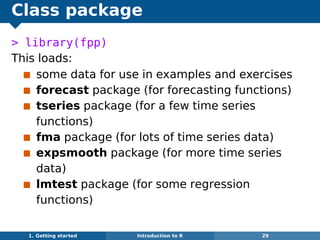

This document provides an outline for a course on applied forecasting. It begins with a brief history of forecasting, covering the rise of stochastic models from the 1950s onward and their advantages over previous subjective approaches. It then discusses types of data commonly used in forecasting, including time series and cross-sectional data. It outlines different forecasting models including time series models, cross-sectional models, and mixed models. It provides four case studies as examples. It also discusses the statistical perspective on forecasting, including point and interval forecasts. It concludes by introducing the R programming language.


