1 


Mobile Application Design ​UMass Lowell Nanofabrication Laboratory
  
F O X ​C A T C H E R, I N C.


2 
Table of Contents 
   
Executive Summary 
Problem Statement 
Market and Competitive Analysis 
Personas 
Treatment 
Staffing 
Timeline/Production Schedule 
Budget Estimate 
Cost Payment Structure and Sign­off Sheet 
Company Statement and Limitations  


3 
 
Executive Summary 
  
UMass Lowell’s state­of­the­art Nanofabrication Laboratory is located in the new 
Mark and Elisia Saab Emerging Technologies Innovation Center.  This research center 
offers many advantages to support their clients’ ventures, including clean room space 
available at daily rates, high­tech equipment with various capabilities, and available 
support and training in the use of this equipment by on­site staff. This is the perfect 
space for technology start­ups who need a laboratory tailored to the complex science of 
nanofabrication.   
Despite all of these advantages, the University is having a difficult time getting 
the word out about their facilities and recruiting new clients to use them.  They are 
currently pursuing new and innovative ways to change that and have enlisted our 
company, Foxcatcher, Inc., to design a mobile application for the Nanofabrication Lab. 
The purpose of this app is to make accessing information about their facilities quick and 
easy.  In doing this we hope to convince both technology­start up companies and 
established businesses to use their labs, particularly those already using the facilities of 
their competitors.  With a visually appealing design, relevant and up to date content, 
and user friendly setup and navigation, we at Foxcatcher, Inc. are confident we can help 
UMass Lowell’s Nanofabrication Laboratory achieve each one of their goals while 
staying on budget. 


4 
Problem Statement 
 
The University of Massachusetts Lowell (UMass Lowell) has launched a business 
model called “Core Research Facilities” where both University researchers and private 
companies can use their high cost facilities.  The goal is for corporate users to pay the 
lion share of the facility’s operating expenses to accommodate for the supply and 
maintenance of its state of the art equipment and professional staff.  The 
Nanofabrication Lab at UMass Lowell needs another channel, beyond LinkedIn, to 
reach out to potential corporate customers to become users. Target customers might 
include: 
 
● Established High Tech companies that may need a particular piece of equipment 
or space for a special project, such as Raytheon, MA/Com, and MKS Microchem. 
● Start­up companies, (venture capital funded) that have limited capabilities on 
their own but need the tools and lab to prototype and develop their products, 
such as MC10 and ZS Genetics. 
● Established small tech companies, such as QMagiq. 
Additional Information 
● Users pay to use the lab and equipment. 
● UMass Lowell might launch a foundry service (where its staff does the work for 
its   corporate users). 
● Staff is limited (3 people). 
● Operating cost annually is approximately $600,000. 
● Harvard University (CNS) is the established local competition with a lab 2.5 times 
the size of UMass Lowell’s facility with 1400 users. 
The goal of this project is to develop a series of web pages with a complementary 
mobile application to promote the use of Core Research Facilities, further descriptions 
all of the equipment that the facility has to offer. Solutions must work in tandem with 
current LinkedIn initiatives. Additional work will include the development of a calendar 
as a mobile app for the scheduling of time in the various facilities and its associated 
equipment. 
 
The budget for this project is $24,000. 


5 
Competitive Analysis
  The Umass Lowell Nanofabrication center has five major competitors.  Harvard 
University (CNS) is their main competition, with facilities at Boston College, Boston 
University, Northeastern University, and University of New Hampshire also occupying 
the same space of industry.  UMass Lowell has a lot of great attributes to attract 
customers, such as convenience of travel and state­of­the art equipment.  Being newer 
to the industry, UMass Lowell faces many challenges convincing potential clients to use 
their facilities. Their competitors have a small advantage on Umass Lowell due to the 
fact that they already have an expansive clientele. 
 
One goal of the Nanofabrication Laboratory at UMass Lowell is to convince 
Harvard CNS users to come to their facilities instead.  This is not as simple as it sounds, 
as Harvard is an established laboratory 2.5 times the size of the facilities at UMass. 
Harvard’s facility also has more staff members available to help users than UMass 
Lowell.   
  
One weaknesses that Harvard University’s labs have compared to UMass Lowell 
is the lack of a calendar for scheduling time and space at the lab.  This makes it much 
more of a hassle for clients to reserve time slots, which gives UMass Lowell a 
competitive advantage. While Harvard does have a user portal, they have no mobile 
application to supplement it.  


6 
James Hayes: Educator and Engineer 
UMass Lowell engineering professor, uses lab for his research 
 
Educational and Professional Background: 
● B.S. from UMass Lowell 
● M.S degree from Northeastern University 
● Ph.D. from Northeastern University 
● Systems/Software Engineer for HP 
● United States Air Force Engineering Technician 
● Professor in electrical and computer engineering at UMass Lowell 
 
Objectives: 
Conduct independent​ ​research in the design, fabrication, and properties of 
metamaterials, specifically electromagnetics, micro­ and nano­scale device modeling. 
 
Questions and Concerns:   
● Is lab use free for UMass Lowell faculty? 
● Are the lab hours flexible enough to accommodate my busy schedule? 
● Is the equipment capable of supporting my specific research? 
● Is there always a knowledgeable staff member on hand to assist in use of 
equipment? 
● What amount of space and privacy will I have while doing my research? 
 
Quote: 
“As a professor, the bulk of my time is spent teaching. I need a laboratory that will allow 
me to make the most of the scarce and valuable time I have for my independent 
research.” 


7 
Michael Smith: Plastics Engineering Student  
UMass Lowell Graduate Student, uses labs for his classes  


Educational Background​:  
● B.S. in Plastics Engineering  
● Graduate student​ working towards his M.S. in Plastics Engineering  
 
Objectives​:  
● Uses the Nanotech lab for personal and project­based usage for plastics and 
engineering new designs for helping to rebuild a casing for his iphone 5  
● Creating a new plastic model design for his team within his class at UMass Lowell.  
 
Questions and Concerns​:  
● Is the lab use free for all UMass Lowell science­majors? 
● What are the lab hours for both group and personal usage? 
● Is the lab equipment capable of supporting my research alongside my fellow colleagues? 
● Will there be any assistance available when I am using the labs?  
 
Quotes:  
● “I have experience not just with the theoretical, but with the hands on as well. I feel 
well­rounded and have exposure to every facet of plastics engineering,” 


8 
Jim Cook: Technology Start­Up Owner 
Oversees technicians use of the lab 
 
 
Educational and Professional Background​:  
● B.S in business administration from Bryant University 
● Has founded and sold two other successful start ups.   
 
Questions and Concerns: 
● How user friendly is the laboratory? 
● What do you offer that your competitors do not? 
● How quickly can UMass react to my rapidly changing needs? 
● How easily can I schedule lab time? 
 
Objective: 
● Minimize the amount of time it takes to become familiar with labs and services. 
● Become familiar with facets of nanofabrication important to their team 
● Maximize flexibility in schedule and scale. 
● Utilize social media, email, and apps to create a dialogue with the lab that will allow him 
to voice his needs and feel heard. 
Quotes:  
● “I know how to run a business, not a lab. I know exactly what we are going to need, but I 
don’t know how a lab operates, and don’t feel like I should have to know.” 


9 
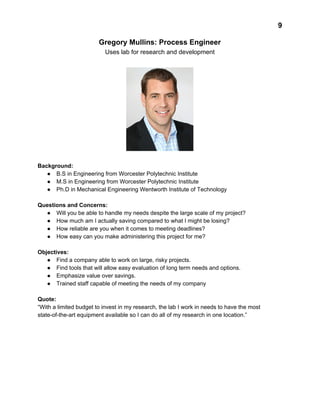
Gregory Mullins: Process Engineer 
Uses lab for research and development 


Background:  
● B.S in Engineering from Worcester Polytechnic Institute 
● M.S in Engineering from Worcester Polytechnic Institute 
● Ph.D in Mechanical Engineering Wentworth Institute of Technology 
 
Questions and Concerns: 
● Will you be able to handle my needs despite the large scale of my project? 
● How much am I actually saving compared to what I might be losing? 
● How reliable are you when it comes to meeting deadlines? 
● How easy can you make administering this project for me? 
 
Objectives: 
● Find a company able to work on large, risky projects. 
● Find tools that will allow easy evaluation of long term needs and options. 
● Emphasize value over savings. 
● Trained staff capable of meeting the needs of my company 
 
Quote:  
“With a limited budget to invest in my research, the lab I work in needs to have the most 
state­of­the­art equipment available so I can do all of my research in one location.” 


10 
 
Treatment 
 
Creating a mobile application for the UMass Lowell Nanofabrication Laboratory 
will serve to attract new users by making their information more accessible than the 
traditional website they have relied on in the past. In addition to bringing new users to 
their facilities, everyone who downloads this app will be able to stay up to date on 
information with just the touch of their fingertips. The most exciting aspect of this mobile 
app, however, is the calendar. This feature, which is not available through the website, 
will make it easier than ever before for users to schedule time in the lab.  In today’s 
fast­paced and technologically inclined world, consumers need to be able to access 
information quickly and easily. The app that we propose does just that, and as a direct 
result, we expect an influx of users will begin to choose the UMass Lowell 
Nanofabrication Laboratory as the place to pursue their ventures.   
  At Foxcatcher, Inc., we recognize that for someone to want to use something, it 
must be more than efficient. To be truly engaging, the aesthetics must correspond with 
the message you are trying to convey. As well as being exceptionally functional, the 
mobile app we have designed emulates the crisp, clean and cutting edge look of the 
laboratory.  In terms of color, we have chosen to use the same blue and white that is 
featured on the Core Research Facilities website.  This serves to provide a seamless 
uniformity with the University’s existing web pages while also giving the app the sleek 
look we are trying to achieve.  The look and feel will be consistent page to page, 
 
11 
creating a seamless whole that both informs and stimulates interest in the 
Nanofabrication Lab. 
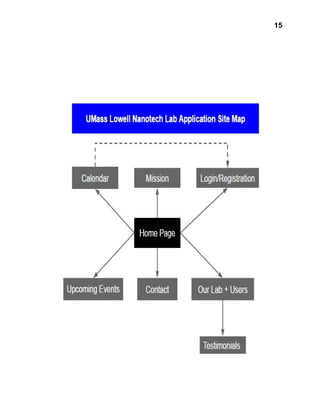
  The app will consist of seven central pages, which have been inspired from the 
Core Research Facilities website. Implementing these pages into the app is crucial in 
creating consistency between the two platforms and ensuring every piece of content is 
carried over from their website. We have, however, opted to make a few subtle changes 
in arrangement.  The mobile app is all about convenience and accessibility, so the way 
we have presented the information has been done in a manner that will optimize the 
user’s experience.  
  Opening the app automatically directs the user to the home page.  The home 
page may seem trivial in a sense, but considering it is the first opportunity to lure users 
in, presentation and aesthetics are incredibly important. In the top center of the page, 
users will see the Core Research Facilities logo, followed by content originating from 
their website.  The introduction is one of the first things users will notice.  Just like on 
the website, the introduction will be split into two categories for ease of use: Core 
Research Facilities and Campus Resources. In an effort to effectively promote the 
facilities, we have chosen to also include UMass Lowell’s video showcasing the lab, 
titled “UMass Lowell Nanomanufacturing Laboratory”. While this setup is visually 
appealing, showcasing this video on the homepage will also be helpful to new users 
who have little to no knowledge about the facilities. 
  For easy navigation, we have designed a taskbar that slides out by swiping down 
from the banner image on the page or pressing the menu icon located in the left corner 
 
12 
beneath the same image.  Opening this task bar fills about a quarter of the horizontal 
space on the screen and gives the user access to links for the other six pages of the 
app.  The links are as follows (from left to right/top to bottom of the taskbar): Mission, 
Login/Registration, Calendar, Our Labs + Users, Upcoming Events, and Contact Us. 
  Similar to the Core Research Facilities website, the login/registration page will 
give users two clickable links to chose from: One for internal users who have not yet 
registered, one for external users who have not registered, and one for existing users to 
login with their credentials.  Registration requires users to read basic content adopted 
from the Core Research Facilities website before they are able to sign up, at which point 
they will be redirected to the website’s registration page.  Users who already have their 
login credentials will be able to view their personal information upon logging in.  It is 
important to note that in order to use the calendar feature of this app, a user first be 
logged in.  Users who try to access this feature without logging in will automatically be 
directed to the login/registration page before they can proceed. 
  The interactive calendar portion of the app is designed to make scheduling time 
in the lab as simple for the user as possible.  Similar to the lab’s website, which includes 
a “search resources” page, our calendar feature allows users to choose from certain 
resources which will help determine what space is available when.  Once the user 
accesses the calendar, they will be able to choose, via two drop down menus, the 
resources they require. There will be two drop down menus specifying if the user wants 
to reserve a time for a specific tool/resource or if the user wants to search by the type of 
laboratory. Once they make their selections, a new page will open up which details what 
 
13 
specific equipment and facilities will be available for the next 30 days. To make a 
reservation, users simply click on a desired timeslot and input their name and email. 
Their request will be sent to a laboratory staff member who will then send a confirmation 
email to that user. However, let’s say that a user comes along and bypasses the app by 
calling the contact first. Whoever made a web reservation first will take precedent. 
  The mission page is dedicated to informing the user of the Core Research 
Facilities’ goals and purpose.  The mission statement, which we took directly from the 
website, is imperative to include in the app as it explains the company’s reason for 
existing and may play a role in recruiting new users.  To supplement this essential piece 
of information, we have inserted below it another video from the lab, titled “The Science 
of Small Things”. 
  The Our Labs and Users page is one portion of the app we felt was especially 
necessary to include. It not only gives the important factor of credibility to the lab, but it 
also affords potential new users with a level of assurance in their decision.  Featured on 
this page is a list of current clientele along with their testimonials describing positive 
experiences using the facilities.  To further our goal of making this app highly usable 
and informative, three links are available which will direct users to the online pages for 
each individual lab. Instead of showcasing a simple list of current and previous clientele, 
we as a group decided it was best to couple testimonials with company names and 
photos of those users to give a more personal feel to the page. For their convenience, 
users will find a downloadable PDF version of the brochure directly underneath the 
testimonials.  
 
14 
  There is also a page on the app dedicated to upcoming events hosted by the 
Core Research Facilities. These will be updated on a regular basis in synch with the 
website.  It is important to showcase these events for promotional purposes.  Examples 
of events may include lab walkthroughs or guest speakers lecturing about innovations 
the industry. 
  Contact information will be included on the final page of the app, complete with 
the address of the facilities, phone numbers, and emails. This has all been taken 
directly from the Core Research facilities website like the rest of the content. 
  After designing and developing the app, it is crucial to make sure all of the 
features work correctly. As part of his or her responsibilities, the app developer analyzes 
and resolves problems associated with tests and debugs the system.  Our team, 
however, will take testing one step further and sit in as the user to make sure everything 
is working properly. Other than internal team testing, we will be doing rounds of testing 
with volunteers, not unlike how video games are tested for bugs today. Through this 
testing, we will be employing volunteers from multiple demographics to get unbiased 
and fair feedback on the application. Through the feedback given, we will make the 
changes needed and make sure the app is ready for release to the masses. 
Alternative Treatment 
 
In our original treatment and budget, we have designed the app to be compatible 
with both the Android and the iPhone. Our client may decide they only want to develop 
an app for one of these platforms, which would cut out the cost of one programmer and 
save them $4,600.  This would make the cost of the project $11,566 instead of $16,166. 
 
 
15 


16 


17 
 
 
18 
 
19 
 
 
20 
 
 
21 
 
 
22 
 
 
23 
 
Sam Cohen, ​Project Manager 
Interactive Media Experience: ​I am currently a senior at 
Fitchburg State working towards a degree in Professional 
Communications.  Outside of the University I have found work as 
a journalist writing for several media outlets.  Given my 
educational and practical experience, I am quite familiar working 
alongside a team to create exceptional content. Work experience 
includes writing for Sumo Skinny Magazine, Under The Gun 
Review, Substream Magazine, and The Jewish Advocate.  Upon 
graduation I hope to build on my knowledge gained at Fitchburg 
State and my work experience to date by pursuing a career in 
film journalism or marketing. 
    
Elizabeth McAvoy, ​Technical Writer 
Interactive Media Experience:​ As a Communications Media 
student at Fitchburg State University, I have been exposed to a 
diversity of educational experiences in Professional 
Communications. Courses in Advertising, Public Relations, 
Document Design, and Marketing have given me a well­rounded 
view of the field, as well as hands on experience in creating 
professional documents for clients, such as the Fitchburg Art 
Museum. In my additional concentration of writing, I learned to 
craft messages for a variety of different audiences and 
platforms. As a marketing intern at Harvard Business School 
Publishing, I worked alongside Harvard Business Review to 
write copy for their bi­annual Backlist Catalog 
 
John Crowley,​ Target Market Representative 
Interactive Media Experience​: As a Professional 
Communications student at Fitchburg State University, 
experience in communications media theory has given me an 
understanding in how people use, adapt, and react to 
technology.  This includes strategies in utilizing new 
technologies, message design and document design. 


24 
Stephen Hilton​, Project Role: Web Designer  
Interactive Media Experience:​ Concentrating in Professional Communications at 
Fitchburg State University has given me the opportunity to expand my knowledge in 
multiple areas of the broad field of communications. Document Design, in particular, has 
caused my interest in the area of project design to grow. This class allowed me to take 
part in updating the Fitchburg Art Museums website, which not only expanded my 
knowledge in document design but afforded me the experience of working with real 
clients and concrete deadlines. 
 
Grant Gisherman, ​Social Media Consultant 
Interactive Media Experience:​ I am a self­taught social media expert with proficient 
knowledge in Facebook, LinkedIn, Twitter, and various other social networks.  While 
many individuals see these websites and applications merely as an outlet for socializing 
with others, I have the knowledge and experience to use them to carry out successfully 
marketing, advertising, and public relations campaigns.  experience has included of a 
strong social media experience, additionally with the classes of management, human 
communication and document design. 


Kyle Prudhomme​, Project Organizer 
Interactive Media Experience:​ I am a Communications Media 
student concentrating in Professional Communications. Classes 
such as Message Design and Document Design have given me an 
in­depth understanding of this exciting field. I bring an extensive 
knowledge in Microsoft Excel to the team. Being editor of my high 
 
25 
school newspaper for three years gave me valuable experience in being a team 
member and I gained practical knowledge in page layout and within Adobe Photoshop. I 
also have background in coding with programs such as C++ and Java. 


26 
Budget 
 
Item  Quantity (Hours)  Unit Cost  Total Cost 
Programmer 1 
(iPhone) 
184  $25  $4,600 
Programmer 2 
(Android) 
184  $25  $4,600 
Photos  ­­  Property of CRF  ­­ 
Video  ­­  Property of CRF  ­­ 
Testing 
(Volunteers) 
5 (Alpha), 5 (Beta)  Free  0 
       
Foxcatcher, Inc.  376  $18  $6,768 
iTunes App Store  ­­  $99  $99 
Android App Store  ­­  $99  $99 
Total Expenses        $16,166 
   
The preliminary budget for this project was $24,000; the estimated budget for this 
project is $16,166. Our company charges $18.00 per hour and with a total of 376 hours 
estimated to be spent on this project, we will earn $6,768.  Divided equally between the 
six of us, each member of our company will take home $1,128. 
  Since we did all of the design work ourselves, we did not need to hire a 
developer for this project. This saved our client a considerable amount of money.  The 
coding for applications is completely different from one platform to the next, so we 
needed to hire two programmers: one for an iPhone and one for an Android. Hiring two 
 
27 
separate programmers to work simultaneously allowed us to finish the project sooner. 
Spending 184 hours programming and debugging at $25, the cost to hire each 
programmer is $4,600. Photos and videos used in the app were taken directly from our 
clients website at no cost, and there was also no cost to testing our app as we used 
volunteers.  The only additional cost to the client is the entry fee into the iTunes and 
Android app stores at $99 each and this fee must be paid annually. 


FoxcatcherInc.Proposal