MEANING OF FORFEITURE
A legal action whereby a person losses all
interest in the ‘forfeit’ property.
A thing forfeited is the one which is taken from
somebody accused of committing a misdeed;
that which is lost, or the right to which is
alienated, by a crime, breach of contract etc.
FORFEITURE OF SHARES
If the shareholders failed to pay a valid call
within the stipulated time, the company may sue
them for the amount of call after waiting for a
reasonable period or may forfeit shares for the
non-payment of any call or installment of call.
But such forfeiture can take place only if a
‘special’ and clear power in the articles is given
to the Directors to do so.
When the power is given in the articles, it must be
‘strictly’ exercised in accordance with the
regulations regarding notice, procedure and
manner stated therein, otherwise the forfeiture may
be void.
Companies normally adopt Regulations 28 to 38 of
Table F with regard to forfeiture of shares.
1: In Accordance With The Articles
As per the English Law, shares can be forfeited
only for the non-payment of calls money as a way
of penalty for the non-payment of such calls.
*Forfeiture on any other ground would be an
illegal reduction of share capital.*
However, the Supreme Court of India has now
held that there is no provision in the Companies
Act restricting the right the exercise of the right
to forfeit shares, to the non-payment of calls
only.
A company can forfeit the shares for reason being
other than non-payment of calls only if the
articles lawfully provides grounds for such
forfeiture, provided the provisions in the articles
are not against the Companies Act, Law of the
Land, and public policy.
Naresh Chandra Sanyal v/s
Calcutta Stock Exchange
A stock broker holding a fully paid share in the
Exchange carried on business on its premises.
He had agreed to buy certain shares from a
company, but failed to carry out his
commitment. The shares were then resold by
the company with the authority of The
Exchange. The broker was required to pay the
difference between contract and resale prices.
On his failure to do so, his shares was forfeited.
• Forfeiture on any other ground would
be an illegal reduction of share capital.
Forfeiture of shares does not amount to any sort
of reduction in capital as the Company is under an
obligation to dispose them off and cannot retain
the same. Further, reissue of forfeited shares is
only a sale not allotment. The Companies can
reissue shares even at a discount but the amount
of discount should not exceed the actual amount
forfeited on shares. The Section 53 prohibits only
the original issue of shares at a discount.
2:Notice Precedent To Forfeiture
A notice under the authority of the Director
should be served to the defaulting shareholder.
It should must mention (i) amount due from
defaulting shareholder (ii) the which the amount
is to be paid, which should not b before 14 days
from the date of service.
3:Resolution of Forfeiture
The notice alone does not operate forfeiture.
The Directors have to pass a resolution at a
Board of Directors meeting, declaring the
forfeiture.
4:Good Faith
The power to forfeit shares is in the nature of
trust and cannot be used at the request of the
shareholder to relieve him from shares. The
power must be exercised in good faith in the
interest of the company.
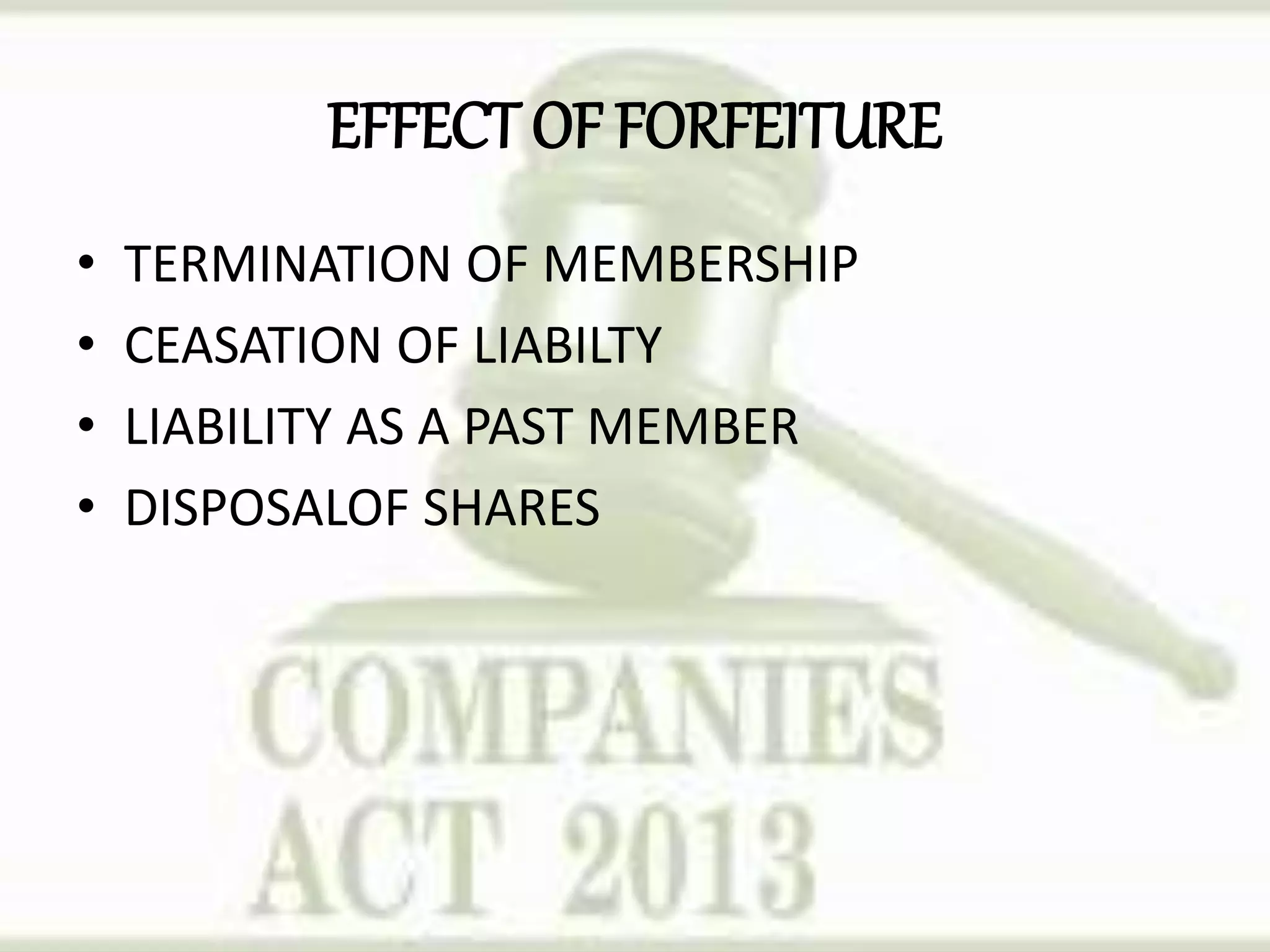
EFFECT OF FORFEITURE
• TERMINATION OF MEMBERSHIP
• CEASATION OF LIABILTY
• LIABILITY AS A PAST MEMBER
• DISPOSALOF SHARES
Forfeiture of Shares

Forfeiture of Shares

  • 4.
    MEANING OF FORFEITURE Alegal action whereby a person losses all interest in the ‘forfeit’ property. A thing forfeited is the one which is taken from somebody accused of committing a misdeed; that which is lost, or the right to which is alienated, by a crime, breach of contract etc.
  • 5.
    FORFEITURE OF SHARES Ifthe shareholders failed to pay a valid call within the stipulated time, the company may sue them for the amount of call after waiting for a reasonable period or may forfeit shares for the non-payment of any call or installment of call. But such forfeiture can take place only if a ‘special’ and clear power in the articles is given to the Directors to do so.
  • 6.
    When the poweris given in the articles, it must be ‘strictly’ exercised in accordance with the regulations regarding notice, procedure and manner stated therein, otherwise the forfeiture may be void. Companies normally adopt Regulations 28 to 38 of Table F with regard to forfeiture of shares.
  • 8.
    1: In AccordanceWith The Articles As per the English Law, shares can be forfeited only for the non-payment of calls money as a way of penalty for the non-payment of such calls. *Forfeiture on any other ground would be an illegal reduction of share capital.* However, the Supreme Court of India has now held that there is no provision in the Companies Act restricting the right the exercise of the right to forfeit shares, to the non-payment of calls only.
  • 9.
    A company canforfeit the shares for reason being other than non-payment of calls only if the articles lawfully provides grounds for such forfeiture, provided the provisions in the articles are not against the Companies Act, Law of the Land, and public policy.
  • 10.
    Naresh Chandra Sanyalv/s Calcutta Stock Exchange A stock broker holding a fully paid share in the Exchange carried on business on its premises. He had agreed to buy certain shares from a company, but failed to carry out his commitment. The shares were then resold by the company with the authority of The Exchange. The broker was required to pay the difference between contract and resale prices. On his failure to do so, his shares was forfeited.
  • 11.
    • Forfeiture onany other ground would be an illegal reduction of share capital. Forfeiture of shares does not amount to any sort of reduction in capital as the Company is under an obligation to dispose them off and cannot retain the same. Further, reissue of forfeited shares is only a sale not allotment. The Companies can reissue shares even at a discount but the amount of discount should not exceed the actual amount forfeited on shares. The Section 53 prohibits only the original issue of shares at a discount.
  • 12.
    2:Notice Precedent ToForfeiture A notice under the authority of the Director should be served to the defaulting shareholder. It should must mention (i) amount due from defaulting shareholder (ii) the which the amount is to be paid, which should not b before 14 days from the date of service.
  • 13.
    3:Resolution of Forfeiture Thenotice alone does not operate forfeiture. The Directors have to pass a resolution at a Board of Directors meeting, declaring the forfeiture.
  • 14.
    4:Good Faith The powerto forfeit shares is in the nature of trust and cannot be used at the request of the shareholder to relieve him from shares. The power must be exercised in good faith in the interest of the company.
  • 15.
    EFFECT OF FORFEITURE •TERMINATION OF MEMBERSHIP • CEASATION OF LIABILTY • LIABILITY AS A PAST MEMBER • DISPOSALOF SHARES