




Forensic
psychologists &
immigration law
June 29th, 2016
Speaker: Julia McLawsen, PhD
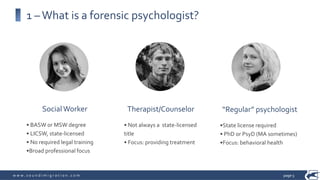
Greg McLawsen
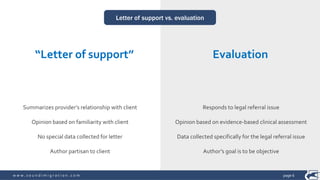
Managing Attorney
Sound Immigration
@mclawsen
greg@soundimmigration.com
www.soundimmigration.com
Julia McLawsen, PhD
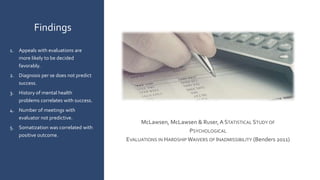
Licensed Psychologist (WA)
Registered Psychologist (BC – inactive)
julia@lawandpsychology.com
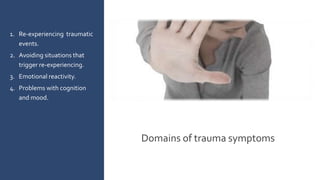
www.lawandpsychology.com
w w w . s o u n d i m i g r a t i o n . c o m
Roadmap
What is a “forensic” psychologist?01
02 Letter of support v. evaluation
03 Elements of an evaluation
04 Objective testing instruments
05 Hardship waivers
06 VAWA, U-Visas & 751 waivers
07 Drug/alcohol abuse
08
page 4
Self-harm inadmissibility
w w w . s o u n d i m i g r a t i o n . c o m
Therapist/Counselor
• Not always a state-licensed
title
• Focus: providing treatment
SocialWorker
• BASW or MSW degree
• LICSW, state-licensed
• No required legal training
•Broad professional focus
“Regular” psychologist
•State license required
• PhD or PsyD (MA sometimes)
•Focus: behavioral health
1 –What is a forensic psychologist?
page 5
w w w . s o u n d i m i g r a t i o n . c o m
Letter of support vs. evaluation
Summarizes provider’s relationship with client
Opinion based on familiarity with client
No special data collected for letter
Author partisan to client
page 6
“Letter of support”
Responds to legal referral issue
Opinion based on evidence-based clinical assessment
Data collected specifically for the legal referral issue
Author’s goal is to be objective
Evaluation
w w w . s o u n d i m i g r a t i o n . c o m
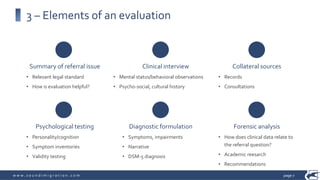
Psychological testing
• Personality/cognition
• Symptom inventories
• Validity testing
Diagnostic formulation
• Symptoms, impairments
• Narrative
• DSM-5 diagnosis
Forensic analysis
• How does clinical data relate to
the referral question?
• Academic reesarch
• Recommendations
3 – Elements of an evaluation
Summary of referral issue
• Relevant legal standard
• How is evaluation helpful?
Clinical interview
• Mental status/behavioral observations
• Psycho-social, cultural history
Collateral sources
• Records
• Consultations
page 7
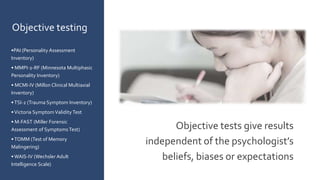
Objective tests give results
independent of the psychologist’s
beliefs, biases or expectations
Objective testing
•PAI (Personality Assessment
Inventory)
• MMPI-2-RF (Minnesota Multiphasic
Personality Inventory)
• MCMI-IV (Millon Clinical Multiaxial
Inventory)
•TSI-2 (Trauma Symptom Inventory)
•Victoria SymptomValidity Test
• M-FAST (Miller Forensic
Assessment of SymptomsTest)
•TOMM (Test of Memory
Malingering)
• WAIS-IV (Wechsler Adult
Intelligence Scale)
w w w . s o u n d i m i g r a t i o n . c o m
Working with a forensic psychologist
help me
help you
page 9
Examples of
Immigration
Evaluations
w w w . s o u n d i m i g r a t i o n . c o m
HardshipWaivers
page 11
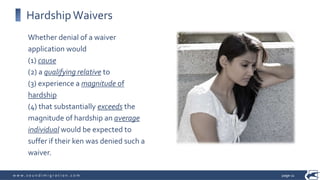
Whether denial of a waiver
application would
(1) cause
(2) a qualifying relative to
(3) experience a magnitude of
hardship
(4) that substantially exceeds the
magnitude of hardship an average
individual would be expected to
suffer if their ken was denied such a
waiver.
McLawsen, McLawsen & Ruser,A STATISTICAL STUDY OF
PSYCHOLOGICAL
EVALUATIONS IN HARDSHIP WAIVERS OF INADMISSIBILITY (Benders 2011)
Findings
1. Appeals with evaluations are
more likely to be decided
favorably.
2. Diagnosis per se does not predict
success.
3. History of mental health
problems correlates with success.
4. Number of meetings with
evaluator not predictive.
5. Somatization was correlated with
positive outcome.
w w w . s o u n d i m i g r a t i o n . c o m
HardshipWaivers
• Who is/are the Qualifying Relative(s)?
• How do you think I can help you prove hardship?
• Country conditions – not my expertise!
• Do you have a theory for why relocation is infeasible?
• If you have records, let me see them!
page 13
VAWA
U-Visas
I-751 abuse waivers
Domains of trauma symptoms
1. Re-experiencing traumatic
events.
2. Avoiding situations that
trigger re-experiencing.
3. Emotional reactivity.
4. Problems with cognition
and mood.
w w w . s o u n d i m i g r a t i o n . c o m
Alcohol/drug abuse
page 16
Understanding
drug/alcohol abuse
diagnoses
Factors tending to
show remission
1. Evidence based
treatment  function
of abuse?
2. Active participation
targeting use
patterns?
3. Lifestyle changes?
4. Relapse prevention
plan?
5. Accountability?
Self harm
Intake questions for
self-harm
1. Have you even been
in therapy?
2. Have you ever
intentionally hurt
yourself?
3. If so, when?
4. Get a release of
information for all
mental health
records.
Referral questions for
self-harm evaluation
1. Does client current
meet dX criteria for
mental disorder?
2. Describe the nature
and severity of self-
harmful behavior.
3. What is the likelihood
of future self-harmful
behavior?
4. Will treatment
reduce likelihood of
future harm?
Thank you
Julia McLawsen, PhD
(206) 289-0456
julia@lawandpsychology.net
www.lawandpsychology.net

Forensic psychologists & immigration law

  • 1.
    Forensic psychologists & immigration law June29th, 2016 Speaker: Julia McLawsen, PhD
  • 2.
    Greg McLawsen Managing Attorney SoundImmigration @mclawsen greg@soundimmigration.com www.soundimmigration.com
  • 3.
    Julia McLawsen, PhD LicensedPsychologist (WA) Registered Psychologist (BC – inactive) julia@lawandpsychology.com www.lawandpsychology.com
  • 4.
    w w w. s o u n d i m i g r a t i o n . c o m Roadmap What is a “forensic” psychologist?01 02 Letter of support v. evaluation 03 Elements of an evaluation 04 Objective testing instruments 05 Hardship waivers 06 VAWA, U-Visas & 751 waivers 07 Drug/alcohol abuse 08 page 4 Self-harm inadmissibility
  • 5.
    w w w. s o u n d i m i g r a t i o n . c o m Therapist/Counselor • Not always a state-licensed title • Focus: providing treatment SocialWorker • BASW or MSW degree • LICSW, state-licensed • No required legal training •Broad professional focus “Regular” psychologist •State license required • PhD or PsyD (MA sometimes) •Focus: behavioral health 1 –What is a forensic psychologist? page 5
  • 6.
    w w w. s o u n d i m i g r a t i o n . c o m Letter of support vs. evaluation Summarizes provider’s relationship with client Opinion based on familiarity with client No special data collected for letter Author partisan to client page 6 “Letter of support” Responds to legal referral issue Opinion based on evidence-based clinical assessment Data collected specifically for the legal referral issue Author’s goal is to be objective Evaluation
  • 7.
    w w w. s o u n d i m i g r a t i o n . c o m Psychological testing • Personality/cognition • Symptom inventories • Validity testing Diagnostic formulation • Symptoms, impairments • Narrative • DSM-5 diagnosis Forensic analysis • How does clinical data relate to the referral question? • Academic reesarch • Recommendations 3 – Elements of an evaluation Summary of referral issue • Relevant legal standard • How is evaluation helpful? Clinical interview • Mental status/behavioral observations • Psycho-social, cultural history Collateral sources • Records • Consultations page 7
  • 8.
    Objective tests giveresults independent of the psychologist’s beliefs, biases or expectations Objective testing •PAI (Personality Assessment Inventory) • MMPI-2-RF (Minnesota Multiphasic Personality Inventory) • MCMI-IV (Millon Clinical Multiaxial Inventory) •TSI-2 (Trauma Symptom Inventory) •Victoria SymptomValidity Test • M-FAST (Miller Forensic Assessment of SymptomsTest) •TOMM (Test of Memory Malingering) • WAIS-IV (Wechsler Adult Intelligence Scale)
  • 9.
    w w w. s o u n d i m i g r a t i o n . c o m Working with a forensic psychologist help me help you page 9
  • 10.
  • 11.
    w w w. s o u n d i m i g r a t i o n . c o m HardshipWaivers page 11 Whether denial of a waiver application would (1) cause (2) a qualifying relative to (3) experience a magnitude of hardship (4) that substantially exceeds the magnitude of hardship an average individual would be expected to suffer if their ken was denied such a waiver.
  • 12.
    McLawsen, McLawsen &Ruser,A STATISTICAL STUDY OF PSYCHOLOGICAL EVALUATIONS IN HARDSHIP WAIVERS OF INADMISSIBILITY (Benders 2011) Findings 1. Appeals with evaluations are more likely to be decided favorably. 2. Diagnosis per se does not predict success. 3. History of mental health problems correlates with success. 4. Number of meetings with evaluator not predictive. 5. Somatization was correlated with positive outcome.
  • 13.
    w w w. s o u n d i m i g r a t i o n . c o m HardshipWaivers • Who is/are the Qualifying Relative(s)? • How do you think I can help you prove hardship? • Country conditions – not my expertise! • Do you have a theory for why relocation is infeasible? • If you have records, let me see them! page 13
  • 14.
  • 15.
    Domains of traumasymptoms 1. Re-experiencing traumatic events. 2. Avoiding situations that trigger re-experiencing. 3. Emotional reactivity. 4. Problems with cognition and mood.
  • 16.
    w w w. s o u n d i m i g r a t i o n . c o m Alcohol/drug abuse page 16 Understanding drug/alcohol abuse diagnoses
  • 17.
    Factors tending to showremission 1. Evidence based treatment  function of abuse? 2. Active participation targeting use patterns? 3. Lifestyle changes? 4. Relapse prevention plan? 5. Accountability?
  • 18.
  • 19.
    Intake questions for self-harm 1.Have you even been in therapy? 2. Have you ever intentionally hurt yourself? 3. If so, when? 4. Get a release of information for all mental health records.
  • 20.
    Referral questions for self-harmevaluation 1. Does client current meet dX criteria for mental disorder? 2. Describe the nature and severity of self- harmful behavior. 3. What is the likelihood of future self-harmful behavior? 4. Will treatment reduce likelihood of future harm?
  • 21.
    Thank you Julia McLawsen,PhD (206) 289-0456 julia@lawandpsychology.net www.lawandpsychology.net

Editor's Notes

  • #2 Welcome Free webinar series offered by Sound Immigration Web-based immigration law firm serving clients world wide through secure online collaboration Webinars are offered free of cost to our friends/colleagues in the immigration law community Follow on linked in Have a topic you’d like to see? Let me know Have a topic that you’d like to present? Also let me know
  • #3 I am… Today I’ll be moderating our discussion Dissertation committee re hardship – stay tuned for some interesting research on best practices
  • #7 When would a letter of support be appropriate?
  • #9 Cultural limitations. Photo credit: Stoonn @ freedigitalphotos.com
  • #10 What do you need to know at the start of a case? Deadline How do you think an eval could help your case? What’s your theory of the case? What records do you have? What case law can you share? Is there any information I should approach with special sensitivity Pet peves?
  • #12 Greg takes this one What would be an example of a strong candidate for a hardship eval? Brandon’s case
  • #13 Photo credit: Adamar @ freedigitalphotos.com
  • #16 Photo credit: Ambro @ freedigitalphotos.com Example: unique vulnerabilities
  • #17 What’s effective treatment? As self-medication. Madrolli @ freedigitalphotos.com
  • #18 Photo credit: Serge Bertasius Photography. @ freedigitalphotos.com
  • #19 Greg: intro inadmissibility issue
  • #21 Greg: waiver available, but might be better and just as quick to wait for remission