Weather Forecasting
Chapter 14
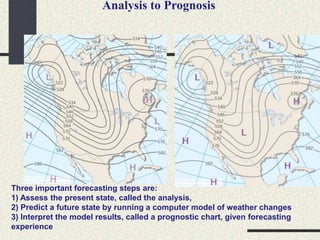
Analysis to Prognosis
Three important forecasting steps are:
1) Assess the present state, called the analysis,
2) Predict a future state by running a computer model of weather changes
3) Interpret the model results, called a prognostic chart, given forecasting
experience
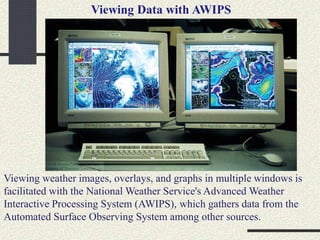
Viewing Data with AWIPS
Viewing weather images, overlays, and graphs in multiple windows is
facilitated with the National Weather Service's Advanced Weather
Interactive Processing System (AWIPS), which gathers data from the
Automated Surface Observing System among other sources.
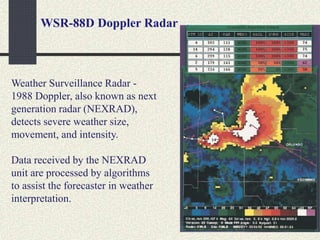
WSR-88D Doppler Radar
Weather Surveillance Radar -
1988 Doppler, also known as next
generation radar (NEXRAD),
detects severe weather size,
movement, and intensity.
Data received by the NEXRAD
unit are processed by algorithms
to assist the forecaster in weather
interpretation.
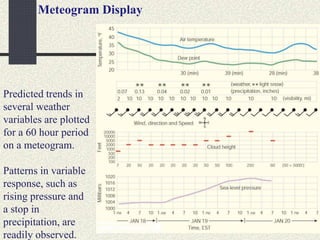
Meteogram Display
Predicted trends in
several weather
variables are plotted
for a 60 hour period
on a meteogram.
Patterns in variable
response, such as
rising pressure and
a stop in
precipitation, are
readily observed.
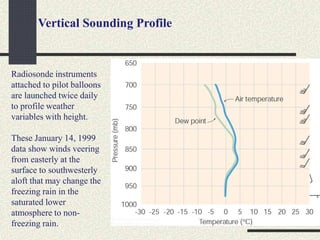
Vertical Sounding Profile
Radiosonde instruments
attached to pilot balloons
are launched twice daily
to profile weather
variables with height.
These January 14, 1999
data show winds veering
from easterly at the
surface to southwesterly
aloft that may change the
freezing rain in the
saturated lower
atmosphere to non-
freezing rain.
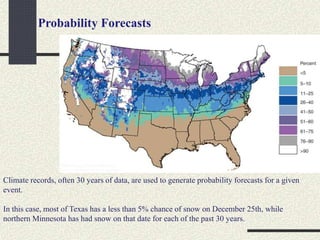
Probability Forecasts
Climate records, often 30 years of data, are used to generate probability forecasts for a given
event.
In this case, most of Texas has a less than 5% chance of snow on December 25th, while
northern Minnesota has had snow on that date for each of the past 30 years.
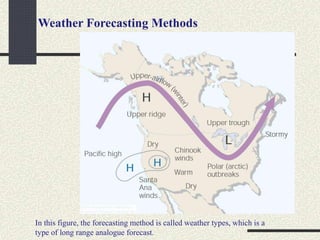
Weather Forecasting Methods
In this figure, the forecasting method is called weather types, which is a
type of long range analogue forecast.
• Persistence - the future will be like the present
• Trend - the future will be like upwind weather
• Analogue - the future will be like weather that historically
occurred when similar conditions were present
Weather Forecasting Methods
Weekly & Monthly Forecasts
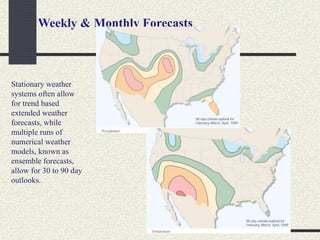
Stationary weather
systems often allow
for trend based
extended weather
forecasts, while
multiple runs of
numerical weather
models, known as
ensemble forecasts,
allow for 30 to 90 day
outlooks.
Forecasting with Surface Charts
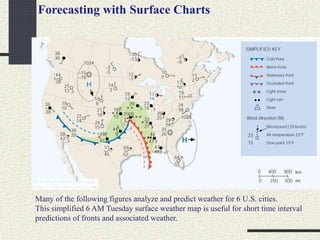
Many of the following figures analyze and predict weather for 6 U.S. cities.
This simplified 6 AM Tuesday surface weather map is useful for short time interval
predictions of fronts and associated weather.
Surface Chart Predictions
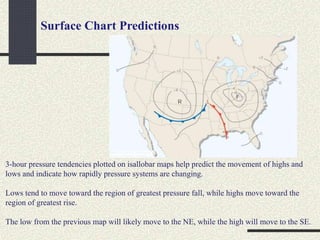
3-hour pressure tendencies plotted on isallobar maps help predict the movement of highs and
lows and indicate how rapidly pressure systems are changing.
Lows tend to move toward the region of greatest pressure fall, while highs move toward the
region of greatest rise.
The low from the previous map will likely move to the NE, while the high will move to the SE.
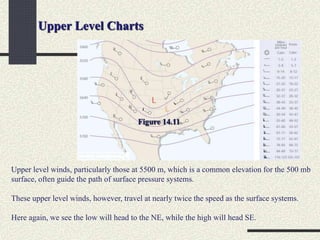
Upper Level Charts
Upper level winds, particularly those at 5500 m, which is a common elevation for the 500 mb
surface, often guide the path of surface pressure systems.
These upper level winds, however, travel at nearly twice the speed as the surface systems.
Here again, we see the low will head to the NE, while the high will head SE.
Figure 14.11
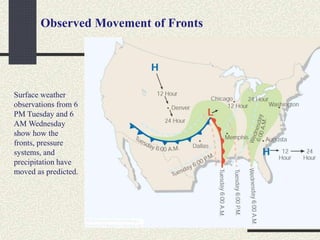
Observed Movement of Fronts
Surface weather
observations from 6
PM Tuesday and 6
AM Wednesday
show how the
fronts, pressure
systems, and
precipitation have
moved as predicted.
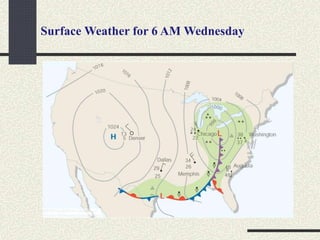
Surface Weather for 6 AM Wednesday
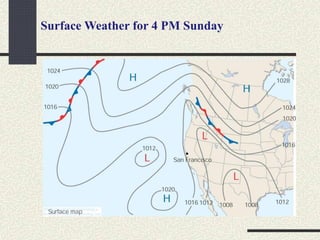
Surface Weather for 4 PM Sunday
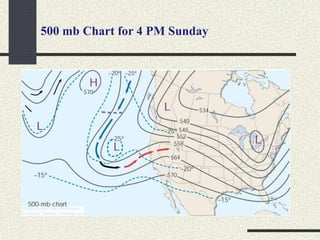
500 mb Chart for 4 PM Sunday
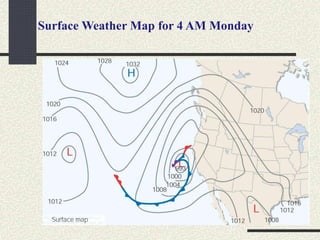
Surface Weather Map for 4 AM Monday

Forecasting (1).ppt

  • 1.
  • 2.
    Analysis to Prognosis Threeimportant forecasting steps are: 1) Assess the present state, called the analysis, 2) Predict a future state by running a computer model of weather changes 3) Interpret the model results, called a prognostic chart, given forecasting experience
  • 3.
    Viewing Data withAWIPS Viewing weather images, overlays, and graphs in multiple windows is facilitated with the National Weather Service's Advanced Weather Interactive Processing System (AWIPS), which gathers data from the Automated Surface Observing System among other sources.
  • 4.
    WSR-88D Doppler Radar WeatherSurveillance Radar - 1988 Doppler, also known as next generation radar (NEXRAD), detects severe weather size, movement, and intensity. Data received by the NEXRAD unit are processed by algorithms to assist the forecaster in weather interpretation.
  • 5.
    Meteogram Display Predicted trendsin several weather variables are plotted for a 60 hour period on a meteogram. Patterns in variable response, such as rising pressure and a stop in precipitation, are readily observed.
  • 6.
    Vertical Sounding Profile Radiosondeinstruments attached to pilot balloons are launched twice daily to profile weather variables with height. These January 14, 1999 data show winds veering from easterly at the surface to southwesterly aloft that may change the freezing rain in the saturated lower atmosphere to non- freezing rain.
  • 7.
    Probability Forecasts Climate records,often 30 years of data, are used to generate probability forecasts for a given event. In this case, most of Texas has a less than 5% chance of snow on December 25th, while northern Minnesota has had snow on that date for each of the past 30 years.
  • 8.
    Weather Forecasting Methods Inthis figure, the forecasting method is called weather types, which is a type of long range analogue forecast.
  • 9.
    • Persistence -the future will be like the present • Trend - the future will be like upwind weather • Analogue - the future will be like weather that historically occurred when similar conditions were present Weather Forecasting Methods
  • 10.
    Weekly & MonthlyForecasts Stationary weather systems often allow for trend based extended weather forecasts, while multiple runs of numerical weather models, known as ensemble forecasts, allow for 30 to 90 day outlooks.
  • 11.
    Forecasting with SurfaceCharts Many of the following figures analyze and predict weather for 6 U.S. cities. This simplified 6 AM Tuesday surface weather map is useful for short time interval predictions of fronts and associated weather.
  • 12.
    Surface Chart Predictions 3-hourpressure tendencies plotted on isallobar maps help predict the movement of highs and lows and indicate how rapidly pressure systems are changing. Lows tend to move toward the region of greatest pressure fall, while highs move toward the region of greatest rise. The low from the previous map will likely move to the NE, while the high will move to the SE.
  • 13.
    Upper Level Charts Upperlevel winds, particularly those at 5500 m, which is a common elevation for the 500 mb surface, often guide the path of surface pressure systems. These upper level winds, however, travel at nearly twice the speed as the surface systems. Here again, we see the low will head to the NE, while the high will head SE. Figure 14.11
  • 14.
    Observed Movement ofFronts Surface weather observations from 6 PM Tuesday and 6 AM Wednesday show how the fronts, pressure systems, and precipitation have moved as predicted.
  • 15.
    Surface Weather for6 AM Wednesday
  • 16.
  • 17.
    500 mb Chartfor 4 PM Sunday
  • 18.
    Surface Weather Mapfor 4 AM Monday