Product Life Cycle
When a product is introduced in a market it
passes through a series of stages and the
concept from launching of product till it is
withdrawn is called as product life cycle.There
are four stages in the product life cycle which is
introduction, growth, maturity and decline. Each
stage has a particular level of sales, profit and
competition.
1) Introduction:When the new product
is launched costs are high
due to sales promotion, research and
product development.The
customers are first time buyers and the
success or failure depends on the
promotional techniques adopted by the
food service institutions.
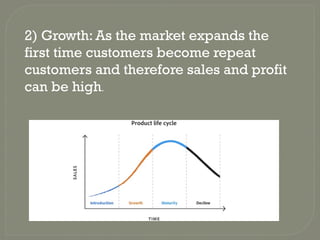
2) Growth: As the market expands the
first time customers become repeat
customers and therefore sales and profit
can be high.
3) Maturity: In the maturity stage costs
may increase as there is competition in
the market and the growth of the
organization may slow down if it is not
managed properly.
4) Decline:The market becomes saturated
with products and demand
falls but the supply release in abundance.
Therefore every food
service organizations should try to be in the
market by launching new
foods or recipes according to the needs of
the customers which will be
constantly changing.
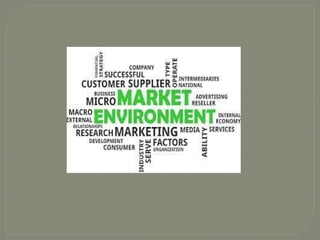
Marketing environment means the internal and
external environment which
affects a business operation.The internal problems
which may arise in the catering operation may be
in the Food and Beverage departments, employees
and control of cash and pricing. External
environment can be, Political, Economic,
Demographic/ Social and Technical factors.
Marketing Environment
Internal Factors
a. Food and Beverage Department
In the food and beverage department perishability of food
can be an important factor which can influence the final
product.The perishability of food has to be checked while
food purchasing, storing and while issuing.Wastage of foods
may lead to poor portioning control and poor production
planning. Pilferage from kitchen, restaurants, bars and store
can be directly influencing the final cost of the product.
b. Employee
Employee shortages often coincide with peaks of
sale activity and surplus can coincide with
troughs of sales activity. Absenteeism, illness and
use of part- time/casual employees in food
service operations can be possible causes for an
internal problem. Poor supervisions can also lead
to poor employee output.
c. Control of Cash and Pricing
Most transactions are conducted on a cash basis in food
and beverage sales outlets and hence good control is
needed. Correct pricing of menus and beverages lists
are important when food prices fluctuate .Tighter
financial and
management controls are required in stores.
If any problems arises outside the organization and that
cannot be solved internally are known as external
environment factors.
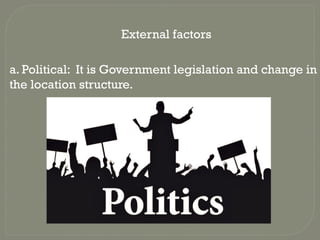
External factors
a. Political: It is Government legislation and change in
the location structure.
b. Economic: Rising costs such as food and
beverages, labour , fuel, rates and
insurance, sales instability, for E.g.: peaks
and troughs of activity that occur on a daily,
weekly and seasonal basis, changes in
expenditure patterns and
people’s disposable incomes, expansion
and retraction of credit facilities and high
interest rates on borrowed capital.
c. Demographic/social environment: It can be
changes in population distribution. For E.g.:
population drifting away from certain areas,
changes in the socio- economic groupings of the
area, growth in ethnic minorities leading to a
demand for more variety of foods and changes in
food fashion. For example, current popularity of
take away foods, healthy eating and diets.
d.Technical environment: It can influence a product can
be mechanization,
for E.g.: in food production and food service where
labour saving devices or
custom made equipments can change the cost of a
product. Product development and food processes, for
eg: vacuum packaging for products. Digital economy,
increasing advertisement cost due to advances in media
for eg: satellite,TV and high percentage of TV and video
ownership. Marketing is an essential element in food
service institutions and many food service operations
have a marketing manager who looks after the sales
promotion, marketing techniques and customer
satisfaction. Hence it is important that to sell a product
marketing and entrepreneurial skills are important.
food service management  presentation.pptx

food service management presentation.pptx

  • 2.
    Product Life Cycle Whena product is introduced in a market it passes through a series of stages and the concept from launching of product till it is withdrawn is called as product life cycle.There are four stages in the product life cycle which is introduction, growth, maturity and decline. Each stage has a particular level of sales, profit and competition.
  • 3.
    1) Introduction:When thenew product is launched costs are high due to sales promotion, research and product development.The customers are first time buyers and the success or failure depends on the promotional techniques adopted by the food service institutions.
  • 4.
    2) Growth: Asthe market expands the first time customers become repeat customers and therefore sales and profit can be high.
  • 5.
    3) Maturity: Inthe maturity stage costs may increase as there is competition in the market and the growth of the organization may slow down if it is not managed properly.
  • 6.
    4) Decline:The marketbecomes saturated with products and demand falls but the supply release in abundance. Therefore every food service organizations should try to be in the market by launching new foods or recipes according to the needs of the customers which will be constantly changing.
  • 8.
    Marketing environment meansthe internal and external environment which affects a business operation.The internal problems which may arise in the catering operation may be in the Food and Beverage departments, employees and control of cash and pricing. External environment can be, Political, Economic, Demographic/ Social and Technical factors. Marketing Environment
  • 10.
    Internal Factors a. Foodand Beverage Department In the food and beverage department perishability of food can be an important factor which can influence the final product.The perishability of food has to be checked while food purchasing, storing and while issuing.Wastage of foods may lead to poor portioning control and poor production planning. Pilferage from kitchen, restaurants, bars and store can be directly influencing the final cost of the product.
  • 12.
    b. Employee Employee shortagesoften coincide with peaks of sale activity and surplus can coincide with troughs of sales activity. Absenteeism, illness and use of part- time/casual employees in food service operations can be possible causes for an internal problem. Poor supervisions can also lead to poor employee output.
  • 14.
    c. Control ofCash and Pricing Most transactions are conducted on a cash basis in food and beverage sales outlets and hence good control is needed. Correct pricing of menus and beverages lists are important when food prices fluctuate .Tighter financial and management controls are required in stores. If any problems arises outside the organization and that cannot be solved internally are known as external environment factors.
  • 16.
    External factors a. Political:It is Government legislation and change in the location structure.
  • 17.
    b. Economic: Risingcosts such as food and beverages, labour , fuel, rates and insurance, sales instability, for E.g.: peaks and troughs of activity that occur on a daily, weekly and seasonal basis, changes in expenditure patterns and people’s disposable incomes, expansion and retraction of credit facilities and high interest rates on borrowed capital.
  • 19.
    c. Demographic/social environment:It can be changes in population distribution. For E.g.: population drifting away from certain areas, changes in the socio- economic groupings of the area, growth in ethnic minorities leading to a demand for more variety of foods and changes in food fashion. For example, current popularity of take away foods, healthy eating and diets.
  • 21.
    d.Technical environment: Itcan influence a product can be mechanization, for E.g.: in food production and food service where labour saving devices or custom made equipments can change the cost of a product. Product development and food processes, for eg: vacuum packaging for products. Digital economy, increasing advertisement cost due to advances in media for eg: satellite,TV and high percentage of TV and video ownership. Marketing is an essential element in food service institutions and many food service operations have a marketing manager who looks after the sales promotion, marketing techniques and customer satisfaction. Hence it is important that to sell a product marketing and entrepreneurial skills are important.