Food Chains and Food
Webs
Energy Flow in Nature
Energy Roles
•An organism’s energy
role in an ecosystem
may be that of a
producer, consumer, or
decomposer.
Eat or be eaten
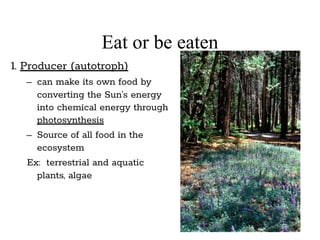
1. Producer (autotroph)
– can make its own food by
converting the Sun’s energy
into chemical energy through
photosynthesis
– Source of all food in the
ecosystem
Ex: terrestrial and aquatic
plants, algae
Mmmmm…delicious.
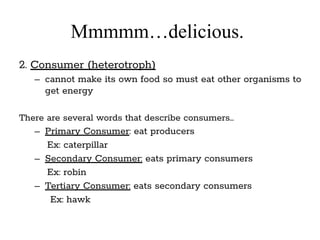
2. Consumer (heterotroph)
– cannot make its own food so must eat other organisms to
get energy
There are several words that describe consumers…
– Primary Consumer: eat producers
Ex: caterpillar
– Secondary Consumer: eats primary consumers
Ex: robin
– Tertiary Consumer: eats secondary consumers
Ex: hawk
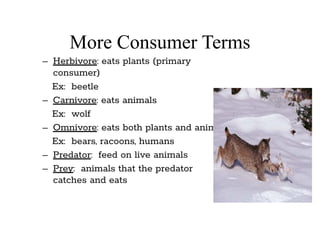
More Consumer Terms
– Herbivore: eats plants (primary
consumer)
Ex: beetle
– Carnivore: eats animals
Ex: wolf
– Omnivore: eats both plants and animals
Ex: bears, racoons, humans
– Predator: feed on live animals
– Prey: animals that the predator
catches and eats
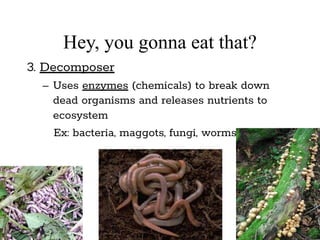
Hey, you gonna eat that?
3. Decomposer
– Uses enzymes (chemicals) to break down
dead organisms and releases nutrients to
ecosystem
Ex: bacteria, maggots, fungi, worms
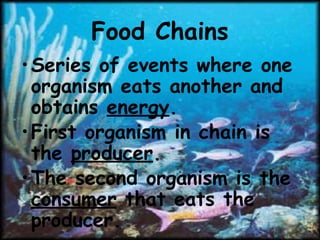
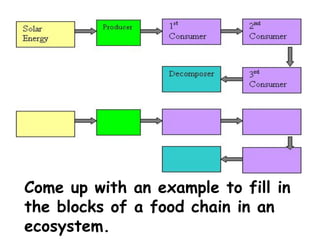
Food Chains
•Series of events where one
organism eats another and
obtains energy.
•First organism in chain is
the producer.
•The second organism is the
consumer that eats the
producer.
Come up with an example to fill in
the blocks of a food chain in an
ecosystem.
Food Web
•Consists of many
overlapping food chains in
an ecosystem.
•Some organisms may play
more than one role by
changing consumer levels.
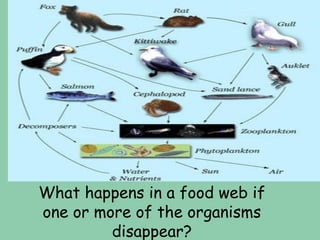
Food webs
• All organisms need FOOD to survive!
• Food webs show what eats what.
What happens in a food web if
one or more of the organisms
disappear?
Which
animals are
carnivores
and
herbivores?
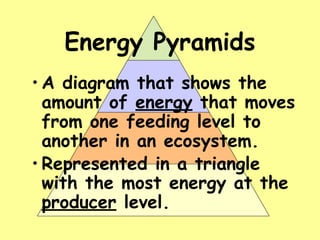
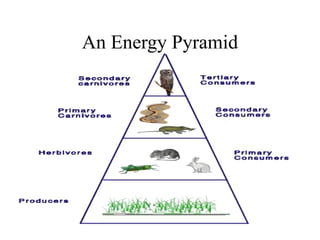
Energy Pyramids
• A diagram that shows the
amount of energy that moves
from one feeding level to
another in an ecosystem.
• Represented in a triangle
with the most energy at the
producer level.
An Energy Pyramid
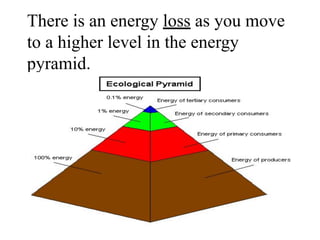
Energy Loss and Use
• 10% of energy is transferred to next
higher level.
• 90% of energy is used by organisms’
life processes.
• Due to energy loss, ecosystem cannot
support many feeding levels.
• The more levels in an energy pyramid,
the less energy is left for the top
consumer from the original producer.
There is an energy loss as you move
to a higher level in the energy
pyramid.

food chains and web.ppt.pdf

  • 1.
    Food Chains andFood Webs Energy Flow in Nature
  • 2.
    Energy Roles •An organism’senergy role in an ecosystem may be that of a producer, consumer, or decomposer.
  • 3.
    Eat or beeaten 1. Producer (autotroph) – can make its own food by converting the Sun’s energy into chemical energy through photosynthesis – Source of all food in the ecosystem Ex: terrestrial and aquatic plants, algae
  • 4.
    Mmmmm…delicious. 2. Consumer (heterotroph) –cannot make its own food so must eat other organisms to get energy There are several words that describe consumers… – Primary Consumer: eat producers Ex: caterpillar – Secondary Consumer: eats primary consumers Ex: robin – Tertiary Consumer: eats secondary consumers Ex: hawk
  • 5.
    More Consumer Terms –Herbivore: eats plants (primary consumer) Ex: beetle – Carnivore: eats animals Ex: wolf – Omnivore: eats both plants and animals Ex: bears, racoons, humans – Predator: feed on live animals – Prey: animals that the predator catches and eats
  • 6.
    Hey, you gonnaeat that? 3. Decomposer – Uses enzymes (chemicals) to break down dead organisms and releases nutrients to ecosystem Ex: bacteria, maggots, fungi, worms
  • 7.
    Food Chains •Series ofevents where one organism eats another and obtains energy. •First organism in chain is the producer. •The second organism is the consumer that eats the producer.
  • 8.
    Come up withan example to fill in the blocks of a food chain in an ecosystem.
  • 9.
    Food Web •Consists ofmany overlapping food chains in an ecosystem. •Some organisms may play more than one role by changing consumer levels.
  • 10.
    Food webs • Allorganisms need FOOD to survive! • Food webs show what eats what.
  • 11.
    What happens ina food web if one or more of the organisms disappear?
  • 12.
  • 13.
    Energy Pyramids • Adiagram that shows the amount of energy that moves from one feeding level to another in an ecosystem. • Represented in a triangle with the most energy at the producer level.
  • 14.
  • 15.
    Energy Loss andUse • 10% of energy is transferred to next higher level. • 90% of energy is used by organisms’ life processes. • Due to energy loss, ecosystem cannot support many feeding levels. • The more levels in an energy pyramid, the less energy is left for the top consumer from the original producer.
  • 16.
    There is anenergy loss as you move to a higher level in the energy pyramid.