Font embedding for the web


POZNAN, 18.06.2011     Wojtek Zajac.com
Disclaimer


    I am:
✦   NOT a native english speaker ☺
✦   NOT a typographer
✦   Web Designer & Developer
What is a CSS
 font stack?
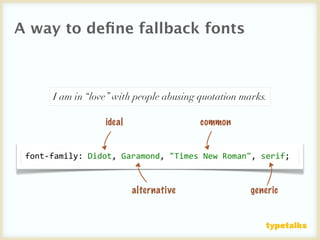
A way to define fallback fonts


      I am in “love” with people abusing quotation marks.

                  ideal                  common


 font‐family:
Didot,
Garamond,
"Times
New
Roman",
serif;


                          alternative                generic
For years,
we’ve been limited
 to a small set of
 “web safe” fonts.
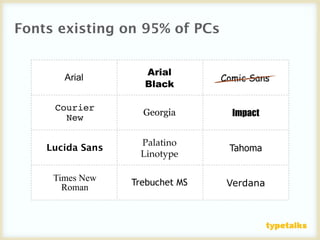
Fonts existing on 95% of PCs


                    Arial
       Arial                     Comic Sans
                    Black

     Courier
       New
                    Georgia        Impact


                   Palatino
    Lucida Sans                   Tahoma
                   Linotype

     Times New    Trebuchet MS
       Roman                      Verdana
So, we’ve had to come up
with some workarounds.
  (old-school methods)
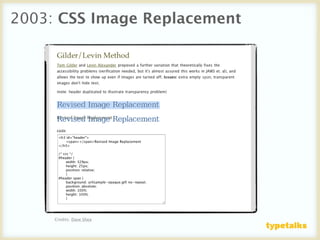
2003: CSS Image Replacement


     Credits: Dave Shea
2005: sIFR   (Scalable Inman Flash Replacement)
2008: Cufón
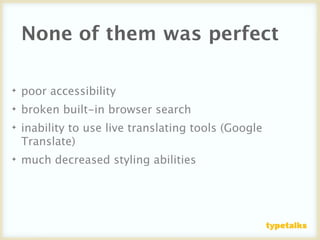
None of them was perfect

✦   poor accessibility
✦   broken built-in browser search
✦   inability to use live translating tools (Google
    Translate)
✦   much decreased styling abilities
The winner is:
CSS3 @font-face
Learn a new CSS3 @font-face
syntax

 @font‐face
{
 

font‐family:
'Your‐font';
 

src:
url('Your‐font.ttf');
 }

 h1,
h2,
h3
{
 

font‐family:
'Your‐font',
'Georgia',
serif;
 }
Make it bulletproof
(yes, you can use it today)


  @font‐face
{
  

font‐family:
'Tagesschrift';
  

src:
url('tagesschrift.eot');
/*
IE
5‐8
*/


src:
local('☺'),


/*
sneakily
trick
IE
*/


url('tagesschrift.woff')
format('woff'),


/*
FF
3.6,
Chrome
5,
IE9
*/


url('tagesschrift.ttf')
format('truetype'),
/*
Opera,
Safari
*/


url('tagesschrift.svg#font')
format('svg');
/*
iOS
*/
  }
Or just use the Font Squirrel generator


 Font Squirrel generator
Problem?

Licenses
Use web font hosting services


   popular, the simplest to use                  personal (free) and paid accounts
   small, curated set of freely licensed fonts   wide range of fonts, mobile support


    over 10000 fonts to choose from               annual fee

    extensive localization support                doesn’t support desktop use


More: http://sprungmarker.de/wp-content/uploads/webfont-services/
Remember:
Buying a font license doesn’t always
     let you use it on the web.
Browse www.fontspring.com
     and www.fontshop.com
    to find professional fonts
ready for embedding for the web.
Thanks!


http://www.slideshare.net/wojciechzajac

Wojtek Zajac (@theanxy)                     This work is licensed
                                                    under
wojtek@wojtekzajac.com                      a Creative Commons
                                          Attribution 3.0 Unported

Font embedding for the web

  • 1.
    Font embedding forthe web POZNAN, 18.06.2011 Wojtek Zajac.com
  • 2.
    Disclaimer I am: ✦ NOT a native english speaker ☺ ✦ NOT a typographer ✦ Web Designer & Developer
  • 3.
    What is aCSS font stack?
  • 4.
    A way todefine fallback fonts I am in “love” with people abusing quotation marks. ideal common font‐family:
Didot,
Garamond,
"Times
New
Roman",
serif; alternative generic
  • 5.
    For years, we’ve beenlimited to a small set of “web safe” fonts.
  • 6.
    Fonts existing on95% of PCs Arial Arial Comic Sans Black Courier New Georgia Impact Palatino Lucida Sans Tahoma Linotype Times New Trebuchet MS Roman Verdana
  • 7.
    So, we’ve hadto come up with some workarounds. (old-school methods)
  • 8.
    2003: CSS ImageReplacement Credits: Dave Shea
  • 9.
    2005: sIFR (Scalable Inman Flash Replacement)
  • 10.
  • 11.
    None of themwas perfect ✦ poor accessibility ✦ broken built-in browser search ✦ inability to use live translating tools (Google Translate) ✦ much decreased styling abilities
  • 12.
  • 13.
    Learn a newCSS3 @font-face syntax @font‐face
{ 

font‐family:
'Your‐font'; 

src:
url('Your‐font.ttf'); } h1,
h2,
h3
{ 

font‐family:
'Your‐font',
'Georgia',
serif; }
  • 14.
    Make it bulletproof (yes,you can use it today) @font‐face
{ 

font‐family:
'Tagesschrift'; 

src:
url('tagesschrift.eot');
/*
IE
5‐8
*/
 

src:
local('☺'),


/*
sneakily
trick
IE
*/ 


url('tagesschrift.woff')
format('woff'),


/*
FF
3.6,
Chrome
5,
IE9
*/ 


url('tagesschrift.ttf')
format('truetype'),
/*
Opera,
Safari
*/ 


url('tagesschrift.svg#font')
format('svg');
/*
iOS
*/ }
  • 15.
    Or just usethe Font Squirrel generator Font Squirrel generator
  • 16.
  • 17.
    Use web fonthosting services popular, the simplest to use personal (free) and paid accounts small, curated set of freely licensed fonts wide range of fonts, mobile support over 10000 fonts to choose from annual fee extensive localization support doesn’t support desktop use More: http://sprungmarker.de/wp-content/uploads/webfont-services/
  • 18.
    Remember: Buying a fontlicense doesn’t always let you use it on the web.
  • 19.
    Browse www.fontspring.com and www.fontshop.com to find professional fonts ready for embedding for the web.
  • 20.
    Thanks! http://www.slideshare.net/wojciechzajac Wojtek Zajac (@theanxy) This work is licensed under wojtek@wojtekzajac.com a Creative Commons Attribution 3.0 Unported

Editor's Notes

  • #2 \n
  • #3 At the beginning I will say that I am not a native english speaker, not a typographer.\n\nI am, though, a web designer & developer from Krakow.\n
  • #4 Please raise your hands: how many of you know what is a CSS font stack?\n
  • #5 CSS Fonts is a way to define fonts that are displayed if our desired font isn’t installed in users’ machine.\nIt defines the preferred order of “back up” fonts to use.\nIt should always end with a generic font-family.\n
  • #6 Web designers are often constrained by the so called “Web Safe Fonts” when creating web pages and whilst 95% of machines worldwide now have these fonts, they were first packaged with Windows XP back in 2001.\n
  • #7 These fonts exist on 95% of the machines. Of course it varies basing on the Operating System.\nAlso, devices like iPhone / iPad have much limited font set as well.\nYou will probably agree with me that these fonts are plainly overused.\n
  • #8 \n
  • #9 In early 2000s, we used various ways of image replacement. They could be generated dynamically to serve custom text and avoid generating it in advance.\nProblems with: transparency\n
  • #10 Then, Mike Davidson basing on the work of Shaun Inman published sIFR, a way to embed custom fonts to sites using Flash.\nThis solved a problem for some time, but the fonts couldn’t be used for body text. \nAlso, the flash text isn’t working for mobile devices.\n
  • #11 In 2008, Cufon came out and designers were very excited about it again.\nUnfortunately, this solution based on HTML Canvas, which is just a hack.\n
  • #12 \n
  • #13 \n
  • #14 Here is the new CSS3 syntax for embedding the fonts.\n
  • #15 There are 4 different types of formats for various browsers: otf&ttf, svg, woff and eot.\nThese different formats were caused by the differences of the browser vendors politics.\n
  • #16 Font Squirrel will let you get the generated files and the CSS ruleset\n
  • #17 Unfortunately, there is a problem with licenses.\nEmbedding font via @font-face means anybody can download it even if the font license forbids it.\n
  • #18 The solution: thankfully there are companies which will host the web fonts to you so you don’t have to care about the licensing problems.\nThe most popular are Google Web Fonts, Typekit, Fonts.com and Font Deck.\n
  • #19 \n
  • #20 \n
  • #21 \n