Introduction
(Definitions offluid, Stresses, Types of fluids,
Newton’s law of viscosity, Laminar flow vs.
Turbulent flow)
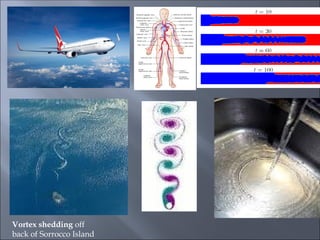
Where you find Fluids and Fluid-Dynamics?
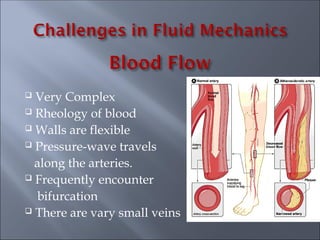
Blood flow in arteries and veins
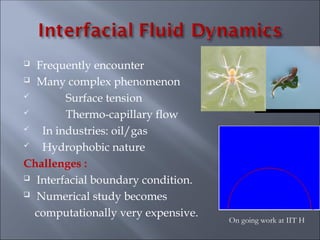
Interfacial fluid dynamics
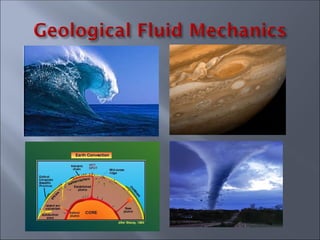
Geological fluid mechanics
The dynamics of ocean
Laminar-turbulent transition
Solidification of fluids
Substances withno strength
Deform when forces are applied
Include water and gases
Solid:
Deforms a fixed amount or breaks completely when a
stress is applied on it.
Fluid:
Deforms continuously as long as any shear stress is
applied.
6.
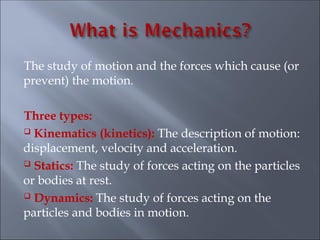
The study ofmotion and the forces which cause (or
prevent) the motion.
Three types:
Kinematics (kinetics): The description of motion:
displacement, velocity and acceleration.
Statics: The study of forces acting on the particles
or bodies at rest.
Dynamics: The study of forces acting on the
particles and bodies in motion.
7.
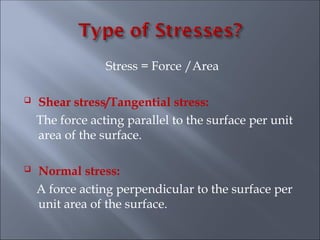
Stress = Force/Area
Shear stress/Tangential stress:
The force acting parallel to the surface per unit
area of the surface.
Normal stress:
A force acting perpendicular to the surface per
unit area of the surface.
8.
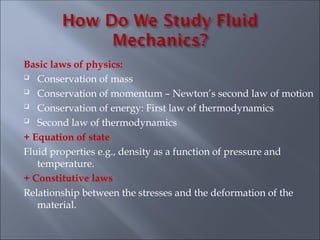
Basic laws ofphysics:
Conservation of mass
Conservation of momentum – Newton’s second law of motion
Conservation of energy: First law of thermodynamics
Second law of thermodynamics
+ Equation of state
Fluid properties e.g., density as a function of pressure and
temperature.
+ Constitutive laws
Relationship between the stresses and the deformation of the
material.
9.
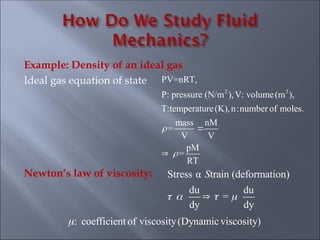
Example: Density ofan ideal gas
Ideal gas equation of state
Newton’s law of viscosity:
2 3
PV=nRT,
P: pressure (N/m ),V: volume(m ),
T:temperature(K),n:number of moles.
mass nM
=
V V
pM
=
RT
Stress α train (deformation)
du du
=
dy dy
S
: coefficient of viscosity(Dynamicviscosity)
10.
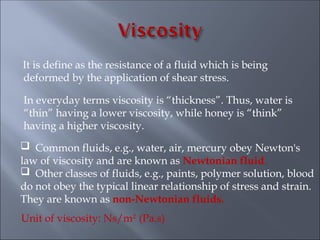
It is defineas the resistance of a fluid which is being
deformed by the application of shear stress.
In everyday terms viscosity is “thickness”. Thus, water is
“thin” having a lower viscosity, while honey is “think”
having a higher viscosity.
Common fluids, e.g., water, air, mercury obey Newton's
law of viscosity and are known as Newtonian fluid.
Other classes of fluids, e.g., paints, polymer solution, blood
do not obey the typical linear relationship of stress and strain.
They are known as non-Newtonian fluids.
Unit of viscosity: Ns/m2
(Pa.s)
11.
Very Complex
Rheology of blood
Walls are flexible
Pressure-wave travels
along the arteries.
Frequently encounter
bifurcation
There are vary small veins
12.
Frequently encounter
Many complex phenomenon
Surface tension
Thermo-capillary flow
In industries: oil/gas
Hydrophobic nature
Challenges :
Interfacial boundary condition.
Numerical study becomes
computationally very expensive.
On going work at IIT H
14.
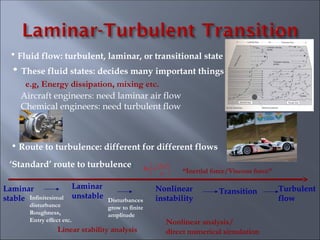
• Fluid flow:turbulent, laminar, or transitional state
• Route to turbulence: different for different flows
• These fluid states: decides many important things
e.g, Energy dissipation, mixing etc.
Aircraft engineers: need laminar air flow
Chemical engineers: need turbulent flow
Nonlinear analysis/
direct numerical simulation
Linear stability analysis
‘Standard’ route to turbulence:
Laminar
stable
Laminar
unstable
Nonlinear
instability
Turbulent
flow
Infinitesimal
disturbance
Roughness,
Entry effect etc.
Disturbances
grow to finite
amplitude
Transition
Re
UL
“Inertial force/Viscous force’’
15.
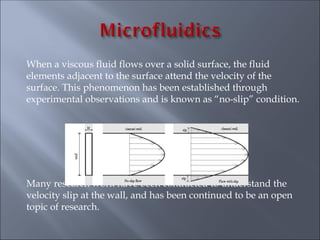
When a viscousfluid flows over a solid surface, the fluid
elements adjacent to the surface attend the velocity of the
surface. This phenomenon has been established through
experimental observations and is known as “no-slip” condition.
Many research work have been conducted to understand the
velocity slip at the wall, and has been continued to be an open
topic of research.