Objectives
• Identify the following: categories of fish and
shellfish, market forms of fish and shellfish
and methods of processing
• Enumerate the characteristics of fresh fish
and and shellfish
• Describe the market forms of fish and
shellfish
Fish and Shellfish
TWO MAJOR CATEGORIES OF FISH:
1. Finfish (vertebrates) – includes bangus,
bisugo, galungong, catfish, and mudfish etc.
2. Shellfish (invertebrates) –scallop, oyster,
mussel, crab, shrimp, lobster etc.
Fish and Shellfish
TWO GROUPS OF SHELLFISH:
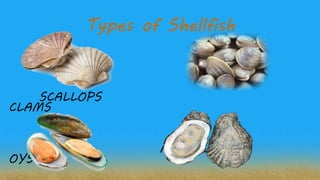
1. MOLLUSKS – such as oyster, clams, and
mussel
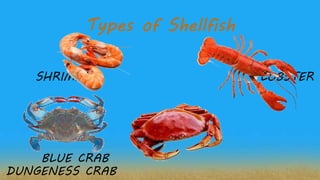
2. CRUSTACEANS – such as lobsters, shrimps
and crabs
Parts of a Fish
Major parts:
1. Skin and Fins
2. Muscle tissues with fats
3. Skeleton (skull, backbone, and ribcage)
4. Viscera (organs and genital system)
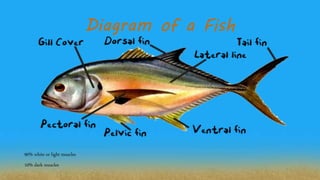
Diagram of a Fish
90% white or light muscles
10% dark muscles
Characteristics of Fresh Fish
1. Eyes are bulging, clear, full, and bright
2. Gill are red and covered with clear
slime
3. Odor is seawater not foul
4. Flesh is firm and elastic.
5. Scales are complete, shiny, and intact.
6. Color is bright and shiny
7. Belly walls are undamaged.
Nutrient Value of Fish
1. Fish oil contains Omega-3 fatty acids
which lower the risk of coronary heart
illness in men and women
2. Excellent source of Vit A and B, and
minerals like iodine, selenium, and zinc
Market Forms of Fish
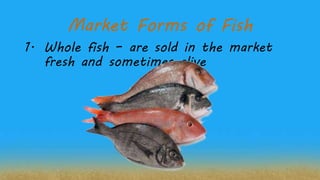
1. Whole fish – are sold in the market
fresh and sometimes alive
Market Forms of Fish
2. Dressed fish – whole but the entrails,
scales, fins and head are removed
Market Forms of Fish
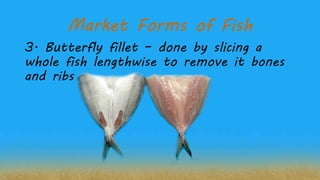
3. Butterfly fillet – done by slicing a
whole fish lengthwise to remove it bones
and ribs
Market Forms of Fish
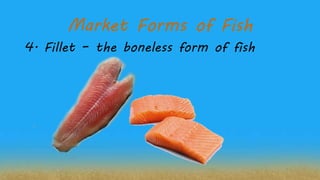
4. Fillet – the boneless form of fish
Market Forms of Fish
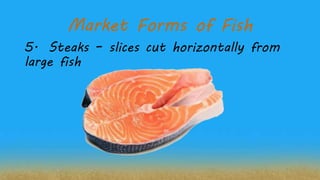
5. Steaks – slices cut horizontally from
large fish
Market Forms of Fish
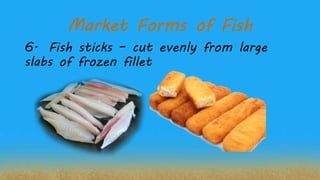
6. Fish sticks – cut evenly from large
slabs of frozen fillet
Types of Shellfish
SCALLOPS
CLAMS
MUSSELS
OYSTER
Types of Shellfish
SHRIMPS LOBSTER
BLUE CRAB
DUNGENESS CRAB
Characteristics of Fresh
Shellfish
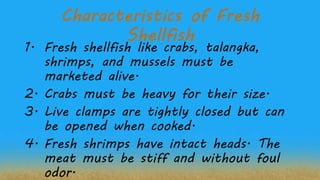
1. Fresh shellfish like crabs, talangka,
shrimps, and mussels must be
marketed alive.
2. Crabs must be heavy for their size.
3. Live clamps are tightly closed but can
be opened when cooked.
4. Fresh shrimps have intact heads. The
meat must be stiff and without foul
odor.
Market Forms of Shellfish
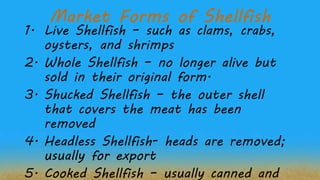
1. Live Shellfish – such as clams, crabs,
oysters, and shrimps
2. Whole Shellfish – no longer alive but
sold in their original form.
3. Shucked Shellfish – the outer shell
that covers the meat has been
removed
4. Headless Shellfish- heads are removed;
usually for export
5. Cooked Shellfish – usually canned and
Methods of Processing Fish
and Shellfish
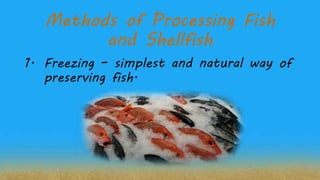
1. Freezing – simplest and natural way of
preserving fish.
Methods of Processing Fish
and Shellfish
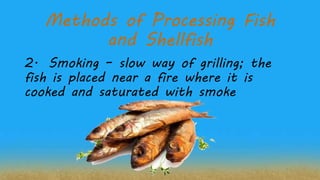
2. Smoking – slow way of grilling; the
fish is placed near a fire where it is
cooked and saturated with smoke
Methods of Processing Fish
and Shellfish
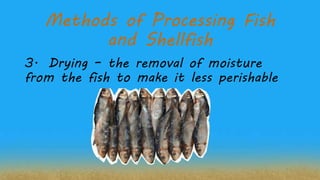
3. Drying – the removal of moisture
from the fish to make it less perishable
Methods of Processing Fish
and Shellfish
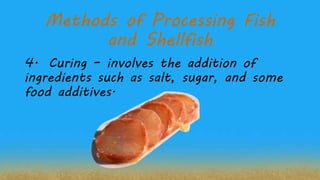
4. Curing – involves the addition of
ingredients such as salt, sugar, and some
food additives.
Methods of Processing Fish
and Shellfish
5. Canning – involves the even heating of
food in tin or glass containers and
hermetically sealing canisters.
a. Open-Kettle Method
b. Can-Cooked Method
Summary
•The major categories of fish are the
finfish and shellfish
•Fish is reach in protein and minerals
PRESENTATION ENDS HERE…….
THANK YOU!

Fish and shellfish

  • 2.
    Objectives • Identify thefollowing: categories of fish and shellfish, market forms of fish and shellfish and methods of processing • Enumerate the characteristics of fresh fish and and shellfish • Describe the market forms of fish and shellfish
  • 3.
    Fish and Shellfish TWOMAJOR CATEGORIES OF FISH: 1. Finfish (vertebrates) – includes bangus, bisugo, galungong, catfish, and mudfish etc. 2. Shellfish (invertebrates) –scallop, oyster, mussel, crab, shrimp, lobster etc.
  • 4.
    Fish and Shellfish TWOGROUPS OF SHELLFISH: 1. MOLLUSKS – such as oyster, clams, and mussel 2. CRUSTACEANS – such as lobsters, shrimps and crabs
  • 5.
    Parts of aFish Major parts: 1. Skin and Fins 2. Muscle tissues with fats 3. Skeleton (skull, backbone, and ribcage) 4. Viscera (organs and genital system)
  • 6.
    Diagram of aFish 90% white or light muscles 10% dark muscles
  • 7.
    Characteristics of FreshFish 1. Eyes are bulging, clear, full, and bright 2. Gill are red and covered with clear slime 3. Odor is seawater not foul 4. Flesh is firm and elastic. 5. Scales are complete, shiny, and intact. 6. Color is bright and shiny 7. Belly walls are undamaged.
  • 8.
    Nutrient Value ofFish 1. Fish oil contains Omega-3 fatty acids which lower the risk of coronary heart illness in men and women 2. Excellent source of Vit A and B, and minerals like iodine, selenium, and zinc
  • 9.
    Market Forms ofFish 1. Whole fish – are sold in the market fresh and sometimes alive
  • 10.
    Market Forms ofFish 2. Dressed fish – whole but the entrails, scales, fins and head are removed
  • 11.
    Market Forms ofFish 3. Butterfly fillet – done by slicing a whole fish lengthwise to remove it bones and ribs
  • 12.
    Market Forms ofFish 4. Fillet – the boneless form of fish
  • 13.
    Market Forms ofFish 5. Steaks – slices cut horizontally from large fish
  • 14.
    Market Forms ofFish 6. Fish sticks – cut evenly from large slabs of frozen fillet
  • 15.
  • 16.
    Types of Shellfish SHRIMPSLOBSTER BLUE CRAB DUNGENESS CRAB
  • 17.
    Characteristics of Fresh Shellfish 1.Fresh shellfish like crabs, talangka, shrimps, and mussels must be marketed alive. 2. Crabs must be heavy for their size. 3. Live clamps are tightly closed but can be opened when cooked. 4. Fresh shrimps have intact heads. The meat must be stiff and without foul odor.
  • 18.
    Market Forms ofShellfish 1. Live Shellfish – such as clams, crabs, oysters, and shrimps 2. Whole Shellfish – no longer alive but sold in their original form. 3. Shucked Shellfish – the outer shell that covers the meat has been removed 4. Headless Shellfish- heads are removed; usually for export 5. Cooked Shellfish – usually canned and
  • 19.
    Methods of ProcessingFish and Shellfish 1. Freezing – simplest and natural way of preserving fish.
  • 20.
    Methods of ProcessingFish and Shellfish 2. Smoking – slow way of grilling; the fish is placed near a fire where it is cooked and saturated with smoke
  • 21.
    Methods of ProcessingFish and Shellfish 3. Drying – the removal of moisture from the fish to make it less perishable
  • 22.
    Methods of ProcessingFish and Shellfish 4. Curing – involves the addition of ingredients such as salt, sugar, and some food additives.
  • 23.
    Methods of ProcessingFish and Shellfish 5. Canning – involves the even heating of food in tin or glass containers and hermetically sealing canisters. a. Open-Kettle Method b. Can-Cooked Method
  • 24.
    Summary •The major categoriesof fish are the finfish and shellfish •Fish is reach in protein and minerals
  • 25.