FIQH FOR ECONOMISTS
ECON 1530 SECTION 02
NOTEBOOK COMPILATION
PRESENTED TO:
DR. MUHAMMAD IRWAN BIN ARIFFIN
Group name: Tomatillo Matric No. Contribution
Ain Atiya Azmi bt Nazmi 1710222 20%
Shah Nur Aryana bt Shah Jahan 1713322 20%
Nor Aina Nashuha bt Mohamad Fikri 1718734 20%
Fatemeh Pilehrar 1311010 20%
Hossaein Md Faisal 1626161 20%
5. Private Property (Al-Mal) 
Al-Mal is one of the five essentials that the Shariah aims to protect. There is no
specific definition in the Quran and Sunnah on what al Mal is. As long as it is not a
prohibition in the Shariah, then it is left to the customs to accommodate new
forms of property. Copyrights, franchises and patents are examples of properties that
only have existed in the community recently.
Definition Of Property
Lingual meaning: it means all things that can be acquired, possessed and 
owned by individuals.
-things that are not captured such as birds in the sky and fish in the sea are not
properties unless there is a device to secure them
-abstract phenomena like health and intelligence are not properties as it is not a
definite possession
-properties must give benefits to the owners. Rotten food is not property.
-prohibited things can only be the property of non-Muslims e.g if a Muslim owns
alcohol or swine, they are not considered his property.
Hanafi: Things that
1. Can be possessed
2. Customarily used by people
3. Desired by people
4. Can be stored for times of need
The definition focuses on things that have “corpus” whose existence is independent. 
Since usufruct only appears through the existence of a physical asset, then it is
dependent and thus is not considered as property.
1
However, there are some arguments that favour usufruct on the base of istihsan. If
customarily accepted, services or benefits can only be a property if and only if we
own its underlying asset. Due to that, a contract of lease (ijarah) is terminated when
the owner of the building dies. Contract of usufruct cannot be inherited.
Jumhur fiqh schools (Shafi’i, Maliki, Hanbali) 
1. All permissible things
2. Have financial value (if destroyed, the owner has a right for compensation)
The definition includes both tangible (corpus) and intangible (usufruct) assets. An           
usufruct is a property if there is a monetary value attached to it. For example, the
Wi-Fi connection is a paid service which is owned by the person who paid for it.
Moreover, assets are owned not for their own sake but due to the usufruct that comes
along with the possession of the assets.
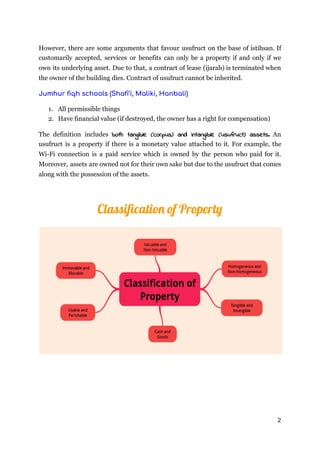
Classificatio of Propert
2
1. VALUABLE (MUTAQAWWIM) AND 
NON-VALUABLE PROPERTY 
Valuable: all permissible things that are possessed and secured
Non-valuable: all prohibited things such as pork and wine
E.g: The validity of a contract depends on its permissibility. Sales of birds in the sky
(have not been possessed) will cause uncertainty on whether they can be delivered or
not. Any gharar contract is void.
2. IMMOVABLE (‘IQAR) AND MOVABLE 
(MANQUL) PROPERTY 
Immovable property (‘iqar) - land and anything that is permanently fixed to it
such as buildings
Movable property (manqul) - a property that can be moved from one place to
another place
3
There are two views on whether a certain property is considered immovable or
movable.
1. Th Hanafi  
Immovable property Movable property
➢ Restricted to land only
➢ Property that cannot be taken
from one place to another place
○ For example:
○ If the land is sold together
with the buildings and
trees, the rules governing
immovable property also
applicable to the buildings
and trees
○ if the buildings or an
apartment or trees are
sold without the land
itself, the rules governing
immovable properties are
not applicable to them
➢ All property that can be taken
from one place to another
whether they remain in their
original form or not
➢ For example: money, animals,
cars and other trade commodities
2. Th Maliki  
Immovable property Movable property
➢ They do not confine the
definition of immovable property
to land only
➢ Immovable property is a property
which cannot be taken from a
place to another place like land
and those properties which if
moved they may change
○ For example: Buildings
and trees
○ Would be damaged if
taken from one place to
another and may not
remain in their original
forms
➢ Can be transformed into
immovable properties and vice
versa
➢ For example:
○ Doors, windows, water
pipes, electricity lines and
fans may become
immovable properties if
they are permanently fixed
to a building.
○ But when a building is
destroyed they become
movable properties.
4
The consequences of this classification
➔ The right of pre-emption (shuf’ah) 
◆ Can only be exercised with regard to immovable properties
◆ The right cannot be claimed with regard to movable properties unless
they are sold as part of an immovable property
➔ Related to cases of bankruptcies 
◆ In cases of bankruptcy, in order to settle the debts of a bankrupt
person, initially his movable properties are sold
◆ If these are not enough to satisfy the debts, the court may order the sale
of his immovable properties.
➔ Related to guardianship 
◆ A guardian cannot sell a minor’s immovable property except for settling
the minor’s debt or for his essential needs or for his higher interest
◆ However, all of these cases, the guardian has to get permission from a
court
◆ This is not applicable to movable properties
   
5
3. Similar (Mithli) and Dissimilar (qimi) or 
Homogeneous and non-Homogeneous 
Property 
 
 
Property can be divided to two groups, 1. Homogeneous: which can be
replaced by an equal quantity of any similar things, like flour with wheat
or oil with gas, they are considered as obligation (dayn) however there are
certain conditions to be followed: 1. It is obligation and Dayn, so the property is not
specified like any kind of wheat can be delivered, 2. It may lead to riba al-nasiyyah
and riba al fadl, so homogeneous property of same kinds should be exchanged equal
in measurement, for example: 1 kilo of dates for 1 kilo of dates. 3. If homogeneous
property is destroyed, it should be compensated with a similar property. 4. If it is
different kinds, it must be exchanged at the spot or immediate or hand to hand, any
delay of delivery is prohibited. E.g 5kg of rice can be exchanged for 10kg of sugar if
the transaction is immediate.
2. Non-homogeneous property is the property that is unique and has at
least one specific feature, like: houses, airplanes, they are considered as
a specific thing (ain). Like homogeneous property it has conditions too: 1. The
non- homogeneous is the subject of the contract so it can not be changed: if contract
is made to buy Sahih al Bukhari then seller cannot give Sahih al muslim book. 2.
Unlike homogeneous property, any charge on dissimilar property if it is used, is
6
permissible, like: house rental. 3. If non-homogeneous property is destroyed or
damaged, it should be paid by its price.
According to Hanafi jurists, these two different properties can make two different
contracts, Salam is used for homogeneous property contract, and istihsan is used for
non-homogeneous property contract.
 
4. Usable (Isti’mali) and Perishable 
(Istihlaki) Property 
 
➔ Usable (Isti’mali) : Property that remain after it is used.
◆ E.g : Land, car, clothes and books.
◆ Can be rented/leased
➔ Perishable (Istihlaki) : Property does not survive the first use which means
it no longer exists once it is used or consumed.
◆ E.g : Money, food and water.
◆ Most of the time it is homogeneous properties & it is important to
observe certain conditions in order to avoid the possibility of riba.
7
◆ After used once, it no longer provides continuous flow of usufruct.
Thus, it is prohibited to rent perishable properties. However, we can
lend or borrow them without charging additional return (usury).
◆ Charging interest on financing will cause injustice as there is no
certainty of profit or loss. Thus, musharakah/ mudharabah contracts
are more preferable for profit/loss sharing contracts on money.
5. Cash (Nuqud) and Goods (‘Urudh) 
 
 
➔ Cash (Nuqud) : Gold, silver and currencies.
➔ Goods (‘Urudh) : Merchandise goods which are not weighable or
measurable. For instance, silk or cotton cloth, watches and computers.
❖ According to Mal , in partnership contract, partners may contribute goods.
❖ Ot e s o l do not agree and claim that all partners must contribute in 
cash.
8
6. Tangible and Intangible Property 
 
Tangible property is anything with physical existence, things that can be felt or
touched.
E.g: Land, vehicles, equipment, machinery, furniture, inventory.
Intangible property are non-physical consists of non-material things
E.g: copyrights, patents, computer software, franchises, bank accounts, stocks,
bonds, trademarks, brand names, accounts receivable, customer lists, trade secrets or
business licenses.
Tangible assets are depreciated and generally much easier to liquidate due to their
physical presence. Tangible property cost can be easily determined or           
evaluated. Most types of tangible personal property are relatively easy to value
because the objects and their condition can be described exactly. There are
well-established markets where most types of tangible property are frequently
bought and sold, providing the basis for market-based price guides an owner can use
to set value on an object.
Intangible property don’t have a physical existence and it is amortized. Intangible
property also known as incorporeal property, describes something which a person or
corporation can have ownership of and can transfer ownership of to another person
or corporation, but has no physical substance.
9
Intangible property is used in distinction to tangible property. Generally, ownership
of intangible property gives the owner a set of legally enforceable rights over
reproduction of personal property containing certain content. For example, a
copyright owner can control the reproduction of the work forming the copyright.
However, the intangible property forms a set of rights separate from the tangible
property that carries the rights. For example, the owner of a copyright can control the
printing of books containing the content, but the book itself is personal property
which can be bought and sold without concern over the rights of the copyright
holder.
 
10

Fiqh notebook phase 2 google docs

  • 1.
        FIQH FORECONOMISTS ECON 1530 SECTION 02 NOTEBOOK COMPILATION PRESENTED TO: DR. MUHAMMAD IRWAN BIN ARIFFIN Group name: Tomatillo Matric No. Contribution Ain Atiya Azmi bt Nazmi 1710222 20% Shah Nur Aryana bt Shah Jahan 1713322 20% Nor Aina Nashuha bt Mohamad Fikri 1718734 20% Fatemeh Pilehrar 1311010 20% Hossaein Md Faisal 1626161 20%
  • 2.
    5. Private Property(Al-Mal)  Al-Mal is one of the five essentials that the Shariah aims to protect. There is no specific definition in the Quran and Sunnah on what al Mal is. As long as it is not a prohibition in the Shariah, then it is left to the customs to accommodate new forms of property. Copyrights, franchises and patents are examples of properties that only have existed in the community recently. Definition Of Property Lingual meaning: it means all things that can be acquired, possessed and  owned by individuals. -things that are not captured such as birds in the sky and fish in the sea are not properties unless there is a device to secure them -abstract phenomena like health and intelligence are not properties as it is not a definite possession -properties must give benefits to the owners. Rotten food is not property. -prohibited things can only be the property of non-Muslims e.g if a Muslim owns alcohol or swine, they are not considered his property. Hanafi: Things that 1. Can be possessed 2. Customarily used by people 3. Desired by people 4. Can be stored for times of need The definition focuses on things that have “corpus” whose existence is independent.  Since usufruct only appears through the existence of a physical asset, then it is dependent and thus is not considered as property. 1
  • 3.
    However, there aresome arguments that favour usufruct on the base of istihsan. If customarily accepted, services or benefits can only be a property if and only if we own its underlying asset. Due to that, a contract of lease (ijarah) is terminated when the owner of the building dies. Contract of usufruct cannot be inherited. Jumhur fiqh schools (Shafi’i, Maliki, Hanbali)  1. All permissible things 2. Have financial value (if destroyed, the owner has a right for compensation) The definition includes both tangible (corpus) and intangible (usufruct) assets. An            usufruct is a property if there is a monetary value attached to it. For example, the Wi-Fi connection is a paid service which is owned by the person who paid for it. Moreover, assets are owned not for their own sake but due to the usufruct that comes along with the possession of the assets. Classificatio of Propert 2
  • 4.
    1. VALUABLE (MUTAQAWWIM)AND  NON-VALUABLE PROPERTY  Valuable: all permissible things that are possessed and secured Non-valuable: all prohibited things such as pork and wine E.g: The validity of a contract depends on its permissibility. Sales of birds in the sky (have not been possessed) will cause uncertainty on whether they can be delivered or not. Any gharar contract is void. 2. IMMOVABLE (‘IQAR) AND MOVABLE  (MANQUL) PROPERTY  Immovable property (‘iqar) - land and anything that is permanently fixed to it such as buildings Movable property (manqul) - a property that can be moved from one place to another place 3
  • 5.
    There are twoviews on whether a certain property is considered immovable or movable. 1. Th Hanafi   Immovable property Movable property ➢ Restricted to land only ➢ Property that cannot be taken from one place to another place ○ For example: ○ If the land is sold together with the buildings and trees, the rules governing immovable property also applicable to the buildings and trees ○ if the buildings or an apartment or trees are sold without the land itself, the rules governing immovable properties are not applicable to them ➢ All property that can be taken from one place to another whether they remain in their original form or not ➢ For example: money, animals, cars and other trade commodities 2. Th Maliki   Immovable property Movable property ➢ They do not confine the definition of immovable property to land only ➢ Immovable property is a property which cannot be taken from a place to another place like land and those properties which if moved they may change ○ For example: Buildings and trees ○ Would be damaged if taken from one place to another and may not remain in their original forms ➢ Can be transformed into immovable properties and vice versa ➢ For example: ○ Doors, windows, water pipes, electricity lines and fans may become immovable properties if they are permanently fixed to a building. ○ But when a building is destroyed they become movable properties. 4
  • 6.
    The consequences ofthis classification ➔ The right of pre-emption (shuf’ah)  ◆ Can only be exercised with regard to immovable properties ◆ The right cannot be claimed with regard to movable properties unless they are sold as part of an immovable property ➔ Related to cases of bankruptcies  ◆ In cases of bankruptcy, in order to settle the debts of a bankrupt person, initially his movable properties are sold ◆ If these are not enough to satisfy the debts, the court may order the sale of his immovable properties. ➔ Related to guardianship  ◆ A guardian cannot sell a minor’s immovable property except for settling the minor’s debt or for his essential needs or for his higher interest ◆ However, all of these cases, the guardian has to get permission from a court ◆ This is not applicable to movable properties     5
  • 7.
    3. Similar (Mithli)and Dissimilar (qimi) or  Homogeneous and non-Homogeneous  Property      Property can be divided to two groups, 1. Homogeneous: which can be replaced by an equal quantity of any similar things, like flour with wheat or oil with gas, they are considered as obligation (dayn) however there are certain conditions to be followed: 1. It is obligation and Dayn, so the property is not specified like any kind of wheat can be delivered, 2. It may lead to riba al-nasiyyah and riba al fadl, so homogeneous property of same kinds should be exchanged equal in measurement, for example: 1 kilo of dates for 1 kilo of dates. 3. If homogeneous property is destroyed, it should be compensated with a similar property. 4. If it is different kinds, it must be exchanged at the spot or immediate or hand to hand, any delay of delivery is prohibited. E.g 5kg of rice can be exchanged for 10kg of sugar if the transaction is immediate. 2. Non-homogeneous property is the property that is unique and has at least one specific feature, like: houses, airplanes, they are considered as a specific thing (ain). Like homogeneous property it has conditions too: 1. The non- homogeneous is the subject of the contract so it can not be changed: if contract is made to buy Sahih al Bukhari then seller cannot give Sahih al muslim book. 2. Unlike homogeneous property, any charge on dissimilar property if it is used, is 6
  • 8.
    permissible, like: houserental. 3. If non-homogeneous property is destroyed or damaged, it should be paid by its price. According to Hanafi jurists, these two different properties can make two different contracts, Salam is used for homogeneous property contract, and istihsan is used for non-homogeneous property contract.   4. Usable (Isti’mali) and Perishable  (Istihlaki) Property    ➔ Usable (Isti’mali) : Property that remain after it is used. ◆ E.g : Land, car, clothes and books. ◆ Can be rented/leased ➔ Perishable (Istihlaki) : Property does not survive the first use which means it no longer exists once it is used or consumed. ◆ E.g : Money, food and water. ◆ Most of the time it is homogeneous properties & it is important to observe certain conditions in order to avoid the possibility of riba. 7
  • 9.
    ◆ After usedonce, it no longer provides continuous flow of usufruct. Thus, it is prohibited to rent perishable properties. However, we can lend or borrow them without charging additional return (usury). ◆ Charging interest on financing will cause injustice as there is no certainty of profit or loss. Thus, musharakah/ mudharabah contracts are more preferable for profit/loss sharing contracts on money. 5. Cash (Nuqud) and Goods (‘Urudh)      ➔ Cash (Nuqud) : Gold, silver and currencies. ➔ Goods (‘Urudh) : Merchandise goods which are not weighable or measurable. For instance, silk or cotton cloth, watches and computers. ❖ According to Mal , in partnership contract, partners may contribute goods. ❖ Ot e s o l do not agree and claim that all partners must contribute in  cash. 8
  • 10.
    6. Tangible andIntangible Property    Tangible property is anything with physical existence, things that can be felt or touched. E.g: Land, vehicles, equipment, machinery, furniture, inventory. Intangible property are non-physical consists of non-material things E.g: copyrights, patents, computer software, franchises, bank accounts, stocks, bonds, trademarks, brand names, accounts receivable, customer lists, trade secrets or business licenses. Tangible assets are depreciated and generally much easier to liquidate due to their physical presence. Tangible property cost can be easily determined or            evaluated. Most types of tangible personal property are relatively easy to value because the objects and their condition can be described exactly. There are well-established markets where most types of tangible property are frequently bought and sold, providing the basis for market-based price guides an owner can use to set value on an object. Intangible property don’t have a physical existence and it is amortized. Intangible property also known as incorporeal property, describes something which a person or corporation can have ownership of and can transfer ownership of to another person or corporation, but has no physical substance. 9
  • 11.
    Intangible property isused in distinction to tangible property. Generally, ownership of intangible property gives the owner a set of legally enforceable rights over reproduction of personal property containing certain content. For example, a copyright owner can control the reproduction of the work forming the copyright. However, the intangible property forms a set of rights separate from the tangible property that carries the rights. For example, the owner of a copyright can control the printing of books containing the content, but the book itself is personal property which can be bought and sold without concern over the rights of the copyright holder.   10