Fintech as a Strategy of Financial
Inclusion in the Age of Digitalization
Group 5
Buddhadev Sinha Id: 121283
Md. Rafiqual Hasan Id: 121284
Shahrear Nasrin Id: 121285
1
Publication Background
•Author: Hyoeun Yang, Senior Researcher, Institute for Global
Economics & University of London
•Publisher: Korean APEC Society
•Publication Information: Journal of APEC Studies
Vol.11 No.2 , 93~106 pages
•Issue date: 30.12.2019 2
Methodology
•Kind of study: Explanatory
•Data source: Secondary
•Population: APEC Members Countries
•Method: Case-study
3
Summary
Global Financial Crisis (GFC) in 2008 & failure of
market driven economic system.
Policy makers’ focus on
Financial empowerment on less privileged people
Enhancing competition of financial market
Creative Destruction of financial system through
fintech
Inevitable policy demand for fintech
4
Summary (Cont.)
Relevance to APEC countries
Fast-growing fintech market
such as China, India, and Russia
Impact of fintech on SMEs
SMEs account over 97% of enterprises and
employ over half of the workforce in the
region.
5
Few interesting factors
•Cultural aspect of human and machine
•Combination of two new concept Fintech and
Financial Inclusion
•The concept of Fintech Ecosystem
6
Key-words
APEC
Financial inclusion
Fintech
Fintech ecosystem
Millennials
7
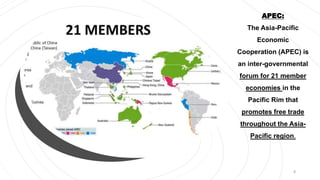
APEC:
The Asia-Pacific
Economic
Cooperation (APEC) is
an inter-governmental
forum for 21 member
economies in the
Pacific Rim that
promotes free trade
throughout the Asia-
Pacific region.
8
Fintech:
Financial technology
(Fintech) is used to
describe new tech that
seeks to improve and
automate the delivery
and use of financial
services.
9
Financial inclusion:
Financial inclusion
means that individuals
and businesses have
access to useful and
affordable financial
products and services
that meet their needs –
transactions, payments,
savings, credit and
insurance – delivered in
a responsible and
sustainable way (The
World Bank).
10
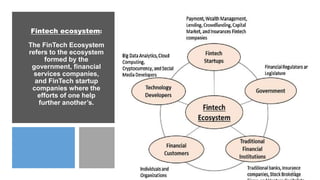
Fintech ecosystem:
The FinTech Ecosystem
refers to the ecosystem
formed by the
government, financial
services companies,
and FinTech startup
companies where the
efforts of one help
further another’s.
11
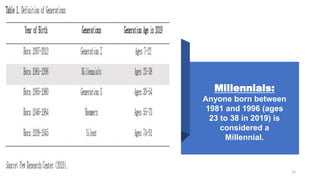
Millennials:
Anyone born between
1981 and 1996 (ages
23 to 38 in 2019) is
considered a
Millennial.
12
Core
Message
Fintech is the key to Financial
Inclusion
13
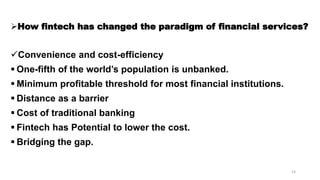
How fintech has changed the paradigm of financial services?
Convenience and cost-efficiency
 One-fifth of the world’s population is unbanked.
 Minimum profitable threshold for most financial institutions.
 Distance as a barrier
 Cost of traditional banking
 Fintech has Potential to lower the cost.
 Bridging the gap.
14
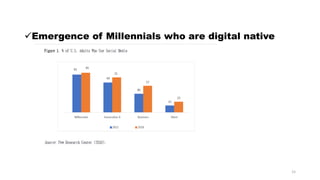
Emergence of Millennials who are digital native
15
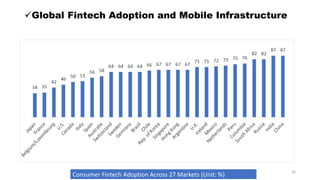
Global Fintech Adoption and Mobile Infrastructure
Consumer Fintech Adoption Across 27 Markets (Unit: %)
16
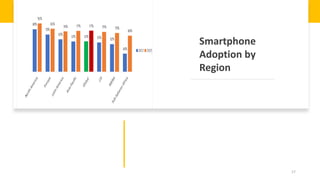
Smartphone
Adoption by
Region
17
Primary ground of demand and acceptance of fintech
 Global financial crisis, 2008.
 Dissatisfaction and distrust of financial customers to
traditional financial institutions.
 The contraction of bank lending due to the increased capital
reserve ratio and other regulatory requirements.
 millennials experienced the 2008 GFC directly.
18
Window for less privileged
population who are unbanked
Revitalizing SMEs
Easy access to finance
automated assessment platform
How fintech
facilitate
financial
inclusion?
19
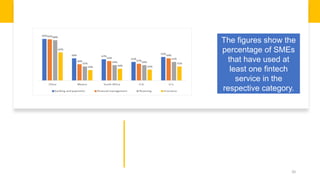
The figures show the
percentage of SMEs
that have used at
least one fintech
service in the
respective category.
20
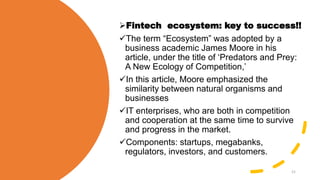
Fintech ecosystem: key to success!!
The term “Ecosystem” was adopted by a
business academic James Moore in his
article, under the title of ‘Predators and Prey:
A New Ecology of Competition,’
In this article, Moore emphasized the
similarity between natural organisms and
businesses
IT enterprises, who are both in competition
and cooperation at the same time to survive
and progress in the market.
Components: startups, megabanks,
regulators, investors, and customers.
21
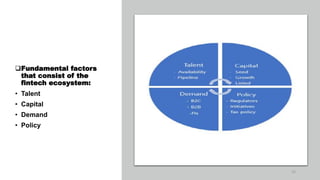
Fundamental factors
that consist of the
fintech ecosystem:
• Talent
• Capital
• Demand
• Policy
22
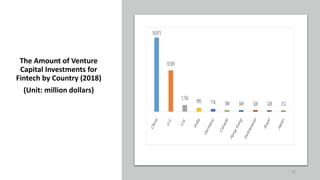
The Amount of Venture
Capital Investments for
Fintech by Country (2018)
(Unit: million dollars)
23
Conclusion:
As described in the article, fintech
Introduced a new paradigm of financial service
Is a tool to achieve financial inclusion
Key to sustainable economic growth.
success of fintech as a facilitator of financial inclusion can be
only realized when the factors consisting of the fintech
ecosystem are well integrated and connected.
24
• If the message of the article is agreeable or not?
…...Yes!
25
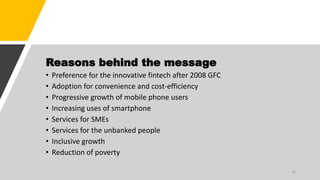
Reasons behind the message
• Preference for the innovative fintech after 2008 GFC
• Adoption for convenience and cost-efficiency
• Progressive growth of mobile phone users
• Increasing uses of smartphone
• Services for SMEs
• Services for the unbanked people
• Inclusive growth
• Reduction of poverty
26
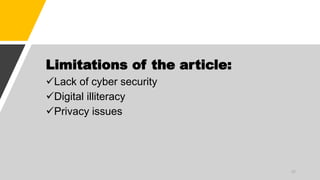
Limitations of the article:
Lack of cyber security
Digital illiteracy
Privacy issues
27
Thank you
28

Fintech & Financial Inclusion.pptx

  • 1.
    Fintech as aStrategy of Financial Inclusion in the Age of Digitalization Group 5 Buddhadev Sinha Id: 121283 Md. Rafiqual Hasan Id: 121284 Shahrear Nasrin Id: 121285 1
  • 2.
    Publication Background •Author: HyoeunYang, Senior Researcher, Institute for Global Economics & University of London •Publisher: Korean APEC Society •Publication Information: Journal of APEC Studies Vol.11 No.2 , 93~106 pages •Issue date: 30.12.2019 2
  • 3.
    Methodology •Kind of study:Explanatory •Data source: Secondary •Population: APEC Members Countries •Method: Case-study 3
  • 4.
    Summary Global Financial Crisis(GFC) in 2008 & failure of market driven economic system. Policy makers’ focus on Financial empowerment on less privileged people Enhancing competition of financial market Creative Destruction of financial system through fintech Inevitable policy demand for fintech 4
  • 5.
    Summary (Cont.) Relevance toAPEC countries Fast-growing fintech market such as China, India, and Russia Impact of fintech on SMEs SMEs account over 97% of enterprises and employ over half of the workforce in the region. 5
  • 6.
    Few interesting factors •Culturalaspect of human and machine •Combination of two new concept Fintech and Financial Inclusion •The concept of Fintech Ecosystem 6
  • 7.
  • 8.
    APEC: The Asia-Pacific Economic Cooperation (APEC)is an inter-governmental forum for 21 member economies in the Pacific Rim that promotes free trade throughout the Asia- Pacific region. 8
  • 9.
    Fintech: Financial technology (Fintech) isused to describe new tech that seeks to improve and automate the delivery and use of financial services. 9
  • 10.
    Financial inclusion: Financial inclusion meansthat individuals and businesses have access to useful and affordable financial products and services that meet their needs – transactions, payments, savings, credit and insurance – delivered in a responsible and sustainable way (The World Bank). 10
  • 11.
    Fintech ecosystem: The FinTechEcosystem refers to the ecosystem formed by the government, financial services companies, and FinTech startup companies where the efforts of one help further another’s. 11
  • 12.
    Millennials: Anyone born between 1981and 1996 (ages 23 to 38 in 2019) is considered a Millennial. 12
  • 13.
    Core Message Fintech is thekey to Financial Inclusion 13
  • 14.
    How fintech haschanged the paradigm of financial services? Convenience and cost-efficiency  One-fifth of the world’s population is unbanked.  Minimum profitable threshold for most financial institutions.  Distance as a barrier  Cost of traditional banking  Fintech has Potential to lower the cost.  Bridging the gap. 14
  • 15.
    Emergence of Millennialswho are digital native 15
  • 16.
    Global Fintech Adoptionand Mobile Infrastructure Consumer Fintech Adoption Across 27 Markets (Unit: %) 16
  • 17.
  • 18.
    Primary ground ofdemand and acceptance of fintech  Global financial crisis, 2008.  Dissatisfaction and distrust of financial customers to traditional financial institutions.  The contraction of bank lending due to the increased capital reserve ratio and other regulatory requirements.  millennials experienced the 2008 GFC directly. 18
  • 19.
    Window for lessprivileged population who are unbanked Revitalizing SMEs Easy access to finance automated assessment platform How fintech facilitate financial inclusion? 19
  • 20.
    The figures showthe percentage of SMEs that have used at least one fintech service in the respective category. 20
  • 21.
    Fintech ecosystem: keyto success!! The term “Ecosystem” was adopted by a business academic James Moore in his article, under the title of ‘Predators and Prey: A New Ecology of Competition,’ In this article, Moore emphasized the similarity between natural organisms and businesses IT enterprises, who are both in competition and cooperation at the same time to survive and progress in the market. Components: startups, megabanks, regulators, investors, and customers. 21
  • 22.
    Fundamental factors that consistof the fintech ecosystem: • Talent • Capital • Demand • Policy 22
  • 23.
    The Amount ofVenture Capital Investments for Fintech by Country (2018) (Unit: million dollars) 23
  • 24.
    Conclusion: As described inthe article, fintech Introduced a new paradigm of financial service Is a tool to achieve financial inclusion Key to sustainable economic growth. success of fintech as a facilitator of financial inclusion can be only realized when the factors consisting of the fintech ecosystem are well integrated and connected. 24
  • 25.
    • If themessage of the article is agreeable or not? …...Yes! 25
  • 26.
    Reasons behind themessage • Preference for the innovative fintech after 2008 GFC • Adoption for convenience and cost-efficiency • Progressive growth of mobile phone users • Increasing uses of smartphone • Services for SMEs • Services for the unbanked people • Inclusive growth • Reduction of poverty 26
  • 27.
    Limitations of thearticle: Lack of cyber security Digital illiteracy Privacy issues 27
  • 28.