FinTech:
1
Shaping the Financial World
Intro - March 30, 2020
2
FinTech 15.S08
• For those wishing to explore FinTech:
• How new technologies are disrupting the financial services industry
• Business models, products, applications and customer user interface
• AI, Deep learning, Blockchain Technology and Open API’s
• Competitive Landscape of FinTech Startups & Big Tech vs. Big Finance
• For those who wish to gain critical reasoning skills to:
• Understand the ‘ground truths’ of FinTech
• Conduct Business & Technology Strategic Analysis
3
Intro Class: Readings
• 'The economic forces driving fintech adoption across countries' Jon
Frost, BIS Working Papers
• 'FinTech and market structure in financial services' Financial Stability
Board
• 'The Future of Banking' FDIC Chair Jelena McWilliams
4
Intro Class: Study Questions
• What are the major technological trends materially influencing the
provision of financial services?
• How is the competitive landscape shaping adoption of these new
technologies around the globe? How are FinTech start-ups and Big Tech
firms competing and cooperating with incumbents from big finance?
How has Big Finance reacted?
• What do you wish to achieve in this Fintech course?
5
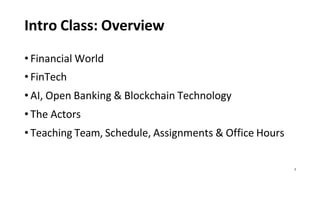
Intro Class: Overview
• Financial World
• FinTech
• AI, Open Banking & Blockchain Technology
• The Actors
• Teaching Team, Schedule, Assignments & Office Hours
6
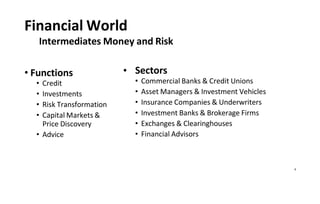
Financial World
Intermediates Money and Risk
• Functions • Sectors
• Commercial Banks & Credit Unions
• Credit
• Asset Managers & Investment Vehicles
• Investments
• Insurance Companies & Underwriters
• Risk Transformation
• Investment Banks & Brokerage Firms
• Exchanges & Clearinghouses
• Capital Markets &
Price Discovery
• Advice • Financial Advisors
7
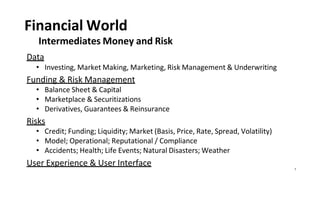
Financial World
Intermediates Money and Risk
Data
• Investing, Market Making, Marketing, Risk Management & Underwriting
Funding & Risk Management
• Balance Sheet & Capital
• Marketplace & Securitizations
• Derivatives, Guarantees & Reinsurance
Risks
• Credit; Funding; Liquidity; Market (Basis, Price, Rate, Spread, Volatility)
• Model; Operational; Reputational / Compliance
• Accidents; Health; Life Events; Natural Disasters; Weather
User Experience & User Interface
8
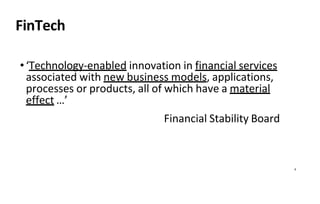
FinTech
•‘Technology-enabled innovation in financial services
associated with new business models, applications,
processes or products, all of which have a material
effect …’
Financial Stability Board
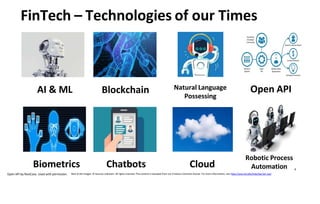
FinTech – Technologies of our Times
Natural Language
Possessing
AI & ML Blockchain Open API
Robotic Process
Automation
Biometrics Chatbots Cloud 9
Open API by RestCase. Used with permission. Rest of the images: © Sources unknown. All rights reserved. This content is excluded from our Creative Commons license. For more information, see https://ocw.mit.edu/help/faq-fair-use/
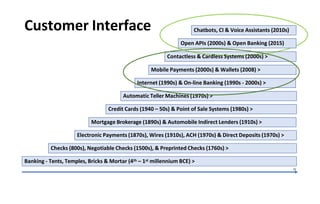
Customer Interface Chatbots, CI & Voice Assistants (2010s)
Open APIs (2000s) & Open Banking (2015)
Contactless & Cardless Systems (2000s) >
Mobile Payments (2000s) & Wallets (2008) >
Internet (1990s) & On-line Banking (1990s - 2000s) >
Automatic Teller Machines (1970s) >
Credit Cards (1940 – 50s) & Point of Sale Systems (1980s) >
Mortgage Brokerage (1890s) & Automobile Indirect Lenders (1910s) >
Electronic Payments (1870s), Wires (1910s), ACH (1970s) & Direct Deposits (1970s) >
Checks (800s), Negotiable Checks (1500s), & Preprinted Checks (1760s) >
Banking - Tents, Temples, Bricks & Mortar (4th – 1st millennium BCE) >
10
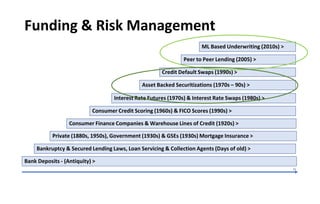
Funding & Risk Management
ML Based Underwriting (2010s) >
Peer to Peer Lending (2005) >
Credit Default Swaps (1990s) >
Asset Backed Securitizations (1970s – 90s) >
Interest Rate Futures (1970s) & Interest Rate Swaps (1980s) >
Consumer Credit Scoring (1960s) & FICO Scores (1990s) >
Consumer Finance Companies & Warehouse Lines of Credit (1920s) >
Private (1880s, 1950s), Government (1930s) & GSEs (1930s) Mortgage Insurance >
Bankruptcy & Secured Lending Laws, Loan Servicing & Collection Agents (Days of old) >
Bank Deposits - (Antiquity) >
11
12
FinTech - Finance’s Fertile Ground
• Digitalization of Money, Securities and Credit
• Vast and Expanding Amounts of Customer Data
• Rapid Expansion of Computational & Analytical Power
• Reliance on Multiple Systems of Ledgers
• Wide Public Acceptance of New Tech
• Legacy Customer Interface and Processing Systems
• Infrastructure Systems’ Costs and Counterparty Risks
• Economic Rents and Centralized Concentrated Risks
13
FinTech – Disruptive Potential
• AI for Managing Risks & Targeting Products
• Updated Customer User Interface and Robo Advice
• Greater Financial Inclusion & Tailored Services
• ‘Internet of Value’: Movement of Value & Micro Payments
• Streamlined Accounting, Clearing, Compliance & Processing Systems
• Some Revenue Models shift to Data in exchange for Free Services
• Efficiencies & Tighter Margins in Financial Sector
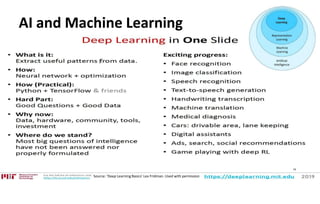
AI and Machine Learning
Source: ‘Deep Learning Basics’ Lex Fridman. Used with permission
14
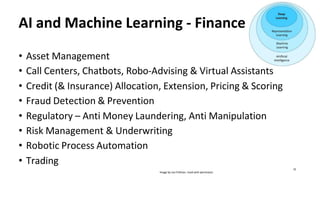
AI and Machine Learning - Finance
• Asset Management
• Call Centers, Chatbots, Robo-Advising & Virtual Assistants
• Credit (& Insurance) Allocation, Extension, Pricing & Scoring
• Fraud Detection & Prevention
• Regulatory – Anti Money Laundering, Anti Manipulation
• Risk Management & Underwriting
• Robotic Process Automation
• Trading
Image by Lex Fridman. Used with permission.
15
Open API & Open Banking
• Open Application Program Interfaces (Open API) allow outside
Developers access to and an ability to Integrate Permissioned Customer
Data into Third Party Applications
• Open Banking initiatives facilitate or mandate Open API for Non-banks to
Share Permissioned Bank Customer Data
• Policy Trade-offs of Promoting Competition & Innovation, Limiting
Cybersecurity Risks, and Maintaining Privacy & Consumer Protections
• EU Payment System Directive (PSD2), UK Open Banking Initiative, etc.
• Plus Screen Scraping, Reverse Engineering & Robotic Process Automation
16
Blockchain Tech Potential Uses
• Speculative Investing
• Crowdfunding through Initial Coin Offerings
• Tokens for Exchanges, Gaming, Gambling, DeFi & File Sharing
• Tokenized Fiat (Stable Value Coins), Securities & Assets
• Payment Systems
• Trade Finance & Supply Chain Management
• Clearing, Settlement & Processing
• Central Bank Digital Currencies & Payment Initiatives
• Digital ID & MIT Diploma
• Medical Records, Property Records, Internet of Things, Voting … 17
18
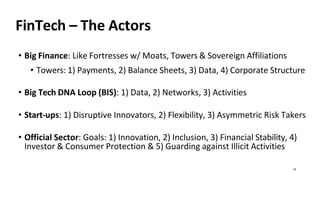
FinTech – The Actors
• Big Finance: Like Fortresses w/ Moats, Towers & Sovereign Affiliations
• Towers: 1) Payments, 2) Balance Sheets, 3) Data, 4) Corporate Structure
• Big Tech DNA Loop (BIS): 1) Data, 2) Networks, 3) Activities
• Start-ups: 1) Disruptive Innovators, 2) Flexibility, 3) Asymmetric Risk Takers
• Official Sector: Goals: 1) Innovation, 2) Inclusion, 3) Financial Stability, 4)
Investor & Consumer Protection & 5) Guarding against Illicit Activities
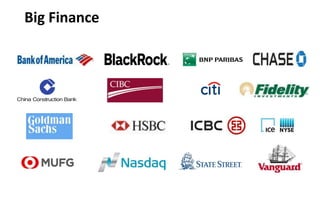
Big Finance
19
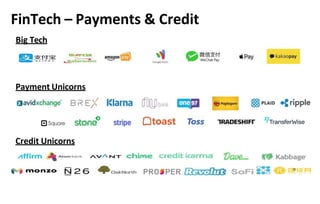
FinTech – Payments & Credit
Big Tech
Payment Unicorns
Credit Unicorns
20
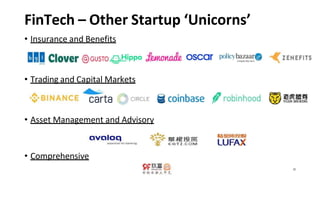
FinTech – Other Startup ‘Unicorns’
• Insurance and Benefits
• Trading and Capital Markets
• Asset Management and Advisory
• Comprehensive
21
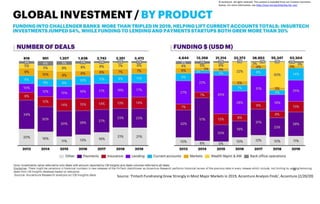
© Accenture. All rights reserved. This content is excluded from our Creative Commons
license. For more information, see https://ocw.mit.edu/help/faq-fair-use/
22
Source: ‘Fintech Fundraising Grew Strongly in Most Major Markets in 2019, Accenture Analysis Finds’, Accenture (2/20/20)
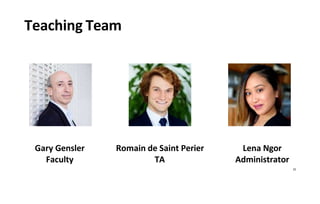
Teaching Team
Gary Gensler Romain de Saint Perier Lena Ngor
Faculty TA Administrator
23
24
FinTech: Technologies
• Class 2 (4/1): Artificial Intelligence, Machine Learning and Deep Learning
• Class 3 (4/6): Artificial Intelligence in Finance
• Class 4 (4/8): Open API’s & Marketing Channels
• Class 5 (4/13): Blockchain Technology & Cryptocurrencies
25
FinTech: Sectors
• Class 6 (4/15): Payments
• Class 7 (4/22): Credit & Lending
• Class 8 (4/27): Challenger Banks
• Class 9 (4/29): Trading & Capital Markets
• Class 10 (5/4): Risk Management & Regulation
26
FinTech: Wrapping it All Together
• Class 1 (3/30): Intro & Key Technological Trends Affecting Financial
Services
• Class 11(5/6): Corona Crisis & Finance
• Class 12 (5/11): Conclusion
27
Assignments
• Group Research Paper (3000 – 3600 words due 5/11) 40%
• Recommended business and technology strategy within a particular sector
• To CEO of B of A, Amazon, or Andreessen Horowitz
• Teams required to be Formed and Sector Selected by 4/8
• Individual Business Write-up (900 – 1200 words due 4/24) 30%
• Each student individually addresses 1 of the following:
• a) overall market analysis, b) technology trend analysis, c) traditional
competitor analysis, & d) big tech & fintech disrupter competitive analysis
• Class Participation 30%
Professionalism & Academic Integrity
• Success goes to those Prepared, Curious & Self Starters
• Respect & Courtesy builds Reputations, Networks & Trust
• Learning comes best to those who Listen as well as Talk
• Understanding Strategy and Paying Attention to Details both Matter
• Staying True to your Values is the best alternative
• Avoiding Plagiarism is not just an Academic Integrity Policy
• It respects other Authors
• It protects one’s Grade, Job and Reputation
Be attentive, speak in class, keep your video on, and audio muted unless speaking
Proper attribution of quotes and paraphrasing is required 28
MIT OpenCourseWare
https://ocw.mit.edu/
15.S08 FinTech: Shaping the Financial World
Spring 2020
For information about citing these materials or our Terms of Use, visit: https://ocw.mit.edu/terms.
29

00e1e9bb7125a0fbc4fbc54cdd0463bf_MIT15-S08S20_class1.pptx

  • 1.
    FinTech: 1 Shaping the FinancialWorld Intro - March 30, 2020
  • 2.
    2 FinTech 15.S08 • Forthose wishing to explore FinTech: • How new technologies are disrupting the financial services industry • Business models, products, applications and customer user interface • AI, Deep learning, Blockchain Technology and Open API’s • Competitive Landscape of FinTech Startups & Big Tech vs. Big Finance • For those who wish to gain critical reasoning skills to: • Understand the ‘ground truths’ of FinTech • Conduct Business & Technology Strategic Analysis
  • 3.
    3 Intro Class: Readings •'The economic forces driving fintech adoption across countries' Jon Frost, BIS Working Papers • 'FinTech and market structure in financial services' Financial Stability Board • 'The Future of Banking' FDIC Chair Jelena McWilliams
  • 4.
    4 Intro Class: StudyQuestions • What are the major technological trends materially influencing the provision of financial services? • How is the competitive landscape shaping adoption of these new technologies around the globe? How are FinTech start-ups and Big Tech firms competing and cooperating with incumbents from big finance? How has Big Finance reacted? • What do you wish to achieve in this Fintech course?
  • 5.
    5 Intro Class: Overview •Financial World • FinTech • AI, Open Banking & Blockchain Technology • The Actors • Teaching Team, Schedule, Assignments & Office Hours
  • 6.
    6 Financial World Intermediates Moneyand Risk • Functions • Sectors • Commercial Banks & Credit Unions • Credit • Asset Managers & Investment Vehicles • Investments • Insurance Companies & Underwriters • Risk Transformation • Investment Banks & Brokerage Firms • Exchanges & Clearinghouses • Capital Markets & Price Discovery • Advice • Financial Advisors
  • 7.
    7 Financial World Intermediates Moneyand Risk Data • Investing, Market Making, Marketing, Risk Management & Underwriting Funding & Risk Management • Balance Sheet & Capital • Marketplace & Securitizations • Derivatives, Guarantees & Reinsurance Risks • Credit; Funding; Liquidity; Market (Basis, Price, Rate, Spread, Volatility) • Model; Operational; Reputational / Compliance • Accidents; Health; Life Events; Natural Disasters; Weather User Experience & User Interface
  • 8.
    8 FinTech •‘Technology-enabled innovation infinancial services associated with new business models, applications, processes or products, all of which have a material effect …’ Financial Stability Board
  • 9.
    FinTech – Technologiesof our Times Natural Language Possessing AI & ML Blockchain Open API Robotic Process Automation Biometrics Chatbots Cloud 9 Open API by RestCase. Used with permission. Rest of the images: © Sources unknown. All rights reserved. This content is excluded from our Creative Commons license. For more information, see https://ocw.mit.edu/help/faq-fair-use/
  • 10.
    Customer Interface Chatbots,CI & Voice Assistants (2010s) Open APIs (2000s) & Open Banking (2015) Contactless & Cardless Systems (2000s) > Mobile Payments (2000s) & Wallets (2008) > Internet (1990s) & On-line Banking (1990s - 2000s) > Automatic Teller Machines (1970s) > Credit Cards (1940 – 50s) & Point of Sale Systems (1980s) > Mortgage Brokerage (1890s) & Automobile Indirect Lenders (1910s) > Electronic Payments (1870s), Wires (1910s), ACH (1970s) & Direct Deposits (1970s) > Checks (800s), Negotiable Checks (1500s), & Preprinted Checks (1760s) > Banking - Tents, Temples, Bricks & Mortar (4th – 1st millennium BCE) > 10
  • 11.
    Funding & RiskManagement ML Based Underwriting (2010s) > Peer to Peer Lending (2005) > Credit Default Swaps (1990s) > Asset Backed Securitizations (1970s – 90s) > Interest Rate Futures (1970s) & Interest Rate Swaps (1980s) > Consumer Credit Scoring (1960s) & FICO Scores (1990s) > Consumer Finance Companies & Warehouse Lines of Credit (1920s) > Private (1880s, 1950s), Government (1930s) & GSEs (1930s) Mortgage Insurance > Bankruptcy & Secured Lending Laws, Loan Servicing & Collection Agents (Days of old) > Bank Deposits - (Antiquity) > 11
  • 12.
    12 FinTech - Finance’sFertile Ground • Digitalization of Money, Securities and Credit • Vast and Expanding Amounts of Customer Data • Rapid Expansion of Computational & Analytical Power • Reliance on Multiple Systems of Ledgers • Wide Public Acceptance of New Tech • Legacy Customer Interface and Processing Systems • Infrastructure Systems’ Costs and Counterparty Risks • Economic Rents and Centralized Concentrated Risks
  • 13.
    13 FinTech – DisruptivePotential • AI for Managing Risks & Targeting Products • Updated Customer User Interface and Robo Advice • Greater Financial Inclusion & Tailored Services • ‘Internet of Value’: Movement of Value & Micro Payments • Streamlined Accounting, Clearing, Compliance & Processing Systems • Some Revenue Models shift to Data in exchange for Free Services • Efficiencies & Tighter Margins in Financial Sector
  • 14.
    AI and MachineLearning Source: ‘Deep Learning Basics’ Lex Fridman. Used with permission 14
  • 15.
    AI and MachineLearning - Finance • Asset Management • Call Centers, Chatbots, Robo-Advising & Virtual Assistants • Credit (& Insurance) Allocation, Extension, Pricing & Scoring • Fraud Detection & Prevention • Regulatory – Anti Money Laundering, Anti Manipulation • Risk Management & Underwriting • Robotic Process Automation • Trading Image by Lex Fridman. Used with permission. 15
  • 16.
    Open API &Open Banking • Open Application Program Interfaces (Open API) allow outside Developers access to and an ability to Integrate Permissioned Customer Data into Third Party Applications • Open Banking initiatives facilitate or mandate Open API for Non-banks to Share Permissioned Bank Customer Data • Policy Trade-offs of Promoting Competition & Innovation, Limiting Cybersecurity Risks, and Maintaining Privacy & Consumer Protections • EU Payment System Directive (PSD2), UK Open Banking Initiative, etc. • Plus Screen Scraping, Reverse Engineering & Robotic Process Automation 16
  • 17.
    Blockchain Tech PotentialUses • Speculative Investing • Crowdfunding through Initial Coin Offerings • Tokens for Exchanges, Gaming, Gambling, DeFi & File Sharing • Tokenized Fiat (Stable Value Coins), Securities & Assets • Payment Systems • Trade Finance & Supply Chain Management • Clearing, Settlement & Processing • Central Bank Digital Currencies & Payment Initiatives • Digital ID & MIT Diploma • Medical Records, Property Records, Internet of Things, Voting … 17
  • 18.
    18 FinTech – TheActors • Big Finance: Like Fortresses w/ Moats, Towers & Sovereign Affiliations • Towers: 1) Payments, 2) Balance Sheets, 3) Data, 4) Corporate Structure • Big Tech DNA Loop (BIS): 1) Data, 2) Networks, 3) Activities • Start-ups: 1) Disruptive Innovators, 2) Flexibility, 3) Asymmetric Risk Takers • Official Sector: Goals: 1) Innovation, 2) Inclusion, 3) Financial Stability, 4) Investor & Consumer Protection & 5) Guarding against Illicit Activities
  • 19.
  • 20.
    FinTech – Payments& Credit Big Tech Payment Unicorns Credit Unicorns 20
  • 21.
    FinTech – OtherStartup ‘Unicorns’ • Insurance and Benefits • Trading and Capital Markets • Asset Management and Advisory • Comprehensive 21
  • 22.
    © Accenture. Allrights reserved. This content is excluded from our Creative Commons license. For more information, see https://ocw.mit.edu/help/faq-fair-use/ 22 Source: ‘Fintech Fundraising Grew Strongly in Most Major Markets in 2019, Accenture Analysis Finds’, Accenture (2/20/20)
  • 23.
    Teaching Team Gary GenslerRomain de Saint Perier Lena Ngor Faculty TA Administrator 23
  • 24.
    24 FinTech: Technologies • Class2 (4/1): Artificial Intelligence, Machine Learning and Deep Learning • Class 3 (4/6): Artificial Intelligence in Finance • Class 4 (4/8): Open API’s & Marketing Channels • Class 5 (4/13): Blockchain Technology & Cryptocurrencies
  • 25.
    25 FinTech: Sectors • Class6 (4/15): Payments • Class 7 (4/22): Credit & Lending • Class 8 (4/27): Challenger Banks • Class 9 (4/29): Trading & Capital Markets • Class 10 (5/4): Risk Management & Regulation
  • 26.
    26 FinTech: Wrapping itAll Together • Class 1 (3/30): Intro & Key Technological Trends Affecting Financial Services • Class 11(5/6): Corona Crisis & Finance • Class 12 (5/11): Conclusion
  • 27.
    27 Assignments • Group ResearchPaper (3000 – 3600 words due 5/11) 40% • Recommended business and technology strategy within a particular sector • To CEO of B of A, Amazon, or Andreessen Horowitz • Teams required to be Formed and Sector Selected by 4/8 • Individual Business Write-up (900 – 1200 words due 4/24) 30% • Each student individually addresses 1 of the following: • a) overall market analysis, b) technology trend analysis, c) traditional competitor analysis, & d) big tech & fintech disrupter competitive analysis • Class Participation 30%
  • 28.
    Professionalism & AcademicIntegrity • Success goes to those Prepared, Curious & Self Starters • Respect & Courtesy builds Reputations, Networks & Trust • Learning comes best to those who Listen as well as Talk • Understanding Strategy and Paying Attention to Details both Matter • Staying True to your Values is the best alternative • Avoiding Plagiarism is not just an Academic Integrity Policy • It respects other Authors • It protects one’s Grade, Job and Reputation Be attentive, speak in class, keep your video on, and audio muted unless speaking Proper attribution of quotes and paraphrasing is required 28
  • 29.
    MIT OpenCourseWare https://ocw.mit.edu/ 15.S08 FinTech:Shaping the Financial World Spring 2020 For information about citing these materials or our Terms of Use, visit: https://ocw.mit.edu/terms. 29