Downloaded 11 times
![1 trait DataHandler[U] {
2 ...
3 def findUser(username: String, password: String): Future[Option[U]]
4 def createAccessToken(authInfo: AuthInfo[U]): Future[AccessToken]
5 def getStoredAccessToken(authInfo: AuthInfo[U]): Future[Option[AccessToken]]
6 def findAccessToken(token: String): Future[Option[AccessToken]]
7 ...
8 }
Finagle-OAuth2: Step #1
DataHandler
3](https://image.slidesharecdn.com/finchfinagleoauth2-150430130348-conversion-gate02/75/Finch-Finagle-OAuth2-3-2048.jpg)
![Finagle-OAuth2: Step #2
Typesafe Auth
1 import com.twitter.finagle.oauth2._
2 import com.twitter.finagle.oauth2.{OAuth2Filter, OAuth2Request}
3
4 val auth = new OAuth2Filter(dataHandler)
5
6 val hello = new Service[OAuth2Request[User], Response] {
7 def apply(req: OAuth2Request[User]) = {
8 println(s"Hello, ${req.authInfo.user}!")
9 Future.value(Response())
10 }
11 }
12
13 val backend: Service[Request, Response] = auth andThen hello
4](https://image.slidesharecdn.com/finchfinagleoauth2-150430130348-conversion-gate02/75/Finch-Finagle-OAuth2-4-2048.jpg)
![1 import com.twitter.finagle.oauth2._
2 import com.twitter.finagle.oauth2.OAuth2Endpoint
3
4 val tokens: Service[Request, Response] =
5 new OAuth2Endpoint(dataHandler) with OAuthErrorInJson with OAuthTokenInJson
Finagle-OAuth2: Step #3
Issue Acces Token
5](https://image.slidesharecdn.com/finchfinagleoauth2-150430130348-conversion-gate02/75/Finch-Finagle-OAuth2-5-2048.jpg)
![Finch: Quickstart
1 def hello(name: String) = new Service[HttpRequest, HttpResponse] = {
2 def apply(req: HttpRequest) = for {
3 title <- OptionalParam("title")(req)
4 } yield Ok(s"Hello, ${title.getOrElse("")} $name!")
5 }
6
7 val endpoint = new Endpoint[HttpRequest, HttpResponse] {
8 def route = {
9 // routes requests like '/hello/Bob?title=Mr.'
10 case Method.Get -> Root / "hello" / name =>
11 BasicallyAuthorize("user", "password") ! hello(name)
12 }
13 }
14
15 val service: Service[HttpRequest, HttpResponse] = endpoint.toService
8](https://image.slidesharecdn.com/finchfinagleoauth2-150430130348-conversion-gate02/75/Finch-Finagle-OAuth2-8-2048.jpg)
![Finch: Request Reader
(Reader Monad)
1 trait RequestReader[A] {
2
3 def apply(req: HttpRequest): Future[A]
4
5 def flatMap[B](fn: A => RequestReader[B]): RequestReader[B] = ???
6
7 def map[B](fn: A => B): RequestReader[B] = ???
8 }
9](https://image.slidesharecdn.com/finchfinagleoauth2-150430130348-conversion-gate02/75/Finch-Finagle-OAuth2-9-2048.jpg)
![Finch: Request Reader
1 val pagination: RequestReader[(Int, Int)] = for {
2 offset <- OptionalIntParam("offset")
3 limit <- OptionalIntParam("limit")
4 } yield (offset.getOrElse(0), math.min(limit.getOrElse(50), 50))
5
6 val service = new Service[HttpRequest, HttpResponse] {
7 def apply(req: HttpRequest) = for {
8 (offsetIt, limit) <- pagination(req)
9 } yield Ok(s"Fetching items $offset..${offset+limit}")
10 }
10](https://image.slidesharecdn.com/finchfinagleoauth2-150430130348-conversion-gate02/75/Finch-Finagle-OAuth2-10-2048.jpg)
![Finch: Params Validation
1 case class User(age: Int)
2
3 val user: RequestReader[User] =
4 for { age <- RequiredIntParam("age") } yield User(age)
5
6 val adult: RequestReader[User] = for {
7 u <- user
8 _ <- ValidationRule("age", "should be greater then 18") { user.age > 18 }
9 } yield u
10
11 val u: Future[JsonResponse] = adult(request) map {
12 JsonObject("age" -> _.age)
13 } handle {
14 case e: ParamNotFound =>
15 JsonObject("error" -> e.getMessage, "param" -> e.param)
16 case e: ValidationFailed =>
17 JsonObject("error" -> e.getMessage, "param" -> e.param)
18 }
11](https://image.slidesharecdn.com/finchfinagleoauth2-150430130348-conversion-gate02/75/Finch-Finagle-OAuth2-11-2048.jpg)
![Finch:
Request Reader Highlights
• RequiredParam, RequiredIntParam, etc
• Future.value[A]
• Future.exception[ParamNotFound]
!
• OptionalParam, OptionalIntParam, etc
• Future.value[Option[A]]
!
• Multi-value Params: RequiredParams, OptionalIntParams, etc.
• Future.value[List[A]]
!
• Params Validation: ValidationRule
• Future.value[Unit]
• Future.exception[ValidationFailed]
12](https://image.slidesharecdn.com/finchfinagleoauth2-150430130348-conversion-gate02/75/Finch-Finagle-OAuth2-12-2048.jpg)
![Finch: Endpoints Highlights
• Finch’s Endpoints are composable routers
!
• Endpoints might be treated as Scala’s
PartialFunctions[Request, Service[_, _]]
!
• Endpoints are convertible to Finagle Service’s
!
• Endpoints might be composed with Service’s, Filter’s or
other Endpoint’s.
14](https://image.slidesharecdn.com/finchfinagleoauth2-150430130348-conversion-gate02/75/Finch-Finagle-OAuth2-14-2048.jpg)
![Finch:
Endpoints Composition
1 val ab: Filter[A, C, B, C] = ???
2 val bc: Endpoint[B, C] = ???
3 val cd: Service[C, D]
4
5 val ad1: Endpoint[A, D] = ab ! bc ! cd
6 val ad2: Endpoint[A, D] = ???
7
8 val ad3: Endpoint[A, D] = ad1 orElse ad2
15](https://image.slidesharecdn.com/finchfinagleoauth2-150430130348-conversion-gate02/75/Finch-Finagle-OAuth2-15-2048.jpg)


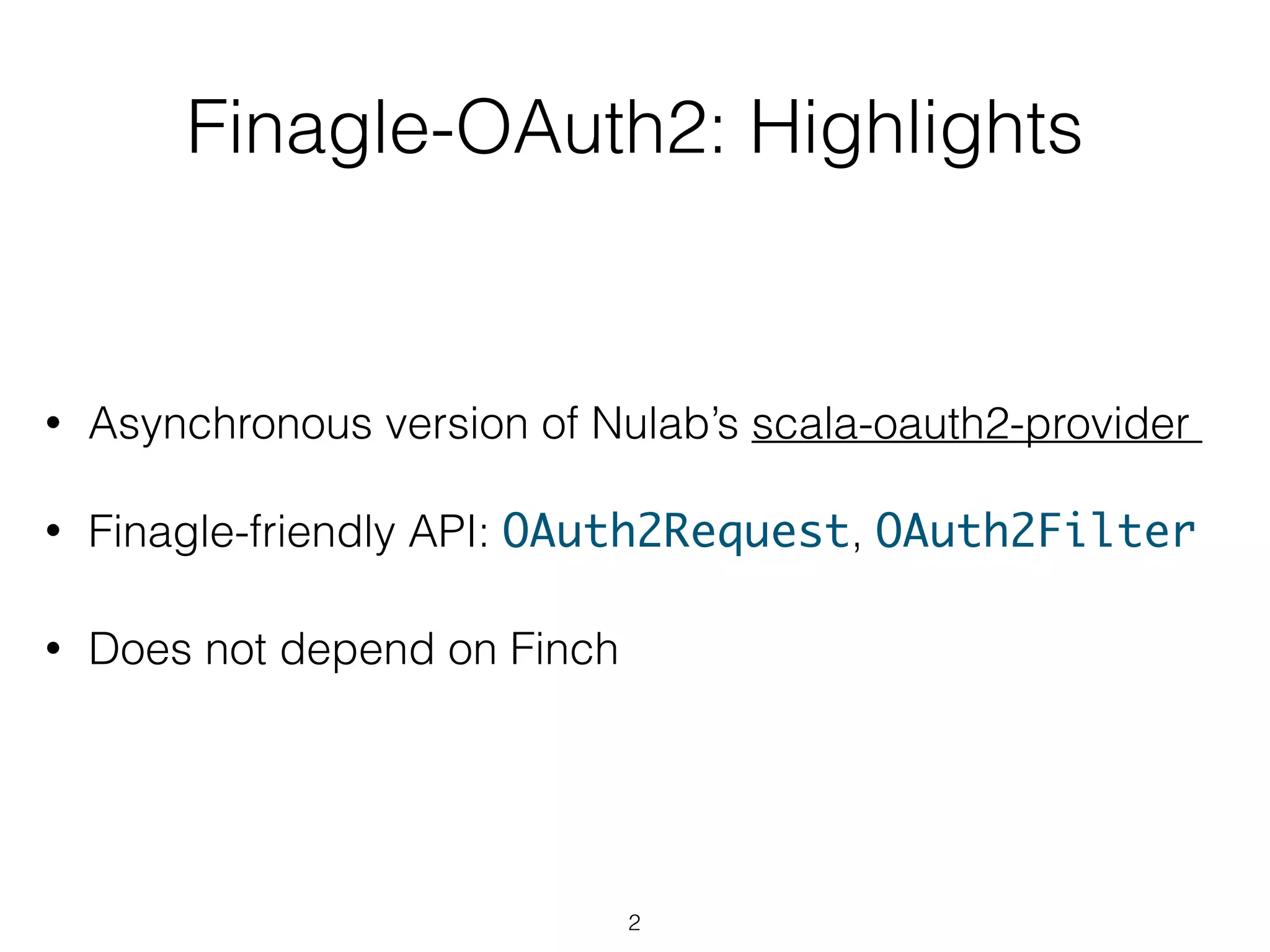
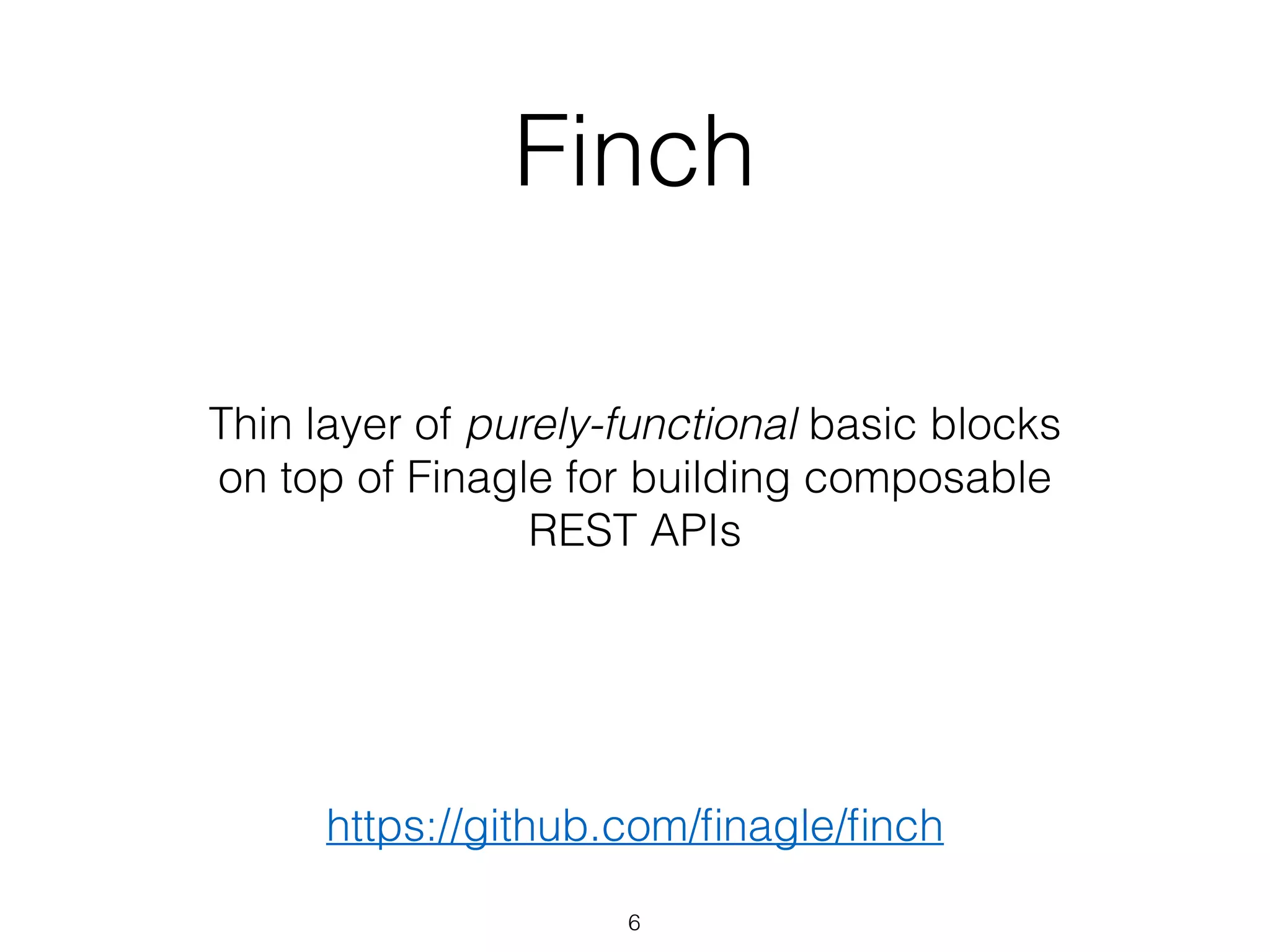
Finch is a library for building composable REST APIs on top of Finagle. Finagle-OAuth2 provides asynchronous OAuth2 support for Finagle services. Together, Finch and Finagle-OAuth2 allow building purely functional REST APIs with OAuth2 authentication in Scala. Key features include request readers for parameter parsing and validation, response builders, and composable endpoint routing.


