The Dynamics of Social Capital and its Effects on Individuals in Sun Valley
Presented as an Undergraduate Honors Thesis in the Department of Sociology
University of Colorado, Boulder
For Graduation in May 2003
By Daniel J. Kaskubar
Committee Members:
Tom Mayer, Sociology
Terra McKinnish, Economics
Brett Johnson, Sociology
The Dynamics of Social Capital and its Effects on Individuals in Sun Valley
Presented as an Undergraduate Honors Thesis in the Department of Sociology
By Daniel J. Kaskubar
Abstract
Using the individual as the unit of analysis, I generate a new theoretical framework for
conceptualizing social capital combining the aspects of sources, trust, range, endowment,
and use. I hypothesize that increases in individual well being in poverty-stricken
populations are often initially generated and facilitated through the use of social capital. I
interview individuals living in the poor community of Sun Valley and, by applying the
new schematic, evaluate each respondent’s total social capital portfolio. I find that
greater endowment and use of social capital is consistent with higher incomes and more
contentment in life. The aspect of trust is found to have most impact on emotional well
being, and the aspect of range is found to have most impact on economic well being.
Contents
Introduction: What is Social Capital? 7
Chapter 1: Defining and Conceptualizing Social Capital 10
Chapter 2: Four Relevant Sections of Study on Social Capital 21
Chapter 3: My Conceptualization of Social Capital 28
Figure 1 41
Figure 2 44
Chapter 4: Methods and Study Design 45
Chapter 5: Results: Interview Data 57
Chapter 6: Results: Discussion of Findings 89
Figure 3 91
Figure 4 92
Figure 5 94
Chapter 7: Concluding Remarks 97
Appendix: Interview Guide 99
Bibliography 104
Introduction
What is Social Capital?
It is usually not necessary to have a car in Boulder, CO, because of the
magnificent bus system. I can take buses virtually wherever I want to go. However,
there are times when I need to get an errand done in a short period of time. In such an
instance, a car is very useful, but I do not own one. The obvious solution, when it would
be much more useful to have a car than to take the bus, is to borrow one. There are many
people I know who own cars, yet they are not constantly using them. It seems logical
that I would be able to borrow a car for a brief period of time, if the relationship is strong
enough to respect such a request. Herein lies the key to social capital – a relationship
between two or more people that can increase an individual’s consumption (or other)
opportunities, thereby increasing his or her well being. Even though I don’t own a car, I
can still have access to one (or many). In fact, since coming to Colorado about three and
a half years ago, I have borrowed over 30 different cars! A few of my friends have even
given me copies of their car keys.
Introduction
8
The phenomenon described above is just one of many varying examples of social
capital. One might go to a party to do some “networking.” We go on the internet to “get
connected.” We may even play the Kevin Bacon game, connecting him to other stars
through a string of movies. Social capital plays a huge part in our lives, yet many of us
pay little attention to it.
It is important to note that one can be part of an environment with a great deal of
social capital without ever making explicit use of it. Because of this, it is necessary to
differentiate between endowment and use. In addition, this differentiation makes it
difficult to define and measure social capital, especially through personal surveys and
general indicators. These topics will be explored in depth below.
Researcher’s Hypothesis
It is my hypothesis that social capital plays a crucial role in the creation of
economic well being for individuals. This is especially true for individuals without other
forms of capital to build on, namely, those who are poor. In fact, the researcher believes
that, based on theoretical inference, increases in individual well being in poverty-stricken
populations are often initially generated and facilitated through the use of social capital,
which provides access to capital outside the ownership of the individual. When
endowments of social capital are used, it creates more opportunities for wealth creation
for the individual, regardless of other capital sources they may have under their
jurisdiction.
In addition to testing this hypothesis, it is my intention to better ascertain the
dynamics of social capital as they relate to the research population (Sun Valley
Introduction
9
neighborhood in Denver, CO) and other neighborhoods like it. This paper serves two
functions, then: First, to evaluate whether or not the use of social capital is a precursor to
individual economic improvement, and second, to critically evaluate how social capital
functions among individuals in Sun Valley.
Chapter 1
Defining and Conceptualizing Social Capital
Social Capital Defined
Economists and sociologists differ in their conceptualizations of social capital.
Economics, which is commonly thought to be a “harder” science than sociology, has
generally approached social capital in terms of “mathematical equations describing how
one person’s utility may be influenced by the behavior of others.”1
In contrast,
sociologists take a much more human-centered, conceptual view, most often defining
social capital generically as the set of interactions between individuals.
The Economist’s View of Social Capital
Let us understand that utility is the root variable in economics. It can be defined
as the basic measure of an individual’s satisfaction or well being. Utility is increased
through consumption, as a person chooses to purchase goods that suit his or her desires.
Chapter 1
Defining and Conceptualizing Social Capital
11
In turn, consumption opportunities are increased by a number of different variables, one
of which is wealth. Finally, a large part of a person’s wealth comes from his or her
income. This 4-tiered model is an example of how an economist might explain the
importance of income on well being. Everything in individual-specific economics
ultimately comes back to utility.
In order to have income, a person needs to produce. Usually, this consists of
productive labor capacity. A person agrees to exchange his or her labor for income,
which can then be used in the manner described above to increase utility. However, there
is one other factor of production in economics: capital.
It is difficult to get a concise definition of capital. In the early 20th
century,
Bohm-Bawerk (an Austrian economist) defined capital as a “produced means of
production.” This implies that capital exists because of someone else’s past labor.2
Produced goods can be thought of, then, as stored wealth. A person’s wealth, in turn, can
be used in three ways: direct personal consumption, trading or selling for more favorable
goods and services, and investment for further use. When produced goods are used as a
way to invest in future production or wealth, it is considered capital. The subtle but
crucial distinction is that it is not the good, but the use of the good, that defines it as
capital. This definition, then, is one based on function, and not on any distinct properties
within the good, other than the fact that it can be utilized in such a manner. Narayan and
1
Debertin 2002
2
The one exception to this is natural capital. Of course, human labor did not “create” the land or the
natural resources we use, but it did provide us with better access to the inherent characteristics within these
endowments. Irrigation and fertilization can greatly increase the productivity of land, and modern
technology allows us to extract oil and many other resources to make use of them. This missing attribute is
one negative consequence of the conceptualization of “natural capital.” However, land and resources can
be invested in, which is a crucial attribute of capital. Therefore, this classification is slightly ambiguous.
Chapter 1
Defining and Conceptualizing Social Capital
12
Pritchett give it a similar definition as “stuff that augments incomes but is not totally
consumed in use.”3
Using the above description, capital must be thought of as a stock of assets one
owns (or has direct access to), which can be used for the sake of future investment and/or
wealth creation, leading to greater individual utility. Specifically, we can measure
natural capital by the amount of land, animals, and other natural resources one owns or
has access to. Physical capital can be measured by the amount of structures, equipment,
and machinery one owns, as well as the quality of physical infrastructure one has access
to (roads, energy, airports, etc). Likewise, it is easy to measure financial capital based on
the amount of money assets one has in his or her bank accounts and portfolios. Human
capital can be measured by one’s health and nutritional level and the amount of training,
education, and work experience one has under his or her belt (a person’s “productive
capacity”).
By extension, social capital also must refer to a “stock” of some form or another.
It has been the consensus that social capital requires the measurement of the quantity and
quality of relationships and networks one has access to, and this can be a very difficult
task indeed. Instead of observing one individual, we must venture outside that individual
to view the “relational climate”, per se, that they are seated in. For many economists, this
is a step they are unwilling to take. Profit maximization and utility functions are
inherently oriented with an individual (or individual company), not with
conceptualizations of altruism that relate one person’s utility to another. Of course, there
are a few economic theories that do take this step (game theory, for example).
3
Narayan and Pritchett 1999: 871
Chapter 1
Defining and Conceptualizing Social Capital
13
In addition, social capital must have certain attributes that make it operate in the
same way as other forms of capital. It must be able to be “produced by labor,” as well as
be able to be invested in. The labor, in this case, is in the form of conversations and
building and maintaining relationships. Labor can be thought of as an investment of
one’s time and resources; therefore, we can consider a person building a relationship as
“investing in social capital”. Relationships can be invested in monetarily through buying
someone lunch or giving them a gift. Usually, these investments are best coupled with
the investment of labor – merely giving someone money for lunch does not do as much
for the relational climate as going out together, eating and conversing together, then
footing the bill.
Maurice Schiff, development economist for the World Bank, has offered an
economist’s definition of social capital as, “The set of elements of the social structure
that affects relations among people and are inputs or arguments of the production and/or
utility function.”4
This macro-level definition conflicts with the assumption that most
economists are concerned only with the individual applications of such a concept.
Indeed, the literature of social capital in economics is split between these two groups.
Economists are concerned with individual-level utility, but many are also concerned with
empirically-driven overarching principles, which can be applied to a variety of
populations.
That stated, economists have most embraced the concept of social capital when
researching economic development in less-developed countries (LDCs). In traditional
growth-accounting models, there has been a great deal of variability between nations of
similar inputs and all other forms of capital (physical, natural, human, and financial).
Chapter 1
Defining and Conceptualizing Social Capital
14
The growth of the “East Asian Miracles” is one such example. Given standard
endogenous variables, only 17 to 36 percent of their growth can be explained.5
It is
thought that one possible cause for the variance is the social and political climate within
which the economic policies operate. In other words, economists are using the concept of
social capital at a macro level in order to attempt to explain variance in growth. In this
way, if social capital can be effectively measured, widespread policy implications can be
initiated to speed up overall growth in many countries worldwide.
The Sociologist’s View of Social Capital
Capital itself is an economic term, and as such, not much literature has been
produced within sociology under the “capital microscope”, as has been the case in
economic literature. Yet, many other species of the same genus have been written on.
For example, Pierre Bourdieu, a French sociologist, first coined the term “cultural
capital,” referring to much the same thing that has been discussed thus far.6
Also
included in this literature are topics such as “community development.” In addition, the
interpersonal linkages through which social capital packs its punch form the base of the
discipline of sociology.
Perhaps the most profound contemporary sociological work on the subject of
social capital is Alejandro Portes’, “Social Capital: Origins and Applications in Modern
Sociology.”7
In this essay, Portes evaluates current definitions of the term, including a
few economists’ perspectives. He starts by making the reader aware that social capital,
4
Schiff 1992 from Portes 1998: 6
5
Grootaert 1998: 13
6
Bourdieu 1985
7
Portes 1998
Chapter 1
Defining and Conceptualizing Social Capital
15
indeed, is not a new concept in the field of sociology. In fact, he dates it back to
Durkheim’s study on group life and its relation to anomie and self-destruction as an
example of research on the profound influence of one’s participation in community on an
individual’s circumstances.
The value of the interactions between people is the primary concern of those
researching within the discipline. One variable that has had considerable attention has
been trust. The more two individuals trust each other, the more they are willing to share
and invest in the relationship. One can think of this in a cyclical fashion – as trust levels
increase between two people, they begin to share more and more intimately and become
more and more open to each other. As these potential vulnerabilities are handled with
care, more trust develops, which increases overall trust in the relationship. When trust
increases in a number of different individuals, they can even form coalition groups.
These kinship groups (or subgroups), as sociologists most often call them, create a
powerful sense of belonging within each member.
The most basic form of kinship group is a family. Within this context, members
can find a safe place to “come home to.” Of course, there can be negative interactions,
which can deteriorate this group, to such extent as to completely eliminate any sort of
kinship bond that might have previously existed. We shall come back to this crucial
distinction later on in this paper. Because of the important dynamic of the family, it has
been thought of as one of the main sources of social capital.
Despite these contributions to the discussion of social capital, sociology has been
criticized for its lack of empiricism. Many overarching theories describing interaction
remain difficult to define for reality, as it exists today (such as modern Marxism, which
Chapter 1
Defining and Conceptualizing Social Capital
16
did not include considerations of entrepreneurship). Indeed, many modern sociologists
disagree on the concept of a singular reality to begin with. Quantification is not
sociology’s strength, and the attainment of an actual value that these interactions might
have to an individual has never (to my knowledge) been attempted within the discipline.
The topic of social capital is, nonetheless, extremely important to the discipline of
sociology.
Further Considerations on the Conceptualization of Social Capital
Where the economists are likely to become uncomfortable happens to be where
sociologists get excited. While economists are trying to quantify the theory of social
capital in order to directly prescribe its applications around the world, many sociologists
are still attempting to define the scope of the “relational climate” as previously described.
On the other hand, it is apparent that by defining the macro-level climate of a country,
economists have taken the step and defined this scope. Before we can go any further, we
must find the bounds by which we can measure and analyze the concept of social capital.
There are three distinct conceptualizations of the scope of the relational climate,
as it influences well being. These conceptualizations have been compiled and
summarized by Christiaan Grootaert, in a paper he produced for the World Bank, entitled,
“Social Capital: The Missing Link?”8
The first conceptualization he attributes to Robert
Putnam, who conducted a study in northern Italy comparing civic engagement with
quality of government (he also recently published a book called Bowling Alone,9
in which
he uses data from a wide variety of studies to show that social capital is on the decline in
8
Grootaert 1997
9
Putnam 1995
Chapter 1
Defining and Conceptualizing Social Capital
17
the United States). In his study, Putnam views the climate of social capital to consist of a
set of “horizontal associations” between people.10
This narrow definition refers to those
interactions between individuals and groups with shared interests and common goals.
Together, these horizontal associations create a civil structure that encourages civil
leaders to be responsible in governing their constituencies.
The second conceptualization of the relational climate is attributed to James
Coleman. In his essay, “Social Capital in the Creation of Human Capital,”11
he includes
horizontal as well as vertical associations between people. This addition includes
hierarchical relationships, such as patron-client relations and employer-employee
relations. A person with a great deal of vertical, as well as horizontal, relationships will
obtain greater access to higher levels of well being through these connections (as long as
they are not oppressive, which can often be true in the patron-client case). Coleman
specifically defined social capital by its function as:
A variety of entities with two elements in common: They all consist of some
aspect of social structures, and they facilitate certain action of actors – whether
persons or corporate actors – within the structure.12
Perhaps it need not be stated that this is quite a vague and removed definition.
The third conceptualization of the relational climate is attributed to North13
and
Olson14
. This “most encompassing view,” as stated by Grootaert, also includes the social
and political environment within which individual actions take place. Variables such as
the type of government, the court system, civil and political liberties, and the economic
10
Putnam, Leonardi, and Nanetti 1993
11
Coleman 1988
12
Coleman 1988 from Portes 1998: 5
13
North 1990
14
Olson 1982
Chapter 1
Defining and Conceptualizing Social Capital
18
system are included in this perspective. These systems enable norms to develop and also
guide the shape and structure of an individual’s interactions within society.
These conceptualizations differ in scale. Putnam attributes social capital to
communities, Coleman to communities in relation to governments and entities with
greater influence, and North and Olson include government as a whole [this includes, but
is not limited to, political stability, Gastil’s measures of civil and political liberty,
measures of expropriation of risk, corruption, enforcement of contracts and property
rights, measures of political and economic discrimination and social disintegration
(crime, suicide, riots, illegitimacy, divorce, etc.)].
This third conceptualization, while encompassing, is problematic. Development
economists prefer this definition because it has more direct relation to macroeconomics
as a whole. However, sociologists have argued that this conceptualization brings with it
issues of tautology. The sociologist Talcott Parsons, through processes he defined as
institutionalization and internalization, described in detail the effects of a social system
on individuals.15
Through institutionalization, individuals in society create structures that
serve their needs. Through internalization, each individual makes personal sense of these
institutions as they relate to the person. Incorporating such variables as the political and
economic environment leaves a classic chicken-and-egg question as to which came first:
the individuals who created the institutions, or the institutions that shaped the behavior
and interaction of the individuals. Portes, a sociologist critical of the current literature of
social capital, has this to say:
The intellectual journey that transformed social capital from an individual
property into a feature of cities and countries tended to disregard [the question of
tautology]. The journey was fast, explaining major social outcomes by re-
15
Parsons 1951
Chapter 1
Defining and Conceptualizing Social Capital
19
labeling them with a novel term (social capital) and then employing the same
term to formulate sweeping policy prescriptions. While I believe that the greatest
theoretical promise of social capital lies at the individual level… there is nothing
intrinsically wrong with redefining it as a structural property of large aggregates.
This conceptual departure requires, however, more care and theoretical
refinement than that displayed so far.16
Those who have tried to extend social capital to broader interpretations have not
effectively considered these barriers to the legitimacy of their research.
There are many other conceptualizations of the phrase, most of which have been
based on the purpose and functionality of social capital. One is that social capital is a
“soil” in which other capital is planted.17
This claim suggests that the quality of social
capital makes investments of other forms of capital more or less effective. Coleman,
Olsen, and Putnam all agree on this point, which is interesting since it is invariably a
macro-level claim. Others have similarly described it as the glue that holds society
together. Still others state the concept as a measure of satisfaction with the way people
interact. Another group defines it as the availability of opportunities, resources, and
advantages. Many of these definitions, however, do not elaborate theoretically. The lack
of detail makes it difficult to accomplish any form of sophisticated work using these
definitions. Finally, Portes also offers a definition of his own, which he states is
becoming the most-agreed upon conceptual basis:
Social capital stands for the ability of actors to secure benefits by virtue of
membership in social networks or other social structures. This is the sense in
which it has been more commonly applied in the empirical literature…. Whereas
economic capital is in people’s bank accounts and human capital is inside their
heads, social capital inheres in the structure of their relationships.18
Applying these definitions, social capital is an abstract concept that cannot explicitly be
agreed upon. Nevertheless, the buck does not stop there. To do research of any kind, a
16
Portes 1998
17
Grootaert 1997: 7
Chapter 1
Defining and Conceptualizing Social Capital
20
definition must be established to use as a basis for operationalization, and in turn,
application to the world in which we live.
18
Portes 1998: 6-7
Chapter 2
Four Relevant Sections of Study on Social Capital
Measuring the concept of social capital requires much more detail than any
definition. Even with the scope of the relational climate defined in any of the three
conceptualizations previously outlined in chapter one, how does one “measure” a
relationship as a stock from which utility can be derived? Most previous research in the
social capital literature has been conducted using surveys with many different indicators.
For instance, in evaluating a person’s relational climate, one can obtain information on
the amount of trust a person has for their neighbors, coworkers, or family members.
Researchers have also tried to calculate social capital by evaluating the number of groups
an individual is a part of and participation level in those groups (usually by asking about
ranking positions, frequency of activity, etc.).
Chapter 2
Four Relevant Sections of Study on Social Capital
22
Previous Research
Much of the theoretical literature has already been outlined in the discussion of
the definition of social capital. I am concentrating on research that is geared toward four
areas, which I believe are most relevant to my study: (1) linking social capital to
economic improvement in a macro sense, (2) social capital as an individual phenomena,
(3) social capital and its effects on employment (especially in poor neighborhoods), and
(4) social capital as a causative variable. This discussion will lead into my
conceptualization of social capital.
The first section of research, geared toward linking social capital to economic
improvement on a macro level, has been dominated by development literature. The most
notable of these studies is one by Narayan and Pritchett entitled, “Cents and Sociability:
Household Income and Social Capital in Rural Tanzania.”19
This discussion is not
centered on the individual as the actor; rather, they use a household as the unit variable.
By using “…a specially designed large scale survey… to measure the degree and
characteristics of associational activity, as a process for social capital”, they find that,
“…a one standard deviation increase in the village social capital index… is
associated with at least 20 percent higher expenditures per person in each
household in the village…. The link… shows convincingly this effect is social
and operates at the village level. The social capital of a household’s village is as
important in determining a household’s income as many of the household’s own
characteristics which receive a great deal of attention (e.g. schooling, assets or
distance to markets, gender of household head). Social capital is an important,
and so far largely missing, dimension of income and poverty analysis.”20
This article appeared in an economic development journal, and was conducted as
research for the World Bank, the government of Tanzania, and the University of Dar Es
Salaam.
19
Narayan and Pritchett 1999
20
Ibid, from the article’s conclusion
Chapter 2
Four Relevant Sections of Study on Social Capital
23
Another notable study within this first section of research was conducted by
Knack and Keefer.21
In this study, the authors are also concerned with development,
especially in poor countries and “poor areas of industrialized countries.” They use the
World Values Surveys to sample 29 market economies across the globe, and they find
that, “trust and civic norms are stronger in nations with higher and more equal incomes,
with institutions that restrain predatory actions of chief executives, and with better-
educated and ethnically homogenous populations.”22
However, this study is ambiguous
in terms of causation. It is difficult to say whether increased economic activity increases
trust and civic activity, or if the link is the other way around.
Finally, a study conducted by Paul Whiteley23
has similar findings. He samples
data from 34 different countries and finds that:
“Social capital has an impact on growth which is at least as strong as that of
human capital or education, which has been the focus of much of the recent work
on endogenous growth theory. It appears to have the same impact on growth as
catch-up or the ability of poorer nations to adopt technological innovations
pioneered by their richer counterparts.”24
Whiteley does not stop at a relation between economic growth and social capital, but also
ventures to state in his conclusion that, “Social capital… originates in primary groups,
principally the family, rather than in secondary groups such as voluntary organizations.”
This idea of the family having a chief influence on an individual’s social capital is an
important one, and one that leads us into the next section of research.
The second section of research concentrates on the individual as an actor as
opposed to the family or household. When this distinction is made, the family becomes a
crucial source of social capital for the individual, instead of being considered as having
21
Knack and Keefer 1997
22
Ibid: 1251
23
Whiteley 2000
Chapter 2
Four Relevant Sections of Study on Social Capital
24
the same resources of social capital as the individual. Pierre Bourdieu, who has been
credited with coming up with the first modern analysis of social capital, was a proponent
of treating the concept at an individual level. His classic work, “The Forms of Capital,”
focuses on the benefits an individual receives through participation in subgroups.25
Sanders and Nee26
added to this topic with their article, “Immigrant Self-
Employment: The Family as Social Capital and the Value of Human Capital.” In this
article, the authors research self-employment among Asian and Hispanic immigrants.
Because self-employment is important in the economic advancement of immigrants,
social capital in this setting is also very important. The authors state that the family is
crucial in facilitating the “pooling of labor power and financial resources”27
of the self-
employed. They also find that, “…being married is associated with a 20 percent
advantage in the net odds of self-employment.”28
This is manifest most greatly in regards
to Korean women. For them, the odds of self-employment are 350% greater if they are
married.29
The authors conclude by stating that immigrants have access to informal
credit markets and interpersonal bonds that aid in starting an individual’s business.
A study by Brehm and Rahn30
is also a noteworthy article on individual-level
analysis of social capital. The authors state, “Although normally conceived as a property
of communities, the reciprocal relationship between community involvement and trust in
24
Ibid, from the article’s abstract
25
Bourdieu 1985
26
Sanders and Nee 1996
27
Ibid, from the article’s abstract
28
Ibid: 240
29
Ibid: 241
30
Brehm and Rahn 1997
Chapter 2
Four Relevant Sections of Study on Social Capital
25
others is a demonstration of social capital in individual behavior and attitudes.”31
They
continue:
“…‘communities’ do not join the PTA or enlist in farming organizations, parents
and farmers do. The collective manifestation of social capital must be
sustainable at the level of individual civic engagement and in individual attitudes
towards others…. In and of itself, identification of the aggregate phenomenon at
an individual level is an important advance in evidence supporting the social
capital idea.”32
In evaluating social capital at an individual level, we can better understand its effects and
processes. There have been a couple of other articles reiterating these points, namely,
those by Jackman and Miller.33
In addition, Portes34
adheres to the assessment of social
capital at the individual level, and notes the importance of including the family in the
assessment of an individual’s social capital resources.
The third section of research has greater significance on the substance, rather than
the methodology, of my study. There has been a growing literature on the effect of social
capital on a person’s ability to get a job.35
One of the more famous works dealing with
this issue is Wilson’s When Work Disappears.36
He notes that informal job networks are
helpful in attaining some forms of employment. Data from the Urban Poverty and
Family Life Study helps him prove his point, and he quotes one woman from the study:
A lot of people get good jobs because they know friends, and they work there. If
you know somebody that’s been working in an established company for a long
time, and they tell you to come in and fill an application, you can get a job. It
always pay to know somebody.37
31
Ibid: 999
32
Ibid: 1017
33
Jackman and Miller 1996a, 1996b
34
Portes 1998: 9-12, 21
35
See, for example, Bridges and Villemez 1986; Granovetter 1974; Lin, Ensel, and Vaughn 1981
36
Wilson 1996
37
Ibid: 65-66
Chapter 2
Four Relevant Sections of Study on Social Capital
26
In addition to Wilson, there are other studies that note this important connection.
Fernandez, Castilla, and Moore38
analyze networks and employment at a phone center.
This study analyzes the labor market from the employer’s perspective, and finds that “the
firm’s investment in the social capital of its employees yields significant economic
returns.”39
An additional study by Reingold, Van Ryzin, and Ronda40
provides insight into
communities with a large percentage of public housing (Sun Valley certainly fits into this
category). In their study they investigate the effect of public housing on the labor force
activity of the residents. Using regression analysis, the results are inconclusive; no direct
effect is observed, but there are indirect effects through their “neighborhood
disadvantage” variable. Reingold conducted a previous study on his own showing that
“residents of poor urban communities face a labour market that is organized, in part, by
their networks of social relations.”41
The fourth and final section of literature that sheds light on my study has to do
with social capital as a causative (rather than a correlated) variable in economic
outcomes. Research in this area is limited, but important nonetheless. The most famous
of these is James Coleman’s, “Social Capital in the Creation of Human Capital.”42
In this
article, Coleman argues that the relationships between parents and children are crucial in
determining educational outcomes. Of course, it is also true that studies in the last
literature section, which indicate that social networks increase an individual’s opportunity
to find a job, have a certain causative aspect to them. Although perhaps not explicitly
38
Fernandez, Castilla, and Moore 2000
39
Ibid, from the article’s abstract
40
Reingold, Van Ryzin, and Ronda 2001
41
Reingold 1999: 1927
Chapter 2
Four Relevant Sections of Study on Social Capital
27
stated, it is an individual’s social capital that allows him to receive the economic benefits
of a job.
42
Coleman 1988
Chapter 3
My Conceptualization of Social Capital
Definition of Social Capital
The definition I subscribe to is the one given by Portes at the end of chapter one.
Indeed, if we are going to consider social capital as “capital” at all, we must adhere to the
previously outlined principles and attributes of capital as defined by economists. In
addition, we must attempt to define two things. First, we must define who these “actors”
are. We have seen definitions that have defined these actors very differently. Some are
based only on individuals, some extend that to groups and organizations, and others
include governments as these actors. By deciding whom or what the actor is, we
inherently figure out our unit of analysis. Secondly, we need to define the scope of the
social networks and social structures. This, again, refers to the relational climate. By
deciding the scope, we limit the types of interactions that can be included under the
heading of social capital.
Chapter 3
My Conceptualization of Social Capital
29
By limiting the actors to individuals, we can greatly concentrate the objects of
what we are calling “social capital.” Recalling Portes, Parsons, and others, if we attempt
to make the actors anything larger than the individual (or perhaps the household), it is
difficult to figure out what has caused the changes of such masses. Limiting the actors to
individuals also carries with it more feasible economic calculations. Social capital, at this
point in time, is largely a micro-level concept. Without fully understanding the
relationship of social capital on individual welfare (indeed, there is much debate), we can
in no way attempt to make an accurate aggregate estimate. For the purpose of this study,
then, the researcher considers the actor (the unit of analysis) to be an individual (Brehm
and Rahn 1997; Whiteley 2000; Sanders and Nee 1996).
The scope of influence (or the scope of the relational climate, as referred to
earlier) must also be defined. There are three main spheres of influence. The first sphere
of influence is an individual’s personal relationships, including co-workers, friends and
family (one-on-one interaction). The second sphere is an individual’s interaction within a
subgroup or network (being a part of a club, organization, or kinship group). The third
and final sphere is an individual’s interaction with the greater society (i.e., institutional
structures) of which he or she is a part.
One might assume that the more intimate the relationship, the more direct effect
on a person’s well being. On the average, not all those living within the same socio-
political-economic environment are equally well off economically or otherwise (unless
that environment functions to provide such egalitarianism, such as the communist regime
in Cuba). We can reasonably explain this by the fact that the most intimate relationships
are the ones people also spend the most time investing in. Frank and Yasumoto comment
Chapter 3
My Conceptualization of Social Capital
30
that individuals are “most strongly influenced by members of their primary groups –
people with whom they engage in frequent interactions.”43
But not all best friends are
equally well off, either. This comes from the fact that there are many other variables that
influence a person’s well being. This paper does not attempt to provide evidence for all
of that influence, but rather the piece that social capital contributes, through cohesive
subgroups of which an individual is a part (family, workplace, church, etc.).
43
Frank and Yasumoto 1998: 643
How Social Capital Affects Well Being
Social capital relates to one’s economic well being in a variety of different ways,
and occurs through two distinct aspects of social capital, which must first be commented
on. The first aspect of social capital is trust. The more one is trusted, and can trust
others, to keep one’s word and be reliable, the more opportunities one might receive in
the future to be trusted again. As long as one proves to be worthy of another’s trust, the
cycle is self-reinforcing. We can parallel this to a credit history report as it relates to
financial capital. Once it becomes obvious that the person is reliable with personal
information and/or resources, the “interest rate” is lowered and the “risk of default” is
lowered.
As classic example of how the aspect of trust in social capital might relate to
one’s utility, the 18th
century philosopher and economist David Hume presents a parable:
Your corn is ripe today; mine will be so tomorrow. ‘Tis profitable for us both,
that I should labour with you today, and that you should aid me tomorrow. I
have no kindness for you, and know you have little for me. I will not, therefore,
take any pains upon your account; and should I labour with you upon my own
account, in expectation of a return, I know I should be disappointed, and that I
should in vain depend upon your gratitude. Here then I leave you to labour
Chapter 3
My Conceptualization of Social Capital
31
alone; you treat me in the same manner. The seasons change; and both of us lose
our harvests for want of mutual confidence and security.
This example demonstrates how lack of trust can lead to a decreased level of social
capital, and in turn, utility. If there were a greater level of trust in this case, both harvests
might be saved. This is also possible through the use of enforceable contracts.
The second aspect of social capital is range. This aspect refers to the breadth of
the relational climate from which an individual can draw personal benefit. The broader
the spectrum of friends, family, and acquaintances, as they cross social boundaries (race,
gender, profession, education, socio-economic class, etc.), the more social capital
resources are available to an individual. Another negative example can serve as an
enlightening grounding for this distinction. This can be seen by William Julius Wilson’s
analysis of inner city communities in his aforementioned book, When Work Disappears:
…it appears that what many impoverished and dangerous neighborhoods have in
common is a relatively high degree of social integration (high levels of local
neighboring while being relatively isolated from contacts in the broader
mainstream society) and low levels of informal social control…. In such areas,
…children are disadvantaged… because the social interaction among neighbors
tends to be confined to those whose skills, styles, orientations, and habits are not
as conducive to promoting positive social outcomes (academic success, pro-
social behavior, etc.)44
Alejandro Portes raises these same concerns,45
and recognizes the works of others such as
Fernandez-Kelly46
on the topic:
In her analysis of teenage pregnancy in Baltimore’s ghetto, [she] notes how the
dense but truncated networks of inner-city black families not only cut off
members from information about the outside world, but simultaneously support
alternative cultural styles that make access to mainstream employment even more
difficult. In this isolated context, teenage pregnancy is not the outgrowth of
carelessness or excess of sexuality but, more commonly, a deliberate means to
gain adult status and a measure of independence.47
44
Wilson 1996: 63
45
Portes 1998: 16
46
Fernandez-Kelly 1995
47
Portes 1998: 14
Chapter 3
My Conceptualization of Social Capital
32
Indeed, a lack of range can severely damage an individual’s well being (utility).
Perhaps the best example of this is a street gang, whose members often see only other
members for long periods of time and whose values do not often promote positive social
outcomes. If an individual gets “caught up” (is that not the language we use?) in a gang
for a long period of time, there can be serious consequences on his or her well being for
the rest of his or her life.
Range of social capital can be conceptualized in a slightly different way.
Increased range gives a person greater access to different subgroups that would otherwise
be out of her reach. Ties between subgroups provide “…access to unique influence and
information that can give an actor important advantages in the pursuit of resources or
position.”48
Granovetter has outlined these sorts of connections (he mentions the
“strength of weak ties”).49
In the case of a poor population such as Sun Valley, increased
range generally means more access to mainstream society.
Together, these aspects of social capital help us to conceptualize the way this
form of capital affects well being. Previous research on social capital indicates that there
are at least five distinct ways that social capital affects well being.50
The first one, as
presented above in Hume’s parable, refers to favors, and the reciprocation of those
favors.51
The second way is through collaborative efforts, where two or more persons
jointly act to solve community problems. The third way social capital affects well being
is by acting as collateral, or social pressure. The fourth is by increased communication
48
Frank and Yasumoto 1998: 644
49
Granovetter 1973, 1974
50
This section has been influenced in particular by the CPN Tools website (see bibliography)
51
Portes; Coleman; Grootaert; Putnam 1993: 3
Chapter 3
My Conceptualization of Social Capital
33
and information flows. Last, social capital can also act as a way of negating
opportunistic behavior by those outside an individual’s associational subgroups.
Favors
Favors, as described in Hume’s anecdote, refer to any preferential treatment given
by one person to another. In this case (had the two agreed on helping each other), the
preferential treatment is in the form of free labor. However, as economists tell us, there
is no such thing as a free lunch. It is merely subsidized because it is deemed a good
investment from the subsidizer. The economic rationality, then, for the one providing the
favor is in the return investment from the farmer he has helped. It is the assumption of
reciprocation that sparks the farmer to go about doing his kind deed. Therefore, there is
an element of risk involved in any such favor. It is possible that the favor will not be
reciprocated (the assumption could be false), in which case it is a bad investment.
Increasing trust, therefore, decreases the risk of the investment. Therefore, investing in
the relational climate improves the expected return of investment, which increases the
total amount of favors, leading to a further increase in trust. Again, there is a cyclical
effect.
The assumption of reciprocation is not always a motivating factor in a person
giving a favor, and should be noted. The alternative is that a person might actually gain
consumption value by helping people, like the true humanitarian (Mother Teresa comes
to mind). In this case, reciprocation is not needed as an assumption because there is
value in the deed itself. This is a bit of an anomaly. Because this person is consuming, it
is not an investment and should not be considered as affecting one’s stock of social
Chapter 3
My Conceptualization of Social Capital
34
capital. However, it is hard to deny that such acts do improve the relational climate. In
fact, if it is perceived on the part of the receiver of the favor that it was done without
expectation of repayment, it might even have a greater effect on the relational climate
than would the favor done with future expectations!
The final consideration here is that reciprocation may, in fact, never even be
wanted by those who provide favors. Indeed, those who have lent me their cars have
never asked for anything in return; often, I will fill the car with gas as a kind gesture, but
it is not required to maintain the relationship. I have given them nothing in return, yet
they continue to allow me to use their cars. It is possible that they just feel pity on me
and secretly despise me every time I ask them to take their prized possession for a spin,
but this seems a little far-fetched. In this case, the trust level of the relationship will not
decline if I do not reciprocate. Instead, there is a form of social cohesion that reinforces
the relationship even if the favor-giving is not necessarily two-way. Contrary to the
above example of consumption value in the favor, this example implies consumption
value in the relationship itself. Therefore, it is not “worth it” to the individual to break
off the relationship because of a lack of reciprocation. This might be best illustrated by
the provider of the car commenting, “I don’t care about the car; I care about you! Have a
good time!”
Collaborative Efforts
Another distinct way that social capital affects well being is through collaborative
efforts. In this case, two or more persons come together to achieve a mutual goal.
Sometimes, the resolution of a problem is beyond the reaches of an individual. However,
Chapter 3
My Conceptualization of Social Capital
35
with others helping, the problem can be solved. A good example of this is farming
equipment in Mexico. Many of the farms in Mexico are very small, and the farmers
cannot produce enough to afford tractors and other expensive equipment. To remedy
this, farmers will often come together and pool resources in order to buy a tractor. The
farmers then share the resources. James Coleman states:
Like other forms of capital, social capital is productive, making possible the
achievement of certain ends that would not be attainable in its absence…. In a
farming community… where one farmer got his hay baled by another and where
farm tools are extensively borrowed and lent, the social capital allows each
farmer to get his work done with less physical capital in the form of tools and
equipment.52
The concepts of time- and resource-sharing are common ones, and a similar
example can be identified in middle class America. My dad just got his pilot’s license,
and he is now thinking about buying an airplane. Used Cessna airplanes can cost
anywhere from $10,000 to $300,000. If my dad purchases a $20,000 airplane, it will
most likely be at least 25 years old, and will probably need a lot more maintenance work
than a $40,000 plane. Most pilots, my dad included, only want to fly on weekends or on
special trips, so it is not necessarily economical to buy a personal airplane. However,
sharing the purchase price and insurance costs with another person cuts the price in half,
meaning he can afford the $40,000 plane. This is a much more economical decision,
because my dad will not be using the aircraft all of the time anyway. There are many
pilots in the area, and they all use the same resource: the local airport. Since there is
only one airport, the pilots often see each other as they come in to rent an aircraft for a
couple hours. The airport provides a space for people to communicate about the possible
aircraft that are available to them, and collaborate if two or more of them are thinking of
52
Coleman from Putnam 1993: 3
Chapter 3
My Conceptualization of Social Capital
36
purchasing a plane. Such sharing can also be seen in roommate situations. Since
roommates allow the resources in an apartment or home to be used more across time, it is
cheaper on a per person basis.
Collateral
Yet another way social capital helps well being is through acting as collateral.
The best example of this is the Grameen Bank, a microcredit program started in
Bangladesh by Muhammad Yunus in 1976. Through this program, Mr. Yunus relies on
social networks to act as reinforcement on the repayment of loans.
The Grameen Bank loans out money to the poorest of the poor. As such, the
borrowers have no collateral. Instead, the program works by only loaning out to groups
of poor individuals (usually four). One individual receives a loan first, and the other
three individuals have to wait until that loan is repaid until they have the opportunity to
receive a similar loan. In this way, the incentives work such that social pressure acts as a
positive reinforcer of repayment. If the first borrower does not pay back the funds, he or
she has inherited three angry friends.
This type of reinforcement can also be observed in covenant communities all
across the United States. Social pressures act as a way to make sure people live within
agreed-upon bounds of things such as the number of pets, the look of one’s lawn, and the
color of one’s house. Such restrictions ensure that property values will remain at their
peak.
Chapter 3
My Conceptualization of Social Capital
37
Increased Communication
Additionally, social capital improves communication flows between people,
increasing their knowledge of what is going on around them. This form of social capital
is most visible in areas such as job searches. The simple rationale is that one cannot
apply for a job that he or she does not know about. With better information flows
through a greater amount of people, more opportunities are presented to each individual.
Not only does this form of social capital work at the individual level, but also it is
beneficial for the business the individual applies to (see the discussion of Fernandez,
Castilla, and Moore53
in chapter two). Since a greater amount of this form of social
capital means more people can hear about the job, the amount of applicants increases,
which increases the probability of the firm getting the best available candidate for the
open position.
In addition, information flows best influence social capital when they “amplify
information about the trustworthiness of other individuals.”54
Students of economics are
all too familiar with the prisoner’s dilemma. As Putnam notes, “[In such dilemmas,]
cooperation is most easily sustained through repeat play.”55
Counteracting Opportunism
Finally, social capital also acts as a good defense against opportunists. This is
especially true for those in poverty. This can be best elaborated by a specific example.
53
Fernandez, Castilla, and Moore 2000
54
Putnam 1993: 3
55
Ibid.
Chapter 3
My Conceptualization of Social Capital
38
Suppose there is a poor single mother (like many of the subjects in the
researcher’s study population), and that mother is not receiving child support payments
from the father. Indeed, this is against the law, but the opportunistic behavior of the
father is a result of the difficulty in enforcing the law. The mother simply cannot afford
(given the constraints of time and money) a lawyer to go through the due process of law
to bring about justice for herself. In such an instance, a social network is crucial. If the
mother is sufficiently “plugged in” to community resources, there is an increased chance
that it will get settled in court (or out of court). The existence of such groups, in turn,
deflects such attacks preemptively if the opportunist knows that the likelihood of
punishment is increased. This is the rationale behind the “Neighborhood Watch”
program.
Indeed, social capital can be used as a very powerful tool for the increase of
personal well being. It is this same power that, as some critics have pointed out, can also
decrease well being.56
Those in privileged positions can often exclude others from the
benefits they receive. Political scientists and economists have commonly dubbed this
“rent seeking” behavior. Another way to look at this same phenomenon is through the
lens of corporate and political favors and government corruption. Suharto’s regime in
Indonesia is a great example of this. He used his power to appoint his family members to
positions of power within the governmental structure, such as giving almost the entire
banking system to one of his sons.
56
See, for example, Portes 1996, 1998
Summary of My Conceptualization
Chapter 3
My Conceptualization of Social Capital
39
To summarize, let us examine the attributes of social capital we have discussed
thus far. First, we must define the unit of analysis (actor). For the purposes of this study,
the actor is synonymous with the individual. Second, we need to define the scope of
influence. In this study, the scope relates to a person’s friends, family, and acquaintances
(the initial scope of influence) as well as the subgroups, networks, and organizations that
person is a part of (the secondary scope of influence). It does not discuss the tertiary
scope (i.e., institutional structures); the respondents are within the same greater society
and this should not give much variance between the individuals interviewed.
Additionally, we must also consider the differences between endowment and use
of social capital. I consider endowment to be strictly the amount of individuals and
subgroups available to an individual. It is important to distinguish that this does not say
anything about the amount of resources a person has access to. To clarify, a farmer with
10 friends with one tractor each will be considered to have greater social capital
endowments than a person with one friend who owns 20 tractors. As this is a discussion
of an individual’s relational climate and not relational climate with wealthy people, this
has to be the case. The point here is that the climate in and of itself can have explanatory
power for a person’s well being. If I were to include a friend’s wealth in the analysis of
social capital, I would be making a grave error. Social capital, as I am defining it, refers
to a stock of relationships called upon to affect individual utility, and nothing else.
Inherent in the concept is the fact that relationships provide something to an individual,
regardless of the affluence of those with whom an individual has a connection.
The term use refers to any and all ways in which an individual calls upon a
relationship to affect well being. This is, in a sense, the most concise conceptualization
Chapter 3
My Conceptualization of Social Capital
40
of the term “social capital” because, as noted earlier, economists have defined capital as
such because it is used as a means to affect utility. In addition, the lack of use is worth
noting, especially if one is in a well-endowed environment. Finally, in order to correctly
evaluate a relational climate, we must take into account the positives and the negatives of
such use. This has been noted in the social capital literature and in chapter three.57
Other key attributes contained within social capital are those of trust and range.
Increased levels of both have a positive effect on one’s social capital. Increased levels of
trust are more common in intimate relationships with those whom a person spends a lot
of time. It is assumed that the more trust one has with another, the greater amount of
social capital (or, to state it a different way, the more friendly is the “relational climate”).
Trust can be increased voluntarily through repeated reciprocation or collaboration, or
increased through social pressure as it is used in collateral.
In contrast to the aspect of trust, increased levels of range are more common in
outlying relationships, with those whom a person spends less time. For instance, a person
working at a low-level position at a large company might have some sort of access (albeit
limited) to the top-level executives in the company. These individuals are most likely in
very different positions socially and economically, and therefore, they have access to
very different subgroups. As such, the time spent with the executive is limited but the
return value can be much greater.
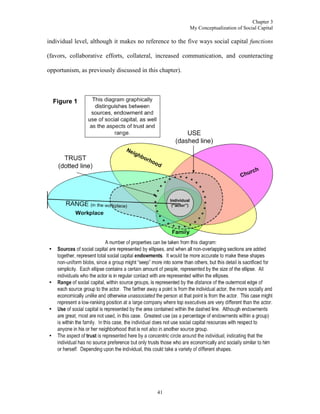
The attributes listed above can be conceptualized graphically, as seen in figure 1.
In this case, the individual is endowed with four main source subgroups from which she
draws upon for personal benefit: her church, her family, her workplace, and her
neighbors. This model summarizes my conceptualization of social capital at the
57
Ibid.
Chapter 3
My Conceptualization of Social Capital
41
individual level, although it makes no reference to the five ways social capital functions
(favors, collaborative efforts, collateral, increased communication, and counteracting
opportunism, as previously discussed in this chapter).
Figure 1
Chapter 3
My Conceptualization of Social Capital
42
A Final Note on the Study of a Poor Population
It was previously stated that for sociologists, the concept of social capital has been
dubbed with other terms, such as “community development.” Inherent in this concept is
the effect of relationships on the communities that most need to develop (those that are
poor).
It is my conceptualization that a poor neighborhood’s basic economic properties
make it easier to recognize the effects of social capital. Using the theory of declining
marginal returns to capital, an economist notes that as capital increases, the return to
capital (or output) increases by smaller and smaller amounts. Nobel Prize Winner Robert
Solow most popularly described this effect in the macroeconomic arena of economic
growth, but it applies to individuals as well.
Consider a woman being paid to dig holes. She starts with her bare hands, and
progress is slow. However, soon she realizes that a shovel (physical capital) would
greatly increase productivity, and she buys one with the money she has made from
digging the first few holes. After that, she recognizes that there are different shovels that
could be used in different circumstances (rocky soil vs. clay soil), so she buys a
specialized shovel. One can conceive of her purchasing more and more shovels and
equipment for every small variant in soil. Even though these additional shovels and
equipment will increase productivity, they will not increase productivity at the same rate
as the first shovel did (see figure 2).
Extending this theory to the community of Sun Valley, the near-absence of capital
means that a small increase in capital will greatly increase output. As stated above,
Chapter 3
My Conceptualization of Social Capital
43
residents do not have access to many forms of capital. However, almost all of them have
access to minimal amounts of social capital. Basically, social capital makes up a larger
percentage of a poor individual’s overall capital than his or her middle- or upper-class
counterparts. If wealth is to be created, it needs to come from this source.
The effects of capital are cyclical. When a firm increases its amount of capital, it
increases its productivity. When productivity increases, profit increase, which in turn
allows the firm to invest in more capital. As noted by Putnam, social capital functions in
the same way.58
It is a self-reinforcing cycle that, once started, gets better and better. As
with other forms of capital, whoever has some is able to accumulate more. This wealth
accumulation model can be used to recognize the role social capital plays in the creation
of wealth, especially in poor neighborhoods.
Using similar rationale, as outlined by the utilitarian theory of declining marginal
utility, an economist notes that relatively speaking, an increase in the amount of wealth
for a rich person does not increase his or her utility as much as the same increase in the
amount of wealth does for a poor person. Basically, we can think of utility as having a
square-root function type of relationship to wealth (see figure 2).
58
Putnam 1995: 3.
Chapter 3
My Conceptualization of Social Capital
44
Figure 2: Output vs. Capital
(Utility vs. Wealth)
0
0
Capital (Wealth)
Output(Utility)
A utilitarian economist is effectively stating that when there is an increase in an
individual’s wealth, those who do not have a lot to begin with will have a greater increase
of “happiness” than a person who already has a large amount of wealth (the slope of the
line is greatest near zero and always decreasing). Conceptually, this means that a poor
person can do a lot to increase his or her well being (by buying food to keep from
starving) with a dollar, while a rich person will not have much use for that same dollar.
Crucial to this argument is the assumption that one can make comparisons
between two individuals’ amounts of utility. This is a controversial assumption, but one
that is made frequently. A good example is the decision-making process within the
political economy, where the vote rests on comparing the benefits of a project on one
group of people versus another.
An additional effect of the theories described above is that it should make it easier
to see differences in well being across individuals in Sun Valley. Since the people of Sun
Valley are poor, slight increases in the amount of wealth owned across individuals will
greatly increase their respective utilities. This makes it an ideal population to study.
Chapter 4
Methods and Study Design
I have conducted a qualitative study of the effects of social capital on well being.
Specifically, I tested my hypothesis that a person who invests in social capital (as the
researcher has defined, conceptualized, and operationalized it) starts a positive cycle that
generates more and more individual utility. As such, this research was aimed at finding
causation, and not only correlation, between the variables of social capital and well being.
The research was conducted in the community of Sun Valley, in Denver, CO.
This community was selected for two reasons. First, it was selected due to the
researcher’s experience and familiarity with the community. Secondly, the community is
the poorest one in Denver, and therefore carries with it the properties outlined in chapter
three. To complete the research, I created an interview guide (see appendix A) with
many open-ended questions designed to give the interviewee the power to talk as much or
as little about relationships as he or she desired.
Chapter 4
Methods and Study Design
46
On the Qualitative Study
As a general note, it should be stated that the researcher has done qualitative
research in part because he is an undergraduate student who does not have the extensive
resources available to do an original statistically significant quantitative study. However,
it is not invalid that he is conducting the research in this way. Qualitative studies are
essential for understanding the inner workings of any subject studied quantitatively.
Social capital has many definitions and conceptualizations, and a well-constructed
qualitative study can help fuse these. The beauty and value of a qualitative study is in its
depth; it is my opinion that the concept of social capital could use more depth in its
construction.
Just what types of social capital are most important to a specific population? Is
there a distinct causal relationship between social capital and welfare? Many existing
qualitative studies using social capital indicators can estimate answers to these questions,
but nothing can be more accurate, and more valuable, than asking straight facts from
individuals themselves. Often, though, individuals see facts very different than reality.
However, one important aspect of social capital is that the perception is just as crucial as
the reality. As a placebo drug can heal a sick person, so an exaggerated perception of the
strength of a relationship can actually influence the strength of that relationship.
The other strength of a qualitative study is that it can more clearly establish
causation mechanisms. Once these mechanisms are established, they can be empirically
verified by future quantitative studies. Research is born when a person starts noticing
patterns in a limited number of observations, and tries to unify those patterns by
employing theory to study a statistically significant sample. Judging by the lack of unity
Chapter 4
Methods and Study Design
47
on the topic of social capital, it is clear that these patterns of observation have not been
sufficiently developed.
On Sun Valley
Sun Valley is the poorest community in Denver. Not only is this population poor,
but many of the residents also have less access to physical capital than their richer
counterparts. This is made most tangible by the lack of private property available in the
community. The neighborhood consists predominantly of low-income public housing
(94 percent of the population lives in publicly subsidized housing), meaning there are
very few homeowners. Also, very few residents have financial portfolios or even savings
accounts, for that matter. All of the owner-occupied housing is located in the north end
of the neighborhood, as well as the church, the elementary school, and the
neighborhood’s only multi-level apartment complex, Decatur Place. Project housing
dominates the south end.
There are about 1500 people living within Sun Valley. About 900 (64 percent) of
these people are children under the age of 18. This is due to the fact that the public
housing is so competitive that one needs to be a single parent to move in. As a result,
most households (over 65 percent) are single-mother homes. Meanwhile, as Portes notes,
“Social capital is greater in two-parent families, those with fewer children, and those
where the parents have high aspirations for their young.”59
This has also been
documented in several other studies.60
59
Portes 1998: 11
60
See, for example, McLanahan and Sandefur 1994; Hao 1994
Chapter 4
Methods and Study Design
48
In the year 2000, the median income for the neighborhood was $7,401. This
decreased from over $8,500 in 1990.61
Since 1990, the poverty rate has increased from
67 percent to 72 percent. Over the same time period, it increased from 73 percent to 79
percent for children. The community has been predominantly Hispanic for a number of
years, although over the past ten years, the Black and Asian populations have both more
than doubled their percentage share.62
Also, it has had the highest crime rate in the city
of Denver for the past two years. Child abuse, larceny, and property crime continue to be
the top reported crimes in Sun Valley, and gang activity has been on the increase. The
child neglect rate is almost eight times higher than the Denver average.63
Despite all of
the kids in the area, only five high school students from the Sun Valley neighborhood
have graduated in the past five years.64
Even the teachers have a hard time staying at
school; the faculty turnover rate at Fairview Elementary is fifty percent per year.65
Historically, Sun Valley has always been a relatively poor neighborhood. One
contributing factor is its relative geographic isolation from other neighborhoods. Quite
literally, Sun Valley is enclosed by natural and man-made boundaries. To the north is
Mile High Stadium, its vast parking lots, and a few warehouses; to the east is the Platte
River and I-25; to the south is Highway 6; to the West is Federal Boulevard, with its
many public buildings virtually hiding the community from passing traffic.
Before Mile High Stadium was built, there were many homes in the north region
of Sun Valley. Unfortunately, all but two blocks of owner-occupied homes got torn
down in favor of parking lots. For most of the year, these lots remain completely vacant.
61
Hubbard 2002: 6A
62
Ibid.
63
The Colorado Foundation for Families and Children 2000
64
From an interview with Pastor “Anton” of Sun Valley Community Church, Summer 2001
Chapter 4
Methods and Study Design
49
One serves as extra parking for off-duty school buses and semi trailers. When these
homes were wiped out, much of the stability of the community was taken out with them.
Sun Valley was historically a industry-intensive area; in fact, over 85 percent of it
is zoned industrial.66
Its close vicinity to the Platte River, and its accessibility by railroad
and major roadways promote this. An oil-burning power plant is located on the east side
of the community.
A study of Sun Valley conducted by the Colorado Foundation for Families and
Children in 2000 found that time and time again, residents named safety, especially for
their children, as the number one issue in the community. Instead of reporting gang and
drug activity to authorities, however, residents keep quiet. This happens because
residents do not want to put themselves or their children in danger. The result, the study
states, is that, “Residents… choose to ‘mind their own business’ and live in ever
increasing isolation. While residents acknowledge that increased policing and
neighborhood watch programs have improved the situation, they feel more can be
done.”67
The environment is also a concern. The Platte River is filthy from years of
dumping, and it has not been recovered, yet children are often found playing there amidst
piles of trash. In addition, there are abandoned vehicles and buildings in the
neighborhood (one such building is right across from the elementary school). The school
is infested with cockroaches (I know, I saw them while walking around the neighborhood
65
Ibid.
66
The Colorado Foundation for Families and Children 2000
67
Ibid.
Chapter 4
Methods and Study Design
50
one evening). In the project area, dumpsters are located along city streets. Among mid-
summer heat, the stench becomes nearly intolerable.
Another pressing issue is the lack of middle-class housing. Much of Sun Valley
lies on the Platte floodplain; as such it is not suitable for residential housing. Indeed,
even the projects are in an area that has been zoned for industrial use. This makes it
incredibly difficult for residents to quality for home loans and improvement permits.
Because of the middle-class housing shortage in the area, if residents are able to rise up
out of the projects, they must leave the neighborhood, and in most cases, this means
leaving their family. This is a huge dilemma for many of the residents who value their
family. For these people, the costs of leaving greatly outweigh the costs of staying in the
project housing. There is an ongoing effort within the community to pass legislation that
would allow for more middle-class housing, but it is coming under a lot of fire.
This could actually be a very real negative effect of social capital on the well
being of an individual, as referenced earlier (see chapter three) in the work of William
Julius Wilson (Wilson 1996:63). This is because in this case, social integration is often
great enough between family members to influence a decision not to leave the
community when it otherwise would be the best decision for the individual. Social
control can keep individuals from pursuing “positive social outcomes.” Of course,
residents could theoretically improve their economic situation while maintaining their
familial ties if there was more middle-income housing in the area. The housing might
also further motivate residents by serving as a visible, tangible example of what is
possible after their tenure in the projects.
Chapter 4
Methods and Study Design
51
There are positive and negative effects of studying Sun Valley, specifically. The
positive effects, as stated above, are inherent in the socioeconomic makeup of the
population. The fact that Sun Valley is a poor community should make the effects of
social capital more pronounced, as discussed in chapter three.
In addition, I have spent a considerable amount of time in the Sun Valley
neighborhood, and I am well acquainted with many individuals within the community.
For the last two summers I have volunteered at Sun Valley Community Church, the only
church in the locality. I have had countless conversations during barbecues and retreats
with many of the residents. In addition, I spent the 2001-2002 school year as a tutor at
the Sun Valley Youth Center. As a result of my own investment in the community, a
high degree of trust has developed, which is crucial to getting honest answers from the
respondents selected for this study.
There are also negative effects of studying this population. The neighborhood
consists primarily of public housing, so there is a great deal of transience. Individuals
within the housing project are moving quite frequently, and, as the residents themselves
have addressed, the frequency of these moves is increasing. Such movement makes it
hard to do any sort of longitudinal study on the population. In addition, on more than one
occasion respondents moved and their telephone numbers were disconnected before I
could contact them to set up an interview.
On the Sample
Sample data was collected between November 2002 and February 2003. Subjects
were selected based on the researcher’s previous relationships and word-of-mouth
Chapter 4
Methods and Study Design
52
through those relationships. Therefore, this sample in no way reflects a random sampling
of the Sun Valley neighborhood. However, the sample does provide valuable insights
into the way any poor person might go about their daily life in search of increased well
being. In addition, because of the researcher’s relationships with these subjects, the
overall trust level of respondents was higher than it would have been had the researcher
randomly selected subjects from the neighborhood. In this community, as in many poor
communities across the United States, residents are especially leery of unknown white
males asking for an hour of their time (and sometimes, rightly so).
In total, the researcher interviewed ten community members. Respondents were
between the ages of 18 and 65, and included current Sun Valley residents, previous Sun
Valley residents, and ancillary interviews with those who work in Sun Valley, especially
those in community development and community organizing positions.
Quite a few of those who were interviewed have been living in Sun Valley for ten
years or more. There are many who are self-proclaimed “experts” on the history of Sun
Valley, and three of the subjects have been living in Sun Valley for over 38 years.
Subjects were very eager to share not only about their own personal lives, but also of the
neighborhood’s past and present. In a sense, I was given a grand narrative of the recent
(last 30 years or so) history of the community.
I made a conscious attempt to get an equal amount of interviews with both
homeowners and non-homeowners in the neighborhood. This meant that the sample
collected was weighed towards homeownership because there are currently less than two-
dozen homes in the 1500-person locality. Homeownership is an important measure of
Chapter 4
Methods and Study Design
53
capital stock (it makes up 2/3 of the wealth for the bottom 4/5 of all American homes68
),
and because one of the crucial aspects of this study is economic well being, it is fitting to
get a wide range of the types of households from which data can be drawn.
The sample was very mixed ethnically, from Chilean to American Indian to
Vietnamese to Italian to Mexican. All of the homeowners interviewed are married,
whereas all but one of the non-homeowners are not (and it is because he is living there
illegally).
The biggest downside of the sample is its size. As stated, I only interviewed ten
people in the Sun Valley community. Many of these people are not, in fact, in extreme
poverty situations. Instead, they are living in homes and they are in semi-stable
economic conditions. This negatively affects the range of my sample. Were I to do this
study again, I would interview more people living in public housing within the Sun
Valley neighborhood. A larger sample would have given me a broader base from which
to analyze the mechanisms of social capital within Sun Valley. Despite the small size of
the sample, the details can be generalized to recognize patterns of social capital usage.
Another downside of the sample is that many of the individuals are associated
with the Sun Valley Community Church. This is because of my work there over the past
two summers. As a result, most of the respondents can be seen as possessing some form
of social capital already, in that they are affiliated with the church. This means that there
is a lower bound of people that I am not reaching, simply because I do not know about
them. In short, I used my own social capital resources to invite people to be interviewed;
therefore, I missed those without any endowments of social capital.
68
Jeffrey Zax lecture, September 23, 2002
Chapter 4
Methods and Study Design
54
On the Interview Process and the Interview Guide
Interviews occurred face-to-face, with the researcher hand-recording the
respondent’s responses. Most often, the interviews were conducted at Sun Valley
Community Church or in the subject’s home. This ensured that the respondents were as
comfortable as possible while the interviews took place. An interview guide was
consulted to aid the interview process.
The interview guide consists of five sections. The sections are aimed at gaining
access to the respondent’s background information, information regarding social capital,
and as much ancillary information as possible. However, considerable time was given to
respondents to elaborate on their personal stories. I then asked follow-up questions
spontaneously based on the responses that were given and the stories that were detailed.
Often, the interview guide was consulted less and less as the interview process progressed
and conversation became more relaxed. Regardless of whether or not it was consulted,
roughly the same sets of questions were asked in each interview. Ultimately, the same
information was always gathered.
The first section of the guide was dedicated to getting an understanding of the
respondent’s background information. This included questions on the person’s
movement to the community and his or her relationships there. In part, this was done to
make the respondent comfortable with me (if we did not already have a relationship), and
also to get key basic insights in the person’s life that would aid in asking relevant
questions later on in the interview.
The second section was dedicated to the respondent’s family life, since it has been
found that the family has a profound influence on an individual’s social capital resources.
Chapter 4
Methods and Study Design
55
Questions were directed at finding information regarding the respondent’s upbringing and
the resources available to them as children (including whether or not their parents had
automobiles and steady jobs or owned homes), time spent with family (both nuclear and
extended), current relationships with family, marital status, and relationships with their
children. Questions were also asked about the extent of reciprocity and information
flows between family members.
The next section was dedicated to the respondent’s personal situation.
Information was gathered such as formal employment (wage rates and how he or she
attained their current job), contentment with work, overall happiness, healthiness, other
forms of income, and how he or she spends recreational time.
The goal of the fourth section was to find out about the respondent’s social capital
portfolio. Questions regarding friendships, neighborhood associations, organizational
involvements, and tendency to give or receive help were asked here. This gave me an
idea of all of the aspects of social capital as discussed in chapter four, including trust,
range, endowment, use, and sources of social capital.
The final section was dedicated to emergency and crisis situations. Respondents
were asked what they would do or who they would go to when given sudden hypothetical
situations such as a need for money or a family illness. Respondents were then asked if
they had ever been givers or helpers to someone in such need. Finally, respondents were
encouraged to put forth any additional information they could think of related to the
topics discussed.
Interviews ranged from an hour to two hours each. As the interview process
progressed, I asked more and more questions about the subject’s involvement in the Sun
Chapter 4
Methods and Study Design
56
Valley Coalition, as it became apparent that participation in that organization had a
profound influence on the overall connectedness of a respondent.
Chapter 5
Results: Interview Data
Qualitative Findings
This section concentrates on the individuals interviewed. Each individual’s story
is taken to convey in detail the extent of one’s endowment and use of social capital over
one’s lifetime. Of the ten people interviewed, there was a dichotomy, as will become
clear, of people with small and large amounts (in both endowment and use) of social
capital. The “small” group consists of three respondents, and the “large” group consists
of seven respondents.
This distinction is not foolproof, and does have some drawbacks. Chiefly, it is
hard to accurately weigh different sources of social capital on an individual basis. For
example, below, it is noted that Anton does not have any people besides his wife that he
considers “friends.” In addition, he has no family members whom he sees on a regular
basis. He often feels alone in his position as the pastor of Sun Valley Community
Chapter 5
Results: Interview Data
58
Church. However, he does know a great many people, both in his own community and
outside of it, whom he considers to be acquaintances. This contributes to an
extraordinary range of social capital, because he has acquaintances from all socio-
economic, racial, cultural, professional, and educational backgrounds.
One can see from this example the two sometimes-conflicting aspects of social
capital discussed previously in chapter 3 of this paper. The first is level of trust. An
increase in one individual’s level of trust with another individual will lead to more
intimate resource sharing, such as informal daycare, house-sitting, or even living
together. In this case, Anton has few people who he can trust on a very intimate level,
such as family and close friends.
On the other hand, though, there is the aspect of social capital we have called
range. In this sense, the more loosely connected an individual is with another, the better.
Because the two have separate, distinct associations with different members of the
community, it expands each individual’s range of social capital. Because Anton has a
veritable cornucopia of acquaintances, his social capital portfolio has remarkable range.
As a general result, he has access to more information, and he has more opportunities to
increase his individual well being.
It is hard to assess which aspect, trust or range, has greater affect on an
individual’s economic well being. It is of my opinion that it varies from person to
person. Some are more comfortable and can better use those social capital endowments
that are greater in trust, and some can better use those endowments that are greater in
range. I have used my own discretion to evaluate which was more influential to a given
Chapter 5
Results: Interview Data
59
respondent in the data below. I further discuss the aspects of trust and range as they
relate to well being in chapter six.
Respondents with Small Amounts of Social Capital
Benny
Benny is a 48 year-old man who came from a family of 14. He moved to Sun
Valley when he was eight or nine years old. His dad was a miner and bought two homes
in Sun Valley. Benny dropped out of high school in the 10th
grade and joined a local
labor union.
He started work with the union at the Chatfield Dam. All three of his older
brothers were working there at the time, and one was made foreman because of his
extensive knowledge and skill. Benny’s brothers were the ones who managed to get him
a job there. At the time, he had no experience doing hard manual labor, and he
comments, “I found everything out from my brothers.”
Because of his expertise, his brother would often get asked to do a number of the
more important jobs with the union. In 1972 (the same year Benny was married), his
brother was asked to take a job at Coors, and he made it possible for Benny to come
along. This ended up being Benny’s life work, and it paid well. He made an average of
$45,000 a year hauling beer crates.
After Benny’s parents died about ten years ago, one of the family’s houses was
owned by one of his sisters, and the other house was owned by one of his brothers.
Unfortunately, the brother got involved in crime, and his house had to be sold or
foreclosed. At that time, Benny did not know how to keep the house in the family’s
Chapter 5
Results: Interview Data
60
name, and according to him, there was no one in the community to educate him. No one
would help him fight for the house, and eventually, they lost it. Down the road, however,
another one of his brothers ended up owning a different home on the same block, and it is
in that house that Benny now lives. He pays rent to this brother, who lives next door.
Benny is bitter about the fact that no one was willing to help him save the other house.
Benny worked at Coors for 25 years until he blew out two discs in his back while
loading beer on the job. He was awarded a lump-sum payment of $100,000 and a
pension of $18,000 a year. With the money, he paid for a trip for his whole family to go
to Disney World. He thought he would be able to go back to work, but it turned out that
the injury was worse than he expected, and he has not gone back. Benny has been out of
work for six years now.
Because of his inability to save his family’s house, Benny embraced the work of
the pastor and others as they initiated the Sun Valley Coalition in 1997. He states,
“When you build relationships, you’re not afraid of being accepted.” However, because
of his injury, he does not venture outside of his home very often anymore. In addition, he
says there is a lot of miscommunication that goes on in the group, and he states it is
difficult because many of the members are Vietnamese and do not speak English. As a
result, he really does not feel like he is a part of the group. He notes that a lot of things
go on at the church, but most of the community knows nothing about it. It seems to him
that the homeowners are in a select group, and more outreach needs to occur.
Benny has felt like many groups (neighborhood groups, NGOs, government
outreach programs, etc.) who come into Sun Valley have promised a lot, but not held
onto those promises. One such example is the new city buildings that have been built
Chapter 5
Results: Interview Data
61
right in Sun Valley, especially the Denver Health and Human Services building. Over
400 entry-level jobs were created for the area when the building went up, but no one from
the community was able to get a job there, including Benny. Instead of trying to be a part
of the broader community, Benny lost hope in branching out. He states, “My family is
the most important thing in the world to me now.”
Benny has used the social capital resources available to him pretty well in the
past, especially in the job market. However, he has not used resource endowments in the
past years (since his injury), as he has kept to himself and stayed home. As a result, he
feels disconnected.
Danielle
Danielle moved to the projects in Sun Valley when she was four years old; her
grandfather got a public housing apartment for the elderly, and she and her mother moved
in with him. She is a 33 year-old, soft-spoken single mother of a 17year-old son, and she
works at the Sun Valley Youth Center.
Danielle says that her teen life is best characterized as hanging out with friends,
ditching class, and smoking weed. Her mother got her own unit in the projects shortly
after moving there, and Danielle “…made [her] mom let [her] go” at the age of 17. She
likes to be alone, she says, and she was happy being by herself. She ended up dropping
out of 11th
grade and started to clean apartments and do janitorial work. In addition, she
did a lot of babysitting over the course of her teen years and into her twenties. She got on
welfare and got a place of her own in the projects for her and her son.
The neighborhood was a lot less violent then, according to Danielle. There were,
Chapter 5
Results: Interview Data
62
“…no gangs, and now there’s more shootings and stabbings than there used to
be. The community was more solid before, but now people are moving in and
out a lot faster and there’s a lot of new teens with nothing else to do…. People
know too much around here, so I don’t socialize much. I like to be by myself.”
Inherent in this statement is a lack of trust of her neighbors. She states, “A lot of my
neighbors drink. I’m not much into that anymore, so I don’t associate with them. A few
I trust – the older ones that have been around for many years – but some I don’t trust at
all.” She considers a few of her neighbors to be “associates,” but none to be friends.
Currently, Danielle lives with her mother, her son, and her two younger cousins.
None of Danielle’s other family members live in Colorado – the rest of the family lives in
Arizona. For a few months in 2002, her mother left with her cousins (she has legal
custody) for Arizona, to be with the rest of the family. Danielle stayed back because she
“…wanted to make it on her own.” Unfortunately, her mother lost her unit in the projects
she when left for Arizona. When she came back, Danielle sacrificed her independent
spirit and let her mother and cousins stay with her.
Danielle started working at the youth center in 1999 because her mother made her
aware of it. Her mom used to clean the Sun Valley Community Church – the church that
housed the youth center – and through that job, heard about the position helping out with
the kids. Danielle started volunteering alongside her mother, and after about a year,
Danielle got a paid position for her work supervising, tutoring, and playing with the kids
there.
In 2001, Danielle got her GED, with the help of a woman who worked at the local
elementary school. Danielle heard about the woman through a friend, and decided to
give her a call. As a result of her diploma, Danielle got a raise at her job and currently
earns $8.50 an hour as a three-quarter time childcare assistant. She is also aspiring to go
Chapter 5
Results: Interview Data
63
to college to earn a certificate or a degree towards counseling troubled kids and teens.
However, she states, “It’s too bad you need to be certified. Some things you shouldn’t
need school to get paid for.” She needs financial help for her schooling, and does not
know where to get it. She also remarks that if she had someone to go with her to college,
she wouldn’t be as scared. This fear extends to other areas as well, such as getting her
driver’s license, purchasing a vehicle, going to the doctor, and even attending the Sun
Valley Coalition meetings. She says, “Nobody has personally invited me, and it makes
me nervous to go.” She even asked me, “Does it really help?”
Danielle wants more for her son. His father is currently in prison and although he
and Danielle never married, she “…needs him financially and emotionally.” They are
still really close, and Danielle is currently trying to get him into a halfway house, but so
far there has been no success. It is difficult for Danielle because she knows there are
conversations she would like to have her son that would be much easier if his father were
around.
In short, Danielle is not satisfied with her life. She always wants more, but does
not know how or from where to get it, and her fear sets her back. She is not very happy
with the way things are going in her life and knows she “could be doing better.”
Danielle is not very well endowed with social capital resources. Her mother is
her only close relative and the father of her son is in prison. She is lonely and has stated
that she wants others to join with her in what she wants to accomplish, although she
affirms her own independence. It is obvious that a few friends with similar passions
could help Danielle out a great deal.
Chapter 5
Results: Interview Data
64
Nina
Nina is a 57 year-old, warm-hearted, Spanish-American grandmother who lives in
Decatur Place apartments, a complex right across the street from the church. She lives
with her granddaughter, although occasionally, as was the case when I interviewed her,
her daughter stays with her. She has custody of her granddaughter because she “…has a
daughter that’s not responsible.”
Nina grew up in Commerce City. Her father was a truck driver who died in 1973.
Her mother remarried but she “…has never gotten along with her new husband.” She has
four brothers and three sisters and her family was really close growing up. One of her
brothers is a mechanic that Nina goes to whenever she has car trouble, and he gives her a
discounted rate.
Nina was married twice, and widowed both times, once in 1988 and again in
1992. She moved to Sun Valley a little over two years ago to help clear up her credit.
She is enrolled in a certificate program, and shortly she will be eligible to buy a small
home. Her main regret in life is not buying a home sooner, because she says she
probably would have it paid off by now.
Nina went to medical assistant school and graduated in 1985. She managed a
Pizza Hut after that until she shattered her knee on the job in 1990. She could not work
again until 1996, after she filed a lawsuit and won; however, she has never regained the
strength and movement in her knee. At that time, she went back to school at a local
community college to learn how to use computers because she “…wanted to get a
career.” However, she ended up getting carpal tunnel and dropping out. Nina now works
Chapter 5
Results: Interview Data
65
for Professional Home Healthcare as a certified nursing assistant. She has a few clients
and works part time to pay the bills. She has an annual income of around $24,000.
As far as friendships go, Nina does not have many. She states, “I don’t have
many friends. All my friends are dead…. I don’t hang out with anybody here in this
building; they all drink and are loud. I usually just go over to my niece’s or my
brother’s.”
In January 2002, Nina’s son passed away. Her brothers helped her with
arrangements for the mortuary and the $2500 it cost for the funeral. Despite this help,
she does not get much help caring for her granddaughter. Because there is “no one else
that’s reliable” and “no one else available” to care for her granddaughter, Nina says she
was not able to get a bus driver job that she wanted. Her granddaughter is supposed to be
in kindergarten this year, but since she cannot afford to have her in daycare after school,
she stays with Nina during her house calls throughout the day. Her granddaughter sees a
speech therapist but does not receive any schooling.
Nina does attend church functions. She goes to the service on Sundays and
participates in a Bible study on Wednesdays. She is very grateful and says, “Church
helps a lot when I’m feeling depressed.” Other than that, however, she does not get out
very often. Most of her time is spent caring for her clients and her granddaughter.
Nina states, “I’m very disappointed with how [life] has turned out.” She puts the
weight of her discontentment on “…waiting for so long” to try to purchase a home of her
own.
It is easy to ascertain from Nina’s comments that her social capital endowments
are negligible. She has almost no friends and she could use a lot more help. The people
Chapter 5
Results: Interview Data
66
that she was closest to have all passed away, and she is frightened by the violence she
hears from her neighbors in her apartment complex.
Data Synthesis – Respondents with Small Amounts of Social Capital
Benny, Danielle, and Nina are all dissatisfied with life. All three of them gave
“what if” scenarios during the interview process, addressing that life could have been
better had the right opportunities arisen. All three seem in some way disconnected from
and discontented with their immediate social sphere – Benny is frustrated at the lack of
help organizations have brought him, Danielle says people are not trustworthy these days,
and Nina doesn’t “…understand this generation.” They are all lonely to some extent and
all three gave a sense that they were just going through the motions of life. In a sense,
dependence on others has hurt them in some way or another in the past – Benny
depended on the organizations that “didn’t follow through with promises”, Danielle had
some dependence on her son’s father who is now in prison, and Nina has depended on
many people that have passed away. Out of these losses, they have lost hope in the value
of relationships with others.
These three respondents do not like living in the area. They cited high crime,
alcoholism, and domestic violence, among other things. Nina notes, “It’s really hard to
get used to the violence. Often they have young kids, and they’re shouting and
screaming, and I have to call the police.” For these respondents, the only people they
know in the neighborhood are those who live in their immediate vicinity (on their block).
Danielle comments, “I don’t know a lot of the people around where I live. A few I trust –
the old ones, the ones that have been here many years. But my neighbors are my
Chapter 5
Results: Interview Data
67
associates, not my friends.” Benny and Nina also noted that they did not have any friends
in the neighborhood.
In addition, they have noticed that people are moving in and out a lot more rapidly
than in the past, and this negatively influences the development of strong friendships.
Benny notes, “I don’t know anyone from the projects. A lot come and go over the years.
There’s a lot of Mexicans, and I don’t know Spanish.”
Finally, while Benny, Danielle, and Nina are receivers of favors, there were only
two examples of haven given a favor of the like that they had received (Benny sent his
family to Disney World; Danielle let her mother live with her; Nina raising her
granddaughter is not included because she sees it as a responsibility, not a favor). This is
in stark contrast to the respondents with large amounts of social capital, who all have
given favors without expectation of reciprocation.
Respondents with Large Amounts of Social Capital
Anton
Anton is a relatively short, middle-aged man with a 20-year marriage and three
children. He has lived in Sun Valley for five years and is the pastor of the only church in
the community, the Sun Valley Community Church. He is originally from Chile and first
came to Miami, Florida, to become a pastor in a mostly-Spanish speaking area.
Anton has no relatives in the United States. He got the opportunity to come to
Miami because back in Chile, he had friends that were involved in the Christian
Reformed Church (CRC), the denomination of the Sun Valley church. These people
referred him for the job in Miami, and he flew out with his family for the job. Anton
Chapter 5
Results: Interview Data
68
said, “I would not have come to the United States if it weren’t for the job in Miami.” The
CRC does not normally allow for the “importation” of pastors, but they made an
exception for Anton to come, largely due to the fact that his friends advocated for him.
Anton repeatedly states that the United States is very different than Chile. In
Chile, he said, people helped each other a lot. There was more of a community feel in his
neighborhood there. Here, he says, there is a “lack of friendship.” What he sees in Sun
Valley is that “people live in isolation from each other.”
Anton states that he has almost no friends. He has many interactions throughout
the day – he talks with community leaders, city officials, fellow clergy, and others in non-
profit organizations. However, he remarks that these people are not friends; rather, they
are people to negotiate with.
In addition, he does not consider his neighbors friends. He does not have deep
conversations with them, something he thinks is crucial to friendship. Part of the reason
for this is because, as he states, “The pastoral role is isolated.” Anton feels that none of
the people in his neighborhood can relate to the problems he faces throughout the day as
the shepherd of a church community. He states, “Sometimes I put up a shield. I don’t
feel a freedom, mostly because of my role. There is power in relationship. I should have
more friends. I should work on those things.”
However, Anton does have a subgroup of peers who make up a “clergy
committee.” This group of about 12 clergy consults each other with the problems and
concerns that arise out of doing ministry. This group crosses all racial, economic,
denominational, and gender boundaries, and meets for one full day each month. Anton
notes that this group is very good for him. They talk about personal issues and according
Chapter 5
Results: Interview Data
69
to Anton the group “…acts like a gang, or maybe more like a Masonic group. We look
out for each other… and it is a great place to network.” When someone from the clergy
committee was looking for work, he helped him to get a job at a group for which he was
the board director. The commitment level to this group is very strong. Outside his
family, Anton has his strongest ties here. He has been involved in the group for about
four years now.
Anton notes that, “If you have a relationship, the sky is the limit. If not, there are
many things you cannot do.” This philosophy has stuck with him during his tenure as
pastor of the Sun Valley Community Church. Through Anton’s assistance, the
neighborhood has organized and felt community like never before. He helped start the
Sun Valley Coalition, a group of Sun Valley residents who advocate for the
neighborhood. The church houses the bi-weekly coalition meetings as well as several
other group functions. In addition to church services (in Spanish and English), a family
support group, and a men’s support group run through the church, the building itself
contains an after-school youth center. A couple of language classes and ethnic support
groups are also hosted there.
Despite his activity advocating community development, Anton remarks, “I don’t
have a personal life. There is just no free time.” He says he is not tired, but he often
works from eight in the morning until nine at night putting in the effort to create a sense
of kinship and unity among others. As a result, he is not very happy with his life, overall.
He states, “I’m obsessive… and I want to fix everything. I can’t have satisfaction
because of my personality.” He comments that his only true friend is his wife, because
he lacks the time to commit to others.
Chapter 5
Results: Interview Data
70
Anton’s economic situation is quite positive. He is given a middle-income salary
by his denomination (he is considered a missionary) and he gets full benefits with this
position. In addition, his family lives in one of the two-dozen or so homes in the
community. The mortgage for the home is paid by his denomination.
Finally, Anton is quite well endowed with social capital resources. The most
notable aspect of his endowment is its range – he has friends that are homeless and he
knows the mayor of Denver. He is using this range to help increase social capital for
others by helping to form the Sun Valley Coalition and uniting those whom he knows.
Anton is very good at using the resources that are available to him, as can be seen with
his emigration to the United States. However, he does not trust many people intimately,
and that seems to hurt is overall contentment with life.
Carl
Carl is a 43-year old, one hundred percent full-blooded Sioux. He grew up in Sun
Valley because his mom left the South Dakota Indian reservation due to the lack of
opportunities for her children. The interview was conducted in his family-picture-filled
home, where the phone frequently rang with people wanting to say hi. Carl has a wife
and three children, and he currently works as a printer at a local newspaper.
Carl often drank with friends as a teen, and he held various jobs. He dropped out
of high school, but earned a G.E.D. through the help of the Denver Indian Center, which
paid him to go. After a battle with alcoholism eventually led to an emergency room visit
on January 9, 1983, he drastically changed his life. He has not had a drink since that
time, and makes it known that God delivered him from his addiction. Since that time, he
Chapter 5
Results: Interview Data
71
says, his relationships with people have blossomed and as a result, his life has been much
more joyful. In Carl’s words, he has “had the opportunity to express his gratitude for
life” by donating a kidney to his brother to assist in saving his life.
Carl started working at the newspaper company (the Post) in 1985 when he was
26 years old. He got a job there because his brother-in-law worked on company cars.
For six months, Carl worked alongside his brother-in-law, mostly just filling them up
with gas. It was there that he met the manager of the commercial department (he
frequented the garage with his car), and shortly thereafter, he found Carl a job in his
department. Carl has been working at the Post for 17 years now, going from $6 an hour
to $16 an hour, and now earning roughly $46,000 a year. He has made friends at his
workplace and they go out to dinner or have a beer together every once in a while.
Carl still lives in the projects, with his wife and three children. He is only able to
stay because his wife is on the lease and he does not report his income to the housing
authority. He says that aside from the drinking and domestic violence, he likes it in Sun
Valley and he plans to stay. He trusts his neighbors in his immediate vicinity, although
he admits he does not know the people outside of his block.
As a result of his tenure in Sun Valley, he states, “This is my neighborhood.”
Carl has been here all his life, and it is a part of him. He is not involved in the coalition
because he wants to maintain a low profile since he is living in Sun Valley illegally.
However, he is involved in church activities, including the service on Sundays, a men’s
Bible study, and a family Bible study. He also does a children’s puppet show on Fridays.
Carl also sells tickets at sporting events (he has a vendor’s license) and gives half of the
proceeds to the church (he can make up to $250 at a CU football game).
Chapter 5
Results: Interview Data
72
Elisa
Elisa has been living in Sun Valley for 50 years. She is a short, energetic
homemaker who loves to get up before four o’clock in the morning to make a stupendous
lunch for her husband to take to work. Along with Anton (mentioned above) and Franco
(mentioned below), she has been a pivotal force for the Sun Valley Coalition. Previous
to the coalition, she would personally walk around the neighborhood collecting signatures
on petitions to present to the city council. When the coalition got off the ground in 1997,
she became president and did everything from balancing the checkbooks to buying
supplies to sending out mailings to mediating between individuals.
Elisa grew up in Sun Valley. She says, “I liked growing up here. I don’t
remember there being any crime when I was young.” According to her, race was not an
issue when she was growing up, and there was quite a bit of community solidarity.
“Everyone knew each other, and people would look out for each other,” she says. She
briefly left the neighborhood at the age of seventeen, but got married and moved back to
Sun Valley after about a year. Things in the community started to change around the
time Elisa got married, around 35 years ago. Many of the houses in the community were
torn down in favor of businesses, and Elisa states that these businesses did not care as
much about crime as long as they had adequate security.
Elisa met her husband through mutual friends. They moved back to Sun Valley
shortly after marrying because her parents offered them their old home there for five
dollars! Her parents had been renting out the house, and the renters were “trashing it”
anyway, so they decided it would be a nice present. Of course, this secured Elisa and her
Chapter 5
Results: Interview Data
73
husband years ahead of their peers financially. As newlyweds, they already had great
equity. Elisa now lives in another home, which she bought twelve years ago for $25,000.
It is a five-bedroom home and now is appraised at $137,000. In total, Elisa and her
husband own three properties and four homes, and they rent out the three houses their
family does not occupy.
Elisa’s husband came from Mexico at the age of seventeen and started as a
maintenance worker. He became a welder, and through a friend of his father’s, learned
about a welding job in the area. Now, through much hard work (he works over 10 hours
a day and some weekends), he is the head of maintenance at his workplace, and makes
over $50,000 a year.
This frees up Elisa to do much of the work she does with the Sun Valley
Coalition. In addition, she helps her Spanish-speaking neighbors in a variety of different
ways, including filling out their income tax forms (at no charge; she used to be a C.P.A.),
going with them to doctor’s appointments, notarizing legal documents, doing homework
with the neighbor children, and writing letters. Two of these families are living in homes
Elisa owns. She rents them out at a discounted rate, with no deposit (one for
$500/month, the other for $700/month). Often, they come to Elisa’s place to borrow
videos. Their kids call her grandma. She understates, “I have good relationships with
most people.”
There are many other stories of Elisa helping those around her. In addition to
owning four homes, another one of Elisa’s neighbors was selling his home, and he gave
her power of attorney. She was then able to sell the house to family friends. As she
Chapter 5
Results: Interview Data
74
provided the service of “realtor,” she effectively helped out both sides a great deal, at no
cost to them.
Elisa states, “I’ve found my place. There’s nothing else I really want.” She is
content with her life. She has “…good relationships and a good husband.” She loves
helping others and she loves being with her kids and her grandkids.
It should be apparent that Elisa has a large endowment of social capital resources.
Her husband works so she does not have to, and therefore has the time to be a major asset
to the community. She loves to be with people and as a result, also has a fairly wide
range, from the mayor of Denver to the children who call her grandma down the street.
Franco
Franco (Elisa’s cousin) is a 57-year old, third generation Sun Valley resident who
has two sons and has been married for 38 years. He grew up in a divorced home, but had
a very close relationship with his grandparents. Franco’s grandparents owned one of the
few homes in the neighborhood, so even though his mother moved around a lot when he
was young, he still spent most of his time in Sun Valley. When his grandpa died, he left
the house to Franco (in 1990).
Franco retired last year from being a meat merchandiser in charge of seven
grocery stores. He started working in the food business as a teenager at the Joy Lounge,
a bar in the Sun Valley neighborhood (it has since moved). His mom was a bar maid
there, and she helped him get a job cleaning up the place. From there he got a job at the
local 7-Eleven, and eventually he worked at Duffy’s Shamrock Restaurant as a full-time
cook. During the Vietnam War, he worked at the Army meat plant. And afterwards, he
Chapter 5
Results: Interview Data
75
got a job at an Albertson’s grocery store. He was employed by several other grocery
stores up until his retirement.
Franco is also the current president of the Sun Valley Coalition. As a long-term
member of the community, he has a vested interest in the well being of the neighborhood
as a whole. Franco gave me what he called a “brag sheet” for the coalition, a list of all
the grants and projects they had lobbied for since the coalition’s creation in 1997. The
grants totaled $1.2 million and included such things as $83,000 for new sidewalks and
street lights, $370,000 for technical and computer training, $400,000 for an Early
Childhood Excellence education program, $135,000 for a new school playground, and
$5,000 for community events. Franco is very proud of the coalition’s achievements in
the past few years, and stated, “This year is the most exciting year for the coalition. In
2002, it really came together for the first time.”
Franco is also well endowed with social capital resources. This is in part because
he has been in the community for so long. He knows many of his neighbors and has
associations with members of the greater Denver community as the president of the
Coalition.
Huong
Huong came to the United States from Vietnam when she was a small child, with
the help of a federal reunification program during the Reagan administration. Her uncle
sponsored her family during the emigration process. She is currently 30 years old and
does not live in the Sun Valley neighborhood. However, she is an active member of the
Chapter 5
Results: Interview Data
76
coalition, has spent a considerable amount of time in the Sun Valley neighborhood, and
has many insights on the Southeast Asian community in Sun Valley.
Huong grew up in a poor neighborhood in Boulder, CO, was able to go to college
and graduate from the University of Colorado in Boulder, and is now working at
Fairview Elementary School. In addition to heading the Early Childhood Excellence
program there, she is a para-teacher and interpreter, as well as the developer of the
curriculum for the English as a Second Language classes. She is also a case manager
with the Head Start program. She is currently building a business out of her interpreting
and translation skills.
Huong also helped the Vietnamese community within Sun Valley (13% of the
total population, or about 180 people) to get connected to each other. In her words, she
“…fostered the spirit that was already there.” She states that the community was already
strongly knit, she just helped support the network. Huong spends a lot of time with the
Sun Valley Vietnamese community, and has assisted in many ways, such as getting
people their driver’s licenses and bringing kids to the hospital, when necessary.
Huong is very eager to bring people closer together and facilitate mutual
understanding among members of the Sun Valley community. That is why she is also
very involved in the Sun Valley Coalition (she is currently the treasurer). She states that
it is crucial to “…get parents connected to each other…. Without organization, people
lose out.” Huong has a strong desire to help people get access to ways to improve their
job skills. She states that in Sun Valley, many people are completely disconnected from
information; she makes it clear that the digital divide is a real issue here.
Chapter 5
Results: Interview Data
77
Huong focuses on the positives in assisting the community. She says the
community has got to want to stay together and work out differences for mutual benefit,
and individuals have to support their families. When this happens, she says, communities
and individuals can be transformed. Ultimately, she wants to work herself out of a job.
She wants someone in the community to take over her position as the head of the Early
Childhood Excellence program, and she is confident that it will happen.
Huong is well endowed with social capital resources because of her involvement
in the Sun Valley Coalition, Fairview Elementary, and Head Start. As I interviewed her,
it became clear that many of the Vietnamese residents are also well endowed. Although
they make up only 13 percent of the Sun Valley population, Vietnamese individuals
account for about half of the resident attendance at the coalition meetings.
Juanita
Juanita is a 24 year-old Mexican-American mother of two who has been living in
Sun Valley now for five years. She does not have any other family in Sun Valley, but
many of her family members live in the greater Denver area. She has a live-in boyfriend
of eight years who is a jeweler. Currently, Juanita tutors at Fairview, the local
elementary school, and she is trying to get a job as a local telephone operator, a job she
found out about through her boyfriend’s sister.
When Juanita was 15 years old, she moved in with her sister. She graduated from
high school when she was 16. During her four years with her sister, she had multiple
jobs working as a customer service representative. Juanita says she got the jobs through a
Chapter 5
Results: Interview Data
78
work service organization that she was referred to by her mother. “My mom tells me
about a lot of connections to help me out,” she says.
Juanita moved into the projects because, like the jobs, she heard about it through
her mother. She did not know much about it, but she wanted to move out of her sister’s
place and be more independent. Currently, she is trying to get out of the projects and find
housing elsewhere. She does not spend a lot of her free time with her neighbors. “A lot
of people around here like to drink all day,” she says, “and that’s not me.” According to
Juanita, “Everyone [in this neighborhood] is getting a divorce… and I don’t trust my
neighbors at all.” She spoke of an incident where her car would not start, only to find out
that someone had put sugar in her gas tank.
In trying to purchase a home, as well as in many other endeavors, Juanita says the
Sun Valley Coalition is “…really important.” The coalition helped her find an agency in
Denver called Del Norte, which will potentially give her a grant equivalent to four times
what ever she can pay for a down payment. Therefore, if she needs $10,000, she will
only have to pay $2,000.
Juanita found out about the coalition through her mother. Her relationship with
the coalition started when she was being “harassed” by the management of Sun Valley
Homes and police officers. She presented her case to the coalition, and ultimately ended
up meeting with the captain of the police to discuss the problem. The issue was resolved
quickly and peacefully.
The members of the coalition consider her a leader, and “they always want me to
be there.” She is currently the letter-typist for the coalition. Through the coalition,
Juanita found out about the tutoring position at the school, and is on a committee of
Chapter 5
Results: Interview Data
79
teachers, parents, and coalition members who have instituted an Early Excellence
education program at the school. The committee sees her as “very valuable, because
[she] knows the parents and tells [the committee] what [resolutions and ideas] will pass
and what won’t in the community.” Juanita concludes, “I like the Sun Valley Coalition.
They make me feel important, like somebody special, and they are always asking me to
do stuff. I helped them find someone for daycare during meetings…. I try to tell other
people [in the neighborhood] about the meetings, and all that stuff, but they don’t go,
because they’re lazy.”
Referring to her position in life, Juanita says she is, “…pretty happy most of the
time…. But I could be doing so much better than I’m doing right now.” She would love
to have a house and be in a nicer neighborhood. Still, she is grateful for her family and
her friends at Sun Valley Community Church.
Juanita has a good endowment of social capital. Even though she does not get
along with her neighbors very well, she has most of her family in the Denver area and her
mother is a great resource for information (she is also the Vice President of the coalition,
because she lived there for years). Because her live-in boyfriend works, she can afford to
stay home and be with her children.
Juanita also uses the resources available to her. She has no problems taking her
mother’s advice, and enjoys playing an active part in the Sun Valley Coalition. In
addition to the positive individual economic and social effects of the coalition, she also
better understands the importance of relationships to help others as well as herself.
Chapter 5
Results: Interview Data
80
Maria
Maria is a talkative, middle-aged mother of two who lived in the projects of the
Sun Valley neighborhood between the years of 1988 and 1998. Her story is perhaps the
most profound one when looking at the impact of social capital on well being.
Maria moved out of her childhood home at the age of 18, and rented an apartment
with her brother and his wife close to the Sun Valley neighborhood. When her brother
and his wife moved on, she moved to the projects. Most of her neighbors were her
friends at that time. They would, “have barbecues and sit on our porches.” Maria had
her first child before moving to Sun Valley, so she did not work initially, and stayed
home and took care of him.
When her son was one and a half, she started working again. She was employed
at the local McDonald’s. While she worked, one of her friends in the projects watched
her son for free. After a couple of years at McDonald’s, Maria started volunteering at a
Head Start program that she entered her son into when he was four years old. This made
Maria excited about being involved in her son’s education and development. When her
son was old enough to go to elementary school, she became friends with the school’s
parent advocate, Ms. Arona. Together, they recruited about 35 parents to become more
involved in the education process. They helped in the classroom, at the crosswalk, and
during the lunch hour. Maria was also able to create a summer science class, for which
she got paid through a government grant. For training, she went to a conference in San
Diego, and brought her cousin along (Maria has many, many cousins).
After three years of helping coordinate parent activities, Maria was able to get a
paid position as a teacher’s aid at the school. She says that it was only possible through
Chapter 5
Results: Interview Data
81
the help of Ms. Arona. The next year, Maria was able to get a job as an aid to a bilingual
teacher at another school (she speaks both English and Spanish). Maria is very clear
about the powerful influence that Ms. Arona had on her life. She states:
We were really close…. She did a lot for me. If it weren’t for [Ms. Arona], I
wouldn’t have had the courage to get the GED. She made me get my GED….
She was a pivotal member of my life…. She didn’t help just me, but many
people…. She helped a lot of people get out of Sun Valley.
Maria says that the parents and Ms. Arona “…became a family.” Often they would be
able to get tickets to sports events through the school and take the kids (via the church
van) to the games.
Over the same time period, Maria met her husband. Together, they were able to
make enough money to move out of the project housing. Their last year in the
community was the same year that Anton came in to pastor the local church. They were
very excited, because he was passionate about the area, unlike the previous pastor. Maria
describes Anton as coming across as a “regular Joe Shmoe…. He didn’t have the ‘I’m
holier than you’ attitude of a lot of the other leaders of the church that I’ve seen.”
Maria’s husband adds, “The first time I met him, he introduced himself and then asked
me to help him with something. Just an ordinary guy. That’s what it’s about, you know?
I appreciated the fact that he wasn’t afraid to ask for help.”
Currently Maria, her husband, and two sons live in a quaint apartment in a suburb
of Denver. Despite both Maria and her husband being in between jobs, they are still able
to support themselves and their children on savings and picking up a work project here
and there. Recently, Maria’s husband got paid $1,000 to dig a trench for a home addition
in his neighborhood by simply making a face-to-face offer. Overall, Maria’s economic
situation is fairly stable.
Chapter 5
Results: Interview Data
82
All in all, Maria is well endowed with social capital resources. She has a large
family (as stated earlier, she has many cousins) that is geographically close, and she gets
along with most members. She is married and can depend on her husband to help support
her in between jobs.
Maria’s outgoing personality contributes to her efficient use of social capital
endowments. She just loves to chat, and she also loves to give. If Maria and her husband
are going out to eat, they will often invite and pay for whoever happens to be around at
the time. In fact, I went out to eat with Maria and her family before I interviewed her.
These qualities make it easy for her to make friends, especially with people that live close
to her. She and her family still regularly attend Anton’s church.
When people like Ms. Arona and Anton came and invested their lives into Sun
Valley, and individuals like Maria and Juanita met them and started working with them,
the community started to see some cohesion among its members. It was good footing
upon which to start the Sun Valley Coalition.
The Sun Valley Coalition
Concerned citizens who wanted to make their community a better place to live
started the Sun Valley Coalition in 1997. It is included in this section because during the
interview process, it became clear that the coalition was a powerful social capital
resource within the community.
As can be seen from the excitement and vigor of Elisa and Franco, the Sun Valley
Coalition is starting to become a force in the neighborhood. After five years of hard, and
sometimes fruitless, work, members of the coalition are starting to see positive
Chapter 5
Results: Interview Data
83
turnarounds to all of their efforts. Since they are beginning to get acknowledged by
politically prominent people as a legitimate force for change, they are becoming
increasingly encouraged to continue working to improve the welfare of the community.
As mentioned previously, the coalition has raised $1.2 million dollars for the
benefit of the community since its inception in 1997, most of which has come in the past
year. In addition, it now has an official non-profit distinction, which increases its
political power and positively reflects on the commitment and organizational skills of its
members.
Data Synthesis – Respondents with Large Amounts of Social Capital
These seven respondents (Anton, Carl, Elisa, Franco, Huong, Juanita, and Maria),
in contrast to the three respondents with small amounts of social capital, have many more
meaningful interactions throughout the day. Anton spends much of his time with
community members as pastor of the church. Carl works and is involved with the
church. Elisa and Maria love having people over and provide them with food and other
services. Franco is the president of the Sun Valley Coalition. Huong and Juanita are
both at the school as well as with many community members throughout the day. All of
these respondents who live in Sun Valley (Huong does not) have a spouse or a
dependable significant other to help take care of finances, child-rearing, and/or other
services that increase the utility of the family and the individuals within it.
Simply stated, there are more events utilizing social capital resources in these
people’s lives. The events are both more prominent (i.e. coming to the United States,
being sold a house for five dollars, etc.) and more frequent. Not only are these
Chapter 5
Results: Interview Data
84
individuals more likely to receive favors, but they are also more likely to give favors
without the expectation of reciprocation (such as disseminating information to the
community, taking people out for dinner, performing coalition services, providing
reduced rent rates, donating a kidney, etc.). In addition, information flows very well
between these individuals and the greater society. Many hear of current events through
the coalition and outside work sources. They participate more frequently in collaborative
efforts and have more collateral and social cohesion between them.
They are also more likely than their counterparts to trust those in their immediate
vicinity. They are generally more positive and more willing to look out for each other.
Despite living in the same crime-filled neighborhood, they are more likely to state that
they are content there. Of course, this may be due to the fact that many are homeowners,
and as such, they have the option of leaving, which is less the case for those living in the
project housing. Finally, this group is more likely to be conscious of the ways that
utilizing social capital has positively influenced their lives.
Relation to Five Ways Social Capital Affects Well Being (From Chapter 3)
As stated before, social capital affects people economically in many different
ways, including favors, collaborative efforts, collateral, increased communication and
information flows, and finally, through negating opportunistic behavior. Through these
lenses, let us now take a comprehensive look at the stories detailed above.
Chapter 5
Results: Interview Data
85
Favors
Free or reduced childcare was the most prominent example of reciprocation
among the respondents. Other examples in the sample were reduced rates for rent,
reduced home purchasing costs (to five dollars!), and reduced rates for mechanical work.
In addition, residents call upon neighbors and family to help bear the cost (both figurative
and literal) of crisis situations. This gives residents more financial and emotional security
despite their oftentimes-meager monetary situation.
Contrasting Nina and Elisa in regards to favors in home ownership, we see that
this has made an invaluable impact on the course of their lives. For Nina, her lack of
ability to purchase a home has kept her renting throughout her life. Currently, a large
portion of her income goes to renting, something that Elisa has never had to worry about
thanks to the gift from her father. Instead of worrying about renting, Elisa can now
charge low rates to those who need it.
Collaborative Efforts
The Sun Valley Coalition is a great example of a large-scale collaborative effort
affecting the lives of many individuals within the community. Through the coalition
members are able to express their opinions regarding issues in the community that affect
their lives. Not only that, but they are also able to voice their opinions on how to change
the community. Recently the coalition organized a voting drive to make the community
more aware and fight against an attempt to build a prison in the neighborhood. Voter
registration skyrocketed 800 percent from the previous year’s election, and the plan for
the prison was dismissed. In addition, the neighborhood was recognized by Vote for
Chapter 5
Results: Interview Data
86
Kids as having the highest increase in voter registration in the nation during that period,
and in so doing, earned another $5000 grant for education at Fairview Elementary!69
Overall, voting registration has increased over 1200 percent since the last general
election.70
Collaborative efforts are helping to increase the quality of the education of
children and adults alike. Children in the area desperately need more programs and
people to help them with their schoolwork; it is rare to find a child in the community who
reads at his or her grade level. Adults need better access to information through the use
of computers, but do not know how to use them. The digital divide is decreasing
residents’ marketability. The community is affecting positive change through obtaining
the $400,000 grant for the Early Excellence education program and the $370,000 grant
for technical computer training for the citizens of Sun Valley. These grants are symbols
of coalition commitment, and as a result, organizations are now more willing than ever to
give the residents of Sun Valley more money to improve their community. Huong states,
“You do something good, and people want to give you more money. People are starting
to pay attention to Sun Valley!”
Collateral
Collateral in the form of social pressure might, in fact, be a negative aspect of
social capital in the Sun Valley neighborhood. Because there are almost no homes in the
area, there is no social pressure (or even encouragement) for people in the projects to
obtain a home by their fellow peers. Instead, there is social pressure to stay close to
69
From a Sun Valley Coalition meeting on November 19, 2002
70
Ibid.
Chapter 5
Results: Interview Data
87
family if they are nearby. There is a lack of collateral affecting positive social outcomes
in the community.
Danielle’s situation also sheds light on the aspect of collateral. Without the
informal social pressure of friends wanting to pursue a degree as she does, she is unable
to motivate herself to accomplish this. This was exactly opposite the case of Maria. In
this situation, social pressure from her friendship with Ms. Arona (“She made me get my
GED!”) made Maria eager and determined to work at the school and become more
involved in her son’s life.
Increased Communication
The main form of information sharing in the sample came in the area of the job
market. Many respondents reported hearing about a job, getting special access to a job,
or gaining the credentials required of a job through friendships and acquaintances.
Such was the case with Maria and the job at Fairview Elementary through the
parent’s advocate. She heard about, gained the credentials for, and had special access to
the position available. Benny got a job through the efforts of his brother to allow him
into the union, Carl got his first job at the Post through his brother-in-law, Huong got
placed in Sun Valley through a referral from her job, Anton came to America to a new
job through a trusted acquaintance, Franco’s first job was at the place his mother worked,
and Danielle gained access to her job through her mother.
Chapter 5
Results: Interview Data
88
Negation of Opportunists
The best example of the negation of opportunists within this data set is when the
Sun Valley Coalition came to the aid of Juanita when she was being harassed. Had the
coalition not been there, Juanita would have been continually harassed and possibly
evicted for an unworthy cause. This sort of “big brother,” in this case, was a very good
thing and positively influenced Juanita’s overall utility. Her access to and use of the
coalition was very beneficial, and started relationships between her and members of the
coalition that continue to grow today.
Chapter 6
Discussion of Findings
As the previous section indicates, there are many similarities in the stories of the
above individuals. Although the sample is not comprehensive, many inferences can be
drawn regarding the effects of social capital on the well being of these individuals, and
those like them, from the information given. First, this section takes the information
from the interviews and relates it to the initial hypothesis: increases in individual well
being in poverty-stricken populations such as Sun Valley are often initially generated and
facilitated through the use of social capital. Secondly, as a means to do this precisely,
information is broken down into the attributes of social capital (sources, endowment, use,
trust, and range).
Social Capital in the Creation of Wealth
My hypothesis is that increases in individual well being in poverty-stricken
populations such as Sun Valley are often initially generated and facilitated through the
Chapter 6
Results: Discussion of Findings
90
use of social capital. From the data provided above (in chapter 5) it appears that this is
indeed the case, but we must elaborate on this issue and provide concrete support for this
claim.
Attributes of Social Capital in Sun Valley (From Chapter 3 and Figure 1)
Sources
There are many sources of social capital within the Sun Valley neighborhood, as
in many poor communities. However, sometimes the problem is that there is not enough
social capital to increase social capital! Occasionally, people are unaware of the
resources that are available to help them get connected.
The most prominent source of social capital with the majority of respondents is
their nuclear family. It is this source that people go to when a crisis occurs, such as
sudden illness. In addition, family members provided each other with a great amount of
timesaving services, including meal making, child rearing, and other housework. Having
a spouse or a domestic partner is a tremendous asset to one’s social capital portfolio, as is
visible in the stories of Elisa, Maria, Anton, Juanita, and Carl.
Other good sources include the Fairview Elementary School (with its after-school
programs and parent-teacher involvement), the Sun Valley Coalition, and the Sun Valley
Community Church (Sunday services and other events). Immediate neighbors seem to be
less prominent sources of social capital (in terms of use, not endowment), but they do
prove helpful especially for daycare situations. Individual employers were used even less
as a source of social capital, and local representatives, civic service organizations, sports
associations, and local businesses were used least of all.
Chapter 6
Results: Discussion of Findings
91
Endowment and Use
Simply put, those with a greater endowment and use of social capital were better
off economically and emotionally. They were more fulfilled with their lives and had
higher incomes. All three of those respondents with a small amount of social capital at
one point or another stated that they had “no friends” in their neighborhood, and they also
reported lower incomes.
In contrast to my hypothesis, however, it appears that endowments and use of
social capital increase utility as an s-shaped curve, rather than a “declining returns” curve
as discussed in chapter 3. In obtaining the first “unit” of social capital, it takes some time
to develop the trust necessary to mobilize it. Therefore, it accelerates in a growing cycle
until resources start to become exhausted, there is an inflection point, and returns then
start to decline. See figure 3 and figure 4:
Figure 3: Hypothesized Utility vs. Social
Capital Curve
0
0
Capital
Utility
In this graph, utility increases with declining returns with an increase in
social capital.
Chapter 6
Results: Discussion of Findings
92
Figure 4: Observed Utility vs. Social Capital
Curve
0
0
Capital
Utility
There are a number of different reasons why social capital might effect utility in
this way. The most prominent reason, from the interviews, is that it takes time to
increase trust in relationships. Unlike other sources of capital, whose uses are proven and
true, social capital comes with it a bit of risk. A new widget will often come with a
warranty. Stated specifically in the instruction manual is exactly what it guaranteed by
the product. One knows precisely what to expect. This is not the case with social capital.
Relationships, in some sense, have to be proven through use. Thus, Danielle asks, “Does
[the coalition] really help?”
Trust
The aspect of trust is best correlated with emotional well being. Simply stated,
those respondents with more intimate relationships, and those with a greater number of
Increases in use, trust and range
of social capital Endowment exhaustion
In this graph, utility increases with increasing returns before returns start
to decline.
Chapter 6
Results: Discussion of Findings
93
intimate relationships, were more content with their life, regardless of income or other
factors. Contrasting Anton (little trust) and Juanita (a lot of trust), we can see this clearly.
Despite Anton having greater levels of range, it became apparent through the interview
process that Juanita is more content with her life. She has many family members that she
sees on a regular basis she can identify with their struggles, and she is in a similar life
situation. In contrast, Anton only receives this sort of communion once a month in his
clergy committee. This finding can be expanded to all of the respondents, and is
consistent with literature on relationships and emotional/psychological well being.
Range
In contrast with trust, range seems to have the greatest affect on economic well
being. If we again compare Anton and Juanita, we see that Anton is in a much more
comfortable financial situation, despite his lack of intimate friendships. Comparing
Juanita to Danielle, however, we find that Juanita has much more range, and is in a more
comfortable financial situation. This finding is also universal across the respondents.
A Final Breakdown of Individuals
Although this study is mostly concerned with the ways that social capital causes
positive economic outcomes for individuals that utilize it, we can also compare uses of
individuals if we hold endowments constant. This can be seen in figure 5, in which I
have placed each individual along the s-curve based upon their total social capital
resources and their potential increases in utility in the event of increased use, trust, and
range:
Chapter 6
Results: Discussion of Findings
94
Figure 5: Observed Utilities and Social
Capital Use of Respondents
0
0
Capital
Utility
The Effect of Social Capital on Income
Income is a chief contributor to individual utility. From the sample data, there is
evidence that a higher level of social capital increases income. The average income last
year for those respondents I designated as having a small amount of social capital was
less than $20,000. All three of these respondents were the breadwinners in their
household. In contrast, last year’s income of breadwinners in the group with a large
amount of social capital was just over $40,000. Of course, not all of this difference is
caused by social capital, or completely explained by it, but it is a notable difference,
nonetheless.
Other Factors Correlated with Social Capital and Well Being
There are a number of other factors from this data sample correlated with social
capital. For instance, it was noted that the Vietnamese population is more greatly
Nina
Benny,
Danielle
Franco
Carl
Juanita
Anton
Huong,
Maria
Elisa
Chapter 6
Results: Discussion of Findings
95
represented in the Sun Valley Coalition than other ethnicities. Therefore, it could be
stated that ethnicity has some explanatory value in evaluating an individual’s social
capital portfolio.
In addition to ethnicity, other factors with explanatory power include age,
location, sex, education, and the ability to speak more than one language. Age is
correlated in that those who have lived longer have been able to foster long-term, high-
trust relationships (as is the case with Franco). On the other hand, it is this same age that
decreases the availability of friendships as a result of death (as is the case for Nina).
Increased transitivity in the community means that it is harder to build
relationships of trust. This means that those who live in the project housing, on average,
have less neighborhood social capital resources then their home owning or home
occupying peers. This geographical correlation is certainly the case for Sun Valley.
Those who owned homes were much more familiar with the people on their block and
were more likely to say that they trusted their neighbors. Geography, in terms of distance
to the school and even more so to the Sun Valley Community Church, is also correlated
with social capital. Respondents closer to the church and school had higher levels of
social capital, overall. However, most of the homes are also concentrated in this area,
which might explain this phenomenon.
The sex of the respondent also had explanatory power for their social capital
portfolio; it held true that the men generally had access to more connections (greater
range) than the women because of working outside the neighborhood, but the women had
a greater number of intimate relationships (greater trust) than the men. In addition to sex,
a higher education level generally increased an individual’s social capital. This might be
Chapter 6
Results: Discussion of Findings
96
due to the well-documented socialization process that happens in secondary education,
the confidence a person receives through achievement to be able to reciprocate favors,
and/or the opportunity to meet more people based on access gained through the education
itself. Finally, speaking more than one language allows an individual to know a greater
number of people at a high-trust level in Sun Valley, since so many do not speak English.
It also creates opportunities for employment (as is the case for Maria and Huong).
Chapter 7
Concluding Remarks
The data clearly shows that many of the most significant economic outcomes in
the respondent’s lives are facilitated, initiated, and/or influenced by their relationships
with others, be that acquaintances, friends, or family. The most widespread example of
this is in finding and holding a job, but other examples, such as where to live and whether
or not to purchase a home, are also visible. In the instance of a few respondents, the
absence of friends and family as “encouragers” (social pressure) decreases the potential
for mobility and self-betterment. Generally, those with longer, stronger relationships
(greater trust) are better off emotionally (in terms of happiness and contentment) and
those with more widespread relationships (greater range) are better off economically.
Not only is there a link between respondent’s economic outcomes and their
relationships; the link is often causal. Were it not for Anton’s friend helping him to come
to the United States; were it not for Benny’s brother vying for him at the labor union;
were it not for Elisa’s father selling her the family house for five dollars; were it not for
Chapter 7
Concluding Remarks
98
Maria meeting the parent advocate at the local elementary school, these individuals’ lives
would most likely look very different. Certainly the relationships that make these types
of life-changing transitions possible have important economic value to the actor.
Such results demand further consideration in current public policy. Federal, state,
and local governments would be better off hiring individuals to go door-to-door to
circulate information on employment and services available for the poor as a way to curb
unemployment. In addition, governments should partner with local development
organizations and other institutions (such as churches and other non-profits) to best tackle
many of the social ills associated with poverty, such as crime, joblessness, and feelings of
disempowerment and hopelessness. In addition, we need to better understand how to
create social capital, if it has such a desirable effect on life as a whole.
We all wonder what life would have been like if we would have pursued one
relationship or let go of another. In fact, these types of “what ifs” can often pervade our
thoughts. In the stories above, we see both negative and positive outcomes based upon
those relationships (or the lack thereof). There is intellectual value in further detailing
what makes opportunities come about – often, it comes down to whom one knows and
how the two (or three, or one hundred, or one million) can effectively work together. Not
only does this satisfy the individual’s desire for self-betterment and increase an
individual’s economic well being, it also satisfies an inherent human need for relationship
and a sense of belonging. In the process of working together for mutual benefit or even
individual benefit, people also find something essential to life and contentment.
Appendix:
The Interview Guide
Lead-in (5-10 minutes):
How long have you lived in this neighborhood? What circumstances led you to move here? Did you have
friends or relatives that lived here first? What is it like living here?
What do you like best/least about living here? Example?
What are the advantages and disadvantages of living in this community?
What are your neighbors like?
Do many of them work?
What is the composition of your neighborhood households?
Are many of them on welfare?
Do you have a lot of friends and relatives nearby? Where else do they live?
Are your friends and relatives working?
Are any of them in a life-situation like you, which you can relate and talk about?
Family (15-20 minutes):
Do you have any children? How old are they? Are they living at home?
Do your kids go to school during the day? Which one(s)? Do they like it there?
When you go to work, how do the kids get taken care of?
Does it cost a lot of money?
Do the kids participate in the free school lunch program? Do they receive any other free meals?
If so, how?
If you have to go out, do you have someone who can watch the kids?
If you can recall when you or someone in your household had a baby, what happened with the other
children? Were they able to be taken to another person’s house?
If you absolutely needed to go out for a little bit, how would you go about finding someone to watch
them?
Would you have to pay a lot of money for someone to do this? How much?
Do you have many relatives close by?
Do you get along with them?
Do you spend a lot of time with them? How much?
What do you do? Examples?
Where do you go to do this?
Do they come over a lot?
Do you have many big family gatherings?
Are you comfortable asking them for favors when you’re in trouble?
Would they provide help in those situations? Examples?
Are they comfortable asking you for favors when they’re in trouble?
Would you provide help in those situations? Examples?
Do they have a lot of the same concerns about life as you do?
What are those concerns?
Appendix A
100
Are your parents still alive? What was it like growing up?
Were you raised in a house, apartment, or elsewhere?
Did you grow up in the United States? If not, where?
Did you move around a lot?
Did you have a lot of money, as best you can remember?
Did you have a car?
What did your parents do for a living?
Were you ever on welfare or food stamps growing up?
Are you married? Have you ever been married? Are you divorced?
Personal situation (25 minutes):
WAGE/SALARY WORK
Do you work? (If NO: Why not?)
Could you get a job?
Are you looking for a job now?
How do you go about looking?
Do friends help?
Do you know of a job you could take right now, but haven’t?
What is that job like?
What is the pay for that job?
Are there benefits?
Would it be fun for you?
If you were to take a job, what sort of job would you take?
Could you get a previous job again?
What kind of job are you looking for?
Do you work? (IF YES: Where do you work?)
What do you do there? Examples?
Do you work with a lot of other people?
What is your “position”?
Is there a hierarchical structure at your work?
Are you in a leadership position?
Are there people working “under” you?
Do you consider your co-workers your friends?
Do your co-workers live close to you?
Do you like your job? What do you like best? What do you like least?
How do you feel about your job? Would you rather change jobs?
What time of day do you work?
Does this prevent you from doing anything you’d like to do?
Is there another time of day you would prefer to work?
Do you make a good wage? What is your yearly income?
Have you had any raises since you started? How many?
When was your last raise?
What are the chances for promotion? Do you expect a new raise any time soon?
How did you get this job?
Did a friend, a relative, or any other person help in getting this job?
Why did you get this job?
How much do you work?
Would you like to work more, or less, if you had the option?
Did you work overtime?
How long have you had this job?
Do you consider this job your career?
Do you anticipate working at this job for a long time?
Do you get health benefits?
Do you get any other types of benefits, like retirement benefits or free daycare, etc?
Did you pay for some of your benefits?
Appendix A
101
What is your ideal job?
How does your job compare with your friends’ jobs?
How does your job compare with your relative’s jobs?
Do you think your job matches your skills and experience? Why or why not?
Do you have a second job? (Repeat questions).
What was your last job? (Repeat questions).
What other jobs have you had?
Is there any other person in your household who works?
OTHER FORMS OF INCOME
Do you do any other work for cash?
What percentage of your total income is based on this?
Bartending? Cleaning houses? Lawn mowing? Babysitting? Repairing? Under-the-table?
Examples?
How did you find this form of work?
Do you work for your friends? Were they your friends before or after you started working?
Do you work for your relatives?
How much do these jobs pay?
Would you be able to make ends meet without these jobs?
What would change without this income?
(All other “work” questions”)
Do you receive any type of welfare payments? Of what type?
How much money do you receive monthly?
Do you have any child support payments coming in?
Are you supposed to?
How much?
Have you tried taking the father to court?
Do you expect child support payments soon?
OTHER PERSONAL INFORMATION
Did you complete high school?
Did you ever attend college? Are you currently attending?
How did you choose your college?
Did you complete it?
How did you pay for it? Loans?
Are you glad you went? Why or why not?
Was it worth it? Did it open up any job opportunities?
Do you consider yourself a happy person, overall? Why?
Are you satisfied with your current life situation?
Do you get sick a lot?
Do others in your household get sick a lot?
Do you use medical benefits, if you have them?
How often does someone in your household go to the hospital?
How often do you go to the hospital?
What do you usually do in your free time?
Do you have a lot of free time?
Do you spend it with friends, by yourself, or with others in your household?
Do you turn to anyone else for advice in raising your kids, balancing your checkbook, fixing your car,
or anything else when you need help?
Who are those people?
How do you know them?
Outside Family (15 minutes):
Do you have a lot of friends outside your family?
What are they like?
What are your friendships like?
Do you go out together a lot?
Appendix A
102
Where do you go?
What do you do? Examples?
Do they come over?
Do you go over to their place?
In the past week, how many conversations have you had with friends?
How many friends did you talk to yesterday?
Over the past few days, have you had lunch/dinner with other people outside of your household?
If they have kids, do your kids play together?
Do they live in the area?
How did you first meet your friends?
Do they help you out when you need it, financially, with the kids, etc?
Do you feel like you can “count on” your friends when you need help? Examples?
Where do most of your friends live?
Would you say your friends or your extended family is most important?
How much time do you spend with your neighbors?
When you spend time with neighbors, is it usually just a few people, or with many people?
Do you know many of your neighbors?
Do they know you?
Do you get along?
Do you feel like you can trust them?
Do you like the kids your children play with in your neighborhood?
Are there any organizations or clubs that you are available to you?
Are these mostly geographically concerned, or otherwise?
What sorts of organizations are out there? (Kid’s school, women’s group, religious, cultural,
neighborhood, parent group, NGO, professional association, health committee, trade union, credit
group, civic group, etc.)
Could you name them?
Are you a part of any of these organizations? How many? Could you name them?
Are there any fees associated with the groups you’re involved with?
What is the extent of your involvement in each group?
How often does the group meet?
Do you hold any leadership positions?
How often do you attend?
Who are the group’s members? (Relatives, same race, only Sun Valley, broader geographical area.
Are all members of the group from roughly the same economic and social background?
Do they all make a living the same way?
Do the leaders of the group earn their living in the same way as the others in the group?
Overall, how would you rate the group functioning?
Do all members of the group attend regularly?
Do you feel close to the members of the group?
Do you feel like the group accomplishes what it has set out to?
Have you learned a lot from being a part of the group?
Have you made any friends in the group? Long-term friendships?
Do you identify strongly with your racial and cultural background?
Do you feel like there are strong ties between people of similar backgrounds in your neighborhood?
Would you prefer more bonding between these people?
Emergency/Crisis (5 minutes):
Suppose there were a serious emergency in your household. Is there a friend or relative living nearby
whom you could call on to spend a lot of time helping out?
How would you choose such a person?
Has this ever happened? Example?
Suppose in an emergency you needed several hundred dollars more than you had available or could borrow
from an institution. Would you ask either a friend or a relative for it?
What would your criteria be in choosing such a person?
Appendix A
103
Has this ever happened? Example?
Has the reverse of either of these two things happened, where you helped out someone else?
Do you have a good understanding of why they chose you?
Concluding Remarks (5 minutes):
Is there anything else related to the topics we discussed that you think I should know?
Are there any other ways in which friends, relatives, or being part of a group has helped you or hurt you,
that you can think of?
TOTAL TIME: 1hour, 15 minutes
Many questions have been taken from previous surveys regarding social capital and overall well being.
Included are:
Edin 1997
Krishna and Shrader 1999
Hofferth et al 1995
Onyx and Bullen 2000
Baum et al 1998
Narayan and Pritchett, 1999
Bibliography
Bourdieu, Pierre, 1985, “The Forms of Capital”, In Handbook of Theory and Research for the Sociology of
Education, ed. J.G. Richardson, New York, NY: Greenwood, 241-58.
Brehm, John and Wendy Rahn, 1997, “Individual-Level Evidence for the Causes and Consequences of
Social Capital”, American Journal of Political Science, 41: 999-1023.
Bridges, William P., and Wayne J. Villemez, 1986, “Recruiting Source Effects: A Test of Two Alternative
Explanations”, Journal of Occupational Psychology 57:261-67.
Coleman, James S., 1988, “Social Capital in the Creation of Human Capital”, American Journal of
Sociology, Volume 94 Issue Supplement: Organizations and Institutions: Sociological and
Economic Approaches to the Analysis of Social Structure, S95-S120.
CPN tools, “Social Capital”, http://www.cpn.org/sections/tools/models/social_capital.html, accessed
August 30, 2002.
Debertin, David L., “Comparison of Social Capital in Rural and Urban Settings”,
http://www.uky.edu/~deberti/socsaea.htm, accessed August 30, 2002.
Edin, Katherine and Laura Lein, 1997, Making Ends Meet, New York, NY: Russell Sage Foundation.
Fernandez, Castilla, and Moore, 2000, “Social Capital at Work: Networks and Employment at a Phone
Center”, American Journal of Sociology 105:5, 1288-1356.
Frank and Yasumoto, 1998, “Linking Action to Social Structure Within a System: Social Capital Within
and Between Subgroups”, American Journal of Sociology, 104:3, 642-686.
Fukuyama, Francis, 2002, “Social Capital and Development: The Coming Agenda”, SAIS Review, 22:1,
23-37.
Granovetter, M.S., 1974, Getting a Job: A Study of Contacts and Careers, Cambridge, MA: Harvard
University Press.
Grootaert, Christiaan, 1997, “Social Capital: The Missing Link?” in Expanding the Measure of Wealth:
Indicators of Environmentally Sustainable Development, Washington, D.C.: The World Bank.
Hao, L., 1994, Kin Support, Welfare, and Out-of-Wedlock Mothers, New York, NY: Garland.
Hayes, Elaine, “The Forms of Capital”, http://dept.english.upen.edu/~jenglish/Courses/hayes-pap.html,
accessed September 19, 2002.
A critique of Bourdieu’s analysis of cultural and symbolic capital.
Bibliography
105
Jackman, Robert W., and Ross A. Miller, 1996a, “Renaissance of Political Culture?” American Journal of
Political Science, 40:632-59.
Jackman, Robert W., and Ross A. Miller, 1996a, “The Poverty of Political Culture”, American Journal of
Political Science, 40:697-716.
Kingsley, McNeely, and Gibson, “Community Building Coming of Age”,
http://www.urban.org/community/combuild.htm, accessed August 30, 2002.
Knack, Stephen, and Philip Keefer, 1997, “Does Social Capital have an Economic Payoff? A Cross-
Country Investigation”, The Quarterly Journal of Economics, 112: 1251-1288.
Lin, Nan, Walter Ensel, and John Vaughn, 1981, “Social Resources and Strength of Ties: Structural
Factors in Occupational Status Attainment”, American Sociological Review 46:393-405.
McLanahan, S., and G. Sandefur, 1994, Growing Up with a Single Parent: What Hurts, What Helps,
Cambridge, MA: Harvard University Press.
Narayan, Deepa, and Lant Pritchett, 1999, “Cents and Sociability: Household Income and Social Capital in
Rural Tanzania”, Economic Development and Cultural Change 47:4, 871-97.
Nel and McQuaid, 2002, “The Evolution of Local Economic Development in South Africa: The Case of
Stutterheim and Social Capital”, Economic Development Quarterly, 16:1, 60-74.
Parsons, Talcott, 1951, The Social System, Glencoe, Il: Free Press.
Portes, Alejandro, 1998, “Social Capital: Its Origins and Applications in Modern Sociology”, Annual
Review of Sociology (24): 1-24.
Portes, Alejandro and Landolt, 2000, “Social Capital: Promise and Pitfalls of its Role in Development”,
Journal of Latin American Studies, 32:2, 529-547.
Putnam, Robert D., 1995, “Bowling Alone: America’s Declining Social Capital”, Journal of Democracy,
6:1, 65-78.
Putnam, Robert D., 1993, “The Prosperous Community – Social Capital and Public Life”, The American
Prospect (13): 35-42.
Reingold, David A., “Social Networks and the Employment Problem of the Urban Poor”, Urban Studies,
36:11, 1907-1932.
Reingold, David A., Gregg G. Van Ryzin, and Michelle Ronda, 2001, “Does Urban Public Housing
Diminish the Social Capital and Labor Force Activity of its Tenants?” Journal of Policy Analysis
and Management, 20:3, 485-504.
Sanders, Jimmy M., and Victor Nee, 1996, “Immigrant Self-Employment: The Family as Social Capital
and the Value of Human Capital”, American Sociological Review, 61:2, 231-249.
Stack, Carol B., 1974, All Our Kin: Strategies for Survival in a Black Community, New York, NY: Harper
and Row.
Stanton-Salazar, Ricardo D., and Sanford M. Dornbusch, 1995, “Social Capital and the Reproduction of
Inequality: Information Networks among Mexican-Origin High School Students”, Sociology of
Education, 68:2, 116-135.
Bibliography
106
Whiteley, Paul F., 2000, “Economic Growth and Social Capital: Thirty-four Countries, from 1970 to
1992”, Political Studies 48:3, 443-466.
Wilson, William Julius, 1996, When Work Disappears: The World of the New Urban Poor, New York,
NY: Alfred A. Knopf, Inc.
Yunus, Muhammad, November 1999, “The Grameen Bank”, Scientific American, 186-189.
FinalThesis

FinalThesis

  • 1.
    The Dynamics ofSocial Capital and its Effects on Individuals in Sun Valley Presented as an Undergraduate Honors Thesis in the Department of Sociology University of Colorado, Boulder For Graduation in May 2003 By Daniel J. Kaskubar Committee Members: Tom Mayer, Sociology Terra McKinnish, Economics Brett Johnson, Sociology
  • 3.
    The Dynamics ofSocial Capital and its Effects on Individuals in Sun Valley Presented as an Undergraduate Honors Thesis in the Department of Sociology By Daniel J. Kaskubar Abstract Using the individual as the unit of analysis, I generate a new theoretical framework for conceptualizing social capital combining the aspects of sources, trust, range, endowment, and use. I hypothesize that increases in individual well being in poverty-stricken populations are often initially generated and facilitated through the use of social capital. I interview individuals living in the poor community of Sun Valley and, by applying the new schematic, evaluate each respondent’s total social capital portfolio. I find that greater endowment and use of social capital is consistent with higher incomes and more contentment in life. The aspect of trust is found to have most impact on emotional well being, and the aspect of range is found to have most impact on economic well being.
  • 5.
    Contents Introduction: What isSocial Capital? 7 Chapter 1: Defining and Conceptualizing Social Capital 10 Chapter 2: Four Relevant Sections of Study on Social Capital 21 Chapter 3: My Conceptualization of Social Capital 28 Figure 1 41 Figure 2 44 Chapter 4: Methods and Study Design 45 Chapter 5: Results: Interview Data 57 Chapter 6: Results: Discussion of Findings 89 Figure 3 91 Figure 4 92 Figure 5 94 Chapter 7: Concluding Remarks 97 Appendix: Interview Guide 99 Bibliography 104
  • 7.
    Introduction What is SocialCapital? It is usually not necessary to have a car in Boulder, CO, because of the magnificent bus system. I can take buses virtually wherever I want to go. However, there are times when I need to get an errand done in a short period of time. In such an instance, a car is very useful, but I do not own one. The obvious solution, when it would be much more useful to have a car than to take the bus, is to borrow one. There are many people I know who own cars, yet they are not constantly using them. It seems logical that I would be able to borrow a car for a brief period of time, if the relationship is strong enough to respect such a request. Herein lies the key to social capital – a relationship between two or more people that can increase an individual’s consumption (or other) opportunities, thereby increasing his or her well being. Even though I don’t own a car, I can still have access to one (or many). In fact, since coming to Colorado about three and a half years ago, I have borrowed over 30 different cars! A few of my friends have even given me copies of their car keys.
  • 8.
    Introduction 8 The phenomenon describedabove is just one of many varying examples of social capital. One might go to a party to do some “networking.” We go on the internet to “get connected.” We may even play the Kevin Bacon game, connecting him to other stars through a string of movies. Social capital plays a huge part in our lives, yet many of us pay little attention to it. It is important to note that one can be part of an environment with a great deal of social capital without ever making explicit use of it. Because of this, it is necessary to differentiate between endowment and use. In addition, this differentiation makes it difficult to define and measure social capital, especially through personal surveys and general indicators. These topics will be explored in depth below. Researcher’s Hypothesis It is my hypothesis that social capital plays a crucial role in the creation of economic well being for individuals. This is especially true for individuals without other forms of capital to build on, namely, those who are poor. In fact, the researcher believes that, based on theoretical inference, increases in individual well being in poverty-stricken populations are often initially generated and facilitated through the use of social capital, which provides access to capital outside the ownership of the individual. When endowments of social capital are used, it creates more opportunities for wealth creation for the individual, regardless of other capital sources they may have under their jurisdiction. In addition to testing this hypothesis, it is my intention to better ascertain the dynamics of social capital as they relate to the research population (Sun Valley
  • 9.
    Introduction 9 neighborhood in Denver,CO) and other neighborhoods like it. This paper serves two functions, then: First, to evaluate whether or not the use of social capital is a precursor to individual economic improvement, and second, to critically evaluate how social capital functions among individuals in Sun Valley.
  • 10.
    Chapter 1 Defining andConceptualizing Social Capital Social Capital Defined Economists and sociologists differ in their conceptualizations of social capital. Economics, which is commonly thought to be a “harder” science than sociology, has generally approached social capital in terms of “mathematical equations describing how one person’s utility may be influenced by the behavior of others.”1 In contrast, sociologists take a much more human-centered, conceptual view, most often defining social capital generically as the set of interactions between individuals. The Economist’s View of Social Capital Let us understand that utility is the root variable in economics. It can be defined as the basic measure of an individual’s satisfaction or well being. Utility is increased through consumption, as a person chooses to purchase goods that suit his or her desires.
  • 11.
    Chapter 1 Defining andConceptualizing Social Capital 11 In turn, consumption opportunities are increased by a number of different variables, one of which is wealth. Finally, a large part of a person’s wealth comes from his or her income. This 4-tiered model is an example of how an economist might explain the importance of income on well being. Everything in individual-specific economics ultimately comes back to utility. In order to have income, a person needs to produce. Usually, this consists of productive labor capacity. A person agrees to exchange his or her labor for income, which can then be used in the manner described above to increase utility. However, there is one other factor of production in economics: capital. It is difficult to get a concise definition of capital. In the early 20th century, Bohm-Bawerk (an Austrian economist) defined capital as a “produced means of production.” This implies that capital exists because of someone else’s past labor.2 Produced goods can be thought of, then, as stored wealth. A person’s wealth, in turn, can be used in three ways: direct personal consumption, trading or selling for more favorable goods and services, and investment for further use. When produced goods are used as a way to invest in future production or wealth, it is considered capital. The subtle but crucial distinction is that it is not the good, but the use of the good, that defines it as capital. This definition, then, is one based on function, and not on any distinct properties within the good, other than the fact that it can be utilized in such a manner. Narayan and 1 Debertin 2002 2 The one exception to this is natural capital. Of course, human labor did not “create” the land or the natural resources we use, but it did provide us with better access to the inherent characteristics within these endowments. Irrigation and fertilization can greatly increase the productivity of land, and modern technology allows us to extract oil and many other resources to make use of them. This missing attribute is one negative consequence of the conceptualization of “natural capital.” However, land and resources can be invested in, which is a crucial attribute of capital. Therefore, this classification is slightly ambiguous.
  • 12.
    Chapter 1 Defining andConceptualizing Social Capital 12 Pritchett give it a similar definition as “stuff that augments incomes but is not totally consumed in use.”3 Using the above description, capital must be thought of as a stock of assets one owns (or has direct access to), which can be used for the sake of future investment and/or wealth creation, leading to greater individual utility. Specifically, we can measure natural capital by the amount of land, animals, and other natural resources one owns or has access to. Physical capital can be measured by the amount of structures, equipment, and machinery one owns, as well as the quality of physical infrastructure one has access to (roads, energy, airports, etc). Likewise, it is easy to measure financial capital based on the amount of money assets one has in his or her bank accounts and portfolios. Human capital can be measured by one’s health and nutritional level and the amount of training, education, and work experience one has under his or her belt (a person’s “productive capacity”). By extension, social capital also must refer to a “stock” of some form or another. It has been the consensus that social capital requires the measurement of the quantity and quality of relationships and networks one has access to, and this can be a very difficult task indeed. Instead of observing one individual, we must venture outside that individual to view the “relational climate”, per se, that they are seated in. For many economists, this is a step they are unwilling to take. Profit maximization and utility functions are inherently oriented with an individual (or individual company), not with conceptualizations of altruism that relate one person’s utility to another. Of course, there are a few economic theories that do take this step (game theory, for example). 3 Narayan and Pritchett 1999: 871
  • 13.
    Chapter 1 Defining andConceptualizing Social Capital 13 In addition, social capital must have certain attributes that make it operate in the same way as other forms of capital. It must be able to be “produced by labor,” as well as be able to be invested in. The labor, in this case, is in the form of conversations and building and maintaining relationships. Labor can be thought of as an investment of one’s time and resources; therefore, we can consider a person building a relationship as “investing in social capital”. Relationships can be invested in monetarily through buying someone lunch or giving them a gift. Usually, these investments are best coupled with the investment of labor – merely giving someone money for lunch does not do as much for the relational climate as going out together, eating and conversing together, then footing the bill. Maurice Schiff, development economist for the World Bank, has offered an economist’s definition of social capital as, “The set of elements of the social structure that affects relations among people and are inputs or arguments of the production and/or utility function.”4 This macro-level definition conflicts with the assumption that most economists are concerned only with the individual applications of such a concept. Indeed, the literature of social capital in economics is split between these two groups. Economists are concerned with individual-level utility, but many are also concerned with empirically-driven overarching principles, which can be applied to a variety of populations. That stated, economists have most embraced the concept of social capital when researching economic development in less-developed countries (LDCs). In traditional growth-accounting models, there has been a great deal of variability between nations of similar inputs and all other forms of capital (physical, natural, human, and financial).
  • 14.
    Chapter 1 Defining andConceptualizing Social Capital 14 The growth of the “East Asian Miracles” is one such example. Given standard endogenous variables, only 17 to 36 percent of their growth can be explained.5 It is thought that one possible cause for the variance is the social and political climate within which the economic policies operate. In other words, economists are using the concept of social capital at a macro level in order to attempt to explain variance in growth. In this way, if social capital can be effectively measured, widespread policy implications can be initiated to speed up overall growth in many countries worldwide. The Sociologist’s View of Social Capital Capital itself is an economic term, and as such, not much literature has been produced within sociology under the “capital microscope”, as has been the case in economic literature. Yet, many other species of the same genus have been written on. For example, Pierre Bourdieu, a French sociologist, first coined the term “cultural capital,” referring to much the same thing that has been discussed thus far.6 Also included in this literature are topics such as “community development.” In addition, the interpersonal linkages through which social capital packs its punch form the base of the discipline of sociology. Perhaps the most profound contemporary sociological work on the subject of social capital is Alejandro Portes’, “Social Capital: Origins and Applications in Modern Sociology.”7 In this essay, Portes evaluates current definitions of the term, including a few economists’ perspectives. He starts by making the reader aware that social capital, 4 Schiff 1992 from Portes 1998: 6 5 Grootaert 1998: 13 6 Bourdieu 1985 7 Portes 1998
  • 15.
    Chapter 1 Defining andConceptualizing Social Capital 15 indeed, is not a new concept in the field of sociology. In fact, he dates it back to Durkheim’s study on group life and its relation to anomie and self-destruction as an example of research on the profound influence of one’s participation in community on an individual’s circumstances. The value of the interactions between people is the primary concern of those researching within the discipline. One variable that has had considerable attention has been trust. The more two individuals trust each other, the more they are willing to share and invest in the relationship. One can think of this in a cyclical fashion – as trust levels increase between two people, they begin to share more and more intimately and become more and more open to each other. As these potential vulnerabilities are handled with care, more trust develops, which increases overall trust in the relationship. When trust increases in a number of different individuals, they can even form coalition groups. These kinship groups (or subgroups), as sociologists most often call them, create a powerful sense of belonging within each member. The most basic form of kinship group is a family. Within this context, members can find a safe place to “come home to.” Of course, there can be negative interactions, which can deteriorate this group, to such extent as to completely eliminate any sort of kinship bond that might have previously existed. We shall come back to this crucial distinction later on in this paper. Because of the important dynamic of the family, it has been thought of as one of the main sources of social capital. Despite these contributions to the discussion of social capital, sociology has been criticized for its lack of empiricism. Many overarching theories describing interaction remain difficult to define for reality, as it exists today (such as modern Marxism, which
  • 16.
    Chapter 1 Defining andConceptualizing Social Capital 16 did not include considerations of entrepreneurship). Indeed, many modern sociologists disagree on the concept of a singular reality to begin with. Quantification is not sociology’s strength, and the attainment of an actual value that these interactions might have to an individual has never (to my knowledge) been attempted within the discipline. The topic of social capital is, nonetheless, extremely important to the discipline of sociology. Further Considerations on the Conceptualization of Social Capital Where the economists are likely to become uncomfortable happens to be where sociologists get excited. While economists are trying to quantify the theory of social capital in order to directly prescribe its applications around the world, many sociologists are still attempting to define the scope of the “relational climate” as previously described. On the other hand, it is apparent that by defining the macro-level climate of a country, economists have taken the step and defined this scope. Before we can go any further, we must find the bounds by which we can measure and analyze the concept of social capital. There are three distinct conceptualizations of the scope of the relational climate, as it influences well being. These conceptualizations have been compiled and summarized by Christiaan Grootaert, in a paper he produced for the World Bank, entitled, “Social Capital: The Missing Link?”8 The first conceptualization he attributes to Robert Putnam, who conducted a study in northern Italy comparing civic engagement with quality of government (he also recently published a book called Bowling Alone,9 in which he uses data from a wide variety of studies to show that social capital is on the decline in 8 Grootaert 1997 9 Putnam 1995
  • 17.
    Chapter 1 Defining andConceptualizing Social Capital 17 the United States). In his study, Putnam views the climate of social capital to consist of a set of “horizontal associations” between people.10 This narrow definition refers to those interactions between individuals and groups with shared interests and common goals. Together, these horizontal associations create a civil structure that encourages civil leaders to be responsible in governing their constituencies. The second conceptualization of the relational climate is attributed to James Coleman. In his essay, “Social Capital in the Creation of Human Capital,”11 he includes horizontal as well as vertical associations between people. This addition includes hierarchical relationships, such as patron-client relations and employer-employee relations. A person with a great deal of vertical, as well as horizontal, relationships will obtain greater access to higher levels of well being through these connections (as long as they are not oppressive, which can often be true in the patron-client case). Coleman specifically defined social capital by its function as: A variety of entities with two elements in common: They all consist of some aspect of social structures, and they facilitate certain action of actors – whether persons or corporate actors – within the structure.12 Perhaps it need not be stated that this is quite a vague and removed definition. The third conceptualization of the relational climate is attributed to North13 and Olson14 . This “most encompassing view,” as stated by Grootaert, also includes the social and political environment within which individual actions take place. Variables such as the type of government, the court system, civil and political liberties, and the economic 10 Putnam, Leonardi, and Nanetti 1993 11 Coleman 1988 12 Coleman 1988 from Portes 1998: 5 13 North 1990 14 Olson 1982
  • 18.
    Chapter 1 Defining andConceptualizing Social Capital 18 system are included in this perspective. These systems enable norms to develop and also guide the shape and structure of an individual’s interactions within society. These conceptualizations differ in scale. Putnam attributes social capital to communities, Coleman to communities in relation to governments and entities with greater influence, and North and Olson include government as a whole [this includes, but is not limited to, political stability, Gastil’s measures of civil and political liberty, measures of expropriation of risk, corruption, enforcement of contracts and property rights, measures of political and economic discrimination and social disintegration (crime, suicide, riots, illegitimacy, divorce, etc.)]. This third conceptualization, while encompassing, is problematic. Development economists prefer this definition because it has more direct relation to macroeconomics as a whole. However, sociologists have argued that this conceptualization brings with it issues of tautology. The sociologist Talcott Parsons, through processes he defined as institutionalization and internalization, described in detail the effects of a social system on individuals.15 Through institutionalization, individuals in society create structures that serve their needs. Through internalization, each individual makes personal sense of these institutions as they relate to the person. Incorporating such variables as the political and economic environment leaves a classic chicken-and-egg question as to which came first: the individuals who created the institutions, or the institutions that shaped the behavior and interaction of the individuals. Portes, a sociologist critical of the current literature of social capital, has this to say: The intellectual journey that transformed social capital from an individual property into a feature of cities and countries tended to disregard [the question of tautology]. The journey was fast, explaining major social outcomes by re- 15 Parsons 1951
  • 19.
    Chapter 1 Defining andConceptualizing Social Capital 19 labeling them with a novel term (social capital) and then employing the same term to formulate sweeping policy prescriptions. While I believe that the greatest theoretical promise of social capital lies at the individual level… there is nothing intrinsically wrong with redefining it as a structural property of large aggregates. This conceptual departure requires, however, more care and theoretical refinement than that displayed so far.16 Those who have tried to extend social capital to broader interpretations have not effectively considered these barriers to the legitimacy of their research. There are many other conceptualizations of the phrase, most of which have been based on the purpose and functionality of social capital. One is that social capital is a “soil” in which other capital is planted.17 This claim suggests that the quality of social capital makes investments of other forms of capital more or less effective. Coleman, Olsen, and Putnam all agree on this point, which is interesting since it is invariably a macro-level claim. Others have similarly described it as the glue that holds society together. Still others state the concept as a measure of satisfaction with the way people interact. Another group defines it as the availability of opportunities, resources, and advantages. Many of these definitions, however, do not elaborate theoretically. The lack of detail makes it difficult to accomplish any form of sophisticated work using these definitions. Finally, Portes also offers a definition of his own, which he states is becoming the most-agreed upon conceptual basis: Social capital stands for the ability of actors to secure benefits by virtue of membership in social networks or other social structures. This is the sense in which it has been more commonly applied in the empirical literature…. Whereas economic capital is in people’s bank accounts and human capital is inside their heads, social capital inheres in the structure of their relationships.18 Applying these definitions, social capital is an abstract concept that cannot explicitly be agreed upon. Nevertheless, the buck does not stop there. To do research of any kind, a 16 Portes 1998 17 Grootaert 1997: 7
  • 20.
    Chapter 1 Defining andConceptualizing Social Capital 20 definition must be established to use as a basis for operationalization, and in turn, application to the world in which we live. 18 Portes 1998: 6-7
  • 21.
    Chapter 2 Four RelevantSections of Study on Social Capital Measuring the concept of social capital requires much more detail than any definition. Even with the scope of the relational climate defined in any of the three conceptualizations previously outlined in chapter one, how does one “measure” a relationship as a stock from which utility can be derived? Most previous research in the social capital literature has been conducted using surveys with many different indicators. For instance, in evaluating a person’s relational climate, one can obtain information on the amount of trust a person has for their neighbors, coworkers, or family members. Researchers have also tried to calculate social capital by evaluating the number of groups an individual is a part of and participation level in those groups (usually by asking about ranking positions, frequency of activity, etc.).
  • 22.
    Chapter 2 Four RelevantSections of Study on Social Capital 22 Previous Research Much of the theoretical literature has already been outlined in the discussion of the definition of social capital. I am concentrating on research that is geared toward four areas, which I believe are most relevant to my study: (1) linking social capital to economic improvement in a macro sense, (2) social capital as an individual phenomena, (3) social capital and its effects on employment (especially in poor neighborhoods), and (4) social capital as a causative variable. This discussion will lead into my conceptualization of social capital. The first section of research, geared toward linking social capital to economic improvement on a macro level, has been dominated by development literature. The most notable of these studies is one by Narayan and Pritchett entitled, “Cents and Sociability: Household Income and Social Capital in Rural Tanzania.”19 This discussion is not centered on the individual as the actor; rather, they use a household as the unit variable. By using “…a specially designed large scale survey… to measure the degree and characteristics of associational activity, as a process for social capital”, they find that, “…a one standard deviation increase in the village social capital index… is associated with at least 20 percent higher expenditures per person in each household in the village…. The link… shows convincingly this effect is social and operates at the village level. The social capital of a household’s village is as important in determining a household’s income as many of the household’s own characteristics which receive a great deal of attention (e.g. schooling, assets or distance to markets, gender of household head). Social capital is an important, and so far largely missing, dimension of income and poverty analysis.”20 This article appeared in an economic development journal, and was conducted as research for the World Bank, the government of Tanzania, and the University of Dar Es Salaam. 19 Narayan and Pritchett 1999 20 Ibid, from the article’s conclusion
  • 23.
    Chapter 2 Four RelevantSections of Study on Social Capital 23 Another notable study within this first section of research was conducted by Knack and Keefer.21 In this study, the authors are also concerned with development, especially in poor countries and “poor areas of industrialized countries.” They use the World Values Surveys to sample 29 market economies across the globe, and they find that, “trust and civic norms are stronger in nations with higher and more equal incomes, with institutions that restrain predatory actions of chief executives, and with better- educated and ethnically homogenous populations.”22 However, this study is ambiguous in terms of causation. It is difficult to say whether increased economic activity increases trust and civic activity, or if the link is the other way around. Finally, a study conducted by Paul Whiteley23 has similar findings. He samples data from 34 different countries and finds that: “Social capital has an impact on growth which is at least as strong as that of human capital or education, which has been the focus of much of the recent work on endogenous growth theory. It appears to have the same impact on growth as catch-up or the ability of poorer nations to adopt technological innovations pioneered by their richer counterparts.”24 Whiteley does not stop at a relation between economic growth and social capital, but also ventures to state in his conclusion that, “Social capital… originates in primary groups, principally the family, rather than in secondary groups such as voluntary organizations.” This idea of the family having a chief influence on an individual’s social capital is an important one, and one that leads us into the next section of research. The second section of research concentrates on the individual as an actor as opposed to the family or household. When this distinction is made, the family becomes a crucial source of social capital for the individual, instead of being considered as having 21 Knack and Keefer 1997 22 Ibid: 1251 23 Whiteley 2000
  • 24.
    Chapter 2 Four RelevantSections of Study on Social Capital 24 the same resources of social capital as the individual. Pierre Bourdieu, who has been credited with coming up with the first modern analysis of social capital, was a proponent of treating the concept at an individual level. His classic work, “The Forms of Capital,” focuses on the benefits an individual receives through participation in subgroups.25 Sanders and Nee26 added to this topic with their article, “Immigrant Self- Employment: The Family as Social Capital and the Value of Human Capital.” In this article, the authors research self-employment among Asian and Hispanic immigrants. Because self-employment is important in the economic advancement of immigrants, social capital in this setting is also very important. The authors state that the family is crucial in facilitating the “pooling of labor power and financial resources”27 of the self- employed. They also find that, “…being married is associated with a 20 percent advantage in the net odds of self-employment.”28 This is manifest most greatly in regards to Korean women. For them, the odds of self-employment are 350% greater if they are married.29 The authors conclude by stating that immigrants have access to informal credit markets and interpersonal bonds that aid in starting an individual’s business. A study by Brehm and Rahn30 is also a noteworthy article on individual-level analysis of social capital. The authors state, “Although normally conceived as a property of communities, the reciprocal relationship between community involvement and trust in 24 Ibid, from the article’s abstract 25 Bourdieu 1985 26 Sanders and Nee 1996 27 Ibid, from the article’s abstract 28 Ibid: 240 29 Ibid: 241 30 Brehm and Rahn 1997
  • 25.
    Chapter 2 Four RelevantSections of Study on Social Capital 25 others is a demonstration of social capital in individual behavior and attitudes.”31 They continue: “…‘communities’ do not join the PTA or enlist in farming organizations, parents and farmers do. The collective manifestation of social capital must be sustainable at the level of individual civic engagement and in individual attitudes towards others…. In and of itself, identification of the aggregate phenomenon at an individual level is an important advance in evidence supporting the social capital idea.”32 In evaluating social capital at an individual level, we can better understand its effects and processes. There have been a couple of other articles reiterating these points, namely, those by Jackman and Miller.33 In addition, Portes34 adheres to the assessment of social capital at the individual level, and notes the importance of including the family in the assessment of an individual’s social capital resources. The third section of research has greater significance on the substance, rather than the methodology, of my study. There has been a growing literature on the effect of social capital on a person’s ability to get a job.35 One of the more famous works dealing with this issue is Wilson’s When Work Disappears.36 He notes that informal job networks are helpful in attaining some forms of employment. Data from the Urban Poverty and Family Life Study helps him prove his point, and he quotes one woman from the study: A lot of people get good jobs because they know friends, and they work there. If you know somebody that’s been working in an established company for a long time, and they tell you to come in and fill an application, you can get a job. It always pay to know somebody.37 31 Ibid: 999 32 Ibid: 1017 33 Jackman and Miller 1996a, 1996b 34 Portes 1998: 9-12, 21 35 See, for example, Bridges and Villemez 1986; Granovetter 1974; Lin, Ensel, and Vaughn 1981 36 Wilson 1996 37 Ibid: 65-66
  • 26.
    Chapter 2 Four RelevantSections of Study on Social Capital 26 In addition to Wilson, there are other studies that note this important connection. Fernandez, Castilla, and Moore38 analyze networks and employment at a phone center. This study analyzes the labor market from the employer’s perspective, and finds that “the firm’s investment in the social capital of its employees yields significant economic returns.”39 An additional study by Reingold, Van Ryzin, and Ronda40 provides insight into communities with a large percentage of public housing (Sun Valley certainly fits into this category). In their study they investigate the effect of public housing on the labor force activity of the residents. Using regression analysis, the results are inconclusive; no direct effect is observed, but there are indirect effects through their “neighborhood disadvantage” variable. Reingold conducted a previous study on his own showing that “residents of poor urban communities face a labour market that is organized, in part, by their networks of social relations.”41 The fourth and final section of literature that sheds light on my study has to do with social capital as a causative (rather than a correlated) variable in economic outcomes. Research in this area is limited, but important nonetheless. The most famous of these is James Coleman’s, “Social Capital in the Creation of Human Capital.”42 In this article, Coleman argues that the relationships between parents and children are crucial in determining educational outcomes. Of course, it is also true that studies in the last literature section, which indicate that social networks increase an individual’s opportunity to find a job, have a certain causative aspect to them. Although perhaps not explicitly 38 Fernandez, Castilla, and Moore 2000 39 Ibid, from the article’s abstract 40 Reingold, Van Ryzin, and Ronda 2001 41 Reingold 1999: 1927
  • 27.
    Chapter 2 Four RelevantSections of Study on Social Capital 27 stated, it is an individual’s social capital that allows him to receive the economic benefits of a job. 42 Coleman 1988
  • 28.
    Chapter 3 My Conceptualizationof Social Capital Definition of Social Capital The definition I subscribe to is the one given by Portes at the end of chapter one. Indeed, if we are going to consider social capital as “capital” at all, we must adhere to the previously outlined principles and attributes of capital as defined by economists. In addition, we must attempt to define two things. First, we must define who these “actors” are. We have seen definitions that have defined these actors very differently. Some are based only on individuals, some extend that to groups and organizations, and others include governments as these actors. By deciding whom or what the actor is, we inherently figure out our unit of analysis. Secondly, we need to define the scope of the social networks and social structures. This, again, refers to the relational climate. By deciding the scope, we limit the types of interactions that can be included under the heading of social capital.
  • 29.
    Chapter 3 My Conceptualizationof Social Capital 29 By limiting the actors to individuals, we can greatly concentrate the objects of what we are calling “social capital.” Recalling Portes, Parsons, and others, if we attempt to make the actors anything larger than the individual (or perhaps the household), it is difficult to figure out what has caused the changes of such masses. Limiting the actors to individuals also carries with it more feasible economic calculations. Social capital, at this point in time, is largely a micro-level concept. Without fully understanding the relationship of social capital on individual welfare (indeed, there is much debate), we can in no way attempt to make an accurate aggregate estimate. For the purpose of this study, then, the researcher considers the actor (the unit of analysis) to be an individual (Brehm and Rahn 1997; Whiteley 2000; Sanders and Nee 1996). The scope of influence (or the scope of the relational climate, as referred to earlier) must also be defined. There are three main spheres of influence. The first sphere of influence is an individual’s personal relationships, including co-workers, friends and family (one-on-one interaction). The second sphere is an individual’s interaction within a subgroup or network (being a part of a club, organization, or kinship group). The third and final sphere is an individual’s interaction with the greater society (i.e., institutional structures) of which he or she is a part. One might assume that the more intimate the relationship, the more direct effect on a person’s well being. On the average, not all those living within the same socio- political-economic environment are equally well off economically or otherwise (unless that environment functions to provide such egalitarianism, such as the communist regime in Cuba). We can reasonably explain this by the fact that the most intimate relationships are the ones people also spend the most time investing in. Frank and Yasumoto comment
  • 30.
    Chapter 3 My Conceptualizationof Social Capital 30 that individuals are “most strongly influenced by members of their primary groups – people with whom they engage in frequent interactions.”43 But not all best friends are equally well off, either. This comes from the fact that there are many other variables that influence a person’s well being. This paper does not attempt to provide evidence for all of that influence, but rather the piece that social capital contributes, through cohesive subgroups of which an individual is a part (family, workplace, church, etc.). 43 Frank and Yasumoto 1998: 643 How Social Capital Affects Well Being Social capital relates to one’s economic well being in a variety of different ways, and occurs through two distinct aspects of social capital, which must first be commented on. The first aspect of social capital is trust. The more one is trusted, and can trust others, to keep one’s word and be reliable, the more opportunities one might receive in the future to be trusted again. As long as one proves to be worthy of another’s trust, the cycle is self-reinforcing. We can parallel this to a credit history report as it relates to financial capital. Once it becomes obvious that the person is reliable with personal information and/or resources, the “interest rate” is lowered and the “risk of default” is lowered. As classic example of how the aspect of trust in social capital might relate to one’s utility, the 18th century philosopher and economist David Hume presents a parable: Your corn is ripe today; mine will be so tomorrow. ‘Tis profitable for us both, that I should labour with you today, and that you should aid me tomorrow. I have no kindness for you, and know you have little for me. I will not, therefore, take any pains upon your account; and should I labour with you upon my own account, in expectation of a return, I know I should be disappointed, and that I should in vain depend upon your gratitude. Here then I leave you to labour
  • 31.
    Chapter 3 My Conceptualizationof Social Capital 31 alone; you treat me in the same manner. The seasons change; and both of us lose our harvests for want of mutual confidence and security. This example demonstrates how lack of trust can lead to a decreased level of social capital, and in turn, utility. If there were a greater level of trust in this case, both harvests might be saved. This is also possible through the use of enforceable contracts. The second aspect of social capital is range. This aspect refers to the breadth of the relational climate from which an individual can draw personal benefit. The broader the spectrum of friends, family, and acquaintances, as they cross social boundaries (race, gender, profession, education, socio-economic class, etc.), the more social capital resources are available to an individual. Another negative example can serve as an enlightening grounding for this distinction. This can be seen by William Julius Wilson’s analysis of inner city communities in his aforementioned book, When Work Disappears: …it appears that what many impoverished and dangerous neighborhoods have in common is a relatively high degree of social integration (high levels of local neighboring while being relatively isolated from contacts in the broader mainstream society) and low levels of informal social control…. In such areas, …children are disadvantaged… because the social interaction among neighbors tends to be confined to those whose skills, styles, orientations, and habits are not as conducive to promoting positive social outcomes (academic success, pro- social behavior, etc.)44 Alejandro Portes raises these same concerns,45 and recognizes the works of others such as Fernandez-Kelly46 on the topic: In her analysis of teenage pregnancy in Baltimore’s ghetto, [she] notes how the dense but truncated networks of inner-city black families not only cut off members from information about the outside world, but simultaneously support alternative cultural styles that make access to mainstream employment even more difficult. In this isolated context, teenage pregnancy is not the outgrowth of carelessness or excess of sexuality but, more commonly, a deliberate means to gain adult status and a measure of independence.47 44 Wilson 1996: 63 45 Portes 1998: 16 46 Fernandez-Kelly 1995 47 Portes 1998: 14
  • 32.
    Chapter 3 My Conceptualizationof Social Capital 32 Indeed, a lack of range can severely damage an individual’s well being (utility). Perhaps the best example of this is a street gang, whose members often see only other members for long periods of time and whose values do not often promote positive social outcomes. If an individual gets “caught up” (is that not the language we use?) in a gang for a long period of time, there can be serious consequences on his or her well being for the rest of his or her life. Range of social capital can be conceptualized in a slightly different way. Increased range gives a person greater access to different subgroups that would otherwise be out of her reach. Ties between subgroups provide “…access to unique influence and information that can give an actor important advantages in the pursuit of resources or position.”48 Granovetter has outlined these sorts of connections (he mentions the “strength of weak ties”).49 In the case of a poor population such as Sun Valley, increased range generally means more access to mainstream society. Together, these aspects of social capital help us to conceptualize the way this form of capital affects well being. Previous research on social capital indicates that there are at least five distinct ways that social capital affects well being.50 The first one, as presented above in Hume’s parable, refers to favors, and the reciprocation of those favors.51 The second way is through collaborative efforts, where two or more persons jointly act to solve community problems. The third way social capital affects well being is by acting as collateral, or social pressure. The fourth is by increased communication 48 Frank and Yasumoto 1998: 644 49 Granovetter 1973, 1974 50 This section has been influenced in particular by the CPN Tools website (see bibliography) 51 Portes; Coleman; Grootaert; Putnam 1993: 3
  • 33.
    Chapter 3 My Conceptualizationof Social Capital 33 and information flows. Last, social capital can also act as a way of negating opportunistic behavior by those outside an individual’s associational subgroups. Favors Favors, as described in Hume’s anecdote, refer to any preferential treatment given by one person to another. In this case (had the two agreed on helping each other), the preferential treatment is in the form of free labor. However, as economists tell us, there is no such thing as a free lunch. It is merely subsidized because it is deemed a good investment from the subsidizer. The economic rationality, then, for the one providing the favor is in the return investment from the farmer he has helped. It is the assumption of reciprocation that sparks the farmer to go about doing his kind deed. Therefore, there is an element of risk involved in any such favor. It is possible that the favor will not be reciprocated (the assumption could be false), in which case it is a bad investment. Increasing trust, therefore, decreases the risk of the investment. Therefore, investing in the relational climate improves the expected return of investment, which increases the total amount of favors, leading to a further increase in trust. Again, there is a cyclical effect. The assumption of reciprocation is not always a motivating factor in a person giving a favor, and should be noted. The alternative is that a person might actually gain consumption value by helping people, like the true humanitarian (Mother Teresa comes to mind). In this case, reciprocation is not needed as an assumption because there is value in the deed itself. This is a bit of an anomaly. Because this person is consuming, it is not an investment and should not be considered as affecting one’s stock of social
  • 34.
    Chapter 3 My Conceptualizationof Social Capital 34 capital. However, it is hard to deny that such acts do improve the relational climate. In fact, if it is perceived on the part of the receiver of the favor that it was done without expectation of repayment, it might even have a greater effect on the relational climate than would the favor done with future expectations! The final consideration here is that reciprocation may, in fact, never even be wanted by those who provide favors. Indeed, those who have lent me their cars have never asked for anything in return; often, I will fill the car with gas as a kind gesture, but it is not required to maintain the relationship. I have given them nothing in return, yet they continue to allow me to use their cars. It is possible that they just feel pity on me and secretly despise me every time I ask them to take their prized possession for a spin, but this seems a little far-fetched. In this case, the trust level of the relationship will not decline if I do not reciprocate. Instead, there is a form of social cohesion that reinforces the relationship even if the favor-giving is not necessarily two-way. Contrary to the above example of consumption value in the favor, this example implies consumption value in the relationship itself. Therefore, it is not “worth it” to the individual to break off the relationship because of a lack of reciprocation. This might be best illustrated by the provider of the car commenting, “I don’t care about the car; I care about you! Have a good time!” Collaborative Efforts Another distinct way that social capital affects well being is through collaborative efforts. In this case, two or more persons come together to achieve a mutual goal. Sometimes, the resolution of a problem is beyond the reaches of an individual. However,
  • 35.
    Chapter 3 My Conceptualizationof Social Capital 35 with others helping, the problem can be solved. A good example of this is farming equipment in Mexico. Many of the farms in Mexico are very small, and the farmers cannot produce enough to afford tractors and other expensive equipment. To remedy this, farmers will often come together and pool resources in order to buy a tractor. The farmers then share the resources. James Coleman states: Like other forms of capital, social capital is productive, making possible the achievement of certain ends that would not be attainable in its absence…. In a farming community… where one farmer got his hay baled by another and where farm tools are extensively borrowed and lent, the social capital allows each farmer to get his work done with less physical capital in the form of tools and equipment.52 The concepts of time- and resource-sharing are common ones, and a similar example can be identified in middle class America. My dad just got his pilot’s license, and he is now thinking about buying an airplane. Used Cessna airplanes can cost anywhere from $10,000 to $300,000. If my dad purchases a $20,000 airplane, it will most likely be at least 25 years old, and will probably need a lot more maintenance work than a $40,000 plane. Most pilots, my dad included, only want to fly on weekends or on special trips, so it is not necessarily economical to buy a personal airplane. However, sharing the purchase price and insurance costs with another person cuts the price in half, meaning he can afford the $40,000 plane. This is a much more economical decision, because my dad will not be using the aircraft all of the time anyway. There are many pilots in the area, and they all use the same resource: the local airport. Since there is only one airport, the pilots often see each other as they come in to rent an aircraft for a couple hours. The airport provides a space for people to communicate about the possible aircraft that are available to them, and collaborate if two or more of them are thinking of 52 Coleman from Putnam 1993: 3
  • 36.
    Chapter 3 My Conceptualizationof Social Capital 36 purchasing a plane. Such sharing can also be seen in roommate situations. Since roommates allow the resources in an apartment or home to be used more across time, it is cheaper on a per person basis. Collateral Yet another way social capital helps well being is through acting as collateral. The best example of this is the Grameen Bank, a microcredit program started in Bangladesh by Muhammad Yunus in 1976. Through this program, Mr. Yunus relies on social networks to act as reinforcement on the repayment of loans. The Grameen Bank loans out money to the poorest of the poor. As such, the borrowers have no collateral. Instead, the program works by only loaning out to groups of poor individuals (usually four). One individual receives a loan first, and the other three individuals have to wait until that loan is repaid until they have the opportunity to receive a similar loan. In this way, the incentives work such that social pressure acts as a positive reinforcer of repayment. If the first borrower does not pay back the funds, he or she has inherited three angry friends. This type of reinforcement can also be observed in covenant communities all across the United States. Social pressures act as a way to make sure people live within agreed-upon bounds of things such as the number of pets, the look of one’s lawn, and the color of one’s house. Such restrictions ensure that property values will remain at their peak.
  • 37.
    Chapter 3 My Conceptualizationof Social Capital 37 Increased Communication Additionally, social capital improves communication flows between people, increasing their knowledge of what is going on around them. This form of social capital is most visible in areas such as job searches. The simple rationale is that one cannot apply for a job that he or she does not know about. With better information flows through a greater amount of people, more opportunities are presented to each individual. Not only does this form of social capital work at the individual level, but also it is beneficial for the business the individual applies to (see the discussion of Fernandez, Castilla, and Moore53 in chapter two). Since a greater amount of this form of social capital means more people can hear about the job, the amount of applicants increases, which increases the probability of the firm getting the best available candidate for the open position. In addition, information flows best influence social capital when they “amplify information about the trustworthiness of other individuals.”54 Students of economics are all too familiar with the prisoner’s dilemma. As Putnam notes, “[In such dilemmas,] cooperation is most easily sustained through repeat play.”55 Counteracting Opportunism Finally, social capital also acts as a good defense against opportunists. This is especially true for those in poverty. This can be best elaborated by a specific example. 53 Fernandez, Castilla, and Moore 2000 54 Putnam 1993: 3 55 Ibid.
  • 38.
    Chapter 3 My Conceptualizationof Social Capital 38 Suppose there is a poor single mother (like many of the subjects in the researcher’s study population), and that mother is not receiving child support payments from the father. Indeed, this is against the law, but the opportunistic behavior of the father is a result of the difficulty in enforcing the law. The mother simply cannot afford (given the constraints of time and money) a lawyer to go through the due process of law to bring about justice for herself. In such an instance, a social network is crucial. If the mother is sufficiently “plugged in” to community resources, there is an increased chance that it will get settled in court (or out of court). The existence of such groups, in turn, deflects such attacks preemptively if the opportunist knows that the likelihood of punishment is increased. This is the rationale behind the “Neighborhood Watch” program. Indeed, social capital can be used as a very powerful tool for the increase of personal well being. It is this same power that, as some critics have pointed out, can also decrease well being.56 Those in privileged positions can often exclude others from the benefits they receive. Political scientists and economists have commonly dubbed this “rent seeking” behavior. Another way to look at this same phenomenon is through the lens of corporate and political favors and government corruption. Suharto’s regime in Indonesia is a great example of this. He used his power to appoint his family members to positions of power within the governmental structure, such as giving almost the entire banking system to one of his sons. 56 See, for example, Portes 1996, 1998 Summary of My Conceptualization
  • 39.
    Chapter 3 My Conceptualizationof Social Capital 39 To summarize, let us examine the attributes of social capital we have discussed thus far. First, we must define the unit of analysis (actor). For the purposes of this study, the actor is synonymous with the individual. Second, we need to define the scope of influence. In this study, the scope relates to a person’s friends, family, and acquaintances (the initial scope of influence) as well as the subgroups, networks, and organizations that person is a part of (the secondary scope of influence). It does not discuss the tertiary scope (i.e., institutional structures); the respondents are within the same greater society and this should not give much variance between the individuals interviewed. Additionally, we must also consider the differences between endowment and use of social capital. I consider endowment to be strictly the amount of individuals and subgroups available to an individual. It is important to distinguish that this does not say anything about the amount of resources a person has access to. To clarify, a farmer with 10 friends with one tractor each will be considered to have greater social capital endowments than a person with one friend who owns 20 tractors. As this is a discussion of an individual’s relational climate and not relational climate with wealthy people, this has to be the case. The point here is that the climate in and of itself can have explanatory power for a person’s well being. If I were to include a friend’s wealth in the analysis of social capital, I would be making a grave error. Social capital, as I am defining it, refers to a stock of relationships called upon to affect individual utility, and nothing else. Inherent in the concept is the fact that relationships provide something to an individual, regardless of the affluence of those with whom an individual has a connection. The term use refers to any and all ways in which an individual calls upon a relationship to affect well being. This is, in a sense, the most concise conceptualization
  • 40.
    Chapter 3 My Conceptualizationof Social Capital 40 of the term “social capital” because, as noted earlier, economists have defined capital as such because it is used as a means to affect utility. In addition, the lack of use is worth noting, especially if one is in a well-endowed environment. Finally, in order to correctly evaluate a relational climate, we must take into account the positives and the negatives of such use. This has been noted in the social capital literature and in chapter three.57 Other key attributes contained within social capital are those of trust and range. Increased levels of both have a positive effect on one’s social capital. Increased levels of trust are more common in intimate relationships with those whom a person spends a lot of time. It is assumed that the more trust one has with another, the greater amount of social capital (or, to state it a different way, the more friendly is the “relational climate”). Trust can be increased voluntarily through repeated reciprocation or collaboration, or increased through social pressure as it is used in collateral. In contrast to the aspect of trust, increased levels of range are more common in outlying relationships, with those whom a person spends less time. For instance, a person working at a low-level position at a large company might have some sort of access (albeit limited) to the top-level executives in the company. These individuals are most likely in very different positions socially and economically, and therefore, they have access to very different subgroups. As such, the time spent with the executive is limited but the return value can be much greater. The attributes listed above can be conceptualized graphically, as seen in figure 1. In this case, the individual is endowed with four main source subgroups from which she draws upon for personal benefit: her church, her family, her workplace, and her neighbors. This model summarizes my conceptualization of social capital at the 57 Ibid.
  • 41.
    Chapter 3 My Conceptualizationof Social Capital 41 individual level, although it makes no reference to the five ways social capital functions (favors, collaborative efforts, collateral, increased communication, and counteracting opportunism, as previously discussed in this chapter). Figure 1
  • 42.
    Chapter 3 My Conceptualizationof Social Capital 42 A Final Note on the Study of a Poor Population It was previously stated that for sociologists, the concept of social capital has been dubbed with other terms, such as “community development.” Inherent in this concept is the effect of relationships on the communities that most need to develop (those that are poor). It is my conceptualization that a poor neighborhood’s basic economic properties make it easier to recognize the effects of social capital. Using the theory of declining marginal returns to capital, an economist notes that as capital increases, the return to capital (or output) increases by smaller and smaller amounts. Nobel Prize Winner Robert Solow most popularly described this effect in the macroeconomic arena of economic growth, but it applies to individuals as well. Consider a woman being paid to dig holes. She starts with her bare hands, and progress is slow. However, soon she realizes that a shovel (physical capital) would greatly increase productivity, and she buys one with the money she has made from digging the first few holes. After that, she recognizes that there are different shovels that could be used in different circumstances (rocky soil vs. clay soil), so she buys a specialized shovel. One can conceive of her purchasing more and more shovels and equipment for every small variant in soil. Even though these additional shovels and equipment will increase productivity, they will not increase productivity at the same rate as the first shovel did (see figure 2). Extending this theory to the community of Sun Valley, the near-absence of capital means that a small increase in capital will greatly increase output. As stated above,
  • 43.
    Chapter 3 My Conceptualizationof Social Capital 43 residents do not have access to many forms of capital. However, almost all of them have access to minimal amounts of social capital. Basically, social capital makes up a larger percentage of a poor individual’s overall capital than his or her middle- or upper-class counterparts. If wealth is to be created, it needs to come from this source. The effects of capital are cyclical. When a firm increases its amount of capital, it increases its productivity. When productivity increases, profit increase, which in turn allows the firm to invest in more capital. As noted by Putnam, social capital functions in the same way.58 It is a self-reinforcing cycle that, once started, gets better and better. As with other forms of capital, whoever has some is able to accumulate more. This wealth accumulation model can be used to recognize the role social capital plays in the creation of wealth, especially in poor neighborhoods. Using similar rationale, as outlined by the utilitarian theory of declining marginal utility, an economist notes that relatively speaking, an increase in the amount of wealth for a rich person does not increase his or her utility as much as the same increase in the amount of wealth does for a poor person. Basically, we can think of utility as having a square-root function type of relationship to wealth (see figure 2). 58 Putnam 1995: 3.
  • 44.
    Chapter 3 My Conceptualizationof Social Capital 44 Figure 2: Output vs. Capital (Utility vs. Wealth) 0 0 Capital (Wealth) Output(Utility) A utilitarian economist is effectively stating that when there is an increase in an individual’s wealth, those who do not have a lot to begin with will have a greater increase of “happiness” than a person who already has a large amount of wealth (the slope of the line is greatest near zero and always decreasing). Conceptually, this means that a poor person can do a lot to increase his or her well being (by buying food to keep from starving) with a dollar, while a rich person will not have much use for that same dollar. Crucial to this argument is the assumption that one can make comparisons between two individuals’ amounts of utility. This is a controversial assumption, but one that is made frequently. A good example is the decision-making process within the political economy, where the vote rests on comparing the benefits of a project on one group of people versus another. An additional effect of the theories described above is that it should make it easier to see differences in well being across individuals in Sun Valley. Since the people of Sun Valley are poor, slight increases in the amount of wealth owned across individuals will greatly increase their respective utilities. This makes it an ideal population to study.
  • 45.
    Chapter 4 Methods andStudy Design I have conducted a qualitative study of the effects of social capital on well being. Specifically, I tested my hypothesis that a person who invests in social capital (as the researcher has defined, conceptualized, and operationalized it) starts a positive cycle that generates more and more individual utility. As such, this research was aimed at finding causation, and not only correlation, between the variables of social capital and well being. The research was conducted in the community of Sun Valley, in Denver, CO. This community was selected for two reasons. First, it was selected due to the researcher’s experience and familiarity with the community. Secondly, the community is the poorest one in Denver, and therefore carries with it the properties outlined in chapter three. To complete the research, I created an interview guide (see appendix A) with many open-ended questions designed to give the interviewee the power to talk as much or as little about relationships as he or she desired.
  • 46.
    Chapter 4 Methods andStudy Design 46 On the Qualitative Study As a general note, it should be stated that the researcher has done qualitative research in part because he is an undergraduate student who does not have the extensive resources available to do an original statistically significant quantitative study. However, it is not invalid that he is conducting the research in this way. Qualitative studies are essential for understanding the inner workings of any subject studied quantitatively. Social capital has many definitions and conceptualizations, and a well-constructed qualitative study can help fuse these. The beauty and value of a qualitative study is in its depth; it is my opinion that the concept of social capital could use more depth in its construction. Just what types of social capital are most important to a specific population? Is there a distinct causal relationship between social capital and welfare? Many existing qualitative studies using social capital indicators can estimate answers to these questions, but nothing can be more accurate, and more valuable, than asking straight facts from individuals themselves. Often, though, individuals see facts very different than reality. However, one important aspect of social capital is that the perception is just as crucial as the reality. As a placebo drug can heal a sick person, so an exaggerated perception of the strength of a relationship can actually influence the strength of that relationship. The other strength of a qualitative study is that it can more clearly establish causation mechanisms. Once these mechanisms are established, they can be empirically verified by future quantitative studies. Research is born when a person starts noticing patterns in a limited number of observations, and tries to unify those patterns by employing theory to study a statistically significant sample. Judging by the lack of unity
  • 47.
    Chapter 4 Methods andStudy Design 47 on the topic of social capital, it is clear that these patterns of observation have not been sufficiently developed. On Sun Valley Sun Valley is the poorest community in Denver. Not only is this population poor, but many of the residents also have less access to physical capital than their richer counterparts. This is made most tangible by the lack of private property available in the community. The neighborhood consists predominantly of low-income public housing (94 percent of the population lives in publicly subsidized housing), meaning there are very few homeowners. Also, very few residents have financial portfolios or even savings accounts, for that matter. All of the owner-occupied housing is located in the north end of the neighborhood, as well as the church, the elementary school, and the neighborhood’s only multi-level apartment complex, Decatur Place. Project housing dominates the south end. There are about 1500 people living within Sun Valley. About 900 (64 percent) of these people are children under the age of 18. This is due to the fact that the public housing is so competitive that one needs to be a single parent to move in. As a result, most households (over 65 percent) are single-mother homes. Meanwhile, as Portes notes, “Social capital is greater in two-parent families, those with fewer children, and those where the parents have high aspirations for their young.”59 This has also been documented in several other studies.60 59 Portes 1998: 11 60 See, for example, McLanahan and Sandefur 1994; Hao 1994
  • 48.
    Chapter 4 Methods andStudy Design 48 In the year 2000, the median income for the neighborhood was $7,401. This decreased from over $8,500 in 1990.61 Since 1990, the poverty rate has increased from 67 percent to 72 percent. Over the same time period, it increased from 73 percent to 79 percent for children. The community has been predominantly Hispanic for a number of years, although over the past ten years, the Black and Asian populations have both more than doubled their percentage share.62 Also, it has had the highest crime rate in the city of Denver for the past two years. Child abuse, larceny, and property crime continue to be the top reported crimes in Sun Valley, and gang activity has been on the increase. The child neglect rate is almost eight times higher than the Denver average.63 Despite all of the kids in the area, only five high school students from the Sun Valley neighborhood have graduated in the past five years.64 Even the teachers have a hard time staying at school; the faculty turnover rate at Fairview Elementary is fifty percent per year.65 Historically, Sun Valley has always been a relatively poor neighborhood. One contributing factor is its relative geographic isolation from other neighborhoods. Quite literally, Sun Valley is enclosed by natural and man-made boundaries. To the north is Mile High Stadium, its vast parking lots, and a few warehouses; to the east is the Platte River and I-25; to the south is Highway 6; to the West is Federal Boulevard, with its many public buildings virtually hiding the community from passing traffic. Before Mile High Stadium was built, there were many homes in the north region of Sun Valley. Unfortunately, all but two blocks of owner-occupied homes got torn down in favor of parking lots. For most of the year, these lots remain completely vacant. 61 Hubbard 2002: 6A 62 Ibid. 63 The Colorado Foundation for Families and Children 2000 64 From an interview with Pastor “Anton” of Sun Valley Community Church, Summer 2001
  • 49.
    Chapter 4 Methods andStudy Design 49 One serves as extra parking for off-duty school buses and semi trailers. When these homes were wiped out, much of the stability of the community was taken out with them. Sun Valley was historically a industry-intensive area; in fact, over 85 percent of it is zoned industrial.66 Its close vicinity to the Platte River, and its accessibility by railroad and major roadways promote this. An oil-burning power plant is located on the east side of the community. A study of Sun Valley conducted by the Colorado Foundation for Families and Children in 2000 found that time and time again, residents named safety, especially for their children, as the number one issue in the community. Instead of reporting gang and drug activity to authorities, however, residents keep quiet. This happens because residents do not want to put themselves or their children in danger. The result, the study states, is that, “Residents… choose to ‘mind their own business’ and live in ever increasing isolation. While residents acknowledge that increased policing and neighborhood watch programs have improved the situation, they feel more can be done.”67 The environment is also a concern. The Platte River is filthy from years of dumping, and it has not been recovered, yet children are often found playing there amidst piles of trash. In addition, there are abandoned vehicles and buildings in the neighborhood (one such building is right across from the elementary school). The school is infested with cockroaches (I know, I saw them while walking around the neighborhood 65 Ibid. 66 The Colorado Foundation for Families and Children 2000 67 Ibid.
  • 50.
    Chapter 4 Methods andStudy Design 50 one evening). In the project area, dumpsters are located along city streets. Among mid- summer heat, the stench becomes nearly intolerable. Another pressing issue is the lack of middle-class housing. Much of Sun Valley lies on the Platte floodplain; as such it is not suitable for residential housing. Indeed, even the projects are in an area that has been zoned for industrial use. This makes it incredibly difficult for residents to quality for home loans and improvement permits. Because of the middle-class housing shortage in the area, if residents are able to rise up out of the projects, they must leave the neighborhood, and in most cases, this means leaving their family. This is a huge dilemma for many of the residents who value their family. For these people, the costs of leaving greatly outweigh the costs of staying in the project housing. There is an ongoing effort within the community to pass legislation that would allow for more middle-class housing, but it is coming under a lot of fire. This could actually be a very real negative effect of social capital on the well being of an individual, as referenced earlier (see chapter three) in the work of William Julius Wilson (Wilson 1996:63). This is because in this case, social integration is often great enough between family members to influence a decision not to leave the community when it otherwise would be the best decision for the individual. Social control can keep individuals from pursuing “positive social outcomes.” Of course, residents could theoretically improve their economic situation while maintaining their familial ties if there was more middle-income housing in the area. The housing might also further motivate residents by serving as a visible, tangible example of what is possible after their tenure in the projects.
  • 51.
    Chapter 4 Methods andStudy Design 51 There are positive and negative effects of studying Sun Valley, specifically. The positive effects, as stated above, are inherent in the socioeconomic makeup of the population. The fact that Sun Valley is a poor community should make the effects of social capital more pronounced, as discussed in chapter three. In addition, I have spent a considerable amount of time in the Sun Valley neighborhood, and I am well acquainted with many individuals within the community. For the last two summers I have volunteered at Sun Valley Community Church, the only church in the locality. I have had countless conversations during barbecues and retreats with many of the residents. In addition, I spent the 2001-2002 school year as a tutor at the Sun Valley Youth Center. As a result of my own investment in the community, a high degree of trust has developed, which is crucial to getting honest answers from the respondents selected for this study. There are also negative effects of studying this population. The neighborhood consists primarily of public housing, so there is a great deal of transience. Individuals within the housing project are moving quite frequently, and, as the residents themselves have addressed, the frequency of these moves is increasing. Such movement makes it hard to do any sort of longitudinal study on the population. In addition, on more than one occasion respondents moved and their telephone numbers were disconnected before I could contact them to set up an interview. On the Sample Sample data was collected between November 2002 and February 2003. Subjects were selected based on the researcher’s previous relationships and word-of-mouth
  • 52.
    Chapter 4 Methods andStudy Design 52 through those relationships. Therefore, this sample in no way reflects a random sampling of the Sun Valley neighborhood. However, the sample does provide valuable insights into the way any poor person might go about their daily life in search of increased well being. In addition, because of the researcher’s relationships with these subjects, the overall trust level of respondents was higher than it would have been had the researcher randomly selected subjects from the neighborhood. In this community, as in many poor communities across the United States, residents are especially leery of unknown white males asking for an hour of their time (and sometimes, rightly so). In total, the researcher interviewed ten community members. Respondents were between the ages of 18 and 65, and included current Sun Valley residents, previous Sun Valley residents, and ancillary interviews with those who work in Sun Valley, especially those in community development and community organizing positions. Quite a few of those who were interviewed have been living in Sun Valley for ten years or more. There are many who are self-proclaimed “experts” on the history of Sun Valley, and three of the subjects have been living in Sun Valley for over 38 years. Subjects were very eager to share not only about their own personal lives, but also of the neighborhood’s past and present. In a sense, I was given a grand narrative of the recent (last 30 years or so) history of the community. I made a conscious attempt to get an equal amount of interviews with both homeowners and non-homeowners in the neighborhood. This meant that the sample collected was weighed towards homeownership because there are currently less than two- dozen homes in the 1500-person locality. Homeownership is an important measure of
  • 53.
    Chapter 4 Methods andStudy Design 53 capital stock (it makes up 2/3 of the wealth for the bottom 4/5 of all American homes68 ), and because one of the crucial aspects of this study is economic well being, it is fitting to get a wide range of the types of households from which data can be drawn. The sample was very mixed ethnically, from Chilean to American Indian to Vietnamese to Italian to Mexican. All of the homeowners interviewed are married, whereas all but one of the non-homeowners are not (and it is because he is living there illegally). The biggest downside of the sample is its size. As stated, I only interviewed ten people in the Sun Valley community. Many of these people are not, in fact, in extreme poverty situations. Instead, they are living in homes and they are in semi-stable economic conditions. This negatively affects the range of my sample. Were I to do this study again, I would interview more people living in public housing within the Sun Valley neighborhood. A larger sample would have given me a broader base from which to analyze the mechanisms of social capital within Sun Valley. Despite the small size of the sample, the details can be generalized to recognize patterns of social capital usage. Another downside of the sample is that many of the individuals are associated with the Sun Valley Community Church. This is because of my work there over the past two summers. As a result, most of the respondents can be seen as possessing some form of social capital already, in that they are affiliated with the church. This means that there is a lower bound of people that I am not reaching, simply because I do not know about them. In short, I used my own social capital resources to invite people to be interviewed; therefore, I missed those without any endowments of social capital. 68 Jeffrey Zax lecture, September 23, 2002
  • 54.
    Chapter 4 Methods andStudy Design 54 On the Interview Process and the Interview Guide Interviews occurred face-to-face, with the researcher hand-recording the respondent’s responses. Most often, the interviews were conducted at Sun Valley Community Church or in the subject’s home. This ensured that the respondents were as comfortable as possible while the interviews took place. An interview guide was consulted to aid the interview process. The interview guide consists of five sections. The sections are aimed at gaining access to the respondent’s background information, information regarding social capital, and as much ancillary information as possible. However, considerable time was given to respondents to elaborate on their personal stories. I then asked follow-up questions spontaneously based on the responses that were given and the stories that were detailed. Often, the interview guide was consulted less and less as the interview process progressed and conversation became more relaxed. Regardless of whether or not it was consulted, roughly the same sets of questions were asked in each interview. Ultimately, the same information was always gathered. The first section of the guide was dedicated to getting an understanding of the respondent’s background information. This included questions on the person’s movement to the community and his or her relationships there. In part, this was done to make the respondent comfortable with me (if we did not already have a relationship), and also to get key basic insights in the person’s life that would aid in asking relevant questions later on in the interview. The second section was dedicated to the respondent’s family life, since it has been found that the family has a profound influence on an individual’s social capital resources.
  • 55.
    Chapter 4 Methods andStudy Design 55 Questions were directed at finding information regarding the respondent’s upbringing and the resources available to them as children (including whether or not their parents had automobiles and steady jobs or owned homes), time spent with family (both nuclear and extended), current relationships with family, marital status, and relationships with their children. Questions were also asked about the extent of reciprocity and information flows between family members. The next section was dedicated to the respondent’s personal situation. Information was gathered such as formal employment (wage rates and how he or she attained their current job), contentment with work, overall happiness, healthiness, other forms of income, and how he or she spends recreational time. The goal of the fourth section was to find out about the respondent’s social capital portfolio. Questions regarding friendships, neighborhood associations, organizational involvements, and tendency to give or receive help were asked here. This gave me an idea of all of the aspects of social capital as discussed in chapter four, including trust, range, endowment, use, and sources of social capital. The final section was dedicated to emergency and crisis situations. Respondents were asked what they would do or who they would go to when given sudden hypothetical situations such as a need for money or a family illness. Respondents were then asked if they had ever been givers or helpers to someone in such need. Finally, respondents were encouraged to put forth any additional information they could think of related to the topics discussed. Interviews ranged from an hour to two hours each. As the interview process progressed, I asked more and more questions about the subject’s involvement in the Sun
  • 56.
    Chapter 4 Methods andStudy Design 56 Valley Coalition, as it became apparent that participation in that organization had a profound influence on the overall connectedness of a respondent.
  • 57.
    Chapter 5 Results: InterviewData Qualitative Findings This section concentrates on the individuals interviewed. Each individual’s story is taken to convey in detail the extent of one’s endowment and use of social capital over one’s lifetime. Of the ten people interviewed, there was a dichotomy, as will become clear, of people with small and large amounts (in both endowment and use) of social capital. The “small” group consists of three respondents, and the “large” group consists of seven respondents. This distinction is not foolproof, and does have some drawbacks. Chiefly, it is hard to accurately weigh different sources of social capital on an individual basis. For example, below, it is noted that Anton does not have any people besides his wife that he considers “friends.” In addition, he has no family members whom he sees on a regular basis. He often feels alone in his position as the pastor of Sun Valley Community
  • 58.
    Chapter 5 Results: InterviewData 58 Church. However, he does know a great many people, both in his own community and outside of it, whom he considers to be acquaintances. This contributes to an extraordinary range of social capital, because he has acquaintances from all socio- economic, racial, cultural, professional, and educational backgrounds. One can see from this example the two sometimes-conflicting aspects of social capital discussed previously in chapter 3 of this paper. The first is level of trust. An increase in one individual’s level of trust with another individual will lead to more intimate resource sharing, such as informal daycare, house-sitting, or even living together. In this case, Anton has few people who he can trust on a very intimate level, such as family and close friends. On the other hand, though, there is the aspect of social capital we have called range. In this sense, the more loosely connected an individual is with another, the better. Because the two have separate, distinct associations with different members of the community, it expands each individual’s range of social capital. Because Anton has a veritable cornucopia of acquaintances, his social capital portfolio has remarkable range. As a general result, he has access to more information, and he has more opportunities to increase his individual well being. It is hard to assess which aspect, trust or range, has greater affect on an individual’s economic well being. It is of my opinion that it varies from person to person. Some are more comfortable and can better use those social capital endowments that are greater in trust, and some can better use those endowments that are greater in range. I have used my own discretion to evaluate which was more influential to a given
  • 59.
    Chapter 5 Results: InterviewData 59 respondent in the data below. I further discuss the aspects of trust and range as they relate to well being in chapter six. Respondents with Small Amounts of Social Capital Benny Benny is a 48 year-old man who came from a family of 14. He moved to Sun Valley when he was eight or nine years old. His dad was a miner and bought two homes in Sun Valley. Benny dropped out of high school in the 10th grade and joined a local labor union. He started work with the union at the Chatfield Dam. All three of his older brothers were working there at the time, and one was made foreman because of his extensive knowledge and skill. Benny’s brothers were the ones who managed to get him a job there. At the time, he had no experience doing hard manual labor, and he comments, “I found everything out from my brothers.” Because of his expertise, his brother would often get asked to do a number of the more important jobs with the union. In 1972 (the same year Benny was married), his brother was asked to take a job at Coors, and he made it possible for Benny to come along. This ended up being Benny’s life work, and it paid well. He made an average of $45,000 a year hauling beer crates. After Benny’s parents died about ten years ago, one of the family’s houses was owned by one of his sisters, and the other house was owned by one of his brothers. Unfortunately, the brother got involved in crime, and his house had to be sold or foreclosed. At that time, Benny did not know how to keep the house in the family’s
  • 60.
    Chapter 5 Results: InterviewData 60 name, and according to him, there was no one in the community to educate him. No one would help him fight for the house, and eventually, they lost it. Down the road, however, another one of his brothers ended up owning a different home on the same block, and it is in that house that Benny now lives. He pays rent to this brother, who lives next door. Benny is bitter about the fact that no one was willing to help him save the other house. Benny worked at Coors for 25 years until he blew out two discs in his back while loading beer on the job. He was awarded a lump-sum payment of $100,000 and a pension of $18,000 a year. With the money, he paid for a trip for his whole family to go to Disney World. He thought he would be able to go back to work, but it turned out that the injury was worse than he expected, and he has not gone back. Benny has been out of work for six years now. Because of his inability to save his family’s house, Benny embraced the work of the pastor and others as they initiated the Sun Valley Coalition in 1997. He states, “When you build relationships, you’re not afraid of being accepted.” However, because of his injury, he does not venture outside of his home very often anymore. In addition, he says there is a lot of miscommunication that goes on in the group, and he states it is difficult because many of the members are Vietnamese and do not speak English. As a result, he really does not feel like he is a part of the group. He notes that a lot of things go on at the church, but most of the community knows nothing about it. It seems to him that the homeowners are in a select group, and more outreach needs to occur. Benny has felt like many groups (neighborhood groups, NGOs, government outreach programs, etc.) who come into Sun Valley have promised a lot, but not held onto those promises. One such example is the new city buildings that have been built
  • 61.
    Chapter 5 Results: InterviewData 61 right in Sun Valley, especially the Denver Health and Human Services building. Over 400 entry-level jobs were created for the area when the building went up, but no one from the community was able to get a job there, including Benny. Instead of trying to be a part of the broader community, Benny lost hope in branching out. He states, “My family is the most important thing in the world to me now.” Benny has used the social capital resources available to him pretty well in the past, especially in the job market. However, he has not used resource endowments in the past years (since his injury), as he has kept to himself and stayed home. As a result, he feels disconnected. Danielle Danielle moved to the projects in Sun Valley when she was four years old; her grandfather got a public housing apartment for the elderly, and she and her mother moved in with him. She is a 33 year-old, soft-spoken single mother of a 17year-old son, and she works at the Sun Valley Youth Center. Danielle says that her teen life is best characterized as hanging out with friends, ditching class, and smoking weed. Her mother got her own unit in the projects shortly after moving there, and Danielle “…made [her] mom let [her] go” at the age of 17. She likes to be alone, she says, and she was happy being by herself. She ended up dropping out of 11th grade and started to clean apartments and do janitorial work. In addition, she did a lot of babysitting over the course of her teen years and into her twenties. She got on welfare and got a place of her own in the projects for her and her son. The neighborhood was a lot less violent then, according to Danielle. There were,
  • 62.
    Chapter 5 Results: InterviewData 62 “…no gangs, and now there’s more shootings and stabbings than there used to be. The community was more solid before, but now people are moving in and out a lot faster and there’s a lot of new teens with nothing else to do…. People know too much around here, so I don’t socialize much. I like to be by myself.” Inherent in this statement is a lack of trust of her neighbors. She states, “A lot of my neighbors drink. I’m not much into that anymore, so I don’t associate with them. A few I trust – the older ones that have been around for many years – but some I don’t trust at all.” She considers a few of her neighbors to be “associates,” but none to be friends. Currently, Danielle lives with her mother, her son, and her two younger cousins. None of Danielle’s other family members live in Colorado – the rest of the family lives in Arizona. For a few months in 2002, her mother left with her cousins (she has legal custody) for Arizona, to be with the rest of the family. Danielle stayed back because she “…wanted to make it on her own.” Unfortunately, her mother lost her unit in the projects she when left for Arizona. When she came back, Danielle sacrificed her independent spirit and let her mother and cousins stay with her. Danielle started working at the youth center in 1999 because her mother made her aware of it. Her mom used to clean the Sun Valley Community Church – the church that housed the youth center – and through that job, heard about the position helping out with the kids. Danielle started volunteering alongside her mother, and after about a year, Danielle got a paid position for her work supervising, tutoring, and playing with the kids there. In 2001, Danielle got her GED, with the help of a woman who worked at the local elementary school. Danielle heard about the woman through a friend, and decided to give her a call. As a result of her diploma, Danielle got a raise at her job and currently earns $8.50 an hour as a three-quarter time childcare assistant. She is also aspiring to go
  • 63.
    Chapter 5 Results: InterviewData 63 to college to earn a certificate or a degree towards counseling troubled kids and teens. However, she states, “It’s too bad you need to be certified. Some things you shouldn’t need school to get paid for.” She needs financial help for her schooling, and does not know where to get it. She also remarks that if she had someone to go with her to college, she wouldn’t be as scared. This fear extends to other areas as well, such as getting her driver’s license, purchasing a vehicle, going to the doctor, and even attending the Sun Valley Coalition meetings. She says, “Nobody has personally invited me, and it makes me nervous to go.” She even asked me, “Does it really help?” Danielle wants more for her son. His father is currently in prison and although he and Danielle never married, she “…needs him financially and emotionally.” They are still really close, and Danielle is currently trying to get him into a halfway house, but so far there has been no success. It is difficult for Danielle because she knows there are conversations she would like to have her son that would be much easier if his father were around. In short, Danielle is not satisfied with her life. She always wants more, but does not know how or from where to get it, and her fear sets her back. She is not very happy with the way things are going in her life and knows she “could be doing better.” Danielle is not very well endowed with social capital resources. Her mother is her only close relative and the father of her son is in prison. She is lonely and has stated that she wants others to join with her in what she wants to accomplish, although she affirms her own independence. It is obvious that a few friends with similar passions could help Danielle out a great deal.
  • 64.
    Chapter 5 Results: InterviewData 64 Nina Nina is a 57 year-old, warm-hearted, Spanish-American grandmother who lives in Decatur Place apartments, a complex right across the street from the church. She lives with her granddaughter, although occasionally, as was the case when I interviewed her, her daughter stays with her. She has custody of her granddaughter because she “…has a daughter that’s not responsible.” Nina grew up in Commerce City. Her father was a truck driver who died in 1973. Her mother remarried but she “…has never gotten along with her new husband.” She has four brothers and three sisters and her family was really close growing up. One of her brothers is a mechanic that Nina goes to whenever she has car trouble, and he gives her a discounted rate. Nina was married twice, and widowed both times, once in 1988 and again in 1992. She moved to Sun Valley a little over two years ago to help clear up her credit. She is enrolled in a certificate program, and shortly she will be eligible to buy a small home. Her main regret in life is not buying a home sooner, because she says she probably would have it paid off by now. Nina went to medical assistant school and graduated in 1985. She managed a Pizza Hut after that until she shattered her knee on the job in 1990. She could not work again until 1996, after she filed a lawsuit and won; however, she has never regained the strength and movement in her knee. At that time, she went back to school at a local community college to learn how to use computers because she “…wanted to get a career.” However, she ended up getting carpal tunnel and dropping out. Nina now works
  • 65.
    Chapter 5 Results: InterviewData 65 for Professional Home Healthcare as a certified nursing assistant. She has a few clients and works part time to pay the bills. She has an annual income of around $24,000. As far as friendships go, Nina does not have many. She states, “I don’t have many friends. All my friends are dead…. I don’t hang out with anybody here in this building; they all drink and are loud. I usually just go over to my niece’s or my brother’s.” In January 2002, Nina’s son passed away. Her brothers helped her with arrangements for the mortuary and the $2500 it cost for the funeral. Despite this help, she does not get much help caring for her granddaughter. Because there is “no one else that’s reliable” and “no one else available” to care for her granddaughter, Nina says she was not able to get a bus driver job that she wanted. Her granddaughter is supposed to be in kindergarten this year, but since she cannot afford to have her in daycare after school, she stays with Nina during her house calls throughout the day. Her granddaughter sees a speech therapist but does not receive any schooling. Nina does attend church functions. She goes to the service on Sundays and participates in a Bible study on Wednesdays. She is very grateful and says, “Church helps a lot when I’m feeling depressed.” Other than that, however, she does not get out very often. Most of her time is spent caring for her clients and her granddaughter. Nina states, “I’m very disappointed with how [life] has turned out.” She puts the weight of her discontentment on “…waiting for so long” to try to purchase a home of her own. It is easy to ascertain from Nina’s comments that her social capital endowments are negligible. She has almost no friends and she could use a lot more help. The people
  • 66.
    Chapter 5 Results: InterviewData 66 that she was closest to have all passed away, and she is frightened by the violence she hears from her neighbors in her apartment complex. Data Synthesis – Respondents with Small Amounts of Social Capital Benny, Danielle, and Nina are all dissatisfied with life. All three of them gave “what if” scenarios during the interview process, addressing that life could have been better had the right opportunities arisen. All three seem in some way disconnected from and discontented with their immediate social sphere – Benny is frustrated at the lack of help organizations have brought him, Danielle says people are not trustworthy these days, and Nina doesn’t “…understand this generation.” They are all lonely to some extent and all three gave a sense that they were just going through the motions of life. In a sense, dependence on others has hurt them in some way or another in the past – Benny depended on the organizations that “didn’t follow through with promises”, Danielle had some dependence on her son’s father who is now in prison, and Nina has depended on many people that have passed away. Out of these losses, they have lost hope in the value of relationships with others. These three respondents do not like living in the area. They cited high crime, alcoholism, and domestic violence, among other things. Nina notes, “It’s really hard to get used to the violence. Often they have young kids, and they’re shouting and screaming, and I have to call the police.” For these respondents, the only people they know in the neighborhood are those who live in their immediate vicinity (on their block). Danielle comments, “I don’t know a lot of the people around where I live. A few I trust – the old ones, the ones that have been here many years. But my neighbors are my
  • 67.
    Chapter 5 Results: InterviewData 67 associates, not my friends.” Benny and Nina also noted that they did not have any friends in the neighborhood. In addition, they have noticed that people are moving in and out a lot more rapidly than in the past, and this negatively influences the development of strong friendships. Benny notes, “I don’t know anyone from the projects. A lot come and go over the years. There’s a lot of Mexicans, and I don’t know Spanish.” Finally, while Benny, Danielle, and Nina are receivers of favors, there were only two examples of haven given a favor of the like that they had received (Benny sent his family to Disney World; Danielle let her mother live with her; Nina raising her granddaughter is not included because she sees it as a responsibility, not a favor). This is in stark contrast to the respondents with large amounts of social capital, who all have given favors without expectation of reciprocation. Respondents with Large Amounts of Social Capital Anton Anton is a relatively short, middle-aged man with a 20-year marriage and three children. He has lived in Sun Valley for five years and is the pastor of the only church in the community, the Sun Valley Community Church. He is originally from Chile and first came to Miami, Florida, to become a pastor in a mostly-Spanish speaking area. Anton has no relatives in the United States. He got the opportunity to come to Miami because back in Chile, he had friends that were involved in the Christian Reformed Church (CRC), the denomination of the Sun Valley church. These people referred him for the job in Miami, and he flew out with his family for the job. Anton
  • 68.
    Chapter 5 Results: InterviewData 68 said, “I would not have come to the United States if it weren’t for the job in Miami.” The CRC does not normally allow for the “importation” of pastors, but they made an exception for Anton to come, largely due to the fact that his friends advocated for him. Anton repeatedly states that the United States is very different than Chile. In Chile, he said, people helped each other a lot. There was more of a community feel in his neighborhood there. Here, he says, there is a “lack of friendship.” What he sees in Sun Valley is that “people live in isolation from each other.” Anton states that he has almost no friends. He has many interactions throughout the day – he talks with community leaders, city officials, fellow clergy, and others in non- profit organizations. However, he remarks that these people are not friends; rather, they are people to negotiate with. In addition, he does not consider his neighbors friends. He does not have deep conversations with them, something he thinks is crucial to friendship. Part of the reason for this is because, as he states, “The pastoral role is isolated.” Anton feels that none of the people in his neighborhood can relate to the problems he faces throughout the day as the shepherd of a church community. He states, “Sometimes I put up a shield. I don’t feel a freedom, mostly because of my role. There is power in relationship. I should have more friends. I should work on those things.” However, Anton does have a subgroup of peers who make up a “clergy committee.” This group of about 12 clergy consults each other with the problems and concerns that arise out of doing ministry. This group crosses all racial, economic, denominational, and gender boundaries, and meets for one full day each month. Anton notes that this group is very good for him. They talk about personal issues and according
  • 69.
    Chapter 5 Results: InterviewData 69 to Anton the group “…acts like a gang, or maybe more like a Masonic group. We look out for each other… and it is a great place to network.” When someone from the clergy committee was looking for work, he helped him to get a job at a group for which he was the board director. The commitment level to this group is very strong. Outside his family, Anton has his strongest ties here. He has been involved in the group for about four years now. Anton notes that, “If you have a relationship, the sky is the limit. If not, there are many things you cannot do.” This philosophy has stuck with him during his tenure as pastor of the Sun Valley Community Church. Through Anton’s assistance, the neighborhood has organized and felt community like never before. He helped start the Sun Valley Coalition, a group of Sun Valley residents who advocate for the neighborhood. The church houses the bi-weekly coalition meetings as well as several other group functions. In addition to church services (in Spanish and English), a family support group, and a men’s support group run through the church, the building itself contains an after-school youth center. A couple of language classes and ethnic support groups are also hosted there. Despite his activity advocating community development, Anton remarks, “I don’t have a personal life. There is just no free time.” He says he is not tired, but he often works from eight in the morning until nine at night putting in the effort to create a sense of kinship and unity among others. As a result, he is not very happy with his life, overall. He states, “I’m obsessive… and I want to fix everything. I can’t have satisfaction because of my personality.” He comments that his only true friend is his wife, because he lacks the time to commit to others.
  • 70.
    Chapter 5 Results: InterviewData 70 Anton’s economic situation is quite positive. He is given a middle-income salary by his denomination (he is considered a missionary) and he gets full benefits with this position. In addition, his family lives in one of the two-dozen or so homes in the community. The mortgage for the home is paid by his denomination. Finally, Anton is quite well endowed with social capital resources. The most notable aspect of his endowment is its range – he has friends that are homeless and he knows the mayor of Denver. He is using this range to help increase social capital for others by helping to form the Sun Valley Coalition and uniting those whom he knows. Anton is very good at using the resources that are available to him, as can be seen with his emigration to the United States. However, he does not trust many people intimately, and that seems to hurt is overall contentment with life. Carl Carl is a 43-year old, one hundred percent full-blooded Sioux. He grew up in Sun Valley because his mom left the South Dakota Indian reservation due to the lack of opportunities for her children. The interview was conducted in his family-picture-filled home, where the phone frequently rang with people wanting to say hi. Carl has a wife and three children, and he currently works as a printer at a local newspaper. Carl often drank with friends as a teen, and he held various jobs. He dropped out of high school, but earned a G.E.D. through the help of the Denver Indian Center, which paid him to go. After a battle with alcoholism eventually led to an emergency room visit on January 9, 1983, he drastically changed his life. He has not had a drink since that time, and makes it known that God delivered him from his addiction. Since that time, he
  • 71.
    Chapter 5 Results: InterviewData 71 says, his relationships with people have blossomed and as a result, his life has been much more joyful. In Carl’s words, he has “had the opportunity to express his gratitude for life” by donating a kidney to his brother to assist in saving his life. Carl started working at the newspaper company (the Post) in 1985 when he was 26 years old. He got a job there because his brother-in-law worked on company cars. For six months, Carl worked alongside his brother-in-law, mostly just filling them up with gas. It was there that he met the manager of the commercial department (he frequented the garage with his car), and shortly thereafter, he found Carl a job in his department. Carl has been working at the Post for 17 years now, going from $6 an hour to $16 an hour, and now earning roughly $46,000 a year. He has made friends at his workplace and they go out to dinner or have a beer together every once in a while. Carl still lives in the projects, with his wife and three children. He is only able to stay because his wife is on the lease and he does not report his income to the housing authority. He says that aside from the drinking and domestic violence, he likes it in Sun Valley and he plans to stay. He trusts his neighbors in his immediate vicinity, although he admits he does not know the people outside of his block. As a result of his tenure in Sun Valley, he states, “This is my neighborhood.” Carl has been here all his life, and it is a part of him. He is not involved in the coalition because he wants to maintain a low profile since he is living in Sun Valley illegally. However, he is involved in church activities, including the service on Sundays, a men’s Bible study, and a family Bible study. He also does a children’s puppet show on Fridays. Carl also sells tickets at sporting events (he has a vendor’s license) and gives half of the proceeds to the church (he can make up to $250 at a CU football game).
  • 72.
    Chapter 5 Results: InterviewData 72 Elisa Elisa has been living in Sun Valley for 50 years. She is a short, energetic homemaker who loves to get up before four o’clock in the morning to make a stupendous lunch for her husband to take to work. Along with Anton (mentioned above) and Franco (mentioned below), she has been a pivotal force for the Sun Valley Coalition. Previous to the coalition, she would personally walk around the neighborhood collecting signatures on petitions to present to the city council. When the coalition got off the ground in 1997, she became president and did everything from balancing the checkbooks to buying supplies to sending out mailings to mediating between individuals. Elisa grew up in Sun Valley. She says, “I liked growing up here. I don’t remember there being any crime when I was young.” According to her, race was not an issue when she was growing up, and there was quite a bit of community solidarity. “Everyone knew each other, and people would look out for each other,” she says. She briefly left the neighborhood at the age of seventeen, but got married and moved back to Sun Valley after about a year. Things in the community started to change around the time Elisa got married, around 35 years ago. Many of the houses in the community were torn down in favor of businesses, and Elisa states that these businesses did not care as much about crime as long as they had adequate security. Elisa met her husband through mutual friends. They moved back to Sun Valley shortly after marrying because her parents offered them their old home there for five dollars! Her parents had been renting out the house, and the renters were “trashing it” anyway, so they decided it would be a nice present. Of course, this secured Elisa and her
  • 73.
    Chapter 5 Results: InterviewData 73 husband years ahead of their peers financially. As newlyweds, they already had great equity. Elisa now lives in another home, which she bought twelve years ago for $25,000. It is a five-bedroom home and now is appraised at $137,000. In total, Elisa and her husband own three properties and four homes, and they rent out the three houses their family does not occupy. Elisa’s husband came from Mexico at the age of seventeen and started as a maintenance worker. He became a welder, and through a friend of his father’s, learned about a welding job in the area. Now, through much hard work (he works over 10 hours a day and some weekends), he is the head of maintenance at his workplace, and makes over $50,000 a year. This frees up Elisa to do much of the work she does with the Sun Valley Coalition. In addition, she helps her Spanish-speaking neighbors in a variety of different ways, including filling out their income tax forms (at no charge; she used to be a C.P.A.), going with them to doctor’s appointments, notarizing legal documents, doing homework with the neighbor children, and writing letters. Two of these families are living in homes Elisa owns. She rents them out at a discounted rate, with no deposit (one for $500/month, the other for $700/month). Often, they come to Elisa’s place to borrow videos. Their kids call her grandma. She understates, “I have good relationships with most people.” There are many other stories of Elisa helping those around her. In addition to owning four homes, another one of Elisa’s neighbors was selling his home, and he gave her power of attorney. She was then able to sell the house to family friends. As she
  • 74.
    Chapter 5 Results: InterviewData 74 provided the service of “realtor,” she effectively helped out both sides a great deal, at no cost to them. Elisa states, “I’ve found my place. There’s nothing else I really want.” She is content with her life. She has “…good relationships and a good husband.” She loves helping others and she loves being with her kids and her grandkids. It should be apparent that Elisa has a large endowment of social capital resources. Her husband works so she does not have to, and therefore has the time to be a major asset to the community. She loves to be with people and as a result, also has a fairly wide range, from the mayor of Denver to the children who call her grandma down the street. Franco Franco (Elisa’s cousin) is a 57-year old, third generation Sun Valley resident who has two sons and has been married for 38 years. He grew up in a divorced home, but had a very close relationship with his grandparents. Franco’s grandparents owned one of the few homes in the neighborhood, so even though his mother moved around a lot when he was young, he still spent most of his time in Sun Valley. When his grandpa died, he left the house to Franco (in 1990). Franco retired last year from being a meat merchandiser in charge of seven grocery stores. He started working in the food business as a teenager at the Joy Lounge, a bar in the Sun Valley neighborhood (it has since moved). His mom was a bar maid there, and she helped him get a job cleaning up the place. From there he got a job at the local 7-Eleven, and eventually he worked at Duffy’s Shamrock Restaurant as a full-time cook. During the Vietnam War, he worked at the Army meat plant. And afterwards, he
  • 75.
    Chapter 5 Results: InterviewData 75 got a job at an Albertson’s grocery store. He was employed by several other grocery stores up until his retirement. Franco is also the current president of the Sun Valley Coalition. As a long-term member of the community, he has a vested interest in the well being of the neighborhood as a whole. Franco gave me what he called a “brag sheet” for the coalition, a list of all the grants and projects they had lobbied for since the coalition’s creation in 1997. The grants totaled $1.2 million and included such things as $83,000 for new sidewalks and street lights, $370,000 for technical and computer training, $400,000 for an Early Childhood Excellence education program, $135,000 for a new school playground, and $5,000 for community events. Franco is very proud of the coalition’s achievements in the past few years, and stated, “This year is the most exciting year for the coalition. In 2002, it really came together for the first time.” Franco is also well endowed with social capital resources. This is in part because he has been in the community for so long. He knows many of his neighbors and has associations with members of the greater Denver community as the president of the Coalition. Huong Huong came to the United States from Vietnam when she was a small child, with the help of a federal reunification program during the Reagan administration. Her uncle sponsored her family during the emigration process. She is currently 30 years old and does not live in the Sun Valley neighborhood. However, she is an active member of the
  • 76.
    Chapter 5 Results: InterviewData 76 coalition, has spent a considerable amount of time in the Sun Valley neighborhood, and has many insights on the Southeast Asian community in Sun Valley. Huong grew up in a poor neighborhood in Boulder, CO, was able to go to college and graduate from the University of Colorado in Boulder, and is now working at Fairview Elementary School. In addition to heading the Early Childhood Excellence program there, she is a para-teacher and interpreter, as well as the developer of the curriculum for the English as a Second Language classes. She is also a case manager with the Head Start program. She is currently building a business out of her interpreting and translation skills. Huong also helped the Vietnamese community within Sun Valley (13% of the total population, or about 180 people) to get connected to each other. In her words, she “…fostered the spirit that was already there.” She states that the community was already strongly knit, she just helped support the network. Huong spends a lot of time with the Sun Valley Vietnamese community, and has assisted in many ways, such as getting people their driver’s licenses and bringing kids to the hospital, when necessary. Huong is very eager to bring people closer together and facilitate mutual understanding among members of the Sun Valley community. That is why she is also very involved in the Sun Valley Coalition (she is currently the treasurer). She states that it is crucial to “…get parents connected to each other…. Without organization, people lose out.” Huong has a strong desire to help people get access to ways to improve their job skills. She states that in Sun Valley, many people are completely disconnected from information; she makes it clear that the digital divide is a real issue here.
  • 77.
    Chapter 5 Results: InterviewData 77 Huong focuses on the positives in assisting the community. She says the community has got to want to stay together and work out differences for mutual benefit, and individuals have to support their families. When this happens, she says, communities and individuals can be transformed. Ultimately, she wants to work herself out of a job. She wants someone in the community to take over her position as the head of the Early Childhood Excellence program, and she is confident that it will happen. Huong is well endowed with social capital resources because of her involvement in the Sun Valley Coalition, Fairview Elementary, and Head Start. As I interviewed her, it became clear that many of the Vietnamese residents are also well endowed. Although they make up only 13 percent of the Sun Valley population, Vietnamese individuals account for about half of the resident attendance at the coalition meetings. Juanita Juanita is a 24 year-old Mexican-American mother of two who has been living in Sun Valley now for five years. She does not have any other family in Sun Valley, but many of her family members live in the greater Denver area. She has a live-in boyfriend of eight years who is a jeweler. Currently, Juanita tutors at Fairview, the local elementary school, and she is trying to get a job as a local telephone operator, a job she found out about through her boyfriend’s sister. When Juanita was 15 years old, she moved in with her sister. She graduated from high school when she was 16. During her four years with her sister, she had multiple jobs working as a customer service representative. Juanita says she got the jobs through a
  • 78.
    Chapter 5 Results: InterviewData 78 work service organization that she was referred to by her mother. “My mom tells me about a lot of connections to help me out,” she says. Juanita moved into the projects because, like the jobs, she heard about it through her mother. She did not know much about it, but she wanted to move out of her sister’s place and be more independent. Currently, she is trying to get out of the projects and find housing elsewhere. She does not spend a lot of her free time with her neighbors. “A lot of people around here like to drink all day,” she says, “and that’s not me.” According to Juanita, “Everyone [in this neighborhood] is getting a divorce… and I don’t trust my neighbors at all.” She spoke of an incident where her car would not start, only to find out that someone had put sugar in her gas tank. In trying to purchase a home, as well as in many other endeavors, Juanita says the Sun Valley Coalition is “…really important.” The coalition helped her find an agency in Denver called Del Norte, which will potentially give her a grant equivalent to four times what ever she can pay for a down payment. Therefore, if she needs $10,000, she will only have to pay $2,000. Juanita found out about the coalition through her mother. Her relationship with the coalition started when she was being “harassed” by the management of Sun Valley Homes and police officers. She presented her case to the coalition, and ultimately ended up meeting with the captain of the police to discuss the problem. The issue was resolved quickly and peacefully. The members of the coalition consider her a leader, and “they always want me to be there.” She is currently the letter-typist for the coalition. Through the coalition, Juanita found out about the tutoring position at the school, and is on a committee of
  • 79.
    Chapter 5 Results: InterviewData 79 teachers, parents, and coalition members who have instituted an Early Excellence education program at the school. The committee sees her as “very valuable, because [she] knows the parents and tells [the committee] what [resolutions and ideas] will pass and what won’t in the community.” Juanita concludes, “I like the Sun Valley Coalition. They make me feel important, like somebody special, and they are always asking me to do stuff. I helped them find someone for daycare during meetings…. I try to tell other people [in the neighborhood] about the meetings, and all that stuff, but they don’t go, because they’re lazy.” Referring to her position in life, Juanita says she is, “…pretty happy most of the time…. But I could be doing so much better than I’m doing right now.” She would love to have a house and be in a nicer neighborhood. Still, she is grateful for her family and her friends at Sun Valley Community Church. Juanita has a good endowment of social capital. Even though she does not get along with her neighbors very well, she has most of her family in the Denver area and her mother is a great resource for information (she is also the Vice President of the coalition, because she lived there for years). Because her live-in boyfriend works, she can afford to stay home and be with her children. Juanita also uses the resources available to her. She has no problems taking her mother’s advice, and enjoys playing an active part in the Sun Valley Coalition. In addition to the positive individual economic and social effects of the coalition, she also better understands the importance of relationships to help others as well as herself.
  • 80.
    Chapter 5 Results: InterviewData 80 Maria Maria is a talkative, middle-aged mother of two who lived in the projects of the Sun Valley neighborhood between the years of 1988 and 1998. Her story is perhaps the most profound one when looking at the impact of social capital on well being. Maria moved out of her childhood home at the age of 18, and rented an apartment with her brother and his wife close to the Sun Valley neighborhood. When her brother and his wife moved on, she moved to the projects. Most of her neighbors were her friends at that time. They would, “have barbecues and sit on our porches.” Maria had her first child before moving to Sun Valley, so she did not work initially, and stayed home and took care of him. When her son was one and a half, she started working again. She was employed at the local McDonald’s. While she worked, one of her friends in the projects watched her son for free. After a couple of years at McDonald’s, Maria started volunteering at a Head Start program that she entered her son into when he was four years old. This made Maria excited about being involved in her son’s education and development. When her son was old enough to go to elementary school, she became friends with the school’s parent advocate, Ms. Arona. Together, they recruited about 35 parents to become more involved in the education process. They helped in the classroom, at the crosswalk, and during the lunch hour. Maria was also able to create a summer science class, for which she got paid through a government grant. For training, she went to a conference in San Diego, and brought her cousin along (Maria has many, many cousins). After three years of helping coordinate parent activities, Maria was able to get a paid position as a teacher’s aid at the school. She says that it was only possible through
  • 81.
    Chapter 5 Results: InterviewData 81 the help of Ms. Arona. The next year, Maria was able to get a job as an aid to a bilingual teacher at another school (she speaks both English and Spanish). Maria is very clear about the powerful influence that Ms. Arona had on her life. She states: We were really close…. She did a lot for me. If it weren’t for [Ms. Arona], I wouldn’t have had the courage to get the GED. She made me get my GED…. She was a pivotal member of my life…. She didn’t help just me, but many people…. She helped a lot of people get out of Sun Valley. Maria says that the parents and Ms. Arona “…became a family.” Often they would be able to get tickets to sports events through the school and take the kids (via the church van) to the games. Over the same time period, Maria met her husband. Together, they were able to make enough money to move out of the project housing. Their last year in the community was the same year that Anton came in to pastor the local church. They were very excited, because he was passionate about the area, unlike the previous pastor. Maria describes Anton as coming across as a “regular Joe Shmoe…. He didn’t have the ‘I’m holier than you’ attitude of a lot of the other leaders of the church that I’ve seen.” Maria’s husband adds, “The first time I met him, he introduced himself and then asked me to help him with something. Just an ordinary guy. That’s what it’s about, you know? I appreciated the fact that he wasn’t afraid to ask for help.” Currently Maria, her husband, and two sons live in a quaint apartment in a suburb of Denver. Despite both Maria and her husband being in between jobs, they are still able to support themselves and their children on savings and picking up a work project here and there. Recently, Maria’s husband got paid $1,000 to dig a trench for a home addition in his neighborhood by simply making a face-to-face offer. Overall, Maria’s economic situation is fairly stable.
  • 82.
    Chapter 5 Results: InterviewData 82 All in all, Maria is well endowed with social capital resources. She has a large family (as stated earlier, she has many cousins) that is geographically close, and she gets along with most members. She is married and can depend on her husband to help support her in between jobs. Maria’s outgoing personality contributes to her efficient use of social capital endowments. She just loves to chat, and she also loves to give. If Maria and her husband are going out to eat, they will often invite and pay for whoever happens to be around at the time. In fact, I went out to eat with Maria and her family before I interviewed her. These qualities make it easy for her to make friends, especially with people that live close to her. She and her family still regularly attend Anton’s church. When people like Ms. Arona and Anton came and invested their lives into Sun Valley, and individuals like Maria and Juanita met them and started working with them, the community started to see some cohesion among its members. It was good footing upon which to start the Sun Valley Coalition. The Sun Valley Coalition Concerned citizens who wanted to make their community a better place to live started the Sun Valley Coalition in 1997. It is included in this section because during the interview process, it became clear that the coalition was a powerful social capital resource within the community. As can be seen from the excitement and vigor of Elisa and Franco, the Sun Valley Coalition is starting to become a force in the neighborhood. After five years of hard, and sometimes fruitless, work, members of the coalition are starting to see positive
  • 83.
    Chapter 5 Results: InterviewData 83 turnarounds to all of their efforts. Since they are beginning to get acknowledged by politically prominent people as a legitimate force for change, they are becoming increasingly encouraged to continue working to improve the welfare of the community. As mentioned previously, the coalition has raised $1.2 million dollars for the benefit of the community since its inception in 1997, most of which has come in the past year. In addition, it now has an official non-profit distinction, which increases its political power and positively reflects on the commitment and organizational skills of its members. Data Synthesis – Respondents with Large Amounts of Social Capital These seven respondents (Anton, Carl, Elisa, Franco, Huong, Juanita, and Maria), in contrast to the three respondents with small amounts of social capital, have many more meaningful interactions throughout the day. Anton spends much of his time with community members as pastor of the church. Carl works and is involved with the church. Elisa and Maria love having people over and provide them with food and other services. Franco is the president of the Sun Valley Coalition. Huong and Juanita are both at the school as well as with many community members throughout the day. All of these respondents who live in Sun Valley (Huong does not) have a spouse or a dependable significant other to help take care of finances, child-rearing, and/or other services that increase the utility of the family and the individuals within it. Simply stated, there are more events utilizing social capital resources in these people’s lives. The events are both more prominent (i.e. coming to the United States, being sold a house for five dollars, etc.) and more frequent. Not only are these
  • 84.
    Chapter 5 Results: InterviewData 84 individuals more likely to receive favors, but they are also more likely to give favors without the expectation of reciprocation (such as disseminating information to the community, taking people out for dinner, performing coalition services, providing reduced rent rates, donating a kidney, etc.). In addition, information flows very well between these individuals and the greater society. Many hear of current events through the coalition and outside work sources. They participate more frequently in collaborative efforts and have more collateral and social cohesion between them. They are also more likely than their counterparts to trust those in their immediate vicinity. They are generally more positive and more willing to look out for each other. Despite living in the same crime-filled neighborhood, they are more likely to state that they are content there. Of course, this may be due to the fact that many are homeowners, and as such, they have the option of leaving, which is less the case for those living in the project housing. Finally, this group is more likely to be conscious of the ways that utilizing social capital has positively influenced their lives. Relation to Five Ways Social Capital Affects Well Being (From Chapter 3) As stated before, social capital affects people economically in many different ways, including favors, collaborative efforts, collateral, increased communication and information flows, and finally, through negating opportunistic behavior. Through these lenses, let us now take a comprehensive look at the stories detailed above.
  • 85.
    Chapter 5 Results: InterviewData 85 Favors Free or reduced childcare was the most prominent example of reciprocation among the respondents. Other examples in the sample were reduced rates for rent, reduced home purchasing costs (to five dollars!), and reduced rates for mechanical work. In addition, residents call upon neighbors and family to help bear the cost (both figurative and literal) of crisis situations. This gives residents more financial and emotional security despite their oftentimes-meager monetary situation. Contrasting Nina and Elisa in regards to favors in home ownership, we see that this has made an invaluable impact on the course of their lives. For Nina, her lack of ability to purchase a home has kept her renting throughout her life. Currently, a large portion of her income goes to renting, something that Elisa has never had to worry about thanks to the gift from her father. Instead of worrying about renting, Elisa can now charge low rates to those who need it. Collaborative Efforts The Sun Valley Coalition is a great example of a large-scale collaborative effort affecting the lives of many individuals within the community. Through the coalition members are able to express their opinions regarding issues in the community that affect their lives. Not only that, but they are also able to voice their opinions on how to change the community. Recently the coalition organized a voting drive to make the community more aware and fight against an attempt to build a prison in the neighborhood. Voter registration skyrocketed 800 percent from the previous year’s election, and the plan for the prison was dismissed. In addition, the neighborhood was recognized by Vote for
  • 86.
    Chapter 5 Results: InterviewData 86 Kids as having the highest increase in voter registration in the nation during that period, and in so doing, earned another $5000 grant for education at Fairview Elementary!69 Overall, voting registration has increased over 1200 percent since the last general election.70 Collaborative efforts are helping to increase the quality of the education of children and adults alike. Children in the area desperately need more programs and people to help them with their schoolwork; it is rare to find a child in the community who reads at his or her grade level. Adults need better access to information through the use of computers, but do not know how to use them. The digital divide is decreasing residents’ marketability. The community is affecting positive change through obtaining the $400,000 grant for the Early Excellence education program and the $370,000 grant for technical computer training for the citizens of Sun Valley. These grants are symbols of coalition commitment, and as a result, organizations are now more willing than ever to give the residents of Sun Valley more money to improve their community. Huong states, “You do something good, and people want to give you more money. People are starting to pay attention to Sun Valley!” Collateral Collateral in the form of social pressure might, in fact, be a negative aspect of social capital in the Sun Valley neighborhood. Because there are almost no homes in the area, there is no social pressure (or even encouragement) for people in the projects to obtain a home by their fellow peers. Instead, there is social pressure to stay close to 69 From a Sun Valley Coalition meeting on November 19, 2002 70 Ibid.
  • 87.
    Chapter 5 Results: InterviewData 87 family if they are nearby. There is a lack of collateral affecting positive social outcomes in the community. Danielle’s situation also sheds light on the aspect of collateral. Without the informal social pressure of friends wanting to pursue a degree as she does, she is unable to motivate herself to accomplish this. This was exactly opposite the case of Maria. In this situation, social pressure from her friendship with Ms. Arona (“She made me get my GED!”) made Maria eager and determined to work at the school and become more involved in her son’s life. Increased Communication The main form of information sharing in the sample came in the area of the job market. Many respondents reported hearing about a job, getting special access to a job, or gaining the credentials required of a job through friendships and acquaintances. Such was the case with Maria and the job at Fairview Elementary through the parent’s advocate. She heard about, gained the credentials for, and had special access to the position available. Benny got a job through the efforts of his brother to allow him into the union, Carl got his first job at the Post through his brother-in-law, Huong got placed in Sun Valley through a referral from her job, Anton came to America to a new job through a trusted acquaintance, Franco’s first job was at the place his mother worked, and Danielle gained access to her job through her mother.
  • 88.
    Chapter 5 Results: InterviewData 88 Negation of Opportunists The best example of the negation of opportunists within this data set is when the Sun Valley Coalition came to the aid of Juanita when she was being harassed. Had the coalition not been there, Juanita would have been continually harassed and possibly evicted for an unworthy cause. This sort of “big brother,” in this case, was a very good thing and positively influenced Juanita’s overall utility. Her access to and use of the coalition was very beneficial, and started relationships between her and members of the coalition that continue to grow today.
  • 89.
    Chapter 6 Discussion ofFindings As the previous section indicates, there are many similarities in the stories of the above individuals. Although the sample is not comprehensive, many inferences can be drawn regarding the effects of social capital on the well being of these individuals, and those like them, from the information given. First, this section takes the information from the interviews and relates it to the initial hypothesis: increases in individual well being in poverty-stricken populations such as Sun Valley are often initially generated and facilitated through the use of social capital. Secondly, as a means to do this precisely, information is broken down into the attributes of social capital (sources, endowment, use, trust, and range). Social Capital in the Creation of Wealth My hypothesis is that increases in individual well being in poverty-stricken populations such as Sun Valley are often initially generated and facilitated through the
  • 90.
    Chapter 6 Results: Discussionof Findings 90 use of social capital. From the data provided above (in chapter 5) it appears that this is indeed the case, but we must elaborate on this issue and provide concrete support for this claim. Attributes of Social Capital in Sun Valley (From Chapter 3 and Figure 1) Sources There are many sources of social capital within the Sun Valley neighborhood, as in many poor communities. However, sometimes the problem is that there is not enough social capital to increase social capital! Occasionally, people are unaware of the resources that are available to help them get connected. The most prominent source of social capital with the majority of respondents is their nuclear family. It is this source that people go to when a crisis occurs, such as sudden illness. In addition, family members provided each other with a great amount of timesaving services, including meal making, child rearing, and other housework. Having a spouse or a domestic partner is a tremendous asset to one’s social capital portfolio, as is visible in the stories of Elisa, Maria, Anton, Juanita, and Carl. Other good sources include the Fairview Elementary School (with its after-school programs and parent-teacher involvement), the Sun Valley Coalition, and the Sun Valley Community Church (Sunday services and other events). Immediate neighbors seem to be less prominent sources of social capital (in terms of use, not endowment), but they do prove helpful especially for daycare situations. Individual employers were used even less as a source of social capital, and local representatives, civic service organizations, sports associations, and local businesses were used least of all.
  • 91.
    Chapter 6 Results: Discussionof Findings 91 Endowment and Use Simply put, those with a greater endowment and use of social capital were better off economically and emotionally. They were more fulfilled with their lives and had higher incomes. All three of those respondents with a small amount of social capital at one point or another stated that they had “no friends” in their neighborhood, and they also reported lower incomes. In contrast to my hypothesis, however, it appears that endowments and use of social capital increase utility as an s-shaped curve, rather than a “declining returns” curve as discussed in chapter 3. In obtaining the first “unit” of social capital, it takes some time to develop the trust necessary to mobilize it. Therefore, it accelerates in a growing cycle until resources start to become exhausted, there is an inflection point, and returns then start to decline. See figure 3 and figure 4: Figure 3: Hypothesized Utility vs. Social Capital Curve 0 0 Capital Utility In this graph, utility increases with declining returns with an increase in social capital.
  • 92.
    Chapter 6 Results: Discussionof Findings 92 Figure 4: Observed Utility vs. Social Capital Curve 0 0 Capital Utility There are a number of different reasons why social capital might effect utility in this way. The most prominent reason, from the interviews, is that it takes time to increase trust in relationships. Unlike other sources of capital, whose uses are proven and true, social capital comes with it a bit of risk. A new widget will often come with a warranty. Stated specifically in the instruction manual is exactly what it guaranteed by the product. One knows precisely what to expect. This is not the case with social capital. Relationships, in some sense, have to be proven through use. Thus, Danielle asks, “Does [the coalition] really help?” Trust The aspect of trust is best correlated with emotional well being. Simply stated, those respondents with more intimate relationships, and those with a greater number of Increases in use, trust and range of social capital Endowment exhaustion In this graph, utility increases with increasing returns before returns start to decline.
  • 93.
    Chapter 6 Results: Discussionof Findings 93 intimate relationships, were more content with their life, regardless of income or other factors. Contrasting Anton (little trust) and Juanita (a lot of trust), we can see this clearly. Despite Anton having greater levels of range, it became apparent through the interview process that Juanita is more content with her life. She has many family members that she sees on a regular basis she can identify with their struggles, and she is in a similar life situation. In contrast, Anton only receives this sort of communion once a month in his clergy committee. This finding can be expanded to all of the respondents, and is consistent with literature on relationships and emotional/psychological well being. Range In contrast with trust, range seems to have the greatest affect on economic well being. If we again compare Anton and Juanita, we see that Anton is in a much more comfortable financial situation, despite his lack of intimate friendships. Comparing Juanita to Danielle, however, we find that Juanita has much more range, and is in a more comfortable financial situation. This finding is also universal across the respondents. A Final Breakdown of Individuals Although this study is mostly concerned with the ways that social capital causes positive economic outcomes for individuals that utilize it, we can also compare uses of individuals if we hold endowments constant. This can be seen in figure 5, in which I have placed each individual along the s-curve based upon their total social capital resources and their potential increases in utility in the event of increased use, trust, and range:
  • 94.
    Chapter 6 Results: Discussionof Findings 94 Figure 5: Observed Utilities and Social Capital Use of Respondents 0 0 Capital Utility The Effect of Social Capital on Income Income is a chief contributor to individual utility. From the sample data, there is evidence that a higher level of social capital increases income. The average income last year for those respondents I designated as having a small amount of social capital was less than $20,000. All three of these respondents were the breadwinners in their household. In contrast, last year’s income of breadwinners in the group with a large amount of social capital was just over $40,000. Of course, not all of this difference is caused by social capital, or completely explained by it, but it is a notable difference, nonetheless. Other Factors Correlated with Social Capital and Well Being There are a number of other factors from this data sample correlated with social capital. For instance, it was noted that the Vietnamese population is more greatly Nina Benny, Danielle Franco Carl Juanita Anton Huong, Maria Elisa
  • 95.
    Chapter 6 Results: Discussionof Findings 95 represented in the Sun Valley Coalition than other ethnicities. Therefore, it could be stated that ethnicity has some explanatory value in evaluating an individual’s social capital portfolio. In addition to ethnicity, other factors with explanatory power include age, location, sex, education, and the ability to speak more than one language. Age is correlated in that those who have lived longer have been able to foster long-term, high- trust relationships (as is the case with Franco). On the other hand, it is this same age that decreases the availability of friendships as a result of death (as is the case for Nina). Increased transitivity in the community means that it is harder to build relationships of trust. This means that those who live in the project housing, on average, have less neighborhood social capital resources then their home owning or home occupying peers. This geographical correlation is certainly the case for Sun Valley. Those who owned homes were much more familiar with the people on their block and were more likely to say that they trusted their neighbors. Geography, in terms of distance to the school and even more so to the Sun Valley Community Church, is also correlated with social capital. Respondents closer to the church and school had higher levels of social capital, overall. However, most of the homes are also concentrated in this area, which might explain this phenomenon. The sex of the respondent also had explanatory power for their social capital portfolio; it held true that the men generally had access to more connections (greater range) than the women because of working outside the neighborhood, but the women had a greater number of intimate relationships (greater trust) than the men. In addition to sex, a higher education level generally increased an individual’s social capital. This might be
  • 96.
    Chapter 6 Results: Discussionof Findings 96 due to the well-documented socialization process that happens in secondary education, the confidence a person receives through achievement to be able to reciprocate favors, and/or the opportunity to meet more people based on access gained through the education itself. Finally, speaking more than one language allows an individual to know a greater number of people at a high-trust level in Sun Valley, since so many do not speak English. It also creates opportunities for employment (as is the case for Maria and Huong).
  • 97.
    Chapter 7 Concluding Remarks Thedata clearly shows that many of the most significant economic outcomes in the respondent’s lives are facilitated, initiated, and/or influenced by their relationships with others, be that acquaintances, friends, or family. The most widespread example of this is in finding and holding a job, but other examples, such as where to live and whether or not to purchase a home, are also visible. In the instance of a few respondents, the absence of friends and family as “encouragers” (social pressure) decreases the potential for mobility and self-betterment. Generally, those with longer, stronger relationships (greater trust) are better off emotionally (in terms of happiness and contentment) and those with more widespread relationships (greater range) are better off economically. Not only is there a link between respondent’s economic outcomes and their relationships; the link is often causal. Were it not for Anton’s friend helping him to come to the United States; were it not for Benny’s brother vying for him at the labor union; were it not for Elisa’s father selling her the family house for five dollars; were it not for
  • 98.
    Chapter 7 Concluding Remarks 98 Mariameeting the parent advocate at the local elementary school, these individuals’ lives would most likely look very different. Certainly the relationships that make these types of life-changing transitions possible have important economic value to the actor. Such results demand further consideration in current public policy. Federal, state, and local governments would be better off hiring individuals to go door-to-door to circulate information on employment and services available for the poor as a way to curb unemployment. In addition, governments should partner with local development organizations and other institutions (such as churches and other non-profits) to best tackle many of the social ills associated with poverty, such as crime, joblessness, and feelings of disempowerment and hopelessness. In addition, we need to better understand how to create social capital, if it has such a desirable effect on life as a whole. We all wonder what life would have been like if we would have pursued one relationship or let go of another. In fact, these types of “what ifs” can often pervade our thoughts. In the stories above, we see both negative and positive outcomes based upon those relationships (or the lack thereof). There is intellectual value in further detailing what makes opportunities come about – often, it comes down to whom one knows and how the two (or three, or one hundred, or one million) can effectively work together. Not only does this satisfy the individual’s desire for self-betterment and increase an individual’s economic well being, it also satisfies an inherent human need for relationship and a sense of belonging. In the process of working together for mutual benefit or even individual benefit, people also find something essential to life and contentment.
  • 99.
    Appendix: The Interview Guide Lead-in(5-10 minutes): How long have you lived in this neighborhood? What circumstances led you to move here? Did you have friends or relatives that lived here first? What is it like living here? What do you like best/least about living here? Example? What are the advantages and disadvantages of living in this community? What are your neighbors like? Do many of them work? What is the composition of your neighborhood households? Are many of them on welfare? Do you have a lot of friends and relatives nearby? Where else do they live? Are your friends and relatives working? Are any of them in a life-situation like you, which you can relate and talk about? Family (15-20 minutes): Do you have any children? How old are they? Are they living at home? Do your kids go to school during the day? Which one(s)? Do they like it there? When you go to work, how do the kids get taken care of? Does it cost a lot of money? Do the kids participate in the free school lunch program? Do they receive any other free meals? If so, how? If you have to go out, do you have someone who can watch the kids? If you can recall when you or someone in your household had a baby, what happened with the other children? Were they able to be taken to another person’s house? If you absolutely needed to go out for a little bit, how would you go about finding someone to watch them? Would you have to pay a lot of money for someone to do this? How much? Do you have many relatives close by? Do you get along with them? Do you spend a lot of time with them? How much? What do you do? Examples? Where do you go to do this? Do they come over a lot? Do you have many big family gatherings? Are you comfortable asking them for favors when you’re in trouble? Would they provide help in those situations? Examples? Are they comfortable asking you for favors when they’re in trouble? Would you provide help in those situations? Examples? Do they have a lot of the same concerns about life as you do? What are those concerns?
  • 100.
    Appendix A 100 Are yourparents still alive? What was it like growing up? Were you raised in a house, apartment, or elsewhere? Did you grow up in the United States? If not, where? Did you move around a lot? Did you have a lot of money, as best you can remember? Did you have a car? What did your parents do for a living? Were you ever on welfare or food stamps growing up? Are you married? Have you ever been married? Are you divorced? Personal situation (25 minutes): WAGE/SALARY WORK Do you work? (If NO: Why not?) Could you get a job? Are you looking for a job now? How do you go about looking? Do friends help? Do you know of a job you could take right now, but haven’t? What is that job like? What is the pay for that job? Are there benefits? Would it be fun for you? If you were to take a job, what sort of job would you take? Could you get a previous job again? What kind of job are you looking for? Do you work? (IF YES: Where do you work?) What do you do there? Examples? Do you work with a lot of other people? What is your “position”? Is there a hierarchical structure at your work? Are you in a leadership position? Are there people working “under” you? Do you consider your co-workers your friends? Do your co-workers live close to you? Do you like your job? What do you like best? What do you like least? How do you feel about your job? Would you rather change jobs? What time of day do you work? Does this prevent you from doing anything you’d like to do? Is there another time of day you would prefer to work? Do you make a good wage? What is your yearly income? Have you had any raises since you started? How many? When was your last raise? What are the chances for promotion? Do you expect a new raise any time soon? How did you get this job? Did a friend, a relative, or any other person help in getting this job? Why did you get this job? How much do you work? Would you like to work more, or less, if you had the option? Did you work overtime? How long have you had this job? Do you consider this job your career? Do you anticipate working at this job for a long time? Do you get health benefits? Do you get any other types of benefits, like retirement benefits or free daycare, etc? Did you pay for some of your benefits?
  • 101.
    Appendix A 101 What isyour ideal job? How does your job compare with your friends’ jobs? How does your job compare with your relative’s jobs? Do you think your job matches your skills and experience? Why or why not? Do you have a second job? (Repeat questions). What was your last job? (Repeat questions). What other jobs have you had? Is there any other person in your household who works? OTHER FORMS OF INCOME Do you do any other work for cash? What percentage of your total income is based on this? Bartending? Cleaning houses? Lawn mowing? Babysitting? Repairing? Under-the-table? Examples? How did you find this form of work? Do you work for your friends? Were they your friends before or after you started working? Do you work for your relatives? How much do these jobs pay? Would you be able to make ends meet without these jobs? What would change without this income? (All other “work” questions”) Do you receive any type of welfare payments? Of what type? How much money do you receive monthly? Do you have any child support payments coming in? Are you supposed to? How much? Have you tried taking the father to court? Do you expect child support payments soon? OTHER PERSONAL INFORMATION Did you complete high school? Did you ever attend college? Are you currently attending? How did you choose your college? Did you complete it? How did you pay for it? Loans? Are you glad you went? Why or why not? Was it worth it? Did it open up any job opportunities? Do you consider yourself a happy person, overall? Why? Are you satisfied with your current life situation? Do you get sick a lot? Do others in your household get sick a lot? Do you use medical benefits, if you have them? How often does someone in your household go to the hospital? How often do you go to the hospital? What do you usually do in your free time? Do you have a lot of free time? Do you spend it with friends, by yourself, or with others in your household? Do you turn to anyone else for advice in raising your kids, balancing your checkbook, fixing your car, or anything else when you need help? Who are those people? How do you know them? Outside Family (15 minutes): Do you have a lot of friends outside your family? What are they like? What are your friendships like? Do you go out together a lot?
  • 102.
    Appendix A 102 Where doyou go? What do you do? Examples? Do they come over? Do you go over to their place? In the past week, how many conversations have you had with friends? How many friends did you talk to yesterday? Over the past few days, have you had lunch/dinner with other people outside of your household? If they have kids, do your kids play together? Do they live in the area? How did you first meet your friends? Do they help you out when you need it, financially, with the kids, etc? Do you feel like you can “count on” your friends when you need help? Examples? Where do most of your friends live? Would you say your friends or your extended family is most important? How much time do you spend with your neighbors? When you spend time with neighbors, is it usually just a few people, or with many people? Do you know many of your neighbors? Do they know you? Do you get along? Do you feel like you can trust them? Do you like the kids your children play with in your neighborhood? Are there any organizations or clubs that you are available to you? Are these mostly geographically concerned, or otherwise? What sorts of organizations are out there? (Kid’s school, women’s group, religious, cultural, neighborhood, parent group, NGO, professional association, health committee, trade union, credit group, civic group, etc.) Could you name them? Are you a part of any of these organizations? How many? Could you name them? Are there any fees associated with the groups you’re involved with? What is the extent of your involvement in each group? How often does the group meet? Do you hold any leadership positions? How often do you attend? Who are the group’s members? (Relatives, same race, only Sun Valley, broader geographical area. Are all members of the group from roughly the same economic and social background? Do they all make a living the same way? Do the leaders of the group earn their living in the same way as the others in the group? Overall, how would you rate the group functioning? Do all members of the group attend regularly? Do you feel close to the members of the group? Do you feel like the group accomplishes what it has set out to? Have you learned a lot from being a part of the group? Have you made any friends in the group? Long-term friendships? Do you identify strongly with your racial and cultural background? Do you feel like there are strong ties between people of similar backgrounds in your neighborhood? Would you prefer more bonding between these people? Emergency/Crisis (5 minutes): Suppose there were a serious emergency in your household. Is there a friend or relative living nearby whom you could call on to spend a lot of time helping out? How would you choose such a person? Has this ever happened? Example? Suppose in an emergency you needed several hundred dollars more than you had available or could borrow from an institution. Would you ask either a friend or a relative for it? What would your criteria be in choosing such a person?
  • 103.
    Appendix A 103 Has thisever happened? Example? Has the reverse of either of these two things happened, where you helped out someone else? Do you have a good understanding of why they chose you? Concluding Remarks (5 minutes): Is there anything else related to the topics we discussed that you think I should know? Are there any other ways in which friends, relatives, or being part of a group has helped you or hurt you, that you can think of? TOTAL TIME: 1hour, 15 minutes Many questions have been taken from previous surveys regarding social capital and overall well being. Included are: Edin 1997 Krishna and Shrader 1999 Hofferth et al 1995 Onyx and Bullen 2000 Baum et al 1998 Narayan and Pritchett, 1999
  • 104.
    Bibliography Bourdieu, Pierre, 1985,“The Forms of Capital”, In Handbook of Theory and Research for the Sociology of Education, ed. J.G. Richardson, New York, NY: Greenwood, 241-58. Brehm, John and Wendy Rahn, 1997, “Individual-Level Evidence for the Causes and Consequences of Social Capital”, American Journal of Political Science, 41: 999-1023. Bridges, William P., and Wayne J. Villemez, 1986, “Recruiting Source Effects: A Test of Two Alternative Explanations”, Journal of Occupational Psychology 57:261-67. Coleman, James S., 1988, “Social Capital in the Creation of Human Capital”, American Journal of Sociology, Volume 94 Issue Supplement: Organizations and Institutions: Sociological and Economic Approaches to the Analysis of Social Structure, S95-S120. CPN tools, “Social Capital”, http://www.cpn.org/sections/tools/models/social_capital.html, accessed August 30, 2002. Debertin, David L., “Comparison of Social Capital in Rural and Urban Settings”, http://www.uky.edu/~deberti/socsaea.htm, accessed August 30, 2002. Edin, Katherine and Laura Lein, 1997, Making Ends Meet, New York, NY: Russell Sage Foundation. Fernandez, Castilla, and Moore, 2000, “Social Capital at Work: Networks and Employment at a Phone Center”, American Journal of Sociology 105:5, 1288-1356. Frank and Yasumoto, 1998, “Linking Action to Social Structure Within a System: Social Capital Within and Between Subgroups”, American Journal of Sociology, 104:3, 642-686. Fukuyama, Francis, 2002, “Social Capital and Development: The Coming Agenda”, SAIS Review, 22:1, 23-37. Granovetter, M.S., 1974, Getting a Job: A Study of Contacts and Careers, Cambridge, MA: Harvard University Press. Grootaert, Christiaan, 1997, “Social Capital: The Missing Link?” in Expanding the Measure of Wealth: Indicators of Environmentally Sustainable Development, Washington, D.C.: The World Bank. Hao, L., 1994, Kin Support, Welfare, and Out-of-Wedlock Mothers, New York, NY: Garland. Hayes, Elaine, “The Forms of Capital”, http://dept.english.upen.edu/~jenglish/Courses/hayes-pap.html, accessed September 19, 2002. A critique of Bourdieu’s analysis of cultural and symbolic capital.
  • 105.
    Bibliography 105 Jackman, Robert W.,and Ross A. Miller, 1996a, “Renaissance of Political Culture?” American Journal of Political Science, 40:632-59. Jackman, Robert W., and Ross A. Miller, 1996a, “The Poverty of Political Culture”, American Journal of Political Science, 40:697-716. Kingsley, McNeely, and Gibson, “Community Building Coming of Age”, http://www.urban.org/community/combuild.htm, accessed August 30, 2002. Knack, Stephen, and Philip Keefer, 1997, “Does Social Capital have an Economic Payoff? A Cross- Country Investigation”, The Quarterly Journal of Economics, 112: 1251-1288. Lin, Nan, Walter Ensel, and John Vaughn, 1981, “Social Resources and Strength of Ties: Structural Factors in Occupational Status Attainment”, American Sociological Review 46:393-405. McLanahan, S., and G. Sandefur, 1994, Growing Up with a Single Parent: What Hurts, What Helps, Cambridge, MA: Harvard University Press. Narayan, Deepa, and Lant Pritchett, 1999, “Cents and Sociability: Household Income and Social Capital in Rural Tanzania”, Economic Development and Cultural Change 47:4, 871-97. Nel and McQuaid, 2002, “The Evolution of Local Economic Development in South Africa: The Case of Stutterheim and Social Capital”, Economic Development Quarterly, 16:1, 60-74. Parsons, Talcott, 1951, The Social System, Glencoe, Il: Free Press. Portes, Alejandro, 1998, “Social Capital: Its Origins and Applications in Modern Sociology”, Annual Review of Sociology (24): 1-24. Portes, Alejandro and Landolt, 2000, “Social Capital: Promise and Pitfalls of its Role in Development”, Journal of Latin American Studies, 32:2, 529-547. Putnam, Robert D., 1995, “Bowling Alone: America’s Declining Social Capital”, Journal of Democracy, 6:1, 65-78. Putnam, Robert D., 1993, “The Prosperous Community – Social Capital and Public Life”, The American Prospect (13): 35-42. Reingold, David A., “Social Networks and the Employment Problem of the Urban Poor”, Urban Studies, 36:11, 1907-1932. Reingold, David A., Gregg G. Van Ryzin, and Michelle Ronda, 2001, “Does Urban Public Housing Diminish the Social Capital and Labor Force Activity of its Tenants?” Journal of Policy Analysis and Management, 20:3, 485-504. Sanders, Jimmy M., and Victor Nee, 1996, “Immigrant Self-Employment: The Family as Social Capital and the Value of Human Capital”, American Sociological Review, 61:2, 231-249. Stack, Carol B., 1974, All Our Kin: Strategies for Survival in a Black Community, New York, NY: Harper and Row. Stanton-Salazar, Ricardo D., and Sanford M. Dornbusch, 1995, “Social Capital and the Reproduction of Inequality: Information Networks among Mexican-Origin High School Students”, Sociology of Education, 68:2, 116-135.
  • 106.
    Bibliography 106 Whiteley, Paul F.,2000, “Economic Growth and Social Capital: Thirty-four Countries, from 1970 to 1992”, Political Studies 48:3, 443-466. Wilson, William Julius, 1996, When Work Disappears: The World of the New Urban Poor, New York, NY: Alfred A. Knopf, Inc. Yunus, Muhammad, November 1999, “The Grameen Bank”, Scientific American, 186-189.