RELIANCE INDUSTRIES
LIMITED
SUBMITTED BY:
HARCHAMAN KAUR
SAGAR BHANDARI
SAHIL BHANDARI
SHUBHENDRA SINGH
SUNNY KATIYAR
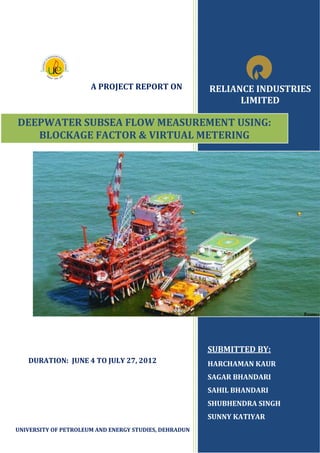
DEEPWATER SUBSEA FLOW MEASUREMENT USING:
BLOCKAGE FACTOR & VIRTUAL METERING
A PROJECT REPORT ON
UNIVERSITY OF PETROLEUM AND ENERGY STUDIES, DEHRADUN
DURATION: JUNE 4 TO JULY 27, 2012
DEEPWATER SUBSEA FLOW MEASUREMENT USING
BLOCKAGE FACTOR & VIRTUAL METERING
University of Petroleum and Energy Studies, Dehradun 2
CERTIFICATE
This is to certify that the project entitled, “DEEPWATER SUBSEA FLOW MEASUREMENT
USING BLOCKAGE FACTOR & VIRTUAL METERING” submitted by Harchaman Kaur,
Sagar Bhandari, Sahil Bhandari, Shubhendra Singh, Sunny Katiyar students of University of
Petroleum and Energy Studies, Dehradun, during the period June 4th
to July 27th
, 2012 in
partial fulfilment of the requirements for the Award of Degree of Bachelor of Technology in
Applied Petroleum Engineering. This project has been carried out by them under my
supervision and guidance at Reliance Industries Limited (E & P Business), KG D6 Operations,
Kakinada.
To the best of my knowledge, the concept embodied in this report is reviewed and should
not submitted to any other Company / Institute by them without prior approval.
Mr Gaurav Gupta
Flow Assurance Engineer
Subsea Team
Reliance Industries Limited
Petroleum Business (E&P)
Onshore Terminal, Gadimoga,
Tallarevu, Mandal, E.G. Dist,
Andhra Pradesh-533 463
Date:
DEEPWATER SUBSEA FLOW MEASUREMENT USING
BLOCKAGE FACTOR & VIRTUAL METERING
University of Petroleum and Energy Studies, Dehradun 3
ACKNOWLEDGEMENT
We take immense pleasure in thanking Mr P.K. VERMA (Head, KGD6) and Mr NAGI
REDDY (GM, HR) for giving us an opportunity to intern at Reliance Industries Limited. We
wish to express our deep sense of gratitude to our internal guides for their able guidance and
useful suggestions, which helped me in completing the project work in time.
Mere words cannot describe our appreciation towards Mr TIMMIE SHEDD & Mr
SIVARAMA V KRISHNA who had the vision and concept of the work assigned to us during
the duration of our training.
We would also like to thank our mentors Mr GAURAV GUPTA, Ms ANURADHA
MAHRA and Ms DEEPTI MISRA for without their guidance and support it would not have
been possible to deliver such promising results in such a short period.
Needless to mention that Mr MALLIKARJUNA RAO (Trainee Manager) who was always
there to provide us with every facility that we needed during the course of our project and has
been as a source of inspiration and for his timely guidance in the conduct of our project.
Finally, yet importantly, we would like to express our heart full thanks to our beloved parents
for their blessings, our friends and classmates for their help and wishes for the successful
completion of this project.
DEEPWATER SUBSEA FLOW MEASUREMENT USING
BLOCKAGE FACTOR & VIRTUAL METERING
University of Petroleum and Energy Studies, Dehradun 4
EXECUTIVE SUMMARY
Flow assurance is a challenging task as Exploration and Production (E&P) operations move
into deeper depths. Paraffins, asphaltenes, hydrates and scaling pose deposition problem
leading to partial blockages in pipeline. Whereas for the KG D6 field, only liquid hold up
causes major blockage owing to multiphase flow. Proper measures have been taken to
overcome other depositional problems by the use of corrosion inhibitors and MEG (hydrate
inhibitor) injection. Due to the difficulty to access subsea flow lines, a remote technique to
detect the blockages is highly desirable. This project investigated the feasibility of using
average pressure technique to detect blockage in subsea flow lines and estimate the WGR
trends from blockage factor.
Blockage Factor is a quantity that is proportional to the size of any obstruction that constricts
or reduces single phase gas flow. Its main action is to increase pressure drop across the two
nodes (inlet/outlet) of a pipeline and even relates magnitude of excess pressure drop (over
and beyond frictional pressure drop) to the size of the blockage.
Sometimes there is a possibility that water being produced is not known. Thus there is a need
to quantify water which has been estimated from blockage factor by developing a new
correlation. The purpose of estimating the produced water from the well is that it helps in
calculating the quantity of MEG to be injected in subsea pipeline to prevent hydrate
formation.
In certain cases there exists a probability of the absence of a flow meter and/or failure of
gradient analysis technique for each well. In these cases virtual metering helps determine well
flow rates in real time using existing instrumentations on the wellbore and on the Christmas
tree at wellhead.
The major applications of this project are in well testing, continuous reservoir monitoring,
production optimization and well allocation measurement.
Other applications capabilities include better distribution, injection and control of fluids.
DEEPWATER SUBSEA FLOW MEASUREMENT USING
BLOCKAGE FACTOR & VIRTUAL METERING
University of Petroleum and Energy Studies, Dehradun 5
CONTENTS
1 LIST OF FIGURES..............................................................................................................................7
2 KG D6 (OVERVIEW) .........................................................................................................................8
2.1 D1D3 Gas Fields.....................................................................................................................9
2.2 MA Oil Field..........................................................................................................................10
3 OBJECTIVE:....................................................................................................................................11
4 SCOPE............................................................................................................................................12
5 BLOCKAGE FACTOR.......................................................................................................................13
5.1 Types of Fluid flow..............................................................................................................13
5.1.1 Single phase flow.........................................................................................................13
5.1.2 Multiphase flow...........................................................................................................13
5.2 Flow Regimes.......................................................................................................................13
5.3 Other methods to estimate WGR trends............................................................................15
5.3.1 Direct Methods ............................................................................................................15
5.3.2 Indirect Methods .........................................................................................................15
5.4 Why use the blockage factor:..............................................................................................15
5.5 How to calculate blockage factor: ......................................................................................15
5.6 Methodology........................................................................................................................17
5.7 Interpretation......................................................................................................................23
5.8 Estimation of water rate from Blockage Factor................................................................32
6 VIRTUAL METERING ......................................................................................................................34
6.1 Metering...............................................................................................................................34
6.1.1 Two modes of flow across chokes..............................................................................34
6.1.2 Classification of Flow Measurement..........................................................................35
6.2 Virtual Metering ..................................................................................................................36
6.2.1 Advantages...................................................................................................................36
6.3 Single phase Correlations - Across the choke ...................................................................37
6.4 Multiphase Correlations - Across the choke......................................................................40
6.5 Results..................................................................................................................................42
7 CONCLUSIONS...............................................................................................................................44
DEEPWATER SUBSEA FLOW MEASUREMENT USING
BLOCKAGE FACTOR & VIRTUAL METERING
University of Petroleum and Energy Studies, Dehradun 6
8 GLOSSARY......................................................................................................................................45
9 REFERENCES..................................................................................................................................46
10 ANNEXURES...................................................................................................................................48
10.1 Nomenclature ......................................................................................................................48
10.2 Friction Factor Calculation .................................................................................................51
10.3 Calculation of gas flow quality............................................................................................56
10.4 Figures..................................................................................................................................57
10.5 Metric Conversion Chart.....................................................................................................58
10.6 Visit to the Reliance Completion Yard, Vakalapudi, Kakinada.........................................59
DEEPWATER SUBSEA FLOW MEASUREMENT USING
BLOCKAGE FACTOR & VIRTUAL METERING
University of Petroleum and Energy Studies, Dehradun 7
1 LIST OF FIGURES
S. NO. FIGURE PAGE NO.
1
Krishna Godavari Delta 6
08
2
D1D3 Gas Fields
09
3
MA Oil Field
10
4
Types of Flow Regimes
14
5
Case 1: WGR, B-Factor, Flow
Rate vs. Time (Well BW4)
24
6
Case 1: WGR, B-Factor, Flow
Rate vs. Time (Well AW1)
25
7
Case 2: WGR, B-Factor, Flow
Rate vs. Time (Well BW6)
26
8
Case 3: B-Factor, Flow Rate vs.
Time (Well BW4)
28
9
Case 3: B-Factor, Flow Rate vs.
Time (Well AW1)
29
10
Case 5: B-Factor vs. Pressure
Drop2
(Well BW4)
30
11
Calculated & Actual Water flow
Rate vs. Time (Well BW4)
33
12
B-Factor vs. Pressure Drop2
(Well AW1)
41
13
Calculated & Actual Gas Rate vs.
Time(Well BW4)
43
DEEPWATER SUBSEA FLOW MEASUREMENT USING
BLOCKAGE FACTOR & VIRTUAL METERING
University of Petroleum and Energy Studies, Dehradun 8
2 KG D6 (OVERVIEW)
Krishna Godavari Basin is an extensive deltaic plain formed by two large East Coast Rivers, Krishna
and Godavari in Andhra Pradesh and the adjoining areas of Bay of Bengal. It’s a proven
petroliferous basin of continental margin located on the east coast of India. It’s on land part covers
an area of 15000 sq. km and the offshore part covers an area of 25,000 sq. km up to 1000m isobaths.
The basin contains about 5km thick sediments with several cycles of deposition, ranging in age from
Late Carboniferous to Pleistocene.
(KG-D6) or block KG-DWN-98/I lies in the Krishna-Godavari basin with an area of 7500 sq. Km
and is located approximately between 40 Km and 60 Km south east from Kakinada. The seabed
slopes sharply causing water depths to vary between 700m (2,297ft) and 1,700m (5,577ft). The field
was awarded to Reliance Industries and Nikos Resources under NELP-1
Currently there are three main fields that are producing at the KG-D6 block. These are D1 and D3
fields which are gas producing fields and MA field that are oil producing field.
Figure 1: Krishna Godavari Delta 6
(KG D6)
DEEPWATER SUBSEA FLOW MEASUREMENT USING
BLOCKAGE FACTOR & VIRTUAL METERING
University of Petroleum and Energy Studies, Dehradun 9
2.1 D1D3 Gas Fields
A total of 18 wells are producing in the D1D3 Gas fields. Reservoir producing fluid is gas. The wells
are located in two different reservoir channels denoted by A and B wells. The water depth at well
head varies from 542 m to 1152 m from mean sea level. These 18 wells are connected to six
manifolds. The six subsea manifolds are then tied back to one Deep Water Pipeline End Manifold
(DWPLEM). From the DWPLEM, two trunk lines are connected to onshore terminal via Central
Riser Platform (CRP).
Figure 2: D1D3 Gas Fields
DEEPWATER SUBSEA FLOW MEASUREMENT USING
BLOCKAGE FACTOR & VIRTUAL METERING
University of Petroleum and Energy Studies, Dehradun 10
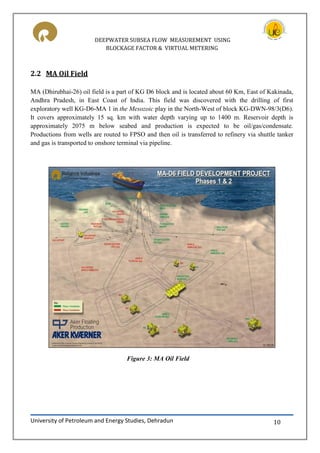
2.2 MA Oil Field
MA (Dhirubhai-26) oil field is a part of KG D6 block and is located about 60 Km, East of Kakinada,
Andhra Pradesh, in East Coast of India. This field was discovered with the drilling of first
exploratory well KG-D6-MA 1 in the Mesozoic play in the North-West of block KG-DWN-98/3(D6).
It covers approximately 15 sq. km with water depth varying up to 1400 m. Reservoir depth is
approximately 2075 m below seabed and production is expected to be oil/gas/condensate.
Productions from wells are routed to FPSO and then oil is transferred to refinery via shuttle tanker
and gas is transported to onshore terminal via pipeline.
Figure 3: MA Oil Field
DEEPWATER SUBSEA FLOW MEASUREMENT USING
BLOCKAGE FACTOR & VIRTUAL METERING
University of Petroleum and Energy Studies, Dehradun 11
3 OBJECTIVE:
 The objective of this project is to formulate an indirect approach to estimate the WGR
trends from the deep water gas wells in D1D3 fields using concept of Blockage Factor.
 Establishing a method to quantify the Water Rate from Blockage factor.
 Implementing virtual metering technique to find gas and water flow rates for D1D3
fields using various correlations in deep water gas wells.
 Compare the results from above correlations with real time production data.
DEEPWATER SUBSEA FLOW MEASUREMENT USING
BLOCKAGE FACTOR & VIRTUAL METERING
University of Petroleum and Energy Studies, Dehradun 12
4 SCOPE
The scope of this project is to establish various indirect methods for flow measurement
in deep water gas fields and limited to:
 The concept of Blockage factor can be used in case when the wet gas flow meter at XMT fails.
 In accuracy in pressure gradient data exists.
 Virtual metering helps determine well flow rates in real time using existing instrumentations in the
wellbore and on Christmas tree.
DEEPWATER SUBSEA FLOW MEASUREMENT USING
BLOCKAGE FACTOR & VIRTUAL METERING
University of Petroleum and Energy Studies, Dehradun 13
5 BLOCKAGE FACTOR
It is a quantity that is proportional to the size of any obstruction that constricts or reduces single
phase gas flow. Its main action is to increase pressure drop across the two nodes (inlet/outlet) of a
pipeline.
It even relates magnitude of excess pressure drop (over and beyond frictional pressure drop) to the
size of the blockage.
B factor can’t tell us what exactly the blockage is i.e. wax, hydrate, eroded portion of pipe, or how it
was formed. Anything other than friction caused by gas is modelled as a blockage.
Blockage causes high pressure drop and even stops gas production. The pressure drop also depends
on the types of fluid flow in a pipe.
5.1 Types of Fluid flow
The fluid flow in oil and gas wells can be broadly classified as follows:-
5.1.1 Single phase flow
When the reservoir pressure is above the bubble point pressure and only one fluid is flowing through
the pipe.
5.1.2 Multiphase flow
The simultaneous flow of two or more phases of fluid will occur in almost all oil and gas producing
wells. In an oil well, whenever the pressure drops below the bubble point, gas evolves and from that
point to the surface gas liquid flow will occur. Many wells also produce significant amount of water
resulting in three phase flow of oil, gas and water.
In D1D3 gas fields two phase flow i.e. gas and water flow exits.
5.2 Flow Regimes
The manner in which two phases are distributed in the pipes significantly affects other aspects of
two phase flow.
The flow regime or flow pattern is a qualitative description of the phase distribution and is of
following types:-
DEEPWATER SUBSEA FLOW MEASUREMENT USING
BLOCKAGE FACTOR & VIRTUAL METERING
University of Petroleum and Energy Studies, Dehradun 14
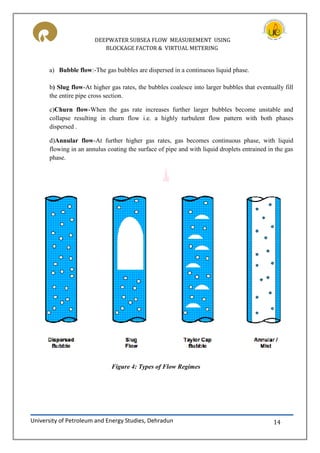
a) Bubble flow:-The gas bubbles are dispersed in a continuous liquid phase.
b) Slug flow-At higher gas rates, the bubbles coalesce into larger bubbles that eventually fill
the entire pipe cross section.
c)Churn flow-When the gas rate increases further larger bubbles become unstable and
collapse resulting in churn flow i.e. a highly turbulent flow pattern with both phases
dispersed .
d)Annular flow-At further higher gas rates, gas becomes continuous phase, with liquid
flowing in an annulus coating the surface of pipe and with liquid droplets entrained in the gas
phase.
Figure 4: Types of Flow Regimes
DEEPWATER SUBSEA FLOW MEASUREMENT USING
BLOCKAGE FACTOR & VIRTUAL METERING
University of Petroleum and Energy Studies, Dehradun 15
5.3 Other methods to estimate WGR trends
The estimation can be broadly classified as follows:-
5.3.1 Direct Methods
i) Wet gas flow meter at each XMT
ii) Metering system at onshore terminals-used to measure cumulative water production.
5.3.2 Indirect Methods
i) Pressure gradient analysis
ii) Nodal analysis –using software like WELLFO, OLGA software
5.4 Why use the blockage factor:
The water produced along with the gas in the tubing would cause an increase in pressure drop for two
main reasons:
i) The sheer presence of liquid water itself would constrict the volume available for the flow of
gas. Figure 4 illustrates a general depiction of possible flow regimes in two phase vertical
flow, how water flowing as ring around the gas or as droplets essentially blocks volume of flow
available for the gas flow.
ii) Two phase flow involves greater pressure drop than single phase flow, with friction between
the water and gas and the friction between the fluids and the pipe being the main factors.
As such, the presence of flowing water itself must cause a greater pressure drop than caused by pipe
friction for single phase gas flow. This excess will show up in blockage factor. Hence, the water itself
is a physical blockage that causes additional pressure drop. As such, varying WGR must show up as
varying blockage factor.
5.5 How to calculate blockage factor:
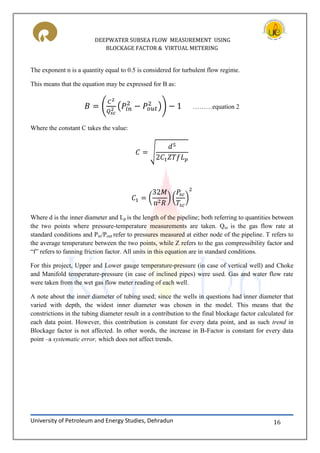
Equation 1 shows the B-factor as the constant in the widely used back pressure equation for the gas
pipelines.
( ) …….equation 1
DEEPWATER SUBSEA FLOW MEASUREMENT USING
BLOCKAGE FACTOR & VIRTUAL METERING
University of Petroleum and Energy Studies, Dehradun 16
The exponent n is a quantity equal to 0.5 is considered for turbulent flow regime.
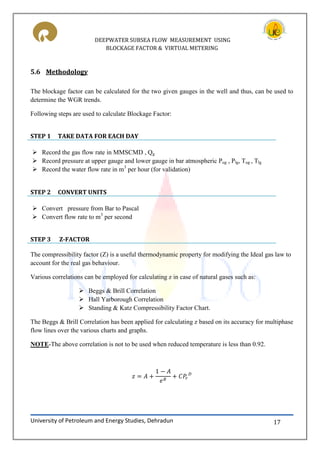
This means that the equation may be expressed for B as:
( ( )) ………equation 2
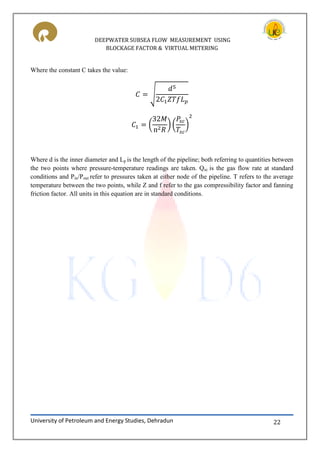
Where the constant C takes the value:
√
( ) ( )
Where d is the inner diameter and Lp is the length of the pipeline; both referring to quantities between
the two points where pressure-temperature measurements are taken. Qsc is the gas flow rate at
standard conditions and Pin/Pout refer to pressures measured at either node of the pipeline. T refers to
the average temperature between the two points, while Z refers to the gas compressibility factor and
“f” refers to fanning friction factor. All units in this equation are in standard conditions.
For this project, Upper and Lower gauge temperature-pressure (in case of vertical well) and Choke
and Manifold temperature-pressure (in case of inclined pipes) were used. Gas and water flow rate
were taken from the wet gas flow meter reading of each well.
A note about the inner diameter of tubing used; since the wells in questions had inner diameter that
varied with depth, the widest inner diameter was chosen in the model. This means that the
constrictions in the tubing diameter result in a contribution to the final blockage factor calculated for
each data point. However, this contribution is constant for every data point, and as such trend in
Blockage factor is not affected. In other words, the increase in B-Factor is constant for every data
point –a systematic error, which does not affect trends.
DEEPWATER SUBSEA FLOW MEASUREMENT USING
BLOCKAGE FACTOR & VIRTUAL METERING
University of Petroleum and Energy Studies, Dehradun 17
5.6 Methodology
The blockage factor can be calculated for the two given gauges in the well and thus, can be used to
determine the WGR trends.
Following steps are used to calculate Blockage Factor:
STEP 1 TAKE DATA FOR EACH DAY
 Record the gas flow rate in MMSCMD , Qg
 Record pressure at upper gauge and lower gauge in bar atmospheric Pug , Plg, Tug , Tlg
 Record the water flow rate in m3
per hour (for validation)
STEP 2 CONVERT UNITS
 Convert pressure from Bar to Pascal
 Convert flow rate to m3
per second
STEP 3 Z-FACTOR
The compressibility factor (Z) is a useful thermodynamic property for modifying the Ideal gas law to
account for the real gas behaviour.
Various correlations can be employed for calculating z in case of natural gases such as:
 Beggs & Brill Correlation
 Hall Yarborough Correlation
 Standing & Katz Compressibility Factor Chart.
The Beggs & Brill Correlation has been applied for calculating z based on its accuracy for multiphase
flow lines over the various charts and graphs.
NOTE-The above correlation is not to be used when reduced temperature is less than 0.92.
DEEPWATER SUBSEA FLOW MEASUREMENT USING
BLOCKAGE FACTOR & VIRTUAL METERING
University of Petroleum and Energy Studies, Dehradun 18
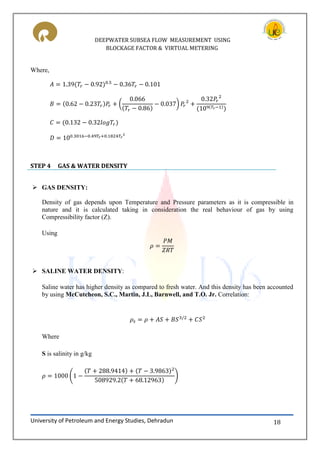
Where,
( )
STEP 4 GAS & WATER DENSITY
 GAS DENSITY:
Density of gas depends upon Temperature and Pressure parameters as it is compressible in
nature and it is calculated taking in consideration the real behaviour of gas by using
Compressibility factor (Z).
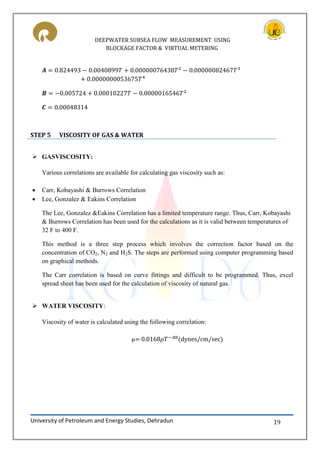
Using
 SALINE WATER DENSITY:
Saline water has higher density as compared to fresh water. And this density has been accounted
by using McCutcheon, S.C., Martin, J.L, Barnwell, and T.O. Jr. Correlation:
Where
S is salinity in g/kg
( )
DEEPWATER SUBSEA FLOW MEASUREMENT USING
BLOCKAGE FACTOR & VIRTUAL METERING
University of Petroleum and Energy Studies, Dehradun 19
STEP 5 VISCOSITY OF GAS & WATER
 GASVISCOSITY:
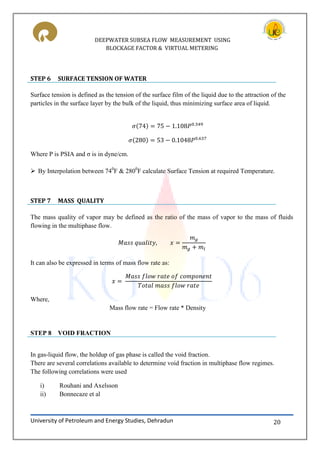
Various correlations are available for calculating gas viscosity such as:
 Carr, Kobayashi & Burrows Correlation
 Lee, Gonzalez & Eakins Correlation
The Lee, Gonzalez &Eakins Correlation has a limited temperature range. Thus, Carr, Kobayashi
& Burrows Correlation has been used for the calculations as it is valid between temperatures of
32 F to 400 F.
This method is a three step process which involves the correction factor based on the
concentration of CO2, N2 and H2S. The steps are performed using computer programming based
on graphical methods.
The Carr correlation is based on curve fittings and difficult to be programmed. Thus, excel
spread sheet has been used for the calculation of viscosity of natural gas.
 WATER VISCOSITY:
Viscosity of water is calculated using the following correlation:
μ (dynes/cm/sec)
DEEPWATER SUBSEA FLOW MEASUREMENT USING
BLOCKAGE FACTOR & VIRTUAL METERING
University of Petroleum and Energy Studies, Dehradun 20
STEP 6 SURFACE TENSION OF WATER
Surface tension is defined as the tension of the surface film of the liquid due to the attraction of the
particles in the surface layer by the bulk of the liquid, thus minimizing surface area of liquid.
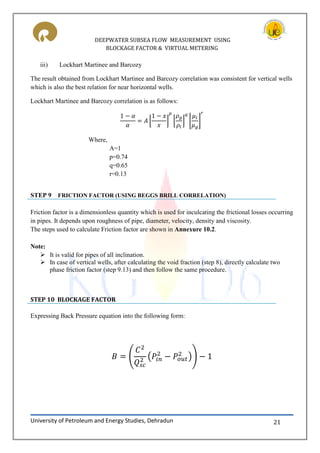
Where P is PSIA and σ is in dyne/cm.
 By Interpolation between 740
F & 2800
F calculate Surface Tension at required Temperature.
STEP 7 MASS QUALITY
The mass quality of vapor may be defined as the ratio of the mass of vapor to the mass of fluids
flowing in the multiphase flow.
It can also be expressed in terms of mass flow rate as:
Where,
Mass flow rate = Flow rate * Density
STEP 8 VOID FRACTION
In gas-liquid flow, the holdup of gas phase is called the void fraction.
There are several correlations available to determine void fraction in multiphase flow regimes.
The following correlations were used
i) Rouhani and Axelsson
ii) Bonnecaze et al
DEEPWATER SUBSEA FLOW MEASUREMENT USING
BLOCKAGE FACTOR & VIRTUAL METERING
University of Petroleum and Energy Studies, Dehradun 21
iii) Lockhart Martinee and Barcozy
The result obtained from Lockhart Martinee and Barcozy correlation was consistent for vertical wells
which is also the best relation for near horizontal wells.
Lockhart Martinee and Barcozy correlation is as follows:
⌊ ⌋ ⌊ ⌋ ⌊ ⌋
Where,
A=1
p=0.74
q=0.65
r=0.13
STEP 9 FRICTION FACTOR (USING BEGGS BRILL CORRELATION)
Friction factor is a dimensionless quantity which is used for inculcating the frictional losses occurring
in pipes. It depends upon roughness of pipe, diameter, velocity, density and viscosity.
The steps used to calculate Friction factor are shown in Annexure 10.2.
Note:
 It is valid for pipes of all inclination.
 In case of vertical wells, after calculating the void fraction (step 8), directly calculate two
phase friction factor (step 9.13) and then follow the same procedure.
STEP 10 BLOCKAGE FACTOR
Expressing Back Pressure equation into the following form:
( ( ))
DEEPWATER SUBSEA FLOW MEASUREMENT USING
BLOCKAGE FACTOR & VIRTUAL METERING
University of Petroleum and Energy Studies, Dehradun 22
Where the constant C takes the value:
√
( ) ( )
Where d is the inner diameter and Lp is the length of the pipeline; both referring to quantities between
the two points where pressure-temperature readings are taken. Qsc is the gas flow rate at standard
conditions and Pin/Pout refer to pressures taken at either node of the pipeline. T refers to the average
temperature between the two points, while Z and f refer to the gas compressibility factor and fanning
friction factor. All units in this equation are in standard conditions.
DEEPWATER SUBSEA FLOW MEASUREMENT USING
BLOCKAGE FACTOR & VIRTUAL METERING
University of Petroleum and Energy Studies, Dehradun 23
5.7 Interpretation
Results obtained for 4 wells: AW1, BW4, and AW6 & BW6 confirm the characteristics of the
Blockage Factor.
Interpretation of these wells has been divided into following five cases:
 Case 1: When both gas and water rate data are given.
 Case 2: When wellbore pressure and temperature parameters are not known.
 Case 3: When only gas rate data is given.
 Case 4: Plot between Blockage Factor and Pressure drop square at varying Gas flow rates.
 Case 5: When both gas rate and water rate are not known.
Here interpretation of wells- BW4, AW1 and BW6 is shown and similar graphical analysis for wells-
AW1 and AW6 is shown in Annexure 10.4
DEEPWATER SUBSEA FLOW MEASUREMENT USING
BLOCKAGE FACTOR & VIRTUAL METERING
University of Petroleum and Energy Studies, Dehradun 24
Case 1: When both Gas and Water rate data are given
(A)Well BW4:
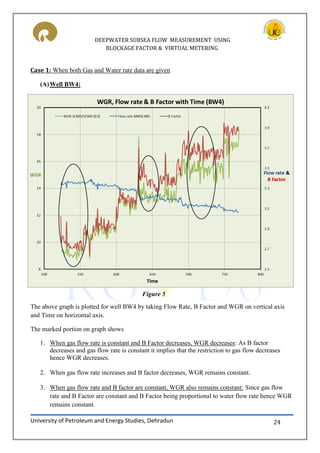
The above graph is plotted for well BW4 by taking Flow Rate, B Factor and WGR on vertical axis
and Time on horizontal axis.
The marked portion on graph shows
1. When gas flow rate is constant and B Factor decreases, WGR decreases: As B factor
decreases and gas flow rate is constant it implies that the restriction to gas flow decreases
hence WGR decreases.
2. When gas flow rate increases and B factor decreases, WGR remains constant.
3. When gas flow rate and B factor are constant, WGR also remains constant: Since gas flow
rate and B Factor are constant and B Factor being proportional to water flow rate hence WGR
remains constant.
Figure 5
DEEPWATER SUBSEA FLOW MEASUREMENT USING
BLOCKAGE FACTOR & VIRTUAL METERING
University of Petroleum and Energy Studies, Dehradun 25
(B) Well AW1
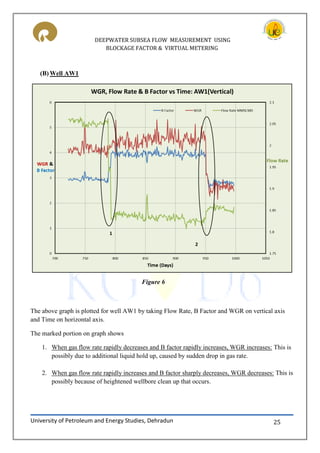
The above graph is plotted for well AW1 by taking Flow Rate, B Factor and WGR on vertical axis
and Time on horizontal axis.
The marked portion on graph shows
1. When gas flow rate rapidly decreases and B factor rapidly increases, WGR increases: This is
possibly due to additional liquid hold up, caused by sudden drop in gas rate.
2. When gas flow rate rapidly increases and B factor sharply decreases, WGR decreases: This is
possibly because of heightened wellbore clean up that occurs.
Figure 6
DEEPWATER SUBSEA FLOW MEASUREMENT USING
BLOCKAGE FACTOR & VIRTUAL METERING
University of Petroleum and Energy Studies, Dehradun 26
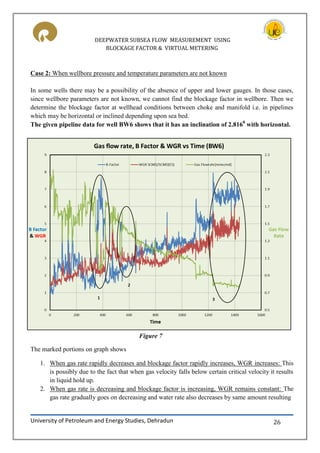
Case 2: When wellbore pressure and temperature parameters are not known
In some wells there may be a possibility of the absence of upper and lower gauges. In those cases,
since wellbore parameters are not known, we cannot find the blockage factor in wellbore. Then we
determine the blockage factor at wellhead conditions between choke and manifold i.e. in pipelines
which may be horizontal or inclined depending upon sea bed.
The given pipeline data for well BW6 shows that it has an inclination of 2.8160
with horizontal.
The marked portions on graph shows
1. When gas rate rapidly decreases and blockage factor rapidly increases, WGR increases: This
is possibly due to the fact that when gas velocity falls below certain critical velocity it results
in liquid hold up.
2. When gas rate is decreasing and blockage factor is increasing, WGR remains constant: The
gas rate gradually goes on decreasing and water rate also decreases by same amount resulting
Figure 7
DEEPWATER SUBSEA FLOW MEASUREMENT USING
BLOCKAGE FACTOR & VIRTUAL METERING
University of Petroleum and Energy Studies, Dehradun 27
in constant WGR.
3. When gas rate is constant and blockage factor is constant, WGR is also constant: In this case
the blockage factor becomes proportional to WGR and tracks the change in WGR very well.
Results
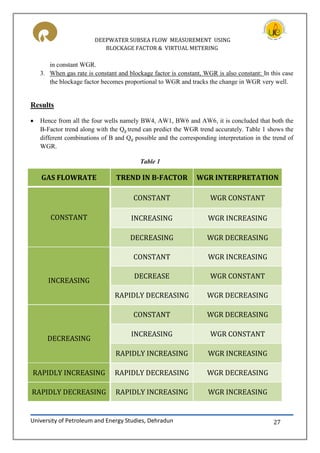
 Hence from all the four wells namely BW4, AW1, BW6 and AW6, it is concluded that both the
B-Factor trend along with the Qg trend can predict the WGR trend accurately. Table 1 shows the
different combinations of B and Qg possible and the corresponding interpretation in the trend of
WGR.
GAS FLOWRATE TREND IN B-FACTOR WGR INTERPRETATION
CONSTANT
CONSTANT WGR CONSTANT
INCREASING WGR INCREASING
DECREASING WGR DECREASING
INCREASING
CONSTANT WGR INCREASING
DECREASE WGR CONSTANT
RAPIDLY DECREASING WGR DECREASING
DECREASING
CONSTANT WGR DECREASING
INCREASING WGR CONSTANT
RAPIDLY INCREASING WGR INCREASING
RAPIDLY INCREASING RAPIDLY DECREASING WGR DECREASING
RAPIDLY DECREASING RAPIDLY INCREASING WGR INCREASING
Table 1
DEEPWATER SUBSEA FLOW MEASUREMENT USING
BLOCKAGE FACTOR & VIRTUAL METERING
University of Petroleum and Energy Studies, Dehradun 28
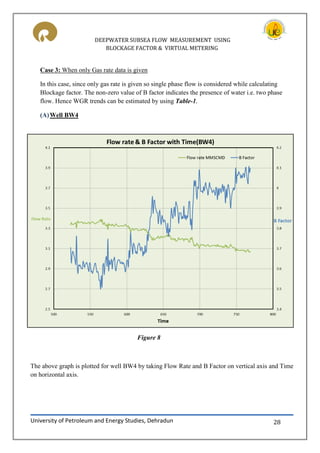
Case 3: When only Gas rate data is given
In this case, since only gas rate is given so single phase flow is considered while calculating
Blockage factor. The non-zero value of B factor indicates the presence of water i.e. two phase
flow. Hence WGR trends can be estimated by using Table-1.
(A)Well BW4
The above graph is plotted for well BW4 by taking Flow Rate and B Factor on vertical axis and Time
on horizontal axis.
Figure 8
DEEPWATER SUBSEA FLOW MEASUREMENT USING
BLOCKAGE FACTOR & VIRTUAL METERING
University of Petroleum and Energy Studies, Dehradun 29
The marked portions on graph show Gas flow rate and B factor trends whereas, WGR trends are
deduced from Table-1
1. When gas flow rate is constant and B Factor decreases, WGR should decrease.
2. When gas flow rate increases and B factor decreases, WGR should remain constant.
3. When gas flow rate and B factor are constant, WGR should remain constant.
 The above results are consistent with those in figure 5.
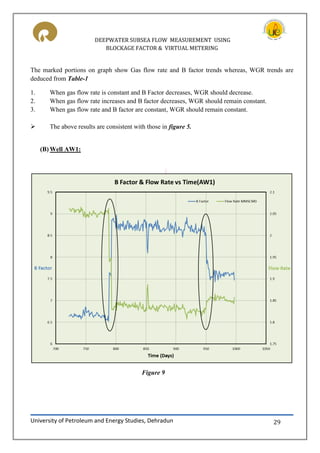
(B) Well AW1:
Figure 9
DEEPWATER SUBSEA FLOW MEASUREMENT USING
BLOCKAGE FACTOR & VIRTUAL METERING
University of Petroleum and Energy Studies, Dehradun 30
The above graph is plotted for well AW1 by taking Flow Rate and B Factor on vertical axis and Time
on horizontal axis.
The marked portions on graph show Gas flow rate and B factor trends whereas, WGR trends are
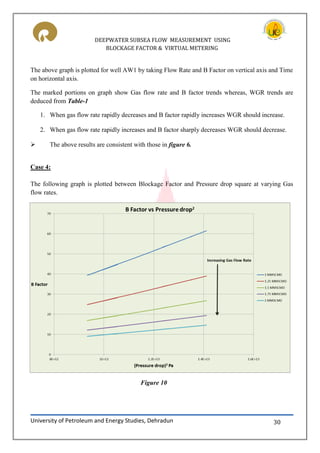
deduced from Table-1
1. When gas flow rate rapidly decreases and B factor rapidly increases WGR should increase.
2. When gas flow rate rapidly increases and B factor sharply decreases WGR should decrease.
 The above results are consistent with those in figure 6.
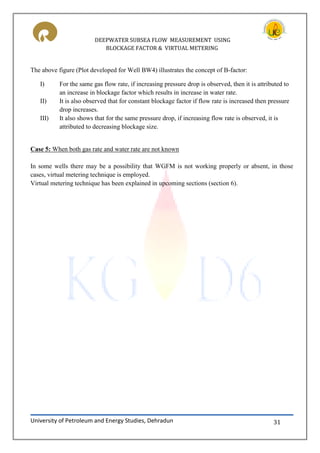
Case 4:
The following graph is plotted between Blockage Factor and Pressure drop square at varying Gas
flow rates.
Figure 10
DEEPWATER SUBSEA FLOW MEASUREMENT USING
BLOCKAGE FACTOR & VIRTUAL METERING
University of Petroleum and Energy Studies, Dehradun 31
The above figure (Plot developed for Well BW4) illustrates the concept of B-factor:
I) For the same gas flow rate, if increasing pressure drop is observed, then it is attributed to
an increase in blockage factor which results in increase in water rate.
II) It is also observed that for constant blockage factor if flow rate is increased then pressure
drop increases.
III) It also shows that for the same pressure drop, if increasing flow rate is observed, it is
attributed to decreasing blockage size.
Case 5: When both gas rate and water rate are not known
In some wells there may be a possibility that WGFM is not working properly or absent, in those
cases, virtual metering technique is employed.
Virtual metering technique has been explained in upcoming sections (section 6).
DEEPWATER SUBSEA FLOW MEASUREMENT USING
BLOCKAGE FACTOR & VIRTUAL METERING
University of Petroleum and Energy Studies, Dehradun 32
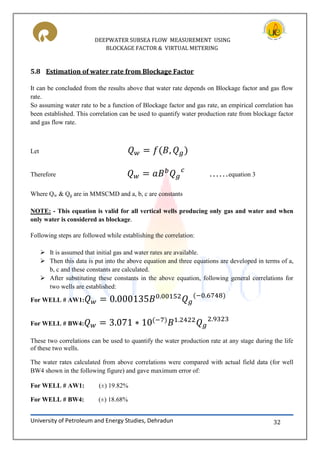
5.8 Estimation of water rate from Blockage Factor
It can be concluded from the results above that water rate depends on Blockage factor and gas flow
rate.
So assuming water rate to be a function of Blockage factor and gas rate, an empirical correlation has
been established. This correlation can be used to quantify water production rate from blockage factor
and gas flow rate.
Let
Therefore ……equation 3
Where Qw & Qg are in MMSCMD and a, b, c are constants
NOTE: - This equation is valid for all vertical wells producing only gas and water and when
only water is considered as blockage.
Following steps are followed while establishing the correlation:
 It is assumed that initial gas and water rates are available.
 Then this data is put into the above equation and three equations are developed in terms of a,
b, c and these constants are calculated.
 After substituting these constants in the above equation, following general correlations for
two wells are established:
For WELL # AW1:
For WELL # BW4:
These two correlations can be used to quantify the water production rate at any stage during the life
of these two wells.
The water rates calculated from above correlations were compared with actual field data (for well
BW4 shown in the following figure) and gave maximum error of:
For WELL # AW1: (±) 19.82%
For WELL # BW4: (±) 18.68%
DEEPWATER SUBSEA FLOW MEASUREMENT USING
BLOCKAGE FACTOR & VIRTUAL METERING
University of Petroleum and Energy Studies, Dehradun 33
Figure 11
DEEPWATER SUBSEA FLOW MEASUREMENT USING
BLOCKAGE FACTOR & VIRTUAL METERING
University of Petroleum and Energy Studies, Dehradun 34
6 VIRTUAL METERING
6.1 Metering
Flow measurement is the quantification of bulk fluid movement. Both gas and liquid flow can be
measured in volumetric or mass flow rates, such as litres per second or kilograms per second. These
measurements can be converted between one another if the material's density is known. The density
for a liquid is almost independent of the liquid conditions; however, this is not the case for gas, the
density of which depends greatly upon pressure, temperature and to a lesser extent, the gas
composition.
Virtually all flowing wells utilize some form of surface restriction to regulate the flow rate.
Typically, a surface choke is located immediately following the wellhead. There are two general
types of chokes: positive chokes and adjustable chokes.
The reasons for having a choking device in the production system are to:
 Protect reservoir and surface equipment from pressure fluctuations.
 Maintain stable pressure downstream of the choke for processing equipment.
 Provide the necessary backpressure on a reservoir to avoid formation damage and to prevent
sand from entering the wellbore.
 Prevent gas and/or water coning.
 Control flow rates and maintain well allowable and
 Produce the reservoir at the most efficient rate.
By introducing a surface choke, operators can effectively isolate the reservoir component from the
surface processing component.
At KG-D6 the type of choke used is a plug and cage type of choke. The nomenclature assigned to the
chokes used is CC40 and CC50.
6.1.1 Two modes of flow across chokes
6.1.1.1Critical flowoccurs when the velocity through the choke is greater than the sonic velocity of the
fluid. If the velocity of the fluid is greater than the sonic velocity of the fluid, any downstream
perturbation is unable to propagate upstream and the mass flow rate through the choke is solely a
function of the upstream parameters.
6.1.1.2Sub-Critical flowoccurs when the velocity through the choke is less than the sonic velocity of
the fluid. If the velocity of the fluid is less than the sonic velocity of the fluid, any downstream
perturbation is able to propagate upstream and the mass flow rate through the choke is a function of
DEEPWATER SUBSEA FLOW MEASUREMENT USING
BLOCKAGE FACTOR & VIRTUAL METERING
University of Petroleum and Energy Studies, Dehradun 35
the upstream and downstream parameters.
The type of flow can be determined using the critical pressure ratio which is a ratio between the
outlet and upstream pressures. It can be expressed as:
( ) ( )
Where,
K is the specific heat ratio expressed as Cp/Cv
 If the ratio between the downstream to upstream pressure ratio is less than the critical
pressure ratio then there exists a critical flow through the choke.
 If the ratio between the downstream to upstream pressure ratio is greater than the critical
pressure ratio then there exists a sub-critical flow through the choke.
6.1.2 Classification of Flow Measurement
Based on type of phases present it is classified as:
6.1.2.1 Single Phase Flow Metering
Single phase flow metering is the determination of flow rate for a well in which the produced fluids
are in a state such that their physical properties are more or less uniform i.e. in the same phase or
single phase.
KG-D6 consists of the D1D3 fields which are gas fields i.e. single phase metering is applicable to
these fields where in gas is the single phase. Hence it is safe to say that gas flow equations are
applicable to these fields for the wells which are having dry gas production.
6.1.2.2 Multi-Phase flow Metering
Multiphase metering is the determination of flow rate for a well in which there are two or more
phases present i.e. the fluids flowing have distinct physical properties and are treated as two separate
phases.
Multiphase metering provides an alternative to traditional separators, reducing size and cost and
provides real-time well data without the need for phase separation or flow line pressure drop.
To get access to fractional flow rate measurements, the multiphase flow meter (MPFM) were
developed. The outputs of this are not direct measurements. The main drawbacks of MPFM are that
they need to be calibrated regularly which implies maintenance OPEX. This comes in addition of it
high CAPEX in case of well production monitoring purpose.
DEEPWATER SUBSEA FLOW MEASUREMENT USING
BLOCKAGE FACTOR & VIRTUAL METERING
University of Petroleum and Energy Studies, Dehradun 36
The alternative solution is to build Virtual flow meter (VFM) based on the hydrodynamic models
correlated to the direct measurements of pressure and temperature. This choice is supported by the
cost effectiveness of this solution compared to MPFM. The quality of the VFM is based on how
realistic the model is.
6.2 Virtual Metering
D1D3 wells are equipped with pressure transmitters i.e. upper and lower gauge. Wet Gas Flow
Meters (WGFM) are installed on each X-Mas tree to measure water production rates but due to
limitations of accuracy, might often prone to errors.
In certain cases there exists a possibility of the absence of a flow meter present exclusively for each
well. In these cases virtual metering helps determine well flow rates in real time using existing
instrumentations on the wellbore and on the Christmas tree at wellhead. Usually there is adequate
instrumentation/information available to estimate the flow rate using different models for the same
well.
The major applications of this concept are in well testing, continuous reservoir monitoring and
production optimisation. Certain manufacturers are also known to apply this concept for calibrating
their meters.
The flow rate model to be used for estimation of flow rate using virtual metering is essentially
governed by the type of phase present in the flow i.e. whether the fluids in flow are in single phase or
in multiple phases.
6.2.1 Advantages
1) Cost reduction by eliminating test lines, separators and separate flow meters.
2) Accurate well testing.
3) Real-time measurement of the well output and behaviour.
DEEPWATER SUBSEA FLOW MEASUREMENT USING
BLOCKAGE FACTOR & VIRTUAL METERING
University of Petroleum and Energy Studies, Dehradun 37
6.3 Single phase Correlations - Across the choke
Following correlations are used for single phase flow across choke for calculation of gas flow
rate.
 SZILAS CORRELATION:
The relationship which describes the mass flow of a single-phase gas through a choke can be
generically written as:
√ (( ) ( ) )
Where,
Q=Gas flow rate, MCFD
D= Choke size, 64th of the inch
Cd= Discharge coefficient, app=0.86
ɣ= specific gravity
Upstream pressure, PSIA
Downstream pressure, PSIA
T= Temperature, 0
R
k= Specific heat ratio (Cp/Cv)
NOTE: This equation applies both at and above the critical pressure ratio, yc i.e. in case of sub-
critical flow.
 NIND EQUATION:
This equation is valid only for sub-critical/sub-sonic flow.
√ (( ) ( ) )
DEEPWATER SUBSEA FLOW MEASUREMENT USING
BLOCKAGE FACTOR & VIRTUAL METERING
University of Petroleum and Energy Studies, Dehradun 38
Where,
Q=Gas flow rate, MSCFD
D= Choke size, in
A=Cross section area of the choke, in2
Cd= Discharge coefficient, app. =0.86
ɣ= specific gravity
Upstream pressure, PSIA
Downstream pressure, PSIA
T= Temperature, 0
R
k= Specific heat ratio (Cp/Cv)
 THORNHILL-CRAVER CO EQUATION:
The equation is for compressible, one-dimensional, and isentropic flow of a perfect gas
through a restriction, with the addition of a correction factor (discharge coefficient) to account
for deviations encountered in real cases.
√ (( ) ( ) )
Where,
Q=Gas flow rate, MSCFD
D= Choke size, 64th
of the inch
A=Cross section area of the choke, in2
Cd= Discharge coefficient, approx. =0.86
ɣ= specific gravity
Upstream pressure, PSIA
Downstream pressure, PSIA
= emperature,
k= Specific heat ratio (Cp/Cv)
DEEPWATER SUBSEA FLOW MEASUREMENT USING
BLOCKAGE FACTOR & VIRTUAL METERING
University of Petroleum and Energy Studies, Dehradun 39
 GAS SIZING EQUATION:
This equation is universal in the sense that it accurately predicts the flow for either high or low
recovery valves for any gas and under any service conditions. This equation introduces a new factor,
C1.
The following is the Universal Gas Sizing Equation:
√ (( ) √ )Rad
Where,
Cg - Gas Sizing Coefficient: This is a dimension less number that related to the amount of
capacity of a valve or orifice.
Q - Flow Rate of a gas in SCFH
P1 - Inlet Pressure (PSIA)
P2 - Outlet Pressure (PSIA)
C1 - Valve recovery Coefficient (C1=Cg/Cv).
G - Specific Gravity of the gas.
T - Gas Temperature in °R (T = 460 + F)
C1 is defined as the ratio of Cg to Cv.
C1- It is an index that tells us something about the physical flow geometry of the valve. Its numerical
value tells us whether the valve is high recovery, low recovery, or somewhere in between.
NOTE: - Cg has been calculated from above equation by hit and trial method by using given gas flow
rate. The value of Cg was found to be 2578.
Limitations: First, consider the extreme where the valve pressure drop is quite small. This means
that the angle of the sine function will also be quite small in radians. Under this condition, the
equation reduces to the original CV equation which is valid at low pressure zone.
The other extreme of the Universal Gas Sizing Equation is the condition of choked flow. At the
critical pressure drop ratio, the sine function becomes unity and the equation reduces to the critical
flow equation.
The other limitation is that this equation is limited to perfect gasses only.
DEEPWATER SUBSEA FLOW MEASUREMENT USING
BLOCKAGE FACTOR & VIRTUAL METERING
University of Petroleum and Energy Studies, Dehradun 40
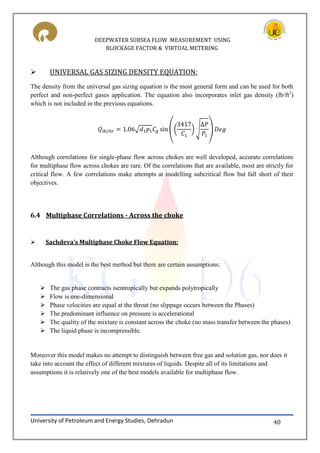
 UNIVERSAL GAS SIZING DENSITY EQUATION:
The density from the universal gas sizing equation is the most general form and can be used for both
perfect and non-perfect gases application. The equation also incorporates inlet gas density (lb/ft3
)
which is not included in the previous equations.
√ (( ) √ )
Although correlations for single-phase flow across chokes are well developed, accurate correlations
for multiphase flow across chokes are rare. Of the correlations that are available, most are strictly for
critical flow. A few correlations make attempts at modelling subcritical flow but fall short of their
objectives.
6.4 Multiphase Correlations - Across the choke
 Sachdeva’s Multiphase Choke Flow Equation:
Although this model is the best method but there are certain assumptions:
 The gas phase contracts isentropically but expands polytropically
 Flow is one-dimensional
 Phase velocities are equal at the throat (no slippage occurs between the Phases)
 The predominant influence on pressure is accelerational
 The quality of the mixture is constant across the choke (no mass transfer between the phases)
 The liquid phase is incompressible.
Moreover this model makes no attempt to distinguish between free gas and solution gas, nor does it
take into account the effect of different mixtures of liquids. Despite all of its limitations and
assumptions it is relatively one of the best models available for multiphase flow.
DEEPWATER SUBSEA FLOW MEASUREMENT USING
BLOCKAGE FACTOR & VIRTUAL METERING
University of Petroleum and Energy Studies, Dehradun 41
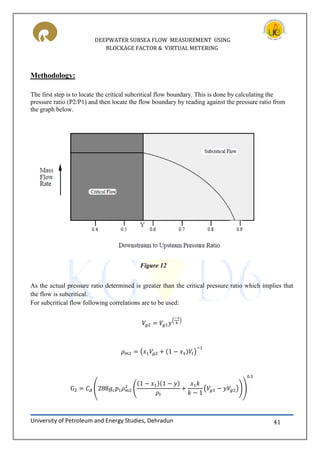
Methodology:
The first step is to locate the critical subcritical flow boundary. This is done by calculating the
pressure ratio (P2/P1) and then locate the flow boundary by reading against the pressure ratio from
the graph below.
As the actual pressure ratio determined is greater than the critical pressure ratio which implies that
the flow is subcritical.
For subcritical flow following correlations are to be used:
( )
( )
( ( ( )))
Figure 12
DEEPWATER SUBSEA FLOW MEASUREMENT USING
BLOCKAGE FACTOR & VIRTUAL METERING
University of Petroleum and Energy Studies, Dehradun 42
Where
G2= mass flux at downstream, lbm/ft2
/s
Cd = discharge coefficient, 0.86
ρm2 = mixture density at downstream, lbm/ft3
ρl = liquid density, lbm/ft3
x1 = free gas quality at upstream, mass fraction
y = actual pressure ratio
Vg = gas specific volume, ft3
/lbm
K = specific heat ratio.
NOTE: - The calculation of gas flow quality, x1 is explained in Annexure 10.3
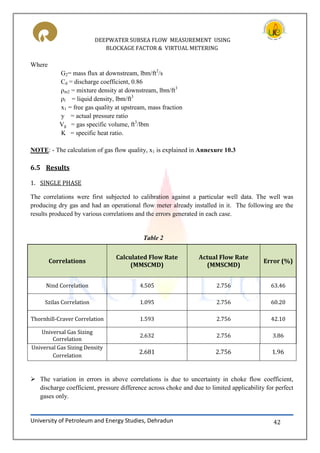
6.5 Results
1. SINGLE PHASE
The correlations were first subjected to calibration against a particular well data. The well was
producing dry gas and had an operational flow meter already installed in it. The following are the
results produced by various correlations and the errors generated in each case.
Correlations
Calculated Flow Rate
(MMSCMD)
Actual Flow Rate
(MMSCMD)
Error (%)
Nind Correlation 4.505 2.756 63.46
Szilas Correlation 1.095 2.756 60.20
Thornhill-Craver Correlation 1.593 2.756 42.10
Universal Gas Sizing
Correlation
2.632 2.756 3.86
Universal Gas Sizing Density
Correlation
2.681 2.756 1.96
 The variation in errors in above correlations is due to uncertainty in choke flow coefficient,
discharge coefficient, pressure difference across choke and due to limited applicability for perfect
gases only.
Table 2
DEEPWATER SUBSEA FLOW MEASUREMENT USING
BLOCKAGE FACTOR & VIRTUAL METERING
University of Petroleum and Energy Studies, Dehradun 43
 As it is seen from the table, the universal gas sizing density correlation gives the least error of
all correlations. Hence it is considered to be the best suited correlation for estimating the single-
phase gas flow rate for D1D3 fields.
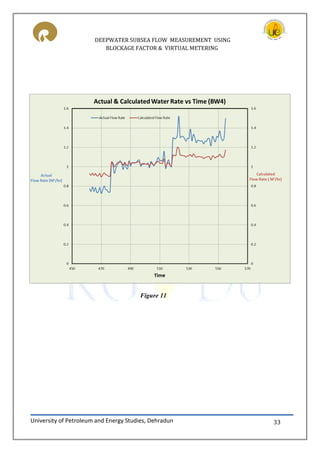
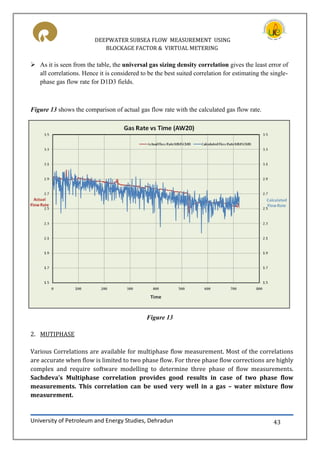
Figure 13 shows the comparison of actual gas flow rate with the calculated gas flow rate.
2. MUTIPHASE
Various Correlations are available for multiphase flow measurement. Most of the correlations
are accurate when flow is limited to two phase flow. For three phase flow corrections are highly
complex and require software modelling to determine three phase of flow measurements.
Sachdeva’s Multiphase correlation provides good results in case of two phase flow
measurements. This correlation can be used very well in a gas – water mixture flow
measurement.
Figure 13
DEEPWATER SUBSEA FLOW MEASUREMENT USING
BLOCKAGE FACTOR & VIRTUAL METERING
University of Petroleum and Energy Studies, Dehradun 44
7 CONCLUSIONS
Following conclusions are made:
 Water production trends with constant and variable gas rate were estimated, generalized and
were found to be well-matched with existing field data.
 The method of Blockage factor for WGR estimation is reliable and can be successfully used
in case of failure of gradient data and wet gas flow meter.
 The concept of blockage factor although is a qualitative approach but it can also be used to
quantify the water production.
 Though virtual metering can give an approximate value of the flow rates but can save a lot of
time and is highly economical as it doesn’t require a flow meter installation in subsea.
DEEPWATER SUBSEA FLOW MEASUREMENT USING
BLOCKAGE FACTOR & VIRTUAL METERING
University of Petroleum and Energy Studies, Dehradun 45
8 GLOSSARY
1. Petroliferous- a rock or geologic formation with petroleum reserves.
2. Isobaths.-an imaginary line connecting all points of equal depth below the surface of a body of
water.
3. Carboniferous -it is a geologic period that extends from the end of the Devonian Period (359.2
± 2.5 million years ago), to the beginning of the Permian Period (299.0 ± 0.8 million years ago)
4. Pleistocene- The geological time scale which lasted from about 2,588,000 to 11,700 years ago
5. Mesozoic-it is an interval of geological time from about 250 million years ago to about 65
million years ago.
6. Bubble point- When heating a liquid consisting of two or more components, the bubble point
is the point where first bubble of vapour is formed
7. Manifold- Oil and gas manifold diverts or merges oil or gas production without flow
interruption,
DEEPWATER SUBSEA FLOW MEASUREMENT USING
BLOCKAGE FACTOR & VIRTUAL METERING
University of Petroleum and Energy Studies, Dehradun 46
9 REFERENCES
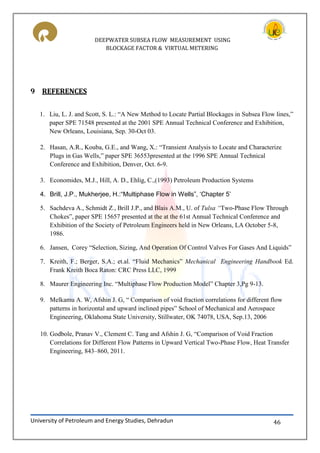
1. Liu, L. J. and Scott, S. L.: “A New Method to Locate Partial Blockages in Subsea Flow lines,”
paper SPE 71548 presented at the 2001 SPE Annual Technical Conference and Exhibition,
New Orleans, Louisiana, Sep. 30-Oct 03.
2. Hasan, A. ., Kouba, G.E., and Wang, X.: “ ransient Analysis to Locate and Characterize
Plugs in Gas Wells,” paper SPE 36553presented at the 1996 SPE Annual Technical
Conference and Exhibition, Denver, Oct. 6-9.
3. Economides, M.J., Hill, A. D., Ehlig, C.,(1993) Petroleum Production Systems
4. Brill, J.P., Mukherjee, H.:“Multiphase Flow in Wells”, ‘Chapter 5’
5. Sachdeva A., Schmidt Z., Brill J.P., and Blais A.M., U. of Tulsa “Two-Phase Flow Through
Chokes”, paper SPE 15657 presented at the at the 61st Annual Technical Conference and
Exhibition of the Society of Petroleum Engineers held in New Orleans, LA October 5-8,
1986.
6. Jansen, Corey “Selection, Sizing, And Operation Of Control Valves For Gases And Liquids”
7. Kreith, F.; Berger, S.A.; et.al. “Fluid Mechanics” Mechanical Engineering Handbook Ed.
Frank Kreith Boca Raton: CRC Press LLC, 1999
8. Maurer Engineering Inc. “Multiphase Flow Production Model” Chapter 3,Pg 9-13.
9. Melkamu A. W, Afshin J. G, “ Comparison of void fraction correlations for different flow
patterns in horizontal and upward inclined pipes” School of Mechanical and Aerospace
Engineering, Oklahoma State University, Stillwater, OK 74078, USA, Sep.13, 2006
10. Godbole, Pranav V., Clement C. Tang and Afshin J. G, “Comparison of Void Fraction
Correlations for Different Flow Patterns in Upward Vertical Two-Phase Flow, Heat Transfer
Engineering, 843–860, 2011.
DEEPWATER SUBSEA FLOW MEASUREMENT USING
BLOCKAGE FACTOR & VIRTUAL METERING
University of Petroleum and Energy Studies, Dehradun 47
Web References:
1. https://fekete.com/software/virtuwell/media/c-te-chokesizing.html
2. http://www.documentation.emersonprocess.com/groups/public/documents/reference/d351798
x012_11.pdf
3. http://www.fekete.com/aboutus/techlibrary.asp
4. www.onlineconversion.com/
5. www.onepetro.org
6. http://www.wlv.com/products/databook/db3/data/db3ch17.pdf
DEEPWATER SUBSEA FLOW MEASUREMENT USING
BLOCKAGE FACTOR & VIRTUAL METERING
University of Petroleum and Energy Studies, Dehradun 48
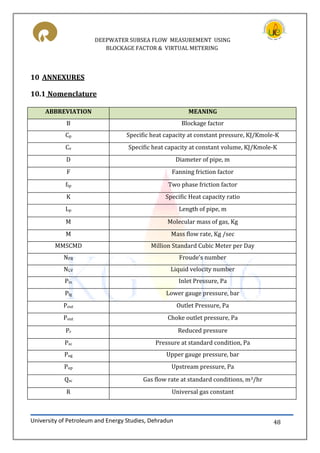
10 ANNEXURES
10.1 Nomenclature
ABBREVIATION MEANING
B Blockage factor
Cp Specific heat capacity at constant pressure, KJ/Kmole-K
Cv Specific heat capacity at constant volume, KJ/Kmole-K
D Diameter of pipe, m
F Fanning friction factor
ftp Two phase friction factor
K Specific Heat capacity ratio
Lp Length of pipe, m
M Molecular mass of gas, Kg
M Mass flow rate, Kg /sec
MMSCMD Million Standard Cubic Meter per Day
NFR Froude’s number
NLV Liquid velocity number
Pin Inlet Pressure, Pa
Plg Lower gauge pressure, bar
Pout Outlet Pressure, Pa
Pout Choke outlet pressure, Pa
Pr Reduced pressure
Psc Pressure at standard condition, Pa
Pug Upper gauge pressure, bar
Pup Upstream pressure, Pa
Qsc Gas flow rate at standard conditions, m3/hr
R Universal gas constant
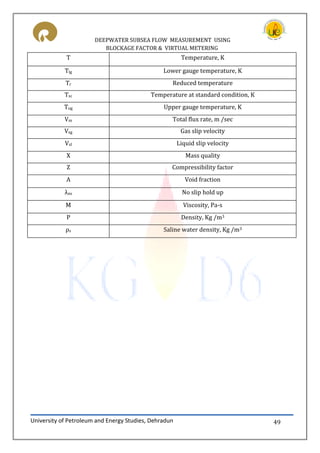
DEEPWATER SUBSEA FLOW MEASUREMENT USING
BLOCKAGE FACTOR & VIRTUAL METERING
University of Petroleum and Energy Studies, Dehradun 49
T Temperature, K
Tlg Lower gauge temperature, K
Tr Reduced temperature
Tsc Temperature at standard condition, K
Tug Upper gauge temperature, K
Vm Total flux rate, m /sec
Vsg Gas slip velocity
Vsl Liquid slip velocity
X Mass quality
Z Compressibility factor
Α Void fraction
λns No slip hold up
Μ Viscosity, Pa-s
Ρ Density, Kg /m3
ρs Saline water density, Kg /m3
DEEPWATER SUBSEA FLOW MEASUREMENT USING
BLOCKAGE FACTOR & VIRTUAL METERING
University of Petroleum and Energy Studies, Dehradun 50
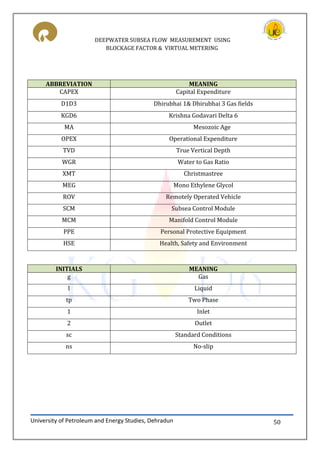
ABBREVIATION MEANING
CAPEX Capital Expenditure
D1D3 Dhirubhai 1& Dhirubhai 3 Gas fields
KGD6 Krishna Godavari Delta 6
MA Mesozoic Age
OPEX Operational Expenditure
TVD True Vertical Depth
WGR Water to Gas Ratio
XMT Christmastree
MEG Mono Ethylene Glycol
ROV Remotely Operated Vehicle
SCM Subsea Control Module
MCM Manifold Control Module
PPE Personal Protective Equipment
HSE Health, Safety and Environment
INITIALS MEANING
g Gas
l Liquid
tp Two Phase
1 Inlet
2 Outlet
sc Standard Conditions
ns No-slip
DEEPWATER SUBSEA FLOW MEASUREMENT USING
BLOCKAGE FACTOR & VIRTUAL METERING
University of Petroleum and Energy Studies, Dehradun 51
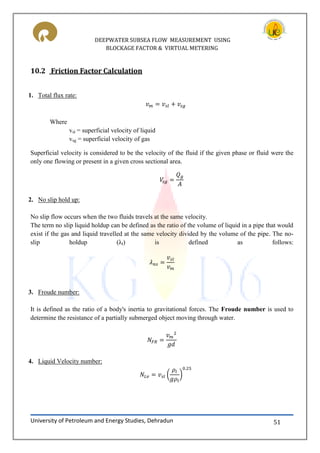
10.2 Friction Factor Calculation
1. Total flux rate:
Where
vsl = superficial velocity of liquid
vsg = superficial velocity of gas
Superficial velocity is considered to be the velocity of the fluid if the given phase or fluid were the
only one flowing or present in a given cross sectional area.
2. No slip hold up:
No slip flow occurs when the two fluids travels at the same velocity.
The term no slip liquid holdup can be defined as the ratio of the volume of liquid in a pipe that would
exist if the gas and liquid travelled at the same velocity divided by the volume of the pipe. The no-
slip holdup (λl) is defined as follows:
3. Froude number:
It is defined as the ratio of a body's inertia to gravitational forces. The Froude number is used to
determine the resistance of a partially submerged object moving through water.
4. Liquid Velocity number:
( )
DEEPWATER SUBSEA FLOW MEASUREMENT USING
BLOCKAGE FACTOR & VIRTUAL METERING
University of Petroleum and Energy Studies, Dehradun 52
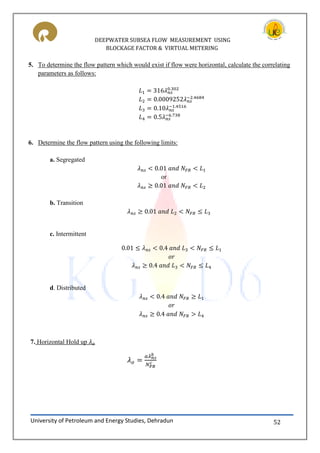
5. To determine the flow pattern which would exist if flow were horizontal, calculate the correlating
parameters as follows:
6. Determine the flow pattern using the following limits:
a. Segregated
or
b. Transition
c. Intermittent
d. Distributed
7. Horizontal Hold up
DEEPWATER SUBSEA FLOW MEASUREMENT USING
BLOCKAGE FACTOR & VIRTUAL METERING
University of Petroleum and Energy Studies, Dehradun 53
Where a, b and c are determined for each flow pattern from the table
Flow pattern a b c
Segregated 0.98 0.4846 0.0868
Intermittent 0.845 0.5351 0.0173
Distributed 1.065 0.5824 0.0609
8. Calculate the inclination correction factor coefficient
Flow pattern d e f g
Segregated Uphill 0.011 -3.768 3.539 -1.614
Intermittent Uphill 2.96 0.305 -0.4473 0.0978
Distributed Uphill No correction No correction C=0
All flow patterns 4.70 -0.3692 0.1244 -0.5056
9. Calculate the liquid holdup inclination correction factor
[ ]
Where is the deviation from horizontal axis
10. Calculate the liquid holdup
11. Apply Palmer correction factor
12. When flow is in transition pattern, take the average as follows:
DEEPWATER SUBSEA FLOW MEASUREMENT USING
BLOCKAGE FACTOR & VIRTUAL METERING
University of Petroleum and Energy Studies, Dehradun 54
Where
Where the liquid holdup is calculated assuming flow is integrated, is the liquid holdup assuming
the flow is intermittent.
13. Calculate frictional factor ratio
Where s = [ ] [ ]
S becomes unbounded at a point in the interval 1<y<1.2; and for y in this interval, the function S is
calculated from
14. Calculate two phase friction factor
Reynolds Number is a dimensionless number that gives a measure of the ratio of inertial forces to
viscous forces and consequently quantifies the relative importance of these two types of forces for
given flow conditions.
The Reynolds Number is determined as:
μ
DEEPWATER SUBSEA FLOW MEASUREMENT USING
BLOCKAGE FACTOR & VIRTUAL METERING
University of Petroleum and Energy Studies, Dehradun 55
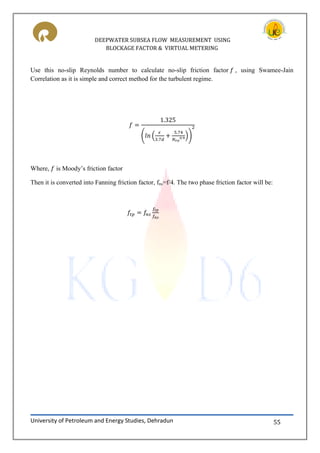
Use this no-slip Reynolds number to calculate no-slip friction factor , using Swamee-Jain
Correlation as it is simple and correct method for the turbulent regime.
( ( ))
Where, is Moody’s friction factor
Then it is converted into Fanning friction factor, fns=f/4. The two phase friction factor will be:
DEEPWATER SUBSEA FLOW MEASUREMENT USING
BLOCKAGE FACTOR & VIRTUAL METERING
University of Petroleum and Energy Studies, Dehradun 56
10.3 Calculation of gas flow quality
Following steps have been followed:
 Since gas and water flow rates are not known, the single phase gas flow is assumed.
 Gas flow rate is calculated by using universal gas sizing density correlation.
 Using this gas flow rate, blockage factor is calculated using equation 2.
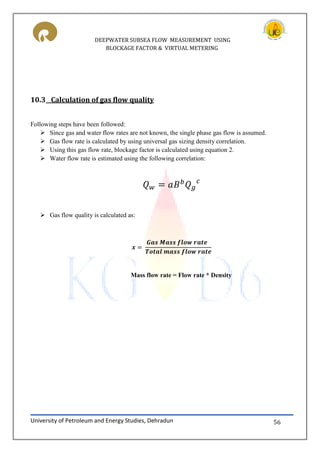
 Water flow rate is estimated using the following correlation:
 Gas flow quality is calculated as:
Mass flow rate = Flow rate * Density
DEEPWATER SUBSEA FLOW MEASUREMENT USING
BLOCKAGE FACTOR & VIRTUAL METERING
University of Petroleum and Energy Studies, Dehradun 57
10.4 Figures
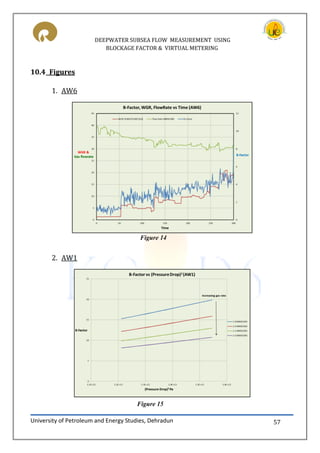
1. AW6
2. AW1
Figure 14
Figure 15
DEEPWATER SUBSEA FLOW MEASUREMENT USING
BLOCKAGE FACTOR & VIRTUAL METERING
University of Petroleum and Energy Studies, Dehradun 58
10.5 Metric Conversion Chart
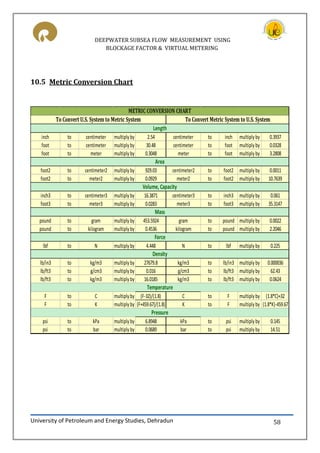
inch to centimeter multiplyby 2.54 centimeter to inch multiplyby 0.3937
foot to centimeter multiplyby 30.48 centimeter to foot multiplyby 0.0328
foot to meter multiplyby 0.3048 meter to foot multiplyby 3.2808
foot2 to centimeter2 multiplyby 929.03 centimeter2 to foot2 multiplyby 0.0011
foot2 to meter2 multiplyby 0.0929 meter2 to foot2 multiplyby 10.7639
inch3 to centimeter3 multiplyby 16.3871 centimeter3 to inch3 multiplyby 0.061
foot3 to meter3 multiplyby 0.0283 meter3 to foot3 multiplyby 35.3147
pound to gram multiplyby 453.5924 gram to pound multiplyby 0.0022
pound to kilogram multiplyby 0.4536 kilogram to pound multiplyby 2.2046
lbf to N multiplyby 4.448 N to lbf multiplyby 0.225
lb/in3 to kg/m3 multiplyby 27679.8 kg/m3 to lb/in3 multiplyby 0.000036
lb/ft3 to g/cm3 multiplyby 0.016 g/cm3 to lb/ft3 multiplyby 62.43
lb/ft3 to kg/m3 multiplyby 16.0185 kg/m3 to lb/ft3 multiplyby 0.0624
F to C multiplyby (F-32)/(1.8) C to F multiplyby (1.8*C)+32
F to K multiplyby (F+459.67)/(1.8) K to F multiplyby (1.8*K)-459.67
psi to kPa multiplyby 6.8948 kPa to psi multiplyby 0.145
psi to bar multiplyby 0.0689 bar to psi multiplyby 14.51
Temperature
Pressure
Length
Area
Volume, Capacity
Mass
Force
Density
To Convert Metric System to U.S. SystemTo Convert U.S. System to Metric System
METRIC CONVERSION CHART
DEEPWATER SUBSEA FLOW MEASUREMENT USING
BLOCKAGE FACTOR & VIRTUAL METERING
University of Petroleum and Energy Studies, Dehradun 59
10.6 Visit to the Reliance Completion Yard, Vakalapudi, Kakinada
July 13, 2012
A visit to the Reliance Completion Yard was organized where storage and maintenance of the subsea
equipment is done. AKER SOLUTIONS is the subsea contractor for Reliance KG D6 subsea project
and has delivered a complete subsea production system, including umbilical to the deep-water gas
field
Aker Solutions ASA is a Norwegian oil services company that offers engineering, construction,
maintenance, modification and operation services for new and existing oil and gas fields. Aker
Solutions has its workshop in the completion yard.
The visit was organized with the support of Mr. Rajesh Sahi, who briefed us about the various tools
and processes which are carried out at the Yard.
The visit comprised of Health ,safety & Environment induction program followed by visual
explanation to the drilling ,casing & cementing aspects, installation of manifolds, placing of
wellhead assembly & the vital functioning of R.O.V.(Remote Operated Vehicle), accompanied by
visit to the warehouse ,where testing of field service instruments like: HXMT(Horizontal X-Mas
Tree), SCM retrieval tool (Sub-sea Control Module) etc.
A brief description of HXMT was given describing various valves and their functionalities. Further
SCM retrieval tool (Surface Control Module) and MCM (Manifold Control Module) were explained.
H.S.E. Induction:
Starting right from the entry point to the training room all were advised to walk in a “Walk Way”.
Wearing PPE (Personal Protection Equipment) was compulsory. The HSE guidelines including
compulsory PPE during working hours in the working areas. The HSE personal gave various proud
examples of their site locations around the globe. Just care is the motto of the company; emphasizing
the fact every accident is preventable.
Well Development Phases:
 Drilling: starting from drilling up of the Conductor hole of around 36”-30”.
 Casing: A conductor casing pipe is put to prevent the drilled well from caving in. Various
casings of different diameters are then put during advancement of the project.
 Cementing: This job is done to keep the casing in place.
 Installation of floor base.
 Wellhead equipment installations:
It comprised of manifold (with a suction anchor), XMT.
DEEPWATER SUBSEA FLOW MEASUREMENT USING
BLOCKAGE FACTOR & VIRTUAL METERING
University of Petroleum and Energy Studies, Dehradun 60
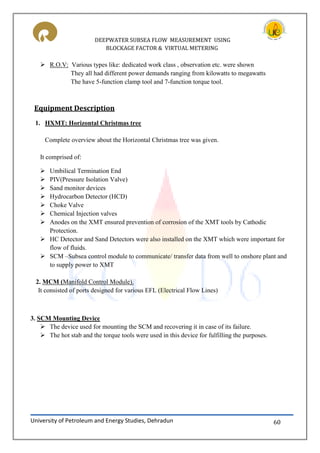
 R.O.V: Various types like: dedicated work class , observation etc. were shown
They all had different power demands ranging from kilowatts to megawatts
The have 5-function clamp tool and 7-function torque tool.
Equipment Description
1. HXMT: Horizontal Christmas tree
Complete overview about the Horizontal Christmas tree was given.
It comprised of:
 Umbilical Termination End
 PIV(Pressure Isolation Valve)
 Sand monitor devices
 Hydrocarbon Detector (HCD)
 Choke Valve
 Chemical Injection valves
 Anodes on the XMT ensured prevention of corrosion of the XMT tools by Cathodic
Protection.
 HC Detector and Sand Detectors were also installed on the XMT which were important for
flow of fluids.
 SCM –Subsea control module to communicate/ transfer data from well to onshore plant and
to supply power to XMT
2. MCM (Manifold Control Module).
It consisted of ports designed for various EFL (Electrical Flow Lines)
3. SCM Mounting Device
 The device used for mounting the SCM and recovering it in case of its failure.
 The hot stab and the torque tools were used in this device for fulfilling the purposes.

Final-Report_on_Deep_water_flow_measurement

  • 1.
    RELIANCE INDUSTRIES LIMITED SUBMITTED BY: HARCHAMANKAUR SAGAR BHANDARI SAHIL BHANDARI SHUBHENDRA SINGH SUNNY KATIYAR DEEPWATER SUBSEA FLOW MEASUREMENT USING: BLOCKAGE FACTOR & VIRTUAL METERING A PROJECT REPORT ON UNIVERSITY OF PETROLEUM AND ENERGY STUDIES, DEHRADUN DURATION: JUNE 4 TO JULY 27, 2012
  • 2.
    DEEPWATER SUBSEA FLOWMEASUREMENT USING BLOCKAGE FACTOR & VIRTUAL METERING University of Petroleum and Energy Studies, Dehradun 2 CERTIFICATE This is to certify that the project entitled, “DEEPWATER SUBSEA FLOW MEASUREMENT USING BLOCKAGE FACTOR & VIRTUAL METERING” submitted by Harchaman Kaur, Sagar Bhandari, Sahil Bhandari, Shubhendra Singh, Sunny Katiyar students of University of Petroleum and Energy Studies, Dehradun, during the period June 4th to July 27th , 2012 in partial fulfilment of the requirements for the Award of Degree of Bachelor of Technology in Applied Petroleum Engineering. This project has been carried out by them under my supervision and guidance at Reliance Industries Limited (E & P Business), KG D6 Operations, Kakinada. To the best of my knowledge, the concept embodied in this report is reviewed and should not submitted to any other Company / Institute by them without prior approval. Mr Gaurav Gupta Flow Assurance Engineer Subsea Team Reliance Industries Limited Petroleum Business (E&P) Onshore Terminal, Gadimoga, Tallarevu, Mandal, E.G. Dist, Andhra Pradesh-533 463 Date:
  • 3.
    DEEPWATER SUBSEA FLOWMEASUREMENT USING BLOCKAGE FACTOR & VIRTUAL METERING University of Petroleum and Energy Studies, Dehradun 3 ACKNOWLEDGEMENT We take immense pleasure in thanking Mr P.K. VERMA (Head, KGD6) and Mr NAGI REDDY (GM, HR) for giving us an opportunity to intern at Reliance Industries Limited. We wish to express our deep sense of gratitude to our internal guides for their able guidance and useful suggestions, which helped me in completing the project work in time. Mere words cannot describe our appreciation towards Mr TIMMIE SHEDD & Mr SIVARAMA V KRISHNA who had the vision and concept of the work assigned to us during the duration of our training. We would also like to thank our mentors Mr GAURAV GUPTA, Ms ANURADHA MAHRA and Ms DEEPTI MISRA for without their guidance and support it would not have been possible to deliver such promising results in such a short period. Needless to mention that Mr MALLIKARJUNA RAO (Trainee Manager) who was always there to provide us with every facility that we needed during the course of our project and has been as a source of inspiration and for his timely guidance in the conduct of our project. Finally, yet importantly, we would like to express our heart full thanks to our beloved parents for their blessings, our friends and classmates for their help and wishes for the successful completion of this project.
  • 4.
    DEEPWATER SUBSEA FLOWMEASUREMENT USING BLOCKAGE FACTOR & VIRTUAL METERING University of Petroleum and Energy Studies, Dehradun 4 EXECUTIVE SUMMARY Flow assurance is a challenging task as Exploration and Production (E&P) operations move into deeper depths. Paraffins, asphaltenes, hydrates and scaling pose deposition problem leading to partial blockages in pipeline. Whereas for the KG D6 field, only liquid hold up causes major blockage owing to multiphase flow. Proper measures have been taken to overcome other depositional problems by the use of corrosion inhibitors and MEG (hydrate inhibitor) injection. Due to the difficulty to access subsea flow lines, a remote technique to detect the blockages is highly desirable. This project investigated the feasibility of using average pressure technique to detect blockage in subsea flow lines and estimate the WGR trends from blockage factor. Blockage Factor is a quantity that is proportional to the size of any obstruction that constricts or reduces single phase gas flow. Its main action is to increase pressure drop across the two nodes (inlet/outlet) of a pipeline and even relates magnitude of excess pressure drop (over and beyond frictional pressure drop) to the size of the blockage. Sometimes there is a possibility that water being produced is not known. Thus there is a need to quantify water which has been estimated from blockage factor by developing a new correlation. The purpose of estimating the produced water from the well is that it helps in calculating the quantity of MEG to be injected in subsea pipeline to prevent hydrate formation. In certain cases there exists a probability of the absence of a flow meter and/or failure of gradient analysis technique for each well. In these cases virtual metering helps determine well flow rates in real time using existing instrumentations on the wellbore and on the Christmas tree at wellhead. The major applications of this project are in well testing, continuous reservoir monitoring, production optimization and well allocation measurement. Other applications capabilities include better distribution, injection and control of fluids.
  • 5.
    DEEPWATER SUBSEA FLOWMEASUREMENT USING BLOCKAGE FACTOR & VIRTUAL METERING University of Petroleum and Energy Studies, Dehradun 5 CONTENTS 1 LIST OF FIGURES..............................................................................................................................7 2 KG D6 (OVERVIEW) .........................................................................................................................8 2.1 D1D3 Gas Fields.....................................................................................................................9 2.2 MA Oil Field..........................................................................................................................10 3 OBJECTIVE:....................................................................................................................................11 4 SCOPE............................................................................................................................................12 5 BLOCKAGE FACTOR.......................................................................................................................13 5.1 Types of Fluid flow..............................................................................................................13 5.1.1 Single phase flow.........................................................................................................13 5.1.2 Multiphase flow...........................................................................................................13 5.2 Flow Regimes.......................................................................................................................13 5.3 Other methods to estimate WGR trends............................................................................15 5.3.1 Direct Methods ............................................................................................................15 5.3.2 Indirect Methods .........................................................................................................15 5.4 Why use the blockage factor:..............................................................................................15 5.5 How to calculate blockage factor: ......................................................................................15 5.6 Methodology........................................................................................................................17 5.7 Interpretation......................................................................................................................23 5.8 Estimation of water rate from Blockage Factor................................................................32 6 VIRTUAL METERING ......................................................................................................................34 6.1 Metering...............................................................................................................................34 6.1.1 Two modes of flow across chokes..............................................................................34 6.1.2 Classification of Flow Measurement..........................................................................35 6.2 Virtual Metering ..................................................................................................................36 6.2.1 Advantages...................................................................................................................36 6.3 Single phase Correlations - Across the choke ...................................................................37 6.4 Multiphase Correlations - Across the choke......................................................................40 6.5 Results..................................................................................................................................42 7 CONCLUSIONS...............................................................................................................................44
  • 6.
    DEEPWATER SUBSEA FLOWMEASUREMENT USING BLOCKAGE FACTOR & VIRTUAL METERING University of Petroleum and Energy Studies, Dehradun 6 8 GLOSSARY......................................................................................................................................45 9 REFERENCES..................................................................................................................................46 10 ANNEXURES...................................................................................................................................48 10.1 Nomenclature ......................................................................................................................48 10.2 Friction Factor Calculation .................................................................................................51 10.3 Calculation of gas flow quality............................................................................................56 10.4 Figures..................................................................................................................................57 10.5 Metric Conversion Chart.....................................................................................................58 10.6 Visit to the Reliance Completion Yard, Vakalapudi, Kakinada.........................................59
  • 7.
    DEEPWATER SUBSEA FLOWMEASUREMENT USING BLOCKAGE FACTOR & VIRTUAL METERING University of Petroleum and Energy Studies, Dehradun 7 1 LIST OF FIGURES S. NO. FIGURE PAGE NO. 1 Krishna Godavari Delta 6 08 2 D1D3 Gas Fields 09 3 MA Oil Field 10 4 Types of Flow Regimes 14 5 Case 1: WGR, B-Factor, Flow Rate vs. Time (Well BW4) 24 6 Case 1: WGR, B-Factor, Flow Rate vs. Time (Well AW1) 25 7 Case 2: WGR, B-Factor, Flow Rate vs. Time (Well BW6) 26 8 Case 3: B-Factor, Flow Rate vs. Time (Well BW4) 28 9 Case 3: B-Factor, Flow Rate vs. Time (Well AW1) 29 10 Case 5: B-Factor vs. Pressure Drop2 (Well BW4) 30 11 Calculated & Actual Water flow Rate vs. Time (Well BW4) 33 12 B-Factor vs. Pressure Drop2 (Well AW1) 41 13 Calculated & Actual Gas Rate vs. Time(Well BW4) 43
  • 8.
    DEEPWATER SUBSEA FLOWMEASUREMENT USING BLOCKAGE FACTOR & VIRTUAL METERING University of Petroleum and Energy Studies, Dehradun 8 2 KG D6 (OVERVIEW) Krishna Godavari Basin is an extensive deltaic plain formed by two large East Coast Rivers, Krishna and Godavari in Andhra Pradesh and the adjoining areas of Bay of Bengal. It’s a proven petroliferous basin of continental margin located on the east coast of India. It’s on land part covers an area of 15000 sq. km and the offshore part covers an area of 25,000 sq. km up to 1000m isobaths. The basin contains about 5km thick sediments with several cycles of deposition, ranging in age from Late Carboniferous to Pleistocene. (KG-D6) or block KG-DWN-98/I lies in the Krishna-Godavari basin with an area of 7500 sq. Km and is located approximately between 40 Km and 60 Km south east from Kakinada. The seabed slopes sharply causing water depths to vary between 700m (2,297ft) and 1,700m (5,577ft). The field was awarded to Reliance Industries and Nikos Resources under NELP-1 Currently there are three main fields that are producing at the KG-D6 block. These are D1 and D3 fields which are gas producing fields and MA field that are oil producing field. Figure 1: Krishna Godavari Delta 6 (KG D6)
  • 9.
    DEEPWATER SUBSEA FLOWMEASUREMENT USING BLOCKAGE FACTOR & VIRTUAL METERING University of Petroleum and Energy Studies, Dehradun 9 2.1 D1D3 Gas Fields A total of 18 wells are producing in the D1D3 Gas fields. Reservoir producing fluid is gas. The wells are located in two different reservoir channels denoted by A and B wells. The water depth at well head varies from 542 m to 1152 m from mean sea level. These 18 wells are connected to six manifolds. The six subsea manifolds are then tied back to one Deep Water Pipeline End Manifold (DWPLEM). From the DWPLEM, two trunk lines are connected to onshore terminal via Central Riser Platform (CRP). Figure 2: D1D3 Gas Fields
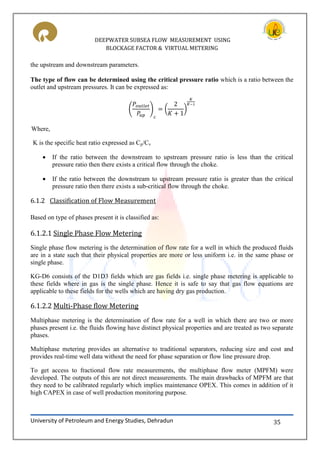
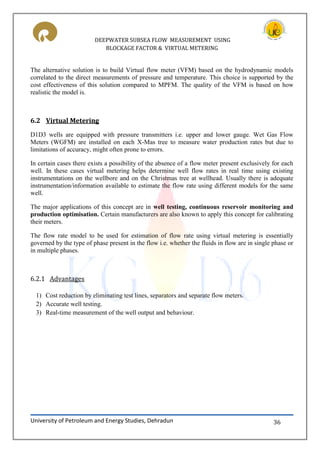
  • 10.
    DEEPWATER SUBSEA FLOWMEASUREMENT USING BLOCKAGE FACTOR & VIRTUAL METERING University of Petroleum and Energy Studies, Dehradun 10 2.2 MA Oil Field MA (Dhirubhai-26) oil field is a part of KG D6 block and is located about 60 Km, East of Kakinada, Andhra Pradesh, in East Coast of India. This field was discovered with the drilling of first exploratory well KG-D6-MA 1 in the Mesozoic play in the North-West of block KG-DWN-98/3(D6). It covers approximately 15 sq. km with water depth varying up to 1400 m. Reservoir depth is approximately 2075 m below seabed and production is expected to be oil/gas/condensate. Productions from wells are routed to FPSO and then oil is transferred to refinery via shuttle tanker and gas is transported to onshore terminal via pipeline. Figure 3: MA Oil Field
  • 11.
    DEEPWATER SUBSEA FLOWMEASUREMENT USING BLOCKAGE FACTOR & VIRTUAL METERING University of Petroleum and Energy Studies, Dehradun 11 3 OBJECTIVE:  The objective of this project is to formulate an indirect approach to estimate the WGR trends from the deep water gas wells in D1D3 fields using concept of Blockage Factor.  Establishing a method to quantify the Water Rate from Blockage factor.  Implementing virtual metering technique to find gas and water flow rates for D1D3 fields using various correlations in deep water gas wells.  Compare the results from above correlations with real time production data.
  • 12.
    DEEPWATER SUBSEA FLOWMEASUREMENT USING BLOCKAGE FACTOR & VIRTUAL METERING University of Petroleum and Energy Studies, Dehradun 12 4 SCOPE The scope of this project is to establish various indirect methods for flow measurement in deep water gas fields and limited to:  The concept of Blockage factor can be used in case when the wet gas flow meter at XMT fails.  In accuracy in pressure gradient data exists.  Virtual metering helps determine well flow rates in real time using existing instrumentations in the wellbore and on Christmas tree.
  • 13.
    DEEPWATER SUBSEA FLOWMEASUREMENT USING BLOCKAGE FACTOR & VIRTUAL METERING University of Petroleum and Energy Studies, Dehradun 13 5 BLOCKAGE FACTOR It is a quantity that is proportional to the size of any obstruction that constricts or reduces single phase gas flow. Its main action is to increase pressure drop across the two nodes (inlet/outlet) of a pipeline. It even relates magnitude of excess pressure drop (over and beyond frictional pressure drop) to the size of the blockage. B factor can’t tell us what exactly the blockage is i.e. wax, hydrate, eroded portion of pipe, or how it was formed. Anything other than friction caused by gas is modelled as a blockage. Blockage causes high pressure drop and even stops gas production. The pressure drop also depends on the types of fluid flow in a pipe. 5.1 Types of Fluid flow The fluid flow in oil and gas wells can be broadly classified as follows:- 5.1.1 Single phase flow When the reservoir pressure is above the bubble point pressure and only one fluid is flowing through the pipe. 5.1.2 Multiphase flow The simultaneous flow of two or more phases of fluid will occur in almost all oil and gas producing wells. In an oil well, whenever the pressure drops below the bubble point, gas evolves and from that point to the surface gas liquid flow will occur. Many wells also produce significant amount of water resulting in three phase flow of oil, gas and water. In D1D3 gas fields two phase flow i.e. gas and water flow exits. 5.2 Flow Regimes The manner in which two phases are distributed in the pipes significantly affects other aspects of two phase flow. The flow regime or flow pattern is a qualitative description of the phase distribution and is of following types:-
  • 14.
    DEEPWATER SUBSEA FLOWMEASUREMENT USING BLOCKAGE FACTOR & VIRTUAL METERING University of Petroleum and Energy Studies, Dehradun 14 a) Bubble flow:-The gas bubbles are dispersed in a continuous liquid phase. b) Slug flow-At higher gas rates, the bubbles coalesce into larger bubbles that eventually fill the entire pipe cross section. c)Churn flow-When the gas rate increases further larger bubbles become unstable and collapse resulting in churn flow i.e. a highly turbulent flow pattern with both phases dispersed . d)Annular flow-At further higher gas rates, gas becomes continuous phase, with liquid flowing in an annulus coating the surface of pipe and with liquid droplets entrained in the gas phase. Figure 4: Types of Flow Regimes
  • 15.
    DEEPWATER SUBSEA FLOWMEASUREMENT USING BLOCKAGE FACTOR & VIRTUAL METERING University of Petroleum and Energy Studies, Dehradun 15 5.3 Other methods to estimate WGR trends The estimation can be broadly classified as follows:- 5.3.1 Direct Methods i) Wet gas flow meter at each XMT ii) Metering system at onshore terminals-used to measure cumulative water production. 5.3.2 Indirect Methods i) Pressure gradient analysis ii) Nodal analysis –using software like WELLFO, OLGA software 5.4 Why use the blockage factor: The water produced along with the gas in the tubing would cause an increase in pressure drop for two main reasons: i) The sheer presence of liquid water itself would constrict the volume available for the flow of gas. Figure 4 illustrates a general depiction of possible flow regimes in two phase vertical flow, how water flowing as ring around the gas or as droplets essentially blocks volume of flow available for the gas flow. ii) Two phase flow involves greater pressure drop than single phase flow, with friction between the water and gas and the friction between the fluids and the pipe being the main factors. As such, the presence of flowing water itself must cause a greater pressure drop than caused by pipe friction for single phase gas flow. This excess will show up in blockage factor. Hence, the water itself is a physical blockage that causes additional pressure drop. As such, varying WGR must show up as varying blockage factor. 5.5 How to calculate blockage factor: Equation 1 shows the B-factor as the constant in the widely used back pressure equation for the gas pipelines. ( ) …….equation 1
  • 16.
    DEEPWATER SUBSEA FLOWMEASUREMENT USING BLOCKAGE FACTOR & VIRTUAL METERING University of Petroleum and Energy Studies, Dehradun 16 The exponent n is a quantity equal to 0.5 is considered for turbulent flow regime. This means that the equation may be expressed for B as: ( ( )) ………equation 2 Where the constant C takes the value: √ ( ) ( ) Where d is the inner diameter and Lp is the length of the pipeline; both referring to quantities between the two points where pressure-temperature measurements are taken. Qsc is the gas flow rate at standard conditions and Pin/Pout refer to pressures measured at either node of the pipeline. T refers to the average temperature between the two points, while Z refers to the gas compressibility factor and “f” refers to fanning friction factor. All units in this equation are in standard conditions. For this project, Upper and Lower gauge temperature-pressure (in case of vertical well) and Choke and Manifold temperature-pressure (in case of inclined pipes) were used. Gas and water flow rate were taken from the wet gas flow meter reading of each well. A note about the inner diameter of tubing used; since the wells in questions had inner diameter that varied with depth, the widest inner diameter was chosen in the model. This means that the constrictions in the tubing diameter result in a contribution to the final blockage factor calculated for each data point. However, this contribution is constant for every data point, and as such trend in Blockage factor is not affected. In other words, the increase in B-Factor is constant for every data point –a systematic error, which does not affect trends.
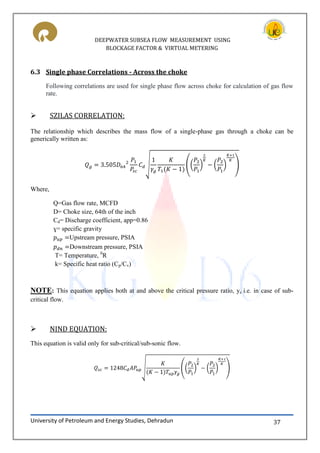
  • 17.
    DEEPWATER SUBSEA FLOWMEASUREMENT USING BLOCKAGE FACTOR & VIRTUAL METERING University of Petroleum and Energy Studies, Dehradun 17 5.6 Methodology The blockage factor can be calculated for the two given gauges in the well and thus, can be used to determine the WGR trends. Following steps are used to calculate Blockage Factor: STEP 1 TAKE DATA FOR EACH DAY  Record the gas flow rate in MMSCMD , Qg  Record pressure at upper gauge and lower gauge in bar atmospheric Pug , Plg, Tug , Tlg  Record the water flow rate in m3 per hour (for validation) STEP 2 CONVERT UNITS  Convert pressure from Bar to Pascal  Convert flow rate to m3 per second STEP 3 Z-FACTOR The compressibility factor (Z) is a useful thermodynamic property for modifying the Ideal gas law to account for the real gas behaviour. Various correlations can be employed for calculating z in case of natural gases such as:  Beggs & Brill Correlation  Hall Yarborough Correlation  Standing & Katz Compressibility Factor Chart. The Beggs & Brill Correlation has been applied for calculating z based on its accuracy for multiphase flow lines over the various charts and graphs. NOTE-The above correlation is not to be used when reduced temperature is less than 0.92.
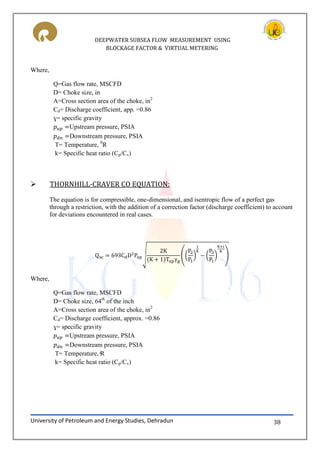
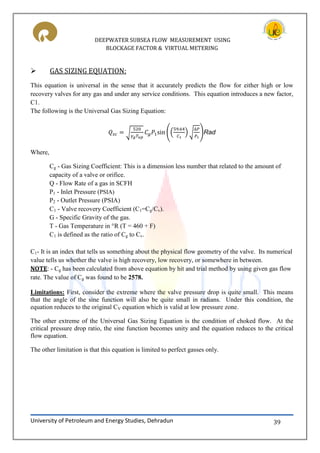
  • 18.
    DEEPWATER SUBSEA FLOWMEASUREMENT USING BLOCKAGE FACTOR & VIRTUAL METERING University of Petroleum and Energy Studies, Dehradun 18 Where, ( ) STEP 4 GAS & WATER DENSITY  GAS DENSITY: Density of gas depends upon Temperature and Pressure parameters as it is compressible in nature and it is calculated taking in consideration the real behaviour of gas by using Compressibility factor (Z). Using  SALINE WATER DENSITY: Saline water has higher density as compared to fresh water. And this density has been accounted by using McCutcheon, S.C., Martin, J.L, Barnwell, and T.O. Jr. Correlation: Where S is salinity in g/kg ( )
  • 19.
    DEEPWATER SUBSEA FLOWMEASUREMENT USING BLOCKAGE FACTOR & VIRTUAL METERING University of Petroleum and Energy Studies, Dehradun 19 STEP 5 VISCOSITY OF GAS & WATER  GASVISCOSITY: Various correlations are available for calculating gas viscosity such as:  Carr, Kobayashi & Burrows Correlation  Lee, Gonzalez & Eakins Correlation The Lee, Gonzalez &Eakins Correlation has a limited temperature range. Thus, Carr, Kobayashi & Burrows Correlation has been used for the calculations as it is valid between temperatures of 32 F to 400 F. This method is a three step process which involves the correction factor based on the concentration of CO2, N2 and H2S. The steps are performed using computer programming based on graphical methods. The Carr correlation is based on curve fittings and difficult to be programmed. Thus, excel spread sheet has been used for the calculation of viscosity of natural gas.  WATER VISCOSITY: Viscosity of water is calculated using the following correlation: μ (dynes/cm/sec)
  • 20.
    DEEPWATER SUBSEA FLOWMEASUREMENT USING BLOCKAGE FACTOR & VIRTUAL METERING University of Petroleum and Energy Studies, Dehradun 20 STEP 6 SURFACE TENSION OF WATER Surface tension is defined as the tension of the surface film of the liquid due to the attraction of the particles in the surface layer by the bulk of the liquid, thus minimizing surface area of liquid. Where P is PSIA and σ is in dyne/cm.  By Interpolation between 740 F & 2800 F calculate Surface Tension at required Temperature. STEP 7 MASS QUALITY The mass quality of vapor may be defined as the ratio of the mass of vapor to the mass of fluids flowing in the multiphase flow. It can also be expressed in terms of mass flow rate as: Where, Mass flow rate = Flow rate * Density STEP 8 VOID FRACTION In gas-liquid flow, the holdup of gas phase is called the void fraction. There are several correlations available to determine void fraction in multiphase flow regimes. The following correlations were used i) Rouhani and Axelsson ii) Bonnecaze et al
  • 21.
    DEEPWATER SUBSEA FLOWMEASUREMENT USING BLOCKAGE FACTOR & VIRTUAL METERING University of Petroleum and Energy Studies, Dehradun 21 iii) Lockhart Martinee and Barcozy The result obtained from Lockhart Martinee and Barcozy correlation was consistent for vertical wells which is also the best relation for near horizontal wells. Lockhart Martinee and Barcozy correlation is as follows: ⌊ ⌋ ⌊ ⌋ ⌊ ⌋ Where, A=1 p=0.74 q=0.65 r=0.13 STEP 9 FRICTION FACTOR (USING BEGGS BRILL CORRELATION) Friction factor is a dimensionless quantity which is used for inculcating the frictional losses occurring in pipes. It depends upon roughness of pipe, diameter, velocity, density and viscosity. The steps used to calculate Friction factor are shown in Annexure 10.2. Note:  It is valid for pipes of all inclination.  In case of vertical wells, after calculating the void fraction (step 8), directly calculate two phase friction factor (step 9.13) and then follow the same procedure. STEP 10 BLOCKAGE FACTOR Expressing Back Pressure equation into the following form: ( ( ))
  • 22.
    DEEPWATER SUBSEA FLOWMEASUREMENT USING BLOCKAGE FACTOR & VIRTUAL METERING University of Petroleum and Energy Studies, Dehradun 22 Where the constant C takes the value: √ ( ) ( ) Where d is the inner diameter and Lp is the length of the pipeline; both referring to quantities between the two points where pressure-temperature readings are taken. Qsc is the gas flow rate at standard conditions and Pin/Pout refer to pressures taken at either node of the pipeline. T refers to the average temperature between the two points, while Z and f refer to the gas compressibility factor and fanning friction factor. All units in this equation are in standard conditions.
  • 23.
    DEEPWATER SUBSEA FLOWMEASUREMENT USING BLOCKAGE FACTOR & VIRTUAL METERING University of Petroleum and Energy Studies, Dehradun 23 5.7 Interpretation Results obtained for 4 wells: AW1, BW4, and AW6 & BW6 confirm the characteristics of the Blockage Factor. Interpretation of these wells has been divided into following five cases:  Case 1: When both gas and water rate data are given.  Case 2: When wellbore pressure and temperature parameters are not known.  Case 3: When only gas rate data is given.  Case 4: Plot between Blockage Factor and Pressure drop square at varying Gas flow rates.  Case 5: When both gas rate and water rate are not known. Here interpretation of wells- BW4, AW1 and BW6 is shown and similar graphical analysis for wells- AW1 and AW6 is shown in Annexure 10.4
  • 24.
    DEEPWATER SUBSEA FLOWMEASUREMENT USING BLOCKAGE FACTOR & VIRTUAL METERING University of Petroleum and Energy Studies, Dehradun 24 Case 1: When both Gas and Water rate data are given (A)Well BW4: The above graph is plotted for well BW4 by taking Flow Rate, B Factor and WGR on vertical axis and Time on horizontal axis. The marked portion on graph shows 1. When gas flow rate is constant and B Factor decreases, WGR decreases: As B factor decreases and gas flow rate is constant it implies that the restriction to gas flow decreases hence WGR decreases. 2. When gas flow rate increases and B factor decreases, WGR remains constant. 3. When gas flow rate and B factor are constant, WGR also remains constant: Since gas flow rate and B Factor are constant and B Factor being proportional to water flow rate hence WGR remains constant. Figure 5
  • 25.
    DEEPWATER SUBSEA FLOWMEASUREMENT USING BLOCKAGE FACTOR & VIRTUAL METERING University of Petroleum and Energy Studies, Dehradun 25 (B) Well AW1 The above graph is plotted for well AW1 by taking Flow Rate, B Factor and WGR on vertical axis and Time on horizontal axis. The marked portion on graph shows 1. When gas flow rate rapidly decreases and B factor rapidly increases, WGR increases: This is possibly due to additional liquid hold up, caused by sudden drop in gas rate. 2. When gas flow rate rapidly increases and B factor sharply decreases, WGR decreases: This is possibly because of heightened wellbore clean up that occurs. Figure 6
  • 26.
    DEEPWATER SUBSEA FLOWMEASUREMENT USING BLOCKAGE FACTOR & VIRTUAL METERING University of Petroleum and Energy Studies, Dehradun 26 Case 2: When wellbore pressure and temperature parameters are not known In some wells there may be a possibility of the absence of upper and lower gauges. In those cases, since wellbore parameters are not known, we cannot find the blockage factor in wellbore. Then we determine the blockage factor at wellhead conditions between choke and manifold i.e. in pipelines which may be horizontal or inclined depending upon sea bed. The given pipeline data for well BW6 shows that it has an inclination of 2.8160 with horizontal. The marked portions on graph shows 1. When gas rate rapidly decreases and blockage factor rapidly increases, WGR increases: This is possibly due to the fact that when gas velocity falls below certain critical velocity it results in liquid hold up. 2. When gas rate is decreasing and blockage factor is increasing, WGR remains constant: The gas rate gradually goes on decreasing and water rate also decreases by same amount resulting Figure 7
  • 27.
    DEEPWATER SUBSEA FLOWMEASUREMENT USING BLOCKAGE FACTOR & VIRTUAL METERING University of Petroleum and Energy Studies, Dehradun 27 in constant WGR. 3. When gas rate is constant and blockage factor is constant, WGR is also constant: In this case the blockage factor becomes proportional to WGR and tracks the change in WGR very well. Results  Hence from all the four wells namely BW4, AW1, BW6 and AW6, it is concluded that both the B-Factor trend along with the Qg trend can predict the WGR trend accurately. Table 1 shows the different combinations of B and Qg possible and the corresponding interpretation in the trend of WGR. GAS FLOWRATE TREND IN B-FACTOR WGR INTERPRETATION CONSTANT CONSTANT WGR CONSTANT INCREASING WGR INCREASING DECREASING WGR DECREASING INCREASING CONSTANT WGR INCREASING DECREASE WGR CONSTANT RAPIDLY DECREASING WGR DECREASING DECREASING CONSTANT WGR DECREASING INCREASING WGR CONSTANT RAPIDLY INCREASING WGR INCREASING RAPIDLY INCREASING RAPIDLY DECREASING WGR DECREASING RAPIDLY DECREASING RAPIDLY INCREASING WGR INCREASING Table 1
  • 28.
    DEEPWATER SUBSEA FLOWMEASUREMENT USING BLOCKAGE FACTOR & VIRTUAL METERING University of Petroleum and Energy Studies, Dehradun 28 Case 3: When only Gas rate data is given In this case, since only gas rate is given so single phase flow is considered while calculating Blockage factor. The non-zero value of B factor indicates the presence of water i.e. two phase flow. Hence WGR trends can be estimated by using Table-1. (A)Well BW4 The above graph is plotted for well BW4 by taking Flow Rate and B Factor on vertical axis and Time on horizontal axis. Figure 8
  • 29.
    DEEPWATER SUBSEA FLOWMEASUREMENT USING BLOCKAGE FACTOR & VIRTUAL METERING University of Petroleum and Energy Studies, Dehradun 29 The marked portions on graph show Gas flow rate and B factor trends whereas, WGR trends are deduced from Table-1 1. When gas flow rate is constant and B Factor decreases, WGR should decrease. 2. When gas flow rate increases and B factor decreases, WGR should remain constant. 3. When gas flow rate and B factor are constant, WGR should remain constant.  The above results are consistent with those in figure 5. (B) Well AW1: Figure 9
  • 30.
    DEEPWATER SUBSEA FLOWMEASUREMENT USING BLOCKAGE FACTOR & VIRTUAL METERING University of Petroleum and Energy Studies, Dehradun 30 The above graph is plotted for well AW1 by taking Flow Rate and B Factor on vertical axis and Time on horizontal axis. The marked portions on graph show Gas flow rate and B factor trends whereas, WGR trends are deduced from Table-1 1. When gas flow rate rapidly decreases and B factor rapidly increases WGR should increase. 2. When gas flow rate rapidly increases and B factor sharply decreases WGR should decrease.  The above results are consistent with those in figure 6. Case 4: The following graph is plotted between Blockage Factor and Pressure drop square at varying Gas flow rates. Figure 10
  • 31.
    DEEPWATER SUBSEA FLOWMEASUREMENT USING BLOCKAGE FACTOR & VIRTUAL METERING University of Petroleum and Energy Studies, Dehradun 31 The above figure (Plot developed for Well BW4) illustrates the concept of B-factor: I) For the same gas flow rate, if increasing pressure drop is observed, then it is attributed to an increase in blockage factor which results in increase in water rate. II) It is also observed that for constant blockage factor if flow rate is increased then pressure drop increases. III) It also shows that for the same pressure drop, if increasing flow rate is observed, it is attributed to decreasing blockage size. Case 5: When both gas rate and water rate are not known In some wells there may be a possibility that WGFM is not working properly or absent, in those cases, virtual metering technique is employed. Virtual metering technique has been explained in upcoming sections (section 6).
  • 32.
    DEEPWATER SUBSEA FLOWMEASUREMENT USING BLOCKAGE FACTOR & VIRTUAL METERING University of Petroleum and Energy Studies, Dehradun 32 5.8 Estimation of water rate from Blockage Factor It can be concluded from the results above that water rate depends on Blockage factor and gas flow rate. So assuming water rate to be a function of Blockage factor and gas rate, an empirical correlation has been established. This correlation can be used to quantify water production rate from blockage factor and gas flow rate. Let Therefore ……equation 3 Where Qw & Qg are in MMSCMD and a, b, c are constants NOTE: - This equation is valid for all vertical wells producing only gas and water and when only water is considered as blockage. Following steps are followed while establishing the correlation:  It is assumed that initial gas and water rates are available.  Then this data is put into the above equation and three equations are developed in terms of a, b, c and these constants are calculated.  After substituting these constants in the above equation, following general correlations for two wells are established: For WELL # AW1: For WELL # BW4: These two correlations can be used to quantify the water production rate at any stage during the life of these two wells. The water rates calculated from above correlations were compared with actual field data (for well BW4 shown in the following figure) and gave maximum error of: For WELL # AW1: (±) 19.82% For WELL # BW4: (±) 18.68%
  • 33.
    DEEPWATER SUBSEA FLOWMEASUREMENT USING BLOCKAGE FACTOR & VIRTUAL METERING University of Petroleum and Energy Studies, Dehradun 33 Figure 11
  • 34.
    DEEPWATER SUBSEA FLOWMEASUREMENT USING BLOCKAGE FACTOR & VIRTUAL METERING University of Petroleum and Energy Studies, Dehradun 34 6 VIRTUAL METERING 6.1 Metering Flow measurement is the quantification of bulk fluid movement. Both gas and liquid flow can be measured in volumetric or mass flow rates, such as litres per second or kilograms per second. These measurements can be converted between one another if the material's density is known. The density for a liquid is almost independent of the liquid conditions; however, this is not the case for gas, the density of which depends greatly upon pressure, temperature and to a lesser extent, the gas composition. Virtually all flowing wells utilize some form of surface restriction to regulate the flow rate. Typically, a surface choke is located immediately following the wellhead. There are two general types of chokes: positive chokes and adjustable chokes. The reasons for having a choking device in the production system are to:  Protect reservoir and surface equipment from pressure fluctuations.  Maintain stable pressure downstream of the choke for processing equipment.  Provide the necessary backpressure on a reservoir to avoid formation damage and to prevent sand from entering the wellbore.  Prevent gas and/or water coning.  Control flow rates and maintain well allowable and  Produce the reservoir at the most efficient rate. By introducing a surface choke, operators can effectively isolate the reservoir component from the surface processing component. At KG-D6 the type of choke used is a plug and cage type of choke. The nomenclature assigned to the chokes used is CC40 and CC50. 6.1.1 Two modes of flow across chokes 6.1.1.1Critical flowoccurs when the velocity through the choke is greater than the sonic velocity of the fluid. If the velocity of the fluid is greater than the sonic velocity of the fluid, any downstream perturbation is unable to propagate upstream and the mass flow rate through the choke is solely a function of the upstream parameters. 6.1.1.2Sub-Critical flowoccurs when the velocity through the choke is less than the sonic velocity of the fluid. If the velocity of the fluid is less than the sonic velocity of the fluid, any downstream perturbation is able to propagate upstream and the mass flow rate through the choke is a function of
  • 35.
    DEEPWATER SUBSEA FLOWMEASUREMENT USING BLOCKAGE FACTOR & VIRTUAL METERING University of Petroleum and Energy Studies, Dehradun 35 the upstream and downstream parameters. The type of flow can be determined using the critical pressure ratio which is a ratio between the outlet and upstream pressures. It can be expressed as: ( ) ( ) Where, K is the specific heat ratio expressed as Cp/Cv  If the ratio between the downstream to upstream pressure ratio is less than the critical pressure ratio then there exists a critical flow through the choke.  If the ratio between the downstream to upstream pressure ratio is greater than the critical pressure ratio then there exists a sub-critical flow through the choke. 6.1.2 Classification of Flow Measurement Based on type of phases present it is classified as: 6.1.2.1 Single Phase Flow Metering Single phase flow metering is the determination of flow rate for a well in which the produced fluids are in a state such that their physical properties are more or less uniform i.e. in the same phase or single phase. KG-D6 consists of the D1D3 fields which are gas fields i.e. single phase metering is applicable to these fields where in gas is the single phase. Hence it is safe to say that gas flow equations are applicable to these fields for the wells which are having dry gas production. 6.1.2.2 Multi-Phase flow Metering Multiphase metering is the determination of flow rate for a well in which there are two or more phases present i.e. the fluids flowing have distinct physical properties and are treated as two separate phases. Multiphase metering provides an alternative to traditional separators, reducing size and cost and provides real-time well data without the need for phase separation or flow line pressure drop. To get access to fractional flow rate measurements, the multiphase flow meter (MPFM) were developed. The outputs of this are not direct measurements. The main drawbacks of MPFM are that they need to be calibrated regularly which implies maintenance OPEX. This comes in addition of it high CAPEX in case of well production monitoring purpose.
  • 36.
    DEEPWATER SUBSEA FLOWMEASUREMENT USING BLOCKAGE FACTOR & VIRTUAL METERING University of Petroleum and Energy Studies, Dehradun 36 The alternative solution is to build Virtual flow meter (VFM) based on the hydrodynamic models correlated to the direct measurements of pressure and temperature. This choice is supported by the cost effectiveness of this solution compared to MPFM. The quality of the VFM is based on how realistic the model is. 6.2 Virtual Metering D1D3 wells are equipped with pressure transmitters i.e. upper and lower gauge. Wet Gas Flow Meters (WGFM) are installed on each X-Mas tree to measure water production rates but due to limitations of accuracy, might often prone to errors. In certain cases there exists a possibility of the absence of a flow meter present exclusively for each well. In these cases virtual metering helps determine well flow rates in real time using existing instrumentations on the wellbore and on the Christmas tree at wellhead. Usually there is adequate instrumentation/information available to estimate the flow rate using different models for the same well. The major applications of this concept are in well testing, continuous reservoir monitoring and production optimisation. Certain manufacturers are also known to apply this concept for calibrating their meters. The flow rate model to be used for estimation of flow rate using virtual metering is essentially governed by the type of phase present in the flow i.e. whether the fluids in flow are in single phase or in multiple phases. 6.2.1 Advantages 1) Cost reduction by eliminating test lines, separators and separate flow meters. 2) Accurate well testing. 3) Real-time measurement of the well output and behaviour.
  • 37.
    DEEPWATER SUBSEA FLOWMEASUREMENT USING BLOCKAGE FACTOR & VIRTUAL METERING University of Petroleum and Energy Studies, Dehradun 37 6.3 Single phase Correlations - Across the choke Following correlations are used for single phase flow across choke for calculation of gas flow rate.  SZILAS CORRELATION: The relationship which describes the mass flow of a single-phase gas through a choke can be generically written as: √ (( ) ( ) ) Where, Q=Gas flow rate, MCFD D= Choke size, 64th of the inch Cd= Discharge coefficient, app=0.86 ɣ= specific gravity Upstream pressure, PSIA Downstream pressure, PSIA T= Temperature, 0 R k= Specific heat ratio (Cp/Cv) NOTE: This equation applies both at and above the critical pressure ratio, yc i.e. in case of sub- critical flow.  NIND EQUATION: This equation is valid only for sub-critical/sub-sonic flow. √ (( ) ( ) )
  • 38.
    DEEPWATER SUBSEA FLOWMEASUREMENT USING BLOCKAGE FACTOR & VIRTUAL METERING University of Petroleum and Energy Studies, Dehradun 38 Where, Q=Gas flow rate, MSCFD D= Choke size, in A=Cross section area of the choke, in2 Cd= Discharge coefficient, app. =0.86 ɣ= specific gravity Upstream pressure, PSIA Downstream pressure, PSIA T= Temperature, 0 R k= Specific heat ratio (Cp/Cv)  THORNHILL-CRAVER CO EQUATION: The equation is for compressible, one-dimensional, and isentropic flow of a perfect gas through a restriction, with the addition of a correction factor (discharge coefficient) to account for deviations encountered in real cases. √ (( ) ( ) ) Where, Q=Gas flow rate, MSCFD D= Choke size, 64th of the inch A=Cross section area of the choke, in2 Cd= Discharge coefficient, approx. =0.86 ɣ= specific gravity Upstream pressure, PSIA Downstream pressure, PSIA = emperature, k= Specific heat ratio (Cp/Cv)
  • 39.
    DEEPWATER SUBSEA FLOWMEASUREMENT USING BLOCKAGE FACTOR & VIRTUAL METERING University of Petroleum and Energy Studies, Dehradun 39  GAS SIZING EQUATION: This equation is universal in the sense that it accurately predicts the flow for either high or low recovery valves for any gas and under any service conditions. This equation introduces a new factor, C1. The following is the Universal Gas Sizing Equation: √ (( ) √ )Rad Where, Cg - Gas Sizing Coefficient: This is a dimension less number that related to the amount of capacity of a valve or orifice. Q - Flow Rate of a gas in SCFH P1 - Inlet Pressure (PSIA) P2 - Outlet Pressure (PSIA) C1 - Valve recovery Coefficient (C1=Cg/Cv). G - Specific Gravity of the gas. T - Gas Temperature in °R (T = 460 + F) C1 is defined as the ratio of Cg to Cv. C1- It is an index that tells us something about the physical flow geometry of the valve. Its numerical value tells us whether the valve is high recovery, low recovery, or somewhere in between. NOTE: - Cg has been calculated from above equation by hit and trial method by using given gas flow rate. The value of Cg was found to be 2578. Limitations: First, consider the extreme where the valve pressure drop is quite small. This means that the angle of the sine function will also be quite small in radians. Under this condition, the equation reduces to the original CV equation which is valid at low pressure zone. The other extreme of the Universal Gas Sizing Equation is the condition of choked flow. At the critical pressure drop ratio, the sine function becomes unity and the equation reduces to the critical flow equation. The other limitation is that this equation is limited to perfect gasses only.
  • 40.
    DEEPWATER SUBSEA FLOWMEASUREMENT USING BLOCKAGE FACTOR & VIRTUAL METERING University of Petroleum and Energy Studies, Dehradun 40  UNIVERSAL GAS SIZING DENSITY EQUATION: The density from the universal gas sizing equation is the most general form and can be used for both perfect and non-perfect gases application. The equation also incorporates inlet gas density (lb/ft3 ) which is not included in the previous equations. √ (( ) √ ) Although correlations for single-phase flow across chokes are well developed, accurate correlations for multiphase flow across chokes are rare. Of the correlations that are available, most are strictly for critical flow. A few correlations make attempts at modelling subcritical flow but fall short of their objectives. 6.4 Multiphase Correlations - Across the choke  Sachdeva’s Multiphase Choke Flow Equation: Although this model is the best method but there are certain assumptions:  The gas phase contracts isentropically but expands polytropically  Flow is one-dimensional  Phase velocities are equal at the throat (no slippage occurs between the Phases)  The predominant influence on pressure is accelerational  The quality of the mixture is constant across the choke (no mass transfer between the phases)  The liquid phase is incompressible. Moreover this model makes no attempt to distinguish between free gas and solution gas, nor does it take into account the effect of different mixtures of liquids. Despite all of its limitations and assumptions it is relatively one of the best models available for multiphase flow.
  • 41.
    DEEPWATER SUBSEA FLOWMEASUREMENT USING BLOCKAGE FACTOR & VIRTUAL METERING University of Petroleum and Energy Studies, Dehradun 41 Methodology: The first step is to locate the critical subcritical flow boundary. This is done by calculating the pressure ratio (P2/P1) and then locate the flow boundary by reading against the pressure ratio from the graph below. As the actual pressure ratio determined is greater than the critical pressure ratio which implies that the flow is subcritical. For subcritical flow following correlations are to be used: ( ) ( ) ( ( ( ))) Figure 12
  • 42.
    DEEPWATER SUBSEA FLOWMEASUREMENT USING BLOCKAGE FACTOR & VIRTUAL METERING University of Petroleum and Energy Studies, Dehradun 42 Where G2= mass flux at downstream, lbm/ft2 /s Cd = discharge coefficient, 0.86 ρm2 = mixture density at downstream, lbm/ft3 ρl = liquid density, lbm/ft3 x1 = free gas quality at upstream, mass fraction y = actual pressure ratio Vg = gas specific volume, ft3 /lbm K = specific heat ratio. NOTE: - The calculation of gas flow quality, x1 is explained in Annexure 10.3 6.5 Results 1. SINGLE PHASE The correlations were first subjected to calibration against a particular well data. The well was producing dry gas and had an operational flow meter already installed in it. The following are the results produced by various correlations and the errors generated in each case. Correlations Calculated Flow Rate (MMSCMD) Actual Flow Rate (MMSCMD) Error (%) Nind Correlation 4.505 2.756 63.46 Szilas Correlation 1.095 2.756 60.20 Thornhill-Craver Correlation 1.593 2.756 42.10 Universal Gas Sizing Correlation 2.632 2.756 3.86 Universal Gas Sizing Density Correlation 2.681 2.756 1.96  The variation in errors in above correlations is due to uncertainty in choke flow coefficient, discharge coefficient, pressure difference across choke and due to limited applicability for perfect gases only. Table 2
  • 43.
    DEEPWATER SUBSEA FLOWMEASUREMENT USING BLOCKAGE FACTOR & VIRTUAL METERING University of Petroleum and Energy Studies, Dehradun 43  As it is seen from the table, the universal gas sizing density correlation gives the least error of all correlations. Hence it is considered to be the best suited correlation for estimating the single- phase gas flow rate for D1D3 fields. Figure 13 shows the comparison of actual gas flow rate with the calculated gas flow rate. 2. MUTIPHASE Various Correlations are available for multiphase flow measurement. Most of the correlations are accurate when flow is limited to two phase flow. For three phase flow corrections are highly complex and require software modelling to determine three phase of flow measurements. Sachdeva’s Multiphase correlation provides good results in case of two phase flow measurements. This correlation can be used very well in a gas – water mixture flow measurement. Figure 13
  • 44.
    DEEPWATER SUBSEA FLOWMEASUREMENT USING BLOCKAGE FACTOR & VIRTUAL METERING University of Petroleum and Energy Studies, Dehradun 44 7 CONCLUSIONS Following conclusions are made:  Water production trends with constant and variable gas rate were estimated, generalized and were found to be well-matched with existing field data.  The method of Blockage factor for WGR estimation is reliable and can be successfully used in case of failure of gradient data and wet gas flow meter.  The concept of blockage factor although is a qualitative approach but it can also be used to quantify the water production.  Though virtual metering can give an approximate value of the flow rates but can save a lot of time and is highly economical as it doesn’t require a flow meter installation in subsea.
  • 45.
    DEEPWATER SUBSEA FLOWMEASUREMENT USING BLOCKAGE FACTOR & VIRTUAL METERING University of Petroleum and Energy Studies, Dehradun 45 8 GLOSSARY 1. Petroliferous- a rock or geologic formation with petroleum reserves. 2. Isobaths.-an imaginary line connecting all points of equal depth below the surface of a body of water. 3. Carboniferous -it is a geologic period that extends from the end of the Devonian Period (359.2 ± 2.5 million years ago), to the beginning of the Permian Period (299.0 ± 0.8 million years ago) 4. Pleistocene- The geological time scale which lasted from about 2,588,000 to 11,700 years ago 5. Mesozoic-it is an interval of geological time from about 250 million years ago to about 65 million years ago. 6. Bubble point- When heating a liquid consisting of two or more components, the bubble point is the point where first bubble of vapour is formed 7. Manifold- Oil and gas manifold diverts or merges oil or gas production without flow interruption,
  • 46.
    DEEPWATER SUBSEA FLOWMEASUREMENT USING BLOCKAGE FACTOR & VIRTUAL METERING University of Petroleum and Energy Studies, Dehradun 46 9 REFERENCES 1. Liu, L. J. and Scott, S. L.: “A New Method to Locate Partial Blockages in Subsea Flow lines,” paper SPE 71548 presented at the 2001 SPE Annual Technical Conference and Exhibition, New Orleans, Louisiana, Sep. 30-Oct 03. 2. Hasan, A. ., Kouba, G.E., and Wang, X.: “ ransient Analysis to Locate and Characterize Plugs in Gas Wells,” paper SPE 36553presented at the 1996 SPE Annual Technical Conference and Exhibition, Denver, Oct. 6-9. 3. Economides, M.J., Hill, A. D., Ehlig, C.,(1993) Petroleum Production Systems 4. Brill, J.P., Mukherjee, H.:“Multiphase Flow in Wells”, ‘Chapter 5’ 5. Sachdeva A., Schmidt Z., Brill J.P., and Blais A.M., U. of Tulsa “Two-Phase Flow Through Chokes”, paper SPE 15657 presented at the at the 61st Annual Technical Conference and Exhibition of the Society of Petroleum Engineers held in New Orleans, LA October 5-8, 1986. 6. Jansen, Corey “Selection, Sizing, And Operation Of Control Valves For Gases And Liquids” 7. Kreith, F.; Berger, S.A.; et.al. “Fluid Mechanics” Mechanical Engineering Handbook Ed. Frank Kreith Boca Raton: CRC Press LLC, 1999 8. Maurer Engineering Inc. “Multiphase Flow Production Model” Chapter 3,Pg 9-13. 9. Melkamu A. W, Afshin J. G, “ Comparison of void fraction correlations for different flow patterns in horizontal and upward inclined pipes” School of Mechanical and Aerospace Engineering, Oklahoma State University, Stillwater, OK 74078, USA, Sep.13, 2006 10. Godbole, Pranav V., Clement C. Tang and Afshin J. G, “Comparison of Void Fraction Correlations for Different Flow Patterns in Upward Vertical Two-Phase Flow, Heat Transfer Engineering, 843–860, 2011.
  • 47.
    DEEPWATER SUBSEA FLOWMEASUREMENT USING BLOCKAGE FACTOR & VIRTUAL METERING University of Petroleum and Energy Studies, Dehradun 47 Web References: 1. https://fekete.com/software/virtuwell/media/c-te-chokesizing.html 2. http://www.documentation.emersonprocess.com/groups/public/documents/reference/d351798 x012_11.pdf 3. http://www.fekete.com/aboutus/techlibrary.asp 4. www.onlineconversion.com/ 5. www.onepetro.org 6. http://www.wlv.com/products/databook/db3/data/db3ch17.pdf
  • 48.
    DEEPWATER SUBSEA FLOWMEASUREMENT USING BLOCKAGE FACTOR & VIRTUAL METERING University of Petroleum and Energy Studies, Dehradun 48 10 ANNEXURES 10.1 Nomenclature ABBREVIATION MEANING B Blockage factor Cp Specific heat capacity at constant pressure, KJ/Kmole-K Cv Specific heat capacity at constant volume, KJ/Kmole-K D Diameter of pipe, m F Fanning friction factor ftp Two phase friction factor K Specific Heat capacity ratio Lp Length of pipe, m M Molecular mass of gas, Kg M Mass flow rate, Kg /sec MMSCMD Million Standard Cubic Meter per Day NFR Froude’s number NLV Liquid velocity number Pin Inlet Pressure, Pa Plg Lower gauge pressure, bar Pout Outlet Pressure, Pa Pout Choke outlet pressure, Pa Pr Reduced pressure Psc Pressure at standard condition, Pa Pug Upper gauge pressure, bar Pup Upstream pressure, Pa Qsc Gas flow rate at standard conditions, m3/hr R Universal gas constant
  • 49.
    DEEPWATER SUBSEA FLOWMEASUREMENT USING BLOCKAGE FACTOR & VIRTUAL METERING University of Petroleum and Energy Studies, Dehradun 49 T Temperature, K Tlg Lower gauge temperature, K Tr Reduced temperature Tsc Temperature at standard condition, K Tug Upper gauge temperature, K Vm Total flux rate, m /sec Vsg Gas slip velocity Vsl Liquid slip velocity X Mass quality Z Compressibility factor Α Void fraction λns No slip hold up Μ Viscosity, Pa-s Ρ Density, Kg /m3 ρs Saline water density, Kg /m3
  • 50.
    DEEPWATER SUBSEA FLOWMEASUREMENT USING BLOCKAGE FACTOR & VIRTUAL METERING University of Petroleum and Energy Studies, Dehradun 50 ABBREVIATION MEANING CAPEX Capital Expenditure D1D3 Dhirubhai 1& Dhirubhai 3 Gas fields KGD6 Krishna Godavari Delta 6 MA Mesozoic Age OPEX Operational Expenditure TVD True Vertical Depth WGR Water to Gas Ratio XMT Christmastree MEG Mono Ethylene Glycol ROV Remotely Operated Vehicle SCM Subsea Control Module MCM Manifold Control Module PPE Personal Protective Equipment HSE Health, Safety and Environment INITIALS MEANING g Gas l Liquid tp Two Phase 1 Inlet 2 Outlet sc Standard Conditions ns No-slip
  • 51.
    DEEPWATER SUBSEA FLOWMEASUREMENT USING BLOCKAGE FACTOR & VIRTUAL METERING University of Petroleum and Energy Studies, Dehradun 51 10.2 Friction Factor Calculation 1. Total flux rate: Where vsl = superficial velocity of liquid vsg = superficial velocity of gas Superficial velocity is considered to be the velocity of the fluid if the given phase or fluid were the only one flowing or present in a given cross sectional area. 2. No slip hold up: No slip flow occurs when the two fluids travels at the same velocity. The term no slip liquid holdup can be defined as the ratio of the volume of liquid in a pipe that would exist if the gas and liquid travelled at the same velocity divided by the volume of the pipe. The no- slip holdup (λl) is defined as follows: 3. Froude number: It is defined as the ratio of a body's inertia to gravitational forces. The Froude number is used to determine the resistance of a partially submerged object moving through water. 4. Liquid Velocity number: ( )
  • 52.
    DEEPWATER SUBSEA FLOWMEASUREMENT USING BLOCKAGE FACTOR & VIRTUAL METERING University of Petroleum and Energy Studies, Dehradun 52 5. To determine the flow pattern which would exist if flow were horizontal, calculate the correlating parameters as follows: 6. Determine the flow pattern using the following limits: a. Segregated or b. Transition c. Intermittent d. Distributed 7. Horizontal Hold up
  • 53.
    DEEPWATER SUBSEA FLOWMEASUREMENT USING BLOCKAGE FACTOR & VIRTUAL METERING University of Petroleum and Energy Studies, Dehradun 53 Where a, b and c are determined for each flow pattern from the table Flow pattern a b c Segregated 0.98 0.4846 0.0868 Intermittent 0.845 0.5351 0.0173 Distributed 1.065 0.5824 0.0609 8. Calculate the inclination correction factor coefficient Flow pattern d e f g Segregated Uphill 0.011 -3.768 3.539 -1.614 Intermittent Uphill 2.96 0.305 -0.4473 0.0978 Distributed Uphill No correction No correction C=0 All flow patterns 4.70 -0.3692 0.1244 -0.5056 9. Calculate the liquid holdup inclination correction factor [ ] Where is the deviation from horizontal axis 10. Calculate the liquid holdup 11. Apply Palmer correction factor 12. When flow is in transition pattern, take the average as follows:
  • 54.
    DEEPWATER SUBSEA FLOWMEASUREMENT USING BLOCKAGE FACTOR & VIRTUAL METERING University of Petroleum and Energy Studies, Dehradun 54 Where Where the liquid holdup is calculated assuming flow is integrated, is the liquid holdup assuming the flow is intermittent. 13. Calculate frictional factor ratio Where s = [ ] [ ] S becomes unbounded at a point in the interval 1<y<1.2; and for y in this interval, the function S is calculated from 14. Calculate two phase friction factor Reynolds Number is a dimensionless number that gives a measure of the ratio of inertial forces to viscous forces and consequently quantifies the relative importance of these two types of forces for given flow conditions. The Reynolds Number is determined as: μ
  • 55.
    DEEPWATER SUBSEA FLOWMEASUREMENT USING BLOCKAGE FACTOR & VIRTUAL METERING University of Petroleum and Energy Studies, Dehradun 55 Use this no-slip Reynolds number to calculate no-slip friction factor , using Swamee-Jain Correlation as it is simple and correct method for the turbulent regime. ( ( )) Where, is Moody’s friction factor Then it is converted into Fanning friction factor, fns=f/4. The two phase friction factor will be:
  • 56.
    DEEPWATER SUBSEA FLOWMEASUREMENT USING BLOCKAGE FACTOR & VIRTUAL METERING University of Petroleum and Energy Studies, Dehradun 56 10.3 Calculation of gas flow quality Following steps have been followed:  Since gas and water flow rates are not known, the single phase gas flow is assumed.  Gas flow rate is calculated by using universal gas sizing density correlation.  Using this gas flow rate, blockage factor is calculated using equation 2.  Water flow rate is estimated using the following correlation:  Gas flow quality is calculated as: Mass flow rate = Flow rate * Density
  • 57.
    DEEPWATER SUBSEA FLOWMEASUREMENT USING BLOCKAGE FACTOR & VIRTUAL METERING University of Petroleum and Energy Studies, Dehradun 57 10.4 Figures 1. AW6 2. AW1 Figure 14 Figure 15
  • 58.
    DEEPWATER SUBSEA FLOWMEASUREMENT USING BLOCKAGE FACTOR & VIRTUAL METERING University of Petroleum and Energy Studies, Dehradun 58 10.5 Metric Conversion Chart inch to centimeter multiplyby 2.54 centimeter to inch multiplyby 0.3937 foot to centimeter multiplyby 30.48 centimeter to foot multiplyby 0.0328 foot to meter multiplyby 0.3048 meter to foot multiplyby 3.2808 foot2 to centimeter2 multiplyby 929.03 centimeter2 to foot2 multiplyby 0.0011 foot2 to meter2 multiplyby 0.0929 meter2 to foot2 multiplyby 10.7639 inch3 to centimeter3 multiplyby 16.3871 centimeter3 to inch3 multiplyby 0.061 foot3 to meter3 multiplyby 0.0283 meter3 to foot3 multiplyby 35.3147 pound to gram multiplyby 453.5924 gram to pound multiplyby 0.0022 pound to kilogram multiplyby 0.4536 kilogram to pound multiplyby 2.2046 lbf to N multiplyby 4.448 N to lbf multiplyby 0.225 lb/in3 to kg/m3 multiplyby 27679.8 kg/m3 to lb/in3 multiplyby 0.000036 lb/ft3 to g/cm3 multiplyby 0.016 g/cm3 to lb/ft3 multiplyby 62.43 lb/ft3 to kg/m3 multiplyby 16.0185 kg/m3 to lb/ft3 multiplyby 0.0624 F to C multiplyby (F-32)/(1.8) C to F multiplyby (1.8*C)+32 F to K multiplyby (F+459.67)/(1.8) K to F multiplyby (1.8*K)-459.67 psi to kPa multiplyby 6.8948 kPa to psi multiplyby 0.145 psi to bar multiplyby 0.0689 bar to psi multiplyby 14.51 Temperature Pressure Length Area Volume, Capacity Mass Force Density To Convert Metric System to U.S. SystemTo Convert U.S. System to Metric System METRIC CONVERSION CHART
  • 59.
    DEEPWATER SUBSEA FLOWMEASUREMENT USING BLOCKAGE FACTOR & VIRTUAL METERING University of Petroleum and Energy Studies, Dehradun 59 10.6 Visit to the Reliance Completion Yard, Vakalapudi, Kakinada July 13, 2012 A visit to the Reliance Completion Yard was organized where storage and maintenance of the subsea equipment is done. AKER SOLUTIONS is the subsea contractor for Reliance KG D6 subsea project and has delivered a complete subsea production system, including umbilical to the deep-water gas field Aker Solutions ASA is a Norwegian oil services company that offers engineering, construction, maintenance, modification and operation services for new and existing oil and gas fields. Aker Solutions has its workshop in the completion yard. The visit was organized with the support of Mr. Rajesh Sahi, who briefed us about the various tools and processes which are carried out at the Yard. The visit comprised of Health ,safety & Environment induction program followed by visual explanation to the drilling ,casing & cementing aspects, installation of manifolds, placing of wellhead assembly & the vital functioning of R.O.V.(Remote Operated Vehicle), accompanied by visit to the warehouse ,where testing of field service instruments like: HXMT(Horizontal X-Mas Tree), SCM retrieval tool (Sub-sea Control Module) etc. A brief description of HXMT was given describing various valves and their functionalities. Further SCM retrieval tool (Surface Control Module) and MCM (Manifold Control Module) were explained. H.S.E. Induction: Starting right from the entry point to the training room all were advised to walk in a “Walk Way”. Wearing PPE (Personal Protection Equipment) was compulsory. The HSE guidelines including compulsory PPE during working hours in the working areas. The HSE personal gave various proud examples of their site locations around the globe. Just care is the motto of the company; emphasizing the fact every accident is preventable. Well Development Phases:  Drilling: starting from drilling up of the Conductor hole of around 36”-30”.  Casing: A conductor casing pipe is put to prevent the drilled well from caving in. Various casings of different diameters are then put during advancement of the project.  Cementing: This job is done to keep the casing in place.  Installation of floor base.  Wellhead equipment installations: It comprised of manifold (with a suction anchor), XMT.
  • 60.
    DEEPWATER SUBSEA FLOWMEASUREMENT USING BLOCKAGE FACTOR & VIRTUAL METERING University of Petroleum and Energy Studies, Dehradun 60  R.O.V: Various types like: dedicated work class , observation etc. were shown They all had different power demands ranging from kilowatts to megawatts The have 5-function clamp tool and 7-function torque tool. Equipment Description 1. HXMT: Horizontal Christmas tree Complete overview about the Horizontal Christmas tree was given. It comprised of:  Umbilical Termination End  PIV(Pressure Isolation Valve)  Sand monitor devices  Hydrocarbon Detector (HCD)  Choke Valve  Chemical Injection valves  Anodes on the XMT ensured prevention of corrosion of the XMT tools by Cathodic Protection.  HC Detector and Sand Detectors were also installed on the XMT which were important for flow of fluids.  SCM –Subsea control module to communicate/ transfer data from well to onshore plant and to supply power to XMT 2. MCM (Manifold Control Module). It consisted of ports designed for various EFL (Electrical Flow Lines) 3. SCM Mounting Device  The device used for mounting the SCM and recovering it in case of its failure.  The hot stab and the torque tools were used in this device for fulfilling the purposes.