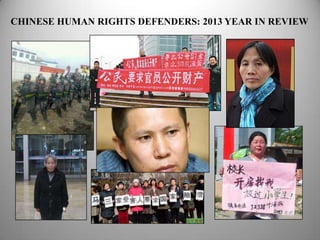
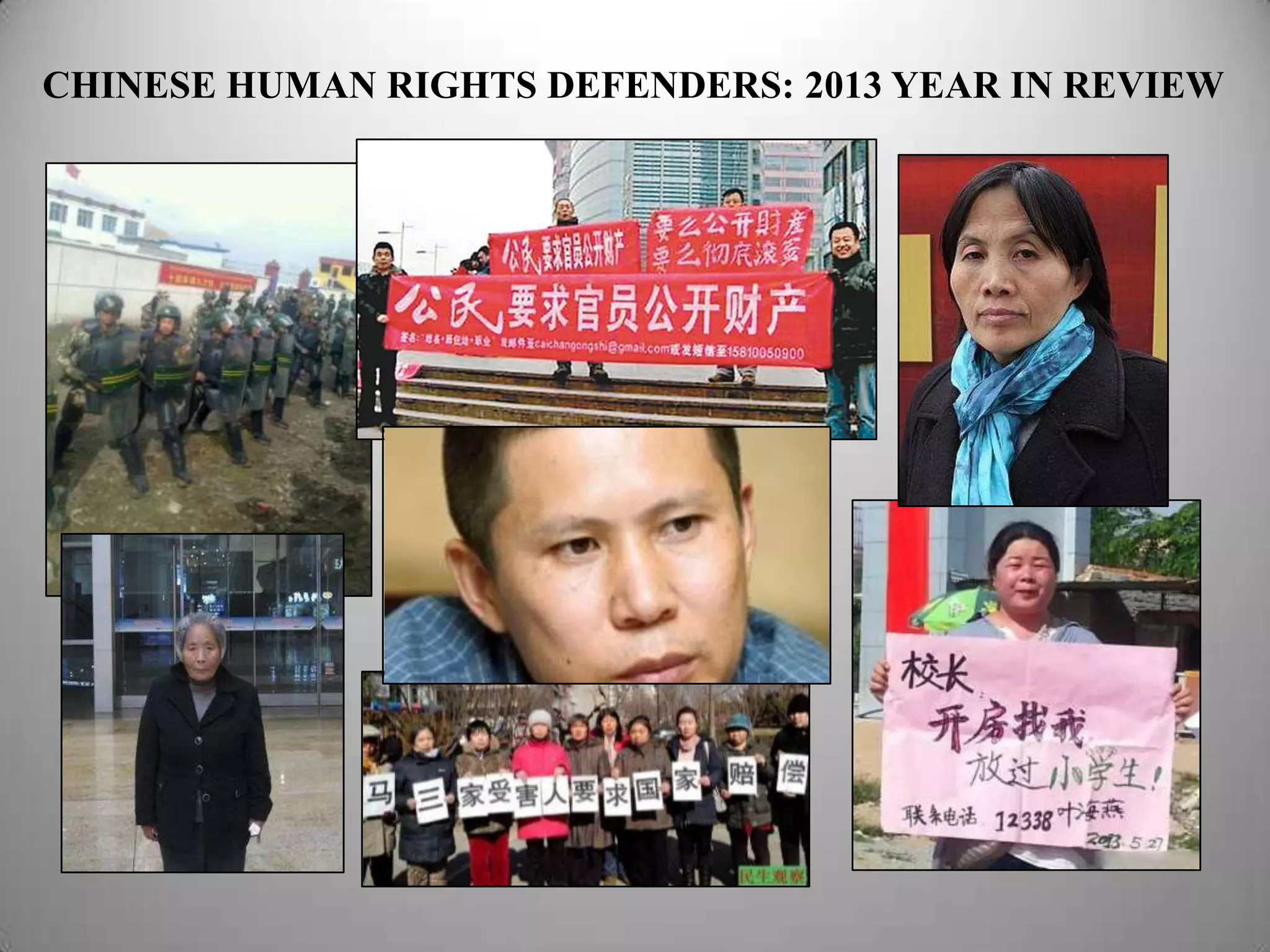
CHINESE HUMAN RIGHTS DEFENDERS: 2013 YEAR IN REVIEW
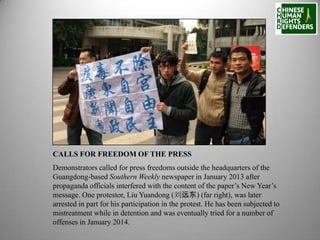
CALLS FOR FREEDOM OF THE PRESS
Demonstrators called for press freedoms outside the headquarters of the
Guangdong-based Southern Weekly newspaper in January 2013 after
propaganda officials interfered with the content of the paper’s New Year’s
message. One protestor, Liu Yuandong (刘远东) (far right), was later
arrested in part for his participation in the protest. He has been subjected to
mistreatment while in detention and was eventually tried for a number of
offenses in January 2014.
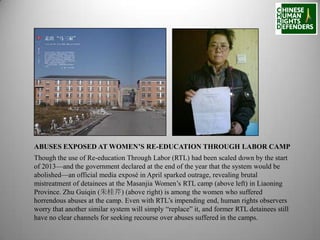
ABUSES EXPOSED AT WOMEN’S RE-EDUCATION THROUGH LABOR CAMP
Though the use of Re-education Through Labor (RTL) had been scaled down by the start
of 2013—and the government declared at the end of the year that the system would be
abolished—an official media exposé in April sparked outrage, revealing brutal
mistreatment of detainees at the Masanjia Women’s RTL camp (above left) in Liaoning
Province. Zhu Guiqin (朱桂芹) (above right) is among the women who suffered
horrendous abuses at the camp. Even with RTL’s impending end, human rights observers
worry that another similar system will simply “replace” it, and former RTL detainees still
have no clear channels for seeking recourse over abuses suffered in the camps.
BEIJING AUTHORITIES LAUNCH
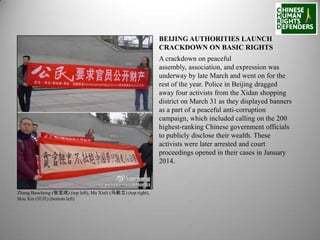
CRACKDOWN ON BASIC RIGHTS
A crackdown on peaceful
assembly, association, and expression was
underway by late March and went on for the
rest of the year. Police in Beijing dragged
away four activists from the Xidan shopping
district on March 31 as they displayed banners
as a part of a peaceful anti-corruption
campaign, which included calling on the 200
highest-ranking Chinese government officials
to publicly disclose their wealth. These
activists were later arrested and court
proceedings opened in their cases in January
2014.

Zhang Baocheng (张宝成) (top left), Ma Xinli (马新立) (top right),
Hou Xin (侯欣) (bottom left)
HEIGHTENED CENSORSHIP OF SOCIAL MEDIA
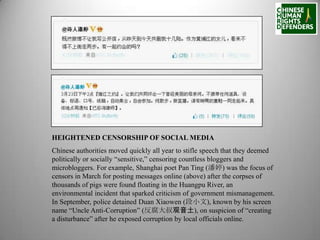
Chinese authorities moved quickly all year to stifle speech that they deemed
politically or socially “sensitive,” censoring countless bloggers and
microbloggers. For example, Shanghai poet Pan Ting (潘婷) was the focus of
censors in March for posting messages online (above) after the corpses of
thousands of pigs were found floating in the Huangpu River, an
environmental incident that sparked criticism of government mismanagement.
In September, police detained Duan Xiaowen (段小文), known by his screen
name “Uncle Anti-Corruption” (反腐大叔观音土), on suspicion of “creating
a disturbance” after he exposed corruption by local officials online.
Photo: People’s Daily Online

FURTHER CRIMINALIZATION OF COMMUNICATIONS BY UYGHURS
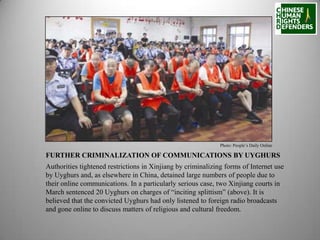
Authorities tightened restrictions in Xinjiang by criminalizing forms of Internet use
by Uyghurs and, as elsewhere in China, detained large numbers of people due to
their online communications. In a particularly serious case, two Xinjiang courts in
March sentenced 20 Uyghurs on charges of “inciting splittism” (above). It is
believed that the convicted Uyghurs had only listened to foreign radio broadcasts
and gone online to discuss matters of religious and cultural freedom.
NEW CITIZENS’ MOVEMENT
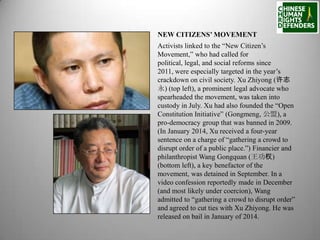
Activists linked to the “New Citizen’s
Movement,” who had called for
political, legal, and social reforms since
2011, were especially targeted in the year’s
crackdown on civil society. Xu Zhiyong (许志
永) (top left), a prominent legal advocate who
spearheaded the movement, was taken into
custody in July. Xu had also founded the “Open
Constitution Initiative” (Gongmeng, 公盟), a
pro-democracy group that was banned in 2009.
(In January 2014, Xu received a four-year
sentence on a charge of “gathering a crowd to
disrupt order of a public place.”) Financier and
philanthropist Wang Gongquan (王功权)
(bottom left), a key benefactor of the
movement, was detained in September. In a
video confession reportedly made in December
(and most likely under coercion), Wang
admitted to “gathering a crowd to disrupt order”
and agreed to cut ties with Xu Zhiyong. He was
released on bail in January of 2014.
CHILDREN’S RIGHTS ACTIVISTS ARRESTED AS UN REVIEWS
CHINA’S RECORD ON PROTECTING CHILDREN
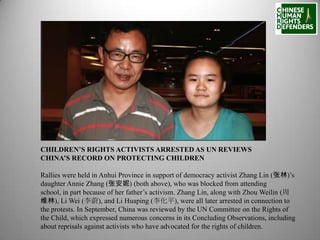
Rallies were held in Anhui Province in support of democracy activist Zhang Lin (张林)’s
daughter Annie Zhang (张安妮) (both above), who was blocked from attending
school, in part because of her father’s activism. Zhang Lin, along with Zhou Weilin (周
维林), Li Wei (李蔚), and Li Huaping (李化平), were all later arrested in connection to
the protests. In September, China was reviewed by the UN Committee on the Rights of
the Child, which expressed numerous concerns in its Concluding Observations, including
about reprisals against activists who have advocated for the rights of children.
REPRISALS AGAINST ACTIVISTS’
FAMILY MEMBERS
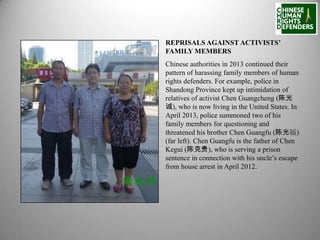
Chinese authorities in 2013 continued their
pattern of harassing family members of human
rights defenders. For example, police in
Shandong Province kept up intimidation of
relatives of activist Chen Guangcheng (陈光
诚), who is now living in the United States. In
April 2013, police summoned two of his
family members for questioning and
threatened his brother Chen Guangfu (陈光福)
(far left). Chen Guangfu is the father of Chen
Kegui (陈克贵), who is serving a prison
sentence in connection with his uncle’s escape
from house arrest in April 2012.
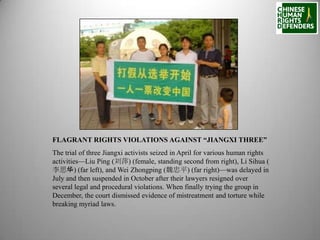
FLAGRANT RIGHTS VIOLATIONS AGAINST “JIANGXI THREE”
The trial of three Jiangxi activists seized in April for various human rights
activities—Liu Ping (刘萍) (female, standing second from right), Li Sihua (
李思华) (far left), and Wei Zhongping (魏忠平) (far right)—was delayed in
July and then suspended in October after their lawyers resigned over
several legal and procedural violations. When finally trying the group in
December, the court dismissed evidence of mistreatment and torture while
breaking myriad laws.
MENTAL HEALTH LAW COMES
INTO EFFECT BUT ABUSES
CONTINUE
China’s first Mental Health Law, which
took effect in May, includes a provision
stating psychiatric commitment must be
voluntary. Still, local authorities continue
to forcibly detain Chinese citizens in
mental institutions in retaliation against
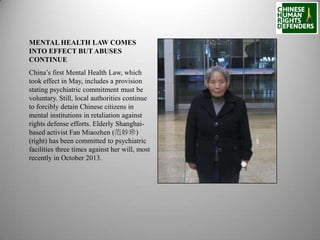
rights defense efforts. Elderly Shanghaibased activist Fan Miaozhen (范妙珍)
(right) has been committed to psychiatric
facilities three times against her will, most
recently in October 2013.
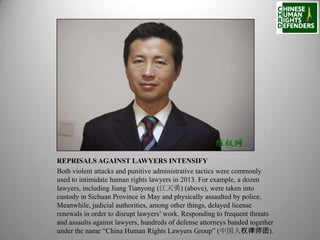
REPRISALS AGAINST LAWYERS INTENSIFY
Both violent attacks and punitive administrative tactics were commonly
used to intimidate human rights lawyers in 2013. For example, a dozen
lawyers, including Jiang Tianyong (江天勇) (above), were taken into
custody in Sichuan Province in May and physically assaulted by police.
Meanwhile, judicial authorities, among other things, delayed license
renewals in order to disrupt lawyers’ work. Responding to frequent threats
and assaults against lawyers, hundreds of defense attorneys banded together
under the name “China Human Rights Lawyers Group” (中国人权律师团).
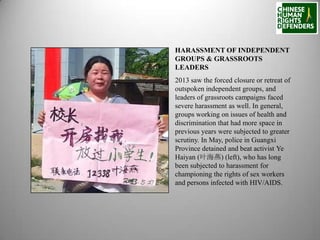
HARASSMENT OF INDEPENDENT
GROUPS & GRASSROOTS
LEADERS
2013 saw the forced closure or retreat of
outspoken independent groups, and
leaders of grassroots campaigns faced
severe harassment as well. In general,
groups working on issues of health and
discrimination that had more space in
previous years were subjected to greater
scrutiny. In May, police in Guangxi
Province detained and beat activist Ye
Haiyan (叶海燕) (left), who has long
been subjected to harassment for
championing the rights of sex workers
and persons infected with HIV/AIDS.
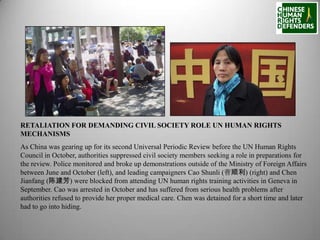
RETALIATION FOR DEMANDING CIVIL SOCIETY ROLE UN HUMAN RIGHTS
MECHANISMS
As China was gearing up for its second Universal Periodic Review before the UN Human Rights
Council in October, authorities suppressed civil society members seeking a role in preparations for
the review. Police monitored and broke up demonstrations outside of the Ministry of Foreign Affairs
between June and October (left), and leading campaigners Cao Shunli (曹顺利) (right) and Chen
Jianfang (陈建芳) were blocked from attending UN human rights training activities in Geneva in
September. Cao was arrested in October and has suffered from serious health problems after
authorities refused to provide her proper medical care. Chen was detained for a short time and later
had to go into hiding.
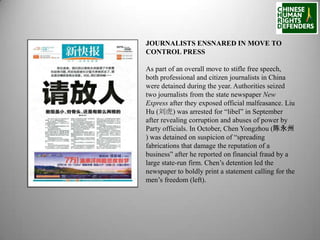
JOURNALISTS ENSNARED IN MOVE TO
CONTROL PRESS
As part of an overall move to stifle free speech,
both professional and citizen journalists in China
were detained during the year. Authorities seized
two journalists from the state newspaper New
Express after they exposed official malfeasance. Liu
Hu (刘虎) was arrested for “libel” in September
after revealing corruption and abuses of power by
Party officials. In October, Chen Yongzhou (陈永州
) was detained on suspicion of “spreading
fabrications that damage the reputation of a
business” after he reported on financial fraud by a
large state-run firm. Chen’s detention led the
newspaper to boldly print a statement calling for the
men’s freedom (left).
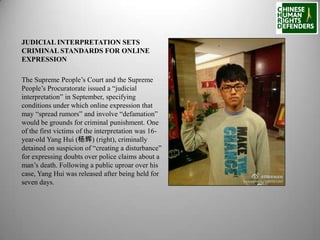
JUDICIAL INTERPRETATION SETS
CRIMINAL STANDARDS FOR ONLINE
EXPRESSION
The Supreme People’s Court and the Supreme
People’s Procuratorate issued a “judicial
interpretation” in September, specifying
conditions under which online expression that
may “spread rumors” and involve “defamation”
would be grounds for criminal punishment. One
of the first victims of the interpretation was 16year-old Yang Hui (杨辉) (right), criminally
detained on suspicion of “creating a disturbance”
for expressing doubts over police claims about a
man’s death. Following a public uproar over his
case, Yang Hui was released after being held for
seven days.
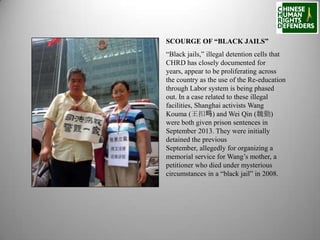
SCOURGE OF “BLACK JAILS”
“Black jails,” illegal detention cells that
CHRD has closely documented for
years, appear to be proliferating across
the country as the use of the Re-education
through Labor system is being phased
out. In a case related to these illegal
facilities, Shanghai activists Wang
Kouma (王扣玛) and Wei Qin (魏勤)
were both given prison sentences in
September 2013. They were initially
detained the previous
September, allegedly for organizing a
memorial service for Wang’s mother, a
petitioner who died under mysterious
circumstances in a “black jail” in 2008.
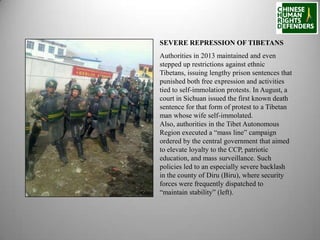
SEVERE REPRESSION OF TIBETANS
Authorities in 2013 maintained and even
stepped up restrictions against ethnic
Tibetans, issuing lengthy prison sentences that
punished both free expression and activities
tied to self-immolation protests. In August, a
court in Sichuan issued the first known death
sentence for that form of protest to a Tibetan
man whose wife self-immolated.
Also, authorities in the Tibet Autonomous
Region executed a “mass line” campaign
ordered by the central government that aimed
to elevate loyalty to the CCP, patriotic
education, and mass surveillance. Such
policies led to an especially severe backlash
in the county of Diru (Biru), where security
forces were frequently dispatched to
“maintain stability” (left).

Final slideshow hrd 2013 report

  • 1.
    CHINESE HUMAN RIGHTSDEFENDERS: 2013 YEAR IN REVIEW
  • 2.
    CALLS FOR FREEDOMOF THE PRESS Demonstrators called for press freedoms outside the headquarters of the Guangdong-based Southern Weekly newspaper in January 2013 after propaganda officials interfered with the content of the paper’s New Year’s message. One protestor, Liu Yuandong (刘远东) (far right), was later arrested in part for his participation in the protest. He has been subjected to mistreatment while in detention and was eventually tried for a number of offenses in January 2014.
  • 3.
    ABUSES EXPOSED ATWOMEN’S RE-EDUCATION THROUGH LABOR CAMP Though the use of Re-education Through Labor (RTL) had been scaled down by the start of 2013—and the government declared at the end of the year that the system would be abolished—an official media exposé in April sparked outrage, revealing brutal mistreatment of detainees at the Masanjia Women’s RTL camp (above left) in Liaoning Province. Zhu Guiqin (朱桂芹) (above right) is among the women who suffered horrendous abuses at the camp. Even with RTL’s impending end, human rights observers worry that another similar system will simply “replace” it, and former RTL detainees still have no clear channels for seeking recourse over abuses suffered in the camps.
  • 4.
    BEIJING AUTHORITIES LAUNCH CRACKDOWNON BASIC RIGHTS A crackdown on peaceful assembly, association, and expression was underway by late March and went on for the rest of the year. Police in Beijing dragged away four activists from the Xidan shopping district on March 31 as they displayed banners as a part of a peaceful anti-corruption campaign, which included calling on the 200 highest-ranking Chinese government officials to publicly disclose their wealth. These activists were later arrested and court proceedings opened in their cases in January 2014. Zhang Baocheng (张宝成) (top left), Ma Xinli (马新立) (top right), Hou Xin (侯欣) (bottom left)
  • 5.
    HEIGHTENED CENSORSHIP OFSOCIAL MEDIA Chinese authorities moved quickly all year to stifle speech that they deemed politically or socially “sensitive,” censoring countless bloggers and microbloggers. For example, Shanghai poet Pan Ting (潘婷) was the focus of censors in March for posting messages online (above) after the corpses of thousands of pigs were found floating in the Huangpu River, an environmental incident that sparked criticism of government mismanagement. In September, police detained Duan Xiaowen (段小文), known by his screen name “Uncle Anti-Corruption” (反腐大叔观音土), on suspicion of “creating a disturbance” after he exposed corruption by local officials online.
  • 6.
    Photo: People’s DailyOnline FURTHER CRIMINALIZATION OF COMMUNICATIONS BY UYGHURS Authorities tightened restrictions in Xinjiang by criminalizing forms of Internet use by Uyghurs and, as elsewhere in China, detained large numbers of people due to their online communications. In a particularly serious case, two Xinjiang courts in March sentenced 20 Uyghurs on charges of “inciting splittism” (above). It is believed that the convicted Uyghurs had only listened to foreign radio broadcasts and gone online to discuss matters of religious and cultural freedom.
  • 7.
    NEW CITIZENS’ MOVEMENT Activistslinked to the “New Citizen’s Movement,” who had called for political, legal, and social reforms since 2011, were especially targeted in the year’s crackdown on civil society. Xu Zhiyong (许志 永) (top left), a prominent legal advocate who spearheaded the movement, was taken into custody in July. Xu had also founded the “Open Constitution Initiative” (Gongmeng, 公盟), a pro-democracy group that was banned in 2009. (In January 2014, Xu received a four-year sentence on a charge of “gathering a crowd to disrupt order of a public place.”) Financier and philanthropist Wang Gongquan (王功权) (bottom left), a key benefactor of the movement, was detained in September. In a video confession reportedly made in December (and most likely under coercion), Wang admitted to “gathering a crowd to disrupt order” and agreed to cut ties with Xu Zhiyong. He was released on bail in January of 2014.
  • 8.
    CHILDREN’S RIGHTS ACTIVISTSARRESTED AS UN REVIEWS CHINA’S RECORD ON PROTECTING CHILDREN Rallies were held in Anhui Province in support of democracy activist Zhang Lin (张林)’s daughter Annie Zhang (张安妮) (both above), who was blocked from attending school, in part because of her father’s activism. Zhang Lin, along with Zhou Weilin (周 维林), Li Wei (李蔚), and Li Huaping (李化平), were all later arrested in connection to the protests. In September, China was reviewed by the UN Committee on the Rights of the Child, which expressed numerous concerns in its Concluding Observations, including about reprisals against activists who have advocated for the rights of children.
  • 9.
    REPRISALS AGAINST ACTIVISTS’ FAMILYMEMBERS Chinese authorities in 2013 continued their pattern of harassing family members of human rights defenders. For example, police in Shandong Province kept up intimidation of relatives of activist Chen Guangcheng (陈光 诚), who is now living in the United States. In April 2013, police summoned two of his family members for questioning and threatened his brother Chen Guangfu (陈光福) (far left). Chen Guangfu is the father of Chen Kegui (陈克贵), who is serving a prison sentence in connection with his uncle’s escape from house arrest in April 2012.
  • 10.
    FLAGRANT RIGHTS VIOLATIONSAGAINST “JIANGXI THREE” The trial of three Jiangxi activists seized in April for various human rights activities—Liu Ping (刘萍) (female, standing second from right), Li Sihua ( 李思华) (far left), and Wei Zhongping (魏忠平) (far right)—was delayed in July and then suspended in October after their lawyers resigned over several legal and procedural violations. When finally trying the group in December, the court dismissed evidence of mistreatment and torture while breaking myriad laws.
  • 11.
    MENTAL HEALTH LAWCOMES INTO EFFECT BUT ABUSES CONTINUE China’s first Mental Health Law, which took effect in May, includes a provision stating psychiatric commitment must be voluntary. Still, local authorities continue to forcibly detain Chinese citizens in mental institutions in retaliation against rights defense efforts. Elderly Shanghaibased activist Fan Miaozhen (范妙珍) (right) has been committed to psychiatric facilities three times against her will, most recently in October 2013.
  • 12.
    REPRISALS AGAINST LAWYERSINTENSIFY Both violent attacks and punitive administrative tactics were commonly used to intimidate human rights lawyers in 2013. For example, a dozen lawyers, including Jiang Tianyong (江天勇) (above), were taken into custody in Sichuan Province in May and physically assaulted by police. Meanwhile, judicial authorities, among other things, delayed license renewals in order to disrupt lawyers’ work. Responding to frequent threats and assaults against lawyers, hundreds of defense attorneys banded together under the name “China Human Rights Lawyers Group” (中国人权律师团).
  • 13.
    HARASSMENT OF INDEPENDENT GROUPS& GRASSROOTS LEADERS 2013 saw the forced closure or retreat of outspoken independent groups, and leaders of grassroots campaigns faced severe harassment as well. In general, groups working on issues of health and discrimination that had more space in previous years were subjected to greater scrutiny. In May, police in Guangxi Province detained and beat activist Ye Haiyan (叶海燕) (left), who has long been subjected to harassment for championing the rights of sex workers and persons infected with HIV/AIDS.
  • 14.
    RETALIATION FOR DEMANDINGCIVIL SOCIETY ROLE UN HUMAN RIGHTS MECHANISMS As China was gearing up for its second Universal Periodic Review before the UN Human Rights Council in October, authorities suppressed civil society members seeking a role in preparations for the review. Police monitored and broke up demonstrations outside of the Ministry of Foreign Affairs between June and October (left), and leading campaigners Cao Shunli (曹顺利) (right) and Chen Jianfang (陈建芳) were blocked from attending UN human rights training activities in Geneva in September. Cao was arrested in October and has suffered from serious health problems after authorities refused to provide her proper medical care. Chen was detained for a short time and later had to go into hiding.
  • 15.
    JOURNALISTS ENSNARED INMOVE TO CONTROL PRESS As part of an overall move to stifle free speech, both professional and citizen journalists in China were detained during the year. Authorities seized two journalists from the state newspaper New Express after they exposed official malfeasance. Liu Hu (刘虎) was arrested for “libel” in September after revealing corruption and abuses of power by Party officials. In October, Chen Yongzhou (陈永州 ) was detained on suspicion of “spreading fabrications that damage the reputation of a business” after he reported on financial fraud by a large state-run firm. Chen’s detention led the newspaper to boldly print a statement calling for the men’s freedom (left).
  • 16.
    JUDICIAL INTERPRETATION SETS CRIMINALSTANDARDS FOR ONLINE EXPRESSION The Supreme People’s Court and the Supreme People’s Procuratorate issued a “judicial interpretation” in September, specifying conditions under which online expression that may “spread rumors” and involve “defamation” would be grounds for criminal punishment. One of the first victims of the interpretation was 16year-old Yang Hui (杨辉) (right), criminally detained on suspicion of “creating a disturbance” for expressing doubts over police claims about a man’s death. Following a public uproar over his case, Yang Hui was released after being held for seven days.
  • 17.
    SCOURGE OF “BLACKJAILS” “Black jails,” illegal detention cells that CHRD has closely documented for years, appear to be proliferating across the country as the use of the Re-education through Labor system is being phased out. In a case related to these illegal facilities, Shanghai activists Wang Kouma (王扣玛) and Wei Qin (魏勤) were both given prison sentences in September 2013. They were initially detained the previous September, allegedly for organizing a memorial service for Wang’s mother, a petitioner who died under mysterious circumstances in a “black jail” in 2008.
  • 18.
    SEVERE REPRESSION OFTIBETANS Authorities in 2013 maintained and even stepped up restrictions against ethnic Tibetans, issuing lengthy prison sentences that punished both free expression and activities tied to self-immolation protests. In August, a court in Sichuan issued the first known death sentence for that form of protest to a Tibetan man whose wife self-immolated. Also, authorities in the Tibet Autonomous Region executed a “mass line” campaign ordered by the central government that aimed to elevate loyalty to the CCP, patriotic education, and mass surveillance. Such policies led to an especially severe backlash in the county of Diru (Biru), where security forces were frequently dispatched to “maintain stability” (left).

Editor's Notes

  • #2 Cover Photo – collage Other title options:HUMAN RIGHTS DEFENDERS IN CHINA: 2013 YEAR IN REVIEWREVIEW OF SITUATION OF CHINESE HUMAN RIGHTS DEFENDERS IN 2013REVIEW OF SITUATION OF HUMAN RIGHTS DEFENDERS IN CHINA IN 2013
  • #4 Aprilhttp://www.chrdnet.com/2013/04/chrb-detainee-diary-reveals-horrendous-abuses-in-womens-labor-camp-44-10-2013/An article by the Chinese magazine Lens published in April 2013 based on a diary that was smuggled out detained the horrors of life inside the camp. It was followed quickly by a documentary by Du Bin called “Above the Ghost’s Head: Women of Masanjia Labor Camp” that interviewed women who were held in the camp. By end of year, RTL abolished
  • #5 http://www.chrdnet.com/2013/04/chrb-activists-detained-for-seeking-public-disclosure-of-top-chinese-officials-wealth-328-43-2013/http://www.chrdnet.com/2013/05/chrb-update-new-detentions-arrests-of-anti-corruption-campaigners-52-8-2013/
  • #6 March http://www.chrdnet.com/2013/03/chrb-tibetans-imprisoned-for-splittism-poet-censored-for-urging-huangpu-river-memorial-316-20-2013/http://www.chrdnet.com/2013/09/chrb-police-detain-online-whistleblowers-as-judicial-interpretation-takes-effect-920-25-2013/http://www.chrdnet.com/2013/10/chrb-missing-activist-cao-shunli-reportedly-detained-on-order-of-ministry-of-foreign-affairs-926-102-2013/
  • #7 20 sentencedPhoto source - http://365jia.cn/news/2013-03-27/1B951C6D3C8B3B62.html
  • #8 Sept 2013 http://www.chrdnet.com/2013/07/chrd-police-seize-lawyer-after-blocking-visit-to-detained-activist-xu-zhiyong-712-18-2013/
  • #9 December 2013 (or April?)http://www.chrdnet.com/2013/12/chrb-violence-against-lawyers-representing-christians-in-henan-many-activists-indicted-1212-1218-2013/
  • #10 http://www.chrdnet.com/2013/05/chrb-police-torture-activists-involved-in-anti-corruption-campaign-426-51-2013/
  • #11 April/ May
  • #12 Novemberhttp://www.chrdnet.com/2013/11/chrb-six-months-after-mental-health-law-implemented-involuntary-psychiatric-commitment-continues-118-13-2013/
  • #13 http://www.chrdnet.com/2013/05/7768/http://www.chrdnet.com/2013/06/chrb-authorities-delay-renewal-of-licenses-for-dozens-of-rights-lawyers-531-66-2013/
  • #14 http://www.chrdnet.com/2013/05/chrb-police-restrict-movements-of-activists-as-tiananmen-anniversary-nears-524-30-2013/
  • #15 August – Septhttp://www.chrdnet.com/2013/10/china-must-stop-excluding-civil-society-from-un-human-rights-review/
  • #16 October 2013http://www.chrdnet.com/2013/10/chrb-cao-shunlis-detention-confirmed-crackdown-expands-as-china-touts-achievements-at-un-review-1017-23-2013/
  • #17 http://www.chrdnet.com/2013/09/chrb-police-detain-online-whistleblowers-as-judicial-interpretation-takes-effect-920-25-2013/
  • #18 I moved this slide to later on since the report from Feb was just that she had been held incommunicado for many months and they still hadn’t heard from her. FEB 2013http://www.chrdnet.com/2013/02/chrb-self-immolation-of-tibetans-and-in-jiangxi-province-shanghai-activist-held-incommunicado-for-5-months-and-more-february-16-21-2013/http://www.chrdnet.com/2013/12/prisoner-of-conscience-wang-kouma/http://www.chrdnet.com/2013/12/prisoner-of-conscience-wei-qin/
  • #19 Octoberhttp://www.chrdnet.com/2013/10/chrb-detained-activists-denied-access-to-lawyers-or-bail-request-latest-detention-103-109-2013/http://www.chrdnet.com/2013/04/chrb-courts-sentence-12-tibetans-on-trumped-up-charges-april-11-18-2013/http://www.chrdnet.com/2014/01/chrb-tibetan-received-6-years-over-self-immolation-cao-shunli-denied-treatment-in-detention-12192013-122014-2/