R E P O R T
OF THE
COMMISSION OF INQUIRY
(Constituted by the Hon’ble Supreme Court of India by Order, Dated 12.12.2019, in Writ
Petition (Criminal) No(s). 348 of 2019)
Hon’ble Mr. Justice V S Sirpurkar, Chairman
Hon’ble Ms. Justice Rekha P Sondur Baldota, Member
Dr. D R Kaarthikeyan, Member
28/01/2022
To,
The Hon’ble the Chief Justice of India,
Supreme Court of India,
Tilak Marg, New Delhi - 110001
Hon’ble Chief Justice,
By orders dated 12.12.2019 and 10.01.2020 in Writ Petition (Criminal) No(s). 348 of
2019 this Commission was set up to inquire and submit report on the matters specified therein.
The Commission has completed the inquiry and is herewith submitting the report of Inquiry.
Yours faithfully
______________________
Hon’ble Mr. Justice V S Sirpurkar, Chariman
____________________
Hon’ble Ms. Justice Rekha P SondurBaldota, Member
______________________
Dr. D R Kaarthikeyan, Member
ACKNOWLEDGEMENTS
The Commission would like to acknowledge the assistance and efforts of the persons who have
assisted the Commission to successfully complete in Inquiry.
The present and former Chief Justices of the High Court for the State of Telangana who have
provided every assistance required for the Commission and had hosted the Commission in the
premises of the High Court.
The Government of Telangana which has provided all the assistance required for the functioning
of the Commission.
Hon’ble Justice A Venkateswara Reddy, formerly the Registrar General of the High Court for
the State of Telangana, whose unstinting support in providing men and material ensured the
smooth working of the Commission.
Smt. Anupama Chakravarty, former Registrar General, High Court for the State of Telangana.
Sri D. Nagarjuna, Registrar General, High Court for the State of Telangana.
The Registry of the High Court for the State of Telangana.
Sri A Santhosh Reddy, District Judge, Secretary to Government, Legal Affairs, Legislative
Affairs and Justice, who had made all the initial arrangements for setting up the office of the
Commission at Hyderabad and had provided everything required for the smooth functioning of
the Commission.
Sri D Ramakanth and Sri Radhakrishna Chauhan, the present and former Registrars (IT), High
Court, State of Telangana.
Sri E. Uma Maheshwar Rao, Sri V. Surender Rao, Ms. Lata Krishnamurthy, Sri Keerthi Kiran
Kota, Sri Praveen Chillara, Sri Shaik Mastan Vali, Sri T. Bala Mohan Reddy, Ms. Vrinda
Grover, Ms. Vasudha Nagaraj, Sri P.V. Krishnamachari and Sri D. Suresh Kumar, Advocates.
Sri Jitender, Additional Director General of Police (law and order), Telangana State Police, who
had coordinated from the side of the police department.
Sri M Malla Reddy (OSD), liaison officer from the Police Department.
The staff of the Computer section of the High Court for the State of Telangana for their
assistance in the deployment and use of ICT. Special mention is to be made of Sri Chakravarthy,
Sri Sachin Kumar, Sri Praveen and Sri Lakhan Singh.
The Staff of the Commission deserve a special mention
Sri V Kapaleeswara Swamy, Nodal Officer
Smt K Lalitha, Court Master Sri M Venugopal, Office Subordinate
Smt Y Sukanthi, Court Master Sri Minhajuddin, Driver
Smt Y V Lakshmi, Court Master Sri Arjun Singh, Office Subordinate
Smt, E Geetha, Assitant Sri Kamalkar, Office subordinate
Ms K Shobha Rani, Assistant Sri Prashanth, Office Subordinate
Sri D Mahesh Kumar, Assistant Sri K Srinivasulu, Officer Subordinate
Sri R Srinivas, Office Subordinate.
The staff of the digitization project, High Court for the State of Telangana
The Officers and jawans of CRPF who have provided security whenever the Commission visited
the city of Hyderabad.
The protocol officers who have attended to the Commission members during the visits to the
City of Hyderabad.
Between the pandemic and the multiple lockdowns, the Commission would not have been able to
accomplish the task entrusted to it but for the effective and relentless assistance by the Secretary
Sri Sura Sasidhar Reddy, District Judge. The manner in which he marshalled the available
resources and effectively harnessed the technology making the virtual hearings seamless is
commendable.
Also, but for the untiring, highly competent and excellent assistance rendered by Sri Virupaksha
Dattatreya Gouda and Sri K. Parameshwar, Advocates assisting the Commission of Inquiry, the
Commission would not have been able to complete the task within time.
1
INDEX TO THE REPORT
PARTICULARS PAGE NOS.
1. Background of the Inquiry Commission
1.1. Introduction
1.2. Judicial Orders
1.3. Background of the Incident under Inquiry
5
5
6
7
2. Working of the Commission, Secretary, Advocate, Staff etc
2.1 Office of the Inquiry Commission
2.2. Staff of the Inquiry Commission
2.3. Secretary of the Inquiry Commission
2.4 Other Staff of the Inquiry Commission
2.5. Advocates assisting the Inquiry Commission
2.6. Working of the Commission
9
9
9
9
9
10
10
3. Procedure adopted by the Inquiry Commission
3.1. Public Notice
3.2. Notice under Section 8B of the Commissions of Inquiry Act,
1952
3.3. Recording of Evidence – witnesses
3.4. Recording of evidence – Procedure
3.5. Legal Representation and cross-examination
3.6. Various objections on the jurisdiction and procedure adopted by
the Commission
21
21
21
22
24
26
32
4. Use of Information and Communication Technology by the
Inquiry Commission
61
5. Events of 27th November, 2019 and 28th, November, 2019
5.1. FIR in Cr.No.480 of 2019 and FIR in Cr.No.784 of 2019
5.2. Identification of accused in Cr.No.784 of 2019
65
65
71
2
5.3 The presence of P Srinivas Reddy (CW-43) sought
5.4 Alleged identification of the accused by P Srinivas Reddy
71
73
6. Arrest of the Accused and production of the accused before the
investigation officer Vasam Surender
6.1. Steps taken for arrest
6.2. Time of arrest
6.3. Identity of those who took away the accused and manner of
arrest
6.4. Furnishing reasons for arrest
6.5. Time of production of accused before CW-44 at Shadnagar
Police Station and recording of arrest
6.6. Contents of the arrest memo
6.7. Time when relatives of the accused came to the PS
6.8. Notices to Accused’s families
6.9. Recording of confessional statement
6.10. Law on Arrest
77
77
80
88
91
93
98
99
101
102
107
7. Aspects revolving around the juvenility of the deceased
7.1 Background
7.2. Re: Age of Mohammed Arif
7.3. Re: Age of Jollu Shiva
7.4. Re: Age of Jollu Naveen
7.5. Re: Age of Chintakunta Chennakesavulu
112
112
115
118
122
124
8. Incidents on 30.11.2019 leading to judicial remand
8.1. Crowd
8.2. Conduct of Medical Examination
8.3. Information to, and Remand by, Executive Magistrate
8.4. Transport of Accused to Cherlapally and Request for Police
Custody
8.5. CCTV Cameras in Shadnagar Police Station
127
127
129
132
137
138
3
9. Grant of police custody on 02.12.2019
9.1. Background
9.2. Issuance of notice to the accused in Cr. No. 784 of 2019
9.3. Absence of the accused at the time of remand to police custody
9.4. Order granting police custody
142
142
143
144
145
10. Preparation for taking into custody the accused in CR. No.
784/2019
10.1. Requisitions made by V. Surender
10.2. Weapons used by the Escort Team
148
148
149
11. Safe House 151
12. Event from safe house to Fifth Bund
12.1 Background
12.2 Time at which the bus arrived at the Safe House
12.3 Time at which the police party left the Safe House and the time
at which the police party reached Chatanpally
12.4 Entry into 5th
Bund
12.5 From alighting from the bus to fifth bund and the formation of
the police party till fifth bund
173
173
174
176
184
186
13. Incidents at the fifth bund
13.1 Background
13.2 Whither Fifth Bund?
13.3 Question of Visibility
13.4 Time of Incident
196
196
197
203
206
14. Alleged attack on policemen and attempt to escape
14.1 Throwing of soil to incapacitate the police party
14.2 Assault on Police Officers
14.3 Injuries to Police Officers
14.4Whether the Police Party tried to chase the accused when they
tried to escape
207
207
216
220
256
4
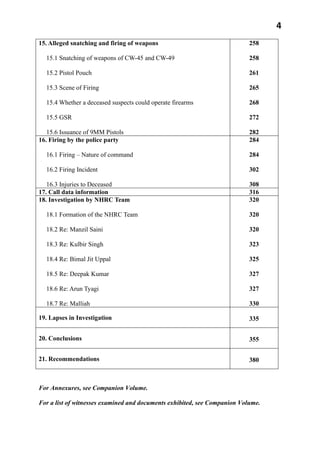
15. Alleged snatching and firing of weapons
15.1 Snatching of weapons of CW-45 and CW-49
15.2 Pistol Pouch
15.3 Scene of Firing
15.4 Whether a deceased suspects could operate firearms
15.5 GSR
15.6 Issuance of 9MM Pistols
258
258
261
265
268
272
282
16. Firing by the police party
16.1 Firing – Nature of command
16.2 Firing Incident
16.3 Injuries to Deceased
284
284
302
308
17. Call data information 316
18. Investigation by NHRC Team
18.1 Formation of the NHRC Team
18.2 Re: Manzil Saini
18.3 Re: Kulbir Singh
18.4 Re: Bimal Jit Uppal
18.5 Re: Deepak Kumar
18.6 Re: Arun Tyagi
18.7 Re: Malliah
320
320
320
323
325
327
327
330
19. Lapses in Investigation 335
20. Conclusions 355
21. Recommendations 380
For Annexures, see Companion Volume.
For a list of witnesses examined and documents exhibited, see Companion Volume.
5
1. INTRODUCTION
1.1 Background
1.1.1 In the early hours of 6th
December 2019 an incident took place on the outskirts of
Chatanpally Village, Ranga Reddy District, State of Telangana in which four accused
persons, Mohd. Arif, Jollu Shiva, Jollu Naveen and Chintakunta Chennakesavulu died
while they were in the custody of the police. Several petitions came to be filed, in the
Hon’ble Supreme Court and in the High Court of the State of Telangana protesting
against the deaths.
1.1.2 On the same day, Ms. K.Sajaya, Prof. Padmaja Shaw, Devi, G. Jhansi, Vimala M. V.
Sandhya, B. Viajaya, K.N Ashalatha, A. Suneetha, Varsha Bargav, Khaleeda Parveen,
Kahaneej Fatima, and Sanjeev who are women’s and child rights and Human Rights
activists submitted letter to the Chief Justice of the High Court for the State of
Telangana, seeking intervention of the High Court in the incident and seeking
direction, inter alia, for preservation of the dead bodies, autopsy by a special team of
doctors from outside the states of Telangana and Andhra Pradesh, an independent
examination of evidence by forensic experts, investigation into the incident by a
court-monitored committee, ensure compliance of the Supreme Court guidelines in
the case of PUCL v Union of India, to recover and preserve evidentiary material,
fingerprints, firearms, bullets, projectiles cartridge cases and to prosecute the police
personnel who participated in the incident under Section 302 IPC. The High Court of
Telangana immediately took cognisance of the letter and registered the same as Suo-
moto Public Interest litigation as WP (PIL) No.173 of 2019.
1.1.3 There were four more petitions filed by different persons before the High Court.
Public interest litigations being WP (PIL) No.175 of 2019 by K Raghavendra Prasad,
WP (PIL) No.181 of 2019 by Prof Gaddam Laxman, WP (PIL) No.183 of 2019 by
Prof Rama Shankarnarayan Melkote and Another and WP (PIL) No.185 of 2019 by
Prof. P. L. Vishweshwer Rao.
1.1.4 Before the Hon’ble Supreme Court four petitions were filed being WP (Criminal) No.
364 of 2019, WP (Criminal) No.348 of 2019, , WP (Criminal) No.347 of 2019 and
WP (Criminal) No.355 of 2019.
1.1.5 WP (Criminal) No. 364 of 2019 was filed by Ms K Sajaya, Ms Meera Sanghamitra,
Ms. Vimala and Ms. V. Sandhya Rani @ POW Sandhya, praying for collection and
preservation of evidence concerning the incident that took place on 6th
December
2019. Hon’ble Supreme Court disposed the Writ Petition with a liberty to apply to the
6
High Court for the collection of evidence and direction that the High Court may pass
appropriate orders on the application by the petitioners.
1.1.6 WP (Criminal) No.348 of 2019 was filed by Sri G S Mani and Sri Pradeed Kumar
Yadav.And Sri Mukesh Kumar Sharma filed WP (Criminal) No.347 of 2019 and WP
(Criminal) No.355 of 2019 praying, inter alia, for investigation into the incident by an
independent agency and for framing of guidelines and norms for protection and
enforcement of Human and Fundamental Rights.
1.2 Judicial Orders
1.2.1 There are four judicial orders that concern the work of the present Commission of
Inquiry. By order dated 12th
December 2019 passed on WP (Criminal) No. 348 of
2019, WP (Criminal) No.347 of 2019 and WP (Criminal) No.355 of 2019, the
Hon’ble Supreme Court, constituted this Commission with powers under the
Commission of Inquiry Act. It appointed Adv. Sri K. Parameshwar, as the
Commission’s counsel. It made clear that no other Court or authority shall inquire into
this matter pending the Commission of Inquiry constituted, until further orders.
However, the orders passed by the High Court pertaining to the preservation of the
dead body of the four accused persons and the investigation by the SIT constituted by
the State Government were continued.1
1.2.2 By order dated 10th January 2020,2
the Hon’ble Supreme Court fixed specific terms
of reference of the Inquiry Commission which read as follows:
“(1) To inquire into the alleged incident resulting in the death of four
persons on 6th December, 2019 in Hyderabad, namely, Mohammed Arif,
Chintakunta Chennakeshavulu, Jollu Shiva and Jollu Naveen, who were
arrested in connection with the rape and murder of a young veterinary lady
doctor, while they were in the custody of police.
(2) To inquire into the circumstances that led to the death of afore-
mentioned four persons and to ascertain as to whether any offence appears to
have been committed in the course. If yes, to fix the responsibility of erring
officials.”
1.2.3 The relevant orders of the High Court of Telangana at Hyderabad, in this regard, are
dated 6th December 2019 and 21st December 2019. By the first order, the High Court
issued directions for the post-mortem of the four deceased suspects to be recorded
through videography and the video record of the post-mortem to be handed over to the
Principal District Judge, Mahabubnagar, who in turn was to submit the same to the
1
See Annexure 1.
2
See Annexure 2.
7
High Court. It also directed that the bodies of the four deceased suspects to be
preserved.3
1.2.4 The second order was on an application filed Ms K Sajaya, in WP (PIL) No.173 of
2019 praying for preservation of evidence pertaining to the incident. The High Court
was pleased to pass the following order in the said application:4
“Therefore, this Court directs the SIT constituted by the State of Telangana
under G.O.Ms.No.173 dated 08.12.2019, to seize the Case Diary, the Log Books,
the Entries of the Weapon, the Movement Reports of the police from the date of
filing of the F.I.R dealing with the alleged rape and murder of the lady veterinary
doctor till the date of the alleged “encounter”. The SIT should also seize the
weapons used by the police in the alleged “encounter”, and send the same to the
Central Forensic Laboratory for its examination and report. The SIT should also
collect call details record, and the details with regard to the cell tower locations
as well as the CC TV footage of the Police Station from where the alleged
offenders were taken and to collect all the necessary evidence, which may be
useful for the perusal of the Commission appointed by the Apex Court. All the
evidence so collected shall be preserved for the benefit of the Commission, and
shall be placed before the Commission, if so called for.”
1.2.5 The High Court also directed that a second post-mortem examination be conducted by
a panel of Doctors from All India Institute of Medical Sciences, New Delhi.
1.3 Background of the incident under inquiry.
1.3.1 The background reported, of the incident to be inquired into by the Commission, is
that on the evening of 27th
November 2019, the unfortunate girl Disha (name
changed) left her home for a clinic in Gachibowli. She parked her Scooty, a two
wheeler near toll plaza and took a cab to the clinic. At 9.22 pm. she called her younger
sister saying that rear tyre of her Scooty had punctured and she was offered and had
accepted help by some truck workers. But then she was worried and expressed fear
for being alone amid men who looked suspicious. The sister advised her to walk to the
toll plaza and wait there, but she hesitated to go there. After about six minutes, the call
was cut and Disha’s phone remained switched off thereafter.
1.3.2 Around 10.30 pm. Disha’s sister and parents approached the police of RGIA Police
Station. The police initially did not register the complaint claiming that they did not
have jurisdiction and directed them to approach Shamshabad Rural Police Station.
The relatives then searched the nearby areas and went to Shamshabad Rural Police
Station where finally at 3.00 am. on 28th
November 2019 the complaint was registered
as Crime Number 480 of 2019, woman missing case.
3
See Annexure 3.
4
See Annexure 4.
8
1.3.3 On 28th
November 2019 in early morning on the information received from one
Samala Sathyam that, he had seen a woman’s dead body burning in the underpass on
NH44 near Chatanpally Village investigation was taken up by Shadnagar Police. In
the course of investigation, the dead body was identified as that of Disha by her
parents and Sister. Based thereon at around 9.00 am FIR in Crime No. 784 of 2019
was registered on the file of Shadnagar Police Station under Section 302 and 201 IPC.
1.3.4 Meanwhile, the print and electronic media widely reported on the incident and there
was widespread public outrage and anger across the country.
1.3.5 On 29.11.2019 at about 7.00 pm Sri V C Sajjanar, Commissioner of Police,
Cyberabad addressed a press conference and announced that four persons namely
Mohammed Arif, Jollu Shiva, Jollu Naveen and Chintakunta Chennakesavulu (herein
after ‘deceased suspects’) were arrested in connection with the rape and murder of
Disha. He also narrated the details of the incident which were said to have been
disclosed by four persons in their confessional statements recorded by the police.
1.3.6 On 30.11.2019 the four accused persons were produced for remand before Executive
Magistrate, Farooq Nagar, who remanded them to Judicial Custody for a period of 13
days. The four deceased suspects were then taken to Cherlapally Central Prison on the
evening of 31st
November 2019.
1.3.7 On 2nd
December 2019, an application was filed by Sri Vasam Surender, the
Investigating Officer in Crime Number 784 of 2019, to the Additional Judicial
Magistrate of First Class, Shadnagar for police custody. The application was allowed
and custody granted to police for 10 days of the deceased suspects.
1.3.8 On 06th
December 2019 it was widely reported in the media that the deceased
suspects were killed when they attacked the police party which had taken them to
Chatanpally to effect recovery of articles of Disha. It was reported that the deceased
suspects had reportedly snatched fire-arms from the police and opened fire upon the
police party and were subsequently killed in the exchange of fire. A few hours
thereafter in a press conference held at site, Sri V C Sajjanar, Commissioner of Police,
Cyberabad gave more details of the incident to the press.
9
2. LOGISTICS RELATING TO INQUIRY COMMISSION
2.1 Office of the Inquiry Commission
2.1.1 The premises for the office of the Commission was arranged by the High Court of
Telangana by allocating rooms and Court Halls in the ‘C’ Block of High Court
Buildings, vide Proceedings Order ROC.No.1553/SO/2019, Dt.28th
December 2019.
2.2 Staff of the Inquiry Commission
2.2.1 In its order constituting the Commission the Hon’ble Supreme Court had directed the
State of Telangana to provide secretarial assistance to the Commission. The
Secretarial assistance was to be chosen by the Chairman of the Inquiry Commission
and provisions were to be made by the State of Telangana in this regard.
Accordinglythe Government of Telangana issued G.O.Ms.No.1, Finance (HRM-II)
Department, dt. 8th
January 2020 creating following posts to assist the Commission.
SI. No. Name of the post Number of Posts
1 Secretary (sitting or Retired) in the cadre of District Judge 01
2 Nodal Officer/Deputy Secretary to be drawing and disbursing
Officer and to attend protocol duties
01
3 Translator 03
4 Computer Operator 03
5 P.S/P.A/Stenographer 04
6 Senior Assistant/Junior Assistant 02
7 Officer Subordinate (on outsourcing basis) 05
Total 19
2.3 Secretary of the Inquiry Commission
2.3.1 The High Court of Telangana deputed the services of Sri S. Sasidhar Reddy, District
Judge, as Secretary to the Inquiry Commission vide Proceedings Order
ROC.No.1553/SO/2019 dt. 27th
January 2020.
2.4 Other staff for the Inquiry Commission
2.4.1 At the request of the State Government, the staff members for the posts sanctioned,
were deputed by the High Court of Telangana vide Proceedings Order
ROC.No.1553/SO/2019-20 dt. 5th
February 2020.
10
2.5 Advocates for assisting the Inquiry Commission
2.5.1 Hon’ble Supreme Court vide order dated 12th
December 2019 in W.P. (Crl.). No. 348
of 2019 was pleased to appoint Sri K. Parameshwar, advocate as the Commission’s
Counsel.
2.5.2 The Inquiry Commission found that a large part of the record before it was in Telugu
and almost all the witnesses were Telugu speakers. Since the Chairman and Members
as well as the Commission’s Counsel appointed by the Supreme Court are not
conversant with Telugu, it was decided to appoint a Telugu knowing Advocate to
assist the Commission. Accordingly, on the directions of the Inquiry Commission, a
panel of six Advocates was prepared by the Secretary, Inquiry Commission. From
among the panel of Advocates, the Inquiry Commission selected Sri Virupaksha
Dattatreya Gouda, (District Judge Retd.) who is practising before the High Court of
Andhra Pradesh.
2.6 Working of the Commission
2.6.1 The Inquiry Commission held its first sitting at Hyderabad on 3rd
February 2020. As
per the order of the Hon’ble Supreme Court this Commission has all the powers of a
commission under the Commissions of Inquiry Act 1952. Rule 5 (2) (b) of the
Commissions of Inquiry (Central) Rules, 1972, requires that a public notification be
issued by the Commission. Therefore, in the first sitting the Commission directed that
a public notice be issued in the daily newspapers having wide circulation in English,
Telugu, Hindi and Urdu. Accordingly, the Public Notice was issued and published on
05.02.2020 in “Times of India”, English language daily Newspaper, “Sakshi” and
“Namaste Telangana”, Telugu language daily Newspapers, Siasat, Urdu language
daily newspaper and “Dainik Jagran”, Hindi language daily newspaper. By the public
notice it called all persons who had any knowledge about the facts under inquiry and
the general public to inform the Commission, the facts within their knowledge in the
form of affidavits.
2.6.2 The next steps taken by the Commission for collection of the relevant material are that
it directed the Addl. Director General of Police (L&O) to prepare a tentative list of
documents to be examined by the Commission and submit the same to the
Commission. It requested the Meteorological Centre, India Meteorological
Department, Begumpet, Hyderabad to provide Meteorological data of 6th December
2020. The Inquiry Commission summoned record of the investigation done by the
National Human Rights Commission from investigation team and the report of the
11
post mortem examination conducted by the Medical Board of AIIMS, New Delhi. It
called for collection of the newspaper reports concerning the incident. With these
directions the Inquiry Commission fixed the next sitting on 23.3.2020.
2.6.3 The data from Meteorological Centre, India Meteorological Department, Begumpet,
Hyderabad was received on 12th
December 2020. The record of the investigation by
the National Human Rights Commission was received on 20th
February 2020. The
newspaper clippings were received from the Information and Public Relations
Department, Government of Telangana on 22th February 2020. The report of the post-
mortem examination conducted by the Medical Board of AIIMS, New Delhi was
received from the Registrar General, High Court for the State of Telangana on 10th
March 2020.
2.6.4 The records of investigation in Crime No.784 of 2019 (Disha rape and murder case)
and Crime No.803 of 2019 (encounter case) with English translations of the Telugu
Documents were submitted to the Commission by the Additional Director General of
Police (Law and Order) on 25th
February 2020.
2.6.5 In response to the public notification, 1365 affidavits were filed by various persons
including the police personnel involved in the incident and the family members of
three of the four deceased persons. The affidavits of the relatives of the deceased
persons were received on 05.03.2020. The affidavits of the police personnel involved
in the incident were received on 15.06.2020. The affidavit of the Principal Secretary
to Government, Home Department, Government of Telangana was received on
17.07.2020.
2.6.6 Most of the records and affidavits received by the Inquiry Commission were in
Telugu. The same were translated with the assistance of the translator appointed, Smt.
C. Swarnalatha, Asst. Registrar (Retd.), High Court for the State of Telangana.
2.6.7 The Inquiry Commission had summoned the CC footage of the Police station and the
safe house where the deceased persons were held, wireless log books, call data
records of the deceased persons and the police officials involved in the incident with
cell tower locations, movement reports, case diaries, GPS location of the police
vehicles involved in the incident from the Additional Director General of Police
(L&O).The directions for collection were given by the High Court for the State of
Telangana vide order Dt.21.12.2019 passed in IA No. 1 of 2019 in WP (PIL) No. 173
of 2019. The office of the Commission received call data records, case diaries,
weapons issue records, vehicle log-books on 13.03.2020. The Additional Director
12
General of Police (L&O) informed that there were no CC TV cameras at the police
station or safe house and therefore no footage was available. Also there was no GPS
in the vehicles used to transport the four deceased persons from safe house to the
scene of incident.
2.6.8 Though the Commission had fixed the next sitting on 23.3.2020, unfortunately by that
date the Covid-19 pandemic had peaked and interstate travel was restricted and lock-
down imposed. Therefore, it was prevented from holding hearings at Hyderabad. But
the lock down period was utilised by the office of the Commission for translation of
the records collected from Telugu language to English language.
2.6.9 The Commission summoned and received reports of the Central Forensic Science
Laboratory, New Delhi on the Forensic examination of Fire arms and other material
objects.
2.6.10 Since the tenure of the Commission of Six months was to end on 2.8.2020,
application being I.A.No.63913 of 2020 in W.P. (Criminal) No.348 of 2019 was filed
before the Hon’ble Supreme Court seeking extension of time. By the order dated
24.7.2020 the Hon’ble Supreme Court was pleased to extend time by another Six
months.
2.6.11 Since the COVID-19 pandemic had not abated, the Commission held virtual meeting
on 15.9.2020 and issued several directions to summon records and affidavits from
witnesses. It resolved to appoint a Telugu knowing Advocate as the records to be
looked into are in Telugu language. It was decided that the Commission will take an
appropriate call, if required, at a later stage to appoint an Investigating Officer to
assist the Commission. The Commission perused the records and affidavits that were
filed before it and it came to the conclusion that summons will have to be issued to
some relevant persons asking them to file their affidavits and also for the production
of certain records. This was necessitated in view of the fact that a thorough inquiry
into the matter would not be possible without all relevant records and evidence. The
Commission has time and again on appreciation of the record taken similar steps to
call for relevant affidavits and documents. It resolved to summon the videographic
record of the first post-mortem examination of the four deceased persons. The
records of the Commission were also directed to be digitized. Accordingly
13
summonses were issued to 59 persons on 22.09.2020 for filing affidavits and for
production of documents.5
2.6.12 In respect of the incident in question multiple investigative agencies including the
police, judicial enquiry magistrate and NHRC had already conducted investigation,
which resulted in several reports and records being placed before the Commission. In
view of this, the Commission requisitioned the services of the Central Bureau of
Investigation (hereinafter ‘CBI’), albeit in a limited manner, to assist the Commission
in sifting through the multiple reports, depositions and records. Accordingly, Sri PC
Kalyan, IPS (SP, CBI-ACB) was deputed to assist the Commission on 16.10.2020
and, Sri Ch. Somaiah, DSP, CBI-ACB and Sri M. Sriniwas, SG-II, CBI-ACB were
deputed to assist Sri PC Kalyan vide letter dated 13.11.2020.
2.6.13 By the letter dt. 11.03.2020 request was made to Registrar General, High Court for the
State of Telangana for providing video graphic record of the first post-mortem
examination. The same was received on 17.06.2020.
2.6.14 The Commission held its next virtual meeting on 11.01.2021 in which it considered
the panel of Telugu knowing advocates and short listed the names of three advocates
and directed the Secretary of the Inquiry Commission to interview the advocates .It
further issued directions to summon Final report of Special Investigation Team, Final
NHRC Investigation Team, Magisterial Inquiry Report of RDO, Shadnagar and
summonses were issued to 17 further witnesses.6
2.6.15 The Commission summoned information concerning the route taken by the police
escort party while transporting the four accused from the Central Prison, Cherlapally
to the safe house and the Safe House to the scene of incident, the details of traffic and
surveillance cameras along the route and the video recording from the said cameras
during the relevant time, the rules and regulations concerning handling of the
deceased suspects while conducting recovery of material objects, concerning use of
fire arms, formation of SOT and the Police Manual and vide letter dt. 11.01.2021 and
reply has been received on 06.02.2021.
2.6.16 Since the six months extension period was ending on 02.02.2021 and there was no
improvement in the COVID-19 situation, the Commission filed another extension
petition in I.A.No.7790 of 2021 in W.P(Criminal)No.348 of 2019 before the Hon’ble
5
See Annexure 5.
6
See Annexure 6.
14
Supreme Court. The Hon’ble Supreme Court was pleased to extend the time by
another six months vide order dt. 29.01.2021.
2.6.17 The Inquiry Commission in its meeting dated 12.02.2021, appointed Sri Virupaksha
Dattatreya Gowda, Advocate, to assist the Commission. It issued directions to the
Special Investigation Team to file its final report, since the Hon’ble Supreme Court
had permitted it to continue investigation. To explore the possibility of recording oral
evidence and to enable the Commission to assess on what counts oral evidence must
be recorded, the Commission directed the advocates assisting the Commission to
prepare a list of witnesses whom the Commission may require to examine. This was
done in order to appreciate the necessity of recording oral evidence. Thereafter,
summonses were issued on 18.02.2021 to some more persons including Sri V.C.
Sajjanar, Commissioner of Police, Cyberabad and Sri N.Prakash Reddy, DCP,
Shamshabad Zone.7
2.6.18 In its virtual meeting held on 22.02.2021, the Commission examined the material on
record, the affidavits that had been filed, including affidavits and documents that had
been specifically summoned and expressed its satisfaction that oral evidence is
required to be recorded in the inquiry. Taking note of the Commissions of Inquiry
(Central) Rules, 1972, requiring the State Government to commence evidence by
producing witnesses, the Commission directed the Secretary of Inquiry Commission
to invite the advocates representing the State Government to appear before the
Commission in virtual hearing to ascertain whether the State Government would
commence evidence.
2.6.19 Ten police officers involved in the firing incident on 06.12.2019 had filed applications
under Section 8C of the Commissions of Inquiry Act, 1952, stating that they are
entitled to legal representation. In the affidavits in support of their applications under
Section 8C, they had specifically contended that as per the directions of the Hon’ble
Supreme Court dated 12.12.2019, their actions during the said exchange of fire would
be scrutinized by the Commission. Considering this pleading of theirs and given the
fact that the Hon’ble Supreme Court had specifically directed the Commission “to fix
responsibility of erring officials”, the Commission passed a common order dated
22.02.2021 in I.A. Nos. 1 to 10 of 2020 allowing their applications. The Commission
7
See Annexure 7.
15
also gave directions for issuing notices under Section 8B of the Commissions of
Inquiry Act, 1952. In compliance, these notices were then duly served.
2.6.20 Upon being invited to appear, the Counsel appearing for the State of Telangana, Sri
E.Umamaheswar Rao and Sri V.Surender Rao attended the virtual meeting of the
Commission on 04.03.2021.In the said meeting Sri V. Surender Rao and Sri E.
Umamaheswar Rao, Advocates appearing for the State Government appeared before
the Commission and requested for time to seek instructions from the State of
Telangana about the commencement of evidence by the State. The Commission also
resolved to request the Advocates appearing on behalf of the police personnel to
participate in the next virtual meeting.
2.6.21 Similarly, upon invitation, Sri Keerthi Kiran Kota, Sri Bala Mohan Reddy and Sri
C.Praveen Advocates appearing for the police officials involved in the incident,
appeared before the Commission in its next virtual meeting on 12.03.2021. The
Advocates for the State Government again requested for time to obtain instructions
from the State Government. The Commission then directed Sri V.Surender Rao and
Sri E. Uma Maheshwara Rao, the Advocates for the State Government to file an
application supported by the affidavit of the Home Secretary stating 1) whether the
State Government will present evidence first as per the Commissions of Inquiry
Rules. If not, the reasons that prevent the State government from commencing
evidence 2) clarifying whether Sri V Surender Rao and Sri Umamaheswar Rao are
representing the State Government or the Police Department or Cyberabad Police
Officials or the Police officers involved in the encounter 3)clarifying the relationship
between the State Advocates and Sri Keerthi Kiran Kota, Sri Praveen Chillara and Sri
Bala Mohan Reddy, the Advocates appointed by the ten Police officers who
participated in the encounter 4) requesting the commission to decide the order of
examination of witnesses stating those that can be examined first and those that have
to be examined after recording all other evidence.
2.6.22 The State of Telangana filed application, I.A.No.1 of 2021 requesting for certain
documents. The police officials involved in the incident also filed IA.Nos.2, 3 & 4 of
2021 asking for charge-sheet or show cause notice issued against the applicants
therein. In its meeting dated 26.03.2021, the Commission directed that the documents
requested for under I.A.No.1 of 2021 be furnished to the State. The applications in
I.A.Nos.2 to 4 of 2021 were rejected since no charge-sheet or show cause notice was
filed against the applicants. The applicants were permitted to inspect the records of
16
the Inquiry Commission and file applications for the documents required by them.The
Commission further resolved to permit Sri V.Surender Rao and Sri E.UmaMaheshwar
Rao, Advocates, to appear on behalf of the Government of Telangana and the Police
Department. Sri Keerthi Kiran Kota, Sri T.Bala Mohan Reddy & Sri C.Praveen,
Advocates, would appear on behalf of the respective police officials for whom they
had filed vakalaths.
2.6.23 The Commission in its meeting held on 04.06.2021 considered IA Nos. 5 to 9 of 2021.
IA No. 9 of 2021 was filed by State of Telangana for supply of certain documents
which was allowed by order dated 04.06.2021. The police officials to whom notices
under Section 8B were directed to be served, while allowing their applications under
Section 8C, surprisingly filed IA Nos. 5, 7 and 8 of 2021 praying that the notices
which were issued under Section 8B be recalled. By separate orders dated 04.06.2021,
the Applicants were permitted to withdraw IA Nos. 5, 7 and 8 of 2021. IA No. 6 of
2021 was filed by some of the police officials requesting permission to change their
Advocate, which was allowed by a separate order dated 04.06.2021.
2.6.24 The State of Telangana through Sri Ravi Gupta, IPS, Principal Secretary to Govt.,
Home Department, Govt. of Telangana filed IA No. 10 of 2021, stating that they will
be examining six witnesses. When the application was taken up for hearing in the next
virtual meeting held on 14.06.2021, on noticing that copies of the application were not
served on the other appearing counsel, directions were issued to the advocates for the
State Government to serve the same on the other appearing counsel. The said
application came to be considered in the next meeting dated 26.06.2021. In the
meanwhile, the Commission issued further summons to five other persons.8
2.6.25 On 26.06.2021, I.A.No.10 of 2021 was considered. Having withdrawn the
applications for recall of notices under Section 8B, the advocates appearing for the
police officials filed affidavits contending that they are entitled for protection under
Section 8B of the Commissions of Inquiry Act, 1952,and are therefore required to be
examined at the end of the hearings. As such, they contended that the claim of the
State Government that some of them ought to be examined in the first instance ought
not to be permitted. The Commission heard the counsel and resolved to examine four
of the six witnesses listed by the State Government and to hold a detailed hearing
after the examination of the third witness on the question whether the Police officials
8
See Annexure 8.
17
who were issued Section 8B notices can be examined at that stage or they have to be
examined only at the end of the Inquiry. The Commission also discussed the
possibility of examining witnesses online. The Commission found that in view of the
gravity of the subject under inquiry and its sensitive nature, it necessary that all the
witnesses are physically present before the Commission so that the Commission can
observe their demeanour and also obviate any questions about the Inquiry process.
The Commission further found that some of the witnesses may be examined online as
they are only formal witnesses who would depose as to certain reports. Considering
the overall situation of Corona pandemic and the spread of new variants, the
Commission found it unviable to hold physical hearings at Hyderabad at that time.
The Commission directed Sri Virupaksha Dattatreya Gowda and Sri K.Parameshwar,
Advocates for the Commission and the Secretary of the Commission to examine the
list of witnesses and classify them into categories of those who can be examined
online and those who may be needed to be examined before the Commission
physically and those who need not be examined. It was further resolved to seek
extension of time for a minimum period of six more months from the Hon’ble
Supreme Court.
2.6.26 Considering the pandemic and the extraordinary circumstances created by it, the
Commission through its Counsel, filed I.A.No.76490 of 2021 in W.P.
(Criminal)No.348 of 2019 on 07.07.2021 seeking extension of time before the
Hon’ble Supreme Court. In the said application, it was pointed out that the
examination of witnesses was yet to begin and therefore, appropriate extension may
be granted.
2.6.27 The Inquiry Commission held its next virtual meeting on 12.07.2021. It directed that
the description of the role of the witnesses be added to the list of witnesses for the
convenience of all. It also directed the advocates of the Commission to examine the
1333 affidavits filed by the general public in response to the public notification and
submit a note as to whether the 1333 persons have to be examined. Then the
Commission directed issuance of summonses to Revenue officials who held the
inquest over the four deceased persons and the panchayathdars who were present at
the inquest to file their affidavits. The Commission directed issuing summons to Smt.
Manzil Saini, IPS, DIG, NHRC, to give details of the investigation procedure adopted
by them and the names of the officials who examined the witnesses. The Commission
18
thereafter issued summons to fourteen revenue officials and panchayathdars who were
connected with the inquiry and inquest on 06.12.2019.9
2.6.28 The Hon’ble Supreme Court vide order dated 03.08.2021 extended time for six
months from that day for the Inquiry Commission to submit its final report in the
matter.
2.6.29 In its virtual meeting dated 07.08.2021, IANos.11 to 14 of 2021 filed by Ms K. Sajaya
and Mr. S Jeevan Kumar for condoning the delay in filing their affidavits, for access
to records, permission to participate in the inquiry and cross-examine witnesses, were
considered. IA Nos. 11 to 14 of 2021 were permitted to be withdrawn upon recording
the statement that they may be permitted to file an appropriate affidavit on or before
11.08.2021.
2.6.30 Considering that some of the relatives of the deceased suspects had filed affidavits
before this Commission claiming that the deceased were minors at the time of their
death, and also considering that similar claims were raised in W.P. (Criminal) 364 of
2019 filed by Ms. K. Sajaya and others before the Hon’ble Supreme Court and in W.P.
(PIL) No. 185 of 2019, the Commission in its internal meeting on 07.08.2021, decided
to issue summons to the relatives of the four deceased suspects namely, Mohammed
Arif, Jollu Shiva, Jollu Naveen and Chintakunta Chennakesavulu to furnish proof of
age of the four persons at the time of their arrest. It was resolved to issue summons to
Sri A Sreedhar Kumar, the then Circle Inspector, Shadnagar, to file his affidavit before
the Inquiry Commission. Since no records pertaining to the injuries and treatment of
the injured policemen had been submitted to the Commission, the Commission
resolved to summon the medical records, including X-ray films and scan reports of
police officials, Sri Kore Venkatewarlu and Sri Aravindh Goud and the Accident
Registers from Community Health Centre, Shadnagar and Care Hospital, Hi-tech
City, Hyderabad and the original record of the investigation by NHRC. Pursuant to
this, summonses were issued.10
Since the Commission was inquiring into the age of
the deceased, the Commission also felt it appropriate that summons be issued to the
headmasters of the respective schools where the deceased suspects had studied to
summon the relevant school records.11
Similarly, summons were also issued to the
9
See Annexure 9.
10
See Annexure 10.
11
See Annexure 11.
19
lorry driver with whom some of the deceased suspects were alleged to have worked
and also to the NHRC officials involved in the investigation.12
2.6.31 In the virtual meeting dt.07.08.2021, the Inquiry Commission resolved to adopt
Hybrid Mode of hearings and to commence hearings by directing the State to produce
its witnesses on 21.08.2021 at 11.00 AM. It deferred identification of the witnesses to
be examined by the Commission, the determination of the order in which the said
witnesses will be examined and the date for examination of the said witnesses to the
next meeting. The Inquiry Commission directed Sri Virupaksha Dattatreya Gouda and
Sri K. Parameshwar to prepare draft procedure for examination of witnesses and
submit the same for the consideration of the Commission.
2.6.32 Summons were issued on 11.10.2021 to print and electronic media houses to produce
before the Commission the photographs and videographs taken by their employees on
06.12.2019 and 07.12.2019.
2.6.33 The Inquiry Commission considered the records collected and identified witnesses to
be examined after completion of the evidence of the State Government on
21.08.2021.The Commission resolved to hold the hearings on 26.08.2021, 27.08.2021
and 28.08.2021 for examination of the witnesses in the list approved. The
Commission took steps to identify the witnesses that it would examine, classified
them based on their relevance and also drew up the order in which they would be
examined. Since the time-frame stipulated by the Hon’ble Supreme Court was only
six months, considering that the pandemic would impede regular physical hearings,
the Commission resolved that witnesses would be examined through the virtual mode.
The Secretary was asked to ensure that suitable technological and digital
arrangements be undertaken so that recording of evidence would proceed in a
transparent and smooth manner, the details of which are given in the forthcoming
section. In order to ensure that the witnesses are secured, the Commission directed the
Secretary to issue summons to the witnesses to appear before the Commission at the
Commission’s premises at Hyderabad as per the schedule fixed. The Standard Hearing
Procedure for the virtual and physical mode of hearings was finalised and circulated.13
2.6.34 At the request of the Inquiry Commission the Hon’ble High Court for the State of
Telangana issued proceedings to the Chief Judge, City Civil Court, Hyderabad to
provide the services of Process Servers whenever required by the Inquiry Commission
12
See Annexure 12.
13
See Annexure 13.
20
for serving summons upon the witnesses. The Commission adopted multiple modes of
service of summons, including e-mail, WhatsApp and registered post.
2.6.35 The hearings commenced on 21.08.2021. The State of Telangana commenced its
evidence and produced its witnesses. In all the State of Telangana examined 4
witnesses. Since the remaining two witnesses proposed by the State of Telangana had
claimed privilege under Section 8B, the Commission decided that they would be
examined after the Commission’s witnesses are examined. Since the recording of
evidence through virtual mode and simultaneous transcription was proceeding without
glitches, and since the Commission was able to observe the demeanour of the
witnesses, the respective schedules for all witnesses indicated that the recording of
evidence would be through the virtual mode. Then the Inquiry Commission
summoned and examined 57 witnesses. The witnesses and Advocates all appeared
physically at the premises of the Inquiry Commission at Hyderabad. The Chairman
and Members of the Inquiry Commission presided over the hearings virtually from
Nagpur, Pune and New Delhi respectively. Sri K Parameshwar, Advocate assisting the
Inquiry Commission appeared virtually. Sri Virupaksha Dattatreya Gouda, Advocate
assisting the Inquiry Commission appeared physically at the premises of the Inquiry
Commission at Hyderabad.
2.6.36 The Commission examined witnesses for forty-seven days between 21.08.2021 and
15.11.2021. Thereafter, arguments on behalf of the respective parties were heard
between 16.11.2021 and 25.11.2021. The parties were given time to file written
submissions and the hearings were formally closed on 25.11.2021.
2.6.37 On 04.12.2021 and 05.12.2021, the Commission along with advocates assisting the
Commission visited Hyderabad and inspected all the places associated with the
incidents under inquiry.
2.6.38 Thereafter, the Commission held numerous internal meetings in the month of
December, 2021 and January, 2022 to deliberate upon the evidence and material on
record and to finalize the report.
21
3. PROCEDURE ADOPTED BY THE INQUIRY COMMISSION
3.1 Public Notice
3.1.1 As already mentioned earlier in view of Rule 5 (2) (b) of the Commissions of Inquiry
(Central) Rules, 1972 which requires that a public notification be issued the
Commission issued and got published public notice in the daily newspapers having
wide circulation in English, Telugu, Hindi and Urdu language. The Notice was
published on 05.02.2020 in “Times of India”, English language daily Newspaper,
“Sakshi” and “Namaste Telangana”, Telugu language daily Newspapers, Siasat, Urdu
language daily newspaper and “Dainik Jagran”, Hindi language daily newspaper. By
the public notice it called all persons who had any knowledge about the facts under
inquiry and the general public to inform the Commission the facts within their
knowledge in the form of affidavits.
3.2 Notice under Section 8B of the Commissions of Inquiry Act, 1952
3.2.1 Section 8 B of the Commissions of Inquiry Act, 1952provides that if, at any stage of
the inquiry, the Commission, (a) considers it necessary to inquire into the conduct of
any person; or (b) is of opinion that the reputation of any person is likely to be
prejudicially affected by the inquiry, the Commission shall give to that person a
reasonable opportunity of being heard in the inquiry and to produce evidence in his
defence.
3.2.2 One of the specific terms of reference of the Inquiry Commission stipulated by the
Hon’ble Supreme Court vide order dt 10.01.2020 is to inquire into the circumstances
that led to the death of afore-mentioned four persons and to ascertain as to whether
any offence appears to have been committed in the course. If yes, to fix the
responsibility of erring officials
3.2.3 The material on the record produced before the Commission shows that there were ten
police officials present at the scene of incident on 06.12.2019. They were also
involved in the firing which resulted in the death of the four persons while in custody.
In view of the stipulation in the terms of reference, the conduct of these ten police
officials has to be necessarily scrutinised by the Inquiry Commission. Also the ten
police officials had already filed applications being IA No.1 to 10 of 2020 under
Sections 8B and 8C of the Commissions of Inquiry Act, 1952 contending that the
Inquiry Commission will be scrutinising their conduct and they may be permitted to
have legal representation. The Inquiry Commission was further of the opinion that the
ten officials are, the persons likely to be prejudicially affected by the inquiry and as
22
such are entitled to the protection under Sections 8B and 8C of the Commissions of
Inquiry Act, 1952, for reasonable opportunity of being heard in the inquiry and to
produce evidence in their defence. It therefore allowed the applications filed by them
seeking legal representation. The Inquiry Commission directed the Secretary, Inquiry
Commission to issue notices under Section 8B to the ten officials.
3.2.4 The Secretary, Inquiry Commission, issued formal notices under Section 8B of the
Commissions of Inquiry Act, 1952, and had the same served upon the ten police
officials. The names of the ten police officials are(1) Sri Vasam Surender, Assistant
Commissioner of Police, Shadnagar (2) Sri Konda Narasimha Reddy, Circle
Inspector, Amangal (3) Sri Kore Venkateswarlu, Sub-Inspector, Nandigama (4) Shaik
Lal Madar, sub-Inspector (5) Kocherla Ravi, Sub-Inspector (6) Mohammed
Sirajuddin, Head Constable (7) Dharmakar Janakiram, Head Constable (8) Saidupally
Aravind Goud, Police Constable (9) Balu Rathod, Police Constable and (10)
Deverashetty Srikanth, Police Constable.
3.2.5 The ten police officials engaged Advocates to represent them before the Inquiry
Commission. The same was recorded by the Inquiry Commission vide order
Dt.30.03.2021.
3.3 Recording of Evidence - witnesses
3.3.1 The Inquiry Commission after examining the statements filed before it and the records
furnished to it considered it necessary to record evidence in the incident under inquiry
and issued order Dt.22.02.2021 accordingly.
3.3.2 Rule 5 (5)(a) of the Commissions of Inquiry (Central) Rules, 1973 requires that the
Inquiry Commission should first record evidence of the Central Government. Under
Rule 5(1) of the Andhra Pradesh Commissions of Inquiry Rules, 1968 also the Inquiry
Commission should first record the evidence of the State Government. In view of the
statutory position, the State of Telangana was directed to inform the Inquiry
Commission whether it would lead evidence and to provide a list of witnesses along
with an affidavit of the Home Secretary.
3.3.3 The State of Telangana filed I.A No.10 of 2021 on 11.06.2021 supported by the
affidavit of Sri Ravi Gupta, Principal Secretary for Home, stating that the Government
of Telangana is ready to examine its witnesses first in accordance with Rule 5(a) of
the Commissions of Inquiry (Central) Rules, 1973 adopted by the State of Andhra
Pradesh, with liberty to examine further witnesses in accordance with Rule 5(b) of the
Rules. The six witnesses to be examined by the State were:
23
(1) Sri Ravi Gupta
(2) Kumari Pothula Bhavya
(3) Sri J Surender Reddy
(4) Sri V Surender
(5) Sri Konda Narasimha Reddy
(6) Sri M Rajashekar
3.3.4 Two out of the six witnesses, Sri V Surender and Sri Konda Narasimha Reddy were
recipients of notices under Section 8B of the Commissions of Inquiry Act, 1952. Both
raised objections to they being examined as witnesses before the other witnesses, by
filing separate Affidavits on 26.06.2021 contending that they are protected under
Section 8B and the law declared by the Hon’ble Supreme Court in Kiran Bedi&
others v Committee of Inquiry and another [(1989) 1 SCC 494] and as such they are
entitled to be examined at the end of the inquiry. They further contended that they
cannot be included in the list of witnesses proposed to be examined by the State
Government.
3.3.5 The Inquiry Commission heard advocates for the State of Telangana and the
advocates for Sri V Surender and Sri Konda Narasimha Reddy. After hearing the
advocates that Inquiry Commission deferred decision on the objections raised until
completion of the examination of the other four witnesses listed by the State
Government. i.e., witness number 1,2,3 and 6. It was further directed that immediately
after the completion of the examination of the third witness in the list a detailed
hearing will be held on these objections and a decision will be taken as to when these
witnesses will be examined.
3.3.6 The Inquiry Commission examined the statements submitted by witnesses and the
materials furnished and identified fifty-three witnesses who have to be examined
orally.
3.3.7 The State Government commenced evidence by examining its witnesses on
21.08.2021. After examining the first three witnesses the objections for examination
of Sri V Surender and Sri Konda Narasimha Reddy were heard. The State
Government reported no objection if these two witnesses were examined at the end of
the inquiry. Recording the same the Inquiry Commission directed that these two
witnesses will be examined at the end of the Inquiry.
24
3.3.8 In all the State of Telangana examined four witnesses. The Inquiry Commission
summoned and examined fifty-three witnesses including the ten police officials
served with notices under Section 8B.
3.4 Recording of evidence – Procedure
3.4.1 The three legislations holding the field on the aspect of procedure to be followed by
the Commission are the Commissions of Inquiry Act, 1952, the Commissions of
Inquiry (Central) Rules, 1972 and the Andhra Pradesh Commissions of Inquiry Rules,
1968. It is to be noted that the relevant provisions i.e. Rule 5(1)in the Andhra Pradesh
Commissions of Inquiry Rules, 1968,are in pari materia with the Central Rules.
3.4.2 Section 8 of the Commissions of Inquiry Act, 1952 states that the Commission shall,
subject to any rules that may be made in this behalf, have power to regulate its own
procedure (including the fixing of places and times of its sittings and deciding
whether to sit in public or in private). Rule 5 of the Commissions of Inquiry (Central)
Rules, 1952 contains the set of rules on the procedure to be followed by the
Commission. Sub-Rule 1of it provides for sitting of the Commission, stating that the
commission may sit in public or in private as it thinks fit and if a request if made by
the Central Government it shall sit in private. [Rule 5(1)] Thus there is no obligation
imposed on the Commission to follow a particular procedure, except in the event of a
request made by the Government.
3.4.3 The High Court of Kerala in S.V. Purushotham v. state of Kerala, AIR 1983 Ker 118,
has held that a Commission is the master of its own procedure and it can exercise
complete control and discretion in deciding the method by which it wishes to conduct
the proceedings.
3.4.4 The High Court of Allahabad in Sardar Malkeet Singh v. State of U.P., AIR 1993 All
343, at Para 27, has held that under Section 8 of the Commissions of Inquiry Act,
1952, a Commission has full powers to sit in a place which it deems fit and it is not
possible for a court or the parties appearing before the Commission to bind the latter
to sit at a particular place or in a particular manner. The Court also noted that the
place of sitting once fixed can be changed on the prayer of the parties and under the
discretion of the Commission. It was further held that if a party is aggrieved by the
place, time and manner of the sitting of the tribunal, the only recourse such a party has
is to approach the Commission and the Commission may decide on such a plea as it
deems fit. This view has also found support by the Hon'ble High Court of Kerala in
S.V. Purushotham v. State of Kerala, AIR 1983 Ker 118.
25
3.4.5 In view of extant legal position and the gravity of the issues under inquiry, the
necessity of noting the demeanour of the witnesses and the requirement of making a
physical inspection of the scene of incident the Inquiry Commission was of the view
that the hearings and examination witnesses has to be done in the physical presences
of the Inquiry Commission in the premises of the Commission at Hyderabad.
However, the prevailing COVID-19 pandemic had made it difficult to travel to
Hyderabad and conduct physical hearings.
3.4.6 The Inquiry Commission upon examining the record found that the demeanour of
every witness may not be required to be noted. There were witnesses like Sri Ravi
Gupta, Home Secretary, and the officials of the Cell Service Providers who have
submitted the call data records and other witnesses whose evidence is formal in nature
or those who do not have direct knowledge of the events, whose demeanour may not
be important to determine the veracity of their statements. The Commission
considered that such witnesses can be examined in the virtual presence of the
Commission. Also, the State of Telangana had expressed its willingness to participate
in virtual hearings through its memo filed on 02.06.2021.
3.4.7 The Inquiry Commission also took note of the various modes of hearing that can be
adopted namely, Physical Mode, Virtual Mode and Hybrid Mode.
3.4.8 In physical mode the Inquiry Commission would physically hold hearings in the
Inquiry Commission’s premises at Hyderabad. All the witnesses, Advocates assisting
the Inquiry Commission, State Government’s Advocates and Advocates for the
person’s served with notices under Section 8B of the Commissions of inquiry Act,
1952 and all other persons and Advocates permitted to participate in the hearings
would appear before the Inquiry commission physically.
3.4.9 In virtual Mode of hearing all the witnesses, Advocates assisting the Inquiry
Commission, State Government’s Advocates and Advocates for the person’s served
with notices under Section 8B of the Commissions of inquiry Act, 1952 and all other
persons and Advocates permitted to participate in the hearings would appear before
the Inquiry commission physically at the Commission’s premises at Hyderabad. The
Inquiry Commission would preside over the hearings virtually through video
conferencing facility.
3.4.10 In Hybrid Mode, some of the witnesses would be examined in physical Mode and
some in Virtual Mode, as determined by the Inquiry Commission.
26
3.4.11 The Inquiry Commission considering the prevailing COVID-19 pandemic which
made it difficult to hold physical hearings at Hyderabad and also the fact that there
was possibility of examining some of the witnesses through virtual mode, decided that
the hearings shall be held in a Hybrid Mode. The Commission formulated a “Standard
Hearing Procedure” for both, the Physical and Virtual Modes of hearings.
3.4.12 The Commission determined which of the witnesses would be examined in physical
mode and which of the witnesses would be examined in virtual mode and issued
directions accordingly.
3.4.13 The examination of witnesses commenced in virtual mode on 21.08.2021. As the
hearings progressed the Inquiry Commission found that the demeanour of a witness
could be effectively observed in the virtual mode as well. Further the hearings were
being recorded through audio-video recording which facilitated in adjudicating any
objections about the statements recorded as the audio-video recording of the witness’
statements could be retrieved and replayed to determine the exact utterance. The
depositions of the witnesses were also being scanned and furnished to the Inquiry
Commission and all the advocates appearing before the Inquiry Commission
immediately after the examination of the witness was complete. Later as the Covid-19
pandemic situation did not ease completely the Inquiry Commission continued with
the virtual mode of examination of witnesses and completed examination of 57
witnesses.
3.4.14 On completion of evidence oral arguments of the Advocates were also heard in virtual
mode by the Inquiry Commission.
3.4.15 The hearings were held openly subject to Covid-19 prevention protocols. The
Advocates for all the interested parties were given access to records and the hearings.
They were permitted to cross-examine witnesses and produce evidence in their
defence.
3.4.16 In view of the Covid-19 protocols entry into the court hall where the hearings were
held was restricted. Arrangement was made for the general public and journalists to
view and hear the proceedings in another hall in which the proceedings were
electronically displayed.
3.5 Legal Representation and cross-examination
3.5.1. Right to cross-examine
3.5.1.1 Section 8C provides for three classes of persons who are entitled to cross examine the
witness and be represented by lawyers. It states that (i)the appropriate Government,
27
(ii) every person referred to in section 8B and, with the permission of the
Commission, (iii) any other person whose evidence is recorded by the Commission,
may(a) cross-examine a witness other than a witness produced by it or him; (b)
address the Commission; and (c) be represented before the Commission by a legal
practitioner or, with the permission of the Commission, by any other person.
3.5.1.2 The Courts have held that there is an indefeasible right to cross examine under section
8C. This right accrues when the evidence is recorded viva voce (Md. Ibrahim Khan v.
Susheel Kumar, AIR 1983 AP 69 (DB); Central Intelligence Officer v. Commission of
Inquiry (Marad Incidents), 2005 SCC OnLine Ker 167: (2005) 2 KLT 927). The
Hon’ble High Court of Delhi in Indira Gandhi v. JC Shah, ILR (1980) 1 Del 552,
described the rules of procedure in Sections 8B and 8C as “statutory 'rules of natural
justice"” and stated that it is a mandatory requirement that ought to be complied with.
3.5.1.3 The decision of the Hon’ble Supreme Court in State of Jammu and Kashmir v. Bakshi
Ghulam Mohammad, MANU/SC/0050/1966: AIR 1967 SC 122, at Para 21, clarifies
the scope of the rights codified in Sections 8B and 8C. In this case, the Hon’ble
Supreme Court analysed Section 10 of the Jammu and Kashmir Commissions of
Inquiry Act 1962 which is in parimateria with Sections 8B and 8C of the
Commissions of Inquiry Act 1952. The Court held that:
We have to remember that we are dealing with a statute which permits a
Commission of Inquiry to be set up for fact-finding purposes. The report of the
Commission has no force proprio vigore. This aspect of the matter is important in
deciding the rules of natural justice reasonably applicable in the proceedings of
the Commission of Inquiry under' the Act. Then we find that s. 10 to which we
have earlier referred, gives a right to be heard but only a restricted right of cross-
examination. The latter right is confined only to the witnesses called to depose
against the person demanding the right. So that Act did not contemplate a right of
hearing to include a right to cross-examine. It will be natural to think that the
statute did not intend that in other cases a party appearing before the
Commission should have any further right of cross examination.
3.5.1.4 Thus, it can be seen that the right to cross-examination is not absolute. It is not
available to all witnesses whose evidence is recorded. The Inquiry Commission has
the discretion as to whether to permit a particular witness to conduct cross-
examination as per Section 8-C. In the case of D Gurusamy v. State of Tamil Nadu,
MANU/TN/0892/2000: AIR 2000 Mad 373, a Commission of Inquiry was set up to
look into police excesses while redirecting protesting workers which had resulted in
multiple deaths. The Petitioner was an advocate who was witness to the incident and
had given his statement to the Commission. He did not have any role to play in the
28
incident. He made a request to cross-examine certain witnesses under Section 8C but
was denied the right to do so. Aggrieved by this, he approached the Court. The High
Court of Madras upheld the decision of the Commission and, at Para 8, held that:
Petitioner has no case that his reputation is likely to be prejudicially
affected by the findings, if any, to be rendered by the Commission... The Petitioner
herein appeared only as a witness and we do not think that every such witness has
got a right to cross examine every other witnesses examined before the
Commission. Moreover, the proceedings of the Commission had to be controlled
by the Commission and we do not think that one witness can be permitted to cross
examine the other witnesses especially when he has no case that his rights will be
prejudicially affected by the report of the Commission.
3.5.1.5 Further, the Inquiry Commission has the discretion to circumscribe the scope of cross-
examination. In the case of Surendra Singh Bhanja Deo v. The Commission of
Inquiry, Liquor Tragedy and Others, MANU/OR/0194/1995: (1995) 80 CLT 690, a
Commission of Inquiry was set up to look into the liquor tragedy which had resulted
in multiple deaths. The request of the Petitioners to cross-examine certain witnesses
on all aspects was disallowed by the Commission. The issue before the High Court of
Orissa was regarding the scope of cross-examination by persons who had been
permitted to conduct cross-examination by the Commission. The Court, at Para 5,
held that:
It has to be borne in mind that in the aforesaid reported decisions. The
point has been discussed elaborately and in depth as to the light to cross-examine
while it accrues and what should be the nature of cross-examination. It cannot be
an open blank charter enabling any party to cross--examine on the point which he
thinks relevant and purposeful for the holding of the enquiry by the Commission.
The scope of the enquiry is limited. All that we can observe is that it is open to the
Commission to allow the questions in cross-examination which would be germane
and pertinent to the relevance of the examination in viva voce and relevant for the
purpose of holding the enquiry by the Commission, Any question beyond the
scope can be over-ruled by the Commission and in order to avoid any
complication, the party on whose behalf cross-examination is being held may file
such relevant question in writing and the same may be kept on record forfuture
reference, if any.
3.5.1.6 In the case of Huzra Bee v State of Madhya Pradesh, 2018 (1) M.P.L.J 383, the
mother of the victim of a police encounter sought the right to cross-examine and to be
provided with all material documents. The High Court of Madhya Pradesh arrived at
the conclusion that the mother of the victim did not fall under either category of
persons under Section 8-B and hence, did not have the right to be heard or to cross-
examine witnesses. However, in that case, the mother was not a witness whose
29
evidence was taken on record and hence, she did not fall within the category of
witness who could be permitted by the Commission to cross-examine other witnesses
under Section 8-C. As a result, the Court did not examine the applicability of Section
8-C at all in that case.
3.5.2. Right to intervene and be heard
3.5.2.1 Before looking into the right to intervene and be given the opportunity to be heard
under the Commissions of Inquiry Act 1952, it may be helpful to look at the scope for
intervention in criminal proceedings. The right of a private person to intervene in
criminal proceedings is limited under the Code of Criminal Procedure, 1973
(hereinafter Cr.P.C.). Section 24 of the Cr.P.C. states that a Public Prosecutor shall be
appointed for conducting prosecutions, appeals or other criminal proceedings on
behalf of the state. It does not confer a right on a private party to conduct a
prosecution or other criminal proceedings. The scope for a private party to intervene
can be located in Sections 301 and 302 of the Cr.P.C. Section 301 enables any court to
permit a private person to conduct the prosecution. However, a private person may
instruct a pleader to act only under the directions of the public prosecutor and submit
written arguments after the close of the evidence. Further, Section 302 provides that a
magistrate court may, at its own discretion, permit a private person to carry out the
prosecution.
3.5.2.2 It must also be noted that although the statute itself does not restrict the categories of
persons who can intervene, the Courts have clarified that the Cr.P.C. envisages
intervention only by aggrieved persons and not by persons unrelated to the
proceedings. JK International v. State (Govt, of NCTof Delhi) & Ors., (2001) 3 SCC
462, at Para 9). Further, the Hon’ble Supreme Court in Dhariwal Industries Limited v.
Kishore Wadhwani & Ors., (2016) 10 SCC 378, at Para 13, has held that while
granting permission under Section 301 and 302, the court has to form an opinion that
cause of justice would be best served by the grant of such permission. The Courts
have also emphasized that the permission under Section 302 can be granted only
'“under very exceptional circumstanced”where“a denial of permission under Section
302 will stand in the way of meeting out, justice in the case” (Babu vState of Kerala,
1984 CriLJ 499, at Para 4).
3.5.2.3 Unlike the aforesaid provisions of the Cr.P.C., there is no specific provision pertaining
to intervention of private parties in the Commissions of Inquiry Act 1952. However, it
does allow for all persons acquainted with the subject matter of the inquiry to come
30
forward and furnish statements to help the Commission gather information. These
persons can do so by responding to the public notice issued by the Commission. Rule
5(2) of the Commissions of Inquiry (Central) Rules, 1952 identifies two categories of
notice that needs to be issued by the Commission. The first category [Rule 5(2)(a)]
are those people who in the opinion of the Commission need to be heard. The second
category under Rule 5(2)(b) relates to persons who respond to the public notice issued
by the Commission.
3.5.2.4 It is pertinent to note here that the notice issued under Rule 5(2) is different from the
notice under Section 8B of the Act. Even the object underlying both provisions are
different. In Jai Prakash Associates v. State of Uttar Pradesh, MANU/UP/0219/2006:
2004 All LJ 2448, at Para 16, the Court held that:
At this juncture it is relevant to consider as to whether there is difference
between the notice as contemplated under Rule 5 and the opportunity as
contemplated under Section 8B. From the perusal of Rule 5 (2) (a) and (b) it is
clear that the said notices are issued to every person who in the opinion of the
Commission should be given opportunity of being heard in the inquiry to furnish
to the Commission the statement relevant to such matter as may be specified in
the notice. Sub rule (b) required notification to be published inviting all persons
acquainted with the subject-matter to furnish the Commission with a statement.
The object of Sub rule (2) is to elicit as much as information for purposes of
inquiry for which the Commission has been constituted. At the stage when the
notice is being issued under, Sub rule (2) the Commission is not necessarily to
determine as to whether the persons who are being called to give statement may
be persons whose conduct and reputation may be required to be examined by the
Commission or not. Further, the notice under Sub rule (2) has to be issued as
soon as may be possible after the appointment of the Commission, Thus, the
notices under Sub rule (2) (a) and (b) are to be issued immediately after the
constitution of the Commission for purposes of eliciting maximum information.
The object and purpose of Rule 2 (a) and (b) is entirely different from that of
Section 8B. Section 8B provides that at any stage of the inquiry if the Commission
considers it necessary to inquire the conduct of any person or is of the opinion
that reputation of any person is likely to be prejudicially affected in the inquiry,
the Commission may give a reasonable opportunity to the person of being heard
in the inquiry and to produce evidence in defence. Section 8B thus contemplates
opportunity when conduct of any person is required to be enquired or the
reputation of any person is likely to be prejudicially affected.
3.5.2.5 Only persons who fall under the two categories under Section 8B have the reasonable
opportunity to be heard and consequently, the right to access relevant material and
documents. In other words, only such persons who, according to the Commission, will
be prejudiced, have the right to be given a reasonable opportunity to be heard. All
persons who are issued notices or who respond to the public notice are not granted the
right of reasonable opportunity to be heard.
31
3.5.2.6 In the case of Amrish Patil v. Commission of Inquiry, MANU/GJ/0042/2012: 2012
SCC OnLineGuj 610, a Commission of Inquiry was constituted to look into the
Godhra riots. The Commission had permitted an NGO, JSM, to actively participate in
the inquiry proceedings, even permitting it to conduct cross-examination of over 30
witnesses. The convener and a member of the NGO had also deposed before the
Commission. The NGO filed an application before the Commission to summon and
cross-examine certain individuals. At this stage, the Commission had dismissed the
applications. Aggrieved by this, the NGO approached the Court and the Court had to
evaluate whether the NGO had a right to cross-examine or be heard in the inquiry
proceedings. The Court, at Para 22, held that:
JSM is not one of the persons envisaged in section 8C. Only three
categories ofpersons are contemplated therein, namely, the appropriate
Government, a person referred to in section 8B and other persons whose evidence
is recorded by the Commission. The Commission was of the opinion that JSM
would notfall in these categories merely because JSM had examined its convener
and member before the Commission. Section 8C of the Act, as already noted,
pertains to right of cross-examination and representation by legal practitioner. In
particular it envisages that the appropriate Government, every person referred to
in section 8B and any other person whose evidence is recorded before the
Commission with permission of the Commission may cross-examine a witness
other than a witness produced by it or him. JSM is an organization...Further, as
already observed, the role of the Commission is one of fact finding and making
recommendations... Commission's powers in this regard are also largely
discretionary.
3.5.2.7 In view of the above legal position the persons served with notices under Section 8B
were permitted legal representation and access to records. They were also permitted to
cross-examine the witnesses wherever the witness has stated something adverse to
them. The Inquiry Commission also suo-moto permitted the persons served with
notice under Section 8B to recall and cross-examine witnesses even when their turn to
examine the witnesses was completed.
3.5.2.8 Further certain witnesses, namely Pinjari Hussain, JolluRajaiah, Jollu Lakshmi and
Chintakunta Renuka, the relatives of the four deceased persons filed applications
under Section 8C of the Commissions of Inquiry Act, 1952 seeking permission of the
Commission to participate in the Inquiry and cross-examine the witnesses. Also Ms
Sajaya (CW-1) and Kumari Pothula Bhavya (SW-2) filed similar application. These
witnesses were allowed legal representation and permitted access to depositions and
exhibits marked and were further to attend the hearings and permitted to make oral
and written submissions.
32
3.6 Various objections on the jurisdiction and procedure adopted by the Commission
3.6.1 Scope of Inquiry
3.6.1.1 In the Written Arguments filed before the Commission by the counsels for the persons
who were issued notices under Section 8-B of the Act, a litany of procedural
objections has been raised instead of putting forth arguments on the merits. This is
especially curious since at every stage, fair procedure has been ensured so that no
prejudice has been caused to any of the persons involved – (i) the Section 8-B notices
were allowed legal representation; (ii) access to all materials on record with the
Commission was permitted; (iii) the standard hearing procedure was intimated to all
the persons involved; (iv) the agenda for hearing and list of witnesses was
communicated in advance; (v)during the course of recording of evidence ample
opportunity to cross-examine or re-examine witnesses was given; (vi) the Persons
served with notices under Section 8-B were examined at the very end; (vii) procedural
objections were considered in great detail and dealt with at the relevant points in time
etc... Thus, at no stage has there been any violation of any rights of any persons
involved or any principles of natural justice. Further, several of these objections were
already raised before the Commission by way of memorandums of objections or
applications and appropriate orders have been passed by the Commission after due
consideration. It is most unfortunate that despite having been already decided, these
procedural grounds are being again raised at this belated stage. The obvious reason for
that would be nothing but to vitiate the sanctity of the proceedings that were
conducted according to fair procedure. Regardless, these submissions with respect to
procedure adopted by the Commission in the Written Arguments have been detailed
hereinbelow.
3.6.1.2 Sri T Bala Mohan Reddy,14
Sri Praveen Chillara,15
Sri Keerthi Kiran Kota,16
and Sri
Mastan Vali,17
have argued that the Commission has traversed upon issues beyond its
scope of inquiry. It is their contention that the Commission ought to have restricted
itself to the events that occurred on 06.12.2019 alone and that the issues leading to the
incident on 06.12.2019 themselves are beyond the jurisdiction of the Commission.
This is extremely surprising since this Commission has been constituted by the
14
Counsel for D Janakiram, Balu Rathod and D Srikanth, Written Arguments dated 25.11.2021, Para 1.
15
Counsel for Kore Venkateshwaralu, Written Arguments dated 25.11.2021, Para 26-29.
16
Counsel for Vasam Surender, Written Arguments dated 25.11.2021, Paras 3 and 15-22.
17
Counsel for Lal Madhar, K Ravi and M Sirajuddin, Written Arguments dated 25.11.2021, Paras 5.18-5.19,
8.2.1-8.2.2.
33
Hon’ble Supreme Court vide its order dated 10.01.2020 in W.P. (Crl.) No. 348 of 2019
with the following terms of reference:
(1) To inquire into the alleged incident resulting in the death of four
persons on 6th December, 2019 in Hyderabad, namely, Mohammed
Arif, ChintakuntaChennakeshavulu, Jolu Shiva and Jollu Naveen, who
were arrested in connection with the rape and murder of a young
veterinary lady doctor, while they were in the custody of police.
(2) To inquire into the circumstances that led to the death of afore-
mentioned four persons and to ascertain as to whether any offence
appears to have been committed in the course. If yes, to fix the
responsibility of erring officials.”
3.6.1.3 While the first term of reference specifically refers to the incident that resulted in the
deaths of the four deceased, the second term of reference requires the Commission to
investigate all circumstances surrounding the death of the deceased and to establish if
any offence appears to have been committed under those circumstances. The
circumstances surrounding the death of the deceased necessarily include his arrest,
first remand to court custody, subsequent grant of police custody, and actual police
custody. This view is supported by the reasons stated by the Supreme Court while
constituting the Commission by its order dated 12.12.2019 in W.P. (Crl.) No. 348 of
2019 at Page 4. The same is reproduced as follows:
"It is desirable and necessary to know the truth relating to the incident
which has resulted in death of all the four accused persons when they
were in custody of the police pursuant to an order passed by the
Court. In other words, police were given custody of the four accused
persons under a Court order. The death had occurred when the
accused were in custody of law."
3.6.1.4 Further, considering that claims have been made before this Commission by the
family members of the deceased that at least three of the four deceased persons were
juveniles at the time of their arrest, it is necessary to determine the age of the
deceased. This aspect of juvenility falls within the scope of reference as it would be
neither prudent nor lawful for the Commission to interpret the terms of reference in
such a narrow and pedantic manner. The issue of juvenility is extremely crucial since,
if established, it would render the very arrest, remand to judicial custody and
subsequent grant of police custody illegal. In other words, the events leading to the
death of the deceased suspects would themselves be rendered illegal. Given that the
34
present incident involves police action that resulted in four deaths and has the stamp
of approval from the department, it is amply clear that the intent of the Supreme
Court, when it directed this Commission to conduct an independent inquiry into both
the incident and the "the circumstances that led to the death" in the terms of
reference, was for the Commission to examine the incidents and the events leading
upto it in a thorough manner.
3.6.1.5 Additionally, it ought to be noted that the Supreme Court in its order dated 12.12.2019
directed " ....that no other Court or authority shall inquire into this matter pending the
Commission of Inquiry ... ". Therefore, the interpretation of the terms of reference
must be wide enough to comprehend the legality of the custody and the subsequent
deaths of the deceased. Not only that, this makes the duty entrusted to the
Commission even more onerous and casts the obligation to examine the issue in
considerable depth.In fact, the Hon’ble Supreme Court specifically recorded in its
order that “it is desirable and necessary to know the truth relating to the incident
which has resulted in death of all the four accused persons when they were in custody
of the police…” Further, the present issue involves potential infringement of the
human rights and fundamental rights of the deceased suspect. Therefore, the
interpretation of the terms of reference must be wide enough to comprehend the
legality of the custody which includes facts of arrest, initial remand to judicial custody
and subsequent police custody.
3.6.1.6 Because of aforesaid reasons, i.e., (a) the direction of the Supreme Court to arrive at
the truth of the incident and the circumstances that led to the death of the four
deceased suspects, (b) the direction of the Supreme Court that no parallel inquiry
would be permitted, (c) involvement of human rights and fundamental rights issues,
(d) departmental approval for the police action that led to death in custody, it is
evident that if the Commission did not examine the issues involved in a thorough and
expansive manner, it would be failing to fulfill the solemn duty entrusted to it. Sri
Keerthi Kiran Kota filed a memorandum of objections dated 13.09.2021 objecting to
the agenda of hearings scheduled for 13.09.2021 to 18.09.2021 on the grounds that it
was inquiring into the aspect of juvenility of the deceased suspects which was beyond
the scope of inquiry of the Hon’ble Commission. The Commission vide a detailed
order dated 14.09.2021 rejected the objections after observing that as a fact-finding
35
body,18
it was empowered to examine connected issues at great latitude since as per
the terms of reference, they are required to inquire into the circumstances that led to
the death of the deceased suspects. Thus, the Commission is duty-bound to examine
potential violations of human rights and fundamental rights, including at the stage of
arrest, arrest, initial remand to judicial custody and subsequent police custody of the
deceased suspects.
3.6.1.7 In this order dated 14.09.2021, the Commission also felicitously referred to the
observation in the decision of the Australian High Court in the case of Ross v
Costigan, (1982) 41 ALR 219, wherein it was stated that “if the Commission bona fide
seeks to establish a relevant connection between certain facts and the subject matter
of the inquiry, it should not be regarded as outside its terms of reference in doing so.
This flows from the very nature of the inquiry being undertaken.” Sri T Bala Mohan
Reddy and Sri Praveen Chillarahavecontended that this reference to the decision in
Ross v. Costigan in the order is incorrect. This contention reveals a complete lack of
understanding of the nature and breadth of the inquiry provided for by the very
scheme of the Commissions of Inquiry Act, 1952.
3.6.1.8 The Commission is a sui generis Commission of sorts. Unlike other Commissions of
Inquiry which are appointed by governments, this Commission has been appointed by
the Hon’ble Supreme Court in exercise of its powers under Article 32 while dealing
with the writ petition which was filed asking the Hon’ble Court to look into the
human rights and fundamental rights violations potentially caused by the death of four
people while in police custody. Given the nature of the task entrusted to the
Commission, it is not only within the powers of the Commission but also its solemn
duty to thoroughly examine the facts of the incident.The powers of the Commission,
rather its duties, are defined by the protection of human rights and fundamental rights
enshrined in the Constitution. In fact, it is incumbent upon the Commission to adopt a
higher standard of scrutiny to fulfil its duty to arrive at the truth of the incident. This
necessarily involves thorough examination in greater detail since what is sought to be
inquired into is a police action which has been given the stamp of approval by its own
department. In such circumstances, the Commission’s jurisdiction and duty cannot be
narrowly construed since even the state of Telangana has taken a categorical position
that the actions of the police is justified instead of adopting a neutral stance. It is in
18
See Annexure 14.
36
this context that the scope of inquiry of the Commission and its duty to find out the
truth must be appreciated.
3.6.2 No Investigation as per Section 5-A
3.6.2.1 Sri T Bala Mohan Reddy19
and Sri Praveen Chillara20
have raised an objection that the
Commission has deviated from the procedure of inquiry prescribed in the Act and
Rules since it has not utilised the services of any investigative agency as mandated
under Section 5-A of the Act. As per the interpretation of Sri T Bala Mohan Reddy,
the Commission is mandated to utilise the services of an investigation agency and
cannot proceed further unless it does so. This interpretation is ex-facie erroneous as a
plain reading of Section 5-A of the Act reveals that the Commission is granted the
powers to utilise the services of any investigative agency and it may do so, if it is
deemed fit to do so. This power is entirely discretionary. Further, the Commission has
ample powers and discretion in deciding the procedure to be followed as has been
reiterated in a catena of judgments including S.V. Purushotham v. State of Kerala, AIR
1983 Ker 118, VallimayilAmmal v. Commission of Inquiry, Chidambaram, ILR (1968)
2 Mad 188 andSardarMalkeet Singh v. State of U.P., AIR 1993 All 343.
3.6.2.2 In the present case, multiple investigative agencies have already rendered reports
based on which the Commission could arrive at a prima facie opinion to proceed
further with the inquiry. That being said, the Commission had employed the services
of the Central Bureau of Investigation (hereinafter ‘CBI’), albeit in a limited manner,
to assist the Commission in sifting through the multiple reports, depositions and
records. Accordingly, Sri PC Kalyan, IPS (SP, CBI-ACB) was deputed to assist the
Commission on 16.10.2020 and, Sri Ch. Somaiah, DSP, CBI-ACB and Sri M.
Sriniwas, SG-II, CBI-ACB were deputed to assist Sri PC Kalyanvide letter dated
13.11.2020. It must be emphasised that no separate investigation was carried on by
the officers deputed by the CBI and no separate chargesheet or investigative report
was filed by them. In light of this, the Commission has chosen to not exercise its
powers under Section 5-A which would only lead to needless repetition, delay and
expenses.
3.6.2.3 It must also be noted that this objection is being raised belatedly for the first time in
the written submissions filed after the recording of evidence has been completed. That
fact that such an objection is now being raised, almost three months after recording of
19
Counsel for D Janakiram, Balu Rathod and D Srikanth, Written Arguments dated 25.11.2021, Para 2.
20
Counsel for Kore Venkateshwaralu Written Arguments dated 25.11.2021, Para 30.
37
oral evidence has commenced, is a clear indication that it is frivolous and also a tactic
to undermine the findings of the Commission.
3.6.3 Issuance of Section 8-B notices
3.6.3.1 Sri T Bala Mohan Reddy,21
Sri Mastan Vali,22
and Sri Praveen Chillara23
have
contended that the issuance of notices under Section 8-B by the Commission are in
contravention to the Act and the Rules. According to them, the issuance of notices
under Section 8-B was done without any basis of investigation under Section 5-A or
any material available on record. This contention depicts an utter lack of
understanding of the terms of reference of the Commission and is predicated on
assumption that the Commission had no material at the stage of issuance of the
notices, but it is also untenable since the conduct of the Persons served with notices
under Section 8-B itself estops them from raising this ground at this stage for reasons
elaborated upon hereinafter.
3.6.3.2 The Commission had issued notices under Section 8-B of the Act to the members of
the police escort party vide order dated 22.02.2021.24
Subsequent to this, the Secretary
of the Commission issued the notices vide letter dated 10.03.2021. In this order, the
Commission recorded the reason that since the Hon’ble Supreme Court had expressly
asked the Commission to look into the conduct of the members of the police escort
party and ‘fix responsibility of erring officials’, and since the Persons served with
notices under Section 8-B were the members of the police escort party who had
custody of the deceased suspects at the time of the incident, their conduct would to be
inquired into. Thus, it must be appreciated that from the very date of issuance of order
by the Hon’ble Supreme Court constituting the Commission, it was evident that it was
their duty to examine the conduct of the members of the police escort party and hence,
as per Section 8B(a), it was incumbent upon the Commission to issue notices under
Section 8-B to them to ensure they have a reasonable opportunity to be heard and
produce evidence in their defence.
3.6.3.3 In fact, this fact that the Hon’ble Supreme Court had mandated an inquiry into the
conduct of the members of the police escort party was well known to them and
expressly acknowledged by them several months prior to the issuance of the notices
under Section 8-B. The members of the police escort party had filed affidavits
21
Counsel for D Janakiram, Balu Rathod and D Srikanth, Written Arguments dated 25.11.2021, Para 3.
22
Counsel for Lal Madhar, K Ravi and M Sirajuddin, Written Arguments dated 25.11.2021Para 5.3-5.7.
23
Counsel for Kore Venkateshwaralu, Written Arguments dated 25.11.2021Para 34.
24
See Annexure 15.
38
accompanying their petitions under Section 8-C vide I.A. Nos. 1 to 10 of 2020 on
13.06.2020, wherein they had stated that “as per the directions of the Hon’ble
Supreme Court dt. 12/12/2019, my actions during the said exchange of fire are being
scrutinized by thee Hon’ble Commission of Inquiry,”25
and on these grounds, submit
that they are entitled to legal representation under Section 8-C of the Act.It must be
noted that Section 8-C entitles the right to legal representation only upon (i) the
appropriate government or (ii) Persons served with notices under Section 8-B. It is
thus evident that the members of the police escort party pre-supposed the issuance of
Section 8-B notices to them as a foregone conclusion since the Hon’ble Supreme
Court had mandated an inquiry into their conduct. Therefore, they are estopped from
raising any objection to the issuance of notices under Section 8-B to them.
3.6.3.4 In a strange volte-face, the members of the police escort party filed applications in
I.A. Nos. 2-4 of 2021 dated 20.03.2021 requesting disclosure of all materials based on
which the notices under Section 8-B were issued to them. The Commission vide order
dated 26.03.2021 recorded that while there was no chargesheet/show cause notice
available with the Commission,26
they were permitted to inspect all the records of the
Commission. The members of the police party then filed misplaced applications vide
I.A. Nos. 5, 7, 8 of 2021 before the Commission praying for recall of the notices
issued to them under Section 8-B on the grounds that there was no formulation of
charges or disclosure of material against them which would enable them to
sufficiently defend their case. During the course of hearing, the counsels sought leave
to withdraw the applications which was allowed by the Commission vide order dated
04.06.2021.27
3.6.3.5 It is thus evident that even if the incorrect assumption that there was no material on
record at the time of issuance of notices is accepted, the Commission had no option
but to issue notices to the members of the police escort party as per Section 8-B(a)
since their conduct was being inquired into as per the mandate of the Hon’ble
Supreme Court. Thus, the reliance sought to be placed on the cases such as Alok
Kumar v. Chairman, SIDCUL Inquiry Commission, 2013 (1) UC 364 is misplaced
since in those cases, there was no specific mandate to inquire into the conduct of
specific persons. It is also to be noted that cart cannot be put before the horse, by
25
Para 4, Section 8-C Application of Konda Narasimha Reddy.
26
See Annexure 16.
27
See Annexure 17.
39
insisting that all materials that would come on record during the course of inquiry,
should be put to the notices under section 8B, even before they are tested through oral
evidence. In this inquiry, the noticees had from day one understood that their conduct
was being inquired into. They admitted so, in clear terms in the petitions filed before
this Commission. The order of the Hon’ble Supreme Court was categorical, they were
given full access to records and yet they state that no reasons were furnished to them.
In any event, the Hon’ble High Court of Guwahati in the case of District
Administration vs. Commissioner of Inquiry and Ors., MANU/GH/0210/2006: AIR
2007 (NOC) 275 (Gau). (D.B.), at Para 32, held that the Commission of Inquiry is not
obligated to disclose the materials on the basis of which the Commission found it
necessary to hold inquiry into the conduct of any person and the notices issued under
Section 8-B would not be vitiated for the same reason.
3.6.3.6 It must also be appreciated that the primary reason for issuance of notice under
Section 8-B is to provide the persons a reasonable opportunity of being heard and to
provide evidence in their defence. Thus, no prejudice is caused to the persons who are
issued notices under Section 8-B. The Commission vide order dated 26.03.2021 also
permitted the persons who were issued notices to examine any and all material on
record with the Commission and also permitted requests for copies of any of the
documents to ensure that the Persons served with notices under Section 8-B had all
the opportunities to be heard effectively. Thus, there is no question of the principles of
natural justice being violated or any prejudice being caused.
3.6.3.7 Sri T Bala Mohan Reddy and Sri Praveen Chillara have also made the erroneous
contention that the affidavits were filed by the persons who were issued notices under
Section 8-B due to the oral instructions and insistence of the Commission. It is
entirely misleading to state that the Commission issued any directions or instructions,
either orally or in written form, to these persons asking them file or submit anything.
In fact, they volunteered to file their affidavits and also filed applications under
Section 8-C along with their affidavits, several months prior to the issuance of notices
under Section 8-B.
3.6.4 Recording of Evidence under Rule 5(5)(a)
3.6.4.1 Sri T Bala Mohan Reddy,28
Sri Praveen Chillara29
and Sri Mastan Vali30
have
contended that the decision of the Commissionto record oral evidence as per Rule
28
Counsel for D Janakiram, Balu Rathod and D Srikanth, Written Arguments dated 25.11.2021, Para 4.
40
5(5)(a) without having utilised the services of an investigative agency to form a
preliminary opinion as per Section 5-A is in contravention with the Act and Rules
thereunder since they are unaware as to what material formed the basis of preliminary
opinion for deciding to record oral evidence of some witnesses. They elaborate that
they are unaware as to whether all the affidavits received by Commission pursuant to
its notification dated 05.02.2020 were examined by the Commission. Such a
contention questions the very integrity and discretion of the Commission and
diminishes the duty cast upon the Commission by the Hon’ble Supreme Court. Given
the gravity of the issues concerned and the bar on parallel inquiry, it is evident that the
Hon’ble Supreme Court would have expected nothing less than thorough examination
of all evidence by way of recording oral evidence in its pursuit to arrive at the truth of
the incident.
3.6.4.2 The Commission thoroughly examined the records of the SIT in Crime No.803,
records of the NHRC investigation team, the post mortem examination reports,
forensic reports, call data records and the 1441 affidavits received from various
persons including the police personnel, the relatives of the deceased, forensic experts
and the like. The affidavits filed before the Commission included those filed by the
relatives of the accused. Pinjari Hussain (the father of Mohd. Arif),31
Chintakunta
Renuka (the wife of Chintakunta Chennakeshavalu),32
Jollu Laxmi (mother of Jollu
Naveen)33
and Jollu Rajaiah (father of Jollu Shiva)34
had stated in their affidavits that
the police had killed the deceased suspects in a police encounter.
3.6.4.3 By order dated 22.02.2021, the Commission considered it necessary to record
evidence in order to thoroughly examine the issues and the events leading to the death
of the deceased suspects under Rule 5(5)(a).35
A plain reading of Rule 5(5)(a) would
reveal that the Commission shall record the evidence of those they consider necessary
and relevant for the inquiry after examination of the affidavits they have received. The
Commission also has the discretion to orally examine persons who have not submitted
affidavits if it considers their evidence relevant to the inquiry. The rules do not impose
29
Counsel for Kore Venkateshwarulu, Written Arguments dated 25.11.2021, Para 31-32.
30
Counsel for Lal Madhar, K Ravi and M Sirajuddin, Written Arguments dated 25.11.2021, Para 7.32.1.
31
Ex.C-24, p 406-409, Vol II, Commission Exhibits.
32
Ex.C-29, p 568-571, Vol II, Commission Exhibits.
33
Ex.C-41, p 774-777, Vol III, Commission Exhibits.
34
Ex.C-44, p 782-785, Vol III, Commission Exhibits.
35
See Annexure 18.
41
any duty on the Commission to communicate the reasons for its decision to adduce
oral evidence.
3.6.4.4 In any event the Commission had examined the 1333 affidavits and found that except
for Running Office Current Nos.9, 16 & 1179, rest of the affidavits were stereotypical
in nature. All the deponents of these affidavits simply stated that they had made
inquiries with regard to the incidents leading to the death of Disha and the four
persons accused of her murder and they found that the four accused persons are
hardened criminals. They further stated that the police have acted professionally and
have not committed any illegal act in the incidents leading to the death of these four
persons. Since there is no material particulars concerning the incidents stated in these
affidavits, the Commission decided that the deponents of the said affidavits need not
be examined by the Commission.
3.6.4.5 In so far as ROC Nos.9, 16 & 1179 were concerned the deponents therein also do not
have any personal knowledge of the incidents. Sri Shiv K Iyer, the deponent in ROC
No.9, is a resident of Mumbai. He has no personal knowledge of the incidents. He
states that he has read the newspaper reports and followed the Television news reports
and that police had killed those four persons because of public pressure.
3.6.4.6 Sri Gummi Vengal Reddy, the deponent in ROC No.16, is a retired Government
Servant. He stated that he had interacted with the many women and men from rural
areas and he found that the reason the public celebrated the killings of the four
accused persons is because the faith in the justice system is being eroded. He makes
some suggestions to Inquiry Commission that can be considered to prevent repetition
of such incidents of assault and rape in the future. He also does not have any personal
knowledge about the incidents under Inquiry.
3.6.4.7 Dr. Sunitha Prasad, the deponent in ROC No.1179, describes herself as a Social
Oraganiser. She supports the encounter claiming it to be “instant justice”. She also
does not have any personal knowledge about the incidents under Inquiry.
3.6.4.8 Since the above-named persons also do not have any personal knowledge about the
incidents under Inquiry, the Commission decided that they need not be examined by
the Inquiry Commission.
3.6.4.9 In light of the direction of the Hon’ble Supreme Court to arrive at the truth about the
incident, it would have been an utter dereliction of the duty entrusted to the
Commission to not record oral evidence to determine what truly transpired and what
human rights violations might have occurred in the events which resulted in the death
42
of four persons in police custody. It must also be noted that a detailed examination of
the evidence in the pursuit of truth does not prejudice any of the persons concerned
and there ought not to be any objection to the Commission discharging its duty as per
its mandate.
3.6.4.10 This objection again is being raised at the fag end of the proceeding, once
again betraying the fact that not only is it belated, but also frivolous. This is yet
another attempt to rake up a procedural objection, when they clearly have not been
able to demonstrate any prejudice or legal injury.
3.6.5 Standard Hearing Procedure Adopted
3.6.5.1 T Bala Mohan Reddy,36
Sri Praveen Chillara37
and Sri Mastan Vali38
have contended
that the Standard Hearing Procedure issued by the Commission on 21.08.2021 is in
contravention of the Act and Rules. They have made two primary submissions: (i) the
counsels assisting the Commission can only conduct examination prior to the stage of
recording of evidence under Rule 5(5)(a) and they can at best play the role of an
assessor as per Section 5-B of the Act; (ii) the counsels for the Persons served with
notices under Section 8-B were asked to cross-examine some witnesses before
examination by other counsels and were denied the opportunity to cross-examine
certain other witnesses.
3.6.5.2 It must be appreciated at the outset that the Commission has the power to determine
its own procedure. In exercise of these powers, the Commission issued the Standard
Hearing Procedure detailing the order, mode and other aspects of examination of
witnesses. The Commission has chosen to permit the counsels assisting the
Commission to conduct examination as per the procedure adopted by it.The
Commission is not conducting an adversarial inquiry. Rather, it is conducting a fact-
finding inquiry and there are no two opposing parties to it. In fact, all the advocates,
including the advocates for the State of Telangana and the persons served notices
under Section 8-B, are only rendering assistance to the Commission in this fact-
finding inquiry. Therefore, the contention that counsels assisting the Commission
cannot examine witnesses is incorrect.
3.6.5.3 The Standard Hearing Procedure also deals with the order of examination by the
advocates. In this, Clause 13(i)-(iv) clearly states that, with respect to witnesses called
36
Counsel for D Janakiram, Balu Rathod and D Srikanth, Written Arguments dated 25.11.2021, Para 6 and 10.
37
Counsel for Kore Venkateshwaralu, Written Arguments dated 25.11.2021, Para 35.
38
Counsel for Lal Madhar, K Ravi and M Sirajuddin, Written Arguments dated 25.11.2021, Para 5.16.
43
by the Commission, the counsel assisting the Commission would first conduct chief-
examination. This would be followed by cross-examination by the State, then the
Persons served with notices under Section 8-B and lastly, any other persons who have
been permitted under Section 8-C. With respect to State witnesses, as per Clause
13(vi)-(viii), the order of examination would be chief-examination by the counsel for
the State followed by cross-examination by the Persons served with notices under
Section 8-B and then examination by the counsels assisting the Commission.
3.6.5.4 This procedure was consistently adopted by the Commission. It is hence erroneous to
state that that the Commission asked the Persons served with notices under Section 8-
B to examine any witnesses first without being aware of the material against them.
They were only asked to conduct cross-examination after the chief examination by the
counsel for the State. In any event, the Commission clearly stated that they would
permit recall of the witnesses for further cross-examination. If the witnesses did not
make any adverse statements with respect to the Persons served with notices under
Section 8-B, there was no question of cross-examining them. However, if there were
any adverse statements made, the Commission took upon itself to permit further
cross-examination by the counsels for the Persons served with notices under Section
8-B.39
This permission was granted by the Commission of its own accord without any
applications filed by the counsels for the Persons served with notices under Section 8-
B. In fact, the counsels themselves declined the opportunity to cross-examine the
witnesses despite being asked to on several occasions.40
Given these multiple
opportunities to recall witnesses, conduct further cross-examination and file
applications for re-examination, it is evident that no prejudice has been caused to any
of the Persons served with notices under Section 8-B and they have been afforded
every avenue to defend their case after any adverse statements have been elicited from
any witness.
3.6.5.5 It must also be noted that the role of the advocates for witnesses issued notices under
Section 8-B is to ensure that their clients whose conduct is being inquired into by the
Commission get an opportunity to have their say before the Commission. In light of
this, the sequence of examination cannot matter. In any event, none of the witnesses
39
See SW-3, Q.405-421, pp.160-163, Deposition of Witnesses, Vol I: Further cross-examination of J Surender
Reddy by Sri T Bala Mohan Reddy
40
See p.43, Deposition of Witnesses, Vol I: Sri Praveen Chillara declined cross-examination of Smt. Pothula
Bhavya, SW-2; See p.218, Deposition of Witnesses, Vol I: Sri Praveen Chillara, Sri T Bala Mohan Reddy, Sri
Keerthi Kiran Kota, all declined further cross-examination of J Surender Reddy.
44
examined by the State Government have stated anything adverse to the persons served
with notices under Section 8-B. In the absence of anything adverse that has come on
record during the examination, there is no question of cross-examination being
permitted. Thus there is no question of a ‘right of cross-examination at first instance’
in the absence of any adverse statements being recorded. Moreover, the Commission
has communicated that if necessary, applications may be made for re-examination as
per Rule 5(5)(a) after all the evidence is recorded. The burden placed upon an
applicant for recalling of witnesses under the Act is no higher than the burden under
the Code of Civil Procedure 1908 or the Code of Criminal Procedure 1973. Hence,
there was always an opportunity to re-examine the witnesses.
3.6.5.6 It is indeed not disputed that the right to cross-examine entitles upon the persons who
are issued notices under Section 8-B. The Hon’ble High Court of Delhi in Indira
Gandhi v. JC Shah, ILR (1980) 1 Del 552, described the rules of procedure in
Sections 8B and 8C as “statutory rules of natural justice” and stated that it is a
mandatory requirement that ought to be complied with. However, it is to be noted that
this right to cross-examination is not absolute in its ambit. The Hon’ble Supreme
Court in State of Jammu and Kashmir v. Bakshi Ghulam Mohammad,
MANU/SC/0050/1966: AIR 1967 SC 122, at Para 21, clarifies the scope of the
rights codified in Sections 8-B and 8-C. In this case, the Court analysed Section 10 of
the Jammu and Kashmir Commissions of Inquiry Act 1962 which is in pari materia
with Sections 8-B and 8-C of the Commissions of Inquiry Act 1952. The Court held
that:
“We have to remember that we are dealing with a statute which permits
a Commission of Inquiry to be set up for fact-finding purposes. The
report of the Commission has no force propriovigore. This aspect of the
matter is important in deciding the rules of natural justice reasonably
applicable in the proceedings of the Commission of Inquiry under the
Act. Then we find that s. 10 to which we have earlier referred, gives a
right to be heard but only a restricted right of cross-examination. The
latter right is confined only to the witnesses called to depose against
the person demanding the right. So that Act did not contemplate a right
of hearing to include a right to cross-examine. It will be natural to think
that the statute did not intend that in other cases a party appearing
before the Commission should have any further right of cross-
examination. “
3.6.5.7 Sri T Bala Mohan Reddy had raised objections to the Standard Hearing Procedure
previously as well, wherein he had additionally contended that the examination of the
45
first three State Witnesses by the counsels for the Commission was recorded as
“cross-examination” instead of “examination”. The Commission issued a detailed
order dated 10.11.2021 wherein it considered each objection and rejected the same.41
It would be pertinent to note that it would be mischaracterization to call the
examination by the counsels for the Commission as “cross-examination” and it was an
inadvertent error that crept in regarding the nomenclature only while recording
evidence of the first three State Witnesses but this has had no bearing on the role
played by the counsels for the Commission. Clause 13(viii) of the Standard Hearing
Procedure itself clearly states that the counsels for the Commission will only be
conducting examination of the witnesses.
3.6.5.8 The objection that counsels assisting the Commission should not be permitted to
examine witnesses is being raised at fag end of the proceedings. Counsels assisting
the Commission are only tendering their assistance to the Commission to examine the
witness critically, since the record and evidence was voluminous. They are not a
separate party to the proceedings and are not interested in the outcome of the
proceedings. In fact, by independently looking into the evidence and examining
witness, they only assist the Commission in arriving at dispassionate view of the
material on record. This is especially so in this case, because the State and the notices
under section 8B, have opposed all attempts by the deceased suspects and other to
intervene and cross examine witness. The State, in these peculiar circumstances, has
chosen to accept the version of the police personnel. In such circumstances, it is only
the Commission, through its counsel who can critically look at the evidence.
Therefore, not only is this argument misplaced, but betrays the intent of the noticees
to ensure that the evidence is not critically appreciated.
3.6.6 No Notification under Section 11 of the Act
3.6.6.1 Sri T Bala Mohan Reddy42
and Sri Mastan Vali43
have raised the untenable contention
that there is no notification constituting the Commission under Section 11 of the Act
read with Rule 5(2) and hence, there is no appropriate government for the conduct of
proceedings. This contention was also previously raised by Sri T Bala Mohan Reddy
in memorandum of objections dated 01.09.2021 which was dealt with by the
Commission in its order dated 10.11.2021. It is disappointing to see this contention
41
See Annexure 19.
42
Counsel for D Janakiram, Balu Rathod and D Srikanth, Written Arguments dated 25.11.2021, Para 7.
43
Counsel for Lal Madhar, K Ravi and M Sirajuddin, Written Arguments dated 25.11.2021, Para 5.1-5.2 & 5.8.
46
raised once again and that the powers of the Hon’ble Supreme Court to constitute the
Commission has been called into question. The Hon’ble Supreme Court has
constituted this Commission vide its order dated 10.01.2020 in W.P. (Crl.) No. 348 of
2019 and vested the powers of a Commission under the Commission of Inquiry Act,
1952 upon it. In light of the judicial order establishing the Commission, there is no
necessity for issuance of a notification under Section 11 of the Act.
3.6.7 Conduct of Inquiry in the Nature of a Trial and Differential Treatment of Witnesses
3.6.7.1 A most curious contention that the Commission has conducted the inquiry in the
nature of a trial has been raised by Sri T Bala Mohan Reddy44
and Sri Praveen
Chillara.45
They have contended that the Commission ought not to have examined
entries in case diaries, statements made before law enforcement agencies and other
records. It is unclear how the Commission could fulfil its responsibility of
ascertaining the truth entrusted to it by the Hon’ble Supreme Court without examining
these materials thoroughly. It is thus the duty of the Commission to conduct a
thorough examination of all aspects of the incident and the events leading upto it to
arrive at the truth of the incident. This necessarily involves adopting a higher standard
of scrutiny. In fact, in light of the powers of a Commission to determine its own
procedure, and because it is a fact-finding inquiry not bound by the strict rules of the
Indian Evidence Act, there is no restriction on the amplitude and depth of the inquiry
conducted insofar as it is in relation to the terms of reference. Further, the
Commission has the powers to call upon records and venture in areas within the
purview of a Court since it has been conferred appropriate powers under Sections 4
and 5 of the Act. Most importantly, there has been no instance of any prejudice caused
to the persons who have been issued notices under Section 8-B by the procedure
adopted by the Commission.
3.6.7.2 It is also incorrect to state that the Commission has meted out differential treatment to
different witnesses when in fact, the Commission has adopted the same treatment for
all witnesses. The Commission has followed the nomenclature of State Witnesses and
Commission Witnesses for all witnesses and has permitted examination of all
witnesses by its own counsels as well as counsel for the state and the persons who
were issued notices under Section 8-B.It is also incorrect to state that the Commission
disallowed several questions posed by the counsels for the persons who were issued
44
Counsel for D Janakiram, Balu Rathod and D Srikanth, Written Arguments dated 25.11.2021, Para 8 and 9.
45
Counsel for Kore Venkateshwaralu, Written Arguments dated 25.11.2021, Para 36-39.
47
notices under Section 8-B or that several objections put forth were not recorded. The
Commission has adopted a fair procedure and given ample opportunities for cross-
examination and re-examination by all counsels and has certainly not treated some
witnesses as witnesses for the prosecution or defense as contended by Sri Bala Mohan
Reddy.
3.6.7.3 Sri T Bala Mohan Reddy contended that the Commission accorded differential
treatment to some witnesses and contends that the commission gave an opportunity to
CW.1 to correct his answer by putting the question number 80. A bare reading of the
question shows that the witness CW-1 had given contradictory answers to the same
question put at different times. Therefore, in order to obtain clarity about the
witnesses stand the said question was put. The frivolousness of the contention is best
illustrated by questions put to SW.3 and CW.43 when they gave contradictory answers
to the same questions put at different times. The questions and answers are extracted
below for sake of clarity.
Question number 402 was put to SW.3 concerning the contradictory answers about the
efforts made to secure the medical records of the police officials allegedly injured in
the incident from Care Hospital.
“402 Q. In your answer to question No.69, you had said that you had made
efforts to obtain the documents from the Care Hospital, but the Hospital
people had refused to give them to you. Today you have answered that the
papers were given to Mr.K.Somaiah and they are available in your office.
Which of the two statements is correct?
Ans. My statement made subsequently that they are available in my office is
the correct statement.”
Similarly Question number 92 was put to CW.43 concerning the contradictory
answers given about CW.43 witnessing the arrest of the accused.
“92 Q. In response to Q.No.55 you stated that you left after Mohd. Arif was
taken into custody by the police. But in response to the previous question, you
now stated that you saw Naveen, Shiva and Chennakeshavulu in the custody of
police in their village. Which statement is correct?
Ans. My statement that I saw Naveen, Shiva and Chennakeshavulu being taken
in custody at Gudigandla, is correct.”
48
3.6.7.4 Sri T Bala Mohan Reddy relies on an extract of deposition of CW-21 wherein the
witness adds to his statements to contend that the witness added the same in view of
the examination of the earlier witnesses making an attempt to bring onto record
information that was at an earlier instance omitted/excluded either in their written
affidavits or their depositions. He further contends that this would show selective
approach to select witnesses who appear to depose against the state and police party.
He further contends that such benefit was not extended to other witnesses which
establishes the differential treatment that is subject of this section of the written
argument.
3.6.7.5 This argument is also untenable for the reason that the deposition extracted by Sri T
Bala Mohan Reddy only shows an explanation given by the witness for the NHRC
team for preparing sketches. It is also on record that all the NHRC team members
except the doctor who accompanied them were examined by the Commission. The
NHRC team had conducted inquiry and recorded statements of the witnesses to the
incident and therefore they were required to be examined by the Commission. The
allegation that they were chosen as they would depose against the state and police is
completely unfounded and is untenable. They are officials of the body entrusted with
the protection of Human Rights in India. They were the first authority apart from the
IO SW-3 to make an inquiry into the incidents that took place on 06.12.2019.
Similarly all witnesses were chosen on the basis of their statements throwing light on
the issues being inquired into. Further Sri T Bala Mohan Reddy does not cite any
material to show that the other witnesses were not allowed the opportunity to add or
improve upon their statements or the statements of their compatriots. In fact a perusal
of the depositions of CW.44 to CW.53 which include the clients of Sri T Bala Mohan
Reddy would show that the witnesses added, improved and corrected their statements
over and over and they were permitted to do so. A critical review of their statements
would also show that as the examination of the witnesses progressed their statements
concerning certain issues would change from witness to witness in order to explain or
cover the lacunae in the statements of the earlier witnesses. The advocates of the
witnesses CW.44 to CW.53 were privy to all depositions and the line of questioning,
however they were not injuncted from appraising their clients about the same. The
Commission was aware of this but had not sequestered the witnesses. Ordinarily, in
any investigation that would have been the regular course adopted to ensure that the
witnesses do not discuss their testimony and adopt a narrative to frustrate the search
49
for the truth. It is in the interest of justice that such restrictions are not imposed and
sometimes truth will also emerge from the improvements the witnesses attempt to
make, which is the case here. In these circumstances the contention of Sri T Bala
Mohan Reddy is extremely hypocritical if not down right contemptuous.
3.6.7.6 It is also to be noted that NHRC team officials were summoned only to depose as to
their acts in connection with the inquiry conducted by them. They were also allowed
to be cross-examined by the Advocates for the State Government and the persons
served with notice under Section 8B. Further an analysis of the depositions of the
NHRC team officials CW.19 to CW.24 would show that they were not treated with
kid gloves. Their actions were critically examined by the Commission. Sri T Bala
Mohan Reddy, by selectively quoting from the depositions, is trying to paint a false
picture as if the Commission treated some witnesses with kid gloves while crucifying
the police officials who appeared before the Commission.
3.6.7.7 In so far as the contention of Sri T Bala Mohan Reddy about asking SW4 to depose in
English is concerned, it is to be noted that the Commission consists of members who
are not natives of Telangana and are therefore not familiar with Telugu. It was noticed
even though he was a was a gazetted officer, SW 4 claimed that he cannot speak
English, the Commission asked him to speak as far as he can in English and that the
Official Translator and the Secretary, Inquiry Commission would assist him if he faces
any difficulty. The witness answered most questions in English without any difficulty.
The Commission is unable to understand how Sri T Bala Mohan Reddy or his clients
are concerned about this issue, when the witness SW-4 was comfortable with the
examination, unless Sri T Bala Mohan Reddy is aggrieved that by making the witness
speak in English some prejudice was caused to his clients. But such is not his case.
Moreover all the witnesses CW.44 to CW53 including the clients of Sri T Bala Mohan
Reddy were allowed to depose in Telugu even though they were proficient enough in
English to correct the translations being made by the Official Translator and the
Secretary, Inquiry Commission.
3.6.7.8 In so far as his contention concerning the examination of MailaramYadagiri (CW.27),
it is beyond comprehension how the counsel can contend that the witness was not the
author of the daily record of the bus trips. The witness admitted his signatures on the
documents. Moreover he is a crucial witness as to an important aspect of the incident
under inquiry namely the movement of the police party from the alleged safe house to
Chatanpally where the incident had taken place. Ordinarily the drivers of government
50
vehicles are required to make the entries of the mileage travelled in a given day as
well as the places visited on that day. Therefore the entries are the responsibility of the
driver. The record would also show that the witness CW.27 was evasive in his answers
and not truthful. Two diary entries concerning the movements of the police bus
bearing the date 06.12.2019 with different noting were produced before the
Commission, one of which was filed by an official no less than the Additional
Director General of Police (law and order), Telangana and the other by the SIT. The
witness also filed the diary entries along with his affidavit. Therefore, he admits to
those entries and is required to be examined on those aspects.
3.6.7.9 In so far as the questions put to CW.5 about government orders are concerned a
perusal of the deposition of CW.5 does not show any such question being put to him.
However such question concerning the Government orders was put to CW.4 by Sri
Keerthi Kiran Kota, Advocate for VasamSurender (CW44) and he had replied that he
was not aware of the said Government orders. There is no further questioning on this
aspect by Sri Keerthi Kiran Kota. In any event that is a question of the authority of
CW4 to affect corrections in the school admission registers. If under law he does not
have the power to make corrections in the School admission registers then all such
corrections will become null. No further inquiry is required on that aspect. Thus, the
position of CW27 is different than CW4 or CW5.
3.6.7.10 Faced with the numerous contradictions and falsities on record, most of the
procedural objections now taken are an act of desperation, designed to unnecessarily
attack the Commission and lawyers assisting it, who we must add, commendably
discharged their duties fairly as officers of the Court. The Commission is of the
opinion that these contentions are nothing but an attempt to frustrate the inquiry into
the truth.
3.6.7.11 In so far as the contentions relating to objections about inquiry into juvenility
are concerned, they have already been addressed in detail in the preceeding
paragraphs and also by order dated 14.09.2021. The contention concerning non-
examination of Sri T Krishanaiah is completely baseless. Similar contention is also
raised by the Advocates appearing for the State of Telangana. Sri T Bala Mohan
Reddy does not cite any material in support of his contention that Sri T Krishanaiah
had anything to do with the entries in the admission register concerning any of the
deceased persons nor does he name the deceased concerning whose admission Sri T
Krsihanaiah is supposed to have made entries. Similar contention is also raised
51
without any basis by the State Counsel who would contend that Sri T Krishnaiah had
made corrections in the admission register. However, it is to be noted that Sri T Bala
Mohan Reddy contends that Sri T Krishnaiah had something to do with the admission
of one of the deceased whereas the State Counsel would contend that he had made
some corrections in the admission register. This would only show that they are only
trying to muddy the waters by making baseless allegations. In any event Sri T
Krishnaiah had only produced attendance registers which are not primary documents
for determining the age of a person and he was not examined as on the scheduled date
he did not appear on the ground that he had to attend the funeral of his sister-in-law.
The Commission considered the fact that Sri T. Krishnaiah only produced attendance
registers and not admission records, the latter being the relevant documents for the
purpose of inquiry into juvenility. In such circumstances, the oral examination of Sri
T. Krishniah, in the opinion of the Commission, would not have thrown any additional
light on the issue of juvenility. Moreover, if the evidence of Sri T Krishnaiah was felt
necessary by the State or the clients of Sri T Bala Mohan Reddy, nothing prevented
them from calling him as their witness. This contention was not raised before the
Commission during the hearings when the witness schedules were communicated to
them. It is only raised now at the fag end of the proceedings.
3.6.7.12 In so far as the contentions regarding the witness CW-53 being confronted
with the photographs and videos collected from the media houses is concerned the
same are not tenable. The photos and videos obviously show that scene of incident as
on 06.12.2019. They were furnished to the advocates appearing for the State as well
as the persons served with notices under Section 8B. The case of the witness CW-53
is that he had gone to the scene of incident on 06.12.2019 and had stayed there till
8.00 PM on that day. In those circumstances he is very much acquainted with the
topography of the place and can be questioned about the same. He may not be author
of the said photos and videos but he is certainly familiar with the place depicted
therein. In fact, in his affidavit and deposition he has stated about the topography of
the place of incident. There is no dispute as to the place depicted therein.
3.6.7.13 In so far as the contention that CW-46 to CW-48 were asked questions on
aspects relating to the accused in Crime No. 784/2019, the seriousness of the crime in
issue, the alleged sensational nature of the crime and the desirability of bringing the
accused to justice in a court of law, the Commission is of the opinion that considering
the nature of the inquiry before it as opposed to a regular criminal trial, these
52
questions are pertinent questions that ought to have been put to the members of the
police escort party. In any event, the opinion of these persons with respect to the
desirability to bring the deceased suspects to trial was relevant since, the deceased
suspects died in police custody.
3.6.7.14 Mr Bala Mohan Reddy in his next set of objections mirrors someof the
objections raised orally by Sri Shaik Mastan Vali during the course of hearings on
18.11.2021. The contents and nature of the obejctions are recorded in detail in the
daily order dated 18.11.2021. Sri Vali in his arguments stated that after he had
allegedly disclosed the names of the defence witnesses, he proposed to examine, some
persons from the Commission and one of the lawyers assisting the Commission
approached these proposed witnesses. He also alleged that a CBI official also visited
these witnesses. In such circumstances, he alleged his case was prejudiced since he
could not produce them as defence witnesses. Immediately after these allegations
were raised, the advocates assisting the Commission, specifically requested Sri Vali to
give clear details and to put such malicious allegations in writing. Sri Vali refused to
do so and also gave vague replies to some of the questions asked by the members of
the Commission. Sri Vali refused to even name the witnesses whom he was impaired
from calling and stated he was not making any allegations, but he just wanted to place
his grievance. Interestingly, Sri Vali has not taken these objections in his written
submissions, but they find their way into the written arguments through the
submissions made by Sri Bala Mohan Reddy, for obvious reasons. In view of this, the
Commission finds no substance in these objections, but only to record that no
members of the Commissions, its staff or the lawyers assisting the Commission have
ever attempted to influence witnesses. Unfortunately, for the sake of record, the
Commission has to even answer such innuendos in order to address all arguments
taken before it.
3.6.7.15 The import of the arguments raised by Sri Bala Mohan Reddy and Sri Vali is
that after SW-3 mentioned the names of some persons who were supposedly present
near the scene of incident at the time the police party went there, the Advocates of the
Commission and/or some officials of the Commission went there and interviewed
those persons. From here the versions of the two advocates diverge. Sri ShaikMastan
Vali says because the Advocates and officials of the Commission interviewed them he
had to drop them as defence witnesses. Sri T Bala Mohan Reddy’s makes an
incoherent argument. He first contends that the interview by the advocates and
53
officials is investigation and the report of the investigation was not provided to his
clients. The he contends that the said persons had already filed affidavits before the
Commission and were also named in the initial list of witnesses to be examined, but
were not examined. He further says that several questions regarding topography were
put to other witnesses but these witnesses were the persons who could speak about the
topography of the scene of incident, but they were removed from the list of witnesses.
3.6.7.16 As can be seen above, neither Sri Shaik Mastan Vali not Sri T Bala Mohan
Reddy state who informed them that the Advocates and officials of the Commission
interviewed the witnesses. Sri ShaikMastan Vali refused to file an affidavit even when
the Commission specifically asked him to do so. Further he makes the preposterous
allegation without any basis. He further contends that he could not examine those
witnesses in his defence as the officials of the Commission interviewed them. This
allegation is also made without any basis. Neither does he name those witnesses nor
does he state how the alleged interview compromised the witnesses.Similarly, the
allegation that an independent investigation was conducted at the scene of occurrence
by officials relating to the Commission of Inquiry, is not just an unfounded allegation
but also a figment of their imagination. At the cost of repetition, it is reiterated that
there was no separate chargesheet or investigative report that was filed by any of the
officials assisting the Commission.
3.6.7.17 Since Sri Shaik Mastan Vali and Sri T Bala Mohan Reddy contend that the
witnesses named by SW-3 in Question number 34 were interviewed by the
Commission officials or Advocates, for the sake of clarity Question number 34 and
the answer thereto are extracted hereunder:
“34Q: I put it to you that ChallaPanduranga Reddy, Samala Satyam,
SamalaVenkataiah, KatikalaSrinivasulu and Siddhi Buchaiah have seen the
police party along with the accused at 5:45 AM on 06.12.2019 at service road
at Chatanpally Village? Is it correct or not?
Ans: Pandu Ranga Reddy, KatikalaSrinivasulu and SiddiBuchaiah were
present at that time at outskirts of Chatanpally service road near scene of
incident.”
3.6.7.18 The above question was put by Sri ShaikMastan Vali to SW-3. From the above
it can be seen that SW-3 states that of the five persons named in the question three
were present. All five have filed affidavits before the Commission. A perusal of the
affidavits of the three persons named in the answer i.e., Pandu Ranga Reddy, and
54
Siddi Buchaiah, would show that Pandu Ranga Reddy and Siddi Buchaiah had seen
ACP Shadnagar and some police and some persons in civil dress at 5.45 Am on
06.12.2019 near the Chatanpally underpass and ten minutes later they heard sounds of
gunfire and that Katikala Srinivasulu heard gunfire at around 6.00 AM. SW-3 does not
confirm the presence of Samala Satyam and Samala Venkataiah. These are the owners
of the land on which the incident had taken place on 06.12.2019. The evidence of SW-
3 is in consonance with the statements under Section 161 Cr.P.C in Cr.No.803 of 2019
wherein they stated that thee went to their field at around 8.00 AM and found a large
crowd there and came to know that the accused in Disha case were killed in an
exchange of fire with the police. But Samala Satyam and Samala Venkataiah in their
affidavits before the Commission stated that they went to their fields for milking
cattle on 06.12.2019 and when they were returning at 5.45 AM they saw ACP
Shadnagar, some police and some persons in civil dress there and they did not speak
with them and went on their way and ten minutes later they heard gun fire. As can be
seen the affidavits are completely contradictory to their Statements under Section 161
Cr P C in Cr No 803 of 2019 recorded by SW-3. Moreover, they are eerily similar to
the affidavits filed by the other three persons Pandu Ranga Reddy, Katikala
Srinivasulu and Siddi Buchaiah. It is also to be noted that the statement of
SamalaSathyam in Cr No. 803 of 2019 is also contrary to his statement in Cr.784 of
2019 wherein he stated that in the early hours while returning after milking cattle he
found the burnt dead body of a woman in the underpass. It is also to be noted that the
statements of Samala Satyam and Samala Venkataiah were recorded on 10.12.2019
and the statements of Pandu Ranga Reddy, Katikala Srinivasulu and Siddi Buchaiah
more than a year later on 20.12.2020. Also, none of them state anything about the
topography of the scene of incident nor do they state any relevant fact in their
affidavits as to the incident of firing. Therefore, they were not examined as they do
not appear to state anything material to the inquiry and their statements do not appear
to be believable.
3.6.7.19 In any event, their knowledge of the topography is not as relevant to the
inquiry as that of the CW-44 to CW-53. The veracity of the statements of CW-44 to
CW-53 will be tested on their knowledge of the topography of the scene of incident as
they categorically state in their affidavits and depositions that they crossed four
bunds, the bunds were slippery, the accused led to fifth bund and the incident occurred
at fifth bund and so on. They are the best witnesses to speak about the topography of
55
the scene of incident. It is also to be noted that neither Sri ShaikMastan Vali nor Sri T
Bala Mohan Reddy called any defence witnesses when they were given opportunity to
do so. Even when the schedules for examination of witnesses were released by the
Commission, no objection in this regard was taken.
3.6.7.20 Sri T Bala Mohan Reddy raised another contention that one of the advocates
assisting the Commission was contacted by the deceased suspect’s families and it was
said so during the course of the hearing. This is yet again a false allegation and all that
was said during the course of the hearing that one of the civil liberties lawyers had
contacted the advocates assisting the Commission in order to ascertain details about
the notice and time of hearing. Unfortunately, yet again this Commission finds itself
compelled to answer such frivolous and malicious allegations.
3.6.8 Place of sitting of Hon’ble Commission
3.6.8.1 It is to be appreciated that the Commission undertook its tasks during a pandemic
which has caused several physical, travel and logistical restrictions. Evidence was
recorded for 47 days and thereafter arguments were heard for 8 days. It would have
been impossible for the three members of the Commission and one of the counsels
assisting the Commission to be present in Hyderabad physically for such a long
stretch for several reasons. One of the members of the Commission and one of the
counsels assisting the Commission tested positive for COVID-19 and were
subsequently admitted to the hospital for treatment. There were travel restrictions and
long quarantine periods in place for several phases during the working of the
Commission. In light of this, the Commission decided to conduct the hearings through
use of video conferencing technology. The hearing proceeded seamlessly and there
were no issues. Further, the technology employed enabled the Commission to observe
the demeanour of the witnesses also clearly. However, after 47 witnesses were
examined by the Commission through the virtual mode with no issues, four
applications vide I.A. No. 32, 33, 34 and 35 of 2021 were filed, seeking that the
witnesses proposed be examined in physical mode of hearing.
3.6.8.2 The Commission vide order dated 21.10.202146
dealt with these objections in detail
and rejected them. In the aforesaid applications, an unfortunate contention was taken
that one of the counsels for the Commission was permitted to appear virtually. The
Commission in its order recorded that it has the powers to determine the procedure
46
See Annexure 20.
56
and it is its prerogative whether to permit the counsel in question to appear online. It
is to be noted that under Section 8 of the Commissions of Inquiry Act, 1952, a
Commission has full powers to sit in a place which it deems fit and it is not possible
for a court or the parties appearing before the Commission to bind the latter to sit at a
particular place or in a particular manner. The Courts have also noted that the place of
sitting once fixed can be changed only under the discretion of the Commission. It was
further held that even if a party is aggrieved by the place, time and manner of the
sitting of the tribunal, the Commission may decide on such a plea as it deems fit. This
view has also found support by the Hon’ble High Court of Kerala in S.V.
Purushotham v. State of Kerala, AIR 1983 Ker 118 and the Hon’ble High Court of
Judicature at Allahabad in Sardar Malkeet Singh v. State of U.P., AIR 1993 All 343.
3.6.8.3 The Commission in its order also noted that the State of Telangana had filed a Memo
dated 02.06.2021 expressing its willingness to participate in the virtual hearings. All
the concerned persons were informed about the mode of hearing well in advance by
way of copies of a detailed letter dated 13.08.2021 addressed by the Secretary of the
Commission. The transcript of the evidence was also made available to the counsels
on a day to day basis without any delay and there was no objection until this belated
stage after recording of evidence of 47 witnesses. The Commission had also informed
the Hon’ble Supreme Court in its application for extension of time that the hearings
were being conducted in the virtual mode.
3.6.8.4 Despite this, Sri T Bala Mohan Reddy has raised objections to the conduct of hearing
through virtual mode in his written arguments.47
Once again, it is unclear what is the
prejudice caused by the conduct of virtual hearings. Even the High Court of
Telangana was conducting hybrid hearings at the relevant point in time. The reliance
placed on Rule 5(1) which states that on a request being made by the Central
Government, the Commission shall sit in private, to object to the open hearings
conducted by the Commission is also wholly misplaced. There has been no request
from the Central Government in this regard and this Rule cannot be said to abridge
the discretion of the Commission under Section 8 of the Act.
3.6.9 Conduct of examination on privileged communication
3.6.9.1 Sri T Bala Mohan Reddy has raised a contention that the inquiry by the Commission
was in breach of attorney client privilege. This reveals a completely erroneous
47
Counsel for D Janakiram, Balu Rathod and D Srikanth, Written Arguments dated 25.11.2021, Para 12.
57
understanding of what amounts to privileged communication. As per Sections 126 and
128 of the Indian Evidence Act, which have been relied upon by Sri T Bala Mohan
Reddy, the counsel shall not be permitted to disclose any communication made to him
during the course of his employment as the counsel unless he has been given express
consent to disclose the same. The Commission has not questioned any of the counsels
for the persons who have been issued notices under Section 8-B. Thus, there is no
question of examination on privileged communication.
3.6.9.2 This argument can be made if Sri T Bala Mohan Reddy was compelled to give
evidence about the instructions his clients have given him. When his clients are on the
stand and they are asked about the instructions they gave to him for drafting their
affidavits which were filed before the Commission the said privilege does not apply.
Moreover, the witnesses did not claim any such privilege under Section 129 of the
Indian Evidence Act nor was such an objection raised before the Commission at the
time of examination of witnesses. Further the witnesses,to disown the statements
made in their affidavits which did not tally with their position before the Commission
and also to explain the improvements they made from time to time, candidly stated
that they had given instructions which were not followed by their Advocates while
drafting their affidavits. In some instances, the witnesses also stated that their
advocates instructed them that details need not be mentioned, the order of events did
not matter and admitted that the affidavits did not reflect what they have told their
advocates. It is also to be noted that the questions as to instructions to advocates while
drafting the affidavits were put when the witnesses deposed before the Commission
contrary to their own affidavits.
3.6.10 Trial by Media
3.6.10.1 Sri T Bala Mohan Reddy has also contended that the Commission did not do
anything to prevent ‘trial by media’ of the persons who were issued notices under
Section 8-B.48
These objections pertaining to the alleged trial by media were already
raised by way of applications vide I.A. Nos. 29, 30, 31 of 2021 wherein it was prayed
that the Hon’ble Commission restrain the media from reporting. It is to be noted that
the Act or the Rules thereunder do not confer upon the Commission any powers to
issue directions to third-parties with respect to any issue unless they pertain to
unearthing material relevant to the inquiry, be it by way of summoning witnesses,
48
Counsel for D Janakiram, Balu Rathod and D Srikanth, Written Arguments dated 25.11.2021, Para 15.
58
requisitioning records or utilising services of investigative agencies. Nevertheless,
vide order dated 10.11.202149
, the Commission considered the applications raised and
clarified that the hearings of the Commission are open to the public, subject to
COVID-19 protection protocols and if aggrieved by the comments of the media, the
applicants are open to avail of any remedies available to them under law.
3.6.10.2 Sri Keerthi Kiran Kota and Sri Praveen Chillara filed I.A. No. 27 and 28 of
2021 before the Commission seeking that their clients be treated neither as
Commission Witnesses nor as State Witnesses and instead be treated as independent
witnesses. The Commission vide order dated 21.10.202150
noted that there was no
demonstration of what legal right would be abridged or what prejudice would be
caused to the applicants if they were treated as Commission Witnesses. The
Commission further observed that issuance of notice under Section 8-B only entitled
the noticee to be examined at the end and did not confer any additional rights as to
their treatment as a witness. The Commission also relied upon the observation in
Kiran Bedi v. Committee of Inquiry, (1989) 1 SCC 494, at Para 29, wherein the
Hon’ble Supreme Court had observed that
“To us this apprehension seems to be more imaginary than real inasmuch
as the power of the Constitution to call upon any person to appear as a
witness under Section 4 of the Act which in terms is very wide and is not
circumscribed by fetters of stage, will be available to the Commission and
the Commission would be entitled to call such person as a witness even at
that stage.”
3.6.10.3 Aggrieved by this order, the applicants approached the High Court of
Telangana vide W.P. Nos. 26463 and 26464 of 2021. The High Courtvide its order
dated 28.10.202151
dismissed the said writ petitions and held as under:
“the Commission is certainly empowered to frame its Rules and procedure and it
is the discretion of the Commission to require any party to adduce the evidence
first. It is certainly not at all open to the petitioner to state that he has to be
examined as an independent witness or has to be examined in the last after
examination of all witnesses is over.”
3.6.11 Comments made by the Commission
3.6.11.1 Sri Bala Mohan Reddy in his written submission has also drawn attention to
comments made by the members of the Commission during the course of the hearing.
All these comments which are attributed now to the members of the Commission
49
See Annexure 21.
50
See Annexure 22.
51
See Annexure 23.
59
were made when witness after witness were recanting from earlier statements, giving
evasive replies and were attempting to make preposterous stories during the course of
their examination. These comments were merely an expression of exasperation and
the record reflects that at least some of the witnesses were repeatedly warned about
their demeanour and conduct. The Commission had to repeatedly remind several
witnesses that questions are being evaded, not answered and these witnesses were
given multiple opportunities to fairly answer those questions. The finding that this
Commission has rendered in this report is based purely on the evidence and material
available on record, which all affected persons had complete access to. In such
circumstances, it is the considered opinion that these objections being raised at the fag
end of the proceedings are yet another attempt to create prejudicial procedural record
against the findings on merits.
3.6.11.2 In so far as the contentions in paras 12 (b) and (c) at page nos. 369 and 370 of
his written submissions, the comment on “crowd” was made as the witnesses were
citing the presence of the crowd as the reason for every lapse in investigation, for not
complying with statutory requirements during arrest of the accused and for everything
wrong they had done for which they had no explanation. The photos and videos
produced by SIT as well as the media houses show that there was no large crowd
present at the scene of incident on 06.12.2019. The crowd that was present was all
confined at the National Highway about 500 meters from the scene of incident. The
videos do not show the crowd in any manner interfering with the investigation
procedures at the scene of incident. But SW-3, CW-15, CW-18 and CW-38 all
blamed the crowd for the lapses in investigation at scene of incident on 06.12.2019.
CW15 specifically claimed that a crowd prevented him from complying the
mandatory legal requirements of arrest when he arrested the accused. The crowd
prevented CW44 from correcting what he claimed to be typographical errors in the
remand report of the accused. Viewing this incredulous stand taken by the witnesses
contrary to the record the Commission made those comments.
3.6.11.3 The contention regarding the comment “Green everywhere” at paragraph 12
(d) at page no 371-372 shows the desperation of Sri T Bala Mohan Reddy to throw
mud on the Commission. The argument is not only incoherent but also malicious. The
Commission was compelled to make that comment as the witnesses refused to
acknowledge what they were seeing with their own eyes. The Commission was forced
to collect the videos and photos of the scene of incident taken by the media houses on
60
06.12.2019 as the SIT did not furnish the complete collection of video and
photographs of the scene of incident taken on 06.12.2019 by the police. A viewing of
the said photographs and videos as well as confronting the same to the witnesses was
strenuously objected to by Sri T Bala Mohan Reddy. Those photographs and videos
show that land at the scene of incident was covered with lush vegetation on
06.12.2019. Moreover the few photographs and videos that were furnished by the SIT
also show that the land was covered with lush vegetation. He does not speak of those
videos. Further Sri T Bala Mohan Reddy is portraying the video recordings made by
the photographer employed by the Commission as those made by CBI officials.
3.6.11.4 In so far as the contentions of Sri T Bala Mohan Reddy at paragraphs 12(a),
(b), (c), (d), (f), (h), (i), (j) at page numbers 369 to 375 are concerned they are based
on misquoting comments made during hearings are twisting the purport of the
comments out of context. For instance, the contention (d) concerns a comment made
that rape is not established. As can be seen from the record the Commission was
questioning CW-44 about how he came to the conclusion that rape was established
since he had included the sections of law in the correspondence even before the arrest
of the accused. The record indicates that the Section of law in the investigative record
before arrest and the alleged confessions were about murder only. The comment was
made in that context. But Sri T Bala Mohan Reddy sees it fit to twist the same out of
context to cast aspersions on the Commission. The comments referred to in (a) and (f)
as can be seen from the record are being quoted out of context. The record would
show the conduct of the witnesses who refused to speak in English even though they
were competent English speakers, witnesses who would not give a straightforward yes
or no to questions that were supposed to be within their knowledge. Almost all the
witnesses did not speak truth to the Commission. They went to extreme lengths to
disown their own previous statements and sworn affidavits. They could not or would
not explain the inconsistencies and contradictions in the official records they
themselves had authored. In the process of eliciting answers the comments made out
of exasperation are being misquoted or being quoted out of context to portray the
Commission as being inimical to the witnesses. This is not expected of a responsible
Advocate. The entire proceedings are video recorded and are submitted to the Hon’ble
Supreme Court. A cursory viewing of the same would show the truth of the matter.
61
4. USE OF INFORMATION AND COMMUNICATION TECHNOLOGY BY THE
INQUIRY COMMISSION
4.1 The Inquiry Commission extensively utilized Information and Communication
technology in the inquiry. The records were digitized and the meeting and hearings were
held using video conferencing applications. Summons, notices, orders, depositions and
records were served on the witnesses, advocates and other persons through electronic
means.
4.2 In the initial stages of the Inquiry thousands of pages of records were furnished to the
Inquiry Commission in response to the notices and summons issued. In order to preserve
the same and to have ease of access to these records, the Inquiry Commission directed
that the records be digitized. Accordingly, the records were compiled into volumes,
indexed and scanned with the assistance of the staff of the Digitisation project of the
Hon’ble High Court for the State of Telangana.
4.3 The Inquiry Commission utilized electronic communications such as email and whatsapp
to serve notices, summons, orders, depositions and records along with physical mode of
service.
4.4 The Inquiry Commission also took note of the various modes of hearing that can be
adopted namely, Physical Mode, Virtual Mode and Hybrid Mode which have been
discussed earlier.
4.5 After considering all the relevant circumstances the Inquiry Commission decided to adopt
Hybrid Mode. It was decided that the examination of the first set of witnesses, who were
to be examined by the State of Telangana, would commence on 21.08.2021 through
Virtual Mode.The Virtual Mode requires the Witnesses and Advocates to assemble in the
Commission’s Premises at Hyderabad and the Inquiry Commission to preside over from
their respective cities of residence. To hold the virtual hearings the Inquiry Commission
utilized the Cisco Webex Video Conferencing Application.
4.6 Recording of evidence through virtual hearings presented certain challenges. The first
challenge was to address the issue of how the Inquiry Commission would refer to the
documents that would be used in the course of inquiry to confront to the witness. The
Second Challenge was the electronic equipment required for the virtual hearing. The
Third Challenge was the arrangement of Court Hall to meet the requirements of the
virtual hearings.The fourth challenge was how the Inquiry Commission could monitor the
typing of the deposition. The Fifth Challenge was how to ensure that the public can view
the hearing.
62
4.7 The first challenge presented by the virtual hearings was the issue of how the Inquiry
Commission will refer to the Documents that would be used in the course of examination
of witnesses. In a physical hearing the Inquiry Commission will be able to refer to the
documents which are available with the office of the Inquiry Commission and the clerical
staff will be able to retrieve any required document and place it before the Inquiry
Commission. But this is not possible in a virtual hearing.
4.8 The issue was resolved by having the affidavits and documents furnished before the
Inquiry Commission compiled into volumes, which were paginated and indexed and
bound. The bound volumes so prepared were consecutively numbered into Book numbers
1 to 15.Copies of the 15 books were made and the copies were furnished to the Inquiry
Commission. During the virtual hearings the Advocates could point to the particular
documents by giving reference of book number and page number. The Inquiry
Commission could simultaneously refer to the document using the reference of the book
number and page number.
4.9 As stated earlier the volumes were also digitized. The digitized volumes were made
searchable and bookmarked. This also facilitated easy reference of the documents during
the hearings.
4.10 As the hearings progressed several more documents were summoned and furnished to
the Inquiry Commission. The copies of these documents were furnished to the Inquiry
Commission by the office through courier. The documents were also scanned and
digitized. The scanned copies were emailed to all the advocates appearing before the
Inquiry Commission. These documents were also compiled into volumes, paginated and
indexed after the hearings
4.11 The second challengewas the electronic equipment required for the virtual hearings.
As stated above the Cisco Webex video conferencing application was used to conduct the
virtual hearings. A high speed broad band internet connection was also installed. The
hearing however required several cameras and microphones, audio devices and
networking as listed below:
Equipment used in the Court Hall:
1. One Dell laptop for Hosting the meeting (Intel Core i3 processor, 8 GB RAM,
Windows)
2. Logitech Full HD Camera
3. Revolabs Chat Box
4. One Acer all in one PC for the Court Master
63
5. Samsung 43-inch LED Display TV
6. One USB Webcam
Equipment used in the Conference Hall:
1. Acer Laptop
2. LG 43-inch LED Display TV
3. One USB Webcam
4. One Airtel Dongle
4.12 The third challenge was the design of the court hall. The traditional design of a Court
hall has the Judge presiding over the Court hall seated on a raised dias. In front of the
Judge’s seat on the dais at a slightly lower level, the clerks, typist or court masters and
witnesses would be seated. Then at a little distance from the clerks at a slightly lower
level the horseshoe table around which the advocates will be seated will be placed.
Beyond the horseshoe table, separated from the advocates seating area by a partition the
public seating will be arranged.
4.13 The court hall for the hearings of the Inquiry Commission was also similarly
designed. The only difference was that instead of a Horseshoe table a large rectangular
table was placed in the middle of the hall for the advocates. However, when the court hall
was adapted for the virtual hearing it was found that the traditional court hall design was
not conducive for virtual hearings. To conduct a virtual hearing traditional court hall
design, required one computer, camera, microphone and audio device for the witness.
One computer and microphone for the translator. Two to four computers along with
cameras, microphones and audio devices for the advocates appearing before the Inquiry
Commission.
4.14 This arrangement caused a lot disturbance in audio as the several microphones in the
room were receiving the sound from the speakers and transmitting the same resulting in
echoes in the various speakers. In order to solve this problem, the number of microphones
and audio devices had to be reduced. Consequently, the number of computers also
reduced.
4.15 The solution that was evolved was to place the main Dell Laptop hosting the meeting
was also placed on the large table in the middle of the hall and the main High-definition
camera was linked to that computer. A “chat-box” was also placed on the same table and
connected to the main computer. The “Chat-box” is an audio device that can both act as a
microphone and speaker. The “chat-box” employed was sensitive enough to pick up
64
sounds made around the table. The seating for the witness and Advocate examining the
witness was arranged adjacent to each other in front of the camera along one side of the
table. On the other side of the table opposite to the witness’ chair a computer was
installed for the court master to type the deposition. By this arrangement with one audio
device and camera the Inquiry Commission could see and hear the witness, the Advocate
could address the Inquiry Commission and the witness. The problem of echoes in the
audio system was eliminated as there was only one audio device in the entire court hall.
4.16 Since the main camera only gives a limited view of the court hall, another camera was
connected to the Court master’s computer and positioned in a way that it gives a view of
the entire court hall. This arrangement enabled the Inquiry Commission to view the entire
court hall during the hearings.
4.17 The court master’s computer was connected to the Cisco Webex application and the
statement of the witness that was being typed was shared on the video conference so that
the Inquiry Commission could monitor what was being typed. Immediately after the
conclusion of a witness’ deposition or the conclusion of a session, the deposition typed
was printed out. Then the signatures of the witness was obtained on the deposition. Then
the Secretary, Inquiry Commission also signed 0n the deposition. Then the deposition
would be scanned and immediately emailed to the Inquiry Commission and all the
advocates appearing before the Inquiry Commission, within the hour of the close of the
session.
4.18 A 43-inch flat Panel TV was also installed in the court hall so that the deposition
being typed and the Inquiry Commission are visible to all the advocates, witnesses and
other officials present in the Court hall.
4.19 In view of the Covid-19 prevention restrictions, general public and journalists were
not allowed into the main court hall. They were accommodated in a conference hall
adjacent to the Main court hall. A computer was installed in the conference hall which
was connected to a 40-inch flat panel television available there. The computer was
connected to the Cisco Webex application and the persons in the conference hall could
see and hear what was happening in the main court hall.
4.20 The entire proceedings of the hearings were recorded using the Cisco WebEx
application. Also, as the Inquiry Commission was not physically presiding over the
hearings, the entire happenings in the court hall were video recorded using a separate
camera operated by a camera man. Thus, ensuring that a record of all the proceedings is
preserved.
65
5. EVENTS ON 27.11.2019 & 28.11.2019
5.1 FIR No. 480/2019 and FIR No. 784/2019
5.1.1 As stated earlier, the entire set of events were set into motion when the sister of Disha,
SW-2, registered a complaint with the police on the night of 27.11.2019 that her sister
was missing. This resulted in the registration of FIR in Crime No. 480/2019 in
Shamshabad Police Station relating to a missing person and also came to be linked
with the investigation in CR No. 784 of 2019 relating to a burnt body which was
registered at 9AM on the next day.
5.1.2 The initial steps of investigation into the offences that occurred on 27.11.2019,
include recording statements of relatives of the victim and crucial witnesses, scene
observation, seizure of material objects, examination of relevant CCTV footages,
which according to the police, enabled them identify Mohd Arif, Jollu Naveen, Jollu
Shiva and Chintakunta Chennakeshavalu and effect their arrest. The primary
witnesses in so far as this section is concerned are SW-2, Pothula Bhavya, the sister of
the deceased victim (Disha), CW-15, A Sridhar Kumar (first investigating officer in
CR No. 784 of 2019) and CW-44, ACP V. Surender (second investigating officer in
CR No. 784 of 2019).
5.1.3 According to the affidavit (Ex. S-16) of Pothula Bhavya (SW-2), on 27.11.2019, the
deceased victim, who is a veterinarian doctor employed in a government hospital,
returned home at 5.30 PM after attending her official duties in Kollur village. At
around 5.50 PM, the deceased victim left for Oliva Clinic, Gachibowli on her Scooty
(TS 08 EF 2677) to attend cosmetic treatment. She was then wearing blue colour
jeans pant, orange colour shirt, one chunni with blue and white design dots and leather
chappal, and carrying a purse with her debit card, Aadhar card and cell phone (SIM
no. 9398990957).52
5.1.4 SW-2 had gone to Shamshabad Airport at around 7 PM to attend to her work. At
around 9.22 PM, she received a phone call from her sister.53
She informed her that she
had finished her treatment and was currently at the ORR toll plaza at Tondupally. She
was fearful and wanted to talk for a few minutes. She informed that she was not in an
accident, but was not allowed to park her Scooty in the usual place at the toll plaza
and had to park it against the compound wall near the service road to Gachibowli on
52
Ex.S-16, pp 153-159, Vol I, State Exhibits.
53
Ex.C-228, p 2300, Vol VIII, Commission Exhibits. Read with Ex.C-227, p 2299, Vol VIII, Commission
Exhibits.
66
the other side of the toll plaza after taking a U-turn. On returning, she found that the
rear tyre of the Scooty was punctured. SW-2 advised her to leave the Scooty and hail
an auto and go back. In response, her sister said that some people who looked like
lorry cleaners and drivers assured her that they will repair the Scooty and one of them
took the Scooty. She stated that she was panicking since they had scary looks on their
face. SW-2 suggested that she go to the toll plaza where money is being collected as
there would be people around. In response, her sister stated that if she goes to toll
room and stand there, the people passing thereby may think otherwise about her. SW-
2 then disconnected the phone and said she would continue talking later.54
5.1.5 At 10 PM, SW-2 called her sister again. The phone was switched off. SW-2 then
called her mother to verify whether her sister had reached home and was informed
that she was not back from the hospital. SW-2 told her mother about the conversation
and her mother informed her father. At around 11:20 PM, after a failed search for the
deceased victim, they went to RGIA Police Station. They wrote half the complaint,
which was not registered by the police. They requested that the police search for her.
The police sent a patrol car to search all toll plazas but they could not find her.55
At 2
AM on 28.11.2019, SW-2 and her father gave a written complaint to RGIA police
station. They said Shamshabad Police Station had the jurisdiction and asked them to
go there. At 3 AM, they went to Shamshabad Police Station, lodged a complaint in CR
No. 480 of 201956
and went home.57
This is what is gleaned from the evidence of SW-
2 before this Commission.
5.1.6 The official version of the events as stated in the final report (Ex.S-14)58
dated
08.12.2019 filed by the SIT constituted by the government is that, the complaint in
CR No. 480/2019 was registered at 3.10 AM on 28.11.2019 in Shamshabad PS. This
shows that though the relatives of the deceased victim had approached the police at
11.20 PM, unfortunately, there was a delay of nearly 4 hours for registration of the
complaint. As a result crucial time was lost. CW-38, Commissioner of Police VS
Sajjanar, sought to explain the delay by stating that it was because the officers had
gone in search of the missing person.59
Nonetheless action was taken against four
54
Ex.S-16, pp 153-159, Vol I, State Exhibits.
55
Ex.S-16, pp 153-159, Vol I, State Exhibits.
56
Ex.S-44, pp 426-247, Vol II, State Exhibits.
57
Ex.S-16, pp 153-159, Vol I, State Exhibits.
58
Ex.S-14, p 136, Vol I, State Exhibits.
59
CW-38, Response to Q 141, p 1329, Vol V, Deposition of Witnesses.
67
police officers for delay and mistreatment of the relatives.60
CW-38 suspended61
M
Ravi Kumar, Sub-Inspector of Police, Shamshabad,62
K Sathanarayana Goud, P
Venugopal Reddy63
and M Anjaiah,64
all Head Constables of Shamshabad PS. An
inquiry was also initiated against them65
. When specifically asked whether the inquiry
has been concluded CW-38 stated he would find out. But no further information has
been provided to the Commission.66
5.1.7 At 7 AM on 28.11.2019, police constable Hanumanth from Shadnagar PS who was on
Bluecolt patrol duty in Chatanpally informed CW-15, Sreedhar Kumar, that he had
received a phone call informing him that a female dead body was found burning in the
underpass bridge of NH 44 in the outskirts of Chattanpally village. CW-15 instructed
him to rush to the spot and directed the duty Sub-Inspector to proceed to the site and
enquire about the occurrence. He also informed his superior officers regarding the
incident,67
including ACP V Surender, CW-44.68
5.1.8 Later at 9 AM, the Sub-Inspector, Sri Krishna, recorded statement of the informant
and after going through it, CW-15 registered the case in CR No. 784/2019 and
dispatched a copy of the FIR to the court.69
The time of 9AM of registration of FIR in
Crime No.784/2019 is also seen recorded in the final report filed by the SIT.70
CW-15
then went to the spot at around 9:30 AM71
and saw completely charred dead body
beyond recognition.72
He conducted preliminary enquiry, posted a guard, took
photographs73
and sent them to the Cyberabad Police Commissionerate through
WhatsApp and requested them to verify whether any woman was missing.74
On
seeing the photographs, the Shamshabad Police suspected the identity to be that of the
missing woman in CR No. 480/2019 and directed the blood relatives to the place of
offence.75
60
CW-38, Response to Q 142, p 1329, Vol V, Deposition of Witnesses.
61
CW-38, Response to Q 145, p 1330, Vol V, Deposition of Witnesses.
62
Ex.C-166, pp 1787-1792, Vol VII, Commission Exhibits.
63
Ex.C-167, pp 1787-1792, Vol VII, Commission Exhibits.
64
Ex.C-168, pp 1787-1792, Vol VII, Commission Exhibits.
65
CW-38, Response to Q 143, p 1329, Vol V, Deposition of Witnesses.
66
CW-38, Response to Q 144, p 1329, Vol V, Deposition of Witnesses.
67
Ex.C-66, pp 1000-1010, Vol IV, Commission Exhibits.
68
Ex.C-181, p 2116, Vol VIII, Commission Exhibits.
69
Ex.C-66, pp 1000-1010, Vol IV, Commission Exhibits.
70
Ex.S-14, p 136, Vol I, State Exhibits.
71
CW-15, Response to Q 99, p 637, Vol II, Deposition of Witnesses.
72
CW-15, Response to Q 100-101, p. 637-638, Vol II, Deposition of Witnesses.
73
Ex.C-182, p 2158, Vol VIII, Commission Exhibits.
74
Ex.C-66, pp 1000-1010, Vol IV, Commission Exhibits.
75
Ex.C-66, pp 1000-1010, Vol IV, Commission Exhibits.
68
5.1.9 According to SW-2, at 8:30 AM, she and her parents went to Shamshabad Police
Station to enquire about her sister. There they were informed that there was a body of
a young woman which had been set on fire in Chatanpally. Then, SW-2 and her
parents went to Chatanpally. They identified a Ganesha locket and a blue chunni with
white dots lying near the dead body as belonging to Disha. They also identified the
body as that of Disha based on its physical features and handed over the voice clip of
the conversation between SW-2 and Disha to Shadnagar Police.76
Around the same
time DCP Prakash Reddy, CW-18, visited the spot at Chatanpally and interacted with
SW-2 for a few minutes while CW-15 was conducting the scene investigation.77
5.1.10 Thereafter, CW-15 recorded the statements of the relatives. He then called three
panchas, observed the scene of offence and seized the material objects78
with the help
of clues team by conducting the scene of offence observation Panchanama. He also
conducted inquest panchanama in the presence of the mediators.79
Since the body was
charred, without clothing as confirmed by CW-18,80
and incapable of being
transported to the hospital for post mortem, he submitted a requisition to the
Government Hospital, Shadnagar with a request to depute a team of doctors to the
spot for conducting post mortem examination. Accordingly, a team of medical officers
visited the scene of offence and conducted autopsy and preserved the viscera and
sternum bone.81
5.1.11 On the same day around 2 PM there was change in the investigating officer82
as per
the instructions of DCP Shamshabad vide memo No. 2138/DCP- SZ/OW/Cyb/201983
and CW-15 handed over the case file to ACP V Surender, (CW-44) to conduct further
investigation.84
As per the final report this transfer was in view of the gravity of the
offence.85
Strangely, CW-15 admits that no transfer of missing complaint in Crime
No.480/2019 was soughtat any time from Shamshabad PS to Shadnagar PS.86
CW-15
deposed that the investigation was being monitored by the Commissioner, V C
76
Ex.S-16, pp 153-159, Vol I, State Exhibits
77
CW-18, Response to Q 3, p 758, Vol II, Deposition of Witnesses.
78
Ex.C-67, pp 1011-1016, Vol IV, Commission Exhibits.
79
Ex.C-66, pp 1000-1010, Vol IV, Commission Exhibits.
80
CW-18, Response to Q 6-7, p 759, Vol II, Deposition of Witnesses.
81
Ex.C-66, pp 1000-1010, Vol IV, Commission Exhibits.
82
CW-15, Response to Q 11, p 616, Vol II, Deposition of Witnesses.
83
Ex.C-69, p 1027, Vol IV, Commission Exhibits.
84
Ex.C-66, pp 1000-1010, Vol IV, Commission Exhibits.
85
Ex.S-14, p 136, Vol I, State Exhibits.
86
CW-15, Response to Q 23, p 618, Vol II, Deposition of Witnesses.
69
Sajjanar, CW-38 and DCP Prakash Reddy, CW-18.87
CW-38, however stated that his
role was confined to taking morning briefings from the DCP.88
5.1.12 CW-44 stated that on 28.11.2019, at about 1.43 PM and 2.03 PM, CW-15 was
informed by the Dial 100 team that they had received a call from Praveen, Essar
Petrol on the intervening night of 27-28.11.2019 regarding two unknown persons on a
red Scooty requesting for petrol in a bottle.89
The caller had refused to sell loose
petrol as he suspected their integrity.90
5.1.13 During the course of investigation, the IO CW-44 visited Tondupally toll plaza and
checked the CCTV footage.91
CW-18, DCP Prakash Reddy, had also visited
Tondupally plaza at about 3:15 PM and instructed the staff to check the CCTV
footage.92
In the said footage CW-44 found that a lorry bearing no. TS 07 UA 3335
was found parked near Toll Plaza from 10.00 PM to 22.30 PM on 27.11.2019. At
about 18.17 hours on 27.11.2019 the deceased was parking her Scooty at Tondupally
ORR Toll plaza. Again at about 21.30 hours the deceased returned to her Scooty. At
that time, a male person was found taking away the Scooty from the deceased. After
some time, it appeared in blurred images that three persons caught the deceased and
carried her away on their shoulders by taking cover of the parked lorry. Movement of
the lorry was detected at 22:21 PM.93
After perusing the CCTV footage, CW-44
examined and recorded statement of the Engineer in charge of the toll plaza and
obtained the relevant CCTV footage.94
5.1.14 Thereafter, CW-44 collected the details of the owner of the lorry bearing no. TS 07
UA 3335 and Scooty bearing no. TS 08 EF 2677 through the Police Intranet Website
(3rd
Eye)95
and learnt that P Srinivasa Reddy, CW-43, was the owner of the lorry and
one Srilatha Goud was the owner of the Scooty as per the Registration Certificates of
the vehicles with Telangana State Transport Department database.96
The efforts to
contact P Srinivasa Reddy and the subsequent findings have been dealt in detail in the
subsequent sections.
87
CW-15, Response to Q 13-14, pp 616 to 617, Vol II, Deposition of Witnesses.
88
CW-38, Response to Q 27, p 1291, Vol V, Deposition of Witnesses.
89
Ex.C-183, p 2160, Vol VIII, Commission Exhibits.
90
Ex.C-181, p 2120, Vol VIII, Commission Exhibits.
91
Ex.C-184, pp 2161-2164, Vol VIII, Commission Exhibits.
92
CW-18, Response to Q 12, p 761, Vol II, Deposition of Witnesses.
93
Ex.C-181, p 2121, Vol VIII, Commission Exhibits.
94
Ex.C-181, p 2121, Vol VIII, Commission Exhibits.
95
Ex.C-185, pp 2165-2166, Vol VIII, Commission Exhibits.
96
Ex.C-181, pp 2121-2122, Vol VIII, Commission Exhibits.
70
5.1.15 CW-44 then instructed CW-15 to provide two panch witnesses for the purpose of
investigation and requested the Clues Team, Dog Squad and fingerprint expert team to
visit the Tondupally Toll Plaza. The dog from dog squad97
took them to the nearby
place where the lorry and Scooty were parked and further led them to an open plot
nearby and stopped where some articles were found lying on ground and there were
signs of unnatural disturbance.98
With the assistance of the Clues Team and staff, CW-
44 thoroughly checked the surroundings and found many material objects.99
CW-18,
DCP Prakash Reddy, also visited the scene and arrived at a preliminary suspicion that
this was the initial place of occurrence of offence.100
5.1.16 The relatives of the deceased victim were also present during the scene observation.
According to SW-2, at around 5:30 PM to 6 PM on 28.11.2019, CW-44 called SW-2
and her parents to an open plot near Tondupally toll plaza and showed them one blue
colour purse, coffee colour underwear, one pair of cat walk chappal, passport size
photographs of her sister. SW-2 and her parents identified all the articles.101
During
the scene observation, the fingerprint expert found availability of chance prints on
liquor bottles102
and developed the same. Then, CW-44 collected the material objects
with the help of the Clues Team and seized103
the same in the presence of the panch
witnesses.104
5.1.17 In the meanwhile, CW-44 received information from the traffic police that one Red
colour Scooty was found abandoned at Vinayaka Steels Junction near JP Darga cross
road in the outskirts of Kothur village. Immediately, CW-44 instructed Inspector of
Police, Kothur to arrange two Revenue department officials to act as panch witnesses
for the purpose of investigation. CW-44 visited the spot and seized, in presence of
panch witnesses, the Scooty which did not have registration number.105
5.1.18 CW-44 then instructed Inspector of Police, Kothur to collect the CCTV footage along
the JP Darga road. When, along with the IT Cell Team, Cyberabad CW-44 checked
97
Ex.C-186, pp 2167-2169, Vol VIII, Commission Exhibits.
98
Ex.C-181, p 2122, Vol VIII, Commission Exhibits.
99
Ex.C-181, p 2122, Vol VIII, Commission Exhibits: 1) one empty full bottle Imperial Blue whisky 2) one half
Imperial Blue whisky bottle 3) one ladies underwear dark snuff colour, 4) one ladies hand purse labeled as
Linoperros, having passport size photographs of two girls 5) one pair of ladies footwear black & gold colour, 6)
one blue colour wallet, ATM debit card, one passport size photograph.
100
CW-18, Response to Q 12, p 761, Vol III, Deposition of Witnesses.
101
Ex.S-16, pp 153-159, Vol I, State Exhibits.
102
Ex.C-193-Ex.C-194, pp 2197-2198, Vol VII, Commission Exhibits.
103
Ex.C-187, pp 2170-2175, Vol VIII, Commission Exhibits.
104
Ex.C-181, p 2122, Vol VIII, Commission Exhibits.
105
Ex.C-181, p 2123, Vol VIII, Commission Exhibits.
71
the CCTV footage, they found that at 22:51 PM a lorry was found proceeding towards
JP Darga Road followed by a Red colour Scooty with a driver and pillion rider. At
around 00:55 AM, the same lorry and Scooty were found returning to the same place
at NH-44 main road from JP Darga cross road. On the same night i.e., 28.11.2019 at
02:03 AM again the said lorry was found returning from Shadnagar side followed by
the said Red colour Scooty. Later, the Scooty took a U-turn in the wrong direction and
went towards Shadnagar side at 02:06 AM on NH-44. CW-44 collected the relevant
CCTV footages106
for the purpose of investigation. These initial steps in investigation
led to the events of identification of the four deceased as the accused in CR No. 784
of 2019. Those events have been described in detail in the next sections.
5.2 Identification of the Accused in FIR No.784/2019
5.2.1 The three witnesses crucial for identification of the accused are CW-15 (A Sreedhar
Kumar), CW-44 (Vasam Surender) and CW-43, (P. Srinivas Reddy), the owner of the
lorry in which the deceased allegedly worked. The events leading to the identification
and arrest of the accused are primarily described by CW-15 and CW-44 in their
respective affidavits being Ex.C-66107
and Ex.C-181.108
CW-43, (P. Srinivas Reddy),
the owner of the lorry in which the deceased allegedly worked, has not filed affidavit,
despite service of summons on 25.08.2021.109
The other most important material for
identification is the contents of the CCTV footage at Tondupalli Plaza and JP Darga
cross-road on NH44.The contents of the CCTV footage have been described in detail
in the earlier paras.
5.3 The presence of P Srinivas Reddy (CW-43) sought
5.3.1 In his affidavit, Ex. C-181, CW-44 baldly states that he secured presence of P Srinivas
Reddy on 29.11.2019 when he visited RGIA Police Station, Shamshabad. He does not
specify the time and manner of securing the presence. He stated that he examined P.
Srinivasa Reddy and recorded his statement U/s 161 (3) Cr.PC. It is further stated that
after watching CCTV footage collected from Tondupally Panchayat Office,
Tondupally Toll Plaza and JP Darga Cross road, P. Srinivasa Reddy identified the
persons who were present in his lorry at Tondupally toll plaza on 27.11.2019 as the
106
Ex.C-189-Ex.C-190, pp 2181-2190, Vol VIII, Commission Exhibits.
107
Ex.C-66, pp 1000-1010, Vol IV, Commission Exhibits.
108
Ex.C-181, pp 2116-2157, Vol VIII, Commission Exhibits.
109
Summons was issued to P. Srinivas Reddy on 25.08.2021 and registered post acknowledgement was received
on 27.08.2021.
72
four accused and further identified the rider and pillion rider of the Scooty as Jollu
Shiva and Jollu Naveen Kumar.110
5.3.2 The claim111
of CW-44 that he visited RGIA Police Station premises and secured the
presence of P Srinivas Reddy (CW-43) at the Shamshabad Police Station on
29.11.2019 is seen contrary to the relevant diary entry of that date. As per the diary
entry at 00:30 hrs he received information that the lorry owner had come to
Shamshabad Police Station and upon receiving such information he went to
Shamshabad PS.112
This means that the presence was not secured by CW-44 as
claimed in the affidavit by him. The deposition of P Srinivas Reddy (CW-43) on this
aspect is that he received a call from the Shamshabad Police Station at 9:30 PM on
28.11.2019.113
He stated that he arrived at the Shamshabad Police Station at 10 PM,114
helped the police identify the accused and his statement u/s.161 CrPC was recorded115
to that effect between 11 PM to 12 Midnight. By 1 AM, he had left to go to the house
of Arif, one of the accused.116
5.3.3 The deposition of the investigating officer, CW-44, would mean that the statement of
P Srinivas Reddy was recorded only post 00:30 hrs because that is the time he
received information about the presence of P Srinivas Reddy whereas according to P
Srinivas Reddy, his statement had been recorded before midnight. Apart from this
contradiction, CW-44 indicates a different time in his deposition, wherein he states
that P Srinivas Reddy’s statement was recorded at 00 hrs on 29.11.2019.117
Thus, at
three different places, the time of recording of the statement of P Srinivas Reddy
differs.
5.3.4 It is curious to note that the S. 161 statement of P Srinivas Reddy118
recorded in Part
II of the case diary does not match with the synopsis119
of his statement recorded in
Part I of the case diary on 29.11.2019. The synopsis contains information which is not
found in the S.161 statement. Upon being questioned about the mismatch, CW-44
stated that P Srinivas Reddy had left after recording of his statement. He came back
110
Ex.C-181, p 1398, Vol V, Deposition of Witnesses.
111
Ex.C-181, p 2124, Vol VIII, Commission Exhibits.
112
P 169, Book No. 10.
113
CW-43, Response to Q 18, p 1362, Vol V, Deposition of Witnesses.
114
CW-43, Response to Q 19, p 1362, Vol V, Deposition of Witnesses.
115
P 187, Book No. 10.
116
CW-43, Response to Q 20, p. 1362 to 1364, Vol V, Deposition of Witnesses.
117
CW-44, Response to Q 40, p 1461, Vol V, Deposition of Witnesses.
118
PP 185-187, Book No. 10.
119
P 169, Book No. 10.
73
after 10 minutes, and informed him that the accused had enjoyed a party on
27.11.2019. When asked about of absence of additional statement, CW-44 stated that
he did not find it necessary to record an additional statement and deemed it fit to put
this additional information in his Part I case diary.120
He admitted that he did not
record Part I of the case diary immediately after receiving the information.121
5.3.5 Securing the presence of P Srinivas Reddy is an important link in the chain of events
that are needed to be established because he is the only person to identify the suspect
persons. The facts discussed above indicate that there is not just lack of clarity with
respect to the time at which the presence of P Srinivas Reddy was secured at
Shamshabad P.S. and his statement recorded, but also raises strong suspicions as
regards the veracity of the police records, including the case diary.
5.4 Alleged identification of the accused by P. Srinivas Reddy
5.4.1 P Srinivas Reddy, the only person to identify the suspects has done so solely on the
basis of the contents of CCTV footages. Therefore, the circumstances needed to be
established on the fact of identification are the date, time and place of viewing, the
number of footages shown and specific description of the footages shown.
5.4.2 A memo titled “CCTV Identification Proceedings”122
has been produced before the
Commission, along with the case diary in Crime No. 784 of 2019. This document is
signed by ACP V. Surender alone, and does not bear the signature of P Srinivas Reddy
who is suuposedto have identified the four suspects from the CCTV footages.
According to this document, P Srinivas Reddy (CW-43) was shown three footages,
being, (a) Thondupally ORR Toll Plaza, (b) Gram panchayat office, Thondupally and
(c) Kothur Police Station. It records that CW-43 described that the “stout man” was
Arif, “short man with medium build” was Jollu Shiva, man with a “tall and lean” built
was Chennakeshavulu and that another person with a “short, medium” built was Jollu
Naveen. According to this document, while Jollu Shiva was working as a cleaner, in
the lorry, Chennakeshavulu, and Jollu Naveen had earlier worked as cleaners in his
lorries. This document states that the viewing was done at 1 AM on 29.11.2019. But,
according to P Srinivas Reddy, at 1 AM he had left for Jaklair after returning from the
Police Station.123
It is the statement of ACP Surender himself that P Srinivas Reddy
120
CW-44, Response to Q 247 to 249, pp 1526 to 1527, Vol V, Deposition of Witnesses.
121
CW-44, Response to Q 249, p 1527, Vol V, Deposition of Witnesses.
122
P 193, Book No. 10.
123
CW-43, Response to Q 20, p 1362-1364, Vol V, Deposition of Witnesses.
74
had told him that he would find out the addresses of the other three persons during
that night and inform by morning.
5.4.3 Although the Memo “CCTV Identification Proceedings” refers to only three specific
footages having been shown to P Srinivas Reddy, he claimed before the Commission
that he was shown seven or eight CCTV footages.124
On being asked as to in which
footages he was able to identify the accused/deceased, he stated that he identified
Shiva from the footage at the petrol pump where Shiva was taking petrol, Arif and
Chennakeshavulu from the footage at Darga road, Kottur and Naveen from the
footage at the Toll gate.125
Interestingly, the footage of the petrol pump is not
mentioned in the Memo of CCTV Identification Proceedings. It specifically refers to
three other footages. What is of the concern is the fact that although the CW-43 stated
that he identified Shiva from the petrol pump footage, the said footage, according to
the police diary itself, was obtained subsequently i.e., only after 7:20 AM on the
29.11.2019 when V Surender (CW-44) visited the petrol pump. It is specifically
mentioned in the case diary dt. 29.11.2019126
that at 7.20 AM, CW-44 went to Essar
petrol pump situated at Kottur and after recording the statement of the cashier
working therein, he obtained the CCTV visuals. Therefore, it is inconceivable that at
midnight, even before V Surender visited the petrol pump to obtain the footages, P
Srinivas Reddy could identify Jollu Shiva from the petrol pump footage. The
deposition of P. Srinivas Reddy before the Commission that he was shown footages
with respect to Essar Petrol Pump in the intervening night of 28.11.2019 and
29.11.2019, when such footages were only obtained the next day, leads us to the
irresistible conclusion that he is a tutored witness.
5.4.4 The basis of identification of the four persons by P Srinivas Reddy is the employment
of these persons by him. Therefore the material on this aspect brought before the
Commission is important. In his S.161 statement,127
P Srinivas Reddy does not state
that either Chennakeshavulu or Naveen Kumar were employed by him previously.
CW-44, V Surender, initially stated that Srinivas Reddy did not tell him that he had
employed Jollu Naveen and Chennakeshavulu. Later, he added that Srinivas Reddy
had stated before him orally that the aforesaid two people had earlier worked for him.
Yet again, he added that Srinivas Reddy did not state while recording the S. 161
124
CW-43, Response to Q 87, p 1378, Vol V, Deposition of Witnesses.
125
CW-43, Response to Q 88, p 1379, Vol V, Deposition of Witnesses.
126
P 170, Book No. 10.
127
PP 185-187, Book No. 10.
75
statement but only informed him at the time of the viewing the CCTV footage.128
After initially stating that he was unable to recollect, CW-44 added that the S.161
statement of P Srinivas Reddy was recorded after he was shown the CCTV footage.
Though in the CCTV Identification Proceedings it is recorded that Naveen was
employed by him, P Srinivas Reddy in his deposition stated that he had never
informed the police that Naveen was employed by him.129
5.4.5 CW-44, Vasam Surender, stated in his evidence that it took P Srinivas Reddy one hour
to see the photographs captured from various areas and that the latter recognized
Chennakeshavulu and Jollu Naveen immediately on seeing their photographs.130
On
the contrary, P Srinivas Reddy admitted in his deposition that he could not identify
Jollu Naveen. He further deposed that he had whatsapped the photos to one Jaffar,131
who identified Naveen. This again is a crucial incongruence between the testimonies
of CW-44 and CW-43. In fact, P Srinivas Reddy (CW-43) was emphatic that he had
never seen Naveen before.132
The witness also stated that he did not remember what
photos he had forwarded to Jaffar for the purpose of identification of Naveen.133
5.4.6 P Srinivas Reddy admitted his signatures in Ex.C-106,134
statement recorded by the
NHRC.135
In the statement given to the NHRC, although the witness initially stated
that Chennakeshavulu, Jollu Shiva and Jollu Naveen were employed by him,136
he
later retracted stating that Jollu Naveen was never employed by him.137
So far as Arif
is concerned, he stated before the NHRC that Arif initially worked as a cleaner and
thereafter as a driver,138
which fact is not stated by him either in his S. 161 statement
or in his deposition. Though in the CCTV Identification Proceedings he stated that he
could identify Shiva as the cleaner, before the NHRC, he stated that he came to know
about Shiva being the cleaner from Arif at the police station.139
He reiterated in
response to another question before the NHRC, that he did not know the name of the
128
CW-44, Response to Q 251, p 1527, Vol V, Deposition of Witnesses.
129
CW-43, Response to Q 89, p 1379, Vol V, Deposition of Witnesses.
130
CW-44, Response to Q 250, p 1527, Vol V, Deposition of Witnesses.
131
CW-43, Response to Q 61 and 64-74, p 1373-1374, Vol V, Deposition of Witnesses.
132
CW-43, Response to Q 77, p 1377, Vol V, Deposition of Witnesses.
133
CW-43, Response to Q 74-76, p 1376, Vol V, Deposition of Witnesses.
134
Ex.C-106, p 1272, Vol V, Commission Exhibits.
135
CW-43, Response to Q 58-59, p 1372, Vol V, Deposition of Witnesses.
136
Ex.C-106, p 1272, Vol V, Commission Exhibits.
137
Ex.C-106, p 1276, Vol V, Commission Exhibits.
138
Ex.C-106, p 1276, Vol V, Commission Exhibits.
139
Ex.C-106, p 1276, Vol V, Commission Exhibits.
76
cleaner who was accompanying Arif and that he only knew the village of the cleaner.
The witness added that it was later that he came to know that it was Shiva.140
5.4.7 Before the Commission, he described the appearance of Shiva as “lean,” looking like
a “youngster” and an “adult.”141
Chennakeshavulu’s hair, he stated, was “thick and
curly”142
and that this feature was visible in the CCTV footage.143
The CCTV footage
was from the night time,144
and he reported being able to see some faces clearly but
not being able to see other faces clearly.145
5.4.8 It is interesting to note that in the statement of CW-43 before the NHRC, there is no
mention of the CCTV footage having been shown to him. On the contrary, he states
that one photograph of a person was shown to him which he could not identify. He
added that a picture of a number plate of a truck was shown to him which he
identified as his and upon being asked by the police, gave the details of the driver and
only the village name of the cleaner. Upon being asked as to when the police
confronted him with Arif and the other accused, the witness stated that it may have
been on 29.11.2019 at evening and that he did not remember the exact date or time.
5.4.9 Thus, it can be seen that there are major contradictions in the number and identity of
the CCTV footages shown to P Srinivas Reddy upon which the identification of the
accused/deceased is premised on. In his statement before the NHRC, P Srinivas
Reddy does not allude to him being shown CCTV footage at all but states that the he
was shown a singular photograph of a person whom he could not identify. There is
also a contradiction as to whether Jollu Naveen was employed by P Srinivas Reddy.
Similarly, the immediate recognition of all the accused by P Srinivas Reddy as
claimed by the police is contradicted by P Srinivas Reddy’s admission that he had
never employed Naveen or ever seen him, and also by the fact that P Srinivas Reddy
in his deposition states that he took the help of Jafar to identify Naveen. It is the
considered opinion of the Commission that, given the contradictions in the CCTV
footage identification, P Srinivas Reddy is not just worthy of credibility, but also
seemed to be a tutored witness to suit the case of the police.
140
Ex.C-106, p 1280, Vol V, Commission Exhibits.
141
CW-43, Response to Q 78, p 1377, Vol V, Deposition of Witnesses.
142
CW-43, Response to Q 80, p 1377, Vol V, Deposition of Witnesses.
143
CW-43, Response to Q 82, p 1377, Vol V, Deposition of Witnesses.
144
CW-43, Response to Q 83, p 1378, Vol V, Deposition of Witnesses.
145
CW-43, Response to Q 84, p 1378, Vol V, Deposition of Witnesses.
77
6. ARREST OF THE ACCUSED AND PRODUCTION BEFORE THE
INVESTIGATING OFFICER V SURENDER
6.1 Steps taken to arrest
6.1.1 According to V Surender (CW-44), upon recording of the statement of the lorry owner
and upon perusing the CCTV footage, he concluded that the lorry driver, cleaner and
his friends have committed the offence and therefore, he “immediately”146
instructed
his Inspector of Police, Shadnagar P.S., through memo bearing
C.No.784/ACP/SDNR/CYl3/2019147
dated 29/11/2019 (Ex.C-72) to locate the above
suspected persons and produce them before him for the purpose of investigation.148
A
perusal of the case diary dt. 29.11.2019 in Crime no. 784/2019would also reveal that
“immediately”149
after recording the statement of the lorry owner and the CCTV
Identification Proceedings, V Surender sent parties to trace out the whereabouts of
suspected persons and also issued memo to Inspector, Shadnagar to proceed to Jaklair
and Gudigandla for apprehension of suspects. The relevant entry about issuance of
memo in the case diary precedes the entry relating to Essar Petrol Pump at 07.20 AM.
As such, in the normal course of affairs, one would have assumed that upon recording
of statement of the lorry owner in the early hours of 29.11.2019, the police would
have immediately proceeded to apprehend the accused. But the first action was taken
only at 8.30 AM on 29.11.2019.
6.1.2 V Surender (CW-44) stated that he issued Ex. C-72, the memo for arrest, at 8:30 AM
on 29.11.2019. A Sreedhar Kumar (CW-15) who is the recipient of the memo, stated
that he received the instructions to apprehend the accused at 9:30 AM.150
When asked
as to whether the Ex.C-72 memo was issued immediately or after 8 ½ hours of
recording of the lorry owner’s statement, CW-44 sought to explain that Srinivas
Reddy, the lorry owner, had told him that he would show him the houses of the
accused in the morning and that the latter could not be compelled to go immediately
the risk of compelling him could not be taken.151
However, Srinivas Reddy in his
deposition stated that it was the Investigating Officer who instructed him that he
would have to identify the house of Md. Arif on the morning of 29.11.2019.152
146
Ex.C-181, Para 21, p 2125, Vol VIII, Commission Exhibits.
147
Ex.C-72, p 1043, Vol IV, Commission Exhibits.
148
Ex.C-181, p 2124, Vol VIII, Commission Exhibits.
149
P 170, Book No. 10.
150
CW-15, Response to Q 29-30, p 630, Vol II, Deposition of Witnesses.
151
CW-44, Response to Q 195-197, p 1510-1511, Vol V, Deposition of Witnesses.
152
CW-43, Response to Q 20, p 1376, Vol V, Deposition of Witnesses.
78
6.1.3 The issuance of memo Ex.C-72 to apprehend the accused and its veracity is clouded
in doubt for many reasons. First and foremost, the memo does not even name the
persons to be arrested. It does not even state the addresses from where the arrest is to
be affected. It merely instructs CW-15, A. Sridhar Kumar, to visit certain villages for
the purpose of arrest. The memo reads as follows –
“to proceed to Jaklair and Gudigandla village, Makhtal Mandal of
Narayanpet District, for apprehension of suspect who are said to be
involved in this case as per evidence collected so far and produce them
before me for the purpose of investigation”.
It is contended by the State of Telangana that non-mentioning of the names does not
have any great bearing on the arrest because P. Srinivas Reddy (CW-43) was to
accompany the police team while arresting, would name and identify the accused.
This is not an acceptable argument, for the reason that Ex.C-72 Memo is not just any
document but one which is required to be issued under Section 55 Cr.P.C. It is
inconceivable that a stand is taken by the State that in an instruction to arrest persons
without a warrant, there is no necessity to mention the name of the accused.
6.1.4 Next, according to the case diary dt. 29.11.2019 in CR No. 784/2019, the offences
mentioned against the crime number, which were initially only under Sections 302
and 201 of the IPC, were amended to include Sections 376, 376D, 201, 392 r/w 34
IPC after the confession of the accused in the late evening of 29.11.2019.153
In this
particular case diary, the IO after recounting the confessional statements, records “As
such, I have added Section 366, 376D, 201, 392 r/w 34 IPC to section of law”.
6.1.5 These sections however, find inclusion in the memo Ex.C-72, which according to the
police was issued at 8:30 AM and received at 9:30 AM in the morning of 29.11.2019.
There is inclusion of the offences in the memo for arrest even before the discloser of
commission of the offence. Same is the case with Ex.C-73,154
the letter written by
CW-15 A Sreedhar Kumar, evidencing production of the apprehended accused before
CW-44, at 5 PM on 29.11.2019. This letter purportedly written at 5 PM on
29.11.2019, which is obviously before the alleged confession by the accused, carries
the amended sections. When confronted with this contradiction of alteration of
charges and the time when additional sections were included, V Surender (CW-44)
stated that based on the viewing of the CCTV footages and the statement of the lorry
owner P Srinivas Reddy he had come to a strong conclusion that the offences were
153
P 184, Book No. 10.
154
Ex.C-73, p 1044, Vol IV, Commission Exhibits.
79
committed by the very four persons and I added these sections to the memo.155
CW-44
further stated that the memo to the court with amended charges was only filed after
the confession but the changed sections were reflected in Ex.C-72 memo. Not only is
his explanation contrary to the case diary, but also inspires very little confidence since
neither the CCTV footages nor the statement of the lorry owner indicate offences
under Sections 376D, 366, etc. of the IPC. V Surender also sought to explain that he
suspected that the offence of rape was committed based on the semen stains on the
chunni of the victim.156
However, there is no such record either in his case diary or
where such sections added or altered on 29.11.2019. Apart from this, neither the S.50
Cr.P.C. notice (Ex.S-51)157
nor the arrest memos (Ex.C-12, 13, 14 and 15)158
dt.
29.11.2019 executed at 5 PM contain the amended sections.
6.1.6 A Sreedhar Kumar (CW-15) specifically stated that when the FIR in 784/2019 was
registered at 9 AM on 28.11.2019, the provisions of law that were invoked were
Sections 302 and 201.159
He also stated that the additional sections were added after
the confessions of the accused were recorded at 10:20 PM on 29.11.2019.160
When he
was confronted with the fact that Ex.C-72, Ex.C-73, etc. had already reflected the
amended sections, although they are purported to have been executed much prior in
time, CW-15 stated that it would have been a copying and pasting mistake and such
typographical errors have occurred.161
6.1.7 In view of the fact that the case diary categorically records that the sections were
amended only after the confessional statements were obtained on 29.11.2019, both
Ex.C-72 and Ex.C-73 are unlikely to have been executed at the time when they are
claimed to have been executed.
6.1.8 Given the highly doubtful version of identification of the four persons and improbable
version of the police that they waited for up to nine hours to take steps to apprehend
the accused, in a highly sensitive matter, it would be appropriate to take note of the
evidence tendered by the relatives of the four deceased also as to how the arrests were
affected by the police. The evidence of these witnesses is required to be appreciated
155
CW-44, Response to Q 200, p 1512, Vol V, Deposition of Witnesses.
156
CW-44, Response to Q 481, p 1594, Vol V, Deposition of Witnesses.
157
Ex.S-51, p 461, Vol II, State Exhibits.
158
Ex.C-12-Ex.C-15, pp 129-132, Vol I, Commission Exhibits.
159
CW-15, Response to Q 91, p 635, Vol II, Deposition of Witnesses.
160
CW-15, Response to Q 92-93, p 635, Vol II, Deposition of Witnesses.
161
CW-15, Response to Q 94-97, p. 636-637, Vol II, Deposition of Witnesses.
80
on the background of their socio-economic status. All the relatives are essentially
agricultural labourers and illiterates. They are thus simple and rustic witnesses.
6.2 Time of arrest
6.2.1 According to the S.161 statement of Sri Pinjari Hussain (CW-1), who is the father of
accused Md. Arif on 29.11.2019,162
at about 3 AM, three persons came to his house
and some more persons were in the car at some distance. He stated that those could be
police personnel and that they took away his son.163
In his statement before the
NHRC, he gave the same time of arrival of the police, but the date given was
intervening night of 27-28/11/2019.164
In his affidavit filed before the Commission, he
stated that the police came along with P Srinivas Reddy and took away his son.165
In
his examination, on the other hand, he stated that the police apprehended his son from
his house at 3 AM on 26.11.2019.166
The counsel for the state of Telangana, cross-
examined him on the different timelines and dates given by him as to the arrest of his
son. He replied that both the versions, the one stated before the NHRC as well as the
one stated in his affidavit are true.167
When this contradiction was further pointed out
to him, he stated “I do not remember. I do not know what to say.”168
6.2.2 Pinjari Hussain(CW-1) deposed that he is illiterate, but is only capable of putting his
signature in Telugu.169
His affidavit, Ex.C-24, was put to him and he identified his
signature on it. Although the sworn affidavit reflects that its contents were explained
to him in Telugu, the affidavit contains some factual errors. It states that his son was a
minor and aged 17 years old. The name of his son was incorrectly given as Jollu
Naveen. Much of the contents of this affidavit are similar to the contents of the
affidavits submitted by the relatives of the other deceased. All of the affidavits are
prepared by one advocate, indicating that there was some casual and perhaps
irresponsible drafting. This witness admitted that he was examined by the
NHRC.170
He also admitted that whatever he stated before the NHRC is true. But he
162
PP 260-263, Book No. 1.
163
P 262, Book No. 1.
164
Ex.S-52, p 462, Vol II, State Exhibits.
165
Ex.C-24, p 406, Vol II, Commission Exhibits.
166
CW-1, Response to Q 48, p 266, Vol I, Deposition of Witnesses.
167
CW-1, Response to Q 61-62, p 268, Vol I, Deposition of Witnesses.
168
CW-1, Response to Q 63, p 269, Vol I, Deposition of Witnesses.
169
CW-1, Response to Q 1-2, p 255, Vol I, Deposition of Witnesses.
170
CW-1, Response to Q 13 and 17-21, p 260-261, Vol I, Deposition of Witnesses.
81
stated that the NHRC statement was not read over to him and he did not volunteer to
affix his left thumb impression.171
6.2.3 This witness has out of exasperation volunteered his feeling at two places in his
deposition. At the end of his further examination by the Counsel for the Commission,
he volunteered:
“Srinavasa Reddy has taken our son. Won’t anybody ask about this?
Now I want to say about this.”172
Again, after his entire evidence was over, he volunteered:
“Why nobody asks for Srinavasa Reddy taking away our children?
All of us were sitting in the police car at Shadnagar Police Station. Saying
it was time, the police have taken our children to Cherlapalli. The next day,
the police told us to bring clothes for my son to Shadnagar Police Station.
So, we brought the clothes. Without asking for the clothes, they told us to
get into the car and leave fast. Srinivasa Reddy took away our children.
When the 5th name came into light, to avoid it, Srinivasa Reddy got
conducted the encounter by police and got four of our sons murdered by
Sajjanar. We have seen our sons from the distance; but we could not go to
them. They did not even ask for our signatures.”173
6.2.4 Smt. Chintakunta Renuka (CW-3), who is the wife of accused Chintakunta
Chennakeshavulu, in her S.161 Cr.P.C. statement stated that her husband was taken
away by the lorry owner at 3 AM on the day following Thursday.174
She did not give a
specific date. In her deposition, she stated that her husband was taken away at night,
at 3 AM175
on either 28th or 29th of December 2019.
6.2.5 The father of Chennakeshavulu, Mr Chintakunta Kurumaiah, who subsequently
passed away, in his S.161 Cr.P.C. statement, stated 3 AM as the time when some
people came to his home and took away his son.176
He stated before the NHRC that
his son had been taken away at around 4 AM on 29.11.2019.177
He further stated that
P Srinivas Reddy, the lorry owner, came to his house along with persons who were in
civil dress to take him away.178
6.2.6 The mother of accused Jollu Naveen, Smt. Jollu Lakshmi (CW-7), stated in her
affidavit (Ex.C-41) before the Commission that her son had been taken away on the
night of 29-11-2019 by police personnel from the Shadnagar Police Station and the
171
CW-1, Response to Q 21-22, p 261, Vol I, Deposition of Witnesses.
172
CW-1, Response to Q 15, p 260, Vol I, Deposition of Witnesses.
173
CW-1, p 276, Vol I, Deposition of Witnesses.
174
PP 276-279, Book No. 1.
175
CW-3, Response to Q 19-21, p 331-332, Vol II, Deposition of Witnesses.
176
PP 272-275, Book No. 1.
177
Ex.C-109, pp 1303-1305, Vol V, Commission Exhibits.
178
Ex.C-109, pp 1303-1305, Vol V, Commission Exhibits.
82
lorry owner P. Srinivas Reddy.179
During her deposition, however, she recalled time of
around 5 AM when her son had left home180
and said that her son had been woken up
and called away by Chintakunta Chennakeshavulu “to go on lorry,”181
In her S.161
Cr.P.C. statement, she narrated 4 AM as the time when Chennakeshavulu took away
her son.182
Before the NHRC, she stated that her son was taken away by
Chennakeshavulu at around 4 - 4:30 AM on 29.11.2019 and she was told by
Chennakeshavulu that the lorry owner had called him.183
She stated that she learnt
about the connection between her son and a criminal case only upon watching the
news later.184
6.2.7 JolluRajaiah (CW-8), the father of accused Jollu Shiva, stated in his affidavit (Ex.C-
44) submitted to the Commission that his son was taken away by the police and P
Srinivas Reddy on Friday night of 29.11.2019 along with the other accused in a
private car.185
In his deposition, he stated the time, when his son was taken away as
between 3 and 4 AM. He stated that Srinivasa Reddy woke up his son who was
sleeping at home. When the witness asked him as to why was he taking his son at
such time, and that he would start the work after taking bath, Srinivasa Reddy told
him that there was some work related to documents of lorry and that he would bring
him back by early morning at 6 AM.186
Before the NHRC, he stated his son was taken
away at 3 AM on 29.11.2019.187
He also stated before the NHRC that Srinivasa Reddy
had asked his son to show the location of the house of Md. Arif.188
In his S.161
Cr.P.C. statement, he stated that his son was taken away at 4 AM.189
6.2.8 Thus, as per the statements of the relatives of the deceased, the police accompanied by
P. Srinivasa Reddy arrived at some time between 3 AM and 5 AM in the intervening
night of 28.11.2019 - 29.11.2019, and arrested the four accused. As against this, the
version of the police is that the arrest was carried out on the afternoon of 29.11.2019
by A. Sridhar Kumar (CW-15) at the instance of V. Surender (CW-44), with the help
of P. Srinivasa Reddy (CW-43). Therefore, the evidence of these three witnesses i.e.,
179
Ex.C-41, p 774, Vol III, Commission Exhibits.
180
CW-7, Response to Q 11, p 415, Vol II, Deposition of Witnesses.
181
CW-7, Response to Q 10-12, p 415 to 416, Vol II, Deposition of Witnesses.
182
PP 268 to 271, Book No. 1.
183
Ex.C-43, p 779, Vol III, Commission Exhibits.
184
CW-7, Response to Q 12-13, p 415-416, Vol II, Deposition of Witnesses.
185
Ex.C-44, p 782-785, Vol III, Commission Exhibits.
186
CW-8, Response to Q 11 and 78, p 436 and 535, Vol II, Deposition of Witnesses.
187
Ex.S-57, p 519, Vol II, State Exhibits.
188
Ex.S-57, pp 516-517, Vol II, State Exhibits.
189
PP 264-267, Book No. 1.
83
A. Sridhar Kumar (CW-15), P. Srinivasa Reddy (CW-43) and V. Surender (CW-44), is
required to be next considered.
6.2.9 CW-15 stated in his deposition that the names of the persons to be apprehended were
not mentioned in the memo, Ex. C-72. He came to know about the persons to be
apprehended from V. Surender (CW-44) and he apprehended them with the assistance
of P. Srinivasa Reddy (CW-43).190
The specific details of his account of arrest are as
follows:
a) CW-44 instructed CW-15 to meet Srinivasa Reddy.
b) Srinivasa Reddy was already present at Jaklair Village on 29.11.2019 when
CW-15 met him.191
c) CW-15 took six policemen and two drivers with him.192
They had gone in two
cars.193
d) He alongwith Srinivasa Reddy and police first went to Jaklair to apprehend
Md. Arif. Thereafter, they went to Gudigandla to apprehend the other three
accused.194
e) The memorandum of production of the accused before CW-44 prepared and
signed by CW-15 (Ex. C-73), shows that the arrest was made between 1 PM to 2
PM. Md. Arif was arrested from his house at Jaklair at 1 PM. Jollu Shiva was
arrested at 1.30 PM, Jollu Naveen Kumar at 1.40 PM and Chintakunta
ChennaKeshavulu at 2 PM, from their respective houses at Gudigandla.195
f) CW-15was in the houses of the accused for 5-10 minutes at Jaklair and 15-20
minutes at Gudigandla.196
Srinivas Reddy also spoke to the family of the accused
for 1-2 minutes.197
g) There was a mob that gathered at each of the villages around the houses of the
accused at the time of arrest.198
h) CW-15 stated that after the arrest of the accused, CW-43, P Srinivas Reddy,
accompanied the police to the Shadnagar police station in his own vehicle after
190
CW-15, Response to Q 32, p 620, Vol II, Deposition of Witnesses.
191
CW-15, Response to Q 26-27, p 619, Vol II, Deposition of Witnesses.
192
CW-15, Response to Q 36, p 622, Vol II, Deposition of Witnesses.
193
CW-15, Response to Q 45, p 624, Vol II, Deposition of Witnesses.
194
CW-15, Response to Q 33, p 621, Vol II, Deposition of Witnesses.
195
Ex.C-73, pp 1044-1045, Vol IV, Commission Exhibits.
196
CW-15, Response to Q 128, p 625, Vol II, Deposition of Witnesses.
197
CW-15, Response to Q 39, p 629, Vol II, Deposition of Witnesses.
198
CW-15, Response to Q 3-44 and 127, p 623 and 646, Vol II, Deposition of Witnesses.
84
they went to Jaklair and Gudigandla.199
He is unaware of what P. Srinivasa Reddy
did after that.200
6.2.10 The evidence of P. Srinivas Reddy (CW-43) is that:
a) On 29.11.2019, a constable from the police station, called him over phone at
8:30 AM and told him that CW-15, A Sreedhar Kumar, will be at Boothpurand
he should go there.201
b) Accordingly, he went to Boothpur, near a temple between 11 AM to 12 noon
and from there he took CW-15 to Jaklair Village.202
c) CW-15 and 7-8 policemen came in a single “Innova type” car.203
When asked
whether all the policemen and the accused could fit in one car, he changed his
statement and said that he did not see in which car they came and how they
went, as he left after showing Md. Arif’s address.204
Thereafter, according to
him, he went to Shadnagar, had his lunch, and then went to Hyderabad. He
said that he had neither seen the houses of the three accused at Gudigandla
nor did he show them to the police. According to him, he had gone in the
night with Md. Arif, and asked him to point out the houses to him and he saw
the houses from a distance. This claim of CW-43 cannot be accepted because
there could be no reason and also no reason has been claimed for travelling in
the dead of night for more than two hours just to see the houses of the three
accused from a distance. Also, these statements of CW-43 contradict his
earlier statements that after showing the house of Md. Arif at Jaklair village,
he had accompanied CW-15 to Gudigandla, and had showed the houses at
Gudigandla from a distance.205
d) CW-43 and CW-15 arrived at Jaklair between 2 PM to 3 PM.206
They visited
Arif, took the addresses of the other three accused from him and took him
along with them,207
and then, they left for Gudigandla and reached there in 15
minutes.208
199
CW-15, Response to Q 49, p 625, Vol II, Deposition of Witnesses.
200
CW-15, Response to Q 50, p 625, Vol II, Deposition of Witnesses.
201
CW-43, Response to Q 39, p 1368, Vol V, Deposition of Witnesses.
202
CW-43, Response to Q 40-41, p 1368, Vol V, Deposition of Witnesses.
203
CW-43, Response to Q 53, p 1371, Vol V, Deposition of Witnesses.
204
CW-43, Response to Q 54-55, p 1371, Vol V, Deposition of Witnesses.
205
CW-43, Response to Q 41, pp 1368-1369, Vol V, Deposition of Witnesses.
206
CW-43, Response to Q 44, p 1369, Vol V, Deposition of Witnesses.
207
CW-43, Response to Q 41, p 1368, Vol V, Deposition of Witnesses.
208
CW-43, Response to Q 45, p 1369, Vol V, Deposition of Witnesses.
85
e) CW-43 did not mention any mob being present at the time of arrest.
f) CW-43 stated that he did not accompany the police to the Shadnagar police
station after the arrests were carried out.209
6.2.11 It can thus be seen that there are a number of contradictions in the versions of CW-43
and CW-15 as to how the arrest of the accused took place, on crucial aspects
including(a) time and place where CW-43 and CW-15 met, (b) composition of the
police party for the arrest and the number of police vehicles, (c) time of arrest and the
visit to Gudigandla after Jaklair by CW-43 and the police party, (d) interaction of CW-
43 with the relatives of the deceased, (e) presence of mob at the villages of the
deceased and (f) as to whether CW-43 visited Shadnagar Police Station after the
arrest. Such extensive contradictions in respect of crucial aspects render it
inconceivable that CW-43 and CW-15 visited the villages of the deceased suspects in
the afternoon of 29.11.2019. Consequently, the arrest of the deceased suspects in the
afternoon of 29.11.2019, in our considered opinion is not believable.
6.2.12 Apart from the aforesaid contradictions, it is important to note that CW-15 admitted
that Jaklair and Gudigandla villages are outside the jurisdiction of his police
station.210
They are in the jurisdiction of Makthal Police Station.211
Even though the
arrest happened within the jurisdiction of the Makthal Police Station, by an officer
from another police station, no officer from Makthal accompanied him to Jacklair and
Gudigandla villages.212
CW-15 claims that after apprehending the accused, he had
orally informed Makthal Police Station213
through one of his constables. However,
Makhtal Police Station did not record in writing the information given by the
constable.214
6.2.13 The creditworthiness of CW-43 (P Srinivas Reddy) as to the factum of arrest in the
afternoon of 29.11.2019 is seriously in doubt because before the NHRC, he stated that
he had never visited the houses of Jollu Shiva, Jollu Naveen and Chintakunta
Chennakeshavulu and reaffirmed the same during his deposition, when he was
confronted with the NHRC statement.215
Before the NHRC, CW-43 never stated that
he was a participant or witness to the arrest of the four deceased. On the other hand,
209
CW-43, Response to Q 55, p 1371, Vol V, Deposition of Witnesses.
210
CW-15, Response to Q 52, p 625, Vol II, Deposition of Witnesses.
211
CW-15, Response to Q 53, p 626, Vol II, Deposition of Witnesses.
212
CW-15, Response to Q 54, p 626, Vol II, Deposition of Witnesses.
213
CW-15, Response to Q 55, p 626, Vol II, Deposition of Witnesses.
214
CW-15, Response to Q 56, p 626, Vol II, Deposition of Witnesses.
215
CW-43, Response to Q 66, p 1374, Vol V, Deposition of Witnesses.
86
CW-43 stated before the NHRC that he had met Md. Arif at the police station and that
he had confronted Md. Arif and the other accused persons on the evening of
29.11.2019.216
Another strange aspect of the evidence of CW-43 is that despite being
in transport business, owning four lorries and employing twelve persons, he does not
know Telugu language and that he could only sign his name in English.
6.2.14 The most telling fact in this regard is that the remand case diary prepared by the
police on 30.11.2019 (Ex.C-55)217
while seeking judicial custody of the
accused/deceased in CR No. 784 of 2019, unequivocally states that it was P Srinivas
Reddy who brought the accused to the police station. At Column No. 8, S. No. 7 of
Ex.C-55, it is mentioned as follows: “owner of lorry & brought accused A1 to A4 to
police station” This document not only contradicts the stand of the police but also
reinforces the version of the victims that it was Srinivas Reddy accompanied by other
persons who took the accused in the intervening night of 28.11.2019 and 29.11.2019.
It only reinforces the conclusion drawn above at Paragraph 6.2.11 that the version that
arrest took place in the afternoon of 29.11.2019 is complete falsehood.
6.2.15 During the course of depositions, desperate attempts were made to get over the
aforesaid entry. CW-15 had admitted that he assisted CW-44 in the preparation of the
case diary, remand diary and other official papers.218
When confronted with the
relevant entry in Ex.C-55 as to the fact that it was the lorry owner who brought the
accused to the police station, CW-15 stated that it was a typographical error.219
Similarly, ACP V Surender, when confronted with the same entry in Ex.C-55, stated
that it was a “copy-paste mistake220
and a “human error.”221
It was pointed out to him
that there are no similarities between the columns between which there was alleged to
be a “copy-paste mistake.” ACP V Surender did not address the discrepancy and
stated that he would have corrected it before filing the same to the court if not for the
fact that there was a mob agitating outside the police station on the night of
29.11.2019 when he was recording the remand case diary.222
When asked which
“human” the “human error” was made by, he responded that he was referring to the
216
Ex.C-106, pp 1276 and 1281, Vol V, Commission Exhibits.
217
Ex.C-55, pp 804-805, Vol III, Commission Exhibits.
218
CW-15, Response to Q 50, p 625, Vol II, Deposition of Witnesses.
219
CW-15, Response to Q 83, p 632 Vol II, Deposition of Witnesses.
220
CW-44, Response to Q 28, p 1457, Vol V, Deposition of Witnesses.
221
CW-44, Response to Q 31, p 1459, Vol V, Deposition of Witnesses.
222
CW-44, Response to Q 30, p 1458, Vol V, Deposition of Witnesses.
87
writer of the document,223
who was Mr Sadath Ali, to whom he had dictated the
contents of the document.224
He went on to say that he had subsequently gone on to
correct the record.225
6.2.16 Therefore, the claim of the police that they arrested the deceased in the afternoon is
not believable. In our considered opinion, given the deposition of witnesses and the
crucial contradictions between the versions of CW-15 and CW-43 as to the alleged
arrest in the afternoon of 29.11.2019, the version of the relatives of the accused that
the accused were in fact arrested and taken into custody in the intervening night of
28.11.2019 - 29.11.2019 gains acceptance. It must be noted that the relatives of the
deceased, CW-1, CW-3, CW-7 and CW-8, in their S.161 CrPC statements recorded on
06.12.2019 and in their NHRC statements recorded on 08.12.2019, at the earliest
possible opportunity, have consistently stated that the deceased were taken away by P
Srinivas Reddy in the intervening night of 28.11.2019 - 29.11.2019 and not in the
afternoon of 29.11.2019.
6.2.17 This version is buttressed by the fact the P Srinivas Reddy (CW-43) admits that he
went to the villages of the accused on that night, although he does not admit that he
had gone with the police. It is his statement that after identifying the accused at
Shamshabad police station, he visited the houses of the accused on the same
intervening night of 28.11.2019 - 29.11.2019. He started for the house of Md. Arif at
Jaklair at 1 AM because Md. Arif owed him money. He reached the house of Md. Arif
at 4 AM. He then sought the addresses of the other three accused from Arif, and saw
from a distance, their houses at Gudigandla. Later, he took Md. Arif back to his house
and claims to have returned to Hyderabad by 6 or 7 AM.226
He claimed later, however,
that he had gone to Gudigandla alone at night, accompanied by no one.227
To the
extent that he admits that he had gone to the villages of the accused at the time
mentioned by the relatives of the accused, the versions of the relatives of the accused
and P Srinivas Reddy are consistent which each other. The time of the arrest being on
the intervening night of 28.11.2019 - 29.11.2019 is also consistent with the fact that it
is extremely improbable that the police would have waited for nearly nine hours to
take any action to apprehend the accused after identifying them in such a sensational
223
CW-44, Response to Q 36, p 1460, Vol V, Deposition of Witnesses.
224
CW-44, Response to Q 38, p 1460, Vol V, Deposition of Witnesses.
225
CW-44, Response to Q 41, p 1461, Vol V, Deposition of Witnesses.
226
CW-43, Response to Q 20, p 1362-1364, Vol V, Deposition of Witnesses.
227
CW-43, Response to Q 57, p 1372, Vol V, Deposition of Witnesses.
88
case, allowing the owner of the lorry connected to the crime to potentially warn the
accused, who were his employees, who could then have tried to evade arrest and
tamper with evidence.
6.3 Identity of those who took away the accused and manner of arrest
6.3.1 The next fact that needs to be examined is whether the relatives of the deceased knew
that the police was arresting and taking the deceased into custody in relation to CR
No. 784 of 2019. This issue assumes importance in view of the fact that all the
relatives of the accused have claimed that the deceased were taken by Srinivas Reddy
and few other persons from their respective houses in the dead of the night, and that
they came to know that they were in fact taken into police custody much later. Two
aspects will have to be considered in this regard. Firstly, it will have to be seen
whether the police, while taking the deceased into custody, were in uniform and had
made it clear that the accused were in fact being taken into police custody. Secondly,
whether the deceased or their relatives were informed the reasons for their arrest and
custody.
6.3.2 According to his affidavit (Ex.C-24), Sri Pinjari Hussain (CW-1), who is the father of
deceased Arif the police personnel had come in a private car and not in a police
vehicle, and that they were not in uniform, apart from stating that CW-43 had come
with them and promised to bring his son back.228
In his deposition before the
commission, his stand has been inconsistent. He first stated that the police personnel
had come in civil dress,229
but later stated that they had been in police
uniform,230
confirmed that he knew the meaning of police uniform231
and affirmed that
they had been in uniform once again.232
In his deposition, he reiterated that Srinivas
Reddy was among the persons who had taken his son away233
and exclaimed in
response to another question that Srinivas Reddy had taken away his son and why
anyone would not ask about this.234
In his S. 161 Cr.P.C. statement, when he stated
that three persons had taken his son away, he added that he was not sure whether they
were police personnel, implying that they might not have been in uniform.235
In his
228
Ex.S-24, p 251, Vol I, Deposition of Witnesses.
229
CW-1, Response to Q 7, p 257, Vol I, Deposition of Witnesses.
230
CW-1, Response to Q 47, p 266, Vol I, Deposition of Witnesses.
231
CW-1, Response to Q 50, p 266, Vol I, Deposition of Witnesses.
232
CW-1, Response to Q 80, p 274, Vol I, Deposition of Witnesses.
233
CW-1, Response to Q 7, p 255, Vol I, Deposition of Witnesses.
234
CW-1, Response to Q 15, p 260, Vol I, Deposition of Witnesses.
235
P. 262, Book No. 1.
89
statement before the NHRC (Ex.S-52),he stated that police personnel came with the
lorry owner and took away his son.236
6.3.3 Smt. Chintakunta Renuka (CW-3), who is the wife of accused Chintakunta
Chennakeshavulu, deposed before the Commission that her husband had been taken
away by some persons who had been in civil dress,237
and affirmed the same during
her cross examination when it was pointed out that she had not mentioned the same in
her affidavit submitted before the commission (Ex.C-29).238
In her S.161 CrPC
statement, she does not say that it was people in police uniform who had taken away
Chennakeshavulu and only says that when her mother-in-law asked her husband,
Chennakeshavulu answered that he only knew the lorry owner.239
6.3.4 The father of Chennakeshavulu, who is the now deceased Mr Chintakunta
Kurumaiah, stated before the NHRC (Ex.C-109) that P Srinivas Reddy, the lorry
owner, came to his house along with persons who were in civil dress to take him
away.240
In his S. 161 CrPC statement, Kurmaiah does not specifically mention that
police took away his son but only stated that some people came to his house and took
away his son, one of whom was the lorry owner.241
6.3.5 The mother of accused Jollu Naveen, Smt. Jollu Lakshmi (CW-7), stated in her
affidavit submitted to the Commission that her son had been taken away by police
personnel from the Shadnagar police station who were not in uniform and had come
in a private vehicle and not a police car. She stated that the police personnel were
accompanied by P Srinivas Reddy, and that he had assured the family that Jollu
Naveen would be returned.242
In her statement before the NHRC (Ex.C-43), however,
she stated that Chennakeshavulu had called her son from the road, saying that P
Srinivas Reddy the lorry owner was calling him, and that she had not been contacted
by the police to go to any police station.243
In her deposition before the Commission
as well, she stated that her son had left home at the beckoning of Chennakeshavulu
who had called him to “go on lorry,” following which he did not return to the
house.244
She deposed that when this transpired, she had not left the house.245
In her
236
Ex.S-52, p 462, Vol II, Commission Exhibits.
237
CW-3, Response to Q 18, p 330, Vol II, Deposition of Witnesses.
238
CW-3, Response to Q 64, p 344, Vol II, Deposition of Witnesses.
239
P. 278, Book No. 1.
240
Ex.C-109, p 1303, Vol V, Commission Exhibits.
241
P 274, Book No. 1.
242
Ex.C-41, p 409, Vol II, Commission Exhibits.
243
Ex.C-43, p 779, Vol III, Commission Exhibits.
244
CW-7, Response to Q 12, p 416, Vol II, Deposition of Witnesses.
90
S.161 Cr.P.C. statement also, she stated that Chennakeshavulu had taken her son
away.246
6.3.6 Jollu Rajaiah (CW-8), the father of accused Jollu Shiva, also maintained in his
affidavit submitted to the Commission that the Shadnagar police had not been in
uniform at the time of the arrest, that they had come in a private car and not a police
vehicle, and that he had been assured by Srinivas Reddy that his son would be
returned.247
In his deposition before the commission, he stated that Srinivas Reddy
had come along with three more persons who were waiting in the car, while Srinivas
Reddy alone came into his house.248
He further stated that he could not identify the
other individuals who were waiting in the car as they were not in police uniform.249
To the NHRC, he stated that P Srinivas Reddy had come to his home at 3 AM on
29.11.2019 and asked for his son, and told him that the reason was to take his help in
finding the house of Mohd. Arif.250
In his S. 161 Cr.P.C. statement as well, he stated
that his son was taken away by the lorry owner P Srinivas Reddy on the pretext of
taking his help to find the house of his driver named Mohammed, and that he was
accompanied by three more persons who were in a car just away from his house.
Further, he stated that he did not know the identity of the other persons who took
away his son. This statement further adds credence to the fact that the policemen or
the persons who took away Jollu Shiva, were not in uniform. If they were in uniform,
the witness would have definitely stated unambiguously in his S.161 Cr.P.C. statement
that the police had taken away his son.
6.3.7 No doubt, Pinjari Hussain (CW-1) has contradicted himself in his deposition as to
whether the persons who took away his sons were in police uniform. But in our
opinion, this contradiction itself ought not to outweigh the consistent statements and
depositions of the other relatives of the deceased suspects. It is observed that the other
relatives of the deceased CW-3, CW-7 and CW-8 in their S.161 Cr.P.C. and NHRC
statements had taken a consistent stance that apart from lorry driver P Srinivas Reddy,
and that they could not identify who had taken away the deceased. In our view, had
the police been in uniform, their statement would have reflected that the police had
arrested the deceased. It must be noted that the S.161 Cr.P.C. statements and the
245
CW-7, Response to Q 15, p 416, Vol II, Deposition of Witnesses.
246
P 270, Book No. 1.
247
Ex.C-44, p 429, Vol II, Commission Exhibits.
248
CW-8, Response to Q 12, p 436, Vol II, Deposition of Witnesses.
249
CW-8, Response to Q 13, p 436, Vol II, Deposition of Witnesses.
250
Ex.S-57, p 516, Vol II, Deposition of Witnesses.
91
NHRC statements were recorded immediately after the incident on 06.12.2019 and
08.12.2019 respectively and reflect as contemporaneous a version as possible. The
Commission also does not find any other reason to disbelieve CW-3, CW-7 and CW-8
on this account, nor has the State been able to demonstrate that these witnesses were
untruthful.
6.4 Furnishing of reasons for arrest
6.4.1 CW-15 (A Sreedhar Kumar), did not state in his affidavit (Ex.C-66) that either the
deceased or their relatives were informed of the reasons for the deceased being taken
into custody. He claimed to have orally informed the accused and their relatives the
reason for the arrest.251
He deposed that when he visited the residence of the accused,
parents of the accused were present, and he gave oral information to the parents.252
When specifically asked about the person present at the house of Jollu Naveen at the
time of arrest, he stated that he does not have correct idea.253
Significantly, he could
not recollect anything about the houses of the deceased, whether the sizes or the
colour.254
Admittedly, no arrest memos or arrest panchnamas were executed at the
spot when they were arrested.255
6.4.2 According to the affidavit (Ex.C-24) of Sri Pinjari Hussain (CW-1), he was not given
any reason for the arrest of his son. He was merely assured by P Srinivas Reddy, the
lorry owner, that his son would be returned.256
In his deposition before the
Commission, he deposed that when he asked for reasons, he was told that he should
find out the same from his son and that they enquired as to whether his son had not
told him about it.257
He stated that he had not been told by the police that his son had
been involved in a murder case, but that they merely asked him to come to the
Shadnagar police station.258
In his NHRC statement (Ex.S-52), he stated that he was
told that Arif had killed a girl in a road accident by his truck and later stated that the
police did not tell him for what offense his son was arrested.259
In his S.161 Cr.P.C.
statement he stated that after the arrest of his son, he later came to know that his son is
251
CW-15, Response to Q 38, p 622, Vol II, Deposition of Witnesses.
252
CW-15, Response to Q 58-60, p 627, Vol II, Deposition of Witnesses.
253
CW-15, Response to Q 58, 59 and 60, p 627, Vol II, Deposition of Witnesses.
254
CW-15, Response to Q 61-62, p 627, Vol II, Deposition of Witnesses.
255
CW-15, Response to Q 42, p 623, Vol II, Deposition of Witnesses.
256
Ex.C-24, p 251, Vol I, Deposition of Witnesses.
257
CW-1, Response to Q 8, p 257, Vol I, Deposition of Witnesses.
258
CW-1, Response to Q 49, p 266, Vol I, Deposition of Witnesses.
259
Ex.S-52, p 462-465, Vol II, State Exhibits.
92
one of the accused persons who raped and killed a woman near the Shamshabad
area.260
6.4.3 Smt. Chintakunta Renuka (CW-3), who is the wife of accused Chintakunta
Chennakeshavulu, also stated in her affidavit that she was not given any reason for the
arrest. In her deposition before the Commission, when she was asked whether the
persons who took her husband gave reasons before taking him, she stated that she, her
mother-in-law and father-in-law had asked the reason for her husband being taken
away. They told them that they would take Chennakeshavulu to show them the house
of Arif, after which they would bring him back to her, and asked her to not be
afraid.261
When she was asked why she did not mention this exchange in her affidavit
(Ex.C-29), she responded that she must have forgotten to do so.262
In her S. 161
Cr.P.C. statement, there is no mention of the police having arrested her husband and
therefore no mention of the reasons for arrest.263
6.4.4 The father of Chennakeshavulu, Mr Chintakunta Kurmaiah, stated before the NHRC
that his son had been taken away by Mr P Srinivas Reddy along with some people in
civil dress under the pretext that he would be returned in two hours (by 6 AM).264
Kurmaiah states in his S. 161 Cr.P.C. statement that only after his son was taken away
did he come to know that he was involved in an offence, and later he was called by
the police to the police station on the day his son was sent to the jail.265
It must be
noted that the deceased were sent to judicial custody not on 29.11.2019 but on
30.11.2019.
6.4.5 The mother of accused Jollu Naveen, Smt. Jollu Lakshmi (CW-7), stated in her
affidavit that no reasons had been given to her for the arrest.266
She affirmed the same
in her deposition before the commission and also added that they had not called her
regarding the same.267
She also stated in her S.161 Cr.P.C. statement that it was only
after her son was taken away that she came to know that he was involved in an
offence, and that she was later called to the police station on the day her son was
260
P 262, Book No. 1.
261
CW-3, Response to Q 24, p 332, Vol II, Deposition of Witnesses.
262
CW-3, Response to Q 65, p 344, Vol II, Deposition of Witnesses.
263
P 278, Book No. 1.
264
Ex.C-109, p 1303, Vol V, Commission Exhibits.
265
P 274-275, Book No. 1.
266
Ex.C-41, p 409, Vol III, Commission Exhibits.
267
CW-8, Response to Q 18, p 417, Vol II, Deposition of Witnesses.
93
taken to jail.268
In her statement before the NHRC (Ex.C-43), she stated that she was
not called by the police and she did not go to any police station.269
6.4.6 Jollu Rajaiah (CW-8), the father of accused Jollu Shiva, stated in his deposition before
the commission that he had not been given any information regarding the reasons for
the arrest but had merely been called to the Shadnagar police station.270
CW-8 in his
S.161 CrPC statement stated that he was informed that his son was being taken away
to show the house of driver Mohammad and that later at 11 AM, he came to know
through the news that his son was also one of the accused in a crime. He states that he
was also called to the police station on the day that his son was sent to Cherlapally
jail.271
Jollu Rajaiah, in his NHRC statement (Ex.S-57), stated that no reasons were
given for taking his son on 29.11.2019 but that he came to know from the TV news
that his son was an accused in an offence. He stated that the police came to his house
on 30.11.2019 and informed him that his son had committed an offense.272
6.4.7 Thus, it can be concluded that at the time the deceased were taken into custody by the
police in the intervening night of 28.11.2019-29.11.2019 with the help of Srinivas
Reddy, no reasons were assigned for their arrest nor was an arrest memo
contemporaneously executed. There is no written record of the police that at the time
of the arrest at their villages, the deceased or their relatives were informed about the
reasons for arrest.
6.5 Time of production of accused before CW-44 at Shadnagar Police Station and
recording of arrest
6.5.1 The material to be examined for the purpose of finding out the time of production of
the accused before CW-44 at Shadnagar P.S. and recording of their arrest is the
evidence of CW-15, the arresting officer, handwritten letter (Ex. C-73) given by him
to CW-44, evidence of the investigating officer, CW-44 and the Arrest and Court
Surrender Forms (Ex. C-12, C-13, C-14 and C-15) prepared and signed by CW-44.
The Commission has already opined that the genuineness of Ex.C-73 and its
contemporaneous execution is in serious doubt.
268
P 270-271, Book No. 1.
269
Ex.C-43, p 779-781, Vol III, Commission Exhibits.
270
CW-8, Response to Q 15-18, p 437, Vol II, Deposition of Witnesses.
271
P 266-267, Book No. 1.
272
Ex.S-57, p 519, Vol II, State Exhibits.
94
6.5.2 A. Sridhar Kumar (CW-15) admitted in his deposition that no arrest memo or arrest
panchnama was executed at the spot of arrest.273
The reason for this, according to
him, was presence of a large mob that had gathered around the residences of the
accused, and the law and order situation thus created.274
According to him, this crowd
had gathered at the sites of arrest because the incident had been widely publicised in
the news channels. As they had arrived in two vehicles, people gathered to watch what
they were doing and on learning their purpose, a large mob gathered.275
He stated that
by the time the police arrived, the crowd already knew the reason why they were
there, but that he does not know how.276
As people gathered out of curiosity, they
questioned the police officers as to how they could take the accused persons away.
CW-15 stated that he anticipated trouble, and hence took away the accused to the
police station directly without executing arrest panchnamas.277
This was a conscious
departure from an important legal provision relating to arrest. Therefore, the reasons
for the departure were expected to have been stated in the case diary for the relevant
date as well as his statement u/s 161 of the Cr.P.C. Not only it is not recorded in the
official records, but his affidavit (Ex.C-66) filed here also does not state
so.278
Therefore, according to the officer who arrested the accused, even if one were to
assume that the accused were arrested in the afternoon of 29.11.2019, no arrest
memos were executed contemporaneously as contemplated under S.41B(b) of the
Cr.P.C.
6.5.3 A. Sridhar Kumar stated in his affidavit that he produced the accused before CW-44 at
5 PM, after having apprehended them at 2 PM on the 29.11.2019.279
He stated in his
deposition that it took him three hours to reach Shadnagar PS and that they did not
stop at any place except for 10 minutes near Jadcherla. He reiterated that he reached
Shadnagar PS at 5 PM.280
Since he was given written instructions vide Ex.C-72 memo
to apprehend the accused, he submitted a letter (Ex.C-73)281
at the time he produced
the accused before CW-44. That handwritten letter also states the time of 5 PM as the
273
CW-15, Response to Q 42, p 623, Vol II, Deposition of Witnesses.
274
CW-15, Response to Q 43, p 623, Vol II, Deposition of Witnesses.
275
CW-15, Response to Q 45, p 624, Vol II, Deposition of Witnesses.
276
CW-15, Response to Q 46, p 624, Vol II, Deposition of Witnesses.
277
CW-15, Response to Q 47, p 624, Vol II, Deposition of Witnesses.
278
CW-15, Response to Q 48, p 625, Vol II, Deposition of Witnesses.
279
Ex.C-66, p 605, Vol II, Commission Exhibits; CW-15, Response to Q 73, p 630, Vol II, Deposition of
Witnesses.
280
CW-15, Response to Q 71-73, pp 629-630, Vol V, Deposition of Witnesses.
281
P 1045, Book No. 10.
95
time of production of the accused before CW-44. This time is confirmed by CW-44 in
his affidavit (Ex.C-181).282
6.5.4 As regards CW-44, V. Surender, stated in his deposition that he recorded the arrest of
the accused at 5 PM on 29.11.2019.283
This would mean that the arrest was recorded
by him on the production of the accused before him by CW-15. The remand case
diary (Ex.C-55), however states that the arrest was recorded after recording of the
confessional statements of the accused. This discrepancy was sought to be explained
by CW-44 by stating that after recording the confessional statements, he issued the
“Arrest and Court Surrender Memo”,284
i.e., Ex.C-12 to Ex.C-15. These documents
also record the same time i.e., 5 PM as the time of arrest.
6.5.5 CW-44 deposed that he interrogated the accused before recording their confessional
statements and that the interrogation went on from 4:45 PM to 5 PM.285
He had
thereafter recorded the arrest at 5 PM.286
He claimed that the accused admitted to their
crimes during this fifteen-minute interrogation.287
He admitted that the fact of
interrogation of the accused and resultant confession is not recorded in the case diary.
The spacious reason stated by him for the lapse is that a confession made in his
presence would not be a valid confession.288
If he had in fact interrogated the accused
from 4:45 PM to 5 PM, the accused could not have been produced before him at 5 PM
as claimed by him in the case diary289
and his affidavit (Ex.C-181).290
This is also
contrary to what has been stated by CW-15 in his deposition291
and affidavit.292
When
this contradiction was pointed out to CW-44, he did not clarify the discrepancy but
simply reiterated that the interrogation had taken place and that the arrest was carried
out at 5 PM.293
When the question was again put to him and when he was asked why
in Ex.C-73, a letter written to him by CW-15, it is stated that the accused had been
presented before him at 5 PM, he stated that CW-15 had stated the same based on the
282
Ex.C-181, pp 2116-2157, Vol V, Commission Exhibits.
283
CW-44, Response to Q 14, p 1454, Vol VIII, Commission Exhibits.
284
Ex.C-55, p 817, Vol III, Commission Exhibits.
285
CW-44, Response to Q 17, p 1455, Vol V, Deposition of Witnesses.
286
CW-44, Response to Q 14, p 1454, Vol V, Deposition of Witnesses.
287
CW-44, Response to Q 18, p 1455, Vol V, Deposition of Witnesses.
288
CW-44, Response to Q 24, p 1456, Vol V, Deposition of Witnesses.
289
P 172, Book No. 10.
290
Ex.C-181, pp 2116-2157, Vol VIII, Commission Exhibits.
291
CW-15, Response to Q 73, p 630, Vol II, Deposition of Witnesses.
292
Ex.C-66, pp 1000-1010, Vol IV, Commission Exhibits.
293
CW-44, Response to Q 180, p 1503, Vol V, Deposition of Witnesses.
96
time of the arrest, and that he had meant to write the time of the arrest.294
He then
stated that CW-15 had actually produced the accused before him at 4:45 PM, and that
CW-15 may have recorded the time wrongly in the case diary because of confusion
allegedly arising from the presence of 50 press persons in the police station. It was
then pointed out to him that he himself and not CW-15 was the author of the case
diary. To this, he stated to the effect that he had recorded the time of production of the
accused wrongly.295
It was then pointed out that even in his affidavit, he had
mentioned the time of production of the accused before him as 5 PM. To this, making
no attempt to maintain a coherent narrative, he stated that what he has stated in his
affidavit is correct.296
6.5.6 The Confession statements of all the four accused are at Ex.C-196 to Ex.C-199. The
statements are named “Crime Confession Panchanama”, conducted by CW-44. His
signature appears on each page of the four statements of confession. CW-15, in his
deposition has stated the times at which the confessional statement of each accused
was recorded. This is corroborated by the four confessional statements. The times
given are
A-1 (Ex. C-196) - 5:20 PM to 6:40 PM
A-2 (Ex. C-197) - 6:45 PM to 7:45 PM
A-3 (Ex. C-198) - 8:10 PM to 9:15 PM
A-4 (Ex. C-199) - 9:20 PM to 10:30 PM
If the statement of CW-44 in his deposition that, he recorded the arrest of the accused
after recording their confessional statements is to be accepted, A-1 (Arif) would have
been shown as arrested at 6:40 PM. A-2 (Shiva) would have been shown as arrested at
7:45 PM. A-3 (Naveen) would have been shown as arrested at 9.15 PM. A-4
(Chennakeshavulu) would have been shown as arrested at 10:30 PM.
6.5.7 Thus, it can be seen that the deposition of CW-15 and CW-44 are just mutually
contradictory as to the alleged production of accused at Shadnagar PS on 29.11.2019,
but also contrary to the case diary and other documents contained therein. This further
falsifies the case of the police that the accused were arrested in the afternoon of
29.11.2019 and were produced at the Police Station at 5 PM on that day.
294
CW-44, Response to Q 181, p 1503, Vol V, Deposition of Witnesses.
295
CW-44, Response to Q 182, p 1504, Vol V, Deposition of Witnesses.
296
CW-44, Response to Q 183, p 1505, Vol V, Deposition of Witnesses.
97
6.5.8 The contradictions between these two witnesses, however, is not limited to production
of accused at Shadnagar PS. CW-15 stated before the commission that he was at
Shadnagar PS when arrest memos were recorded,297
and that the relatives of the
accused were present as well when the arrest memos were recorded.298
At first, he
stated that the arrest memos were executed after confessional statements were
recorded for each of the accused.299
The confessional statements, according to him,
were recorded from 5.20 PM to 10.30 PM.300
Thus, the arrest memos were executed
after 10.30 PM according to him.301
However, 5 PM is recorded as the time of arrest
in the arrest memos.302
When confronted with the same, CW-15 changed his stance on
the time of arrest and stated that the arrest memos have been recorded correctly as 5
PM,303
and that the arrests took place before the confessional statements were
recorded.304
6.5.9 In the Case Diary Part I, CW-44 stated that he “rearrested the accused A1 to A4” at 5
PM on 29.11.2019 when they were brought to him at the Shadnagar Police Station.305
He also stated in his examination that he had recorded the arrest at 5 PM.306
He stated
that at this point, he explained the reason for arrest to the accused, and that
information regarding the arrest was passed on to the relatives of the accused under S.
50 of the CrPC.307
When it was pointed out to him that according to the remand case
diary, the arrest of the accused was recorded after recording the confessional
statements of the four accused, CW-44 stated that he was instead referring to the fact
that he had issued an “arrest and court surrender memo” after recording the
confessional statements.308
In our view, this is a meaningless statement with the
design to mislead with equivocation, as the arrest memos are titled “Arrest/Court
Surrender Form.”309
It was again pointed out that contrary to his claim that the arrest
had been carried out at 5 PM, he had stated in his affidavit (Ex.C-181) that he had
arrested the accused after recording the confessional statements of the accused, which
297
CW-15, Response to Q 68, p 628, Vol V, Deposition of Witnesses.
298
CW-15, Response to Q 69, p 629, Vol II, Deposition of Witnesses.
299
CW-15, Response to Q 84, p 633, Vol II, Deposition of Witnesses.
300
CW-15, Response to Q 85, p 633, Vol II, Deposition of Witnesses.
301
CW-15, Response to Q 86, p 633, Vol II, Deposition of Witnesses.
302
Ex.C-12 to C-15, p 121 to 132, Vol I, Commission Exhibits.
303
CW-15, Response to Q 87, p 633, Vol II, Deposition of Witnesses.
304
CW-15, Response to Q 88, p 633, Vol II, Deposition of Witnesses.
305
P 172, Book No. 10
306
CW-44, Response to Q 14, p 1454, Vol V, Deposition of Witnesses.
307
P 172, Book No. 10.
308
CW-44, Response to Q 15, p 1454, Vol V, Deposition of Witnesses.
309
Ex.C-12 to Ex.C-15, p 132-134, Vol I, Commission Exhibits.
98
according to his affidavit concluded at 9:20 PM.310
To this, he responded that he had
in fact recorded the arrest at 5 PM, but that it took until 9:30 PM to 10:00 PM for the
relatives of the accused to be intimated of the arrest and for their signatures to be
obtained on the Arrest Court Surrender Form.311
When asked if the relatives of the
accused had been there at the time of arrest, which he purports to be 5 PM, he replied
in the negative.312
Therefore, there is contradiction in the material available on record
and also the depositions as to at what time the arrest memos entitled ‘Arrest/Court
Surrender Form’ were executed.
6.6 Contents of the arrest memo
6.6.1 In the arrest memos, Pinjari Hussain is listed as the witness for Arif,313
“Jollu
Rajappa” is listed as the witness for Jollu Shiva and Jollu Naveen,314
and Kurmaiah is
listed as the witness for Chennakeshavulu.315
Jollu Rajaiah denies having affixed his
thumb print on any such document,316
although Ex.C-13 and Ex.C-15 contain thumb
prints attributed to him.317
6.6.2 In the Arrest/Court Surrender Form (Ex.C-14) of Chennakeshavulu, the thumb
impression of Kurmaiah is collected, whereas in the S. 50 CrPC notice (Ex.S-51), a
signature is recorded. When asked about this discrepancy, V Surender claimed that he
could not pay attention to this detail because the police station was being attacked,318
but that he did not feel it was necessary to check the authenticity of the thumb
impression and the signature in light of this discrepancy.319
6.6.3 Sri Pinjari Hussain (CW-1), the father of the accused Arif stated in his affidavit that he
was not issued an arrest memo.320
He is, however, listed as the witness to the arrest
memo of Mohd. Arif, and his signature is present on said document.321
Further, Jollu
Lakshmi, the mother of accused Jollu Naveen, also stated in her affidavit that she was
not issued an arrest memo.322
310
Ex.C-181, p 1403, Vol V, Deposition of Witnesses.
311
CW-44, Response to Q 184, p 1506, Vol V, Deposition of Witnesses.
312
CW-44, Response to Q 185, p 1506, Vol V, Deposition of Witnesses.
313
Ex.C-12, p 131, Vol I, Commission Exhibits.
314
Ex.C-13 and Ex.C-15, p 132-134, Vol I, Commission Exhibits.
315
Ex.C-14, p 133, Vol I, Commission Exhibits.
316
CW-8, Response to Q 64 and 68, p 449-451, Vol II, Deposition of Witnesses.
317
Ex.C-13 and Ex.C-15, p 131-134, Vol I, Commission Exhibits.
318
CW-44, Response to Q 192, p 1509, Vol V, Deposition of Witnesses.
319
CW-44, Response to Q 193, p 1510, Vol V, Deposition of Witnesses.
320
Ex.C-24, p 406, Vol II, Commission Exhibits.
321
Ex.C-13 and Ex.C-15, p 132-134, Vol I, Commission Exhibits.
322
Ex.C-41, p 774, Vol III, Commission Exhibits.
99
6.6.4 It is recorded in each of the arrest memos that the physical condition the accused has
been examined by a government medical officer and that a “certificate is enclosed
here with.”323
CW-15 deposed that he did not know if any medical examination was
done at 5 PM,324
which is the time he claims the arrest memos were recorded. He
subsequently admitted that there are no records pertaining to any medical examination
done on 29.11.2019 in respect of the accused persons after the arrest.325
CW-44, on
the other hand, stated that the physical examination by a medical officer was only
mentioned as part of the format for an arrest memo, and that it was written only in the
sense that the accused would be produced before a medical officer before remand.326
6.6.5 The above circumstances make it clear that the contemporaneous execution of arrest
memos is also in serious doubt. This is yet another set of documents, where
admittedly, the contents are not true.
6.7 Time when relatives of the accused came to Shadnagar P.S.
6.7.1 CW-15 stated that the relatives of the accused arrived at the police station at around
5.10 to 5.15, being 10 to 15 minutes after the time he claims he had arrived at the
Shadnagar PS.327
Further, CW-44 in his deposition stated that he had permitted the
relatives of the deceased to meet the deceased on 29.11.2019.328
6.7.2 The relatives of the accused, on the other hand, either state that they had not been
called to the police station and had not done so, or that they had gone to the police
station on the day following the arrest, i.e., 30.11.2019, with the exception of Pinjari
Hussain, who contradicts himself on the matter.
6.7.3 Pinjari Hussain (CW-1) stated that he was asked to go to the police station on
Saturday to bring the clothes of his son to the police station. These clothes were not
received and were kept in the police station itself, and no signatures were taken on
that day. In response to another question, he stated that he had been asked to come to
the Shadnagar police station when his son was taken away, without being given any
reason for why his son was being taken away.329
He stated that he followed this
instruction and went to the Shadnagar police station330
on the same day.331
Before the
323
P 219-222, Book No. 10.
324
CW-15, Response to Q 110-112 and 120, p 642-644, Vol II, Deposition of Witnesses.
325
CW-15, Response to Q 119, p 644, Vol II, Deposition of Witnesses.
326
CW-44, Response to Q 186, p 1506, Vol V, Deposition of Witnesses.
327
CW-15, Response to Q 43 and 74, p 623 and 630, Vol II, Deposition of Witnesses.
328
CW-44, Response to Q 263, p 1533, Vol V, Deposition of Witnesses.
329
CW-1, Response to Q 49, p 266, Vol I, Deposition of Witnesses.
330
CW-1, Response to Q 51, p 266, Vol I, Deposition of Witnesses.
331
CW-1, Response to Q 52, p 267, Vol I, Deposition of Witnesses.
100
NHRC, however, he said that he did not go to the police station on the same day but
that he had been picked up from his house by some police personnel on the next day
at around 4 AM. He went on to state before the NHRC that at the police station, the
signatures/thumb impressions of himself and the relatives of the other accused were
taken. He did not go to the police station after that.332
In his S.161 Cr.P.C., he stated
that he went to the police station on the day after the arrest and noticed that his son
and three others were in the custody of the police.333
6.7.4 The father of Chennakeshavulu, who is the now deceased Mr. Chintakunta Kurmaiah,
stated that he did not meet his son at the jail after his arrest.334
However, he is listed as
the witness in the arrest memo of his son, which contains a thumb impression.335
Chintakunta Renuka (CW-3), the wife of Chennakeshavulu, deposed that she did not
go the police station on the day of the arrest.336
Further, she stated that after 3 to 4
days after the arrest, the police had come to their house and asked them to bring
clothes for her husband. Following this, her father-in-law went to the police station
for this purpose.337
6.7.5 The mother of deceased Jollu Naveen, Smt. Jollu Lakshmi (CW-7), stated before the
NHRC that she was not contacted by the police at all and had not been called to any
police station.338
She also deposed that no signature was taken from her at the time of
arrest, that she was not called by the police,339
and that she was only shown the dead
body of her son thereafter. She had not gone to the police station.340
6.7.6 Jollu Rajaiah (CW-8), the father of deceased Jollu Shiva stated that he was not given
any reasons when his son was taken away, but that he had merely been called to the
Shadnagar police station.341
When he went to the police station, he was not allowed to
meet his son or the other accused.342
His signatures were not obtained on that day.343
When asked if he had put thumb impressions on Ex.C-13 and Ex.C-15, which are
Arrest/Court Surrender Forms recording the arrest of Jollu Shiva and Jollu Naveen at
332
Ex.S-52, p. 462, Vol II, State Exhibits.
333
P 262, Book No. 1.
334
Ex.C-109, pp 1303-1305, Vol V, Commission Exhibits.
335
Ex.C-14, p. 133, Vol I, Commission Exhibits.
336
CW-3, Response to Q 25, p 332, Vol II, Deposition of Witnesses.
337
CW-3, Response to Q 26, p 333, Vol II, Deposition of Witnesses.
338
Ex.C-43, p 779, Vol III, Commission Exhibits.
339
CW-7, Response to Q 19, p 417, Vol II, Deposition of Witnesses
340
CW-7, Response to Q 20, p 417, Vol II, Deposition of Witnesses
341
CW-8, Response to Q 15-18, p 437, Vol II, Deposition of Witnesses.
342
CW-8, Response to Q 20, p 438, Vol II, Deposition of Witnesses.
343
CW-8, Response to Q 21, p 438, Vol II, Deposition of Witnesses.
101
the Shadnagar P.S., he denied having done so and stated that he did not affix his
thumb impression on any such documents.344
In his statement to the NHRC, he
reported that the police had come to his house on 30.11.2019, the day following the
arrest, and had informed him that his son had committed the crime he was accused of,
and that he had to visit the police station to provide various signatures. He stated that
he did so.345
In his S.161 CrPC statement as well, he stated that he was informed of
his son’s arrest by the police the next day, and that he was called to the police
station.346
No notice under S.50 CrPC seemed to have been served on Jollu Rajaiah at
all.
6.7.7 Therefore, it can be seen that there is no cogent evidence to show that the relatives of
the deceased were present at the Shadnagar Police Station on 29.11.2019. It can also
be seen that Jollu Rajaiah (CW-8) has denied his thumb impressions on the arrest
memos - Ex.C-13 & Ex.C-15, of Jollu Shiva and Jollu Naveen respectively. Further,
there is contradiction as to the time of execution of the arrest memos and also as to the
presence of the relatives of the deceased at the time of the execution of the arrest
memos.
6.8 Notices to Accused’s families
6.8.1 V Surender (CW-44) deposed before the commission that at the time of arrest, he had
issued a notice to Hussain, the father of Md. Arif, and to the father of Shiva for Shiva
and Naveen as they were both relatives, and that he took the signature of Chintakunta
Kurmaiah (whose name he wrongly stated as “Kurmanna”), who is the father of
Chennakeshavulu. He had asked for the documents proving identity of the accused
like ID Cards or driving licenses from their relatives.347
They all produced Aadhar
cards.348
This would mean that according to CW-44, the Aadhaar cards of all of the
four accused were with him soon after the arrest. Despite that, in his letter dt.
30.11.2019 (Ex.C-262) sent to the Superintendent of Central Prison, Cherlapally,349
while handing over the accused after remand to judicial custody, CW-44 stated that
the accused did not have any ID proof and requested Superintendent to take the
accused without ID proofs. When this was pointed out to CW-44, then he stated that
344
CW-8, Response to Q 64 and 68, p. 449 and 451, Vol II, Deposition of Witnesses.
345
Ex.S-57, p 519, Vol II, State Exhibits.
346
P 271, Book No. 1.
347
CW-44, Response to Q 187, p 1507, Vol V, Deposition of Witnesses.
348
CW-44, Response to Q 188, p 1507, Vol V, Deposition of Witnesses.
349
Ex.C-263, p 2456, Vol IX, Commission Exhibits.
102
he had wrongly recorded this fact because of the emergency created when “thousands
of people attacked the police station”.350
6.8.2 It was pointed out to CW-44 during his deposition that, notice dt. 29.11.2019 (Ex.S-
51) issued under S. 50 Cr.P.C.,351
reflects that the notice was given only to Mohd.
Hussain (father of Md. Arif) and Chintakunta Kurmaiah (father of
Chennakeshavulu).No notice was given to the relatives of Jollu Shiva and Jollu
Naveen. He replied claiming ignorance about the signature of Jollu Rajaiah (who he
wrongly recounted as “Jollu Rajappa”) not being taken in the said notice. He further
stated that he did not know whether Jollu Rajaiah was present when the signature on
the arrest form was to be taken from him. According to him, such signatures are
usually collected by constables.352
6.9 Recording of confessional statement
6.9.1 According to CW-15, after the accused were apprehended in the afternoon of
29.11.2019, their confessional statements were recorded from 5.20 PM to 10.30
PM.353
The confession of Md. Arif, was allegedly recorded from 5.20 PM to 6.40 PM;
that of Jollu Shiva from 6.45 PM to 7.45 PM; that of Jollu Naveen from 8.10 PM to
9.15 PM; and that of Chennakeshavulu from 9.20 PM to 10.30 PM.354
In the case
diary, the confession of Md. Arif was recorded as having been recorded at 5 PM, that
of Shiva at 6.45 PM, that of Naveen at 8.30 PM and that of Chennakeshavulu at 9.20
PM.355
According to CW-44 in his affidavit, the confessional statements were
recorded from 5:20 PM till 9.20 PM on 19.11.2019.356
According to DCP Prakash
Reddy (CW-18), he had been told by CW-44 at 5.15 PM that the accused had
disclosed the crime and the manner in which it had been committed to CW-44.357
When CW-44 deposed before the commission subsequently, he stated that the
deceased had confessed to him during a fifteen-minute interrogation from 4:45 PM to
5 PM358
– a claim not reflected in any prior record. Thus, it may be observed that
there are a number of contradictions in the police version on the time of recording the
confessional statements.
350
CW-44, Response to Q 190, p 1508, Vol V, Deposition of Witnesses.
351
P 216, Book No. 10.
352
CW-44, Response to Q 191, p 1509, Vol V, Deposition of Witnesses.
353
CW-15, Response to Q 86, p 633, Vol II, Deposition of Witnesses.
354
CW-15, Response to Q 85, p 633, Vol V, Deposition of Witnesses.
355
P 172, Book No. 10.
356
Ex.C-181, p 2127, Vol VIII, Commission Exhibits.
357
CW-18, Response to Q 79, p 784, Vol III, Deposition of Witnesses.
358
CW-44, Response to Q 17-18, p 1455, Vol V, Deposition of Witnesses.
103
6.9.2 In the Case Diary Part I, it is stated that after CW-15 produced the deceased before
CW-44 at about 5 PM and after the deceased were “rearrested” at 5 PM, CW-44 sent a
requisition (Ex.C-53)359
to the office of the Tahsildar, Farooqnagar at 5.10 PM,
requesting him to provide two employees to act as panch witnesses for the recording
of the statements of the deceased regarding he facts and circumstances of the case.
KavaliJagadeshwar and KavaliChennaiah are recorded as the panch witnesses thus
secured. This is contrary to what is stated by Kavali Jagadeshwar in his statement
before the NHRC, where he states that the MRO informed him at 4.30 PM on
29.11.2019 to go to ACP Shadnagar to undertake panch duties. He further stated that
he reached the Police Station at 5 PM along with his colleague. Therefore, contrary to
the case diary, even before the deceased suspects had allegedly arrived at the Police
Station, panchas were called.
6.9.3 According to the Case Diary Part I,360
affidavit (Ex.C-181) of CW-44,361
the
confessional statement of Md. Arif (Ex.C-196)362
and the deposition of CW-15,363
the
recording of the confessional statements had started from 5.20 PM. Further, CW-44,
when asked in what manner the confessions were recorded on 29.11.2019, he stated
that he had asked the panchas to put questions to the accused and to write down what
the accused stated,364
indicating that the panchas were involved throughout the
process of recording confessional statements. Thus, it is the version of the police that
just ten minutes after CW-44 requisitioned the two panch witnesses from the
Tahsildar’s office, the said panch witnesses had reached the Shadnagar Police Station
and had started recording the confessional statements of the accused. This unlikely
story is further thrown into question when the deposition of the Tahsildar who
allegedly granted the requisition, Jaruplavath Pandu (Cw-9), is considered. At first, he
stated that he did not receive any request from CW-44 in relation to Crime No.
784/2019.365
When the purported requisition letter (Ex.C-53) was shown to him,
however, he acknowledged that he had received it and had endorsed it to the
Additional Revenue Inspector.366
When asked at what time he had received said letter
359
Ex.C-53, p 801, Vol III, Commission Exhibits.
360
P 172, Book No. 10.
361
Ex.C-181, p 2127, Vol VIII, Commission Exhibits.
362
Ex.C-196, pp 2200-2212, Vol VIII, Commission Exhibits.
363
CW-15, Response to Q 85, p 633, Vol V, Deposition of Witnesses.
364
CW-44, Response to Q 150, p 1492, Vol V, Deposition of Witnesses.
365
CW-9, Response to Q 111, p 488, Vol II, Deposition of Witnesses.
366
CW-9, Response to Q 112, p 488, Vol II, Deposition of Witnesses.
104
(Ex.C-53), he stated that he received the same before 12:00 noon on 29.11.2019, at
which time he had been in his office.367
He further stated that he did not know when
exactly his staff had attended the panchnama proceedings pursuant to his endorsement
of Ex.C-53 and his instructions to his staff pursuant to the same, but that he had
verified that they had attended the panchnama proceedings.368
The version of the
Tahslidar, in our view, completely falsifies the version of the police that the
requisition had been sent, two panch witnesses had been secured and the recording of
the confessional statements had started all in a span of ten minutes.
6.9.4 That apart, Ex.C-53, which according to CW-44 was sent at 5 PM on 29.11.2019 and
which according to CW-9 was received before 12 noon on 29.11.2019, also contains
reference to the additional provisions of law, which were inserted in CR No. 784 of
2019. The fact that the additional sections were inserted much later after the
confessions were obtained, would lead to the irresistible conclusion like Ex.C-72 and
Ex.C-73, that Ex.C-53 is also a fabricated document.
6.9.5 Further, there are inconsistencies in the record of whether the confessional statements
were recorded before or after the arrest. At first, CW-15 stated that the arrest memos
were executed after confessional statements were recorded for each of the accused.369
The confessional statements, according to him, were recorded from 5.20 PM to 10:30
PM.370
Thus, the arrest memos were executed after 10:30 PM according to him.371
However, 5 PM is recorded as the time of arrest in the arrest memos.372
When
confronted with the same, CW-15 changed his stance on the time of arrest and stated
that the arrest memos have been recorded correctly as 5 PM,373
and that the arrests
took place before the confessional statements were recorded.374
CW-44 on the other
hand, both in the Case Diary Part I375
and in his examination,376
stated that he had
recorded the arrest at 5 PM on 29.11.2019. When it was pointed out to him that
according to the remand case diary (Ex.C-55), the arrest of the accused was recorded
after recording the confessional statements of the four accused, CW-44 stated that he
367
CW-9, Response to Q 113, p 488, Vol II, Deposition of Witnesses.
368
CW-9, Response to Q 114-116, p 489, Vol II, Deposition of Witnesses.
369
CW-15, Response to Q 84, p 633, Vol V, Deposition of Witnesses.
370
CW-15, Response to Q 85, p 633, Vol V, Deposition of Witnesses.
371
CW-15, Response to Q 86, p 633, Vol V, Deposition of Witnesses.
372
Ex.C-12 to C-15, p. 129 to 132, Vol I, Commissions Exhibits.
373
CW-15, Response to Q 87, p 633, Vol V, Deposition of Witnesses.
374
CW-15, Response to Q 88, p 633, Vol V, Deposition of Witnesses.
375
P 172, Book No. 10
376
CW-44, Response to Q 14, p 1454, Vol V, Deposition of Witnesses.
105
was instead referring to the fact that he had issued an “arrest and court surrender
memo” after recording the confessional statements.377
As stated previously, in our
view, this is a meaningless statement with the design to mislead with equivocation, as
the arrest memos are titled “Arrest/Court Surrender Form.”378
It was again pointed out
that contrary to his claim that the arrest had been carried out at 5 PM, he had stated in
his affidavit (Ex.C-181) that he had arrested the accused after recording the
confessional statements of the accused, which according to his affidavit concluded at
9:20 PM.379
To this, he responded that he had in fact recorded the arrest at 5 PM, but
that it took until 9.30 PM to 10.00 PM to obtain the signatures of the relatives of the
deceased on the Arrest Court Surrender Form.380
Thus, it may be observed that both
CW-15 and CW-44 have not provided a convincing account that explains the
discrepancies in their statements on the chronology of when the confessional
statements were recorded vis-à-vis the arrest memos.
6.9.6 Further doubt is thrown on the alleged time of recording the confessional statements
of the accused by the fact that a press conference was held by Commissioner V
Sajjanar (CW-38) at 7 PM on 29.11.2019,381
wherein he divulged various details of
the case to the media which he claims were based on a briefing by the Deputy
Commissioner of Police, Shamshabad, N Prakash Reddy (CW-18).382
CW-18 himself
claimed to have got the information that he gave to the Commissioner from CW-44383
at about 6.40 PM.384
According to CW-18, CW-44 told CW-18 at about 5.15 PM –
even before any confessional statement was recorded according to the version of the
police, that the four accused had disclosed the crime to CW-44 and that they had
explained to him the manner in which the crime had been committed.385
CW-44
deposed that he provided information about the confessional statement of Md. Arif
and its contents to the DCP at 6:30 PM.386
The Commissioner stated that he had
briefed the media regarding the details of the case without having read any
377
CW-44, Response to Q 15, p 1454, Vol V, Deposition of Witnesses.
378
Ex.C-12-Ex.C-15, pp 132-134, Vol I, Commission Exhibits.
379
Ex.C-181, p 2127, Vol VIII, Commission Exhibits.
380
CW-44, Response to Q 184, p 1506, Vol V, Deposition of Witnesses.
381
CW-38, Response to Q 39, p 1296, Vol V, Deposition of Witnesses.
382
CW-38, Response to Q 58, p 1304, Vol V, Deposition of Witnesses.
383
CW-18, Response to Q 90, p 787, Vol III, Deposition of Witnesses.
384
CW-18, Response to Q 91, p 787, Vol III, Deposition of Witnesses.
385
CW-18, Response to Q 79, p 784, Vol III, Deposition of Witnesses.
386
CW-44, Response to Q 205-206, p 1514, Vol V, Deposition of Witnesses.
106
confessional statement.387
According to the Commissioner, CW-18 had briefed him
based on CCTV footage and “other scientific evidence” collected by CW-18,388
and
on the basis of the confession of Md. Arif.389
When asked what “scientific evidence he
was referring to, he stated that he was referring to tower call data and call records of
the deceased.390
It must be noted that there is no reference to any tower call data and
call records of the deceased in the case diary or the affidavit of the Investigating
Officer CW-44 or any other record prior to the said press conference. Call Data
Records (CDRs) and tower call data are only first reflected in the record in Ex.C-
169,391
which is dated 12.10.2019. The Commissioner expressed that he did not find it
improper to brief the media about the confessions obtained from the accused before
the factum of arrest and confession were reported to the jurisdictional magistrate.392
Further, he did not believe that conflicting confessions could have arisen subsequent
to the recording of Md. Arif’s confessional statement from further confessions as he
believed he had stuck to just the basic facts.393
He did not think that making such a
press statement could interfere in the due course of investigation.394
In our view, it is
improbable that a press conference would have been held on such a sensational case
in such extreme haste when confessional statements revealing details of the crime
were still being recorded.
6.9.7 Therefore, in view of (a) contradictions in the record of when the confessions were
recorded, (b) the unbelievable and falsified account of two panch witnesses starting to
record a confessional statement within ten minutes of a requisition for said witnesses
being issued, (c) inconsistencies in the police version on when the confessional
statements were recorded vis-à-vis the recording of the arrest and (d) the
improbability of important details of the case being revealed to the public in a press
conference based on information that was still being collected by the police, we do
not find it possible to believe the police version on when the confessional statements
of the deceased had been recorded. When viewed along with the inconsistencies in the
record on when the accused had been arrested, when they had been produced at the
387
CW-38, Response to Q 59, p 1304, Vol V, Deposition of Witnesses.
388
CW-38, Response to Q 41, p 1296, Vol V, Deposition of Witnesses.
389
CW-38, Response to Q 43 and 57, p 1297 and 1304, Vol V, Deposition of Witnesses.
390
CW-38, Response to Q 42, p 1297, Vol V, Deposition of Witnesses.
391
Ex.C-169, p 1793, Vol VIII, Commission Exhibits.
392
CW-38, Response to Q 60, p 1305, Vol V, Deposition of Witnesses
393
CW-38, Response to Q 77, p 1309, Vol V, Deposition of Witnesses
394
CW-38, Response to Q 78, p 1310, Vol V, Deposition of Witnesses
107
Police Station and when their arrests had been recorded, the claimed time of recording
of confessional statements is rendered all the more impossible to accept.
6.10 Law on Arrest
6.10.1 According to Section 41B(a) of the Cr.P.C., the NHRC Guidelines on Arrest,395
and
the AP Police Manual,396
an arrest can only be made by a police officer who bears an
accurate, visible and a clear identification of his name. This has also been affirmed in
judgements of the Hon’ble Supreme Court.397
6.10.2 In the present case, however, this rule has been clearly flouted. While it is true that
there are contradictions in the statements of CW-1, these contradictions cannot
outweigh the consistent evidence otherwise on record in respect of the arrest of the
deceased suspects. The relatives of the other deceased - CW-3, CW-7 and CW-8 in
their S. 161 CrPC and NHRC statements, which constitute as contemporaneous a
version of the arrest as possible and can be expected, had taken a consistent stance
that apart from lorry driver P Srinivas Reddy, they could not identify who had taken
away the deceased suspects. Had the police been in uniform, their statement would
have reflected that the police had arrested the deceased suspects. Therefore, it is our
considered opinion that since no satisfactory explanation has been offered to the
relevant entry in the remand case diary that it was P Srinivas Reddy who brought the
deceased suspects to the Police Station, the case of the police that all four deceased
suspects were arrested by policemen in uniform cannot be believed.
6.10.3 According to Section 41B (c) of the Cr.P.C., it is the right of the arrestee to have the
factum of arrest be informed to a family member or friend named by him, unless the
arrest memo is itself attested by a member of his family. The Hon’ble Supreme Court
has also time and again upheld this right,398
and this right is also present in the NHRC
Guidelines on Arrest399
and the AP Police Manual.400
Further, Section 50A of the
395
National Human Rights Commission Guidelines on Arrest, 22nd
November, 1999,
https://police.py.gov.in/NHRC%20Guidelines%20Regarding/NHRC%20Guidelines%20Regarding%20arrest.P
DF, at Page 6.
396
Andhra Pradesh Police Department Manual, Supreme Court Guidelines – To be followed in all cases of
arrests (Chapter XXV, Standing Order No. 453),
https://www.appolice.gov.in/jsp/appm/appm/appm/manch/c25.htm#25453
397
D.K. Basu v. State of West Bengal, (1997) 1 SCC 416, at Para 35; Ahmed Noormohmed Bhatti v. State of
Gujarat, (2005) 3 SCC 647, at Para 8; RiniJohar v. State of Madhya Pradesh, (2016) 11 SCC 703, at Para 18.
398
Sheela Barse v. State of Maharashtra, (1983) 2 SCC 96, at Para 4; der Singh v. State of Punjab, (1994) 4 SCC
260, at Para 21.
399
National Human Rights Commission Guidelines on Arrest, 22nd
November, 1999,
https://police.py.gov.in/NHRC%20Guidelines%20Regarding/NHRC%20Guidelines%20Regarding%20arrest.P
DF, at Page 7; National Human Rights Commission Manual on Human Rights for Police Officers, 10th
108
Cr.P.C., states that an arrested person should be allowed to inform a friend or relative
about the arrest and the place where he is being held. If no person is informed about
the arrest at the time of arrest, then the arresting officer must inform the arrested
person, his right to have his relative/friend informed about the arrest. This shall take
place as soon as the arrested person is brought to the police station. The arresting
officer is required to make an entry in a diary as to who was informed. Additional
safeguards advancing this right were laid down in DK Basu v. State of West
Bengal.401
6.10.4 In the present case, it is admitted by the police that the arrest memos were not
executed at the time when the deceased were picked up.402
Further, the thumb
impressions in two of the arrest memos (that of Jollu Shiva and Jollu Naveen) are
thrown into doubt as Jollu Rajaiah denied affixing his thumb impression on any such
document.403
With the exception of Pinjari Hussain who contradicts himself, all the
relatives of the deceased state that the deceased were taken away under false
pretences in the middle of the night by those they did not clearly identify as police
personnel, and they all state that the lorry owner P Srinivas Reddy played a significant
role in the apprehension of the accused. Further, it must be noted that in a notice
issued under S.50 Cr.P.C. dt. 29.11.2019,404
it is only reflected that notice of arrest
was given to Mohd. Hussain (father of Md. Arif) and Chintakunta Kurmaiah (father of
Chennakeshavulu), and not to the relatives of Jollu Shiva and Jollu Naveen. ACP V
Surender expressed ignorance of why this was the case.405
6.10.5 According to Section 41B(b) of the Cr.P.C. and DK Basu v. State of West Bengal,406
every police officer while making an arrest should prepare a memorandum of arrest
which shall be — (i) attested by at least one witness, who is a member of the family
of the person arrested or a respectable member of the locality where the arrest is
made; (ii) countersigned by the person arrested. The Telangana State Police
December, 2011, https://nhrc.nic.in/sites/default/files/Manual_On_Human_Rights_for_Police_Officers.pdf, at
Page 73.
400
Andhra Pradesh Police Department Manual, Supreme Court Guidelines – To be followed in all cases of
arrests (Chapter XXV, Standing Order No. 453),
https://www.appolice.gov.in/jsp/appm/appm/appm/manch/c25.htm#25453.
401
D.K. Basu v. State of West Bengal, (1997) 1 SCC 416, at Para 35.
402
CW-15, Response to Q 42, p 623, Vol V, Deposition of Witnesses.
403
CW-8, Response to Q 64 and 68, p 449 and 451, Vol II, Deposition of Witnesses.
404
P 216, Book No. 10.
405
CW-44, Response to Q 191, p 1509, Vol V, Deposition of Witnesses.
406
D.K. Basu v. State of West Bengal, (1997) 1 SCC 416, at Para 35.
109
Department requires its officers to follow the DK Basu Guidelines407
and the AP
Police Manual also mandates its police officers to prepare an arrest memo at the time
of arrest.408
Further, the NHRC Manual has reiterated the law laid down in DK
Basu.409
6.10.6 In the present case, it is admitted by the police that the memoranda of arrest were not
executed while the deceased were being picked up, but it is rather claimed that they
were executed after the deceased were produced at the Shadnagar Police station and
‘rearrested’. It must be noted that the term ‘rearrest’ has no legal recognition in the
Indian criminal justice system, and that the arrest memo is to be prepared at the time
of arrest and not ‘rearrest’ according to Section 41B(b) of the Cr.P.C. While the arrest
memos bear the signatures/thumbprints of the accused, a number of discrepancies
remain. Jollu Rajaiah denies having affixed his thumb prints on said documents.
Further, while Chintakunta Kurmaiah’s thumb impression is present on an arrest
memo (Ex.C-14), his signature is present in the S. 50 Cr.P.C. notice (Ex.S-51). ACP V
Surender stated that he did not look into this discrepancy.410
6.10.7 S. 50 of the Cr.P.C. lays down the right of the accused to be made aware of the
grounds on which the arrest is being made. The grounds for arrest have to be
communicated to the accused by the Police or the person carrying out the arrest. Such
a communication bears relevance to the object of Article 22(1) of the Constitution of
India, since it gives the accused an opportunity to remove any misapprehensions
which the Police might have with respect to the offence. It also gives the accused the
time to prepare to defend himself from the accusations levelled against him. This right
has been further strengthened and elucidated upon by the Supreme Court.411
The
burden to prove that the requirements of aforesaid two provisions have been fully
complied with, is on the state. This burden could be discharged by informing the
arrestee of the necessary facts leading to his arrest, which includes the facts that in
respect of whom and by whom the offence is said to be committed coupled with the
407
Telangana State Police Department, Law of Arrest,
https://www.tspolice.gov.in/jsp/howDoIUser.do?method=howDoICategories2&howDoICategoryId=189&howD
oICategoryName=Law%20of%20Arrest
408
Andhra Pradesh Police Department Manual, Arrest report or Memo (Chapter XXV, Standing Order No. 457),
https://www.appolice.gov.in/jsp/appm/appm/appm/manch/c25.htm#25457.
409
National Human Rights Commission Manual on Human Rights for Police Officers, 10th
December, 2011,
https://nhrc.nic.in/sites/default/files/Manual_On_Human_Rights_for_Police_Officers.pdf, at Page 57.
410
CW-44, Response to Q 192 and 193, p 1509 and 1510, Vol V, Deposition of Witnesses.
411
Sheela Barse v. State of Maharashtra, (1983) 2 SCC 96, at Para 4; Re MadhuLimaye, (1969) 1 SCC 292, at
Para 11; Govind Prasad v State of WB, 1975 SCC OnLine Cal 169, at Para 10.
110
date, time and place of the offence.412
The NHRC Guidelines on Arrest413
and the
NHRC Manual414
too lay down detailed guidelines on how the reason for arrest ought
to be communicated to the accused.
6.10.8 In CR No. 784 of 2019, upon considering the evidence, it is our finding that the
deceased were taken into custody by the police in the intervening night of 28.11.2019
and 29.11.2019 with the help of Srinivas Reddy. There is no written record of the
police that at the time of the apprehension of the arrest at their villages, the deceased
or their relatives were informed about the reasons for arrest. Rather, all the relatives of
the deceased except Pinjari Hussain have maintained a consistent account that the
deceased had been picked up on false pretexts, without having the right reason being
provided to them. Although A Sreedhar Kumar stated that he informed the reasons of
arrest both to the accused as well as their relatives when he picked them up on the
afternoon of 29.11.2019, this account is falsified when the statements of P Srinivas
Reddy, the relatives of the accused and the irregularities in the material on record is
considered with respect to the time at which the accused were picked up. ACP V
Surender has also stated, in the Case Diary Part I, that he informed the deceased the
reason for the arrest when they were produced before him at the Shadnagar Police
Station, which according to him was at 4:45 PM. Assuming that the diary entry is
accepted to be true, that does not satisfy the requirement of law that the deceased
suspects and their relatives ought to have been informed about the reason for the
arrest at the time of taking them into custody from their respective residences. Further,
given the many discrepancies in the record and attempts to falsify documents, even
this claim regarding when the deceased were told the reasons for the arrest is
questionable.
6.10.9 Section 41D of the Cr.P.C. provides that an arrestee has a right to meet an advocate of
his choice during interrogation, but not throughout the interrogation. The said
provision came to be inserted by virtue of the guidelines laid down by the Hon’ble
Supreme Court in DK Basu v. State of West Bengal.415
It also finds support in the
412
Vikram v. State of UP, 1995 SCC OnLine All 1024, at Para 12; Vimal Kumar Sharma v State of UP, 1995
SCC OnLine All 75, at Para 4.
413
National Human Rights Commission Guidelines on Arrest, 22nd
November, 1999,
https://police.py.gov.in/NHRC%20Guidelines%20Regarding/NHRC%20Guidelines%20Regarding%20arrest.P
DF, at Page 7.
414
National Human Rights Commission Manual on Human Rights for Police Officers, 10th
December, 2011,
https://nhrc.nic.in/sites/default/files/Manual_On_Human_Rights_for_Police_Officers.pdf, at Page 57.
415
D.K. Basu v. State of West Bengal, (1997) 1 SCC 416, at Para 35.
111
NHRC Guidelines on Arrest,416
and the AP Police Manual.417
Further, as per the
decision in DK Basu and the NHRC Guidelines on Arrest, it is the duty of the
arresting officer to inform the arrested person about this right. In case the arrestee is
not in a position to engage a counsel, then it is the duty of the arresting officer to
inform that he is entitled to free legal aid at state expense.418
6.10.10There is no record either in the case diary or the documents contained therein that the
deceased suspects were informed about their right to legal representation. The
concerned police officer also did not depose to this effect before this Commission. On
the contrary, SW-3, J. Surender Reddy, has admitted before the Commission that it
was not recorded either in the case diary or in the arrest memo or in the Section 50-A
notice served to the relatives of the accused that the accused were informed of their
rights upon arrest, including the right to legal representation.419
As will be seen in the
following sections, this serious lapse in failure to provide legal aid/representation to
the deceased suspects at the time of arrest, is a recurring feature, that occurred at the
time of their remand to judicial custody and thereafter to police custody.
416
National Human Rights Commission Guidelines on Arrest, 22nd
November, 1999,
https://police.py.gov.in/NHRC%20Guidelines%20Regarding/NHRC%20Guidelines%20Regarding%20arrest.P
DF, at Page 7.
417
Andhra Pradesh Police Department Manual, Supreme Court Guidelines – To be followed in all cases of
arrests (Chapter XXV, Standing Order No. 453),
https://www.appolice.gov.in/jsp/appm/appm/appm/manch/c25.htm#25453; Andhra Pradesh Police Department
Manual, Rights of Arrested Persons (Chapter XXV, Standing Order No. 451),
https://www.appolice.gov.in/jsp/appm/appm/appm/manch/c25.htm#254513.
418
National Human Rights Commission Guidelines on Arrest, 22nd
November, 1999,
https://police.py.gov.in/NHRC%20Guidelines%20Regarding/NHRC%20Guidelines%20Regarding%20arrest.P
DF, at Page 7.
419
CW-44, Response to Q 262, p 1532, Vol V, Deposition of Witnesses.
112
7. ASPECTS REVOLVING AROUND THE JUVENILITY OF THE DECEASED
7.1 Background
7.1.1 While the Commission was perusing records and deliberating upon the evidence on
record, it was noticed that the relatives of the deceased suspects, in their affidavits
filed before the Commission, had raised an issue as to the juvenility of the deceased
suspects at the time of their death. It was also noticed that the issue pertaining to
juvenility was also raised in judicial proceedings being, WP (PIL) 185 of 2019 filed
by Prof. P. L. Vishweshwer Rao in Telangana High Court and WP (Criminal) No. 364
of 2019 was filed by Ms K Sajaya, Ms Meera Sanghamitra, Ms M Vimala and Ms V
Sandhya Rani in the Hon’ble Supreme Court, almost immediately after the incident
on 06.12.2019. As has been discussed above in Chapter 3, the Commission came to
the conclusion that it was its bounden duty to inquire into this aspect because a
finding of juvenility would render the entire remand and police custody proceedings
illegal.
7.1.2 Soon after the incident on 06.12.2019, the investigating team of the National Human
Rights Commission (hereinafter NHRC) on 08.12.2019, recorded the statements of
Sri Mohammed Hussain (CW-1), Sri Jollu Rajaiah (CW-8), Smt. Jollu Laxmi (CW-7)
and Sri Chintakunta Kurumiah, the parents of Mohammed Arif, Jollu Shiva, Jollu
Naveen and Chintakunta Chennakeshavulu respectively. CW-7, CW-8 and
Chintakunta Kurumiah in their statements before the NHRC, Ex.C-43,420
Ex.C-57421
and Ex.C-109422
respectively, had alleged that their sons were minors as on
06.12.2019, when they were killed in the firing incident. CW-1 had made no such
claim in his statement before the NHRC, being Ex.S-52.423
In the affidavits filed
before this Commission, being Ex.C-41424
and Ex.C-44425
respectively, by CW-7 and
CW-8 reiterated the fact that their sons were minors. Apart from this, Chintakunta
Renuka (CW-3), wife of Chennakeshavulu, in her affidavit before this Commission,
being Ex.C-29,426
stated that her husband was a minor as on 06.12.2019. Pinjari
Hussain (CW-1), in his affidavit, being Ex.C-24, also claimed that his son was a
minor. But he has not pressed the contention.
420
Ex.C-43, pp 770-781, Vol III, Commission Exhibits.
421
Ex.C-57, pp 903-906, Vol IV, Commission Exhibits.
422
Ex.C-109, pp 1303-1305, Vol V, Commission Exhibits.
423
Ex.S-52, pp 462-465, Vol II, Commission Exhibits.
424
Ex.C-41, pp 774-777, Vol III, Commission Exhibits.
425
Ex.C-44, pp 782-785, Vol III, Commission Exhibits.
426
Ex.C-29, pp 568-571, Vol II, Commission Exhibits.
113
7.1.3 The records in Cr. No. 784 of 2019, shows that the arrest memos of Jollu Shiva, Jollu
Naveen and Chintakunta Chennakeshavulu, being Ex.C-13427
, Ex.C-14428
, Ex.C-15429
,
and their respective confession statements, being Ex.C-197430
, Ex.C-198431
and Ex.C-
199432
, record different ages. Given these conflicting entries in the records and the
claims raised by the relatives of the deceased, the Commission felt it necessary to
inquire into the aspect of the claim of juvenility made by the relatives of the deceased,
and therefore, issued summons for the production of the admission registers of the
schools in which the deceased studied. Summons were issued to V. Narsimulu (CW-
4), V. Prakash (CW-5) & J. Jagadeesh Kumar (CW-6), the principals of the respective
schools on 18.08.2021, 27.08.2021 & 02.09.2021 respectively, for production of
relevant school records. The records were submitted to the Commission through an
appropriate affidavit and thereafter, these persons were summoned to tender their oral
evidence. This was done in order to ensure that all concerned persons would be able
to cross-examine these witnesses, in compliance with principles of natural justice.
Before proceeding to analyse the school record and the evidence in respect thereof, it
is necessary to take note of certain circumstances.
7.1.4 CW-15 who had effected the arrest did not even inquire about the age and identity of
the persons being arrest either from them or their relatives present at the time of
arrest.433
When questioned about that, his initial response was that he did not
remember. But when it was pointed out to him that as the arresting officer it was his
duty to ascertain the identity and age of the person to be arrested, he stated that he was
unable to make the inquiries because of law and order problem. However, his answers
to the further questions clearly establish that, there was no law and order problem at
the relevant time. In fact, as he reached the houses of the persons to be arrested, no
mob was present.434
Even if the explanation of CW-15 is to be accepted for not
making the inquiries at the time of the arrest itself, it was expected that the necessary
inquiries would be made immediately on they being brought to the police station.
427
Ex.C-13, p 130, Vol I, Commission Exhibits.
428
Ex.C-14, p 131, Vol I, Commission Exhibits.
429
Ex.C-15, p 132, Vol I, Commission Exhibits.
430
Ex.C-197, pp 2213-2225, Vol VIII, Commission Exhibits.
431
Ex.C-198, pp 2226-2240, Vol VIII, Commission Exhibits.
432
Ex.C-199, pp 2241-2254, Vol VIII, Commission Exhibits.
433
CW-15, Response to Q 121, 122 and 125, p 645, Vol III, Deposition of Witnesses.
434
CW-15, Response to Q 128-129, p 646, Vol III, Deposition of Witnesses.
114
7.1.5 CW-44, Vasam Surender, the lead investigation officer in CR No. 784 of 2019
deposed before the Commission that he collected the Aadhaar cards of the deceased
from their relatives on 29.11.2019.435
However, on the very next day, in his letter
dated 30.11.2019436
(Ex.C-262) to the Superintendent of Central Prison, Charlapally,
he stated that the accused had no ID proof and that they may be admitted into prison
without any ID proofs. When confronted with this letter, CW-44 sought to explain it
by stating that since thousands of people attacked the police station, he could not trace
the documents. The explanation is not credit-worthy nor one which behooves a Senior
Police Officer. Arun Tyagi, CW-21, was cross-examined by the Counsel for V.
Surender (CW-44). During the cross-examination, he was put the following
question:437
“55.The Aadhar card of Jollu Shiva Kumar was being circulated in
the social media while NHRC team was investigation about the occurrence.
My client Mr. V. Surender had received it on his whatsapp. That Aadhar
card shows his date of birth as 18.09.2001. Have you come across the
Aadhar card that was being circulated on whatsapp?
The suggestion that a copy of aadhar card was being circulated in social media and not
as a part of the arrest records, only suggests that CW-44’s deposition before the
Commission that he obtained aadhar cards at the time of recording of arrest is false.
Strangely, neither the Counsel appearing for CW-44 nor the Counsel appearing for the
State elicited from the relatives of the deceased that the aadhar cards of the deceased
suspects were produced by them before the police at the time of arrest. Nor was
anything elicited from them as to whether after the recording of arrest, they were
summoned to produce the aadhar card of the deceased suspects.
7.1.6 A very important circumstance relating to the minority of the three deceased suspects
got revealed in the deposition of CW-44. CW-44 was asked whether any of the mobile
phone numbers allegedly used by Jollu Shiva, Jollu Naveen and Chintakunta
Chennakeshavulu were registered in their respective names. He answered that he had
collected customer application forms of those numbers which showed that the
numbers are registered in the names of their respective parents. He was then asked
whether he was aware that according to the regulations prevalent in India, no SIM
Card can be issued to a minor. His reply was that he has no idea.438
435
CW-44, Response to Q 187 and 188, p 1507, Vol V, Deposition of Witnesses.
436
Ex.C-262, p 2456, Vol IX, Commission Exhibits.
437
CW-21, Response to Q 55, p 878, Vol III, Deposition of Witnesses.
438
CW-44, Response to Q 265-266, p 1533, Vol V, Deposition of Witnesses.
115
7.2 Re: Age of Mohammed Arif
7.2.1 Though Pinjari Hussain (CW-1), father of Md. Arif, in his affidavit, being Ex.C-24,
claimed that his son was a minor, he has not pressed the contention further, for the
obvious reason that Arif was 26 years old at the relevant time. In his Section 161
statement recorded on 06.12.2019, CW-1 stated that his son was 26 years old.439
In his
statement before the NHRC, being Ex.S-52, recorded on 08.12.2019, CW-1 deposed
that his son was 24 years old.440
According to the case diary in CR No. 784 of 2019,
the age of Mohammed Arif was recorded as 26 years.441
In his arrest memo, being
Ex.C-12442
, and his confession statement dated 29.11.2019, being Ex.C-196443
, his age
is recorded as 26 years. In his deposition, he further stated that his son was 23 years
old at the time of the incident.444
His affidavit before this Commission alone contains
a statement that his son was a minor aged 17 years old,445
though in the earlier part of
the same affidavit, he stated that his son was 25 years old. In all these circumstances,
the question of juvenility of Arif does not arise for consideration of the Commission.
7.3 Re: the age of Jollu Shiva
7.3.1 Ex.C-13 dated 29.11.2019, titled “Arrest/Court Surrender Form” is the arrest memo of
Jollu Shiva. It records his age as 19 years. This arrest memo is purportedly signed by
Jollu Shiva and also carries the thumb impression of his father, Jollu Rajaiah (wrongly
written as Jollu Rajappa in Ex.C-13). Jollu Rajaiah (CW-8), has denied having affixed
his thumb impression on the arrest memo.446
The confessional statement of Jollu
Shiva recorded on the same day (Ex.C-197)447
, records his age as 20 years.
7.3.2 Jollu Rajaiah’s statement was recorded on 08.12.2019 by the NHRC team. He stated
before the NHRC team that his son was a minor, aged about 17 years448
and that he
studied up to VI Standard at the government school in Gudigandla.449
He stated that
he would provide documents of his son as proof of age. His statement before the
NHRC team was translated by Constable Malliah, who has been examined by this
Commission, as CW-24. Immediately on the next evening i.e., on 09.12.2019, copies
439
P 262, Book No. 1.
440
Ex.S-52, pp 462-465, Vol II, State Exhibits.
441
P 168, Book No. 10.
442
Ex.C-12, p 129, Vol I, Commission Exhibits.
443
Ex.C-196, pp 2200-2212, Vol VIII, Commission Exhibits.
444
CW-1, Response to Q 33, p 263, Vol II, Deposition of Witnesses.
445
Ex.C-24, pp 406-209, Vol II, Commission Exhibits.
446
CW-8, Response to Q 21, 64 and 68, p 438, 449 and 451, Vol II, Deposition of Witnesses.
447
Ex.C-197, pp 2213-2225, Vol VIII, Commission Exhibits.
448
Ex.S-57, p 517, Vol II, State Exhibits.
449
Ex.S-57, p 516, Vol II, State Exhibits.
116
of the bonafide certificate of Jollu Shiva, his Aadhaar card and also a food card
belonging to his family, were handed over to the NHRC team.
7.3.3 Arun Tyagi, Inspector, NHRC (CW-21), stated that he recorded the statement of Jollu
Rajaiah on 08.12.2019 and that the documents annexed to the statement of Jollu
Rajaiah were given on the next day.450
The documents were handed over at the gate of
the Telangana State Police Academy, where the NHRC team was staying.451
CW-21
stated that he remembered that the date of birth mentioned in the bonafide certificate
was 2002 and that it indicated that the deceased was a minor at the time of the
encounter. CW-21, was subjected to extensive cross-examination on how he received
the school documents of Jollu Shiva. He stated that he was expecting those documents
from Jollu Rajaiah and that he was informed on 09.12.2019 that Rajaiah would send
these documents. On receipt of the documents no formal seizure memo was
executed.452
The witness was also cross-examined on the Aadhaar card of Jollu Shiva,
which records his age as 2001. When the difference in the year of birth in the two
documents was pointed out to him, the witness answered that, so far as date of birth is
concerned, the bonafide certificate issued by the school, which showed the date of
birth as 2002, would acquire precedence.453
7.3.4 To confirm the evidence given by CW-21, Constable Malliah, NHRC (CW-24), was
asked whether any additional documents were given by any of the persons after the
statements were recorded to which he replied that one person gave documents relating
to the proof of birth.454
He further clarified that it related to Jollu Shiva. Pertinently,
this witness was not cross-examined by the state or the persons who have received
notices under section 8-B. Thus, it can be seen that Jollu Rajaiah had raised a claim of
juvenility of his son on 08.12.2019 before the NHRC investigating team and produced
documents on 09.12.2019, to establish that his son was a juvenile. There is nothing to
indicate that the claim of juvenility on his part was an afterthought or that the
documents produced were doctored to suit a claim for compensation.
7.3.5 It is no doubt true that the copy of the Aadhaar card of Jollu Shiva455
, produced by
Jollu Rajaiah before the NHRC team records his date of birth as ‘year of birth’ of
2001, but gives no details as to the month or year. But the bonafide certificate, being
450
P 61-63, Book No. 5.
451
CW-21, Chief-examination, p 855, Vol III, Deposition of Witnesses.
452
CW-21, Response to Q 43-52, p 874-876, Vol III, Deposition of Witnesses.
453
CW-21, Response to Q 52, p 876, Vol III, Deposition of Witnesses.
454
CW-24, Response to Q 4-5, p 921, Vol III, Deposition of Witnesses.
455
Ex.B-5, p 2586, Vol IX, Commission Exhibits.
117
Ex.B-4,456
records his date of birth as 15.08.2002. The said bonafide certificate seems
to be issued on 09.12.2019. A copy of this certificate seems to have been handed over
to the NHRC. It is also true that the Aadhaar number in the Bonafide certificate, being
Ex.B-4, matches with the number in the copy of the Aadhaar card, being Ex.B-5. In
his deposition, JolluRajaiah stated that he had the original Aadhaar card of his son at
the time of his death, but somebody had taken it thereafter.457
7.3.6 V. Narasimhulu (CW-4), Headmaster, Mandal Parishad High School, Gudigandla, was
cross-examined on the issuance of bonafide certificate (Ex.B-4). He affirmed that the
signature on the bonafide certificate was his and that he had seen the Aadhaar card
number of J. Shiva Kumar while issuing Ex. B-4, bonafide certificate.458
Upon being
asked that the date of birth in the Aadhaar card and the bonafide certificate are
different, he stated that there is no date of birth mentioned in the Aadhaar card, only
the year of birth is mentioned.459
7.3.7 CW-4 produced the original admission register maintained by the Upper Primary
School, Gudigandla, which is now bifurcated into a Primary School and a High
School. He produced the relevant school records through his affidavit, being Ex.C-
32460
. As per his evidence, the admission details of J. Shiva Kumar, are found at
Admission No. 1668 in the register for the year 2008-09. The entire register is
exhibited as Ex.S-55461
and the relevant extract is exhibited as Ex.C-33462
. According
to Ex.C-33 and the deposition of CW-4,463
the admission number of J. Shiva Kumar is
1668 and his date of admission is 26.08.2008. The date of birth of J. Shiva Kumar is
15.08.2002 and his father’s name is J. Rajanna. It must be noted that this relevant
entry belonging to “J. Shiva Kumar” was identified as belonging to Jollu Shiva by
none other than CW-4. The summons issued by the Inquiry Commission pertained to
Jollu Shiva as is reflected in Ex.C-32.464
The witness was specifically questioned as to
how he identified this entry pertaining to Jollu Shiva, especially when the word
“Jollu” is missing in Admission No. 1668 and only the name “J. Shiva Kumar” is
present. To this, he specifically answered that the family of Shiva Kumar resides at
456
Ex.B-4, p 2585, Vol IX Commission Exhibits.
457
CW-8, Response to Q 48, p 445, Vol II, Deposition of Witnesses.
458
CW-4, Response to Q 64-67, p 379-380, Vol II, Deposition of Witnesses.
459
CW-4, Response to Q 68, p 80, Vol II, Deposition of Witnesses.
460
Ex.C-32, p 574-575, Vol II, Commission Exhibits.
461
Ex.S-55, p 468-514, Vol II, State Exhibits.
462
Ex.C-33, p 576-581, Vol II, Commission Exhibits.
463
CW-4, Response to Q 7, p 355, Vol II, Deposition of Witnesses.
464
Ex.C-32, p 574, Vol II, Commission Exhibits.
118
the backside of the school and he knew that “J.” stands for Jollu.465
The witness had
earlier stated in his examination that the surname of J. Shiva Kumar was Jollu.466
The
witness was yet again asked as to his identification of “J. Shiva Kumar” as Jollu and
he said that this was the same person who was killed in the encounter.467
The witness
also stated that he was residing at Jaklair village and thereafter moved to Marikkal
village. CW-4 has impressed to be a truthful witness. He can be believed in so far as
he identifies admission no. 1668 as the relevant entry of the deceased Jollu Shiva.
Therefore, the suggestion given by the state that the relevant entry in the register so
far as Jollu Shiva is concerned is not 1668, but is entry at S. No. 1516 of Ex.S-51
against the name “J. Shivaiah”,468
does not hold water. This is especially so, because
the witness seems to know the family of the deceased Jollu Shiva and has specifically
testified that the deceased Jollu Shiva’s family was staying behind the school. CW-4
has also withstood extensive cross-examination and nothing particular has been
brought out in the cross-examination, suggesting that the witness had falsified school
records or was committing perjury.
7.4 Re: Age of Jollu Naveen
7.4.1 Ex.C-14 dated 29.11.2019, which is the arrest memo of Jollu Naveen, records his age
as 19 years.469
In the confessional statement of Jollu Naveen, being Ex.C-198, which
was recorded on the same day, his age was recorded as 20 years.470
7.4.2 Jollu Laxmi (CW-7), the mother of Jollu Naveen in her statement before the NHRC,
being Ex.C-43, which was recorded on 08.12.2019, just 2 days after the firing incident
on 6.12.2019 stated that he was 18 years old but gave the date of birth as 02.02.2002.
She then stated that her son was a minor and was only 17 years old.471
She added that
she would provide the documents regarding his age as proof.
7.4.3 In her affidavit filed before the Commission, being Ex.C-41, she reiterated that her
son was a minor aged 17 years.472
During her deposition she produced the original
Bonafide Certificate issued by the Mandal Parishad Primary School, Chinnaporla,
Ex.C-42473
. According to this Certificate, issued on 09.12.2019, the date of birth of
465
CW-4, Response to Q 21, p 361, Vol II, Deposition of Witnesses.
466
CW-4, Response to Q 50, p 373, Vol II, Deposition of Witnesses.
467
CW-4, Response to Q 39, p 369, Vol II, Deposition of Witnesses.
468
CW-4, Response to Q 33-37, p 368, Vol II, Deposition of Witnesses.
469
Ex.C-14, p 131, Vol II, Commission Exhibits.
470
Ex.C-198, p 2226-2240, Vol VIII, Commission Exhibits.
471
Ex.C-43, p 779, Vol III, Commission Exhibits.
472
Ex.C-41, p 774-777, Vol III, Commission Exhibits.
473
Ex.C-42, p 778, Vol III, Commission Exhibits.
119
Naveen Kumar is 04.04,2004. She affirmed the date of birth as 04.04.2004 during her
deposition.474
In her deposition she stated that she is not a literate but she can sign in
Telugu.475
She also stated that she cannot say dates but can identify the day of the
week.476
When she was asked that, since she cannot tell the dates, whether she could
tell the date of birth of her son, she stated that since he is her child she would have
recorded the date of birth. She added that the sisters at the hospital noted it down for
her.477
When the witness was asked why she stated the date of birth as 02.02.2002
before the NHRC team, she stated that she was in a state of confusion due to the death
of her son.478
7.4.4 In her deposition the witness stated that she stays in Gudigandla and that her son
studied at Chinnaporla.479
Since her elder sister was given in marriage in Chinnaporla,
her son was staying with her elder sister when he was studying at Chinnaporla. In her
Cross-examination she stated that her husband died in 2006 and that JolluRajaiah,
who was her cousin, was taking care of her family.480
The witness was cross-
examined about her household card filed with her application which showed that her
son was also a resident of Gudigandla, to which she stated that the contents of the
household card were correct.481
However she stated that her son was studying in
Chinnaporla even though he was aged four.482
7.4.5 Although Ex.C-42483
, the Bonafide Certificate records that it was issued on
09.12.2019, the witness stated that she obtained the Certificate eight days after the
death of her as the Delhi people had asked her (implying NHRC).484
When she was
confronted with the photocopy of the Aadhaar card of her son, Naveen Kumar, The
witness readily produced the original, a copy of which is marked as Ex.S-56.485
Just
as in the case of Shiva, Ex.S-56, the copy of the Aadhaar card of Naveen does not
give the exact date of birth but only gives the year of birth as 2001. It is equally
important to appreciate that CW-7, mother of Naveen, did not withhold the original
474
CW-7, Response to Q 35, p 420, Vol II, Deposition of Witnesses.
475
CW-7, Response to Q 7, p 415, Vol II, Deposition of Witnesses.
476
CW-7, Response to Q 8-9, p 415, Vol II, Deposition of Witnesses.
477
CW-7, Response to Q 32, p 419, Vol II, Deposition of Witnesses.
478
CW-7, Response to Q 36, p 420, Vol II, Deposition of Witnesses.
479
CW-7, Response to Q 26 and 27, p 417 and 419, Vol II, Deposition of Witnesses.
480
CW-7, Response to Q 38-40, p 421, Vol II, Deposition of Witnesses.
481
CW-7, Response to Q 44, p 422, Vol II, Deposition of Witnesses.
482
CW-7, Response to Q 45, p 422, Vol II, Deposition of Witnesses.
483
Ex. C-42, p 778, Vol III, Commission Exhibits.
484
CW-7, Response to Q 46, p 423, Vol II, Deposition of Witnesses.
485
Ex.S-56, p 515, Vol II, State Exhibits.
120
Aadhaar card from production even though it would not have suited her claim. She
was extensively cross-examined as to whether her son could have studied in
Chinnaporla as she was a resident of Gudigandla, but the witness continued to affirm
that her son studied at Chinnaporla, and also stated that the teachers at Chinnaporla
could be asked to verify about her son studying at Chinnaporla.486
7.4.6 J. Jagadeesh Kumar (CW-6), the Head Master of Zilla Parishad Primary School,
Chinnaporla the school where Jollu Naveen studied till V Standard487
, through
affidavit Ex. C-40488
, produced the register of admissions and withdrawals, Ex. C-
38489
, along with the original admission form of Naveen, being Ex.C-39490
. In his
deposition, he stated that as per the admission register for the year 2009-2010, Ex.C-
38, Naveen Kumar S/o Yellappa was admitted to Class 1 on 28.8.2009 with admission
number 1908. He further stated that the date of birth was recorded as 4.04.2004.491
7.4.7 Since he had started working in the school only from 01.10.2013492
, J. Jagadeesh
Kumar (CW-6) was subjected to extensive cross-examination. He deposed that he had
no personal knowledge regarding the entries made in the register,493
but he went on to
state that in June 2014, he had himself issued a certificate to Jollu Naveen when he
cleared his 5th class exams.494
Further, due to the difference in handwriting and usage
of two different inks in recording Admission Nos. 1907 and 1908, an allegation of
tampering of the register was made during the cross-examination of Jagadeesh
Kumar.495
However, he deposed that the handwriting and inks are different because,
when no document is produced in support of the Date of birth at the time of
admission, the school authorities ask the parents to produce documents in support of
Date of birth at a later point of time. Hence, he stated that entries concerning Date of
birth are sometimes made when such suitable documents are produced, thereby
warranting a change in the ink and handwriting.496
He further stated that the document
relating to Date of birth would also be noted in the register.497
However, he added that
486
CW-7, Response to Q 41, 46, 54 and 66, p 421-427, Vol II, Deposition of Witnesses.
487
CW-6, Response to Q 14, p 396, Vol II, Deposition of Witnesses.
488
Ex.C-40, pp 769-773, Vol III, Commission Exhibits.
489
Ex.C-38, pp 670-766, Vol III, Commission Exhibits.
490
Ex.C-39, pp 767-768, Vol III, Commission Exhibits.
491
CW-6, Response to Q 10, p 398, Vol II, Deposition of Witnesses.
492
CW-6, Response to Q 5, p 394, Vol II, Deposition of Witnesses.
493
CW-6, Response to Q 18, p 397, Vol II, Deposition of Witnesses.
494
CW-6, Response to Q 42, p 406, Vol II, Deposition of Witnesses.
495
CW-6, Response to Q 19, p 397, Vol II, Deposition of Witnesses.
496
CW-6, Response to Q 35, p 402, Vol II, Deposition of Witnesses.
497
CW-6, In Response to Q 36, Page no. 403, Vol II, Deposition of Witnesses.
121
no such note is there against Admission No. 1908 since, a signature was taken on the
admission form to the effect that the Date of birth stated is correct, and that usually
such a signature is considered as proof regarding the correctness of the Date of
birth.498
Considering that Naveen was a common name, CW-6 was asked if he was
sure that the Naveen in Admission No. 1908 is the same Naveen who was killed in the
encounter. He stated with utmost surety that the Naveen in Admission No. 1908 is the
same Naveen whose death is being inquired into.499
To a suggestion that Ex.C-38 and
Ex.C-39 are not supported by contemporaneous entries, he continued to affirm that
the student in question is Jollu Naveen.500
Yet again, when it was suggested that he
was giving false evidence as to the entries in Ex.C-38 and Ex.C-39, he affirmed that
the relevant entries belonged to Jollu Naveen.501
The witness further stated that he
knew the family of Naveen Kumar personally and stated that the maternal aunt of
Naveen Kumar resided at Chinnaporla village. He also stated that though Naveen
Kumar was native of Gudigandla Village, he grew up at his aunt’s house in
Chinnaporla.502
CW-6 also identified K. Ramesh, who signed as the guardian in
Ex.C-39, the admission of form of Naveen Kumar, as the son of the junior maternal
aunt of Naveen Kumar.503
In so far as the personal details of the family of deceased
Naveen and his studying at Chinnaporla are concerned, the testimony of CW-6
Headmaster corroborates the testimony of Naveen’s mother CW-7. She has affirmed
that she had an elder sister named Laxmi and that the latter also had a son named
Ramesh.504
In our considered view, the testimonies of CW-6 and CW-7 not only
corroborate the admission and school details of the deceased, Jollu Naveen, but are
also reflective of the actual state of affairs.
7.4.8 The cross-examination of CW-6 and CW-7 seemed to proceed on the line that
deceased, Jollu Naveen, would have studied at Guduigandla and not Chinnaporla. In
this regard, one may refer to Ex.C-198 confessional statement of Jollu Naveen dated
29.11.2019505
. According to the said confessional statement, Naveen revealed to the
police that he stayed with the elder sister of his mother at Chinnaporla and that he also
498
CW-6, Response to Q 37, p 403, Vol II, Deposition of Witnesses.
499
CW-6, Response to Q 39, p 404, Vol II, Deposition of Witnesses.
500
CW-6, Response to Q 40, p 405, Vol II, Deposition of Witnesses.
501
CW-6, Response to Q 41, p 405, Vol II, Deposition of Witnesses.
502
CW-6, Response to Q 27-28, p 400-401, Vol II, Deposition of Witnesses.
503
CW-6, Response to Q 12, p 396, Vol II, Deposition of Witnesses.
504
CW-7, Response to Q 29-31, p 419, Vol II, Deposition of Witnesses.
505
Ex.C-198, p 2226, Vol IX, Commission Exhibits.
122
studied at Chinnaporla village. Therefore, the suggestion in the cross-examination of
CW-4 that the deceased Jollu Naveen studied at Gudigandla, by pointing out
admission number 1686 in Ex.S-55 is completely misplaced.
7.5 Re: Age of Chintakunta Chennakeshavulu
7.5.1 In Ex.C-15 dated 29.11.2019, which is the arrest memo of Chintakunta
Chennakeshavulu, his age was recorded as 19 years.506
In the confessional statement
of Chennakeshavulu, being Ex. C-199, which was recorded on the very same day, his
age was recorded as 20 years.507
Chintakunta Kurmaiah, father of Chennakeshavulu,
in his statement before the NHRC, being Ex.C-109, recorded on 08.12.2019, stated
that his son was aged 19 years.508
7.5.2 CW-3, Renuka, wife of deceased Chennakeshuvulu, by affidavit (Ex.C-29) filed
before this Commission stated that her husband was a minor and was aged 17
years.509
CW-3 produced, Ex. C-30, copy of her Aadhaar card, in which her date of
birth was recorded as 01.01.2004.510
She also produced Ex.C-31, Bonafide certificate
of Chennakeshavulu dated 24.07.2018, according to which his date of birth is
10.04.2004. She stated in her deposition that in her affidavit Ex.C-29, she had
deliberately mis-stated her age as 19 due to the apprehension that her marriage took
place when she was a minor. Though it was suggested by the State that this witness is
not creditworthy because she has deliberately misstated her age, the Commission is of
the opinion that considering the socio-economic status of the witness, it is quite likely
that the marriage was solemnized during minority. She stated that she does not know
the date of birth of her husband but at the time of marriage,511
she was aged 14 and
her husband was aged 15.512
In her cross-examination, she stated that her marriage
took place one year prior to the death of her husband.513
The witness produced the
original aadhar card of Chennakeshavulu, the copy of which was marked as Ex.S-53.
Just like Naveen and Shiva, the Aadhaar card of Chennakeshavulu does not record a
specific date of birth but only records year of birth as 2001. Yet again, even in the case
of this witness there was no attempt to suppress the Aadhaar card of the deceased, and
506
Ex.C-15, p 132, Vol I, Commission Exhibits.
507
Ex.C-199, p 2241-2254, Vol VIII, Commission Exhibits.
508
Ex.C-109, p 1303, Vol V, Commission Exhibits.
509
Ex.C-29, p 568, Vol II, Commission Exhibits.
510
Ex.C-30, p 572, Vol II, Commission Exhibits.
511
CW-3, Response to Q 13-14, p 330, Vol II, Deposition of Witnesses.
512
CW-3, Response to Q 17, p 330, Vol II, Deposition of Witnesses.
513
CW-3, Response to Q 40, p 336, Vol II, Deposition of Witnesses.
123
the witness readily produced it even though it was contrary to the claims put forward
by her.
7.5.3 V. Narasimhulu (CW-4), the Head Master who produced the school records of Jollu
Shiva also produced the relevant records of deceased Chennakeshavuliu. In his
affidavit (Ex.C-32) before the Commission, he stated that as per the admission
register, Chennakeshavulu’s admission number was 1999 and the date of birth was
10.04.2004.514
He stated that the admission entry regarding Chennakeshavulu was
made on 04.07.2014 upon a transfer from Shantiniketan School, Jaklair village.
During his deposition he reiterated the details concerning Chennakeshavulu and also
stated that Chennakeshavulu’ father was C. Kurumaiah. He got marked the relevant
register for the year 2014-2015 and the relevant extract of the admission register was
marked as C-34.515
The relevant entry concerning Chennakeshavulu is at admission
number 1999 in Ex. C-34. The witness stated that he joined the school as 14.12.2007
as a teacher and from 2013 was the Head Master of the school.516
He also stated that
the relevant entry regarding Chennakeshavulu was in his handwriting.517
It was
suggested to the witness that the relevant entry for Chennakeshavulu was admission
number 1547 and not admission number 1999, to which the witness explained that the
student with respect to admission number 1547 had dropped out.518
When enquired
about the papers brought by Chennakeshavulu in respect of admission number 1999
relating to his earlier study at Shantiniketan School, the witness stated that he did not
produce the same but it was available at the School.519
7.5.4 This witness was extensively cross-examined on the corrections, over-writings and
different inks in many of the entries contained in the school register. The witness
explained the inconsistencies in the number, multiple entries and over-writings,520
which, in our considered opinion, do not indicate that the relevant entries deposed by
the witnesses have been tampered or doctored.
514
Ex.C-32, p 575, Vol II, Commission Exhibits.
515
Ex.C-34, p 582, Vol II, Commission Exhibits.
516
CW-4, Response to Q 11, p 358, Vol II, Deposition of Witnesses.
517
CW-4, Response to Q 18, p 360, Vol II, Deposition of Witnesses.
518
CW-4, Response to Q 47-48, p 372, Vol II, Deposition of Witnesses.
519
CW-4, Response to Q 54, p 374, Vol II, Deposition of Witnesses.
520
CW-4, Response to Q 8, 19, 20, 31, 32, 33, 34, 35, 41, 51, 52, 55 and 56, p 356, 360, 366, 367, 373, 374 and
376, Vol II, Deposition of Witnesses.
124
7.6 Findings
7.6.1 From the entire material brought before the Commission in respect of the claims of
the relatives of the four deceased that they were minors at the time of their death, the
following facts emerge:
a) There can be no doubt that Md. Arif was aged 26, as on 06.12.2019 and
therefore, the question of him being a minor at the relevant point does not arise.
b) CW-7 (Jollu Laxmi) and CW-8 (Jollu Rajaiah) had raised the issue of juvenility
of their sons when they were questioned by the NHRC team on 08.12.2019. The
Bonafide Certificate of Jollu Shiva (Ex.B-4) is dated 09.12.2019, the Bonafide
Certificate of Jollu Naveen (Ex.C-42) is dated 09.12.2019 and the Bonafide
Certificate of Chintakunta Chennakeshavulu is (Ex.C-31) is dated 24.07.2018.
The claims were made two days after the incident and the documents are also
contemporaneous. It is therefore quite difficult to accept the suggestions made
by the State and the persons served with notices U/s 8-B that the documents
produced before the Commission have been doctored or falsified.
c) Neither Jollu Laxmi (CW-7) nor Chintakunta Renuka (CW-3) sought to suppress
the respective Aadhaar cards of their relatives, even though it contradicted their
claims they readily produced the Aadhaar cards during the course of their
examination before the Commission. The commission finds them to be bonafide
witnesses.
d) The Aadhaar cards of deceased Shiva, Naveen and Chennakeshavulu, being
Ex.B-4, Ex.S-53 and Ex.S-56 respectively, record only their year of birth as
2001 and no exact date of birth is mentioned in any of these documents. The
Commission takes note of various judicial decisions which have held that
Aadhaar card cannot be proof of date of birth. In Sher Singh v. State of M.P.,
2020 SCC OnLine MP 2149, at Para 8, it was held that:
“Undisputedly, the AADHAAR Card is the certificate of Biometrics
and it is not a certificate of date of birth”.
Further, in SharadaSoni @ SonuSoni v. State of M.P., 2018 SCC OnLine
MP 1748, at Para 11, it was held that
“The Aadhaar card cannot be used as a proof of date of birth. This
document is only for the identification of a particular person”
125
e) Section 94(2)(i) of the Juvenile Justice (Care and Protection of Children) Act,
2015 provides that the date of birth certificate obtained from the school shall be
primary document evidencing the age of a person and it is only in the absence of
such a certificate that the birth certificate from a Municipal Panchayat or a
medical test shall be resorted to. The significant change introduced by Section
94(2)(i) as compared to the previous law was specifically emphasized by the
Supreme Court in Sanjeev Kumar Gupta v. State of U.P., (2019) 12 SCC 370, at
Para 17. This position has been reemphasised by a recent decision of Supreme
Court in Rishipal Singh Solanki v. State of Uttar Pradesh & Ors., 2021 SCC
OnLine SC 1079.
f) In Ashwani Kumar Saxena v. State of MP, (2012) 9 SCC 750, Paras 38 and
42, it was held that once a school admission register is produced and the
principal of the school has duly proved the document, then a court need not
conduct a detailed inquiry as to how the Date of birth of the juvenile was
entered in the register. It was also held that not examining the staff who
recorded the Date of birth would not reduce the credibility of an admission
register. In Ram Suresh Singh v. Prabhat Singh, (2009) 6 SCC 681, at Para
15, the Supreme Court observed that when an admission register is not found to
be forged, fabricated or otherwise inadmissible in law, then the said register
ought to be accepted as proof of Date of birth.
g) In the present case, the relevant portions of the admission registers of Jollu
Shiva and Chennakeshavulu (Ex.C-33, Ex.C-34) demonstrate that their date of
birth is 15.08.2002, 10.04.2004 whereas Jollu Naveen’s date of birth according
to the admission register is 04.04.2004. Therefore, at the relevant point of time it
appears that the aforesaid three deceased suspects were minors, being of the age
17 years, 15 years and 15 years respectively.
h) In our considered view there is no reason to disbelieve the evidence of the Head
Masters, CW-4 & CW-6, who not only identified the relevant entries pertaining
to the deceased but also have deposed that they personally knew the family of
the deceased persons (Jollu Shiva &Jollu Naveen).
i) The Head Master (CW-4 & CW-6) withstood extensive cross-examination by
not just the counsels appearing for persons served with notices under section 8-
B but also by the counsel by the State of Telangana. Curiously, the stand taken
by the State of Telangana during their examination of these witnesses seem to
126
suggest that the state wanted to disown the admission registers maintained in the
normal course by Government Schools.
j) Most importantly, CW-4, Narasimhulu, specifically stated in his examination
that three or four days after the DISHA incident, Mandal Educational Officer
telephoned him during night at 10.00 to 10.30 PM and told him that some police
men might come, so he has to show the school registers. He then went to the
school by 10.30 PM and the police came there. When they asked for the records
of J. Shiva Kumar and C. Chennakeshavulu, he showed them the records. He
also stated that they took photographs of the admission registers with mobile
phones and that the policemen came from Shamshabad PS and one of them was
a Sub-Inspector.521
This clearly suggests that the police were well aware about
the School records of Jollu Shiva and Chennakleshavulu and yet thy chose to
gloss over it. The telling feature in respect of this deposition is that neither the
state nor any of the others chose to cross-examine the witness on this aspect.
7.6.2 It becomes clear from the above that apparently the police, from the physical
appearance of at least two of the deceased, did have doubts about their age. They went
to the school where Jollu Shiva and Chennakeshavulu had studied, took photographs
of the relevant school registers and thus had knowledge of the dates of birth of the
two. Yet the entire investigation record is silent over this. The only logical inference is
that the facts on juvenility have been deliberately suppressed.
521
CW-44, Response to Q 12-14, p 358-359, Vol II, Deposition of Witnesses.
127
8 INCIDENTS ON 30.11.2019 LEADING TO JUDICIAL REMAND
8.1 Crowd
8.1.1 Pursuant to the arrest and recording of crime confessions on the 29.11.2021, the
police officials sought to resume investigation on the morning of 30.11.2021.
According to the turn of events described primarily by V Surender (CW-44) and A
Sreedhar Kumar (CW-15), there was a crowd of people thronging the police station
which impeded the course of investigation and led them to request that the accused be
remanded to judicial custody.
8.1.2 According to CW-44’s affidavit (Ex.C-181), he had received information that
thousands of people started gathering in front of Shadnagar Police Station and were
about to arrest the accused since they had received information from the media that
the accused persons involved had been arrested and were to be produced before the
Court. He stated that more than 50,000 to 60,000 members of the public gathered and
started agitating in front of the police station. The crowd attempted to lay siege and
barge into the police station and were demanding handover of the arrested accused.
The crowd was also sloganeering and engaged in heated arguments with the police.522
This was videographed and photographed by the police (Ex.C-200).523
8.1.3 This rendition is consistent with his S.161 statement, wherein CW-44 stated that
thousands of people staged a dharna in front of Shadnagar Police Station and that
50,000-60,000 people had gathered together with the intent to kill the accused and
there was no possibility of taking the accused for seizure of things.524
In the case diary
in Crime No. 784/2019, CW-44 has stated that from 8 AM onwards, thousands of
people started gathering and the crowd consisted of more than 50,000 to 60,000.525
However, in the statement recorded by the NHRC (Ex.C-94), CW-44 stated that there
was a crowd of 5000 people gathered at Shadnagar PS on 30.11.2019.526
This
contradiction was pointed out to CW-44 during his deposition and he stated that a ‘0’
is missing in the NHRC statement and he had mentioned 50,000 then as well.527
8.1.4 CW-44 deposed that he had arrived at the police station at 8 AM on 30.11.2019.528
There was crowd at that time as well529
and, at 8 AM, the crowd was 3000 to 4000
522
Ex.C-181, pp 2116-2157, Vol VIII, Commission Exhibits.
523
Ex.C-200, pp 2255-2264, Vol VIII, Commission Exhibits.
524
P 161, Book No. 1.
525
P 315, Book No. 10.
526
Ex.C-94, p 1175, Vol V, Commission Exhibits.
527
CW-44, Response to Q 218, p 1516, Vol V, Deposition of Witnesses.
528
CW-44, Response to Q 210, p 1514, Vol V, Deposition of Witnesses.
128
people strong but it increased to 50,000 by the time the accused were dispatched to
Cherlapally Jail.530
He stated that he had seen crowds of 50,000 people multiple times
during his bandobasth duties531
and, his estimate of crowd strength is based on public
information, media information from local press and informers and electronic media
such as TV9 and NTV and, his own personal estimation.532
He stated that the crowd
strength mentioned in the case diary was written on the night of 30.11.2019.533
When
the contradiction in the petition before the Judicial Magistrate seeking police custody
(Ex.S-22)wherein CW-44 had stated that the crowd strength was 3000 was pointed
out,534
he stated that it was a typographical mistake and should have been 30,000.535
8.1.5 CW-15, A Sreedhar Kumar, in his affidavit (Ex.C-66), stated that V Surender, CW-44,
was about to go to the place where the articles of the deceased were hidden by the
accused in the outskirts of Chatanpally village to recover the material objects as per
Section 27, Indian Evidence Act at around 9 AM on 30.11.2019. However, due to the
crowd of 50,000-60,000 people who had gheraoed the station this was not possible.
Assistance of additional forces had to be sought to restore the law and order situation
to normalcy.536
In his S.161 statement, CW-15 narrated a similar thronging of crowd
but did not specify an estimate. He stated that thousands of people had gathered in
front of the police station and demanded handover of the accused.537
8.1.6 In his deposition, CW-15 stated that V Surender, CW-44, came to police station at
8:30 AM538
which differs from V Surender’s version in his deposition and case diary
that he reached there at 8 AM. Unlike V Surender’s deposition that at that time itself
there was a mob of 3000-4000 people, CW-15 stated that while they were getting the
accused ready for effective recovery at about 8:30 AM, 15-20 minutes thereafter, a
mob started gathering ‘slowly’ before the police station. At that time, they were giving
breakfast to the accused.539
By the time the accused finished their breakfast, a large
mob gathered. Information was then given to the Divisional Force and Zonal force
and V Surender, after consultation with superior officers, instructed them to prepare
529
CW-44, Response to Q 211, pp 1514-1515, Vol V, Deposition of Witnesses.
530
CW-44, Response to Q 212, p 1515, Vol V, Deposition of Witnesses.
531
CW-44, Response to Q 213, p 1515, Vol V, Deposition of Witnesses.
532
CW-44, Response to Q 214-215, p 1515-1516, Vol V, Deposition of Witnesses.
533
CW-44, Response to Q 216-217, p 1516, Vol V, Deposition of Witnesses.
534
Ex.S-22, p 253, Vol II, State Exhibits.
535
CW-44, Response to Q 219, p 1517, Vol V, Deposition of Witnesses.
536
Ex.C-66, pp 1000-1010, Vol IV, Commission Exhibits.
537
P 280, Book No. 1.
538
CW-15, Response to Q 155, pp 652-654, Vol II, Deposition of Witnesses.
539
CW-15, Response to Q 155, pp 652-654, Vol II, Deposition of Witnesses.
129
formalities for medical examination etc. for remand of the accused to judicial custody
since they cannot be taken outside for recovery.540
At this point, it is pertinent to note
that the order granting remand to judicial custody (Ex.C-54)541
and the Executive
Magistrate, CW-9, who passed the aforesaid order (Ex.C-54), stated in his deposition
that there were around 30,000-40,000 people who were sloganeering and demanding
handover of the accused542
when he reached the police station.543
8.1.7 From the above, existence of the crowd outside the police station in the morning at the
time when it was decided that the accused could not be escorted for the purposes of
recovery, stands established. But there are material contradictions as regards the
strength of the crowd. The strength varies over the wide range of 3,000 to 60,000.
8.2 Conduct of Medical Examination
8.2.1 CW-44, in his affidavit (Ex.C-181), stated that due to the large crowd outside the
police station, he was unable to take the accused out for a medical check-up to the
Community Hospital, Shadnagar. Therefore, he sent a requisition at 10:30 AM to the
Medical Officer requesting him to come to the police station for medical examination
of the four accused persons (Ex.C-202).544
It is his further statement on evidence that,
the Medical Officer, CHC, Shadnagar, visited the police station and examined all the
accused (Ex.C-204 to Ex.C-207). He issued fitness certificates as well as potency test
certificates (Ex.C-208 to Ex.C-211) of all the accused opining that “there is nothing to
suggest that the male examined is not capable of performing sex act”.545
8.2.2 The case diary written by CW-44 also records that the requisition (Ex.C-202) was sent
to the Medical Officer at 10:30 AM, and in response, the Medical Officer visited the
Police Station, examined all the four persons, conducted potency tests and issued
medical certificates.546
8.2.3 However, there are two more records in the investigation papers made by CW-44,
Arrest Memos of the four persons (Ex. C-12, C-13, C-14 and C-15) and the Remand
Case Diary (Ex. C-55). Both these records state that all the four suspects were taken
to the Govt. CHC for medical examination. CW-44 was confronted with these records
540
CW-15, Response to Q 155, pp 652-654, Vol II, Deposition of Witnesses.
541
Ex.C-54, p 802, Vol III, Commission Exhibits.
542
CW-9, Response to Q 160, p 502, Vol II, Deposition of Witnesses.
543
CW-9, Response to Q 161, p 502, Vol II, Deposition of Witnesses.
544
Ex.C-181, pp 2116-2157, Vol VIII, Commission Exhibits read with Ex.C-202, pp 2266-2267, Vol VIII,
Commission Exhibits.
545
Ex.C-181, pp 2116-2157, Vol VIII, Commission Exhibits read with Ex.C-204-Ex.C-211, pp 2270-2277, Vol
VIII, Commission Exhibits.
546
P 315, Book No. 10.
130
of his own creation and signed by him. As regards the arrest memos, his explanation
was547
:
“It is a format. We write it in the sense that the accused is going to be produced
before the medical officer before remand. On 30.11.2019, we produced the
accused before the Community Health Centre doctors. The certificates are
enclosed.”
8.2.4 About the Remand Case Diary, he stated that he had prepared a skeleton remand
report for producing the accused before the Court after making recovery of the
material objects on 30.11.2019. In the said skeleton remand report, as per format, he
had written that the accused were produced before the hospital for medical
examination. The writer prepared the report based on this skeleton report and due to
the law-and-order problem, he could not incorporate the fact that medical examination
was conducted at the police station in the remand report.548
8.2.5 Both these explanations offered by CW-44 sound highly improbable and difficult to
accept.
8.2.6 In addition to the contradictions as regards the place of medical examination, there is
contradiction in respect of the time of medical examination also. The case diary of
CW-44 states the time of visit of the Medical Officer to the Police Station as 1 PM,
whereas the potency certificates issued after conducting the medical examination for
Md. Arif (Ex.C-208) records the time of examination as 12:45 PM.
8.2.7 When CW-44 was specifically asked about the time recorded in the potency certificate
of Md. Arif (Ex.C-208), which is prior to the arrival of the doctors at the police
station, he stated that he entered the time as per memory and that he had not recorded
the timing of the visit in his case diary.549
He repeated that he had not noted the exact
time when it was pointed to him that he had stated the time of arrival of the doctors as
1 PM in the case diary.550
When asked about whether the potency test was confirmed
before or after the medical examination of the accused, CW-44 stated that he was not
aware.551
He further stated that, initially, the SHO had given requisition to the doctors
to visit the police station for medical examination (Ex.C-202) and immediately after
their arrival, he himself served the letter (Ex.C-263)552
upon the doctors,553
although
he is unsure at what time this was.554
547
CW-44, Response to Q 186, p 1506, Vol V, Deposition of Witnesses.
548
CW-44, Response to Q 229, p 1519, Vol V, Deposition of Witnesses.
549
CW-44, Response to Q 256, p 1530, Vol V, Deposition of Witnesses.
550
CW-44, Response to Q 257, pp 1530-1531, Vol V, Deposition of Witnesses.
551
CW-44, Response to Q 258, p 1531, Vol V, Deposition of Witnesses.
552
Ex.C-263, pp 2457-2458, Vol IX, Commission Exhibits.
131
8.2.8 CW-15, in his affidavit (Ex.C-66), briefly stated that due to the abnormal law and
order situation, CW-44 requisitioned the medical officer to come to the police station
for examination of accused and he accordingly came and issued necessary medical
certificates of the accused persons.555
He deposed that the medical staff arrived at the
police station and after the completion of the medical examination, the accused were
produced before the Executive Magistrate, CW-9.556
When CW-15 was specifically
asked about the contradiction in the remand diary (Ex.C-55), which narrates that the
accused were taken to the hospital, he stated that the accused were examined at the
police station.557
He stated that while the medical examination happened at the police
station, he could not say anything regarding the potency test since he was managing
the mob.558
8.2.9 CW-9, the Executive Magistrate who had grated judicial remand deposed that for the
purpose of remand, he had gone to the Police Station between 12:30 PM to 1 PM.
During remand proceedings he had confirmed the medical records with the help of the
Sub-Inspector.559
He was told which doctor had conducted the medical examination560
and that the accused were examined by the Doctor between 12:30 PM and 1 PM.561
When asked if the accused were examined in his presence, he stated that he did not
himself see the medical examination.562
There, thus, appear to be several
lapses/contradictions regarding the conduct of medical examination:
a) As per V Surender, the request for medical examination at the police station was
issued at 10:30 AM (Ex.C-202).563
b) The doctors are supposed to have arrived at the police station and conducted the
medical examination as per CW-44, CW-15 and CW-9.
c) The remand case diary (Ex.C-55)564
states that the accused were taken to Govt.
CHC for medical examination.
d) The doctors arrived at 1 PM on 30.11.2019 as per V Surender, CW-44.
553
CW-44, Response to Q 260, pp 1531-1532, Vol V, Deposition of Witnesses.
554
CW-44, Response to Q 261, p 1532, Vol V, Deposition of Witnesses.
555
Ex.C-66, pp 1000-1010, Vol IV, Commission Exhibits.
556
CW-15, Response to Q 155, pp 652-654, Vol II, Deposition of Witnesses.
557
CW-15, Response to Q 159, p 654, Vol II, Deposition of Witnesses.
558
CW-15, Response to Q 160, p 655, Vol II, Deposition of Witnesses.
559
CW-9, Response to Q 148, p 499, Vol II, Deposition of Witnesses.
560
CW-9, Response to Q 149, p 499, Vol II, Deposition of Witnesses.
561
CW-9, Response to Q 150, p 499, Vol II, Deposition of Witnesses.
562
CW-9, Response to Q 151, p 499, Vol II, Deposition of Witnesses.
563
Ex.C-202, pp 2266-2267, Vol VIII, Commission Exhibits.
564
Ex.C-55, pp 817-818, Vol III, Commission Exhibits.
132
e) As per J Pandu, CW-9, medical examination was conducted between 12:30 PM to
1 PM.
f) A separate letter requesting conduct of potency test (Ex.C-263)565
was issued to
the doctors indicating that the potency tests were conducted after the medical
examination.
g) As per V Surender, this letter was served immediately after the arrival of the
doctors in the police station.
h) As per the potency certificate of Md. Arif potency test (Ex.C-208)566
was
conducted at 12:45 PM.
i) CW-44, CW-15 or CW-9 were present at the time of medical examination cannot
state the details of the medical examination.
8.3 Information to, and Remand by, Executive Magistrate
8.3.1 V. Surender, CW-44,states in his affidavit (Ex.C-181), that he was informed by the
Court PC of Shadnagar Police Station that the Judicial Magistrate was on some other
duty and, J Pandu (CW-9), the Executive Magistrate, Farooqnagar was put in charge
to look after urgent judicial work during the absence of a Judicial Magistrate (Ex.C-
201).567
He made a requisition to CW-9 requesting him to visit the police station to
grant judicial remand of the accused as it was impossible to take them out of the
police station because of the huge crowd (Ex.C-54).568
CW-9 visited the police station
at about 1 PM and granted judicial custody of the accused under Section 167,
Cr.P.C.569
8.3.2 In his S. 161 statement, CW-44 states that he requested the CW-9, in-charge Tahsildar
Shadnagar (MRO), to come to Police station and take the four accused for remand
and, obliging to the request CW-9 came to police station ordered 14 days remand to
the four accused.570
The sequence of events wherein the Court PC informed CW-44
about the order putting CW-9 in-charge to look after urgent judicial work at 9:30 AM,
the request to CW-9 and his visit to the police station to grant judicial custody is
consistent with the case diary as well.571
However, there is no mention of the time at
565
Ex.C-263, pp 2457-2458, Vol IX, Commission Exhibits.
566
Ex.C-208, p 2274, Vol VIII, Commission Exhibits.
567
Ex.C-181, p 2130, Vol VIII, Commission Exhibits read with Ex.C-201, p 2265, Vol VIII, Commission
Exhibits.
568
Ex.C-181, pp 2130-2131, Vol VIII, Commission Exhibits read with Ex.C-54, p 802, Vol III, Commission
Exhibits.
569
Ex.C-181, p 2131, Vol VIII, Commission Exhibits read with Ex.C-54, p 802, Vol III, Commission Exhibits.
570
P 161, Book No. 1.
571
P 315, Book No. 10.
133
which request was sent to CW-9 and the time at which he arrived at the police station
in the case diary.
8.3.3 In his deposition, CW-44 initially stated that he sent the request to CW-9 (Ex.C-54),
the Executive Magistrate, at 11:30 AM to 12 noon,572
and CW-9 arrived at the police
station in the same time frame, i.e. between 11:30 AM to 12 noon.573
He then stated
that he was confused and had incorrectly stated the time. He clarified that he had sent
a request to CW-9 at 12 noon and he arrived at the police station, more or less, around
1 PM.574
He stated that he was not present before CW-9575
and that he did not supply
the Aadhar cards to CW-9576
although he was in possession of the same.577
8.3.4 A Sreedhar Kumar, CW-15, in his affidavit (Ex.C-66) states that the due to
unavailability of the Judicial Magistrate which was brought to their notice, CW-9, the
Executive Magistrate, was requested to visit the police station and grant remand of the
accused under Section 167 Cr.P.C. (Ex.C-54).578
In his S.161 statement, CW-15 stated
that CW-9 was requested to come to the police station and take the accused into
judicial custody. Accordingly, CW-9 visited the police station and remanded them to
judicial custody for 14 days.579
8.3.5 The sequence of events narrated by CW-15 in his deposition differs from that of CW-
44. CW-15 deposed that they learnt that the Judicial Magistrate was on other duty
(Ex.C-201) and that CW-9 was in-charge for the day only after the completion of
medical examination. Hence, the requisition to CW-9 with a request that he come to
the police station (Ex.C-54) was also sent after this. They then escorted CW-9 to the
police station and he granted remand to judicial custody at the police station.580
CW-9
visited the police station between 2 PM to 2:30 PM581
and he was accompanied by the
court staff.582
CW-15 stated that he did not have an estimate of the time consumed by
the remand proceedings as he was managing the mob.583
572
CW-44, Response to Q 224, p 1518, Vol V, Deposition of Witnesses.
573
CW-44, Response to Q 225, p 1518, Vol V, Deposition of Witnesses.
574
CW-44, Response to Q 228, p 1519, Vol V, Deposition of Witnesses.
575
CW-44, Response to Q 230, p 1520, Vol V, Deposition of Witnesses.
576
CW-44, Response to Q 231, p 1521, Vol V, Deposition of Witnesses.
577
CW-44, Response to Q 188, p 1507, Vol V, Deposition of Witnesses.
578
Ex.C-66, pp 1000-1010, Vol IV, Commission Exhibits.
579
P 280, Book No. 1.
580
CW-15, Response to Q 155, pp 652-654, Vol II, Deposition of Witnesses.
581
CW-15, Response to Q 156, p 654, Vol II, Deposition of Witnesses.
582
CW-15, Response to Q 157, p 654, Vol II, Deposition of Witnesses.
583
CW-15, Response to Q 158, p 654, Vol II, Deposition of Witnesses.
134
8.3.6 The Executive Magistrate, J Pandu, CW-9, in his affidavit (Ex.C-45) states that he
was made in-charge of urgent judicial work as per the directions of the Hon’ble Addl.
District and Sessions Judge, Mahabubnagar on 30.11.2019 (Ex.C-201). At that time,
the deceased were arrested by CW-44 and were ‘produced before’ him accordingly
and he granted judicial remand of the deceased (Ex.C-54) after which they were
shifted to Central Prison, Cherlapally.584
There is no mention of the events that
transpired on 30.11.2019 in his statement/letter to the NHRC (Ex.C-51).585
8.3.7 In his deposition, CW-9 stated that he received a request from CW-44 on
30.11.2019.586
He also received a telephonic call from CW-44.587
CW-9 had initially
responded that it was improper for him to go the Police Station for remand work, but
when CW-44 told him about the situation, CW-9 agreed to go to the Police Station.588
He also acquainted himself with the situation and found that there was crowd in the
surroundings of him office as well. The police and court staff came to his office and
took him to the police station in a vehicle. He claimed that he remained seated in the
police station and the accused were made to stand in a row before him. The remand
notice, arrest warrant Section 50 notice, arrest memo, confessional statement were
placed before him through the Court Superintendent. However, he is unsure whether
he checked the documents personally or if it was checked by the Court staff. He
further stated that he cross-checked the identity of the accused persons with the
personal information mentioned in the documents placed before him, although did not
ask anyone any questions. He then signed on the remand order which was handed to
him by the Court Superintendent; the contents of which were explained to him by the
court staff. After that, the accused were taken away.589
CW-9 did not see V Surender,
CW-44, during the proceedings.590
Only a Sub-Inspector and Assistant Sub-Inspector
were present during production of accused and conduct of remand proceedings.591
8.3.8 CW-9 further stated that he went to the police station between 12:30 PM to 1 PM on
30.11.2019. He claimed that since it was his first time remanding accused to judicial
custody, he was unfamiliar with the proceedings592
and the court staff had informed
584
Ex.C-45, pp 786-789, Vol III, Commission Exhibits.
585
Ex.C-51, pp 796-799, Vol III, Commission Exhibits.
586
CW-9, Response to Q 117, p 489, Vol II, Deposition of Witnesses.
587
CW-9, Response to Q 163, p 502, Vol II, Deposition of Witnesses.
588
CW-9, Response to Q 164, p 503, Vol II, Deposition of Witnesses.
589
CW-9, Response to Q 119, p 490, Vol II, Deposition of Witnesses.
590
CW-9, Response to Q 145, p 498, Vol II, Deposition of Witnesses.
591
CW-9, Response to Q 146, p 498, Vol II, Deposition of Witnesses.
592
CW-9, Response to Q 123, p 491, Vol II, Deposition of Witnesses.
135
him about the same.593
He stated that due to stress because of the situation and lack of
time, he could not ask about the nature of proceedings to be followed and believed the
court staff would not mislead him.594
Neither did the police did tell him about the
manner and details of arrest nor did he attempt to inquire either from the police or the
accused about the time and manner of arrest.595
He merely saw the date and time
writtenin the remand report (Ex.C-55).596
He stated that he did not ask the deceased
any details apart from their names, ages, father’s name and village. This too, he was
unsure whether he asked them himself or it was the court staff who asked on his
behalf.597
He deposed that he did not inform the accused that they had the right to be
represented by a legal counsel.598
Although he stated that he confirmed that notices
were issued to relatives of all four accused intimating them about the arrest,599
it is to
be noted that the notice issued under Section 50-A (Ex.C-56)600
does not contain the
signatures of the relatives of Jollu Shiva and Jollu Naveen. When specifically asked
about this, he stated that he although there is no record of issuance of notice on
relatives of Jollu Shiva and Naveen, he had been updated that Kurmaiah had received
notices on behalf of them.601
He did not specify who updated him about this and did
not indicate that he attempted to verify the same.
8.3.9 With respect to the order granting remand to judicial custody, CW-9 stated that a
typed matter, which was brought by the Court Superintendent, was shown to him and
he wrote it by hand on an independent third page.602
He stated that the remand order
(Ex.C-54) was already prepared in advance and kept ready and given along with the
case diary and other records by the time he reached there.603
He did not have any idea
about the handwritten order and was under the impression that he had signed on the
typed order.604
Thus, there are several inconsistencies and procedural improprieties
with respect to the role and involvement of the Executive Magistrate:
593
CW-9, Response to Q 124, p 491, Vol II, Deposition of Witnesses.
594
CW-9, Response to Q 159, p 502, Vol II, Deposition of Witnesses.
595
CW-9, Response to Q 125-126, p 491, Vol II, Deposition of Witnesses.
596
CW-9, Response to Q 127, p 492, Vol II, Deposition of Witnesses.
597
CW-9, Response to Q 158, p 501, Vol II, Deposition of Witnesses.
598
CW-9, Response to Q 152, p 499, Vol II, Deposition of Witnesses.
599
CW-9, Response to Q 153, p 499, Vol II, Deposition of Witnesses.
600
Ex.C-56, p 899, Vol III, Commission Exhibits.
601
CW-9, Response to Q 155, p 500, Vol II, Deposition of Witnesses.
602
CW-9, Response to Q 138-141, pp 496-497, Vol II, Deposition of Witnesses.
603
CW-9, Response to Q 142, p 497, Vol II, Deposition of Witnesses.
604
CW-9, Response to Q 143, p 497, Vol II, Deposition of Witnesses.
136
a. Although the police were aware that the Executive Magistrate was made in-
charge of judicial work (Ex-C-201) at 9:30 AM, no request was sent to him until
over two hours later.
b. The time at which the Executive Magistrate arrived at the police station is
unclear.
i. V Surender has contradicted himself about the time of arrival. He first
stated that he arrived between 11:30 AM and 12 PM and then stated that he
arrived at 1 PM.
ii. A Sreedhar Kumar stated that the Executive Magistrate arrived between 2
PM and 2:30 PM. This is barely half an hour before the accused were
boarded onto the bus to Central Jail, Cherlapally, as per the entry in the case
diary.
iii. J Pandu, the Executive Magistrate, on the other hand states that he arrived
between 12:30 PM and 1 PM, which is when, according to him, the medical
examination was conducted.
c. There are several illegalities in the remand proceedings:
i. The Executive Magistrate admitted to signing a remand order (Ex.C-54)
that was prepared in advance and given to him along with the case diary. He
copied the content shown to him and signed the order without any
application of mind.
ii. He did not inquire any details regarding the time and manner of arrest of the
accused either from the police or from the accused themselves.
iii. He did not independently verify the details of the identity of accused and
only verified the consistency of details across the documents given to him
by the police, i.e., remand notice, arrest warrant Section 50 notice, arrest
memo, confessional statement. It is unclear whether even this verification
was done by him or by the accompanying court staff.
iv. He did not inform the accused about their right to legal representation.
v. He did not attempt to ascertain whether notice had been issued to relatives
of Jollu Shiva and Naveen despite their signatures not being there on the
Section 50-A notice (Ex.C-56).
vi. In such circumstances, especially when the Executive Magistrate signed on
a remand order already prepared, it is impossible to accept the contention of
137
the State of Telangana, taken in its written submissions, that there was
“substantial compliance”.
8.3.10 It is thus evident that there are several irregularities, and at times, patent illegalities
with respect to the remand proceedings. The Hon’ble Supreme Court in Khatri (2) v.
State of Bihar, (1981) 1 SCC 627, noted that the constitutional obligation to provide
free legal aid attracts at the stage of production of the accused before the Magistrate
for the first time since it is at this stage when the accused needs competent legal
advice regarding application for bail and/or resisting the remand to police/judicial
custody.605
Hence, the Magistrate is under an obligation to inform the accused that he
may obtain free legal services at this stage. The Hon’ble Supreme Court Mohd. Ajmal
Amir Kasav v. State of Maharashtra, (2012) 9 SCC 1, endorsed the findings in Khatri
and went on to categorically hold that the right to counsel and be defended by a legal
practitioner arises when the arrested person is first produced before a Magistrate. It is
the duty of the Magistrate to inform the arrested person about this right and non-
discharge of this duty would make the Magistrate liable to departmental inquiries.606
8.4 Transport of Accused to Cherlapally Central Prison and Request for Police Custody
8.4.1 V Surender, CW-44, in his affidavit (Ex.C-181) stated that after receiving the order
granting remand to judicial custody of the accused, he issued instructions (Ex.C-
212)607
to K Devaraj, Sub-Inspector to take the deceased suspects to Cherlapally
Central Prison, Hyderabad.608
In the case diary, CW-44 states that at about 3 PM, the
accused person boarded the police bus along with police escort in order to go to
Cherlapally Central Prison. At 4 PM, with the help of special teams of police party
who dispersed the agitated mob, they proceeded towards the jail.609
CW-44 in his S.
161 statement stated that as per the orders of the Executive Magistrate on 30.11.2019,
the accused were taken to Cherlapally Jail after remand on the same day in the
evening at 6 PM with the required escort force. At that time, there were hundreds of
people sitting in front of Cherlapally Jail as well.610
Although admittedly the Aadhar
cards were in his possession,611
CW-44 issued letter requesting that remand be
605
Khatri (2) v. State of Bihar, (1981) 1 SCC 627, Para 5-6.
606
Mohd. Ajmal Amir Kasav v. State of Maharashtra, (2012) 9 SCC 1, Para 471-474.
607
Ex.C-212, p 2278, Vol VIII, Commission Exhibits
608
Ex.C-181, pp 2116-2157, Vol VIII, Commission Exhibits.
609
P 315, Book No. 10.
610
P 161, Book No. 10.
611
CW-44, Response to Q 188, p 1507, Vol V, Deposition of Witnesses.
138
accepted without ID proof (Ex.C-212).612
When specifically asked about the reason
for this, CW-44 deposed that because the police station was attacked by thousands, he
could not trace the documents given to him in the night and he issued the letter as it
was an emergency.613
8.4.2 There is also an inconsistency with respect to whether after remand to judicial
custody, CW-9 was approached later in the day for grant of police custody of the
accused. CW-44 stated that he had instructed the SHO to inquire from CW-9 whether
he was amenable to granting police custody on 30.11.2019 and, was informed that
since CW-9 was in charge only for one day, he had the power to take remands but not
grant police custody.614
CW-15 in his affidavit (Ex.C-66) stated that when CW-9 was
approached for grant of police custody, he informed that he was only empowered to
look after judicial work of receiving FIRs and granting remand to the accused and
could not hear the police custody petition. As a result, the police custody petition was
not accepted and CW-44 was informed about this.615
He reiterated the same in his
deposition and stated that he approached CW-9 on 30.11.2019 to grant police
custody616
at around 5 PM to 6 PM,617
i.e., immediately after being granted judicial
remand.618
He gave the requisition for grant of police custody to CW-9 in writing and
CW-9 replied orally.619
On the other hand, CW-9 categorically deposed that he was
not approached by the police for grant of police custody of the accused after to
granting judicial remand on 30.11.2019.620
8.5 CCTV Cameras in Shadnagar Police Station
8.5.1 The High Court of Telangana by its order dated 21.12.2019 passed in W.P. (PIL) 173
of 2019 filed by Ms. K. Sajaya directed that, the CCTV footages from the Police
Station be collected by the SIT and made available to the Commission, if requested
for. No CCTV footage from Shadnagar P.S. has been produced before the
Commission. In view of the directions, the Commission had by letter dt. 06.03.2020
requested the Additional Director General of Police (Law and Order), Telangana
612
Ex.C-262, p 2456, Vol IX, Commission Exhibits read with CW-44, Response to Q 189, p 1507, Vol V,
Deposition of Witnesses.
613
CW-44, Response to Q 190, p 1508, Vol V, Deposition of Witnesses.
614
CW-44, Response to Q 299, p 1542, Vol V, Deposition of Witnesses.
615
Ex.C-66, pp 1000-1010, Vol IV, Commission Exhibits.
616
CW-15, Response to Q 161, p 655, Vol II, Deposition of Witnesses.
617
CW-15, Response to Q 163, p 655, Vol II, Deposition of Witnesses.
618
CW-15, Response to Q 162, p 655, Vol II, Deposition of Witnesses.
619
CW-15, Response to Q 164, p 656, Vol II, Deposition of Witnesses.
620
CW-9, Response to Q 156, p 501, Vol II, Deposition of Witnesses.
139
(“Addl. DGP”), that the CCTV footage of Shadnagar police station, amongst other
documents, be furnished to it. The Addl. DGP replied by the letter dt. 13.03.2020
(Ex.C-75)621
stating that no CCTV cameras are available at Shadnagar police station.
8.5.2 The existence or non-existence of CCTV cameras in the Police Station has been
deposed upon by 3 witnesses before the Commission - Mahesh Bhagwat (CW-16), J
Surender Reddy (SW-3) and A Sreedhar Kumar (CW-15). J. Surender Reddy (SW-3),
the IO for Special Investigation Team formed by the State of Telangana, stated in his
deposition that he had issued a notice dt. 26.12.2019 (Ex.C-76),622
under Section 91
Cr.P.C. to A. Sridhar Kumar, calling upon him to immediately submit, amongst other
documents, CD containing CCTV footages of Shadnagar P.S. from 29.11.2019 to
06.12.2019 for the purpose of investigation. CW-15 did not reply to the notice,623
but
orally informed J. Surender Reddy that, no data was available because the CCTV
cameras in Shadnagar P.S. were not in working condition during the period
29.11.2019 to 10.12.2019.624
Also he had not collected CCTV footages from any
place.625
CW-15, on the other hand, claimed in his deposition that he had sent a reply
in writing to J. Surender Reddy to the notice under S. 91 Cr.P.C. He however,
expressed his inability to produce a copy of the reply on the spacious ground that he
had been transferred from the concerned Police Station. Attention of SW-3 was drawn
to the contents of the letter dt. 13.03.2020 of Addl. DGP (Law and Order), that there
are no CCTV Camera available in Shadnagar P.S., and asked whether his statement
that CCTV cameras at Shadnagar P.S. were malfunctioning is incorrect. He gave a
non-committal reply that the SHO, Shadnagar, orally stated that CCTV cameras are
not functioning. He however, admitted that, the information received by him about
CCTV cameras at Shadnagar P.S. from CW-15 is not recorded anywhere in the case
diary.626
Later he has admitted that there is no CCTV footage collected by him from
any place i.e., Shadnagar P.S., Ravi Guest House and en-route Ravi Guest House to
the place of the incident and the jail premises.
8.5.3 CW-15 narrates an entirely different version regarding the existence of CCTV
cameras at Shadnagar police station. He stated that he did not receive any request
621
Ex.C-75, pp 1047-1048, Vol IV, Commission Exhibits.
622
Ex.C-76, p 1049-1050, Vol IV, Commission Exhibits.
623
SW-3, Response to Q 531, p 215, Vol I, Deposition of Witnesses.
624
SW-3, p 116, Vol I, Deposition of Witnesses.
625
SW-3, p 118, Vol I, Deposition of Witnesses.
626
SW-3, p 117, Vol I, Deposition of Witnesses.
140
from the Commissioner, Cyberabad, regarding CCTV footage627
and acknowledged
that he received a formal request that CCTV footage be supplied from SW-3,628
although he is unsure of the date when he received this request.629
He deposed that he
had replied to the notice in writing630
wherein he clearly stated that the CCTV footage
for the relevant period between 29.11.2019 and 06.12.2019 the storage time had
lapsed and hence, not available.631
He was then asked whether he could produce a
copy of his reply, to which he stated that due to his transfer out of Shadnagar Police
Station, he was unable to provide a copy of the reply.632
The Counsel for the State of
Telangana, while cross-examining CW-15, drew his attention to the report of Addl.
DGP (Law and Order) that no cameras were available at Shadnagar P.S. and asked
from where were the cameras mentioned by CW-15 were procured for installation in
the Police Station. CW-15 responded that CCTV cameras were installed in and around
the P.S. with the assistance of donations contributed by the community.633
They are
also known as community CCTV cameras. He then reiterated that cameras did exist in
the Shadnagar P.S. between those dates.634
He categorically disagreed with the
contents of the letter issued by the Addl. DGP (Law and Order) and stated that CCTV
cameras existed in Shadnagar Police Station635
and the information furnished by the
Addl. DGP is inconsistent with the records.636
8.5.4 When Mahesh Bhagwat, CW-16, the Commissioner of Rachakonda and head of the
SIT, was specifically asked about the correct position regarding the CCTV cameras,
i.e., “was the footage not recovered, was the CCTV installed and not working or were
the CCTV never installed at all at Shadnagar Police Station”. CW-16 replied by
referring to notice given by J. Surender Reddy (SW-3) to CW-15 and stated that SW-3
could not get any reply from CW-15. He next referred to the reply given by Addl.
DGP (Ex.C-75) to the Commission that, there are no CCTV cameras installed in
Shadnagar Police Station,637
and answered “Therefore no CCTV footage of the above
place available.” Immediately thereafter, he contradicted himself by volunteering that
627
CW-15, Response to Q 9, p 616, Vol II, Deposition of Witnesses.
628
CW-15, Response to Q 6, p 615, Vol II, Deposition of Witnesses.
629
CW-15, Response to Q 7, p 615, Vol II, Deposition of Witnesses.
630
CW-15, Response to Q 142, p 649, Vol II, Deposition of Witnesses.
631
CW-15, Response to Q 143, p 649, Vol II, Deposition of Witnesses.
632
CW-15, Response to Q 144, p 649, Vol II, Deposition of Witnesses.
633
CW-15, Response to Q 248, p 678, Vol II, Deposition of Witnesses.
634
CW-15, Response to Q 249, p 678, Vol II, Deposition of Witnesses.
635
CW-15, Response to Q 107, pp 640-641, Vol II, Deposition of Witnesses.
636
CW-15, Response to Q 109, p 641, Vol II, Deposition of Witnesses.
637
CW-16, Response to Q 46, p 708, Vol III, Deposition of Witnesses.
141
in the State of Telangana there are community CCTV sponsored by the local
community and that cameras maybe installed in Shadnagar Police Station, but there is
no official record because there are no government cameras installed.638
On a query
from the Commission, as regards the action against CW-15 for not responding to
notice under S. 91 Cr.P.C. issued to him, he stated that SW-3 did not take any action
or make any report regarding the non-responsiveness of CW-15 to the notice issued
under S. 91 Cr.P.C. He further stated that SW-3 had stated that CW-15 had informed
him on oral enquiry that cameras were installed but footage was not available as
storage capacity was exhausted.639
This differs from SW-3’s claim that CW-15
informed him that the CCTV cameras were not functioning. Thus, there is a complete
lack of clarity regarding CCTV cameras since:
a) Addl. DGP states that no cameras existed in the police station (Ex.C-75).
b) CW-15 states community CCTV cameras existed in and around the police station
and their existence was part of the records but CCTV footage for the relevant
period was not available due to lapse of time. Information regarding this was
communicated in writing in reply to the notice issued by SW-3. However, he
cannot furnish any documents to substantiate his statements due to his transfer.
c) SW-3 states that CW-15 informed him orally that CCTV cameras were not
functioning and hence, he could not collect any footage. However, there is no
corresponding entry in the case diary regarding this and he did not pursue any
action against CW-15 despite his non-responsiveness.
d) CW-16 self-contradictorily states that SW-3 was informed orally by CW-15 that
cameras were installed but footage was not available as storage capacity got
exhausted. At the same time, the states that no CCTV cameras were installed. He
elaborates that no government cameras were installed but there is a possibility
that community cameras were installed but there is no record of the same.
638
CW-16, Response to Q 47, p 708, Vol III, Deposition of Witnesses.
639
CW-16, Response to Q 47, p 708, Vol III, Deposition of Witnesses.
142
9 GRANT OF POLICE CUSTODY ON 02.12.2019
9.1 Background
9.1.1 The two most important witnesses on the aspect of grant of police custody are V.
Surender (CW-44) and P. Shyam Prasad (CW-37), the Additional Civil Judge,
Shadnagar. The next witness would be A. Sridhar Kumar (CW-15). The concerned
documents would obviously be the application dt. 02.12.2019 (Ex. C-162) being Crl.
M.P. No. 997 of 2019 and the order thereon.
9.1.2 It has already been seen earlier that according to the police, an attempt at police
custody was made earlier which had failed. CW-15 claimed to have approached with a
written request to CW-9, the executive magistrate had granted judicial custody on
30.11.2019 between 5 PM to 6 PM. He was however told by CW-9, that CW-9 did not
have the authority to grant police custody640
. CW-44 supported the claim641
but CW-9
refuted it stating that he was never approached by any officer.642
9.1.3 CW-44 on 02.12.2019 filed the petition for police custody (Ex.C-162) before
Additional JMFC Court, Shadnagar, requesting for grant of police custody for 10 days
of the accused, for interrogation and to recover material objects for the purpose of
Investigation. He claims to have handed over the petition to CW-15 at about 8 PM on
the same day643
which finally reached the court between 4 PM to 5 PM644
.
9.1.4 Beyond making and finding of the petition for police custody, CW-44 claims to have
done nothing further. According to him, he came into picture again only after the
Petition was allowed. Same is the stance of CW-15. Beyond receiving and filing the
Petition, he claims to have done nothing. Both claim that they were not present in the
Court when the Petition was heard and they learnt of the order through a constable.
CW-15 stated that he learnt of the order in the evening from a constable who brought
a sealed cover which he handed over to CW-44.645
CW-44 deposed that Court
constable Ravi of Shadnagar Police Station informed him of the custody being
granted and that constable Ravi had attended the court at the time of hearing. On this
statement, when asked as to how could he send only a court constable to attend the
hearing in a highly sensational case, his reply was that he entrusted the work to the
640
CW-15, Response to Q 164, p 656, Vol II, Deposition of Witnesses.
641
CW-44, Response to Q 161-163, p 1516, Vol V, Deposition of Witnesses.
642
CW-9, Response to Q 156, p 501, Vol II, Deposition of Witnesses.
643
CW-44, Response to Q 268, p 1534, Vol V, Deposition of Witnesses.
644
CW-37, Response to Q 1-2, p 1261, Vol IV, Deposition of Witnesses.
645
CW-15, Response to Q 169, p 656-657, Vol II, Deposition of Witnesses.
143
SHO and he does not know whom he deputed to attend the court. This apathy
expressed is in the face of knowledge that there was no regular Asst. Public
Prosecutor attached to that Court and the Asst. Public Prosecutor attached to another
Court was attending to the matters in this Court. The order of remand records that no
prosecutor was present at the hearing of the Petition.
9.1.5 Interestingly, the order granting police custody records the presence of CW-44 in the
Court at the time of hearing. The order records presence of only one police officer. It
does not reflect the presence of Constable Ravi. Despite this record CW-44
maintained that he was not present. He was then asked whether he brought the fact to
the notice of the code to get the order of factually corrected, he answered in the
negative.
9.2 Issuance of notice to the accused in Cr. No. 784 of 2019.
9.2.1 As can be seen hereinafter there is nothing on record to indicate that the Petition for
Police Custody (Ex. C-162) was actually served upon the four deceased persons. CW-
37 states in the affidavit filed before this Commission that after perusing Ex. C-162,
he had issued notice to all the four accused646
, but they neither filed a counter nor did
they engage a counsel to oppose Ex. C-162.
9.2.2 In view of his statement in the affidavit that he had issued notice to all the four
accused, CW-37 was asked the manner in which the notices were served. At that time
he stated that he did not issue any notice after Ex. C-162 was filed before him.
According to him, the police had served the notice upon the accused. The obvious
question thereafter to him was how did he verify the service of notice. His first
response was that, he could not say anything about it. But thereafter, he stated that he
had seen signatures on the Petition, which tallied with the names of the accused
persons, meaning thereby that the signatures were an acknowledgement of service. As
regards, ascertainment of the signatures, his response was that he believed the
signatures to be those of the accused persons because the signatures were attested by
the Jailor, Central Prison, Cherlapalli, and he presumed from the attestation of the
signatures of the jailor that copies of the Petition were served upon the accused
persons.
9.2.3 When admittedly, neither the accused nor their counsel were present at the time of
hearing of their Petition, CW-37 was asked as to how could he say that accused did
646
Ex.C-161, pp 1672-1682, Vol VII, Commission Exhibits.
144
not file any counter to the notice. The surprising answer given by CW-37 was that
generally, if the accused intended to file any counter, then that is sent with the jailor.
Because he did not receive any counter from the jailor, he presumed that no counter
was filed. This answer was given on the background of the fact that he had not even
bothered to inquire whether the notices had been served upon. He was then confronted
with a possible situation of a jailor either deliberately not handing over a counter to
the court or forgetting to hand it over to the court. He responded by saying that in that
case, “The accused will suffer”. He however, immediately added that, during his
tenure at Shadnagar Court, he had not received any complaint from under-trial
prisoners that the jail authorities had not submitted the counters or any grievances
before the court, and therefore, he did not suspect the jail authorities to have acted
otherwise.
9.3 Absence of the accused before the Court at the time of remand to police custody.
9.3.1 A. Sreedhar Kumar in his deposition before the Commission, stated that he was
unaware if the accused were physically produced before the Court on 02.12.2019.647
But it is now admitted position that the accused were not physically produced before
the Court.648
Despite being aware of the fact that the earlier remand was granted by an
executive magistrate who is not expected to be conversant with the legal provisions
relating to remand, CW-37 deposed that he did not feel the need to insist the physical
presence of the accused,649
since he was satisfied with the judicial remand granted by
CW-9. He also stated that after perusing the remand order, he was of the opinion that
the concerned legal provisions were also adhered to by CW-9.650
Despite the order of
CW-9 being cryptic and sketchy, he found no mistake in the order, though he stated
that he could not make out what provisions of law CW-9 had complied with because
the order does not specify it.
9.3.2 V. Surender (CW-44) was asked the reason for non-production of the accused before
the Court at the time of hearing of the Police Custody Petition. He answered that the
practice of producing the accused before a magistrate does not exist in the State of
Telangana.651
He also deposed that the jail authorities would not have handed over the
647
CW-15, Response to Q 166, p 656, Vol II, Deposition of Witnesses.
648
CW-37, Response to Q 8, p 1262, Vol IV, Deposition of Witnesses.
649
CW-37, Response to Q 8-10, p 1262-1263, Vol IV, Deposition of Witnesses.
650
CW-37, Response to Q 12, 13 and 15, p 1264-1265, Vol IV, Deposition of Witnesses.
651
CW-44, Response to Q 290, p 1539, Vol V, Deposition of Witnesses.
145
accused, who were in judicial remand, without magisterial orders.652
Further, he stated
that he lacks the requisite authority to even approach the jail authorities and request
for production of the accused in court, without such orders being passed by a
competent magistrate.653
9.3.3 CW-37 was asked whether he did not think it necessary to appoint a legal aid counsel
for the accused to oppose the Petition for Police Custody, to which his unfortunate
reply was that he did not receive any requisition from the accused to appoint a legal
aid counsel on their behalf. One fails to understand as to how the accused persons
could have requested for legal aid, when they did were not even aware of the Petition
filed by the Police for custody.
9.4 Order granting police custody
9.4.1 As per the deposition of CW-37, the Petition for Police Custody was filed in his Court
sometime in the forenoon, and the order passed thereon was between 4 PM to 5 PM.
As already seen above, neither the accused nor their counsel nor the Asst. Public
Prosecutor nor any police officer was present at the time of hearing of the Petition.
According to CW-44, court constable Ravi alone was present. This would mean that
absolutely no assistance to the Court at the time of hearing. CW-37 had to go through
the papers as filed before him on his own and pass the orders. He has deposed that
except for the Petition, no material was produced before him by the Police. He had
only perused the earlier remand and statements of witnesses and panchanamas
produced before CW-9, for passing the order. He was then asked as to how the entire
file of CW-9 came to him. In answer, he stated that on 30.11.2019, at the time of
judicial remand, the Superintendent of his Court was present with CW-9, but he was
unable to say as to how the remand diary along with the statements of the witnesses
and four panchanamas of confession by the accused came to his court. It is his
statement that he went through the panchanama with respect of only Md. Arif (A-1)
and checked up the relevant portions of the panchanamas of Jollu Siva, Jollu Naveen
and Chintakunta Chennakeshavulu to ascertain whether the panchanamas were
similar.
9.4.2 The State of Telangana, in its written submissions contends that there is no statutory
requirement for the accused to be produced before the magistrate under Section 167
Cr.P.C. at the time of hearing of the application, once they were produced for the first
652
CW-44, Response to Q 291, p 1539, Vol V, Deposition of Witnesses.
653
CW-44, Response to Q 292, p 1539, Vol V, Deposition of Witnesses.
146
time for judicial remand on 30.11.2019 and that such practice is not prevalent in the
State of Telangana. They contend that service of notice is alone sufficient. The
contention flies in the face of Section 167 of the Cr.P.C. which states that the accused
has to be produced before the judicial magistrate every time detention of the accused
is to be granted in the custody of the police. The Hon’ble Supreme Court in Satyajit
Ballubhai Desai v State of Gujarat, (2014) 14 SCC 434, has held that if the arrested
accused is produced before the Executive Magistrate, he is empowered to authorise
the detention in such custody either police or judicial only for a week, in the same
manner namely by one or more orders but after one week he should transmit him to
the nearest Judicial Magistrate along with the records. When the arrested accused is so
transmitted the Judicial Magistrate, for the remaining period, that is to say excluding
one week or the number of days of detention ordered by the Executive Magistrate,
may authorise further detention within that period of first fifteen days to such custody
either police or judicial.
9.4.3 The order of remand to police custody passed by CW-37 leaves much to be desired.
There are several irregularities in the conduct of the proceedings by CW-37. It also
does not conform to the several duties categorically recognized and cast upon the
court of magistrate by the Hon’ble Supreme Court in Mohd. Ajmal Amir Kasav v.
State of Maharashtra, (2012) 9 SCC 1. Instead, the irregularities noticed in the
remand proceedings are as follows:
a) The Petition filed by the Police on 02.12.2019 was not accompanied by any
documents.
b) CW-37 did not insist for production of relevant documents by the police. He
went through the documents produced in the first remand proceedings before
CW-9 on 30.11.2019.
c) The material collected by the Police during the period 30.11.2019 to 02.12.2019
was not made available to CW-37.
d) The accused were not produced before CW-37.
e) There were no steps taken as regards legal assistance to the deceased suspects
and therefore, there was no lawyer representing the deceased suspects. There was
no public prosecutor present during the proceedings. Shockingly, even in the
absence of any lawyers appearing in the Petition, the order records “heard
arguments”.
147
f) According to CW-44, no police officer was present before the Magistrate. The
person apparently present was a court constable, who is not expected to know the
details of the steps in investigation taken earlier and required to be taken.
However, the order granting police custody states that CW-44 was present.
g) CW-37 did not ascertain whether the Petition for police custody was in fact
served upon the accused persons.
h) The so-called signatures of the accused appearing in the Petition do not indicate
that, they are in acknowledgement of service of the Petition upon the accused
persons.
148
10 PREPARATION FOR TAKING INTO POLICE CUSTODY
10.1 Requisitions made by V. Surender
10.1.1 CW-44 states in his affidavit that he apprehended some trouble from the general
public once the news of grant of police custody would become known. He had learnt
from his sources that some members of the public had been moving to the all the
police stations in Shadnagar sub-divison enquiring about the accused. Therefore, by
his letter (Ex. S-23) dated 02.12.2019 i.e., he requested his senior, N. Prakash Reddy
(CW-18), for permission to keep the accused in a safe place outside the Shadnagar
area; and also for additional police force/escort team to control the agitating public.654
Further, on the next day he made a request (Ex.C-88) for the escort team to be armed
with 6 long-range weapons.655
Both the request of CW-44 were granted. The police
had seen three guest houses i.e., Ravi Guest House, Narsimha Guest House and
Mallesh Yadav Guest House on 02.12.2019, and later finalized on Ravi Guest House
as the safe place for keeping the accused.656
As regards the request for additional
force, N. Prakash Reddy (CW-18), on 02.12.2019, addressed a letter (Ex. C-86) to
Commissioner of Police, Cyberabad, V.C. Sajjanar (CW-38), for that purpose.657
CP,
V.C. Sajjanar vide letter dated 03.12.2019 (Ex.S-24), allotted a team of 29 armed
police personnel consisting of 1 ACP, 4 Inspectors, 5 Sub-Inspectors, 4 Head
Constables and 15 Police Constables to assist V. Surender.658
10.1.2 With respect to the parameters based on which the escort team was to be identified, N.
Prakash Reddy (CW-18) stated that he had conveyed to Sri Ghouse Moinuddin,
Additional DCP, Special Branch, Cyberabad, that he expected the escort team to be
skilled in handling crowds and protecting the accused.659
When asked if he was the
person who identified the escort team, N. Prakash Reddy (CW-18) stated that it was
Ghouse Moinuddin, who identified the escort team.660
However, a different version is
provided by CP, V.C. Sajjanar in his deposition, stating that, usually, it is the
concerned DCP sending in a requisition for the escort force, who decides the
composition of the escort team, albeit after consulting the Additional DCP, Special
654
Ex.S-23, p 259, Vol I, State Exhibits.
655
Ex.C-88, p 1102, Vol IV, Commission Exhibits.
656
CW-18, Response to Q 139, p 802, Vol III, Deposition of Witnesses.
657
Ex.C-86, p 1101, Vol IV, Commission Exhibits.
658
Ex.S-24, p 264, Vol I, State Exhibits.
659
CW-18, Response to Q 106-107, pp 792-793, Vol III, Deposition of Witnesses.
660
CW-18, Response to Q103, p 792, Vol III, Deposition of Witnesses.
149
Branch.661
In this case, since the request for an escort team had come from N. Prakash
Reddy, he had asked N. Prakash Reddy to contact Ghouse Moinuddin and put up a
list.662
He stated that it was after due consultation between the two, the names arrived
at were placed before him for approval.663
He granted the approval by the letter dated
03.12.2019 (Ex.S-24).664
10.1.3 The composition of the escort team shows that, 9 out of the 29 officers were part of
the Special Operations Team,665
a team which functions directly under the aegis of the
Commissioner of Police, Cyberabad, as per the Memorandum dated 08.09.2004,666
including the three persons who actually fired at the four deceased.667
Also, 3 other
members of the escort team had served as members of the SOT in the past. Thus,
majority of the members of the escort team who were present at the time of the firing
were officers trained for handling organized crimes.
10.2 Weapons used by the Escort Team
10.2.1 Specific request (Ex. S-23) had been made to CP, V.C. Sajjanar, for issuance of 6 long
range weapons for the escort team on 02.12.2019 by N. Prakash Reddy.668
CP, V.C.
Sajjanar granted the permission.669
The request for 6 long range weapons does not
find a mention in either the case diary of 03.12.2019 in CR No. 784/2019 or the
affidavits filed by V. Surender (Ex. C-181), N. Prakash Reddy (Ex. C-85) and V.C.
Sajjanar (Ex. C-163).
10.2.2 All three officers i.e., CP, V.C. Sajjanar, N. Prakash Reddy and V. Surender were
extensively questioned over the issuance of long-range weapons to the escort team.
CP, V.C. Sajjanar and V. Surender tendered a general response by stating that escort
team officers are usually armed with long range weapons.670
N. Prakash Reddy stated
that as per Order No. 378 of the Andhra Pradesh Police Manual, when there are three
to five prisoners, at the discretion of the unit officer, strong armed escort can be
661
CW-38, Response to Q 91, p 1314, Vol V, Deposition of Witnesses.
662
CW-38, Response to Q 91, p 1314, Vol V, Deposition of Witnesses.
663
CW-38, Response to Q 91, p 1314, Vol V, Deposition of Witnesses.
664
Ex.S-24, p 264, Vol I, State Exhibits.
665
Ex.S-24, p 264, Vol I, State Exhibits.
666
Ex.S-15, pp 149-152, Vol I, State Exhibits.
667
CW-38, Response to Q 89, pp 1313, Vol V, Deposition of Witnesses.
668
Ex.S-23, p 259, Vol I, State Exhibits.
669
CW-18, Response to Q 62, p 778, Vol III, Deposition of Witnesses.
670
CW-38, Response to Q 34, p 1294, Vol V, Deposition of Witnesses; CW-44, Response to Q 296, p 1540, Vol
V, Deposition of Witnesses.
150
provided and generally they are armed with long range weapon,671
though no
explanation is provided for the discretion exercised by the unit officer in this case.
671
CW-18, Response to Q 31, p 767, Vol III, Deposition of Witnesses.
151
11 SAFE HOUSE
11.1 It is stated that in view of the threat posed to the accused from the general public, it
was proposed to keep the accused in a safe and confidential house during the period of
police custody. It is not known whether there is any such practice of taking private
premises for lodging accused during police custody. When asked on how many occasions
he had rented a private guest house as a safe house and whether it was a normal practice
in State of Telangana to engage a private guest house as a safe house, N. Prakash Reddy
(CW-18), states that only once in his career, he had rented a private guest house as a safe
place and that he is not aware whether it is a normal practice.672
Hence it should be
inferred that it is not a routine practice and therefore such a course could not have been
adopted without the approval of CP, V.C. Sajjanar. When J. Surender Reddy (SW-3), is
asked whether there is any correspondence with the Commissioner of Police regarding
identification of safe house, he stated that there is such correspondence.673
However when
he is asked whether there is any record to show that the Commissioner of Police accorded
such permission, the witness did not answer the question even after granting sufficient
time.674
When CP, V.C. Sajjanar, is asked whether he granted permission to keep accused
in safe place at Mirzaguda Ravi guest house during police custody, he states that he did
not give permission and that the information was received by his office from DCP
Shamshabad about utilization of safe house.675
When his attention was drawn to page 281
and 282 of Book No 9 wherein it is stated that Commissioner of Police granted
permission to keep the accused in safe house at Ravi Guest house Mirzaguda, CP, V.C.
Sajjanar, states that he did not grant any such permission and that it was just informed to
the office.676
However, CP, V.C. Sajjanar, in para 5 of his affidavit states that V. Surender
requested him and N. Prakash Reddy (CW-18) to accord permission to keep the accused
in a safe and confidential place other than Shadnagar Division.677
In para 7 of his
affidavit, CP, V.C. Sajjanar, further states that Ravi guest house situated in Mirzaguda of
Shankarpally Mandal was identified and confidentially selected as a safe place to keep the
accused during police custody period.678
Now, it is to be considered whether the safe
house was in fact utilized for interrogating the accused during police custody. Before that
672
CW-18, Response to Q 37, p 770, Vol III, Deposition of Witnesses.
673
SW-3, Response to Q 155, p 110, Vol I, Deposition of Witnesses.
674
SW-3, Response to Q 156, p 111, Vol I, Deposition of Witnesses.
675
CW-38, Response to Q 81, p 1311, Vol V, Deposition of Witnesses.
676
CW-3, Response to Q 82, p 1311, Vol V, Deposition of Witnesses.
677
CW-38, p 1277, Vol V, Deposition of Witnesses.
678
CW-38, p 1278, Vol V, Deposition of Witnesses.
152
it is necessary to advert to the evidence relating to identification of safe house, lease of
the same and payment of rent etc.
11.2 It is to be seen that there is any amount of discrepancy with regard to identification
and selection of the safe house. N. Prakash Reddy (CW-18), has stated in para 6 of his
affidavit that Ravi guest house situated in Mirzaguda was identified and was
confidentially selected as a safe place to keep the accused during police custody
period.679
. N. Prakash Reddy (CW-18), has stated that on 02.12.2019, he received a
requisition from V. Surender (CW-44) to identify a safe place and that on 02.12.2019, he
visited Ravi guest house and two other guest houses and chose Ravi guest house and
another stand-by guest house.680
V. Surender (CW-44) states in para 47 of his affidavit
that he addressed letter dated 02.12.2019 to his superior officer to accord permission to
keep the accused in a safe and confidential place during the police custody period.681
The
said letter is Ex.S-23.682
As per Ex.S-23, the Court has passed order and granted police
custody for 10 days. Hence Ex.S-23 would have been addressed only after the passing of
orders in the Police Custody Petition. As per the evidence of A. Sridhar Kumar (CW-15),
the then SHO of Shadnagar P.S., the order granting police custody was received in the
evening hours.683
When such is the case, the necessity to visit the Safe house would arise
only after the evening hours. When N. Prakash Reddy (CW-18) is asked at what time he
received request from V. Surender (CW-44), he states that he cannot even approximately
remember when he received the request.684
In answer to another question, he has stated
that he assumed that police custody would be granted.685
When such is the preparedness
to proceed with investigation, there should not have been any delay in finalizing the guest
house and in taking the accused into police custody soon after the order was passed.
When N. Prakash Reddy (CW-18) is asked who ultimately decided that Ravi guest house
should be hired as safe house, he says that it was V. Surender (CW-44) who decided the
same.686
When N. Prakash Reddy (CW-18) has identified two guest houses on 02.12.2019
itself, V. Surender (CW-44) should have followed it up immediately. As per Ex. C-
180,687
N. Prakash Reddy (CW-18) has addressed a letter to Commissioner of Police that
679
CW-18, p 754, Vol III, Deposition of Witnesses.
680
CW-18, Response to Q 37, p 769, Vol III, Deposition of Witnesses.
681
CW-44, p 1409, Vol V, Deposition of Witnesses.
682
Ex.S-23, p 259, Vol II, State Exhibits.
683
CW-15, Response to Q 169, p 656, Vol II, Deposition of Witnesses
684
CW-18, Response to Q 111-112, p 794, Vol III, Deposition of Witnesses
685
CW-18, Response to Q 110, p 794, Vol III, Deposition of Witnesses.
686
CW-18, Response to Q 139, p 803, Vol III, Deposition of Witnesses.
687
Ex.C-180, p 2115, Vol VIII, Commission Exhibits.
153
any of the two guest houses may be utilized as safe house. V. Surender (CW-44) initially
stated that he visited Ravi guest house along with N. Prakash Reddy (CW-18)on
04.12.2019.688
But on the next day he sought leave to add that N. Prakash Reddy (CW-
18)did not come along with him and he alone visited Ravi guest house.689
11.3 In para 61 of his affidavit, V. Surender (CW-44) states that on 04.12.2019 he visited
Ravi guest house and entered a rental agreement with Anil, Manager, Ravi guest house,
for a period of 10 days on lease basis.690
In his deposition, he stated that the decision to
finalise Ravi Guest House was taken only on 04.12.2019.691
When he is asked the reason
for not finalising the safe house till 04.12.2019, V. Surender (CW-44) gives a vague
answer that he blocked the guest houses on 03.12.2019 and after he visited it physically
on 04.12.2019, he finalized.692
When he is informed that he has not answered the question
for delay in finalizing the guest house, he states that because he did not get the intimation
regarding the force for safeguarding the house, there was delay in finalizing the guest
house,693
and that he received intimation regarding the force on the evening of
03.12.2019.694
Thus as per V. Surender (CW-44), he visited the guest house on 04.12.2019
and the guest house was finalized on 04.12.2019. In this regard, Anil Kumar (CW-25) the
lessee/manager, has stated that V. Surender (CW-44) visited the guest house on
03.12.2019695
and he specifically states that the statement in his affidavit that V. Surender
(CW-44) visited the guest house on 04.12.2019 is incorrect.696
In fact the Rental Deed,
Ex. S-39, is dated 04.12.2019.697
When such is the case, the period of 10 days should
have commenced from 04.12.2019. But the copy of rental deed Ex. S-39 shows that the
period of lease commenced on 03.12.2019 itself.698
When asked why the premises were
taken on lease from 03.12.2019, V. Surender (CW-44) states that he had instructed to
reserve the guest house from 03.12.2019.699
When asked whether there is any record to
show such reservation of guest house from 03.12.2019, he states that he had instructed his
688
CW-44, Response to Q 4, p 1451, Vol V, Deposition of Witnesses.
689
CW-44, p 1462, Vol V, Deposition of Witnesses.
690
CW-44, p 1414, Vol V, Deposition of Witnesses.
691
CW-44, Response to Q 43, p 1463, Vol V, Deposition of Witnesses.
692
CW-44, Response to Q 44, p 1463, Vol V, Deposition of Witnesses.
693
CW-44, Response to Q 45, p 1463, Vol V, Deposition of Witnesses.
694
CW-44, Response to Q 46, p 1463-1464, Vol V, Deposition of Witnesses.
695
CW-25, Response to Q 12, p 930, Vol III, Deposition of Witnesses.
696
CW-25, Response to Q 13, p 930, Vol III, Deposition of Witnesses.
697
Ex.S-39, p 412-413, Vol II, State Exhibits.
698
Ex.S-39, p 412-413, Vol II, State Exhibits.
699
CW-44, Response to Q 50, p 1464, Vol V, Deposition of Witnesses.
154
Assistant Investigating Officer to reserve the guest house from 04.12.2019 onwards.700
When asked why the lease period was shown to have commenced from 03.12.2019, he
states that since he has reserved from 03.12.2019, he has instructed the Asst Investigating
Officer to reserve the guest house from 04.12.2019.701
11.4 If the guest house was reserved from 03.12.2019 and if the lease period commenced
from 03.12.2019, the rent should have been paid from 03.12.2019. But when asked for
which dates and for how many days the rent was paid, V. Surender (CW-44) states he paid
rent for three days from 04.12.2019 to 06.12.2019.702
V. Surender (CW-44) claims to have
sent rent for the guest house703
and that he paid in cash704
and that there is a receipt.705
The
said receipt is filed along with the final report, Ex.S-14.706
Considering the gravity of the
incident on 06.12.2019, neither party would be in a hurry to settle the payment of rent for
the guest house. But here is a case, where CW-44 is said to have paid rent on 07.12.2019,
and CW-25 states that he received after about 10 days.707
He states that he receives Rs
10.000/- per month as Contingent Fund and that he paid rent from that fund.708
He states
that no separate register is maintained for contingent fund709
and again says that he does
not know whether any separate account or register is maintained for contingent fund.710
There ought to be records for the amount spent from government funds. There is also no
reference to payment of rent in the case diary.711
11.5 The aforesaid discrepancies with regard to the rental deed assume significance in view
of the fact that the alleged lessee/manager of Ravi guest house in his statement before J.
Surender Reddy (SW-3) and which is furnished to the Commission at the earliest point of
time does not refer to execution of any such rental deed or the alleged payment of rent.712
When J. Surender Reddy (SW-3) is confronted with that statement, he admits that it is
recorded by him and that it bears his signature.713
There is no reference to execution of
700
CW-44, Response to Q 51, p 1465, Vol V, Deposition of Witnesses.
701
CW-44, Response to Q 52, p 1465, Vol V, Deposition of Witnesses.
702
CW-44, Response to Q 54, p 1465, Vol V, Deposition of Witnesses.
703
CW-44, Response to Q 53, p 1464, Vol V, Deposition of Witnesses.
704
CW-44, Response to Q 57, p 1466, Vol V, Deposition of Witnesses.
705
CW-44, Response to Q 58, p 1466, Vol V, Deposition of Witnesses.
706
P 479, Book No. 12.
707
CW-25, Response to Q 53, p 937, Vol III, Deposition of Witnesses.
708
CW-44, Response to Q 58, p 1466, Vol V, Deposition of Witnesses.
709
CW-44, Response to Q 59, p 1466, Vol V, Deposition of Witnesses.
710
CW-44, Response to Q 60, p 1466, Vol V, Deposition of Witnesses.
711
CW-44, Response to Q 56, p 1466, Vol V, Deposition of Witnesses.
712
P 445, Book No. 1.
713
P 445, Book No. 1.
155
rental deed and payment of rent in the statement sent to the Commission.714
But according
to J. Surender Reddy (SW-3), Popuri Anil Kumar (CW-25) in his statement before him,
has stated about rental deed and payment of rent.715
Hence he was asked whether he
recorded the statement of Anil Kumar (CW-25) twice and he said that he recorded the
statement of Anil Kumar (CW-25) only once.716
But when examined on the next day, he
has stated that he examined Anil Kumar (CW-25) twice.717
When asked why the second
statement was not sent to the Commission along with the records submitted by Additional
DG Law & Order, he wanted to verify.718
On a later date, he says that due to oversight, he
forgot to send the second statement to the Commission.719
He cannot say anything more.
However, in the cross examination by the counsel representing some of the 8B noticees, it
is elicited that whenever a witness adds anything further, they would not insert the same
in the first statement and he would draw another 161statement.720
There cannot be any
quarrel about it. But in the second statement, that which is stated on a later occasion alone
would be incorporated and at any rate, both the statements should form part of the record.
However, in this case, the second statement is neither referred to in case diary nor does it
confine only to the additional information about rental deed and payment of rent.
Strangely, J. Surender Reddy (SW-3) states that when such statements are recorded twice,
the first statement would be replaced by the second statement and the first statement
would be discarded.721
He states that the first statement was recorded at 8 am on
08.12.2019 and the second statement was recorded on the same day at about 1 PM.722
But
his case diary does not show that he recorded the statement of Anil Kumar (CW-25)
twice.723
J. Surender Reddy (SW-3) by referring to his records i.e., the statement of Anil
Kumar (CW-25)724
states that Anil Kumar (CW-25) has spoken about rental deed and
payment of rent.725
When confronted with the discrepancy between the two statements, he
said that there is no reference to execution of rental deed and payment of rent in the
714
P 445, Book No. 1.
715
SW-3, Response to Q 162, p 111, Vol I, Deposition of Witnesses.
716
SW-3, Response to Q 163, p 111, Vol I, Deposition of Witnesses.
717
SW-3, Response to Q 174, p 114, Vol I, Deposition of Witnesses.
718
SW-3, Response to Q 180, p 116, Vol I, Deposition of Witnesses.
719
SW-3, Response to Q 266, p 133, Vol I, Deposition of Witnesses.
720
SW-3, Response to Q 418, p 163, Vol I, Deposition of Witnesses.
721
SW-3, Response to Q 419, p 163, Vol I, Deposition of Witnesses.
722
SW-3, Response to Q 178, p 115, Vol I, Deposition of Witnesses.
723
SW-3, Response to Q 179, p 115, Vol I, Deposition of Witnesses.
724
P 319, Book No. 12.
725
SW-3, Response to Q 164, p 111, Vol I, Deposition of Witnesses.
156
statement at page 445 of Book No 1.726
Anil Kumar (CW-25) does not state either in his
affidavit or in his deposition that he was examined twice by J. Surender Reddy (SW-3).
As regards rental deed and payment of rent, he says that he did not state about the same to
IO as he was not asked about the said aspects.727
Though J. Surender Reddy (SW-3)
claims that rental deed was seized, he says that he cannot produce any seizure memo of
any such rental deed.728
11.6 There is a further discrepancy regarding the authority of Anil Kumar (CW-25) to enter
into any such rental deed with reference to Ravi guest house. Anil Kumar (CW-25) has
stated in his statement before the J. Surender Reddy (SW-3) that he took the guest house
from Satya Prasad on lease.729
Later he says that he was working as Manager.730
Then
again says that he had taken the guest house from the owner and running it731
and yet
again says that he was appointed as Manager.732
According to both his statements before
J. Surender Reddy (SW-3), he took the guest house on lease from the owner Satya Prasad
and running the same since past 2 years.733
But in his affidavit Ex. C-125, he states that he
is working as manager of the guest house since 2012.734
When he is asked about the said
discrepancy, he says that he is working as manager and therefore there is no lease
agreement.735
Again in answer to a question, he says that he had taken the guesthouse on
lease for a period of 2 years from 2017 to 2019 and it was on lease for almost till the year
2020736
and that he was the manager from 2012 to 2017.737
If he was a lessee from 2017
onwards, in his affidavit, he could not have described himself as manager. When he is
asked to explain the discrepancy, he says that he was the manager of the guest house till it
was disposed of.738
Even V. Surender (CW-44) states that Anil Kumar (CW-25) was both
a lessee and a manager.739
He also states that his statement before the J. Surender Reddy
(SW-3) that V. Surender (CW-44) contacted him on 02.12.2019 and that he gave
726
SW-3, Response to Q 167, p 111, Vol I, Deposition of Witnesses.
727
CW-25, Response to Q 4, p 928, Vol III, Deposition of Witnesses.
728
SW-3, Response to Q 168, p 113, Vol I, Deposition of Witnesses.
729
P 445-446, Book No 1.
730
CW-25, Response to Q 6, p 929, Vol III, Deposition of Witnesses.
731
CW-25, Response to Q 7, p 929, Vol III, Deposition of Witnesses.
732
CW-25, Response to Q 8, p 929, Vol III, Deposition of Witnesses.
733
P 445, Book No. 1 and P 319-320, Book No. 12.
734
Ex.C-125, p 925-926, Vol III, Deposition of Witnesses.
735
CW-25, Response to Q 6, p 925, Vol III, Deposition of Witnesses.
736
CW-25, Response to Q 27, p 933, Vol III, Deposition of Witnesses.
737
CW-25, Response to Q 28, p 933, Vol III, Deposition of Witnesses.
738
CW-25, Response to Q 30, p 933, Vol III, Deposition of Witnesses.
739
CW-44, Response to Q 47, p 1464, Vol V, Deposition of Witnesses.
157
possession of the guest house on 03.12.2019 are incorrect.740
Thus, in his statement
before J. Surender Reddy (SW-3), he has stated that V. Surender (CW-44) contacted him
on 03.12.2019 and in his affidavit he has stated that V. Surender (CW-44) contacted him
on 04.12.2019 and in his deposition he has reverted to V. Surender (CW-44) contacting
him on 03.12.2019. There could not have been so many discrepancies if there was any
truth with regard to execution of rental deed and payment of rent. Ultimately Anil Kumar
(CW-25) states that usually they do not give the guest house to an outsider and that when
the police came and asked for a rental receipt, he has issued a rental receipt for 3 days.741
As per the 2nd
statement said to have been recorded by J. Surender Reddy (SW-3), Anil
Kumar (CW-25) handed over a copy of the rental deed to J. Surender Reddy (SW-3).742
But Anil Kumar (CW-25) states that he did not carry any copy of the rental deed when he
visited the office of N. Prakash Reddy (CW-18) while he was examined byJ. Surender
Reddy (SW-3).743
In his 2nd
statement he is said to have stated to J. Surender Reddy (SW-
3) that rent was paid for 3 days from 03.12.2019 to 05.12.2019.744
However when he is
asked whether he stated so before J. Surender Reddy (SW-3), he says that he did not say
so745
and that he was paid rent for 3 days from 04.12.2019 to 06.12.2019.746
All these
discrepancies stated above cast a doubt on the evidence of Anil Kumar (CW-25).
11.7 Anil Kumar (CW-25) also makes inconsistent statements with regard to the particulars
of the watchmen employed at Ravi guest house. He states that there was only one
watchman working in the guest house747
and that his name is Venkateswara Rao (CW-
26).748
When he is asked whether any person by name Sambaiah worked as watchman in
the guest house, he says that Sambaiah did not work as watchman when the police took
the guest house and that Venkateswara Rao (CW-26) was the watchman at that time and
that Sambaiah had worked previously for 3 or 4 months temporarily for the purpose of
Dairy farm749
and that was in 2017.750
If Venkateshwara Rao (CW-26) was working as
watchman in Ravi guest house, it is expected that he would stay in the same premises. But
Anil Kumar (CW-25) states that Venkateshwara Rao (CW-26) was staying outside as his
740
CW-25, Response to Q 17-18, p 931, Vol III, Deposition of Witnesses.
741
CW-25, Response to Q 31, p 934, Vol III, Deposition of Witnesses.
742
Page 320 Book No 12
743
CW-25, Response to Q 59, p 938, Vol III, Deposition of Witnesses.
744
P 320, Book No. 12.
745
CW-25, Response to Q 55, p 938, Vol III, Deposition of Witnesses.
746
CW-25, Response to Q 56 p 938, Vol III, Deposition of Witnesses.
747
CW-25, Response to Q 45, p 936, Vol III, Deposition of Witnesses.
748
CW-25, Response to Q 46, p 936, Vol III, Deposition of Witnesses.
749
CW-25, Response to Q 47, p 936, Vol III, Deposition of Witnesses.8
750
CW-25, Response to Q 48, p 937, Vol III, Deposition of Witnesses.
158
family was working for another farm house 751
and that he would come to the guest house
every day in the morning and would leave by night.752
Venkateshwara Rao (CW-26) in his
affidavit states that earlier he worked as watchman at Ravi guest house for about 4 years.
However during his examination he has stated that he was working as watchman of
Jayaprada Gardens753
since 5 years754
and that he stays with his family at Jayaprada
gardens.755
Though he initially states that he was the watchman of Ravi guest house,756
later he says that there was another watchman by name Sambaiah757
and that after the
police came, he left the job758
and again says that one day before the police arrived,
Sambaiah went to his village in Andhra Pradesh.759
As per the statement of
Venkateshwarulu (CW-26)made before J. Surender Reddy (SW-3), he was asked to
perform the duties of the watchman at Ravi guest house for 4 days during the temporary
absence of Sambaiah.760
When the contents of the said statement were read over to him,
he admitted that he has made such a statement.761
When his attention was drawn to the
discrepant versions in his affidavit and in his statement before J. Surender Reddy (SW-3),
he states that he had earlier worked in Ravi guest house and left the job and that
Sambaiah asked him to work in Ravi guest house for a period of 4 days as he was going
to Andhra Pradesh.762
The statement of Venkateshwarulu (CW-26), both in his statement
before J. Surender Reddy (SW-3) and also in his evidence before the Commission, would
establish that Sambaiah was the watchman at the relevant time and that because he was
absent temporarily, Venkateshwarulu (CW-26) was asked to attend to duties of watchman.
But Anil Kumar (CW-25) totally denies the employment of Sambaiah as watchman at the
relevant time. Thus, both Anil Kumar (CW-25) and Venkateshwarulu (CW-26) have
avoided any reference to Sambaiah being employed as watchman. However,
Venkateshwarulu (CW-26) subsequently states that it was Sambaiah who was the regular
watchman and that he was temporarily absent at the time when the police occupied the
guest house.
751
CW-25, Response to Q 49, p 937, Vol III, Deposition of Witnesses.
752
CW-25, Response to Q 50, p 937, Vol III, Deposition of Witnesses.
753
CW-26, Response to Q 4, p 945, Vol III, Deposition of Witnesses.
754
CW-25, Response to Q 5, p 945, Vol III, Deposition of Witnesses.
755
CW-26, Response to Q 6, p 945, Vol III, Deposition of Witnesses.
756
CW-26, Response to Q 7, p 945, Vol III, Deposition of Witnesses.
757
CW-26, Response to Q 11, p 945, Vol III, Deposition of Witnesses.
758
CW-26, Response to Q 12, p 945, Vol III, Deposition of Witnesses.
759
CW-26, Response to Q 13, p 945, Vol III, Deposition of Witnesses.
760
P 448, Book No. 1.
761
CW-26, Response to Q 15, p 946, Vol III, Deposition of Witnesses.
762
CW-26, Response to Q 4, p 945, Vol III, Deposition of Witnesses.
159
11.8 The evidence of Venkateshwarulu (CW-26) would suggest that he has no personal
knowledge about the alleged stay of the police in Ravi guest house. If at all
Venkateshwarulu (CW-26) had worked as watchman of Ravi guest house, he should have
known when the police party occupied the guest house. But when asked, whether all the
police personnel came at a time, he says that since they came in the night, he had not seen
them763
and that he came to know about the occupation of police when they woke him up
in the early hours for supply of water.764
When asked as to when the police left the guest
house, he says that they woke him up in the early hours and informed him that they were
leaving and they asked him to lock the gate.765
When asked whether all the police people
left at a time, he says that some of them left and some of them stayed back and that they
asked him to lock the gate saying that they would remain at the guest house766
and that
the others left the guest house after the daybreak767
and that he opened the gate when they
left after daybreak.768
If at all any of them stayed back at the guest house, they would not
have asked to put the lock to the gate. Moreover, according to the record placed by the
State, an order book was maintained and a sentry post was placed at the gate. When the
guest house is occupied by the police in connection with lodging of accused in a sensitive
case and when they apprehended threat to the lives of the accused from the hands of
general public, they would not have allowed the watchman to operate a lock to the gate of
the guest house during the stay of the police and the accused. The evidence of
Venkateshwarulu (CW-26) is also not consistent regarding the number of days when the
guest house was occupied by the police. He states that police occupied the guest house for
2 days and that they came in the night and stayed for that day and went away on the next
day.769
But as per the order book, they occupied the guest house for 3 days from
04.12.2019 to 06.12.2019. For these reasons, the evidence of Venkateshwarulu (CW-26)
does not appear to be acceptable.
11.9 Though the safe house is said to have been identified by N. Prakash Reddy (CW-18)
on 02.12.2019 itself, the accused have not been taken into police custody till 11 PM on
04.12.2019. When N. Prakash Reddy (CW-18) is asked the reason for not taking the
763
CW-26, Response to Q 20, p 947, Vol III, Deposition of Witnesses.
764
CW-26, Response to Q 21, p 948, Vol III, Deposition of Witnesses.
765
CW-26, Response to Q 24, p 948, Vol III, Deposition of Witnesses.
766
CW-26, Response to Q 25, p 948, Vol III, Deposition of Witnesses.
767
CW-26, Response to Q 26, p 948, Vol III, Deposition of Witnesses.
768
CW-26, Response to Q 27, p 948, Vol III, Deposition of Witnesses.
769
CW-26, Response to Q 35, p 948, Vol III, Deposition of Witnesses.
160
accused into police custody till 04.12.2019, he says that he does not know.770
Even after
taking the accused into custody, the Investigating agency does not appear to have taken
any steps to continue any investigation such as taking out the accused to effect recovery
in pursuance of the confessions recorded at the police station or further interrogation etc.
The reason for this stated by V. Surender (CW-44) is that there was a necessity to
interrogate the accused.771
There was already loss of two days of police custody period
without any interrogation. At least immediately after the accused were taken into custody,
the interrogation ought to have commenced without any further loss of time. In para 68 of
his affidavit, V. Surender (CW-44) states that on 05.12.2019 he was busy in other duties
and therefore he directed K. Venkata Reddy (Addl. Inspector RGIA Police Station) to
interrogate the accused. During his examination, CW-44 states that because of his age (his
age is said to be 56 years772
) and health problem, he could not be present at the safe house
by the time the accused were brought there to take up interrogation.773
In that case he
could have commenced interrogation at least on the morning of 05.12.2019. But he states
that he was busy with investigation during the morning on that day and that he went to
Forensic Science Laboratory (FSL) to collect pending reports and that he forwarded
material objects to FSL and that he was analyzing CCTV footage and that the panchas
also came at 6 PM and for these reasons he could not interrogate the accused on the
morning of 05.12.2019.774
None of these reasons appear to be satisfactory reasons for not
taking up interrogation of the accused by him till the night of 05.12.2019. It is stated that
Asst. Investigating Officer Venkata Reddy went to the safe house and interrogated the
accused from 12 noon to 5:30 PM and prepared interrogation reports.775
The said
interrogation reports are filed along with the affidavit of V. Surender (CW-44) and they
are marked as Ex.C-254 to Ex.C-257.776
V. Surender (CW-44) has also stated in his
statement before the IO that Asst. Investigating Officer Venkata Reddy interrogated the
accused and prepared a report. The said Venkata Reddy who is examined as LW 36 in CR
No. 803/2019 also states in his statement before J. Surender Reddy (SW-3) that he
interrogated the accused till the evening and prepared a report.777
770
CW-26, Response to Q 141, p 803, Vol III, Deposition of Witnesses.
771
CW-44, Response to Q 70, p 1470, Vol V, Deposition of Witnesses.
772
CW-44, Response to Q 76, p 1472, Vol V, Deposition of Witnesses.
773
CW-44, Response to Q 75, p 1472, Vol V, Deposition of Witnesses.
774
CW-44, Response to Q 129, p 1486, Vol V, Deposition of Witnesses.
775
Ex.C-181, Para 68, p 1417, Vol V, Deposition of Witnesses.
776
Ex.C-254-Ex.C-257, p 2368-2412, Vol IX, Commission Exhibits.
777
P 463, Book No. 1.
161
11.10 The said interrogation reports do not form part of the record of CR No. 784 of 2019
submitted to the Commission on 25.02.2020. They are however found in the original case
diary of CR No. 784/2019. In this connection, it is to be recalled that the High Court for
the State of Telangana had directed that the case diary in CR No. 784/2019shall be seized
and produced before the Commission. While the said order was passed on 21.12.2019, the
original case diary was produced before the Commission only on 14.09.2021. If the said
interrogation reports had formed part of the original case diary by the date the copies of
the same were produced before the commission on 25.02.2020, the copies of the
interrogation report also should have found place in the record produced before the
Commission. V. Surender (CW-44) was confronted with the copies of case dairies in CR
No. 784/2019, Book Nos. 10 and 11 and he has stated that interrogation reports do not
form part of the case diaries submitted to the Commission.778
When asked why they did
not form part of the record submitted to the Commission, he states that he had not
submitted the records to the Commission and that somebody collected them from him and
produced before the Commission and in that process some records might have been
missing.779
The said explanation does not appear to be acceptable and the records of such
a sensitive case pending consideration before the Commission would not have been dealt
with in such a fashion. The explanation probably could been accepted had there been no
conflicting evidence before the Commission. None of the other police officers who are
examined on 06.12.2019 and 07.12.2019 have stated in their statements recorded by the
Investigating Officer in CR No. 803/2019, about any such interrogation by Asst
Investigating Officer Venkata Reddy.780
Some of the witnesses examined on 08.12.2019,
on which date the statement of Venkata Reddy is recorded, have stated that Venkata
Reddy interrogated the accused and prepared a report.781
There is no reference to any such
interrogation or interrogation report in Ex.S-14, final report.782
Above all, in his statement
before NHRC team, recorded on 10.12.2019, V. Surender (CW-44) has stated as noted
hereunder: -
“In the morning of 05.12.19, I had directed Detective Inspector Venkata
Reddy to interrogate all accused whether they were involved in other similar
778
CW-44, Response to Q 113, p 1481, Vol V, Deposition of Witnesses.
779
CW-44, Response to Q 115, p 1482, Vol V, Deposition of Witnesses.
780
P 104-121 and 142-230, Book No. 12.
781
P 325-340 and 265-370, Book No. 12.
782
Ex.S-14, p 110-148, Vol I, State Exhibits.
162
cases. However, no record or documentation was maintained about this
interrogation.”783
11.11 When V. Surender (CW-44) is confronted with the said statement, he says that he did
not say so before NHRC team,784
despite the fact that all the pages in statements at Ex. C-
94 and Ex. C-108 bear his signatures. He states that he put his signatures or initials in the
statement without knowing what is written therein, as it was late in the night and as he
was also threatened.785
The evidence of V. Surender (CW-44) with regard to his statement
before NHRC team is totally discrepant. On the one hand, he states that he does not know
whether they had recorded what he had stated before them 786
and that they did not record
what he stated, he had stated one thing and they wrote something else.787
Also, there was
also an argument about it when he pointed out the same.788
The above answers would
indicate that the statement recorded by NHRC team was in fact read over to him before he
signed it. Without that he could not have commented about the correctness of his
statement. But, he says that he did not go through the statement recorded by NHRC at any
time.789
When he is asked how he could say that they did not record what he stated, he
says that the statement was read over by the NHRC officials and that as there were
contradictions, an argument ensued.790
In view of such inconsistencies, it is to be held that
there is no truth in the allegation that the NHRC team did not record what was stated by
him or that the statement was not made by him. If really there were any such threats by
NHRC team, the witness would have brought it to the notice of the higher authorities in
writing. V. Surender (CW-44) initially said that he did not complain to anybody791
but
later said that he informed N. Prakash Reddy (CW-18)792
. However, he does not
remember even approximately when and how he informed N. Prakash Reddy (CW-18).793
He finally says that he decided to close the issue at that stage794
and that he did not want
to make an issue out of it.795
When he was asked as to why he had put signatures even
when the statement is not recorded properly, he stated that “My senior officials were
783
P 72, Book No. 5.
784
CW-44, Response to Q 80, p 1473, Vol V, Deposition of Witnesses.
785
CW-44, Response to Q 84, p 1474, Vol V, Deposition of Witnesses.
786
CW-44, Response to Q 82, p 1473, Vol V, Deposition of Witnesses.
787
CW-44, Response to Q 97, p 1476, Vol V, Deposition of Witnesses.
788
CW-44, Response to Q 98, p 1477, Vol V, Deposition of Witnesses.
789
CW-44, Response to Q 105, p 1479, Vol V, Deposition of Witnesses.
790
CW-44, Response to Q 106, p 1469, Vol V, Deposition of Witnesses.
791
CW-44, Response to Q 89, p 1475, Vol V, Deposition of Witnesses.
792
CW-44, Response to Q 90, p 1475, Vol V, Deposition of Witnesses.
793
CW-44, Response to Q 93, p 1475, Vol V, Deposition of Witnesses.
794
CW-44, Response to Q 95, p 1476, Vol V, Deposition of Witnesses.
795
CW-44, Response to Q 96, p 1476, Vol V, Deposition of Witnesses.
163
present.”796
When asked who were his higher officials present, he denied stating “My
higher offcials were also present”.797
Since the witness had disputed the translation, the
recording was replayed for confirmation. The recording in Telugu was “Naa pai officials
kudaunnaru”., which means in English “My higher officials were also present”. Thus, the
translation done was found to be correct.
11.12 In any case, the interrogation reports by Investigating Officer Venkata Reddy at Ex.
C-254, C-255, C-256 and C-257 are in formats said to be available in Crime Criminal
Tracking Network system (CCTNS). As per the caption of the said formats, they are “MO
Criminals Database Inputs.” Except noting the personal details such as names of family
members and identification marks etc, nothing more is found in those reports. In one of
the columns, it is recorded that during interrogation, discrete enquiries were made
regarding their complicity in some other reported offences and that they did not confess.
Some of the entries therein appear to have been made without even minimum verification.
Eg. V. Surender (CW-44) states that all the accused in CR No. 784/2019 have a fixed
abode.798
But in the column “Regular Residence” in respect of Md. Arif in Ex. C-254, it is
noted that he stays in a lorry bearing number 07 UA 3335 and in respect of the other
accused, the said column is left blank. V. Surender (CW-44) states that since Md. Arif
regularly travels in that lorry, it is stated so and that the other accused are not travelling as
regularly as him.799
When asked what is the purpose of Serial No 21 in the format of
Interrogation Report, he states that he cannot say exactly800
and that such type of
proforma was not there when he joined service.801
He does not know when this proforma
came in existence802
and that he does not remember whether he ever filled up such
proforma as Inspector of Police.803
Further, he does not have any idea whether the filling
up of those forms would not have taken more than an hour.804
It appears the alleged
interrogation by Asst. IO Venkat Reddy and the preparation of interrogation reports Ex.C-
254 to Ex.C-257 are introduced only to make it appear that some investigation was done
on the morning of 05.12.2019 at the safe house.
796
CW-44, Response to Q 99, p 1477, Vol V, Deposition of Witnesses.
797
CW-44, Response to Q 100, p 1477, Vol V, Deposition of Witnesses.
798
CW-44, Response to Q 119, p 1482, Vol V, Deposition of Witnesses.
799
CW-44, Response to Q 120-121, p 1483, Vol V, Deposition of Witnesses.
800
CW-44, Response to Q 123, p 1485, Vol V, Deposition of Witnesses.
801
CW-44, Response to Q 124, p 1485, Vol V, Deposition of Witnesses.
802
CW-44, Response to Q 125, p 1485, Vol V, Deposition of Witnesses.
803
CW-44, Response to Q 129, p 1486, Vol V, Deposition of Witnesses.
804
CW-44, Response to Q 100, p 1486, Vol V, Deposition of Witnesses.
164
11.13 It is the case of the Investigating Agency in CR No. 784/2019 that the accused made
another confessional statement in the safe house. As per the case diary in CR No.
784/2019, accused had made confessional statements in the police station on 29.11.2019
and they had disclosed that they had hidden the articles of DISHA behind the bushes
where the body of Disha was burnt. V. Surender (CW-44) affirms the same in his
evidence.805
It is stated by V. Surender (CW-44) that the accused could not be taken out
for effecting recovery after recording confessional statements on 29.11.2019, as it was
late in the night.806
It is further claimed that on the next day they could not be taken out
for recovery because of the presence of the mob in and around the police station. It is thus
clear that the investigating agency had necessary information disclosed by the accused
regarding the place where the articles of Disha were hidden, and the accused had
volunteered to lead the police to the place where the articles were hidden. Though the
accused could not be taken out during day time in view of the threat posed by the agitated
mob, by the time the accused were taken into police custody from the Central Prison, the
V. Surender (CW-44) had the services of adequate force to deal with the crowd. In that
case, from the Central Prison itself, the accused could have been taken straight to the
place where they are said to have hidden the articles of Disha. But V. Surender (CW-44)
stated that there was necessity to further interrogate the accused as they appeared to be
professional criminals.807
According to him, long interrogation was necessary as similar
crimes relating to women burning were pending in their Zone.808
Even if the accused
were suspected to be involved in other offences, interrogation as regards the other
offences was not necessary to recover the articles concerned in CR No. 784/2019. In other
words, there did not appear to be any valid reason for obtaining another confession from
the accused in the safe house. Having claimed that it was necessary to interrogate the
accused, V. Surender (CW-44) states that he himself did not interrogate the accused. He
has not even chosen to visit the safe house till 10 PM on 05.12.2019 either on the ground
of his age and health problem or on the ground of his preoccupation with other duties.
Even after he comes to safe house at 10 PM on 05.12.2019, he does not claim that he did
any interrogation and his evidence before the Commission is contrary to his own
affidavit.
805
CW-44, Response to Q 69, p 1469, Vol V, Deposition of Witnesses.
806
CW-44, Response to Q 68, p 1469, Vol V, Deposition of Witnesses.
807
CW-44, Response to Q 70, p 1470, Vol V, Deposition of Witnesses.
808
CW-44, Response to Q 72, p 1471, Vol V, Deposition of Witnesses.
165
11.14 In para 69 of his affidavit, V. Surender (CW-44) states that on 05.12.2019 at about 6
PM, Rajasekhar (SW-4) and Abdul Rauf (CW-30) came to him while he was at
Shamshabad.809
V. Surender (CW-44) is said to have addressed letters to the concerned
officers to depute someone for the purpose of interrogation and in pursuance of the
directions of the superior officers, Rajasekhar and Abdul Rauf are said to have appeared
before him. It is seen that both Rajasekhar and Abdul Rauf are residents of Shadnagar
area and they are said to have gone all the way to Shamshabad (which is at a distance of
28 to 30 KMs)810
where V. Surender (CW-44) was camping, to act as mediators for
confession panchanama. There are government offices and public offices at
Shamshabad.811
V. Surender (CW-44) could as well have summoned any government
officials from Shamshabad area itself. It is stated by Rajasekhar (SW-4) in his affidavit
that he reached the office of N. Prakash Reddy (CW-18) at 5 PM on 05.12.2019 and that
Abdul Rauf came to the office of N. Prakash Reddy (CW-18) at 6 PM. However, in the
previous statement before the investigating officer as well as in his statement before the
Judicial Magistrate under section 164 Cr.P.C., he has stated that Abdul Rauf was already
present by the time he went to the office of N. Prakash Reddy (CW-18). However, he
denies having made such a statement before the V. Surender (CW-44).812
11.15 In para 70 of his affidavit, V. Surender (CW-44) says that he along with panch
witnesses Rajasekhar and Rauf reached the safe house by 10 PM and thereafter he
interrogated the accused A1 to A4 and recorded their confessional statements in the
presence of the panchas with the help of his staff.813
CW-45 to CW-53 have also stated in
their affidavits that V. Surender (CW-44) interrogated the accused at the safe house in the
presence of panch witnesses and drafted confessional statements of the accused. CW-45
to CW-50 have stated in para 9 of their affidavits that on 05.12.2019 at about 10 PM, V.
Surender (CW-44) came to the safe house along with two panch witnesses and
interrogated the accused one after the other in the presence of panch witnesses and drafted
confessional statements of the accused. CW-51 to CW-53 have stated in para-6 of their
affidavits that at about 10 PM, V. Surender (CW-44) came to the safe house along with
two panch witnesses, examined the accused and drafted the confessional statements of the
accused in the presence of panch witnesses. V. Surender (CW-44) in his evidence does not
809
CW-44, p 1417, Vol V, Deposition of Witnesses.
810
CW-44, Response to Q 306, p 1545, Vol V, Deposition of Witnesses.
811
CW-44, Response to Q 307, p 1545, Vol V, Deposition of Witnesses.
812
SW-3, Response to Q 10, p 230, Vol I, Deposition of Witnesses.
813
CW-44, p 1418, Vol V, Deposition of Witnesses.
166
claim that he interrogated the accused. He states that the accused, Panchas and the scribe
alone were present when the confessional statements were recorded at the safe house and
that he was outside the building but within the premises of guest house.814
When his
attention is drawn to para 70 of his affidavit, he says that in his case diary it is stated that
the panchas had recorded the confessional statements and he introduced the panchas to
the accused and thereafter they recorded the confessional statements815
. He states that
what is contained in para-70 of his affidavit might have occurred due to time gap between
the incident and the filing of affidavit.816
His case diary,817
however records that he had
called the accused, recorded the statements of accused in the presence of mediators giving
the time details. When his attention is drawn to the said entry, he says that it is not stated
in the case diary that he had recorded their statements and that he has written the case
diary in the sense that he had called the mediators and introduced them to the accused and
they recorded the confessional statements in the presence of the mediators.818
The
relevant portion in the case diary is reproduced in the deposition and it is also reproduced
hereunder for the purpose of appreciation of the evidence of V. Surender (CW-44) in
relation to an important part of investigation.
“Thereafter I called the accused and recorded their statements in the
presence of the above mediators. The confessional statement of accused A1
was recorded at 22.30 hours, statement of A2 was recorded at 23.40 hours,
statement of A3 was recorded at 00.40 hours on 06-12-2019, and statement
of A4 at 01-40 hours and concluded at 02-30 hours on 06-12-2019”.
V. Surender (CW-44) continued to maintain that he had written the diary in the sense that
he had introduced the accused to the panchas and not in the sense that he had personally
recorded the confessional statements of the accused.819
There is a different version in his
statement before the Investigating officer in CR. No. 803/2019820
recorded in Telugu,
wherein it is stated that he showed the accused to the panchas and that the panchas
examined the accused one after the other and related their statements to him and he had
those confessional statements of accused recorded. He says that he did not state so before
814
CW-44, Response to Q 142-143, p 1490, Vol V, Deposition of Witnesses.
815
CW-44, Response to Q 158, p 1493, Vol V, Deposition of Witnesses.
816
CW-44, Response to Q 159-162, p 1494, Vol V, Deposition of Witnesses,
817
P 540, Book No 10.
818
CW-44, Response to Q 165, p 1495, Vol V, Deposition of Witnesses.
819
CW-44, Response to Q 166, p 1497, Vol V, Deposition of Witnesses.
820
P 150-155, Book No. 1.
167
J. Surender Reddy (SW-3).821
When he is asked what other portion of his statement
recorded by J. Surender Reddy (SW-3) is incorrectly recorded, the witness read the
statement and initially stated that the other portion is correctly recorded except the portion
referred in Question No 171822
; again he says that he is unable to remember if any part of
his statement was incorrectly recorded and that he would answer as and when he
remembers. Even in his complaint statement Ex. S-2823
, it is stated that the accused were
further questioned in the presence of mediators. When it is pointed out that he has not
stated that the mediators questioned the accused, his stock answer is that all facts need not
be mentioned in the FIR.824
It is evident that the various statements confronted to him do
not convey any meaning which is suggested by him and yet he persists with the same
version that it was panchas who questioned the accused.
11.16 Mohammed Sirajuddin (CW-47) has stated that V. Surender (CW-44) was not present
when the interrogation was going on.825
According to him, V. Surender (CW-44) told the
accused to tell the panchas what they had stated earlier concerning the offence and about
the place where they had hidden the material objects and went away.826
When asked
where was ACP when the interrogation was going on, he stated that he was sitting in a
chair outside near the guard and that he was either sitting there or walking around.827
Thus, according to Mohammed Sirajuddin (CW-47), V. Surender (CW-44) did not
interrogate the accused at the safe house. K. Ravi (CW-48)also made the same statement
as CW-47.828
When K. Ravi (CW-48) is confronted with para 9 of his affidavit stating that
V. Surender (CW-44) interrogated the accused, he says that he had instructed his advocate
that V. Surender (CW-44) had introduced the accused to the panchas and left and that the
panchas had recorded the statements of the accused.829
When asked where was V.
Surender (CW-44) when the confessional statements were being recorded, he says that
ACP had gone out of the safe house and that he does not know where he had gone830
and
that he returned to the safe house after 2:30 am.831
When he is asked whether he
instructed his advocate that V. Surender (CW-44) left the premises of the safe house when
821
CW-44, Response to Q 171, p 1498-1499, Vol V, Deposition of Witnesses.
822
CW-44, Response to Q 172, p 1499, Vol V, Deposition of Witnesses.
823
Ex.S-2, p 17-27, Vol I, State Exhibits.
824
CW-44, Responses to Q 178-179, pp 1500-1501, Vol V, Deposition of Witnesses.
825
CW-47, Response to Q 92, p 1776, Vol VI, Deposition of Witnesses.
826
CW-47, Response to Q 93, p 1776, Vol VI, Deposition of Witnesses.
827
CW-47, Response to Q 100, p 1778, Vol VI, Deposition of Witnesses.
828
CW-48, Response to Q 99, p 1831, Vol VI, Deposition of Witnesses.
829
CW-48, Response to Q 108, p 1833, Vol VI, Deposition of Witnesses.
830
CW-48, Response to Q 100, p 1832, Vol VI, Deposition of Witnesses.
831
CW-48, Response to Q 101, p 1832, Vol VI, Deposition of Witnesses.
168
confessions were being recorded, he initially states that he gave such instructions to his
advocate but again as an afterthought adds to his answer and says that he does not know
whether V. Surender (CW-44) was in the premises of the safe house or not.832
K.
Venkateshwarulu (CW-49) also initially states as though V. Surender (CW-44) was
present at the time of interrogation, but later says that V. Surender (CW-44) did not
interrogate.833
When he is confronted with para 9 of his affidavit where it is stated that V.
Surender (CW-44) interrogated the accused, he says that he had told his advocate’s junior
what all occurred.834
Even Arvind Goud (CW-50) states that V. Surender (CW-44) was
outside the safe house during the interrogation.835
Initially he states that it is not stated in
his affidavit that V. Surender (CW-44) interrogated the accused.836
When confronted with
para 9 of his affidavit, he states that he is aware that it is stated in his affidavit that V.
Surender (CW-44) had interrogated the accused in the presence of panchas837
and that in
fact V. Surender (CW-44) only spoke to the accused838
and that his advocate informed
him that speaking with the accused is also interrogation.839
D. Janakiram (CW-51) also
makes inconsistent statements. Once he states that V. Surender (CW-44) did not examine
the accused and he only spoke to them and V. Surender (CW-44) told the accused to tell
to the panchas what they had told him.840
Again when he was confronted with para 6 of
his affidavit where it is stated that V. Surender (CW-44) interrogated the accused and after
the contents were read over in Telugu, he states that the contents of affidavit are
correct.841
D. Srikanth (CW-53) states that V. Surender (CW-44) did not examine the
accused842
and when confronted with para 6 of his affidavit, he states that V. Surender
(CW-44) spoke to accused and he told his advocate the same thing and that his advocate
informed that what is written in affidavit also conveys the same meaning.843
Thus, not
only V. Surender (CW-44), but the other police officers who were said to be present at the
safe house have denied their prior statement in their affidavits and stated in their evidence
that there was no interrogation by V. Surender (CW-44) and that V. Surender (CW-44)
832
CW-48, Response to Q 109, p 1834, Vol VI, Deposition of Witnesses.
833
CW-49, Response to Q 201, p 1927-1928, Vol VI, Deposition of Witnesses.
834
CW-49, Response to Q 202, p 1928, Vol VI, Deposition of Witnesses.
835
CW-50, Response to Q 149, p 1983, Vol VI, Deposition of Witnesses.
836
CW-50, Response to Q 153, p 1984, Vol VI, Deposition of Witnesses.
837
CW-50, Response to Q 154, p 1984, Vol VI, Deposition of Witnesses.
838
CW-50, Response to Q 153, p 1984, Vol VI, Deposition of Witnesses.
839
CW-50, Response to Q 154, p 1984, Vol VI, Deposition of Witnesses.
840
CW-51, Response to Q 87, p 2020, Vol VI, Deposition of Witnesses.
841
CW-51, Response to Q 90, p 2021, Vol VI, Deposition of Witnesses.
842
CW-53, Response to Q 115, p 2105, Vol VI, Deposition of Witnesses.
843
CW-53, Response to Q 116, p 2105, Vol VI, Deposition of Witnesses.
169
only introduced the panchas to the accused and left and that V. Surender (CW-44) was not
present when the confessional statements were recorded. The version stated by the
panchas in their affidavits is something else. It is stated in para 5 of their affidavits that V.
Surender (CW-44) requested them to examine the accused about the occurrence of
offence andleft them. One of the attestors of confession panchanamas Ex. C-20 to Ex. C-
23 is examined as Rajashekhar (SW-4). SW-4 has initially stated that the police were
present when they enquired with the accused844
and apart from V. Surender (CW-44) and
the writer, one of the policemen was present in the Hall where the confessional statements
were recorded.845
Only when he is confronted with the statement in his affidavit that V.
Surender (CW-44) left them after requesting them to examine the accused, he says that V.
Surender (CW-44) sat at some distance in the Hall.846
The evidence of Rajashekhar (SW-
4) about the manner in which the confession was recorded is inconsistent with the
certificate at the foot of the confessional statements. Rajashekhar (SW-4) stated in the
first instance that the statements of the accused were recorded by the writer
simultaneously while they were being examined by them. When he is confronted with the
certificates at the foot of Ex. C-20 to Ex. C-23, he admits that it is recorded therein that
both the panchas first took the statement from the accused and thereafter the panchas
informed the same to the police and that what is stated by the panchas is recorded by the
police in Telugu and that the panchas read and verified that both the statements are one
and the same.847
He also admits that even in his statement before the magistrate he has
stated that they informed the V. Surender (CW-44) about the statement given by the
accused persons and V. Surender (CW-44) got it scribed.848
The witness volunteers that
first the police person wrote the statements of the accused and they gave the statement to
the V. Surender (CW-44) and that he forgot to mention before the magistrate that a police
constable had first written the statements. The evidence of Rajashekhar (SW-4) therefore
shows that V. Surender (CW-44) was in fact present when the confessional statements
were recorded. The other attestor, Abdul Rauf (CW-30) however states that apart from
himself, Rajashekhar (SW-4) and one writer, none were present when the confessional
statements were recorded. Thus, according to Abdul Rauf (CW-30), the V. Surender (CW-
44) was not present.
844
SW-4, Response to Q 13, p 230, Vol I, Deposition of Witnesses.
845
SW-4, Response to Q 17, p 231, Vol I, Deposition of Witnesses.
846
SW-4, Response to Q 21, p 232, Vol I, Deposition of Witnesses.
847
SW-4, Response to Q 46, p 239, Vol I, Deposition of Witnesses.
848
SW-4, Response to Q 47, p 239, Vol I, Deposition of Witnesses.
170
11.17 There is another major discrepancy in the evidence of Rajashekhar (SW-4) and Abdul
Rauf (CW-30) regarding the confessional statements allegedly recorded at the safe house.
On the requisition of the investigating officer in CR No. 803 of 2019, the statements of
both Rajashekhar (SW-4) and Abdul Rauf (CW-30) have been recorded by a judicial
magistrate under section 164 of Cr.P.C. Their statements are also recorded by the
investigating officer under section 161 Cr.P.C. In their statements, both Rajashekhar (SW-
4) and Abdul Rauf (CW-30)could have stated only such facts which are disclosed to them
by the accused at the time of recording of the confessional statements at the safe house.
However, it is seen that in their prior statements, they have stated certain facts which are
not at all found in the confessional statements allegedly recorded on 05.12.2019-
06.12.2019,but which are found in the confessional statements said to have been recorded
at Shadnagar police station on 29.11.2019 i.e., Ex.C-196 to Ex.C-199. Admittedly
Rajashekhar (SW-4) and Abdul Rauf (CW-30) were not the attestors of Ex.C-196 to
Ex.C-199. In fact in answer to a question, Rajashekhar (SW-4) clearly states that they
were not informed that the accused were already examined prior to their examination.849
Thus in his statement before the judicial magistrate under section 164 Cr.P.C., Ex.C-18850
Rajashekhar (SW-4) has stated as though the accused have stated to them that “on the
evening at about 6 PM a girl aged about 20 to 25 years parked her scooty near their lorry
and she boarded a car near the tollgate and went away and all the 4 accused hatched a
plan to rape her and that after she left they deflated the rear tyre and that after she
returned, they offered to get the tyre punctured.” Similarly, Abdul Rauf (CW-30) in his
statement under section 164, has stated so. In para-6 of their affidavits, both Rajashekhar
(SW-4) and Abdul Rauf (CW-30) have stated that Md. Arif voluntarily confessed before
them that on 27.11.2019, at 9:30 PM, he along with other 3 persons abducted the
deceased woman, took her to adjacent land, committed gang rape and murder near ORR
toll plaza, Tondupally village and it is further stated that the said deceased woman came
near their lorry to park her scooty and then they removed air of rear tyre wantonly and
later in the guise of helping her for repairing the puncture of the rear tyre, they abducted
her and committed rape.
11.18 However, these statements are not found in the confessional statements said to have
been recorded at safe house in the presence of Rajashekhar (SW-4) and Abdul Rauf (CW-
849
SW-4, Response to Q 22, p 232, Vol I, Deposition of Witnesses.
850
Ex.C-18, p 354-363, Vol II, Commission Exhibits.
171
30). The said confessional statements are marked as Ex.C-20 to Ex.C-23.851
They are also
marked by the State as Ex.S-27.852
What is stated in Ex.S-27 and Ex.C-20 to Ex.C-23 is
that the girl who had earlier kept the scooty in front of their lorry returned there at about
9:30 PM and all the four of them took her into the bushes by the side of the lorry and
raped her. When Abdul Rauf (CW-30) is confronted with the contents of Ex.C-20 to
Ex.C-23, initially he stated that itis stated in Ex.C-20 to Ex.C-23 that on the evening at
6.00 PM a girl aged 20 to 25 years parked her scooty near their lorry and boarded a car
near the toll gate,853
and on being asked to read the relevant portion, he concedes that the
said statement is not found in Ex.C-20 to Ex.C-23.854
He also admits that it is not
mentioned in Ex.C-20 to Ex.C-23 that all the 4 accused hatched a plan to commit rape on
her anyhow.855
He also admits that it is not stated in Ex.C-20 to Ex.C-23 that “later they
removed the air of the scooty from the rear tyre and that they waited there until her arrival
and after her arrival they told her that the rear tyre of scooty got punctured and that they
would get it repaired and that they took her scooty and spent some time.”856
These
circumstances would suggest that Rajashekhar (SW-4) and Abdul Rauf (CW-30) may not
have witnessed any such recording of confession at the safe house and that they have
simply reproduced in whatever manner they were tutored and the person who has briefed
the witnesses appears to have relied upon Ex.C-196 to Ex.C-199 instead of Ex.C-20 to
Ex.C-23.
11.19 As stated earlier, there was in fact no necessity to interrogate the accused once again
since they are said to have disclosed in the earlier confessional statements about the place
where they had hidden the material objects and since they had offered to show them to the
police. On consideration of the entire material on record, it would appear that Ex.C-20 to
Ex.C-23 are introduced only to change the venue of the alleged place from where the
articles were to be recovered. As per the confessional statements Ex.C-196 to Ex.C-199,
the accused are said to have stated that they had hidden the phone, power bank and wrist
watch “in the bushes at some distance from the place where the body was burnt.” But
according to the contents of Ex.C-20 to Ex.C-23, the accused are said to have stated that
they had hidden the phone, power bank, connecting wire and wrist watch “near a big
851
Ex.C-20 to C-23, pp 376-405, Vol II, Commission Exhibits,
852
Ex.S-20, pp 271-300, Vol II, State Exhibits,
853
CW-30, Response to Q 12, p 1041, Vol IV, Deposition of Witnesses.
854
CW-30, Response to Q 13, p 1042, Vol IV, Deposition of Witnesses.
855
CW-30, Response to Q 14, p 1041, Vol IV, Deposition of Witnesses.
856
CW-30, Response to Q 15, p 1042, Vol IV, Deposition of Witnesses.
172
electric pole on the eastern side at some distance from the place where the body was
burnt.”
11.20 In this regard, the evidence of CP, V.C. Sajjanar (CW-38) is to be taken note of CP,
V.C. Sajjanar (CW-38) has stated in the press conference held on 06.12.2019 at the scene
of occurrence that the articles of Disha were recovered from behind the bushes. When his
attention is drawn to the discrepancy in the two confessions regarding the place where the
articles are said to have been hidden857
he states that his statement in the press conference
that the articles of Disha were recovered from behind the bushes is erroneous,858
and that
he is not aware of the discrepancy in the two confessions.859
11.21 The above discussion would establish that the claim that the accused were
interrogated or that the accused were examined at the safe house and that their
confessional statements were recorded in the presence of Rajashekhar (SW-4) and Abdul
Rauf (CW-30) at the safe house etc… cannot be accepted.
857
Ex.C-196 to C-199, p 2200-2254, Vol VIII, Commission Exhibits and Ex.S-27, pp 271-300, Vol II, State
Exhibits.
858
CW-38, Response to Q 123, p 1322, Vol V, Deposition of Witnesses.
859
CW-38, Response to Q 124, p 1322, Vol V, Deposition of Witnesses.
173
12 EVENTS FROM SAFE HOUSE TO FIFTH BUND
12.1 Background
12.1.1 The details of the alleged trip from safe house to Chatanpally would not have been of
any importance but for the serious and unexplained contradictions relating to a) the
time at which the police bus arrived at the safe house b) the time at which the police
party left the safe house c) the journey time from safe house to Chatanpally d) the
time at which the police party reached Chatanpally and lastly e) whether the police
party deboarded the bus at Chatanpally immediately on reaching there or whether they
stayed put in the bus till day break as it was dark at the time when they reached
Chatapally. Moreover, there are also different versions regarding the manner in which
the police party gained entry into the field and the manner of file formation of the
police team till they reached the place where they are said to have sighted the material
objects of Disha.
12.1.2 The team of NHRC officials have examined CW-44 to CW-48, CW-51 to CW-53,
CW-27, CW-30 and SW-4 and recorded their statements soon after the incident. All of
them have consistently stated before NHRC team that they left the safe house at 3.00
AM and reached Chatanpallyat about 4.30 AM while it was still dark and that they
were asked to stay in the bus as it was dark and they stayed in the bus for about an
hour and at about 5.30 AM, they deboarded the bus.
12.1.3 In the final report submitted by the SIT in CR No. 803 of 2019, the time at which the
police party left the safe house along with the accused and panchas is stated as 3.30
AM on 06.12.2019 and it is stated that it took about two hours to reach Chatanpally860
and that the police party reached Chatanpally village at 5.30 AM.861
12.1.4 The distance from safe house to Chatanpally is said to be about 60 to 70 KMs. About
half the said distance is covered by National Highway. The journey is during early
hours when there could not have been any traffic. Therefore, the journey time between
the safe house and Chatanpally could not have been more than 1 hour or at the best
1.5 hours. As per the Order Book862
said to have been maintained at the safe house,
the police party left the safe house at 3.00 AM. There is another serious discrepancy
with reference to the log book of the police bus bearing number TS 09 PB 4760, since
860
Ex.S-14, p 110-148, Vol I, State Exhibits.
861
Ex.S-14, p 110-148, Vol I, State Exhibits.
862
Ex.C-253, pp 2359-2367, Vol IX, Commission Exhibits.
174
the entries in the log book filed along with the Final Report, Ex. S-28,863
are at
variance with the entries in the log book, Ex. C-128,864
furnished by the State to
NHRC team at the earliest point of time. In the first instance there could not have
been two log book entries for the same vehicle signed by the same driver and
secondly the details of the trip on the same day could not have been different. For all
these reasons, it is necessary to scrutinize the evidence relating to the details of the
journey with reference to their previous statements before J. Surender Reddy (SW-3)
in CR. No. 803 of 2019 and before NHRC team and also with reference to their
affidavits filed before the Commission.
12.2 The time at which the bus arrived at the safe house
12.2.1 Mailaram Yadagiri (CW-27), the driver of the police bus bearing number TS 09 PB
4760, in his statement recorded under Section 161 Cr.P.C by J. Surender Reddy (SW-
3) stated that, on 05.12.2019 as per the directions of the MTO Cyberabad, he had
taken the police bus to safe place on the outskirts of Mirzaguda Village on the way to
Shankerpalli and reported to Chandrashekar, ACP Traffic, at about 8.00 PM on the
same day.865
However, in his statement before the NHRC team (Ex.C-105), he has
stated that he was instructed to go to Narsingi SOT at about 11.30 PM on 05.12.2019
and that he reached Narsingi SOT by 12.00 midnight and one constable whose name
he did not know boarded the bus and took him to Shankerpally guest house and that
they reached the guest house by 00.30 AM on 06.12.2019.866
Mailaram Yadagiri (CW-
27) in his affidavit filed before the Inquiry Commission (Ex.C-127) has stated that, on
05.12.2019 around 11.30 PM he was informed by his Motor Transport Officer that he
was assigned prisoner escort duty and was asked to report for duty at safe custody
guest house at Mirzaguda and accordingly at about 11.45 PM, he left for Mirzaguda
and at 00.15 AM, he reported for duty at the guest house.867
When Mailaram Yadagiri
(CW-27) was confronted with his statement under Section 161 Cr.P.C recorded by J.
Surender Reddy (SW-3), wherein he had stated that he reached the safe house at 8.00
PM, Mailaram Yadagiri (CW-27) stated that he had told the Investigating Officer that
he had gone to the safe house by 12.15 AM that he does not know what the
863
Ex.S-28, pp 301–304, Vol II, State Exhibits.
864
Ex.C-128. pp 1374-1375, Vol V, Commission Exhibits.
865
P 231-232, Book No.12.
866
Ex.C-105, p 1265-1271, Vol V, Commission Exhibits.
867
Ex.C-127, p 1371-1373, Vol V, Commission Exhibits.
175
Investigating Officer had written.868
He also denied having stated before the NHRC
that he had reached SOT Narsingi at 12 midnight and from there a constable who was
in uniform took him to Shankarpalli Guest house and that after reaching the guest
house the constable went inside the guest house and he slept in the bus.869
12.2.2 V. Surender (CW-44) in his deposition before the Commission initially stated that he
cannot say at what time the bus came,870
but he has again stated that the bus came at 3
am.871
V. Surender (CW-44) stated before the Commission that he summoned the bus
after he decided to take the accused to make recovery and that he summoned the bus
after completing the recording of confessions.872
Whereas in his statement before the
NHRC he has stated that he had decided to call for the bus before recording the
confessions of the accused and the bus arrived at 3.00 AM on 06.12.2019,873
and he
states he does not remember whether he stated so before NHRC.874
12.2.3 Konda Narasimha Reddy (CW-45) in his deposition before the Commission stated
that he saw the bus arrive at 3.30 AM.875
Sri Shaik Lal Madhar (CW-46) in his
deposition before the Inquiry Commission stated that the bus arrived at 3.30 AM.876
He stated in his statement before NHRC team that the bus arrived at 3.00 AM.877
Ravi
Kocherla (CW-48) in his deposition before the Commission stated that the bus arrived
after 3.00 AM.878
Ravi Kocherla (CW-48) in his statement before the NHRC has
stated that he does not know when the bus came.879
Kore Venkateswarlu (CW-49) in
his deposition before the Commission stated that the bus arrived at 3.30 AM.880
Dharmakar Janakiram (CW-51) in his statement before the NHRC team has stated that
the bus came at 12.00 AM,881
and he admits the same.882
Again he states that the bus
came at 3.30 AM,883
and again states that the bus came at 12.00 midnight.884
Balu
868
CW-27, Response to Q 21-23, p 962, Vol III, Deposition of Witnesses.
869
CW-27, Response to Q 31-33, p 963-964, Vol III, Deposition of Witnesses.
870
CW-44, Response to Q 462, p 1590, Vol V, Deposition of Witnesses.
871
CW-44, Response to Q 465, p 1591, Vol V, Deposition of Witnesses.
872
CW-44, Response to Q 463-464, p 1590, Vol V, Deposition of Witnesses.
873
Ex.C-94, p 1162, Vol V, Commission Exhibits.
874
CW-44, Response to Q 465, p 1590-1591, Vol V, Deposition of Witnesses.
875
CW-46, Response to Q 67, p. 1637-1638, Vol VI, Deposition of Witnesses.
876
CW-46, Response to Q 3, p 1698, Vol VI, Deposition of Witnesses.
877
Ex.C-91, p 1117, Vol IV, Commission Exhibits.
878
CW-48, Response to Q 104, p 1832, Vol VI, Deposition of Witnesses.
879
Ex.C-95, p 1186, Vol V, Commission Exhibits.
880
CW-49, Response to Q 195, p 1925, Vol VI, Deposition of Witnesses.
881
Ex.C-105, p. 1252, Vol V, Commission Exhibits.
882
CW-51, Response to Q 98, p 2023, Vol VI, Deposition of Witnesses.
883
CW-51, Response to Q 99, p 2023, Vol VI, Deposition of Witnesses.
884
CW-51, Response to Q 100, p 2023, Vol VI, Deposition of Witnesses.
176
Rathod (CW-52) in his deposition before the Commission stated that the bus came at
3.30 AM.885
In his statement before the NHRC he stated that he does not know when
the bus came.886
12.2.4 From the above, it can be seen that there is a glaring contradiction regarding the time
at which the bus arrived at the safe house. It varies from 8.00 PM on 05.12.2019 to
3.30 AM on 06.12.2019. There is even a discrepancy as to when the requisition for the
bus was given. The story of the bus driver is that he reached the safe house by 12.00
AM, which statement is corroborated only by the statement of Dharmakar Janakiram
(CW-51). The statements of rest of the witnesses do not corroborate this. The driver
Mailaram Yadagiri (CW-27) himself gives different versions in different statements.
There could not have been so many inconsistent statements regarding the time at
which the bus arrived at the safe house. Such discrepancies raise doubt whether the
bus in fact came to the safe house.
12.3 Time at which the police party left the Safe House and the time at which the
police party reached Chatanpally
12.3.1 Mailaram Yadagiri (CW-27) in his statement recorded under Section 161 Cr.P.C by J.
Surender Reddy (SW-3) stated that on 06.12.2019 at about 3.30 AM on the orders of
V. Surender(CW-44) he had left the safe house with the four accused, V. Surender
(CW-44), escort staff and panchas and drove towards Shadnagar on the NH-44
highway to the scene of offence near the under pass bridge on the outskirts of
Chatanpally village and reached there at about 5.45 AM.887
In his statement before
NHRC he says that at about 3.00 AM, he took the bus onto a service road and parked
the bus near the Chatanpally bridge at 4.40 AM and that they waited for about one
hour in the bus and at about 5.30 AM, all the persons deboarded the bus.888
12.3.2 In the statements of the ten police officials (CW-44 to CW-53)889
, Mailaram Yadagiri
(CW-27) and the 2 panchas i.e., M Rajashekar (SW-4) and Abdul Rauf (CW-30)
recorded under Section 161 Cr.P.C by J. Surender Reddy (SW-3), it is consistently
stated that the police party left the safe house for Chatanpally at around 3.30 AM on
06.12.2019 and reached Chatanpally at around 5.30 AM on 06.12.2019.
885
CW-52, Response to Q 112, p 2062, Vol VI, Deposition of Witnesses.
886
Ex.C-96, p 1200, Vol V, Commission Exhibits.
887
P 231-232, Book No. 12.
888
Ex.C-105, p. 1265-1271, Vol V, Commission Exhibits.
889
P 104-233, Book No.12.
177
12.3.3 In the statements of these witnesses before the NHRC team, the time at which the
police party left the safe house for Chatanpally is stated as around 3.00 AM on
06.12.2019 and it is stated that they reached Chatanpally around 4.30 AM.
12.3.4 In the affidavits of CW-44 - CW-53 filed before the Commission, the time at which
they left the safe house is conspicuously absent.
12.3.5 M. Rajashekar (SW-4) in his statement before the NHRC team (Ex.C-19) stated that
they started at about 3.00 AM-3.10 AM and after one and a half hour of drive, reached
the place where the deceased was burnt, at around 4.30 AM890
and then they waited in
the bus till 5.30 AM - 5.45 AM891
as V. Surender (CW-44) asked them to wait in the
bus. When he was confronted with his statement before NHRC team wherein he had
stated that they left the safe house at 3.00 AM and reached Chatanpally by 4.30 AM
and waited in the bus till 5.30 AM, M. Rajashekhar (SW-4) stated that he did not give
such statement to the NHRC team.892
12.3.6 Abdul Rauf (CW-30) also in his statement before the NHRC team (Ex.C-97) has
stated that he along with the other 10 to 12 members including the four accused
persons started from the Guest house in a mini bus at about 3.00 AM and reached the
place of incident at about 4.30 AM 893
and that they reached the place under the bridge
by taking the service road near the petrol pump and they remained in the bus till 5.45
AM. When Abdul Rauf (CW-30) was confronted with his statement before the NHRC
team that they left the safe house at 3.00 AM and reached Chatantpally at 4.30 AM
and remained in the bus till 5.45 AM, Abdul Rauf (CW-30) stated that he did not state
so before the NHRC team.894
12.3.7 Vasam Surender (CW-44) in his statement before the NHRC team (Ex.C-94) stated
that at around 3.00 AM on 06.12.2019 a mini bus arrived at the safe house and the
team consisting of police, panchas and accused, all numbering 17 left for the spot for
recovery895
. He further stated that the distance from safe house to place of occurrence
was 60 KMs and it took about one hour to reach there and that mini bus reached the
spot around 4.30 AM. When V. Surender (CW-44) was confronted with his statement
given to NHRC team that they reached Chatanpally at 4.30 AM and waited till 5.30
890
Ex.C-19, p 369-375, Vol II, Commission Exhibits.
891
Ex.C-19, p 369-375, Vol II, Commission Exhibits.
892
SW-4, Response to Q 48-52, p 239-240, Vol I, Deposition of Witnesses.
893
Ex.C-97, p 1211-1217, Vol V, Commission Exhibits.
894
CW-30, Response to Q 111, p. 1060, Vol IV, Deposition of Witnesses.
895
Ex.C-94, p 1159-1173, Vol V, Commission Exhibits.
178
AM as it was dark, he stated that he did not state so before the NHRC team.896
When
he was confronted with the entries in the Order Book897
which showed that they left
the safe house at 3.00 AM, he stated that he had taken custody of the Accused at that
time and brought them out of the safe house.898
When asked why he did not mention
the time at which he left the safe house in his complaint and affidavit, he stated that he
missed it, but he had mentioned it in his Part-I case diary.899
But even in his case diary
dt. 06.12.2019 the time at which he left the safe house with the police party is not
stated.900
Later on, in his deposition dt. 26.10.2021, CW-44 added that he left the safe
house at 3.30 AM and the same can be gathered from his statements in paragraphs 72
and 73 of his affidavit Ex.C-181.901
12.3.8 Konda Narasimha Reddy (CW-45) in his statement before the NHRC team (Ex.C-
103) stated that the bus moved to Chatanpally Bridge and from the service road
reached near the bridge tunnel at 4.30 AM approximately.902
He further stated that it
was completely dark and there was fog, very poor visibility. He further stated that the
IO instructed them to stay there for some time and at around 5.30 AM, they all
deboarded the bus.903
Sri Shaik Lal Madhar (CW-46) in his statement before the
NHRC team (Ex.C-91) stated that a white mini bus arrived at the safe house at around
3.00 AM on 06.12.2019 and then they were all asked to board the bus and the bus
arrived at the scene of burning through service road at around 4.30 AM on
06.12.2019. He further stated that they were asked to remain seated in the bus and not
to get out of it and at 5.30 AM, V. Surender (CW-44) instructed them to get down.904
When Shaik Lal Madhar (CW-46) was asked why the time at which they started to
Chatanpally is not mentioned in his affidavit (Ex.C-268), he first stated that his
advocate advised him that all information need not be stated in affidavit and then he
stated that he remembers that the time at which they started from the safe house is
mentioned in his affidavit. After verifying his affidavit, he admitted that it is not
specifically mentioned in his affidavit. Then he further added that they started from
896
CW-44, Response to Q 315, p 1546-1547, Vol V, Deposition of Witnesses.
897
Ex.C-253, pp 2359-2367, Vol IX, Commission Exhibits.
898
CW-44, Response to Q 312, p 1546, Vol V, Deposition of Witnesses.
899
CW-44, Response to Q 322, p 1549, Vol V, Deposition of Witnesses.
900
P 607-612, Book No. 10.
901
Ex.C-181, p. 1576, Vol V, Deposition of Witnesses.
902
Ex.C-103, p 1237-1250, Vol V, Commissions Exhibits.
903
Ex.C-103, p 1237-1250, Vol V, Commissions Exhibits.
904
Ex.C-91, p 1115-1132, Vol V, Commissions Exhibits.
179
the safe house at 3.30 AM.905
Mohammed Sirajuddin (CW-47) in his statement before
the NHRC team (Ex.C-119) stated that the police party left the safe house along with
the accused and panchas at around 3.00 AM on 06.12.2019 and reached the place
stated by the accused at around 4.30 AM and that V. Surender (CW-44) told them that
it was still dark and asked them remain seated and that after an hour and 30 minutes
he came and told that it is dawn and that they will start now and that at that time, it
was around 5.45 AM.906
When confronted with his statement to the NHRC team that
they had reached Chatanpally at approximately 4.30 AM and then V. Surender (CW-
44)asked all of them to be seated in the bus as it was dark outside and then about one
and a half hour later V. Surender (CW-44)asked them to get down from the bus and at
that time it was 5.45 AM, Mohammed Sirajuddin (CW-47) stated that it was
incorrect.907
Mohammed Sirajuddin (CW-47) admitted in his deposition that he did
not instruct his advocate about the time at which they left the safe house.908
He further
stated that he had told his advocate that after having them fall in at 3.00 AM, they
were briefed for half an hour and thereafter they had started to
Chatanpally.909
Kocherla Ravi (CW-48) in his statement before the NHRC team (Ex.C-
95) has stated that at about 3.00 AM on 06.12.2019 he along with other police
personnel, four accused, two independent police panchas left the safe house in a mini
bus and that the bus arrived at Chatanpally at about 4.00 AM or 4.30 AM on
06.12.2019 and since it was dark, V. Surender (CW-44) told them to wait inside the
bus and at around 5.45 AM they came out of the bus.910
Kocherla Ravi (CW-48) was
confronted with his statement before the NHRC team that the police party reached
Chatanpally at about 4/4.30 AM and since it was dark, V. Surender (CW-44) asked
them to stay inside the bus and that they got down from the bus at 5.45 AM, he replied
that what was stated in the affidavit was correct and that NHRC officials had asked
him what was being done at what time and they had asked him where he was at 4.30
AM and he had answered that he was in the bus and the bus was traveling.911
Dharmakar Janakiram (CW-51) in his statement before the NHRC team (Ex.C-104)
stated that at about 3.00 AM on 06.12.2019 the police team along with the 2 panch
905
CW-46, Response to Q 8, p 1699, Vol VI, Deposition of Witnesses.
906
Ex.C-119, p 1332-1349, Vol V, Commission Exhibits.
907
CW-47, Response to Q 111, p. 1780, Vol VI, Deposition of Witnesses.
908
CW-47, Response to Q 105, p. 1779, Vol VI, Deposition of Witnesses.
909
CW-47, Response to Q 105, p. 1779, Vol VI, Deposition of Witnesses.
910
Ex.C-95, p 1185-1197, Vol V, Commission Exhibits.
911
CW-48, Response to Q 176, p. 1853, Vol VI, Deposition of Witnesses.
180
witnesses and 4 accused persons boarded the bus and left for Shadnagar area and the
bus reached near Chatanpally Bridge and took the service road to reach the underpass
at 4.40 AM and at that time it was dark outside and there was medium fog and V.
Surender (CW-44) asked them to remain seated in the bus and they waited for about
one hour and at about 5.45 AM, the police team deboarded from the bus along with
the accused and the panchas.912
Dharmakar Janakiram (CW-51) stated he did not state
before NHRC team that they had started from the safe house at 3.00 AM. He also
denied having stated before the NHRC that the V. Surender (CW-44) asked them to
remain seated in the bus after reaching Chatanpally and that they waited in the bus for
about one hour.913
R Balu Rathod (CW-52) in his statement before the NHRC team
(Ex.C-96) has stated that at about 2.45 AM or 3.00 AM on 06.12.2019, the ten police
personnel, four accused, two panchas and one driver left the safe house in a minibus
and that they reached the Chatanpally highway bridge by 4.00 AM or 4.30 AM on
06.12.2019, and since it was dark, they all remained in the bus for approximately one
hour.914
R Balu Rathod (CW-52) also denied having stated before the NHRC team that
they had left the safe house at 2.45/3.00 AM and reached Chatanpally highway bridge
by 4/4.30 AM, and as it was dark all of them remained in the bus for approximately
one hour.915
Devarasetti Srikanth (CW-53) in his statement before the NHRC (Ex.C-
92) stated that they left the guest house at about 3.45 AM on 06.12.2019 and reached
the spot where the victim girl was burnt at about 4.30 AM to 4.40 AM and since it was
dark they remained seated in the bus and V. Surender (CW-44) directed them to
remain seated in the bus for one hour and at around 5.30 AM or 5.40 AM, they got
down from the bus on the instructions of V. Surender (CW-44).916
12.3.9 Thus, all the witnesses who are said to have travelled in the police bus from safe
house to Chatanpally have stated before NHRC team that the bus left the safe house at
3.00 AM and reached Chatanpally between 4.00 AM and 4.30 AM. They have also
stated that it was dark when they reached Chatanpally and therefore, they waited in
the bus till day break. However, in their statements before J. Surender Reddy (SW-3),
they have stated that they left safe house at 3.30 AM which is contrary to the entries in
order book maintained at the safe house. They also state before J. Surender Reddy
912
Ex.C-104, p.1251-1263, Vol V, Commission Exhibits.
913
CW-51, Response to Q 98-101, p 2023, Vol VI, Deposition of Witnesses.
914
Ex.C-96, p 1198-1210, Vol V, Commission Exhibits.
915
CW-52, Response to Q 113, p 2062, Vol VI, Deposition of Witnesess.
916
Ex.C-92, p 1133-1153, Vol IV, Commission Exhibits.
181
(SW-3) that they reached Chatanpally around 5.30 or 5.40 AM. Thus, as per the
statements before J. Surender Reddy (SW-3), the journey took almost two hours. Now
probably, having realized that the trip from safe house to Chatanpally would not take
so much time, the witnesses in their affidavits filed before the Commission do not
state the time at which they left the safe house and the theory of briefing at the safe
house is introduced in an attempt to push the time at which they left the safe house at
least by ½ an hour to one hour. In fact, J. Surender Reddy (SW-3), initially stated that
the journey time would be one hour to two hours and again says about two hours.917
V. Surender (CW-44) has filed an affidavit on 20.01.2021, Ex. C-264, wherein the
details of the journey have been disclosed. As per the said affidavit the distance
between safe house and Chatanpally is 60 KMs and that they took the route from safe
house to Narsingi and travelled through the service road along Outer Ring Road
uptoTondupally toll plaza and from Tondupally toll plaza to Chatanpally they
travelled on NH 44.918
V. Surender (CW-44) states that distance travelled through NH
44 is 27 KMs.919
There was no reason to travel through the service road along the
Outer Ring Road and they could have as well travelled through Outer Ring Road, an 8
lane expressway. Be that as it may, during the site inspection by us on 05.12.2021, we
visited the safe house and then drove from the safe house along the route the police
bus is supposed to have taken at a speed not exceeding 60 kilometers per hour, which
was 20 kilometers per hour less than maximum speed at which the police bus could
travel according to Mailaram Yadagiri (CW-27)920
. The Inquiry Commission’s convoy
left the safe house at 10.05 AM and reached scene of incident at Chatanpally by 11.30
AM. The police had cleared the roads for the convoy, but this recreated the traffic
conditions that would have obtained at 3.00 AM on that route. Therefore, if the police
party had left safe house at 3.00 AM, they would have reached the scene of incident
by 4.30 AM. If the journey time was 2 hours and if they had left at 3.30 AM, they
would have reached the scene of incident at 5.30 AM and there was no necessity for
the police team to carry torch lights or dragon lights.
917
SW-3, Response to Q 192, p 118, Vol I, Deposition of Witnesses.
918
Ex.C-264, Para 6, p 2459-2461, Vol IX, Commission Exhibits.
919
CW-44, Response to Q 416, p 1578, Vol V, Deposition of Witnesses.
920
CW-27, Response to Q 122, p 982, Vol III, Deposition of Witnesess.
182
12.3.10Another curious aspect is that there are two log book extracts produced before the
Inquiry Commission for the same journey by the bus bearing number TS 09 PB 4760.
One is Ex.S-28921
and another Ex.C-128922
.
12.3.11In Ex.S-28 filed along with the Final Report, Ex. S-14, the Milometer reading on
05.12.2019 is “10067-10082”, distance travelled is “15 Kilometers” and the places
visited are “CAR Headquarters to Safe Place”. On 06.12.2019 the Milometer reading
is “10082-10202”, distance travelled is “120 Kilometers” and the places visited are
“Safe place Mirzaguda to Narsingi X road Shamshabad to Chatanpally. Chatanpally -
Shamshabad to Narsingi X road to Safe place Mirzaguda to SOT Narsingi, CAR
HQRs”.
12.3.12In response to a request by NHRC team at the earliest point of time, the State has
furnished copies of extracts of log books of all the vehicles which were used during
the said period and it was noticed that the relevant extract of the same vehicle
contained altogether different entries particularly regarding the return trip and the two
log books were in different handwriting. The extract furnished to NHRC was marked
as Ex.C-128. In Ex.C-128, the Milometer reading on 05.12.2019 is “10067-10082”,
distance travelled is “15 Kilometers” and the places visited are “CAR Headquarters to
Safe Place Mirzaguda”. On 06.12.2019 the Milometer reading is “10082-10202”,
distance travelled is “120 Kilometers” and the places visited are “Safe place –
Mirzaguda - Narsingi X road - Shamshabad – Chatanpally, Chatanpally - Shamshabad
- Narsingi X road - CAR Head Quarters”.
12.3.13Mailaram Yadagiri (CW-27) admitted his signatures on Ex.S-28 and Ex.C-128. But
when questioned about the entries in the log book, he stated that he was told by “Sir”
that there would be mileage problem if it is written that he had gone to safe house
because he had gone there to fetch his bag.923
Such an explanation would have been
accepted if there was no entry regarding the trip to safe house. If there was any
problem, the trip to safe house would not have been noted.
12.3.14Further, in the “vehicles out and in” register of the M.T. Section of Cyberabad
Commissionerate (Ex.C-129)924
there is no entry regarding the return trip of the Bus
921
Ex.S-28, p 301-304, Vol I, State Exhibits.
922
Ex.C-128, p 1374, Vol V, Commission Exhibits.
923
CW-27, Response to Q 58-60, p 969, Vol III, Deposition of Witnesess.
924
Ex.C-129, p 1376-1385, Vol V, Commission Exhibits.
183
Bearing number 4760 on 06.12.2019 and Mailaram Yadagiri (CW-27) admits the
same.925
12.3.15Further, Mailaram Yadagiri (CW-27)in his deposition gave contradictory statements
about the time he left Chatanpally.926
He says at one place that he left Chatanpally at
12.30 PM. He admits that he was given instructions to leave at 7.20 AM, but states
that he remained at Chatanpally as there was traffic and he was curious to see what
was happening. In his affidavit he stated that he left Chatanpally at 5.00 PM as per the
instructions of the officers and returned to headquarters at 6.00 PM. Mailaram
Yadagiri (CW-27)stated before the Inquiry Commission in his deposition that he did
not instruct his Advocate to write in his affidavit that he left Chatanpally at 5.00 PM.
12.3.16When Mailaram Yadagiri (CW-27)is asked how does he know the name and location
of the guest house, he states that he being a local man of Shamshabad, knows the
name of guest house927
and that he knows the location as he goes by that way to
attend to his duty.928
But when asked the distance from Shamshabad to guest house,
he says he does not know.929
During the site visit, it was noticed that the guest house
is located a little away from the main road and it is not visible to the main road.
Therefore, it could not have been possible for Mailaram Yadagiri (CW-27) to locate
the guest house on his own during midnight.
12.3.17The conduct of Mailaram Yadagiri (CW-27) as stated by him, does not appear to be
natural conduct. In his statement before NHRC, Ex. C-105, he states that he slept in
the bus and about 25 minutes later, he heard sounds of gunshots for about 5 minutes
and that he could not see anything from inside the bus as there was darkness and fog
outside and that he slept in the bus and at 6.30 AM, an Ambulance came and he was
woken up to give way to the Ambulance and that at 7.20 AM, one constable came and
asked him to go back to the place from where he had come and that he took the bus to
Shankerpally guest house and remained there till 4.30 PM and after that he went to
MT HQRs and dropped the bus there and left for his house at 6.00 PM.930
In his
affidavit filed before the Commission, Mailaram Yadagiri (CW-27) states that he
remained in the bus taking rest and at about 6.00 AM, he heard firing sound from the
direction in which the police party had gone and that he learnt that the four accused
925
CW-27, Response to Q 86, p 975, Vol III, Deposition of Witnesess.
926
CW-27, Response to Q 152, p 988, Vol III, Deposition of Witnesess.
927
CW-27, Response to Q 13, p 960, Vol III, Deposition of Witnesses.
928
CW-27, Response to Q 11, p 960, Vol III, Deposition of Witnesses.
929
CW-27, Response to Q 14, p 960, Vol III, Deposition of Witnesses.
930
Ex.C-105, p 1265-1271, Vol V, Commission Exhibits.
184
were killed in an exchange of fire with the police and in para 5 of the affidavit, he
states that at about 5.00 PM, as per the instructions of his officers, he left Chatanpally
village and at about 6.00 PM he returned to his headquarters.931
During his
examination before the Commission, he states that he did not leave Chatanpally at 5
PM as stated in para 5 of his affidavit and that he left Chatanpally at 12-30 PM and
reached headquarters at 5.30 PM or 6 PM. Once he states that he used the same route
for the return journey932
and again says that in the return trip he used Outer Ring Road
and not the same route.933
12.3.18All these circumstances raise a serious doubt regarding the alleged trip from safe
house to Chatanpally in the bus including the time at which the bus arrived, the time
at which they left safe house and the time at which they reached scene of incident.
12.4 Entry into the fields
12.4.1 It is to be noted here that in the statements of the ten police officials (CW-44 to CW-
53) and the two panchas M. Rajashekar (SW-4) and Abdul Rauf (CW-30), recorded
by J. Surender Reddy (SW-3) under Section 161 Cr.P.C,934
they do not state how the
police party entered into the agricultural field, which is the scene of incident. In their
statements before the NHRC team, some of them have stated that they entered into the
field through a fencing and they do not speak about entering into the field through any
gate. But, during their examination before the Commission, they have denied their
prior statements before the NHRC.
12.4.2 M. Rajashekar (SW-4) in his deposition before the Commission stated that there was
no gate to the fields and there was a fencing.935
M. Rajashekar (SW-4) has further
stated that as it was dark at that time, he cannot say how many entry points were there
to the agricultural land936
and again stated that he does not know at what point he
entered the place of occurrence and that he simply followed the police.937
Abdul Rauf
(CW-30) in his evidence before the Commission stated that there was an opening like
a gate and they entered the agricultural fields through the same.938
Mohammed
Sirajuddin (CW-47) in his statement before NHRC team,939
has stated that they all got
931
Ex.C-127, p 1371-1373, Vol V, Commission Exhibits.
932
CW-27, Response to Q 51, p 967, Vol III, Deposition of Witnesses.
933
CW-27, Response to Q 52-54, p 968, Vol III, Deposition of Witnesses.
934
P 104-233, Book No. 12.
935
SW-4, Response to Q 55, p 240, Vol I, Deposition of Witnesses.
936
SW-4, Response to Q 56, p 240, Vol I, Deposition of Witnesses.
937
SW-4, Response to Q 57, p 241, Vol I, Deposition of Witnesses.
938
CW-30, Response to Q 26, p 1044, Vol IV, Deposition of Witnesses.
939
Ex.C-119, pp 1332-1349, Vol V, Commission Exhibits.
185
down from the bus and then V. Surender (CW-44) directed them to follow him in a
line and after walking for some distance, V. Surender (CW-44)widened the fence and
through it he entered the field and the rest of them followed him, but in his
depositionbefore the Commission, he denied having stated so.940
On the other hand,
Mohammed Sirajuddin (CW-47)in his deposition before the Commission, stated that
the entry point into the agricultural field was about 30 to 40 feet which was on the
north side of the field with a gate made out of wood and they entered through that
gate.941
Devarasetti Srikanth (CW-53) in his statement before the NHRC (Ex.C-92)
has stated that V. Surender (CW-44) led the team and Md. Arif was behind him and all
the team members and accused moved towards east and they found a fencing of iron
wire in the way and they all passed through the fencing by bending the iron wire.942
However, in his deposition before the Inquiry Commission, Devarasetti Srikanth
(CW-53) stated that the bus was parked about 40 to 50 meters before the underpass
and fields were to the left side towards east and that the entry to the agricultural fields
was 60 to 70 feet from the place the bus was parked and they went into the fields
through what looked like a gate barred by sticks and there was fencing around the
fields.943
Shaik Lal Madhar (CW-46) in his statement before the NHRC, Ex.C-91,944
has stated that they came across an iron fencing and Narasimha Reddy (CW-45),
pierced through it and reached other side and all the other team members and accused
followed him. However, in his deposition before the Commission, he denied having
stated so.945
Shaik Lal Madhar (CW-46) in his deposition before the Inquiry
Commission stated that the entry into the fields was on the north side abutting service
road946
and that there was no gate and the entry was blocked with sticks.947
Kore
Venkateswarlu (CW-49) in his deposition before the Inquiry Commission, stated that
on the north side of the fields there was no fencing and there was a wooden gate.948
V.
Surender (CW-44) in his statement before the NHRC team (Ex.C-94)949
has only
940
CW-47, Response to Q 113, p 1780, Vol VI, Deposition of Witnesses.
941
CW-47, Response to Q 109-112, p 1779-1780, Vol VI, Deposition of Witnesses.
942
Ex.C-92, pp 1133-1153, Vol IV, Commission Exhibits.
943
CW-53, Response to Q 20-27, p 2082-2084, Vol VI, Deposition of Witnesses.
944
Ex.C-91, pp 1115-1132, Vol IV, Commission Exhibits.
945
CW-46, Response to Q 38, p 1708, Vol VI, Deposition of Witnesses.
946
CW-46, Response to Q 5, p 1698, Vol VI, Deposition of Witnesses.
947
CW-46, Rresponse to Q 6, p 1698, Vol VI, Deposition of Witnesses.
948
CW-49, Response to Q 200, p 1927, Vol VI, Deposition of Witnesses.
949
Ex.C-94, pp 1159-1184, Vol V, Commission Exhibits.
186
stated that they entered the fields towards High Tension tower opposite the spot where
the body of victim was burnt.
12.4.3 Thus, there is no consistency whether the police party entered the agricultural field
through a gate or a gate like provision or by breaking/bending a wired fencing erected
around the field. J. Surender Reddy (SW-3) ought to have placed relevant photos and
video of the topography of the scene of incident. The same is not done. He states that
he had given instructions to the videographer to cover the path through which the
accused persons, police party and the panchas approached the scene of offence.950
He
states that he instructed the Videographer to properly record the video of the position
of the dead bodies and the scene of offence and that he was under the impression that
the videographer acted according to his instructions and that he realized only later that
the videographer did not record the video according to his instructions.951
12.5 From alighting from the bus to fifth bund and the formation of the police party
till fifth bund
12.5.1 M Rajashekar (SW-4) in his affidavit filed before the Inquiry Commission (Ex.S-
48)952
and Abdul Rauf (CW-30) in his affidavit filed before the Inquiry Commission
(Ex.C-139)953
have stated that they reached the service road situated on the eastern
side of NH44, Chatanpally Village, at about 5.45 AM and that after getting down from
the bus, the four accused showed way towards eastern side of the fields where they
had hidden the articles of the deceased and that both of them along with the ACP and
his staff accompanied the accused and each accused was assigned one police person
as handler and there was a supervisor for every two handlers and the three armed
escort were behind them for security and that the accused initially took them to the
nearby high tension electrical pole area which was in a sloped agricultural field and
that the slope of the field had been leveled into six level step bunds for agricultural
purposes and the accused first led to various places at four of the bunds and ultimately
they took them to the fifth bund which was two and half feet high and at the place
indicated by Mohammed Arif, CI Narasimha Reddy started digging on the
instructions of V. Surender (CW-44).
12.5.2 V. Surender (CW-44) in his affidavit filed before the Inquiry Commission (Ex.C-181)
states that Md. Arif indicated to him that the objects were buried in a field bund
950
SW-3, Response to Q 472, p 193, Vol I, Deposition of Witnesses.
951
SW-3, Response to Q 471, pp 192-193, Vol I, Deposition of Witnesses.
952
Ex.S-48, pp 451-458, Vol I, State Exhibits.
953
Ex.C-139, pp 1408-1415, Vol VI, Commission Exhibits.
187
within 200 meters and then they all moved into the fields on the eastern side of NH44
led by the accused and at around 5.45 AM, the accused took them to the area in the
field where a high tension tower was situated and that there the fields were sloping
from east to west and the field was divided into five level steps for agricultural
purposes and each part had a parapet wall type bunds to store water and the bunds
were one feet to two and a half feet in height. He states that initially the accused took
them to the first level bund and said that the objects were hidden there and nothing
was found and then the accused took them to the other three level bunds and at 6.00
AM the accused took them to the fifth level bund which was two and half feet in
height and there Md. Arif pointed at a spot where there was a stick and some stones
lying and said that that was the spot where they concealed the articles. He has stated
that he called the panch witnesses to come forward and asked CI Amangal to verify
the spot.954
12.5.3 All others i.e., Sri Konda Narasimha Reddy (CW-45), Sri Shaik Lal Madhar(CW-46),
Mohammed Sirajuddin (CW-47), Kocherla Ravi (CW-48), Kore Venkateswarlu (CW-
49), Saidupally Arvind Goud (CW-50), Dharmakar Janakiram (CW-51), Balu Rathod
(CW-52) and Devarshetty Srikanth (CW-53) in their affidavits filed before the Inquiry
Commission, being Ex.C-266,955
Ex.C-268,956
Ex.C-270,957
Ex.C-271,958
Ex.C-272,959
Ex.C-274,960
Ex.C-275,961
Ex.C-276962
and Ex.C-277963
respectively set out the same
version as found in the affidavit of V. Surender (CW-44).
12.5.4 When the accused are taken to a scene of incident by a team of 10 police officers,
accompanied by two panchas, there would be a definite pattern of file formation,
based on the location of the scene and the nature of security concerns. The accused
would not be allowed to roam freely in the field. V. Surender (CW-44) in his affidavit
filed before the Commission,964
states that the men were assigned duties of handling
the accused. During their examination before the Commission, M. Rajashekhar (SW-
4), Abdul Rauf (CW-30) and CW-44 to CW-53 have all stated that the handlers were
954
Ex.C-181, pp 2116-2157, Vol VIII, Commission Exhibits.
955
Ex.C-266, pp 2463-2477, Vol IX, Commission Exhibits.
956
Ex.C-268, pp 2482-2494, Vol IX, Commission Exhibits.
957
Ex.C-270, pp 2496-2509, Vol IX, Commission Exhibits.
958
Ex.C-271, pp 2510-2524, Vol IX, Commission Exhibits.
959
Ex.C-272, pp 2525-2538, Vol IX, Commission Exhibits.
960
Ex.C-274, pp 2541-2553, Vol IX, Commission Exhibits.
961
Ex.C-275, pp 2554-2560, Vol IX, Commission Exhibits.
962
Ex.C-276, pp 2561-2567, Vol IX, Commission Exhibits.
963
Ex.C-277, pp 2568-2574, Vol IX, Commission Exhibits.
964
Ex C-181, pp 2116-2157, Vol VIII, Commission Exhibit.s
188
holding the accused. Even Dharmakar Jankiram (CW-51), Balu Rathod (CW-52) and
D. Srikanth (CW-53) have stated in para 6 of their respective affidavits that they were
assigned the duties of handlers of the accused. But in para 7 of their affidavits,
Dharmakar Jankiram (CW-51), Balu Rathod (CW-52) and D. Srikanth (CW-53)have
stated that as the accused were cooperating with the police party, they did not
handcuff them and the accused were allowed to roam freely under their surveillance.
The affidavits of D. Jankiram (CW-51), Balu Rathod (CW-52) and D. Srikanth (CW-
53) are marked as Ex. C-275965
, Ex. C-276966
and Ex. C-277967
respectively.
12.5.5 At any rate, the evidence concerning the file formation ought to be consistent and
there cannot be any divergent statements. However, in this case, it is found that there
is no such consistency.
12.5.6 M. Rajashekar (SW-4) in his statement before the NHRC team (Ex.C-19) has stated
that each accused was held by one policeman and that as the way was narrow at one
place they moved in single file and that he and the Revenue Inspector were last in the
file.968
M. Rajashekar (SW-4) in his deposition stated that they followed one
another969
and Circle Inspector and Sub-Inspector were behind Md. Arif and that he,
Abdul Rauf and V. Surender (CW-44) were behind the Circle Inspector and Sub-
Inspector, and behind them there were some police persons,970
and that they were in
the same formation when Arif pointed out the place where the articles were hidden.971
Strangely, he states that Narasimha Reddy (CW-45) went in front of the Circle
Inspector and Sub-Inspector. There was only one Circle Inspector and his name is
Narasimha Reddy (CW-45). Having realized the same, he again stated that Narasimha
Reddy was the Circle Inspector.972
12.5.7 Abdul Rauf (CW-30) in his statement before the NHRC team (Ex.C-97)973
has stated
that he and Rajashekar (SW-4) were behind all the others and that each accused was
held by one policeman and the accused were not handcuffed. Abdul Rauf (CW-30) in
his deposition before the Inquiry Commission stated that they moved in three rows,
with the accused and the police men holding them in the first row, in the second row
965
Ex C-275, pp 2554-2560, Vol IX, Commission Exhibits.
966
Ex C-276, pp 2561-2567, Vol IX, Commission Exhibits.
967
Ex C-277, pp 2568-2574, Vol IX, Commission Exhibits.
968
Ex.C-19, pp 369-375, Vol II, Commission Exhibits.
969
SW-4, Response to Q 62, p 241, Vol I, Deposition of Witnesses.
970
SW-4, Response to Q 63, p 241, Vol I, Deposition of Witnesses.
971
SW-4, Response to Q 64, p 241, Vol I, Deposition of Witnesses.
972
SW-4, Response to Q 75, p 243, Vol I, Deposition of Witnesses.
973
Ex.C-97, pp 1211-1221, Vol V, Commission Exhibits.
189
he was there with V. Surender (CW-44) and Rajashekar (SW-4) and behind them the
three policemen carrying weapons974
and that they continued in the same formation
throughout.975
Abdul Rauf (CW-30) stated that Arif was on the extreme left of the first
row and he does not remember who were there in the other positions in that row.976
He further stated that the Circle Inspector was on the right side of Arif and Arif was in
the first row.977
12.5.8 Konda Narasimha Reddy (CW-45) in his statement before the NHRC team (Ex.C-
103)978
has stated that as the path was narrow and terrain suitable for single line
formation, they moved in that manner as per the directions of the IO and that later
they moved in a straight direction towards east, turned slightly towards left and stood
in horizontal facing towards east and in that shuffle, the positions of the team
members and accused changed though they were all in a single row. He has stated that
he was behind the middle of the team with AK-47 taking care of the accused and
Kocherla Ravi (CW-48) was to his left behind V. Surender (CW-44) and Mohammed
Sirajuddin (CW-47) to his right behind Chennakesavulu and Venkateswarlu, Sub-
Inspector.979
Shaik Lal Madhar (CW-46) has also made markings on a sketch provided
by the NHRC team showing his position at various points of time during the
incident.980
The sketch shows the formation in which the police party moved. It shows
the police party was arranged in three rows V. Surender (CW-44), D. Janakiram (CW-
51), Md. Arif, Konda Narasimha Reddy (CW-45), Jollu Shiva, Aravindh Goud (CW-
50), R. Balu Rathod (CW-52), Jollu Naveen, D. Srikanth (CW-53), Chennakeshavulu
and Kore Venkateshwarulu (CW-49) in the first row; K. Ravi (CW-48), Shaik Lal
Madhar (CW-46) and Mohammed Sirajuddin (CW-47) in the second row behind them
and panchas; and M. Rajashekhar (SW-4) and Abdul Rauf (CW-30) in the third row
behind them.
12.5.9 Mohd Sirajuddin (CW-47) has stated that they proceeded for about 200 to 300 meters
and reached an electric pole and there Md. Arif told V. Surender (CW-44) that they
had concealed the objects somewhere along the electric pole high tension wire and
then they were made to stand one beside the other and instructed to inform if they saw
974
CW-30, Response to Q 31, p 1045, Deposition of Witnesses.
975
CW-30, Response to Q 32, p 1045, Deposition of Witnesses.
976
CW-30, Response to Q 36, p 1046, Deposition of Witnesses.
977
CW-30, Response to Q 39-40, p 1046, Deposition of Witnesses.
978
Ex.C-103, p 1237-1250, Vol V, Commission Exhibits.
979
Ex.C-91, p 1115-1132, Vol IV, Commissions Exhibits.
980
Ex.C-91, p 1115-1132, Vol IV, Commissions Exhibits.
190
some object and at that time, the accused and their handlers and K. Narasimha Reddy
(CW-45) and Kore Venkateswarlu (CW-49), were in a row in front of Shaik Lal
Madhar (CW-46) and Mohammed Sirajuddin (CW-47), and Mohammed Sirajuddin
(CW-47) and K. Ravi (CW-48) were covering the persons in front of them and behind
them, the two panchas were there and V. Surender (CW-44) instructed them to move
forward.981
12.5.10Kocherla Ravi (CW-48) in his statement before the NHRC team (Ex.C-95) stated that
initially they moved in a single line and after that they moved in a row.982
He has also
made markings on a sketch provided by the NHRC team showing the positions of the
police, accused and panchas at various points of time.983
12.5.11Dharmakar Janakiram (CW-51), in his statement before the NHRC team (Ex.C-104)
stated that the police team moved in single file and D. Janakiram (CW-51) has also
drawn a sketch showing the formation.984
R.Balu Rathod (CW-52) in his statement
before the NHRC team (Ex.C-96) stated that they followed V. Surender (CW-44) in a
line formation for up to 300 yards and after reaching the high tension tower, the police
and accused spread out into a row and he has also made markings on a sketch
provided by the NHRC team showing the positions of the police, accused and panchas
at various points of time.985
12.5.12D. Srikanth (CW-53), in his statement before the NHRC (Ex.C-92) stated that V.
Surender (CW-44) made them to stand in a row and Md. Arif and his escort D.
Janakiram (CW-51), then Narasimha Reddy (CW-45), Jollu Shiva with his escort
Aravind Goud (CW-50), behind him K. Ravi (CW-49), then Jollu Naveen with his
escort R. Balu Rathod (CW-52) and behind them Shaik Lal Madhar (CW-46) and then
Chennakeshavulu with his escort D. Srikanth (CW-53) and then Kore Venkateshwarlu
(CW-49) behind him and Mohammed Sirajuddin (CW-47) behind Venkateshwarlu,
followed by the two panchas M. Rajashekhar(SW 4) and Abdul Rauf (CW-30) and
they moved 200 to 300 meters and then the accused asked them to take a turn and
ACP stopped them near the electric pole (high tension wire) and then all the police
and accused were asked to stand in a horizontal line facing towards east, which was
981
Ex.C-119, p 1332-1349, Vol V, Commissions Exhibits.
982
Ex.C-95, pp 1185-1197, Vol V, Commission Exhibits.
983
Ex.C-95, pp 1185-1197, Vol V, Commission Exhibits.
984
Ex.C-104, pp 1251-1263, Vol V, Commission Exhibits.
985
Ex.C-96, pp 1198-1210, Vol V, Commission Exhibits.
191
also marked by D. Srikanth (CW-53) in a separate sketch.986
The sketch in which D.
Srikanth (CW-53) made the marking also indicated the positions of the police,
panchas and the accused at various places.987
12.5.13Abdul Rauf (CW-30) in his deposition before the Inquiry Commission stated that after
getting down from the bus they went to the electric tower in the agricultural field,
which was at distance of 120 feet from the service road.988
He stated that there was
visibility. He stated that the accused first took them to the first embankment, which
was about 10 to 20 feet from the electric tower. The first embankment was situated to
the east of the electric tower.989
He further stated that Md. Arif took them to the first
embankment and they searched that place and then Md. Arif took them to the second
embankment and they did not find anything there. Then Md. Arif took them to the
next embankment and when they did not find anything there, V. Surender (CW-44)
asked Md. Arif seriously to show the correct place and Md. Arif took them to the fifth
embankment and there Md. Arif pointed to a place in the middle of the fifth
embankment where there were two stones and a stick and V. Surender (CW-44) and
asked K. Narasimha Reddy (CW-45) to check the place and at that point V. Surender
(CW-44) was two feet away from him and beside him. Md. Arif and one constable
and Circle Inspector were before him. He first stated that the Circle Inspector was on
the left side of Arif and then again corrected himself saying Md. Arif was the left side
of Circle Inspector and the other three accused were to his right.990
12.5.14V. Surender (CW-44) in his deposition before the Inquiry Commission stated that at
the time of recovery they were not standing in a row, but had drawn closer to the place
where the articles were found and that the panchas were standing near him, he cannot
say who was to his left and who was to his right.991
He further stated that the sketch
on which he made markings showing the positions of the police, accused and panchas
is wrong even though it bears his signature.992
He also refused to draw a sketch
depicting the location where “Disha” articles were found on the 5th
bund.993
986
Ex.C-92, pp 1133-1153, Vol IV, Commission Exhibits.
987
Ex.C-92, pp 1133-1153, Vol IV, Commission Exhibits.
988
CW-30, Response to Q 23-25, p 1044, Vol IV, Deposition of Witnesses.
989
CW-30, Response to Q 42-43, p 1047, Vol IV, Deposition of Witnesses.
990
CW-30, Response to Q 48-54, pp 1048-1050, Vol IV, Deposition of Witnesses.
991
CW-44, Response to Q 355-362, pp 1561-1563, Vol V, Deposition of Witnesses.
992
CW-44, Response to Q 431, p 1583, Vol V, Deposition of Witnsses.
993
CW-44, Response to Q 383, p 1567, Vol V, Deposition of Witnsses and CW-44, Response to Q 433, p 1583,
Vol V, Deposition of Witnsses.
192
12.5.15K. Narasimha Reddy (CW-45) in his deposition before the Inquiry Commission says
that they reached Chatanpally at 5.30 AM on 06.12.2019 and dawn was breaking at
that time and there was some visibility and they did not have to use the dragon lights
carried by them994
and that they reached the spot where DISHA’s articles were
allegedly kept by 5.50 AM to 6.00 AM and the visibility improved by that time.995
He
stated that he cannot mark the spot where the articles of DISHA were found and
refused to say whether the point marked in the sketch is the place where the articles
were found.996
He states that when they reached the 5th
bund the three policemen with
long range weapons were behind him and the panchas were also behind him997
and
that in front of him, the accused and their handlers were there in the front row along
with him and Kore Venkateswarlu (CW-49) also moved forward into their line.998
He
stated that he was seeing the sketch attached to his statement before NHRC for the
first time during the deposition and it was not prepared in his presence.999
He states
that he did not state before the NHRC team that the path was narrow and the terrain
suitable for single line formation, and that they moved for 200-300 meters and that V.
Surender (CW-44) directed to use file formation which K. Narasimha Reddy (CW-45)
had explained in the site plan attached to the statement and in the file formation V.
Surender (CW-44) was on the left side of the formation.1000
12.5.16Shaik Lal Madhar (CW-46) in his deposition before the Inquiry Commission has
stated that first handlers, then supervisor, and then DSP and then panchas and then
behind them all them, Mohammed Sirajuddin(CW-47) and K. Ravi (CW-48) were
there and this formation continued till the place where DISHA’s articles were
recovered.1001
He states that the distance between the rows was about 2 feet1002
and
Md. Arif led the party giving directions to the handlers and led them first to a bund
about 10 feet from the high-tension tower and thereafter he showed four bunds1003
and
when Md. Arif pointed out the place of material objects, V. Surender (CW-44) called
K. Narasimha Reddy (CW-45) to check and K. Narasimha Reddy (CW-45) checked
994
CW-45, Response to Q 78-80, p 1640, Vol VI, Deposition of Witnesses.
995
CW-45, Response to Q 84, p 1641, Vol VI, Deposition of Witnesses.
996
CW-45, Response to Q 86, p 1641, Vol VI, Deposition of Witnesses.
997
CW-45, Response to Q 89, p 1642, Vol VI, Deposition of Witnesses.
998
CW-45, Response to Q 92, p 1643, Vol VI, Deposition of Witnesses.
999
CW-45, Response to Q 176, p 1661, Vol VI, Deposition of Witnesses.
1000
CW-45, Response to Q 179, p 1663, Vol VI, Deposition of Witnesses.
1001
CW-46, Response to Q 12-13, p 1700, Vol VI, Deposition of Witnesses.
1002
CW-46, Response to Q 40, p 1708, Vol VI, Deposition of Witnesses.
1003
CW-46, Response to Q 15-18. p 1701, Vol VI, Deposition of Witnesses.
193
and the V. Surender (CW-44) moved forward and the formation closed in and he
remained where he was.1004
He stated that K. Narasimha Reddy (CW-45) was on the
right side of Md. Arif and his handler when the articles were sighted1005
and he denied
stating before NHRC that they crossed three banks and reached 4th
or 5th
one where
there was a small mound/heap covered with stones and clay stick was there and when
V. Surender (CW-44) asked, Md. Arif (A-1) told that in that heap/mound the objects
were concealed and meanwhile the panchas went near V. Surender (CW-44) and V.
Surender (CW-44) moved towards the mound to examine in the focus of light.1006
He
states that the articles were hidden at the edge of the 4th
field, at the middle of 5th
bund, at the foot1007
and that there was light when they reached 5th
bund and there was
no fog.1008
He admitted that the marking made on the sketch attached to his statement
before NHRC were made by him, but stated that markings are incorrect and only the
positions of the dead bodies match.1009
Shaik Lal Madhar (CW-46) was given a copy
of the rough sketch,Ex.C-8, and was asked to mark the place where the objects of
Disha were sighted and he did not mark the place stating that he can say but cannot
mark and that the map was confusing. He was asked to draw a sketch and he drew
Ex.C-269 showing 4th
field and 5th
bund with a dot in the middle of line indicating 5th
bund. He stated that he can describe the place and he cannot draw the sketch with
reference to topography.1010
12.5.17Mohammed Sirajuddin (CW-47) in his deposition before the Inquiry Commission
stated that when they entered the field, they were in rows viz in the first row handlers
and accused; in the second row Kore Venkateswarlu (CW-49) and K. Narasimha
Reddy (CW-45); in the third row V. Surender (CW-44)and Panchas and behind them
Shaik Lal Madhar (CW-46), Mohammed Sirajuddin (CW-47) and K. Ravi (CW-
48).1011
He denied having stated before the NHRC team that V. Surender (CW-44) led
the team from the front and they all followed him in a line and that the panchas were
1004
CW-46, Response to Q 41, p 1709, Vol VI, Deposition of Witnesses.
1005
CW-46, Response to Q 42, p 1709, Vol VI, Deposition of Witnesses.
1006
CW-46, Response to Q 51, p 1711, Vol VI, Deposition of Witnesses.
1007
CW-46, Response to Q 52, p 1720, Vol VI, Deposition of Witnesses.
1008
CW-46, Response to Q 92-95, p 1698, Vol VI, Deposition of Witnesses.
1009
CW-46, Response to Q 102, p 1722, Vol VI, Deposition of Witnesses.
1010
CW-46, Response to Q 139-142, p 1732-1734, Vol VI, Deposition of Witnesses.
1011
CW-47, Response to Q 114, p 1781, Vol VI, Depositions of Witnesses.
194
behind Mohammed Sirajuddin (CW-47).1012
He stated that the panchas along with V.
Surender (CW-44) were in front of him when the objects were sighted.1013
12.5.18K. Ravi (CW-48) in his deposition before the Commission initially denied the
correctness of the sketches attached to his statement before the NHRC team.1014
Then
he admitted to the positions in the sketches but denied that he was in front of the fifth
bund when firing.1015
12.5.19Dharmakar Janakiram (CW-51) in his deposition before the Inquiry Commission
stated that when they reached Chatanpally the visibility was 20 to 30 feet and he
denied stating before NHRC team that he held Md. Arif from behind with hands on
his shoulder and left hand and he stated that he only held the left hand of Md. Arif and
he admitted that he stated before the NHRC that they moved in single file and that he
and Md. Arif were in the front, then supervisors, then V. Surender (CW-44) and
Panchas and then weapons party. He stated that he did not state before NHRC that the
path was narrow and that he had told them that it was wide and they all moved in
rows.1016
12.5.20D. Srikanth (CW-53) in his deposition before the Inquiry Commission stated that
when they went into the agricultural fields, they went side by side and not one behind
the other.
12.5.21Thus, each one has his own version regarding the manner in which the police party,
accused and panchas traversed through the field and about the file formation. It might
be useful to examine this aspect with reference to the sketches drawn by the police
team in the presence of NHRC team. As stated in the above paras, during their
examination by the NHRC team, each of them has been asked to draw a sketch of
their respective positions at the scene. In all the sketches, the position of V. Surender
(CW-44) is shown on the extreme left side in the first row. In fact, he being the head
of the team is bound to be ahead of other members of the team. The statements also
disclose that when Md. Arif pointed out the place where the material objects were
hidden by them, V. Surender (CW-44) called the panchas to move forward. This
version would indicate that V. Surender (CW-44) was in the front row. But during
their examination before the Commission all of them would state that V. Surender
1012
CW-47, Response to Q 115-116, p 1781, Vol VI, Depositions of Witnesses.
1013
CW-47, Response to Q 117, p 1781, Vol VI, Depositions of Witnesses.
1014
CW-48, Response to Q 72-76, pp 1825-1827, Vol VI, Deposition of Witnesses.
1015
CW-48, Response to Q 123-135, pp 1839-1842, Vol VI, Deposition of Witnesses.
1016
CW-51, Response to Q 102-106, p 2024-2025, Vol VI, Deposition of Witnesses.
195
(CW-44) was standing behind in the row in which the panchas were standing. This
version is not only contrary to the positions pointed out in the sketches drawn by the
witnesses in the presence of the NHRC team but also contrary to natural conduct.
12.5.22From the above discussion it is seen that the time at which the whole team reached
Chatanpally and the time of their entry into the place of the incident appears to be of
some significance to the police. A lot of confusion is sought to be created over the
timing. Same is the case in respect of file formation at the time of entry and also
thereafter. Since ultimately the dead bodies were found at the place, the police and the
accused would have traveled to the scene of incident either in bus TS 09 PB 4760 or
any other vehicle/vehicles. Since in all likelihood they wanted to travel without being
noticed by the general public, they would have started for Chatanpally during early
hours and would have reached Chatanpally much before the daybreak, as stated by all
the witnesses in their statements before NHRC team. As regards what transpired
thereafter, needs to be assessed on examination of the relevant material brought before
the Commission.
196
13. INCIDENTS AT 5TH BUND
13.1Background
13.1.1 The circumstances to be looked at, for knowing what actually transpired at the 5th
Bund would be – (i) the exact location of the incident; (ii) finding the articles of Disha
and seizure of the same; (iii) time of the incident; (iv) the acts attributed to the
deceased; (v) actions by the police; (vi) nature of command given for firing; (vii)
actual incident of firing; and (viii) the nature of wounds suffered by the deceased.
13.1.2 The earliest document concerning the incident is the FIR in CR No. 803/2019,
registered on the basis of the complaint given by V. Surender (CW-44) to Shadnagar
Police Station. The complaint filed by CW-44, significantly does not allege the fact of
the accused throwing soil into the eyes of police party. Also, there is no reference in
the FIR that the incident occurred at the 5th
bund. The description of the place of the
incident as given in the FIR is “200 -300 mtrs towards East side Under Bridge on
NH44 road, in the limits of Chatanpally village Farooqnagar”. The description as
given in the handwritten complaint of CW-44 is “barren land situated in between 2nd
and 3rd
HT lines towards East side at a distance at around 300 to 400 meters at the
underpass bridge”
13.1.3 The version of the police and the State later, before the Commission is that on
06.12.2019, at about 6.00 AM, the deceased persons led the police party to 5th level
bund where they had hidden the material objects of the deceased woman. It is stated
that on the instructions of V. Surender (CW-44), K. Narasimha Reddy (CW-45) dug
the area and found some articles and at the moment the attention of the police staff
and the panch witnesses was drawn towards that place, Md. Arif assaulted CW-45, K.
Narasimha Reddy (CW-45) who was digging the pit in a bent position, and snatched
his service pistol from his left side waist and hinted to the other accused to run by
shouting “guys run”, hurled dust and earth into the eyes of police officers and panch
witnesses. It is stated that the other accused also threw dust and earth into the eyes of
policemen, Jollu Shiva beat Aravind Goud (CW-50) with a stick and Jollu Naveen
beat Venkateshwarlu (CW-49) with a stone and that Chennakesavulu snatched the
service pistol of Venkateshwarlu (CW-49). It is stated that while the policemen and
panch witnesses were wiping dust from their eyes, the accused started running away
and firing and CW-44 instructed his staff and panchas to lie down and warned the
accused to surrender and not to fire,but the accused continued to fire and as the firing
endangered the lives of police and panchas, CW-44 instructed Lal Madhar (CW-46)
197
to fire in the air as a caution warning and yet the accused continued to fire and in a bid
to re-arrest the fleeing accused and to save the lives of police team and panchas, CW-
44 directed Lal Madhar (CW-46), Mohd Sirajuddin (CW-47) and Kocherla Ravi
(CW-48) to open counter firing towards the sound of firing from the accused without
direct aim and accordingly, they opened counter firing to arrest the fleeing accused
and after about five minutes, there was a lull from the side of the accused and all the
four accused were found dead with bullet injuries.
13.1.4 There are twelve witnesses to the entire incident. They are the ten police officials
examined as CW-44 to CW-53 and the two panch witnesses M. Rajashekhar (SW-4)
and Abdul Rauf (CW-30). The ten police officers and the two panch witnesses have
filed their affidavits before the Commission and they are also examined by the
Investigating Officer. Their version is echoed in the Final Report, Ex. S-14, at least in
respect of the broad contours.
13.1.5 Sri Samala Sathaiah and Sri Samala Venkataiaha, owners of the land in which the
incident has occurred and Challa Panduranga Reddy, Katikala Srinivasulu @ Raju
and Siddi Butchaiah, some of the neighbouring land owners have filed their affidavits
before the Commission and they are also examined by the Investigating Officer in CR
No. 803/2019. Their testimony at best explains the presence of the police officers and
some civilians near the scene of incident and hearing of firing sound and it does not
throw any light on the events that are alleged to have taken place at 5th
bund.
13.1.6 Apart from the affidavits filed before the Commission and the statements recorded by
J. Surender Reddy (SW-3), all the twelve of them have been examined by the
Executive Magistrates during the course of inquest proceedings. The statements of K.
Venkateshwarulu (CW-49) and Arvind Goud (CW-50) have been recorded by the
Judicial Magistrate in the course of Magisterial Inquiry under Section 176(1A) of
Cr.P.C. The statements of SW-4 and CW-30 have been recorded under Section 164
Cr.P.C. The investigative team of NHRC has recorded the statements of CW-44 to
CW-48, CW-51 to CW-53, SW-4 and CW-30. Since there is no other witness to speak
about the incident, the evidence of these 12 witnesses is to be examined with
reference to their previous statements and the probabilities.
13.2Whither Fifth Bund?
13.2.1 As mentioned earlier, there is no reference in Ex.S-2 that the incident occurred at 5th
bund. For the first time, in the affidavits of SW-4, CW-30 and CW-44 to CW-53,it is
stated that the incident took place at 5th
bund.
198
13.2.2 CW-16, Mahesh Bhagwat, Head of Special Investigation Team stated that, on
11.12.2019 when the SIT visited the scene of incident, J. Surender Reddy (SW-3)
informed them that the articles belonging to Disha were recovered from the 5th bund
at the scene of occurrence and that the police party also fired from the 5th
bund.1017
When CW-16 is asked to show either by the sketch prepared by SW-3, or from the
statements of the police officers and the two independent witnesses, recorded under
Section 161 Cr.P.C to the effect that the recoveries were made at the 5th bund and that
there was a fixed spot therein, he stated that from the scene of crime panchanama, in
the Case Diary in CR No. 803/2019, he came to know that the articles of Disha
concealed in a plastic bag were recovered from a pit covered with a stone at the lower
level side at the middle of the 5th level bund and that the bund was solid and a pit was
dug up to conceal the articles of Disha kept in a plastic bag.1018
When he is asked to
show from the recovery panchanama that the articles were recovered from the 5th
bund, CW-16 stated that in the panchanama, the word "5th bund" is not written.1019
Then he was asked to show from the sketch at Ex.C-8, of the scene of occurrence,
whether the spot of recovery of articles of Disha is marked, he states that it is not
marked in the said rough sketch.1020
A question then arose as to how the SIT
concluded in its Final Report, Ex.S-14, that the recoveries of articles of Disha were
affected from the lower side of middle portion of the 5th embankment. He answered
that the investigating officer after recording the statements of the police witnesses and
panch witnesses, has ascertained this fact.1021
When he is asked to state which police
witness or panch witness in his statement u/s 161 Cr.P.C., recorded by the
Investigating Officer of the SIT has stated that the articles of Disha were found at the
5th embankment, he stated that he was not able to find out the word "5th bund" in the
statement of any of the witnesses and that only the word "bund" is there.1022
However,
when it is suggested to him that the statement in the Final Report that the recoveries
were effected at the 5th
embankment is without basis, he denies the same and states
that he does not agree and that the investigation officer has physically seen the levels
and then only named it as 5th bund and that however, now the situation at the scene of
crime is different and that at that particular point of time, the bund was 5th
one from
1017
CW-16, Response to Q 19, pp 697- 698, Vol III, Deposition of Witnesses.
1018
CW-16, Response to Q 20, p 698, Vol III, Deposition of Witnesses.
1019
CW-16, Response to Q 23, p 699, Vol III, Deposition of Witnesses.
1020
CW-16, Response to Q 24, p 699, Vol III, Deposition of Witnesses.
1021
CW-16, Response to Q 25, p 699-700, Vol III, Deposition of Witnesses.
1022
CW-16, Response to Q 26, p 700, Vol III, Deposition of Witnesses.
199
the high tension pole, though it is not named as 5th
bund in any of the statements of
the witnesses.1023
In that case, the investigating officer should have made some
contemporaneous record of his inspection noting it as 5th
bund. When asked whether
the investigating officer has made his own statement recording his visit and referring
to the place as 5th bund, CW-16 states that he is not able to find out.1024
13.2.3 The place where the objects of Disha were allegedly found is not even marked as
“pit” in the sketch, Ex. C-8. Since it is claimed that the place from where the articles
of Disha were recovered is also the place from where the accused are said to have
fled, and it is also the place where the police party are said to have positioned
themselves at the time of firing, a clear marking of that point was quite essential. J.
Surender Reddy (SW-3) states that the exact point where the police were positioned is
not marked in the sketch.1025
CW-31, Dr. Venkanna, Assistant Director, Telangana
Forensic Science Laboratory, who is the head of the clues team, and who was said to
be present at the time of observation of scene of the incident, initially claimed that the
scene of the incident, including the place where the police had positioned themselves
at the time of firing was cordoned off1026
by using a tape “Crime scene. Do not
cross.”1027
Later he accepted that the place from where the police had fired upon the
deceased was not included in the place preserved.1028
The place from where the
objects of Disha were allegedly seized, which is also the place from where the police
party had opened fire, is not shown in the sketch and it was not cordoned off and not a
single photo or video footage of that place is forthcoming. If really there was such a
pit from where the objects of Disha were seized and if it was the place where such
altercation such as throwing of soil and hurling of stones and causation of bleeding
injuries had taken place, such place would have eloquently presented tell-tale signs of
the incident and the same would have been cordoned off. It would also have been duly
photographed. According to Ex.S-30, the mahajar prepared at the time of seizure of
the articles of Disha, V. Surender (CW-44) was said to be present and yet CW-44
states that he does not know whether that spot was photographed or not.1029
Absence
of such record leads to serious doubts regarding the very genesis of the incident.
1023
CW-16, Response to Q 27, p 700, Vol III, Deposition of Witnesses.
1024
CW-16, Response to Q 19, p 700-701, Vol III, Deposition of Witnesses.
1025
SW-3, Response to Q 113, p 104, Vol I, Deposition of Witnesses.
1026
CW-31, Response to Q 27, p 1095, Vol I, Deposition of Witnesses.
1027
CW-31, Response to Q 28, p 1095, Vol I, Deposition of Witnesses.
1028
CW-31, Response to Q 31, p 1096, Vol I, Deposition of Witnesses.
1029
CW-44, Response to Q 376, p 1565, Vol V, Deposition of Witnesses
200
13.2.4 There is another serious discrepancy with regard to the alleged seizure of the articles
of Disha from the said 5th
bund. As per the Inquest reports, the scene observation
mahajar and seizure had already been concluded by the time of inquest and the same
was duly photographed and videographed. But there is one scene of observation
mahajar at 3 PM and as per the said mahajar, the pit where the articles of Disha were
concealed was covered with two big stones.1030
As per the evidence of CW-44 to CW-
53 and CW-30 and SW-3, the stones had already been removed and the polythene
cover was visible by the time of the incident. At any rate, the said articles of Disha
have not been seized at the time of the first panchanama, Ex.C-3. There is another
mahajar, Ex. S-30, the panchanama conducted at 05.10 PM, where it is stated that
they found a part of polythene cover and that on picking up the same, they found the
cell phone, power bank, wristwatch and a wire.1031
Thus, the stones with which the pit
was covered at 3 PM are not found at 5.10 PM. This discrepancy further throws doubt
about any such incident at 5th
bund.
13.2.5 The persons who took part in the recovery proceedings and who were at the scene for
a considerable time and more particularly, the police officers who are used to scene
observation and preparation of the sketch of the scene, should be able to draw a rough
sketch of the scene at Chatanpally. But in this case, all of the witnesses CW-44, CW-
45, CW-47 to CW-53 refused to draw a sketch during the inquiry and stated that they
could only describe. CW-46 attempted to draw a sketch and gave up midway saying
that he cannot draw any sketch and that he could only describe. The only description
they gave is “lower side of the center of embankment” as recited in Ex.C-3.
13.2.6 V. Surender (CW-44) when asked to draw a sketch showing location of the place at
which articles of Disha were found on the 5th
bund, stated that he was not in a position
to draw the sketch “now.”1032
On the next day, when he was asked whether he would
draw a sketch, he said “it is difficult.” He stated that he has not seen the sketch drawn
by J. Surender Reddy (SW-3).1033
When his attention was drawn to the sketch Ex.C-8
drawn by J. Surender Reddy (SW-3) and when he was asked whether the said sketch
represents the scene of incident, even without looking at the sketch, he stated “I
cannot say as it was prepared by the investigating officer."1034
Thus, CW-44 was
1030
SW-3, Response to Q 93, p 100, Vol I, Deposition of Witnesses.
1031
SW-3, Response to Q 94, p 100, Vol I, Deposition of Witnesses.
1032
CW-44, Response to Q 383, p 1567, Vol V, Deposition of Witnesses.
1033
CW-44, Response to Q 436, p 1584, Vol V, Deposition of Witnesses.
1034
CW-44, Response to Q 456, p 1588, Vol V, Deposition of Witnesses.
201
neither willing to draw a sketch of his own nor was he willing to make any comment
regarding the sketch at Ex.C-8. This was clearly an act of non-co-operation. Similarly,
when K. Narasimha Reddy (CW-45) was asked to mark on a copy of Ex.C-8 (the
sketch drawn by the Investigating Officer), the spot from where articles of Disha were
allegedly found, he pleaded inability to mark on the sketch and he only orally
explained.1035
When he is asked whether the place depicted by dot in Ex.C-8 is the
spot, he states that he cannot say as there is no reference to “gattu” in the copy of
Ex.C-8given to him.1036
13.2.7 K. Narasimha Reddy (CW-46) has stated in Ex.C-91 before the NHRC team that Md.
Arif pointed to a heap/mound covered with stones and clay, stick as the place where
the articles were hidden1037
. However in his deposition he denies having stated so.1038
When CW-46 is asked whether the place where the articles were hidden was a pit or
whether they were hidden on the ground and covered with mud etc, he says that he
did not observe.1039
When he is asked whether he can mark in the sketch the place
where the articles of Disha were found, he says that he cannot mark, but he can say1040
and that the map is confusing.1041
The Counsel for the state of Telangana requested
that Ex.C-8 itself be shown instead of a copy of Ex.C-8 and accordingly Ex.C-8 was
shown and yet he stated that the map is confusing.1042
When he is asked to draw a
sketch of his own, he drew a sketch Ex.C-269 by marking 4th
bund and 5th
bund with
a dot in the middle indicating 5th
bund and again stated that he cannot draw the sketch
of the place from where articles of Disha were found, with reference to topography
and that he can only describe.1043
13.2.8 There is one very serious discrepancy even with regard to the disclosure statement
said to have been made by the accused which lead to the police party to the scene of
incident. As per the confessional statements Ex. C-196 to Ex. C-199, the accused are
said to have stated that they had hidden the phone, power bank and wrist watch “in
the bushes at some distance from the place where the body was burnt.” But
according to the contents of Ex. C-20 to Ex. C-23, the confessions recorded at safe
1035
CW-45, Response to Q 87, p 1642, Vol VI, Deposition of Witnesses.
1036
CW-45, Response to Q 88, p 1642, Vol VI, Deposition of Witnesses.
1037
Ex.C-91, pp 1115-1132, Vol IV, Commission Exhibits.
1038
CW-46, Response to Q 51, p 1711, Vol VI, Deposition of Witnesses.
1039
CW-46, Response to Q 49, p 1711, Vol VI, Deposition of Witnesses.
1040
CW-46, Response to Q 139, p 1733, Vol VI, Deposition of Witnesses.
1041
CW-46, Response to Q 140, p 1733, Vol VI, Deposition of Witnesses.
1042
CW-46, Response to Q 140-141, p 1733, Vol VI, Deposition of Witnesses.
1043
CW-46, Response to Q 142, p p1733-1734, Vol VI, Deposition of Witnesses.
202
house, the accused are said to have stated that they had hidden the phone, power bank,
connecting wire and wrist watch “near a big electric pole on the eastern side at some
distance from the place where the body was burnt.” In this regard, the evidence of
CW-38, CP, VC Sajjanar, is to be taken note of. CW-38 has stated in the press
conference held on 06.12.2019 at the scene of occurrence itself, that articles of Disha
were recovered from behind the bushes. When his attention is drawn to the
discrepancy in the two confessions regarding the place where the articles are said to
have been hidden1044
he states that his statement in the press conference that the
articles of Disha were recovered from behind the bushes is erroneous,1045
and that he
is not aware of the discrepancy in the two confessions.1046
It is also relevant to note
that K. Narasimha Reddy (CW-46), in his statement Ex. C-91 before the NHRC has
stated that Md. Arif told V. Surender (CW-44) that items were hidden near high
tension wire pole towards East of the place of burning body i.e., the underpass but not
at underpass as he had confessed.1047
When he is confronted with the same, he denies
having stated so.1048
13.2.9 Another pertinent aspect to be examined is whether the deceased suspects would have
travelled up to the alleged spot of recovery at the 5th
Bund on the intervening night of
27.11.2019 and 28.11.2019 to hide the articles of Disha. The Commission inspected
the scene of incident. It is approximately 500 mts. from the service road of NH-44 in
the middle of the fields. There is no light available in that area. Traversing that land in
day time itself is difficult if one is not familiar with the lay of the land. Traversing it
during night time without light or even with some form of light would be extremely
difficult and time consuming. It is not believable that the deceased suspects who went
there allegedly to dispose of the dead body of Disha, would have taken the time to
move across the field to hide the articles of Disha. Moreover, there were several
bushes bordering the service road where the articles could be hidden. Therefore, it is
highly improbable that the deceased suspects could have travelled up to the 5th
Bund,
the alleged spot of recovery.
13.2.10There is also no evidence to establish that the articles allegedly recovered belong to
Disha, as SW-2, the sister of Disha has categorically stated before the Commission
1044
Ex.C-196 to Ex.C-199, pp 2200-2254, Vol VIII, Commission Exhibits and Ex.S-27, pp 271-300, Vol II,
State Exhibits.
1045
CW-38, Response to Q 123, p 1322, Vol V, Deposition of Witnesses.
1046
CW-38, Response to Q 124, p 1322, Vol V, Deposition of Witnesses.
1047
Ex.C-91, pp 1115-1132, Vol IV, Commission Exhibits.
1048
CW-46, Response to Q 48, p 1710, Vol VI, Deposition of Witnesses.
203
that she was not summoned by the police after the incident on 06.12.2019.1049
The
record would show that till the time of examination of SW-2, the articles allegedly
recovered were not shown to the family members of Disha for identification. The IO
in CR No. 803 of 2019, SW-3 was asked as to who identified the alleged articles
recovered as those belonging to Disha. SW-3 stated that he had verified with the sister
of Disha on 07.12.2019 and that he had not recorded the statement of sister of Disha
under Section 161 Cr.P.C. When he was confronted with the deposition of the sister of
Disha and was asked whether he was aware that she had stated that she was not
summoned by the police after 06.12.2019, he stated that he was not aware.1050
13.2.11SW-3 in his deposition further admitted that, the fingerprints of the deceased suspects
were not found on the alleged articles of Disha and also stated that they were not sent
for forensic examination. In fact, he admitted that the fingerprints of the deceased
suspects are not found on any of the objects allegedly recovered from the scene of
occurrence on 06.12.2019.1051
13.2.12In view of the above discussion, it is difficult to accept that there was any recovery of
articles of Disha at the scene of incident, more particularly, at the alleged5th
bund.
13.3Question of Visibility
13.3.1 It is stated that the police team left safe house in the early hours of 06.12.2019.
However, the claim that the journey took two-hour time and that they reached at about
5.45 AM does not appear to be plausible especially considering the previous
statements recorded by NHRC team and also considering the actual journey time as
noticed by the Commission during site visit. According to the witnesses they had
carried Dragon lights and they continued to carry the lights even after alighting from
the bus despite allegedly there being day-break by that time. They say that they
continued to carry dragon lights throughout the time. In fact, it is stated that K.
Narasimha Reddy (CW-45) continued to hold the Dragon light in his right hand when
he attempted to take out the articles of Disha with his left hand. In this background it
is apposite to examine the evidence of the witnesses with regard to visibility, reason
for carrying of Dragon lights and use of Dragon lights.
13.3.2 There are inconsistent statements on how much light was there when the police party
reached the 5th
bund. In their statements under Section 161 Cr.P.C., V. Surender (CW-
1049
SW-2, Response to Q 10, p 43, Vol I, Deposition of Witnesses.
1050
SW-3, Response to Q 213-216, p 122, Vol I, Deposition of Witnesses.
1051
SW-3, Response to Q 230, p 125, Vol I, Deposition of Witnesses.
204
44), M. Rajashekhar (SW-4) and Abdul Rauf (CW-30) have stated that Dragon lights
were used to light their path during their movements across the fields and also while
K. Narasimha Reddy (CW-45) was checking the place as pointed out by the accused.
But CW-45 to CW0-53, in their statements under Section 161 Cr.P.C, have not stated
that lights were used.
13.3.3 M. Rajashekhar (SW-4) in his statement under Section 164 Cr.P.C. has stated that K.
Narasimha Reddy (CW-45) used torchlight to check the spot pointed out by the
accused.1052
Abdul Rauf (CW-30) also states the same thing in his statement under
Section 164 Cr.P.C.1053
13.3.4 Shaik Lal Madhar (CW-46) in his statement before the NHRC has stated that they
used torch lights during the search through the fields.1054
D. Janakiram (CW-51), R.
Balu Rathod (CW-52) and D. Srikanth (CW-53) in their statements before the NHRC
stated that V. Surender (CW-44), K. Narsimha Reddy (CW-45) and K.
Venkateshwarulu (CW-49) carried torch lights.1055
13.3.5 However, K. Ravi (CW-48) in his statement before the NHRC claimed that at the time
of the incident there was sufficient light.1056
Abdul Rauf (CW-30) in his statement
before the NHRC has stated that there was no lighting arrangement and dawn was
breaking and there was sufficient light with visibility of 15 to 20 feet.1057
K. Narsimha
Reddy (CW-45) in his statement before NHRC stated that he was carrying a Dragon
Light in his hand.1058
Mohammed Sirajuddin (CW-47) in his statement before NHRC
has stated that as dawn was just breaking and since there was fog, he could not see the
faces of the accused clearly and that they had taken three torch lights with them.1059
13.3.6 During the inquiry before the Commission, when asked whether police were carrying
any torch lights, Abdul Rauf (CW-30) first stated that it might have been there and
that he does not remember and again says that there was one torchlight and again says
that he did not observe properly.1060
However, all the other witnesses have stated that
V. Surender (CW-44), K. Narsimha Reddy (CW-45) and K. Venkateshwarulu (CW-
49) were carrying dragon lights. If their statements that there was clear visibility even
1052
P 598-607, Book No.12
1053
P 613-624, Book No.12
1054
Ex.C-91, pp 1115-1120, Vol IV, Commission Exhibits.
1055
Ex.C-104, Ex.C-92 and Ex.C-96, p 1251-1263, 1133-1153 and 1198-1208, Vol IV, Commission Exhibits.
1056
Ex.C-95, pp 1185-1197, Vol V, Commission Exhibits.
1057
Ex.C-97, pp 1211-1221, Vol V, Commission Exhibits.
1058
Ex.C-103, pp 1237-1250, Vol V, Commission Exhibits.
1059
Ex.C-119, pp 1332-1349, Vol V, Commission Exhibits.
1060
CW-30, Response to Q 27, pp 1044-1045, Vol IV, Deposition of Witnesses,
205
by the time they alighted from the bus at Chatanpally is to be accepted, there could
not have been any necessity to carry torch lights. K. Narasimha Reddy (CW-45) has
stated that there was no necessity for using the dragon lights1061
and yet he carried a
dragon light with him1062
and others also were carrying the dragon lights when they
entered the fields.1063
CW-45 states that when he was digging for the material objects,
the dragon light was in his right hand1064
.1065
Lal Madhar (CW-46) states that the
dragon lights were not used.1066
But in Ex. C-91, his statement before NHRC team, he
has stated that they searched first at the first bank focusing torch lights at open
place.1067
He has denied having stated so.1068
When asked about the visibility at
Chatanpally, CW-47 said that dawn was breaking by the time they reached
Chatanpally and visibility was around 20ft, and by the time the briefing was
completed,1069
there was daylight and visibility had improved. Despite this, CW-44,
K. Narasimha Reddy (CW-45) and Venkateswarlu (CW-49) continued to carry
torchlights and that he could not have advised his superior officers.1070
R. Balu
Rathod (CW-52) states that at the time when CW-44 finished the briefing at
Chatanpally, there was sufficient visibility and therefore the torchlights and dragon
lights were not used1071
and when asked why dragon lights and torchlights were being
carried when there was enough light, he also said that he could not tell anything to his
superior officers.1072
D. Srikanth (CW-53) states that torches or dragon lights were not
used as there was sufficient light1073
and when asked whether he did not wonder why
they were carrying torchlights when there was no necessity, CW-53 says that he does
not know, and he stated that when they got down from the bus, they could see with
clarity and that there was no darkness.1074
He said he did not know why the torch
lights were carried even after they alighted from the bus,1075
and that K.
Venkateswarlu (CW-49) and Narsimha Reddy (CW-45) were carrying dragon lights
1061
CW-45, Response to Q 80, p 1640, Vol VI, Deposition of Witnesses.
1062
CW-45, Response to Q 81, p 1641, Vol VI, Deposition of Witnesses.
1063
CW-45, Response to Q 82, p 1641, Vol VI, Deposition of Witnesses.
1064
CW-45, Response to Q 98, p 1644, Vol VI, Deposition of Witnesses.
1065
CW-45, Response to Q 214, p 1676, Vol VI, Deposition of Witnesses.
1066
CW-46, Response to Q 89, p 1720, Vol VI, Deposition of Witnesses.
1067
Ex.C-91, pp 1115-1132, Vol IV, Commission Exhibits.
1068
CW-46, Response to Q 98, p 1721-1722, Vol VI, Deposition of Witnesses.
1069
CW-47. Response to Q 128, p 1785, Vol VI, Deposition of Witnesses.
1070
CW-47. Response to Q 130, p 1786, Vol VI, Deposition of Witnesses.
1071
CW-52 Response to Q 119, p 2064, Vol VI, Deposition of Witnesses.
1072
CW-52 Response to Q 118, p 2064, Vol VI, Deposition of Witnesses.
1073
CW-53 Response to Q 80, p 2096, Vol VI, Deposition of Witnesses.
1074
CW-53 Response to Q 82, p 2096-2097, Vol VI, Deposition of Witnesses.
1075
CW-53 Response to Q 85, p 2097, Vol VI, Deposition of Witnesses.
206
in their hands at the time when their pistols were snatched.1076
It would therefore
appear that the evidence that the torch lights were being carried in spite of there being
adequate light and that CW-45 continued to hold the torch light even when he was
attempting to recover the articles of Disha, is highly unnatural and to say the least, it
is absurd. The three dragon lights which were allegedly carried by the police officers
have not been seized by the investigating officer.1077
Such inconsistency is a hallmark
of concocted testimonies.
13.4Time of Incident
13.4.1 The time of incident also does not appear to be free from doubt. While the time of
incident is said to be 6:10 AM as per the FIR, Ex.S-21078
, in the inquest reports of all
the four accused persons, Ex. S-20, it is recorded in Col. 3 that the witnesses
mentioned in Col. 1 (which includes CW-44) had seen the dead bodies for the first
time at 6.30 AM.1079
In column 4 of the inquest reports, it is stated that the accused
were last seen alive by the same witnesses before 6.30 AM. When CW-44 is asked
about it, he states that he did not say so at the time of inquest.1080
The inquest reports
are some of the earliest documents and this discrepancy ought to have been explained
by the concerned and no such effort has been made and consequently the version of
the police party, investigating agency and the State that the accused died at about 6.13
AM cannot be accepted.
1076
CW-53 Response to Q 92, p 2098, Vol VI, Deposition of Witnesses.
1077
CW-17, Response to Q 57, p 746, Vol III, Deposition of Witnesses.
1078
Ex.S-2, p 17-27, Vol I, State Exhibits.
1079
Ex.S-20, pp 199-234, Vol I, State Exhibits.
1080
CW-44, Response to Q 420, p 1580, Vol V, Deposition of Witnesses.
207
14. ALLEGED ATTACK ON POLICE PARTY AND ATTEMPT TO ESCAPE
14.1Throwing of soil to incapacitate the police party
14.1.1 That such an incident could have happened is somewhat strange considering the large
number of the armed police men being present. The Hon’ble Supreme Court while
passing the order dated 12.12.2019, having observed the peculiarities of the case,
considered it necessary to know the truth relating to the incident.
14.1.2 The throwing of dust and earth into the eyes of the police party is said to be the
genesis of the fatal incident. It is claimed that only on account of the throwing of dust
and earth into the eyes of the police party, the accused could escape from the custody
of the police and assault the policemen and snatch pistols and finally opened fire at
the police party. Such an important aspect is not adverted to in the FIR, Ex. S-2. The
first informant is none other than V. Surender (CW-44). In the printed form of the
FIR, the details of the incident stated are very short and cryptic. Even the statement of
CW-44 accompanying the FIR i.e., the complaint lacks the material details of the
incident of the encounter. Surprisingly, it states several details of the facts relating to
the offence committed in CR No. 784/2019. The attention of CW-44 was drawn to the
absence of the fact of throwing dust and earth in the eyes of the police party, amongst
several other missing facts, and asked whether he considered this fact as material
while giving the complaint. CW-44, instead of answering the question, started
shuffling through papers in his hands. Considering his conduct, the Commission was
constrained to record his demeanour in the evidence in following words:
“the witness has taken an unusually long time in answering the question. He
was going through some papers. Therefore, it had to be pointed out to him that
the question is about his opinion of the importance of the fact which cannot be
found in any file or papers”.
14.1.3 Thereafter, CW-44 answered that at the relevant time, he was unable to recollect
because of his emotional state. He however added that, he noted it in his case diary
written on the next day, and his affidavit filed before this Commission is based on
that.1081
This claim however, is difficult to accept because these facts are missing from
his statement recorded by NHRC team also. In fact, none of the members of the police
party examined by NHRC and the two panchas, state before NHRC team about
throwing of dust and earth in their eyes. The statements of two of the police officers,
CW-49 and CW-50 were recorded by the Judicial Magistrate (CW-10), and even in
those statements the fact of throwing of dust and earth is not mentioned. It may be
1081
CW-44, Response to Q 331, p 1552, Vol V, Deposition of Witnesses.
208
noted that the statements of two panchas, M. Rajashekhar (SW-4) and Abdul Rauf
(CW-30) are recorded by a Judicial Magistrate u/s 164 Cr.P.C. on 04.01.2020. Even
in their statements u/s 164 Cr.P.C. as well as in their statements recorded by J.
Surender Reddy (SW-3) u/s 161 Cr.P.C.1082, they do not refer to any such incident.
When SW-3 who was examined in the initial stages of the inquiry, was confronted
with such omissions, he stated that he had forgotten to state so before the
Magistrate1083 and that J. Surender Reddy (SW-3) did not record it though he stated to
him.1084 SW-3 also admits that he did not mention about it in Ex. C-19, his statement
before the NHRC.1085 However, when Abdul Rauf (CW-30), who was examined
much later by the Commission, is confronted with the omissions, he claimed to have
made the statement but not recorded by SW-3.1086He claimed to have stated before
NHRC team also and he did not know whether they recorded it or not.1087 As regards
the omission in his statement u/s 164 Cr.P.C., he makes a wild allegation that he had
stated so before the Magistrate, but the Magistrate did not record the same and had
admonished him to sign the statement and he signed out of fear.1088
Such allegations
in respect of a judicial function, cannot be countenanced, particularly when the
allegation is not found even in the statement recorded by SW-3. He admits that such
an allegation is not stated in his affidavit.1089 The other two documents are the
statements of CW-49 & CW-50 recorded by the Judicial Magistrate (CW 10) in
CARE hospital on 07.12.2019 and they are marked as Ex. C-58.1090
Even in these
statements, CW-49 & CW-50 do not say that the accused threw dust and earth into the
eyes of police party. Of course, CW-49 & CW-50 make similar allegations that the
Magistrate did not record the statements in their presence and that their signatures
were taken by a police officer subsequently. They do not state so in their affidavits
which are admittedly drafted by their counsel. Their counsel does not make any such
suggestions to the Magistrate while the Magistrate was in the witness box. Hence it is
evident that there is no basis for the allegations made by CW-30, CW-49 and CW-50.
1082
P 122-127, Book No. 12 and P 132-137, Book No. 12.
1083
SW-4, Response to Q 31, p 235, Vol I, Deposition of Witnesses.
1084
SW-4, Response to Q 32, p. 235, Vol I, Deposition of Witnesses.
1085
SW-4, Response to Q 33, p 235, Vol I, Deposition of Witnesses.
1086
CW-30, Response to Q 60, p 1051, Vol IV, Deposition of Witnesses.
1087
CW-30, Response to Q 64, p 1051-1052, Vol IV, Deposition of Witnesses.
1088
CW-30, Response to Q 55, p 1050, Vol IV, Deposition of Witnesses.
1089
CW-30, Response to Q 56, p 1050, Vol IV, Deposition of Witnesses.
1090
Ex.C-58, pp 907-973, Vol IV, Commission Exhibits.
209
14.1.4 Thus, in all the documents such as FIR, statements recorded during inquest,
statements of the panchas recorded under section 164 Cr.P.C. and the statements
recorded by Magistrate at CARE hospital and the statements recorded by NHRC, and
even the statements of the panchas, SW-4 and CW-30, recorded by SW-3, there is no
reference to any such throwing of dust and earth into the eyes of police party.
14.1.5 The allegation is made for the first time in the statements of CW-44 to CW-53
recorded by SW-3 and the said statements do not appear to have been produced before
any authority before their production before the Commission. Since such a material
particular is introduced so belatedly, the evidence in this regard is to be subjected to
stricter scrutiny.
14.1.6 When the witnesses are questioned with regard to the details of the alleged throwing
of mud and earth into the eyes of police party, they have tried to avoid answering the
question either by stating that they did not observe or by stating that they do not
know.
14.1.7 In their depositions when questioned about the specifics of the incident the witnesses
gave varied and contradictory answers. CW-30 stated that Md. Arif scooped soil from
the ground and threw it.1091
He stated that Arif picked and threw soil only once with
both hands and it fell in the eyes of the two panch witnesses and all the policemen and
then he corrected it saying that the soil fell in the eyes of the persons nearby.1092
Ex. C-
11 photograph was confronted to the witness and he admitted that the soil and stones
are not visible in the photograph.1093
14.1.8 V. Surender (CW-44) in his evidence before the Commission stated that he cannot say
how many times Md. Arif threw soil, soil had gotten into his eyes1094
and he could not
also say in what position Md. Arif was when he was throwing soil claiming that since
soil fell into his eyes he could not see.1095
When asked whether the soil thrown by Md.
Arif on the first occasion fell into the eyes of all the policemen, CW-44 states that the
soil fell into his eyes and that he cannot say whether it was the first time he threw soil
or the second time and that Md. Arif kept on throwing soil.1096
When asked whether
Md. Arif was throwing soil by picking up soil every time by bending down or did he
1091
CW-30, Response to Q 49, p 1049, Vol IV, Deposition of Witnesses.
1092
CW-30, Response to Q 71-73, p 1053, Vol IV, Deposition of Witnesses.
1093
CW-30, Response to Q 93-95, p 1056, Vol IV, Deposition of Witnesses.
1094
CW-44, Response to Q 385, p 1568, Vol V, Deposition of Witnesses.
1095
CW-44, Response to Q 389-391, p 1568-1569, Vol V, Deposition of Witnesses.
1096
CW-44, Response to Q 389, p 1568-1569, Vol V, Deposition of Witnesses.
210
take the soil repeatedly while he was in a bent position, CW-44 stated that once soil
fell into his eyes, he could not see what position he was throwing the soil.1097
He had
warned the other police officials that the accused were escaping.1098
CW-44 states that
while Md. Arif was throwing soil into their eyes, the other suspect were on the top of
the 5th bund and again says that he does not remember.1099
In answer to a question
whether D. Janakiram did not catch Md .Arif when Md. Arif picked up soil, CW-44
says that he cannot say and that D. Janakiram has to answer.1100
Had any such incident
in fact occurred, CW-44 would not have replied in such a manner. When CW-44 is
questioned further he makes the following statement;
“Q 393: Since you said that soil was thrown in the eyes of all of you, what
could be the purpose of your cautioning?
Ans: Soil falling into the eyes was only an impediment for a minute and it was
not of such severity as to prevent us from doing our jobs. We tried to clear our
eyes by wiping them.”
14.1.9 K. Narasimha Reddy (CW-45) also deposes that Md. Arif threw soil in his eyes.1101
CW-45 states that it was not necessary for Md. Arif to bend while he picked up soil1102
and again says that soil was picked up from the ground.1103
CW-45 states that Md. Arif
threw soil in the eyes of D. Janakiram first and then pushed him immediately.1104
Once he states that he saw Md. Arif throwing mud in the eyes of Janakiram and
himself only1105
and again states that he saw mud falling into the eyes of Arvind Goud
and Venkateshwarlu,1106
and that he saw Shiva throwing mud in the eyes of Arvind
Goud.1107
CW-45 stated that after throwing soil into his eyes Md. Arif snatched the
pistol and pouch.1108
In his affidavit CW-45 stated that after throwing soil, Md. Arif
snatched the pistol, but in his deposition he stated that after snatching pistol Md. Arif
threw soil.1109
CW-45 further says that Md. Arif threw soil before and after snatching
the pistol and picked up soil more than once.1110
When asked how he could observe
mud falling into the eyes of Aravind Goud and Venkateshwarlu, CW-45 states that he
1097
CW-44, Response to Q 390, p 1569, Vol V, Deposition of Witnesses.
1098
CW-44, Response to Q 392, p 1569, Vol V, Deposition of Witnesses.
1099
CW-44, Response to Q 384, p 1567, Vol V, Deposition of Witnesses.
1100
CW-44, Response to Q 387, p 1568, Vol V, Deposition of Witnesses.
1101
CW-45, Response to Q 114-116, p 1647, Vol VI, Deposition of Witnesses.
1102
CW-45, Response to Q 117, p 1648, Vol VI, Deposition of Witnesses.
1103
CW-45, Response to Q 225, p 1681, Vol VI, Deposition of Witnesses.
1104
CW-45, Response to Q 110, p 1646, Vol VI, Deposition of Witnesses.
1105
CW-45, Response to Q 117, p 1648, Vol VI, Deposition of Witnesses.
1106
CW-45, Response to Q 132, p 1651, Vol VI, Deposition of Witnesses.
1107
CW-45, Response to Q 135, p 1651, Vol VI, Deposition of Witnesses.
1108
CW-45, Response to Q 119, p 1645, Vol VI, Deposition of Witnesses.
1109
CW-45, Response to Q 215-220, p 1676-1678, Vol VI, Deposition of Witnesses.
1110
CW-45, Response to Q 223-226, p 1680-1681, Vol VI, Deposition of Witnesses.
211
had wiped his eyes by then.1111
So even if there was any such throwing of soil into the
eyes of police party, it could not have disabled them from preventing the escape of the
accused.
14.1.10CW-45 stated that after throwing soil into his eyes Arif snatched the pistol and
pouch.1112
In his affidavit CW-45 stated that after throwing soil, Arif snatched the
pistol, but in his deposition he stated that after snatching pistol Arif threw soil.1113
CW-45 further says that Arif threw soil before and after snatching the pistol and
picked up soil more than once.1114
Shaik Lal Madhar (CW-46) has stated that when
soil was thrown into the eyes of Janakiram and CW-45, the dust fell into his eyes.1115
According to CW-46, the distance between the row in which the accused and the
supervisors were standing was 2 feet and N. Prakash Reddy (CW-18) and panchas
were again at a distance of 2 feet and he and the other armed men were again at a
distance of 3 feet.1116
Thus, CW-46 would be at a distance of 7 feet behind from the
place where Md. Arif was there. It is highly improbable that the soil thrown by Md.
Arif would fall into the eyes of CW-46. Hence, he appears to have said dust. CW-46
in his deposition stated that he did not observe whether soil was thrown by Md. Arif
into the eyes of all the persons present there at the same time, but he saw him pushing
Janakiram first and throwing soil in the eyes of Janakiram.1117
He also deposed that
soil fell in his eyes when soil was thrown in the eyes of CW-45 and CW-51.1118
CW-
46 states that after throwing soil into the eyes of CW-51 and after pushing him aside,
Md. Arif threw soil in the eyes of CW-45, pushed him and snatched his weapon and
then, shouting "Arey Vurakandira" ran away.1119
This is in contradiction to the
statement of CW-45, who deposed that Md. Arif continued to throw soil after
snatching his pistol.1120
Further, the reaction of CW-46 to the incident is completely
unnatural. He says he was briefed to look for threat from general public.1121
But his
response when asked why he did not intervene when he saw Arif attacking the police
is extracted below:
1111
CW-45, Response to Q 133-134, p 1651, Vol VI, Deposition of Witnesses.
1112
CW-45, Response to Q 119, p 1645, Vol VI, Deposition of Witnesses.
1113
CW-45, Response to Q 215-220, p 1675-1678, Vol VI, Deposition of Witnesses.
1114
CW-45, Response to Q 223-226, p 1680-1681, Vol VI, Deposition of Witnesses.
1115
CW-46, Response to Q 59, p 1713, Vol VI, Deposition of Witnesses.
1116
CW-46, Response to Q 40, p 1708-1709, Vol VI, Deposition of Witnesses.
1117
CW-46, Response to Q 56, p 1712, Vol VI, Deposition of Witnesses.
1118
CW-46, Response to Q 58-59, p 1713, Vol VI, Deposition of Witnesses.
1119
CW-46, Response to Q 60, p 1713, Vol VI, Deposition of Witnesses.
1120
CW-45, Response to Q 223-226, p 1680-1681, Vol VI, Deposition of Witnesses.
1121
CW-46, Response to Q 61, p 1713-1714, Vol VI, Deposition of Witnesses.
212
“76 Q. You were at a distance of about 8 to 10 feet from the place of recovery.
According to your statement, even if any soil had fallen in your eyes, it must
have been negligible. Did you make any attempt to rush towards A 1 to try to
catch him?
Ans. When Sri Narsimha Reddy said that the articles were present, I drew near
to that place. When he threw soil in our eyes and started shouting, because of
my briefing that there was threat from public, I was wiping my eyes and
looking around for the threat.”1122
14.1.11Mohammed Sirajuddin (CW-47) deposed that Chennakesavulu first threw soil at
Venkateswarlu and then snatched his pistol.1123
CW-47 further says that he saw
Naveen assaulting Venkateswarlu (CW-49) but did not intervene as he was briefed to
look for threat from the public1124
and that he could not intervene as dust fell in his
eyes.1125
CW-47 states that the entire incident started as the accused threw soil in the
eyes of the police.1126
CW-47 first says dust fell into his eyes and then says soil fell
into his eyes and then first Md. Arif and then all the accused stood on the fifth bund
and started throwing soil at the police party1127
and that as he was at a distance of 10
feet from the bund only dust fell into his eyes.1128
CW-47 states in his deposition that
the soil was thrown into the eyes of the entire police party and dust fell in his eyes
because of that. CW-47 deposed that only dust fell into his eyes and by the time he
wiped his eyes, he saw stone hitting Venkateswarlu.1129
CW-47 has differentiated
lumps of soil as “soil” and the particles floating in the air when soil is thrown as
“dust”.1130
CW-47 stated that Md. Arif picked up soil from the bund.1131
When asked
whether Md. Arif ran away as soon as he snatched the weapon or he stayed near 5th
bund even after snatching the weapon, V. Surender (CW-44) states that Md. Arif
snatched the weapon and ran away.1132
CW-47 also states that Md. Arif threw soil in
the eyes and snatched the weapon and ran away immediately after snatching the
weapon.1133
Again, when CW-47 was asked who all threw soil from the top of the 5th
Bund, CW-47 states that Md. Arif was one of the persons who threw soil from the top
1122
CW-46, Response to Q 76, p 1717, Vol VI, Deposition of Witnesses.
1123
CW-47, Response to Q 36, p 1762, Vol VI, Deposition of Witnesses.
1124
CW-47, Response to Q 42, p 1763, Vol VI, Deposition of Witnesses.
1125
CW-47, Response to Q 43, p 1763, Vol VI, Deposition of Witnesses.
1126
CW-47, Response to Q 78, p 1773, Vol VI, Deposition of Witnesses.
1127
CW-47, Response to Q 52, p 1765, Vol VI, Deposition of Witnesses.
1128
CW-47, Response to Q 51-52, p 1765, Vol VI, Deposition of Witnesses.
1129
CW-47, Response to Q 44-48, p 1763-1764, Vol VI, Deposition of Witnesses.
1130
CW-47, Response to Q 49, p 1765, Vol VI, Deposition of Witnesses.
1131
CW-47, Response to Q 60, p 1769, Vol VI, Deposition of Witnesses.
1132
CW-44, Response to Q 399, p 1567, Vol V, Deposition of Witnesses.
1133
CW-47, Response to Q 61, p 1769, Vol VI, Deposition of Witnesses.
213
of the 5th
bund.1134
Thus, on the one hand CW-47 says that Arif ran away immediately
after snatching the weapon and again says that after climbing the top of 5th
bund, he
stood along with other accused and threw soil. CW-47 states that when Md. Arif threw
soil in the eyes of Janakiram, Janakiram shouted1135
loudly and the same was audible
to everyone.1136
When asked whether the handlers of Jollu Shiva, Jollu Naveen and C.
Chennakeshavulu made any attempt to prevent their escape, CW-47 states that the
concentration of all of them was towards the objects being recovered,1137
and again
admits that the recovery of material objects in a criminal case is nothing strange in his
career.1138
CW-47 states that Md. Arif was throwing soil with his right hand even
while Janakiram was holding his left hand1139
and that even while Janakiram held the
left hand of Md. Arif, yet Arif bent down to pick up soil.1140
14.1.12K. Venkateshwarulu (CW-49) states that Md. Arif and others were throwing soil from
the 5th
bund.1141
The evidence of some of the witnesses is that Arif had run away
immediately after snatching the weapon of Narasimha Reddy and thus the statement
that Arif continued to throw soil from the top of the 5th
bund is contradictory to the
other evidence on record. In fact, CW-49 also says that he saw firing coming from the
top of the 5th
bund and that he did not see who was firing.1142
This statement would
mean that Arif started firing from the top of the 5th
bund. CW-49 states that soil and
dust fell into his eyes from the side of Arif. According to the file formation, Arif was
said to be on the extreme left side and CW-49 was said to be on the extreme right side
and therefore the evidence that the soil fell into the eyes of CW-49 from the side of
Arif cannot be accepted.
14.1.13When CW-49 was confronted with the statement before the Magistrate CW-10 and
asked why he did not state about the soil being thrown, the witness did not give any
answer and evaded the question.1143
14.1.14Aravind Goud (CW-50) claimed that he had stated before J. Surender Reddy (SW-3)
and the Magistrate (CW-10) that soil was thrown into his eyes.1144
CW-50 deposed
1134
CW-47, Response to Q 67, p 1771, Vol VI, Deposition of Witnesses.
1135
CW-47, Response to Q 62, p 1769, Vol VI, Deposition of Witnesses.
1136
CW-47, Response to Q 63, p 1770, Vol VI, Deposition of Witnesses.
1137
CW-47, Response to Q 64, p 1770, Vol VI, Deposition of Witnesses.
1138
CW-47, Response to Q 65, p 1770, Vol VI, Deposition of Witnesses.
1139
CW-47, Response to Q 71, p 1772, Vol VI, Deposition of Witnesses.
1140
CW-47, Response to Q 75, p 1772, Vol VI, Deposition of Witnesses.
1141
CW-49, Response to Q 28, p 1879, Vol VI, Deposition of Witnesses.
1142
CW-49, Response to Q 34, p 1880, Vol VI, Deposition of Witnesses,
1143
CW-49, Response to Q 92-93, p 1893-1896, Vol VI, Deposition of Witnesses.
214
that he cannot say whether the incident started with the soil being thrown into the eyes
of the police by the accused, but soil fell into his eyes.1145
CW-50 states that he was
beside CW-45 when Md. Arif threw soil in the eyes of D. Janakiram (CW-51), but he
cannot say whether soil fell in the eyes of all the other persons in the same line or in
the second and third row1146
and that some of the soil fell in his eyes and when he was
wiping the same. CW-50 states that Jollu Shiva picked up soil from the 5th
bund1147
and that Jollu Shiva picked up soil with his right hand even while he (CW-50) was
holding his left hand1148
and threw soil in his eyes. When CW-50 is asked how was it
possible for A2 to move and pick up the soil, CW-50 states that some soil thrown by
Arif fell into his eyes and that Jollu Shiva also threw soil into his eyes.1149
14.1.15Dharmakar Jankiram (CW-51) deposed that Md. Arif picked up soil and when he went
to catch him, Arif pushed him away and then Arif first threw soil in his eyes and then
in the eyes of K. Narasimha Reddy (CW-45) and then the rest of the police party.1150
When it was pointed out to CW-51 that according to his affidavit, Md. Arif first
pushed CW-51 and then threw soil, he answered that he had told his advocate and his
advocate said that the order of events does not matter.1151
R. Balu Rathod (CW-52)
states that Arif picked up soil even while Janakiram was holding Arif1152
and that he
picked up soil from the top of the fifth bund1153
and when asked whether Janakiram
tried to prevent Arif from picking up soil1154
, he says that he does not remember and
when he is asked whether V. Surender (CW-44) who was behind Arif tried to catch
Arif1155
, he says that he does not remember and when he is asked whether the soil
thrown by Arif fell into the eyes of the persons standing in the 2nd
and 3rd
rows also,
he says that he does not know1156
and that he does not know whether the soil thrown
by Arif fell into the eyes of the persons who were on his right.1157
He states that the
accused picked up soil even while they were being held by their handlers and that the
1144
CW-50, Response to Q 62-69, p 1963-1965, Vol VI, Deposition of Witnesses.
1145
CW-50, Response to Q 68, p 1964, Vol VI, Deposition of Witnesses.
1146
CW-50, Response to Q 83, p 1968, Vol VI, Deposition of Witnesses.
1147
CW-50, Response to Q 75, p 1966, Vol VI, Deposition of Witnesses.
1148
CW-50, Response to Q 76, p 1966, Vol VI, Deposition of Witnesses.
1149
CW-50, Response to Q 80, p 1968, Vol VI, Deposition of Witnesses.
1150
CW-51, Response to Q 49, p 2008, Vol VI, Deposition of Witnesses.
1151
CW-51, Response to Q 50, p 2008, Vol VI, Deposition of Witnesses.
1152
CW-52, Response to Q 58, p 2050, Vol VI, Deposition of Witnesses.
1153
CW-52, Response to Q 59, p 2050, Vol VI, Deposition of Witnesses.
1154
CW-52, Response to Q 60, p 2050, Vol VI, Deposition of Witnesses.
1155
CW-52, Response to Q 62, p 2050, Vol VI, Deposition of Witnesses.
1156
CW-52, Response to Q 63, p 2050, Vol VI, Deposition of Witnesses.
1157
CW-52, Response to Q 64, p 2051, Vol VI, Deposition of Witnesses.
215
accused pushed their handlers and ran away and then climbed on the top of the 5th
bund and threw stones, soil and clods.1158
Again R. Balu Rathod (CW-52) says that
the accused ran away immediately after pushing the handlers.1159
When he is asked
whether the CW-44, K. Venkateswarlu (CW-49) and 3 members of the weapon party
took any steps to catch the accused who were getting released from the hands of their
handlers, he says that he had soil in his eyes and therefore he did not observe.1160
Balu
Rathod (CW-52) deposed that he saw Arif and Jollu Naveen throwing soil and Naveen
threw soil in his eyes1161
and Arif threw soil to his left and first into the eyes of D.
Janakiram (CW-51),1162
but he does not know whether CW-51 tried to prevent Arif
from picking up the soil, whether CW-44 made any attempt to stop Arif, whether the
soil thrown by Arif fell into the eyes of the persons in second and third rows.1163
CW-
52 states that all the accused picked up soil while being held by their handlers and
pushed them and ran away and they climbed on top of the 5th
bund and threw stones
and soil and clods.1164
The conduct of CW-52 is also unnatural as he states that even
when he saw Arif throwing soil, he continued to hold tightly to the left hand of Jollu
Shiva instead of immobilising Jollu Shiva by holding both his hands.1165
14.1.16Devarshetty Srikanth (CW-53) when confronted with photographs which showed that
the entire scene was covered with thick grass, he initially stated that the bund was
made of soil1166
and that the bund was not covered with green grass1167
and that none
of the bunds including the 5th
bund were covered with grass and that all of them were
constructed with soil.1168
Then CW-53 was confronted with certain photographs and
after ascertaining that he had seen the photographs, he was asked whether the photos
cover the spot where the encounter took place, and he wanted to see the photos once
again and after seeing the photos once again, he states that there is grass on all the
bunds and he further adds that there was soil on the bunds on that day.1169
1158
CW-52, Response to Q 70, p 2052, Vol VI, Deposition of Witnesses.
1159
CW-52, Response to Q 76, p 2053, Vol VI, Deposition of Witnesses.
1160
CW-52, Response to Q 71, p 2052, Vol VI, Deposition of Witnesses.
1161
CW-52, Response to Q 47-50, p 2046-2047, Vol VI, Deposition of Witnesses.
1162
CW-52, Response to Q 55-56, Deposition of Witnesses.
1163
CW-52, Response to Q 60-64, p 2050-2051, Vol VI, Deposition of Witnesses.
1164
CW-52, Response to Q 70, p 2052, Vol VI, Deposition of Witnesses.
1165
CW-52, Response to Q 67, p 2051, Vol VI, Deposition of Witnesses.
1166
CW-53, Response to Q 100, p 2100, Vol VI, Deposition of Witnesses.
1167
CW-53, Response to Q 101, p 2100, Vol VI, Deposition of Witnesses.
1168
CW-53, Response to Q 102, p 2100-2101, Vol VI, Deposition of Witnesses.
1169
CW-53, Response to Q 103-105, p 2100-2102, Vol VI, Deposition of Witnesses.
216
14.1.17It is to be noted that the photographs show that there was dense vegetation at the place
the witnesses say the incident happened. Even conceding that the accused were able to
pick up soil in the first instance, they could not have picked up and thrown enough
soil to raise dust that would incapacitate a person ten feet away.1170
14.1.18The Inquiry Commission collected a great number of contemporaneous photographs
and videos of the Scene of Incident from the police and the Media. All the
photographs and videos show that the scene of incident was a fallow land covered
with lush vegetation and picking up soil from the ground is well-nigh impossible. A
handful may be collected with some effort, but nowhere enough to throw in the eyes
of twelve persons so as to incapacitate them and attack them. Further it is to be noted
that the leader of the police party CW-44 deposed that the soil falling in their eyes was
not sufficient to incapacitate them.1171
If at all any such throwing of dust and earth
into the eyes of police party had incapacitated the police party in preventing the
escape of the accused, such throwing of dust and earth should have also incapacitated
the accused and dust and earth would have fallen into their eyes also since they were
by the side of the policemen at least when Arif started the throwing of mud and earth
initially. When CW-53 is asked whether dust soil did not fall into the eyes of accused,
he states that he do not know.1172
14.1.19On account of the fact that the allegation of throwing of dust and earth is introduced
belatedly and considering the improbabilities in the version, it is to be held that this
allegation is an embellishment and introduced only to give a plausible explanation
that the accused could escape from the custody of such a large contingent of armed
police party. When any such mischievous attempt is initiated by one of the accused,
the entire police party would get alerted and would thwart all such attempts. Such
helplessness could not have been expected even from a layman until at least the
weapons are snatched. Hence it would be necessary to examine the veracity of the
claim that the accused snatched the weapons of the policemen.
14.2Assault on Police Officers
14.2.1 V. Surender (CW-44), the leader of the team does not even say that he witnessed the
assault on the other officers and he states that he heard K. Venkateshwarlu shouting
that he was injured by a stone and Arvind Goud shouting that he was injured by a
1170
CW-47, Response to Q 51, p 1765, Vol VI, Deposition of Witnesses.
1171
CW-44, Response to Q 393, p 1570, Vol V, Deposition of Witnesses.
1172
CW-53, Response to Q 97, Vol VI, Deposition of Witnesses.
217
stick and that all the accused attacked together and he cannot say who attacked with
what weapon.1173
14.2.2 M. Rajashekhar (SW-4), one of the panchas, has stated before NHRC team that when
Arif started running, he was not carrying any stone, stick or weapon in his hand, but
in his deposition he denies having stated so.1174
SW-4 also denies having stated before
NHRC team that he did not see any accused person attacking police personnel.1175
SW-4 has not spoken of any threats or pressure by NHRC team. SW-4 states that a
translator was present when his statement was recorded.1176
SW-4 also states that at
the time of incident, he did not know that two police people were injured and that he
learnt about it afterwards.1177
To a subsequent question, he states that after the incident
of firing was over, he saw two persons lying down.1178
14.2.3 Abdul Rauf (CW-30), the other panch witness, when asked as to who beat the police
persons, states that while he was wiping his eyes, he could hear shouts from the other
police persons and that one man was standing on the 5th
embankment and hitting the
police personnel with a stick1179
and that he cannot say who was beating whom1180
and that he could not correctly identify the person assaulting from the top of 5th
embankment as he had soil in his eyes.1181
When asked who was the person who was
beaten with stick at the 5th
Embankment, he states the name of Venkateswarlu and
again says he does not know.1182
When asked where were the other injured persons, he
says that he was besides Venkateswarlu1183
and when asked who was there by the side
of the other injured person, he says no one was there and he again says that he does
not have a correct idea.1184
CW-30 states that he cannot say how many stones were
thrown at the police party and that the stones were thrown from the side and that
Venkateshwarulu had a bleeding injury on his forehead.1185
When asked whether the
stone was hurled at Venkateswarlu or whether he was beaten with stones, he says that
1173
CW-44, Response to Q 350, p 1559, Vol V, Deposition of Witnesses.
1174
SW-4, Response to Q 76, p 243, Vol I, Deposition of Witnesses.
1175
SW-4, Response to Q 89, p 245, Vol I, Deposition of Witnesses.
1176
SW-4, Response to Q 54, p 240, Vol I, Deposition of Witnesses.
1177
SW-4, Response to Q 87, p 245, Vol I, Deposition of Witnesses.
1178
SW-4, Response to Q 88, p 245, Vol I, Deposition of Witnesses.
1179
CW-30, Response to Q 76, p 1054, Vol IV, Deposition of Witnesses.
1180
CW-30, Response to Q 81, p 1054, Vol IV, Deposition of Witnesses.
1181
CW-30, Response to Q 82, p 1054-1055, Vol IV, Deposition of Witnesses.
1182
CW-30, Response to Q 84, p 1055, Vol IV, Deposition of Witnesses.
1183
CW-30, Response to Q 87, p 1055, Vol IV, Deposition of Witnesses.
1184
CW-30, Response to Q 88, p 1055, Vol IV, Deposition of Witnesses.
1185
CW-30, Response to Q 90-92, p 1056, Vol IV, Deposition of Witnesses.
218
he does not know.1186
However, CW-30, on seeing a photo, Ex. C-11, states that soil
and stones are not visible in that photograph. When CW-30 is asked where he was
standing when the assault took place, he says that he was beside Rajashekhar (SW-4)
and that SW-4 was beside Circle Inspector and again says he does not remember who
was by his side.1187
14.2.4 The evidence of K. Venkateshwarulu (CW-49) and Arvind Goud (CW-50) who are
said to have been injured in the incident has been elaborately discussed separately
with reference to the medical records. However, it is necessary to note one salient
feature.
14.2.5 According to CW-49, Jollu Naveen was standing on top of the 5th
bund in front of
him1188
when he threw stones at him and that at that time, he was at a distance of 1
foot to 2 feet from the 5th
bund.1189
The other injured person, CW-50 states that some
soil fell into his eyes and while he was wiping his eyes, Jollu Shiva picked up a stick
and hit him on his hands, on his head and neck and that when he tried to catch hold of
him, he climbed on to the bund and hit him hard on his left arm and he fell down and
that meanwhile firing commenced.1190
CW-50 states that the accused threw soil and
assaulted the police party from the 5th
bund and when asked whether they assaulted
from the top of the 5th
bund1191
, he states that Jollu Shiva attacked him from the foot
of the 5th
bund and also after climbing on the top of the 5th
bund.1192
CW-50 states that
Shiva hit him two or three times in the 4th
field and that after climbing on the top of
the bund, he hit him hard once and that he dealt blows with a stick1193
on his hands,
neck and head.1194
Mohammed Sirajuddin (CW-47) also states that Jollu Naveen had
climbed on to the field (5th
field) when he assaulted Venkateswarlu with a stone1195
and that Naveen threw the stone at Venkateswarlu and did not smash it on his
forehead.1196
CW-47 states that soil was thrown into his eyes after Naveen attacked
Venkateswarlu,1197
and when his attention was drawn to Para 18 of his affidavit where
1186
CW-30, Response to Q 96, p 1056, Vol IV, Deposition of Witnesses.
1187
CW-30, Response to Q104-106, p 1058, Vol IV, Deposition of Witnesses.
1188
CW-49, Response to Q 20, p 1877, Vol VI, Deposition of Witnesses.
1189
CW-49, Response to Q 21, p 1877, Vol VI, Deposition of Witnesses.
1190
CW-50, Response to Q 58, p 1961-1962, Vol VI, Deposition of Witnesses.
1191
CW-50, Response to Q 88, p 1969, Vol VI, Deposition of Witnesses.
1192
CW-50, Response to Q 89, p 1969, Vol VI, Deposition of Witnesses.
1193
CW-50, Response to Q 97, p 1971, Vol VI, Deposition of Witnesses.
1194
CW-50, Response to Q 98, p 1971, Vol VI, Deposition of Witnesses.
1195
CW-47, Response to Q 39, p 1762, Vol VI, Deposition of Witnesses.
1196
CW-47, Response to Q 40, p 1763, Vol VI, Deposition of Witnesses.
1197
CW-47, Response to Q 46, p 1764, Vol VI, Deposition of Witnesses.
219
it is stated that Naveen hit Venkateswarlu after the police party wiped their eyes, he
says that after wiping his eyes, he saw the stone hitting Venkateswarlu and that since
they were behind, the soil did not fall in their eyes and that only dust flew into their
eyes.1198
Interestingly, though CW-47 states that he witnessed the incident
personally,1199
he says that he did not intervene as he was instructed that there was a
threat to the accused from the public and therefore he was checking from all the sides
as to whether there was any threat from the public.1200
14.2.6 Thus, it is alleged that the accused climbed on to the 5th
bund and assaulted the police
persons from the 5th
bund. It is stated that the bund is at a height of 2 feet or 2.5 feet.
It is inconceivable that the police party would keep quiet till the accused climb on to
the 5th
bund and it is also highly improbable that the accused who wanted to escape
would remain on top of the 5th
bund to assault the police persons. Moreover, K. Ravi
(CW-48) states that the handlers of the accused had a better build than the accused1201
and when asked how the accused could free themselves from the handlers who had a
better built than the accused, he says he cannot say.1202
14.2.7 In his statement before the NHRC Team, CW-48 has stated that the accused assaulted
the police party with sticks, stones and rods, however in his deposition he states that
he had only stated that the accused assaulted with sticks and stones and that he has no
idea about any assault with rod.1203
14.2.8 R. Balu Rathod (CW-52) has stated before the NHRC team in answer to Question No.
10 that, both Venkateswarlu (CW-49) and Arvind Goud (CW-50) were conscious and
they had fallen down after getting the injuries and when confronted with the said
statement, he denies the same.1204
CW-52 also denies having stated before the NHRC
team that Naveen threw a stone at him and that somehow he was able to protect
himself and that the stone hit Venkateswarlu.1205
CW-52 states that after CW-44 and
others went to see the injured persons in the 6th
field, CW-53 shouted loudly that CW-
49 and CW-50 were lying unconscious and then he observed that they were lying
1198
CW-47, Responses to Q 46-47, p 1764, Vol VI, Deposition of Witnesses.
1199
CW-47, Response to Q 41, p 1763, Vol VI, Deposition of Witnesses.
1200
CW-47, Response to Q 42, p 1763, Vol VI, Deposition of Witnesses.
1201
CW-48, Response to Q 88, p 1829, Vol VI, Deposition of Witnesses.
1202
CW-48, Response to Q 90, pp 1829-1930, Vol VI, Deposition of Witnesses.
1203
CW-48, Response to Q 153, p 1847, Vol VI, Deposition of Witnesses.
1204
CW-52, Response to Q 103, p 2060, Vol VI, Deposition of Witnesses.
1205
CW-52, Response to Q 106, p 2060-2061, Vol VI, Deposition of Witnesses.
220
unconscious and when he is asked whether no one knew that they were injured till
CW-53 shouted, he says that he does not know.1206
14.2.9 CW-53 states that both CW-49 and CW-50 were beaten with stones and sticks and he
also told the Emergency Staff at CARE Hospital.1207
14.2.10V. Surender (CW-44) states that there were many stones at the scene of incident1208
and that some stones were of fist size and some were smaller and some were larger
which could be held in two hands1209
and they were lying in the 5th
field after the 5th
bund towards the approach of 6th
field.1210
The scene observation panchanamas do not
mention existence of such large number of stones.
14.2.11In view of the evidence copiously extracted in the above paragraphs, it is evident that
each one of the witnesses have stated his own version and their present version is at
variance with their statements made before NHRC team. In our opinion, it is not a
case of mere contradictions and the allegation of assault is inherently improbable and
false to the core.
14.3Injuries to Police officers
14.3.1 Background
14.3.1.1 It is the version of the State as stated in Para 15.171211
of the Final Report,
Ex.S-14, that during the incident on 06-12-2019, Jollu Shiva, beat Saidupally
Aravind Goud (CW 50) with a stick and that Jollu Naveen beat K. Venkateshwarlu
with stones and in Para 15.241212
, it is stated that both the injured were shifted to
Community Health Center, Shadnagar and from there to CARE hospital. As per the
Medico-Legal Certificates, Ex.S-401213
, K. Venkateshwarlu had suffered a
laceration of 2 cm with surrounding abrasions on the right side of forehead and S.
Aravind Goud had pain and tenderness in left hand and shoulder. As per the final
opinion issued by CARE hospital, Ex.S-471214
, S. Aravind Goud had hairline
fracture of inferior angle of left scapula and the said injury is grievous in nature.
The injury sustained by K. Venkateshwarlu is said to be simple in nature. Apart
from the evidence of the police officers and panchas, the doctors who are said to
1206
CW-52, Response to Q 109, p 2062, Vol VI, Deposition of Witnesses.
1207
CW-53, Response to Q 75, p 2095, Vol VI, Deposition of Witnesses.
1208
CW-44, Response to Q 369, p 1564, Vol V, Deposition of Witnesses.
1209
CW-44, Response to Q 370, p 1564, Vol V, Deposition of Witnesses.
1210
CW-44, Response to Q 372, p 1564, Vol V, Deposition of Witnesses.
1211
Ex.S-14, p 140, Vol I, State Exhibits.
1212
Ex.S-14, p 141, Vol I, State Exhibits.
1213
Ex.S-40, p 415-416, Vol II, State Exhibits.
1214
Ex.S-47, p 450, Vol II, State Exhibits.
221
have treated the injured police officers at Community Health Center and CARE
hospital have been examined and the record from both the hospitals have been
placed before the Commission.
14.3.1.2 In the complaint statement, being Ex.S-2, there is a bald allegation that SI
Venkateshwarlu and police constable Aravind Goud sustained injuries.1215
The
informant Vasam Surender (CW-44) neither states the names of the persons who
caused those injuries nor does he state situs of the injuries nor the nature of the
injuries sustained by them. It is claimed that both the injured were lying
unconscious. While the incident is said to have occurred at about 6:13 AM, the
informant drafted the complaint at about 8 AM i.e., nearly 2 hours later and yet
these details are missing. The least that could have been mentioned is the situs of
the injuries. For this, CW-44 offers explanation that the FIR need not be an
encyclopaedia and that he was in a disturbed state of mind and therefore he did not
narrate all these facts in his complaint statement.1216
When a complaint is given by
a senior police officer, it is expected that material facts would be mentioned. It is
not as though Ex.S-2 is a cryptic document. It is a compendious document running
into 5 pages which sets out minute details of the incident from 27.11.2019.
Therefore, the contention that FIR need not be an encyclopaedia is not applicable
to the fact situation in relation to this event. The explanation does not sound to be
real. The two reasons stated are patently contradictory to each other. The first
explanation is a deliberate exclusion whereas the second is a situation beyond
control. Both cannot be true at the same time.
14.3.1.3 During the examination of SW-1, the Principal Secretary, Home department, it
is stated that the SIT submitted a status report.1217
Later a copy of the status report
of investigation as on 19.06.20201218
signed by SW-3 and submitted along with the
letter of Head of SIT dated 24.06.2020 has been submitted to the Commission. As
per para 5 of the status report, “In the incident two police personnel i.e., Shri
Venkateshwarlu, S I of Police Nandigama and Sri Aravind Goud, PC of Cyber
Crimes also sustained bleeding injuries.” Since the statement that two policemen
suffered bleeding injuries finds place in the report contemporaneously along with
the statement at Para 17 of the same report that wound certificates of both
1215
Ex. S-2, pp 19-24, Vol I, State Exhibits.
1216
CW-44, Response to Q 342, p 1556, Vol V, Deposition of Witnesses.
1217
SW-1, Response to Q 42, p 25, Vol I, Depositions of Witnesses.
1218
See Annexure 24.
222
policemen were obtained, it is unclear as to what was the exact content of the
wound certificate mentioned in the said report.
14.3.1.4 This matter is further confounded by the fact that Ms K. Apoorva Rao, one of
the members of SIT has stated in her case diary in CR No. 803 of 2019 at page
595 of Book No. 2 that “In the incident two police personnel i.e., Shri
Venkateshwarlu, SI of Police Nandigama and Sri Aravind Goud, PC of Cyber
Crimes also sustained bleeding injuries.”1219
She states that she inspected the case
diary of Investigating Officer and spoke to the Investigating Officer and came to a
conclusion that Aravind Goud suffered bleeding injuries1220
and that the
Investigating Officer told her in a meeting on 09.12.2019 at SIT office that
Aravind Goud had suffered bleeding injury.1221
Later, after referring to Medico
Legal Record, states that she has written about bleeding injury in the Case Diary
through oversight1222
and when suggested that it was something too important to
commit a mistake in the facts of this case, she admits that it was an important
aspect.1223
14.3.2 Manner in which the Police Officers are said to have sustained injuries
14.3.2.1 As regards the manner in which the injuries are said to have been caused to the
policemen, as seen above, there is absolutely no mention of the details in Ex.S-2
FIR. The informant, CW-44 admits that it is not stated in his complaint as to who
assaulted the police officers.1224
He states that because of his disturbed mental
state, some facts are missing in the FIR and that he could not recollect all the
details of the incident.1225
In fact, there is a vague allegation in FIR (Ex.S-2) that
“all the 4 accused conjointly overpowered the police party, assaulted and snatched
two firearms”. The FIR states that an iron rod was also one of the weapons used in
the incident. When CW-44 is asked who beat whom with the iron rod he says that
he cannot say.1226
In answer to a question as to which accused used which weapon,
he states that all the accused attacked together and that he cannot say specifically
who attacked with what weapon.1227
CW-44 does not even claim that he witnessed
1219
P 600, Book No 2.
1220
CW-17, Response to Q 1, p 730, Vol III, Deposition of Witnesses.
1221
CW-17, Response to Q 2, p 730, Vol III, Deposition of Witnesses.
1222
CW-17, Response to Q 10, p 732, Vol III, Deposition of Witnesses.
1223
CW-17, Response to Q 11, p 732, Vol III, Deposition of Witnesses.
1224
CW-44, Response to Q 342, p 1556, Vol V, Deposition of Witnesses.
1225
CW-44, Response to Q 342, p 1556, Vol V, Deposition of Witnesses.
1226
CW-44, Response to Q 367, p 1564, Vol V, Deposition of Witnesses.
1227
CW-44, Response to Q 350, p 1559, Vol V, Deposition of Witnesses.
223
the assault on the policemen. He says that he heard Venkateshwarlu shouting that
he was injured by a stone and Aravind Goud shouting that he was injured by a
stick.1228
14.3.2.2 CW-47, Mohammed Sirajuddin states that Naveen hit Venkateshwarlu with a
stone1229
on the right side of the forehead above the eyebrow,1230
that Naveen had
climbed onto the field and hit Venkateshwarlu with a stone1231
and that he threw
the stone.1232
The witness stated that he had personally witnessed this,1233
and yet
he took no step to prevent the assault because his assignment was limited only to
protect Naveen from general public. He stated that ACP had instructed them that
there was a threat to the accused from the public and therefore at the time of
occurrence of the incident he was checking on all the sides if there was any threat
from the public.1234
With regard to the sequence of events, he has stated in
paragraph 18 of his affidavit that Naveen hit Venkateshwarlu after the police party
wiped soil from their eyes,1235
but before the Commission, he states that soil was
thrown into his eyes after Naveen attacked Venkateswarlu.1236
CW-47 at one stage
states that Md. Arif beat Narasimha Reddy1237
and again says that he did not say
that Arif beat Narasimha Reddy.1238
14.3.2.3 CW-49, K. Venkateshwarulu, states that Aravind Goud was hit on the head,
neck and other parts with a stick by Shiva1239
and when asked whether he tried to
help Aravind Goud, he says that he himself was injured.1240
It was then suggested
to him that he did not witness the assault on Aravind Goud, to which he replied that
he did witness Aravind Goud being assaulted because by that time he was not hit
by stone.1241
The deposition of CW-49 that he witnessed the assault on Aravind
Goud is contrary to the contents of para 23 of his affidavit where he states that he
1228
CW-44, Response to Q 350, p 1559, Vol V, Deposition of Witnesses.
1229
CW-47, Response to Q 37, p 1762, Vol VI, Deposition of Witnesses.
1230
CW-47, Response to Q 38, p 1762, Vol VI, Deposition of Witnesses.
1231
CW-47, Response to Q 39, p 1762, Vol VI, Deposition of Witnesses.
1232
CW-47, Response to Q 40, p 1763, Vol VI, Deposition of Witnesses.
1233
CW-47, Response to Q 41, p 1763, Vol VI, Deposition of Witnesses.
1234
CW-47, Response to Q 42, p 1763, Vol VI, Deposition of Witnesses.
1235
Ex.C-270, p 1746, Vol VI, Deposition of Witnesses.
1236
CW-47, Response to Q 46, p 1764, Vol VI, Deposition of Witnesses.
1237
CW-47, Response to Q 52, p 1765, Vol VI, Deposition of Witnesses.
1238
CW-47, Response to Q 53, p 1766, Vol VI, Deposition of Witnesses.
1239
CW-49, Response to Q 36, p 1881, Vol VI, Deposition of Witnesses.
1240
CW-49, Response to Q 37, p 1881, Vol VI, Deposition of Witnesses.
1241
CW-49, Response to Q 40, p 1882, Vol VI, Deposition of Witnesses.
224
later came to know that Aravind Goud was assaulted by Jollu Shiva.1242
CW-49
states that he was attacked before the firing started1243
and that he did not become
unconscious and that he was aware of the firing sound even though he was lying on
the ground.1244
But when he is asked whether he was beaten with sticks, he says
that he does not remember and that he only remembers being hit by stones.1245
In
fact, he has given vivid details of the incident in para 18 to 22 of his affidavit.
Therefore, his explanation that he does not remember whether he was hit by sticks
or not is not acceptable. As per the entries in Ex.C-16 medical record of CARE
hospital, the patient himself has given the history and the patient is said to have
stated that he was also hit with wooden sticks.1246
But CW-49 states that he did not
speak to the staff at the hospital.1247
14.3.2.4 CW 50 Aravind Goud states that the accused threw soil and assaulted the
police party from the 5th
bund1248
and when asked whether they assaulted from the
top of the 5th
bund, he says that Jollu Shiva attacked him from the foot of the 5th
bund and also after climbing on the top of the 5th
bund1249
and he does not know
where was the stick with which Shiva hit him.1250
But it is not stated in his affidavit
that Shiva hit him with stick from the top of the 5th
bund, though he is said to have
informed his advocate about the same.1251
When asked on which part of the body
Shiva dealt blows, he says that he beat him on his hands, neck and head1252
and
that he stated the same both before the investigating officer as also his advocate
and yet it is not found either in his affidavit or in the statement recorded by the
investigating officer.1253
Though he claims that he was hit with a stick on the head,
he says that he did not receive an injury.1254
When asked about the details of the
stick, he says he cannot say.1255
Though he says that there is no injury on the head,
he claims to have lost consciousness for a long time. But according to the medical
1242
Ex.C-272, Para 23, p 1867, Vol VI, Deposition of Witnesses.
1243
CW-49, Response to Q 41, p 1882, Vol VI, Deposition of Witnesses.
1244
CW-49, Response to Q 42, p 1882, Vol VI, Deposition of Witnesses.
1245
CW-49, Response to Q 122-123, p 1904, Vol VI, Deposition of Witnesses.
1246
Ex.C-16, p 140, Vol I, Commission Exhibits.
1247
CW-49, Response to Q 141, p 1909, Vol VI, Deposition of Witnesses.
1248
CW-50, Response to Q 88, p 1970, Vol VI, Deposition of Witnesses.
1249
CW-50, Response to Q 89, p 1970, Vol VI, Deposition of Witnesses.
1250
CW-50, Response to Q 90, p 1971, Vol VI, Deposition of Witnesses.
1251
CW-50, Response to Q 101, p 1972, Vol VI, Deposition of Witnesses.
1252
CW-50, Response to Q 98, p 1971, Vol VI, Deposition of Witnesses.
1253
CW-50, Response to Q 100, p 1972, Vol VI, Deposition of Witnesses.
1254
CW-50, Response to Q 114, p 1975, Vol VI, Deposition of Witnesses.
1255
CW-50, Response to Q 118-120, p 1970, Vol VI, Deposition of Witnesses.
225
records there was no history of loss of consciousness. Thus, there is no consistency
with regard to the manner in which the police officers allegedly received injuries.
14.3.3 Unnatural reaction of the police party in taking care of the injured and discrepencies
in the narration of their transport to the hospitals
14.3.3.1 There is something very unnatural about the way in which the other members
of the police party are said to have reacted to a situation where some of the
members have sustained injuries. When some of the members of the team are
injured, the other members would attend on them and give some first aid till proper
treatment is made available. In this case, at least after it was found that the accused
were dead, the other members present there would have given some first aid to the
injured persons. The head of the police team, CW-44, when asked whether he went
near the place where the injured persons were lying unconscious, he says that he
does not remember.1256
CW-44 does not even give a proper answer to a question
whether the injured persons were carried on stretchers from the scene of
occurrence up to the vehicle. Initially he states that they were carried on
stretchers,1257
again says that he was in confusion whether they were taken on
stretchers or not1258
and again he says that he cannot say whether they were carried
or taken on stretchers.1259
But none of the witnesses state either in their statements
before the Investigating Officer or in their affidavits that they gave any such first
aid. The head of the team,CW-44 states that the injured were unconscious when he
saw them1260
at 6.10 AM1261
and when he is asked whether he went near the place
where the injured were lying unconscious, he says he does not remember.1262
One
or two witnesses have for the first time stated before the Commission that they
gave first aid. When a specific question is put to CW-45, he states that he rubbed
the legs of the injured policemen and administered some first aid1263
by patting
them to cheek whether they were breathing or not and by calling their names into
their ears1264
and however they did not regain consciousness.1265
Another witness
1256
CW-44, Response to Q 469, p 1591, Vol V, Deposition of Witnesses.
1257
CW-44, Response to Q 474, p 1593, Vol V, Deposition of Witnesses.
1258
CW-44, Response to Q 476, p 1593, Vol V, Deposition of Witnesses.
1259
CW-44, Response to Q 477, p 1593, Vol V, Deposition of Witnesses.
1260
CW-44, Response to Q 466, p 1591, Vol V, Deposition of Witnesses.
1261
CW-44, Response to Q 467, p 1591, Vol V, Deposition of Witnesses.
1262
CW-44, Response to Q 469, p 1591, Vol V, Deposition of Witnesses.
1263
CW-45, Response to Q 158, p 1656, Vol VI, Deposition of Witnesses.
1264
CW-45, Response to Q 159, p 1656, Vol VI, Deposition of Witnesses.
1265
CW-45, Response to Q 160, p 1656, Vol VI, Deposition of Witnesses
226
CW-50 has stated that he and Srikanth gave first aid to the injured1266
and that he
rubbed the hands of Venkateshwarlu.1267
However when asked further questions
such as who else gave first aid to the injured persons, etc, he says he does not know
or he does not remember.1268
14.3.3.2 When it is claimed that two of the police officers were seriously injured and
lying unconscious, they ought to have been sent to a hospital without loss of time.
If really, they were so critical that they had lost consciousness, the other police
officers present would lose no time in calling for 108 ambulance. None of them
made any such attempt, either by sending the injured policemen in the bus readily
available at the site or by securing any vehicle passing through NH-44 situated just
adjacent to scene of incident. Even when the ambulance arrived at the scene, the
staff of the ambulance are not even asked to examine the injured police officers to
give them first aid and strangely, the injured officers are transported to Community
Health Centre in a police vehicle. This aspect is examined at length in the
following paragraphs.
14.3.3.3 A Sridhar Kumar (CW-15), the then SHO of Shadnagar PS, who is said to
have reached the scene of occurrence first, states that Venkateshwarlu and Aravind
Goud were in unconscious state with bleeding injuries. In answer to question, he
has stated that the ambulance reached the spot at about the same time when he
reached the spot.1269
However, he states that he opted to send the injured for
treatment in a police vehicle and not in the ambulance. When asked why he did not
send the injured in an ambulance, he states that they did not know that the accused
were dead until the ambulance staff informed them and that the ambulance staff
took a lot of time to declare that the accused died.1270
But, in para 17 of his
affidavit, being Ex.C-66, he states that CW-44 informed him that the accused were
found dead due to bullet injuries.1271
14.3.3.4 When CW-44 is asked whether he made any effort to find out whether the bus
in which they had travelled to the scene was still available so as to send the injured
persons to the hospital, he states that he tried for an ambulance as there would be
equipment in the ambulance and he was informed that the ambulance was
1266
CW-50, Response to Q 86, p 2055, Vol VI, Deposition of Witnesses.
1267
CW-50, Response to Q 88, p 2056, Vol VI, Deposition of Witnesses.
1268
CW-50, Response to Q 90-94, p 2057, Vol VI, Deposition of Witnesses.
1269
CW-15, Response to Q 171, p 657, Vol II, Deposition of Witnesses.
1270
CW-15, Response to Q 173, p 659, Vol II, Deposition of Witnesses.
1271
Ex. C-66, p 609, Vol II, Commission Exhibits.
227
coming.1272
But when the ambulance came, the staff of ambulance is not even asked
to examine the injured police officers and they are not sent to the hospital in that
ambulance. Thus, it is evident that there is no satisfactory explanation for not
sending the injured policemen in an ambulance. Probably one of the reasons for
avoiding reference to the ambulance could be that the information pertaining to the
patients carried in the said ambulances will be computerised and the information
cannot be manipulated. The evidence of Sridhar Kumar regarding examination of
injured witnesses by the ambulance staff is also discrepant. He states that the
medical personnel in the ambulance did not examine the injured persons.1273
However he was confronted with his statement under section 161 Cr.P.C. recorded
by the Investigating Officer and marked as Ex.C-77 wherein it is stated that the
108-ambulance staff also examined the injured police officers.1274
He has stated
that whatever is stated by him before the commission is the correct version.1275
Thus according to him the ambulance staff did not even examine the injured police
officers at the scene of occurrence. This is the evidence of the police officer who is
said to have first reached the scene of occurrence.
14.3.3.5 In this regard, it is useful to refer to the affidavit of Ganduri Satyanarayana,
Emergency Medical Technician of 108 Ambulance of Shadnagar Community
Health Center area,1276
and the affidavit of Bendi Vijayabhaskara Reddy, Pilot
driver of 108 Ambulance of Shadnagar Community Health Centre area.1277
Both of
them have only stated that at 6-24 am, they received information about an accident
at underpass bridge at Chatanpally and that they rushed there and they checked the
pulses of 4 persons lying in the fields and that they could not trace the pulse and
that they informed the same to the police and left. They do not state that they
examined any injured persons at the spot. If there were any injured persons present
there when the ambulance staff arrived there, they would have been asked to
examine them and to give first aid and to carry them in the ambulance.
14.3.3.6 Strangely enough, the injured are said to have been taken in a police vehicle to
CHC Shadnagar though an ambulance was very much available. But it is stated
that the injured were taken from CHC Shadnagar to CARE hospital in an
1272
CW-44, Response to Q 472, p 1592, Vol V, Deposition of Witnesses.
1273
CW-15, Response to Q 175, p 660, Vol II, Deposition of Witnesses.
1274
Ex. C-77, p 1059, Vol IV, Commission Exhibits.
1275
CW-15, Response to Q 178, p 660, Vol II, Deposition of Witnesses.
1276
P 20-22 Book No. 14.
1277
P 23-25, Book No. 14.
228
ambulance. It is not known why the ambulance was secured after the injured were
given first aid and when they are said to have regained consciousness. As per the
entries in Ex.C-16, the record of CARE hospital,1278
the injured were brought in a
private vehicle. Though the Investigation Officer has examined the ambulance staff
who came to the scene of occurrence, the ambulance staff who are said to have
taken them to CARE hospital have not been examined. The record relating to
ambulance would be very much available, but not collected.
14.3.3.7 It is claimed that both the injured lost consciousness, which in turn would
show that they were critically injured. However, such an important piece of
information is not to be found in FIR, being Ex.S-2.1279
Admittedly the police party
was transported to the scene of incident in a police bus bearing number TS 09 PB
4760 driven by M. Yadagiri (CW-27). According to the affidavit of the said
Yadagiri, being Ex.C-127, the bus remained there till 5 PM.1280
However, when the
contents of his affidavit in English are translated to him, he denies the statement
that he left Chatanpally at 5 PM. He states that he was present till 12.30 PM.1281
Strangely, the informant, CW-44 states that he does not know whether the bus was
still there at the scene of incident.1282
The driver of the bus could not have left the
scene without specific instructions by CW-44. Therefore, it is to be held that the
bus should have been there all the time at least till the arrival of ambulance.
Moreover, admittedly National Highway is passing through quite close from the
scene of incident and a vehicle could have been secured easily. Hence the claim
that the policemen had sustained injuries which necessitated their prolonged
treatment in ICCU does not appear to be acceptable.
14.3.4 Treatment of the injured police officers at CHC, Shadnagar
14.3.4.1 It is stated that the injured police officers were forwarded to Community
Health Centre for treatment and from there to CARE hospital. There is any amount
of doubt regarding the authenticity of the records relating to the same. CW-32, Dr
Gone Naveen Kumar, in his affidavit, Ex.C-147, states that the two injured police
persons were brought to Community Health Centre Shadnagar and that he gave
1278
Ex.C-16, p. 145 and 248, Vol I, Commission Exhibits.
1279
Ex.S-2, p 19-24, Vol I, State Exhibits.
1280
Ex.C-127, p 1321, Vol V, Commission Exhibits.
1281
CW-27, p 1592, Vol III, Deposition of Witnesses.
1282
CW-44, Response to Q 5, p 959, Vol V, Deposition of Witnesses.
229
first aid and referred them to CARE hospital for better treatment.1283
In answer to
Q. No. 4, he has stated that requisitions are sent in prescribed format.1284
However,
he has enclosed with his affidavit, a copy of hand written requisition said to have
been addressed by SHO Shadnagar PS and the same is marked as Ex.C-148.1285
There could not have been more than one such requisition. Hence, he has stated
that he received only one requisition.1286
But there are two more requisitions sent
in prescribed format at pages 930 and 932 of Book No. 2 and the same are
confronted to him and they are marked as Ex.C-1511287
and Ex.C-1521288
. He states
that both the requisitions were received on the same day.1289
He states that he
received Ex.C-148, Ex.C-151 and Ex.C-152 on 06.12.2019 at 7 AM.1290
If that was
really so crime number could not have been noted in the requisitions as by that
time, the case was not yet registered, but CR No. 803 of 2019 is noted in Ex. C-151
and Ex. C-152 (which was registered only at 8:30 AM) and he admits the same.1291
The requisite information such as the details of the person escorting the injured is
not noted in Ex.C-151 and Ex.C-152 and they are not even signed by the SHO. In
this connection it is necessary to refer to the letter dated 06.12.2019 filed along
with the affidavit of the present Superintendent of Community Health Center
Shadnagar filed before the Commission on 31.08.2021.1292
The said letter is said to
have been written by Vijayabhaskar, SI of Police Shadnagar to the Superintendent,
Community Health Centre, Shadnagar requesting that the patients may be referred
to CARE hospital as there is Arogya Bhadratha scheme of government. If at all any
such letter was addressed on 06.12.2019, it should bear the initials of CW-32 as is
found in Ex.C-148. CW-32 was confronted with the said letter and he has stated
that he did not come across any such letter and that the said document does not
bear his initial. It would therefore appear that the said letter dated 06.12.2019 is
introduced into the records for the first time when the present incumbent Dr
Santhana Srinivasulu filed his affidavit before the commission.
1283
Ex.C-147, p 1137, Vol IV, Commission Exhibits.
1284
CW-32, Response to Q 4, p 1141, Vol IV, Deposition of Witnesses.
1285
Ex.C-148, p 1427, Vol VI, Commission Exhibits.
1286
CW-32, Response to Q 8, p 1141, Vol IV, Deposition of Witnesses.
1287
Ex.C-151, p 1430, Vol VI, Commission Exhibits.
1288
Ex.C-152, p 1432, Vol VI, Commission Exhibits.
1289
CW-32, Response to Q 12, p 1142, Vol IV, Deposition of Witnesses.
1290
CW-32, Response to Q 14, p 1143, Vol IV, Deposition of Witnesses.
1291
CW-32, Response to Q 15, p 1143, Vol IV, Deposition of Witnesses.
1292
P 429, Book No. 19.
230
14.3.4.2 Apart from the requisition sent by the SHO, CW-32 has also enclosed to his
affidavit the copies of Out Patient tickets Ex.C-1491293
and Ex.C-1501294
wherein it
is simply recorded that “as there is no availability of CT scan, on the request of the
police, the injured person was referred to CARE hospital as he has Arogya
Bhadratha scheme.” CW-32 has not enclosed to his affidavit the crucial documents
such as the report of examination of injuries and his opinion about the injuries. The
same are found at pages 931and 933 of Book No 2 marked as Ex.C-1531295
and
Ex.C-1541296
. As per the entries in Ex.C-153 and Ex.C-154, the injured were
referred to Osmania General hospital. According to CW-32, the entries in Ex.C-
153 and Ex.C-154 were filled up and signed on 18.01.2020,1297
and yet there is no
mention that the patients were referred to CARE hospital and he explains saying
that the entries were made in a hurry burry.1298
In the column relating to his
treatment as out-patient or in-patient in Ex.C-153 and Ex.C-154, it is only noted
“OP” and the out-patient number is also not noted. In his statement before NHRC
team, being Ex.C-100,1299
he does not even state that the patients were referred to
CARE hospital. He does not offer any explanation for such omission.1300
14.3.4.3 It is further observed that there is a serious discrepancy in the nature of the
injuries noted by CW-32 in his own records. He admits that the entries in the
Medico Legal Register will be incorporated in the wound certificates.1301
However,
the entries in the wound certificate of Venkateshwarlu Ex. C-1531302
are totally at
variance with the entries in the Medico Legal Register. The original Medico Legal
Register is summoned and the same is produced through the present
Superintendent, Community Health Centre, Shadnagar and it is marked as Ex.C-
1551303
and the relevant entry at Page No. 341 of the Register is marked as Ex.C-
156.1304
As per the entries in Ex.C-156, Venkateshwarlu has a laceration measuring
1293
Ex.C-149, p 1428, Vol VI, Commission Exhibits.
1294
Ex.C-150, p 1429, Vol VI, Commission Exhibits.
1295
Ex.C-153, p 1432, Vol VI, Commission Exhibits.
1296
Ex.C-154, p 1433, Vol VI, Commission Exhibits.
1297
CW-32, Response to Q 27, p 1146, Vol IV, Deposition of Witnesses.
1298
CW-32, Response to Q 28, p 1146, Vol IV, Deposition of Witnesses.
1299
Ex.C-100, p 1230, Vol V, Commission Exhibits.
1300
CW-32, Response to Q 103, p 1165, Vol IV, Deposition of Witnesses.
1301
CW-32, Response to Q 29 & 39, p 1147 & 1149, Vol IV, Deposition of Witnesses.
1302
Ex.C-153, p 1432, Vol VI, Commission Exhibits.
1303
Ex.C-155, pp 1434-1618, Vol VI, Commission Exhibits.
1304
Ex.C-156, p 1619, Vol VI, Commission Exhibits.
231
2 cm. But as per Ex.C-1531305
he had a laceration of 3x1cm. Thus, the entries in
Ex.C-153 wound certificate of Venkateshwarlu are different from the entries in
Medico Legal Register, being Ex.C-155 at Ex.C-156. CW-32 admits that the
entries are discrepant.1306
When he is asked to explain the discrepancy, he states
that he noted the size of lacerated injury as 3 x 1 cm as per the record of CARE
hospital.1307
However, after verifying the Medico Legal Certificate of CARE
hospital at Ex.S-40,1308
he states that the size of the injury is noted as 2 cm and not
as 3x1 cm. When asked whether he noted the size as 2 cm based on CARE record,
he denies it.1309
The writing “2cmlaceration” in Ex.C-1561310
appears to be in a
different ink. But CW-32 has denied the said suggestion.1311
He states that generally
a laceration wound is measured in terms of length, width and depth.1312
In fact,
majority of the entries in Ex.C-155 show that a laceration is described with
reference to length, width and depth.1313
So there is no reason why the laceration of
Venkateshwarlu is described with reference to length only. As regards the injuries
on Aravind Goud, CW-32 admits that some of the entries in respect of Aravind
Goud in Ex.C-156, are struck off.1314
CW-32 has contradicted himself on several
other aspects also. As regards the nature of injury of Aravind Goud, he says that he
opined that the injury is grievous based on the findings of CARE hospital.1315
He
states that Aravind Goud suffered fracture of left scapula.1316
But he says that he
did not mention in Ex.C-154 that there was a fracture of left scapula.1317
After
verification of CARE records, he says that there is a small hairline fracture in the
inferior border of scapula.1318
He finally says that he neither saw CT scan film or
report.1319
He also says that discharge summary of Aravind Goud in Ex.C-16 does
not refer to CT scan of left shoulder1320
and that there is such reference to CT scan
1305
Ex.C-153, p 1432, Vol VI, Commission Exhibits.
1306
CW-32, Response to Q 40, p 1149, Vol IV, Deposition of Witnesses.
1307
CW-32, Response to Q 41, p 1149, Vol IV, Deposition of Witnesses.
1308
Ex.S-40, p 415, Vol II, State Exhibits.
1309
CW-32, Response to Q 44, p 1149, Vol IV, Deposition of Witnesses.
1310
Ex.C-156, p 1619, Vol VI, Commission Exhibits.
1311
CW-32, Response to Q 45, p 1150, Vol IV, Deposition of Witnesses.
1312
CW-32, Response to Q 36, p 1148, Vol IV, Deposition of Witnesses.
1313
Ex.C-155, pp 1434-1618, Vol VI, Commission Exhibits.
1314
CW-32, Response to Q 32, p 1147, Vol IV, Deposition of Witnesses.
1315
CW-32, Response to Q 76, p 1158, Vol IV, Deposition of Witnesses.
1316
CW-32, Response to Q 77-78, p 1158, Vol IV, Deposition of Witnesses.
1317
CW-32, Response to Q 80, p 1159, Vol IV, Deposition of Witnesses.
1318
CW-32, Response to Q 83, p 1160, Vol IV, Deposition of Witnesses.
1319
CW-32, Response to Q 87, p 1161, Vol IV, Deposition of Witnesses.
1320
CW-32, Response to Q 88, p 1161, Vol IV, Deposition of Witnesses.
232
in Doctor’s notes1321
and that however he is seeing the doctor’s notes first time at
the time of giving evidence.1322
Regarding the conscious state of the patients, he
has stated in para 4 of his affidavit that he made the unconscious patients into
conscious1323
and when questioned how the patients arrived at the hospital, he states
that they were brought by a wheel chair1324
and when asked how unconscious
patients could be brought by wheel chair, he says that by the time he attended, they
were already in the Casualty ward.1325
Contrary to his present version regarding
conscious state of the patients, he has given a statement before the NHRC team in
his own handwriting Ex.C-1001326
wherein he has stated that the patients were
conscious and that they were walking themselves and that they were not in a
serious condition. He admits having made such a statement but says that they were
in fact unconscious.1327
As regards bleeding on the wound of Venkateshwarlu, he
states that there was minor bleeding1328
and that he applied pressure and the
bleeding was arrested1329
. In answer to a question he states that blood coagulation
takes place within 5 to 7 minutes1330
and the bleeding stops and it is a natural
phenomenon.1331
He states that bleeding would continue even after coagulation if
the wound is deep1332
and that in this case the depth of the wound was 1 cm1333
and
that he did not check it and did not record the depth of the wound anywhere.1334
If
really bleeding had continued till the injured was brought to the hospital, the
clothes of the injured would have been stained with blood. But CW-32 states that
the clothes of Venkateshwarlu were not stained with blood.1335
In his statement
before the NHRC also, he has stated that the clothes of the injured policemen were
not stained with blood.1336
It is strange that an allegedly blood stained shirt of CW-
1321
CW-32, Response to Q 90, p 1162, Vol IV, Deposition of Witnesses.
1322
CW-32, Response to Q 92, p 1162, Vol IV, Deposition of Witnesses.
1323
Ex.C-147, p 1137, Vol IV, Commission Exhibits.
1324
CW-32, Response to Q 54, p 1152, Vol IV, Deposition of Witnesses.
1325
CW-32, Response to Q 55, p 1152, Vol IV, Deposition of Witnesses.
1326
Ex.C-100, p 1230, Vol V, Commission Exhibits.
1327
CW-32, Response to Q 100, p 1164, Vol IV, Deposition of Witnesses.
1328
CW-32, Response to Q 61, p 1153, Vol IV, Deposition of Witnesses.
1329
CW-32, Response to Q 62, p 1154, Vol IV, Deposition of Witnesses.
1330
CW-32, Response to Q 63, p 1154, Vol IV, Deposition of Witnesses.
1331
CW-32, Response to Q 64, p 1154, Vol IV, Deposition of Witnesses.
1332
CW-32, Response to Q 67, p 1155, Vol IV, Deposition of Witnesses.
1333
CW-32, Response to Q 68, p 1155, Vol IV, Deposition of Witnesses.
1334
CW-32, Response to Q 69, p 1155, Vol IV, Deposition of Witnesses.
1335
CW-32, Response to Q 65, p 1154, Vol IV, Deposition of Witnesses.
1336
Ex.C-100, pp 1231, Vol V, Commission Exhibits.
233
49 is said to have been seized during investigation under Ex.C-9 and it is even sent
to Forensic Laboratory for examination and report.
14.3.4.4 The various discrepancies in the evidence of CW-32 as well as the serious
discrepancies in the record maintained by him i.e., Ex.C-148, Ex.C-151 to Ex.C-
156 as detailed above, more particularly regarding the question whether the
patients were referred to Osmania general hospital or CARE hospital and the
discrepancy with regard to the size of laceration injury etc raise any amount of
doubt regarding the shifting of the injured to Community Health Centre,
Shadnagar, and referring the patients to CARE hospital from CHC Shadnagar.
14.3.5 Treatment of CW-49 at Care Hospital
14.3.5.1 The two doctors who are said to have treated the injured policemen at CARE
hospital are examined as CW-33 and CW-35. CW-33 has stated in his affidavit,
being Ex.C-1571337
, that on 06.12.2019, a patient by name K. Venkateshwarlu was
brought to the hospital at 8.05 AM by a police officer by name Vijaya bhaskar and
that the patient was conscious, coherent and had a clear state of mind with stable
vitals and that he had a laceration of 2 cm with surrounding abrasions on the right
side of forehead and that the laceration was sutured under local anaesthesia and
that he was advised admission as the patient gave a history of loss of consciousness
of 5 minutes.
14.3.5.2 From the contents of the affidavit of CW-33, the patient had a loss of
consciousness for 5 minutes only. However, the evidence of SW-4, CW-30, CW-32
and CW-44 to CW-53, would suggest that the loss of consciousness continued
beyond 5 minutes. However, in the medicolegal record of Venkateswarlu, Ex.S-
401338
, in the column “Unconscious/Conscious/Semi-Conscious responding to”
there is a tick mark above the entry Semi-Conscious.1339During the cross
examination of SW-3, one of the counsels for 8B witnesses, has drawn the
attention of the witness to the said entry.1340
When CW-33 is confronted with the
said entry, he only says that the said entry is made by their Emergency Physician
and that however by 8:30 AM, when he examined the patient, he was very much
conscious, coherent, oriented. Moreover, in the emergency department record of
the same patient under the caption “general examination” it is recorded
1337
Ex.C-157, pp 1620-1621, Vol VI, Commission Exhibits.
1338
Ex.S-40, pp 414-416, Vol II, State Exhibits.
1339
Ex.C-16, p 134, Vol I, Commission Exhibits; Ex.S-40, p 415, Vol II, State Exhibits.
1340
SW-3, Response to Q 422, p 164, Vol I, Deposition of Witnesses.
234
“conscious, oriented”.1341
In fact, CW-33 has clarified that when the condition of
the patient is recorded as semiconscious, it is required to specify whether he could
open eyes whether he could respond to verbal commands etc.1342
Therefore, the tick
mark above the word “Semi conscious” does not carry any significance. CW-33 in
the normal course should have gone through the record prepared by the emergency
physician. However, CW-33 at one stage says that he did not go through the
medico legal record1343
and asserts once again that he did not go through the record
made by emergency department1344
. Again, he says that he had gone through the
treatment given in the emergency department and that however he did not look into
the wordings made by the E R physician in the emergency room record1345
and
when asked which pages of the emergency department record, he perused and
which pages he did not go through, he says that he went through the vital chart and
column “systemic review” of the medical record of Venkateswarlu1346
. When asked
whether he did not read the history noted by the emergency physician, he says that
he himself took the history.1347
The said deposition of CW-33 would suggest that
he does not want to admit some of the entries of the record made by the emergency
department. CW-33 has made some statements from out of his memory. Thus, he
says that when he enquired the emergency physician about the mental status of K.
Venkateshwarlu when he was brought to the hospital, he was informed that the
patient was obeying commands and that he was not opening his eyes and that the
same is mentioned in the copy of medico legal record.1348
When asked to read out
from MLC the words “he was obeying commands but he was not opening eyes”,
he says that it was not mentioned in M.L.C.1349
Thus CW-33 appears to be making
an attempt to justify the entry in the MLC that the patient was semi-conscious.
However, the other entries in MLC that the patient was conscious and oriented and
also his own entries that the patient was conscious, coherent and oriented, come in
his way in justifying the entry semi-conscious. In fact, he says that when he
examined the patient at 8.30 AM he has noted the finding as “E 4 M 6 V 5”which
1341
Ex.C-16, p 146, Vol I, Commission Exhibits
1342
CW-33, Response to Q 13, p 1174, Vol IV, Deposition of Witnesses.
1343
CW-33, Response to Q 3, p 1171, Vol IV, Deposition of Witnesses.
1344
CW-33, Response to Q 28, p 1178, Vol IV, Deposition of Witnesses.
1345
CW-33, Response to Q 29, p 1179, Vol IV, Deposition of Witnesses.
1346
CW-33, Response to Q 30, p 1179, Vol IV, Deposition of Witnesses.
1347
CW-33, Response to Q 31, p 1179, Vol IV, Deposition of Witnesses.
1348
CW-33, Response to Q 9, p 1173, Vol IV, Deposition of Witnesses.
1349
CW-33, Response to Q 10, p 1174, Vol IV, Deposition of Witnesses.
235
means the patient was conscious, obeying commands and was
communicating.1350
Therefore it is quite evident that except for the history of
alleged loss of consciousness for about 5 minutes, there is no other record to show
that Venkateshwarlu suffered any loss of consciousness. The entire version that
Venkateshwarlu had lost consciousness is totally unbelievable and unacceptable.
As per the evidence of SW-3, he examined Venkateshwarlu on 07.12.2019 and it is
not the case of either Venkateshwarlu or SW-3 that there was any such complaint
of loss of consciousness during such examination. It is interesting to note one
inconsistent statement in the deposition of CW-44. When he is asked for reasons as
to why he has not disclosed to the Investigating Officer the overt acts on the part
of the accused, he says that as far as he can remember he had stated the overt acts
as he had seen the injured police personnel and also interacted with them.1351
After
the lunch break, when he was recalled and examined, he sought leave to add to the
above said answer and now he states that he went near the injured persons and saw
them and they were not in a position to speak and he had not interacted with
them.1352
14.3.5.3 There is also a discrepancy whether K. Venkateshwarlu was admitted in
emergency department in the first instance or he was admitted in ICCU straight
away. CW-33 has stated that any patient received in emergency is first assessed by
the emergency physician and primary treatment is given and the patient is
stabilized and in the meantime a consultant is called for and after examination by
the consultant, investigations are ordered and decision would be taken whether the
patient is to be admitted or not.1353
If that be so, the patient could not have been
found in ICCU at 8.00 AM even before the examination was done by CW-33. But
the admission data of Venkateshwarlu in page 12 of Ex.C-16 shows that the patient
was admitted in ICCU at 8.00 AM.1354
When the attention of CW-33 is drawn to
the said entry at page 12 of Ex.C-16, he says that he is unable to explain the said
entry.1355
On the other hand, the registration data at Page No.3 of Ex.C-161356
shows
admission time as 10.12 AM and the category to which the patient is admitted is
1350
CW-33, Response to Q 6, p 1172, Vol IV, Deposition of Witnesses.
1351
CW-44, Response to Q 353, p 1560, Vol V, Deposition of Witnesses.
1352
CW-44, Response to Q 353, p 1561, Vol V, Deposition of Witnesses.
1353
CW-33, Response to Q 19, p 1176, Vol IV, Deposition of Witnesses.
1354
Ex.C-16, p 150, Vol I, Commission Exhibits.
1355
CW-33, Response to Q 19, p 1176, Vol IV, Deposition of Witnesses.
1356
Ex.C-16, p 137, Vol I, Commission Exhibits.
236
shown as ER casualty.1357
When CW-33 was confronted with the nature of
treatment given in emergency department and when it was suggested that except
paracetamol, Pantop and IV fluids, no other treatment was given, CW-33 states that
TT and Overan were also given in the emergency department.1358
However, when
he was asked to verify the record, he realizes that the said treatment i.e. TT and
Overan were said to have been administered before the patient was brought to
CARE hospital.1359
14.3.5.4 As per the findings of CW-33, Venkateshwarlu had a laceration of about 2
centimetres on right side of forehead. CW-33 agrees with the suggestion that an
accurate description of wounds in medico legal cases is necessary.1360
However,
except stating that the patient had a laceration of 2 centimetres, he has not given
any other details. He agrees that a laceration injury is measured with reference to
length, width, depth.1361
However, he says that he did not measure because the
laceration is surrounded by abrasions, besides he did not have a measuring
devise.1362
He also agrees that a laceration may appear linear or stellar (irregular)1363
and when pointed out that he has not noted the shape of laceration, he says that he
has drawn a picture mentioning the laceration, its location and associated
injuries1364
and he points to some noting on a picture of body chart drawn at page
13 of Ex.C-161365
and claims that it is a diagram of the laceration injury1366
. In
fact, the said marking would only indicate the location of the injury and does not
appear to be a diagram of the nature of the injury as claimed by CW-33.Though he
says that the laceration suffered by the patient is a curvilinear laceration with
ragged edges,1367
he admits that he did not note either in the case sheet or in the
discharge summary that there was a curvilinear laceration with ragged edges1368
.
He further admits that he has not noted either the colour of the wound or the age of
1357
Ex.C-16, p 137, Vol I, Commission Exhibits.
1358
CW-33, Response to Q 23, p 1177, Vol IV, Deposition of Witnesses.
1359
CW-33, Response to Q 24, p 1177, Vol IV, Deposition of Witnesses.
1360
CW-33, Response to Q 48, p 1185, Vol IV, Deposition of Witnesses.
1361
CW-33, Response to Q 34, p 1181, Vol IV, Deposition of Witnesses.
1362
CW-33, Response to Q 39, p 1183, Vol IV, Deposition of Witnesses.
1363
CW-33, Response to Q 36, p 1182, Vol IV, Deposition of Witnesses.
1364
CW-33, Response to Q 37, p 1182, Vol IV, Deposition of Witnesses.
1365
Ex.C-16, p 147, Vol I, Commission Exhibits.
1366
CW-33, Response to Q 38, p 1182, Vol IV, Deposition of Witnesses.
1367
CW-33, Response to Q 38, p 1182, Vol IV, Deposition of Witnesses.
1368
CW-33, Response to Q 46, p 1184, Vol IV, Deposition of Witnesses.
237
the wound.1369
When asked whether he found any exposure of muscle or fat or
bone at the wound side, he says that ‘facie and bone were exposed”1370
and when
he was asked whether he made a note of the same, he says that there is no
documentation regarding exposure of facia and bone and that he is saying from his
memory1371
. When he is asked whether the diagram which he is said to have made
shows the exposure of muscle, fat or bone, he says that they are necessarily
exposed when there is laceration,1372
but when he was asked whether there is
exposure of muscle, fat or bone in all lacerations, he says ‘no’ and that it all
depends on the depth of laceration1373
.When asked whether this injury could have
caused the death of person he says “yes”.1374
Immediately when he was asked
whether the injury was significantly big enough so as to be able to cause death, he
says ‘in this case no’.1375
As regards bleeding, he says that there was bleeding when
he saw the patient,1376
but he concedes that it is not noted either in the records of
the emergency department or in his own notes that there was any such bleeding.1377
When he was asked whether the wound was deep enough for continuous bleeding
right from 6.45 AM when the patient was first taken to community health centre,
he says ‘NO’ and he further clarifies that there was no active bleeding when the
dressing was opened at CARE hospital.1378
Thus, the evidence of CW-33 does not
inspire credibility and the witness has made several discrepant statements and
several of his statements are either inconsistent with the record or not borne out by
documentation.
14.3.5.5 Above all, neither the evidence of CW-33 nor the medical record would show
any necessity to keep Venkateshwarlu in ICCU from 06.12.2019 to 09.12.2019.
CW-33, with reference to vitals noted in the chart at page 10 of medical record of
Venkateshwarlu in Ex.C-16,1379
says that the heart rate was 74 per minute, blood
pressure was 130/80, respiratory rate was 21 per minute, oxygen saturation was 98
1369
CW-33, Response to Q 57, p 1187, Vol IV, Deposition of Witnesses.
1370
CW-33, Response to Q 58, p 1187, Vol IV, Deposition of Witnesses.
1371
CW-33, Response to Q 59, p 1188, Vol IV, Deposition of Witnesses.
1372
CW-33, Response to Q 63, p 1188, Vol IV, Deposition of Witnesses.
1373
CW-33, Response to Q 64, p 1189, Vol IV, Deposition of Witnesses.
1374
CW-33, Response to Q 41, p 1183, Vol IV, Deposition of Witnesses.
1375
CW-33, Response to Q 43, p 1183, Vol IV, Deposition of Witnesses.
1376
CW-33, Response to Q 54, p1186, Vol IV, Deposition of Witnesses.
1377
CW-33, Response to Q 55, p 1186, Vol IV, Deposition of Witnesses.
1378
CW-33, Response to Q 56, p 1187, Vol IV, Deposition of Witnesses.
1379
Ex.C-16, p 145, Vol I, Commission Exhibits.
238
percent, temperature was normal and random blood sugar was 991380
and he agrees
that all these readings are normal1381
. However, he says that he advised the
admission of the patient as he was told that the patient had become unconscious
and that is the only reason why he advised the admission of the patient.1382
When
asked whether it is not correct that generally patients likely to require advanced
respiratory support and patients requiring support of multiorgan systems and
patients with chronic impairment of one or more organ systems would require
constant monitoring and frequent nursing care are admitted to ICU, he says that in
cases of head injury, there can be a bleed into the brain during the course of
treatment and that the condition of the patient may deteriorate due to fits and
therefore admission was warranted for observation.1383
He has stated that no
specific treatment was given in ICCU and that he would need specific treatment
only if the condition of the patient deteriorates.1384
He states that he advised the
patient to be admitted in ICCU for 3 days as the patient complained neck
pain.1385
CW033 states that as the patient was not responding to analgesics, they
had to administer Fentanyl once on 07.12.20191386
and that he prescribed it at 10.30
AM and the said drug was administered at 10.35 AM1387
. He admits that Fentanyl
is separately sanctioned under the caption “narcotic prescription’.1388
When such is
the case, it would appear improbable that the drug was secured and administered
within a period of 5 minutes. But he says it could be secured within 5 minutes.1389
While the said drug is said to have been prescribed and administered on
07.12.2019, the date in the case sheet Ex.C-16 is noted as 07.11.2019.1390
The
timing at which the drug Fentanyl was said to have been prescribed and
administered assumes significance in view of the contents of the record of the
Magistrate Ex. C-581391
where it is stated that she reached CARE hospital on
07.12.2019 at 10 AM, and after confirming from the doctor that the patient is
1380
CW-33, Response to Q 68, p 1190, Vol IV, Deposition of Witnesses.
1381
CW-33, Response to Q 69, p 1190, Vol IV, Deposition of Witnesses.
1382
CW-33, Response to Q 44, p 1184, Vol IV, Deposition of Witnesses.
1383
CW-33, Response to Q 71, p 1191, Vol IV, Deposition of Witnesses.
1384
CW-33, Response to Q 74, p 1191, Vol IV, Deposition of Witnesses.
1385
CW-33, Response to Q 76, p 1192, Vol IV, Deposition of Witnesses.
1386
CW-33, Response to Q 76, p 1192, Vol IV, Deposition of Witnesses.
1387
CW-33, Response to Q 85, p 1194, Vol IV, Deposition of Witnesses.
1388
CW-33, Response to Q 83, p 1194, Vol IV, Deposition of Witnesses.
1389
CW-33, Response to Q 83, p 1194, Vol IV, Deposition of Witnesses.
1390
Ex.C-16, p 172, Vol I, Commission Exhibits.
1391
Ex.C-58, p 916, Vol IV, Commission Exhibits.
239
conscious and coherent, started recording the statement of Venkateshwarlu and
that Venkateshwarlu reported giddiness and doctor suggested a break and informed
that since he had a head injury and in view of medications, he might have felt
giddiness. However, CW-33 states that the patient did not suffer loss of
consciousness at any time during the period of history at the hospital.1392
When
questioned about the effect of Fentanyl, the witness says that only 25 micrograms
was given and it does not induce sleep.1393
However as per the narcotic
prescription, 100 micrograms of Fentanyl has been sanctioned. There cannot be
such discrepancy with regard a drug which required a special sanction. For all
these reasons, it is to be stated that there does not appear to be any necessity to
admit the patient as an in-patient for any such observation and there does not
appear to be any reason for his admission in ICCU.
14.3.5.6 The discrepancies in the medical record are galore. CW-33 admits that the date
07.12.2019 is overwritten in the front page of page 24 of Ex.C-16,1394
and that on
the reverse of page 24 in columns 2. 3 and 4 the date is written as
06.11.2019.1395
While the patient was said to have been admitted in the hospital at
about 8 AM on 06.12.2019, it is recorded in page number 30 of Ex. C-161396
that
the level of consciousness of the patient is semi-conscious at 7 AM on 06.12.2019.
When CW-33 is confronted with the said entry, he says that the nursing staff might
have recorded him as semiconscious while the patient was sleeping.1397
When he is
reminded that the said entry would suggest that the patient was present in CARE
hospital even by 7 AM, he clarifies that the patient was not present in CARE
hospital by that time.1398
In his cross-examination by the counsel for the state of
Telangana, an attempt is made to substantiate the said error apparent on record by
eliciting that if a person is admitted prior to 1 PM, the entries will be made in the
column of morning shift.1399
If at all there is no appropriate time column, the time
at which the finding is recorded should be noted by changing the caption of the
1392
CW-33, Response to Q 87, p 1194, Vol IV, Deposition of Witnesses.
1393
CW-33, Response to Q 122, p 1205, Vol IV, Deposition of Witnesses.
1394
Ex.C-16, p 171, Vol I, Commission Exhibits; CW-33, Response to Q 77, p 1192, Vol IV, Deposition of
Witnesses.
1395
Ex.C-16, p 172, Vol I, Commission Exhibits; CW-33, Response to Q 79, p 1193, Vol IV, Deposition of
Witnesses.
1396
Ex.C-16, p 180, Vol I, Commission Exhibits.
1397
CW-33, Response to Q 88, p 1195, Vol IV, Deposition of Witnesses.
1398
CW-33, Response to Q 90, p 1195, Vol IV, Deposition of Witnesses.
1399
CW-33, Response to Q 123, p 1206, Vol IV, Deposition of Witnesses.
240
column manually. At any rate, it is not the case of CW-33 that the patient was
semiconscious at any time in the hospital. While the patient is said to have
sustained injury on the right side of forehead, in page number 32 of Ex.C-161400
under the heading, “lesions or wounds”, it is described in two columns that there is
left side abrasion present and in the last column it is written as right side abrasion
present. As per the case sheet, the injured had a laceration. Similarly on the reverse
of page number 33 of Ex.C-161401
under the heading “lesions or wounds”, it is
recorded that there is left side abrasion, left side head laceration and on the reverse
of page 31 of Ex. C-16,1402
it is only specified “on forehead” without noting
whether it is on the right side of left side. On the reverse of page number 50 of
Ex.C-16 an entry is made in respect of 11.12.2019 and there is also a signature in a
blank sheet.1403
When the attention of the witness is drawn to all these
discrepancies, he simply says that they are clerical errors1404
and that the entries are
made by the nursing staff1405
and that he did not verify them and that he cannot
change the record1406
. All these discrepancies in the record would appear to suggest
that the said entries are made in haste. In this connection it is stated by the
Magistrate in her report Ex.C-581407
that when she asked for copies of the medical
record, she was informed that the copies of the medical record cannot be given
before the patient is discharged. However, when the NHRC team has asked for
records on 09.12.2019, such copies have been given although the patient was not
discharged and the said record is found at Pages 360 to 423 of Book No. 6.1408
14.3.5.7 As regards the object with which the injury is allegedly caused to
Venkateswarlu, as per the history given by the patient, he was hit by stone and
wooden stick and CW-33 also states so.1409
When suggested that an injury caused
by stone would appear differently from the injury caused by a stick, he says that
they may appear same and they may appear different.1410
However, CW-33 admits
that he has not given any opinion regarding the object which had caused the said
1400
Ex.C-16, p 185, Vol I, Commission Exhibits.
1401
Ex.C-16, p 187, Vol I, Commission Exhibits.
1402
Ex.C-16, p 183, Vol I, Commission Exhibits.
1403
Ex.C-16, p 221, Vol I, Commission Exhibits.
1404
CW-33, Response to Q 108, p 1202, Vol IV, Deposition of Witnesses.
1405
CW-33, Response to Q 103, p 1202, Vol IV, Deposition of Witnesses.
1406
CW-33, Response to Q 95, p 1196, Vol IV, Deposition of Witnesses.
1407
Ex.C-58, p 917, Vol IV, Commission Exhibits.
1408
P 360-423, Book No. 6.
1409
CW-33, Response to Q 50, p 1185, Vol IV, Deposition of Witnesses.
1410
CW-33, Response to Q 51, p 1186, Vol IV, Deposition of Witnesses.
241
injury.1411
He also says that an identical injury can also be caused by a fall on the
ground.1412
Even though the medico legal record at Page No. 7 of Ex.C-161413
is
issued at 4.00 PM on 06.12.2019, by which time all the investigation reports were
allegedly received and yet in the said final opinion there is no reference to the scan
reports and other reports. When the attention of the witness was drawn to the same,
he says that he does not know why it is not mentioned.1414
14.3.5.8 As stated earlier, according to CW-31, the bleeding had been arrested by the
time the patient left CHC Shadnagar. According to CW-33, there was no active
bleeding when the patient was brought to CARE hospital, but in his statement
before NHRC team, being Ex.C-122,1415
CW-33 has stated that he found some
clothes i.e., Police uniform, stained with blood were found in a cover with the
patient. When CW-33 is asked whether there could be any bleeding from a dressed
wound so as to stain the clothes, he says ‘NO’.1416
Even if there were any such
blood-stained clothes, the same could not have been found in ICCU. When CW-33
is asked whether cell phones can adversely affect the functioning of various
equipment in ICCU, he says that he is not aware of the same,1417
and when asked
whether the patients would be permitted to use cell phones in the ICCU, he says
that they are also permitted to make video calls when their relatives are not
available in the hospital. It would appear that CW-33 is too anxious to support the
evidence of Investigating Agency that blood stained clothes of Venkateshwarlu
were seized in the hospital and that the injured police officers spoke over video
call.
14.3.5.9 Now it is required to be considered whether the evidence of the injured person
K. Venkateshwarlu CW-49 is consistent with the evidence of CW-33 and the
entries in Ex.C-16 medical record.1418
As per para 17 of the affidavit of CW-49, he
was assaulted by Jollu Naveen with a stone on his right side of forehead and that
he received bleeding injuries.1419
It is also claimed that he lost consciousness. The
loss of consciousness can only be attributed to the injury on the head and if at all
1411
CW-33, Response to Q 52, p 1186, Vol IV, Deposition of Witnesses.
1412
CW-33, Response to Q 53, p 1186, Vol IV, Deposition of Witnesses.
1413
Ex.C-16, p 92, Vol I, Commission Exhibits.
1414
CW-33, Response to Q 98, p 1199, Vol IV, Deposition of Witnesses.
1415
Ex.C-122, p 1355, Vol V, Commission Exhibits.
1416
CW-33, Response to Q 111, p 1203, Vol IV, Deposition of Witnesses.
1417
CW-33, Response to Q 116, p 1204, Vol IV, Deposition of Witnesses.
1418
Ex.C-16, pp 133-349 Vol I, Commission Exhibits.
1419
CW-49, p 1865, Vol VI, Deposition of Witnesses.
242
there is loss of consciousness, the same should have happened soon after the injury
is caused to him. In fact, the statement of CW-49 recorded by the investigating
officer is on the same lines.1420
In para 23 of his affidavit also, he states that due to
sudden assault followed by the sound of firing he went into shock and fell on the
ground due to giddiness and that he came to know that Aravind Goud also received
injuries etc.1421
According to the said statement, he learnt about the exchange of
fire only after he regained consciousness. CW-49 says that the said statement is
correct.1422
However, before the Commission, he has stated that he was attacked
before the firing started1423
and that he did not become unconscious before the
firing started1424
and he had witnessed what had happened at the place of incident
and that he also saw Aravind Goud being assaulted1425
. When the discrepancy
between his statement before the Investigating Officer and his statement before the
Commission is brought to his notice, he says that he has stated to the Investigating
Officer what is stated by him in his deposition before the Commission.1426
Thus, on
the one hand, he says that he lost consciousness after being assaulted and that
subsequently he came to know that Aravind Goud was also assaulted and that he
learnt about the exchange of fire after he regained consciousness. On the other
hand, he states that he lost consciousness only after exchange of fire. He has
specifically stated in answer to Q. No.44 that he became unconscious after he
heard ACP instructing the firing party to move towards the deceased.1427
There are
similar discrepancies regarding his regaining consciousness. At one stage, he says
that he regained consciousness at Shandnagar Government Hospital.1428
However
in para 23 of his affidavit he says that he regained consciousness while on the way
to Shadnagar Hospital.1429
The alleged loss of consciousness and the regaining of
consciousnesses best explained in answer to Question No.118.1430
The question
was put whether any special consent was taken from him before administering
drug? The answer as recorded in the deposition reads as follows:
1420
P 326, Book No. 1.
1421
Ex.C-272, p 1867, Vol VI, Commission Exhibits.
1422
CW-49, Response to Q 67, p 1887, Vol VI, Deposition of Witnesses.
1423
CW-49, Response to Q 41, p 1882, Vol VI, Deposition of Witnesses.
1424
CW-49, Response to Q 42, p 1882, Vol VI, Deposition of Witnesses.
1425
CW-49, Response to Q 40, p 1882, Vol VI, Deposition of Witnesses.
1426
CW-49, Response to Q 69, p 1888, Vol VI, Deposition of Witnesses.
1427
CW-49, Response to Q 44, p 1882, Vol VI, Deposition of Witnesses.
1428
CW-49, Response to Q 45, p 1883, Vol VI, Deposition of Witnesses.
1429
Ex.C-272, pp 2525-2538, Vol IX, Commission Exhibits.
1430
CW-49, Response to Q 118, p 1902-1903, Vol VI, Deposition of Witnesses.
243
On 06.12.2019 and on 07.12.2019 I was unconscious and now say that I was
not unconsciousness, I was giddiness. did not state that I was unconscious. I
had giddiness. I do not know what drugs were administered. My initial was
not taken for administering any drugs. I now say that I do not remember”.
14.3.5.10 After the above answer was recorded, the witness has stated that the
translation of his answer is not accurate. Hence, the audio recording has been
replayed and the following statement was retrieved from the recording:
“on 6th
and 7th
I was slightly unconscious. I do not know what drug was
given. My signature was not taken. I had giddiness. Not unconscious, I had
giddiness. I did not say unconscious. I do not remember”.
14.3.5.11 He further says that he was confused between “unconscious” and “giddiness”.
14.3.5.12 As regards the injuries, according to the entries in Ex.C-16 and also according
to the evidence of CW-33, CW-49 himself gave a history that he was beaten with
stick and stones.1431
But CW-49 says that he did not give any history to the doctors
and he did not speak to the medical staff.1432
As per the history recorded by the
medical staff in Ex.C-16 recorded on 06.12.2019 and 07.12.2019, there was only
loss of consciousness for a period of five minutes only and there is a specific entry
at Page No. 151 of Ex C-16.1433
In fact, CW-33 states that at page 13 of Ex.C-16 of
his notes he has recorded “H/O. Transient LOC for about 5 mins.”1434
He further
explains that “H/O” means the history given by the patient and “LOC” means loss
of consciousness and “TRANSIENT” means for a few minutes. He clarifies that he
understood that the patient had sustained head injury and he became unconscious
for a couple of minutes and he regained consciousness spontaneously.1435
Thus,
according to the entries in Ex.C-16 and the evidence of CW-33, CW-49 had a
history of loss of consciousness for 5 minutes only. On the other hand, the evidence
of CW-49 is that he regained consciousness only at 6.45 or 7.00 AM when he
reached Community Health Centre, Shadnagar. While the record Ex.C-16 shows
that the patient informed the medical staff that he was assaulted with stick and
stone, CW-49 says that he was not assaulted with stick. In his evidence, CW-49
further claims that apart from bleeding injury, he had sustained several other
1431
CW-33, Response to Q 6, p 1172, Vol I, Deposition of Witnesses.
1432
CW-49, Response to Q 140-141, p 1909, Vol VI, Deposition of Witnesses.
1433
Ex.C-16, p 151, Vol I Commission Exhibits
1434
Ex.C-16, p 141, Vol I, Commission Exhibits.
1435
CW-33, Response to Q 7, p 1172, Vol I, Deposition of Witnesses.
244
injuries all over his head and neck1436
but he admits that there is no mention of the
said injuries in his affidavit and he says that he felt that it was not necessary to
mention about the injury in his affidavit1437
. As regards the treatment, when asked
what treatment was advised for the neck, he says that no specific treatment was
advised and that he was given medicines1438
but as per the medical record Ex.C-16
he was advised to wear Cervical Collar.1439
Thus, the evidence of CW-49 with
regard to the injuries allegedly sustained by him is not at all acceptable. For all the
above reasons, the infliction of injuries, the loss of consciousness and the
subsequent treatment at Care Hospital, in so far as CW-49 is concerned, is not at all
believable.
14.3.6 Treatment of CW-50 at Care Hospital
14.3.6.1 As regards the injuries alleged to have been caused to Aravind Goud, the
consultant Orthopaedic of CARE hospital is examined as CW-35. As per the
affidavit of CW-35, being Ex. C-159,1440
the patient was conscious, coherent and
with clear state of mind with stable vitals and that he was tender over the left upper
arm and over the shoulder and over the scapular region and that X-ray did not
show any fractures and that trauma protocol, CT-Scan revealed hair line fracture of
the inferior border of the scapula and that he was treated conservatively with
analgesia and arm sling. Even in the case of Aravind Goud, the final opinion at
Page No.7 of medical record of Aravind Goud, being Ex.C-16,1441
is said to have
been given on 06.12.2019 at 4.00 PM by which time the necessary investigation
reports would have been received and yet, it is only stated that CT trauma protocol
and X ray were advised and it is not stated that any such reports were referred
while giving the final opinion. When CW-35 is confronted with the said document,
he says that the medico legal record is documented by E.R. consultant.1442
Once
again when his attention is drawn to the fact that the injury certificate in medico
legal record does not mention the nature of the injury as described in the discharge
summary, he says that the injury certificate is not written by him.1443
When he is
1436
CW-49, Response to Q 127, p 1906, Vol VI, Deposition of Witnesses.
1437
CW-49, Response to Q 128, p 1906, Vol VI, Deposition of Witnesses.
1438
CW-49, Response to Q 132, p 1907, Vol VI, Deposition of Witnesses.
1439
Ex.C-16, p 116, Vol I, Commission Exhibits.
1440
Ex.C-159, p 1221, Vol IV, Commission Exhibits.
1441
Ex.C-16, p 236, Vol I, Commission Exhibits.
1442
CW-35, Response to Q 2, p 1224, Vol IV, Deposition of Witnesses.
1443
CW-35, Response to Q 4, p 1225, Vol IV, Deposition of Witnesses.
245
asked about the radiological investigations done at the hospital, he says that a plain
x ray of the shoulder as well as CT trauma protocol were part of the radiological
investigation1444
and that CT trauma protocol includes taking CT from head to
pelvis level1445
. However, in the radiology list of the discharge summary, there is
no mention of any X-ray and CW-35 admits that the X-ray should have been
mentioned in the check list.1446
Even the X-ray findings are also not noted in the
discharge summary. Similarly, there is no reference to CT scan shoulder/ scapula in
the discharge summary. CW-35 admits that it is not so mentioned and that however
there is a mention of the same in his clinical notes and that every detail will not be
mentioned in the discharge summary.1447
However, it is brought to the notice of the
witness that in the discharge summary under the head “Radiology list” there is a
reference to CT – whole abdomen (plain) and CT – brain scan (Plain) which have
not disclosed any positive findings and strangely there is no reference to CT scan
shoulder – scapula which is the relevant report in this case. CW-35 says that it
should have been mentioned.1448
Thus the hair line fracture of inferior of angle of
left scapula is detected only on the basis of CT scan shoulder/scapula and yet there
is no reference to it in the column “Radiology list”. CW-35 has only stated that it
should have been mentioned.1449
14.3.6.2 It is found in the medical record that a narcotic prescription drug by name
“Fentanyl” was prescribed but the same was not administered. In this regard as per
the entries in page 23 and 24 of Ex.C-161450
regarding drug administration chart do
not tally with the drugs under the caption “Medication during stay” in the
discharge summary particularly in respect of the drug Fentanyl. CW-35 admits that
they do not tally.1451
There are some other strange entries in Ex.C-16. While it is
stated that Aravind Goud was discharged on 10.12.2019, as per the entries on the
reverse of Page No. 25 of Ex.C-161452
the patient was found sleeping at 2.00 AM on
11.12.2019 and there is another entry in the same page which shows that the
patient was discharged on 11.12.2019. CW-35 says that the said entries are made
1444
CW-35, Response to Q 8, p 1227, Vol IV, Deposition of Witnesses.
1445
CW-35, Response to Q 9, p 1227, Vol IV, Deposition of Witnesses.
1446
CW-35, Response to Q 10, p 1227, Vol IV, Deposition of Witnesses.
1447
CW-35, Response to Q 12, p 1228, Vol IV, Deposition of Witnesses.
1448
CW-35, Response to Q 13, p 1229, Vol IV, Deposition of Witnesses.
1449
CW-35, Response to Q 14, p 1229, Vol IV, Deposition of Witnesses.
1450
Ex.C-16, p 274-277, Vol I, Commission Exhibits.
1451
CW-35, Response to Q 21, p 1233, Vol IV, Deposition of Witnesses.
1452
Ex.C-16, p 279, Vol I, Commission Exhibits.
246
by the nursing staff.1453
When it is suggested that such wrong entries affect the
credibility of the charts, CW-35 admits that errors in the chart would reduce their
credibility1454
. Similarly, it is not the case of anybody that Aravind Goud had any
open wound which required dressing, but an entry on the reverse of Page 40 of
Ex.C-161455
shows that there is a reference to dressing and the said entry is not
struck off though there is an endorsement that it is an error.1456
14.3.6.3 Above all, neither the record Ex.C-16 nor the evidence of CW-35 appear to
justify admission of Aravind Goud in ICCU from 06.12.2019 to 09.12.2019. It is
admitted by CW-35 that admission to ICCU is necessary only for patients who
require advance respiratory support or such of those patients who require to one or
more organ system and who require constant monitoring and frequent nursing care
by skilled staff.1457
He also admits that Aravind Goud did not have any such
problems which required his admission and treatment in ICCU, but he says that
there was a potential risk in the form of injury in the lung which is often associated
with scapular injury.1458
When a pointed question is put to him as to how many
patients with a hair line fracture of scapula were admitted by him in ICCU, he says
“NONE’.1459
Even though it is claimed that there was a potential risk, it is nowhere
recorded in Ex.C-16 that a lung injury was suspected.1460
It is suggested to CW-35
that even if any observation was required, it may not be necessary to have kept him
in ICCU for four days. Finally, he concedes that it was probably not necessary to
keep CW-50 ICCU1461
and that he feels that his admission to ICCU was
unnecessary1462
. Though the entire record of Aravind Goud at CARE hospital does
not show that there was any history of loss of consciousness before he was brought
to CARE hospital or loss of consciousness during his stay at the hospital, in his
statement before NHRC team, being Ex.C-1211463
, CW-35 has stated that the
patient had brief loss of consciousness. When he is asked about it, he says that he
1453
CW-35, Response to Q 22-23, p 1233, Vol IV, Deposition of Witnesses.
1454
CW-35, Response to Q 24, p 1234, Vol IV, Deposition of Witnesses.
1455
Ex.C-16, p 309, Vol I, Commission Exhibits.
1456
CW-35, Response to Q 26, p 1234, Vol IV, Deposition of Witnesses.
1457
CW-35, Response to Q 28, p 1235, Vol IV, Deposition of Witnesses.
1458
CW-35, Response to Q 30, p 1237, Vol IV, Deposition of Witnesses.
1459
CW-35, Response to Q 35, p 1236, Vol IV, Deposition of Witnesses.
1460
CW-35, Response to Q 37, p 1236, Vol IV, Deposition of Witnesses.
1461
CW-35, Response to Q 39, p 1238, Vol IV, Deposition of Witnesses.
1462
CW-35, Response to Q 41, p 1238, Vol IV, Deposition of Witnesses.
1463
Ex.C-121, p 1353, Vol V, Commission Exhibits.
247
does not remember though he has stated so in that statement and that however in
the entire clinical notes, he has not mentioned about loss of consciousness.1464
14.3.6.4 Thus, the evidence of CW-35 would show that the crucial document i.e., the
CT scan of Shoulder/Scapula which is said to have disclosed the fracture injury has
not seen the light of the day. The report of CT scan Shoulder/Scapula is not even
referred to in the Discharge summary. The alleged potential risk in the form of a
suspected lung injury is not even referred to in the case sheet. For all these reasons,
it is to be stated that there is no satisfactory material to accept the claim that
Aravind Goud was injured in the incident.
14.3.6.5 CW-50, who is said to have suffered a hair line fracture on the inferior border
of the scapula, also claims that he lost consciousness. In para 23 of his affidavit,
being Ex.C-274,1465
he states that due to sudden assault followed by the sound of
firing he went into shock and fell on the ground due to giddiness and that he came
to know that Venkateshwarlu also received injuries etc. According to the said
statement, he learnt about the exchange of fire only after he regained
consciousness. But in paras 17 to 22 of his affidavit he has stated as though he
witnessed the entire incident. In his statement before the Investigating Officer1466
he has stated that he came to know about the incident later. When confronted with
his statement before the Investigating Officer, he states that he has stated before the
Investigating Officer everything and that he does not know what is written by the
Investigating Officer. In his statement before the Magistrate, he has stated that after
he received a blow on his left arm immediately, he fell down and became
unconscious.1467
When he is confronted with that statement, he states that he did
not state so before the Magistrate.1468
When it is suggested to him that in his
statement before the Investigating Officer, he has neither stated that he lost
consciousness or that he regained consciousness, he states that he stated before the
Investigating Officer.1469
When he is confronted with the statement before the
Investigating Officer that they were taken to CHC Shadnagar in a Bolero vehicle,
he denies having made any such statement.1470
In his statement before the
1464
CW-35, Response to Q 48, p 1241, Vol IV, Deposition of Witnesses.
1465
Ex.C-274, p 1938, Vol VI, Commission Exhibits.
1466
PP 335-339, Book No. 1.
1467
Ex.C-58, p 939, Vol IV, Commission Exhibits.
1468
CW-50, Response to Q 47, p 1958, Vol VI, Deposition of Witnesses.
1469
CW-50, Response to Q 52, p 1959, Vol VI, Deposition of Witnesses.
1470
CW-50, Response to Q 56, p 1960, Vol VI, Deposition of Witnesses.
248
Investigating Officer 1471
he has stated that he came to know about the snatching of
the weapons by the accused and about exchange of fire and death of accused, but
he denies having made such statement before the Investigating Officer.1472
When
questioned about the reason why he lost consciousness, he states that he was also
hit on his head and that he had heard firing sound for the first time and that he did
not know what was happening and that he felt his head spinning and he lost
consciousness.1473
He states that he was hit above the left side forehead, and that he
did not receive any injury on his head1474
, that he did not tell the doctor about being
hit by a stick on his head and about this loss of consciousness as he did not feel
anything at that time.1475
When asked when did he regain consciousness, he stated
that he regained consciousness while undergoing treatment at CHC
Shadnagar.1476
Again when he is asked whether he was fully conscious when he
reached CARE hospital, he has stated that he was not fully conscious.1477
When
asked whether the medical staff at CARE hospital inquired him about the cause of
injury, he states that he was not conscious at that time.1478
When asked when did he
regain consciousness, he has stated that he regained consciousness while
undergoing treatment.1479
When he was specifically asked at what time and on
which date he regained consciousness, he says that he regained consciousness on
06.12.2019 at 6-45 AM or 7 AM,1480
which would be before he was allegedly taken
to CARE hospital.
14.3.6.6 There is an entirely different version in his statement recorded by the
Magistrate at CARE hospital. In his statement before the Magistrate1481
, he has
stated that after he regained consciousness, he found himself admitted in CARE
hospital. When he is confronted with that statement, he states that he did not state
so before the Magistrate.1482
When asked whether any bandage was put to him for
the fracture of shoulder, he indicated that a bandage was put on his left hand and
1471
PP 335, Book No. 1.
1472
CW-50, Response to Q 58, p 1961, Vol VI, Deposition of Witnesses.
1473
CW-50, Response to Q 112, p 1974, Vol VI, Deposition of Witnesses.
1474
CW-50, Response to Q 114, p 1975, Vol VI, Deposition of Witnesses.
1475
CW-50, Response to Q 115, p 1975, Vol VI, Deposition of Witnesses.
1476
CW-50, Response to Q 2, p 1945, Vol VI, Deposition of Witnesses.
1477
CW-50, Response to Q 9, p 1946, Vol VI, Deposition of Witnesses.
1478
CW-50, Response to Q 12, p 1947, Vol VI, Deposition of Witnesses.
1479
CW-50, Response to Q 13-19, p 1947-1948, Vol VI, Deposition of Witnesses.
1480
CW-50, Response to Q 14, p 1947, Vol VI, Deposition of Witnesses.
1481
Ex.C-58, p 907-973 @ 940, Vol IV, Commission Exhibits.
1482
CW-50, Response to Q 37, p 1955, Vol VI, Deposition of Witnesses.
249
shoulder and going around his neck1483
and when asked how long was the bandage
sustained, he says, he cannot say correctly and that he had the bandage for about 10
to 15 days.1484
As per the medical record, he was advised to wear only an arm sling
and no bandage has been put. Thus, the evidence of Aravind Goud regarding the
alleged injuries sustained by him in the incident do not appear to be acceptable.
What is more surprising is that none of the family members of CW-50 attended on
him while he was undergoing treatment at CARE hospital.1485
14.3.7 Admission to ICU or ICCU
14.3.7.1 The entire claim that Venkateshwarlu and Aravind Goud were treated in ICCU
is to be viewed with any amount of doubt on account of the fact that the alleged
injuries sustained by them did not necessitate their admission in the hospital let
alone their admission in ICCU. The doubt is further cemented since the
discrepancies in the medical record referred to above suggest that they do not carry
any credibility and is further compounded by the failure to account for and produce
the original medical record of CARE hospital.
14.3.7.2 In this regard, it is interesting to note the evidence of Ms Apoorva Rao (CW-
17). She states that she visited CARE hospital on 09.12.20191486
and examined
Venkateshwarlu and Aravind Goud at CARE hospital. When she is asked where
Venkateshwarlu and Aravind Goud in CARE hospital were when she examined
them, she says she does not remember.1487
When asked whether she examined them
in the room or reception etc, she states that they were examined in their room.1488
When asked whether they were in independent rooms or same room and in which
floor the room is located, she says she does not remember.1489
Most amusing part
of it is that when she is asked whether they were in a normal ward or ICU, she says
that they were in a normal ward.1490
When she is asked whether she knows the
distinction between a ward and Intensive care unit, she says that she knows the
distinction.1491
This is the evidence of a member of the SIT regarding the treatment
of policemen at CARE hospital.
1483
CW-50, Response to Q 128, p 1978, Vol VI, Deposition of Witnesses.
1484
CW-50, Response to Q 129, p 1978, Vol VI, Deposition of Witnesses.
1485
CW-50, Response to Q 136, p 1979 & 1980, Vol VI, Deposition of Witnesses.
1486
CW-17, Response to Q 12, p 735, Vol VI, Deposition of Witnesses.
1487
CW-17, Response to Q 23-24, p 737, Vol VI, Deposition of Witnesses.
1488
CW-17, Response to Q 27, p 738, Vol VI, Deposition of Witnesses.
1489
CW-17, Response to Q 28, p 738, Vol VI, Deposition of Witnesses.
1490
CW-17, Response to Q 37, p 740, Vol VI, Deposition of Witnesses.
1491
CW-17, Response to Q 38, p 740, Vol VI, Deposition of Witnesses.
250
14.3.8 Examination by Magistrate at Care Hospital
14.3.8.1 It is seen that both Venkateshwarlu and Aravind Goud have stated in their
depositions that the statements recorded by Magistrate and forming part of Ex.C-
58 bear their signatures. When confronted with some contradictions and omissions
in those statements, they have for the first time, stated that Magistrate did not
record their statements in their presence and that she only wrote in a small note
book and that one Krishnaiah, ASI of Shadnagar obtained their signatures in the
said statements on the evening of 07.12.2019.1492
It may be noted that the
examination of CW-49 commenced on 08.11.2021 and in answer to a question
whether his statement recorded by the Magistrate was read over and explained to
him before he signed, he has stated that he does not remember.1493
When his
examination is continued on 09.11.2021, he has come up with a statement that the
statement was not recorded in his presence. CW-50 who is examined later repeats
the same version. CW-50 has further stated that the statement did not contain what
he had told and that he informed the same to ASI who in turn assured him that he
would inform the Magistrate.1494
This version is stated for the first time before the
commission. There is no such allegation in their affidavits.
14.3.8.2 Their counsel did not choose to cross examine the Magistrate who was
examined as CW-10, in the first instance nor did they choose to recall the witness.
When CW-50 is asked whether he ascertained from ASI whether he informed the
Magistrate, the witness has volunteered that he informed CW-44 on the evening of
eighth that certain inaccurate facts were found in his statement recorded by the
Magistrate.1495
When he is undergoing treatment in ICCU on eighth, how and when
he could contact CW-44 is not clarified. They have stated that the Investigating
Officer also did not record their statements in their presence. Considering the
various serious discrepancies in their evidence, no value can be attached to their
evidence that their statements were not recorded in their presence by the
Magistrate.
1492
CW-50, Response to Q 31, p 1951, Vol VI, Deposition of Witnesses; CW-49, Response to Q 94, p 1896, Vol
VI, Deposition of Witnesses.
1493
CW-49, Response to Q 88, p 1891, Vol VI, Deposition of Witnesses.
1494
CW-50, Response to Q 31, p 1950, Vol VI, Deposition of Witnesses.
1495
CW-50, Response to Q 45, p 1957, Vol VI, Deposition of Witnesses.
251
14.3.9 Discrepancies – Presence of CW-53, WhatsApp calls
14.3.9.1 As per the case of the witnesses as well as the version of the investigating
agency, the injured police personnel were escorted to the hospital by HC Srikanth
(CW-53) who was also part of the team which took the accused to Chatanpally for
recovery of material objects and Vijay bhaskar SI of police, Shadnagar. The said
Srikanth is examined as CW-53. Srikanth has been examined by NHRC team and
his statement is marked as Ex.C-92.1496
In his statement before NHRC team,
Srikanth does not say that he escorted the injured police people to the hospital,
instead, he has stated that local police shifted them to the hospital1497
. If Srikanth
had escorted the injured persons to the hospital and the registration has taken place
at about 10 AM, considering the critical condition of the injured persons, the
presence of Srikanth once again at about 12 noon to be a witness for the inquest of
Jollu Siva appears to be not believable. It is not as though he was the only eye
witness for the incident. No doubt as per the entries in the records of CARE
hospital, Ex.C-16 at pages 134 and 236 Medico Legal Records,1498
the injured were
accompanied by D. Srikanth (CW-53). Not only CW-53 is said to have been
present, the injured persons Venkateshwarlu and Aravind Goud were also said to
have been examined during the inquest over the dead bodies of Jollu Naveen and
Chinthakunta Chennakeshavulu. It is admitted by the Investigating Officer1499
that
the said Srikanth, K. Venkateshwarlu and S. Aravind Goud referred to in the
inquest reports of Shiva, Naveen and Chennakeshavulu respectively are none other
than CW-53, CW-49 and CW-50. During the course of the proceedings of the
Commission, the affidavits of Mandal Executive Magistrates have been called for.
14.3.9.2 In the affidavits of Mandal Executive Magistrates filed before the commission,
it is stated for the first time and surprisingly so, that the injured police persons,
Venkateshwarlu and Aravind Goud were examined by Mandal Executive
Magistrates through video conferencing over WhatsApp. As per the case diaries of
the first Investigating Officer Sreedhar Kumar, Venkateshwarlu and Aravind Goud
were examined during the course of inquest. It is nowhere stated in the inquest
reports or the case dairy that Venkateshwarlu and Aravind Goud were examined
during inquest through WhatsApp video calls. The Investigating Officer, SW-3 has
1496
Ex.C-92, p 1133-1153, Vol IV, Commission Exhibits.
1497
Ex.C-92, p 1140, Vol IV, Commission Exhibits.
1498
Ex.C-16, pp 134 and 236, Vol I, Commission Exhibits.
1499
SW-3, Response to Q 71, p 94, Vol I, Depositions of Witnesses.
252
expressed his inability to inform the phone numbers through which such whatapp
calls were made. The investigating officer has stated that they have not adopted
this practice of examination through video calls at any time before.1500
When
questioned who exactly spoke to the injured persons through video call, the
Executive Magistrate CW-111501
has referred to Sri Syed Hyder Ali who is said to
have conducted inquest over the dead body of Jollu Naveen and who is said to be
no more. Sri Hyder Ali, the Executive Magistrate has given a statement before the
NHRC team in his own handwriting (Ex.C-123)1502
stating that he conducted the
inquest between 12:45 PM and 2:45 PM in the presence of the available witnesses
(Pratyaksha Sakshulu), photographer, videographer and after taking their opinion.
He does not state that he spoke to any of the witnesses by WhatsApp video calls.
All these circumstances would suggest that the theory of examination of
Venkateshwarlu and Aravind Goud through video call has been introduced after
having noticed that the names of Venkateshwarlu and Aravind Goud figure as
witnesses during the inquest.
14.3.10Discrepencies – Seizure of clothes of CW-49 and CW-50
14.3.10.1 When the investigating officer was questioned whether the clothes of the
injured police persons were stained with blood, he stated that the shirt of
Venkateshwarlu was stained with blood1503
and when he was asked whether the
clothes of the injured police officers were seized, he says “no”.1504
He admits that
Venkateshwarlu stated in his statement recorded under Section 161 Cr.P.C.,1505
that
he handed over the torn pistol pouch and bloodstained shirt.1506
When he is
confronted with his earlier statement that he did not seize the clothes of injured
policemen, he says that the witness handed over the shirt and that he did not seize
the same.1507
Similarly, he admits that Aravind Goud stated in his statement
recorded under Section 161 Cr.P.C.,1508
that he handed over his shirt. However, he
says that he did not seize it.1509
When the investigating officer is confronted with
1500
SW-3, Response to Q 80, p 96, Vol I, Depositions of Witnesses.
1501
CW-11, Response to Q 18, p 521, Vol II, Depositions of Witnesses.
1502
Ex.C-123, p 1357-1360, Vol V, Commission Exhibits.
1503
SW-3, Response to Q 117, p 105, Vol I, Deposition of Witnesses.
1504
SW-3, Response to Q 118, p 105, Vol I, Deposition of Witnesses.
1505
P 334, Book No. 1.
1506
SW-3, Response to Q 120, p 105, Vol I, Deposition of Witnesses.
1507
SW-3, Response to Q 121, p 106, Vol I, Deposition of Witnesses.
1508
SW-3, Response to Q 125, p 106, Vol I, Deposition of Witnesses.
1509
SW-3, Response to Q 126, p 106, Vol I, Deposition of Witnesses.
253
the letter of advice dated 08.12.20191510
, he says that there is a seizure report and
the same is marked as Ex.C-9.1511
14.3.10.2 According to the evidence of the investigating officer, the injured police
officers Venkateshwarlu and Aravind Goud were examined at CARE hospital on
07.12.2019 and during their examination, they handed over their shirts. But as per
Ex.C-9, the place of seizure is the agricultural land in survey number 377 of
Samala Venkataiah, resident of Chatanpally. The investigating officer says that the
clothes were in fact seized at CARE hospital and that the place of seizure is
mentioned wrongly in Ex.C-9.1512
He further states that even the date and time of
seizure is recorded wrongly in Ex.C-91513
. Ex.C-9 bears the signatures of CW-13,
Kavali Mallesham and CW-14 Chapala Lingam, who have attested the
panchanamas at the scene of the incident. In the normal course they would not
have been present at a distance of 60 km from the place of incident only to witness
the seizure of clothes of injured police officers at CARE hospital. It is admitted by
the investigating officer that Kavali Mallesham and Chapala Lingam are residents
of Shadnagar,1514
CW-13 and CW-14 have not stated in their affidavits that the
clothes of the injured police officers were seized in their presence. However, CW-
13 admits that his name figures as one of the mediators for the seizure under Ex.C-
9 and that it bears his signature.1515
CW-13 does not say that the seizure under
Ex.C-9 took place at CARE hospital. CW-13 was examined on 21.09.2021. CW-14
was examined on 22.09.2021. CW-14 when examined with reference to Ex.C-9,
states that his signature in Ex.C-9 was obtained on next day1516
at CARE
hospital1517
. Admittedly CW-14 is a resident of Farooqnagar1518
and his office is
also situated at Farooqnagar1519
and the distance from Farooqnagar to CARE
hospital is about 60 to 70 km1520
. CW-14 says that he went to hospital only to
witness the seizure of the clothes.1521
When it is pointed out that the place of seizure
1510
P 432, Book No. 1.
1511
Ex.C-9, p 126-127, Vol I, Commission Exhibits.
1512
SW-3, Response to Q 130, p 107, Vol I, Deposition of Witnesses.
1513
SW-3, Response to Q 133 and 150, p 107 and 110, Vol I, Deposition of Witnesses.
1514
SW-3, Response to Q 136, p 108, Vol I, Deposition of Witnesses.
1515
CW-13, Response to Q 44-45, p 578, Vol II, Deposition of Witnesses.
1516
CW-14, Response to Q 33, p 593, Vol II, Deposition of Witnesses.
1517
CW-14, Response to Q 34, p 593, Vol II, Deposition of Witnesses.
1518
CW-14, Response to Q 41, p 594, Vol II, Deposition of Witnesses.
1519
CW-14, Response to Q 42, p 594, Vol II, Deposition of Witnesses.
1520
CW-14, Response to Q 43, p 594, Vol II, Deposition of Witnesses.
1521
CW-14, Response to Q 47, p 595, Vol II, Deposition of Witnesses.
254
in Ex.C-9 is shown as agricultural land in survey number 377 of Venkataiah of
Chatanpally, he says that he does not know what is stated in Ex.C-9.1522
14.3.10.3 D. Srikanth (CW 53) who is said to have escorted the injured policemen states
that he did not receive the personal belongings of Venkateshwarlu, despite a
document titled “Handling/Taking over of Items/Specimens of Patients” of
Venkateshwarlu, Ex.C-278,1523
showing that a shoe, watch, yellow coloured ring,
belt, purse and pouch belonging to Venkateshwarlu were handed over to him. The
said document is signed by him. When asked why did he sign Ex.C-278, CW-53
says that he was asked to sign as he had brought the injured to the hospital.1524
If
such be the case, he should have signed “Handling/Taking over of
Items/Specimens of Patients” of Aravind Goud, Ex C- 2791525
without receiving the
articles mentioned therein, but he states that he received the said items of Aravind
Goud.1526
The reason for denying receipt of articles of Venkateshwarlu is not far to
seek because according to the Investigating Officer and CW-49, the pistol pouch of
Venkateswarlu was seized by the Investigating Officer from the possession of
Venkateswarlu.
14.3.10.4 While there are such glaring discrepancies relating to the seizure of the alleged
blood-stained clothes, some documents stating that they were seized at the scene
and some stating that they were seized at the hospital, CW-32 who is said to have
treated the injured policemen in the first instance at Community Health Centre,
Shadnagar, states that the clothes of the injured policemen were not at all stained
with blood.1527
14.3.10.5 These discrepancies in relation to the alleged seizure of the clothes of the
policemen cast a serious doubt about the claim that the police officers were injured.
In fact, it is not the case that Aravind Goud had any bleeding injury and as such
there was absolutely no need for the seizure of the shirt of Aravind Goud.
14.3.11Mystery surrounding the original records of Care Hospital
14.3.11.1 The only record placed by the investigating agency in the first instance is
medicolegal certificates of Venkateshwarlu and Aravind Goud, Ex. S-401528
. When
1522
CW-14, Response to Q 48, p 595, Vol II, Deposition of Witnesses.
1523
Ex.C-278, p 177, Vol I, Commission Exhibits.
1524
CW-53 Response to Q 58, p 2091, Vol VI, Depositions of Witnesses.
1525
Ex.C-279, p 331, Vol I, Commission Exhibits
1526
CW-53, Response to Q 54, p 2090, Vol VI, Depositions of Witnesses.
1527
CW-32, Response to Q 65, p 1154, Vol IV, Deposition of Witnesses.
1528
Ex.S-40, pp 414-416, Vol II, State Exhibits.
255
the investigating officer is questioned whether he collected the case sheet,
registration data of the injured policemen from CARE hospital, he says that he did
not collect them,1529
and when he is asked whether he made any effort to collect
Case sheet, registration data etc from CARE hospital, he states that he tried and
that they refused to give the record1530
. However, as per the affidavit of Dr Charles,
Deputy Medical Superintendent of CARE hospital filed before the Commission, all
the original documents were taken away by Mr K Somaiah. When the investigating
officer is confronted with the said affidavit, he said that he would verify.1531
When
examined on the next day, he stated that the original documents obtained by K
Somaiah are available in his office,1532
and he produced the same. The said
documents were taken over and marked as Ex.C-16. On verification of the same, it
is seen that they are only attested copies and not the original records. The
Investigating Officer says that these are the documents received by K Somaiah
from CARE hospital.1533
The x-ray films and CT scan films are not produced
before the Commission. As regards the CT scan films, CW-33 says that all the
originals were given to investigating officers.1534
The above noted material would
demonstrate that there appears to be a deliberate attempt to withhold the medical
record. In this connection, it is to be noted that as per the report of the Magistrate,
the authorities of CARE hospital did not furnish copies of medical records on the
ground that the copies of records cannot be given until the patient is discharged.
However, some portions of the records have been given to NHRC team when they
visited the hospital and by that date the patients were not discharged. All these
aspects throw any amount of suspicion over the issue pertaining to the alleged
treatment at CARE hospital. In this regard, it is necessary to advert to the
observation of CW-10 (judicial magistrate) who in her report (Ex.C-58) states that
she has personally gone through case sheets, X ray reports, C T Scan reports and
the recorded statements of injured and attending doctors and found them
corroborating with each other on material particulars.1535
The X ray films or CT
Scan films are not placed before the Commission. Admittedly, the X ray of Aravind
1529
SW-3, Response to Q 66, p 93, Vol I, Deposition of Witnesses.
1530
SW-3, Response to Q 69, p 94, Vol I, Deposition of Witnesses.
1531
SW-3, Response to Q 338, p 155, Vol I, Deposition of Witnesses.
1532
SW-3, Response to Q 401, p 159, Vol I, Deposition of Witnesses.
1533
SW-3, Response to Q 404, p 160, Vol I, Deposition of Witnesses.
1534
CW-33, Response to Q 118, p 1204, Vol IV, Deposition of Witnesses.
1535
Ex.C-58, p 917, Vol IV, Commission Exhibits.
256
Goud did not show any fracture and there is neither CT Scan film of shoulder of
Aravind Goud nor even a report of CT Scan Shoulder. Surprisingly, what is placed
before the Commission is the CT Scan reports of Whole Abdomen and Brain.
Added to that there are several discrepancies in the record as pointed out in the
above paragraphs. Hence the observations of CW-10 in her report (Ex.C-58) about
alleged corroborations with medical record cannot be accepted.
14.3.12Delay in intimation to Police
14.3.12.1 It is mandatory that in respect of all medico legal cases, upon the admission of
the injured, the concerned hospital shall send intimation to the police forthwith.
However, in this case, it is stated that the patients are admitted on 06.12.2019, but
the medical intimation is sent to the Inspector of Police, Shadnagar, on 07.12.2019
at 12:00 Noon, as seen from the entries in Ex.C-16.1536
CW-35 states that he does
not know the reason for the delay.1537
Thus, the reason for the delay is not
explained.
14.3.12.2 For all these reasons, the claim that the accused assaulted the policemen and
that two of the policemen by name Venkateshwarlu and Aravind Goud suffered
injuries and that they were treated at CARE hospital etc cannot be accepted.
14.4Whether the Police Party tried to chase the accused when they tried to escape
14.4.1 The evidence on record would suggest that nobody made any attempt to catch the
accused when they allegedly tried to get themselves released from the handlers and
started running away from there. M. Rajashekhar (SW-4) when asked whether any of
the policemen chased the accused, he says he does not know.1538
Lal Madhar (CW-
46) says that he did not observe whether K. Ravi (CW-48) and Mohammed Sirajuddin
(CW-47) made any effort to catch Arif.1539
When CW-48 is asked whether any
member of the Police Team made any attempt to prevent the accused from running
away or to apprehend them before they opened fire, he says that by the time the police
moved, the firing had started from the accused.1540
When Arvind Goud (CW-50) is
asked whether any member of the police team tried to catch Arif when he threw soil,
he states that he did not see1541
and when he is asked whether anybody tried to catch
1536
Ex.C-16, p 140 and 244, Vol I, Commission Exhibits
1537
CW-35, Response to Q 7, p 1226, Vol IV, Deposition of Witnesses.
1538
SW-4, Response to Q 83, p 244, Vol I, Deposition of Witnesses.
1539
CW-46, Response to Q 77, p 1718, Vol VI Deposition of Witnesses.
1540
CW-48, Response to Q 180, p 1854, Vol VI, Deposition of Witnesses.
1541
CW-50, Response to Q84, p 1969, Vol VI, Deposition of Witnesses.
257
any of the accused before the firing commenced, he says that he does not know1542
and he also says that none of the members of the police party moved ahead from the
4th
field.1543
When CW-50 is asked whether Venkateswarlu (CW-49) or R. Balu
Rathod (CW-52) or D. Srikanth (CW-53) made any attempt to catch Jollu Shiva when
he threw soil into his eyes, CW-50 says he does not know.1544
D. Janakiram (CW-51)
states that when the accused threw soil into their eyes, and when they were running
away, CW-44 instructed them to catch them and that they went after the accused and
that he went after the accused for some distance and that he cannot say the distance
which he ran and that he remained in the 4th
field and that he did not observe who else
ran after the accused. If he had run after the accused, he ought to have climbed on the
5th
bund and he ought to have run in the 5th
field. But he says that he was pushed by
Arif and that he fell at a distance of 4 or 5 feet away.1545
The above said statements of
CW-51 exposes the falsity of his evidence, as he could not have run even an inch
when he stood at the edge of the 4th
field. When CW-52 is asked whether the persons
in the second and the third row moved from their places till the commencement of
firing or whether they stayed put where they were, he states that he did not
observe.1546
When asked whether any member of the police party tried to catch the
accused by running behind them, he says that he also ran and again says he also tried
to run and that he tried to climb the bund and by that time, firing started and CW-44
asked them to lie down.1547
If at all any such incident had occurred, the natural
conduct would be to make a concerted effort to catch the accused and at least, the
answer from the witnesses would be either that they made effort to catch the accused
or that they did not make any such effort. But the witnesses in this case say “they did
not observe” or “they do not know”, which demonstrate that no such incident had
really happened and they have chosen not to give any categorical answers only to
avoid discrepancies in their evidence inter-se.
1542
CW-50, Response to Q 86, p 1969, Vol VI, Deposition of Witnesses.
1543
CW-50, Response to Q 87, p 1969, Vol VI, Deposition of Witnesses.
1544
CW-50, Response to Q 91, p 1970, Vol VI, Deposition of Witnesses.
1545
CW-51, Response to Q 32-36, p 2004-2005, Vol VI, Deposition of Witnesses.
1546
CW-52, Response to Q 73, p 2053, Vol VI, Deposition of Witnesses.
1547
CW-53, Response to Q 98, p 2099-2100, Vol VI, Deposition of Witnesses.
258
15. ALLEGED SNATCHING AND FIRING OF WEAPONS
15.1 Snatching of weapons of CW-45
15.1.1 Snatching of weapons of CW-45
15.1.1.1 The evidence relating to snatching of weapons is best illustrated by the answer
given by the leader of the team CW-44 to one of the questions. Initially he states
that he saw with his own eyes Arif and Chennakeshavulu snatching the weapons
and he again says that he saw with his eyes Arif snatching the weapon and heard
Chennakeshavulu snatching the weapon from Venkateshwarlu (CW-49).1548
15.1.1.2 In the FIR, Ex.S-2, it is not stated that the incident occurred when K.
Narasimha Reddy (CW-45) dug the area and found some articles while he was in a
bent position. On the other hand, CW-44 states in Ex. S-2 that the incident started
while he (CW-44) was making efforts to trace the material objects at the instance
of the accused.1549
When the attention of CW-44 is drawn to a contradiction
between the statement in para 77 of his affidavit that CW-45 was checking the pit
where the objects were found and the statement in his complaint, Ex.S-19, wherein
he has stated that the incident occurred when he (CW-44) was making efforts to
trace the material objects at the instance of the accused, CW-44 states that he could
not recollect all the details of the incident in view of the mental state he was in the
immediate aftermath of the incident.1550
CW-44 states that to the best of his
memory, CW-45 was carrying a torch light in his right hand.1551
CW-45 deposed
before the Commission that while he was bending and digging, he had kept his left
leg on the slope and Arif put his leg on his left leg and pulled the pistol pouch
forcibly and because of the same, he had fallen down and Arif snatched the pistol
along with pouch.1552
This is not found in any of the prior statements of CW-45
including his affidavits before the Commission Ex.C-266 or Ex.C-267.1553
The said
allegation is also not found in the statements or affidavits of any other witnesses.
This allegation appears to have been introduced only to make it appear more
probable that the weapon of CW-45 was snatched by Arif when the police team
was seriously incapacitated.
1548
CW-44, Response to Q 344, p 1557, Vol V, Deposition of Witnesses
1549
Ex.S-2, pp 17-27, Vol I, State Exhibits.
1550
CW-44, Response to Q 323, pp 1549-1550, Vol V, Deposition of Witnesses.
1551
CW-44, Response to Q 340, p 1555, Vol V, Deposition of Witnesses.
1552
CW-45, Response to Q 107, p 1645, Vol VI, Deposition of Witnesses.
1553
Ex.C-266 and Ex.C-267, p 2463-2477, Vol IX, Commission Exhibits.
259
15.1.1.3 CW-45 has stated that a pouch containing a pistol attached to the belt can be
removed from the belt only by pulling it forcefully.1554
CW-45 states that he did not
see whether the pouch had fallen anywhere near the dead bodies of Arif and
Chennakeshavulu on that day1555
and the he did not even go near their bodies.1556
Though he states that the pouch was found on the day1557
, at the crime scene, he
states that he does not know exactly where it was found.1558
When he is asked
whether the pouch was torn into pieces, he states that he does not know.1559
Even
more curiously CW-45 did not make any attempt to check what happened to his
service weapon. The service weapon and bullets issued to him are entirely his
responsibility and he has to account for them. But he did not go to check the state
of his weapon and he states that he did not see it in the hands of Arif and he was
only informed that it was seized by J. Surender Reddy (SW-3) when he went to
report at the headquarters about the loss of the weapon.1560
15.1.2 Snatching of weapon of CW-49
15.1.2.1 When K. Venkateshwarulu (CW-49), is asked whether Chennakeshavulu was
standing in front of him when he snatched the pistol, he initially stated that they
were all standing near each other and later stated that Chennakeshavulu climbed on
to the 5th
bund and snatched his pistol and pushed him down and again says that he
was standing in front of him when he snatched the pistol.1561
When a clarification
is sought whether Chennakeshavulu was standing at an elevated position and
whether he bent down to snatch his pistol, CW-49 says he does not remember as he
was already injured by that time1562
and that he does not remember whether
Chennakeshavulu was in a bent position.1563
Thus the statement of CW-49 that
Chennakeshavulu snatched his weapon while Chennakeshavulu was on the 5th
bund appears to be highly improbable because the height of the bund is said to be
about 2-2 and half feet. One should have necessarily bent forward to snatch the
weapon from a person standing in the 4th
field. Therefore, CW-49 conveniently
1554
CW-45, Response to Q 13, p 1625, Vol VI, Deposition of Witnesses.
1555
CW-45, Response to Q 22-23, p 1627, Vol VI, Deposition of Witnesses.
1556
CW-45, Response to Q 24, p 1627, Vol VI, Deposition of Witnesses.
1557
CW-45, Response to Q 26, p 1628, Vol VI, Deposition of Witnesses.
1558
CW-45, Response to Q 27, p 1628, Vol VI, Deposition of Witnesses.
1559
CW-45, Response to Q 33, p 1629, Vol VI, Deposition of Witnesses.
1560
CW-45, Response to Q 192, p 1668-1669, Vol VI, Deposition of Witnesses.
1561
CW-49, Response to Q13-14, p 1875-1876, Vol VI, Deposition of Witnesses.
1562
CW-49, Response to Q14, p 1876, Vol VI, Deposition of Witnesses.
1563
CW-49, Response to Q15, p 1876, Vol VI, Deposition of Witnesses.
260
states that he does not remember whether Chennakeshavulu had bent forward when
he snatched the weapon. According to all the witnesses, CW-49 was on the extreme
right side of the row and according to all the witnesses, none of them actually saw
Chennakeshavulu snatching the weapon from the waist of CW-49, and that all of
them heard CW-49, shouting that Chennakeshavulu had snatched his weapon. Of
course, some of them have stated that they saw Chennakeshavulu snatching the
weapon of Venkateswarlu. However, they have again corrected themselves and
stated that they only heard about it when CW-49 shouted. Thus, in para 18 of his
affidavit, K. Ravi (CW-48) has stated that Chennakeshavulu snatched the weapon
from the waist of Venkateswarlu. However, CW-48 now says that he did not see
Chennakeshavulu snatching away the weapon from Venkateswarlu and that he only
heard Venkateswarlu Shouting that his weapon was snatched.1564
When asked
whether it is mentioned in his affidavit that he heard Venkateswarlu shouting about
his snatching of his weapon, CW-48 says that he had informed his advocate that he
had heard Venkateswarlu that his weapon was snatched and that advocate had
written that the weapon was snatched from Venkateswarlu.1565
15.1.2.2 Contrary to his earlier stand that he was standing when his pistol was snatched
by Chennakeshavulu1566
, CW-49 thereafter stated that he was pushed down and
lying on the ground when his pistol was snatched.1567
This verion that the pistol
was snatched when he was lying down is contradicted by the evidence of CW-53,
who stated that CW-49 fell down after the pistol was snatched.1568
He further stated
that Chennakeshavulu snatched his pistol and that he did not snatch the pouch1569
and that the pouch remained with him1570
and that he took the pistol without
opening the pouch1571
though he had closed the pouch with velcro fastening1572
and
when he is asked whether Chennakeshavulu first opened the velcro fastening and
took out the pistol while he was standing at a higher platform, he states that he had
soil in his eyes and that as he was pushed, he could not understand what was
1564
CW-48, Response to Q 154, p 1847, Vol VI, Deposition of Witnesses.
1565
CW-48, Response to Q 156, p 1848, Vol VI, Deposition of Witnesses.
1566
CW-49, Response to Q13-14, p 1875-1876, Vol VI, Deposition of Witnesses.
1567
CW-49, Response to Q 164-165, p 1915, Vol VI, Deposition of Witnesses.
1568
CW-53, Response to Q 30, p 2084, Vol VI, Deposition of Witnesses.
1569
CW-49, Response to Q 22, p 1877-1878, Vol VI, Deposition of Witnesses.
1570
CW-49, Response to Q 23, p 1878, Vol VI, Deposition of Witnesses.
1571
CW-49, Response to Q 24, p 1878, Vol VI, Deposition of Witnesses.
1572
CW-49, Response to Q 25, p 1878, Vol VI, Deposition of Witnesses.
261
happening.1573
Abdul Rauf (CW-30) stated that Chennakeshavulu snatched the
weapon of Venkateshwarulu and when asked whether he could recognize
Chennakeshavulu, he says “no”.1574
However in Para 13 of his affidavit, he has
stated that they learnt that one of the three other persons snatched the weapon from
Venkateswarlu and when confronted with his affidavit, he states that what is
recorded in the affidavit is correct.1575
15.1.2.3 M. Rajashekhar (SW-4) when asked whether he knows who snatched the
weapon of Venkateshwarulu (CW-49), he states that he does not know and he did
not see it and he was told about it later on.1576
However in his statement before the
Magistrate recorded under Section 164 Cr.P.C, he has stated that Chennakeshavulu
snatched the weapon from CW-49.1577
When asked who told him that
Chennakeshavulu snatched the gun of CW-49, he says that nobody told him and
that he saw the gun in the hands of Chennakeshavulu and therefore he is saying
that it was snatched.1578
He again states that he has seen the gun being snatched
from CW-49 and at that time he did not know who was the person snatching the
gun.1579
15.1.2.4 Therefore, the entire evidence pertaining to the snatching of the weapon of
CW-49 appears to be unacceptable.
15.2 Location of Pistol Pouch
15.2.1 According to the deposition of J. Surender Reddy (SW-3)dated 21.08.2021, he stated
that Md. Arif snatched the pistol from the pouch of K. Narasimha Reddy (CW-45) and
Chennakeshavulu snatched the weapon from the left side waist of K. Venkateshwarlu
(CW-49).1580
He further stated that the finger prints of Md. Arif and Chennakeshavulu
were not identified on the pouches.1581
15.2.2 According to SW-3, a pistol pouch was found at a distance of 22 feet towards west
from the dead body of Jollu Shiva which is also shown in the Rough Sketch (Ex. C-8)
which is contrary to the inquest reports (Column No. 8, Pg. No. 93, Book no. 1) of
Jollu Shiva and Chennakeshavulu wherein it was stated that a pistol pouch had fallen
1573
CW-49, Response to Q 26, p 1878-1879, Vol VI, Deposition of Witnesses.
1574
CW-30, Response to Q 98-99, p 1057, Vol IV, Deposition of Witnesses.
1575
CW-30, Response to Q 100, p 1057, Vol IV, Deposition of Witnesses.
1576
SW-4, Response to Q 68, p 242, Vol I, Deposition of Witnesses.
1577
SW-4, Response to Q 70, p 242, Vol I, Deposition of Witnesses.
1578
SW-4, Response to Q 71, p 242, Vol I, Deposition of Witnesses.
1579
SW-4, Response to Q 72, p 242-243, Vol I, Deposition of Witnesses.
1580
SW-3, Response to Q228, p 125, Vol I, Deposition of Witnesses.
1581
SW-3, Response to Q230, p 125, Vol I, Deposition of Witnesses.
262
at a distance of 9 feet from dead body of Jollu Shiva.1582
He further deposed that in
Serial No. 7 of scene of offence observation and seizure Mahzar (Ex. C-3) wherein it
was stated that a brown colour pistol pouch was found at a distance of 22 feet from
one empty 9MM round was incorrect because such a pouch was found 22 feet away
from the dead body of Jollu Shiva.1583
15.2.3 J. Surender Reddy (SW-3) stated that a black-coloured pistol pouch that is shown at a
distance of 5 feet from the right knee of Jollu Naveen, according to the Column No. 8
of inquest proceedings of Jollu Naveen is not shown in the rough sketch (Ex. C-
8)rather such a pistol pouch is shown near the 5th
bund.1584
A perusal of Ex.C-3, scene
of offence observation and seizure panchanama would reveal that it was not a whole
black-coloured pistol pouch but only a part of it which was found at the scene of
occurrence.1585
Surprisingly, it is claimed that the part of this black-coloured pistol
pouch was seized at 3 PM vide Ex.C-3 and it also claimed that the black-coloured
pistol pouch was also seized at 8 PM near agricultural fields at Chatanpally on
06.12.2019 vide Ex.C-9.1586
The Commission examined the black-coloured pistol
pouch during the course of the hearing and found that except for a tear, no part of the
pistol pouch had been detached. This factum was admitted to by CW-49 also.
15.2.4 Shockingly, SW-3 states that a black-coloured pistol pouch used by CW-49 was
handed over to him by CW-49 on 07.12.2019, when SW-3 examined him at the
hospital.1587
A similar statement is made by CW-49 during the course of his
examination.1588
This statement is contradicted by Ex.C-278 (medical records of Care
Hospital pertaining to CW-49) wherein it stated that the pistol pouch of CW-49 was
handed to CW-53 on 06.12.2019 in the hospital. Therefore, it can be seen that the
black-coloured pistol pouch allegedly belonging to CW-49 has been seized/delivered
on four occasions between 06.12.2019 and 07.12.2019. In the deposition of D.
Srikanth (CW-53), he was shown Ex.C-278 of the Medical Records of Care Hospital
concerning Venkateshwarulu (CW-49) that were submitted by Dr. Charles,
Superintendent of Care Hospital wherein it was stated that a shoe, watch, yellow
colour ring, belt, purse and pistol pouch of Venketswarulu (CW-49) were handed over
1582
SW-3, Response to Q 504, p 205, Vol I, Deposition of Witnesses.
1583
SW-3, Response to Q 508, p 206, Vol I, Deposition of Witnesses.
1584
SW-3, Response to Q 513, p 208, Vol I, Deposition of Witnesses.
1585
Ex.C-3, p 41-51, Vol I, Commission Exhibits.
1586
Ex.C-9, p 126-127, Vol I, Commission Exhibits.
1587
SW-3, Response to Q 120-132, pp 105-107, Vol I, Deposition of Witnesses.
1588
CW-49, Response to Q 113, 166-167, p 1901 and 1916, Vol VI, Deposition of Witnesses.
263
to CW-53 on 06.12.2019 in the hospital. When asked to clarify on this matter since it
was previously stated that the pistol pouches were seized by J. Surender Reddy (SW-
3), he stated that he does not remember receiving such articles belonging to
Venketswarulu.1589
He further stated that the signature in Ex. C-278 was his and he
signed it since he brought those articles to the Hospital.1590
He accompanied CW-49 to
CHC in the vehicle (Bolero) and claims that he did not observe if CW-49 still had the
pistol pouch, he also stated that he signed that document without receiving the articles
as he was under tension.1591
He further claims that during treatment in the CHC the
blood soaked shirt, personal items such as belt, pistol pouch, shoe etc. of
Venkateshwarulu were not removed.1592
He deposed that he did not observe the colour
of pistol pouches carried by Narasimha Reddy (CW-45) or Venkateshwarulu (CW-49)
due to bad light.1593
Such absurd multiple versions about the presence and seizure of
black-coloured pistol pouch belonging to CW-49 leads to only one conclusion – the
testimony that Chennakeshavulu snatched the pistol from CW-49 is concocted and
false.
15.2.5 According to the deposition of Begumpet Srikanth Reddy (CW-12) dated 21.09.2021,
he stated that he was responsible for conducting inquest proceedings over the dead
body of Jollu Shiva.1594
He initially stated that the pistol pouch as referred to him in
column no. 8 of the inquest report was grey in colour but then rectified himself and
stated that the pouch was the colour of the belt of the police (brown).1595
He
mentioned that the pouch was made of leather1596
and was damaged1597
like someone
tried pulling it off.1598
15.2.6 According to the deposition of Kavali Mallesh (CW-13) before the commission dated
21.09.2021, he stated that he was a village revenue assistant and was one of the
mediators present at the scene of occurrence.1599
He further stated that the Khaki
Colour full sleeves shirt of PC-4385 Aravind Goud and Khaki colour full sleeves shirt
1589
CW-53, CW-49, Response to Q 56, p 2090, Vol VI, Deposition of Witnesses.
1590
CW-53, CW-49, Response to Q 58, p 2091, Vol VI, Deposition of Witnesses.
1591
CW-53, CW-49, Response to Q 59-60, p 2090, Vol VI, Deposition of Witnesses.
1592
CW-53, CW-49, Response to Q 62, p 2092, Vol VI, Deposition of Witnesses.
1593
CW-53, CW-49, Response to Q 90-91, p 2098, Vol VI, Deposition of Witnesses.
1594
CW-12, Response to Q 4, p 545, Vol II, Deposition of Witnesses.
1595
CW-12, Response to Q 46, p 555, Vol II, Deposition of Witnesses.
1596
CW-12, Response to Q 47, p 555, Vol II, Deposition of Witnesses.
1597
CW-12, Response to Q 48, p 555, Vol II, Deposition of Witnesses.
1598
CW-13, Response to Q 48, p 556, Vol II, Deposition of Witnesses.
1599
CW-13, Response to Q 44, p 578, Vol II, Deposition of Witnesses.
264
belonging to SI-Venkateshwarlu and black colour pistol pouch belonging to Si-
Venkateshwarlu have been seized under Ex.C-9.1600
15.2.7 According to the deposition of Chapala Lingam (CW-14) before the commission
dated 22.09.2021, he stated that he is a village revenue assistant and assisted the
Tahsildar during the inquest proceedings.1601
He further stated that all the articles i.e.,
Khaki Colour full sleeves shirt of PC-4385 Aravind Goud and Khaki colour full
sleeves shirt belonging to K. Venkateshwarlu and black colour pistol pouch belonging
to K. Venkateshwarlu mentioned in Ex.C-9 were covered in blood stains.1602
Subsequently he stated that he does not remember if the blood stains were present on
the black pistol pouch.1603
15.2.8 He also stated that he cannot recollect the exact location of the pistol pouch that was
recorded in the panchanama1604
although he was the witness to that panchanama and
that the pistol pouch might have been in the 5th
or 6th
embankment.1605
15.2.9 According to the deposition of Konda Narasimha Reddy (CW-45)dated 26.10.2021,
he stated that he was allotted a pistol bearing butt no. 4 on 03.10.20181606
but a pistol
pouch was not given for the same.1607
He claims to have bought the pouch for
carrying the pistol and that the pouch was brown in colour, made from nylon.1608
He
stated that the pouch is attached to the belt using a loop1609
and the pouch was closed
using a Velcro mechanism.1610
He further stated that the pouch could be removed from
the belt by pulling it forcefully1611
and generally he removes the pouch by removing
the belt and sliding it out along the belt.1612
On 06.12.2019 the pistol was snatched
along with the pouch by Md. Arif1613
. He claims to have no idea near which body, Arif
or Chennakeshavulu, the pouch was found1614
and that he did not go looking for it
once the pouch went missing from his possession.1615
He subsequently stated that it
1600
CW-13, Response to Q 47, p 578, Vol II, Deposition of Witnesses.
1601
CW-14, Response to Q 4, p 587, Vol II, Deposition of Witnesses.
1602
CW-14, Response to Q 30, p 592, Vol II, Deposition of Witnesses.
1603
CW-14, Response to Q 31, p 593, Vol II, Deposition of Witnesses.
1604
CW-14, Response to Q 56, p 597, Vol II, Deposition of Witnesses.
1605
CW-14, Response to Q 57, p 597, Vol II, Deposition of Witnesses.
1606
CW-45, Response to Q 2, p 1623, Vol VI, Deposition of Witnesses.
1607
CW-45, Response to Q 4, p 1624, Vol VI, Deposition of Witnesses.
1608
CW-45, Response to Q 7, p 1623, Vol VI, Deposition of Witnesses.
1609
CW-45, Response to Q 8, p 1623, Vol VI, Deposition of Witnesses.
1610
CW-45, Response to Q 9, p 1624, Vol VI, Deposition of Witnesses.
1611
CW-45, Response to Q 13, p 1625, Vol VI, Deposition of Witnesses.
1612
CW-45, Response to Q 14, p 1625, Vol VI, Deposition of Witnesses.
1613
CW-45, Response to Q 18, p 1626, Vol VI, Deposition of Witnesses.
1614
CW-45, Response to Q 22-23, p 1627, Vol VI, Deposition of Witnesses.
1615
CW-45, Response to Q 25, p 1627, Vol VI, Deposition of Witnesses.
265
was his responsibility to safe keep the pistol and the pouch, that Arif snatched and ran
away, he was not allowed to re-enter the crime scene by SHO Shadnagar to retrieve
the said pouch or look for it.1616
When asked regarding the process of removing the
pistol from the pouch, he deposed that the pistol can be removed from the pouch by
simply opening the Velcro strip and removing the pouch from the belt is not
necessary.1617
He also stated the pouch was recovered from the cordoned off area1618
and that the loop was still attached to it1619
but he does not remember if this was the
same pouch that was recovered from 5th
or 6th
embankment.1620
15.2.10Further, the claim of snatching of weapons is beset with contradictions in the details
of location of the pistol pouches and their recovery.
15.2.11Thus, the claim that pistols of CW-45 and CW-49 were snatched by Md. Arif and
Chennakeshavulu respectively is a concocted story, invented only to make out a case
for opening firing at the deceased suspects.
15.3 Scene of Firing
15.3.1 K. Narasimha Reddy (CW-45) stated that when they have taken the accused for
recovery, he bent down to recover a polythene bag. He claims that he had put his right
leg forward as the bund was inclined and, at that point, Md. Arif put his leg on the left
leg of CW-45 and forcibly snatched the pistol pouch.1621
He claimed that Arif had
thrown mud into his eyes thereby he could not see if the pistol pouch was opened
immediately.1622
He further stated that by the time he cleared his eyes of the mud, Arif
started firing across the 5th
bund.1623
15.3.2 On 08.11.2021, the Commission received a sealed box from the High Court of
Telangana which was opened in the presence of CW-45. The box contained a plastic
polythene bag in which there were two cloth packages with yellow labels on them.
The first cloth package was from Telangana State Forensic Laboratories (TSFL)
which was labelled Item No. 14, MO13 Cr. No. 803/2019 PS Shadnagar CPR No.
148/2019 which contained the brown colour pistol pouch. The second cloth package
1616
CW-45, Response to Q 28-29, p 1627, Vol VI, Deposition of Witnesses.
1617
CW-45, Response to Q 19, p 1626, Vol VI, Deposition of Witnesses.
1618
CW-45, Response to Q 36, p 1630, Vol VI, Deposition of Witnesses.
1619
CW-45, Response to Q 37, p 1630, Vol VI, Deposition of Witnesses.
1620
CW-45, Response to Q 38, p 1630, Vol VI, Deposition of Witnesses.
1621
CW-45, Response to Q 107, p 1645, Vol VI, Deposition of Witnesses.
1622
CW-45, Response to Q 120, p 1648, Vol VI, Deposition of Witnesses.
1623
CW-45, Response to Q 128, p 1651, Vol VI, Deposition of Witnesses.
266
was also from TSFL and was labelled Item No. 18, MO17 Cr. No. 803/2019 PS
Shadnagar CPR No. 148/2019 which contained the black colour pistol pouch.1624
15.3.3 Konda Narasimha Reddy (CW-45) further identified the pistol pouch used by him and
picked up Item No. 14, MO13 which was brown in colour.1625
He then went on to
demonstrate how the pouch is attached to the belt and also pointed out to the
Commission where it was torn due to Arif snatching it from him.1626
He then
proceeded to explain that he was digging with his left hand and holding a dragon light
with his right hand when Arif snatched the pistol pouch and how he couldnot stop him
since both the hands were occupied and he had fallen down.1627
However, in his
affidavit (Ex. C-226), he stated that at the time of snatching he was wiping eyes since
Arif threw mud into his eyes while snatching and when asked for a clarification as to
which of the above scenarios is true during snatching, he clarified that soil fell into his
eyes and the snatching of the pistol took place simultaneously while he fell down and
that he wiped his eyes with his right hand and was holding the dragon light with his
left hand.1628
This would mean that he had shifted the dragon light earlier held in his
right hand to his left hand while falling down. Clinging to the dragon light rather than
safeguarding his pistol would be a very strange and unnatural conduct on his part. He
then elaborated on the scenario and stated that Md. Arif first threw soil into the eyes
of D. Janakiram (CW-51) and thereafter pushed him and then Md. Arif threw the soil
into the eyes of CW-45 and then pushed him and snatched the brown pistol pouch
simultaneously.1629
15.3.4 According to the deposition of Kore Venkateswarlu (CW-49) before this Commission
dated 08.11.2021, he stated that he used the black colour pistol pouch on 06.12.2019
and he picked up Item No. 18, MO17 CR. No. 803/2019 PS Shadnagar, CPR No.
148/2019 from the parcel sent by High Court of Telangana.1630
He further
demonstrated to the Commission the manner in which he generally attaches the pouch
to his belt and claims that there is a stitched loop through which the belt is passed for
the purpose of attaching the pouch.1631
He stated that the pouch has a button and
1624
CW 45, p 1673, Vol VI, Deposition of Witnesses.
1625
CW-45, Response to Q 201, p 1673, Vol VI, Deposition of Witnesses.
1626
Question no. 205, 206, 207 & 208, Page no. 53 & 54, Vol VI
1627
CW-45, Response to Q 215, p 1676, Vol VI, Deposition of Witnesses.
1628
CW-45, Response to Q 216-217, p 1677, Vol VI, Deposition of Witnesses.
1629
CW-45, Response to Q 219, p 1678, Vol VI, Deposition of Witnesses.
1630
CW-49, Response to Q 4, p 1873, Vol VI, Deposition of Witnesses.
1631
CW-49, Response to Q 4, p 1873, Vol VI, Deposition of Witnesses.
267
Velcro fastening to close the pistol pouch but he generally only uses the Velcro
fastening to close the pouch since there would be no sufficient space to use the button
if there is a pistol in the pouch1632
and that he carried the pistol on his left side,1633
and
that on 06.12.2019, Chennakeshavulu, who was standing in front of him, snatched the
pistol pouch from him when he climbed to the 5th
bund and pushed him down.1634
He
stated that he does not remember if Chennakeshavulu was in a bent position when he
snatched the pistol.1635
He states that the assault on him was initiated by Jollu Naveen,
who threw soil and then hit him with stones while standing on the 5th
Bund.1636
He
states that subsequent to this, Chennakeshavulu threw soil into his eyes and snatched
the pistol but did not snatch the black colour pouch.1637
When asked whether
Chennakeshavulu first opened the Velcro fastening and then took out his pistol while
he was standing at a higher platform, initially he evaded the answer and later stated
that as he was pushed, he could not understand what was happening.1638
15.3.5 CW-49 stated that the pouch remained as a whole with him after the pistol was
snatched by Chennakeshavulu which is contrary to the Scene Observation and Seizure
Panchanama (Ex.C-3) wherein it was stated that a black pistol pouch was recovered
from the scene of occurrence on 06.12.2019. Venkateswarlu (CW-49) reiterates that
his pistol pouch was intact and he himself handed it over to J. Surender Reddy (SW-
3).1639
Contrary to his previous statements, he then stated that Chennakeshavulu was
standing below the 5th
bund to his right but then corrected himself and stated that
Chennakeshavulu was standing diagonally to his front left side.1640
He added that
since he was on the ground beneath the 5th
bund and had soil in his eyes, he did not
observe whether Chennakeshavulu snatched the pistol or removed it from the pouch
but since the pouch was only closed using a Velcro fastening, it is easy to remove.1641
15.3.6 It was pointed out to him that neither in his statement under Section 161 Cr.P.C or in
his statement before the Judicial Magistrate, he had stated that he was pushed down to
the ground when the pistol was snatched from him but he reiterates that what he
1632
CW-49, Response to Q 8, p 1874, Vol VI, Deposition of Witnesses.
1633
CW-49, Response to Q 10, p 1875, Vol VI, Deposition of Witnesses.
1634
CW-49, Response to Q 12-13, p 1875, Vol VI, Deposition of Witnesses.
1635
CW-49, Response to Q 15, p 1876, Vol VI, Deposition of Witnesses.
1636
CW-49, Response to Q 16-21, p 1877, Vol VI, Deposition of Witnesses.
1637
CW-49, Response to Q 22, p 1878, Vol VI, Deposition of Witnesses.
1638
CW-49, Response to Q 26, p 1879, Vol VI, Deposition of Witnesses.
1639
CW-49, Response to Q 159, p 1913, Vol VI, Deposition of Witnesses.
1640
CW-49, Response to Q 161, p 1914, Vol VI, Deposition of Witnesses.
1641
CW-49, Response to Q 163, p 1915, Vol VI, Deposition of Witnesses.
268
deposed before the Commission is the true version of events.1642
It was also pointed
out to him that according to his statements, if the pouch was not snatched and only the
pistol was snatched, and in that event how is that the loop of the black coloured pouch
was torn. He stated that since force was used on him to push him to the ground, the
loop tore in the process.1643
The Commission finds it extremely extraordinary that the
loop of the pistol pouch is not torn when the pistol is snatched, but torn when the
witness falls to the ground. These statements clearly reflect how the entire theory of
snatching of pistol is concocted.
15.3.7 As seen above, the inherently improbable and multiple versions of snatching of the
9MM pistols, the multiple places and times at which a single pouch was recovered,
the improbabilities of removing a pistol without opening the velcro while the pistol
pouch is still attached to CW-49’s belt etc., lead only to one conclusion that the
version that the deceased suspects snatched the 9MM pistols is not only concocted but
is a mischievous attempt to justify the police firing.
15.4 Could the deceased suspects could operate firearms?
15.4.1 K. Narasimha Reddy (CW-45) has stated that he keeps his 9MM pistol normally at
Magazine load for safety1644
and that after cocking, the round goes into chamber
which is called chamber load1645
and that there will be a safety catch in the pistol1646
and that generally the safety catch is applied after chamber load1647
and after chamber
load , the safety catch is moved upwards for safety.1648
Thus, it can be seen there are
at least two clear steps before a 9MM pistol is ready to fire. CW-45 states that when
he was in the bus along with accused on the way to Chatanpally, the pistol was in
magazine mode1649
and after that he did not change it to chamber mode.1650
CW-45
has once again affirmed that the pistol was magazine loaded only when he carried1651
and that it was not chamber loaded.1652
Therefore, in order for the deceased suspects
to have fired the said 9MM pistol on 06.12.2019, all the aforesaid steps ought to have
been taken by the deceased suspect before even he could attempt firing. CW-45
1642
CW-49, Response to Q 164, p 1915, Vol VI, Deposition of Witnesses.
1643
CW-49, Response to Q 164, p 1915, Vol VI, Deposition of Witnesses.
1644
CW-45, Response to Q 40-41, p 1630, Vol VI, Deposition of Witnesses.
1645
CW-45, Response to Q 44, p 1631, Vol VI, Deposition of Witnesses.
1646
CW-45, Response to Q 45, p 1631, Vol VI, Deposition of Witnesses.
1647
CW-45, Response to Q 46, p 1631, Vol VI, Deposition of Witnesses.
1648
CW-45, Response to Q 47, p 1631-1632, Vol VI, Deposition of Witnesses.
1649
CW-45, Response to Q 48, p 1632, Vol VI, Deposition of Witnesses.
1650
CW-45, Response to Q 49, p 1632, Vol VI, Deposition of Witnesses.
1651
CW-45, Response to Q 122, p 1649, Vol VI, Deposition of Witnesses.
1652
CW-45, Response to Q 123, p 1649, Vol VI, Deposition of Witnesses.
269
demonstrated before the Commission how to chamber load a pistol by cocking it.1653
Having seen the demonstration of the manner of chamber loading of the pistol, a
question was put to CW-45 whether it would require some knowledge for a stranger to
know how to chamber load a pistol and the answer was that he cannot say whether a
stranger would need any such knowledge.1654
When asked whether in his experience,
can he say whether an amateur person can fire a pistol using a single hand, he states
that he cannot say1655
and that he cannot also say whether the pistol would fall off
from the hand, due to the effect of recoil when a person who is not used to fire, does
the firing with a 9mm pistol.1656
Surprisingly, K. Narasimha Reddy (CW-45) stated
that the position of the safety catch need not be changed for firing1657
, a statement
which is at variance with the testimony of N.B. Bardhan (CW-34), the ballistics
expert. Having considered the above statements of CW-45, it would be evident that a
person who has never used a firearm would not have used it for the first time in such a
situation. When asked whether during the investigation, he ascertained whether the
accused had any experience in handling fire arms, J. Surender Reddy (SW-3) states
that he cannot say.1658
15.4.2 N.B. Bardhan, CW-34, the forensic ballistics expert from CFSL, stated that in order to
fire a 9MM standard RFI pistol, a person must first check the workability of the
firearm in an empty condition, then load the magazine and cock the weapon by
pulling the body of the slides behind and then, pull the trigger for firing to
happen.1659
He stated thereafter the pistol is fired, the fired cartridges will eject
upwards from the pistol on the right side and fall around 4-5 feet from the
pistol.1660
He further stated that in a 9MM standard RFI pistol is a semi-automatic
pistol with a safety knob located on the lateral side of the body, and he categorically
deposed that if the safety knob is on the safe position, the trigger will not function.1661
As per CW-31, although this safety knob is identifiable, if a person has never handled
a pistol, he would be unable to identify the knob and its function.1662
Although the
1653
CW-45, Response to Q 125, p 1649, Vol VI, Deposition of Witnesses.
1654
CW-45, Response to Q 126, p 1650, Vol VI, Deposition of Witnesses.
1655
CW-45, Response to Q 53, p 1633, Vol VI, Deposition of Witnesses.
1656
CW-45, Response to Q 54, p 1633, Vol VI, Deposition of Witnesses.
1657
CW-45, Response to Q 46, p 1631, Vol VI, Deposition of Witnesses.
1658
SW-3, Response to Q 259, p 129, Vol I, Deposition of Witnesses.
1659
CW-34, Response to Q 1, p 1211, Vol IV, Deposition of Witnesses.
1660
CW-34, Response to Q 6, p 1212, Vol IV, Deposition of Witnesses.
1661
CW-34, Response to Q 2-4, p 1211-1212, Vol IV, Deposition of Witnesses.
1662
CW-34, Response to Q 5, p 1212, Vol IV, Deposition of Witnesses.
270
magazine capacity of the 9 MM pistol is 10 cartridges, generally only 9 are loaded for
safety reasons.1663
15.4.3 According to the deposition of J. Surender Reddy (SW-3) before the Commission
dated 28.08.2021, he stated that he does not know whether investigation was carried
out into the matter of the position of the safety latches of the 9MM pistols of K.
Narasimha Reddy (CW-45) and Venkateshwarlu (CW-49) when Arif and
Chennakeshavulu snatched the pistols from them.1664
When asked if it was possible
for a common man to identify the safety latch in a 9MM pistol, especially during a
struggle of the nature that occurred on 06.12.2019, he stated that he cannot say on that
matter.1665
He further deposed that he did not inquire from the aforementioned two
officers regarding the position of the safety latch1666
but he confirmed that generally
the pistol safety latch is in the off position and is opened only during the time of
actual firing.1667
15.4.4 According to the deposition of Mahesh M. Bhagwat (CW-16) before the Commission
dated 24.09.2021, he stated that during the investigation of SIT the position of the
selector switch on the AK-47 used by Lal Madhar (CW-46) or the position of safety
latch on the 9MM pistols recovered from Arif and Chennakeshavulu was not
investigated by SW-3 and such position was also not recorded in the panchanama at
EX.C-64 or the seizure panchanama (Ex.S-30).1668
He further stated that the SIT did
not examine the panchanama regarding the position of the selector switch.1669
15.4.5 According to the Deposition of N. Prakash Reddy (CW-18)before the Commission
dated 20.10.2021. In the transcript of the press conference of Cyberabad Police
Commissioner dt. 06.12.2019, a journalist has asked him “who were the officers who
were carrying the weapons and how did the accused manage to unlock the weapons?”
to which the commissioner answered that “They were unlocked already”. He stated
that the word ‘unlocked; is used incorrectly in the transcript as the words ‘safety catch
up or down’ are generally used.1670
He further elaborated on this matter and stated that
for a 9MM pistol the safety catch down is unlocked, in general terminology, and for
1663
CW-34, Response to Q 8, p 1212, Vol IV, Deposition of Witnesses.
1664
SW-3, Response to Q 242, p 127, Vol I, Deposition of Witnesses.
1665
SW-3, Response to Q 244, p 127, Vol I, Deposition of Witnesses.
1666
SW-3, Response to Q 245, p 127, Vol I, Deposition of Witnesses.
1667
SW-3, Response to Q 246, p 127, Vol I, Deposition of Witnesses.
1668
CW-16, Response to Q 53, p 712, Vol III, Deposition of Witnesses.
1669
CW-16, Response to Q 54, p 712, Vol III, Deposition of Witnesses.
1670
CW-18, Response to Q 151, p 806, Vol III, Deposition of Witnesses.
271
an AK-47 or SLR, change lever not set to safety is unlocked.1671
He stated that SHO
Shadnagar informed him regarding the position of the safety latches which he further
briefed to CP, V.C. Sajjanar before the press conference but he did not ascertain how
SHO Shadnagar came to know about this fact.1672
This was also confirmed by CP,
V.C. Sajjanar (CW-38)in his deposition dated 12.10.2021 before the Commission.1673
15.4.6 According to the deposition of N. B. Bardhan (CW-34)before this commission dated
08.10.2021, he stated that 9MM standard RFI pistol is a semi-automatic pistol and has
a safety knob, if the safety knob is put in the safe position the trigger will not function
and vice versa.1674
The safety knob on a 9MM pistol is on the lateral body side of the
pistol and is easily identifiable to a person if he sees it but if a person has never
handled a weapon then he cannot identify the safety knob or its function.1675
15.4.7 According to the deposition of Konda Narasimha Reddy (CW-45) before this
Commission dated 26.10.2021, he stated that he generally keeps his pistol in the
magazine load position wherein he clarifies that ‘magazine load’ means safety.1676
He
further stated that there is safety catch on the pistol and such safety catch is generally
applied after chamber load and that the safety catch is moved upwards after chamber
load for safety.1677
He explained that chamber load is the process when the round goes
into the chamber after cocking the pistol.1678
He also stated that on 06.12.2019 when
the police party was in the bus on the way to Chatanpally along with the accused, the
pistol was in magazine load and he never changed it to chamber load.1679
15.4.8 According to the deposition of Kore Venkateshwarlu (CW-49) before this
Commission, first gave an evasive answer when he was asked whether his 9MM
pistol was magazine loaded.1680
Thereafter, he stated that he had not cocked his pistol
on 06.12.2019 and that it could not have been cocked when he had carried it in his
pouch.1681
Shockingly, contrary to both the deposition of his colleague CW-45 and the
ballistic expert (CW-34), CW-49 states that in the same pistol make (9MM Pistol RFI)
there is no safety switch. He further stated that in his pistol magazine load itself was
1671
CW-18, Response to Q 152, p 806, Vol III, Deposition of Witnesses.
1672
CW-18, Response to Q 153-154, p 807, Vol III, Deposition of Witnesses.
1673
CW-38, Response to Q 125-128, p 1323-1324, Vol V, Deposition of Witnesses.
1674
CW-34, Response to Q 2-3, p 1211, Vol IV, Deposition of Witnesses.
1675
CW-34, Response to Q 5, p 1212, Vol IV, Deposition of Witnesses.
1676
CW-45, Response to Q 40-41 and 47, p 1630, Vol VI, Deposition of Witnesses.
1677
CW-45, Response to Q 46, p 1631, Vol VI, Deposition of Witnesses.
1678
CW-45, Response to Q 44, p 1631, Vol VI, Deposition of Witnesses.
1679
CW-45, Response to Q 48-49, p 1632, Vol VI, Deposition of Witnesses.
1680
CW-49, Response to Q 184, p 1922, Vol VI, Deposition of Witnesses.
1681
CW-49, Response to Q 185, p 1922, Vol VI, Deposition of Witnesses.
272
the safety.1682
It is evident that the witness has been completely dishonest in his
deposition and that such absurd answers on the existence of a safety switch is a
desperate attempt to cover up the concocted story.
15.5 Gunshot Residue – Collection and Analysis
15.5.1 Background
15.5.1.1 In this section, the collection, processing and analysis of the evidence of
gunshot residue (“GSR”) from the hands of the two deceased, Md. Arif and
Chintakunta Chennakeshavalu, shall be examined. As per J Surender Reddy, SW-3,
on 06.12.2019, he visited the scene of offence at Chatanpally village limits and
secured the presence of two mediators in whose presence The Clues Team headed
by Dr. N Venkanna (CW-31) accompanied SW-3 and gunshot residue (GSR) of
Md. Arif and Chintakunta Chennakeshavalu was collected.1683
This collection
through clues team was done at 1 PM when the seizure panchnama was
conducted.1684
15.5.1.2 SW-3 also stated in his affidavit that the scene of offence was also
videographed and photographed.1685
However, it is to be noted that neither of the
videographs of collection of GSR actually show collection of GSR from the hands
of the accused. It merely shows Dr. N Venkanna squatting next to the body of Md.
Arif.1686
As per the independent witness, Kavali Mallesh, CW-13, who is unaware
of the meaning of “gunshot residue”,1687
he saw the hands of Md. Arif and
Chintakunta Chennakeshavalu being wiped with cotton.1688
15.5.1.3 Thereafter, the bodies of the deceased were transported for post-mortem
examination. The Executive Magistrate present during the inquest proceedings and
the transportation of bodies, Mr. J Pandu, CW-9, stated that the hands of the
deceased were not wrapped in white paper before transportation1689
and zipper
bags were not used.1690
Then, as per SW-3’s affidavit, Dr. T Krupal Singh (CW-29)
conducted post-mortem examination, preserved viscera and collected GSR swabs
1682
CW-49, Response to Q 186, p 1923, Vol VI, Deposition of Witnesses.
1683
Ex.S-17, Para 26, p169, Vol I, State Exhibits.
1684
SW-3, p 127, Vol I, Deposition of Witnesses.
1685
Ex.S-17, Para 26, p 169, Vol I, State Exhibits.
1686
SW-3, Response to Q 491-492, p 202, Vol I, Deposition of Witnesses.
1687
CW-13, Response to Q 40, p 577, Vol II, Deposition of Witnesses.
1688
CW-13, Response to Q 41, p 577, Vol II, Deposition of Witnesses
1689
CW-9, Response to Q7 0, p 474, Vol II Deposition of Witnesses.
1690
CW-9, Response to Q 71, p 475, Vol II, Deposition of Witnesses.
273
which were sent for forensic analysis.1691
CW-29 too deposed that the hand of the
deceased were not covered and protected.1692
This casts grave doubt on the sanctity
and integrity of the evidence and is in contravention to the specific mandate of the
Forensic Guide for Crime Investigators which has been issued by the Ministry of
Home Affairs. Then, as per SW-3’s affidavit, after an analysis of the GSR swabs
collected from the deceased Mohd. Arif and Chintakunta Chennakeshavalu, the
ballistic expert videhis report dated 13.12.20191693
opined that the swabs collected
from Mohd. Arif and Chintakunta Chennakeshavalu revealed traces of GSR.1694
15.5.2 Collection of GSR
15.5.2.1 Dr. N Venkanna (CW-31), in his affidavit (Ex.C-140),stated that he was
requisitioned via letter dated 6.12.2019 (Ex.C-143) to visit the scene of offence at
Chatanpally for collection of material and scientific evidence in Cr. No.
803/2019.1695
Thereafter, he along with his staff, went to the scene of offence and
obtained, amongst other material, cotton swabs from both hands of Md. Arif and
Chintakunta Chennakeshavalu.1696
As per the request of the SW-3, GSR swabs
were collected from the hands of the deceased and the police personnel who were
involved in the exchange of fire, and later, handed over to SW-3.1697
15.5.2.2 In his deposition, CW-31 stated that the Clues Team was responsible to collect
GSR from the hands of the two deceased who possessed fire arms on
6.12.20191698
. Although they arrived at the crime scene at 11 AM,1699
the Clues
Team could commence their work only at 12:45 PM.1700
The collection of GSR
was done around 2.30 PM to 4.00 PM,1701
prior to obtaining fingerprints from the
deceased.1702
Since 5% nitric solution was not available with him,1703
he collected
GSR using cotton (ear bud) and distilled water.1704
He deposed took one sample
1691
Ex.S-17, Para 29, p 169, Vol I, State Exhibits.
1692
CW-29, Response to Q 13, p1 013, Vol IV, Deposition of Witnesses.
1693
Ex.S-34, p 393, Vol II, State Exhibits.
1694
Ex.S-17, Para 29, p 169, Vol I, State Exhibits.
1695
Ex.C-140, Para 2, p 1416, Vol VI, Commission Exhibits.
1696
Ex.C-140, Para 4, p 1416, Vol VI, Commission Exhibits.
1697
Ex.C-140, Para 5, p 1416, Vol VI, Commission Exhibits.
1698
CW-31, Response to Q 56, p 1102, Vol IV, Deposition of Witnesses.
1699
CW-31, Response to Q 5, p 1090, Vol IV, Deposition of Witnesses.
1700
CW-31, Response to Q 26, p 1095, Vol IV, Deposition of Witnesses.
1701
CW-31, Response to Q 67-68, p 1104, Vol IV, Deposition of Witnesses.
1702
CW-31, Response to Q 69, p 1104, Vol IV, Deposition of Witnesses.
1703
CW-31, Response to Q 73, p 1105, Vol IV, Deposition of Witnesses.
1704
CW-31, Response to Q 71, p 1104, Vol IV, Deposition of Witnesses.
274
from each hand,1705
from in between the thumb and index finger region.1706
In the
letter dated 06.12.2019 addressed to CW-15, which is the most contemporaneous
rendition, CW-31 has not elaborated about the manner of collection and has merely
stated that cotton swabs were collected from both hands of both the deceased.1707
Before the NHRC (Ex. C-120), he stated that he collected cotton swab from the
right hand web region of Md. Arif.1708
It is pertinent to note that when questioned,
CW-31 was not certain what he meant by ‘web region’ in hands meant.1709
Further,
before the NHRC, he made no mention of GSR collected from Chintakunta
Chennakeshavalu.1710
When confronted about the different renditions of collection
of GSR samples, he was unable to recollect1711
and stated that the omission could
have been due to hurry to file his statement before the NHRC.1712
15.5.2.3 When asked if he was aware that the NHRC guidelines prescribed collection
of gunshot residues only using the handwash method, he stated that he had no idea
about the permissible methods of collection of GSR.1713
Neither was he aware that
the cotton bud method is the least preferred method as per the Forensic Guide for
Crime Investigators, Ministry of Home Affairs1714
and, that the it specifically
mandates collection of GSR through cotton bud only with 5% nitric acid solution.
In fact, as per the Forensic Guide, wherever the deceased are in occupations where
there are chances of coming in contact with batteries, paint or metals, it is
imperative that the ‘taping method’ be used. Instead, he opined that in certain
instances 5% nitric acid solution affects the reagents used for the detection of
GSRs in Forensic Ballistic lab by experts.1715
However, he was not able to cite any
supporting authority or guidelines regarding this opinion.1716
When questioned
about the method of collection of GSR prescribed in Crime Scene to Court: the
essentials of Forensic science by Peter White’, a standard book which CW-31
1705
CW-31, Response to Q 72, p 1105, Vol IV, Deposition of Witnesses.
1706
CW-31, Response to Q 94, p 1112, Vol IV, Deposition of Witnesses.
1707
Ex-C-145, p 1424, Vol VI, Commission Exhibits.
1708
Ex.C-120, p 1350, Vol V, Commission Exhibits.
1709
CW-31, Response to Q 95-98, pp 1112-1113, Vol IV, Deposition of Witnesses
1710
Ex.C-120, p 1350, Vol V, Commission Exhibits.
1711
CW-31, Response to Q 101 p 1113, Vol IV, Deposition of Witnesses.
1712
CW-31, Response to Q 102, p 1113, Vol IV, Deposition of Witnesses.
1713
CW-31, Response to Q 74, p 1105, Vol IV, Deposition of Witnesses.
1714
CW-31, Response to Q 75, p 1105, Vol IV, Deposition of Witnesses.
1715
CW-31, Response to Q 76, p 1106, Vol IV, Deposition of Witnesses
1716
CW-31, Response to Q 76, p 1106, Vol IV, Deposition of Witnesses.
275
stated he had in his possession,1717
he admitted that the books prescribes that the
‘optimum recovery of primer residue is by a taping method’.1718
He further
admitted that the method used by him, that is, collection of GSR using cotton bud
with distilled water, was not prescribed anywhere in the aforementioned book.1719
15.5.2.4 Despite being aware that, as per the guidelines issued by the National Institute
of Criminology and Forensic sciences, Ministry of Home Affairs, it is mandated
that multiple swabs from each hand of person alleged to have used the gun should
be collected for GSR detection,1720
he did not collect multiple swabs. He justified
his actions on the grounds that it was the responsibility of the doctor conducting
post-mortem examination (‘PME’) to collect GSR. However, he collected a little
since GSR depletes over time.1721
However, he later contradicted himself and said
that it was part of his duty to identify GSR on the hands of the deceased by using
preliminary test kits at the scene of offence.1722
Interestingly, he stated that he was
not instructed by SW-3 to collect GSR and rather advised him to protect the hands
of the deceased.1723
Not only did SW-3 not follow this advice, if tendered, but CW-
31’s own actions run contrary to the instructions he received regarding collection
of material and scientific evidence. It is also contradictory to his own deposition
wherein he later states that he was instructed by SW-3 to collect GSR samples
from in between the thumb and index finger region of both the deceased.1724
15.5.2.5 Dr. T Krupal Singh, CW-29, in his affidavit (Ex.C-131) stated that he received
requisition to conduct four post-mortem examinations at 5 PM on 06.12.2019 from
CW-9, the Executive Magistrate.1725
Thereafter, they conducted the examination
which was entirely videographed.1726
During the examination, they collected GSR
from Mohd. Arif and Chintakunta Chennakeshavalu.1727
He deposed that cotton
swabs were collected from the web of the finger,1728
without dipping in any
1717
CW-31, Response to Q 75, p 1106, Vol IV, Deposition of Witnesses.
1718
CW-31, Response to Q 92, p 1111, Vol IV, Deposition of Witnesses.
1719
CW-31, Response to Q 93, p 1112, Vol IV, Deposition of Witnesses.
1720
CW-31, Response to Q 78, p 1106, Vol IV , Deposition of Witnesses.
1721
CW-31, Response to Q 79, p 1106, Vol IV, Deposition of Witnesses.
1722
CW-31, Response to Q 81, p 1107, Vol IV, Deposition of Witnesses.
1723
CW-31, Response to Q 80, p 1107, Vol IV, Deposition of Witnesses.
1724
CW-31, Response to Q 43, p 1112, Vol IV, Deposition of Witnesses.
1725
Ex.C-133, p 1395, Vol VI, Commission Exhibits.
1726
Ex.C-133, p 1395, Vol VI, Commission Exhibits.
1727
Ex.C-133, p 1396, Vol VI, Commission Exhibits.
1728
CW-29, Response to Q 1, p 1008, Vol IV, Deposition of Witnesses.
276
solution,1729
and after sealing,1730
were handed over to the Shadnagar Police
Station1731
officers on the same day.1732
He deposed that this collection was done
before removal of clothes1733
and washing of the body at the beginning of the post-
mortem examination1734
However, this was not mentioned anywhere in the
report1735
nor was it photographed or videographed.1736
15.5.2.6 When V. Venkateshwarulu, CW-36, the forensic ballistic expert from SFSL,
was asked about the method of collection of GSR, he initially stated that collection
of GSR using distilled water is a recommended practice in instances wherein 5%
nitric acid solution or any other alcohol is not available.1737
However, he was
unable to cite any authority for this opinion1738
and later admitted that he had
himself recommended using 5% nitric solution for the collection of GSR in a paper
authored by him (Ex.C-160).1739
Further, he too stated that usually multiple swabs
are to be collected from different parts of the hand.1740
The Forensic Guide issued
by the Ministry of Home Affairs too lays down a clear procedure with respect to
collection of GSR. It recommends that multiple swabs be lifted from different parts
of the hand with each lift being marked separately indicating the portion of hand.
The handwashing should be done in in 50cc of 5% Hydrochloric acid or Nitric acid
and put in a plastic bottle which is labelled with identifying details.
15.5.2.7 Thus, with respect to the collection of GSR at the scene of offence from the
hands of the deceased, there are two versions: (i) where CW-31 collected one
sample each from both hands of both deceased and (ii) where CW-31 only
collected one sample from the right web region of Mohd. Arif’s hand. There is also
discrepancy as to the time of collection as SW-3 states it was collected at 1 PM
while CW-31 states it was collected between 2:30 to 4 PM. This is relevant in the
light of CW-31’s own opinion that GSR depletes with time. Further, there are
contradictory statements as to whether CW-31 received instruction from SW-3 to
1729
CW-29, Response to Q 7, p 1011, Vol IV, Deposition of Witnesses.
1730
CW-29, Response to Q 4, p 1009, Vol IV, Deposition of Witnesses.
1731
CW-29, Response to Q 3, p 1009, Vol IV, Deposition of Witnesses.
1732
CW-29, Response to Q 2, p 1009, Vol IV, Deposition of Witnesses.
1733
CW-29, Response to Q 21, p 1015, Vol IV, Deposition of Witnesses.
1734
CW-29, Response to Q 8, p 1011, Vol IV, Deposition of Witnesses.
1735
CW-29, Response to Q 9-11, p 1011, Vol IV, Deposition of Witnesses.
1736
CW-29, Response to Q 12, p 1009, Vol IV, Deposition of Witnesses.
1737
CW-36, Response to Q 17, p 1251, Vol IV, Deposition of Witnesses.
1738
CW-36, Response to Q 18, p 1251, Vol IV, Deposition of Witnesses.
1739
CW-36, Response to Q 20, p 1251, Vol IV, Deposition of Witnesses.
1740
CW-36, Response to Q 16, p 1250, Vol IV, Deposition of Witnesses.
277
collect GSR or whether it was an unauthorised overstep on his part since GSR
samples are to be collected only by the doctor conducting post-mortem
examination.
15.5.2.8 However, there is consistency in the version that the collection of sample by
CW-31 was done through cotton bud with distilled water. Further, CW-29 has
collected a sample with cotton without using any solution whatsoever. There is also
consistency across various authorities and government issued guidelines that: (i)
collection through cotton bud is the least preferred method; (ii) multiple swabs
must be collected and (iii) if cotton bud is used, it must only be with 5% nitric acid
solution. It is also clear that there is no supporting authority regarding usage of
distilled water which casts grave doubt on the sanctity of the method of collection.
It is also pertinent to note that the hands of the deceased were not protected and
CW-29 collected the sample only after 6 PM. Further, this sample was sent to the
police officials from Shadnagar PS which casts doubt on the chain of custody as
well. Most crucially, the best evidence on the method of collection used, i.e.
videographs and photographs of the process, have not been placed before this
Commission.
15.5.3 Analysis of GSR
15.5.3.1 Dr. V. Venkateshwarlu, CW-36, the forensic ballistic expert from SFSL,
conducted two analyses of the cotton swabs collected from the deceased. The first
opinion was rendered on 13.12.2019,1741
wherein he concluded that the cotton
swabs from the right hand of both Mohd. Arif and Chintakunta Chennakeshavulu
showed traces of GSR and, the second opinion was rendered on 06.01.2020.1742
wherein he concluded that the cotton swabs from both hands of Mohd. Arif and the
right hand of Chintakunta Chennakeshavalu showed traces of GSR. However, the
cotton swab from the left hand of D4 tested negative for GSR.1743
Thus, it can be
noted that there is a discrepancy in both opinions with respect to traces of GSR on
Mohd. Arif’s left hand.
15.5.3.2 When questioned about this discrepancy, CW-34 opined that the methods
employed by the person first collecting GSR is most crucial.1744
He elaborated that
if cotton swabs are collected using 5% nitric acid solution, GSR will be found only
1741
Ex.S-34, p 393, Vol II, State Exhibits.
1742
CW-36, Response to Q 1, p 1244, Vol IV, Deposition of Witnesses read with P 728, Book No. 13.
1743
CW-36, Response to Q 4, p 1245, Vol IV, Deposition of Witnesses.
1744
CW-36, Response to Q 9, p 1246, Vol IV, Deposition of Witnesses.
278
once. If collection was done using distilled water, GSR can be detected more than
once.1745
This was because the entire GSR gets collected in a single swab if 5%
nitric acid solution is used whereas with distilled water, the entire GSR may not be
collected leaving some residue which can be collected the second time.1746
He
deposed that he had not inquired into the methods of collection used1747
but both
samples, which yielded differing results, were collected by two different people as
he received the first sample from the Professor of Forensic Medicine in Gandhi
Medical College on 10.12.2019 and the second sample from Addition Junior Civil
Judge, Shadnagar on 13.12.2019.1748
It is relevant to note that the cotton swabs
collected by CW-31 at the scene of offence was handed over for testing only a
week later and it was this first collected sample that does not show any GSR on the
left hand of Mohd. Arif.
15.5.3.3 CW-36 deposed that he analysed the cotton swab samples using X-ray
Fluorescence and chemical test, pursuant to which he detected copper, iron and
traces of nitrites in them.1749
With respect to the analysis of samples for detection
of GSR, he admitted that in the paper authored by him, he has stated that for
positive handwashing in an individual who has fired a gun, antimony, barium and
lead must also be present in GSR.1750
It is relevant to note that antimony, barium
and lead have not been detected in the samples of GSR collected from the
deceased. When asked if this would render the finding that GSR was detected to be
incorrect, CW-36 deposed that the presence of nitrites was indicative of a positive
detection.1751
However, he was unwilling to make a categorical statement that
barium and antimony are not necessary constituents of GSR and stated that in the
absence of nitrites, it is essential that barium, antimony and lead be present in the
primer residue.1752
At the same time, CW-36 also admitted that there are chances of
getting positive results for nitrites even when such persons have not fired firearms
and in such cases too, nitrites would be found on both hands of the accused.1753
This, supported by his admission that no separate test is needed to detect barium
1745
CW-36, Response to Q 8, p 1246, Vol IV, Deposition of Witnesses.
1746
CW-36, Response to Q 15, p 1250, Vol IV, Deposition of Witnesses.
1747
CW-36, Response to Q 11, p 1247, Vol IV, Deposition of Witnesses.
1748
CW-36, Response to Q 13, p 1249, Vol IV, Deposition of Witnesses.
1749
CW-36, Response to Q 2, p 1245, Vol IV, Deposition of Witnesses.
1750
CW-36, Response to Q 21, p 1252, Vol IV, Deposition of Witnesses.
1751
CW-36, Response to Q 22, p 1252, Vol IV, Deposition of Witnesses.
1752
CW-36, Response to Q 23, p 1252, Vol IV, Deposition of Witnesses.
1753
CW-36, Response to Q 24, p 1253, Vol IV, Deposition of Witnesses.
279
and antimony1754
since X-ray fluorescence is a non-destructive technique to detect
all the elements at a time,1755
casts doubt on the finding that the traces are indeed
GSR, especially in the absence of lead, barium and antimony. CW-36 also admitted
to the lapse of not testing the GSR for density to determine the range and intensity
of firing.1756
15.5.3.4 The ‘Forensic guide for Crime Investigators’ issued by the National Institute
of Criminology and Forensic Science, Ministry of Home Affairs, too defines GSR
as consisting of invisible spheroids of lead, barium and antimony, lending credence
to the finding that the conclusion of the forensic expert regarding detection of GSR
is tenuous at best. Further, there is specific mention of the phenomenon of
secondary transfer of GSR in the aforementioned guide. It states that secondary
transfer of GSR can happen if: (i) the person is near the firer; (ii) the person has
touched the fired firearm; (iii) there is a struggle during which residue has come on
the hand and (iv) if the firearm is planted into the hands of the victim to
simulatemurder as suicide, more GSR will be found on the palm of the victim. It is
relevant to note once again at this stage that no swab was collected from the palms
of the deceased and only one single swab was collected from the web of each hand.
15.5.3.5 When CW-31 was asked about the possibility of GSR being found because of
planting of the pistol in the hands of the deceased, he initially stated that that
neither in the event of (i) planting the pistol in the hands of the deceased1757
and
then firing nor (ii) planting the pistol in the hands of the deceased after firing,1758
there was possibility for GSR to appear. However, he later backtracked and said it
was possible1759
and opined that it is possible for GSR to appear on dead body’s
hand, if it has not suffered from rigor mortis, and a gun is placed in its hand and
then fired. However, according to him, this possibility was remote if the pistol is
planted after firing.1760
Despite rendering such a categorical opinion on what he
considered to be hypotheticals on firing incidents,1761
he was not aware that the
‘Forensic guide for Crime Investigators’ issued by the National Institute of
1754
CW-36, Response to Q 25, p 1253, Vol IV, Deposition of Witnesses.
1755
CW-36, Response to Q 26, p 1253, Vol IV, Deposition of Witnesses.
1756
CW-36, Response to Q 29, p 1254, Vol IV, Deposition of Witnesses.
1757
CW-31, Response to Q 182, p 1133, Vol IV, Deposition of Witnesses.
1758
CW-31, Response to Q 184, p 1134 Vol IV, Deposition of Witnesses.
1759
CW-31, Response to Q 183, p 1133 Vol IV, Deposition of Witnesses.
1760
CW-31, Response to Q 185, p 1134 Vol IV, Deposition of Witnesses.
1761
CW-31, Response to Q 187, p 1135, Vol IV, Deposition of Witnesses.
280
Criminology and Forensic Science, Ministry of Home Affairs, states GSR will be
found if a firearm is planted into the hands of the victim.1762
15.5.3.6 Mr. N.B. Bardhan, CW-34, the forensic ballistic expert in CFSL, Delhi, too
deposed that it is possible to find the presence of GSR if the gun is placed in the
hands of a dead person and fired by someone else before rigor mortis has set in.1763
He opined that it is not possible to find GSR if the gun is fired and then
immediately placed in the hands of a dead person.1764
However, when specifically
asked about the possibility of secondary transfer of GSR, he elaborated that, when
a firer fires a firearm the smoke ejected from the breeze-block of the firearm and
stick on the palm or hand of the firer. If after firing, somebody put the same
firearm in the hands of the dead body, it is not probable that GSR will be detected
on the hand or palm of the dead body unless somebody mechanically put the GSR
on the hand or palm of the dead body.1765
Thus, he indicated two modes of planting
GSR on a deceased person: (i) planting the pistol in the hands of the deceased and
then firing and (ii) mechanically planting GSR on the hands of the deceased. It is
relevant to note that CW-34 could not conduct any testing of the samples for
presence of GSR since the samples had already been tested by the SFSL and that it
is scientifically impossible to test them again for the presence of GSR.1766
15.5.3.7 Thus, it is evident that there are several infirmities in the process of collection
of GSR, the chain of custody of the samples and the analysis conducted on them.
15.5.3.8 There are contradictory statements as to the time of collection of the first
sample at the scene of offence which is relevant given that the GSR depletes with
time. In any event, it is clear that even the first sample was collected at least seven
hours after the time of incident and during the intervening time frame, there was no
protection or cover of the hands of the deceased to ensure no contamination of
evidence. The second sample was collected over twelve hours after the time of the
incident.
15.5.3.9 The collection of sample was done with the least suitable method, in direct
contravention with the guidelines issued by the Ministry of Home Affairs and
standard authorities, which require the ‘taping method’ to be used when there is a
1762
CW-31, Response to Q 186, p 1135, Vol IV, Deposition of Witnesses.
1763
CW-34, Response to Q 28, p 1218, Vol IV, Deposition of Witnesses.
1764
CW-34, Response to Q 29, p 1218, Vol IV, Deposition of Witnesses.
1765
CW-34, Response to Q 31, p 1219, Vol IV, Deposition of Witnesses.
1766
CW-34, Response to Q 27, p 1217, Vol IV, Deposition of Witnesses.
281
possibility of the deceased being engaged in occupations where they come in
contact with nitrites.
15.5.3.10 The collection of sample even using cotton swab, the least preferred method,
was done without the mandated 5% nitric solution. In the first instance of
collection, at the scene of offence, distilled water was used. This is not supported
by any authority and is not standard practice. In the second instance of collection,
at the time of post-mortem examination, no solution of any sort was used.
15.5.3.11 The hands of the deceased were not protected at the time of transporting the
bodies for inquest and post-mortem examination.
15.5.3.12 A single swab from only the web of the hand was collected despite it being
mandated that swabs be lifted from multiple portions of the hand, each being
labelled separately, to enable better analysis of the GSR.
15.5.3.13 The best evidence, i.e. photographs and videographs, of the collection during
post-mortem examination and scene of offence are not available before the
Commission.
15.5.3.14 There is no sanctity in the chain of custody as the sample collected at the time
of post-mortem examination was handed over to police officials from the
Shadnagar Police Station who were closely involved with the events that led to the
death of the deceased.
15.5.3.15 There is undue and unexplained delay of over 4 days (for the sample collected
by the doctor conducting post-mortem examination) and 7 days (for the sample
collected at the scene of offence) between collection of the sample and handing it
over to the State FSL for analysis.
15.5.3.16 There is a discrepancy in the results of analysis of the two sets of samples. The
more contemporaneous sample does not show any detection of GSR on the left
hand of Mohd. Arif while the sample collected over twelve hours after the
incidents shows GSR.
15.5.3.17 Neither of the samples show any traces of antimony, barium and lead which
are defined to be necessary constituents of GSR. Only nitrites, which are likely to
be found even ordinarily depending on the occupation and exposure, have been
detected in the samples collected.
15.5.3.18 There is a possibility that similar residue may be detected even if (i) the pistol
was planted in the hands of the deceased and then fired, (ii) the residue was
mechanically rubbed on to the hands of the deceased or (iii) there was secondary
282
transfer due to proximity to firing, touching the fired firearm or planting. In the
absence of samples being collected and analysed from multiple portions of the
hand, especially the palm, these alternatives cannot be ruled out.
15.6 Issuance of 9MM Pistols
15.6.1 During the deposition of CW-16, the head of the SIT, when asked about the arms
records and the allocation of pistols, he stated that the City Armed Reserve
Headquarters while issuing the relevant 9MM pistols to K. Narasimha Reddy (CW-
45) and K. Venkateshwarulu (CW-49) has made relevant entries at Page 165 and 155
respectively.1767
He had earlier stated that arms issuance registers are not maintained
at the police station concerning CW-45 and CW-49, and all records are maintained at
the Commissionerate Armed Reserve Headquarters.1768
He also added that 9MM
pistols with Butt No. 4 and Butt No. 36 were handed over to CW-45 and CW-49
respectively, on 03.10.2018. The original Arms and Ammunition Distribution
Register, Cyberabad – 2019 was marked as Ex.C-1651769
, through the Commissioner
of Police, V.C. Sajjanar (CW-38).1770
15.6.2 The relevant pages in Ex.C-165 register concerning entries relating to Amangal P.S. to
which CW-45 belonged and Nandigama P.S. to which CW-49 belonged are to be
found at internal pages 165 and 155 of the said register respectively. The relevant
entry belonging to Amangal P.S.1771
indicates that the 9MM Pistol with Butt No. 4
was allotted to CW-45 on 03.10.2018. However, in the remarks column it is indicated
that it was seized on 03.12.2019 in CR No. 803 of 2019, which is surprisingly 3 days
before CR No. 803 of 2019 was registered. In so far as Nandigama P.S. is
concerned,1772
the 9MM Pistol bearing Butt No. 36 is shown as being issued to B.
Narasimha, SIP, and does not indicate that it was issued to CW-49. In this record also,
in the remarks column it is stated that the Pistol was seized on 03.12.2019 in Crime
No. 803 of 2019. When this discrepancy is pointed out, CW-38 states that two letters
were submitted regarding information of seizure on 13.12.2019 by CW-45 and CW-
49, and therefore, instead of recording as ‘13.12.2019’, it was erroneously recorded as
03.12.2019.1773
He also stated that CW-49 was SHO, Nandigama, on the transfer of
1767
CW-16, Response to Q 76, p 721, Vol III, Deposition of Witnesses.
1768
CW-16, Response to Q 72, p 719-720, Vol III, Deposition of Witnesses.
1769
Ex.C-165, p 1698, Vol VII, Commission Exhibits.
1770
CW-38, Response to Q 15, 1287, Vol V, Deposition of Witnesses.
1771
Ex.C-165, p 1781, Vol VII, Commission Exhibits
1772
Ex.C-165, p 1776, Vol VII, Commission Exhibits
1773
CW-38, Response to Q 45-47, 1300-1301, Vol V, Deposition of Witnesses.
283
the earlier SHO B. Narasimha, the 9MM Pistol was taken over by CW-49, and
therefore, the entry does not mention the name of CW-49. This must be contrasted
with the deposition of CW-16 who states that the 9MM Pistol with Butt No. 36 was
allotted to one Narasimha, SI of Nandigama P.S., and on 03.10.2018 it was allotted to
CW-49, on the transfer of the former. However, the relevant entry in Ex.C-165 shows
that it was actually allotted to B. Narasimha on 03.10.2018.
15.6.3 CW-49 states that he took over the said 9MM Pistol from SHO, Nandigama, on
28.02.2019,1774
when he took charge of the properties at Nandigama P.S. vide Ex.C-
273,1775
but gives an ambivalent answer as to why the record in the arms register does
not reflect him taking over the arms pistol.1776
Thus, it can be seen that the records
pertaining to the arms register concerning the 9MM Pistols alleged to have been used
by the deceased suspects is also fraught with contradictions.
1774
CW-49, Response to Q 171, 1918, Vol VI, Deposition of Witnesses.
1775
Ex.C-273, p 2539, Vol IX, Commission Exhibits
1776
CW-49, Response to Q 176, 1920, Vol VI, Deposition of Witnesses.
284
16. FIRING BY THE POLICE PARTY
16.1 Firing – Nature of Command
16.1.1. In this section, the exact nature of command regarding firing of arms issued by ACP V
Surender, CW-44, the leader of the police escort party, in the early hours of
06.12.2019 at Chatanpally shall be examined. The earliest rendition of the events
leading to the death of the four accused that transpired on 06.12.2019 is found in the
first information report filed in CR No. 803 of 2019 in Shadnagar Police Station at
8:30 AM pursuant to receiving the handwritten complaint of ACP V Surender which
was prepared at 8 AM (Ex.S-2). In this, ACP V Surender does not specifically detail
any commands issued by him to the police escort party. He states that at 6:10 AM, the
four deceased conjointly overpowered the police party, snatched their firearms,
opened fire and despite repeated warnings to surrender, they fired with an intention to
kill the police party and in self-protection, the police personnel opened fire on them
resulting in the death of the deceased.1777
It is too curious to note that although the
most crucial details of the incident are missing in the complaint, it elaborately details
the events leading up to the arrest of, and subsequent confession by, the deceased.
16.1.2. DCP J Surender Reddy, SW-3, who was the Investigating Officer in CR No.803 of
2019, recorded the statements of all the members of the police escort party and the
two independent panch witnesses who were at the scene of offence under S. 161. The
following are the details:
a) CW-44, ACP V Surender, stated that he had first shouted two-three times at the
accused asking them to stop firing and surrender. However, the accused continued
to fire and then, upon his orders and with an intention to warn them, Shaik Lal
Madhar (CW-46) fired a few rounds into the air as a caution. The accused,
however, continued to fire at the police escort party and were running away.
Therefore, the staff, i.e. CW-46, CW-47 and CW-48, in an attempt to catch them
and make them stop fleeing, and for protecting the lives of the staff and panchas,
fired towards the direction from where the firing sound came from the accused.1778
Thus, he stated that he issued one direction to CW-46, the exact phrasing of the
same is not mentioned, after which CW-46 fired a few rounds into the air as
warning, and did not state that he issued any further directions/commands with
respect to firing.
1777
Ex.S-2, p 26, Vol I, State Exhibits.
1778
P 166, Book No. 1.
285
b) CW-45, K Narasimha Reddy, stated that as per the orders of CW-44, CW-46 fired
a few rounds into the air as a caution with an intention to warn them. However,
since the deceased continued their firing, in attempt to catch the accused and for
self-protection, CW-46, CW-47 and CW-48 fired towards the direction of
sound.1779
Thus, he too stated that CW-43 issued one direction to CW-46 and does
not mention any further directions/commands with respect to firing.
c) CW-46, Shaik Lal Madhar, stated that the police party attempted to catch the
fleeing deceased but due to their firing, had sought cover of a bump and CW-44
cautioned the deceased who did not stop firing. Then, on the orders of CW-44, he
fired a few rounds into the air with the gun as a caution. As the deceased
continued to fire and the situation was such that they could have lost their lives, he
along with CW-47 and CW-48, fired towards the direction of the firing sound
from the accused.1780
He too mentions one command issued by CW-44 with
respect to firing with reference to the warning shots fired by him into the air and
does not specify any further commands.
d) CW-47, M Sirajuddin, stated that on the orders of CW-44, CW-46 fired a few
rounds into the air as a caution. Due to the continued firing by the accused, he
along with CW-46 and CW-48, fired towards the direction of firing.1781
Thus, as
per CW-47 as well, CW-44 had issued one initial command with respect to firing
rounds into the air and did not give any further commands.
e) CW-48, Kocherla Ravi, similarly stated that on the orders of CW-44, CW-46 fired
a few rounds into the air as a caution. Due to the continued firing by the accused,
he along with CW-46 and CW-47, fired towards the direction of firing.1782
f) CW-49, K Venkateshwarlu, stated that due to the bleeding injury inflicted to his
right temporal region by the deceased Chennakeshavulu when he snatched the 9
MM pistol from his left pouch, he became giddy and fell down. He attained
consciousness later in the hospital and hence, was not aware of what transpired
after being hit, including the command on firing issued by CW-44.1783
g) CW-50, S Arvind Goud, stated that after hearing CW-49 yell that
Chennakeshavulu was fleeing and hearing the sudden firing sound, he got shocked
1779
PP 230-231, Book No. 1.
1780
P 197, Book No. 1.
1781
P 219, Book No. 1.
1782
P 208, Book No. 1.
1783
PP 333-334, Book No. 1.
286
and fell under the bund due to giddiness. He was not aware of what transpired
thereafter, including the command on firing issued by CW-44.1784
h) CW-51, D Janakiraman, stated that when the accused tried to escape by opening
fire at them, CW-44 instructed CW-46 to fire into the air to get the accused to
surrender. However, as they continued firing, CW-46, CW-47 and CW-48 fired
towards the firing sound.1785
Thus, according to CW-51 too, CW-44 issued one
command on firing to CW-46 with respect to firing into the air and does not
specify any further commands.
i) CW-52, Balu Rathod, too stated that when the accused tried to escape by opening
fire at them, CW-44 instructed CW-46 to fire into the air to get the accused to
surrender. However, as they continued firing, CW-46, CW-47 and CW-48 fired
towards the firing sound.1786
Thus, CW-51 too mentions only one command on
firing.
j) CW-53, D Srikanth, stated the same set of facts wherein when the accused tried to
escape by opening fire at them, CW-44 instructed CW-46 to fire into the air to get
the accused to surrender. However, as they continued firing, CW-46, CW-47 and
CW-48 fired towards the firing sound.1787
k) CW-30, Abdul Rauf, one of the panch witnesses, stated that due to fear of life,
they were all lying down to protect themselves from the firing of the accused. He
stated that CW-44 directed the police party to ‘catch the fleeing accused’. Upon
this direction, the police party opened fire to apprehend the accused.1788
Thus, as
per CW-30’s version, no specific command was issued by CW-44 with respect to
firing but the police party construed his general instruction to apprehend the
accused to mean they could open fire upon the accused.
l) SW-4, M Rajashekhar, the second panch witness, stated that the accused were
firing at them and the police party with snatched firearms and they were on the
ground to protect themselves from the firing. Then, CW-44 directed the police
party to catch the fleeing accused. Upon this, the police party opened fire.1789
Thus, SW-4 too does not mention the issuance of any specific command on firing
by CW-44.
1784
P 342, Book No. 1.
1785
P 239, Book No. 1.
1786
P 258, Book No. 1.
1787
P 248, Book No. 1.
1788
P 183, Book No. 1.
1789
P 177, Book No. 1.
287
16.1.3 Thus, a perusal of the S.161 statements of the police escort party, which is the most
contemporaneous evidence recorded, reveals that the eight police personnel who were
conscious during the entirety of the incident consistently state that CW-44 issued one
command to CW-46 to fire warning shots into the air. No further commands on firing
were issued although due to the circumstances, in order to defend themselves, three of
the police personnel opened fire towards the direction of firing sounds by the
deceased. The S.161 statements of the panch witnesses, which are consistent with
each other, do not specify any specific instruction on firing but a general instruction to
apprehend the fleeing accused which was construed as using the method of firing at
the accused.
16.1.4 In his S. 176(1A) statement,1790
which was recorded by the Principal Junior Civil
Judge, Shadnagar on 07.12.2019,1791
CW-49, K Venkateshwarlu, stated that CW-44
had directed the police party and the panch witnesses to lie down. However,
thereafter, he fell unconscious due to his injury and did not know what transpired.
Curiously, he could hear the siren and found himself in the hospital 2.5 hours later.1792
CW-50, S Aravind Goud, stated that he fell unconscious after being hit by the
deceased Jollu Shiva. However, he was still able to hear the warning issued by CW-44
to the deceased to surrender and the instruction to the rest of them to lie down. He was
unable to recollect the events that followed and although he could hear a firing sound
while he was unconscious. He gained consciousness after a few hours in the
hospital.1793
These events are consistent with their S.161 statement, which was
recorded on the same day, to the extent that neither of them heard any commands
issued by CW-44 with respect to firing due to their unconscious state.
16.1.5 Shortly thereafter, on 08.12.2019, ten witnesses – the police party and the panch
witnesses, gave statements before the NHRC. These statements, however, reveal
inconsistencies.
16.1.6 CW-44, in his statement before the NHRC (Ex.C-94 and Ex.C-108), stated that after
the deceased Mohd. Arif shouted ‘run’ and fired from the snatched pistol in their
direction, CW-44 shouted asking them to stop firing and surrender. While lying down
on the ground, he realised that the police personnel also retaliated by opening fire.1794
1790
P 60, Book No. 7.
1791
P 35, Book No. 1.
1792
P 60, Book No. 7.
1793
P 59, Book No. 7.
1794
Ex.C-94, p 1159, Vol V, Commission Exhibits; Ex.C-108, p 1292, Vol V, Commission Exhibits.
288
In other words, CW-44 does not make any mention of any command on firing issued
by him. In fact, states that he realised that retaliatory firing was ongoing only at a
subsequent point in time,1795
thereby contradicting the version of events narrated in
his S.161 statement.
16.1.7 CW-45, in his statement before the NHRC (Ex.C-103), stated that CW-44 gave a
warning to the accused asking them to stop the firing. However, they did not stop and
he and CW-4 were lying down. Then, the police staff with long range weapons
retaliated and fired upon the accused persons.1796
Thus, CW-45 too does not make any
mention of any commands on firing issued during the entire incident.
16.1.8 CW-46, in his statement before the NHRC (Ex.C-91), stated that after he heard firing
sounds towards CW-49, SI Venkateshwarlu, he opened fire at the accused in self-
defence and CW-47 and CW-48 opened fire from another direction at the accused.1797
Thus, in a stark contradiction to what he stated in his S.161 statement recorded by
SW-3, he does not even mention firing a warning shot into the air. Neither does he
mention any command on firing issued by CW-44 and instead indicates that he took
an independent call to open fire in self-defence.
16.1.9 CW-47, M Sirajuddin, in his statement recorded by the NHRC (Ex.C-119), stated that
he, CW-46 and CW-48, stepped forward and tried to lie down but were fired at from
the front side by the accused. Hence, in self-defence, he fired his SLR weapon at the
direction from which they were firing at him.1798
16.1.10CW-48, K Ravi, in fact, categorically states in his statement recorded by the NHRC
(Ex.C-95), that he was not ordered by anybody and opened the firing on his own after
seeing firing from the deceased Mohd. Arif. While describing the incident, he states
that he saw Jollu Shiva take a stick and attack CW-50, S Aravind Goud, and there was
a firing sound from the front side. This caused him to retaliate with his SLR in the
direction of the sound in standing position without taking any aim.1799
Thus, this is an
express contradiction to the version of events stated in the S.161 statement.
16.1.11CW-51, D Janakiram, in his statement before the NHRC (Ex.C-104), stated that CW-
44 was shouting asking the deceased to stop firing but they continued. He was lying
down to save himself as were the panchas, the Circle Inspector, ACP and the
1795
Ex.C-94, p 1159, Vol V, Commission Exhibits.
1796
Ex.C-103, p 1237, Vol V, Commission Exhibits.
1797
Ex.C-91, p 1115, Vol IV, Commission Exhibits.
1798
Ex.C-119, p 1332, Vol V, Commission Exhibits.
1799
Ex.C-95, p 1185, Vol V, Commission Exhibits.
289
constables, but he could not see what happened to the others. He heard multiple
gunshots for a few minutes.1800
Thus, CW-51 indicates that he was not in a position to
witness much of what transpired and he had not heard anything apart from gunshots.
He does not mention any commands issued or any conversation beyond the shouts of
CW-44 to the accused.
16.1.12CW-52, Balu Rathod, in his statement before the NHRC (Ex.C-96), similarly states
that he was in a lying position and the firing continued for around five minutes. Prior
to the firing, while the accused were running, CW-44 was shouting asking them to
surrender.1801
Curiously, this statement mentions that CW-44 was shouting while the
accused were running, before the firing started which contradicts the version that the
accused were firing while they were running. He too does not mention any commands
that were issued with respect to the firing.
16.1.13CW-53, D Srikanth, in his statement before the NHRC (Ex.C-92), states that either
CW-44 or the Circle Inspector were shouting and asking the accused to surrender.
However, the accused continued firing. He was lying down to escape from the firing
and the incident took around two to three minutes.1802
There is no mention of any
other conversation amongst the members of the police party or any directions issued
by CW-44 who was leading the party.
16.1.14CW-30, Abdul Rauf, the panch witness, in his statement before the NHRC (Ex.C-97),
stated that CW-44 told the accused to not run and to stop. Due to the firing, he was
fearful and lied down after seeing one constable on the ground. The firing continued
for four to five minutes.1803
This is a variation from the sequence of events narrated by
CW-30 in his S.161 statement wherein he stated that CW-44 instructed the police to
catch the fleeing accused. Here, he does not mention any instructions of any sort
issued by CW-44 beyond shouting at the accused and asking them to stop.
16.1.15SW-4, M Rajashekhar, in his statement before the NHRC (Ex.C-19), stated that there
was some commotion and he heard a gunshot and lied down. Several gunshots were
heard and CW-44 had shouted asking them to surrender. However, he did not hear
anything other than the warning of CW-44 to the accused. He could not see anything
either.1804
This differs from what he stated earlier to SW-3 since he said that CW-44
1800
Ex.C-104, p 1251, Vol V, Commission Exhibits.
1801
Ex.C-96, p 1198, Vol V, Commission Exhibits.
1802
Ex.C-92, p 1131, Vol IV, Commission Exhibits.
1803
Ex.C-97, p 1211, Vol V, Commission Exhibits.
1804
Ex.C-19, p 369, Vol II, Commission Exhibits.
290
had instructed the police to catch the accused and the police personnel opened fire
pursuant to that direction.
16.1.16Thus, the statements before the NHRC portray an entirely different sequence of
events. According to this version, which is consistent across all the witnesses, CW-44
did not issue any command whatsoever regarding firing. In fact, this is expressly
stated so by CW-48 who says he did not receive any instructions from anyone and
acted on his own. As per the witnesses, CW-44 had shouted asking for the accused to
surrender themselves. Nine out of ten witnesses, barring CW-52, state that the
gunshots started before CW-44 started shouting while CW-52 indicates that there was
no firing prior to that. The statements of the two witnesses who, according to their
S.161 statement, were unconscious during the incident has not been recorded by the
NHRC.
16.1.17The S.164 statements of the panch witnesses were recorded by the Judicial
Magistrate, First Class, Jadcherla. CW-30, Abdul Rauf, stated (Ex.B-13) that after the
deceased started firing at them, he and the others lied down. CW-44 said “Ye Babu,
stop firing and surrender yourselves.” However, the firing continued by the accused
and then, CW-44 instructed the police party to catch the deceased ‘by all means’.
Thereafter, the police also opened firing.1805
SW-4, M Rajashekhar, stated (Ex.C-18) a
similar version of events wherein CW-44 asked the deceased to surrender and stop
firing but since they continued firing, CW-44 instructed the police party to catch the
accused ‘at any cost’. Thereafter, the police started firing to catch the accused.1806
While this version is largely consistent with the version in the S.161 statements of the
panch witnesses wherein the police personnel construed the direction by CW-44 to
catch the accused to permit them to open fire, it differs the version in their NHRC
statements wherein they stated nothing and from the version in the S.161 statements
of the police escort party wherein they stated that CW-44 instructed CW-46 to fire
warning shots into the air.
16.1.18Hence, thus far, there are three versions: (i) CW-44 instructed CW-46 to fire warning
shots in the air, (ii) CW-44 did not issue any instructions whatsoever with respect to
firing and (iii) CW-44 instructed the entire police party to catch the fleeing accused
‘by all means’. However, these are not the only variations as is evident from the
affidavits and depositions of the witnesses before this Commission.
1805
P 613, Book No.13.
1806
Ex.C-18, p 367, Vol II, Commission Exhibits.
291
16.1.19CW-44, V Surender, in his affidavit (Ex.C-181) stated that after seeing the sudden
assault and snatching of pistols of the police party, he immediately alerted his staff in
Telugu language. Further, he instructed them in a loud voice to stop and restrain the
fleeing accused from escaping and to arrest them.1807
Within no time, the accused
opened blind fire using the snatched pistols. The police staff, panch witnesses lied
down under the cover of the bund to protect themselves from indiscriminate firing.
CW-44 then shouted twice warning the fleeing accused in Telugu “Kalchakandi,
Kalchakand, longipondi, longipondi” which translates to ‘don’t fire, don’t fire,
surrender, surrender’. The accused did not cease their firing.1808
With an intent to re-
arrest the fleeing accused, CW-44 then asked the staff to fire into the air as a caution
warning pursuant to which CW-46, Shaik Lal Madhar, fired into the air with his
weapon. Despite this, the firing continued by the accused.1809
In order to prevent their
escape and to divert their attention, CW-44 asked the armed escort team who were
scattered near him in the South and North direction along the level step bund, to fire
towards the sound of firing without any direct aim to the accused so as to stop them
firing and to re-arrest them from escape without causing any harm to their lives.
Accordingly, CW-46, CW-47 and CW-48 fired towards the direction of firing sound
of the accused side without any direct aim to stop the accused firing and to re-arrest
them from escape.1810
It is to be noted that this is the first time there is any mention of
a second command on firing issued by CW-44. During his deposition, CW-44
reiterated what was stated in his affidavit1811
and clarified that his orders were not to
shoot at the persons.1812
16.1.20CW-45, K Narasimha Reddy, in his affidavit (Ex.C-266), stated the same sequence of
events as in CW-44’s affidavit (Ex.C-181) in an almost verbatim narration. He stated
that the accused opened blind fire using the snatched pistols. CW-44 then shouted
twice warning the fleeing accused in Telugu “Kalchakandi, Kalchakand, longipondi,
longipondi” which translates to ‘don’t fire, don’t fire, surrender, surrender’. When the
accused did not cease their firing,1813
CW-44 then asked the staff to fire into the air as
a caution warning pursuant to which CW-46, Shaik Lal Madhar, fired into the air with
1807
Ex.C-181, p 2148, Vol VIII, Commission Exhibits.
1808
Ex.C-181, p 2148, Vol VIII, Commission Exhibits.
1809
Ex.C-181, p 2149, Vol VIII, Commission Exhibits.
1810
Ex.C-181, p 2198, Vol VIII, Commission Exhibits.
1811
CW-44, Response to Q 400-402, pp 1571-1572, Vol V, Deposition of Witnesses.
1812
CW-44, Response to Q 403, p 1572, Vol V, Deposition of Witnesses.
1813
Ex.C-181, p 2148, Vol VIII, Commission Exhibits.
292
his weapon. Despite this, the firing continued by the accused.1814
In order to prevent
their escape and to divert their attention, CW-44 asked the armed escort team to fire
towards the sound of firing without any direct aim to the accused so as to stop them
firing and to re-arrest them from escape without causing any harm to their lives.
Accordingly, CW-46, CW-47 and CW-48 fired towards the direction of firing sound
of the accused side without any direct aim to stop the accused firing and to re-arrest
them from escape.1815
16.1.21In his deposition, CW-45 deposed that while the accused were running and firing,
CW-44 cautioned them to stop firing and surrender. When they did not stop, CW-44
ordered CW-46, Shaik Lal Madhar, to fire in the air. When the firing continued, CW-
44 ordered CW-46, CW-47 and CW-48 to fire towards the direction of firing to
apprehend the accused and divert their attention.1816
Thus, two crucial discrepancies
emerge. (i) Contrary to what is stated in his affidavit wherein he stated that CW-44
generally instructed the staff to fire in the air, CW-46 deposed that CW-44 specifically
instructed CW-46 to fire in the air and, (ii) similarly, CW-46 deposed that CW-44
specifically instructed CW-46, CW-47 and CW-48 to fire towards the direction of
firing while in his affidavit he stated that CW-44 generally instructed the police escort
party to do so.
16.1.22CW-46, Shaik Lal Madhar too, in his affidavit (Ex.C-268) narrated events in a near
verbatim manner to that in CW-44 (Ex.C-181) and CW-46 (Ex.C-266)’s affidavits
wherein CW-44 issued two commands with respect to firing – first, wherein he
ordered the armed escort party to fire into the air as a caution warning and second,
later wherein he instructed them to fire towards the sound of firing of the accused
without direct aim to stop them firing.1817
16.1.23In his deposition, he stated that when the firing started, CW-44 instructed them all to
lie down on the ground.1818
This is the first mention of such an instruction although it
does not pertain to firing specifically. CW-46 further deposed that after the
instructions of CW-44, he kept the selector switch of the AK-47 in single position.1819
CW-46 then immediately contradicted himself and stated that CW-44 did not give
instructions to put the switch in single position. He added that when the accused
1814
Ex.C-181, p 2149, Vol VIII, Commission Exhibits.
1815
Ex.C-266, p 2469, Vol IX, Commission Exhibits.
1816
CW-45, Response to Q 142, p 1653, Vol V, Deposition of Witnesses.
1817
Ex.C-268, p 2487, Vol IX, Commission Exhibits.
1818
CW-46, Response to Q 82, p 1718, Vol V, Deposition of Witnesses.
1819
CW-46, Response to Q 108, p 1724, Vol V, Deposition of Witnesses.
293
started firing, ACP sir gave caution "Kalchakandi kalchakandi, paripokandi,
longipondi longipondi" two-three times.
16.1.24Since they did not heed the caution and continued to fire, CW-44 instructed CW-46 by
name saying "Lal Madhar Gali lo kalchandi", which translates to ‘Lal Madhar fire
into the air’. At that time, CW-46 changed the selector switch from safety to
single.1820
He deposed that he could see the accused1821
but still fired towards the
sound to divert their attention and apprehend them since that was the instruction of
CW-44.1822
He reiterated that he was instructed not to target the accused at all while
firing.1823
When asked about the omission in his S.161 statement about CW-44’s
instructions to open fire, he said that he had stated it to SW-3 but he did not write
down his statement in his presence.1824
However, since SW-3 was higher in rank to
him, he did not protest about the omission.1825
16.1.25CW-47, M Sirajuddin too, in his affidavit (Ex.C-270), which is verbatim to that of
CW-46, stated that CW-44 first instructed the armed escort party to fire a caution
warning into the air and then instructed them to fire towards the sound of firing
without any direct aim in order to stop them from firing and to rearrest them.1826
In his
deposition, when he was asked about how entire paragraphs of his affidavit are
verbatim with that of CW-46’s affidavit, he stated that he did not know.1827
He
deposed that CW-44 had given instructions to fire towards the direction from which
firing was coming in order to distract them and to make them stop running away.1828
He further stated that he could indeed clearly see the accused while he was firing.1829
When asked about whether his S.161 statement mentions the ACP’s instructions to
fire towards the direction from which the firing was coming, he replied that he had
stated so but SW-3 did not write it and he wrote something that he had not stated.1830
16.1.26CW-48, Kocherla Ravi, in his affidavit (Ex.C-271) once again rendered a narration
that was verbatim with the affidavits of the previous witnesses with respect to the
narration of events regarding the firing. According to his affidavit, CW-44 first
1820
CW-46, Response to Q 109, pp 1724-1725, Vol V, Deposition of Witnesses.
1821
CW-46, Response to Q 116, p 1727, Vol V, Deposition of Witnesses.
1822
CW-46, Response to Q 123, p 1728, Vol V, Deposition of Witnesses.
1823
CW-46, Response to Q 124, p 1728, Vol V, Deposition of Witnesses.
1824
CW-46, Response to Q 134, p 1730, Vol V, Deposition of Witnesses.
1825
CW-46, Response to Q 135, p 1731, Vol V, Deposition of Witnesses.
1826
Ex.C-270, p 2496 Vol IX, Commission Exhibits.
1827
CW-47, Response to Q 7, p 1756, Vol VI, Deposition of Witnesses.
1828
CW-47, Response to Q 118, p 1782, Vol VI, Deposition of Witnesses.
1829
CW-47, Response to Q 23, p 1759, Vol VI, Deposition of Witnesses.
1830
CW-47, Response to Q 119, p 1782, Vol VI, Deposition of Witnesses.
294
instructed the armed escort party to fire a caution warning into the air and then
instructed them to fire towards the sound of firing without any direct aim in order to
stop them from firing and to re-arrest them.1831
In his deposition, CW-48 stated that
ACP had instructed him to fire towards the direction of firing in order to distract them
and to apprehend them and he fired as per the instructions.1832
He reiterated that CW-
44 instructed them to fire towards the sound of firing.1833
However, he too stated that
the deceased were clearly visible to him.1834
16.1.27He deposed that when the accused were running away, CW-44 had instructed to police
party to catch them. By that time, firing started and all the handlers had laid down on
the ground. All the other members also laid down.1835
He affirmed that CW-44 gave
orders to fire in the air and added that the accused did not stop firing even after the
caution given by the CW-44 to stop firing and surrender, he had instructed Sri Lal
Madhar to fire in the air.1836
He categorically stated that CW-44 instructed only Lal
Madhar to fire in the air.1837
16.1.28When asked about the omission in his affidavit wherein he just stated that CW-44
asked them to fire in the air as a caution, CW-48 stated that he was advised by his
advocate that all particulars need not be stated.1838
When asked about the omission in
his S.161 statement, he stated that he had mentioned that CW-44 had instructed to fire
towards the sound of firing of the accused, to SW-31839
and does not know why it is
not mentioned in the S.161 statement.1840
When asked about his categorical statement
before the NHRC that he was not ordered by anybody and opened fire on his own, he
first stated that he did say so before the NHRC. He then contradicted himself and said
that he was asked whether ACP alone had issued orders or whether any other member
of the team had issued orders and had answered that no one gave orders.1841
16.1.29The narration of events in CW-49, K. Venkateshwarlu’s affidavit (Ex.C-272), is also
verbatim with that in the affidavits of the previous witnesses. He too stated that CW-
44 first instructed the armed escort party to fire a caution warning into the air and then
1831
Ex.C-271, p 2510, Vol IX, Commission Exhibits.
1832
CW-48, Response to Q 28, p 1816, Vol VI, Deposition of Witnesses
1833
CW-48, Response to Q 29, p 1816, Vol VI, Deposition of Witnesses.
1834
CW-48, Response to Q 30, p 1817, Vol VI, Deposition of Witnesses.
1835
CW-48, Response to Q 41, p 1819, Vol VI, Deposition of Witnesses.
1836
CW-48, Response to Q 47, p 1819, Vol VI, Deposition of Witnesses.
1837
CW-48, Response to Q 48, p 1820, Vol VI, Deposition of Witnesses.
1838
CW-48, Response to Q 49, p 1821, Vol VI, Deposition of Witnesses.
1839
CW-48, Response to Q 147, p 1845, Vol VI, Deposition of Witnesses.
1840
CW-48, Response to Q 148, p 1845, Vol VI, Deposition of Witnesses.
1841
CW-48, Response to Q 150, p 1846, Vol VI, Deposition of Witnesses.
295
instructed them to fire towards the sound of firing without any direct aim in order to
stop them from firing and to re-arrest them.1842
This is especially peculiar since as per
his S.161 statement and S.176(1-A) statement, he was unconscious during the incident
and could not have borne witness to the sequence of events as narrated in his affidavit.
In his deposition too, however, he stated that CW-44 directed to fire in the air and
then, CW-46 started firing in the air.1843
He further deposed that the firing was
continuous and CW-44 directed the firing party to fire in the direction from which
firing was coming in order to apprehend the accused.1844
16.1.30Similarly, in the affidavit of CW-50 (Ex.C-274), yet another witness who was
unconscious during the incident, the narration of events is verbatim with that in the
affidavits of the previous witnesses.1845
When questioned how he could hear CW-44’s
warning to the accused when he was unconscious, CW-50 deposed that he was
conscious when CW-44 was issuing instructions.1846
When asked how he could have
narrated the incident when he had earlier stated in his S.161 statement that he came to
know later that the accused had forcibly snatched the weapons, he deposed that he did
not state so to SW-3. He was conscious at the time of the incident and was attacked by
Jolly Shiva. CW-44 had instructed that the accused were running away and should be
caught. When firing continued despite CW-44’s shouts to stop and surrender, CW-44
instructed CW-46 to fire in the air to frighten the accused. Then CW-44 instructed to
fire towards the direction from which the sound of firing was coming. He had stated
this entirely to SW-3 and is unaware what was actually written down.1847
16.1.31CW-51, D. Janakiram, in his affidavit (Ex.C-275), briefly stated that he heard warning
shouts of CW-44 asking the accused to surrender, cautioning staff to lay down and
instructing the armed escort to open fire in the air as the fleeing accused were opening
fire on the police party.1848
CW-52, Balu Rathod, in his affidavit (Ex.C-276), in a
pithily verbatim manner to that of CW-51, states that, he heard warning shouts of CW-
44 asking the accused to surrender, cautioning staff to lay down and instructing the
armed escort to open fire in the air as the fleeing accused were opening fire on the
1842
Ex.C-272, p 2531, Vol IX, Commission Exhibits.
1843
CW-49, Response to Q 32, p 1880, Vol VI, Deposition of Witnesses.
1844
CW-49, Response to Q 33, p 1880, Vol VI, Deposition of Witnesses.
1845
Ex.C-274, p 2546, Vol IX, Commission Exhibits.
1846
CW-50, Response to Q 35, p 1953, Vol VI, Deposition of Witnesses.
1847
CW-50, Response to Q 58, p 1961, Vol VI, Deposition of Witnesses.
1848
Ex.C-275, p 2557, Vol IX, Commission Exhibits.
296
police party.1849
CW-53, D Srikanth (Ex.C-277), too states the exact same description
of events in his affidavit wherein he heard warning shouts of CW-44 asking the
accused to surrender, cautioning staff to lay down and instructing the armed escort to
open fire in the air as the fleeing accused were opening fire on the police party.1850
All
three of them mention only one command to open fire in the air which is consistent
with the version narrated by the police escort team in their S.161 statements recorded
by SW-3. They make no mention of a second command to fire towards the sound of
firing in an attempt to divert attention and apprehend the accused.
16.1.32CW-30, Abdul Rauf, the panch witness, in his affidavit (Ex.C-139) stated that CW-44
had asked one of his staff to open fire in the air when the accused kept firing upon
them. Accordingly, one of the staff fired nearly ten times in the air. When the firing by
the accused did not stop, CW-44 asked his armed staff to divert their attention by
counter firing towards the firing sound of persons without any direct aim.1851
When
specifically asked if heard anything else during his deposition, he did not mention any
command on firing and only mentioned CW-44’s shouts asking the deceased to
surrender.1852
SW-4, M Rajeshekhar, the other panch witness, too stated in his
affidavit (Ex.S-48) that CW-44 had asked one of his staff to open fire in the air when
the accused kept firing upon them. Accordingly, one of the staff fired nearly ten times
in the air. When the firing by the accused did not stop, CW-44 asked his armed staff to
divert their attention by counter firing towards the firing sound of persons without any
direct aim.1853
Both these versions differ from what was stated by them on three
different occasions – (i) S.161 statement, (ii) S.164 statement and (iii) statement
before the NHRC.
16.1.33When SW-4 was specifically asked about the omission of the statement that ‘ACP
commended to fire in open, staff fired ten times in air and then ACP asked staff to
divert their attention by counter firing’. In his Section 164 and NHRC statement, he
deposed that, only the part of firing in the air was not in his earlier statements, but it is
stated there that CW-44 had asked that the persons should be caught at any cost.1854
When he was further asked whether in his previous statements he had mentioned
about CW-44’s direction to open fire in air and commence counter firing, he stated
1849
Ex.C-276, p 2564, Vol IX, Commission Exhibits.
1850
Ex.C-277, p 2571, Vol IX, Commission Exhibits.
1851
Ex.C-139, p 1412, Vol VI, Commission Exhibits.
1852
CW-30, Response to Q 127 and 131, p 1064, Vol IV, Deposition of Witnesses.
1853
Ex.S-48, p 453, Vol II, State Exhibits.
1854
SW-4, Response to Q 35, p 236, Vol I, Deposition of Witnesses.
297
that he had made mentioned it to SW-3 and before the NHRC but is not aware why it
is not recorded. However, he had forgotten to mention it before the Magistrate.1855
16.1.34It is thus evident that in addition to the three versions of commands issued by CW-44,
three more versions emerge from the affidavits and depositions of the witnesses,
which do not find mention at any stage prior to the submission of affidavits before
this Commission: (i) CW-44 issued two sets of commands to the police party, first to
fire into the air and later to fire in the direction of sound to divert attention and
apprehend the accused; (ii) CW-44 issued a command specifically to CW-46 to fire
into the air and later issued a command to the police party asking them to fire in the
direction of sound to divert attention and apprehend the accused and lastly, (iii) CW-
44 issued a command specifically to CW-46 to fire into the air and later issued a
command specifically to CW-46, CW-47 and CW-48 asking them to fire in the
direction of sound to divert attention and apprehend the accused.
16.1.35Thus, to sum it up, there are six different versions with respect to what exactly the
nature of command issued by CW-44 was:
a) CW-44 did not issue any instructions whatsoever with respect to firing.
b) CW-44 instructed one command after which CW-46 fired warning shots in the
air.
c) CW-44 instructed the entire police party to catch the fleeing accused.
d) CW-44 issued two sets of commands to the police party, first to fire into the air
and later to fire in the direction of sound to divert attention and apprehend the
accused.
e) CW-44 issued a command specifically to CW-46 to fire into the air and later
issued a command to the police party asking them to fire in the direction of
sound to divert attention and apprehend the accused.
f) CW-44 issued a command specifically to CW-46 to fire into the air and later
issued a command specifically to CW-46, CW-47 and CW-48 asking them to
fire in the direction of sound to divert attention and apprehend the accused.
16.1.36Despite the multiplicity of versions, each contradictory to the other, both the status
report dated 24.06.20201856
and the final report submitted by the Special Investigation
Team (Ex.S-14) arrives at a conclusive finding. The status report dated 24.06.2020
was produced during the course of hearing by SW-1 when he was specifically
1855
SW-4, Response to Q 36, p 236, Vol I, Deposition of Witnesses.
1856
P 22, Book No 21.
298
questioned about his reference to a report in his affidavit.1857
In this status report, at
Para 22, it is concluded that as there was no alternative to safeguard their lives and
also the lives of the panch witnesses, on the instructions of CW-44, the armed escort
also in self defense opened fire towards the sense of sound from the accused.
Interestingly, in the same report a different version of the firing is given at Para 5.
According to this version, the police escort party not only fired warning shots in the
air, but also towards the side and on the ground. Curiously, the timing of the incident
is stated to be 6:10 AM. This is the only document which refers to the firing towards
the ground as well. If there were to be true, then at least some bullets fired into the
ground ought to have been recovered from the scene of occurrence, but neither Ex.C-
3 (Scene of Observation and Seizure Panchanama) nor Ex.C-8 (sketch of the
incident).
16.1.37A similar conclusion is arrived at in Para 15.19 and 15.20 of the final report, wherein
it is stated that, CW-44 directed CW-46 to open fire into air as a caution warning to
the fleeing accused. Accordingly, CW-46 opened ten rounds firing into the air with his
AK-47 but deceased continued fierce and deadly indiscriminate firing.1858
It is further
stated in the final report that in a bid to re-arrest the fleeing deceased who were
escaping from the lawful custody of police and in order to save the lives of panch
witnesses and police staff, CW-44 warned the accused to surrender. But they did not
heed and continued firing. Then, CW-44 directed CW-46, CW-47 and CW-48 to arrest
the fleeing accused and if necessary open counter firing to the side of sense of firing
sound from the deceased without any direct aim. Accordingly, in pursuance of the
directions and commands, CW-46, CW-47 and CW-48 opened counter firing in a bid
to arrest fleeing accused.1859
16.1.38It is pertinent to note that both at the time of filing the status report on 24.06.2020 and
the final report on 05.02.2021, there was no recorded material for the investigative
agencies to arrive at the aforesaid conclusion. At this point in time, only the S.161
statements, S.164 statements, S.176(1-A) statements and NHRC statements were
recorded. In none of these statements have any of the witnesses made any mention or
tangential reference to a second command issued by CW-44 to open counter firing in
the direction of the sound of the firing. It is curious how such a categorical finding
1857
SW-1, Response to Q 42, p 25, Vol I, Deposition of Witnesses.
1858
Ex.S-14, p 140, Vol II, State Exhibits.
1859
Ex.S-14, p 140, Vol II, State Exhibits.
299
could be arrived at in the absence of any witness statements to support it. When this
question was specifically put to SW-3, J Surender Reddy, the Investigating Officer of
CR No. 803 of 2019, he stated that he arrived at the conclusion that CW-44 directed
CW-46, CW-47 and CW-48 to open counter firing without any direct aim based on the
statement of CW-44.1860
However, as detailed hereinabove, there is no mention of
such a command in CW-44’s S.161 statement or his statement before the NHRC. The
fact that it is not mentioned in CW-44’s 161 statement is also expressly acknowledged
by CW-16,1861
Mahesh Bhagwat, the Head of the Special Investigation Team. CW-16
also categorically stated that as per CW-44’s statement, he had issued only the first
command on firing.1862
Despite this, Ravi Gupta (SW-1) upon being asked by the
Counsel appearing for one of the police escort party, specifically states that the firing
opened upon orders of V. Surender (CW-44).1863
16.1.39When SW-3, J Surender Reddy, was further asked what was the exact nature of the
firing order given by CW-44 to the police party, he stated that the exact order was “to
fire in the air to apprehend the fleeing accused”1864
which is also contradictory to the
finding in the report and in SW-3’s own affidavit (Ex.S-17),1865
that there were two
separate sets of commands. Thus, when both the Investigating Officer and the Head of
the Special Investigation Team were specifically asked to state the materials upon
which they placed reliance to conclude that ACP V Surender, CW-44, had issued the
second command on firing, they could not place any such material. This is crucial to
note since SW-1, Ravi Gupta, has relied upon these reports of the Special
Investigation Team to arrive at the stance that the police party had used appropriate
force when the accused were resisting their arrest using lethal firearms and were
justified by law under Section 76 and 79 of the IPC.1866
16.1.40It is to be noted that despite the police escort party and the panch witnesses stating
that the mention of the second command on firing issued by CW-44 was not noted
down by J Surender Reddy, SW-3, at the time of recording their S.161 statements,
neither the counsel for the state nor the counsel for the police officers sought to re-
examine or question SW-3 on this crucial aspect regarding incorrect recording of the
1860
SW-3, Response to Q 278, p 135, Vol I, Deposition of Witnesses.
1861
CW-16, Response to Q 40, p 705, Vol II, Deposition of Witnesses.
1862
CW-16, Response to Q 39, p 705, Vol II, Deposition of Witnesses.
1863
SW-1, Response to Q 7, p 17, Vol I, Deposition of Witnesses.
1864
SW-3, Response to Q 277, p 134, Vol I, Deposition of Witnesses.
1865
Ex.S-17, p 165, Vol I, State Exhibits.
1866
Ex.S-1, pp 8-16, Vol I, State Exhibits.
300
S.161 statement. The issuance of a second command on firing has been brought up for
the first time before this Commission. It appears to be a deliberate inclusion to bring
the actions of the police escort party within the cloak of protection offered by the
applicability of Section 76 IPC as justifiable actions taken pursuant to a lawful
command. The consistent absence of any mention of a second command on firing in
(i) S.161 statements, (ii) S.164 statements, (iii) S.176(1-A) statements and (iv) NHRC
statement is a significant omission amounting to a contradiction.
16.1.41At this stage, it is relevant to note that all the witnesses, i.e., CW-44 to CW-53, CW-
30 and SW-4, have stated that their S.161 statement1867
and their statement before the
NHRC1868
was incorrectly recorded and ridden with omissions and additions. Some
witnesses have further stated that they were coerced into signing their statements
before the NHRC1869
and that they did not object to the recording of their S.161
statement because SW-3 was superior to them.1870
16.1.42This allegation of incorrect recording of S.161 statements and the NHRC statements
at this stage, was not followed by way of cross-examination of SW-3 or CW-16, on
this issue by the counsels representing CW-44 to CW-48 i.e., ACP V Surender, Shaik
Lal Madhar, M Sirajuddin and Kocherla Ravi. Equally crucial is the absence of
examination by the counsel representing the state of Telangana, either through re-
examination of SW-3, J Surender Reddy, or cross-examination of CW-16, Mahesh
Bhagwat, as to how specific conclusions were arrived at relating to the second
command to fire without any supporting evidence in that regard. No clarification has
been sought by the state counsels from either of these two witnesses. This lends
credence to the possibility that, in a bid to justify the wrongful and questionable
conclusions in the status report dated 24.06.2020 and the final report dated 05.02.2021
submitted by the Special Investigation Team, the police of officers incorporated the
issuance of a second command in their narrative in their affidavits.
16.1.43The near-verbatim rendition of the sequence of events in the affidavits of CW-44 to
CW-50, who mention the issuance of the second command for the very first time,
1867
CW-47, Response to Q 119, p 1782, Vol VI, Deposition of Witnesses; CW-46, Response to Q 104-105, p
1717, Vol VI, Deposition of Witnesses; CW-48, Response to Q 147, p 1845, Vol VI, Deposition of Witnesses;
CW-49, Response to Q 69-71, p 1887-1888, Vol VI, Deposition of Witnesses.
1868
CW-48, Response to Q 150, p 1846, Vol VI, Deposition of Witnesses; CW-46, Response to Q 134, p 1730,
Vol VI, Deposition of Witnesses.
1869
CW-44, Response to Q 104-110, pp 1478-1480, Vol V, Deposition of Witnesses; CW-48, Response to Q
143-145, p 1844, Vol VI, Deposition of Witnesses.
1870
CW-46, Response to Q 135, p 1731, Vol V, Deposition of Witnesses.
301
indicates that it is an unnatural and spurious testimony which is a complete
afterthought. Further, CW-51 to CW-53 do not make any mention of a second
command anywhere, including in their affidavits before the Commission, which too
are inter se verbatim.
16.1.44Further, the nature of the second command, which CW-44 to CW-50, CW-30 and SW-
4 mention for the first time in their affidavits, also raises several questions. As
acknowledged by CW-16, Mahesh Bhagwat, himself, the very nature of the
command, that is, to shoot in the direction of sense of sound, and not to shoot on the
accused but to shoot either at the side or down with an intention to catch them without
losing their lives, are inconsistent with each other.1871
Further, all three police officers
who shot at the accused, i.e. CW-46 to CW-48, stated that the accused were clearly
visible to them. If the accused were clearly visible to them, logically there arises no
question of shooting in the direction of the sound.
16.1.45The multiple variations in the statements of the police party and the panch witnesses
also make it unclear whether the counter firing was initiated (i) in self-defence, (ii) to
apprehend the accused or (iii) to open retaliatory fire. There is thus no clarity on the
purpose for which firing was opened and this is extremely suspect since there is a
clear admission that firing did indeed take place. It must be noted that the nature of
firing, in terms of aim, frequency etc., would substantially differ depending upon the
purpose and in the present case, all the four deceased bear gunshot wounds in their
upper torso and head, lending credence to the possibility that clear aim was taken at
the deceased who were visible.
16.1.46The conclusion in the final report seeks to justify the firing made by the police party
on grounds of self-defence, attempt to arrest etc. In the absence of clarity regarding
the objective of firing and the exact nature of the command, it is difficult to see how
the investigative agencies could have justified the action of the police party in such
categorical terms as indicated in Para 16.10 of the final report.1872
In our opinion, the
conclusions on the nature of commands on firing and the subsequent invocation of
Section 76, IPC read with Section 149, 157, 60, 46, Code of Criminal Procedure and
Sections 96, 97(first), 100, exception 3 of Section 300 read with Section 6, IPC, to
justify the action is not merely suspect but is also legally unsustainable.
1871
CW-16, Response to Q 38, p 705, Vol II, Deposition of Witnesses.
1872
Ex.S-14, p 146, Vol I, State Exhibits.
302
16.1.47To summarise the above-discussion on the command to fire which was issued by CW-
44:
a) CW-46, CW-47 and CW-48 having claimed before the NHRC team that they fired
on their own without any command by their superior officer, now take a plea that
they acted as per the directions of their superior officer. On the other hand the
earliest version of CW-44 to CW-53 in their statements before the Investigating
Officer (SW-3) is silent with regard to any command to fire at the deceased
suspects, having been given by CW-44. For the first time, in their affidavits
before the Commission, CW-44 to CW-50 speak about a command to fire at the
deceased suspects, having been given by CW-44. There could not have been
multiple discrepancies with regard to the nature of command to fire given by CW-
44, if really there was any genuine incident of firing by the deceased suspects.
Such multiple versions as to the command of firing as is shown in Paragraph
16.1.35, also suggest that different pleas have been set up from time to time to
wriggle out of the situation.
b) In view of the fact that the alleged recovery, the attempt to escape and the assault
by the deceased suspects have been disbelieved, in the considered opinion of the
Commission, there arises no occasion for giving any lawful command as claimed
and for its compliance in good faith.
16.2 Firing Incident
16.2.1 Whether the police team fired at the accused in standing position or lying position?
16.2.1.1 K. Narasimha Reddy (CW-45) states that he did not observe whether Lal
Madhar (CW-46), K. Ravi (CW-48) and Mohammed Sirajuddin (CW-47) were
firing while they were in a standing position.1873
CW-47 states that he was in a
kneeling position when he opened fire1874
and the same is contrary to his answer to
Question No. 13 of his Statement before NHRC,1875
wherein he has stated that he
was in a standing position and that he was moving hither and thither when he fired
and he denies having stated so before NHRC team.1876
He has stated before the
NHRC team that he opened fire in a standing position without taking any aim and
in his deposition he says that he stated that he was standing on his knees which is
1873
CW-45, Response to Q 150, p 1655, Vol VI, Deposition of Witnesses.
1874
CW-47, Response to Q 126, p 1784, Vol VI, Deposition of Witnesses.
1875
Ex.C-119, p 1342, Vol V, Commission Exhibits.
1876
CW-47, Response to Q 127, p 1785, Vol VI, Deposition of Witnesses.
303
also a kneeling position.1877
Similarly CW-48 has stated before the NHRC team in
answer to Question No.10 that “3 armed police personnel were standing including
myself, and others were in lying position.”1878
CW-48 denies having stated so
before the NHRC team1879
and also adds that the statement was not read over and
explained to him. In his statement before NHRC, CW-48 has stated that the other
two police personnel were in a standing position when they fired and he denies
having stated so.1880
When M. Rajashekhar (SW-4), the pancha is asked whether
the police officers were in sitting or standing position or running position, he says
that he does not know.1881
16.2.2 Firing towards direction of “sense of sound of firing”
16.2.2.1 The witnesses have stated that they did not fire by aiming at the accused and
that they fired towards direction of sense of sound of firing. V. Surender (CW-44)
states that his orders were not to shoot at the persons and only to fire towards the
sound.1882
Mohammed Sirajuddin (CW-47) states that since the accused were
escaping, they fired to distract them and to stop them from escaping1883
and that he
did not fire towards the accused and that he fired towards the sound of firing1884
and that he could see the accused while firing.1885
Though CW-47 states that he
fired towards the direction from which the sound of firing was coming from the
side of Arif and Chennakeshavulu,1886
he says that he did not fire at Arif and
Chennakeshavulu and that he only fired towards the sound of firing.1887
K. Ravi
(CW-48) states that he had fired towards the direction from which he felt the sound
of firing has come.1888
CW-48 says that he was getting up and seeing the accused
and ducking back behind the bund1889
and that he did not know the exact position
of the accused as they were moving around1890
and that he was instructed to fire
1877
CW-48, Response to Q 122, p 1838-1839, Vol VI, Deposition of Witnesses.
1878
Ex.C-95, p 1185 and 1189, Vol V, Commission Exhibits.
1879
CW-48, Response to Q 123, p 1839, Vol VI, Deposition of Witnesses.
1880
CW-48, Response to Q 69, p 1825, Vol VI, Deposition of Witnesses.
1881
SW-4, Response to Q 86, p 245, Vol I, Deposition of Witnesses.
1882
CW-44, Response to Q 403, p 1572, Vol V, Deposition of Witnesses.
1883
CW 47. Response to Q 21, p 1759, Vol VI, Deposition of Witnesses.
1884
CW 47. Response to Q 22, p 1758, Vol VI, Deposition of Witnesses.
1885
CW 47. Response to Q 23, p 1759, Vol VI, Deposition of Witnesses.
1886
CW 47. Response to Q 24, p 1759, Vol VI, Deposition of Witnesses.
1887
CW 47. Response to Q 25, p 1760, Vol VI, Deposition of Witnesses.
1888
CW 48, Response to Q 25, p 1815-1816, Vol VI, Deposition of Witnesses.
1889
CW 48, Response to Q 26, p 1816, Vol VI, Deposition of Witnesses.
1890
CW 48, Response to Q 27, p 1816, Vol VI, Deposition of Witnesses.
304
towards the direction of firing in order to distract them and to apprehend them.1891
When asked whether he should not have fired at their legs, CW-48 says that he was
instructed to fire towards the sound of firing.1892
CW-48 says that the accused were
visible to him when he fired towards the sense of direction1893
and that he saw
them running and firing.1894
When CW-48 is asked why he fired towards their
bodies, he says that he fired only towards the sound and that he had not fired
towards their bodies.1895
When asked, how could he fire only at the direction from
which the sound was coming, when in fact the accused were visible to him, CW-48
says that he was not looking at them continuously and that he was seeing them
only when he got up from behind the cover.1896
When CW-48 is asked whether he
tried his best to aim at the lower part of the bodies of the accused, he says that he
only fired towards the sense of direction.1897
CW-48 states that “sense of direction”
means firing in the approximate direction without aiming.1898
When CW-48 was
asked where was the need to fire towards the sound of firing, when the visibility
was clear, he again states that he was instructed to fire towards the sound in order
to frighten them and when it is suggested to him that he has not answered the
question, he says “I cannot say” and adds that he fired towards the sound of firing
as instructed by ACP.1899
CW-47 states that he could see the accused firing and
running and that as he was hiding, he could not see them continuously.1900
CW-48
states that he could see the accused clearly when he opened fire.1901
D. Janakiram
(CW-51) states that he could see Arif firing at the police party and that he could
recognize Arif1902
and at the time of firing1903
. In fact, all the witnesses have stated
that there was enough light and there was good visibility and also that the accused
were visible when they were running and firing. In such an event, the evidence that
they were firing towards direction of sense of sound of firing does not make any
sense. If the target was not visible, then such a statement appears to be acceptable.
1891
CW 48, Response to Q 28, p 1816, Vol VI, Deposition of Witnesses.
1892
CW 48, Response to Q 29, p 1816, Vol VI, Deposition of Witnesses.
1893
CW 48, Response to Q 30, p 1817, Vol VI, Deposition of Witnesses.
1894
CW 48, Response to Q 31, p 1817, Vol VI, Deposition of Witnesses.
1895
CW 48, Response to Q 32, p 1817, Vol VI, Deposition of Witnesses.
1896
CW 48, Response to Q 33, p 1817, Vol VI, Deposition of Witnesses.
1897
CW 48, Response to Q 68, p 1824-1825, Vol VI, Deposition of Witnesses.
1898
CW-48, Response to Q 17, p 1814, Vol VI, Deposition of Witnesses.
1899
CW-48, Response to Q 159-160, p 1849, Vol VI, Deposition of Witnesses.
1900
CW-47. Response to Q 27, p 1760, Vol VI, Deposition of Witnesses.
1901
CW-48, Response to Q 141, p 1843, Vol VI, Deposition of Witnesses.
1902
CW-51, Response to Q 21, p 2002, Vol VI, Deposition of Witnesses.
1903
CW-51, Response to Q 20, p 2002, Vol VI, Deposition of Witnesses.
305
In fact, Mahesh Bhagwat (CW-16), the head of SIT was asked regarding the
inconsistency as regards the directions to shoot i.e., direction (i) to shoot in the
direction of sense of sound, and (ii) not to shoot on the accused but to shoot either
at the side or down with an intention to catch them without losing their lives. In
response thereto, CW-16 states that the two directions are inconsistent with each
other.1904
This plea of firing towards the direction of sense of firing is contrary to a
statement made by CW-48 before NHRC1905
, to the effect that CW-48 first opened
fire towards Arif, then towards Naveen and thereafter towards
Chennakeshavulu.CW-48 however denies having made such a statement before
NHRC team.1906
16.2.2.2 If the accused were visible when the police party opened fire and if the police
party had fired merely by the sense of direction of sound, the same would be highly
hazardous and fatal. K. Ravi (CW-48) states that he can fire by hearing sound and
that he cannot say whether it would hit the target or not1907
and that it is difficult to
identify from the sound of firing, the exact spot from which the firing comes and
that it can be determined approximately.1908
Since it is stated that he fired towards
the sound of firing, CW-48 is asked whether it would mean that he fired even
knowing that the accused may be injured due to his firing, he evasively says that he
was instructed to fire towards the sound in order to frighten the accused.1909
There
is some discrepancy regarding the place from which the police party opened fire.
Though CW-48 admits his signatures in the sketch enclosed to his statement before
NHRC team,1910
when he is asked whether the position of the three armed persons
as shown in the sketch is correct, he says that the sketch is confusing.1911
When it is
shown to him that as per the positions drawn by him in the said sketch, the 5th
embankment is behind him, CW-48 says that he was confused by NHRC officials
by making him to mark the positions in ten sketches1912
and that in fact he had
taken cover behind the 5th
embankment at the time of firing.1913
Mohammed
1904
CW-16, Response to Q 38, p 704, Vol III, Deposition of Witnesses.
1905
Ex.C-95, p 1185 and 1187, Vol V, Commission Exhibits.
1906
CW-48, Response to Q 70, p 1825, Vol VI, Deposition of Witnesses.
1907
CW-48, Response to Q 7, p 1811, Vol VI, Deposition of Witnesses.
1908
CW-48, Response to Q 12, p 1813, Vol VI, Deposition of Witnesses.
1909
CW-48, Response to Q 158, p 1848-1849, Vol VI, Deposition of Witnesses.
1910
CW-48, Response to Q 124, p 1839, Vol VI, Deposition of Witnesses.
1911
CW-48, Response to Q 132, p 1841, Vol VI, Deposition of Witnesses.
1912
CW-48, Response to Q 135, p 1842, Vol VI, Deposition of Witnesses.
1913
CW-48, Response to Q 134, p 1841-1842, Vol VI, Deposition of Witnesses.
306
Sirajuddin (CW-47) states that none of them were injured as they were lying down
on the ground behind the bund.1914
CW-47 says that he fired with the intention that
they would become frightened because of the firing and would stop running.1915
16.2.2.3 Such an inconsistent story of firing at the direction of the sound has been put
forth only to evade criminal responsibility and to extricate themselves from the
charge that the deceased suspects were directly fired upon. It is therefore seen that
the alleged command to fire at the direction of the sound is contradictory.
Assuming that such a command was given does not serve the purpose for which it
was allegedly given.
16.2.3 Firing Distance
16.2.3.1 The evidence in relation to the firing distance is also not found to be
satisfactory. As per the case diary of SW-13, the firing distance between both
parties appeared to be about 26 feet to 45 feet at the time of occurrence.1916
However, in Para 7.4.4 of the Final Report, Ex. S-14,1917
the distance between the
place of counter firing party and the place where the deceased were found is 90 to
95 feet. When Mahesh Bhagwat (CW-16) is asked to clarify, he states that distance
between 5th
bund and 6th
bund is wrongly marked as 26-4 feet in the sketch (Ex. C-
8) and that the actual distance is 26-4 meters and that the mistake arose because the
measuring tape has meter on one side and feet on the other side and that the
mistake was discovered during discussions1918
about one week before the
preparation of final report.1919
CW-17, Apoorva Rao, a member of the SIT, states
that the firing distance is 26-45 mtrs. and that the Investigating Officer has
mistakenly noted it in terms of feet. Thus, according to CW-17, the distance would
be approximately 78-145 feet. As per the status report, the distance is about 100
feet. There cannot be so many discrepancies.
16.2.3.2 It is on record that the investigating officer was assisted by a clues team and it
is difficult to accept such belated explanation. During the examination of SW-3, an
attempt was made by the lawyer appearing for one of the police parties to elicit that
the distance is actually 25-30 mtrs, based upon a sketch prepared by the NHRC.1920
1914
CW-47. Response to Q19, p 1758, Vol VI, Deposition of Witnesses.
1915
CW-47. Response to Q29, p 1761, Vol VI, Deposition of Witnesses.
1916
SW-3, Response to Q 107, p 103, Vol I, Deposition of Witnesses.
1917
Ex.S-14, pp 110-148, Vol I, State Exhibits.
1918
CW-16, Response to Q 29, p 701, Vol III, Deposition of Witnesses.
1919
CW-16, Response to Q 30, p 702, Vol III, Deposition of Witnesses.
1920
SW-3, Response to Q 446, p 171, Vol I, Deposition of Witnesses.
307
But the witness later admitted that there were no explanatory notes on the aforesaid
sketch, and also that the said sketch did not indicate that the 25-30 mtrs is between
the 5th
and the 6th
Bund.1921
Given that different witnesses have at different points
of time given multiple figures about the distance between the police party and the
deceased suspects, it would appear that these mutually contradictory statements
regarding firing distance are yet another attempt to frustrate the inquiry into the
truth.
16.2.4 Other discrepancies regarding the firing incident
16.2.4.1 When the witnesses are asked about the details of the firing incident, they have
stated that they do not remember. When asked what was the angle of his rifle and
whether it was held parallel to the ground, K. Ravi (CW-48) says that he does not
remember.1922
When asked whether the accused were running backwards, CW-48
says that he cannot say exactly.1923
Lal Madhar (CW-46) stated that he cannot say
the distance between the police party and the accused by the time he opened fire
into the air.1924
When D. Janakiram (CW-51) is asked where was the necessity to
fire back when they were taking shelter at the foot of the 5th
bund, he says that he
does not know.1925
Mohammed Sirajuddin (CW-47) states that when Arif started
firing, the other deceased had climbed the bund after throwing soil in the eyes of
the Police1926
CW-51 states that Arif was at a distance of 25-30 feet from the police
party.1927
However, in his affidavit, CW-51 has not stated that he saw Arif firing
and only stated that he heard firing sound from the escaping accused. When CW-51
is asked to clarify, he states that he informed this to his advocate who noted it
down, but said that he would not prepare a very long affidavit.1928
CW-51 states
that all the accused were running towards the east1929
and he saw two of them were
running and firing.1930
Though D. Srikanth (CW-53) claims that he saw Arif and
Chennakeshavulu firing, the same is not mentioned in his affidavit and when he is
asked about it, he says that he informed his advocate that he had seen Arif and
1921
SW-3, Response to Q 447-449, p 171, Vol I, Deposition of Witnesses.
1922
CW-48, Response to Q 24, p 1815, Vol VI, Deposition of Witnesses
1923
CW-48, Response to Q 34, p 1818, Vol VI, Deposition of Witnesses
1924
CW-46, Response to Q 111, p 1725, Vol VI, Deposition of Witnesses
1925
CW-51, Response to Q 27, p 2003, Vol VI, Deposition of Witnesses
1926
CW-47, Response to Q 136, p 1787, Vol VI, Deposition of Witnesses
1927
CW-51, Response to Q 22, p 2002, Vol VI, Deposition of Witnesses
1928
CW-51, Response to Q 23, p 2003, Vol VI, Deposition of Witnesses
1929
CW-51, Response to Q 24, p 2003, Vol VI, Deposition of Witnesses
1930
CW-51, Response to Q 25, p 2003, Vol VI, Deposition of Witnesses
308
Chennakeshavulu firing and that he does not know why it is not mentioned in his
affidavit.1931
Thus, it would appear that some of the 8B noticees have even gone to
the extent of not sparing their advocates when they find that they are unable to
explain certain embellishments in their evidence.
16.3 Injuries to Deceased
16.3.1 Background
16.3.1.1 Though CW-44 to CW-53 have refused to acknowledge that the deceased
suspects had bullet entry wounds on the front side on vital parts, the reports of post
mortem examination conducted twice clearly show that all the injuries are on the
front side on vital parts and above the waist.
16.3.1.2 The deceased suspects are alleged to have been in the 6th field. The police
party is said to have fired from the foot of 5th bund in a lying position. It is stated
that the height of each bund is about 2 feet. Thus, according to the version of the
police, the deceased suspects were on a field at a height of about 4 feet. It is the
further version of the police, that the accused were running away from the police
party and also were firing at them simultaneously. Given that all entry wounds of
the deceased suspects are in the front side of their bodies and above the waist, it is
not possible to accept the version of the police that the deceased suspects running
away while the police party was firing.
16.3.1.3 An attempt was made by CW-44 to CW-53, as well as in the Final Report filed
by the SIT that, since Arif and Chennakeshavulu were firing towards the police
party, and since all deceased suspects were running helter-skelter, the shots fired by
Arif and Chennakeshavulu towards the police party might have hit Jollu Shiva and
Jollu Naveen as well as themselves and caused those injuries.
16.3.1.4 But the forensic evidence on record belies this theory. The reports of the
Telangana State Forensic Science Laboratory (Ex.S-131932
) states that the analysis
of the bullet holes in the shirts worn by the deceased suspects were caused by
“high velocity copper jacketed bullets”. The evidence of the ballistics experts (CW-
34) is that 9mm bullets, which the deceased suspects are alleged to have fired are
not “high velocity”,1933
whereas the AK-47 and SLR bullets, admittedly used by
1931
CW-53, Response to Q 16-17, p 2081-2082, Vol VI, Deposition of Witnesses.
1932
Ex.S-13, p 106-109 @ p 108 (opinion no. 11 and 12), Vol I, State Exhibits.
1933
CW-34, Response to Q 11, p 1213, Vol IV, Deposition of Witnesses.
309
the police party are “high velocity”1934
. Thus, the forensic evidence would show
that the injuries caused to all the four accused were from “high velocity” bullets,
which could only have been fired from the AK-47 carried by CW-46 and the SLRs
carried by CW-47 and CW-48.
16.3.1.5 It is alleged that the deceased suspects received all their bullet entry wounds in
the front side of their bodies, since they turned towards the policemen to fire at
them. The absurdity of this contention ought not to be lost on the Commission. It is
the case of the police that the deceased suspects were running away and
simultaneously firing, which version has been already disbelieved in the preceding
sections of this Report. Even if it were assumed for a minute that they were in fact
turning back while they were running in order to fire at the police, the injuries on
the front side of Jollu Shiva and Jollu Naveen, who admittedly did not fire any
weapon cannot be explained since they would only be running towards their
alleged escaped route.
16.3.1.6 The version of the police about firing is further put into doubt by the findings
in the reports of the post-mortem examinations of the deceased done by the doctors
of Gandhi Hospital, Hyderabad and AIIMS, New Delhi. The post-mortem
examination showed the following injuries
16.3.2 Re: Mohammed Arif
16.3.2.1 According to the first post-mortem examination of Mohammed Arif which
was conducted on 06.12.2019 from 5:10 PM to 6:05 PM. According to this post-
mortem report (Ex.S-91935
), the following four injuries were noted:
a) Fire-arm entry wound measuring 1.1*1.1cm at a distance of 10cm below the
right mandible (lower jaw) and 143cm above the right heel. The bullet pierced
the underlying tissue with fracture of right clavicle in its medial one third,
exited out through upper boarder of right scapula over back of the chest with a
wound measuring 3 cm x 2 cm. Bleeding and injury to blood vessels with
bruising of surrounding issues noted along the track of the firearm injury noted.
The margins of exit wounds are irregular and everted. The exit wound
measuring 3 x 2cm was located near the upper border of the right scapula (back
of the chest), located at a distance of around 146cms above the right heel.
1934
CW-34, Response to Q 12-14, p 1213-1214, Vol IV, Deposition of Witnesses.
1935
Ex.S-9, p 71-79, Vol I, State Exhibits.
310
b) Fire-arm entry wound measuring 1.1 x 1.1cm located on front hand side of the
chest (right side), at a distance of 0.5cms below Injury No. 1 and 138cms
above the right heel. The bullet pierced the chest wall entered the chest cavity
with fracture of 1st and 2nd ribs (right side) at sternal end, pierced right
inferior lobe of the wing at lateral aspect, fracturing 6th, 7th, 8th ribs (right)
over paraspinal region and exited out below lower boarder of right scapula
(back of the chest) 7 cm away from midline and 134 cm away from right heel
with a wound measuring 5 x 2.5 cm with everted, irregular margins. About 500
ml of blood collected in the chest cavity. Bruise and bleeding into surrounding
tissues along with firearm injury noted. The exit wound measuring 5 x 2.5cm
was located near the lower border of the right scapula (back of the chest), 7cms
away from the midline and around 134cms above the right heel.
c) Fire-arm entry wound measuring 1.1*1.1cm at a distance of 5cm below the
suprasternal notch (front hand side of the chest) and 135cm above the right
heel. The bullet pierced the chest wall, body of sternum bone, tracheal tube,
fractured T1 and T2 thoracic vertebrae exited out through back of left shoulder
with a wound measuring 2.5 cm x 2.5 cm with everted and irregular margins.
The exit wound measuring 2.5*2.5cm was located 5cms away from the left
auxiliary fold (back of left shoulder) and 136cms above the left heel.
d) Fire-arm entry wound measuring 1.1*1.1cm located at the right lateral aspect
of the chest, 20cms below the right auxiliary bed and 123cm above the right
heel. Piercing the abdominal wall entered abdominal cavity with laceration of
right lobe of liver, bruise of mesentery, piercing diaphragm entered chest cavity
rupturing superior lobe of left lung posteriorly, exited out through back of left
shoulder with an elliptical wound measuring 2 x 1.5 cm with irregular and
everted margins. The exit wound measuring 2*1.5cm was located 2cms away
from the 3rd exit wound and 138cms above the left heel.
16.3.2.2 According to Dr. Krupal Singh (CW-29) the trajectory of the first of the said
injuries was downwards to upwards, the trajectory of the second of the said injuries
was upwards to downwards, the trajectory of the third of the said injuries was
downwards to upwards and the trajectory of the fourth of the said injuries was
311
downwards to upwards.1936
The trajectory of the bullet injuries is also confirmed
by the post-mortem report1937
given by Dr. Sudhir Gupta (CW-28).
16.3.3 Re: Jollu Shiva
16.3.3.1 According to the first post-mortem examination of Jollu Shiva which was
conducted on 06.12.2019 from 06:10 PM to 07:10 PM. According to this post-
mortem report (Ex.S-101938
), the following three injuries were noted:
a) Fire-arm entry wound measuring 1.1*1.1cm on the right side of the abdomen,
4cms away from the umbilicus and 99cms above the right heel. Piercing the
abdominal wall and muscles with diffuse bruise of mesentery, perforating bowel
loops and right kidney entered chest cavity fracturing 8th and 9th ribs (left side) at
vertebral ends posteriorly exited out at back of chest (left) with a wound measuring
1.5 cm x 1.5 cm with irregular and everted margins noted. About 1 litre of blood
noted in abdominal cavity. The exit wound measuring 1.5*1.5cm was located at
the back side of the chest, and at a distance of 114cms above the left heel, 2cms
away from the midline and 29cms below the neck.
b) Fire-arm entry wound measuring 1.1*1.1cm was located on the left side of the
chest, 13cms below the medial and at a distance of 124cm above the left heel.
Piercing the chest wall (left side) fracturing 4th and 5th ribs (left side) perforated
the heart over right atrium and exited out at upper boarder of right scapula lateral
aspect over back of the chest with an exit wound measuring 1.5 x 1.5 cm irregular
and everted margins noted. Exit wound is located at a distance of 134 cm from
right heel. About 500 ml of blood collected in chest cavity. The exit wound
measuring 1.5x1.5cm was located near the upper border of the right scapula
(backside of the chest) and 134cms above the right heel.
c) Fire-arm entry wound measuring 1.1*1.1cm located at the left side of the
chest, 9cms below entry wound 2, 11cms away from the midline (on the left) and
118cms above the left heel. Piercing the chest wall, fracturing 8th and 9th ribs
(left) laterally, entered chest cavity, penetrated inferior lobe of left lung and middle
lobe of right lung and inferior lobe of right lung and exited out through lower
boarder of right scapula over back of chest with an exit wound measuring 2 x 1.5
cm, margins are irregular and everted. The exit wound measuring 1.5*1.5cm
1936
CW-29, Response to Q 61, p 1028, Vol IV, Deposition of Witnesses.
1937
Ex.S-33, p 370-371, Vol II, State Exhibits.
1938
Ex.S-10, p 80-88, Vol I, State Exhibits.
312
located near the lower border of the right scapula (backside of the chest) and
115cms above the right heel.
16.3.3.2 According to Dr. Krupal Singh (CW-29) the trajectory of the first of the said
injuries was upwards to downwards, the trajectory of the second of the said injuries
was downwards to upwards, the trajectory of the third of the said injuries was
straight but marginally upwards to downwards.1939
The trajectory of the bullet
injuries is also confirmed by the post-mortem report1940
given by Dr Sudhir Gupta
(CW-28) with respect to the last two injuries, but so far as the first injury is
concerned, the second post-mortem reports says that the trajectory is downwards to
upwards.
16.3.4 Re: Jollu Naveen
16.3.4.1 According to the first post-mortem examination of Jollu Naveen which was
conducted on 06.12.2019 from 07:10 PM to 08:15 PM. According to this post-
mortem report (Ex.S-111941
), the following two firearm injuries were noted:
a) Fire-arm entry wound measuring 1.1*1.1cm located at a distance of 2cm below
the medial and 136cm above the right heel. Piercing the chest wall and 1st
intercostal space medially, entered the chest cavity and pierced the superior
lobe of right lung exited out piercing the first intercostal space posteriorly
(right side) at upper boarder of right scapula (middle one third). The exit
wound measuring 1.5*1.5cm was located 8cms away from the midline (right
side) and 134cms above the right heel.
b) Fire-arm entry wound measuring 1*1cm over the left temporal area of the
scalp, 2.5cms above the left pinna and 160cms above the left heel. Penetrating
the cranial cavity on left side, fracturing temporal bone (left side) skull and
resulting in linear fracture of outer table of left fronto-parieto temporal bone.
Fracture line measuring 13 cm noted. Piercing the Dura mater and brain matter
exited out with a wound measuring 2.5 x 1.5 cm on right side temporal bone
located 160 cm above right heel.
16.3.4.2 According to Dr. Krupal Singh (CW-29) the trajectory of the first of the said
injuries was upwards to downwards, the trajectory of the second of the said injuries
1939
CW-29, Response to Q 60, p 1027, Vol IV, Deposition of Witnesses.
1940
Ex.S-33, p 375, Vol II, State Exhibits.
1941
Ex.S-11, p 89-97, Vol I, State Exhibits.
313
was straight.1942
The AIIMS post-mortem report states that trajectory of the first
bullet injury is horizontally backwards and the second one is horizontally from left
to right.1943
16.3.5 Re: Chintakunta Chennakeshavulu
16.3.5.1 According to the first post-mortem examination of Chintakunta
Chennekeshavulu which was conducted on 06.12.2019 from 08:20 PM to 09:10
PM. According to this post-mortem report (Ex.S-121944
), the following two firearm
injuries were noted:
a) Fire-arm entry wound measuring 1.1*1.1cm located at the root of the neck
(right side) and at a distance of 148cm above the right heel. Piercing the chest
cavity, fracturing the first rib [right side) medially, piercing the upper part of
superior lobe of right lung (posteriorly), exited out through second intercostal
space posteriorly through exit wound measuring 2.5 x 1.5 cm over back of
chest (right) at upper and medial boarder of right scapula, 8 cm away from
midline and 143 cm from right heel. The margins of exit wound are irregular
and everted. About 1 litre of blood present in the chest cavity noted.
16.3.5.2 According to Dr Krupal Singh (CW-29), the trajectory of this firearm injury is
upwards to downwards.1945
But according to the post-mortem report of AIIMS, the
trajectory of this injury is backwards to downward.1946
16.3.6 Analysis
16.3.6.1 Both the post-mortem reports in respect of all the deceased suspects
conclusively state that the deceased died as a result of firearm injuries. Both the
medical experts who deposed before the Commission, stated that they could not
give conclusive answers as to the exact distance from which the firearms were
discharged. It is stated in Ex.C-1381947
, an additional opinion rendered by the
doctors who undertook the first post-mortem that since there is no blackening,
tattooing and burning, there is no point-range firing. However, the opinion does not
state what is the distance relating to term “point-range firing”. The Ballistic expert
(CW-34) stated that if AK-47 or SLR are fired within 2 feet from the victim, then
1942
CW-29, Response to Q 59, p 1027, Vol IV, Deposition of Witnesses.
1943
Ex.S-33, p 381, Vol II, State Exhibits.
1944
Ex.S-12, p 98-105, Vol I, State Exhibits.
1945
CW-29, Response to Q 58, p 1027, Vol IV, Deposition of Witnesses.
1946
Ex.S-33, p 387, Vol II, State Exhibits.
1947
Ex.C-138, p. 1406-1407, Vol VI, Commission Exhibits.
314
blackening and tattooing can be detected at the entry wound, and if they are fired
within 6-8 feet of the victim then tattooing can be detected.1948
16.3.6.2 Dr. Sudhir Gupta (CW-28) on the other hand, stated that he could not
comment on the nature of the firearm or the range of firing, since he did not have
the ballistic reports.1949
16.3.6.3 The State of Telangana contends relying on the opinion tendered vide Ex.C-
138 that since there is no close-range firing, the version that there was an exchange
of fire must be believed. In our considered opinion, there is no direct co-relation
between the close-range firing and the alleged exchange of fire. At best, the
absence of blackening, tattooing and burning indicates that the firing was perhaps
beyond the range of 7-8 feet, but does not indicate that there was an exchange of
fire nor does it rule out the possibility that the police party had taken deliberate aim
and fired at the deceased suspects. In other words, a finding of deliberate firing
with an intent to kill is not premised upon presence of close-range firing alone.
16.3.6.4 The artificiality of the narration of the firing incident by the witnesses is best
illustrated by a question put by the tribunal to CW-44 “DO YOU MEAN TO SAY
THAT THE OTHER TWO INSTEAD OF RUNNING AWAY STOOD THERE
WAITING TO BE SHOT DEAD?” and the answer by the leader of the team CW-
44 “I CANNOT SAY” is equally demonstrative of the helplessness of the
witnesses to give a rational answer.1950
16.3.6.5 It is quite astonishing that all the members of the police team state that they
did not even observe the injuries on the dead bodies of the accused. When V.
Surender (CW-44) is asked whether all the entry wounds on the accused are on the
front side, he says that he did not observe the injuries.1951
Mohammed Sirajuddin
(CW-47) states that he does not know where the bullet injuries were caused on the
accused1952
and that though he saw the dead bodies of the accused, he did not see
the injuries on their bodies,1953
and that he only checked whether they were alive or
not and that he did not observe injuries1954
and that he did not concentrate on the
injuries when he saw the dead bodies, when he went near the dead bodies along
1948
CW-34, Response to Q 26, p 1217, Vol IV, Deposition of Witnesses.
1949
CW-28, Response to Q 11, p 1002, Vol IV, Deposition of Witnesses.
1950
CW-45, Response to Q 452, p 1587, Vol VI, Deposition of Witnesses.
1951
CW-44, Response to Q 442, p 1585, Vol V, Deposition of Witnesses.
1952
CW-47, Response to Q 30, p 1761, Vol VI, Deposition of Witnesses.
1953
CW-47, Response to Q 31-32, p 1761, Vol VI, Deposition of Witnesses.
1954
CW-44, Response to Q 444, p 1585, Vol V, Deposition of Witnesses.
315
with DIG.1955
When K. Ravi (CW-48) is asked whether all the entry wounds on all
the accused are on the front side and on vital parts above the waist, he says he does
not know1956
and that he stood at a distance from the dead bodies1957
and that he
does not know how many fire arm wounds were caused to Arif.1958
Though CW-48
claims that he was examined during the inquest, he says that he did not go near the
dead body and that the MRO examined in a Tent.1959
D. Janakiram (CW-51) states
that he did not see the dead bodies1960
and that he also did not see the injuries on
the dead body.1961
He figures as a witness for the inquest over the dead body of
Jollu Shiva and yet he says that he did not see the bodies even during the inquest
and says that the Executive Magistrate examined him in a tent.1962
R. Balu Rathod
(CW-52) states that he does not know how many injuries were caused to each of
the accused1963
and that he did not go near the place where the accused had fallen
down1964
and that he was examined in a tent during an inquest.1965
D. Srikanth
(CW-53) states that he did not see the dead bodies after the incident1966
and that he
was also not informed about the injuries on the deceased.1967
Such conduct appears
to be very unnatural and the same evokes great suspicion.
1955
CW-44, Response to Q 445, p 1585, Vol V, Deposition of Witnesses.
1956
CW-48, Response to Q 161, p 1849, Vol VI, Deposition of Witnesses.
1957
CW-48, Response to Q 162, p 1849, Vol VI, Deposition of Witnesses.
1958
CW-48, Response to Q 165, p 1850, Vol VI, Deposition of Witnesses.
1959
CW-48, Response to Q 169, p 1851, Vol VI, Deposition of Witnesses.
1960
CW-51, Response to Q 57, p 2012, Vol VI, Deposition of Witnesses.
1961
CW-51, Response to Q 63, p 2013, Vol VI, Deposition of Witnesses.
1962
CW-51, Response to Q 58, p 2012, Vol VI, Deposition of Witnesses.
1963
CW-52, Response to Q 79, p 2054, Vol VI, Deposition of Witnesses.
1964
CW-52, Response to Q 80, p 2054, Vol VI, Deposition of Witnesses.
1965
CW-52, Response to Q 82, p 2054, Vol VI, Deposition of Witnesses.
1966
CW-53, Response to Q 10, p 2078, Vol VI, Deposition of Witnesses.
1967
CW-53, Response to Q 11, p 2079, Vol VI, Deposition of Witnesses.
316
17. DISCREPENCY IN CALL DATA RECORDS OF THE POLICE PARTY
17.1It is noticed from an analysis of call data of the police officers who participated in the
investigation on 05.12.2019 and 06.12.2019, that there is no activity on their phones
from the night of 05.12.2019 to about 6.30 AM on 06.12.2019. This is rather odd
considering the present-day life style. All these phones are official phones and the fact
that there was no activity on these phones for such a long time would certainly suggest
that the cell phones might have been switched off, which in turn raises doubt about the
whole episode. There are also some specific instances which appear to be strange and the
explanation is very odd-that the phones were taken by the IO on the ground on
06.12.2019, under the apprehension that the witnesses might speak to press and others,
and that they may speak unnecessary things or that the phone may have fallen down etc.
17.2According to CW-46, he stayed at Chatanpally till 8:00 PM or 8:30 PM on that day.1968
CW-46 admits that his cell number is 9491030086.1969
When questioned that as as per
the call details of 9491030086 on 06.12.2019, the tower location was Chatanpally at 7:59
AM & 8:02 AM, thereafter, from 9:49 AM to 11:55 AM it is shown as Maharajpet, at
6:09 PM, it is shown as Narsingi, at 6:11 PM, it is shown as Greyhounds, at 6:19 PM, it
is shown as Kothwalguda and thereafter, the tower location is shown at Shamshabad, he
says that on that day the SHO Shadnagar took away all their phones saying that they
would be speaking to others and he further states that they informed that their bags
remained at safe house and requested SHO Shadnagar to have them brought to
Chatanpally1970
. CW 46 states that as far as he can remember, the phones of himself,
Sirajuddin, Ravi and Narasimha Reddy were taken by SHO Shadnagar.1971
It may not be
a mere coincidence that it was CW-46, Sirajuddin (CW-47) and Ravi (CW-48) who had
opened fire on that day. Further even if the phones were taken over by SHO Shadnagar,
the phones would not have been on multipled location on the same day, would not have
been made use of to make calls, even if the phone was not locked as claimed by CW-46
17.3The cell phone number of CW 48 is said to be 9490617466.1972
When CW 48 is
confronted with the tower location of his cell number 9490617466 as per Call Data
Records, which is at Chatanpally at 07:58 AM on 06.12.2019, at Moinabad at 08:42 AM,
at Kothwalguda at 08:52 AM, at Appa HM Sagar at 08:54 AM, at CBIT Gandipet at
1968
CW-46, Response to Q 144-145, p 1734, Vol VI Depositions of Witnesses.
1969
CW-46, Response to Q 147, p 1734, Vol VI Depositions of Witnesses.
1970
CW-46, Response to Q 148, p 1735, Vol VI Depositions of Witnesses.
1971
CW-46, Response to Q 150, p 1735, Vol VI Depositions of Witnesses.
1972
CW-48, Response to Q 171, p 1851, Vol VI Depositions of Witnesses.
317
09:12 AM, and thereafter, from 10:43 AM to 12.02 PM at Maharajpet. He says that his
cell phone was seized by Inspector Shadnagar at about 08 or 08:15 AM1973
on the ground
that he was speaking with other persons and that he may inform the press.1974
17.4As per the case put forth by the police officers and the State, CW-49 was admittedly in
CARE Hospital even by 8 AM on 06.12.2019. It is stated by CW-49 that his cell number
is 8333993537.1975
As per the tower location of his cell phone number, 8333993537 is
shown to be at Narsingi at 5.07 PM on 06.12.2019.1976
CW-49 states that during the
incident at Chatanpally, his phone fell down and that he does not know whether it fell
down during the incident or while being shifted to CHC Shadnagar and that the phone
came to him on the evening of 06.12.2019 between 6 PM and 7 PM.1977
Since there were
no calls on this phone on the intervening night of 05.12.2019 and 06.12.2019, he was
asked whether he had switched off the phone and he stated that he did not switch off the
phone.1978
17.5When CW-50 is asked whether it is not strange that there are no incoming or outgoing
calls on his phone 9885780087 on 05.12.2019, he states that he cannot say.1979
CW-52
states that his official phone number is 8333993287.1980
As per the call data records of
the said cell number 8333993287 of CW-52, tower location of the said phone at 4.35 PM
on 06.12.2019 is at Maharajpet. When CW-52 is asked about it, he states that CI
Shadnagar seized their cell phones saying that they would tell unnecessary things to
outsiders and that they also informed CI Shadnagar that their bags are at Ravi Guest
House and that he told one Constable to bring their bags.1981
17.6CW-47 in his statement before the NHRC, states that they were asked to go back to the
safe house and in his deposition, he denies having stated so.1982
CW-47 states that on that
day neither he nor any of the team members went back to the safe house and that he was
present at Chatanpally till around 8 PM in the evening1983
. CW-47 states that his phone
was taken by SHO Shadnagar on 06.12.2019.1984
When asked whether his phone was
1973
CW-48, Response to Q 174, p 1852, Vol VI, Depositions of Witnesses.
1974
CW-48, Response to Q 175, p 1852-1853, Vol VI, Depositions of Witnesses.
1975
CW-49, Response to Q 187, p 1923, Vol VI, Depositions of Witnesses.
1976
CW-49, Response to Q 194, p 1925, Vol VI, Depositions of Witnesses.
1977
CW-49, Response to Q 193, p 1924-1925, Vol VI, Depositions of Witnesses.
1978
CW-50, Response to Q 189, p 1924, Vol VI, Depositions of Witnesses.
1979
CW-59, Response to Q 158, p 1985 Vol VI, Depositions of Witnesses.
1980
CW-52, Response to Q 129, p 2066, Vol VI, Depositions of Witnesses.
1981
CW-52, Response to Q 130, p 2067, Vol VI, Depositions of Witnesses.
1982
CW-47, Response to Q 153, p 1791, Vol VI, Depositions of Witnesses.
1983
CW-47, Responses to Q 55,56,57, p 1768, Vol VI, Depositions of Witnesses.
1984
CW-47, Response to Q 8, p 1756, Vol VI, Depositions of Witnesses.
318
switched off from 10 PM on 05.12.2019 to 6 AM on 06.12.2019, CW-47 stated that he
did not check1985
and that he did not make or receive calls during that time.1986
17.7SW-3 states that on 06.02.2020, he addressed service providers to provide call data after
the directions by the High Court1987
and further states that the High Court passed the said
directions on 21.12.2019.1988
In para 30 of his affidavit, SW-3 states that he has made a
comparison of call data record and the same corroborated with the statements of police.
When he is asked to furnish a copy of the said comparison, he stated that he would
furnish later.1989
When he is asked the same question again on another date, he again
stated that he would furnish later1990
and also stated that he has not kept any writing of
the analysis of call data records.1991
Finally, SW-3 stated that he has rough data and
produced an unsigned document Ex.C-179.1992
17.8It is stated in Ex.C-1791993
that the tower locations of cell phone numbers of Vasam
Surender (CW-44), M. Rajasekhar (SW-4) and Abdul Rauf (CW-30), show that they
were at Shamshabad at about 9 PM on 05.12.2019 and that later the tower location of
CW-44, SW-4 and CW-30 showed Khanapur, Gandipet road and Anandnagar colony,
Himayatsagar respectively and that all these places are en route Shamshabad to
Mirjaguda. But even though all the three of them are said to be together at Shamshabad
on the evening of 05.12.2019, yet the exact cell tower shows different locations. It is not
clarified that all the three were together at the same location at Shamshabad. The
employees of service providers who were examined as CW-39 to CW-42. CW-39 states
that if two persons using the same network are present in the same geographical location,
the ID of the same BTS will be shown in the CDRs of both the persons.1994
When CW-41
is asked by the Counsel for the State whether there is a possibility that call made from the
same location may be captured by two different towers, he states that he is not aware of
the technicality.1995
When the question is repeated to CW-42 by the counsel for the State,
he states that only one tower will capture the call and the neighbouring tower will not
1985
CW-47, Response to Q 9, p 1756, Vol VI, Depositions of Witnesses.
1986
CW-47, Response to Q 11, p 1756-1757, Vol VI, Depositions of Witnesses.
1987
SW-3, Response to Q 199, p 119 Vol I, Depositions of Witnesses.
1988
SW-3, Response to Q 200, p 119 Vol I, Depositions of Witnesses.
1989
SW-3, Response to Q 201, p 119, Vol I, Depositions of Witnesses.
1990
SW-3, Response to Q 267, p 133, Vol I, Depositions of Witnesses.
1991
SW-3, Response to Q 268, p 133, Vol I, Depositions of Witnesses.
1992
SW-3, Response to Q 532, p 215, Vol I, Depositions of Witnesses.
1993
Ex.C-179, p 2093-2114, Vol VIII, Commission Exhibits.
1994
CW-39, Response to Q 16, p 1344, Vol V, Depositions of Witnesses.
1995
CW-41, Response to Q 4, p 1352, Vol V, Depositions of Witnesses.
319
capture.1996
CW-42 states that if the call is made from a distance of 100 meters away
from the place where the first call is made, the call will be captured by another tower.1997
17.9What is obvious from the aforesaid discussion on call-data record is that the members of
the police party, especially those who fired the long-range firearms have made desperate
attempts to explain the discrepancy between their presence on the scene of occurrence on
06.12.2019 and the moving locations of their respective cellphones on the very same day.
It is to be noted that while all of them claim that they were present at Chatanpally till late
in the evening on 06.12.2019, their call data records indicate otherwise. To get over this
rather inconvenient analysis of their call data records, they now state that their phones
were seized by police officers but are unable to coherently explain, how despite the
seizure the phones were in use and were mobile throughout the day. This unnatural and
absurd explanation is buttressed by the fact that the investigating officer, SW-3 had to be
questioned multiple times about his analysis of the call data records, and even after such
questioning, no explanation is given by him. This is yet another circumstance where the
conduct of the policemen is unnatural.
1996
CW-42, Response to Q 3, p 1356, Vol V, Depositions of Witnesses.
1997
CW-42,Response to Q 4, p 1356, Vol V, Depositions of Witnesses .
320
18 INVESTIGATION CONDUCTED BY NHRC TEAM
18.1Formation of the NHRC Team
18.1.1 Pursuant to the firing incident on 06.12.2019, the National Human Rights
Commission vide order dated 06.12.2019 (Ex.C-114), directed its Director General
(Investigation) to send a team headed by a Sr. Superintendent of Police, for
conducting a spot inquiry into the death of the four deceased.1998
Therefore, a team led
by Ms. Manzil Saini (CW-23), IPS, Sr. Superintendent of Police, NHRC, which
comprised of officials from the Investigation Division of NHRC and a forensic doctor
of Safdarjung Hospital, Delhi, were directed to visit the spot of occurrence of the
incident and conduct a detailed fact-finding exercise from 07.12.2019 to
11.12.2019.1999
18.2Re: Manzil Saini (CW-23)
18.2.1 Pursuant to the aforesaid direction, Ms. Saini (CW-23), addressed a letter on
06.12.2019 (Ex. C-115) to the District Collector, Ranga Reddy District, Telangana,
and sought for – (i) suitable directions to all the concerned police officials, civilian
officials, doctors and independent witnesses to be present during the spot inquiry; (ii)
relevant records pertaining to the encounter death of the four deceased, along with
translations if the documents are in local language; and (iii) two liaison officers and
two interpreters.2000
However, since a bulk of the documents/records were not handed
over to her team,2001
Ms. Saini vide letter dated 08.12.2019 (Ex. C-116), again
requested the District Collector to hand over the relevant records and direct all the
concerned officials to be present before the team.2002
Consequently, V.C. Sajjanar
(CW-38), Commissioner of Police, Cyberabad, vide letter dated 09.12.2019 (Ex. C-
117), sent a part of the documents pertaining to CR No. 784/2019,2003
and the same
was received by Mr. Bimal Jit Uppal (CW-20), Dy. Superintendent of Police, NHRC,
on 11.12.20192004
. Further, documents pertaining to CR No. 803/2019 were sent vide
letter dated 09.12.2019 (Ex. C-118) by the Additional Deputy Commissioner of
1998
Ex.C-114, pp 1317-1320, Vol V, Commission Exhibits.
1999
Ex.C-110, pp 1306-1308, Vol V, Commission Exhibits.
2000
Ex.C-115, pp 1321-1323, Vol V, Commission Exhibits.
2001
CW-23, Response to Q 5, p 895, Vol III, Deposition of Witnesses.
2002
Ex.C-116, pp 1324-1327, Vol V, Commission Exhibits.
2003
Ex.C-117, pp 1328-1329, Vol V, Commission Exhibits.
2004
CW-23, Response to Q 7, p 896, Vol III, Deposition of Witnesses.
321
Police, SOT, Rachakonda,2005
and the same was received by Mr. Bimal Jit Uppal
(CW-20) on 09.12.20192006
.
18.2.2 It is to be noted that in her deposition before this Commission, Ms. Saini has stated
that despite two letters being sent to the concerned authority, not all documents as
requested were shared with the NHRC team.2007
When asked to point out which are
those documents that were not handed over, Ms. Saini stated that ballistic reports qua
the forensic evidence collected from the scene of occurrence, finger print analysis
reports and hand wash reports were not received by the team. She also stated that
autopsy reports were not prepared at that point of time and only inquest reports were
made available.2008
18.2.3 In so far as her team’s visit to the spot of occurrence is concerned, Ms. Saini stated
that on 07.12.20192009
, along with N. Prakash Reddy (CW-18), DCP, Shamshabad2010
,
the NHRC team visited – (i) the place where the encounter had taken place; (ii) the
place where the dead body of the four deceased was found; and (iii) the place where
the incident of rape had allegedly taken place2011
. However, she stated that due to the
presence of large sections of the general public and the media, the team could not take
photographs or video graphs of the spot,2012
and that they had to make do with rough
sketches,2013
which were prepared by Mr. Arun Tyagi (CW-21), Inspector, NHRC,2014
after receiving information from the concerned police officials.2015
18.2.4 Ms. Saini, in her deposition has stated that making a rough sketch was imperative to
know the exact series of events, what weapons the policemen were carrying, how
many policemen were part of the team, who were the two independent witnesses who
had accompanied the policemen, where was the bus parked, in what all directions the
four deceased ran and which all policemen fired upon them.2016
She deposed that the
sketches were needed to rule out or to find out if any discrepancies had crept into the
individual versions of the policemen who witnessed the firing incident on
2005
Ex.C-118, pp 1330-1331, Vol V, Commission Exhibits; CW-23, Response to Q 8, p 896, Vol III, Deposition
of Witnesses.
2006
CW-23, Response to Q 9, p 896, Vol III, Deposition of Witnesses.
2007
CW-23, Response to Q 5, p 895, Vol III, Deposition of Witnesses.
2008
CW-23, Response to Q 15, pp 900-901, Vol III, Deposition of Witnesses.
2009
CW-23, Response to Q 11, p 897, Vol III, Deposition of Witnesses.
2010
CW-23, Response to Q 12, pp 897-898, Vol III, Deposition of Witnesses.
2011
CW-23, Response to Q 11, p 897, Vol III, Deposition of Witnesses.
2012
CW-23, Response to Q 12, pp 897-898, Vol III, Deposition of Witnesses.
2013
CW-23, Response to Q 26, pp 905-906, Vol III, Deposition of Witnesses.
2014
CW-23, Response to Q 34, pp 909-910, Vol III, Deposition of Witnesses.
2015
CW-23, Response to Q 28-30, pp 906-908, Vol III, Deposition of Witnesses.
2016
CW-23, Response to Q 26, pp 905-906, Vol III, Deposition of Witnesses.
322
06.12.2019.2017
When questioned over the precision of the sketches, since the same
was drawn based on memory after 2-3 days of the team’s visit to the spot, Ms. Saini
stated that her team took a fair view of the entire topography and made a basic sketch
in which there was a plain landscape where the four bodies of deceased were lying
and also an undulated landscape in the form of steps.2018
She also deposed that as the
incident had already taken place and there was nothing on the spot at the time of their
visit, they drew the sketch and filled up the rest of the details after taking information
from the policemen who were present at the time of the encounter.2019
18.2.5 Further, Ms. Saini was extensively questioned over her team’s failure to record the
statements of the two policemen who were injured in the firing incident on
06.12.2019. However, she consistently maintained that despite meeting the injured
policemen on 09.12.2019,2020
her team refrained from recording their statements,
since the doctors treating them had orally informed the NHRC team that the
policemen were not in a position to record statements owing to their injuries, and
asked the NHRC team to record the statement after they were discharged.2021
Ms.
Saini’s answer did not change, when her attention was drawn to the following words
of Dr. Rajesh Racha (CW-35), Orthopedic Surgeon, Care Hospital, Hyderabad – “on
examination, patient was conscious, coherent and in clear state of mind on vital
observations of B.P., pulse, respiration rate were normal and stable”.2022
It is curious
to note that on 09.12.2019, the authorities at Care Hospital had indeed granted
permission to the NHRC team to record statements of the two injured policemen.2023
When the same was brought to the notice of Ms. Saini, she reiterated that her team
had planned on recording the statements of the policemen only after they were
discharged.2024
Nevertheless, she stated that her team took on record the self-written
statements of the doctors who treated the two injured policemen.2025
2017
CW-23, Response to Q 26, pp 905-906, Vol III, Deposition of Witnesses.
2018
CW-23, Response to Q 28-31, pp 906-909, Vol III, Deposition of Witnesses.
2019
CW-23, Response to Q 28-30, pp 906-908, Vol III, Deposition of Witnesses (Information was taken from
Mr. V. Surender (CW-44); Mr. Sk. Lal Madhar (CW-46); Mr. Ravi Kochala (CW-48); Mr. K. Narasimha Reddy
(CW-45); Head Constable Mr. D. Srikanth (CW-53); Head Constable Mr. Janakiram (CW-51); Constable Mr.
R. Balu (CW-52). Ms. Saini also deposed that there were seven sketches in which the information was filled in).
2020
CW-23, Response to Q 17, p 901, Vol III, Deposition of Witnesses.
2021
CW-23, Response to Q 18, p 901, Vol III, Deposition of Witnesses.
2022
CW-23, Response to Q 20, p 902, Vol III, Deposition of Witnesses.
2023
CW-23, Response to Q 21-22, pp 902-903, Vol III, Deposition of Witnesses.
2024
CW-23, Response to Q 21-22, pp 902-903, Vol III, Deposition of Witnesses.
2025
CW-23, Response to Q 16, p 901, Vol III, Deposition of Witnesses.
323
18.3Re: Kulbir Singh
18.3.1 Mr. Kulbir Singh (CW-19), Dy. Superintendent of Police, NHRC, vide his affidavit
dated 14.09.2021 (Ex. C-89), stated that he had examined the following people with
the help of translators/interpreters provided by the State Government:2026
Name of
the
Witness
Exhibit
No.
Date of
Recording of
the
Statement
Whether
Exhibit includes
the sketch
drawn
Statement recorded in
who’s handwriting
Mr. R.
Venkatesh
Ex. C-90 10.12.20192027
No Chief Statement -
Deponent
Questions – CW-19
Answers - Deponent2028
Mr. Shaik
Lal
Madhar
Ex. C-91 10.12.20192029
Yes (Sketch
drawn in the
presence of CW-
19)2030
Chief Statement -
Interpreter
Questions – CW-19
Answers – CW-192031
Mr. D.
Srikanth
Ex. C-92 10.12.20192032
Yes (Sketch
drawn in the
presence of CW-
19)2033
Chief Statement – CW-19
Questions – CW-19
Answers – CW-192034
18.3.2 Since Ex.C-90 to Ex.C-92 did not bear the sign of Mr. Kulbir Singh, it was put to him
that the said statements were not made in his presence.2035
However, he refuted these
claims and said that his handwriting is present on one or the other part of their
statements, which shows that the statements were recorded in his presence.2036
He also
2026
Ex.C-89, pp 1103-1104, Vol IV, Commission Exhibits.
2027
CW-19, p 826, Vol III, Deposition of Witnesses.
2028
CW-19, p 826, Vol III, Deposition of Witnesses.
2029
CW-19, p 826, Vol III, Deposition of Witnesses.
2030
CW-19, Response to Q No. 1-2, p 827-828, Vol III, Deposition of Witnesses.
2031
CW-19, p 826, Vol III, Deposition of Witnesses.
2032
CW-19, p 827, Vol III, Deposition of Witnesses.
2033
CW-19, Response to Q No. 3, p 828, Vol III, Deposition of Witnesses.
2034
CW-19, Response to Q No. 6, p 829, Vol III, Deposition of Witnesses.
2035
CW-19, Response to Q No. 4-8, pp 828-829, Vol III, Deposition of Witnesses.
2036
CW-19, Response to Q No. 5-6, pp 828-829, Vol III, Deposition of Witnesses.
324
stated that the signatures of all the three witnesses are present on their respective
statements and also on the cross-questioning.2037
18.3.3 Mr. Kulbir Singh was also questioned over the authenticity of the sketches, as it was
suggested to him that the sketches were drawn by the NHRC team and signatures of
the deponents were taken on them. Mr. Singh denied these suggestions and stated that
Mr. Shaik Lal Madhar (CW-46) and Mr. D. Srikanth (CW-53) had drawn the sketch in
front of him and had themselves signed on the sketches.2038
18.3.4 It is curious to note that the Counsel appearing for Mr. D. Srikanth (CW-53), had
suggested that the statement of D. Srikanth, being Ex. C-92, was not given by him, as
the NHRC team had themselves written a statement and D. Srikanth (CW-53) was
threatened to sign on the same. However, Mr. Kulbir Singh denied these allegations as
being incorrect and baseless and reiterated that Ex.C-92 is the statement given by Mr.
D. Srikanth.2039
It is pertinent to note that Mr. D. Srikanth had not mentioned anything
about the threats received either in his affidavit filed before this Commission or in his
deposition. It was Mr. V. Surender (CW-44),2040
K. Narasimha Reddy (CW-45),2041
Sk. Lal Madhar (CW-46)2042
and K. Ravi (CW-48) who had deposed that they signed
their respective NHRC statements under a threat. In fact, according to the deposition
of V. Surender, he was threatened that if he does not sign the statement, then the
matter would be referred to the CBI.2043
When this Commission asked him as to why
did he not raise this issue in his affidavit, he stated that he wanted to close the
issue.2044
For the same question asked to K. Narasimha Reddy, he stated that his
lawyer advised him that it was not necessary to mention in his affidavit about the
threats given by the NHRC.2045
Further, K. Narasimha Reddy had stated that he
complained about the threats to V. Surender and who in turn informed N. Prakash
Reddy (CW-18), however, he failed to follow up on the status of his complaint.2046
On
the other hand to a similar question posed to Mr. Sk. Lal Madhar, he stated that he
2037
CW-19, Response to Q No. 7, p 829, Vol III, Deposition of Witnesses.
2038
CW-19, Response to Q No. 12, pp 831-832, Vol III, Deposition of Witnesses.
2039
CW-19, Response to Q No. 22, p 834, Vol III, Deposition of Witnesses.
2040
CW-44, Response to Q No. 84 and 107, p 1474 and 1479, Vol V, Deposition of Witnesses.
2041
CW-45, Response to Q No. 178, p 1662, Vol VI, Deposition of Witnesses.
2042
CW-46, Response to Q No. 104, p 1723, Vol VI, Deposition of Witnesses.
2043
CW-44, Response to Q No. 241, p 1524, Vol V, Deposition of Witnesses.
2044
CW-44, Response to Q No. 240, p 1524, Vol V, Deposition of Witnesses.
2045
CW-45, Response to Q No. 182, p 1667, Vol VI, Deposition of Witnesses.
2046
CW-45, Response to Q No. 184-186, p 1667 Vol VI, Deposition of Witnesses.
325
made no complaints to higher authorities about the threats.2047
Lastly, K. Ravi stated
that since he does not know English very well, he had asked the NHRC officials to
read over and explain the statement recorded by, which they purportedly did not. He
deposed that some of the officials present there threatened him and finally made him
sign.2048
Despite making such serious allegations, the counsels appearing for Mr. V.
Surender (CW-44), K. Narasimha Reddy (CW-45), Sk. Lal Madhar (CW-46) and K.
Ravi (CW-48) failed to ask a single question to the NHRC officials regarding such
threats, during their examination before this Commission.
18.4Re: Bimal Jit Uppal
18.4.1 Mr. Bimal Jit Uppal (CW-20), Dy. Superintendent of Police, NHRC, vide his affidavit
dated 14.09.2021 (Ex.C-93), stated that he had examined the following people, with
the help of translators provided by the State Government:
Name of the Witness Exhibit
No.
Date of Recording
of the Statement
Whether Exhibit
includes the sketch
drawn by the respective
witness
Mr. V. Surender (CW-
44)
Ex. C-94 10.12.2019 and
11.12.2019
Yes (Sketch drawn in the
presence of CW-20)
Mr. Ravi Kocherla
(CW-48)
Ex. C-95 10.12.2019 Yes
Mr. R. Balu (CW-52) Ex. C-96 10.12.2019 Yes
Mr. Abdul Rauf (CW-
30)
Ex. C-97 09.12.2019 No (because CW-30 was
a panch witness and was
not a part of the team)
Mr. K. Jagadeshwar
(VRO, Shadnagar)
Ex. C-98 10.12.2019
(Statement supported
and signed by Kavali
Chenniah)
No
2047
CW-46, Response to Q No. 105, p 1723, Vol VI, Deposition of Witnesses.
2048
CW-48, Response to Q No. 183, p 1855, Vol VI, Deposition of Witnesses.
326
Mr. T. Naveen (SI,
Finger Print Expert
Unit, CID,
Cyberabad)
Ex. C-99 10.12.2019 No
Mr. G. Naveen Kumar
(CW-32).
Ex. C-100 10.12.2019 No
18.4.2 Mr. Uppal, in his deposition stated that a part of Mr. V. Surender’s statement was
recorded by him, being Ex. C-94, and the remaining part was recorded by Mr. Deepak
Kumar (CW-22), Inspector, NHRC, being Ex. C-108.2049
He further stated that the
statements and consequent questions and answers of V. Surender (CW-44), K. Ravi
(CW-48), R. Balu Rathod (CW-52) and Abdul Rauf (CW-30) were recorded in his
handwriting, but the statements of T. Naveen and G. Naveen Kumar (CW-32) were
recorded in the respective deponents handwriting.2050
However, he clarified that the
question and answers of T. Naveen and G. Naveen Kumar (CW-32) were in his
handwriting.2051
18.4.3 Mr. Uppal was extensively questioned over the manner in which the sketches came to
be drawn by the police officers. However, he clarified that their team had prepared a
rough sketch before recording the aforementioned statements2052
, and that each officer
was provided with a copy of the sketch at the time of recording their statement.2053
He
stated that it was after placing identical sketches before all the concerned police
officer2054
, that they were asked to draw theirs as well as their colleagues position at
the time of the firing incident2055
, which they obliged to. During his cross-
examination, it was put to him that the handwriting in the statement as well the
handwriting on the sketch were one and the same. However, Mr. Uppal vehemently
denied this suggestion and stated that it was indeed the concerned police officers who
had written on the rough sketch provided to them.2056
Lastly, when Mr. Uppal stated
2049
CW-20, p 843, Vol III, Deposition of Witnesses.
2050
CW-20, pp 842-846, Vol III, Deposition of Witnesses.
2051
CW-20, pp 845-846, Vol III, Deposition of Witnesses.
2052
CW-20, Response to Q 6 and 10, p 848, Vol III, Deposition of Witnesses.
2053
CW-20, Response to Q 7, p 848, Vol III, Deposition of Witnesses.
2054
CW-20, Response to Q 5, p 848, Vol III, Deposition of Witnesses.
2055
CW-20, Response to Q 4, p 847, Vol III, Deposition of Witnesses.
2056
CW-20, Response to Q 3-4, p 847, Vol III, Deposition of Witnesses.
327
that his team had visited the spot on 07.12.20192057
and prepared a rough sketch of the
spot at a later point of time (either on 08.12.2019 or 09.12.2019)2058
, he was asked as
to why was the sketch not prepared at the time of their visit to the spot. In response to
this, he stated that the sketch had to be drawn based on memory at the Telangana State
Police Academy, due to the presence of huge crowds of media and local people.2059
18.5Re: Deepak Kumar
18.5.1 Mr. Deepak Kumar (CW-22), Inspector, NHRC, vide his affidavit dated 14.09.2021
(Ex. C-107), deposed that – (i) he examined Mr. V. Surender (CW-44) on
10.12.20192060
, Smt. Jollu Laxmi (CW-8) on 08.12.20192061
and Mr. Chintakunta
Kurumiah on 08.12.20192062
, with Mr. Malliah (CW-24) translating the statements of
CW-8 and Mr. Chintakunta Kurumiah2063
; (ii) he visited the places of incident(s) on
07.12.20192064
; and (iii) he visited the hospitals where the dead bodies of the deceased
were kept and where the two injured policemen were being treated2065
. During his
examination before this Commission, he stated all the aforesaid statements and the
consequent questions and answers were recorded in his handwriting.2066
18.5.2 Further, Mr. Deepak Kumar was asked for the reason for not preparing a sketch at the
time of their visit and also for not taking any photographs or videographs of the spot.
However, he stated that he has no answer to this question.2067
18.6Re: Arun Tyagi
18.6.1 Mr. Arun Tyagi (CW-21), Inspector, NHRC, vide his affidavit dated 14.09.2021
(Ex.C-101), stated that he had examined the following people with the help of Mr.
Mallaiah (CW-24) and the translators/interpreters provided by the State
Government:2068
Name of the Witness Exhibit
No.
Date of Recording
of the Statement
Whether Exhibit
includes the sketch
drawn by the respective
2057
CW-20, Response to Q 8, p 848, Vol III, Deposition of Witnesses.
2058
CW-20, Response to Q 11, p 849, Vol III, Deposition of Witnesses.
2059
CW-20, Response to Q 12, p 849, Vol III, Deposition of Witnesses.
2060
Ex.C-108, pp 1292-1302, Vol V, Commission Exhibits.
2061
Ex.C-43, pp 779-781, Vol III, Commission Exhibits.
2062
Ex.C-109, pp 1303-1305, Vol V, Commission Exhibits.
2063
CW-22, p 883, Vol III, Deposition of Witnesses.
2064
CW-22, Response to Q 1-2, p 883, Vol III, Deposition of Witnesses.
2065
Ex.C-107, pp 1290-1291, Vol V, Commission Exhibits.
2066
CW-22, pp 882-883, Vol III, Deposition of Witnesses.
2067
CW-22, Response to Q 5, p 884, Vol III, Deposition of Witnesses.
2068
Ex.C-101, pp 1264-1235, Vol V, Commission Exhibits.
328
witness
Mr. Mohd. Hussan (CW-
1)
Ex. S-52 08.12.2019 No
Mr. Jollu Rajaiah (CW-
8)
Ex. S-57 08.12.2019 No
Mr. K. Narasimha
Reddy (CW-45)
Ex. C-
103
10.12.2019 Yes
Mr. Janakiram (CW-51) Ex. C-
104
10.12.2019 Yes
Mr. M. Yadagiri (CW-
27)
Ex. C-
105
Not stated No
Mr. Patlola Srinivas
Reddy (CW-43)
Ex. C-
106
Not stated No
Mr. M. Rajshekhar (SW-
4)
Ex. C-19 09.12.2019 No
18.6.2 With respect to the sketch drawn by the police officers, Mr. Arun Tyagi stated that his
team was prompted to prepare a sketch, since the state government did not provide the
NHRC team with the requisite documents pertaining to the encounter case which
includes site plan prepared by the Investigating Officer. He stated that on 10.12.2019,
when the police officers were to be examined by the team, he prepared a rough
diagram of the topography of the scene of offence and asked the concerned witnesses
to tell him or fill the exact location of the place where the police officers, accused
persons and the panchas were standing. After they depicted the details in the
topographical outline, he added clarification notes in his handwriting to better
appreciate the circumstances of the place of occurrence. He specifically deposed that
the same sketch was also used by his colleagues during their interview with other
police officers.2069
18.6.3 When asked for the reason behind getting the positions marked, he stated that the
same was required – (i) to get a better picture of the spot; (ii) note down the
inconsistencies in the statements of the police officers involved in the encounter; and
(iii) to verify the claim of the individual officer over the police version, so that the
2069
CW-21, p 860, Vol III, Deposition of Witnesses.
329
same can be checked or correlated with the documents which we were expected from
the state government.2070
18.6.4 In so far as the team’s visit to the spot is concerned, Mr. Arun Tyagi stated that the
team could not take photographs of the spot due to the large-scale presence of the
general public and the media persons.2071
However, he stated that his team took a
good view of the entire area, including the cordoned area (bearing yellow-coloured
tapes of “do no cross the line”) from where the dead bodies were recovered,2072
the
area from where the incriminating material of the deceased girl Disha was
recovered,2073
and the area from where the body of the deceased girl Disha was
recovered2074
.
18.6.5 An extremely crucial part of his deposition is the section where he states that the
documents annexed to the statement of Jollu Rajaiah, being Ex.S-57, were given on
the next day i.e., 09.12.20192075
. He stated that they were handed over at the gate of
Telangana State Police Academy and the same were handed over to him by the staff of
the Academy. Since Jollu Rajaiah had said that he would give certain documents, Mr.
Tyagi stated that he was expecting them to be handed over by Rajaiah himself, which
was later confirmed by Rajaiah, as he called up Mr. Tyagi to inform him that he was
sending the documents.2076
When asked to describe the documents handed over, Mr.
Tyagi stated that documents included a bonafide certificate issued by the principal of
the school purported to have been attended by Jollu Shiva, a copy of the food card, a
copy of Aadhar card of Rajaiah. He deposed that he remembers that the date of birth
mentioned in that bonafide certificate was year 2002.2077
After stating this, when Mr.
Tyagi was questioned over the inconsistency in the date of birth recorded in Jollu
Shiva’s aadhar card (year of birth is 2001) and his bonafide certificate, he referred to
the legal position governing the determination of the age of an alleged juvenile and
stated that the date of birth stated in a bonafide certificate would prevail over the date
of birth entry in an aadhar card.2078
2070
CW-21, Response to Q 2, 19-20, p 861 and 866, Vol III, Deposition of Witnesses.
2071
CW-21, Response to Q 7, p 862, Vol III, Deposition of Witnesses.
2072
CW-21, Response to Q 11 and 14, p 864, Vol III, Deposition of Witnesses.
2073
CW-21, Response to Q 24-26, p 868, Vol III, Deposition of Witnesses.
2074
CW-21, Response to Q 27-28, pp 868-869, Vol III, Deposition of Witnesses.
2075
CW-21, Response to Q 43, pp 874, Vol III, Deposition of Witnesses.
2076
CW-21, p 855, Vol III, Deposition of Witnesses.
2077
CW-21, Response to Q 44, pp 874, Vol III, Deposition of Witnesses.
2078
CW-21, Response to Q 52, pp 876-877, Vol III, Deposition of Witnesses.
330
18.7Re: Malliah
18.7.1 In response to this Commission’s letter dated 01.09.2021, Mr. Malliah (CW-24),
Constable, NHRC, filed an affidavit before this Commission (Ex.C-124),wherein he
stated that he did not examine any witness and that he only assisted the NHRC team
during the inquiry.2079
18.7.2 In his deposition before the Commission, he stated that he was present when the
statements of Mohd. Hussain (CW-1), Jollu Rajaiah (CW-8), Jollu Laxmi (CW-7) and
Chintakunta Kurumiah were recorded, and that his job was to translate their
statements to Hindi language which was thereafter translated to English by the IO.2080
It should be noted that he confirmed Mr. Arun Tyagi’s statement, by reiterating that
Jollu Rajaiah submitted a document as proof of date of birth of Jollu Shiva.2081
18.7.3 Apart from the statements recorded and documents collected, the NHRC team also
received self-written statements by a few officials.2082
A list of such statements are as
follows:
Name of the Witness Exhibit No.
Mohd. Sirajuddin Ex. C-119
Dr. M. Venkanna Ex. C-120
Dr. Rajesh Rachha Ex. C-121
Dr. Vishwaksena Reddy Ex. C-122
Syed Hyder Ali Ex. C-123
B. Srikanth Reddy Ex. C-62
K. Ramulu Ex. C-60
J. Pandu Ex. C-51
18.7.4 Despite undertaking the aforesaid exercise, the NHRC team could not proceed further
in light of the Hon’ble Supreme Court’s order dated 12.12.2019, whereby the Court
constituted this Inquiry Commission and barred any other court/authority to inquire
into the alleged encounter death of the four deceased. In light of the aforesaid order
and the fact that certain documents which were to be provided by the State
Government were not provided till 11.12.2019, Ms. Saini (CW-23) stated that the
2079
Ex. C-124, pp 1361-1362, Vol V, Commission Exhibits.
2080
CW-24, Response to Q 5-6, p 921, Vol III, Deposition of Witnesses.
2081
CW-24, Response to Q 4, p 921, Vol III, Deposition of Witnesses.
2082
CW-23, Response to Q 14, pp 898-899, Vol III, Deposition of Witnesses.
331
NHRC team could not form an opinion regarding the veracity of the facts and
circumstances of the case and the genuineness of the incident.2083
18.7.5 Considering that the NHRC team had examined witnesses and had collected
documents, this Inquiry Commission vide letter dated 14.02.2020, asked for copies of
all the statements and documents collected by the NHRC team.2084
The same was
submitted to the Commission vide letter dated 20.02.2020 (Ex.C-113).2085
Further,
Ms. Manzil Saini vide her affidavit dated 14.09.2021 filed before this Commission
(Ex.C-112), also provided details of the manner in which investigation was conducted
by the NHRC team, statements of witnesses recorded by the NHRC team, the number
of witnesses examined by each member of the NHRC team and the name of the
witnesses examined by the NHRC team.2086
18.7.6 After taking into account the statements of the NHRC officials, the following
conclusions emerge:
a) The NHRC team conducted an inquiry between 07.12.2019 and 11.12.2019, which
included visiting the spot where the offence took place and also examining the
concerned police officials and civilians. Further, the NHRC team had also drawn
rough sketches of the spot to get a better picture of the topography of the area where
the firing incident took place.
b) Jollu Rajaiah had submitted date of birth documents of Jollu Shiva to Mr. Arun Tyagi
as early as 09.12.2019, to prove that his son was a minor.
c) V. Surender (CW-44), K. Narasimha Reddy (CW-45), Sk. Lal Madhar (CW-46) and
K. Ravi (CW-48) had raised allegations that the NHRC team had recorded their
statements by threatening them. It is noticed that V. Surender (CW-44), at one stage
states that at the time of the inquiry by the NHRC team, an argument ensued and that
the DIG madam asked him whether he would answer if questions are put to him, and
that he agreed and they asked him questions in her presence. In his own words he says
- “I am binding myself to those questions and answers as recorded in the NHRC
2083
Ex.C-110, pp 1306-1308, Vol V, Commission Exhibits.
2084
Ex.C-110, pp 1306-1308, Vol V, Commission Exhibits.
2085
Ex.C-113, pp 1315-1316, Vol V, Commission Exhibits.
2086
Ex.C-112, pp 1311-1314, Vol V, Commission Exhibits.
332
statement”.2087
His statement before the NHRC team is marked as Ex.C-942088
. One
of the questions and the answer2089
is extracted below:
Q:- When there was threat to life for those accused persons from general
public and anyone could have got the articles recovered, why were all taken to
the spot risking their life ?
Answer:- As all the accused persons confessed separately, and the items are
crucial for us as without the recovery, there is no evidence against the accused
persons.
When CW-44 is confronted with this question and answer, he, as usual, states that he
did not state that there was no evidence against the accused and that he only stated
that the evidence was crucial.2090
The Commission considers the afore extracted
crucial question by the NHRC team, the categorical answer given by CW-44 to the
NHRC team and desperate attempts made by him and his colleagues to repeatedly get
over their statements made to the NHRC team, as furnishing the fundamental basis
leading to the death of the deceased suspects. This concession, rather admission by
CW-44 that there was no other evidence apart from the proposed recovery, in our
opinion, provides a clear motive for the actions taken on 06.12.2019. Thus, the
witnesses have chosen their own convenient mode of disowning prior statements
which are not convenient to them.
d) The answer given by CW-44 to the NHRC team that “without the recovery, there is no
evidence against the accused persons” is reinforced in the context of DNA evidence.
In this connection, it is noticed that in the press conference held on 06.12.2019,
Commissioner of Police (CW-38), has stated that DNA profiling of both the victim
and the accused had already been done and in his deposition CW-38 states that he
mentioned it wrongly in the press conference.2091
CW-44 in answer to a question by
NHRC team whether DNA samples of the deceased suspects were collected, states
that the DNA samples were not collected and as per the practice, they would file an
application for DNA samples after completion of police custody remand.2092
This
statement of CW-44 was recorded by NHRC on 10.12.2019. In the said statement, he
2087
CW-44, Response to Q 315, pp 1546-1547, Vol V, Depositions of Witnesses.
2088
Ex.C-94, pp 1159-1184, Vol V, Commission Exhibits.
2089
Ex.C-94, pp 1159-1184 @ 1171, Vol V, Commission Exhibits.
2090
CW-44, Response to Q 426, pp 1581-1582, Vol V, Depositions of Witnesses.
2091
CW-38, Response to Q 129, p 1324, Vol V, Depositions of Witnesses.
2092
Ex.C-108, pp 1292-1302 @ 1293, Vol V, Commission Exhibits.
333
does not say that he had made any request to the doctors conducting autopsy, to
collect DNA sample from the dead bodies of the accused.
e) However, as per the case diary in CR No. 784 of 2019 dated 06.12.2019,2093
after
coming to know about post mortem examination at 21-30 hours, CW-44 had
requested the team of doctors to collect and preserve the tissues for DNA profiling. As
per Ex.C-137, letter dated 06.12.2019, CW-44 had requested Dr Krupal Singh to
preserve tissue samples and to forward to FSL for DNA profiling.2094
CW-44 states
that Dr Krupal Singh informed him that he had preserved the samples at Government
Hospital, Mahaboobnagar and he had further informed him to address a letter to
Government Hospital Mahaboobnagar.2095
CW-44 addressed a letter to
Superintendent, Government Hospital, Mahaboobnagar to preserve the samples.2096
The Superintendent, Government Hospital, Mahaboobnagar, in turn addressed a letter
to Superintendent, Gandhi Hospital, Secunderabad, dated 09.12.2019 stating that
necessary action may be taken in this regard. A copy of the said letter is found in the
records of CR No. 803 of 2019.2097
CW-44 states that he is not aware of the said
reply.2098
As per the case diary in CR No. 784 of 2019 dated 12-12-2019,2099
PC 1915
has informed CW-44 that the Medical officer himself forwarded the tissue samples.
CW-44 admits the said entry to be correct.2100
As per the acknowledgement Ex.C-
2652101
, issued by FSL, the sample is sent by Professor, Forensic Medicine and the
sample is received through PC 1915, which fact CW-44 admits to be correct.2102
Thus,
whether the tissue samples were collected at Government Hospital, Mahaboobnagar
or at Gandhi Hospital, Secunderabad, and further, whether the Medical Officer sent
the sample directly as stated by PC 1915 or whether the sample was taken by PC 1915
himself, raise any amount of suspicion about this issue.
f) Even though it is alleged by CW-44 to CW-53 that they were threatened by NHRC
officials, their counsels failed to ask a single question to the NHRC officials regarding
such threats. It was the counsel appearing for D. Srikanth (CW-53), who said that D.
2093
P 611, Book No. 10 (Records in Crime No. 784 of 2019).
2094
Ex.C-137, p 1403, Vol VI, Commission Exhibits.
2095
CW-44, Response to Q 488, p 1599, Vol V, Depositions of Witnesses.
2096
P 24, Book No. 11 (Records in Crime No. 784 of 2019).
2097
P 626, Book No. 2 (Records in Crime No 803 of 2019).
2098
CW-44, Response to Q 489, p 1599, Vol V, Depositions of Witnesses.
2099
P 180, Book No. 11 (Records in Cr No 784 of 2019).
2100
CW-44, Response to Q 492, p 1600, Vol V, Depositions of Witnesses.
2101
Ex.C-265, p 2462, Vol IX, Commission Exhibits.
2102
CW-44, Response to Q 497, p 1601, Vol V, Depositions of Witnesses.
334
Srikanth was threatened into signing the statement, when in the first place, D.
Srikanth had not raised such an allegation either in his affidavit or in his deposition.
g) Moreover the record of NHRC investigation shows that there were some police
officials from the Telangana State Police Department were present during the
examination of CW-44 to CW-53. There is signature of one S Ravi Chandra, ACP on
Ex.C-95 as having translated the statement. CW-44 to CW-53 could have called those
officials as their defence witnesses in respect of the NHRC investigation. They could
have complained to those officials about any alleged mistreatment. They did not call
those police officials as defence witnesses.
335
19 LAPSES IN INVESTIGATION
19.1It is now settled law that lodging of FIR promptly expels the opportunity for any possible
concoction of a false version. Even if there is any unavoidable delay, there ought to be a
satisfactory explanation. In this case, the incident is said to have occurred at 06.10 AM
and CW-44 is said to have informed CW-15 Sridhar Kumar over phone and CW-15
Sridhar Kumar is said to have arrived at the scene. It is stated that the complaint lodged
by CW-44 was sent to the police station by 8am. It is received by SHO at 8.30 AM as per
the endorsement in FIR, Ex.S-2.2103
It is also admitted that the court premises is at a
distance of 3 kms from the police station.2104
It should not have taken more than half an
hour to fill up the columns in the FIR and the FIR should have reached the Magistrate
within an hour at the most. But the FIR in CR No. 803 of 2019 is received by the
Magistrate at 4.40 PM as seen from the report Ex.C-582105
. There is absolutely no
explanation for the delay in sending the FIR to the court. Both the Commissioner of
Police (CW-38) and the head of SIT (CW-16) state that they are not aware when the FIR
was received by the jurisdictional court. The unexplained delay in sending the FIR to the
court would only establish that the complaint was not received by the SHO at 8 AM and
much time has been spent on deliberations. It is to be noted that Telangana State Police
Manual enumerates various Orders regarding the various facets of investigation. As per
Order number 411-1 of chapter 21 of Telangana Police Manual, the FIR in original
should be sent to the Magistrate having jurisdiction without delay. The distance between
Shadnagar Police Station and the court premises is about 3 kms.2106
SW-3 the
investigating officer states that he verified that the fire was received by the concerned
court on 06.12.2019 in the afternoon hours,2107
but when it is suggested to him that the
FIR is received by the court at 4:40 PM, he states that he cannot say. CW-10, the Judicial
Magistrate in her report Ex.C-58 states that she received the FIR in CR No. 803 of 2019
on 06.12.2019 at 4:40 PM while she was holding bench.2108
The said statement of
Judicial Magistrate is not disputed. There is no explanation for such inordinate delay. As
per Order No 412-1 of chapter 21 of Telangana Police Manual, in grave crimes listed in
Order 52–7 and specially grave offences listed in Order 55–2 of chapter 3, a
telephonic/fax/radio message/email should be sent to SP and SDPO and in later cases i.e.,
2103
Ex.S-2, p 24, Vol I, State Exhibits.
2104
SW-3, Response to Q 51, p 90, Vol I, Deposition of Witnesses.
2105
Ex.C-58, p 911, Vol IV, Commission Exhibits.
2106
SW-3, Response to Q 51, p 90, Vol I, Deposition of Witnesses.
2107
SW-3, Response to Q 49, p 90, Vol I, Deposition of Witnesses.
2108
Ex.C-58, p 911, Vol IV, Commission Exhibits.
336
those listed in Order 55 – 2 of chapter 3, such message should also be sent to the District
Magistrate and these reports are termed “express reports” and should be sent as quickly
as possible. It is further laid down in Order 412 – 4 that in any case of use of firearms by
police in dealing with a riot or in self-defence, an express report or radiogram or
telegram or fax or email whichever is the quickest possible shall be sent to the District
Magistrate and in the said report, the number of persons killed or injured, if any, shall be
stated with their identity, if known. SW-3 admits the said legal requirements.2109
The
acknowledgement evidencing the delivery of copies of FIR to various officers is marked
as Ex.C-4.2110
As per Ex.C-4, the officers mentioned at serial numbers 1 to 3 and 5, i.e.,
the Chief Secretary of the State of Telangana, Personal Secretary to the Home Minister,
Principal Secretary to the Chief Minister, Principal Secretary of the Home Department
have received the copies of FIR only on 07.12.2019. The Director General of Police,
Commissioner of Police Cyberabad and Head of Intelligence Department have received
it on 06.12.2019. As per Ex.C-4, the time at which the copies are delivered is noted only
in respect of the Director General of Police and it is seen that the DGP has received the
copy of FIR only at 8:15 PM. If really the complaint was lodged at 8 am, there could not
have been such inordinate delay in sending the FIR to the court and to the concerned
officers. The reason for the delay has not been explained and it should be assumed that
the delay has occurred only for confabulations and deliberations.
19.2It is noticed that in spite of so much delay in lodging the complaint, the necessary details
of the incident that are said to have taken place on 06.12.2019 are not mentioned in the
FIR, Ex.S-2. Many details of the events that occurred long prior to 06.12.2019 are
mentioned in greater detail whereas the details relating to the incident of alleged
“exchange of fire” are not set forth in Ex.C-2. The investigating officer SW-3 has
admitted that the report given by the ACP runs into five pages and that the facts relating
to the exchange of fire are set out in one page only.2111
It is also admitted by SW-3 that in
the report there is only a general allegation that the accused overpowered the police
party, assaulted and snatched two firearms from CI, Amangal and SI Nandigama, and
fled towards bushes and they were repeatedly warned and they opened fire on the police
party with an intention to kill and in self-protection, they opened fire. He also admits that
the various details such as which of the accused snatched the weapons and the nature of
2109
SW-3, Response to Q 52-53, p 90, Vol I, Deposition of Witnesses.
2110
Ex.C-4, pp 52-55, Vol I, Commission Exhibits.
2111
SW-3, Response to Q 55, p 91 Vol I, Deposition of Witnesses.
337
the weapons which were snatched and who assaulted the policemen etc details are not
found in the report.2112
When the informant, CW-44 is confronted with the said omissions
of material facts in his report, he repeatedly states that he was in a disturbed state of mind
and that he could not give all the details. He also takes umbrage under the principle that
an FIR need not be an encyclopaedia. If the report is given by a rustic person or an
illiterate person such explanations may be tenable. In this case the FIR is lodged by a
senior police officer.
19.3There is a great deal of inconsistency with regard to the commencement of investigation.
The place of incident is within the jurisdiction of Shadnagar police station. A.Sridhar
Kumar CW-15 Inspector of Police, the Station House officer of Shadnagar P.S., on
reaching the scene of occurrence is said to have taken up investigation and he is said to
have continued the investigation till the investigation was taken over by SW-3 on being
appointed as the investigating officer as per the proceedings in Ex.S-18.2113
As per the
case dairy of CW-15 Sridhar Kumar, investigation was taken over by SW-3 after the
completion of inquest at 2:45 PM.2114
However, SW-3 states that he took over the
investigation at 12.40 PM and that however his case dairy does not show that he took
over investigation at 12.40 PM.2115
When he is confronted with the case dairy of A
Sridhar Kumar, showing that he handed over investigation to SW-3 at 2:45 PM, SW-3
states that his statement is correct and that case dairy of Sridhar Kumar is incorrect.2116
19.4It is seen that the case dairy of CW-15 is full of inconsistencies. His case dairy
commences from page 25 of Book No 1. Column 8 of the Case Diary relates to “NAMES
OF WITNESSES EXAMINED” and since CW-15 is said to have commenced inquest
over the dead bodies even before the appointment of SW-3, it is expected that the names
of witnesses for inquest are mentioned and accordingly they are mentioned at Page 25.
But in the column “the witnesses for Scene Observation, Weapons Seizure and Mos
Recovery mediators”, the names of Kavali Mallesh and Chapala Lingam are found.
Similarly, under the caption “Forensic experts who held autopsy” the names of the
doctors who conducted the autopsy are noted. Admittedly CW-15 did not conduct any
observation of scene and he did not seize any material objects and autopsy was also
conducted after SW-3 took over the investigation. The names of witnesses for
2112
SW-3, Response to Q 56, p 91, Vol I, Deposition of Witnesses.
2113
Ex.S-18, p 141, Vol I, State Exhibits.
2114
P 37, Book No. 1.
2115
SW-3, Response to Q 36, p 87, Vol I, Deposition of Witnesses.
2116
SW-3, Response to Q 42, p 88, Vol I, Deposition of Witnesses.
338
observation and the names of doctors who conducted autopsy could not have been found
in the case diary of CW-15. The names of ambulance staff which should find place in his
case diary are not shown.2117
In order to justify the incorrect entries in his case diary, he
states that the Commissioner of Police stated to him personally that a letter was
addressed to Director of Medical Examination to constitute a medical team for
conducting autopsy,2118
and when further questions are put to him, he says that he
overheard the Commissioner of Police discussing the subject with other officers.2119
19.5The evidence regarding the conduct of inquest over the dead bodies also is most
discrepant. The four inquest reports are marked as Ex.S-20.2120
The Executive
Magistrates who conducted the inquest over the dead bodies of Md. Arif, Chintakunta
Chennakeshavulu and Jollu Shiva are examined as CW-11, CW-12 and CW-13
respectively. The Executive Magistrate Hyder Ali who has conducted the inquest over the
dead body of Jollu Naveen is said to be no more.
19.6Generally, during the inquest, the presence of blood relatives is secured and in the
prescribed format, there is a column to show the names of the blood relatives present
during the inquest. In this case, admittedly the inquest was held without the presence of
blood relatives of any of the deceased persons.2121
The evidence regarding the service of
notice on the blood relatives of the deceased persons is very discrepant to say the least.
SW-3 states that notices were sent to blood relatives of deceased but they refused to
receive.2122
The said notices with endorsement of refusal are found at Ex.C-5.2123
As per
the endorsements on Ex.C-5, the serving officer went to the houses of the deceased.2124
But as per paras 4 of the affidavits filed by the Executive Magistrates, they received
information from Inspector of Police Shamshabad P.S. that he secured the presence of
parents of the deceased at District Government Hospital, Mahabubnagar and tried to
serve the notices and that they refused to acknowledge the notices.2125
CW-12 states that
the serving officers went to the residence of the relatives of the deceased and that there
2117
CW-15, Response to Q 180, p 661, Vol II, Deposition of Witnesses.
2118
CW-15, Response to Q 185-187, p 662, Vol II, Deposition of Witnesses.
2119
CW-15, Response to Q 195, p 664, Vol II, Deposition of Witnesses.
2120
Ex.S-20, pp 199-234, Vol I, State Exhibits.
2121
SW-3, Response to Q 57, p 91, Vol I, Deposition of Witnesses.
2122
SW-3, Response to Q 58, p 92, Vol I, Deposition of Witnesses.
2123
Ex.C-5, p 56-63, Vol I, Commission Exhibits.
2124
SW-3, Response to Q 61, p 92, Vol I, Deposition of Witnesses.
2125
Ex.C-45 at p 457, Ex.C-59 at p 513 and Ex.C-61 at p 541, Vol II, Deposition of Witnesses
339
was a lot of public wrath against them and that the blood relatives had gone to the
hospital at Mahabubnagar.2126
19.7As per the records in CR No. 803 of 2019, K, Venkateswarlu and Aravind Goud are sent
to hospital and they were not present at the scene by the time the inquest was conducted.
Similarly, D. Srikanth is said to have escorted the injured to the hospital. The names of
D. Srikanth, K. Venkateswarlu and Aravind Goud are shown as witnesses for the inquest
of Jollu Shiva, Jollu Naveen and Chinthakunta Chennakeshavulu respectively. D.
Srikanth, CW-53, claims that he came back from the hospital by the time of inquest.
Admittedly CARE hospital is at a distance of about 60 kms from the scene of incident
and the journey time is said to be about 1 to 1.5 hours and when the condition of the
injured is claimed to be critical, how could D. Srikanth come away from the hospital is a
question to be examined. In this connection, it is stated that Vijaya bhaskar SI of Police
Shadnagar also is said to have escorted the injured to CARE hospital and as per the
statement of Vijaya bhaskar recorded by the Investigating Officer in CR No. 803 of 2019,
shows that Vijaybhaskar stayed put at CARE hospital even on 07.12.2019.2127
When an
SI stays back at the hospital to attend on the injured, it would be expected that a head
constable could not have come away. Hence it would appear that either D. Srikanth did
not go to the hospital or he was not present during inquest. As far as K. Venkateshwarlu
and Aravind Goud are concerned, they were said to be admitted in ICCU and therefore it
could not have been claimed that they were present at the time of inquest. During the
course of inquiry, CW-11, Kavali Ramulu, the Executive Magistrate who has conducted
the inquest over the dead body of Chintakunta Chennakeshavulu, has filed an
affidavit2128
on 24.07.2021, stating for the first time, that K. Venkateshwarlu who figures
as a witness for the inquest of Chintakunta Chennakeshavulu was admitted in CARE
hospital and the police officials caused him to interact with the witness through
WhatsApp video call and that he examined K Venkateshwarlu over WhatsApp video call.
When he is examined before the commission, he states that he has mistakenly stated the
name of Venkateswarlu (the witness allegedly examined over WhatsApp video call),
instead of the name of Aravind Goud,2129
who also incidentally happens to be another
injured who was said to be doing treatment at CARE hospital. When he is questioned
2126
CW-12, Response to Q 10, p 547, Vol II, Deposition of Witnesses.
2127
P 254, Book No. 12.
2128
Ex.C-59, p 512, Vol II, Deposition of Witnesses
2129
CW-11, Chief Examination, p 515, Vol II, Deposition of Witnesses
340
whether it is the only correction he wanted to make in his affidavit, he said “yes”.2130
But
when his attention is drawn to para 5 of his affidavit where it is stated that he secured the
presence of Aravind PC 4385, he says that he did not secure the presence of Aravind2131
and that he was in the hospital and the statement in para-5 of his affidavit is incorrect.2132
With regard to the WhatsApp video call, he now says during examination2133
that Hyder
Ali (another Executive Magistrate who has conducted the inquest of Jollu Naveen and
who is said to be no more) was talking to Venkateswarlu over WhatsApp video call and
that since Venkateswarlu was also his witness, he spoke to him through the WhatsApp
video call of Hyder Ali. It may be recalled that he has stated in the affidavit that police
officials caused him to interact with the witness and now he says it was Hyder Ali who
facilitated the WhatsApp video call. It may also be recalled that at the first instance he
corrected himself and stated that he interacted with Aravind Goud and not Venkateswarlu
as stated in his affidavit. Once again, he claims that Venkateswarlu was his witness. Later
he once again says that he did not examine Venkateswarlu and that he examined Aravind
Goud.2134
When the video recording of the witness was played back, he again says that
Venkateswarlu told him that he was injured2135
and again says that he did not speak to
Venkateswarlu and that after Hyder Ali spoke to Venkateswarlu, he spoke to Aravind
Goud.2136
This is the nature of evidence in relation to inquest which is a judicial
proceeding of utmost importance in the investigation of a crime.
19.8It is to be noted that the alleged examination of Venkateswarlu and Aravind Goud
through WhatsApp video call during inquest is not noted either in the inquest reports2137
or in the case dairy2138
or in the statements of the said Venkateswarlu and Aravind Goud
recorded by the investigating officer or in the statements recorded by the judicial
magistrate. SW-3 states that he has not adopted the mode of examination of witnesses
through video call anywhere else.2139
SW-3 has stated that he cannot give the phone
numbers through which such video calls were made.2140
In fact, SW-3 admits that only
the names of persons who were present at the time of inquest, were to be mentioned in
2130
CW-11, Response to Q 10, p 519, Vol II, Deposition of Witnesses.
2131
CW-11, Response to Q 11, p 520, Vol II, Deposition of Witnesses.
2132
CW-11, Response to Q 13, p 520, Vol II, Deposition of Witnesses.
2133
CW-11, Response to Q 18, p 521, Vol II, Deposition of Witnesses.
2134
CW-11, Response to Q 19, p 521, Vol II, Deposition of Witnesses.
2135
CW-11, Response to Q 20, p 522, Vol II, Deposition of Witnesses.
2136
CW-11, Response to Q 21, p 522, Vol II, Deposition of Witnesses.
2137
SW-3, p 96, Vol I, Deposition of Witnesses.
2138
SW-3, p 96, Vol I, Deposition of Witnesses.
2139
SW-3, p 96, Vol I, Deposition of Witnesses.
2140
SW-3, p 96, Vol I, Deposition of Witnesses.
341
Column 1(b) of the Inquest Report.2141
It is therefore apparent that the names of
Venkateswarlu and Aravind Goud in the inquest report do not match the theory of their
admission in CARE hospital and therefore the plea of examination over WhatsApp video
call has been belatedly introduced through the affidavit of CW 11.
19.9In his evidence CW-11 stated that during inquest V. Surender told that he was involved in
the firing2142
and stated that he shot at all the four deceased and that he did not say
towards which deceased he particularly shot at2143
and that he also told that Ravi and
Aravind Goud also shot at them2144
and that he told that they used 9 MM pistol.2145
In the
cross-examination by the counsel for the State, he once again affirms that V. Surender
informed him that he fired and also stated the names of other people who fired2146
and
again states that V. Surender did not tell him that he used bullet2147
and finally states that
there is no other document other than the inquest report to show the recording of the
statement of V. Surender.2148
CW-12 states that Surender told2149
that the accused used
stones and sticks2150
and that Lal Madhar fired2151
and that when he examined Lal
Madhar, he stated that since the accused were attacking them with sticks and stones, he
fired in self-defence.2152
CW-12 has stated that it is not mentioned in Ex.S-20 inquest
report that Surender informed him that Lal Madhar had fired.2153
As per Order 496-1 of
Telangana Police Manual, the Executive Magistrate is required to record the statements
of witnesses at the time of inquest and SW-3 admits the same.2154
SW-3 states that
Executive Magistrates did in fact record such statements and again says that he did not
observe.2155
Though CW-11 states that the inquest was videographed and photographed
and though a photographer and a videographer were said to be present during the inquest
as per the entries in the inquest report Ex.S-20, the entire footage of the video recording
and photographs are not produced before the Commission. Only some photos and bits
and pieces of video recording is made available to the Commission.
2141
SW-3, p 99, Vol I, Deposition of Witnesses.
2142
CW 11, Response to Q 49, p 528, Vol II, Deposition of Witnesses.
2143
CW 11, Response to Q 50-51, p 529, Vol II, Deposition of Witnesses.
2144
CW 11, Response to Q 52, p 529, Vol II, Deposition of Witnesses.
2145
CW 11, Response to Q 53, p 529, Vol II, Deposition of Witnesses.
2146
CW 11, Response to Q 79, p 535, Vol II, Deposition of Witnesses.
2147
CW 11, Response to Q 81, p 536, Vol II, Deposition of Witnesses.
2148
CW 11, Response to Q 83, p 537, Vol II, Deposition of Witnesses.
2149
CW 12, Response to Q 35, p 552, Vol II, Deposition of Witnesses.
2150
CW 12, Response to Q 34, p 552, Vol II, Deposition of Witnesses.
2151
CW 12, Response to Q 36, p 552, Vol II, Deposition of Witnesses.
2152
CW 12, Response to Q 38, p 552, Vol II, Deposition of Witnesses.
2153
CW 12, Response to Q 87, p 563, Vol II, Deposition of Witnesses.
2154
SW-3, p 99, Vol I, Deposition of Witnesses.
2155
SW-3, p 99, Vol I, Deposition of Witnesses.
342
19.10 CW-11 states that the observation panchnama of the scene of offence was also a part
of inquest proceedings and the scene of crime was photographed and video was taken
and the same is mentioned in column number 8 of the inquest report.2156
CW-11 states
that scene of offence observation proceedings started at 12.45 PM.2157
When CW-11 is
confronted with the contents of the inquest report wherein it is stated that the scene of
offence observation panchnama had been concluded, he states that it is a mistake.2158
On
the other hand, CW-12 states that the scene of offence observation panchanama was
concluded at about the same time when the inquest was concluded.2159
Thus, according to
the evidence of Executive Magistrates, inquest and observation of scene of offence took
place simultaneously. Even SW-3 at one stage states that he took up investigation and his
first step was to visit the scene of offence at 12.40 PM.2160
In fact, as per the contents of
column 8 of the inquest reports of Jollu Shiva2161
, Jollu Naveen2162
and Chintakunta
Chennakeshavulu,2163
the scene of observation proceedings were already conducted and
the scene of offence has been photographed and videographed. Therefore, according to
the contents of column 8 of the inquest reports of Jollu Shiva, Jollu Naveen and
Chintakunta Chennakeshavulu, the observation of the scene of offence had already been
concluded before the inquest i.e., before 2.45 PM as it is stated that inquest was
concluded at 2.45 PM. But as per the scene of offence observation panchanama prepared
at 3 PM which is marked as Ex.C-32164
, the observation of scene of offence is
commenced at 3 PM. The Investigating Agency has not placed the scene of offence
observation Reports which were said to have been prepared earlier and referred to in
column 8 of the inquest reports of Jollu Shiva, Jollu Naveen and Chintakunta
Chennakeshavulu. In view of the evidence of the Executive Magistrates and in view of
the contents of inquest reports, the non-production of the scene of offence observation
reports prepared at the earliest point of time raises any amount of doubt. An inference
may have to be drawn that the said reports prepared at the earliest point of time do not
advance the present version put forth by the State.
2156
CW-11, Response to Q 60, p 531, Vol II, Deposition of Witnesses.
2157
CW-11, Response to Q 69, p 533, Vol II, Deposition of Witnesses.
2158
CW-11, Response to Q 76, p 534, Vol II, Deposition of Witnesses.
2159
CW-12, Response to Q 74, p 560, Vol II, Deposition of Witnesses.
2160
SW-3, p 88, Vol I, Deposition of Witnesses.
2161
Ex.S-20, pp 199-234, Vol I, State Exhibits.
2162
Ex.S-20, p 199-234, Vol I, State Exhibits.
2163
Ex.S-20, p 199-234, Vol I, State Exhibits.
2164
Ex.C-3, pp 41-51, Vol I, Commission Exhibits.
343
19.11 The Investigating Agency has placed two scene of offence observation and seizure
reports. They are Ex.C-32165
dated 06.12.2019 at 3 PM together with the sketch Ex.C-
82166
, another panchanama Ex S 302167
dated 06.12.2019 at 5.10 PM. During the first
panchanama at 3 pm, the position of the four dead bodies at the scene and the distance
from the underpass bridge and the distances between the dead bodies inter se have been
noted. Further, two 9 mm pistols said to have been found in the hands of Md. Arif and
Chennakeshavulu and 10 empty cartridges of 9 mm calibre and 3 empty cartridges of
SLR and 6 empty cartridges of AK 47 apart from one brown colour pistol pouch, a piece
of black colour pistol pouch, two small stones, one iron rod and two pieces of wooden
stick are said to have been seized. The location of these objects and the distances from
one another have been noted in Ex.C-3 as well as the sketch Ex.C-8. In the Inquest
reports Ex.S-20 also, the distances at which some of the material objects were found are
noted. There should not be any discrepancies either regarding the distances noted in the
various documents or in the nature and number of material objects said to have been
found. But there are several unexplained discrepancies.
19.12 Thus, as per column number 8 of the inquest report of Jollu Shiva,2168
a pistol pouch
had fallen at a distance of 9 feet from the dead body of Jollu Shiva. However as per the
sketch2169
the pistol pouch is at a distance of 22 feet towards west from the dead body of
Jollu Shiva and the same is admitted by SW-3.2170
But as per serial number 7 in Ex.C-3,
the pistol pouch is at a distance of 22 feet from one 9 mm empty cartridge shown at serial
no 6. When SW-3 is asked about the discrepancy, he states that it is a mistake.2171
Similarly as per the inquest report of Jollu Shiva, two sticks are found at a distance of 4.9
feet on the left side on the western side. But no such sticks are shown in Ex.C-8 at the
location shown in the inquest report. The same is admitted by SW-3.2172
Similarly as per
the inquest report of Jollu Shiva, the dead body of Md. Arif is found at a distance of 7.4
feet on the eastern side. But as per the sketch Ex.C-8, the distance between the dead body
of Md. Arif and the dead body of Jollu Shiva is shown as 16 feet. The same is admitted
by SW-3.2173
2165
Ex.C-3, p 41-51, Vol I, Commission Exhibits.
2166
Ex.C-8, p 124-125, Vol I, Commission Exhibits.
2167
Ex.S-30, p 313-317, Vol II, State Exhibits.
2168
Ex.S-20, p 210, Vol I, State Exhibits.
2169
Ex.C-8, p 124-125, Vol I, Commission Exhibits
2170
SW-3, Response to Q 503, p 205, Vol I, Deposition of Witnesses.
2171
SW-3, Response to Q 508, p 206, Vol I, Deposition of Witnesses.
2172
SW-3, Response to Q 509, p 207, Vol I, Deposition of Witnesses.
2173
SW-3, Response to Q 511, p 207, Vol I, Deposition of Witnesses.
344
19.13 Similarly, as per column number 8 of the inquest report of Jollu Naveen,2174
one
cartridge is shown at a distance of 10 feet from the head of Jollu Naveen. However, no
such cartridge is shown in the rough sketch at the location shown in the inquest report
and the same is admitted by SW-3.2175
Similarly, as per column number 8 of the inquest
report of Jollu Naveen,2176
a piece of black coloured pistol pouch is shown at a distance
of 5 feet from the right knee of Jollu Naveen. However, no such piece of black coloured
pistol pouch is shown in the rough sketch at the location shown in the inquest report and
the same is admitted by SW-3.2177
19.14 Similarly, as per column number 8 of the inquest report of Chintakunta
Chennakeshavulu,2178
one empty cartridge is shown on the south west of the dead body at
a distance of 16.7 inches. However no such cartridge is shown in the rough sketch Ex.C-
8 at the location shown in the inquest report and the same is admitted by SW-3.2179
Thus
SW-3 categorically admits the various discrepancies between the inquest reports and the
scene of offence observation panchanama Ex.C-3 and the rough sketch Ex.C-8. He has
volunteered to say in his responses that the objects are noted elsewhere in the rough
sketch. As far as discrepancies are concerned, he states that he is not the author of inquest
reports. Admittedly he was present throughout the inquest proceedings and he being the
Investigating Officer, he cannot escape his responsibility in clarifying the discrepancies.
The said discrepancies coupled with the recital in the inquest reports that the scene
observation was already concluded by the time the inquest was concluded would throw
any amount of doubt regarding the authenticity of the scene observation report, Ex.C-3
and rough sketch Ex.C-8. Added to it, neither the State nor the investigating agency has
produced all the photos and the entire video footage. All these suggest that the original
record relating to scene of offence observation is not placed before the Commission.
Otherwise, there cannot be any explanation for the discrepancies relating to the location
of the objects and the distances.
19.15 It is further noticed that there is a serious discrepancy with regard to the observations
at the scene and the seizure of the material objects belonging to DISHA. As per the
contents of Ex.C-3, the investigating officer, panchas and the clues team go near the
place where the objects of DISHA were allegedly found and yet the said objects are not
2174
Ex.S-20, p 219, Vol I, State Exhibits.
2175
SW-3, Response to Q 512, p 208, Vol I, Deposition of Witnesses.
2176
Ex.S-20, p 219, Vol I, State Exhibits.
2177
SW-3, Response to Q 513, p 208, Vol I, Deposition of Witnesses.
2178
Ex.S-20, p 228, Vol I, State Exhibits.
2179
SW-3, Response to Q 514, p 209, Vol I, Deposition of Witnesses.
345
seized during the first panchnama conducted at 3 PM. There is no explanation for not
seizing those objects during the first panchnama at 3 PM. As against the contents of
Ex.C-3, Kavali Mallesam, one of the attestors of Ex.C-3, who is examined as CW-13
states that when the first panchnama was conducted, they did not even go near the place
where the objects of DISHA were found.2180
But as per Ex.C-3, when they visited the
place where the objects of the DISHA were found, the pit was covered with two big
stones.2181
However, as per the evidence of CW-44 to CW 53, by the time the incident
occurred, the stick, stones and soil were already removed and they could find a polythene
cover and a mobile phone was seen.2182
Therefore, when the scene is inspected after the
incident, the pit could not have been covered with stones. If at all any such stones were
found during the first panchnama at 3 PM, the same should be seen even at 5:10 PM. But
it is stated in Ex.S-30, the panchanama conducted at 5.10 PM, that they found a part of
polythene cover and that on picking up the same, they found the cell phone, power bank,
wristwatch and a wire.2183
When SW-3 is asked whether there was any tampering of the
scene of occurrence during the intervening period, he says “no”.2184
He tries to justify
that there were some small stones in the pit. However, as per the description in Ex.C-3,
there were “ peddarallu” which mean two big stones. Surprisingly, SW-3 states that
“pedda” means “small”. Either he should not be knowing Telugu or he should be
speaking false. He being a native of Telangana cannot plead that he does not know
Telugu. SW 3 states that he has shown the said pit in the sketch Ex.C-8. When he is
asked to point it out, he points to a place marked “stone” and the witness encircled it in
the sketch in red colour.2185
The said red marked portion is not located in the centre of the
embankment.2186
As per the description in Ex.C-8, the pit was in the lower side of the
centre of the embankment.2187
Therefore the marking made by the witness while he was
in the box is different from the location described in Ex.C-3. At any rate, the alleged
place where the objects of DISHA were found is not even marked as “pit” in the sketch
Ex.C-8. Since it is claimed that this is the place from where the accused are said to have
fled, it was quite necessary to mark the said location in the sketch. In fact, it is claimed
2180
CW-13, Response to Q 33, p 575, Vol II, Deposition of Witnesses
2181
SW-3, Response to Q 93, p 100, Vol I, Deposition of Witnesses.
2182
Ex.C-181, p 1421, Vol V, Deposition of Witnesses.
2183
SW-3, Response to Q 94, p 100, Vol I, Deposition of Witnesses.
2184
SW-3, Response to Q 95, p 100, Vol I, Deposition of Witnesses.
2185
SW-3, Response to Q 97, p 101, Vol I, Deposition of Witnesses.
2186
SW-3, Response to Q 101, p 101, Vol I, Deposition of Witnesses.
2187
SW-3, Response to Q 102, p 102, Vol I, Deposition of Witnesses.
346
that the police party had positioned themselves at the point where the objects of DISHA
were found and that the police party opened fire from that point. Therefore, a clear
marking of that point was quite essential. SW-3 states that the exact point where the
police were positioned is not marked in the sketch.2188
As per the contents of Ex.C-3,
clues team members were present at the time of scene observation and seizure of material
objects. CW-31, Dr Venkanna, Asst Director, Telangana Forensic Science Laboratory,
who is the head of the clues team, states in his affidavit2189
that he assisted the
Investigating Officer in Cr No 803 of 2019 for the seizure of the material objects. CW-31
initially claims that the scene of offence including the place where the police had
positioned themselves at the time of firing incident was cordoned off2190
by using a tape
“Crime scene. Do not cross.”2191
CW 31 again states that the place from where the police
had fired upon the deceased was not included in the place preserved.2192
The place from
where the objects of DISHA were allegedly seized which is also the place from where the
police party had opened fire is not shown in the sketch, it is not cordoned off and not a
single photo or video footage of that place is forthcoming. If really there was such a pit
from where the objects of DISHA were seized and if it was the place where such
altercation such as throwing of soil and hurling of stones and causation of bleeding
injuries had taken place, such place would have been cordoned off and the same would
have been duly photographed. When SW-3 is asked where is the video clip showing the
place from where the objects of DISHA were recovered and from where the whole
incident started, he gives an irrelevant answer that in clipping no. 02957, video clipping
is taken zoom from 6th
level bund showing public and media vehicles on the NH-44.
Finally he says that he will prove his case by producing seizure panchanamas and
Section 164 Cr.P.C. statements of eye witnesses- Rajashekar and Abdul Rauf and rough
sketch of scene of place and that he is satisfied that the mere recovery photo does not
help his case.2193
When the question is repeated to him, he concedes that the place from
where the articles of DISHA were recovered is not covered in the photographs or
videograph.2194
CW-16, the head of SIT concedes that it is not stated in recovery
2188
SW-3, Response to Q 113, p 104, Vol I, Deposition of Witnesses.
2189
CW-31, p 1085, Vol IV, Deposition of Witnesses
2190
CW-31, Response to Q 27, p 1095, Vol I, Deposition of Witnesses.
2191
CW-31, Response to Q 28, p 1095, Vol I, Deposition of Witnesses.
2192
CW-31, Response to Q 31, p 1096, Vol I, Deposition of Witnesses.
2193
SW-3, Response to Q 483, p 199, Vol I, Deposition of Witnesses,
2194
SW-3, Response to Q 484, p 199, Vol I, Deposition of Witnesses.
347
panchanama that recovery was effected from the 5th
bund,2195
and that the spot of
recovery is not marked in the sketch(Ex.C-8),2196
and that there is no reference to 5th
bund in the statements of any of the witnesses.2197
19.16 The evidence in relation to the firing distance is also not found to be satisfactory. As
per the case diary of SW-13, the firing distance between both parties appeared to be
about 26 feet to 45 feet at the time of occurrence.2198
However, in para 7.4.4 of the Final
Report, Ex.S-14,2199
the distance between the place of counter firing party and the place
where the deceased were found is 90 to 95 feet. When CW-16, the head of SIT is asked
to clarify, he states that distance between 5th
bund and 6th
bund is wrongly marked as 26-
4 feet in the sketch (Ex.C-8) and that the actual distance is 26-4 meters and that the
mistake arose because the measuring tape has meter on one side and feet on the other
side and that the mistake was discovered during discussions2200
about one week before
the preparation of final report.2201
It is stated that the investigating officer was assisted by
a clues team and it is difficult to accept such belated explanation.
19.17 Even the spent bullets are not seized from the scene of offence. CW-31 states that
even though they put lot of efforts, including the efforts of Bomb Disposal Team, they
were unable to trace spent bullets.2202
While the contents of Ex.C-3 show that the seized
material objects were taken over by the Investigating Officer (SW-3), as per the letter
Ex.C-145, Dr Venkanna (CW-31) has handed them over to SHO, Shadnagar. As per the
records, SHO Shadnagar ceased to be the Investigating Officer by the time of
observation of scene of offence and it is not explained why the objects were handed over
to SHO, Shadnagar. CW-31 states that someone assigned by SHO received those
objects.2203
In this connection, it is apt to refer to a seizure report pertaining to the alleged
seizure of the blood stained clothes of K. Venkateshwarlu and Aravind Goud. According
to the Investigating Officer they were taken to CARE hospital by 8 AM on 06.12.2019.
Therefore, their clothes could not have been seized at the scene of offence on 06.12.2019
at 8 PM. When SW-3 is asked whether the clothes of the injured police were seized, he
2195
CW-16, Response to Q 23, p 699, Vol III, Deposition of Witnesses.
2196
CW-16, Response to Q 24, p 699, Vol III, Deposition of Witnesses.
2197
CW-16, Response to Q 26, p 700, Vol III, Deposition of Witnesses.
2198
SW-3, Response to Q 107, p 103, Vol I, Deposition of Witnesses.
2199
Ex.S-14, pp 110-148, Vol I, State Exhibits.
2200
CW-16, Response to Q 29, p 701, Vol III, Deposition of Witnesses.
2201
CW-16, Response to Q 30, p 702, Vol III, Deposition of Witnesses.
2202
CW-31, Response to Q 42, p 1099, Vol I, Deposition of Witnesses.
2203
CW-31, Response to Q 104-105, p 1114, Vol I, Deposition of Witnesses.
348
says they were not seized.2204
After being confronted with the statement of
Venkateswarlu2205
and copy of letter of advice,2206
he states that there is a seizure report
Ex.C-9.2207
As per Ex.C-9 the clothes of injured police officers are seized at the scene of
offence at 8 pm. But SW-3 states that Ex.C-9 was prepared at CARE hospital on
07.12.2019. The attestors to Ex.C-9 are the same persons who have attested the
pancahanamas and seizure reports prepared at scene of offence. CARE hospital is at a
distance of 50 to 60 KMs from the scene of offence and the attestors are residents of area
near the scene of offence and there is no reason to associate the same attestors for the
alleged seizure at CARE hospital and no reason is forthcoming for not noting the date
and time correctly. For all these reasons, it is to be held that the evidence relating to the
proceeding relating to observation of scene and seizure of material objects at the scene, is
not at all creditworthy. Surprisingly, CW-32 who is said to have treated the injured
policemen in the first instance at Community Health Centre, Shadnagar, states that the
clothes of the injured policemen were not at all stained with blood.2208
19.18 The investigating officer, SW-3 in his deposition has admitted that the pistol pouch as
shown in the inquest report is not to be seen at the same spot in Ex.C-8.2209
He admits
that there are other discrepancies as to the distance of this pistol pouch. He admits that
two sticks which are shown as found in the inquest report, are not shown in Ex.C-8 and
in the latter, they are found at a different spot.2210
Similarly, a stone which is found in the
inquest report is not shown in the Ex.C-8, rough sketch.2211
Curiously, he admits that the
distance between the dead bodies of Arif and Shiva in the inquest report differ from the
distance shown in Ex.C-8.2212
Cartridges which are shown in the inquest report, the
witness admits are not shown in the rough sketch.2213
He also admits that the position of
the black coloured pistol pouch does not tally with the sketch at Ex.C-8,2214
nor does the
position of the brown colour pistol pouch tally2215
. The only conclusion that can be
drawn from such discrepancies between the inquest report and Ex.C-8 is that, the scene
2204
SW-3, Response to Q 118, p 105, Vol I, Deposition of Witnesses.
2205
P 334, Book No. 1.
2206
P 432, Book No. 1.
2207
Ex.C-9, p 126-127, Vol I, Commission Exhibits.
2208
CW-32, Response to Q 65, p 1154, Vol IV, Deposition of Witnesses.
2209
SW-3, Response to Q 504, p 205, Vol I, Deposition of Witnesses.
2210
SW-3, Response to Q 509, p 207, Vol I, Deposition of Witnesses.
2211
SW-3, Response to Q 510, p 207, Vol I, Deposition of Witnesses.
2212
SW-3, Response to Q 511, p 207, Vol I, Deposition of Witnesses.
2213
SW-3, Response to Q 512 and 514, p 208-209, Vol I, Deposition of Witnesses.
2214
SW-3, Response to Q 513, p 208, Vol I, Deposition of Witnesses.
2215
SW-3, Response to Q 508, p 206, Vol I, Deposition of Witnesses.
349
of incident may have either been tampered or the scene has been created to suit the
convenience.
19.19 Since the action of the police officers was under scrutiny in CR No. 803 of 2019 and
since the State Police was investigating the case, it was all the more necessary to
maintain transparency so that it may not be accused that there was no fair and proper
investigation. It is seen that since the investigation was handed over to a Special
Investigation Team (SIT), the Hon’ble Supreme Court while appointing this
Commission, specifically permitted SIT to continue the investigation. It would be
expected that when a Special Investigation Team headed by Senior Officers of the
Department take up investigation as a team, there would not be any negligence whether
designed or otherwise and that there would not be any shortcomings in the investigation.
However, the investigating agency in CR No. 803 of 2019, has not made any such
attempts to collect scientific evidence immediately. In stark contrast, the material in CR
No. 784 of 2019 placed before the Commission in Books 10 and 11 and also through the
affidavit of CW-44 Vasam Surender, the investigating officer in CR No. 784 of 2019 and
the documents enclosed to his affidavit show that a large amount of scientific evidence in
the form of CCTV footage and call details records has been collected. In fact, the CCTV
footage shows that there is very effective network of CCTV in the State of Telangana
even in rural areas along the highway in particular. In fact, it is claimed in the press
conference held after the arrest of the accused that scientific evidence played a crucial
role in the detection of the crime and apprehension of the offenders. During the
investigation in CR No. 803 of 2019, there is not only a failure to collect scientific
evidence but it is also noticed that some evidence routinely collected such as all the
relevant photographs and entire footage of video recordings, are not placed before the
Commission and it also appears that some attempt is made to manipulate some of the
material documents such as statements recorded under Section 161 and log books of the
vehicles etc.
19.20 It is seen that such scientific evidence is collected in CR No. 784 of 2019 even though
there is no order/direction by any court. In fact, collection of evidence is a routine matter
and no specific directions are required. But in this case though there are specific
directions by the High Court of Telangana, the Investigating Officer and the SIT do not
appear to have made sincere attempts collect such scientific evidence.
19.21 As per the order of the High Court in W.P. (PIL) 173 of 2019, dated 21.12.2019, SIT
was directed to collect all the necessary evidence which may be useful for the perusal of
350
the Commission. A specific direction was also issued to collect the call details record and
the details with regard to cell tower location.
19.22 A special mention is required to be made regarding collection of CCTV footage. One
of the directions issued by the High Court of Telangana was to collect CCTV footage of
the police station from where the alleged offenders were taken. The concerned police
station is Shadnagar. In his examination, the Investigating Officer, J. Surender Reddy
(SW-3) was confronted with the notices to SHO Shadnagar and others dated 26.12.2019
issued under section 91 Cr.P.C. for production of CCTV footage at Pages 810, 81l and
812 of Book No. 2, where under he has directed SHO Shadnagar to produce CCTV
footage of Shadnagar police station for the period 29.11.2019 to 06.12.2019.2216
According to SW-3, he issued the notices2217
as per the directions of High Court and the
SHO, Shadnagar informed that data is not available because the CCTVs were not
functioning from 29.11.2019 to 10.12.2019,2218
and that SHO gave information orally.2219
As per the letter of Additional Director General of Police (Law & Order), Telangana,
dated 13.03.2020 in LR. No. 780/C-3/2020 to the Commission Ex.C-75,2220
it is stated
that there are no CCTV cameras available in Shadnagar Police Station. When the
witnesses are confronted with that letter, Sridhar Kumar maintains that CCTVs were in
working condition2221
and that he informed the Investigating Officer that the footage is
not available due to lapse of time.2222
But SW-3 maintains that SHO Shadnagar orally2223
informed him that CCTVs were not functioning. As regards the reply to the notice under
Section 91 Cr.P.C., the Investigating Officer states that Sridhar Kumar gave oral reply
and that however he has not recorded the same in his case diary.2224
On the other hand,
Sridhar Kumar states that the CCTV cameras were in working condition between
28.11.2019 and 06.12.2019 and that he cannot produce them as the back-up is only for 10
days2225
and that he did not preserve the same as he did not think it necessary and that he
did not think the CCTV camera footage would be of use.2226
Sridhar Kumar states that he
informed the Investigating Officer that the footage of the relevant period was not
2216
SW-3, Response to Q 181, p 116, Vol I, Deposition of Witnesses.
2217
Ex.C-76, p 1049-1050, Vol IV, Commission Exhibits.
2218
SW-3, Response to Q 182, p 116, Vol I, Deposition of Witnesses.
2219
SW-3, Response to Q 1823, p 116, Vol I, Deposition of Witnesses.
2220
Ex.C-75, p 1047-1048, Vol IV, Commission Exhibits.
2221
CW-15, Response to Q 3, p 615, Vol IV, Deposition of Witnesses.
2222
CW-15, Response to Q 8, p 616, Vol I, Deposition of Witnesses.
2223
SW-3, Response to Q 183, p 116, Vol I, Deposition of Witnesses.
2224
SW-3, Response to Q 187, p 117, Vol I, Deposition of Witnesses.
2225
CW-15, Response to Q 4, p 615, Vol II, Deposition of Witnesses.
2226
CW-15, Response to Q 5, p 615, Vol II, Deposition of Witnesses.
351
available by the date the request was made as the time period had lapsed and that he gave
a written reply2227
stating that the CCTV footage for the period 29.11.2019 to
06.12.2019 was not available2228
and that however he cannot produce a copy of the
reply2229
as he has been transferred from that police station. But the Investigating Officer,
when recalled and examined, maintains that Sridhar Kumar did not give any written
reply. Mr Mahesh Bhagwat, CW-16 also says that Sridhar Kumar did not give any
reply.2230
19.23 Since the version in Ex.C-75 is at variance with the evidence of the Investigating
Officer and Sridhar Kumar, there is a feeble attempt from the evidence of Mr Mahesh
Bhagwat when he says that in the state of Telangana, there are community CCTV’s
sponsored by the local community and that such cameras may have been installed in
Shadnagar P.S. and as such in the official record they couldn't find Government cameras
installed in Shadnagar P.S.2231
When it is known to the authorities that CCTV’s
sponsored by the local donors are installed in some Police Stations, the Addl. DGP while
giving information ought to have enquired whether any such CCTVs sponsored by local
donors are installed in Shadnagar P S. However, the discrepancy whether the CCTVs
were not functioning as stated by the Investigating Officer or whether the back-up was
lost due to lapse of time as stated by Sridhar Kumar and whether Sridhar Kumar gave a
written reply to notice u/s 91 Cr.P.C. or only gave an oral reply still remains and there is
no explanation. In answer to a question whether the CCTV’s were installed and not
working, or were the CCTV’s were never installed at all at Shadnagar police station, Mr
Mahesh Bhagwat states that Investigating Officer, J. Surender Reddy couldn't get any
reply from the SHO Shadnagar.2232
Mr Mahesh Bhagawat states that no such recordings
were recovered from the above places because by the time the collection started the
storage capacity was exhausted.2233
He doesn’t explain why the collection was started
late and whether it was necessary for the High Court to issue any such directions and
whether it was not necessary to forthwith collect all evidence.
19.24 The evidence is discrepant in relation to other CCTV footages also. To a question, he
has stated that CCTV footage en route Ravi guest house to Chatanpally were
2227
CW-15, Response to Q 142, p 649, Vol II, Deposition of Witnesses.
2228
CW-15, Response to Q 143, p 649, Vol II, Deposition of Witnesses.
2229
CW-15, Response to Q 144, p 649, Vol II, Deposition of Witnesses.
2230
CW-16, Response to Q 46, p 708, Vol III, Deposition of Witnesses.
2231
CW-16, Response to Q 47, p 708, Vol III, Deposition of Witnesses.
2232
CW-16, Response to Q 46, p 708, Vol III, Deposition of Witnesses.
2233
CW-16, Response to Q 44, p 707, Vol III, Deposition of Witnesses.
352
exhausted2234
and the same is contrary to paragraph 30 of his affidavit2235
where he has
stated that there are no CCTV’s en route Ravi guest house to Chatanpally and when
sought clarification whether CCTV footages enroute Ravi Guest House to Chatanpally
were not available or they were exhausted, the Investigating Officer has stated that they
were exhausted and that due to insufficient storage, the backup capacity was exhausted.
When asked which of his two statements are correct, he has stated that his statement
made in deposition is correct and that what is stated in his affidavit is a typing error.2236
19.25 In answer to a question by the Tribunal, the Investigating Officer has stated that he
has not collected any footage of CCTV either from Shadnagar Police Station or Ravi
Guest House or enroute Ravi Guest House to the place of the incident.2237
At last he
states that since there were number of eye witnesses, and there was recovery of articles
and evidence of safe house witnesses and vehicle log books and also FSL reports, he did
not consider it necessary to get the CCTV footage.2238
The entire evidence on this aspect
shows that there is deliberate suppression of crucial evidence which has a bearing on the
matter under inquiry.
19.26 Thus, both the Investigating Officer and Sridhar Kumar state that they did not
consider the CCTV footage of any use and therefore they did not make any attempt to
collect CCTV footage. It is bounden duty of Investigating agency to collect all evidence
and here is a case where the Investigating Officer starts making attempt only after the
directions by the High Court and such attempts are also half-hearted attempts.
19.27 During his examination on 16.10.2021 the Investigating Officer produced a memory
card and a pen drive said to be containing the complete original footage of the video
recordings of the scene of incident and inquest proceedings and digital photographs
recorded by clues team and said to have been handed over to him by Dr N. Venkanna.
The pen drive was opened before the Commission and there were 25 video clippings
with Numbers 02946, 02947, 02955, 02956, 02959, 02960, 02964, 02967, 02968, 02969,
02970, 02972, 02973, 02975, 02976, 02979, 02981, 02982, 02983, 02985, 02991, 02994,
02998 and 03004. The video clippings were played on the screen. The Investigating
Officer admitted that the video does not cover the topography of the scene and more
particularly the spot from where DISHA's articles were recovered. The Investigating
2234
SW-3, Response to Q 169, p 113, Vol I, Deposition of Witnesses.
2235
Ex.S-17, Page 56 Vol, I Deposition of Witnesses.
2236
SW-3, Response to Q 170, p 114, Vol I, Deposition of Witnesses.
2237
SW-3, Response to Q 190, p 118, Vol I, Deposition of Witnesses.
2238
SW-3, Response to Q 184, p 116, Vol I, Deposition of Witnesses.
353
Officer admits that they are not in seriatim. The length of many of the clippings is too
short. They also appear to have been modified. There is no explanation by the State as to
why the entire footage is not placed before the Commission. The Commission has issued
summons to media houses to produce available photos, videos and paper clippings
covering the incident and accordingly several such videos and photos were produced and
the copies of the same have been given to all the counsel. The said videos show better
coverage than what is found in the videos and photos produced by the state.
19.28 There is so much discrepancy with regard to production of the medical records of
CARE hospital. The Investigating Officer initially states that the CARE hospital refused
to give medical records of the injured policemen who were treated in hospital. After the
records were summoned from the CARE hospital, it was noticed that the records were in
fact, given to one Assistant Sub-Inspector by name Somaiah. When the investigating
officer was confronted with the said endorsement, Investigating Officer produced a set of
records. They are only copies of the records and not the original records. He says that the
original case sheets were not received and by mistake it was stated in the case diary that
original case sheets had been collected. Thus, the original records of care hospital said to
have been given to the Assistant Sub-Inspector Somaiah have not seen the light of the
day. The x-ray films and CT scan films are said to have been handed over to the
attendants of the patients but they plead ignorance about the said same. In fact, the
crucial CT scan film of left shoulder or even the report of the CT scan which is said to
have identified the hairline fracture of Aravind Goud is neither produced before the
commission nor even referred to in the discharge summary.
19.29 All the material witnesses including the 10 police officers who participated in the
investigation on 06.12.2019 have stated that their statements were not recorded by the
Investigating Officer in their presence and that the statements are not recorded accurately
and that what is stated by them has been omitted and what is not stated by them has been
incorporated. Thus, the police officers make accusations against officers of their own
department. From the material available on record, there is nothing to suggest that either
the State or the Investigating agency is antagonistic to 8B noticees. If anything, they are
more than eager to help the 8B noticees. Therefore, the allegation that the Investigating
Agency has not recorded the statements as told by them does not appear to be acceptable.
It is therefore to be held that whenever any statement convenient to the 8B noticees is not
found in their statements, it is stated that the Investigating Officer did not record the
statements properly.
354
19.30 The way in which the investigation has been done would raise a great deal of doubt. It
does not appear to be a case of mere instance of faulty investigation and it appears to be
a case of deliberate withholding of best evidence &screening of material evidence so as
not to place the true version.
19.31 The case diary from day 1 shows that the Investigating Agency proceeded on the basis
that it is a “case of exchange of fire” while arresting the accused and the same caption
continues in the case diary till the end and the conclusion also follows the same line.
19.32 The entire material placed by the state does not show that the other members of SIT
had taken any part in the investigation except a copy pasted case diary of Ms Apoorva
Rao and in view of the various lapses noted during the inquiry by the Commission, the
SIT does not appear to have supervised the investigation made by J. Surender Reddy at
any point of time or on any particular aspect. It is true that SIT was formed a few days
later and SIT may not be held responsible for the lapses in matters such as delay in
lodging the report and in not safeguarding the scene of incident and in not taking and
preserving proper photos and video recording of the scene of offence and in conducting
proper observation of the scene of offence. But immediately after the formation of the
SIT, necessary steps ought to have been taken to preserve the available evidence more
particularly the scientific evidence such as CCTV footage, call records etc. The claim of
juvenility at least in respect of some of the accused has been made during the inquiry
conducted by NHRC team, even according to the evidence of CW-44. But SIT has not
made any efforts to find out whether the claim is true or not.
19.33 The manner in which the dead bodies have been dealt shows scant respect for human
rights. CW-9 states that as per NHRC guidelines, the dead body should be treated with
respect.2239
He states that all the 4 bodies were shifted to the hospital for post-mortem in
an ambulance.2240
CW-9 on the next date of his examination states that the bodies were
put in Tata Ace ambulance.2241
The attention of CW-9 was drawn a video clip (Ex.C-46)
which showed the arrival of the body of Md. Arif at the hospital for post-mortem
examination and it showed that the bodies of all the four deceased were brought in a
goods vehicle and the witness states that according to his version, it is an ambulance.2242
2239
CW-9, Response to Q 39, p 466, Vol II, Deposition of Witnesses.
2240
CW-9, Response to Q 40, p 467, Vol II, Deposition of Witnesses.
2241
CW-9, Response to Q 73, p 475, Vol II, Deposition of Witnesses.
2242
CW-9, Response to Q 83, p 478, Vol II, Deposition of Witnesses.
355
20 FINDINGS OF THE COMMISSION
20.1Having considered the extensive oral, documentary and other material evidence on
record, having examined the same in the light of the probabilities, and having heard the
submissions advanced before it, the Commission now proceeds to consolidate the
necessary conclusions in order to answer the points of reference set out in the order of
the Hon’ble Supreme Court.
20.2It is to be noted that the Hon’ble Supreme Court even while constituting the
Commission, permitted investigation by the Special Investigation Team (SIT) to
continue. The witnesses examined by the Commission and the documents referred to by
the Commission are substantially the same as in the Final Report submitted to the
concerned court by the SIT. The only difference is that the SIT has limited itself to
examine the events from the time the deceased suspects were taken from the Central
Prison, Cherlapally, to the Safe House till the incident resulting in their death whereas,
the Commission has considered the additional crucial aspects of legality of the arrest,
remand to judicial custody, remand to police custody and the issue pertaining to the claim
of juvenility of the deceased suspects. The importance of the additional aspects had
become sufficiently clear soon after the incident.
20.3The parents of the deceased suspects in their affidavits filed before the Commission,
have in addition to the allegation, that, it is not an encounter as alleged by the State,
alleged that the deceased suspects were arrested illegally and also that the deceased
suspects were juveniles. The issue of juvenility was also raised during the inquiry by the
NHRC team. Immediately after the incident, even in the Writ Petitions filed before the
Hon’ble Supreme Court and Hon’ble High Court for the State of Telangana, the issues of
juvenility were raised. Therefore, it is wrong for the State of Telangana to contend that it
was raised for the first time before the Commission, since it was already aware of the
issues, as in W.P. (PIL) 185 of 2019 filed by Prof P.L. Vishweshwer Rao v. State of
Telangana, a specific issue of juvenility was raised. In that Petition, the State of
Telangana was represented by its Advocate General. Hence, the Commission had to look
into these aspects. The objections raised by the 8B noticees and the State regarding the
scope of inquiry, were considered and appropriate orders were passed. Similarly, the
objections regarding certain procedural aspects were also heard, considered and
appropriate orders were passed.
20.4After their arrest, the deceased suspects are said to have made confessional statements at
Shadnagar P.S. on 29.11.2019 wherein, they are said to have stated that the articles of
356
Disha were hidden by them in the bushes near the place where her dead body was burnt
and the deceased suspects are also said to have offered to take the police to the said
place. However, it is stated that in view of the protests by the mob and apprehension of
attack on the deceased suspects, in the event of taking them out to effect recovery of the
articles, the deceased suspects had been remanded to judicial custody on the orders of the
Executive Magistrate. Later, on the application of the Investigating Officer in CR No.
784 of 2019 (CW-44), the Judicial Magistrate granted police custody for a period of 10
days.
20.5It is stated that in view of the threat to the deceased suspects, a safe house was identified
and the same was taken on lease. There are several contradictions relating to lease of the
safe house. In the statement of Anil Kumar (CW-25), Manager of the Guest House,
recorded by the Investigation Officer in the first instance, and submitted to the
Commission by the Additional Director General of Police, there is no reference to
execution of any rental deed. However, a second statement of CW-25, which surfaced for
the first time before the Commission along with the SIT Report, contains a reference to
execution of a rental deed. The seizure memo of the said rental deed though said to have
been prepared is not produced. Similarly, CW-25 states that usually they do not give the
guest house to an outsider and that when the police came and asked for a rental receipt,
he has issued a rental receipt for 3 days. Considering the gravity of the incident on
06.12.2019, neither party would be in a great hurry to settle the payment of rent for the
guest house. But here is a case where CW-44 is said to have paid rent on 07.12.2019,
though CW-25 states that he received rent after about 10 days and in any event, there is
no record of the payment of rent in the accounts maintained at the Police Station. Hence
the entire case that the safe house was taken on lease is thoroughly false and
unacceptable.
20.6In these circumstances, the crucial question that arises is whether the deceased suspects
made a second set of confessional statements at the safe house pursuant to the
interrogation. The deceased suspects were said to have been brought to safe house,
contending that their long interrogation was necessary to find out if they were involved
in similar offences. But strangely enough, CW-44 does not even visit the safe house for
21 hours after the deceased suspects were allegedly taken there. Even after he arrived at
the safe house, he states that he did not interrogate the deceased suspects and he only
introduced the deceased suspects to the panchas and the panchas recorded the
confessional statements of the deceased suspects. Both in the case diary and in the
357
affidavits of CW-44 to CW-53, it is stated that the deceased suspects were interrogated
by CW-44. The reason for this volte face is not forthcoming. The fact that they were not
interrogated by CW-44 at the safe house falsifies the reason set out to bring the deceased
suspects to safe house. A belated version is put forth that the deceased suspects were
interrogated by one Venkata Reddy, an Asst. Investigating Officer. The interrogation
reports said to have been prepared by the Asst. Investigating Officer do not see the light
of the day till CW-44 filed his affidavit before the Commission. In his statement before
the NHRC team, CW-44 has stated that there is no record of interrogation made by the
said Venkata Reddy. SW-3, J. Surender Reddy has also stated that there is no record of
such interrogation. They are not part of the record of CR No. 784 of 2019 submitted to
the Commission at the earliest point of time. Even otherwise the alleged interrogation
reports do not contain anything except for some details of phone numbers of the
deceased suspects and their family members. Thus, the alleged interrogation by Venkata
Reddy, Asst. Investigating Officer, cannot be accepted as true. It appears that the alleged
interrogation and the interrogation reports are introduced only to make it appear that
some investigation was done on the morning of 05.12.2019 at the safe house.
20.7It is stated that the deceased suspects made confessions at the safe house in the presence
of two panchas - Rajashekhar (SW-4) and Abdul Rauf (CW-30). As seen in the preceding
paragraphs, CW-44 claims to have only introduced the panchas to the deceased suspects.
Therefore, the veracity of the evidence of SW-4 and CW-30 must be rigorously tested.
Both these witnesses in their statements recorded u/s 161 Cr.P.C., in their affidavits filed
before this Commission and shockingly even in their statements recorded u/s 164 Cr.P.C.
before the judicial magistrate, have stated certain facts which are not at all found in the
confessional statements allegedly recorded at the safe house on 05.12.2019-06.12.2019,
which facts are found only in the confessional statements said to have been recorded at
Shadnagar Police Station on 29.11.2019. Thus, the statement “on the evening at about 6
PM a girl aged about 20 to 25 years parked her scooty near their lorry and she boarded
a car near the tollgate and went away and all the 4 deceased suspects hatched a plan to
rape her and that after she left they deflated the rear tyre and that after she returned,
they offered to get the tyre punctured” is not found in the confessional statements said to
have been recorded at safe house in their presence. This would suggest that Rajashekhar
(SW-4) and Abdul Rauf (CW-30) may not have witnessed any such recording of
confession at the safe house, that they have simply reproduced in whatever manner they
were tutored and the person who has briefed the witnesses appears to have relied upon
358
the confessions said to have been recorded at police station. Hence, it is to be concluded
that the deceased suspects did not make any confessional statement at the safe house on
05.12.2019 and 06.12.2019.
20.8Even otherwise, the credibility of the panchas – SW-4 and CW-30, who are the only
independent witnesses is in serious doubt. Their evidence is found to be discrepant in
many important respects. Though it is stated that they were present at the time of seizure
of the articles of Disha, under Ex.S-30, they do not refer to it in their affidavits. Though
they figure as witnesses during inquest held between 12.45 PM and 2.45 PM, they do not
state about the same in their statements under Section 164 Cr.P.C. or 161 Cr.P.C., wherein
they have stated that they returned to the scene in the evening of 06.12.2019. Even with
regard to the incident, they have made several inconsistent and self-contradictory
statements and some of the statements are at variance with their prior statements. For
instance, SW-4 stated that at the time of incident, he did not know that two police people
were injured in that incident and after the incident was over, he found two persons lying
down. In his statement before NHRC team, SW-4 has stated that he did not see any
accused person attacking police personnel. Similarly, CW-30 states that he was present in
a tent erected at the scene from morning to evening and that he was called by the police
in the evening. Hence, the evidence of the alleged independent witnesses is not at all
creditworthy.
20.9The version that the deceased suspects were taken to Chatanpally pursuant to their
alleged confessions for effecting recovery in the din of the night is also thrown to the
winds for another reason. The evidence on record shows that there is a serious
contradiction whether the bus that was allegedly used to transport the deceased suspects
was secured before or after recording of the alleged second confession. The various
statements of CW-27, including his deposition demonstrate that he reached the safe
house along with the bus latest by 12 AM on 06.12.2019, which leads to the irresistible
conclusion that much before the alleged confessional statements were recorded, a
decision had been taken to take the deceased suspects to Chatanpally for recovery.
20.10 Similarly, the evidence regarding the time at which they left the safe house and the
time at which they reached Chatanpally is also varied. The time at which the police party
reached Chatanpally is also not free from discrepancies. If they had left the safe house at
3 AM as claimed by them, the journey should not have taken more than an hour or one
and half hours and they would have reached by 4.30 AM, which is the time the witnesses
have stated before the NHRC team. But they claim that they reached at about 5.30 AM.
359
Both on the basis of the statements recorded by NHRC team and also on the basis of the
journey time observed by us during our visit to the site, it is to be held that if the bus had
left the safe house at 3 AM, it would have reached Chatanpally by 4.30 AM. More
importantly, it is the consistent version of all the witnesses before the NHRC that by the
time they reached Chatanpally, it was dark and they stayed in the bus till 5.30 AM as per
the instructions of CW-44. Therefore, if the bus had left the safe house at 3 AM, it would
have reached Chatanpally at about 4.30 AM and since it would be dark, they all stayed in
the bus for more than an hour. It is claimed that the bus travelled through a service road
along the Outer Ring Road. It is not explained why the bus did not travel through the
Outer Ring Road which is an 8-lane expressway. At any rate, the bus would have
certainly travelled through Tondupally toll plaza where the entry of the vehicle would
have been recorded in the CCTV camera. It is not explained why such crucial evidence is
not collected.
20.11 Another curious aspect is that there are two log book extracts produced before the
Inquiry Commission for the same journey by the same bus bearing number TS 09 PB
4760. One is Ex.S-28 and another Ex.C-128. However, it is seen from the photographs
and videos collected from the media houses that the bus bearing no. 4760 was present at
Chatanpally. Therefore, even if the police party had travelled from safe house to
Chatanpally in that bus, the claim that the bus reached Chatanpally at 5.30 AM cannot be
accepted. The evidence in regard to the time at which the police party reached
Chatanpally is also to be viewed with suspicion. On the one hand it is stated that there
was enough light even by the time they alighted from the bus, and on the other hand it is
stated that they were carrying three dragon lights. Having stated that they were carrying
three dragon lights, all held by the three senior police officers, they later stated that they
did not have to use the dragon lights in the fields since the light had significantly
improved as there was clear visibility by the time of the firing incident. Since they have
all stated that they did not use the dragon lights as there was sufficient light, there was no
need to carry the dragon lights in their hands at the time of the incident. The claim that
CW-45 Narasimha Reddy was holding a torch light in his right hand when he was
looking for material object at the fifth bund, appears to be absurd and the same appears to
have been introduced to make it probable that the deceased suspects snatched the pistol
of CW-45.
20.12 Since it is found in the above paragraphs that there was no second confession at the
safe house, there was no necessity at all to enter the agricultural fields. It may be recalled
360
that as per the confessions recorded at Shadnagar P.S., the deceased suspects are said to
have stated that they had hidden the articles of Disha in the bushes at some distance from
the place where the dead body was burnt. It is claimed that in the second confessions, the
deceased suspects stated that they have hidden the articles near a big electric pole on the
eastern side at some distance from where the body was burnt. In this regard, the
Commissioner of Police, V.C. Sajjanar (CW-38) has stated in the press conference held
on 06.12.2019 at the scene of occurrence that, the articles of Disha were recovered from
behind the bushes. However, when he was confronted with this during his examination
by the Commission, he stated that it is erroneous.
20.13 Another pertinent aspect to be examined is whether the deceased suspects would have
travelled up to the alleged spot of recovery at the fifth bund on the intervening night of
27.11.2019 and 28.11.2019 to hide the articles of Disha. The Commission inspected the
scene of incident. It is approximately 500 meters from the Service Road of the National
Highway 44, in the middle of the fields. There was a barbed wire fence separating the
fields from the service road. There was no electrical light available in that area. The
photographs and videos of the scene of incident on 06.12.2019 reveal that the land was
covered with lush green weeds. Traversing that land in day time itself is difficult if one is
not familiar with the lay of the land. Traversing it during night time without light or even
with some form of light would be extremely difficult and time consuming. It is not
believable that the deceased suspects who went to Chatanpally allegedly to dispose of the
dead body of the victim girl would have taken the time to move across the field to hide
the articles of the victim girl. Moreover, there were several bushes bordering the service
road where the articles could be hidden. Therefore, it is highly improbable that the
deceased suspects could have travelled up to the fifth bund, the alleged spot of recovery.
20.14 For knowing what actually transpired at the fifth bund, it would be first necessary to
examine whether there is any reference to fifth bund as the exact location of the incident.
Whatever be the truth in respect of the claim that the deceased suspects made
confessional statements that they had hidden the articles in the said field, the present
claim in the affidavits filed before the Commission that the said articles were found at the
fifth bund and were recovered from the fifth bund in the said field, is a substantial
improvement. There is no reference to any such fifth bund in any of the prior statements
of any of the witnesses. There is no reference to fifth bund in the scene observation
panchanamas at the scene of occurrence or in the sketch drawn by the Investigating
Officer. All the witnesses CW-44 to CW-53 pleaded inability to draw a sketch of the
361
scene of occurrence. The fifth bund is not shown in any of the photographs filed by the
State. No such fifth bund is cordoned off to protect the scene. If at all any such incident
had occurred at a particular location called fifth bund, there would have been found any
amount of tell-tale evidence such as soil said to have been thrown at the police party by
the deceased suspects, pile of stones said to have been thrown at the police party.
20.15 As regards the recovery of the said articles on 06.12.2019, there is a major
discrepancy. There is one scene of observation mahazar at 3 PM (Ex.C-3) and as per the
said mahazar, the pit where the articles of Disha were concealed was covered with two
big stones. As per the evidence of CW-44 to CW-53, CW-30 and SW-4, the stones had
already been removed and the polythene cover was visible by the time of the incident of
firing. There is another mahazar, the panchanama conducted at 05.10 PM (Ex. S-30),
where it is stated that they found a part of polythene cover and that on picking up the
same, they found the cell phone, power bank, wristwatch and a wire. Thus, the stones
with which the pit was said to have been covered at 3 PM are not found at 5.10 PM. The
exact place where the articles of Disha were found is not identified either in the sketch or
by showing any photographs etc. The available evidence also shows that the area where
the articles of Disha were found was not even guarded and protected. Hence the claim
that the articles of Disha were hidden in a pit at the fifth bund and that they were
subsequently recovered from the scene of offence, more particularly at the fifth bund, is
not at all established.
20.16 It is also strange that no steps have been taken to have the alleged articles identified
by the family members of Disha. SW-2, the sister of Disha has categorically stated before
the Commission that she was not summoned by the police after the incident on
06.12.2019. The record would show that till the time of examination of SW-2, the articles
allegedly recovered were not shown to the family members of Disha for identification.
The Investigating Officer (SW-3) in CR No. 803 of 2019, SW-3 was asked as to who
identified the alleged articles recovered as those belonging to Disha. SW-3 stated that he
had verified with the sister of Disha on 07.12.2019 and that he had not recorded the
statement of sister of Disha under Section 161 Cr.P.C. SW-3 also stated that finger prints
of the deceased suspects were not found on the alleged articles of Disha and that they
were not sent for forensic examination.
20.17 The allegation is that the escape of the deceased suspects was initiated with the
throwing of mud on the police party. The throwing of mud/soil by the deceased suspects
is not stated in the Complaint, Ex.S-2, prepared and filed by CW-44, neither in the
362
statements of SW-4 and CW-30 under Section 161 or 164 Cr.P.C. nor in their statements
before the NHRC team. This is also conspicuously absent from the statements of CW-49
and CW-50 recorded by the Magistrate in the inquiry under Section 176(1-A) Cr.P.C. It
finds place in the statements of CW-44 to CW-53 under Section 161 Cr.P.C. That any
such incident of the police team being incapacitated by throwing of soil and earth into
their eyes, and which lead to an attempted escape by the deceased suspects in custody
could have occurred, is somewhat strange considering the significant number of armed
police men were present. The Commission collected a great number of contemporaneous
photographs and videos of the Scene of Incident from the police and the Media. All the
photographs and videos show that the scene of incident was a fallow land covered with
lush green weeds and picking up soil from the ground is well-nigh impossible. A handful
could have been collected only by scraping the ground with some effort, but nowhere
enough to simultaneously throw in the eyes of twelve persons so as to incapacitate them
and attack them.
20.18 Further it is to be noted that the leader of the police party, CW-44 deposed that the soil
falling in their eyes was not sufficient to incapacitate them. Even though it is alleged that
soil in such sufficient quantity so as to incapacitate all the 12 persons was thrown by the
deceased suspects, it is surprising that there is no mention of such soil in the inquest
report or scene of observation and seizure panchanama (Ex.C-3), nor is it found on the
police uniforms and in the hands of the deceased suspects. In our opinion, it is highly
improbable that such throwing of soil would not have impacted the deceased suspects,
given that some of the witnesses have stated that the soil/dust travelled 10 feet. On
account of the fact that the allegation of throwing of dust and earth is introduced
belatedly and considering the improbabilities in the version, it is to be held that this
allegation is an embellishment and introduced only to give a plausible explanation that
the deceased suspects could escape from the custody of such a contingent of armed
police party. All these aspects render this part of the version absolutely unbelievable.
20.19 Even as regards the claim of the two policemen of having sustained injuries about
which there ought not to have been any discrepancies in the record, the Commission
found multiple contradictions and absurdities. While the Status Report submitted by the
SIT on 04.06.2020 and the case diary recorded by K Apoorva Rao, IPS (CW-17),
indicate that both the officers suffered bleeding injuries, the subsequent stand of the
police has been that only one police officer suffered a bleeding injury.
363
20.20 It is stated in the Final Report, Ex.S-14, that during the incident on 06.12.2019, Jollu
Shiva, beat Saidupally Aravind Goud (CW-50) with a stick and that Jollu Naveen, beat
K. Venkateshwarlu with stones. It is also stated that both the injured were shifted to
Community Health Centre, Shadnagar, and from there to CARE Hospital. It is stated by
CW-32 that he received three requisitions for the examination of the injured persons at 7
AM on 06.12.2019 and strangely the CR No. 803 of 2019 is noted in two requisitions,
even though the case in CR No. 803 of 2019 is registered at 8:30 AM. CW-32 has noted
the size of the laceration injury on the forehead of CW-49 as 2cms in the original medico
legal register, whereas in the medico legal certificate issued by him, the size of the
laceration injury is noted as 3cm x 1cm. There are corrections in relation to the entries of
CW-50 in the medico legal register. In one set of documents, the injured policemen are
said to have been referred to Care Hospital, and in the other set of documents, they are
said to have been referred to Osmania General Hospital.
20.21 As regards the treatment at Care Hospital, it has been shown above that there are
multiple discrepancies about the time at which the injured policemen are supposed to
have been admitted. The original records of treatment at Care Hospital which have been
admittedly handed over to the SIT are not produced before the Commission. No X-ray
films or CT scans of the injured policemen are produced before the Commission. While
it is alleged that CW-50 suffered an injury to his shoulder, his discharge summary records
that the CT scans of his abdomen and brain have been taken, and there is a conspicuous
absence of reference to any radiological examination of the shoulder. The injuries
suffered by CW-49 on his forehead according to some medical records are on the left
side and according to some medical records, it is on the right side. The nature of injuries
suffered by them did not warrant their admission in a hospital, let alone being admitted in
ICCU for three long days. In fact, the alleged treatment in ICCU is to be viewed with
suspicion in view of the statement of CW-17, K. Apoorva Rao, that the injured policemen
were in a general ward and not in ICCU.
20.22 It is claimed that the blood-stained clothes of the injured policemen were seized at
Care Hospital on 07.12.2019, whereas the seizure memo shows that they were seized at
the scene of incident on the evening of 06.12.2019. On the contrary, the evidence of CW-
32, who is said to have treated the injured policemen in the first instance, is that the
clothes of the injured policemen were not at all stained with blood.
20.23 Though the record shows that there was a history of transient loss of consciousness
for five minutes in respect of CW-49, all the witnesses claimed that CW-49 and CW-50
364
were unconscious for a substantial length of time. CW-50, who is said to have suffered
shoulder injury, also claims that he lost consciousness and in his statement before the
judicial magistrate, he states that he regained consciousness only at Care Hospital. It is
noticed that both CW-49 and CW-50 have stated before the Magistrate that even though
they were unconscious, they could hear firing and siren sounds. If at all, they were
injured so critically, they would have been shifted from the scene of offence immediately
after the incident in an ambulance, but they were not shifted in the ambulance which
came to the scene and they were said to have been shifted in a police vehicle.
20.24 Furthermore, the injured policemen who were said to have been shifted to the hospital
at 8 AM, are shown as witnesses present and examined during the inquest conducted over
the dead bodies between 12.45 PM and 2.45 PM. A belated attempt is made to get over
this absurdity by contending that an Executive Magistrate, since deceased, spoke to the
injured who were in ICCU through WhatsApp call.
20.25 For all the circumstances stated above, we find that the claim that the deceased
suspects assaulted the policemen, that the two policemen sustained injuries as a result
and that they were treated at hospitals is false.
20.26 The allegation of snatching of pistols from the policemen CW-44 and CW-49 is
artificial and unbelievable. The evidence relating to snatching of weapons is best
illustrated by the flip-flop evidence of CW-44, the leader of the police party. He first
states that he saw weapons being snatched from both police officers with his own eyes
and later states that he only saw one and heard about the other.
20.27 CW-45 in his deposition gave a graphic description of how Arif snatched his pistol
along with the pouch. This story in its entirety is missing from all the previous statements
of CW-45 including his affidavit filed before the Commission. It is highly improbable
that he would have failed to mention such important details in the previous statements.
Further, his subsequent conduct in not going to look for his pistol for which he is
responsible is unnatural. Moreover, the narration of the snatching given by CW-45 is also
not found in the statements of the other witnesses.
20.28 Similarly, the claim of snatching of pistol of CW-49 is also ridden with contradictions
and inconsistencies. The other witnesses claimed at some places that they had seen CW-
49’s weapon being snatched, but at some other places they state that they only heard the
shout of the pistol of CW-49 being snatched. CW-49, who is alleged to have carried his
9MM pistol in a black pouch, states that the pistol was snatched from the pouch leaving
the pouch intact on his belt. The Commission is unable to comprehend how this is
365
possible because this would require the pouch to be opened and the pistol taken out,
while the pouch was still hooked to the belt of CW-49. That apart, while CW-49 claimed
that his pouch was left intact on his belt, a piece of the pouch is recovered at 3 PM vide
Ex.C-3 on 06.12.2019. In his deposition, he has categorically admitted that no part of his
pouch was separated from the whole. Surprisingly, a black coloured pistol pouch is again
recovered at 8 PM vide Ex.C-9 from the agricultural fields. The absurdity does not stop
there. The hospital record shows that a black coloured pistol pouch was handed over to
CW-53 vide Ex.C-278 on 06.12.2019. Yet again, CW-49 in his deposition states that he
handed over the pistol pouch to SW-3 on 07.12.2019. One can only wonder how many
times the same pistol pouch is recovered multiple times from multiple places.
20.29 It is stated by SW-3 and other officers of the SIT that there is no material to indicate
that the deceased suspects were familiar with the operation of fire arms. On the directions
of the Commission, CW-45 brought a pistol to the Commission premises during the
hearing and demonstrated the operation of the same. The process is complicated enough
that a person unfamiliar with the use of firearms would not be able to operate the pistol
easily and especially the operation of firearm would not be possible in the circumstances
in which the deceased allegedly used them. Further it is admitted by both CW-45 and
CW-49 that the pistols were carried by them in what is termed as “magazine load”
position. That means in order to fire the weapon, the pistol has to be cocked to chamber
load by pulling the slide. There is no evidence on record to suggest what was the position
of the safety switch in the 9MM pistol on 06.12.2019. As stated by the Ballistics Expert,
it is not possible for an untrained person to identify the safety switch and thereafter fire
the weapon. It is also not conceivable that within a short span of time, as alleged by the
police, the deceased suspects snatched the weapons, cocked the pistol and used it to fire.
20.30 These circumstances are compounded by the infirmities in the collection of gunshot
residue (GSR) from the hands of the deceased suspects. The process of collection was
neither photographed nor video graphed. The approved methods of collection were not
followed. The analysis of the same is suspect. The experts before the Commission have
also stated before the Commission that it is possible to plant GSR. For all these reasons,
it has to be held that the deceased suspects could not have fired those pistols and in fact
did not fire the pistols.
20.31 As regards the allegation that the deceased suspects fired at the police party even
while running, the record shows contradictory statements by the witnesses. The most
improbable part is that when Arif is alleged to have attempted to escape, the police would
366
have been alerted and they would have ensured that the other deceased suspects do not
escape. Moreover, once they escaped and started running, it would be highly improbable
that they would fire towards the police party while running. They would either run away
or stand and fire at the police party. As discussed above it is not possible for the deceased
suspects to have operated the firearms. Even if they could operate the firearms, their aim
would only be to escape. They would not stand and enter into an exchange of fire with
the police. Therefore, it has to be held that the deceased suspects could not have fired and
run away simultaneously.
20.32 A version is sought to be projected that the deceased suspects might have died from
the indiscriminate firing by Arif and Chennakeshavulu. This version is made untenable
both by the fact that all the injuries to the deceased are all above waist on the vital organs
and all the entry wounds are on the front side and exit wounds are on the back side. The
forensic reports show that the injuries were caused by “high velocity copper jacketed
rounds” and the evidence of Ballistics expert shows that the bullets of 9MM pistols
allegedly snatched by the deceased suspects are not “high velocity” bullets whereas the
bullets of AK-47 and the two SLRs wielded by the police party are “high velocity”
bullets. As per the record, the bodies were lying in the four corners of a trapezium with
the deceased suspects Shiva and Naveen who do not have any arms in the front and Arif
and Chennakeshavulu with pistols at the back. The artificiality of the narration of the
firing incident by the witnesses is best illustrated by a question put by the tribunal to
CW-44 “DO YOU MEAN TO SAY THAT THE OTHER TWO INSTEAD OF
RUNNING AWAY STOOD THERE WAITING TO BE SHOT DEAD?” and the answer
by the leader of the team CW-44 “I CANNOT SAY”, is equally demonstrative of the
helplessness of the witnesses to give a rational answer.
20.33 Therefore, it cannot be believed that the deceased suspects might have died due to the
indiscriminate firing from the pistols allegedly snatched by them and it has to be held
that all the deceased suspects died due to the injuries caused by the bullets fired by the
police party. It cannot also be believed that the deceased suspects opened fire towards the
police party.
20.34 Here is a case where there is a documentation at the earliest point of time, to the effect
that SW-46, SW-47 and SW-48 claim to have opened firing on their own accord and
initiative and without any command by CW-44. Such statements are found in the
statements of SW-46, SW-47 and SW-48 recorded by NHRC. Of course, as usual, they
deny having made any such statements before NHRC. It is found that in the record of
367
investigation by Special Investigation Team headed by CW-16, a command being given
by CW-44 to open firing which resulted in the death of the deceased suspects, is
conspicuously absent. On the other hand, there is a specific reference in the statements of
all the witnesses recorded under Section 161 Cr.P.C. that CW 44 directed Lal Madhar to
fire into the air. However, in their affidavits SW-4, CW-30 and CW-44 to CW-50 as well
as other witnesses such as SW-3 speak of two commands to fire, one in the air and the
second towards the sense of direction of sound. Thus, there are multiple variations in the
statements of the police party and the panch witnesses regarding nature of command
given by CW 44. On one extreme is the version that CW-44 did not issue any instructions
whatsoever with respect to firing. On the other extreme is the version that CW-44 issued
a command specifically to CW-46 to fire into the air and later issued a command
specifically to CW-46, CW-47 and CW-48 asking them to fire in the direction of sound to
divert attention and apprehend the deceased suspects. In between, a version that CW-44
instructed one command after which CW-46 fired warning shots in the air. There is
another version that CW-44 issued two sets of commands to the police party, first to fire
into the air and later to fire in the direction of sound to divert attention and apprehend the
deceased suspects. Lastly, there is another version that CW-44 issued a command
specifically to CW-46 to fire into the air and later issued a command to the police party
asking them to fire in the direction of sound to divert attention and apprehend the
deceased suspects.
20.35 There are also many contradictions with regard to the second command. It is quite
significant that three witnesses, CW-51 to CW-53, do not make any mention of a second
command of firing at any point in time, including in their affidavits. The two panch
witnesses in their statements made before NHRC team or in their statements under
Section 161 or Section 164 do not make any mention of any command in firing apart
from a general direction by CW-44 to catch the deceased suspects at any cost. However,
their narration of the incident differs in their affidavit and they mention two commands
of firing issued by CW-44.
20.36 These discrepant versions with regard to such a crucial aspect make it unclear whether
the counter firing by the police party was initiated (i) in self-defence, (ii) to apprehend
the deceased suspects or (iii) to open retaliatory fire. There is thus no clarity on the
purpose for which firing was opened and this is extremely suspect since there is a clear
admission that firing did indeed take place. It must be noted that the nature of firing, in
terms of aim, frequency etc., would substantially differ depending upon the purpose and
368
in the present case, all the four deceased bear gunshot wounds in their upper torso and
head, lending credence to the possibility that clear aim was taken at the deceased who
were visible.
20.37 The evidence in relation to the firing distance is also not found to be satisfactory. As
per the case diary of SW-3, the firing distance between both parties appeared to be about
26 feet to 45 feet at the time of occurrence. However, in paragraph 7.4.4 of the Final
Report, Ex.S-14, the distance between the place of counter firing party and the place
where the deceased were found is 90 to 95 feet. When Mahesh Bhagwat (CW-16) is
asked to clarify, he states that distance between 5th
bund and 6th
bund is wrongly marked
as 26.4 feet in the sketch (Ex.C-8) and that the actual distance is 26.4 meters and that the
mistake arose because the measuring tape has meter on one side and feet on the other
side and that the mistake was discovered during discussions about one week before the
preparation of final report. CW-17, Apoorva Rao, a member of the SIT, states that the
firing distance is 26-45 meters. and that the Investigating Officer has mistakenly noted it
in terms of feet. Thus, according to CW-17, the distance would be approximately 78-145
feet. As per the status report, the distance is about 100 feet. There cannot be so many
discrepancies.
20.38 As acknowledged by the Head of SIT, Sri Mahesh Bhagwat (CW-16) himself, the
very nature of the command given by CW-44, that is, to shoot in the direction of sense of
sound, and not to shoot on the deceased suspects but to shoot either at the side or down
with an intention to catch them without losing their lives, are inconsistent with each
other. Further, all three police officers who shot at the deceased suspects, i.e. CW-46 to
CW-48, stated that the deceased suspects were clearly visible to them. If the deceased
suspects were clearly visible to them, logically there arises no question of shooting in the
direction of the sound.
20.39 Thus, it can be seen that there are multiple discrepancies on all crucial aspects from
arrival at Chatanpally, the manner in which the police party travelled to the fifth bund,
there are different versions of alleged recoveries, multiple versions of assault,
contradictory versions on command to fire and firing. In such circumstances, where such
glaring discrepancies are found with respect to material aspects, we fail to understand
how they can be called minor discrepancies as contended by the State of Telangana.
20.40 It is the case of the police that the deceased suspects fired towards the police who
were taking cover of the bund. The evidence of the police party is that none of the bullets
hit them because of the bund. Some bullets might have hit the bund and lodged there. If
369
the police were firing towards the tree line, some bullets might have hit the trees or the
intervening bunds, but no bullets were recovered. It is very curious that that no bullets
were found at the scene of occurrence nor were all cartridges recovered, even though the
status report dated 04.06.2020 specifically states that some firing took place pointing
towards the ground. Ballistics show that a bullet fired either from a pistol or a rifle would
travel considerable distance unless impeded by any object. But the empty cartridges
ejected would be found around the place from where the shooter fired the firearm. In this
case only 19 empty cartridges were recovered even though 41 rounds were allegedly
fired from the two 9MM pistols, one AK-47 and two SLRs, and none of the bullets were
found, even though SW-3 says that a search was made by using the services of Bomb
Disposal Unit and metal detectors.
20.41 It is also to be noted that the record shows that the entire scene of the alleged firing
was not secured. Therefore, without the recovery of all the empty cartridges, it is
impossible to say that in fact 41 rounds have been fired. The non-recovery of the bullets
also casts doubt on the version of firing.
20.42 While it is stated in the inquest reports that the scene observation and seizure mahazar
was already conducted and the scene was already photographed and video graphed even
before the inquest examination conducted between at 12.45 PM and 2.45 PM, what is
placed before the Commission are the scene observation and seizure mahazars conducted
at 3 PM and 5.10 PM. It is further noticed that there are irreconcilable discrepancies
regarding the location of material objects such as the cartridges, sticks, stones, pouches,
etc as noted in Ex.C-3 panchanama, as well as the sketch Ex.C-8 and the Inquest reports
Ex.S-20. The investigating officer, SW-3 in his deposition has admitted that the pistol
pouch as shown in the inquest report is not to be seen at the same spot in Ex.C-8. He
admits that there are other discrepancies as to the distance of this pistol pouch. He admits
that two sticks which are shown as found in the inquest report, are not shown in Ex.C-8
and in the latter, they are found at a different spot. Similarly, a stone which is found in
the inquest report is not shown in the Ex.C-8, rough sketch. Curiously, he admits that the
distance between the dead bodies of Arif and Shiva in the inquest report differ from the
distance shown in Ex.C-8. Cartridges which are shown in the inquest report, the witness
admits are not shown in the rough sketch. He also admits that the position of the black
coloured pistol pouch does not tally with the sketch at Ex.C-8. The only conclusion that
can be drawn from such discrepancies between the inquest report and Ex.C-8 is that, the
370
scene of incident may have either been tampered or the scene has been created to suit the
convenience.
20.43 In the light of the above discussion, it cannot be said that the police party fired in self-
defence or in a bid to re-arrest the deceased suspects. The record shows that entire
version of the police party beginning from the safe house to the incident at Chatanpally is
concocted. It was impossible for the deceased suspects to have snatched the weapons of
the police and they could not have operated the fire arms. Therefore, the entire version is
unbelievable.
20.44 There is the usual malady of delay in sending FIR to the Court in this case also. In this
case, the incident is said to have occurred at 06.10 AM, the complaint lodged by CW-44
is sent to the police station by 8am and it is received by SHO 08.30 AM as per the
endorsement in FIR, Ex.S-2. Since the court premises is at a distance of 3 kms from the
police station it should not have taken more than half an hour to fill up the columns in the
FIR and the FIR should have reached the Magistrate within an hour at the most. But the
FIR in CR No. 803 of 2019 is received by the Magistrate at 04.40 PM, as seen from the
report, Ex.C-58. As per Order 412 – 4 of Telangana Police Manual, in any case of use of
firearms by police in dealing with a riot or in self-defence, an express report or
radiogram or telegram or fax or email whichever is the quickest possible shall be sent to
the District Magistrate and in the said report, the number of persons killed or injured, if
any, shall be stated with their identity, if known. The unexplained delay in sending the
FIR to the court would only establish that the complaint was not received by the SHO at
8 AM, and it should be concluded that the delay has occurred only for confabulations and
deliberations, which in turn affects the veracity of the case put forth by the State.
20.45 Above all, there is a grave suspicion that the best evidence in respect of CCTV
footages, video recording of inquest and crime scene etc has been withheld from the
Commission.
20.46 To obviate shortcomings in the investigation of cases through human fallibility or
otherwise, in recent times there is greater dependency on scientific investigation.
However, the investigating agency in CR No. 803 of 2019, has not made any such
attempts to collect scientific evidence immediately. In stark contrast, the material in CR
No. 784 of 2019 placed before the Commission in Books 10 and 11 and also through the
affidavit of Vasam Surender (CW-44), the Investigating Officer in CR No. 784 of 2019
and the documents enclosed to his affidavit show that a large amount of scientific
evidence in the form of CCTV footage and call details records has been collected. In fact,
371
the CCTV footage shows that there is very effective network of CCTV cameras in the
State of Telangana even in rural areas and especially along the highway. In fact, it is
claimed in the press conference held after the arrest of the deceased suspects that
scientific evidence played a crucial role in the detection of the crime and apprehension of
the offenders. The Investigating Officer, J. Surender Reddy has stated that he has not
collected any footage of CCTV either from Shadnagar Police Station or Ravi Guest
House or enroute Ravi Guest House to the place of the incident. Both J. Surender Reddy
(SW-3) and Sridhar Kumar (CW-15) state that they did not consider the CCTV footage
of any use and therefore they did not make any attempt to collect CCTV footage.
20.47 Some of the video footages of the scene of incident are produced before the
Commission, which are not in seriatim and are very short clippings that appear to be
sourced from a primary footage. There is no explanation by the State as to why the entire
footage is not placed before the Commission. The Commission observes that apart from
the aforesaid lapses, there seems to have been a deliberate attempt to suppress the truth
from emerging. The State has not been able to explain why there have been multiple
statements of the same witness recorded under Section 161 Cr.P.C., which were
incrementally produced before the Commission. It has not been able to explain the
presence of multiple log books in relation to the bus that is said to have transported the
deceased suspects. Further, the absence of original medical records of Care Hospital
concerning the injured policemen, the inability to recover all the spent cartridges and also
the complete absence of the fired bullets from the scene of occurrence, in the opinion of
the Commission perhaps cannot be classified as mere lapses in investigation. As stated
above, the crucial differences in the positions of the dead bodies and other material
objects, and their inter-se differences in the inquest reports and crime scene panchanamas
only further our conclusion that the version put forth by the police is not believable.
20.48 For the first time, during the inquiry a plea has been put forth that the NHRC team
recorded the statements of CW-44 to CW-53 under threat and coercion. Prior to the
examination of the police officers who were served with 8B notices, there was no
allegation that the statements of the witnesses were recorded by NHRC team under threat
and coercion, though some witnesses were confronted with their statements recorded by
NHRC team. Thus, the two panch witnesses, the three doctors and the driver of the bus
and the head of the clues team etc have only denied some statements which are contrary
to their present version or they have added/ explained their prior statements. For the first
time, V. Surender (CW-44), the head of the team came up with this allegation and the
372
other officers have taken cue. No such allegations are found in the statements recorded
by J. Surender Reddy (SW-3) and no such allegations are found in the affidavits filed
before the Commission. If at all, there were any such threats, the same would have been
taken to the notice of the higher authorities. Though they all stated that they informed
DCP Prakash Reddy (CW-18), it is not elicited from him that such complaints were
made. In fact, J. Surender Reddy (SW-3) states that he is not even aware that NHRC
team recorded the statements of any of the police officers. Their counsel failed to cross
examine the NHRC officials regarding such threats. Only the counsel appearing for D.
Srikanth (CW-53), suggested that D. Srikanth was threatened into signing the statement.
However, D. Srikanth has not stated that he was threatened either in his affidavit or in his
deposition. Admittedly, some senior police officers of Telangana Police department were
present at the time of recording the statements by NHRC team either as translators or
otherwise and they could have been examined to prove such grave allegations. It is
therefore to be concluded that the police officers served with 8B notices have invented
the allegation of threat and coercion by NHRC team belatedly, only to get over the prior
statements which do not suit them.
20.49 After considering the entire material on record, we conclude that the deceased have
not committed any offence in connection with the incident on 06.12.2019, like snatching
the weapons, attempt to escape from the custody, assaulting and firing at the police party.
20.50 In view of the fact that the Commission has disbelieved the second confession, the
alleged recovery at the 5th
bund, the assault by the deceased suspects on the police
officers, the alleged snatching of weapons and subsequent firing of 9MM pistols by the
deceased suspects, there did not arise any occasion for exercising the right of private
defence and consequently, there is no question of invocation of Section 96 IPC, 97 IPC
(firstly), 100 IPC and Exception 3 to Section 300 IPC r/w Section 6 IPC.
20.51 In view of the fact that the Commission has disbelieved the alleged recovery, that the
deceased suspects assaulted the policemen and attempted to escape, the actions of the
police officers in deliberately firing at the deceased suspects, is not justified in light of
Sections 46 Cr.P.C. r/w 60 Cr.P.C.
20.52 In view of the fact that the Commission has disbelieved that the deceased suspects
fired upon the policemen, the actions of the police officers in deliberately firing at the
deceased suspects, is not justified in light of Sections 149 Cr.P.C.
20.53 It is admitted that the deceased suspects were in the custody of CW-44 to CW-53. It is
admitted that CW-44 to CW-53, SW4, CW-30 and the deceased suspects alone were
373
present at the scene of incident. It is also admitted by CW-46 to CW-48 that they fired
their weapons and the forensics establish that the death was caused by the bullets that
could have come only from the weapons of CW-46 to CW-48. Once the claims of CW-44
to CW-53 concerning the deaths of the deceased suspects are disbelieved, the only
conclusion possible is that CW-44 to CW-53 were responsible for the deaths of the
deceased suspects. Each one of them were responsible for the safe keeping of the four
deceased suspects. If either by acts or omissions they failed to fulfil their responsibility,
then their common intention to cause the deaths of the deceased suspects is established.
Their conduct subsequent to the deaths of the deceased suspects in falsifying the record
would indicate that not only did they act in furtherance of common intention to give false
information in order to screen the offenders but also that, they all acted with the common
intention to cause the deaths of the four deceased suspects. Res Ipsa Loquitor.
20.54 In our considered opinion, the accused were deliberately fired upon with an intent to
cause their death and with the knowledge that the firing would invariably result in the
death of the deceased suspect. It is also of the opinion of the Commission that:
A) Shaik Lal Madhar, Mohammed Sirajuddin and Kocherla Ravi are liable to be tried
for the offence under Section 302 IPC. These officers cannot take shelter under Section
76 IPC and Exception 3 to Section 300 IPC because their contention that they fired in
good faith at the deceased suspects has been disbelieved. Good faith, which is an
essential pre-requisite of Section 76 IPC and Exception 3 to Section 300 IPC, is found
to be clearly absent.
B) All the 10 police officers i.e., V. Surender, K. Narasimha Reddy, Shaik Lal Madhar,
Mohammed Sirajuddin, Kocherla Ravi, K. Venkateshwarulu, S. Arvind Goud, D.
Janakiram, R. Balu Rathod and D. Srikanth, are to be tried for the offences under
Section 302 r/w 34 IPC, 201 r/w 302 IPC and 34 IPC, as the above discussion would
show that the different acts committed by each of them were done in furtherance of
common intention to kill the deceased suspects.
20.55 Ms. Lata Krishnamurthy, learned counsel for the State of Telangana, strenuously
contended that according to the dictum in Om Prakash & Ors v. State of Jharkhand &
Anr, (2012) 12 SCC 72, no inference can be drawn that the police action is indefensible
or vindictive or that the police were not acting in discharge of their official duty. The
facts of the said case discloses that the father of a person killed in an encounter had
challenged the order of the high court quashing the proceedings against a DSP on the
374
ground of absence of sanction under Section 197 Cr.P.C. The said decision depended
upon the peculiar facts of that case, and the same has to relevance to the facts of this
case. The Ld. Counsel strongly relied on the observations made in the said decision to the
effect that even police officers need protection from wrongful prosecution. The
Commission observes that in the same judgement the Court has deprecated “killings by
trigger-happy police personnel, who liquidate criminals and project the incident as an
encounter”.
20.56 It was contended by the State of Telangana that all directions given by the Hon’ble
Supreme Court in PUCL v. State of Maharashtra, (2014) 10 SCC 635, with respect to
encounter killings have been followed. The Commission is of the opinion that this
judgement has been followed in breach, and at best, there is only symbolic compliance.
20.57 As stated in the above paragraphs, serious allegations were made by the parents of the
deceased that their children were arrested illegally. It was also contended by the parents
of the deceased that their children are juveniles. During the course of the inquiry, it also
came to light that the constitutional and statutory rights of the deceased suspects at the
time of their arrest and remand to judicial and police custody appear to have been
violated. As such, the said aspects are being considered. The deceased suspects, at the
time of arrest, were entitled to a number of constitutional and statutory rights that were
violated by the police personnel. They are listed as follows:
Firstly, in violation of Section 41B(a) of the Code of Criminal Procedure, the NHRC
Guidelines on arrest, the Telangana Police Manual and several Supreme Court
judgments, the deceased were not arrested by police personnel bearing accurate,
visible and clear identification of their names. This is indicated by record which are as
contemporaneous to the incident as possible, namely the statements of CW-3, CW-7
and CW-8 recorded by the Investigating Officer and NHRC. Although CW-1 offers
contradictory statements, the other witnesses have maintained a consistent stand that
they could not identify anyone at the time of arrest other than P Srinivas Reddy, the
lorry driver.
Secondly, in violation of Section 41B(c) of the Cr.P.C., the NHRC Guidelines on
Arrest, the Telangana Police Manual, and several Supreme Court judgments, the
police personnel did not inform the factum of arrest to family members or friends
named by the persons being arrested. With the exception of CW-1, who has made
contradictory statements, all the family members of the deceased have consistently
375
maintained that the deceased had been taken away on false premises at the instance of
the lorry owner P Srinivas Reddy. Although Section 41B(c) requires the police to
inform the fact of arrest to the family members of an arrested person if the family
members do not themselves attest the arrest memos. It must be noted that in this case,
the arrest memos were not executed at the time that the deceased suspects were picked
up from their residences and further. Further, there are discrepancies in the thumb
prints attributed to the family members of the deceased suspects in three of the arrest
memos.
Thirdly, in violation of Section 41B(b) of the Cr.P.C., the NHRC Guidelines on
Arrest, the Telangana Police Manual, and several Supreme Court judgments, the
police personnel did not execute an arrest memo while making the arrest, but well
after the deceased suspects were picked up from their villages. Further, Section
41B(b) requires that the arrest memos should be attested by a witness who is a
member of the family of the person arrested or a respectable member of the locality
where the arrest is made. However, the thumb impressions in two of the arrest
memos, attributed to Jollu Rajaiah, are denied by him.
Fourthly, in violation of Article 22(1) of the Constitution of India, Section 50 of the
Cr.P.C., the NHRC Guidelines on Arrest and the Telangana Police Manual, the
deceased suspects were not made aware of the grounds on which the arrests were
made. Whereas the Supreme Court has placed the burden of proof on the State to
show that the same has complied with the same, they have not done so. It is our
finding that the arrest was made on the intervening night of 28.11.2019 and
29.11.2019, and that there is no written record to show that the police had informed
the deceased suspects or their relatives as to the reason for the arrest. Rather, all the
relatives of the deceased suspects except Pinjari Hussain (CW-1) have maintained a
consistent account that the deceased suspects had been picked up on false pretexts,
without having the right reason being provided to them. Although A Sreedhar Kumar
(CW-15) stated in his deposition that he informed the reasons of arrest both to the
deceased suspects as well as their relatives when he picked them up on the afternoon
of 29.11.2019, this account is falsified, when the statements of P Srinivas Reddy
(CW-43), the relatives of the deceased suspects and the irregularities in the material
on record are considered with respect to the time at which the deceased suspects were
picked up. V Surender (CW-44) has also stated in the Case Diary Part I, that he
376
informed the deceased suspects, the reason for their arrest when they were produced
before him at the Shadnagar Police Station, which according to him was at 4:45 PM.
Even if this were true, the deceased suspects were supposed to have been told the
reason for the arrest when they were being picked up, and not when they were
produced at the police station.
Fifthly, in violation of Section 41D of the Cr.P.C., the NHRC Guidelines on Arrest
and various judgments of the Supreme Court, the deceased were not given the right to
meet an advocate of their choice during their interrogation. Whereas it is the duty of
the arresting officer to inform the arrested person about this right, there is no record of
they having been informed of the same.
20.58 It has also come to the fore that the statutory provisions required to be complied at the
time of the remand to judicial custody of the deceased suspects had been violated. The
circumstances prior to the grant of judicial custody and the order granting the same
suggest anomalies and irregularities.
Firstly, there are irregularities pertaining to the conduct of medical examination of the
deceased. The case diary maintained by CW-44 states that the medical examination
took place at Shadnagar P.S., however, the arrest memos and remand case diary state
that the deceased were taken to Community Health Centre, Shadnagar, for the said
purpose. Not only is the place of examination unclear, but even the time of medical
examination is not devoid of inconsistencies.
Secondly, the time at which Sri J Pandu, the Executive Magistrate(CW-9) arrived at
the police station is unclear. Sri V Surender (CW-44) first stated that he (CW-9)
arrived between 11:30 AM and 12 PM and then stated that he arrived at 1 PM. Sri A
Sreedhar Kumar (CW-15) stated that CW-9 arrived between 2 PM and 2:30 PM. This
is barely half an hour before the deceased suspects were boarded onto the bus to
Central Jail, Cherlapally, as per the entry in the case diary. CW-9 on the other hand
states that he arrived between 12:30 PM and 1 PM, which is when, according to him,
the medical examination was conducted.
Thirdly, there are several illegalities in the remand proceedings as well – (i) CW-9
admitted to signing a remand order (Ex.C-54) that was prepared in advance and given
to him along with the case diary. He copied the content shown to him and signed the
order without any application of mind; (ii) he did not inquire any details regarding the
377
time and manner of arrest of the deceased suspects either from the police or from the
deceased suspects themselves; (iii) he did not independently verify the details of the
identity of deceased suspects and only verified the consistency of details across the
documents given to him by the police, i.e., remand notice, arrest warrant, Section 50
notice, arrest memo and confessional statement. It is unclear whether even this
verification was done by him or by the accompanying court staff; (iv) he did not
inform the deceased suspects about their right to legal representation; and (v) he did
not attempt to ascertain whether notice had been issued to relatives of Jollu Shiva and
Naveen despite their signatures not being there on Section 50-A notice (Ex.C-56). It is
thus evident that there are several irregularities, and at times, patent illegalities with
respect to the remand proceedings. The Hon’ble Supreme Court in Khatri (2) v. State
of Bihar, (1981) 1 SCC 627, has categorically noted that the constitutional obligation
to provide free legal aid attracts at the stage of production of an accused before the
magistrate for the first time since it is at this stage when the deceased suspects needs
competent legal advice regarding application for bail and/or resisting the remand to
police/judicial custody. The Hon’ble Supreme Court Mohd. Ajmal Amir Kasav v.
State of Maharashtra, (2012) 9 SCC 1, has endorsed the findings in Khatri.
20.59 It is also found that there are also serious violations of law at the time of granting
police custody by the Judicial Magistrate. The order granting police custody by CW-37
leaves much to be desired. CW-37 seems to have come to a conclusion to grant police
custody without perusing any documents apart from the petition for police custody. In
fact, he does not even insist for the production of relevant documents by the police,
especially, the documents collected by the police between 30.11.2019 to 02.12.2019.
Most importantly, the deceased suspects were neither produced before CW-37 nor were
they represented by a counsel. This should have raised questions as to whether the
deceased suspects were even served a notice, however, CW-37 fails to satisfy himself on
this front. Further, there was neither a public prosecutor nor a police officer present
during the proceedings before him. It is claimed that a court constable was present,
although the order granting police specifically records that ACP V. Surender (CW-44)
was present. Strangely, in the absence of any lawyers appearing in the Petition, the order
records “heard arguments”. Thus, it is evident that there are several irregularities as the
proceedings conducted by him do not conform to the duties categorically recognized and
378
cast upon the court of magistrate by the Hon’ble Supreme Court in Mohd. Ajmal Amir
Kasab v. State of Maharashtra, (2012) 9 SCC 1.
20.60 As regards the claim of juvenility of the four deceased suspects, it is claimed by their
relatives that they were minors at the time of their arrest and death. As per the available
records, it can be conclusively stated that Mohd. Arif was aged 26, as on 06.12.2019 and
therefore, the question of him being a minor at the relevant point does not arise. CW-7
and CW-8 had raised the issue of juvenility of their sons when they were examined by
the NHRC team on 08.12.2019. The claims were made two days after the incident, In
fact, the Bonafide Certificate of Jollu Shiva (Ex.B-4) was dated 09.12.2019, the Bonafide
Certificate of Jollu Naveen (Ex.C-42) was dated 09.12.2019 and the Bonafide Certificate
of Chintakunta Chennakeshavulu (Ex.C-31) was dated 24.07.2018, which are also
contemporaneous. It is therefore quite difficult to accept the suggestions made by the
State and the persons served with notices under Section 8-B of the Commissions of
Inquiry Act, 1952, that the documents produced before the Commission have been
doctored or falsified. The Aadhaar cards of Shiva, Naveen and Chennakeshavulu, being
Ex.B-4, Ex.S-53 and Ex.S-56 respectively, record only their year of birth as 2001 and no
exact date of birth is mentioned in any of these documents. However, various judicial
decisions have held that Aadhaar card cannot be proof of date of birth. On the other hand,
Section 94(2)(i) of the Juvenile Justice (Care and Protection of Children) Act, 2015,
provides that the date of birth certificate obtained from the school as recorded in their
admission registers shall be the primary document evidencing the age of an alleged
juvenile.
20.61 In the present case, the relevant portions of the admission registers of Jollu Shiva and
Chennakeshavulu (Ex.C-33 and Ex.C-34) demonstrate that their date of birth is
15.08.2002 and 10.04.2004 respectively, whereas, Jollu Naveen’s date of birth according
to the admission register is 04.04.2004. In our considered view, there is no reason to
disbelieve the evidence of the Head Masters, CW-4 and CW-6, who not only identified
the relevant entries pertaining to the deceased but also have deposed that they personally
knew the family of the deceased persons. CW-4 specifically stated in his examination
that after three or four days of Disha incident, Mandal Educational Officer telephoned
him during night at 10.00 to 10.30 PM and told him that some police men might come,
so he has to show the school registers and that he then went to the school by 10.30 PM
and thereafter the police arrived and checked the records. He also stated that they took
photographs of the admission registers with mobile phones and that the policemen came
379
from Shamshabad PS and one of them was a Sub-Inspector. This clearly suggests that the
police were well aware about the school records of Jollu Shiva and Chennakeshavulu and
yet have not recorded the age of the deceased persons according to the admission
registers at any given point of time. Therefore, we are of the opinion that at the relevant
time, Jollu Shiva, Jollu Naveen and Chintakunta Chennakeshavulu were minors.
______________________
Hon’ble Mr. Justice V S Sirpurkar, Chariman
____________________
Hon’ble Ms. Justice Rekha P SondurBaldota, Member
______________________
Dr. D R Kaarthikeyan, Member
380
21. GENERAL RECOMMENDATIONS
Just as Mob Lynching is unacceptable, so is any idea of instant justice.
At any point of time Rule of Law must prevail. Punishment for crime has
to be only by the procedure established by law.
21.1During the course of this inquiry, the Commission had the opportunity to observe and
ponder over the entire criminal justice system. The Commission observed that in certain
aspects there is absence of clear legal provisions, but in certain aspects although the
legislative mandates are clear, there is laxity in enforcement. It is in this context that the
following recommendations are proposed:
21.2Registration of FIR in respect offences against women and children - Order 409 (3) of
the Andhra Pradesh Police Manual mandates that information relating to the cognizable
offences should be registered even if they are presented in a police station not having
jurisdiction and such registration should not be refused on the point of jurisdiction and
after registration, the FIR should be transferred to the concerned police station. However
this provision does not authorize such Police Station to start with the investigation into
the information relating to the offence presented to it. It is seen that Order 409(3) was not
followed in the case of Disha. The Commission is informed that the Government has
since issued circular mandating strict compliance with order 409(3). In addition to strict
compliance with the order, the Commission recommends that an exception be made in
respect of the information received of offences against women or children. Whenever
information relating to cognizable offences committed against women or children is
received by any police station not having jurisdiction, it should not only register the
complaint but also start the investigation immediately. It shall later handover the further
investigation to the regular police station.
21.3Separation of investigation wing of Police from Law and Order wing of Police -
Recommendations have already been made by different Commissions for police reforms
that separate wings of Police be maintained for investigation and for maintenance of Law
and Order. This Commission supports those recommendations, because in its opinion,
the separation would facilitate quicker investigation into the offences.
21.4Mandatory Compliance of the Constitutional and statutory requirements during arrest-
There are several directions even in this regard by the Hon’ble Supreme Court from time
to time. A distinction is sought to be drawn between apprehending the person and
381
arresting a person. Such distinction cannot be available to the police. Whenever the
police take a person into their custody, all the Constitutional and statutory requirements
during arrest become applicable because a person is deemed to be arrested. IN that case
the police will have to mandatorily comply and have documented all the Constitutional
and statutory requirements.
21.5Video recording of all the investigative processes - The Commission recommends that
the investigative processes such as arrest, service of notice of arrest, crime scene
observation, inquest, forensic examination of the crime scene, recovery of material
objects, topography of the crime scene should be video recorded.
21.6Body worn cameras and dash cameras - The Commission recommends that the police
should use body worn cameras which record in real time their actions as well as their
surroundings and their interactions with the citizens and suspects. Similarly cameras
should be installed on the dashboards of the police vehicles which also record the
happenings in the surroundings of the police vehicles.
21.7Mandatory Collection of CCTV footage during investigation into all offences - The
Commission recommends that CCTV footage should be mandatorily collected during
investigation into all offences and preserved.
21.8Audio-video recording of statements of witnesses - The Commission recommends that
the statements of witnesses recorded under Sections 161, 164 and 176 (1-A) Code of
Criminal Procedure, 1973, should be mandatorily recorded through Audio-video
recording devices.
21.9Forensics - The Commission recommends that the first responders to a crime scene
should be trained and instructed in the preservation of the crime scene. The “Clues
Team” or Forensic experts should be given complete charge of the Crime Scene
preservation, observation, documentation, photography, videography and collection of
forensic evidence.
21.10 Chain of Custody of forensic evidence - The Commission observed many lapses in
the chain of custody of forensic material collected during investigations. Any lapse in
chain of custody destroys the evidentiary value of the forensic material. Therefore the
Commission recommends that collection and preservation of forensic evidence should be
properly documented. Also the transmission of the forensic evidence to the Forensic
Science Laboratory and the analysis done in the laboratory as well as the transmission of
reports and the materials back to the investigation officer or the court should be properly
documented. Appropriate standard procedures should be evolved in this regard.
382
21.11 Remand of accused by Executive magistrate - The Commission recommends that
Executive Magistrates being kept in charge of the Court of Judicial Magistrate for any
purpose should be completely avoided. It is further recommended that in case of an
extraordinary situation where the Executive Magistrates required to be called upon to
exercise powers under Section 167(2-A) Cr.P.C, careful selection be made keeping in
mind the knowledge of concerned law and procedure and experience of the person.
21.12 Production of accused while granting police custody - The Commission recommends
that it in view of the proviso (b) to Section 167(2) of Cr.P.C it should be made mandatory
that every time an application for police custody is filed, the Magistrate should direct that
the accused be produced before him at the time of hearing the said application.
21.13 Service of notice of applications filed by police on accused in prison - It is
recommended that serving of notice to the accused while they are in prison should not be
considered as sufficient notice in any application if such notice is given prior to filing the
application before the Court. Even if such notice is effected, the Court should order fresh
notice specifying the date on which the application is listed for hearing and also
specifying that the accused should be produced before the Court on that date.
21.14 Magisterial Inquiry under Section 176 (1-A) Code of Criminal procedure, 1973 - The
Commission recommends that the Magisterial Inquiry under Section 176 (1-A) Code of
Criminal procedure, 1973, in cases of deaths in police custody should be conducted by a
Judicial Magistrate only. The Magistrate within whose Jurisdiction the incident has
occurred should be informed immediately upon the occurrence of a death in police
custody. The information shall be given either in electronic form or through telephone, in
addition to the physical intimation. On receiving such information the Judicial Magistrate
shall immediately proceed to the scene of custodial death for inquiry after due intimation
to the Principal District and Sessions Judge in charge of the district. Inquest and other
proceedings should be done under the supervision of the Judicial Magistrate. The bodies
and the scene of incident should not be disturbed until the Judicial Magistrate has
inspected and documented that same. The State shall not appoint an Executive Magistrate
to hold inquiries under Section 176(1-A) in cases of custodial deaths.
21.15 Press conference by Police officers - No police officer shall hold press conference in
respect of an offence under investigation until such time as the investigation is complete
and final report filed in the concerned court. A police station may issue a press note
communicating updates about the investigations, but shall not divulge information
collected during investigation.
383
21.16 Perjury - The present procedure for prosecuting perjury is cumbersome and hence
perjury proceedings are not as effective as desired. The procedure for action for perjury
shall be simplified.
______________________
Hon’ble Mr. Justice V S Sirpurkar, Chariman
____________________
Hon’ble Ms. Justice Rekha P SondurBaldota, Member
______________________
Dr. D R Kaarthikeyan, Member

Final Report.pdf

  • 1.
    R E PO R T OF THE COMMISSION OF INQUIRY (Constituted by the Hon’ble Supreme Court of India by Order, Dated 12.12.2019, in Writ Petition (Criminal) No(s). 348 of 2019) Hon’ble Mr. Justice V S Sirpurkar, Chairman Hon’ble Ms. Justice Rekha P Sondur Baldota, Member Dr. D R Kaarthikeyan, Member
  • 2.
    28/01/2022 To, The Hon’ble theChief Justice of India, Supreme Court of India, Tilak Marg, New Delhi - 110001 Hon’ble Chief Justice, By orders dated 12.12.2019 and 10.01.2020 in Writ Petition (Criminal) No(s). 348 of 2019 this Commission was set up to inquire and submit report on the matters specified therein. The Commission has completed the inquiry and is herewith submitting the report of Inquiry. Yours faithfully ______________________ Hon’ble Mr. Justice V S Sirpurkar, Chariman ____________________ Hon’ble Ms. Justice Rekha P SondurBaldota, Member ______________________ Dr. D R Kaarthikeyan, Member
  • 3.
    ACKNOWLEDGEMENTS The Commission wouldlike to acknowledge the assistance and efforts of the persons who have assisted the Commission to successfully complete in Inquiry. The present and former Chief Justices of the High Court for the State of Telangana who have provided every assistance required for the Commission and had hosted the Commission in the premises of the High Court. The Government of Telangana which has provided all the assistance required for the functioning of the Commission. Hon’ble Justice A Venkateswara Reddy, formerly the Registrar General of the High Court for the State of Telangana, whose unstinting support in providing men and material ensured the smooth working of the Commission. Smt. Anupama Chakravarty, former Registrar General, High Court for the State of Telangana. Sri D. Nagarjuna, Registrar General, High Court for the State of Telangana. The Registry of the High Court for the State of Telangana. Sri A Santhosh Reddy, District Judge, Secretary to Government, Legal Affairs, Legislative Affairs and Justice, who had made all the initial arrangements for setting up the office of the Commission at Hyderabad and had provided everything required for the smooth functioning of the Commission. Sri D Ramakanth and Sri Radhakrishna Chauhan, the present and former Registrars (IT), High Court, State of Telangana. Sri E. Uma Maheshwar Rao, Sri V. Surender Rao, Ms. Lata Krishnamurthy, Sri Keerthi Kiran Kota, Sri Praveen Chillara, Sri Shaik Mastan Vali, Sri T. Bala Mohan Reddy, Ms. Vrinda Grover, Ms. Vasudha Nagaraj, Sri P.V. Krishnamachari and Sri D. Suresh Kumar, Advocates. Sri Jitender, Additional Director General of Police (law and order), Telangana State Police, who had coordinated from the side of the police department. Sri M Malla Reddy (OSD), liaison officer from the Police Department. The staff of the Computer section of the High Court for the State of Telangana for their assistance in the deployment and use of ICT. Special mention is to be made of Sri Chakravarthy, Sri Sachin Kumar, Sri Praveen and Sri Lakhan Singh.
  • 4.
    The Staff ofthe Commission deserve a special mention Sri V Kapaleeswara Swamy, Nodal Officer Smt K Lalitha, Court Master Sri M Venugopal, Office Subordinate Smt Y Sukanthi, Court Master Sri Minhajuddin, Driver Smt Y V Lakshmi, Court Master Sri Arjun Singh, Office Subordinate Smt, E Geetha, Assitant Sri Kamalkar, Office subordinate Ms K Shobha Rani, Assistant Sri Prashanth, Office Subordinate Sri D Mahesh Kumar, Assistant Sri K Srinivasulu, Officer Subordinate Sri R Srinivas, Office Subordinate. The staff of the digitization project, High Court for the State of Telangana The Officers and jawans of CRPF who have provided security whenever the Commission visited the city of Hyderabad. The protocol officers who have attended to the Commission members during the visits to the City of Hyderabad. Between the pandemic and the multiple lockdowns, the Commission would not have been able to accomplish the task entrusted to it but for the effective and relentless assistance by the Secretary Sri Sura Sasidhar Reddy, District Judge. The manner in which he marshalled the available resources and effectively harnessed the technology making the virtual hearings seamless is commendable. Also, but for the untiring, highly competent and excellent assistance rendered by Sri Virupaksha Dattatreya Gouda and Sri K. Parameshwar, Advocates assisting the Commission of Inquiry, the Commission would not have been able to complete the task within time.
  • 5.
    1 INDEX TO THEREPORT PARTICULARS PAGE NOS. 1. Background of the Inquiry Commission 1.1. Introduction 1.2. Judicial Orders 1.3. Background of the Incident under Inquiry 5 5 6 7 2. Working of the Commission, Secretary, Advocate, Staff etc 2.1 Office of the Inquiry Commission 2.2. Staff of the Inquiry Commission 2.3. Secretary of the Inquiry Commission 2.4 Other Staff of the Inquiry Commission 2.5. Advocates assisting the Inquiry Commission 2.6. Working of the Commission 9 9 9 9 9 10 10 3. Procedure adopted by the Inquiry Commission 3.1. Public Notice 3.2. Notice under Section 8B of the Commissions of Inquiry Act, 1952 3.3. Recording of Evidence – witnesses 3.4. Recording of evidence – Procedure 3.5. Legal Representation and cross-examination 3.6. Various objections on the jurisdiction and procedure adopted by the Commission 21 21 21 22 24 26 32 4. Use of Information and Communication Technology by the Inquiry Commission 61 5. Events of 27th November, 2019 and 28th, November, 2019 5.1. FIR in Cr.No.480 of 2019 and FIR in Cr.No.784 of 2019 5.2. Identification of accused in Cr.No.784 of 2019 65 65 71
  • 6.
    2 5.3 The presenceof P Srinivas Reddy (CW-43) sought 5.4 Alleged identification of the accused by P Srinivas Reddy 71 73 6. Arrest of the Accused and production of the accused before the investigation officer Vasam Surender 6.1. Steps taken for arrest 6.2. Time of arrest 6.3. Identity of those who took away the accused and manner of arrest 6.4. Furnishing reasons for arrest 6.5. Time of production of accused before CW-44 at Shadnagar Police Station and recording of arrest 6.6. Contents of the arrest memo 6.7. Time when relatives of the accused came to the PS 6.8. Notices to Accused’s families 6.9. Recording of confessional statement 6.10. Law on Arrest 77 77 80 88 91 93 98 99 101 102 107 7. Aspects revolving around the juvenility of the deceased 7.1 Background 7.2. Re: Age of Mohammed Arif 7.3. Re: Age of Jollu Shiva 7.4. Re: Age of Jollu Naveen 7.5. Re: Age of Chintakunta Chennakesavulu 112 112 115 118 122 124 8. Incidents on 30.11.2019 leading to judicial remand 8.1. Crowd 8.2. Conduct of Medical Examination 8.3. Information to, and Remand by, Executive Magistrate 8.4. Transport of Accused to Cherlapally and Request for Police Custody 8.5. CCTV Cameras in Shadnagar Police Station 127 127 129 132 137 138
  • 7.
    3 9. Grant ofpolice custody on 02.12.2019 9.1. Background 9.2. Issuance of notice to the accused in Cr. No. 784 of 2019 9.3. Absence of the accused at the time of remand to police custody 9.4. Order granting police custody 142 142 143 144 145 10. Preparation for taking into custody the accused in CR. No. 784/2019 10.1. Requisitions made by V. Surender 10.2. Weapons used by the Escort Team 148 148 149 11. Safe House 151 12. Event from safe house to Fifth Bund 12.1 Background 12.2 Time at which the bus arrived at the Safe House 12.3 Time at which the police party left the Safe House and the time at which the police party reached Chatanpally 12.4 Entry into 5th Bund 12.5 From alighting from the bus to fifth bund and the formation of the police party till fifth bund 173 173 174 176 184 186 13. Incidents at the fifth bund 13.1 Background 13.2 Whither Fifth Bund? 13.3 Question of Visibility 13.4 Time of Incident 196 196 197 203 206 14. Alleged attack on policemen and attempt to escape 14.1 Throwing of soil to incapacitate the police party 14.2 Assault on Police Officers 14.3 Injuries to Police Officers 14.4Whether the Police Party tried to chase the accused when they tried to escape 207 207 216 220 256
  • 8.
    4 15. Alleged snatchingand firing of weapons 15.1 Snatching of weapons of CW-45 and CW-49 15.2 Pistol Pouch 15.3 Scene of Firing 15.4 Whether a deceased suspects could operate firearms 15.5 GSR 15.6 Issuance of 9MM Pistols 258 258 261 265 268 272 282 16. Firing by the police party 16.1 Firing – Nature of command 16.2 Firing Incident 16.3 Injuries to Deceased 284 284 302 308 17. Call data information 316 18. Investigation by NHRC Team 18.1 Formation of the NHRC Team 18.2 Re: Manzil Saini 18.3 Re: Kulbir Singh 18.4 Re: Bimal Jit Uppal 18.5 Re: Deepak Kumar 18.6 Re: Arun Tyagi 18.7 Re: Malliah 320 320 320 323 325 327 327 330 19. Lapses in Investigation 335 20. Conclusions 355 21. Recommendations 380 For Annexures, see Companion Volume. For a list of witnesses examined and documents exhibited, see Companion Volume.
  • 9.
    5 1. INTRODUCTION 1.1 Background 1.1.1In the early hours of 6th December 2019 an incident took place on the outskirts of Chatanpally Village, Ranga Reddy District, State of Telangana in which four accused persons, Mohd. Arif, Jollu Shiva, Jollu Naveen and Chintakunta Chennakesavulu died while they were in the custody of the police. Several petitions came to be filed, in the Hon’ble Supreme Court and in the High Court of the State of Telangana protesting against the deaths. 1.1.2 On the same day, Ms. K.Sajaya, Prof. Padmaja Shaw, Devi, G. Jhansi, Vimala M. V. Sandhya, B. Viajaya, K.N Ashalatha, A. Suneetha, Varsha Bargav, Khaleeda Parveen, Kahaneej Fatima, and Sanjeev who are women’s and child rights and Human Rights activists submitted letter to the Chief Justice of the High Court for the State of Telangana, seeking intervention of the High Court in the incident and seeking direction, inter alia, for preservation of the dead bodies, autopsy by a special team of doctors from outside the states of Telangana and Andhra Pradesh, an independent examination of evidence by forensic experts, investigation into the incident by a court-monitored committee, ensure compliance of the Supreme Court guidelines in the case of PUCL v Union of India, to recover and preserve evidentiary material, fingerprints, firearms, bullets, projectiles cartridge cases and to prosecute the police personnel who participated in the incident under Section 302 IPC. The High Court of Telangana immediately took cognisance of the letter and registered the same as Suo- moto Public Interest litigation as WP (PIL) No.173 of 2019. 1.1.3 There were four more petitions filed by different persons before the High Court. Public interest litigations being WP (PIL) No.175 of 2019 by K Raghavendra Prasad, WP (PIL) No.181 of 2019 by Prof Gaddam Laxman, WP (PIL) No.183 of 2019 by Prof Rama Shankarnarayan Melkote and Another and WP (PIL) No.185 of 2019 by Prof. P. L. Vishweshwer Rao. 1.1.4 Before the Hon’ble Supreme Court four petitions were filed being WP (Criminal) No. 364 of 2019, WP (Criminal) No.348 of 2019, , WP (Criminal) No.347 of 2019 and WP (Criminal) No.355 of 2019. 1.1.5 WP (Criminal) No. 364 of 2019 was filed by Ms K Sajaya, Ms Meera Sanghamitra, Ms. Vimala and Ms. V. Sandhya Rani @ POW Sandhya, praying for collection and preservation of evidence concerning the incident that took place on 6th December 2019. Hon’ble Supreme Court disposed the Writ Petition with a liberty to apply to the
  • 10.
    6 High Court forthe collection of evidence and direction that the High Court may pass appropriate orders on the application by the petitioners. 1.1.6 WP (Criminal) No.348 of 2019 was filed by Sri G S Mani and Sri Pradeed Kumar Yadav.And Sri Mukesh Kumar Sharma filed WP (Criminal) No.347 of 2019 and WP (Criminal) No.355 of 2019 praying, inter alia, for investigation into the incident by an independent agency and for framing of guidelines and norms for protection and enforcement of Human and Fundamental Rights. 1.2 Judicial Orders 1.2.1 There are four judicial orders that concern the work of the present Commission of Inquiry. By order dated 12th December 2019 passed on WP (Criminal) No. 348 of 2019, WP (Criminal) No.347 of 2019 and WP (Criminal) No.355 of 2019, the Hon’ble Supreme Court, constituted this Commission with powers under the Commission of Inquiry Act. It appointed Adv. Sri K. Parameshwar, as the Commission’s counsel. It made clear that no other Court or authority shall inquire into this matter pending the Commission of Inquiry constituted, until further orders. However, the orders passed by the High Court pertaining to the preservation of the dead body of the four accused persons and the investigation by the SIT constituted by the State Government were continued.1 1.2.2 By order dated 10th January 2020,2 the Hon’ble Supreme Court fixed specific terms of reference of the Inquiry Commission which read as follows: “(1) To inquire into the alleged incident resulting in the death of four persons on 6th December, 2019 in Hyderabad, namely, Mohammed Arif, Chintakunta Chennakeshavulu, Jollu Shiva and Jollu Naveen, who were arrested in connection with the rape and murder of a young veterinary lady doctor, while they were in the custody of police. (2) To inquire into the circumstances that led to the death of afore- mentioned four persons and to ascertain as to whether any offence appears to have been committed in the course. If yes, to fix the responsibility of erring officials.” 1.2.3 The relevant orders of the High Court of Telangana at Hyderabad, in this regard, are dated 6th December 2019 and 21st December 2019. By the first order, the High Court issued directions for the post-mortem of the four deceased suspects to be recorded through videography and the video record of the post-mortem to be handed over to the Principal District Judge, Mahabubnagar, who in turn was to submit the same to the 1 See Annexure 1. 2 See Annexure 2.
  • 11.
    7 High Court. Italso directed that the bodies of the four deceased suspects to be preserved.3 1.2.4 The second order was on an application filed Ms K Sajaya, in WP (PIL) No.173 of 2019 praying for preservation of evidence pertaining to the incident. The High Court was pleased to pass the following order in the said application:4 “Therefore, this Court directs the SIT constituted by the State of Telangana under G.O.Ms.No.173 dated 08.12.2019, to seize the Case Diary, the Log Books, the Entries of the Weapon, the Movement Reports of the police from the date of filing of the F.I.R dealing with the alleged rape and murder of the lady veterinary doctor till the date of the alleged “encounter”. The SIT should also seize the weapons used by the police in the alleged “encounter”, and send the same to the Central Forensic Laboratory for its examination and report. The SIT should also collect call details record, and the details with regard to the cell tower locations as well as the CC TV footage of the Police Station from where the alleged offenders were taken and to collect all the necessary evidence, which may be useful for the perusal of the Commission appointed by the Apex Court. All the evidence so collected shall be preserved for the benefit of the Commission, and shall be placed before the Commission, if so called for.” 1.2.5 The High Court also directed that a second post-mortem examination be conducted by a panel of Doctors from All India Institute of Medical Sciences, New Delhi. 1.3 Background of the incident under inquiry. 1.3.1 The background reported, of the incident to be inquired into by the Commission, is that on the evening of 27th November 2019, the unfortunate girl Disha (name changed) left her home for a clinic in Gachibowli. She parked her Scooty, a two wheeler near toll plaza and took a cab to the clinic. At 9.22 pm. she called her younger sister saying that rear tyre of her Scooty had punctured and she was offered and had accepted help by some truck workers. But then she was worried and expressed fear for being alone amid men who looked suspicious. The sister advised her to walk to the toll plaza and wait there, but she hesitated to go there. After about six minutes, the call was cut and Disha’s phone remained switched off thereafter. 1.3.2 Around 10.30 pm. Disha’s sister and parents approached the police of RGIA Police Station. The police initially did not register the complaint claiming that they did not have jurisdiction and directed them to approach Shamshabad Rural Police Station. The relatives then searched the nearby areas and went to Shamshabad Rural Police Station where finally at 3.00 am. on 28th November 2019 the complaint was registered as Crime Number 480 of 2019, woman missing case. 3 See Annexure 3. 4 See Annexure 4.
  • 12.
    8 1.3.3 On 28th November2019 in early morning on the information received from one Samala Sathyam that, he had seen a woman’s dead body burning in the underpass on NH44 near Chatanpally Village investigation was taken up by Shadnagar Police. In the course of investigation, the dead body was identified as that of Disha by her parents and Sister. Based thereon at around 9.00 am FIR in Crime No. 784 of 2019 was registered on the file of Shadnagar Police Station under Section 302 and 201 IPC. 1.3.4 Meanwhile, the print and electronic media widely reported on the incident and there was widespread public outrage and anger across the country. 1.3.5 On 29.11.2019 at about 7.00 pm Sri V C Sajjanar, Commissioner of Police, Cyberabad addressed a press conference and announced that four persons namely Mohammed Arif, Jollu Shiva, Jollu Naveen and Chintakunta Chennakesavulu (herein after ‘deceased suspects’) were arrested in connection with the rape and murder of Disha. He also narrated the details of the incident which were said to have been disclosed by four persons in their confessional statements recorded by the police. 1.3.6 On 30.11.2019 the four accused persons were produced for remand before Executive Magistrate, Farooq Nagar, who remanded them to Judicial Custody for a period of 13 days. The four deceased suspects were then taken to Cherlapally Central Prison on the evening of 31st November 2019. 1.3.7 On 2nd December 2019, an application was filed by Sri Vasam Surender, the Investigating Officer in Crime Number 784 of 2019, to the Additional Judicial Magistrate of First Class, Shadnagar for police custody. The application was allowed and custody granted to police for 10 days of the deceased suspects. 1.3.8 On 06th December 2019 it was widely reported in the media that the deceased suspects were killed when they attacked the police party which had taken them to Chatanpally to effect recovery of articles of Disha. It was reported that the deceased suspects had reportedly snatched fire-arms from the police and opened fire upon the police party and were subsequently killed in the exchange of fire. A few hours thereafter in a press conference held at site, Sri V C Sajjanar, Commissioner of Police, Cyberabad gave more details of the incident to the press.
  • 13.
    9 2. LOGISTICS RELATINGTO INQUIRY COMMISSION 2.1 Office of the Inquiry Commission 2.1.1 The premises for the office of the Commission was arranged by the High Court of Telangana by allocating rooms and Court Halls in the ‘C’ Block of High Court Buildings, vide Proceedings Order ROC.No.1553/SO/2019, Dt.28th December 2019. 2.2 Staff of the Inquiry Commission 2.2.1 In its order constituting the Commission the Hon’ble Supreme Court had directed the State of Telangana to provide secretarial assistance to the Commission. The Secretarial assistance was to be chosen by the Chairman of the Inquiry Commission and provisions were to be made by the State of Telangana in this regard. Accordinglythe Government of Telangana issued G.O.Ms.No.1, Finance (HRM-II) Department, dt. 8th January 2020 creating following posts to assist the Commission. SI. No. Name of the post Number of Posts 1 Secretary (sitting or Retired) in the cadre of District Judge 01 2 Nodal Officer/Deputy Secretary to be drawing and disbursing Officer and to attend protocol duties 01 3 Translator 03 4 Computer Operator 03 5 P.S/P.A/Stenographer 04 6 Senior Assistant/Junior Assistant 02 7 Officer Subordinate (on outsourcing basis) 05 Total 19 2.3 Secretary of the Inquiry Commission 2.3.1 The High Court of Telangana deputed the services of Sri S. Sasidhar Reddy, District Judge, as Secretary to the Inquiry Commission vide Proceedings Order ROC.No.1553/SO/2019 dt. 27th January 2020. 2.4 Other staff for the Inquiry Commission 2.4.1 At the request of the State Government, the staff members for the posts sanctioned, were deputed by the High Court of Telangana vide Proceedings Order ROC.No.1553/SO/2019-20 dt. 5th February 2020.
  • 14.
    10 2.5 Advocates forassisting the Inquiry Commission 2.5.1 Hon’ble Supreme Court vide order dated 12th December 2019 in W.P. (Crl.). No. 348 of 2019 was pleased to appoint Sri K. Parameshwar, advocate as the Commission’s Counsel. 2.5.2 The Inquiry Commission found that a large part of the record before it was in Telugu and almost all the witnesses were Telugu speakers. Since the Chairman and Members as well as the Commission’s Counsel appointed by the Supreme Court are not conversant with Telugu, it was decided to appoint a Telugu knowing Advocate to assist the Commission. Accordingly, on the directions of the Inquiry Commission, a panel of six Advocates was prepared by the Secretary, Inquiry Commission. From among the panel of Advocates, the Inquiry Commission selected Sri Virupaksha Dattatreya Gouda, (District Judge Retd.) who is practising before the High Court of Andhra Pradesh. 2.6 Working of the Commission 2.6.1 The Inquiry Commission held its first sitting at Hyderabad on 3rd February 2020. As per the order of the Hon’ble Supreme Court this Commission has all the powers of a commission under the Commissions of Inquiry Act 1952. Rule 5 (2) (b) of the Commissions of Inquiry (Central) Rules, 1972, requires that a public notification be issued by the Commission. Therefore, in the first sitting the Commission directed that a public notice be issued in the daily newspapers having wide circulation in English, Telugu, Hindi and Urdu. Accordingly, the Public Notice was issued and published on 05.02.2020 in “Times of India”, English language daily Newspaper, “Sakshi” and “Namaste Telangana”, Telugu language daily Newspapers, Siasat, Urdu language daily newspaper and “Dainik Jagran”, Hindi language daily newspaper. By the public notice it called all persons who had any knowledge about the facts under inquiry and the general public to inform the Commission, the facts within their knowledge in the form of affidavits. 2.6.2 The next steps taken by the Commission for collection of the relevant material are that it directed the Addl. Director General of Police (L&O) to prepare a tentative list of documents to be examined by the Commission and submit the same to the Commission. It requested the Meteorological Centre, India Meteorological Department, Begumpet, Hyderabad to provide Meteorological data of 6th December 2020. The Inquiry Commission summoned record of the investigation done by the National Human Rights Commission from investigation team and the report of the
  • 15.
    11 post mortem examinationconducted by the Medical Board of AIIMS, New Delhi. It called for collection of the newspaper reports concerning the incident. With these directions the Inquiry Commission fixed the next sitting on 23.3.2020. 2.6.3 The data from Meteorological Centre, India Meteorological Department, Begumpet, Hyderabad was received on 12th December 2020. The record of the investigation by the National Human Rights Commission was received on 20th February 2020. The newspaper clippings were received from the Information and Public Relations Department, Government of Telangana on 22th February 2020. The report of the post- mortem examination conducted by the Medical Board of AIIMS, New Delhi was received from the Registrar General, High Court for the State of Telangana on 10th March 2020. 2.6.4 The records of investigation in Crime No.784 of 2019 (Disha rape and murder case) and Crime No.803 of 2019 (encounter case) with English translations of the Telugu Documents were submitted to the Commission by the Additional Director General of Police (Law and Order) on 25th February 2020. 2.6.5 In response to the public notification, 1365 affidavits were filed by various persons including the police personnel involved in the incident and the family members of three of the four deceased persons. The affidavits of the relatives of the deceased persons were received on 05.03.2020. The affidavits of the police personnel involved in the incident were received on 15.06.2020. The affidavit of the Principal Secretary to Government, Home Department, Government of Telangana was received on 17.07.2020. 2.6.6 Most of the records and affidavits received by the Inquiry Commission were in Telugu. The same were translated with the assistance of the translator appointed, Smt. C. Swarnalatha, Asst. Registrar (Retd.), High Court for the State of Telangana. 2.6.7 The Inquiry Commission had summoned the CC footage of the Police station and the safe house where the deceased persons were held, wireless log books, call data records of the deceased persons and the police officials involved in the incident with cell tower locations, movement reports, case diaries, GPS location of the police vehicles involved in the incident from the Additional Director General of Police (L&O).The directions for collection were given by the High Court for the State of Telangana vide order Dt.21.12.2019 passed in IA No. 1 of 2019 in WP (PIL) No. 173 of 2019. The office of the Commission received call data records, case diaries, weapons issue records, vehicle log-books on 13.03.2020. The Additional Director
  • 16.
    12 General of Police(L&O) informed that there were no CC TV cameras at the police station or safe house and therefore no footage was available. Also there was no GPS in the vehicles used to transport the four deceased persons from safe house to the scene of incident. 2.6.8 Though the Commission had fixed the next sitting on 23.3.2020, unfortunately by that date the Covid-19 pandemic had peaked and interstate travel was restricted and lock- down imposed. Therefore, it was prevented from holding hearings at Hyderabad. But the lock down period was utilised by the office of the Commission for translation of the records collected from Telugu language to English language. 2.6.9 The Commission summoned and received reports of the Central Forensic Science Laboratory, New Delhi on the Forensic examination of Fire arms and other material objects. 2.6.10 Since the tenure of the Commission of Six months was to end on 2.8.2020, application being I.A.No.63913 of 2020 in W.P. (Criminal) No.348 of 2019 was filed before the Hon’ble Supreme Court seeking extension of time. By the order dated 24.7.2020 the Hon’ble Supreme Court was pleased to extend time by another Six months. 2.6.11 Since the COVID-19 pandemic had not abated, the Commission held virtual meeting on 15.9.2020 and issued several directions to summon records and affidavits from witnesses. It resolved to appoint a Telugu knowing Advocate as the records to be looked into are in Telugu language. It was decided that the Commission will take an appropriate call, if required, at a later stage to appoint an Investigating Officer to assist the Commission. The Commission perused the records and affidavits that were filed before it and it came to the conclusion that summons will have to be issued to some relevant persons asking them to file their affidavits and also for the production of certain records. This was necessitated in view of the fact that a thorough inquiry into the matter would not be possible without all relevant records and evidence. The Commission has time and again on appreciation of the record taken similar steps to call for relevant affidavits and documents. It resolved to summon the videographic record of the first post-mortem examination of the four deceased persons. The records of the Commission were also directed to be digitized. Accordingly
  • 17.
    13 summonses were issuedto 59 persons on 22.09.2020 for filing affidavits and for production of documents.5 2.6.12 In respect of the incident in question multiple investigative agencies including the police, judicial enquiry magistrate and NHRC had already conducted investigation, which resulted in several reports and records being placed before the Commission. In view of this, the Commission requisitioned the services of the Central Bureau of Investigation (hereinafter ‘CBI’), albeit in a limited manner, to assist the Commission in sifting through the multiple reports, depositions and records. Accordingly, Sri PC Kalyan, IPS (SP, CBI-ACB) was deputed to assist the Commission on 16.10.2020 and, Sri Ch. Somaiah, DSP, CBI-ACB and Sri M. Sriniwas, SG-II, CBI-ACB were deputed to assist Sri PC Kalyan vide letter dated 13.11.2020. 2.6.13 By the letter dt. 11.03.2020 request was made to Registrar General, High Court for the State of Telangana for providing video graphic record of the first post-mortem examination. The same was received on 17.06.2020. 2.6.14 The Commission held its next virtual meeting on 11.01.2021 in which it considered the panel of Telugu knowing advocates and short listed the names of three advocates and directed the Secretary of the Inquiry Commission to interview the advocates .It further issued directions to summon Final report of Special Investigation Team, Final NHRC Investigation Team, Magisterial Inquiry Report of RDO, Shadnagar and summonses were issued to 17 further witnesses.6 2.6.15 The Commission summoned information concerning the route taken by the police escort party while transporting the four accused from the Central Prison, Cherlapally to the safe house and the Safe House to the scene of incident, the details of traffic and surveillance cameras along the route and the video recording from the said cameras during the relevant time, the rules and regulations concerning handling of the deceased suspects while conducting recovery of material objects, concerning use of fire arms, formation of SOT and the Police Manual and vide letter dt. 11.01.2021 and reply has been received on 06.02.2021. 2.6.16 Since the six months extension period was ending on 02.02.2021 and there was no improvement in the COVID-19 situation, the Commission filed another extension petition in I.A.No.7790 of 2021 in W.P(Criminal)No.348 of 2019 before the Hon’ble 5 See Annexure 5. 6 See Annexure 6.
  • 18.
    14 Supreme Court. TheHon’ble Supreme Court was pleased to extend the time by another six months vide order dt. 29.01.2021. 2.6.17 The Inquiry Commission in its meeting dated 12.02.2021, appointed Sri Virupaksha Dattatreya Gowda, Advocate, to assist the Commission. It issued directions to the Special Investigation Team to file its final report, since the Hon’ble Supreme Court had permitted it to continue investigation. To explore the possibility of recording oral evidence and to enable the Commission to assess on what counts oral evidence must be recorded, the Commission directed the advocates assisting the Commission to prepare a list of witnesses whom the Commission may require to examine. This was done in order to appreciate the necessity of recording oral evidence. Thereafter, summonses were issued on 18.02.2021 to some more persons including Sri V.C. Sajjanar, Commissioner of Police, Cyberabad and Sri N.Prakash Reddy, DCP, Shamshabad Zone.7 2.6.18 In its virtual meeting held on 22.02.2021, the Commission examined the material on record, the affidavits that had been filed, including affidavits and documents that had been specifically summoned and expressed its satisfaction that oral evidence is required to be recorded in the inquiry. Taking note of the Commissions of Inquiry (Central) Rules, 1972, requiring the State Government to commence evidence by producing witnesses, the Commission directed the Secretary of Inquiry Commission to invite the advocates representing the State Government to appear before the Commission in virtual hearing to ascertain whether the State Government would commence evidence. 2.6.19 Ten police officers involved in the firing incident on 06.12.2019 had filed applications under Section 8C of the Commissions of Inquiry Act, 1952, stating that they are entitled to legal representation. In the affidavits in support of their applications under Section 8C, they had specifically contended that as per the directions of the Hon’ble Supreme Court dated 12.12.2019, their actions during the said exchange of fire would be scrutinized by the Commission. Considering this pleading of theirs and given the fact that the Hon’ble Supreme Court had specifically directed the Commission “to fix responsibility of erring officials”, the Commission passed a common order dated 22.02.2021 in I.A. Nos. 1 to 10 of 2020 allowing their applications. The Commission 7 See Annexure 7.
  • 19.
    15 also gave directionsfor issuing notices under Section 8B of the Commissions of Inquiry Act, 1952. In compliance, these notices were then duly served. 2.6.20 Upon being invited to appear, the Counsel appearing for the State of Telangana, Sri E.Umamaheswar Rao and Sri V.Surender Rao attended the virtual meeting of the Commission on 04.03.2021.In the said meeting Sri V. Surender Rao and Sri E. Umamaheswar Rao, Advocates appearing for the State Government appeared before the Commission and requested for time to seek instructions from the State of Telangana about the commencement of evidence by the State. The Commission also resolved to request the Advocates appearing on behalf of the police personnel to participate in the next virtual meeting. 2.6.21 Similarly, upon invitation, Sri Keerthi Kiran Kota, Sri Bala Mohan Reddy and Sri C.Praveen Advocates appearing for the police officials involved in the incident, appeared before the Commission in its next virtual meeting on 12.03.2021. The Advocates for the State Government again requested for time to obtain instructions from the State Government. The Commission then directed Sri V.Surender Rao and Sri E. Uma Maheshwara Rao, the Advocates for the State Government to file an application supported by the affidavit of the Home Secretary stating 1) whether the State Government will present evidence first as per the Commissions of Inquiry Rules. If not, the reasons that prevent the State government from commencing evidence 2) clarifying whether Sri V Surender Rao and Sri Umamaheswar Rao are representing the State Government or the Police Department or Cyberabad Police Officials or the Police officers involved in the encounter 3)clarifying the relationship between the State Advocates and Sri Keerthi Kiran Kota, Sri Praveen Chillara and Sri Bala Mohan Reddy, the Advocates appointed by the ten Police officers who participated in the encounter 4) requesting the commission to decide the order of examination of witnesses stating those that can be examined first and those that have to be examined after recording all other evidence. 2.6.22 The State of Telangana filed application, I.A.No.1 of 2021 requesting for certain documents. The police officials involved in the incident also filed IA.Nos.2, 3 & 4 of 2021 asking for charge-sheet or show cause notice issued against the applicants therein. In its meeting dated 26.03.2021, the Commission directed that the documents requested for under I.A.No.1 of 2021 be furnished to the State. The applications in I.A.Nos.2 to 4 of 2021 were rejected since no charge-sheet or show cause notice was filed against the applicants. The applicants were permitted to inspect the records of
  • 20.
    16 the Inquiry Commissionand file applications for the documents required by them.The Commission further resolved to permit Sri V.Surender Rao and Sri E.UmaMaheshwar Rao, Advocates, to appear on behalf of the Government of Telangana and the Police Department. Sri Keerthi Kiran Kota, Sri T.Bala Mohan Reddy & Sri C.Praveen, Advocates, would appear on behalf of the respective police officials for whom they had filed vakalaths. 2.6.23 The Commission in its meeting held on 04.06.2021 considered IA Nos. 5 to 9 of 2021. IA No. 9 of 2021 was filed by State of Telangana for supply of certain documents which was allowed by order dated 04.06.2021. The police officials to whom notices under Section 8B were directed to be served, while allowing their applications under Section 8C, surprisingly filed IA Nos. 5, 7 and 8 of 2021 praying that the notices which were issued under Section 8B be recalled. By separate orders dated 04.06.2021, the Applicants were permitted to withdraw IA Nos. 5, 7 and 8 of 2021. IA No. 6 of 2021 was filed by some of the police officials requesting permission to change their Advocate, which was allowed by a separate order dated 04.06.2021. 2.6.24 The State of Telangana through Sri Ravi Gupta, IPS, Principal Secretary to Govt., Home Department, Govt. of Telangana filed IA No. 10 of 2021, stating that they will be examining six witnesses. When the application was taken up for hearing in the next virtual meeting held on 14.06.2021, on noticing that copies of the application were not served on the other appearing counsel, directions were issued to the advocates for the State Government to serve the same on the other appearing counsel. The said application came to be considered in the next meeting dated 26.06.2021. In the meanwhile, the Commission issued further summons to five other persons.8 2.6.25 On 26.06.2021, I.A.No.10 of 2021 was considered. Having withdrawn the applications for recall of notices under Section 8B, the advocates appearing for the police officials filed affidavits contending that they are entitled for protection under Section 8B of the Commissions of Inquiry Act, 1952,and are therefore required to be examined at the end of the hearings. As such, they contended that the claim of the State Government that some of them ought to be examined in the first instance ought not to be permitted. The Commission heard the counsel and resolved to examine four of the six witnesses listed by the State Government and to hold a detailed hearing after the examination of the third witness on the question whether the Police officials 8 See Annexure 8.
  • 21.
    17 who were issuedSection 8B notices can be examined at that stage or they have to be examined only at the end of the Inquiry. The Commission also discussed the possibility of examining witnesses online. The Commission found that in view of the gravity of the subject under inquiry and its sensitive nature, it necessary that all the witnesses are physically present before the Commission so that the Commission can observe their demeanour and also obviate any questions about the Inquiry process. The Commission further found that some of the witnesses may be examined online as they are only formal witnesses who would depose as to certain reports. Considering the overall situation of Corona pandemic and the spread of new variants, the Commission found it unviable to hold physical hearings at Hyderabad at that time. The Commission directed Sri Virupaksha Dattatreya Gowda and Sri K.Parameshwar, Advocates for the Commission and the Secretary of the Commission to examine the list of witnesses and classify them into categories of those who can be examined online and those who may be needed to be examined before the Commission physically and those who need not be examined. It was further resolved to seek extension of time for a minimum period of six more months from the Hon’ble Supreme Court. 2.6.26 Considering the pandemic and the extraordinary circumstances created by it, the Commission through its Counsel, filed I.A.No.76490 of 2021 in W.P. (Criminal)No.348 of 2019 on 07.07.2021 seeking extension of time before the Hon’ble Supreme Court. In the said application, it was pointed out that the examination of witnesses was yet to begin and therefore, appropriate extension may be granted. 2.6.27 The Inquiry Commission held its next virtual meeting on 12.07.2021. It directed that the description of the role of the witnesses be added to the list of witnesses for the convenience of all. It also directed the advocates of the Commission to examine the 1333 affidavits filed by the general public in response to the public notification and submit a note as to whether the 1333 persons have to be examined. Then the Commission directed issuance of summonses to Revenue officials who held the inquest over the four deceased persons and the panchayathdars who were present at the inquest to file their affidavits. The Commission directed issuing summons to Smt. Manzil Saini, IPS, DIG, NHRC, to give details of the investigation procedure adopted by them and the names of the officials who examined the witnesses. The Commission
  • 22.
    18 thereafter issued summonsto fourteen revenue officials and panchayathdars who were connected with the inquiry and inquest on 06.12.2019.9 2.6.28 The Hon’ble Supreme Court vide order dated 03.08.2021 extended time for six months from that day for the Inquiry Commission to submit its final report in the matter. 2.6.29 In its virtual meeting dated 07.08.2021, IANos.11 to 14 of 2021 filed by Ms K. Sajaya and Mr. S Jeevan Kumar for condoning the delay in filing their affidavits, for access to records, permission to participate in the inquiry and cross-examine witnesses, were considered. IA Nos. 11 to 14 of 2021 were permitted to be withdrawn upon recording the statement that they may be permitted to file an appropriate affidavit on or before 11.08.2021. 2.6.30 Considering that some of the relatives of the deceased suspects had filed affidavits before this Commission claiming that the deceased were minors at the time of their death, and also considering that similar claims were raised in W.P. (Criminal) 364 of 2019 filed by Ms. K. Sajaya and others before the Hon’ble Supreme Court and in W.P. (PIL) No. 185 of 2019, the Commission in its internal meeting on 07.08.2021, decided to issue summons to the relatives of the four deceased suspects namely, Mohammed Arif, Jollu Shiva, Jollu Naveen and Chintakunta Chennakesavulu to furnish proof of age of the four persons at the time of their arrest. It was resolved to issue summons to Sri A Sreedhar Kumar, the then Circle Inspector, Shadnagar, to file his affidavit before the Inquiry Commission. Since no records pertaining to the injuries and treatment of the injured policemen had been submitted to the Commission, the Commission resolved to summon the medical records, including X-ray films and scan reports of police officials, Sri Kore Venkatewarlu and Sri Aravindh Goud and the Accident Registers from Community Health Centre, Shadnagar and Care Hospital, Hi-tech City, Hyderabad and the original record of the investigation by NHRC. Pursuant to this, summonses were issued.10 Since the Commission was inquiring into the age of the deceased, the Commission also felt it appropriate that summons be issued to the headmasters of the respective schools where the deceased suspects had studied to summon the relevant school records.11 Similarly, summons were also issued to the 9 See Annexure 9. 10 See Annexure 10. 11 See Annexure 11.
  • 23.
    19 lorry driver withwhom some of the deceased suspects were alleged to have worked and also to the NHRC officials involved in the investigation.12 2.6.31 In the virtual meeting dt.07.08.2021, the Inquiry Commission resolved to adopt Hybrid Mode of hearings and to commence hearings by directing the State to produce its witnesses on 21.08.2021 at 11.00 AM. It deferred identification of the witnesses to be examined by the Commission, the determination of the order in which the said witnesses will be examined and the date for examination of the said witnesses to the next meeting. The Inquiry Commission directed Sri Virupaksha Dattatreya Gouda and Sri K. Parameshwar to prepare draft procedure for examination of witnesses and submit the same for the consideration of the Commission. 2.6.32 Summons were issued on 11.10.2021 to print and electronic media houses to produce before the Commission the photographs and videographs taken by their employees on 06.12.2019 and 07.12.2019. 2.6.33 The Inquiry Commission considered the records collected and identified witnesses to be examined after completion of the evidence of the State Government on 21.08.2021.The Commission resolved to hold the hearings on 26.08.2021, 27.08.2021 and 28.08.2021 for examination of the witnesses in the list approved. The Commission took steps to identify the witnesses that it would examine, classified them based on their relevance and also drew up the order in which they would be examined. Since the time-frame stipulated by the Hon’ble Supreme Court was only six months, considering that the pandemic would impede regular physical hearings, the Commission resolved that witnesses would be examined through the virtual mode. The Secretary was asked to ensure that suitable technological and digital arrangements be undertaken so that recording of evidence would proceed in a transparent and smooth manner, the details of which are given in the forthcoming section. In order to ensure that the witnesses are secured, the Commission directed the Secretary to issue summons to the witnesses to appear before the Commission at the Commission’s premises at Hyderabad as per the schedule fixed. The Standard Hearing Procedure for the virtual and physical mode of hearings was finalised and circulated.13 2.6.34 At the request of the Inquiry Commission the Hon’ble High Court for the State of Telangana issued proceedings to the Chief Judge, City Civil Court, Hyderabad to provide the services of Process Servers whenever required by the Inquiry Commission 12 See Annexure 12. 13 See Annexure 13.
  • 24.
    20 for serving summonsupon the witnesses. The Commission adopted multiple modes of service of summons, including e-mail, WhatsApp and registered post. 2.6.35 The hearings commenced on 21.08.2021. The State of Telangana commenced its evidence and produced its witnesses. In all the State of Telangana examined 4 witnesses. Since the remaining two witnesses proposed by the State of Telangana had claimed privilege under Section 8B, the Commission decided that they would be examined after the Commission’s witnesses are examined. Since the recording of evidence through virtual mode and simultaneous transcription was proceeding without glitches, and since the Commission was able to observe the demeanour of the witnesses, the respective schedules for all witnesses indicated that the recording of evidence would be through the virtual mode. Then the Inquiry Commission summoned and examined 57 witnesses. The witnesses and Advocates all appeared physically at the premises of the Inquiry Commission at Hyderabad. The Chairman and Members of the Inquiry Commission presided over the hearings virtually from Nagpur, Pune and New Delhi respectively. Sri K Parameshwar, Advocate assisting the Inquiry Commission appeared virtually. Sri Virupaksha Dattatreya Gouda, Advocate assisting the Inquiry Commission appeared physically at the premises of the Inquiry Commission at Hyderabad. 2.6.36 The Commission examined witnesses for forty-seven days between 21.08.2021 and 15.11.2021. Thereafter, arguments on behalf of the respective parties were heard between 16.11.2021 and 25.11.2021. The parties were given time to file written submissions and the hearings were formally closed on 25.11.2021. 2.6.37 On 04.12.2021 and 05.12.2021, the Commission along with advocates assisting the Commission visited Hyderabad and inspected all the places associated with the incidents under inquiry. 2.6.38 Thereafter, the Commission held numerous internal meetings in the month of December, 2021 and January, 2022 to deliberate upon the evidence and material on record and to finalize the report.
  • 25.
    21 3. PROCEDURE ADOPTEDBY THE INQUIRY COMMISSION 3.1 Public Notice 3.1.1 As already mentioned earlier in view of Rule 5 (2) (b) of the Commissions of Inquiry (Central) Rules, 1972 which requires that a public notification be issued the Commission issued and got published public notice in the daily newspapers having wide circulation in English, Telugu, Hindi and Urdu language. The Notice was published on 05.02.2020 in “Times of India”, English language daily Newspaper, “Sakshi” and “Namaste Telangana”, Telugu language daily Newspapers, Siasat, Urdu language daily newspaper and “Dainik Jagran”, Hindi language daily newspaper. By the public notice it called all persons who had any knowledge about the facts under inquiry and the general public to inform the Commission the facts within their knowledge in the form of affidavits. 3.2 Notice under Section 8B of the Commissions of Inquiry Act, 1952 3.2.1 Section 8 B of the Commissions of Inquiry Act, 1952provides that if, at any stage of the inquiry, the Commission, (a) considers it necessary to inquire into the conduct of any person; or (b) is of opinion that the reputation of any person is likely to be prejudicially affected by the inquiry, the Commission shall give to that person a reasonable opportunity of being heard in the inquiry and to produce evidence in his defence. 3.2.2 One of the specific terms of reference of the Inquiry Commission stipulated by the Hon’ble Supreme Court vide order dt 10.01.2020 is to inquire into the circumstances that led to the death of afore-mentioned four persons and to ascertain as to whether any offence appears to have been committed in the course. If yes, to fix the responsibility of erring officials 3.2.3 The material on the record produced before the Commission shows that there were ten police officials present at the scene of incident on 06.12.2019. They were also involved in the firing which resulted in the death of the four persons while in custody. In view of the stipulation in the terms of reference, the conduct of these ten police officials has to be necessarily scrutinised by the Inquiry Commission. Also the ten police officials had already filed applications being IA No.1 to 10 of 2020 under Sections 8B and 8C of the Commissions of Inquiry Act, 1952 contending that the Inquiry Commission will be scrutinising their conduct and they may be permitted to have legal representation. The Inquiry Commission was further of the opinion that the ten officials are, the persons likely to be prejudicially affected by the inquiry and as
  • 26.
    22 such are entitledto the protection under Sections 8B and 8C of the Commissions of Inquiry Act, 1952, for reasonable opportunity of being heard in the inquiry and to produce evidence in their defence. It therefore allowed the applications filed by them seeking legal representation. The Inquiry Commission directed the Secretary, Inquiry Commission to issue notices under Section 8B to the ten officials. 3.2.4 The Secretary, Inquiry Commission, issued formal notices under Section 8B of the Commissions of Inquiry Act, 1952, and had the same served upon the ten police officials. The names of the ten police officials are(1) Sri Vasam Surender, Assistant Commissioner of Police, Shadnagar (2) Sri Konda Narasimha Reddy, Circle Inspector, Amangal (3) Sri Kore Venkateswarlu, Sub-Inspector, Nandigama (4) Shaik Lal Madar, sub-Inspector (5) Kocherla Ravi, Sub-Inspector (6) Mohammed Sirajuddin, Head Constable (7) Dharmakar Janakiram, Head Constable (8) Saidupally Aravind Goud, Police Constable (9) Balu Rathod, Police Constable and (10) Deverashetty Srikanth, Police Constable. 3.2.5 The ten police officials engaged Advocates to represent them before the Inquiry Commission. The same was recorded by the Inquiry Commission vide order Dt.30.03.2021. 3.3 Recording of Evidence - witnesses 3.3.1 The Inquiry Commission after examining the statements filed before it and the records furnished to it considered it necessary to record evidence in the incident under inquiry and issued order Dt.22.02.2021 accordingly. 3.3.2 Rule 5 (5)(a) of the Commissions of Inquiry (Central) Rules, 1973 requires that the Inquiry Commission should first record evidence of the Central Government. Under Rule 5(1) of the Andhra Pradesh Commissions of Inquiry Rules, 1968 also the Inquiry Commission should first record the evidence of the State Government. In view of the statutory position, the State of Telangana was directed to inform the Inquiry Commission whether it would lead evidence and to provide a list of witnesses along with an affidavit of the Home Secretary. 3.3.3 The State of Telangana filed I.A No.10 of 2021 on 11.06.2021 supported by the affidavit of Sri Ravi Gupta, Principal Secretary for Home, stating that the Government of Telangana is ready to examine its witnesses first in accordance with Rule 5(a) of the Commissions of Inquiry (Central) Rules, 1973 adopted by the State of Andhra Pradesh, with liberty to examine further witnesses in accordance with Rule 5(b) of the Rules. The six witnesses to be examined by the State were:
  • 27.
    23 (1) Sri RaviGupta (2) Kumari Pothula Bhavya (3) Sri J Surender Reddy (4) Sri V Surender (5) Sri Konda Narasimha Reddy (6) Sri M Rajashekar 3.3.4 Two out of the six witnesses, Sri V Surender and Sri Konda Narasimha Reddy were recipients of notices under Section 8B of the Commissions of Inquiry Act, 1952. Both raised objections to they being examined as witnesses before the other witnesses, by filing separate Affidavits on 26.06.2021 contending that they are protected under Section 8B and the law declared by the Hon’ble Supreme Court in Kiran Bedi& others v Committee of Inquiry and another [(1989) 1 SCC 494] and as such they are entitled to be examined at the end of the inquiry. They further contended that they cannot be included in the list of witnesses proposed to be examined by the State Government. 3.3.5 The Inquiry Commission heard advocates for the State of Telangana and the advocates for Sri V Surender and Sri Konda Narasimha Reddy. After hearing the advocates that Inquiry Commission deferred decision on the objections raised until completion of the examination of the other four witnesses listed by the State Government. i.e., witness number 1,2,3 and 6. It was further directed that immediately after the completion of the examination of the third witness in the list a detailed hearing will be held on these objections and a decision will be taken as to when these witnesses will be examined. 3.3.6 The Inquiry Commission examined the statements submitted by witnesses and the materials furnished and identified fifty-three witnesses who have to be examined orally. 3.3.7 The State Government commenced evidence by examining its witnesses on 21.08.2021. After examining the first three witnesses the objections for examination of Sri V Surender and Sri Konda Narasimha Reddy were heard. The State Government reported no objection if these two witnesses were examined at the end of the inquiry. Recording the same the Inquiry Commission directed that these two witnesses will be examined at the end of the Inquiry.
  • 28.
    24 3.3.8 In allthe State of Telangana examined four witnesses. The Inquiry Commission summoned and examined fifty-three witnesses including the ten police officials served with notices under Section 8B. 3.4 Recording of evidence – Procedure 3.4.1 The three legislations holding the field on the aspect of procedure to be followed by the Commission are the Commissions of Inquiry Act, 1952, the Commissions of Inquiry (Central) Rules, 1972 and the Andhra Pradesh Commissions of Inquiry Rules, 1968. It is to be noted that the relevant provisions i.e. Rule 5(1)in the Andhra Pradesh Commissions of Inquiry Rules, 1968,are in pari materia with the Central Rules. 3.4.2 Section 8 of the Commissions of Inquiry Act, 1952 states that the Commission shall, subject to any rules that may be made in this behalf, have power to regulate its own procedure (including the fixing of places and times of its sittings and deciding whether to sit in public or in private). Rule 5 of the Commissions of Inquiry (Central) Rules, 1952 contains the set of rules on the procedure to be followed by the Commission. Sub-Rule 1of it provides for sitting of the Commission, stating that the commission may sit in public or in private as it thinks fit and if a request if made by the Central Government it shall sit in private. [Rule 5(1)] Thus there is no obligation imposed on the Commission to follow a particular procedure, except in the event of a request made by the Government. 3.4.3 The High Court of Kerala in S.V. Purushotham v. state of Kerala, AIR 1983 Ker 118, has held that a Commission is the master of its own procedure and it can exercise complete control and discretion in deciding the method by which it wishes to conduct the proceedings. 3.4.4 The High Court of Allahabad in Sardar Malkeet Singh v. State of U.P., AIR 1993 All 343, at Para 27, has held that under Section 8 of the Commissions of Inquiry Act, 1952, a Commission has full powers to sit in a place which it deems fit and it is not possible for a court or the parties appearing before the Commission to bind the latter to sit at a particular place or in a particular manner. The Court also noted that the place of sitting once fixed can be changed on the prayer of the parties and under the discretion of the Commission. It was further held that if a party is aggrieved by the place, time and manner of the sitting of the tribunal, the only recourse such a party has is to approach the Commission and the Commission may decide on such a plea as it deems fit. This view has also found support by the Hon'ble High Court of Kerala in S.V. Purushotham v. State of Kerala, AIR 1983 Ker 118.
  • 29.
    25 3.4.5 In viewof extant legal position and the gravity of the issues under inquiry, the necessity of noting the demeanour of the witnesses and the requirement of making a physical inspection of the scene of incident the Inquiry Commission was of the view that the hearings and examination witnesses has to be done in the physical presences of the Inquiry Commission in the premises of the Commission at Hyderabad. However, the prevailing COVID-19 pandemic had made it difficult to travel to Hyderabad and conduct physical hearings. 3.4.6 The Inquiry Commission upon examining the record found that the demeanour of every witness may not be required to be noted. There were witnesses like Sri Ravi Gupta, Home Secretary, and the officials of the Cell Service Providers who have submitted the call data records and other witnesses whose evidence is formal in nature or those who do not have direct knowledge of the events, whose demeanour may not be important to determine the veracity of their statements. The Commission considered that such witnesses can be examined in the virtual presence of the Commission. Also, the State of Telangana had expressed its willingness to participate in virtual hearings through its memo filed on 02.06.2021. 3.4.7 The Inquiry Commission also took note of the various modes of hearing that can be adopted namely, Physical Mode, Virtual Mode and Hybrid Mode. 3.4.8 In physical mode the Inquiry Commission would physically hold hearings in the Inquiry Commission’s premises at Hyderabad. All the witnesses, Advocates assisting the Inquiry Commission, State Government’s Advocates and Advocates for the person’s served with notices under Section 8B of the Commissions of inquiry Act, 1952 and all other persons and Advocates permitted to participate in the hearings would appear before the Inquiry commission physically. 3.4.9 In virtual Mode of hearing all the witnesses, Advocates assisting the Inquiry Commission, State Government’s Advocates and Advocates for the person’s served with notices under Section 8B of the Commissions of inquiry Act, 1952 and all other persons and Advocates permitted to participate in the hearings would appear before the Inquiry commission physically at the Commission’s premises at Hyderabad. The Inquiry Commission would preside over the hearings virtually through video conferencing facility. 3.4.10 In Hybrid Mode, some of the witnesses would be examined in physical Mode and some in Virtual Mode, as determined by the Inquiry Commission.
  • 30.
    26 3.4.11 The InquiryCommission considering the prevailing COVID-19 pandemic which made it difficult to hold physical hearings at Hyderabad and also the fact that there was possibility of examining some of the witnesses through virtual mode, decided that the hearings shall be held in a Hybrid Mode. The Commission formulated a “Standard Hearing Procedure” for both, the Physical and Virtual Modes of hearings. 3.4.12 The Commission determined which of the witnesses would be examined in physical mode and which of the witnesses would be examined in virtual mode and issued directions accordingly. 3.4.13 The examination of witnesses commenced in virtual mode on 21.08.2021. As the hearings progressed the Inquiry Commission found that the demeanour of a witness could be effectively observed in the virtual mode as well. Further the hearings were being recorded through audio-video recording which facilitated in adjudicating any objections about the statements recorded as the audio-video recording of the witness’ statements could be retrieved and replayed to determine the exact utterance. The depositions of the witnesses were also being scanned and furnished to the Inquiry Commission and all the advocates appearing before the Inquiry Commission immediately after the examination of the witness was complete. Later as the Covid-19 pandemic situation did not ease completely the Inquiry Commission continued with the virtual mode of examination of witnesses and completed examination of 57 witnesses. 3.4.14 On completion of evidence oral arguments of the Advocates were also heard in virtual mode by the Inquiry Commission. 3.4.15 The hearings were held openly subject to Covid-19 prevention protocols. The Advocates for all the interested parties were given access to records and the hearings. They were permitted to cross-examine witnesses and produce evidence in their defence. 3.4.16 In view of the Covid-19 protocols entry into the court hall where the hearings were held was restricted. Arrangement was made for the general public and journalists to view and hear the proceedings in another hall in which the proceedings were electronically displayed. 3.5 Legal Representation and cross-examination 3.5.1. Right to cross-examine 3.5.1.1 Section 8C provides for three classes of persons who are entitled to cross examine the witness and be represented by lawyers. It states that (i)the appropriate Government,
  • 31.
    27 (ii) every personreferred to in section 8B and, with the permission of the Commission, (iii) any other person whose evidence is recorded by the Commission, may(a) cross-examine a witness other than a witness produced by it or him; (b) address the Commission; and (c) be represented before the Commission by a legal practitioner or, with the permission of the Commission, by any other person. 3.5.1.2 The Courts have held that there is an indefeasible right to cross examine under section 8C. This right accrues when the evidence is recorded viva voce (Md. Ibrahim Khan v. Susheel Kumar, AIR 1983 AP 69 (DB); Central Intelligence Officer v. Commission of Inquiry (Marad Incidents), 2005 SCC OnLine Ker 167: (2005) 2 KLT 927). The Hon’ble High Court of Delhi in Indira Gandhi v. JC Shah, ILR (1980) 1 Del 552, described the rules of procedure in Sections 8B and 8C as “statutory 'rules of natural justice"” and stated that it is a mandatory requirement that ought to be complied with. 3.5.1.3 The decision of the Hon’ble Supreme Court in State of Jammu and Kashmir v. Bakshi Ghulam Mohammad, MANU/SC/0050/1966: AIR 1967 SC 122, at Para 21, clarifies the scope of the rights codified in Sections 8B and 8C. In this case, the Hon’ble Supreme Court analysed Section 10 of the Jammu and Kashmir Commissions of Inquiry Act 1962 which is in parimateria with Sections 8B and 8C of the Commissions of Inquiry Act 1952. The Court held that: We have to remember that we are dealing with a statute which permits a Commission of Inquiry to be set up for fact-finding purposes. The report of the Commission has no force proprio vigore. This aspect of the matter is important in deciding the rules of natural justice reasonably applicable in the proceedings of the Commission of Inquiry under' the Act. Then we find that s. 10 to which we have earlier referred, gives a right to be heard but only a restricted right of cross- examination. The latter right is confined only to the witnesses called to depose against the person demanding the right. So that Act did not contemplate a right of hearing to include a right to cross-examine. It will be natural to think that the statute did not intend that in other cases a party appearing before the Commission should have any further right of cross examination. 3.5.1.4 Thus, it can be seen that the right to cross-examination is not absolute. It is not available to all witnesses whose evidence is recorded. The Inquiry Commission has the discretion as to whether to permit a particular witness to conduct cross- examination as per Section 8-C. In the case of D Gurusamy v. State of Tamil Nadu, MANU/TN/0892/2000: AIR 2000 Mad 373, a Commission of Inquiry was set up to look into police excesses while redirecting protesting workers which had resulted in multiple deaths. The Petitioner was an advocate who was witness to the incident and had given his statement to the Commission. He did not have any role to play in the
  • 32.
    28 incident. He madea request to cross-examine certain witnesses under Section 8C but was denied the right to do so. Aggrieved by this, he approached the Court. The High Court of Madras upheld the decision of the Commission and, at Para 8, held that: Petitioner has no case that his reputation is likely to be prejudicially affected by the findings, if any, to be rendered by the Commission... The Petitioner herein appeared only as a witness and we do not think that every such witness has got a right to cross examine every other witnesses examined before the Commission. Moreover, the proceedings of the Commission had to be controlled by the Commission and we do not think that one witness can be permitted to cross examine the other witnesses especially when he has no case that his rights will be prejudicially affected by the report of the Commission. 3.5.1.5 Further, the Inquiry Commission has the discretion to circumscribe the scope of cross- examination. In the case of Surendra Singh Bhanja Deo v. The Commission of Inquiry, Liquor Tragedy and Others, MANU/OR/0194/1995: (1995) 80 CLT 690, a Commission of Inquiry was set up to look into the liquor tragedy which had resulted in multiple deaths. The request of the Petitioners to cross-examine certain witnesses on all aspects was disallowed by the Commission. The issue before the High Court of Orissa was regarding the scope of cross-examination by persons who had been permitted to conduct cross-examination by the Commission. The Court, at Para 5, held that: It has to be borne in mind that in the aforesaid reported decisions. The point has been discussed elaborately and in depth as to the light to cross-examine while it accrues and what should be the nature of cross-examination. It cannot be an open blank charter enabling any party to cross--examine on the point which he thinks relevant and purposeful for the holding of the enquiry by the Commission. The scope of the enquiry is limited. All that we can observe is that it is open to the Commission to allow the questions in cross-examination which would be germane and pertinent to the relevance of the examination in viva voce and relevant for the purpose of holding the enquiry by the Commission, Any question beyond the scope can be over-ruled by the Commission and in order to avoid any complication, the party on whose behalf cross-examination is being held may file such relevant question in writing and the same may be kept on record forfuture reference, if any. 3.5.1.6 In the case of Huzra Bee v State of Madhya Pradesh, 2018 (1) M.P.L.J 383, the mother of the victim of a police encounter sought the right to cross-examine and to be provided with all material documents. The High Court of Madhya Pradesh arrived at the conclusion that the mother of the victim did not fall under either category of persons under Section 8-B and hence, did not have the right to be heard or to cross- examine witnesses. However, in that case, the mother was not a witness whose
  • 33.
    29 evidence was takenon record and hence, she did not fall within the category of witness who could be permitted by the Commission to cross-examine other witnesses under Section 8-C. As a result, the Court did not examine the applicability of Section 8-C at all in that case. 3.5.2. Right to intervene and be heard 3.5.2.1 Before looking into the right to intervene and be given the opportunity to be heard under the Commissions of Inquiry Act 1952, it may be helpful to look at the scope for intervention in criminal proceedings. The right of a private person to intervene in criminal proceedings is limited under the Code of Criminal Procedure, 1973 (hereinafter Cr.P.C.). Section 24 of the Cr.P.C. states that a Public Prosecutor shall be appointed for conducting prosecutions, appeals or other criminal proceedings on behalf of the state. It does not confer a right on a private party to conduct a prosecution or other criminal proceedings. The scope for a private party to intervene can be located in Sections 301 and 302 of the Cr.P.C. Section 301 enables any court to permit a private person to conduct the prosecution. However, a private person may instruct a pleader to act only under the directions of the public prosecutor and submit written arguments after the close of the evidence. Further, Section 302 provides that a magistrate court may, at its own discretion, permit a private person to carry out the prosecution. 3.5.2.2 It must also be noted that although the statute itself does not restrict the categories of persons who can intervene, the Courts have clarified that the Cr.P.C. envisages intervention only by aggrieved persons and not by persons unrelated to the proceedings. JK International v. State (Govt, of NCTof Delhi) & Ors., (2001) 3 SCC 462, at Para 9). Further, the Hon’ble Supreme Court in Dhariwal Industries Limited v. Kishore Wadhwani & Ors., (2016) 10 SCC 378, at Para 13, has held that while granting permission under Section 301 and 302, the court has to form an opinion that cause of justice would be best served by the grant of such permission. The Courts have also emphasized that the permission under Section 302 can be granted only '“under very exceptional circumstanced”where“a denial of permission under Section 302 will stand in the way of meeting out, justice in the case” (Babu vState of Kerala, 1984 CriLJ 499, at Para 4). 3.5.2.3 Unlike the aforesaid provisions of the Cr.P.C., there is no specific provision pertaining to intervention of private parties in the Commissions of Inquiry Act 1952. However, it does allow for all persons acquainted with the subject matter of the inquiry to come
  • 34.
    30 forward and furnishstatements to help the Commission gather information. These persons can do so by responding to the public notice issued by the Commission. Rule 5(2) of the Commissions of Inquiry (Central) Rules, 1952 identifies two categories of notice that needs to be issued by the Commission. The first category [Rule 5(2)(a)] are those people who in the opinion of the Commission need to be heard. The second category under Rule 5(2)(b) relates to persons who respond to the public notice issued by the Commission. 3.5.2.4 It is pertinent to note here that the notice issued under Rule 5(2) is different from the notice under Section 8B of the Act. Even the object underlying both provisions are different. In Jai Prakash Associates v. State of Uttar Pradesh, MANU/UP/0219/2006: 2004 All LJ 2448, at Para 16, the Court held that: At this juncture it is relevant to consider as to whether there is difference between the notice as contemplated under Rule 5 and the opportunity as contemplated under Section 8B. From the perusal of Rule 5 (2) (a) and (b) it is clear that the said notices are issued to every person who in the opinion of the Commission should be given opportunity of being heard in the inquiry to furnish to the Commission the statement relevant to such matter as may be specified in the notice. Sub rule (b) required notification to be published inviting all persons acquainted with the subject-matter to furnish the Commission with a statement. The object of Sub rule (2) is to elicit as much as information for purposes of inquiry for which the Commission has been constituted. At the stage when the notice is being issued under, Sub rule (2) the Commission is not necessarily to determine as to whether the persons who are being called to give statement may be persons whose conduct and reputation may be required to be examined by the Commission or not. Further, the notice under Sub rule (2) has to be issued as soon as may be possible after the appointment of the Commission, Thus, the notices under Sub rule (2) (a) and (b) are to be issued immediately after the constitution of the Commission for purposes of eliciting maximum information. The object and purpose of Rule 2 (a) and (b) is entirely different from that of Section 8B. Section 8B provides that at any stage of the inquiry if the Commission considers it necessary to inquire the conduct of any person or is of the opinion that reputation of any person is likely to be prejudicially affected in the inquiry, the Commission may give a reasonable opportunity to the person of being heard in the inquiry and to produce evidence in defence. Section 8B thus contemplates opportunity when conduct of any person is required to be enquired or the reputation of any person is likely to be prejudicially affected. 3.5.2.5 Only persons who fall under the two categories under Section 8B have the reasonable opportunity to be heard and consequently, the right to access relevant material and documents. In other words, only such persons who, according to the Commission, will be prejudiced, have the right to be given a reasonable opportunity to be heard. All persons who are issued notices or who respond to the public notice are not granted the right of reasonable opportunity to be heard.
  • 35.
    31 3.5.2.6 In thecase of Amrish Patil v. Commission of Inquiry, MANU/GJ/0042/2012: 2012 SCC OnLineGuj 610, a Commission of Inquiry was constituted to look into the Godhra riots. The Commission had permitted an NGO, JSM, to actively participate in the inquiry proceedings, even permitting it to conduct cross-examination of over 30 witnesses. The convener and a member of the NGO had also deposed before the Commission. The NGO filed an application before the Commission to summon and cross-examine certain individuals. At this stage, the Commission had dismissed the applications. Aggrieved by this, the NGO approached the Court and the Court had to evaluate whether the NGO had a right to cross-examine or be heard in the inquiry proceedings. The Court, at Para 22, held that: JSM is not one of the persons envisaged in section 8C. Only three categories ofpersons are contemplated therein, namely, the appropriate Government, a person referred to in section 8B and other persons whose evidence is recorded by the Commission. The Commission was of the opinion that JSM would notfall in these categories merely because JSM had examined its convener and member before the Commission. Section 8C of the Act, as already noted, pertains to right of cross-examination and representation by legal practitioner. In particular it envisages that the appropriate Government, every person referred to in section 8B and any other person whose evidence is recorded before the Commission with permission of the Commission may cross-examine a witness other than a witness produced by it or him. JSM is an organization...Further, as already observed, the role of the Commission is one of fact finding and making recommendations... Commission's powers in this regard are also largely discretionary. 3.5.2.7 In view of the above legal position the persons served with notices under Section 8B were permitted legal representation and access to records. They were also permitted to cross-examine the witnesses wherever the witness has stated something adverse to them. The Inquiry Commission also suo-moto permitted the persons served with notice under Section 8B to recall and cross-examine witnesses even when their turn to examine the witnesses was completed. 3.5.2.8 Further certain witnesses, namely Pinjari Hussain, JolluRajaiah, Jollu Lakshmi and Chintakunta Renuka, the relatives of the four deceased persons filed applications under Section 8C of the Commissions of Inquiry Act, 1952 seeking permission of the Commission to participate in the Inquiry and cross-examine the witnesses. Also Ms Sajaya (CW-1) and Kumari Pothula Bhavya (SW-2) filed similar application. These witnesses were allowed legal representation and permitted access to depositions and exhibits marked and were further to attend the hearings and permitted to make oral and written submissions.
  • 36.
    32 3.6 Various objectionson the jurisdiction and procedure adopted by the Commission 3.6.1 Scope of Inquiry 3.6.1.1 In the Written Arguments filed before the Commission by the counsels for the persons who were issued notices under Section 8-B of the Act, a litany of procedural objections has been raised instead of putting forth arguments on the merits. This is especially curious since at every stage, fair procedure has been ensured so that no prejudice has been caused to any of the persons involved – (i) the Section 8-B notices were allowed legal representation; (ii) access to all materials on record with the Commission was permitted; (iii) the standard hearing procedure was intimated to all the persons involved; (iv) the agenda for hearing and list of witnesses was communicated in advance; (v)during the course of recording of evidence ample opportunity to cross-examine or re-examine witnesses was given; (vi) the Persons served with notices under Section 8-B were examined at the very end; (vii) procedural objections were considered in great detail and dealt with at the relevant points in time etc... Thus, at no stage has there been any violation of any rights of any persons involved or any principles of natural justice. Further, several of these objections were already raised before the Commission by way of memorandums of objections or applications and appropriate orders have been passed by the Commission after due consideration. It is most unfortunate that despite having been already decided, these procedural grounds are being again raised at this belated stage. The obvious reason for that would be nothing but to vitiate the sanctity of the proceedings that were conducted according to fair procedure. Regardless, these submissions with respect to procedure adopted by the Commission in the Written Arguments have been detailed hereinbelow. 3.6.1.2 Sri T Bala Mohan Reddy,14 Sri Praveen Chillara,15 Sri Keerthi Kiran Kota,16 and Sri Mastan Vali,17 have argued that the Commission has traversed upon issues beyond its scope of inquiry. It is their contention that the Commission ought to have restricted itself to the events that occurred on 06.12.2019 alone and that the issues leading to the incident on 06.12.2019 themselves are beyond the jurisdiction of the Commission. This is extremely surprising since this Commission has been constituted by the 14 Counsel for D Janakiram, Balu Rathod and D Srikanth, Written Arguments dated 25.11.2021, Para 1. 15 Counsel for Kore Venkateshwaralu, Written Arguments dated 25.11.2021, Para 26-29. 16 Counsel for Vasam Surender, Written Arguments dated 25.11.2021, Paras 3 and 15-22. 17 Counsel for Lal Madhar, K Ravi and M Sirajuddin, Written Arguments dated 25.11.2021, Paras 5.18-5.19, 8.2.1-8.2.2.
  • 37.
    33 Hon’ble Supreme Courtvide its order dated 10.01.2020 in W.P. (Crl.) No. 348 of 2019 with the following terms of reference: (1) To inquire into the alleged incident resulting in the death of four persons on 6th December, 2019 in Hyderabad, namely, Mohammed Arif, ChintakuntaChennakeshavulu, Jolu Shiva and Jollu Naveen, who were arrested in connection with the rape and murder of a young veterinary lady doctor, while they were in the custody of police. (2) To inquire into the circumstances that led to the death of afore- mentioned four persons and to ascertain as to whether any offence appears to have been committed in the course. If yes, to fix the responsibility of erring officials.” 3.6.1.3 While the first term of reference specifically refers to the incident that resulted in the deaths of the four deceased, the second term of reference requires the Commission to investigate all circumstances surrounding the death of the deceased and to establish if any offence appears to have been committed under those circumstances. The circumstances surrounding the death of the deceased necessarily include his arrest, first remand to court custody, subsequent grant of police custody, and actual police custody. This view is supported by the reasons stated by the Supreme Court while constituting the Commission by its order dated 12.12.2019 in W.P. (Crl.) No. 348 of 2019 at Page 4. The same is reproduced as follows: "It is desirable and necessary to know the truth relating to the incident which has resulted in death of all the four accused persons when they were in custody of the police pursuant to an order passed by the Court. In other words, police were given custody of the four accused persons under a Court order. The death had occurred when the accused were in custody of law." 3.6.1.4 Further, considering that claims have been made before this Commission by the family members of the deceased that at least three of the four deceased persons were juveniles at the time of their arrest, it is necessary to determine the age of the deceased. This aspect of juvenility falls within the scope of reference as it would be neither prudent nor lawful for the Commission to interpret the terms of reference in such a narrow and pedantic manner. The issue of juvenility is extremely crucial since, if established, it would render the very arrest, remand to judicial custody and subsequent grant of police custody illegal. In other words, the events leading to the death of the deceased suspects would themselves be rendered illegal. Given that the
  • 38.
    34 present incident involvespolice action that resulted in four deaths and has the stamp of approval from the department, it is amply clear that the intent of the Supreme Court, when it directed this Commission to conduct an independent inquiry into both the incident and the "the circumstances that led to the death" in the terms of reference, was for the Commission to examine the incidents and the events leading upto it in a thorough manner. 3.6.1.5 Additionally, it ought to be noted that the Supreme Court in its order dated 12.12.2019 directed " ....that no other Court or authority shall inquire into this matter pending the Commission of Inquiry ... ". Therefore, the interpretation of the terms of reference must be wide enough to comprehend the legality of the custody and the subsequent deaths of the deceased. Not only that, this makes the duty entrusted to the Commission even more onerous and casts the obligation to examine the issue in considerable depth.In fact, the Hon’ble Supreme Court specifically recorded in its order that “it is desirable and necessary to know the truth relating to the incident which has resulted in death of all the four accused persons when they were in custody of the police…” Further, the present issue involves potential infringement of the human rights and fundamental rights of the deceased suspect. Therefore, the interpretation of the terms of reference must be wide enough to comprehend the legality of the custody which includes facts of arrest, initial remand to judicial custody and subsequent police custody. 3.6.1.6 Because of aforesaid reasons, i.e., (a) the direction of the Supreme Court to arrive at the truth of the incident and the circumstances that led to the death of the four deceased suspects, (b) the direction of the Supreme Court that no parallel inquiry would be permitted, (c) involvement of human rights and fundamental rights issues, (d) departmental approval for the police action that led to death in custody, it is evident that if the Commission did not examine the issues involved in a thorough and expansive manner, it would be failing to fulfill the solemn duty entrusted to it. Sri Keerthi Kiran Kota filed a memorandum of objections dated 13.09.2021 objecting to the agenda of hearings scheduled for 13.09.2021 to 18.09.2021 on the grounds that it was inquiring into the aspect of juvenility of the deceased suspects which was beyond the scope of inquiry of the Hon’ble Commission. The Commission vide a detailed order dated 14.09.2021 rejected the objections after observing that as a fact-finding
  • 39.
    35 body,18 it was empoweredto examine connected issues at great latitude since as per the terms of reference, they are required to inquire into the circumstances that led to the death of the deceased suspects. Thus, the Commission is duty-bound to examine potential violations of human rights and fundamental rights, including at the stage of arrest, arrest, initial remand to judicial custody and subsequent police custody of the deceased suspects. 3.6.1.7 In this order dated 14.09.2021, the Commission also felicitously referred to the observation in the decision of the Australian High Court in the case of Ross v Costigan, (1982) 41 ALR 219, wherein it was stated that “if the Commission bona fide seeks to establish a relevant connection between certain facts and the subject matter of the inquiry, it should not be regarded as outside its terms of reference in doing so. This flows from the very nature of the inquiry being undertaken.” Sri T Bala Mohan Reddy and Sri Praveen Chillarahavecontended that this reference to the decision in Ross v. Costigan in the order is incorrect. This contention reveals a complete lack of understanding of the nature and breadth of the inquiry provided for by the very scheme of the Commissions of Inquiry Act, 1952. 3.6.1.8 The Commission is a sui generis Commission of sorts. Unlike other Commissions of Inquiry which are appointed by governments, this Commission has been appointed by the Hon’ble Supreme Court in exercise of its powers under Article 32 while dealing with the writ petition which was filed asking the Hon’ble Court to look into the human rights and fundamental rights violations potentially caused by the death of four people while in police custody. Given the nature of the task entrusted to the Commission, it is not only within the powers of the Commission but also its solemn duty to thoroughly examine the facts of the incident.The powers of the Commission, rather its duties, are defined by the protection of human rights and fundamental rights enshrined in the Constitution. In fact, it is incumbent upon the Commission to adopt a higher standard of scrutiny to fulfil its duty to arrive at the truth of the incident. This necessarily involves thorough examination in greater detail since what is sought to be inquired into is a police action which has been given the stamp of approval by its own department. In such circumstances, the Commission’s jurisdiction and duty cannot be narrowly construed since even the state of Telangana has taken a categorical position that the actions of the police is justified instead of adopting a neutral stance. It is in 18 See Annexure 14.
  • 40.
    36 this context thatthe scope of inquiry of the Commission and its duty to find out the truth must be appreciated. 3.6.2 No Investigation as per Section 5-A 3.6.2.1 Sri T Bala Mohan Reddy19 and Sri Praveen Chillara20 have raised an objection that the Commission has deviated from the procedure of inquiry prescribed in the Act and Rules since it has not utilised the services of any investigative agency as mandated under Section 5-A of the Act. As per the interpretation of Sri T Bala Mohan Reddy, the Commission is mandated to utilise the services of an investigation agency and cannot proceed further unless it does so. This interpretation is ex-facie erroneous as a plain reading of Section 5-A of the Act reveals that the Commission is granted the powers to utilise the services of any investigative agency and it may do so, if it is deemed fit to do so. This power is entirely discretionary. Further, the Commission has ample powers and discretion in deciding the procedure to be followed as has been reiterated in a catena of judgments including S.V. Purushotham v. State of Kerala, AIR 1983 Ker 118, VallimayilAmmal v. Commission of Inquiry, Chidambaram, ILR (1968) 2 Mad 188 andSardarMalkeet Singh v. State of U.P., AIR 1993 All 343. 3.6.2.2 In the present case, multiple investigative agencies have already rendered reports based on which the Commission could arrive at a prima facie opinion to proceed further with the inquiry. That being said, the Commission had employed the services of the Central Bureau of Investigation (hereinafter ‘CBI’), albeit in a limited manner, to assist the Commission in sifting through the multiple reports, depositions and records. Accordingly, Sri PC Kalyan, IPS (SP, CBI-ACB) was deputed to assist the Commission on 16.10.2020 and, Sri Ch. Somaiah, DSP, CBI-ACB and Sri M. Sriniwas, SG-II, CBI-ACB were deputed to assist Sri PC Kalyanvide letter dated 13.11.2020. It must be emphasised that no separate investigation was carried on by the officers deputed by the CBI and no separate chargesheet or investigative report was filed by them. In light of this, the Commission has chosen to not exercise its powers under Section 5-A which would only lead to needless repetition, delay and expenses. 3.6.2.3 It must also be noted that this objection is being raised belatedly for the first time in the written submissions filed after the recording of evidence has been completed. That fact that such an objection is now being raised, almost three months after recording of 19 Counsel for D Janakiram, Balu Rathod and D Srikanth, Written Arguments dated 25.11.2021, Para 2. 20 Counsel for Kore Venkateshwaralu Written Arguments dated 25.11.2021, Para 30.
  • 41.
    37 oral evidence hascommenced, is a clear indication that it is frivolous and also a tactic to undermine the findings of the Commission. 3.6.3 Issuance of Section 8-B notices 3.6.3.1 Sri T Bala Mohan Reddy,21 Sri Mastan Vali,22 and Sri Praveen Chillara23 have contended that the issuance of notices under Section 8-B by the Commission are in contravention to the Act and the Rules. According to them, the issuance of notices under Section 8-B was done without any basis of investigation under Section 5-A or any material available on record. This contention depicts an utter lack of understanding of the terms of reference of the Commission and is predicated on assumption that the Commission had no material at the stage of issuance of the notices, but it is also untenable since the conduct of the Persons served with notices under Section 8-B itself estops them from raising this ground at this stage for reasons elaborated upon hereinafter. 3.6.3.2 The Commission had issued notices under Section 8-B of the Act to the members of the police escort party vide order dated 22.02.2021.24 Subsequent to this, the Secretary of the Commission issued the notices vide letter dated 10.03.2021. In this order, the Commission recorded the reason that since the Hon’ble Supreme Court had expressly asked the Commission to look into the conduct of the members of the police escort party and ‘fix responsibility of erring officials’, and since the Persons served with notices under Section 8-B were the members of the police escort party who had custody of the deceased suspects at the time of the incident, their conduct would to be inquired into. Thus, it must be appreciated that from the very date of issuance of order by the Hon’ble Supreme Court constituting the Commission, it was evident that it was their duty to examine the conduct of the members of the police escort party and hence, as per Section 8B(a), it was incumbent upon the Commission to issue notices under Section 8-B to them to ensure they have a reasonable opportunity to be heard and produce evidence in their defence. 3.6.3.3 In fact, this fact that the Hon’ble Supreme Court had mandated an inquiry into the conduct of the members of the police escort party was well known to them and expressly acknowledged by them several months prior to the issuance of the notices under Section 8-B. The members of the police escort party had filed affidavits 21 Counsel for D Janakiram, Balu Rathod and D Srikanth, Written Arguments dated 25.11.2021, Para 3. 22 Counsel for Lal Madhar, K Ravi and M Sirajuddin, Written Arguments dated 25.11.2021Para 5.3-5.7. 23 Counsel for Kore Venkateshwaralu, Written Arguments dated 25.11.2021Para 34. 24 See Annexure 15.
  • 42.
    38 accompanying their petitionsunder Section 8-C vide I.A. Nos. 1 to 10 of 2020 on 13.06.2020, wherein they had stated that “as per the directions of the Hon’ble Supreme Court dt. 12/12/2019, my actions during the said exchange of fire are being scrutinized by thee Hon’ble Commission of Inquiry,”25 and on these grounds, submit that they are entitled to legal representation under Section 8-C of the Act.It must be noted that Section 8-C entitles the right to legal representation only upon (i) the appropriate government or (ii) Persons served with notices under Section 8-B. It is thus evident that the members of the police escort party pre-supposed the issuance of Section 8-B notices to them as a foregone conclusion since the Hon’ble Supreme Court had mandated an inquiry into their conduct. Therefore, they are estopped from raising any objection to the issuance of notices under Section 8-B to them. 3.6.3.4 In a strange volte-face, the members of the police escort party filed applications in I.A. Nos. 2-4 of 2021 dated 20.03.2021 requesting disclosure of all materials based on which the notices under Section 8-B were issued to them. The Commission vide order dated 26.03.2021 recorded that while there was no chargesheet/show cause notice available with the Commission,26 they were permitted to inspect all the records of the Commission. The members of the police party then filed misplaced applications vide I.A. Nos. 5, 7, 8 of 2021 before the Commission praying for recall of the notices issued to them under Section 8-B on the grounds that there was no formulation of charges or disclosure of material against them which would enable them to sufficiently defend their case. During the course of hearing, the counsels sought leave to withdraw the applications which was allowed by the Commission vide order dated 04.06.2021.27 3.6.3.5 It is thus evident that even if the incorrect assumption that there was no material on record at the time of issuance of notices is accepted, the Commission had no option but to issue notices to the members of the police escort party as per Section 8-B(a) since their conduct was being inquired into as per the mandate of the Hon’ble Supreme Court. Thus, the reliance sought to be placed on the cases such as Alok Kumar v. Chairman, SIDCUL Inquiry Commission, 2013 (1) UC 364 is misplaced since in those cases, there was no specific mandate to inquire into the conduct of specific persons. It is also to be noted that cart cannot be put before the horse, by 25 Para 4, Section 8-C Application of Konda Narasimha Reddy. 26 See Annexure 16. 27 See Annexure 17.
  • 43.
    39 insisting that allmaterials that would come on record during the course of inquiry, should be put to the notices under section 8B, even before they are tested through oral evidence. In this inquiry, the noticees had from day one understood that their conduct was being inquired into. They admitted so, in clear terms in the petitions filed before this Commission. The order of the Hon’ble Supreme Court was categorical, they were given full access to records and yet they state that no reasons were furnished to them. In any event, the Hon’ble High Court of Guwahati in the case of District Administration vs. Commissioner of Inquiry and Ors., MANU/GH/0210/2006: AIR 2007 (NOC) 275 (Gau). (D.B.), at Para 32, held that the Commission of Inquiry is not obligated to disclose the materials on the basis of which the Commission found it necessary to hold inquiry into the conduct of any person and the notices issued under Section 8-B would not be vitiated for the same reason. 3.6.3.6 It must also be appreciated that the primary reason for issuance of notice under Section 8-B is to provide the persons a reasonable opportunity of being heard and to provide evidence in their defence. Thus, no prejudice is caused to the persons who are issued notices under Section 8-B. The Commission vide order dated 26.03.2021 also permitted the persons who were issued notices to examine any and all material on record with the Commission and also permitted requests for copies of any of the documents to ensure that the Persons served with notices under Section 8-B had all the opportunities to be heard effectively. Thus, there is no question of the principles of natural justice being violated or any prejudice being caused. 3.6.3.7 Sri T Bala Mohan Reddy and Sri Praveen Chillara have also made the erroneous contention that the affidavits were filed by the persons who were issued notices under Section 8-B due to the oral instructions and insistence of the Commission. It is entirely misleading to state that the Commission issued any directions or instructions, either orally or in written form, to these persons asking them file or submit anything. In fact, they volunteered to file their affidavits and also filed applications under Section 8-C along with their affidavits, several months prior to the issuance of notices under Section 8-B. 3.6.4 Recording of Evidence under Rule 5(5)(a) 3.6.4.1 Sri T Bala Mohan Reddy,28 Sri Praveen Chillara29 and Sri Mastan Vali30 have contended that the decision of the Commissionto record oral evidence as per Rule 28 Counsel for D Janakiram, Balu Rathod and D Srikanth, Written Arguments dated 25.11.2021, Para 4.
  • 44.
    40 5(5)(a) without havingutilised the services of an investigative agency to form a preliminary opinion as per Section 5-A is in contravention with the Act and Rules thereunder since they are unaware as to what material formed the basis of preliminary opinion for deciding to record oral evidence of some witnesses. They elaborate that they are unaware as to whether all the affidavits received by Commission pursuant to its notification dated 05.02.2020 were examined by the Commission. Such a contention questions the very integrity and discretion of the Commission and diminishes the duty cast upon the Commission by the Hon’ble Supreme Court. Given the gravity of the issues concerned and the bar on parallel inquiry, it is evident that the Hon’ble Supreme Court would have expected nothing less than thorough examination of all evidence by way of recording oral evidence in its pursuit to arrive at the truth of the incident. 3.6.4.2 The Commission thoroughly examined the records of the SIT in Crime No.803, records of the NHRC investigation team, the post mortem examination reports, forensic reports, call data records and the 1441 affidavits received from various persons including the police personnel, the relatives of the deceased, forensic experts and the like. The affidavits filed before the Commission included those filed by the relatives of the accused. Pinjari Hussain (the father of Mohd. Arif),31 Chintakunta Renuka (the wife of Chintakunta Chennakeshavalu),32 Jollu Laxmi (mother of Jollu Naveen)33 and Jollu Rajaiah (father of Jollu Shiva)34 had stated in their affidavits that the police had killed the deceased suspects in a police encounter. 3.6.4.3 By order dated 22.02.2021, the Commission considered it necessary to record evidence in order to thoroughly examine the issues and the events leading to the death of the deceased suspects under Rule 5(5)(a).35 A plain reading of Rule 5(5)(a) would reveal that the Commission shall record the evidence of those they consider necessary and relevant for the inquiry after examination of the affidavits they have received. The Commission also has the discretion to orally examine persons who have not submitted affidavits if it considers their evidence relevant to the inquiry. The rules do not impose 29 Counsel for Kore Venkateshwarulu, Written Arguments dated 25.11.2021, Para 31-32. 30 Counsel for Lal Madhar, K Ravi and M Sirajuddin, Written Arguments dated 25.11.2021, Para 7.32.1. 31 Ex.C-24, p 406-409, Vol II, Commission Exhibits. 32 Ex.C-29, p 568-571, Vol II, Commission Exhibits. 33 Ex.C-41, p 774-777, Vol III, Commission Exhibits. 34 Ex.C-44, p 782-785, Vol III, Commission Exhibits. 35 See Annexure 18.
  • 45.
    41 any duty onthe Commission to communicate the reasons for its decision to adduce oral evidence. 3.6.4.4 In any event the Commission had examined the 1333 affidavits and found that except for Running Office Current Nos.9, 16 & 1179, rest of the affidavits were stereotypical in nature. All the deponents of these affidavits simply stated that they had made inquiries with regard to the incidents leading to the death of Disha and the four persons accused of her murder and they found that the four accused persons are hardened criminals. They further stated that the police have acted professionally and have not committed any illegal act in the incidents leading to the death of these four persons. Since there is no material particulars concerning the incidents stated in these affidavits, the Commission decided that the deponents of the said affidavits need not be examined by the Commission. 3.6.4.5 In so far as ROC Nos.9, 16 & 1179 were concerned the deponents therein also do not have any personal knowledge of the incidents. Sri Shiv K Iyer, the deponent in ROC No.9, is a resident of Mumbai. He has no personal knowledge of the incidents. He states that he has read the newspaper reports and followed the Television news reports and that police had killed those four persons because of public pressure. 3.6.4.6 Sri Gummi Vengal Reddy, the deponent in ROC No.16, is a retired Government Servant. He stated that he had interacted with the many women and men from rural areas and he found that the reason the public celebrated the killings of the four accused persons is because the faith in the justice system is being eroded. He makes some suggestions to Inquiry Commission that can be considered to prevent repetition of such incidents of assault and rape in the future. He also does not have any personal knowledge about the incidents under Inquiry. 3.6.4.7 Dr. Sunitha Prasad, the deponent in ROC No.1179, describes herself as a Social Oraganiser. She supports the encounter claiming it to be “instant justice”. She also does not have any personal knowledge about the incidents under Inquiry. 3.6.4.8 Since the above-named persons also do not have any personal knowledge about the incidents under Inquiry, the Commission decided that they need not be examined by the Inquiry Commission. 3.6.4.9 In light of the direction of the Hon’ble Supreme Court to arrive at the truth about the incident, it would have been an utter dereliction of the duty entrusted to the Commission to not record oral evidence to determine what truly transpired and what human rights violations might have occurred in the events which resulted in the death
  • 46.
    42 of four personsin police custody. It must also be noted that a detailed examination of the evidence in the pursuit of truth does not prejudice any of the persons concerned and there ought not to be any objection to the Commission discharging its duty as per its mandate. 3.6.4.10 This objection again is being raised at the fag end of the proceeding, once again betraying the fact that not only is it belated, but also frivolous. This is yet another attempt to rake up a procedural objection, when they clearly have not been able to demonstrate any prejudice or legal injury. 3.6.5 Standard Hearing Procedure Adopted 3.6.5.1 T Bala Mohan Reddy,36 Sri Praveen Chillara37 and Sri Mastan Vali38 have contended that the Standard Hearing Procedure issued by the Commission on 21.08.2021 is in contravention of the Act and Rules. They have made two primary submissions: (i) the counsels assisting the Commission can only conduct examination prior to the stage of recording of evidence under Rule 5(5)(a) and they can at best play the role of an assessor as per Section 5-B of the Act; (ii) the counsels for the Persons served with notices under Section 8-B were asked to cross-examine some witnesses before examination by other counsels and were denied the opportunity to cross-examine certain other witnesses. 3.6.5.2 It must be appreciated at the outset that the Commission has the power to determine its own procedure. In exercise of these powers, the Commission issued the Standard Hearing Procedure detailing the order, mode and other aspects of examination of witnesses. The Commission has chosen to permit the counsels assisting the Commission to conduct examination as per the procedure adopted by it.The Commission is not conducting an adversarial inquiry. Rather, it is conducting a fact- finding inquiry and there are no two opposing parties to it. In fact, all the advocates, including the advocates for the State of Telangana and the persons served notices under Section 8-B, are only rendering assistance to the Commission in this fact- finding inquiry. Therefore, the contention that counsels assisting the Commission cannot examine witnesses is incorrect. 3.6.5.3 The Standard Hearing Procedure also deals with the order of examination by the advocates. In this, Clause 13(i)-(iv) clearly states that, with respect to witnesses called 36 Counsel for D Janakiram, Balu Rathod and D Srikanth, Written Arguments dated 25.11.2021, Para 6 and 10. 37 Counsel for Kore Venkateshwaralu, Written Arguments dated 25.11.2021, Para 35. 38 Counsel for Lal Madhar, K Ravi and M Sirajuddin, Written Arguments dated 25.11.2021, Para 5.16.
  • 47.
    43 by the Commission,the counsel assisting the Commission would first conduct chief- examination. This would be followed by cross-examination by the State, then the Persons served with notices under Section 8-B and lastly, any other persons who have been permitted under Section 8-C. With respect to State witnesses, as per Clause 13(vi)-(viii), the order of examination would be chief-examination by the counsel for the State followed by cross-examination by the Persons served with notices under Section 8-B and then examination by the counsels assisting the Commission. 3.6.5.4 This procedure was consistently adopted by the Commission. It is hence erroneous to state that that the Commission asked the Persons served with notices under Section 8- B to examine any witnesses first without being aware of the material against them. They were only asked to conduct cross-examination after the chief examination by the counsel for the State. In any event, the Commission clearly stated that they would permit recall of the witnesses for further cross-examination. If the witnesses did not make any adverse statements with respect to the Persons served with notices under Section 8-B, there was no question of cross-examining them. However, if there were any adverse statements made, the Commission took upon itself to permit further cross-examination by the counsels for the Persons served with notices under Section 8-B.39 This permission was granted by the Commission of its own accord without any applications filed by the counsels for the Persons served with notices under Section 8- B. In fact, the counsels themselves declined the opportunity to cross-examine the witnesses despite being asked to on several occasions.40 Given these multiple opportunities to recall witnesses, conduct further cross-examination and file applications for re-examination, it is evident that no prejudice has been caused to any of the Persons served with notices under Section 8-B and they have been afforded every avenue to defend their case after any adverse statements have been elicited from any witness. 3.6.5.5 It must also be noted that the role of the advocates for witnesses issued notices under Section 8-B is to ensure that their clients whose conduct is being inquired into by the Commission get an opportunity to have their say before the Commission. In light of this, the sequence of examination cannot matter. In any event, none of the witnesses 39 See SW-3, Q.405-421, pp.160-163, Deposition of Witnesses, Vol I: Further cross-examination of J Surender Reddy by Sri T Bala Mohan Reddy 40 See p.43, Deposition of Witnesses, Vol I: Sri Praveen Chillara declined cross-examination of Smt. Pothula Bhavya, SW-2; See p.218, Deposition of Witnesses, Vol I: Sri Praveen Chillara, Sri T Bala Mohan Reddy, Sri Keerthi Kiran Kota, all declined further cross-examination of J Surender Reddy.
  • 48.
    44 examined by theState Government have stated anything adverse to the persons served with notices under Section 8-B. In the absence of anything adverse that has come on record during the examination, there is no question of cross-examination being permitted. Thus there is no question of a ‘right of cross-examination at first instance’ in the absence of any adverse statements being recorded. Moreover, the Commission has communicated that if necessary, applications may be made for re-examination as per Rule 5(5)(a) after all the evidence is recorded. The burden placed upon an applicant for recalling of witnesses under the Act is no higher than the burden under the Code of Civil Procedure 1908 or the Code of Criminal Procedure 1973. Hence, there was always an opportunity to re-examine the witnesses. 3.6.5.6 It is indeed not disputed that the right to cross-examine entitles upon the persons who are issued notices under Section 8-B. The Hon’ble High Court of Delhi in Indira Gandhi v. JC Shah, ILR (1980) 1 Del 552, described the rules of procedure in Sections 8B and 8C as “statutory rules of natural justice” and stated that it is a mandatory requirement that ought to be complied with. However, it is to be noted that this right to cross-examination is not absolute in its ambit. The Hon’ble Supreme Court in State of Jammu and Kashmir v. Bakshi Ghulam Mohammad, MANU/SC/0050/1966: AIR 1967 SC 122, at Para 21, clarifies the scope of the rights codified in Sections 8-B and 8-C. In this case, the Court analysed Section 10 of the Jammu and Kashmir Commissions of Inquiry Act 1962 which is in pari materia with Sections 8-B and 8-C of the Commissions of Inquiry Act 1952. The Court held that: “We have to remember that we are dealing with a statute which permits a Commission of Inquiry to be set up for fact-finding purposes. The report of the Commission has no force propriovigore. This aspect of the matter is important in deciding the rules of natural justice reasonably applicable in the proceedings of the Commission of Inquiry under the Act. Then we find that s. 10 to which we have earlier referred, gives a right to be heard but only a restricted right of cross-examination. The latter right is confined only to the witnesses called to depose against the person demanding the right. So that Act did not contemplate a right of hearing to include a right to cross-examine. It will be natural to think that the statute did not intend that in other cases a party appearing before the Commission should have any further right of cross- examination. “ 3.6.5.7 Sri T Bala Mohan Reddy had raised objections to the Standard Hearing Procedure previously as well, wherein he had additionally contended that the examination of the
  • 49.
    45 first three StateWitnesses by the counsels for the Commission was recorded as “cross-examination” instead of “examination”. The Commission issued a detailed order dated 10.11.2021 wherein it considered each objection and rejected the same.41 It would be pertinent to note that it would be mischaracterization to call the examination by the counsels for the Commission as “cross-examination” and it was an inadvertent error that crept in regarding the nomenclature only while recording evidence of the first three State Witnesses but this has had no bearing on the role played by the counsels for the Commission. Clause 13(viii) of the Standard Hearing Procedure itself clearly states that the counsels for the Commission will only be conducting examination of the witnesses. 3.6.5.8 The objection that counsels assisting the Commission should not be permitted to examine witnesses is being raised at fag end of the proceedings. Counsels assisting the Commission are only tendering their assistance to the Commission to examine the witness critically, since the record and evidence was voluminous. They are not a separate party to the proceedings and are not interested in the outcome of the proceedings. In fact, by independently looking into the evidence and examining witness, they only assist the Commission in arriving at dispassionate view of the material on record. This is especially so in this case, because the State and the notices under section 8B, have opposed all attempts by the deceased suspects and other to intervene and cross examine witness. The State, in these peculiar circumstances, has chosen to accept the version of the police personnel. In such circumstances, it is only the Commission, through its counsel who can critically look at the evidence. Therefore, not only is this argument misplaced, but betrays the intent of the noticees to ensure that the evidence is not critically appreciated. 3.6.6 No Notification under Section 11 of the Act 3.6.6.1 Sri T Bala Mohan Reddy42 and Sri Mastan Vali43 have raised the untenable contention that there is no notification constituting the Commission under Section 11 of the Act read with Rule 5(2) and hence, there is no appropriate government for the conduct of proceedings. This contention was also previously raised by Sri T Bala Mohan Reddy in memorandum of objections dated 01.09.2021 which was dealt with by the Commission in its order dated 10.11.2021. It is disappointing to see this contention 41 See Annexure 19. 42 Counsel for D Janakiram, Balu Rathod and D Srikanth, Written Arguments dated 25.11.2021, Para 7. 43 Counsel for Lal Madhar, K Ravi and M Sirajuddin, Written Arguments dated 25.11.2021, Para 5.1-5.2 & 5.8.
  • 50.
    46 raised once againand that the powers of the Hon’ble Supreme Court to constitute the Commission has been called into question. The Hon’ble Supreme Court has constituted this Commission vide its order dated 10.01.2020 in W.P. (Crl.) No. 348 of 2019 and vested the powers of a Commission under the Commission of Inquiry Act, 1952 upon it. In light of the judicial order establishing the Commission, there is no necessity for issuance of a notification under Section 11 of the Act. 3.6.7 Conduct of Inquiry in the Nature of a Trial and Differential Treatment of Witnesses 3.6.7.1 A most curious contention that the Commission has conducted the inquiry in the nature of a trial has been raised by Sri T Bala Mohan Reddy44 and Sri Praveen Chillara.45 They have contended that the Commission ought not to have examined entries in case diaries, statements made before law enforcement agencies and other records. It is unclear how the Commission could fulfil its responsibility of ascertaining the truth entrusted to it by the Hon’ble Supreme Court without examining these materials thoroughly. It is thus the duty of the Commission to conduct a thorough examination of all aspects of the incident and the events leading upto it to arrive at the truth of the incident. This necessarily involves adopting a higher standard of scrutiny. In fact, in light of the powers of a Commission to determine its own procedure, and because it is a fact-finding inquiry not bound by the strict rules of the Indian Evidence Act, there is no restriction on the amplitude and depth of the inquiry conducted insofar as it is in relation to the terms of reference. Further, the Commission has the powers to call upon records and venture in areas within the purview of a Court since it has been conferred appropriate powers under Sections 4 and 5 of the Act. Most importantly, there has been no instance of any prejudice caused to the persons who have been issued notices under Section 8-B by the procedure adopted by the Commission. 3.6.7.2 It is also incorrect to state that the Commission has meted out differential treatment to different witnesses when in fact, the Commission has adopted the same treatment for all witnesses. The Commission has followed the nomenclature of State Witnesses and Commission Witnesses for all witnesses and has permitted examination of all witnesses by its own counsels as well as counsel for the state and the persons who were issued notices under Section 8-B.It is also incorrect to state that the Commission disallowed several questions posed by the counsels for the persons who were issued 44 Counsel for D Janakiram, Balu Rathod and D Srikanth, Written Arguments dated 25.11.2021, Para 8 and 9. 45 Counsel for Kore Venkateshwaralu, Written Arguments dated 25.11.2021, Para 36-39.
  • 51.
    47 notices under Section8-B or that several objections put forth were not recorded. The Commission has adopted a fair procedure and given ample opportunities for cross- examination and re-examination by all counsels and has certainly not treated some witnesses as witnesses for the prosecution or defense as contended by Sri Bala Mohan Reddy. 3.6.7.3 Sri T Bala Mohan Reddy contended that the Commission accorded differential treatment to some witnesses and contends that the commission gave an opportunity to CW.1 to correct his answer by putting the question number 80. A bare reading of the question shows that the witness CW-1 had given contradictory answers to the same question put at different times. Therefore, in order to obtain clarity about the witnesses stand the said question was put. The frivolousness of the contention is best illustrated by questions put to SW.3 and CW.43 when they gave contradictory answers to the same questions put at different times. The questions and answers are extracted below for sake of clarity. Question number 402 was put to SW.3 concerning the contradictory answers about the efforts made to secure the medical records of the police officials allegedly injured in the incident from Care Hospital. “402 Q. In your answer to question No.69, you had said that you had made efforts to obtain the documents from the Care Hospital, but the Hospital people had refused to give them to you. Today you have answered that the papers were given to Mr.K.Somaiah and they are available in your office. Which of the two statements is correct? Ans. My statement made subsequently that they are available in my office is the correct statement.” Similarly Question number 92 was put to CW.43 concerning the contradictory answers given about CW.43 witnessing the arrest of the accused. “92 Q. In response to Q.No.55 you stated that you left after Mohd. Arif was taken into custody by the police. But in response to the previous question, you now stated that you saw Naveen, Shiva and Chennakeshavulu in the custody of police in their village. Which statement is correct? Ans. My statement that I saw Naveen, Shiva and Chennakeshavulu being taken in custody at Gudigandla, is correct.”
  • 52.
    48 3.6.7.4 Sri TBala Mohan Reddy relies on an extract of deposition of CW-21 wherein the witness adds to his statements to contend that the witness added the same in view of the examination of the earlier witnesses making an attempt to bring onto record information that was at an earlier instance omitted/excluded either in their written affidavits or their depositions. He further contends that this would show selective approach to select witnesses who appear to depose against the state and police party. He further contends that such benefit was not extended to other witnesses which establishes the differential treatment that is subject of this section of the written argument. 3.6.7.5 This argument is also untenable for the reason that the deposition extracted by Sri T Bala Mohan Reddy only shows an explanation given by the witness for the NHRC team for preparing sketches. It is also on record that all the NHRC team members except the doctor who accompanied them were examined by the Commission. The NHRC team had conducted inquiry and recorded statements of the witnesses to the incident and therefore they were required to be examined by the Commission. The allegation that they were chosen as they would depose against the state and police is completely unfounded and is untenable. They are officials of the body entrusted with the protection of Human Rights in India. They were the first authority apart from the IO SW-3 to make an inquiry into the incidents that took place on 06.12.2019. Similarly all witnesses were chosen on the basis of their statements throwing light on the issues being inquired into. Further Sri T Bala Mohan Reddy does not cite any material to show that the other witnesses were not allowed the opportunity to add or improve upon their statements or the statements of their compatriots. In fact a perusal of the depositions of CW.44 to CW.53 which include the clients of Sri T Bala Mohan Reddy would show that the witnesses added, improved and corrected their statements over and over and they were permitted to do so. A critical review of their statements would also show that as the examination of the witnesses progressed their statements concerning certain issues would change from witness to witness in order to explain or cover the lacunae in the statements of the earlier witnesses. The advocates of the witnesses CW.44 to CW.53 were privy to all depositions and the line of questioning, however they were not injuncted from appraising their clients about the same. The Commission was aware of this but had not sequestered the witnesses. Ordinarily, in any investigation that would have been the regular course adopted to ensure that the witnesses do not discuss their testimony and adopt a narrative to frustrate the search
  • 53.
    49 for the truth.It is in the interest of justice that such restrictions are not imposed and sometimes truth will also emerge from the improvements the witnesses attempt to make, which is the case here. In these circumstances the contention of Sri T Bala Mohan Reddy is extremely hypocritical if not down right contemptuous. 3.6.7.6 It is also to be noted that NHRC team officials were summoned only to depose as to their acts in connection with the inquiry conducted by them. They were also allowed to be cross-examined by the Advocates for the State Government and the persons served with notice under Section 8B. Further an analysis of the depositions of the NHRC team officials CW.19 to CW.24 would show that they were not treated with kid gloves. Their actions were critically examined by the Commission. Sri T Bala Mohan Reddy, by selectively quoting from the depositions, is trying to paint a false picture as if the Commission treated some witnesses with kid gloves while crucifying the police officials who appeared before the Commission. 3.6.7.7 In so far as the contention of Sri T Bala Mohan Reddy about asking SW4 to depose in English is concerned, it is to be noted that the Commission consists of members who are not natives of Telangana and are therefore not familiar with Telugu. It was noticed even though he was a was a gazetted officer, SW 4 claimed that he cannot speak English, the Commission asked him to speak as far as he can in English and that the Official Translator and the Secretary, Inquiry Commission would assist him if he faces any difficulty. The witness answered most questions in English without any difficulty. The Commission is unable to understand how Sri T Bala Mohan Reddy or his clients are concerned about this issue, when the witness SW-4 was comfortable with the examination, unless Sri T Bala Mohan Reddy is aggrieved that by making the witness speak in English some prejudice was caused to his clients. But such is not his case. Moreover all the witnesses CW.44 to CW53 including the clients of Sri T Bala Mohan Reddy were allowed to depose in Telugu even though they were proficient enough in English to correct the translations being made by the Official Translator and the Secretary, Inquiry Commission. 3.6.7.8 In so far as his contention concerning the examination of MailaramYadagiri (CW.27), it is beyond comprehension how the counsel can contend that the witness was not the author of the daily record of the bus trips. The witness admitted his signatures on the documents. Moreover he is a crucial witness as to an important aspect of the incident under inquiry namely the movement of the police party from the alleged safe house to Chatanpally where the incident had taken place. Ordinarily the drivers of government
  • 54.
    50 vehicles are requiredto make the entries of the mileage travelled in a given day as well as the places visited on that day. Therefore the entries are the responsibility of the driver. The record would also show that the witness CW.27 was evasive in his answers and not truthful. Two diary entries concerning the movements of the police bus bearing the date 06.12.2019 with different noting were produced before the Commission, one of which was filed by an official no less than the Additional Director General of Police (law and order), Telangana and the other by the SIT. The witness also filed the diary entries along with his affidavit. Therefore, he admits to those entries and is required to be examined on those aspects. 3.6.7.9 In so far as the questions put to CW.5 about government orders are concerned a perusal of the deposition of CW.5 does not show any such question being put to him. However such question concerning the Government orders was put to CW.4 by Sri Keerthi Kiran Kota, Advocate for VasamSurender (CW44) and he had replied that he was not aware of the said Government orders. There is no further questioning on this aspect by Sri Keerthi Kiran Kota. In any event that is a question of the authority of CW4 to affect corrections in the school admission registers. If under law he does not have the power to make corrections in the School admission registers then all such corrections will become null. No further inquiry is required on that aspect. Thus, the position of CW27 is different than CW4 or CW5. 3.6.7.10 Faced with the numerous contradictions and falsities on record, most of the procedural objections now taken are an act of desperation, designed to unnecessarily attack the Commission and lawyers assisting it, who we must add, commendably discharged their duties fairly as officers of the Court. The Commission is of the opinion that these contentions are nothing but an attempt to frustrate the inquiry into the truth. 3.6.7.11 In so far as the contentions relating to objections about inquiry into juvenility are concerned, they have already been addressed in detail in the preceeding paragraphs and also by order dated 14.09.2021. The contention concerning non- examination of Sri T Krishanaiah is completely baseless. Similar contention is also raised by the Advocates appearing for the State of Telangana. Sri T Bala Mohan Reddy does not cite any material in support of his contention that Sri T Krishanaiah had anything to do with the entries in the admission register concerning any of the deceased persons nor does he name the deceased concerning whose admission Sri T Krsihanaiah is supposed to have made entries. Similar contention is also raised
  • 55.
    51 without any basisby the State Counsel who would contend that Sri T Krishnaiah had made corrections in the admission register. However, it is to be noted that Sri T Bala Mohan Reddy contends that Sri T Krishnaiah had something to do with the admission of one of the deceased whereas the State Counsel would contend that he had made some corrections in the admission register. This would only show that they are only trying to muddy the waters by making baseless allegations. In any event Sri T Krishnaiah had only produced attendance registers which are not primary documents for determining the age of a person and he was not examined as on the scheduled date he did not appear on the ground that he had to attend the funeral of his sister-in-law. The Commission considered the fact that Sri T. Krishnaiah only produced attendance registers and not admission records, the latter being the relevant documents for the purpose of inquiry into juvenility. In such circumstances, the oral examination of Sri T. Krishniah, in the opinion of the Commission, would not have thrown any additional light on the issue of juvenility. Moreover, if the evidence of Sri T Krishnaiah was felt necessary by the State or the clients of Sri T Bala Mohan Reddy, nothing prevented them from calling him as their witness. This contention was not raised before the Commission during the hearings when the witness schedules were communicated to them. It is only raised now at the fag end of the proceedings. 3.6.7.12 In so far as the contentions regarding the witness CW-53 being confronted with the photographs and videos collected from the media houses is concerned the same are not tenable. The photos and videos obviously show that scene of incident as on 06.12.2019. They were furnished to the advocates appearing for the State as well as the persons served with notices under Section 8B. The case of the witness CW-53 is that he had gone to the scene of incident on 06.12.2019 and had stayed there till 8.00 PM on that day. In those circumstances he is very much acquainted with the topography of the place and can be questioned about the same. He may not be author of the said photos and videos but he is certainly familiar with the place depicted therein. In fact, in his affidavit and deposition he has stated about the topography of the place of incident. There is no dispute as to the place depicted therein. 3.6.7.13 In so far as the contention that CW-46 to CW-48 were asked questions on aspects relating to the accused in Crime No. 784/2019, the seriousness of the crime in issue, the alleged sensational nature of the crime and the desirability of bringing the accused to justice in a court of law, the Commission is of the opinion that considering the nature of the inquiry before it as opposed to a regular criminal trial, these
  • 56.
    52 questions are pertinentquestions that ought to have been put to the members of the police escort party. In any event, the opinion of these persons with respect to the desirability to bring the deceased suspects to trial was relevant since, the deceased suspects died in police custody. 3.6.7.14 Mr Bala Mohan Reddy in his next set of objections mirrors someof the objections raised orally by Sri Shaik Mastan Vali during the course of hearings on 18.11.2021. The contents and nature of the obejctions are recorded in detail in the daily order dated 18.11.2021. Sri Vali in his arguments stated that after he had allegedly disclosed the names of the defence witnesses, he proposed to examine, some persons from the Commission and one of the lawyers assisting the Commission approached these proposed witnesses. He also alleged that a CBI official also visited these witnesses. In such circumstances, he alleged his case was prejudiced since he could not produce them as defence witnesses. Immediately after these allegations were raised, the advocates assisting the Commission, specifically requested Sri Vali to give clear details and to put such malicious allegations in writing. Sri Vali refused to do so and also gave vague replies to some of the questions asked by the members of the Commission. Sri Vali refused to even name the witnesses whom he was impaired from calling and stated he was not making any allegations, but he just wanted to place his grievance. Interestingly, Sri Vali has not taken these objections in his written submissions, but they find their way into the written arguments through the submissions made by Sri Bala Mohan Reddy, for obvious reasons. In view of this, the Commission finds no substance in these objections, but only to record that no members of the Commissions, its staff or the lawyers assisting the Commission have ever attempted to influence witnesses. Unfortunately, for the sake of record, the Commission has to even answer such innuendos in order to address all arguments taken before it. 3.6.7.15 The import of the arguments raised by Sri Bala Mohan Reddy and Sri Vali is that after SW-3 mentioned the names of some persons who were supposedly present near the scene of incident at the time the police party went there, the Advocates of the Commission and/or some officials of the Commission went there and interviewed those persons. From here the versions of the two advocates diverge. Sri ShaikMastan Vali says because the Advocates and officials of the Commission interviewed them he had to drop them as defence witnesses. Sri T Bala Mohan Reddy’s makes an incoherent argument. He first contends that the interview by the advocates and
  • 57.
    53 officials is investigationand the report of the investigation was not provided to his clients. The he contends that the said persons had already filed affidavits before the Commission and were also named in the initial list of witnesses to be examined, but were not examined. He further says that several questions regarding topography were put to other witnesses but these witnesses were the persons who could speak about the topography of the scene of incident, but they were removed from the list of witnesses. 3.6.7.16 As can be seen above, neither Sri Shaik Mastan Vali not Sri T Bala Mohan Reddy state who informed them that the Advocates and officials of the Commission interviewed the witnesses. Sri ShaikMastan Vali refused to file an affidavit even when the Commission specifically asked him to do so. Further he makes the preposterous allegation without any basis. He further contends that he could not examine those witnesses in his defence as the officials of the Commission interviewed them. This allegation is also made without any basis. Neither does he name those witnesses nor does he state how the alleged interview compromised the witnesses.Similarly, the allegation that an independent investigation was conducted at the scene of occurrence by officials relating to the Commission of Inquiry, is not just an unfounded allegation but also a figment of their imagination. At the cost of repetition, it is reiterated that there was no separate chargesheet or investigative report that was filed by any of the officials assisting the Commission. 3.6.7.17 Since Sri Shaik Mastan Vali and Sri T Bala Mohan Reddy contend that the witnesses named by SW-3 in Question number 34 were interviewed by the Commission officials or Advocates, for the sake of clarity Question number 34 and the answer thereto are extracted hereunder: “34Q: I put it to you that ChallaPanduranga Reddy, Samala Satyam, SamalaVenkataiah, KatikalaSrinivasulu and Siddhi Buchaiah have seen the police party along with the accused at 5:45 AM on 06.12.2019 at service road at Chatanpally Village? Is it correct or not? Ans: Pandu Ranga Reddy, KatikalaSrinivasulu and SiddiBuchaiah were present at that time at outskirts of Chatanpally service road near scene of incident.” 3.6.7.18 The above question was put by Sri ShaikMastan Vali to SW-3. From the above it can be seen that SW-3 states that of the five persons named in the question three were present. All five have filed affidavits before the Commission. A perusal of the affidavits of the three persons named in the answer i.e., Pandu Ranga Reddy, and
  • 58.
    54 Siddi Buchaiah, wouldshow that Pandu Ranga Reddy and Siddi Buchaiah had seen ACP Shadnagar and some police and some persons in civil dress at 5.45 Am on 06.12.2019 near the Chatanpally underpass and ten minutes later they heard sounds of gunfire and that Katikala Srinivasulu heard gunfire at around 6.00 AM. SW-3 does not confirm the presence of Samala Satyam and Samala Venkataiah. These are the owners of the land on which the incident had taken place on 06.12.2019. The evidence of SW- 3 is in consonance with the statements under Section 161 Cr.P.C in Cr.No.803 of 2019 wherein they stated that thee went to their field at around 8.00 AM and found a large crowd there and came to know that the accused in Disha case were killed in an exchange of fire with the police. But Samala Satyam and Samala Venkataiah in their affidavits before the Commission stated that they went to their fields for milking cattle on 06.12.2019 and when they were returning at 5.45 AM they saw ACP Shadnagar, some police and some persons in civil dress there and they did not speak with them and went on their way and ten minutes later they heard gun fire. As can be seen the affidavits are completely contradictory to their Statements under Section 161 Cr P C in Cr No 803 of 2019 recorded by SW-3. Moreover, they are eerily similar to the affidavits filed by the other three persons Pandu Ranga Reddy, Katikala Srinivasulu and Siddi Buchaiah. It is also to be noted that the statement of SamalaSathyam in Cr No. 803 of 2019 is also contrary to his statement in Cr.784 of 2019 wherein he stated that in the early hours while returning after milking cattle he found the burnt dead body of a woman in the underpass. It is also to be noted that the statements of Samala Satyam and Samala Venkataiah were recorded on 10.12.2019 and the statements of Pandu Ranga Reddy, Katikala Srinivasulu and Siddi Buchaiah more than a year later on 20.12.2020. Also, none of them state anything about the topography of the scene of incident nor do they state any relevant fact in their affidavits as to the incident of firing. Therefore, they were not examined as they do not appear to state anything material to the inquiry and their statements do not appear to be believable. 3.6.7.19 In any event, their knowledge of the topography is not as relevant to the inquiry as that of the CW-44 to CW-53. The veracity of the statements of CW-44 to CW-53 will be tested on their knowledge of the topography of the scene of incident as they categorically state in their affidavits and depositions that they crossed four bunds, the bunds were slippery, the accused led to fifth bund and the incident occurred at fifth bund and so on. They are the best witnesses to speak about the topography of
  • 59.
    55 the scene ofincident. It is also to be noted that neither Sri ShaikMastan Vali nor Sri T Bala Mohan Reddy called any defence witnesses when they were given opportunity to do so. Even when the schedules for examination of witnesses were released by the Commission, no objection in this regard was taken. 3.6.7.20 Sri T Bala Mohan Reddy raised another contention that one of the advocates assisting the Commission was contacted by the deceased suspect’s families and it was said so during the course of the hearing. This is yet again a false allegation and all that was said during the course of the hearing that one of the civil liberties lawyers had contacted the advocates assisting the Commission in order to ascertain details about the notice and time of hearing. Unfortunately, yet again this Commission finds itself compelled to answer such frivolous and malicious allegations. 3.6.8 Place of sitting of Hon’ble Commission 3.6.8.1 It is to be appreciated that the Commission undertook its tasks during a pandemic which has caused several physical, travel and logistical restrictions. Evidence was recorded for 47 days and thereafter arguments were heard for 8 days. It would have been impossible for the three members of the Commission and one of the counsels assisting the Commission to be present in Hyderabad physically for such a long stretch for several reasons. One of the members of the Commission and one of the counsels assisting the Commission tested positive for COVID-19 and were subsequently admitted to the hospital for treatment. There were travel restrictions and long quarantine periods in place for several phases during the working of the Commission. In light of this, the Commission decided to conduct the hearings through use of video conferencing technology. The hearing proceeded seamlessly and there were no issues. Further, the technology employed enabled the Commission to observe the demeanour of the witnesses also clearly. However, after 47 witnesses were examined by the Commission through the virtual mode with no issues, four applications vide I.A. No. 32, 33, 34 and 35 of 2021 were filed, seeking that the witnesses proposed be examined in physical mode of hearing. 3.6.8.2 The Commission vide order dated 21.10.202146 dealt with these objections in detail and rejected them. In the aforesaid applications, an unfortunate contention was taken that one of the counsels for the Commission was permitted to appear virtually. The Commission in its order recorded that it has the powers to determine the procedure 46 See Annexure 20.
  • 60.
    56 and it isits prerogative whether to permit the counsel in question to appear online. It is to be noted that under Section 8 of the Commissions of Inquiry Act, 1952, a Commission has full powers to sit in a place which it deems fit and it is not possible for a court or the parties appearing before the Commission to bind the latter to sit at a particular place or in a particular manner. The Courts have also noted that the place of sitting once fixed can be changed only under the discretion of the Commission. It was further held that even if a party is aggrieved by the place, time and manner of the sitting of the tribunal, the Commission may decide on such a plea as it deems fit. This view has also found support by the Hon’ble High Court of Kerala in S.V. Purushotham v. State of Kerala, AIR 1983 Ker 118 and the Hon’ble High Court of Judicature at Allahabad in Sardar Malkeet Singh v. State of U.P., AIR 1993 All 343. 3.6.8.3 The Commission in its order also noted that the State of Telangana had filed a Memo dated 02.06.2021 expressing its willingness to participate in the virtual hearings. All the concerned persons were informed about the mode of hearing well in advance by way of copies of a detailed letter dated 13.08.2021 addressed by the Secretary of the Commission. The transcript of the evidence was also made available to the counsels on a day to day basis without any delay and there was no objection until this belated stage after recording of evidence of 47 witnesses. The Commission had also informed the Hon’ble Supreme Court in its application for extension of time that the hearings were being conducted in the virtual mode. 3.6.8.4 Despite this, Sri T Bala Mohan Reddy has raised objections to the conduct of hearing through virtual mode in his written arguments.47 Once again, it is unclear what is the prejudice caused by the conduct of virtual hearings. Even the High Court of Telangana was conducting hybrid hearings at the relevant point in time. The reliance placed on Rule 5(1) which states that on a request being made by the Central Government, the Commission shall sit in private, to object to the open hearings conducted by the Commission is also wholly misplaced. There has been no request from the Central Government in this regard and this Rule cannot be said to abridge the discretion of the Commission under Section 8 of the Act. 3.6.9 Conduct of examination on privileged communication 3.6.9.1 Sri T Bala Mohan Reddy has raised a contention that the inquiry by the Commission was in breach of attorney client privilege. This reveals a completely erroneous 47 Counsel for D Janakiram, Balu Rathod and D Srikanth, Written Arguments dated 25.11.2021, Para 12.
  • 61.
    57 understanding of whatamounts to privileged communication. As per Sections 126 and 128 of the Indian Evidence Act, which have been relied upon by Sri T Bala Mohan Reddy, the counsel shall not be permitted to disclose any communication made to him during the course of his employment as the counsel unless he has been given express consent to disclose the same. The Commission has not questioned any of the counsels for the persons who have been issued notices under Section 8-B. Thus, there is no question of examination on privileged communication. 3.6.9.2 This argument can be made if Sri T Bala Mohan Reddy was compelled to give evidence about the instructions his clients have given him. When his clients are on the stand and they are asked about the instructions they gave to him for drafting their affidavits which were filed before the Commission the said privilege does not apply. Moreover, the witnesses did not claim any such privilege under Section 129 of the Indian Evidence Act nor was such an objection raised before the Commission at the time of examination of witnesses. Further the witnesses,to disown the statements made in their affidavits which did not tally with their position before the Commission and also to explain the improvements they made from time to time, candidly stated that they had given instructions which were not followed by their Advocates while drafting their affidavits. In some instances, the witnesses also stated that their advocates instructed them that details need not be mentioned, the order of events did not matter and admitted that the affidavits did not reflect what they have told their advocates. It is also to be noted that the questions as to instructions to advocates while drafting the affidavits were put when the witnesses deposed before the Commission contrary to their own affidavits. 3.6.10 Trial by Media 3.6.10.1 Sri T Bala Mohan Reddy has also contended that the Commission did not do anything to prevent ‘trial by media’ of the persons who were issued notices under Section 8-B.48 These objections pertaining to the alleged trial by media were already raised by way of applications vide I.A. Nos. 29, 30, 31 of 2021 wherein it was prayed that the Hon’ble Commission restrain the media from reporting. It is to be noted that the Act or the Rules thereunder do not confer upon the Commission any powers to issue directions to third-parties with respect to any issue unless they pertain to unearthing material relevant to the inquiry, be it by way of summoning witnesses, 48 Counsel for D Janakiram, Balu Rathod and D Srikanth, Written Arguments dated 25.11.2021, Para 15.
  • 62.
    58 requisitioning records orutilising services of investigative agencies. Nevertheless, vide order dated 10.11.202149 , the Commission considered the applications raised and clarified that the hearings of the Commission are open to the public, subject to COVID-19 protection protocols and if aggrieved by the comments of the media, the applicants are open to avail of any remedies available to them under law. 3.6.10.2 Sri Keerthi Kiran Kota and Sri Praveen Chillara filed I.A. No. 27 and 28 of 2021 before the Commission seeking that their clients be treated neither as Commission Witnesses nor as State Witnesses and instead be treated as independent witnesses. The Commission vide order dated 21.10.202150 noted that there was no demonstration of what legal right would be abridged or what prejudice would be caused to the applicants if they were treated as Commission Witnesses. The Commission further observed that issuance of notice under Section 8-B only entitled the noticee to be examined at the end and did not confer any additional rights as to their treatment as a witness. The Commission also relied upon the observation in Kiran Bedi v. Committee of Inquiry, (1989) 1 SCC 494, at Para 29, wherein the Hon’ble Supreme Court had observed that “To us this apprehension seems to be more imaginary than real inasmuch as the power of the Constitution to call upon any person to appear as a witness under Section 4 of the Act which in terms is very wide and is not circumscribed by fetters of stage, will be available to the Commission and the Commission would be entitled to call such person as a witness even at that stage.” 3.6.10.3 Aggrieved by this order, the applicants approached the High Court of Telangana vide W.P. Nos. 26463 and 26464 of 2021. The High Courtvide its order dated 28.10.202151 dismissed the said writ petitions and held as under: “the Commission is certainly empowered to frame its Rules and procedure and it is the discretion of the Commission to require any party to adduce the evidence first. It is certainly not at all open to the petitioner to state that he has to be examined as an independent witness or has to be examined in the last after examination of all witnesses is over.” 3.6.11 Comments made by the Commission 3.6.11.1 Sri Bala Mohan Reddy in his written submission has also drawn attention to comments made by the members of the Commission during the course of the hearing. All these comments which are attributed now to the members of the Commission 49 See Annexure 21. 50 See Annexure 22. 51 See Annexure 23.
  • 63.
    59 were made whenwitness after witness were recanting from earlier statements, giving evasive replies and were attempting to make preposterous stories during the course of their examination. These comments were merely an expression of exasperation and the record reflects that at least some of the witnesses were repeatedly warned about their demeanour and conduct. The Commission had to repeatedly remind several witnesses that questions are being evaded, not answered and these witnesses were given multiple opportunities to fairly answer those questions. The finding that this Commission has rendered in this report is based purely on the evidence and material available on record, which all affected persons had complete access to. In such circumstances, it is the considered opinion that these objections being raised at the fag end of the proceedings are yet another attempt to create prejudicial procedural record against the findings on merits. 3.6.11.2 In so far as the contentions in paras 12 (b) and (c) at page nos. 369 and 370 of his written submissions, the comment on “crowd” was made as the witnesses were citing the presence of the crowd as the reason for every lapse in investigation, for not complying with statutory requirements during arrest of the accused and for everything wrong they had done for which they had no explanation. The photos and videos produced by SIT as well as the media houses show that there was no large crowd present at the scene of incident on 06.12.2019. The crowd that was present was all confined at the National Highway about 500 meters from the scene of incident. The videos do not show the crowd in any manner interfering with the investigation procedures at the scene of incident. But SW-3, CW-15, CW-18 and CW-38 all blamed the crowd for the lapses in investigation at scene of incident on 06.12.2019. CW15 specifically claimed that a crowd prevented him from complying the mandatory legal requirements of arrest when he arrested the accused. The crowd prevented CW44 from correcting what he claimed to be typographical errors in the remand report of the accused. Viewing this incredulous stand taken by the witnesses contrary to the record the Commission made those comments. 3.6.11.3 The contention regarding the comment “Green everywhere” at paragraph 12 (d) at page no 371-372 shows the desperation of Sri T Bala Mohan Reddy to throw mud on the Commission. The argument is not only incoherent but also malicious. The Commission was compelled to make that comment as the witnesses refused to acknowledge what they were seeing with their own eyes. The Commission was forced to collect the videos and photos of the scene of incident taken by the media houses on
  • 64.
    60 06.12.2019 as theSIT did not furnish the complete collection of video and photographs of the scene of incident taken on 06.12.2019 by the police. A viewing of the said photographs and videos as well as confronting the same to the witnesses was strenuously objected to by Sri T Bala Mohan Reddy. Those photographs and videos show that land at the scene of incident was covered with lush vegetation on 06.12.2019. Moreover the few photographs and videos that were furnished by the SIT also show that the land was covered with lush vegetation. He does not speak of those videos. Further Sri T Bala Mohan Reddy is portraying the video recordings made by the photographer employed by the Commission as those made by CBI officials. 3.6.11.4 In so far as the contentions of Sri T Bala Mohan Reddy at paragraphs 12(a), (b), (c), (d), (f), (h), (i), (j) at page numbers 369 to 375 are concerned they are based on misquoting comments made during hearings are twisting the purport of the comments out of context. For instance, the contention (d) concerns a comment made that rape is not established. As can be seen from the record the Commission was questioning CW-44 about how he came to the conclusion that rape was established since he had included the sections of law in the correspondence even before the arrest of the accused. The record indicates that the Section of law in the investigative record before arrest and the alleged confessions were about murder only. The comment was made in that context. But Sri T Bala Mohan Reddy sees it fit to twist the same out of context to cast aspersions on the Commission. The comments referred to in (a) and (f) as can be seen from the record are being quoted out of context. The record would show the conduct of the witnesses who refused to speak in English even though they were competent English speakers, witnesses who would not give a straightforward yes or no to questions that were supposed to be within their knowledge. Almost all the witnesses did not speak truth to the Commission. They went to extreme lengths to disown their own previous statements and sworn affidavits. They could not or would not explain the inconsistencies and contradictions in the official records they themselves had authored. In the process of eliciting answers the comments made out of exasperation are being misquoted or being quoted out of context to portray the Commission as being inimical to the witnesses. This is not expected of a responsible Advocate. The entire proceedings are video recorded and are submitted to the Hon’ble Supreme Court. A cursory viewing of the same would show the truth of the matter.
  • 65.
    61 4. USE OFINFORMATION AND COMMUNICATION TECHNOLOGY BY THE INQUIRY COMMISSION 4.1 The Inquiry Commission extensively utilized Information and Communication technology in the inquiry. The records were digitized and the meeting and hearings were held using video conferencing applications. Summons, notices, orders, depositions and records were served on the witnesses, advocates and other persons through electronic means. 4.2 In the initial stages of the Inquiry thousands of pages of records were furnished to the Inquiry Commission in response to the notices and summons issued. In order to preserve the same and to have ease of access to these records, the Inquiry Commission directed that the records be digitized. Accordingly, the records were compiled into volumes, indexed and scanned with the assistance of the staff of the Digitisation project of the Hon’ble High Court for the State of Telangana. 4.3 The Inquiry Commission utilized electronic communications such as email and whatsapp to serve notices, summons, orders, depositions and records along with physical mode of service. 4.4 The Inquiry Commission also took note of the various modes of hearing that can be adopted namely, Physical Mode, Virtual Mode and Hybrid Mode which have been discussed earlier. 4.5 After considering all the relevant circumstances the Inquiry Commission decided to adopt Hybrid Mode. It was decided that the examination of the first set of witnesses, who were to be examined by the State of Telangana, would commence on 21.08.2021 through Virtual Mode.The Virtual Mode requires the Witnesses and Advocates to assemble in the Commission’s Premises at Hyderabad and the Inquiry Commission to preside over from their respective cities of residence. To hold the virtual hearings the Inquiry Commission utilized the Cisco Webex Video Conferencing Application. 4.6 Recording of evidence through virtual hearings presented certain challenges. The first challenge was to address the issue of how the Inquiry Commission would refer to the documents that would be used in the course of inquiry to confront to the witness. The Second Challenge was the electronic equipment required for the virtual hearing. The Third Challenge was the arrangement of Court Hall to meet the requirements of the virtual hearings.The fourth challenge was how the Inquiry Commission could monitor the typing of the deposition. The Fifth Challenge was how to ensure that the public can view the hearing.
  • 66.
    62 4.7 The firstchallenge presented by the virtual hearings was the issue of how the Inquiry Commission will refer to the Documents that would be used in the course of examination of witnesses. In a physical hearing the Inquiry Commission will be able to refer to the documents which are available with the office of the Inquiry Commission and the clerical staff will be able to retrieve any required document and place it before the Inquiry Commission. But this is not possible in a virtual hearing. 4.8 The issue was resolved by having the affidavits and documents furnished before the Inquiry Commission compiled into volumes, which were paginated and indexed and bound. The bound volumes so prepared were consecutively numbered into Book numbers 1 to 15.Copies of the 15 books were made and the copies were furnished to the Inquiry Commission. During the virtual hearings the Advocates could point to the particular documents by giving reference of book number and page number. The Inquiry Commission could simultaneously refer to the document using the reference of the book number and page number. 4.9 As stated earlier the volumes were also digitized. The digitized volumes were made searchable and bookmarked. This also facilitated easy reference of the documents during the hearings. 4.10 As the hearings progressed several more documents were summoned and furnished to the Inquiry Commission. The copies of these documents were furnished to the Inquiry Commission by the office through courier. The documents were also scanned and digitized. The scanned copies were emailed to all the advocates appearing before the Inquiry Commission. These documents were also compiled into volumes, paginated and indexed after the hearings 4.11 The second challengewas the electronic equipment required for the virtual hearings. As stated above the Cisco Webex video conferencing application was used to conduct the virtual hearings. A high speed broad band internet connection was also installed. The hearing however required several cameras and microphones, audio devices and networking as listed below: Equipment used in the Court Hall: 1. One Dell laptop for Hosting the meeting (Intel Core i3 processor, 8 GB RAM, Windows) 2. Logitech Full HD Camera 3. Revolabs Chat Box 4. One Acer all in one PC for the Court Master
  • 67.
    63 5. Samsung 43-inchLED Display TV 6. One USB Webcam Equipment used in the Conference Hall: 1. Acer Laptop 2. LG 43-inch LED Display TV 3. One USB Webcam 4. One Airtel Dongle 4.12 The third challenge was the design of the court hall. The traditional design of a Court hall has the Judge presiding over the Court hall seated on a raised dias. In front of the Judge’s seat on the dais at a slightly lower level, the clerks, typist or court masters and witnesses would be seated. Then at a little distance from the clerks at a slightly lower level the horseshoe table around which the advocates will be seated will be placed. Beyond the horseshoe table, separated from the advocates seating area by a partition the public seating will be arranged. 4.13 The court hall for the hearings of the Inquiry Commission was also similarly designed. The only difference was that instead of a Horseshoe table a large rectangular table was placed in the middle of the hall for the advocates. However, when the court hall was adapted for the virtual hearing it was found that the traditional court hall design was not conducive for virtual hearings. To conduct a virtual hearing traditional court hall design, required one computer, camera, microphone and audio device for the witness. One computer and microphone for the translator. Two to four computers along with cameras, microphones and audio devices for the advocates appearing before the Inquiry Commission. 4.14 This arrangement caused a lot disturbance in audio as the several microphones in the room were receiving the sound from the speakers and transmitting the same resulting in echoes in the various speakers. In order to solve this problem, the number of microphones and audio devices had to be reduced. Consequently, the number of computers also reduced. 4.15 The solution that was evolved was to place the main Dell Laptop hosting the meeting was also placed on the large table in the middle of the hall and the main High-definition camera was linked to that computer. A “chat-box” was also placed on the same table and connected to the main computer. The “Chat-box” is an audio device that can both act as a microphone and speaker. The “chat-box” employed was sensitive enough to pick up
  • 68.
    64 sounds made aroundthe table. The seating for the witness and Advocate examining the witness was arranged adjacent to each other in front of the camera along one side of the table. On the other side of the table opposite to the witness’ chair a computer was installed for the court master to type the deposition. By this arrangement with one audio device and camera the Inquiry Commission could see and hear the witness, the Advocate could address the Inquiry Commission and the witness. The problem of echoes in the audio system was eliminated as there was only one audio device in the entire court hall. 4.16 Since the main camera only gives a limited view of the court hall, another camera was connected to the Court master’s computer and positioned in a way that it gives a view of the entire court hall. This arrangement enabled the Inquiry Commission to view the entire court hall during the hearings. 4.17 The court master’s computer was connected to the Cisco Webex application and the statement of the witness that was being typed was shared on the video conference so that the Inquiry Commission could monitor what was being typed. Immediately after the conclusion of a witness’ deposition or the conclusion of a session, the deposition typed was printed out. Then the signatures of the witness was obtained on the deposition. Then the Secretary, Inquiry Commission also signed 0n the deposition. Then the deposition would be scanned and immediately emailed to the Inquiry Commission and all the advocates appearing before the Inquiry Commission, within the hour of the close of the session. 4.18 A 43-inch flat Panel TV was also installed in the court hall so that the deposition being typed and the Inquiry Commission are visible to all the advocates, witnesses and other officials present in the Court hall. 4.19 In view of the Covid-19 prevention restrictions, general public and journalists were not allowed into the main court hall. They were accommodated in a conference hall adjacent to the Main court hall. A computer was installed in the conference hall which was connected to a 40-inch flat panel television available there. The computer was connected to the Cisco Webex application and the persons in the conference hall could see and hear what was happening in the main court hall. 4.20 The entire proceedings of the hearings were recorded using the Cisco WebEx application. Also, as the Inquiry Commission was not physically presiding over the hearings, the entire happenings in the court hall were video recorded using a separate camera operated by a camera man. Thus, ensuring that a record of all the proceedings is preserved.
  • 69.
    65 5. EVENTS ON27.11.2019 & 28.11.2019 5.1 FIR No. 480/2019 and FIR No. 784/2019 5.1.1 As stated earlier, the entire set of events were set into motion when the sister of Disha, SW-2, registered a complaint with the police on the night of 27.11.2019 that her sister was missing. This resulted in the registration of FIR in Crime No. 480/2019 in Shamshabad Police Station relating to a missing person and also came to be linked with the investigation in CR No. 784 of 2019 relating to a burnt body which was registered at 9AM on the next day. 5.1.2 The initial steps of investigation into the offences that occurred on 27.11.2019, include recording statements of relatives of the victim and crucial witnesses, scene observation, seizure of material objects, examination of relevant CCTV footages, which according to the police, enabled them identify Mohd Arif, Jollu Naveen, Jollu Shiva and Chintakunta Chennakeshavalu and effect their arrest. The primary witnesses in so far as this section is concerned are SW-2, Pothula Bhavya, the sister of the deceased victim (Disha), CW-15, A Sridhar Kumar (first investigating officer in CR No. 784 of 2019) and CW-44, ACP V. Surender (second investigating officer in CR No. 784 of 2019). 5.1.3 According to the affidavit (Ex. S-16) of Pothula Bhavya (SW-2), on 27.11.2019, the deceased victim, who is a veterinarian doctor employed in a government hospital, returned home at 5.30 PM after attending her official duties in Kollur village. At around 5.50 PM, the deceased victim left for Oliva Clinic, Gachibowli on her Scooty (TS 08 EF 2677) to attend cosmetic treatment. She was then wearing blue colour jeans pant, orange colour shirt, one chunni with blue and white design dots and leather chappal, and carrying a purse with her debit card, Aadhar card and cell phone (SIM no. 9398990957).52 5.1.4 SW-2 had gone to Shamshabad Airport at around 7 PM to attend to her work. At around 9.22 PM, she received a phone call from her sister.53 She informed her that she had finished her treatment and was currently at the ORR toll plaza at Tondupally. She was fearful and wanted to talk for a few minutes. She informed that she was not in an accident, but was not allowed to park her Scooty in the usual place at the toll plaza and had to park it against the compound wall near the service road to Gachibowli on 52 Ex.S-16, pp 153-159, Vol I, State Exhibits. 53 Ex.C-228, p 2300, Vol VIII, Commission Exhibits. Read with Ex.C-227, p 2299, Vol VIII, Commission Exhibits.
  • 70.
    66 the other sideof the toll plaza after taking a U-turn. On returning, she found that the rear tyre of the Scooty was punctured. SW-2 advised her to leave the Scooty and hail an auto and go back. In response, her sister said that some people who looked like lorry cleaners and drivers assured her that they will repair the Scooty and one of them took the Scooty. She stated that she was panicking since they had scary looks on their face. SW-2 suggested that she go to the toll plaza where money is being collected as there would be people around. In response, her sister stated that if she goes to toll room and stand there, the people passing thereby may think otherwise about her. SW- 2 then disconnected the phone and said she would continue talking later.54 5.1.5 At 10 PM, SW-2 called her sister again. The phone was switched off. SW-2 then called her mother to verify whether her sister had reached home and was informed that she was not back from the hospital. SW-2 told her mother about the conversation and her mother informed her father. At around 11:20 PM, after a failed search for the deceased victim, they went to RGIA Police Station. They wrote half the complaint, which was not registered by the police. They requested that the police search for her. The police sent a patrol car to search all toll plazas but they could not find her.55 At 2 AM on 28.11.2019, SW-2 and her father gave a written complaint to RGIA police station. They said Shamshabad Police Station had the jurisdiction and asked them to go there. At 3 AM, they went to Shamshabad Police Station, lodged a complaint in CR No. 480 of 201956 and went home.57 This is what is gleaned from the evidence of SW- 2 before this Commission. 5.1.6 The official version of the events as stated in the final report (Ex.S-14)58 dated 08.12.2019 filed by the SIT constituted by the government is that, the complaint in CR No. 480/2019 was registered at 3.10 AM on 28.11.2019 in Shamshabad PS. This shows that though the relatives of the deceased victim had approached the police at 11.20 PM, unfortunately, there was a delay of nearly 4 hours for registration of the complaint. As a result crucial time was lost. CW-38, Commissioner of Police VS Sajjanar, sought to explain the delay by stating that it was because the officers had gone in search of the missing person.59 Nonetheless action was taken against four 54 Ex.S-16, pp 153-159, Vol I, State Exhibits. 55 Ex.S-16, pp 153-159, Vol I, State Exhibits. 56 Ex.S-44, pp 426-247, Vol II, State Exhibits. 57 Ex.S-16, pp 153-159, Vol I, State Exhibits. 58 Ex.S-14, p 136, Vol I, State Exhibits. 59 CW-38, Response to Q 141, p 1329, Vol V, Deposition of Witnesses.
  • 71.
    67 police officers fordelay and mistreatment of the relatives.60 CW-38 suspended61 M Ravi Kumar, Sub-Inspector of Police, Shamshabad,62 K Sathanarayana Goud, P Venugopal Reddy63 and M Anjaiah,64 all Head Constables of Shamshabad PS. An inquiry was also initiated against them65 . When specifically asked whether the inquiry has been concluded CW-38 stated he would find out. But no further information has been provided to the Commission.66 5.1.7 At 7 AM on 28.11.2019, police constable Hanumanth from Shadnagar PS who was on Bluecolt patrol duty in Chatanpally informed CW-15, Sreedhar Kumar, that he had received a phone call informing him that a female dead body was found burning in the underpass bridge of NH 44 in the outskirts of Chattanpally village. CW-15 instructed him to rush to the spot and directed the duty Sub-Inspector to proceed to the site and enquire about the occurrence. He also informed his superior officers regarding the incident,67 including ACP V Surender, CW-44.68 5.1.8 Later at 9 AM, the Sub-Inspector, Sri Krishna, recorded statement of the informant and after going through it, CW-15 registered the case in CR No. 784/2019 and dispatched a copy of the FIR to the court.69 The time of 9AM of registration of FIR in Crime No.784/2019 is also seen recorded in the final report filed by the SIT.70 CW-15 then went to the spot at around 9:30 AM71 and saw completely charred dead body beyond recognition.72 He conducted preliminary enquiry, posted a guard, took photographs73 and sent them to the Cyberabad Police Commissionerate through WhatsApp and requested them to verify whether any woman was missing.74 On seeing the photographs, the Shamshabad Police suspected the identity to be that of the missing woman in CR No. 480/2019 and directed the blood relatives to the place of offence.75 60 CW-38, Response to Q 142, p 1329, Vol V, Deposition of Witnesses. 61 CW-38, Response to Q 145, p 1330, Vol V, Deposition of Witnesses. 62 Ex.C-166, pp 1787-1792, Vol VII, Commission Exhibits. 63 Ex.C-167, pp 1787-1792, Vol VII, Commission Exhibits. 64 Ex.C-168, pp 1787-1792, Vol VII, Commission Exhibits. 65 CW-38, Response to Q 143, p 1329, Vol V, Deposition of Witnesses. 66 CW-38, Response to Q 144, p 1329, Vol V, Deposition of Witnesses. 67 Ex.C-66, pp 1000-1010, Vol IV, Commission Exhibits. 68 Ex.C-181, p 2116, Vol VIII, Commission Exhibits. 69 Ex.C-66, pp 1000-1010, Vol IV, Commission Exhibits. 70 Ex.S-14, p 136, Vol I, State Exhibits. 71 CW-15, Response to Q 99, p 637, Vol II, Deposition of Witnesses. 72 CW-15, Response to Q 100-101, p. 637-638, Vol II, Deposition of Witnesses. 73 Ex.C-182, p 2158, Vol VIII, Commission Exhibits. 74 Ex.C-66, pp 1000-1010, Vol IV, Commission Exhibits. 75 Ex.C-66, pp 1000-1010, Vol IV, Commission Exhibits.
  • 72.
    68 5.1.9 According toSW-2, at 8:30 AM, she and her parents went to Shamshabad Police Station to enquire about her sister. There they were informed that there was a body of a young woman which had been set on fire in Chatanpally. Then, SW-2 and her parents went to Chatanpally. They identified a Ganesha locket and a blue chunni with white dots lying near the dead body as belonging to Disha. They also identified the body as that of Disha based on its physical features and handed over the voice clip of the conversation between SW-2 and Disha to Shadnagar Police.76 Around the same time DCP Prakash Reddy, CW-18, visited the spot at Chatanpally and interacted with SW-2 for a few minutes while CW-15 was conducting the scene investigation.77 5.1.10 Thereafter, CW-15 recorded the statements of the relatives. He then called three panchas, observed the scene of offence and seized the material objects78 with the help of clues team by conducting the scene of offence observation Panchanama. He also conducted inquest panchanama in the presence of the mediators.79 Since the body was charred, without clothing as confirmed by CW-18,80 and incapable of being transported to the hospital for post mortem, he submitted a requisition to the Government Hospital, Shadnagar with a request to depute a team of doctors to the spot for conducting post mortem examination. Accordingly, a team of medical officers visited the scene of offence and conducted autopsy and preserved the viscera and sternum bone.81 5.1.11 On the same day around 2 PM there was change in the investigating officer82 as per the instructions of DCP Shamshabad vide memo No. 2138/DCP- SZ/OW/Cyb/201983 and CW-15 handed over the case file to ACP V Surender, (CW-44) to conduct further investigation.84 As per the final report this transfer was in view of the gravity of the offence.85 Strangely, CW-15 admits that no transfer of missing complaint in Crime No.480/2019 was soughtat any time from Shamshabad PS to Shadnagar PS.86 CW-15 deposed that the investigation was being monitored by the Commissioner, V C 76 Ex.S-16, pp 153-159, Vol I, State Exhibits 77 CW-18, Response to Q 3, p 758, Vol II, Deposition of Witnesses. 78 Ex.C-67, pp 1011-1016, Vol IV, Commission Exhibits. 79 Ex.C-66, pp 1000-1010, Vol IV, Commission Exhibits. 80 CW-18, Response to Q 6-7, p 759, Vol II, Deposition of Witnesses. 81 Ex.C-66, pp 1000-1010, Vol IV, Commission Exhibits. 82 CW-15, Response to Q 11, p 616, Vol II, Deposition of Witnesses. 83 Ex.C-69, p 1027, Vol IV, Commission Exhibits. 84 Ex.C-66, pp 1000-1010, Vol IV, Commission Exhibits. 85 Ex.S-14, p 136, Vol I, State Exhibits. 86 CW-15, Response to Q 23, p 618, Vol II, Deposition of Witnesses.
  • 73.
    69 Sajjanar, CW-38 andDCP Prakash Reddy, CW-18.87 CW-38, however stated that his role was confined to taking morning briefings from the DCP.88 5.1.12 CW-44 stated that on 28.11.2019, at about 1.43 PM and 2.03 PM, CW-15 was informed by the Dial 100 team that they had received a call from Praveen, Essar Petrol on the intervening night of 27-28.11.2019 regarding two unknown persons on a red Scooty requesting for petrol in a bottle.89 The caller had refused to sell loose petrol as he suspected their integrity.90 5.1.13 During the course of investigation, the IO CW-44 visited Tondupally toll plaza and checked the CCTV footage.91 CW-18, DCP Prakash Reddy, had also visited Tondupally plaza at about 3:15 PM and instructed the staff to check the CCTV footage.92 In the said footage CW-44 found that a lorry bearing no. TS 07 UA 3335 was found parked near Toll Plaza from 10.00 PM to 22.30 PM on 27.11.2019. At about 18.17 hours on 27.11.2019 the deceased was parking her Scooty at Tondupally ORR Toll plaza. Again at about 21.30 hours the deceased returned to her Scooty. At that time, a male person was found taking away the Scooty from the deceased. After some time, it appeared in blurred images that three persons caught the deceased and carried her away on their shoulders by taking cover of the parked lorry. Movement of the lorry was detected at 22:21 PM.93 After perusing the CCTV footage, CW-44 examined and recorded statement of the Engineer in charge of the toll plaza and obtained the relevant CCTV footage.94 5.1.14 Thereafter, CW-44 collected the details of the owner of the lorry bearing no. TS 07 UA 3335 and Scooty bearing no. TS 08 EF 2677 through the Police Intranet Website (3rd Eye)95 and learnt that P Srinivasa Reddy, CW-43, was the owner of the lorry and one Srilatha Goud was the owner of the Scooty as per the Registration Certificates of the vehicles with Telangana State Transport Department database.96 The efforts to contact P Srinivasa Reddy and the subsequent findings have been dealt in detail in the subsequent sections. 87 CW-15, Response to Q 13-14, pp 616 to 617, Vol II, Deposition of Witnesses. 88 CW-38, Response to Q 27, p 1291, Vol V, Deposition of Witnesses. 89 Ex.C-183, p 2160, Vol VIII, Commission Exhibits. 90 Ex.C-181, p 2120, Vol VIII, Commission Exhibits. 91 Ex.C-184, pp 2161-2164, Vol VIII, Commission Exhibits. 92 CW-18, Response to Q 12, p 761, Vol II, Deposition of Witnesses. 93 Ex.C-181, p 2121, Vol VIII, Commission Exhibits. 94 Ex.C-181, p 2121, Vol VIII, Commission Exhibits. 95 Ex.C-185, pp 2165-2166, Vol VIII, Commission Exhibits. 96 Ex.C-181, pp 2121-2122, Vol VIII, Commission Exhibits.
  • 74.
    70 5.1.15 CW-44 theninstructed CW-15 to provide two panch witnesses for the purpose of investigation and requested the Clues Team, Dog Squad and fingerprint expert team to visit the Tondupally Toll Plaza. The dog from dog squad97 took them to the nearby place where the lorry and Scooty were parked and further led them to an open plot nearby and stopped where some articles were found lying on ground and there were signs of unnatural disturbance.98 With the assistance of the Clues Team and staff, CW- 44 thoroughly checked the surroundings and found many material objects.99 CW-18, DCP Prakash Reddy, also visited the scene and arrived at a preliminary suspicion that this was the initial place of occurrence of offence.100 5.1.16 The relatives of the deceased victim were also present during the scene observation. According to SW-2, at around 5:30 PM to 6 PM on 28.11.2019, CW-44 called SW-2 and her parents to an open plot near Tondupally toll plaza and showed them one blue colour purse, coffee colour underwear, one pair of cat walk chappal, passport size photographs of her sister. SW-2 and her parents identified all the articles.101 During the scene observation, the fingerprint expert found availability of chance prints on liquor bottles102 and developed the same. Then, CW-44 collected the material objects with the help of the Clues Team and seized103 the same in the presence of the panch witnesses.104 5.1.17 In the meanwhile, CW-44 received information from the traffic police that one Red colour Scooty was found abandoned at Vinayaka Steels Junction near JP Darga cross road in the outskirts of Kothur village. Immediately, CW-44 instructed Inspector of Police, Kothur to arrange two Revenue department officials to act as panch witnesses for the purpose of investigation. CW-44 visited the spot and seized, in presence of panch witnesses, the Scooty which did not have registration number.105 5.1.18 CW-44 then instructed Inspector of Police, Kothur to collect the CCTV footage along the JP Darga road. When, along with the IT Cell Team, Cyberabad CW-44 checked 97 Ex.C-186, pp 2167-2169, Vol VIII, Commission Exhibits. 98 Ex.C-181, p 2122, Vol VIII, Commission Exhibits. 99 Ex.C-181, p 2122, Vol VIII, Commission Exhibits: 1) one empty full bottle Imperial Blue whisky 2) one half Imperial Blue whisky bottle 3) one ladies underwear dark snuff colour, 4) one ladies hand purse labeled as Linoperros, having passport size photographs of two girls 5) one pair of ladies footwear black & gold colour, 6) one blue colour wallet, ATM debit card, one passport size photograph. 100 CW-18, Response to Q 12, p 761, Vol III, Deposition of Witnesses. 101 Ex.S-16, pp 153-159, Vol I, State Exhibits. 102 Ex.C-193-Ex.C-194, pp 2197-2198, Vol VII, Commission Exhibits. 103 Ex.C-187, pp 2170-2175, Vol VIII, Commission Exhibits. 104 Ex.C-181, p 2122, Vol VIII, Commission Exhibits. 105 Ex.C-181, p 2123, Vol VIII, Commission Exhibits.
  • 75.
    71 the CCTV footage,they found that at 22:51 PM a lorry was found proceeding towards JP Darga Road followed by a Red colour Scooty with a driver and pillion rider. At around 00:55 AM, the same lorry and Scooty were found returning to the same place at NH-44 main road from JP Darga cross road. On the same night i.e., 28.11.2019 at 02:03 AM again the said lorry was found returning from Shadnagar side followed by the said Red colour Scooty. Later, the Scooty took a U-turn in the wrong direction and went towards Shadnagar side at 02:06 AM on NH-44. CW-44 collected the relevant CCTV footages106 for the purpose of investigation. These initial steps in investigation led to the events of identification of the four deceased as the accused in CR No. 784 of 2019. Those events have been described in detail in the next sections. 5.2 Identification of the Accused in FIR No.784/2019 5.2.1 The three witnesses crucial for identification of the accused are CW-15 (A Sreedhar Kumar), CW-44 (Vasam Surender) and CW-43, (P. Srinivas Reddy), the owner of the lorry in which the deceased allegedly worked. The events leading to the identification and arrest of the accused are primarily described by CW-15 and CW-44 in their respective affidavits being Ex.C-66107 and Ex.C-181.108 CW-43, (P. Srinivas Reddy), the owner of the lorry in which the deceased allegedly worked, has not filed affidavit, despite service of summons on 25.08.2021.109 The other most important material for identification is the contents of the CCTV footage at Tondupalli Plaza and JP Darga cross-road on NH44.The contents of the CCTV footage have been described in detail in the earlier paras. 5.3 The presence of P Srinivas Reddy (CW-43) sought 5.3.1 In his affidavit, Ex. C-181, CW-44 baldly states that he secured presence of P Srinivas Reddy on 29.11.2019 when he visited RGIA Police Station, Shamshabad. He does not specify the time and manner of securing the presence. He stated that he examined P. Srinivasa Reddy and recorded his statement U/s 161 (3) Cr.PC. It is further stated that after watching CCTV footage collected from Tondupally Panchayat Office, Tondupally Toll Plaza and JP Darga Cross road, P. Srinivasa Reddy identified the persons who were present in his lorry at Tondupally toll plaza on 27.11.2019 as the 106 Ex.C-189-Ex.C-190, pp 2181-2190, Vol VIII, Commission Exhibits. 107 Ex.C-66, pp 1000-1010, Vol IV, Commission Exhibits. 108 Ex.C-181, pp 2116-2157, Vol VIII, Commission Exhibits. 109 Summons was issued to P. Srinivas Reddy on 25.08.2021 and registered post acknowledgement was received on 27.08.2021.
  • 76.
    72 four accused andfurther identified the rider and pillion rider of the Scooty as Jollu Shiva and Jollu Naveen Kumar.110 5.3.2 The claim111 of CW-44 that he visited RGIA Police Station premises and secured the presence of P Srinivas Reddy (CW-43) at the Shamshabad Police Station on 29.11.2019 is seen contrary to the relevant diary entry of that date. As per the diary entry at 00:30 hrs he received information that the lorry owner had come to Shamshabad Police Station and upon receiving such information he went to Shamshabad PS.112 This means that the presence was not secured by CW-44 as claimed in the affidavit by him. The deposition of P Srinivas Reddy (CW-43) on this aspect is that he received a call from the Shamshabad Police Station at 9:30 PM on 28.11.2019.113 He stated that he arrived at the Shamshabad Police Station at 10 PM,114 helped the police identify the accused and his statement u/s.161 CrPC was recorded115 to that effect between 11 PM to 12 Midnight. By 1 AM, he had left to go to the house of Arif, one of the accused.116 5.3.3 The deposition of the investigating officer, CW-44, would mean that the statement of P Srinivas Reddy was recorded only post 00:30 hrs because that is the time he received information about the presence of P Srinivas Reddy whereas according to P Srinivas Reddy, his statement had been recorded before midnight. Apart from this contradiction, CW-44 indicates a different time in his deposition, wherein he states that P Srinivas Reddy’s statement was recorded at 00 hrs on 29.11.2019.117 Thus, at three different places, the time of recording of the statement of P Srinivas Reddy differs. 5.3.4 It is curious to note that the S. 161 statement of P Srinivas Reddy118 recorded in Part II of the case diary does not match with the synopsis119 of his statement recorded in Part I of the case diary on 29.11.2019. The synopsis contains information which is not found in the S.161 statement. Upon being questioned about the mismatch, CW-44 stated that P Srinivas Reddy had left after recording of his statement. He came back 110 Ex.C-181, p 1398, Vol V, Deposition of Witnesses. 111 Ex.C-181, p 2124, Vol VIII, Commission Exhibits. 112 P 169, Book No. 10. 113 CW-43, Response to Q 18, p 1362, Vol V, Deposition of Witnesses. 114 CW-43, Response to Q 19, p 1362, Vol V, Deposition of Witnesses. 115 P 187, Book No. 10. 116 CW-43, Response to Q 20, p. 1362 to 1364, Vol V, Deposition of Witnesses. 117 CW-44, Response to Q 40, p 1461, Vol V, Deposition of Witnesses. 118 PP 185-187, Book No. 10. 119 P 169, Book No. 10.
  • 77.
    73 after 10 minutes,and informed him that the accused had enjoyed a party on 27.11.2019. When asked about of absence of additional statement, CW-44 stated that he did not find it necessary to record an additional statement and deemed it fit to put this additional information in his Part I case diary.120 He admitted that he did not record Part I of the case diary immediately after receiving the information.121 5.3.5 Securing the presence of P Srinivas Reddy is an important link in the chain of events that are needed to be established because he is the only person to identify the suspect persons. The facts discussed above indicate that there is not just lack of clarity with respect to the time at which the presence of P Srinivas Reddy was secured at Shamshabad P.S. and his statement recorded, but also raises strong suspicions as regards the veracity of the police records, including the case diary. 5.4 Alleged identification of the accused by P. Srinivas Reddy 5.4.1 P Srinivas Reddy, the only person to identify the suspects has done so solely on the basis of the contents of CCTV footages. Therefore, the circumstances needed to be established on the fact of identification are the date, time and place of viewing, the number of footages shown and specific description of the footages shown. 5.4.2 A memo titled “CCTV Identification Proceedings”122 has been produced before the Commission, along with the case diary in Crime No. 784 of 2019. This document is signed by ACP V. Surender alone, and does not bear the signature of P Srinivas Reddy who is suuposedto have identified the four suspects from the CCTV footages. According to this document, P Srinivas Reddy (CW-43) was shown three footages, being, (a) Thondupally ORR Toll Plaza, (b) Gram panchayat office, Thondupally and (c) Kothur Police Station. It records that CW-43 described that the “stout man” was Arif, “short man with medium build” was Jollu Shiva, man with a “tall and lean” built was Chennakeshavulu and that another person with a “short, medium” built was Jollu Naveen. According to this document, while Jollu Shiva was working as a cleaner, in the lorry, Chennakeshavulu, and Jollu Naveen had earlier worked as cleaners in his lorries. This document states that the viewing was done at 1 AM on 29.11.2019. But, according to P Srinivas Reddy, at 1 AM he had left for Jaklair after returning from the Police Station.123 It is the statement of ACP Surender himself that P Srinivas Reddy 120 CW-44, Response to Q 247 to 249, pp 1526 to 1527, Vol V, Deposition of Witnesses. 121 CW-44, Response to Q 249, p 1527, Vol V, Deposition of Witnesses. 122 P 193, Book No. 10. 123 CW-43, Response to Q 20, p 1362-1364, Vol V, Deposition of Witnesses.
  • 78.
    74 had told himthat he would find out the addresses of the other three persons during that night and inform by morning. 5.4.3 Although the Memo “CCTV Identification Proceedings” refers to only three specific footages having been shown to P Srinivas Reddy, he claimed before the Commission that he was shown seven or eight CCTV footages.124 On being asked as to in which footages he was able to identify the accused/deceased, he stated that he identified Shiva from the footage at the petrol pump where Shiva was taking petrol, Arif and Chennakeshavulu from the footage at Darga road, Kottur and Naveen from the footage at the Toll gate.125 Interestingly, the footage of the petrol pump is not mentioned in the Memo of CCTV Identification Proceedings. It specifically refers to three other footages. What is of the concern is the fact that although the CW-43 stated that he identified Shiva from the petrol pump footage, the said footage, according to the police diary itself, was obtained subsequently i.e., only after 7:20 AM on the 29.11.2019 when V Surender (CW-44) visited the petrol pump. It is specifically mentioned in the case diary dt. 29.11.2019126 that at 7.20 AM, CW-44 went to Essar petrol pump situated at Kottur and after recording the statement of the cashier working therein, he obtained the CCTV visuals. Therefore, it is inconceivable that at midnight, even before V Surender visited the petrol pump to obtain the footages, P Srinivas Reddy could identify Jollu Shiva from the petrol pump footage. The deposition of P. Srinivas Reddy before the Commission that he was shown footages with respect to Essar Petrol Pump in the intervening night of 28.11.2019 and 29.11.2019, when such footages were only obtained the next day, leads us to the irresistible conclusion that he is a tutored witness. 5.4.4 The basis of identification of the four persons by P Srinivas Reddy is the employment of these persons by him. Therefore the material on this aspect brought before the Commission is important. In his S.161 statement,127 P Srinivas Reddy does not state that either Chennakeshavulu or Naveen Kumar were employed by him previously. CW-44, V Surender, initially stated that Srinivas Reddy did not tell him that he had employed Jollu Naveen and Chennakeshavulu. Later, he added that Srinivas Reddy had stated before him orally that the aforesaid two people had earlier worked for him. Yet again, he added that Srinivas Reddy did not state while recording the S. 161 124 CW-43, Response to Q 87, p 1378, Vol V, Deposition of Witnesses. 125 CW-43, Response to Q 88, p 1379, Vol V, Deposition of Witnesses. 126 P 170, Book No. 10. 127 PP 185-187, Book No. 10.
  • 79.
    75 statement but onlyinformed him at the time of the viewing the CCTV footage.128 After initially stating that he was unable to recollect, CW-44 added that the S.161 statement of P Srinivas Reddy was recorded after he was shown the CCTV footage. Though in the CCTV Identification Proceedings it is recorded that Naveen was employed by him, P Srinivas Reddy in his deposition stated that he had never informed the police that Naveen was employed by him.129 5.4.5 CW-44, Vasam Surender, stated in his evidence that it took P Srinivas Reddy one hour to see the photographs captured from various areas and that the latter recognized Chennakeshavulu and Jollu Naveen immediately on seeing their photographs.130 On the contrary, P Srinivas Reddy admitted in his deposition that he could not identify Jollu Naveen. He further deposed that he had whatsapped the photos to one Jaffar,131 who identified Naveen. This again is a crucial incongruence between the testimonies of CW-44 and CW-43. In fact, P Srinivas Reddy (CW-43) was emphatic that he had never seen Naveen before.132 The witness also stated that he did not remember what photos he had forwarded to Jaffar for the purpose of identification of Naveen.133 5.4.6 P Srinivas Reddy admitted his signatures in Ex.C-106,134 statement recorded by the NHRC.135 In the statement given to the NHRC, although the witness initially stated that Chennakeshavulu, Jollu Shiva and Jollu Naveen were employed by him,136 he later retracted stating that Jollu Naveen was never employed by him.137 So far as Arif is concerned, he stated before the NHRC that Arif initially worked as a cleaner and thereafter as a driver,138 which fact is not stated by him either in his S. 161 statement or in his deposition. Though in the CCTV Identification Proceedings he stated that he could identify Shiva as the cleaner, before the NHRC, he stated that he came to know about Shiva being the cleaner from Arif at the police station.139 He reiterated in response to another question before the NHRC, that he did not know the name of the 128 CW-44, Response to Q 251, p 1527, Vol V, Deposition of Witnesses. 129 CW-43, Response to Q 89, p 1379, Vol V, Deposition of Witnesses. 130 CW-44, Response to Q 250, p 1527, Vol V, Deposition of Witnesses. 131 CW-43, Response to Q 61 and 64-74, p 1373-1374, Vol V, Deposition of Witnesses. 132 CW-43, Response to Q 77, p 1377, Vol V, Deposition of Witnesses. 133 CW-43, Response to Q 74-76, p 1376, Vol V, Deposition of Witnesses. 134 Ex.C-106, p 1272, Vol V, Commission Exhibits. 135 CW-43, Response to Q 58-59, p 1372, Vol V, Deposition of Witnesses. 136 Ex.C-106, p 1272, Vol V, Commission Exhibits. 137 Ex.C-106, p 1276, Vol V, Commission Exhibits. 138 Ex.C-106, p 1276, Vol V, Commission Exhibits. 139 Ex.C-106, p 1276, Vol V, Commission Exhibits.
  • 80.
    76 cleaner who wasaccompanying Arif and that he only knew the village of the cleaner. The witness added that it was later that he came to know that it was Shiva.140 5.4.7 Before the Commission, he described the appearance of Shiva as “lean,” looking like a “youngster” and an “adult.”141 Chennakeshavulu’s hair, he stated, was “thick and curly”142 and that this feature was visible in the CCTV footage.143 The CCTV footage was from the night time,144 and he reported being able to see some faces clearly but not being able to see other faces clearly.145 5.4.8 It is interesting to note that in the statement of CW-43 before the NHRC, there is no mention of the CCTV footage having been shown to him. On the contrary, he states that one photograph of a person was shown to him which he could not identify. He added that a picture of a number plate of a truck was shown to him which he identified as his and upon being asked by the police, gave the details of the driver and only the village name of the cleaner. Upon being asked as to when the police confronted him with Arif and the other accused, the witness stated that it may have been on 29.11.2019 at evening and that he did not remember the exact date or time. 5.4.9 Thus, it can be seen that there are major contradictions in the number and identity of the CCTV footages shown to P Srinivas Reddy upon which the identification of the accused/deceased is premised on. In his statement before the NHRC, P Srinivas Reddy does not allude to him being shown CCTV footage at all but states that the he was shown a singular photograph of a person whom he could not identify. There is also a contradiction as to whether Jollu Naveen was employed by P Srinivas Reddy. Similarly, the immediate recognition of all the accused by P Srinivas Reddy as claimed by the police is contradicted by P Srinivas Reddy’s admission that he had never employed Naveen or ever seen him, and also by the fact that P Srinivas Reddy in his deposition states that he took the help of Jafar to identify Naveen. It is the considered opinion of the Commission that, given the contradictions in the CCTV footage identification, P Srinivas Reddy is not just worthy of credibility, but also seemed to be a tutored witness to suit the case of the police. 140 Ex.C-106, p 1280, Vol V, Commission Exhibits. 141 CW-43, Response to Q 78, p 1377, Vol V, Deposition of Witnesses. 142 CW-43, Response to Q 80, p 1377, Vol V, Deposition of Witnesses. 143 CW-43, Response to Q 82, p 1377, Vol V, Deposition of Witnesses. 144 CW-43, Response to Q 83, p 1378, Vol V, Deposition of Witnesses. 145 CW-43, Response to Q 84, p 1378, Vol V, Deposition of Witnesses.
  • 81.
    77 6. ARREST OFTHE ACCUSED AND PRODUCTION BEFORE THE INVESTIGATING OFFICER V SURENDER 6.1 Steps taken to arrest 6.1.1 According to V Surender (CW-44), upon recording of the statement of the lorry owner and upon perusing the CCTV footage, he concluded that the lorry driver, cleaner and his friends have committed the offence and therefore, he “immediately”146 instructed his Inspector of Police, Shadnagar P.S., through memo bearing C.No.784/ACP/SDNR/CYl3/2019147 dated 29/11/2019 (Ex.C-72) to locate the above suspected persons and produce them before him for the purpose of investigation.148 A perusal of the case diary dt. 29.11.2019 in Crime no. 784/2019would also reveal that “immediately”149 after recording the statement of the lorry owner and the CCTV Identification Proceedings, V Surender sent parties to trace out the whereabouts of suspected persons and also issued memo to Inspector, Shadnagar to proceed to Jaklair and Gudigandla for apprehension of suspects. The relevant entry about issuance of memo in the case diary precedes the entry relating to Essar Petrol Pump at 07.20 AM. As such, in the normal course of affairs, one would have assumed that upon recording of statement of the lorry owner in the early hours of 29.11.2019, the police would have immediately proceeded to apprehend the accused. But the first action was taken only at 8.30 AM on 29.11.2019. 6.1.2 V Surender (CW-44) stated that he issued Ex. C-72, the memo for arrest, at 8:30 AM on 29.11.2019. A Sreedhar Kumar (CW-15) who is the recipient of the memo, stated that he received the instructions to apprehend the accused at 9:30 AM.150 When asked as to whether the Ex.C-72 memo was issued immediately or after 8 ½ hours of recording of the lorry owner’s statement, CW-44 sought to explain that Srinivas Reddy, the lorry owner, had told him that he would show him the houses of the accused in the morning and that the latter could not be compelled to go immediately the risk of compelling him could not be taken.151 However, Srinivas Reddy in his deposition stated that it was the Investigating Officer who instructed him that he would have to identify the house of Md. Arif on the morning of 29.11.2019.152 146 Ex.C-181, Para 21, p 2125, Vol VIII, Commission Exhibits. 147 Ex.C-72, p 1043, Vol IV, Commission Exhibits. 148 Ex.C-181, p 2124, Vol VIII, Commission Exhibits. 149 P 170, Book No. 10. 150 CW-15, Response to Q 29-30, p 630, Vol II, Deposition of Witnesses. 151 CW-44, Response to Q 195-197, p 1510-1511, Vol V, Deposition of Witnesses. 152 CW-43, Response to Q 20, p 1376, Vol V, Deposition of Witnesses.
  • 82.
    78 6.1.3 The issuanceof memo Ex.C-72 to apprehend the accused and its veracity is clouded in doubt for many reasons. First and foremost, the memo does not even name the persons to be arrested. It does not even state the addresses from where the arrest is to be affected. It merely instructs CW-15, A. Sridhar Kumar, to visit certain villages for the purpose of arrest. The memo reads as follows – “to proceed to Jaklair and Gudigandla village, Makhtal Mandal of Narayanpet District, for apprehension of suspect who are said to be involved in this case as per evidence collected so far and produce them before me for the purpose of investigation”. It is contended by the State of Telangana that non-mentioning of the names does not have any great bearing on the arrest because P. Srinivas Reddy (CW-43) was to accompany the police team while arresting, would name and identify the accused. This is not an acceptable argument, for the reason that Ex.C-72 Memo is not just any document but one which is required to be issued under Section 55 Cr.P.C. It is inconceivable that a stand is taken by the State that in an instruction to arrest persons without a warrant, there is no necessity to mention the name of the accused. 6.1.4 Next, according to the case diary dt. 29.11.2019 in CR No. 784/2019, the offences mentioned against the crime number, which were initially only under Sections 302 and 201 of the IPC, were amended to include Sections 376, 376D, 201, 392 r/w 34 IPC after the confession of the accused in the late evening of 29.11.2019.153 In this particular case diary, the IO after recounting the confessional statements, records “As such, I have added Section 366, 376D, 201, 392 r/w 34 IPC to section of law”. 6.1.5 These sections however, find inclusion in the memo Ex.C-72, which according to the police was issued at 8:30 AM and received at 9:30 AM in the morning of 29.11.2019. There is inclusion of the offences in the memo for arrest even before the discloser of commission of the offence. Same is the case with Ex.C-73,154 the letter written by CW-15 A Sreedhar Kumar, evidencing production of the apprehended accused before CW-44, at 5 PM on 29.11.2019. This letter purportedly written at 5 PM on 29.11.2019, which is obviously before the alleged confession by the accused, carries the amended sections. When confronted with this contradiction of alteration of charges and the time when additional sections were included, V Surender (CW-44) stated that based on the viewing of the CCTV footages and the statement of the lorry owner P Srinivas Reddy he had come to a strong conclusion that the offences were 153 P 184, Book No. 10. 154 Ex.C-73, p 1044, Vol IV, Commission Exhibits.
  • 83.
    79 committed by thevery four persons and I added these sections to the memo.155 CW-44 further stated that the memo to the court with amended charges was only filed after the confession but the changed sections were reflected in Ex.C-72 memo. Not only is his explanation contrary to the case diary, but also inspires very little confidence since neither the CCTV footages nor the statement of the lorry owner indicate offences under Sections 376D, 366, etc. of the IPC. V Surender also sought to explain that he suspected that the offence of rape was committed based on the semen stains on the chunni of the victim.156 However, there is no such record either in his case diary or where such sections added or altered on 29.11.2019. Apart from this, neither the S.50 Cr.P.C. notice (Ex.S-51)157 nor the arrest memos (Ex.C-12, 13, 14 and 15)158 dt. 29.11.2019 executed at 5 PM contain the amended sections. 6.1.6 A Sreedhar Kumar (CW-15) specifically stated that when the FIR in 784/2019 was registered at 9 AM on 28.11.2019, the provisions of law that were invoked were Sections 302 and 201.159 He also stated that the additional sections were added after the confessions of the accused were recorded at 10:20 PM on 29.11.2019.160 When he was confronted with the fact that Ex.C-72, Ex.C-73, etc. had already reflected the amended sections, although they are purported to have been executed much prior in time, CW-15 stated that it would have been a copying and pasting mistake and such typographical errors have occurred.161 6.1.7 In view of the fact that the case diary categorically records that the sections were amended only after the confessional statements were obtained on 29.11.2019, both Ex.C-72 and Ex.C-73 are unlikely to have been executed at the time when they are claimed to have been executed. 6.1.8 Given the highly doubtful version of identification of the four persons and improbable version of the police that they waited for up to nine hours to take steps to apprehend the accused, in a highly sensitive matter, it would be appropriate to take note of the evidence tendered by the relatives of the four deceased also as to how the arrests were affected by the police. The evidence of these witnesses is required to be appreciated 155 CW-44, Response to Q 200, p 1512, Vol V, Deposition of Witnesses. 156 CW-44, Response to Q 481, p 1594, Vol V, Deposition of Witnesses. 157 Ex.S-51, p 461, Vol II, State Exhibits. 158 Ex.C-12-Ex.C-15, pp 129-132, Vol I, Commission Exhibits. 159 CW-15, Response to Q 91, p 635, Vol II, Deposition of Witnesses. 160 CW-15, Response to Q 92-93, p 635, Vol II, Deposition of Witnesses. 161 CW-15, Response to Q 94-97, p. 636-637, Vol II, Deposition of Witnesses.
  • 84.
    80 on the backgroundof their socio-economic status. All the relatives are essentially agricultural labourers and illiterates. They are thus simple and rustic witnesses. 6.2 Time of arrest 6.2.1 According to the S.161 statement of Sri Pinjari Hussain (CW-1), who is the father of accused Md. Arif on 29.11.2019,162 at about 3 AM, three persons came to his house and some more persons were in the car at some distance. He stated that those could be police personnel and that they took away his son.163 In his statement before the NHRC, he gave the same time of arrival of the police, but the date given was intervening night of 27-28/11/2019.164 In his affidavit filed before the Commission, he stated that the police came along with P Srinivas Reddy and took away his son.165 In his examination, on the other hand, he stated that the police apprehended his son from his house at 3 AM on 26.11.2019.166 The counsel for the state of Telangana, cross- examined him on the different timelines and dates given by him as to the arrest of his son. He replied that both the versions, the one stated before the NHRC as well as the one stated in his affidavit are true.167 When this contradiction was further pointed out to him, he stated “I do not remember. I do not know what to say.”168 6.2.2 Pinjari Hussain(CW-1) deposed that he is illiterate, but is only capable of putting his signature in Telugu.169 His affidavit, Ex.C-24, was put to him and he identified his signature on it. Although the sworn affidavit reflects that its contents were explained to him in Telugu, the affidavit contains some factual errors. It states that his son was a minor and aged 17 years old. The name of his son was incorrectly given as Jollu Naveen. Much of the contents of this affidavit are similar to the contents of the affidavits submitted by the relatives of the other deceased. All of the affidavits are prepared by one advocate, indicating that there was some casual and perhaps irresponsible drafting. This witness admitted that he was examined by the NHRC.170 He also admitted that whatever he stated before the NHRC is true. But he 162 PP 260-263, Book No. 1. 163 P 262, Book No. 1. 164 Ex.S-52, p 462, Vol II, State Exhibits. 165 Ex.C-24, p 406, Vol II, Commission Exhibits. 166 CW-1, Response to Q 48, p 266, Vol I, Deposition of Witnesses. 167 CW-1, Response to Q 61-62, p 268, Vol I, Deposition of Witnesses. 168 CW-1, Response to Q 63, p 269, Vol I, Deposition of Witnesses. 169 CW-1, Response to Q 1-2, p 255, Vol I, Deposition of Witnesses. 170 CW-1, Response to Q 13 and 17-21, p 260-261, Vol I, Deposition of Witnesses.
  • 85.
    81 stated that theNHRC statement was not read over to him and he did not volunteer to affix his left thumb impression.171 6.2.3 This witness has out of exasperation volunteered his feeling at two places in his deposition. At the end of his further examination by the Counsel for the Commission, he volunteered: “Srinavasa Reddy has taken our son. Won’t anybody ask about this? Now I want to say about this.”172 Again, after his entire evidence was over, he volunteered: “Why nobody asks for Srinavasa Reddy taking away our children? All of us were sitting in the police car at Shadnagar Police Station. Saying it was time, the police have taken our children to Cherlapalli. The next day, the police told us to bring clothes for my son to Shadnagar Police Station. So, we brought the clothes. Without asking for the clothes, they told us to get into the car and leave fast. Srinivasa Reddy took away our children. When the 5th name came into light, to avoid it, Srinivasa Reddy got conducted the encounter by police and got four of our sons murdered by Sajjanar. We have seen our sons from the distance; but we could not go to them. They did not even ask for our signatures.”173 6.2.4 Smt. Chintakunta Renuka (CW-3), who is the wife of accused Chintakunta Chennakeshavulu, in her S.161 Cr.P.C. statement stated that her husband was taken away by the lorry owner at 3 AM on the day following Thursday.174 She did not give a specific date. In her deposition, she stated that her husband was taken away at night, at 3 AM175 on either 28th or 29th of December 2019. 6.2.5 The father of Chennakeshavulu, Mr Chintakunta Kurumaiah, who subsequently passed away, in his S.161 Cr.P.C. statement, stated 3 AM as the time when some people came to his home and took away his son.176 He stated before the NHRC that his son had been taken away at around 4 AM on 29.11.2019.177 He further stated that P Srinivas Reddy, the lorry owner, came to his house along with persons who were in civil dress to take him away.178 6.2.6 The mother of accused Jollu Naveen, Smt. Jollu Lakshmi (CW-7), stated in her affidavit (Ex.C-41) before the Commission that her son had been taken away on the night of 29-11-2019 by police personnel from the Shadnagar Police Station and the 171 CW-1, Response to Q 21-22, p 261, Vol I, Deposition of Witnesses. 172 CW-1, Response to Q 15, p 260, Vol I, Deposition of Witnesses. 173 CW-1, p 276, Vol I, Deposition of Witnesses. 174 PP 276-279, Book No. 1. 175 CW-3, Response to Q 19-21, p 331-332, Vol II, Deposition of Witnesses. 176 PP 272-275, Book No. 1. 177 Ex.C-109, pp 1303-1305, Vol V, Commission Exhibits. 178 Ex.C-109, pp 1303-1305, Vol V, Commission Exhibits.
  • 86.
    82 lorry owner P.Srinivas Reddy.179 During her deposition, however, she recalled time of around 5 AM when her son had left home180 and said that her son had been woken up and called away by Chintakunta Chennakeshavulu “to go on lorry,”181 In her S.161 Cr.P.C. statement, she narrated 4 AM as the time when Chennakeshavulu took away her son.182 Before the NHRC, she stated that her son was taken away by Chennakeshavulu at around 4 - 4:30 AM on 29.11.2019 and she was told by Chennakeshavulu that the lorry owner had called him.183 She stated that she learnt about the connection between her son and a criminal case only upon watching the news later.184 6.2.7 JolluRajaiah (CW-8), the father of accused Jollu Shiva, stated in his affidavit (Ex.C- 44) submitted to the Commission that his son was taken away by the police and P Srinivas Reddy on Friday night of 29.11.2019 along with the other accused in a private car.185 In his deposition, he stated the time, when his son was taken away as between 3 and 4 AM. He stated that Srinivasa Reddy woke up his son who was sleeping at home. When the witness asked him as to why was he taking his son at such time, and that he would start the work after taking bath, Srinivasa Reddy told him that there was some work related to documents of lorry and that he would bring him back by early morning at 6 AM.186 Before the NHRC, he stated his son was taken away at 3 AM on 29.11.2019.187 He also stated before the NHRC that Srinivasa Reddy had asked his son to show the location of the house of Md. Arif.188 In his S.161 Cr.P.C. statement, he stated that his son was taken away at 4 AM.189 6.2.8 Thus, as per the statements of the relatives of the deceased, the police accompanied by P. Srinivasa Reddy arrived at some time between 3 AM and 5 AM in the intervening night of 28.11.2019 - 29.11.2019, and arrested the four accused. As against this, the version of the police is that the arrest was carried out on the afternoon of 29.11.2019 by A. Sridhar Kumar (CW-15) at the instance of V. Surender (CW-44), with the help of P. Srinivasa Reddy (CW-43). Therefore, the evidence of these three witnesses i.e., 179 Ex.C-41, p 774, Vol III, Commission Exhibits. 180 CW-7, Response to Q 11, p 415, Vol II, Deposition of Witnesses. 181 CW-7, Response to Q 10-12, p 415 to 416, Vol II, Deposition of Witnesses. 182 PP 268 to 271, Book No. 1. 183 Ex.C-43, p 779, Vol III, Commission Exhibits. 184 CW-7, Response to Q 12-13, p 415-416, Vol II, Deposition of Witnesses. 185 Ex.C-44, p 782-785, Vol III, Commission Exhibits. 186 CW-8, Response to Q 11 and 78, p 436 and 535, Vol II, Deposition of Witnesses. 187 Ex.S-57, p 519, Vol II, State Exhibits. 188 Ex.S-57, pp 516-517, Vol II, State Exhibits. 189 PP 264-267, Book No. 1.
  • 87.
    83 A. Sridhar Kumar(CW-15), P. Srinivasa Reddy (CW-43) and V. Surender (CW-44), is required to be next considered. 6.2.9 CW-15 stated in his deposition that the names of the persons to be apprehended were not mentioned in the memo, Ex. C-72. He came to know about the persons to be apprehended from V. Surender (CW-44) and he apprehended them with the assistance of P. Srinivasa Reddy (CW-43).190 The specific details of his account of arrest are as follows: a) CW-44 instructed CW-15 to meet Srinivasa Reddy. b) Srinivasa Reddy was already present at Jaklair Village on 29.11.2019 when CW-15 met him.191 c) CW-15 took six policemen and two drivers with him.192 They had gone in two cars.193 d) He alongwith Srinivasa Reddy and police first went to Jaklair to apprehend Md. Arif. Thereafter, they went to Gudigandla to apprehend the other three accused.194 e) The memorandum of production of the accused before CW-44 prepared and signed by CW-15 (Ex. C-73), shows that the arrest was made between 1 PM to 2 PM. Md. Arif was arrested from his house at Jaklair at 1 PM. Jollu Shiva was arrested at 1.30 PM, Jollu Naveen Kumar at 1.40 PM and Chintakunta ChennaKeshavulu at 2 PM, from their respective houses at Gudigandla.195 f) CW-15was in the houses of the accused for 5-10 minutes at Jaklair and 15-20 minutes at Gudigandla.196 Srinivas Reddy also spoke to the family of the accused for 1-2 minutes.197 g) There was a mob that gathered at each of the villages around the houses of the accused at the time of arrest.198 h) CW-15 stated that after the arrest of the accused, CW-43, P Srinivas Reddy, accompanied the police to the Shadnagar police station in his own vehicle after 190 CW-15, Response to Q 32, p 620, Vol II, Deposition of Witnesses. 191 CW-15, Response to Q 26-27, p 619, Vol II, Deposition of Witnesses. 192 CW-15, Response to Q 36, p 622, Vol II, Deposition of Witnesses. 193 CW-15, Response to Q 45, p 624, Vol II, Deposition of Witnesses. 194 CW-15, Response to Q 33, p 621, Vol II, Deposition of Witnesses. 195 Ex.C-73, pp 1044-1045, Vol IV, Commission Exhibits. 196 CW-15, Response to Q 128, p 625, Vol II, Deposition of Witnesses. 197 CW-15, Response to Q 39, p 629, Vol II, Deposition of Witnesses. 198 CW-15, Response to Q 3-44 and 127, p 623 and 646, Vol II, Deposition of Witnesses.
  • 88.
    84 they went toJaklair and Gudigandla.199 He is unaware of what P. Srinivasa Reddy did after that.200 6.2.10 The evidence of P. Srinivas Reddy (CW-43) is that: a) On 29.11.2019, a constable from the police station, called him over phone at 8:30 AM and told him that CW-15, A Sreedhar Kumar, will be at Boothpurand he should go there.201 b) Accordingly, he went to Boothpur, near a temple between 11 AM to 12 noon and from there he took CW-15 to Jaklair Village.202 c) CW-15 and 7-8 policemen came in a single “Innova type” car.203 When asked whether all the policemen and the accused could fit in one car, he changed his statement and said that he did not see in which car they came and how they went, as he left after showing Md. Arif’s address.204 Thereafter, according to him, he went to Shadnagar, had his lunch, and then went to Hyderabad. He said that he had neither seen the houses of the three accused at Gudigandla nor did he show them to the police. According to him, he had gone in the night with Md. Arif, and asked him to point out the houses to him and he saw the houses from a distance. This claim of CW-43 cannot be accepted because there could be no reason and also no reason has been claimed for travelling in the dead of night for more than two hours just to see the houses of the three accused from a distance. Also, these statements of CW-43 contradict his earlier statements that after showing the house of Md. Arif at Jaklair village, he had accompanied CW-15 to Gudigandla, and had showed the houses at Gudigandla from a distance.205 d) CW-43 and CW-15 arrived at Jaklair between 2 PM to 3 PM.206 They visited Arif, took the addresses of the other three accused from him and took him along with them,207 and then, they left for Gudigandla and reached there in 15 minutes.208 199 CW-15, Response to Q 49, p 625, Vol II, Deposition of Witnesses. 200 CW-15, Response to Q 50, p 625, Vol II, Deposition of Witnesses. 201 CW-43, Response to Q 39, p 1368, Vol V, Deposition of Witnesses. 202 CW-43, Response to Q 40-41, p 1368, Vol V, Deposition of Witnesses. 203 CW-43, Response to Q 53, p 1371, Vol V, Deposition of Witnesses. 204 CW-43, Response to Q 54-55, p 1371, Vol V, Deposition of Witnesses. 205 CW-43, Response to Q 41, pp 1368-1369, Vol V, Deposition of Witnesses. 206 CW-43, Response to Q 44, p 1369, Vol V, Deposition of Witnesses. 207 CW-43, Response to Q 41, p 1368, Vol V, Deposition of Witnesses. 208 CW-43, Response to Q 45, p 1369, Vol V, Deposition of Witnesses.
  • 89.
    85 e) CW-43 didnot mention any mob being present at the time of arrest. f) CW-43 stated that he did not accompany the police to the Shadnagar police station after the arrests were carried out.209 6.2.11 It can thus be seen that there are a number of contradictions in the versions of CW-43 and CW-15 as to how the arrest of the accused took place, on crucial aspects including(a) time and place where CW-43 and CW-15 met, (b) composition of the police party for the arrest and the number of police vehicles, (c) time of arrest and the visit to Gudigandla after Jaklair by CW-43 and the police party, (d) interaction of CW- 43 with the relatives of the deceased, (e) presence of mob at the villages of the deceased and (f) as to whether CW-43 visited Shadnagar Police Station after the arrest. Such extensive contradictions in respect of crucial aspects render it inconceivable that CW-43 and CW-15 visited the villages of the deceased suspects in the afternoon of 29.11.2019. Consequently, the arrest of the deceased suspects in the afternoon of 29.11.2019, in our considered opinion is not believable. 6.2.12 Apart from the aforesaid contradictions, it is important to note that CW-15 admitted that Jaklair and Gudigandla villages are outside the jurisdiction of his police station.210 They are in the jurisdiction of Makthal Police Station.211 Even though the arrest happened within the jurisdiction of the Makthal Police Station, by an officer from another police station, no officer from Makthal accompanied him to Jacklair and Gudigandla villages.212 CW-15 claims that after apprehending the accused, he had orally informed Makthal Police Station213 through one of his constables. However, Makhtal Police Station did not record in writing the information given by the constable.214 6.2.13 The creditworthiness of CW-43 (P Srinivas Reddy) as to the factum of arrest in the afternoon of 29.11.2019 is seriously in doubt because before the NHRC, he stated that he had never visited the houses of Jollu Shiva, Jollu Naveen and Chintakunta Chennakeshavulu and reaffirmed the same during his deposition, when he was confronted with the NHRC statement.215 Before the NHRC, CW-43 never stated that he was a participant or witness to the arrest of the four deceased. On the other hand, 209 CW-43, Response to Q 55, p 1371, Vol V, Deposition of Witnesses. 210 CW-15, Response to Q 52, p 625, Vol II, Deposition of Witnesses. 211 CW-15, Response to Q 53, p 626, Vol II, Deposition of Witnesses. 212 CW-15, Response to Q 54, p 626, Vol II, Deposition of Witnesses. 213 CW-15, Response to Q 55, p 626, Vol II, Deposition of Witnesses. 214 CW-15, Response to Q 56, p 626, Vol II, Deposition of Witnesses. 215 CW-43, Response to Q 66, p 1374, Vol V, Deposition of Witnesses.
  • 90.
    86 CW-43 stated beforethe NHRC that he had met Md. Arif at the police station and that he had confronted Md. Arif and the other accused persons on the evening of 29.11.2019.216 Another strange aspect of the evidence of CW-43 is that despite being in transport business, owning four lorries and employing twelve persons, he does not know Telugu language and that he could only sign his name in English. 6.2.14 The most telling fact in this regard is that the remand case diary prepared by the police on 30.11.2019 (Ex.C-55)217 while seeking judicial custody of the accused/deceased in CR No. 784 of 2019, unequivocally states that it was P Srinivas Reddy who brought the accused to the police station. At Column No. 8, S. No. 7 of Ex.C-55, it is mentioned as follows: “owner of lorry & brought accused A1 to A4 to police station” This document not only contradicts the stand of the police but also reinforces the version of the victims that it was Srinivas Reddy accompanied by other persons who took the accused in the intervening night of 28.11.2019 and 29.11.2019. It only reinforces the conclusion drawn above at Paragraph 6.2.11 that the version that arrest took place in the afternoon of 29.11.2019 is complete falsehood. 6.2.15 During the course of depositions, desperate attempts were made to get over the aforesaid entry. CW-15 had admitted that he assisted CW-44 in the preparation of the case diary, remand diary and other official papers.218 When confronted with the relevant entry in Ex.C-55 as to the fact that it was the lorry owner who brought the accused to the police station, CW-15 stated that it was a typographical error.219 Similarly, ACP V Surender, when confronted with the same entry in Ex.C-55, stated that it was a “copy-paste mistake220 and a “human error.”221 It was pointed out to him that there are no similarities between the columns between which there was alleged to be a “copy-paste mistake.” ACP V Surender did not address the discrepancy and stated that he would have corrected it before filing the same to the court if not for the fact that there was a mob agitating outside the police station on the night of 29.11.2019 when he was recording the remand case diary.222 When asked which “human” the “human error” was made by, he responded that he was referring to the 216 Ex.C-106, pp 1276 and 1281, Vol V, Commission Exhibits. 217 Ex.C-55, pp 804-805, Vol III, Commission Exhibits. 218 CW-15, Response to Q 50, p 625, Vol II, Deposition of Witnesses. 219 CW-15, Response to Q 83, p 632 Vol II, Deposition of Witnesses. 220 CW-44, Response to Q 28, p 1457, Vol V, Deposition of Witnesses. 221 CW-44, Response to Q 31, p 1459, Vol V, Deposition of Witnesses. 222 CW-44, Response to Q 30, p 1458, Vol V, Deposition of Witnesses.
  • 91.
    87 writer of thedocument,223 who was Mr Sadath Ali, to whom he had dictated the contents of the document.224 He went on to say that he had subsequently gone on to correct the record.225 6.2.16 Therefore, the claim of the police that they arrested the deceased in the afternoon is not believable. In our considered opinion, given the deposition of witnesses and the crucial contradictions between the versions of CW-15 and CW-43 as to the alleged arrest in the afternoon of 29.11.2019, the version of the relatives of the accused that the accused were in fact arrested and taken into custody in the intervening night of 28.11.2019 - 29.11.2019 gains acceptance. It must be noted that the relatives of the deceased, CW-1, CW-3, CW-7 and CW-8, in their S.161 CrPC statements recorded on 06.12.2019 and in their NHRC statements recorded on 08.12.2019, at the earliest possible opportunity, have consistently stated that the deceased were taken away by P Srinivas Reddy in the intervening night of 28.11.2019 - 29.11.2019 and not in the afternoon of 29.11.2019. 6.2.17 This version is buttressed by the fact the P Srinivas Reddy (CW-43) admits that he went to the villages of the accused on that night, although he does not admit that he had gone with the police. It is his statement that after identifying the accused at Shamshabad police station, he visited the houses of the accused on the same intervening night of 28.11.2019 - 29.11.2019. He started for the house of Md. Arif at Jaklair at 1 AM because Md. Arif owed him money. He reached the house of Md. Arif at 4 AM. He then sought the addresses of the other three accused from Arif, and saw from a distance, their houses at Gudigandla. Later, he took Md. Arif back to his house and claims to have returned to Hyderabad by 6 or 7 AM.226 He claimed later, however, that he had gone to Gudigandla alone at night, accompanied by no one.227 To the extent that he admits that he had gone to the villages of the accused at the time mentioned by the relatives of the accused, the versions of the relatives of the accused and P Srinivas Reddy are consistent which each other. The time of the arrest being on the intervening night of 28.11.2019 - 29.11.2019 is also consistent with the fact that it is extremely improbable that the police would have waited for nearly nine hours to take any action to apprehend the accused after identifying them in such a sensational 223 CW-44, Response to Q 36, p 1460, Vol V, Deposition of Witnesses. 224 CW-44, Response to Q 38, p 1460, Vol V, Deposition of Witnesses. 225 CW-44, Response to Q 41, p 1461, Vol V, Deposition of Witnesses. 226 CW-43, Response to Q 20, p 1362-1364, Vol V, Deposition of Witnesses. 227 CW-43, Response to Q 57, p 1372, Vol V, Deposition of Witnesses.
  • 92.
    88 case, allowing theowner of the lorry connected to the crime to potentially warn the accused, who were his employees, who could then have tried to evade arrest and tamper with evidence. 6.3 Identity of those who took away the accused and manner of arrest 6.3.1 The next fact that needs to be examined is whether the relatives of the deceased knew that the police was arresting and taking the deceased into custody in relation to CR No. 784 of 2019. This issue assumes importance in view of the fact that all the relatives of the accused have claimed that the deceased were taken by Srinivas Reddy and few other persons from their respective houses in the dead of the night, and that they came to know that they were in fact taken into police custody much later. Two aspects will have to be considered in this regard. Firstly, it will have to be seen whether the police, while taking the deceased into custody, were in uniform and had made it clear that the accused were in fact being taken into police custody. Secondly, whether the deceased or their relatives were informed the reasons for their arrest and custody. 6.3.2 According to his affidavit (Ex.C-24), Sri Pinjari Hussain (CW-1), who is the father of deceased Arif the police personnel had come in a private car and not in a police vehicle, and that they were not in uniform, apart from stating that CW-43 had come with them and promised to bring his son back.228 In his deposition before the commission, his stand has been inconsistent. He first stated that the police personnel had come in civil dress,229 but later stated that they had been in police uniform,230 confirmed that he knew the meaning of police uniform231 and affirmed that they had been in uniform once again.232 In his deposition, he reiterated that Srinivas Reddy was among the persons who had taken his son away233 and exclaimed in response to another question that Srinivas Reddy had taken away his son and why anyone would not ask about this.234 In his S. 161 Cr.P.C. statement, when he stated that three persons had taken his son away, he added that he was not sure whether they were police personnel, implying that they might not have been in uniform.235 In his 228 Ex.S-24, p 251, Vol I, Deposition of Witnesses. 229 CW-1, Response to Q 7, p 257, Vol I, Deposition of Witnesses. 230 CW-1, Response to Q 47, p 266, Vol I, Deposition of Witnesses. 231 CW-1, Response to Q 50, p 266, Vol I, Deposition of Witnesses. 232 CW-1, Response to Q 80, p 274, Vol I, Deposition of Witnesses. 233 CW-1, Response to Q 7, p 255, Vol I, Deposition of Witnesses. 234 CW-1, Response to Q 15, p 260, Vol I, Deposition of Witnesses. 235 P. 262, Book No. 1.
  • 93.
    89 statement before theNHRC (Ex.S-52),he stated that police personnel came with the lorry owner and took away his son.236 6.3.3 Smt. Chintakunta Renuka (CW-3), who is the wife of accused Chintakunta Chennakeshavulu, deposed before the Commission that her husband had been taken away by some persons who had been in civil dress,237 and affirmed the same during her cross examination when it was pointed out that she had not mentioned the same in her affidavit submitted before the commission (Ex.C-29).238 In her S.161 CrPC statement, she does not say that it was people in police uniform who had taken away Chennakeshavulu and only says that when her mother-in-law asked her husband, Chennakeshavulu answered that he only knew the lorry owner.239 6.3.4 The father of Chennakeshavulu, who is the now deceased Mr Chintakunta Kurumaiah, stated before the NHRC (Ex.C-109) that P Srinivas Reddy, the lorry owner, came to his house along with persons who were in civil dress to take him away.240 In his S. 161 CrPC statement, Kurmaiah does not specifically mention that police took away his son but only stated that some people came to his house and took away his son, one of whom was the lorry owner.241 6.3.5 The mother of accused Jollu Naveen, Smt. Jollu Lakshmi (CW-7), stated in her affidavit submitted to the Commission that her son had been taken away by police personnel from the Shadnagar police station who were not in uniform and had come in a private vehicle and not a police car. She stated that the police personnel were accompanied by P Srinivas Reddy, and that he had assured the family that Jollu Naveen would be returned.242 In her statement before the NHRC (Ex.C-43), however, she stated that Chennakeshavulu had called her son from the road, saying that P Srinivas Reddy the lorry owner was calling him, and that she had not been contacted by the police to go to any police station.243 In her deposition before the Commission as well, she stated that her son had left home at the beckoning of Chennakeshavulu who had called him to “go on lorry,” following which he did not return to the house.244 She deposed that when this transpired, she had not left the house.245 In her 236 Ex.S-52, p 462, Vol II, Commission Exhibits. 237 CW-3, Response to Q 18, p 330, Vol II, Deposition of Witnesses. 238 CW-3, Response to Q 64, p 344, Vol II, Deposition of Witnesses. 239 P. 278, Book No. 1. 240 Ex.C-109, p 1303, Vol V, Commission Exhibits. 241 P 274, Book No. 1. 242 Ex.C-41, p 409, Vol II, Commission Exhibits. 243 Ex.C-43, p 779, Vol III, Commission Exhibits. 244 CW-7, Response to Q 12, p 416, Vol II, Deposition of Witnesses.
  • 94.
    90 S.161 Cr.P.C. statementalso, she stated that Chennakeshavulu had taken her son away.246 6.3.6 Jollu Rajaiah (CW-8), the father of accused Jollu Shiva, also maintained in his affidavit submitted to the Commission that the Shadnagar police had not been in uniform at the time of the arrest, that they had come in a private car and not a police vehicle, and that he had been assured by Srinivas Reddy that his son would be returned.247 In his deposition before the commission, he stated that Srinivas Reddy had come along with three more persons who were waiting in the car, while Srinivas Reddy alone came into his house.248 He further stated that he could not identify the other individuals who were waiting in the car as they were not in police uniform.249 To the NHRC, he stated that P Srinivas Reddy had come to his home at 3 AM on 29.11.2019 and asked for his son, and told him that the reason was to take his help in finding the house of Mohd. Arif.250 In his S. 161 Cr.P.C. statement as well, he stated that his son was taken away by the lorry owner P Srinivas Reddy on the pretext of taking his help to find the house of his driver named Mohammed, and that he was accompanied by three more persons who were in a car just away from his house. Further, he stated that he did not know the identity of the other persons who took away his son. This statement further adds credence to the fact that the policemen or the persons who took away Jollu Shiva, were not in uniform. If they were in uniform, the witness would have definitely stated unambiguously in his S.161 Cr.P.C. statement that the police had taken away his son. 6.3.7 No doubt, Pinjari Hussain (CW-1) has contradicted himself in his deposition as to whether the persons who took away his sons were in police uniform. But in our opinion, this contradiction itself ought not to outweigh the consistent statements and depositions of the other relatives of the deceased suspects. It is observed that the other relatives of the deceased CW-3, CW-7 and CW-8 in their S.161 Cr.P.C. and NHRC statements had taken a consistent stance that apart from lorry driver P Srinivas Reddy, and that they could not identify who had taken away the deceased. In our view, had the police been in uniform, their statement would have reflected that the police had arrested the deceased. It must be noted that the S.161 Cr.P.C. statements and the 245 CW-7, Response to Q 15, p 416, Vol II, Deposition of Witnesses. 246 P 270, Book No. 1. 247 Ex.C-44, p 429, Vol II, Commission Exhibits. 248 CW-8, Response to Q 12, p 436, Vol II, Deposition of Witnesses. 249 CW-8, Response to Q 13, p 436, Vol II, Deposition of Witnesses. 250 Ex.S-57, p 516, Vol II, Deposition of Witnesses.
  • 95.
    91 NHRC statements wererecorded immediately after the incident on 06.12.2019 and 08.12.2019 respectively and reflect as contemporaneous a version as possible. The Commission also does not find any other reason to disbelieve CW-3, CW-7 and CW-8 on this account, nor has the State been able to demonstrate that these witnesses were untruthful. 6.4 Furnishing of reasons for arrest 6.4.1 CW-15 (A Sreedhar Kumar), did not state in his affidavit (Ex.C-66) that either the deceased or their relatives were informed of the reasons for the deceased being taken into custody. He claimed to have orally informed the accused and their relatives the reason for the arrest.251 He deposed that when he visited the residence of the accused, parents of the accused were present, and he gave oral information to the parents.252 When specifically asked about the person present at the house of Jollu Naveen at the time of arrest, he stated that he does not have correct idea.253 Significantly, he could not recollect anything about the houses of the deceased, whether the sizes or the colour.254 Admittedly, no arrest memos or arrest panchnamas were executed at the spot when they were arrested.255 6.4.2 According to the affidavit (Ex.C-24) of Sri Pinjari Hussain (CW-1), he was not given any reason for the arrest of his son. He was merely assured by P Srinivas Reddy, the lorry owner, that his son would be returned.256 In his deposition before the Commission, he deposed that when he asked for reasons, he was told that he should find out the same from his son and that they enquired as to whether his son had not told him about it.257 He stated that he had not been told by the police that his son had been involved in a murder case, but that they merely asked him to come to the Shadnagar police station.258 In his NHRC statement (Ex.S-52), he stated that he was told that Arif had killed a girl in a road accident by his truck and later stated that the police did not tell him for what offense his son was arrested.259 In his S.161 Cr.P.C. statement he stated that after the arrest of his son, he later came to know that his son is 251 CW-15, Response to Q 38, p 622, Vol II, Deposition of Witnesses. 252 CW-15, Response to Q 58-60, p 627, Vol II, Deposition of Witnesses. 253 CW-15, Response to Q 58, 59 and 60, p 627, Vol II, Deposition of Witnesses. 254 CW-15, Response to Q 61-62, p 627, Vol II, Deposition of Witnesses. 255 CW-15, Response to Q 42, p 623, Vol II, Deposition of Witnesses. 256 Ex.C-24, p 251, Vol I, Deposition of Witnesses. 257 CW-1, Response to Q 8, p 257, Vol I, Deposition of Witnesses. 258 CW-1, Response to Q 49, p 266, Vol I, Deposition of Witnesses. 259 Ex.S-52, p 462-465, Vol II, State Exhibits.
  • 96.
    92 one of theaccused persons who raped and killed a woman near the Shamshabad area.260 6.4.3 Smt. Chintakunta Renuka (CW-3), who is the wife of accused Chintakunta Chennakeshavulu, also stated in her affidavit that she was not given any reason for the arrest. In her deposition before the Commission, when she was asked whether the persons who took her husband gave reasons before taking him, she stated that she, her mother-in-law and father-in-law had asked the reason for her husband being taken away. They told them that they would take Chennakeshavulu to show them the house of Arif, after which they would bring him back to her, and asked her to not be afraid.261 When she was asked why she did not mention this exchange in her affidavit (Ex.C-29), she responded that she must have forgotten to do so.262 In her S. 161 Cr.P.C. statement, there is no mention of the police having arrested her husband and therefore no mention of the reasons for arrest.263 6.4.4 The father of Chennakeshavulu, Mr Chintakunta Kurmaiah, stated before the NHRC that his son had been taken away by Mr P Srinivas Reddy along with some people in civil dress under the pretext that he would be returned in two hours (by 6 AM).264 Kurmaiah states in his S. 161 Cr.P.C. statement that only after his son was taken away did he come to know that he was involved in an offence, and later he was called by the police to the police station on the day his son was sent to the jail.265 It must be noted that the deceased were sent to judicial custody not on 29.11.2019 but on 30.11.2019. 6.4.5 The mother of accused Jollu Naveen, Smt. Jollu Lakshmi (CW-7), stated in her affidavit that no reasons had been given to her for the arrest.266 She affirmed the same in her deposition before the commission and also added that they had not called her regarding the same.267 She also stated in her S.161 Cr.P.C. statement that it was only after her son was taken away that she came to know that he was involved in an offence, and that she was later called to the police station on the day her son was 260 P 262, Book No. 1. 261 CW-3, Response to Q 24, p 332, Vol II, Deposition of Witnesses. 262 CW-3, Response to Q 65, p 344, Vol II, Deposition of Witnesses. 263 P 278, Book No. 1. 264 Ex.C-109, p 1303, Vol V, Commission Exhibits. 265 P 274-275, Book No. 1. 266 Ex.C-41, p 409, Vol III, Commission Exhibits. 267 CW-8, Response to Q 18, p 417, Vol II, Deposition of Witnesses.
  • 97.
    93 taken to jail.268 Inher statement before the NHRC (Ex.C-43), she stated that she was not called by the police and she did not go to any police station.269 6.4.6 Jollu Rajaiah (CW-8), the father of accused Jollu Shiva, stated in his deposition before the commission that he had not been given any information regarding the reasons for the arrest but had merely been called to the Shadnagar police station.270 CW-8 in his S.161 CrPC statement stated that he was informed that his son was being taken away to show the house of driver Mohammad and that later at 11 AM, he came to know through the news that his son was also one of the accused in a crime. He states that he was also called to the police station on the day that his son was sent to Cherlapally jail.271 Jollu Rajaiah, in his NHRC statement (Ex.S-57), stated that no reasons were given for taking his son on 29.11.2019 but that he came to know from the TV news that his son was an accused in an offence. He stated that the police came to his house on 30.11.2019 and informed him that his son had committed an offense.272 6.4.7 Thus, it can be concluded that at the time the deceased were taken into custody by the police in the intervening night of 28.11.2019-29.11.2019 with the help of Srinivas Reddy, no reasons were assigned for their arrest nor was an arrest memo contemporaneously executed. There is no written record of the police that at the time of the arrest at their villages, the deceased or their relatives were informed about the reasons for arrest. 6.5 Time of production of accused before CW-44 at Shadnagar Police Station and recording of arrest 6.5.1 The material to be examined for the purpose of finding out the time of production of the accused before CW-44 at Shadnagar P.S. and recording of their arrest is the evidence of CW-15, the arresting officer, handwritten letter (Ex. C-73) given by him to CW-44, evidence of the investigating officer, CW-44 and the Arrest and Court Surrender Forms (Ex. C-12, C-13, C-14 and C-15) prepared and signed by CW-44. The Commission has already opined that the genuineness of Ex.C-73 and its contemporaneous execution is in serious doubt. 268 P 270-271, Book No. 1. 269 Ex.C-43, p 779-781, Vol III, Commission Exhibits. 270 CW-8, Response to Q 15-18, p 437, Vol II, Deposition of Witnesses. 271 P 266-267, Book No. 1. 272 Ex.S-57, p 519, Vol II, State Exhibits.
  • 98.
    94 6.5.2 A. SridharKumar (CW-15) admitted in his deposition that no arrest memo or arrest panchnama was executed at the spot of arrest.273 The reason for this, according to him, was presence of a large mob that had gathered around the residences of the accused, and the law and order situation thus created.274 According to him, this crowd had gathered at the sites of arrest because the incident had been widely publicised in the news channels. As they had arrived in two vehicles, people gathered to watch what they were doing and on learning their purpose, a large mob gathered.275 He stated that by the time the police arrived, the crowd already knew the reason why they were there, but that he does not know how.276 As people gathered out of curiosity, they questioned the police officers as to how they could take the accused persons away. CW-15 stated that he anticipated trouble, and hence took away the accused to the police station directly without executing arrest panchnamas.277 This was a conscious departure from an important legal provision relating to arrest. Therefore, the reasons for the departure were expected to have been stated in the case diary for the relevant date as well as his statement u/s 161 of the Cr.P.C. Not only it is not recorded in the official records, but his affidavit (Ex.C-66) filed here also does not state so.278 Therefore, according to the officer who arrested the accused, even if one were to assume that the accused were arrested in the afternoon of 29.11.2019, no arrest memos were executed contemporaneously as contemplated under S.41B(b) of the Cr.P.C. 6.5.3 A. Sridhar Kumar stated in his affidavit that he produced the accused before CW-44 at 5 PM, after having apprehended them at 2 PM on the 29.11.2019.279 He stated in his deposition that it took him three hours to reach Shadnagar PS and that they did not stop at any place except for 10 minutes near Jadcherla. He reiterated that he reached Shadnagar PS at 5 PM.280 Since he was given written instructions vide Ex.C-72 memo to apprehend the accused, he submitted a letter (Ex.C-73)281 at the time he produced the accused before CW-44. That handwritten letter also states the time of 5 PM as the 273 CW-15, Response to Q 42, p 623, Vol II, Deposition of Witnesses. 274 CW-15, Response to Q 43, p 623, Vol II, Deposition of Witnesses. 275 CW-15, Response to Q 45, p 624, Vol II, Deposition of Witnesses. 276 CW-15, Response to Q 46, p 624, Vol II, Deposition of Witnesses. 277 CW-15, Response to Q 47, p 624, Vol II, Deposition of Witnesses. 278 CW-15, Response to Q 48, p 625, Vol II, Deposition of Witnesses. 279 Ex.C-66, p 605, Vol II, Commission Exhibits; CW-15, Response to Q 73, p 630, Vol II, Deposition of Witnesses. 280 CW-15, Response to Q 71-73, pp 629-630, Vol V, Deposition of Witnesses. 281 P 1045, Book No. 10.
  • 99.
    95 time of productionof the accused before CW-44. This time is confirmed by CW-44 in his affidavit (Ex.C-181).282 6.5.4 As regards CW-44, V. Surender, stated in his deposition that he recorded the arrest of the accused at 5 PM on 29.11.2019.283 This would mean that the arrest was recorded by him on the production of the accused before him by CW-15. The remand case diary (Ex.C-55), however states that the arrest was recorded after recording of the confessional statements of the accused. This discrepancy was sought to be explained by CW-44 by stating that after recording the confessional statements, he issued the “Arrest and Court Surrender Memo”,284 i.e., Ex.C-12 to Ex.C-15. These documents also record the same time i.e., 5 PM as the time of arrest. 6.5.5 CW-44 deposed that he interrogated the accused before recording their confessional statements and that the interrogation went on from 4:45 PM to 5 PM.285 He had thereafter recorded the arrest at 5 PM.286 He claimed that the accused admitted to their crimes during this fifteen-minute interrogation.287 He admitted that the fact of interrogation of the accused and resultant confession is not recorded in the case diary. The spacious reason stated by him for the lapse is that a confession made in his presence would not be a valid confession.288 If he had in fact interrogated the accused from 4:45 PM to 5 PM, the accused could not have been produced before him at 5 PM as claimed by him in the case diary289 and his affidavit (Ex.C-181).290 This is also contrary to what has been stated by CW-15 in his deposition291 and affidavit.292 When this contradiction was pointed out to CW-44, he did not clarify the discrepancy but simply reiterated that the interrogation had taken place and that the arrest was carried out at 5 PM.293 When the question was again put to him and when he was asked why in Ex.C-73, a letter written to him by CW-15, it is stated that the accused had been presented before him at 5 PM, he stated that CW-15 had stated the same based on the 282 Ex.C-181, pp 2116-2157, Vol V, Commission Exhibits. 283 CW-44, Response to Q 14, p 1454, Vol VIII, Commission Exhibits. 284 Ex.C-55, p 817, Vol III, Commission Exhibits. 285 CW-44, Response to Q 17, p 1455, Vol V, Deposition of Witnesses. 286 CW-44, Response to Q 14, p 1454, Vol V, Deposition of Witnesses. 287 CW-44, Response to Q 18, p 1455, Vol V, Deposition of Witnesses. 288 CW-44, Response to Q 24, p 1456, Vol V, Deposition of Witnesses. 289 P 172, Book No. 10. 290 Ex.C-181, pp 2116-2157, Vol VIII, Commission Exhibits. 291 CW-15, Response to Q 73, p 630, Vol II, Deposition of Witnesses. 292 Ex.C-66, pp 1000-1010, Vol IV, Commission Exhibits. 293 CW-44, Response to Q 180, p 1503, Vol V, Deposition of Witnesses.
  • 100.
    96 time of thearrest, and that he had meant to write the time of the arrest.294 He then stated that CW-15 had actually produced the accused before him at 4:45 PM, and that CW-15 may have recorded the time wrongly in the case diary because of confusion allegedly arising from the presence of 50 press persons in the police station. It was then pointed out to him that he himself and not CW-15 was the author of the case diary. To this, he stated to the effect that he had recorded the time of production of the accused wrongly.295 It was then pointed out that even in his affidavit, he had mentioned the time of production of the accused before him as 5 PM. To this, making no attempt to maintain a coherent narrative, he stated that what he has stated in his affidavit is correct.296 6.5.6 The Confession statements of all the four accused are at Ex.C-196 to Ex.C-199. The statements are named “Crime Confession Panchanama”, conducted by CW-44. His signature appears on each page of the four statements of confession. CW-15, in his deposition has stated the times at which the confessional statement of each accused was recorded. This is corroborated by the four confessional statements. The times given are A-1 (Ex. C-196) - 5:20 PM to 6:40 PM A-2 (Ex. C-197) - 6:45 PM to 7:45 PM A-3 (Ex. C-198) - 8:10 PM to 9:15 PM A-4 (Ex. C-199) - 9:20 PM to 10:30 PM If the statement of CW-44 in his deposition that, he recorded the arrest of the accused after recording their confessional statements is to be accepted, A-1 (Arif) would have been shown as arrested at 6:40 PM. A-2 (Shiva) would have been shown as arrested at 7:45 PM. A-3 (Naveen) would have been shown as arrested at 9.15 PM. A-4 (Chennakeshavulu) would have been shown as arrested at 10:30 PM. 6.5.7 Thus, it can be seen that the deposition of CW-15 and CW-44 are just mutually contradictory as to the alleged production of accused at Shadnagar PS on 29.11.2019, but also contrary to the case diary and other documents contained therein. This further falsifies the case of the police that the accused were arrested in the afternoon of 29.11.2019 and were produced at the Police Station at 5 PM on that day. 294 CW-44, Response to Q 181, p 1503, Vol V, Deposition of Witnesses. 295 CW-44, Response to Q 182, p 1504, Vol V, Deposition of Witnesses. 296 CW-44, Response to Q 183, p 1505, Vol V, Deposition of Witnesses.
  • 101.
    97 6.5.8 The contradictionsbetween these two witnesses, however, is not limited to production of accused at Shadnagar PS. CW-15 stated before the commission that he was at Shadnagar PS when arrest memos were recorded,297 and that the relatives of the accused were present as well when the arrest memos were recorded.298 At first, he stated that the arrest memos were executed after confessional statements were recorded for each of the accused.299 The confessional statements, according to him, were recorded from 5.20 PM to 10.30 PM.300 Thus, the arrest memos were executed after 10.30 PM according to him.301 However, 5 PM is recorded as the time of arrest in the arrest memos.302 When confronted with the same, CW-15 changed his stance on the time of arrest and stated that the arrest memos have been recorded correctly as 5 PM,303 and that the arrests took place before the confessional statements were recorded.304 6.5.9 In the Case Diary Part I, CW-44 stated that he “rearrested the accused A1 to A4” at 5 PM on 29.11.2019 when they were brought to him at the Shadnagar Police Station.305 He also stated in his examination that he had recorded the arrest at 5 PM.306 He stated that at this point, he explained the reason for arrest to the accused, and that information regarding the arrest was passed on to the relatives of the accused under S. 50 of the CrPC.307 When it was pointed out to him that according to the remand case diary, the arrest of the accused was recorded after recording the confessional statements of the four accused, CW-44 stated that he was instead referring to the fact that he had issued an “arrest and court surrender memo” after recording the confessional statements.308 In our view, this is a meaningless statement with the design to mislead with equivocation, as the arrest memos are titled “Arrest/Court Surrender Form.”309 It was again pointed out that contrary to his claim that the arrest had been carried out at 5 PM, he had stated in his affidavit (Ex.C-181) that he had arrested the accused after recording the confessional statements of the accused, which 297 CW-15, Response to Q 68, p 628, Vol V, Deposition of Witnesses. 298 CW-15, Response to Q 69, p 629, Vol II, Deposition of Witnesses. 299 CW-15, Response to Q 84, p 633, Vol II, Deposition of Witnesses. 300 CW-15, Response to Q 85, p 633, Vol II, Deposition of Witnesses. 301 CW-15, Response to Q 86, p 633, Vol II, Deposition of Witnesses. 302 Ex.C-12 to C-15, p 121 to 132, Vol I, Commission Exhibits. 303 CW-15, Response to Q 87, p 633, Vol II, Deposition of Witnesses. 304 CW-15, Response to Q 88, p 633, Vol II, Deposition of Witnesses. 305 P 172, Book No. 10 306 CW-44, Response to Q 14, p 1454, Vol V, Deposition of Witnesses. 307 P 172, Book No. 10. 308 CW-44, Response to Q 15, p 1454, Vol V, Deposition of Witnesses. 309 Ex.C-12 to Ex.C-15, p 132-134, Vol I, Commission Exhibits.
  • 102.
    98 according to hisaffidavit concluded at 9:20 PM.310 To this, he responded that he had in fact recorded the arrest at 5 PM, but that it took until 9:30 PM to 10:00 PM for the relatives of the accused to be intimated of the arrest and for their signatures to be obtained on the Arrest Court Surrender Form.311 When asked if the relatives of the accused had been there at the time of arrest, which he purports to be 5 PM, he replied in the negative.312 Therefore, there is contradiction in the material available on record and also the depositions as to at what time the arrest memos entitled ‘Arrest/Court Surrender Form’ were executed. 6.6 Contents of the arrest memo 6.6.1 In the arrest memos, Pinjari Hussain is listed as the witness for Arif,313 “Jollu Rajappa” is listed as the witness for Jollu Shiva and Jollu Naveen,314 and Kurmaiah is listed as the witness for Chennakeshavulu.315 Jollu Rajaiah denies having affixed his thumb print on any such document,316 although Ex.C-13 and Ex.C-15 contain thumb prints attributed to him.317 6.6.2 In the Arrest/Court Surrender Form (Ex.C-14) of Chennakeshavulu, the thumb impression of Kurmaiah is collected, whereas in the S. 50 CrPC notice (Ex.S-51), a signature is recorded. When asked about this discrepancy, V Surender claimed that he could not pay attention to this detail because the police station was being attacked,318 but that he did not feel it was necessary to check the authenticity of the thumb impression and the signature in light of this discrepancy.319 6.6.3 Sri Pinjari Hussain (CW-1), the father of the accused Arif stated in his affidavit that he was not issued an arrest memo.320 He is, however, listed as the witness to the arrest memo of Mohd. Arif, and his signature is present on said document.321 Further, Jollu Lakshmi, the mother of accused Jollu Naveen, also stated in her affidavit that she was not issued an arrest memo.322 310 Ex.C-181, p 1403, Vol V, Deposition of Witnesses. 311 CW-44, Response to Q 184, p 1506, Vol V, Deposition of Witnesses. 312 CW-44, Response to Q 185, p 1506, Vol V, Deposition of Witnesses. 313 Ex.C-12, p 131, Vol I, Commission Exhibits. 314 Ex.C-13 and Ex.C-15, p 132-134, Vol I, Commission Exhibits. 315 Ex.C-14, p 133, Vol I, Commission Exhibits. 316 CW-8, Response to Q 64 and 68, p 449-451, Vol II, Deposition of Witnesses. 317 Ex.C-13 and Ex.C-15, p 131-134, Vol I, Commission Exhibits. 318 CW-44, Response to Q 192, p 1509, Vol V, Deposition of Witnesses. 319 CW-44, Response to Q 193, p 1510, Vol V, Deposition of Witnesses. 320 Ex.C-24, p 406, Vol II, Commission Exhibits. 321 Ex.C-13 and Ex.C-15, p 132-134, Vol I, Commission Exhibits. 322 Ex.C-41, p 774, Vol III, Commission Exhibits.
  • 103.
    99 6.6.4 It isrecorded in each of the arrest memos that the physical condition the accused has been examined by a government medical officer and that a “certificate is enclosed here with.”323 CW-15 deposed that he did not know if any medical examination was done at 5 PM,324 which is the time he claims the arrest memos were recorded. He subsequently admitted that there are no records pertaining to any medical examination done on 29.11.2019 in respect of the accused persons after the arrest.325 CW-44, on the other hand, stated that the physical examination by a medical officer was only mentioned as part of the format for an arrest memo, and that it was written only in the sense that the accused would be produced before a medical officer before remand.326 6.6.5 The above circumstances make it clear that the contemporaneous execution of arrest memos is also in serious doubt. This is yet another set of documents, where admittedly, the contents are not true. 6.7 Time when relatives of the accused came to Shadnagar P.S. 6.7.1 CW-15 stated that the relatives of the accused arrived at the police station at around 5.10 to 5.15, being 10 to 15 minutes after the time he claims he had arrived at the Shadnagar PS.327 Further, CW-44 in his deposition stated that he had permitted the relatives of the deceased to meet the deceased on 29.11.2019.328 6.7.2 The relatives of the accused, on the other hand, either state that they had not been called to the police station and had not done so, or that they had gone to the police station on the day following the arrest, i.e., 30.11.2019, with the exception of Pinjari Hussain, who contradicts himself on the matter. 6.7.3 Pinjari Hussain (CW-1) stated that he was asked to go to the police station on Saturday to bring the clothes of his son to the police station. These clothes were not received and were kept in the police station itself, and no signatures were taken on that day. In response to another question, he stated that he had been asked to come to the Shadnagar police station when his son was taken away, without being given any reason for why his son was being taken away.329 He stated that he followed this instruction and went to the Shadnagar police station330 on the same day.331 Before the 323 P 219-222, Book No. 10. 324 CW-15, Response to Q 110-112 and 120, p 642-644, Vol II, Deposition of Witnesses. 325 CW-15, Response to Q 119, p 644, Vol II, Deposition of Witnesses. 326 CW-44, Response to Q 186, p 1506, Vol V, Deposition of Witnesses. 327 CW-15, Response to Q 43 and 74, p 623 and 630, Vol II, Deposition of Witnesses. 328 CW-44, Response to Q 263, p 1533, Vol V, Deposition of Witnesses. 329 CW-1, Response to Q 49, p 266, Vol I, Deposition of Witnesses. 330 CW-1, Response to Q 51, p 266, Vol I, Deposition of Witnesses. 331 CW-1, Response to Q 52, p 267, Vol I, Deposition of Witnesses.
  • 104.
    100 NHRC, however, hesaid that he did not go to the police station on the same day but that he had been picked up from his house by some police personnel on the next day at around 4 AM. He went on to state before the NHRC that at the police station, the signatures/thumb impressions of himself and the relatives of the other accused were taken. He did not go to the police station after that.332 In his S.161 Cr.P.C., he stated that he went to the police station on the day after the arrest and noticed that his son and three others were in the custody of the police.333 6.7.4 The father of Chennakeshavulu, who is the now deceased Mr. Chintakunta Kurmaiah, stated that he did not meet his son at the jail after his arrest.334 However, he is listed as the witness in the arrest memo of his son, which contains a thumb impression.335 Chintakunta Renuka (CW-3), the wife of Chennakeshavulu, deposed that she did not go the police station on the day of the arrest.336 Further, she stated that after 3 to 4 days after the arrest, the police had come to their house and asked them to bring clothes for her husband. Following this, her father-in-law went to the police station for this purpose.337 6.7.5 The mother of deceased Jollu Naveen, Smt. Jollu Lakshmi (CW-7), stated before the NHRC that she was not contacted by the police at all and had not been called to any police station.338 She also deposed that no signature was taken from her at the time of arrest, that she was not called by the police,339 and that she was only shown the dead body of her son thereafter. She had not gone to the police station.340 6.7.6 Jollu Rajaiah (CW-8), the father of deceased Jollu Shiva stated that he was not given any reasons when his son was taken away, but that he had merely been called to the Shadnagar police station.341 When he went to the police station, he was not allowed to meet his son or the other accused.342 His signatures were not obtained on that day.343 When asked if he had put thumb impressions on Ex.C-13 and Ex.C-15, which are Arrest/Court Surrender Forms recording the arrest of Jollu Shiva and Jollu Naveen at 332 Ex.S-52, p. 462, Vol II, State Exhibits. 333 P 262, Book No. 1. 334 Ex.C-109, pp 1303-1305, Vol V, Commission Exhibits. 335 Ex.C-14, p. 133, Vol I, Commission Exhibits. 336 CW-3, Response to Q 25, p 332, Vol II, Deposition of Witnesses. 337 CW-3, Response to Q 26, p 333, Vol II, Deposition of Witnesses. 338 Ex.C-43, p 779, Vol III, Commission Exhibits. 339 CW-7, Response to Q 19, p 417, Vol II, Deposition of Witnesses 340 CW-7, Response to Q 20, p 417, Vol II, Deposition of Witnesses 341 CW-8, Response to Q 15-18, p 437, Vol II, Deposition of Witnesses. 342 CW-8, Response to Q 20, p 438, Vol II, Deposition of Witnesses. 343 CW-8, Response to Q 21, p 438, Vol II, Deposition of Witnesses.
  • 105.
    101 the Shadnagar P.S.,he denied having done so and stated that he did not affix his thumb impression on any such documents.344 In his statement to the NHRC, he reported that the police had come to his house on 30.11.2019, the day following the arrest, and had informed him that his son had committed the crime he was accused of, and that he had to visit the police station to provide various signatures. He stated that he did so.345 In his S.161 CrPC statement as well, he stated that he was informed of his son’s arrest by the police the next day, and that he was called to the police station.346 No notice under S.50 CrPC seemed to have been served on Jollu Rajaiah at all. 6.7.7 Therefore, it can be seen that there is no cogent evidence to show that the relatives of the deceased were present at the Shadnagar Police Station on 29.11.2019. It can also be seen that Jollu Rajaiah (CW-8) has denied his thumb impressions on the arrest memos - Ex.C-13 & Ex.C-15, of Jollu Shiva and Jollu Naveen respectively. Further, there is contradiction as to the time of execution of the arrest memos and also as to the presence of the relatives of the deceased at the time of the execution of the arrest memos. 6.8 Notices to Accused’s families 6.8.1 V Surender (CW-44) deposed before the commission that at the time of arrest, he had issued a notice to Hussain, the father of Md. Arif, and to the father of Shiva for Shiva and Naveen as they were both relatives, and that he took the signature of Chintakunta Kurmaiah (whose name he wrongly stated as “Kurmanna”), who is the father of Chennakeshavulu. He had asked for the documents proving identity of the accused like ID Cards or driving licenses from their relatives.347 They all produced Aadhar cards.348 This would mean that according to CW-44, the Aadhaar cards of all of the four accused were with him soon after the arrest. Despite that, in his letter dt. 30.11.2019 (Ex.C-262) sent to the Superintendent of Central Prison, Cherlapally,349 while handing over the accused after remand to judicial custody, CW-44 stated that the accused did not have any ID proof and requested Superintendent to take the accused without ID proofs. When this was pointed out to CW-44, then he stated that 344 CW-8, Response to Q 64 and 68, p. 449 and 451, Vol II, Deposition of Witnesses. 345 Ex.S-57, p 519, Vol II, State Exhibits. 346 P 271, Book No. 1. 347 CW-44, Response to Q 187, p 1507, Vol V, Deposition of Witnesses. 348 CW-44, Response to Q 188, p 1507, Vol V, Deposition of Witnesses. 349 Ex.C-263, p 2456, Vol IX, Commission Exhibits.
  • 106.
    102 he had wronglyrecorded this fact because of the emergency created when “thousands of people attacked the police station”.350 6.8.2 It was pointed out to CW-44 during his deposition that, notice dt. 29.11.2019 (Ex.S- 51) issued under S. 50 Cr.P.C.,351 reflects that the notice was given only to Mohd. Hussain (father of Md. Arif) and Chintakunta Kurmaiah (father of Chennakeshavulu).No notice was given to the relatives of Jollu Shiva and Jollu Naveen. He replied claiming ignorance about the signature of Jollu Rajaiah (who he wrongly recounted as “Jollu Rajappa”) not being taken in the said notice. He further stated that he did not know whether Jollu Rajaiah was present when the signature on the arrest form was to be taken from him. According to him, such signatures are usually collected by constables.352 6.9 Recording of confessional statement 6.9.1 According to CW-15, after the accused were apprehended in the afternoon of 29.11.2019, their confessional statements were recorded from 5.20 PM to 10.30 PM.353 The confession of Md. Arif, was allegedly recorded from 5.20 PM to 6.40 PM; that of Jollu Shiva from 6.45 PM to 7.45 PM; that of Jollu Naveen from 8.10 PM to 9.15 PM; and that of Chennakeshavulu from 9.20 PM to 10.30 PM.354 In the case diary, the confession of Md. Arif was recorded as having been recorded at 5 PM, that of Shiva at 6.45 PM, that of Naveen at 8.30 PM and that of Chennakeshavulu at 9.20 PM.355 According to CW-44 in his affidavit, the confessional statements were recorded from 5:20 PM till 9.20 PM on 19.11.2019.356 According to DCP Prakash Reddy (CW-18), he had been told by CW-44 at 5.15 PM that the accused had disclosed the crime and the manner in which it had been committed to CW-44.357 When CW-44 deposed before the commission subsequently, he stated that the deceased had confessed to him during a fifteen-minute interrogation from 4:45 PM to 5 PM358 – a claim not reflected in any prior record. Thus, it may be observed that there are a number of contradictions in the police version on the time of recording the confessional statements. 350 CW-44, Response to Q 190, p 1508, Vol V, Deposition of Witnesses. 351 P 216, Book No. 10. 352 CW-44, Response to Q 191, p 1509, Vol V, Deposition of Witnesses. 353 CW-15, Response to Q 86, p 633, Vol II, Deposition of Witnesses. 354 CW-15, Response to Q 85, p 633, Vol V, Deposition of Witnesses. 355 P 172, Book No. 10. 356 Ex.C-181, p 2127, Vol VIII, Commission Exhibits. 357 CW-18, Response to Q 79, p 784, Vol III, Deposition of Witnesses. 358 CW-44, Response to Q 17-18, p 1455, Vol V, Deposition of Witnesses.
  • 107.
    103 6.9.2 In theCase Diary Part I, it is stated that after CW-15 produced the deceased before CW-44 at about 5 PM and after the deceased were “rearrested” at 5 PM, CW-44 sent a requisition (Ex.C-53)359 to the office of the Tahsildar, Farooqnagar at 5.10 PM, requesting him to provide two employees to act as panch witnesses for the recording of the statements of the deceased regarding he facts and circumstances of the case. KavaliJagadeshwar and KavaliChennaiah are recorded as the panch witnesses thus secured. This is contrary to what is stated by Kavali Jagadeshwar in his statement before the NHRC, where he states that the MRO informed him at 4.30 PM on 29.11.2019 to go to ACP Shadnagar to undertake panch duties. He further stated that he reached the Police Station at 5 PM along with his colleague. Therefore, contrary to the case diary, even before the deceased suspects had allegedly arrived at the Police Station, panchas were called. 6.9.3 According to the Case Diary Part I,360 affidavit (Ex.C-181) of CW-44,361 the confessional statement of Md. Arif (Ex.C-196)362 and the deposition of CW-15,363 the recording of the confessional statements had started from 5.20 PM. Further, CW-44, when asked in what manner the confessions were recorded on 29.11.2019, he stated that he had asked the panchas to put questions to the accused and to write down what the accused stated,364 indicating that the panchas were involved throughout the process of recording confessional statements. Thus, it is the version of the police that just ten minutes after CW-44 requisitioned the two panch witnesses from the Tahsildar’s office, the said panch witnesses had reached the Shadnagar Police Station and had started recording the confessional statements of the accused. This unlikely story is further thrown into question when the deposition of the Tahsildar who allegedly granted the requisition, Jaruplavath Pandu (Cw-9), is considered. At first, he stated that he did not receive any request from CW-44 in relation to Crime No. 784/2019.365 When the purported requisition letter (Ex.C-53) was shown to him, however, he acknowledged that he had received it and had endorsed it to the Additional Revenue Inspector.366 When asked at what time he had received said letter 359 Ex.C-53, p 801, Vol III, Commission Exhibits. 360 P 172, Book No. 10. 361 Ex.C-181, p 2127, Vol VIII, Commission Exhibits. 362 Ex.C-196, pp 2200-2212, Vol VIII, Commission Exhibits. 363 CW-15, Response to Q 85, p 633, Vol V, Deposition of Witnesses. 364 CW-44, Response to Q 150, p 1492, Vol V, Deposition of Witnesses. 365 CW-9, Response to Q 111, p 488, Vol II, Deposition of Witnesses. 366 CW-9, Response to Q 112, p 488, Vol II, Deposition of Witnesses.
  • 108.
    104 (Ex.C-53), he statedthat he received the same before 12:00 noon on 29.11.2019, at which time he had been in his office.367 He further stated that he did not know when exactly his staff had attended the panchnama proceedings pursuant to his endorsement of Ex.C-53 and his instructions to his staff pursuant to the same, but that he had verified that they had attended the panchnama proceedings.368 The version of the Tahslidar, in our view, completely falsifies the version of the police that the requisition had been sent, two panch witnesses had been secured and the recording of the confessional statements had started all in a span of ten minutes. 6.9.4 That apart, Ex.C-53, which according to CW-44 was sent at 5 PM on 29.11.2019 and which according to CW-9 was received before 12 noon on 29.11.2019, also contains reference to the additional provisions of law, which were inserted in CR No. 784 of 2019. The fact that the additional sections were inserted much later after the confessions were obtained, would lead to the irresistible conclusion like Ex.C-72 and Ex.C-73, that Ex.C-53 is also a fabricated document. 6.9.5 Further, there are inconsistencies in the record of whether the confessional statements were recorded before or after the arrest. At first, CW-15 stated that the arrest memos were executed after confessional statements were recorded for each of the accused.369 The confessional statements, according to him, were recorded from 5.20 PM to 10:30 PM.370 Thus, the arrest memos were executed after 10:30 PM according to him.371 However, 5 PM is recorded as the time of arrest in the arrest memos.372 When confronted with the same, CW-15 changed his stance on the time of arrest and stated that the arrest memos have been recorded correctly as 5 PM,373 and that the arrests took place before the confessional statements were recorded.374 CW-44 on the other hand, both in the Case Diary Part I375 and in his examination,376 stated that he had recorded the arrest at 5 PM on 29.11.2019. When it was pointed out to him that according to the remand case diary (Ex.C-55), the arrest of the accused was recorded after recording the confessional statements of the four accused, CW-44 stated that he 367 CW-9, Response to Q 113, p 488, Vol II, Deposition of Witnesses. 368 CW-9, Response to Q 114-116, p 489, Vol II, Deposition of Witnesses. 369 CW-15, Response to Q 84, p 633, Vol V, Deposition of Witnesses. 370 CW-15, Response to Q 85, p 633, Vol V, Deposition of Witnesses. 371 CW-15, Response to Q 86, p 633, Vol V, Deposition of Witnesses. 372 Ex.C-12 to C-15, p. 129 to 132, Vol I, Commissions Exhibits. 373 CW-15, Response to Q 87, p 633, Vol V, Deposition of Witnesses. 374 CW-15, Response to Q 88, p 633, Vol V, Deposition of Witnesses. 375 P 172, Book No. 10 376 CW-44, Response to Q 14, p 1454, Vol V, Deposition of Witnesses.
  • 109.
    105 was instead referringto the fact that he had issued an “arrest and court surrender memo” after recording the confessional statements.377 As stated previously, in our view, this is a meaningless statement with the design to mislead with equivocation, as the arrest memos are titled “Arrest/Court Surrender Form.”378 It was again pointed out that contrary to his claim that the arrest had been carried out at 5 PM, he had stated in his affidavit (Ex.C-181) that he had arrested the accused after recording the confessional statements of the accused, which according to his affidavit concluded at 9:20 PM.379 To this, he responded that he had in fact recorded the arrest at 5 PM, but that it took until 9.30 PM to 10.00 PM to obtain the signatures of the relatives of the deceased on the Arrest Court Surrender Form.380 Thus, it may be observed that both CW-15 and CW-44 have not provided a convincing account that explains the discrepancies in their statements on the chronology of when the confessional statements were recorded vis-à-vis the arrest memos. 6.9.6 Further doubt is thrown on the alleged time of recording the confessional statements of the accused by the fact that a press conference was held by Commissioner V Sajjanar (CW-38) at 7 PM on 29.11.2019,381 wherein he divulged various details of the case to the media which he claims were based on a briefing by the Deputy Commissioner of Police, Shamshabad, N Prakash Reddy (CW-18).382 CW-18 himself claimed to have got the information that he gave to the Commissioner from CW-44383 at about 6.40 PM.384 According to CW-18, CW-44 told CW-18 at about 5.15 PM – even before any confessional statement was recorded according to the version of the police, that the four accused had disclosed the crime to CW-44 and that they had explained to him the manner in which the crime had been committed.385 CW-44 deposed that he provided information about the confessional statement of Md. Arif and its contents to the DCP at 6:30 PM.386 The Commissioner stated that he had briefed the media regarding the details of the case without having read any 377 CW-44, Response to Q 15, p 1454, Vol V, Deposition of Witnesses. 378 Ex.C-12-Ex.C-15, pp 132-134, Vol I, Commission Exhibits. 379 Ex.C-181, p 2127, Vol VIII, Commission Exhibits. 380 CW-44, Response to Q 184, p 1506, Vol V, Deposition of Witnesses. 381 CW-38, Response to Q 39, p 1296, Vol V, Deposition of Witnesses. 382 CW-38, Response to Q 58, p 1304, Vol V, Deposition of Witnesses. 383 CW-18, Response to Q 90, p 787, Vol III, Deposition of Witnesses. 384 CW-18, Response to Q 91, p 787, Vol III, Deposition of Witnesses. 385 CW-18, Response to Q 79, p 784, Vol III, Deposition of Witnesses. 386 CW-44, Response to Q 205-206, p 1514, Vol V, Deposition of Witnesses.
  • 110.
    106 confessional statement.387 According tothe Commissioner, CW-18 had briefed him based on CCTV footage and “other scientific evidence” collected by CW-18,388 and on the basis of the confession of Md. Arif.389 When asked what “scientific evidence he was referring to, he stated that he was referring to tower call data and call records of the deceased.390 It must be noted that there is no reference to any tower call data and call records of the deceased in the case diary or the affidavit of the Investigating Officer CW-44 or any other record prior to the said press conference. Call Data Records (CDRs) and tower call data are only first reflected in the record in Ex.C- 169,391 which is dated 12.10.2019. The Commissioner expressed that he did not find it improper to brief the media about the confessions obtained from the accused before the factum of arrest and confession were reported to the jurisdictional magistrate.392 Further, he did not believe that conflicting confessions could have arisen subsequent to the recording of Md. Arif’s confessional statement from further confessions as he believed he had stuck to just the basic facts.393 He did not think that making such a press statement could interfere in the due course of investigation.394 In our view, it is improbable that a press conference would have been held on such a sensational case in such extreme haste when confessional statements revealing details of the crime were still being recorded. 6.9.7 Therefore, in view of (a) contradictions in the record of when the confessions were recorded, (b) the unbelievable and falsified account of two panch witnesses starting to record a confessional statement within ten minutes of a requisition for said witnesses being issued, (c) inconsistencies in the police version on when the confessional statements were recorded vis-à-vis the recording of the arrest and (d) the improbability of important details of the case being revealed to the public in a press conference based on information that was still being collected by the police, we do not find it possible to believe the police version on when the confessional statements of the deceased had been recorded. When viewed along with the inconsistencies in the record on when the accused had been arrested, when they had been produced at the 387 CW-38, Response to Q 59, p 1304, Vol V, Deposition of Witnesses. 388 CW-38, Response to Q 41, p 1296, Vol V, Deposition of Witnesses. 389 CW-38, Response to Q 43 and 57, p 1297 and 1304, Vol V, Deposition of Witnesses. 390 CW-38, Response to Q 42, p 1297, Vol V, Deposition of Witnesses. 391 Ex.C-169, p 1793, Vol VIII, Commission Exhibits. 392 CW-38, Response to Q 60, p 1305, Vol V, Deposition of Witnesses 393 CW-38, Response to Q 77, p 1309, Vol V, Deposition of Witnesses 394 CW-38, Response to Q 78, p 1310, Vol V, Deposition of Witnesses
  • 111.
    107 Police Station andwhen their arrests had been recorded, the claimed time of recording of confessional statements is rendered all the more impossible to accept. 6.10 Law on Arrest 6.10.1 According to Section 41B(a) of the Cr.P.C., the NHRC Guidelines on Arrest,395 and the AP Police Manual,396 an arrest can only be made by a police officer who bears an accurate, visible and a clear identification of his name. This has also been affirmed in judgements of the Hon’ble Supreme Court.397 6.10.2 In the present case, however, this rule has been clearly flouted. While it is true that there are contradictions in the statements of CW-1, these contradictions cannot outweigh the consistent evidence otherwise on record in respect of the arrest of the deceased suspects. The relatives of the other deceased - CW-3, CW-7 and CW-8 in their S. 161 CrPC and NHRC statements, which constitute as contemporaneous a version of the arrest as possible and can be expected, had taken a consistent stance that apart from lorry driver P Srinivas Reddy, they could not identify who had taken away the deceased suspects. Had the police been in uniform, their statement would have reflected that the police had arrested the deceased suspects. Therefore, it is our considered opinion that since no satisfactory explanation has been offered to the relevant entry in the remand case diary that it was P Srinivas Reddy who brought the deceased suspects to the Police Station, the case of the police that all four deceased suspects were arrested by policemen in uniform cannot be believed. 6.10.3 According to Section 41B (c) of the Cr.P.C., it is the right of the arrestee to have the factum of arrest be informed to a family member or friend named by him, unless the arrest memo is itself attested by a member of his family. The Hon’ble Supreme Court has also time and again upheld this right,398 and this right is also present in the NHRC Guidelines on Arrest399 and the AP Police Manual.400 Further, Section 50A of the 395 National Human Rights Commission Guidelines on Arrest, 22nd November, 1999, https://police.py.gov.in/NHRC%20Guidelines%20Regarding/NHRC%20Guidelines%20Regarding%20arrest.P DF, at Page 6. 396 Andhra Pradesh Police Department Manual, Supreme Court Guidelines – To be followed in all cases of arrests (Chapter XXV, Standing Order No. 453), https://www.appolice.gov.in/jsp/appm/appm/appm/manch/c25.htm#25453 397 D.K. Basu v. State of West Bengal, (1997) 1 SCC 416, at Para 35; Ahmed Noormohmed Bhatti v. State of Gujarat, (2005) 3 SCC 647, at Para 8; RiniJohar v. State of Madhya Pradesh, (2016) 11 SCC 703, at Para 18. 398 Sheela Barse v. State of Maharashtra, (1983) 2 SCC 96, at Para 4; der Singh v. State of Punjab, (1994) 4 SCC 260, at Para 21. 399 National Human Rights Commission Guidelines on Arrest, 22nd November, 1999, https://police.py.gov.in/NHRC%20Guidelines%20Regarding/NHRC%20Guidelines%20Regarding%20arrest.P DF, at Page 7; National Human Rights Commission Manual on Human Rights for Police Officers, 10th
  • 112.
    108 Cr.P.C., states thatan arrested person should be allowed to inform a friend or relative about the arrest and the place where he is being held. If no person is informed about the arrest at the time of arrest, then the arresting officer must inform the arrested person, his right to have his relative/friend informed about the arrest. This shall take place as soon as the arrested person is brought to the police station. The arresting officer is required to make an entry in a diary as to who was informed. Additional safeguards advancing this right were laid down in DK Basu v. State of West Bengal.401 6.10.4 In the present case, it is admitted by the police that the arrest memos were not executed at the time when the deceased were picked up.402 Further, the thumb impressions in two of the arrest memos (that of Jollu Shiva and Jollu Naveen) are thrown into doubt as Jollu Rajaiah denied affixing his thumb impression on any such document.403 With the exception of Pinjari Hussain who contradicts himself, all the relatives of the deceased state that the deceased were taken away under false pretences in the middle of the night by those they did not clearly identify as police personnel, and they all state that the lorry owner P Srinivas Reddy played a significant role in the apprehension of the accused. Further, it must be noted that in a notice issued under S.50 Cr.P.C. dt. 29.11.2019,404 it is only reflected that notice of arrest was given to Mohd. Hussain (father of Md. Arif) and Chintakunta Kurmaiah (father of Chennakeshavulu), and not to the relatives of Jollu Shiva and Jollu Naveen. ACP V Surender expressed ignorance of why this was the case.405 6.10.5 According to Section 41B(b) of the Cr.P.C. and DK Basu v. State of West Bengal,406 every police officer while making an arrest should prepare a memorandum of arrest which shall be — (i) attested by at least one witness, who is a member of the family of the person arrested or a respectable member of the locality where the arrest is made; (ii) countersigned by the person arrested. The Telangana State Police December, 2011, https://nhrc.nic.in/sites/default/files/Manual_On_Human_Rights_for_Police_Officers.pdf, at Page 73. 400 Andhra Pradesh Police Department Manual, Supreme Court Guidelines – To be followed in all cases of arrests (Chapter XXV, Standing Order No. 453), https://www.appolice.gov.in/jsp/appm/appm/appm/manch/c25.htm#25453. 401 D.K. Basu v. State of West Bengal, (1997) 1 SCC 416, at Para 35. 402 CW-15, Response to Q 42, p 623, Vol V, Deposition of Witnesses. 403 CW-8, Response to Q 64 and 68, p 449 and 451, Vol II, Deposition of Witnesses. 404 P 216, Book No. 10. 405 CW-44, Response to Q 191, p 1509, Vol V, Deposition of Witnesses. 406 D.K. Basu v. State of West Bengal, (1997) 1 SCC 416, at Para 35.
  • 113.
    109 Department requires itsofficers to follow the DK Basu Guidelines407 and the AP Police Manual also mandates its police officers to prepare an arrest memo at the time of arrest.408 Further, the NHRC Manual has reiterated the law laid down in DK Basu.409 6.10.6 In the present case, it is admitted by the police that the memoranda of arrest were not executed while the deceased were being picked up, but it is rather claimed that they were executed after the deceased were produced at the Shadnagar Police station and ‘rearrested’. It must be noted that the term ‘rearrest’ has no legal recognition in the Indian criminal justice system, and that the arrest memo is to be prepared at the time of arrest and not ‘rearrest’ according to Section 41B(b) of the Cr.P.C. While the arrest memos bear the signatures/thumbprints of the accused, a number of discrepancies remain. Jollu Rajaiah denies having affixed his thumb prints on said documents. Further, while Chintakunta Kurmaiah’s thumb impression is present on an arrest memo (Ex.C-14), his signature is present in the S. 50 Cr.P.C. notice (Ex.S-51). ACP V Surender stated that he did not look into this discrepancy.410 6.10.7 S. 50 of the Cr.P.C. lays down the right of the accused to be made aware of the grounds on which the arrest is being made. The grounds for arrest have to be communicated to the accused by the Police or the person carrying out the arrest. Such a communication bears relevance to the object of Article 22(1) of the Constitution of India, since it gives the accused an opportunity to remove any misapprehensions which the Police might have with respect to the offence. It also gives the accused the time to prepare to defend himself from the accusations levelled against him. This right has been further strengthened and elucidated upon by the Supreme Court.411 The burden to prove that the requirements of aforesaid two provisions have been fully complied with, is on the state. This burden could be discharged by informing the arrestee of the necessary facts leading to his arrest, which includes the facts that in respect of whom and by whom the offence is said to be committed coupled with the 407 Telangana State Police Department, Law of Arrest, https://www.tspolice.gov.in/jsp/howDoIUser.do?method=howDoICategories2&howDoICategoryId=189&howD oICategoryName=Law%20of%20Arrest 408 Andhra Pradesh Police Department Manual, Arrest report or Memo (Chapter XXV, Standing Order No. 457), https://www.appolice.gov.in/jsp/appm/appm/appm/manch/c25.htm#25457. 409 National Human Rights Commission Manual on Human Rights for Police Officers, 10th December, 2011, https://nhrc.nic.in/sites/default/files/Manual_On_Human_Rights_for_Police_Officers.pdf, at Page 57. 410 CW-44, Response to Q 192 and 193, p 1509 and 1510, Vol V, Deposition of Witnesses. 411 Sheela Barse v. State of Maharashtra, (1983) 2 SCC 96, at Para 4; Re MadhuLimaye, (1969) 1 SCC 292, at Para 11; Govind Prasad v State of WB, 1975 SCC OnLine Cal 169, at Para 10.
  • 114.
    110 date, time andplace of the offence.412 The NHRC Guidelines on Arrest413 and the NHRC Manual414 too lay down detailed guidelines on how the reason for arrest ought to be communicated to the accused. 6.10.8 In CR No. 784 of 2019, upon considering the evidence, it is our finding that the deceased were taken into custody by the police in the intervening night of 28.11.2019 and 29.11.2019 with the help of Srinivas Reddy. There is no written record of the police that at the time of the apprehension of the arrest at their villages, the deceased or their relatives were informed about the reasons for arrest. Rather, all the relatives of the deceased except Pinjari Hussain have maintained a consistent account that the deceased had been picked up on false pretexts, without having the right reason being provided to them. Although A Sreedhar Kumar stated that he informed the reasons of arrest both to the accused as well as their relatives when he picked them up on the afternoon of 29.11.2019, this account is falsified when the statements of P Srinivas Reddy, the relatives of the accused and the irregularities in the material on record is considered with respect to the time at which the accused were picked up. ACP V Surender has also stated, in the Case Diary Part I, that he informed the deceased the reason for the arrest when they were produced before him at the Shadnagar Police Station, which according to him was at 4:45 PM. Assuming that the diary entry is accepted to be true, that does not satisfy the requirement of law that the deceased suspects and their relatives ought to have been informed about the reason for the arrest at the time of taking them into custody from their respective residences. Further, given the many discrepancies in the record and attempts to falsify documents, even this claim regarding when the deceased were told the reasons for the arrest is questionable. 6.10.9 Section 41D of the Cr.P.C. provides that an arrestee has a right to meet an advocate of his choice during interrogation, but not throughout the interrogation. The said provision came to be inserted by virtue of the guidelines laid down by the Hon’ble Supreme Court in DK Basu v. State of West Bengal.415 It also finds support in the 412 Vikram v. State of UP, 1995 SCC OnLine All 1024, at Para 12; Vimal Kumar Sharma v State of UP, 1995 SCC OnLine All 75, at Para 4. 413 National Human Rights Commission Guidelines on Arrest, 22nd November, 1999, https://police.py.gov.in/NHRC%20Guidelines%20Regarding/NHRC%20Guidelines%20Regarding%20arrest.P DF, at Page 7. 414 National Human Rights Commission Manual on Human Rights for Police Officers, 10th December, 2011, https://nhrc.nic.in/sites/default/files/Manual_On_Human_Rights_for_Police_Officers.pdf, at Page 57. 415 D.K. Basu v. State of West Bengal, (1997) 1 SCC 416, at Para 35.
  • 115.
    111 NHRC Guidelines onArrest,416 and the AP Police Manual.417 Further, as per the decision in DK Basu and the NHRC Guidelines on Arrest, it is the duty of the arresting officer to inform the arrested person about this right. In case the arrestee is not in a position to engage a counsel, then it is the duty of the arresting officer to inform that he is entitled to free legal aid at state expense.418 6.10.10There is no record either in the case diary or the documents contained therein that the deceased suspects were informed about their right to legal representation. The concerned police officer also did not depose to this effect before this Commission. On the contrary, SW-3, J. Surender Reddy, has admitted before the Commission that it was not recorded either in the case diary or in the arrest memo or in the Section 50-A notice served to the relatives of the accused that the accused were informed of their rights upon arrest, including the right to legal representation.419 As will be seen in the following sections, this serious lapse in failure to provide legal aid/representation to the deceased suspects at the time of arrest, is a recurring feature, that occurred at the time of their remand to judicial custody and thereafter to police custody. 416 National Human Rights Commission Guidelines on Arrest, 22nd November, 1999, https://police.py.gov.in/NHRC%20Guidelines%20Regarding/NHRC%20Guidelines%20Regarding%20arrest.P DF, at Page 7. 417 Andhra Pradesh Police Department Manual, Supreme Court Guidelines – To be followed in all cases of arrests (Chapter XXV, Standing Order No. 453), https://www.appolice.gov.in/jsp/appm/appm/appm/manch/c25.htm#25453; Andhra Pradesh Police Department Manual, Rights of Arrested Persons (Chapter XXV, Standing Order No. 451), https://www.appolice.gov.in/jsp/appm/appm/appm/manch/c25.htm#254513. 418 National Human Rights Commission Guidelines on Arrest, 22nd November, 1999, https://police.py.gov.in/NHRC%20Guidelines%20Regarding/NHRC%20Guidelines%20Regarding%20arrest.P DF, at Page 7. 419 CW-44, Response to Q 262, p 1532, Vol V, Deposition of Witnesses.
  • 116.
    112 7. ASPECTS REVOLVINGAROUND THE JUVENILITY OF THE DECEASED 7.1 Background 7.1.1 While the Commission was perusing records and deliberating upon the evidence on record, it was noticed that the relatives of the deceased suspects, in their affidavits filed before the Commission, had raised an issue as to the juvenility of the deceased suspects at the time of their death. It was also noticed that the issue pertaining to juvenility was also raised in judicial proceedings being, WP (PIL) 185 of 2019 filed by Prof. P. L. Vishweshwer Rao in Telangana High Court and WP (Criminal) No. 364 of 2019 was filed by Ms K Sajaya, Ms Meera Sanghamitra, Ms M Vimala and Ms V Sandhya Rani in the Hon’ble Supreme Court, almost immediately after the incident on 06.12.2019. As has been discussed above in Chapter 3, the Commission came to the conclusion that it was its bounden duty to inquire into this aspect because a finding of juvenility would render the entire remand and police custody proceedings illegal. 7.1.2 Soon after the incident on 06.12.2019, the investigating team of the National Human Rights Commission (hereinafter NHRC) on 08.12.2019, recorded the statements of Sri Mohammed Hussain (CW-1), Sri Jollu Rajaiah (CW-8), Smt. Jollu Laxmi (CW-7) and Sri Chintakunta Kurumiah, the parents of Mohammed Arif, Jollu Shiva, Jollu Naveen and Chintakunta Chennakeshavulu respectively. CW-7, CW-8 and Chintakunta Kurumiah in their statements before the NHRC, Ex.C-43,420 Ex.C-57421 and Ex.C-109422 respectively, had alleged that their sons were minors as on 06.12.2019, when they were killed in the firing incident. CW-1 had made no such claim in his statement before the NHRC, being Ex.S-52.423 In the affidavits filed before this Commission, being Ex.C-41424 and Ex.C-44425 respectively, by CW-7 and CW-8 reiterated the fact that their sons were minors. Apart from this, Chintakunta Renuka (CW-3), wife of Chennakeshavulu, in her affidavit before this Commission, being Ex.C-29,426 stated that her husband was a minor as on 06.12.2019. Pinjari Hussain (CW-1), in his affidavit, being Ex.C-24, also claimed that his son was a minor. But he has not pressed the contention. 420 Ex.C-43, pp 770-781, Vol III, Commission Exhibits. 421 Ex.C-57, pp 903-906, Vol IV, Commission Exhibits. 422 Ex.C-109, pp 1303-1305, Vol V, Commission Exhibits. 423 Ex.S-52, pp 462-465, Vol II, Commission Exhibits. 424 Ex.C-41, pp 774-777, Vol III, Commission Exhibits. 425 Ex.C-44, pp 782-785, Vol III, Commission Exhibits. 426 Ex.C-29, pp 568-571, Vol II, Commission Exhibits.
  • 117.
    113 7.1.3 The recordsin Cr. No. 784 of 2019, shows that the arrest memos of Jollu Shiva, Jollu Naveen and Chintakunta Chennakeshavulu, being Ex.C-13427 , Ex.C-14428 , Ex.C-15429 , and their respective confession statements, being Ex.C-197430 , Ex.C-198431 and Ex.C- 199432 , record different ages. Given these conflicting entries in the records and the claims raised by the relatives of the deceased, the Commission felt it necessary to inquire into the aspect of the claim of juvenility made by the relatives of the deceased, and therefore, issued summons for the production of the admission registers of the schools in which the deceased studied. Summons were issued to V. Narsimulu (CW- 4), V. Prakash (CW-5) & J. Jagadeesh Kumar (CW-6), the principals of the respective schools on 18.08.2021, 27.08.2021 & 02.09.2021 respectively, for production of relevant school records. The records were submitted to the Commission through an appropriate affidavit and thereafter, these persons were summoned to tender their oral evidence. This was done in order to ensure that all concerned persons would be able to cross-examine these witnesses, in compliance with principles of natural justice. Before proceeding to analyse the school record and the evidence in respect thereof, it is necessary to take note of certain circumstances. 7.1.4 CW-15 who had effected the arrest did not even inquire about the age and identity of the persons being arrest either from them or their relatives present at the time of arrest.433 When questioned about that, his initial response was that he did not remember. But when it was pointed out to him that as the arresting officer it was his duty to ascertain the identity and age of the person to be arrested, he stated that he was unable to make the inquiries because of law and order problem. However, his answers to the further questions clearly establish that, there was no law and order problem at the relevant time. In fact, as he reached the houses of the persons to be arrested, no mob was present.434 Even if the explanation of CW-15 is to be accepted for not making the inquiries at the time of the arrest itself, it was expected that the necessary inquiries would be made immediately on they being brought to the police station. 427 Ex.C-13, p 130, Vol I, Commission Exhibits. 428 Ex.C-14, p 131, Vol I, Commission Exhibits. 429 Ex.C-15, p 132, Vol I, Commission Exhibits. 430 Ex.C-197, pp 2213-2225, Vol VIII, Commission Exhibits. 431 Ex.C-198, pp 2226-2240, Vol VIII, Commission Exhibits. 432 Ex.C-199, pp 2241-2254, Vol VIII, Commission Exhibits. 433 CW-15, Response to Q 121, 122 and 125, p 645, Vol III, Deposition of Witnesses. 434 CW-15, Response to Q 128-129, p 646, Vol III, Deposition of Witnesses.
  • 118.
    114 7.1.5 CW-44, VasamSurender, the lead investigation officer in CR No. 784 of 2019 deposed before the Commission that he collected the Aadhaar cards of the deceased from their relatives on 29.11.2019.435 However, on the very next day, in his letter dated 30.11.2019436 (Ex.C-262) to the Superintendent of Central Prison, Charlapally, he stated that the accused had no ID proof and that they may be admitted into prison without any ID proofs. When confronted with this letter, CW-44 sought to explain it by stating that since thousands of people attacked the police station, he could not trace the documents. The explanation is not credit-worthy nor one which behooves a Senior Police Officer. Arun Tyagi, CW-21, was cross-examined by the Counsel for V. Surender (CW-44). During the cross-examination, he was put the following question:437 “55.The Aadhar card of Jollu Shiva Kumar was being circulated in the social media while NHRC team was investigation about the occurrence. My client Mr. V. Surender had received it on his whatsapp. That Aadhar card shows his date of birth as 18.09.2001. Have you come across the Aadhar card that was being circulated on whatsapp? The suggestion that a copy of aadhar card was being circulated in social media and not as a part of the arrest records, only suggests that CW-44’s deposition before the Commission that he obtained aadhar cards at the time of recording of arrest is false. Strangely, neither the Counsel appearing for CW-44 nor the Counsel appearing for the State elicited from the relatives of the deceased that the aadhar cards of the deceased suspects were produced by them before the police at the time of arrest. Nor was anything elicited from them as to whether after the recording of arrest, they were summoned to produce the aadhar card of the deceased suspects. 7.1.6 A very important circumstance relating to the minority of the three deceased suspects got revealed in the deposition of CW-44. CW-44 was asked whether any of the mobile phone numbers allegedly used by Jollu Shiva, Jollu Naveen and Chintakunta Chennakeshavulu were registered in their respective names. He answered that he had collected customer application forms of those numbers which showed that the numbers are registered in the names of their respective parents. He was then asked whether he was aware that according to the regulations prevalent in India, no SIM Card can be issued to a minor. His reply was that he has no idea.438 435 CW-44, Response to Q 187 and 188, p 1507, Vol V, Deposition of Witnesses. 436 Ex.C-262, p 2456, Vol IX, Commission Exhibits. 437 CW-21, Response to Q 55, p 878, Vol III, Deposition of Witnesses. 438 CW-44, Response to Q 265-266, p 1533, Vol V, Deposition of Witnesses.
  • 119.
    115 7.2 Re: Ageof Mohammed Arif 7.2.1 Though Pinjari Hussain (CW-1), father of Md. Arif, in his affidavit, being Ex.C-24, claimed that his son was a minor, he has not pressed the contention further, for the obvious reason that Arif was 26 years old at the relevant time. In his Section 161 statement recorded on 06.12.2019, CW-1 stated that his son was 26 years old.439 In his statement before the NHRC, being Ex.S-52, recorded on 08.12.2019, CW-1 deposed that his son was 24 years old.440 According to the case diary in CR No. 784 of 2019, the age of Mohammed Arif was recorded as 26 years.441 In his arrest memo, being Ex.C-12442 , and his confession statement dated 29.11.2019, being Ex.C-196443 , his age is recorded as 26 years. In his deposition, he further stated that his son was 23 years old at the time of the incident.444 His affidavit before this Commission alone contains a statement that his son was a minor aged 17 years old,445 though in the earlier part of the same affidavit, he stated that his son was 25 years old. In all these circumstances, the question of juvenility of Arif does not arise for consideration of the Commission. 7.3 Re: the age of Jollu Shiva 7.3.1 Ex.C-13 dated 29.11.2019, titled “Arrest/Court Surrender Form” is the arrest memo of Jollu Shiva. It records his age as 19 years. This arrest memo is purportedly signed by Jollu Shiva and also carries the thumb impression of his father, Jollu Rajaiah (wrongly written as Jollu Rajappa in Ex.C-13). Jollu Rajaiah (CW-8), has denied having affixed his thumb impression on the arrest memo.446 The confessional statement of Jollu Shiva recorded on the same day (Ex.C-197)447 , records his age as 20 years. 7.3.2 Jollu Rajaiah’s statement was recorded on 08.12.2019 by the NHRC team. He stated before the NHRC team that his son was a minor, aged about 17 years448 and that he studied up to VI Standard at the government school in Gudigandla.449 He stated that he would provide documents of his son as proof of age. His statement before the NHRC team was translated by Constable Malliah, who has been examined by this Commission, as CW-24. Immediately on the next evening i.e., on 09.12.2019, copies 439 P 262, Book No. 1. 440 Ex.S-52, pp 462-465, Vol II, State Exhibits. 441 P 168, Book No. 10. 442 Ex.C-12, p 129, Vol I, Commission Exhibits. 443 Ex.C-196, pp 2200-2212, Vol VIII, Commission Exhibits. 444 CW-1, Response to Q 33, p 263, Vol II, Deposition of Witnesses. 445 Ex.C-24, pp 406-209, Vol II, Commission Exhibits. 446 CW-8, Response to Q 21, 64 and 68, p 438, 449 and 451, Vol II, Deposition of Witnesses. 447 Ex.C-197, pp 2213-2225, Vol VIII, Commission Exhibits. 448 Ex.S-57, p 517, Vol II, State Exhibits. 449 Ex.S-57, p 516, Vol II, State Exhibits.
  • 120.
    116 of the bonafidecertificate of Jollu Shiva, his Aadhaar card and also a food card belonging to his family, were handed over to the NHRC team. 7.3.3 Arun Tyagi, Inspector, NHRC (CW-21), stated that he recorded the statement of Jollu Rajaiah on 08.12.2019 and that the documents annexed to the statement of Jollu Rajaiah were given on the next day.450 The documents were handed over at the gate of the Telangana State Police Academy, where the NHRC team was staying.451 CW-21 stated that he remembered that the date of birth mentioned in the bonafide certificate was 2002 and that it indicated that the deceased was a minor at the time of the encounter. CW-21, was subjected to extensive cross-examination on how he received the school documents of Jollu Shiva. He stated that he was expecting those documents from Jollu Rajaiah and that he was informed on 09.12.2019 that Rajaiah would send these documents. On receipt of the documents no formal seizure memo was executed.452 The witness was also cross-examined on the Aadhaar card of Jollu Shiva, which records his age as 2001. When the difference in the year of birth in the two documents was pointed out to him, the witness answered that, so far as date of birth is concerned, the bonafide certificate issued by the school, which showed the date of birth as 2002, would acquire precedence.453 7.3.4 To confirm the evidence given by CW-21, Constable Malliah, NHRC (CW-24), was asked whether any additional documents were given by any of the persons after the statements were recorded to which he replied that one person gave documents relating to the proof of birth.454 He further clarified that it related to Jollu Shiva. Pertinently, this witness was not cross-examined by the state or the persons who have received notices under section 8-B. Thus, it can be seen that Jollu Rajaiah had raised a claim of juvenility of his son on 08.12.2019 before the NHRC investigating team and produced documents on 09.12.2019, to establish that his son was a juvenile. There is nothing to indicate that the claim of juvenility on his part was an afterthought or that the documents produced were doctored to suit a claim for compensation. 7.3.5 It is no doubt true that the copy of the Aadhaar card of Jollu Shiva455 , produced by Jollu Rajaiah before the NHRC team records his date of birth as ‘year of birth’ of 2001, but gives no details as to the month or year. But the bonafide certificate, being 450 P 61-63, Book No. 5. 451 CW-21, Chief-examination, p 855, Vol III, Deposition of Witnesses. 452 CW-21, Response to Q 43-52, p 874-876, Vol III, Deposition of Witnesses. 453 CW-21, Response to Q 52, p 876, Vol III, Deposition of Witnesses. 454 CW-24, Response to Q 4-5, p 921, Vol III, Deposition of Witnesses. 455 Ex.B-5, p 2586, Vol IX, Commission Exhibits.
  • 121.
    117 Ex.B-4,456 records his dateof birth as 15.08.2002. The said bonafide certificate seems to be issued on 09.12.2019. A copy of this certificate seems to have been handed over to the NHRC. It is also true that the Aadhaar number in the Bonafide certificate, being Ex.B-4, matches with the number in the copy of the Aadhaar card, being Ex.B-5. In his deposition, JolluRajaiah stated that he had the original Aadhaar card of his son at the time of his death, but somebody had taken it thereafter.457 7.3.6 V. Narasimhulu (CW-4), Headmaster, Mandal Parishad High School, Gudigandla, was cross-examined on the issuance of bonafide certificate (Ex.B-4). He affirmed that the signature on the bonafide certificate was his and that he had seen the Aadhaar card number of J. Shiva Kumar while issuing Ex. B-4, bonafide certificate.458 Upon being asked that the date of birth in the Aadhaar card and the bonafide certificate are different, he stated that there is no date of birth mentioned in the Aadhaar card, only the year of birth is mentioned.459 7.3.7 CW-4 produced the original admission register maintained by the Upper Primary School, Gudigandla, which is now bifurcated into a Primary School and a High School. He produced the relevant school records through his affidavit, being Ex.C- 32460 . As per his evidence, the admission details of J. Shiva Kumar, are found at Admission No. 1668 in the register for the year 2008-09. The entire register is exhibited as Ex.S-55461 and the relevant extract is exhibited as Ex.C-33462 . According to Ex.C-33 and the deposition of CW-4,463 the admission number of J. Shiva Kumar is 1668 and his date of admission is 26.08.2008. The date of birth of J. Shiva Kumar is 15.08.2002 and his father’s name is J. Rajanna. It must be noted that this relevant entry belonging to “J. Shiva Kumar” was identified as belonging to Jollu Shiva by none other than CW-4. The summons issued by the Inquiry Commission pertained to Jollu Shiva as is reflected in Ex.C-32.464 The witness was specifically questioned as to how he identified this entry pertaining to Jollu Shiva, especially when the word “Jollu” is missing in Admission No. 1668 and only the name “J. Shiva Kumar” is present. To this, he specifically answered that the family of Shiva Kumar resides at 456 Ex.B-4, p 2585, Vol IX Commission Exhibits. 457 CW-8, Response to Q 48, p 445, Vol II, Deposition of Witnesses. 458 CW-4, Response to Q 64-67, p 379-380, Vol II, Deposition of Witnesses. 459 CW-4, Response to Q 68, p 80, Vol II, Deposition of Witnesses. 460 Ex.C-32, p 574-575, Vol II, Commission Exhibits. 461 Ex.S-55, p 468-514, Vol II, State Exhibits. 462 Ex.C-33, p 576-581, Vol II, Commission Exhibits. 463 CW-4, Response to Q 7, p 355, Vol II, Deposition of Witnesses. 464 Ex.C-32, p 574, Vol II, Commission Exhibits.
  • 122.
    118 the backside ofthe school and he knew that “J.” stands for Jollu.465 The witness had earlier stated in his examination that the surname of J. Shiva Kumar was Jollu.466 The witness was yet again asked as to his identification of “J. Shiva Kumar” as Jollu and he said that this was the same person who was killed in the encounter.467 The witness also stated that he was residing at Jaklair village and thereafter moved to Marikkal village. CW-4 has impressed to be a truthful witness. He can be believed in so far as he identifies admission no. 1668 as the relevant entry of the deceased Jollu Shiva. Therefore, the suggestion given by the state that the relevant entry in the register so far as Jollu Shiva is concerned is not 1668, but is entry at S. No. 1516 of Ex.S-51 against the name “J. Shivaiah”,468 does not hold water. This is especially so, because the witness seems to know the family of the deceased Jollu Shiva and has specifically testified that the deceased Jollu Shiva’s family was staying behind the school. CW-4 has also withstood extensive cross-examination and nothing particular has been brought out in the cross-examination, suggesting that the witness had falsified school records or was committing perjury. 7.4 Re: Age of Jollu Naveen 7.4.1 Ex.C-14 dated 29.11.2019, which is the arrest memo of Jollu Naveen, records his age as 19 years.469 In the confessional statement of Jollu Naveen, being Ex.C-198, which was recorded on the same day, his age was recorded as 20 years.470 7.4.2 Jollu Laxmi (CW-7), the mother of Jollu Naveen in her statement before the NHRC, being Ex.C-43, which was recorded on 08.12.2019, just 2 days after the firing incident on 6.12.2019 stated that he was 18 years old but gave the date of birth as 02.02.2002. She then stated that her son was a minor and was only 17 years old.471 She added that she would provide the documents regarding his age as proof. 7.4.3 In her affidavit filed before the Commission, being Ex.C-41, she reiterated that her son was a minor aged 17 years.472 During her deposition she produced the original Bonafide Certificate issued by the Mandal Parishad Primary School, Chinnaporla, Ex.C-42473 . According to this Certificate, issued on 09.12.2019, the date of birth of 465 CW-4, Response to Q 21, p 361, Vol II, Deposition of Witnesses. 466 CW-4, Response to Q 50, p 373, Vol II, Deposition of Witnesses. 467 CW-4, Response to Q 39, p 369, Vol II, Deposition of Witnesses. 468 CW-4, Response to Q 33-37, p 368, Vol II, Deposition of Witnesses. 469 Ex.C-14, p 131, Vol II, Commission Exhibits. 470 Ex.C-198, p 2226-2240, Vol VIII, Commission Exhibits. 471 Ex.C-43, p 779, Vol III, Commission Exhibits. 472 Ex.C-41, p 774-777, Vol III, Commission Exhibits. 473 Ex.C-42, p 778, Vol III, Commission Exhibits.
  • 123.
    119 Naveen Kumar is04.04,2004. She affirmed the date of birth as 04.04.2004 during her deposition.474 In her deposition she stated that she is not a literate but she can sign in Telugu.475 She also stated that she cannot say dates but can identify the day of the week.476 When she was asked that, since she cannot tell the dates, whether she could tell the date of birth of her son, she stated that since he is her child she would have recorded the date of birth. She added that the sisters at the hospital noted it down for her.477 When the witness was asked why she stated the date of birth as 02.02.2002 before the NHRC team, she stated that she was in a state of confusion due to the death of her son.478 7.4.4 In her deposition the witness stated that she stays in Gudigandla and that her son studied at Chinnaporla.479 Since her elder sister was given in marriage in Chinnaporla, her son was staying with her elder sister when he was studying at Chinnaporla. In her Cross-examination she stated that her husband died in 2006 and that JolluRajaiah, who was her cousin, was taking care of her family.480 The witness was cross- examined about her household card filed with her application which showed that her son was also a resident of Gudigandla, to which she stated that the contents of the household card were correct.481 However she stated that her son was studying in Chinnaporla even though he was aged four.482 7.4.5 Although Ex.C-42483 , the Bonafide Certificate records that it was issued on 09.12.2019, the witness stated that she obtained the Certificate eight days after the death of her as the Delhi people had asked her (implying NHRC).484 When she was confronted with the photocopy of the Aadhaar card of her son, Naveen Kumar, The witness readily produced the original, a copy of which is marked as Ex.S-56.485 Just as in the case of Shiva, Ex.S-56, the copy of the Aadhaar card of Naveen does not give the exact date of birth but only gives the year of birth as 2001. It is equally important to appreciate that CW-7, mother of Naveen, did not withhold the original 474 CW-7, Response to Q 35, p 420, Vol II, Deposition of Witnesses. 475 CW-7, Response to Q 7, p 415, Vol II, Deposition of Witnesses. 476 CW-7, Response to Q 8-9, p 415, Vol II, Deposition of Witnesses. 477 CW-7, Response to Q 32, p 419, Vol II, Deposition of Witnesses. 478 CW-7, Response to Q 36, p 420, Vol II, Deposition of Witnesses. 479 CW-7, Response to Q 26 and 27, p 417 and 419, Vol II, Deposition of Witnesses. 480 CW-7, Response to Q 38-40, p 421, Vol II, Deposition of Witnesses. 481 CW-7, Response to Q 44, p 422, Vol II, Deposition of Witnesses. 482 CW-7, Response to Q 45, p 422, Vol II, Deposition of Witnesses. 483 Ex. C-42, p 778, Vol III, Commission Exhibits. 484 CW-7, Response to Q 46, p 423, Vol II, Deposition of Witnesses. 485 Ex.S-56, p 515, Vol II, State Exhibits.
  • 124.
    120 Aadhaar card fromproduction even though it would not have suited her claim. She was extensively cross-examined as to whether her son could have studied in Chinnaporla as she was a resident of Gudigandla, but the witness continued to affirm that her son studied at Chinnaporla, and also stated that the teachers at Chinnaporla could be asked to verify about her son studying at Chinnaporla.486 7.4.6 J. Jagadeesh Kumar (CW-6), the Head Master of Zilla Parishad Primary School, Chinnaporla the school where Jollu Naveen studied till V Standard487 , through affidavit Ex. C-40488 , produced the register of admissions and withdrawals, Ex. C- 38489 , along with the original admission form of Naveen, being Ex.C-39490 . In his deposition, he stated that as per the admission register for the year 2009-2010, Ex.C- 38, Naveen Kumar S/o Yellappa was admitted to Class 1 on 28.8.2009 with admission number 1908. He further stated that the date of birth was recorded as 4.04.2004.491 7.4.7 Since he had started working in the school only from 01.10.2013492 , J. Jagadeesh Kumar (CW-6) was subjected to extensive cross-examination. He deposed that he had no personal knowledge regarding the entries made in the register,493 but he went on to state that in June 2014, he had himself issued a certificate to Jollu Naveen when he cleared his 5th class exams.494 Further, due to the difference in handwriting and usage of two different inks in recording Admission Nos. 1907 and 1908, an allegation of tampering of the register was made during the cross-examination of Jagadeesh Kumar.495 However, he deposed that the handwriting and inks are different because, when no document is produced in support of the Date of birth at the time of admission, the school authorities ask the parents to produce documents in support of Date of birth at a later point of time. Hence, he stated that entries concerning Date of birth are sometimes made when such suitable documents are produced, thereby warranting a change in the ink and handwriting.496 He further stated that the document relating to Date of birth would also be noted in the register.497 However, he added that 486 CW-7, Response to Q 41, 46, 54 and 66, p 421-427, Vol II, Deposition of Witnesses. 487 CW-6, Response to Q 14, p 396, Vol II, Deposition of Witnesses. 488 Ex.C-40, pp 769-773, Vol III, Commission Exhibits. 489 Ex.C-38, pp 670-766, Vol III, Commission Exhibits. 490 Ex.C-39, pp 767-768, Vol III, Commission Exhibits. 491 CW-6, Response to Q 10, p 398, Vol II, Deposition of Witnesses. 492 CW-6, Response to Q 5, p 394, Vol II, Deposition of Witnesses. 493 CW-6, Response to Q 18, p 397, Vol II, Deposition of Witnesses. 494 CW-6, Response to Q 42, p 406, Vol II, Deposition of Witnesses. 495 CW-6, Response to Q 19, p 397, Vol II, Deposition of Witnesses. 496 CW-6, Response to Q 35, p 402, Vol II, Deposition of Witnesses. 497 CW-6, In Response to Q 36, Page no. 403, Vol II, Deposition of Witnesses.
  • 125.
    121 no such noteis there against Admission No. 1908 since, a signature was taken on the admission form to the effect that the Date of birth stated is correct, and that usually such a signature is considered as proof regarding the correctness of the Date of birth.498 Considering that Naveen was a common name, CW-6 was asked if he was sure that the Naveen in Admission No. 1908 is the same Naveen who was killed in the encounter. He stated with utmost surety that the Naveen in Admission No. 1908 is the same Naveen whose death is being inquired into.499 To a suggestion that Ex.C-38 and Ex.C-39 are not supported by contemporaneous entries, he continued to affirm that the student in question is Jollu Naveen.500 Yet again, when it was suggested that he was giving false evidence as to the entries in Ex.C-38 and Ex.C-39, he affirmed that the relevant entries belonged to Jollu Naveen.501 The witness further stated that he knew the family of Naveen Kumar personally and stated that the maternal aunt of Naveen Kumar resided at Chinnaporla village. He also stated that though Naveen Kumar was native of Gudigandla Village, he grew up at his aunt’s house in Chinnaporla.502 CW-6 also identified K. Ramesh, who signed as the guardian in Ex.C-39, the admission of form of Naveen Kumar, as the son of the junior maternal aunt of Naveen Kumar.503 In so far as the personal details of the family of deceased Naveen and his studying at Chinnaporla are concerned, the testimony of CW-6 Headmaster corroborates the testimony of Naveen’s mother CW-7. She has affirmed that she had an elder sister named Laxmi and that the latter also had a son named Ramesh.504 In our considered view, the testimonies of CW-6 and CW-7 not only corroborate the admission and school details of the deceased, Jollu Naveen, but are also reflective of the actual state of affairs. 7.4.8 The cross-examination of CW-6 and CW-7 seemed to proceed on the line that deceased, Jollu Naveen, would have studied at Guduigandla and not Chinnaporla. In this regard, one may refer to Ex.C-198 confessional statement of Jollu Naveen dated 29.11.2019505 . According to the said confessional statement, Naveen revealed to the police that he stayed with the elder sister of his mother at Chinnaporla and that he also 498 CW-6, Response to Q 37, p 403, Vol II, Deposition of Witnesses. 499 CW-6, Response to Q 39, p 404, Vol II, Deposition of Witnesses. 500 CW-6, Response to Q 40, p 405, Vol II, Deposition of Witnesses. 501 CW-6, Response to Q 41, p 405, Vol II, Deposition of Witnesses. 502 CW-6, Response to Q 27-28, p 400-401, Vol II, Deposition of Witnesses. 503 CW-6, Response to Q 12, p 396, Vol II, Deposition of Witnesses. 504 CW-7, Response to Q 29-31, p 419, Vol II, Deposition of Witnesses. 505 Ex.C-198, p 2226, Vol IX, Commission Exhibits.
  • 126.
    122 studied at Chinnaporlavillage. Therefore, the suggestion in the cross-examination of CW-4 that the deceased Jollu Naveen studied at Gudigandla, by pointing out admission number 1686 in Ex.S-55 is completely misplaced. 7.5 Re: Age of Chintakunta Chennakeshavulu 7.5.1 In Ex.C-15 dated 29.11.2019, which is the arrest memo of Chintakunta Chennakeshavulu, his age was recorded as 19 years.506 In the confessional statement of Chennakeshavulu, being Ex. C-199, which was recorded on the very same day, his age was recorded as 20 years.507 Chintakunta Kurmaiah, father of Chennakeshavulu, in his statement before the NHRC, being Ex.C-109, recorded on 08.12.2019, stated that his son was aged 19 years.508 7.5.2 CW-3, Renuka, wife of deceased Chennakeshuvulu, by affidavit (Ex.C-29) filed before this Commission stated that her husband was a minor and was aged 17 years.509 CW-3 produced, Ex. C-30, copy of her Aadhaar card, in which her date of birth was recorded as 01.01.2004.510 She also produced Ex.C-31, Bonafide certificate of Chennakeshavulu dated 24.07.2018, according to which his date of birth is 10.04.2004. She stated in her deposition that in her affidavit Ex.C-29, she had deliberately mis-stated her age as 19 due to the apprehension that her marriage took place when she was a minor. Though it was suggested by the State that this witness is not creditworthy because she has deliberately misstated her age, the Commission is of the opinion that considering the socio-economic status of the witness, it is quite likely that the marriage was solemnized during minority. She stated that she does not know the date of birth of her husband but at the time of marriage,511 she was aged 14 and her husband was aged 15.512 In her cross-examination, she stated that her marriage took place one year prior to the death of her husband.513 The witness produced the original aadhar card of Chennakeshavulu, the copy of which was marked as Ex.S-53. Just like Naveen and Shiva, the Aadhaar card of Chennakeshavulu does not record a specific date of birth but only records year of birth as 2001. Yet again, even in the case of this witness there was no attempt to suppress the Aadhaar card of the deceased, and 506 Ex.C-15, p 132, Vol I, Commission Exhibits. 507 Ex.C-199, p 2241-2254, Vol VIII, Commission Exhibits. 508 Ex.C-109, p 1303, Vol V, Commission Exhibits. 509 Ex.C-29, p 568, Vol II, Commission Exhibits. 510 Ex.C-30, p 572, Vol II, Commission Exhibits. 511 CW-3, Response to Q 13-14, p 330, Vol II, Deposition of Witnesses. 512 CW-3, Response to Q 17, p 330, Vol II, Deposition of Witnesses. 513 CW-3, Response to Q 40, p 336, Vol II, Deposition of Witnesses.
  • 127.
    123 the witness readilyproduced it even though it was contrary to the claims put forward by her. 7.5.3 V. Narasimhulu (CW-4), the Head Master who produced the school records of Jollu Shiva also produced the relevant records of deceased Chennakeshavuliu. In his affidavit (Ex.C-32) before the Commission, he stated that as per the admission register, Chennakeshavulu’s admission number was 1999 and the date of birth was 10.04.2004.514 He stated that the admission entry regarding Chennakeshavulu was made on 04.07.2014 upon a transfer from Shantiniketan School, Jaklair village. During his deposition he reiterated the details concerning Chennakeshavulu and also stated that Chennakeshavulu’ father was C. Kurumaiah. He got marked the relevant register for the year 2014-2015 and the relevant extract of the admission register was marked as C-34.515 The relevant entry concerning Chennakeshavulu is at admission number 1999 in Ex. C-34. The witness stated that he joined the school as 14.12.2007 as a teacher and from 2013 was the Head Master of the school.516 He also stated that the relevant entry regarding Chennakeshavulu was in his handwriting.517 It was suggested to the witness that the relevant entry for Chennakeshavulu was admission number 1547 and not admission number 1999, to which the witness explained that the student with respect to admission number 1547 had dropped out.518 When enquired about the papers brought by Chennakeshavulu in respect of admission number 1999 relating to his earlier study at Shantiniketan School, the witness stated that he did not produce the same but it was available at the School.519 7.5.4 This witness was extensively cross-examined on the corrections, over-writings and different inks in many of the entries contained in the school register. The witness explained the inconsistencies in the number, multiple entries and over-writings,520 which, in our considered opinion, do not indicate that the relevant entries deposed by the witnesses have been tampered or doctored. 514 Ex.C-32, p 575, Vol II, Commission Exhibits. 515 Ex.C-34, p 582, Vol II, Commission Exhibits. 516 CW-4, Response to Q 11, p 358, Vol II, Deposition of Witnesses. 517 CW-4, Response to Q 18, p 360, Vol II, Deposition of Witnesses. 518 CW-4, Response to Q 47-48, p 372, Vol II, Deposition of Witnesses. 519 CW-4, Response to Q 54, p 374, Vol II, Deposition of Witnesses. 520 CW-4, Response to Q 8, 19, 20, 31, 32, 33, 34, 35, 41, 51, 52, 55 and 56, p 356, 360, 366, 367, 373, 374 and 376, Vol II, Deposition of Witnesses.
  • 128.
    124 7.6 Findings 7.6.1 Fromthe entire material brought before the Commission in respect of the claims of the relatives of the four deceased that they were minors at the time of their death, the following facts emerge: a) There can be no doubt that Md. Arif was aged 26, as on 06.12.2019 and therefore, the question of him being a minor at the relevant point does not arise. b) CW-7 (Jollu Laxmi) and CW-8 (Jollu Rajaiah) had raised the issue of juvenility of their sons when they were questioned by the NHRC team on 08.12.2019. The Bonafide Certificate of Jollu Shiva (Ex.B-4) is dated 09.12.2019, the Bonafide Certificate of Jollu Naveen (Ex.C-42) is dated 09.12.2019 and the Bonafide Certificate of Chintakunta Chennakeshavulu is (Ex.C-31) is dated 24.07.2018. The claims were made two days after the incident and the documents are also contemporaneous. It is therefore quite difficult to accept the suggestions made by the State and the persons served with notices U/s 8-B that the documents produced before the Commission have been doctored or falsified. c) Neither Jollu Laxmi (CW-7) nor Chintakunta Renuka (CW-3) sought to suppress the respective Aadhaar cards of their relatives, even though it contradicted their claims they readily produced the Aadhaar cards during the course of their examination before the Commission. The commission finds them to be bonafide witnesses. d) The Aadhaar cards of deceased Shiva, Naveen and Chennakeshavulu, being Ex.B-4, Ex.S-53 and Ex.S-56 respectively, record only their year of birth as 2001 and no exact date of birth is mentioned in any of these documents. The Commission takes note of various judicial decisions which have held that Aadhaar card cannot be proof of date of birth. In Sher Singh v. State of M.P., 2020 SCC OnLine MP 2149, at Para 8, it was held that: “Undisputedly, the AADHAAR Card is the certificate of Biometrics and it is not a certificate of date of birth”. Further, in SharadaSoni @ SonuSoni v. State of M.P., 2018 SCC OnLine MP 1748, at Para 11, it was held that “The Aadhaar card cannot be used as a proof of date of birth. This document is only for the identification of a particular person”
  • 129.
    125 e) Section 94(2)(i)of the Juvenile Justice (Care and Protection of Children) Act, 2015 provides that the date of birth certificate obtained from the school shall be primary document evidencing the age of a person and it is only in the absence of such a certificate that the birth certificate from a Municipal Panchayat or a medical test shall be resorted to. The significant change introduced by Section 94(2)(i) as compared to the previous law was specifically emphasized by the Supreme Court in Sanjeev Kumar Gupta v. State of U.P., (2019) 12 SCC 370, at Para 17. This position has been reemphasised by a recent decision of Supreme Court in Rishipal Singh Solanki v. State of Uttar Pradesh & Ors., 2021 SCC OnLine SC 1079. f) In Ashwani Kumar Saxena v. State of MP, (2012) 9 SCC 750, Paras 38 and 42, it was held that once a school admission register is produced and the principal of the school has duly proved the document, then a court need not conduct a detailed inquiry as to how the Date of birth of the juvenile was entered in the register. It was also held that not examining the staff who recorded the Date of birth would not reduce the credibility of an admission register. In Ram Suresh Singh v. Prabhat Singh, (2009) 6 SCC 681, at Para 15, the Supreme Court observed that when an admission register is not found to be forged, fabricated or otherwise inadmissible in law, then the said register ought to be accepted as proof of Date of birth. g) In the present case, the relevant portions of the admission registers of Jollu Shiva and Chennakeshavulu (Ex.C-33, Ex.C-34) demonstrate that their date of birth is 15.08.2002, 10.04.2004 whereas Jollu Naveen’s date of birth according to the admission register is 04.04.2004. Therefore, at the relevant point of time it appears that the aforesaid three deceased suspects were minors, being of the age 17 years, 15 years and 15 years respectively. h) In our considered view there is no reason to disbelieve the evidence of the Head Masters, CW-4 & CW-6, who not only identified the relevant entries pertaining to the deceased but also have deposed that they personally knew the family of the deceased persons (Jollu Shiva &Jollu Naveen). i) The Head Master (CW-4 & CW-6) withstood extensive cross-examination by not just the counsels appearing for persons served with notices under section 8- B but also by the counsel by the State of Telangana. Curiously, the stand taken by the State of Telangana during their examination of these witnesses seem to
  • 130.
    126 suggest that thestate wanted to disown the admission registers maintained in the normal course by Government Schools. j) Most importantly, CW-4, Narasimhulu, specifically stated in his examination that three or four days after the DISHA incident, Mandal Educational Officer telephoned him during night at 10.00 to 10.30 PM and told him that some police men might come, so he has to show the school registers. He then went to the school by 10.30 PM and the police came there. When they asked for the records of J. Shiva Kumar and C. Chennakeshavulu, he showed them the records. He also stated that they took photographs of the admission registers with mobile phones and that the policemen came from Shamshabad PS and one of them was a Sub-Inspector.521 This clearly suggests that the police were well aware about the School records of Jollu Shiva and Chennakleshavulu and yet thy chose to gloss over it. The telling feature in respect of this deposition is that neither the state nor any of the others chose to cross-examine the witness on this aspect. 7.6.2 It becomes clear from the above that apparently the police, from the physical appearance of at least two of the deceased, did have doubts about their age. They went to the school where Jollu Shiva and Chennakeshavulu had studied, took photographs of the relevant school registers and thus had knowledge of the dates of birth of the two. Yet the entire investigation record is silent over this. The only logical inference is that the facts on juvenility have been deliberately suppressed. 521 CW-44, Response to Q 12-14, p 358-359, Vol II, Deposition of Witnesses.
  • 131.
    127 8 INCIDENTS ON30.11.2019 LEADING TO JUDICIAL REMAND 8.1 Crowd 8.1.1 Pursuant to the arrest and recording of crime confessions on the 29.11.2021, the police officials sought to resume investigation on the morning of 30.11.2021. According to the turn of events described primarily by V Surender (CW-44) and A Sreedhar Kumar (CW-15), there was a crowd of people thronging the police station which impeded the course of investigation and led them to request that the accused be remanded to judicial custody. 8.1.2 According to CW-44’s affidavit (Ex.C-181), he had received information that thousands of people started gathering in front of Shadnagar Police Station and were about to arrest the accused since they had received information from the media that the accused persons involved had been arrested and were to be produced before the Court. He stated that more than 50,000 to 60,000 members of the public gathered and started agitating in front of the police station. The crowd attempted to lay siege and barge into the police station and were demanding handover of the arrested accused. The crowd was also sloganeering and engaged in heated arguments with the police.522 This was videographed and photographed by the police (Ex.C-200).523 8.1.3 This rendition is consistent with his S.161 statement, wherein CW-44 stated that thousands of people staged a dharna in front of Shadnagar Police Station and that 50,000-60,000 people had gathered together with the intent to kill the accused and there was no possibility of taking the accused for seizure of things.524 In the case diary in Crime No. 784/2019, CW-44 has stated that from 8 AM onwards, thousands of people started gathering and the crowd consisted of more than 50,000 to 60,000.525 However, in the statement recorded by the NHRC (Ex.C-94), CW-44 stated that there was a crowd of 5000 people gathered at Shadnagar PS on 30.11.2019.526 This contradiction was pointed out to CW-44 during his deposition and he stated that a ‘0’ is missing in the NHRC statement and he had mentioned 50,000 then as well.527 8.1.4 CW-44 deposed that he had arrived at the police station at 8 AM on 30.11.2019.528 There was crowd at that time as well529 and, at 8 AM, the crowd was 3000 to 4000 522 Ex.C-181, pp 2116-2157, Vol VIII, Commission Exhibits. 523 Ex.C-200, pp 2255-2264, Vol VIII, Commission Exhibits. 524 P 161, Book No. 1. 525 P 315, Book No. 10. 526 Ex.C-94, p 1175, Vol V, Commission Exhibits. 527 CW-44, Response to Q 218, p 1516, Vol V, Deposition of Witnesses. 528 CW-44, Response to Q 210, p 1514, Vol V, Deposition of Witnesses.
  • 132.
    128 people strong butit increased to 50,000 by the time the accused were dispatched to Cherlapally Jail.530 He stated that he had seen crowds of 50,000 people multiple times during his bandobasth duties531 and, his estimate of crowd strength is based on public information, media information from local press and informers and electronic media such as TV9 and NTV and, his own personal estimation.532 He stated that the crowd strength mentioned in the case diary was written on the night of 30.11.2019.533 When the contradiction in the petition before the Judicial Magistrate seeking police custody (Ex.S-22)wherein CW-44 had stated that the crowd strength was 3000 was pointed out,534 he stated that it was a typographical mistake and should have been 30,000.535 8.1.5 CW-15, A Sreedhar Kumar, in his affidavit (Ex.C-66), stated that V Surender, CW-44, was about to go to the place where the articles of the deceased were hidden by the accused in the outskirts of Chatanpally village to recover the material objects as per Section 27, Indian Evidence Act at around 9 AM on 30.11.2019. However, due to the crowd of 50,000-60,000 people who had gheraoed the station this was not possible. Assistance of additional forces had to be sought to restore the law and order situation to normalcy.536 In his S.161 statement, CW-15 narrated a similar thronging of crowd but did not specify an estimate. He stated that thousands of people had gathered in front of the police station and demanded handover of the accused.537 8.1.6 In his deposition, CW-15 stated that V Surender, CW-44, came to police station at 8:30 AM538 which differs from V Surender’s version in his deposition and case diary that he reached there at 8 AM. Unlike V Surender’s deposition that at that time itself there was a mob of 3000-4000 people, CW-15 stated that while they were getting the accused ready for effective recovery at about 8:30 AM, 15-20 minutes thereafter, a mob started gathering ‘slowly’ before the police station. At that time, they were giving breakfast to the accused.539 By the time the accused finished their breakfast, a large mob gathered. Information was then given to the Divisional Force and Zonal force and V Surender, after consultation with superior officers, instructed them to prepare 529 CW-44, Response to Q 211, pp 1514-1515, Vol V, Deposition of Witnesses. 530 CW-44, Response to Q 212, p 1515, Vol V, Deposition of Witnesses. 531 CW-44, Response to Q 213, p 1515, Vol V, Deposition of Witnesses. 532 CW-44, Response to Q 214-215, p 1515-1516, Vol V, Deposition of Witnesses. 533 CW-44, Response to Q 216-217, p 1516, Vol V, Deposition of Witnesses. 534 Ex.S-22, p 253, Vol II, State Exhibits. 535 CW-44, Response to Q 219, p 1517, Vol V, Deposition of Witnesses. 536 Ex.C-66, pp 1000-1010, Vol IV, Commission Exhibits. 537 P 280, Book No. 1. 538 CW-15, Response to Q 155, pp 652-654, Vol II, Deposition of Witnesses. 539 CW-15, Response to Q 155, pp 652-654, Vol II, Deposition of Witnesses.
  • 133.
    129 formalities for medicalexamination etc. for remand of the accused to judicial custody since they cannot be taken outside for recovery.540 At this point, it is pertinent to note that the order granting remand to judicial custody (Ex.C-54)541 and the Executive Magistrate, CW-9, who passed the aforesaid order (Ex.C-54), stated in his deposition that there were around 30,000-40,000 people who were sloganeering and demanding handover of the accused542 when he reached the police station.543 8.1.7 From the above, existence of the crowd outside the police station in the morning at the time when it was decided that the accused could not be escorted for the purposes of recovery, stands established. But there are material contradictions as regards the strength of the crowd. The strength varies over the wide range of 3,000 to 60,000. 8.2 Conduct of Medical Examination 8.2.1 CW-44, in his affidavit (Ex.C-181), stated that due to the large crowd outside the police station, he was unable to take the accused out for a medical check-up to the Community Hospital, Shadnagar. Therefore, he sent a requisition at 10:30 AM to the Medical Officer requesting him to come to the police station for medical examination of the four accused persons (Ex.C-202).544 It is his further statement on evidence that, the Medical Officer, CHC, Shadnagar, visited the police station and examined all the accused (Ex.C-204 to Ex.C-207). He issued fitness certificates as well as potency test certificates (Ex.C-208 to Ex.C-211) of all the accused opining that “there is nothing to suggest that the male examined is not capable of performing sex act”.545 8.2.2 The case diary written by CW-44 also records that the requisition (Ex.C-202) was sent to the Medical Officer at 10:30 AM, and in response, the Medical Officer visited the Police Station, examined all the four persons, conducted potency tests and issued medical certificates.546 8.2.3 However, there are two more records in the investigation papers made by CW-44, Arrest Memos of the four persons (Ex. C-12, C-13, C-14 and C-15) and the Remand Case Diary (Ex. C-55). Both these records state that all the four suspects were taken to the Govt. CHC for medical examination. CW-44 was confronted with these records 540 CW-15, Response to Q 155, pp 652-654, Vol II, Deposition of Witnesses. 541 Ex.C-54, p 802, Vol III, Commission Exhibits. 542 CW-9, Response to Q 160, p 502, Vol II, Deposition of Witnesses. 543 CW-9, Response to Q 161, p 502, Vol II, Deposition of Witnesses. 544 Ex.C-181, pp 2116-2157, Vol VIII, Commission Exhibits read with Ex.C-202, pp 2266-2267, Vol VIII, Commission Exhibits. 545 Ex.C-181, pp 2116-2157, Vol VIII, Commission Exhibits read with Ex.C-204-Ex.C-211, pp 2270-2277, Vol VIII, Commission Exhibits. 546 P 315, Book No. 10.
  • 134.
    130 of his owncreation and signed by him. As regards the arrest memos, his explanation was547 : “It is a format. We write it in the sense that the accused is going to be produced before the medical officer before remand. On 30.11.2019, we produced the accused before the Community Health Centre doctors. The certificates are enclosed.” 8.2.4 About the Remand Case Diary, he stated that he had prepared a skeleton remand report for producing the accused before the Court after making recovery of the material objects on 30.11.2019. In the said skeleton remand report, as per format, he had written that the accused were produced before the hospital for medical examination. The writer prepared the report based on this skeleton report and due to the law-and-order problem, he could not incorporate the fact that medical examination was conducted at the police station in the remand report.548 8.2.5 Both these explanations offered by CW-44 sound highly improbable and difficult to accept. 8.2.6 In addition to the contradictions as regards the place of medical examination, there is contradiction in respect of the time of medical examination also. The case diary of CW-44 states the time of visit of the Medical Officer to the Police Station as 1 PM, whereas the potency certificates issued after conducting the medical examination for Md. Arif (Ex.C-208) records the time of examination as 12:45 PM. 8.2.7 When CW-44 was specifically asked about the time recorded in the potency certificate of Md. Arif (Ex.C-208), which is prior to the arrival of the doctors at the police station, he stated that he entered the time as per memory and that he had not recorded the timing of the visit in his case diary.549 He repeated that he had not noted the exact time when it was pointed to him that he had stated the time of arrival of the doctors as 1 PM in the case diary.550 When asked about whether the potency test was confirmed before or after the medical examination of the accused, CW-44 stated that he was not aware.551 He further stated that, initially, the SHO had given requisition to the doctors to visit the police station for medical examination (Ex.C-202) and immediately after their arrival, he himself served the letter (Ex.C-263)552 upon the doctors,553 although he is unsure at what time this was.554 547 CW-44, Response to Q 186, p 1506, Vol V, Deposition of Witnesses. 548 CW-44, Response to Q 229, p 1519, Vol V, Deposition of Witnesses. 549 CW-44, Response to Q 256, p 1530, Vol V, Deposition of Witnesses. 550 CW-44, Response to Q 257, pp 1530-1531, Vol V, Deposition of Witnesses. 551 CW-44, Response to Q 258, p 1531, Vol V, Deposition of Witnesses. 552 Ex.C-263, pp 2457-2458, Vol IX, Commission Exhibits.
  • 135.
    131 8.2.8 CW-15, inhis affidavit (Ex.C-66), briefly stated that due to the abnormal law and order situation, CW-44 requisitioned the medical officer to come to the police station for examination of accused and he accordingly came and issued necessary medical certificates of the accused persons.555 He deposed that the medical staff arrived at the police station and after the completion of the medical examination, the accused were produced before the Executive Magistrate, CW-9.556 When CW-15 was specifically asked about the contradiction in the remand diary (Ex.C-55), which narrates that the accused were taken to the hospital, he stated that the accused were examined at the police station.557 He stated that while the medical examination happened at the police station, he could not say anything regarding the potency test since he was managing the mob.558 8.2.9 CW-9, the Executive Magistrate who had grated judicial remand deposed that for the purpose of remand, he had gone to the Police Station between 12:30 PM to 1 PM. During remand proceedings he had confirmed the medical records with the help of the Sub-Inspector.559 He was told which doctor had conducted the medical examination560 and that the accused were examined by the Doctor between 12:30 PM and 1 PM.561 When asked if the accused were examined in his presence, he stated that he did not himself see the medical examination.562 There, thus, appear to be several lapses/contradictions regarding the conduct of medical examination: a) As per V Surender, the request for medical examination at the police station was issued at 10:30 AM (Ex.C-202).563 b) The doctors are supposed to have arrived at the police station and conducted the medical examination as per CW-44, CW-15 and CW-9. c) The remand case diary (Ex.C-55)564 states that the accused were taken to Govt. CHC for medical examination. d) The doctors arrived at 1 PM on 30.11.2019 as per V Surender, CW-44. 553 CW-44, Response to Q 260, pp 1531-1532, Vol V, Deposition of Witnesses. 554 CW-44, Response to Q 261, p 1532, Vol V, Deposition of Witnesses. 555 Ex.C-66, pp 1000-1010, Vol IV, Commission Exhibits. 556 CW-15, Response to Q 155, pp 652-654, Vol II, Deposition of Witnesses. 557 CW-15, Response to Q 159, p 654, Vol II, Deposition of Witnesses. 558 CW-15, Response to Q 160, p 655, Vol II, Deposition of Witnesses. 559 CW-9, Response to Q 148, p 499, Vol II, Deposition of Witnesses. 560 CW-9, Response to Q 149, p 499, Vol II, Deposition of Witnesses. 561 CW-9, Response to Q 150, p 499, Vol II, Deposition of Witnesses. 562 CW-9, Response to Q 151, p 499, Vol II, Deposition of Witnesses. 563 Ex.C-202, pp 2266-2267, Vol VIII, Commission Exhibits. 564 Ex.C-55, pp 817-818, Vol III, Commission Exhibits.
  • 136.
    132 e) As perJ Pandu, CW-9, medical examination was conducted between 12:30 PM to 1 PM. f) A separate letter requesting conduct of potency test (Ex.C-263)565 was issued to the doctors indicating that the potency tests were conducted after the medical examination. g) As per V Surender, this letter was served immediately after the arrival of the doctors in the police station. h) As per the potency certificate of Md. Arif potency test (Ex.C-208)566 was conducted at 12:45 PM. i) CW-44, CW-15 or CW-9 were present at the time of medical examination cannot state the details of the medical examination. 8.3 Information to, and Remand by, Executive Magistrate 8.3.1 V. Surender, CW-44,states in his affidavit (Ex.C-181), that he was informed by the Court PC of Shadnagar Police Station that the Judicial Magistrate was on some other duty and, J Pandu (CW-9), the Executive Magistrate, Farooqnagar was put in charge to look after urgent judicial work during the absence of a Judicial Magistrate (Ex.C- 201).567 He made a requisition to CW-9 requesting him to visit the police station to grant judicial remand of the accused as it was impossible to take them out of the police station because of the huge crowd (Ex.C-54).568 CW-9 visited the police station at about 1 PM and granted judicial custody of the accused under Section 167, Cr.P.C.569 8.3.2 In his S. 161 statement, CW-44 states that he requested the CW-9, in-charge Tahsildar Shadnagar (MRO), to come to Police station and take the four accused for remand and, obliging to the request CW-9 came to police station ordered 14 days remand to the four accused.570 The sequence of events wherein the Court PC informed CW-44 about the order putting CW-9 in-charge to look after urgent judicial work at 9:30 AM, the request to CW-9 and his visit to the police station to grant judicial custody is consistent with the case diary as well.571 However, there is no mention of the time at 565 Ex.C-263, pp 2457-2458, Vol IX, Commission Exhibits. 566 Ex.C-208, p 2274, Vol VIII, Commission Exhibits. 567 Ex.C-181, p 2130, Vol VIII, Commission Exhibits read with Ex.C-201, p 2265, Vol VIII, Commission Exhibits. 568 Ex.C-181, pp 2130-2131, Vol VIII, Commission Exhibits read with Ex.C-54, p 802, Vol III, Commission Exhibits. 569 Ex.C-181, p 2131, Vol VIII, Commission Exhibits read with Ex.C-54, p 802, Vol III, Commission Exhibits. 570 P 161, Book No. 1. 571 P 315, Book No. 10.
  • 137.
    133 which request wassent to CW-9 and the time at which he arrived at the police station in the case diary. 8.3.3 In his deposition, CW-44 initially stated that he sent the request to CW-9 (Ex.C-54), the Executive Magistrate, at 11:30 AM to 12 noon,572 and CW-9 arrived at the police station in the same time frame, i.e. between 11:30 AM to 12 noon.573 He then stated that he was confused and had incorrectly stated the time. He clarified that he had sent a request to CW-9 at 12 noon and he arrived at the police station, more or less, around 1 PM.574 He stated that he was not present before CW-9575 and that he did not supply the Aadhar cards to CW-9576 although he was in possession of the same.577 8.3.4 A Sreedhar Kumar, CW-15, in his affidavit (Ex.C-66) states that the due to unavailability of the Judicial Magistrate which was brought to their notice, CW-9, the Executive Magistrate, was requested to visit the police station and grant remand of the accused under Section 167 Cr.P.C. (Ex.C-54).578 In his S.161 statement, CW-15 stated that CW-9 was requested to come to the police station and take the accused into judicial custody. Accordingly, CW-9 visited the police station and remanded them to judicial custody for 14 days.579 8.3.5 The sequence of events narrated by CW-15 in his deposition differs from that of CW- 44. CW-15 deposed that they learnt that the Judicial Magistrate was on other duty (Ex.C-201) and that CW-9 was in-charge for the day only after the completion of medical examination. Hence, the requisition to CW-9 with a request that he come to the police station (Ex.C-54) was also sent after this. They then escorted CW-9 to the police station and he granted remand to judicial custody at the police station.580 CW-9 visited the police station between 2 PM to 2:30 PM581 and he was accompanied by the court staff.582 CW-15 stated that he did not have an estimate of the time consumed by the remand proceedings as he was managing the mob.583 572 CW-44, Response to Q 224, p 1518, Vol V, Deposition of Witnesses. 573 CW-44, Response to Q 225, p 1518, Vol V, Deposition of Witnesses. 574 CW-44, Response to Q 228, p 1519, Vol V, Deposition of Witnesses. 575 CW-44, Response to Q 230, p 1520, Vol V, Deposition of Witnesses. 576 CW-44, Response to Q 231, p 1521, Vol V, Deposition of Witnesses. 577 CW-44, Response to Q 188, p 1507, Vol V, Deposition of Witnesses. 578 Ex.C-66, pp 1000-1010, Vol IV, Commission Exhibits. 579 P 280, Book No. 1. 580 CW-15, Response to Q 155, pp 652-654, Vol II, Deposition of Witnesses. 581 CW-15, Response to Q 156, p 654, Vol II, Deposition of Witnesses. 582 CW-15, Response to Q 157, p 654, Vol II, Deposition of Witnesses. 583 CW-15, Response to Q 158, p 654, Vol II, Deposition of Witnesses.
  • 138.
    134 8.3.6 The ExecutiveMagistrate, J Pandu, CW-9, in his affidavit (Ex.C-45) states that he was made in-charge of urgent judicial work as per the directions of the Hon’ble Addl. District and Sessions Judge, Mahabubnagar on 30.11.2019 (Ex.C-201). At that time, the deceased were arrested by CW-44 and were ‘produced before’ him accordingly and he granted judicial remand of the deceased (Ex.C-54) after which they were shifted to Central Prison, Cherlapally.584 There is no mention of the events that transpired on 30.11.2019 in his statement/letter to the NHRC (Ex.C-51).585 8.3.7 In his deposition, CW-9 stated that he received a request from CW-44 on 30.11.2019.586 He also received a telephonic call from CW-44.587 CW-9 had initially responded that it was improper for him to go the Police Station for remand work, but when CW-44 told him about the situation, CW-9 agreed to go to the Police Station.588 He also acquainted himself with the situation and found that there was crowd in the surroundings of him office as well. The police and court staff came to his office and took him to the police station in a vehicle. He claimed that he remained seated in the police station and the accused were made to stand in a row before him. The remand notice, arrest warrant Section 50 notice, arrest memo, confessional statement were placed before him through the Court Superintendent. However, he is unsure whether he checked the documents personally or if it was checked by the Court staff. He further stated that he cross-checked the identity of the accused persons with the personal information mentioned in the documents placed before him, although did not ask anyone any questions. He then signed on the remand order which was handed to him by the Court Superintendent; the contents of which were explained to him by the court staff. After that, the accused were taken away.589 CW-9 did not see V Surender, CW-44, during the proceedings.590 Only a Sub-Inspector and Assistant Sub-Inspector were present during production of accused and conduct of remand proceedings.591 8.3.8 CW-9 further stated that he went to the police station between 12:30 PM to 1 PM on 30.11.2019. He claimed that since it was his first time remanding accused to judicial custody, he was unfamiliar with the proceedings592 and the court staff had informed 584 Ex.C-45, pp 786-789, Vol III, Commission Exhibits. 585 Ex.C-51, pp 796-799, Vol III, Commission Exhibits. 586 CW-9, Response to Q 117, p 489, Vol II, Deposition of Witnesses. 587 CW-9, Response to Q 163, p 502, Vol II, Deposition of Witnesses. 588 CW-9, Response to Q 164, p 503, Vol II, Deposition of Witnesses. 589 CW-9, Response to Q 119, p 490, Vol II, Deposition of Witnesses. 590 CW-9, Response to Q 145, p 498, Vol II, Deposition of Witnesses. 591 CW-9, Response to Q 146, p 498, Vol II, Deposition of Witnesses. 592 CW-9, Response to Q 123, p 491, Vol II, Deposition of Witnesses.
  • 139.
    135 him about thesame.593 He stated that due to stress because of the situation and lack of time, he could not ask about the nature of proceedings to be followed and believed the court staff would not mislead him.594 Neither did the police did tell him about the manner and details of arrest nor did he attempt to inquire either from the police or the accused about the time and manner of arrest.595 He merely saw the date and time writtenin the remand report (Ex.C-55).596 He stated that he did not ask the deceased any details apart from their names, ages, father’s name and village. This too, he was unsure whether he asked them himself or it was the court staff who asked on his behalf.597 He deposed that he did not inform the accused that they had the right to be represented by a legal counsel.598 Although he stated that he confirmed that notices were issued to relatives of all four accused intimating them about the arrest,599 it is to be noted that the notice issued under Section 50-A (Ex.C-56)600 does not contain the signatures of the relatives of Jollu Shiva and Jollu Naveen. When specifically asked about this, he stated that he although there is no record of issuance of notice on relatives of Jollu Shiva and Naveen, he had been updated that Kurmaiah had received notices on behalf of them.601 He did not specify who updated him about this and did not indicate that he attempted to verify the same. 8.3.9 With respect to the order granting remand to judicial custody, CW-9 stated that a typed matter, which was brought by the Court Superintendent, was shown to him and he wrote it by hand on an independent third page.602 He stated that the remand order (Ex.C-54) was already prepared in advance and kept ready and given along with the case diary and other records by the time he reached there.603 He did not have any idea about the handwritten order and was under the impression that he had signed on the typed order.604 Thus, there are several inconsistencies and procedural improprieties with respect to the role and involvement of the Executive Magistrate: 593 CW-9, Response to Q 124, p 491, Vol II, Deposition of Witnesses. 594 CW-9, Response to Q 159, p 502, Vol II, Deposition of Witnesses. 595 CW-9, Response to Q 125-126, p 491, Vol II, Deposition of Witnesses. 596 CW-9, Response to Q 127, p 492, Vol II, Deposition of Witnesses. 597 CW-9, Response to Q 158, p 501, Vol II, Deposition of Witnesses. 598 CW-9, Response to Q 152, p 499, Vol II, Deposition of Witnesses. 599 CW-9, Response to Q 153, p 499, Vol II, Deposition of Witnesses. 600 Ex.C-56, p 899, Vol III, Commission Exhibits. 601 CW-9, Response to Q 155, p 500, Vol II, Deposition of Witnesses. 602 CW-9, Response to Q 138-141, pp 496-497, Vol II, Deposition of Witnesses. 603 CW-9, Response to Q 142, p 497, Vol II, Deposition of Witnesses. 604 CW-9, Response to Q 143, p 497, Vol II, Deposition of Witnesses.
  • 140.
    136 a. Although thepolice were aware that the Executive Magistrate was made in- charge of judicial work (Ex-C-201) at 9:30 AM, no request was sent to him until over two hours later. b. The time at which the Executive Magistrate arrived at the police station is unclear. i. V Surender has contradicted himself about the time of arrival. He first stated that he arrived between 11:30 AM and 12 PM and then stated that he arrived at 1 PM. ii. A Sreedhar Kumar stated that the Executive Magistrate arrived between 2 PM and 2:30 PM. This is barely half an hour before the accused were boarded onto the bus to Central Jail, Cherlapally, as per the entry in the case diary. iii. J Pandu, the Executive Magistrate, on the other hand states that he arrived between 12:30 PM and 1 PM, which is when, according to him, the medical examination was conducted. c. There are several illegalities in the remand proceedings: i. The Executive Magistrate admitted to signing a remand order (Ex.C-54) that was prepared in advance and given to him along with the case diary. He copied the content shown to him and signed the order without any application of mind. ii. He did not inquire any details regarding the time and manner of arrest of the accused either from the police or from the accused themselves. iii. He did not independently verify the details of the identity of accused and only verified the consistency of details across the documents given to him by the police, i.e., remand notice, arrest warrant Section 50 notice, arrest memo, confessional statement. It is unclear whether even this verification was done by him or by the accompanying court staff. iv. He did not inform the accused about their right to legal representation. v. He did not attempt to ascertain whether notice had been issued to relatives of Jollu Shiva and Naveen despite their signatures not being there on the Section 50-A notice (Ex.C-56). vi. In such circumstances, especially when the Executive Magistrate signed on a remand order already prepared, it is impossible to accept the contention of
  • 141.
    137 the State ofTelangana, taken in its written submissions, that there was “substantial compliance”. 8.3.10 It is thus evident that there are several irregularities, and at times, patent illegalities with respect to the remand proceedings. The Hon’ble Supreme Court in Khatri (2) v. State of Bihar, (1981) 1 SCC 627, noted that the constitutional obligation to provide free legal aid attracts at the stage of production of the accused before the Magistrate for the first time since it is at this stage when the accused needs competent legal advice regarding application for bail and/or resisting the remand to police/judicial custody.605 Hence, the Magistrate is under an obligation to inform the accused that he may obtain free legal services at this stage. The Hon’ble Supreme Court Mohd. Ajmal Amir Kasav v. State of Maharashtra, (2012) 9 SCC 1, endorsed the findings in Khatri and went on to categorically hold that the right to counsel and be defended by a legal practitioner arises when the arrested person is first produced before a Magistrate. It is the duty of the Magistrate to inform the arrested person about this right and non- discharge of this duty would make the Magistrate liable to departmental inquiries.606 8.4 Transport of Accused to Cherlapally Central Prison and Request for Police Custody 8.4.1 V Surender, CW-44, in his affidavit (Ex.C-181) stated that after receiving the order granting remand to judicial custody of the accused, he issued instructions (Ex.C- 212)607 to K Devaraj, Sub-Inspector to take the deceased suspects to Cherlapally Central Prison, Hyderabad.608 In the case diary, CW-44 states that at about 3 PM, the accused person boarded the police bus along with police escort in order to go to Cherlapally Central Prison. At 4 PM, with the help of special teams of police party who dispersed the agitated mob, they proceeded towards the jail.609 CW-44 in his S. 161 statement stated that as per the orders of the Executive Magistrate on 30.11.2019, the accused were taken to Cherlapally Jail after remand on the same day in the evening at 6 PM with the required escort force. At that time, there were hundreds of people sitting in front of Cherlapally Jail as well.610 Although admittedly the Aadhar cards were in his possession,611 CW-44 issued letter requesting that remand be 605 Khatri (2) v. State of Bihar, (1981) 1 SCC 627, Para 5-6. 606 Mohd. Ajmal Amir Kasav v. State of Maharashtra, (2012) 9 SCC 1, Para 471-474. 607 Ex.C-212, p 2278, Vol VIII, Commission Exhibits 608 Ex.C-181, pp 2116-2157, Vol VIII, Commission Exhibits. 609 P 315, Book No. 10. 610 P 161, Book No. 10. 611 CW-44, Response to Q 188, p 1507, Vol V, Deposition of Witnesses.
  • 142.
    138 accepted without IDproof (Ex.C-212).612 When specifically asked about the reason for this, CW-44 deposed that because the police station was attacked by thousands, he could not trace the documents given to him in the night and he issued the letter as it was an emergency.613 8.4.2 There is also an inconsistency with respect to whether after remand to judicial custody, CW-9 was approached later in the day for grant of police custody of the accused. CW-44 stated that he had instructed the SHO to inquire from CW-9 whether he was amenable to granting police custody on 30.11.2019 and, was informed that since CW-9 was in charge only for one day, he had the power to take remands but not grant police custody.614 CW-15 in his affidavit (Ex.C-66) stated that when CW-9 was approached for grant of police custody, he informed that he was only empowered to look after judicial work of receiving FIRs and granting remand to the accused and could not hear the police custody petition. As a result, the police custody petition was not accepted and CW-44 was informed about this.615 He reiterated the same in his deposition and stated that he approached CW-9 on 30.11.2019 to grant police custody616 at around 5 PM to 6 PM,617 i.e., immediately after being granted judicial remand.618 He gave the requisition for grant of police custody to CW-9 in writing and CW-9 replied orally.619 On the other hand, CW-9 categorically deposed that he was not approached by the police for grant of police custody of the accused after to granting judicial remand on 30.11.2019.620 8.5 CCTV Cameras in Shadnagar Police Station 8.5.1 The High Court of Telangana by its order dated 21.12.2019 passed in W.P. (PIL) 173 of 2019 filed by Ms. K. Sajaya directed that, the CCTV footages from the Police Station be collected by the SIT and made available to the Commission, if requested for. No CCTV footage from Shadnagar P.S. has been produced before the Commission. In view of the directions, the Commission had by letter dt. 06.03.2020 requested the Additional Director General of Police (Law and Order), Telangana 612 Ex.C-262, p 2456, Vol IX, Commission Exhibits read with CW-44, Response to Q 189, p 1507, Vol V, Deposition of Witnesses. 613 CW-44, Response to Q 190, p 1508, Vol V, Deposition of Witnesses. 614 CW-44, Response to Q 299, p 1542, Vol V, Deposition of Witnesses. 615 Ex.C-66, pp 1000-1010, Vol IV, Commission Exhibits. 616 CW-15, Response to Q 161, p 655, Vol II, Deposition of Witnesses. 617 CW-15, Response to Q 163, p 655, Vol II, Deposition of Witnesses. 618 CW-15, Response to Q 162, p 655, Vol II, Deposition of Witnesses. 619 CW-15, Response to Q 164, p 656, Vol II, Deposition of Witnesses. 620 CW-9, Response to Q 156, p 501, Vol II, Deposition of Witnesses.
  • 143.
    139 (“Addl. DGP”), thatthe CCTV footage of Shadnagar police station, amongst other documents, be furnished to it. The Addl. DGP replied by the letter dt. 13.03.2020 (Ex.C-75)621 stating that no CCTV cameras are available at Shadnagar police station. 8.5.2 The existence or non-existence of CCTV cameras in the Police Station has been deposed upon by 3 witnesses before the Commission - Mahesh Bhagwat (CW-16), J Surender Reddy (SW-3) and A Sreedhar Kumar (CW-15). J. Surender Reddy (SW-3), the IO for Special Investigation Team formed by the State of Telangana, stated in his deposition that he had issued a notice dt. 26.12.2019 (Ex.C-76),622 under Section 91 Cr.P.C. to A. Sridhar Kumar, calling upon him to immediately submit, amongst other documents, CD containing CCTV footages of Shadnagar P.S. from 29.11.2019 to 06.12.2019 for the purpose of investigation. CW-15 did not reply to the notice,623 but orally informed J. Surender Reddy that, no data was available because the CCTV cameras in Shadnagar P.S. were not in working condition during the period 29.11.2019 to 10.12.2019.624 Also he had not collected CCTV footages from any place.625 CW-15, on the other hand, claimed in his deposition that he had sent a reply in writing to J. Surender Reddy to the notice under S. 91 Cr.P.C. He however, expressed his inability to produce a copy of the reply on the spacious ground that he had been transferred from the concerned Police Station. Attention of SW-3 was drawn to the contents of the letter dt. 13.03.2020 of Addl. DGP (Law and Order), that there are no CCTV Camera available in Shadnagar P.S., and asked whether his statement that CCTV cameras at Shadnagar P.S. were malfunctioning is incorrect. He gave a non-committal reply that the SHO, Shadnagar, orally stated that CCTV cameras are not functioning. He however, admitted that, the information received by him about CCTV cameras at Shadnagar P.S. from CW-15 is not recorded anywhere in the case diary.626 Later he has admitted that there is no CCTV footage collected by him from any place i.e., Shadnagar P.S., Ravi Guest House and en-route Ravi Guest House to the place of the incident and the jail premises. 8.5.3 CW-15 narrates an entirely different version regarding the existence of CCTV cameras at Shadnagar police station. He stated that he did not receive any request 621 Ex.C-75, pp 1047-1048, Vol IV, Commission Exhibits. 622 Ex.C-76, p 1049-1050, Vol IV, Commission Exhibits. 623 SW-3, Response to Q 531, p 215, Vol I, Deposition of Witnesses. 624 SW-3, p 116, Vol I, Deposition of Witnesses. 625 SW-3, p 118, Vol I, Deposition of Witnesses. 626 SW-3, p 117, Vol I, Deposition of Witnesses.
  • 144.
    140 from the Commissioner,Cyberabad, regarding CCTV footage627 and acknowledged that he received a formal request that CCTV footage be supplied from SW-3,628 although he is unsure of the date when he received this request.629 He deposed that he had replied to the notice in writing630 wherein he clearly stated that the CCTV footage for the relevant period between 29.11.2019 and 06.12.2019 the storage time had lapsed and hence, not available.631 He was then asked whether he could produce a copy of his reply, to which he stated that due to his transfer out of Shadnagar Police Station, he was unable to provide a copy of the reply.632 The Counsel for the State of Telangana, while cross-examining CW-15, drew his attention to the report of Addl. DGP (Law and Order) that no cameras were available at Shadnagar P.S. and asked from where were the cameras mentioned by CW-15 were procured for installation in the Police Station. CW-15 responded that CCTV cameras were installed in and around the P.S. with the assistance of donations contributed by the community.633 They are also known as community CCTV cameras. He then reiterated that cameras did exist in the Shadnagar P.S. between those dates.634 He categorically disagreed with the contents of the letter issued by the Addl. DGP (Law and Order) and stated that CCTV cameras existed in Shadnagar Police Station635 and the information furnished by the Addl. DGP is inconsistent with the records.636 8.5.4 When Mahesh Bhagwat, CW-16, the Commissioner of Rachakonda and head of the SIT, was specifically asked about the correct position regarding the CCTV cameras, i.e., “was the footage not recovered, was the CCTV installed and not working or were the CCTV never installed at all at Shadnagar Police Station”. CW-16 replied by referring to notice given by J. Surender Reddy (SW-3) to CW-15 and stated that SW-3 could not get any reply from CW-15. He next referred to the reply given by Addl. DGP (Ex.C-75) to the Commission that, there are no CCTV cameras installed in Shadnagar Police Station,637 and answered “Therefore no CCTV footage of the above place available.” Immediately thereafter, he contradicted himself by volunteering that 627 CW-15, Response to Q 9, p 616, Vol II, Deposition of Witnesses. 628 CW-15, Response to Q 6, p 615, Vol II, Deposition of Witnesses. 629 CW-15, Response to Q 7, p 615, Vol II, Deposition of Witnesses. 630 CW-15, Response to Q 142, p 649, Vol II, Deposition of Witnesses. 631 CW-15, Response to Q 143, p 649, Vol II, Deposition of Witnesses. 632 CW-15, Response to Q 144, p 649, Vol II, Deposition of Witnesses. 633 CW-15, Response to Q 248, p 678, Vol II, Deposition of Witnesses. 634 CW-15, Response to Q 249, p 678, Vol II, Deposition of Witnesses. 635 CW-15, Response to Q 107, pp 640-641, Vol II, Deposition of Witnesses. 636 CW-15, Response to Q 109, p 641, Vol II, Deposition of Witnesses. 637 CW-16, Response to Q 46, p 708, Vol III, Deposition of Witnesses.
  • 145.
    141 in the Stateof Telangana there are community CCTV sponsored by the local community and that cameras maybe installed in Shadnagar Police Station, but there is no official record because there are no government cameras installed.638 On a query from the Commission, as regards the action against CW-15 for not responding to notice under S. 91 Cr.P.C. issued to him, he stated that SW-3 did not take any action or make any report regarding the non-responsiveness of CW-15 to the notice issued under S. 91 Cr.P.C. He further stated that SW-3 had stated that CW-15 had informed him on oral enquiry that cameras were installed but footage was not available as storage capacity was exhausted.639 This differs from SW-3’s claim that CW-15 informed him that the CCTV cameras were not functioning. Thus, there is a complete lack of clarity regarding CCTV cameras since: a) Addl. DGP states that no cameras existed in the police station (Ex.C-75). b) CW-15 states community CCTV cameras existed in and around the police station and their existence was part of the records but CCTV footage for the relevant period was not available due to lapse of time. Information regarding this was communicated in writing in reply to the notice issued by SW-3. However, he cannot furnish any documents to substantiate his statements due to his transfer. c) SW-3 states that CW-15 informed him orally that CCTV cameras were not functioning and hence, he could not collect any footage. However, there is no corresponding entry in the case diary regarding this and he did not pursue any action against CW-15 despite his non-responsiveness. d) CW-16 self-contradictorily states that SW-3 was informed orally by CW-15 that cameras were installed but footage was not available as storage capacity got exhausted. At the same time, the states that no CCTV cameras were installed. He elaborates that no government cameras were installed but there is a possibility that community cameras were installed but there is no record of the same. 638 CW-16, Response to Q 47, p 708, Vol III, Deposition of Witnesses. 639 CW-16, Response to Q 47, p 708, Vol III, Deposition of Witnesses.
  • 146.
    142 9 GRANT OFPOLICE CUSTODY ON 02.12.2019 9.1 Background 9.1.1 The two most important witnesses on the aspect of grant of police custody are V. Surender (CW-44) and P. Shyam Prasad (CW-37), the Additional Civil Judge, Shadnagar. The next witness would be A. Sridhar Kumar (CW-15). The concerned documents would obviously be the application dt. 02.12.2019 (Ex. C-162) being Crl. M.P. No. 997 of 2019 and the order thereon. 9.1.2 It has already been seen earlier that according to the police, an attempt at police custody was made earlier which had failed. CW-15 claimed to have approached with a written request to CW-9, the executive magistrate had granted judicial custody on 30.11.2019 between 5 PM to 6 PM. He was however told by CW-9, that CW-9 did not have the authority to grant police custody640 . CW-44 supported the claim641 but CW-9 refuted it stating that he was never approached by any officer.642 9.1.3 CW-44 on 02.12.2019 filed the petition for police custody (Ex.C-162) before Additional JMFC Court, Shadnagar, requesting for grant of police custody for 10 days of the accused, for interrogation and to recover material objects for the purpose of Investigation. He claims to have handed over the petition to CW-15 at about 8 PM on the same day643 which finally reached the court between 4 PM to 5 PM644 . 9.1.4 Beyond making and finding of the petition for police custody, CW-44 claims to have done nothing further. According to him, he came into picture again only after the Petition was allowed. Same is the stance of CW-15. Beyond receiving and filing the Petition, he claims to have done nothing. Both claim that they were not present in the Court when the Petition was heard and they learnt of the order through a constable. CW-15 stated that he learnt of the order in the evening from a constable who brought a sealed cover which he handed over to CW-44.645 CW-44 deposed that Court constable Ravi of Shadnagar Police Station informed him of the custody being granted and that constable Ravi had attended the court at the time of hearing. On this statement, when asked as to how could he send only a court constable to attend the hearing in a highly sensational case, his reply was that he entrusted the work to the 640 CW-15, Response to Q 164, p 656, Vol II, Deposition of Witnesses. 641 CW-44, Response to Q 161-163, p 1516, Vol V, Deposition of Witnesses. 642 CW-9, Response to Q 156, p 501, Vol II, Deposition of Witnesses. 643 CW-44, Response to Q 268, p 1534, Vol V, Deposition of Witnesses. 644 CW-37, Response to Q 1-2, p 1261, Vol IV, Deposition of Witnesses. 645 CW-15, Response to Q 169, p 656-657, Vol II, Deposition of Witnesses.
  • 147.
    143 SHO and hedoes not know whom he deputed to attend the court. This apathy expressed is in the face of knowledge that there was no regular Asst. Public Prosecutor attached to that Court and the Asst. Public Prosecutor attached to another Court was attending to the matters in this Court. The order of remand records that no prosecutor was present at the hearing of the Petition. 9.1.5 Interestingly, the order granting police custody records the presence of CW-44 in the Court at the time of hearing. The order records presence of only one police officer. It does not reflect the presence of Constable Ravi. Despite this record CW-44 maintained that he was not present. He was then asked whether he brought the fact to the notice of the code to get the order of factually corrected, he answered in the negative. 9.2 Issuance of notice to the accused in Cr. No. 784 of 2019. 9.2.1 As can be seen hereinafter there is nothing on record to indicate that the Petition for Police Custody (Ex. C-162) was actually served upon the four deceased persons. CW- 37 states in the affidavit filed before this Commission that after perusing Ex. C-162, he had issued notice to all the four accused646 , but they neither filed a counter nor did they engage a counsel to oppose Ex. C-162. 9.2.2 In view of his statement in the affidavit that he had issued notice to all the four accused, CW-37 was asked the manner in which the notices were served. At that time he stated that he did not issue any notice after Ex. C-162 was filed before him. According to him, the police had served the notice upon the accused. The obvious question thereafter to him was how did he verify the service of notice. His first response was that, he could not say anything about it. But thereafter, he stated that he had seen signatures on the Petition, which tallied with the names of the accused persons, meaning thereby that the signatures were an acknowledgement of service. As regards, ascertainment of the signatures, his response was that he believed the signatures to be those of the accused persons because the signatures were attested by the Jailor, Central Prison, Cherlapalli, and he presumed from the attestation of the signatures of the jailor that copies of the Petition were served upon the accused persons. 9.2.3 When admittedly, neither the accused nor their counsel were present at the time of hearing of their Petition, CW-37 was asked as to how could he say that accused did 646 Ex.C-161, pp 1672-1682, Vol VII, Commission Exhibits.
  • 148.
    144 not file anycounter to the notice. The surprising answer given by CW-37 was that generally, if the accused intended to file any counter, then that is sent with the jailor. Because he did not receive any counter from the jailor, he presumed that no counter was filed. This answer was given on the background of the fact that he had not even bothered to inquire whether the notices had been served upon. He was then confronted with a possible situation of a jailor either deliberately not handing over a counter to the court or forgetting to hand it over to the court. He responded by saying that in that case, “The accused will suffer”. He however, immediately added that, during his tenure at Shadnagar Court, he had not received any complaint from under-trial prisoners that the jail authorities had not submitted the counters or any grievances before the court, and therefore, he did not suspect the jail authorities to have acted otherwise. 9.3 Absence of the accused before the Court at the time of remand to police custody. 9.3.1 A. Sreedhar Kumar in his deposition before the Commission, stated that he was unaware if the accused were physically produced before the Court on 02.12.2019.647 But it is now admitted position that the accused were not physically produced before the Court.648 Despite being aware of the fact that the earlier remand was granted by an executive magistrate who is not expected to be conversant with the legal provisions relating to remand, CW-37 deposed that he did not feel the need to insist the physical presence of the accused,649 since he was satisfied with the judicial remand granted by CW-9. He also stated that after perusing the remand order, he was of the opinion that the concerned legal provisions were also adhered to by CW-9.650 Despite the order of CW-9 being cryptic and sketchy, he found no mistake in the order, though he stated that he could not make out what provisions of law CW-9 had complied with because the order does not specify it. 9.3.2 V. Surender (CW-44) was asked the reason for non-production of the accused before the Court at the time of hearing of the Police Custody Petition. He answered that the practice of producing the accused before a magistrate does not exist in the State of Telangana.651 He also deposed that the jail authorities would not have handed over the 647 CW-15, Response to Q 166, p 656, Vol II, Deposition of Witnesses. 648 CW-37, Response to Q 8, p 1262, Vol IV, Deposition of Witnesses. 649 CW-37, Response to Q 8-10, p 1262-1263, Vol IV, Deposition of Witnesses. 650 CW-37, Response to Q 12, 13 and 15, p 1264-1265, Vol IV, Deposition of Witnesses. 651 CW-44, Response to Q 290, p 1539, Vol V, Deposition of Witnesses.
  • 149.
    145 accused, who werein judicial remand, without magisterial orders.652 Further, he stated that he lacks the requisite authority to even approach the jail authorities and request for production of the accused in court, without such orders being passed by a competent magistrate.653 9.3.3 CW-37 was asked whether he did not think it necessary to appoint a legal aid counsel for the accused to oppose the Petition for Police Custody, to which his unfortunate reply was that he did not receive any requisition from the accused to appoint a legal aid counsel on their behalf. One fails to understand as to how the accused persons could have requested for legal aid, when they did were not even aware of the Petition filed by the Police for custody. 9.4 Order granting police custody 9.4.1 As per the deposition of CW-37, the Petition for Police Custody was filed in his Court sometime in the forenoon, and the order passed thereon was between 4 PM to 5 PM. As already seen above, neither the accused nor their counsel nor the Asst. Public Prosecutor nor any police officer was present at the time of hearing of the Petition. According to CW-44, court constable Ravi alone was present. This would mean that absolutely no assistance to the Court at the time of hearing. CW-37 had to go through the papers as filed before him on his own and pass the orders. He has deposed that except for the Petition, no material was produced before him by the Police. He had only perused the earlier remand and statements of witnesses and panchanamas produced before CW-9, for passing the order. He was then asked as to how the entire file of CW-9 came to him. In answer, he stated that on 30.11.2019, at the time of judicial remand, the Superintendent of his Court was present with CW-9, but he was unable to say as to how the remand diary along with the statements of the witnesses and four panchanamas of confession by the accused came to his court. It is his statement that he went through the panchanama with respect of only Md. Arif (A-1) and checked up the relevant portions of the panchanamas of Jollu Siva, Jollu Naveen and Chintakunta Chennakeshavulu to ascertain whether the panchanamas were similar. 9.4.2 The State of Telangana, in its written submissions contends that there is no statutory requirement for the accused to be produced before the magistrate under Section 167 Cr.P.C. at the time of hearing of the application, once they were produced for the first 652 CW-44, Response to Q 291, p 1539, Vol V, Deposition of Witnesses. 653 CW-44, Response to Q 292, p 1539, Vol V, Deposition of Witnesses.
  • 150.
    146 time for judicialremand on 30.11.2019 and that such practice is not prevalent in the State of Telangana. They contend that service of notice is alone sufficient. The contention flies in the face of Section 167 of the Cr.P.C. which states that the accused has to be produced before the judicial magistrate every time detention of the accused is to be granted in the custody of the police. The Hon’ble Supreme Court in Satyajit Ballubhai Desai v State of Gujarat, (2014) 14 SCC 434, has held that if the arrested accused is produced before the Executive Magistrate, he is empowered to authorise the detention in such custody either police or judicial only for a week, in the same manner namely by one or more orders but after one week he should transmit him to the nearest Judicial Magistrate along with the records. When the arrested accused is so transmitted the Judicial Magistrate, for the remaining period, that is to say excluding one week or the number of days of detention ordered by the Executive Magistrate, may authorise further detention within that period of first fifteen days to such custody either police or judicial. 9.4.3 The order of remand to police custody passed by CW-37 leaves much to be desired. There are several irregularities in the conduct of the proceedings by CW-37. It also does not conform to the several duties categorically recognized and cast upon the court of magistrate by the Hon’ble Supreme Court in Mohd. Ajmal Amir Kasav v. State of Maharashtra, (2012) 9 SCC 1. Instead, the irregularities noticed in the remand proceedings are as follows: a) The Petition filed by the Police on 02.12.2019 was not accompanied by any documents. b) CW-37 did not insist for production of relevant documents by the police. He went through the documents produced in the first remand proceedings before CW-9 on 30.11.2019. c) The material collected by the Police during the period 30.11.2019 to 02.12.2019 was not made available to CW-37. d) The accused were not produced before CW-37. e) There were no steps taken as regards legal assistance to the deceased suspects and therefore, there was no lawyer representing the deceased suspects. There was no public prosecutor present during the proceedings. Shockingly, even in the absence of any lawyers appearing in the Petition, the order records “heard arguments”.
  • 151.
    147 f) According toCW-44, no police officer was present before the Magistrate. The person apparently present was a court constable, who is not expected to know the details of the steps in investigation taken earlier and required to be taken. However, the order granting police custody states that CW-44 was present. g) CW-37 did not ascertain whether the Petition for police custody was in fact served upon the accused persons. h) The so-called signatures of the accused appearing in the Petition do not indicate that, they are in acknowledgement of service of the Petition upon the accused persons.
  • 152.
    148 10 PREPARATION FORTAKING INTO POLICE CUSTODY 10.1 Requisitions made by V. Surender 10.1.1 CW-44 states in his affidavit that he apprehended some trouble from the general public once the news of grant of police custody would become known. He had learnt from his sources that some members of the public had been moving to the all the police stations in Shadnagar sub-divison enquiring about the accused. Therefore, by his letter (Ex. S-23) dated 02.12.2019 i.e., he requested his senior, N. Prakash Reddy (CW-18), for permission to keep the accused in a safe place outside the Shadnagar area; and also for additional police force/escort team to control the agitating public.654 Further, on the next day he made a request (Ex.C-88) for the escort team to be armed with 6 long-range weapons.655 Both the request of CW-44 were granted. The police had seen three guest houses i.e., Ravi Guest House, Narsimha Guest House and Mallesh Yadav Guest House on 02.12.2019, and later finalized on Ravi Guest House as the safe place for keeping the accused.656 As regards the request for additional force, N. Prakash Reddy (CW-18), on 02.12.2019, addressed a letter (Ex. C-86) to Commissioner of Police, Cyberabad, V.C. Sajjanar (CW-38), for that purpose.657 CP, V.C. Sajjanar vide letter dated 03.12.2019 (Ex.S-24), allotted a team of 29 armed police personnel consisting of 1 ACP, 4 Inspectors, 5 Sub-Inspectors, 4 Head Constables and 15 Police Constables to assist V. Surender.658 10.1.2 With respect to the parameters based on which the escort team was to be identified, N. Prakash Reddy (CW-18) stated that he had conveyed to Sri Ghouse Moinuddin, Additional DCP, Special Branch, Cyberabad, that he expected the escort team to be skilled in handling crowds and protecting the accused.659 When asked if he was the person who identified the escort team, N. Prakash Reddy (CW-18) stated that it was Ghouse Moinuddin, who identified the escort team.660 However, a different version is provided by CP, V.C. Sajjanar in his deposition, stating that, usually, it is the concerned DCP sending in a requisition for the escort force, who decides the composition of the escort team, albeit after consulting the Additional DCP, Special 654 Ex.S-23, p 259, Vol I, State Exhibits. 655 Ex.C-88, p 1102, Vol IV, Commission Exhibits. 656 CW-18, Response to Q 139, p 802, Vol III, Deposition of Witnesses. 657 Ex.C-86, p 1101, Vol IV, Commission Exhibits. 658 Ex.S-24, p 264, Vol I, State Exhibits. 659 CW-18, Response to Q 106-107, pp 792-793, Vol III, Deposition of Witnesses. 660 CW-18, Response to Q103, p 792, Vol III, Deposition of Witnesses.
  • 153.
    149 Branch.661 In this case,since the request for an escort team had come from N. Prakash Reddy, he had asked N. Prakash Reddy to contact Ghouse Moinuddin and put up a list.662 He stated that it was after due consultation between the two, the names arrived at were placed before him for approval.663 He granted the approval by the letter dated 03.12.2019 (Ex.S-24).664 10.1.3 The composition of the escort team shows that, 9 out of the 29 officers were part of the Special Operations Team,665 a team which functions directly under the aegis of the Commissioner of Police, Cyberabad, as per the Memorandum dated 08.09.2004,666 including the three persons who actually fired at the four deceased.667 Also, 3 other members of the escort team had served as members of the SOT in the past. Thus, majority of the members of the escort team who were present at the time of the firing were officers trained for handling organized crimes. 10.2 Weapons used by the Escort Team 10.2.1 Specific request (Ex. S-23) had been made to CP, V.C. Sajjanar, for issuance of 6 long range weapons for the escort team on 02.12.2019 by N. Prakash Reddy.668 CP, V.C. Sajjanar granted the permission.669 The request for 6 long range weapons does not find a mention in either the case diary of 03.12.2019 in CR No. 784/2019 or the affidavits filed by V. Surender (Ex. C-181), N. Prakash Reddy (Ex. C-85) and V.C. Sajjanar (Ex. C-163). 10.2.2 All three officers i.e., CP, V.C. Sajjanar, N. Prakash Reddy and V. Surender were extensively questioned over the issuance of long-range weapons to the escort team. CP, V.C. Sajjanar and V. Surender tendered a general response by stating that escort team officers are usually armed with long range weapons.670 N. Prakash Reddy stated that as per Order No. 378 of the Andhra Pradesh Police Manual, when there are three to five prisoners, at the discretion of the unit officer, strong armed escort can be 661 CW-38, Response to Q 91, p 1314, Vol V, Deposition of Witnesses. 662 CW-38, Response to Q 91, p 1314, Vol V, Deposition of Witnesses. 663 CW-38, Response to Q 91, p 1314, Vol V, Deposition of Witnesses. 664 Ex.S-24, p 264, Vol I, State Exhibits. 665 Ex.S-24, p 264, Vol I, State Exhibits. 666 Ex.S-15, pp 149-152, Vol I, State Exhibits. 667 CW-38, Response to Q 89, pp 1313, Vol V, Deposition of Witnesses. 668 Ex.S-23, p 259, Vol I, State Exhibits. 669 CW-18, Response to Q 62, p 778, Vol III, Deposition of Witnesses. 670 CW-38, Response to Q 34, p 1294, Vol V, Deposition of Witnesses; CW-44, Response to Q 296, p 1540, Vol V, Deposition of Witnesses.
  • 154.
    150 provided and generallythey are armed with long range weapon,671 though no explanation is provided for the discretion exercised by the unit officer in this case. 671 CW-18, Response to Q 31, p 767, Vol III, Deposition of Witnesses.
  • 155.
    151 11 SAFE HOUSE 11.1It is stated that in view of the threat posed to the accused from the general public, it was proposed to keep the accused in a safe and confidential house during the period of police custody. It is not known whether there is any such practice of taking private premises for lodging accused during police custody. When asked on how many occasions he had rented a private guest house as a safe house and whether it was a normal practice in State of Telangana to engage a private guest house as a safe house, N. Prakash Reddy (CW-18), states that only once in his career, he had rented a private guest house as a safe place and that he is not aware whether it is a normal practice.672 Hence it should be inferred that it is not a routine practice and therefore such a course could not have been adopted without the approval of CP, V.C. Sajjanar. When J. Surender Reddy (SW-3), is asked whether there is any correspondence with the Commissioner of Police regarding identification of safe house, he stated that there is such correspondence.673 However when he is asked whether there is any record to show that the Commissioner of Police accorded such permission, the witness did not answer the question even after granting sufficient time.674 When CP, V.C. Sajjanar, is asked whether he granted permission to keep accused in safe place at Mirzaguda Ravi guest house during police custody, he states that he did not give permission and that the information was received by his office from DCP Shamshabad about utilization of safe house.675 When his attention was drawn to page 281 and 282 of Book No 9 wherein it is stated that Commissioner of Police granted permission to keep the accused in safe house at Ravi Guest house Mirzaguda, CP, V.C. Sajjanar, states that he did not grant any such permission and that it was just informed to the office.676 However, CP, V.C. Sajjanar, in para 5 of his affidavit states that V. Surender requested him and N. Prakash Reddy (CW-18) to accord permission to keep the accused in a safe and confidential place other than Shadnagar Division.677 In para 7 of his affidavit, CP, V.C. Sajjanar, further states that Ravi guest house situated in Mirzaguda of Shankarpally Mandal was identified and confidentially selected as a safe place to keep the accused during police custody period.678 Now, it is to be considered whether the safe house was in fact utilized for interrogating the accused during police custody. Before that 672 CW-18, Response to Q 37, p 770, Vol III, Deposition of Witnesses. 673 SW-3, Response to Q 155, p 110, Vol I, Deposition of Witnesses. 674 SW-3, Response to Q 156, p 111, Vol I, Deposition of Witnesses. 675 CW-38, Response to Q 81, p 1311, Vol V, Deposition of Witnesses. 676 CW-3, Response to Q 82, p 1311, Vol V, Deposition of Witnesses. 677 CW-38, p 1277, Vol V, Deposition of Witnesses. 678 CW-38, p 1278, Vol V, Deposition of Witnesses.
  • 156.
    152 it is necessaryto advert to the evidence relating to identification of safe house, lease of the same and payment of rent etc. 11.2 It is to be seen that there is any amount of discrepancy with regard to identification and selection of the safe house. N. Prakash Reddy (CW-18), has stated in para 6 of his affidavit that Ravi guest house situated in Mirzaguda was identified and was confidentially selected as a safe place to keep the accused during police custody period.679 . N. Prakash Reddy (CW-18), has stated that on 02.12.2019, he received a requisition from V. Surender (CW-44) to identify a safe place and that on 02.12.2019, he visited Ravi guest house and two other guest houses and chose Ravi guest house and another stand-by guest house.680 V. Surender (CW-44) states in para 47 of his affidavit that he addressed letter dated 02.12.2019 to his superior officer to accord permission to keep the accused in a safe and confidential place during the police custody period.681 The said letter is Ex.S-23.682 As per Ex.S-23, the Court has passed order and granted police custody for 10 days. Hence Ex.S-23 would have been addressed only after the passing of orders in the Police Custody Petition. As per the evidence of A. Sridhar Kumar (CW-15), the then SHO of Shadnagar P.S., the order granting police custody was received in the evening hours.683 When such is the case, the necessity to visit the Safe house would arise only after the evening hours. When N. Prakash Reddy (CW-18) is asked at what time he received request from V. Surender (CW-44), he states that he cannot even approximately remember when he received the request.684 In answer to another question, he has stated that he assumed that police custody would be granted.685 When such is the preparedness to proceed with investigation, there should not have been any delay in finalizing the guest house and in taking the accused into police custody soon after the order was passed. When N. Prakash Reddy (CW-18) is asked who ultimately decided that Ravi guest house should be hired as safe house, he says that it was V. Surender (CW-44) who decided the same.686 When N. Prakash Reddy (CW-18) has identified two guest houses on 02.12.2019 itself, V. Surender (CW-44) should have followed it up immediately. As per Ex. C- 180,687 N. Prakash Reddy (CW-18) has addressed a letter to Commissioner of Police that 679 CW-18, p 754, Vol III, Deposition of Witnesses. 680 CW-18, Response to Q 37, p 769, Vol III, Deposition of Witnesses. 681 CW-44, p 1409, Vol V, Deposition of Witnesses. 682 Ex.S-23, p 259, Vol II, State Exhibits. 683 CW-15, Response to Q 169, p 656, Vol II, Deposition of Witnesses 684 CW-18, Response to Q 111-112, p 794, Vol III, Deposition of Witnesses 685 CW-18, Response to Q 110, p 794, Vol III, Deposition of Witnesses. 686 CW-18, Response to Q 139, p 803, Vol III, Deposition of Witnesses. 687 Ex.C-180, p 2115, Vol VIII, Commission Exhibits.
  • 157.
    153 any of thetwo guest houses may be utilized as safe house. V. Surender (CW-44) initially stated that he visited Ravi guest house along with N. Prakash Reddy (CW-18)on 04.12.2019.688 But on the next day he sought leave to add that N. Prakash Reddy (CW- 18)did not come along with him and he alone visited Ravi guest house.689 11.3 In para 61 of his affidavit, V. Surender (CW-44) states that on 04.12.2019 he visited Ravi guest house and entered a rental agreement with Anil, Manager, Ravi guest house, for a period of 10 days on lease basis.690 In his deposition, he stated that the decision to finalise Ravi Guest House was taken only on 04.12.2019.691 When he is asked the reason for not finalising the safe house till 04.12.2019, V. Surender (CW-44) gives a vague answer that he blocked the guest houses on 03.12.2019 and after he visited it physically on 04.12.2019, he finalized.692 When he is informed that he has not answered the question for delay in finalizing the guest house, he states that because he did not get the intimation regarding the force for safeguarding the house, there was delay in finalizing the guest house,693 and that he received intimation regarding the force on the evening of 03.12.2019.694 Thus as per V. Surender (CW-44), he visited the guest house on 04.12.2019 and the guest house was finalized on 04.12.2019. In this regard, Anil Kumar (CW-25) the lessee/manager, has stated that V. Surender (CW-44) visited the guest house on 03.12.2019695 and he specifically states that the statement in his affidavit that V. Surender (CW-44) visited the guest house on 04.12.2019 is incorrect.696 In fact the Rental Deed, Ex. S-39, is dated 04.12.2019.697 When such is the case, the period of 10 days should have commenced from 04.12.2019. But the copy of rental deed Ex. S-39 shows that the period of lease commenced on 03.12.2019 itself.698 When asked why the premises were taken on lease from 03.12.2019, V. Surender (CW-44) states that he had instructed to reserve the guest house from 03.12.2019.699 When asked whether there is any record to show such reservation of guest house from 03.12.2019, he states that he had instructed his 688 CW-44, Response to Q 4, p 1451, Vol V, Deposition of Witnesses. 689 CW-44, p 1462, Vol V, Deposition of Witnesses. 690 CW-44, p 1414, Vol V, Deposition of Witnesses. 691 CW-44, Response to Q 43, p 1463, Vol V, Deposition of Witnesses. 692 CW-44, Response to Q 44, p 1463, Vol V, Deposition of Witnesses. 693 CW-44, Response to Q 45, p 1463, Vol V, Deposition of Witnesses. 694 CW-44, Response to Q 46, p 1463-1464, Vol V, Deposition of Witnesses. 695 CW-25, Response to Q 12, p 930, Vol III, Deposition of Witnesses. 696 CW-25, Response to Q 13, p 930, Vol III, Deposition of Witnesses. 697 Ex.S-39, p 412-413, Vol II, State Exhibits. 698 Ex.S-39, p 412-413, Vol II, State Exhibits. 699 CW-44, Response to Q 50, p 1464, Vol V, Deposition of Witnesses.
  • 158.
    154 Assistant Investigating Officerto reserve the guest house from 04.12.2019 onwards.700 When asked why the lease period was shown to have commenced from 03.12.2019, he states that since he has reserved from 03.12.2019, he has instructed the Asst Investigating Officer to reserve the guest house from 04.12.2019.701 11.4 If the guest house was reserved from 03.12.2019 and if the lease period commenced from 03.12.2019, the rent should have been paid from 03.12.2019. But when asked for which dates and for how many days the rent was paid, V. Surender (CW-44) states he paid rent for three days from 04.12.2019 to 06.12.2019.702 V. Surender (CW-44) claims to have sent rent for the guest house703 and that he paid in cash704 and that there is a receipt.705 The said receipt is filed along with the final report, Ex.S-14.706 Considering the gravity of the incident on 06.12.2019, neither party would be in a hurry to settle the payment of rent for the guest house. But here is a case, where CW-44 is said to have paid rent on 07.12.2019, and CW-25 states that he received after about 10 days.707 He states that he receives Rs 10.000/- per month as Contingent Fund and that he paid rent from that fund.708 He states that no separate register is maintained for contingent fund709 and again says that he does not know whether any separate account or register is maintained for contingent fund.710 There ought to be records for the amount spent from government funds. There is also no reference to payment of rent in the case diary.711 11.5 The aforesaid discrepancies with regard to the rental deed assume significance in view of the fact that the alleged lessee/manager of Ravi guest house in his statement before J. Surender Reddy (SW-3) and which is furnished to the Commission at the earliest point of time does not refer to execution of any such rental deed or the alleged payment of rent.712 When J. Surender Reddy (SW-3) is confronted with that statement, he admits that it is recorded by him and that it bears his signature.713 There is no reference to execution of 700 CW-44, Response to Q 51, p 1465, Vol V, Deposition of Witnesses. 701 CW-44, Response to Q 52, p 1465, Vol V, Deposition of Witnesses. 702 CW-44, Response to Q 54, p 1465, Vol V, Deposition of Witnesses. 703 CW-44, Response to Q 53, p 1464, Vol V, Deposition of Witnesses. 704 CW-44, Response to Q 57, p 1466, Vol V, Deposition of Witnesses. 705 CW-44, Response to Q 58, p 1466, Vol V, Deposition of Witnesses. 706 P 479, Book No. 12. 707 CW-25, Response to Q 53, p 937, Vol III, Deposition of Witnesses. 708 CW-44, Response to Q 58, p 1466, Vol V, Deposition of Witnesses. 709 CW-44, Response to Q 59, p 1466, Vol V, Deposition of Witnesses. 710 CW-44, Response to Q 60, p 1466, Vol V, Deposition of Witnesses. 711 CW-44, Response to Q 56, p 1466, Vol V, Deposition of Witnesses. 712 P 445, Book No. 1. 713 P 445, Book No. 1.
  • 159.
    155 rental deed andpayment of rent in the statement sent to the Commission.714 But according to J. Surender Reddy (SW-3), Popuri Anil Kumar (CW-25) in his statement before him, has stated about rental deed and payment of rent.715 Hence he was asked whether he recorded the statement of Anil Kumar (CW-25) twice and he said that he recorded the statement of Anil Kumar (CW-25) only once.716 But when examined on the next day, he has stated that he examined Anil Kumar (CW-25) twice.717 When asked why the second statement was not sent to the Commission along with the records submitted by Additional DG Law & Order, he wanted to verify.718 On a later date, he says that due to oversight, he forgot to send the second statement to the Commission.719 He cannot say anything more. However, in the cross examination by the counsel representing some of the 8B noticees, it is elicited that whenever a witness adds anything further, they would not insert the same in the first statement and he would draw another 161statement.720 There cannot be any quarrel about it. But in the second statement, that which is stated on a later occasion alone would be incorporated and at any rate, both the statements should form part of the record. However, in this case, the second statement is neither referred to in case diary nor does it confine only to the additional information about rental deed and payment of rent. Strangely, J. Surender Reddy (SW-3) states that when such statements are recorded twice, the first statement would be replaced by the second statement and the first statement would be discarded.721 He states that the first statement was recorded at 8 am on 08.12.2019 and the second statement was recorded on the same day at about 1 PM.722 But his case diary does not show that he recorded the statement of Anil Kumar (CW-25) twice.723 J. Surender Reddy (SW-3) by referring to his records i.e., the statement of Anil Kumar (CW-25)724 states that Anil Kumar (CW-25) has spoken about rental deed and payment of rent.725 When confronted with the discrepancy between the two statements, he said that there is no reference to execution of rental deed and payment of rent in the 714 P 445, Book No. 1. 715 SW-3, Response to Q 162, p 111, Vol I, Deposition of Witnesses. 716 SW-3, Response to Q 163, p 111, Vol I, Deposition of Witnesses. 717 SW-3, Response to Q 174, p 114, Vol I, Deposition of Witnesses. 718 SW-3, Response to Q 180, p 116, Vol I, Deposition of Witnesses. 719 SW-3, Response to Q 266, p 133, Vol I, Deposition of Witnesses. 720 SW-3, Response to Q 418, p 163, Vol I, Deposition of Witnesses. 721 SW-3, Response to Q 419, p 163, Vol I, Deposition of Witnesses. 722 SW-3, Response to Q 178, p 115, Vol I, Deposition of Witnesses. 723 SW-3, Response to Q 179, p 115, Vol I, Deposition of Witnesses. 724 P 319, Book No. 12. 725 SW-3, Response to Q 164, p 111, Vol I, Deposition of Witnesses.
  • 160.
    156 statement at page445 of Book No 1.726 Anil Kumar (CW-25) does not state either in his affidavit or in his deposition that he was examined twice by J. Surender Reddy (SW-3). As regards rental deed and payment of rent, he says that he did not state about the same to IO as he was not asked about the said aspects.727 Though J. Surender Reddy (SW-3) claims that rental deed was seized, he says that he cannot produce any seizure memo of any such rental deed.728 11.6 There is a further discrepancy regarding the authority of Anil Kumar (CW-25) to enter into any such rental deed with reference to Ravi guest house. Anil Kumar (CW-25) has stated in his statement before the J. Surender Reddy (SW-3) that he took the guest house from Satya Prasad on lease.729 Later he says that he was working as Manager.730 Then again says that he had taken the guest house from the owner and running it731 and yet again says that he was appointed as Manager.732 According to both his statements before J. Surender Reddy (SW-3), he took the guest house on lease from the owner Satya Prasad and running the same since past 2 years.733 But in his affidavit Ex. C-125, he states that he is working as manager of the guest house since 2012.734 When he is asked about the said discrepancy, he says that he is working as manager and therefore there is no lease agreement.735 Again in answer to a question, he says that he had taken the guesthouse on lease for a period of 2 years from 2017 to 2019 and it was on lease for almost till the year 2020736 and that he was the manager from 2012 to 2017.737 If he was a lessee from 2017 onwards, in his affidavit, he could not have described himself as manager. When he is asked to explain the discrepancy, he says that he was the manager of the guest house till it was disposed of.738 Even V. Surender (CW-44) states that Anil Kumar (CW-25) was both a lessee and a manager.739 He also states that his statement before the J. Surender Reddy (SW-3) that V. Surender (CW-44) contacted him on 02.12.2019 and that he gave 726 SW-3, Response to Q 167, p 111, Vol I, Deposition of Witnesses. 727 CW-25, Response to Q 4, p 928, Vol III, Deposition of Witnesses. 728 SW-3, Response to Q 168, p 113, Vol I, Deposition of Witnesses. 729 P 445-446, Book No 1. 730 CW-25, Response to Q 6, p 929, Vol III, Deposition of Witnesses. 731 CW-25, Response to Q 7, p 929, Vol III, Deposition of Witnesses. 732 CW-25, Response to Q 8, p 929, Vol III, Deposition of Witnesses. 733 P 445, Book No. 1 and P 319-320, Book No. 12. 734 Ex.C-125, p 925-926, Vol III, Deposition of Witnesses. 735 CW-25, Response to Q 6, p 925, Vol III, Deposition of Witnesses. 736 CW-25, Response to Q 27, p 933, Vol III, Deposition of Witnesses. 737 CW-25, Response to Q 28, p 933, Vol III, Deposition of Witnesses. 738 CW-25, Response to Q 30, p 933, Vol III, Deposition of Witnesses. 739 CW-44, Response to Q 47, p 1464, Vol V, Deposition of Witnesses.
  • 161.
    157 possession of theguest house on 03.12.2019 are incorrect.740 Thus, in his statement before J. Surender Reddy (SW-3), he has stated that V. Surender (CW-44) contacted him on 03.12.2019 and in his affidavit he has stated that V. Surender (CW-44) contacted him on 04.12.2019 and in his deposition he has reverted to V. Surender (CW-44) contacting him on 03.12.2019. There could not have been so many discrepancies if there was any truth with regard to execution of rental deed and payment of rent. Ultimately Anil Kumar (CW-25) states that usually they do not give the guest house to an outsider and that when the police came and asked for a rental receipt, he has issued a rental receipt for 3 days.741 As per the 2nd statement said to have been recorded by J. Surender Reddy (SW-3), Anil Kumar (CW-25) handed over a copy of the rental deed to J. Surender Reddy (SW-3).742 But Anil Kumar (CW-25) states that he did not carry any copy of the rental deed when he visited the office of N. Prakash Reddy (CW-18) while he was examined byJ. Surender Reddy (SW-3).743 In his 2nd statement he is said to have stated to J. Surender Reddy (SW- 3) that rent was paid for 3 days from 03.12.2019 to 05.12.2019.744 However when he is asked whether he stated so before J. Surender Reddy (SW-3), he says that he did not say so745 and that he was paid rent for 3 days from 04.12.2019 to 06.12.2019.746 All these discrepancies stated above cast a doubt on the evidence of Anil Kumar (CW-25). 11.7 Anil Kumar (CW-25) also makes inconsistent statements with regard to the particulars of the watchmen employed at Ravi guest house. He states that there was only one watchman working in the guest house747 and that his name is Venkateswara Rao (CW- 26).748 When he is asked whether any person by name Sambaiah worked as watchman in the guest house, he says that Sambaiah did not work as watchman when the police took the guest house and that Venkateswara Rao (CW-26) was the watchman at that time and that Sambaiah had worked previously for 3 or 4 months temporarily for the purpose of Dairy farm749 and that was in 2017.750 If Venkateshwara Rao (CW-26) was working as watchman in Ravi guest house, it is expected that he would stay in the same premises. But Anil Kumar (CW-25) states that Venkateshwara Rao (CW-26) was staying outside as his 740 CW-25, Response to Q 17-18, p 931, Vol III, Deposition of Witnesses. 741 CW-25, Response to Q 31, p 934, Vol III, Deposition of Witnesses. 742 Page 320 Book No 12 743 CW-25, Response to Q 59, p 938, Vol III, Deposition of Witnesses. 744 P 320, Book No. 12. 745 CW-25, Response to Q 55, p 938, Vol III, Deposition of Witnesses. 746 CW-25, Response to Q 56 p 938, Vol III, Deposition of Witnesses. 747 CW-25, Response to Q 45, p 936, Vol III, Deposition of Witnesses. 748 CW-25, Response to Q 46, p 936, Vol III, Deposition of Witnesses. 749 CW-25, Response to Q 47, p 936, Vol III, Deposition of Witnesses.8 750 CW-25, Response to Q 48, p 937, Vol III, Deposition of Witnesses.
  • 162.
    158 family was workingfor another farm house 751 and that he would come to the guest house every day in the morning and would leave by night.752 Venkateshwara Rao (CW-26) in his affidavit states that earlier he worked as watchman at Ravi guest house for about 4 years. However during his examination he has stated that he was working as watchman of Jayaprada Gardens753 since 5 years754 and that he stays with his family at Jayaprada gardens.755 Though he initially states that he was the watchman of Ravi guest house,756 later he says that there was another watchman by name Sambaiah757 and that after the police came, he left the job758 and again says that one day before the police arrived, Sambaiah went to his village in Andhra Pradesh.759 As per the statement of Venkateshwarulu (CW-26)made before J. Surender Reddy (SW-3), he was asked to perform the duties of the watchman at Ravi guest house for 4 days during the temporary absence of Sambaiah.760 When the contents of the said statement were read over to him, he admitted that he has made such a statement.761 When his attention was drawn to the discrepant versions in his affidavit and in his statement before J. Surender Reddy (SW-3), he states that he had earlier worked in Ravi guest house and left the job and that Sambaiah asked him to work in Ravi guest house for a period of 4 days as he was going to Andhra Pradesh.762 The statement of Venkateshwarulu (CW-26), both in his statement before J. Surender Reddy (SW-3) and also in his evidence before the Commission, would establish that Sambaiah was the watchman at the relevant time and that because he was absent temporarily, Venkateshwarulu (CW-26) was asked to attend to duties of watchman. But Anil Kumar (CW-25) totally denies the employment of Sambaiah as watchman at the relevant time. Thus, both Anil Kumar (CW-25) and Venkateshwarulu (CW-26) have avoided any reference to Sambaiah being employed as watchman. However, Venkateshwarulu (CW-26) subsequently states that it was Sambaiah who was the regular watchman and that he was temporarily absent at the time when the police occupied the guest house. 751 CW-25, Response to Q 49, p 937, Vol III, Deposition of Witnesses. 752 CW-25, Response to Q 50, p 937, Vol III, Deposition of Witnesses. 753 CW-26, Response to Q 4, p 945, Vol III, Deposition of Witnesses. 754 CW-25, Response to Q 5, p 945, Vol III, Deposition of Witnesses. 755 CW-26, Response to Q 6, p 945, Vol III, Deposition of Witnesses. 756 CW-26, Response to Q 7, p 945, Vol III, Deposition of Witnesses. 757 CW-26, Response to Q 11, p 945, Vol III, Deposition of Witnesses. 758 CW-26, Response to Q 12, p 945, Vol III, Deposition of Witnesses. 759 CW-26, Response to Q 13, p 945, Vol III, Deposition of Witnesses. 760 P 448, Book No. 1. 761 CW-26, Response to Q 15, p 946, Vol III, Deposition of Witnesses. 762 CW-26, Response to Q 4, p 945, Vol III, Deposition of Witnesses.
  • 163.
    159 11.8 The evidenceof Venkateshwarulu (CW-26) would suggest that he has no personal knowledge about the alleged stay of the police in Ravi guest house. If at all Venkateshwarulu (CW-26) had worked as watchman of Ravi guest house, he should have known when the police party occupied the guest house. But when asked, whether all the police personnel came at a time, he says that since they came in the night, he had not seen them763 and that he came to know about the occupation of police when they woke him up in the early hours for supply of water.764 When asked as to when the police left the guest house, he says that they woke him up in the early hours and informed him that they were leaving and they asked him to lock the gate.765 When asked whether all the police people left at a time, he says that some of them left and some of them stayed back and that they asked him to lock the gate saying that they would remain at the guest house766 and that the others left the guest house after the daybreak767 and that he opened the gate when they left after daybreak.768 If at all any of them stayed back at the guest house, they would not have asked to put the lock to the gate. Moreover, according to the record placed by the State, an order book was maintained and a sentry post was placed at the gate. When the guest house is occupied by the police in connection with lodging of accused in a sensitive case and when they apprehended threat to the lives of the accused from the hands of general public, they would not have allowed the watchman to operate a lock to the gate of the guest house during the stay of the police and the accused. The evidence of Venkateshwarulu (CW-26) is also not consistent regarding the number of days when the guest house was occupied by the police. He states that police occupied the guest house for 2 days and that they came in the night and stayed for that day and went away on the next day.769 But as per the order book, they occupied the guest house for 3 days from 04.12.2019 to 06.12.2019. For these reasons, the evidence of Venkateshwarulu (CW-26) does not appear to be acceptable. 11.9 Though the safe house is said to have been identified by N. Prakash Reddy (CW-18) on 02.12.2019 itself, the accused have not been taken into police custody till 11 PM on 04.12.2019. When N. Prakash Reddy (CW-18) is asked the reason for not taking the 763 CW-26, Response to Q 20, p 947, Vol III, Deposition of Witnesses. 764 CW-26, Response to Q 21, p 948, Vol III, Deposition of Witnesses. 765 CW-26, Response to Q 24, p 948, Vol III, Deposition of Witnesses. 766 CW-26, Response to Q 25, p 948, Vol III, Deposition of Witnesses. 767 CW-26, Response to Q 26, p 948, Vol III, Deposition of Witnesses. 768 CW-26, Response to Q 27, p 948, Vol III, Deposition of Witnesses. 769 CW-26, Response to Q 35, p 948, Vol III, Deposition of Witnesses.
  • 164.
    160 accused into policecustody till 04.12.2019, he says that he does not know.770 Even after taking the accused into custody, the Investigating agency does not appear to have taken any steps to continue any investigation such as taking out the accused to effect recovery in pursuance of the confessions recorded at the police station or further interrogation etc. The reason for this stated by V. Surender (CW-44) is that there was a necessity to interrogate the accused.771 There was already loss of two days of police custody period without any interrogation. At least immediately after the accused were taken into custody, the interrogation ought to have commenced without any further loss of time. In para 68 of his affidavit, V. Surender (CW-44) states that on 05.12.2019 he was busy in other duties and therefore he directed K. Venkata Reddy (Addl. Inspector RGIA Police Station) to interrogate the accused. During his examination, CW-44 states that because of his age (his age is said to be 56 years772 ) and health problem, he could not be present at the safe house by the time the accused were brought there to take up interrogation.773 In that case he could have commenced interrogation at least on the morning of 05.12.2019. But he states that he was busy with investigation during the morning on that day and that he went to Forensic Science Laboratory (FSL) to collect pending reports and that he forwarded material objects to FSL and that he was analyzing CCTV footage and that the panchas also came at 6 PM and for these reasons he could not interrogate the accused on the morning of 05.12.2019.774 None of these reasons appear to be satisfactory reasons for not taking up interrogation of the accused by him till the night of 05.12.2019. It is stated that Asst. Investigating Officer Venkata Reddy went to the safe house and interrogated the accused from 12 noon to 5:30 PM and prepared interrogation reports.775 The said interrogation reports are filed along with the affidavit of V. Surender (CW-44) and they are marked as Ex.C-254 to Ex.C-257.776 V. Surender (CW-44) has also stated in his statement before the IO that Asst. Investigating Officer Venkata Reddy interrogated the accused and prepared a report. The said Venkata Reddy who is examined as LW 36 in CR No. 803/2019 also states in his statement before J. Surender Reddy (SW-3) that he interrogated the accused till the evening and prepared a report.777 770 CW-26, Response to Q 141, p 803, Vol III, Deposition of Witnesses. 771 CW-44, Response to Q 70, p 1470, Vol V, Deposition of Witnesses. 772 CW-44, Response to Q 76, p 1472, Vol V, Deposition of Witnesses. 773 CW-44, Response to Q 75, p 1472, Vol V, Deposition of Witnesses. 774 CW-44, Response to Q 129, p 1486, Vol V, Deposition of Witnesses. 775 Ex.C-181, Para 68, p 1417, Vol V, Deposition of Witnesses. 776 Ex.C-254-Ex.C-257, p 2368-2412, Vol IX, Commission Exhibits. 777 P 463, Book No. 1.
  • 165.
    161 11.10 The saidinterrogation reports do not form part of the record of CR No. 784 of 2019 submitted to the Commission on 25.02.2020. They are however found in the original case diary of CR No. 784/2019. In this connection, it is to be recalled that the High Court for the State of Telangana had directed that the case diary in CR No. 784/2019shall be seized and produced before the Commission. While the said order was passed on 21.12.2019, the original case diary was produced before the Commission only on 14.09.2021. If the said interrogation reports had formed part of the original case diary by the date the copies of the same were produced before the commission on 25.02.2020, the copies of the interrogation report also should have found place in the record produced before the Commission. V. Surender (CW-44) was confronted with the copies of case dairies in CR No. 784/2019, Book Nos. 10 and 11 and he has stated that interrogation reports do not form part of the case diaries submitted to the Commission.778 When asked why they did not form part of the record submitted to the Commission, he states that he had not submitted the records to the Commission and that somebody collected them from him and produced before the Commission and in that process some records might have been missing.779 The said explanation does not appear to be acceptable and the records of such a sensitive case pending consideration before the Commission would not have been dealt with in such a fashion. The explanation probably could been accepted had there been no conflicting evidence before the Commission. None of the other police officers who are examined on 06.12.2019 and 07.12.2019 have stated in their statements recorded by the Investigating Officer in CR No. 803/2019, about any such interrogation by Asst Investigating Officer Venkata Reddy.780 Some of the witnesses examined on 08.12.2019, on which date the statement of Venkata Reddy is recorded, have stated that Venkata Reddy interrogated the accused and prepared a report.781 There is no reference to any such interrogation or interrogation report in Ex.S-14, final report.782 Above all, in his statement before NHRC team, recorded on 10.12.2019, V. Surender (CW-44) has stated as noted hereunder: - “In the morning of 05.12.19, I had directed Detective Inspector Venkata Reddy to interrogate all accused whether they were involved in other similar 778 CW-44, Response to Q 113, p 1481, Vol V, Deposition of Witnesses. 779 CW-44, Response to Q 115, p 1482, Vol V, Deposition of Witnesses. 780 P 104-121 and 142-230, Book No. 12. 781 P 325-340 and 265-370, Book No. 12. 782 Ex.S-14, p 110-148, Vol I, State Exhibits.
  • 166.
    162 cases. However, norecord or documentation was maintained about this interrogation.”783 11.11 When V. Surender (CW-44) is confronted with the said statement, he says that he did not say so before NHRC team,784 despite the fact that all the pages in statements at Ex. C- 94 and Ex. C-108 bear his signatures. He states that he put his signatures or initials in the statement without knowing what is written therein, as it was late in the night and as he was also threatened.785 The evidence of V. Surender (CW-44) with regard to his statement before NHRC team is totally discrepant. On the one hand, he states that he does not know whether they had recorded what he had stated before them 786 and that they did not record what he stated, he had stated one thing and they wrote something else.787 Also, there was also an argument about it when he pointed out the same.788 The above answers would indicate that the statement recorded by NHRC team was in fact read over to him before he signed it. Without that he could not have commented about the correctness of his statement. But, he says that he did not go through the statement recorded by NHRC at any time.789 When he is asked how he could say that they did not record what he stated, he says that the statement was read over by the NHRC officials and that as there were contradictions, an argument ensued.790 In view of such inconsistencies, it is to be held that there is no truth in the allegation that the NHRC team did not record what was stated by him or that the statement was not made by him. If really there were any such threats by NHRC team, the witness would have brought it to the notice of the higher authorities in writing. V. Surender (CW-44) initially said that he did not complain to anybody791 but later said that he informed N. Prakash Reddy (CW-18)792 . However, he does not remember even approximately when and how he informed N. Prakash Reddy (CW-18).793 He finally says that he decided to close the issue at that stage794 and that he did not want to make an issue out of it.795 When he was asked as to why he had put signatures even when the statement is not recorded properly, he stated that “My senior officials were 783 P 72, Book No. 5. 784 CW-44, Response to Q 80, p 1473, Vol V, Deposition of Witnesses. 785 CW-44, Response to Q 84, p 1474, Vol V, Deposition of Witnesses. 786 CW-44, Response to Q 82, p 1473, Vol V, Deposition of Witnesses. 787 CW-44, Response to Q 97, p 1476, Vol V, Deposition of Witnesses. 788 CW-44, Response to Q 98, p 1477, Vol V, Deposition of Witnesses. 789 CW-44, Response to Q 105, p 1479, Vol V, Deposition of Witnesses. 790 CW-44, Response to Q 106, p 1469, Vol V, Deposition of Witnesses. 791 CW-44, Response to Q 89, p 1475, Vol V, Deposition of Witnesses. 792 CW-44, Response to Q 90, p 1475, Vol V, Deposition of Witnesses. 793 CW-44, Response to Q 93, p 1475, Vol V, Deposition of Witnesses. 794 CW-44, Response to Q 95, p 1476, Vol V, Deposition of Witnesses. 795 CW-44, Response to Q 96, p 1476, Vol V, Deposition of Witnesses.
  • 167.
    163 present.”796 When asked whowere his higher officials present, he denied stating “My higher offcials were also present”.797 Since the witness had disputed the translation, the recording was replayed for confirmation. The recording in Telugu was “Naa pai officials kudaunnaru”., which means in English “My higher officials were also present”. Thus, the translation done was found to be correct. 11.12 In any case, the interrogation reports by Investigating Officer Venkata Reddy at Ex. C-254, C-255, C-256 and C-257 are in formats said to be available in Crime Criminal Tracking Network system (CCTNS). As per the caption of the said formats, they are “MO Criminals Database Inputs.” Except noting the personal details such as names of family members and identification marks etc, nothing more is found in those reports. In one of the columns, it is recorded that during interrogation, discrete enquiries were made regarding their complicity in some other reported offences and that they did not confess. Some of the entries therein appear to have been made without even minimum verification. Eg. V. Surender (CW-44) states that all the accused in CR No. 784/2019 have a fixed abode.798 But in the column “Regular Residence” in respect of Md. Arif in Ex. C-254, it is noted that he stays in a lorry bearing number 07 UA 3335 and in respect of the other accused, the said column is left blank. V. Surender (CW-44) states that since Md. Arif regularly travels in that lorry, it is stated so and that the other accused are not travelling as regularly as him.799 When asked what is the purpose of Serial No 21 in the format of Interrogation Report, he states that he cannot say exactly800 and that such type of proforma was not there when he joined service.801 He does not know when this proforma came in existence802 and that he does not remember whether he ever filled up such proforma as Inspector of Police.803 Further, he does not have any idea whether the filling up of those forms would not have taken more than an hour.804 It appears the alleged interrogation by Asst. IO Venkat Reddy and the preparation of interrogation reports Ex.C- 254 to Ex.C-257 are introduced only to make it appear that some investigation was done on the morning of 05.12.2019 at the safe house. 796 CW-44, Response to Q 99, p 1477, Vol V, Deposition of Witnesses. 797 CW-44, Response to Q 100, p 1477, Vol V, Deposition of Witnesses. 798 CW-44, Response to Q 119, p 1482, Vol V, Deposition of Witnesses. 799 CW-44, Response to Q 120-121, p 1483, Vol V, Deposition of Witnesses. 800 CW-44, Response to Q 123, p 1485, Vol V, Deposition of Witnesses. 801 CW-44, Response to Q 124, p 1485, Vol V, Deposition of Witnesses. 802 CW-44, Response to Q 125, p 1485, Vol V, Deposition of Witnesses. 803 CW-44, Response to Q 129, p 1486, Vol V, Deposition of Witnesses. 804 CW-44, Response to Q 100, p 1486, Vol V, Deposition of Witnesses.
  • 168.
    164 11.13 It isthe case of the Investigating Agency in CR No. 784/2019 that the accused made another confessional statement in the safe house. As per the case diary in CR No. 784/2019, accused had made confessional statements in the police station on 29.11.2019 and they had disclosed that they had hidden the articles of DISHA behind the bushes where the body of Disha was burnt. V. Surender (CW-44) affirms the same in his evidence.805 It is stated by V. Surender (CW-44) that the accused could not be taken out for effecting recovery after recording confessional statements on 29.11.2019, as it was late in the night.806 It is further claimed that on the next day they could not be taken out for recovery because of the presence of the mob in and around the police station. It is thus clear that the investigating agency had necessary information disclosed by the accused regarding the place where the articles of Disha were hidden, and the accused had volunteered to lead the police to the place where the articles were hidden. Though the accused could not be taken out during day time in view of the threat posed by the agitated mob, by the time the accused were taken into police custody from the Central Prison, the V. Surender (CW-44) had the services of adequate force to deal with the crowd. In that case, from the Central Prison itself, the accused could have been taken straight to the place where they are said to have hidden the articles of Disha. But V. Surender (CW-44) stated that there was necessity to further interrogate the accused as they appeared to be professional criminals.807 According to him, long interrogation was necessary as similar crimes relating to women burning were pending in their Zone.808 Even if the accused were suspected to be involved in other offences, interrogation as regards the other offences was not necessary to recover the articles concerned in CR No. 784/2019. In other words, there did not appear to be any valid reason for obtaining another confession from the accused in the safe house. Having claimed that it was necessary to interrogate the accused, V. Surender (CW-44) states that he himself did not interrogate the accused. He has not even chosen to visit the safe house till 10 PM on 05.12.2019 either on the ground of his age and health problem or on the ground of his preoccupation with other duties. Even after he comes to safe house at 10 PM on 05.12.2019, he does not claim that he did any interrogation and his evidence before the Commission is contrary to his own affidavit. 805 CW-44, Response to Q 69, p 1469, Vol V, Deposition of Witnesses. 806 CW-44, Response to Q 68, p 1469, Vol V, Deposition of Witnesses. 807 CW-44, Response to Q 70, p 1470, Vol V, Deposition of Witnesses. 808 CW-44, Response to Q 72, p 1471, Vol V, Deposition of Witnesses.
  • 169.
    165 11.14 In para69 of his affidavit, V. Surender (CW-44) states that on 05.12.2019 at about 6 PM, Rajasekhar (SW-4) and Abdul Rauf (CW-30) came to him while he was at Shamshabad.809 V. Surender (CW-44) is said to have addressed letters to the concerned officers to depute someone for the purpose of interrogation and in pursuance of the directions of the superior officers, Rajasekhar and Abdul Rauf are said to have appeared before him. It is seen that both Rajasekhar and Abdul Rauf are residents of Shadnagar area and they are said to have gone all the way to Shamshabad (which is at a distance of 28 to 30 KMs)810 where V. Surender (CW-44) was camping, to act as mediators for confession panchanama. There are government offices and public offices at Shamshabad.811 V. Surender (CW-44) could as well have summoned any government officials from Shamshabad area itself. It is stated by Rajasekhar (SW-4) in his affidavit that he reached the office of N. Prakash Reddy (CW-18) at 5 PM on 05.12.2019 and that Abdul Rauf came to the office of N. Prakash Reddy (CW-18) at 6 PM. However, in the previous statement before the investigating officer as well as in his statement before the Judicial Magistrate under section 164 Cr.P.C., he has stated that Abdul Rauf was already present by the time he went to the office of N. Prakash Reddy (CW-18). However, he denies having made such a statement before the V. Surender (CW-44).812 11.15 In para 70 of his affidavit, V. Surender (CW-44) says that he along with panch witnesses Rajasekhar and Rauf reached the safe house by 10 PM and thereafter he interrogated the accused A1 to A4 and recorded their confessional statements in the presence of the panchas with the help of his staff.813 CW-45 to CW-53 have also stated in their affidavits that V. Surender (CW-44) interrogated the accused at the safe house in the presence of panch witnesses and drafted confessional statements of the accused. CW-45 to CW-50 have stated in para 9 of their affidavits that on 05.12.2019 at about 10 PM, V. Surender (CW-44) came to the safe house along with two panch witnesses and interrogated the accused one after the other in the presence of panch witnesses and drafted confessional statements of the accused. CW-51 to CW-53 have stated in para-6 of their affidavits that at about 10 PM, V. Surender (CW-44) came to the safe house along with two panch witnesses, examined the accused and drafted the confessional statements of the accused in the presence of panch witnesses. V. Surender (CW-44) in his evidence does not 809 CW-44, p 1417, Vol V, Deposition of Witnesses. 810 CW-44, Response to Q 306, p 1545, Vol V, Deposition of Witnesses. 811 CW-44, Response to Q 307, p 1545, Vol V, Deposition of Witnesses. 812 SW-3, Response to Q 10, p 230, Vol I, Deposition of Witnesses. 813 CW-44, p 1418, Vol V, Deposition of Witnesses.
  • 170.
    166 claim that heinterrogated the accused. He states that the accused, Panchas and the scribe alone were present when the confessional statements were recorded at the safe house and that he was outside the building but within the premises of guest house.814 When his attention is drawn to para 70 of his affidavit, he says that in his case diary it is stated that the panchas had recorded the confessional statements and he introduced the panchas to the accused and thereafter they recorded the confessional statements815 . He states that what is contained in para-70 of his affidavit might have occurred due to time gap between the incident and the filing of affidavit.816 His case diary,817 however records that he had called the accused, recorded the statements of accused in the presence of mediators giving the time details. When his attention is drawn to the said entry, he says that it is not stated in the case diary that he had recorded their statements and that he has written the case diary in the sense that he had called the mediators and introduced them to the accused and they recorded the confessional statements in the presence of the mediators.818 The relevant portion in the case diary is reproduced in the deposition and it is also reproduced hereunder for the purpose of appreciation of the evidence of V. Surender (CW-44) in relation to an important part of investigation. “Thereafter I called the accused and recorded their statements in the presence of the above mediators. The confessional statement of accused A1 was recorded at 22.30 hours, statement of A2 was recorded at 23.40 hours, statement of A3 was recorded at 00.40 hours on 06-12-2019, and statement of A4 at 01-40 hours and concluded at 02-30 hours on 06-12-2019”. V. Surender (CW-44) continued to maintain that he had written the diary in the sense that he had introduced the accused to the panchas and not in the sense that he had personally recorded the confessional statements of the accused.819 There is a different version in his statement before the Investigating officer in CR. No. 803/2019820 recorded in Telugu, wherein it is stated that he showed the accused to the panchas and that the panchas examined the accused one after the other and related their statements to him and he had those confessional statements of accused recorded. He says that he did not state so before 814 CW-44, Response to Q 142-143, p 1490, Vol V, Deposition of Witnesses. 815 CW-44, Response to Q 158, p 1493, Vol V, Deposition of Witnesses. 816 CW-44, Response to Q 159-162, p 1494, Vol V, Deposition of Witnesses, 817 P 540, Book No 10. 818 CW-44, Response to Q 165, p 1495, Vol V, Deposition of Witnesses. 819 CW-44, Response to Q 166, p 1497, Vol V, Deposition of Witnesses. 820 P 150-155, Book No. 1.
  • 171.
    167 J. Surender Reddy(SW-3).821 When he is asked what other portion of his statement recorded by J. Surender Reddy (SW-3) is incorrectly recorded, the witness read the statement and initially stated that the other portion is correctly recorded except the portion referred in Question No 171822 ; again he says that he is unable to remember if any part of his statement was incorrectly recorded and that he would answer as and when he remembers. Even in his complaint statement Ex. S-2823 , it is stated that the accused were further questioned in the presence of mediators. When it is pointed out that he has not stated that the mediators questioned the accused, his stock answer is that all facts need not be mentioned in the FIR.824 It is evident that the various statements confronted to him do not convey any meaning which is suggested by him and yet he persists with the same version that it was panchas who questioned the accused. 11.16 Mohammed Sirajuddin (CW-47) has stated that V. Surender (CW-44) was not present when the interrogation was going on.825 According to him, V. Surender (CW-44) told the accused to tell the panchas what they had stated earlier concerning the offence and about the place where they had hidden the material objects and went away.826 When asked where was ACP when the interrogation was going on, he stated that he was sitting in a chair outside near the guard and that he was either sitting there or walking around.827 Thus, according to Mohammed Sirajuddin (CW-47), V. Surender (CW-44) did not interrogate the accused at the safe house. K. Ravi (CW-48)also made the same statement as CW-47.828 When K. Ravi (CW-48) is confronted with para 9 of his affidavit stating that V. Surender (CW-44) interrogated the accused, he says that he had instructed his advocate that V. Surender (CW-44) had introduced the accused to the panchas and left and that the panchas had recorded the statements of the accused.829 When asked where was V. Surender (CW-44) when the confessional statements were being recorded, he says that ACP had gone out of the safe house and that he does not know where he had gone830 and that he returned to the safe house after 2:30 am.831 When he is asked whether he instructed his advocate that V. Surender (CW-44) left the premises of the safe house when 821 CW-44, Response to Q 171, p 1498-1499, Vol V, Deposition of Witnesses. 822 CW-44, Response to Q 172, p 1499, Vol V, Deposition of Witnesses. 823 Ex.S-2, p 17-27, Vol I, State Exhibits. 824 CW-44, Responses to Q 178-179, pp 1500-1501, Vol V, Deposition of Witnesses. 825 CW-47, Response to Q 92, p 1776, Vol VI, Deposition of Witnesses. 826 CW-47, Response to Q 93, p 1776, Vol VI, Deposition of Witnesses. 827 CW-47, Response to Q 100, p 1778, Vol VI, Deposition of Witnesses. 828 CW-48, Response to Q 99, p 1831, Vol VI, Deposition of Witnesses. 829 CW-48, Response to Q 108, p 1833, Vol VI, Deposition of Witnesses. 830 CW-48, Response to Q 100, p 1832, Vol VI, Deposition of Witnesses. 831 CW-48, Response to Q 101, p 1832, Vol VI, Deposition of Witnesses.
  • 172.
    168 confessions were beingrecorded, he initially states that he gave such instructions to his advocate but again as an afterthought adds to his answer and says that he does not know whether V. Surender (CW-44) was in the premises of the safe house or not.832 K. Venkateshwarulu (CW-49) also initially states as though V. Surender (CW-44) was present at the time of interrogation, but later says that V. Surender (CW-44) did not interrogate.833 When he is confronted with para 9 of his affidavit where it is stated that V. Surender (CW-44) interrogated the accused, he says that he had told his advocate’s junior what all occurred.834 Even Arvind Goud (CW-50) states that V. Surender (CW-44) was outside the safe house during the interrogation.835 Initially he states that it is not stated in his affidavit that V. Surender (CW-44) interrogated the accused.836 When confronted with para 9 of his affidavit, he states that he is aware that it is stated in his affidavit that V. Surender (CW-44) had interrogated the accused in the presence of panchas837 and that in fact V. Surender (CW-44) only spoke to the accused838 and that his advocate informed him that speaking with the accused is also interrogation.839 D. Janakiram (CW-51) also makes inconsistent statements. Once he states that V. Surender (CW-44) did not examine the accused and he only spoke to them and V. Surender (CW-44) told the accused to tell to the panchas what they had told him.840 Again when he was confronted with para 6 of his affidavit where it is stated that V. Surender (CW-44) interrogated the accused and after the contents were read over in Telugu, he states that the contents of affidavit are correct.841 D. Srikanth (CW-53) states that V. Surender (CW-44) did not examine the accused842 and when confronted with para 6 of his affidavit, he states that V. Surender (CW-44) spoke to accused and he told his advocate the same thing and that his advocate informed that what is written in affidavit also conveys the same meaning.843 Thus, not only V. Surender (CW-44), but the other police officers who were said to be present at the safe house have denied their prior statement in their affidavits and stated in their evidence that there was no interrogation by V. Surender (CW-44) and that V. Surender (CW-44) 832 CW-48, Response to Q 109, p 1834, Vol VI, Deposition of Witnesses. 833 CW-49, Response to Q 201, p 1927-1928, Vol VI, Deposition of Witnesses. 834 CW-49, Response to Q 202, p 1928, Vol VI, Deposition of Witnesses. 835 CW-50, Response to Q 149, p 1983, Vol VI, Deposition of Witnesses. 836 CW-50, Response to Q 153, p 1984, Vol VI, Deposition of Witnesses. 837 CW-50, Response to Q 154, p 1984, Vol VI, Deposition of Witnesses. 838 CW-50, Response to Q 153, p 1984, Vol VI, Deposition of Witnesses. 839 CW-50, Response to Q 154, p 1984, Vol VI, Deposition of Witnesses. 840 CW-51, Response to Q 87, p 2020, Vol VI, Deposition of Witnesses. 841 CW-51, Response to Q 90, p 2021, Vol VI, Deposition of Witnesses. 842 CW-53, Response to Q 115, p 2105, Vol VI, Deposition of Witnesses. 843 CW-53, Response to Q 116, p 2105, Vol VI, Deposition of Witnesses.
  • 173.
    169 only introduced thepanchas to the accused and left and that V. Surender (CW-44) was not present when the confessional statements were recorded. The version stated by the panchas in their affidavits is something else. It is stated in para 5 of their affidavits that V. Surender (CW-44) requested them to examine the accused about the occurrence of offence andleft them. One of the attestors of confession panchanamas Ex. C-20 to Ex. C- 23 is examined as Rajashekhar (SW-4). SW-4 has initially stated that the police were present when they enquired with the accused844 and apart from V. Surender (CW-44) and the writer, one of the policemen was present in the Hall where the confessional statements were recorded.845 Only when he is confronted with the statement in his affidavit that V. Surender (CW-44) left them after requesting them to examine the accused, he says that V. Surender (CW-44) sat at some distance in the Hall.846 The evidence of Rajashekhar (SW- 4) about the manner in which the confession was recorded is inconsistent with the certificate at the foot of the confessional statements. Rajashekhar (SW-4) stated in the first instance that the statements of the accused were recorded by the writer simultaneously while they were being examined by them. When he is confronted with the certificates at the foot of Ex. C-20 to Ex. C-23, he admits that it is recorded therein that both the panchas first took the statement from the accused and thereafter the panchas informed the same to the police and that what is stated by the panchas is recorded by the police in Telugu and that the panchas read and verified that both the statements are one and the same.847 He also admits that even in his statement before the magistrate he has stated that they informed the V. Surender (CW-44) about the statement given by the accused persons and V. Surender (CW-44) got it scribed.848 The witness volunteers that first the police person wrote the statements of the accused and they gave the statement to the V. Surender (CW-44) and that he forgot to mention before the magistrate that a police constable had first written the statements. The evidence of Rajashekhar (SW-4) therefore shows that V. Surender (CW-44) was in fact present when the confessional statements were recorded. The other attestor, Abdul Rauf (CW-30) however states that apart from himself, Rajashekhar (SW-4) and one writer, none were present when the confessional statements were recorded. Thus, according to Abdul Rauf (CW-30), the V. Surender (CW- 44) was not present. 844 SW-4, Response to Q 13, p 230, Vol I, Deposition of Witnesses. 845 SW-4, Response to Q 17, p 231, Vol I, Deposition of Witnesses. 846 SW-4, Response to Q 21, p 232, Vol I, Deposition of Witnesses. 847 SW-4, Response to Q 46, p 239, Vol I, Deposition of Witnesses. 848 SW-4, Response to Q 47, p 239, Vol I, Deposition of Witnesses.
  • 174.
    170 11.17 There isanother major discrepancy in the evidence of Rajashekhar (SW-4) and Abdul Rauf (CW-30) regarding the confessional statements allegedly recorded at the safe house. On the requisition of the investigating officer in CR No. 803 of 2019, the statements of both Rajashekhar (SW-4) and Abdul Rauf (CW-30) have been recorded by a judicial magistrate under section 164 of Cr.P.C. Their statements are also recorded by the investigating officer under section 161 Cr.P.C. In their statements, both Rajashekhar (SW- 4) and Abdul Rauf (CW-30)could have stated only such facts which are disclosed to them by the accused at the time of recording of the confessional statements at the safe house. However, it is seen that in their prior statements, they have stated certain facts which are not at all found in the confessional statements allegedly recorded on 05.12.2019- 06.12.2019,but which are found in the confessional statements said to have been recorded at Shadnagar police station on 29.11.2019 i.e., Ex.C-196 to Ex.C-199. Admittedly Rajashekhar (SW-4) and Abdul Rauf (CW-30) were not the attestors of Ex.C-196 to Ex.C-199. In fact in answer to a question, Rajashekhar (SW-4) clearly states that they were not informed that the accused were already examined prior to their examination.849 Thus in his statement before the judicial magistrate under section 164 Cr.P.C., Ex.C-18850 Rajashekhar (SW-4) has stated as though the accused have stated to them that “on the evening at about 6 PM a girl aged about 20 to 25 years parked her scooty near their lorry and she boarded a car near the tollgate and went away and all the 4 accused hatched a plan to rape her and that after she left they deflated the rear tyre and that after she returned, they offered to get the tyre punctured.” Similarly, Abdul Rauf (CW-30) in his statement under section 164, has stated so. In para-6 of their affidavits, both Rajashekhar (SW-4) and Abdul Rauf (CW-30) have stated that Md. Arif voluntarily confessed before them that on 27.11.2019, at 9:30 PM, he along with other 3 persons abducted the deceased woman, took her to adjacent land, committed gang rape and murder near ORR toll plaza, Tondupally village and it is further stated that the said deceased woman came near their lorry to park her scooty and then they removed air of rear tyre wantonly and later in the guise of helping her for repairing the puncture of the rear tyre, they abducted her and committed rape. 11.18 However, these statements are not found in the confessional statements said to have been recorded at safe house in the presence of Rajashekhar (SW-4) and Abdul Rauf (CW- 849 SW-4, Response to Q 22, p 232, Vol I, Deposition of Witnesses. 850 Ex.C-18, p 354-363, Vol II, Commission Exhibits.
  • 175.
    171 30). The saidconfessional statements are marked as Ex.C-20 to Ex.C-23.851 They are also marked by the State as Ex.S-27.852 What is stated in Ex.S-27 and Ex.C-20 to Ex.C-23 is that the girl who had earlier kept the scooty in front of their lorry returned there at about 9:30 PM and all the four of them took her into the bushes by the side of the lorry and raped her. When Abdul Rauf (CW-30) is confronted with the contents of Ex.C-20 to Ex.C-23, initially he stated that itis stated in Ex.C-20 to Ex.C-23 that on the evening at 6.00 PM a girl aged 20 to 25 years parked her scooty near their lorry and boarded a car near the toll gate,853 and on being asked to read the relevant portion, he concedes that the said statement is not found in Ex.C-20 to Ex.C-23.854 He also admits that it is not mentioned in Ex.C-20 to Ex.C-23 that all the 4 accused hatched a plan to commit rape on her anyhow.855 He also admits that it is not stated in Ex.C-20 to Ex.C-23 that “later they removed the air of the scooty from the rear tyre and that they waited there until her arrival and after her arrival they told her that the rear tyre of scooty got punctured and that they would get it repaired and that they took her scooty and spent some time.”856 These circumstances would suggest that Rajashekhar (SW-4) and Abdul Rauf (CW-30) may not have witnessed any such recording of confession at the safe house and that they have simply reproduced in whatever manner they were tutored and the person who has briefed the witnesses appears to have relied upon Ex.C-196 to Ex.C-199 instead of Ex.C-20 to Ex.C-23. 11.19 As stated earlier, there was in fact no necessity to interrogate the accused once again since they are said to have disclosed in the earlier confessional statements about the place where they had hidden the material objects and since they had offered to show them to the police. On consideration of the entire material on record, it would appear that Ex.C-20 to Ex.C-23 are introduced only to change the venue of the alleged place from where the articles were to be recovered. As per the confessional statements Ex.C-196 to Ex.C-199, the accused are said to have stated that they had hidden the phone, power bank and wrist watch “in the bushes at some distance from the place where the body was burnt.” But according to the contents of Ex.C-20 to Ex.C-23, the accused are said to have stated that they had hidden the phone, power bank, connecting wire and wrist watch “near a big 851 Ex.C-20 to C-23, pp 376-405, Vol II, Commission Exhibits, 852 Ex.S-20, pp 271-300, Vol II, State Exhibits, 853 CW-30, Response to Q 12, p 1041, Vol IV, Deposition of Witnesses. 854 CW-30, Response to Q 13, p 1042, Vol IV, Deposition of Witnesses. 855 CW-30, Response to Q 14, p 1041, Vol IV, Deposition of Witnesses. 856 CW-30, Response to Q 15, p 1042, Vol IV, Deposition of Witnesses.
  • 176.
    172 electric pole onthe eastern side at some distance from the place where the body was burnt.” 11.20 In this regard, the evidence of CP, V.C. Sajjanar (CW-38) is to be taken note of CP, V.C. Sajjanar (CW-38) has stated in the press conference held on 06.12.2019 at the scene of occurrence that the articles of Disha were recovered from behind the bushes. When his attention is drawn to the discrepancy in the two confessions regarding the place where the articles are said to have been hidden857 he states that his statement in the press conference that the articles of Disha were recovered from behind the bushes is erroneous,858 and that he is not aware of the discrepancy in the two confessions.859 11.21 The above discussion would establish that the claim that the accused were interrogated or that the accused were examined at the safe house and that their confessional statements were recorded in the presence of Rajashekhar (SW-4) and Abdul Rauf (CW-30) at the safe house etc… cannot be accepted. 857 Ex.C-196 to C-199, p 2200-2254, Vol VIII, Commission Exhibits and Ex.S-27, pp 271-300, Vol II, State Exhibits. 858 CW-38, Response to Q 123, p 1322, Vol V, Deposition of Witnesses. 859 CW-38, Response to Q 124, p 1322, Vol V, Deposition of Witnesses.
  • 177.
    173 12 EVENTS FROMSAFE HOUSE TO FIFTH BUND 12.1 Background 12.1.1 The details of the alleged trip from safe house to Chatanpally would not have been of any importance but for the serious and unexplained contradictions relating to a) the time at which the police bus arrived at the safe house b) the time at which the police party left the safe house c) the journey time from safe house to Chatanpally d) the time at which the police party reached Chatanpally and lastly e) whether the police party deboarded the bus at Chatanpally immediately on reaching there or whether they stayed put in the bus till day break as it was dark at the time when they reached Chatapally. Moreover, there are also different versions regarding the manner in which the police party gained entry into the field and the manner of file formation of the police team till they reached the place where they are said to have sighted the material objects of Disha. 12.1.2 The team of NHRC officials have examined CW-44 to CW-48, CW-51 to CW-53, CW-27, CW-30 and SW-4 and recorded their statements soon after the incident. All of them have consistently stated before NHRC team that they left the safe house at 3.00 AM and reached Chatanpallyat about 4.30 AM while it was still dark and that they were asked to stay in the bus as it was dark and they stayed in the bus for about an hour and at about 5.30 AM, they deboarded the bus. 12.1.3 In the final report submitted by the SIT in CR No. 803 of 2019, the time at which the police party left the safe house along with the accused and panchas is stated as 3.30 AM on 06.12.2019 and it is stated that it took about two hours to reach Chatanpally860 and that the police party reached Chatanpally village at 5.30 AM.861 12.1.4 The distance from safe house to Chatanpally is said to be about 60 to 70 KMs. About half the said distance is covered by National Highway. The journey is during early hours when there could not have been any traffic. Therefore, the journey time between the safe house and Chatanpally could not have been more than 1 hour or at the best 1.5 hours. As per the Order Book862 said to have been maintained at the safe house, the police party left the safe house at 3.00 AM. There is another serious discrepancy with reference to the log book of the police bus bearing number TS 09 PB 4760, since 860 Ex.S-14, p 110-148, Vol I, State Exhibits. 861 Ex.S-14, p 110-148, Vol I, State Exhibits. 862 Ex.C-253, pp 2359-2367, Vol IX, Commission Exhibits.
  • 178.
    174 the entries inthe log book filed along with the Final Report, Ex. S-28,863 are at variance with the entries in the log book, Ex. C-128,864 furnished by the State to NHRC team at the earliest point of time. In the first instance there could not have been two log book entries for the same vehicle signed by the same driver and secondly the details of the trip on the same day could not have been different. For all these reasons, it is necessary to scrutinize the evidence relating to the details of the journey with reference to their previous statements before J. Surender Reddy (SW-3) in CR. No. 803 of 2019 and before NHRC team and also with reference to their affidavits filed before the Commission. 12.2 The time at which the bus arrived at the safe house 12.2.1 Mailaram Yadagiri (CW-27), the driver of the police bus bearing number TS 09 PB 4760, in his statement recorded under Section 161 Cr.P.C by J. Surender Reddy (SW- 3) stated that, on 05.12.2019 as per the directions of the MTO Cyberabad, he had taken the police bus to safe place on the outskirts of Mirzaguda Village on the way to Shankerpalli and reported to Chandrashekar, ACP Traffic, at about 8.00 PM on the same day.865 However, in his statement before the NHRC team (Ex.C-105), he has stated that he was instructed to go to Narsingi SOT at about 11.30 PM on 05.12.2019 and that he reached Narsingi SOT by 12.00 midnight and one constable whose name he did not know boarded the bus and took him to Shankerpally guest house and that they reached the guest house by 00.30 AM on 06.12.2019.866 Mailaram Yadagiri (CW- 27) in his affidavit filed before the Inquiry Commission (Ex.C-127) has stated that, on 05.12.2019 around 11.30 PM he was informed by his Motor Transport Officer that he was assigned prisoner escort duty and was asked to report for duty at safe custody guest house at Mirzaguda and accordingly at about 11.45 PM, he left for Mirzaguda and at 00.15 AM, he reported for duty at the guest house.867 When Mailaram Yadagiri (CW-27) was confronted with his statement under Section 161 Cr.P.C recorded by J. Surender Reddy (SW-3), wherein he had stated that he reached the safe house at 8.00 PM, Mailaram Yadagiri (CW-27) stated that he had told the Investigating Officer that he had gone to the safe house by 12.15 AM that he does not know what the 863 Ex.S-28, pp 301–304, Vol II, State Exhibits. 864 Ex.C-128. pp 1374-1375, Vol V, Commission Exhibits. 865 P 231-232, Book No.12. 866 Ex.C-105, p 1265-1271, Vol V, Commission Exhibits. 867 Ex.C-127, p 1371-1373, Vol V, Commission Exhibits.
  • 179.
    175 Investigating Officer hadwritten.868 He also denied having stated before the NHRC that he had reached SOT Narsingi at 12 midnight and from there a constable who was in uniform took him to Shankarpalli Guest house and that after reaching the guest house the constable went inside the guest house and he slept in the bus.869 12.2.2 V. Surender (CW-44) in his deposition before the Commission initially stated that he cannot say at what time the bus came,870 but he has again stated that the bus came at 3 am.871 V. Surender (CW-44) stated before the Commission that he summoned the bus after he decided to take the accused to make recovery and that he summoned the bus after completing the recording of confessions.872 Whereas in his statement before the NHRC he has stated that he had decided to call for the bus before recording the confessions of the accused and the bus arrived at 3.00 AM on 06.12.2019,873 and he states he does not remember whether he stated so before NHRC.874 12.2.3 Konda Narasimha Reddy (CW-45) in his deposition before the Commission stated that he saw the bus arrive at 3.30 AM.875 Sri Shaik Lal Madhar (CW-46) in his deposition before the Inquiry Commission stated that the bus arrived at 3.30 AM.876 He stated in his statement before NHRC team that the bus arrived at 3.00 AM.877 Ravi Kocherla (CW-48) in his deposition before the Commission stated that the bus arrived after 3.00 AM.878 Ravi Kocherla (CW-48) in his statement before the NHRC has stated that he does not know when the bus came.879 Kore Venkateswarlu (CW-49) in his deposition before the Commission stated that the bus arrived at 3.30 AM.880 Dharmakar Janakiram (CW-51) in his statement before the NHRC team has stated that the bus came at 12.00 AM,881 and he admits the same.882 Again he states that the bus came at 3.30 AM,883 and again states that the bus came at 12.00 midnight.884 Balu 868 CW-27, Response to Q 21-23, p 962, Vol III, Deposition of Witnesses. 869 CW-27, Response to Q 31-33, p 963-964, Vol III, Deposition of Witnesses. 870 CW-44, Response to Q 462, p 1590, Vol V, Deposition of Witnesses. 871 CW-44, Response to Q 465, p 1591, Vol V, Deposition of Witnesses. 872 CW-44, Response to Q 463-464, p 1590, Vol V, Deposition of Witnesses. 873 Ex.C-94, p 1162, Vol V, Commission Exhibits. 874 CW-44, Response to Q 465, p 1590-1591, Vol V, Deposition of Witnesses. 875 CW-46, Response to Q 67, p. 1637-1638, Vol VI, Deposition of Witnesses. 876 CW-46, Response to Q 3, p 1698, Vol VI, Deposition of Witnesses. 877 Ex.C-91, p 1117, Vol IV, Commission Exhibits. 878 CW-48, Response to Q 104, p 1832, Vol VI, Deposition of Witnesses. 879 Ex.C-95, p 1186, Vol V, Commission Exhibits. 880 CW-49, Response to Q 195, p 1925, Vol VI, Deposition of Witnesses. 881 Ex.C-105, p. 1252, Vol V, Commission Exhibits. 882 CW-51, Response to Q 98, p 2023, Vol VI, Deposition of Witnesses. 883 CW-51, Response to Q 99, p 2023, Vol VI, Deposition of Witnesses. 884 CW-51, Response to Q 100, p 2023, Vol VI, Deposition of Witnesses.
  • 180.
    176 Rathod (CW-52) inhis deposition before the Commission stated that the bus came at 3.30 AM.885 In his statement before the NHRC he stated that he does not know when the bus came.886 12.2.4 From the above, it can be seen that there is a glaring contradiction regarding the time at which the bus arrived at the safe house. It varies from 8.00 PM on 05.12.2019 to 3.30 AM on 06.12.2019. There is even a discrepancy as to when the requisition for the bus was given. The story of the bus driver is that he reached the safe house by 12.00 AM, which statement is corroborated only by the statement of Dharmakar Janakiram (CW-51). The statements of rest of the witnesses do not corroborate this. The driver Mailaram Yadagiri (CW-27) himself gives different versions in different statements. There could not have been so many inconsistent statements regarding the time at which the bus arrived at the safe house. Such discrepancies raise doubt whether the bus in fact came to the safe house. 12.3 Time at which the police party left the Safe House and the time at which the police party reached Chatanpally 12.3.1 Mailaram Yadagiri (CW-27) in his statement recorded under Section 161 Cr.P.C by J. Surender Reddy (SW-3) stated that on 06.12.2019 at about 3.30 AM on the orders of V. Surender(CW-44) he had left the safe house with the four accused, V. Surender (CW-44), escort staff and panchas and drove towards Shadnagar on the NH-44 highway to the scene of offence near the under pass bridge on the outskirts of Chatanpally village and reached there at about 5.45 AM.887 In his statement before NHRC he says that at about 3.00 AM, he took the bus onto a service road and parked the bus near the Chatanpally bridge at 4.40 AM and that they waited for about one hour in the bus and at about 5.30 AM, all the persons deboarded the bus.888 12.3.2 In the statements of the ten police officials (CW-44 to CW-53)889 , Mailaram Yadagiri (CW-27) and the 2 panchas i.e., M Rajashekar (SW-4) and Abdul Rauf (CW-30) recorded under Section 161 Cr.P.C by J. Surender Reddy (SW-3), it is consistently stated that the police party left the safe house for Chatanpally at around 3.30 AM on 06.12.2019 and reached Chatanpally at around 5.30 AM on 06.12.2019. 885 CW-52, Response to Q 112, p 2062, Vol VI, Deposition of Witnesses. 886 Ex.C-96, p 1200, Vol V, Commission Exhibits. 887 P 231-232, Book No. 12. 888 Ex.C-105, p. 1265-1271, Vol V, Commission Exhibits. 889 P 104-233, Book No.12.
  • 181.
    177 12.3.3 In thestatements of these witnesses before the NHRC team, the time at which the police party left the safe house for Chatanpally is stated as around 3.00 AM on 06.12.2019 and it is stated that they reached Chatanpally around 4.30 AM. 12.3.4 In the affidavits of CW-44 - CW-53 filed before the Commission, the time at which they left the safe house is conspicuously absent. 12.3.5 M. Rajashekar (SW-4) in his statement before the NHRC team (Ex.C-19) stated that they started at about 3.00 AM-3.10 AM and after one and a half hour of drive, reached the place where the deceased was burnt, at around 4.30 AM890 and then they waited in the bus till 5.30 AM - 5.45 AM891 as V. Surender (CW-44) asked them to wait in the bus. When he was confronted with his statement before NHRC team wherein he had stated that they left the safe house at 3.00 AM and reached Chatanpally by 4.30 AM and waited in the bus till 5.30 AM, M. Rajashekhar (SW-4) stated that he did not give such statement to the NHRC team.892 12.3.6 Abdul Rauf (CW-30) also in his statement before the NHRC team (Ex.C-97) has stated that he along with the other 10 to 12 members including the four accused persons started from the Guest house in a mini bus at about 3.00 AM and reached the place of incident at about 4.30 AM 893 and that they reached the place under the bridge by taking the service road near the petrol pump and they remained in the bus till 5.45 AM. When Abdul Rauf (CW-30) was confronted with his statement before the NHRC team that they left the safe house at 3.00 AM and reached Chatantpally at 4.30 AM and remained in the bus till 5.45 AM, Abdul Rauf (CW-30) stated that he did not state so before the NHRC team.894 12.3.7 Vasam Surender (CW-44) in his statement before the NHRC team (Ex.C-94) stated that at around 3.00 AM on 06.12.2019 a mini bus arrived at the safe house and the team consisting of police, panchas and accused, all numbering 17 left for the spot for recovery895 . He further stated that the distance from safe house to place of occurrence was 60 KMs and it took about one hour to reach there and that mini bus reached the spot around 4.30 AM. When V. Surender (CW-44) was confronted with his statement given to NHRC team that they reached Chatanpally at 4.30 AM and waited till 5.30 890 Ex.C-19, p 369-375, Vol II, Commission Exhibits. 891 Ex.C-19, p 369-375, Vol II, Commission Exhibits. 892 SW-4, Response to Q 48-52, p 239-240, Vol I, Deposition of Witnesses. 893 Ex.C-97, p 1211-1217, Vol V, Commission Exhibits. 894 CW-30, Response to Q 111, p. 1060, Vol IV, Deposition of Witnesses. 895 Ex.C-94, p 1159-1173, Vol V, Commission Exhibits.
  • 182.
    178 AM as itwas dark, he stated that he did not state so before the NHRC team.896 When he was confronted with the entries in the Order Book897 which showed that they left the safe house at 3.00 AM, he stated that he had taken custody of the Accused at that time and brought them out of the safe house.898 When asked why he did not mention the time at which he left the safe house in his complaint and affidavit, he stated that he missed it, but he had mentioned it in his Part-I case diary.899 But even in his case diary dt. 06.12.2019 the time at which he left the safe house with the police party is not stated.900 Later on, in his deposition dt. 26.10.2021, CW-44 added that he left the safe house at 3.30 AM and the same can be gathered from his statements in paragraphs 72 and 73 of his affidavit Ex.C-181.901 12.3.8 Konda Narasimha Reddy (CW-45) in his statement before the NHRC team (Ex.C- 103) stated that the bus moved to Chatanpally Bridge and from the service road reached near the bridge tunnel at 4.30 AM approximately.902 He further stated that it was completely dark and there was fog, very poor visibility. He further stated that the IO instructed them to stay there for some time and at around 5.30 AM, they all deboarded the bus.903 Sri Shaik Lal Madhar (CW-46) in his statement before the NHRC team (Ex.C-91) stated that a white mini bus arrived at the safe house at around 3.00 AM on 06.12.2019 and then they were all asked to board the bus and the bus arrived at the scene of burning through service road at around 4.30 AM on 06.12.2019. He further stated that they were asked to remain seated in the bus and not to get out of it and at 5.30 AM, V. Surender (CW-44) instructed them to get down.904 When Shaik Lal Madhar (CW-46) was asked why the time at which they started to Chatanpally is not mentioned in his affidavit (Ex.C-268), he first stated that his advocate advised him that all information need not be stated in affidavit and then he stated that he remembers that the time at which they started from the safe house is mentioned in his affidavit. After verifying his affidavit, he admitted that it is not specifically mentioned in his affidavit. Then he further added that they started from 896 CW-44, Response to Q 315, p 1546-1547, Vol V, Deposition of Witnesses. 897 Ex.C-253, pp 2359-2367, Vol IX, Commission Exhibits. 898 CW-44, Response to Q 312, p 1546, Vol V, Deposition of Witnesses. 899 CW-44, Response to Q 322, p 1549, Vol V, Deposition of Witnesses. 900 P 607-612, Book No. 10. 901 Ex.C-181, p. 1576, Vol V, Deposition of Witnesses. 902 Ex.C-103, p 1237-1250, Vol V, Commissions Exhibits. 903 Ex.C-103, p 1237-1250, Vol V, Commissions Exhibits. 904 Ex.C-91, p 1115-1132, Vol V, Commissions Exhibits.
  • 183.
    179 the safe houseat 3.30 AM.905 Mohammed Sirajuddin (CW-47) in his statement before the NHRC team (Ex.C-119) stated that the police party left the safe house along with the accused and panchas at around 3.00 AM on 06.12.2019 and reached the place stated by the accused at around 4.30 AM and that V. Surender (CW-44) told them that it was still dark and asked them remain seated and that after an hour and 30 minutes he came and told that it is dawn and that they will start now and that at that time, it was around 5.45 AM.906 When confronted with his statement to the NHRC team that they had reached Chatanpally at approximately 4.30 AM and then V. Surender (CW- 44)asked all of them to be seated in the bus as it was dark outside and then about one and a half hour later V. Surender (CW-44)asked them to get down from the bus and at that time it was 5.45 AM, Mohammed Sirajuddin (CW-47) stated that it was incorrect.907 Mohammed Sirajuddin (CW-47) admitted in his deposition that he did not instruct his advocate about the time at which they left the safe house.908 He further stated that he had told his advocate that after having them fall in at 3.00 AM, they were briefed for half an hour and thereafter they had started to Chatanpally.909 Kocherla Ravi (CW-48) in his statement before the NHRC team (Ex.C- 95) has stated that at about 3.00 AM on 06.12.2019 he along with other police personnel, four accused, two independent police panchas left the safe house in a mini bus and that the bus arrived at Chatanpally at about 4.00 AM or 4.30 AM on 06.12.2019 and since it was dark, V. Surender (CW-44) told them to wait inside the bus and at around 5.45 AM they came out of the bus.910 Kocherla Ravi (CW-48) was confronted with his statement before the NHRC team that the police party reached Chatanpally at about 4/4.30 AM and since it was dark, V. Surender (CW-44) asked them to stay inside the bus and that they got down from the bus at 5.45 AM, he replied that what was stated in the affidavit was correct and that NHRC officials had asked him what was being done at what time and they had asked him where he was at 4.30 AM and he had answered that he was in the bus and the bus was traveling.911 Dharmakar Janakiram (CW-51) in his statement before the NHRC team (Ex.C-104) stated that at about 3.00 AM on 06.12.2019 the police team along with the 2 panch 905 CW-46, Response to Q 8, p 1699, Vol VI, Deposition of Witnesses. 906 Ex.C-119, p 1332-1349, Vol V, Commission Exhibits. 907 CW-47, Response to Q 111, p. 1780, Vol VI, Deposition of Witnesses. 908 CW-47, Response to Q 105, p. 1779, Vol VI, Deposition of Witnesses. 909 CW-47, Response to Q 105, p. 1779, Vol VI, Deposition of Witnesses. 910 Ex.C-95, p 1185-1197, Vol V, Commission Exhibits. 911 CW-48, Response to Q 176, p. 1853, Vol VI, Deposition of Witnesses.
  • 184.
    180 witnesses and 4accused persons boarded the bus and left for Shadnagar area and the bus reached near Chatanpally Bridge and took the service road to reach the underpass at 4.40 AM and at that time it was dark outside and there was medium fog and V. Surender (CW-44) asked them to remain seated in the bus and they waited for about one hour and at about 5.45 AM, the police team deboarded from the bus along with the accused and the panchas.912 Dharmakar Janakiram (CW-51) stated he did not state before NHRC team that they had started from the safe house at 3.00 AM. He also denied having stated before the NHRC that the V. Surender (CW-44) asked them to remain seated in the bus after reaching Chatanpally and that they waited in the bus for about one hour.913 R Balu Rathod (CW-52) in his statement before the NHRC team (Ex.C-96) has stated that at about 2.45 AM or 3.00 AM on 06.12.2019, the ten police personnel, four accused, two panchas and one driver left the safe house in a minibus and that they reached the Chatanpally highway bridge by 4.00 AM or 4.30 AM on 06.12.2019, and since it was dark, they all remained in the bus for approximately one hour.914 R Balu Rathod (CW-52) also denied having stated before the NHRC team that they had left the safe house at 2.45/3.00 AM and reached Chatanpally highway bridge by 4/4.30 AM, and as it was dark all of them remained in the bus for approximately one hour.915 Devarasetti Srikanth (CW-53) in his statement before the NHRC (Ex.C- 92) stated that they left the guest house at about 3.45 AM on 06.12.2019 and reached the spot where the victim girl was burnt at about 4.30 AM to 4.40 AM and since it was dark they remained seated in the bus and V. Surender (CW-44) directed them to remain seated in the bus for one hour and at around 5.30 AM or 5.40 AM, they got down from the bus on the instructions of V. Surender (CW-44).916 12.3.9 Thus, all the witnesses who are said to have travelled in the police bus from safe house to Chatanpally have stated before NHRC team that the bus left the safe house at 3.00 AM and reached Chatanpally between 4.00 AM and 4.30 AM. They have also stated that it was dark when they reached Chatanpally and therefore, they waited in the bus till day break. However, in their statements before J. Surender Reddy (SW-3), they have stated that they left safe house at 3.30 AM which is contrary to the entries in order book maintained at the safe house. They also state before J. Surender Reddy 912 Ex.C-104, p.1251-1263, Vol V, Commission Exhibits. 913 CW-51, Response to Q 98-101, p 2023, Vol VI, Deposition of Witnesses. 914 Ex.C-96, p 1198-1210, Vol V, Commission Exhibits. 915 CW-52, Response to Q 113, p 2062, Vol VI, Deposition of Witnesess. 916 Ex.C-92, p 1133-1153, Vol IV, Commission Exhibits.
  • 185.
    181 (SW-3) that theyreached Chatanpally around 5.30 or 5.40 AM. Thus, as per the statements before J. Surender Reddy (SW-3), the journey took almost two hours. Now probably, having realized that the trip from safe house to Chatanpally would not take so much time, the witnesses in their affidavits filed before the Commission do not state the time at which they left the safe house and the theory of briefing at the safe house is introduced in an attempt to push the time at which they left the safe house at least by ½ an hour to one hour. In fact, J. Surender Reddy (SW-3), initially stated that the journey time would be one hour to two hours and again says about two hours.917 V. Surender (CW-44) has filed an affidavit on 20.01.2021, Ex. C-264, wherein the details of the journey have been disclosed. As per the said affidavit the distance between safe house and Chatanpally is 60 KMs and that they took the route from safe house to Narsingi and travelled through the service road along Outer Ring Road uptoTondupally toll plaza and from Tondupally toll plaza to Chatanpally they travelled on NH 44.918 V. Surender (CW-44) states that distance travelled through NH 44 is 27 KMs.919 There was no reason to travel through the service road along the Outer Ring Road and they could have as well travelled through Outer Ring Road, an 8 lane expressway. Be that as it may, during the site inspection by us on 05.12.2021, we visited the safe house and then drove from the safe house along the route the police bus is supposed to have taken at a speed not exceeding 60 kilometers per hour, which was 20 kilometers per hour less than maximum speed at which the police bus could travel according to Mailaram Yadagiri (CW-27)920 . The Inquiry Commission’s convoy left the safe house at 10.05 AM and reached scene of incident at Chatanpally by 11.30 AM. The police had cleared the roads for the convoy, but this recreated the traffic conditions that would have obtained at 3.00 AM on that route. Therefore, if the police party had left safe house at 3.00 AM, they would have reached the scene of incident by 4.30 AM. If the journey time was 2 hours and if they had left at 3.30 AM, they would have reached the scene of incident at 5.30 AM and there was no necessity for the police team to carry torch lights or dragon lights. 917 SW-3, Response to Q 192, p 118, Vol I, Deposition of Witnesses. 918 Ex.C-264, Para 6, p 2459-2461, Vol IX, Commission Exhibits. 919 CW-44, Response to Q 416, p 1578, Vol V, Deposition of Witnesses. 920 CW-27, Response to Q 122, p 982, Vol III, Deposition of Witnesess.
  • 186.
    182 12.3.10Another curious aspectis that there are two log book extracts produced before the Inquiry Commission for the same journey by the bus bearing number TS 09 PB 4760. One is Ex.S-28921 and another Ex.C-128922 . 12.3.11In Ex.S-28 filed along with the Final Report, Ex. S-14, the Milometer reading on 05.12.2019 is “10067-10082”, distance travelled is “15 Kilometers” and the places visited are “CAR Headquarters to Safe Place”. On 06.12.2019 the Milometer reading is “10082-10202”, distance travelled is “120 Kilometers” and the places visited are “Safe place Mirzaguda to Narsingi X road Shamshabad to Chatanpally. Chatanpally - Shamshabad to Narsingi X road to Safe place Mirzaguda to SOT Narsingi, CAR HQRs”. 12.3.12In response to a request by NHRC team at the earliest point of time, the State has furnished copies of extracts of log books of all the vehicles which were used during the said period and it was noticed that the relevant extract of the same vehicle contained altogether different entries particularly regarding the return trip and the two log books were in different handwriting. The extract furnished to NHRC was marked as Ex.C-128. In Ex.C-128, the Milometer reading on 05.12.2019 is “10067-10082”, distance travelled is “15 Kilometers” and the places visited are “CAR Headquarters to Safe Place Mirzaguda”. On 06.12.2019 the Milometer reading is “10082-10202”, distance travelled is “120 Kilometers” and the places visited are “Safe place – Mirzaguda - Narsingi X road - Shamshabad – Chatanpally, Chatanpally - Shamshabad - Narsingi X road - CAR Head Quarters”. 12.3.13Mailaram Yadagiri (CW-27) admitted his signatures on Ex.S-28 and Ex.C-128. But when questioned about the entries in the log book, he stated that he was told by “Sir” that there would be mileage problem if it is written that he had gone to safe house because he had gone there to fetch his bag.923 Such an explanation would have been accepted if there was no entry regarding the trip to safe house. If there was any problem, the trip to safe house would not have been noted. 12.3.14Further, in the “vehicles out and in” register of the M.T. Section of Cyberabad Commissionerate (Ex.C-129)924 there is no entry regarding the return trip of the Bus 921 Ex.S-28, p 301-304, Vol I, State Exhibits. 922 Ex.C-128, p 1374, Vol V, Commission Exhibits. 923 CW-27, Response to Q 58-60, p 969, Vol III, Deposition of Witnesess. 924 Ex.C-129, p 1376-1385, Vol V, Commission Exhibits.
  • 187.
    183 Bearing number 4760on 06.12.2019 and Mailaram Yadagiri (CW-27) admits the same.925 12.3.15Further, Mailaram Yadagiri (CW-27)in his deposition gave contradictory statements about the time he left Chatanpally.926 He says at one place that he left Chatanpally at 12.30 PM. He admits that he was given instructions to leave at 7.20 AM, but states that he remained at Chatanpally as there was traffic and he was curious to see what was happening. In his affidavit he stated that he left Chatanpally at 5.00 PM as per the instructions of the officers and returned to headquarters at 6.00 PM. Mailaram Yadagiri (CW-27)stated before the Inquiry Commission in his deposition that he did not instruct his Advocate to write in his affidavit that he left Chatanpally at 5.00 PM. 12.3.16When Mailaram Yadagiri (CW-27)is asked how does he know the name and location of the guest house, he states that he being a local man of Shamshabad, knows the name of guest house927 and that he knows the location as he goes by that way to attend to his duty.928 But when asked the distance from Shamshabad to guest house, he says he does not know.929 During the site visit, it was noticed that the guest house is located a little away from the main road and it is not visible to the main road. Therefore, it could not have been possible for Mailaram Yadagiri (CW-27) to locate the guest house on his own during midnight. 12.3.17The conduct of Mailaram Yadagiri (CW-27) as stated by him, does not appear to be natural conduct. In his statement before NHRC, Ex. C-105, he states that he slept in the bus and about 25 minutes later, he heard sounds of gunshots for about 5 minutes and that he could not see anything from inside the bus as there was darkness and fog outside and that he slept in the bus and at 6.30 AM, an Ambulance came and he was woken up to give way to the Ambulance and that at 7.20 AM, one constable came and asked him to go back to the place from where he had come and that he took the bus to Shankerpally guest house and remained there till 4.30 PM and after that he went to MT HQRs and dropped the bus there and left for his house at 6.00 PM.930 In his affidavit filed before the Commission, Mailaram Yadagiri (CW-27) states that he remained in the bus taking rest and at about 6.00 AM, he heard firing sound from the direction in which the police party had gone and that he learnt that the four accused 925 CW-27, Response to Q 86, p 975, Vol III, Deposition of Witnesess. 926 CW-27, Response to Q 152, p 988, Vol III, Deposition of Witnesess. 927 CW-27, Response to Q 13, p 960, Vol III, Deposition of Witnesses. 928 CW-27, Response to Q 11, p 960, Vol III, Deposition of Witnesses. 929 CW-27, Response to Q 14, p 960, Vol III, Deposition of Witnesses. 930 Ex.C-105, p 1265-1271, Vol V, Commission Exhibits.
  • 188.
    184 were killed inan exchange of fire with the police and in para 5 of the affidavit, he states that at about 5.00 PM, as per the instructions of his officers, he left Chatanpally village and at about 6.00 PM he returned to his headquarters.931 During his examination before the Commission, he states that he did not leave Chatanpally at 5 PM as stated in para 5 of his affidavit and that he left Chatanpally at 12-30 PM and reached headquarters at 5.30 PM or 6 PM. Once he states that he used the same route for the return journey932 and again says that in the return trip he used Outer Ring Road and not the same route.933 12.3.18All these circumstances raise a serious doubt regarding the alleged trip from safe house to Chatanpally in the bus including the time at which the bus arrived, the time at which they left safe house and the time at which they reached scene of incident. 12.4 Entry into the fields 12.4.1 It is to be noted here that in the statements of the ten police officials (CW-44 to CW- 53) and the two panchas M. Rajashekar (SW-4) and Abdul Rauf (CW-30), recorded by J. Surender Reddy (SW-3) under Section 161 Cr.P.C,934 they do not state how the police party entered into the agricultural field, which is the scene of incident. In their statements before the NHRC team, some of them have stated that they entered into the field through a fencing and they do not speak about entering into the field through any gate. But, during their examination before the Commission, they have denied their prior statements before the NHRC. 12.4.2 M. Rajashekar (SW-4) in his deposition before the Commission stated that there was no gate to the fields and there was a fencing.935 M. Rajashekar (SW-4) has further stated that as it was dark at that time, he cannot say how many entry points were there to the agricultural land936 and again stated that he does not know at what point he entered the place of occurrence and that he simply followed the police.937 Abdul Rauf (CW-30) in his evidence before the Commission stated that there was an opening like a gate and they entered the agricultural fields through the same.938 Mohammed Sirajuddin (CW-47) in his statement before NHRC team,939 has stated that they all got 931 Ex.C-127, p 1371-1373, Vol V, Commission Exhibits. 932 CW-27, Response to Q 51, p 967, Vol III, Deposition of Witnesses. 933 CW-27, Response to Q 52-54, p 968, Vol III, Deposition of Witnesses. 934 P 104-233, Book No. 12. 935 SW-4, Response to Q 55, p 240, Vol I, Deposition of Witnesses. 936 SW-4, Response to Q 56, p 240, Vol I, Deposition of Witnesses. 937 SW-4, Response to Q 57, p 241, Vol I, Deposition of Witnesses. 938 CW-30, Response to Q 26, p 1044, Vol IV, Deposition of Witnesses. 939 Ex.C-119, pp 1332-1349, Vol V, Commission Exhibits.
  • 189.
    185 down from thebus and then V. Surender (CW-44) directed them to follow him in a line and after walking for some distance, V. Surender (CW-44)widened the fence and through it he entered the field and the rest of them followed him, but in his depositionbefore the Commission, he denied having stated so.940 On the other hand, Mohammed Sirajuddin (CW-47)in his deposition before the Commission, stated that the entry point into the agricultural field was about 30 to 40 feet which was on the north side of the field with a gate made out of wood and they entered through that gate.941 Devarasetti Srikanth (CW-53) in his statement before the NHRC (Ex.C-92) has stated that V. Surender (CW-44) led the team and Md. Arif was behind him and all the team members and accused moved towards east and they found a fencing of iron wire in the way and they all passed through the fencing by bending the iron wire.942 However, in his deposition before the Inquiry Commission, Devarasetti Srikanth (CW-53) stated that the bus was parked about 40 to 50 meters before the underpass and fields were to the left side towards east and that the entry to the agricultural fields was 60 to 70 feet from the place the bus was parked and they went into the fields through what looked like a gate barred by sticks and there was fencing around the fields.943 Shaik Lal Madhar (CW-46) in his statement before the NHRC, Ex.C-91,944 has stated that they came across an iron fencing and Narasimha Reddy (CW-45), pierced through it and reached other side and all the other team members and accused followed him. However, in his deposition before the Commission, he denied having stated so.945 Shaik Lal Madhar (CW-46) in his deposition before the Inquiry Commission stated that the entry into the fields was on the north side abutting service road946 and that there was no gate and the entry was blocked with sticks.947 Kore Venkateswarlu (CW-49) in his deposition before the Inquiry Commission, stated that on the north side of the fields there was no fencing and there was a wooden gate.948 V. Surender (CW-44) in his statement before the NHRC team (Ex.C-94)949 has only 940 CW-47, Response to Q 113, p 1780, Vol VI, Deposition of Witnesses. 941 CW-47, Response to Q 109-112, p 1779-1780, Vol VI, Deposition of Witnesses. 942 Ex.C-92, pp 1133-1153, Vol IV, Commission Exhibits. 943 CW-53, Response to Q 20-27, p 2082-2084, Vol VI, Deposition of Witnesses. 944 Ex.C-91, pp 1115-1132, Vol IV, Commission Exhibits. 945 CW-46, Response to Q 38, p 1708, Vol VI, Deposition of Witnesses. 946 CW-46, Response to Q 5, p 1698, Vol VI, Deposition of Witnesses. 947 CW-46, Rresponse to Q 6, p 1698, Vol VI, Deposition of Witnesses. 948 CW-49, Response to Q 200, p 1927, Vol VI, Deposition of Witnesses. 949 Ex.C-94, pp 1159-1184, Vol V, Commission Exhibits.
  • 190.
    186 stated that theyentered the fields towards High Tension tower opposite the spot where the body of victim was burnt. 12.4.3 Thus, there is no consistency whether the police party entered the agricultural field through a gate or a gate like provision or by breaking/bending a wired fencing erected around the field. J. Surender Reddy (SW-3) ought to have placed relevant photos and video of the topography of the scene of incident. The same is not done. He states that he had given instructions to the videographer to cover the path through which the accused persons, police party and the panchas approached the scene of offence.950 He states that he instructed the Videographer to properly record the video of the position of the dead bodies and the scene of offence and that he was under the impression that the videographer acted according to his instructions and that he realized only later that the videographer did not record the video according to his instructions.951 12.5 From alighting from the bus to fifth bund and the formation of the police party till fifth bund 12.5.1 M Rajashekar (SW-4) in his affidavit filed before the Inquiry Commission (Ex.S- 48)952 and Abdul Rauf (CW-30) in his affidavit filed before the Inquiry Commission (Ex.C-139)953 have stated that they reached the service road situated on the eastern side of NH44, Chatanpally Village, at about 5.45 AM and that after getting down from the bus, the four accused showed way towards eastern side of the fields where they had hidden the articles of the deceased and that both of them along with the ACP and his staff accompanied the accused and each accused was assigned one police person as handler and there was a supervisor for every two handlers and the three armed escort were behind them for security and that the accused initially took them to the nearby high tension electrical pole area which was in a sloped agricultural field and that the slope of the field had been leveled into six level step bunds for agricultural purposes and the accused first led to various places at four of the bunds and ultimately they took them to the fifth bund which was two and half feet high and at the place indicated by Mohammed Arif, CI Narasimha Reddy started digging on the instructions of V. Surender (CW-44). 12.5.2 V. Surender (CW-44) in his affidavit filed before the Inquiry Commission (Ex.C-181) states that Md. Arif indicated to him that the objects were buried in a field bund 950 SW-3, Response to Q 472, p 193, Vol I, Deposition of Witnesses. 951 SW-3, Response to Q 471, pp 192-193, Vol I, Deposition of Witnesses. 952 Ex.S-48, pp 451-458, Vol I, State Exhibits. 953 Ex.C-139, pp 1408-1415, Vol VI, Commission Exhibits.
  • 191.
    187 within 200 metersand then they all moved into the fields on the eastern side of NH44 led by the accused and at around 5.45 AM, the accused took them to the area in the field where a high tension tower was situated and that there the fields were sloping from east to west and the field was divided into five level steps for agricultural purposes and each part had a parapet wall type bunds to store water and the bunds were one feet to two and a half feet in height. He states that initially the accused took them to the first level bund and said that the objects were hidden there and nothing was found and then the accused took them to the other three level bunds and at 6.00 AM the accused took them to the fifth level bund which was two and half feet in height and there Md. Arif pointed at a spot where there was a stick and some stones lying and said that that was the spot where they concealed the articles. He has stated that he called the panch witnesses to come forward and asked CI Amangal to verify the spot.954 12.5.3 All others i.e., Sri Konda Narasimha Reddy (CW-45), Sri Shaik Lal Madhar(CW-46), Mohammed Sirajuddin (CW-47), Kocherla Ravi (CW-48), Kore Venkateswarlu (CW- 49), Saidupally Arvind Goud (CW-50), Dharmakar Janakiram (CW-51), Balu Rathod (CW-52) and Devarshetty Srikanth (CW-53) in their affidavits filed before the Inquiry Commission, being Ex.C-266,955 Ex.C-268,956 Ex.C-270,957 Ex.C-271,958 Ex.C-272,959 Ex.C-274,960 Ex.C-275,961 Ex.C-276962 and Ex.C-277963 respectively set out the same version as found in the affidavit of V. Surender (CW-44). 12.5.4 When the accused are taken to a scene of incident by a team of 10 police officers, accompanied by two panchas, there would be a definite pattern of file formation, based on the location of the scene and the nature of security concerns. The accused would not be allowed to roam freely in the field. V. Surender (CW-44) in his affidavit filed before the Commission,964 states that the men were assigned duties of handling the accused. During their examination before the Commission, M. Rajashekhar (SW- 4), Abdul Rauf (CW-30) and CW-44 to CW-53 have all stated that the handlers were 954 Ex.C-181, pp 2116-2157, Vol VIII, Commission Exhibits. 955 Ex.C-266, pp 2463-2477, Vol IX, Commission Exhibits. 956 Ex.C-268, pp 2482-2494, Vol IX, Commission Exhibits. 957 Ex.C-270, pp 2496-2509, Vol IX, Commission Exhibits. 958 Ex.C-271, pp 2510-2524, Vol IX, Commission Exhibits. 959 Ex.C-272, pp 2525-2538, Vol IX, Commission Exhibits. 960 Ex.C-274, pp 2541-2553, Vol IX, Commission Exhibits. 961 Ex.C-275, pp 2554-2560, Vol IX, Commission Exhibits. 962 Ex.C-276, pp 2561-2567, Vol IX, Commission Exhibits. 963 Ex.C-277, pp 2568-2574, Vol IX, Commission Exhibits. 964 Ex C-181, pp 2116-2157, Vol VIII, Commission Exhibit.s
  • 192.
    188 holding the accused.Even Dharmakar Jankiram (CW-51), Balu Rathod (CW-52) and D. Srikanth (CW-53) have stated in para 6 of their respective affidavits that they were assigned the duties of handlers of the accused. But in para 7 of their affidavits, Dharmakar Jankiram (CW-51), Balu Rathod (CW-52) and D. Srikanth (CW-53)have stated that as the accused were cooperating with the police party, they did not handcuff them and the accused were allowed to roam freely under their surveillance. The affidavits of D. Jankiram (CW-51), Balu Rathod (CW-52) and D. Srikanth (CW- 53) are marked as Ex. C-275965 , Ex. C-276966 and Ex. C-277967 respectively. 12.5.5 At any rate, the evidence concerning the file formation ought to be consistent and there cannot be any divergent statements. However, in this case, it is found that there is no such consistency. 12.5.6 M. Rajashekar (SW-4) in his statement before the NHRC team (Ex.C-19) has stated that each accused was held by one policeman and that as the way was narrow at one place they moved in single file and that he and the Revenue Inspector were last in the file.968 M. Rajashekar (SW-4) in his deposition stated that they followed one another969 and Circle Inspector and Sub-Inspector were behind Md. Arif and that he, Abdul Rauf and V. Surender (CW-44) were behind the Circle Inspector and Sub- Inspector, and behind them there were some police persons,970 and that they were in the same formation when Arif pointed out the place where the articles were hidden.971 Strangely, he states that Narasimha Reddy (CW-45) went in front of the Circle Inspector and Sub-Inspector. There was only one Circle Inspector and his name is Narasimha Reddy (CW-45). Having realized the same, he again stated that Narasimha Reddy was the Circle Inspector.972 12.5.7 Abdul Rauf (CW-30) in his statement before the NHRC team (Ex.C-97)973 has stated that he and Rajashekar (SW-4) were behind all the others and that each accused was held by one policeman and the accused were not handcuffed. Abdul Rauf (CW-30) in his deposition before the Inquiry Commission stated that they moved in three rows, with the accused and the police men holding them in the first row, in the second row 965 Ex C-275, pp 2554-2560, Vol IX, Commission Exhibits. 966 Ex C-276, pp 2561-2567, Vol IX, Commission Exhibits. 967 Ex C-277, pp 2568-2574, Vol IX, Commission Exhibits. 968 Ex.C-19, pp 369-375, Vol II, Commission Exhibits. 969 SW-4, Response to Q 62, p 241, Vol I, Deposition of Witnesses. 970 SW-4, Response to Q 63, p 241, Vol I, Deposition of Witnesses. 971 SW-4, Response to Q 64, p 241, Vol I, Deposition of Witnesses. 972 SW-4, Response to Q 75, p 243, Vol I, Deposition of Witnesses. 973 Ex.C-97, pp 1211-1221, Vol V, Commission Exhibits.
  • 193.
    189 he was therewith V. Surender (CW-44) and Rajashekar (SW-4) and behind them the three policemen carrying weapons974 and that they continued in the same formation throughout.975 Abdul Rauf (CW-30) stated that Arif was on the extreme left of the first row and he does not remember who were there in the other positions in that row.976 He further stated that the Circle Inspector was on the right side of Arif and Arif was in the first row.977 12.5.8 Konda Narasimha Reddy (CW-45) in his statement before the NHRC team (Ex.C- 103)978 has stated that as the path was narrow and terrain suitable for single line formation, they moved in that manner as per the directions of the IO and that later they moved in a straight direction towards east, turned slightly towards left and stood in horizontal facing towards east and in that shuffle, the positions of the team members and accused changed though they were all in a single row. He has stated that he was behind the middle of the team with AK-47 taking care of the accused and Kocherla Ravi (CW-48) was to his left behind V. Surender (CW-44) and Mohammed Sirajuddin (CW-47) to his right behind Chennakesavulu and Venkateswarlu, Sub- Inspector.979 Shaik Lal Madhar (CW-46) has also made markings on a sketch provided by the NHRC team showing his position at various points of time during the incident.980 The sketch shows the formation in which the police party moved. It shows the police party was arranged in three rows V. Surender (CW-44), D. Janakiram (CW- 51), Md. Arif, Konda Narasimha Reddy (CW-45), Jollu Shiva, Aravindh Goud (CW- 50), R. Balu Rathod (CW-52), Jollu Naveen, D. Srikanth (CW-53), Chennakeshavulu and Kore Venkateshwarulu (CW-49) in the first row; K. Ravi (CW-48), Shaik Lal Madhar (CW-46) and Mohammed Sirajuddin (CW-47) in the second row behind them and panchas; and M. Rajashekhar (SW-4) and Abdul Rauf (CW-30) in the third row behind them. 12.5.9 Mohd Sirajuddin (CW-47) has stated that they proceeded for about 200 to 300 meters and reached an electric pole and there Md. Arif told V. Surender (CW-44) that they had concealed the objects somewhere along the electric pole high tension wire and then they were made to stand one beside the other and instructed to inform if they saw 974 CW-30, Response to Q 31, p 1045, Deposition of Witnesses. 975 CW-30, Response to Q 32, p 1045, Deposition of Witnesses. 976 CW-30, Response to Q 36, p 1046, Deposition of Witnesses. 977 CW-30, Response to Q 39-40, p 1046, Deposition of Witnesses. 978 Ex.C-103, p 1237-1250, Vol V, Commission Exhibits. 979 Ex.C-91, p 1115-1132, Vol IV, Commissions Exhibits. 980 Ex.C-91, p 1115-1132, Vol IV, Commissions Exhibits.
  • 194.
    190 some object andat that time, the accused and their handlers and K. Narasimha Reddy (CW-45) and Kore Venkateswarlu (CW-49), were in a row in front of Shaik Lal Madhar (CW-46) and Mohammed Sirajuddin (CW-47), and Mohammed Sirajuddin (CW-47) and K. Ravi (CW-48) were covering the persons in front of them and behind them, the two panchas were there and V. Surender (CW-44) instructed them to move forward.981 12.5.10Kocherla Ravi (CW-48) in his statement before the NHRC team (Ex.C-95) stated that initially they moved in a single line and after that they moved in a row.982 He has also made markings on a sketch provided by the NHRC team showing the positions of the police, accused and panchas at various points of time.983 12.5.11Dharmakar Janakiram (CW-51), in his statement before the NHRC team (Ex.C-104) stated that the police team moved in single file and D. Janakiram (CW-51) has also drawn a sketch showing the formation.984 R.Balu Rathod (CW-52) in his statement before the NHRC team (Ex.C-96) stated that they followed V. Surender (CW-44) in a line formation for up to 300 yards and after reaching the high tension tower, the police and accused spread out into a row and he has also made markings on a sketch provided by the NHRC team showing the positions of the police, accused and panchas at various points of time.985 12.5.12D. Srikanth (CW-53), in his statement before the NHRC (Ex.C-92) stated that V. Surender (CW-44) made them to stand in a row and Md. Arif and his escort D. Janakiram (CW-51), then Narasimha Reddy (CW-45), Jollu Shiva with his escort Aravind Goud (CW-50), behind him K. Ravi (CW-49), then Jollu Naveen with his escort R. Balu Rathod (CW-52) and behind them Shaik Lal Madhar (CW-46) and then Chennakeshavulu with his escort D. Srikanth (CW-53) and then Kore Venkateshwarlu (CW-49) behind him and Mohammed Sirajuddin (CW-47) behind Venkateshwarlu, followed by the two panchas M. Rajashekhar(SW 4) and Abdul Rauf (CW-30) and they moved 200 to 300 meters and then the accused asked them to take a turn and ACP stopped them near the electric pole (high tension wire) and then all the police and accused were asked to stand in a horizontal line facing towards east, which was 981 Ex.C-119, p 1332-1349, Vol V, Commissions Exhibits. 982 Ex.C-95, pp 1185-1197, Vol V, Commission Exhibits. 983 Ex.C-95, pp 1185-1197, Vol V, Commission Exhibits. 984 Ex.C-104, pp 1251-1263, Vol V, Commission Exhibits. 985 Ex.C-96, pp 1198-1210, Vol V, Commission Exhibits.
  • 195.
    191 also marked byD. Srikanth (CW-53) in a separate sketch.986 The sketch in which D. Srikanth (CW-53) made the marking also indicated the positions of the police, panchas and the accused at various places.987 12.5.13Abdul Rauf (CW-30) in his deposition before the Inquiry Commission stated that after getting down from the bus they went to the electric tower in the agricultural field, which was at distance of 120 feet from the service road.988 He stated that there was visibility. He stated that the accused first took them to the first embankment, which was about 10 to 20 feet from the electric tower. The first embankment was situated to the east of the electric tower.989 He further stated that Md. Arif took them to the first embankment and they searched that place and then Md. Arif took them to the second embankment and they did not find anything there. Then Md. Arif took them to the next embankment and when they did not find anything there, V. Surender (CW-44) asked Md. Arif seriously to show the correct place and Md. Arif took them to the fifth embankment and there Md. Arif pointed to a place in the middle of the fifth embankment where there were two stones and a stick and V. Surender (CW-44) and asked K. Narasimha Reddy (CW-45) to check the place and at that point V. Surender (CW-44) was two feet away from him and beside him. Md. Arif and one constable and Circle Inspector were before him. He first stated that the Circle Inspector was on the left side of Arif and then again corrected himself saying Md. Arif was the left side of Circle Inspector and the other three accused were to his right.990 12.5.14V. Surender (CW-44) in his deposition before the Inquiry Commission stated that at the time of recovery they were not standing in a row, but had drawn closer to the place where the articles were found and that the panchas were standing near him, he cannot say who was to his left and who was to his right.991 He further stated that the sketch on which he made markings showing the positions of the police, accused and panchas is wrong even though it bears his signature.992 He also refused to draw a sketch depicting the location where “Disha” articles were found on the 5th bund.993 986 Ex.C-92, pp 1133-1153, Vol IV, Commission Exhibits. 987 Ex.C-92, pp 1133-1153, Vol IV, Commission Exhibits. 988 CW-30, Response to Q 23-25, p 1044, Vol IV, Deposition of Witnesses. 989 CW-30, Response to Q 42-43, p 1047, Vol IV, Deposition of Witnesses. 990 CW-30, Response to Q 48-54, pp 1048-1050, Vol IV, Deposition of Witnesses. 991 CW-44, Response to Q 355-362, pp 1561-1563, Vol V, Deposition of Witnesses. 992 CW-44, Response to Q 431, p 1583, Vol V, Deposition of Witnsses. 993 CW-44, Response to Q 383, p 1567, Vol V, Deposition of Witnsses and CW-44, Response to Q 433, p 1583, Vol V, Deposition of Witnsses.
  • 196.
    192 12.5.15K. Narasimha Reddy(CW-45) in his deposition before the Inquiry Commission says that they reached Chatanpally at 5.30 AM on 06.12.2019 and dawn was breaking at that time and there was some visibility and they did not have to use the dragon lights carried by them994 and that they reached the spot where DISHA’s articles were allegedly kept by 5.50 AM to 6.00 AM and the visibility improved by that time.995 He stated that he cannot mark the spot where the articles of DISHA were found and refused to say whether the point marked in the sketch is the place where the articles were found.996 He states that when they reached the 5th bund the three policemen with long range weapons were behind him and the panchas were also behind him997 and that in front of him, the accused and their handlers were there in the front row along with him and Kore Venkateswarlu (CW-49) also moved forward into their line.998 He stated that he was seeing the sketch attached to his statement before NHRC for the first time during the deposition and it was not prepared in his presence.999 He states that he did not state before the NHRC team that the path was narrow and the terrain suitable for single line formation, and that they moved for 200-300 meters and that V. Surender (CW-44) directed to use file formation which K. Narasimha Reddy (CW-45) had explained in the site plan attached to the statement and in the file formation V. Surender (CW-44) was on the left side of the formation.1000 12.5.16Shaik Lal Madhar (CW-46) in his deposition before the Inquiry Commission has stated that first handlers, then supervisor, and then DSP and then panchas and then behind them all them, Mohammed Sirajuddin(CW-47) and K. Ravi (CW-48) were there and this formation continued till the place where DISHA’s articles were recovered.1001 He states that the distance between the rows was about 2 feet1002 and Md. Arif led the party giving directions to the handlers and led them first to a bund about 10 feet from the high-tension tower and thereafter he showed four bunds1003 and when Md. Arif pointed out the place of material objects, V. Surender (CW-44) called K. Narasimha Reddy (CW-45) to check and K. Narasimha Reddy (CW-45) checked 994 CW-45, Response to Q 78-80, p 1640, Vol VI, Deposition of Witnesses. 995 CW-45, Response to Q 84, p 1641, Vol VI, Deposition of Witnesses. 996 CW-45, Response to Q 86, p 1641, Vol VI, Deposition of Witnesses. 997 CW-45, Response to Q 89, p 1642, Vol VI, Deposition of Witnesses. 998 CW-45, Response to Q 92, p 1643, Vol VI, Deposition of Witnesses. 999 CW-45, Response to Q 176, p 1661, Vol VI, Deposition of Witnesses. 1000 CW-45, Response to Q 179, p 1663, Vol VI, Deposition of Witnesses. 1001 CW-46, Response to Q 12-13, p 1700, Vol VI, Deposition of Witnesses. 1002 CW-46, Response to Q 40, p 1708, Vol VI, Deposition of Witnesses. 1003 CW-46, Response to Q 15-18. p 1701, Vol VI, Deposition of Witnesses.
  • 197.
    193 and the V.Surender (CW-44) moved forward and the formation closed in and he remained where he was.1004 He stated that K. Narasimha Reddy (CW-45) was on the right side of Md. Arif and his handler when the articles were sighted1005 and he denied stating before NHRC that they crossed three banks and reached 4th or 5th one where there was a small mound/heap covered with stones and clay stick was there and when V. Surender (CW-44) asked, Md. Arif (A-1) told that in that heap/mound the objects were concealed and meanwhile the panchas went near V. Surender (CW-44) and V. Surender (CW-44) moved towards the mound to examine in the focus of light.1006 He states that the articles were hidden at the edge of the 4th field, at the middle of 5th bund, at the foot1007 and that there was light when they reached 5th bund and there was no fog.1008 He admitted that the marking made on the sketch attached to his statement before NHRC were made by him, but stated that markings are incorrect and only the positions of the dead bodies match.1009 Shaik Lal Madhar (CW-46) was given a copy of the rough sketch,Ex.C-8, and was asked to mark the place where the objects of Disha were sighted and he did not mark the place stating that he can say but cannot mark and that the map was confusing. He was asked to draw a sketch and he drew Ex.C-269 showing 4th field and 5th bund with a dot in the middle of line indicating 5th bund. He stated that he can describe the place and he cannot draw the sketch with reference to topography.1010 12.5.17Mohammed Sirajuddin (CW-47) in his deposition before the Inquiry Commission stated that when they entered the field, they were in rows viz in the first row handlers and accused; in the second row Kore Venkateswarlu (CW-49) and K. Narasimha Reddy (CW-45); in the third row V. Surender (CW-44)and Panchas and behind them Shaik Lal Madhar (CW-46), Mohammed Sirajuddin (CW-47) and K. Ravi (CW- 48).1011 He denied having stated before the NHRC team that V. Surender (CW-44) led the team from the front and they all followed him in a line and that the panchas were 1004 CW-46, Response to Q 41, p 1709, Vol VI, Deposition of Witnesses. 1005 CW-46, Response to Q 42, p 1709, Vol VI, Deposition of Witnesses. 1006 CW-46, Response to Q 51, p 1711, Vol VI, Deposition of Witnesses. 1007 CW-46, Response to Q 52, p 1720, Vol VI, Deposition of Witnesses. 1008 CW-46, Response to Q 92-95, p 1698, Vol VI, Deposition of Witnesses. 1009 CW-46, Response to Q 102, p 1722, Vol VI, Deposition of Witnesses. 1010 CW-46, Response to Q 139-142, p 1732-1734, Vol VI, Deposition of Witnesses. 1011 CW-47, Response to Q 114, p 1781, Vol VI, Depositions of Witnesses.
  • 198.
    194 behind Mohammed Sirajuddin(CW-47).1012 He stated that the panchas along with V. Surender (CW-44) were in front of him when the objects were sighted.1013 12.5.18K. Ravi (CW-48) in his deposition before the Commission initially denied the correctness of the sketches attached to his statement before the NHRC team.1014 Then he admitted to the positions in the sketches but denied that he was in front of the fifth bund when firing.1015 12.5.19Dharmakar Janakiram (CW-51) in his deposition before the Inquiry Commission stated that when they reached Chatanpally the visibility was 20 to 30 feet and he denied stating before NHRC team that he held Md. Arif from behind with hands on his shoulder and left hand and he stated that he only held the left hand of Md. Arif and he admitted that he stated before the NHRC that they moved in single file and that he and Md. Arif were in the front, then supervisors, then V. Surender (CW-44) and Panchas and then weapons party. He stated that he did not state before NHRC that the path was narrow and that he had told them that it was wide and they all moved in rows.1016 12.5.20D. Srikanth (CW-53) in his deposition before the Inquiry Commission stated that when they went into the agricultural fields, they went side by side and not one behind the other. 12.5.21Thus, each one has his own version regarding the manner in which the police party, accused and panchas traversed through the field and about the file formation. It might be useful to examine this aspect with reference to the sketches drawn by the police team in the presence of NHRC team. As stated in the above paras, during their examination by the NHRC team, each of them has been asked to draw a sketch of their respective positions at the scene. In all the sketches, the position of V. Surender (CW-44) is shown on the extreme left side in the first row. In fact, he being the head of the team is bound to be ahead of other members of the team. The statements also disclose that when Md. Arif pointed out the place where the material objects were hidden by them, V. Surender (CW-44) called the panchas to move forward. This version would indicate that V. Surender (CW-44) was in the front row. But during their examination before the Commission all of them would state that V. Surender 1012 CW-47, Response to Q 115-116, p 1781, Vol VI, Depositions of Witnesses. 1013 CW-47, Response to Q 117, p 1781, Vol VI, Depositions of Witnesses. 1014 CW-48, Response to Q 72-76, pp 1825-1827, Vol VI, Deposition of Witnesses. 1015 CW-48, Response to Q 123-135, pp 1839-1842, Vol VI, Deposition of Witnesses. 1016 CW-51, Response to Q 102-106, p 2024-2025, Vol VI, Deposition of Witnesses.
  • 199.
    195 (CW-44) was standingbehind in the row in which the panchas were standing. This version is not only contrary to the positions pointed out in the sketches drawn by the witnesses in the presence of the NHRC team but also contrary to natural conduct. 12.5.22From the above discussion it is seen that the time at which the whole team reached Chatanpally and the time of their entry into the place of the incident appears to be of some significance to the police. A lot of confusion is sought to be created over the timing. Same is the case in respect of file formation at the time of entry and also thereafter. Since ultimately the dead bodies were found at the place, the police and the accused would have traveled to the scene of incident either in bus TS 09 PB 4760 or any other vehicle/vehicles. Since in all likelihood they wanted to travel without being noticed by the general public, they would have started for Chatanpally during early hours and would have reached Chatanpally much before the daybreak, as stated by all the witnesses in their statements before NHRC team. As regards what transpired thereafter, needs to be assessed on examination of the relevant material brought before the Commission.
  • 200.
    196 13. INCIDENTS AT5TH BUND 13.1Background 13.1.1 The circumstances to be looked at, for knowing what actually transpired at the 5th Bund would be – (i) the exact location of the incident; (ii) finding the articles of Disha and seizure of the same; (iii) time of the incident; (iv) the acts attributed to the deceased; (v) actions by the police; (vi) nature of command given for firing; (vii) actual incident of firing; and (viii) the nature of wounds suffered by the deceased. 13.1.2 The earliest document concerning the incident is the FIR in CR No. 803/2019, registered on the basis of the complaint given by V. Surender (CW-44) to Shadnagar Police Station. The complaint filed by CW-44, significantly does not allege the fact of the accused throwing soil into the eyes of police party. Also, there is no reference in the FIR that the incident occurred at the 5th bund. The description of the place of the incident as given in the FIR is “200 -300 mtrs towards East side Under Bridge on NH44 road, in the limits of Chatanpally village Farooqnagar”. The description as given in the handwritten complaint of CW-44 is “barren land situated in between 2nd and 3rd HT lines towards East side at a distance at around 300 to 400 meters at the underpass bridge” 13.1.3 The version of the police and the State later, before the Commission is that on 06.12.2019, at about 6.00 AM, the deceased persons led the police party to 5th level bund where they had hidden the material objects of the deceased woman. It is stated that on the instructions of V. Surender (CW-44), K. Narasimha Reddy (CW-45) dug the area and found some articles and at the moment the attention of the police staff and the panch witnesses was drawn towards that place, Md. Arif assaulted CW-45, K. Narasimha Reddy (CW-45) who was digging the pit in a bent position, and snatched his service pistol from his left side waist and hinted to the other accused to run by shouting “guys run”, hurled dust and earth into the eyes of police officers and panch witnesses. It is stated that the other accused also threw dust and earth into the eyes of policemen, Jollu Shiva beat Aravind Goud (CW-50) with a stick and Jollu Naveen beat Venkateshwarlu (CW-49) with a stone and that Chennakesavulu snatched the service pistol of Venkateshwarlu (CW-49). It is stated that while the policemen and panch witnesses were wiping dust from their eyes, the accused started running away and firing and CW-44 instructed his staff and panchas to lie down and warned the accused to surrender and not to fire,but the accused continued to fire and as the firing endangered the lives of police and panchas, CW-44 instructed Lal Madhar (CW-46)
  • 201.
    197 to fire inthe air as a caution warning and yet the accused continued to fire and in a bid to re-arrest the fleeing accused and to save the lives of police team and panchas, CW- 44 directed Lal Madhar (CW-46), Mohd Sirajuddin (CW-47) and Kocherla Ravi (CW-48) to open counter firing towards the sound of firing from the accused without direct aim and accordingly, they opened counter firing to arrest the fleeing accused and after about five minutes, there was a lull from the side of the accused and all the four accused were found dead with bullet injuries. 13.1.4 There are twelve witnesses to the entire incident. They are the ten police officials examined as CW-44 to CW-53 and the two panch witnesses M. Rajashekhar (SW-4) and Abdul Rauf (CW-30). The ten police officers and the two panch witnesses have filed their affidavits before the Commission and they are also examined by the Investigating Officer. Their version is echoed in the Final Report, Ex. S-14, at least in respect of the broad contours. 13.1.5 Sri Samala Sathaiah and Sri Samala Venkataiaha, owners of the land in which the incident has occurred and Challa Panduranga Reddy, Katikala Srinivasulu @ Raju and Siddi Butchaiah, some of the neighbouring land owners have filed their affidavits before the Commission and they are also examined by the Investigating Officer in CR No. 803/2019. Their testimony at best explains the presence of the police officers and some civilians near the scene of incident and hearing of firing sound and it does not throw any light on the events that are alleged to have taken place at 5th bund. 13.1.6 Apart from the affidavits filed before the Commission and the statements recorded by J. Surender Reddy (SW-3), all the twelve of them have been examined by the Executive Magistrates during the course of inquest proceedings. The statements of K. Venkateshwarulu (CW-49) and Arvind Goud (CW-50) have been recorded by the Judicial Magistrate in the course of Magisterial Inquiry under Section 176(1A) of Cr.P.C. The statements of SW-4 and CW-30 have been recorded under Section 164 Cr.P.C. The investigative team of NHRC has recorded the statements of CW-44 to CW-48, CW-51 to CW-53, SW-4 and CW-30. Since there is no other witness to speak about the incident, the evidence of these 12 witnesses is to be examined with reference to their previous statements and the probabilities. 13.2Whither Fifth Bund? 13.2.1 As mentioned earlier, there is no reference in Ex.S-2 that the incident occurred at 5th bund. For the first time, in the affidavits of SW-4, CW-30 and CW-44 to CW-53,it is stated that the incident took place at 5th bund.
  • 202.
    198 13.2.2 CW-16, MaheshBhagwat, Head of Special Investigation Team stated that, on 11.12.2019 when the SIT visited the scene of incident, J. Surender Reddy (SW-3) informed them that the articles belonging to Disha were recovered from the 5th bund at the scene of occurrence and that the police party also fired from the 5th bund.1017 When CW-16 is asked to show either by the sketch prepared by SW-3, or from the statements of the police officers and the two independent witnesses, recorded under Section 161 Cr.P.C to the effect that the recoveries were made at the 5th bund and that there was a fixed spot therein, he stated that from the scene of crime panchanama, in the Case Diary in CR No. 803/2019, he came to know that the articles of Disha concealed in a plastic bag were recovered from a pit covered with a stone at the lower level side at the middle of the 5th level bund and that the bund was solid and a pit was dug up to conceal the articles of Disha kept in a plastic bag.1018 When he is asked to show from the recovery panchanama that the articles were recovered from the 5th bund, CW-16 stated that in the panchanama, the word "5th bund" is not written.1019 Then he was asked to show from the sketch at Ex.C-8, of the scene of occurrence, whether the spot of recovery of articles of Disha is marked, he states that it is not marked in the said rough sketch.1020 A question then arose as to how the SIT concluded in its Final Report, Ex.S-14, that the recoveries of articles of Disha were affected from the lower side of middle portion of the 5th embankment. He answered that the investigating officer after recording the statements of the police witnesses and panch witnesses, has ascertained this fact.1021 When he is asked to state which police witness or panch witness in his statement u/s 161 Cr.P.C., recorded by the Investigating Officer of the SIT has stated that the articles of Disha were found at the 5th embankment, he stated that he was not able to find out the word "5th bund" in the statement of any of the witnesses and that only the word "bund" is there.1022 However, when it is suggested to him that the statement in the Final Report that the recoveries were effected at the 5th embankment is without basis, he denies the same and states that he does not agree and that the investigation officer has physically seen the levels and then only named it as 5th bund and that however, now the situation at the scene of crime is different and that at that particular point of time, the bund was 5th one from 1017 CW-16, Response to Q 19, pp 697- 698, Vol III, Deposition of Witnesses. 1018 CW-16, Response to Q 20, p 698, Vol III, Deposition of Witnesses. 1019 CW-16, Response to Q 23, p 699, Vol III, Deposition of Witnesses. 1020 CW-16, Response to Q 24, p 699, Vol III, Deposition of Witnesses. 1021 CW-16, Response to Q 25, p 699-700, Vol III, Deposition of Witnesses. 1022 CW-16, Response to Q 26, p 700, Vol III, Deposition of Witnesses.
  • 203.
    199 the high tensionpole, though it is not named as 5th bund in any of the statements of the witnesses.1023 In that case, the investigating officer should have made some contemporaneous record of his inspection noting it as 5th bund. When asked whether the investigating officer has made his own statement recording his visit and referring to the place as 5th bund, CW-16 states that he is not able to find out.1024 13.2.3 The place where the objects of Disha were allegedly found is not even marked as “pit” in the sketch, Ex. C-8. Since it is claimed that the place from where the articles of Disha were recovered is also the place from where the accused are said to have fled, and it is also the place where the police party are said to have positioned themselves at the time of firing, a clear marking of that point was quite essential. J. Surender Reddy (SW-3) states that the exact point where the police were positioned is not marked in the sketch.1025 CW-31, Dr. Venkanna, Assistant Director, Telangana Forensic Science Laboratory, who is the head of the clues team, and who was said to be present at the time of observation of scene of the incident, initially claimed that the scene of the incident, including the place where the police had positioned themselves at the time of firing was cordoned off1026 by using a tape “Crime scene. Do not cross.”1027 Later he accepted that the place from where the police had fired upon the deceased was not included in the place preserved.1028 The place from where the objects of Disha were allegedly seized, which is also the place from where the police party had opened fire, is not shown in the sketch and it was not cordoned off and not a single photo or video footage of that place is forthcoming. If really there was such a pit from where the objects of Disha were seized and if it was the place where such altercation such as throwing of soil and hurling of stones and causation of bleeding injuries had taken place, such place would have eloquently presented tell-tale signs of the incident and the same would have been cordoned off. It would also have been duly photographed. According to Ex.S-30, the mahajar prepared at the time of seizure of the articles of Disha, V. Surender (CW-44) was said to be present and yet CW-44 states that he does not know whether that spot was photographed or not.1029 Absence of such record leads to serious doubts regarding the very genesis of the incident. 1023 CW-16, Response to Q 27, p 700, Vol III, Deposition of Witnesses. 1024 CW-16, Response to Q 19, p 700-701, Vol III, Deposition of Witnesses. 1025 SW-3, Response to Q 113, p 104, Vol I, Deposition of Witnesses. 1026 CW-31, Response to Q 27, p 1095, Vol I, Deposition of Witnesses. 1027 CW-31, Response to Q 28, p 1095, Vol I, Deposition of Witnesses. 1028 CW-31, Response to Q 31, p 1096, Vol I, Deposition of Witnesses. 1029 CW-44, Response to Q 376, p 1565, Vol V, Deposition of Witnesses
  • 204.
    200 13.2.4 There isanother serious discrepancy with regard to the alleged seizure of the articles of Disha from the said 5th bund. As per the Inquest reports, the scene observation mahajar and seizure had already been concluded by the time of inquest and the same was duly photographed and videographed. But there is one scene of observation mahajar at 3 PM and as per the said mahajar, the pit where the articles of Disha were concealed was covered with two big stones.1030 As per the evidence of CW-44 to CW- 53 and CW-30 and SW-3, the stones had already been removed and the polythene cover was visible by the time of the incident. At any rate, the said articles of Disha have not been seized at the time of the first panchanama, Ex.C-3. There is another mahajar, Ex. S-30, the panchanama conducted at 05.10 PM, where it is stated that they found a part of polythene cover and that on picking up the same, they found the cell phone, power bank, wristwatch and a wire.1031 Thus, the stones with which the pit was covered at 3 PM are not found at 5.10 PM. This discrepancy further throws doubt about any such incident at 5th bund. 13.2.5 The persons who took part in the recovery proceedings and who were at the scene for a considerable time and more particularly, the police officers who are used to scene observation and preparation of the sketch of the scene, should be able to draw a rough sketch of the scene at Chatanpally. But in this case, all of the witnesses CW-44, CW- 45, CW-47 to CW-53 refused to draw a sketch during the inquiry and stated that they could only describe. CW-46 attempted to draw a sketch and gave up midway saying that he cannot draw any sketch and that he could only describe. The only description they gave is “lower side of the center of embankment” as recited in Ex.C-3. 13.2.6 V. Surender (CW-44) when asked to draw a sketch showing location of the place at which articles of Disha were found on the 5th bund, stated that he was not in a position to draw the sketch “now.”1032 On the next day, when he was asked whether he would draw a sketch, he said “it is difficult.” He stated that he has not seen the sketch drawn by J. Surender Reddy (SW-3).1033 When his attention was drawn to the sketch Ex.C-8 drawn by J. Surender Reddy (SW-3) and when he was asked whether the said sketch represents the scene of incident, even without looking at the sketch, he stated “I cannot say as it was prepared by the investigating officer."1034 Thus, CW-44 was 1030 SW-3, Response to Q 93, p 100, Vol I, Deposition of Witnesses. 1031 SW-3, Response to Q 94, p 100, Vol I, Deposition of Witnesses. 1032 CW-44, Response to Q 383, p 1567, Vol V, Deposition of Witnesses. 1033 CW-44, Response to Q 436, p 1584, Vol V, Deposition of Witnesses. 1034 CW-44, Response to Q 456, p 1588, Vol V, Deposition of Witnesses.
  • 205.
    201 neither willing todraw a sketch of his own nor was he willing to make any comment regarding the sketch at Ex.C-8. This was clearly an act of non-co-operation. Similarly, when K. Narasimha Reddy (CW-45) was asked to mark on a copy of Ex.C-8 (the sketch drawn by the Investigating Officer), the spot from where articles of Disha were allegedly found, he pleaded inability to mark on the sketch and he only orally explained.1035 When he is asked whether the place depicted by dot in Ex.C-8 is the spot, he states that he cannot say as there is no reference to “gattu” in the copy of Ex.C-8given to him.1036 13.2.7 K. Narasimha Reddy (CW-46) has stated in Ex.C-91 before the NHRC team that Md. Arif pointed to a heap/mound covered with stones and clay, stick as the place where the articles were hidden1037 . However in his deposition he denies having stated so.1038 When CW-46 is asked whether the place where the articles were hidden was a pit or whether they were hidden on the ground and covered with mud etc, he says that he did not observe.1039 When he is asked whether he can mark in the sketch the place where the articles of Disha were found, he says that he cannot mark, but he can say1040 and that the map is confusing.1041 The Counsel for the state of Telangana requested that Ex.C-8 itself be shown instead of a copy of Ex.C-8 and accordingly Ex.C-8 was shown and yet he stated that the map is confusing.1042 When he is asked to draw a sketch of his own, he drew a sketch Ex.C-269 by marking 4th bund and 5th bund with a dot in the middle indicating 5th bund and again stated that he cannot draw the sketch of the place from where articles of Disha were found, with reference to topography and that he can only describe.1043 13.2.8 There is one very serious discrepancy even with regard to the disclosure statement said to have been made by the accused which lead to the police party to the scene of incident. As per the confessional statements Ex. C-196 to Ex. C-199, the accused are said to have stated that they had hidden the phone, power bank and wrist watch “in the bushes at some distance from the place where the body was burnt.” But according to the contents of Ex. C-20 to Ex. C-23, the confessions recorded at safe 1035 CW-45, Response to Q 87, p 1642, Vol VI, Deposition of Witnesses. 1036 CW-45, Response to Q 88, p 1642, Vol VI, Deposition of Witnesses. 1037 Ex.C-91, pp 1115-1132, Vol IV, Commission Exhibits. 1038 CW-46, Response to Q 51, p 1711, Vol VI, Deposition of Witnesses. 1039 CW-46, Response to Q 49, p 1711, Vol VI, Deposition of Witnesses. 1040 CW-46, Response to Q 139, p 1733, Vol VI, Deposition of Witnesses. 1041 CW-46, Response to Q 140, p 1733, Vol VI, Deposition of Witnesses. 1042 CW-46, Response to Q 140-141, p 1733, Vol VI, Deposition of Witnesses. 1043 CW-46, Response to Q 142, p p1733-1734, Vol VI, Deposition of Witnesses.
  • 206.
    202 house, the accusedare said to have stated that they had hidden the phone, power bank, connecting wire and wrist watch “near a big electric pole on the eastern side at some distance from the place where the body was burnt.” In this regard, the evidence of CW-38, CP, VC Sajjanar, is to be taken note of. CW-38 has stated in the press conference held on 06.12.2019 at the scene of occurrence itself, that articles of Disha were recovered from behind the bushes. When his attention is drawn to the discrepancy in the two confessions regarding the place where the articles are said to have been hidden1044 he states that his statement in the press conference that the articles of Disha were recovered from behind the bushes is erroneous,1045 and that he is not aware of the discrepancy in the two confessions.1046 It is also relevant to note that K. Narasimha Reddy (CW-46), in his statement Ex. C-91 before the NHRC has stated that Md. Arif told V. Surender (CW-44) that items were hidden near high tension wire pole towards East of the place of burning body i.e., the underpass but not at underpass as he had confessed.1047 When he is confronted with the same, he denies having stated so.1048 13.2.9 Another pertinent aspect to be examined is whether the deceased suspects would have travelled up to the alleged spot of recovery at the 5th Bund on the intervening night of 27.11.2019 and 28.11.2019 to hide the articles of Disha. The Commission inspected the scene of incident. It is approximately 500 mts. from the service road of NH-44 in the middle of the fields. There is no light available in that area. Traversing that land in day time itself is difficult if one is not familiar with the lay of the land. Traversing it during night time without light or even with some form of light would be extremely difficult and time consuming. It is not believable that the deceased suspects who went there allegedly to dispose of the dead body of Disha, would have taken the time to move across the field to hide the articles of Disha. Moreover, there were several bushes bordering the service road where the articles could be hidden. Therefore, it is highly improbable that the deceased suspects could have travelled up to the 5th Bund, the alleged spot of recovery. 13.2.10There is also no evidence to establish that the articles allegedly recovered belong to Disha, as SW-2, the sister of Disha has categorically stated before the Commission 1044 Ex.C-196 to Ex.C-199, pp 2200-2254, Vol VIII, Commission Exhibits and Ex.S-27, pp 271-300, Vol II, State Exhibits. 1045 CW-38, Response to Q 123, p 1322, Vol V, Deposition of Witnesses. 1046 CW-38, Response to Q 124, p 1322, Vol V, Deposition of Witnesses. 1047 Ex.C-91, pp 1115-1132, Vol IV, Commission Exhibits. 1048 CW-46, Response to Q 48, p 1710, Vol VI, Deposition of Witnesses.
  • 207.
    203 that she wasnot summoned by the police after the incident on 06.12.2019.1049 The record would show that till the time of examination of SW-2, the articles allegedly recovered were not shown to the family members of Disha for identification. The IO in CR No. 803 of 2019, SW-3 was asked as to who identified the alleged articles recovered as those belonging to Disha. SW-3 stated that he had verified with the sister of Disha on 07.12.2019 and that he had not recorded the statement of sister of Disha under Section 161 Cr.P.C. When he was confronted with the deposition of the sister of Disha and was asked whether he was aware that she had stated that she was not summoned by the police after 06.12.2019, he stated that he was not aware.1050 13.2.11SW-3 in his deposition further admitted that, the fingerprints of the deceased suspects were not found on the alleged articles of Disha and also stated that they were not sent for forensic examination. In fact, he admitted that the fingerprints of the deceased suspects are not found on any of the objects allegedly recovered from the scene of occurrence on 06.12.2019.1051 13.2.12In view of the above discussion, it is difficult to accept that there was any recovery of articles of Disha at the scene of incident, more particularly, at the alleged5th bund. 13.3Question of Visibility 13.3.1 It is stated that the police team left safe house in the early hours of 06.12.2019. However, the claim that the journey took two-hour time and that they reached at about 5.45 AM does not appear to be plausible especially considering the previous statements recorded by NHRC team and also considering the actual journey time as noticed by the Commission during site visit. According to the witnesses they had carried Dragon lights and they continued to carry the lights even after alighting from the bus despite allegedly there being day-break by that time. They say that they continued to carry dragon lights throughout the time. In fact, it is stated that K. Narasimha Reddy (CW-45) continued to hold the Dragon light in his right hand when he attempted to take out the articles of Disha with his left hand. In this background it is apposite to examine the evidence of the witnesses with regard to visibility, reason for carrying of Dragon lights and use of Dragon lights. 13.3.2 There are inconsistent statements on how much light was there when the police party reached the 5th bund. In their statements under Section 161 Cr.P.C., V. Surender (CW- 1049 SW-2, Response to Q 10, p 43, Vol I, Deposition of Witnesses. 1050 SW-3, Response to Q 213-216, p 122, Vol I, Deposition of Witnesses. 1051 SW-3, Response to Q 230, p 125, Vol I, Deposition of Witnesses.
  • 208.
    204 44), M. Rajashekhar(SW-4) and Abdul Rauf (CW-30) have stated that Dragon lights were used to light their path during their movements across the fields and also while K. Narasimha Reddy (CW-45) was checking the place as pointed out by the accused. But CW-45 to CW0-53, in their statements under Section 161 Cr.P.C, have not stated that lights were used. 13.3.3 M. Rajashekhar (SW-4) in his statement under Section 164 Cr.P.C. has stated that K. Narasimha Reddy (CW-45) used torchlight to check the spot pointed out by the accused.1052 Abdul Rauf (CW-30) also states the same thing in his statement under Section 164 Cr.P.C.1053 13.3.4 Shaik Lal Madhar (CW-46) in his statement before the NHRC has stated that they used torch lights during the search through the fields.1054 D. Janakiram (CW-51), R. Balu Rathod (CW-52) and D. Srikanth (CW-53) in their statements before the NHRC stated that V. Surender (CW-44), K. Narsimha Reddy (CW-45) and K. Venkateshwarulu (CW-49) carried torch lights.1055 13.3.5 However, K. Ravi (CW-48) in his statement before the NHRC claimed that at the time of the incident there was sufficient light.1056 Abdul Rauf (CW-30) in his statement before the NHRC has stated that there was no lighting arrangement and dawn was breaking and there was sufficient light with visibility of 15 to 20 feet.1057 K. Narsimha Reddy (CW-45) in his statement before NHRC stated that he was carrying a Dragon Light in his hand.1058 Mohammed Sirajuddin (CW-47) in his statement before NHRC has stated that as dawn was just breaking and since there was fog, he could not see the faces of the accused clearly and that they had taken three torch lights with them.1059 13.3.6 During the inquiry before the Commission, when asked whether police were carrying any torch lights, Abdul Rauf (CW-30) first stated that it might have been there and that he does not remember and again says that there was one torchlight and again says that he did not observe properly.1060 However, all the other witnesses have stated that V. Surender (CW-44), K. Narsimha Reddy (CW-45) and K. Venkateshwarulu (CW- 49) were carrying dragon lights. If their statements that there was clear visibility even 1052 P 598-607, Book No.12 1053 P 613-624, Book No.12 1054 Ex.C-91, pp 1115-1120, Vol IV, Commission Exhibits. 1055 Ex.C-104, Ex.C-92 and Ex.C-96, p 1251-1263, 1133-1153 and 1198-1208, Vol IV, Commission Exhibits. 1056 Ex.C-95, pp 1185-1197, Vol V, Commission Exhibits. 1057 Ex.C-97, pp 1211-1221, Vol V, Commission Exhibits. 1058 Ex.C-103, pp 1237-1250, Vol V, Commission Exhibits. 1059 Ex.C-119, pp 1332-1349, Vol V, Commission Exhibits. 1060 CW-30, Response to Q 27, pp 1044-1045, Vol IV, Deposition of Witnesses,
  • 209.
    205 by the timethey alighted from the bus at Chatanpally is to be accepted, there could not have been any necessity to carry torch lights. K. Narasimha Reddy (CW-45) has stated that there was no necessity for using the dragon lights1061 and yet he carried a dragon light with him1062 and others also were carrying the dragon lights when they entered the fields.1063 CW-45 states that when he was digging for the material objects, the dragon light was in his right hand1064 .1065 Lal Madhar (CW-46) states that the dragon lights were not used.1066 But in Ex. C-91, his statement before NHRC team, he has stated that they searched first at the first bank focusing torch lights at open place.1067 He has denied having stated so.1068 When asked about the visibility at Chatanpally, CW-47 said that dawn was breaking by the time they reached Chatanpally and visibility was around 20ft, and by the time the briefing was completed,1069 there was daylight and visibility had improved. Despite this, CW-44, K. Narasimha Reddy (CW-45) and Venkateswarlu (CW-49) continued to carry torchlights and that he could not have advised his superior officers.1070 R. Balu Rathod (CW-52) states that at the time when CW-44 finished the briefing at Chatanpally, there was sufficient visibility and therefore the torchlights and dragon lights were not used1071 and when asked why dragon lights and torchlights were being carried when there was enough light, he also said that he could not tell anything to his superior officers.1072 D. Srikanth (CW-53) states that torches or dragon lights were not used as there was sufficient light1073 and when asked whether he did not wonder why they were carrying torchlights when there was no necessity, CW-53 says that he does not know, and he stated that when they got down from the bus, they could see with clarity and that there was no darkness.1074 He said he did not know why the torch lights were carried even after they alighted from the bus,1075 and that K. Venkateswarlu (CW-49) and Narsimha Reddy (CW-45) were carrying dragon lights 1061 CW-45, Response to Q 80, p 1640, Vol VI, Deposition of Witnesses. 1062 CW-45, Response to Q 81, p 1641, Vol VI, Deposition of Witnesses. 1063 CW-45, Response to Q 82, p 1641, Vol VI, Deposition of Witnesses. 1064 CW-45, Response to Q 98, p 1644, Vol VI, Deposition of Witnesses. 1065 CW-45, Response to Q 214, p 1676, Vol VI, Deposition of Witnesses. 1066 CW-46, Response to Q 89, p 1720, Vol VI, Deposition of Witnesses. 1067 Ex.C-91, pp 1115-1132, Vol IV, Commission Exhibits. 1068 CW-46, Response to Q 98, p 1721-1722, Vol VI, Deposition of Witnesses. 1069 CW-47. Response to Q 128, p 1785, Vol VI, Deposition of Witnesses. 1070 CW-47. Response to Q 130, p 1786, Vol VI, Deposition of Witnesses. 1071 CW-52 Response to Q 119, p 2064, Vol VI, Deposition of Witnesses. 1072 CW-52 Response to Q 118, p 2064, Vol VI, Deposition of Witnesses. 1073 CW-53 Response to Q 80, p 2096, Vol VI, Deposition of Witnesses. 1074 CW-53 Response to Q 82, p 2096-2097, Vol VI, Deposition of Witnesses. 1075 CW-53 Response to Q 85, p 2097, Vol VI, Deposition of Witnesses.
  • 210.
    206 in their handsat the time when their pistols were snatched.1076 It would therefore appear that the evidence that the torch lights were being carried in spite of there being adequate light and that CW-45 continued to hold the torch light even when he was attempting to recover the articles of Disha, is highly unnatural and to say the least, it is absurd. The three dragon lights which were allegedly carried by the police officers have not been seized by the investigating officer.1077 Such inconsistency is a hallmark of concocted testimonies. 13.4Time of Incident 13.4.1 The time of incident also does not appear to be free from doubt. While the time of incident is said to be 6:10 AM as per the FIR, Ex.S-21078 , in the inquest reports of all the four accused persons, Ex. S-20, it is recorded in Col. 3 that the witnesses mentioned in Col. 1 (which includes CW-44) had seen the dead bodies for the first time at 6.30 AM.1079 In column 4 of the inquest reports, it is stated that the accused were last seen alive by the same witnesses before 6.30 AM. When CW-44 is asked about it, he states that he did not say so at the time of inquest.1080 The inquest reports are some of the earliest documents and this discrepancy ought to have been explained by the concerned and no such effort has been made and consequently the version of the police party, investigating agency and the State that the accused died at about 6.13 AM cannot be accepted. 1076 CW-53 Response to Q 92, p 2098, Vol VI, Deposition of Witnesses. 1077 CW-17, Response to Q 57, p 746, Vol III, Deposition of Witnesses. 1078 Ex.S-2, p 17-27, Vol I, State Exhibits. 1079 Ex.S-20, pp 199-234, Vol I, State Exhibits. 1080 CW-44, Response to Q 420, p 1580, Vol V, Deposition of Witnesses.
  • 211.
    207 14. ALLEGED ATTACKON POLICE PARTY AND ATTEMPT TO ESCAPE 14.1Throwing of soil to incapacitate the police party 14.1.1 That such an incident could have happened is somewhat strange considering the large number of the armed police men being present. The Hon’ble Supreme Court while passing the order dated 12.12.2019, having observed the peculiarities of the case, considered it necessary to know the truth relating to the incident. 14.1.2 The throwing of dust and earth into the eyes of the police party is said to be the genesis of the fatal incident. It is claimed that only on account of the throwing of dust and earth into the eyes of the police party, the accused could escape from the custody of the police and assault the policemen and snatch pistols and finally opened fire at the police party. Such an important aspect is not adverted to in the FIR, Ex. S-2. The first informant is none other than V. Surender (CW-44). In the printed form of the FIR, the details of the incident stated are very short and cryptic. Even the statement of CW-44 accompanying the FIR i.e., the complaint lacks the material details of the incident of the encounter. Surprisingly, it states several details of the facts relating to the offence committed in CR No. 784/2019. The attention of CW-44 was drawn to the absence of the fact of throwing dust and earth in the eyes of the police party, amongst several other missing facts, and asked whether he considered this fact as material while giving the complaint. CW-44, instead of answering the question, started shuffling through papers in his hands. Considering his conduct, the Commission was constrained to record his demeanour in the evidence in following words: “the witness has taken an unusually long time in answering the question. He was going through some papers. Therefore, it had to be pointed out to him that the question is about his opinion of the importance of the fact which cannot be found in any file or papers”. 14.1.3 Thereafter, CW-44 answered that at the relevant time, he was unable to recollect because of his emotional state. He however added that, he noted it in his case diary written on the next day, and his affidavit filed before this Commission is based on that.1081 This claim however, is difficult to accept because these facts are missing from his statement recorded by NHRC team also. In fact, none of the members of the police party examined by NHRC and the two panchas, state before NHRC team about throwing of dust and earth in their eyes. The statements of two of the police officers, CW-49 and CW-50 were recorded by the Judicial Magistrate (CW-10), and even in those statements the fact of throwing of dust and earth is not mentioned. It may be 1081 CW-44, Response to Q 331, p 1552, Vol V, Deposition of Witnesses.
  • 212.
    208 noted that thestatements of two panchas, M. Rajashekhar (SW-4) and Abdul Rauf (CW-30) are recorded by a Judicial Magistrate u/s 164 Cr.P.C. on 04.01.2020. Even in their statements u/s 164 Cr.P.C. as well as in their statements recorded by J. Surender Reddy (SW-3) u/s 161 Cr.P.C.1082, they do not refer to any such incident. When SW-3 who was examined in the initial stages of the inquiry, was confronted with such omissions, he stated that he had forgotten to state so before the Magistrate1083 and that J. Surender Reddy (SW-3) did not record it though he stated to him.1084 SW-3 also admits that he did not mention about it in Ex. C-19, his statement before the NHRC.1085 However, when Abdul Rauf (CW-30), who was examined much later by the Commission, is confronted with the omissions, he claimed to have made the statement but not recorded by SW-3.1086He claimed to have stated before NHRC team also and he did not know whether they recorded it or not.1087 As regards the omission in his statement u/s 164 Cr.P.C., he makes a wild allegation that he had stated so before the Magistrate, but the Magistrate did not record the same and had admonished him to sign the statement and he signed out of fear.1088 Such allegations in respect of a judicial function, cannot be countenanced, particularly when the allegation is not found even in the statement recorded by SW-3. He admits that such an allegation is not stated in his affidavit.1089 The other two documents are the statements of CW-49 & CW-50 recorded by the Judicial Magistrate (CW 10) in CARE hospital on 07.12.2019 and they are marked as Ex. C-58.1090 Even in these statements, CW-49 & CW-50 do not say that the accused threw dust and earth into the eyes of police party. Of course, CW-49 & CW-50 make similar allegations that the Magistrate did not record the statements in their presence and that their signatures were taken by a police officer subsequently. They do not state so in their affidavits which are admittedly drafted by their counsel. Their counsel does not make any such suggestions to the Magistrate while the Magistrate was in the witness box. Hence it is evident that there is no basis for the allegations made by CW-30, CW-49 and CW-50. 1082 P 122-127, Book No. 12 and P 132-137, Book No. 12. 1083 SW-4, Response to Q 31, p 235, Vol I, Deposition of Witnesses. 1084 SW-4, Response to Q 32, p. 235, Vol I, Deposition of Witnesses. 1085 SW-4, Response to Q 33, p 235, Vol I, Deposition of Witnesses. 1086 CW-30, Response to Q 60, p 1051, Vol IV, Deposition of Witnesses. 1087 CW-30, Response to Q 64, p 1051-1052, Vol IV, Deposition of Witnesses. 1088 CW-30, Response to Q 55, p 1050, Vol IV, Deposition of Witnesses. 1089 CW-30, Response to Q 56, p 1050, Vol IV, Deposition of Witnesses. 1090 Ex.C-58, pp 907-973, Vol IV, Commission Exhibits.
  • 213.
    209 14.1.4 Thus, inall the documents such as FIR, statements recorded during inquest, statements of the panchas recorded under section 164 Cr.P.C. and the statements recorded by Magistrate at CARE hospital and the statements recorded by NHRC, and even the statements of the panchas, SW-4 and CW-30, recorded by SW-3, there is no reference to any such throwing of dust and earth into the eyes of police party. 14.1.5 The allegation is made for the first time in the statements of CW-44 to CW-53 recorded by SW-3 and the said statements do not appear to have been produced before any authority before their production before the Commission. Since such a material particular is introduced so belatedly, the evidence in this regard is to be subjected to stricter scrutiny. 14.1.6 When the witnesses are questioned with regard to the details of the alleged throwing of mud and earth into the eyes of police party, they have tried to avoid answering the question either by stating that they did not observe or by stating that they do not know. 14.1.7 In their depositions when questioned about the specifics of the incident the witnesses gave varied and contradictory answers. CW-30 stated that Md. Arif scooped soil from the ground and threw it.1091 He stated that Arif picked and threw soil only once with both hands and it fell in the eyes of the two panch witnesses and all the policemen and then he corrected it saying that the soil fell in the eyes of the persons nearby.1092 Ex. C- 11 photograph was confronted to the witness and he admitted that the soil and stones are not visible in the photograph.1093 14.1.8 V. Surender (CW-44) in his evidence before the Commission stated that he cannot say how many times Md. Arif threw soil, soil had gotten into his eyes1094 and he could not also say in what position Md. Arif was when he was throwing soil claiming that since soil fell into his eyes he could not see.1095 When asked whether the soil thrown by Md. Arif on the first occasion fell into the eyes of all the policemen, CW-44 states that the soil fell into his eyes and that he cannot say whether it was the first time he threw soil or the second time and that Md. Arif kept on throwing soil.1096 When asked whether Md. Arif was throwing soil by picking up soil every time by bending down or did he 1091 CW-30, Response to Q 49, p 1049, Vol IV, Deposition of Witnesses. 1092 CW-30, Response to Q 71-73, p 1053, Vol IV, Deposition of Witnesses. 1093 CW-30, Response to Q 93-95, p 1056, Vol IV, Deposition of Witnesses. 1094 CW-44, Response to Q 385, p 1568, Vol V, Deposition of Witnesses. 1095 CW-44, Response to Q 389-391, p 1568-1569, Vol V, Deposition of Witnesses. 1096 CW-44, Response to Q 389, p 1568-1569, Vol V, Deposition of Witnesses.
  • 214.
    210 take the soilrepeatedly while he was in a bent position, CW-44 stated that once soil fell into his eyes, he could not see what position he was throwing the soil.1097 He had warned the other police officials that the accused were escaping.1098 CW-44 states that while Md. Arif was throwing soil into their eyes, the other suspect were on the top of the 5th bund and again says that he does not remember.1099 In answer to a question whether D. Janakiram did not catch Md .Arif when Md. Arif picked up soil, CW-44 says that he cannot say and that D. Janakiram has to answer.1100 Had any such incident in fact occurred, CW-44 would not have replied in such a manner. When CW-44 is questioned further he makes the following statement; “Q 393: Since you said that soil was thrown in the eyes of all of you, what could be the purpose of your cautioning? Ans: Soil falling into the eyes was only an impediment for a minute and it was not of such severity as to prevent us from doing our jobs. We tried to clear our eyes by wiping them.” 14.1.9 K. Narasimha Reddy (CW-45) also deposes that Md. Arif threw soil in his eyes.1101 CW-45 states that it was not necessary for Md. Arif to bend while he picked up soil1102 and again says that soil was picked up from the ground.1103 CW-45 states that Md. Arif threw soil in the eyes of D. Janakiram first and then pushed him immediately.1104 Once he states that he saw Md. Arif throwing mud in the eyes of Janakiram and himself only1105 and again states that he saw mud falling into the eyes of Arvind Goud and Venkateshwarlu,1106 and that he saw Shiva throwing mud in the eyes of Arvind Goud.1107 CW-45 stated that after throwing soil into his eyes Md. Arif snatched the pistol and pouch.1108 In his affidavit CW-45 stated that after throwing soil, Md. Arif snatched the pistol, but in his deposition he stated that after snatching pistol Md. Arif threw soil.1109 CW-45 further says that Md. Arif threw soil before and after snatching the pistol and picked up soil more than once.1110 When asked how he could observe mud falling into the eyes of Aravind Goud and Venkateshwarlu, CW-45 states that he 1097 CW-44, Response to Q 390, p 1569, Vol V, Deposition of Witnesses. 1098 CW-44, Response to Q 392, p 1569, Vol V, Deposition of Witnesses. 1099 CW-44, Response to Q 384, p 1567, Vol V, Deposition of Witnesses. 1100 CW-44, Response to Q 387, p 1568, Vol V, Deposition of Witnesses. 1101 CW-45, Response to Q 114-116, p 1647, Vol VI, Deposition of Witnesses. 1102 CW-45, Response to Q 117, p 1648, Vol VI, Deposition of Witnesses. 1103 CW-45, Response to Q 225, p 1681, Vol VI, Deposition of Witnesses. 1104 CW-45, Response to Q 110, p 1646, Vol VI, Deposition of Witnesses. 1105 CW-45, Response to Q 117, p 1648, Vol VI, Deposition of Witnesses. 1106 CW-45, Response to Q 132, p 1651, Vol VI, Deposition of Witnesses. 1107 CW-45, Response to Q 135, p 1651, Vol VI, Deposition of Witnesses. 1108 CW-45, Response to Q 119, p 1645, Vol VI, Deposition of Witnesses. 1109 CW-45, Response to Q 215-220, p 1676-1678, Vol VI, Deposition of Witnesses. 1110 CW-45, Response to Q 223-226, p 1680-1681, Vol VI, Deposition of Witnesses.
  • 215.
    211 had wiped hiseyes by then.1111 So even if there was any such throwing of soil into the eyes of police party, it could not have disabled them from preventing the escape of the accused. 14.1.10CW-45 stated that after throwing soil into his eyes Arif snatched the pistol and pouch.1112 In his affidavit CW-45 stated that after throwing soil, Arif snatched the pistol, but in his deposition he stated that after snatching pistol Arif threw soil.1113 CW-45 further says that Arif threw soil before and after snatching the pistol and picked up soil more than once.1114 Shaik Lal Madhar (CW-46) has stated that when soil was thrown into the eyes of Janakiram and CW-45, the dust fell into his eyes.1115 According to CW-46, the distance between the row in which the accused and the supervisors were standing was 2 feet and N. Prakash Reddy (CW-18) and panchas were again at a distance of 2 feet and he and the other armed men were again at a distance of 3 feet.1116 Thus, CW-46 would be at a distance of 7 feet behind from the place where Md. Arif was there. It is highly improbable that the soil thrown by Md. Arif would fall into the eyes of CW-46. Hence, he appears to have said dust. CW-46 in his deposition stated that he did not observe whether soil was thrown by Md. Arif into the eyes of all the persons present there at the same time, but he saw him pushing Janakiram first and throwing soil in the eyes of Janakiram.1117 He also deposed that soil fell in his eyes when soil was thrown in the eyes of CW-45 and CW-51.1118 CW- 46 states that after throwing soil into the eyes of CW-51 and after pushing him aside, Md. Arif threw soil in the eyes of CW-45, pushed him and snatched his weapon and then, shouting "Arey Vurakandira" ran away.1119 This is in contradiction to the statement of CW-45, who deposed that Md. Arif continued to throw soil after snatching his pistol.1120 Further, the reaction of CW-46 to the incident is completely unnatural. He says he was briefed to look for threat from general public.1121 But his response when asked why he did not intervene when he saw Arif attacking the police is extracted below: 1111 CW-45, Response to Q 133-134, p 1651, Vol VI, Deposition of Witnesses. 1112 CW-45, Response to Q 119, p 1645, Vol VI, Deposition of Witnesses. 1113 CW-45, Response to Q 215-220, p 1675-1678, Vol VI, Deposition of Witnesses. 1114 CW-45, Response to Q 223-226, p 1680-1681, Vol VI, Deposition of Witnesses. 1115 CW-46, Response to Q 59, p 1713, Vol VI, Deposition of Witnesses. 1116 CW-46, Response to Q 40, p 1708-1709, Vol VI, Deposition of Witnesses. 1117 CW-46, Response to Q 56, p 1712, Vol VI, Deposition of Witnesses. 1118 CW-46, Response to Q 58-59, p 1713, Vol VI, Deposition of Witnesses. 1119 CW-46, Response to Q 60, p 1713, Vol VI, Deposition of Witnesses. 1120 CW-45, Response to Q 223-226, p 1680-1681, Vol VI, Deposition of Witnesses. 1121 CW-46, Response to Q 61, p 1713-1714, Vol VI, Deposition of Witnesses.
  • 216.
    212 “76 Q. Youwere at a distance of about 8 to 10 feet from the place of recovery. According to your statement, even if any soil had fallen in your eyes, it must have been negligible. Did you make any attempt to rush towards A 1 to try to catch him? Ans. When Sri Narsimha Reddy said that the articles were present, I drew near to that place. When he threw soil in our eyes and started shouting, because of my briefing that there was threat from public, I was wiping my eyes and looking around for the threat.”1122 14.1.11Mohammed Sirajuddin (CW-47) deposed that Chennakesavulu first threw soil at Venkateswarlu and then snatched his pistol.1123 CW-47 further says that he saw Naveen assaulting Venkateswarlu (CW-49) but did not intervene as he was briefed to look for threat from the public1124 and that he could not intervene as dust fell in his eyes.1125 CW-47 states that the entire incident started as the accused threw soil in the eyes of the police.1126 CW-47 first says dust fell into his eyes and then says soil fell into his eyes and then first Md. Arif and then all the accused stood on the fifth bund and started throwing soil at the police party1127 and that as he was at a distance of 10 feet from the bund only dust fell into his eyes.1128 CW-47 states in his deposition that the soil was thrown into the eyes of the entire police party and dust fell in his eyes because of that. CW-47 deposed that only dust fell into his eyes and by the time he wiped his eyes, he saw stone hitting Venkateswarlu.1129 CW-47 has differentiated lumps of soil as “soil” and the particles floating in the air when soil is thrown as “dust”.1130 CW-47 stated that Md. Arif picked up soil from the bund.1131 When asked whether Md. Arif ran away as soon as he snatched the weapon or he stayed near 5th bund even after snatching the weapon, V. Surender (CW-44) states that Md. Arif snatched the weapon and ran away.1132 CW-47 also states that Md. Arif threw soil in the eyes and snatched the weapon and ran away immediately after snatching the weapon.1133 Again, when CW-47 was asked who all threw soil from the top of the 5th Bund, CW-47 states that Md. Arif was one of the persons who threw soil from the top 1122 CW-46, Response to Q 76, p 1717, Vol VI, Deposition of Witnesses. 1123 CW-47, Response to Q 36, p 1762, Vol VI, Deposition of Witnesses. 1124 CW-47, Response to Q 42, p 1763, Vol VI, Deposition of Witnesses. 1125 CW-47, Response to Q 43, p 1763, Vol VI, Deposition of Witnesses. 1126 CW-47, Response to Q 78, p 1773, Vol VI, Deposition of Witnesses. 1127 CW-47, Response to Q 52, p 1765, Vol VI, Deposition of Witnesses. 1128 CW-47, Response to Q 51-52, p 1765, Vol VI, Deposition of Witnesses. 1129 CW-47, Response to Q 44-48, p 1763-1764, Vol VI, Deposition of Witnesses. 1130 CW-47, Response to Q 49, p 1765, Vol VI, Deposition of Witnesses. 1131 CW-47, Response to Q 60, p 1769, Vol VI, Deposition of Witnesses. 1132 CW-44, Response to Q 399, p 1567, Vol V, Deposition of Witnesses. 1133 CW-47, Response to Q 61, p 1769, Vol VI, Deposition of Witnesses.
  • 217.
    213 of the 5th bund.1134 Thus,on the one hand CW-47 says that Arif ran away immediately after snatching the weapon and again says that after climbing the top of 5th bund, he stood along with other accused and threw soil. CW-47 states that when Md. Arif threw soil in the eyes of Janakiram, Janakiram shouted1135 loudly and the same was audible to everyone.1136 When asked whether the handlers of Jollu Shiva, Jollu Naveen and C. Chennakeshavulu made any attempt to prevent their escape, CW-47 states that the concentration of all of them was towards the objects being recovered,1137 and again admits that the recovery of material objects in a criminal case is nothing strange in his career.1138 CW-47 states that Md. Arif was throwing soil with his right hand even while Janakiram was holding his left hand1139 and that even while Janakiram held the left hand of Md. Arif, yet Arif bent down to pick up soil.1140 14.1.12K. Venkateshwarulu (CW-49) states that Md. Arif and others were throwing soil from the 5th bund.1141 The evidence of some of the witnesses is that Arif had run away immediately after snatching the weapon of Narasimha Reddy and thus the statement that Arif continued to throw soil from the top of the 5th bund is contradictory to the other evidence on record. In fact, CW-49 also says that he saw firing coming from the top of the 5th bund and that he did not see who was firing.1142 This statement would mean that Arif started firing from the top of the 5th bund. CW-49 states that soil and dust fell into his eyes from the side of Arif. According to the file formation, Arif was said to be on the extreme left side and CW-49 was said to be on the extreme right side and therefore the evidence that the soil fell into the eyes of CW-49 from the side of Arif cannot be accepted. 14.1.13When CW-49 was confronted with the statement before the Magistrate CW-10 and asked why he did not state about the soil being thrown, the witness did not give any answer and evaded the question.1143 14.1.14Aravind Goud (CW-50) claimed that he had stated before J. Surender Reddy (SW-3) and the Magistrate (CW-10) that soil was thrown into his eyes.1144 CW-50 deposed 1134 CW-47, Response to Q 67, p 1771, Vol VI, Deposition of Witnesses. 1135 CW-47, Response to Q 62, p 1769, Vol VI, Deposition of Witnesses. 1136 CW-47, Response to Q 63, p 1770, Vol VI, Deposition of Witnesses. 1137 CW-47, Response to Q 64, p 1770, Vol VI, Deposition of Witnesses. 1138 CW-47, Response to Q 65, p 1770, Vol VI, Deposition of Witnesses. 1139 CW-47, Response to Q 71, p 1772, Vol VI, Deposition of Witnesses. 1140 CW-47, Response to Q 75, p 1772, Vol VI, Deposition of Witnesses. 1141 CW-49, Response to Q 28, p 1879, Vol VI, Deposition of Witnesses. 1142 CW-49, Response to Q 34, p 1880, Vol VI, Deposition of Witnesses, 1143 CW-49, Response to Q 92-93, p 1893-1896, Vol VI, Deposition of Witnesses.
  • 218.
    214 that he cannotsay whether the incident started with the soil being thrown into the eyes of the police by the accused, but soil fell into his eyes.1145 CW-50 states that he was beside CW-45 when Md. Arif threw soil in the eyes of D. Janakiram (CW-51), but he cannot say whether soil fell in the eyes of all the other persons in the same line or in the second and third row1146 and that some of the soil fell in his eyes and when he was wiping the same. CW-50 states that Jollu Shiva picked up soil from the 5th bund1147 and that Jollu Shiva picked up soil with his right hand even while he (CW-50) was holding his left hand1148 and threw soil in his eyes. When CW-50 is asked how was it possible for A2 to move and pick up the soil, CW-50 states that some soil thrown by Arif fell into his eyes and that Jollu Shiva also threw soil into his eyes.1149 14.1.15Dharmakar Jankiram (CW-51) deposed that Md. Arif picked up soil and when he went to catch him, Arif pushed him away and then Arif first threw soil in his eyes and then in the eyes of K. Narasimha Reddy (CW-45) and then the rest of the police party.1150 When it was pointed out to CW-51 that according to his affidavit, Md. Arif first pushed CW-51 and then threw soil, he answered that he had told his advocate and his advocate said that the order of events does not matter.1151 R. Balu Rathod (CW-52) states that Arif picked up soil even while Janakiram was holding Arif1152 and that he picked up soil from the top of the fifth bund1153 and when asked whether Janakiram tried to prevent Arif from picking up soil1154 , he says that he does not remember and when he is asked whether V. Surender (CW-44) who was behind Arif tried to catch Arif1155 , he says that he does not remember and when he is asked whether the soil thrown by Arif fell into the eyes of the persons standing in the 2nd and 3rd rows also, he says that he does not know1156 and that he does not know whether the soil thrown by Arif fell into the eyes of the persons who were on his right.1157 He states that the accused picked up soil even while they were being held by their handlers and that the 1144 CW-50, Response to Q 62-69, p 1963-1965, Vol VI, Deposition of Witnesses. 1145 CW-50, Response to Q 68, p 1964, Vol VI, Deposition of Witnesses. 1146 CW-50, Response to Q 83, p 1968, Vol VI, Deposition of Witnesses. 1147 CW-50, Response to Q 75, p 1966, Vol VI, Deposition of Witnesses. 1148 CW-50, Response to Q 76, p 1966, Vol VI, Deposition of Witnesses. 1149 CW-50, Response to Q 80, p 1968, Vol VI, Deposition of Witnesses. 1150 CW-51, Response to Q 49, p 2008, Vol VI, Deposition of Witnesses. 1151 CW-51, Response to Q 50, p 2008, Vol VI, Deposition of Witnesses. 1152 CW-52, Response to Q 58, p 2050, Vol VI, Deposition of Witnesses. 1153 CW-52, Response to Q 59, p 2050, Vol VI, Deposition of Witnesses. 1154 CW-52, Response to Q 60, p 2050, Vol VI, Deposition of Witnesses. 1155 CW-52, Response to Q 62, p 2050, Vol VI, Deposition of Witnesses. 1156 CW-52, Response to Q 63, p 2050, Vol VI, Deposition of Witnesses. 1157 CW-52, Response to Q 64, p 2051, Vol VI, Deposition of Witnesses.
  • 219.
    215 accused pushed theirhandlers and ran away and then climbed on the top of the 5th bund and threw stones, soil and clods.1158 Again R. Balu Rathod (CW-52) says that the accused ran away immediately after pushing the handlers.1159 When he is asked whether the CW-44, K. Venkateswarlu (CW-49) and 3 members of the weapon party took any steps to catch the accused who were getting released from the hands of their handlers, he says that he had soil in his eyes and therefore he did not observe.1160 Balu Rathod (CW-52) deposed that he saw Arif and Jollu Naveen throwing soil and Naveen threw soil in his eyes1161 and Arif threw soil to his left and first into the eyes of D. Janakiram (CW-51),1162 but he does not know whether CW-51 tried to prevent Arif from picking up the soil, whether CW-44 made any attempt to stop Arif, whether the soil thrown by Arif fell into the eyes of the persons in second and third rows.1163 CW- 52 states that all the accused picked up soil while being held by their handlers and pushed them and ran away and they climbed on top of the 5th bund and threw stones and soil and clods.1164 The conduct of CW-52 is also unnatural as he states that even when he saw Arif throwing soil, he continued to hold tightly to the left hand of Jollu Shiva instead of immobilising Jollu Shiva by holding both his hands.1165 14.1.16Devarshetty Srikanth (CW-53) when confronted with photographs which showed that the entire scene was covered with thick grass, he initially stated that the bund was made of soil1166 and that the bund was not covered with green grass1167 and that none of the bunds including the 5th bund were covered with grass and that all of them were constructed with soil.1168 Then CW-53 was confronted with certain photographs and after ascertaining that he had seen the photographs, he was asked whether the photos cover the spot where the encounter took place, and he wanted to see the photos once again and after seeing the photos once again, he states that there is grass on all the bunds and he further adds that there was soil on the bunds on that day.1169 1158 CW-52, Response to Q 70, p 2052, Vol VI, Deposition of Witnesses. 1159 CW-52, Response to Q 76, p 2053, Vol VI, Deposition of Witnesses. 1160 CW-52, Response to Q 71, p 2052, Vol VI, Deposition of Witnesses. 1161 CW-52, Response to Q 47-50, p 2046-2047, Vol VI, Deposition of Witnesses. 1162 CW-52, Response to Q 55-56, Deposition of Witnesses. 1163 CW-52, Response to Q 60-64, p 2050-2051, Vol VI, Deposition of Witnesses. 1164 CW-52, Response to Q 70, p 2052, Vol VI, Deposition of Witnesses. 1165 CW-52, Response to Q 67, p 2051, Vol VI, Deposition of Witnesses. 1166 CW-53, Response to Q 100, p 2100, Vol VI, Deposition of Witnesses. 1167 CW-53, Response to Q 101, p 2100, Vol VI, Deposition of Witnesses. 1168 CW-53, Response to Q 102, p 2100-2101, Vol VI, Deposition of Witnesses. 1169 CW-53, Response to Q 103-105, p 2100-2102, Vol VI, Deposition of Witnesses.
  • 220.
    216 14.1.17It is tobe noted that the photographs show that there was dense vegetation at the place the witnesses say the incident happened. Even conceding that the accused were able to pick up soil in the first instance, they could not have picked up and thrown enough soil to raise dust that would incapacitate a person ten feet away.1170 14.1.18The Inquiry Commission collected a great number of contemporaneous photographs and videos of the Scene of Incident from the police and the Media. All the photographs and videos show that the scene of incident was a fallow land covered with lush vegetation and picking up soil from the ground is well-nigh impossible. A handful may be collected with some effort, but nowhere enough to throw in the eyes of twelve persons so as to incapacitate them and attack them. Further it is to be noted that the leader of the police party CW-44 deposed that the soil falling in their eyes was not sufficient to incapacitate them.1171 If at all any such throwing of dust and earth into the eyes of police party had incapacitated the police party in preventing the escape of the accused, such throwing of dust and earth should have also incapacitated the accused and dust and earth would have fallen into their eyes also since they were by the side of the policemen at least when Arif started the throwing of mud and earth initially. When CW-53 is asked whether dust soil did not fall into the eyes of accused, he states that he do not know.1172 14.1.19On account of the fact that the allegation of throwing of dust and earth is introduced belatedly and considering the improbabilities in the version, it is to be held that this allegation is an embellishment and introduced only to give a plausible explanation that the accused could escape from the custody of such a large contingent of armed police party. When any such mischievous attempt is initiated by one of the accused, the entire police party would get alerted and would thwart all such attempts. Such helplessness could not have been expected even from a layman until at least the weapons are snatched. Hence it would be necessary to examine the veracity of the claim that the accused snatched the weapons of the policemen. 14.2Assault on Police Officers 14.2.1 V. Surender (CW-44), the leader of the team does not even say that he witnessed the assault on the other officers and he states that he heard K. Venkateshwarlu shouting that he was injured by a stone and Arvind Goud shouting that he was injured by a 1170 CW-47, Response to Q 51, p 1765, Vol VI, Deposition of Witnesses. 1171 CW-44, Response to Q 393, p 1570, Vol V, Deposition of Witnesses. 1172 CW-53, Response to Q 97, Vol VI, Deposition of Witnesses.
  • 221.
    217 stick and thatall the accused attacked together and he cannot say who attacked with what weapon.1173 14.2.2 M. Rajashekhar (SW-4), one of the panchas, has stated before NHRC team that when Arif started running, he was not carrying any stone, stick or weapon in his hand, but in his deposition he denies having stated so.1174 SW-4 also denies having stated before NHRC team that he did not see any accused person attacking police personnel.1175 SW-4 has not spoken of any threats or pressure by NHRC team. SW-4 states that a translator was present when his statement was recorded.1176 SW-4 also states that at the time of incident, he did not know that two police people were injured and that he learnt about it afterwards.1177 To a subsequent question, he states that after the incident of firing was over, he saw two persons lying down.1178 14.2.3 Abdul Rauf (CW-30), the other panch witness, when asked as to who beat the police persons, states that while he was wiping his eyes, he could hear shouts from the other police persons and that one man was standing on the 5th embankment and hitting the police personnel with a stick1179 and that he cannot say who was beating whom1180 and that he could not correctly identify the person assaulting from the top of 5th embankment as he had soil in his eyes.1181 When asked who was the person who was beaten with stick at the 5th Embankment, he states the name of Venkateswarlu and again says he does not know.1182 When asked where were the other injured persons, he says that he was besides Venkateswarlu1183 and when asked who was there by the side of the other injured person, he says no one was there and he again says that he does not have a correct idea.1184 CW-30 states that he cannot say how many stones were thrown at the police party and that the stones were thrown from the side and that Venkateshwarulu had a bleeding injury on his forehead.1185 When asked whether the stone was hurled at Venkateswarlu or whether he was beaten with stones, he says that 1173 CW-44, Response to Q 350, p 1559, Vol V, Deposition of Witnesses. 1174 SW-4, Response to Q 76, p 243, Vol I, Deposition of Witnesses. 1175 SW-4, Response to Q 89, p 245, Vol I, Deposition of Witnesses. 1176 SW-4, Response to Q 54, p 240, Vol I, Deposition of Witnesses. 1177 SW-4, Response to Q 87, p 245, Vol I, Deposition of Witnesses. 1178 SW-4, Response to Q 88, p 245, Vol I, Deposition of Witnesses. 1179 CW-30, Response to Q 76, p 1054, Vol IV, Deposition of Witnesses. 1180 CW-30, Response to Q 81, p 1054, Vol IV, Deposition of Witnesses. 1181 CW-30, Response to Q 82, p 1054-1055, Vol IV, Deposition of Witnesses. 1182 CW-30, Response to Q 84, p 1055, Vol IV, Deposition of Witnesses. 1183 CW-30, Response to Q 87, p 1055, Vol IV, Deposition of Witnesses. 1184 CW-30, Response to Q 88, p 1055, Vol IV, Deposition of Witnesses. 1185 CW-30, Response to Q 90-92, p 1056, Vol IV, Deposition of Witnesses.
  • 222.
    218 he does notknow.1186 However, CW-30, on seeing a photo, Ex. C-11, states that soil and stones are not visible in that photograph. When CW-30 is asked where he was standing when the assault took place, he says that he was beside Rajashekhar (SW-4) and that SW-4 was beside Circle Inspector and again says he does not remember who was by his side.1187 14.2.4 The evidence of K. Venkateshwarulu (CW-49) and Arvind Goud (CW-50) who are said to have been injured in the incident has been elaborately discussed separately with reference to the medical records. However, it is necessary to note one salient feature. 14.2.5 According to CW-49, Jollu Naveen was standing on top of the 5th bund in front of him1188 when he threw stones at him and that at that time, he was at a distance of 1 foot to 2 feet from the 5th bund.1189 The other injured person, CW-50 states that some soil fell into his eyes and while he was wiping his eyes, Jollu Shiva picked up a stick and hit him on his hands, on his head and neck and that when he tried to catch hold of him, he climbed on to the bund and hit him hard on his left arm and he fell down and that meanwhile firing commenced.1190 CW-50 states that the accused threw soil and assaulted the police party from the 5th bund and when asked whether they assaulted from the top of the 5th bund1191 , he states that Jollu Shiva attacked him from the foot of the 5th bund and also after climbing on the top of the 5th bund.1192 CW-50 states that Shiva hit him two or three times in the 4th field and that after climbing on the top of the bund, he hit him hard once and that he dealt blows with a stick1193 on his hands, neck and head.1194 Mohammed Sirajuddin (CW-47) also states that Jollu Naveen had climbed on to the field (5th field) when he assaulted Venkateswarlu with a stone1195 and that Naveen threw the stone at Venkateswarlu and did not smash it on his forehead.1196 CW-47 states that soil was thrown into his eyes after Naveen attacked Venkateswarlu,1197 and when his attention was drawn to Para 18 of his affidavit where 1186 CW-30, Response to Q 96, p 1056, Vol IV, Deposition of Witnesses. 1187 CW-30, Response to Q104-106, p 1058, Vol IV, Deposition of Witnesses. 1188 CW-49, Response to Q 20, p 1877, Vol VI, Deposition of Witnesses. 1189 CW-49, Response to Q 21, p 1877, Vol VI, Deposition of Witnesses. 1190 CW-50, Response to Q 58, p 1961-1962, Vol VI, Deposition of Witnesses. 1191 CW-50, Response to Q 88, p 1969, Vol VI, Deposition of Witnesses. 1192 CW-50, Response to Q 89, p 1969, Vol VI, Deposition of Witnesses. 1193 CW-50, Response to Q 97, p 1971, Vol VI, Deposition of Witnesses. 1194 CW-50, Response to Q 98, p 1971, Vol VI, Deposition of Witnesses. 1195 CW-47, Response to Q 39, p 1762, Vol VI, Deposition of Witnesses. 1196 CW-47, Response to Q 40, p 1763, Vol VI, Deposition of Witnesses. 1197 CW-47, Response to Q 46, p 1764, Vol VI, Deposition of Witnesses.
  • 223.
    219 it is statedthat Naveen hit Venkateswarlu after the police party wiped their eyes, he says that after wiping his eyes, he saw the stone hitting Venkateswarlu and that since they were behind, the soil did not fall in their eyes and that only dust flew into their eyes.1198 Interestingly, though CW-47 states that he witnessed the incident personally,1199 he says that he did not intervene as he was instructed that there was a threat to the accused from the public and therefore he was checking from all the sides as to whether there was any threat from the public.1200 14.2.6 Thus, it is alleged that the accused climbed on to the 5th bund and assaulted the police persons from the 5th bund. It is stated that the bund is at a height of 2 feet or 2.5 feet. It is inconceivable that the police party would keep quiet till the accused climb on to the 5th bund and it is also highly improbable that the accused who wanted to escape would remain on top of the 5th bund to assault the police persons. Moreover, K. Ravi (CW-48) states that the handlers of the accused had a better build than the accused1201 and when asked how the accused could free themselves from the handlers who had a better built than the accused, he says he cannot say.1202 14.2.7 In his statement before the NHRC Team, CW-48 has stated that the accused assaulted the police party with sticks, stones and rods, however in his deposition he states that he had only stated that the accused assaulted with sticks and stones and that he has no idea about any assault with rod.1203 14.2.8 R. Balu Rathod (CW-52) has stated before the NHRC team in answer to Question No. 10 that, both Venkateswarlu (CW-49) and Arvind Goud (CW-50) were conscious and they had fallen down after getting the injuries and when confronted with the said statement, he denies the same.1204 CW-52 also denies having stated before the NHRC team that Naveen threw a stone at him and that somehow he was able to protect himself and that the stone hit Venkateswarlu.1205 CW-52 states that after CW-44 and others went to see the injured persons in the 6th field, CW-53 shouted loudly that CW- 49 and CW-50 were lying unconscious and then he observed that they were lying 1198 CW-47, Responses to Q 46-47, p 1764, Vol VI, Deposition of Witnesses. 1199 CW-47, Response to Q 41, p 1763, Vol VI, Deposition of Witnesses. 1200 CW-47, Response to Q 42, p 1763, Vol VI, Deposition of Witnesses. 1201 CW-48, Response to Q 88, p 1829, Vol VI, Deposition of Witnesses. 1202 CW-48, Response to Q 90, pp 1829-1930, Vol VI, Deposition of Witnesses. 1203 CW-48, Response to Q 153, p 1847, Vol VI, Deposition of Witnesses. 1204 CW-52, Response to Q 103, p 2060, Vol VI, Deposition of Witnesses. 1205 CW-52, Response to Q 106, p 2060-2061, Vol VI, Deposition of Witnesses.
  • 224.
    220 unconscious and whenhe is asked whether no one knew that they were injured till CW-53 shouted, he says that he does not know.1206 14.2.9 CW-53 states that both CW-49 and CW-50 were beaten with stones and sticks and he also told the Emergency Staff at CARE Hospital.1207 14.2.10V. Surender (CW-44) states that there were many stones at the scene of incident1208 and that some stones were of fist size and some were smaller and some were larger which could be held in two hands1209 and they were lying in the 5th field after the 5th bund towards the approach of 6th field.1210 The scene observation panchanamas do not mention existence of such large number of stones. 14.2.11In view of the evidence copiously extracted in the above paragraphs, it is evident that each one of the witnesses have stated his own version and their present version is at variance with their statements made before NHRC team. In our opinion, it is not a case of mere contradictions and the allegation of assault is inherently improbable and false to the core. 14.3Injuries to Police officers 14.3.1 Background 14.3.1.1 It is the version of the State as stated in Para 15.171211 of the Final Report, Ex.S-14, that during the incident on 06-12-2019, Jollu Shiva, beat Saidupally Aravind Goud (CW 50) with a stick and that Jollu Naveen beat K. Venkateshwarlu with stones and in Para 15.241212 , it is stated that both the injured were shifted to Community Health Center, Shadnagar and from there to CARE hospital. As per the Medico-Legal Certificates, Ex.S-401213 , K. Venkateshwarlu had suffered a laceration of 2 cm with surrounding abrasions on the right side of forehead and S. Aravind Goud had pain and tenderness in left hand and shoulder. As per the final opinion issued by CARE hospital, Ex.S-471214 , S. Aravind Goud had hairline fracture of inferior angle of left scapula and the said injury is grievous in nature. The injury sustained by K. Venkateshwarlu is said to be simple in nature. Apart from the evidence of the police officers and panchas, the doctors who are said to 1206 CW-52, Response to Q 109, p 2062, Vol VI, Deposition of Witnesses. 1207 CW-53, Response to Q 75, p 2095, Vol VI, Deposition of Witnesses. 1208 CW-44, Response to Q 369, p 1564, Vol V, Deposition of Witnesses. 1209 CW-44, Response to Q 370, p 1564, Vol V, Deposition of Witnesses. 1210 CW-44, Response to Q 372, p 1564, Vol V, Deposition of Witnesses. 1211 Ex.S-14, p 140, Vol I, State Exhibits. 1212 Ex.S-14, p 141, Vol I, State Exhibits. 1213 Ex.S-40, p 415-416, Vol II, State Exhibits. 1214 Ex.S-47, p 450, Vol II, State Exhibits.
  • 225.
    221 have treated theinjured police officers at Community Health Center and CARE hospital have been examined and the record from both the hospitals have been placed before the Commission. 14.3.1.2 In the complaint statement, being Ex.S-2, there is a bald allegation that SI Venkateshwarlu and police constable Aravind Goud sustained injuries.1215 The informant Vasam Surender (CW-44) neither states the names of the persons who caused those injuries nor does he state situs of the injuries nor the nature of the injuries sustained by them. It is claimed that both the injured were lying unconscious. While the incident is said to have occurred at about 6:13 AM, the informant drafted the complaint at about 8 AM i.e., nearly 2 hours later and yet these details are missing. The least that could have been mentioned is the situs of the injuries. For this, CW-44 offers explanation that the FIR need not be an encyclopaedia and that he was in a disturbed state of mind and therefore he did not narrate all these facts in his complaint statement.1216 When a complaint is given by a senior police officer, it is expected that material facts would be mentioned. It is not as though Ex.S-2 is a cryptic document. It is a compendious document running into 5 pages which sets out minute details of the incident from 27.11.2019. Therefore, the contention that FIR need not be an encyclopaedia is not applicable to the fact situation in relation to this event. The explanation does not sound to be real. The two reasons stated are patently contradictory to each other. The first explanation is a deliberate exclusion whereas the second is a situation beyond control. Both cannot be true at the same time. 14.3.1.3 During the examination of SW-1, the Principal Secretary, Home department, it is stated that the SIT submitted a status report.1217 Later a copy of the status report of investigation as on 19.06.20201218 signed by SW-3 and submitted along with the letter of Head of SIT dated 24.06.2020 has been submitted to the Commission. As per para 5 of the status report, “In the incident two police personnel i.e., Shri Venkateshwarlu, S I of Police Nandigama and Sri Aravind Goud, PC of Cyber Crimes also sustained bleeding injuries.” Since the statement that two policemen suffered bleeding injuries finds place in the report contemporaneously along with the statement at Para 17 of the same report that wound certificates of both 1215 Ex. S-2, pp 19-24, Vol I, State Exhibits. 1216 CW-44, Response to Q 342, p 1556, Vol V, Deposition of Witnesses. 1217 SW-1, Response to Q 42, p 25, Vol I, Depositions of Witnesses. 1218 See Annexure 24.
  • 226.
    222 policemen were obtained,it is unclear as to what was the exact content of the wound certificate mentioned in the said report. 14.3.1.4 This matter is further confounded by the fact that Ms K. Apoorva Rao, one of the members of SIT has stated in her case diary in CR No. 803 of 2019 at page 595 of Book No. 2 that “In the incident two police personnel i.e., Shri Venkateshwarlu, SI of Police Nandigama and Sri Aravind Goud, PC of Cyber Crimes also sustained bleeding injuries.”1219 She states that she inspected the case diary of Investigating Officer and spoke to the Investigating Officer and came to a conclusion that Aravind Goud suffered bleeding injuries1220 and that the Investigating Officer told her in a meeting on 09.12.2019 at SIT office that Aravind Goud had suffered bleeding injury.1221 Later, after referring to Medico Legal Record, states that she has written about bleeding injury in the Case Diary through oversight1222 and when suggested that it was something too important to commit a mistake in the facts of this case, she admits that it was an important aspect.1223 14.3.2 Manner in which the Police Officers are said to have sustained injuries 14.3.2.1 As regards the manner in which the injuries are said to have been caused to the policemen, as seen above, there is absolutely no mention of the details in Ex.S-2 FIR. The informant, CW-44 admits that it is not stated in his complaint as to who assaulted the police officers.1224 He states that because of his disturbed mental state, some facts are missing in the FIR and that he could not recollect all the details of the incident.1225 In fact, there is a vague allegation in FIR (Ex.S-2) that “all the 4 accused conjointly overpowered the police party, assaulted and snatched two firearms”. The FIR states that an iron rod was also one of the weapons used in the incident. When CW-44 is asked who beat whom with the iron rod he says that he cannot say.1226 In answer to a question as to which accused used which weapon, he states that all the accused attacked together and that he cannot say specifically who attacked with what weapon.1227 CW-44 does not even claim that he witnessed 1219 P 600, Book No 2. 1220 CW-17, Response to Q 1, p 730, Vol III, Deposition of Witnesses. 1221 CW-17, Response to Q 2, p 730, Vol III, Deposition of Witnesses. 1222 CW-17, Response to Q 10, p 732, Vol III, Deposition of Witnesses. 1223 CW-17, Response to Q 11, p 732, Vol III, Deposition of Witnesses. 1224 CW-44, Response to Q 342, p 1556, Vol V, Deposition of Witnesses. 1225 CW-44, Response to Q 342, p 1556, Vol V, Deposition of Witnesses. 1226 CW-44, Response to Q 367, p 1564, Vol V, Deposition of Witnesses. 1227 CW-44, Response to Q 350, p 1559, Vol V, Deposition of Witnesses.
  • 227.
    223 the assault onthe policemen. He says that he heard Venkateshwarlu shouting that he was injured by a stone and Aravind Goud shouting that he was injured by a stick.1228 14.3.2.2 CW-47, Mohammed Sirajuddin states that Naveen hit Venkateshwarlu with a stone1229 on the right side of the forehead above the eyebrow,1230 that Naveen had climbed onto the field and hit Venkateshwarlu with a stone1231 and that he threw the stone.1232 The witness stated that he had personally witnessed this,1233 and yet he took no step to prevent the assault because his assignment was limited only to protect Naveen from general public. He stated that ACP had instructed them that there was a threat to the accused from the public and therefore at the time of occurrence of the incident he was checking on all the sides if there was any threat from the public.1234 With regard to the sequence of events, he has stated in paragraph 18 of his affidavit that Naveen hit Venkateshwarlu after the police party wiped soil from their eyes,1235 but before the Commission, he states that soil was thrown into his eyes after Naveen attacked Venkateswarlu.1236 CW-47 at one stage states that Md. Arif beat Narasimha Reddy1237 and again says that he did not say that Arif beat Narasimha Reddy.1238 14.3.2.3 CW-49, K. Venkateshwarulu, states that Aravind Goud was hit on the head, neck and other parts with a stick by Shiva1239 and when asked whether he tried to help Aravind Goud, he says that he himself was injured.1240 It was then suggested to him that he did not witness the assault on Aravind Goud, to which he replied that he did witness Aravind Goud being assaulted because by that time he was not hit by stone.1241 The deposition of CW-49 that he witnessed the assault on Aravind Goud is contrary to the contents of para 23 of his affidavit where he states that he 1228 CW-44, Response to Q 350, p 1559, Vol V, Deposition of Witnesses. 1229 CW-47, Response to Q 37, p 1762, Vol VI, Deposition of Witnesses. 1230 CW-47, Response to Q 38, p 1762, Vol VI, Deposition of Witnesses. 1231 CW-47, Response to Q 39, p 1762, Vol VI, Deposition of Witnesses. 1232 CW-47, Response to Q 40, p 1763, Vol VI, Deposition of Witnesses. 1233 CW-47, Response to Q 41, p 1763, Vol VI, Deposition of Witnesses. 1234 CW-47, Response to Q 42, p 1763, Vol VI, Deposition of Witnesses. 1235 Ex.C-270, p 1746, Vol VI, Deposition of Witnesses. 1236 CW-47, Response to Q 46, p 1764, Vol VI, Deposition of Witnesses. 1237 CW-47, Response to Q 52, p 1765, Vol VI, Deposition of Witnesses. 1238 CW-47, Response to Q 53, p 1766, Vol VI, Deposition of Witnesses. 1239 CW-49, Response to Q 36, p 1881, Vol VI, Deposition of Witnesses. 1240 CW-49, Response to Q 37, p 1881, Vol VI, Deposition of Witnesses. 1241 CW-49, Response to Q 40, p 1882, Vol VI, Deposition of Witnesses.
  • 228.
    224 later came toknow that Aravind Goud was assaulted by Jollu Shiva.1242 CW-49 states that he was attacked before the firing started1243 and that he did not become unconscious and that he was aware of the firing sound even though he was lying on the ground.1244 But when he is asked whether he was beaten with sticks, he says that he does not remember and that he only remembers being hit by stones.1245 In fact, he has given vivid details of the incident in para 18 to 22 of his affidavit. Therefore, his explanation that he does not remember whether he was hit by sticks or not is not acceptable. As per the entries in Ex.C-16 medical record of CARE hospital, the patient himself has given the history and the patient is said to have stated that he was also hit with wooden sticks.1246 But CW-49 states that he did not speak to the staff at the hospital.1247 14.3.2.4 CW 50 Aravind Goud states that the accused threw soil and assaulted the police party from the 5th bund1248 and when asked whether they assaulted from the top of the 5th bund, he says that Jollu Shiva attacked him from the foot of the 5th bund and also after climbing on the top of the 5th bund1249 and he does not know where was the stick with which Shiva hit him.1250 But it is not stated in his affidavit that Shiva hit him with stick from the top of the 5th bund, though he is said to have informed his advocate about the same.1251 When asked on which part of the body Shiva dealt blows, he says that he beat him on his hands, neck and head1252 and that he stated the same both before the investigating officer as also his advocate and yet it is not found either in his affidavit or in the statement recorded by the investigating officer.1253 Though he claims that he was hit with a stick on the head, he says that he did not receive an injury.1254 When asked about the details of the stick, he says he cannot say.1255 Though he says that there is no injury on the head, he claims to have lost consciousness for a long time. But according to the medical 1242 Ex.C-272, Para 23, p 1867, Vol VI, Deposition of Witnesses. 1243 CW-49, Response to Q 41, p 1882, Vol VI, Deposition of Witnesses. 1244 CW-49, Response to Q 42, p 1882, Vol VI, Deposition of Witnesses. 1245 CW-49, Response to Q 122-123, p 1904, Vol VI, Deposition of Witnesses. 1246 Ex.C-16, p 140, Vol I, Commission Exhibits. 1247 CW-49, Response to Q 141, p 1909, Vol VI, Deposition of Witnesses. 1248 CW-50, Response to Q 88, p 1970, Vol VI, Deposition of Witnesses. 1249 CW-50, Response to Q 89, p 1970, Vol VI, Deposition of Witnesses. 1250 CW-50, Response to Q 90, p 1971, Vol VI, Deposition of Witnesses. 1251 CW-50, Response to Q 101, p 1972, Vol VI, Deposition of Witnesses. 1252 CW-50, Response to Q 98, p 1971, Vol VI, Deposition of Witnesses. 1253 CW-50, Response to Q 100, p 1972, Vol VI, Deposition of Witnesses. 1254 CW-50, Response to Q 114, p 1975, Vol VI, Deposition of Witnesses. 1255 CW-50, Response to Q 118-120, p 1970, Vol VI, Deposition of Witnesses.
  • 229.
    225 records there wasno history of loss of consciousness. Thus, there is no consistency with regard to the manner in which the police officers allegedly received injuries. 14.3.3 Unnatural reaction of the police party in taking care of the injured and discrepencies in the narration of their transport to the hospitals 14.3.3.1 There is something very unnatural about the way in which the other members of the police party are said to have reacted to a situation where some of the members have sustained injuries. When some of the members of the team are injured, the other members would attend on them and give some first aid till proper treatment is made available. In this case, at least after it was found that the accused were dead, the other members present there would have given some first aid to the injured persons. The head of the police team, CW-44, when asked whether he went near the place where the injured persons were lying unconscious, he says that he does not remember.1256 CW-44 does not even give a proper answer to a question whether the injured persons were carried on stretchers from the scene of occurrence up to the vehicle. Initially he states that they were carried on stretchers,1257 again says that he was in confusion whether they were taken on stretchers or not1258 and again he says that he cannot say whether they were carried or taken on stretchers.1259 But none of the witnesses state either in their statements before the Investigating Officer or in their affidavits that they gave any such first aid. The head of the team,CW-44 states that the injured were unconscious when he saw them1260 at 6.10 AM1261 and when he is asked whether he went near the place where the injured were lying unconscious, he says he does not remember.1262 One or two witnesses have for the first time stated before the Commission that they gave first aid. When a specific question is put to CW-45, he states that he rubbed the legs of the injured policemen and administered some first aid1263 by patting them to cheek whether they were breathing or not and by calling their names into their ears1264 and however they did not regain consciousness.1265 Another witness 1256 CW-44, Response to Q 469, p 1591, Vol V, Deposition of Witnesses. 1257 CW-44, Response to Q 474, p 1593, Vol V, Deposition of Witnesses. 1258 CW-44, Response to Q 476, p 1593, Vol V, Deposition of Witnesses. 1259 CW-44, Response to Q 477, p 1593, Vol V, Deposition of Witnesses. 1260 CW-44, Response to Q 466, p 1591, Vol V, Deposition of Witnesses. 1261 CW-44, Response to Q 467, p 1591, Vol V, Deposition of Witnesses. 1262 CW-44, Response to Q 469, p 1591, Vol V, Deposition of Witnesses. 1263 CW-45, Response to Q 158, p 1656, Vol VI, Deposition of Witnesses. 1264 CW-45, Response to Q 159, p 1656, Vol VI, Deposition of Witnesses. 1265 CW-45, Response to Q 160, p 1656, Vol VI, Deposition of Witnesses
  • 230.
    226 CW-50 has statedthat he and Srikanth gave first aid to the injured1266 and that he rubbed the hands of Venkateshwarlu.1267 However when asked further questions such as who else gave first aid to the injured persons, etc, he says he does not know or he does not remember.1268 14.3.3.2 When it is claimed that two of the police officers were seriously injured and lying unconscious, they ought to have been sent to a hospital without loss of time. If really, they were so critical that they had lost consciousness, the other police officers present would lose no time in calling for 108 ambulance. None of them made any such attempt, either by sending the injured policemen in the bus readily available at the site or by securing any vehicle passing through NH-44 situated just adjacent to scene of incident. Even when the ambulance arrived at the scene, the staff of the ambulance are not even asked to examine the injured police officers to give them first aid and strangely, the injured officers are transported to Community Health Centre in a police vehicle. This aspect is examined at length in the following paragraphs. 14.3.3.3 A Sridhar Kumar (CW-15), the then SHO of Shadnagar PS, who is said to have reached the scene of occurrence first, states that Venkateshwarlu and Aravind Goud were in unconscious state with bleeding injuries. In answer to question, he has stated that the ambulance reached the spot at about the same time when he reached the spot.1269 However, he states that he opted to send the injured for treatment in a police vehicle and not in the ambulance. When asked why he did not send the injured in an ambulance, he states that they did not know that the accused were dead until the ambulance staff informed them and that the ambulance staff took a lot of time to declare that the accused died.1270 But, in para 17 of his affidavit, being Ex.C-66, he states that CW-44 informed him that the accused were found dead due to bullet injuries.1271 14.3.3.4 When CW-44 is asked whether he made any effort to find out whether the bus in which they had travelled to the scene was still available so as to send the injured persons to the hospital, he states that he tried for an ambulance as there would be equipment in the ambulance and he was informed that the ambulance was 1266 CW-50, Response to Q 86, p 2055, Vol VI, Deposition of Witnesses. 1267 CW-50, Response to Q 88, p 2056, Vol VI, Deposition of Witnesses. 1268 CW-50, Response to Q 90-94, p 2057, Vol VI, Deposition of Witnesses. 1269 CW-15, Response to Q 171, p 657, Vol II, Deposition of Witnesses. 1270 CW-15, Response to Q 173, p 659, Vol II, Deposition of Witnesses. 1271 Ex. C-66, p 609, Vol II, Commission Exhibits.
  • 231.
    227 coming.1272 But when theambulance came, the staff of ambulance is not even asked to examine the injured police officers and they are not sent to the hospital in that ambulance. Thus, it is evident that there is no satisfactory explanation for not sending the injured policemen in an ambulance. Probably one of the reasons for avoiding reference to the ambulance could be that the information pertaining to the patients carried in the said ambulances will be computerised and the information cannot be manipulated. The evidence of Sridhar Kumar regarding examination of injured witnesses by the ambulance staff is also discrepant. He states that the medical personnel in the ambulance did not examine the injured persons.1273 However he was confronted with his statement under section 161 Cr.P.C. recorded by the Investigating Officer and marked as Ex.C-77 wherein it is stated that the 108-ambulance staff also examined the injured police officers.1274 He has stated that whatever is stated by him before the commission is the correct version.1275 Thus according to him the ambulance staff did not even examine the injured police officers at the scene of occurrence. This is the evidence of the police officer who is said to have first reached the scene of occurrence. 14.3.3.5 In this regard, it is useful to refer to the affidavit of Ganduri Satyanarayana, Emergency Medical Technician of 108 Ambulance of Shadnagar Community Health Center area,1276 and the affidavit of Bendi Vijayabhaskara Reddy, Pilot driver of 108 Ambulance of Shadnagar Community Health Centre area.1277 Both of them have only stated that at 6-24 am, they received information about an accident at underpass bridge at Chatanpally and that they rushed there and they checked the pulses of 4 persons lying in the fields and that they could not trace the pulse and that they informed the same to the police and left. They do not state that they examined any injured persons at the spot. If there were any injured persons present there when the ambulance staff arrived there, they would have been asked to examine them and to give first aid and to carry them in the ambulance. 14.3.3.6 Strangely enough, the injured are said to have been taken in a police vehicle to CHC Shadnagar though an ambulance was very much available. But it is stated that the injured were taken from CHC Shadnagar to CARE hospital in an 1272 CW-44, Response to Q 472, p 1592, Vol V, Deposition of Witnesses. 1273 CW-15, Response to Q 175, p 660, Vol II, Deposition of Witnesses. 1274 Ex. C-77, p 1059, Vol IV, Commission Exhibits. 1275 CW-15, Response to Q 178, p 660, Vol II, Deposition of Witnesses. 1276 P 20-22 Book No. 14. 1277 P 23-25, Book No. 14.
  • 232.
    228 ambulance. It isnot known why the ambulance was secured after the injured were given first aid and when they are said to have regained consciousness. As per the entries in Ex.C-16, the record of CARE hospital,1278 the injured were brought in a private vehicle. Though the Investigation Officer has examined the ambulance staff who came to the scene of occurrence, the ambulance staff who are said to have taken them to CARE hospital have not been examined. The record relating to ambulance would be very much available, but not collected. 14.3.3.7 It is claimed that both the injured lost consciousness, which in turn would show that they were critically injured. However, such an important piece of information is not to be found in FIR, being Ex.S-2.1279 Admittedly the police party was transported to the scene of incident in a police bus bearing number TS 09 PB 4760 driven by M. Yadagiri (CW-27). According to the affidavit of the said Yadagiri, being Ex.C-127, the bus remained there till 5 PM.1280 However, when the contents of his affidavit in English are translated to him, he denies the statement that he left Chatanpally at 5 PM. He states that he was present till 12.30 PM.1281 Strangely, the informant, CW-44 states that he does not know whether the bus was still there at the scene of incident.1282 The driver of the bus could not have left the scene without specific instructions by CW-44. Therefore, it is to be held that the bus should have been there all the time at least till the arrival of ambulance. Moreover, admittedly National Highway is passing through quite close from the scene of incident and a vehicle could have been secured easily. Hence the claim that the policemen had sustained injuries which necessitated their prolonged treatment in ICCU does not appear to be acceptable. 14.3.4 Treatment of the injured police officers at CHC, Shadnagar 14.3.4.1 It is stated that the injured police officers were forwarded to Community Health Centre for treatment and from there to CARE hospital. There is any amount of doubt regarding the authenticity of the records relating to the same. CW-32, Dr Gone Naveen Kumar, in his affidavit, Ex.C-147, states that the two injured police persons were brought to Community Health Centre Shadnagar and that he gave 1278 Ex.C-16, p. 145 and 248, Vol I, Commission Exhibits. 1279 Ex.S-2, p 19-24, Vol I, State Exhibits. 1280 Ex.C-127, p 1321, Vol V, Commission Exhibits. 1281 CW-27, p 1592, Vol III, Deposition of Witnesses. 1282 CW-44, Response to Q 5, p 959, Vol V, Deposition of Witnesses.
  • 233.
    229 first aid andreferred them to CARE hospital for better treatment.1283 In answer to Q. No. 4, he has stated that requisitions are sent in prescribed format.1284 However, he has enclosed with his affidavit, a copy of hand written requisition said to have been addressed by SHO Shadnagar PS and the same is marked as Ex.C-148.1285 There could not have been more than one such requisition. Hence, he has stated that he received only one requisition.1286 But there are two more requisitions sent in prescribed format at pages 930 and 932 of Book No. 2 and the same are confronted to him and they are marked as Ex.C-1511287 and Ex.C-1521288 . He states that both the requisitions were received on the same day.1289 He states that he received Ex.C-148, Ex.C-151 and Ex.C-152 on 06.12.2019 at 7 AM.1290 If that was really so crime number could not have been noted in the requisitions as by that time, the case was not yet registered, but CR No. 803 of 2019 is noted in Ex. C-151 and Ex. C-152 (which was registered only at 8:30 AM) and he admits the same.1291 The requisite information such as the details of the person escorting the injured is not noted in Ex.C-151 and Ex.C-152 and they are not even signed by the SHO. In this connection it is necessary to refer to the letter dated 06.12.2019 filed along with the affidavit of the present Superintendent of Community Health Center Shadnagar filed before the Commission on 31.08.2021.1292 The said letter is said to have been written by Vijayabhaskar, SI of Police Shadnagar to the Superintendent, Community Health Centre, Shadnagar requesting that the patients may be referred to CARE hospital as there is Arogya Bhadratha scheme of government. If at all any such letter was addressed on 06.12.2019, it should bear the initials of CW-32 as is found in Ex.C-148. CW-32 was confronted with the said letter and he has stated that he did not come across any such letter and that the said document does not bear his initial. It would therefore appear that the said letter dated 06.12.2019 is introduced into the records for the first time when the present incumbent Dr Santhana Srinivasulu filed his affidavit before the commission. 1283 Ex.C-147, p 1137, Vol IV, Commission Exhibits. 1284 CW-32, Response to Q 4, p 1141, Vol IV, Deposition of Witnesses. 1285 Ex.C-148, p 1427, Vol VI, Commission Exhibits. 1286 CW-32, Response to Q 8, p 1141, Vol IV, Deposition of Witnesses. 1287 Ex.C-151, p 1430, Vol VI, Commission Exhibits. 1288 Ex.C-152, p 1432, Vol VI, Commission Exhibits. 1289 CW-32, Response to Q 12, p 1142, Vol IV, Deposition of Witnesses. 1290 CW-32, Response to Q 14, p 1143, Vol IV, Deposition of Witnesses. 1291 CW-32, Response to Q 15, p 1143, Vol IV, Deposition of Witnesses. 1292 P 429, Book No. 19.
  • 234.
    230 14.3.4.2 Apart fromthe requisition sent by the SHO, CW-32 has also enclosed to his affidavit the copies of Out Patient tickets Ex.C-1491293 and Ex.C-1501294 wherein it is simply recorded that “as there is no availability of CT scan, on the request of the police, the injured person was referred to CARE hospital as he has Arogya Bhadratha scheme.” CW-32 has not enclosed to his affidavit the crucial documents such as the report of examination of injuries and his opinion about the injuries. The same are found at pages 931and 933 of Book No 2 marked as Ex.C-1531295 and Ex.C-1541296 . As per the entries in Ex.C-153 and Ex.C-154, the injured were referred to Osmania General hospital. According to CW-32, the entries in Ex.C- 153 and Ex.C-154 were filled up and signed on 18.01.2020,1297 and yet there is no mention that the patients were referred to CARE hospital and he explains saying that the entries were made in a hurry burry.1298 In the column relating to his treatment as out-patient or in-patient in Ex.C-153 and Ex.C-154, it is only noted “OP” and the out-patient number is also not noted. In his statement before NHRC team, being Ex.C-100,1299 he does not even state that the patients were referred to CARE hospital. He does not offer any explanation for such omission.1300 14.3.4.3 It is further observed that there is a serious discrepancy in the nature of the injuries noted by CW-32 in his own records. He admits that the entries in the Medico Legal Register will be incorporated in the wound certificates.1301 However, the entries in the wound certificate of Venkateshwarlu Ex. C-1531302 are totally at variance with the entries in the Medico Legal Register. The original Medico Legal Register is summoned and the same is produced through the present Superintendent, Community Health Centre, Shadnagar and it is marked as Ex.C- 1551303 and the relevant entry at Page No. 341 of the Register is marked as Ex.C- 156.1304 As per the entries in Ex.C-156, Venkateshwarlu has a laceration measuring 1293 Ex.C-149, p 1428, Vol VI, Commission Exhibits. 1294 Ex.C-150, p 1429, Vol VI, Commission Exhibits. 1295 Ex.C-153, p 1432, Vol VI, Commission Exhibits. 1296 Ex.C-154, p 1433, Vol VI, Commission Exhibits. 1297 CW-32, Response to Q 27, p 1146, Vol IV, Deposition of Witnesses. 1298 CW-32, Response to Q 28, p 1146, Vol IV, Deposition of Witnesses. 1299 Ex.C-100, p 1230, Vol V, Commission Exhibits. 1300 CW-32, Response to Q 103, p 1165, Vol IV, Deposition of Witnesses. 1301 CW-32, Response to Q 29 & 39, p 1147 & 1149, Vol IV, Deposition of Witnesses. 1302 Ex.C-153, p 1432, Vol VI, Commission Exhibits. 1303 Ex.C-155, pp 1434-1618, Vol VI, Commission Exhibits. 1304 Ex.C-156, p 1619, Vol VI, Commission Exhibits.
  • 235.
    231 2 cm. Butas per Ex.C-1531305 he had a laceration of 3x1cm. Thus, the entries in Ex.C-153 wound certificate of Venkateshwarlu are different from the entries in Medico Legal Register, being Ex.C-155 at Ex.C-156. CW-32 admits that the entries are discrepant.1306 When he is asked to explain the discrepancy, he states that he noted the size of lacerated injury as 3 x 1 cm as per the record of CARE hospital.1307 However, after verifying the Medico Legal Certificate of CARE hospital at Ex.S-40,1308 he states that the size of the injury is noted as 2 cm and not as 3x1 cm. When asked whether he noted the size as 2 cm based on CARE record, he denies it.1309 The writing “2cmlaceration” in Ex.C-1561310 appears to be in a different ink. But CW-32 has denied the said suggestion.1311 He states that generally a laceration wound is measured in terms of length, width and depth.1312 In fact, majority of the entries in Ex.C-155 show that a laceration is described with reference to length, width and depth.1313 So there is no reason why the laceration of Venkateshwarlu is described with reference to length only. As regards the injuries on Aravind Goud, CW-32 admits that some of the entries in respect of Aravind Goud in Ex.C-156, are struck off.1314 CW-32 has contradicted himself on several other aspects also. As regards the nature of injury of Aravind Goud, he says that he opined that the injury is grievous based on the findings of CARE hospital.1315 He states that Aravind Goud suffered fracture of left scapula.1316 But he says that he did not mention in Ex.C-154 that there was a fracture of left scapula.1317 After verification of CARE records, he says that there is a small hairline fracture in the inferior border of scapula.1318 He finally says that he neither saw CT scan film or report.1319 He also says that discharge summary of Aravind Goud in Ex.C-16 does not refer to CT scan of left shoulder1320 and that there is such reference to CT scan 1305 Ex.C-153, p 1432, Vol VI, Commission Exhibits. 1306 CW-32, Response to Q 40, p 1149, Vol IV, Deposition of Witnesses. 1307 CW-32, Response to Q 41, p 1149, Vol IV, Deposition of Witnesses. 1308 Ex.S-40, p 415, Vol II, State Exhibits. 1309 CW-32, Response to Q 44, p 1149, Vol IV, Deposition of Witnesses. 1310 Ex.C-156, p 1619, Vol VI, Commission Exhibits. 1311 CW-32, Response to Q 45, p 1150, Vol IV, Deposition of Witnesses. 1312 CW-32, Response to Q 36, p 1148, Vol IV, Deposition of Witnesses. 1313 Ex.C-155, pp 1434-1618, Vol VI, Commission Exhibits. 1314 CW-32, Response to Q 32, p 1147, Vol IV, Deposition of Witnesses. 1315 CW-32, Response to Q 76, p 1158, Vol IV, Deposition of Witnesses. 1316 CW-32, Response to Q 77-78, p 1158, Vol IV, Deposition of Witnesses. 1317 CW-32, Response to Q 80, p 1159, Vol IV, Deposition of Witnesses. 1318 CW-32, Response to Q 83, p 1160, Vol IV, Deposition of Witnesses. 1319 CW-32, Response to Q 87, p 1161, Vol IV, Deposition of Witnesses. 1320 CW-32, Response to Q 88, p 1161, Vol IV, Deposition of Witnesses.
  • 236.
    232 in Doctor’s notes1321 andthat however he is seeing the doctor’s notes first time at the time of giving evidence.1322 Regarding the conscious state of the patients, he has stated in para 4 of his affidavit that he made the unconscious patients into conscious1323 and when questioned how the patients arrived at the hospital, he states that they were brought by a wheel chair1324 and when asked how unconscious patients could be brought by wheel chair, he says that by the time he attended, they were already in the Casualty ward.1325 Contrary to his present version regarding conscious state of the patients, he has given a statement before the NHRC team in his own handwriting Ex.C-1001326 wherein he has stated that the patients were conscious and that they were walking themselves and that they were not in a serious condition. He admits having made such a statement but says that they were in fact unconscious.1327 As regards bleeding on the wound of Venkateshwarlu, he states that there was minor bleeding1328 and that he applied pressure and the bleeding was arrested1329 . In answer to a question he states that blood coagulation takes place within 5 to 7 minutes1330 and the bleeding stops and it is a natural phenomenon.1331 He states that bleeding would continue even after coagulation if the wound is deep1332 and that in this case the depth of the wound was 1 cm1333 and that he did not check it and did not record the depth of the wound anywhere.1334 If really bleeding had continued till the injured was brought to the hospital, the clothes of the injured would have been stained with blood. But CW-32 states that the clothes of Venkateshwarlu were not stained with blood.1335 In his statement before the NHRC also, he has stated that the clothes of the injured policemen were not stained with blood.1336 It is strange that an allegedly blood stained shirt of CW- 1321 CW-32, Response to Q 90, p 1162, Vol IV, Deposition of Witnesses. 1322 CW-32, Response to Q 92, p 1162, Vol IV, Deposition of Witnesses. 1323 Ex.C-147, p 1137, Vol IV, Commission Exhibits. 1324 CW-32, Response to Q 54, p 1152, Vol IV, Deposition of Witnesses. 1325 CW-32, Response to Q 55, p 1152, Vol IV, Deposition of Witnesses. 1326 Ex.C-100, p 1230, Vol V, Commission Exhibits. 1327 CW-32, Response to Q 100, p 1164, Vol IV, Deposition of Witnesses. 1328 CW-32, Response to Q 61, p 1153, Vol IV, Deposition of Witnesses. 1329 CW-32, Response to Q 62, p 1154, Vol IV, Deposition of Witnesses. 1330 CW-32, Response to Q 63, p 1154, Vol IV, Deposition of Witnesses. 1331 CW-32, Response to Q 64, p 1154, Vol IV, Deposition of Witnesses. 1332 CW-32, Response to Q 67, p 1155, Vol IV, Deposition of Witnesses. 1333 CW-32, Response to Q 68, p 1155, Vol IV, Deposition of Witnesses. 1334 CW-32, Response to Q 69, p 1155, Vol IV, Deposition of Witnesses. 1335 CW-32, Response to Q 65, p 1154, Vol IV, Deposition of Witnesses. 1336 Ex.C-100, pp 1231, Vol V, Commission Exhibits.
  • 237.
    233 49 is saidto have been seized during investigation under Ex.C-9 and it is even sent to Forensic Laboratory for examination and report. 14.3.4.4 The various discrepancies in the evidence of CW-32 as well as the serious discrepancies in the record maintained by him i.e., Ex.C-148, Ex.C-151 to Ex.C- 156 as detailed above, more particularly regarding the question whether the patients were referred to Osmania general hospital or CARE hospital and the discrepancy with regard to the size of laceration injury etc raise any amount of doubt regarding the shifting of the injured to Community Health Centre, Shadnagar, and referring the patients to CARE hospital from CHC Shadnagar. 14.3.5 Treatment of CW-49 at Care Hospital 14.3.5.1 The two doctors who are said to have treated the injured policemen at CARE hospital are examined as CW-33 and CW-35. CW-33 has stated in his affidavit, being Ex.C-1571337 , that on 06.12.2019, a patient by name K. Venkateshwarlu was brought to the hospital at 8.05 AM by a police officer by name Vijaya bhaskar and that the patient was conscious, coherent and had a clear state of mind with stable vitals and that he had a laceration of 2 cm with surrounding abrasions on the right side of forehead and that the laceration was sutured under local anaesthesia and that he was advised admission as the patient gave a history of loss of consciousness of 5 minutes. 14.3.5.2 From the contents of the affidavit of CW-33, the patient had a loss of consciousness for 5 minutes only. However, the evidence of SW-4, CW-30, CW-32 and CW-44 to CW-53, would suggest that the loss of consciousness continued beyond 5 minutes. However, in the medicolegal record of Venkateswarlu, Ex.S- 401338 , in the column “Unconscious/Conscious/Semi-Conscious responding to” there is a tick mark above the entry Semi-Conscious.1339During the cross examination of SW-3, one of the counsels for 8B witnesses, has drawn the attention of the witness to the said entry.1340 When CW-33 is confronted with the said entry, he only says that the said entry is made by their Emergency Physician and that however by 8:30 AM, when he examined the patient, he was very much conscious, coherent, oriented. Moreover, in the emergency department record of the same patient under the caption “general examination” it is recorded 1337 Ex.C-157, pp 1620-1621, Vol VI, Commission Exhibits. 1338 Ex.S-40, pp 414-416, Vol II, State Exhibits. 1339 Ex.C-16, p 134, Vol I, Commission Exhibits; Ex.S-40, p 415, Vol II, State Exhibits. 1340 SW-3, Response to Q 422, p 164, Vol I, Deposition of Witnesses.
  • 238.
    234 “conscious, oriented”.1341 In fact,CW-33 has clarified that when the condition of the patient is recorded as semiconscious, it is required to specify whether he could open eyes whether he could respond to verbal commands etc.1342 Therefore, the tick mark above the word “Semi conscious” does not carry any significance. CW-33 in the normal course should have gone through the record prepared by the emergency physician. However, CW-33 at one stage says that he did not go through the medico legal record1343 and asserts once again that he did not go through the record made by emergency department1344 . Again, he says that he had gone through the treatment given in the emergency department and that however he did not look into the wordings made by the E R physician in the emergency room record1345 and when asked which pages of the emergency department record, he perused and which pages he did not go through, he says that he went through the vital chart and column “systemic review” of the medical record of Venkateswarlu1346 . When asked whether he did not read the history noted by the emergency physician, he says that he himself took the history.1347 The said deposition of CW-33 would suggest that he does not want to admit some of the entries of the record made by the emergency department. CW-33 has made some statements from out of his memory. Thus, he says that when he enquired the emergency physician about the mental status of K. Venkateshwarlu when he was brought to the hospital, he was informed that the patient was obeying commands and that he was not opening his eyes and that the same is mentioned in the copy of medico legal record.1348 When asked to read out from MLC the words “he was obeying commands but he was not opening eyes”, he says that it was not mentioned in M.L.C.1349 Thus CW-33 appears to be making an attempt to justify the entry in the MLC that the patient was semi-conscious. However, the other entries in MLC that the patient was conscious and oriented and also his own entries that the patient was conscious, coherent and oriented, come in his way in justifying the entry semi-conscious. In fact, he says that when he examined the patient at 8.30 AM he has noted the finding as “E 4 M 6 V 5”which 1341 Ex.C-16, p 146, Vol I, Commission Exhibits 1342 CW-33, Response to Q 13, p 1174, Vol IV, Deposition of Witnesses. 1343 CW-33, Response to Q 3, p 1171, Vol IV, Deposition of Witnesses. 1344 CW-33, Response to Q 28, p 1178, Vol IV, Deposition of Witnesses. 1345 CW-33, Response to Q 29, p 1179, Vol IV, Deposition of Witnesses. 1346 CW-33, Response to Q 30, p 1179, Vol IV, Deposition of Witnesses. 1347 CW-33, Response to Q 31, p 1179, Vol IV, Deposition of Witnesses. 1348 CW-33, Response to Q 9, p 1173, Vol IV, Deposition of Witnesses. 1349 CW-33, Response to Q 10, p 1174, Vol IV, Deposition of Witnesses.
  • 239.
    235 means the patientwas conscious, obeying commands and was communicating.1350 Therefore it is quite evident that except for the history of alleged loss of consciousness for about 5 minutes, there is no other record to show that Venkateshwarlu suffered any loss of consciousness. The entire version that Venkateshwarlu had lost consciousness is totally unbelievable and unacceptable. As per the evidence of SW-3, he examined Venkateshwarlu on 07.12.2019 and it is not the case of either Venkateshwarlu or SW-3 that there was any such complaint of loss of consciousness during such examination. It is interesting to note one inconsistent statement in the deposition of CW-44. When he is asked for reasons as to why he has not disclosed to the Investigating Officer the overt acts on the part of the accused, he says that as far as he can remember he had stated the overt acts as he had seen the injured police personnel and also interacted with them.1351 After the lunch break, when he was recalled and examined, he sought leave to add to the above said answer and now he states that he went near the injured persons and saw them and they were not in a position to speak and he had not interacted with them.1352 14.3.5.3 There is also a discrepancy whether K. Venkateshwarlu was admitted in emergency department in the first instance or he was admitted in ICCU straight away. CW-33 has stated that any patient received in emergency is first assessed by the emergency physician and primary treatment is given and the patient is stabilized and in the meantime a consultant is called for and after examination by the consultant, investigations are ordered and decision would be taken whether the patient is to be admitted or not.1353 If that be so, the patient could not have been found in ICCU at 8.00 AM even before the examination was done by CW-33. But the admission data of Venkateshwarlu in page 12 of Ex.C-16 shows that the patient was admitted in ICCU at 8.00 AM.1354 When the attention of CW-33 is drawn to the said entry at page 12 of Ex.C-16, he says that he is unable to explain the said entry.1355 On the other hand, the registration data at Page No.3 of Ex.C-161356 shows admission time as 10.12 AM and the category to which the patient is admitted is 1350 CW-33, Response to Q 6, p 1172, Vol IV, Deposition of Witnesses. 1351 CW-44, Response to Q 353, p 1560, Vol V, Deposition of Witnesses. 1352 CW-44, Response to Q 353, p 1561, Vol V, Deposition of Witnesses. 1353 CW-33, Response to Q 19, p 1176, Vol IV, Deposition of Witnesses. 1354 Ex.C-16, p 150, Vol I, Commission Exhibits. 1355 CW-33, Response to Q 19, p 1176, Vol IV, Deposition of Witnesses. 1356 Ex.C-16, p 137, Vol I, Commission Exhibits.
  • 240.
    236 shown as ERcasualty.1357 When CW-33 was confronted with the nature of treatment given in emergency department and when it was suggested that except paracetamol, Pantop and IV fluids, no other treatment was given, CW-33 states that TT and Overan were also given in the emergency department.1358 However, when he was asked to verify the record, he realizes that the said treatment i.e. TT and Overan were said to have been administered before the patient was brought to CARE hospital.1359 14.3.5.4 As per the findings of CW-33, Venkateshwarlu had a laceration of about 2 centimetres on right side of forehead. CW-33 agrees with the suggestion that an accurate description of wounds in medico legal cases is necessary.1360 However, except stating that the patient had a laceration of 2 centimetres, he has not given any other details. He agrees that a laceration injury is measured with reference to length, width, depth.1361 However, he says that he did not measure because the laceration is surrounded by abrasions, besides he did not have a measuring devise.1362 He also agrees that a laceration may appear linear or stellar (irregular)1363 and when pointed out that he has not noted the shape of laceration, he says that he has drawn a picture mentioning the laceration, its location and associated injuries1364 and he points to some noting on a picture of body chart drawn at page 13 of Ex.C-161365 and claims that it is a diagram of the laceration injury1366 . In fact, the said marking would only indicate the location of the injury and does not appear to be a diagram of the nature of the injury as claimed by CW-33.Though he says that the laceration suffered by the patient is a curvilinear laceration with ragged edges,1367 he admits that he did not note either in the case sheet or in the discharge summary that there was a curvilinear laceration with ragged edges1368 . He further admits that he has not noted either the colour of the wound or the age of 1357 Ex.C-16, p 137, Vol I, Commission Exhibits. 1358 CW-33, Response to Q 23, p 1177, Vol IV, Deposition of Witnesses. 1359 CW-33, Response to Q 24, p 1177, Vol IV, Deposition of Witnesses. 1360 CW-33, Response to Q 48, p 1185, Vol IV, Deposition of Witnesses. 1361 CW-33, Response to Q 34, p 1181, Vol IV, Deposition of Witnesses. 1362 CW-33, Response to Q 39, p 1183, Vol IV, Deposition of Witnesses. 1363 CW-33, Response to Q 36, p 1182, Vol IV, Deposition of Witnesses. 1364 CW-33, Response to Q 37, p 1182, Vol IV, Deposition of Witnesses. 1365 Ex.C-16, p 147, Vol I, Commission Exhibits. 1366 CW-33, Response to Q 38, p 1182, Vol IV, Deposition of Witnesses. 1367 CW-33, Response to Q 38, p 1182, Vol IV, Deposition of Witnesses. 1368 CW-33, Response to Q 46, p 1184, Vol IV, Deposition of Witnesses.
  • 241.
    237 the wound.1369 When askedwhether he found any exposure of muscle or fat or bone at the wound side, he says that ‘facie and bone were exposed”1370 and when he was asked whether he made a note of the same, he says that there is no documentation regarding exposure of facia and bone and that he is saying from his memory1371 . When he is asked whether the diagram which he is said to have made shows the exposure of muscle, fat or bone, he says that they are necessarily exposed when there is laceration,1372 but when he was asked whether there is exposure of muscle, fat or bone in all lacerations, he says ‘no’ and that it all depends on the depth of laceration1373 .When asked whether this injury could have caused the death of person he says “yes”.1374 Immediately when he was asked whether the injury was significantly big enough so as to be able to cause death, he says ‘in this case no’.1375 As regards bleeding, he says that there was bleeding when he saw the patient,1376 but he concedes that it is not noted either in the records of the emergency department or in his own notes that there was any such bleeding.1377 When he was asked whether the wound was deep enough for continuous bleeding right from 6.45 AM when the patient was first taken to community health centre, he says ‘NO’ and he further clarifies that there was no active bleeding when the dressing was opened at CARE hospital.1378 Thus, the evidence of CW-33 does not inspire credibility and the witness has made several discrepant statements and several of his statements are either inconsistent with the record or not borne out by documentation. 14.3.5.5 Above all, neither the evidence of CW-33 nor the medical record would show any necessity to keep Venkateshwarlu in ICCU from 06.12.2019 to 09.12.2019. CW-33, with reference to vitals noted in the chart at page 10 of medical record of Venkateshwarlu in Ex.C-16,1379 says that the heart rate was 74 per minute, blood pressure was 130/80, respiratory rate was 21 per minute, oxygen saturation was 98 1369 CW-33, Response to Q 57, p 1187, Vol IV, Deposition of Witnesses. 1370 CW-33, Response to Q 58, p 1187, Vol IV, Deposition of Witnesses. 1371 CW-33, Response to Q 59, p 1188, Vol IV, Deposition of Witnesses. 1372 CW-33, Response to Q 63, p 1188, Vol IV, Deposition of Witnesses. 1373 CW-33, Response to Q 64, p 1189, Vol IV, Deposition of Witnesses. 1374 CW-33, Response to Q 41, p 1183, Vol IV, Deposition of Witnesses. 1375 CW-33, Response to Q 43, p 1183, Vol IV, Deposition of Witnesses. 1376 CW-33, Response to Q 54, p1186, Vol IV, Deposition of Witnesses. 1377 CW-33, Response to Q 55, p 1186, Vol IV, Deposition of Witnesses. 1378 CW-33, Response to Q 56, p 1187, Vol IV, Deposition of Witnesses. 1379 Ex.C-16, p 145, Vol I, Commission Exhibits.
  • 242.
    238 percent, temperature wasnormal and random blood sugar was 991380 and he agrees that all these readings are normal1381 . However, he says that he advised the admission of the patient as he was told that the patient had become unconscious and that is the only reason why he advised the admission of the patient.1382 When asked whether it is not correct that generally patients likely to require advanced respiratory support and patients requiring support of multiorgan systems and patients with chronic impairment of one or more organ systems would require constant monitoring and frequent nursing care are admitted to ICU, he says that in cases of head injury, there can be a bleed into the brain during the course of treatment and that the condition of the patient may deteriorate due to fits and therefore admission was warranted for observation.1383 He has stated that no specific treatment was given in ICCU and that he would need specific treatment only if the condition of the patient deteriorates.1384 He states that he advised the patient to be admitted in ICCU for 3 days as the patient complained neck pain.1385 CW033 states that as the patient was not responding to analgesics, they had to administer Fentanyl once on 07.12.20191386 and that he prescribed it at 10.30 AM and the said drug was administered at 10.35 AM1387 . He admits that Fentanyl is separately sanctioned under the caption “narcotic prescription’.1388 When such is the case, it would appear improbable that the drug was secured and administered within a period of 5 minutes. But he says it could be secured within 5 minutes.1389 While the said drug is said to have been prescribed and administered on 07.12.2019, the date in the case sheet Ex.C-16 is noted as 07.11.2019.1390 The timing at which the drug Fentanyl was said to have been prescribed and administered assumes significance in view of the contents of the record of the Magistrate Ex. C-581391 where it is stated that she reached CARE hospital on 07.12.2019 at 10 AM, and after confirming from the doctor that the patient is 1380 CW-33, Response to Q 68, p 1190, Vol IV, Deposition of Witnesses. 1381 CW-33, Response to Q 69, p 1190, Vol IV, Deposition of Witnesses. 1382 CW-33, Response to Q 44, p 1184, Vol IV, Deposition of Witnesses. 1383 CW-33, Response to Q 71, p 1191, Vol IV, Deposition of Witnesses. 1384 CW-33, Response to Q 74, p 1191, Vol IV, Deposition of Witnesses. 1385 CW-33, Response to Q 76, p 1192, Vol IV, Deposition of Witnesses. 1386 CW-33, Response to Q 76, p 1192, Vol IV, Deposition of Witnesses. 1387 CW-33, Response to Q 85, p 1194, Vol IV, Deposition of Witnesses. 1388 CW-33, Response to Q 83, p 1194, Vol IV, Deposition of Witnesses. 1389 CW-33, Response to Q 83, p 1194, Vol IV, Deposition of Witnesses. 1390 Ex.C-16, p 172, Vol I, Commission Exhibits. 1391 Ex.C-58, p 916, Vol IV, Commission Exhibits.
  • 243.
    239 conscious and coherent,started recording the statement of Venkateshwarlu and that Venkateshwarlu reported giddiness and doctor suggested a break and informed that since he had a head injury and in view of medications, he might have felt giddiness. However, CW-33 states that the patient did not suffer loss of consciousness at any time during the period of history at the hospital.1392 When questioned about the effect of Fentanyl, the witness says that only 25 micrograms was given and it does not induce sleep.1393 However as per the narcotic prescription, 100 micrograms of Fentanyl has been sanctioned. There cannot be such discrepancy with regard a drug which required a special sanction. For all these reasons, it is to be stated that there does not appear to be any necessity to admit the patient as an in-patient for any such observation and there does not appear to be any reason for his admission in ICCU. 14.3.5.6 The discrepancies in the medical record are galore. CW-33 admits that the date 07.12.2019 is overwritten in the front page of page 24 of Ex.C-16,1394 and that on the reverse of page 24 in columns 2. 3 and 4 the date is written as 06.11.2019.1395 While the patient was said to have been admitted in the hospital at about 8 AM on 06.12.2019, it is recorded in page number 30 of Ex. C-161396 that the level of consciousness of the patient is semi-conscious at 7 AM on 06.12.2019. When CW-33 is confronted with the said entry, he says that the nursing staff might have recorded him as semiconscious while the patient was sleeping.1397 When he is reminded that the said entry would suggest that the patient was present in CARE hospital even by 7 AM, he clarifies that the patient was not present in CARE hospital by that time.1398 In his cross-examination by the counsel for the state of Telangana, an attempt is made to substantiate the said error apparent on record by eliciting that if a person is admitted prior to 1 PM, the entries will be made in the column of morning shift.1399 If at all there is no appropriate time column, the time at which the finding is recorded should be noted by changing the caption of the 1392 CW-33, Response to Q 87, p 1194, Vol IV, Deposition of Witnesses. 1393 CW-33, Response to Q 122, p 1205, Vol IV, Deposition of Witnesses. 1394 Ex.C-16, p 171, Vol I, Commission Exhibits; CW-33, Response to Q 77, p 1192, Vol IV, Deposition of Witnesses. 1395 Ex.C-16, p 172, Vol I, Commission Exhibits; CW-33, Response to Q 79, p 1193, Vol IV, Deposition of Witnesses. 1396 Ex.C-16, p 180, Vol I, Commission Exhibits. 1397 CW-33, Response to Q 88, p 1195, Vol IV, Deposition of Witnesses. 1398 CW-33, Response to Q 90, p 1195, Vol IV, Deposition of Witnesses. 1399 CW-33, Response to Q 123, p 1206, Vol IV, Deposition of Witnesses.
  • 244.
    240 column manually. Atany rate, it is not the case of CW-33 that the patient was semiconscious at any time in the hospital. While the patient is said to have sustained injury on the right side of forehead, in page number 32 of Ex.C-161400 under the heading, “lesions or wounds”, it is described in two columns that there is left side abrasion present and in the last column it is written as right side abrasion present. As per the case sheet, the injured had a laceration. Similarly on the reverse of page number 33 of Ex.C-161401 under the heading “lesions or wounds”, it is recorded that there is left side abrasion, left side head laceration and on the reverse of page 31 of Ex. C-16,1402 it is only specified “on forehead” without noting whether it is on the right side of left side. On the reverse of page number 50 of Ex.C-16 an entry is made in respect of 11.12.2019 and there is also a signature in a blank sheet.1403 When the attention of the witness is drawn to all these discrepancies, he simply says that they are clerical errors1404 and that the entries are made by the nursing staff1405 and that he did not verify them and that he cannot change the record1406 . All these discrepancies in the record would appear to suggest that the said entries are made in haste. In this connection it is stated by the Magistrate in her report Ex.C-581407 that when she asked for copies of the medical record, she was informed that the copies of the medical record cannot be given before the patient is discharged. However, when the NHRC team has asked for records on 09.12.2019, such copies have been given although the patient was not discharged and the said record is found at Pages 360 to 423 of Book No. 6.1408 14.3.5.7 As regards the object with which the injury is allegedly caused to Venkateswarlu, as per the history given by the patient, he was hit by stone and wooden stick and CW-33 also states so.1409 When suggested that an injury caused by stone would appear differently from the injury caused by a stick, he says that they may appear same and they may appear different.1410 However, CW-33 admits that he has not given any opinion regarding the object which had caused the said 1400 Ex.C-16, p 185, Vol I, Commission Exhibits. 1401 Ex.C-16, p 187, Vol I, Commission Exhibits. 1402 Ex.C-16, p 183, Vol I, Commission Exhibits. 1403 Ex.C-16, p 221, Vol I, Commission Exhibits. 1404 CW-33, Response to Q 108, p 1202, Vol IV, Deposition of Witnesses. 1405 CW-33, Response to Q 103, p 1202, Vol IV, Deposition of Witnesses. 1406 CW-33, Response to Q 95, p 1196, Vol IV, Deposition of Witnesses. 1407 Ex.C-58, p 917, Vol IV, Commission Exhibits. 1408 P 360-423, Book No. 6. 1409 CW-33, Response to Q 50, p 1185, Vol IV, Deposition of Witnesses. 1410 CW-33, Response to Q 51, p 1186, Vol IV, Deposition of Witnesses.
  • 245.
    241 injury.1411 He also saysthat an identical injury can also be caused by a fall on the ground.1412 Even though the medico legal record at Page No. 7 of Ex.C-161413 is issued at 4.00 PM on 06.12.2019, by which time all the investigation reports were allegedly received and yet in the said final opinion there is no reference to the scan reports and other reports. When the attention of the witness was drawn to the same, he says that he does not know why it is not mentioned.1414 14.3.5.8 As stated earlier, according to CW-31, the bleeding had been arrested by the time the patient left CHC Shadnagar. According to CW-33, there was no active bleeding when the patient was brought to CARE hospital, but in his statement before NHRC team, being Ex.C-122,1415 CW-33 has stated that he found some clothes i.e., Police uniform, stained with blood were found in a cover with the patient. When CW-33 is asked whether there could be any bleeding from a dressed wound so as to stain the clothes, he says ‘NO’.1416 Even if there were any such blood-stained clothes, the same could not have been found in ICCU. When CW-33 is asked whether cell phones can adversely affect the functioning of various equipment in ICCU, he says that he is not aware of the same,1417 and when asked whether the patients would be permitted to use cell phones in the ICCU, he says that they are also permitted to make video calls when their relatives are not available in the hospital. It would appear that CW-33 is too anxious to support the evidence of Investigating Agency that blood stained clothes of Venkateshwarlu were seized in the hospital and that the injured police officers spoke over video call. 14.3.5.9 Now it is required to be considered whether the evidence of the injured person K. Venkateshwarlu CW-49 is consistent with the evidence of CW-33 and the entries in Ex.C-16 medical record.1418 As per para 17 of the affidavit of CW-49, he was assaulted by Jollu Naveen with a stone on his right side of forehead and that he received bleeding injuries.1419 It is also claimed that he lost consciousness. The loss of consciousness can only be attributed to the injury on the head and if at all 1411 CW-33, Response to Q 52, p 1186, Vol IV, Deposition of Witnesses. 1412 CW-33, Response to Q 53, p 1186, Vol IV, Deposition of Witnesses. 1413 Ex.C-16, p 92, Vol I, Commission Exhibits. 1414 CW-33, Response to Q 98, p 1199, Vol IV, Deposition of Witnesses. 1415 Ex.C-122, p 1355, Vol V, Commission Exhibits. 1416 CW-33, Response to Q 111, p 1203, Vol IV, Deposition of Witnesses. 1417 CW-33, Response to Q 116, p 1204, Vol IV, Deposition of Witnesses. 1418 Ex.C-16, pp 133-349 Vol I, Commission Exhibits. 1419 CW-49, p 1865, Vol VI, Deposition of Witnesses.
  • 246.
    242 there is lossof consciousness, the same should have happened soon after the injury is caused to him. In fact, the statement of CW-49 recorded by the investigating officer is on the same lines.1420 In para 23 of his affidavit also, he states that due to sudden assault followed by the sound of firing he went into shock and fell on the ground due to giddiness and that he came to know that Aravind Goud also received injuries etc.1421 According to the said statement, he learnt about the exchange of fire only after he regained consciousness. CW-49 says that the said statement is correct.1422 However, before the Commission, he has stated that he was attacked before the firing started1423 and that he did not become unconscious before the firing started1424 and he had witnessed what had happened at the place of incident and that he also saw Aravind Goud being assaulted1425 . When the discrepancy between his statement before the Investigating Officer and his statement before the Commission is brought to his notice, he says that he has stated to the Investigating Officer what is stated by him in his deposition before the Commission.1426 Thus, on the one hand, he says that he lost consciousness after being assaulted and that subsequently he came to know that Aravind Goud was also assaulted and that he learnt about the exchange of fire after he regained consciousness. On the other hand, he states that he lost consciousness only after exchange of fire. He has specifically stated in answer to Q. No.44 that he became unconscious after he heard ACP instructing the firing party to move towards the deceased.1427 There are similar discrepancies regarding his regaining consciousness. At one stage, he says that he regained consciousness at Shandnagar Government Hospital.1428 However in para 23 of his affidavit he says that he regained consciousness while on the way to Shadnagar Hospital.1429 The alleged loss of consciousness and the regaining of consciousnesses best explained in answer to Question No.118.1430 The question was put whether any special consent was taken from him before administering drug? The answer as recorded in the deposition reads as follows: 1420 P 326, Book No. 1. 1421 Ex.C-272, p 1867, Vol VI, Commission Exhibits. 1422 CW-49, Response to Q 67, p 1887, Vol VI, Deposition of Witnesses. 1423 CW-49, Response to Q 41, p 1882, Vol VI, Deposition of Witnesses. 1424 CW-49, Response to Q 42, p 1882, Vol VI, Deposition of Witnesses. 1425 CW-49, Response to Q 40, p 1882, Vol VI, Deposition of Witnesses. 1426 CW-49, Response to Q 69, p 1888, Vol VI, Deposition of Witnesses. 1427 CW-49, Response to Q 44, p 1882, Vol VI, Deposition of Witnesses. 1428 CW-49, Response to Q 45, p 1883, Vol VI, Deposition of Witnesses. 1429 Ex.C-272, pp 2525-2538, Vol IX, Commission Exhibits. 1430 CW-49, Response to Q 118, p 1902-1903, Vol VI, Deposition of Witnesses.
  • 247.
    243 On 06.12.2019 andon 07.12.2019 I was unconscious and now say that I was not unconsciousness, I was giddiness. did not state that I was unconscious. I had giddiness. I do not know what drugs were administered. My initial was not taken for administering any drugs. I now say that I do not remember”. 14.3.5.10 After the above answer was recorded, the witness has stated that the translation of his answer is not accurate. Hence, the audio recording has been replayed and the following statement was retrieved from the recording: “on 6th and 7th I was slightly unconscious. I do not know what drug was given. My signature was not taken. I had giddiness. Not unconscious, I had giddiness. I did not say unconscious. I do not remember”. 14.3.5.11 He further says that he was confused between “unconscious” and “giddiness”. 14.3.5.12 As regards the injuries, according to the entries in Ex.C-16 and also according to the evidence of CW-33, CW-49 himself gave a history that he was beaten with stick and stones.1431 But CW-49 says that he did not give any history to the doctors and he did not speak to the medical staff.1432 As per the history recorded by the medical staff in Ex.C-16 recorded on 06.12.2019 and 07.12.2019, there was only loss of consciousness for a period of five minutes only and there is a specific entry at Page No. 151 of Ex C-16.1433 In fact, CW-33 states that at page 13 of Ex.C-16 of his notes he has recorded “H/O. Transient LOC for about 5 mins.”1434 He further explains that “H/O” means the history given by the patient and “LOC” means loss of consciousness and “TRANSIENT” means for a few minutes. He clarifies that he understood that the patient had sustained head injury and he became unconscious for a couple of minutes and he regained consciousness spontaneously.1435 Thus, according to the entries in Ex.C-16 and the evidence of CW-33, CW-49 had a history of loss of consciousness for 5 minutes only. On the other hand, the evidence of CW-49 is that he regained consciousness only at 6.45 or 7.00 AM when he reached Community Health Centre, Shadnagar. While the record Ex.C-16 shows that the patient informed the medical staff that he was assaulted with stick and stone, CW-49 says that he was not assaulted with stick. In his evidence, CW-49 further claims that apart from bleeding injury, he had sustained several other 1431 CW-33, Response to Q 6, p 1172, Vol I, Deposition of Witnesses. 1432 CW-49, Response to Q 140-141, p 1909, Vol VI, Deposition of Witnesses. 1433 Ex.C-16, p 151, Vol I Commission Exhibits 1434 Ex.C-16, p 141, Vol I, Commission Exhibits. 1435 CW-33, Response to Q 7, p 1172, Vol I, Deposition of Witnesses.
  • 248.
    244 injuries all overhis head and neck1436 but he admits that there is no mention of the said injuries in his affidavit and he says that he felt that it was not necessary to mention about the injury in his affidavit1437 . As regards the treatment, when asked what treatment was advised for the neck, he says that no specific treatment was advised and that he was given medicines1438 but as per the medical record Ex.C-16 he was advised to wear Cervical Collar.1439 Thus, the evidence of CW-49 with regard to the injuries allegedly sustained by him is not at all acceptable. For all the above reasons, the infliction of injuries, the loss of consciousness and the subsequent treatment at Care Hospital, in so far as CW-49 is concerned, is not at all believable. 14.3.6 Treatment of CW-50 at Care Hospital 14.3.6.1 As regards the injuries alleged to have been caused to Aravind Goud, the consultant Orthopaedic of CARE hospital is examined as CW-35. As per the affidavit of CW-35, being Ex. C-159,1440 the patient was conscious, coherent and with clear state of mind with stable vitals and that he was tender over the left upper arm and over the shoulder and over the scapular region and that X-ray did not show any fractures and that trauma protocol, CT-Scan revealed hair line fracture of the inferior border of the scapula and that he was treated conservatively with analgesia and arm sling. Even in the case of Aravind Goud, the final opinion at Page No.7 of medical record of Aravind Goud, being Ex.C-16,1441 is said to have been given on 06.12.2019 at 4.00 PM by which time the necessary investigation reports would have been received and yet, it is only stated that CT trauma protocol and X ray were advised and it is not stated that any such reports were referred while giving the final opinion. When CW-35 is confronted with the said document, he says that the medico legal record is documented by E.R. consultant.1442 Once again when his attention is drawn to the fact that the injury certificate in medico legal record does not mention the nature of the injury as described in the discharge summary, he says that the injury certificate is not written by him.1443 When he is 1436 CW-49, Response to Q 127, p 1906, Vol VI, Deposition of Witnesses. 1437 CW-49, Response to Q 128, p 1906, Vol VI, Deposition of Witnesses. 1438 CW-49, Response to Q 132, p 1907, Vol VI, Deposition of Witnesses. 1439 Ex.C-16, p 116, Vol I, Commission Exhibits. 1440 Ex.C-159, p 1221, Vol IV, Commission Exhibits. 1441 Ex.C-16, p 236, Vol I, Commission Exhibits. 1442 CW-35, Response to Q 2, p 1224, Vol IV, Deposition of Witnesses. 1443 CW-35, Response to Q 4, p 1225, Vol IV, Deposition of Witnesses.
  • 249.
    245 asked about theradiological investigations done at the hospital, he says that a plain x ray of the shoulder as well as CT trauma protocol were part of the radiological investigation1444 and that CT trauma protocol includes taking CT from head to pelvis level1445 . However, in the radiology list of the discharge summary, there is no mention of any X-ray and CW-35 admits that the X-ray should have been mentioned in the check list.1446 Even the X-ray findings are also not noted in the discharge summary. Similarly, there is no reference to CT scan shoulder/ scapula in the discharge summary. CW-35 admits that it is not so mentioned and that however there is a mention of the same in his clinical notes and that every detail will not be mentioned in the discharge summary.1447 However, it is brought to the notice of the witness that in the discharge summary under the head “Radiology list” there is a reference to CT – whole abdomen (plain) and CT – brain scan (Plain) which have not disclosed any positive findings and strangely there is no reference to CT scan shoulder – scapula which is the relevant report in this case. CW-35 says that it should have been mentioned.1448 Thus the hair line fracture of inferior of angle of left scapula is detected only on the basis of CT scan shoulder/scapula and yet there is no reference to it in the column “Radiology list”. CW-35 has only stated that it should have been mentioned.1449 14.3.6.2 It is found in the medical record that a narcotic prescription drug by name “Fentanyl” was prescribed but the same was not administered. In this regard as per the entries in page 23 and 24 of Ex.C-161450 regarding drug administration chart do not tally with the drugs under the caption “Medication during stay” in the discharge summary particularly in respect of the drug Fentanyl. CW-35 admits that they do not tally.1451 There are some other strange entries in Ex.C-16. While it is stated that Aravind Goud was discharged on 10.12.2019, as per the entries on the reverse of Page No. 25 of Ex.C-161452 the patient was found sleeping at 2.00 AM on 11.12.2019 and there is another entry in the same page which shows that the patient was discharged on 11.12.2019. CW-35 says that the said entries are made 1444 CW-35, Response to Q 8, p 1227, Vol IV, Deposition of Witnesses. 1445 CW-35, Response to Q 9, p 1227, Vol IV, Deposition of Witnesses. 1446 CW-35, Response to Q 10, p 1227, Vol IV, Deposition of Witnesses. 1447 CW-35, Response to Q 12, p 1228, Vol IV, Deposition of Witnesses. 1448 CW-35, Response to Q 13, p 1229, Vol IV, Deposition of Witnesses. 1449 CW-35, Response to Q 14, p 1229, Vol IV, Deposition of Witnesses. 1450 Ex.C-16, p 274-277, Vol I, Commission Exhibits. 1451 CW-35, Response to Q 21, p 1233, Vol IV, Deposition of Witnesses. 1452 Ex.C-16, p 279, Vol I, Commission Exhibits.
  • 250.
    246 by the nursingstaff.1453 When it is suggested that such wrong entries affect the credibility of the charts, CW-35 admits that errors in the chart would reduce their credibility1454 . Similarly, it is not the case of anybody that Aravind Goud had any open wound which required dressing, but an entry on the reverse of Page 40 of Ex.C-161455 shows that there is a reference to dressing and the said entry is not struck off though there is an endorsement that it is an error.1456 14.3.6.3 Above all, neither the record Ex.C-16 nor the evidence of CW-35 appear to justify admission of Aravind Goud in ICCU from 06.12.2019 to 09.12.2019. It is admitted by CW-35 that admission to ICCU is necessary only for patients who require advance respiratory support or such of those patients who require to one or more organ system and who require constant monitoring and frequent nursing care by skilled staff.1457 He also admits that Aravind Goud did not have any such problems which required his admission and treatment in ICCU, but he says that there was a potential risk in the form of injury in the lung which is often associated with scapular injury.1458 When a pointed question is put to him as to how many patients with a hair line fracture of scapula were admitted by him in ICCU, he says “NONE’.1459 Even though it is claimed that there was a potential risk, it is nowhere recorded in Ex.C-16 that a lung injury was suspected.1460 It is suggested to CW-35 that even if any observation was required, it may not be necessary to have kept him in ICCU for four days. Finally, he concedes that it was probably not necessary to keep CW-50 ICCU1461 and that he feels that his admission to ICCU was unnecessary1462 . Though the entire record of Aravind Goud at CARE hospital does not show that there was any history of loss of consciousness before he was brought to CARE hospital or loss of consciousness during his stay at the hospital, in his statement before NHRC team, being Ex.C-1211463 , CW-35 has stated that the patient had brief loss of consciousness. When he is asked about it, he says that he 1453 CW-35, Response to Q 22-23, p 1233, Vol IV, Deposition of Witnesses. 1454 CW-35, Response to Q 24, p 1234, Vol IV, Deposition of Witnesses. 1455 Ex.C-16, p 309, Vol I, Commission Exhibits. 1456 CW-35, Response to Q 26, p 1234, Vol IV, Deposition of Witnesses. 1457 CW-35, Response to Q 28, p 1235, Vol IV, Deposition of Witnesses. 1458 CW-35, Response to Q 30, p 1237, Vol IV, Deposition of Witnesses. 1459 CW-35, Response to Q 35, p 1236, Vol IV, Deposition of Witnesses. 1460 CW-35, Response to Q 37, p 1236, Vol IV, Deposition of Witnesses. 1461 CW-35, Response to Q 39, p 1238, Vol IV, Deposition of Witnesses. 1462 CW-35, Response to Q 41, p 1238, Vol IV, Deposition of Witnesses. 1463 Ex.C-121, p 1353, Vol V, Commission Exhibits.
  • 251.
    247 does not rememberthough he has stated so in that statement and that however in the entire clinical notes, he has not mentioned about loss of consciousness.1464 14.3.6.4 Thus, the evidence of CW-35 would show that the crucial document i.e., the CT scan of Shoulder/Scapula which is said to have disclosed the fracture injury has not seen the light of the day. The report of CT scan Shoulder/Scapula is not even referred to in the Discharge summary. The alleged potential risk in the form of a suspected lung injury is not even referred to in the case sheet. For all these reasons, it is to be stated that there is no satisfactory material to accept the claim that Aravind Goud was injured in the incident. 14.3.6.5 CW-50, who is said to have suffered a hair line fracture on the inferior border of the scapula, also claims that he lost consciousness. In para 23 of his affidavit, being Ex.C-274,1465 he states that due to sudden assault followed by the sound of firing he went into shock and fell on the ground due to giddiness and that he came to know that Venkateshwarlu also received injuries etc. According to the said statement, he learnt about the exchange of fire only after he regained consciousness. But in paras 17 to 22 of his affidavit he has stated as though he witnessed the entire incident. In his statement before the Investigating Officer1466 he has stated that he came to know about the incident later. When confronted with his statement before the Investigating Officer, he states that he has stated before the Investigating Officer everything and that he does not know what is written by the Investigating Officer. In his statement before the Magistrate, he has stated that after he received a blow on his left arm immediately, he fell down and became unconscious.1467 When he is confronted with that statement, he states that he did not state so before the Magistrate.1468 When it is suggested to him that in his statement before the Investigating Officer, he has neither stated that he lost consciousness or that he regained consciousness, he states that he stated before the Investigating Officer.1469 When he is confronted with the statement before the Investigating Officer that they were taken to CHC Shadnagar in a Bolero vehicle, he denies having made any such statement.1470 In his statement before the 1464 CW-35, Response to Q 48, p 1241, Vol IV, Deposition of Witnesses. 1465 Ex.C-274, p 1938, Vol VI, Commission Exhibits. 1466 PP 335-339, Book No. 1. 1467 Ex.C-58, p 939, Vol IV, Commission Exhibits. 1468 CW-50, Response to Q 47, p 1958, Vol VI, Deposition of Witnesses. 1469 CW-50, Response to Q 52, p 1959, Vol VI, Deposition of Witnesses. 1470 CW-50, Response to Q 56, p 1960, Vol VI, Deposition of Witnesses.
  • 252.
    248 Investigating Officer 1471 hehas stated that he came to know about the snatching of the weapons by the accused and about exchange of fire and death of accused, but he denies having made such statement before the Investigating Officer.1472 When questioned about the reason why he lost consciousness, he states that he was also hit on his head and that he had heard firing sound for the first time and that he did not know what was happening and that he felt his head spinning and he lost consciousness.1473 He states that he was hit above the left side forehead, and that he did not receive any injury on his head1474 , that he did not tell the doctor about being hit by a stick on his head and about this loss of consciousness as he did not feel anything at that time.1475 When asked when did he regain consciousness, he stated that he regained consciousness while undergoing treatment at CHC Shadnagar.1476 Again when he is asked whether he was fully conscious when he reached CARE hospital, he has stated that he was not fully conscious.1477 When asked whether the medical staff at CARE hospital inquired him about the cause of injury, he states that he was not conscious at that time.1478 When asked when did he regain consciousness, he has stated that he regained consciousness while undergoing treatment.1479 When he was specifically asked at what time and on which date he regained consciousness, he says that he regained consciousness on 06.12.2019 at 6-45 AM or 7 AM,1480 which would be before he was allegedly taken to CARE hospital. 14.3.6.6 There is an entirely different version in his statement recorded by the Magistrate at CARE hospital. In his statement before the Magistrate1481 , he has stated that after he regained consciousness, he found himself admitted in CARE hospital. When he is confronted with that statement, he states that he did not state so before the Magistrate.1482 When asked whether any bandage was put to him for the fracture of shoulder, he indicated that a bandage was put on his left hand and 1471 PP 335, Book No. 1. 1472 CW-50, Response to Q 58, p 1961, Vol VI, Deposition of Witnesses. 1473 CW-50, Response to Q 112, p 1974, Vol VI, Deposition of Witnesses. 1474 CW-50, Response to Q 114, p 1975, Vol VI, Deposition of Witnesses. 1475 CW-50, Response to Q 115, p 1975, Vol VI, Deposition of Witnesses. 1476 CW-50, Response to Q 2, p 1945, Vol VI, Deposition of Witnesses. 1477 CW-50, Response to Q 9, p 1946, Vol VI, Deposition of Witnesses. 1478 CW-50, Response to Q 12, p 1947, Vol VI, Deposition of Witnesses. 1479 CW-50, Response to Q 13-19, p 1947-1948, Vol VI, Deposition of Witnesses. 1480 CW-50, Response to Q 14, p 1947, Vol VI, Deposition of Witnesses. 1481 Ex.C-58, p 907-973 @ 940, Vol IV, Commission Exhibits. 1482 CW-50, Response to Q 37, p 1955, Vol VI, Deposition of Witnesses.
  • 253.
    249 shoulder and goingaround his neck1483 and when asked how long was the bandage sustained, he says, he cannot say correctly and that he had the bandage for about 10 to 15 days.1484 As per the medical record, he was advised to wear only an arm sling and no bandage has been put. Thus, the evidence of Aravind Goud regarding the alleged injuries sustained by him in the incident do not appear to be acceptable. What is more surprising is that none of the family members of CW-50 attended on him while he was undergoing treatment at CARE hospital.1485 14.3.7 Admission to ICU or ICCU 14.3.7.1 The entire claim that Venkateshwarlu and Aravind Goud were treated in ICCU is to be viewed with any amount of doubt on account of the fact that the alleged injuries sustained by them did not necessitate their admission in the hospital let alone their admission in ICCU. The doubt is further cemented since the discrepancies in the medical record referred to above suggest that they do not carry any credibility and is further compounded by the failure to account for and produce the original medical record of CARE hospital. 14.3.7.2 In this regard, it is interesting to note the evidence of Ms Apoorva Rao (CW- 17). She states that she visited CARE hospital on 09.12.20191486 and examined Venkateshwarlu and Aravind Goud at CARE hospital. When she is asked where Venkateshwarlu and Aravind Goud in CARE hospital were when she examined them, she says she does not remember.1487 When asked whether she examined them in the room or reception etc, she states that they were examined in their room.1488 When asked whether they were in independent rooms or same room and in which floor the room is located, she says she does not remember.1489 Most amusing part of it is that when she is asked whether they were in a normal ward or ICU, she says that they were in a normal ward.1490 When she is asked whether she knows the distinction between a ward and Intensive care unit, she says that she knows the distinction.1491 This is the evidence of a member of the SIT regarding the treatment of policemen at CARE hospital. 1483 CW-50, Response to Q 128, p 1978, Vol VI, Deposition of Witnesses. 1484 CW-50, Response to Q 129, p 1978, Vol VI, Deposition of Witnesses. 1485 CW-50, Response to Q 136, p 1979 & 1980, Vol VI, Deposition of Witnesses. 1486 CW-17, Response to Q 12, p 735, Vol VI, Deposition of Witnesses. 1487 CW-17, Response to Q 23-24, p 737, Vol VI, Deposition of Witnesses. 1488 CW-17, Response to Q 27, p 738, Vol VI, Deposition of Witnesses. 1489 CW-17, Response to Q 28, p 738, Vol VI, Deposition of Witnesses. 1490 CW-17, Response to Q 37, p 740, Vol VI, Deposition of Witnesses. 1491 CW-17, Response to Q 38, p 740, Vol VI, Deposition of Witnesses.
  • 254.
    250 14.3.8 Examination byMagistrate at Care Hospital 14.3.8.1 It is seen that both Venkateshwarlu and Aravind Goud have stated in their depositions that the statements recorded by Magistrate and forming part of Ex.C- 58 bear their signatures. When confronted with some contradictions and omissions in those statements, they have for the first time, stated that Magistrate did not record their statements in their presence and that she only wrote in a small note book and that one Krishnaiah, ASI of Shadnagar obtained their signatures in the said statements on the evening of 07.12.2019.1492 It may be noted that the examination of CW-49 commenced on 08.11.2021 and in answer to a question whether his statement recorded by the Magistrate was read over and explained to him before he signed, he has stated that he does not remember.1493 When his examination is continued on 09.11.2021, he has come up with a statement that the statement was not recorded in his presence. CW-50 who is examined later repeats the same version. CW-50 has further stated that the statement did not contain what he had told and that he informed the same to ASI who in turn assured him that he would inform the Magistrate.1494 This version is stated for the first time before the commission. There is no such allegation in their affidavits. 14.3.8.2 Their counsel did not choose to cross examine the Magistrate who was examined as CW-10, in the first instance nor did they choose to recall the witness. When CW-50 is asked whether he ascertained from ASI whether he informed the Magistrate, the witness has volunteered that he informed CW-44 on the evening of eighth that certain inaccurate facts were found in his statement recorded by the Magistrate.1495 When he is undergoing treatment in ICCU on eighth, how and when he could contact CW-44 is not clarified. They have stated that the Investigating Officer also did not record their statements in their presence. Considering the various serious discrepancies in their evidence, no value can be attached to their evidence that their statements were not recorded in their presence by the Magistrate. 1492 CW-50, Response to Q 31, p 1951, Vol VI, Deposition of Witnesses; CW-49, Response to Q 94, p 1896, Vol VI, Deposition of Witnesses. 1493 CW-49, Response to Q 88, p 1891, Vol VI, Deposition of Witnesses. 1494 CW-50, Response to Q 31, p 1950, Vol VI, Deposition of Witnesses. 1495 CW-50, Response to Q 45, p 1957, Vol VI, Deposition of Witnesses.
  • 255.
    251 14.3.9 Discrepancies –Presence of CW-53, WhatsApp calls 14.3.9.1 As per the case of the witnesses as well as the version of the investigating agency, the injured police personnel were escorted to the hospital by HC Srikanth (CW-53) who was also part of the team which took the accused to Chatanpally for recovery of material objects and Vijay bhaskar SI of police, Shadnagar. The said Srikanth is examined as CW-53. Srikanth has been examined by NHRC team and his statement is marked as Ex.C-92.1496 In his statement before NHRC team, Srikanth does not say that he escorted the injured police people to the hospital, instead, he has stated that local police shifted them to the hospital1497 . If Srikanth had escorted the injured persons to the hospital and the registration has taken place at about 10 AM, considering the critical condition of the injured persons, the presence of Srikanth once again at about 12 noon to be a witness for the inquest of Jollu Siva appears to be not believable. It is not as though he was the only eye witness for the incident. No doubt as per the entries in the records of CARE hospital, Ex.C-16 at pages 134 and 236 Medico Legal Records,1498 the injured were accompanied by D. Srikanth (CW-53). Not only CW-53 is said to have been present, the injured persons Venkateshwarlu and Aravind Goud were also said to have been examined during the inquest over the dead bodies of Jollu Naveen and Chinthakunta Chennakeshavulu. It is admitted by the Investigating Officer1499 that the said Srikanth, K. Venkateshwarlu and S. Aravind Goud referred to in the inquest reports of Shiva, Naveen and Chennakeshavulu respectively are none other than CW-53, CW-49 and CW-50. During the course of the proceedings of the Commission, the affidavits of Mandal Executive Magistrates have been called for. 14.3.9.2 In the affidavits of Mandal Executive Magistrates filed before the commission, it is stated for the first time and surprisingly so, that the injured police persons, Venkateshwarlu and Aravind Goud were examined by Mandal Executive Magistrates through video conferencing over WhatsApp. As per the case diaries of the first Investigating Officer Sreedhar Kumar, Venkateshwarlu and Aravind Goud were examined during the course of inquest. It is nowhere stated in the inquest reports or the case dairy that Venkateshwarlu and Aravind Goud were examined during inquest through WhatsApp video calls. The Investigating Officer, SW-3 has 1496 Ex.C-92, p 1133-1153, Vol IV, Commission Exhibits. 1497 Ex.C-92, p 1140, Vol IV, Commission Exhibits. 1498 Ex.C-16, pp 134 and 236, Vol I, Commission Exhibits. 1499 SW-3, Response to Q 71, p 94, Vol I, Depositions of Witnesses.
  • 256.
    252 expressed his inabilityto inform the phone numbers through which such whatapp calls were made. The investigating officer has stated that they have not adopted this practice of examination through video calls at any time before.1500 When questioned who exactly spoke to the injured persons through video call, the Executive Magistrate CW-111501 has referred to Sri Syed Hyder Ali who is said to have conducted inquest over the dead body of Jollu Naveen and who is said to be no more. Sri Hyder Ali, the Executive Magistrate has given a statement before the NHRC team in his own handwriting (Ex.C-123)1502 stating that he conducted the inquest between 12:45 PM and 2:45 PM in the presence of the available witnesses (Pratyaksha Sakshulu), photographer, videographer and after taking their opinion. He does not state that he spoke to any of the witnesses by WhatsApp video calls. All these circumstances would suggest that the theory of examination of Venkateshwarlu and Aravind Goud through video call has been introduced after having noticed that the names of Venkateshwarlu and Aravind Goud figure as witnesses during the inquest. 14.3.10Discrepencies – Seizure of clothes of CW-49 and CW-50 14.3.10.1 When the investigating officer was questioned whether the clothes of the injured police persons were stained with blood, he stated that the shirt of Venkateshwarlu was stained with blood1503 and when he was asked whether the clothes of the injured police officers were seized, he says “no”.1504 He admits that Venkateshwarlu stated in his statement recorded under Section 161 Cr.P.C.,1505 that he handed over the torn pistol pouch and bloodstained shirt.1506 When he is confronted with his earlier statement that he did not seize the clothes of injured policemen, he says that the witness handed over the shirt and that he did not seize the same.1507 Similarly, he admits that Aravind Goud stated in his statement recorded under Section 161 Cr.P.C.,1508 that he handed over his shirt. However, he says that he did not seize it.1509 When the investigating officer is confronted with 1500 SW-3, Response to Q 80, p 96, Vol I, Depositions of Witnesses. 1501 CW-11, Response to Q 18, p 521, Vol II, Depositions of Witnesses. 1502 Ex.C-123, p 1357-1360, Vol V, Commission Exhibits. 1503 SW-3, Response to Q 117, p 105, Vol I, Deposition of Witnesses. 1504 SW-3, Response to Q 118, p 105, Vol I, Deposition of Witnesses. 1505 P 334, Book No. 1. 1506 SW-3, Response to Q 120, p 105, Vol I, Deposition of Witnesses. 1507 SW-3, Response to Q 121, p 106, Vol I, Deposition of Witnesses. 1508 SW-3, Response to Q 125, p 106, Vol I, Deposition of Witnesses. 1509 SW-3, Response to Q 126, p 106, Vol I, Deposition of Witnesses.
  • 257.
    253 the letter ofadvice dated 08.12.20191510 , he says that there is a seizure report and the same is marked as Ex.C-9.1511 14.3.10.2 According to the evidence of the investigating officer, the injured police officers Venkateshwarlu and Aravind Goud were examined at CARE hospital on 07.12.2019 and during their examination, they handed over their shirts. But as per Ex.C-9, the place of seizure is the agricultural land in survey number 377 of Samala Venkataiah, resident of Chatanpally. The investigating officer says that the clothes were in fact seized at CARE hospital and that the place of seizure is mentioned wrongly in Ex.C-9.1512 He further states that even the date and time of seizure is recorded wrongly in Ex.C-91513 . Ex.C-9 bears the signatures of CW-13, Kavali Mallesham and CW-14 Chapala Lingam, who have attested the panchanamas at the scene of the incident. In the normal course they would not have been present at a distance of 60 km from the place of incident only to witness the seizure of clothes of injured police officers at CARE hospital. It is admitted by the investigating officer that Kavali Mallesham and Chapala Lingam are residents of Shadnagar,1514 CW-13 and CW-14 have not stated in their affidavits that the clothes of the injured police officers were seized in their presence. However, CW- 13 admits that his name figures as one of the mediators for the seizure under Ex.C- 9 and that it bears his signature.1515 CW-13 does not say that the seizure under Ex.C-9 took place at CARE hospital. CW-13 was examined on 21.09.2021. CW-14 was examined on 22.09.2021. CW-14 when examined with reference to Ex.C-9, states that his signature in Ex.C-9 was obtained on next day1516 at CARE hospital1517 . Admittedly CW-14 is a resident of Farooqnagar1518 and his office is also situated at Farooqnagar1519 and the distance from Farooqnagar to CARE hospital is about 60 to 70 km1520 . CW-14 says that he went to hospital only to witness the seizure of the clothes.1521 When it is pointed out that the place of seizure 1510 P 432, Book No. 1. 1511 Ex.C-9, p 126-127, Vol I, Commission Exhibits. 1512 SW-3, Response to Q 130, p 107, Vol I, Deposition of Witnesses. 1513 SW-3, Response to Q 133 and 150, p 107 and 110, Vol I, Deposition of Witnesses. 1514 SW-3, Response to Q 136, p 108, Vol I, Deposition of Witnesses. 1515 CW-13, Response to Q 44-45, p 578, Vol II, Deposition of Witnesses. 1516 CW-14, Response to Q 33, p 593, Vol II, Deposition of Witnesses. 1517 CW-14, Response to Q 34, p 593, Vol II, Deposition of Witnesses. 1518 CW-14, Response to Q 41, p 594, Vol II, Deposition of Witnesses. 1519 CW-14, Response to Q 42, p 594, Vol II, Deposition of Witnesses. 1520 CW-14, Response to Q 43, p 594, Vol II, Deposition of Witnesses. 1521 CW-14, Response to Q 47, p 595, Vol II, Deposition of Witnesses.
  • 258.
    254 in Ex.C-9 isshown as agricultural land in survey number 377 of Venkataiah of Chatanpally, he says that he does not know what is stated in Ex.C-9.1522 14.3.10.3 D. Srikanth (CW 53) who is said to have escorted the injured policemen states that he did not receive the personal belongings of Venkateshwarlu, despite a document titled “Handling/Taking over of Items/Specimens of Patients” of Venkateshwarlu, Ex.C-278,1523 showing that a shoe, watch, yellow coloured ring, belt, purse and pouch belonging to Venkateshwarlu were handed over to him. The said document is signed by him. When asked why did he sign Ex.C-278, CW-53 says that he was asked to sign as he had brought the injured to the hospital.1524 If such be the case, he should have signed “Handling/Taking over of Items/Specimens of Patients” of Aravind Goud, Ex C- 2791525 without receiving the articles mentioned therein, but he states that he received the said items of Aravind Goud.1526 The reason for denying receipt of articles of Venkateshwarlu is not far to seek because according to the Investigating Officer and CW-49, the pistol pouch of Venkateswarlu was seized by the Investigating Officer from the possession of Venkateswarlu. 14.3.10.4 While there are such glaring discrepancies relating to the seizure of the alleged blood-stained clothes, some documents stating that they were seized at the scene and some stating that they were seized at the hospital, CW-32 who is said to have treated the injured policemen in the first instance at Community Health Centre, Shadnagar, states that the clothes of the injured policemen were not at all stained with blood.1527 14.3.10.5 These discrepancies in relation to the alleged seizure of the clothes of the policemen cast a serious doubt about the claim that the police officers were injured. In fact, it is not the case that Aravind Goud had any bleeding injury and as such there was absolutely no need for the seizure of the shirt of Aravind Goud. 14.3.11Mystery surrounding the original records of Care Hospital 14.3.11.1 The only record placed by the investigating agency in the first instance is medicolegal certificates of Venkateshwarlu and Aravind Goud, Ex. S-401528 . When 1522 CW-14, Response to Q 48, p 595, Vol II, Deposition of Witnesses. 1523 Ex.C-278, p 177, Vol I, Commission Exhibits. 1524 CW-53 Response to Q 58, p 2091, Vol VI, Depositions of Witnesses. 1525 Ex.C-279, p 331, Vol I, Commission Exhibits 1526 CW-53, Response to Q 54, p 2090, Vol VI, Depositions of Witnesses. 1527 CW-32, Response to Q 65, p 1154, Vol IV, Deposition of Witnesses. 1528 Ex.S-40, pp 414-416, Vol II, State Exhibits.
  • 259.
    255 the investigating officeris questioned whether he collected the case sheet, registration data of the injured policemen from CARE hospital, he says that he did not collect them,1529 and when he is asked whether he made any effort to collect Case sheet, registration data etc from CARE hospital, he states that he tried and that they refused to give the record1530 . However, as per the affidavit of Dr Charles, Deputy Medical Superintendent of CARE hospital filed before the Commission, all the original documents were taken away by Mr K Somaiah. When the investigating officer is confronted with the said affidavit, he said that he would verify.1531 When examined on the next day, he stated that the original documents obtained by K Somaiah are available in his office,1532 and he produced the same. The said documents were taken over and marked as Ex.C-16. On verification of the same, it is seen that they are only attested copies and not the original records. The Investigating Officer says that these are the documents received by K Somaiah from CARE hospital.1533 The x-ray films and CT scan films are not produced before the Commission. As regards the CT scan films, CW-33 says that all the originals were given to investigating officers.1534 The above noted material would demonstrate that there appears to be a deliberate attempt to withhold the medical record. In this connection, it is to be noted that as per the report of the Magistrate, the authorities of CARE hospital did not furnish copies of medical records on the ground that the copies of records cannot be given until the patient is discharged. However, some portions of the records have been given to NHRC team when they visited the hospital and by that date the patients were not discharged. All these aspects throw any amount of suspicion over the issue pertaining to the alleged treatment at CARE hospital. In this regard, it is necessary to advert to the observation of CW-10 (judicial magistrate) who in her report (Ex.C-58) states that she has personally gone through case sheets, X ray reports, C T Scan reports and the recorded statements of injured and attending doctors and found them corroborating with each other on material particulars.1535 The X ray films or CT Scan films are not placed before the Commission. Admittedly, the X ray of Aravind 1529 SW-3, Response to Q 66, p 93, Vol I, Deposition of Witnesses. 1530 SW-3, Response to Q 69, p 94, Vol I, Deposition of Witnesses. 1531 SW-3, Response to Q 338, p 155, Vol I, Deposition of Witnesses. 1532 SW-3, Response to Q 401, p 159, Vol I, Deposition of Witnesses. 1533 SW-3, Response to Q 404, p 160, Vol I, Deposition of Witnesses. 1534 CW-33, Response to Q 118, p 1204, Vol IV, Deposition of Witnesses. 1535 Ex.C-58, p 917, Vol IV, Commission Exhibits.
  • 260.
    256 Goud did notshow any fracture and there is neither CT Scan film of shoulder of Aravind Goud nor even a report of CT Scan Shoulder. Surprisingly, what is placed before the Commission is the CT Scan reports of Whole Abdomen and Brain. Added to that there are several discrepancies in the record as pointed out in the above paragraphs. Hence the observations of CW-10 in her report (Ex.C-58) about alleged corroborations with medical record cannot be accepted. 14.3.12Delay in intimation to Police 14.3.12.1 It is mandatory that in respect of all medico legal cases, upon the admission of the injured, the concerned hospital shall send intimation to the police forthwith. However, in this case, it is stated that the patients are admitted on 06.12.2019, but the medical intimation is sent to the Inspector of Police, Shadnagar, on 07.12.2019 at 12:00 Noon, as seen from the entries in Ex.C-16.1536 CW-35 states that he does not know the reason for the delay.1537 Thus, the reason for the delay is not explained. 14.3.12.2 For all these reasons, the claim that the accused assaulted the policemen and that two of the policemen by name Venkateshwarlu and Aravind Goud suffered injuries and that they were treated at CARE hospital etc cannot be accepted. 14.4Whether the Police Party tried to chase the accused when they tried to escape 14.4.1 The evidence on record would suggest that nobody made any attempt to catch the accused when they allegedly tried to get themselves released from the handlers and started running away from there. M. Rajashekhar (SW-4) when asked whether any of the policemen chased the accused, he says he does not know.1538 Lal Madhar (CW- 46) says that he did not observe whether K. Ravi (CW-48) and Mohammed Sirajuddin (CW-47) made any effort to catch Arif.1539 When CW-48 is asked whether any member of the Police Team made any attempt to prevent the accused from running away or to apprehend them before they opened fire, he says that by the time the police moved, the firing had started from the accused.1540 When Arvind Goud (CW-50) is asked whether any member of the police team tried to catch Arif when he threw soil, he states that he did not see1541 and when he is asked whether anybody tried to catch 1536 Ex.C-16, p 140 and 244, Vol I, Commission Exhibits 1537 CW-35, Response to Q 7, p 1226, Vol IV, Deposition of Witnesses. 1538 SW-4, Response to Q 83, p 244, Vol I, Deposition of Witnesses. 1539 CW-46, Response to Q 77, p 1718, Vol VI Deposition of Witnesses. 1540 CW-48, Response to Q 180, p 1854, Vol VI, Deposition of Witnesses. 1541 CW-50, Response to Q84, p 1969, Vol VI, Deposition of Witnesses.
  • 261.
    257 any of theaccused before the firing commenced, he says that he does not know1542 and he also says that none of the members of the police party moved ahead from the 4th field.1543 When CW-50 is asked whether Venkateswarlu (CW-49) or R. Balu Rathod (CW-52) or D. Srikanth (CW-53) made any attempt to catch Jollu Shiva when he threw soil into his eyes, CW-50 says he does not know.1544 D. Janakiram (CW-51) states that when the accused threw soil into their eyes, and when they were running away, CW-44 instructed them to catch them and that they went after the accused and that he went after the accused for some distance and that he cannot say the distance which he ran and that he remained in the 4th field and that he did not observe who else ran after the accused. If he had run after the accused, he ought to have climbed on the 5th bund and he ought to have run in the 5th field. But he says that he was pushed by Arif and that he fell at a distance of 4 or 5 feet away.1545 The above said statements of CW-51 exposes the falsity of his evidence, as he could not have run even an inch when he stood at the edge of the 4th field. When CW-52 is asked whether the persons in the second and the third row moved from their places till the commencement of firing or whether they stayed put where they were, he states that he did not observe.1546 When asked whether any member of the police party tried to catch the accused by running behind them, he says that he also ran and again says he also tried to run and that he tried to climb the bund and by that time, firing started and CW-44 asked them to lie down.1547 If at all any such incident had occurred, the natural conduct would be to make a concerted effort to catch the accused and at least, the answer from the witnesses would be either that they made effort to catch the accused or that they did not make any such effort. But the witnesses in this case say “they did not observe” or “they do not know”, which demonstrate that no such incident had really happened and they have chosen not to give any categorical answers only to avoid discrepancies in their evidence inter-se. 1542 CW-50, Response to Q 86, p 1969, Vol VI, Deposition of Witnesses. 1543 CW-50, Response to Q 87, p 1969, Vol VI, Deposition of Witnesses. 1544 CW-50, Response to Q 91, p 1970, Vol VI, Deposition of Witnesses. 1545 CW-51, Response to Q 32-36, p 2004-2005, Vol VI, Deposition of Witnesses. 1546 CW-52, Response to Q 73, p 2053, Vol VI, Deposition of Witnesses. 1547 CW-53, Response to Q 98, p 2099-2100, Vol VI, Deposition of Witnesses.
  • 262.
    258 15. ALLEGED SNATCHINGAND FIRING OF WEAPONS 15.1 Snatching of weapons of CW-45 15.1.1 Snatching of weapons of CW-45 15.1.1.1 The evidence relating to snatching of weapons is best illustrated by the answer given by the leader of the team CW-44 to one of the questions. Initially he states that he saw with his own eyes Arif and Chennakeshavulu snatching the weapons and he again says that he saw with his eyes Arif snatching the weapon and heard Chennakeshavulu snatching the weapon from Venkateshwarlu (CW-49).1548 15.1.1.2 In the FIR, Ex.S-2, it is not stated that the incident occurred when K. Narasimha Reddy (CW-45) dug the area and found some articles while he was in a bent position. On the other hand, CW-44 states in Ex. S-2 that the incident started while he (CW-44) was making efforts to trace the material objects at the instance of the accused.1549 When the attention of CW-44 is drawn to a contradiction between the statement in para 77 of his affidavit that CW-45 was checking the pit where the objects were found and the statement in his complaint, Ex.S-19, wherein he has stated that the incident occurred when he (CW-44) was making efforts to trace the material objects at the instance of the accused, CW-44 states that he could not recollect all the details of the incident in view of the mental state he was in the immediate aftermath of the incident.1550 CW-44 states that to the best of his memory, CW-45 was carrying a torch light in his right hand.1551 CW-45 deposed before the Commission that while he was bending and digging, he had kept his left leg on the slope and Arif put his leg on his left leg and pulled the pistol pouch forcibly and because of the same, he had fallen down and Arif snatched the pistol along with pouch.1552 This is not found in any of the prior statements of CW-45 including his affidavits before the Commission Ex.C-266 or Ex.C-267.1553 The said allegation is also not found in the statements or affidavits of any other witnesses. This allegation appears to have been introduced only to make it appear more probable that the weapon of CW-45 was snatched by Arif when the police team was seriously incapacitated. 1548 CW-44, Response to Q 344, p 1557, Vol V, Deposition of Witnesses 1549 Ex.S-2, pp 17-27, Vol I, State Exhibits. 1550 CW-44, Response to Q 323, pp 1549-1550, Vol V, Deposition of Witnesses. 1551 CW-44, Response to Q 340, p 1555, Vol V, Deposition of Witnesses. 1552 CW-45, Response to Q 107, p 1645, Vol VI, Deposition of Witnesses. 1553 Ex.C-266 and Ex.C-267, p 2463-2477, Vol IX, Commission Exhibits.
  • 263.
    259 15.1.1.3 CW-45 hasstated that a pouch containing a pistol attached to the belt can be removed from the belt only by pulling it forcefully.1554 CW-45 states that he did not see whether the pouch had fallen anywhere near the dead bodies of Arif and Chennakeshavulu on that day1555 and the he did not even go near their bodies.1556 Though he states that the pouch was found on the day1557 , at the crime scene, he states that he does not know exactly where it was found.1558 When he is asked whether the pouch was torn into pieces, he states that he does not know.1559 Even more curiously CW-45 did not make any attempt to check what happened to his service weapon. The service weapon and bullets issued to him are entirely his responsibility and he has to account for them. But he did not go to check the state of his weapon and he states that he did not see it in the hands of Arif and he was only informed that it was seized by J. Surender Reddy (SW-3) when he went to report at the headquarters about the loss of the weapon.1560 15.1.2 Snatching of weapon of CW-49 15.1.2.1 When K. Venkateshwarulu (CW-49), is asked whether Chennakeshavulu was standing in front of him when he snatched the pistol, he initially stated that they were all standing near each other and later stated that Chennakeshavulu climbed on to the 5th bund and snatched his pistol and pushed him down and again says that he was standing in front of him when he snatched the pistol.1561 When a clarification is sought whether Chennakeshavulu was standing at an elevated position and whether he bent down to snatch his pistol, CW-49 says he does not remember as he was already injured by that time1562 and that he does not remember whether Chennakeshavulu was in a bent position.1563 Thus the statement of CW-49 that Chennakeshavulu snatched his weapon while Chennakeshavulu was on the 5th bund appears to be highly improbable because the height of the bund is said to be about 2-2 and half feet. One should have necessarily bent forward to snatch the weapon from a person standing in the 4th field. Therefore, CW-49 conveniently 1554 CW-45, Response to Q 13, p 1625, Vol VI, Deposition of Witnesses. 1555 CW-45, Response to Q 22-23, p 1627, Vol VI, Deposition of Witnesses. 1556 CW-45, Response to Q 24, p 1627, Vol VI, Deposition of Witnesses. 1557 CW-45, Response to Q 26, p 1628, Vol VI, Deposition of Witnesses. 1558 CW-45, Response to Q 27, p 1628, Vol VI, Deposition of Witnesses. 1559 CW-45, Response to Q 33, p 1629, Vol VI, Deposition of Witnesses. 1560 CW-45, Response to Q 192, p 1668-1669, Vol VI, Deposition of Witnesses. 1561 CW-49, Response to Q13-14, p 1875-1876, Vol VI, Deposition of Witnesses. 1562 CW-49, Response to Q14, p 1876, Vol VI, Deposition of Witnesses. 1563 CW-49, Response to Q15, p 1876, Vol VI, Deposition of Witnesses.
  • 264.
    260 states that hedoes not remember whether Chennakeshavulu had bent forward when he snatched the weapon. According to all the witnesses, CW-49 was on the extreme right side of the row and according to all the witnesses, none of them actually saw Chennakeshavulu snatching the weapon from the waist of CW-49, and that all of them heard CW-49, shouting that Chennakeshavulu had snatched his weapon. Of course, some of them have stated that they saw Chennakeshavulu snatching the weapon of Venkateswarlu. However, they have again corrected themselves and stated that they only heard about it when CW-49 shouted. Thus, in para 18 of his affidavit, K. Ravi (CW-48) has stated that Chennakeshavulu snatched the weapon from the waist of Venkateswarlu. However, CW-48 now says that he did not see Chennakeshavulu snatching away the weapon from Venkateswarlu and that he only heard Venkateswarlu Shouting that his weapon was snatched.1564 When asked whether it is mentioned in his affidavit that he heard Venkateswarlu shouting about his snatching of his weapon, CW-48 says that he had informed his advocate that he had heard Venkateswarlu that his weapon was snatched and that advocate had written that the weapon was snatched from Venkateswarlu.1565 15.1.2.2 Contrary to his earlier stand that he was standing when his pistol was snatched by Chennakeshavulu1566 , CW-49 thereafter stated that he was pushed down and lying on the ground when his pistol was snatched.1567 This verion that the pistol was snatched when he was lying down is contradicted by the evidence of CW-53, who stated that CW-49 fell down after the pistol was snatched.1568 He further stated that Chennakeshavulu snatched his pistol and that he did not snatch the pouch1569 and that the pouch remained with him1570 and that he took the pistol without opening the pouch1571 though he had closed the pouch with velcro fastening1572 and when he is asked whether Chennakeshavulu first opened the velcro fastening and took out the pistol while he was standing at a higher platform, he states that he had soil in his eyes and that as he was pushed, he could not understand what was 1564 CW-48, Response to Q 154, p 1847, Vol VI, Deposition of Witnesses. 1565 CW-48, Response to Q 156, p 1848, Vol VI, Deposition of Witnesses. 1566 CW-49, Response to Q13-14, p 1875-1876, Vol VI, Deposition of Witnesses. 1567 CW-49, Response to Q 164-165, p 1915, Vol VI, Deposition of Witnesses. 1568 CW-53, Response to Q 30, p 2084, Vol VI, Deposition of Witnesses. 1569 CW-49, Response to Q 22, p 1877-1878, Vol VI, Deposition of Witnesses. 1570 CW-49, Response to Q 23, p 1878, Vol VI, Deposition of Witnesses. 1571 CW-49, Response to Q 24, p 1878, Vol VI, Deposition of Witnesses. 1572 CW-49, Response to Q 25, p 1878, Vol VI, Deposition of Witnesses.
  • 265.
    261 happening.1573 Abdul Rauf (CW-30)stated that Chennakeshavulu snatched the weapon of Venkateshwarulu and when asked whether he could recognize Chennakeshavulu, he says “no”.1574 However in Para 13 of his affidavit, he has stated that they learnt that one of the three other persons snatched the weapon from Venkateswarlu and when confronted with his affidavit, he states that what is recorded in the affidavit is correct.1575 15.1.2.3 M. Rajashekhar (SW-4) when asked whether he knows who snatched the weapon of Venkateshwarulu (CW-49), he states that he does not know and he did not see it and he was told about it later on.1576 However in his statement before the Magistrate recorded under Section 164 Cr.P.C, he has stated that Chennakeshavulu snatched the weapon from CW-49.1577 When asked who told him that Chennakeshavulu snatched the gun of CW-49, he says that nobody told him and that he saw the gun in the hands of Chennakeshavulu and therefore he is saying that it was snatched.1578 He again states that he has seen the gun being snatched from CW-49 and at that time he did not know who was the person snatching the gun.1579 15.1.2.4 Therefore, the entire evidence pertaining to the snatching of the weapon of CW-49 appears to be unacceptable. 15.2 Location of Pistol Pouch 15.2.1 According to the deposition of J. Surender Reddy (SW-3)dated 21.08.2021, he stated that Md. Arif snatched the pistol from the pouch of K. Narasimha Reddy (CW-45) and Chennakeshavulu snatched the weapon from the left side waist of K. Venkateshwarlu (CW-49).1580 He further stated that the finger prints of Md. Arif and Chennakeshavulu were not identified on the pouches.1581 15.2.2 According to SW-3, a pistol pouch was found at a distance of 22 feet towards west from the dead body of Jollu Shiva which is also shown in the Rough Sketch (Ex. C-8) which is contrary to the inquest reports (Column No. 8, Pg. No. 93, Book no. 1) of Jollu Shiva and Chennakeshavulu wherein it was stated that a pistol pouch had fallen 1573 CW-49, Response to Q 26, p 1878-1879, Vol VI, Deposition of Witnesses. 1574 CW-30, Response to Q 98-99, p 1057, Vol IV, Deposition of Witnesses. 1575 CW-30, Response to Q 100, p 1057, Vol IV, Deposition of Witnesses. 1576 SW-4, Response to Q 68, p 242, Vol I, Deposition of Witnesses. 1577 SW-4, Response to Q 70, p 242, Vol I, Deposition of Witnesses. 1578 SW-4, Response to Q 71, p 242, Vol I, Deposition of Witnesses. 1579 SW-4, Response to Q 72, p 242-243, Vol I, Deposition of Witnesses. 1580 SW-3, Response to Q228, p 125, Vol I, Deposition of Witnesses. 1581 SW-3, Response to Q230, p 125, Vol I, Deposition of Witnesses.
  • 266.
    262 at a distanceof 9 feet from dead body of Jollu Shiva.1582 He further deposed that in Serial No. 7 of scene of offence observation and seizure Mahzar (Ex. C-3) wherein it was stated that a brown colour pistol pouch was found at a distance of 22 feet from one empty 9MM round was incorrect because such a pouch was found 22 feet away from the dead body of Jollu Shiva.1583 15.2.3 J. Surender Reddy (SW-3) stated that a black-coloured pistol pouch that is shown at a distance of 5 feet from the right knee of Jollu Naveen, according to the Column No. 8 of inquest proceedings of Jollu Naveen is not shown in the rough sketch (Ex. C- 8)rather such a pistol pouch is shown near the 5th bund.1584 A perusal of Ex.C-3, scene of offence observation and seizure panchanama would reveal that it was not a whole black-coloured pistol pouch but only a part of it which was found at the scene of occurrence.1585 Surprisingly, it is claimed that the part of this black-coloured pistol pouch was seized at 3 PM vide Ex.C-3 and it also claimed that the black-coloured pistol pouch was also seized at 8 PM near agricultural fields at Chatanpally on 06.12.2019 vide Ex.C-9.1586 The Commission examined the black-coloured pistol pouch during the course of the hearing and found that except for a tear, no part of the pistol pouch had been detached. This factum was admitted to by CW-49 also. 15.2.4 Shockingly, SW-3 states that a black-coloured pistol pouch used by CW-49 was handed over to him by CW-49 on 07.12.2019, when SW-3 examined him at the hospital.1587 A similar statement is made by CW-49 during the course of his examination.1588 This statement is contradicted by Ex.C-278 (medical records of Care Hospital pertaining to CW-49) wherein it stated that the pistol pouch of CW-49 was handed to CW-53 on 06.12.2019 in the hospital. Therefore, it can be seen that the black-coloured pistol pouch allegedly belonging to CW-49 has been seized/delivered on four occasions between 06.12.2019 and 07.12.2019. In the deposition of D. Srikanth (CW-53), he was shown Ex.C-278 of the Medical Records of Care Hospital concerning Venkateshwarulu (CW-49) that were submitted by Dr. Charles, Superintendent of Care Hospital wherein it was stated that a shoe, watch, yellow colour ring, belt, purse and pistol pouch of Venketswarulu (CW-49) were handed over 1582 SW-3, Response to Q 504, p 205, Vol I, Deposition of Witnesses. 1583 SW-3, Response to Q 508, p 206, Vol I, Deposition of Witnesses. 1584 SW-3, Response to Q 513, p 208, Vol I, Deposition of Witnesses. 1585 Ex.C-3, p 41-51, Vol I, Commission Exhibits. 1586 Ex.C-9, p 126-127, Vol I, Commission Exhibits. 1587 SW-3, Response to Q 120-132, pp 105-107, Vol I, Deposition of Witnesses. 1588 CW-49, Response to Q 113, 166-167, p 1901 and 1916, Vol VI, Deposition of Witnesses.
  • 267.
    263 to CW-53 on06.12.2019 in the hospital. When asked to clarify on this matter since it was previously stated that the pistol pouches were seized by J. Surender Reddy (SW- 3), he stated that he does not remember receiving such articles belonging to Venketswarulu.1589 He further stated that the signature in Ex. C-278 was his and he signed it since he brought those articles to the Hospital.1590 He accompanied CW-49 to CHC in the vehicle (Bolero) and claims that he did not observe if CW-49 still had the pistol pouch, he also stated that he signed that document without receiving the articles as he was under tension.1591 He further claims that during treatment in the CHC the blood soaked shirt, personal items such as belt, pistol pouch, shoe etc. of Venkateshwarulu were not removed.1592 He deposed that he did not observe the colour of pistol pouches carried by Narasimha Reddy (CW-45) or Venkateshwarulu (CW-49) due to bad light.1593 Such absurd multiple versions about the presence and seizure of black-coloured pistol pouch belonging to CW-49 leads to only one conclusion – the testimony that Chennakeshavulu snatched the pistol from CW-49 is concocted and false. 15.2.5 According to the deposition of Begumpet Srikanth Reddy (CW-12) dated 21.09.2021, he stated that he was responsible for conducting inquest proceedings over the dead body of Jollu Shiva.1594 He initially stated that the pistol pouch as referred to him in column no. 8 of the inquest report was grey in colour but then rectified himself and stated that the pouch was the colour of the belt of the police (brown).1595 He mentioned that the pouch was made of leather1596 and was damaged1597 like someone tried pulling it off.1598 15.2.6 According to the deposition of Kavali Mallesh (CW-13) before the commission dated 21.09.2021, he stated that he was a village revenue assistant and was one of the mediators present at the scene of occurrence.1599 He further stated that the Khaki Colour full sleeves shirt of PC-4385 Aravind Goud and Khaki colour full sleeves shirt 1589 CW-53, CW-49, Response to Q 56, p 2090, Vol VI, Deposition of Witnesses. 1590 CW-53, CW-49, Response to Q 58, p 2091, Vol VI, Deposition of Witnesses. 1591 CW-53, CW-49, Response to Q 59-60, p 2090, Vol VI, Deposition of Witnesses. 1592 CW-53, CW-49, Response to Q 62, p 2092, Vol VI, Deposition of Witnesses. 1593 CW-53, CW-49, Response to Q 90-91, p 2098, Vol VI, Deposition of Witnesses. 1594 CW-12, Response to Q 4, p 545, Vol II, Deposition of Witnesses. 1595 CW-12, Response to Q 46, p 555, Vol II, Deposition of Witnesses. 1596 CW-12, Response to Q 47, p 555, Vol II, Deposition of Witnesses. 1597 CW-12, Response to Q 48, p 555, Vol II, Deposition of Witnesses. 1598 CW-13, Response to Q 48, p 556, Vol II, Deposition of Witnesses. 1599 CW-13, Response to Q 44, p 578, Vol II, Deposition of Witnesses.
  • 268.
    264 belonging to SI-Venkateshwarluand black colour pistol pouch belonging to Si- Venkateshwarlu have been seized under Ex.C-9.1600 15.2.7 According to the deposition of Chapala Lingam (CW-14) before the commission dated 22.09.2021, he stated that he is a village revenue assistant and assisted the Tahsildar during the inquest proceedings.1601 He further stated that all the articles i.e., Khaki Colour full sleeves shirt of PC-4385 Aravind Goud and Khaki colour full sleeves shirt belonging to K. Venkateshwarlu and black colour pistol pouch belonging to K. Venkateshwarlu mentioned in Ex.C-9 were covered in blood stains.1602 Subsequently he stated that he does not remember if the blood stains were present on the black pistol pouch.1603 15.2.8 He also stated that he cannot recollect the exact location of the pistol pouch that was recorded in the panchanama1604 although he was the witness to that panchanama and that the pistol pouch might have been in the 5th or 6th embankment.1605 15.2.9 According to the deposition of Konda Narasimha Reddy (CW-45)dated 26.10.2021, he stated that he was allotted a pistol bearing butt no. 4 on 03.10.20181606 but a pistol pouch was not given for the same.1607 He claims to have bought the pouch for carrying the pistol and that the pouch was brown in colour, made from nylon.1608 He stated that the pouch is attached to the belt using a loop1609 and the pouch was closed using a Velcro mechanism.1610 He further stated that the pouch could be removed from the belt by pulling it forcefully1611 and generally he removes the pouch by removing the belt and sliding it out along the belt.1612 On 06.12.2019 the pistol was snatched along with the pouch by Md. Arif1613 . He claims to have no idea near which body, Arif or Chennakeshavulu, the pouch was found1614 and that he did not go looking for it once the pouch went missing from his possession.1615 He subsequently stated that it 1600 CW-13, Response to Q 47, p 578, Vol II, Deposition of Witnesses. 1601 CW-14, Response to Q 4, p 587, Vol II, Deposition of Witnesses. 1602 CW-14, Response to Q 30, p 592, Vol II, Deposition of Witnesses. 1603 CW-14, Response to Q 31, p 593, Vol II, Deposition of Witnesses. 1604 CW-14, Response to Q 56, p 597, Vol II, Deposition of Witnesses. 1605 CW-14, Response to Q 57, p 597, Vol II, Deposition of Witnesses. 1606 CW-45, Response to Q 2, p 1623, Vol VI, Deposition of Witnesses. 1607 CW-45, Response to Q 4, p 1624, Vol VI, Deposition of Witnesses. 1608 CW-45, Response to Q 7, p 1623, Vol VI, Deposition of Witnesses. 1609 CW-45, Response to Q 8, p 1623, Vol VI, Deposition of Witnesses. 1610 CW-45, Response to Q 9, p 1624, Vol VI, Deposition of Witnesses. 1611 CW-45, Response to Q 13, p 1625, Vol VI, Deposition of Witnesses. 1612 CW-45, Response to Q 14, p 1625, Vol VI, Deposition of Witnesses. 1613 CW-45, Response to Q 18, p 1626, Vol VI, Deposition of Witnesses. 1614 CW-45, Response to Q 22-23, p 1627, Vol VI, Deposition of Witnesses. 1615 CW-45, Response to Q 25, p 1627, Vol VI, Deposition of Witnesses.
  • 269.
    265 was his responsibilityto safe keep the pistol and the pouch, that Arif snatched and ran away, he was not allowed to re-enter the crime scene by SHO Shadnagar to retrieve the said pouch or look for it.1616 When asked regarding the process of removing the pistol from the pouch, he deposed that the pistol can be removed from the pouch by simply opening the Velcro strip and removing the pouch from the belt is not necessary.1617 He also stated the pouch was recovered from the cordoned off area1618 and that the loop was still attached to it1619 but he does not remember if this was the same pouch that was recovered from 5th or 6th embankment.1620 15.2.10Further, the claim of snatching of weapons is beset with contradictions in the details of location of the pistol pouches and their recovery. 15.2.11Thus, the claim that pistols of CW-45 and CW-49 were snatched by Md. Arif and Chennakeshavulu respectively is a concocted story, invented only to make out a case for opening firing at the deceased suspects. 15.3 Scene of Firing 15.3.1 K. Narasimha Reddy (CW-45) stated that when they have taken the accused for recovery, he bent down to recover a polythene bag. He claims that he had put his right leg forward as the bund was inclined and, at that point, Md. Arif put his leg on the left leg of CW-45 and forcibly snatched the pistol pouch.1621 He claimed that Arif had thrown mud into his eyes thereby he could not see if the pistol pouch was opened immediately.1622 He further stated that by the time he cleared his eyes of the mud, Arif started firing across the 5th bund.1623 15.3.2 On 08.11.2021, the Commission received a sealed box from the High Court of Telangana which was opened in the presence of CW-45. The box contained a plastic polythene bag in which there were two cloth packages with yellow labels on them. The first cloth package was from Telangana State Forensic Laboratories (TSFL) which was labelled Item No. 14, MO13 Cr. No. 803/2019 PS Shadnagar CPR No. 148/2019 which contained the brown colour pistol pouch. The second cloth package 1616 CW-45, Response to Q 28-29, p 1627, Vol VI, Deposition of Witnesses. 1617 CW-45, Response to Q 19, p 1626, Vol VI, Deposition of Witnesses. 1618 CW-45, Response to Q 36, p 1630, Vol VI, Deposition of Witnesses. 1619 CW-45, Response to Q 37, p 1630, Vol VI, Deposition of Witnesses. 1620 CW-45, Response to Q 38, p 1630, Vol VI, Deposition of Witnesses. 1621 CW-45, Response to Q 107, p 1645, Vol VI, Deposition of Witnesses. 1622 CW-45, Response to Q 120, p 1648, Vol VI, Deposition of Witnesses. 1623 CW-45, Response to Q 128, p 1651, Vol VI, Deposition of Witnesses.
  • 270.
    266 was also fromTSFL and was labelled Item No. 18, MO17 Cr. No. 803/2019 PS Shadnagar CPR No. 148/2019 which contained the black colour pistol pouch.1624 15.3.3 Konda Narasimha Reddy (CW-45) further identified the pistol pouch used by him and picked up Item No. 14, MO13 which was brown in colour.1625 He then went on to demonstrate how the pouch is attached to the belt and also pointed out to the Commission where it was torn due to Arif snatching it from him.1626 He then proceeded to explain that he was digging with his left hand and holding a dragon light with his right hand when Arif snatched the pistol pouch and how he couldnot stop him since both the hands were occupied and he had fallen down.1627 However, in his affidavit (Ex. C-226), he stated that at the time of snatching he was wiping eyes since Arif threw mud into his eyes while snatching and when asked for a clarification as to which of the above scenarios is true during snatching, he clarified that soil fell into his eyes and the snatching of the pistol took place simultaneously while he fell down and that he wiped his eyes with his right hand and was holding the dragon light with his left hand.1628 This would mean that he had shifted the dragon light earlier held in his right hand to his left hand while falling down. Clinging to the dragon light rather than safeguarding his pistol would be a very strange and unnatural conduct on his part. He then elaborated on the scenario and stated that Md. Arif first threw soil into the eyes of D. Janakiram (CW-51) and thereafter pushed him and then Md. Arif threw the soil into the eyes of CW-45 and then pushed him and snatched the brown pistol pouch simultaneously.1629 15.3.4 According to the deposition of Kore Venkateswarlu (CW-49) before this Commission dated 08.11.2021, he stated that he used the black colour pistol pouch on 06.12.2019 and he picked up Item No. 18, MO17 CR. No. 803/2019 PS Shadnagar, CPR No. 148/2019 from the parcel sent by High Court of Telangana.1630 He further demonstrated to the Commission the manner in which he generally attaches the pouch to his belt and claims that there is a stitched loop through which the belt is passed for the purpose of attaching the pouch.1631 He stated that the pouch has a button and 1624 CW 45, p 1673, Vol VI, Deposition of Witnesses. 1625 CW-45, Response to Q 201, p 1673, Vol VI, Deposition of Witnesses. 1626 Question no. 205, 206, 207 & 208, Page no. 53 & 54, Vol VI 1627 CW-45, Response to Q 215, p 1676, Vol VI, Deposition of Witnesses. 1628 CW-45, Response to Q 216-217, p 1677, Vol VI, Deposition of Witnesses. 1629 CW-45, Response to Q 219, p 1678, Vol VI, Deposition of Witnesses. 1630 CW-49, Response to Q 4, p 1873, Vol VI, Deposition of Witnesses. 1631 CW-49, Response to Q 4, p 1873, Vol VI, Deposition of Witnesses.
  • 271.
    267 Velcro fastening toclose the pistol pouch but he generally only uses the Velcro fastening to close the pouch since there would be no sufficient space to use the button if there is a pistol in the pouch1632 and that he carried the pistol on his left side,1633 and that on 06.12.2019, Chennakeshavulu, who was standing in front of him, snatched the pistol pouch from him when he climbed to the 5th bund and pushed him down.1634 He stated that he does not remember if Chennakeshavulu was in a bent position when he snatched the pistol.1635 He states that the assault on him was initiated by Jollu Naveen, who threw soil and then hit him with stones while standing on the 5th Bund.1636 He states that subsequent to this, Chennakeshavulu threw soil into his eyes and snatched the pistol but did not snatch the black colour pouch.1637 When asked whether Chennakeshavulu first opened the Velcro fastening and then took out his pistol while he was standing at a higher platform, initially he evaded the answer and later stated that as he was pushed, he could not understand what was happening.1638 15.3.5 CW-49 stated that the pouch remained as a whole with him after the pistol was snatched by Chennakeshavulu which is contrary to the Scene Observation and Seizure Panchanama (Ex.C-3) wherein it was stated that a black pistol pouch was recovered from the scene of occurrence on 06.12.2019. Venkateswarlu (CW-49) reiterates that his pistol pouch was intact and he himself handed it over to J. Surender Reddy (SW- 3).1639 Contrary to his previous statements, he then stated that Chennakeshavulu was standing below the 5th bund to his right but then corrected himself and stated that Chennakeshavulu was standing diagonally to his front left side.1640 He added that since he was on the ground beneath the 5th bund and had soil in his eyes, he did not observe whether Chennakeshavulu snatched the pistol or removed it from the pouch but since the pouch was only closed using a Velcro fastening, it is easy to remove.1641 15.3.6 It was pointed out to him that neither in his statement under Section 161 Cr.P.C or in his statement before the Judicial Magistrate, he had stated that he was pushed down to the ground when the pistol was snatched from him but he reiterates that what he 1632 CW-49, Response to Q 8, p 1874, Vol VI, Deposition of Witnesses. 1633 CW-49, Response to Q 10, p 1875, Vol VI, Deposition of Witnesses. 1634 CW-49, Response to Q 12-13, p 1875, Vol VI, Deposition of Witnesses. 1635 CW-49, Response to Q 15, p 1876, Vol VI, Deposition of Witnesses. 1636 CW-49, Response to Q 16-21, p 1877, Vol VI, Deposition of Witnesses. 1637 CW-49, Response to Q 22, p 1878, Vol VI, Deposition of Witnesses. 1638 CW-49, Response to Q 26, p 1879, Vol VI, Deposition of Witnesses. 1639 CW-49, Response to Q 159, p 1913, Vol VI, Deposition of Witnesses. 1640 CW-49, Response to Q 161, p 1914, Vol VI, Deposition of Witnesses. 1641 CW-49, Response to Q 163, p 1915, Vol VI, Deposition of Witnesses.
  • 272.
    268 deposed before theCommission is the true version of events.1642 It was also pointed out to him that according to his statements, if the pouch was not snatched and only the pistol was snatched, and in that event how is that the loop of the black coloured pouch was torn. He stated that since force was used on him to push him to the ground, the loop tore in the process.1643 The Commission finds it extremely extraordinary that the loop of the pistol pouch is not torn when the pistol is snatched, but torn when the witness falls to the ground. These statements clearly reflect how the entire theory of snatching of pistol is concocted. 15.3.7 As seen above, the inherently improbable and multiple versions of snatching of the 9MM pistols, the multiple places and times at which a single pouch was recovered, the improbabilities of removing a pistol without opening the velcro while the pistol pouch is still attached to CW-49’s belt etc., lead only to one conclusion that the version that the deceased suspects snatched the 9MM pistols is not only concocted but is a mischievous attempt to justify the police firing. 15.4 Could the deceased suspects could operate firearms? 15.4.1 K. Narasimha Reddy (CW-45) has stated that he keeps his 9MM pistol normally at Magazine load for safety1644 and that after cocking, the round goes into chamber which is called chamber load1645 and that there will be a safety catch in the pistol1646 and that generally the safety catch is applied after chamber load1647 and after chamber load , the safety catch is moved upwards for safety.1648 Thus, it can be seen there are at least two clear steps before a 9MM pistol is ready to fire. CW-45 states that when he was in the bus along with accused on the way to Chatanpally, the pistol was in magazine mode1649 and after that he did not change it to chamber mode.1650 CW-45 has once again affirmed that the pistol was magazine loaded only when he carried1651 and that it was not chamber loaded.1652 Therefore, in order for the deceased suspects to have fired the said 9MM pistol on 06.12.2019, all the aforesaid steps ought to have been taken by the deceased suspect before even he could attempt firing. CW-45 1642 CW-49, Response to Q 164, p 1915, Vol VI, Deposition of Witnesses. 1643 CW-49, Response to Q 164, p 1915, Vol VI, Deposition of Witnesses. 1644 CW-45, Response to Q 40-41, p 1630, Vol VI, Deposition of Witnesses. 1645 CW-45, Response to Q 44, p 1631, Vol VI, Deposition of Witnesses. 1646 CW-45, Response to Q 45, p 1631, Vol VI, Deposition of Witnesses. 1647 CW-45, Response to Q 46, p 1631, Vol VI, Deposition of Witnesses. 1648 CW-45, Response to Q 47, p 1631-1632, Vol VI, Deposition of Witnesses. 1649 CW-45, Response to Q 48, p 1632, Vol VI, Deposition of Witnesses. 1650 CW-45, Response to Q 49, p 1632, Vol VI, Deposition of Witnesses. 1651 CW-45, Response to Q 122, p 1649, Vol VI, Deposition of Witnesses. 1652 CW-45, Response to Q 123, p 1649, Vol VI, Deposition of Witnesses.
  • 273.
    269 demonstrated before theCommission how to chamber load a pistol by cocking it.1653 Having seen the demonstration of the manner of chamber loading of the pistol, a question was put to CW-45 whether it would require some knowledge for a stranger to know how to chamber load a pistol and the answer was that he cannot say whether a stranger would need any such knowledge.1654 When asked whether in his experience, can he say whether an amateur person can fire a pistol using a single hand, he states that he cannot say1655 and that he cannot also say whether the pistol would fall off from the hand, due to the effect of recoil when a person who is not used to fire, does the firing with a 9mm pistol.1656 Surprisingly, K. Narasimha Reddy (CW-45) stated that the position of the safety catch need not be changed for firing1657 , a statement which is at variance with the testimony of N.B. Bardhan (CW-34), the ballistics expert. Having considered the above statements of CW-45, it would be evident that a person who has never used a firearm would not have used it for the first time in such a situation. When asked whether during the investigation, he ascertained whether the accused had any experience in handling fire arms, J. Surender Reddy (SW-3) states that he cannot say.1658 15.4.2 N.B. Bardhan, CW-34, the forensic ballistics expert from CFSL, stated that in order to fire a 9MM standard RFI pistol, a person must first check the workability of the firearm in an empty condition, then load the magazine and cock the weapon by pulling the body of the slides behind and then, pull the trigger for firing to happen.1659 He stated thereafter the pistol is fired, the fired cartridges will eject upwards from the pistol on the right side and fall around 4-5 feet from the pistol.1660 He further stated that in a 9MM standard RFI pistol is a semi-automatic pistol with a safety knob located on the lateral side of the body, and he categorically deposed that if the safety knob is on the safe position, the trigger will not function.1661 As per CW-31, although this safety knob is identifiable, if a person has never handled a pistol, he would be unable to identify the knob and its function.1662 Although the 1653 CW-45, Response to Q 125, p 1649, Vol VI, Deposition of Witnesses. 1654 CW-45, Response to Q 126, p 1650, Vol VI, Deposition of Witnesses. 1655 CW-45, Response to Q 53, p 1633, Vol VI, Deposition of Witnesses. 1656 CW-45, Response to Q 54, p 1633, Vol VI, Deposition of Witnesses. 1657 CW-45, Response to Q 46, p 1631, Vol VI, Deposition of Witnesses. 1658 SW-3, Response to Q 259, p 129, Vol I, Deposition of Witnesses. 1659 CW-34, Response to Q 1, p 1211, Vol IV, Deposition of Witnesses. 1660 CW-34, Response to Q 6, p 1212, Vol IV, Deposition of Witnesses. 1661 CW-34, Response to Q 2-4, p 1211-1212, Vol IV, Deposition of Witnesses. 1662 CW-34, Response to Q 5, p 1212, Vol IV, Deposition of Witnesses.
  • 274.
    270 magazine capacity ofthe 9 MM pistol is 10 cartridges, generally only 9 are loaded for safety reasons.1663 15.4.3 According to the deposition of J. Surender Reddy (SW-3) before the Commission dated 28.08.2021, he stated that he does not know whether investigation was carried out into the matter of the position of the safety latches of the 9MM pistols of K. Narasimha Reddy (CW-45) and Venkateshwarlu (CW-49) when Arif and Chennakeshavulu snatched the pistols from them.1664 When asked if it was possible for a common man to identify the safety latch in a 9MM pistol, especially during a struggle of the nature that occurred on 06.12.2019, he stated that he cannot say on that matter.1665 He further deposed that he did not inquire from the aforementioned two officers regarding the position of the safety latch1666 but he confirmed that generally the pistol safety latch is in the off position and is opened only during the time of actual firing.1667 15.4.4 According to the deposition of Mahesh M. Bhagwat (CW-16) before the Commission dated 24.09.2021, he stated that during the investigation of SIT the position of the selector switch on the AK-47 used by Lal Madhar (CW-46) or the position of safety latch on the 9MM pistols recovered from Arif and Chennakeshavulu was not investigated by SW-3 and such position was also not recorded in the panchanama at EX.C-64 or the seizure panchanama (Ex.S-30).1668 He further stated that the SIT did not examine the panchanama regarding the position of the selector switch.1669 15.4.5 According to the Deposition of N. Prakash Reddy (CW-18)before the Commission dated 20.10.2021. In the transcript of the press conference of Cyberabad Police Commissioner dt. 06.12.2019, a journalist has asked him “who were the officers who were carrying the weapons and how did the accused manage to unlock the weapons?” to which the commissioner answered that “They were unlocked already”. He stated that the word ‘unlocked; is used incorrectly in the transcript as the words ‘safety catch up or down’ are generally used.1670 He further elaborated on this matter and stated that for a 9MM pistol the safety catch down is unlocked, in general terminology, and for 1663 CW-34, Response to Q 8, p 1212, Vol IV, Deposition of Witnesses. 1664 SW-3, Response to Q 242, p 127, Vol I, Deposition of Witnesses. 1665 SW-3, Response to Q 244, p 127, Vol I, Deposition of Witnesses. 1666 SW-3, Response to Q 245, p 127, Vol I, Deposition of Witnesses. 1667 SW-3, Response to Q 246, p 127, Vol I, Deposition of Witnesses. 1668 CW-16, Response to Q 53, p 712, Vol III, Deposition of Witnesses. 1669 CW-16, Response to Q 54, p 712, Vol III, Deposition of Witnesses. 1670 CW-18, Response to Q 151, p 806, Vol III, Deposition of Witnesses.
  • 275.
    271 an AK-47 orSLR, change lever not set to safety is unlocked.1671 He stated that SHO Shadnagar informed him regarding the position of the safety latches which he further briefed to CP, V.C. Sajjanar before the press conference but he did not ascertain how SHO Shadnagar came to know about this fact.1672 This was also confirmed by CP, V.C. Sajjanar (CW-38)in his deposition dated 12.10.2021 before the Commission.1673 15.4.6 According to the deposition of N. B. Bardhan (CW-34)before this commission dated 08.10.2021, he stated that 9MM standard RFI pistol is a semi-automatic pistol and has a safety knob, if the safety knob is put in the safe position the trigger will not function and vice versa.1674 The safety knob on a 9MM pistol is on the lateral body side of the pistol and is easily identifiable to a person if he sees it but if a person has never handled a weapon then he cannot identify the safety knob or its function.1675 15.4.7 According to the deposition of Konda Narasimha Reddy (CW-45) before this Commission dated 26.10.2021, he stated that he generally keeps his pistol in the magazine load position wherein he clarifies that ‘magazine load’ means safety.1676 He further stated that there is safety catch on the pistol and such safety catch is generally applied after chamber load and that the safety catch is moved upwards after chamber load for safety.1677 He explained that chamber load is the process when the round goes into the chamber after cocking the pistol.1678 He also stated that on 06.12.2019 when the police party was in the bus on the way to Chatanpally along with the accused, the pistol was in magazine load and he never changed it to chamber load.1679 15.4.8 According to the deposition of Kore Venkateshwarlu (CW-49) before this Commission, first gave an evasive answer when he was asked whether his 9MM pistol was magazine loaded.1680 Thereafter, he stated that he had not cocked his pistol on 06.12.2019 and that it could not have been cocked when he had carried it in his pouch.1681 Shockingly, contrary to both the deposition of his colleague CW-45 and the ballistic expert (CW-34), CW-49 states that in the same pistol make (9MM Pistol RFI) there is no safety switch. He further stated that in his pistol magazine load itself was 1671 CW-18, Response to Q 152, p 806, Vol III, Deposition of Witnesses. 1672 CW-18, Response to Q 153-154, p 807, Vol III, Deposition of Witnesses. 1673 CW-38, Response to Q 125-128, p 1323-1324, Vol V, Deposition of Witnesses. 1674 CW-34, Response to Q 2-3, p 1211, Vol IV, Deposition of Witnesses. 1675 CW-34, Response to Q 5, p 1212, Vol IV, Deposition of Witnesses. 1676 CW-45, Response to Q 40-41 and 47, p 1630, Vol VI, Deposition of Witnesses. 1677 CW-45, Response to Q 46, p 1631, Vol VI, Deposition of Witnesses. 1678 CW-45, Response to Q 44, p 1631, Vol VI, Deposition of Witnesses. 1679 CW-45, Response to Q 48-49, p 1632, Vol VI, Deposition of Witnesses. 1680 CW-49, Response to Q 184, p 1922, Vol VI, Deposition of Witnesses. 1681 CW-49, Response to Q 185, p 1922, Vol VI, Deposition of Witnesses.
  • 276.
    272 the safety.1682 It isevident that the witness has been completely dishonest in his deposition and that such absurd answers on the existence of a safety switch is a desperate attempt to cover up the concocted story. 15.5 Gunshot Residue – Collection and Analysis 15.5.1 Background 15.5.1.1 In this section, the collection, processing and analysis of the evidence of gunshot residue (“GSR”) from the hands of the two deceased, Md. Arif and Chintakunta Chennakeshavalu, shall be examined. As per J Surender Reddy, SW-3, on 06.12.2019, he visited the scene of offence at Chatanpally village limits and secured the presence of two mediators in whose presence The Clues Team headed by Dr. N Venkanna (CW-31) accompanied SW-3 and gunshot residue (GSR) of Md. Arif and Chintakunta Chennakeshavalu was collected.1683 This collection through clues team was done at 1 PM when the seizure panchnama was conducted.1684 15.5.1.2 SW-3 also stated in his affidavit that the scene of offence was also videographed and photographed.1685 However, it is to be noted that neither of the videographs of collection of GSR actually show collection of GSR from the hands of the accused. It merely shows Dr. N Venkanna squatting next to the body of Md. Arif.1686 As per the independent witness, Kavali Mallesh, CW-13, who is unaware of the meaning of “gunshot residue”,1687 he saw the hands of Md. Arif and Chintakunta Chennakeshavalu being wiped with cotton.1688 15.5.1.3 Thereafter, the bodies of the deceased were transported for post-mortem examination. The Executive Magistrate present during the inquest proceedings and the transportation of bodies, Mr. J Pandu, CW-9, stated that the hands of the deceased were not wrapped in white paper before transportation1689 and zipper bags were not used.1690 Then, as per SW-3’s affidavit, Dr. T Krupal Singh (CW-29) conducted post-mortem examination, preserved viscera and collected GSR swabs 1682 CW-49, Response to Q 186, p 1923, Vol VI, Deposition of Witnesses. 1683 Ex.S-17, Para 26, p169, Vol I, State Exhibits. 1684 SW-3, p 127, Vol I, Deposition of Witnesses. 1685 Ex.S-17, Para 26, p 169, Vol I, State Exhibits. 1686 SW-3, Response to Q 491-492, p 202, Vol I, Deposition of Witnesses. 1687 CW-13, Response to Q 40, p 577, Vol II, Deposition of Witnesses. 1688 CW-13, Response to Q 41, p 577, Vol II, Deposition of Witnesses 1689 CW-9, Response to Q7 0, p 474, Vol II Deposition of Witnesses. 1690 CW-9, Response to Q 71, p 475, Vol II, Deposition of Witnesses.
  • 277.
    273 which were sentfor forensic analysis.1691 CW-29 too deposed that the hand of the deceased were not covered and protected.1692 This casts grave doubt on the sanctity and integrity of the evidence and is in contravention to the specific mandate of the Forensic Guide for Crime Investigators which has been issued by the Ministry of Home Affairs. Then, as per SW-3’s affidavit, after an analysis of the GSR swabs collected from the deceased Mohd. Arif and Chintakunta Chennakeshavalu, the ballistic expert videhis report dated 13.12.20191693 opined that the swabs collected from Mohd. Arif and Chintakunta Chennakeshavalu revealed traces of GSR.1694 15.5.2 Collection of GSR 15.5.2.1 Dr. N Venkanna (CW-31), in his affidavit (Ex.C-140),stated that he was requisitioned via letter dated 6.12.2019 (Ex.C-143) to visit the scene of offence at Chatanpally for collection of material and scientific evidence in Cr. No. 803/2019.1695 Thereafter, he along with his staff, went to the scene of offence and obtained, amongst other material, cotton swabs from both hands of Md. Arif and Chintakunta Chennakeshavalu.1696 As per the request of the SW-3, GSR swabs were collected from the hands of the deceased and the police personnel who were involved in the exchange of fire, and later, handed over to SW-3.1697 15.5.2.2 In his deposition, CW-31 stated that the Clues Team was responsible to collect GSR from the hands of the two deceased who possessed fire arms on 6.12.20191698 . Although they arrived at the crime scene at 11 AM,1699 the Clues Team could commence their work only at 12:45 PM.1700 The collection of GSR was done around 2.30 PM to 4.00 PM,1701 prior to obtaining fingerprints from the deceased.1702 Since 5% nitric solution was not available with him,1703 he collected GSR using cotton (ear bud) and distilled water.1704 He deposed took one sample 1691 Ex.S-17, Para 29, p 169, Vol I, State Exhibits. 1692 CW-29, Response to Q 13, p1 013, Vol IV, Deposition of Witnesses. 1693 Ex.S-34, p 393, Vol II, State Exhibits. 1694 Ex.S-17, Para 29, p 169, Vol I, State Exhibits. 1695 Ex.C-140, Para 2, p 1416, Vol VI, Commission Exhibits. 1696 Ex.C-140, Para 4, p 1416, Vol VI, Commission Exhibits. 1697 Ex.C-140, Para 5, p 1416, Vol VI, Commission Exhibits. 1698 CW-31, Response to Q 56, p 1102, Vol IV, Deposition of Witnesses. 1699 CW-31, Response to Q 5, p 1090, Vol IV, Deposition of Witnesses. 1700 CW-31, Response to Q 26, p 1095, Vol IV, Deposition of Witnesses. 1701 CW-31, Response to Q 67-68, p 1104, Vol IV, Deposition of Witnesses. 1702 CW-31, Response to Q 69, p 1104, Vol IV, Deposition of Witnesses. 1703 CW-31, Response to Q 73, p 1105, Vol IV, Deposition of Witnesses. 1704 CW-31, Response to Q 71, p 1104, Vol IV, Deposition of Witnesses.
  • 278.
    274 from each hand,1705 fromin between the thumb and index finger region.1706 In the letter dated 06.12.2019 addressed to CW-15, which is the most contemporaneous rendition, CW-31 has not elaborated about the manner of collection and has merely stated that cotton swabs were collected from both hands of both the deceased.1707 Before the NHRC (Ex. C-120), he stated that he collected cotton swab from the right hand web region of Md. Arif.1708 It is pertinent to note that when questioned, CW-31 was not certain what he meant by ‘web region’ in hands meant.1709 Further, before the NHRC, he made no mention of GSR collected from Chintakunta Chennakeshavalu.1710 When confronted about the different renditions of collection of GSR samples, he was unable to recollect1711 and stated that the omission could have been due to hurry to file his statement before the NHRC.1712 15.5.2.3 When asked if he was aware that the NHRC guidelines prescribed collection of gunshot residues only using the handwash method, he stated that he had no idea about the permissible methods of collection of GSR.1713 Neither was he aware that the cotton bud method is the least preferred method as per the Forensic Guide for Crime Investigators, Ministry of Home Affairs1714 and, that the it specifically mandates collection of GSR through cotton bud only with 5% nitric acid solution. In fact, as per the Forensic Guide, wherever the deceased are in occupations where there are chances of coming in contact with batteries, paint or metals, it is imperative that the ‘taping method’ be used. Instead, he opined that in certain instances 5% nitric acid solution affects the reagents used for the detection of GSRs in Forensic Ballistic lab by experts.1715 However, he was not able to cite any supporting authority or guidelines regarding this opinion.1716 When questioned about the method of collection of GSR prescribed in Crime Scene to Court: the essentials of Forensic science by Peter White’, a standard book which CW-31 1705 CW-31, Response to Q 72, p 1105, Vol IV, Deposition of Witnesses. 1706 CW-31, Response to Q 94, p 1112, Vol IV, Deposition of Witnesses. 1707 Ex-C-145, p 1424, Vol VI, Commission Exhibits. 1708 Ex.C-120, p 1350, Vol V, Commission Exhibits. 1709 CW-31, Response to Q 95-98, pp 1112-1113, Vol IV, Deposition of Witnesses 1710 Ex.C-120, p 1350, Vol V, Commission Exhibits. 1711 CW-31, Response to Q 101 p 1113, Vol IV, Deposition of Witnesses. 1712 CW-31, Response to Q 102, p 1113, Vol IV, Deposition of Witnesses. 1713 CW-31, Response to Q 74, p 1105, Vol IV, Deposition of Witnesses. 1714 CW-31, Response to Q 75, p 1105, Vol IV, Deposition of Witnesses. 1715 CW-31, Response to Q 76, p 1106, Vol IV, Deposition of Witnesses 1716 CW-31, Response to Q 76, p 1106, Vol IV, Deposition of Witnesses.
  • 279.
    275 stated he hadin his possession,1717 he admitted that the books prescribes that the ‘optimum recovery of primer residue is by a taping method’.1718 He further admitted that the method used by him, that is, collection of GSR using cotton bud with distilled water, was not prescribed anywhere in the aforementioned book.1719 15.5.2.4 Despite being aware that, as per the guidelines issued by the National Institute of Criminology and Forensic sciences, Ministry of Home Affairs, it is mandated that multiple swabs from each hand of person alleged to have used the gun should be collected for GSR detection,1720 he did not collect multiple swabs. He justified his actions on the grounds that it was the responsibility of the doctor conducting post-mortem examination (‘PME’) to collect GSR. However, he collected a little since GSR depletes over time.1721 However, he later contradicted himself and said that it was part of his duty to identify GSR on the hands of the deceased by using preliminary test kits at the scene of offence.1722 Interestingly, he stated that he was not instructed by SW-3 to collect GSR and rather advised him to protect the hands of the deceased.1723 Not only did SW-3 not follow this advice, if tendered, but CW- 31’s own actions run contrary to the instructions he received regarding collection of material and scientific evidence. It is also contradictory to his own deposition wherein he later states that he was instructed by SW-3 to collect GSR samples from in between the thumb and index finger region of both the deceased.1724 15.5.2.5 Dr. T Krupal Singh, CW-29, in his affidavit (Ex.C-131) stated that he received requisition to conduct four post-mortem examinations at 5 PM on 06.12.2019 from CW-9, the Executive Magistrate.1725 Thereafter, they conducted the examination which was entirely videographed.1726 During the examination, they collected GSR from Mohd. Arif and Chintakunta Chennakeshavalu.1727 He deposed that cotton swabs were collected from the web of the finger,1728 without dipping in any 1717 CW-31, Response to Q 75, p 1106, Vol IV, Deposition of Witnesses. 1718 CW-31, Response to Q 92, p 1111, Vol IV, Deposition of Witnesses. 1719 CW-31, Response to Q 93, p 1112, Vol IV, Deposition of Witnesses. 1720 CW-31, Response to Q 78, p 1106, Vol IV , Deposition of Witnesses. 1721 CW-31, Response to Q 79, p 1106, Vol IV, Deposition of Witnesses. 1722 CW-31, Response to Q 81, p 1107, Vol IV, Deposition of Witnesses. 1723 CW-31, Response to Q 80, p 1107, Vol IV, Deposition of Witnesses. 1724 CW-31, Response to Q 43, p 1112, Vol IV, Deposition of Witnesses. 1725 Ex.C-133, p 1395, Vol VI, Commission Exhibits. 1726 Ex.C-133, p 1395, Vol VI, Commission Exhibits. 1727 Ex.C-133, p 1396, Vol VI, Commission Exhibits. 1728 CW-29, Response to Q 1, p 1008, Vol IV, Deposition of Witnesses.
  • 280.
    276 solution,1729 and after sealing,1730 werehanded over to the Shadnagar Police Station1731 officers on the same day.1732 He deposed that this collection was done before removal of clothes1733 and washing of the body at the beginning of the post- mortem examination1734 However, this was not mentioned anywhere in the report1735 nor was it photographed or videographed.1736 15.5.2.6 When V. Venkateshwarulu, CW-36, the forensic ballistic expert from SFSL, was asked about the method of collection of GSR, he initially stated that collection of GSR using distilled water is a recommended practice in instances wherein 5% nitric acid solution or any other alcohol is not available.1737 However, he was unable to cite any authority for this opinion1738 and later admitted that he had himself recommended using 5% nitric solution for the collection of GSR in a paper authored by him (Ex.C-160).1739 Further, he too stated that usually multiple swabs are to be collected from different parts of the hand.1740 The Forensic Guide issued by the Ministry of Home Affairs too lays down a clear procedure with respect to collection of GSR. It recommends that multiple swabs be lifted from different parts of the hand with each lift being marked separately indicating the portion of hand. The handwashing should be done in in 50cc of 5% Hydrochloric acid or Nitric acid and put in a plastic bottle which is labelled with identifying details. 15.5.2.7 Thus, with respect to the collection of GSR at the scene of offence from the hands of the deceased, there are two versions: (i) where CW-31 collected one sample each from both hands of both deceased and (ii) where CW-31 only collected one sample from the right web region of Mohd. Arif’s hand. There is also discrepancy as to the time of collection as SW-3 states it was collected at 1 PM while CW-31 states it was collected between 2:30 to 4 PM. This is relevant in the light of CW-31’s own opinion that GSR depletes with time. Further, there are contradictory statements as to whether CW-31 received instruction from SW-3 to 1729 CW-29, Response to Q 7, p 1011, Vol IV, Deposition of Witnesses. 1730 CW-29, Response to Q 4, p 1009, Vol IV, Deposition of Witnesses. 1731 CW-29, Response to Q 3, p 1009, Vol IV, Deposition of Witnesses. 1732 CW-29, Response to Q 2, p 1009, Vol IV, Deposition of Witnesses. 1733 CW-29, Response to Q 21, p 1015, Vol IV, Deposition of Witnesses. 1734 CW-29, Response to Q 8, p 1011, Vol IV, Deposition of Witnesses. 1735 CW-29, Response to Q 9-11, p 1011, Vol IV, Deposition of Witnesses. 1736 CW-29, Response to Q 12, p 1009, Vol IV, Deposition of Witnesses. 1737 CW-36, Response to Q 17, p 1251, Vol IV, Deposition of Witnesses. 1738 CW-36, Response to Q 18, p 1251, Vol IV, Deposition of Witnesses. 1739 CW-36, Response to Q 20, p 1251, Vol IV, Deposition of Witnesses. 1740 CW-36, Response to Q 16, p 1250, Vol IV, Deposition of Witnesses.
  • 281.
    277 collect GSR orwhether it was an unauthorised overstep on his part since GSR samples are to be collected only by the doctor conducting post-mortem examination. 15.5.2.8 However, there is consistency in the version that the collection of sample by CW-31 was done through cotton bud with distilled water. Further, CW-29 has collected a sample with cotton without using any solution whatsoever. There is also consistency across various authorities and government issued guidelines that: (i) collection through cotton bud is the least preferred method; (ii) multiple swabs must be collected and (iii) if cotton bud is used, it must only be with 5% nitric acid solution. It is also clear that there is no supporting authority regarding usage of distilled water which casts grave doubt on the sanctity of the method of collection. It is also pertinent to note that the hands of the deceased were not protected and CW-29 collected the sample only after 6 PM. Further, this sample was sent to the police officials from Shadnagar PS which casts doubt on the chain of custody as well. Most crucially, the best evidence on the method of collection used, i.e. videographs and photographs of the process, have not been placed before this Commission. 15.5.3 Analysis of GSR 15.5.3.1 Dr. V. Venkateshwarlu, CW-36, the forensic ballistic expert from SFSL, conducted two analyses of the cotton swabs collected from the deceased. The first opinion was rendered on 13.12.2019,1741 wherein he concluded that the cotton swabs from the right hand of both Mohd. Arif and Chintakunta Chennakeshavulu showed traces of GSR and, the second opinion was rendered on 06.01.2020.1742 wherein he concluded that the cotton swabs from both hands of Mohd. Arif and the right hand of Chintakunta Chennakeshavalu showed traces of GSR. However, the cotton swab from the left hand of D4 tested negative for GSR.1743 Thus, it can be noted that there is a discrepancy in both opinions with respect to traces of GSR on Mohd. Arif’s left hand. 15.5.3.2 When questioned about this discrepancy, CW-34 opined that the methods employed by the person first collecting GSR is most crucial.1744 He elaborated that if cotton swabs are collected using 5% nitric acid solution, GSR will be found only 1741 Ex.S-34, p 393, Vol II, State Exhibits. 1742 CW-36, Response to Q 1, p 1244, Vol IV, Deposition of Witnesses read with P 728, Book No. 13. 1743 CW-36, Response to Q 4, p 1245, Vol IV, Deposition of Witnesses. 1744 CW-36, Response to Q 9, p 1246, Vol IV, Deposition of Witnesses.
  • 282.
    278 once. If collectionwas done using distilled water, GSR can be detected more than once.1745 This was because the entire GSR gets collected in a single swab if 5% nitric acid solution is used whereas with distilled water, the entire GSR may not be collected leaving some residue which can be collected the second time.1746 He deposed that he had not inquired into the methods of collection used1747 but both samples, which yielded differing results, were collected by two different people as he received the first sample from the Professor of Forensic Medicine in Gandhi Medical College on 10.12.2019 and the second sample from Addition Junior Civil Judge, Shadnagar on 13.12.2019.1748 It is relevant to note that the cotton swabs collected by CW-31 at the scene of offence was handed over for testing only a week later and it was this first collected sample that does not show any GSR on the left hand of Mohd. Arif. 15.5.3.3 CW-36 deposed that he analysed the cotton swab samples using X-ray Fluorescence and chemical test, pursuant to which he detected copper, iron and traces of nitrites in them.1749 With respect to the analysis of samples for detection of GSR, he admitted that in the paper authored by him, he has stated that for positive handwashing in an individual who has fired a gun, antimony, barium and lead must also be present in GSR.1750 It is relevant to note that antimony, barium and lead have not been detected in the samples of GSR collected from the deceased. When asked if this would render the finding that GSR was detected to be incorrect, CW-36 deposed that the presence of nitrites was indicative of a positive detection.1751 However, he was unwilling to make a categorical statement that barium and antimony are not necessary constituents of GSR and stated that in the absence of nitrites, it is essential that barium, antimony and lead be present in the primer residue.1752 At the same time, CW-36 also admitted that there are chances of getting positive results for nitrites even when such persons have not fired firearms and in such cases too, nitrites would be found on both hands of the accused.1753 This, supported by his admission that no separate test is needed to detect barium 1745 CW-36, Response to Q 8, p 1246, Vol IV, Deposition of Witnesses. 1746 CW-36, Response to Q 15, p 1250, Vol IV, Deposition of Witnesses. 1747 CW-36, Response to Q 11, p 1247, Vol IV, Deposition of Witnesses. 1748 CW-36, Response to Q 13, p 1249, Vol IV, Deposition of Witnesses. 1749 CW-36, Response to Q 2, p 1245, Vol IV, Deposition of Witnesses. 1750 CW-36, Response to Q 21, p 1252, Vol IV, Deposition of Witnesses. 1751 CW-36, Response to Q 22, p 1252, Vol IV, Deposition of Witnesses. 1752 CW-36, Response to Q 23, p 1252, Vol IV, Deposition of Witnesses. 1753 CW-36, Response to Q 24, p 1253, Vol IV, Deposition of Witnesses.
  • 283.
    279 and antimony1754 since X-rayfluorescence is a non-destructive technique to detect all the elements at a time,1755 casts doubt on the finding that the traces are indeed GSR, especially in the absence of lead, barium and antimony. CW-36 also admitted to the lapse of not testing the GSR for density to determine the range and intensity of firing.1756 15.5.3.4 The ‘Forensic guide for Crime Investigators’ issued by the National Institute of Criminology and Forensic Science, Ministry of Home Affairs, too defines GSR as consisting of invisible spheroids of lead, barium and antimony, lending credence to the finding that the conclusion of the forensic expert regarding detection of GSR is tenuous at best. Further, there is specific mention of the phenomenon of secondary transfer of GSR in the aforementioned guide. It states that secondary transfer of GSR can happen if: (i) the person is near the firer; (ii) the person has touched the fired firearm; (iii) there is a struggle during which residue has come on the hand and (iv) if the firearm is planted into the hands of the victim to simulatemurder as suicide, more GSR will be found on the palm of the victim. It is relevant to note once again at this stage that no swab was collected from the palms of the deceased and only one single swab was collected from the web of each hand. 15.5.3.5 When CW-31 was asked about the possibility of GSR being found because of planting of the pistol in the hands of the deceased, he initially stated that that neither in the event of (i) planting the pistol in the hands of the deceased1757 and then firing nor (ii) planting the pistol in the hands of the deceased after firing,1758 there was possibility for GSR to appear. However, he later backtracked and said it was possible1759 and opined that it is possible for GSR to appear on dead body’s hand, if it has not suffered from rigor mortis, and a gun is placed in its hand and then fired. However, according to him, this possibility was remote if the pistol is planted after firing.1760 Despite rendering such a categorical opinion on what he considered to be hypotheticals on firing incidents,1761 he was not aware that the ‘Forensic guide for Crime Investigators’ issued by the National Institute of 1754 CW-36, Response to Q 25, p 1253, Vol IV, Deposition of Witnesses. 1755 CW-36, Response to Q 26, p 1253, Vol IV, Deposition of Witnesses. 1756 CW-36, Response to Q 29, p 1254, Vol IV, Deposition of Witnesses. 1757 CW-31, Response to Q 182, p 1133, Vol IV, Deposition of Witnesses. 1758 CW-31, Response to Q 184, p 1134 Vol IV, Deposition of Witnesses. 1759 CW-31, Response to Q 183, p 1133 Vol IV, Deposition of Witnesses. 1760 CW-31, Response to Q 185, p 1134 Vol IV, Deposition of Witnesses. 1761 CW-31, Response to Q 187, p 1135, Vol IV, Deposition of Witnesses.
  • 284.
    280 Criminology and ForensicScience, Ministry of Home Affairs, states GSR will be found if a firearm is planted into the hands of the victim.1762 15.5.3.6 Mr. N.B. Bardhan, CW-34, the forensic ballistic expert in CFSL, Delhi, too deposed that it is possible to find the presence of GSR if the gun is placed in the hands of a dead person and fired by someone else before rigor mortis has set in.1763 He opined that it is not possible to find GSR if the gun is fired and then immediately placed in the hands of a dead person.1764 However, when specifically asked about the possibility of secondary transfer of GSR, he elaborated that, when a firer fires a firearm the smoke ejected from the breeze-block of the firearm and stick on the palm or hand of the firer. If after firing, somebody put the same firearm in the hands of the dead body, it is not probable that GSR will be detected on the hand or palm of the dead body unless somebody mechanically put the GSR on the hand or palm of the dead body.1765 Thus, he indicated two modes of planting GSR on a deceased person: (i) planting the pistol in the hands of the deceased and then firing and (ii) mechanically planting GSR on the hands of the deceased. It is relevant to note that CW-34 could not conduct any testing of the samples for presence of GSR since the samples had already been tested by the SFSL and that it is scientifically impossible to test them again for the presence of GSR.1766 15.5.3.7 Thus, it is evident that there are several infirmities in the process of collection of GSR, the chain of custody of the samples and the analysis conducted on them. 15.5.3.8 There are contradictory statements as to the time of collection of the first sample at the scene of offence which is relevant given that the GSR depletes with time. In any event, it is clear that even the first sample was collected at least seven hours after the time of incident and during the intervening time frame, there was no protection or cover of the hands of the deceased to ensure no contamination of evidence. The second sample was collected over twelve hours after the time of the incident. 15.5.3.9 The collection of sample was done with the least suitable method, in direct contravention with the guidelines issued by the Ministry of Home Affairs and standard authorities, which require the ‘taping method’ to be used when there is a 1762 CW-31, Response to Q 186, p 1135, Vol IV, Deposition of Witnesses. 1763 CW-34, Response to Q 28, p 1218, Vol IV, Deposition of Witnesses. 1764 CW-34, Response to Q 29, p 1218, Vol IV, Deposition of Witnesses. 1765 CW-34, Response to Q 31, p 1219, Vol IV, Deposition of Witnesses. 1766 CW-34, Response to Q 27, p 1217, Vol IV, Deposition of Witnesses.
  • 285.
    281 possibility of thedeceased being engaged in occupations where they come in contact with nitrites. 15.5.3.10 The collection of sample even using cotton swab, the least preferred method, was done without the mandated 5% nitric solution. In the first instance of collection, at the scene of offence, distilled water was used. This is not supported by any authority and is not standard practice. In the second instance of collection, at the time of post-mortem examination, no solution of any sort was used. 15.5.3.11 The hands of the deceased were not protected at the time of transporting the bodies for inquest and post-mortem examination. 15.5.3.12 A single swab from only the web of the hand was collected despite it being mandated that swabs be lifted from multiple portions of the hand, each being labelled separately, to enable better analysis of the GSR. 15.5.3.13 The best evidence, i.e. photographs and videographs, of the collection during post-mortem examination and scene of offence are not available before the Commission. 15.5.3.14 There is no sanctity in the chain of custody as the sample collected at the time of post-mortem examination was handed over to police officials from the Shadnagar Police Station who were closely involved with the events that led to the death of the deceased. 15.5.3.15 There is undue and unexplained delay of over 4 days (for the sample collected by the doctor conducting post-mortem examination) and 7 days (for the sample collected at the scene of offence) between collection of the sample and handing it over to the State FSL for analysis. 15.5.3.16 There is a discrepancy in the results of analysis of the two sets of samples. The more contemporaneous sample does not show any detection of GSR on the left hand of Mohd. Arif while the sample collected over twelve hours after the incidents shows GSR. 15.5.3.17 Neither of the samples show any traces of antimony, barium and lead which are defined to be necessary constituents of GSR. Only nitrites, which are likely to be found even ordinarily depending on the occupation and exposure, have been detected in the samples collected. 15.5.3.18 There is a possibility that similar residue may be detected even if (i) the pistol was planted in the hands of the deceased and then fired, (ii) the residue was mechanically rubbed on to the hands of the deceased or (iii) there was secondary
  • 286.
    282 transfer due toproximity to firing, touching the fired firearm or planting. In the absence of samples being collected and analysed from multiple portions of the hand, especially the palm, these alternatives cannot be ruled out. 15.6 Issuance of 9MM Pistols 15.6.1 During the deposition of CW-16, the head of the SIT, when asked about the arms records and the allocation of pistols, he stated that the City Armed Reserve Headquarters while issuing the relevant 9MM pistols to K. Narasimha Reddy (CW- 45) and K. Venkateshwarulu (CW-49) has made relevant entries at Page 165 and 155 respectively.1767 He had earlier stated that arms issuance registers are not maintained at the police station concerning CW-45 and CW-49, and all records are maintained at the Commissionerate Armed Reserve Headquarters.1768 He also added that 9MM pistols with Butt No. 4 and Butt No. 36 were handed over to CW-45 and CW-49 respectively, on 03.10.2018. The original Arms and Ammunition Distribution Register, Cyberabad – 2019 was marked as Ex.C-1651769 , through the Commissioner of Police, V.C. Sajjanar (CW-38).1770 15.6.2 The relevant pages in Ex.C-165 register concerning entries relating to Amangal P.S. to which CW-45 belonged and Nandigama P.S. to which CW-49 belonged are to be found at internal pages 165 and 155 of the said register respectively. The relevant entry belonging to Amangal P.S.1771 indicates that the 9MM Pistol with Butt No. 4 was allotted to CW-45 on 03.10.2018. However, in the remarks column it is indicated that it was seized on 03.12.2019 in CR No. 803 of 2019, which is surprisingly 3 days before CR No. 803 of 2019 was registered. In so far as Nandigama P.S. is concerned,1772 the 9MM Pistol bearing Butt No. 36 is shown as being issued to B. Narasimha, SIP, and does not indicate that it was issued to CW-49. In this record also, in the remarks column it is stated that the Pistol was seized on 03.12.2019 in Crime No. 803 of 2019. When this discrepancy is pointed out, CW-38 states that two letters were submitted regarding information of seizure on 13.12.2019 by CW-45 and CW- 49, and therefore, instead of recording as ‘13.12.2019’, it was erroneously recorded as 03.12.2019.1773 He also stated that CW-49 was SHO, Nandigama, on the transfer of 1767 CW-16, Response to Q 76, p 721, Vol III, Deposition of Witnesses. 1768 CW-16, Response to Q 72, p 719-720, Vol III, Deposition of Witnesses. 1769 Ex.C-165, p 1698, Vol VII, Commission Exhibits. 1770 CW-38, Response to Q 15, 1287, Vol V, Deposition of Witnesses. 1771 Ex.C-165, p 1781, Vol VII, Commission Exhibits 1772 Ex.C-165, p 1776, Vol VII, Commission Exhibits 1773 CW-38, Response to Q 45-47, 1300-1301, Vol V, Deposition of Witnesses.
  • 287.
    283 the earlier SHOB. Narasimha, the 9MM Pistol was taken over by CW-49, and therefore, the entry does not mention the name of CW-49. This must be contrasted with the deposition of CW-16 who states that the 9MM Pistol with Butt No. 36 was allotted to one Narasimha, SI of Nandigama P.S., and on 03.10.2018 it was allotted to CW-49, on the transfer of the former. However, the relevant entry in Ex.C-165 shows that it was actually allotted to B. Narasimha on 03.10.2018. 15.6.3 CW-49 states that he took over the said 9MM Pistol from SHO, Nandigama, on 28.02.2019,1774 when he took charge of the properties at Nandigama P.S. vide Ex.C- 273,1775 but gives an ambivalent answer as to why the record in the arms register does not reflect him taking over the arms pistol.1776 Thus, it can be seen that the records pertaining to the arms register concerning the 9MM Pistols alleged to have been used by the deceased suspects is also fraught with contradictions. 1774 CW-49, Response to Q 171, 1918, Vol VI, Deposition of Witnesses. 1775 Ex.C-273, p 2539, Vol IX, Commission Exhibits 1776 CW-49, Response to Q 176, 1920, Vol VI, Deposition of Witnesses.
  • 288.
    284 16. FIRING BYTHE POLICE PARTY 16.1 Firing – Nature of Command 16.1.1. In this section, the exact nature of command regarding firing of arms issued by ACP V Surender, CW-44, the leader of the police escort party, in the early hours of 06.12.2019 at Chatanpally shall be examined. The earliest rendition of the events leading to the death of the four accused that transpired on 06.12.2019 is found in the first information report filed in CR No. 803 of 2019 in Shadnagar Police Station at 8:30 AM pursuant to receiving the handwritten complaint of ACP V Surender which was prepared at 8 AM (Ex.S-2). In this, ACP V Surender does not specifically detail any commands issued by him to the police escort party. He states that at 6:10 AM, the four deceased conjointly overpowered the police party, snatched their firearms, opened fire and despite repeated warnings to surrender, they fired with an intention to kill the police party and in self-protection, the police personnel opened fire on them resulting in the death of the deceased.1777 It is too curious to note that although the most crucial details of the incident are missing in the complaint, it elaborately details the events leading up to the arrest of, and subsequent confession by, the deceased. 16.1.2. DCP J Surender Reddy, SW-3, who was the Investigating Officer in CR No.803 of 2019, recorded the statements of all the members of the police escort party and the two independent panch witnesses who were at the scene of offence under S. 161. The following are the details: a) CW-44, ACP V Surender, stated that he had first shouted two-three times at the accused asking them to stop firing and surrender. However, the accused continued to fire and then, upon his orders and with an intention to warn them, Shaik Lal Madhar (CW-46) fired a few rounds into the air as a caution. The accused, however, continued to fire at the police escort party and were running away. Therefore, the staff, i.e. CW-46, CW-47 and CW-48, in an attempt to catch them and make them stop fleeing, and for protecting the lives of the staff and panchas, fired towards the direction from where the firing sound came from the accused.1778 Thus, he stated that he issued one direction to CW-46, the exact phrasing of the same is not mentioned, after which CW-46 fired a few rounds into the air as warning, and did not state that he issued any further directions/commands with respect to firing. 1777 Ex.S-2, p 26, Vol I, State Exhibits. 1778 P 166, Book No. 1.
  • 289.
    285 b) CW-45, KNarasimha Reddy, stated that as per the orders of CW-44, CW-46 fired a few rounds into the air as a caution with an intention to warn them. However, since the deceased continued their firing, in attempt to catch the accused and for self-protection, CW-46, CW-47 and CW-48 fired towards the direction of sound.1779 Thus, he too stated that CW-43 issued one direction to CW-46 and does not mention any further directions/commands with respect to firing. c) CW-46, Shaik Lal Madhar, stated that the police party attempted to catch the fleeing deceased but due to their firing, had sought cover of a bump and CW-44 cautioned the deceased who did not stop firing. Then, on the orders of CW-44, he fired a few rounds into the air with the gun as a caution. As the deceased continued to fire and the situation was such that they could have lost their lives, he along with CW-47 and CW-48, fired towards the direction of the firing sound from the accused.1780 He too mentions one command issued by CW-44 with respect to firing with reference to the warning shots fired by him into the air and does not specify any further commands. d) CW-47, M Sirajuddin, stated that on the orders of CW-44, CW-46 fired a few rounds into the air as a caution. Due to the continued firing by the accused, he along with CW-46 and CW-48, fired towards the direction of firing.1781 Thus, as per CW-47 as well, CW-44 had issued one initial command with respect to firing rounds into the air and did not give any further commands. e) CW-48, Kocherla Ravi, similarly stated that on the orders of CW-44, CW-46 fired a few rounds into the air as a caution. Due to the continued firing by the accused, he along with CW-46 and CW-47, fired towards the direction of firing.1782 f) CW-49, K Venkateshwarlu, stated that due to the bleeding injury inflicted to his right temporal region by the deceased Chennakeshavulu when he snatched the 9 MM pistol from his left pouch, he became giddy and fell down. He attained consciousness later in the hospital and hence, was not aware of what transpired after being hit, including the command on firing issued by CW-44.1783 g) CW-50, S Arvind Goud, stated that after hearing CW-49 yell that Chennakeshavulu was fleeing and hearing the sudden firing sound, he got shocked 1779 PP 230-231, Book No. 1. 1780 P 197, Book No. 1. 1781 P 219, Book No. 1. 1782 P 208, Book No. 1. 1783 PP 333-334, Book No. 1.
  • 290.
    286 and fell underthe bund due to giddiness. He was not aware of what transpired thereafter, including the command on firing issued by CW-44.1784 h) CW-51, D Janakiraman, stated that when the accused tried to escape by opening fire at them, CW-44 instructed CW-46 to fire into the air to get the accused to surrender. However, as they continued firing, CW-46, CW-47 and CW-48 fired towards the firing sound.1785 Thus, according to CW-51 too, CW-44 issued one command on firing to CW-46 with respect to firing into the air and does not specify any further commands. i) CW-52, Balu Rathod, too stated that when the accused tried to escape by opening fire at them, CW-44 instructed CW-46 to fire into the air to get the accused to surrender. However, as they continued firing, CW-46, CW-47 and CW-48 fired towards the firing sound.1786 Thus, CW-51 too mentions only one command on firing. j) CW-53, D Srikanth, stated the same set of facts wherein when the accused tried to escape by opening fire at them, CW-44 instructed CW-46 to fire into the air to get the accused to surrender. However, as they continued firing, CW-46, CW-47 and CW-48 fired towards the firing sound.1787 k) CW-30, Abdul Rauf, one of the panch witnesses, stated that due to fear of life, they were all lying down to protect themselves from the firing of the accused. He stated that CW-44 directed the police party to ‘catch the fleeing accused’. Upon this direction, the police party opened fire to apprehend the accused.1788 Thus, as per CW-30’s version, no specific command was issued by CW-44 with respect to firing but the police party construed his general instruction to apprehend the accused to mean they could open fire upon the accused. l) SW-4, M Rajashekhar, the second panch witness, stated that the accused were firing at them and the police party with snatched firearms and they were on the ground to protect themselves from the firing. Then, CW-44 directed the police party to catch the fleeing accused. Upon this, the police party opened fire.1789 Thus, SW-4 too does not mention the issuance of any specific command on firing by CW-44. 1784 P 342, Book No. 1. 1785 P 239, Book No. 1. 1786 P 258, Book No. 1. 1787 P 248, Book No. 1. 1788 P 183, Book No. 1. 1789 P 177, Book No. 1.
  • 291.
    287 16.1.3 Thus, aperusal of the S.161 statements of the police escort party, which is the most contemporaneous evidence recorded, reveals that the eight police personnel who were conscious during the entirety of the incident consistently state that CW-44 issued one command to CW-46 to fire warning shots into the air. No further commands on firing were issued although due to the circumstances, in order to defend themselves, three of the police personnel opened fire towards the direction of firing sounds by the deceased. The S.161 statements of the panch witnesses, which are consistent with each other, do not specify any specific instruction on firing but a general instruction to apprehend the fleeing accused which was construed as using the method of firing at the accused. 16.1.4 In his S. 176(1A) statement,1790 which was recorded by the Principal Junior Civil Judge, Shadnagar on 07.12.2019,1791 CW-49, K Venkateshwarlu, stated that CW-44 had directed the police party and the panch witnesses to lie down. However, thereafter, he fell unconscious due to his injury and did not know what transpired. Curiously, he could hear the siren and found himself in the hospital 2.5 hours later.1792 CW-50, S Aravind Goud, stated that he fell unconscious after being hit by the deceased Jollu Shiva. However, he was still able to hear the warning issued by CW-44 to the deceased to surrender and the instruction to the rest of them to lie down. He was unable to recollect the events that followed and although he could hear a firing sound while he was unconscious. He gained consciousness after a few hours in the hospital.1793 These events are consistent with their S.161 statement, which was recorded on the same day, to the extent that neither of them heard any commands issued by CW-44 with respect to firing due to their unconscious state. 16.1.5 Shortly thereafter, on 08.12.2019, ten witnesses – the police party and the panch witnesses, gave statements before the NHRC. These statements, however, reveal inconsistencies. 16.1.6 CW-44, in his statement before the NHRC (Ex.C-94 and Ex.C-108), stated that after the deceased Mohd. Arif shouted ‘run’ and fired from the snatched pistol in their direction, CW-44 shouted asking them to stop firing and surrender. While lying down on the ground, he realised that the police personnel also retaliated by opening fire.1794 1790 P 60, Book No. 7. 1791 P 35, Book No. 1. 1792 P 60, Book No. 7. 1793 P 59, Book No. 7. 1794 Ex.C-94, p 1159, Vol V, Commission Exhibits; Ex.C-108, p 1292, Vol V, Commission Exhibits.
  • 292.
    288 In other words,CW-44 does not make any mention of any command on firing issued by him. In fact, states that he realised that retaliatory firing was ongoing only at a subsequent point in time,1795 thereby contradicting the version of events narrated in his S.161 statement. 16.1.7 CW-45, in his statement before the NHRC (Ex.C-103), stated that CW-44 gave a warning to the accused asking them to stop the firing. However, they did not stop and he and CW-4 were lying down. Then, the police staff with long range weapons retaliated and fired upon the accused persons.1796 Thus, CW-45 too does not make any mention of any commands on firing issued during the entire incident. 16.1.8 CW-46, in his statement before the NHRC (Ex.C-91), stated that after he heard firing sounds towards CW-49, SI Venkateshwarlu, he opened fire at the accused in self- defence and CW-47 and CW-48 opened fire from another direction at the accused.1797 Thus, in a stark contradiction to what he stated in his S.161 statement recorded by SW-3, he does not even mention firing a warning shot into the air. Neither does he mention any command on firing issued by CW-44 and instead indicates that he took an independent call to open fire in self-defence. 16.1.9 CW-47, M Sirajuddin, in his statement recorded by the NHRC (Ex.C-119), stated that he, CW-46 and CW-48, stepped forward and tried to lie down but were fired at from the front side by the accused. Hence, in self-defence, he fired his SLR weapon at the direction from which they were firing at him.1798 16.1.10CW-48, K Ravi, in fact, categorically states in his statement recorded by the NHRC (Ex.C-95), that he was not ordered by anybody and opened the firing on his own after seeing firing from the deceased Mohd. Arif. While describing the incident, he states that he saw Jollu Shiva take a stick and attack CW-50, S Aravind Goud, and there was a firing sound from the front side. This caused him to retaliate with his SLR in the direction of the sound in standing position without taking any aim.1799 Thus, this is an express contradiction to the version of events stated in the S.161 statement. 16.1.11CW-51, D Janakiram, in his statement before the NHRC (Ex.C-104), stated that CW- 44 was shouting asking the deceased to stop firing but they continued. He was lying down to save himself as were the panchas, the Circle Inspector, ACP and the 1795 Ex.C-94, p 1159, Vol V, Commission Exhibits. 1796 Ex.C-103, p 1237, Vol V, Commission Exhibits. 1797 Ex.C-91, p 1115, Vol IV, Commission Exhibits. 1798 Ex.C-119, p 1332, Vol V, Commission Exhibits. 1799 Ex.C-95, p 1185, Vol V, Commission Exhibits.
  • 293.
    289 constables, but hecould not see what happened to the others. He heard multiple gunshots for a few minutes.1800 Thus, CW-51 indicates that he was not in a position to witness much of what transpired and he had not heard anything apart from gunshots. He does not mention any commands issued or any conversation beyond the shouts of CW-44 to the accused. 16.1.12CW-52, Balu Rathod, in his statement before the NHRC (Ex.C-96), similarly states that he was in a lying position and the firing continued for around five minutes. Prior to the firing, while the accused were running, CW-44 was shouting asking them to surrender.1801 Curiously, this statement mentions that CW-44 was shouting while the accused were running, before the firing started which contradicts the version that the accused were firing while they were running. He too does not mention any commands that were issued with respect to the firing. 16.1.13CW-53, D Srikanth, in his statement before the NHRC (Ex.C-92), states that either CW-44 or the Circle Inspector were shouting and asking the accused to surrender. However, the accused continued firing. He was lying down to escape from the firing and the incident took around two to three minutes.1802 There is no mention of any other conversation amongst the members of the police party or any directions issued by CW-44 who was leading the party. 16.1.14CW-30, Abdul Rauf, the panch witness, in his statement before the NHRC (Ex.C-97), stated that CW-44 told the accused to not run and to stop. Due to the firing, he was fearful and lied down after seeing one constable on the ground. The firing continued for four to five minutes.1803 This is a variation from the sequence of events narrated by CW-30 in his S.161 statement wherein he stated that CW-44 instructed the police to catch the fleeing accused. Here, he does not mention any instructions of any sort issued by CW-44 beyond shouting at the accused and asking them to stop. 16.1.15SW-4, M Rajashekhar, in his statement before the NHRC (Ex.C-19), stated that there was some commotion and he heard a gunshot and lied down. Several gunshots were heard and CW-44 had shouted asking them to surrender. However, he did not hear anything other than the warning of CW-44 to the accused. He could not see anything either.1804 This differs from what he stated earlier to SW-3 since he said that CW-44 1800 Ex.C-104, p 1251, Vol V, Commission Exhibits. 1801 Ex.C-96, p 1198, Vol V, Commission Exhibits. 1802 Ex.C-92, p 1131, Vol IV, Commission Exhibits. 1803 Ex.C-97, p 1211, Vol V, Commission Exhibits. 1804 Ex.C-19, p 369, Vol II, Commission Exhibits.
  • 294.
    290 had instructed thepolice to catch the accused and the police personnel opened fire pursuant to that direction. 16.1.16Thus, the statements before the NHRC portray an entirely different sequence of events. According to this version, which is consistent across all the witnesses, CW-44 did not issue any command whatsoever regarding firing. In fact, this is expressly stated so by CW-48 who says he did not receive any instructions from anyone and acted on his own. As per the witnesses, CW-44 had shouted asking for the accused to surrender themselves. Nine out of ten witnesses, barring CW-52, state that the gunshots started before CW-44 started shouting while CW-52 indicates that there was no firing prior to that. The statements of the two witnesses who, according to their S.161 statement, were unconscious during the incident has not been recorded by the NHRC. 16.1.17The S.164 statements of the panch witnesses were recorded by the Judicial Magistrate, First Class, Jadcherla. CW-30, Abdul Rauf, stated (Ex.B-13) that after the deceased started firing at them, he and the others lied down. CW-44 said “Ye Babu, stop firing and surrender yourselves.” However, the firing continued by the accused and then, CW-44 instructed the police party to catch the deceased ‘by all means’. Thereafter, the police also opened firing.1805 SW-4, M Rajashekhar, stated (Ex.C-18) a similar version of events wherein CW-44 asked the deceased to surrender and stop firing but since they continued firing, CW-44 instructed the police party to catch the accused ‘at any cost’. Thereafter, the police started firing to catch the accused.1806 While this version is largely consistent with the version in the S.161 statements of the panch witnesses wherein the police personnel construed the direction by CW-44 to catch the accused to permit them to open fire, it differs the version in their NHRC statements wherein they stated nothing and from the version in the S.161 statements of the police escort party wherein they stated that CW-44 instructed CW-46 to fire warning shots into the air. 16.1.18Hence, thus far, there are three versions: (i) CW-44 instructed CW-46 to fire warning shots in the air, (ii) CW-44 did not issue any instructions whatsoever with respect to firing and (iii) CW-44 instructed the entire police party to catch the fleeing accused ‘by all means’. However, these are not the only variations as is evident from the affidavits and depositions of the witnesses before this Commission. 1805 P 613, Book No.13. 1806 Ex.C-18, p 367, Vol II, Commission Exhibits.
  • 295.
    291 16.1.19CW-44, V Surender,in his affidavit (Ex.C-181) stated that after seeing the sudden assault and snatching of pistols of the police party, he immediately alerted his staff in Telugu language. Further, he instructed them in a loud voice to stop and restrain the fleeing accused from escaping and to arrest them.1807 Within no time, the accused opened blind fire using the snatched pistols. The police staff, panch witnesses lied down under the cover of the bund to protect themselves from indiscriminate firing. CW-44 then shouted twice warning the fleeing accused in Telugu “Kalchakandi, Kalchakand, longipondi, longipondi” which translates to ‘don’t fire, don’t fire, surrender, surrender’. The accused did not cease their firing.1808 With an intent to re- arrest the fleeing accused, CW-44 then asked the staff to fire into the air as a caution warning pursuant to which CW-46, Shaik Lal Madhar, fired into the air with his weapon. Despite this, the firing continued by the accused.1809 In order to prevent their escape and to divert their attention, CW-44 asked the armed escort team who were scattered near him in the South and North direction along the level step bund, to fire towards the sound of firing without any direct aim to the accused so as to stop them firing and to re-arrest them from escape without causing any harm to their lives. Accordingly, CW-46, CW-47 and CW-48 fired towards the direction of firing sound of the accused side without any direct aim to stop the accused firing and to re-arrest them from escape.1810 It is to be noted that this is the first time there is any mention of a second command on firing issued by CW-44. During his deposition, CW-44 reiterated what was stated in his affidavit1811 and clarified that his orders were not to shoot at the persons.1812 16.1.20CW-45, K Narasimha Reddy, in his affidavit (Ex.C-266), stated the same sequence of events as in CW-44’s affidavit (Ex.C-181) in an almost verbatim narration. He stated that the accused opened blind fire using the snatched pistols. CW-44 then shouted twice warning the fleeing accused in Telugu “Kalchakandi, Kalchakand, longipondi, longipondi” which translates to ‘don’t fire, don’t fire, surrender, surrender’. When the accused did not cease their firing,1813 CW-44 then asked the staff to fire into the air as a caution warning pursuant to which CW-46, Shaik Lal Madhar, fired into the air with 1807 Ex.C-181, p 2148, Vol VIII, Commission Exhibits. 1808 Ex.C-181, p 2148, Vol VIII, Commission Exhibits. 1809 Ex.C-181, p 2149, Vol VIII, Commission Exhibits. 1810 Ex.C-181, p 2198, Vol VIII, Commission Exhibits. 1811 CW-44, Response to Q 400-402, pp 1571-1572, Vol V, Deposition of Witnesses. 1812 CW-44, Response to Q 403, p 1572, Vol V, Deposition of Witnesses. 1813 Ex.C-181, p 2148, Vol VIII, Commission Exhibits.
  • 296.
    292 his weapon. Despitethis, the firing continued by the accused.1814 In order to prevent their escape and to divert their attention, CW-44 asked the armed escort team to fire towards the sound of firing without any direct aim to the accused so as to stop them firing and to re-arrest them from escape without causing any harm to their lives. Accordingly, CW-46, CW-47 and CW-48 fired towards the direction of firing sound of the accused side without any direct aim to stop the accused firing and to re-arrest them from escape.1815 16.1.21In his deposition, CW-45 deposed that while the accused were running and firing, CW-44 cautioned them to stop firing and surrender. When they did not stop, CW-44 ordered CW-46, Shaik Lal Madhar, to fire in the air. When the firing continued, CW- 44 ordered CW-46, CW-47 and CW-48 to fire towards the direction of firing to apprehend the accused and divert their attention.1816 Thus, two crucial discrepancies emerge. (i) Contrary to what is stated in his affidavit wherein he stated that CW-44 generally instructed the staff to fire in the air, CW-46 deposed that CW-44 specifically instructed CW-46 to fire in the air and, (ii) similarly, CW-46 deposed that CW-44 specifically instructed CW-46, CW-47 and CW-48 to fire towards the direction of firing while in his affidavit he stated that CW-44 generally instructed the police escort party to do so. 16.1.22CW-46, Shaik Lal Madhar too, in his affidavit (Ex.C-268) narrated events in a near verbatim manner to that in CW-44 (Ex.C-181) and CW-46 (Ex.C-266)’s affidavits wherein CW-44 issued two commands with respect to firing – first, wherein he ordered the armed escort party to fire into the air as a caution warning and second, later wherein he instructed them to fire towards the sound of firing of the accused without direct aim to stop them firing.1817 16.1.23In his deposition, he stated that when the firing started, CW-44 instructed them all to lie down on the ground.1818 This is the first mention of such an instruction although it does not pertain to firing specifically. CW-46 further deposed that after the instructions of CW-44, he kept the selector switch of the AK-47 in single position.1819 CW-46 then immediately contradicted himself and stated that CW-44 did not give instructions to put the switch in single position. He added that when the accused 1814 Ex.C-181, p 2149, Vol VIII, Commission Exhibits. 1815 Ex.C-266, p 2469, Vol IX, Commission Exhibits. 1816 CW-45, Response to Q 142, p 1653, Vol V, Deposition of Witnesses. 1817 Ex.C-268, p 2487, Vol IX, Commission Exhibits. 1818 CW-46, Response to Q 82, p 1718, Vol V, Deposition of Witnesses. 1819 CW-46, Response to Q 108, p 1724, Vol V, Deposition of Witnesses.
  • 297.
    293 started firing, ACPsir gave caution "Kalchakandi kalchakandi, paripokandi, longipondi longipondi" two-three times. 16.1.24Since they did not heed the caution and continued to fire, CW-44 instructed CW-46 by name saying "Lal Madhar Gali lo kalchandi", which translates to ‘Lal Madhar fire into the air’. At that time, CW-46 changed the selector switch from safety to single.1820 He deposed that he could see the accused1821 but still fired towards the sound to divert their attention and apprehend them since that was the instruction of CW-44.1822 He reiterated that he was instructed not to target the accused at all while firing.1823 When asked about the omission in his S.161 statement about CW-44’s instructions to open fire, he said that he had stated it to SW-3 but he did not write down his statement in his presence.1824 However, since SW-3 was higher in rank to him, he did not protest about the omission.1825 16.1.25CW-47, M Sirajuddin too, in his affidavit (Ex.C-270), which is verbatim to that of CW-46, stated that CW-44 first instructed the armed escort party to fire a caution warning into the air and then instructed them to fire towards the sound of firing without any direct aim in order to stop them from firing and to rearrest them.1826 In his deposition, when he was asked about how entire paragraphs of his affidavit are verbatim with that of CW-46’s affidavit, he stated that he did not know.1827 He deposed that CW-44 had given instructions to fire towards the direction from which firing was coming in order to distract them and to make them stop running away.1828 He further stated that he could indeed clearly see the accused while he was firing.1829 When asked about whether his S.161 statement mentions the ACP’s instructions to fire towards the direction from which the firing was coming, he replied that he had stated so but SW-3 did not write it and he wrote something that he had not stated.1830 16.1.26CW-48, Kocherla Ravi, in his affidavit (Ex.C-271) once again rendered a narration that was verbatim with the affidavits of the previous witnesses with respect to the narration of events regarding the firing. According to his affidavit, CW-44 first 1820 CW-46, Response to Q 109, pp 1724-1725, Vol V, Deposition of Witnesses. 1821 CW-46, Response to Q 116, p 1727, Vol V, Deposition of Witnesses. 1822 CW-46, Response to Q 123, p 1728, Vol V, Deposition of Witnesses. 1823 CW-46, Response to Q 124, p 1728, Vol V, Deposition of Witnesses. 1824 CW-46, Response to Q 134, p 1730, Vol V, Deposition of Witnesses. 1825 CW-46, Response to Q 135, p 1731, Vol V, Deposition of Witnesses. 1826 Ex.C-270, p 2496 Vol IX, Commission Exhibits. 1827 CW-47, Response to Q 7, p 1756, Vol VI, Deposition of Witnesses. 1828 CW-47, Response to Q 118, p 1782, Vol VI, Deposition of Witnesses. 1829 CW-47, Response to Q 23, p 1759, Vol VI, Deposition of Witnesses. 1830 CW-47, Response to Q 119, p 1782, Vol VI, Deposition of Witnesses.
  • 298.
    294 instructed the armedescort party to fire a caution warning into the air and then instructed them to fire towards the sound of firing without any direct aim in order to stop them from firing and to re-arrest them.1831 In his deposition, CW-48 stated that ACP had instructed him to fire towards the direction of firing in order to distract them and to apprehend them and he fired as per the instructions.1832 He reiterated that CW- 44 instructed them to fire towards the sound of firing.1833 However, he too stated that the deceased were clearly visible to him.1834 16.1.27He deposed that when the accused were running away, CW-44 had instructed to police party to catch them. By that time, firing started and all the handlers had laid down on the ground. All the other members also laid down.1835 He affirmed that CW-44 gave orders to fire in the air and added that the accused did not stop firing even after the caution given by the CW-44 to stop firing and surrender, he had instructed Sri Lal Madhar to fire in the air.1836 He categorically stated that CW-44 instructed only Lal Madhar to fire in the air.1837 16.1.28When asked about the omission in his affidavit wherein he just stated that CW-44 asked them to fire in the air as a caution, CW-48 stated that he was advised by his advocate that all particulars need not be stated.1838 When asked about the omission in his S.161 statement, he stated that he had mentioned that CW-44 had instructed to fire towards the sound of firing of the accused, to SW-31839 and does not know why it is not mentioned in the S.161 statement.1840 When asked about his categorical statement before the NHRC that he was not ordered by anybody and opened fire on his own, he first stated that he did say so before the NHRC. He then contradicted himself and said that he was asked whether ACP alone had issued orders or whether any other member of the team had issued orders and had answered that no one gave orders.1841 16.1.29The narration of events in CW-49, K. Venkateshwarlu’s affidavit (Ex.C-272), is also verbatim with that in the affidavits of the previous witnesses. He too stated that CW- 44 first instructed the armed escort party to fire a caution warning into the air and then 1831 Ex.C-271, p 2510, Vol IX, Commission Exhibits. 1832 CW-48, Response to Q 28, p 1816, Vol VI, Deposition of Witnesses 1833 CW-48, Response to Q 29, p 1816, Vol VI, Deposition of Witnesses. 1834 CW-48, Response to Q 30, p 1817, Vol VI, Deposition of Witnesses. 1835 CW-48, Response to Q 41, p 1819, Vol VI, Deposition of Witnesses. 1836 CW-48, Response to Q 47, p 1819, Vol VI, Deposition of Witnesses. 1837 CW-48, Response to Q 48, p 1820, Vol VI, Deposition of Witnesses. 1838 CW-48, Response to Q 49, p 1821, Vol VI, Deposition of Witnesses. 1839 CW-48, Response to Q 147, p 1845, Vol VI, Deposition of Witnesses. 1840 CW-48, Response to Q 148, p 1845, Vol VI, Deposition of Witnesses. 1841 CW-48, Response to Q 150, p 1846, Vol VI, Deposition of Witnesses.
  • 299.
    295 instructed them tofire towards the sound of firing without any direct aim in order to stop them from firing and to re-arrest them.1842 This is especially peculiar since as per his S.161 statement and S.176(1-A) statement, he was unconscious during the incident and could not have borne witness to the sequence of events as narrated in his affidavit. In his deposition too, however, he stated that CW-44 directed to fire in the air and then, CW-46 started firing in the air.1843 He further deposed that the firing was continuous and CW-44 directed the firing party to fire in the direction from which firing was coming in order to apprehend the accused.1844 16.1.30Similarly, in the affidavit of CW-50 (Ex.C-274), yet another witness who was unconscious during the incident, the narration of events is verbatim with that in the affidavits of the previous witnesses.1845 When questioned how he could hear CW-44’s warning to the accused when he was unconscious, CW-50 deposed that he was conscious when CW-44 was issuing instructions.1846 When asked how he could have narrated the incident when he had earlier stated in his S.161 statement that he came to know later that the accused had forcibly snatched the weapons, he deposed that he did not state so to SW-3. He was conscious at the time of the incident and was attacked by Jolly Shiva. CW-44 had instructed that the accused were running away and should be caught. When firing continued despite CW-44’s shouts to stop and surrender, CW-44 instructed CW-46 to fire in the air to frighten the accused. Then CW-44 instructed to fire towards the direction from which the sound of firing was coming. He had stated this entirely to SW-3 and is unaware what was actually written down.1847 16.1.31CW-51, D. Janakiram, in his affidavit (Ex.C-275), briefly stated that he heard warning shouts of CW-44 asking the accused to surrender, cautioning staff to lay down and instructing the armed escort to open fire in the air as the fleeing accused were opening fire on the police party.1848 CW-52, Balu Rathod, in his affidavit (Ex.C-276), in a pithily verbatim manner to that of CW-51, states that, he heard warning shouts of CW- 44 asking the accused to surrender, cautioning staff to lay down and instructing the armed escort to open fire in the air as the fleeing accused were opening fire on the 1842 Ex.C-272, p 2531, Vol IX, Commission Exhibits. 1843 CW-49, Response to Q 32, p 1880, Vol VI, Deposition of Witnesses. 1844 CW-49, Response to Q 33, p 1880, Vol VI, Deposition of Witnesses. 1845 Ex.C-274, p 2546, Vol IX, Commission Exhibits. 1846 CW-50, Response to Q 35, p 1953, Vol VI, Deposition of Witnesses. 1847 CW-50, Response to Q 58, p 1961, Vol VI, Deposition of Witnesses. 1848 Ex.C-275, p 2557, Vol IX, Commission Exhibits.
  • 300.
    296 police party.1849 CW-53, DSrikanth (Ex.C-277), too states the exact same description of events in his affidavit wherein he heard warning shouts of CW-44 asking the accused to surrender, cautioning staff to lay down and instructing the armed escort to open fire in the air as the fleeing accused were opening fire on the police party.1850 All three of them mention only one command to open fire in the air which is consistent with the version narrated by the police escort team in their S.161 statements recorded by SW-3. They make no mention of a second command to fire towards the sound of firing in an attempt to divert attention and apprehend the accused. 16.1.32CW-30, Abdul Rauf, the panch witness, in his affidavit (Ex.C-139) stated that CW-44 had asked one of his staff to open fire in the air when the accused kept firing upon them. Accordingly, one of the staff fired nearly ten times in the air. When the firing by the accused did not stop, CW-44 asked his armed staff to divert their attention by counter firing towards the firing sound of persons without any direct aim.1851 When specifically asked if heard anything else during his deposition, he did not mention any command on firing and only mentioned CW-44’s shouts asking the deceased to surrender.1852 SW-4, M Rajeshekhar, the other panch witness, too stated in his affidavit (Ex.S-48) that CW-44 had asked one of his staff to open fire in the air when the accused kept firing upon them. Accordingly, one of the staff fired nearly ten times in the air. When the firing by the accused did not stop, CW-44 asked his armed staff to divert their attention by counter firing towards the firing sound of persons without any direct aim.1853 Both these versions differ from what was stated by them on three different occasions – (i) S.161 statement, (ii) S.164 statement and (iii) statement before the NHRC. 16.1.33When SW-4 was specifically asked about the omission of the statement that ‘ACP commended to fire in open, staff fired ten times in air and then ACP asked staff to divert their attention by counter firing’. In his Section 164 and NHRC statement, he deposed that, only the part of firing in the air was not in his earlier statements, but it is stated there that CW-44 had asked that the persons should be caught at any cost.1854 When he was further asked whether in his previous statements he had mentioned about CW-44’s direction to open fire in air and commence counter firing, he stated 1849 Ex.C-276, p 2564, Vol IX, Commission Exhibits. 1850 Ex.C-277, p 2571, Vol IX, Commission Exhibits. 1851 Ex.C-139, p 1412, Vol VI, Commission Exhibits. 1852 CW-30, Response to Q 127 and 131, p 1064, Vol IV, Deposition of Witnesses. 1853 Ex.S-48, p 453, Vol II, State Exhibits. 1854 SW-4, Response to Q 35, p 236, Vol I, Deposition of Witnesses.
  • 301.
    297 that he hadmade mentioned it to SW-3 and before the NHRC but is not aware why it is not recorded. However, he had forgotten to mention it before the Magistrate.1855 16.1.34It is thus evident that in addition to the three versions of commands issued by CW-44, three more versions emerge from the affidavits and depositions of the witnesses, which do not find mention at any stage prior to the submission of affidavits before this Commission: (i) CW-44 issued two sets of commands to the police party, first to fire into the air and later to fire in the direction of sound to divert attention and apprehend the accused; (ii) CW-44 issued a command specifically to CW-46 to fire into the air and later issued a command to the police party asking them to fire in the direction of sound to divert attention and apprehend the accused and lastly, (iii) CW- 44 issued a command specifically to CW-46 to fire into the air and later issued a command specifically to CW-46, CW-47 and CW-48 asking them to fire in the direction of sound to divert attention and apprehend the accused. 16.1.35Thus, to sum it up, there are six different versions with respect to what exactly the nature of command issued by CW-44 was: a) CW-44 did not issue any instructions whatsoever with respect to firing. b) CW-44 instructed one command after which CW-46 fired warning shots in the air. c) CW-44 instructed the entire police party to catch the fleeing accused. d) CW-44 issued two sets of commands to the police party, first to fire into the air and later to fire in the direction of sound to divert attention and apprehend the accused. e) CW-44 issued a command specifically to CW-46 to fire into the air and later issued a command to the police party asking them to fire in the direction of sound to divert attention and apprehend the accused. f) CW-44 issued a command specifically to CW-46 to fire into the air and later issued a command specifically to CW-46, CW-47 and CW-48 asking them to fire in the direction of sound to divert attention and apprehend the accused. 16.1.36Despite the multiplicity of versions, each contradictory to the other, both the status report dated 24.06.20201856 and the final report submitted by the Special Investigation Team (Ex.S-14) arrives at a conclusive finding. The status report dated 24.06.2020 was produced during the course of hearing by SW-1 when he was specifically 1855 SW-4, Response to Q 36, p 236, Vol I, Deposition of Witnesses. 1856 P 22, Book No 21.
  • 302.
    298 questioned about hisreference to a report in his affidavit.1857 In this status report, at Para 22, it is concluded that as there was no alternative to safeguard their lives and also the lives of the panch witnesses, on the instructions of CW-44, the armed escort also in self defense opened fire towards the sense of sound from the accused. Interestingly, in the same report a different version of the firing is given at Para 5. According to this version, the police escort party not only fired warning shots in the air, but also towards the side and on the ground. Curiously, the timing of the incident is stated to be 6:10 AM. This is the only document which refers to the firing towards the ground as well. If there were to be true, then at least some bullets fired into the ground ought to have been recovered from the scene of occurrence, but neither Ex.C- 3 (Scene of Observation and Seizure Panchanama) nor Ex.C-8 (sketch of the incident). 16.1.37A similar conclusion is arrived at in Para 15.19 and 15.20 of the final report, wherein it is stated that, CW-44 directed CW-46 to open fire into air as a caution warning to the fleeing accused. Accordingly, CW-46 opened ten rounds firing into the air with his AK-47 but deceased continued fierce and deadly indiscriminate firing.1858 It is further stated in the final report that in a bid to re-arrest the fleeing deceased who were escaping from the lawful custody of police and in order to save the lives of panch witnesses and police staff, CW-44 warned the accused to surrender. But they did not heed and continued firing. Then, CW-44 directed CW-46, CW-47 and CW-48 to arrest the fleeing accused and if necessary open counter firing to the side of sense of firing sound from the deceased without any direct aim. Accordingly, in pursuance of the directions and commands, CW-46, CW-47 and CW-48 opened counter firing in a bid to arrest fleeing accused.1859 16.1.38It is pertinent to note that both at the time of filing the status report on 24.06.2020 and the final report on 05.02.2021, there was no recorded material for the investigative agencies to arrive at the aforesaid conclusion. At this point in time, only the S.161 statements, S.164 statements, S.176(1-A) statements and NHRC statements were recorded. In none of these statements have any of the witnesses made any mention or tangential reference to a second command issued by CW-44 to open counter firing in the direction of the sound of the firing. It is curious how such a categorical finding 1857 SW-1, Response to Q 42, p 25, Vol I, Deposition of Witnesses. 1858 Ex.S-14, p 140, Vol II, State Exhibits. 1859 Ex.S-14, p 140, Vol II, State Exhibits.
  • 303.
    299 could be arrivedat in the absence of any witness statements to support it. When this question was specifically put to SW-3, J Surender Reddy, the Investigating Officer of CR No. 803 of 2019, he stated that he arrived at the conclusion that CW-44 directed CW-46, CW-47 and CW-48 to open counter firing without any direct aim based on the statement of CW-44.1860 However, as detailed hereinabove, there is no mention of such a command in CW-44’s S.161 statement or his statement before the NHRC. The fact that it is not mentioned in CW-44’s 161 statement is also expressly acknowledged by CW-16,1861 Mahesh Bhagwat, the Head of the Special Investigation Team. CW-16 also categorically stated that as per CW-44’s statement, he had issued only the first command on firing.1862 Despite this, Ravi Gupta (SW-1) upon being asked by the Counsel appearing for one of the police escort party, specifically states that the firing opened upon orders of V. Surender (CW-44).1863 16.1.39When SW-3, J Surender Reddy, was further asked what was the exact nature of the firing order given by CW-44 to the police party, he stated that the exact order was “to fire in the air to apprehend the fleeing accused”1864 which is also contradictory to the finding in the report and in SW-3’s own affidavit (Ex.S-17),1865 that there were two separate sets of commands. Thus, when both the Investigating Officer and the Head of the Special Investigation Team were specifically asked to state the materials upon which they placed reliance to conclude that ACP V Surender, CW-44, had issued the second command on firing, they could not place any such material. This is crucial to note since SW-1, Ravi Gupta, has relied upon these reports of the Special Investigation Team to arrive at the stance that the police party had used appropriate force when the accused were resisting their arrest using lethal firearms and were justified by law under Section 76 and 79 of the IPC.1866 16.1.40It is to be noted that despite the police escort party and the panch witnesses stating that the mention of the second command on firing issued by CW-44 was not noted down by J Surender Reddy, SW-3, at the time of recording their S.161 statements, neither the counsel for the state nor the counsel for the police officers sought to re- examine or question SW-3 on this crucial aspect regarding incorrect recording of the 1860 SW-3, Response to Q 278, p 135, Vol I, Deposition of Witnesses. 1861 CW-16, Response to Q 40, p 705, Vol II, Deposition of Witnesses. 1862 CW-16, Response to Q 39, p 705, Vol II, Deposition of Witnesses. 1863 SW-1, Response to Q 7, p 17, Vol I, Deposition of Witnesses. 1864 SW-3, Response to Q 277, p 134, Vol I, Deposition of Witnesses. 1865 Ex.S-17, p 165, Vol I, State Exhibits. 1866 Ex.S-1, pp 8-16, Vol I, State Exhibits.
  • 304.
    300 S.161 statement. Theissuance of a second command on firing has been brought up for the first time before this Commission. It appears to be a deliberate inclusion to bring the actions of the police escort party within the cloak of protection offered by the applicability of Section 76 IPC as justifiable actions taken pursuant to a lawful command. The consistent absence of any mention of a second command on firing in (i) S.161 statements, (ii) S.164 statements, (iii) S.176(1-A) statements and (iv) NHRC statement is a significant omission amounting to a contradiction. 16.1.41At this stage, it is relevant to note that all the witnesses, i.e., CW-44 to CW-53, CW- 30 and SW-4, have stated that their S.161 statement1867 and their statement before the NHRC1868 was incorrectly recorded and ridden with omissions and additions. Some witnesses have further stated that they were coerced into signing their statements before the NHRC1869 and that they did not object to the recording of their S.161 statement because SW-3 was superior to them.1870 16.1.42This allegation of incorrect recording of S.161 statements and the NHRC statements at this stage, was not followed by way of cross-examination of SW-3 or CW-16, on this issue by the counsels representing CW-44 to CW-48 i.e., ACP V Surender, Shaik Lal Madhar, M Sirajuddin and Kocherla Ravi. Equally crucial is the absence of examination by the counsel representing the state of Telangana, either through re- examination of SW-3, J Surender Reddy, or cross-examination of CW-16, Mahesh Bhagwat, as to how specific conclusions were arrived at relating to the second command to fire without any supporting evidence in that regard. No clarification has been sought by the state counsels from either of these two witnesses. This lends credence to the possibility that, in a bid to justify the wrongful and questionable conclusions in the status report dated 24.06.2020 and the final report dated 05.02.2021 submitted by the Special Investigation Team, the police of officers incorporated the issuance of a second command in their narrative in their affidavits. 16.1.43The near-verbatim rendition of the sequence of events in the affidavits of CW-44 to CW-50, who mention the issuance of the second command for the very first time, 1867 CW-47, Response to Q 119, p 1782, Vol VI, Deposition of Witnesses; CW-46, Response to Q 104-105, p 1717, Vol VI, Deposition of Witnesses; CW-48, Response to Q 147, p 1845, Vol VI, Deposition of Witnesses; CW-49, Response to Q 69-71, p 1887-1888, Vol VI, Deposition of Witnesses. 1868 CW-48, Response to Q 150, p 1846, Vol VI, Deposition of Witnesses; CW-46, Response to Q 134, p 1730, Vol VI, Deposition of Witnesses. 1869 CW-44, Response to Q 104-110, pp 1478-1480, Vol V, Deposition of Witnesses; CW-48, Response to Q 143-145, p 1844, Vol VI, Deposition of Witnesses. 1870 CW-46, Response to Q 135, p 1731, Vol V, Deposition of Witnesses.
  • 305.
    301 indicates that itis an unnatural and spurious testimony which is a complete afterthought. Further, CW-51 to CW-53 do not make any mention of a second command anywhere, including in their affidavits before the Commission, which too are inter se verbatim. 16.1.44Further, the nature of the second command, which CW-44 to CW-50, CW-30 and SW- 4 mention for the first time in their affidavits, also raises several questions. As acknowledged by CW-16, Mahesh Bhagwat, himself, the very nature of the command, that is, to shoot in the direction of sense of sound, and not to shoot on the accused but to shoot either at the side or down with an intention to catch them without losing their lives, are inconsistent with each other.1871 Further, all three police officers who shot at the accused, i.e. CW-46 to CW-48, stated that the accused were clearly visible to them. If the accused were clearly visible to them, logically there arises no question of shooting in the direction of the sound. 16.1.45The multiple variations in the statements of the police party and the panch witnesses also make it unclear whether the counter firing was initiated (i) in self-defence, (ii) to apprehend the accused or (iii) to open retaliatory fire. There is thus no clarity on the purpose for which firing was opened and this is extremely suspect since there is a clear admission that firing did indeed take place. It must be noted that the nature of firing, in terms of aim, frequency etc., would substantially differ depending upon the purpose and in the present case, all the four deceased bear gunshot wounds in their upper torso and head, lending credence to the possibility that clear aim was taken at the deceased who were visible. 16.1.46The conclusion in the final report seeks to justify the firing made by the police party on grounds of self-defence, attempt to arrest etc. In the absence of clarity regarding the objective of firing and the exact nature of the command, it is difficult to see how the investigative agencies could have justified the action of the police party in such categorical terms as indicated in Para 16.10 of the final report.1872 In our opinion, the conclusions on the nature of commands on firing and the subsequent invocation of Section 76, IPC read with Section 149, 157, 60, 46, Code of Criminal Procedure and Sections 96, 97(first), 100, exception 3 of Section 300 read with Section 6, IPC, to justify the action is not merely suspect but is also legally unsustainable. 1871 CW-16, Response to Q 38, p 705, Vol II, Deposition of Witnesses. 1872 Ex.S-14, p 146, Vol I, State Exhibits.
  • 306.
    302 16.1.47To summarise theabove-discussion on the command to fire which was issued by CW- 44: a) CW-46, CW-47 and CW-48 having claimed before the NHRC team that they fired on their own without any command by their superior officer, now take a plea that they acted as per the directions of their superior officer. On the other hand the earliest version of CW-44 to CW-53 in their statements before the Investigating Officer (SW-3) is silent with regard to any command to fire at the deceased suspects, having been given by CW-44. For the first time, in their affidavits before the Commission, CW-44 to CW-50 speak about a command to fire at the deceased suspects, having been given by CW-44. There could not have been multiple discrepancies with regard to the nature of command to fire given by CW- 44, if really there was any genuine incident of firing by the deceased suspects. Such multiple versions as to the command of firing as is shown in Paragraph 16.1.35, also suggest that different pleas have been set up from time to time to wriggle out of the situation. b) In view of the fact that the alleged recovery, the attempt to escape and the assault by the deceased suspects have been disbelieved, in the considered opinion of the Commission, there arises no occasion for giving any lawful command as claimed and for its compliance in good faith. 16.2 Firing Incident 16.2.1 Whether the police team fired at the accused in standing position or lying position? 16.2.1.1 K. Narasimha Reddy (CW-45) states that he did not observe whether Lal Madhar (CW-46), K. Ravi (CW-48) and Mohammed Sirajuddin (CW-47) were firing while they were in a standing position.1873 CW-47 states that he was in a kneeling position when he opened fire1874 and the same is contrary to his answer to Question No. 13 of his Statement before NHRC,1875 wherein he has stated that he was in a standing position and that he was moving hither and thither when he fired and he denies having stated so before NHRC team.1876 He has stated before the NHRC team that he opened fire in a standing position without taking any aim and in his deposition he says that he stated that he was standing on his knees which is 1873 CW-45, Response to Q 150, p 1655, Vol VI, Deposition of Witnesses. 1874 CW-47, Response to Q 126, p 1784, Vol VI, Deposition of Witnesses. 1875 Ex.C-119, p 1342, Vol V, Commission Exhibits. 1876 CW-47, Response to Q 127, p 1785, Vol VI, Deposition of Witnesses.
  • 307.
    303 also a kneelingposition.1877 Similarly CW-48 has stated before the NHRC team in answer to Question No.10 that “3 armed police personnel were standing including myself, and others were in lying position.”1878 CW-48 denies having stated so before the NHRC team1879 and also adds that the statement was not read over and explained to him. In his statement before NHRC, CW-48 has stated that the other two police personnel were in a standing position when they fired and he denies having stated so.1880 When M. Rajashekhar (SW-4), the pancha is asked whether the police officers were in sitting or standing position or running position, he says that he does not know.1881 16.2.2 Firing towards direction of “sense of sound of firing” 16.2.2.1 The witnesses have stated that they did not fire by aiming at the accused and that they fired towards direction of sense of sound of firing. V. Surender (CW-44) states that his orders were not to shoot at the persons and only to fire towards the sound.1882 Mohammed Sirajuddin (CW-47) states that since the accused were escaping, they fired to distract them and to stop them from escaping1883 and that he did not fire towards the accused and that he fired towards the sound of firing1884 and that he could see the accused while firing.1885 Though CW-47 states that he fired towards the direction from which the sound of firing was coming from the side of Arif and Chennakeshavulu,1886 he says that he did not fire at Arif and Chennakeshavulu and that he only fired towards the sound of firing.1887 K. Ravi (CW-48) states that he had fired towards the direction from which he felt the sound of firing has come.1888 CW-48 says that he was getting up and seeing the accused and ducking back behind the bund1889 and that he did not know the exact position of the accused as they were moving around1890 and that he was instructed to fire 1877 CW-48, Response to Q 122, p 1838-1839, Vol VI, Deposition of Witnesses. 1878 Ex.C-95, p 1185 and 1189, Vol V, Commission Exhibits. 1879 CW-48, Response to Q 123, p 1839, Vol VI, Deposition of Witnesses. 1880 CW-48, Response to Q 69, p 1825, Vol VI, Deposition of Witnesses. 1881 SW-4, Response to Q 86, p 245, Vol I, Deposition of Witnesses. 1882 CW-44, Response to Q 403, p 1572, Vol V, Deposition of Witnesses. 1883 CW 47. Response to Q 21, p 1759, Vol VI, Deposition of Witnesses. 1884 CW 47. Response to Q 22, p 1758, Vol VI, Deposition of Witnesses. 1885 CW 47. Response to Q 23, p 1759, Vol VI, Deposition of Witnesses. 1886 CW 47. Response to Q 24, p 1759, Vol VI, Deposition of Witnesses. 1887 CW 47. Response to Q 25, p 1760, Vol VI, Deposition of Witnesses. 1888 CW 48, Response to Q 25, p 1815-1816, Vol VI, Deposition of Witnesses. 1889 CW 48, Response to Q 26, p 1816, Vol VI, Deposition of Witnesses. 1890 CW 48, Response to Q 27, p 1816, Vol VI, Deposition of Witnesses.
  • 308.
    304 towards the directionof firing in order to distract them and to apprehend them.1891 When asked whether he should not have fired at their legs, CW-48 says that he was instructed to fire towards the sound of firing.1892 CW-48 says that the accused were visible to him when he fired towards the sense of direction1893 and that he saw them running and firing.1894 When CW-48 is asked why he fired towards their bodies, he says that he fired only towards the sound and that he had not fired towards their bodies.1895 When asked, how could he fire only at the direction from which the sound was coming, when in fact the accused were visible to him, CW-48 says that he was not looking at them continuously and that he was seeing them only when he got up from behind the cover.1896 When CW-48 is asked whether he tried his best to aim at the lower part of the bodies of the accused, he says that he only fired towards the sense of direction.1897 CW-48 states that “sense of direction” means firing in the approximate direction without aiming.1898 When CW-48 was asked where was the need to fire towards the sound of firing, when the visibility was clear, he again states that he was instructed to fire towards the sound in order to frighten them and when it is suggested to him that he has not answered the question, he says “I cannot say” and adds that he fired towards the sound of firing as instructed by ACP.1899 CW-47 states that he could see the accused firing and running and that as he was hiding, he could not see them continuously.1900 CW-48 states that he could see the accused clearly when he opened fire.1901 D. Janakiram (CW-51) states that he could see Arif firing at the police party and that he could recognize Arif1902 and at the time of firing1903 . In fact, all the witnesses have stated that there was enough light and there was good visibility and also that the accused were visible when they were running and firing. In such an event, the evidence that they were firing towards direction of sense of sound of firing does not make any sense. If the target was not visible, then such a statement appears to be acceptable. 1891 CW 48, Response to Q 28, p 1816, Vol VI, Deposition of Witnesses. 1892 CW 48, Response to Q 29, p 1816, Vol VI, Deposition of Witnesses. 1893 CW 48, Response to Q 30, p 1817, Vol VI, Deposition of Witnesses. 1894 CW 48, Response to Q 31, p 1817, Vol VI, Deposition of Witnesses. 1895 CW 48, Response to Q 32, p 1817, Vol VI, Deposition of Witnesses. 1896 CW 48, Response to Q 33, p 1817, Vol VI, Deposition of Witnesses. 1897 CW 48, Response to Q 68, p 1824-1825, Vol VI, Deposition of Witnesses. 1898 CW-48, Response to Q 17, p 1814, Vol VI, Deposition of Witnesses. 1899 CW-48, Response to Q 159-160, p 1849, Vol VI, Deposition of Witnesses. 1900 CW-47. Response to Q 27, p 1760, Vol VI, Deposition of Witnesses. 1901 CW-48, Response to Q 141, p 1843, Vol VI, Deposition of Witnesses. 1902 CW-51, Response to Q 21, p 2002, Vol VI, Deposition of Witnesses. 1903 CW-51, Response to Q 20, p 2002, Vol VI, Deposition of Witnesses.
  • 309.
    305 In fact, MaheshBhagwat (CW-16), the head of SIT was asked regarding the inconsistency as regards the directions to shoot i.e., direction (i) to shoot in the direction of sense of sound, and (ii) not to shoot on the accused but to shoot either at the side or down with an intention to catch them without losing their lives. In response thereto, CW-16 states that the two directions are inconsistent with each other.1904 This plea of firing towards the direction of sense of firing is contrary to a statement made by CW-48 before NHRC1905 , to the effect that CW-48 first opened fire towards Arif, then towards Naveen and thereafter towards Chennakeshavulu.CW-48 however denies having made such a statement before NHRC team.1906 16.2.2.2 If the accused were visible when the police party opened fire and if the police party had fired merely by the sense of direction of sound, the same would be highly hazardous and fatal. K. Ravi (CW-48) states that he can fire by hearing sound and that he cannot say whether it would hit the target or not1907 and that it is difficult to identify from the sound of firing, the exact spot from which the firing comes and that it can be determined approximately.1908 Since it is stated that he fired towards the sound of firing, CW-48 is asked whether it would mean that he fired even knowing that the accused may be injured due to his firing, he evasively says that he was instructed to fire towards the sound in order to frighten the accused.1909 There is some discrepancy regarding the place from which the police party opened fire. Though CW-48 admits his signatures in the sketch enclosed to his statement before NHRC team,1910 when he is asked whether the position of the three armed persons as shown in the sketch is correct, he says that the sketch is confusing.1911 When it is shown to him that as per the positions drawn by him in the said sketch, the 5th embankment is behind him, CW-48 says that he was confused by NHRC officials by making him to mark the positions in ten sketches1912 and that in fact he had taken cover behind the 5th embankment at the time of firing.1913 Mohammed 1904 CW-16, Response to Q 38, p 704, Vol III, Deposition of Witnesses. 1905 Ex.C-95, p 1185 and 1187, Vol V, Commission Exhibits. 1906 CW-48, Response to Q 70, p 1825, Vol VI, Deposition of Witnesses. 1907 CW-48, Response to Q 7, p 1811, Vol VI, Deposition of Witnesses. 1908 CW-48, Response to Q 12, p 1813, Vol VI, Deposition of Witnesses. 1909 CW-48, Response to Q 158, p 1848-1849, Vol VI, Deposition of Witnesses. 1910 CW-48, Response to Q 124, p 1839, Vol VI, Deposition of Witnesses. 1911 CW-48, Response to Q 132, p 1841, Vol VI, Deposition of Witnesses. 1912 CW-48, Response to Q 135, p 1842, Vol VI, Deposition of Witnesses. 1913 CW-48, Response to Q 134, p 1841-1842, Vol VI, Deposition of Witnesses.
  • 310.
    306 Sirajuddin (CW-47) statesthat none of them were injured as they were lying down on the ground behind the bund.1914 CW-47 says that he fired with the intention that they would become frightened because of the firing and would stop running.1915 16.2.2.3 Such an inconsistent story of firing at the direction of the sound has been put forth only to evade criminal responsibility and to extricate themselves from the charge that the deceased suspects were directly fired upon. It is therefore seen that the alleged command to fire at the direction of the sound is contradictory. Assuming that such a command was given does not serve the purpose for which it was allegedly given. 16.2.3 Firing Distance 16.2.3.1 The evidence in relation to the firing distance is also not found to be satisfactory. As per the case diary of SW-13, the firing distance between both parties appeared to be about 26 feet to 45 feet at the time of occurrence.1916 However, in Para 7.4.4 of the Final Report, Ex. S-14,1917 the distance between the place of counter firing party and the place where the deceased were found is 90 to 95 feet. When Mahesh Bhagwat (CW-16) is asked to clarify, he states that distance between 5th bund and 6th bund is wrongly marked as 26-4 feet in the sketch (Ex. C- 8) and that the actual distance is 26-4 meters and that the mistake arose because the measuring tape has meter on one side and feet on the other side and that the mistake was discovered during discussions1918 about one week before the preparation of final report.1919 CW-17, Apoorva Rao, a member of the SIT, states that the firing distance is 26-45 mtrs. and that the Investigating Officer has mistakenly noted it in terms of feet. Thus, according to CW-17, the distance would be approximately 78-145 feet. As per the status report, the distance is about 100 feet. There cannot be so many discrepancies. 16.2.3.2 It is on record that the investigating officer was assisted by a clues team and it is difficult to accept such belated explanation. During the examination of SW-3, an attempt was made by the lawyer appearing for one of the police parties to elicit that the distance is actually 25-30 mtrs, based upon a sketch prepared by the NHRC.1920 1914 CW-47. Response to Q19, p 1758, Vol VI, Deposition of Witnesses. 1915 CW-47. Response to Q29, p 1761, Vol VI, Deposition of Witnesses. 1916 SW-3, Response to Q 107, p 103, Vol I, Deposition of Witnesses. 1917 Ex.S-14, pp 110-148, Vol I, State Exhibits. 1918 CW-16, Response to Q 29, p 701, Vol III, Deposition of Witnesses. 1919 CW-16, Response to Q 30, p 702, Vol III, Deposition of Witnesses. 1920 SW-3, Response to Q 446, p 171, Vol I, Deposition of Witnesses.
  • 311.
    307 But the witnesslater admitted that there were no explanatory notes on the aforesaid sketch, and also that the said sketch did not indicate that the 25-30 mtrs is between the 5th and the 6th Bund.1921 Given that different witnesses have at different points of time given multiple figures about the distance between the police party and the deceased suspects, it would appear that these mutually contradictory statements regarding firing distance are yet another attempt to frustrate the inquiry into the truth. 16.2.4 Other discrepancies regarding the firing incident 16.2.4.1 When the witnesses are asked about the details of the firing incident, they have stated that they do not remember. When asked what was the angle of his rifle and whether it was held parallel to the ground, K. Ravi (CW-48) says that he does not remember.1922 When asked whether the accused were running backwards, CW-48 says that he cannot say exactly.1923 Lal Madhar (CW-46) stated that he cannot say the distance between the police party and the accused by the time he opened fire into the air.1924 When D. Janakiram (CW-51) is asked where was the necessity to fire back when they were taking shelter at the foot of the 5th bund, he says that he does not know.1925 Mohammed Sirajuddin (CW-47) states that when Arif started firing, the other deceased had climbed the bund after throwing soil in the eyes of the Police1926 CW-51 states that Arif was at a distance of 25-30 feet from the police party.1927 However, in his affidavit, CW-51 has not stated that he saw Arif firing and only stated that he heard firing sound from the escaping accused. When CW-51 is asked to clarify, he states that he informed this to his advocate who noted it down, but said that he would not prepare a very long affidavit.1928 CW-51 states that all the accused were running towards the east1929 and he saw two of them were running and firing.1930 Though D. Srikanth (CW-53) claims that he saw Arif and Chennakeshavulu firing, the same is not mentioned in his affidavit and when he is asked about it, he says that he informed his advocate that he had seen Arif and 1921 SW-3, Response to Q 447-449, p 171, Vol I, Deposition of Witnesses. 1922 CW-48, Response to Q 24, p 1815, Vol VI, Deposition of Witnesses 1923 CW-48, Response to Q 34, p 1818, Vol VI, Deposition of Witnesses 1924 CW-46, Response to Q 111, p 1725, Vol VI, Deposition of Witnesses 1925 CW-51, Response to Q 27, p 2003, Vol VI, Deposition of Witnesses 1926 CW-47, Response to Q 136, p 1787, Vol VI, Deposition of Witnesses 1927 CW-51, Response to Q 22, p 2002, Vol VI, Deposition of Witnesses 1928 CW-51, Response to Q 23, p 2003, Vol VI, Deposition of Witnesses 1929 CW-51, Response to Q 24, p 2003, Vol VI, Deposition of Witnesses 1930 CW-51, Response to Q 25, p 2003, Vol VI, Deposition of Witnesses
  • 312.
    308 Chennakeshavulu firing andthat he does not know why it is not mentioned in his affidavit.1931 Thus, it would appear that some of the 8B noticees have even gone to the extent of not sparing their advocates when they find that they are unable to explain certain embellishments in their evidence. 16.3 Injuries to Deceased 16.3.1 Background 16.3.1.1 Though CW-44 to CW-53 have refused to acknowledge that the deceased suspects had bullet entry wounds on the front side on vital parts, the reports of post mortem examination conducted twice clearly show that all the injuries are on the front side on vital parts and above the waist. 16.3.1.2 The deceased suspects are alleged to have been in the 6th field. The police party is said to have fired from the foot of 5th bund in a lying position. It is stated that the height of each bund is about 2 feet. Thus, according to the version of the police, the deceased suspects were on a field at a height of about 4 feet. It is the further version of the police, that the accused were running away from the police party and also were firing at them simultaneously. Given that all entry wounds of the deceased suspects are in the front side of their bodies and above the waist, it is not possible to accept the version of the police that the deceased suspects running away while the police party was firing. 16.3.1.3 An attempt was made by CW-44 to CW-53, as well as in the Final Report filed by the SIT that, since Arif and Chennakeshavulu were firing towards the police party, and since all deceased suspects were running helter-skelter, the shots fired by Arif and Chennakeshavulu towards the police party might have hit Jollu Shiva and Jollu Naveen as well as themselves and caused those injuries. 16.3.1.4 But the forensic evidence on record belies this theory. The reports of the Telangana State Forensic Science Laboratory (Ex.S-131932 ) states that the analysis of the bullet holes in the shirts worn by the deceased suspects were caused by “high velocity copper jacketed bullets”. The evidence of the ballistics experts (CW- 34) is that 9mm bullets, which the deceased suspects are alleged to have fired are not “high velocity”,1933 whereas the AK-47 and SLR bullets, admittedly used by 1931 CW-53, Response to Q 16-17, p 2081-2082, Vol VI, Deposition of Witnesses. 1932 Ex.S-13, p 106-109 @ p 108 (opinion no. 11 and 12), Vol I, State Exhibits. 1933 CW-34, Response to Q 11, p 1213, Vol IV, Deposition of Witnesses.
  • 313.
    309 the police partyare “high velocity”1934 . Thus, the forensic evidence would show that the injuries caused to all the four accused were from “high velocity” bullets, which could only have been fired from the AK-47 carried by CW-46 and the SLRs carried by CW-47 and CW-48. 16.3.1.5 It is alleged that the deceased suspects received all their bullet entry wounds in the front side of their bodies, since they turned towards the policemen to fire at them. The absurdity of this contention ought not to be lost on the Commission. It is the case of the police that the deceased suspects were running away and simultaneously firing, which version has been already disbelieved in the preceding sections of this Report. Even if it were assumed for a minute that they were in fact turning back while they were running in order to fire at the police, the injuries on the front side of Jollu Shiva and Jollu Naveen, who admittedly did not fire any weapon cannot be explained since they would only be running towards their alleged escaped route. 16.3.1.6 The version of the police about firing is further put into doubt by the findings in the reports of the post-mortem examinations of the deceased done by the doctors of Gandhi Hospital, Hyderabad and AIIMS, New Delhi. The post-mortem examination showed the following injuries 16.3.2 Re: Mohammed Arif 16.3.2.1 According to the first post-mortem examination of Mohammed Arif which was conducted on 06.12.2019 from 5:10 PM to 6:05 PM. According to this post- mortem report (Ex.S-91935 ), the following four injuries were noted: a) Fire-arm entry wound measuring 1.1*1.1cm at a distance of 10cm below the right mandible (lower jaw) and 143cm above the right heel. The bullet pierced the underlying tissue with fracture of right clavicle in its medial one third, exited out through upper boarder of right scapula over back of the chest with a wound measuring 3 cm x 2 cm. Bleeding and injury to blood vessels with bruising of surrounding issues noted along the track of the firearm injury noted. The margins of exit wounds are irregular and everted. The exit wound measuring 3 x 2cm was located near the upper border of the right scapula (back of the chest), located at a distance of around 146cms above the right heel. 1934 CW-34, Response to Q 12-14, p 1213-1214, Vol IV, Deposition of Witnesses. 1935 Ex.S-9, p 71-79, Vol I, State Exhibits.
  • 314.
    310 b) Fire-arm entrywound measuring 1.1 x 1.1cm located on front hand side of the chest (right side), at a distance of 0.5cms below Injury No. 1 and 138cms above the right heel. The bullet pierced the chest wall entered the chest cavity with fracture of 1st and 2nd ribs (right side) at sternal end, pierced right inferior lobe of the wing at lateral aspect, fracturing 6th, 7th, 8th ribs (right) over paraspinal region and exited out below lower boarder of right scapula (back of the chest) 7 cm away from midline and 134 cm away from right heel with a wound measuring 5 x 2.5 cm with everted, irregular margins. About 500 ml of blood collected in the chest cavity. Bruise and bleeding into surrounding tissues along with firearm injury noted. The exit wound measuring 5 x 2.5cm was located near the lower border of the right scapula (back of the chest), 7cms away from the midline and around 134cms above the right heel. c) Fire-arm entry wound measuring 1.1*1.1cm at a distance of 5cm below the suprasternal notch (front hand side of the chest) and 135cm above the right heel. The bullet pierced the chest wall, body of sternum bone, tracheal tube, fractured T1 and T2 thoracic vertebrae exited out through back of left shoulder with a wound measuring 2.5 cm x 2.5 cm with everted and irregular margins. The exit wound measuring 2.5*2.5cm was located 5cms away from the left auxiliary fold (back of left shoulder) and 136cms above the left heel. d) Fire-arm entry wound measuring 1.1*1.1cm located at the right lateral aspect of the chest, 20cms below the right auxiliary bed and 123cm above the right heel. Piercing the abdominal wall entered abdominal cavity with laceration of right lobe of liver, bruise of mesentery, piercing diaphragm entered chest cavity rupturing superior lobe of left lung posteriorly, exited out through back of left shoulder with an elliptical wound measuring 2 x 1.5 cm with irregular and everted margins. The exit wound measuring 2*1.5cm was located 2cms away from the 3rd exit wound and 138cms above the left heel. 16.3.2.2 According to Dr. Krupal Singh (CW-29) the trajectory of the first of the said injuries was downwards to upwards, the trajectory of the second of the said injuries was upwards to downwards, the trajectory of the third of the said injuries was downwards to upwards and the trajectory of the fourth of the said injuries was
  • 315.
    311 downwards to upwards.1936 Thetrajectory of the bullet injuries is also confirmed by the post-mortem report1937 given by Dr. Sudhir Gupta (CW-28). 16.3.3 Re: Jollu Shiva 16.3.3.1 According to the first post-mortem examination of Jollu Shiva which was conducted on 06.12.2019 from 06:10 PM to 07:10 PM. According to this post- mortem report (Ex.S-101938 ), the following three injuries were noted: a) Fire-arm entry wound measuring 1.1*1.1cm on the right side of the abdomen, 4cms away from the umbilicus and 99cms above the right heel. Piercing the abdominal wall and muscles with diffuse bruise of mesentery, perforating bowel loops and right kidney entered chest cavity fracturing 8th and 9th ribs (left side) at vertebral ends posteriorly exited out at back of chest (left) with a wound measuring 1.5 cm x 1.5 cm with irregular and everted margins noted. About 1 litre of blood noted in abdominal cavity. The exit wound measuring 1.5*1.5cm was located at the back side of the chest, and at a distance of 114cms above the left heel, 2cms away from the midline and 29cms below the neck. b) Fire-arm entry wound measuring 1.1*1.1cm was located on the left side of the chest, 13cms below the medial and at a distance of 124cm above the left heel. Piercing the chest wall (left side) fracturing 4th and 5th ribs (left side) perforated the heart over right atrium and exited out at upper boarder of right scapula lateral aspect over back of the chest with an exit wound measuring 1.5 x 1.5 cm irregular and everted margins noted. Exit wound is located at a distance of 134 cm from right heel. About 500 ml of blood collected in chest cavity. The exit wound measuring 1.5x1.5cm was located near the upper border of the right scapula (backside of the chest) and 134cms above the right heel. c) Fire-arm entry wound measuring 1.1*1.1cm located at the left side of the chest, 9cms below entry wound 2, 11cms away from the midline (on the left) and 118cms above the left heel. Piercing the chest wall, fracturing 8th and 9th ribs (left) laterally, entered chest cavity, penetrated inferior lobe of left lung and middle lobe of right lung and inferior lobe of right lung and exited out through lower boarder of right scapula over back of chest with an exit wound measuring 2 x 1.5 cm, margins are irregular and everted. The exit wound measuring 1.5*1.5cm 1936 CW-29, Response to Q 61, p 1028, Vol IV, Deposition of Witnesses. 1937 Ex.S-33, p 370-371, Vol II, State Exhibits. 1938 Ex.S-10, p 80-88, Vol I, State Exhibits.
  • 316.
    312 located near thelower border of the right scapula (backside of the chest) and 115cms above the right heel. 16.3.3.2 According to Dr. Krupal Singh (CW-29) the trajectory of the first of the said injuries was upwards to downwards, the trajectory of the second of the said injuries was downwards to upwards, the trajectory of the third of the said injuries was straight but marginally upwards to downwards.1939 The trajectory of the bullet injuries is also confirmed by the post-mortem report1940 given by Dr Sudhir Gupta (CW-28) with respect to the last two injuries, but so far as the first injury is concerned, the second post-mortem reports says that the trajectory is downwards to upwards. 16.3.4 Re: Jollu Naveen 16.3.4.1 According to the first post-mortem examination of Jollu Naveen which was conducted on 06.12.2019 from 07:10 PM to 08:15 PM. According to this post- mortem report (Ex.S-111941 ), the following two firearm injuries were noted: a) Fire-arm entry wound measuring 1.1*1.1cm located at a distance of 2cm below the medial and 136cm above the right heel. Piercing the chest wall and 1st intercostal space medially, entered the chest cavity and pierced the superior lobe of right lung exited out piercing the first intercostal space posteriorly (right side) at upper boarder of right scapula (middle one third). The exit wound measuring 1.5*1.5cm was located 8cms away from the midline (right side) and 134cms above the right heel. b) Fire-arm entry wound measuring 1*1cm over the left temporal area of the scalp, 2.5cms above the left pinna and 160cms above the left heel. Penetrating the cranial cavity on left side, fracturing temporal bone (left side) skull and resulting in linear fracture of outer table of left fronto-parieto temporal bone. Fracture line measuring 13 cm noted. Piercing the Dura mater and brain matter exited out with a wound measuring 2.5 x 1.5 cm on right side temporal bone located 160 cm above right heel. 16.3.4.2 According to Dr. Krupal Singh (CW-29) the trajectory of the first of the said injuries was upwards to downwards, the trajectory of the second of the said injuries 1939 CW-29, Response to Q 60, p 1027, Vol IV, Deposition of Witnesses. 1940 Ex.S-33, p 375, Vol II, State Exhibits. 1941 Ex.S-11, p 89-97, Vol I, State Exhibits.
  • 317.
    313 was straight.1942 The AIIMSpost-mortem report states that trajectory of the first bullet injury is horizontally backwards and the second one is horizontally from left to right.1943 16.3.5 Re: Chintakunta Chennakeshavulu 16.3.5.1 According to the first post-mortem examination of Chintakunta Chennekeshavulu which was conducted on 06.12.2019 from 08:20 PM to 09:10 PM. According to this post-mortem report (Ex.S-121944 ), the following two firearm injuries were noted: a) Fire-arm entry wound measuring 1.1*1.1cm located at the root of the neck (right side) and at a distance of 148cm above the right heel. Piercing the chest cavity, fracturing the first rib [right side) medially, piercing the upper part of superior lobe of right lung (posteriorly), exited out through second intercostal space posteriorly through exit wound measuring 2.5 x 1.5 cm over back of chest (right) at upper and medial boarder of right scapula, 8 cm away from midline and 143 cm from right heel. The margins of exit wound are irregular and everted. About 1 litre of blood present in the chest cavity noted. 16.3.5.2 According to Dr Krupal Singh (CW-29), the trajectory of this firearm injury is upwards to downwards.1945 But according to the post-mortem report of AIIMS, the trajectory of this injury is backwards to downward.1946 16.3.6 Analysis 16.3.6.1 Both the post-mortem reports in respect of all the deceased suspects conclusively state that the deceased died as a result of firearm injuries. Both the medical experts who deposed before the Commission, stated that they could not give conclusive answers as to the exact distance from which the firearms were discharged. It is stated in Ex.C-1381947 , an additional opinion rendered by the doctors who undertook the first post-mortem that since there is no blackening, tattooing and burning, there is no point-range firing. However, the opinion does not state what is the distance relating to term “point-range firing”. The Ballistic expert (CW-34) stated that if AK-47 or SLR are fired within 2 feet from the victim, then 1942 CW-29, Response to Q 59, p 1027, Vol IV, Deposition of Witnesses. 1943 Ex.S-33, p 381, Vol II, State Exhibits. 1944 Ex.S-12, p 98-105, Vol I, State Exhibits. 1945 CW-29, Response to Q 58, p 1027, Vol IV, Deposition of Witnesses. 1946 Ex.S-33, p 387, Vol II, State Exhibits. 1947 Ex.C-138, p. 1406-1407, Vol VI, Commission Exhibits.
  • 318.
    314 blackening and tattooingcan be detected at the entry wound, and if they are fired within 6-8 feet of the victim then tattooing can be detected.1948 16.3.6.2 Dr. Sudhir Gupta (CW-28) on the other hand, stated that he could not comment on the nature of the firearm or the range of firing, since he did not have the ballistic reports.1949 16.3.6.3 The State of Telangana contends relying on the opinion tendered vide Ex.C- 138 that since there is no close-range firing, the version that there was an exchange of fire must be believed. In our considered opinion, there is no direct co-relation between the close-range firing and the alleged exchange of fire. At best, the absence of blackening, tattooing and burning indicates that the firing was perhaps beyond the range of 7-8 feet, but does not indicate that there was an exchange of fire nor does it rule out the possibility that the police party had taken deliberate aim and fired at the deceased suspects. In other words, a finding of deliberate firing with an intent to kill is not premised upon presence of close-range firing alone. 16.3.6.4 The artificiality of the narration of the firing incident by the witnesses is best illustrated by a question put by the tribunal to CW-44 “DO YOU MEAN TO SAY THAT THE OTHER TWO INSTEAD OF RUNNING AWAY STOOD THERE WAITING TO BE SHOT DEAD?” and the answer by the leader of the team CW- 44 “I CANNOT SAY” is equally demonstrative of the helplessness of the witnesses to give a rational answer.1950 16.3.6.5 It is quite astonishing that all the members of the police team state that they did not even observe the injuries on the dead bodies of the accused. When V. Surender (CW-44) is asked whether all the entry wounds on the accused are on the front side, he says that he did not observe the injuries.1951 Mohammed Sirajuddin (CW-47) states that he does not know where the bullet injuries were caused on the accused1952 and that though he saw the dead bodies of the accused, he did not see the injuries on their bodies,1953 and that he only checked whether they were alive or not and that he did not observe injuries1954 and that he did not concentrate on the injuries when he saw the dead bodies, when he went near the dead bodies along 1948 CW-34, Response to Q 26, p 1217, Vol IV, Deposition of Witnesses. 1949 CW-28, Response to Q 11, p 1002, Vol IV, Deposition of Witnesses. 1950 CW-45, Response to Q 452, p 1587, Vol VI, Deposition of Witnesses. 1951 CW-44, Response to Q 442, p 1585, Vol V, Deposition of Witnesses. 1952 CW-47, Response to Q 30, p 1761, Vol VI, Deposition of Witnesses. 1953 CW-47, Response to Q 31-32, p 1761, Vol VI, Deposition of Witnesses. 1954 CW-44, Response to Q 444, p 1585, Vol V, Deposition of Witnesses.
  • 319.
    315 with DIG.1955 When K.Ravi (CW-48) is asked whether all the entry wounds on all the accused are on the front side and on vital parts above the waist, he says he does not know1956 and that he stood at a distance from the dead bodies1957 and that he does not know how many fire arm wounds were caused to Arif.1958 Though CW-48 claims that he was examined during the inquest, he says that he did not go near the dead body and that the MRO examined in a Tent.1959 D. Janakiram (CW-51) states that he did not see the dead bodies1960 and that he also did not see the injuries on the dead body.1961 He figures as a witness for the inquest over the dead body of Jollu Shiva and yet he says that he did not see the bodies even during the inquest and says that the Executive Magistrate examined him in a tent.1962 R. Balu Rathod (CW-52) states that he does not know how many injuries were caused to each of the accused1963 and that he did not go near the place where the accused had fallen down1964 and that he was examined in a tent during an inquest.1965 D. Srikanth (CW-53) states that he did not see the dead bodies after the incident1966 and that he was also not informed about the injuries on the deceased.1967 Such conduct appears to be very unnatural and the same evokes great suspicion. 1955 CW-44, Response to Q 445, p 1585, Vol V, Deposition of Witnesses. 1956 CW-48, Response to Q 161, p 1849, Vol VI, Deposition of Witnesses. 1957 CW-48, Response to Q 162, p 1849, Vol VI, Deposition of Witnesses. 1958 CW-48, Response to Q 165, p 1850, Vol VI, Deposition of Witnesses. 1959 CW-48, Response to Q 169, p 1851, Vol VI, Deposition of Witnesses. 1960 CW-51, Response to Q 57, p 2012, Vol VI, Deposition of Witnesses. 1961 CW-51, Response to Q 63, p 2013, Vol VI, Deposition of Witnesses. 1962 CW-51, Response to Q 58, p 2012, Vol VI, Deposition of Witnesses. 1963 CW-52, Response to Q 79, p 2054, Vol VI, Deposition of Witnesses. 1964 CW-52, Response to Q 80, p 2054, Vol VI, Deposition of Witnesses. 1965 CW-52, Response to Q 82, p 2054, Vol VI, Deposition of Witnesses. 1966 CW-53, Response to Q 10, p 2078, Vol VI, Deposition of Witnesses. 1967 CW-53, Response to Q 11, p 2079, Vol VI, Deposition of Witnesses.
  • 320.
    316 17. DISCREPENCY INCALL DATA RECORDS OF THE POLICE PARTY 17.1It is noticed from an analysis of call data of the police officers who participated in the investigation on 05.12.2019 and 06.12.2019, that there is no activity on their phones from the night of 05.12.2019 to about 6.30 AM on 06.12.2019. This is rather odd considering the present-day life style. All these phones are official phones and the fact that there was no activity on these phones for such a long time would certainly suggest that the cell phones might have been switched off, which in turn raises doubt about the whole episode. There are also some specific instances which appear to be strange and the explanation is very odd-that the phones were taken by the IO on the ground on 06.12.2019, under the apprehension that the witnesses might speak to press and others, and that they may speak unnecessary things or that the phone may have fallen down etc. 17.2According to CW-46, he stayed at Chatanpally till 8:00 PM or 8:30 PM on that day.1968 CW-46 admits that his cell number is 9491030086.1969 When questioned that as as per the call details of 9491030086 on 06.12.2019, the tower location was Chatanpally at 7:59 AM & 8:02 AM, thereafter, from 9:49 AM to 11:55 AM it is shown as Maharajpet, at 6:09 PM, it is shown as Narsingi, at 6:11 PM, it is shown as Greyhounds, at 6:19 PM, it is shown as Kothwalguda and thereafter, the tower location is shown at Shamshabad, he says that on that day the SHO Shadnagar took away all their phones saying that they would be speaking to others and he further states that they informed that their bags remained at safe house and requested SHO Shadnagar to have them brought to Chatanpally1970 . CW 46 states that as far as he can remember, the phones of himself, Sirajuddin, Ravi and Narasimha Reddy were taken by SHO Shadnagar.1971 It may not be a mere coincidence that it was CW-46, Sirajuddin (CW-47) and Ravi (CW-48) who had opened fire on that day. Further even if the phones were taken over by SHO Shadnagar, the phones would not have been on multipled location on the same day, would not have been made use of to make calls, even if the phone was not locked as claimed by CW-46 17.3The cell phone number of CW 48 is said to be 9490617466.1972 When CW 48 is confronted with the tower location of his cell number 9490617466 as per Call Data Records, which is at Chatanpally at 07:58 AM on 06.12.2019, at Moinabad at 08:42 AM, at Kothwalguda at 08:52 AM, at Appa HM Sagar at 08:54 AM, at CBIT Gandipet at 1968 CW-46, Response to Q 144-145, p 1734, Vol VI Depositions of Witnesses. 1969 CW-46, Response to Q 147, p 1734, Vol VI Depositions of Witnesses. 1970 CW-46, Response to Q 148, p 1735, Vol VI Depositions of Witnesses. 1971 CW-46, Response to Q 150, p 1735, Vol VI Depositions of Witnesses. 1972 CW-48, Response to Q 171, p 1851, Vol VI Depositions of Witnesses.
  • 321.
    317 09:12 AM, andthereafter, from 10:43 AM to 12.02 PM at Maharajpet. He says that his cell phone was seized by Inspector Shadnagar at about 08 or 08:15 AM1973 on the ground that he was speaking with other persons and that he may inform the press.1974 17.4As per the case put forth by the police officers and the State, CW-49 was admittedly in CARE Hospital even by 8 AM on 06.12.2019. It is stated by CW-49 that his cell number is 8333993537.1975 As per the tower location of his cell phone number, 8333993537 is shown to be at Narsingi at 5.07 PM on 06.12.2019.1976 CW-49 states that during the incident at Chatanpally, his phone fell down and that he does not know whether it fell down during the incident or while being shifted to CHC Shadnagar and that the phone came to him on the evening of 06.12.2019 between 6 PM and 7 PM.1977 Since there were no calls on this phone on the intervening night of 05.12.2019 and 06.12.2019, he was asked whether he had switched off the phone and he stated that he did not switch off the phone.1978 17.5When CW-50 is asked whether it is not strange that there are no incoming or outgoing calls on his phone 9885780087 on 05.12.2019, he states that he cannot say.1979 CW-52 states that his official phone number is 8333993287.1980 As per the call data records of the said cell number 8333993287 of CW-52, tower location of the said phone at 4.35 PM on 06.12.2019 is at Maharajpet. When CW-52 is asked about it, he states that CI Shadnagar seized their cell phones saying that they would tell unnecessary things to outsiders and that they also informed CI Shadnagar that their bags are at Ravi Guest House and that he told one Constable to bring their bags.1981 17.6CW-47 in his statement before the NHRC, states that they were asked to go back to the safe house and in his deposition, he denies having stated so.1982 CW-47 states that on that day neither he nor any of the team members went back to the safe house and that he was present at Chatanpally till around 8 PM in the evening1983 . CW-47 states that his phone was taken by SHO Shadnagar on 06.12.2019.1984 When asked whether his phone was 1973 CW-48, Response to Q 174, p 1852, Vol VI, Depositions of Witnesses. 1974 CW-48, Response to Q 175, p 1852-1853, Vol VI, Depositions of Witnesses. 1975 CW-49, Response to Q 187, p 1923, Vol VI, Depositions of Witnesses. 1976 CW-49, Response to Q 194, p 1925, Vol VI, Depositions of Witnesses. 1977 CW-49, Response to Q 193, p 1924-1925, Vol VI, Depositions of Witnesses. 1978 CW-50, Response to Q 189, p 1924, Vol VI, Depositions of Witnesses. 1979 CW-59, Response to Q 158, p 1985 Vol VI, Depositions of Witnesses. 1980 CW-52, Response to Q 129, p 2066, Vol VI, Depositions of Witnesses. 1981 CW-52, Response to Q 130, p 2067, Vol VI, Depositions of Witnesses. 1982 CW-47, Response to Q 153, p 1791, Vol VI, Depositions of Witnesses. 1983 CW-47, Responses to Q 55,56,57, p 1768, Vol VI, Depositions of Witnesses. 1984 CW-47, Response to Q 8, p 1756, Vol VI, Depositions of Witnesses.
  • 322.
    318 switched off from10 PM on 05.12.2019 to 6 AM on 06.12.2019, CW-47 stated that he did not check1985 and that he did not make or receive calls during that time.1986 17.7SW-3 states that on 06.02.2020, he addressed service providers to provide call data after the directions by the High Court1987 and further states that the High Court passed the said directions on 21.12.2019.1988 In para 30 of his affidavit, SW-3 states that he has made a comparison of call data record and the same corroborated with the statements of police. When he is asked to furnish a copy of the said comparison, he stated that he would furnish later.1989 When he is asked the same question again on another date, he again stated that he would furnish later1990 and also stated that he has not kept any writing of the analysis of call data records.1991 Finally, SW-3 stated that he has rough data and produced an unsigned document Ex.C-179.1992 17.8It is stated in Ex.C-1791993 that the tower locations of cell phone numbers of Vasam Surender (CW-44), M. Rajasekhar (SW-4) and Abdul Rauf (CW-30), show that they were at Shamshabad at about 9 PM on 05.12.2019 and that later the tower location of CW-44, SW-4 and CW-30 showed Khanapur, Gandipet road and Anandnagar colony, Himayatsagar respectively and that all these places are en route Shamshabad to Mirjaguda. But even though all the three of them are said to be together at Shamshabad on the evening of 05.12.2019, yet the exact cell tower shows different locations. It is not clarified that all the three were together at the same location at Shamshabad. The employees of service providers who were examined as CW-39 to CW-42. CW-39 states that if two persons using the same network are present in the same geographical location, the ID of the same BTS will be shown in the CDRs of both the persons.1994 When CW-41 is asked by the Counsel for the State whether there is a possibility that call made from the same location may be captured by two different towers, he states that he is not aware of the technicality.1995 When the question is repeated to CW-42 by the counsel for the State, he states that only one tower will capture the call and the neighbouring tower will not 1985 CW-47, Response to Q 9, p 1756, Vol VI, Depositions of Witnesses. 1986 CW-47, Response to Q 11, p 1756-1757, Vol VI, Depositions of Witnesses. 1987 SW-3, Response to Q 199, p 119 Vol I, Depositions of Witnesses. 1988 SW-3, Response to Q 200, p 119 Vol I, Depositions of Witnesses. 1989 SW-3, Response to Q 201, p 119, Vol I, Depositions of Witnesses. 1990 SW-3, Response to Q 267, p 133, Vol I, Depositions of Witnesses. 1991 SW-3, Response to Q 268, p 133, Vol I, Depositions of Witnesses. 1992 SW-3, Response to Q 532, p 215, Vol I, Depositions of Witnesses. 1993 Ex.C-179, p 2093-2114, Vol VIII, Commission Exhibits. 1994 CW-39, Response to Q 16, p 1344, Vol V, Depositions of Witnesses. 1995 CW-41, Response to Q 4, p 1352, Vol V, Depositions of Witnesses.
  • 323.
    319 capture.1996 CW-42 states thatif the call is made from a distance of 100 meters away from the place where the first call is made, the call will be captured by another tower.1997 17.9What is obvious from the aforesaid discussion on call-data record is that the members of the police party, especially those who fired the long-range firearms have made desperate attempts to explain the discrepancy between their presence on the scene of occurrence on 06.12.2019 and the moving locations of their respective cellphones on the very same day. It is to be noted that while all of them claim that they were present at Chatanpally till late in the evening on 06.12.2019, their call data records indicate otherwise. To get over this rather inconvenient analysis of their call data records, they now state that their phones were seized by police officers but are unable to coherently explain, how despite the seizure the phones were in use and were mobile throughout the day. This unnatural and absurd explanation is buttressed by the fact that the investigating officer, SW-3 had to be questioned multiple times about his analysis of the call data records, and even after such questioning, no explanation is given by him. This is yet another circumstance where the conduct of the policemen is unnatural. 1996 CW-42, Response to Q 3, p 1356, Vol V, Depositions of Witnesses. 1997 CW-42,Response to Q 4, p 1356, Vol V, Depositions of Witnesses .
  • 324.
    320 18 INVESTIGATION CONDUCTEDBY NHRC TEAM 18.1Formation of the NHRC Team 18.1.1 Pursuant to the firing incident on 06.12.2019, the National Human Rights Commission vide order dated 06.12.2019 (Ex.C-114), directed its Director General (Investigation) to send a team headed by a Sr. Superintendent of Police, for conducting a spot inquiry into the death of the four deceased.1998 Therefore, a team led by Ms. Manzil Saini (CW-23), IPS, Sr. Superintendent of Police, NHRC, which comprised of officials from the Investigation Division of NHRC and a forensic doctor of Safdarjung Hospital, Delhi, were directed to visit the spot of occurrence of the incident and conduct a detailed fact-finding exercise from 07.12.2019 to 11.12.2019.1999 18.2Re: Manzil Saini (CW-23) 18.2.1 Pursuant to the aforesaid direction, Ms. Saini (CW-23), addressed a letter on 06.12.2019 (Ex. C-115) to the District Collector, Ranga Reddy District, Telangana, and sought for – (i) suitable directions to all the concerned police officials, civilian officials, doctors and independent witnesses to be present during the spot inquiry; (ii) relevant records pertaining to the encounter death of the four deceased, along with translations if the documents are in local language; and (iii) two liaison officers and two interpreters.2000 However, since a bulk of the documents/records were not handed over to her team,2001 Ms. Saini vide letter dated 08.12.2019 (Ex. C-116), again requested the District Collector to hand over the relevant records and direct all the concerned officials to be present before the team.2002 Consequently, V.C. Sajjanar (CW-38), Commissioner of Police, Cyberabad, vide letter dated 09.12.2019 (Ex. C- 117), sent a part of the documents pertaining to CR No. 784/2019,2003 and the same was received by Mr. Bimal Jit Uppal (CW-20), Dy. Superintendent of Police, NHRC, on 11.12.20192004 . Further, documents pertaining to CR No. 803/2019 were sent vide letter dated 09.12.2019 (Ex. C-118) by the Additional Deputy Commissioner of 1998 Ex.C-114, pp 1317-1320, Vol V, Commission Exhibits. 1999 Ex.C-110, pp 1306-1308, Vol V, Commission Exhibits. 2000 Ex.C-115, pp 1321-1323, Vol V, Commission Exhibits. 2001 CW-23, Response to Q 5, p 895, Vol III, Deposition of Witnesses. 2002 Ex.C-116, pp 1324-1327, Vol V, Commission Exhibits. 2003 Ex.C-117, pp 1328-1329, Vol V, Commission Exhibits. 2004 CW-23, Response to Q 7, p 896, Vol III, Deposition of Witnesses.
  • 325.
    321 Police, SOT, Rachakonda,2005 andthe same was received by Mr. Bimal Jit Uppal (CW-20) on 09.12.20192006 . 18.2.2 It is to be noted that in her deposition before this Commission, Ms. Saini has stated that despite two letters being sent to the concerned authority, not all documents as requested were shared with the NHRC team.2007 When asked to point out which are those documents that were not handed over, Ms. Saini stated that ballistic reports qua the forensic evidence collected from the scene of occurrence, finger print analysis reports and hand wash reports were not received by the team. She also stated that autopsy reports were not prepared at that point of time and only inquest reports were made available.2008 18.2.3 In so far as her team’s visit to the spot of occurrence is concerned, Ms. Saini stated that on 07.12.20192009 , along with N. Prakash Reddy (CW-18), DCP, Shamshabad2010 , the NHRC team visited – (i) the place where the encounter had taken place; (ii) the place where the dead body of the four deceased was found; and (iii) the place where the incident of rape had allegedly taken place2011 . However, she stated that due to the presence of large sections of the general public and the media, the team could not take photographs or video graphs of the spot,2012 and that they had to make do with rough sketches,2013 which were prepared by Mr. Arun Tyagi (CW-21), Inspector, NHRC,2014 after receiving information from the concerned police officials.2015 18.2.4 Ms. Saini, in her deposition has stated that making a rough sketch was imperative to know the exact series of events, what weapons the policemen were carrying, how many policemen were part of the team, who were the two independent witnesses who had accompanied the policemen, where was the bus parked, in what all directions the four deceased ran and which all policemen fired upon them.2016 She deposed that the sketches were needed to rule out or to find out if any discrepancies had crept into the individual versions of the policemen who witnessed the firing incident on 2005 Ex.C-118, pp 1330-1331, Vol V, Commission Exhibits; CW-23, Response to Q 8, p 896, Vol III, Deposition of Witnesses. 2006 CW-23, Response to Q 9, p 896, Vol III, Deposition of Witnesses. 2007 CW-23, Response to Q 5, p 895, Vol III, Deposition of Witnesses. 2008 CW-23, Response to Q 15, pp 900-901, Vol III, Deposition of Witnesses. 2009 CW-23, Response to Q 11, p 897, Vol III, Deposition of Witnesses. 2010 CW-23, Response to Q 12, pp 897-898, Vol III, Deposition of Witnesses. 2011 CW-23, Response to Q 11, p 897, Vol III, Deposition of Witnesses. 2012 CW-23, Response to Q 12, pp 897-898, Vol III, Deposition of Witnesses. 2013 CW-23, Response to Q 26, pp 905-906, Vol III, Deposition of Witnesses. 2014 CW-23, Response to Q 34, pp 909-910, Vol III, Deposition of Witnesses. 2015 CW-23, Response to Q 28-30, pp 906-908, Vol III, Deposition of Witnesses. 2016 CW-23, Response to Q 26, pp 905-906, Vol III, Deposition of Witnesses.
  • 326.
    322 06.12.2019.2017 When questioned overthe precision of the sketches, since the same was drawn based on memory after 2-3 days of the team’s visit to the spot, Ms. Saini stated that her team took a fair view of the entire topography and made a basic sketch in which there was a plain landscape where the four bodies of deceased were lying and also an undulated landscape in the form of steps.2018 She also deposed that as the incident had already taken place and there was nothing on the spot at the time of their visit, they drew the sketch and filled up the rest of the details after taking information from the policemen who were present at the time of the encounter.2019 18.2.5 Further, Ms. Saini was extensively questioned over her team’s failure to record the statements of the two policemen who were injured in the firing incident on 06.12.2019. However, she consistently maintained that despite meeting the injured policemen on 09.12.2019,2020 her team refrained from recording their statements, since the doctors treating them had orally informed the NHRC team that the policemen were not in a position to record statements owing to their injuries, and asked the NHRC team to record the statement after they were discharged.2021 Ms. Saini’s answer did not change, when her attention was drawn to the following words of Dr. Rajesh Racha (CW-35), Orthopedic Surgeon, Care Hospital, Hyderabad – “on examination, patient was conscious, coherent and in clear state of mind on vital observations of B.P., pulse, respiration rate were normal and stable”.2022 It is curious to note that on 09.12.2019, the authorities at Care Hospital had indeed granted permission to the NHRC team to record statements of the two injured policemen.2023 When the same was brought to the notice of Ms. Saini, she reiterated that her team had planned on recording the statements of the policemen only after they were discharged.2024 Nevertheless, she stated that her team took on record the self-written statements of the doctors who treated the two injured policemen.2025 2017 CW-23, Response to Q 26, pp 905-906, Vol III, Deposition of Witnesses. 2018 CW-23, Response to Q 28-31, pp 906-909, Vol III, Deposition of Witnesses. 2019 CW-23, Response to Q 28-30, pp 906-908, Vol III, Deposition of Witnesses (Information was taken from Mr. V. Surender (CW-44); Mr. Sk. Lal Madhar (CW-46); Mr. Ravi Kochala (CW-48); Mr. K. Narasimha Reddy (CW-45); Head Constable Mr. D. Srikanth (CW-53); Head Constable Mr. Janakiram (CW-51); Constable Mr. R. Balu (CW-52). Ms. Saini also deposed that there were seven sketches in which the information was filled in). 2020 CW-23, Response to Q 17, p 901, Vol III, Deposition of Witnesses. 2021 CW-23, Response to Q 18, p 901, Vol III, Deposition of Witnesses. 2022 CW-23, Response to Q 20, p 902, Vol III, Deposition of Witnesses. 2023 CW-23, Response to Q 21-22, pp 902-903, Vol III, Deposition of Witnesses. 2024 CW-23, Response to Q 21-22, pp 902-903, Vol III, Deposition of Witnesses. 2025 CW-23, Response to Q 16, p 901, Vol III, Deposition of Witnesses.
  • 327.
    323 18.3Re: Kulbir Singh 18.3.1Mr. Kulbir Singh (CW-19), Dy. Superintendent of Police, NHRC, vide his affidavit dated 14.09.2021 (Ex. C-89), stated that he had examined the following people with the help of translators/interpreters provided by the State Government:2026 Name of the Witness Exhibit No. Date of Recording of the Statement Whether Exhibit includes the sketch drawn Statement recorded in who’s handwriting Mr. R. Venkatesh Ex. C-90 10.12.20192027 No Chief Statement - Deponent Questions – CW-19 Answers - Deponent2028 Mr. Shaik Lal Madhar Ex. C-91 10.12.20192029 Yes (Sketch drawn in the presence of CW- 19)2030 Chief Statement - Interpreter Questions – CW-19 Answers – CW-192031 Mr. D. Srikanth Ex. C-92 10.12.20192032 Yes (Sketch drawn in the presence of CW- 19)2033 Chief Statement – CW-19 Questions – CW-19 Answers – CW-192034 18.3.2 Since Ex.C-90 to Ex.C-92 did not bear the sign of Mr. Kulbir Singh, it was put to him that the said statements were not made in his presence.2035 However, he refuted these claims and said that his handwriting is present on one or the other part of their statements, which shows that the statements were recorded in his presence.2036 He also 2026 Ex.C-89, pp 1103-1104, Vol IV, Commission Exhibits. 2027 CW-19, p 826, Vol III, Deposition of Witnesses. 2028 CW-19, p 826, Vol III, Deposition of Witnesses. 2029 CW-19, p 826, Vol III, Deposition of Witnesses. 2030 CW-19, Response to Q No. 1-2, p 827-828, Vol III, Deposition of Witnesses. 2031 CW-19, p 826, Vol III, Deposition of Witnesses. 2032 CW-19, p 827, Vol III, Deposition of Witnesses. 2033 CW-19, Response to Q No. 3, p 828, Vol III, Deposition of Witnesses. 2034 CW-19, Response to Q No. 6, p 829, Vol III, Deposition of Witnesses. 2035 CW-19, Response to Q No. 4-8, pp 828-829, Vol III, Deposition of Witnesses. 2036 CW-19, Response to Q No. 5-6, pp 828-829, Vol III, Deposition of Witnesses.
  • 328.
    324 stated that thesignatures of all the three witnesses are present on their respective statements and also on the cross-questioning.2037 18.3.3 Mr. Kulbir Singh was also questioned over the authenticity of the sketches, as it was suggested to him that the sketches were drawn by the NHRC team and signatures of the deponents were taken on them. Mr. Singh denied these suggestions and stated that Mr. Shaik Lal Madhar (CW-46) and Mr. D. Srikanth (CW-53) had drawn the sketch in front of him and had themselves signed on the sketches.2038 18.3.4 It is curious to note that the Counsel appearing for Mr. D. Srikanth (CW-53), had suggested that the statement of D. Srikanth, being Ex. C-92, was not given by him, as the NHRC team had themselves written a statement and D. Srikanth (CW-53) was threatened to sign on the same. However, Mr. Kulbir Singh denied these allegations as being incorrect and baseless and reiterated that Ex.C-92 is the statement given by Mr. D. Srikanth.2039 It is pertinent to note that Mr. D. Srikanth had not mentioned anything about the threats received either in his affidavit filed before this Commission or in his deposition. It was Mr. V. Surender (CW-44),2040 K. Narasimha Reddy (CW-45),2041 Sk. Lal Madhar (CW-46)2042 and K. Ravi (CW-48) who had deposed that they signed their respective NHRC statements under a threat. In fact, according to the deposition of V. Surender, he was threatened that if he does not sign the statement, then the matter would be referred to the CBI.2043 When this Commission asked him as to why did he not raise this issue in his affidavit, he stated that he wanted to close the issue.2044 For the same question asked to K. Narasimha Reddy, he stated that his lawyer advised him that it was not necessary to mention in his affidavit about the threats given by the NHRC.2045 Further, K. Narasimha Reddy had stated that he complained about the threats to V. Surender and who in turn informed N. Prakash Reddy (CW-18), however, he failed to follow up on the status of his complaint.2046 On the other hand to a similar question posed to Mr. Sk. Lal Madhar, he stated that he 2037 CW-19, Response to Q No. 7, p 829, Vol III, Deposition of Witnesses. 2038 CW-19, Response to Q No. 12, pp 831-832, Vol III, Deposition of Witnesses. 2039 CW-19, Response to Q No. 22, p 834, Vol III, Deposition of Witnesses. 2040 CW-44, Response to Q No. 84 and 107, p 1474 and 1479, Vol V, Deposition of Witnesses. 2041 CW-45, Response to Q No. 178, p 1662, Vol VI, Deposition of Witnesses. 2042 CW-46, Response to Q No. 104, p 1723, Vol VI, Deposition of Witnesses. 2043 CW-44, Response to Q No. 241, p 1524, Vol V, Deposition of Witnesses. 2044 CW-44, Response to Q No. 240, p 1524, Vol V, Deposition of Witnesses. 2045 CW-45, Response to Q No. 182, p 1667, Vol VI, Deposition of Witnesses. 2046 CW-45, Response to Q No. 184-186, p 1667 Vol VI, Deposition of Witnesses.
  • 329.
    325 made no complaintsto higher authorities about the threats.2047 Lastly, K. Ravi stated that since he does not know English very well, he had asked the NHRC officials to read over and explain the statement recorded by, which they purportedly did not. He deposed that some of the officials present there threatened him and finally made him sign.2048 Despite making such serious allegations, the counsels appearing for Mr. V. Surender (CW-44), K. Narasimha Reddy (CW-45), Sk. Lal Madhar (CW-46) and K. Ravi (CW-48) failed to ask a single question to the NHRC officials regarding such threats, during their examination before this Commission. 18.4Re: Bimal Jit Uppal 18.4.1 Mr. Bimal Jit Uppal (CW-20), Dy. Superintendent of Police, NHRC, vide his affidavit dated 14.09.2021 (Ex.C-93), stated that he had examined the following people, with the help of translators provided by the State Government: Name of the Witness Exhibit No. Date of Recording of the Statement Whether Exhibit includes the sketch drawn by the respective witness Mr. V. Surender (CW- 44) Ex. C-94 10.12.2019 and 11.12.2019 Yes (Sketch drawn in the presence of CW-20) Mr. Ravi Kocherla (CW-48) Ex. C-95 10.12.2019 Yes Mr. R. Balu (CW-52) Ex. C-96 10.12.2019 Yes Mr. Abdul Rauf (CW- 30) Ex. C-97 09.12.2019 No (because CW-30 was a panch witness and was not a part of the team) Mr. K. Jagadeshwar (VRO, Shadnagar) Ex. C-98 10.12.2019 (Statement supported and signed by Kavali Chenniah) No 2047 CW-46, Response to Q No. 105, p 1723, Vol VI, Deposition of Witnesses. 2048 CW-48, Response to Q No. 183, p 1855, Vol VI, Deposition of Witnesses.
  • 330.
    326 Mr. T. Naveen(SI, Finger Print Expert Unit, CID, Cyberabad) Ex. C-99 10.12.2019 No Mr. G. Naveen Kumar (CW-32). Ex. C-100 10.12.2019 No 18.4.2 Mr. Uppal, in his deposition stated that a part of Mr. V. Surender’s statement was recorded by him, being Ex. C-94, and the remaining part was recorded by Mr. Deepak Kumar (CW-22), Inspector, NHRC, being Ex. C-108.2049 He further stated that the statements and consequent questions and answers of V. Surender (CW-44), K. Ravi (CW-48), R. Balu Rathod (CW-52) and Abdul Rauf (CW-30) were recorded in his handwriting, but the statements of T. Naveen and G. Naveen Kumar (CW-32) were recorded in the respective deponents handwriting.2050 However, he clarified that the question and answers of T. Naveen and G. Naveen Kumar (CW-32) were in his handwriting.2051 18.4.3 Mr. Uppal was extensively questioned over the manner in which the sketches came to be drawn by the police officers. However, he clarified that their team had prepared a rough sketch before recording the aforementioned statements2052 , and that each officer was provided with a copy of the sketch at the time of recording their statement.2053 He stated that it was after placing identical sketches before all the concerned police officer2054 , that they were asked to draw theirs as well as their colleagues position at the time of the firing incident2055 , which they obliged to. During his cross- examination, it was put to him that the handwriting in the statement as well the handwriting on the sketch were one and the same. However, Mr. Uppal vehemently denied this suggestion and stated that it was indeed the concerned police officers who had written on the rough sketch provided to them.2056 Lastly, when Mr. Uppal stated 2049 CW-20, p 843, Vol III, Deposition of Witnesses. 2050 CW-20, pp 842-846, Vol III, Deposition of Witnesses. 2051 CW-20, pp 845-846, Vol III, Deposition of Witnesses. 2052 CW-20, Response to Q 6 and 10, p 848, Vol III, Deposition of Witnesses. 2053 CW-20, Response to Q 7, p 848, Vol III, Deposition of Witnesses. 2054 CW-20, Response to Q 5, p 848, Vol III, Deposition of Witnesses. 2055 CW-20, Response to Q 4, p 847, Vol III, Deposition of Witnesses. 2056 CW-20, Response to Q 3-4, p 847, Vol III, Deposition of Witnesses.
  • 331.
    327 that his teamhad visited the spot on 07.12.20192057 and prepared a rough sketch of the spot at a later point of time (either on 08.12.2019 or 09.12.2019)2058 , he was asked as to why was the sketch not prepared at the time of their visit to the spot. In response to this, he stated that the sketch had to be drawn based on memory at the Telangana State Police Academy, due to the presence of huge crowds of media and local people.2059 18.5Re: Deepak Kumar 18.5.1 Mr. Deepak Kumar (CW-22), Inspector, NHRC, vide his affidavit dated 14.09.2021 (Ex. C-107), deposed that – (i) he examined Mr. V. Surender (CW-44) on 10.12.20192060 , Smt. Jollu Laxmi (CW-8) on 08.12.20192061 and Mr. Chintakunta Kurumiah on 08.12.20192062 , with Mr. Malliah (CW-24) translating the statements of CW-8 and Mr. Chintakunta Kurumiah2063 ; (ii) he visited the places of incident(s) on 07.12.20192064 ; and (iii) he visited the hospitals where the dead bodies of the deceased were kept and where the two injured policemen were being treated2065 . During his examination before this Commission, he stated all the aforesaid statements and the consequent questions and answers were recorded in his handwriting.2066 18.5.2 Further, Mr. Deepak Kumar was asked for the reason for not preparing a sketch at the time of their visit and also for not taking any photographs or videographs of the spot. However, he stated that he has no answer to this question.2067 18.6Re: Arun Tyagi 18.6.1 Mr. Arun Tyagi (CW-21), Inspector, NHRC, vide his affidavit dated 14.09.2021 (Ex.C-101), stated that he had examined the following people with the help of Mr. Mallaiah (CW-24) and the translators/interpreters provided by the State Government:2068 Name of the Witness Exhibit No. Date of Recording of the Statement Whether Exhibit includes the sketch drawn by the respective 2057 CW-20, Response to Q 8, p 848, Vol III, Deposition of Witnesses. 2058 CW-20, Response to Q 11, p 849, Vol III, Deposition of Witnesses. 2059 CW-20, Response to Q 12, p 849, Vol III, Deposition of Witnesses. 2060 Ex.C-108, pp 1292-1302, Vol V, Commission Exhibits. 2061 Ex.C-43, pp 779-781, Vol III, Commission Exhibits. 2062 Ex.C-109, pp 1303-1305, Vol V, Commission Exhibits. 2063 CW-22, p 883, Vol III, Deposition of Witnesses. 2064 CW-22, Response to Q 1-2, p 883, Vol III, Deposition of Witnesses. 2065 Ex.C-107, pp 1290-1291, Vol V, Commission Exhibits. 2066 CW-22, pp 882-883, Vol III, Deposition of Witnesses. 2067 CW-22, Response to Q 5, p 884, Vol III, Deposition of Witnesses. 2068 Ex.C-101, pp 1264-1235, Vol V, Commission Exhibits.
  • 332.
    328 witness Mr. Mohd. Hussan(CW- 1) Ex. S-52 08.12.2019 No Mr. Jollu Rajaiah (CW- 8) Ex. S-57 08.12.2019 No Mr. K. Narasimha Reddy (CW-45) Ex. C- 103 10.12.2019 Yes Mr. Janakiram (CW-51) Ex. C- 104 10.12.2019 Yes Mr. M. Yadagiri (CW- 27) Ex. C- 105 Not stated No Mr. Patlola Srinivas Reddy (CW-43) Ex. C- 106 Not stated No Mr. M. Rajshekhar (SW- 4) Ex. C-19 09.12.2019 No 18.6.2 With respect to the sketch drawn by the police officers, Mr. Arun Tyagi stated that his team was prompted to prepare a sketch, since the state government did not provide the NHRC team with the requisite documents pertaining to the encounter case which includes site plan prepared by the Investigating Officer. He stated that on 10.12.2019, when the police officers were to be examined by the team, he prepared a rough diagram of the topography of the scene of offence and asked the concerned witnesses to tell him or fill the exact location of the place where the police officers, accused persons and the panchas were standing. After they depicted the details in the topographical outline, he added clarification notes in his handwriting to better appreciate the circumstances of the place of occurrence. He specifically deposed that the same sketch was also used by his colleagues during their interview with other police officers.2069 18.6.3 When asked for the reason behind getting the positions marked, he stated that the same was required – (i) to get a better picture of the spot; (ii) note down the inconsistencies in the statements of the police officers involved in the encounter; and (iii) to verify the claim of the individual officer over the police version, so that the 2069 CW-21, p 860, Vol III, Deposition of Witnesses.
  • 333.
    329 same can bechecked or correlated with the documents which we were expected from the state government.2070 18.6.4 In so far as the team’s visit to the spot is concerned, Mr. Arun Tyagi stated that the team could not take photographs of the spot due to the large-scale presence of the general public and the media persons.2071 However, he stated that his team took a good view of the entire area, including the cordoned area (bearing yellow-coloured tapes of “do no cross the line”) from where the dead bodies were recovered,2072 the area from where the incriminating material of the deceased girl Disha was recovered,2073 and the area from where the body of the deceased girl Disha was recovered2074 . 18.6.5 An extremely crucial part of his deposition is the section where he states that the documents annexed to the statement of Jollu Rajaiah, being Ex.S-57, were given on the next day i.e., 09.12.20192075 . He stated that they were handed over at the gate of Telangana State Police Academy and the same were handed over to him by the staff of the Academy. Since Jollu Rajaiah had said that he would give certain documents, Mr. Tyagi stated that he was expecting them to be handed over by Rajaiah himself, which was later confirmed by Rajaiah, as he called up Mr. Tyagi to inform him that he was sending the documents.2076 When asked to describe the documents handed over, Mr. Tyagi stated that documents included a bonafide certificate issued by the principal of the school purported to have been attended by Jollu Shiva, a copy of the food card, a copy of Aadhar card of Rajaiah. He deposed that he remembers that the date of birth mentioned in that bonafide certificate was year 2002.2077 After stating this, when Mr. Tyagi was questioned over the inconsistency in the date of birth recorded in Jollu Shiva’s aadhar card (year of birth is 2001) and his bonafide certificate, he referred to the legal position governing the determination of the age of an alleged juvenile and stated that the date of birth stated in a bonafide certificate would prevail over the date of birth entry in an aadhar card.2078 2070 CW-21, Response to Q 2, 19-20, p 861 and 866, Vol III, Deposition of Witnesses. 2071 CW-21, Response to Q 7, p 862, Vol III, Deposition of Witnesses. 2072 CW-21, Response to Q 11 and 14, p 864, Vol III, Deposition of Witnesses. 2073 CW-21, Response to Q 24-26, p 868, Vol III, Deposition of Witnesses. 2074 CW-21, Response to Q 27-28, pp 868-869, Vol III, Deposition of Witnesses. 2075 CW-21, Response to Q 43, pp 874, Vol III, Deposition of Witnesses. 2076 CW-21, p 855, Vol III, Deposition of Witnesses. 2077 CW-21, Response to Q 44, pp 874, Vol III, Deposition of Witnesses. 2078 CW-21, Response to Q 52, pp 876-877, Vol III, Deposition of Witnesses.
  • 334.
    330 18.7Re: Malliah 18.7.1 Inresponse to this Commission’s letter dated 01.09.2021, Mr. Malliah (CW-24), Constable, NHRC, filed an affidavit before this Commission (Ex.C-124),wherein he stated that he did not examine any witness and that he only assisted the NHRC team during the inquiry.2079 18.7.2 In his deposition before the Commission, he stated that he was present when the statements of Mohd. Hussain (CW-1), Jollu Rajaiah (CW-8), Jollu Laxmi (CW-7) and Chintakunta Kurumiah were recorded, and that his job was to translate their statements to Hindi language which was thereafter translated to English by the IO.2080 It should be noted that he confirmed Mr. Arun Tyagi’s statement, by reiterating that Jollu Rajaiah submitted a document as proof of date of birth of Jollu Shiva.2081 18.7.3 Apart from the statements recorded and documents collected, the NHRC team also received self-written statements by a few officials.2082 A list of such statements are as follows: Name of the Witness Exhibit No. Mohd. Sirajuddin Ex. C-119 Dr. M. Venkanna Ex. C-120 Dr. Rajesh Rachha Ex. C-121 Dr. Vishwaksena Reddy Ex. C-122 Syed Hyder Ali Ex. C-123 B. Srikanth Reddy Ex. C-62 K. Ramulu Ex. C-60 J. Pandu Ex. C-51 18.7.4 Despite undertaking the aforesaid exercise, the NHRC team could not proceed further in light of the Hon’ble Supreme Court’s order dated 12.12.2019, whereby the Court constituted this Inquiry Commission and barred any other court/authority to inquire into the alleged encounter death of the four deceased. In light of the aforesaid order and the fact that certain documents which were to be provided by the State Government were not provided till 11.12.2019, Ms. Saini (CW-23) stated that the 2079 Ex. C-124, pp 1361-1362, Vol V, Commission Exhibits. 2080 CW-24, Response to Q 5-6, p 921, Vol III, Deposition of Witnesses. 2081 CW-24, Response to Q 4, p 921, Vol III, Deposition of Witnesses. 2082 CW-23, Response to Q 14, pp 898-899, Vol III, Deposition of Witnesses.
  • 335.
    331 NHRC team couldnot form an opinion regarding the veracity of the facts and circumstances of the case and the genuineness of the incident.2083 18.7.5 Considering that the NHRC team had examined witnesses and had collected documents, this Inquiry Commission vide letter dated 14.02.2020, asked for copies of all the statements and documents collected by the NHRC team.2084 The same was submitted to the Commission vide letter dated 20.02.2020 (Ex.C-113).2085 Further, Ms. Manzil Saini vide her affidavit dated 14.09.2021 filed before this Commission (Ex.C-112), also provided details of the manner in which investigation was conducted by the NHRC team, statements of witnesses recorded by the NHRC team, the number of witnesses examined by each member of the NHRC team and the name of the witnesses examined by the NHRC team.2086 18.7.6 After taking into account the statements of the NHRC officials, the following conclusions emerge: a) The NHRC team conducted an inquiry between 07.12.2019 and 11.12.2019, which included visiting the spot where the offence took place and also examining the concerned police officials and civilians. Further, the NHRC team had also drawn rough sketches of the spot to get a better picture of the topography of the area where the firing incident took place. b) Jollu Rajaiah had submitted date of birth documents of Jollu Shiva to Mr. Arun Tyagi as early as 09.12.2019, to prove that his son was a minor. c) V. Surender (CW-44), K. Narasimha Reddy (CW-45), Sk. Lal Madhar (CW-46) and K. Ravi (CW-48) had raised allegations that the NHRC team had recorded their statements by threatening them. It is noticed that V. Surender (CW-44), at one stage states that at the time of the inquiry by the NHRC team, an argument ensued and that the DIG madam asked him whether he would answer if questions are put to him, and that he agreed and they asked him questions in her presence. In his own words he says - “I am binding myself to those questions and answers as recorded in the NHRC 2083 Ex.C-110, pp 1306-1308, Vol V, Commission Exhibits. 2084 Ex.C-110, pp 1306-1308, Vol V, Commission Exhibits. 2085 Ex.C-113, pp 1315-1316, Vol V, Commission Exhibits. 2086 Ex.C-112, pp 1311-1314, Vol V, Commission Exhibits.
  • 336.
    332 statement”.2087 His statement beforethe NHRC team is marked as Ex.C-942088 . One of the questions and the answer2089 is extracted below: Q:- When there was threat to life for those accused persons from general public and anyone could have got the articles recovered, why were all taken to the spot risking their life ? Answer:- As all the accused persons confessed separately, and the items are crucial for us as without the recovery, there is no evidence against the accused persons. When CW-44 is confronted with this question and answer, he, as usual, states that he did not state that there was no evidence against the accused and that he only stated that the evidence was crucial.2090 The Commission considers the afore extracted crucial question by the NHRC team, the categorical answer given by CW-44 to the NHRC team and desperate attempts made by him and his colleagues to repeatedly get over their statements made to the NHRC team, as furnishing the fundamental basis leading to the death of the deceased suspects. This concession, rather admission by CW-44 that there was no other evidence apart from the proposed recovery, in our opinion, provides a clear motive for the actions taken on 06.12.2019. Thus, the witnesses have chosen their own convenient mode of disowning prior statements which are not convenient to them. d) The answer given by CW-44 to the NHRC team that “without the recovery, there is no evidence against the accused persons” is reinforced in the context of DNA evidence. In this connection, it is noticed that in the press conference held on 06.12.2019, Commissioner of Police (CW-38), has stated that DNA profiling of both the victim and the accused had already been done and in his deposition CW-38 states that he mentioned it wrongly in the press conference.2091 CW-44 in answer to a question by NHRC team whether DNA samples of the deceased suspects were collected, states that the DNA samples were not collected and as per the practice, they would file an application for DNA samples after completion of police custody remand.2092 This statement of CW-44 was recorded by NHRC on 10.12.2019. In the said statement, he 2087 CW-44, Response to Q 315, pp 1546-1547, Vol V, Depositions of Witnesses. 2088 Ex.C-94, pp 1159-1184, Vol V, Commission Exhibits. 2089 Ex.C-94, pp 1159-1184 @ 1171, Vol V, Commission Exhibits. 2090 CW-44, Response to Q 426, pp 1581-1582, Vol V, Depositions of Witnesses. 2091 CW-38, Response to Q 129, p 1324, Vol V, Depositions of Witnesses. 2092 Ex.C-108, pp 1292-1302 @ 1293, Vol V, Commission Exhibits.
  • 337.
    333 does not saythat he had made any request to the doctors conducting autopsy, to collect DNA sample from the dead bodies of the accused. e) However, as per the case diary in CR No. 784 of 2019 dated 06.12.2019,2093 after coming to know about post mortem examination at 21-30 hours, CW-44 had requested the team of doctors to collect and preserve the tissues for DNA profiling. As per Ex.C-137, letter dated 06.12.2019, CW-44 had requested Dr Krupal Singh to preserve tissue samples and to forward to FSL for DNA profiling.2094 CW-44 states that Dr Krupal Singh informed him that he had preserved the samples at Government Hospital, Mahaboobnagar and he had further informed him to address a letter to Government Hospital Mahaboobnagar.2095 CW-44 addressed a letter to Superintendent, Government Hospital, Mahaboobnagar to preserve the samples.2096 The Superintendent, Government Hospital, Mahaboobnagar, in turn addressed a letter to Superintendent, Gandhi Hospital, Secunderabad, dated 09.12.2019 stating that necessary action may be taken in this regard. A copy of the said letter is found in the records of CR No. 803 of 2019.2097 CW-44 states that he is not aware of the said reply.2098 As per the case diary in CR No. 784 of 2019 dated 12-12-2019,2099 PC 1915 has informed CW-44 that the Medical officer himself forwarded the tissue samples. CW-44 admits the said entry to be correct.2100 As per the acknowledgement Ex.C- 2652101 , issued by FSL, the sample is sent by Professor, Forensic Medicine and the sample is received through PC 1915, which fact CW-44 admits to be correct.2102 Thus, whether the tissue samples were collected at Government Hospital, Mahaboobnagar or at Gandhi Hospital, Secunderabad, and further, whether the Medical Officer sent the sample directly as stated by PC 1915 or whether the sample was taken by PC 1915 himself, raise any amount of suspicion about this issue. f) Even though it is alleged by CW-44 to CW-53 that they were threatened by NHRC officials, their counsels failed to ask a single question to the NHRC officials regarding such threats. It was the counsel appearing for D. Srikanth (CW-53), who said that D. 2093 P 611, Book No. 10 (Records in Crime No. 784 of 2019). 2094 Ex.C-137, p 1403, Vol VI, Commission Exhibits. 2095 CW-44, Response to Q 488, p 1599, Vol V, Depositions of Witnesses. 2096 P 24, Book No. 11 (Records in Crime No. 784 of 2019). 2097 P 626, Book No. 2 (Records in Crime No 803 of 2019). 2098 CW-44, Response to Q 489, p 1599, Vol V, Depositions of Witnesses. 2099 P 180, Book No. 11 (Records in Cr No 784 of 2019). 2100 CW-44, Response to Q 492, p 1600, Vol V, Depositions of Witnesses. 2101 Ex.C-265, p 2462, Vol IX, Commission Exhibits. 2102 CW-44, Response to Q 497, p 1601, Vol V, Depositions of Witnesses.
  • 338.
    334 Srikanth was threatenedinto signing the statement, when in the first place, D. Srikanth had not raised such an allegation either in his affidavit or in his deposition. g) Moreover the record of NHRC investigation shows that there were some police officials from the Telangana State Police Department were present during the examination of CW-44 to CW-53. There is signature of one S Ravi Chandra, ACP on Ex.C-95 as having translated the statement. CW-44 to CW-53 could have called those officials as their defence witnesses in respect of the NHRC investigation. They could have complained to those officials about any alleged mistreatment. They did not call those police officials as defence witnesses.
  • 339.
    335 19 LAPSES ININVESTIGATION 19.1It is now settled law that lodging of FIR promptly expels the opportunity for any possible concoction of a false version. Even if there is any unavoidable delay, there ought to be a satisfactory explanation. In this case, the incident is said to have occurred at 06.10 AM and CW-44 is said to have informed CW-15 Sridhar Kumar over phone and CW-15 Sridhar Kumar is said to have arrived at the scene. It is stated that the complaint lodged by CW-44 was sent to the police station by 8am. It is received by SHO at 8.30 AM as per the endorsement in FIR, Ex.S-2.2103 It is also admitted that the court premises is at a distance of 3 kms from the police station.2104 It should not have taken more than half an hour to fill up the columns in the FIR and the FIR should have reached the Magistrate within an hour at the most. But the FIR in CR No. 803 of 2019 is received by the Magistrate at 4.40 PM as seen from the report Ex.C-582105 . There is absolutely no explanation for the delay in sending the FIR to the court. Both the Commissioner of Police (CW-38) and the head of SIT (CW-16) state that they are not aware when the FIR was received by the jurisdictional court. The unexplained delay in sending the FIR to the court would only establish that the complaint was not received by the SHO at 8 AM and much time has been spent on deliberations. It is to be noted that Telangana State Police Manual enumerates various Orders regarding the various facets of investigation. As per Order number 411-1 of chapter 21 of Telangana Police Manual, the FIR in original should be sent to the Magistrate having jurisdiction without delay. The distance between Shadnagar Police Station and the court premises is about 3 kms.2106 SW-3 the investigating officer states that he verified that the fire was received by the concerned court on 06.12.2019 in the afternoon hours,2107 but when it is suggested to him that the FIR is received by the court at 4:40 PM, he states that he cannot say. CW-10, the Judicial Magistrate in her report Ex.C-58 states that she received the FIR in CR No. 803 of 2019 on 06.12.2019 at 4:40 PM while she was holding bench.2108 The said statement of Judicial Magistrate is not disputed. There is no explanation for such inordinate delay. As per Order No 412-1 of chapter 21 of Telangana Police Manual, in grave crimes listed in Order 52–7 and specially grave offences listed in Order 55–2 of chapter 3, a telephonic/fax/radio message/email should be sent to SP and SDPO and in later cases i.e., 2103 Ex.S-2, p 24, Vol I, State Exhibits. 2104 SW-3, Response to Q 51, p 90, Vol I, Deposition of Witnesses. 2105 Ex.C-58, p 911, Vol IV, Commission Exhibits. 2106 SW-3, Response to Q 51, p 90, Vol I, Deposition of Witnesses. 2107 SW-3, Response to Q 49, p 90, Vol I, Deposition of Witnesses. 2108 Ex.C-58, p 911, Vol IV, Commission Exhibits.
  • 340.
    336 those listed inOrder 55 – 2 of chapter 3, such message should also be sent to the District Magistrate and these reports are termed “express reports” and should be sent as quickly as possible. It is further laid down in Order 412 – 4 that in any case of use of firearms by police in dealing with a riot or in self-defence, an express report or radiogram or telegram or fax or email whichever is the quickest possible shall be sent to the District Magistrate and in the said report, the number of persons killed or injured, if any, shall be stated with their identity, if known. SW-3 admits the said legal requirements.2109 The acknowledgement evidencing the delivery of copies of FIR to various officers is marked as Ex.C-4.2110 As per Ex.C-4, the officers mentioned at serial numbers 1 to 3 and 5, i.e., the Chief Secretary of the State of Telangana, Personal Secretary to the Home Minister, Principal Secretary to the Chief Minister, Principal Secretary of the Home Department have received the copies of FIR only on 07.12.2019. The Director General of Police, Commissioner of Police Cyberabad and Head of Intelligence Department have received it on 06.12.2019. As per Ex.C-4, the time at which the copies are delivered is noted only in respect of the Director General of Police and it is seen that the DGP has received the copy of FIR only at 8:15 PM. If really the complaint was lodged at 8 am, there could not have been such inordinate delay in sending the FIR to the court and to the concerned officers. The reason for the delay has not been explained and it should be assumed that the delay has occurred only for confabulations and deliberations. 19.2It is noticed that in spite of so much delay in lodging the complaint, the necessary details of the incident that are said to have taken place on 06.12.2019 are not mentioned in the FIR, Ex.S-2. Many details of the events that occurred long prior to 06.12.2019 are mentioned in greater detail whereas the details relating to the incident of alleged “exchange of fire” are not set forth in Ex.C-2. The investigating officer SW-3 has admitted that the report given by the ACP runs into five pages and that the facts relating to the exchange of fire are set out in one page only.2111 It is also admitted by SW-3 that in the report there is only a general allegation that the accused overpowered the police party, assaulted and snatched two firearms from CI, Amangal and SI Nandigama, and fled towards bushes and they were repeatedly warned and they opened fire on the police party with an intention to kill and in self-protection, they opened fire. He also admits that the various details such as which of the accused snatched the weapons and the nature of 2109 SW-3, Response to Q 52-53, p 90, Vol I, Deposition of Witnesses. 2110 Ex.C-4, pp 52-55, Vol I, Commission Exhibits. 2111 SW-3, Response to Q 55, p 91 Vol I, Deposition of Witnesses.
  • 341.
    337 the weapons whichwere snatched and who assaulted the policemen etc details are not found in the report.2112 When the informant, CW-44 is confronted with the said omissions of material facts in his report, he repeatedly states that he was in a disturbed state of mind and that he could not give all the details. He also takes umbrage under the principle that an FIR need not be an encyclopaedia. If the report is given by a rustic person or an illiterate person such explanations may be tenable. In this case the FIR is lodged by a senior police officer. 19.3There is a great deal of inconsistency with regard to the commencement of investigation. The place of incident is within the jurisdiction of Shadnagar police station. A.Sridhar Kumar CW-15 Inspector of Police, the Station House officer of Shadnagar P.S., on reaching the scene of occurrence is said to have taken up investigation and he is said to have continued the investigation till the investigation was taken over by SW-3 on being appointed as the investigating officer as per the proceedings in Ex.S-18.2113 As per the case dairy of CW-15 Sridhar Kumar, investigation was taken over by SW-3 after the completion of inquest at 2:45 PM.2114 However, SW-3 states that he took over the investigation at 12.40 PM and that however his case dairy does not show that he took over investigation at 12.40 PM.2115 When he is confronted with the case dairy of A Sridhar Kumar, showing that he handed over investigation to SW-3 at 2:45 PM, SW-3 states that his statement is correct and that case dairy of Sridhar Kumar is incorrect.2116 19.4It is seen that the case dairy of CW-15 is full of inconsistencies. His case dairy commences from page 25 of Book No 1. Column 8 of the Case Diary relates to “NAMES OF WITNESSES EXAMINED” and since CW-15 is said to have commenced inquest over the dead bodies even before the appointment of SW-3, it is expected that the names of witnesses for inquest are mentioned and accordingly they are mentioned at Page 25. But in the column “the witnesses for Scene Observation, Weapons Seizure and Mos Recovery mediators”, the names of Kavali Mallesh and Chapala Lingam are found. Similarly, under the caption “Forensic experts who held autopsy” the names of the doctors who conducted the autopsy are noted. Admittedly CW-15 did not conduct any observation of scene and he did not seize any material objects and autopsy was also conducted after SW-3 took over the investigation. The names of witnesses for 2112 SW-3, Response to Q 56, p 91, Vol I, Deposition of Witnesses. 2113 Ex.S-18, p 141, Vol I, State Exhibits. 2114 P 37, Book No. 1. 2115 SW-3, Response to Q 36, p 87, Vol I, Deposition of Witnesses. 2116 SW-3, Response to Q 42, p 88, Vol I, Deposition of Witnesses.
  • 342.
    338 observation and thenames of doctors who conducted autopsy could not have been found in the case diary of CW-15. The names of ambulance staff which should find place in his case diary are not shown.2117 In order to justify the incorrect entries in his case diary, he states that the Commissioner of Police stated to him personally that a letter was addressed to Director of Medical Examination to constitute a medical team for conducting autopsy,2118 and when further questions are put to him, he says that he overheard the Commissioner of Police discussing the subject with other officers.2119 19.5The evidence regarding the conduct of inquest over the dead bodies also is most discrepant. The four inquest reports are marked as Ex.S-20.2120 The Executive Magistrates who conducted the inquest over the dead bodies of Md. Arif, Chintakunta Chennakeshavulu and Jollu Shiva are examined as CW-11, CW-12 and CW-13 respectively. The Executive Magistrate Hyder Ali who has conducted the inquest over the dead body of Jollu Naveen is said to be no more. 19.6Generally, during the inquest, the presence of blood relatives is secured and in the prescribed format, there is a column to show the names of the blood relatives present during the inquest. In this case, admittedly the inquest was held without the presence of blood relatives of any of the deceased persons.2121 The evidence regarding the service of notice on the blood relatives of the deceased persons is very discrepant to say the least. SW-3 states that notices were sent to blood relatives of deceased but they refused to receive.2122 The said notices with endorsement of refusal are found at Ex.C-5.2123 As per the endorsements on Ex.C-5, the serving officer went to the houses of the deceased.2124 But as per paras 4 of the affidavits filed by the Executive Magistrates, they received information from Inspector of Police Shamshabad P.S. that he secured the presence of parents of the deceased at District Government Hospital, Mahabubnagar and tried to serve the notices and that they refused to acknowledge the notices.2125 CW-12 states that the serving officers went to the residence of the relatives of the deceased and that there 2117 CW-15, Response to Q 180, p 661, Vol II, Deposition of Witnesses. 2118 CW-15, Response to Q 185-187, p 662, Vol II, Deposition of Witnesses. 2119 CW-15, Response to Q 195, p 664, Vol II, Deposition of Witnesses. 2120 Ex.S-20, pp 199-234, Vol I, State Exhibits. 2121 SW-3, Response to Q 57, p 91, Vol I, Deposition of Witnesses. 2122 SW-3, Response to Q 58, p 92, Vol I, Deposition of Witnesses. 2123 Ex.C-5, p 56-63, Vol I, Commission Exhibits. 2124 SW-3, Response to Q 61, p 92, Vol I, Deposition of Witnesses. 2125 Ex.C-45 at p 457, Ex.C-59 at p 513 and Ex.C-61 at p 541, Vol II, Deposition of Witnesses
  • 343.
    339 was a lotof public wrath against them and that the blood relatives had gone to the hospital at Mahabubnagar.2126 19.7As per the records in CR No. 803 of 2019, K, Venkateswarlu and Aravind Goud are sent to hospital and they were not present at the scene by the time the inquest was conducted. Similarly, D. Srikanth is said to have escorted the injured to the hospital. The names of D. Srikanth, K. Venkateswarlu and Aravind Goud are shown as witnesses for the inquest of Jollu Shiva, Jollu Naveen and Chinthakunta Chennakeshavulu respectively. D. Srikanth, CW-53, claims that he came back from the hospital by the time of inquest. Admittedly CARE hospital is at a distance of about 60 kms from the scene of incident and the journey time is said to be about 1 to 1.5 hours and when the condition of the injured is claimed to be critical, how could D. Srikanth come away from the hospital is a question to be examined. In this connection, it is stated that Vijaya bhaskar SI of Police Shadnagar also is said to have escorted the injured to CARE hospital and as per the statement of Vijaya bhaskar recorded by the Investigating Officer in CR No. 803 of 2019, shows that Vijaybhaskar stayed put at CARE hospital even on 07.12.2019.2127 When an SI stays back at the hospital to attend on the injured, it would be expected that a head constable could not have come away. Hence it would appear that either D. Srikanth did not go to the hospital or he was not present during inquest. As far as K. Venkateshwarlu and Aravind Goud are concerned, they were said to be admitted in ICCU and therefore it could not have been claimed that they were present at the time of inquest. During the course of inquiry, CW-11, Kavali Ramulu, the Executive Magistrate who has conducted the inquest over the dead body of Chintakunta Chennakeshavulu, has filed an affidavit2128 on 24.07.2021, stating for the first time, that K. Venkateshwarlu who figures as a witness for the inquest of Chintakunta Chennakeshavulu was admitted in CARE hospital and the police officials caused him to interact with the witness through WhatsApp video call and that he examined K Venkateshwarlu over WhatsApp video call. When he is examined before the commission, he states that he has mistakenly stated the name of Venkateswarlu (the witness allegedly examined over WhatsApp video call), instead of the name of Aravind Goud,2129 who also incidentally happens to be another injured who was said to be doing treatment at CARE hospital. When he is questioned 2126 CW-12, Response to Q 10, p 547, Vol II, Deposition of Witnesses. 2127 P 254, Book No. 12. 2128 Ex.C-59, p 512, Vol II, Deposition of Witnesses 2129 CW-11, Chief Examination, p 515, Vol II, Deposition of Witnesses
  • 344.
    340 whether it isthe only correction he wanted to make in his affidavit, he said “yes”.2130 But when his attention is drawn to para 5 of his affidavit where it is stated that he secured the presence of Aravind PC 4385, he says that he did not secure the presence of Aravind2131 and that he was in the hospital and the statement in para-5 of his affidavit is incorrect.2132 With regard to the WhatsApp video call, he now says during examination2133 that Hyder Ali (another Executive Magistrate who has conducted the inquest of Jollu Naveen and who is said to be no more) was talking to Venkateswarlu over WhatsApp video call and that since Venkateswarlu was also his witness, he spoke to him through the WhatsApp video call of Hyder Ali. It may be recalled that he has stated in the affidavit that police officials caused him to interact with the witness and now he says it was Hyder Ali who facilitated the WhatsApp video call. It may also be recalled that at the first instance he corrected himself and stated that he interacted with Aravind Goud and not Venkateswarlu as stated in his affidavit. Once again, he claims that Venkateswarlu was his witness. Later he once again says that he did not examine Venkateswarlu and that he examined Aravind Goud.2134 When the video recording of the witness was played back, he again says that Venkateswarlu told him that he was injured2135 and again says that he did not speak to Venkateswarlu and that after Hyder Ali spoke to Venkateswarlu, he spoke to Aravind Goud.2136 This is the nature of evidence in relation to inquest which is a judicial proceeding of utmost importance in the investigation of a crime. 19.8It is to be noted that the alleged examination of Venkateswarlu and Aravind Goud through WhatsApp video call during inquest is not noted either in the inquest reports2137 or in the case dairy2138 or in the statements of the said Venkateswarlu and Aravind Goud recorded by the investigating officer or in the statements recorded by the judicial magistrate. SW-3 states that he has not adopted the mode of examination of witnesses through video call anywhere else.2139 SW-3 has stated that he cannot give the phone numbers through which such video calls were made.2140 In fact, SW-3 admits that only the names of persons who were present at the time of inquest, were to be mentioned in 2130 CW-11, Response to Q 10, p 519, Vol II, Deposition of Witnesses. 2131 CW-11, Response to Q 11, p 520, Vol II, Deposition of Witnesses. 2132 CW-11, Response to Q 13, p 520, Vol II, Deposition of Witnesses. 2133 CW-11, Response to Q 18, p 521, Vol II, Deposition of Witnesses. 2134 CW-11, Response to Q 19, p 521, Vol II, Deposition of Witnesses. 2135 CW-11, Response to Q 20, p 522, Vol II, Deposition of Witnesses. 2136 CW-11, Response to Q 21, p 522, Vol II, Deposition of Witnesses. 2137 SW-3, p 96, Vol I, Deposition of Witnesses. 2138 SW-3, p 96, Vol I, Deposition of Witnesses. 2139 SW-3, p 96, Vol I, Deposition of Witnesses. 2140 SW-3, p 96, Vol I, Deposition of Witnesses.
  • 345.
    341 Column 1(b) ofthe Inquest Report.2141 It is therefore apparent that the names of Venkateswarlu and Aravind Goud in the inquest report do not match the theory of their admission in CARE hospital and therefore the plea of examination over WhatsApp video call has been belatedly introduced through the affidavit of CW 11. 19.9In his evidence CW-11 stated that during inquest V. Surender told that he was involved in the firing2142 and stated that he shot at all the four deceased and that he did not say towards which deceased he particularly shot at2143 and that he also told that Ravi and Aravind Goud also shot at them2144 and that he told that they used 9 MM pistol.2145 In the cross-examination by the counsel for the State, he once again affirms that V. Surender informed him that he fired and also stated the names of other people who fired2146 and again states that V. Surender did not tell him that he used bullet2147 and finally states that there is no other document other than the inquest report to show the recording of the statement of V. Surender.2148 CW-12 states that Surender told2149 that the accused used stones and sticks2150 and that Lal Madhar fired2151 and that when he examined Lal Madhar, he stated that since the accused were attacking them with sticks and stones, he fired in self-defence.2152 CW-12 has stated that it is not mentioned in Ex.S-20 inquest report that Surender informed him that Lal Madhar had fired.2153 As per Order 496-1 of Telangana Police Manual, the Executive Magistrate is required to record the statements of witnesses at the time of inquest and SW-3 admits the same.2154 SW-3 states that Executive Magistrates did in fact record such statements and again says that he did not observe.2155 Though CW-11 states that the inquest was videographed and photographed and though a photographer and a videographer were said to be present during the inquest as per the entries in the inquest report Ex.S-20, the entire footage of the video recording and photographs are not produced before the Commission. Only some photos and bits and pieces of video recording is made available to the Commission. 2141 SW-3, p 99, Vol I, Deposition of Witnesses. 2142 CW 11, Response to Q 49, p 528, Vol II, Deposition of Witnesses. 2143 CW 11, Response to Q 50-51, p 529, Vol II, Deposition of Witnesses. 2144 CW 11, Response to Q 52, p 529, Vol II, Deposition of Witnesses. 2145 CW 11, Response to Q 53, p 529, Vol II, Deposition of Witnesses. 2146 CW 11, Response to Q 79, p 535, Vol II, Deposition of Witnesses. 2147 CW 11, Response to Q 81, p 536, Vol II, Deposition of Witnesses. 2148 CW 11, Response to Q 83, p 537, Vol II, Deposition of Witnesses. 2149 CW 12, Response to Q 35, p 552, Vol II, Deposition of Witnesses. 2150 CW 12, Response to Q 34, p 552, Vol II, Deposition of Witnesses. 2151 CW 12, Response to Q 36, p 552, Vol II, Deposition of Witnesses. 2152 CW 12, Response to Q 38, p 552, Vol II, Deposition of Witnesses. 2153 CW 12, Response to Q 87, p 563, Vol II, Deposition of Witnesses. 2154 SW-3, p 99, Vol I, Deposition of Witnesses. 2155 SW-3, p 99, Vol I, Deposition of Witnesses.
  • 346.
    342 19.10 CW-11 statesthat the observation panchnama of the scene of offence was also a part of inquest proceedings and the scene of crime was photographed and video was taken and the same is mentioned in column number 8 of the inquest report.2156 CW-11 states that scene of offence observation proceedings started at 12.45 PM.2157 When CW-11 is confronted with the contents of the inquest report wherein it is stated that the scene of offence observation panchnama had been concluded, he states that it is a mistake.2158 On the other hand, CW-12 states that the scene of offence observation panchanama was concluded at about the same time when the inquest was concluded.2159 Thus, according to the evidence of Executive Magistrates, inquest and observation of scene of offence took place simultaneously. Even SW-3 at one stage states that he took up investigation and his first step was to visit the scene of offence at 12.40 PM.2160 In fact, as per the contents of column 8 of the inquest reports of Jollu Shiva2161 , Jollu Naveen2162 and Chintakunta Chennakeshavulu,2163 the scene of observation proceedings were already conducted and the scene of offence has been photographed and videographed. Therefore, according to the contents of column 8 of the inquest reports of Jollu Shiva, Jollu Naveen and Chintakunta Chennakeshavulu, the observation of the scene of offence had already been concluded before the inquest i.e., before 2.45 PM as it is stated that inquest was concluded at 2.45 PM. But as per the scene of offence observation panchanama prepared at 3 PM which is marked as Ex.C-32164 , the observation of scene of offence is commenced at 3 PM. The Investigating Agency has not placed the scene of offence observation Reports which were said to have been prepared earlier and referred to in column 8 of the inquest reports of Jollu Shiva, Jollu Naveen and Chintakunta Chennakeshavulu. In view of the evidence of the Executive Magistrates and in view of the contents of inquest reports, the non-production of the scene of offence observation reports prepared at the earliest point of time raises any amount of doubt. An inference may have to be drawn that the said reports prepared at the earliest point of time do not advance the present version put forth by the State. 2156 CW-11, Response to Q 60, p 531, Vol II, Deposition of Witnesses. 2157 CW-11, Response to Q 69, p 533, Vol II, Deposition of Witnesses. 2158 CW-11, Response to Q 76, p 534, Vol II, Deposition of Witnesses. 2159 CW-12, Response to Q 74, p 560, Vol II, Deposition of Witnesses. 2160 SW-3, p 88, Vol I, Deposition of Witnesses. 2161 Ex.S-20, pp 199-234, Vol I, State Exhibits. 2162 Ex.S-20, p 199-234, Vol I, State Exhibits. 2163 Ex.S-20, p 199-234, Vol I, State Exhibits. 2164 Ex.C-3, pp 41-51, Vol I, Commission Exhibits.
  • 347.
    343 19.11 The InvestigatingAgency has placed two scene of offence observation and seizure reports. They are Ex.C-32165 dated 06.12.2019 at 3 PM together with the sketch Ex.C- 82166 , another panchanama Ex S 302167 dated 06.12.2019 at 5.10 PM. During the first panchanama at 3 pm, the position of the four dead bodies at the scene and the distance from the underpass bridge and the distances between the dead bodies inter se have been noted. Further, two 9 mm pistols said to have been found in the hands of Md. Arif and Chennakeshavulu and 10 empty cartridges of 9 mm calibre and 3 empty cartridges of SLR and 6 empty cartridges of AK 47 apart from one brown colour pistol pouch, a piece of black colour pistol pouch, two small stones, one iron rod and two pieces of wooden stick are said to have been seized. The location of these objects and the distances from one another have been noted in Ex.C-3 as well as the sketch Ex.C-8. In the Inquest reports Ex.S-20 also, the distances at which some of the material objects were found are noted. There should not be any discrepancies either regarding the distances noted in the various documents or in the nature and number of material objects said to have been found. But there are several unexplained discrepancies. 19.12 Thus, as per column number 8 of the inquest report of Jollu Shiva,2168 a pistol pouch had fallen at a distance of 9 feet from the dead body of Jollu Shiva. However as per the sketch2169 the pistol pouch is at a distance of 22 feet towards west from the dead body of Jollu Shiva and the same is admitted by SW-3.2170 But as per serial number 7 in Ex.C-3, the pistol pouch is at a distance of 22 feet from one 9 mm empty cartridge shown at serial no 6. When SW-3 is asked about the discrepancy, he states that it is a mistake.2171 Similarly as per the inquest report of Jollu Shiva, two sticks are found at a distance of 4.9 feet on the left side on the western side. But no such sticks are shown in Ex.C-8 at the location shown in the inquest report. The same is admitted by SW-3.2172 Similarly as per the inquest report of Jollu Shiva, the dead body of Md. Arif is found at a distance of 7.4 feet on the eastern side. But as per the sketch Ex.C-8, the distance between the dead body of Md. Arif and the dead body of Jollu Shiva is shown as 16 feet. The same is admitted by SW-3.2173 2165 Ex.C-3, p 41-51, Vol I, Commission Exhibits. 2166 Ex.C-8, p 124-125, Vol I, Commission Exhibits. 2167 Ex.S-30, p 313-317, Vol II, State Exhibits. 2168 Ex.S-20, p 210, Vol I, State Exhibits. 2169 Ex.C-8, p 124-125, Vol I, Commission Exhibits 2170 SW-3, Response to Q 503, p 205, Vol I, Deposition of Witnesses. 2171 SW-3, Response to Q 508, p 206, Vol I, Deposition of Witnesses. 2172 SW-3, Response to Q 509, p 207, Vol I, Deposition of Witnesses. 2173 SW-3, Response to Q 511, p 207, Vol I, Deposition of Witnesses.
  • 348.
    344 19.13 Similarly, asper column number 8 of the inquest report of Jollu Naveen,2174 one cartridge is shown at a distance of 10 feet from the head of Jollu Naveen. However, no such cartridge is shown in the rough sketch at the location shown in the inquest report and the same is admitted by SW-3.2175 Similarly, as per column number 8 of the inquest report of Jollu Naveen,2176 a piece of black coloured pistol pouch is shown at a distance of 5 feet from the right knee of Jollu Naveen. However, no such piece of black coloured pistol pouch is shown in the rough sketch at the location shown in the inquest report and the same is admitted by SW-3.2177 19.14 Similarly, as per column number 8 of the inquest report of Chintakunta Chennakeshavulu,2178 one empty cartridge is shown on the south west of the dead body at a distance of 16.7 inches. However no such cartridge is shown in the rough sketch Ex.C- 8 at the location shown in the inquest report and the same is admitted by SW-3.2179 Thus SW-3 categorically admits the various discrepancies between the inquest reports and the scene of offence observation panchanama Ex.C-3 and the rough sketch Ex.C-8. He has volunteered to say in his responses that the objects are noted elsewhere in the rough sketch. As far as discrepancies are concerned, he states that he is not the author of inquest reports. Admittedly he was present throughout the inquest proceedings and he being the Investigating Officer, he cannot escape his responsibility in clarifying the discrepancies. The said discrepancies coupled with the recital in the inquest reports that the scene observation was already concluded by the time the inquest was concluded would throw any amount of doubt regarding the authenticity of the scene observation report, Ex.C-3 and rough sketch Ex.C-8. Added to it, neither the State nor the investigating agency has produced all the photos and the entire video footage. All these suggest that the original record relating to scene of offence observation is not placed before the Commission. Otherwise, there cannot be any explanation for the discrepancies relating to the location of the objects and the distances. 19.15 It is further noticed that there is a serious discrepancy with regard to the observations at the scene and the seizure of the material objects belonging to DISHA. As per the contents of Ex.C-3, the investigating officer, panchas and the clues team go near the place where the objects of DISHA were allegedly found and yet the said objects are not 2174 Ex.S-20, p 219, Vol I, State Exhibits. 2175 SW-3, Response to Q 512, p 208, Vol I, Deposition of Witnesses. 2176 Ex.S-20, p 219, Vol I, State Exhibits. 2177 SW-3, Response to Q 513, p 208, Vol I, Deposition of Witnesses. 2178 Ex.S-20, p 228, Vol I, State Exhibits. 2179 SW-3, Response to Q 514, p 209, Vol I, Deposition of Witnesses.
  • 349.
    345 seized during thefirst panchnama conducted at 3 PM. There is no explanation for not seizing those objects during the first panchnama at 3 PM. As against the contents of Ex.C-3, Kavali Mallesam, one of the attestors of Ex.C-3, who is examined as CW-13 states that when the first panchnama was conducted, they did not even go near the place where the objects of DISHA were found.2180 But as per Ex.C-3, when they visited the place where the objects of the DISHA were found, the pit was covered with two big stones.2181 However, as per the evidence of CW-44 to CW 53, by the time the incident occurred, the stick, stones and soil were already removed and they could find a polythene cover and a mobile phone was seen.2182 Therefore, when the scene is inspected after the incident, the pit could not have been covered with stones. If at all any such stones were found during the first panchnama at 3 PM, the same should be seen even at 5:10 PM. But it is stated in Ex.S-30, the panchanama conducted at 5.10 PM, that they found a part of polythene cover and that on picking up the same, they found the cell phone, power bank, wristwatch and a wire.2183 When SW-3 is asked whether there was any tampering of the scene of occurrence during the intervening period, he says “no”.2184 He tries to justify that there were some small stones in the pit. However, as per the description in Ex.C-3, there were “ peddarallu” which mean two big stones. Surprisingly, SW-3 states that “pedda” means “small”. Either he should not be knowing Telugu or he should be speaking false. He being a native of Telangana cannot plead that he does not know Telugu. SW 3 states that he has shown the said pit in the sketch Ex.C-8. When he is asked to point it out, he points to a place marked “stone” and the witness encircled it in the sketch in red colour.2185 The said red marked portion is not located in the centre of the embankment.2186 As per the description in Ex.C-8, the pit was in the lower side of the centre of the embankment.2187 Therefore the marking made by the witness while he was in the box is different from the location described in Ex.C-3. At any rate, the alleged place where the objects of DISHA were found is not even marked as “pit” in the sketch Ex.C-8. Since it is claimed that this is the place from where the accused are said to have fled, it was quite necessary to mark the said location in the sketch. In fact, it is claimed 2180 CW-13, Response to Q 33, p 575, Vol II, Deposition of Witnesses 2181 SW-3, Response to Q 93, p 100, Vol I, Deposition of Witnesses. 2182 Ex.C-181, p 1421, Vol V, Deposition of Witnesses. 2183 SW-3, Response to Q 94, p 100, Vol I, Deposition of Witnesses. 2184 SW-3, Response to Q 95, p 100, Vol I, Deposition of Witnesses. 2185 SW-3, Response to Q 97, p 101, Vol I, Deposition of Witnesses. 2186 SW-3, Response to Q 101, p 101, Vol I, Deposition of Witnesses. 2187 SW-3, Response to Q 102, p 102, Vol I, Deposition of Witnesses.
  • 350.
    346 that the policeparty had positioned themselves at the point where the objects of DISHA were found and that the police party opened fire from that point. Therefore, a clear marking of that point was quite essential. SW-3 states that the exact point where the police were positioned is not marked in the sketch.2188 As per the contents of Ex.C-3, clues team members were present at the time of scene observation and seizure of material objects. CW-31, Dr Venkanna, Asst Director, Telangana Forensic Science Laboratory, who is the head of the clues team, states in his affidavit2189 that he assisted the Investigating Officer in Cr No 803 of 2019 for the seizure of the material objects. CW-31 initially claims that the scene of offence including the place where the police had positioned themselves at the time of firing incident was cordoned off2190 by using a tape “Crime scene. Do not cross.”2191 CW 31 again states that the place from where the police had fired upon the deceased was not included in the place preserved.2192 The place from where the objects of DISHA were allegedly seized which is also the place from where the police party had opened fire is not shown in the sketch, it is not cordoned off and not a single photo or video footage of that place is forthcoming. If really there was such a pit from where the objects of DISHA were seized and if it was the place where such altercation such as throwing of soil and hurling of stones and causation of bleeding injuries had taken place, such place would have been cordoned off and the same would have been duly photographed. When SW-3 is asked where is the video clip showing the place from where the objects of DISHA were recovered and from where the whole incident started, he gives an irrelevant answer that in clipping no. 02957, video clipping is taken zoom from 6th level bund showing public and media vehicles on the NH-44. Finally he says that he will prove his case by producing seizure panchanamas and Section 164 Cr.P.C. statements of eye witnesses- Rajashekar and Abdul Rauf and rough sketch of scene of place and that he is satisfied that the mere recovery photo does not help his case.2193 When the question is repeated to him, he concedes that the place from where the articles of DISHA were recovered is not covered in the photographs or videograph.2194 CW-16, the head of SIT concedes that it is not stated in recovery 2188 SW-3, Response to Q 113, p 104, Vol I, Deposition of Witnesses. 2189 CW-31, p 1085, Vol IV, Deposition of Witnesses 2190 CW-31, Response to Q 27, p 1095, Vol I, Deposition of Witnesses. 2191 CW-31, Response to Q 28, p 1095, Vol I, Deposition of Witnesses. 2192 CW-31, Response to Q 31, p 1096, Vol I, Deposition of Witnesses. 2193 SW-3, Response to Q 483, p 199, Vol I, Deposition of Witnesses, 2194 SW-3, Response to Q 484, p 199, Vol I, Deposition of Witnesses.
  • 351.
    347 panchanama that recoverywas effected from the 5th bund,2195 and that the spot of recovery is not marked in the sketch(Ex.C-8),2196 and that there is no reference to 5th bund in the statements of any of the witnesses.2197 19.16 The evidence in relation to the firing distance is also not found to be satisfactory. As per the case diary of SW-13, the firing distance between both parties appeared to be about 26 feet to 45 feet at the time of occurrence.2198 However, in para 7.4.4 of the Final Report, Ex.S-14,2199 the distance between the place of counter firing party and the place where the deceased were found is 90 to 95 feet. When CW-16, the head of SIT is asked to clarify, he states that distance between 5th bund and 6th bund is wrongly marked as 26- 4 feet in the sketch (Ex.C-8) and that the actual distance is 26-4 meters and that the mistake arose because the measuring tape has meter on one side and feet on the other side and that the mistake was discovered during discussions2200 about one week before the preparation of final report.2201 It is stated that the investigating officer was assisted by a clues team and it is difficult to accept such belated explanation. 19.17 Even the spent bullets are not seized from the scene of offence. CW-31 states that even though they put lot of efforts, including the efforts of Bomb Disposal Team, they were unable to trace spent bullets.2202 While the contents of Ex.C-3 show that the seized material objects were taken over by the Investigating Officer (SW-3), as per the letter Ex.C-145, Dr Venkanna (CW-31) has handed them over to SHO, Shadnagar. As per the records, SHO Shadnagar ceased to be the Investigating Officer by the time of observation of scene of offence and it is not explained why the objects were handed over to SHO, Shadnagar. CW-31 states that someone assigned by SHO received those objects.2203 In this connection, it is apt to refer to a seizure report pertaining to the alleged seizure of the blood stained clothes of K. Venkateshwarlu and Aravind Goud. According to the Investigating Officer they were taken to CARE hospital by 8 AM on 06.12.2019. Therefore, their clothes could not have been seized at the scene of offence on 06.12.2019 at 8 PM. When SW-3 is asked whether the clothes of the injured police were seized, he 2195 CW-16, Response to Q 23, p 699, Vol III, Deposition of Witnesses. 2196 CW-16, Response to Q 24, p 699, Vol III, Deposition of Witnesses. 2197 CW-16, Response to Q 26, p 700, Vol III, Deposition of Witnesses. 2198 SW-3, Response to Q 107, p 103, Vol I, Deposition of Witnesses. 2199 Ex.S-14, pp 110-148, Vol I, State Exhibits. 2200 CW-16, Response to Q 29, p 701, Vol III, Deposition of Witnesses. 2201 CW-16, Response to Q 30, p 702, Vol III, Deposition of Witnesses. 2202 CW-31, Response to Q 42, p 1099, Vol I, Deposition of Witnesses. 2203 CW-31, Response to Q 104-105, p 1114, Vol I, Deposition of Witnesses.
  • 352.
    348 says they werenot seized.2204 After being confronted with the statement of Venkateswarlu2205 and copy of letter of advice,2206 he states that there is a seizure report Ex.C-9.2207 As per Ex.C-9 the clothes of injured police officers are seized at the scene of offence at 8 pm. But SW-3 states that Ex.C-9 was prepared at CARE hospital on 07.12.2019. The attestors to Ex.C-9 are the same persons who have attested the pancahanamas and seizure reports prepared at scene of offence. CARE hospital is at a distance of 50 to 60 KMs from the scene of offence and the attestors are residents of area near the scene of offence and there is no reason to associate the same attestors for the alleged seizure at CARE hospital and no reason is forthcoming for not noting the date and time correctly. For all these reasons, it is to be held that the evidence relating to the proceeding relating to observation of scene and seizure of material objects at the scene, is not at all creditworthy. Surprisingly, CW-32 who is said to have treated the injured policemen in the first instance at Community Health Centre, Shadnagar, states that the clothes of the injured policemen were not at all stained with blood.2208 19.18 The investigating officer, SW-3 in his deposition has admitted that the pistol pouch as shown in the inquest report is not to be seen at the same spot in Ex.C-8.2209 He admits that there are other discrepancies as to the distance of this pistol pouch. He admits that two sticks which are shown as found in the inquest report, are not shown in Ex.C-8 and in the latter, they are found at a different spot.2210 Similarly, a stone which is found in the inquest report is not shown in the Ex.C-8, rough sketch.2211 Curiously, he admits that the distance between the dead bodies of Arif and Shiva in the inquest report differ from the distance shown in Ex.C-8.2212 Cartridges which are shown in the inquest report, the witness admits are not shown in the rough sketch.2213 He also admits that the position of the black coloured pistol pouch does not tally with the sketch at Ex.C-8,2214 nor does the position of the brown colour pistol pouch tally2215 . The only conclusion that can be drawn from such discrepancies between the inquest report and Ex.C-8 is that, the scene 2204 SW-3, Response to Q 118, p 105, Vol I, Deposition of Witnesses. 2205 P 334, Book No. 1. 2206 P 432, Book No. 1. 2207 Ex.C-9, p 126-127, Vol I, Commission Exhibits. 2208 CW-32, Response to Q 65, p 1154, Vol IV, Deposition of Witnesses. 2209 SW-3, Response to Q 504, p 205, Vol I, Deposition of Witnesses. 2210 SW-3, Response to Q 509, p 207, Vol I, Deposition of Witnesses. 2211 SW-3, Response to Q 510, p 207, Vol I, Deposition of Witnesses. 2212 SW-3, Response to Q 511, p 207, Vol I, Deposition of Witnesses. 2213 SW-3, Response to Q 512 and 514, p 208-209, Vol I, Deposition of Witnesses. 2214 SW-3, Response to Q 513, p 208, Vol I, Deposition of Witnesses. 2215 SW-3, Response to Q 508, p 206, Vol I, Deposition of Witnesses.
  • 353.
    349 of incident mayhave either been tampered or the scene has been created to suit the convenience. 19.19 Since the action of the police officers was under scrutiny in CR No. 803 of 2019 and since the State Police was investigating the case, it was all the more necessary to maintain transparency so that it may not be accused that there was no fair and proper investigation. It is seen that since the investigation was handed over to a Special Investigation Team (SIT), the Hon’ble Supreme Court while appointing this Commission, specifically permitted SIT to continue the investigation. It would be expected that when a Special Investigation Team headed by Senior Officers of the Department take up investigation as a team, there would not be any negligence whether designed or otherwise and that there would not be any shortcomings in the investigation. However, the investigating agency in CR No. 803 of 2019, has not made any such attempts to collect scientific evidence immediately. In stark contrast, the material in CR No. 784 of 2019 placed before the Commission in Books 10 and 11 and also through the affidavit of CW-44 Vasam Surender, the investigating officer in CR No. 784 of 2019 and the documents enclosed to his affidavit show that a large amount of scientific evidence in the form of CCTV footage and call details records has been collected. In fact, the CCTV footage shows that there is very effective network of CCTV in the State of Telangana even in rural areas along the highway in particular. In fact, it is claimed in the press conference held after the arrest of the accused that scientific evidence played a crucial role in the detection of the crime and apprehension of the offenders. During the investigation in CR No. 803 of 2019, there is not only a failure to collect scientific evidence but it is also noticed that some evidence routinely collected such as all the relevant photographs and entire footage of video recordings, are not placed before the Commission and it also appears that some attempt is made to manipulate some of the material documents such as statements recorded under Section 161 and log books of the vehicles etc. 19.20 It is seen that such scientific evidence is collected in CR No. 784 of 2019 even though there is no order/direction by any court. In fact, collection of evidence is a routine matter and no specific directions are required. But in this case though there are specific directions by the High Court of Telangana, the Investigating Officer and the SIT do not appear to have made sincere attempts collect such scientific evidence. 19.21 As per the order of the High Court in W.P. (PIL) 173 of 2019, dated 21.12.2019, SIT was directed to collect all the necessary evidence which may be useful for the perusal of
  • 354.
    350 the Commission. Aspecific direction was also issued to collect the call details record and the details with regard to cell tower location. 19.22 A special mention is required to be made regarding collection of CCTV footage. One of the directions issued by the High Court of Telangana was to collect CCTV footage of the police station from where the alleged offenders were taken. The concerned police station is Shadnagar. In his examination, the Investigating Officer, J. Surender Reddy (SW-3) was confronted with the notices to SHO Shadnagar and others dated 26.12.2019 issued under section 91 Cr.P.C. for production of CCTV footage at Pages 810, 81l and 812 of Book No. 2, where under he has directed SHO Shadnagar to produce CCTV footage of Shadnagar police station for the period 29.11.2019 to 06.12.2019.2216 According to SW-3, he issued the notices2217 as per the directions of High Court and the SHO, Shadnagar informed that data is not available because the CCTVs were not functioning from 29.11.2019 to 10.12.2019,2218 and that SHO gave information orally.2219 As per the letter of Additional Director General of Police (Law & Order), Telangana, dated 13.03.2020 in LR. No. 780/C-3/2020 to the Commission Ex.C-75,2220 it is stated that there are no CCTV cameras available in Shadnagar Police Station. When the witnesses are confronted with that letter, Sridhar Kumar maintains that CCTVs were in working condition2221 and that he informed the Investigating Officer that the footage is not available due to lapse of time.2222 But SW-3 maintains that SHO Shadnagar orally2223 informed him that CCTVs were not functioning. As regards the reply to the notice under Section 91 Cr.P.C., the Investigating Officer states that Sridhar Kumar gave oral reply and that however he has not recorded the same in his case diary.2224 On the other hand, Sridhar Kumar states that the CCTV cameras were in working condition between 28.11.2019 and 06.12.2019 and that he cannot produce them as the back-up is only for 10 days2225 and that he did not preserve the same as he did not think it necessary and that he did not think the CCTV camera footage would be of use.2226 Sridhar Kumar states that he informed the Investigating Officer that the footage of the relevant period was not 2216 SW-3, Response to Q 181, p 116, Vol I, Deposition of Witnesses. 2217 Ex.C-76, p 1049-1050, Vol IV, Commission Exhibits. 2218 SW-3, Response to Q 182, p 116, Vol I, Deposition of Witnesses. 2219 SW-3, Response to Q 1823, p 116, Vol I, Deposition of Witnesses. 2220 Ex.C-75, p 1047-1048, Vol IV, Commission Exhibits. 2221 CW-15, Response to Q 3, p 615, Vol IV, Deposition of Witnesses. 2222 CW-15, Response to Q 8, p 616, Vol I, Deposition of Witnesses. 2223 SW-3, Response to Q 183, p 116, Vol I, Deposition of Witnesses. 2224 SW-3, Response to Q 187, p 117, Vol I, Deposition of Witnesses. 2225 CW-15, Response to Q 4, p 615, Vol II, Deposition of Witnesses. 2226 CW-15, Response to Q 5, p 615, Vol II, Deposition of Witnesses.
  • 355.
    351 available by thedate the request was made as the time period had lapsed and that he gave a written reply2227 stating that the CCTV footage for the period 29.11.2019 to 06.12.2019 was not available2228 and that however he cannot produce a copy of the reply2229 as he has been transferred from that police station. But the Investigating Officer, when recalled and examined, maintains that Sridhar Kumar did not give any written reply. Mr Mahesh Bhagwat, CW-16 also says that Sridhar Kumar did not give any reply.2230 19.23 Since the version in Ex.C-75 is at variance with the evidence of the Investigating Officer and Sridhar Kumar, there is a feeble attempt from the evidence of Mr Mahesh Bhagwat when he says that in the state of Telangana, there are community CCTV’s sponsored by the local community and that such cameras may have been installed in Shadnagar P.S. and as such in the official record they couldn't find Government cameras installed in Shadnagar P.S.2231 When it is known to the authorities that CCTV’s sponsored by the local donors are installed in some Police Stations, the Addl. DGP while giving information ought to have enquired whether any such CCTVs sponsored by local donors are installed in Shadnagar P S. However, the discrepancy whether the CCTVs were not functioning as stated by the Investigating Officer or whether the back-up was lost due to lapse of time as stated by Sridhar Kumar and whether Sridhar Kumar gave a written reply to notice u/s 91 Cr.P.C. or only gave an oral reply still remains and there is no explanation. In answer to a question whether the CCTV’s were installed and not working, or were the CCTV’s were never installed at all at Shadnagar police station, Mr Mahesh Bhagwat states that Investigating Officer, J. Surender Reddy couldn't get any reply from the SHO Shadnagar.2232 Mr Mahesh Bhagawat states that no such recordings were recovered from the above places because by the time the collection started the storage capacity was exhausted.2233 He doesn’t explain why the collection was started late and whether it was necessary for the High Court to issue any such directions and whether it was not necessary to forthwith collect all evidence. 19.24 The evidence is discrepant in relation to other CCTV footages also. To a question, he has stated that CCTV footage en route Ravi guest house to Chatanpally were 2227 CW-15, Response to Q 142, p 649, Vol II, Deposition of Witnesses. 2228 CW-15, Response to Q 143, p 649, Vol II, Deposition of Witnesses. 2229 CW-15, Response to Q 144, p 649, Vol II, Deposition of Witnesses. 2230 CW-16, Response to Q 46, p 708, Vol III, Deposition of Witnesses. 2231 CW-16, Response to Q 47, p 708, Vol III, Deposition of Witnesses. 2232 CW-16, Response to Q 46, p 708, Vol III, Deposition of Witnesses. 2233 CW-16, Response to Q 44, p 707, Vol III, Deposition of Witnesses.
  • 356.
    352 exhausted2234 and the sameis contrary to paragraph 30 of his affidavit2235 where he has stated that there are no CCTV’s en route Ravi guest house to Chatanpally and when sought clarification whether CCTV footages enroute Ravi Guest House to Chatanpally were not available or they were exhausted, the Investigating Officer has stated that they were exhausted and that due to insufficient storage, the backup capacity was exhausted. When asked which of his two statements are correct, he has stated that his statement made in deposition is correct and that what is stated in his affidavit is a typing error.2236 19.25 In answer to a question by the Tribunal, the Investigating Officer has stated that he has not collected any footage of CCTV either from Shadnagar Police Station or Ravi Guest House or enroute Ravi Guest House to the place of the incident.2237 At last he states that since there were number of eye witnesses, and there was recovery of articles and evidence of safe house witnesses and vehicle log books and also FSL reports, he did not consider it necessary to get the CCTV footage.2238 The entire evidence on this aspect shows that there is deliberate suppression of crucial evidence which has a bearing on the matter under inquiry. 19.26 Thus, both the Investigating Officer and Sridhar Kumar state that they did not consider the CCTV footage of any use and therefore they did not make any attempt to collect CCTV footage. It is bounden duty of Investigating agency to collect all evidence and here is a case where the Investigating Officer starts making attempt only after the directions by the High Court and such attempts are also half-hearted attempts. 19.27 During his examination on 16.10.2021 the Investigating Officer produced a memory card and a pen drive said to be containing the complete original footage of the video recordings of the scene of incident and inquest proceedings and digital photographs recorded by clues team and said to have been handed over to him by Dr N. Venkanna. The pen drive was opened before the Commission and there were 25 video clippings with Numbers 02946, 02947, 02955, 02956, 02959, 02960, 02964, 02967, 02968, 02969, 02970, 02972, 02973, 02975, 02976, 02979, 02981, 02982, 02983, 02985, 02991, 02994, 02998 and 03004. The video clippings were played on the screen. The Investigating Officer admitted that the video does not cover the topography of the scene and more particularly the spot from where DISHA's articles were recovered. The Investigating 2234 SW-3, Response to Q 169, p 113, Vol I, Deposition of Witnesses. 2235 Ex.S-17, Page 56 Vol, I Deposition of Witnesses. 2236 SW-3, Response to Q 170, p 114, Vol I, Deposition of Witnesses. 2237 SW-3, Response to Q 190, p 118, Vol I, Deposition of Witnesses. 2238 SW-3, Response to Q 184, p 116, Vol I, Deposition of Witnesses.
  • 357.
    353 Officer admits thatthey are not in seriatim. The length of many of the clippings is too short. They also appear to have been modified. There is no explanation by the State as to why the entire footage is not placed before the Commission. The Commission has issued summons to media houses to produce available photos, videos and paper clippings covering the incident and accordingly several such videos and photos were produced and the copies of the same have been given to all the counsel. The said videos show better coverage than what is found in the videos and photos produced by the state. 19.28 There is so much discrepancy with regard to production of the medical records of CARE hospital. The Investigating Officer initially states that the CARE hospital refused to give medical records of the injured policemen who were treated in hospital. After the records were summoned from the CARE hospital, it was noticed that the records were in fact, given to one Assistant Sub-Inspector by name Somaiah. When the investigating officer was confronted with the said endorsement, Investigating Officer produced a set of records. They are only copies of the records and not the original records. He says that the original case sheets were not received and by mistake it was stated in the case diary that original case sheets had been collected. Thus, the original records of care hospital said to have been given to the Assistant Sub-Inspector Somaiah have not seen the light of the day. The x-ray films and CT scan films are said to have been handed over to the attendants of the patients but they plead ignorance about the said same. In fact, the crucial CT scan film of left shoulder or even the report of the CT scan which is said to have identified the hairline fracture of Aravind Goud is neither produced before the commission nor even referred to in the discharge summary. 19.29 All the material witnesses including the 10 police officers who participated in the investigation on 06.12.2019 have stated that their statements were not recorded by the Investigating Officer in their presence and that the statements are not recorded accurately and that what is stated by them has been omitted and what is not stated by them has been incorporated. Thus, the police officers make accusations against officers of their own department. From the material available on record, there is nothing to suggest that either the State or the Investigating agency is antagonistic to 8B noticees. If anything, they are more than eager to help the 8B noticees. Therefore, the allegation that the Investigating Agency has not recorded the statements as told by them does not appear to be acceptable. It is therefore to be held that whenever any statement convenient to the 8B noticees is not found in their statements, it is stated that the Investigating Officer did not record the statements properly.
  • 358.
    354 19.30 The wayin which the investigation has been done would raise a great deal of doubt. It does not appear to be a case of mere instance of faulty investigation and it appears to be a case of deliberate withholding of best evidence &screening of material evidence so as not to place the true version. 19.31 The case diary from day 1 shows that the Investigating Agency proceeded on the basis that it is a “case of exchange of fire” while arresting the accused and the same caption continues in the case diary till the end and the conclusion also follows the same line. 19.32 The entire material placed by the state does not show that the other members of SIT had taken any part in the investigation except a copy pasted case diary of Ms Apoorva Rao and in view of the various lapses noted during the inquiry by the Commission, the SIT does not appear to have supervised the investigation made by J. Surender Reddy at any point of time or on any particular aspect. It is true that SIT was formed a few days later and SIT may not be held responsible for the lapses in matters such as delay in lodging the report and in not safeguarding the scene of incident and in not taking and preserving proper photos and video recording of the scene of offence and in conducting proper observation of the scene of offence. But immediately after the formation of the SIT, necessary steps ought to have been taken to preserve the available evidence more particularly the scientific evidence such as CCTV footage, call records etc. The claim of juvenility at least in respect of some of the accused has been made during the inquiry conducted by NHRC team, even according to the evidence of CW-44. But SIT has not made any efforts to find out whether the claim is true or not. 19.33 The manner in which the dead bodies have been dealt shows scant respect for human rights. CW-9 states that as per NHRC guidelines, the dead body should be treated with respect.2239 He states that all the 4 bodies were shifted to the hospital for post-mortem in an ambulance.2240 CW-9 on the next date of his examination states that the bodies were put in Tata Ace ambulance.2241 The attention of CW-9 was drawn a video clip (Ex.C-46) which showed the arrival of the body of Md. Arif at the hospital for post-mortem examination and it showed that the bodies of all the four deceased were brought in a goods vehicle and the witness states that according to his version, it is an ambulance.2242 2239 CW-9, Response to Q 39, p 466, Vol II, Deposition of Witnesses. 2240 CW-9, Response to Q 40, p 467, Vol II, Deposition of Witnesses. 2241 CW-9, Response to Q 73, p 475, Vol II, Deposition of Witnesses. 2242 CW-9, Response to Q 83, p 478, Vol II, Deposition of Witnesses.
  • 359.
    355 20 FINDINGS OFTHE COMMISSION 20.1Having considered the extensive oral, documentary and other material evidence on record, having examined the same in the light of the probabilities, and having heard the submissions advanced before it, the Commission now proceeds to consolidate the necessary conclusions in order to answer the points of reference set out in the order of the Hon’ble Supreme Court. 20.2It is to be noted that the Hon’ble Supreme Court even while constituting the Commission, permitted investigation by the Special Investigation Team (SIT) to continue. The witnesses examined by the Commission and the documents referred to by the Commission are substantially the same as in the Final Report submitted to the concerned court by the SIT. The only difference is that the SIT has limited itself to examine the events from the time the deceased suspects were taken from the Central Prison, Cherlapally, to the Safe House till the incident resulting in their death whereas, the Commission has considered the additional crucial aspects of legality of the arrest, remand to judicial custody, remand to police custody and the issue pertaining to the claim of juvenility of the deceased suspects. The importance of the additional aspects had become sufficiently clear soon after the incident. 20.3The parents of the deceased suspects in their affidavits filed before the Commission, have in addition to the allegation, that, it is not an encounter as alleged by the State, alleged that the deceased suspects were arrested illegally and also that the deceased suspects were juveniles. The issue of juvenility was also raised during the inquiry by the NHRC team. Immediately after the incident, even in the Writ Petitions filed before the Hon’ble Supreme Court and Hon’ble High Court for the State of Telangana, the issues of juvenility were raised. Therefore, it is wrong for the State of Telangana to contend that it was raised for the first time before the Commission, since it was already aware of the issues, as in W.P. (PIL) 185 of 2019 filed by Prof P.L. Vishweshwer Rao v. State of Telangana, a specific issue of juvenility was raised. In that Petition, the State of Telangana was represented by its Advocate General. Hence, the Commission had to look into these aspects. The objections raised by the 8B noticees and the State regarding the scope of inquiry, were considered and appropriate orders were passed. Similarly, the objections regarding certain procedural aspects were also heard, considered and appropriate orders were passed. 20.4After their arrest, the deceased suspects are said to have made confessional statements at Shadnagar P.S. on 29.11.2019 wherein, they are said to have stated that the articles of
  • 360.
    356 Disha were hiddenby them in the bushes near the place where her dead body was burnt and the deceased suspects are also said to have offered to take the police to the said place. However, it is stated that in view of the protests by the mob and apprehension of attack on the deceased suspects, in the event of taking them out to effect recovery of the articles, the deceased suspects had been remanded to judicial custody on the orders of the Executive Magistrate. Later, on the application of the Investigating Officer in CR No. 784 of 2019 (CW-44), the Judicial Magistrate granted police custody for a period of 10 days. 20.5It is stated that in view of the threat to the deceased suspects, a safe house was identified and the same was taken on lease. There are several contradictions relating to lease of the safe house. In the statement of Anil Kumar (CW-25), Manager of the Guest House, recorded by the Investigation Officer in the first instance, and submitted to the Commission by the Additional Director General of Police, there is no reference to execution of any rental deed. However, a second statement of CW-25, which surfaced for the first time before the Commission along with the SIT Report, contains a reference to execution of a rental deed. The seizure memo of the said rental deed though said to have been prepared is not produced. Similarly, CW-25 states that usually they do not give the guest house to an outsider and that when the police came and asked for a rental receipt, he has issued a rental receipt for 3 days. Considering the gravity of the incident on 06.12.2019, neither party would be in a great hurry to settle the payment of rent for the guest house. But here is a case where CW-44 is said to have paid rent on 07.12.2019, though CW-25 states that he received rent after about 10 days and in any event, there is no record of the payment of rent in the accounts maintained at the Police Station. Hence the entire case that the safe house was taken on lease is thoroughly false and unacceptable. 20.6In these circumstances, the crucial question that arises is whether the deceased suspects made a second set of confessional statements at the safe house pursuant to the interrogation. The deceased suspects were said to have been brought to safe house, contending that their long interrogation was necessary to find out if they were involved in similar offences. But strangely enough, CW-44 does not even visit the safe house for 21 hours after the deceased suspects were allegedly taken there. Even after he arrived at the safe house, he states that he did not interrogate the deceased suspects and he only introduced the deceased suspects to the panchas and the panchas recorded the confessional statements of the deceased suspects. Both in the case diary and in the
  • 361.
    357 affidavits of CW-44to CW-53, it is stated that the deceased suspects were interrogated by CW-44. The reason for this volte face is not forthcoming. The fact that they were not interrogated by CW-44 at the safe house falsifies the reason set out to bring the deceased suspects to safe house. A belated version is put forth that the deceased suspects were interrogated by one Venkata Reddy, an Asst. Investigating Officer. The interrogation reports said to have been prepared by the Asst. Investigating Officer do not see the light of the day till CW-44 filed his affidavit before the Commission. In his statement before the NHRC team, CW-44 has stated that there is no record of interrogation made by the said Venkata Reddy. SW-3, J. Surender Reddy has also stated that there is no record of such interrogation. They are not part of the record of CR No. 784 of 2019 submitted to the Commission at the earliest point of time. Even otherwise the alleged interrogation reports do not contain anything except for some details of phone numbers of the deceased suspects and their family members. Thus, the alleged interrogation by Venkata Reddy, Asst. Investigating Officer, cannot be accepted as true. It appears that the alleged interrogation and the interrogation reports are introduced only to make it appear that some investigation was done on the morning of 05.12.2019 at the safe house. 20.7It is stated that the deceased suspects made confessions at the safe house in the presence of two panchas - Rajashekhar (SW-4) and Abdul Rauf (CW-30). As seen in the preceding paragraphs, CW-44 claims to have only introduced the panchas to the deceased suspects. Therefore, the veracity of the evidence of SW-4 and CW-30 must be rigorously tested. Both these witnesses in their statements recorded u/s 161 Cr.P.C., in their affidavits filed before this Commission and shockingly even in their statements recorded u/s 164 Cr.P.C. before the judicial magistrate, have stated certain facts which are not at all found in the confessional statements allegedly recorded at the safe house on 05.12.2019-06.12.2019, which facts are found only in the confessional statements said to have been recorded at Shadnagar Police Station on 29.11.2019. Thus, the statement “on the evening at about 6 PM a girl aged about 20 to 25 years parked her scooty near their lorry and she boarded a car near the tollgate and went away and all the 4 deceased suspects hatched a plan to rape her and that after she left they deflated the rear tyre and that after she returned, they offered to get the tyre punctured” is not found in the confessional statements said to have been recorded at safe house in their presence. This would suggest that Rajashekhar (SW-4) and Abdul Rauf (CW-30) may not have witnessed any such recording of confession at the safe house, that they have simply reproduced in whatever manner they were tutored and the person who has briefed the witnesses appears to have relied upon
  • 362.
    358 the confessions saidto have been recorded at police station. Hence, it is to be concluded that the deceased suspects did not make any confessional statement at the safe house on 05.12.2019 and 06.12.2019. 20.8Even otherwise, the credibility of the panchas – SW-4 and CW-30, who are the only independent witnesses is in serious doubt. Their evidence is found to be discrepant in many important respects. Though it is stated that they were present at the time of seizure of the articles of Disha, under Ex.S-30, they do not refer to it in their affidavits. Though they figure as witnesses during inquest held between 12.45 PM and 2.45 PM, they do not state about the same in their statements under Section 164 Cr.P.C. or 161 Cr.P.C., wherein they have stated that they returned to the scene in the evening of 06.12.2019. Even with regard to the incident, they have made several inconsistent and self-contradictory statements and some of the statements are at variance with their prior statements. For instance, SW-4 stated that at the time of incident, he did not know that two police people were injured in that incident and after the incident was over, he found two persons lying down. In his statement before NHRC team, SW-4 has stated that he did not see any accused person attacking police personnel. Similarly, CW-30 states that he was present in a tent erected at the scene from morning to evening and that he was called by the police in the evening. Hence, the evidence of the alleged independent witnesses is not at all creditworthy. 20.9The version that the deceased suspects were taken to Chatanpally pursuant to their alleged confessions for effecting recovery in the din of the night is also thrown to the winds for another reason. The evidence on record shows that there is a serious contradiction whether the bus that was allegedly used to transport the deceased suspects was secured before or after recording of the alleged second confession. The various statements of CW-27, including his deposition demonstrate that he reached the safe house along with the bus latest by 12 AM on 06.12.2019, which leads to the irresistible conclusion that much before the alleged confessional statements were recorded, a decision had been taken to take the deceased suspects to Chatanpally for recovery. 20.10 Similarly, the evidence regarding the time at which they left the safe house and the time at which they reached Chatanpally is also varied. The time at which the police party reached Chatanpally is also not free from discrepancies. If they had left the safe house at 3 AM as claimed by them, the journey should not have taken more than an hour or one and half hours and they would have reached by 4.30 AM, which is the time the witnesses have stated before the NHRC team. But they claim that they reached at about 5.30 AM.
  • 363.
    359 Both on thebasis of the statements recorded by NHRC team and also on the basis of the journey time observed by us during our visit to the site, it is to be held that if the bus had left the safe house at 3 AM, it would have reached Chatanpally by 4.30 AM. More importantly, it is the consistent version of all the witnesses before the NHRC that by the time they reached Chatanpally, it was dark and they stayed in the bus till 5.30 AM as per the instructions of CW-44. Therefore, if the bus had left the safe house at 3 AM, it would have reached Chatanpally at about 4.30 AM and since it would be dark, they all stayed in the bus for more than an hour. It is claimed that the bus travelled through a service road along the Outer Ring Road. It is not explained why the bus did not travel through the Outer Ring Road which is an 8-lane expressway. At any rate, the bus would have certainly travelled through Tondupally toll plaza where the entry of the vehicle would have been recorded in the CCTV camera. It is not explained why such crucial evidence is not collected. 20.11 Another curious aspect is that there are two log book extracts produced before the Inquiry Commission for the same journey by the same bus bearing number TS 09 PB 4760. One is Ex.S-28 and another Ex.C-128. However, it is seen from the photographs and videos collected from the media houses that the bus bearing no. 4760 was present at Chatanpally. Therefore, even if the police party had travelled from safe house to Chatanpally in that bus, the claim that the bus reached Chatanpally at 5.30 AM cannot be accepted. The evidence in regard to the time at which the police party reached Chatanpally is also to be viewed with suspicion. On the one hand it is stated that there was enough light even by the time they alighted from the bus, and on the other hand it is stated that they were carrying three dragon lights. Having stated that they were carrying three dragon lights, all held by the three senior police officers, they later stated that they did not have to use the dragon lights in the fields since the light had significantly improved as there was clear visibility by the time of the firing incident. Since they have all stated that they did not use the dragon lights as there was sufficient light, there was no need to carry the dragon lights in their hands at the time of the incident. The claim that CW-45 Narasimha Reddy was holding a torch light in his right hand when he was looking for material object at the fifth bund, appears to be absurd and the same appears to have been introduced to make it probable that the deceased suspects snatched the pistol of CW-45. 20.12 Since it is found in the above paragraphs that there was no second confession at the safe house, there was no necessity at all to enter the agricultural fields. It may be recalled
  • 364.
    360 that as perthe confessions recorded at Shadnagar P.S., the deceased suspects are said to have stated that they had hidden the articles of Disha in the bushes at some distance from the place where the dead body was burnt. It is claimed that in the second confessions, the deceased suspects stated that they have hidden the articles near a big electric pole on the eastern side at some distance from where the body was burnt. In this regard, the Commissioner of Police, V.C. Sajjanar (CW-38) has stated in the press conference held on 06.12.2019 at the scene of occurrence that, the articles of Disha were recovered from behind the bushes. However, when he was confronted with this during his examination by the Commission, he stated that it is erroneous. 20.13 Another pertinent aspect to be examined is whether the deceased suspects would have travelled up to the alleged spot of recovery at the fifth bund on the intervening night of 27.11.2019 and 28.11.2019 to hide the articles of Disha. The Commission inspected the scene of incident. It is approximately 500 meters from the Service Road of the National Highway 44, in the middle of the fields. There was a barbed wire fence separating the fields from the service road. There was no electrical light available in that area. The photographs and videos of the scene of incident on 06.12.2019 reveal that the land was covered with lush green weeds. Traversing that land in day time itself is difficult if one is not familiar with the lay of the land. Traversing it during night time without light or even with some form of light would be extremely difficult and time consuming. It is not believable that the deceased suspects who went to Chatanpally allegedly to dispose of the dead body of the victim girl would have taken the time to move across the field to hide the articles of the victim girl. Moreover, there were several bushes bordering the service road where the articles could be hidden. Therefore, it is highly improbable that the deceased suspects could have travelled up to the fifth bund, the alleged spot of recovery. 20.14 For knowing what actually transpired at the fifth bund, it would be first necessary to examine whether there is any reference to fifth bund as the exact location of the incident. Whatever be the truth in respect of the claim that the deceased suspects made confessional statements that they had hidden the articles in the said field, the present claim in the affidavits filed before the Commission that the said articles were found at the fifth bund and were recovered from the fifth bund in the said field, is a substantial improvement. There is no reference to any such fifth bund in any of the prior statements of any of the witnesses. There is no reference to fifth bund in the scene observation panchanamas at the scene of occurrence or in the sketch drawn by the Investigating Officer. All the witnesses CW-44 to CW-53 pleaded inability to draw a sketch of the
  • 365.
    361 scene of occurrence.The fifth bund is not shown in any of the photographs filed by the State. No such fifth bund is cordoned off to protect the scene. If at all any such incident had occurred at a particular location called fifth bund, there would have been found any amount of tell-tale evidence such as soil said to have been thrown at the police party by the deceased suspects, pile of stones said to have been thrown at the police party. 20.15 As regards the recovery of the said articles on 06.12.2019, there is a major discrepancy. There is one scene of observation mahazar at 3 PM (Ex.C-3) and as per the said mahazar, the pit where the articles of Disha were concealed was covered with two big stones. As per the evidence of CW-44 to CW-53, CW-30 and SW-4, the stones had already been removed and the polythene cover was visible by the time of the incident of firing. There is another mahazar, the panchanama conducted at 05.10 PM (Ex. S-30), where it is stated that they found a part of polythene cover and that on picking up the same, they found the cell phone, power bank, wristwatch and a wire. Thus, the stones with which the pit was said to have been covered at 3 PM are not found at 5.10 PM. The exact place where the articles of Disha were found is not identified either in the sketch or by showing any photographs etc. The available evidence also shows that the area where the articles of Disha were found was not even guarded and protected. Hence the claim that the articles of Disha were hidden in a pit at the fifth bund and that they were subsequently recovered from the scene of offence, more particularly at the fifth bund, is not at all established. 20.16 It is also strange that no steps have been taken to have the alleged articles identified by the family members of Disha. SW-2, the sister of Disha has categorically stated before the Commission that she was not summoned by the police after the incident on 06.12.2019. The record would show that till the time of examination of SW-2, the articles allegedly recovered were not shown to the family members of Disha for identification. The Investigating Officer (SW-3) in CR No. 803 of 2019, SW-3 was asked as to who identified the alleged articles recovered as those belonging to Disha. SW-3 stated that he had verified with the sister of Disha on 07.12.2019 and that he had not recorded the statement of sister of Disha under Section 161 Cr.P.C. SW-3 also stated that finger prints of the deceased suspects were not found on the alleged articles of Disha and that they were not sent for forensic examination. 20.17 The allegation is that the escape of the deceased suspects was initiated with the throwing of mud on the police party. The throwing of mud/soil by the deceased suspects is not stated in the Complaint, Ex.S-2, prepared and filed by CW-44, neither in the
  • 366.
    362 statements of SW-4and CW-30 under Section 161 or 164 Cr.P.C. nor in their statements before the NHRC team. This is also conspicuously absent from the statements of CW-49 and CW-50 recorded by the Magistrate in the inquiry under Section 176(1-A) Cr.P.C. It finds place in the statements of CW-44 to CW-53 under Section 161 Cr.P.C. That any such incident of the police team being incapacitated by throwing of soil and earth into their eyes, and which lead to an attempted escape by the deceased suspects in custody could have occurred, is somewhat strange considering the significant number of armed police men were present. The Commission collected a great number of contemporaneous photographs and videos of the Scene of Incident from the police and the Media. All the photographs and videos show that the scene of incident was a fallow land covered with lush green weeds and picking up soil from the ground is well-nigh impossible. A handful could have been collected only by scraping the ground with some effort, but nowhere enough to simultaneously throw in the eyes of twelve persons so as to incapacitate them and attack them. 20.18 Further it is to be noted that the leader of the police party, CW-44 deposed that the soil falling in their eyes was not sufficient to incapacitate them. Even though it is alleged that soil in such sufficient quantity so as to incapacitate all the 12 persons was thrown by the deceased suspects, it is surprising that there is no mention of such soil in the inquest report or scene of observation and seizure panchanama (Ex.C-3), nor is it found on the police uniforms and in the hands of the deceased suspects. In our opinion, it is highly improbable that such throwing of soil would not have impacted the deceased suspects, given that some of the witnesses have stated that the soil/dust travelled 10 feet. On account of the fact that the allegation of throwing of dust and earth is introduced belatedly and considering the improbabilities in the version, it is to be held that this allegation is an embellishment and introduced only to give a plausible explanation that the deceased suspects could escape from the custody of such a contingent of armed police party. All these aspects render this part of the version absolutely unbelievable. 20.19 Even as regards the claim of the two policemen of having sustained injuries about which there ought not to have been any discrepancies in the record, the Commission found multiple contradictions and absurdities. While the Status Report submitted by the SIT on 04.06.2020 and the case diary recorded by K Apoorva Rao, IPS (CW-17), indicate that both the officers suffered bleeding injuries, the subsequent stand of the police has been that only one police officer suffered a bleeding injury.
  • 367.
    363 20.20 It isstated in the Final Report, Ex.S-14, that during the incident on 06.12.2019, Jollu Shiva, beat Saidupally Aravind Goud (CW-50) with a stick and that Jollu Naveen, beat K. Venkateshwarlu with stones. It is also stated that both the injured were shifted to Community Health Centre, Shadnagar, and from there to CARE Hospital. It is stated by CW-32 that he received three requisitions for the examination of the injured persons at 7 AM on 06.12.2019 and strangely the CR No. 803 of 2019 is noted in two requisitions, even though the case in CR No. 803 of 2019 is registered at 8:30 AM. CW-32 has noted the size of the laceration injury on the forehead of CW-49 as 2cms in the original medico legal register, whereas in the medico legal certificate issued by him, the size of the laceration injury is noted as 3cm x 1cm. There are corrections in relation to the entries of CW-50 in the medico legal register. In one set of documents, the injured policemen are said to have been referred to Care Hospital, and in the other set of documents, they are said to have been referred to Osmania General Hospital. 20.21 As regards the treatment at Care Hospital, it has been shown above that there are multiple discrepancies about the time at which the injured policemen are supposed to have been admitted. The original records of treatment at Care Hospital which have been admittedly handed over to the SIT are not produced before the Commission. No X-ray films or CT scans of the injured policemen are produced before the Commission. While it is alleged that CW-50 suffered an injury to his shoulder, his discharge summary records that the CT scans of his abdomen and brain have been taken, and there is a conspicuous absence of reference to any radiological examination of the shoulder. The injuries suffered by CW-49 on his forehead according to some medical records are on the left side and according to some medical records, it is on the right side. The nature of injuries suffered by them did not warrant their admission in a hospital, let alone being admitted in ICCU for three long days. In fact, the alleged treatment in ICCU is to be viewed with suspicion in view of the statement of CW-17, K. Apoorva Rao, that the injured policemen were in a general ward and not in ICCU. 20.22 It is claimed that the blood-stained clothes of the injured policemen were seized at Care Hospital on 07.12.2019, whereas the seizure memo shows that they were seized at the scene of incident on the evening of 06.12.2019. On the contrary, the evidence of CW- 32, who is said to have treated the injured policemen in the first instance, is that the clothes of the injured policemen were not at all stained with blood. 20.23 Though the record shows that there was a history of transient loss of consciousness for five minutes in respect of CW-49, all the witnesses claimed that CW-49 and CW-50
  • 368.
    364 were unconscious fora substantial length of time. CW-50, who is said to have suffered shoulder injury, also claims that he lost consciousness and in his statement before the judicial magistrate, he states that he regained consciousness only at Care Hospital. It is noticed that both CW-49 and CW-50 have stated before the Magistrate that even though they were unconscious, they could hear firing and siren sounds. If at all, they were injured so critically, they would have been shifted from the scene of offence immediately after the incident in an ambulance, but they were not shifted in the ambulance which came to the scene and they were said to have been shifted in a police vehicle. 20.24 Furthermore, the injured policemen who were said to have been shifted to the hospital at 8 AM, are shown as witnesses present and examined during the inquest conducted over the dead bodies between 12.45 PM and 2.45 PM. A belated attempt is made to get over this absurdity by contending that an Executive Magistrate, since deceased, spoke to the injured who were in ICCU through WhatsApp call. 20.25 For all the circumstances stated above, we find that the claim that the deceased suspects assaulted the policemen, that the two policemen sustained injuries as a result and that they were treated at hospitals is false. 20.26 The allegation of snatching of pistols from the policemen CW-44 and CW-49 is artificial and unbelievable. The evidence relating to snatching of weapons is best illustrated by the flip-flop evidence of CW-44, the leader of the police party. He first states that he saw weapons being snatched from both police officers with his own eyes and later states that he only saw one and heard about the other. 20.27 CW-45 in his deposition gave a graphic description of how Arif snatched his pistol along with the pouch. This story in its entirety is missing from all the previous statements of CW-45 including his affidavit filed before the Commission. It is highly improbable that he would have failed to mention such important details in the previous statements. Further, his subsequent conduct in not going to look for his pistol for which he is responsible is unnatural. Moreover, the narration of the snatching given by CW-45 is also not found in the statements of the other witnesses. 20.28 Similarly, the claim of snatching of pistol of CW-49 is also ridden with contradictions and inconsistencies. The other witnesses claimed at some places that they had seen CW- 49’s weapon being snatched, but at some other places they state that they only heard the shout of the pistol of CW-49 being snatched. CW-49, who is alleged to have carried his 9MM pistol in a black pouch, states that the pistol was snatched from the pouch leaving the pouch intact on his belt. The Commission is unable to comprehend how this is
  • 369.
    365 possible because thiswould require the pouch to be opened and the pistol taken out, while the pouch was still hooked to the belt of CW-49. That apart, while CW-49 claimed that his pouch was left intact on his belt, a piece of the pouch is recovered at 3 PM vide Ex.C-3 on 06.12.2019. In his deposition, he has categorically admitted that no part of his pouch was separated from the whole. Surprisingly, a black coloured pistol pouch is again recovered at 8 PM vide Ex.C-9 from the agricultural fields. The absurdity does not stop there. The hospital record shows that a black coloured pistol pouch was handed over to CW-53 vide Ex.C-278 on 06.12.2019. Yet again, CW-49 in his deposition states that he handed over the pistol pouch to SW-3 on 07.12.2019. One can only wonder how many times the same pistol pouch is recovered multiple times from multiple places. 20.29 It is stated by SW-3 and other officers of the SIT that there is no material to indicate that the deceased suspects were familiar with the operation of fire arms. On the directions of the Commission, CW-45 brought a pistol to the Commission premises during the hearing and demonstrated the operation of the same. The process is complicated enough that a person unfamiliar with the use of firearms would not be able to operate the pistol easily and especially the operation of firearm would not be possible in the circumstances in which the deceased allegedly used them. Further it is admitted by both CW-45 and CW-49 that the pistols were carried by them in what is termed as “magazine load” position. That means in order to fire the weapon, the pistol has to be cocked to chamber load by pulling the slide. There is no evidence on record to suggest what was the position of the safety switch in the 9MM pistol on 06.12.2019. As stated by the Ballistics Expert, it is not possible for an untrained person to identify the safety switch and thereafter fire the weapon. It is also not conceivable that within a short span of time, as alleged by the police, the deceased suspects snatched the weapons, cocked the pistol and used it to fire. 20.30 These circumstances are compounded by the infirmities in the collection of gunshot residue (GSR) from the hands of the deceased suspects. The process of collection was neither photographed nor video graphed. The approved methods of collection were not followed. The analysis of the same is suspect. The experts before the Commission have also stated before the Commission that it is possible to plant GSR. For all these reasons, it has to be held that the deceased suspects could not have fired those pistols and in fact did not fire the pistols. 20.31 As regards the allegation that the deceased suspects fired at the police party even while running, the record shows contradictory statements by the witnesses. The most improbable part is that when Arif is alleged to have attempted to escape, the police would
  • 370.
    366 have been alertedand they would have ensured that the other deceased suspects do not escape. Moreover, once they escaped and started running, it would be highly improbable that they would fire towards the police party while running. They would either run away or stand and fire at the police party. As discussed above it is not possible for the deceased suspects to have operated the firearms. Even if they could operate the firearms, their aim would only be to escape. They would not stand and enter into an exchange of fire with the police. Therefore, it has to be held that the deceased suspects could not have fired and run away simultaneously. 20.32 A version is sought to be projected that the deceased suspects might have died from the indiscriminate firing by Arif and Chennakeshavulu. This version is made untenable both by the fact that all the injuries to the deceased are all above waist on the vital organs and all the entry wounds are on the front side and exit wounds are on the back side. The forensic reports show that the injuries were caused by “high velocity copper jacketed rounds” and the evidence of Ballistics expert shows that the bullets of 9MM pistols allegedly snatched by the deceased suspects are not “high velocity” bullets whereas the bullets of AK-47 and the two SLRs wielded by the police party are “high velocity” bullets. As per the record, the bodies were lying in the four corners of a trapezium with the deceased suspects Shiva and Naveen who do not have any arms in the front and Arif and Chennakeshavulu with pistols at the back. The artificiality of the narration of the firing incident by the witnesses is best illustrated by a question put by the tribunal to CW-44 “DO YOU MEAN TO SAY THAT THE OTHER TWO INSTEAD OF RUNNING AWAY STOOD THERE WAITING TO BE SHOT DEAD?” and the answer by the leader of the team CW-44 “I CANNOT SAY”, is equally demonstrative of the helplessness of the witnesses to give a rational answer. 20.33 Therefore, it cannot be believed that the deceased suspects might have died due to the indiscriminate firing from the pistols allegedly snatched by them and it has to be held that all the deceased suspects died due to the injuries caused by the bullets fired by the police party. It cannot also be believed that the deceased suspects opened fire towards the police party. 20.34 Here is a case where there is a documentation at the earliest point of time, to the effect that SW-46, SW-47 and SW-48 claim to have opened firing on their own accord and initiative and without any command by CW-44. Such statements are found in the statements of SW-46, SW-47 and SW-48 recorded by NHRC. Of course, as usual, they deny having made any such statements before NHRC. It is found that in the record of
  • 371.
    367 investigation by SpecialInvestigation Team headed by CW-16, a command being given by CW-44 to open firing which resulted in the death of the deceased suspects, is conspicuously absent. On the other hand, there is a specific reference in the statements of all the witnesses recorded under Section 161 Cr.P.C. that CW 44 directed Lal Madhar to fire into the air. However, in their affidavits SW-4, CW-30 and CW-44 to CW-50 as well as other witnesses such as SW-3 speak of two commands to fire, one in the air and the second towards the sense of direction of sound. Thus, there are multiple variations in the statements of the police party and the panch witnesses regarding nature of command given by CW 44. On one extreme is the version that CW-44 did not issue any instructions whatsoever with respect to firing. On the other extreme is the version that CW-44 issued a command specifically to CW-46 to fire into the air and later issued a command specifically to CW-46, CW-47 and CW-48 asking them to fire in the direction of sound to divert attention and apprehend the deceased suspects. In between, a version that CW-44 instructed one command after which CW-46 fired warning shots in the air. There is another version that CW-44 issued two sets of commands to the police party, first to fire into the air and later to fire in the direction of sound to divert attention and apprehend the deceased suspects. Lastly, there is another version that CW-44 issued a command specifically to CW-46 to fire into the air and later issued a command to the police party asking them to fire in the direction of sound to divert attention and apprehend the deceased suspects. 20.35 There are also many contradictions with regard to the second command. It is quite significant that three witnesses, CW-51 to CW-53, do not make any mention of a second command of firing at any point in time, including in their affidavits. The two panch witnesses in their statements made before NHRC team or in their statements under Section 161 or Section 164 do not make any mention of any command in firing apart from a general direction by CW-44 to catch the deceased suspects at any cost. However, their narration of the incident differs in their affidavit and they mention two commands of firing issued by CW-44. 20.36 These discrepant versions with regard to such a crucial aspect make it unclear whether the counter firing by the police party was initiated (i) in self-defence, (ii) to apprehend the deceased suspects or (iii) to open retaliatory fire. There is thus no clarity on the purpose for which firing was opened and this is extremely suspect since there is a clear admission that firing did indeed take place. It must be noted that the nature of firing, in terms of aim, frequency etc., would substantially differ depending upon the purpose and
  • 372.
    368 in the presentcase, all the four deceased bear gunshot wounds in their upper torso and head, lending credence to the possibility that clear aim was taken at the deceased who were visible. 20.37 The evidence in relation to the firing distance is also not found to be satisfactory. As per the case diary of SW-3, the firing distance between both parties appeared to be about 26 feet to 45 feet at the time of occurrence. However, in paragraph 7.4.4 of the Final Report, Ex.S-14, the distance between the place of counter firing party and the place where the deceased were found is 90 to 95 feet. When Mahesh Bhagwat (CW-16) is asked to clarify, he states that distance between 5th bund and 6th bund is wrongly marked as 26.4 feet in the sketch (Ex.C-8) and that the actual distance is 26.4 meters and that the mistake arose because the measuring tape has meter on one side and feet on the other side and that the mistake was discovered during discussions about one week before the preparation of final report. CW-17, Apoorva Rao, a member of the SIT, states that the firing distance is 26-45 meters. and that the Investigating Officer has mistakenly noted it in terms of feet. Thus, according to CW-17, the distance would be approximately 78-145 feet. As per the status report, the distance is about 100 feet. There cannot be so many discrepancies. 20.38 As acknowledged by the Head of SIT, Sri Mahesh Bhagwat (CW-16) himself, the very nature of the command given by CW-44, that is, to shoot in the direction of sense of sound, and not to shoot on the deceased suspects but to shoot either at the side or down with an intention to catch them without losing their lives, are inconsistent with each other. Further, all three police officers who shot at the deceased suspects, i.e. CW-46 to CW-48, stated that the deceased suspects were clearly visible to them. If the deceased suspects were clearly visible to them, logically there arises no question of shooting in the direction of the sound. 20.39 Thus, it can be seen that there are multiple discrepancies on all crucial aspects from arrival at Chatanpally, the manner in which the police party travelled to the fifth bund, there are different versions of alleged recoveries, multiple versions of assault, contradictory versions on command to fire and firing. In such circumstances, where such glaring discrepancies are found with respect to material aspects, we fail to understand how they can be called minor discrepancies as contended by the State of Telangana. 20.40 It is the case of the police that the deceased suspects fired towards the police who were taking cover of the bund. The evidence of the police party is that none of the bullets hit them because of the bund. Some bullets might have hit the bund and lodged there. If
  • 373.
    369 the police werefiring towards the tree line, some bullets might have hit the trees or the intervening bunds, but no bullets were recovered. It is very curious that that no bullets were found at the scene of occurrence nor were all cartridges recovered, even though the status report dated 04.06.2020 specifically states that some firing took place pointing towards the ground. Ballistics show that a bullet fired either from a pistol or a rifle would travel considerable distance unless impeded by any object. But the empty cartridges ejected would be found around the place from where the shooter fired the firearm. In this case only 19 empty cartridges were recovered even though 41 rounds were allegedly fired from the two 9MM pistols, one AK-47 and two SLRs, and none of the bullets were found, even though SW-3 says that a search was made by using the services of Bomb Disposal Unit and metal detectors. 20.41 It is also to be noted that the record shows that the entire scene of the alleged firing was not secured. Therefore, without the recovery of all the empty cartridges, it is impossible to say that in fact 41 rounds have been fired. The non-recovery of the bullets also casts doubt on the version of firing. 20.42 While it is stated in the inquest reports that the scene observation and seizure mahazar was already conducted and the scene was already photographed and video graphed even before the inquest examination conducted between at 12.45 PM and 2.45 PM, what is placed before the Commission are the scene observation and seizure mahazars conducted at 3 PM and 5.10 PM. It is further noticed that there are irreconcilable discrepancies regarding the location of material objects such as the cartridges, sticks, stones, pouches, etc as noted in Ex.C-3 panchanama, as well as the sketch Ex.C-8 and the Inquest reports Ex.S-20. The investigating officer, SW-3 in his deposition has admitted that the pistol pouch as shown in the inquest report is not to be seen at the same spot in Ex.C-8. He admits that there are other discrepancies as to the distance of this pistol pouch. He admits that two sticks which are shown as found in the inquest report, are not shown in Ex.C-8 and in the latter, they are found at a different spot. Similarly, a stone which is found in the inquest report is not shown in the Ex.C-8, rough sketch. Curiously, he admits that the distance between the dead bodies of Arif and Shiva in the inquest report differ from the distance shown in Ex.C-8. Cartridges which are shown in the inquest report, the witness admits are not shown in the rough sketch. He also admits that the position of the black coloured pistol pouch does not tally with the sketch at Ex.C-8. The only conclusion that can be drawn from such discrepancies between the inquest report and Ex.C-8 is that, the
  • 374.
    370 scene of incidentmay have either been tampered or the scene has been created to suit the convenience. 20.43 In the light of the above discussion, it cannot be said that the police party fired in self- defence or in a bid to re-arrest the deceased suspects. The record shows that entire version of the police party beginning from the safe house to the incident at Chatanpally is concocted. It was impossible for the deceased suspects to have snatched the weapons of the police and they could not have operated the fire arms. Therefore, the entire version is unbelievable. 20.44 There is the usual malady of delay in sending FIR to the Court in this case also. In this case, the incident is said to have occurred at 06.10 AM, the complaint lodged by CW-44 is sent to the police station by 8am and it is received by SHO 08.30 AM as per the endorsement in FIR, Ex.S-2. Since the court premises is at a distance of 3 kms from the police station it should not have taken more than half an hour to fill up the columns in the FIR and the FIR should have reached the Magistrate within an hour at the most. But the FIR in CR No. 803 of 2019 is received by the Magistrate at 04.40 PM, as seen from the report, Ex.C-58. As per Order 412 – 4 of Telangana Police Manual, in any case of use of firearms by police in dealing with a riot or in self-defence, an express report or radiogram or telegram or fax or email whichever is the quickest possible shall be sent to the District Magistrate and in the said report, the number of persons killed or injured, if any, shall be stated with their identity, if known. The unexplained delay in sending the FIR to the court would only establish that the complaint was not received by the SHO at 8 AM, and it should be concluded that the delay has occurred only for confabulations and deliberations, which in turn affects the veracity of the case put forth by the State. 20.45 Above all, there is a grave suspicion that the best evidence in respect of CCTV footages, video recording of inquest and crime scene etc has been withheld from the Commission. 20.46 To obviate shortcomings in the investigation of cases through human fallibility or otherwise, in recent times there is greater dependency on scientific investigation. However, the investigating agency in CR No. 803 of 2019, has not made any such attempts to collect scientific evidence immediately. In stark contrast, the material in CR No. 784 of 2019 placed before the Commission in Books 10 and 11 and also through the affidavit of Vasam Surender (CW-44), the Investigating Officer in CR No. 784 of 2019 and the documents enclosed to his affidavit show that a large amount of scientific evidence in the form of CCTV footage and call details records has been collected. In fact,
  • 375.
    371 the CCTV footageshows that there is very effective network of CCTV cameras in the State of Telangana even in rural areas and especially along the highway. In fact, it is claimed in the press conference held after the arrest of the deceased suspects that scientific evidence played a crucial role in the detection of the crime and apprehension of the offenders. The Investigating Officer, J. Surender Reddy has stated that he has not collected any footage of CCTV either from Shadnagar Police Station or Ravi Guest House or enroute Ravi Guest House to the place of the incident. Both J. Surender Reddy (SW-3) and Sridhar Kumar (CW-15) state that they did not consider the CCTV footage of any use and therefore they did not make any attempt to collect CCTV footage. 20.47 Some of the video footages of the scene of incident are produced before the Commission, which are not in seriatim and are very short clippings that appear to be sourced from a primary footage. There is no explanation by the State as to why the entire footage is not placed before the Commission. The Commission observes that apart from the aforesaid lapses, there seems to have been a deliberate attempt to suppress the truth from emerging. The State has not been able to explain why there have been multiple statements of the same witness recorded under Section 161 Cr.P.C., which were incrementally produced before the Commission. It has not been able to explain the presence of multiple log books in relation to the bus that is said to have transported the deceased suspects. Further, the absence of original medical records of Care Hospital concerning the injured policemen, the inability to recover all the spent cartridges and also the complete absence of the fired bullets from the scene of occurrence, in the opinion of the Commission perhaps cannot be classified as mere lapses in investigation. As stated above, the crucial differences in the positions of the dead bodies and other material objects, and their inter-se differences in the inquest reports and crime scene panchanamas only further our conclusion that the version put forth by the police is not believable. 20.48 For the first time, during the inquiry a plea has been put forth that the NHRC team recorded the statements of CW-44 to CW-53 under threat and coercion. Prior to the examination of the police officers who were served with 8B notices, there was no allegation that the statements of the witnesses were recorded by NHRC team under threat and coercion, though some witnesses were confronted with their statements recorded by NHRC team. Thus, the two panch witnesses, the three doctors and the driver of the bus and the head of the clues team etc have only denied some statements which are contrary to their present version or they have added/ explained their prior statements. For the first time, V. Surender (CW-44), the head of the team came up with this allegation and the
  • 376.
    372 other officers havetaken cue. No such allegations are found in the statements recorded by J. Surender Reddy (SW-3) and no such allegations are found in the affidavits filed before the Commission. If at all, there were any such threats, the same would have been taken to the notice of the higher authorities. Though they all stated that they informed DCP Prakash Reddy (CW-18), it is not elicited from him that such complaints were made. In fact, J. Surender Reddy (SW-3) states that he is not even aware that NHRC team recorded the statements of any of the police officers. Their counsel failed to cross examine the NHRC officials regarding such threats. Only the counsel appearing for D. Srikanth (CW-53), suggested that D. Srikanth was threatened into signing the statement. However, D. Srikanth has not stated that he was threatened either in his affidavit or in his deposition. Admittedly, some senior police officers of Telangana Police department were present at the time of recording the statements by NHRC team either as translators or otherwise and they could have been examined to prove such grave allegations. It is therefore to be concluded that the police officers served with 8B notices have invented the allegation of threat and coercion by NHRC team belatedly, only to get over the prior statements which do not suit them. 20.49 After considering the entire material on record, we conclude that the deceased have not committed any offence in connection with the incident on 06.12.2019, like snatching the weapons, attempt to escape from the custody, assaulting and firing at the police party. 20.50 In view of the fact that the Commission has disbelieved the second confession, the alleged recovery at the 5th bund, the assault by the deceased suspects on the police officers, the alleged snatching of weapons and subsequent firing of 9MM pistols by the deceased suspects, there did not arise any occasion for exercising the right of private defence and consequently, there is no question of invocation of Section 96 IPC, 97 IPC (firstly), 100 IPC and Exception 3 to Section 300 IPC r/w Section 6 IPC. 20.51 In view of the fact that the Commission has disbelieved the alleged recovery, that the deceased suspects assaulted the policemen and attempted to escape, the actions of the police officers in deliberately firing at the deceased suspects, is not justified in light of Sections 46 Cr.P.C. r/w 60 Cr.P.C. 20.52 In view of the fact that the Commission has disbelieved that the deceased suspects fired upon the policemen, the actions of the police officers in deliberately firing at the deceased suspects, is not justified in light of Sections 149 Cr.P.C. 20.53 It is admitted that the deceased suspects were in the custody of CW-44 to CW-53. It is admitted that CW-44 to CW-53, SW4, CW-30 and the deceased suspects alone were
  • 377.
    373 present at thescene of incident. It is also admitted by CW-46 to CW-48 that they fired their weapons and the forensics establish that the death was caused by the bullets that could have come only from the weapons of CW-46 to CW-48. Once the claims of CW-44 to CW-53 concerning the deaths of the deceased suspects are disbelieved, the only conclusion possible is that CW-44 to CW-53 were responsible for the deaths of the deceased suspects. Each one of them were responsible for the safe keeping of the four deceased suspects. If either by acts or omissions they failed to fulfil their responsibility, then their common intention to cause the deaths of the deceased suspects is established. Their conduct subsequent to the deaths of the deceased suspects in falsifying the record would indicate that not only did they act in furtherance of common intention to give false information in order to screen the offenders but also that, they all acted with the common intention to cause the deaths of the four deceased suspects. Res Ipsa Loquitor. 20.54 In our considered opinion, the accused were deliberately fired upon with an intent to cause their death and with the knowledge that the firing would invariably result in the death of the deceased suspect. It is also of the opinion of the Commission that: A) Shaik Lal Madhar, Mohammed Sirajuddin and Kocherla Ravi are liable to be tried for the offence under Section 302 IPC. These officers cannot take shelter under Section 76 IPC and Exception 3 to Section 300 IPC because their contention that they fired in good faith at the deceased suspects has been disbelieved. Good faith, which is an essential pre-requisite of Section 76 IPC and Exception 3 to Section 300 IPC, is found to be clearly absent. B) All the 10 police officers i.e., V. Surender, K. Narasimha Reddy, Shaik Lal Madhar, Mohammed Sirajuddin, Kocherla Ravi, K. Venkateshwarulu, S. Arvind Goud, D. Janakiram, R. Balu Rathod and D. Srikanth, are to be tried for the offences under Section 302 r/w 34 IPC, 201 r/w 302 IPC and 34 IPC, as the above discussion would show that the different acts committed by each of them were done in furtherance of common intention to kill the deceased suspects. 20.55 Ms. Lata Krishnamurthy, learned counsel for the State of Telangana, strenuously contended that according to the dictum in Om Prakash & Ors v. State of Jharkhand & Anr, (2012) 12 SCC 72, no inference can be drawn that the police action is indefensible or vindictive or that the police were not acting in discharge of their official duty. The facts of the said case discloses that the father of a person killed in an encounter had challenged the order of the high court quashing the proceedings against a DSP on the
  • 378.
    374 ground of absenceof sanction under Section 197 Cr.P.C. The said decision depended upon the peculiar facts of that case, and the same has to relevance to the facts of this case. The Ld. Counsel strongly relied on the observations made in the said decision to the effect that even police officers need protection from wrongful prosecution. The Commission observes that in the same judgement the Court has deprecated “killings by trigger-happy police personnel, who liquidate criminals and project the incident as an encounter”. 20.56 It was contended by the State of Telangana that all directions given by the Hon’ble Supreme Court in PUCL v. State of Maharashtra, (2014) 10 SCC 635, with respect to encounter killings have been followed. The Commission is of the opinion that this judgement has been followed in breach, and at best, there is only symbolic compliance. 20.57 As stated in the above paragraphs, serious allegations were made by the parents of the deceased that their children were arrested illegally. It was also contended by the parents of the deceased that their children are juveniles. During the course of the inquiry, it also came to light that the constitutional and statutory rights of the deceased suspects at the time of their arrest and remand to judicial and police custody appear to have been violated. As such, the said aspects are being considered. The deceased suspects, at the time of arrest, were entitled to a number of constitutional and statutory rights that were violated by the police personnel. They are listed as follows: Firstly, in violation of Section 41B(a) of the Code of Criminal Procedure, the NHRC Guidelines on arrest, the Telangana Police Manual and several Supreme Court judgments, the deceased were not arrested by police personnel bearing accurate, visible and clear identification of their names. This is indicated by record which are as contemporaneous to the incident as possible, namely the statements of CW-3, CW-7 and CW-8 recorded by the Investigating Officer and NHRC. Although CW-1 offers contradictory statements, the other witnesses have maintained a consistent stand that they could not identify anyone at the time of arrest other than P Srinivas Reddy, the lorry driver. Secondly, in violation of Section 41B(c) of the Cr.P.C., the NHRC Guidelines on Arrest, the Telangana Police Manual, and several Supreme Court judgments, the police personnel did not inform the factum of arrest to family members or friends named by the persons being arrested. With the exception of CW-1, who has made contradictory statements, all the family members of the deceased have consistently
  • 379.
    375 maintained that thedeceased had been taken away on false premises at the instance of the lorry owner P Srinivas Reddy. Although Section 41B(c) requires the police to inform the fact of arrest to the family members of an arrested person if the family members do not themselves attest the arrest memos. It must be noted that in this case, the arrest memos were not executed at the time that the deceased suspects were picked up from their residences and further. Further, there are discrepancies in the thumb prints attributed to the family members of the deceased suspects in three of the arrest memos. Thirdly, in violation of Section 41B(b) of the Cr.P.C., the NHRC Guidelines on Arrest, the Telangana Police Manual, and several Supreme Court judgments, the police personnel did not execute an arrest memo while making the arrest, but well after the deceased suspects were picked up from their villages. Further, Section 41B(b) requires that the arrest memos should be attested by a witness who is a member of the family of the person arrested or a respectable member of the locality where the arrest is made. However, the thumb impressions in two of the arrest memos, attributed to Jollu Rajaiah, are denied by him. Fourthly, in violation of Article 22(1) of the Constitution of India, Section 50 of the Cr.P.C., the NHRC Guidelines on Arrest and the Telangana Police Manual, the deceased suspects were not made aware of the grounds on which the arrests were made. Whereas the Supreme Court has placed the burden of proof on the State to show that the same has complied with the same, they have not done so. It is our finding that the arrest was made on the intervening night of 28.11.2019 and 29.11.2019, and that there is no written record to show that the police had informed the deceased suspects or their relatives as to the reason for the arrest. Rather, all the relatives of the deceased suspects except Pinjari Hussain (CW-1) have maintained a consistent account that the deceased suspects had been picked up on false pretexts, without having the right reason being provided to them. Although A Sreedhar Kumar (CW-15) stated in his deposition that he informed the reasons of arrest both to the deceased suspects as well as their relatives when he picked them up on the afternoon of 29.11.2019, this account is falsified, when the statements of P Srinivas Reddy (CW-43), the relatives of the deceased suspects and the irregularities in the material on record are considered with respect to the time at which the deceased suspects were picked up. V Surender (CW-44) has also stated in the Case Diary Part I, that he
  • 380.
    376 informed the deceasedsuspects, the reason for their arrest when they were produced before him at the Shadnagar Police Station, which according to him was at 4:45 PM. Even if this were true, the deceased suspects were supposed to have been told the reason for the arrest when they were being picked up, and not when they were produced at the police station. Fifthly, in violation of Section 41D of the Cr.P.C., the NHRC Guidelines on Arrest and various judgments of the Supreme Court, the deceased were not given the right to meet an advocate of their choice during their interrogation. Whereas it is the duty of the arresting officer to inform the arrested person about this right, there is no record of they having been informed of the same. 20.58 It has also come to the fore that the statutory provisions required to be complied at the time of the remand to judicial custody of the deceased suspects had been violated. The circumstances prior to the grant of judicial custody and the order granting the same suggest anomalies and irregularities. Firstly, there are irregularities pertaining to the conduct of medical examination of the deceased. The case diary maintained by CW-44 states that the medical examination took place at Shadnagar P.S., however, the arrest memos and remand case diary state that the deceased were taken to Community Health Centre, Shadnagar, for the said purpose. Not only is the place of examination unclear, but even the time of medical examination is not devoid of inconsistencies. Secondly, the time at which Sri J Pandu, the Executive Magistrate(CW-9) arrived at the police station is unclear. Sri V Surender (CW-44) first stated that he (CW-9) arrived between 11:30 AM and 12 PM and then stated that he arrived at 1 PM. Sri A Sreedhar Kumar (CW-15) stated that CW-9 arrived between 2 PM and 2:30 PM. This is barely half an hour before the deceased suspects were boarded onto the bus to Central Jail, Cherlapally, as per the entry in the case diary. CW-9 on the other hand states that he arrived between 12:30 PM and 1 PM, which is when, according to him, the medical examination was conducted. Thirdly, there are several illegalities in the remand proceedings as well – (i) CW-9 admitted to signing a remand order (Ex.C-54) that was prepared in advance and given to him along with the case diary. He copied the content shown to him and signed the order without any application of mind; (ii) he did not inquire any details regarding the
  • 381.
    377 time and mannerof arrest of the deceased suspects either from the police or from the deceased suspects themselves; (iii) he did not independently verify the details of the identity of deceased suspects and only verified the consistency of details across the documents given to him by the police, i.e., remand notice, arrest warrant, Section 50 notice, arrest memo and confessional statement. It is unclear whether even this verification was done by him or by the accompanying court staff; (iv) he did not inform the deceased suspects about their right to legal representation; and (v) he did not attempt to ascertain whether notice had been issued to relatives of Jollu Shiva and Naveen despite their signatures not being there on Section 50-A notice (Ex.C-56). It is thus evident that there are several irregularities, and at times, patent illegalities with respect to the remand proceedings. The Hon’ble Supreme Court in Khatri (2) v. State of Bihar, (1981) 1 SCC 627, has categorically noted that the constitutional obligation to provide free legal aid attracts at the stage of production of an accused before the magistrate for the first time since it is at this stage when the deceased suspects needs competent legal advice regarding application for bail and/or resisting the remand to police/judicial custody. The Hon’ble Supreme Court Mohd. Ajmal Amir Kasav v. State of Maharashtra, (2012) 9 SCC 1, has endorsed the findings in Khatri. 20.59 It is also found that there are also serious violations of law at the time of granting police custody by the Judicial Magistrate. The order granting police custody by CW-37 leaves much to be desired. CW-37 seems to have come to a conclusion to grant police custody without perusing any documents apart from the petition for police custody. In fact, he does not even insist for the production of relevant documents by the police, especially, the documents collected by the police between 30.11.2019 to 02.12.2019. Most importantly, the deceased suspects were neither produced before CW-37 nor were they represented by a counsel. This should have raised questions as to whether the deceased suspects were even served a notice, however, CW-37 fails to satisfy himself on this front. Further, there was neither a public prosecutor nor a police officer present during the proceedings before him. It is claimed that a court constable was present, although the order granting police specifically records that ACP V. Surender (CW-44) was present. Strangely, in the absence of any lawyers appearing in the Petition, the order records “heard arguments”. Thus, it is evident that there are several irregularities as the proceedings conducted by him do not conform to the duties categorically recognized and
  • 382.
    378 cast upon thecourt of magistrate by the Hon’ble Supreme Court in Mohd. Ajmal Amir Kasab v. State of Maharashtra, (2012) 9 SCC 1. 20.60 As regards the claim of juvenility of the four deceased suspects, it is claimed by their relatives that they were minors at the time of their arrest and death. As per the available records, it can be conclusively stated that Mohd. Arif was aged 26, as on 06.12.2019 and therefore, the question of him being a minor at the relevant point does not arise. CW-7 and CW-8 had raised the issue of juvenility of their sons when they were examined by the NHRC team on 08.12.2019. The claims were made two days after the incident, In fact, the Bonafide Certificate of Jollu Shiva (Ex.B-4) was dated 09.12.2019, the Bonafide Certificate of Jollu Naveen (Ex.C-42) was dated 09.12.2019 and the Bonafide Certificate of Chintakunta Chennakeshavulu (Ex.C-31) was dated 24.07.2018, which are also contemporaneous. It is therefore quite difficult to accept the suggestions made by the State and the persons served with notices under Section 8-B of the Commissions of Inquiry Act, 1952, that the documents produced before the Commission have been doctored or falsified. The Aadhaar cards of Shiva, Naveen and Chennakeshavulu, being Ex.B-4, Ex.S-53 and Ex.S-56 respectively, record only their year of birth as 2001 and no exact date of birth is mentioned in any of these documents. However, various judicial decisions have held that Aadhaar card cannot be proof of date of birth. On the other hand, Section 94(2)(i) of the Juvenile Justice (Care and Protection of Children) Act, 2015, provides that the date of birth certificate obtained from the school as recorded in their admission registers shall be the primary document evidencing the age of an alleged juvenile. 20.61 In the present case, the relevant portions of the admission registers of Jollu Shiva and Chennakeshavulu (Ex.C-33 and Ex.C-34) demonstrate that their date of birth is 15.08.2002 and 10.04.2004 respectively, whereas, Jollu Naveen’s date of birth according to the admission register is 04.04.2004. In our considered view, there is no reason to disbelieve the evidence of the Head Masters, CW-4 and CW-6, who not only identified the relevant entries pertaining to the deceased but also have deposed that they personally knew the family of the deceased persons. CW-4 specifically stated in his examination that after three or four days of Disha incident, Mandal Educational Officer telephoned him during night at 10.00 to 10.30 PM and told him that some police men might come, so he has to show the school registers and that he then went to the school by 10.30 PM and thereafter the police arrived and checked the records. He also stated that they took photographs of the admission registers with mobile phones and that the policemen came
  • 383.
    379 from Shamshabad PSand one of them was a Sub-Inspector. This clearly suggests that the police were well aware about the school records of Jollu Shiva and Chennakeshavulu and yet have not recorded the age of the deceased persons according to the admission registers at any given point of time. Therefore, we are of the opinion that at the relevant time, Jollu Shiva, Jollu Naveen and Chintakunta Chennakeshavulu were minors. ______________________ Hon’ble Mr. Justice V S Sirpurkar, Chariman ____________________ Hon’ble Ms. Justice Rekha P SondurBaldota, Member ______________________ Dr. D R Kaarthikeyan, Member
  • 384.
    380 21. GENERAL RECOMMENDATIONS Justas Mob Lynching is unacceptable, so is any idea of instant justice. At any point of time Rule of Law must prevail. Punishment for crime has to be only by the procedure established by law. 21.1During the course of this inquiry, the Commission had the opportunity to observe and ponder over the entire criminal justice system. The Commission observed that in certain aspects there is absence of clear legal provisions, but in certain aspects although the legislative mandates are clear, there is laxity in enforcement. It is in this context that the following recommendations are proposed: 21.2Registration of FIR in respect offences against women and children - Order 409 (3) of the Andhra Pradesh Police Manual mandates that information relating to the cognizable offences should be registered even if they are presented in a police station not having jurisdiction and such registration should not be refused on the point of jurisdiction and after registration, the FIR should be transferred to the concerned police station. However this provision does not authorize such Police Station to start with the investigation into the information relating to the offence presented to it. It is seen that Order 409(3) was not followed in the case of Disha. The Commission is informed that the Government has since issued circular mandating strict compliance with order 409(3). In addition to strict compliance with the order, the Commission recommends that an exception be made in respect of the information received of offences against women or children. Whenever information relating to cognizable offences committed against women or children is received by any police station not having jurisdiction, it should not only register the complaint but also start the investigation immediately. It shall later handover the further investigation to the regular police station. 21.3Separation of investigation wing of Police from Law and Order wing of Police - Recommendations have already been made by different Commissions for police reforms that separate wings of Police be maintained for investigation and for maintenance of Law and Order. This Commission supports those recommendations, because in its opinion, the separation would facilitate quicker investigation into the offences. 21.4Mandatory Compliance of the Constitutional and statutory requirements during arrest- There are several directions even in this regard by the Hon’ble Supreme Court from time to time. A distinction is sought to be drawn between apprehending the person and
  • 385.
    381 arresting a person.Such distinction cannot be available to the police. Whenever the police take a person into their custody, all the Constitutional and statutory requirements during arrest become applicable because a person is deemed to be arrested. IN that case the police will have to mandatorily comply and have documented all the Constitutional and statutory requirements. 21.5Video recording of all the investigative processes - The Commission recommends that the investigative processes such as arrest, service of notice of arrest, crime scene observation, inquest, forensic examination of the crime scene, recovery of material objects, topography of the crime scene should be video recorded. 21.6Body worn cameras and dash cameras - The Commission recommends that the police should use body worn cameras which record in real time their actions as well as their surroundings and their interactions with the citizens and suspects. Similarly cameras should be installed on the dashboards of the police vehicles which also record the happenings in the surroundings of the police vehicles. 21.7Mandatory Collection of CCTV footage during investigation into all offences - The Commission recommends that CCTV footage should be mandatorily collected during investigation into all offences and preserved. 21.8Audio-video recording of statements of witnesses - The Commission recommends that the statements of witnesses recorded under Sections 161, 164 and 176 (1-A) Code of Criminal Procedure, 1973, should be mandatorily recorded through Audio-video recording devices. 21.9Forensics - The Commission recommends that the first responders to a crime scene should be trained and instructed in the preservation of the crime scene. The “Clues Team” or Forensic experts should be given complete charge of the Crime Scene preservation, observation, documentation, photography, videography and collection of forensic evidence. 21.10 Chain of Custody of forensic evidence - The Commission observed many lapses in the chain of custody of forensic material collected during investigations. Any lapse in chain of custody destroys the evidentiary value of the forensic material. Therefore the Commission recommends that collection and preservation of forensic evidence should be properly documented. Also the transmission of the forensic evidence to the Forensic Science Laboratory and the analysis done in the laboratory as well as the transmission of reports and the materials back to the investigation officer or the court should be properly documented. Appropriate standard procedures should be evolved in this regard.
  • 386.
    382 21.11 Remand ofaccused by Executive magistrate - The Commission recommends that Executive Magistrates being kept in charge of the Court of Judicial Magistrate for any purpose should be completely avoided. It is further recommended that in case of an extraordinary situation where the Executive Magistrates required to be called upon to exercise powers under Section 167(2-A) Cr.P.C, careful selection be made keeping in mind the knowledge of concerned law and procedure and experience of the person. 21.12 Production of accused while granting police custody - The Commission recommends that it in view of the proviso (b) to Section 167(2) of Cr.P.C it should be made mandatory that every time an application for police custody is filed, the Magistrate should direct that the accused be produced before him at the time of hearing the said application. 21.13 Service of notice of applications filed by police on accused in prison - It is recommended that serving of notice to the accused while they are in prison should not be considered as sufficient notice in any application if such notice is given prior to filing the application before the Court. Even if such notice is effected, the Court should order fresh notice specifying the date on which the application is listed for hearing and also specifying that the accused should be produced before the Court on that date. 21.14 Magisterial Inquiry under Section 176 (1-A) Code of Criminal procedure, 1973 - The Commission recommends that the Magisterial Inquiry under Section 176 (1-A) Code of Criminal procedure, 1973, in cases of deaths in police custody should be conducted by a Judicial Magistrate only. The Magistrate within whose Jurisdiction the incident has occurred should be informed immediately upon the occurrence of a death in police custody. The information shall be given either in electronic form or through telephone, in addition to the physical intimation. On receiving such information the Judicial Magistrate shall immediately proceed to the scene of custodial death for inquiry after due intimation to the Principal District and Sessions Judge in charge of the district. Inquest and other proceedings should be done under the supervision of the Judicial Magistrate. The bodies and the scene of incident should not be disturbed until the Judicial Magistrate has inspected and documented that same. The State shall not appoint an Executive Magistrate to hold inquiries under Section 176(1-A) in cases of custodial deaths. 21.15 Press conference by Police officers - No police officer shall hold press conference in respect of an offence under investigation until such time as the investigation is complete and final report filed in the concerned court. A police station may issue a press note communicating updates about the investigations, but shall not divulge information collected during investigation.
  • 387.
    383 21.16 Perjury -The present procedure for prosecuting perjury is cumbersome and hence perjury proceedings are not as effective as desired. The procedure for action for perjury shall be simplified. ______________________ Hon’ble Mr. Justice V S Sirpurkar, Chariman ____________________ Hon’ble Ms. Justice Rekha P SondurBaldota, Member ______________________ Dr. D R Kaarthikeyan, Member