GENERAL PRINCIPLES
 Piaget’s long standing interest in the development of
children’s thinking actually began, in a way, in his
own childhood, as he studied and wrote about birds.
• Piaget saw children as active participants in their
own development.
• He rejected the idea that cognitive structures some
how slowly emerge. Instead Piaget believed that the
children construed their own mental structures, the
building blocks of cognition and intelligence,
through a constant and active series of intelligence
interactions with their environment.
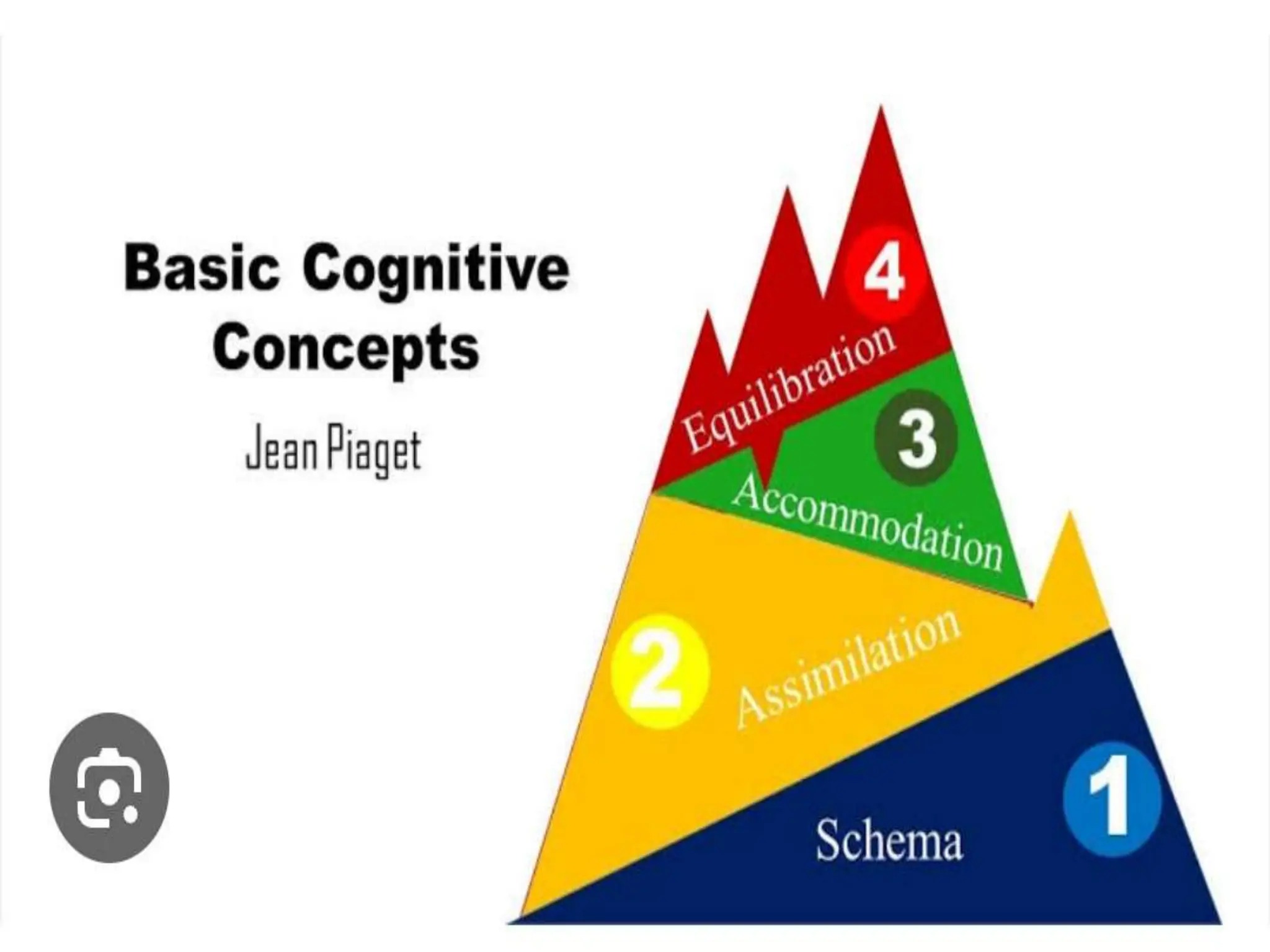
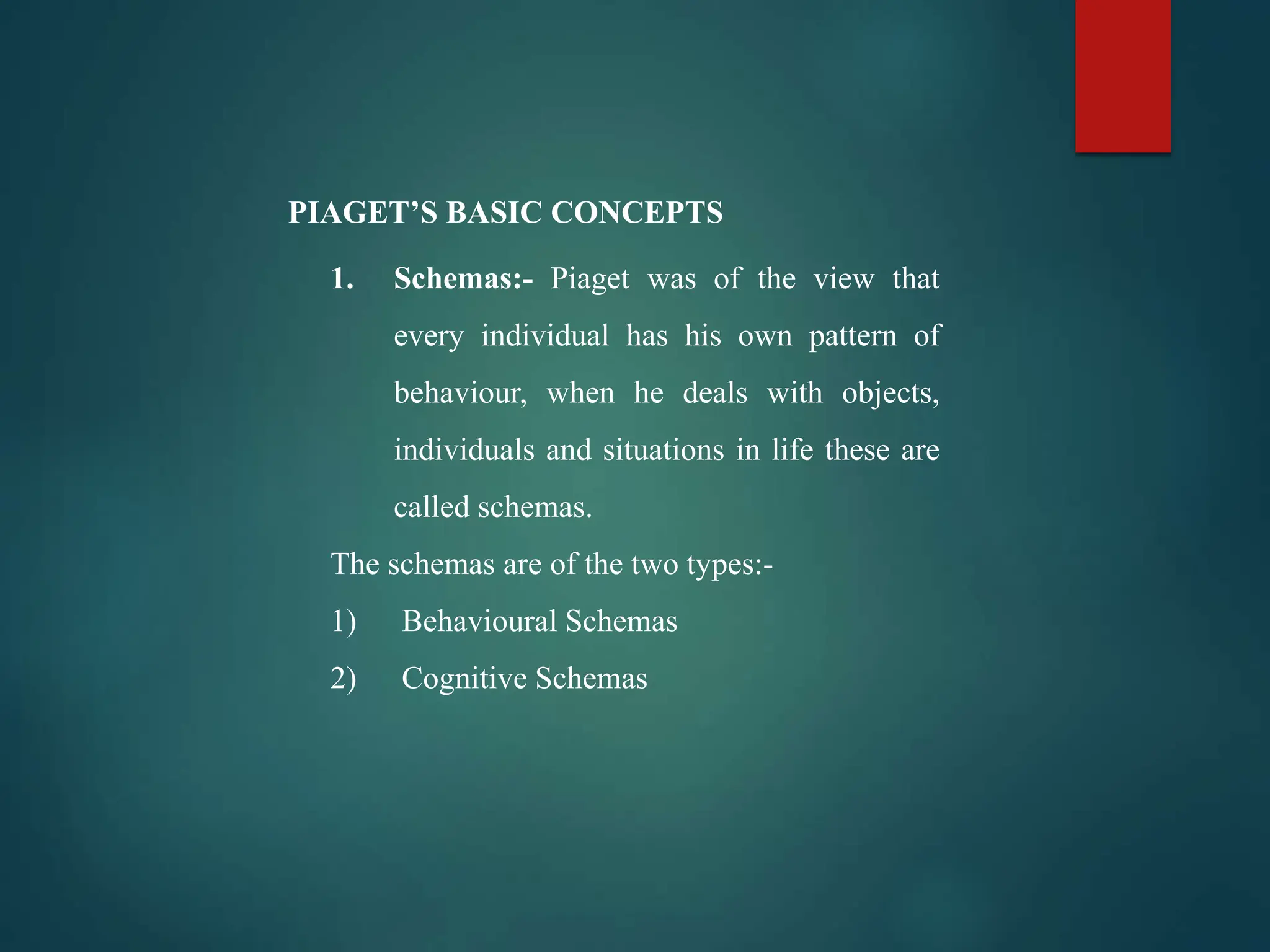
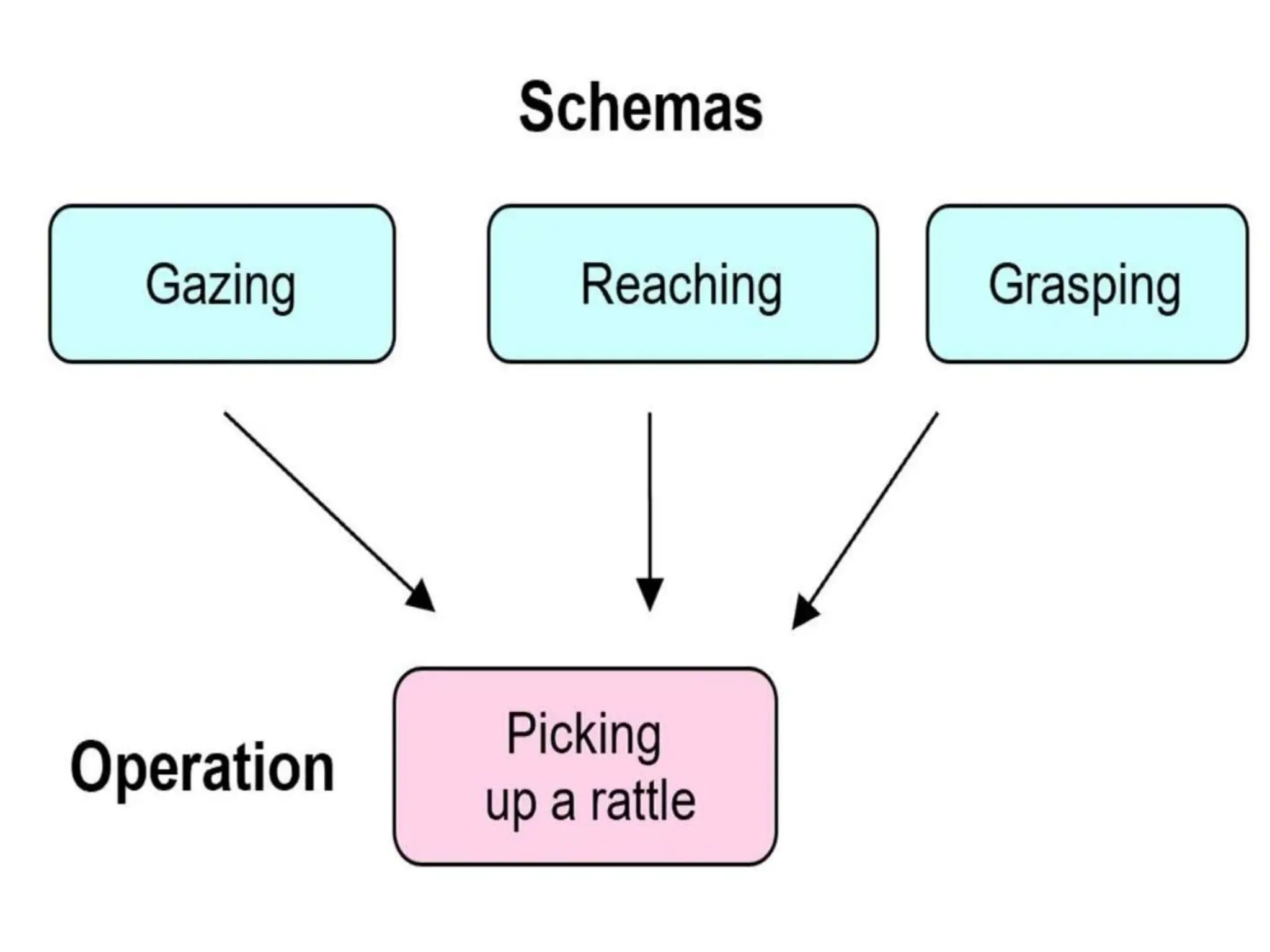
1. Schemas:- Piaget was of the view that
every individual has his own pattern of
behaviour, when he deals with objects,
individuals and situations in life these are
called schemas.
The schemas are of the two types:-
1) Behavioural Schemas
2) Cognitive Schemas
PIAGET’S BASIC CONCEPTS
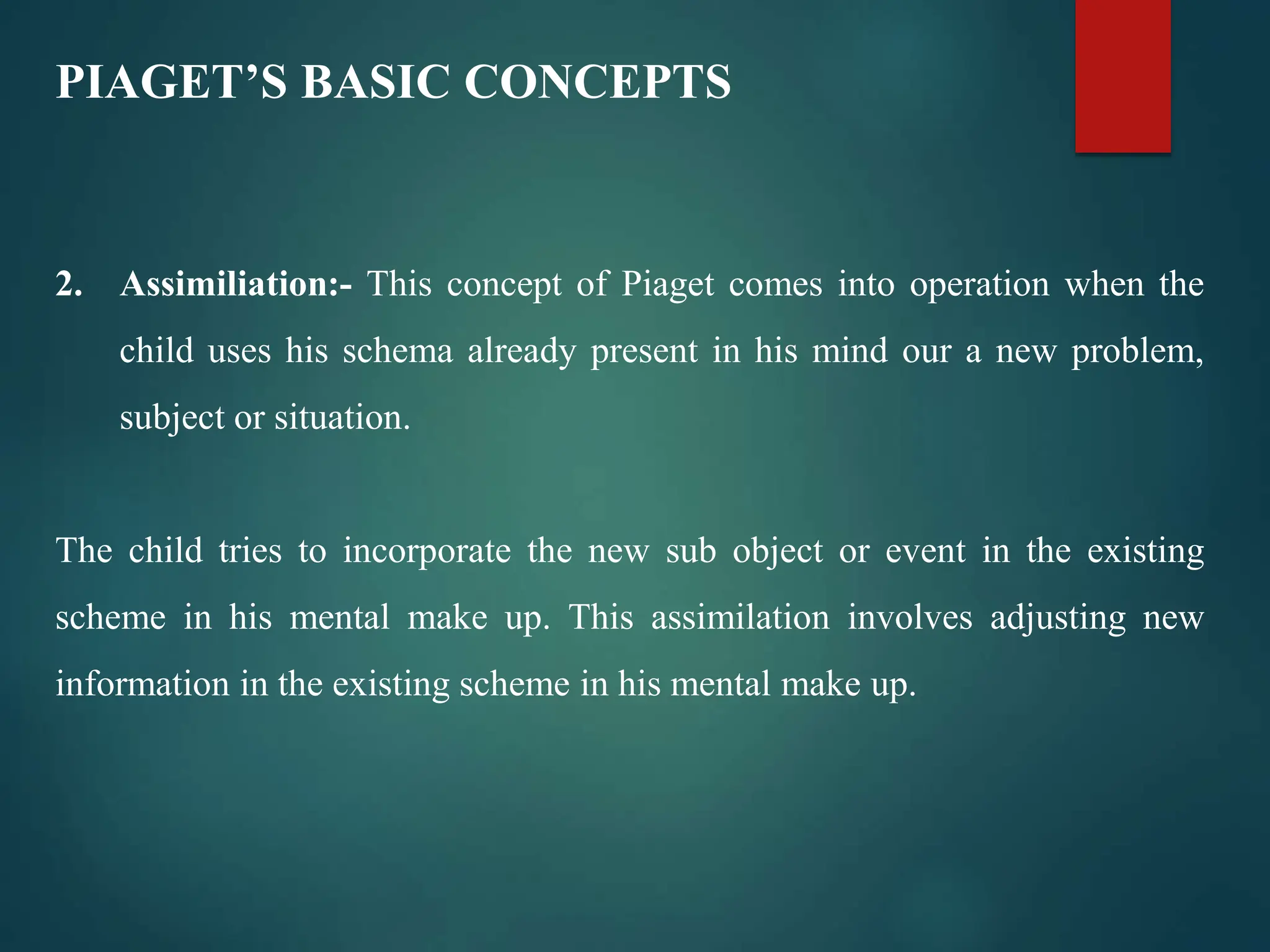
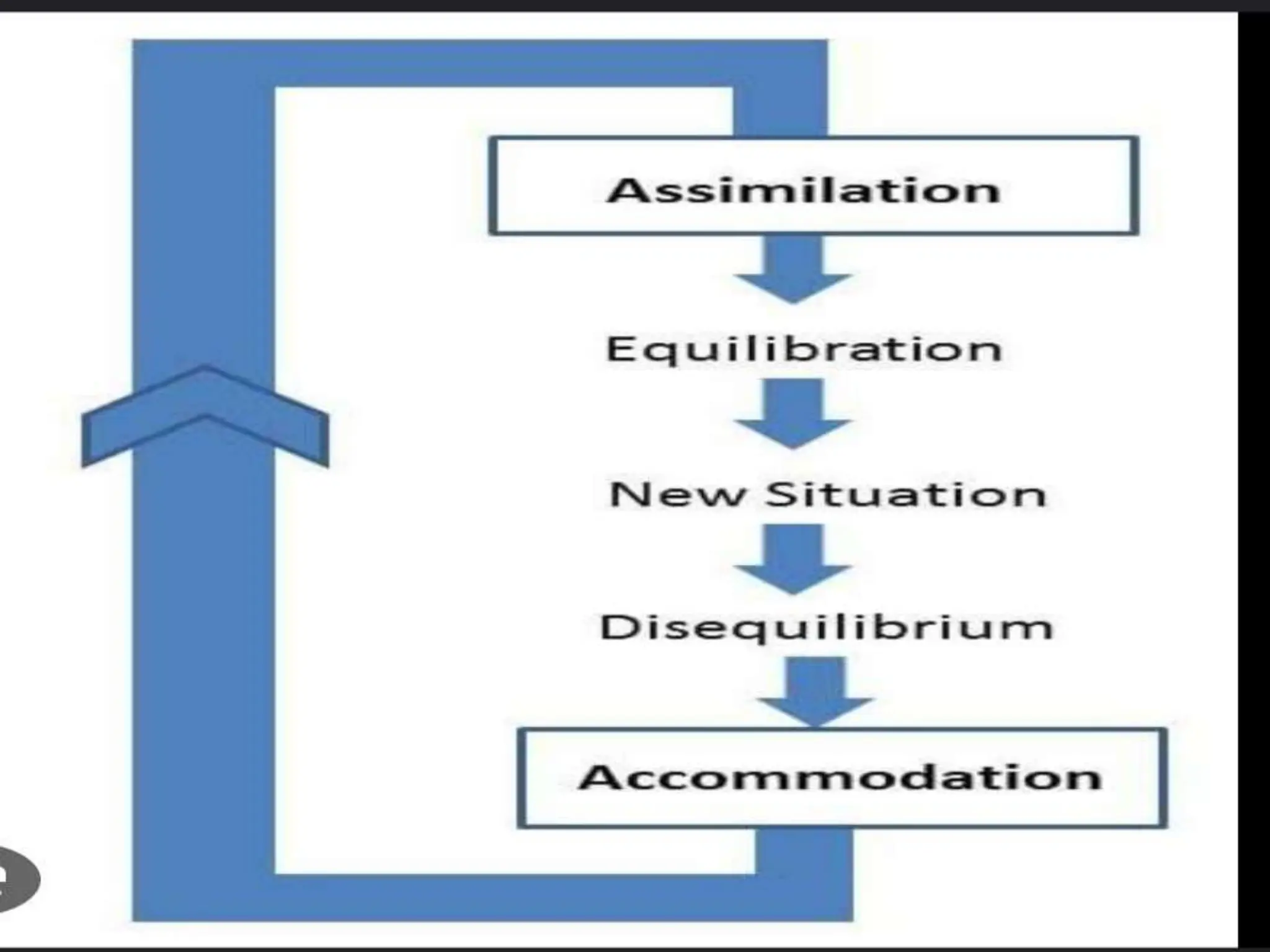
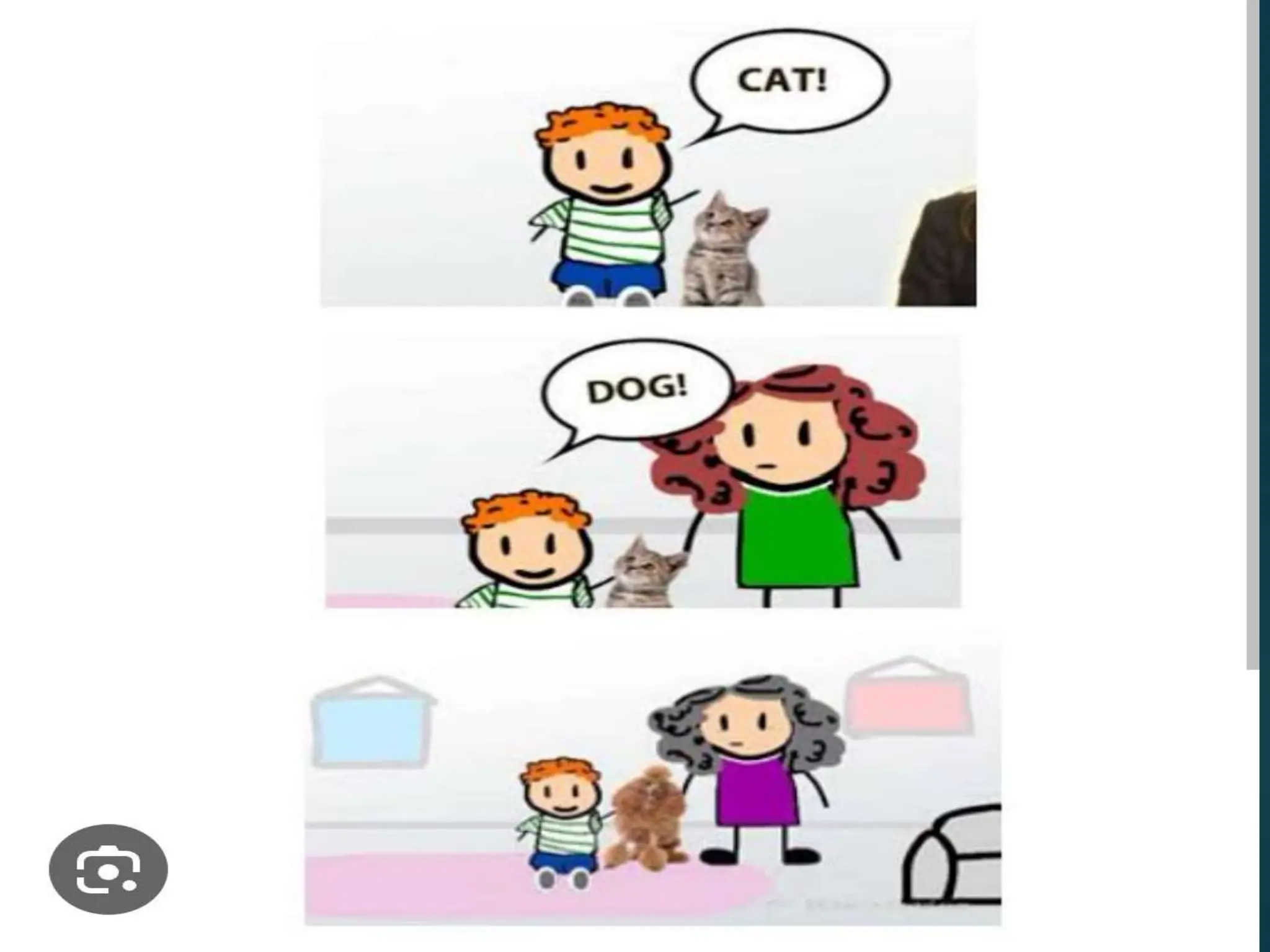
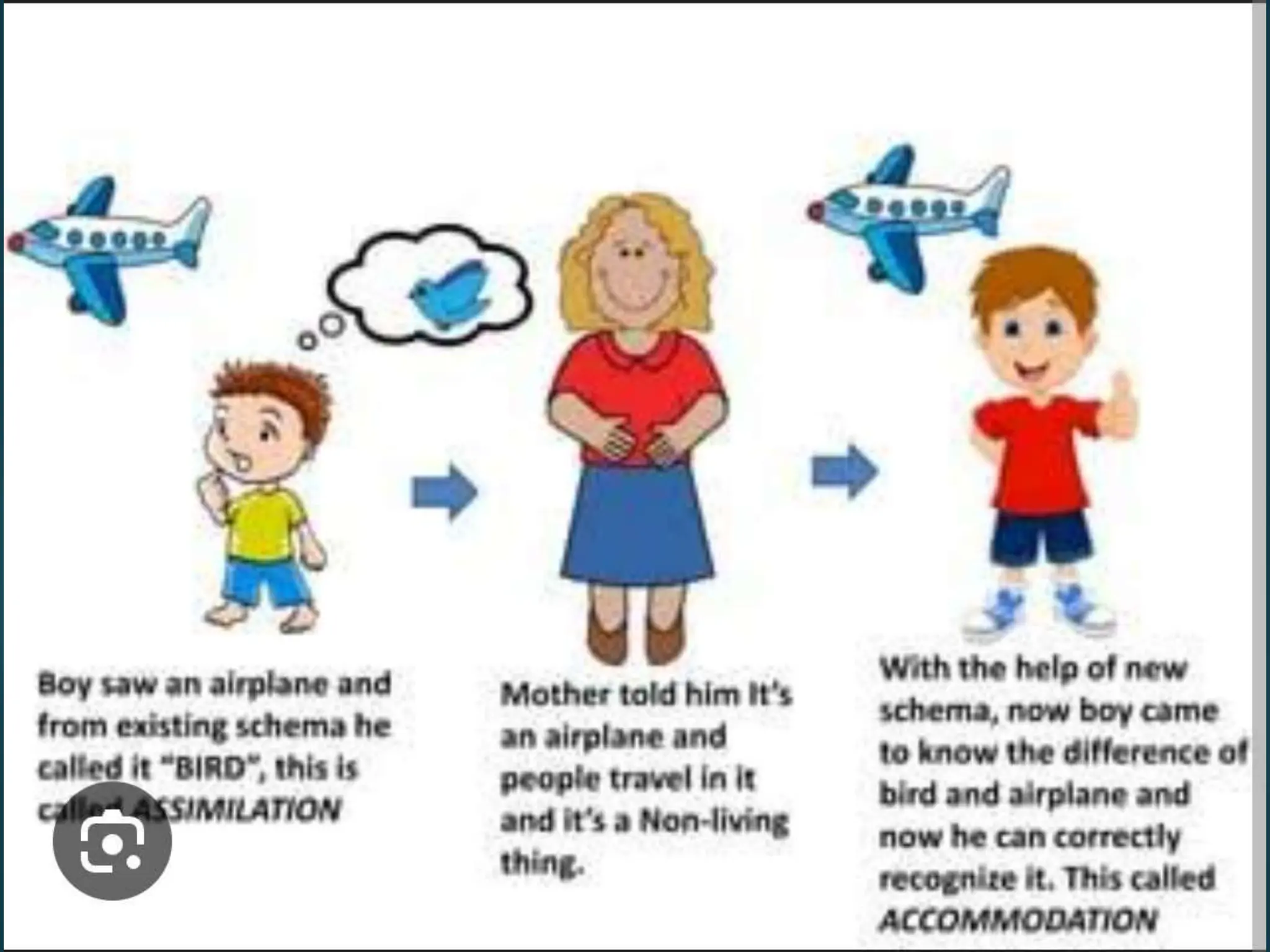
2. Assimiliation:- This concept of Piaget comes into operation when the
child uses his schema already present in his mind our a new problem,
subject or situation.
The child tries to incorporate the new sub object or event in the existing
scheme in his mental make up. This assimilation involves adjusting new
information in the existing scheme in his mental make up.
3. Accommodation:- It means making changes in the existing
schema to fit in new ideas or objects. The child may imitate
others, may suppress own schema and this show a tendency
towards accommodation.
4. Equilibration:- This word is based on the word ‘equilibrium’
which means a state of even mental balance. When the child faces
& new problem and his existing schema does not work this state
of affair being out disequilibrium in the mind of the child. At this
stage the child has to focus modifies his old schema to suit the
new situation.
STAGES OF COGNITIVE DEVELOPMENT
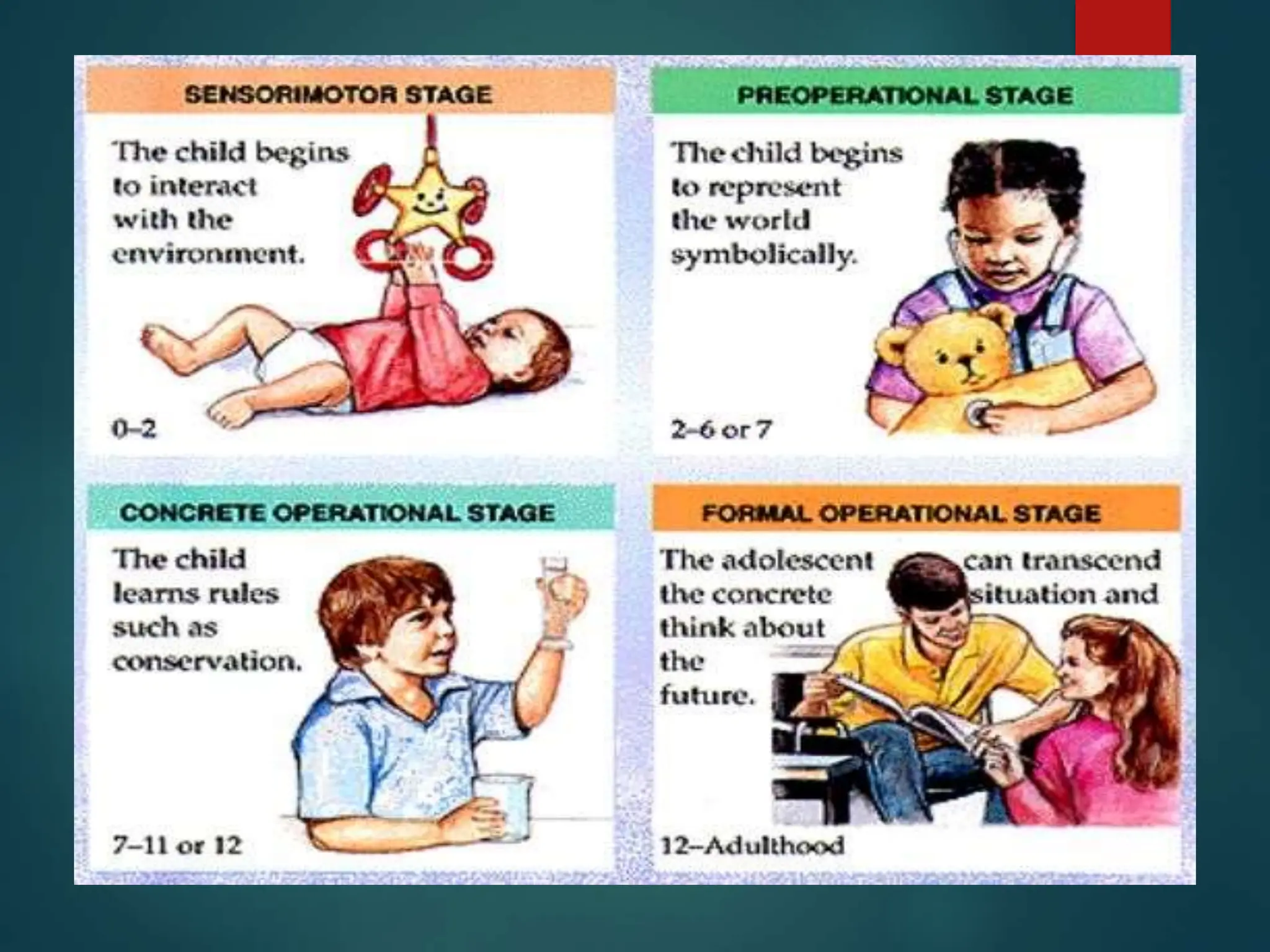
Piaget described four major periods of development:-
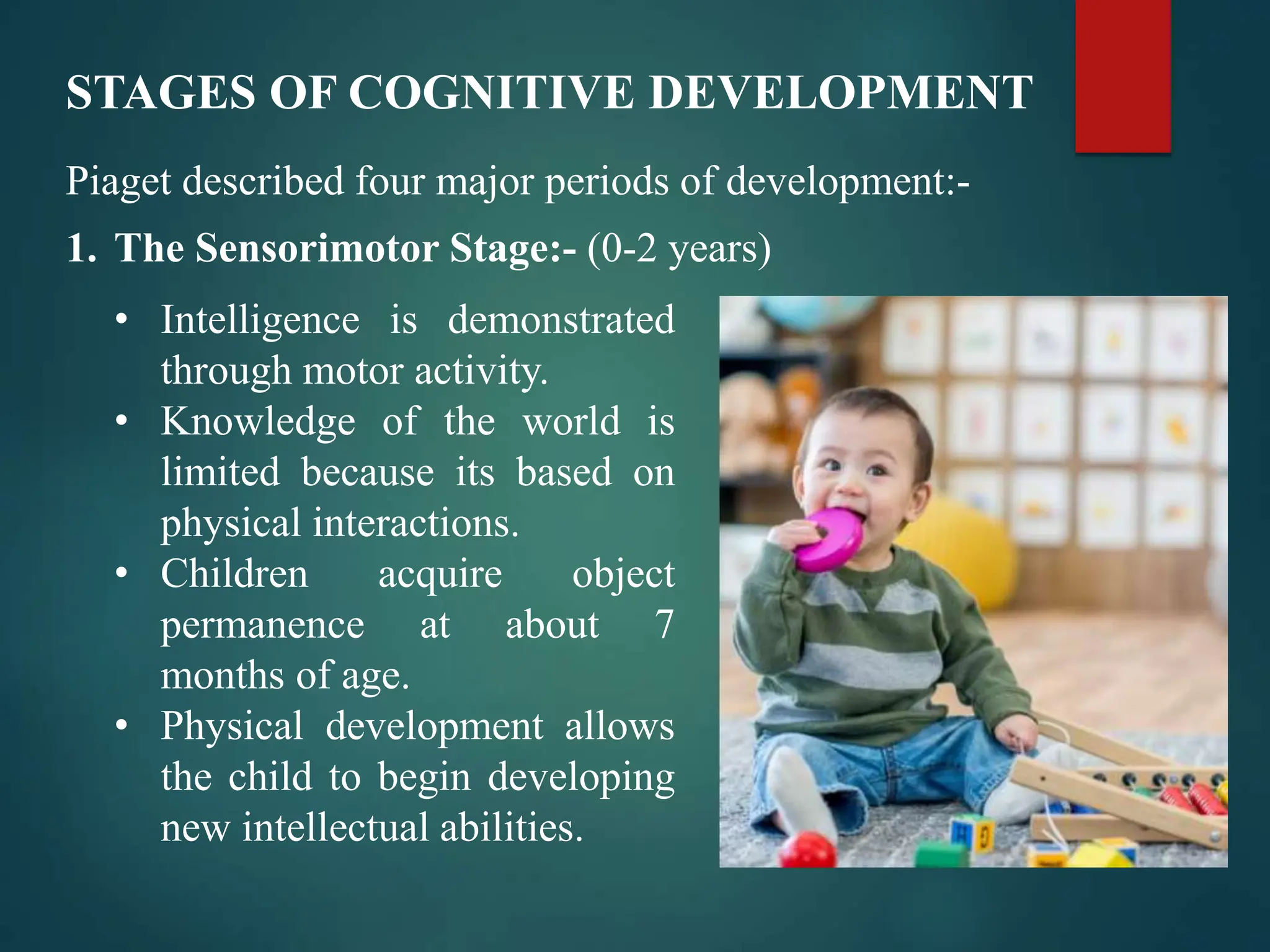
1. The Sensorimotor Stage:- (0-2 years)
• Intelligence is demonstrated
through motor activity.
• Knowledge of the world is
limited because its based on
physical interactions.
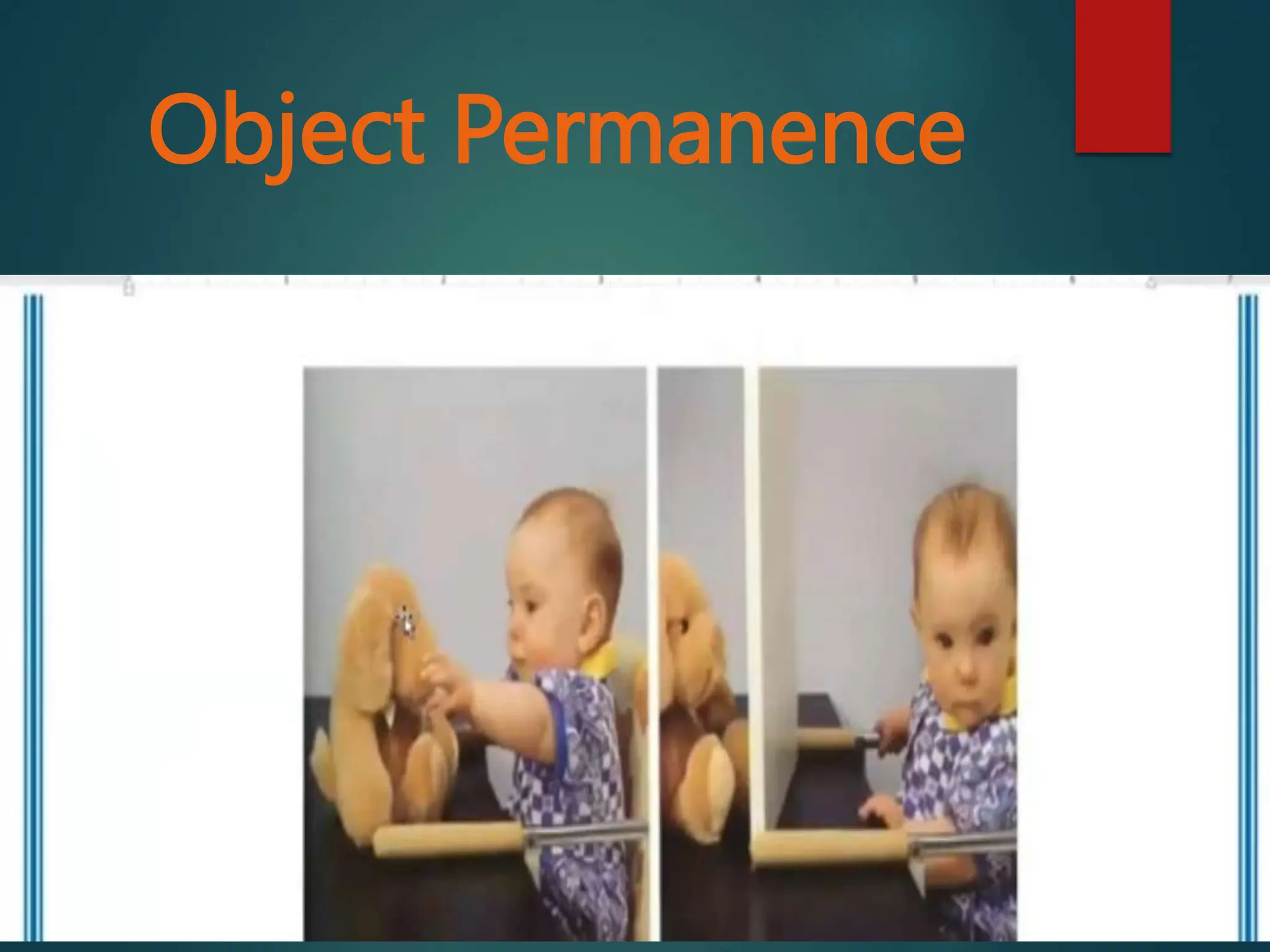
• Children acquire object
permanence at about 7
months of age.
• Physical development allows
the child to begin developing
new intellectual abilities.
Object Permanence
2. The Pre-operational Stage:- (2-7 years)
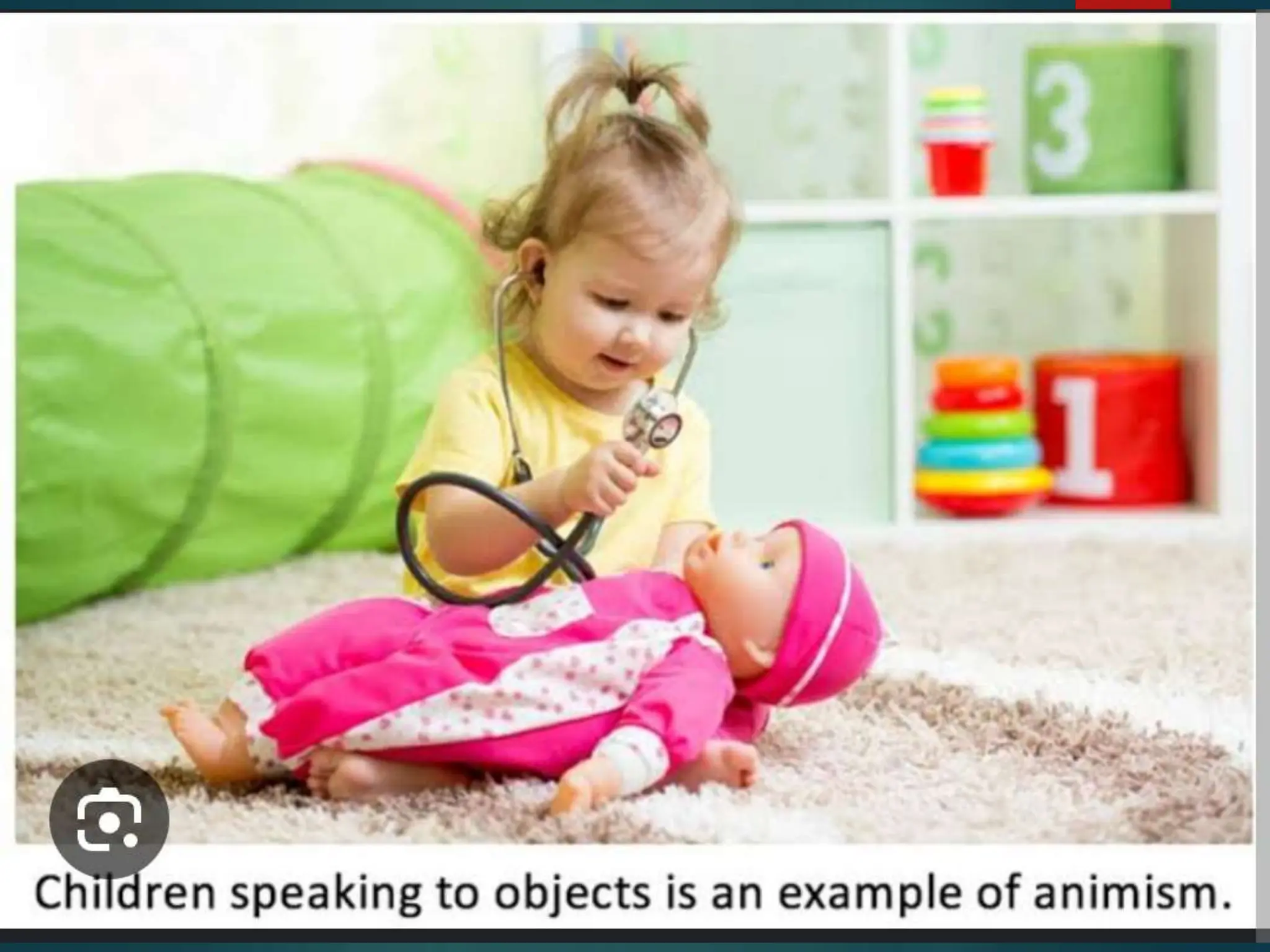
• Animism- the belief that everything that
exists has some kind of consciousness.
• Vocabulary is expanded and developed
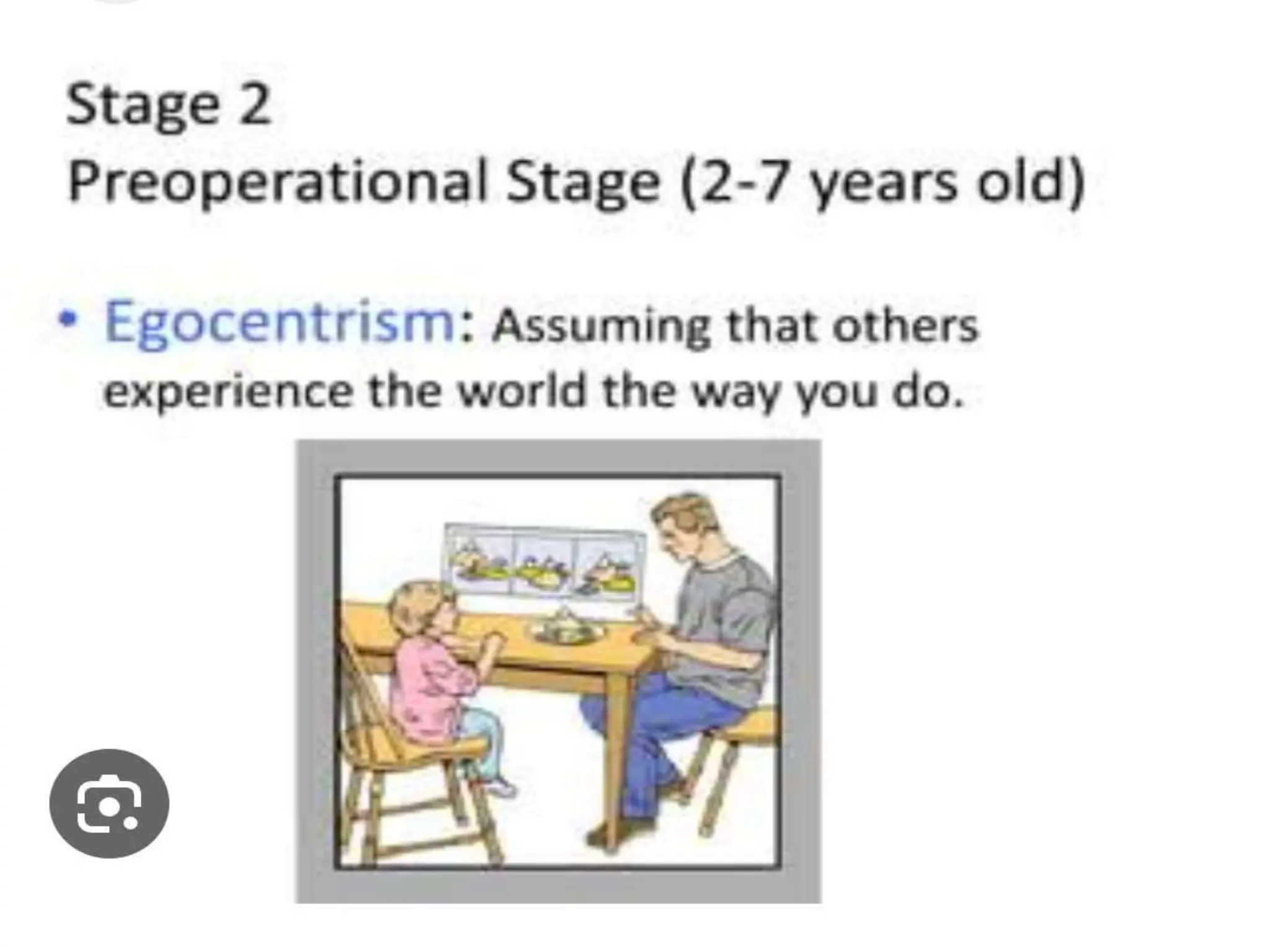
• Egocentric thinking predominates.
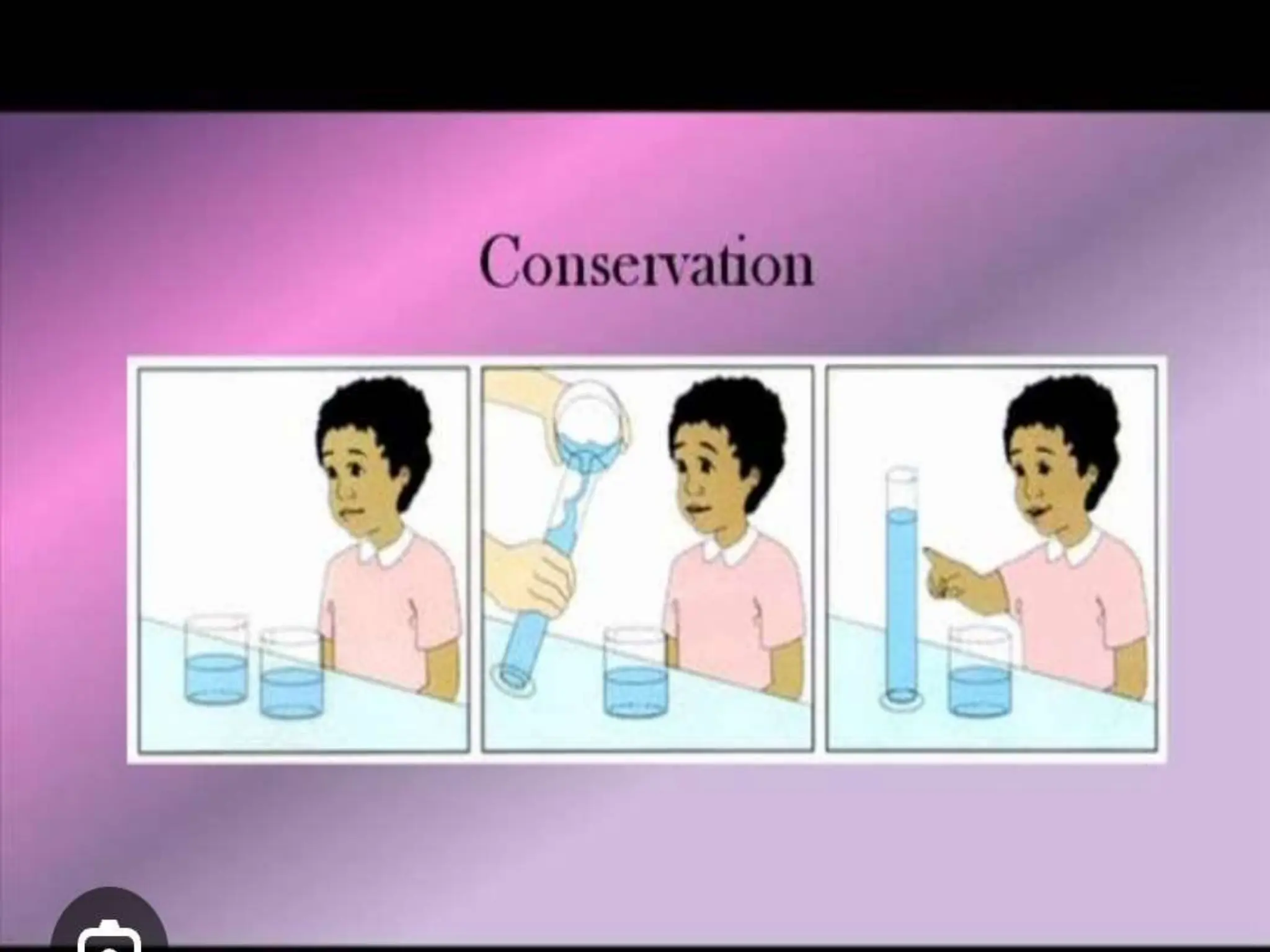
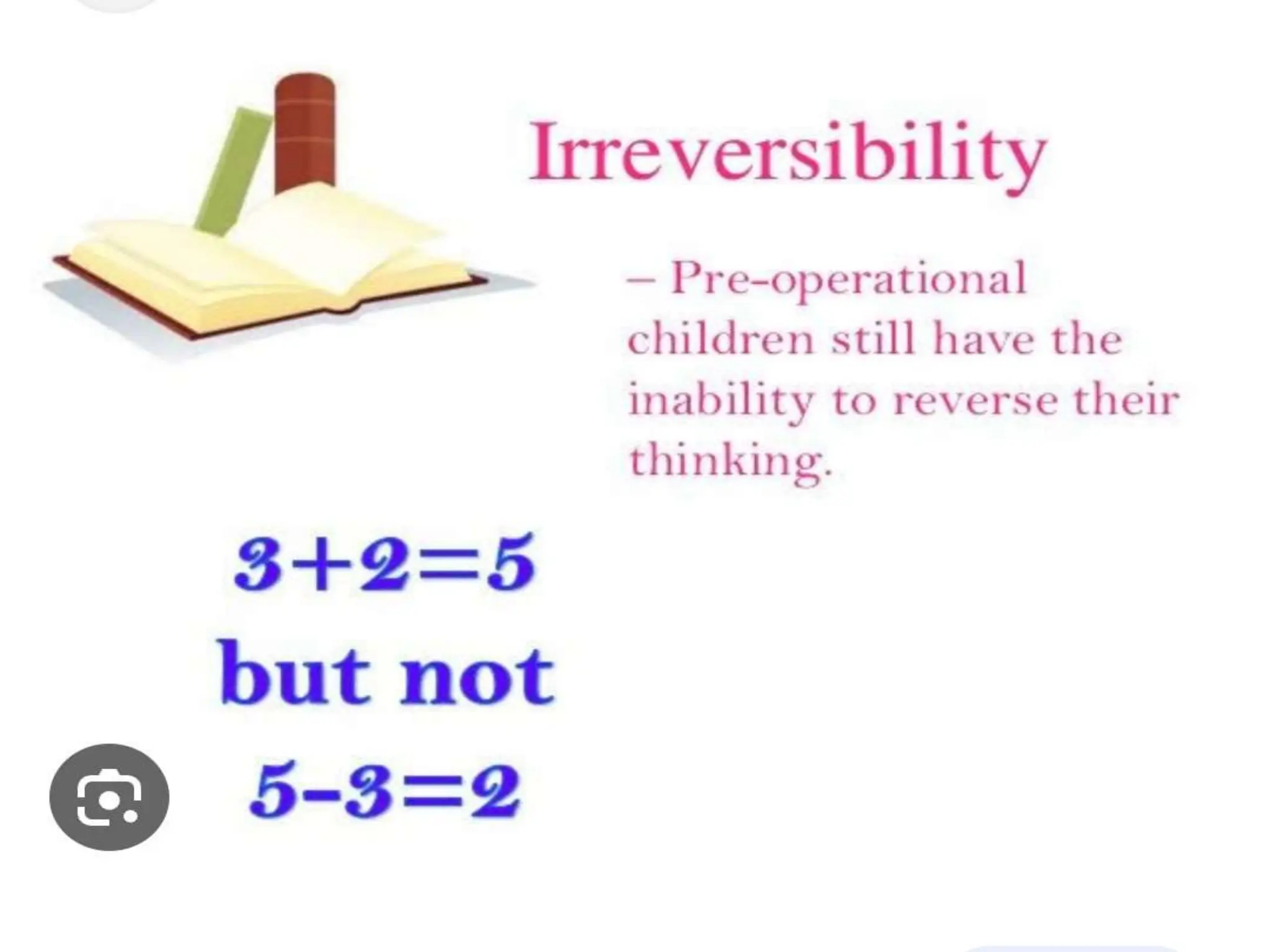
• Memory and imagination are developed,
but thinking is done in a nonlogical,
nonconservation, nonreversible manner.
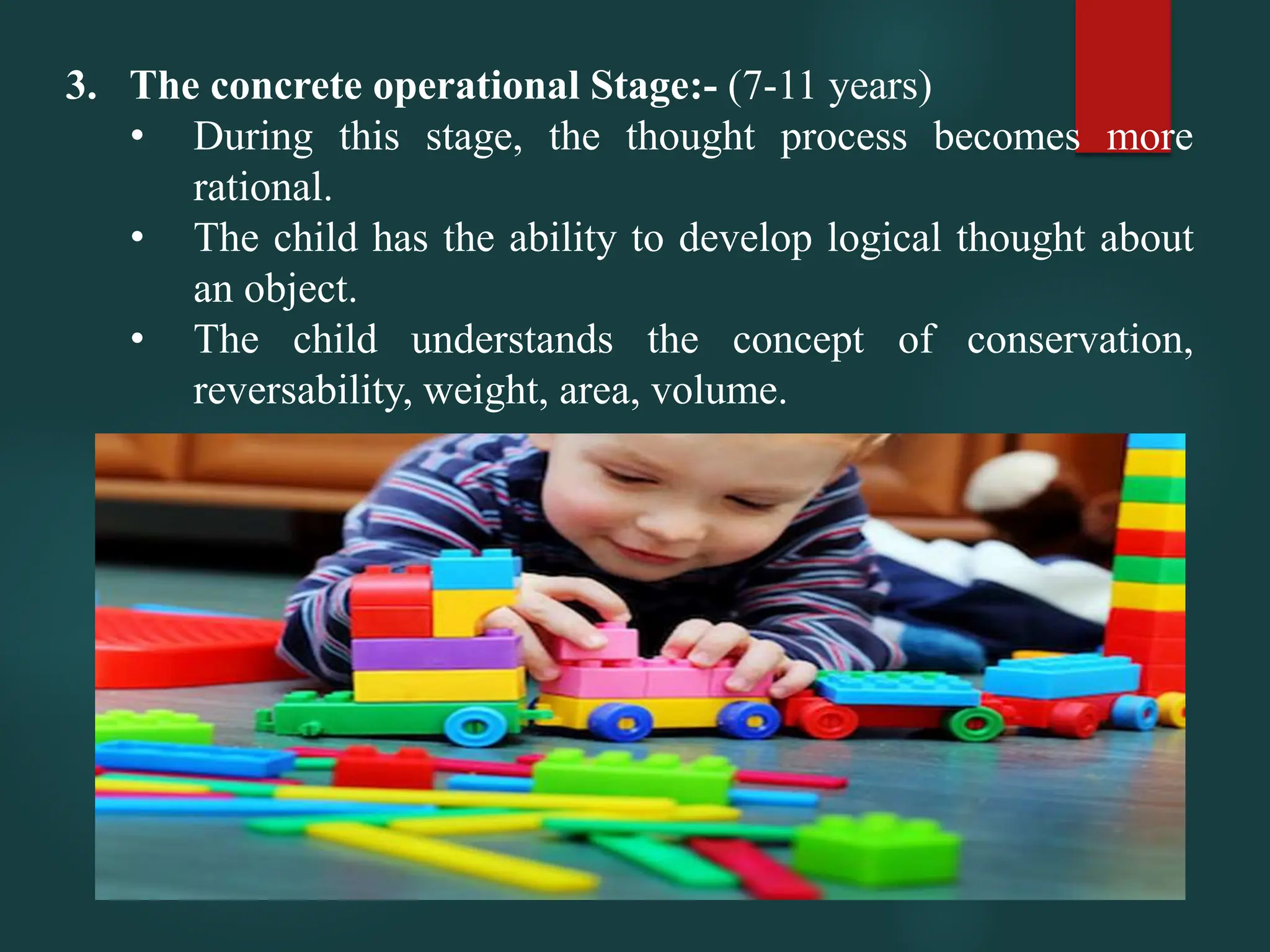
3. The concrete operational Stage:- (7-11 years)
• During this stage, the thought process becomes more
rational.
• The child has the ability to develop logical thought about
an object.
• The child understands the concept of conservation,
reversability, weight, area, volume.
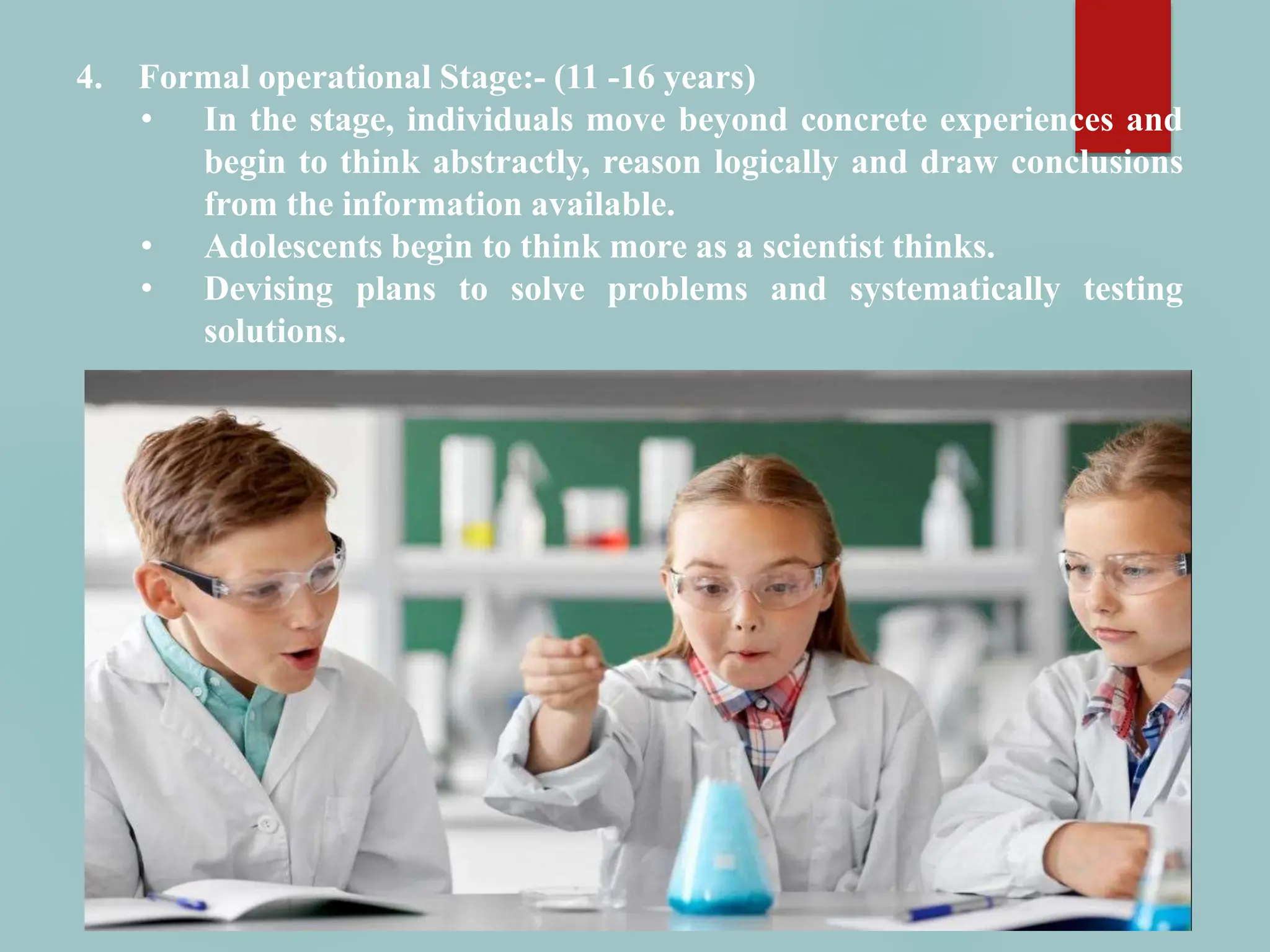
4. Formal operational Stage:- (11 -16 years)
• In the stage, individuals move beyond concrete experiences and
begin to think abstractly, reason logically and draw conclusions
from the information available.
• Adolescents begin to think more as a scientist thinks.
• Devising plans to solve problems and systematically testing
solutions.
CONTRIBUTION TO EDUCATION
(Educational Implications)
1. Curriculum Planning:- Piaget’s theory provides a suitable
frame work of the learning experiences in view of the
cognitive development of children. It is helpful in
curriculum planning. Since children of a particular region
tend to reach a particular stage in their intellectual
development what is to be planned in their curriculum of
studies must always be in accordance with the expected
level of mental abilities.
2. Child Centered Education:- Piaget’s theory emphasises
pupil-centered education. It has advocated need for
tailoring the education of a child according to the level of
functioning of his cognitive structure.
3. Appropriate and stimulating environment:- As Piaget
theory considers both physical and social experiences as
quite essential for a child's intellectual development. It has
placed an important responsibility on parents and teachers
to arrange for the most appropriate and stimulating
environment for their children.
4. Importance of drives and motivation:- Piaget theory has
highlighted the importance of drives and motivation in the
field of learning and development. It has utilised the
concept of equilibration for this purpose.
5. Variety of aid material:- The theory exphasises the
importance of the variety of aid material in teaching
learning process. Teaching learning process should not be
confined to the use of verbal communication, but should
involve other symbolic expressions.
6. Self learning:- Children should be encouraged to
experiment with materials in order to accommodate new
understanding and to acquire new learning b them selves.
Teacher should try to set up environment in which the
students can have a wide variety of experiences for self
learning.
7. Acquaintance with thought process:- Piaget theory
acquaints teacher s and parents with the thought processes
of children at a particular level of their maturation.
8. Practical interpretation of Intelligence:- Piaget defined
and interpreted intelligence in a practical way. Intelligence
in terms of cognitive structure and functioning helps the
person in making struggle for survival and seeking
adjustment with the environment.

Final ppt.pptx

  • 5.
    GENERAL PRINCIPLES  Piaget’slong standing interest in the development of children’s thinking actually began, in a way, in his own childhood, as he studied and wrote about birds. • Piaget saw children as active participants in their own development. • He rejected the idea that cognitive structures some how slowly emerge. Instead Piaget believed that the children construed their own mental structures, the building blocks of cognition and intelligence, through a constant and active series of intelligence interactions with their environment.
  • 7.
    1. Schemas:- Piagetwas of the view that every individual has his own pattern of behaviour, when he deals with objects, individuals and situations in life these are called schemas. The schemas are of the two types:- 1) Behavioural Schemas 2) Cognitive Schemas PIAGET’S BASIC CONCEPTS
  • 9.
    PIAGET’S BASIC CONCEPTS 2.Assimiliation:- This concept of Piaget comes into operation when the child uses his schema already present in his mind our a new problem, subject or situation. The child tries to incorporate the new sub object or event in the existing scheme in his mental make up. This assimilation involves adjusting new information in the existing scheme in his mental make up.
  • 13.
    3. Accommodation:- Itmeans making changes in the existing schema to fit in new ideas or objects. The child may imitate others, may suppress own schema and this show a tendency towards accommodation. 4. Equilibration:- This word is based on the word ‘equilibrium’ which means a state of even mental balance. When the child faces & new problem and his existing schema does not work this state of affair being out disequilibrium in the mind of the child. At this stage the child has to focus modifies his old schema to suit the new situation.
  • 15.
    STAGES OF COGNITIVEDEVELOPMENT Piaget described four major periods of development:- 1. The Sensorimotor Stage:- (0-2 years) • Intelligence is demonstrated through motor activity. • Knowledge of the world is limited because its based on physical interactions. • Children acquire object permanence at about 7 months of age. • Physical development allows the child to begin developing new intellectual abilities.
  • 20.
  • 21.
    2. The Pre-operationalStage:- (2-7 years) • Animism- the belief that everything that exists has some kind of consciousness. • Vocabulary is expanded and developed • Egocentric thinking predominates. • Memory and imagination are developed, but thinking is done in a nonlogical, nonconservation, nonreversible manner.
  • 27.
    3. The concreteoperational Stage:- (7-11 years) • During this stage, the thought process becomes more rational. • The child has the ability to develop logical thought about an object. • The child understands the concept of conservation, reversability, weight, area, volume.
  • 28.
    4. Formal operationalStage:- (11 -16 years) • In the stage, individuals move beyond concrete experiences and begin to think abstractly, reason logically and draw conclusions from the information available. • Adolescents begin to think more as a scientist thinks. • Devising plans to solve problems and systematically testing solutions.
  • 29.
    CONTRIBUTION TO EDUCATION (EducationalImplications) 1. Curriculum Planning:- Piaget’s theory provides a suitable frame work of the learning experiences in view of the cognitive development of children. It is helpful in curriculum planning. Since children of a particular region tend to reach a particular stage in their intellectual development what is to be planned in their curriculum of studies must always be in accordance with the expected level of mental abilities. 2. Child Centered Education:- Piaget’s theory emphasises pupil-centered education. It has advocated need for tailoring the education of a child according to the level of functioning of his cognitive structure.
  • 30.
    3. Appropriate andstimulating environment:- As Piaget theory considers both physical and social experiences as quite essential for a child's intellectual development. It has placed an important responsibility on parents and teachers to arrange for the most appropriate and stimulating environment for their children. 4. Importance of drives and motivation:- Piaget theory has highlighted the importance of drives and motivation in the field of learning and development. It has utilised the concept of equilibration for this purpose. 5. Variety of aid material:- The theory exphasises the importance of the variety of aid material in teaching learning process. Teaching learning process should not be confined to the use of verbal communication, but should involve other symbolic expressions.
  • 31.
    6. Self learning:-Children should be encouraged to experiment with materials in order to accommodate new understanding and to acquire new learning b them selves. Teacher should try to set up environment in which the students can have a wide variety of experiences for self learning. 7. Acquaintance with thought process:- Piaget theory acquaints teacher s and parents with the thought processes of children at a particular level of their maturation. 8. Practical interpretation of Intelligence:- Piaget defined and interpreted intelligence in a practical way. Intelligence in terms of cognitive structure and functioning helps the person in making struggle for survival and seeking adjustment with the environment.