The Lipid Profile
 Lipid Profile is ordered in the following types of
patients, who
 have a family history of high cholesterol or heart
disease
 are obese
 are diabetic
 are hypertensive (high B.P)
 In short, the patients who have high risk of developing
atherosclerotic diseases of blood vessels.
The Lipid Profile
 A complete cholesterol test, referred to as a lipid panel
or lipid profile, includes the calculation of four types
of fats (lipids):
 Total cholesterol
 Low-density lipoprotein (LDL) cholesterol
 High-density lipoprotein (HDL) cholesterol
 Triglycerides
Structure of Lipoproteins
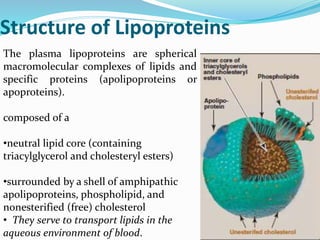
The plasma lipoproteins are spherical
macromolecular complexes of lipids and
specific proteins (apolipoproteins or
apoproteins).
composed of a
•neutral lipid core (containing
triacylglycerol and cholesteryl esters)
•surrounded by a shell of amphipathic
apolipoproteins, phospholipid, and
nonesterified (free) cholesterol
• They serve to transport lipids in the
aqueous environment of blood.
Size and density of lipoprotein
particles:
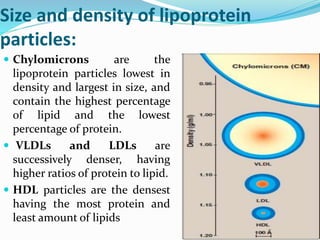
 Chylomicrons are the
lipoprotein particles lowest in
density and largest in size, and
contain the highest percentage
of lipid and the lowest
percentage of protein.
 VLDLs and LDLs are
successively denser, having
higher ratios of protein to lipid.
 HDL particles are the densest
having the most protein and
least amount of lipids
LDL- Cholesterol
 LDL-Cholesterol is one of the major culprits in the
development of atherosclerotic heart disease
 The function of LDL is to deliver cholesterol synthesized in
the liver to other cells, where it is used in membranes, or for
the synthesis of steroid hormones.
 Cells take up cholesterol by receptor-mediated
endocytosis. LDL binds to a specific LDL receptor and is
internalized in an endocytic vesicle. Receptors are recycled
to the cell surface, while hydrolysis in an endolysosome
releases cholesterol for use in the cell.

LDL- Cholesterol
 LDL cholesterol is the major cholesterol found in the
plaques formed in coronary and other atherosclerotic
vascular diseases.
 Levels of LDL- cholesterol below 1o0 mg./dl are
recommended for patients with a history of risk factor
for heart disease.
HDL- Cholesterol
 HDL-Cholesterol is called good cholesterol because it is
inversely related with the incidence of atherosclerosis
 HDL is involved in reverse cholesterol transport.
 Excess cholesterol from cells is brought back to the liver
by HDL in a process known as reverse cholesterol
transport HDL travels in the circulation where it gathers
cholesterol and returns the cholesterol to the liver via
various pathways.
 The HDL-Cholesterol level above 40 mg/dL in men and
above 50 mg/dL in women is desirable.
Background
 Uric acid is the final product of purine catabolism in
human beings.
 Approximately two thirds of total body urate is
produced endogenously, while the remaining one third
is accounted for by dietary purines.
Background
 Approximately 70% of the urate produced daily is
excreted by the kidneys, while the rest is eliminated by
the intestines.
 The blood levels of uric acid are a function of the
balance between the breakdown of purines and the
rate of uric acid excretion.
 Alterations in this balance may account for
hyperuricemia.
Mechanism of Hyperuricemia
 Therefore, there are two main mechanisms of
hyperuricemia:
1. Under excretion e.g chronic kidney disease
2. Overproduction e.g rapid cell death such as in
cancer chemotherapy
or a combination of these two mechanisms!!
Effects of Hyperuricemia
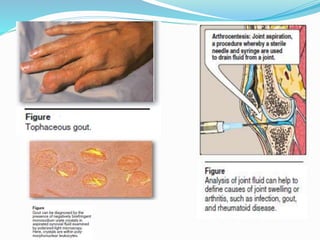
 Gouty Arthritis,
 Gouty Tophi
 Uric acid calculi in urinary tract.
Gout
 Acute inflammatory monoarthritis caused by precipitation of
monosodium urate crystals in joints
 most commonly in the great toe and less frequently in the
tarsal joint, knee, and other joints
 Results in intesnse pain, redness and swelling of the affected
joint.
 polarized light microscopy of the joint aspirate show the
presence of needle-shaped mono -sodium urate crystals
LABORATORY STUDIES
 Serum uric acid
 CBC count: Values may be abnormal in patients with
hemolytic anemia, hematologic malignancies, or lead
poisoning.
 Electrolytes, Urea, and serum creatinine values: These
are abnormal in patients with acidosis or renal disease.
 Urinary uric acid excretion
KIDNEY DISORDERS and ASSESSMENT OF
RENAL FUNCTION
 The kidneys have many functions, most
notably:
 excretion of waste such as urea and
creatinine
 maintenance of extracellular fluid (ECF)
volume and homeostasis
 Acid Base homeostasis
 hormone synthesis such as erythropoeitin
and vitamin D
THE NEPHRON
 The functional unit of the kidney is a nephron.
 Each kidney contains approximately 1 to 1.5 million
nephrons.
 A nephron is in fact a long microscopic tubule,
consisting of different anatomic and functional
units and supplied by a rich blood supply.
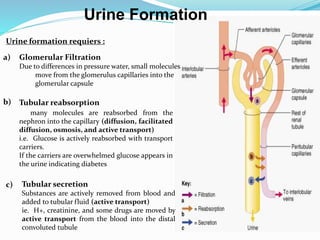
Urine formation requiers :
Urine Formation
Glomerular Filtration
Due to differences in pressure water, small molecules
move from the glomerulus capillaries into the
glomerular capsule
Tubular reabsorption
many molecules are reabsorbed from the
nephron into the capillary (diffusion, facilitated
diffusion, osmosis, and active transport)
i.e. Glucose is actively reabsorbed with transport
carriers.
If the carriers are overwhelmed glucose appears in
the urine indicating diabetes
Tubular secretion
Substances are actively removed from blood and
added to tubular fluid (active transport)
ie. H+, creatinine, and some drugs are moved by
active transport from the blood into the distal
convoluted tubule
a)
b)
c)
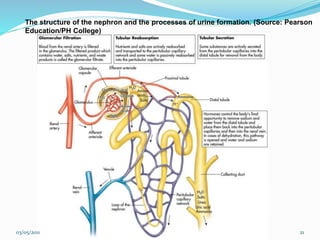
The structure of the nephron and the processes of urine formation. (Source: Pearson
Education/PH College)
03/05/2011 21
 The glomerular filtrate is an ultra filtrate of
plasma; that is, it has a similar composition to
plasma except that it is almost free of proteins.
 Proteins with molecular weights lower than that
of albumin (68 kDa) are filterable; negatively
charged molecules are less easily filtered than
those bearing a positive charge.
 . The volume of plasma fluid filtered from
glomerular capillaries into the Bowman’s
capsule per unit time is called Glomerular
Filtration Rate (GFR).
The normal glomerular filtration
rate (GFR) is approximately 120
mL/min, equivalent to a volume
of about 170 L/24 h.
However, urine production is only
1-2 L/24 h, depending on fluid
intake; the bulk of the filtrate is
reabsorbed further along the
nephron
Laboratory Investigations in renal
DIseases
 The most routinely ordered tests in suspected kidney diseases
are:
 Blood urea
 Serum creatinine and
 Urinary albumin
Increased blood urea and creatinine levels in a patient of
renal failure may be a sign of decreased GFR
 However, urea and creatinine levels may be normal in the
initial stages of the kidney diseases due to the great ability of the
healthier parts of the kidney to compensate and maintain
adequate GFR.
 Therefore, in many patients an estimate of GFR
is made to gauge the true extent of kidney
damage.
 Creatinine clearance is measured to estimate the
GFR.
 Creatinine clearance is defined as the volume of
plasma which is cleared of creatinine per unit
time.
 Creatinine clearance is a good estimate of GFR
because it is freely filtered and only minutely
secreted with no reabsorption.
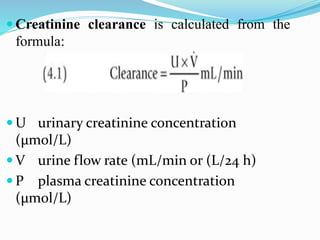
 Creatinine clearance is calculated from the
formula:
 U urinary creatinine concentration
(μmol/L)
 V urine flow rate (mL/min or (L/24 h)
 P plasma creatinine concentration
(μmol/L)
Assessment of glomerular integrity
 Impairment of glomerular integrity results in the
filtration of large molecules that are normally
retained and is manifest as proteinuria.
 Proteinuria can, however, occur for other reasons.
Classification of Proteinuria
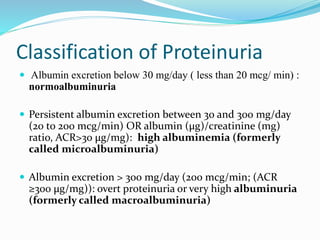
 Albumin excretion below 30 mg/day ( less than 20 mcg/ min) :
normoalbuminuria
 Persistent albumin excretion between 30 and 300 mg/day
(20 to 200 mcg/min) OR albumin (μg)/creatinine (mg)
ratio, ACR>30 μg/mg): high albuminemia (formerly
called microalbuminuria)
 Albumin excretion > 300 mg/day (200 mcg/min; (ACR
≥300 μg/mg)): overt proteinuria or very high albuminuria
(formerly called macroalbuminuria)
The liver
INTRODUCTION
 The liver is of vital importance in intermediary
metabolism and in the detoxification and
elimination of toxic substances.
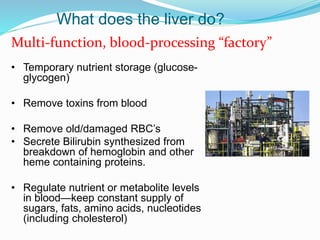
What does the liver do?
• Temporary nutrient storage (glucose-
glycogen)
• Remove toxins from blood
• Remove old/damaged RBC’s
• Secrete Bilirubin synthesized from
breakdown of hemoglobin and other
heme containing proteins.
• Regulate nutrient or metabolite levels
in blood—keep constant supply of
sugars, fats, amino acids, nucleotides
(including cholesterol)
Multi-function, blood-processing “factory”
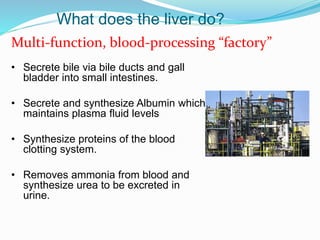
What does the liver do?
• Secrete bile via bile ducts and gall
bladder into small intestines.
• Secrete and synthesize Albumin which
maintains plasma fluid levels
• Synthesize proteins of the blood
clotting system.
• Removes ammonia from blood and
synthesize urea to be excreted in
urine.
Multi-function, blood-processing “factory”
What targets the Liver?
 Toxins
 Alcohol
 Medications
 Tylenol
 Mushrooms
 Tumors, most frequently
secondary;
 Viral
 Hepatitis A/B/C/D/E
 EBV/HSV/CMV
 Autoimmune
What targets the Liver?
 Metabolic
 Glycogen storage
diseases
 Wilson’s Disease
 Ischemia
 Severe hypotension
 Vasoconstriction
 Sepsis
 Deficiency diseases
 Alpha-1 antitrypsin
deficiency
LIVER FUNCTION TESTS
 ALT : Alanine Transaminase
 AST : Aspartate Transaminase
 ALP: Alkaline Phosphatase
 GGT: Gamma Glutamyl Transferase
 Albumin reflects protein synthetic function
 PT, aPTT and INR reflect clotting factor synthesis
 Ammonia: An increase in serum ammonia reflects
decreased synthesis of urea.
Liver Function Tests and Markers
of liver cell injury.
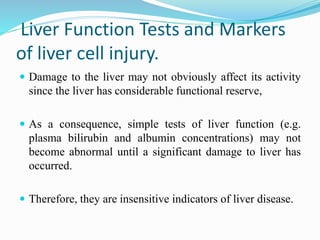
 Damage to the liver may not obviously affect its activity
since the liver has considerable functional reserve,
 As a consequence, simple tests of liver function (e.g.
plasma bilirubin and albumin concentrations) may not
become abnormal until a significant damage to liver has
occurred.
 Therefore, they are insensitive indicators of liver disease.
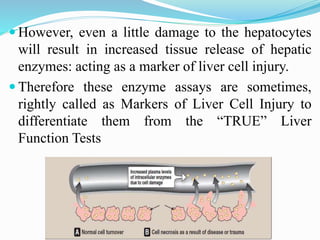
 However, even a little damage to the hepatocytes
will result in increased tissue release of hepatic
enzymes: acting as a marker of liver cell injury.
 Therefore these enzyme assays are sometimes,
rightly called as Markers of Liver Cell Injury to
differentiate them from the “TRUE” Liver
Function Tests
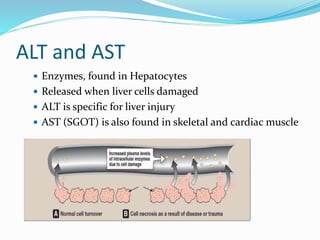
ALT and AST
 Enzymes, found in Hepatocytes
 Released when liver cells damaged
 ALT is specific for liver injury
 AST (SGOT) is also found in skeletal and cardiac muscle
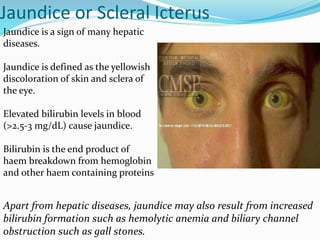
Jaundice or Scleral Icterus
Jaundice is a sign of many hepatic
diseases.
Jaundice is defined as the yellowish
discoloration of skin and sclera of
the eye.
Elevated bilirubin levels in blood
(>2.5-3 mg/dL) cause jaundice.
Bilirubin is the end product of
haem breakdown from hemoglobin
and other haem containing proteins
Apart from hepatic diseases, jaundice may also result from increased
bilirubin formation such as hemolytic anemia and biliary channel
obstruction such as gall stones.
Thyroid Gland
 The thyroid gland produces three hormones:
 Triiodothyronine or T3
 Tetraiodothyronine, also called thyroxine, or T4
 Calcitonin
 Strictly speaking, only T3 and T4 are proper thyroid
hormones. They are produced in what are known as
the follicular epithelial cells of the thyroid, with iodine
being one of the main components of both hormones
 Their most obvious overall effect on metabolism is
to stimulate the basal metabolic rate, oxygen
consumption and heat production, through actions
that include stimulating Na+,K+-ATPases
involved in ion transport and increasing the
availability of energy substrates.
 Thyroid hormone can thus be considered as the
‘Tuning Switch’ of body metabolism.
Thyroid Hormones
Physiological Functions
Thyroid Hormones
Physiological Functions
 Body temperature maintenance
 Increased heart rate and contractility.
 Lipolysis, proteolysis, Glycolysis
 Mobilization of energy storage
 Brain maturation in children
 Growth promotion in children.
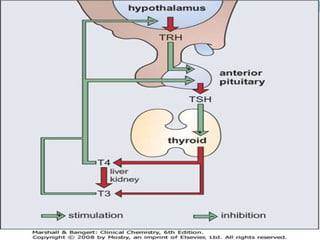
 Thyroxine synthesis and release are stimulated
by the pituitary trophic hormone, thyroid-
stimulating hormone (TSH).
 The secretion of TSH is controlled by negative
feedback by the thyroid hormones, which modulate
the response of the pituitary to the hypothalamic
hormone, thyrotropin-releasing hormone (TRH).
REGULATION OF THYROID
SECRETION
 This feedback is mediated primarily by T3
produced by the action of iodothyronine deiodinase
on T4 in the thyrotroph cells of the anterior
pituitary.
 Glucocorticoids, dopamine and somatostatin
inhibit TSH secretion.
Thyroid function tests
The tests used to investigate thyroid function can be grouped
into:
 Tests that establish whether there is thyroid
dysfunction
 Tests to know the cause of thyroid dysfunction
 Tests that establish whether there is thyroid
dysfunction
TSH,
T4 and
T3 measurements
Thyroid function tests
 Tests to know the cause of thyroid dysfunction
 thyroid auto-antibody and
 serum thyroglobulin measurements,
 thyroid enzyme activities,
 biopsy of the thyroid,
 ultrasound and
 isotopic thyroid scanning
Thyroid function tests
TSH :
- The single most sensitive, specific and
reliable test of thyroid status .
- In primary hypothyroidism, [TSH] is
increased.
- In primary hyperthyroidism, [TSH] is
decrease or undetectable
Total T4 and Total T3 :
- More than 99% of T4 and T3 circulate
in plasma bound to protein
- Both [total T4] and [total T3] change if
[TBG] alters, e.g. in pregnancy
Free T4 and Free T3
Free thyroid hormone concentrations
are independent of changes in
the concentration of thyroid-hormone
binding proteins → more
reliable for diagnosis of thyroid
dysfunction
Hyperthyroidism
Clinical Features
 Palpitations
Heat intolerance
Nervousness
Insomnia
Breathlessness
Increased bowel movements
Light or absent menstrual periods
Tachycardia
Tremors Weight loss
Muscle weakness
Warm moist skin
Hair loss
Staring gaze
 In short everything speeds up and everything becomes hyperactive
Hypothyroidism
Clinical Features
 Dry skin
 Brittle and lustreless hair
 Weight gain
 Tiredness
 Constipation
 Muscle aches
 Bradycardia
 Cold intolarance
 Depression
 Memory Loss
• Menstrual irregularities (menorrhagia)
In short, everything slows down and everything becomes dull.
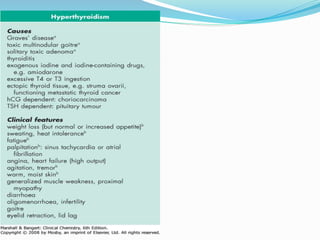
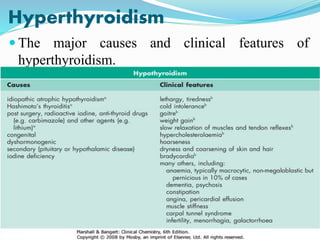
 The major causes and clinical features of
hyperthyroidism.
Hyperthyroidism

Final lecture

  • 2.
    The Lipid Profile Lipid Profile is ordered in the following types of patients, who  have a family history of high cholesterol or heart disease  are obese  are diabetic  are hypertensive (high B.P)  In short, the patients who have high risk of developing atherosclerotic diseases of blood vessels.
  • 3.
    The Lipid Profile A complete cholesterol test, referred to as a lipid panel or lipid profile, includes the calculation of four types of fats (lipids):  Total cholesterol  Low-density lipoprotein (LDL) cholesterol  High-density lipoprotein (HDL) cholesterol  Triglycerides
  • 4.
    Structure of Lipoproteins Theplasma lipoproteins are spherical macromolecular complexes of lipids and specific proteins (apolipoproteins or apoproteins). composed of a •neutral lipid core (containing triacylglycerol and cholesteryl esters) •surrounded by a shell of amphipathic apolipoproteins, phospholipid, and nonesterified (free) cholesterol • They serve to transport lipids in the aqueous environment of blood.
  • 5.
    Size and densityof lipoprotein particles:  Chylomicrons are the lipoprotein particles lowest in density and largest in size, and contain the highest percentage of lipid and the lowest percentage of protein.  VLDLs and LDLs are successively denser, having higher ratios of protein to lipid.  HDL particles are the densest having the most protein and least amount of lipids
  • 6.
    LDL- Cholesterol  LDL-Cholesterolis one of the major culprits in the development of atherosclerotic heart disease  The function of LDL is to deliver cholesterol synthesized in the liver to other cells, where it is used in membranes, or for the synthesis of steroid hormones.  Cells take up cholesterol by receptor-mediated endocytosis. LDL binds to a specific LDL receptor and is internalized in an endocytic vesicle. Receptors are recycled to the cell surface, while hydrolysis in an endolysosome releases cholesterol for use in the cell. 
  • 7.
    LDL- Cholesterol  LDLcholesterol is the major cholesterol found in the plaques formed in coronary and other atherosclerotic vascular diseases.  Levels of LDL- cholesterol below 1o0 mg./dl are recommended for patients with a history of risk factor for heart disease.
  • 8.
    HDL- Cholesterol  HDL-Cholesterolis called good cholesterol because it is inversely related with the incidence of atherosclerosis  HDL is involved in reverse cholesterol transport.  Excess cholesterol from cells is brought back to the liver by HDL in a process known as reverse cholesterol transport HDL travels in the circulation where it gathers cholesterol and returns the cholesterol to the liver via various pathways.  The HDL-Cholesterol level above 40 mg/dL in men and above 50 mg/dL in women is desirable.
  • 10.
    Background  Uric acidis the final product of purine catabolism in human beings.  Approximately two thirds of total body urate is produced endogenously, while the remaining one third is accounted for by dietary purines.
  • 11.
    Background  Approximately 70%of the urate produced daily is excreted by the kidneys, while the rest is eliminated by the intestines.  The blood levels of uric acid are a function of the balance between the breakdown of purines and the rate of uric acid excretion.  Alterations in this balance may account for hyperuricemia.
  • 12.
    Mechanism of Hyperuricemia Therefore, there are two main mechanisms of hyperuricemia: 1. Under excretion e.g chronic kidney disease 2. Overproduction e.g rapid cell death such as in cancer chemotherapy or a combination of these two mechanisms!!
  • 13.
    Effects of Hyperuricemia Gouty Arthritis,  Gouty Tophi  Uric acid calculi in urinary tract.
  • 14.
    Gout  Acute inflammatorymonoarthritis caused by precipitation of monosodium urate crystals in joints  most commonly in the great toe and less frequently in the tarsal joint, knee, and other joints  Results in intesnse pain, redness and swelling of the affected joint.  polarized light microscopy of the joint aspirate show the presence of needle-shaped mono -sodium urate crystals
  • 16.
    LABORATORY STUDIES  Serumuric acid  CBC count: Values may be abnormal in patients with hemolytic anemia, hematologic malignancies, or lead poisoning.  Electrolytes, Urea, and serum creatinine values: These are abnormal in patients with acidosis or renal disease.  Urinary uric acid excretion
  • 18.
    KIDNEY DISORDERS andASSESSMENT OF RENAL FUNCTION  The kidneys have many functions, most notably:  excretion of waste such as urea and creatinine  maintenance of extracellular fluid (ECF) volume and homeostasis  Acid Base homeostasis  hormone synthesis such as erythropoeitin and vitamin D
  • 19.
    THE NEPHRON  Thefunctional unit of the kidney is a nephron.  Each kidney contains approximately 1 to 1.5 million nephrons.  A nephron is in fact a long microscopic tubule, consisting of different anatomic and functional units and supplied by a rich blood supply.
  • 20.
    Urine formation requiers: Urine Formation Glomerular Filtration Due to differences in pressure water, small molecules move from the glomerulus capillaries into the glomerular capsule Tubular reabsorption many molecules are reabsorbed from the nephron into the capillary (diffusion, facilitated diffusion, osmosis, and active transport) i.e. Glucose is actively reabsorbed with transport carriers. If the carriers are overwhelmed glucose appears in the urine indicating diabetes Tubular secretion Substances are actively removed from blood and added to tubular fluid (active transport) ie. H+, creatinine, and some drugs are moved by active transport from the blood into the distal convoluted tubule a) b) c)
  • 21.
    The structure ofthe nephron and the processes of urine formation. (Source: Pearson Education/PH College) 03/05/2011 21
  • 22.
     The glomerularfiltrate is an ultra filtrate of plasma; that is, it has a similar composition to plasma except that it is almost free of proteins.  Proteins with molecular weights lower than that of albumin (68 kDa) are filterable; negatively charged molecules are less easily filtered than those bearing a positive charge.  . The volume of plasma fluid filtered from glomerular capillaries into the Bowman’s capsule per unit time is called Glomerular Filtration Rate (GFR).
  • 23.
    The normal glomerularfiltration rate (GFR) is approximately 120 mL/min, equivalent to a volume of about 170 L/24 h. However, urine production is only 1-2 L/24 h, depending on fluid intake; the bulk of the filtrate is reabsorbed further along the nephron
  • 24.
    Laboratory Investigations inrenal DIseases  The most routinely ordered tests in suspected kidney diseases are:  Blood urea  Serum creatinine and  Urinary albumin Increased blood urea and creatinine levels in a patient of renal failure may be a sign of decreased GFR  However, urea and creatinine levels may be normal in the initial stages of the kidney diseases due to the great ability of the healthier parts of the kidney to compensate and maintain adequate GFR.
  • 25.
     Therefore, inmany patients an estimate of GFR is made to gauge the true extent of kidney damage.  Creatinine clearance is measured to estimate the GFR.  Creatinine clearance is defined as the volume of plasma which is cleared of creatinine per unit time.  Creatinine clearance is a good estimate of GFR because it is freely filtered and only minutely secreted with no reabsorption.
  • 26.
     Creatinine clearanceis calculated from the formula:  U urinary creatinine concentration (μmol/L)  V urine flow rate (mL/min or (L/24 h)  P plasma creatinine concentration (μmol/L)
  • 27.
    Assessment of glomerularintegrity  Impairment of glomerular integrity results in the filtration of large molecules that are normally retained and is manifest as proteinuria.  Proteinuria can, however, occur for other reasons.
  • 28.
    Classification of Proteinuria Albumin excretion below 30 mg/day ( less than 20 mcg/ min) : normoalbuminuria  Persistent albumin excretion between 30 and 300 mg/day (20 to 200 mcg/min) OR albumin (μg)/creatinine (mg) ratio, ACR>30 μg/mg): high albuminemia (formerly called microalbuminuria)  Albumin excretion > 300 mg/day (200 mcg/min; (ACR ≥300 μg/mg)): overt proteinuria or very high albuminuria (formerly called macroalbuminuria)
  • 30.
    The liver INTRODUCTION  Theliver is of vital importance in intermediary metabolism and in the detoxification and elimination of toxic substances.
  • 31.
    What does theliver do? • Temporary nutrient storage (glucose- glycogen) • Remove toxins from blood • Remove old/damaged RBC’s • Secrete Bilirubin synthesized from breakdown of hemoglobin and other heme containing proteins. • Regulate nutrient or metabolite levels in blood—keep constant supply of sugars, fats, amino acids, nucleotides (including cholesterol) Multi-function, blood-processing “factory”
  • 32.
    What does theliver do? • Secrete bile via bile ducts and gall bladder into small intestines. • Secrete and synthesize Albumin which maintains plasma fluid levels • Synthesize proteins of the blood clotting system. • Removes ammonia from blood and synthesize urea to be excreted in urine. Multi-function, blood-processing “factory”
  • 33.
    What targets theLiver?  Toxins  Alcohol  Medications  Tylenol  Mushrooms  Tumors, most frequently secondary;  Viral  Hepatitis A/B/C/D/E  EBV/HSV/CMV  Autoimmune
  • 34.
    What targets theLiver?  Metabolic  Glycogen storage diseases  Wilson’s Disease  Ischemia  Severe hypotension  Vasoconstriction  Sepsis  Deficiency diseases  Alpha-1 antitrypsin deficiency
  • 35.
    LIVER FUNCTION TESTS ALT : Alanine Transaminase  AST : Aspartate Transaminase  ALP: Alkaline Phosphatase  GGT: Gamma Glutamyl Transferase  Albumin reflects protein synthetic function  PT, aPTT and INR reflect clotting factor synthesis  Ammonia: An increase in serum ammonia reflects decreased synthesis of urea.
  • 36.
    Liver Function Testsand Markers of liver cell injury.  Damage to the liver may not obviously affect its activity since the liver has considerable functional reserve,  As a consequence, simple tests of liver function (e.g. plasma bilirubin and albumin concentrations) may not become abnormal until a significant damage to liver has occurred.  Therefore, they are insensitive indicators of liver disease.
  • 37.
     However, evena little damage to the hepatocytes will result in increased tissue release of hepatic enzymes: acting as a marker of liver cell injury.  Therefore these enzyme assays are sometimes, rightly called as Markers of Liver Cell Injury to differentiate them from the “TRUE” Liver Function Tests
  • 38.
    ALT and AST Enzymes, found in Hepatocytes  Released when liver cells damaged  ALT is specific for liver injury  AST (SGOT) is also found in skeletal and cardiac muscle
  • 39.
    Jaundice or ScleralIcterus Jaundice is a sign of many hepatic diseases. Jaundice is defined as the yellowish discoloration of skin and sclera of the eye. Elevated bilirubin levels in blood (>2.5-3 mg/dL) cause jaundice. Bilirubin is the end product of haem breakdown from hemoglobin and other haem containing proteins Apart from hepatic diseases, jaundice may also result from increased bilirubin formation such as hemolytic anemia and biliary channel obstruction such as gall stones.
  • 41.
    Thyroid Gland  Thethyroid gland produces three hormones:  Triiodothyronine or T3  Tetraiodothyronine, also called thyroxine, or T4  Calcitonin  Strictly speaking, only T3 and T4 are proper thyroid hormones. They are produced in what are known as the follicular epithelial cells of the thyroid, with iodine being one of the main components of both hormones
  • 42.
     Their mostobvious overall effect on metabolism is to stimulate the basal metabolic rate, oxygen consumption and heat production, through actions that include stimulating Na+,K+-ATPases involved in ion transport and increasing the availability of energy substrates.  Thyroid hormone can thus be considered as the ‘Tuning Switch’ of body metabolism. Thyroid Hormones Physiological Functions
  • 43.
    Thyroid Hormones Physiological Functions Body temperature maintenance  Increased heart rate and contractility.  Lipolysis, proteolysis, Glycolysis  Mobilization of energy storage  Brain maturation in children  Growth promotion in children.
  • 44.
     Thyroxine synthesisand release are stimulated by the pituitary trophic hormone, thyroid- stimulating hormone (TSH).  The secretion of TSH is controlled by negative feedback by the thyroid hormones, which modulate the response of the pituitary to the hypothalamic hormone, thyrotropin-releasing hormone (TRH). REGULATION OF THYROID SECRETION
  • 45.
     This feedbackis mediated primarily by T3 produced by the action of iodothyronine deiodinase on T4 in the thyrotroph cells of the anterior pituitary.  Glucocorticoids, dopamine and somatostatin inhibit TSH secretion.
  • 47.
    Thyroid function tests Thetests used to investigate thyroid function can be grouped into:  Tests that establish whether there is thyroid dysfunction  Tests to know the cause of thyroid dysfunction
  • 48.
     Tests thatestablish whether there is thyroid dysfunction TSH, T4 and T3 measurements Thyroid function tests
  • 49.
     Tests toknow the cause of thyroid dysfunction  thyroid auto-antibody and  serum thyroglobulin measurements,  thyroid enzyme activities,  biopsy of the thyroid,  ultrasound and  isotopic thyroid scanning Thyroid function tests
  • 50.
    TSH : - Thesingle most sensitive, specific and reliable test of thyroid status . - In primary hypothyroidism, [TSH] is increased. - In primary hyperthyroidism, [TSH] is decrease or undetectable
  • 51.
    Total T4 andTotal T3 : - More than 99% of T4 and T3 circulate in plasma bound to protein - Both [total T4] and [total T3] change if [TBG] alters, e.g. in pregnancy Free T4 and Free T3 Free thyroid hormone concentrations are independent of changes in the concentration of thyroid-hormone binding proteins → more reliable for diagnosis of thyroid dysfunction
  • 52.
    Hyperthyroidism Clinical Features  Palpitations Heatintolerance Nervousness Insomnia Breathlessness Increased bowel movements Light or absent menstrual periods Tachycardia Tremors Weight loss Muscle weakness Warm moist skin Hair loss Staring gaze  In short everything speeds up and everything becomes hyperactive
  • 54.
    Hypothyroidism Clinical Features  Dryskin  Brittle and lustreless hair  Weight gain  Tiredness  Constipation  Muscle aches  Bradycardia  Cold intolarance  Depression  Memory Loss • Menstrual irregularities (menorrhagia) In short, everything slows down and everything becomes dull.
  • 55.
     The majorcauses and clinical features of hyperthyroidism. Hyperthyroidism