Ellie Schafer
December 7, 2014
Final Project-Project 4
Wealth; an abundance of valuable possessions or money. What does it mean to be
wealthy? Does it mean you have a lot of money? Or does wealth come from personal
satisfaction? In Suzanne Collins’ Hunger Games, wealth has a multitude of meanings. Wealth in
Hunger Games has a lot of meanings but it also does in the real world. Collins writes Hunger
Games to portray the real world and what it means to be wealthy in it. Collins does this by using
the examples of transportation, fashion, and people’s compassion, or lack of, towards one
another.
Transportation can mean a million different things from walking, riding a bike, driving a
car, taking public buses, planes, or trains, but in the Hunger Games, Collins uses trains as the
main mode of transportation. “Of course, I’ve never been on a train, as travel between the
districts is forbidden except for officially sanctioned duties. For us, that’s mainly transporting
coal. But this is no ordinary coal train. It’s one of the high-speed Capitol models that averages
250 miles per hour. Our journey to the Capitol will take less than a day” (Collins 41). Katniss is
riding on a Capitol train and she is very impressed because usually travel on trains is forbidden.
The Capitol is considered wealthy because they have own the train that is really rare to ride. It is
also uncommon to ride trains in the United States. Daily, on average, 274.5 million people drive
to work (brookings.edu), 35 million people take public transportation (publictransportation.org),
1.73 million people fly (Bureau of Transportation Statistics), and only 86,000 people ride trains
(Amtrak.com). Looking at these statistics, the lowest number is the people who ride trains just
like how riding trains in Hunger Games is also low. Katniss goes on to describe the train as “The
tribute train is fancier than even the room in the Justice Buildings. We are given our own
chambers that have a bedroom, a dressing area, and a private bathroom with hot and cold running
water. We don’t have hot water at home, unless we boil it” (Collins 42). Katniss is amazed by
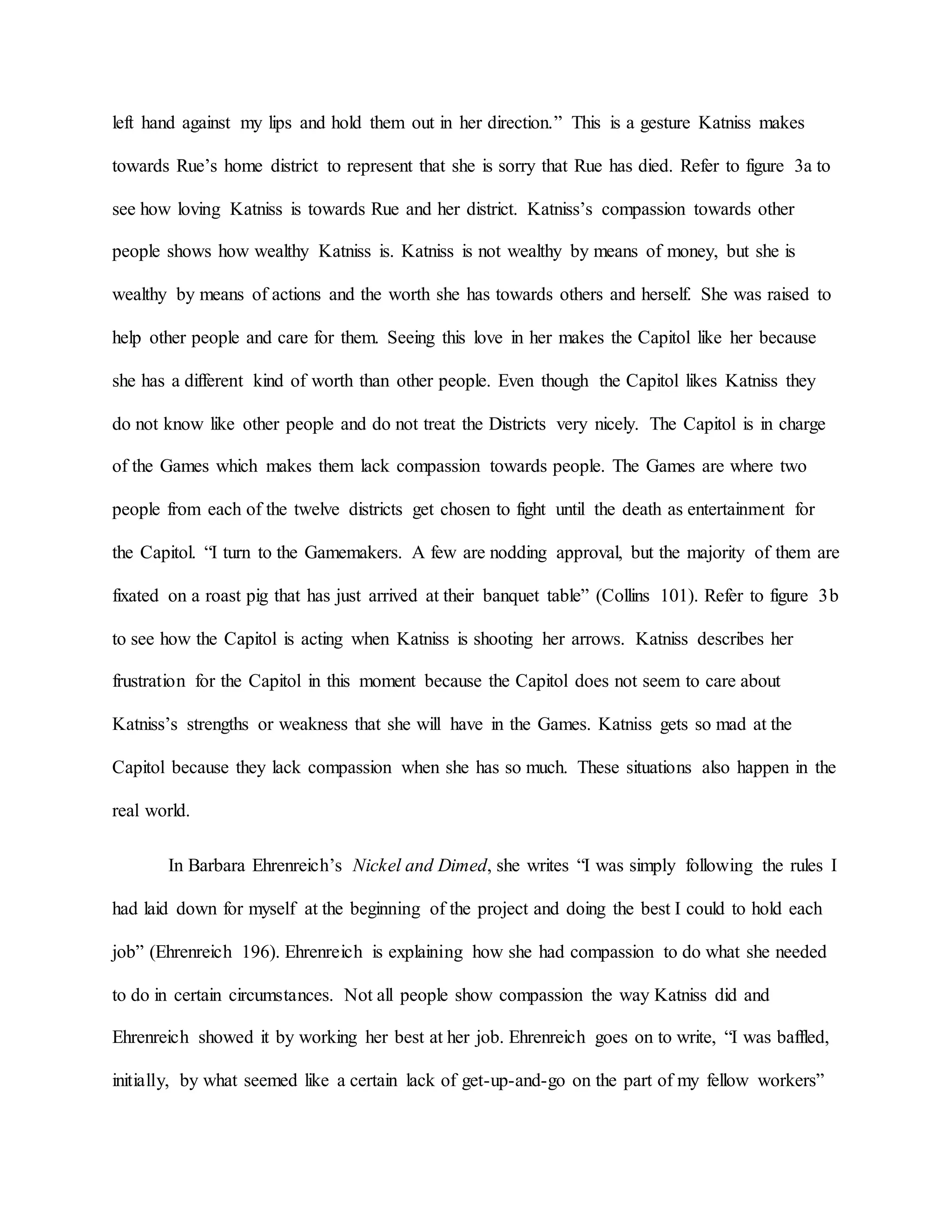
how nice the train is and the accommodations of it. Refer to figure 1a to see what a sitting car of
the Hunger Games’ train looks like. Amtrak trains also include many different features and to
see what a sitting car looks like refer to figure 1b. Looking at these figures, it shows that the
trains are similar but also different which is understandable. Collins does not only use trains as a
mode of transportation but she also uses hovercrafts.
Hovercrafts in Hunger Games are used to retrieve the tributes that have been killed in the
arena of the Games. “High above the dying campfire a hovercraft materializes. A set of large
metal teeth drops down. Slowly, gently, the dead tribute girl is lifted into the hovercraft. Then it
vanishes” (Collins 163). Katniss is in the Games when she describes how the hovercraft comes to
get people that have died fighting for their lives. The United States also uses air modes of
transportation. Planes and helicopters are what most Americans would think of when thinking of
air transportation. Helicopters and hovercrafts are similar because hovercrafts pick up dead
people out of the arena and helicopters pick up people that are in intensive care and are
practically dying. In the Great War, the first helicopter was used to fly soldiers from the
battlefield to the hospital (mercyflight.org). The battle field of the Great War can be looked at as
the Games in Hunger Games. Collins writes about hovercrafts to represent how wealthy, in terms
of money, the Capitol is. In the real world, Americans also have to have a decent amount of
money to afford to ride in the helicopter. Transportation in Hunger Games and the real world is
fairly similar but so is the fashion.
The definition of fashion and the actual appearance of fashion can be perceived as totally
different. In Hunger Games, Collins represents the lower income districts’ fashion as poverty in
the real world and she represents the Capitol’s fashion as the wealthier people of the real world.
“I swing my legs off the bed and slide into my hunting boots. Supple leather that has molded to
my feet. I pull on trousers, a shirt, tuck my long dark braid up into a cap, and grab my forage
bag” (Collins 4). Katniss’ fashion is not fancy or posh compared to the Capitol’s fashion. Katniss
describes some of the Capitol’s fashion as “…fresh from the Capitol with her scary white grin,
pinkish hair, and spring green suit” (Collins 18). Coming from a low income district, Katniss
does not like the appearance of the Capitol’s fashion. She is used to District 12 looking dark with
men and women having hunched shoulders, swollen ankles. They have nails that have been
broken from trying to scrub the coal dust off of them (Collins 4). The people of the Capitol dress
very exuberant and colorful. Katniss is being prepared for the introduction of her and Peeta in
front of the Capitol and she describes the woman prepping her as “a woman with aqua hair and
gold tattoos above her eyebrows” (Collins 61). Katniss is shocked by what the people of the
Capitol look like but so do real world people of the lower income looking at the fashion of the
high income. Not only does Katniss find high end fashion a little overwhelming, so does Brian
Moylan, a writer and pop culture junkie.
Moylan writes, “…the growing idea that Fashion Week is a spectator sport that should be
open to everyone with an Instagram account and a subscription to Vogue is baffling to me”
(vice.com). Moylan is explaining that he thinks that fashion is becoming a sport and people only
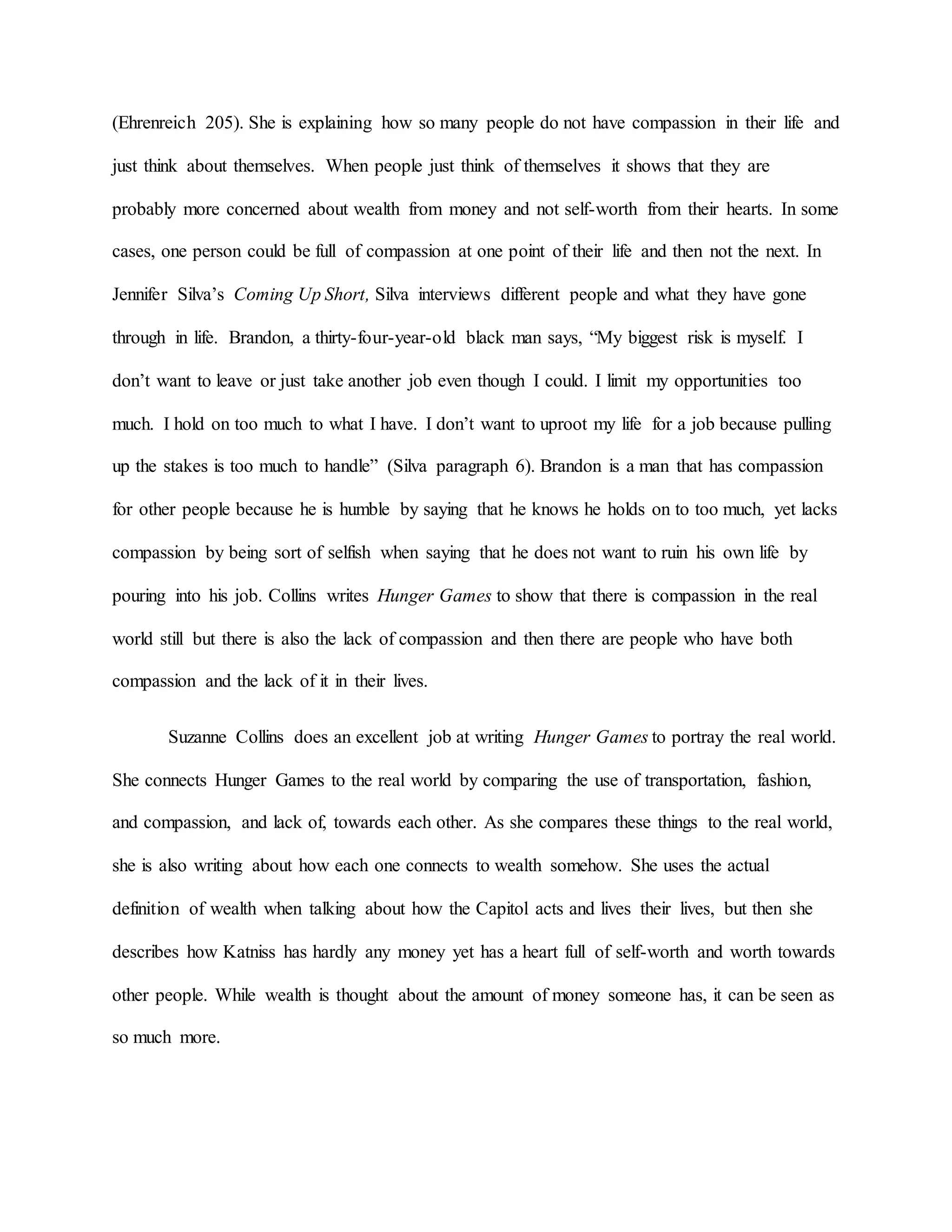
do it for publicity which is what Katniss thinks about the Capitol. Refer to figure 2a to see what
publicity of New York’s Fashion Week looks like. Katniss is used to dressing in the same thing
every day like multiple Americans. “Throughout Los Angeles public schools, thousands of
children struggle daily with a humbling consequence of poverty: inadequate clothing”
(articles.latimes.com). This article goes on to say that “About 72% of the district's 711,000
students come from families living in poverty. Although there are no records kept on how many
children lack proper clothing, officials estimate that at least half the students at the poorest
schools wear little more than rags or unwashed clothes because mom ran out of quarters at the
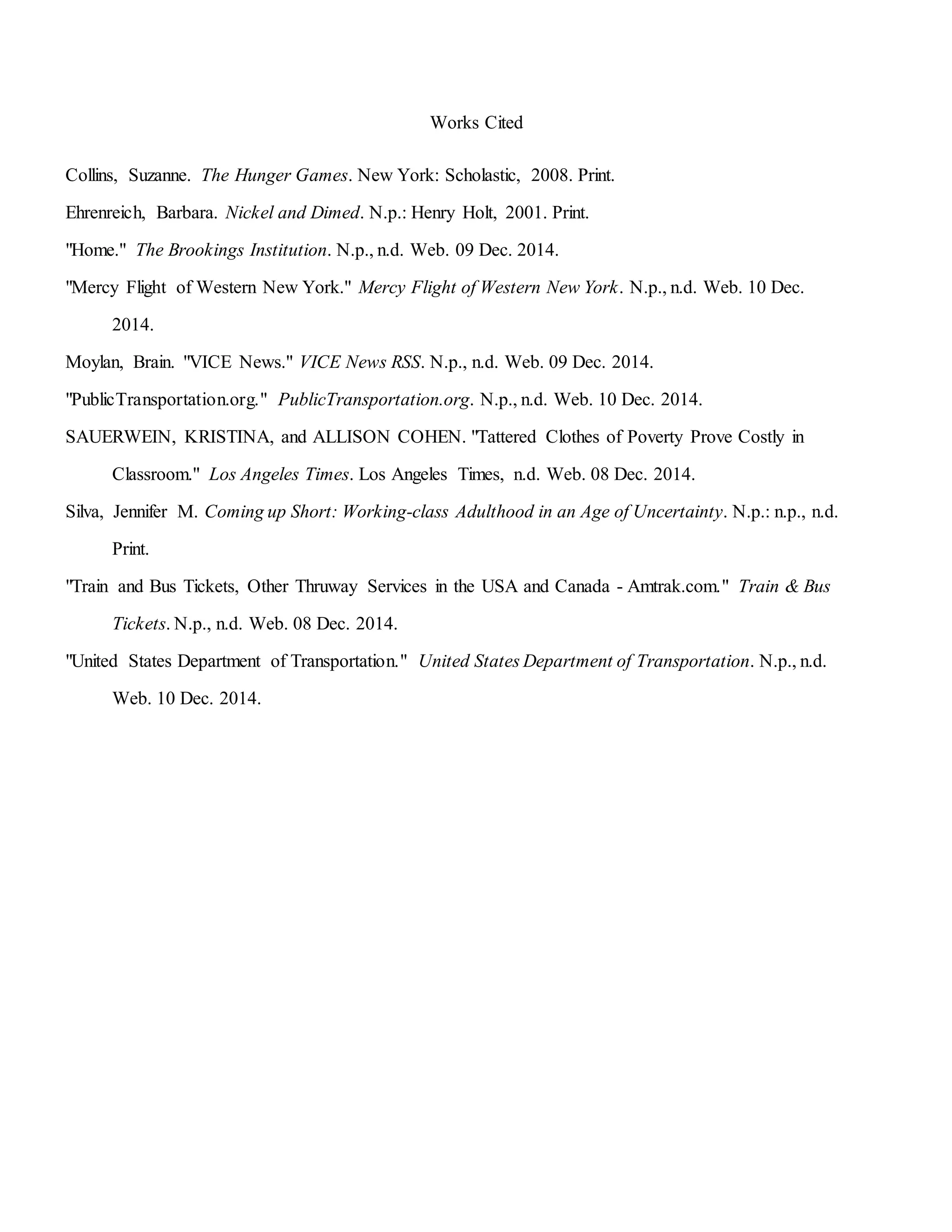
laundry.” Refer to figure 2b to see how Katniss and the children in the Las Angeles area compare
to each other. It is not the exact same but Katniss and the children have to wear the same clothes
every day until they can wash them or find something else to wear. Katniss and the children of
this school district do not have the proper clothing to wear, yet in the Capitol and New York,
they wear crazy clothing to draw attention to themselves and make it known they are from a
wealthier class. In the real world, there are people that struggle to clothe themselves and in the
Hunger Games there are too. Also, in the real world there are people who get paid for trying on
new clothes that will be never be worn and in Hunger Games, Collins depicts that as well when
writing about the people of the Capitol. Even though Katniss is not a fan of the Capitol and the
fashion there, she is compassionate towards people when she wants to be.
Katniss shows compassion and kindness many times in Hunger Games while the Capitol
and other Districts of Panem do not. This is much like the real world as there are evil people and
then people that restore faith in humanity. The first time Katniss shows a lot of compassion
towards someone is when she screams, “I volunteer! I volunteer as tribute!” (Collins 22). Katniss
volunteers as a tribute to go into the Games after her sister’s name was called. She shows an
incredible amount of love during this part of the book. She also shows compassion towards Rue,
another tribute in the Games, in the arena. Collins shows Katniss’s compassion towards Rue
from pages 200 through 213 and pages 229 through 238. Katniss takes Rue under her wing and
acts like a big sister towards her. They become allies and take care of each other. Katniss’s love
for Rue is really shown on page 237 when Collins writes, “I press the three middle fingers of my
left hand against my lips and hold them out in her direction.” This is a gesture Katniss makes
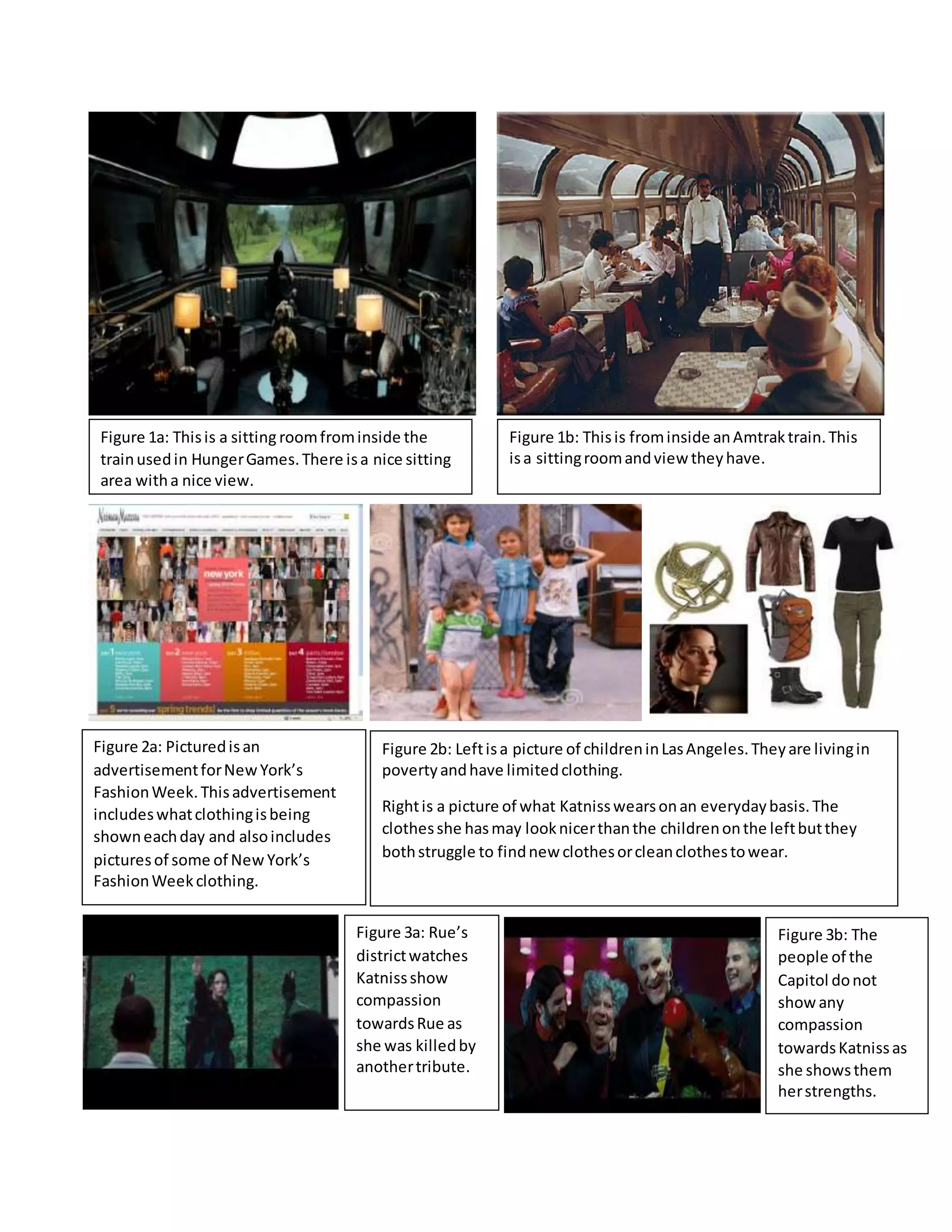
towards Rue’s home district to represent that she is sorry that Rue has died. Refer to figure 3a to
see how loving Katniss is towards Rue and her district. Katniss’s compassion towards other
people shows how wealthy Katniss is. Katniss is not wealthy by means of money, but she is
wealthy by means of actions and the worth she has towards others and herself. She was raised to
help other people and care for them. Seeing this love in her makes the Capitol like her because
she has a different kind of worth than other people. Even though the Capitol likes Katniss they
do not know like other people and do not treat the Districts very nicely. The Capitol is in charge
of the Games which makes them lack compassion towards people. The Games are where two
people from each of the twelve districts get chosen to fight until the death as entertainment for
the Capitol. “I turn to the Gamemakers. A few are nodding approval, but the majority of them are
fixated on a roast pig that has just arrived at their banquet table” (Collins 101). Refer to figure 3b
to see how the Capitol is acting when Katniss is shooting her arrows. Katniss describes her
frustration for the Capitol in this moment because the Capitol does not seem to care about
Katniss’s strengths or weakness that she will have in the Games. Katniss gets so mad at the
Capitol because they lack compassion when she has so much. These situations also happen in the
real world.
In Barbara Ehrenreich’s Nickel and Dimed, she writes “I was simply following the rules I
had laid down for myself at the beginning of the project and doing the best I could to hold each
job” (Ehrenreich 196). Ehrenreich is explaining how she had compassion to do what she needed
to do in certain circumstances. Not all people show compassion the way Katniss did and
Ehrenreich showed it by working her best at her job. Ehrenreich goes on to write, “I was baffled,
initially, by what seemed like a certain lack of get-up-and-go on the part of my fellow workers”
(Ehrenreich 205). She is explaining how so many people do not have compassion in their life and
just think about themselves. When people just think of themselves it shows that they are
probably more concerned about wealth from money and not self-worth from their hearts. In some
cases, one person could be full of compassion at one point of their life and then not the next. In
Jennifer Silva’s Coming Up Short, Silva interviews different people and what they have gone
through in life. Brandon, a thirty-four-year-old black man says, “My biggest risk is myself. I
don’t want to leave or just take another job even though I could. I limit my opportunities too
much. I hold on too much to what I have. I don’t want to uproot my life for a job because pulling
up the stakes is too much to handle” (Silva paragraph 6). Brandon is a man that has compassion
for other people because he is humble by saying that he knows he holds on to too much, yet lacks
compassion by being sort of selfish when saying that he does not want to ruin his own life by
pouring into his job. Collins writes Hunger Games to show that there is compassion in the real
world still but there is also the lack of compassion and then there are people who have both
compassion and the lack of it in their lives.
Suzanne Collins does an excellent job at writing Hunger Games to portray the real world.
She connects Hunger Games to the real world by comparing the use of transportation, fashion,
and compassion, and lack of, towards each other. As she compares these things to the real world,
she is also writing about how each one connects to wealth somehow. She uses the actual
definition of wealth when talking about how the Capitol acts and lives their lives, but then she
describes how Katniss has hardly any money yet has a heart full of self-worth and worth towards
other people. While wealth is thought about the amount of money someone has, it can be seen as
so much more.
Works Cited
Collins, Suzanne. The Hunger Games. New York: Scholastic, 2008. Print.
Ehrenreich, Barbara. Nickel and Dimed. N.p.: Henry Holt, 2001. Print.
"Home." The Brookings Institution. N.p., n.d. Web. 09 Dec. 2014.
"Mercy Flight of Western New York." Mercy Flight of Western New York. N.p., n.d. Web. 10 Dec.
2014.
Moylan, Brain. "VICE News." VICE News RSS. N.p., n.d. Web. 09 Dec. 2014.
"PublicTransportation.org." PublicTransportation.org. N.p., n.d. Web. 10 Dec. 2014.
SAUERWEIN, KRISTINA, and ALLISON COHEN. "Tattered Clothes of Poverty Prove Costly in
Classroom." Los Angeles Times. Los Angeles Times, n.d. Web. 08 Dec. 2014.
Silva, Jennifer M. Coming up Short: Working-class Adulthood in an Age of Uncertainty. N.p.: n.p., n.d.
Print.
"Train and Bus Tickets, Other Thruway Services in the USA and Canada - Amtrak.com." Train & Bus
Tickets. N.p., n.d. Web. 08 Dec. 2014.
"United States Department of Transportation." United States Department of Transportation. N.p., n.d.
Web. 10 Dec. 2014.
Figure 1a: Thisis a sitting roomfrominside the
trainusedin HungerGames.There isa nice sitting
area witha nice view.
Figure 1b: Thisis frominside anAmtraktrain.This
isa sittingroomandview theyhave.
Figure 2a: Picturedisan
advertisementforNewYork’s
FashionWeek.Thisadvertisement
includeswhatclothingisbeing
showneachday and alsoincludes
picturesof some of NewYork’s
FashionWeekclothing.
Figure 2b: Leftisa picture of childreninLasAngeles.Theyare livingin
povertyandhave limitedclothing.
Rightis a picture of what Katnisswearsonan everydaybasis.The
clothesshe hasmay looknicerthanthe childrenonthe leftbutthey
bothstruggle to findnew clothesorcleanclothestowear.
Figure 3a: Rue’s
districtwatches
Katnissshow
compassion
towardsRue as
she was killedby
anothertribute.
Figure 3b: The
people of the
Capitol donot
showany
compassion
towardsKatnissas
she showsthem
herstrengths.
Ellie Schafer
Annotated Bibliography-Project 3
Pfeffer, T. Fabian. Danzinger, Sheldon, and Schoeni, F. Robert. (2014) Wealth Levels, Wealthy,
Inequality, and The Great Recession. Print.
Grossmann, Igor., and Huynh, C. Alex. (2013) Where is the Culture in Social Class? Print.
Fasce, Ferdinando. (2002) An American Family, The Great War and Corporate Culture in
America. The Ohio State University Press. 2002. Print.
Pfeffer, T. Fabian. Danzinger, Sheldon, and Schoeni, F. Robert. (2014) Wealth Levels,
Wealthy, Inequality, and The Great Recession. Print.
This source is a scholarly peer review.
In this review, the authors, Fabian Pfeffer, Sheldon, Danzinger, and Robert Schoeni write about
the wealth levels of the United States before and after the Great Depression. They have done
many studies of the different wealth levels and who belongs in each level. The authors explain
what each wealth level was like before the Great Recession and if what it was at was good or not.
If the level was where it wasn’t supposed to be they would explain why and have lots of statistics
to back it up. After explaining what the levels were like and what they should have been like
before the Great Recession, they go on to explain what the Great Recession did to the wealth
levels. They explain that some levels didn’t change and others changed drastically. They also
write and explain how get certain levels the way they should be and how that will affect the
country and other wealth levels. They conclude by saying that all levels have changed somehow
and continue to change at extremely different rates.
I came upon this review and knew that it was going to be a good source for my paper because it
links both, the Great Recession and Social Class, together and in one article. This is good
because my paper if focusing on if and how the Great Recession had anything to do with how my
four pieces of work are written. The number one concern while reading this article is that it
referred to things called wealth levels. I am not sure if wealth levels and social classes are the
same thing or not so I need to do some more research on that.
Grossmann, Igor., and Huynh, C. Alex. (2013) Where is the Culture in Social Class? Print.
This source is a scholarly peer review.
This writing is full of great information that deals a lot with social classes and the different
between them. The author’s bluntly say that social class is alive and striving which can be
arguable. They believe that social class is very important because it affects the way people act
and how people perceive other people. They do a very good job and describing what each class is
like and what it means to be a part of that class and what the people of that class think and act
like. They give a really good example of 2 girls working on a group project together. One of the
girls is from the upper class and one is from the lower. They then go on to say what each girl is
thinking about the other girl. The authors also don’t just focus on the United States. They
compare the US and Russia when dealing with social classes and how the two countries view
them. In conclusion, the authors reassure us that they believe in social class and say that social
rank it alive also.
I found this source very useful after reading the whole thing through. I thought the example of
the girls working on a group project was very useful and helped me dig deeper into realizing
what people from each class are thinking. The example opened my eyes and made me think the
way they explained it was right and made me pretend to be in that position. I thought of it as I
was in the lower class and what I would thinking working with a girl in the upper class and vice
versa. I also really liked the way they worded things because they backed all their information up
with evidence and was really clear what they thought in a very persuasive way.
Fasce, Ferdinando. (2002) An American Family, The Great War and Corporate Culture in
America. The Ohio State University Press. 2002. Print.
This source is a book.
This book was published in 2002 but is written about the early 1900s. Focusing in on section 5 of
Chapter 1, the author talks about workers and the middle class. He describes what the classes are
like during that time and what people from those classes are thinking about life. He talks about
the Citizens’ Alliance being formed which included lots of the lower and middle class to the
business class. The Alliance was made in order to focus on the quiet people of the lower and
middle class so they could express themselves. This section of the book goes on to explain how
and if the alliance worked and basically talked more about how the classes changed.
I don’t think this book will help me as much as a thought it would. I came upon it on the library
catalog and thought it would be really useful and informative. I don’t think I realized how old it
was until I started working on this annotated bibliography. It is a little dated and doesn’t really
focus on what I would like to focus on in my paper. I’m not saying that I won’t use it at all,
because it does have some information from before the Great Recession I could talk about, but it
won’t be one of the pieces I use to back up my major claims.
Proposal
What is the primary research question driving your inquiry? Why is it an interesting,
problematic, a significant question?
I find social class very interesting. Because I am interested in social class, I thought it would be
really good to write my paper over it. I know that I can find evidence for both sides. Those both
sides would be if social class actually exists or if society makes it up. I also know that the pieces
I want to work with all deal with social class somehow, whether that be the use of social class or
lack of social class. I think that social class is problematic because it tends to define people and it
shouldn’t. I think that social class is a thing but at the same time there needs to be more specific
classes I believe.
What is the context? Is there a “They Say”? Who is invested in this question? What
academic disciplines might appreciate this research? What methods do these disciplines
typically use? What are the intended consequences of your intervention?
I think almost every American (other countries too but in this case just America) deals with the
question of what social class is and why it is a thing. The context is all around us. How people
act and how people dress could be context. If someone dresses sloppy people automatically
assume that they are from the lower class and the vice versa. I think that anyone dealing with
economy or banking would appreciate this research because that would explain to them what
social class is, if it is a real thing, and what defines each class. I am confused on the last couple
questions but I think that the intent of my research and intervention is to prove if social classes
are a real thing or not and if they are what defines them and if they have changed since the great
recession.
What kinds of research will you pursue? What resources will you consult? Will you
conduct any fieldwork? Will you perform your own close reading of a text we’ve read in
class? What other text (fiction, film, or any other genre…I’ve had students successfully
analyze videogames, narrative nonfiction, and television commercials, for example) might
you choose to analyze?
I have already research 2 peer reviews and a book from the library that I think will help learn
more about social classes and more about if they have changed after the great recession. I want to
know more about social class and what defines each and learn what the great recession exactly
was and how/if social classes affected it. I also have to read over Broke USA and Coming Up
Short. I have a pretty solid feeling of what the Hunger Games and Snowpiercer but definitely
need to review the others. I think that watching the movie Hunger Games would help analyze
social classes more because it gives social class a visual of how they actually are.
What is our working thesis? Make sure that there are two STRONG opposing sides.
The argument of the pieces Snowpiercer, Hunger Games, Coming Up Short, and Broke USA is if
they are written to reflect the Great Recession or not. I do/don’t believe that they are because of
the use/lack of social class rankings.
The opposing sides are 1) there are social classes in each of these texts that are put in the pieces
to reflect the great recession because of the use of social class rankings. 2) social classes are not
present in these pieces and the great recession had no effect on them.
What types of claims and evidence will support this thesis?
The pieces that I am arguing will be involved in my evidence and also the research I do on the
library website and online.
What challenges do you anticipate? What counter arguments will you have to consider?
I anticipate not finding enough support for my claims and I fear that my arguments won’t be
strong enough. I have to consider obviously the opposite of my argument like stated above.
Analysis Paper-Project 2
“May the odds be ever in your favor” (Collins 19). This quote describes both the Hunger
Games and Snowpiercer perfectly. In these texts there is a constant battle between the lower and
upper class and which one will have the “favor” in the end. Hunger Games is a novel about a
young girl and boy, from the lower class of District 12 who have to literally fight for their lives
while the upper class of the Capitol watches. Snowpiercer is a movie about a community of
people living in the back of a train, a lower class state, pushing their way to the front of the train
to gain the same advantages the upper class has. These pieces have a similar idea to them but use
diverse ways to display the similarity. Hunger Games by Suzanne Collins and Snowpiercer
directed by Bong Joon-Ho claim that the lower class and the upper class are treated differently
by displaying contrasting color schemes to represent each class and by having a varied
availability of resources, but in the end the lower class defeats the upper class.
Hunger Games by Suzanne Collins is a book that has different plot lines throughout the
text. At the beginning of the text Collins introduces the main characters: Katniss, Gale, Effie,
Haymitch and Peeta who all play a pretty big part in Katniss’ life. Collins also describes the
setting that Katniss, Gale, and Peeta live in. They live in District 12 which is a lower class
district which is dark and dreary. The district is financially unstable and keeps people from
having jobs. In order to gain money and fame for different districts The Games are held. The
Games is an event that involves 12 districts with 2 people, a girl and a boy, from each district.
Effie and Haymitch are a big part of the games for Katniss. Effie is District 12’s leader when it
comes to the Games and Haymitch is someone who has survived The Games in the past. They
both come into play when Katniss and Peeta are selected to participate in The Games. The
Games is also a plot line in the Hunger Games. During The Games, Katniss and Peeta fight for
their lives in hopes to become the last standing. In the end, Katniss and Peeta end up winning
which is a huge success for such a low-income district. Just like Katniss and Peeta are the
underdogs in The Games, the movie Snowpiercer results in the people living in poverty ending
up making their way to the upper class.
Snowpiercer, directed by Bong Joon-Ho is a movie that has a major plot with different
setting in that plot. The settings are different cars on a train, moving for the back of the train to
the front of the train. The train is home to many people and they are not allowed to leave it
because the outside world has frozen over. The movie begins with introducing some main
characters that live in the back of the train where it is dark and dirty. These characters are Curtis,
Tanya, Mr. Gillium, and Edgar. They live in poverty and are treated with disrespect. They were
tired of being treated unfairly and wanted to get to the front of the train, where people were
living high class, to put an end to it. As they moved from car to car they discovered something
new each time. They discovered the room their food was coming from, a water car, a classroom
with children, a party car, and then they finally made it to the head of the train. While making
their way to the front of the train, the people at the head of the train, Minister Mason, Franco the
Elder, and Wilford, were trying to keep them in the back of the train. Many different fights
happened while trying to make it to the front of the train and lives were lost but in the end, the
people living in lower class ended up controlling the original leaders of the train. Both of the
pieces are dealing with people of the lower class fighting their way to be in the upper class while
giving the audience a sense of how the classes are different by using a distinct color scheme and
showing what resources each class has.
Hunger Games and Snowpiercer both have very noticeable color schemes to describe the
different classes. The lower class tends to have darker colors that appear to be more gloomy and
sad, and the upper class tends to have brighter colors that express that scene or people to be
living in a financially sound place. Collins starts out Hunger Games by explaining how Katniss
has only enough light to see her mother and sister sleeping in her room (Collins 3). Collins goes
on to explain that District 12 is known for their coal mines. She describes how people have to
scrub coal dust out of their nails and how the streets are black and empty (Collins 4). The start of
Snowpiercer is also dark. The movie begins in the back of the train where everyone is wearing
dark, baggy clothes that are dirty. The car they are in is also dark and hardly has a working light.
Moving towards the front of the train, they next few cars were also dark. They didn’t have lights
and looked like they were hardly ever cleaned. Seeing the dark scenes in both pieces make the
audience feels bad for the people living in poverty which is considered pathos or the appeal to
emotion. The dark scenes were shown when the lower class was being explained, but the colorful
scenes were shown when the upper class was introduced.
The colorful scenes in Hunger Games appeared when Effie arrived in District 12 for the
Games introduction. She is from the Capitol and had a white grin, pinkish hair and a spring green
suit (Collins 18). Color appears again in Hunger Games as Collins describes what people of the
Capitol look like. They are dressed oddly with crazy hair and painted faces. According to Katniss
“All the colors seems artificial, the pinks too deep, the greens too bright, the yellow’s painful to
the eyes...” (Collins 59) In Snowpiercer color appears during the beginning of the movie when
the camera is in the back of the train and Minister Mason comes in wearing a yellow coat (Joon-
Ho). This shows right away that there is a distinguished color scheme in the train. The back of
the train is the lower class and the front of the train is considered upper class. Also during
Snowpiercer while Curtis, Tanya, Mr. Gillium, and Edgar are moving towards the front of the
train they run into many cars with bright colors. There is a car that has a classroom in it where
everything is colored, the walls are yellow and the students are wearing all kinds of colored
clothes (Joon-Ho). In these examples from both pieces it is visible that the lower class wears
darker and lives in dirty places while the upper class wears bright clothes and lives in light
places. Not only does the color scheme show the contrast between classes but so does the
resources available to them.
The availability of resources such as food and furnishings are also differed between
classes in Hunger Games and Snowpiercer. In Hunger Games, Collins writes that Katniss had to
go out and find food in the woods for her family (Collins 4). She also describes that pretty much
the only job in District 12 is a coal miner which do not make a lot of money and cannot really
afford much food. District 12 also has poor living facilities. Katniss describes that her bed is just
a rough canvas over a mattress (Collins 1). The end of the train in Snowpiercer had to deal with
this problem too. The people of the lower class were given protein bars to each that were made
out of bugs (Joon-Ho). Protein bars are pretty much the only thing that the end of the train is
given. The Capitol of Hunger Games had the very opposite of Katniss. They had more food than
they knew what to do with. Katniss describes it as, “The supper comes in courses. A think carrot
soup, green salad, lamb chops and mashed potatoes, cheese and fruit, a chocolate cake” (Collins
44). She also says that the train Peeta and her rode in to get to the Capitol had fancier rooms than
one building in her district. The car on the train has a bedroom, dressing room, and a private
bathroom (Collins 46). There is definitely differences in the resources available for the different
classes. In Snowpiercer, the front of the train had fine dining and more accessories that dealt with
electronic operation. Even though the lower classes do not have much to them they always seems
to end out winning the fight.
As said in the summaries both pieces, Hunger Games and Snowpiercer, have a lower
class and an upper class in them. Katniss, from District 12, has to go find her own food in the
woods and lives in a very dirty and dark place while the back of the train in Snowpiercer also
lives in the a gloomy place and is only given protein bars for food made of bugs. Those are
considered lower classes and the Capitol and front of the train are considered upper classes. The
Capitol in Hunger Games has exuberantly colored clothes and all the food imaginable while the
front of the train in Snowpiercer also has brightly colored scenes and clothing and fine dining
food. Having good food and nice furnishings does not mean that they are better than the lower
class by any means. In Hunger Games Katniss and Peeta fight for their lives in the Games and
end up winning and beating out people from District 1 or 2. Curtis, from Snowpiercer, ends up
making his way all the way to the front of the train and gets the access to run the engine of the
train. Even though most people would assume the upper class wins the battle because of their
financial status or label they are wrong because in this case both lower classes won the battle and
got what they wanted and deserved.
Suzanne Collins’ Hunger Games and Bong Joon-Ho’s Snowpiercer claim that the lower
and upper classes are treated differently. The audience can tell they are treated differently
because of the way the authors present the color scheme and availability of resources. Both
authors also have the lower class beat the upper class in two major battles. The lower class is
represented by being displayed with dark colors and a dirty setting, but the upper class has really
bright colors with a light setting. The lower class also has a limited amount of resources while
the upper class has pretty much anything they need. These pieces explain that sometimes they
odds are in the lower classes favor.
Works Cited
Collins, Suzanne. Hunger Games. New York: Scholastic, 2008
Print
Snowpiercer. Dir. Bong Joon-Ho. Moho Films. 2014
Film
Summaries-Project 1
Jonathan Swift’s, “A Modest Proposal”
Jonathan Swift’s, A Modest Proposal, suggests changing the laws in Ireland
to help decrease overpopulation during the eighteenth century. Using satire, Swift
declares that something needs to be done about the overpopulation problem. Swift
writes, “...it is exactly at one year old that I propose to provide for them in such a
manner as instead of being a charge upon their parents or the parish, or wanting
food and raiment for the rest of their lives, they shall on the contrary contribute to
the feeding, and partly to the clothing, of the thousands” (2462).
Swift proposes that in order to decrease population size, parents should sell
their children to be eaten. Women are being told that there are too many children in
the country but are also being told there are too many abortions happening and
murdering their children is horrid. Instead of killing their children, born or unborn,
they are supposed to raise their babies until one year old then sell them to benefit
the community and themselves. Swift says that “…a young healthy child well
nursed is at a year old a most delicious, nourishing, and wholesome food, whether
stewed, roasted, baked, or boiled…” (2464). Families who raise their baby to the
best of their ability can help themselves out by receiving money to pay for food,
rent, and living expenses. These families also serve the community by making food
available all year round and bringing new people into town. Selling babies not only
contributes to families and communities, it also helps keep down the number of
Catholics.
Swift lists a number of positives to selling babies to be eaten and at the top
of that list is decreasing the number of Catholics. Swifts writes, “…it would greatly
lessen the number of Papists, with who we are yearly overrun, being the principal
breeders of the nation as well as our most dangerous enemies…” (2466) Swift is
trying to suggest that there are too many Catholics and the number of them is
constantly growing. Selling babies would cut this number down by not having as
many grow up to be Catholic and then having them have their own babies. He says
that Catholics are the “most dangerous enemy” because they keep growing and that
is bad for the overpopulation situation. Swift says that Protestants are better than
Catholics because Protestants choose to leave home and serve the Episcopal C hurch
when Catholics just stay home. Eating babies would help save Ireland from growing
in Catholic faith.
Swift also addresses how selling babies for profit can benefit the marriage
between a man and a woman. He writes, “Men would become more fond of their
wives during the time of their pregnancy as they are now of their mares of foal,
their cows in calf, or sows when they are ready to farrow…” (2466) Men will
respect their wives when they are pregnant because they know that they will be
getting a profit in a little over a year. Swift really stresses the importance of selling
babies for profit for families. Even though this piece is written with satire, Swift is
expressing the problem of overpopulation and how it could be fixed.
Using satire, in Jonathan Swift’s, A Modest Proposal, he focuses on an
overpopulation problem and suggest the solution of killing babies and eating them.
Swift believes that there are too many people in Ireland and wants to cut down the
community beneficially. He says, “…it is exactly at one year old that I propose to
provide for them in such a manner as instead of being a charge upon their parents or
the parish, or wanting food and raiment for the rest of their lives, they shall on the
contrary contribute to the feeding…” (2462) He thinks that children are a burden to
the parents so when they are a year old they are to be sold and eaten. Selling a
family’s child is helpful to the parents because it brings in an income but it is also a
positive outcome for the community because it provides food for everyone the
whole year. Swift proposes eating babies as a financial benefit for everyone in the
community.
A Modest Proposal, written by Jonathan Swift is a satirical suggestion of
raising babies until they are a year old to then be sold and eaten for profit for
families and communities due to the overpopulation problem in Ireland.
In Kevin Roose’s, I Crashed a Wall Street Secret Society, he writes about
how he sneaks into a secret fraternity meeting and starts taking notes about what
they are talking about. He gets caught in the meeting and escorted out to realize that
people of the upper class have separated themselves from reality and that the
fraternity was a group based on fear. This leads to him explaining his book, Young
Money. “As part of my research for my book, Young Money, I’d been investigating
the lives of young Wall Street bankers-the 22-year-olds toiling at the bottom of the
financial sector’s food chain.” After interviewing these 22-year-olds he found out
that they were struggling because they didn’t want to end up like the upper class
who had separated themselves from the outside world. The 22-year-olds wanted to
live the life they were already living and didn’t want to change who they were.
I Crashed a Wall Street Secret Society by Kevin Roose is a piece written to
describe and scrutinize the way the upper class acts within a fraternity and the
public.
Kevin Roose’s, I Crashed a Wall Street Secret Society, is focused in on
looking deeply at the upper class. Roose writes about how he attends a secret
fraternity meeting that no one is supposed know about and observed what was going
on the whole time. After taking notes at this meeting, interrogating people, and
analyzing this information, Roose works on writing his own book, Young Money.
Roose was interested in learning about and observing different classes of
society and wrote, “So when I learned when and where Kappa Beta Phi’s annual
dinner was being held, I knew I needed to try to go.” He was nervous about being
able to sneak into the meeting but said it was fairly easy which, to him, was a relief.
As he was found his way to the meeting he didn’t want to look suspicious so he
avoided talking to anyone and got on his phone. The meeting began and he started
to observe what was going on and who was there. Roose writes, “For eight decades,
it worked. No outsiders in living memory had witnessed the entire proceedings
firsthand.” No one had ever snuck in before but when the fraternity realized that
Roose did they were not happy. “’Who the hell are you?’ Novogratz demanded. I
felt my pulse spike. I was tempted to make a run for it, but – due to ethics code of
the New York Time, my then-employer – I had no choice but to out myself.” Roose
had been caught and was escorted out. While he was in there though, he observed
what upper class society was like.
After being kicked out of the secret fraternity meeting Roose realized two
things; upper class people have separated themselves from reality completely and
that the fraternity, as a group, is a fear-based organization. As Roose started to
write Young Money he interview 22-year-olds that just started working on Wall
Street. Interviewing 22-year-olds helped Roose realized the difference between
younger people’s minds and how selfish the upper class really is.

Final Final Final

  • 1.
    Ellie Schafer December 7,2014 Final Project-Project 4 Wealth; an abundance of valuable possessions or money. What does it mean to be wealthy? Does it mean you have a lot of money? Or does wealth come from personal satisfaction? In Suzanne Collins’ Hunger Games, wealth has a multitude of meanings. Wealth in Hunger Games has a lot of meanings but it also does in the real world. Collins writes Hunger Games to portray the real world and what it means to be wealthy in it. Collins does this by using the examples of transportation, fashion, and people’s compassion, or lack of, towards one another. Transportation can mean a million different things from walking, riding a bike, driving a car, taking public buses, planes, or trains, but in the Hunger Games, Collins uses trains as the main mode of transportation. “Of course, I’ve never been on a train, as travel between the districts is forbidden except for officially sanctioned duties. For us, that’s mainly transporting coal. But this is no ordinary coal train. It’s one of the high-speed Capitol models that averages 250 miles per hour. Our journey to the Capitol will take less than a day” (Collins 41). Katniss is riding on a Capitol train and she is very impressed because usually travel on trains is forbidden. The Capitol is considered wealthy because they have own the train that is really rare to ride. It is also uncommon to ride trains in the United States. Daily, on average, 274.5 million people drive to work (brookings.edu), 35 million people take public transportation (publictransportation.org), 1.73 million people fly (Bureau of Transportation Statistics), and only 86,000 people ride trains (Amtrak.com). Looking at these statistics, the lowest number is the people who ride trains just like how riding trains in Hunger Games is also low. Katniss goes on to describe the train as “The tribute train is fancier than even the room in the Justice Buildings. We are given our own
  • 2.
    chambers that havea bedroom, a dressing area, and a private bathroom with hot and cold running water. We don’t have hot water at home, unless we boil it” (Collins 42). Katniss is amazed by how nice the train is and the accommodations of it. Refer to figure 1a to see what a sitting car of the Hunger Games’ train looks like. Amtrak trains also include many different features and to see what a sitting car looks like refer to figure 1b. Looking at these figures, it shows that the trains are similar but also different which is understandable. Collins does not only use trains as a mode of transportation but she also uses hovercrafts. Hovercrafts in Hunger Games are used to retrieve the tributes that have been killed in the arena of the Games. “High above the dying campfire a hovercraft materializes. A set of large metal teeth drops down. Slowly, gently, the dead tribute girl is lifted into the hovercraft. Then it vanishes” (Collins 163). Katniss is in the Games when she describes how the hovercraft comes to get people that have died fighting for their lives. The United States also uses air modes of transportation. Planes and helicopters are what most Americans would think of when thinking of air transportation. Helicopters and hovercrafts are similar because hovercrafts pick up dead people out of the arena and helicopters pick up people that are in intensive care and are practically dying. In the Great War, the first helicopter was used to fly soldiers from the battlefield to the hospital (mercyflight.org). The battle field of the Great War can be looked at as the Games in Hunger Games. Collins writes about hovercrafts to represent how wealthy, in terms of money, the Capitol is. In the real world, Americans also have to have a decent amount of money to afford to ride in the helicopter. Transportation in Hunger Games and the real world is fairly similar but so is the fashion. The definition of fashion and the actual appearance of fashion can be perceived as totally different. In Hunger Games, Collins represents the lower income districts’ fashion as poverty in
  • 3.
    the real worldand she represents the Capitol’s fashion as the wealthier people of the real world. “I swing my legs off the bed and slide into my hunting boots. Supple leather that has molded to my feet. I pull on trousers, a shirt, tuck my long dark braid up into a cap, and grab my forage bag” (Collins 4). Katniss’ fashion is not fancy or posh compared to the Capitol’s fashion. Katniss describes some of the Capitol’s fashion as “…fresh from the Capitol with her scary white grin, pinkish hair, and spring green suit” (Collins 18). Coming from a low income district, Katniss does not like the appearance of the Capitol’s fashion. She is used to District 12 looking dark with men and women having hunched shoulders, swollen ankles. They have nails that have been broken from trying to scrub the coal dust off of them (Collins 4). The people of the Capitol dress very exuberant and colorful. Katniss is being prepared for the introduction of her and Peeta in front of the Capitol and she describes the woman prepping her as “a woman with aqua hair and gold tattoos above her eyebrows” (Collins 61). Katniss is shocked by what the people of the Capitol look like but so do real world people of the lower income looking at the fashion of the high income. Not only does Katniss find high end fashion a little overwhelming, so does Brian Moylan, a writer and pop culture junkie. Moylan writes, “…the growing idea that Fashion Week is a spectator sport that should be open to everyone with an Instagram account and a subscription to Vogue is baffling to me” (vice.com). Moylan is explaining that he thinks that fashion is becoming a sport and people only do it for publicity which is what Katniss thinks about the Capitol. Refer to figure 2a to see what publicity of New York’s Fashion Week looks like. Katniss is used to dressing in the same thing every day like multiple Americans. “Throughout Los Angeles public schools, thousands of children struggle daily with a humbling consequence of poverty: inadequate clothing” (articles.latimes.com). This article goes on to say that “About 72% of the district's 711,000
  • 4.
    students come fromfamilies living in poverty. Although there are no records kept on how many children lack proper clothing, officials estimate that at least half the students at the poorest schools wear little more than rags or unwashed clothes because mom ran out of quarters at the laundry.” Refer to figure 2b to see how Katniss and the children in the Las Angeles area compare to each other. It is not the exact same but Katniss and the children have to wear the same clothes every day until they can wash them or find something else to wear. Katniss and the children of this school district do not have the proper clothing to wear, yet in the Capitol and New York, they wear crazy clothing to draw attention to themselves and make it known they are from a wealthier class. In the real world, there are people that struggle to clothe themselves and in the Hunger Games there are too. Also, in the real world there are people who get paid for trying on new clothes that will be never be worn and in Hunger Games, Collins depicts that as well when writing about the people of the Capitol. Even though Katniss is not a fan of the Capitol and the fashion there, she is compassionate towards people when she wants to be. Katniss shows compassion and kindness many times in Hunger Games while the Capitol and other Districts of Panem do not. This is much like the real world as there are evil people and then people that restore faith in humanity. The first time Katniss shows a lot of compassion towards someone is when she screams, “I volunteer! I volunteer as tribute!” (Collins 22). Katniss volunteers as a tribute to go into the Games after her sister’s name was called. She shows an incredible amount of love during this part of the book. She also shows compassion towards Rue, another tribute in the Games, in the arena. Collins shows Katniss’s compassion towards Rue from pages 200 through 213 and pages 229 through 238. Katniss takes Rue under her wing and acts like a big sister towards her. They become allies and take care of each other. Katniss’s love for Rue is really shown on page 237 when Collins writes, “I press the three middle fingers of my
  • 5.
    left hand againstmy lips and hold them out in her direction.” This is a gesture Katniss makes towards Rue’s home district to represent that she is sorry that Rue has died. Refer to figure 3a to see how loving Katniss is towards Rue and her district. Katniss’s compassion towards other people shows how wealthy Katniss is. Katniss is not wealthy by means of money, but she is wealthy by means of actions and the worth she has towards others and herself. She was raised to help other people and care for them. Seeing this love in her makes the Capitol like her because she has a different kind of worth than other people. Even though the Capitol likes Katniss they do not know like other people and do not treat the Districts very nicely. The Capitol is in charge of the Games which makes them lack compassion towards people. The Games are where two people from each of the twelve districts get chosen to fight until the death as entertainment for the Capitol. “I turn to the Gamemakers. A few are nodding approval, but the majority of them are fixated on a roast pig that has just arrived at their banquet table” (Collins 101). Refer to figure 3b to see how the Capitol is acting when Katniss is shooting her arrows. Katniss describes her frustration for the Capitol in this moment because the Capitol does not seem to care about Katniss’s strengths or weakness that she will have in the Games. Katniss gets so mad at the Capitol because they lack compassion when she has so much. These situations also happen in the real world. In Barbara Ehrenreich’s Nickel and Dimed, she writes “I was simply following the rules I had laid down for myself at the beginning of the project and doing the best I could to hold each job” (Ehrenreich 196). Ehrenreich is explaining how she had compassion to do what she needed to do in certain circumstances. Not all people show compassion the way Katniss did and Ehrenreich showed it by working her best at her job. Ehrenreich goes on to write, “I was baffled, initially, by what seemed like a certain lack of get-up-and-go on the part of my fellow workers”
  • 6.
    (Ehrenreich 205). Sheis explaining how so many people do not have compassion in their life and just think about themselves. When people just think of themselves it shows that they are probably more concerned about wealth from money and not self-worth from their hearts. In some cases, one person could be full of compassion at one point of their life and then not the next. In Jennifer Silva’s Coming Up Short, Silva interviews different people and what they have gone through in life. Brandon, a thirty-four-year-old black man says, “My biggest risk is myself. I don’t want to leave or just take another job even though I could. I limit my opportunities too much. I hold on too much to what I have. I don’t want to uproot my life for a job because pulling up the stakes is too much to handle” (Silva paragraph 6). Brandon is a man that has compassion for other people because he is humble by saying that he knows he holds on to too much, yet lacks compassion by being sort of selfish when saying that he does not want to ruin his own life by pouring into his job. Collins writes Hunger Games to show that there is compassion in the real world still but there is also the lack of compassion and then there are people who have both compassion and the lack of it in their lives. Suzanne Collins does an excellent job at writing Hunger Games to portray the real world. She connects Hunger Games to the real world by comparing the use of transportation, fashion, and compassion, and lack of, towards each other. As she compares these things to the real world, she is also writing about how each one connects to wealth somehow. She uses the actual definition of wealth when talking about how the Capitol acts and lives their lives, but then she describes how Katniss has hardly any money yet has a heart full of self-worth and worth towards other people. While wealth is thought about the amount of money someone has, it can be seen as so much more.
  • 7.
    Works Cited Collins, Suzanne.The Hunger Games. New York: Scholastic, 2008. Print. Ehrenreich, Barbara. Nickel and Dimed. N.p.: Henry Holt, 2001. Print. "Home." The Brookings Institution. N.p., n.d. Web. 09 Dec. 2014. "Mercy Flight of Western New York." Mercy Flight of Western New York. N.p., n.d. Web. 10 Dec. 2014. Moylan, Brain. "VICE News." VICE News RSS. N.p., n.d. Web. 09 Dec. 2014. "PublicTransportation.org." PublicTransportation.org. N.p., n.d. Web. 10 Dec. 2014. SAUERWEIN, KRISTINA, and ALLISON COHEN. "Tattered Clothes of Poverty Prove Costly in Classroom." Los Angeles Times. Los Angeles Times, n.d. Web. 08 Dec. 2014. Silva, Jennifer M. Coming up Short: Working-class Adulthood in an Age of Uncertainty. N.p.: n.p., n.d. Print. "Train and Bus Tickets, Other Thruway Services in the USA and Canada - Amtrak.com." Train & Bus Tickets. N.p., n.d. Web. 08 Dec. 2014. "United States Department of Transportation." United States Department of Transportation. N.p., n.d. Web. 10 Dec. 2014.
  • 8.
    Figure 1a: Thisisa sitting roomfrominside the trainusedin HungerGames.There isa nice sitting area witha nice view. Figure 1b: Thisis frominside anAmtraktrain.This isa sittingroomandview theyhave. Figure 2a: Picturedisan advertisementforNewYork’s FashionWeek.Thisadvertisement includeswhatclothingisbeing showneachday and alsoincludes picturesof some of NewYork’s FashionWeekclothing. Figure 2b: Leftisa picture of childreninLasAngeles.Theyare livingin povertyandhave limitedclothing. Rightis a picture of what Katnisswearsonan everydaybasis.The clothesshe hasmay looknicerthanthe childrenonthe leftbutthey bothstruggle to findnew clothesorcleanclothestowear. Figure 3a: Rue’s districtwatches Katnissshow compassion towardsRue as she was killedby anothertribute. Figure 3b: The people of the Capitol donot showany compassion towardsKatnissas she showsthem herstrengths.
  • 9.
    Ellie Schafer Annotated Bibliography-Project3 Pfeffer, T. Fabian. Danzinger, Sheldon, and Schoeni, F. Robert. (2014) Wealth Levels, Wealthy, Inequality, and The Great Recession. Print. Grossmann, Igor., and Huynh, C. Alex. (2013) Where is the Culture in Social Class? Print. Fasce, Ferdinando. (2002) An American Family, The Great War and Corporate Culture in America. The Ohio State University Press. 2002. Print. Pfeffer, T. Fabian. Danzinger, Sheldon, and Schoeni, F. Robert. (2014) Wealth Levels, Wealthy, Inequality, and The Great Recession. Print. This source is a scholarly peer review. In this review, the authors, Fabian Pfeffer, Sheldon, Danzinger, and Robert Schoeni write about the wealth levels of the United States before and after the Great Depression. They have done many studies of the different wealth levels and who belongs in each level. The authors explain what each wealth level was like before the Great Recession and if what it was at was good or not. If the level was where it wasn’t supposed to be they would explain why and have lots of statistics to back it up. After explaining what the levels were like and what they should have been like before the Great Recession, they go on to explain what the Great Recession did to the wealth levels. They explain that some levels didn’t change and others changed drastically. They also write and explain how get certain levels the way they should be and how that will affect the country and other wealth levels. They conclude by saying that all levels have changed somehow and continue to change at extremely different rates. I came upon this review and knew that it was going to be a good source for my paper because it links both, the Great Recession and Social Class, together and in one article. This is good because my paper if focusing on if and how the Great Recession had anything to do with how my four pieces of work are written. The number one concern while reading this article is that it referred to things called wealth levels. I am not sure if wealth levels and social classes are the same thing or not so I need to do some more research on that. Grossmann, Igor., and Huynh, C. Alex. (2013) Where is the Culture in Social Class? Print. This source is a scholarly peer review. This writing is full of great information that deals a lot with social classes and the different between them. The author’s bluntly say that social class is alive and striving which can be arguable. They believe that social class is very important because it affects the way people act and how people perceive other people. They do a very good job and describing what each class is like and what it means to be a part of that class and what the people of that class think and act like. They give a really good example of 2 girls working on a group project together. One of the girls is from the upper class and one is from the lower. They then go on to say what each girl is
  • 10.
    thinking about theother girl. The authors also don’t just focus on the United States. They compare the US and Russia when dealing with social classes and how the two countries view them. In conclusion, the authors reassure us that they believe in social class and say that social rank it alive also. I found this source very useful after reading the whole thing through. I thought the example of the girls working on a group project was very useful and helped me dig deeper into realizing what people from each class are thinking. The example opened my eyes and made me think the way they explained it was right and made me pretend to be in that position. I thought of it as I was in the lower class and what I would thinking working with a girl in the upper class and vice versa. I also really liked the way they worded things because they backed all their information up with evidence and was really clear what they thought in a very persuasive way. Fasce, Ferdinando. (2002) An American Family, The Great War and Corporate Culture in America. The Ohio State University Press. 2002. Print. This source is a book. This book was published in 2002 but is written about the early 1900s. Focusing in on section 5 of Chapter 1, the author talks about workers and the middle class. He describes what the classes are like during that time and what people from those classes are thinking about life. He talks about the Citizens’ Alliance being formed which included lots of the lower and middle class to the business class. The Alliance was made in order to focus on the quiet people of the lower and middle class so they could express themselves. This section of the book goes on to explain how and if the alliance worked and basically talked more about how the classes changed. I don’t think this book will help me as much as a thought it would. I came upon it on the library catalog and thought it would be really useful and informative. I don’t think I realized how old it was until I started working on this annotated bibliography. It is a little dated and doesn’t really focus on what I would like to focus on in my paper. I’m not saying that I won’t use it at all, because it does have some information from before the Great Recession I could talk about, but it won’t be one of the pieces I use to back up my major claims. Proposal What is the primary research question driving your inquiry? Why is it an interesting, problematic, a significant question? I find social class very interesting. Because I am interested in social class, I thought it would be really good to write my paper over it. I know that I can find evidence for both sides. Those both sides would be if social class actually exists or if society makes it up. I also know that the pieces I want to work with all deal with social class somehow, whether that be the use of social class or lack of social class. I think that social class is problematic because it tends to define people and it shouldn’t. I think that social class is a thing but at the same time there needs to be more specific classes I believe.
  • 11.
    What is thecontext? Is there a “They Say”? Who is invested in this question? What academic disciplines might appreciate this research? What methods do these disciplines typically use? What are the intended consequences of your intervention? I think almost every American (other countries too but in this case just America) deals with the question of what social class is and why it is a thing. The context is all around us. How people act and how people dress could be context. If someone dresses sloppy people automatically assume that they are from the lower class and the vice versa. I think that anyone dealing with economy or banking would appreciate this research because that would explain to them what social class is, if it is a real thing, and what defines each class. I am confused on the last couple questions but I think that the intent of my research and intervention is to prove if social classes are a real thing or not and if they are what defines them and if they have changed since the great recession. What kinds of research will you pursue? What resources will you consult? Will you conduct any fieldwork? Will you perform your own close reading of a text we’ve read in class? What other text (fiction, film, or any other genre…I’ve had students successfully analyze videogames, narrative nonfiction, and television commercials, for example) might you choose to analyze? I have already research 2 peer reviews and a book from the library that I think will help learn more about social classes and more about if they have changed after the great recession. I want to know more about social class and what defines each and learn what the great recession exactly was and how/if social classes affected it. I also have to read over Broke USA and Coming Up Short. I have a pretty solid feeling of what the Hunger Games and Snowpiercer but definitely need to review the others. I think that watching the movie Hunger Games would help analyze social classes more because it gives social class a visual of how they actually are. What is our working thesis? Make sure that there are two STRONG opposing sides. The argument of the pieces Snowpiercer, Hunger Games, Coming Up Short, and Broke USA is if they are written to reflect the Great Recession or not. I do/don’t believe that they are because of the use/lack of social class rankings. The opposing sides are 1) there are social classes in each of these texts that are put in the pieces to reflect the great recession because of the use of social class rankings. 2) social classes are not present in these pieces and the great recession had no effect on them. What types of claims and evidence will support this thesis? The pieces that I am arguing will be involved in my evidence and also the research I do on the library website and online. What challenges do you anticipate? What counter arguments will you have to consider? I anticipate not finding enough support for my claims and I fear that my arguments won’t be strong enough. I have to consider obviously the opposite of my argument like stated above.
  • 12.
    Analysis Paper-Project 2 “Maythe odds be ever in your favor” (Collins 19). This quote describes both the Hunger Games and Snowpiercer perfectly. In these texts there is a constant battle between the lower and upper class and which one will have the “favor” in the end. Hunger Games is a novel about a young girl and boy, from the lower class of District 12 who have to literally fight for their lives while the upper class of the Capitol watches. Snowpiercer is a movie about a community of people living in the back of a train, a lower class state, pushing their way to the front of the train to gain the same advantages the upper class has. These pieces have a similar idea to them but use diverse ways to display the similarity. Hunger Games by Suzanne Collins and Snowpiercer directed by Bong Joon-Ho claim that the lower class and the upper class are treated differently by displaying contrasting color schemes to represent each class and by having a varied availability of resources, but in the end the lower class defeats the upper class. Hunger Games by Suzanne Collins is a book that has different plot lines throughout the text. At the beginning of the text Collins introduces the main characters: Katniss, Gale, Effie, Haymitch and Peeta who all play a pretty big part in Katniss’ life. Collins also describes the setting that Katniss, Gale, and Peeta live in. They live in District 12 which is a lower class district which is dark and dreary. The district is financially unstable and keeps people from having jobs. In order to gain money and fame for different districts The Games are held. The Games is an event that involves 12 districts with 2 people, a girl and a boy, from each district. Effie and Haymitch are a big part of the games for Katniss. Effie is District 12’s leader when it comes to the Games and Haymitch is someone who has survived The Games in the past. They both come into play when Katniss and Peeta are selected to participate in The Games. The Games is also a plot line in the Hunger Games. During The Games, Katniss and Peeta fight for
  • 13.
    their lives inhopes to become the last standing. In the end, Katniss and Peeta end up winning which is a huge success for such a low-income district. Just like Katniss and Peeta are the underdogs in The Games, the movie Snowpiercer results in the people living in poverty ending up making their way to the upper class. Snowpiercer, directed by Bong Joon-Ho is a movie that has a major plot with different setting in that plot. The settings are different cars on a train, moving for the back of the train to the front of the train. The train is home to many people and they are not allowed to leave it because the outside world has frozen over. The movie begins with introducing some main characters that live in the back of the train where it is dark and dirty. These characters are Curtis, Tanya, Mr. Gillium, and Edgar. They live in poverty and are treated with disrespect. They were tired of being treated unfairly and wanted to get to the front of the train, where people were living high class, to put an end to it. As they moved from car to car they discovered something new each time. They discovered the room their food was coming from, a water car, a classroom with children, a party car, and then they finally made it to the head of the train. While making their way to the front of the train, the people at the head of the train, Minister Mason, Franco the Elder, and Wilford, were trying to keep them in the back of the train. Many different fights happened while trying to make it to the front of the train and lives were lost but in the end, the people living in lower class ended up controlling the original leaders of the train. Both of the pieces are dealing with people of the lower class fighting their way to be in the upper class while giving the audience a sense of how the classes are different by using a distinct color scheme and showing what resources each class has. Hunger Games and Snowpiercer both have very noticeable color schemes to describe the different classes. The lower class tends to have darker colors that appear to be more gloomy and
  • 14.
    sad, and theupper class tends to have brighter colors that express that scene or people to be living in a financially sound place. Collins starts out Hunger Games by explaining how Katniss has only enough light to see her mother and sister sleeping in her room (Collins 3). Collins goes on to explain that District 12 is known for their coal mines. She describes how people have to scrub coal dust out of their nails and how the streets are black and empty (Collins 4). The start of Snowpiercer is also dark. The movie begins in the back of the train where everyone is wearing dark, baggy clothes that are dirty. The car they are in is also dark and hardly has a working light. Moving towards the front of the train, they next few cars were also dark. They didn’t have lights and looked like they were hardly ever cleaned. Seeing the dark scenes in both pieces make the audience feels bad for the people living in poverty which is considered pathos or the appeal to emotion. The dark scenes were shown when the lower class was being explained, but the colorful scenes were shown when the upper class was introduced. The colorful scenes in Hunger Games appeared when Effie arrived in District 12 for the Games introduction. She is from the Capitol and had a white grin, pinkish hair and a spring green suit (Collins 18). Color appears again in Hunger Games as Collins describes what people of the Capitol look like. They are dressed oddly with crazy hair and painted faces. According to Katniss “All the colors seems artificial, the pinks too deep, the greens too bright, the yellow’s painful to the eyes...” (Collins 59) In Snowpiercer color appears during the beginning of the movie when the camera is in the back of the train and Minister Mason comes in wearing a yellow coat (Joon- Ho). This shows right away that there is a distinguished color scheme in the train. The back of the train is the lower class and the front of the train is considered upper class. Also during Snowpiercer while Curtis, Tanya, Mr. Gillium, and Edgar are moving towards the front of the train they run into many cars with bright colors. There is a car that has a classroom in it where
  • 15.
    everything is colored,the walls are yellow and the students are wearing all kinds of colored clothes (Joon-Ho). In these examples from both pieces it is visible that the lower class wears darker and lives in dirty places while the upper class wears bright clothes and lives in light places. Not only does the color scheme show the contrast between classes but so does the resources available to them. The availability of resources such as food and furnishings are also differed between classes in Hunger Games and Snowpiercer. In Hunger Games, Collins writes that Katniss had to go out and find food in the woods for her family (Collins 4). She also describes that pretty much the only job in District 12 is a coal miner which do not make a lot of money and cannot really afford much food. District 12 also has poor living facilities. Katniss describes that her bed is just a rough canvas over a mattress (Collins 1). The end of the train in Snowpiercer had to deal with this problem too. The people of the lower class were given protein bars to each that were made out of bugs (Joon-Ho). Protein bars are pretty much the only thing that the end of the train is given. The Capitol of Hunger Games had the very opposite of Katniss. They had more food than they knew what to do with. Katniss describes it as, “The supper comes in courses. A think carrot soup, green salad, lamb chops and mashed potatoes, cheese and fruit, a chocolate cake” (Collins 44). She also says that the train Peeta and her rode in to get to the Capitol had fancier rooms than one building in her district. The car on the train has a bedroom, dressing room, and a private bathroom (Collins 46). There is definitely differences in the resources available for the different classes. In Snowpiercer, the front of the train had fine dining and more accessories that dealt with electronic operation. Even though the lower classes do not have much to them they always seems to end out winning the fight.
  • 16.
    As said inthe summaries both pieces, Hunger Games and Snowpiercer, have a lower class and an upper class in them. Katniss, from District 12, has to go find her own food in the woods and lives in a very dirty and dark place while the back of the train in Snowpiercer also lives in the a gloomy place and is only given protein bars for food made of bugs. Those are considered lower classes and the Capitol and front of the train are considered upper classes. The Capitol in Hunger Games has exuberantly colored clothes and all the food imaginable while the front of the train in Snowpiercer also has brightly colored scenes and clothing and fine dining food. Having good food and nice furnishings does not mean that they are better than the lower class by any means. In Hunger Games Katniss and Peeta fight for their lives in the Games and end up winning and beating out people from District 1 or 2. Curtis, from Snowpiercer, ends up making his way all the way to the front of the train and gets the access to run the engine of the train. Even though most people would assume the upper class wins the battle because of their financial status or label they are wrong because in this case both lower classes won the battle and got what they wanted and deserved. Suzanne Collins’ Hunger Games and Bong Joon-Ho’s Snowpiercer claim that the lower and upper classes are treated differently. The audience can tell they are treated differently because of the way the authors present the color scheme and availability of resources. Both authors also have the lower class beat the upper class in two major battles. The lower class is represented by being displayed with dark colors and a dirty setting, but the upper class has really bright colors with a light setting. The lower class also has a limited amount of resources while the upper class has pretty much anything they need. These pieces explain that sometimes they odds are in the lower classes favor.
  • 17.
    Works Cited Collins, Suzanne.Hunger Games. New York: Scholastic, 2008 Print Snowpiercer. Dir. Bong Joon-Ho. Moho Films. 2014 Film Summaries-Project 1 Jonathan Swift’s, “A Modest Proposal” Jonathan Swift’s, A Modest Proposal, suggests changing the laws in Ireland to help decrease overpopulation during the eighteenth century. Using satire, Swift declares that something needs to be done about the overpopulation problem. Swift writes, “...it is exactly at one year old that I propose to provide for them in such a manner as instead of being a charge upon their parents or the parish, or wanting food and raiment for the rest of their lives, they shall on the contrary contribute to the feeding, and partly to the clothing, of the thousands” (2462). Swift proposes that in order to decrease population size, parents should sell their children to be eaten. Women are being told that there are too many children in the country but are also being told there are too many abortions happening and murdering their children is horrid. Instead of killing their children, born or unborn, they are supposed to raise their babies until one year old then sell them to benefit the community and themselves. Swift says that “…a young healthy child well nursed is at a year old a most delicious, nourishing, and wholesome food, whether stewed, roasted, baked, or boiled…” (2464). Families who raise their baby to the
  • 18.
    best of theirability can help themselves out by receiving money to pay for food, rent, and living expenses. These families also serve the community by making food available all year round and bringing new people into town. Selling babies not only contributes to families and communities, it also helps keep down the number of Catholics. Swift lists a number of positives to selling babies to be eaten and at the top of that list is decreasing the number of Catholics. Swifts writes, “…it would greatly lessen the number of Papists, with who we are yearly overrun, being the principal breeders of the nation as well as our most dangerous enemies…” (2466) Swift is trying to suggest that there are too many Catholics and the number of them is constantly growing. Selling babies would cut this number down by not having as many grow up to be Catholic and then having them have their own babies. He says that Catholics are the “most dangerous enemy” because they keep growing and that is bad for the overpopulation situation. Swift says that Protestants are better than Catholics because Protestants choose to leave home and serve the Episcopal C hurch when Catholics just stay home. Eating babies would help save Ireland from growing in Catholic faith. Swift also addresses how selling babies for profit can benefit the marriage between a man and a woman. He writes, “Men would become more fond of their wives during the time of their pregnancy as they are now of their mares of foal, their cows in calf, or sows when they are ready to farrow…” (2466) Men will respect their wives when they are pregnant because they know that they will be getting a profit in a little over a year. Swift really stresses the importance of selling
  • 19.
    babies for profitfor families. Even though this piece is written with satire, Swift is expressing the problem of overpopulation and how it could be fixed. Using satire, in Jonathan Swift’s, A Modest Proposal, he focuses on an overpopulation problem and suggest the solution of killing babies and eating them. Swift believes that there are too many people in Ireland and wants to cut down the community beneficially. He says, “…it is exactly at one year old that I propose to provide for them in such a manner as instead of being a charge upon their parents or the parish, or wanting food and raiment for the rest of their lives, they shall on the contrary contribute to the feeding…” (2462) He thinks that children are a burden to the parents so when they are a year old they are to be sold and eaten. Selling a family’s child is helpful to the parents because it brings in an income but it is also a positive outcome for the community because it provides food for everyone the whole year. Swift proposes eating babies as a financial benefit for everyone in the community. A Modest Proposal, written by Jonathan Swift is a satirical suggestion of raising babies until they are a year old to then be sold and eaten for profit for families and communities due to the overpopulation problem in Ireland. In Kevin Roose’s, I Crashed a Wall Street Secret Society, he writes about how he sneaks into a secret fraternity meeting and starts taking notes about what they are talking about. He gets caught in the meeting and escorted out to realize that people of the upper class have separated themselves from reality and that the fraternity was a group based on fear. This leads to him explaining his book, Young Money. “As part of my research for my book, Young Money, I’d been investigating
  • 20.
    the lives ofyoung Wall Street bankers-the 22-year-olds toiling at the bottom of the financial sector’s food chain.” After interviewing these 22-year-olds he found out that they were struggling because they didn’t want to end up like the upper class who had separated themselves from the outside world. The 22-year-olds wanted to live the life they were already living and didn’t want to change who they were. I Crashed a Wall Street Secret Society by Kevin Roose is a piece written to describe and scrutinize the way the upper class acts within a fraternity and the public. Kevin Roose’s, I Crashed a Wall Street Secret Society, is focused in on looking deeply at the upper class. Roose writes about how he attends a secret fraternity meeting that no one is supposed know about and observed what was going on the whole time. After taking notes at this meeting, interrogating people, and analyzing this information, Roose works on writing his own book, Young Money. Roose was interested in learning about and observing different classes of society and wrote, “So when I learned when and where Kappa Beta Phi’s annual dinner was being held, I knew I needed to try to go.” He was nervous about being able to sneak into the meeting but said it was fairly easy which, to him, was a relief. As he was found his way to the meeting he didn’t want to look suspicious so he avoided talking to anyone and got on his phone. The meeting began and he started to observe what was going on and who was there. Roose writes, “For eight decades, it worked. No outsiders in living memory had witnessed the entire proceedings
  • 21.
    firsthand.” No onehad ever snuck in before but when the fraternity realized that Roose did they were not happy. “’Who the hell are you?’ Novogratz demanded. I felt my pulse spike. I was tempted to make a run for it, but – due to ethics code of the New York Time, my then-employer – I had no choice but to out myself.” Roose had been caught and was escorted out. While he was in there though, he observed what upper class society was like. After being kicked out of the secret fraternity meeting Roose realized two things; upper class people have separated themselves from reality completely and that the fraternity, as a group, is a fear-based organization. As Roose started to write Young Money he interview 22-year-olds that just started working on Wall Street. Interviewing 22-year-olds helped Roose realized the difference between younger people’s minds and how selfish the upper class really is.