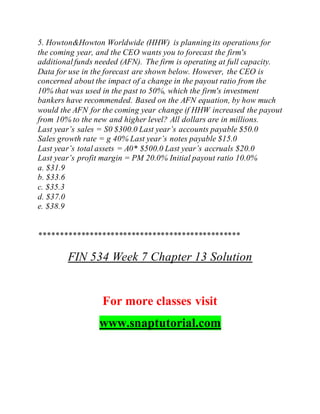
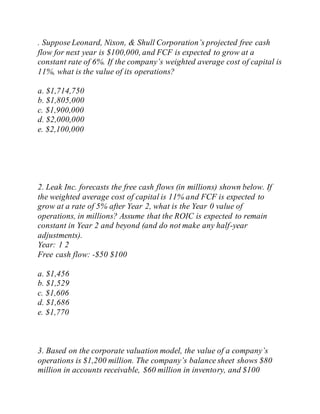
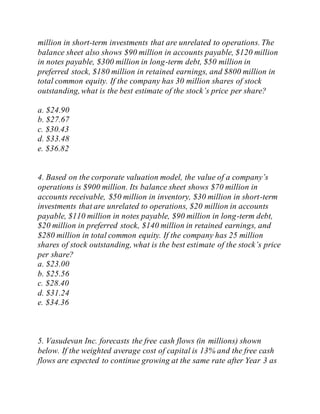
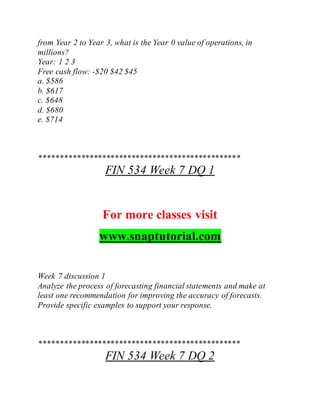
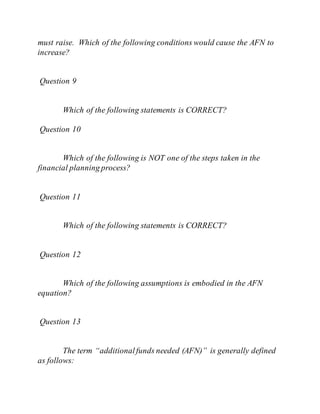
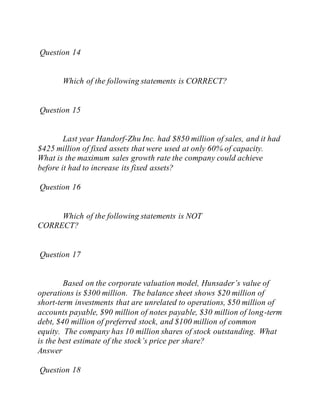
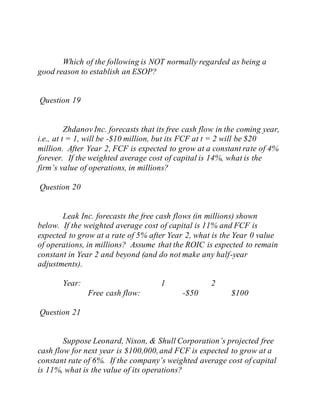
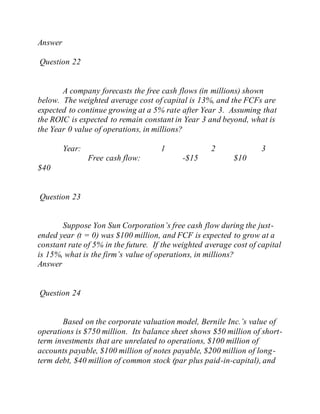
FIN 534 Entire Course
For more classes visit
www.snaptutorial.com
FIN 534 Week 1 Chapter 1 Solution
FIN 534 Week 1 Chapter 2 Solution
FIN 534 Week 2 Chapter 3 Solution
FIN 534 Week 3 Chapter 4 Solution
FIN 534 Week 3 Chapter 5 Solution
FIN 534 Week 4 Chapter 6 Solution
FIN 534 Week 4 Chapter 7 Solution
FIN 534 Week 5 Chapter 8 Solution
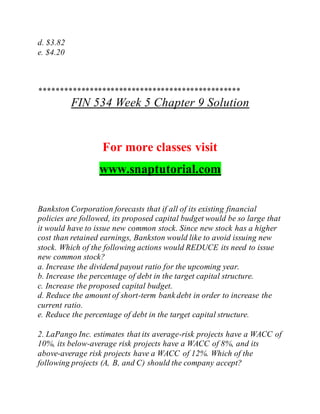
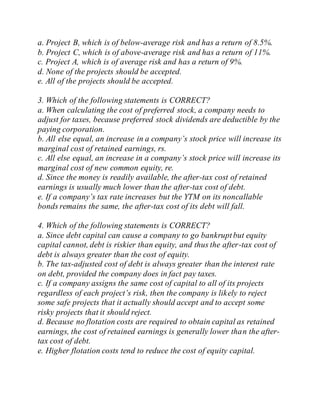
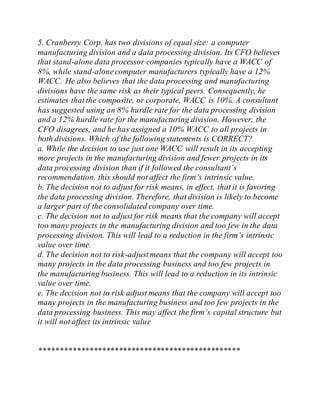
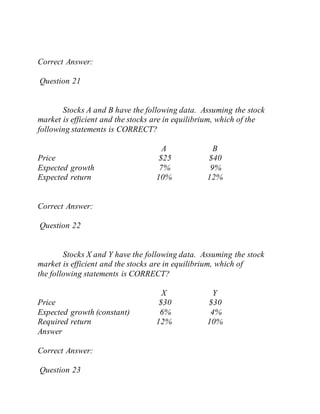
FIN 534 Week 5 Chapter 9 Solution
FIN 534 Week 6 Chapter 10 Solution
FIN 534 Week 6 Chapter 11 Solution
FIN 534 Week 7 Chapter 12 Solution
FIN 534 Week 7 Chapter 13 Solution
FIN 534 Week 8 Chapter 14 Solution
FIN 534 Week 8 Chapter 15 Solution
FIN 534 Week 9 Chapter 16 Solution
FIN 534 Week 10 Chapter 17 Solution
Fin 534 Week 1 Quiz 1
FIN 534 Week 3 Quiz 2
FIN 534 Week 4 Quiz 3
FIN 534 Week 5 Quiz 4
FIN 536 Week 6 Quiz 5
FIN 534 Week 7 Quiz 6
FIN 534 Week 8 Quiz 7
FIN 534 Week 9 Quiz 8
FIN 534 Week 10 Quiz 9
FIN 534 Week 11 Quiz 10
FIN 534 Week 1 DQ 1
FIN 534 Week 1 DQ 2
FIN 534 Week 2 DQ 1
FIN 534 Week 2 DQ 2
FIN 534 Week 3 DQ 1
FIN 534 Week 3 DQ 2
FIN 534 Week 4 DQ 1
FIN 534 Week 4 DQ 2
FIN 534 Week 5 DQ 1
FIN 534 Week 6 DQ 1
FIN 534 Week 7 DQ 1
FIN 534 Week 7 DQ 2
FIN 534 Week 8 DQ 1
FIN 534 Week 8 DQ 2
FIN 534 Week 9 DQ 1
FIN 534 Week 9 DQ 2
FIN 534 Week 10 DQ 1
FIN 534 Week 10 DQ 2
FIN 534 Week 11 DQ 1
FIN 534 Week 11 DQ 2
************************************************
FIN 534 Final Exam Set 1 (4 Sets)
For more classes visit
www.snaptutorial.com
FIN 534 Final Exam Part 1 Set 1
• Question 1
BLW Corporation is considering the terms to be set on the
options it plans to issue to its executives. Which of the following actions
would decrease the value of the options, other things held constant?
• Question 2
Which of the following statements is CORRECT?
• Question 3
Suppose you believe that Florio Company's stock price is going
to decline from its current level of $82.50 sometime during the next 5
months. For $5.10 you could buy a 5-month put option giving you the
right to sell 1 share at a price of $85 per share. If you bought this option
for $5.10 and Florio's stock price actually dropped to $60, what would
your pre-tax net profit be?
• Question 4
Which of the following statements is CORRECT?
• Question 5
Which of the following statements is CORRECT?
• Question 6
Which of the following statements is most correct, holding other
things constant, for XYZ Corporation's traded call options?
• Question 7
To help them estimate the company's cost of capital, Smithco has
hired you as a consultant. You have been provided with the following
data: D1 = $1.45; P0 = $22.50; and g = 6.50% (constant). Based on the
DCF approach, what is the cost of common from reinvested earnings?
• Question 8
Which of the following statements is CORRECT? Assume a
company's target capital structure is 50% debt and 50% common equity.
• Question 9
A company's perpetual preferred stock currently sells for $92.50
per share, and it pays an $8.00 annual dividend. If the company were to
sell a new preferred issue, it would incur a flotation cost of 5.00% of the
issue price. What is the firm's cost of preferred stock?
• Question 10
Which of the following statements is CORRECT?
• Question 11
Which of the following statements is CORRECT?
• Question 12
You have been hired as a consultant by Feludi Inc.'s CFO, who
wants you to help her estimate the cost of capital. You have been
provided with the following data: rRF = 4.10%; RPM = 5.25%; and b =
1.30. Based on the CAPM approach, what is the cost of common from
reinvested earnings?
• Question 13
Which of the following statements is CORRECT?
• Question 14
Which of the following statements is CORRECT?
• Question 15
Projects C and D both have normal cash flows and are mutually
exclusive. Project C has a higher NPV if the WACC is less than 12%,
whereas Project D has a higher NPV if the WACC exceeds 12%. Which
of the following statements is CORRECT?
• Question 16
Which of the following statements is CORRECT?
• Question 17
Projects S and L are both normal projects with an initial cost of
$10,000, followed by a series of positive cash inflows. Project S's
undiscounted net cash flows total $20,000, while L's total undiscounted
flows are $30,000. At a WACC of 10%, the two projects have identical
NPVs. Which project's NPV is more sensitive to changes in the WACC?
• Question 18
Which of the following statements is CORRECT? Assume that the
project being considered has normal cash flows, with one outflow
followed by a series of inflows.
• Question 19
Which of the following statements is CORRECT?
• Question 20
Which of the following statements is CORRECT?
• Question 21
Collins Inc. is investigating whether to develop a new product. In
evaluating whether to go ahead with the project, which of the following
items should NOT be explicitly considered when cash flows are
estimated?
• Question 22
Which of the following rules is CORRECT for capital budgeting
analysis?
• Question 23
Which one of the following would NOT result in incremental
cash flows and thus should NOT be included in the capital budgeting
analysis for a new product?
• Question 24
Which of the following statements is CORRECT?
• Question 25
A company expects sales to increase during the coming year, and
it is using the AFN equation to forecast the additionalcapital that it
must raise. Which of the following conditions would cause the AFN to
increase?
• Question 26
Last year National Aeronautics had a FA/Sales ratio of 40%,
comprised of $250 million of sales and $100 million of fixed assets.
However, its fixed assets were used at only 75% of capacity. Now the
company is developing its financial forecast for the coming year. As part
of that process, the company wants to set its target Fixed Assets/Sales
ratio at the level it would have had had it been operating at full
capacity. What target FA/Sales ratio should the company set?
• Question 27
F. Marston, Inc. has developed a forecasting model to estimate
its AFN for the upcoming year. All else being equal, which of the
following factors is most likely to lead to an increase of the additional
funds needed (AFN)?
• Question 28
Which of the following statements is CORRECT?
• Question 29
Which of the following statements is CORRECT?
• Question 30
The capital intensity ratio is generally defined as follows:
FIN 534 Final Exam Part 1 Set 2
FIN 534 Final Exam Part 1
•
The current price of a stock is $22, and at the end of one year its
price will be either $27 or $17. The annualrisk-free rate is 6.0%, based
on daily compounding. A 1-year call option on the stock, with an
exercise price of $22, is available. Based on the binomial model, what is
the option's value? (Hint: Use daily compounding.)
• Question 2
Cazden Motors' stock is trading at $30 a share. Call options on
the company's stock are also available, some with a strike price of $25
and some with a strike price of $35. Both options expire in three months.
Which of the following best describes the value of these
options?
• Question 3
Which of the following statements is CORRECT?
• Question 4
Suppose you believe that Florio Company's stock price is going
to decline from its current level of $82.50 sometime during the next 5
months. For $5.10 you could buy a 5-month put option giving you the
right to sell 1 share at a price of $85 per share. If you bought this option
for $5.10 and Florio's stock price actually dropped to $60, what would
your pre-tax net profit be?
• Question 5
BLW Corporation is considering the terms to be set on the
options it plans to issue to its executives. Which of the following actions
would decrease the value of the options, other things held
constant?
• Question 6
Which of the following statements is
CORRECT?
• Question 7
Which of the following statements is CORRECT?
• Question 8
Which of the following statements is
CORRECT?
• Question 9
Burnham Brothers Inc. has no retained earnings since it has
always paid out all of its earnings as dividends. This same situation is
expected to persist in the future. The company uses the CAPM to
calculate its cost of equity, and its target capital structure consists of
common stock, preferred stock, and debt. Which of the following events
would REDUCE its WACC?
• Question 10
Which of the following statements is CORRECT?
• Question 11
Which of the following statements is CORRECT?
• Question 12
Which of the following statements is
CORRECT?
• Question 13
Which of the following statements is
CORRECT?
• Question 14
Which of the following statements is NOT a disadvantage of the
regular payback method?
• Question 15
Which of the following statements is CORRECT? Assume that the
project being considered has normal cash flows, with one outflow
followed by a series of inflows.
• Question 16
Projects S and L are both normal projects with an initial cost of
$10,000, followed by a series of positive cash inflows. Project S's
undiscounted net cash flows total $20,000, while L's total undiscounted
flows are $30,000. At a WACC of 10%, the two projects have identical
NPVs. Which project's NPV is more sensitive to changes in the
WACC?
• Question 17
The WACC for two mutually exclusive projects that are being
considered is 12%. Project K has an IRR of 20% while Project R's IRR
is 15%. The projects have the same NPV at the 12% current WACC.
Interest rates are currently high. However, you believe that money costs
and thus your WACC will soon decline. You also think that the projects
will not be funded until the WACC has decreased, and their cash flows
will not be affected by the change in economic conditions. Under these
conditions, which of the following statements is CORRECT?
• Question 18
Suppose a firm relies exclusively on the payback method when
making capital budgeting decisions, and it sets a 4-year payback
regardless of economic conditions. Other things held constant, which of
the following statements is most likely to be true?
• Question 19
Which of the following statements is CORRECT?
• Question 20
Which of the following factors should be included in the cash
flows used to estimate a project's NPV?
• Question 21
Which of the following statements is
CORRECT?
• Question 22
When evaluating a new project, firms should include in the
projected cash flows all of the following EXCEPT:
• Question 23
To increase productive capacity, a company is considering a
proposed new plant. Which of the following statements is
CORRECT?
• Question 24
Which of the following is NOT a relevant cash flow and thus
should not be reflected in the analysis of a capital budgeting
project?
• Question 25
North Construction had $850 million of sales last year, and it
had $425 million of fixed assets that were used at only 60% of capacity.
What is the maximum sales growth rate North could achieve before it
had to increase its fixed assets?
• Question 26
Which of the following assumptions is embodied in the AFN
equation?
• Question 27
Which of the following statements is
CORRECT?
• Question 28
The Besnier Company had $250 million of sales last year, and it
had $75 million of fixed assets that were being operated at 80% of
capacity. In millions, how large could sales have been if the company
had operated at full capacity?
• Question 29
Which of the following statements is
CORRECT?
• Question 30
Which of the following is NOT one of the steps taken in the
financial planning process?
FIN 534 Final Exam Part 1 Set 3
• Question 1
An investor who writes standard call options against stock held
in his or her portfolio is said to be selling what type of
options?
• Question 2
Suppose you believe that Basso Inc.'s stock price is going to
increase from its current level of $22.50 sometime during the next 5
months. For $3.10 you can buy a 5-month call option giving you the
right to buy 1 share at a price of $25 per share. If you buy this option for
$3.10 and Basso's stock price actually rises to $45, what would your
pre-tax net profit be?
• Question 3
Which of the following statements is
CORRECT?
• Question 4
BLW Corporation is considering the terms to be set on the
options it plans to issue to its executives. Which of the following actions
would decrease the value of the options, other things held
constant?
• &a
************************************************
FIN 534 Final Exam Set 2 (4 Sets)
For more classes visit
www.snaptutorial.com
FIN 534 Final Exam Part 2 Set 1
• Question 1
Which of the following is NOT normally regarded as being a
good reason to establish an ESOP?
• Question 2
Which of the following is NOT normally regarded as being a
barrier to hostile takeovers?
• Question 3
RohterGaleano Inc. is considering how to set its dividend policy.
It has a capital budget of $3,000,000. The company wants to maintain a
target capital structure that is 15% debt and 85% equity. The company
forecasts that its net income this year will be $3,500,000. If the company
follows a residual dividend policy, what will be its total dividend
payment?
• Question 4
Which of the following statements is correct?
• Question 5
Which of the following statements is correct?
• Question 6
Which of the following statements is NOT correct?
• Question 7
Which of the following statements is correct?
• Question 8
The capital budget of Creative Ventures Inc. is $1,000,000. The
company wants to maintain a target capital structure that is 30% debt
and 70% equity. The company forecasts that its net income this year will
be $800,000. If the company follows a residual dividend policy, what
will be its total dividend payment?
• Question 9
Which of the following statements is CORRECT?
• Question 10
Which of the following statements is CORRECT?
• Question 11
Which of the following statements is CORRECT?
• Question 12
Other things held constant, which of the following events is most
likely to encourage a firm to increase the amount of debt in its capital
structure?
• Question 13
Blueline Publishers is considering a recapitalization plan. It is
currently 100% equity financed but under the plan it would issue long-
term debt with a yield of 9% and use the proceeds to repurchase
common stock. The recapitalization would not change the company's
total assets, nor would it affect the firm's basic earning power, which is
currently 15%. The CFO believes that this recapitalization would reduce
the WACC and increase stock price. Which of the following would also
be likely to occur if the company goes ahead with the recapitalization
plan?
• Question 14
Which of the following is NOT associated with (or does not
contribute to) business risk? Recall that business risk is affected by a
firm's operations.
• Question 15
Barette Consulting currently has no debt in its capital structure,
has $500 million of total assets, and its basic earning power is 15%. The
CFO is contemplating a recapitalization where it will issue debt at a
cost of 10% and use the proceeds to buy back shares of the company's
common stock, paying book value. If the company proceeds with the
recapitalization, its operating income, total assets, and tax rate will
remain unchanged. Which of the following is most likely to occur as a
result of the recapitalization?
• Question 16
Which of the following statements is CORRECT?
• Question 17
Which of the following actions should Reece Windows take if it
wants to reduce its cash conversion cycle?
• Question 18
Which of the following will cause an increase in net working
capital, other things held constant?
• Question 19
A lockbox plan is most beneficial to firms that
• Question 20
Which of the following actions would be likely to shorten the
cash conversion cycle?
• Question 21
Other things held constant, which of the following would tend to
reduce the cash conversion cycle?
• Question 22
Which of the following is NOT directly reflected in the cash
budget of a firm that is in the zero tax bracket?
• Question 23
Suppose one U.S. dollar can purchase 144 yen today in the
foreign exchange market. If the yen depreciates by 8.0% tomorrow, how
many yen could one U.S. dollar buy tomorrow?
• Question 24
If the spot rate of the Israeli shekel is 5.51 shekels per dollar and
the 180-day forward rate is 5.97 shekels per dollar, then the forward
rate for the Israeli shekel is selling at a ____ to the spot rate.
• Question 25
Which of the following statements is NOT CORRECT?
• Question 26
A U.S.-based importer, Zarb Inc., makes a purchase of crystal
glassware from a firm in Switzerland for 39,960 Swiss francs, or
$24,000, at the spot rate of 1.665 francs per dollar. The terms of the
purchase are net 90 days, and the U.S. firm wants to cover this trade
payable with a forward market hedge to eliminate its exchange rate risk.
Suppose the firm completes a forward hedge at the 90-day forward rate
of 1.682 francs. If the spot rate in 90 days is actually 1.638 francs, how
much will the U.S. firm have saved or lost in U.S. dollars by hedging its
exchange rate exposure?
• Question 27
In Japan, 90-day securities have a 4% annualized return and
180-day securities have a 5% annualized return. In the United States,
90-day securities have a 4% annualized return and 180-day securities
have an annualized return of 4.5%. All securities are of equal risk, and
Japanese securities are denominated in terms of the Japanese yen.
Assuming that interest rate parity holds in all markets, which of the
following statements is most CORRECT?
• Question 28
Suppose a carton of hockey pucks sell in Canada for 105
Canadian dollars, and 1 Canadian dollar equals 0.71 U.S. dollars. If
purchasing power parity (PPP) holds, what is the price of hockey pucks
in the United States?
• Question 29
If it takes $0.71 U.S. dollars to purchase one Swiss franc, how
many Swiss francs can one U.S. dollar buy?
• Question 30
Suppose that 1 British pound currently equals 1.62 U.S. dollars
and 1 U.S. dollar equals 1.62 Swiss francs. What is the cross exchange
rate between the pound and the franc?
FIN 534 Final Exam Part 2 Set 2
• Question 1
Which of the following is NOT normally regarded as being a
good reason to establish an ESOP?
• Question 2
Which of the following is NOT normally regarded as being a
barrier to hostile takeovers?
• Question 3
If a firm adheres strictly to the residual dividend policy, the
issuance of new common stock would suggest that
• Question 4
Which of the following statements is correct?
• Question 5
Which of the following statements is NOT correct?
• Question 6
Which of the following actions will best enable a company to
raise additionalequity capital?
• Question 7
Which of the following statements is correct?
• Question 8
Which of the following statements is CORRECT?
• Question 9
Which of the following statements is correct?
• Question 10
Which of the following statements is CORRECT?
• Question 11
Which of these items will not generally be affected by an increase
in the debt ratio?
• Question 12
Based on the information below for Benson Corporation, what is
the optimal capital structure?
• Question 13
Blueline Publishers is considering a recapitalization plan. It is
currently 100% equity financed but under the plan it would issue long-
term debt with a yield of 9% and use the proceeds to repurchase
common stock. The recapitalization would not change the company's
total assets, nor would it affect the firm's basic earning power, which is
currently 15%. The CFO believes that this recapitalization would reduce
the WACC and increase stock price. Which of the following would also
be likely to occur if the company goes ahead with the recapitalization
plan?
• Question 14
Which of the following statements is CORRECT?
• Question 15
Two operationally similar companies, HD and LD, have the
same total assets, operating income (EBIT), tax rate, and business risk.
Company HD, however, has a much higher debt ratio than LD. Also
HD's basic earning power (BEP) exceeds its cost of debt (rd). Which of
the following statements is CORRECT?
• Question 16
Which of the following events is likely to encourage a company
to raise its target debt ratio, other things held constant?
• Question 17
A lockbox plan is
• Question 18
Which of the following will cause an increase in net working
capital, other things held constant?
• Question 19
Firms generally choose to finance temporary current operating
assets with short-term debt because
• Question 20
Which of the following statements is most consistent with
efficient inventory management? The firm has a
• Question 21
Other things held constant, which of the following would tend to
reduce the cash conversion cycle?
• Question 22
Which of the following is NOT directly reflected in the cash
budget of a firm that is in the zero tax bracket?
• Question 23
Suppose that 1 British pound currently equals 1.62 U.S. dollars
and 1 U.S. dollar equals 1.62 Swiss francs. What is the cross exchange
rate between the pound and the franc?
• Question 24
Suppose it takes 1.82 U.S. dollars today to purchase one British
pound in the foreign exchange market, and currency forecasters predict
that the U.S. dollar will depreciate by 12.0% against the pound over the
next 30 days. How many dollars will a pound buy in 30 days?
• Question 25
Suppose a foreign investor who holds tax-exempt Eurobonds
paying 9% is considering investing in an equivalent-risk domestic bond
in a country with a 28% withholding tax on interest paid to foreigners. If
9% after-tax is the investor's required return, what before-tax rate
would the domestic bond need to pay to provide the required after-tax
return?
• Question 26
Suppose 1 U.S. dollar equals 1.60 Canadian dollars in the spot
market. 6-month Canadian securities have an annualized return of 6%
(and thus a 6-month periodic return of 3%). 6-month U.S. securities
have an annualized return of 6.5% and a periodic return of 3.25%. If
interest rate parity holds, what is the U.S. dollar-Canadian dollar
exchange rate in the 180-day forward market?
• Question 27
Suppose a carton of hockey pucks sell in Canada for 105
Canadian dollars, and 1 Canadian dollar equals 0.71 U.S. dollars. If
purchasing power parity (PPP) holds, what is the price of hockey pucks
in the United States?
• Question 28
Suppose Yates Inc., a U.S. exporter, sold a consignment of
antique American muscle-cars to a Japanese customer at a price of
143.5 million yen, when the exchange rate was 140 yen per dollar. In
order to close the sale, Yates agreed to make the bill payable in yen,
thus agreeing to take some exchange rate risk for the transaction. The
terms were net 6 months. If the yen fell against the dollar such that one
dollar would buy 154.4 yen when the invoice was paid, what dollar
amount would Yates actually receive after it exchanged yen for U.S.
dollars?
• Question 29
Suppose 90-day investments in Britain have a 6% annualized
return and a 1.5% quarterly (90-day) return. In the U.S., 90-day
investments of similar risk have a 4% annualized return and a 1%
quarterly (90-day) return. In the 90-day forward market, 1 British pound
equals $1.65. If interest rate parity holds, what is the spot exchange
rate?
• Question 30
In 1985, a given Japanese imported automobile sold for
1,476,000 yen, or $8,200. If the car still sold for the same amount of yen
today but the current exchange rate is 144 yen per dollar, what would
the car be selling for today in U.S. dollars?
FIN 534 Final Exam Part 2 Set 3
• Question 1
Which of the following is NOT normally regarded as being a
good reason to establish an ESOP?
• Question 2
Which of the following is NOT normally regarded as being a
barrier to hostile takeovers?
• Question 3
Consider two very different firms, M and N. Firm M is a mature
firm in a mature industry. Its annual net income and net cash flows are
both consistently high and stable. However, M's growth prospects are
quite limited, so its capital budget is small relative to its net income.
Firm N is a relatively new firm in a new and growing industry. Its
markets and products have not stabilized, so its annualoperating
income fluctuates considerably. However, N has substantial growth
opportunities, and its capital budget is expected to be large relative to
its net income for the foreseeable future. Which of the following
statements is correct?
• Question 4
Which of the following actions will best enable a company to
raise additionalequity capital?
• Question 5
Which of the following statements is NOT
correct?
• Question 6
If a firm adheres strictly to the residual dividend policy, the
issuance of new common stock would suggest that
• Question 7
Poff Industries' stock currently sells for $120 a share. You own
100 shares of the stock. The company is contemplating a 2-for-1 stock
split. Which of the following best describes what your position will be
after such a split takes place?
• Question 8
Which of the following statements is
correct?
• Question 9
************************************************
FIN 534 Week 1 Chapter 1 Solution
For more classes visit
www.snaptutorial.com
Which of the following statements is CORRECT?
a. One of the disadvantages of a sole proprietorship is that the
proprietor is exposed to unlimited liability.
b. It is generally easier to transfer one’s ownership interest in a
partnership than in a corporation.
c. One of the advantages of the corporate form of organization is that it
avoids double taxation.
d. One of the advantages of a corporation from a social standpoint is
that every stockholder has equal voting rights, i.e., “one person, one
vote.”
e. Corporations of all types are subject to the corporate income tax.
2. Which of the following would be most likely to lead to higher interest
rates on all debt securities in the economy?
a. Households start saving a larger percentage of their income.
b. The economy moves from a boom to a recession.
c. The level of inflation begins to decline.
d. Corporations step up their expansion plans and thus increase their
demand for capital.
e. The Federal Reserve uses monetary policy in an attempt to stimulate
the economy.
3. Which of the following statements is CORRECT?
a. If General Electric were to issue new stock this year it would be
considered a secondary market transaction since the company already
has stock outstanding.
b. Capital market transactions only include preferred stock and common
stock transactions.
c. The distinguishing feature between spot markets versus futures
markets transactions is the maturity of the investments. That is, spot
market transactions involve securities that have maturities of less than
one year, whereas futures markets transactions involve securities with
maturities greater than one year.
d. Both Nasdaq "dealers" and NYSE “specialists” hold inventories of
stocks.
e. An electronic communications network (ECN) is a physical location
exchange.
4. Which of the following statements is CORRECT?
a. A good goal for a firm’s management is maximization of expected
EPS.
b. Most business in the U.S. is conducted by corporations, and
corporations’ popularity results primarily from their favorable tax
treatment.
c. Because most stock ownership is concentrated in the hands of a
relatively small segment of society, firms' actions to maximize their stock
prices have little benefit to society.
d. Corporations and partnerships have an advantage over
proprietorships because a sole proprietor is exposed to unlimited
liability, but the liability of all investors in the other types of businesses
is more limited.
e. The potential exists for agency conflicts between stockholders and
managers.
5. Which of the following statements is NOT CORRECT?
a. When a corporation’s shares are owned by a few individuals and are
not traded on public markets, we say that the firm is “closely, or
privately, held."
b. “Going public” establishes a firm's true intrinsic value, and it also
insures that a highly liquid market will always exist for the firm’s
shares.
c. When stock in a closely held corporation is offered to the public for
the first time, the transaction is called “going public,” and the market
for such stock is called the new issue market.
d. Publicly owned companies have shares owned by investors who are
not associated with management, and public companies must register
with and report to a regulatory agency such as the SEC.
e. It is possible for a firm to go public and yet not raise any additional
new capital at the time.
************************************************
FIN 534 Week 1 Chapter 2 Solution
For more classes visit
www.snaptutorial.com
Which of the following statements is CORRECT?
a. Typically, a firm’s DPS should exceed its EPS.
b. Typically, a firm’s EBIT should exceed its EBITDA.
c. If a firm is more profitable than average (e.g., Google), we would
normally expect to see its stock price exceed its book value per share.
d. If a firm is more profitable than most other firms, we would normally
expect to see its book value per share exceed its stock price, especially
after several years of high inflation.
e. The more depreciation a firm has in a given year, the higher its EPS,
other things held constant.
2. Which of the following statements is CORRECT?
a. The statement of cash flows reflects cash flows from operations, but it
does not reflect the effects of buying or selling fixed assets.
b. The statement of cash flows shows where the firm’s cash is located;
indeed, it provides a listing of all banks and brokerage houses where
cash is on deposit.
c. The statement of cash flows reflects cash flows from continuing
operations, but it does not reflect the effects of changes in working
capital.
d. The statement of cash flows reflects cash flows from operations and
from borrowings, but it does not reflect cash obtained by selling new
common stock.
e. The statement of cash flows shows how much the firm’s cash--the total
of currency, bank deposits, and short-term liquid securities (or cash
equivalents)--increased or decreased during a given year.
3. Which of the following statements is CORRECT?
a. Dividends paid reduce the net income that is reported on a company’s
income statement.
b. If a company uses some of its bank deposits to buy short-term, highly
liquid marketable securities, this will cause a decline in its current
assets as shown on the balance sheet.
c. If a company issues new long-term bonds during the current year, this
will increase its reported current liabilities at the end of the year.
d. Accounts receivable are reported as a current liability on the balance
sheet.
e. If a company pays more in dividends than it generates in net income,
its retained. earnings as reported on the balance sheet will decline from
the previous year's balance.
4. Last year Roussakis Company’s operations provided a negative net
cash flow, yet the cash shown on its balance sheet increased. Which of
the following statements could explain the increase in cash, assuming
the company’s financial statements were prepared under generally
accepted accounting principles?
a. The company repurchased some of its common stock.
b. The company dramatically increased its capital expenditures.
c. The company retired a large amount of its long-term debt.
d. The company sold some of its fixed assets.
e. The company had high depreciation expenses.
5. Bartling Energy Systems recently reported $9,250 of sales, $5,750 of
operating costs other than depreciation, and $700 of depreciation. The
company had no amortization charges, it had $3,200 of outstanding
bonds that carry a 5% interest rate, and its federal-plus-state income tax
rate was 35%. In order to sustain its operations and thus generate sales
and cash flows in the future, the firm was required to make $1,250 of
capital expenditures on new fixed assets and to invest $300 in net
operating working capital. By how much did the firm's net income
exceed its free cash flow?
a. $673.27
b. $708.70
c. $746.00
d. $783.30
e. $822.47
************************************************
FIN 534 Week 1 DQ 1
For more classes visit
www.snaptutorial.com
Imagine a startup company of your own and briefly trace its
development from a sole proprietorship to a major
************************************************FIN 534
Week 1 DQ 2
For more classes visit
www.snaptutorial.com
Week 1 discussion 2
Discuss ways that the basic concepts we have discussed in this chapter
directly impact your life. Provide specific examples to support your
response.
************************************************
FIN 534 Week 1 Quiz 1
For more classes visit
www.snaptutorial.com
Question 1
You recently sold 100 shares of your new company, XYZ Corporation, to
your brother at a family reunion. At the reunion your brother gave you
a check for the stock and you gave your brother the stock certificates.
Which of the following statements best describes this transaction?
1) This is an example of an exchange of physical assets.
2) This is an example of a primary market transaction.
3) This is an example of a direct transfer of capital.
4) This is an example of a money market transaction.
5) This is an example of a derivatives market transaction.
Question 2
Which of the following statements is CORRECT?
1) While the distinctions are blurring, investment banks generally
specialize in lending money, whereas commercial banks generally help
companies raise capital from other parties
2) A liquid security is a security whose value is derived from the price of
some other "underlying" asset
3) Money market mutual funds usually invest most of their money in a
well-diversified portfolio of liquid common stocks.
4) Money markets are markets for long-term debt and common stocks.
5) The NYSE operates as an auction market, whereas the Nasdaq is a
dealer market
Question 3
Which of the following statements is CORRECT?
1) The NYSE does not exist as a physical location; rather it represents a
loose collection of
dealers who trade stock electronically.
2) An example of a primary market transaction would be your uncle
transferring 100 shares of
Wal-Mart stock to you as a birthday gift.
3) Capital market instruments include both long-term debt and common
stocks.
4) If your uncle in New York sold 100 shares of Microsoft through his
broker to an investor in
Los Angeles, this would be a primary market transaction.
5) While the two frequently perform similar functions, investment banks
generally specialize in lending money, whereas commercial banks
generally help companies raise large blocks of capital from
investors.
Question 4
Which of the following statements is CORRECT?
1) It is usually easier to transfer ownership in a corporation than it is to
transfer ownership in a sole proprietorship
2) Corporate shareholders are exposed to unlimited liability.
3) Corporations generally face fewer regulations than sole
proprietorships.
4) Corporate shareholders are exposed to unlimited liability, and this
factor may be compounded by the tax disadvantages of incorporation.
5) There is a tax disadvantage to incorporation, and there is no way any
corporation can escape this disadvantage, even if it is very small
Question 5
Which of the following statements is CORRECT?
1) One disadvantage of operating as a corporation rather than as a
partnership is that corporate shareholders are exposed to more personal
liability than partners
2) There is no good reason to expect a firm's stockholders and
bondholders to react differently to the types of new asset investments a
firm makes
3) Bondholders are generally more willing than stockholders to have
managers invest in risky projects with high potential returns as opposed
to safer projects with lower expected returns
4) Stockholders are generally more willing than bondholders to have
managers invest in risky projects with high potential returns as opposed
to safer projects with lower expected returns
5) Relative to sole proprietorships, corporations generally face fewer
regulations, and this makes it easier for corporations to raise capital
Question 6
Suppose the U.S. Treasury announces plans to issue $50 billion of new
bonds. Assuming the announcement was not expected, what effect, other
things held constant, would that have on bond prices and interest rates?
1) Prices and interest rates would both rise.
2) Prices would rise and interest rates would decline.
3) Prices and interest rates would both decline.
4) There would be no changes in either prices or interest rates.
5) Prices would decline and interest rates would rise.
Question 7
Which of the following statements is CORRECT?
1) Corporations are at a disadvantage relative to partnerships because
they have to file more reports to state and federal agencies, including
the Securities and Exchange Administration, even if they are not publicly
owned
2) In a regular partnership, liability for the firm's debts is limited to the
amount a particular partner has invested in the business
3) A fast-growth company would be more likely to set up as a
partnership for its business organization than would a slow-growth
company
4) Partnerships have difficulty attracting capital in part because of their
unlimited liability, the lack of impermanence of the organization,and
difficulty in transferring ownership
5) A major disadvantage of a partnership relative to a corporation as a
form of business organization is the high cost and practical difficulty of
its formation
Question 8
Which of the following statements is CORRECT?
1) In a regular partnership, liability for other partners' misdeeds is
limited to the amount of a particular partner's investment in the business
2) Partnerships have more difficulty attracting large amounts of capital
than corporations because of such factors as unlimited liability, the need
to reorganize when a partner dies, and the illiquidity (difficulty buying
and selling) of partnership interests
3) A slow-growth company, with little need for new capital, would be
more likely to organize as a corporation than would a faster growing
company
4) In a limited partnership, the limited partners have voting control,
while the general partner has operating control over the business. Also,
the limited partners are individually responsible, on a pro rata basis, for
the firm's debts in the event of bankruptcy.
5) A major disadvantage of all partnerships relative to all corporations
is the fact that federal income taxes must be paid by the partners rather
than by the firm itself
Question 9
Which of the following statements is CORRECT?
1) If you purchase 100 shares of Disney stock from your brother-in-law,
this is an example of a primary market transaction.
2) If Disney issues additional shares of common stock through an
investment banker, this would be a secondary market transaction.
3) The NYSE is an example of an over-the-counter market.
4) Only institutions, and not individuals, can engage in derivative
market transactions.
5) As they are generally defined, money market transactions involve debt
securities with maturities of less than one year
Question 10
Which of the following factors would be most likely to lead to an
increase in interest rates in the economy?
1) Households reduce their consumption and increase their savings
2) The Federal Reserve decides to try to stimulate the economy.
3) There is a decrease in expected inflation
4) The economy falls into a recession
5) Most businesses decide to modernize and expand their manufacturing
capacity, and to install new equipment to reduce labor costs
Question 11
Which of the following statements is CORRECT?
1) Hedge funds are legal in Europe and Asia, but they are not permitted
to operate in the United States
2) Hedge funds have more in common with commercial banks than with
any other type of financial institution
3) Hedge funds have more in common with investment banks than with
any other type of financial institution
4) Hedge funds are legal in the United States, but they are not permitted
to operate in Europe or Asia
5) The justification for the "light" regulation of hedge funds is that only
"sophisticated" investors with high net worths and high incomes are
permitted to invest in these funds, and such investors supposedly can do
the necessary "due diligence" on their own rather than have it done by
the SEC or some other regulator
Question 12
Which of the following statements is CORRECT?
1) The New York Stock Exchange is an auction market with a physical
location
2) Capital market transactions involve only the purchase and sale of
equity securities, i.e., common stocks
3) If an investor sells shares of stock through a broker, then this would
be a primary market transaction.
4) Consumer automobile loans are evidenced by legal documents called
"promissory notes," and these individualnotes are traded in the money
market
5) Consumer automobile loans are evidenced by legal documents called
"promissory notes," and these individualnotes are traded in the money
market
Question 13
Which of the following statements is CORRECT?
1) The corporate bylaws are a standard set of rules established by the
state of incorporation. These rules are identical for all corporations in
the state, and their purpose is to ensure that the firm's managers run the
firm in accordance with state laws
2) The corporate charter is a standard document prescribed by the state
of incorporation, and its purpose is to ensure that the firm's managers
run the firm in accordance with state laws. Procedures for electing
corporate directors are contained in bylaws, while the declaration of the
activities that the firm will pursue and the number of directors are
included in the corporate charter.
3) Companies must establish a home office, or domicile, in a particular
state, and that state must be the one in which most of their business
(sales, manufacturing, and so forth) is conducted
4) Attorney fees are generally involved when a company develops its
charter and bylaws, but since these documents are voluntary, a new
corporation can avoid these costs by deciding not to have either a
charter or bylaws
5) The corporate charter is concerned with things like what business the
company will engage in, whereas the bylaws are concerned with things
like procedures for electing the board of directors
Question 14
Which of the following statements is CORRECT?
1) If expected inflation increases, interest rates are likely to increase
2) If individuals in general increase the percentage of their income that
they save, interest rates are likely to increase
3) If companies have fewer good investment opportunities, interest rates
are likely to increase
4) Interest rates on all debt securities tend to rise during recessions
because recessions increase the possibility of bankruptcy, hence the
riskiness of all debt securities
5) Interest rates on long-term bonds are more volatile than rates on
short-term debt securities like T-bills
Question 15
The primary operating goal of a publicly-owned firm interested in
serving its stockholders should be to ____
1) maximize its expected total corporate income
2) maximize its expected EPS
3) minimize the chances of losses
4) maximize the stock price per share over the long run, which is the
stock's intrinsic value
5) maximize the stock price on a specific target date
************************************************
FIN 534 Week 2 Chapter 3 Solution
For more classes visit
www.snaptutorial.com
Which of the following statements is CORRECT?
a. The ratio of long-term debt to total capital is more likely to
experience seasonal fluctuations than is either the DSO or the inventory
turnover ratio.
b. If two firms have the same ROA, the firm with the most debt can be
expected to have the lower ROE.
c. An increase in the DSO, other things held constant, could be expected
to increase the total assets turnover ratio.
d. An increase in the DSO, other things held constant, could be expected
to increase the ROE.
e. An increase in a firm’s debt ratio, with no changes in its sales or
operating costs, could be expected to lower the profit margin.
2. Companies HD and LD have the same tax rate, sales, total assets, and
basic earning power. Both companies have positive net incomes.
Company HD has a higher debt ratio and, therefore, a higher interest
expense. Which of the following statements is CORRECT?
a. Company HD has a lower equity multiplier.
b. Company HD has more net income.
c. Company HD pays more in taxes.
d. Company HD has a lower ROE.
e. Company HD has a lower times interest earned (TIE) ratio.
3. Companies HD and LD have the same total assets, sales, operating
costs, and tax rates, and they pay the same interest rate on their debt.
However, company HD has a higher debt ratio. Which of the following
statements is CORRECT?
a. Given this information, LD must have the higher ROE.
b. Company LD has a higher basic earning power ratio (BEP).
c. Company HD has a higher basic earning power ratio (BEP).
d. If the interest rate the companies pay on their debt is more than their
basic earning power (BEP), then Company HD will have the higher
ROE.
e. If the interest rate the companies pay on their debt is less than their
basic earning power (BEP), then Company HD will have the higher
ROE.
4. Muscarella Inc. has the following balance sheet and income statement
data:
Cash $ 14,000 Accounts payable $ 42,000
Receivables 70,000 Other current liabilities 28,000
Inventories 210,000 Total CL $ 70,000
Total CA $294,000 Long-term debt 70,000
Net fixed assets 126,000 Common equity 280,000
Total assets $420,000 Total liab. and equity $420,000
Sales $280,000
Net income $ 21,000
The new CFO thinks that inventories are excessive and could be lowered
sufficiently to cause the current ratio to equal the industry average,
2.70, without affecting either sales or net income. Assuming that
inventories are sold off and not replaced to get the current ratio to the
target level, and that the funds generated are used to buy back common
stock at book value, by how much would the ROE change?
a. 4.28%
b. 4.50%
c. 4.73%
d. 4.96%
e. 5.21%
5. Quigley Inc. is considering two financial plans for the coming year.
Management expects sales to be $301,770, operating costs to be
$266,545, assets to be $200,000, and its tax rate to be 35%. Under Plan
A it would use 25% debt and 75% common equity. The interest rate on
the debt would be 8.8%, but the TIE ratio would have to be kept at 4.00
or more. Under Plan B the maximum debt that met the TIE constraint
would be employed. Assuming that sales, operating costs, assets, the
interest rate, and the tax rate would all remain constant, by how much
would the ROE change in response to the change in the capital
structure?
a. 3.83%
b. 4.02%
c. 4.22%
d. 4.43%
e. 4.65%
************************************************
FIN 534 Week 2 DQ 1
For more classes visit
www.snaptutorial.com
Week 2 discussion 1
Assume you are deciding whether or not to invest in a particular
company. Discuss which elements of which financial statements you
would want to carefully examine. Explain your rationale.
************************************************
FIN 534 Week 2 DQ 2
For more classes visit
www.snaptutorial.com
Week 2 discussion 2
From the e-Activity, determine if the company you analyzed would be a
good investment for you or not. Provide specific examples to support
your response.
************************************************
FIN 534 Week 3 Chapter 4 Solution
For more classes visit
www.snaptutorial.com
A $50,000 loan is to be amortized over 7 years, with annual end-of-year
payments. Which of these statements is CORRECT?
a. The annualpayments would be larger if the interest rate were lower.
b. If the loan were amortized over 10 years rather than 7 years, and if
the interest rate were the same in either case, the first payment would
include more dollars of interest under the 7-year amortization plan.
c. The proportion of each payment that represents interest as opposed to
repayment of principal would be lower if the interest rate were lower.
d. The last payment would have a higher proportion of interest than the
first payment.
e. The proportion of interest versus principal repayment would be the
same for each of the 7 payments.
2. Which of the following statements is CORRECT?
a. If you have a series of cash flows, each of which is positive, you can
solve for I, where the solution value of I causes the PV of the cash flows
to equal the cash flow at Time 0.
b. If you have a series of cash flows, and CF0 is negative but each of the
following CFs is positive, you can solve for I, but only if the sum of the
undiscounted cash flows exceeds the cost.
c. To solve for I, one must identify the value of I that causes the PV of
the positive CFs to equal the absolute value of the PV of the negative
CFs. This is, essentially, a trial-and-error procedure that is easy with a
computer or financial calculator but quite difficult otherwise.
d. If you solve for I and get a negative number, then you must have made
a mistake.
e. If CF0 is positive and all the other CFs are negative, then you cannot
solve for I.
3. Riverside Bank offers to lend you $50,000 at a nominal rate of 6.5%,
compounded monthly. The loan (principal plus interest) must be repaid
at the end of the year. Midwest Bank also offers to lend you the $50,000,
but it will charge an annual rate of 7.0%, with no interest due until the
end of the year. How much higher or lower is the effective annual rate
charged by Midwest versus the rate charged by Riverside?
a. 0.52%
b. 0.44%
c. 0.36%
d. 0.30%
e. 0.24%
4. Steve and Ed are cousins who were both born on the same day, and
both turned 25 today. Their grandfather began putting $2,500 per year
into a trust fund for Steve on his 20th birthday, and he just made a 6th
payment into the fund. The grandfather (or his estate's trustee) will
make 40 more $2,500 payments until a 46th and final payment is made
on Steve's 65th birthday. The grandfather set things up this way
because he wants Steve to work, not be a "trust fund baby," but he also
wants to ensure that Steve is provided for in his old age.
Until now, the grandfather has been disappointed with Ed, hence has not
given him anything. However, they recently reconciled, and the
grandfather decided to make an equivalent provision for Ed. He will
make the first payment to a trust for Ed today, and he has instructed his
trustee to make 40 additionalequal annual payments until Ed turns 65,
when the 41st and final payment will be made. If both trusts earn an
annual return of 8%, how much must the grandfather put into Ed's trust
today and each subsequent year to enable him to have the same
retirement nest egg as Steve after the last payment is made on their 65th
birthday?
a. $3,726
b. $3,912
c. $4,107
d. $4,313
e. $4,528
5. John and Daphne are saving for their daughter Ellen's college
education. Ellen just turned 10 at (t = 0), and she will be entering
college 8 years from now (at t = 8). College tuition and expenses at
State U. are currently $14,500 a year, but they are expected to increase
at a rate of 3.5% a year. Ellen should graduate in 4 years--if she takes
longer or wants to go to graduate school, she will be on her own.
Tuition and other costs will be due at the beginning of each school year
(at t = 8, 9, 10, and 11).
So far, John and Daphne have accumulated $15,000 in their college
savings account (at t = 0). Their long-run financial plan is to add an
additional$5,000 in each of the next 4 years (at t = 1, 2, 3, and 4). Then
they plan to make 3 equal annual contributions in each of the following
years, t = 5, 6, and 7. They expect their investment account to earn 9%.
How large must the annual payments at t = 5, 6, and 7 be to cover
Ellen's anticipated college costs?
a. $1,965.21
b. $2,068.64
c. $2,177.51
d. $2,292.12
e. $2,412.76
************************************************
FIN 534 Week 3 Chapter 5 Solution
For more classes visit
www.snaptutorial.com
1. Three $1,000 face value bonds that mature in 10 years have the same
level of risk, hence their YTMs are equal. Bond A has an 8% annual
coupon, Bond B has a 10% annualcoupon, and Bond C has a 12%
annual coupon. Bond B sells at par. Assuming interest rates remain
constant for the next 10 years, which of the following statements is
CORRECT?
a. Bond A’s current yield will increase each year.
b. Since the bonds have the same YTM, they should all have the same
price, and since interest rates are not expected to change, their prices
should all remain at their current levels until maturity.
c. Bond C sells at a premium (its price is greater than par), and its price
is expected to increase over the next year.
d. Bond A sells at a discount (its price is less than par), and its price is
expected to increase over the next year.
e. Over the next year, Bond A’s price is expected to decrease, Bond B’s
price is expected to stay the same, and Bond C’s price is expected to
increase.
2. Which of the following statements is CORRECT?
a. Two bonds have the same maturity and the same coupon rate.
However, one is callable and the other is not. The difference in prices
between the bonds will be greater if the current market interest rate is
below the coupon rate than if it is above the coupon rate.
b. A callable 10-year, 10% bond should sell at a higher price than an
otherwise similar noncallable bond.
c. Corporate treasurers dislike issuing callable bonds because these
bonds may require the company to raise additionalfunds earlier than
would be true if noncallable bonds with the same maturity were used.
d. Two bonds have the same maturity and the same coupon rate.
However, one is callable and the other is not. The difference in prices
between the bonds will be greater if the current market interest rate is
above the coupon rate than if it is below the coupon rate.
e. The actual life of a callable bond will always be equal to or less than
the actual life of a noncallable bond with the same maturity. Therefore,
if the yield curve is upward sloping, the required rate of return will be
lower on the callable bond.
3. Which of the following statements is CORRECT?
a. Assume that two bonds have equal maturities and are of equal risk,
but one bond sells at par while the other sells at a premium above par.
The premium bond must have a lower current yield and a higher capital
gains yield than the par bond.
b. A bond’s current yield must always be either equal to its yield to
maturity or between its yield to maturity and its coupon rate.
c. If a bond sells at par, then its current yield will be less than its yield to
maturity.
d. If a bond sells for less than par, then its yield to maturity is less than
its coupon rate.
e. A discount bond’s price declines each year until it matures, when its
value equals its par value.
4. Suppose a new company decides to raise a total of $200 million, with
$100 million as common equity and $100 million as long-term debt. The
debt can be mortgage bonds or debentures, but by an iron-clad
provision in its charter, the company can never raise any additionaldebt
beyond the original $100 million. Given these conditions, which of the
following statements is CORRECT?
a. The higher the percentage of debt represented by mortgage bonds, the
riskier both types of bonds will be and, consequently, the higher the
firm’s total dollar interest charges will be.
b. If the debt were raised by issuing $50 million of debentures and $50
million of first mortgage bonds, we could be certain that the firm’s total
interest expense would be lower than if the debt were raised by issuing
$100 million of debentures.
c. In this situation, we cannot tell for sure how, or whether, the firm’s
total interest expense on the $100 million of debt would be affected by
the mix of debentures versus first mortgage bonds. The interest rate on
each of the two types of bonds would increase as the percentage of
mortgage bonds used was increased, but the result might well be such
that the firm’s total interest charges would not be affected materially by
the mix between the two.
d. The higher the percentage of debentures, the greater the risk borne by
each debenture, and thus the higher the required rate of return on the
debentures.
e. If the debt were raised by issuing $50 million of debentures and $50
million of first mortgage bonds, we could be certain that the firm’s total
interest expense would be lower than if the debt were raised by issuing
$100 million of first mortgage bonds.
5. Cosmic Communications Inc. is planning two new issues of 25-year
bonds. Bond Par will be sold at its $1,000 par value, and it will have a
10% semiannual coupon. Bond OID will be an Original Issue Discount
bond, and it will also have a 25-year maturity and a $1,000 par value,
but its semiannual coupon will be only 6.25%. If both bonds are to
provide investors with the same effective yield, how many of the OID
bonds must Cosmic issue to raise $3,000,000? Disregard flotation costs,
and round your final answer up to a whole number of bonds.
a. 4,228
b. 4,337
c. 4,448
d. 4,562
e. 4,676
************************************************
FIN 534 Week 3 DQ 1
For more classes visit
www.snaptutorial.com
Week 3 discussion 1
Starting with your current situation, describe what you must do to
ensure an annual retirement income of $60,000 starting at age 65.
************************************************
FIN 534 Week 3 DQ 2
For more classes visit
www.snaptutorial.com
Week 3 discussion 2
Discuss the impact of Standard & Poor’s downgrading the U.S. credit
rating in 2011. Address current and likely future impact on U.S.
business, individuals, the global economy and current financial
practices. Provide specific examples to support your response.
************************************************
FIN 534 Week 3 Quiz 2
For more classes visit
www.snaptutorial.com
Question 1
Which of the following statements is CORRECT?
a. Since companies can deduct dividends paid but not interest paid, our
tax system favors the use of equity financing over debt financing, and
this causes companies’ debt ratios to be lower than they would be if
interest and dividends were both deductible.
b. Interest paid to an individual is counted as income for tax purposes
and taxed at the individual’s regular tax rate, which in 2008 could go up
to 35%, but dividends received were taxed at a maximum rate of 15%.
c. The maximum federal tax rate on corporate income in 2008 was 50%.
d. Corporations obtain capital for use in their operations by borrowing
and by raising equity capital, either by selling new common stock or by
retaining earnings. The cost of debt capital is the interest paid on the
debt, and the cost of the equity is the dividends paid on the stock. Both
of these costs are deductible from income when calculating income for
tax purposes.
d. The maximum federal tax rate on personal income in 2008 was 50%.
Question 2
Which of the following statements is CORRECT?
The four most important financial statements provided in the annual
report are the balance sheet, income statement, cash budget, and the
statement of retained earnings.
The balance sheet gives us a picture of the firm’s financial position at a
point in time.
The income statement gives us a picture of the firm’s financial position
at a point in time.
The statement of cash flows tells us how much cash the firm has in the
form of currency and demand deposits.
The statement of cash needs tells us how much cash the firm will require
during some future period, generally a month or a year.
Question 3
For managerial purposes, i.e., making decisions regarding the firm's
operations, the standard financial statements as prepared by
accountants under Generally Accepted Accounting Principles (GAAP)
are often modified and used to create alternative data and metrics that
provide a somewhat different picture of a firm's operations. Related to
these modifications, which of the following statements is CORRECT?
The standard statements make adjustments to reflect the effects of
inflation on asset values, and these adjustments are normally carried
into any adjustment that managers make to the standard statements.
The standard statements focus on accounting income for the entire
corporation, not cash flows, and the two can be quite different during
any given accounting period. However, for valuation purposes we need
to discount cash flows, not accounting income. Moreover, since many
firms have a number of separate divisions, and since division managers
should be compensated on their divisions’ performance, not that of the
entire firm, information that focuses on the divisions is needed. These
factors have led to the development of information that is focused on
cash flows and the operations of individual units.
The standard statements provide useful information on the firm’s
individual operating units, but management needs more information on
the firm’s overall operations than the standard statements provide.
The standard statements focus on cash flows, but managers are less
concerned with cash flows than with accounting income as defined by
GAAP.
The best feature of standard statements is that, if they are prepared
under GAAP, the data are always consistent from firm to firm. Thus,
under GAAP, there is no room for accountants to “adjust” the results to
make earnings look better.
Question 4
On its 2010 balance sheet, Barngrover Books showed $510 million of
retained earnings, and exactly that same amount was shown the
following year. Assuming that no earnings restatements were issued,
which of the following statements is CORRECT?
a. If the company lost money in 2010, they must have paid dividends.
b. The company must have had zero net income in 2010.
c. The company must have paid out half of its earnings as dividends.
d. The company must have paid no dividends in 2010.
e. Dividends could have been paid in 2010, but they would have had to
equal the earnings for the year.
Question 5
Other things held constant, which of the following actions would
increase the amount of cash on a company’s balance
sheet?
The company repurchases common stock.
The company pays a dividend.
The company issues new common stock.
The company gives customers more time to pay their bills.
The company purchases a new piece of equipment.
Question 6
The CFO of Shalit Industries plans to have the company issue $300
million of new common stock and use the proceeds to pay off some of its
outstanding bonds. Assume that the company, which does not pay any
dividends, takes this action, and that total assets, operating income
(EBIT), and its tax rate all remain constant. Which of the following
would occur?
The company’s taxable income would fall.
The company’s interest expense would remain constant.
The company would have less common equity than before.
The company’s net income would increase.
The company would have to pay less taxes.
Question 7
Which of the following factors could explain why Dellva Energy had a
negative net cash flow last year, even though the cash on its balance
sheet increased?
a. The company sold a new issue of bonds.
b. The company made a large investment in new plant and equipment.
c. The company paid a large dividend.
d. The company had high amortization expenses.
e. The company repurchased 20% of its common stock.
Question 8
Which of the following statements is CORRECT?
Since depreciation is a source of funds, the more depreciation a
company has, the larger its retained earnings will be, other things held
constant.
A firm can show a large amount of retained earnings on its balance
sheet yet need to borrow cash to make required payments.
Common equity includes common stock and retained earnings, less
accumulated depreciation.
The retained earnings account as shown on the balance sheet shows the
amount of cash that is available for paying dividends.
If a firm reports a loss on its income statement, then the retained
earnings account as shown on the balance sheet will be
negative.
Question 9
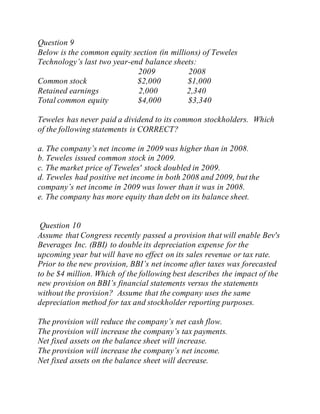
Below is the common equity section (in millions) of Teweles
Technology’s last two year-end balance sheets:
2009 2008
Common stock $2,000 $1,000
Retained earnings 2,000 2,340
Total common equity $4,000 $3,340
Teweles has never paid a dividend to its common stockholders. Which
of the following statements is CORRECT?
a. The company’s net income in 2009 was higher than in 2008.
b. Teweles issued common stock in 2009.
c. The market price of Teweles' stock doubled in 2009.
d. Teweles had positive net income in both 2008 and 2009, but the
company’s net income in 2009 was lower than it was in 2008.
e. The company has more equity than debt on its balance sheet.
Question 10
Assume that Congress recently passed a provision that will enable Bev's
Beverages Inc. (BBI) to double its depreciation expense for the
upcoming year but will have no effect on its sales revenue or tax rate.
Prior to the new provision, BBI’s net income after taxes was forecasted
to be $4 million. Which of the following best describes the impact of the
new provision on BBI’s financial statements versus the statements
without the provision? Assume that the company uses the same
depreciation method for tax and stockholder reporting purposes.
The provision will reduce the company’s net cash flow.
The provision will increase the company’s tax payments.
Net fixed assets on the balance sheet will increase.
The provision will increase the company’s net income.
Net fixed assets on the balance sheet will decrease.
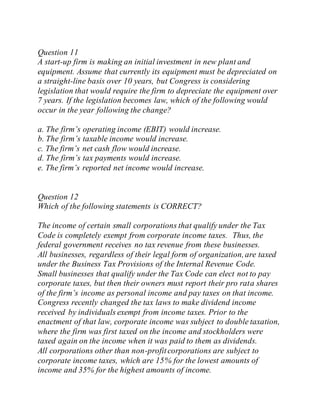
Question 11
A start-up firm is making an initial investment in new plant and
equipment. Assume that currently its equipment must be depreciated on
a straight-line basis over 10 years, but Congress is considering
legislation that would require the firm to depreciate the equipment over
7 years. If the legislation becomes law, which of the following would
occur in the year following the change?
a. The firm’s operating income (EBIT) would increase.
b. The firm’s taxable income would increase.
c. The firm’s net cash flow would increase.
d. The firm’s tax payments would increase.
e. The firm’s reported net income would increase.
Question 12
Which of the following statements is CORRECT?
The income of certain small corporations that qualify under the Tax
Code is completely exempt from corporate income taxes. Thus, the
federal government receives no tax revenue from these businesses.
All businesses, regardless of their legal form of organization,are taxed
under the Business Tax Provisions of the Internal Revenue Code.
Small businesses that qualify under the Tax Code can elect not to pay
corporate taxes, but then their owners must report their pro rata shares
of the firm’s income as personal income and pay taxes on that income.
Congress recently changed the tax laws to make dividend income
received by individuals exempt from income taxes. Prior to the
enactment of that law, corporate income was subject to double taxation,
where the firm was first taxed on the income and stockholders were
taxed again on the income when it was paid to them as dividends.
All corporations other than non-profitcorporations are subject to
corporate income taxes, which are 15% for the lowest amounts of
income and 35% for the highest amounts of income.
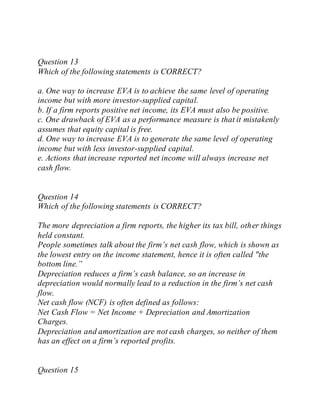
Question 13
Which of the following statements is CORRECT?
a. One way to increase EVA is to achieve the same level of operating
income but with more investor-supplied capital.
b. If a firm reports positive net income, its EVA must also be positive.
c. One drawback of EVA as a performance measure is that it mistakenly
assumes that equity capital is free.
d. One way to increase EVA is to generate the same level of operating
income but with less investor-supplied capital.
e. Actions that increase reported net income will always increase net
cash flow.
Question 14
Which of the following statements is CORRECT?
The more depreciation a firm reports, the higher its tax bill, other things
held constant.
People sometimes talk about the firm’s net cash flow, which is shown as
the lowest entry on the income statement, hence it is often called "the
bottom line.”
Depreciation reduces a firm’s cash balance, so an increase in
depreciation would normally lead to a reduction in the firm’s net cash
flow.
Net cash flow (NCF) is often defined as follows:
Net Cash Flow = Net Income + Depreciation and Amortization
Charges.
Depreciation and amortization are not cash charges, so neither of them
has an effect on a firm’s reported profits.
Question 15
Which of the following items is NOT included in current assets?
Accounts receivable.
Inventory.
Bonds.
Cash.
Short-term, highly liquid, marketable securities.
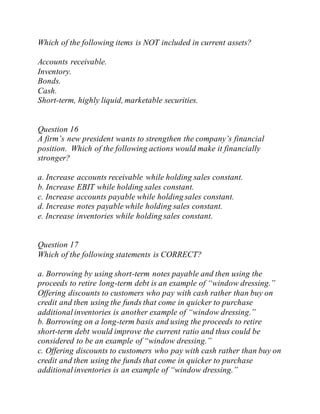
Question 16
A firm’s new president wants to strengthen the company’s financial
position. Which of the following actions would make it financially
stronger?
a. Increase accounts receivable while holding sales constant.
b. Increase EBIT while holding sales constant.
c. Increase accounts payable while holding sales constant.
d. Increase notes payable while holding sales constant.
e. Increase inventories while holding sales constant.
Question 17
Which of the following statements is CORRECT?
a. Borrowing by using short-term notes payable and then using the
proceeds to retire long-term debt is an example of “window dressing.”
Offering discounts to customers who pay with cash rather than buy on
credit and then using the funds that come in quicker to purchase
additionalinventories is another example of “window dressing.”
b. Borrowing on a long-term basis and using the proceeds to retire
short-term debt would improve the current ratio and thus could be
considered to be an example of “window dressing.”
c. Offering discounts to customers who pay with cash rather than buy on
credit and then using the funds that come in quicker to purchase
additionalinventories is an example of “window dressing.”
d. Using some of the firm’s cash to reduce long-term debt is an example
of “window dressing.”
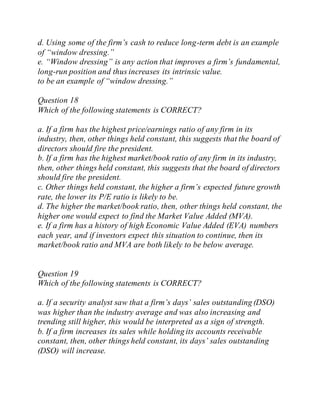
e. “Window dressing” is any action that improves a firm’s fundamental,
long-run position and thus increases its intrinsic value.
to be an example of “window dressing.”
Question 18
Which of the following statements is CORRECT?
a. If a firm has the highest price/earnings ratio of any firm in its
industry, then, other things held constant, this suggests that the board of
directors should fire the president.
b. If a firm has the highest market/book ratio of any firm in its industry,
then, other things held constant, this suggests that the board of directors
should fire the president.
c. Other things held constant, the higher a firm’s expected future growth
rate, the lower its P/E ratio is likely to be.
d. The higher the market/book ratio, then, other things held constant, the
higher one would expect to find the Market Value Added (MVA).
e. If a firm has a history of high Economic Value Added (EVA) numbers
each year, and if investors expect this situation to continue, then its
market/book ratio and MVA are both likely to be below average.
Question 19
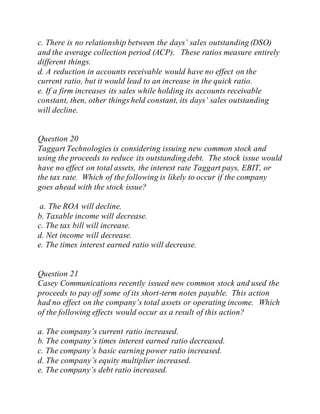
Which of the following statements is CORRECT?
a. If a security analyst saw that a firm’s days’ sales outstanding (DSO)
was higher than the industry average and was also increasing and
trending still higher, this would be interpreted as a sign of strength.
b. If a firm increases its sales while holding its accounts receivable
constant, then, other things held constant, its days’ sales outstanding
(DSO) will increase.
c. There is no relationship between the days’ sales outstanding (DSO)
and the average collection period (ACP). These ratios measure entirely
different things.
d. A reduction in accounts receivable would have no effect on the
current ratio, but it would lead to an increase in the quick ratio.
e. If a firm increases its sales while holding its accounts receivable
constant, then, other things held constant, its days’ sales outstanding
will decline.
Question 20
Taggart Technologies is considering issuing new common stock and
using the proceeds to reduce its outstanding debt. The stock issue would
have no effect on total assets, the interest rate Taggart pays, EBIT, or
the tax rate. Which of the following is likely to occur if the company
goes ahead with the stock issue?
a. The ROA will decline.
b. Taxable income will decrease.
c. The tax bill will increase.
d. Net income will decrease.
e. The times interest earned ratio will decrease.
Question 21
Casey Communications recently issued new common stock and used the
proceeds to pay off some of its short-term notes payable. This action
had no effect on the company’s total assets or operating income. Which
of the following effects would occur as a result of this action?
a. The company’s current ratio increased.
b. The company’s times interest earned ratio decreased.
c. The company’s basic earning power ratio increased.
d. The company’s equity multiplier increased.
e. The company’s debt ratio increased.
Question 22
Which of the following statements is CORRECT?
a. If Firms X and Y have the same P/E ratios, then their market-to-book
ratios must also be the same.
b. If Firms X and Y have the same net income, number of shares
outstanding,and price per share, then their P/E ratios must also be the
same.
c. If Firms X and Y have the same earnings per share and market-to-
book ratio, they must have the same price earnings ratio.
d. If Firm X’s P/E ratio exceeds that of Firm Y, then Y is likely to be less
risky and also to be expected to grow at a faster rate.
e. If Firms X and Y have the same net income, number of shares
outstanding,and price per share, then their market-to-book ratios must
also be the same.
Question 23
Companies HD and LD have the same sales, tax rate, interest rate on
their debt, total assets, and basic earning power. Both companies have
positive net incomes. Company HD has a higher debt ratio and,
therefore, a higher interest expense. Which of the following statements
is CORRECT?
a. Company HD pays less in taxes.
b. Company HD has a lower equity multiplier.
c. Company HD has a higher ROA.
d. Company HD has a higher times interest earned (TIE) ratio.
e. Company HD has more net income.
Question 24
You observe that a firm’s ROE is above the industry average, but its
profit margin and debt ratio are both below the industry average.
Which of the following statements is CORRECT?
a. Its total assets turnover must be above the industry average.
b. Its return on assets must equal the industry average.
c. Its TIE ratio must be below the industry average.
d. Its total assets turnover must be below the industry average.
e. Its total assets turnover must equal the industry average.
Question 25
Which of the following would indicate an improvement in a company’s
financial position, holding other things constant?
a. The inventory and total assets turnover ratios both decline.
b. The debt ratio increases.
c. The profit margin declines.
d. The EBITDA coverage ratio declines.
e. The current and quick ratios both increase.
Question 26
A firm wants to strengthen its financial position. Which of the following
actions would increase its quick ratio?
a. Offer price reductions along with generous credit terms that would
(1) enable the firm to sell some of its excess inventory and (2)lead to an
increase in accounts receivable.
b. Issue new common stock and use the proceeds to increase inventories.
c. Speed up the collection of receivables and use the cash generated to
increase inventories.
d. Use some of its cash to purchase additional inventories.
e. Issue new common stock and use the proceeds to acquire additional
fixed assets.
Question 27
If a bank loan officer were considering a company’s request for a loan,
which of the following statements would you consider to be CORRECT?
a. The lower the company’s EBITDA coverage ratio, other things held
constant, the lower the interest rate the bank would charge the firm.
b. Other things held constant, the higher the debt ratio, the lower the
interest rate the bank would charge the firm.
c. Other things held constant, the lower the debt ratio, the lower the
interest rate the bank would charge the firm.
d. The lower the company’s TIE ratio, other things held constant, the
lower the interest rate the bank would charge the firm.
e. Other things held constant, the lower the current ratio, the lower the
interest rate the bank would charge the firm.
Question 28
Companies HD and LD are both profitable, and they have the same total
assets (TA), Sales (S), return on assets (ROA), and profit margin (PM).
However, Company HD has the higher debt ratio. Which of the
following statements is CORRECT?
a. Company HD has a lower total assets turnover than Company LD.
b. Company HD has a lower equity multiplier than Company LD.
c. Company HD has a higher fixed assets turnover than Company B.
d. Company HD has a higher ROE than Company LD.
e. Company HD has a lower operating income (EBIT) than Company
LD.
Question 29
Which of the following statements is CORRECT?
a. Suppose a firm’s total assets turnover ratio falls from 1.0 to 0.9, but
at the same time its profit margin rises from 9% to 10% and its debt
increases from 40% of total assets to 60%. Under these conditions, the
ROE will increase.
b. Suppose a firm’s total assets turnover ratio falls from 1.0 to 0.9, but
at the same time its profit margin rises from 9% to 10% and its debt
increases from 40% of total assets to 60%. Without additional
information, we cannot tell what will happen to the ROE.
c. The modified Du Pont equation provides information about how
operations affect the ROE, but the equation does not include the effects
of debt on the ROE.
d. Other things held constant, an increase in the debt ratio will result in
an increase in the profit margin on sales.
e. Suppose a firm’s total assets turnover ratio falls from 1.0 to 0.9, but at
the same time its profit margin rises from 9% to 10%, and its debt
increases from 40% of total assets to 60%. Under these conditions, the
ROE will decrease.
Question 30
Considered alone, which of the following would increase a company’s
current ratio?
a. An increase in net fixed assets.
b. An increase in accrued liabilities.
c. An increase in notes payable.
d. An increase in accounts receivable.
e. An increase in accounts payable.
************************************************
FIN 534 Week 4 Chapter 6 Solution
For more classes visit
www.snaptutorial.com
Which of the following statements is CORRECT?
a. If you add enough randomly selected stocks to a portfolio, you can
completely eliminate all of the market risk from the portfolio.
b. If you were restricted to investing in publicly traded common stocks,
yet you wanted to minimize the riskiness of your portfolio as measured
by its beta, then according to the CAPM theory you should invest an
equal amount of money in each stock in the market. That is, if there were
10,000 traded stocks in the world, the least risky possible portfolio
would include some shares of each one.
c. If you formed a portfolio that consisted of all stocks with betas less
than 1.0, which is abouthalf of all stocks, the portfolio would itself have
a beta coefficient that is equal to the weighted average beta of the stocks
in the portfolio, and that portfolio would have less risk than a portfolio
that consisted of all stocks in the market.
d. Market risk can be eliminated by forming a large portfolio, and if
some Treasury bonds are held in the portfolio, the portfolio can be made
to be completely riskless.
e. A portfolio that consists of all stocks in the market would have a
required return that is equal to the riskless rate.
2. Jane has a portfolio of 20 average stocks, and Dick has a portfolio of
2 average stocks. Assuming the market is in equilibrium, which of the
following statements is CORRECT?
a. Jane's portfolio will have less diversifiable risk and also less market
risk than Dick's portfolio.
b. The required return on Jane's portfolio will be lower than that on
Dick's portfolio because Jane's portfolio will have less total risk.
c. Dick's portfolio will have more diversifiable risk, the same market
risk, and thus more total risk than Jane's portfolio, but the required (and
expected) returns will be the same on both portfolios.
d. If the two portfolios have the same beta, their required returns will be
the same, but Jane's portfolio will have less market risk than Dick's.
e. The expected return on Jane's portfolio must be lower than the
expected return on Dick's portfolio because Jane is more diversified.
3. Stock X has a beta of 0.7 and Stock Y has a beta of 1.3. The standard
deviation of each stock's returns is 20%. The stocks' returns are
independent of each other, i.e., the correlation coefficient, r, between
them is zero. Portfolio P consists of 50% X and 50% Y. Given this
information, which of the following statements is CORRECT?
a. Portfolio P has a standard deviation of 20%.
b. The required return on Portfolio P is equal to the market risk
premium (rM − rRF).
c. Portfolio P has a beta of 0.7.
d. Portfolio P has a beta of 1.0 and a required return that is equal to the
riskless rate, rRF.
e. Portfolio P has the same required return as the market (rM).
4. Which of the following statements is CORRECT?
a. When diversifiable risk has been diversified away, the inherent risk
that remains is market risk, which is constant for all stocks in the
market.
b. Portfolio diversification reduces the variability of returns on an
individual stock.
c. Risk refers to the chance that some unfavorable event will occur, and
a probability distribution is completely described by a listing of the
likelihoods of unfavorable events.
d. The SML relates a stock's required return to its market risk. The slope
and intercept of this line cannot be controlled by the firms' managers,
but managers can influence their firms' positions on the line by such
actions as changing the firm's capital structure or the type of assets it
employs.
e. A stock with a beta of -1.0 has zero market risk if held in a 1-stock
portfolio.
5. Which of the following statements is CORRECT?
a. If Mutual Fund A held equal amounts of 100 stocks, each of which
had a beta of 1.0, and Mutual Fund B held equal amounts of 10 stocks
with betas of 1.0, then the two mutual funds would both have betas of
1.0. Thus, they would be equally risky from an investor's standpoint,
assuming the investor's only asset is one or the other of the mutual
funds.
b. If investors become more risk averse but rRF does not change, then
the required rate of return on high-beta stocks will rise and the required
return on low-beta stocks will decline, but the required return on an
average-risk stock will not change.
c. An investor who holds just one stock will generally be exposed to
more risk than an investor who holds a portfolio of stocks, assuming the
stocks are all equally risky. Since the holder of the 1-stock portfolio is
exposed to more risk, he or she can expect to earn a higher rate of
return to compensate for the greater risk.
d. There is no reason to think that the slope of the yield curve would
have any effect on the slope of the SML.
e. Assume that the required rate of return on the market, rM, is given
and fixed at 10%. If the yield curve were upward sloping, then the
Security Market Line (SML) would have a steeper slope if 1-year
Treasury securities were used as the risk-free rate than if 30-year
Treasury bonds were used for rRF.
************************************************
FIN 534 Week 4 Chapter 7 Solution
For more classes visit
www.snaptutorial.com
Which of the following statements is CORRECT?
a. The constant growth model takes into consideration the capital gains
investors expect to earn on a stock.
b. Two firms with the same expected dividend and growth rates must
also have the same stock price.
c. It is appropriate to use the constant growth model to estimate a
stock's value even if its growth rate is never expected to become
constant.
d. If a stock has a required rate of return rs = 12%, and if its dividend is
expected to grow at a constant rate of 5%, this implies that the stock’s
dividend yield is also 5%.
e. The price of a stock is the present value of all expected future
dividends, discounted at the dividend growth rate.
2. Stocks A and B have the following data. Assuming the stock market is
efficient and the stocks are in equilibrium, which of the following
statements is CORRECT?
A B
Price $25 $25
Expected growth (constant) 10% 5%
Required return 15% 15%
a. Stock A's expected dividend at t = 1 is only half that of Stock B.
b. Stock A has a higher dividend yield than Stock B.
c. Currently the two stocks have the same price, but over time Stock B's
price will pass that of A.
d. Since Stock A’s growth rate is twice that of Stock B, Stock A’s future
dividends will always be twice as high as Stock B’s.
e. The two stocks should not sell at the same price. If their prices are
equal, then a disequilibrium must exist.
3. Which of the following statements is CORRECT?
a. A major disadvantage of financing with preferred stock is that
preferred stockholders typically have supernormal voting rights.
b. Preferred stock is normally expected to provide steadier, more
reliable income to investors than the same firm’s common stock, and, as
a result, the expected after-tax yield on the preferred is lower than the
after-tax expected return on the common stock.
c. The preemptive right is a provision in all corporate charters that gives
preferred stockholders the right to purchase (on a pro rata basis) new
issues of preferred stock.
d. One of the disadvantages to a corporation of owning preferred stock
is that 70% of the dividends received represent taxable income to the
corporate recipient, whereas interest income earned on bonds would be
tax free.
e. One of the advantages to financing with preferred stock is that 70% of
the dividends paid out are tax deductible to the issuer.
4. Church Inc. is presently enjoying relatively high growth because of a
surge in the demand for its new product. Management expects earnings
and dividends to grow at a rate of 25% for the next 4 years, after which
competition will probably reduce the growth rate in earnings and
dividends to zero, i.e., g = 0. The company’s last dividend, D0, was
$1.25, its beta is 1.20, the market risk premium is 5.50%, and the risk-
free rate is 3.00%. What is the current price of the common stock?
a. $26.77
b. $27.89
c. $29.05
d. $30.21
e. $31.42
5. Your boss, Sally Maloney, treasurer of Fred Clark Enterprises (FCE),
asked you to help her estimate the intrinsic value of the company's stock.
FCE just paid a dividend of $1.00, and the stock now sells for $15.00
per share. Sally asked a number of security analysts what they believe
FCE's future dividends will be, based on their analysis of the company.
The consensus is that the dividend will be increased by 10% during
Years 1 to 3, and it will be increased at a rate of 5% per year in Year 4
and thereafter. Sally asked you to use that information to estimate the
required rate of return on the stock, rs, and she provided you with the
following template for use in the analysis.
Sally told you that the growth rates in the template were just put in as a
trial, and that you must replace them with the analysts' forecasted rates
to get the correct forecasted dividends and then the estimated TV. She
also notes that the estimated value for rs, at the top of the template, is
also just a guess, and you must replace it with a value that will cause the
Calculated Price shown at the bottom to equal the Actual Market Price.
She suggests that, after you have put in the correct dividends, you can
manually calculate the price, using a series of guesses as to the
Estimated rs. The value of rs that causes the calculated price to equal
the actual price is the correct one. She notes, though, that this trial-and-
error process would be quite tedious, and that the correct rs could be
found much faster with a simple Excel model, especially if you use Goal
Seek. What is the value of rs?
a. 11.84%
b. 12.21%
c. 12.58%
d. 12.97%
e. 13.36%
************************************************
FIN 534 Week 4 DQ 1
For more classes visit
www.snaptutorial.com
Week 4 discussion 1
Drawing on what you discovered in the e-Activity, discuss how instances
of corporate mismanagement or fraud should be taken into account
when assessing the risks associated with certain types of investments.
Information is the investor's best tool when it comes to investing wisely.
Often, the lack of reliable, readily available, current information also
opens the door to fraud. It is easier for the unscrupulous to spread false
information and to manipulate a stock's price when accurate
information about the company is scarce.
Source: http://www.sec.gov/answers/infomatters.htm
************************************************
FIN 534 Week 4 DQ 2
For more classes visit
www.snaptutorial.com
Week 4 discussion 2
Discuss the non-rationalfactors that may have a role in the valuation of
stocks and stock market equilibrium. Provide specific examples to
support your response.
************************************************
FIN 534 Week 4 Quiz 3
For more classes visit
www.snaptutorial.com
Which of the following statements is CORRECT?
1) A time line is not meaningful unless all cash flows occur annually
2) Time lines are useful for visualizing complex problems prior to
doing actual calculations
3) Time lines cannot be constructed to deal with situations where
some of the cash flows occur annually but others occur quarterly
4) Time lines can only be constructed for annuities where the
payments occur at the ends of the periods, i.e., for ordinary annuities
5) Time lines cannot be constructed where some of the payments
constitute an annuity but others are unequal and thus are not part of the
annuity
2. Which of the following statements regarding a 30-year monthly
payment amortized mortgage with a nominal interest rate of 10% is
CORRECT?
1) The monthly payments will decline over time.
2) A smaller proportion of the last monthly payment will be interest,
and a larger proportion will be principal, than for the first monthly
payment
3) The total dollar amount of principal being paid off each month
gets smaller as the loan approaches maturity
4) The amount representing interest in the first payment would be
higher if the nominal interest rate were 7% rather than 10%.
5) Exactly 10% of the first monthly payment represents interest
3. A Treasury bond promises to pay a lump sum of $1,000 exactly 3
years from today. The nominal interest rate is 6%, semiannual
compounding. Which of the following statements is CORRECT?
1) The periodic interest rate is greater than 3%
2) The periodic rate is less than 3%
3) The present value would be greater if the lump sum were
discounted back for more periods
4) The present value of the $1,000 would be smaller if interest were
compounded monthly rather than semiannually
5) The PV of the $1,000 lump sum has a higher present value than
the PV of a 3-year, $333.33 ordinary annuity
4. You are analyzing the value of a potential investment by
calculating the sum of the present values of its expected cash flows.
Which of the following would lower the calculated value of the
investment?
1) The cash flows are in the form of a deferred annuity, and they total
to $100,000. You learn that the annuity lasts for only 5 rather than 10
years, hence that each payment is for $20,000 rather than for $10,000
2) The discount rate increases
3) The riskiness of the investment’s cash flows decreases
4) The total amount of cash flows remains the same, but more of the
cash flows are received in the earlier years and less are received in the
later years
5) The discount rate decreases
5. You are considering two equally risky annuities, each of which
pays $5,000 per year for 10 years. Investment ORD is an ordinary (or
deferred) annuity, while Investment DUE is an annuity due. Which of
the following statements is CORRECT?
1) A rational investor would be willing to pay more for DUE than for
ORD, so their market prices should differ.
2) The present value of DUE exceeds the present value of ORD, while
the future value of DUE is less than the future value of ORD.
3) The present value of ORD exceeds the present value of DUE, and the
future value of ORD also exceeds the future value of DUE.
4) The present value of ORD exceeds the present value of DUE, while
the future value of DUE exceeds the future value of ORD.
5) If the going rate of interest decreases from 10% to 0%, the difference
between the present value of ORD and the present value of DUE would
remain constant.
6. Which of the following statements regarding a 30-year monthly
payment amortized mortgage with a nominal interest rate of 10% is
CORRECT?
1) The monthly payments will decline over time
2) A smaller proportion of the last monthly payment will be interest,
and a larger proportion will be principal, than for the first monthly
payment
3) The total dollar amount of principal being paid off each month
gets smaller as the loan approaches maturity.
4) The amount representing interest in the first payment would be
higher if the nominal interest rate were 7% rather than 10%
5) Exactly 10% of the first monthly payment represents interest
7. A $150,000 loan is to be amortized over 7 years, with annual end-
of-year payments. Which of these statements is CORRECT?
1) The annual payments would be larger if the interest rate were
lower.
2) If the loan were amortized over 10 years rather than 7 years, and
if the interest rate were the same in either case, the first payment would
include more dollars of interest under the 7-year amortization plan.
3) The proportion of each payment that represents interest as
opposed to repayment of principal would be higher if the interest rate
were lower.
4) The proportion of each payment that represents interest versus
repayment of principal would be higher if the interest rate were higher.
5) The proportion of interest versus principal repayment would be the
same for each of the 7 payments.
8. Which of the following statements is CORRECT?
1) A time line is not meaningful unless all cash flows occur annually.
2) Time lines are not useful for visualizing complex problems prior to
doing actual calculations.
3) Time lines cannot be constructed to deal with situations where
some of the cash flows occur annually but others occur quarterly.
4) Time lines can only be constructed for annuities where the
payments occur at the end of the periods, i.e., for ordinary annuities.
5) Time lines can be constructed where some of the payments
constitute an annuity but others are unequal and thus are not part of the
annuity.
9. Which of the following investments would have the highest future
value at the end of 10 years? Assume that the effective annualrate for
all investments is the same and is greater than zero.
1) Investment A pays $250 at the beginning of every year for the next
10 years (a total of 10 payments).
2) Investment B pays $125 at the end of every 6-month period for the
next 10 years (a total of 20 payments).
3) Investment C pays $125 at the beginning of every 6-month period
for the next 10 years (a total of 20 payments).
4) Investment D pays $2,500 at the end of 10 years (just one
payment).
5) Investment E pays $250 at the end of every year for the next 10
years (a total of 10 payments).
10. Which of the following statements is CORRECT?
The present value of a 3-year, $150 annuity due will exceed the present
value of a 3-year, $150 ordinary annuity.
If a loan has a nominal annual rate of 8%, then the effective rate can
never be greater than 8%.
If a loan or investment has annualpayments, then the effective, periodic,
and nominal rates of interest will all be different.
The proportion of the payment that goes toward interest on a fully
amortized loan increases over time.
An investment that has a nominal rate of 6% with semiannual payments
will have an effective rate that is smaller than 6%
11. Which of the following statements regarding a 15-year (180-month)
$125,000, fixed-rate mortgage is CORRECT? (Ignore taxes and
transactions costs.)
1) The remaining balance after three years will be $125,000 less one
third of the interest paid during the first three years.
2) Because the outstanding balance declines over time, the monthly
payments will also decline over time.
3) Interest payments on the mortgage will increase steadily over time,
but the total amount of each payment will remain constant.
4) The proportion of the monthly payment that goes towards
repayment of principal will be lower 10 years from now than it will be
the first year.
5) The outstanding balance declines at a faster rate in the later years
of the loan’s life
12. Which of the following bank accounts has the highest effective
annual return?
1) An account that pays 8% nominal interest with monthly
compounding
2) An account that pays 8% nominal interest with annual
compounding.
3) An account that pays 7% nominal interest with daily (365-day)
compounding
4) An account that pays 7% nominal interest with monthly
compounding
5) An account that pays 8% nominal interest with daily (365-day)
compounding
13. A U.S. Treasury bond will pay a lump sum of $1,000 exactly 3 years
from today. The nominal interest rate is 6%, semiannual compounding.
Which of the following statements is CORRECT?
1) The periodic interest rate is greater than 3%.
2) The periodic rate is less than 3%.
3) The present value would be greater if the lump sum were
discounted back for more periods.
4) The present value of the $1,000 would be smaller if interest were
compounded monthly rather than semiannually.
5) The PV of the $1,000 lump sum has a higher present value than
the PV of a 3-year, $333.33 ordinary annuity.
14. Which of the following statements is CORRECT?
1) If you have a series of cash flows, each of which is positive, you
can solve for I, where the solution value of I causes the PV of the cash
flows to equal the cash flow at Time 0.
2) If you have a series of cash flows, and CF0 is negative but each of
the following CFs is positive, you can solve for I, but only if the sum of
the undiscounted cash flows exceeds the cost.
3) To solve for I, one must identify the value of I that causes the PV of
the positive CFs to equal the absolute value of the PV of the negative
CFs. This is, essentially, a trial-and-error procedure that is easy with a
computer or financial calculator but quite difficult otherwise.
4) If you solve for I and get a negative number, then you must have
made a mistake.
5) If CF0 is positive and all the other CFs are negative, then you
cannot solve for I.
15. You are considering two equally risky annuities, each of which pays
$5,000 per year for 10 years. Investment ORD is an ordinary (or
deferred) annuity, while Investment DUE is an annuity due. Which of
the following statements is CORRECT?
1) The present value of ORD must exceed the present value of DUE, but
the future value of ORD may be less than the future value of DUE.
2) The present value of DUE exceeds the present value of ORD, while
the future value of DUE is less than the future value of ORD.
3) The present value of ORD exceeds the present value of DUE, and
the future value of ORD also exceeds the future value of DUE.
4) The present value of DUE exceeds the present value of ORD, and
the future value of DUE also exceeds the future value of ORD.
5) If the going rate of interest decreases from 10% to 0%, the
difference between the present value of ORD and the present value of
DUE would remain constant.
16. Amram Inc. can issue a 20-year bond with a 6% annual coupon.
This bond is not convertible, is not callable, and has no sinking fund.
Alternatively, Amram could issue a 20-year bond that is convertible into
common equity, may be called, and has a sinking fund. Which of the
following most accurately describes the coupon rate that Amram would
have to pay on the convertible, callable bond?
1. Exactly equal to 6%.
2. It could be less than, equal to, or greater than 6%.
3. Greater than 6%.
4. Exactly equal to 8%.
5. Less than 6%.
17. A Treasury bond has an 8% annualcoupon and a 7.5% yield to
maturity. Which of the following statements is CORRECT?
1 The bond has a current yield greater than 8 percent.
2 The bond sells at a price above par.
3. If the yield to maturity remains constant, the price of the bond is
expected to fall over time.
4. Statements b and c are correct.
5 All of the statements above are correct.
18. Which of the following bonds has the greatest interest rate
price risk?
1) A 10-year $100 annuity.
2) All 10-year bonds have the same price risk since they have the same
maturity.
3) A 10-year, $1,000 face value, zero coupon bond.
4) A 10-year, $1,000 face value, 10% coupon bond with annual interest
payments.
5) A 10-year, $1,000 face value, 10% coupon bond with semiannual
interest payments
19. Which of the following statements is CORRECT?
A time line is not meaningful unless all cash flows occur annually.
Time lines are not useful for visualizing complex problems prior to
doing actual calculations.
Time lines can be constructed to deal with situations where some of the
cash flows occur annually but others occur quarterly.
Time lines can only be constructed for annuities where the payments
occur at the end of the periods, i.e., for ordinary annuities.
Time lines cannot be constructed where some of the payments constitute
an annuity but others are unequal and thus are not part of the annuity.
20. Which of the following statements is CORRECT?
All else equal, senior debt generally has a lower yield to maturity than
subordinated debt.
An indenture is a bond that is less risky than a mortgage bond.
The expected return on a corporate bond will generally exceed the
bond's yield to maturity.
If a bond’s coupon rate exceeds its yield to maturity, then its expected
return to investors exceeds the yield to maturity.
Under our bankruptcy laws, any firm that is in financial distress will be
forced to declare bankruptcy and then be liquidated.
21. A 15-year bond with a face value of $1,000 currently sells for $850.
Which of the following statements is CORRECT?
1. The bond's yield to maturity is greater than its coupon rate.
2. If the yield to maturity stays constant until the bond matures, the
bond's price will remain at $850.
3. The bond's current yield is equal to its coupon rate.
4. The bond's current yield exceeds its yield to maturity.
5. The bond's coupon rate exceeds its current yield.
22. Which of the following statements is CORRECT?
1) Sinking fund provisions never require companies to retire their
debt; they only establish “targets” for the company to reduce its debt
over time.
2) A sinking fund provision makes a bond more risky to investors at
the time of issuance.
3) Sinking fund provisions sometimes turn out to adversely affect
bondholders, and this is most likely to occur if interest rates decline
after the bond was issued.
4) Most sinking funds require the issuer to provide funds to a trustee,
who holds the money so that it will be available to pay off bondholders
when the bonds mature.
5) If interest rates increase after a company has issued bonds with a
sinking fund, the company will be less likely to buy bonds on the open
market to meet its sinking fund obligation and more likely to call them in
at the sinking fund call price.
23. Assume that all interest rates in the economy decline from 10% to
9%. Which of the following bonds would have the largest percentage
increase in price?
1. A 10-year bond with a 10 percent coupon.
2. An 8-year bond with a 9 percent coupon.
3. A 10-year zero coupon bond.
4. A 1-year bond with a 15 percent coupon.
24. A 12-year bond has an annualcoupon rate of 9%. The coupon rate
will remain fixed until the bond matures. The bond has a yield to
maturity of 7%. Which of the following statements is CORRECT?
1. The bond is currently selling at a price below its par value.
2. If market interest rates decline today, the price of the bond will also
decline today.
3. If market interest rates remain unchanged, the bond’s price one year
from now will be lower than it is today.
4. All of the statements above are correct.
5. None of the statements above is correct.
25. A 10-year bond pays an annual coupon. The bond has a yield to
maturity of 8 percent. The bond currently trades at a premium--its price
is above the par value of $1,000. Which of the following statements is
CORRECT?
1. If the yield to maturity remains at 8 percent, then the bond’s price will
decline over the next year.
2. The bond’s current yield is less than 8 percent.
3. If the yield to maturity remains at 8 percent, then the bond’s price will
remain the same over the next year.
4. The bond’s coupon rate is less than 8 percent.
5. If the yield to maturity increases, then the bond’s price will increase.
26. Which of the following statements is CORRECT?
One advantage of a zero coupon Treasury bond is that no one who owns
the bond has to pay any taxes on it until it matures or is sold.
Long-term bonds have less interest rate price risk but more reinvestment
rate risk than short-term bonds.
If interest rates increase, all bond prices will increase, but the increase
will be greater for bonds that have less interest rate risk.
Relative to a coupon-bearing bond with the same maturity, a zero
coupon bond has more interest rate price risk but less reinvestment rate
risk.
Long-term bonds have less interest rate price risk and also less
reinvestment rate risk than short-term bonds.
27. Which of the following statements is CORRECT?
A zero coupon bond's current yield is equal to its yield to maturity.
If a bond’s yield to maturity exceeds its coupon rate, the bond will sell at
par.
All else equal, if a bond’s yield to maturity increases, its price will fall.
If a bond’s yield to maturity exceeds its coupon rate, the bond will sell at
a premium over par.
All else equal, if a bond’s yield to maturity increases, its current yield
will fall.
28. A 10-year bond with a 9% annual coupon has a yield to maturity of
8%. Which of the following statements is CORRECT?
1. If the yield to maturity remains constant, the bond's price one year
from now will be higher than its current price.
2. The bond is selling below its par value.
3. The bond is selling at a discount.
4. If the yield to maturity remains constant, the bond's price one year
from now will be lower than its current price.
5. The bond's current yield is greater than 9%.
29. A 10-year corporate bond has an annual coupon of 9%. The bond is
currently selling at par ($1,000). Which of the following statements is
CORRECT?
a. The bond s expected capital gains yield is zero.
b. The bond s yield to maturity is above 9%.
c. The bond s current yield is above 9%.
d. If the bond s yield to maturity declines, the bond will sell at a
discount.
e. The bond s current yield is less than its expected capital gains yield.
30. If the Federal Reserve unexpectedly announces that it expects
inflation to increase, then we would probably observe an immediate
increase in bond prices.
The total yield on a bond is derived from dividends plus changes in the
price of the bond.
Bonds are riskier than common stocks and therefore have higher
required returns.
Bonds issued by larger companies always have lower yields to maturity
(less risk) than bonds issued by smaller companies.
The market value of a bond will always approach its par value as its
maturity date approaches, provided the bond’s required return remains
constant.
************************************************
FIN 534 Week 5 Chapter 8 Solution
For more classes visit
www.snaptutorial.com
1.Which of the following statements is CORRECT?
a. Put options give investors the right to buy a stock at a certain strike
price before a specified date.
b. Call options give investors the right to sell a stock at a certain strike
price before a specified date.
c. Options typically sell for less than their exercise value.
d. LEAPS are very short-term options that were created relatively
recently and now trade in the market.
e. An option holder is not entitled to receive dividends unless he or she
exercises their option before the stock goes ex dividend.
2. Which of the following statements is CORRECT?
a. If the underlying stock does not pay a dividend, it makes good
economic sense to exercise a call option as soon as the stock’s price
exceeds the strike price by about10%, because this permits the option
holder to lock in an immediate profit.
b. Call options generally sell at a price less than their exercise value.
c. If a stock becomes riskier (more volatile), call options on the stock are
likely to decline in value.
d. Call options generally sell at prices above their exercise value, but for
an in-the-money option, the greater the exercise value in relation to the
strike price, the lower the premium on the option is likely to be.
e. Because of the put-call parity relationship, under equilibrium
conditions a put option on a stock must sell at exactly the same price as
a call option on the stock.
3. Which of the following statements is CORRECT?
a. An option's value is determined by its exercise value, which is the
market price of the stock less its striking price. Thus, an option can't sell
for more than its exercise value.
b. As the stock’s price rises, the time value portion of an option on a
stock increases because the difference between the price of the stock and
the fixed strike price increases.
c. Issuing options provides companies with a low cost method of raising
capital.
d. The market value of an option depends in part on the option'stime to
maturity and also on the variability of the underlying stock's price.
e. The potential loss on an option decreases as the option sells at higher
and higher prices because the profit margin gets bigger.
4. The current price of a stock is $22, and at the end of one year its price
will be either $27 or $17. The annualrisk-free rate is 6.0%, based on
daily compounding. A 1-year call option on the stock, with an exercise
price of $22, is available. Based on the binominal model, what is the
option's value?
a. $2.43
b. $2.70
c. $2.99
d. $3.29
e. $3.62
5. An analyst wants to use the Black-Scholes model to value call options
on the stock of Ledbetter Inc. based on the following data:
The price of the stock is $40.
The strike price of the option is $40.
The option matures in 3 months (t = 0.25).
The standard deviation of the stock’s returns is 0.40, and the variance is
0.16.
The risk-free rate is 6%.
Given this information, the analyst then calculated the following
necessary components of the Black-Scholes model:
d1 = 0.175
d2 = -0.025
N(d1) = 0.56946
N(d2) = 0.49003
N(d1) and N(d2) represent areas under a standard normal distribution
function. Using the Black- Scholes model, what is the value of the call
option?
a. $2.81
b. $3.12
c. $3.47
d. $3.82
e. $4.20
************************************************
FIN 534 Week 5 Chapter 9 Solution
For more classes visit
www.snaptutorial.com
Bankston Corporation forecasts that if all of its existing financial
policies are followed, its proposed capital budget would be so large that
it would have to issue new common stock. Since new stock has a higher
cost than retained earnings, Bankston would like to avoid issuing new
stock. Which of the following actions would REDUCE its need to issue
new common stock?
a. Increase the dividend payout ratio for the upcoming year.
b. Increase the percentage of debt in the target capital structure.
c. Increase the proposed capital budget.
d. Reduce the amount of short-term bank debt in order to increase the
current ratio.
e. Reduce the percentage of debt in the target capital structure.
2. LaPango Inc. estimates that its average-risk projects have a WACC of
10%, its below-average risk projects have a WACC of 8%, and its
above-average risk projects have a WACC of 12%. Which of the
following projects (A, B, and C) should the company accept?
a. Project B, which is of below-average risk and has a return of 8.5%.
b. Project C, which is of above-average risk and has a return of 11%.
c. Project A, which is of average risk and has a return of 9%.
d. None of the projects should be accepted.
e. All of the projects should be accepted.
3. Which of the following statements is CORRECT?
a. When calculating the cost of preferred stock, a company needs to
adjust for taxes, because preferred stock dividends are deductible by the
paying corporation.
b. All else equal, an increase in a company’s stock price will increase its
marginal cost of retained earnings, rs.
c. All else equal, an increase in a company’s stock price will increase its
marginal cost of new common equity, re.
d. Since the money is readily available, the after-tax cost of retained
earnings is usually much lower than the after-tax cost of debt.
e. If a company’s tax rate increases but the YTM on its noncallable
bonds remains the same, the after-tax cost of its debt will fall.
4. Which of the following statements is CORRECT?
a. Since debt capital can cause a company to go bankruptbut equity
capital cannot, debt is riskier than equity, and thus the after-tax cost of
debt is always greater than the cost of equity.
b. The tax-adjusted cost of debt is always greater than the interest rate
on debt, provided the company does in fact pay taxes.
c. If a company assigns the same cost of capital to all of its projects
regardless of each project’s risk, then the company is likely to reject
some safe projects that it actually should accept and to accept some
risky projects that it should reject.
d. Because no flotation costs are required to obtain capital as retained
earnings, the cost of retained earnings is generally lower than the after-
tax cost of debt.
e. Higher flotation costs tend to reduce the cost of equity capital.
5. Cranberry Corp. has two divisions of equal size: a computer
manufacturing division and a data processing division. Its CFO believes
that stand-alone data processor companies typically have a WACC of
8%, while stand-alone computer manufacturers typically have a 12%
WACC. He also believes that the data processing and manufacturing
divisions have the same risk as their typical peers. Consequently, he
estimates that the composite, or corporate, WACC is 10%. A consultant
has suggested using an 8% hurdle rate for the data processing division
and a 12% hurdle rate for the manufacturing division. However, the
CFO disagrees, and he has assigned a 10% WACC to all projects in
both divisions. Which of the following statements is CORRECT?
a. While the decision to use just one WACC will result in its accepting
more projects in the manufacturing division and fewer projects in its
data processing division than if it followed the consultant’s
recommendation, this should not affect the firm’s intrinsic value.
b. The decision not to adjust for risk means, in effect, that it is favoring
the data processing division. Therefore, that division is likely to become
a larger part of the consolidated company over time.
c. The decision not to adjust for risk means that the company will accept
too many projects in the manufacturing division and too few in the data
processing division. This will lead to a reduction in the firm’s intrinsic
value over time.
d. The decision not to risk-adjust means that the company will accept too
many projects in the data processing business and too few projects in
the manufacturing business. This will lead to a reduction in its intrinsic
value over time.
e. The decision not to risk adjust means that the company will accept too
many projects in the manufacturing business and too few projects in the
data processing business. This may affect the firm’s capital structure but
it will not affect its intrinsic value
************************************************
FIN 534 Week 5 DQ 1
For more classes visit
www.snaptutorial.com
Week 5 discussion 1
Based on what you discovered in the e-Activity, make at least two
recommendations for regarding how your selected company should
approach its capital budgeting. Explain the reasoning behind your
recommendations.
A capital budgeting analysis conducts a test to see if the benefits (i.e.,
cash inflows) are large enough to repay the company for three things:
(1) the cost of the asset, (2) the cost of financing the asset (e.g., interest,
etc.), and (3) a rate of return (called a risk premium) that compensates
the company for potential errors made when estimating cash flows that
will occur in the distant future.
************************************************
FIN 534 Week 5 Quiz 4
For more classes visit
www.snaptutorial.com
Finance 534 week 5 quiz 4
Question 1
Assume that in recent years both expected inflation and the
market risk premium (rM
− rRF) have declined. Assume also that all stocks have positive betas.
Which of the following would be most likely to have occurred as a result
of these changes?
Answer
Question 2
Assume that the risk-free rate is 5%. Which of the following
statements is CORRECT?
Question 3
Which of the following statements is
CORRECT?
Question 4
A highly risk-averse investor is considering adding one
additionalstock to a 3-stock portfolio, to form a 4-stock portfolio. The
three stocks currently held all have b = 1.0, and they are perfectly
positively correlated with the market. Potential new Stocks A and B
both have expected returns of 15%, are in equilibrium, and are equally
correlated with the market, with r = 0.75. However, Stock A's standard
deviation of returns is 12% versus 8% for Stock B. Which stock should
this investor add to his or her portfolio, or does the choice not matter?
Correct Answer:
Question 5
Which of the following statements is CORRECT? (Assume that
the risk-free rate is a constant.)
Correct Answer:
Question 6
During the coming year, the market risk premium (rM − rRF), is
expected to fall, while the risk-free rate, rRF, is expected to remain the
same. Given this forecast, which of the following statements is
CORRECT?
Correct Answer:
Question 7
2 out of 2 points
Stock A's beta is 1.5 and Stock B's beta is 0.5. Which of the
following statements must be true, assuming the CAPM is correct.
Correct Answer:
Question 8
Bob has a $50,000 stock portfolio with a beta of 1.2, an expected
return of 10.8%, and a standard deviation of 25%. Becky also has a
$50,000 portfolio, but it has a beta of 0.8, an expected return of 9.2%,
and a standard deviation that is also 25%. The correlation coefficient,
r, between Bob's and Becky's portfolios is zero. If Bob and Becky marry
and combine their portfolios, which of the following best describes their
combined $100,000 portfolio?
Correct Answer:
Question 9
Stock A's beta is 1.5 and Stock B's beta is 0.5. Which of the
following statements must be true about these securities? (Assume
market equilibrium.)
Correct Answer:
The expected return on Stock A should be greater than that on B.
Question 10
For a portfolio of 40 randomly selected stocks, which of the
following is most likely to be true?
Correct Answer:
Question 11
Which of the following statements is CORRECT?
Question 12
You have the following data on three stocks:
Stock Standard Deviation Beta
A 20% 0.59
B 10% 0.61
C 12% 1.29
If you are a strict risk minimizer, you would choose Stock ____ if it is to
be held in isolation and Stock ____ if it is to be held as part of a well-
diversified portfolio.
Answer
Correct Answer:
Question 13
2 out of 2 points
Stock A has a beta of 0.8, Stock B has a beta of 1.0, and Stock C
has a beta of 1.2. Portfolio P has equal amounts invested in each of the
three stocks. Each of the stocks has a standard deviation of 25%. The
returns on the three stocks are independent of one another (i.e., the
correlation coefficients all equal zero). Assume that there is an increase
in the market risk premium, but the risk-free rate remains unchanged.
Which of the following statements is CORRECT?
Correct Answer:
Question 14
Which is the best measure of risk for a single asset held in
isolation, and which is the best measure for an asset held in a diversified
portfolio?
Answer
Correct Answer:
Question 15
Which of the following statements is CORRECT?
Correct Answer:
Question 16
If in the opinion of a given investor a stock’s expected return
exceeds
its required return, this suggests that the investor thinks
Answer
Correct Answer:
Question 17
The preemptive right is important to shareholders
because it
Correct Answer:
Question 18
2 out of 2 points
Stocks X and Y have the following data. Assuming the stock
market is efficient and the stocks are in equilibrium, which of the
following statements is CORRECT?
X Y
Price $25 $25
Expected dividend yield 5% 3%
Required return 12% 10%
Correct Answer:
Stock X pays a higher dividend per share than Stock Y.
Question 19
2 out of 2 points
Companies can issue different classes of common stock. Which
of the following statements concerning stock classes is CORRECT?
Question 20
The required returns of Stocks X and Y are rX = 10% and rY
= 12%. Which of the following statements is CORRECT?
Correct Answer:
Question 21
Stocks A and B have the following data. Assuming the stock
market is efficient and the stocks are in equilibrium, which of the
following statements is CORRECT?
A B
Price $25 $40
Expected growth 7% 9%
Expected return 10% 12%
Correct Answer:
Question 22
Stocks X and Y have the following data. Assuming the stock
market is efficient and the stocks are in equilibrium, which of
the following statements is CORRECT?
X Y
Price $30 $30
Expected growth (constant) 6% 4%
Required return 12% 10%
Answer
Correct Answer:
Question 23
2 out of 2 points
Which of the following statements is CORRECT?
Correct Answer:
Question 24
2 out of 2 points
Stocks A and B have the same price and are in equilibrium, but
Stock A has the higher required rate of return. Which of the following
statements is CORRECT?
Answer
Correct Answer:
Question 25
0 out of 2 points
Stocks A and B have the following data. Assuming
the stock market is efficient and the stocks are in equilibrium, which of
the following statements is CORRECT?
A B
Required return 10% 12%
Market price $25 $40
Expected growth 7% 9%
Correct Answer:
Question 26
2 out of 2 points
An increase in a firm’s expected growth rate would cause its
required rate of return to
Correct Answer:
Question 27
2 out of 2 points
If markets are in equilibrium, which of the following conditions
will exist?
Answer
Correct Answer:
Question 28
0 out of 2 points
Two constant growth stocks are in equilibrium, have the same
price, and have the same required rate of return. Which of the following
statements is CORRECT?
Answer
Correct Answer:
Question 29
2 out of 2 points
For a stock to be in equilibrium, that is, for there to be no long-
term pressure for its price to depart from its current level, then
Correct Answer:
Question 30
0 out of 2 points
Which of the following statements is CORRECT, assuming stocks
are in equilibrium?
Correct Answer:
************************************************
FIN 534 Week 6 Chapter 10 Solution
For more classes visit
www.snaptutorial.com
Which of the following statements is CORRECT?
a. The internal rate of return method (IRR) is generally regarded by
academics as being the best single method for evaluating capital
budgeting projects.
b. The payback method is generally regarded by academics as being the
best single method for evaluating capital budgeting projects.
c. The discounted payback method is generally regarded by academics
as being the best single method for evaluating capital budgeting
projects.
d. The net present value method (NPV) is generally regarded by
academics as being the best single method for evaluating capital
budgeting projects.
e. The modified internal rate of return method (MIRR) is generally
regarded by academics as being the best single method for evaluating
capital budgeting projects.
2. Projects A and B have identical expected lives and identical initial
cash outflows (costs). However, most of one project’s cash flows come in
the early years, while most of the other project’s cash flows occur in the
later years. The two NPV profiles are given below:
Which of the following statements is CORRECT?
a. More of Project A’s cash flows occur in the later years.
b. More of Project B’s cash flows occur in the later years.
c. We must have information on the cost of capital in order to determine
which project has the larger early cash flows.
d. The NPV profile graph is inconsistent with the statement made in the
problem.
e. The crossover rate, i.e., the rate at which Projects A and B have the
same NPV, is greater than either project’s IRR.
3. Suppose a firm relies exclusively on the payback method when making
capital budgeting decisions, and it sets a 4-year payback regardless of
economic conditions. Other things held constant, which of the following
statements is most likely to be true?
a. It will accept too many short-term projects and reject too many long-
term projects (as judged by the NPV).
b. It will accept too many long-term projects and reject too many short-
term projects (as judged by the NPV).
c. The firm will accept too many projects in all economic states because
a 4-year payback is too low.
d. The firm will accept too few projects in all economic states because a
4-year payback is too high.
e. If the 4-year payback results in accepting just the right set of projects
under average economic conditions, then this payback will result in too
few long-term projects when the economy is weak.
4. You are on the staff of Camden Inc. The CFO believes project
acceptance should be based on the NPV, but Steve Camden, the
president, insists that no project should be accepted unless its IRR
exceeds the project’s risk-adjusted WACC. Now you must make a
recommendation on a project that has a cost of $15,000 and two cash
flows: $110,000 at the end of Year 1 and -$100,000 at the end of Year 2.
The president and the CFO both agree that the appropriate WACC for
this project is 10%. At 10%, the NPV is $2,355.37, but you find two
IRRs, one at 6.33% and one at 527%, and a MIRR of 11.32%. Which of
the following statements best describes your optimal recommendation,
i.e., the analysis and recommendation that is best for the company and
least likely to get you in trouble with either the CFO or the president?
a. You should recommend that the project be rejected because its NPV is
negative and its IRR is less than the WACC.
b. You should recommend that the project be rejected because, although
its NPV is positive, it has an IRR that is less than the WACC.
c. You should recommend that the project be accepted because (1) its
NPV is positive and (2) although it has two IRRs, in this case it would be
better to focus on the MIRR, which exceeds the WACC. You should
explain this to the president and tell him that the firm’s value will
increase if the project is accepted.
d. You should recommend that the project be rejected. Although its NPV
is positive it has two IRRs, one of which is less than the WACC, which
indicates that the firm’s value will decline if the project is accepted.
e. You should recommend that the project be rejected because, although
its NPV is positive, its MIRR is less than the WACC, and that indicates
that the firm’s value will decline if it is accepted.
5. A firm is considering Projects S and L, whose cash flows are shown
below. These projects are mutually exclusive, equally risky, and not
repeatable. The CEO wants to use the IRR criterion, while the CFO
favors the NPV method. You were hired to advise the firm on the best
procedure. If the wrong decision criterion is used, how much potential
value would the firm lose?
WACC: 6.00%
Year 0 1 2 3 4
CFS -$1,025 $380 $380 $380 $380
CFL -$2,150 $765 $765 $765 $765
a. $188.68
b. $198.61
c. $209.07
d. $219.52
e. $230.49
************************************************
FIN 534 Week 6 Chapter 11 Solution
For more classes visit
www.snaptutorial.com
Which of the following statements is CORRECT?
a. An externality is a situation where a project would have an adverse
effect on some other part of the firm’s overall operations. If the project
would have a favorable effect on other operations, then this is not an
externality.
b. An example of an externality is a situation where a bank opens a new
office, and that new office causes deposits in the bank’s other offices to
decline.
c. The NPV method automatically deals correctly with externalities, even
if the externalities are not specifically identified, but the IRR method
does not. This is another reason to favor the NPV.
d. Both the NPV and IRR methods deal correctly with externalities, even
if the externalities are not specifically identified. However, the payback
method does not.
e. Identifying an externality can never lead to an increase in the
calculated NPV.
2. Taussig Technologies is considering two potential projects, X and Y.
In assessing the projects’ risks, the company estimated the beta of each
project versus both the company’s other assets and the stock market,
and it also conducted thorough scenario and simulation analyses. This
research produced the following data:
Project X Project Y
Expected NPV $350,000 $350,000
Standard deviation (σNPV) $100,000 $150,000
Project beta (vs. market) 1.4 0.8
Correlation of the project cash flows with cash flows from currently
existing projects. Cash flows are not correlated with the cash flows from
existing projects. Cash flows are highly correlated with the cash flows
from existing projects.
Which of the following statements is CORRECT?
a. Project X has more stand-alone risk than Project Y.
b. Project X has more corporate (or within-firm) risk than Project Y.
c. Project X has more market risk than Project Y.
d. Project X has the same level of corporate risk as Project Y.
e. Project X has less market risk than Project Y.
3. Which of the following statements is CORRECT?
a. If an asset is sold for less than its book value at the end of a project’s
life, it will generate a loss for the firm, hence its terminal cash flow will
be negative.
b. Only incremental cash flows are relevant in project analysis, the
proper incremental cash flows are the reported accounting profits, and
thus reported accounting income should be used as the basis for investor
and managerial decisions.
c. It is unrealistic to believe that any increases in net working capital
required at the start of an expansion project can be recovered at the
project’s completion. Working capital like inventory is almost always
used up in operations. Thus, cash flows associated with working capital
should be included only at the start of a project’s life.
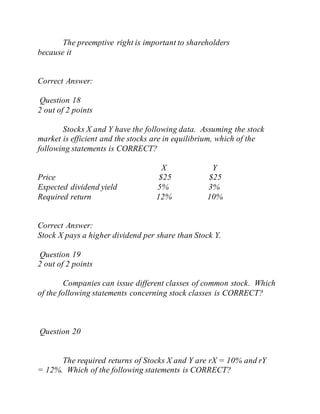
d. If equipment is expected to be sold for more than its book value at the
end of a project’s life, this will result in a profit. In this case, despite
taxes on the profit, the end-of-project cash flow will be greater than if
the asset had been sold at book value, other things held constant.
e. Changes in net working capital refer to changes in current assets and
current liabilities, not to changes in long-term assets and liabilities.
Therefore, changes in net working capital should not be considered in a
capital budgeting analysis.
4. Temple Corp. is considering a new project whose data are shown
below. The equipment that would be used has a 3-year tax life, would be
depreciated by the straight-line method over its 3-year life, and would
have a zero salvage value. No new working capital would be required.
Revenues and other operating costs are expected to be constant over the
project’s 3-year life. What is the project’s NPV?
Risk-adjusted WACC 10.0%
Net investment cost (depreciable basis) $65,000
Straight-line deprec. rate 33.3333%
Sales revenues, each year $65,500
Operating costs (excl. deprec.), each year $25,000
Tax rate 35.0%
a. $15,740
b. $16,569
c. $17,441
d. $18,359
e. $19,325
5. Florida Car Wash is considering a new project whose data are shown
below. The equipment to be used has a 3-year tax life, would be
depreciated on a straight-line basis over the project’s 3-year life, and
would have a zero salvage value after Year 3. No new working capital
would be required. Revenues and other operating costs will be constant
over the project’s life, and this is just one of the firm’s many projects, so
any losses on it can be used to offset profits in other units. If the number
of cars washed declined by 40% from the expected level, by how much
would the project’s NPV decline? (Hint: Note that cash flows are
constant at the Year 1 level, whatever that level is.)
WACC 10.0%
Net investment cost (depreciable basis) $60,000
Number of cars washed 2,800
Average price per car $25.00
Fixed op. cost (excl. deprec.) $10,000
Variable op. cost/unit (i.e., VC per car washed) $5.375
Annual depreciation $20,000
Tax rate 35.0%
a. $28,939
b. $30,462
c. $32,066
d. $33,753
e. $35,530
************************************************
FIN 534 Week 6 DQ 1
For more classes visit
www.snaptutorial.com
Week 6 discussion 1
Analyze the concept of “stress test” as applied to financial institutions
and create a better alternative for assessing the viability of a financial
institution.
************************************************
FIN 534 Week 6 Quiz 5
For more classes visit
www.snaptutorial.com
Finance 534 week 6 Quiz5
Question 1
Call options on XYZ Corporation’s common stock trade in the
market. Which of the following statements is most correct, holding other
things constant?
Question 2
Other things held constant, the value of an option depends on the
stock's price, the risk-free rate, and the
Question 3
Which of the following statements is CORRECT?
Question 4
Which of the following statements is CORRECT?
Question 5
An investor who writes standard call options against stock held
in his or her portfolio is said to be selling what type of options?
Question 6
An option that gives the holder the right to sell a stock at a
specified price at some future time is
Question 7
2 out of 2 points
The current price of a stock is $22, and at the end of one year its
price will be either $27 or $17. The annual risk-free rate is 6.0%, based
on daily compounding. A 1-year call option on the stock, with an
exercise price of $22, is available. Based on the binominal model, what
is the option's value?
Question 8
2 out of 2 points
The current price of a stock is $50, the annualrisk-free rate is
6%, and a 1-year call option with a strike price of $55 sells for $7.20.
What is the value of a put option, assuming the same strike price and
expiration date as for the call option?
Question 9
Which of the following statements is CORRECT?
Question 10
Deeble Construction Co.’s stock is trading at $30 a share. Call
options on the company’s stock are also available, some with a strike
price of $25 and some with a strike price of $35. Both options expire in
three months. Which of the following best describes the value of these
options?
Question 11
2 out of 2 points
Which of the following statements is CORRECT?
Question 12
Warner Motors’ stock is trading at $20 a share. Call options
that expire in three months with a strike price of $20 sell for $1.50.
Which of the following will occur if the stock price increases 10%, to
$22 a share?
Question 13
2 out of 2 points
Suppose you believe that Johnson Company's stock price is going
to increase from its current level of $22.50 sometime during the next 5
months. For $310.25 you can buy a 5-month call option giving you the
right to buy 100 shares at a price of $25 per share. If you buy this
option for $310.25 and Johnson's stock price actually rises to $45, what
would your pre-tax net profit be?
Question 14
2 out of 2 points
Which of the following statements is CORRECT?
Question 15
Suppose you believe that Delva Corporation's stock price is
going to decline from its current level of $82.50 sometime during the
next 5 months. For $510.25 you could buy a 5-month put option giving
you the right to sell 100 shares at a price of $85 per share. If you
bought this option for $510.25 and Delva's stock price actually dropped
to $60, what would your pre-tax net profit be?
Question 16
Which of the following statements is CORRECT?
Question 17
Which of the following statements is CORRECT? Assume that
the firm is a publicly-owned corporation and is seeking to maximize
shareholder wealth.
Question 18
When working with the CAPM, which of the following
factors can be determined with the most precision?
Question 19
For a company whose target capital structure calls for 50% debt
and 50% common equity, which of the following statements
is CORRECT?
Question 20
2 out of 2 points
Which of the following statements is CORRECT?
Question 21
Safeco Company and RiscoInc are identical in size and capital
structure. However, the riskiness of their assets and cash flows are
somewhat different, resulting in Safeco having a WACC of 10% and
Risco a WACC of 12%. Safeco is considering Project X, which has an
IRR of 10.5% and is of the same risk as a typical Safeco project. Risco
is considering Project Y, which has an IRR of 11.5% and is of the same
risk as a typical Risco project.
Now assume that the two companies merge and form a new company,
Safeco/Risco Inc. Moreover, the new company's market risk is an
average of the pre-merger companies' market risks, and the merger has
no impact on either the cash flows or the risks of Projects X and Y.
Which of the following statements is CORRECT?
Question 22
Which of the following statements is CORRECT?
Question 23
Which of the following statements is CORRECT?
Question 24
Schalheim Sisters Inc. has always paid out all of its earnings as
dividends; hence, the firm has no retained earnings. This same situation
is expected to persist in the future. The company uses the CAPM to
calculate its cost of equity, and its target capital structure consists of
common stock, preferred stock, and debt. Which of the following events
would REDUCE its WACC?
Question 25
Which of the following statements is CORRECT?
Question 26
2 out of 2 points
For a typical firm, which of the following sequences is
CORRECT? All rates are after taxes, and assume that the firm operates
at its target capital structure.
Answer
Question 27
Which of the following statements is CORRECT?
Question 28
The MacMillen Company has equal amounts of low-risk,
average-risk, and high-risk projects. The firm's overall WACC is 12%.
The CFO believes that this is the correct WACC for the company’s
average-risk projects, but that a lower rate should be used for lower-risk
projects and a higher rate for higher-risk projects. The CEO disagrees,
on the grounds that even though projects have different risks, the WACC
used to evaluate each project should be the same because the company
obtains capital for all projects from the same sources. If the CEO’s
position is accepted, what is likely to happen over time?
Correct Answer:
The company will take on too many high-risk projects and reject too
many low-risk projects.
Question 29
2 out of 2 points
Which of the following statements is CORRECT?
Question 30
Which of the following is NOT a capital component when
calculating the weighted average cost of capital (WACC) for use in
capital budgeting?
************************************************
FIN 534 Week 7 Chapter 12 Solution
For more classes visit
www.snaptutorial.com
1. Which of the following statements is CORRECT?
a. Perhaps the most important step when developing forecasted financial
statements is to determine the breakdown of common equity between
common stock and retained earnings.
b. The first, and perhaps the most critical, step in forecasting financial
requirements is to forecast future sales.
c. Forecasted financial statements, as discussed in the text, are used
primarily as a part of the managerial compensation program, where
management’s historical performance is evaluated.
d. The capital intensity ratio gives us an idea of the physical condition of
the firm’s fixed assets.
e. The AFN equation produces more accurate forecasts than the
forecasted financial statement method, especially if fixed assets are
lumpy, economies of scale exist, or if excess capacity exists.
2. Which of the following statements is CORRECT?
a. The sustainable growth rate is the maximum achievable growth rate
without the firm having to raise external funds. In other words, it is the
growth rate at which the firm's AFN equals zero.
b. If a firm’s assets are growing at a positive rate, but its retained
earnings are not increasing, then it would be impossible for the firm’s
AFN to be negative.
c. If a firm increases its dividend payout ratio in anticipation of higher
earnings, but sales and earnings actually decrease, then the firm’s
actual AFN must, mathematically, exceed the previously calculated
AFN.
d. Higher sales usually require higher asset levels, and this leads to
what we call AFN. However, the AFN will be zero if the firm chooses to
retain all of its profits, i.e., to have a zero dividend payout ratio.
e. Dividend policy does not affect the requirement for external funds
based on the AFN equation.
3. Which of the following statements is CORRECT?
a. When we use the AFN equation, we assume that the ratios of assets
and liabilities to sales (A0*/S0 and L0*/S0) vary from year to year in a
stable, predictable manner.
b. When fixed assets are added in large, discrete units as a company
grows, the assumption of constant ratios is more appropriate than if
assets are relatively small and can be added in small increments as sales
grow.
c. Firms whose fixed assets are “lumpy” frequently have excess
capacity, and this should be accounted for in the financial forecasting
process.
d. For a firm that uses lumpy assets, it is impossible to have small
increases in sales without expanding fixed assets.
e. There are economies of scale in the use of many kinds of assets. When
economies occur the ratios are likely to remain constant over time as the
size of the firm increases.
4. Last year Jain Technologies had $250 million of sales and $100
million of fixed assets, so its FA/Sales ratio was 40%. However, its fixed
assets were used at only 75% of capacity. Now the company is
developing its financial forecast for the coming year. As part of that
process, the company wants to set its target Fixed Assets/Sales ratio at
the level it would have had had it been operating at full capacity. What
target FA/Sales ratio should the company set?
a. 28.5%
b. 30.0%
c. 31.5%
d. 33.1%
e. 34.7%
5. Howton&Howton Worldwide (HHW) is planning its operations for
the coming year, and the CEO wants you to forecast the firm's
additionalfunds needed (AFN). The firm is operating at full capacity.
Data for use in the forecast are shown below. However, the CEO is
concerned about the impact of a change in the payout ratio from the
10% that was used in the past to 50%, which the firm's investment
bankers have recommended. Based on the AFN equation, by how much
would the AFN for the coming year change if HHW increased the payout
from 10% to the new and higher level? All dollars are in millions.
Last year’s sales = S0 $300.0 Last year’s accounts payable $50.0
Sales growth rate = g 40% Last year’s notes payable $15.0
Last year’s total assets = A0* $500.0 Last year’s accruals $20.0
Last year’s profit margin = PM 20.0% Initial payout ratio 10.0%
a. $31.9
b. $33.6
c. $35.3
d. $37.0
e. $38.9
************************************************
FIN 534 Week 7 Chapter 13 Solution
For more classes visit
www.snaptutorial.com
. Suppose Leonard, Nixon, & Shull Corporation’s projected free cash
flow for next year is $100,000, and FCF is expected to grow at a
constant rate of 6%. If the company’s weighted average cost of capital is
11%, what is the value of its operations?
a. $1,714,750
b. $1,805,000
c. $1,900,000
d. $2,000,000
e. $2,100,000
2. Leak Inc. forecasts the free cash flows (in millions) shown below. If
the weighted average cost of capital is 11% and FCF is expected to
grow at a rate of 5% after Year 2, what is the Year 0 value of
operations, in millions? Assume that the ROIC is expected to remain
constant in Year 2 and beyond (and do not make any half-year
adjustments).
Year: 1 2
Free cash flow: -$50 $100
a. $1,456
b. $1,529
c. $1,606
d. $1,686
e. $1,770
3. Based on the corporate valuation model, the value of a company’s
operations is $1,200 million. The company’s balance sheet shows $80
million in accounts receivable, $60 million in inventory, and $100
million in short-term investments that are unrelated to operations. The
balance sheet also shows $90 million in accounts payable, $120 million
in notes payable, $300 million in long-term debt, $50 million in
preferred stock, $180 million in retained earnings, and $800 million in
total common equity. If the company has 30 million shares of stock
outstanding,what is the best estimate of the stock’s price per share?
a. $24.90
b. $27.67
c. $30.43
d. $33.48
e. $36.82
4. Based on the corporate valuation model, the value of a company’s
operations is $900 million. Its balance sheet shows $70 million in
accounts receivable, $50 million in inventory, $30 million in short-term
investments that are unrelated to operations, $20 million in accounts
payable, $110 million in notes payable, $90 million in long-term debt,
$20 million in preferred stock, $140 million in retained earnings, and
$280 million in total common equity. If the company has 25 million
shares of stock outstanding, what is the best estimate of the stock’s price
per share?
a. $23.00
b. $25.56
c. $28.40
d. $31.24
e. $34.36
5. Vasudevan Inc. forecasts the free cash flows (in millions) shown
below. If the weighted average cost of capital is 13% and the free cash
flows are expected to continue growing at the same rate after Year 3 as
from Year 2 to Year 3, what is the Year 0 value of operations, in
millions?
Year: 1 2 3
Free cash flow: -$20 $42 $45
a. $586
b. $617
c. $648
d. $680
e. $714
************************************************
FIN 534 Week 7 DQ 1
For more classes visit
www.snaptutorial.com
Week 7 discussion 1
Analyze the process of forecasting financial statements and make at
least one recommendation for improving the accuracy of forecasts.
Provide specific examples to support your response.
************************************************
FIN 534 Week 7 DQ 2
For more classes visit
www.snaptutorial.com
Week 7 discussion 2
Drawing on what you discovered in the e-Activity, determine what
additionalsteps can be taken in the valuation of a corporation to avoid
instances like the one you researched from occurring in the future.
Provide specific examples to support your response.
************************************************
FIN 534 Week 7 Quiz 6
For more classes visit
www.snaptutorial.com
Finance 534 week 7 quiz 6
Question 1
Which of the following statements is CORRECT?
Answer
Question 2
Which of the following statements is CORRECT?
Question 3
Assume that the economy is in a mild recession, and as a result
interest rates and money costs generally are relatively low. The WACC
for two mutually exclusive projects that are being considered is 8%.
Project S has an IRR of 20% while Project L's IRR is 15%. The projects
have the same NPV at the 8% current WACC. However, you believe
that the economy is about to recover, and money costs and thus your
WACC will also increase. You also think that the projects will not be
funded until the WACC has increased, and their cash flows will not be
affected by the change in economic conditions. Under these conditions,
which of the following statements is CORRECT?
Question 4
Four of the following statements are truly disadvantages of the
regular payback method, but one is not a disadvantage of this method.
Which one is NOT
a disadvantage of the payback method?
Question 5
Which of the following statements is CORRECT?
Question 6
Which of the following statements is CORRECT? Assume that
the project being considered has normal cash flows, with one outflow
followed by a series of inflows.
Question 7
Which of the following statements is CORRECT?
Question 8
Which of the following statements is CORRECT?
Question 9
Which of the following statements is CORRECT?
Question 10
Which of the following statements is CORRECT? Assume that
the project being considered has normal cash flows, with one outflow
followed by a series of inflows.
Question 11
Which of the following statements is CORRECT?
Question 12
Which of the following statements is CORRECT? Assume that
the project being considered has normal cash flows, with one outflow
followed by a series of inflows.
Question 13
Assume that the economy is enjoying a strong boom, and as a
result interest rates and money costs generally are relatively high. The
WACC for two mutually exclusive projects that are being considered is
12%. Project S has an IRR of 20% while Project L's IRR is 15%. The
projects have the same NPV at the 12% current WACC. However, you
believe that the economy will soon fall into a mild recession, and money
costs and thus your WACC will soon decline. You also think that the
projects will not be funded until the WACC has decreased, and their
cash flows will not be affected by the change in economic conditions.
Under these conditions, which of the following statements is
CORRECT?
Question 14
Which of the following statements is CORRECT?
Question 15
Which of the following statements is CORRECT?
Question 16
The relative risk of a proposed project is best accounted for by
which of the following procedures?
Question 17
Which of the following statements is CORRECT?
Question 18
Rowell Company spent $3 million two years ago to build a plant
for a new product. It then decided not to go forward with the project, so
the building is available for sale or for a new product. Rowell owns the
building free and clear--there is no mortgage on it. Which of the
following statements is CORRECT?
Question 19
Which of the following should be considered when a company
estimates the cash flows used to analyze a proposed project?
Question 20
Which of the following statements is CORRECT?
Question 21
A company is considering a new project. The CFO plans to
calculate the project’s NPV by estimating the relevant cash flows for
each year of the project’s life (i.e., the initial investment cost, the annual
operating cash flows, and the terminal cash flow), then discounting
those cash flows at the company’s overall WACC. Which one of the
following factors should the CFO be sure to INCLUDE in the cash flows
when estimating the relevant cash flows?
Question 22
Which of the following factors should be included in the cash
flows used to estimate a project’s NPV?
Question 23
Which of the following rules is CORRECT for capital budgeting
analysis?
Question 24
Currently, Powell Products has a beta of 1.0, and its sales and
profits are positively correlated with the overall economy. The company
estimates that a proposed new project would have a higher standard
deviation and coefficient of variation than an average company project.
Also, the new project’s sales would be countercyclical in the sense that
they would be high when the overall economy is down and low when the
overall economy is strong. On the basis of this information, which of the
following statements is CORRECT?
Question 25
2 out of 2 points
Which of the following statements is CORRECT?
Question 26
Which of the following procedures does the text say is used most
frequently by businesses when they do capital budgeting analyses?
Question 27
A firm is considering a new project whose risk is greater than the
risk of the firm’s average project, based on all methods for assessing
risk. In evaluating this project, it would be reasonable for management
to do which of the following?
Question 28
When evaluating a new project, firms should include in the
projected cash flows all of the following EXCEPT:
Question 29
Which of the following is NOT a relevant cash flow and thus
should not be reflected in the analysis of a capital budgeting project?
Question 30
Suppose Tapley Inc. uses a WACC of 8% for below-average risk
projects, 10% for average-risk projects, and 12% for above-average risk
projects. Which of the following independent projects should Tapley
accept, assuming that the company uses the NPV method when choosing
projects?
************************************************
FIN 534 Week 8 Chapter 14 Solution
For more classes visit
www.snaptutorial.com
Which of the following statements about dividend policies is CORRECT?
a. Modigliani and Miller argue that investors prefer dividends to capital
gains because dividends are more certain than capital gains. They call
this the ―bird-in-the hand‖ effect.
b. One reason that companies tend to avoid stock repurchases is that
dividend payments are taxed at a lower rate than gains on stock
repurchases.
c. One advantage of dividend reinvestment plans is that they allow
shareholders to avoid paying taxes on the dividends that they choose to
reinvest.
d. One key advantage of a residual dividend policy is that it enables a
company to follow a stable dividend policy.
e. The clientele effect suggests that companies should follow a stable
dividend policy.
2. Which of the following statements is CORRECT?
a. One disadvantage of dividend reinvestment plans is that they increase
transactions costs for investors who want to increase their ownership in
the company.
b. One advantage of dividend reinvestment plans is that they enable
investors to postpone paying taxes on the dividends credited to their
account.
c. Stock repurchases can be used by a firm that wants to increase its
debt ratio.
d. Stock repurchases make sense if a company expects to have a lot of
profitable new projects to fund over the next few years, provided
investors are aware of these investment opportunities.
e. One advantage of an open market dividend reinvestment plan is that it
provides new equity capital and increases the shares outstanding.
3. Which of the following statements is CORRECT?
a. When firms are deciding on the size of stock splits—say whether to
declare a 2-for-1 split or a 3-for-1 split, it is best to declare the smaller
one, in this case the 2-for-1 split, because then the after-split price will
be higher than if the 3-for-1 split had been used.
b. Back before the SEC was created in the 1930s, companies would
declare reverse splits in order to boost their stock prices. However, this
was determined to be a deceptive practice, and it is illegal today.
c. Stock splits create more administrative problems for investors than
stock dividends, especially determining the tax basis of their shares
when they decide to sell them, so today stock dividends are used far
more often than stock splits.
d. When a company declares a stock split, the price of the stock typically
declines—by about 50% after a 2-for-1 split—and this necessarily
reduces the total market value of the equity.
e. If a firm’s stock price is quite high relative to most stocks—say $500
per share—then it can declare a stock split of say 10-for-1 so as to bring
the price down to something close to $50.
4. Which of the following statements is CORRECT?
a. If a firm follows the residual dividend policy, then a sudden increase
in the number of profitable projects is likely to reduce the firm’s
dividend payout.
b. The clientele effect can explain why so many firms change their
dividend policies so often.
c. One advantage of adopting the residual dividend policy is that this
policy makes it easier for corporations to develop a specific and well-
identified dividend clientele.
d. New-stock dividend reinvestment plans are similar to stock dividends
because they both increase the number of shares outstanding but don’t
change the firm’s total amount of book equity.
e. Investors who receive stock dividends must pay taxes on the value of
the new shares in the year the stock dividends are received.
5. DeAngelo Corp.'s projected net income is $150.0 million, its target
capital structure is 25% debt and 75% equity, and its target payout ratio
is 65%. DeAngelo has more positive NPV projects than it can finance
without issuing new stock, but its board of directors had decreed that it
cannot issue any new shares in the foreseeable future. The CFO now
wants to determine how the maximum capital budget would be affected
by changes in capital structure policy and/or the target dividend payout
policy. Versus the current policy, how much larger could the capital
budget be if (1) the target debt ratio were raised to 75%, other things
held constant, (2) the target payout ratio were lowered to 20%, other
things held constant, and (3) the debt ratio and payout were both
changed by the indicated amounts.
Increase in Capital Budget
Increase Debt Lower Payout Do Both to 75% to
20%___________________
a. $114.0 $73.3 $333.9
b. $120.0 $77.2 $351.5
c. $126.4 $81.2 $370.0
d. $133.0 $85.5 $389.5
e. $140.0 $90.0 $410.0
************************************************
FIN 534 Week 8 Chapter 15 Solution
For more classes visit
www.snaptutorial.com
Which of the following statements best describes the optimal capital
structure?
a. The optimal capital structure is the mix of debt, equity, and preferred
stock that maximizes the company’s earnings per share (EPS).
b. The optimal capital structure is the mix of debt, equity, and preferred
stock that maximizes the company’s stock price.
c. The optimal capital structure is the mix of debt, equity, and preferred
stock that minimizes the company’s cost of equity.
d. The optimal capital structure is the mix of debt, equity, and preferred
stock that minimizes the company’s cost of debt.
e. The optimal capital structure is the mix of debt, equity, and preferred
stock that minimizes the company’s cost of preferred stock.
2. Which of the following statements is CORRECT?
a. A firm can use retained earnings without paying a flotation cost.
Therefore, while the cost of retained earnings is not zero, its cost is
generally lower than the after-tax cost of debt.
b. The capital structure that minimizes a firm’s weighted average cost of
capital is also the capital structure that maximizes its stock price.
c. The capital structure that minimizes the firm’s weighted average cost
of capital is also the capital structure that maximizes its earnings per
share.
d. If a firm finds that the cost of debt is less than the cost of equity,
increasing its debt ratio must reduce its WACC.
e. Other things held constant, if corporate tax rates declined, then the
Modigliani-Miller tax-adjusted tradeoff theory would suggest that firms
should increase their use of debt.
3. Which of the following statements is CORRECT?
a. In general, a firm with low operating leverage also has a small
proportion of its total costs in the form of fixed costs.
b. There is no reason to think that changes in the personal tax rate
would affect firms’ capital structure decisions.
c. A firm with high business risk is more likely to increase its use of
financial leverage than a firm with low business risk, assuming all else
equal.
d. If a firm's after-tax cost of equity exceeds its after-tax cost of debt, it
can always reduce its WACC by increasing its use of debt.
e. Suppose a firm has less than its optimal amount of debt. Increasing its
use of debt to the point where it is at its optimal capital structure will
decrease the costs of both debt and equity financing.
4. Companies HD and LD have identical amounts of assets, operating
income (EBIT), tax rates, and business risk. Company HD, however, has
a much higher debt ratio than LD. Company HD’s basic earning power
ratio (BEP) exceeds its cost of debt (rd). Which of the following
statements is CORRECT?
a. Company HD has a higher return on assets (ROA) than Company LD.
b. Company HD has a higher times interest earned (TIE) ratio than
Company LD.
c. Company HD has a higher return on equity (ROE) than Company LD,
and its risk, as measured by the standard deviation of ROE, is also
higher than LD’s.
d. The two companies have the same ROE.
e. Company HD’s ROE would be higher if it had no debt.
5. Which of the following statements is CORRECT?
a. Generally, debt-to-total-assets ratios do not vary much among
different industries, although they do vary among firms within a given
industry.
b. Electric utilities generally have very high common equity ratios
because their revenues are more volatile than those of firms in most
other industries.
c. Drug companies (prescription, not illegal!) generally have high debt-
to-equity ratios because their earnings are very stable and, thus, they
can cover the high interest costs associated with high debt levels.
d. Wide variations in capital structures exist both between industries and
among individual firms within given industries. These differences are
caused by differing business risks and also managerial attitudes.
e. Since most stocks sell at or very close to their book values, book value
capital structures are almost always adequate for use in estimating
firms' costs of capital.
************************************************
FIN 534 Week 8 DQ 1
For more classes visit
www.snaptutorial.com
Week 8 discussion 1
I examined PepsiCo to determine how it should address its free cash
flow, either through distributions to shareholders or repurchasing of
stock.
************************************************
FIN 534 Week 8 DQ 2
For more classes visit
www.snaptutorial.com
Week 8 discussion 2
Capital structure is the manner in which a firm’s assets are financed;
that is, the right-hand side of the balance sheet. Capital structure is
normally expressed as the percentage of each type of capital used by the
firm--debt, preferred stock, and common equity
************************************************
FIN 534 Week 8 Quiz 7
For more classes visit
www.snaptutorial.com
Finance 534 week 8 quiz 7
This quiz consist of 30 multiple choice questions. The first 15 questions
cover the material in Chapter 12. The second 15 questions cover the
material in Chapter 13. Be sure you are in the correct Chapter when you
take the quiz.
Question 1
Last year Godinho Corp. had $250 million of sales, and it had
$75 million of fixed assets that were being operated at 80% of capacity.
In millions, how large could sales have been if the company had
operated at full capacity?
Question 2
Which of the following is NOT a key element in strategic
planning as it is described in the text?
Question 3
Spontaneousfunds are generally defined as follows:
Question 4
Which of the following statements is CORRECT?
Question 5
Which of the following statements is CORRECT?
Question 6
Which of the following statements is CORRECT?
Question 7
The capital intensity ratio is generally defined as follows:
Question 8
A company expects sales to increase during the coming year, and
it is using the AFN equation to forecast the additionalcapital that it
must raise. Which of the following conditions would cause the AFN to
increase?
Question 9
Which of the following statements is CORRECT?
Question 10
Which of the following is NOT one of the steps taken in the
financial planning process?
Question 11
Which of the following statements is CORRECT?
Question 12
Which of the following assumptions is embodied in the AFN
equation?
Question 13
The term “additionalfunds needed (AFN)” is generally defined
as follows:
Question 14
Which of the following statements is CORRECT?
Question 15
Last year Handorf-Zhu Inc. had $850 million of sales, and it had
$425 million of fixed assets that were used at only 60% of capacity.
What is the maximum sales growth rate the company could achieve
before it had to increase its fixed assets?
Question 16
Which of the following statements is NOT
CORRECT?
Question 17
Based on the corporate valuation model, Hunsader’s value of
operations is $300 million. The balance sheet shows $20 million of
short-term investments that are unrelated to operations, $50 million of
accounts payable, $90 million of notes payable, $30 million of long-term
debt, $40 million of preferred stock, and $100 million of common
equity. The company has 10 million shares of stock outstanding. What
is the best estimate of the stock’s price per share?
Answer
Question 18
Which of the following is NOT normally regarded as being a
good reason to establish an ESOP?
Question 19
Zhdanov Inc. forecasts that its free cash flow in the coming year,
i.e., at t = 1, will be -$10 million, but its FCF at t = 2 will be $20
million. After Year 2, FCF is expected to grow at a constant rate of 4%
forever. If the weighted average cost of capital is 14%, what is the
firm’s value of operations, in millions?
Question 20
Leak Inc. forecasts the free cash flows (in millions) shown
below. If the weighted average cost of capital is 11% and FCF is
expected to grow at a rate of 5% after Year 2, what is the Year 0 value
of operations, in millions? Assume that the ROIC is expected to remain
constant in Year 2 and beyond (and do not make any half-year
adjustments).
Year: 1 2
Free cash flow: -$50 $100
Question 21
Suppose Leonard, Nixon, & Shull Corporation’s projected free
cash flow for next year is $100,000,and FCF is expected to grow at a
constant rate of 6%. If the company’s weighted average cost of capital
is 11%, what is the value of its operations?
Answer
Question 22
A company forecasts the free cash flows (in millions) shown
below. The weighted average cost of capital is 13%, and the FCFs are
expected to continue growing at a 5% rate after Year 3. Assuming that
the ROIC is expected to remain constant in Year 3 and beyond, what is
the Year 0 value of operations, in millions?
Year: 1 2 3
Free cash flow: -$15 $10
$40
Question 23
Suppose Yon Sun Corporation’s free cash flow during the just-
ended year (t = 0) was $100 million, and FCF is expected to grow at a
constant rate of 5% in the future. If the weighted average cost of capital
is 15%, what is the firm’s value of operations, in millions?
Answer
Question 24
Based on the corporate valuation model, Bernile Inc.’s value of
operations is $750 million. Its balance sheet shows $50 million of short-
term investments that are unrelated to operations, $100 million of
accounts payable, $100 million of notes payable, $200 million of long-
term debt, $40 million of common stock (par plus paid-in-capital), and
$160 million of retained earnings. What is the best estimate for the
firm’s value of equity, in millions?
Answer
Question 25
Simonyan Inc. forecasts a free cash flow of $40 million in Year 3,
i.e., at t = 3, and it expects FCF to grow at a constant rate of 5%
thereafter. If the weighted average cost of capital is 10% and the cost of
equity is 15%, what is the horizon value, in millions at t = 3?
Answer
Question 26
Akyol Corporation is undergoing a restructuring, and its free
cash flows are expected to be unstable during the next few years.
However, FCF is expected to be $50 million in Year 5, i.e., FCF at t = 5
equals $50 million, and the FCF growth rate is expected to be constant
at 6% beyond that point. If the weighted average cost of capital is 12%,
what is the horizon value (in millions) at t = 5?
Answer
Question 27
Which of the following does NOT always
increase a company’s market value?
Question 28
Based on the corporate valuation model, the value of a
company’s operations is $1,200 million. The company’s balance sheet
shows $80 million in accounts receivable, $60 million in inventory, and
$100 million in short-term investments that are unrelated to operations.
The balance sheet also shows $90 million in accounts payable, $120
million in notes payable, $300 million in long-term debt, $50 million in
preferred stock, $180 million in retained earnings, and $800 million in
total common equity. If the company has 30 million shares of stock
outstanding,what is the best estimate of the stock’s price per share?
Question 29
Which of the following is NOT normally regarded as being
a barrier to hostile takeovers?
Question 30
Based on the corporate valuation model, the value of a
company’s operations is $900 million. Its balance sheet shows $70
million in accounts receivable, $50 million in inventory, $30 million in
short-term investments that are unrelated to operations, $20 million in
accounts payable, $110 million in notes payable, $90 million in long-
term debt, $20 million in preferred stock, $140 million in retained
earnings, and $280 million in total common equity. If the company has
25 million shares of stock outstanding,what is the best estimate of the
stock’s price per share?
************************************************
FIN 534 Week 9 Chapter 16 Solution
For more classes visit
www.snaptutorial.com
Swim Suits Unlimited is in a highly seasonal business, and the following
summary balance sheet data show its assets and liabilities at peak and
off-peak seasons (in thousands of dollars):
Peak Off-Peak
Cash $ 50 $ 30
Marketable securities 0 20
Accounts receivable 40 20
Inventories 100 50
Net fixed assets 500 500
Total assets $690 $620
Payables and accruals $ 30 $ 10
Short-term bank debt 50 0
Long-term debt 300 300
Common equity 310 310
Total claims $690 $620
From this data we may conclude that
a. Swim Suits' current asset financing policy calls for exactly matching
asset and liability maturities.
b. Swim Suits' current asset financing policy is relatively aggressive;
that is, the company finances some of its permanent assets with short-
term discretionary debt.
c. Swim Suits follows a relatively conservative approach to current asset
financing; that is, some of its short-term needs are met by permanent
capital.
d. Without income statement data, we cannot determine the
aggressiveness or conservatism of the company's current asset financing
policy.
e. Without cash flow data, we cannot determine the aggressiveness or
conservatism of the company's current asset financing policy.
2. Which of the following statements is CORRECT?
a. A firm that makes 90% of its sales on credit and 10% for cash is
growing at a constant rate of 10% annually. Such a firm will be able to
keep its accounts receivable at the current level, since the 10% cash
sales can be used to finance the 10% growth rate.
b. In managing a firm's accounts receivable, it is possible to increase
credit sales per day yet still keep accounts receivable fairly steady,
provided the firm can shorten the length of its collection period (its
DSO) sufficiently.
c. Because of the costs of granting credit, it is not possible for credit
sales to be more profitable than cash sales.
d. Since receivables and payables both result from sales transactions, a
firm with a high receivables-to-sales ratio must also have a high
payables-to-sales ratio.
e. Other things held constant, if a firm can shorten its DSO, this will
lead to a higher current ratio.
3. Halka Company is a no-growth firm. Its sales fluctuate seasonally,
causing total assets to vary from $320,000 to $410,000,but fixed assets
remain constant at $260,000. If the firm follows a maturity matching (or
moderate) working capital financing policy, what is the most likely total
of long-term debt plus equity capital?
a. $260,642
b. $274,360
c. $288,800
d. $304,000
e. $320,000
4. Your consulting firm was recently hired to improve the performance
of Shin-SoenenInc, which is highly profitable but has been experiencing
cash shortages due to its high growth rate. As one part of your analysis,
you want to determine the firm’s cash conversion cycle. Using the
following information and a 365-day year, what is the firm’s present
cash conversion cycle?
Average inventory = $75,000
Annual sales = $600,000
Annual cost of goods sold = $360,000
Average accounts receivable = $160,000
Average accounts payable = $25,000
a. 120.6 days
b. 126.9 days
c. 133.6 days
d. 140.6 days
e. 148.0 days
5. Affleck Inc.'s business is booming, and it needs to raise more capital.
The company purchases supplies on terms of 1/10 net 20, and it
currently takes the discount. One way of getting the needed funds would
be to forgo the discount, and the firm's owner believes she could delay
payment to 40 days without adverse effects. What would be the effective
annual percentage cost of funds raised by this action? (Assume a 365-
day year.)
a. 10.59%
b. 11.15%
c. 11.74%
d. 12.36%
e. 13.01%
************************************************
FIN 534 Week 9 DQ 1
For more classes visit
www.snaptutorial.com
Week 9 discussion 1
Based on the content of this chapter and what you discovered in the e-
Activity, analyze cash management technology and make at least one
recommendation for another technique that would enhance working
capital management. Explain the reasoning behind your
recommendation.
************************************************
FIN 534 Week 9 DQ 2
For more classes visit
www.snaptutorial.com
Week 9 discussion 2
Create an idea for a startup venture and discuss the most viable way to
raise the working capital to get the startup running. Explain your
rationale.
************************************************
FIN 534 Week 9 Quiz 8
For more classes visit
www.snaptutorial.com
Question 1
Which of the following statements about dividend policies is
correct?
Question 2
If a firm adheres strictly to the residual dividend policy, the
issuance of new common stock would suggest that
Question 3
Which of the following statements is correct?
Answer
Correct Answer:
If a firm repurchases some of its stock in the open market, then
shareholders who sell their stock for more than they paid for it will be
subject to capital gains taxes.
Question 4
Which of the following statements is CORRECT?
Question 5
Which of the following statements is correct?
Question 6
Which of the following should not
influence a firm’s dividend policy decision?
Question 7
If a firm adheres strictly to the residual dividend policy, then if
its optimal capital budget requires the use of all earnings for a given
year (along with new debt according to the optimal debt/total assets
ratio), then the firm should pay
Question 8
You own 100 shares of Troll Brothers’ stock, which currently
sells for $120 a share. The company is contemplating a 2-for-1 stock
split. Which of the following best describes what your position will be
after such a split takes place?
Answer
Question 9
Myron Gordon and John Lintner believe that the required return
on equity increases as the dividend payout ratio is decreased. Their
argument is based on the assumption that
Question 10
Which of the following statements is correct?
Question 11
Which of the following would be most likely to lead to a decrease
in a firm’s dividend payout ratio?
Question 12
Which of the following statements is correct?
Question 13
Firm M is a mature firm in a mature industry. Its annualnet
income and net cash flows are both consistently high and stable.
However, M’s growth prospects are quite limited, so its capital budget is
small relative to its net income. Firm N is a relatively new firm in a new
and growing industry. Its markets and products have not stabilized, so
its annualoperating income fluctuates considerably. However, N has
substantial growth opportunities, and its capital budget is expected to be
large relative to its net income for the foreseeable future. Which of the
following statements is correct?
Answer
Question 14
Which of the following statements is correct?
Question 15
Which of the following statements is correct?
Question 16
Which of the following would increase the likelihood that a
company would increase its debt ratio, other things held constant?
Question 17
Which of the following statements is CORRECT?
Question 18
Companies HD and LD have the same total assets, operating
income (EBIT), tax rate, and business risk. Company HD, however, has
a much higher debt ratio than LD. Also HD’s basic earning power
(BEP) exceeds its cost of debt (rd). Which of the following statements is
CORRECT?
Question 19
Other things held constant, which of the following events is most
likely to encourage a firm to increase the amount of debt in its capital
structure?
Question 20
Which of the following statements is CORRECT?
Question 21
Which of the following statements is CORRECT?
Question 22
The firm’s target capital structure should be consistent with
which of the following statements?
Question 23
Business risk is affected by a firm's operations. Which of the
following is NOT associated with (or does not contribute to) business
risk?
Question 24
If debt financing is used, which of the following is CORRECT?
Question 25
Which of the following events is likely to encourage a company
to raise its target debt ratio, other things held constant?
Question 26
Companies HD and LD have identical tax rates, total assets, and
basic earning power ratios, and their basic earning power exceeds their
before-tax cost of debt, rd. However, Company HD has a higher debt
ratio and thus more interest expense than Company LD. Which of the
following statements is CORRECT?
Question 27
Which of the following statements is CORRECT? As a firm
increases the operating leverage used to produce a given quantity of
output, this will
Question 28
Which of the following statements is CORRECT?
Question 29
Which of the following statements is CORRECT?
Question 30
Which of the following statements is CORRECT?
************************************************
FIN 534 Week 10 Chapter 17 Solution
For more classes visit
www.snaptutorial.com
1. In Japan, 90-day securities have a 4% annualized return and 180-day
securities have a 5% annualized return. In the United States, 90-day
securities have a 4% annualized return and 180-day securities have an
annualized return of 4.5%. All securities are of equal risk, and Japanese
securities are denominated in terms of the Japanese yen. Assuming that
interest rate parity holds in all markets, which of the following
statements is most CORRECT?
a. The yen-dollar spot exchange rate equals the yen-dollar exchange
rate in the 90-day forward market.
b. The yen-dollar spot exchange rate equals the yen-dollar exchange
rate in the 180-day forward market.
c. The yen-dollar exchange rate in the 90-day forward market equals the
yen-dollar exchange rate in the 180-day forward market.
d. The spot rate equals the 90-day forward rate.
e. The spot rate equals the 180-day forward rate.
2. If the spot rate of the Israeli shekel is 5.51 shekels per dollar and the
180-day forward rate is 5.97 shekels per dollar, then the forward rate
for the Israeli shekel is selling at a ________________ to the spot rate.
a. premium of 8%
b. premium of 18%
c. discount of 18%
d. discount of 8%
e. premium of 16%
3. Stover Corporation, a U.S. based importer, makes a purchase of
crystal glassware from a firm in Switzerland for 39,960 Swiss francs, or
$24,000, at the spot rate of 1.665 francs per dollar. The terms of the
purchase are net 90 days, and the U.S. firm wants to cover this trade
payable with a forward market hedge to eliminate its exchange rate risk.
Suppose the firm completes a forward hedge at the 90-day forward rate
of 1.682 francs. If the spot rate in 90 days is actually 1.638 francs, how
much will the U.S. firm have saved or lost in U.S. dollars by hedging its
exchange rate exposure?
a. -$396
b. -$243
c. $0
d. $243
e. $638
4. A product sells for $750 in the United States. The exchange rate is $1
to 1.65 Swiss francs. If purchasing power parity (PPP) holds, what is the
price of the product in Switzerland?
a. 123.75 Swiss francs
b. 454.55 Swiss francs
c. 750.00 Swiss francs
d. 1,237.50 Swiss francs
e. 1,650.00 Swiss francs
5. Chen Transport, a U.S. based company, is considering expanding its
operations into a foreign country. The required investment at Time = 0
is $10 million. The firm forecasts total cash inflows of $4 million per
year for 2 years, $6 million for the next 2 years, and then a possible
terminal value of $8 million. In addition, due to political risk factors,
Chen believes that there is a 50% chance that the gross terminal value
will be only $2 million and a 50% chance that it will be $8 million.
However, the government of the host country will block 20% of all cash
flows. Thus, cash flows that can be repatriated are 80% of those
projected. Chen's cost of capital is 15%, but it adds one percentage
point to all foreign projects to account for exchange rate risk. Under
these conditions, what is the project’s NPV?
a. $1.01 million
b. $2.77 million
c. $3.09 million
d. $5.96 million
e. $7.39 million
************************************************
FIN 534 Week 10 DQ 1
For more classes visit
www.snaptutorial.com
Week 10 discussion 1
Based on what you uncovered in the e-Activity, determine the most
significant risk factors associated with investing in the company you
selected when compared with investing in a domestic company. Provide
specific examples to support your response.
************************************************
FIN 534 Week 10 DQ 2
For more classes visit
www.snaptutorial.com
Week 10 discussion 2
Recommend three policy changes that would make the Federal
Reserve’s job of controlling U.S. interest rates easier. Explain your
reasoning.
************************************************
FIN 534 Week 10 Quiz 9
For more classes visit
www.snaptutorial.com
Finance 534 week 10 quiz 9
Question 1
Which of the following statements is NOT CORRECT?
Question 2
Which of the following statements is CORRECT?
Question 3
Which of the following statements is CORRECT?
Answer
Question 4
Helena Furnishings wants to reduce its cash conversion cycle. Which of
the following actions should it take?
Question 5
Which of the following actions would be likely to shorten the cash
conversion cycle?
Question 6
Which of the following statements is CORRECT?
Question 7
Which of the following is NOT a situation that might lead a firm to
increase its holdings of short-term marketable securities?
Question 8
Which of the following statements is CORRECT?
Question 9
Which of the following items should a company report directly in its
monthly cash budget?
Question 10
Which of the following is NOT directly reflected in the cash budget of a
firm that is in the zero tax bracket?
Question 11
Which of the following statements is CORRECT?
Question 12
Other things held constant, which of the following would tend to reduce
the cash conversion cycle?
Question 13
Other things held constant, which of the following will cause an increase
in net working capital?
Question 14
Which of the following statements is CORRECT?
Answer
Question 15
A lockbox plan is
************************************************
FIN 534 Week 11 DQ 1
For more classes visit
www.snaptutorial.com
Week 11 discussion 1
Reflect on the lessons learned during this class and discuss the most
interesting or surprising thing you learned. Explain what made it so.
************************************************
FIN 534 Week 11 DQ 2
For more classes visit
www.snaptutorial.com
Week 11 discussion 2
Discuss how you plan on using what you learned in this course in your
current or future position. What will prove to be the most valuable?
************************************************
FIN 534 Week 11 Quiz 10
For more classes visit
www.snaptutorial.com
Finance 534 week 11 quiz 10
Question 1
Suppose DeGraw Corporation, a U.S. exporter, sold a solar
heating station to a Japanese customer at a price of 143.5 million yen,
when the exchange rate was 140 yen per dollar. In order to close the
sale, DeGraw agreed to make the bill payable in yen, thus agreeing to
take some exchange rate risk for the transaction. The terms were net 6
months. If the yen fell against the dollar such that one dollar would buy
154.4 yen when the invoice was paid, what dollar amount would
DeGraw actually receive after it exchanged yen for U.S. dollars?
Question 2
Suppose 144 yen could be purchased in the foreign exchange
market for one U.S. dollar today. If the yen depreciates by 8.0%
tomorrow, how many yen could one U.S. dollar buy tomorrow?
Question 3
Suppose one British pound can purchase 1.82 U.S. dollars today
in the foreign exchange market, and currency forecasters predict that
the U.S. dollar will depreciate by 12.0% against the pound over the next
30 days. How many dollars will a pound buy in 30 days?
Answer
Question 4
Suppose 6 months ago a Swiss investor boughta 6-month U.S.
Treasury bill at a price of $9,708.74, with a maturity value of $10,000.
The exchange rate at that time was 1.420 Swiss francs per dollar.
Today, at maturity, the exchange rate is 1.324 Swiss francs per dollar.
What is the annualized rate of return to the Swiss investor?
• Question 5
A box of candy costs 28.80 Swiss francs in Switzerland and $20
in the United States. Assuming that purchasing power parity (PPP)
holds, what is the current exchange rate?
• Question 6
Suppose one year ago, Hein Company had inventory in Britain
valued at 240,000 pounds. The exchange rate for dollars to pounds was
1£ = 2 U.S. dollars. This year the exchange rate is 1£ = 1.82 U.S.
dollars. The inventory in Britain is still valued at 240,000 pounds.
What is the gain or loss in inventory value in U.S. dollars as a result of
the change in exchange rates?
• Question 7
Which of the following is NOT a reason why companies move
into internationaloperations?
• Question 8
If one U.S. dollar buys 1.64 Canadian dollars, how many U.S.
dollars can you purchase for one Canadian dollar?
• Question 9
If the inflation rate in the United States is greater than the
inflation rate in Britain, other things held constant, the British pound
will
• Question 10
In 1985, a given Japanese imported automobile sold for
1,476,000 yen, or $8,200. If the car still sold for the same amount of yen
today but the current exchange rate is 144 yen per dollar, what would
the car be selling for today in U.S. dollars?
• Question 11
Suppose the exchange rate between U.S. dollars and Swiss francs
is SF 1.41 = $1.00, and the exchange rate between the U.S. dollar and
the euro is $1.00 = 1.64 euros. What is the cross-rate of Swiss francs to
euros?
• Question 12
Suppose hockey skates sell in Canada for 105 Canadian dollars,
and 1 Canadian dollar equals 0.71 U.S. dollars. If purchasing power
parity (PPP) holds, what is the price of hockey skates in the United
States?
• Question 13
If one Swiss franc can purchase $0.71 U.S. dollars, how many
Swiss francs can one U.S. dollar buy?
• Question 14
2 out of 2 points
Suppose 90-day investments in Britain have a 6% annualized
return and a 1.5% quarterly (90-day) return. In the U.S., 90-day
investments of similar risk have a 4% annualized return and a 1%
quarterly (90-day) return. In the 90-day forward market, 1 British
pound equals $1.65. If interest rate parity holds, what is the spot
exchange rate?
• Question 15
Which of the following statements is NOT CORRECT?
************************************************

Fin 534 Education Redefined - snaptutorial.com

  • 1.
    FIN 534 EntireCourse For more classes visit www.snaptutorial.com FIN 534 Week 1 Chapter 1 Solution FIN 534 Week 1 Chapter 2 Solution FIN 534 Week 2 Chapter 3 Solution FIN 534 Week 3 Chapter 4 Solution FIN 534 Week 3 Chapter 5 Solution FIN 534 Week 4 Chapter 6 Solution FIN 534 Week 4 Chapter 7 Solution FIN 534 Week 5 Chapter 8 Solution FIN 534 Week 5 Chapter 9 Solution FIN 534 Week 6 Chapter 10 Solution FIN 534 Week 6 Chapter 11 Solution FIN 534 Week 7 Chapter 12 Solution FIN 534 Week 7 Chapter 13 Solution FIN 534 Week 8 Chapter 14 Solution FIN 534 Week 8 Chapter 15 Solution FIN 534 Week 9 Chapter 16 Solution
  • 2.
    FIN 534 Week10 Chapter 17 Solution Fin 534 Week 1 Quiz 1 FIN 534 Week 3 Quiz 2 FIN 534 Week 4 Quiz 3 FIN 534 Week 5 Quiz 4 FIN 536 Week 6 Quiz 5 FIN 534 Week 7 Quiz 6 FIN 534 Week 8 Quiz 7 FIN 534 Week 9 Quiz 8 FIN 534 Week 10 Quiz 9 FIN 534 Week 11 Quiz 10 FIN 534 Week 1 DQ 1 FIN 534 Week 1 DQ 2 FIN 534 Week 2 DQ 1 FIN 534 Week 2 DQ 2 FIN 534 Week 3 DQ 1 FIN 534 Week 3 DQ 2 FIN 534 Week 4 DQ 1 FIN 534 Week 4 DQ 2 FIN 534 Week 5 DQ 1 FIN 534 Week 6 DQ 1 FIN 534 Week 7 DQ 1 FIN 534 Week 7 DQ 2
  • 3.
    FIN 534 Week8 DQ 1 FIN 534 Week 8 DQ 2 FIN 534 Week 9 DQ 1 FIN 534 Week 9 DQ 2 FIN 534 Week 10 DQ 1 FIN 534 Week 10 DQ 2 FIN 534 Week 11 DQ 1 FIN 534 Week 11 DQ 2 ************************************************ FIN 534 Final Exam Set 1 (4 Sets) For more classes visit www.snaptutorial.com FIN 534 Final Exam Part 1 Set 1 • Question 1
  • 4.
    BLW Corporation isconsidering the terms to be set on the options it plans to issue to its executives. Which of the following actions would decrease the value of the options, other things held constant? • Question 2 Which of the following statements is CORRECT? • Question 3 Suppose you believe that Florio Company's stock price is going to decline from its current level of $82.50 sometime during the next 5 months. For $5.10 you could buy a 5-month put option giving you the right to sell 1 share at a price of $85 per share. If you bought this option for $5.10 and Florio's stock price actually dropped to $60, what would your pre-tax net profit be? • Question 4 Which of the following statements is CORRECT? • Question 5 Which of the following statements is CORRECT? • Question 6 Which of the following statements is most correct, holding other things constant, for XYZ Corporation's traded call options? • Question 7 To help them estimate the company's cost of capital, Smithco has hired you as a consultant. You have been provided with the following
  • 5.
    data: D1 =$1.45; P0 = $22.50; and g = 6.50% (constant). Based on the DCF approach, what is the cost of common from reinvested earnings? • Question 8 Which of the following statements is CORRECT? Assume a company's target capital structure is 50% debt and 50% common equity. • Question 9 A company's perpetual preferred stock currently sells for $92.50 per share, and it pays an $8.00 annual dividend. If the company were to sell a new preferred issue, it would incur a flotation cost of 5.00% of the issue price. What is the firm's cost of preferred stock? • Question 10 Which of the following statements is CORRECT? • Question 11 Which of the following statements is CORRECT? • Question 12 You have been hired as a consultant by Feludi Inc.'s CFO, who wants you to help her estimate the cost of capital. You have been provided with the following data: rRF = 4.10%; RPM = 5.25%; and b = 1.30. Based on the CAPM approach, what is the cost of common from reinvested earnings? • Question 13 Which of the following statements is CORRECT?
  • 6.
    • Question 14 Whichof the following statements is CORRECT? • Question 15 Projects C and D both have normal cash flows and are mutually exclusive. Project C has a higher NPV if the WACC is less than 12%, whereas Project D has a higher NPV if the WACC exceeds 12%. Which of the following statements is CORRECT? • Question 16 Which of the following statements is CORRECT? • Question 17 Projects S and L are both normal projects with an initial cost of $10,000, followed by a series of positive cash inflows. Project S's undiscounted net cash flows total $20,000, while L's total undiscounted flows are $30,000. At a WACC of 10%, the two projects have identical NPVs. Which project's NPV is more sensitive to changes in the WACC? • Question 18 Which of the following statements is CORRECT? Assume that the project being considered has normal cash flows, with one outflow followed by a series of inflows. • Question 19 Which of the following statements is CORRECT? • Question 20
  • 7.
    Which of thefollowing statements is CORRECT? • Question 21 Collins Inc. is investigating whether to develop a new product. In evaluating whether to go ahead with the project, which of the following items should NOT be explicitly considered when cash flows are estimated? • Question 22 Which of the following rules is CORRECT for capital budgeting analysis? • Question 23 Which one of the following would NOT result in incremental cash flows and thus should NOT be included in the capital budgeting analysis for a new product? • Question 24 Which of the following statements is CORRECT? • Question 25 A company expects sales to increase during the coming year, and it is using the AFN equation to forecast the additionalcapital that it must raise. Which of the following conditions would cause the AFN to increase? • Question 26
  • 8.
    Last year NationalAeronautics had a FA/Sales ratio of 40%, comprised of $250 million of sales and $100 million of fixed assets. However, its fixed assets were used at only 75% of capacity. Now the company is developing its financial forecast for the coming year. As part of that process, the company wants to set its target Fixed Assets/Sales ratio at the level it would have had had it been operating at full capacity. What target FA/Sales ratio should the company set? • Question 27 F. Marston, Inc. has developed a forecasting model to estimate its AFN for the upcoming year. All else being equal, which of the following factors is most likely to lead to an increase of the additional funds needed (AFN)? • Question 28 Which of the following statements is CORRECT? • Question 29 Which of the following statements is CORRECT? • Question 30 The capital intensity ratio is generally defined as follows: FIN 534 Final Exam Part 1 Set 2 FIN 534 Final Exam Part 1 • The current price of a stock is $22, and at the end of one year its price will be either $27 or $17. The annualrisk-free rate is 6.0%, based on daily compounding. A 1-year call option on the stock, with an
  • 9.
    exercise price of$22, is available. Based on the binomial model, what is the option's value? (Hint: Use daily compounding.) • Question 2 Cazden Motors' stock is trading at $30 a share. Call options on the company's stock are also available, some with a strike price of $25 and some with a strike price of $35. Both options expire in three months. Which of the following best describes the value of these options? • Question 3 Which of the following statements is CORRECT? • Question 4 Suppose you believe that Florio Company's stock price is going to decline from its current level of $82.50 sometime during the next 5 months. For $5.10 you could buy a 5-month put option giving you the right to sell 1 share at a price of $85 per share. If you bought this option for $5.10 and Florio's stock price actually dropped to $60, what would your pre-tax net profit be? • Question 5 BLW Corporation is considering the terms to be set on the options it plans to issue to its executives. Which of the following actions would decrease the value of the options, other things held constant? • Question 6
  • 10.
    Which of thefollowing statements is CORRECT? • Question 7 Which of the following statements is CORRECT? • Question 8 Which of the following statements is CORRECT? • Question 9 Burnham Brothers Inc. has no retained earnings since it has always paid out all of its earnings as dividends. This same situation is expected to persist in the future. The company uses the CAPM to calculate its cost of equity, and its target capital structure consists of common stock, preferred stock, and debt. Which of the following events would REDUCE its WACC? • Question 10 Which of the following statements is CORRECT? • Question 11 Which of the following statements is CORRECT? • Question 12
  • 11.
    Which of thefollowing statements is CORRECT? • Question 13 Which of the following statements is CORRECT? • Question 14 Which of the following statements is NOT a disadvantage of the regular payback method? • Question 15 Which of the following statements is CORRECT? Assume that the project being considered has normal cash flows, with one outflow followed by a series of inflows. • Question 16 Projects S and L are both normal projects with an initial cost of $10,000, followed by a series of positive cash inflows. Project S's undiscounted net cash flows total $20,000, while L's total undiscounted flows are $30,000. At a WACC of 10%, the two projects have identical NPVs. Which project's NPV is more sensitive to changes in the WACC? • Question 17 The WACC for two mutually exclusive projects that are being considered is 12%. Project K has an IRR of 20% while Project R's IRR is 15%. The projects have the same NPV at the 12% current WACC.
  • 12.
    Interest rates arecurrently high. However, you believe that money costs and thus your WACC will soon decline. You also think that the projects will not be funded until the WACC has decreased, and their cash flows will not be affected by the change in economic conditions. Under these conditions, which of the following statements is CORRECT? • Question 18 Suppose a firm relies exclusively on the payback method when making capital budgeting decisions, and it sets a 4-year payback regardless of economic conditions. Other things held constant, which of the following statements is most likely to be true? • Question 19 Which of the following statements is CORRECT? • Question 20 Which of the following factors should be included in the cash flows used to estimate a project's NPV? • Question 21 Which of the following statements is CORRECT? • Question 22 When evaluating a new project, firms should include in the projected cash flows all of the following EXCEPT: • Question 23
  • 13.
    To increase productivecapacity, a company is considering a proposed new plant. Which of the following statements is CORRECT? • Question 24 Which of the following is NOT a relevant cash flow and thus should not be reflected in the analysis of a capital budgeting project? • Question 25 North Construction had $850 million of sales last year, and it had $425 million of fixed assets that were used at only 60% of capacity. What is the maximum sales growth rate North could achieve before it had to increase its fixed assets? • Question 26 Which of the following assumptions is embodied in the AFN equation? • Question 27 Which of the following statements is CORRECT? • Question 28 The Besnier Company had $250 million of sales last year, and it had $75 million of fixed assets that were being operated at 80% of
  • 14.
    capacity. In millions,how large could sales have been if the company had operated at full capacity? • Question 29 Which of the following statements is CORRECT? • Question 30 Which of the following is NOT one of the steps taken in the financial planning process? FIN 534 Final Exam Part 1 Set 3 • Question 1 An investor who writes standard call options against stock held in his or her portfolio is said to be selling what type of options? • Question 2 Suppose you believe that Basso Inc.'s stock price is going to increase from its current level of $22.50 sometime during the next 5 months. For $3.10 you can buy a 5-month call option giving you the right to buy 1 share at a price of $25 per share. If you buy this option for $3.10 and Basso's stock price actually rises to $45, what would your pre-tax net profit be? • Question 3
  • 15.
    Which of thefollowing statements is CORRECT? • Question 4 BLW Corporation is considering the terms to be set on the options it plans to issue to its executives. Which of the following actions would decrease the value of the options, other things held constant? • &a ************************************************ FIN 534 Final Exam Set 2 (4 Sets) For more classes visit www.snaptutorial.com FIN 534 Final Exam Part 2 Set 1 • Question 1 Which of the following is NOT normally regarded as being a good reason to establish an ESOP?
  • 16.
    • Question 2 Whichof the following is NOT normally regarded as being a barrier to hostile takeovers? • Question 3 RohterGaleano Inc. is considering how to set its dividend policy. It has a capital budget of $3,000,000. The company wants to maintain a target capital structure that is 15% debt and 85% equity. The company forecasts that its net income this year will be $3,500,000. If the company follows a residual dividend policy, what will be its total dividend payment? • Question 4 Which of the following statements is correct? • Question 5 Which of the following statements is correct? • Question 6 Which of the following statements is NOT correct? • Question 7 Which of the following statements is correct? • Question 8 The capital budget of Creative Ventures Inc. is $1,000,000. The company wants to maintain a target capital structure that is 30% debt and 70% equity. The company forecasts that its net income this year will
  • 17.
    be $800,000. Ifthe company follows a residual dividend policy, what will be its total dividend payment? • Question 9 Which of the following statements is CORRECT? • Question 10 Which of the following statements is CORRECT? • Question 11 Which of the following statements is CORRECT? • Question 12 Other things held constant, which of the following events is most likely to encourage a firm to increase the amount of debt in its capital structure? • Question 13 Blueline Publishers is considering a recapitalization plan. It is currently 100% equity financed but under the plan it would issue long- term debt with a yield of 9% and use the proceeds to repurchase common stock. The recapitalization would not change the company's total assets, nor would it affect the firm's basic earning power, which is currently 15%. The CFO believes that this recapitalization would reduce the WACC and increase stock price. Which of the following would also be likely to occur if the company goes ahead with the recapitalization plan? • Question 14
  • 18.
    Which of thefollowing is NOT associated with (or does not contribute to) business risk? Recall that business risk is affected by a firm's operations. • Question 15 Barette Consulting currently has no debt in its capital structure, has $500 million of total assets, and its basic earning power is 15%. The CFO is contemplating a recapitalization where it will issue debt at a cost of 10% and use the proceeds to buy back shares of the company's common stock, paying book value. If the company proceeds with the recapitalization, its operating income, total assets, and tax rate will remain unchanged. Which of the following is most likely to occur as a result of the recapitalization? • Question 16 Which of the following statements is CORRECT? • Question 17 Which of the following actions should Reece Windows take if it wants to reduce its cash conversion cycle? • Question 18 Which of the following will cause an increase in net working capital, other things held constant? • Question 19 A lockbox plan is most beneficial to firms that • Question 20
  • 19.
    Which of thefollowing actions would be likely to shorten the cash conversion cycle? • Question 21 Other things held constant, which of the following would tend to reduce the cash conversion cycle? • Question 22 Which of the following is NOT directly reflected in the cash budget of a firm that is in the zero tax bracket? • Question 23 Suppose one U.S. dollar can purchase 144 yen today in the foreign exchange market. If the yen depreciates by 8.0% tomorrow, how many yen could one U.S. dollar buy tomorrow? • Question 24 If the spot rate of the Israeli shekel is 5.51 shekels per dollar and the 180-day forward rate is 5.97 shekels per dollar, then the forward rate for the Israeli shekel is selling at a ____ to the spot rate. • Question 25 Which of the following statements is NOT CORRECT? • Question 26 A U.S.-based importer, Zarb Inc., makes a purchase of crystal glassware from a firm in Switzerland for 39,960 Swiss francs, or $24,000, at the spot rate of 1.665 francs per dollar. The terms of the purchase are net 90 days, and the U.S. firm wants to cover this trade
  • 20.
    payable with aforward market hedge to eliminate its exchange rate risk. Suppose the firm completes a forward hedge at the 90-day forward rate of 1.682 francs. If the spot rate in 90 days is actually 1.638 francs, how much will the U.S. firm have saved or lost in U.S. dollars by hedging its exchange rate exposure? • Question 27 In Japan, 90-day securities have a 4% annualized return and 180-day securities have a 5% annualized return. In the United States, 90-day securities have a 4% annualized return and 180-day securities have an annualized return of 4.5%. All securities are of equal risk, and Japanese securities are denominated in terms of the Japanese yen. Assuming that interest rate parity holds in all markets, which of the following statements is most CORRECT? • Question 28 Suppose a carton of hockey pucks sell in Canada for 105 Canadian dollars, and 1 Canadian dollar equals 0.71 U.S. dollars. If purchasing power parity (PPP) holds, what is the price of hockey pucks in the United States? • Question 29 If it takes $0.71 U.S. dollars to purchase one Swiss franc, how many Swiss francs can one U.S. dollar buy? • Question 30 Suppose that 1 British pound currently equals 1.62 U.S. dollars and 1 U.S. dollar equals 1.62 Swiss francs. What is the cross exchange rate between the pound and the franc?
  • 21.
    FIN 534 FinalExam Part 2 Set 2 • Question 1 Which of the following is NOT normally regarded as being a good reason to establish an ESOP? • Question 2 Which of the following is NOT normally regarded as being a barrier to hostile takeovers? • Question 3 If a firm adheres strictly to the residual dividend policy, the issuance of new common stock would suggest that • Question 4 Which of the following statements is correct? • Question 5 Which of the following statements is NOT correct? • Question 6 Which of the following actions will best enable a company to raise additionalequity capital? • Question 7
  • 22.
    Which of thefollowing statements is correct? • Question 8 Which of the following statements is CORRECT? • Question 9 Which of the following statements is correct? • Question 10 Which of the following statements is CORRECT? • Question 11 Which of these items will not generally be affected by an increase in the debt ratio? • Question 12 Based on the information below for Benson Corporation, what is the optimal capital structure? • Question 13 Blueline Publishers is considering a recapitalization plan. It is currently 100% equity financed but under the plan it would issue long- term debt with a yield of 9% and use the proceeds to repurchase common stock. The recapitalization would not change the company's total assets, nor would it affect the firm's basic earning power, which is currently 15%. The CFO believes that this recapitalization would reduce the WACC and increase stock price. Which of the following would also be likely to occur if the company goes ahead with the recapitalization plan?
  • 23.
    • Question 14 Whichof the following statements is CORRECT? • Question 15 Two operationally similar companies, HD and LD, have the same total assets, operating income (EBIT), tax rate, and business risk. Company HD, however, has a much higher debt ratio than LD. Also HD's basic earning power (BEP) exceeds its cost of debt (rd). Which of the following statements is CORRECT? • Question 16 Which of the following events is likely to encourage a company to raise its target debt ratio, other things held constant? • Question 17 A lockbox plan is • Question 18 Which of the following will cause an increase in net working capital, other things held constant? • Question 19 Firms generally choose to finance temporary current operating assets with short-term debt because • Question 20
  • 24.
    Which of thefollowing statements is most consistent with efficient inventory management? The firm has a • Question 21 Other things held constant, which of the following would tend to reduce the cash conversion cycle? • Question 22 Which of the following is NOT directly reflected in the cash budget of a firm that is in the zero tax bracket? • Question 23 Suppose that 1 British pound currently equals 1.62 U.S. dollars and 1 U.S. dollar equals 1.62 Swiss francs. What is the cross exchange rate between the pound and the franc? • Question 24 Suppose it takes 1.82 U.S. dollars today to purchase one British pound in the foreign exchange market, and currency forecasters predict that the U.S. dollar will depreciate by 12.0% against the pound over the next 30 days. How many dollars will a pound buy in 30 days? • Question 25 Suppose a foreign investor who holds tax-exempt Eurobonds paying 9% is considering investing in an equivalent-risk domestic bond in a country with a 28% withholding tax on interest paid to foreigners. If 9% after-tax is the investor's required return, what before-tax rate would the domestic bond need to pay to provide the required after-tax return?
  • 25.
    • Question 26 Suppose1 U.S. dollar equals 1.60 Canadian dollars in the spot market. 6-month Canadian securities have an annualized return of 6% (and thus a 6-month periodic return of 3%). 6-month U.S. securities have an annualized return of 6.5% and a periodic return of 3.25%. If interest rate parity holds, what is the U.S. dollar-Canadian dollar exchange rate in the 180-day forward market? • Question 27 Suppose a carton of hockey pucks sell in Canada for 105 Canadian dollars, and 1 Canadian dollar equals 0.71 U.S. dollars. If purchasing power parity (PPP) holds, what is the price of hockey pucks in the United States? • Question 28 Suppose Yates Inc., a U.S. exporter, sold a consignment of antique American muscle-cars to a Japanese customer at a price of 143.5 million yen, when the exchange rate was 140 yen per dollar. In order to close the sale, Yates agreed to make the bill payable in yen, thus agreeing to take some exchange rate risk for the transaction. The terms were net 6 months. If the yen fell against the dollar such that one dollar would buy 154.4 yen when the invoice was paid, what dollar amount would Yates actually receive after it exchanged yen for U.S. dollars? • Question 29 Suppose 90-day investments in Britain have a 6% annualized return and a 1.5% quarterly (90-day) return. In the U.S., 90-day investments of similar risk have a 4% annualized return and a 1% quarterly (90-day) return. In the 90-day forward market, 1 British pound
  • 26.
    equals $1.65. Ifinterest rate parity holds, what is the spot exchange rate? • Question 30 In 1985, a given Japanese imported automobile sold for 1,476,000 yen, or $8,200. If the car still sold for the same amount of yen today but the current exchange rate is 144 yen per dollar, what would the car be selling for today in U.S. dollars? FIN 534 Final Exam Part 2 Set 3 • Question 1 Which of the following is NOT normally regarded as being a good reason to establish an ESOP? • Question 2 Which of the following is NOT normally regarded as being a barrier to hostile takeovers? • Question 3 Consider two very different firms, M and N. Firm M is a mature firm in a mature industry. Its annual net income and net cash flows are both consistently high and stable. However, M's growth prospects are quite limited, so its capital budget is small relative to its net income. Firm N is a relatively new firm in a new and growing industry. Its markets and products have not stabilized, so its annualoperating income fluctuates considerably. However, N has substantial growth opportunities, and its capital budget is expected to be large relative to
  • 27.
    its net incomefor the foreseeable future. Which of the following statements is correct? • Question 4 Which of the following actions will best enable a company to raise additionalequity capital? • Question 5 Which of the following statements is NOT correct? • Question 6 If a firm adheres strictly to the residual dividend policy, the issuance of new common stock would suggest that • Question 7 Poff Industries' stock currently sells for $120 a share. You own 100 shares of the stock. The company is contemplating a 2-for-1 stock split. Which of the following best describes what your position will be after such a split takes place? • Question 8 Which of the following statements is correct? • Question 9 ************************************************
  • 28.
    FIN 534 Week1 Chapter 1 Solution For more classes visit www.snaptutorial.com Which of the following statements is CORRECT? a. One of the disadvantages of a sole proprietorship is that the proprietor is exposed to unlimited liability. b. It is generally easier to transfer one’s ownership interest in a partnership than in a corporation. c. One of the advantages of the corporate form of organization is that it avoids double taxation. d. One of the advantages of a corporation from a social standpoint is that every stockholder has equal voting rights, i.e., “one person, one vote.” e. Corporations of all types are subject to the corporate income tax. 2. Which of the following would be most likely to lead to higher interest rates on all debt securities in the economy? a. Households start saving a larger percentage of their income. b. The economy moves from a boom to a recession. c. The level of inflation begins to decline. d. Corporations step up their expansion plans and thus increase their demand for capital.
  • 29.
    e. The FederalReserve uses monetary policy in an attempt to stimulate the economy. 3. Which of the following statements is CORRECT? a. If General Electric were to issue new stock this year it would be considered a secondary market transaction since the company already has stock outstanding. b. Capital market transactions only include preferred stock and common stock transactions. c. The distinguishing feature between spot markets versus futures markets transactions is the maturity of the investments. That is, spot market transactions involve securities that have maturities of less than one year, whereas futures markets transactions involve securities with maturities greater than one year. d. Both Nasdaq "dealers" and NYSE “specialists” hold inventories of stocks. e. An electronic communications network (ECN) is a physical location exchange. 4. Which of the following statements is CORRECT? a. A good goal for a firm’s management is maximization of expected EPS. b. Most business in the U.S. is conducted by corporations, and corporations’ popularity results primarily from their favorable tax treatment. c. Because most stock ownership is concentrated in the hands of a relatively small segment of society, firms' actions to maximize their stock prices have little benefit to society. d. Corporations and partnerships have an advantage over proprietorships because a sole proprietor is exposed to unlimited
  • 30.
    liability, but theliability of all investors in the other types of businesses is more limited. e. The potential exists for agency conflicts between stockholders and managers. 5. Which of the following statements is NOT CORRECT? a. When a corporation’s shares are owned by a few individuals and are not traded on public markets, we say that the firm is “closely, or privately, held." b. “Going public” establishes a firm's true intrinsic value, and it also insures that a highly liquid market will always exist for the firm’s shares. c. When stock in a closely held corporation is offered to the public for the first time, the transaction is called “going public,” and the market for such stock is called the new issue market. d. Publicly owned companies have shares owned by investors who are not associated with management, and public companies must register with and report to a regulatory agency such as the SEC. e. It is possible for a firm to go public and yet not raise any additional new capital at the time. ************************************************ FIN 534 Week 1 Chapter 2 Solution For more classes visit www.snaptutorial.com
  • 31.
    Which of thefollowing statements is CORRECT? a. Typically, a firm’s DPS should exceed its EPS. b. Typically, a firm’s EBIT should exceed its EBITDA. c. If a firm is more profitable than average (e.g., Google), we would normally expect to see its stock price exceed its book value per share. d. If a firm is more profitable than most other firms, we would normally expect to see its book value per share exceed its stock price, especially after several years of high inflation. e. The more depreciation a firm has in a given year, the higher its EPS, other things held constant. 2. Which of the following statements is CORRECT? a. The statement of cash flows reflects cash flows from operations, but it does not reflect the effects of buying or selling fixed assets. b. The statement of cash flows shows where the firm’s cash is located; indeed, it provides a listing of all banks and brokerage houses where cash is on deposit. c. The statement of cash flows reflects cash flows from continuing operations, but it does not reflect the effects of changes in working capital. d. The statement of cash flows reflects cash flows from operations and from borrowings, but it does not reflect cash obtained by selling new common stock. e. The statement of cash flows shows how much the firm’s cash--the total of currency, bank deposits, and short-term liquid securities (or cash equivalents)--increased or decreased during a given year. 3. Which of the following statements is CORRECT?
  • 32.
    a. Dividends paidreduce the net income that is reported on a company’s income statement. b. If a company uses some of its bank deposits to buy short-term, highly liquid marketable securities, this will cause a decline in its current assets as shown on the balance sheet. c. If a company issues new long-term bonds during the current year, this will increase its reported current liabilities at the end of the year. d. Accounts receivable are reported as a current liability on the balance sheet. e. If a company pays more in dividends than it generates in net income, its retained. earnings as reported on the balance sheet will decline from the previous year's balance. 4. Last year Roussakis Company’s operations provided a negative net cash flow, yet the cash shown on its balance sheet increased. Which of the following statements could explain the increase in cash, assuming the company’s financial statements were prepared under generally accepted accounting principles? a. The company repurchased some of its common stock. b. The company dramatically increased its capital expenditures. c. The company retired a large amount of its long-term debt. d. The company sold some of its fixed assets. e. The company had high depreciation expenses. 5. Bartling Energy Systems recently reported $9,250 of sales, $5,750 of operating costs other than depreciation, and $700 of depreciation. The company had no amortization charges, it had $3,200 of outstanding bonds that carry a 5% interest rate, and its federal-plus-state income tax rate was 35%. In order to sustain its operations and thus generate sales and cash flows in the future, the firm was required to make $1,250 of capital expenditures on new fixed assets and to invest $300 in net operating working capital. By how much did the firm's net income exceed its free cash flow?
  • 33.
    a. $673.27 b. $708.70 c.$746.00 d. $783.30 e. $822.47 ************************************************ FIN 534 Week 1 DQ 1 For more classes visit www.snaptutorial.com Imagine a startup company of your own and briefly trace its development from a sole proprietorship to a major ************************************************FIN 534 Week 1 DQ 2 For more classes visit www.snaptutorial.com
  • 34.
    Week 1 discussion2 Discuss ways that the basic concepts we have discussed in this chapter directly impact your life. Provide specific examples to support your response. ************************************************ FIN 534 Week 1 Quiz 1 For more classes visit www.snaptutorial.com Question 1 You recently sold 100 shares of your new company, XYZ Corporation, to your brother at a family reunion. At the reunion your brother gave you a check for the stock and you gave your brother the stock certificates. Which of the following statements best describes this transaction? 1) This is an example of an exchange of physical assets. 2) This is an example of a primary market transaction. 3) This is an example of a direct transfer of capital. 4) This is an example of a money market transaction. 5) This is an example of a derivatives market transaction.
  • 35.
    Question 2 Which ofthe following statements is CORRECT? 1) While the distinctions are blurring, investment banks generally specialize in lending money, whereas commercial banks generally help companies raise capital from other parties 2) A liquid security is a security whose value is derived from the price of some other "underlying" asset 3) Money market mutual funds usually invest most of their money in a well-diversified portfolio of liquid common stocks. 4) Money markets are markets for long-term debt and common stocks. 5) The NYSE operates as an auction market, whereas the Nasdaq is a dealer market Question 3 Which of the following statements is CORRECT? 1) The NYSE does not exist as a physical location; rather it represents a loose collection of dealers who trade stock electronically. 2) An example of a primary market transaction would be your uncle transferring 100 shares of Wal-Mart stock to you as a birthday gift. 3) Capital market instruments include both long-term debt and common stocks. 4) If your uncle in New York sold 100 shares of Microsoft through his broker to an investor in Los Angeles, this would be a primary market transaction. 5) While the two frequently perform similar functions, investment banks generally specialize in lending money, whereas commercial banks generally help companies raise large blocks of capital from investors.
  • 36.
    Question 4 Which ofthe following statements is CORRECT? 1) It is usually easier to transfer ownership in a corporation than it is to transfer ownership in a sole proprietorship 2) Corporate shareholders are exposed to unlimited liability. 3) Corporations generally face fewer regulations than sole proprietorships. 4) Corporate shareholders are exposed to unlimited liability, and this factor may be compounded by the tax disadvantages of incorporation. 5) There is a tax disadvantage to incorporation, and there is no way any corporation can escape this disadvantage, even if it is very small Question 5 Which of the following statements is CORRECT? 1) One disadvantage of operating as a corporation rather than as a partnership is that corporate shareholders are exposed to more personal liability than partners 2) There is no good reason to expect a firm's stockholders and bondholders to react differently to the types of new asset investments a firm makes 3) Bondholders are generally more willing than stockholders to have managers invest in risky projects with high potential returns as opposed to safer projects with lower expected returns 4) Stockholders are generally more willing than bondholders to have managers invest in risky projects with high potential returns as opposed to safer projects with lower expected returns 5) Relative to sole proprietorships, corporations generally face fewer regulations, and this makes it easier for corporations to raise capital Question 6 Suppose the U.S. Treasury announces plans to issue $50 billion of new bonds. Assuming the announcement was not expected, what effect, other things held constant, would that have on bond prices and interest rates?
  • 37.
    1) Prices andinterest rates would both rise. 2) Prices would rise and interest rates would decline. 3) Prices and interest rates would both decline. 4) There would be no changes in either prices or interest rates. 5) Prices would decline and interest rates would rise. Question 7 Which of the following statements is CORRECT? 1) Corporations are at a disadvantage relative to partnerships because they have to file more reports to state and federal agencies, including the Securities and Exchange Administration, even if they are not publicly owned 2) In a regular partnership, liability for the firm's debts is limited to the amount a particular partner has invested in the business 3) A fast-growth company would be more likely to set up as a partnership for its business organization than would a slow-growth company 4) Partnerships have difficulty attracting capital in part because of their unlimited liability, the lack of impermanence of the organization,and difficulty in transferring ownership 5) A major disadvantage of a partnership relative to a corporation as a form of business organization is the high cost and practical difficulty of its formation Question 8 Which of the following statements is CORRECT? 1) In a regular partnership, liability for other partners' misdeeds is limited to the amount of a particular partner's investment in the business 2) Partnerships have more difficulty attracting large amounts of capital than corporations because of such factors as unlimited liability, the need
  • 38.
    to reorganize whena partner dies, and the illiquidity (difficulty buying and selling) of partnership interests 3) A slow-growth company, with little need for new capital, would be more likely to organize as a corporation than would a faster growing company 4) In a limited partnership, the limited partners have voting control, while the general partner has operating control over the business. Also, the limited partners are individually responsible, on a pro rata basis, for the firm's debts in the event of bankruptcy. 5) A major disadvantage of all partnerships relative to all corporations is the fact that federal income taxes must be paid by the partners rather than by the firm itself Question 9 Which of the following statements is CORRECT? 1) If you purchase 100 shares of Disney stock from your brother-in-law, this is an example of a primary market transaction. 2) If Disney issues additional shares of common stock through an investment banker, this would be a secondary market transaction. 3) The NYSE is an example of an over-the-counter market. 4) Only institutions, and not individuals, can engage in derivative market transactions. 5) As they are generally defined, money market transactions involve debt securities with maturities of less than one year Question 10 Which of the following factors would be most likely to lead to an increase in interest rates in the economy? 1) Households reduce their consumption and increase their savings 2) The Federal Reserve decides to try to stimulate the economy. 3) There is a decrease in expected inflation
  • 39.
    4) The economyfalls into a recession 5) Most businesses decide to modernize and expand their manufacturing capacity, and to install new equipment to reduce labor costs Question 11 Which of the following statements is CORRECT? 1) Hedge funds are legal in Europe and Asia, but they are not permitted to operate in the United States 2) Hedge funds have more in common with commercial banks than with any other type of financial institution 3) Hedge funds have more in common with investment banks than with any other type of financial institution 4) Hedge funds are legal in the United States, but they are not permitted to operate in Europe or Asia 5) The justification for the "light" regulation of hedge funds is that only "sophisticated" investors with high net worths and high incomes are permitted to invest in these funds, and such investors supposedly can do the necessary "due diligence" on their own rather than have it done by the SEC or some other regulator Question 12 Which of the following statements is CORRECT? 1) The New York Stock Exchange is an auction market with a physical location 2) Capital market transactions involve only the purchase and sale of equity securities, i.e., common stocks 3) If an investor sells shares of stock through a broker, then this would be a primary market transaction. 4) Consumer automobile loans are evidenced by legal documents called "promissory notes," and these individualnotes are traded in the money market
  • 40.
    5) Consumer automobileloans are evidenced by legal documents called "promissory notes," and these individualnotes are traded in the money market Question 13 Which of the following statements is CORRECT? 1) The corporate bylaws are a standard set of rules established by the state of incorporation. These rules are identical for all corporations in the state, and their purpose is to ensure that the firm's managers run the firm in accordance with state laws 2) The corporate charter is a standard document prescribed by the state of incorporation, and its purpose is to ensure that the firm's managers run the firm in accordance with state laws. Procedures for electing corporate directors are contained in bylaws, while the declaration of the activities that the firm will pursue and the number of directors are included in the corporate charter. 3) Companies must establish a home office, or domicile, in a particular state, and that state must be the one in which most of their business (sales, manufacturing, and so forth) is conducted 4) Attorney fees are generally involved when a company develops its charter and bylaws, but since these documents are voluntary, a new corporation can avoid these costs by deciding not to have either a charter or bylaws 5) The corporate charter is concerned with things like what business the company will engage in, whereas the bylaws are concerned with things like procedures for electing the board of directors Question 14 Which of the following statements is CORRECT? 1) If expected inflation increases, interest rates are likely to increase
  • 41.
    2) If individualsin general increase the percentage of their income that they save, interest rates are likely to increase 3) If companies have fewer good investment opportunities, interest rates are likely to increase 4) Interest rates on all debt securities tend to rise during recessions because recessions increase the possibility of bankruptcy, hence the riskiness of all debt securities 5) Interest rates on long-term bonds are more volatile than rates on short-term debt securities like T-bills Question 15 The primary operating goal of a publicly-owned firm interested in serving its stockholders should be to ____ 1) maximize its expected total corporate income 2) maximize its expected EPS 3) minimize the chances of losses 4) maximize the stock price per share over the long run, which is the stock's intrinsic value 5) maximize the stock price on a specific target date ************************************************ FIN 534 Week 2 Chapter 3 Solution For more classes visit www.snaptutorial.com
  • 42.
    Which of thefollowing statements is CORRECT? a. The ratio of long-term debt to total capital is more likely to experience seasonal fluctuations than is either the DSO or the inventory turnover ratio. b. If two firms have the same ROA, the firm with the most debt can be expected to have the lower ROE. c. An increase in the DSO, other things held constant, could be expected to increase the total assets turnover ratio. d. An increase in the DSO, other things held constant, could be expected to increase the ROE. e. An increase in a firm’s debt ratio, with no changes in its sales or operating costs, could be expected to lower the profit margin. 2. Companies HD and LD have the same tax rate, sales, total assets, and basic earning power. Both companies have positive net incomes. Company HD has a higher debt ratio and, therefore, a higher interest expense. Which of the following statements is CORRECT? a. Company HD has a lower equity multiplier. b. Company HD has more net income. c. Company HD pays more in taxes. d. Company HD has a lower ROE. e. Company HD has a lower times interest earned (TIE) ratio. 3. Companies HD and LD have the same total assets, sales, operating costs, and tax rates, and they pay the same interest rate on their debt. However, company HD has a higher debt ratio. Which of the following statements is CORRECT? a. Given this information, LD must have the higher ROE. b. Company LD has a higher basic earning power ratio (BEP). c. Company HD has a higher basic earning power ratio (BEP).
  • 43.
    d. If theinterest rate the companies pay on their debt is more than their basic earning power (BEP), then Company HD will have the higher ROE. e. If the interest rate the companies pay on their debt is less than their basic earning power (BEP), then Company HD will have the higher ROE. 4. Muscarella Inc. has the following balance sheet and income statement data: Cash $ 14,000 Accounts payable $ 42,000 Receivables 70,000 Other current liabilities 28,000 Inventories 210,000 Total CL $ 70,000 Total CA $294,000 Long-term debt 70,000 Net fixed assets 126,000 Common equity 280,000 Total assets $420,000 Total liab. and equity $420,000 Sales $280,000 Net income $ 21,000 The new CFO thinks that inventories are excessive and could be lowered sufficiently to cause the current ratio to equal the industry average, 2.70, without affecting either sales or net income. Assuming that inventories are sold off and not replaced to get the current ratio to the target level, and that the funds generated are used to buy back common stock at book value, by how much would the ROE change? a. 4.28% b. 4.50% c. 4.73% d. 4.96% e. 5.21% 5. Quigley Inc. is considering two financial plans for the coming year. Management expects sales to be $301,770, operating costs to be $266,545, assets to be $200,000, and its tax rate to be 35%. Under Plan A it would use 25% debt and 75% common equity. The interest rate on
  • 44.
    the debt wouldbe 8.8%, but the TIE ratio would have to be kept at 4.00 or more. Under Plan B the maximum debt that met the TIE constraint would be employed. Assuming that sales, operating costs, assets, the interest rate, and the tax rate would all remain constant, by how much would the ROE change in response to the change in the capital structure? a. 3.83% b. 4.02% c. 4.22% d. 4.43% e. 4.65% ************************************************ FIN 534 Week 2 DQ 1 For more classes visit www.snaptutorial.com Week 2 discussion 1 Assume you are deciding whether or not to invest in a particular company. Discuss which elements of which financial statements you would want to carefully examine. Explain your rationale. ************************************************
  • 45.
    FIN 534 Week2 DQ 2 For more classes visit www.snaptutorial.com Week 2 discussion 2 From the e-Activity, determine if the company you analyzed would be a good investment for you or not. Provide specific examples to support your response. ************************************************ FIN 534 Week 3 Chapter 4 Solution For more classes visit www.snaptutorial.com A $50,000 loan is to be amortized over 7 years, with annual end-of-year payments. Which of these statements is CORRECT?
  • 46.
    a. The annualpaymentswould be larger if the interest rate were lower. b. If the loan were amortized over 10 years rather than 7 years, and if the interest rate were the same in either case, the first payment would include more dollars of interest under the 7-year amortization plan. c. The proportion of each payment that represents interest as opposed to repayment of principal would be lower if the interest rate were lower. d. The last payment would have a higher proportion of interest than the first payment. e. The proportion of interest versus principal repayment would be the same for each of the 7 payments. 2. Which of the following statements is CORRECT? a. If you have a series of cash flows, each of which is positive, you can solve for I, where the solution value of I causes the PV of the cash flows to equal the cash flow at Time 0. b. If you have a series of cash flows, and CF0 is negative but each of the following CFs is positive, you can solve for I, but only if the sum of the undiscounted cash flows exceeds the cost. c. To solve for I, one must identify the value of I that causes the PV of the positive CFs to equal the absolute value of the PV of the negative CFs. This is, essentially, a trial-and-error procedure that is easy with a computer or financial calculator but quite difficult otherwise. d. If you solve for I and get a negative number, then you must have made a mistake. e. If CF0 is positive and all the other CFs are negative, then you cannot solve for I. 3. Riverside Bank offers to lend you $50,000 at a nominal rate of 6.5%, compounded monthly. The loan (principal plus interest) must be repaid at the end of the year. Midwest Bank also offers to lend you the $50,000, but it will charge an annual rate of 7.0%, with no interest due until the end of the year. How much higher or lower is the effective annual rate charged by Midwest versus the rate charged by Riverside? a. 0.52% b. 0.44%
  • 47.
    c. 0.36% d. 0.30% e.0.24% 4. Steve and Ed are cousins who were both born on the same day, and both turned 25 today. Their grandfather began putting $2,500 per year into a trust fund for Steve on his 20th birthday, and he just made a 6th payment into the fund. The grandfather (or his estate's trustee) will make 40 more $2,500 payments until a 46th and final payment is made on Steve's 65th birthday. The grandfather set things up this way because he wants Steve to work, not be a "trust fund baby," but he also wants to ensure that Steve is provided for in his old age. Until now, the grandfather has been disappointed with Ed, hence has not given him anything. However, they recently reconciled, and the grandfather decided to make an equivalent provision for Ed. He will make the first payment to a trust for Ed today, and he has instructed his trustee to make 40 additionalequal annual payments until Ed turns 65, when the 41st and final payment will be made. If both trusts earn an annual return of 8%, how much must the grandfather put into Ed's trust today and each subsequent year to enable him to have the same retirement nest egg as Steve after the last payment is made on their 65th birthday? a. $3,726 b. $3,912 c. $4,107 d. $4,313 e. $4,528 5. John and Daphne are saving for their daughter Ellen's college education. Ellen just turned 10 at (t = 0), and she will be entering college 8 years from now (at t = 8). College tuition and expenses at State U. are currently $14,500 a year, but they are expected to increase at a rate of 3.5% a year. Ellen should graduate in 4 years--if she takes longer or wants to go to graduate school, she will be on her own.
  • 48.
    Tuition and othercosts will be due at the beginning of each school year (at t = 8, 9, 10, and 11). So far, John and Daphne have accumulated $15,000 in their college savings account (at t = 0). Their long-run financial plan is to add an additional$5,000 in each of the next 4 years (at t = 1, 2, 3, and 4). Then they plan to make 3 equal annual contributions in each of the following years, t = 5, 6, and 7. They expect their investment account to earn 9%. How large must the annual payments at t = 5, 6, and 7 be to cover Ellen's anticipated college costs? a. $1,965.21 b. $2,068.64 c. $2,177.51 d. $2,292.12 e. $2,412.76 ************************************************ FIN 534 Week 3 Chapter 5 Solution For more classes visit www.snaptutorial.com 1. Three $1,000 face value bonds that mature in 10 years have the same level of risk, hence their YTMs are equal. Bond A has an 8% annual coupon, Bond B has a 10% annualcoupon, and Bond C has a 12% annual coupon. Bond B sells at par. Assuming interest rates remain
  • 49.
    constant for thenext 10 years, which of the following statements is CORRECT? a. Bond A’s current yield will increase each year. b. Since the bonds have the same YTM, they should all have the same price, and since interest rates are not expected to change, their prices should all remain at their current levels until maturity. c. Bond C sells at a premium (its price is greater than par), and its price is expected to increase over the next year. d. Bond A sells at a discount (its price is less than par), and its price is expected to increase over the next year. e. Over the next year, Bond A’s price is expected to decrease, Bond B’s price is expected to stay the same, and Bond C’s price is expected to increase. 2. Which of the following statements is CORRECT? a. Two bonds have the same maturity and the same coupon rate. However, one is callable and the other is not. The difference in prices between the bonds will be greater if the current market interest rate is below the coupon rate than if it is above the coupon rate. b. A callable 10-year, 10% bond should sell at a higher price than an otherwise similar noncallable bond. c. Corporate treasurers dislike issuing callable bonds because these bonds may require the company to raise additionalfunds earlier than would be true if noncallable bonds with the same maturity were used. d. Two bonds have the same maturity and the same coupon rate. However, one is callable and the other is not. The difference in prices between the bonds will be greater if the current market interest rate is above the coupon rate than if it is below the coupon rate. e. The actual life of a callable bond will always be equal to or less than the actual life of a noncallable bond with the same maturity. Therefore, if the yield curve is upward sloping, the required rate of return will be lower on the callable bond. 3. Which of the following statements is CORRECT?
  • 50.
    a. Assume thattwo bonds have equal maturities and are of equal risk, but one bond sells at par while the other sells at a premium above par. The premium bond must have a lower current yield and a higher capital gains yield than the par bond. b. A bond’s current yield must always be either equal to its yield to maturity or between its yield to maturity and its coupon rate. c. If a bond sells at par, then its current yield will be less than its yield to maturity. d. If a bond sells for less than par, then its yield to maturity is less than its coupon rate. e. A discount bond’s price declines each year until it matures, when its value equals its par value. 4. Suppose a new company decides to raise a total of $200 million, with $100 million as common equity and $100 million as long-term debt. The debt can be mortgage bonds or debentures, but by an iron-clad provision in its charter, the company can never raise any additionaldebt beyond the original $100 million. Given these conditions, which of the following statements is CORRECT? a. The higher the percentage of debt represented by mortgage bonds, the riskier both types of bonds will be and, consequently, the higher the firm’s total dollar interest charges will be. b. If the debt were raised by issuing $50 million of debentures and $50 million of first mortgage bonds, we could be certain that the firm’s total interest expense would be lower than if the debt were raised by issuing $100 million of debentures. c. In this situation, we cannot tell for sure how, or whether, the firm’s total interest expense on the $100 million of debt would be affected by the mix of debentures versus first mortgage bonds. The interest rate on each of the two types of bonds would increase as the percentage of mortgage bonds used was increased, but the result might well be such that the firm’s total interest charges would not be affected materially by the mix between the two.
  • 51.
    d. The higherthe percentage of debentures, the greater the risk borne by each debenture, and thus the higher the required rate of return on the debentures. e. If the debt were raised by issuing $50 million of debentures and $50 million of first mortgage bonds, we could be certain that the firm’s total interest expense would be lower than if the debt were raised by issuing $100 million of first mortgage bonds. 5. Cosmic Communications Inc. is planning two new issues of 25-year bonds. Bond Par will be sold at its $1,000 par value, and it will have a 10% semiannual coupon. Bond OID will be an Original Issue Discount bond, and it will also have a 25-year maturity and a $1,000 par value, but its semiannual coupon will be only 6.25%. If both bonds are to provide investors with the same effective yield, how many of the OID bonds must Cosmic issue to raise $3,000,000? Disregard flotation costs, and round your final answer up to a whole number of bonds. a. 4,228 b. 4,337 c. 4,448 d. 4,562 e. 4,676 ************************************************ FIN 534 Week 3 DQ 1 For more classes visit www.snaptutorial.com
  • 52.
    Week 3 discussion1 Starting with your current situation, describe what you must do to ensure an annual retirement income of $60,000 starting at age 65. ************************************************ FIN 534 Week 3 DQ 2 For more classes visit www.snaptutorial.com Week 3 discussion 2 Discuss the impact of Standard & Poor’s downgrading the U.S. credit rating in 2011. Address current and likely future impact on U.S. business, individuals, the global economy and current financial practices. Provide specific examples to support your response. ************************************************ FIN 534 Week 3 Quiz 2
  • 53.
    For more classesvisit www.snaptutorial.com Question 1 Which of the following statements is CORRECT? a. Since companies can deduct dividends paid but not interest paid, our tax system favors the use of equity financing over debt financing, and this causes companies’ debt ratios to be lower than they would be if interest and dividends were both deductible. b. Interest paid to an individual is counted as income for tax purposes and taxed at the individual’s regular tax rate, which in 2008 could go up to 35%, but dividends received were taxed at a maximum rate of 15%. c. The maximum federal tax rate on corporate income in 2008 was 50%. d. Corporations obtain capital for use in their operations by borrowing and by raising equity capital, either by selling new common stock or by retaining earnings. The cost of debt capital is the interest paid on the debt, and the cost of the equity is the dividends paid on the stock. Both of these costs are deductible from income when calculating income for tax purposes. d. The maximum federal tax rate on personal income in 2008 was 50%. Question 2 Which of the following statements is CORRECT? The four most important financial statements provided in the annual report are the balance sheet, income statement, cash budget, and the statement of retained earnings. The balance sheet gives us a picture of the firm’s financial position at a point in time. The income statement gives us a picture of the firm’s financial position
  • 54.
    at a pointin time. The statement of cash flows tells us how much cash the firm has in the form of currency and demand deposits. The statement of cash needs tells us how much cash the firm will require during some future period, generally a month or a year. Question 3 For managerial purposes, i.e., making decisions regarding the firm's operations, the standard financial statements as prepared by accountants under Generally Accepted Accounting Principles (GAAP) are often modified and used to create alternative data and metrics that provide a somewhat different picture of a firm's operations. Related to these modifications, which of the following statements is CORRECT? The standard statements make adjustments to reflect the effects of inflation on asset values, and these adjustments are normally carried into any adjustment that managers make to the standard statements. The standard statements focus on accounting income for the entire corporation, not cash flows, and the two can be quite different during any given accounting period. However, for valuation purposes we need to discount cash flows, not accounting income. Moreover, since many firms have a number of separate divisions, and since division managers should be compensated on their divisions’ performance, not that of the entire firm, information that focuses on the divisions is needed. These factors have led to the development of information that is focused on cash flows and the operations of individual units. The standard statements provide useful information on the firm’s individual operating units, but management needs more information on the firm’s overall operations than the standard statements provide. The standard statements focus on cash flows, but managers are less concerned with cash flows than with accounting income as defined by GAAP. The best feature of standard statements is that, if they are prepared under GAAP, the data are always consistent from firm to firm. Thus,
  • 55.
    under GAAP, thereis no room for accountants to “adjust” the results to make earnings look better. Question 4 On its 2010 balance sheet, Barngrover Books showed $510 million of retained earnings, and exactly that same amount was shown the following year. Assuming that no earnings restatements were issued, which of the following statements is CORRECT? a. If the company lost money in 2010, they must have paid dividends. b. The company must have had zero net income in 2010. c. The company must have paid out half of its earnings as dividends. d. The company must have paid no dividends in 2010. e. Dividends could have been paid in 2010, but they would have had to equal the earnings for the year. Question 5 Other things held constant, which of the following actions would increase the amount of cash on a company’s balance sheet? The company repurchases common stock. The company pays a dividend. The company issues new common stock. The company gives customers more time to pay their bills. The company purchases a new piece of equipment. Question 6 The CFO of Shalit Industries plans to have the company issue $300 million of new common stock and use the proceeds to pay off some of its outstanding bonds. Assume that the company, which does not pay any dividends, takes this action, and that total assets, operating income
  • 56.
    (EBIT), and itstax rate all remain constant. Which of the following would occur? The company’s taxable income would fall. The company’s interest expense would remain constant. The company would have less common equity than before. The company’s net income would increase. The company would have to pay less taxes. Question 7 Which of the following factors could explain why Dellva Energy had a negative net cash flow last year, even though the cash on its balance sheet increased? a. The company sold a new issue of bonds. b. The company made a large investment in new plant and equipment. c. The company paid a large dividend. d. The company had high amortization expenses. e. The company repurchased 20% of its common stock. Question 8 Which of the following statements is CORRECT? Since depreciation is a source of funds, the more depreciation a company has, the larger its retained earnings will be, other things held constant. A firm can show a large amount of retained earnings on its balance sheet yet need to borrow cash to make required payments. Common equity includes common stock and retained earnings, less accumulated depreciation. The retained earnings account as shown on the balance sheet shows the amount of cash that is available for paying dividends. If a firm reports a loss on its income statement, then the retained earnings account as shown on the balance sheet will be negative.
  • 57.
    Question 9 Below isthe common equity section (in millions) of Teweles Technology’s last two year-end balance sheets: 2009 2008 Common stock $2,000 $1,000 Retained earnings 2,000 2,340 Total common equity $4,000 $3,340 Teweles has never paid a dividend to its common stockholders. Which of the following statements is CORRECT? a. The company’s net income in 2009 was higher than in 2008. b. Teweles issued common stock in 2009. c. The market price of Teweles' stock doubled in 2009. d. Teweles had positive net income in both 2008 and 2009, but the company’s net income in 2009 was lower than it was in 2008. e. The company has more equity than debt on its balance sheet. Question 10 Assume that Congress recently passed a provision that will enable Bev's Beverages Inc. (BBI) to double its depreciation expense for the upcoming year but will have no effect on its sales revenue or tax rate. Prior to the new provision, BBI’s net income after taxes was forecasted to be $4 million. Which of the following best describes the impact of the new provision on BBI’s financial statements versus the statements without the provision? Assume that the company uses the same depreciation method for tax and stockholder reporting purposes. The provision will reduce the company’s net cash flow. The provision will increase the company’s tax payments. Net fixed assets on the balance sheet will increase. The provision will increase the company’s net income. Net fixed assets on the balance sheet will decrease.
  • 58.
    Question 11 A start-upfirm is making an initial investment in new plant and equipment. Assume that currently its equipment must be depreciated on a straight-line basis over 10 years, but Congress is considering legislation that would require the firm to depreciate the equipment over 7 years. If the legislation becomes law, which of the following would occur in the year following the change? a. The firm’s operating income (EBIT) would increase. b. The firm’s taxable income would increase. c. The firm’s net cash flow would increase. d. The firm’s tax payments would increase. e. The firm’s reported net income would increase. Question 12 Which of the following statements is CORRECT? The income of certain small corporations that qualify under the Tax Code is completely exempt from corporate income taxes. Thus, the federal government receives no tax revenue from these businesses. All businesses, regardless of their legal form of organization,are taxed under the Business Tax Provisions of the Internal Revenue Code. Small businesses that qualify under the Tax Code can elect not to pay corporate taxes, but then their owners must report their pro rata shares of the firm’s income as personal income and pay taxes on that income. Congress recently changed the tax laws to make dividend income received by individuals exempt from income taxes. Prior to the enactment of that law, corporate income was subject to double taxation, where the firm was first taxed on the income and stockholders were taxed again on the income when it was paid to them as dividends. All corporations other than non-profitcorporations are subject to corporate income taxes, which are 15% for the lowest amounts of income and 35% for the highest amounts of income.
  • 59.
    Question 13 Which ofthe following statements is CORRECT? a. One way to increase EVA is to achieve the same level of operating income but with more investor-supplied capital. b. If a firm reports positive net income, its EVA must also be positive. c. One drawback of EVA as a performance measure is that it mistakenly assumes that equity capital is free. d. One way to increase EVA is to generate the same level of operating income but with less investor-supplied capital. e. Actions that increase reported net income will always increase net cash flow. Question 14 Which of the following statements is CORRECT? The more depreciation a firm reports, the higher its tax bill, other things held constant. People sometimes talk about the firm’s net cash flow, which is shown as the lowest entry on the income statement, hence it is often called "the bottom line.” Depreciation reduces a firm’s cash balance, so an increase in depreciation would normally lead to a reduction in the firm’s net cash flow. Net cash flow (NCF) is often defined as follows: Net Cash Flow = Net Income + Depreciation and Amortization Charges. Depreciation and amortization are not cash charges, so neither of them has an effect on a firm’s reported profits. Question 15
  • 60.
    Which of thefollowing items is NOT included in current assets? Accounts receivable. Inventory. Bonds. Cash. Short-term, highly liquid, marketable securities. Question 16 A firm’s new president wants to strengthen the company’s financial position. Which of the following actions would make it financially stronger? a. Increase accounts receivable while holding sales constant. b. Increase EBIT while holding sales constant. c. Increase accounts payable while holding sales constant. d. Increase notes payable while holding sales constant. e. Increase inventories while holding sales constant. Question 17 Which of the following statements is CORRECT? a. Borrowing by using short-term notes payable and then using the proceeds to retire long-term debt is an example of “window dressing.” Offering discounts to customers who pay with cash rather than buy on credit and then using the funds that come in quicker to purchase additionalinventories is another example of “window dressing.” b. Borrowing on a long-term basis and using the proceeds to retire short-term debt would improve the current ratio and thus could be considered to be an example of “window dressing.” c. Offering discounts to customers who pay with cash rather than buy on credit and then using the funds that come in quicker to purchase additionalinventories is an example of “window dressing.”
  • 61.
    d. Using someof the firm’s cash to reduce long-term debt is an example of “window dressing.” e. “Window dressing” is any action that improves a firm’s fundamental, long-run position and thus increases its intrinsic value. to be an example of “window dressing.” Question 18 Which of the following statements is CORRECT? a. If a firm has the highest price/earnings ratio of any firm in its industry, then, other things held constant, this suggests that the board of directors should fire the president. b. If a firm has the highest market/book ratio of any firm in its industry, then, other things held constant, this suggests that the board of directors should fire the president. c. Other things held constant, the higher a firm’s expected future growth rate, the lower its P/E ratio is likely to be. d. The higher the market/book ratio, then, other things held constant, the higher one would expect to find the Market Value Added (MVA). e. If a firm has a history of high Economic Value Added (EVA) numbers each year, and if investors expect this situation to continue, then its market/book ratio and MVA are both likely to be below average. Question 19 Which of the following statements is CORRECT? a. If a security analyst saw that a firm’s days’ sales outstanding (DSO) was higher than the industry average and was also increasing and trending still higher, this would be interpreted as a sign of strength. b. If a firm increases its sales while holding its accounts receivable constant, then, other things held constant, its days’ sales outstanding (DSO) will increase.
  • 62.
    c. There isno relationship between the days’ sales outstanding (DSO) and the average collection period (ACP). These ratios measure entirely different things. d. A reduction in accounts receivable would have no effect on the current ratio, but it would lead to an increase in the quick ratio. e. If a firm increases its sales while holding its accounts receivable constant, then, other things held constant, its days’ sales outstanding will decline. Question 20 Taggart Technologies is considering issuing new common stock and using the proceeds to reduce its outstanding debt. The stock issue would have no effect on total assets, the interest rate Taggart pays, EBIT, or the tax rate. Which of the following is likely to occur if the company goes ahead with the stock issue? a. The ROA will decline. b. Taxable income will decrease. c. The tax bill will increase. d. Net income will decrease. e. The times interest earned ratio will decrease. Question 21 Casey Communications recently issued new common stock and used the proceeds to pay off some of its short-term notes payable. This action had no effect on the company’s total assets or operating income. Which of the following effects would occur as a result of this action? a. The company’s current ratio increased. b. The company’s times interest earned ratio decreased. c. The company’s basic earning power ratio increased. d. The company’s equity multiplier increased. e. The company’s debt ratio increased.
  • 63.
    Question 22 Which ofthe following statements is CORRECT? a. If Firms X and Y have the same P/E ratios, then their market-to-book ratios must also be the same. b. If Firms X and Y have the same net income, number of shares outstanding,and price per share, then their P/E ratios must also be the same. c. If Firms X and Y have the same earnings per share and market-to- book ratio, they must have the same price earnings ratio. d. If Firm X’s P/E ratio exceeds that of Firm Y, then Y is likely to be less risky and also to be expected to grow at a faster rate. e. If Firms X and Y have the same net income, number of shares outstanding,and price per share, then their market-to-book ratios must also be the same. Question 23 Companies HD and LD have the same sales, tax rate, interest rate on their debt, total assets, and basic earning power. Both companies have positive net incomes. Company HD has a higher debt ratio and, therefore, a higher interest expense. Which of the following statements is CORRECT? a. Company HD pays less in taxes. b. Company HD has a lower equity multiplier. c. Company HD has a higher ROA. d. Company HD has a higher times interest earned (TIE) ratio. e. Company HD has more net income. Question 24
  • 64.
    You observe thata firm’s ROE is above the industry average, but its profit margin and debt ratio are both below the industry average. Which of the following statements is CORRECT? a. Its total assets turnover must be above the industry average. b. Its return on assets must equal the industry average. c. Its TIE ratio must be below the industry average. d. Its total assets turnover must be below the industry average. e. Its total assets turnover must equal the industry average. Question 25 Which of the following would indicate an improvement in a company’s financial position, holding other things constant? a. The inventory and total assets turnover ratios both decline. b. The debt ratio increases. c. The profit margin declines. d. The EBITDA coverage ratio declines. e. The current and quick ratios both increase. Question 26 A firm wants to strengthen its financial position. Which of the following actions would increase its quick ratio? a. Offer price reductions along with generous credit terms that would (1) enable the firm to sell some of its excess inventory and (2)lead to an increase in accounts receivable. b. Issue new common stock and use the proceeds to increase inventories. c. Speed up the collection of receivables and use the cash generated to increase inventories. d. Use some of its cash to purchase additional inventories. e. Issue new common stock and use the proceeds to acquire additional fixed assets.
  • 65.
    Question 27 If abank loan officer were considering a company’s request for a loan, which of the following statements would you consider to be CORRECT? a. The lower the company’s EBITDA coverage ratio, other things held constant, the lower the interest rate the bank would charge the firm. b. Other things held constant, the higher the debt ratio, the lower the interest rate the bank would charge the firm. c. Other things held constant, the lower the debt ratio, the lower the interest rate the bank would charge the firm. d. The lower the company’s TIE ratio, other things held constant, the lower the interest rate the bank would charge the firm. e. Other things held constant, the lower the current ratio, the lower the interest rate the bank would charge the firm. Question 28 Companies HD and LD are both profitable, and they have the same total assets (TA), Sales (S), return on assets (ROA), and profit margin (PM). However, Company HD has the higher debt ratio. Which of the following statements is CORRECT? a. Company HD has a lower total assets turnover than Company LD. b. Company HD has a lower equity multiplier than Company LD. c. Company HD has a higher fixed assets turnover than Company B. d. Company HD has a higher ROE than Company LD. e. Company HD has a lower operating income (EBIT) than Company LD. Question 29 Which of the following statements is CORRECT?
  • 66.
    a. Suppose afirm’s total assets turnover ratio falls from 1.0 to 0.9, but at the same time its profit margin rises from 9% to 10% and its debt increases from 40% of total assets to 60%. Under these conditions, the ROE will increase. b. Suppose a firm’s total assets turnover ratio falls from 1.0 to 0.9, but at the same time its profit margin rises from 9% to 10% and its debt increases from 40% of total assets to 60%. Without additional information, we cannot tell what will happen to the ROE. c. The modified Du Pont equation provides information about how operations affect the ROE, but the equation does not include the effects of debt on the ROE. d. Other things held constant, an increase in the debt ratio will result in an increase in the profit margin on sales. e. Suppose a firm’s total assets turnover ratio falls from 1.0 to 0.9, but at the same time its profit margin rises from 9% to 10%, and its debt increases from 40% of total assets to 60%. Under these conditions, the ROE will decrease. Question 30 Considered alone, which of the following would increase a company’s current ratio? a. An increase in net fixed assets. b. An increase in accrued liabilities. c. An increase in notes payable. d. An increase in accounts receivable. e. An increase in accounts payable. ************************************************ FIN 534 Week 4 Chapter 6 Solution
  • 67.
    For more classesvisit www.snaptutorial.com Which of the following statements is CORRECT? a. If you add enough randomly selected stocks to a portfolio, you can completely eliminate all of the market risk from the portfolio. b. If you were restricted to investing in publicly traded common stocks, yet you wanted to minimize the riskiness of your portfolio as measured by its beta, then according to the CAPM theory you should invest an equal amount of money in each stock in the market. That is, if there were 10,000 traded stocks in the world, the least risky possible portfolio would include some shares of each one. c. If you formed a portfolio that consisted of all stocks with betas less than 1.0, which is abouthalf of all stocks, the portfolio would itself have a beta coefficient that is equal to the weighted average beta of the stocks in the portfolio, and that portfolio would have less risk than a portfolio that consisted of all stocks in the market. d. Market risk can be eliminated by forming a large portfolio, and if some Treasury bonds are held in the portfolio, the portfolio can be made to be completely riskless. e. A portfolio that consists of all stocks in the market would have a required return that is equal to the riskless rate. 2. Jane has a portfolio of 20 average stocks, and Dick has a portfolio of 2 average stocks. Assuming the market is in equilibrium, which of the following statements is CORRECT? a. Jane's portfolio will have less diversifiable risk and also less market risk than Dick's portfolio.
  • 68.
    b. The requiredreturn on Jane's portfolio will be lower than that on Dick's portfolio because Jane's portfolio will have less total risk. c. Dick's portfolio will have more diversifiable risk, the same market risk, and thus more total risk than Jane's portfolio, but the required (and expected) returns will be the same on both portfolios. d. If the two portfolios have the same beta, their required returns will be the same, but Jane's portfolio will have less market risk than Dick's. e. The expected return on Jane's portfolio must be lower than the expected return on Dick's portfolio because Jane is more diversified. 3. Stock X has a beta of 0.7 and Stock Y has a beta of 1.3. The standard deviation of each stock's returns is 20%. The stocks' returns are independent of each other, i.e., the correlation coefficient, r, between them is zero. Portfolio P consists of 50% X and 50% Y. Given this information, which of the following statements is CORRECT? a. Portfolio P has a standard deviation of 20%. b. The required return on Portfolio P is equal to the market risk premium (rM − rRF). c. Portfolio P has a beta of 0.7. d. Portfolio P has a beta of 1.0 and a required return that is equal to the riskless rate, rRF. e. Portfolio P has the same required return as the market (rM). 4. Which of the following statements is CORRECT? a. When diversifiable risk has been diversified away, the inherent risk that remains is market risk, which is constant for all stocks in the market. b. Portfolio diversification reduces the variability of returns on an individual stock. c. Risk refers to the chance that some unfavorable event will occur, and a probability distribution is completely described by a listing of the likelihoods of unfavorable events. d. The SML relates a stock's required return to its market risk. The slope and intercept of this line cannot be controlled by the firms' managers, but managers can influence their firms' positions on the line by such
  • 69.
    actions as changingthe firm's capital structure or the type of assets it employs. e. A stock with a beta of -1.0 has zero market risk if held in a 1-stock portfolio. 5. Which of the following statements is CORRECT? a. If Mutual Fund A held equal amounts of 100 stocks, each of which had a beta of 1.0, and Mutual Fund B held equal amounts of 10 stocks with betas of 1.0, then the two mutual funds would both have betas of 1.0. Thus, they would be equally risky from an investor's standpoint, assuming the investor's only asset is one or the other of the mutual funds. b. If investors become more risk averse but rRF does not change, then the required rate of return on high-beta stocks will rise and the required return on low-beta stocks will decline, but the required return on an average-risk stock will not change. c. An investor who holds just one stock will generally be exposed to more risk than an investor who holds a portfolio of stocks, assuming the stocks are all equally risky. Since the holder of the 1-stock portfolio is exposed to more risk, he or she can expect to earn a higher rate of return to compensate for the greater risk. d. There is no reason to think that the slope of the yield curve would have any effect on the slope of the SML. e. Assume that the required rate of return on the market, rM, is given and fixed at 10%. If the yield curve were upward sloping, then the Security Market Line (SML) would have a steeper slope if 1-year Treasury securities were used as the risk-free rate than if 30-year Treasury bonds were used for rRF. ************************************************ FIN 534 Week 4 Chapter 7 Solution
  • 70.
    For more classesvisit www.snaptutorial.com Which of the following statements is CORRECT? a. The constant growth model takes into consideration the capital gains investors expect to earn on a stock. b. Two firms with the same expected dividend and growth rates must also have the same stock price. c. It is appropriate to use the constant growth model to estimate a stock's value even if its growth rate is never expected to become constant. d. If a stock has a required rate of return rs = 12%, and if its dividend is expected to grow at a constant rate of 5%, this implies that the stock’s dividend yield is also 5%. e. The price of a stock is the present value of all expected future dividends, discounted at the dividend growth rate. 2. Stocks A and B have the following data. Assuming the stock market is efficient and the stocks are in equilibrium, which of the following statements is CORRECT? A B Price $25 $25 Expected growth (constant) 10% 5% Required return 15% 15% a. Stock A's expected dividend at t = 1 is only half that of Stock B. b. Stock A has a higher dividend yield than Stock B.
  • 71.
    c. Currently thetwo stocks have the same price, but over time Stock B's price will pass that of A. d. Since Stock A’s growth rate is twice that of Stock B, Stock A’s future dividends will always be twice as high as Stock B’s. e. The two stocks should not sell at the same price. If their prices are equal, then a disequilibrium must exist. 3. Which of the following statements is CORRECT? a. A major disadvantage of financing with preferred stock is that preferred stockholders typically have supernormal voting rights. b. Preferred stock is normally expected to provide steadier, more reliable income to investors than the same firm’s common stock, and, as a result, the expected after-tax yield on the preferred is lower than the after-tax expected return on the common stock. c. The preemptive right is a provision in all corporate charters that gives preferred stockholders the right to purchase (on a pro rata basis) new issues of preferred stock. d. One of the disadvantages to a corporation of owning preferred stock is that 70% of the dividends received represent taxable income to the corporate recipient, whereas interest income earned on bonds would be tax free. e. One of the advantages to financing with preferred stock is that 70% of the dividends paid out are tax deductible to the issuer. 4. Church Inc. is presently enjoying relatively high growth because of a surge in the demand for its new product. Management expects earnings and dividends to grow at a rate of 25% for the next 4 years, after which competition will probably reduce the growth rate in earnings and dividends to zero, i.e., g = 0. The company’s last dividend, D0, was $1.25, its beta is 1.20, the market risk premium is 5.50%, and the risk- free rate is 3.00%. What is the current price of the common stock?
  • 72.
    a. $26.77 b. $27.89 c.$29.05 d. $30.21 e. $31.42 5. Your boss, Sally Maloney, treasurer of Fred Clark Enterprises (FCE), asked you to help her estimate the intrinsic value of the company's stock. FCE just paid a dividend of $1.00, and the stock now sells for $15.00 per share. Sally asked a number of security analysts what they believe FCE's future dividends will be, based on their analysis of the company. The consensus is that the dividend will be increased by 10% during Years 1 to 3, and it will be increased at a rate of 5% per year in Year 4 and thereafter. Sally asked you to use that information to estimate the required rate of return on the stock, rs, and she provided you with the following template for use in the analysis. Sally told you that the growth rates in the template were just put in as a trial, and that you must replace them with the analysts' forecasted rates to get the correct forecasted dividends and then the estimated TV. She also notes that the estimated value for rs, at the top of the template, is also just a guess, and you must replace it with a value that will cause the Calculated Price shown at the bottom to equal the Actual Market Price. She suggests that, after you have put in the correct dividends, you can manually calculate the price, using a series of guesses as to the Estimated rs. The value of rs that causes the calculated price to equal the actual price is the correct one. She notes, though, that this trial-and- error process would be quite tedious, and that the correct rs could be found much faster with a simple Excel model, especially if you use Goal Seek. What is the value of rs? a. 11.84% b. 12.21% c. 12.58%
  • 73.
    d. 12.97% e. 13.36% ************************************************ FIN534 Week 4 DQ 1 For more classes visit www.snaptutorial.com Week 4 discussion 1 Drawing on what you discovered in the e-Activity, discuss how instances of corporate mismanagement or fraud should be taken into account when assessing the risks associated with certain types of investments. Information is the investor's best tool when it comes to investing wisely. Often, the lack of reliable, readily available, current information also opens the door to fraud. It is easier for the unscrupulous to spread false information and to manipulate a stock's price when accurate information about the company is scarce. Source: http://www.sec.gov/answers/infomatters.htm ************************************************ FIN 534 Week 4 DQ 2
  • 74.
    For more classesvisit www.snaptutorial.com Week 4 discussion 2 Discuss the non-rationalfactors that may have a role in the valuation of stocks and stock market equilibrium. Provide specific examples to support your response. ************************************************ FIN 534 Week 4 Quiz 3 For more classes visit www.snaptutorial.com Which of the following statements is CORRECT? 1) A time line is not meaningful unless all cash flows occur annually 2) Time lines are useful for visualizing complex problems prior to doing actual calculations 3) Time lines cannot be constructed to deal with situations where some of the cash flows occur annually but others occur quarterly 4) Time lines can only be constructed for annuities where the payments occur at the ends of the periods, i.e., for ordinary annuities
  • 75.
    5) Time linescannot be constructed where some of the payments constitute an annuity but others are unequal and thus are not part of the annuity 2. Which of the following statements regarding a 30-year monthly payment amortized mortgage with a nominal interest rate of 10% is CORRECT? 1) The monthly payments will decline over time. 2) A smaller proportion of the last monthly payment will be interest, and a larger proportion will be principal, than for the first monthly payment 3) The total dollar amount of principal being paid off each month gets smaller as the loan approaches maturity 4) The amount representing interest in the first payment would be higher if the nominal interest rate were 7% rather than 10%. 5) Exactly 10% of the first monthly payment represents interest 3. A Treasury bond promises to pay a lump sum of $1,000 exactly 3 years from today. The nominal interest rate is 6%, semiannual compounding. Which of the following statements is CORRECT? 1) The periodic interest rate is greater than 3% 2) The periodic rate is less than 3% 3) The present value would be greater if the lump sum were discounted back for more periods 4) The present value of the $1,000 would be smaller if interest were compounded monthly rather than semiannually 5) The PV of the $1,000 lump sum has a higher present value than the PV of a 3-year, $333.33 ordinary annuity 4. You are analyzing the value of a potential investment by calculating the sum of the present values of its expected cash flows.
  • 76.
    Which of thefollowing would lower the calculated value of the investment? 1) The cash flows are in the form of a deferred annuity, and they total to $100,000. You learn that the annuity lasts for only 5 rather than 10 years, hence that each payment is for $20,000 rather than for $10,000 2) The discount rate increases 3) The riskiness of the investment’s cash flows decreases 4) The total amount of cash flows remains the same, but more of the cash flows are received in the earlier years and less are received in the later years 5) The discount rate decreases 5. You are considering two equally risky annuities, each of which pays $5,000 per year for 10 years. Investment ORD is an ordinary (or deferred) annuity, while Investment DUE is an annuity due. Which of the following statements is CORRECT? 1) A rational investor would be willing to pay more for DUE than for ORD, so their market prices should differ. 2) The present value of DUE exceeds the present value of ORD, while the future value of DUE is less than the future value of ORD. 3) The present value of ORD exceeds the present value of DUE, and the future value of ORD also exceeds the future value of DUE. 4) The present value of ORD exceeds the present value of DUE, while the future value of DUE exceeds the future value of ORD. 5) If the going rate of interest decreases from 10% to 0%, the difference between the present value of ORD and the present value of DUE would remain constant. 6. Which of the following statements regarding a 30-year monthly payment amortized mortgage with a nominal interest rate of 10% is CORRECT? 1) The monthly payments will decline over time
  • 77.
    2) A smallerproportion of the last monthly payment will be interest, and a larger proportion will be principal, than for the first monthly payment 3) The total dollar amount of principal being paid off each month gets smaller as the loan approaches maturity. 4) The amount representing interest in the first payment would be higher if the nominal interest rate were 7% rather than 10% 5) Exactly 10% of the first monthly payment represents interest 7. A $150,000 loan is to be amortized over 7 years, with annual end- of-year payments. Which of these statements is CORRECT? 1) The annual payments would be larger if the interest rate were lower. 2) If the loan were amortized over 10 years rather than 7 years, and if the interest rate were the same in either case, the first payment would include more dollars of interest under the 7-year amortization plan. 3) The proportion of each payment that represents interest as opposed to repayment of principal would be higher if the interest rate were lower. 4) The proportion of each payment that represents interest versus repayment of principal would be higher if the interest rate were higher. 5) The proportion of interest versus principal repayment would be the same for each of the 7 payments. 8. Which of the following statements is CORRECT? 1) A time line is not meaningful unless all cash flows occur annually. 2) Time lines are not useful for visualizing complex problems prior to doing actual calculations. 3) Time lines cannot be constructed to deal with situations where some of the cash flows occur annually but others occur quarterly. 4) Time lines can only be constructed for annuities where the payments occur at the end of the periods, i.e., for ordinary annuities.
  • 78.
    5) Time linescan be constructed where some of the payments constitute an annuity but others are unequal and thus are not part of the annuity. 9. Which of the following investments would have the highest future value at the end of 10 years? Assume that the effective annualrate for all investments is the same and is greater than zero. 1) Investment A pays $250 at the beginning of every year for the next 10 years (a total of 10 payments). 2) Investment B pays $125 at the end of every 6-month period for the next 10 years (a total of 20 payments). 3) Investment C pays $125 at the beginning of every 6-month period for the next 10 years (a total of 20 payments). 4) Investment D pays $2,500 at the end of 10 years (just one payment). 5) Investment E pays $250 at the end of every year for the next 10 years (a total of 10 payments). 10. Which of the following statements is CORRECT? The present value of a 3-year, $150 annuity due will exceed the present value of a 3-year, $150 ordinary annuity. If a loan has a nominal annual rate of 8%, then the effective rate can never be greater than 8%. If a loan or investment has annualpayments, then the effective, periodic, and nominal rates of interest will all be different. The proportion of the payment that goes toward interest on a fully amortized loan increases over time. An investment that has a nominal rate of 6% with semiannual payments will have an effective rate that is smaller than 6% 11. Which of the following statements regarding a 15-year (180-month) $125,000, fixed-rate mortgage is CORRECT? (Ignore taxes and transactions costs.)
  • 79.
    1) The remainingbalance after three years will be $125,000 less one third of the interest paid during the first three years. 2) Because the outstanding balance declines over time, the monthly payments will also decline over time. 3) Interest payments on the mortgage will increase steadily over time, but the total amount of each payment will remain constant. 4) The proportion of the monthly payment that goes towards repayment of principal will be lower 10 years from now than it will be the first year. 5) The outstanding balance declines at a faster rate in the later years of the loan’s life 12. Which of the following bank accounts has the highest effective annual return? 1) An account that pays 8% nominal interest with monthly compounding 2) An account that pays 8% nominal interest with annual compounding. 3) An account that pays 7% nominal interest with daily (365-day) compounding 4) An account that pays 7% nominal interest with monthly compounding 5) An account that pays 8% nominal interest with daily (365-day) compounding 13. A U.S. Treasury bond will pay a lump sum of $1,000 exactly 3 years from today. The nominal interest rate is 6%, semiannual compounding. Which of the following statements is CORRECT? 1) The periodic interest rate is greater than 3%. 2) The periodic rate is less than 3%. 3) The present value would be greater if the lump sum were discounted back for more periods.
  • 80.
    4) The presentvalue of the $1,000 would be smaller if interest were compounded monthly rather than semiannually. 5) The PV of the $1,000 lump sum has a higher present value than the PV of a 3-year, $333.33 ordinary annuity. 14. Which of the following statements is CORRECT? 1) If you have a series of cash flows, each of which is positive, you can solve for I, where the solution value of I causes the PV of the cash flows to equal the cash flow at Time 0. 2) If you have a series of cash flows, and CF0 is negative but each of the following CFs is positive, you can solve for I, but only if the sum of the undiscounted cash flows exceeds the cost. 3) To solve for I, one must identify the value of I that causes the PV of the positive CFs to equal the absolute value of the PV of the negative CFs. This is, essentially, a trial-and-error procedure that is easy with a computer or financial calculator but quite difficult otherwise. 4) If you solve for I and get a negative number, then you must have made a mistake. 5) If CF0 is positive and all the other CFs are negative, then you cannot solve for I. 15. You are considering two equally risky annuities, each of which pays $5,000 per year for 10 years. Investment ORD is an ordinary (or deferred) annuity, while Investment DUE is an annuity due. Which of the following statements is CORRECT? 1) The present value of ORD must exceed the present value of DUE, but the future value of ORD may be less than the future value of DUE. 2) The present value of DUE exceeds the present value of ORD, while the future value of DUE is less than the future value of ORD. 3) The present value of ORD exceeds the present value of DUE, and the future value of ORD also exceeds the future value of DUE. 4) The present value of DUE exceeds the present value of ORD, and the future value of DUE also exceeds the future value of ORD.
  • 81.
    5) If thegoing rate of interest decreases from 10% to 0%, the difference between the present value of ORD and the present value of DUE would remain constant. 16. Amram Inc. can issue a 20-year bond with a 6% annual coupon. This bond is not convertible, is not callable, and has no sinking fund. Alternatively, Amram could issue a 20-year bond that is convertible into common equity, may be called, and has a sinking fund. Which of the following most accurately describes the coupon rate that Amram would have to pay on the convertible, callable bond? 1. Exactly equal to 6%. 2. It could be less than, equal to, or greater than 6%. 3. Greater than 6%. 4. Exactly equal to 8%. 5. Less than 6%. 17. A Treasury bond has an 8% annualcoupon and a 7.5% yield to maturity. Which of the following statements is CORRECT? 1 The bond has a current yield greater than 8 percent. 2 The bond sells at a price above par. 3. If the yield to maturity remains constant, the price of the bond is expected to fall over time. 4. Statements b and c are correct. 5 All of the statements above are correct. 18. Which of the following bonds has the greatest interest rate price risk? 1) A 10-year $100 annuity. 2) All 10-year bonds have the same price risk since they have the same maturity. 3) A 10-year, $1,000 face value, zero coupon bond.
  • 82.
    4) A 10-year,$1,000 face value, 10% coupon bond with annual interest payments. 5) A 10-year, $1,000 face value, 10% coupon bond with semiannual interest payments 19. Which of the following statements is CORRECT? A time line is not meaningful unless all cash flows occur annually. Time lines are not useful for visualizing complex problems prior to doing actual calculations. Time lines can be constructed to deal with situations where some of the cash flows occur annually but others occur quarterly. Time lines can only be constructed for annuities where the payments occur at the end of the periods, i.e., for ordinary annuities. Time lines cannot be constructed where some of the payments constitute an annuity but others are unequal and thus are not part of the annuity. 20. Which of the following statements is CORRECT? All else equal, senior debt generally has a lower yield to maturity than subordinated debt. An indenture is a bond that is less risky than a mortgage bond. The expected return on a corporate bond will generally exceed the bond's yield to maturity. If a bond’s coupon rate exceeds its yield to maturity, then its expected return to investors exceeds the yield to maturity. Under our bankruptcy laws, any firm that is in financial distress will be forced to declare bankruptcy and then be liquidated. 21. A 15-year bond with a face value of $1,000 currently sells for $850. Which of the following statements is CORRECT? 1. The bond's yield to maturity is greater than its coupon rate. 2. If the yield to maturity stays constant until the bond matures, the bond's price will remain at $850. 3. The bond's current yield is equal to its coupon rate. 4. The bond's current yield exceeds its yield to maturity.
  • 83.
    5. The bond'scoupon rate exceeds its current yield. 22. Which of the following statements is CORRECT? 1) Sinking fund provisions never require companies to retire their debt; they only establish “targets” for the company to reduce its debt over time. 2) A sinking fund provision makes a bond more risky to investors at the time of issuance. 3) Sinking fund provisions sometimes turn out to adversely affect bondholders, and this is most likely to occur if interest rates decline after the bond was issued. 4) Most sinking funds require the issuer to provide funds to a trustee, who holds the money so that it will be available to pay off bondholders when the bonds mature. 5) If interest rates increase after a company has issued bonds with a sinking fund, the company will be less likely to buy bonds on the open market to meet its sinking fund obligation and more likely to call them in at the sinking fund call price. 23. Assume that all interest rates in the economy decline from 10% to 9%. Which of the following bonds would have the largest percentage increase in price? 1. A 10-year bond with a 10 percent coupon. 2. An 8-year bond with a 9 percent coupon. 3. A 10-year zero coupon bond. 4. A 1-year bond with a 15 percent coupon. 24. A 12-year bond has an annualcoupon rate of 9%. The coupon rate will remain fixed until the bond matures. The bond has a yield to maturity of 7%. Which of the following statements is CORRECT? 1. The bond is currently selling at a price below its par value.
  • 84.
    2. If marketinterest rates decline today, the price of the bond will also decline today. 3. If market interest rates remain unchanged, the bond’s price one year from now will be lower than it is today. 4. All of the statements above are correct. 5. None of the statements above is correct. 25. A 10-year bond pays an annual coupon. The bond has a yield to maturity of 8 percent. The bond currently trades at a premium--its price is above the par value of $1,000. Which of the following statements is CORRECT? 1. If the yield to maturity remains at 8 percent, then the bond’s price will decline over the next year. 2. The bond’s current yield is less than 8 percent. 3. If the yield to maturity remains at 8 percent, then the bond’s price will remain the same over the next year. 4. The bond’s coupon rate is less than 8 percent. 5. If the yield to maturity increases, then the bond’s price will increase. 26. Which of the following statements is CORRECT? One advantage of a zero coupon Treasury bond is that no one who owns the bond has to pay any taxes on it until it matures or is sold. Long-term bonds have less interest rate price risk but more reinvestment rate risk than short-term bonds. If interest rates increase, all bond prices will increase, but the increase will be greater for bonds that have less interest rate risk. Relative to a coupon-bearing bond with the same maturity, a zero coupon bond has more interest rate price risk but less reinvestment rate risk. Long-term bonds have less interest rate price risk and also less reinvestment rate risk than short-term bonds.
  • 85.
    27. Which ofthe following statements is CORRECT? A zero coupon bond's current yield is equal to its yield to maturity. If a bond’s yield to maturity exceeds its coupon rate, the bond will sell at par. All else equal, if a bond’s yield to maturity increases, its price will fall. If a bond’s yield to maturity exceeds its coupon rate, the bond will sell at a premium over par. All else equal, if a bond’s yield to maturity increases, its current yield will fall. 28. A 10-year bond with a 9% annual coupon has a yield to maturity of 8%. Which of the following statements is CORRECT? 1. If the yield to maturity remains constant, the bond's price one year from now will be higher than its current price. 2. The bond is selling below its par value. 3. The bond is selling at a discount. 4. If the yield to maturity remains constant, the bond's price one year from now will be lower than its current price. 5. The bond's current yield is greater than 9%. 29. A 10-year corporate bond has an annual coupon of 9%. The bond is currently selling at par ($1,000). Which of the following statements is CORRECT? a. The bond s expected capital gains yield is zero. b. The bond s yield to maturity is above 9%. c. The bond s current yield is above 9%. d. If the bond s yield to maturity declines, the bond will sell at a discount. e. The bond s current yield is less than its expected capital gains yield.
  • 86.
    30. If theFederal Reserve unexpectedly announces that it expects inflation to increase, then we would probably observe an immediate increase in bond prices. The total yield on a bond is derived from dividends plus changes in the price of the bond. Bonds are riskier than common stocks and therefore have higher required returns. Bonds issued by larger companies always have lower yields to maturity (less risk) than bonds issued by smaller companies. The market value of a bond will always approach its par value as its maturity date approaches, provided the bond’s required return remains constant. ************************************************ FIN 534 Week 5 Chapter 8 Solution For more classes visit www.snaptutorial.com 1.Which of the following statements is CORRECT? a. Put options give investors the right to buy a stock at a certain strike price before a specified date. b. Call options give investors the right to sell a stock at a certain strike price before a specified date. c. Options typically sell for less than their exercise value.
  • 87.
    d. LEAPS arevery short-term options that were created relatively recently and now trade in the market. e. An option holder is not entitled to receive dividends unless he or she exercises their option before the stock goes ex dividend. 2. Which of the following statements is CORRECT? a. If the underlying stock does not pay a dividend, it makes good economic sense to exercise a call option as soon as the stock’s price exceeds the strike price by about10%, because this permits the option holder to lock in an immediate profit. b. Call options generally sell at a price less than their exercise value. c. If a stock becomes riskier (more volatile), call options on the stock are likely to decline in value. d. Call options generally sell at prices above their exercise value, but for an in-the-money option, the greater the exercise value in relation to the strike price, the lower the premium on the option is likely to be. e. Because of the put-call parity relationship, under equilibrium conditions a put option on a stock must sell at exactly the same price as a call option on the stock. 3. Which of the following statements is CORRECT? a. An option's value is determined by its exercise value, which is the market price of the stock less its striking price. Thus, an option can't sell for more than its exercise value. b. As the stock’s price rises, the time value portion of an option on a stock increases because the difference between the price of the stock and the fixed strike price increases. c. Issuing options provides companies with a low cost method of raising capital. d. The market value of an option depends in part on the option'stime to maturity and also on the variability of the underlying stock's price. e. The potential loss on an option decreases as the option sells at higher and higher prices because the profit margin gets bigger.
  • 88.
    4. The currentprice of a stock is $22, and at the end of one year its price will be either $27 or $17. The annualrisk-free rate is 6.0%, based on daily compounding. A 1-year call option on the stock, with an exercise price of $22, is available. Based on the binominal model, what is the option's value? a. $2.43 b. $2.70 c. $2.99 d. $3.29 e. $3.62 5. An analyst wants to use the Black-Scholes model to value call options on the stock of Ledbetter Inc. based on the following data: The price of the stock is $40. The strike price of the option is $40. The option matures in 3 months (t = 0.25). The standard deviation of the stock’s returns is 0.40, and the variance is 0.16. The risk-free rate is 6%. Given this information, the analyst then calculated the following necessary components of the Black-Scholes model: d1 = 0.175 d2 = -0.025 N(d1) = 0.56946 N(d2) = 0.49003 N(d1) and N(d2) represent areas under a standard normal distribution function. Using the Black- Scholes model, what is the value of the call option? a. $2.81 b. $3.12 c. $3.47
  • 89.
    d. $3.82 e. $4.20 ************************************************ FIN534 Week 5 Chapter 9 Solution For more classes visit www.snaptutorial.com Bankston Corporation forecasts that if all of its existing financial policies are followed, its proposed capital budget would be so large that it would have to issue new common stock. Since new stock has a higher cost than retained earnings, Bankston would like to avoid issuing new stock. Which of the following actions would REDUCE its need to issue new common stock? a. Increase the dividend payout ratio for the upcoming year. b. Increase the percentage of debt in the target capital structure. c. Increase the proposed capital budget. d. Reduce the amount of short-term bank debt in order to increase the current ratio. e. Reduce the percentage of debt in the target capital structure. 2. LaPango Inc. estimates that its average-risk projects have a WACC of 10%, its below-average risk projects have a WACC of 8%, and its above-average risk projects have a WACC of 12%. Which of the following projects (A, B, and C) should the company accept?
  • 90.
    a. Project B,which is of below-average risk and has a return of 8.5%. b. Project C, which is of above-average risk and has a return of 11%. c. Project A, which is of average risk and has a return of 9%. d. None of the projects should be accepted. e. All of the projects should be accepted. 3. Which of the following statements is CORRECT? a. When calculating the cost of preferred stock, a company needs to adjust for taxes, because preferred stock dividends are deductible by the paying corporation. b. All else equal, an increase in a company’s stock price will increase its marginal cost of retained earnings, rs. c. All else equal, an increase in a company’s stock price will increase its marginal cost of new common equity, re. d. Since the money is readily available, the after-tax cost of retained earnings is usually much lower than the after-tax cost of debt. e. If a company’s tax rate increases but the YTM on its noncallable bonds remains the same, the after-tax cost of its debt will fall. 4. Which of the following statements is CORRECT? a. Since debt capital can cause a company to go bankruptbut equity capital cannot, debt is riskier than equity, and thus the after-tax cost of debt is always greater than the cost of equity. b. The tax-adjusted cost of debt is always greater than the interest rate on debt, provided the company does in fact pay taxes. c. If a company assigns the same cost of capital to all of its projects regardless of each project’s risk, then the company is likely to reject some safe projects that it actually should accept and to accept some risky projects that it should reject. d. Because no flotation costs are required to obtain capital as retained earnings, the cost of retained earnings is generally lower than the after- tax cost of debt. e. Higher flotation costs tend to reduce the cost of equity capital.
  • 91.
    5. Cranberry Corp.has two divisions of equal size: a computer manufacturing division and a data processing division. Its CFO believes that stand-alone data processor companies typically have a WACC of 8%, while stand-alone computer manufacturers typically have a 12% WACC. He also believes that the data processing and manufacturing divisions have the same risk as their typical peers. Consequently, he estimates that the composite, or corporate, WACC is 10%. A consultant has suggested using an 8% hurdle rate for the data processing division and a 12% hurdle rate for the manufacturing division. However, the CFO disagrees, and he has assigned a 10% WACC to all projects in both divisions. Which of the following statements is CORRECT? a. While the decision to use just one WACC will result in its accepting more projects in the manufacturing division and fewer projects in its data processing division than if it followed the consultant’s recommendation, this should not affect the firm’s intrinsic value. b. The decision not to adjust for risk means, in effect, that it is favoring the data processing division. Therefore, that division is likely to become a larger part of the consolidated company over time. c. The decision not to adjust for risk means that the company will accept too many projects in the manufacturing division and too few in the data processing division. This will lead to a reduction in the firm’s intrinsic value over time. d. The decision not to risk-adjust means that the company will accept too many projects in the data processing business and too few projects in the manufacturing business. This will lead to a reduction in its intrinsic value over time. e. The decision not to risk adjust means that the company will accept too many projects in the manufacturing business and too few projects in the data processing business. This may affect the firm’s capital structure but it will not affect its intrinsic value ************************************************
  • 92.
    FIN 534 Week5 DQ 1 For more classes visit www.snaptutorial.com Week 5 discussion 1 Based on what you discovered in the e-Activity, make at least two recommendations for regarding how your selected company should approach its capital budgeting. Explain the reasoning behind your recommendations. A capital budgeting analysis conducts a test to see if the benefits (i.e., cash inflows) are large enough to repay the company for three things: (1) the cost of the asset, (2) the cost of financing the asset (e.g., interest, etc.), and (3) a rate of return (called a risk premium) that compensates the company for potential errors made when estimating cash flows that will occur in the distant future. ************************************************ FIN 534 Week 5 Quiz 4 For more classes visit www.snaptutorial.com
  • 93.
    Finance 534 week5 quiz 4 Question 1 Assume that in recent years both expected inflation and the market risk premium (rM − rRF) have declined. Assume also that all stocks have positive betas. Which of the following would be most likely to have occurred as a result of these changes? Answer Question 2 Assume that the risk-free rate is 5%. Which of the following statements is CORRECT? Question 3 Which of the following statements is CORRECT? Question 4 A highly risk-averse investor is considering adding one additionalstock to a 3-stock portfolio, to form a 4-stock portfolio. The
  • 94.
    three stocks currentlyheld all have b = 1.0, and they are perfectly positively correlated with the market. Potential new Stocks A and B both have expected returns of 15%, are in equilibrium, and are equally correlated with the market, with r = 0.75. However, Stock A's standard deviation of returns is 12% versus 8% for Stock B. Which stock should this investor add to his or her portfolio, or does the choice not matter? Correct Answer: Question 5 Which of the following statements is CORRECT? (Assume that the risk-free rate is a constant.) Correct Answer: Question 6 During the coming year, the market risk premium (rM − rRF), is expected to fall, while the risk-free rate, rRF, is expected to remain the same. Given this forecast, which of the following statements is CORRECT? Correct Answer: Question 7 2 out of 2 points Stock A's beta is 1.5 and Stock B's beta is 0.5. Which of the following statements must be true, assuming the CAPM is correct.
  • 95.
    Correct Answer: Question 8 Bobhas a $50,000 stock portfolio with a beta of 1.2, an expected return of 10.8%, and a standard deviation of 25%. Becky also has a $50,000 portfolio, but it has a beta of 0.8, an expected return of 9.2%, and a standard deviation that is also 25%. The correlation coefficient, r, between Bob's and Becky's portfolios is zero. If Bob and Becky marry and combine their portfolios, which of the following best describes their combined $100,000 portfolio? Correct Answer: Question 9 Stock A's beta is 1.5 and Stock B's beta is 0.5. Which of the following statements must be true about these securities? (Assume market equilibrium.) Correct Answer: The expected return on Stock A should be greater than that on B. Question 10 For a portfolio of 40 randomly selected stocks, which of the following is most likely to be true?
  • 96.
    Correct Answer: Question 11 Whichof the following statements is CORRECT? Question 12 You have the following data on three stocks: Stock Standard Deviation Beta A 20% 0.59 B 10% 0.61 C 12% 1.29 If you are a strict risk minimizer, you would choose Stock ____ if it is to be held in isolation and Stock ____ if it is to be held as part of a well- diversified portfolio. Answer Correct Answer: Question 13 2 out of 2 points Stock A has a beta of 0.8, Stock B has a beta of 1.0, and Stock C has a beta of 1.2. Portfolio P has equal amounts invested in each of the three stocks. Each of the stocks has a standard deviation of 25%. The returns on the three stocks are independent of one another (i.e., the correlation coefficients all equal zero). Assume that there is an increase in the market risk premium, but the risk-free rate remains unchanged. Which of the following statements is CORRECT?
  • 97.
    Correct Answer: Question 14 Whichis the best measure of risk for a single asset held in isolation, and which is the best measure for an asset held in a diversified portfolio? Answer Correct Answer: Question 15 Which of the following statements is CORRECT? Correct Answer: Question 16 If in the opinion of a given investor a stock’s expected return exceeds its required return, this suggests that the investor thinks Answer Correct Answer: Question 17
  • 98.
    The preemptive rightis important to shareholders because it Correct Answer: Question 18 2 out of 2 points Stocks X and Y have the following data. Assuming the stock market is efficient and the stocks are in equilibrium, which of the following statements is CORRECT? X Y Price $25 $25 Expected dividend yield 5% 3% Required return 12% 10% Correct Answer: Stock X pays a higher dividend per share than Stock Y. Question 19 2 out of 2 points Companies can issue different classes of common stock. Which of the following statements concerning stock classes is CORRECT? Question 20 The required returns of Stocks X and Y are rX = 10% and rY = 12%. Which of the following statements is CORRECT?
  • 99.
    Correct Answer: Question 21 StocksA and B have the following data. Assuming the stock market is efficient and the stocks are in equilibrium, which of the following statements is CORRECT? A B Price $25 $40 Expected growth 7% 9% Expected return 10% 12% Correct Answer: Question 22 Stocks X and Y have the following data. Assuming the stock market is efficient and the stocks are in equilibrium, which of the following statements is CORRECT? X Y Price $30 $30 Expected growth (constant) 6% 4% Required return 12% 10% Answer Correct Answer: Question 23
  • 100.
    2 out of2 points Which of the following statements is CORRECT? Correct Answer: Question 24 2 out of 2 points Stocks A and B have the same price and are in equilibrium, but Stock A has the higher required rate of return. Which of the following statements is CORRECT? Answer Correct Answer: Question 25 0 out of 2 points Stocks A and B have the following data. Assuming the stock market is efficient and the stocks are in equilibrium, which of the following statements is CORRECT? A B Required return 10% 12% Market price $25 $40 Expected growth 7% 9% Correct Answer: Question 26 2 out of 2 points
  • 101.
    An increase ina firm’s expected growth rate would cause its required rate of return to Correct Answer: Question 27 2 out of 2 points If markets are in equilibrium, which of the following conditions will exist? Answer Correct Answer: Question 28 0 out of 2 points Two constant growth stocks are in equilibrium, have the same price, and have the same required rate of return. Which of the following statements is CORRECT? Answer Correct Answer: Question 29 2 out of 2 points For a stock to be in equilibrium, that is, for there to be no long- term pressure for its price to depart from its current level, then Correct Answer: Question 30
  • 102.
    0 out of2 points Which of the following statements is CORRECT, assuming stocks are in equilibrium? Correct Answer: ************************************************ FIN 534 Week 6 Chapter 10 Solution For more classes visit www.snaptutorial.com Which of the following statements is CORRECT? a. The internal rate of return method (IRR) is generally regarded by academics as being the best single method for evaluating capital budgeting projects. b. The payback method is generally regarded by academics as being the best single method for evaluating capital budgeting projects. c. The discounted payback method is generally regarded by academics as being the best single method for evaluating capital budgeting projects. d. The net present value method (NPV) is generally regarded by academics as being the best single method for evaluating capital budgeting projects.
  • 103.
    e. The modifiedinternal rate of return method (MIRR) is generally regarded by academics as being the best single method for evaluating capital budgeting projects. 2. Projects A and B have identical expected lives and identical initial cash outflows (costs). However, most of one project’s cash flows come in the early years, while most of the other project’s cash flows occur in the later years. The two NPV profiles are given below: Which of the following statements is CORRECT? a. More of Project A’s cash flows occur in the later years. b. More of Project B’s cash flows occur in the later years. c. We must have information on the cost of capital in order to determine which project has the larger early cash flows. d. The NPV profile graph is inconsistent with the statement made in the problem. e. The crossover rate, i.e., the rate at which Projects A and B have the same NPV, is greater than either project’s IRR. 3. Suppose a firm relies exclusively on the payback method when making capital budgeting decisions, and it sets a 4-year payback regardless of economic conditions. Other things held constant, which of the following statements is most likely to be true? a. It will accept too many short-term projects and reject too many long- term projects (as judged by the NPV). b. It will accept too many long-term projects and reject too many short- term projects (as judged by the NPV). c. The firm will accept too many projects in all economic states because a 4-year payback is too low. d. The firm will accept too few projects in all economic states because a 4-year payback is too high. e. If the 4-year payback results in accepting just the right set of projects under average economic conditions, then this payback will result in too few long-term projects when the economy is weak.
  • 104.
    4. You areon the staff of Camden Inc. The CFO believes project acceptance should be based on the NPV, but Steve Camden, the president, insists that no project should be accepted unless its IRR exceeds the project’s risk-adjusted WACC. Now you must make a recommendation on a project that has a cost of $15,000 and two cash flows: $110,000 at the end of Year 1 and -$100,000 at the end of Year 2. The president and the CFO both agree that the appropriate WACC for this project is 10%. At 10%, the NPV is $2,355.37, but you find two IRRs, one at 6.33% and one at 527%, and a MIRR of 11.32%. Which of the following statements best describes your optimal recommendation, i.e., the analysis and recommendation that is best for the company and least likely to get you in trouble with either the CFO or the president? a. You should recommend that the project be rejected because its NPV is negative and its IRR is less than the WACC. b. You should recommend that the project be rejected because, although its NPV is positive, it has an IRR that is less than the WACC. c. You should recommend that the project be accepted because (1) its NPV is positive and (2) although it has two IRRs, in this case it would be better to focus on the MIRR, which exceeds the WACC. You should explain this to the president and tell him that the firm’s value will increase if the project is accepted. d. You should recommend that the project be rejected. Although its NPV is positive it has two IRRs, one of which is less than the WACC, which indicates that the firm’s value will decline if the project is accepted. e. You should recommend that the project be rejected because, although its NPV is positive, its MIRR is less than the WACC, and that indicates that the firm’s value will decline if it is accepted. 5. A firm is considering Projects S and L, whose cash flows are shown below. These projects are mutually exclusive, equally risky, and not repeatable. The CEO wants to use the IRR criterion, while the CFO favors the NPV method. You were hired to advise the firm on the best procedure. If the wrong decision criterion is used, how much potential value would the firm lose? WACC: 6.00%
  • 105.
    Year 0 12 3 4 CFS -$1,025 $380 $380 $380 $380 CFL -$2,150 $765 $765 $765 $765 a. $188.68 b. $198.61 c. $209.07 d. $219.52 e. $230.49 ************************************************ FIN 534 Week 6 Chapter 11 Solution For more classes visit www.snaptutorial.com Which of the following statements is CORRECT? a. An externality is a situation where a project would have an adverse effect on some other part of the firm’s overall operations. If the project would have a favorable effect on other operations, then this is not an externality. b. An example of an externality is a situation where a bank opens a new office, and that new office causes deposits in the bank’s other offices to decline.
  • 106.
    c. The NPVmethod automatically deals correctly with externalities, even if the externalities are not specifically identified, but the IRR method does not. This is another reason to favor the NPV. d. Both the NPV and IRR methods deal correctly with externalities, even if the externalities are not specifically identified. However, the payback method does not. e. Identifying an externality can never lead to an increase in the calculated NPV. 2. Taussig Technologies is considering two potential projects, X and Y. In assessing the projects’ risks, the company estimated the beta of each project versus both the company’s other assets and the stock market, and it also conducted thorough scenario and simulation analyses. This research produced the following data: Project X Project Y Expected NPV $350,000 $350,000 Standard deviation (σNPV) $100,000 $150,000 Project beta (vs. market) 1.4 0.8 Correlation of the project cash flows with cash flows from currently existing projects. Cash flows are not correlated with the cash flows from existing projects. Cash flows are highly correlated with the cash flows from existing projects. Which of the following statements is CORRECT? a. Project X has more stand-alone risk than Project Y. b. Project X has more corporate (or within-firm) risk than Project Y. c. Project X has more market risk than Project Y. d. Project X has the same level of corporate risk as Project Y. e. Project X has less market risk than Project Y.
  • 107.
    3. Which ofthe following statements is CORRECT? a. If an asset is sold for less than its book value at the end of a project’s life, it will generate a loss for the firm, hence its terminal cash flow will be negative. b. Only incremental cash flows are relevant in project analysis, the proper incremental cash flows are the reported accounting profits, and thus reported accounting income should be used as the basis for investor and managerial decisions. c. It is unrealistic to believe that any increases in net working capital required at the start of an expansion project can be recovered at the project’s completion. Working capital like inventory is almost always used up in operations. Thus, cash flows associated with working capital should be included only at the start of a project’s life. d. If equipment is expected to be sold for more than its book value at the end of a project’s life, this will result in a profit. In this case, despite taxes on the profit, the end-of-project cash flow will be greater than if the asset had been sold at book value, other things held constant. e. Changes in net working capital refer to changes in current assets and current liabilities, not to changes in long-term assets and liabilities. Therefore, changes in net working capital should not be considered in a capital budgeting analysis. 4. Temple Corp. is considering a new project whose data are shown below. The equipment that would be used has a 3-year tax life, would be depreciated by the straight-line method over its 3-year life, and would have a zero salvage value. No new working capital would be required. Revenues and other operating costs are expected to be constant over the project’s 3-year life. What is the project’s NPV? Risk-adjusted WACC 10.0% Net investment cost (depreciable basis) $65,000 Straight-line deprec. rate 33.3333% Sales revenues, each year $65,500
  • 108.
    Operating costs (excl.deprec.), each year $25,000 Tax rate 35.0% a. $15,740 b. $16,569 c. $17,441 d. $18,359 e. $19,325 5. Florida Car Wash is considering a new project whose data are shown below. The equipment to be used has a 3-year tax life, would be depreciated on a straight-line basis over the project’s 3-year life, and would have a zero salvage value after Year 3. No new working capital would be required. Revenues and other operating costs will be constant over the project’s life, and this is just one of the firm’s many projects, so any losses on it can be used to offset profits in other units. If the number of cars washed declined by 40% from the expected level, by how much would the project’s NPV decline? (Hint: Note that cash flows are constant at the Year 1 level, whatever that level is.) WACC 10.0% Net investment cost (depreciable basis) $60,000 Number of cars washed 2,800 Average price per car $25.00 Fixed op. cost (excl. deprec.) $10,000 Variable op. cost/unit (i.e., VC per car washed) $5.375 Annual depreciation $20,000 Tax rate 35.0% a. $28,939 b. $30,462 c. $32,066 d. $33,753
  • 109.
    e. $35,530 ************************************************ FIN 534Week 6 DQ 1 For more classes visit www.snaptutorial.com Week 6 discussion 1 Analyze the concept of “stress test” as applied to financial institutions and create a better alternative for assessing the viability of a financial institution. ************************************************ FIN 534 Week 6 Quiz 5 For more classes visit www.snaptutorial.com
  • 110.
    Finance 534 week6 Quiz5 Question 1 Call options on XYZ Corporation’s common stock trade in the market. Which of the following statements is most correct, holding other things constant? Question 2 Other things held constant, the value of an option depends on the stock's price, the risk-free rate, and the Question 3 Which of the following statements is CORRECT? Question 4 Which of the following statements is CORRECT? Question 5 An investor who writes standard call options against stock held in his or her portfolio is said to be selling what type of options?
  • 111.
    Question 6 An optionthat gives the holder the right to sell a stock at a specified price at some future time is Question 7 2 out of 2 points The current price of a stock is $22, and at the end of one year its price will be either $27 or $17. The annual risk-free rate is 6.0%, based on daily compounding. A 1-year call option on the stock, with an exercise price of $22, is available. Based on the binominal model, what is the option's value? Question 8 2 out of 2 points The current price of a stock is $50, the annualrisk-free rate is 6%, and a 1-year call option with a strike price of $55 sells for $7.20. What is the value of a put option, assuming the same strike price and expiration date as for the call option? Question 9 Which of the following statements is CORRECT? Question 10
  • 112.
    Deeble Construction Co.’sstock is trading at $30 a share. Call options on the company’s stock are also available, some with a strike price of $25 and some with a strike price of $35. Both options expire in three months. Which of the following best describes the value of these options? Question 11 2 out of 2 points Which of the following statements is CORRECT? Question 12 Warner Motors’ stock is trading at $20 a share. Call options that expire in three months with a strike price of $20 sell for $1.50. Which of the following will occur if the stock price increases 10%, to $22 a share? Question 13 2 out of 2 points Suppose you believe that Johnson Company's stock price is going to increase from its current level of $22.50 sometime during the next 5 months. For $310.25 you can buy a 5-month call option giving you the right to buy 100 shares at a price of $25 per share. If you buy this option for $310.25 and Johnson's stock price actually rises to $45, what would your pre-tax net profit be? Question 14 2 out of 2 points
  • 113.
    Which of thefollowing statements is CORRECT? Question 15 Suppose you believe that Delva Corporation's stock price is going to decline from its current level of $82.50 sometime during the next 5 months. For $510.25 you could buy a 5-month put option giving you the right to sell 100 shares at a price of $85 per share. If you bought this option for $510.25 and Delva's stock price actually dropped to $60, what would your pre-tax net profit be? Question 16 Which of the following statements is CORRECT? Question 17 Which of the following statements is CORRECT? Assume that the firm is a publicly-owned corporation and is seeking to maximize shareholder wealth. Question 18
  • 114.
    When working withthe CAPM, which of the following factors can be determined with the most precision? Question 19 For a company whose target capital structure calls for 50% debt and 50% common equity, which of the following statements is CORRECT? Question 20 2 out of 2 points Which of the following statements is CORRECT? Question 21 Safeco Company and RiscoInc are identical in size and capital structure. However, the riskiness of their assets and cash flows are somewhat different, resulting in Safeco having a WACC of 10% and Risco a WACC of 12%. Safeco is considering Project X, which has an IRR of 10.5% and is of the same risk as a typical Safeco project. Risco is considering Project Y, which has an IRR of 11.5% and is of the same risk as a typical Risco project.
  • 115.
    Now assume thatthe two companies merge and form a new company, Safeco/Risco Inc. Moreover, the new company's market risk is an average of the pre-merger companies' market risks, and the merger has no impact on either the cash flows or the risks of Projects X and Y. Which of the following statements is CORRECT? Question 22 Which of the following statements is CORRECT? Question 23 Which of the following statements is CORRECT? Question 24 Schalheim Sisters Inc. has always paid out all of its earnings as dividends; hence, the firm has no retained earnings. This same situation is expected to persist in the future. The company uses the CAPM to calculate its cost of equity, and its target capital structure consists of common stock, preferred stock, and debt. Which of the following events would REDUCE its WACC?
  • 116.
    Question 25 Which ofthe following statements is CORRECT? Question 26 2 out of 2 points For a typical firm, which of the following sequences is CORRECT? All rates are after taxes, and assume that the firm operates at its target capital structure. Answer Question 27 Which of the following statements is CORRECT? Question 28 The MacMillen Company has equal amounts of low-risk, average-risk, and high-risk projects. The firm's overall WACC is 12%. The CFO believes that this is the correct WACC for the company’s average-risk projects, but that a lower rate should be used for lower-risk projects and a higher rate for higher-risk projects. The CEO disagrees, on the grounds that even though projects have different risks, the WACC used to evaluate each project should be the same because the company
  • 117.
    obtains capital forall projects from the same sources. If the CEO’s position is accepted, what is likely to happen over time? Correct Answer: The company will take on too many high-risk projects and reject too many low-risk projects. Question 29 2 out of 2 points Which of the following statements is CORRECT? Question 30 Which of the following is NOT a capital component when calculating the weighted average cost of capital (WACC) for use in capital budgeting? ************************************************ FIN 534 Week 7 Chapter 12 Solution For more classes visit
  • 118.
    www.snaptutorial.com 1. Which ofthe following statements is CORRECT? a. Perhaps the most important step when developing forecasted financial statements is to determine the breakdown of common equity between common stock and retained earnings. b. The first, and perhaps the most critical, step in forecasting financial requirements is to forecast future sales. c. Forecasted financial statements, as discussed in the text, are used primarily as a part of the managerial compensation program, where management’s historical performance is evaluated. d. The capital intensity ratio gives us an idea of the physical condition of the firm’s fixed assets. e. The AFN equation produces more accurate forecasts than the forecasted financial statement method, especially if fixed assets are lumpy, economies of scale exist, or if excess capacity exists. 2. Which of the following statements is CORRECT? a. The sustainable growth rate is the maximum achievable growth rate without the firm having to raise external funds. In other words, it is the growth rate at which the firm's AFN equals zero. b. If a firm’s assets are growing at a positive rate, but its retained earnings are not increasing, then it would be impossible for the firm’s AFN to be negative. c. If a firm increases its dividend payout ratio in anticipation of higher earnings, but sales and earnings actually decrease, then the firm’s actual AFN must, mathematically, exceed the previously calculated AFN. d. Higher sales usually require higher asset levels, and this leads to what we call AFN. However, the AFN will be zero if the firm chooses to retain all of its profits, i.e., to have a zero dividend payout ratio.
  • 119.
    e. Dividend policydoes not affect the requirement for external funds based on the AFN equation. 3. Which of the following statements is CORRECT? a. When we use the AFN equation, we assume that the ratios of assets and liabilities to sales (A0*/S0 and L0*/S0) vary from year to year in a stable, predictable manner. b. When fixed assets are added in large, discrete units as a company grows, the assumption of constant ratios is more appropriate than if assets are relatively small and can be added in small increments as sales grow. c. Firms whose fixed assets are “lumpy” frequently have excess capacity, and this should be accounted for in the financial forecasting process. d. For a firm that uses lumpy assets, it is impossible to have small increases in sales without expanding fixed assets. e. There are economies of scale in the use of many kinds of assets. When economies occur the ratios are likely to remain constant over time as the size of the firm increases. 4. Last year Jain Technologies had $250 million of sales and $100 million of fixed assets, so its FA/Sales ratio was 40%. However, its fixed assets were used at only 75% of capacity. Now the company is developing its financial forecast for the coming year. As part of that process, the company wants to set its target Fixed Assets/Sales ratio at the level it would have had had it been operating at full capacity. What target FA/Sales ratio should the company set? a. 28.5% b. 30.0% c. 31.5% d. 33.1% e. 34.7%
  • 120.
    5. Howton&Howton Worldwide(HHW) is planning its operations for the coming year, and the CEO wants you to forecast the firm's additionalfunds needed (AFN). The firm is operating at full capacity. Data for use in the forecast are shown below. However, the CEO is concerned about the impact of a change in the payout ratio from the 10% that was used in the past to 50%, which the firm's investment bankers have recommended. Based on the AFN equation, by how much would the AFN for the coming year change if HHW increased the payout from 10% to the new and higher level? All dollars are in millions. Last year’s sales = S0 $300.0 Last year’s accounts payable $50.0 Sales growth rate = g 40% Last year’s notes payable $15.0 Last year’s total assets = A0* $500.0 Last year’s accruals $20.0 Last year’s profit margin = PM 20.0% Initial payout ratio 10.0% a. $31.9 b. $33.6 c. $35.3 d. $37.0 e. $38.9 ************************************************ FIN 534 Week 7 Chapter 13 Solution For more classes visit www.snaptutorial.com
  • 121.
    . Suppose Leonard,Nixon, & Shull Corporation’s projected free cash flow for next year is $100,000, and FCF is expected to grow at a constant rate of 6%. If the company’s weighted average cost of capital is 11%, what is the value of its operations? a. $1,714,750 b. $1,805,000 c. $1,900,000 d. $2,000,000 e. $2,100,000 2. Leak Inc. forecasts the free cash flows (in millions) shown below. If the weighted average cost of capital is 11% and FCF is expected to grow at a rate of 5% after Year 2, what is the Year 0 value of operations, in millions? Assume that the ROIC is expected to remain constant in Year 2 and beyond (and do not make any half-year adjustments). Year: 1 2 Free cash flow: -$50 $100 a. $1,456 b. $1,529 c. $1,606 d. $1,686 e. $1,770 3. Based on the corporate valuation model, the value of a company’s operations is $1,200 million. The company’s balance sheet shows $80 million in accounts receivable, $60 million in inventory, and $100
  • 122.
    million in short-terminvestments that are unrelated to operations. The balance sheet also shows $90 million in accounts payable, $120 million in notes payable, $300 million in long-term debt, $50 million in preferred stock, $180 million in retained earnings, and $800 million in total common equity. If the company has 30 million shares of stock outstanding,what is the best estimate of the stock’s price per share? a. $24.90 b. $27.67 c. $30.43 d. $33.48 e. $36.82 4. Based on the corporate valuation model, the value of a company’s operations is $900 million. Its balance sheet shows $70 million in accounts receivable, $50 million in inventory, $30 million in short-term investments that are unrelated to operations, $20 million in accounts payable, $110 million in notes payable, $90 million in long-term debt, $20 million in preferred stock, $140 million in retained earnings, and $280 million in total common equity. If the company has 25 million shares of stock outstanding, what is the best estimate of the stock’s price per share? a. $23.00 b. $25.56 c. $28.40 d. $31.24 e. $34.36 5. Vasudevan Inc. forecasts the free cash flows (in millions) shown below. If the weighted average cost of capital is 13% and the free cash flows are expected to continue growing at the same rate after Year 3 as
  • 123.
    from Year 2to Year 3, what is the Year 0 value of operations, in millions? Year: 1 2 3 Free cash flow: -$20 $42 $45 a. $586 b. $617 c. $648 d. $680 e. $714 ************************************************ FIN 534 Week 7 DQ 1 For more classes visit www.snaptutorial.com Week 7 discussion 1 Analyze the process of forecasting financial statements and make at least one recommendation for improving the accuracy of forecasts. Provide specific examples to support your response. ************************************************ FIN 534 Week 7 DQ 2
  • 124.
    For more classesvisit www.snaptutorial.com Week 7 discussion 2 Drawing on what you discovered in the e-Activity, determine what additionalsteps can be taken in the valuation of a corporation to avoid instances like the one you researched from occurring in the future. Provide specific examples to support your response. ************************************************ FIN 534 Week 7 Quiz 6 For more classes visit www.snaptutorial.com Finance 534 week 7 quiz 6 Question 1
  • 125.
    Which of thefollowing statements is CORRECT? Answer Question 2 Which of the following statements is CORRECT? Question 3 Assume that the economy is in a mild recession, and as a result interest rates and money costs generally are relatively low. The WACC for two mutually exclusive projects that are being considered is 8%. Project S has an IRR of 20% while Project L's IRR is 15%. The projects have the same NPV at the 8% current WACC. However, you believe that the economy is about to recover, and money costs and thus your WACC will also increase. You also think that the projects will not be funded until the WACC has increased, and their cash flows will not be affected by the change in economic conditions. Under these conditions, which of the following statements is CORRECT? Question 4 Four of the following statements are truly disadvantages of the regular payback method, but one is not a disadvantage of this method. Which one is NOT a disadvantage of the payback method? Question 5 Which of the following statements is CORRECT?
  • 126.
    Question 6 Which ofthe following statements is CORRECT? Assume that the project being considered has normal cash flows, with one outflow followed by a series of inflows. Question 7 Which of the following statements is CORRECT? Question 8 Which of the following statements is CORRECT? Question 9 Which of the following statements is CORRECT? Question 10 Which of the following statements is CORRECT? Assume that the project being considered has normal cash flows, with one outflow followed by a series of inflows. Question 11 Which of the following statements is CORRECT?
  • 127.
    Question 12 Which ofthe following statements is CORRECT? Assume that the project being considered has normal cash flows, with one outflow followed by a series of inflows. Question 13 Assume that the economy is enjoying a strong boom, and as a result interest rates and money costs generally are relatively high. The WACC for two mutually exclusive projects that are being considered is 12%. Project S has an IRR of 20% while Project L's IRR is 15%. The projects have the same NPV at the 12% current WACC. However, you believe that the economy will soon fall into a mild recession, and money costs and thus your WACC will soon decline. You also think that the projects will not be funded until the WACC has decreased, and their cash flows will not be affected by the change in economic conditions. Under these conditions, which of the following statements is CORRECT? Question 14 Which of the following statements is CORRECT? Question 15 Which of the following statements is CORRECT?
  • 128.
    Question 16 The relativerisk of a proposed project is best accounted for by which of the following procedures? Question 17 Which of the following statements is CORRECT? Question 18 Rowell Company spent $3 million two years ago to build a plant for a new product. It then decided not to go forward with the project, so the building is available for sale or for a new product. Rowell owns the building free and clear--there is no mortgage on it. Which of the following statements is CORRECT? Question 19 Which of the following should be considered when a company estimates the cash flows used to analyze a proposed project? Question 20
  • 129.
    Which of thefollowing statements is CORRECT? Question 21 A company is considering a new project. The CFO plans to calculate the project’s NPV by estimating the relevant cash flows for each year of the project’s life (i.e., the initial investment cost, the annual operating cash flows, and the terminal cash flow), then discounting those cash flows at the company’s overall WACC. Which one of the following factors should the CFO be sure to INCLUDE in the cash flows when estimating the relevant cash flows? Question 22 Which of the following factors should be included in the cash flows used to estimate a project’s NPV? Question 23 Which of the following rules is CORRECT for capital budgeting analysis? Question 24 Currently, Powell Products has a beta of 1.0, and its sales and profits are positively correlated with the overall economy. The company estimates that a proposed new project would have a higher standard deviation and coefficient of variation than an average company project. Also, the new project’s sales would be countercyclical in the sense that
  • 130.
    they would behigh when the overall economy is down and low when the overall economy is strong. On the basis of this information, which of the following statements is CORRECT? Question 25 2 out of 2 points Which of the following statements is CORRECT? Question 26 Which of the following procedures does the text say is used most frequently by businesses when they do capital budgeting analyses? Question 27 A firm is considering a new project whose risk is greater than the risk of the firm’s average project, based on all methods for assessing risk. In evaluating this project, it would be reasonable for management to do which of the following? Question 28 When evaluating a new project, firms should include in the projected cash flows all of the following EXCEPT:
  • 131.
    Question 29 Which ofthe following is NOT a relevant cash flow and thus should not be reflected in the analysis of a capital budgeting project? Question 30 Suppose Tapley Inc. uses a WACC of 8% for below-average risk projects, 10% for average-risk projects, and 12% for above-average risk projects. Which of the following independent projects should Tapley accept, assuming that the company uses the NPV method when choosing projects? ************************************************ FIN 534 Week 8 Chapter 14 Solution For more classes visit www.snaptutorial.com Which of the following statements about dividend policies is CORRECT? a. Modigliani and Miller argue that investors prefer dividends to capital gains because dividends are more certain than capital gains. They call this the ―bird-in-the hand‖ effect.
  • 132.
    b. One reasonthat companies tend to avoid stock repurchases is that dividend payments are taxed at a lower rate than gains on stock repurchases. c. One advantage of dividend reinvestment plans is that they allow shareholders to avoid paying taxes on the dividends that they choose to reinvest. d. One key advantage of a residual dividend policy is that it enables a company to follow a stable dividend policy. e. The clientele effect suggests that companies should follow a stable dividend policy. 2. Which of the following statements is CORRECT? a. One disadvantage of dividend reinvestment plans is that they increase transactions costs for investors who want to increase their ownership in the company. b. One advantage of dividend reinvestment plans is that they enable investors to postpone paying taxes on the dividends credited to their account. c. Stock repurchases can be used by a firm that wants to increase its debt ratio. d. Stock repurchases make sense if a company expects to have a lot of profitable new projects to fund over the next few years, provided investors are aware of these investment opportunities. e. One advantage of an open market dividend reinvestment plan is that it provides new equity capital and increases the shares outstanding. 3. Which of the following statements is CORRECT? a. When firms are deciding on the size of stock splits—say whether to declare a 2-for-1 split or a 3-for-1 split, it is best to declare the smaller one, in this case the 2-for-1 split, because then the after-split price will be higher than if the 3-for-1 split had been used.
  • 133.
    b. Back beforethe SEC was created in the 1930s, companies would declare reverse splits in order to boost their stock prices. However, this was determined to be a deceptive practice, and it is illegal today. c. Stock splits create more administrative problems for investors than stock dividends, especially determining the tax basis of their shares when they decide to sell them, so today stock dividends are used far more often than stock splits. d. When a company declares a stock split, the price of the stock typically declines—by about 50% after a 2-for-1 split—and this necessarily reduces the total market value of the equity. e. If a firm’s stock price is quite high relative to most stocks—say $500 per share—then it can declare a stock split of say 10-for-1 so as to bring the price down to something close to $50. 4. Which of the following statements is CORRECT? a. If a firm follows the residual dividend policy, then a sudden increase in the number of profitable projects is likely to reduce the firm’s dividend payout. b. The clientele effect can explain why so many firms change their dividend policies so often. c. One advantage of adopting the residual dividend policy is that this policy makes it easier for corporations to develop a specific and well- identified dividend clientele. d. New-stock dividend reinvestment plans are similar to stock dividends because they both increase the number of shares outstanding but don’t change the firm’s total amount of book equity. e. Investors who receive stock dividends must pay taxes on the value of the new shares in the year the stock dividends are received. 5. DeAngelo Corp.'s projected net income is $150.0 million, its target capital structure is 25% debt and 75% equity, and its target payout ratio is 65%. DeAngelo has more positive NPV projects than it can finance without issuing new stock, but its board of directors had decreed that it
  • 134.
    cannot issue anynew shares in the foreseeable future. The CFO now wants to determine how the maximum capital budget would be affected by changes in capital structure policy and/or the target dividend payout policy. Versus the current policy, how much larger could the capital budget be if (1) the target debt ratio were raised to 75%, other things held constant, (2) the target payout ratio were lowered to 20%, other things held constant, and (3) the debt ratio and payout were both changed by the indicated amounts. Increase in Capital Budget Increase Debt Lower Payout Do Both to 75% to 20%___________________ a. $114.0 $73.3 $333.9 b. $120.0 $77.2 $351.5 c. $126.4 $81.2 $370.0 d. $133.0 $85.5 $389.5 e. $140.0 $90.0 $410.0 ************************************************ FIN 534 Week 8 Chapter 15 Solution For more classes visit www.snaptutorial.com
  • 135.
    Which of thefollowing statements best describes the optimal capital structure? a. The optimal capital structure is the mix of debt, equity, and preferred stock that maximizes the company’s earnings per share (EPS). b. The optimal capital structure is the mix of debt, equity, and preferred stock that maximizes the company’s stock price. c. The optimal capital structure is the mix of debt, equity, and preferred stock that minimizes the company’s cost of equity. d. The optimal capital structure is the mix of debt, equity, and preferred stock that minimizes the company’s cost of debt. e. The optimal capital structure is the mix of debt, equity, and preferred stock that minimizes the company’s cost of preferred stock. 2. Which of the following statements is CORRECT? a. A firm can use retained earnings without paying a flotation cost. Therefore, while the cost of retained earnings is not zero, its cost is generally lower than the after-tax cost of debt. b. The capital structure that minimizes a firm’s weighted average cost of capital is also the capital structure that maximizes its stock price. c. The capital structure that minimizes the firm’s weighted average cost of capital is also the capital structure that maximizes its earnings per share. d. If a firm finds that the cost of debt is less than the cost of equity, increasing its debt ratio must reduce its WACC. e. Other things held constant, if corporate tax rates declined, then the Modigliani-Miller tax-adjusted tradeoff theory would suggest that firms should increase their use of debt.
  • 136.
    3. Which ofthe following statements is CORRECT? a. In general, a firm with low operating leverage also has a small proportion of its total costs in the form of fixed costs. b. There is no reason to think that changes in the personal tax rate would affect firms’ capital structure decisions. c. A firm with high business risk is more likely to increase its use of financial leverage than a firm with low business risk, assuming all else equal. d. If a firm's after-tax cost of equity exceeds its after-tax cost of debt, it can always reduce its WACC by increasing its use of debt. e. Suppose a firm has less than its optimal amount of debt. Increasing its use of debt to the point where it is at its optimal capital structure will decrease the costs of both debt and equity financing. 4. Companies HD and LD have identical amounts of assets, operating income (EBIT), tax rates, and business risk. Company HD, however, has a much higher debt ratio than LD. Company HD’s basic earning power ratio (BEP) exceeds its cost of debt (rd). Which of the following statements is CORRECT? a. Company HD has a higher return on assets (ROA) than Company LD. b. Company HD has a higher times interest earned (TIE) ratio than Company LD. c. Company HD has a higher return on equity (ROE) than Company LD, and its risk, as measured by the standard deviation of ROE, is also higher than LD’s.
  • 137.
    d. The twocompanies have the same ROE. e. Company HD’s ROE would be higher if it had no debt. 5. Which of the following statements is CORRECT? a. Generally, debt-to-total-assets ratios do not vary much among different industries, although they do vary among firms within a given industry. b. Electric utilities generally have very high common equity ratios because their revenues are more volatile than those of firms in most other industries. c. Drug companies (prescription, not illegal!) generally have high debt- to-equity ratios because their earnings are very stable and, thus, they can cover the high interest costs associated with high debt levels. d. Wide variations in capital structures exist both between industries and among individual firms within given industries. These differences are caused by differing business risks and also managerial attitudes. e. Since most stocks sell at or very close to their book values, book value capital structures are almost always adequate for use in estimating firms' costs of capital. ************************************************ FIN 534 Week 8 DQ 1
  • 138.
    For more classesvisit www.snaptutorial.com Week 8 discussion 1 I examined PepsiCo to determine how it should address its free cash flow, either through distributions to shareholders or repurchasing of stock. ************************************************ FIN 534 Week 8 DQ 2 For more classes visit www.snaptutorial.com Week 8 discussion 2 Capital structure is the manner in which a firm’s assets are financed; that is, the right-hand side of the balance sheet. Capital structure is normally expressed as the percentage of each type of capital used by the firm--debt, preferred stock, and common equity ************************************************
  • 139.
    FIN 534 Week8 Quiz 7 For more classes visit www.snaptutorial.com Finance 534 week 8 quiz 7 This quiz consist of 30 multiple choice questions. The first 15 questions cover the material in Chapter 12. The second 15 questions cover the material in Chapter 13. Be sure you are in the correct Chapter when you take the quiz. Question 1 Last year Godinho Corp. had $250 million of sales, and it had $75 million of fixed assets that were being operated at 80% of capacity. In millions, how large could sales have been if the company had operated at full capacity? Question 2 Which of the following is NOT a key element in strategic planning as it is described in the text?
  • 140.
    Question 3 Spontaneousfunds aregenerally defined as follows: Question 4 Which of the following statements is CORRECT? Question 5 Which of the following statements is CORRECT? Question 6 Which of the following statements is CORRECT? Question 7 The capital intensity ratio is generally defined as follows: Question 8 A company expects sales to increase during the coming year, and it is using the AFN equation to forecast the additionalcapital that it
  • 141.
    must raise. Whichof the following conditions would cause the AFN to increase? Question 9 Which of the following statements is CORRECT? Question 10 Which of the following is NOT one of the steps taken in the financial planning process? Question 11 Which of the following statements is CORRECT? Question 12 Which of the following assumptions is embodied in the AFN equation? Question 13 The term “additionalfunds needed (AFN)” is generally defined as follows:
  • 142.
    Question 14 Which ofthe following statements is CORRECT? Question 15 Last year Handorf-Zhu Inc. had $850 million of sales, and it had $425 million of fixed assets that were used at only 60% of capacity. What is the maximum sales growth rate the company could achieve before it had to increase its fixed assets? Question 16 Which of the following statements is NOT CORRECT? Question 17 Based on the corporate valuation model, Hunsader’s value of operations is $300 million. The balance sheet shows $20 million of short-term investments that are unrelated to operations, $50 million of accounts payable, $90 million of notes payable, $30 million of long-term debt, $40 million of preferred stock, and $100 million of common equity. The company has 10 million shares of stock outstanding. What is the best estimate of the stock’s price per share? Answer Question 18
  • 143.
    Which of thefollowing is NOT normally regarded as being a good reason to establish an ESOP? Question 19 Zhdanov Inc. forecasts that its free cash flow in the coming year, i.e., at t = 1, will be -$10 million, but its FCF at t = 2 will be $20 million. After Year 2, FCF is expected to grow at a constant rate of 4% forever. If the weighted average cost of capital is 14%, what is the firm’s value of operations, in millions? Question 20 Leak Inc. forecasts the free cash flows (in millions) shown below. If the weighted average cost of capital is 11% and FCF is expected to grow at a rate of 5% after Year 2, what is the Year 0 value of operations, in millions? Assume that the ROIC is expected to remain constant in Year 2 and beyond (and do not make any half-year adjustments). Year: 1 2 Free cash flow: -$50 $100 Question 21 Suppose Leonard, Nixon, & Shull Corporation’s projected free cash flow for next year is $100,000,and FCF is expected to grow at a constant rate of 6%. If the company’s weighted average cost of capital is 11%, what is the value of its operations?
  • 144.
    Answer Question 22 A companyforecasts the free cash flows (in millions) shown below. The weighted average cost of capital is 13%, and the FCFs are expected to continue growing at a 5% rate after Year 3. Assuming that the ROIC is expected to remain constant in Year 3 and beyond, what is the Year 0 value of operations, in millions? Year: 1 2 3 Free cash flow: -$15 $10 $40 Question 23 Suppose Yon Sun Corporation’s free cash flow during the just- ended year (t = 0) was $100 million, and FCF is expected to grow at a constant rate of 5% in the future. If the weighted average cost of capital is 15%, what is the firm’s value of operations, in millions? Answer Question 24 Based on the corporate valuation model, Bernile Inc.’s value of operations is $750 million. Its balance sheet shows $50 million of short- term investments that are unrelated to operations, $100 million of accounts payable, $100 million of notes payable, $200 million of long- term debt, $40 million of common stock (par plus paid-in-capital), and
  • 145.
    $160 million ofretained earnings. What is the best estimate for the firm’s value of equity, in millions? Answer Question 25 Simonyan Inc. forecasts a free cash flow of $40 million in Year 3, i.e., at t = 3, and it expects FCF to grow at a constant rate of 5% thereafter. If the weighted average cost of capital is 10% and the cost of equity is 15%, what is the horizon value, in millions at t = 3? Answer Question 26 Akyol Corporation is undergoing a restructuring, and its free cash flows are expected to be unstable during the next few years. However, FCF is expected to be $50 million in Year 5, i.e., FCF at t = 5 equals $50 million, and the FCF growth rate is expected to be constant at 6% beyond that point. If the weighted average cost of capital is 12%, what is the horizon value (in millions) at t = 5? Answer Question 27 Which of the following does NOT always increase a company’s market value? Question 28
  • 146.
    Based on thecorporate valuation model, the value of a company’s operations is $1,200 million. The company’s balance sheet shows $80 million in accounts receivable, $60 million in inventory, and $100 million in short-term investments that are unrelated to operations. The balance sheet also shows $90 million in accounts payable, $120 million in notes payable, $300 million in long-term debt, $50 million in preferred stock, $180 million in retained earnings, and $800 million in total common equity. If the company has 30 million shares of stock outstanding,what is the best estimate of the stock’s price per share? Question 29 Which of the following is NOT normally regarded as being a barrier to hostile takeovers? Question 30 Based on the corporate valuation model, the value of a company’s operations is $900 million. Its balance sheet shows $70 million in accounts receivable, $50 million in inventory, $30 million in short-term investments that are unrelated to operations, $20 million in accounts payable, $110 million in notes payable, $90 million in long- term debt, $20 million in preferred stock, $140 million in retained earnings, and $280 million in total common equity. If the company has 25 million shares of stock outstanding,what is the best estimate of the stock’s price per share? ************************************************
  • 147.
    FIN 534 Week9 Chapter 16 Solution For more classes visit www.snaptutorial.com Swim Suits Unlimited is in a highly seasonal business, and the following summary balance sheet data show its assets and liabilities at peak and off-peak seasons (in thousands of dollars): Peak Off-Peak Cash $ 50 $ 30 Marketable securities 0 20 Accounts receivable 40 20 Inventories 100 50 Net fixed assets 500 500 Total assets $690 $620 Payables and accruals $ 30 $ 10 Short-term bank debt 50 0 Long-term debt 300 300 Common equity 310 310 Total claims $690 $620 From this data we may conclude that a. Swim Suits' current asset financing policy calls for exactly matching asset and liability maturities.
  • 148.
    b. Swim Suits'current asset financing policy is relatively aggressive; that is, the company finances some of its permanent assets with short- term discretionary debt. c. Swim Suits follows a relatively conservative approach to current asset financing; that is, some of its short-term needs are met by permanent capital. d. Without income statement data, we cannot determine the aggressiveness or conservatism of the company's current asset financing policy. e. Without cash flow data, we cannot determine the aggressiveness or conservatism of the company's current asset financing policy. 2. Which of the following statements is CORRECT? a. A firm that makes 90% of its sales on credit and 10% for cash is growing at a constant rate of 10% annually. Such a firm will be able to keep its accounts receivable at the current level, since the 10% cash sales can be used to finance the 10% growth rate. b. In managing a firm's accounts receivable, it is possible to increase credit sales per day yet still keep accounts receivable fairly steady, provided the firm can shorten the length of its collection period (its DSO) sufficiently. c. Because of the costs of granting credit, it is not possible for credit sales to be more profitable than cash sales. d. Since receivables and payables both result from sales transactions, a firm with a high receivables-to-sales ratio must also have a high payables-to-sales ratio.
  • 149.
    e. Other thingsheld constant, if a firm can shorten its DSO, this will lead to a higher current ratio. 3. Halka Company is a no-growth firm. Its sales fluctuate seasonally, causing total assets to vary from $320,000 to $410,000,but fixed assets remain constant at $260,000. If the firm follows a maturity matching (or moderate) working capital financing policy, what is the most likely total of long-term debt plus equity capital? a. $260,642 b. $274,360 c. $288,800 d. $304,000 e. $320,000 4. Your consulting firm was recently hired to improve the performance of Shin-SoenenInc, which is highly profitable but has been experiencing cash shortages due to its high growth rate. As one part of your analysis, you want to determine the firm’s cash conversion cycle. Using the following information and a 365-day year, what is the firm’s present cash conversion cycle? Average inventory = $75,000 Annual sales = $600,000 Annual cost of goods sold = $360,000 Average accounts receivable = $160,000
  • 150.
    Average accounts payable= $25,000 a. 120.6 days b. 126.9 days c. 133.6 days d. 140.6 days e. 148.0 days 5. Affleck Inc.'s business is booming, and it needs to raise more capital. The company purchases supplies on terms of 1/10 net 20, and it currently takes the discount. One way of getting the needed funds would be to forgo the discount, and the firm's owner believes she could delay payment to 40 days without adverse effects. What would be the effective annual percentage cost of funds raised by this action? (Assume a 365- day year.) a. 10.59% b. 11.15% c. 11.74% d. 12.36% e. 13.01% ************************************************
  • 151.
    FIN 534 Week9 DQ 1 For more classes visit www.snaptutorial.com Week 9 discussion 1 Based on the content of this chapter and what you discovered in the e- Activity, analyze cash management technology and make at least one recommendation for another technique that would enhance working capital management. Explain the reasoning behind your recommendation. ************************************************ FIN 534 Week 9 DQ 2 For more classes visit www.snaptutorial.com Week 9 discussion 2
  • 152.
    Create an ideafor a startup venture and discuss the most viable way to raise the working capital to get the startup running. Explain your rationale. ************************************************ FIN 534 Week 9 Quiz 8 For more classes visit www.snaptutorial.com Question 1 Which of the following statements about dividend policies is correct? Question 2 If a firm adheres strictly to the residual dividend policy, the issuance of new common stock would suggest that Question 3
  • 153.
    Which of thefollowing statements is correct? Answer Correct Answer: If a firm repurchases some of its stock in the open market, then shareholders who sell their stock for more than they paid for it will be subject to capital gains taxes. Question 4 Which of the following statements is CORRECT? Question 5 Which of the following statements is correct? Question 6 Which of the following should not influence a firm’s dividend policy decision? Question 7 If a firm adheres strictly to the residual dividend policy, then if its optimal capital budget requires the use of all earnings for a given
  • 154.
    year (along withnew debt according to the optimal debt/total assets ratio), then the firm should pay Question 8 You own 100 shares of Troll Brothers’ stock, which currently sells for $120 a share. The company is contemplating a 2-for-1 stock split. Which of the following best describes what your position will be after such a split takes place? Answer Question 9 Myron Gordon and John Lintner believe that the required return on equity increases as the dividend payout ratio is decreased. Their argument is based on the assumption that Question 10 Which of the following statements is correct? Question 11 Which of the following would be most likely to lead to a decrease in a firm’s dividend payout ratio? Question 12
  • 155.
    Which of thefollowing statements is correct? Question 13 Firm M is a mature firm in a mature industry. Its annualnet income and net cash flows are both consistently high and stable. However, M’s growth prospects are quite limited, so its capital budget is small relative to its net income. Firm N is a relatively new firm in a new and growing industry. Its markets and products have not stabilized, so its annualoperating income fluctuates considerably. However, N has substantial growth opportunities, and its capital budget is expected to be large relative to its net income for the foreseeable future. Which of the following statements is correct? Answer Question 14 Which of the following statements is correct? Question 15 Which of the following statements is correct? Question 16
  • 156.
    Which of thefollowing would increase the likelihood that a company would increase its debt ratio, other things held constant? Question 17 Which of the following statements is CORRECT? Question 18 Companies HD and LD have the same total assets, operating income (EBIT), tax rate, and business risk. Company HD, however, has a much higher debt ratio than LD. Also HD’s basic earning power (BEP) exceeds its cost of debt (rd). Which of the following statements is CORRECT? Question 19 Other things held constant, which of the following events is most likely to encourage a firm to increase the amount of debt in its capital structure? Question 20 Which of the following statements is CORRECT? Question 21
  • 157.
    Which of thefollowing statements is CORRECT? Question 22 The firm’s target capital structure should be consistent with which of the following statements? Question 23 Business risk is affected by a firm's operations. Which of the following is NOT associated with (or does not contribute to) business risk? Question 24 If debt financing is used, which of the following is CORRECT? Question 25 Which of the following events is likely to encourage a company to raise its target debt ratio, other things held constant? Question 26
  • 158.
    Companies HD andLD have identical tax rates, total assets, and basic earning power ratios, and their basic earning power exceeds their before-tax cost of debt, rd. However, Company HD has a higher debt ratio and thus more interest expense than Company LD. Which of the following statements is CORRECT? Question 27 Which of the following statements is CORRECT? As a firm increases the operating leverage used to produce a given quantity of output, this will Question 28 Which of the following statements is CORRECT? Question 29 Which of the following statements is CORRECT? Question 30 Which of the following statements is CORRECT? ************************************************
  • 159.
    FIN 534 Week10 Chapter 17 Solution For more classes visit www.snaptutorial.com 1. In Japan, 90-day securities have a 4% annualized return and 180-day securities have a 5% annualized return. In the United States, 90-day securities have a 4% annualized return and 180-day securities have an annualized return of 4.5%. All securities are of equal risk, and Japanese securities are denominated in terms of the Japanese yen. Assuming that interest rate parity holds in all markets, which of the following statements is most CORRECT? a. The yen-dollar spot exchange rate equals the yen-dollar exchange rate in the 90-day forward market. b. The yen-dollar spot exchange rate equals the yen-dollar exchange rate in the 180-day forward market. c. The yen-dollar exchange rate in the 90-day forward market equals the yen-dollar exchange rate in the 180-day forward market. d. The spot rate equals the 90-day forward rate. e. The spot rate equals the 180-day forward rate. 2. If the spot rate of the Israeli shekel is 5.51 shekels per dollar and the 180-day forward rate is 5.97 shekels per dollar, then the forward rate for the Israeli shekel is selling at a ________________ to the spot rate. a. premium of 8% b. premium of 18% c. discount of 18% d. discount of 8%
  • 160.
    e. premium of16% 3. Stover Corporation, a U.S. based importer, makes a purchase of crystal glassware from a firm in Switzerland for 39,960 Swiss francs, or $24,000, at the spot rate of 1.665 francs per dollar. The terms of the purchase are net 90 days, and the U.S. firm wants to cover this trade payable with a forward market hedge to eliminate its exchange rate risk. Suppose the firm completes a forward hedge at the 90-day forward rate of 1.682 francs. If the spot rate in 90 days is actually 1.638 francs, how much will the U.S. firm have saved or lost in U.S. dollars by hedging its exchange rate exposure? a. -$396 b. -$243 c. $0 d. $243 e. $638 4. A product sells for $750 in the United States. The exchange rate is $1 to 1.65 Swiss francs. If purchasing power parity (PPP) holds, what is the price of the product in Switzerland? a. 123.75 Swiss francs b. 454.55 Swiss francs c. 750.00 Swiss francs d. 1,237.50 Swiss francs e. 1,650.00 Swiss francs 5. Chen Transport, a U.S. based company, is considering expanding its operations into a foreign country. The required investment at Time = 0 is $10 million. The firm forecasts total cash inflows of $4 million per year for 2 years, $6 million for the next 2 years, and then a possible terminal value of $8 million. In addition, due to political risk factors, Chen believes that there is a 50% chance that the gross terminal value will be only $2 million and a 50% chance that it will be $8 million.
  • 161.
    However, the governmentof the host country will block 20% of all cash flows. Thus, cash flows that can be repatriated are 80% of those projected. Chen's cost of capital is 15%, but it adds one percentage point to all foreign projects to account for exchange rate risk. Under these conditions, what is the project’s NPV? a. $1.01 million b. $2.77 million c. $3.09 million d. $5.96 million e. $7.39 million ************************************************ FIN 534 Week 10 DQ 1 For more classes visit www.snaptutorial.com Week 10 discussion 1 Based on what you uncovered in the e-Activity, determine the most significant risk factors associated with investing in the company you selected when compared with investing in a domestic company. Provide specific examples to support your response. ************************************************
  • 162.
    FIN 534 Week10 DQ 2 For more classes visit www.snaptutorial.com Week 10 discussion 2 Recommend three policy changes that would make the Federal Reserve’s job of controlling U.S. interest rates easier. Explain your reasoning. ************************************************ FIN 534 Week 10 Quiz 9 For more classes visit www.snaptutorial.com Finance 534 week 10 quiz 9 Question 1
  • 163.
    Which of thefollowing statements is NOT CORRECT? Question 2 Which of the following statements is CORRECT? Question 3 Which of the following statements is CORRECT? Answer Question 4 Helena Furnishings wants to reduce its cash conversion cycle. Which of the following actions should it take? Question 5 Which of the following actions would be likely to shorten the cash conversion cycle? Question 6 Which of the following statements is CORRECT? Question 7 Which of the following is NOT a situation that might lead a firm to increase its holdings of short-term marketable securities? Question 8 Which of the following statements is CORRECT?
  • 164.
    Question 9 Which ofthe following items should a company report directly in its monthly cash budget? Question 10 Which of the following is NOT directly reflected in the cash budget of a firm that is in the zero tax bracket? Question 11 Which of the following statements is CORRECT? Question 12 Other things held constant, which of the following would tend to reduce the cash conversion cycle? Question 13 Other things held constant, which of the following will cause an increase in net working capital? Question 14 Which of the following statements is CORRECT? Answer Question 15 A lockbox plan is
  • 165.
    ************************************************ FIN 534 Week11 DQ 1 For more classes visit www.snaptutorial.com Week 11 discussion 1 Reflect on the lessons learned during this class and discuss the most interesting or surprising thing you learned. Explain what made it so. ************************************************ FIN 534 Week 11 DQ 2 For more classes visit www.snaptutorial.com Week 11 discussion 2 Discuss how you plan on using what you learned in this course in your current or future position. What will prove to be the most valuable?
  • 166.
    ************************************************ FIN 534 Week11 Quiz 10 For more classes visit www.snaptutorial.com Finance 534 week 11 quiz 10 Question 1 Suppose DeGraw Corporation, a U.S. exporter, sold a solar heating station to a Japanese customer at a price of 143.5 million yen, when the exchange rate was 140 yen per dollar. In order to close the sale, DeGraw agreed to make the bill payable in yen, thus agreeing to take some exchange rate risk for the transaction. The terms were net 6 months. If the yen fell against the dollar such that one dollar would buy 154.4 yen when the invoice was paid, what dollar amount would DeGraw actually receive after it exchanged yen for U.S. dollars? Question 2
  • 167.
    Suppose 144 yencould be purchased in the foreign exchange market for one U.S. dollar today. If the yen depreciates by 8.0% tomorrow, how many yen could one U.S. dollar buy tomorrow? Question 3 Suppose one British pound can purchase 1.82 U.S. dollars today in the foreign exchange market, and currency forecasters predict that the U.S. dollar will depreciate by 12.0% against the pound over the next 30 days. How many dollars will a pound buy in 30 days? Answer Question 4 Suppose 6 months ago a Swiss investor boughta 6-month U.S. Treasury bill at a price of $9,708.74, with a maturity value of $10,000. The exchange rate at that time was 1.420 Swiss francs per dollar. Today, at maturity, the exchange rate is 1.324 Swiss francs per dollar. What is the annualized rate of return to the Swiss investor? • Question 5 A box of candy costs 28.80 Swiss francs in Switzerland and $20 in the United States. Assuming that purchasing power parity (PPP) holds, what is the current exchange rate? • Question 6
  • 168.
    Suppose one yearago, Hein Company had inventory in Britain valued at 240,000 pounds. The exchange rate for dollars to pounds was 1£ = 2 U.S. dollars. This year the exchange rate is 1£ = 1.82 U.S. dollars. The inventory in Britain is still valued at 240,000 pounds. What is the gain or loss in inventory value in U.S. dollars as a result of the change in exchange rates? • Question 7 Which of the following is NOT a reason why companies move into internationaloperations? • Question 8 If one U.S. dollar buys 1.64 Canadian dollars, how many U.S. dollars can you purchase for one Canadian dollar? • Question 9 If the inflation rate in the United States is greater than the inflation rate in Britain, other things held constant, the British pound will • Question 10
  • 169.
    In 1985, agiven Japanese imported automobile sold for 1,476,000 yen, or $8,200. If the car still sold for the same amount of yen today but the current exchange rate is 144 yen per dollar, what would the car be selling for today in U.S. dollars? • Question 11 Suppose the exchange rate between U.S. dollars and Swiss francs is SF 1.41 = $1.00, and the exchange rate between the U.S. dollar and the euro is $1.00 = 1.64 euros. What is the cross-rate of Swiss francs to euros? • Question 12 Suppose hockey skates sell in Canada for 105 Canadian dollars, and 1 Canadian dollar equals 0.71 U.S. dollars. If purchasing power parity (PPP) holds, what is the price of hockey skates in the United States? • Question 13 If one Swiss franc can purchase $0.71 U.S. dollars, how many Swiss francs can one U.S. dollar buy? • Question 14 2 out of 2 points
  • 170.
    Suppose 90-day investmentsin Britain have a 6% annualized return and a 1.5% quarterly (90-day) return. In the U.S., 90-day investments of similar risk have a 4% annualized return and a 1% quarterly (90-day) return. In the 90-day forward market, 1 British pound equals $1.65. If interest rate parity holds, what is the spot exchange rate? • Question 15 Which of the following statements is NOT CORRECT? ************************************************