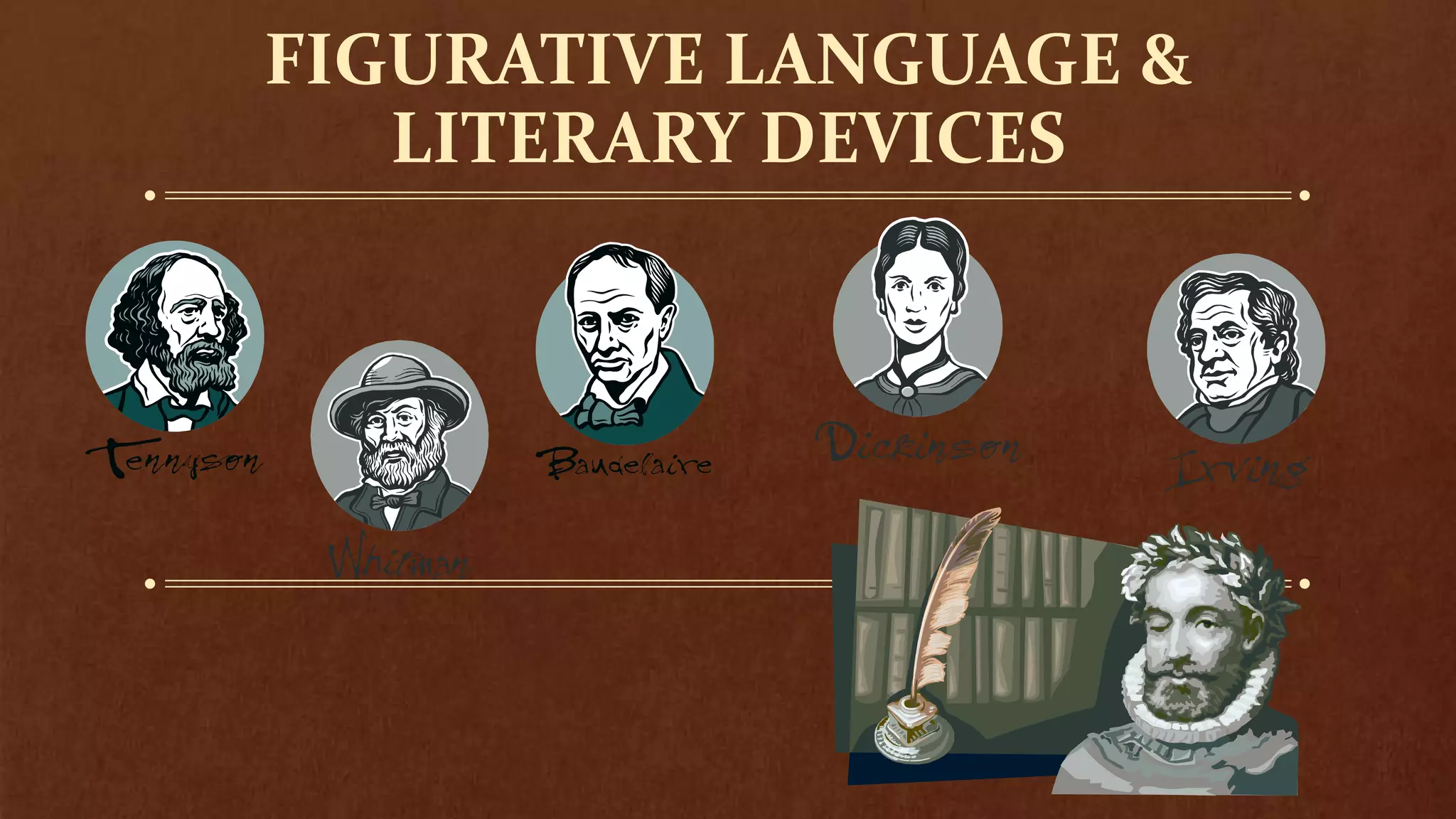
FIGURATIVE LANGUAGE &
LITERARY DEVICES
WHAT IS FIGURATIVE LANGUAGE?
•Figurative language presents ordinary
things in fresh ways, communicating ideas
that go beyond words’ ordinary
meanings.
• HERE ARE SOME EXAMPLES…
FIGURATIVE LANGUAGE:
IT´S LIKE A SIMILE
– a comparison of two unlike things using the words like or as.
Examples of simile:
• “Life is like a box of chocolates.”
• “The girl is as beautiful as a rose.”
• “The willow is like an etching…”
FIGURATIVE LANGUAGE:
IT IS A METAPHOR
– a comparison of two unlike things without using the words like or as.
Examples of metaphor:
• “My father is a tall, sturdy oak.”
• “The hotel is a diamond in the sky.”
• “who know’s if the moon’s a balloon…”
FIGURATIVE LANGUAGE:
PERSONIFICATION
– the giving of human qualities to an animal, object, or idea.
Examples of personification:
• “Hunger sat shivering on the road.”
• “The flowers danced on the lawn.”
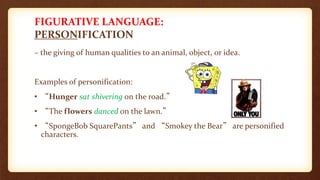
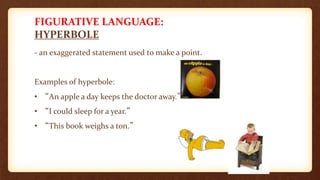
• “SpongeBob SquarePants” and “Smokey the Bear” are personified
characters.
FIGURATIVE LANGUAGE:
HYPERBOLE
- an exaggerated statement used to make a point.
Examples of hyperbole:
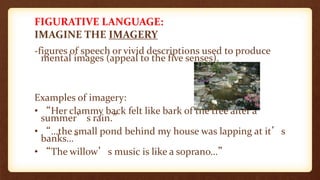
• “An apple a day keeps the doctor away.”
• “I could sleep for a year.”
• “This book weighs a ton.”
FIGURATIVE LANGUAGE:
IMAGINE THE IMAGERY
-figures of speech or vivid descriptions used to produce
mental images (appeal to the five senses).
Examples of imagery:
• “Her clammy back felt like bark of the tree after a
summer’s rain.”
• “…the small pond behind my house was lapping at it’s
banks…”
• “The willow’s music is like a soprano…”
WHAT IS A SOUND DEVICE?
•The effect of a poem can depend on the
sound of its words.
•HERE ARE SOME EXAMPLES…
SOUND DEVICE:
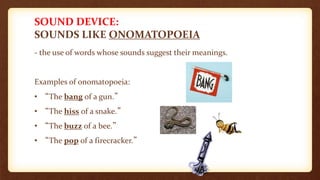
SOUNDS LIKE ONOMATOPOEIA
- the use of words whose sounds suggest their meanings.
Examples of onomatopoeia:
• “The bang of a gun.”
• “The hiss of a snake.”
• “The buzz of a bee.”
• “The pop of a firecracker.”
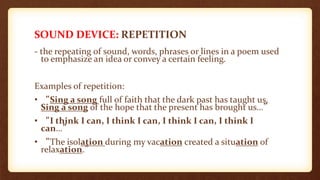
SOUND DEVICE: REPETITION
- the repeating of sound, words, phrases or lines in a poem used
to emphasize an idea or convey a certain feeling.
Examples of repetition:
• “Sing a song full of faith that the dark past has taught us,
Sing a song of the hope that the present has brought us…”
• “I think I can, I think I can, I think I can, I think I
can…”
• “The isolation during my vacation created a situation of
relaxation.”
SOUND DEVICE:
I RHYME ALL THE TIME AND I GUESS IT
SOUNDS FINE…
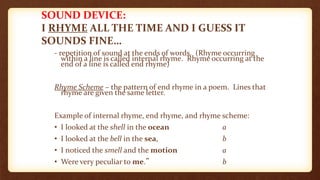
- repetition of sound at the ends of words. (Rhyme occurring
within a line is called internal rhyme. Rhyme occurring at the
end of a line is called end rhyme)
Rhyme Scheme – the pattern of end rhyme in a poem. Lines that
rhyme are given the same letter.
Example of internal rhyme, end rhyme, and rhyme scheme:
• I looked at the shell in the ocean a
• I looked at the bell in the sea, b
• I noticed the smell and the motion a
• Were very peculiar to me.” b
SOUND DEVICE:
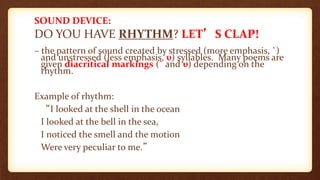
DO YOU HAVE RHYTHM? LET’S CLAP!
– the pattern of sound created by stressed (more emphasis, `)
and unstressed (less emphasis, υ) syllables. Many poems are
given diacritical markings (` and υ) depending on the
rhythm.
Example of rhythm:
“I looked at the shell in the ocean
I looked at the bell in the sea,
I noticed the smell and the motion
Were very peculiar to me.”
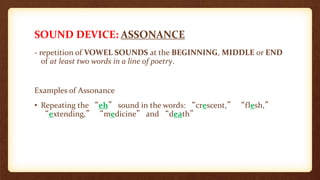
SOUND DEVICE: ASSONANCE
- repetition of VOWEL SOUNDS at the BEGINNING, MIDDLE or END
of at least two words in a line of poetry.
Examples of Assonance
• Repeating the “eh” sound in the words: “crescent,” “flesh,”
“extending,” “medicine” and “death”
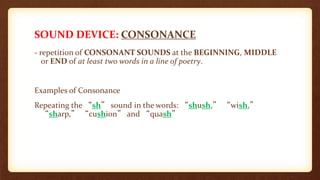
SOUND DEVICE: CONSONANCE
- repetition of CONSONANT SOUNDS at the BEGINNING, MIDDLE
or END of at least two words in a line of poetry.
Examples of Consonance
Repeating the “sh” sound in the words: “shush,” “wish,”
“sharp,” “cushion” and “quash”
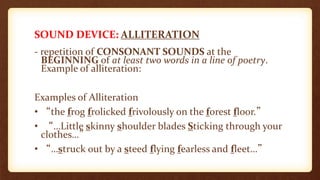
SOUND DEVICE: ALLITERATION
- repetition of CONSONANT SOUNDS at the
BEGINNING of at least two words in a line of poetry.
Example of alliteration:
Examples of Alliteration
• “the frog frolicked frivolously on the forest floor.”
• “…Little skinny shoulder blades Sticking through your
clothes…”
• “…struck out by a steed flying fearless and fleet…”

FIGURATIVE_LANGUAGE__LITERARY_DEVICES.pptx

  • 1.
  • 2.
    WHAT IS FIGURATIVELANGUAGE? •Figurative language presents ordinary things in fresh ways, communicating ideas that go beyond words’ ordinary meanings. • HERE ARE SOME EXAMPLES…
  • 3.
    FIGURATIVE LANGUAGE: IT´S LIKEA SIMILE – a comparison of two unlike things using the words like or as. Examples of simile: • “Life is like a box of chocolates.” • “The girl is as beautiful as a rose.” • “The willow is like an etching…”
  • 4.
    FIGURATIVE LANGUAGE: IT ISA METAPHOR – a comparison of two unlike things without using the words like or as. Examples of metaphor: • “My father is a tall, sturdy oak.” • “The hotel is a diamond in the sky.” • “who know’s if the moon’s a balloon…”
  • 5.
    FIGURATIVE LANGUAGE: PERSONIFICATION – thegiving of human qualities to an animal, object, or idea. Examples of personification: • “Hunger sat shivering on the road.” • “The flowers danced on the lawn.” • “SpongeBob SquarePants” and “Smokey the Bear” are personified characters.
  • 6.
    FIGURATIVE LANGUAGE: HYPERBOLE - anexaggerated statement used to make a point. Examples of hyperbole: • “An apple a day keeps the doctor away.” • “I could sleep for a year.” • “This book weighs a ton.”
  • 7.
    FIGURATIVE LANGUAGE: IMAGINE THEIMAGERY -figures of speech or vivid descriptions used to produce mental images (appeal to the five senses). Examples of imagery: • “Her clammy back felt like bark of the tree after a summer’s rain.” • “…the small pond behind my house was lapping at it’s banks…” • “The willow’s music is like a soprano…”
  • 8.
    WHAT IS ASOUND DEVICE? •The effect of a poem can depend on the sound of its words. •HERE ARE SOME EXAMPLES…
  • 9.
    SOUND DEVICE: SOUNDS LIKEONOMATOPOEIA - the use of words whose sounds suggest their meanings. Examples of onomatopoeia: • “The bang of a gun.” • “The hiss of a snake.” • “The buzz of a bee.” • “The pop of a firecracker.”
  • 10.
    SOUND DEVICE: REPETITION -the repeating of sound, words, phrases or lines in a poem used to emphasize an idea or convey a certain feeling. Examples of repetition: • “Sing a song full of faith that the dark past has taught us, Sing a song of the hope that the present has brought us…” • “I think I can, I think I can, I think I can, I think I can…” • “The isolation during my vacation created a situation of relaxation.”
  • 11.
    SOUND DEVICE: I RHYMEALL THE TIME AND I GUESS IT SOUNDS FINE… - repetition of sound at the ends of words. (Rhyme occurring within a line is called internal rhyme. Rhyme occurring at the end of a line is called end rhyme) Rhyme Scheme – the pattern of end rhyme in a poem. Lines that rhyme are given the same letter. Example of internal rhyme, end rhyme, and rhyme scheme: • I looked at the shell in the ocean a • I looked at the bell in the sea, b • I noticed the smell and the motion a • Were very peculiar to me.” b
  • 12.
    SOUND DEVICE: DO YOUHAVE RHYTHM? LET’S CLAP! – the pattern of sound created by stressed (more emphasis, `) and unstressed (less emphasis, υ) syllables. Many poems are given diacritical markings (` and υ) depending on the rhythm. Example of rhythm: “I looked at the shell in the ocean I looked at the bell in the sea, I noticed the smell and the motion Were very peculiar to me.”
  • 13.
    SOUND DEVICE: ASSONANCE -repetition of VOWEL SOUNDS at the BEGINNING, MIDDLE or END of at least two words in a line of poetry. Examples of Assonance • Repeating the “eh” sound in the words: “crescent,” “flesh,” “extending,” “medicine” and “death”
  • 14.
    SOUND DEVICE: CONSONANCE -repetition of CONSONANT SOUNDS at the BEGINNING, MIDDLE or END of at least two words in a line of poetry. Examples of Consonance Repeating the “sh” sound in the words: “shush,” “wish,” “sharp,” “cushion” and “quash”
  • 15.
    SOUND DEVICE: ALLITERATION -repetition of CONSONANT SOUNDS at the BEGINNING of at least two words in a line of poetry. Example of alliteration: Examples of Alliteration • “the frog frolicked frivolously on the forest floor.” • “…Little skinny shoulder blades Sticking through your clothes…” • “…struck out by a steed flying fearless and fleet…”