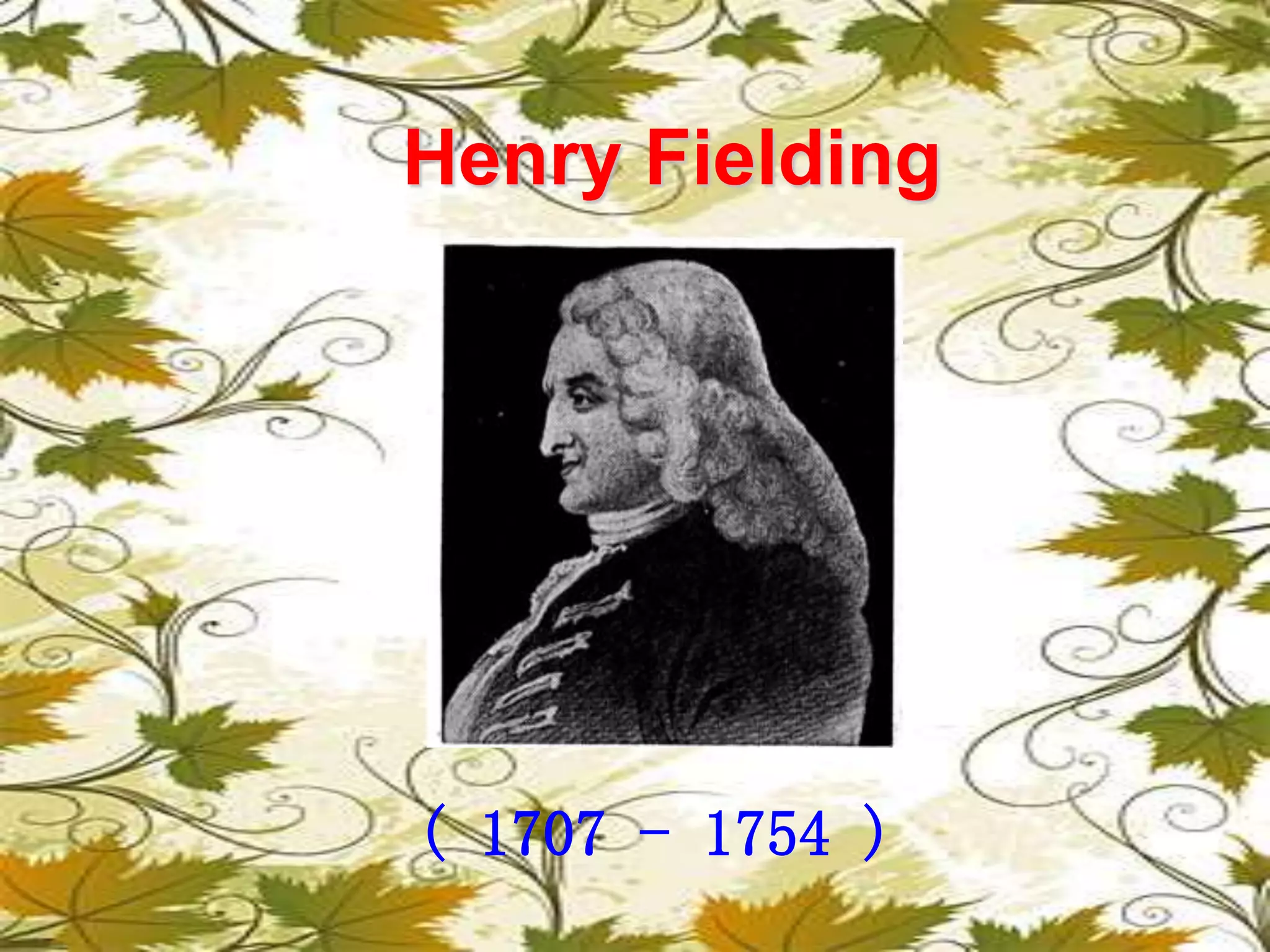
Henry Fielding
( 1707 - 1754 )
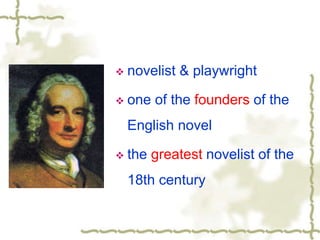
 novelist & playwright
 one of the founders of the
English novel
 the greatest novelist of the
18th century
 I. Life
 II. Fielding’s position
 III. Major Works
 IV. Joseph Andrews
 V Features of Fielding’s
Novels
I. Life and Career
 an aristocratic family
 well educated
 a deep knowledge of life
 In order to make a living for
himself, he began to write
plays and farces for the stage
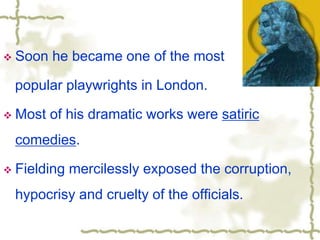
 Soon he became one of the most
popular playwrights in London.
 Most of his dramatic works were satiric
comedies.
 Fielding mercilessly exposed the corruption,
hypocrisy and cruelty of the officials.
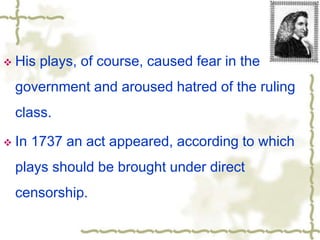
 His plays, of course, caused fear in the
government and aroused hatred of the ruling
class.
 In 1737 an act appeared, according to which
plays should be brought under direct
censorship.
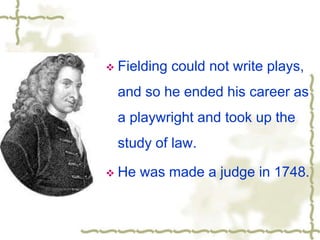
 Fielding could not write plays,
and so he ended his career as
a playwright and took up the
study of law.
 He was made a judge in 1748.
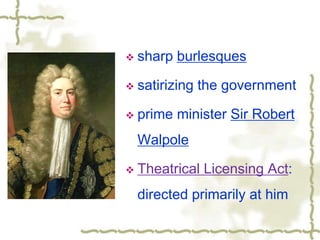
 sharp burlesques
 satirizing the government
 prime minister Sir Robert
Walpole
 Theatrical Licensing Act:
directed primarily at him
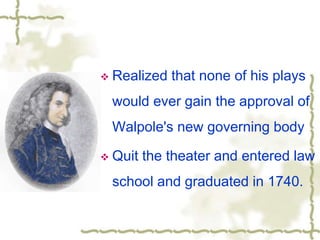
 Realized that none of his plays
would ever gain the approval of
Walpole's new governing body
 Quit the theater and entered law
school and graduated in 1740.
 Began his novel writing by attacking Samuel
Richardson.
 Published his first novel, Joseph Andrews,1742.
a parody of the best-selling novel at the time,
Pamela: or Virtue Rewarded, by Samuel
Richardson, about a virtuous servant girl.
 Followed by
Jonathan Wild the Great
Tom Jones, his masterpiece
Amelia, his last novel
 In his novels, Fielding continued to expose
and fight against social evils of his time.
 His later years were devoted to the duties as
a magistrate.
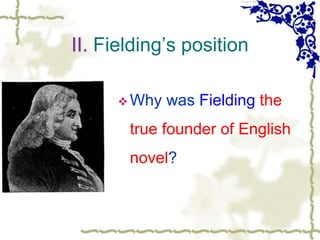
II. Fielding’s position
 Why was Fielding the
true founder of English
novel?
 Defoe: still followed the 17th century tradition of
claiming his fiction was fact.
 Richardson: declared that his tales were moral
tracts, emphasizing the instructional rather than
the fictional aspect.
 Fielding: the first major novelist to unabashedly
write fiction.
 Fielding is the founder of
English realistic novels.
 He set up the theory of
realism in literary creation.
 The exact observation and study of the real
life was the basis of his work.
 He did not rely simply on his imagination.
 He did not imitate the characters depicted in
the works of earlier authors.
 He made a close and constant
study of real men and women in
real life.
 He gave us genuine pictures of
men and women of his own age.
 His aim as a novelist was
to write comic epic in prose
 he once described himself
as “great, tattered bard.”
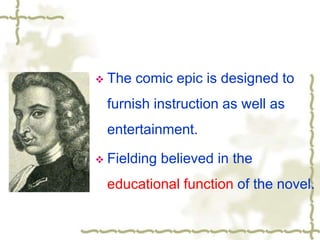
 The comic epic is designed to
furnish instruction as well as
entertainment.
 Fielding believed in the
educational function of the novel.
III. Major Works
 1. Joseph Andrews
 2. Jonathan Wild the Great
 3. Tom Jones
 4. Amelia
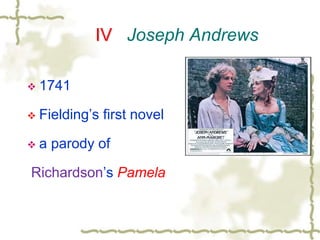
IV Joseph Andrews
 1741
 Fielding’s first novel
 a parody of
Richardson’s Pamela
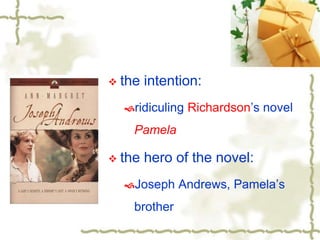
 the intention:
ridiculing Richardson’s novel
Pamela
 the hero of the novel:
Joseph Andrews, Pamela’s
brother
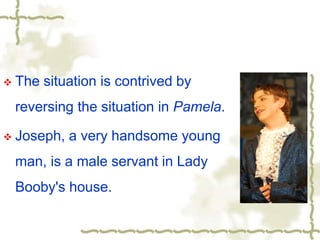
 The situation is contrived by
reversing the situation in Pamela.
 Joseph, a very handsome young
man, is a male servant in Lady
Booby's house.
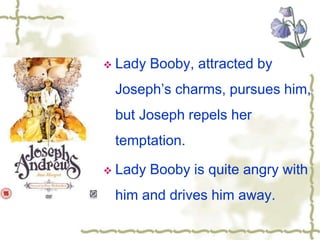
 Lady Booby, attracted by
Joseph’s charms, pursues him,
but Joseph repels her
temptation.
 Lady Booby is quite angry with
him and drives him away.
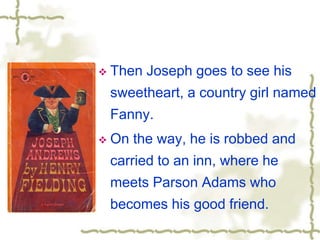
 Then Joseph goes to see his
sweetheart, a country girl named
Fanny.
 On the way, he is robbed and
carried to an inn, where he
meets Parson Adams who
becomes his good friend.
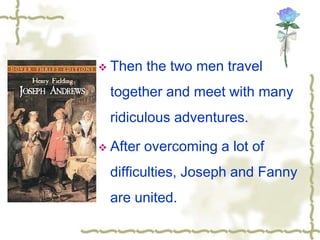
 Then the two men travel
together and meet with many
ridiculous adventures.
 After overcoming a lot of
difficulties, Joseph and Fanny
are united.
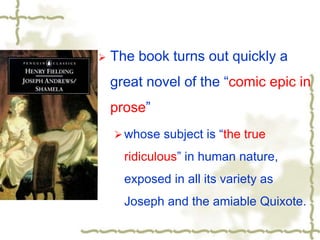
 The book turns out quickly a
great novel of the “comic epic in
prose”
 whose subject is “the true
ridiculous” in human nature,
exposed in all its variety as
Joseph and the amiable Quixote.
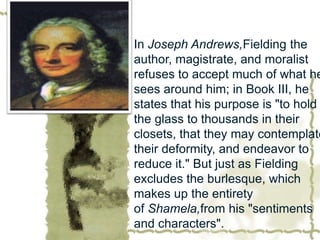
In Joseph Andrews,Fielding the
author, magistrate, and moralist
refuses to accept much of what he
sees around him; in Book III, he
states that his purpose is "to hold
the glass to thousands in their
closets, that they may contemplate
their deformity, and endeavor to
reduce it." But just as Fielding
excludes the burlesque, which
makes up the entirety
of Shamela,from his "sentiments
and characters".
in Joseph Andrews, so too does he progress
beyond a mere criticism of the "ridiculous" to
a positive statement and portrayal of the
values in which he believed. We find that we
are no longer merely laughing at people and
situations, but also laughing with them; we
are taking delight, rather than laughing in
scorn. Our sense of delight at the close
of Joseph Andrews is in no sense destructive,
but represents one of the many aspects of
this book which can be considered under
such headings as form, characterization,
style, and moral tone
Fielding takes his characters through a series of
confusing episodes, finally aligning them with
their correct partners in an improved social
setting, from which the most recalcitrant
characters are excluded; the characters, for the
most part, have all measured and achieved a
greater degree of self-knowledge. Thus the
marriage of Fanny to a more experienced Joseph
takes place in an ideal setting — the country —
and is facilitated by the generosity of an
enlightened Mr. Booby. Lady Booby, unchanged
and unreformed, returns to London, excluding
herself from the society which Fielding has
reshaped.
It is often the business of comedy to correct excess,
and Fielding has not spared the devious practices of
a lawyer Scout, or the boorish greed of a Parson
Trulliber. But his comedy includes a sense of delight,
and the order into which he molds Joseph Andrews is
a positive affirmation of the qualities of love, charity,
and sincerity, expressed by Adams, Joseph, and
Fanny.
.
V. Features of Fielding’s Novels
A. authorial narrative voice
Fielding’s method of relating a
story is telling the story directly
by the author.
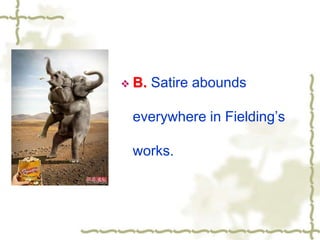
 B. Satire abounds
everywhere in Fielding’s
works.
C. Fielding believed in the educational
function of the novel.
 The object of his novels is to present a faithful
picture of life, while sound teaching is woven
into their very texture.
D. Fielding is a master of style.
 His style is easy and familiar, but extremely vivid
and vigorous.
 His sentences are always distinguished by logic
and musical rhythm.
 His command of language is remarkable.

fielding.ppt

  • 1.
  • 2.
     novelist &playwright  one of the founders of the English novel  the greatest novelist of the 18th century
  • 3.
     I. Life II. Fielding’s position  III. Major Works  IV. Joseph Andrews  V Features of Fielding’s Novels
  • 4.
    I. Life andCareer  an aristocratic family  well educated  a deep knowledge of life  In order to make a living for himself, he began to write plays and farces for the stage
  • 5.
     Soon hebecame one of the most popular playwrights in London.  Most of his dramatic works were satiric comedies.  Fielding mercilessly exposed the corruption, hypocrisy and cruelty of the officials.
  • 6.
     His plays,of course, caused fear in the government and aroused hatred of the ruling class.  In 1737 an act appeared, according to which plays should be brought under direct censorship.
  • 7.
     Fielding couldnot write plays, and so he ended his career as a playwright and took up the study of law.  He was made a judge in 1748.
  • 8.
     sharp burlesques satirizing the government  prime minister Sir Robert Walpole  Theatrical Licensing Act: directed primarily at him
  • 9.
     Realized thatnone of his plays would ever gain the approval of Walpole's new governing body  Quit the theater and entered law school and graduated in 1740.
  • 10.
     Began hisnovel writing by attacking Samuel Richardson.  Published his first novel, Joseph Andrews,1742. a parody of the best-selling novel at the time, Pamela: or Virtue Rewarded, by Samuel Richardson, about a virtuous servant girl.
  • 11.
     Followed by JonathanWild the Great Tom Jones, his masterpiece Amelia, his last novel
  • 12.
     In hisnovels, Fielding continued to expose and fight against social evils of his time.  His later years were devoted to the duties as a magistrate.
  • 13.
    II. Fielding’s position Why was Fielding the true founder of English novel?
  • 14.
     Defoe: stillfollowed the 17th century tradition of claiming his fiction was fact.  Richardson: declared that his tales were moral tracts, emphasizing the instructional rather than the fictional aspect.  Fielding: the first major novelist to unabashedly write fiction.
  • 15.
     Fielding isthe founder of English realistic novels.  He set up the theory of realism in literary creation.
  • 16.
     The exactobservation and study of the real life was the basis of his work.  He did not rely simply on his imagination.  He did not imitate the characters depicted in the works of earlier authors.
  • 17.
     He madea close and constant study of real men and women in real life.  He gave us genuine pictures of men and women of his own age.
  • 18.
     His aimas a novelist was to write comic epic in prose  he once described himself as “great, tattered bard.”
  • 19.
     The comicepic is designed to furnish instruction as well as entertainment.  Fielding believed in the educational function of the novel.
  • 20.
    III. Major Works 1. Joseph Andrews  2. Jonathan Wild the Great  3. Tom Jones  4. Amelia
  • 21.
    IV Joseph Andrews 1741  Fielding’s first novel  a parody of Richardson’s Pamela
  • 22.
     the intention: ridiculingRichardson’s novel Pamela  the hero of the novel: Joseph Andrews, Pamela’s brother
  • 23.
     The situationis contrived by reversing the situation in Pamela.  Joseph, a very handsome young man, is a male servant in Lady Booby's house.
  • 24.
     Lady Booby,attracted by Joseph’s charms, pursues him, but Joseph repels her temptation.  Lady Booby is quite angry with him and drives him away.
  • 25.
     Then Josephgoes to see his sweetheart, a country girl named Fanny.  On the way, he is robbed and carried to an inn, where he meets Parson Adams who becomes his good friend.
  • 26.
     Then thetwo men travel together and meet with many ridiculous adventures.  After overcoming a lot of difficulties, Joseph and Fanny are united.
  • 27.
     The bookturns out quickly a great novel of the “comic epic in prose”  whose subject is “the true ridiculous” in human nature, exposed in all its variety as Joseph and the amiable Quixote.
  • 28.
    In Joseph Andrews,Fieldingthe author, magistrate, and moralist refuses to accept much of what he sees around him; in Book III, he states that his purpose is "to hold the glass to thousands in their closets, that they may contemplate their deformity, and endeavor to reduce it." But just as Fielding excludes the burlesque, which makes up the entirety of Shamela,from his "sentiments and characters".
  • 29.
    in Joseph Andrews,so too does he progress beyond a mere criticism of the "ridiculous" to a positive statement and portrayal of the values in which he believed. We find that we are no longer merely laughing at people and situations, but also laughing with them; we are taking delight, rather than laughing in scorn. Our sense of delight at the close of Joseph Andrews is in no sense destructive, but represents one of the many aspects of this book which can be considered under such headings as form, characterization, style, and moral tone
  • 30.
    Fielding takes hischaracters through a series of confusing episodes, finally aligning them with their correct partners in an improved social setting, from which the most recalcitrant characters are excluded; the characters, for the most part, have all measured and achieved a greater degree of self-knowledge. Thus the marriage of Fanny to a more experienced Joseph takes place in an ideal setting — the country — and is facilitated by the generosity of an enlightened Mr. Booby. Lady Booby, unchanged and unreformed, returns to London, excluding herself from the society which Fielding has reshaped.
  • 31.
    It is oftenthe business of comedy to correct excess, and Fielding has not spared the devious practices of a lawyer Scout, or the boorish greed of a Parson Trulliber. But his comedy includes a sense of delight, and the order into which he molds Joseph Andrews is a positive affirmation of the qualities of love, charity, and sincerity, expressed by Adams, Joseph, and Fanny. .
  • 32.
    V. Features ofFielding’s Novels A. authorial narrative voice Fielding’s method of relating a story is telling the story directly by the author.
  • 33.
     B. Satireabounds everywhere in Fielding’s works.
  • 34.
    C. Fielding believedin the educational function of the novel.  The object of his novels is to present a faithful picture of life, while sound teaching is woven into their very texture.
  • 35.
    D. Fielding isa master of style.  His style is easy and familiar, but extremely vivid and vigorous.  His sentences are always distinguished by logic and musical rhythm.  His command of language is remarkable.