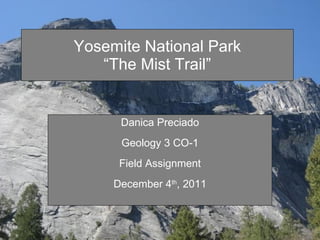
Yosemite National Park “The Mist Trail” Danica Preciado Geology 3 CO-1 Field Assignment December 4 th , 2011
Content Background and Method Park Information Seasonal Weather/Climate Waterfall/River Geology Tree Examples Habitats Rock Samples References
Background and Research Methodology In early August I visited “The Mist Trail” which is one of many trails of the Yosemite National Park.  Most of the photos used in this report were taken from this trip. Map images used came from Google.  Vernal and Nevada Falls I provided along with some tree photos. Animal pictures came from Internet. Identification of rock came from  Topinka(2002) Identification of tree came from Browse Trees (n.d)
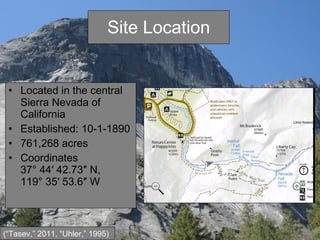
Site Location Located in the central Sierra Nevada of California  Established: 10-1-1890 761,268 acres  Coordinates 37° 44′ 42.73″ N, 119° 35′ 53.6″ W  (“Tasev,” 2011, “Uhler,” 1995)
Park Information Yosemite National Park was established on 01 October 1890. It is the Nation's third oldest national park. It is a show case spectacular geological features, such as the greatest concentration of granite domes and largest exposed granite monolith in the world. Abraham Lincoln signed the grant of 1864 which was the first application of a park concept that originated in Yosemite. Yosemite plays an important role in wildlife preservation and preserving biological diversity. It’s a world heritage site that provides solitude and inspiration and serves as an outdoor classroom for environmental education.  (“Uhler,” 1995)
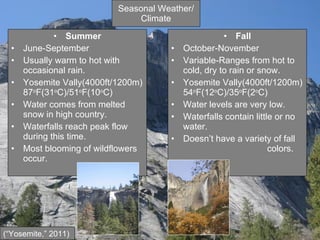
Seasonal Weather/Climate Summer June-September Usually warm to hot with occasional rain. Yosemite Vally(4000ft/1200m) 87 o F(31 o C)/51 o F(10 o C) Water comes from melted snow in high country. Waterfalls reach peak flow during this time. Most blooming of wildflowers occur. Fall October-November Variable-Ranges from hot to cold, dry to rain or snow. Yosemite Vally(4000ft/1200m) 54 o F(12 o C)/35 o F(2 o C) Water levels are very low. Waterfalls contain little or no water. Doesn’t have a variety of fall  colors. (“Yosemite,” 2011)
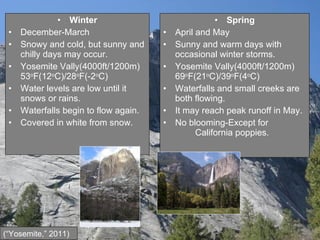
Winter December-March Snowy and cold, but sunny and chilly days may occur. Yosemite Vally(4000ft/1200m) 53 o F(12 o C)/28 o F(-2 o C) Water levels are low until it snows or rains. Waterfalls begin to flow again. Covered in white from snow. Spring April and May Sunny and warm days with occasional winter storms. Yosemite Vally(4000ft/1200m) 69 o F(21 o C)/39 o F(4 o C) Waterfalls and small creeks are both flowing. It may reach peak runoff in May. No blooming-Except for  California poppies. (“Yosemite,” 2011)
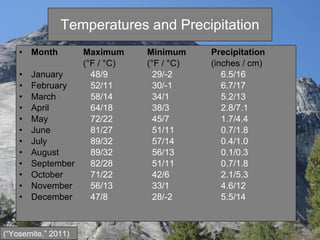
Temperatures and Precipitation Month Maximum   Minimum Precipitation   (°F / °C) (°F / °C) (inches / cm) January   48/9   29/-2   6.5/16 February   52/11   30/-1   6.7/17 March   58/14   34/1    5.2/13 April   64/18   38/3   2.8/7.1 May   72/22   45/7    1.7/4.4 June   81/27   51/11   0.7/1.8 July   89/32   57/14   0.4/1.0 August   89/32   56/13   0.1/0.3 September   82/28   51/11   0.7/1.8 October   71/22   42/6   2.1/5.3 November   56/13   33/1   4.6/12 December   47/8   28/-2   5.5/14 (“Yosemite,” 2011)
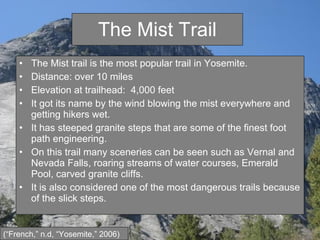
The Mist Trail The Mist trail is the most popular trail in Yosemite. Distance: over 10 miles Elevation at trailhead:  4,000 feet  It got its name by the wind blowing the mist everywhere and getting hikers wet. It has steeped granite steps that are some of the finest foot path engineering. On this trail many sceneries can be seen such as Vernal and Nevada Falls, roaring streams of water courses, Emerald Pool, carved granite cliffs. It is also considered one of the most dangerous trails because of the slick steps. (“French,” n.d, “Yosemite,” 2006)
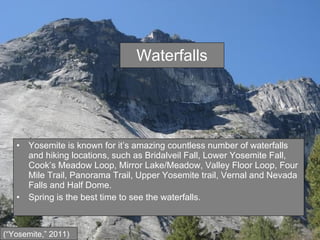
Waterfalls Yosemite is known for it’s amazing countless number of waterfalls and hiking locations, such as Bridalveil Fall, Lower Yosemite Fall, Cook’s Meadow Loop, Mirror Lake/Meadow, Valley Floor Loop, Four Mile Trail, Panorama Trail, Upper Yosemite trail, Vernal and Nevada Falls and Half Dome. Spring is the best time to see the waterfalls. (“Yosemite,” 2011)
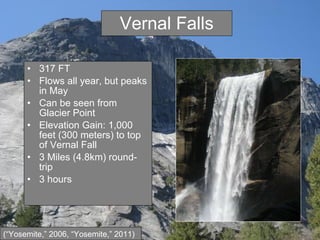
Vernal Falls 317 FT Flows all year, but peaks in May Can be seen from Glacier Point Elevation Gain: 1,000 feet (300 meters) to top of Vernal Fall 3 Miles (4.8km) round-trip 3 hours (“Yosemite,” 2006, “Yosemite,” 2011)
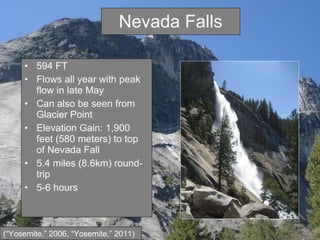
Nevada Falls 594 FT Flows all year with peak flow in late May Can also be seen from Glacier Point Elevation Gain: 1,900 feet (580 meters) to top of Nevada Fall 5.4 miles (8.6km) round-trip 5-6 hours (“Yosemite,” 2006, “Yosemite,” 2011)
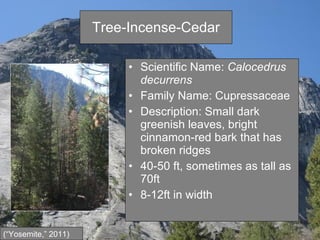
Tree-Incense-Cedar Scientific Name:  Calocedrus decurrens   Family Name: Cupressaceae  Description: Small dark greenish leaves, bright cinnamon-red bark that has broken ridges 40-50 ft, sometimes as tall as 70ft 8-12ft in width (“Yosemite,” 2011)
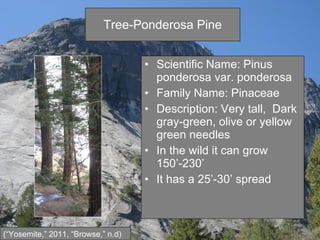
Tree-Ponderosa Pine Scientific Name: Pinus ponderosa var. ponderosa  Family Name: Pinaceae Description: Very tall,  Dark gray-green, olive or yellow green needles  In the wild it can grow 150’-230’ It has a 25’-30’ spread (“Yosemite,” 2011, “Browse,” n.d)
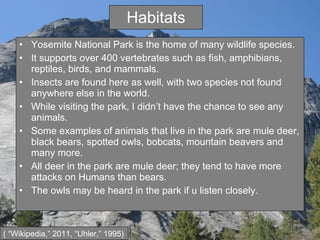
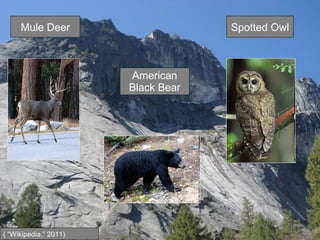
Habitats Yosemite National Park is the home of many wildlife species. It supports over 400 vertebrates such as fish, amphibians, reptiles, birds, and mammals.  Insects are found here as well, with two species not found anywhere else in the world. While visiting the park, I didn’t have the chance to see any animals. Some examples of animals that live in the park are mule deer, black bears, spotted owls, bobcats, mountain beavers and many more. All deer in the park are mule deer; they tend to have more attacks on Humans than bears. The owls may be heard in the park if u listen closely. ( “Wikipedia,” 2011, “Uhler,” 1995)
American Black Bear Mule Deer Spotted Owl ( “Wikipedia,” 2011)
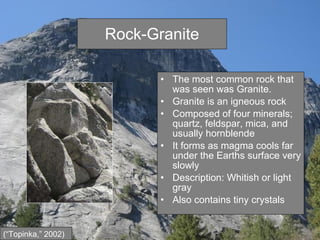
Rock-Granite The most common rock that was seen was Granite. Granite is an igneous rock Composed of four minerals; quartz, feldspar, mica, and usually hornblende  It forms as magma cools far under the Earths surface very slowly Description: Whitish or light gray Also contains tiny crystals (“Topinka,” 2002)
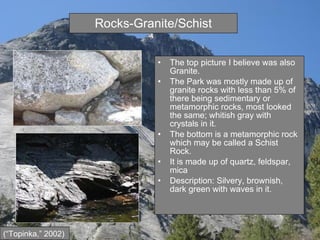
Rocks-Granite/Schist The top picture I believe was also Granite.  The Park was mostly made up of granite rocks with less than 5% of there being sedimentary or metamorphic rocks, most looked the same; whitish gray with crystals in it. The bottom is a metamorphic rock which may be called a Schist Rock. It is made up of quartz, feldspar, mica  Description: Silvery, brownish, dark green with waves in it. (“Topinka,” 2002)
References &quot;Browse Trees—Tree Guide at Arborday.org.&quot;  Buy Trees and Learn About Trees - Visit Our Online  Nursery . Arbor Day Foundation. Web. 26 Oct. 2011.  <http://www.arborday.org/treeguide/browsetrees.cfm>.  French, Dave. &quot;The Mist Trail Yosemite National Park.&quot; Climbing, Hiking and  Mountaineering at  Timberline Trails. Timberlines Trails. Web. 24 Oct. 2011.  <http://timberlinetrails.net/YosemiteMistTrail.html>. Peck, Donald B. &quot;Rock Key.&quot;  Bob's Rock Shop: The First 'Zine for Mineral Collectors and  Rockhounds . Don Peck, 2001. Web. 28 Oct. 2011.  <http://www.rockhounds.com/rockshop/rockkey/>.    Tasev, Ivan. &quot;Google Custom Maps | Mapsys.info.&quot; Mapsys Info - Mapping and Geospatial  News. Google, 2011. Web. 29 Sept. 2011. <http://mapsys.info/62799/google-custom- maps/>. Topinka, Lyn. &quot;CVO Menu - America's Volcanic Past - Yosemite.&quot; USGS Cascades Volcano  Observatory (CVO). USGS, 20 Sept. 2002. Web. 27 Oct. 2011.  <http://vulcan.wr.usgs.gov/LivingWith/VolcanicPast/Places/volcanic_past_yosemite.html>. Uhler, John W. &quot;Yosemite National Park Information Page.&quot; Yosemite National Park. Hillclimb  Media, 1995. Web. 26 Oct. 2011. <http://www.yosemite.national-park.com/info.htm>.    &quot;Yosemite Hikes: The Mist Trail.&quot; Yosemite Hikes: The Best Hikes in Yosemite National  Park.  Yosemite Hikes, 2006. Web. 28 Oct. 2011. <http://www.yosemitehikes.com/yosemite- valley/mist-trail/mist-trail.htm>.   &quot;Yosemite National Park (U.S. National Park Service).&quot; U.S. National Park Service - Experience  Your America. National Park Sevice, 2011. Web. 24 Oct. 2011.  <http://www.nps.gov/yose/index.htm>.   &quot;Yosemite National Park.&quot; Wikipedia, the Free Encyclopedia. Wikipedia. Web. 28 Oct. 2011.  <http://en.wikipedia.org/wiki/Yosemite_National_Park>.

Field assignment-Yosemite National Park.

  • 1.
    Yosemite National Park“The Mist Trail” Danica Preciado Geology 3 CO-1 Field Assignment December 4 th , 2011
  • 2.
    Content Background andMethod Park Information Seasonal Weather/Climate Waterfall/River Geology Tree Examples Habitats Rock Samples References
  • 3.
    Background and ResearchMethodology In early August I visited “The Mist Trail” which is one of many trails of the Yosemite National Park. Most of the photos used in this report were taken from this trip. Map images used came from Google. Vernal and Nevada Falls I provided along with some tree photos. Animal pictures came from Internet. Identification of rock came from Topinka(2002) Identification of tree came from Browse Trees (n.d)
  • 4.
    Site Location Locatedin the central Sierra Nevada of California Established: 10-1-1890 761,268 acres Coordinates 37° 44′ 42.73″ N, 119° 35′ 53.6″ W (“Tasev,” 2011, “Uhler,” 1995)
  • 5.
    Park Information YosemiteNational Park was established on 01 October 1890. It is the Nation's third oldest national park. It is a show case spectacular geological features, such as the greatest concentration of granite domes and largest exposed granite monolith in the world. Abraham Lincoln signed the grant of 1864 which was the first application of a park concept that originated in Yosemite. Yosemite plays an important role in wildlife preservation and preserving biological diversity. It’s a world heritage site that provides solitude and inspiration and serves as an outdoor classroom for environmental education. (“Uhler,” 1995)
  • 6.
    Seasonal Weather/Climate SummerJune-September Usually warm to hot with occasional rain. Yosemite Vally(4000ft/1200m) 87 o F(31 o C)/51 o F(10 o C) Water comes from melted snow in high country. Waterfalls reach peak flow during this time. Most blooming of wildflowers occur. Fall October-November Variable-Ranges from hot to cold, dry to rain or snow. Yosemite Vally(4000ft/1200m) 54 o F(12 o C)/35 o F(2 o C) Water levels are very low. Waterfalls contain little or no water. Doesn’t have a variety of fall colors. (“Yosemite,” 2011)
  • 7.
    Winter December-March Snowyand cold, but sunny and chilly days may occur. Yosemite Vally(4000ft/1200m) 53 o F(12 o C)/28 o F(-2 o C) Water levels are low until it snows or rains. Waterfalls begin to flow again. Covered in white from snow. Spring April and May Sunny and warm days with occasional winter storms. Yosemite Vally(4000ft/1200m) 69 o F(21 o C)/39 o F(4 o C) Waterfalls and small creeks are both flowing. It may reach peak runoff in May. No blooming-Except for California poppies. (“Yosemite,” 2011)
  • 8.
    Temperatures and PrecipitationMonth Maximum   Minimum Precipitation   (°F / °C) (°F / °C) (inches / cm) January 48/9 29/-2 6.5/16 February 52/11 30/-1 6.7/17 March 58/14 34/1 5.2/13 April 64/18 38/3 2.8/7.1 May 72/22 45/7 1.7/4.4 June 81/27 51/11 0.7/1.8 July 89/32 57/14 0.4/1.0 August 89/32 56/13 0.1/0.3 September 82/28 51/11 0.7/1.8 October 71/22 42/6 2.1/5.3 November 56/13 33/1 4.6/12 December 47/8 28/-2 5.5/14 (“Yosemite,” 2011)
  • 9.
    The Mist TrailThe Mist trail is the most popular trail in Yosemite. Distance: over 10 miles Elevation at trailhead:  4,000 feet It got its name by the wind blowing the mist everywhere and getting hikers wet. It has steeped granite steps that are some of the finest foot path engineering. On this trail many sceneries can be seen such as Vernal and Nevada Falls, roaring streams of water courses, Emerald Pool, carved granite cliffs. It is also considered one of the most dangerous trails because of the slick steps. (“French,” n.d, “Yosemite,” 2006)
  • 10.
    Waterfalls Yosemite isknown for it’s amazing countless number of waterfalls and hiking locations, such as Bridalveil Fall, Lower Yosemite Fall, Cook’s Meadow Loop, Mirror Lake/Meadow, Valley Floor Loop, Four Mile Trail, Panorama Trail, Upper Yosemite trail, Vernal and Nevada Falls and Half Dome. Spring is the best time to see the waterfalls. (“Yosemite,” 2011)
  • 11.
    Vernal Falls 317FT Flows all year, but peaks in May Can be seen from Glacier Point Elevation Gain: 1,000 feet (300 meters) to top of Vernal Fall 3 Miles (4.8km) round-trip 3 hours (“Yosemite,” 2006, “Yosemite,” 2011)
  • 12.
    Nevada Falls 594FT Flows all year with peak flow in late May Can also be seen from Glacier Point Elevation Gain: 1,900 feet (580 meters) to top of Nevada Fall 5.4 miles (8.6km) round-trip 5-6 hours (“Yosemite,” 2006, “Yosemite,” 2011)
  • 13.
    Tree-Incense-Cedar Scientific Name: Calocedrus decurrens Family Name: Cupressaceae Description: Small dark greenish leaves, bright cinnamon-red bark that has broken ridges 40-50 ft, sometimes as tall as 70ft 8-12ft in width (“Yosemite,” 2011)
  • 14.
    Tree-Ponderosa Pine ScientificName: Pinus ponderosa var. ponderosa Family Name: Pinaceae Description: Very tall, Dark gray-green, olive or yellow green needles In the wild it can grow 150’-230’ It has a 25’-30’ spread (“Yosemite,” 2011, “Browse,” n.d)
  • 15.
    Habitats Yosemite NationalPark is the home of many wildlife species. It supports over 400 vertebrates such as fish, amphibians, reptiles, birds, and mammals. Insects are found here as well, with two species not found anywhere else in the world. While visiting the park, I didn’t have the chance to see any animals. Some examples of animals that live in the park are mule deer, black bears, spotted owls, bobcats, mountain beavers and many more. All deer in the park are mule deer; they tend to have more attacks on Humans than bears. The owls may be heard in the park if u listen closely. ( “Wikipedia,” 2011, “Uhler,” 1995)
  • 16.
    American Black BearMule Deer Spotted Owl ( “Wikipedia,” 2011)
  • 17.
    Rock-Granite The mostcommon rock that was seen was Granite. Granite is an igneous rock Composed of four minerals; quartz, feldspar, mica, and usually hornblende It forms as magma cools far under the Earths surface very slowly Description: Whitish or light gray Also contains tiny crystals (“Topinka,” 2002)
  • 18.
    Rocks-Granite/Schist The toppicture I believe was also Granite. The Park was mostly made up of granite rocks with less than 5% of there being sedimentary or metamorphic rocks, most looked the same; whitish gray with crystals in it. The bottom is a metamorphic rock which may be called a Schist Rock. It is made up of quartz, feldspar, mica Description: Silvery, brownish, dark green with waves in it. (“Topinka,” 2002)
  • 19.
    References &quot;Browse Trees—TreeGuide at Arborday.org.&quot; Buy Trees and Learn About Trees - Visit Our Online Nursery . Arbor Day Foundation. Web. 26 Oct. 2011. <http://www.arborday.org/treeguide/browsetrees.cfm>. French, Dave. &quot;The Mist Trail Yosemite National Park.&quot; Climbing, Hiking and Mountaineering at Timberline Trails. Timberlines Trails. Web. 24 Oct. 2011. <http://timberlinetrails.net/YosemiteMistTrail.html>. Peck, Donald B. &quot;Rock Key.&quot; Bob's Rock Shop: The First 'Zine for Mineral Collectors and Rockhounds . Don Peck, 2001. Web. 28 Oct. 2011. <http://www.rockhounds.com/rockshop/rockkey/>.   Tasev, Ivan. &quot;Google Custom Maps | Mapsys.info.&quot; Mapsys Info - Mapping and Geospatial News. Google, 2011. Web. 29 Sept. 2011. <http://mapsys.info/62799/google-custom- maps/>. Topinka, Lyn. &quot;CVO Menu - America's Volcanic Past - Yosemite.&quot; USGS Cascades Volcano Observatory (CVO). USGS, 20 Sept. 2002. Web. 27 Oct. 2011. <http://vulcan.wr.usgs.gov/LivingWith/VolcanicPast/Places/volcanic_past_yosemite.html>. Uhler, John W. &quot;Yosemite National Park Information Page.&quot; Yosemite National Park. Hillclimb Media, 1995. Web. 26 Oct. 2011. <http://www.yosemite.national-park.com/info.htm>.   &quot;Yosemite Hikes: The Mist Trail.&quot; Yosemite Hikes: The Best Hikes in Yosemite National Park. Yosemite Hikes, 2006. Web. 28 Oct. 2011. <http://www.yosemitehikes.com/yosemite- valley/mist-trail/mist-trail.htm>.   &quot;Yosemite National Park (U.S. National Park Service).&quot; U.S. National Park Service - Experience Your America. National Park Sevice, 2011. Web. 24 Oct. 2011. <http://www.nps.gov/yose/index.htm>.   &quot;Yosemite National Park.&quot; Wikipedia, the Free Encyclopedia. Wikipedia. Web. 28 Oct. 2011. <http://en.wikipedia.org/wiki/Yosemite_National_Park>.